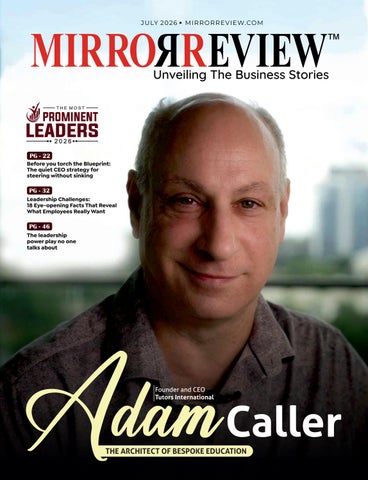
J U LY 2 0 2 6
M I R R O R R EVI EW.CO M
™
THE MOST
PROMINENT
LEADERS 2026
PG - 22 Before you torch the Blueprint: The quiet CEO strategy for steering without sinking
PG - 32 Leadership Challenges: 18 Eye-opening Facts That Reveal What Employees Really Want
PG - 46 The leadership power play no one talks about
Adam Caller Founder and CEO Tutors International
THE ARCHITECT OF BESPOKE EDUCATION
EDITOR’S
Leading Today, Shaping Tomorrow!
Dear Readers, Every generation produces a handful of individuals who refuse to accept that the old way is the only way. This year, our pages turn to five such figures, whose work spans education, talent, and technology, in an issue we are proud to call “The Most Prominent Leaders, 2026.” What unites them is not industry or geography, but a shared instinct to notice what is broken and the resolve to fix it, often quietly, always deliberately. Their stories are less about ambition and more about a belief that people, whether pupils, employees or organisations, deserve better than the systems built around them. In the pages that follow, we trace how each turned frustration into design. Our cover feature belongs to Adam Caller, Founder and CEO of Tutors International, whose path to education ran through civil engineering and seven years in a classroom before he chose a different route. In 1999, having watched agencies overlook what families and children genuinely needed, he built a company that positions itself not as an agency but as an employer, one that stays involved throughout every placement rather than stepping back after an introduction. His process resists shortcuts: every family is met in person, every candidate interviewed face to face, every search begun afresh. Adam speaks openly about the absence of formula in his work, trusting instinct honed over decades and guided always by what is best for the child. As demand grows, driven partly by parental unease over artificial intelligence in schools, he remains unhurried, insisting only that families reach out early, since his process cannot be rushed. Alongside him, this issue also celebrates Corey Shaw, Founder of North Star Talent; Nuno Fontoura, Director of NabiaEdge; Kojima Hiromichi, CEO of AGORAARS; and Lisa Sisson, Founder of Unearth Technologies Pty Ltd. Together, these leaders remind us that influence is rarely loud. It is built through patience, precision, and a refusal to settle for systems that no longer serve the people within them. As their industries evolve at a pace few could have predicted, their steady leadership offers a blueprint worth studying, not just for what they have built, but for how they continue to build it. Sincerely,
SIMRAN KHAN Managing Editor
Publisher Archana Ghule Editor-in-Chief Vikram Suryawanshi Managing Editor Simran Khan Project Editor Shadab Mestri ™
Mirror Review Magazine is published by Pericles Ventures Pvt. Ltd. No part of this publication may be reproduced, distributed, or used in any form without prior written consent from the publisher. The editorial team has exercised utmost diligence to ensure the accuracy and integrity of all published content; however, the publisher assumes no liability for any errors or omissions. The publisher also bears no responsibility for the content of advertisements featured within the magazine.
Mirror Review Media & Tech
Project Managers Maria Jackson Vaishnavi Dahatonde Visualizer Mark Davis Graphic Designer Chaitanya Kulkarni Head of Distribution and Production Aakash Mahajan
Office No. 430, 4th Floor, Gera’s Imperium Rise, Opp. Wipro Circle, Hinjewadi Phase 2, Pune, Maharashtra - 411057.
Head of Operations Robert Smith
+1 (850) 564-8517
Research Analysts James Adams
info@mirrorreview.com www.mirrorreview.com
Advertising Maria Smith
10. Adam Caller
16. Corey Shaw 26. Kojima Hiromichi 36. Lisa Sisson 50. Nuno Fontoura
Articles 22.
Before you torch the Blueprint: The quiet CEO strategy for steering without sinking
32.
Leadership Challenges: 18 Eye-opening Facts That Reveal What Employees Really Want
46.
The Leadership Power Play No One Talks About
Content
Profiles
The Most Prominent Leaders, 2026 Adam Caller
Corey Shaw
Founder &CEO Tutors International
Founder North Star Talent
www.tutors-international.com
www.northstartlnt.com
Kojima Hiromichi
Lisa Sisson
Chief Executive Officer AGORAARS
Founder Unearth Technologies Pty Ltd.
linkedin - AGORAARSS
www.unearth.com.au
Nuno Fontoura Director NabiaEdge www.nabiaedge.com
COVER STORY
10 | JULY 2026
Adam Caller Founder and CEO Tutors International
THE ARCHITECT OF BESPOKE EDUCATION
MIRRORREVIEW.COM | 11
ADAM CALLER did not set out to spend his life inside classrooms, matching gifted teachers to families who needed them most. He began, of all things, with a degree in Civil Engineering, the kind of qualification that suggests bridges and blueprints, not report cards and reading lists. But something pulled him toward teaching instead, and he trained as a secondary school teacher, eventually spending seven years in the classroom, guiding students between the ages of eleven and eighteen through the ordinary chaos of adolescence and algebra alike. Then came a pivot that would define the rest of his career. He left the classroom, not because he had become tired of teaching, but because he no longer wanted to work inside the structure of a school. He became a full-time, residential private tutor, moving into the lives of families rather than standing in front of a room of thirty students. It was in that role, quietly observing how the agencies operated, that he noticed something was missing. The agencies were not paying close attention to what families, and especially the children, truly needed. Nor were they paying much attention to what he, as a tutor, could actually offer. So in 1999, Adam did what dissatisfied professionals rarely have the nerve to do: he built Tutors International to do the job properly, eventually growing into his role as Founder and CEO of the company. Not an Agency, an Employer Ask Adam what separates his company from the dozens of other tutoring services in the world, and he will correct you before you finish the question. Tutors International is not an agency. It is an employer. His tutors work for the company, sometimes as contractors, sometimes as employees, but always under its guidance and support. This distinction is not a matter of semantics for him. Where agencies tend to introduce a tutor and step back, Adam’s company maintains a continuous contract with both the client family and the tutor, staying involved throughout the placement.
12 | JULY 2026
“
When a child is homeschooled by a really fantastic educator, the child has more time for social activities.
That involvement, he explains, is what allows small problems to be addressed before they become larger ones. It also explains why the company insists on meeting every family in person, spending time with the children themselves, before a single candidate is considered. Only after a detailed job description has been agreed upon does the recruitment process begin, and even then, every candidate under consideration is interviewed in person. There is no scrolling through a database of pre-approved names. Each search, he says, starts fresh. “We literally headhunt for each circumstance afresh.” No Formula, Only Instinct For a company built on precision, Adam is remarkably candid about the limits of process. When asked how he matches tutors to a family’s particular learning style or personality, he does not describe an algorithm or a checklist. He describes something closer to intuition, sharpened over decades. “There is no formula to this,” he admits, adding that he sometimes wishes there were, if only to make the work easier.
COVER STORY The second criticism, aimed more at tutors supporting children still enrolled in school, is that the tutor becomes a crutch, something the child leans on instead of learning to stand independently. He rejects this framing entirely. The purpose of a tutor, in his view, is rarely to create dependency. Good tutors, he says, often make themselves redundant because their real task is teaching a child to eventually succeed without them. What Makes a Tutor Worth Hiring
But he is quick to note that a formula would strip away the very individuality the company is built to protect. That instinct is guided, he says, by one constant above all else: what is genuinely best for the child. It is the single principle he returns to repeatedly, the filter through which every other decision passes.
Adam is unusually selective about who gets to represent Tutors International, and he is transparent about why. He is not interested in candidates who have only dabbled in afterschool tutoring without full course responsibility. Subject specialists who can teach only one discipline are unlikely to make the cut, and neither are candidates who lack international experience or additional language skills. What he wants instead are seasoned professionals, people with a genuine teaching degree and years of demonstrable classroom experience, capable of thriving independently without the built-in support structure of a traditional school environment. It is a deliberately high bar because the people he places are often the only educators a child will have.
Defending the Homeschooled and the Supported
Leading Through Twenty-Six Years
Adam has heard the criticisms of private tutoring more times than he can count, and he does not flinch from them. The most common concern, particularly around homeschooling, is that a child will miss out on socialisation. He considers this one of the least significant criticisms directed at his industry. In his experience, a child taught well by a dedicated educator often has more time, not less, to pursue sports, music, faith, drama, debate, or community service, and he sees it as part of the tutor’s responsibility to actively seek out those opportunities.
Adam’s account of leadership is refreshingly unromantic. He does not describe crisis management or dramatic turnarounds. Instead, he describes surrounding himself with people he believes are better than him, empowering them, and backing their ideas once they have earned his trust. He credits the company’s stability, now spanning twenty-six years, to being consistently clear about its ethos and purpose, which he says helps resolve disagreements quickly whenever they arise.
MIRRORREVIEW.COM | 13
COVER STORY Many members of his leadership team, he notes, have been with the company for most of that history, a detail he offers not as a boast but as evidence of something durable. Measuring an Impact That Resists Numbers When asked to name Tutors International's greatest achievements, Adam hesitates, not out of modesty, but because he genuinely finds the question difficult to answer in measurable terms. The company is often brought in precisely because a problem has resisted every previous educator or consultant who attempted to solve it. When that intervention succeeds, the child at the centre of it may one day inherit a significant company or carry responsibility for the livelihoods of thousands of families connected to that business. Knowing his company played a role in supporting that kind of generational continuity was, in his words, deeply gratifying, even if it cannot be reduced to a statistic. Looking Toward 2026 and the Question of AI Adam is candid about where he thinks private education is heading. The company, he says, continues to experience significant growth. But the driving force behind that growth is not simply demand for tutoring itself. There is a growing unease among his clients that traditional school and university systems have not kept pace with the speed of technological change, particularly artificial intelligence. Some families, he observes, worry that AI could eventually replace classroom teachers altogether, and it is precisely that anxiety that is pushing them toward something more personal, something they hope will prepare their children to lead the next generation rather than simply keep up with it. A Life That Does Not Feel Like Work For someone running a global operation, Adam describes his relationship with balance in strikingly simple terms. He does not see his work as a burden. He meets fascinating families and some of the finest educators in the world, and he struggles to see what there is not to love about that. He acknowledges that demands sometimes arrive all at once, but he credits his company’s efficiency and the capability of his employees with allowing responsibilities to be shared when needed. “I am not struggling for balance,” he says, without a trace of performance in the statement.
14 | JULY 2026
A Final Word to Families Adam closes with something closer to a plea than advice. If a family reading his story believes a full-time private tutor might suit their circumstances, he urges them to reach out as early as possible. The one limitation his careful, unhurried process cannot easily accommodate, he says, is being asked to find the perfect tutor in a hurry.
“
I need resourceful, solutions-oriented educators who do well on their own without the support of a staffroom. MIRRORREVIEW.COM | 15
COREY SHAW Finding the True North in the Chaos of Hiring
T
here is a particular kind of quiet that exists in the heart of a large financial institution, a sort of hum that sounds like money moving and data clicking into place. It is a world of rigid structures and high-stakes decisions, where the human element can sometimes feel like a variable to be managed rather than the pulse of the machine. Corey Shaw, the founder of North Star Talent, spent years within this hum, navigating the marbled corridors and glass towers of TD Bank, CIBC, and Canada Life. He saw the way organizations, even the most successful ones, can treat the act of hiring as a clerical function, a series of boxes to be checked off in a hurry. But Corey looked at it differently. He saw a map where others saw a list. He saw a North Star. In 2023, Corey decided to step away from the safety of the corporate canopy to plant something of his own. He founded North Star Talent, a Canadian company born from a simple, yet radical, observation: most organizations do not know the economic impact of their hiring. They know how to promote their brand, post ads, interview, and onboard, but often lack the architecture that connects talent to the right opportunity, driving a company’s success. To watch Corey talk about talent acquisition is to watch an architect explain a building’s foundation. It is not about the glass or the steel you see above ground; it is about the structure beneath that holds everything upright. 16 | JULY 2026
MIRRORREVIEW.COM | 17
The Architecture of Attraction Before he was the founder of a strategic consultancy, Corey was a student of the corporate ecosystem. His journey took him through the heavyweights of the Canadian economy, from the Retail, Commercial, and Wealth divisions of TD Bank to the legacy-rich environments of Canada Life, Co-operators, and The Salvation Army. He didn’t just work in Human Resources; he lived in the intersections of Project Management, Financial Planning, and Commercial Banking. This multi-disciplinary background gave him a perspective that most talent leaders lack. He didn’t just see a resume; he saw a balance sheet. Corey was drawn to talent acquisition because he recognized it as the most powerful lever a company has to improve its economic success. It is the gate through which all value must pass. At TD Bank, he wasn’t just filling roles; he was forming the enterprise Talent Acquisition Strategy, Policy, Governance, and Practices. He was building the operating model that would dictate how thousands of people were hired internally or externally. It was here that he began to realize that an effective hiring strategy, when properly aligned with technology and process, could fundamentally change the trajectory of a billion-dollar business. Yet, despite the scale of these roles, Corey noticed a recurring theme. Even at the top, there was often a disconnect. Companies would have a business strategy on one page and a hiring plan on another, and the two rarely spoke the same language. This realization became the seed for North Star Talent. He saw that without a thoughtful plan, efficient processes, and the right technologies, hiring became a gamble. And in business, gambling on people leads to turnover, disengagement, and a slow, quiet erosion of the brand. The Why Behind the Work When you sit down with Corey, you quickly realize that his approach isn’t just about efficiency; it’s about purpose. There is a deep, underlying “why” to everything he builds. He believes that the reason a company exists is inextricably linked to the people it chooses to represent it. To Corey, an effective workforce model isn’t a luxury; it is a proactive act of survival. The most common mistake companies make today, Corey observes, is a lack of intentionality. They react to vacancies like a homeowner reacts to a leaky roof, rushing to patch the hole without wondering why the wood rotted in the first place. Corey’s mission is to move organizations away from this reactive posture. He wants them to integrate their business and talent strategies so tightly that they become one and the same. 18 | JULY 2026
At North Star Talent, this begins with a deep dive into the current reality of the organization. Corey performs what is essentially a cultural and structural audit. He looks at the aspirational state of hiring quality. He asks, “What does success actually look like for you?” and then he builds a roadmap to get there. It is a process of stripping away the noise and focusing on the signals. He isn’t interested in providing a generic solution because he knows that a strategy that works for a major bank won’t necessarily work for a mid-sized growth company. Everything must be customized, relevant, and aligned to the specific market and organizational reality. From Order Takers to Alchemists Perhaps the most compelling evidence of Corey’s impact can be found in his recent work at a large, complex organization in the automotive industry where the stakes of hiring are incredibly high. Corey didn’t just give them a new set of rules; he gave them a new identity. He formed their talent acquisition strategy and roadmap, creating evolution proof points and a robust operating model. But the real magic happened in the training. Corey has been delivering a program designed to elevate recruiters from what he calls “order takers” to “strategic, trusted, expert talent advisors.” This is where his philosophy of service truly shines. He isn’t just serving the board or the executives; he is serving the recruiters themselves. He is giving them the tools to move beyond the transactional and into the transformational. An order-taker waits for a job description and tries to find a match. A strategic advisor understands the business’s long-term goals and finds the person who can fulfill them before the need even becomes a crisis. By empowering these individuals, Corey is effectively changing the DNA of the organization. He is guiding them on how to be the curators of the company’s future. This is the essence of his leadership: he leads by lifting others, by providing the clarity and the framework they need to excel in their own right.
The Digital Hearth: Blending AI with Humanity As we look toward the next three to five years, the conversation in every boardroom inevitably turns to Artificial Intelligence. For many, AI is a threat or a cold, impersonal replacement for human intuition. But Corey sees it as a new tool in the artisan’s kit. He believes the defining trend of the near future will be the governance model that effectively blends AI with human interaction. Corey’s vision for technology is not one of automation for its own sake. He speaks of using AI and Machine Learning to plan, attract, source, and assess talent, but always within a framework that is “fit to purpose.” He believes that technology should be the digital hearth around which human connections are made. It should remove the friction of the process so that the human elements, the interviews, the cultural fit, and the shared values can take center stage. This focus on governance and intentional build-to-sustain models is what sets Corey apart. He isn’t interested in the latest shiny object; he is interested in what works for the long haul. He understands that while an algorithm can find a candidate, it cannot understand a candidate’s passion and purpose. Only a human, supported by the right technology, can do that.
“
A high-performing organization builds a standardized, structured approach to identifying skills proficiency anchored by a clearly defined skills taxonomy. That taxonomy becomes the ‘big anchor’: the foundational starting point for strategic workforce planning, targeted hiring, meaningful development, and succession aligned to business goals. The real differentiator, however, is governance. An integrated model sponsored by the CEO that aligns stakeholders to show the true value of elevating sustained organizational success. MIRRORREVIEW.COM | 19
The Servant’s Compass If you ask Corey who he is serving, his answer reveals the humble, grounded nature of his leadership. While he has spent his career in the upper echelons of corporate Canada, his heart is increasingly drawn to the smaller and medium-sized organizations. These are the companies that often lack the infrastructure and maturity to handle complex talent issues, yet for them, every single hire is a make-or-break decision.
And then there is the music. Corey is a lover of live music, a pursuit that requires one to be fully present in the moment. There is something poetic about a man who spends his days building structures for the future, spending his evenings lost in the fleeting, beautiful resonance of a live performance. It is this capacity for presence that makes Corey such an effective leader. He hears the notes that others miss. The True North
Corey wants to grow his offering to help these organizations find their growth and viability in a competitive talent economy. He sees himself as a guide for those who are still finding their way. There is a sense of stewardship in his work, a feeling that he is responsible for the health of the broader economic ecosystem. By helping these companies hire better, he is helping communities thrive. This is the “Who” that drives him. It is not about the prestige of the client list; it is about the impact of the work. Corey is a leader who leads from the front during times of transformation, as he did during a significant business overhaul early in his career. He knows how to gain deep insight into transformation drivers while simultaneously delegating authority to ensure that the day-to-day business continues to flourish. He is a master of balance, or as he prefers to call it, harmony. The Harmony of the Quiet Moments The concept of “work-life balance” is often discussed as a scale, with one side always threatening to tip the other. Corey rejects this binary. He seeks “work-life harmony,” a state where his professional passion and his personal well-being feed into each other rather than competing. He focuses on a holistic sense of wellness, encompassing the financial, physical, and mental. Beyond the boardroom and the strategy sessions, Corey is a man of diverse interests. He is a regular presence in his community, volunteering his time and staying grounded in the needs of those around him. He is a lifelong learner, often found with a book in hand, constantly refining his understanding of the world. He is a sports enthusiast, finding the same rhythm in the game that he finds in a well-oiled business process. 20 | JULY 2026
In the end, Corey Shaw’s story is not just about talent acquisition. It is about the search for clarity in a world that is often intentionally confusing. It is about the belief that every organization, no matter how small, deserves to have a North Star. Through his company, he is providing the compass and the map. Corey has built a distinguished career by being the person who looks at the messy, human reality of business and finds the pattern. He has taken the lessons from TD Bank, CIBC, Canada Life, Co-Operators, and The Salvation Army and distilled them into a mission that is both strategic and deeply human. He is a visionary who isn’t afraid to get his hands dirty in the data, a mentor who believes in the power of diversity, and a servant leader who knows that his success is measured by the success of those he helps. As the workforce continues to evolve, as AI changes the way we work and the economy demands ever more agility, Corey will be there, guiding organizations toward their own aspirational state. He will be teaching recruiters how to be advisors, helping founders find their first crucial hires, and reminding us all that at the heart of every great company is a group of people who were chosen with intention. Corey is not just finding talent; he is building the future, one strategic hire at a time. And as he looks toward the horizon, his focus remains steady. He is serving the growth of the economy, the integrity of the profession, and the human potential that lies within us all. He has found his North Star, and in doing so, he is helping the rest of us find ours.
“
The most common mistake is companies not intentionally integrating business and talent strategies through an effective workforce model, enabling proactive, targeted attraction and hiring activities… all to achieve quality hires.
MIRRORREVIEW.COM | 21
H
ere’s a hard truth: Most executives don’t quit because they can’t handle the workload. They quit because they forgot why the work mattered in the first place.
I’ve seen it play out in biotech labs, pharma boardrooms, and startup incubators across three continents. Brilliant scientists, razor-sharp strategists, product leads who can navigate regulatory mazes in their sleep—all of them on the edge of burning it all down. Not because they’re weak. Because they’ve been living in reactive mode for too long. And the problem with reactive mode is simple: when you’re constantly below deck fixing the engine, the ship has no one steering it. You can be the hardest-working captain in the fleet, but if you never get topside, you’re navigating blind.
The retreat included deep strategy sessions, sound baths, and even Tai Chi with a practitioner nicknamed “The Health Magician.” We worked, but we also left time to think—which, ironically, is the thing most leaders claim to have no time for. And here’s the kicker: those unstructured hours produced more breakthroughs than any meticulously planned offsite I’ve attended in the last five years. Rest Is Not the Opposite of Work
The Weekend That Proved My Point
In high-stakes sectors like biotech and pharma, leaders treat rest like a side dish. Something you might have if you've finished your plate.
Two weeks ago, I took part in a leadership retreat in Nanpantan Hall—not the kind where you endure eight hours of PowerPoints under fluorescent lights. This one was different. No artificial urgency, no back-to-back agenda items, no empty “team-building” exercises.
Rest is not the opposite of work.
Instead, there was space—actual breathing space—to ask the questions no one in biotech or pharma seems to make time for anymore:
Think of it like cell regeneration in the human body. You can’t grow without downtime. Push your system into constant strain, and you’re not “maximizing output”—you’re degrading your infrastructure.
· Where is this company really going? · Does that direction still make sense in the market we’re facing?
Dino, one of the facilitators, summed it up better than any white paper ever could:
· What excites me enough to push through the inevitable resistance ahead?
“If you’re always below deck fixing the engine, no one’s steering the ship.”
22 | JULY 2026
MIRRORREVIEW.COM | 23
That’s not just a cute metaphor. It’s the operational truth of any growing business. In biotech, this is the difference between bringing a drug to market on time and watching your IP get leapfrogged by a competitor who had the discipline to step back, recalibrate, and pivot early.
Play isn’t downtime. It’s neural cross-training. Burnout Prevention Is a Profit Strategy
Questions Worth Your Calendar Space Let’s skip the generic “How can I be more productive?” and get into questions that actually sharpen leadership thinking: 1. What would feel exciting to create right now? Not “What's urgent?” Not “What’s on the roadmap?” The projects that create energy for you tend to create energy for the team. 2. Where is this company heading—and do I still want to lead it there? It’s easy to inherit a trajectory. It’s harder to question it mid-journey. But if you never do, you risk building something you wouldn’t want to run.
Here’s what you need to accept if you’re leading in a high-pressure, high-regulation industry: avoiding burnout is not a “soft” goal. It’s a profit strategy. Burned-out leaders make cautious, small-vision choices because their bandwidth is gone. Burned-out teams ship safe, forgettable products because no one has the energy to challenge the brief. That’s not just morale loss—that’s market loss.
3. What would make the work itself more satisfying? The Ruthless Takeaway Satisfaction isn’t a luxury metric. It’s a retention strategy—for you and your best people. The CEO’s Clandestine Advantage Here’s something the most effective biotech CEOs I’ve worked with all have in common: they know when to pull back. It’s not about “working less.” It’s about strategic disengagement pulling out of the day-to-day churn so they can: · Identify market shifts before they’re obvious · Reallocate resources toward emerging opportunities · Maintain the mental clarity to make calls under uncertainty This isn’t mystical. It’s mechanical. Just as a molecule needs stability before it can form useful bonds, a company needs stability in its leadership to form useful strategies.
Before you torch the blueprint, scrap the roadmap, or walk away from a project you once believed in, try this: · Clear the decks for 48 hours. · Step away from your role as the fixer. · Ask the questions that make you uncomfortable. · Play, rest, reflect—without guilt. Because the work isn’t just the hours you put in. The work is also the space you create for the right ideas to emerge.
Play Is a Performance Tool During the retreat, we made time for something most leaders would scoff at: play. No, not in the “forced fun” sense. Real, unstructured play. What I’ve seen in the lab and in the C-suite is the same: innovation doesn’t come from staring harder at the data. It comes from giving your mind the space to connect things it wasn’t connecting before. 24 | JULY 2026
You’re not behind. You’re building. And the most sustainable companies in biotech and pharma are led by people who understand that rest, wonder, and play are as much a part of the job as any quarterly review.
MIRRORREVIEW.COM | 25
KOJIMA CEO I AGORAARS
Hiromich
The Samurai with a Lean Startup Soul
26 | JULY 2026
MIRRORREVIEW.COM | 27
T
here is a story that Kojima Hiromichi carries, one that begins not with a line of code, but with a lineage. He was born a descendant of samurai, raised in a world where the concepts of sincerity and friendship with one’s companions were not abstract virtues but the very architecture of a meaningful life. This ancient code, a quiet insistence on honor and connection, seems an unlikely foundation for a man who now stands at the vanguard of Tokyo’s technology scene, a man whose professional lexicon is filled with terms like “Pyramid principle thinking,” “Business process reengineering,” and the relentless, iterative mantra of the Lean Startup’s “Build-Measure-Learn Loop.” Yet, to understand Kojima Hiromichi and his seed-stage IT services company, AGORAARS, is to understand that these two worlds are not in conflict. They are, in fact, the same. He is a man who sees the ghost of a lost friend in the future of mobility, the fate of the planet in the fragile beauty of a coral reef, and the rhythm of music in the act of writing software. With over a decade of experience as a product and project manager and more than five years as a management consultant at a global powerhouse like Accenture, he possesses the sharp, analytical mind of a modern strategist. But it is the story of his own life, a narrative of effort, friendship, victory, and profound loss, that fuels his true mission: to pioneer a future where technology and humanity do not simply intersect but coexist in a state of profound and sincere harmony. Effort, Friendship, Victory Long before Kojima was managing development teams, he was a young man devoted to sports. It was on the field of play that he first learned the elemental truths that would come to define his company’s ethos. He learned the pure, unadulterated joy of victory, but more importantly, he learned that victory was not an event but a process, the culmination of relentless effort and the precious, unbreakable bonds of friendship. This triad, “Effort, Friendship, Victory,” became more than a memory of his youth. It became a foundational philosophy, a belief that the greatest achievements are born from shared struggle and mutual trust. This idyllic chapter of Kojima’s life, however, was tragically interrupted. He lost a dear friend in an accident, a loss so profound that it carved a new and permanent obsession into his heart. The abstract concepts of technology and innovation suddenly became intensely personal. 28 | JULY 2026
The accident ignited a quest for mobility safety and for the creation of human-friendly technology, a technology that protects rather than endangers, that serves rather than dominates. The ghost of his friend became a quiet companion in his work, a constant reminder of the human stakes involved in every technological leap forward. The Coral and the Code Another piece of Kojima’s story, another formative experience that would shape the DNA of his company, took place far from the bustling energy of Tokyo. He once lived in Okinawa, an island of stunning natural beauty and complex geopolitical realities. It was here that he witnessed the daily presence of U.S. military bases and the struggles of the people living in their shadow. This experience gave him a nuanced understanding of power, technology, and their impact on ordinary lives. However, it was in the vibrant, life-giving waters of Kunigami Village that Kojima found a new and powerful symbol for his mission. He became involved in coral conservation activities, working to protect the delicate ecosystems that are a bellwether for the health of our planet. The coral reefs, with their intricate beauty and their vulnerability to the warming of the seas, became a symbol of his resolve to “protect the future.” The act of preserving this natural wonder was not separate from his interest in technology; it was the same impulse. Whether it was a fragile coral or a human life, the mission was one of protection, of using intelligence and effort to safeguard what is precious. Forging a New Path Kojima’s professional journey provided him with the formidable toolkit he would need to turn these deeply personal missions into a viable enterprise. For over six years, from February 2019 to May 2025, he worked as a management consultant at Accenture in Tokyo. It was here that he mastered the traditional consulting methodologies, the rigorous, structured thinking that allows for the reengineering of complex business processes. His more than ten years of experience as a web product and project manager gave him the hands-on expertise to lead development teams to success.
MIRRORREVIEW.COM | 29
“
Just as music creates rhythm and connects the world, our activities embody the spirit of music at their very foundation.
30 | JULY 2026
In April 2017, driven by an entrepreneurial spirit, he founded studio911, a mobile gaming startup. The seed-stage company, backed by individual investors, successfully developed a Minimum Viable Product but ultimately made the difficult decision to discontinue development in 2018. This experience, while not a commercial success, was an invaluable lesson in the realities of the startup world, a real-world application of the “Build-MeasureLearn” loop that would become the core mindset of his future consultations. In May 2025, all of these threads, the samurai lineage, the lessons of the playing field, the ghost of his friend, the memory of the coral, the strategic rigor of Accenture, and the hard-won wisdom of studio911, converged. He founded AGORAARS, an IT service provider with a mission that was both technologically ambitious and deeply human. Hello, World!!! The purpose of AGORAARS is stated with a simple, elegant clarity: “Build the coexistence society which is people and technology for people lives as people.” It is a vision for a world where technology serves to enhance our humanity, not to diminish it. The company focuses on three key technology domains that Kojima has identified as critical to this future: Artificial Intelligence, Mobility, and Robotics. The company’s mission statement is not a dry corporate slogan, but an energetic, rhythmic anthem that captures the spirit of its founder: “Hello, World!!! Hear the Voice! Write the Code!! Make some Noise!!! We are AGORAARS!!!!” Kojima explains this with a beautiful analogy. “Just as music creates rhythm and connects the world,” he says, “our activities embody the spirit of music at their very foundation.” The mission is a call to action, a declaration of intent to listen to the needs of the world (“Hear the Voice”), to apply technical skill to meet those needs (“Write the Code”), and to make a significant, positive impact (“Make some Noise”). As a seed-stage company, AGORAARS provides a range of IT services, including in-house development, growth support for other companies, and development support. With his business-level English proficiency, Kojima is adept at navigating international projects, leading his team with the same principles of effort, friendship, and sincerity that he learned in his youth. AGORAARS is more than just a company; it is the story of a life, a bridge connecting past experiences with a profound hope for the future. It is the culmination of a journey, from the quiet dignity of a samurai heritage to the dynamic, world-changing potential of a single line of code. It is Kojima Hiromichi’s sincere and determined effort to make some beautiful, and profoundly human, noise. MIRRORREVIEW.COM | 31
LEADERSHIP CHALLENGES 18 Eye-opening Facts That Reveal What Employees Really Want
Y
ou can overcome these challenges to enhance team performance and foster a positive work environment. If you are a manager or a team leader, understanding what employees really want can significantly improve your leadership skills. In this blog, we will unveil 18 eye-opening facts that reveal what employees really want, helping you to effectively address leadership challenges in your organization. Employee Engagement 1. A Gallup study reveals that 85% of the global workforce is disengaged, leaving only 15% engaged at work. 2. Among employees, 59% are passively disengaged (quiet quitting), while 18% are actively disengaged (loud quitting). These employees often point to workplace culture, compensation, and well-being as areas for improvement.
Among the non-engaged, 59% are ‘quiet quitting.’ They’re on the ship, holding the oars but not rowing. They might be dissatisfied with the company culture, pay, or well-being. They're not causing trouble, but they’re not contributing either. Then, there are the 18% who are ‘loud quitting.’ They’re not just failing to row but are actively disrupting the ship. They might be complaining, arguing, or even drilling holes in the ship. This is another facet of leadership challenges. This lack of engagement isn't just about slower progress. It's costly. So, future leaders must find ways to: ● Engage the ‘quiet quitters’ ● Neutralize the ‘loud quitters’ ● Foster an environment where more crew members are actively and enthusiastically working Knowledge Silos
3. Disengaged employees are costing U.S. businesses between $450 billion to $550 billion in lost productivity annually, with these employees being 18% less productive than their engaged counterparts. Imagine a company as a ship. Employees are crew members, their engagement is their rowing effort. Ideally, all crew members would be fully engaged, rowing in sync, propelling the ship efficiently. This is 100% employee engagement. However, only 15 out of 100 crew members are actively rowing. This is one of the significant leadership challenges. 32 | JULY 2026
4. The Chaos Manifesto 2014 states that 33% of projects fail due to insufficient team involvement, emphasizing the importance of clear collaboration. 5. The absence of collaboration can result in ‘knowledge silos’ causing information to be confined within teams, leading to redundant efforts and lost learning opportunities. 6. In such ‘siloed’ environments, crucial information and expertise remain isolated within specific teams, obstructing organizational knowledge growth and sharing.
Consider a company as a football team. In a successful team, each player knows their role and their contribution to the game plan. This is collaboration. However, some players are unclear about their roles or not fully committed, leading to a disjointed team that struggles to win games. This lack of collaboration creates ‘knowledge silos,’ where players excel individually but lack understanding of the teamwork, leading to missed opportunities. In these ‘siloed’ environments, valuable information gets trapped within teams, hindering knowledge sharing and growth, leading to duplication of efforts and missed opportunities for teamwork and improvement. This presents leadership challenges for the captain. The challenge is to build a collaborative environment where every team member understands their role and its contribution to the team’s success. This involves: ● Breaking down knowledge silos ● Promoting open communication ● Ensuring that everyone feels involved and valued. Change Management 7. 70% of change initiatives fail, underlining the challenges in executing effective change management strategies. 8. Prosci’s research indicates a lack of change buy-in and solution support as a key obstacle. This resistance can stem from fear of the unknown, job insecurity, or inadequate communication. 9. 31% of CEOs are fired for mismanaging change, underscoring the critical role leadership plays in navigating organizational change. Think about a company as a ship sailing towards its goals. The journey isn’t always smooth; it often needs to change course due to various factors, similar to organizational change initiatives. MIRRORREVIEW.COM | 33
Imagine if 70% of the time, the ship fails to change its course successfully. It’s likely to hit obstacles or get caught in bad weather, delaying or even preventing it from reaching its destination. This mirrors when 70% of change initiatives in organizations fail.
In some cases, the novelist might question the credibility of the information they have. Is the historical fact accurate? Is the character’s backstory believable? This mirrors the struggle of some leaders who question the credibility of their data.
The success of a course change depends on the crew’s support. If they resist change due to fear, insecurity, or lack of communication the ship struggles to change its course. This is much like the lack of change buy-in in organizations, where 37% of employees resist change.
Sometimes, the overload of information can be so overwhelming that the novelist cannot move forward with the story. They are stuck, unable to decide which plot direction to take or which character to focus on.
The captain’s role is crucial in navigating these changes. If they fail, they might be replaced, as 31% of CEOs are fired for mismanaging change.
This decision paralysis can have negative impacts. It can lead to increased anxiety, missed opportunities (like a great plot twist or character development), and unnecessary spending (time spent on irrelevant research or rewriting).
If the ship constantly changes its course, the crew can become overwhelmed, similar to the change fatigue experienced by employees in organizations undergoing constant changes. To navigate these changes:
Similarly, decision paralysis in leadership can lead to increased stress, missed business opportunities, and wasteful spending. So, the key is to:
● Clear communication ● Address anxieties and insecurities ● Manage change in a way that keeps the organization on track to achieve its goals.
● Learn how to manage and interpret data effectively ● Ensuring its credibility ● Making informed decisions without letting the volume of data lead to decision paralysis.
Decision distress
Conflict Resolution
10. An Oracle study reveals that 90% of business leaders experience decision distressdue to data overload, adversely affecting their quality of life.
13. 48% of employees believe managers need more training in handling conflicts.
11. 26% struggle with data credibility, and 80% abandon decision-making due to overwhelming data. 12. This decision paralysis negatively impacts the quality of life for 88% of people, leading to increased anxiety (38%), missed opportunities (40%), and unnecessary spending (42%). Imagine a novelist trying to write a book. He has a lot of information-character backstories, plot ideas, historical facts, and so on. However, the sheer volume of this information can be overwhelming, leading to “decision distress.” This reflects leadership challenges where data overload makes decision-making stressful. 34 | JULY 2026
14. 76% of employees prefer to avoid conflict when possible. This avoidance can lead to unresolved issues, resentment, and decreased productivity. 15. 27 % of employees quit their jobs due to unresolved conflicts. Let's consider a scenario of a coach training a sports team to understand these statistics better. A coach often faces conflicts among team members. These conflicts could arise from disagreements about strategies, roles, or personal issues. Some team members might feel that their coach needs more training in handling these conflicts, much like employees who believe their managers could benefit from additional conflict resolution training.
Many team members might prefer to avoid conflict altogether, similar to employees who would rather keep the peace than voice their concerns. However, this avoidance can lead to unresolved issues and resentment, affecting the team’s performance and morale. Unresolved conflicts can lead to serious consequences. Some team members might choose to leave the team if conflicts are not addressed, disrupting the team’s harmony and potentially affecting their performance in games.
These insights highlight the importance of effective delegation in the workplace, a key aspect of addressing leadership challenges. It not only helps in preventing burnout among managers but also fosters a sense of growth and development among team members. Moreover, it helps in building trust within the team and stimulates creativity by allowing team members to take on new challenges. On the contrary, poor delegation can lead to a lack of trust, stagnation, and even employee attrition.
That’s why it is crucial to learn: ● How to manage and resolve conflicts effectively ● How to tackle unresolved conflicts ● Ensure a harmonious and productive work environment.
Therefore, managers must strike a balance between delegation and oversight to ensure a healthy and productive work environment, effectively overcoming these leadership challenges. Here are the strategies to tackle the problem of poor delegation:
Authority Delegation 16. A Harvard Business Review article states that a classic sign of insufficient delegation is a manager who works long hours while their team keeps “strangely regular hours.” This suggests the manager isn’t delegating tasks, leading to burnout for themselves and a lack of growth for their team. 17. When employees don’t have the authority to make decisions or complete tasks independently, they can feel underutilized and unimportant. A study by the Society for Human Resource Management (SHRM) found that a lack of growth opportunities is a major reason employees leave their jobs.
● Provide employees with the necessary authority and autonomy to make decisions and complete tasks independently. ● Implement training programs to equip managers with the skills to delegate effectively. ● Encourages skill development and offers growth opportunities. Conclusion We hope this blog has enlightened you about the leadership challenges and the 18 eye-opening facts that reveal what employees really want. If you found this blog valuable, then please subscribe to our YouTube Channel for more leadership development videos. You can also find us on Twitter and Instagram. Remember, understanding and addressing leadership challenges is the key to a successful and harmonious workplace.
18. When managers micromanage and hoard tasks, they prevent employees from developing their skills and taking on new challenges. This limits the team’s overall potential and can lead to stagnation. MIRRORREVIEW.COM | 35
Lisa
Sisson Unearthing the Leadership Superpower Hidden in Risk
The Lens That Changes Everything
L
eadership. Risk. Organisational performance. Most see these as separate conversations. Lisa Sisson sees them as inseparable—interconnected forces that either build or break a business from the inside out.
When she walks into a room—whether it’s a boardroom clouded by tension, an operational floor under pressure, or a leadership retreat full of aspiration—Lisa doesn’t just see what’s visible. She reads the room, including what’s missing. The silence when voices should speak. The gap between what’s written on the wall and what’s lived in practice. The fear behind the metrics—beneath the titles. This isn’t instinct. It’s insight—refined through decades of decoding complex environments and uncovering what others overlook.
36 | JULY 2026
MIRRORREVIEW.COM | 37
To Lisa, risk isn’t a threat to avoid or a compliance task to tick. It’s a human story unfolding in every interaction, decision, and strategy. And risk management? It’s a leadership superpower—when done right.
She could sense shifts in body language, changes in tone, or the silence that signalled something was wrong. These insights would later prove invaluable when she entered the high-stakes world of specialist security—including bodyguard work—where risk was not abstract. It was immediate, human, and constantly evolving.
“Risk is not something to fear—it’s something to understand,” she explains. “When we understand it, we can lead through it—and unlock the potential hiding in plain sight.”
In those environments, protection wasn’t a concept—it was a responsibility. Lisa had to assess situations in real time, often relying on the subtleties most people miss. She didn’t just observe a room—she read it, often sensing what others couldn’t yet see unfolding.
In 2013, Lisa founded Unearth Technologies Pty Ltd (known simply as Unearth), a boutique consultancy originally based in Sydney, with a bold ambition: To reframe risk as a leadership imperative—transforming it into a catalyst for trust, alignment, and performance. Lisa founded Unearth to reimagine how leaders manage risk and lead transformation. It’s the foundation of her globally recognised PROTECT Framework, the S4R model, and the growing Risk Rebel movement. That ambition is grounded in a powerful mission: To create a safer world—one organisation, one community, and one person at a time. The “Risk Rebel” title wasn’t something Lisa gave herself. It was gifted by a client who saw the boldness and clarity in her work—and it stuck. Because it captured the essence of her mission: Not to dismantle systems, but to reimagine them. Not to control people, but to empower them. Not to avoid risk, but to transform it into a leadership superpower. The Instinct of a Protector “My relationship with risk didn’t start in a boardroom; it started in my childhood. I grew up in a home where safety wasn’t guaranteed, which taught me to read people and environments with sharp instinct,” Lisa recalls.
But when she transitioned into corporate leadership roles, Lisa encountered a very different approach to risk. The instinctive, human-centred awareness she had developed clashed with a system driven by metrics, checklists, and rigid compliance structures. What she witnessed was a consistent pattern: organisations unintentionally creating risk through their systems and behaviours—often in direct conflict with their stated values. “It was all very reactive,” she says. “I saw businesses misusing compliance as a stick instead of a support. The very systems designed to protect the house were doing the opposite—quietly creating harm through fear, misalignment, and disengagement.” Employees were expected to perform, deliver, and comply—but often without the psychological safety to speak up, challenge, or even question. People were physically present but emotionally absent. And when people don’t feel safe, they retreat. They withhold their voice, their initiative, and their care. For Lisa, the deeper issue wasn’t risk itself—it was the way leadership had been conditioned to see and respond to it. Most organisations weren’t managing risk—they were creating it, through broken systems, disconnected cultures, and a reluctance to evolve.
That formative experience shaped more than a personal outlook—it forged a professional superpower.
This dissonance between what an organisation pitched—its purpose, mission, and culture—and what was being practiced became Lisa’s turning point. It compelled her to her very core: not just to challenge the status quo, but to build something better.
Long before risk became a business term to Lisa, she learned to detect danger not just in action, but in energy.
She didn’t want to manage risk. She wanted to redefine it.
38 | JULY 2026
“
You belong here. You matter. You are heard. You are seen. And it’s safe to stretch, speak up, and shine.
MIRRORREVIEW.COM | 39
“
The cave you fear to enter holds the treasure you seek.
The Architecture of Human Safety If the goal is to create a safer world, we need more than policies and protocols—we need a new architecture for leadership. That’s exactly what Lisa Sisson and Unearth set out to build. Through Unearth’s frameworks, Lisa offers more than tools—she provides a new lens. A way of seeing risk not as a barrier to progress, but as a strategic advantage. Her approach doesn’t replace what leaders are already doing—it enhances it, bridging the gaps between people, purpose, and performance. At the core lies the PROTECT Framework—a foundational, people-centred model that shifts risk management from a reactive function to a proactive leadership capability. Rather than competing with existing systems, PROTECT strengthens and complements them—especially where traditional approaches fall short or become tick-the-box exercises. Embedded within PROTECT is one of Unearth’s most transformative diagnostic tools: the S4R Model–System for Risk.
40 | JULY 2026
MIRRORREVIEW.COM | 41
Born from years of real-world observation, S4R gives leaders a powerful way to understand risk through a human lens. It recognizes that all risk intersects with people—and that to truly understand exposure, we must examine both the risk to a person and the risk by a person. These two perspectives are fundamental. Because what harms one person may not affect another—and what one person might do under pressure can differ entirely from someone else. Surrounding this lens is what Lisa calls a person’s unique “risk cocktail”, made up of four dynamic forces: ● Predispositions (traits, beliefs, mindset, genetics, mental health) ● Stressors (external or internal pressures) ● Triggers (interactions or events that activate a response) ● Onset (the moment pressure turns into action—or breakdown) “Most risks are behavioural in nature,” Lisa explains. “And unless we understand the human side—the environmental, psychological, and systemic factors—we’re only ever managing symptoms, not root causes.”
S4R helps organisations shift from reactive firefighting to proactive insight. It enables them to detect early warning signs, intervene with care, and design environments where people feel supported—and set up to succeed. At the heart of this transformation are the Safe Zones Unearth helps cultivate—spaces where people feel safe to speak up, challenge assumptions, and lead with courage. Because when leaders apply this lens, they don’t just mitigate risk—they unlock potential. As Lisa puts it: “Risk and opportunity are two sides of the same coin.” The Rebel’s Creed This work requires a different kind of leader. One willing to challenge the status quo, reimagine leadership, and face risk head-on. It requires a Risk Rebel.
She recalls working with a large enterprise on a sensitive insider-threat project. “Before we even formally named S4R, we were already applying its methods,” she says. “We began by examining how their people operated on a day-to-day basis—considering both the risks to them and the risks they posed.” The insights were revealing. The S4R lens showed that two individuals in the same role, with similar backgrounds, could have completely different experiences—one thriving, the other faltering. “This is often dismissed as a lack of ‘cultural fit,’” Lisa notes. “But it runs much deeper. It’s usually a misalignment between the person and their environment—one you won’t see unless you’re trained to look for it.” And this is where the architecture of human safety becomes truly transformative. Because, whether it’s a project, a policy, a system, a supply chain—or a piece of technology—everything intersects with people. When leaders examine the risk to and risk by individuals, they don’t just uncover isolated issues—they reveal hidden patterns across operations, strategy, and culture. 42 | JULY 2026
“To me, being a Risk Rebel means having the courage to challenge systems that don’t serve people—or the business,” Lisa explains. “Even when those systems are backed by tradition, policy, or decades of so-called ‘best practice.’” This philosophy reframes the role of a leader entirely. While conventional risk leaders focus on containment and control, Risk Rebels lead with curiosity, courage, and care. They are willing to sit with discomfort, ask hard questions, and hold space for truth—even when it's inconvenient. “At the heart of it all is a belief I hold close,” Lisa shares. “The cave you fear to enter holds the treasure you seek.” “Risk Rebels don’t run from discomfort—we step into it. Because that’s where the clarity lives. That’s where the transformation happens. That's where leadership is forged.” After all, “Risk is the gateway to opportunity and transformation.” This approach is anchored in Lisa’s foundational mantra:
“
“Risk isn’t the enemy. Fear is.” “Risk starts and ends with people.”
It sounds simple, but its implications are profound. “Risk is a human concept,” she explains. “We are the only species that tries to understand, assess, and manage risk—because risk is rooted in what we value. Every form of risk—reputational, cultural, operational, financial—ultimately traces back to people: their decisions, their actions, or their inactions.” Even natural disasters are only framed as “risks” because of their potential impact on people or the things we value. Yet, many systems are still designed to manage risk around people, rather than with them.
Being a people-centred leader in systems designed for control—rather than care—has often meant walking a lonely path. “I resisted leadership roles early on because I didn’t want to replicate broken models,” Lisa shares. “I wasn’t interested in cliques or charisma contests. I believed results should speak for themselves—and that leadership was about setting people up for success. Sadly, I didn’t see that happening often enough.” As a woman navigating male-dominated environments, Lisa often felt the friction of not fitting the mold.
That’s where Lisa draws the line. Her challenge to every leader is clear: Rethink what you’re protecting. Reimagine how you’re leading. Examine where the real risks in your organisation truly lie.
“I wasn’t there to play politics. I was focused on impact. But I kept seeing poor leaders promoted, while those who truly cared about accountability, growth, and people were overlooked. That did my head in.” Instead of conforming, she chose courage.
Because when people feel safe, seen, and supported—they make better decisions. They respond, not react impulsively. And they carry your mission with clarity and commitment. That is the essence of effective risk management. That is the creed of a Risk Rebel. The Price of Conviction Clarity isn’t always comfortable. And for Lisa, it didn't come without cost.
Lisa learned to lead with authenticity. To stay true to her values—even when it was uncomfortable. To protect her team. To create Safe Zones where people could grow. And to back her convictions when others played it safe. “I’m a protector by nature. So I protected my team, even when the system didn’t. I held the line. It wasn’t easy, but it’s what laid the foundation for Unearth.” MIRRORREVIEW.COM | 43
That experience—of being the “odd one out”—is now part of her superpower. Lisa helps leaders who feel out of step with traditional systems find alignment and strength in their authenticity. She reminds them: you don’t need to fit in to lead powerfully. And you’re not alone. While she’s contributed to groundbreaking projects—including global and Australian firsts—her true measure of success isn’t in headlines. It’s an impact. “I genuinely love seeing others succeed,” she says. “One of my greatest joys is providing the insight, tools, and safe space to help other leaders grow.” Publishing her book Risk Starts and Ends with People marked a turning point. It opened hearts, created global conversations, and introduced Unearth’s people-centred frameworks—including PROTECT and S4R—to a wider audience. And now, that work has evolved into something even more powerful. The Risk Rebel Leadership Pathway—quietly developed over the years—is officially live. It’s a transformational journey that helps leaders stop carrying risk as a burden… and start using it as their superpower. The Next Frontier is Human Lisa Sisson’s work hasn’t gone unnoticed. She’s been featured in many media platforms, including The Australian Financial Review and CEO World Magazine, and recognised twice by The Australian Business Journal—first as one of the “20 Australian Women Making Moves,” and more recently as one of the “8 Rising Australian Authors to Watch in 2025.” But for Lisa, this isn’t a moment to rest on laurels—it’s just the beginning. “I’ve always believed recognition should follow impact,” she says. “And right now, the impact we can make is only just starting to surface.” 44 | JULY 2026
Lisa is currently immersed in writing her second book, The Risk Rebel Playbook: How to Transform Risk into Your Leadership Superpower, slated for release in 2026. The book builds on the foundation of Risk Starts and Ends with People, but it goes deeper. More personal. More provocative. More human. “It mirrors the Risk Rebel Leadership Pathway,” Lisa explains. “We explore mindset, habits, culture, and the courageous leadership required to spark lasting change. And we name what many leaders are too afraid to say out loud—that they feel trapped in systems that contradict the values they believe in.” The message is clear: it’s time for a new path—one that is more aligned, more empowered, and most of all, more human. That belief now fuels the next evolution of Unearth. The Risk Rebel Leadership Pathway offers a bold and practical roadmap for modern leaders. It includes an exclusive version designed for senior executives, C-suite leaders, and boards—those at the top who are often expected to have all the answers, yet silently carry the weight of misalignment and disconnection. As part of this evolution, Unearth offers the Clarity Workshop—a powerful experience created specifically for executive teams and boards. It helps uncover hidden misalignments, restore direction, and reconnect decisions with the true identity of the organisation. The Clarity Workshop often serves as the spark that reignites alignment and intention at the highest levels of leadership. It also helps surface long-ignored symptoms of misalignment that, left unaddressed, can undermine employee engagement and hinder overall performance. Because when leadership is out of sync with the organisation’s identity, it reverberates through every layer of the business. And the momentum is building.
Plans are already underway to expand these transformative experiences into online and digital formats, increasing accessibility for leaders around the world who are ready to lead differently.
Her closing message to leaders, managers, and future change-makers is a bold call to courage:
“This isn’t just another leadership book,” Lisa says. “It’s a movement. A call to lead with heart. To transform through risk. And to protect what truly matters—our people, our purpose, and the legacy we leave behind.”
“Most people avoid risk because it makes them feel vulnerable, exposed, or uncertain. But risk is simply a mirror—it reflects what we value, what we protect, and what we dare to imagine. It’s where growth lives. It’s where change begins.”
Because the next frontier in leadership isn’t more power.
“Risk isn’t the enemy. Fear is.”
And the greatest gift a leader can offer?
It’s more humanity. Alignment Over Balance When asked about the elusive idea of “perfect work-life balance,” Lisa Sisson gently reframes the question. “I don’t believe in perfect balance—because perfect is a myth,” she says. “Instead, I choose alignment.” This philosophy shapes not only how she works, but how she lives. Recently, Lisa relocated to the Gold Coast with her daughter, opening a new chapter defined by freedom, flow, and meaning. “I’m most at home by the ocean—surrounded by nature, animals, and wildlife,” she shares. “Life feels richest when it's built around what you truly value.”
Not control. Not certainty. But a Safe Zone. A space where people feel they belong. Where they matter. Where they are heard and seen. A space where it's safe to stretch, to speak up, and to shine. “That’s how we Protect the House. That’s how we leave a legacy that lasts. Not through control—but through courage, connection, and care.” Because at the end of the day? “Leadership isn’t about being in charge. It’s about being in service of something greater.”
In that one statement, her personal ethos echoes the foundation of her professional work. Alignment isn’t just a lifestyle choice—it’s a leadership strategy. It means living and leading in a way where actions, values, and purpose all pull in the same direction. This is what Lisa strives for in her own life—and what she helps others uncover in their organisations. MIRRORREVIEW.COM | 45
46 | JULY 2026
The Power Play No One Talks About The loudest person in the room rarely runs it. In high-stakes leadership, power often belongs to the one who knows when to step forward—and when to step back. I’ve watched this play out in boardrooms on five continents. The most influential leaders guard their energy like investors guard capital. They don’t burn it on every request, meeting, or fight. They deploy it where the return is highest. That isn’t retreat. It’s precision. Why Energy Is a Strategic Asset—Not a Renewable One You’ve been told to “show up everywhere” and “always say yes to opportunity.” That’s advice designed to keep you busy, not effective. Energy works like working capital: if you spend it indiscriminately, you’ll have nothing left for the decisions and conversations that actually move the needle. I’ve seen too many founders, executives, and creatives burn themselves out trying to be constantly available. By the time they hit the moment that truly matters—negotiating a critical deal, steering through a crisis—they’re running on fumes. The leaders who win over decades build what I call an Energy Reserve Strategy: they invest in recovery, decline low-value demands, and preserve their capacity for the work only they can do.
MIRRORREVIEW.COM | 47
The CEO Pattern You’ll Never See in Their LinkedIn Posts When you study leaders at the top of their game—Oprah Winfrey, Ava DuVernay, Shonda Rhimes, Naomi Osaka—you notice a pattern: They say “no” more than they say “yes.” They disappear on purpose. They choose when to speak, rather than react to every moment. Oprah has said her breakthrough came when she stopped saying “yes” out of obligation. Naomi Osaka skipped press conferences to protect her mental bandwidth. Ava DuVernay directs her focus toward the work that will outlast the noise. None of them confuse constant presence with meaningful impact. How to Build Your Own Energy Reserve Strategy Stop thinking of energy management as self-care. It’s operational discipline. Here’s the framework I use with executives who want sustainable influence: 1. Audit the Drains – Track your week. Identify what drains you without delivering measurable value. 2. Cut Without Guilt – If it doesn’t move your mission forward, it’s a no. No justification required. 48 | JULY 2026
3. Schedule Recovery Like Revenue Work – Block solitude, deep work, and decompression into your calendar before anything else. 4. Decide Your Deployment Triggers – Define the criteria for when you’ll step in, speak up, or take the lead. If it doesn’t meet that bar, you hold. This isn’t about hiding. It’s about controlling the terms of your visibility. Why This Works in Divided Times In today’s polarized climate—inside companies, markets, and public discourse—reaction speed is overrated. Leaders who pause before acting can see beyond the noise. Congresswoman Pramila Jayapal calls her introversion an advantage: it allows her to hear more, filter faster, and find leverage points in heated negotiations. The same applies in business. If you burn energy reacting to every provocation, you lose clarity. If you hold back, assess, and respond only when impact is possible, your influence compounds. The Diplomatic Deployment Principle Think of your influence like a high-value currency. If you spend it on every small transaction, it loses value. Spend it strategically, and its weight grows.
The Misconception That Costs Leaders Their Edge Too many talented people believe that influence requires constant output. They confuse activity with authority. In reality, measured presence builds more trust than constant chatter. The people you lead, sell to, or negotiate with learn that when you step in, it matters. That scarcity creates weight. And weight moves decisions. The Playbook for Quiet Influence If you want to operate like the leaders I’m describing, here’s the system: 1. Treat Energy as Capital – Your time and presence are assets. Protect them like your P&L depends on it—because it does. 2. Operate From a Reserve – Never let your energy account hit zero. Decisions made from depletion are almost always costly. 3. Define Your “Yes” and “No” Rules – Without clear criteria, you’ll spend yourself on work that doesn’t move the mission. 4. Build Recharge Rituals – Whether it’s a daily walk, two hours of phone-off time, or quarterly solo strategy days, make it non-negotiable. 5. Deploy With Intention – When you engage, bring full clarity, preparation, and presence. Then step back before your edge dulls. The Bottom Line
This is why Ava DuVernay’s voice carries. She doesn’t engage every battle. She picks the ones that shift the industry. You can do the same. · Save your input for moments that definedirection. · Let others exhaust themselves in the noise. · When you speak, make sure it counts. This isn’t passivity—it’s tactical patience.
Leaders who master energy control don’t just last longer—they win more often. While others burn themselves out trying to be everywhere, they conserve power for the moments that change everything. Your job is not to be constantly visible. Your job is to be unmistakably effective when it matters. If you do this well, you won’t need to fight for attention. Your absence will be noticed—and your presence will be felt. MIRRORREVIEW.COM | 49
Fontoura Building Clarity in a Complex Operational World
50 | JULY 2026
Director MIRRORREVIEW.COM | 51
Before the conversation around supply chains became mainstream and before companies started speaking openly about visibility gaps, many leaders were already feeling the strain of unclear processes and slow decision cycles. Across industries, teams tried to meet rising expectations, yet something always seemed to get in the way. This tension grew quietly in boardrooms and warehouse floors alike, creating a need for someone who could see both the pressure and the potential. It is within this environment that Nuno Fontoura’s story begins to take shape. Nuno Fontoura did not start his career behind a desk or inside a distribution center. His early years unfolded inside the Portuguese Marines, where he learned what it meant to stay focused on a mission, adapt quickly, and rely on discipline to move teams forward. Those lessons stayed with him long after he stepped out of uniform. When he shifted into corporate operations, he recognized a familiar pattern. Organizations were filled with committed people, yet they often worked without a clear framework that showed how daily actions connected to larger goals. This lack of visibility slowed progress and limited growth. As Nuno observed these patterns, he began shaping his own path. He devoted himself to understanding why operations break down and what leaders need to fix them. He later shared that the turning point came when he saw how often decisions were made without the right information at the right time. “I realized leaders wanted clarity, but they did not always have the systems to support it,” he explained. That realization guided him toward logistics leadership coaching, where he blended his operational background with structured profit-system methods. Today, his work reflects both his military discipline and his practical understanding of business operations. He helps leaders see what they could not see before, building frameworks that support smarter decisions and healthier long-term growth. Through this blend of experience and insight, Nuno Fontoura has become a steady voice in a field where clarity matters more than ever. 52 | JULY 2026
Cross-Functional Alignment and a Blended Coaching Approach Nuno’s years at NabiaEdge brought him into the center of multi-country launches, where every decision depended on teams moving in the same direction. He often worked with legal, policy, commercial, and operations groups at the same time, and he saw how success depended on shared visibility. When each function understood the risks and the goals, the launch stayed steady. When clarity slipped, delays followed. That experience shaped much of how he works with leaders today. He explains that the second major lesson came from watching teams struggle with guidance alone. Coaching helped them take ownership, but they still needed structure to apply what they learned. “A blended model made the most sense,” he shared. He combined coaching principles with consulting tools so leaders could both understand the problem and know how to act on it. This mix became a foundation of his methodology. He helps clients think through challenges while also giving them practical frameworks that support real progress. The approach allows leaders to solve immediate issues and build confidence for future ones. It reflects what Nuno saw firsthand in international operations. Teams move faster when they have both clarity and direction. Seeing Beyond the Blind Spots in Growing Operations In his work with logistics and retail distribution teams, Nuno often notices the same pattern. Companies grow quickly, but their systems do not keep pace. Processes that once worked begin to strain under new pressure, and the gaps stay hidden until something breaks. He explains that many teams rely on informal habits rather than clear procedures, which leads to inconsistent performance and decisions made in the moment instead of with intention.
Another blind spot he sees involves the frontline. These teams interact with daily operations and understand where delays and risks appear first, yet their insight is often missed. Nuno believes their perspective is essential for strong visibility. “Leaders often overlook the people who know the system best,” he shared. His coaching centers on helping leaders build the skills to make timely and informed decisions. He guides them to create structure where it is missing and to use data and frontline feedback to see issues before they escalate. The goal is to shift organizations from constant firefighting to a place of foresight, where they can respond with confidence rather than urgency. Through this approach, Nuno helps teams strengthen performance and stay resilient as they grow. A Framework Built for Clarity and Predictable Profit Nuno is known for using a structured 9-Step Framework that helps leaders move from scattered efforts to steady, predictable results. The foundation of this model comes from the Profit System developed by the Business Coach Academy, a framework designed to give business owners a clear view of their entire operation. It allows them to see what is working, what is slipping, and what areas may be quietly limiting growth. What makes the model powerful in logistics is how Nuno applies it. He blends the structure of the Profit System with principles of operational resilience. He understands that logistics businesses face constant stress, unpredictable demand, and the risk of disruption at any point in the chain. “The framework shines a light on issues leaders often miss,” he explained. By surfacing these overlooked areas, owners gain visibility into both immediate challenges and long-term patterns. MIRRORREVIEW.COM | 53
“
When people understand why their work matters, alignment becomes natural.
54 | JULY 2026
Nuno’s approach helps leaders analyze their businesses with clarity and act with confidence. The framework becomes more than a checklist. It turns into a practical tool that stabilizes performance in an industry where pressure is the norm. For logistics owners, this balance of structure and resilience creates the conditions for consistent, healthy profit. Moving Beyond Cashflow Paralysis Many of the business owners Nuno works with feel trapped in a cycle of reacting to whatever problem hits next. Cash flow sits at the center of that pressure. When leaders cannot see what is coming, every decision feels urgent. Nuno approaches this challenge by giving clients a simple but powerful starting point. He teaches them how to build their own cash flow models and map out at least ninety days of projected cash availability. Once leaders see what they actually have and what commitments are approaching, the constant sense of uncertainty begins to ease. He explains that the next step is to look for opportunities specific to each business. Some teams benefit from tighter cost control, while others need to focus on revenue adjustments. “The goal is to create an actionable plan, not just more information,” he shared. By working through these details together, Nuno helps clients shift from reacting to planning.
But Nuno’s approach does not stop with numbers. He pairs operational analytics with resilience and leadership assessment tools that help teams interpret what the data is trying to tell them. Alongside data and analytics, Nuno also works at the individual level, helping leaders manage energy, stress, focus, and recovery so they can interpret information clearly and make sound decisions under sustained pressure. “Data is valuable only if people know how to act on it,” he explained. By strengthening both insight and interpretation, he helps teams develop habits that support consistent and accountable performance. This blend of business intelligence and human-centered coaching creates steady improvement. Teams begin to rely on facts rather than intuition, and leaders gain confidence in their ability to guide the operation. Over time, data becomes more than a set of charts. It becomes a shared language that supports better decisions and a stronger operational culture. Leading with Vision While Staying Grounded in Daily Work
Turning Data into Daily Decision-Making
Nuno leads his organizations with a clear long-term view supported by steady weekly habits. He keeps a three-year vision and goal plan that he reviews twice a year, making sure it stays relevant as markets and priorities shift. This long horizon guides where the business is heading, but his weekly planning keeps him connected to the work that needs attention right now. He includes both business tasks and personal commitments in this process, so nothing competes for space without intention.
For Nuno, data is most useful when it becomes part of a leader’s daily rhythm rather than something checked only during reviews or moments of crisis. He helps clients build practical dashboards that highlight the measures that matter most. These tools show performance trends, pinpoint bottlenecks, reveal cost drivers, and track customer-impact indicators. When leaders can see this information clearly, the business becomes easier to understand, and decisions become faster and more grounded.
He often describes work and life as a rhythm instead of a balance. Stress in one area can easily spill into the other, so he treats planning as a way to maintain harmony. “When everything is scheduled with purpose, performance becomes more sustainable,” he shared. By approaching his responsibilities with both structure and flexibility, Nuno stays focused on strategic goals while managing the daily execution that keeps his teams moving forward.
This process gives leaders something they often lack during difficult periods: clarity. With clearer visibility, surprises become rare, and decisions feel more deliberate. Over time, this confidence helps businesses move away from firefighting and toward predictable, sustainable profitability.
MIRRORREVIEW.COM | 55
A Moment that Tested Resolve and Reinforced Resilience Nuno has spent much of his career in environments where pressure builds quickly, and decisions cannot wait. One moment stands out to him as a turning point. During a multi-city launch, supplier readiness fell behind schedule and threatened to derail critical integration timelines. The situation demanded fast action and a calm mind, and he leaned on the discipline shaped during his years in the Marines. He brought cross-functional teams together, clarified responsibilities, and simplified the processes, causing delays. He also kept communication clear and proactive, so stakeholders understood the risks and the plan to move forward. The experience reminded him that strong leadership is not only about operational knowledge. It requires resilience, the ability to anticipate pressure points, and the discipline to create contingencies before cracks appear. “People need clarity when disruption hits,” he said. That lesson continues to shape how he guides teams through challenging moments today. Milestones That Reflect Long-Term Impact Among the many projects Nuno has led, one milestone stands out as a clear sign of the value his coaching brings. A client initially signed on for a three-month engagement, but the partnership grew into a full year. For Nuno, this extension mattered because it showed that the work was creating lasting growth rather than short-term fixes. It confirmed that the client saw real change in their confidence and decision-making. One achievement from that engagement highlights his practical approach. He helped the client build a straightforward Excel-based competitive pricing tool that compared their prices against competitors across different markets. The simplicity of the tool made it easy for leadership and sales teams in multiple countries to use it immediately. “They needed something practical, not complicated,” he said. The result was a clearer view of their market position and more informed pricing decisions. For Nuno, successes like this represent the heart of his coaching: giving clients tools that strengthen capability, adaptability, and long-term performance. 56 | JULY 2026
Looking Ahead to a Broader Coaching Movement Nuno is now focused on expanding his impact by creating coaching programs that can reach more people without losing the personal depth he values. He is developing scalable group formats supported by data-driven insights and plans to build services that guide entire teams, not only senior leaders. He believes stronger collaboration begins when everyone learns together. “Real progress happens when the whole team grows, not just one person,” he said.
“
People
need clarity
when disruption hits.
This next phase blends technology, community, and practical tools to make coaching more accessible and flexible. His goal is to help more entrepreneurs overcome growth barriers, strengthen culture, and build sustainable profit. Over time, he hopes to move beyond one-on-one coaching and contribute to a wider movement of conscious, high-performing businesses. Finding Rhythm Beyond Work Nuno treats balance as something created with intention rather than something that happens on its own. He protects personal time by scheduling it just as firmly as his work commitments and keeps clear boundaries so both areas can support each other. Learning is a constant part of his life, and he credits it with keeping his thinking sharp and adaptable. Outside of work, he turns to boxing for discipline and stress relief, and he travels whenever he can to stay curious and expand his perspective. He also spends time hiking, which helps him slow down, disconnect from routine, and reconnect with nature. These interests give him the energy and clarity he brings back into his work each day. A Guiding Principle Anchored in Clarity As Nuno reflects on his journey, he returns to a principle that shapes both his leadership and his life. He believes everything begins with clarity. Without it, people lose direction, and businesses drift away from their goals. To him, clarity means more than understanding tasks. It means knowing the deeper purpose behind the work and seeing how each role contributes to the larger vision. “When people understand why their work matters, alignment becomes natural,” he said. This sense of purpose sharpens priorities, improves communication, and strengthens resilience during difficult moments. Nuno also applies the same principle to his personal life, where clarity helps him stay focused, balanced, and intentional. For him, it is the foundation of sustained growth and meaningful leadership. MIRRORREVIEW.COM | 57
www.mirrorreview.com