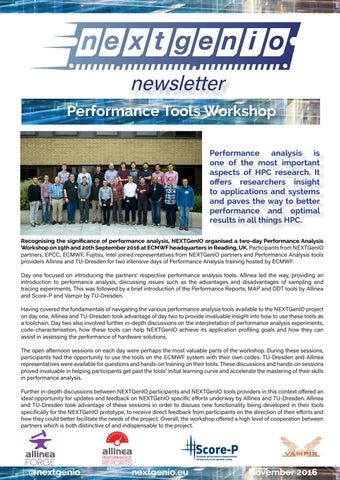
newsletter Performance Tools Workshop Performance analysis is one of the most important aspects of HPC research. It offers researchers insight to applications and systems and paves the way to better performance and optimal results in all things HPC. Recognising the significance of performance analysis, NEXTGenIO organised a two-day Performance Analysis Workshop on 19th and 20th September 2016 at ECMWF headquarters in Reading, UK. Participants from NEXTGenIO partners, EPCC, ECMWF, Fujitsu, Intel joined representatives from NEXTGenIO partners and Performance Analysis tools providers Allinea and TU-Dresden for two intensive days of Performance Analysis training hosted by ECMWF. Day one focused on introducing the partners’ respective performance analysis tools. Allinea led the way, providing an introduction to performance analysis, discussing issues such as the advantages and disadvantages of sampling and tracing experiments. This was followed by a brief introduction of the Performance Reports, MAP and DDT tools by Allinea and Score-P and Vampir by TU-Dresden. Having covered the fundamentals of navigating the various performance analysis tools available to the NEXTGenIO project on day one, Allinea and TU-Dresden took advantage of day two to provide invaluable insight into how to use these tools as a toolchain. Day two also involved further in-depth discussions on the interpretation of performance analysis experiments, code-characterisation, how these tools can help NEXTGenIO achieve its application profiling goals and how they can assist in assessing the performance of hardware solutions. The open afternoon sessions on each day were perhaps the most valuable parts of the workshop. During these sessions, participants had the opportunity to use the tools on the ECMWF system with their own codes. TU-Dresden and Allinea representatives were available for questions and hands-on training on their tools. These discussions and hands-on sessions proved invaluable in helping participants get past the tools’ initial learning curve and accelerate the mastering of their skills in performance analysis. Further in-depth discussions between NEXTGenIO participants and NEXTGenIO tools providers in this context offered an ideal opportunity for updates and feedback on NEXTGenIO specific efforts underway by Allinea and TU-Dresden. Allinea and TU-Dresden took advantage of these sessions in order to discuss new functionality being developed in their tools specifically for the NEXTGenIO prototype, to receive direct feedback from participants on the direction of their efforts and how they could better facilitate the needs of the project. Overall, the workshop offered a high level of cooperation between partners which is both distinctive of and indispensable to the project.
@nextgenio
nextgenio.eu
November 2016
Fujitsu Factory in Augsburg A NEXTGenIO Interim Review was held at Fujitsu in Augsburg, Germany, in early July 2016. Fujitsu, with its rich history in data center and HPC technology, led the definition of the NEXTGenIO hardware architecture and is now developing and manufacturing the new NEXTGenIO prototype hardware platform in its facilities in Augsburg. Fujitsu is one of the world’s leading providers of business solutions based on information and telecommunications technology. With approximately 156,000 employees in over 100 countries around the globe, Fujitsu offers a wide-ranging portfolio of technology products, solutions and services. In Augsburg, Fujitsu operates the only complete development and production site for mainboards for workplace systems (PCs and workstations), servers, storage systems and industrial factory systems in Europe. The Fujitsu site in Augsburg is also home to the final assembly of workplace systems, servers and storage systems and to the final assembly of notebooks for the main target market of Europe. The plant in Augsburg allows for flexible and demand-driven production. Having Europe as the main target market right on its doorstep means that orders are able to be handled quickly, and products can be delivered at short notice. Fujitsu has developed the Augsburg plant by continually investing millions in Europe’s most modern production facility for IT systems. The company employs around 1600 people in Augsburg. Up to 21,000 IT systems leave the production site every day. Fujitsu R&D teams in Augsburg currently are developing the NEXTGenIO motherboard and in parallel are working on server system integration, thus implementing solutions which meet the demanding architecture requirements for prototype performance, scalability, density, configurability and efficiency.
Having defined the system form factor, design teams are choosing electronic motherboard components with best in class achievable performance and energy efficiency. This is followed by schematics design. In parallel extensive electrical signal integrity and thermal simulations are done as input for the motherboard floor planning in order to guarantee reliable operations under all conditions. In the subsequent layout phase 1000s of connections are routed according to the restrictions derived from the simulation output. Very short distances between Fujitsu R&D teams and the production facilities in Fujitsu’s Augsburg location allow for tight coupling of processes, fast and efficient data & information flow between development and production and quick reaction times in change processes and quality management. Combining leading edge technologies with an optimized design and most modern production processes are providing the basis for the innovative NEXTGenIO prototype system. The Fujitsu project team is proud to contribute to the success of the NEXTGenIO consortium.
HPC Workload profiling task Modern HPC systems are (increasingly) complex and heterogeneous. As a result, the relationship between the results of benchmarking and the observed performance under real-life workloads is increasingly unclear. Within NEXTGenIO, ECMWF is developing a Workload Simulator named Kronos. The aims of Kronos are to generate, run, and benchmark a workload representative of a reallife computational workload but in an environment that is controlled and easily portable. Moreover, it aims to generate these workloads automatically, based on analysis of collected workloads from operational HPC systems.
The Kronos Workload Simulator is a collection of different software tools. The first stage is made of measurement tools, which are used to gather data about real jobs running on a supercomputer. This includes details such as the number of file accesses, how much data is transferred and how much computation is carried out. The job descriptions are then categorised and a model of the workload is automatically built. This aims to group the measured jobs into classes, and in doing so, to reduce the complexity and diversity of the real workload into a schedule of idealised, model tasks. From this, artificial synthetic applications are generated along with a specific schedule, and these can be executed either on the original HPC system or another one. These applications are easily portable such that Kronos can be used as a benchmark in HPC procurements. One of the most important tasks in this process is the collection of representative data from the HPC systems to serve as input. To support this, specific tools have been developed by the project partners at Allinea and Technische Universität Dresden, and deployed at the three HPC centres. The data collected in this task highlighted the astonishing diversity in the nature of the workloads; ARCTUR runs a highly on-demand service, with widely varying utilisation of resources, EPCC has a continuously sustained high utilisation of its resources with a wide and varying mix of applications running, and ECMWF has a tightly controlled time-critical workflow with a daily repeated cycle of jobs, and the remaining capacity used for less time-critical work.
Exascale I/O Workshop at SC16 Our first workshop will be taking place on Friday 18th November - so if you’re reading this at SC, there’s still time to sign up! This is a half-day workshop and will take place from 8:30am - 12:00pm in room 355-BC. The topic of this workshop is ‘Exascale I/O: Challenges, Innovations, and Solutions’, with presentations by leading experts from Europe and the US. Full schedule details are below: 08:30 - 08:45 Introduction to workshop Mark Parsons, EPCC 08:45 - 09:10 IO Challenge at the Exascale: Perspectives for Numerical Weather Prediction Tiago Quintino, ECMWF 09:10 - 09:35 NEXTGenIO: Moving I/O into the memory system Adrian Jackson, EPCC 09:35 - 10:00 SAGE: Percipient StorAGe for Exascale Data Centric Computing Sai Narasimhamurthy, Seagate 10:00 - 10:30 BREAK 10:30 - 10:55 Who is Afraid of I/O?: Exploring I/O Challenges and Opportunities at the Exascale Michela Taufer, University of Delaware 10:55 - 11:20 The DEEP-ER take on I/O Wolfgang Frings, FZ Jülich 11:20 - 12:00 Panel with all speakers, moderated by Mark Parsons If you would like to sign up to attend the workshop, please register at http://sc16.supercomputing.org
What’s Next? Earlier this summer, NEXTGenIO had its first review by the project’s funders, the European Commission. This was a very successful event and it concluded the first phase of the project, which was very much focused around gathering requirements and defining a system architecture that will result in a powerful yet flexible solution both for traditional HPC and more novel applications with high-performance data-intensive needs. The project has now entered its next (and, for many of us, very exciting) stage: the implementation phase! Both on the hardware and the software side, designs are being turned into first prototypes; by the time the 3rd edition of this newsletter is published next year, we expect to showcase examples of our work. In the meantime, if you want to know what we’re up to, please keep an eye on our website or follow us on Twitter (@nextgenio) to make sure you are kept up to date with our latest news!