All the session details, expert speakers, conferences and events to help you plan your time at MIPIM and make the most of the latest intelligence, insights and debate
71 Features
ARTIFICIAL INTELLIGENCE INDUSTRIAL
Increasing use of LLMs is changing real estate’s reality
Investors target location and quality in hunt for logistics
DIRECTOR OF PUBLICATIONS Michel Filzi EDITORIAL DEPARTMENT Editor in Chief, Isobel Lee; News Editor, Julian Newby; Sub Editors, Neil Churchman, Joanna Stephens; Proof Reader, Debbie Lincoln; Reporters, Adam Branson, Clive Bull, Ben Cooper, Mark Faithfull, Andy Fry, Liz Morrell, Nigel Willmott; Editorial Management, Boutique Media International; Graphic Studio, studioA Design; Layout Designers, Harriet Palmer, Sunnie Newby; Head of Photographers, Yann Coatsaliou/360 Medias; Photographers, Cyril Chateau, Patrick Frega, Phyrass Haidar, Sebastien Nogier, Claire Sagny-LeBeau PRODUCTION DEPARTMENT Publishing Director, Martin Screpel; Publishing Manager, Amrane Lamiri; Printer CREAMANIA (France).
The MIPIM Opening Reception brought delegates together for some relaxed networking at the Martinez hotel
Dario Colagrossi from Polo Real Estate Group (left), with Debbie Flevotomou of Debbie Flevotomou Architects, Matthew Thomas of Evolve Consulting Engineers and Laura Watson, Teo Architects
Yao Yang (left) with Nick Fang from Vimiu
Ana Magalhães (left) and Patricia Lima, ARC International Design Consultants
Cain Christoforou (left), with Utsha Saha and Monty Kilpatrick from Climate X
PARIS
Discover our opportunities
Paris is undergoing its urban revolution with the first bioclimatic Local Urban Plan in France and is accelerating its adaptation to climate change. At the forefront of real estate and architectural transformation, exemplary projects are being created in terms of reuse, use of bio-based materials, and energy valorization.
Paris is strengthening the territorial network of its cultural, sports, and health public facilities as well as the diversity of local shops.
The transformation and renovation of existing structures are carried out with respect for the capital’s history and heritage.
NOW !
Investment opportunity in a youth hostel of approximately 3 800 m² and in an economic activity building with current standards of 3 100 m². In this lot 6a7, awarded to Linkcity, alongside an innovative hotel under the TRIBE 4 stars brand created in partnership with Extendam.
SPRING 2026
Consultation via calls for urban projects for 20 000 m² of diversified economic activities. High visibility lots located near the Bagnolet gate. These buildings are intended to be delivered in 2030.
IN 2026
A consultation with operators will belaunched for the construction of an affordable housing program of 120 units (8700 m²) – lot S2 along Ney Boulevard.
IN 2027
Start marketing of business programs in the northern part of the site.
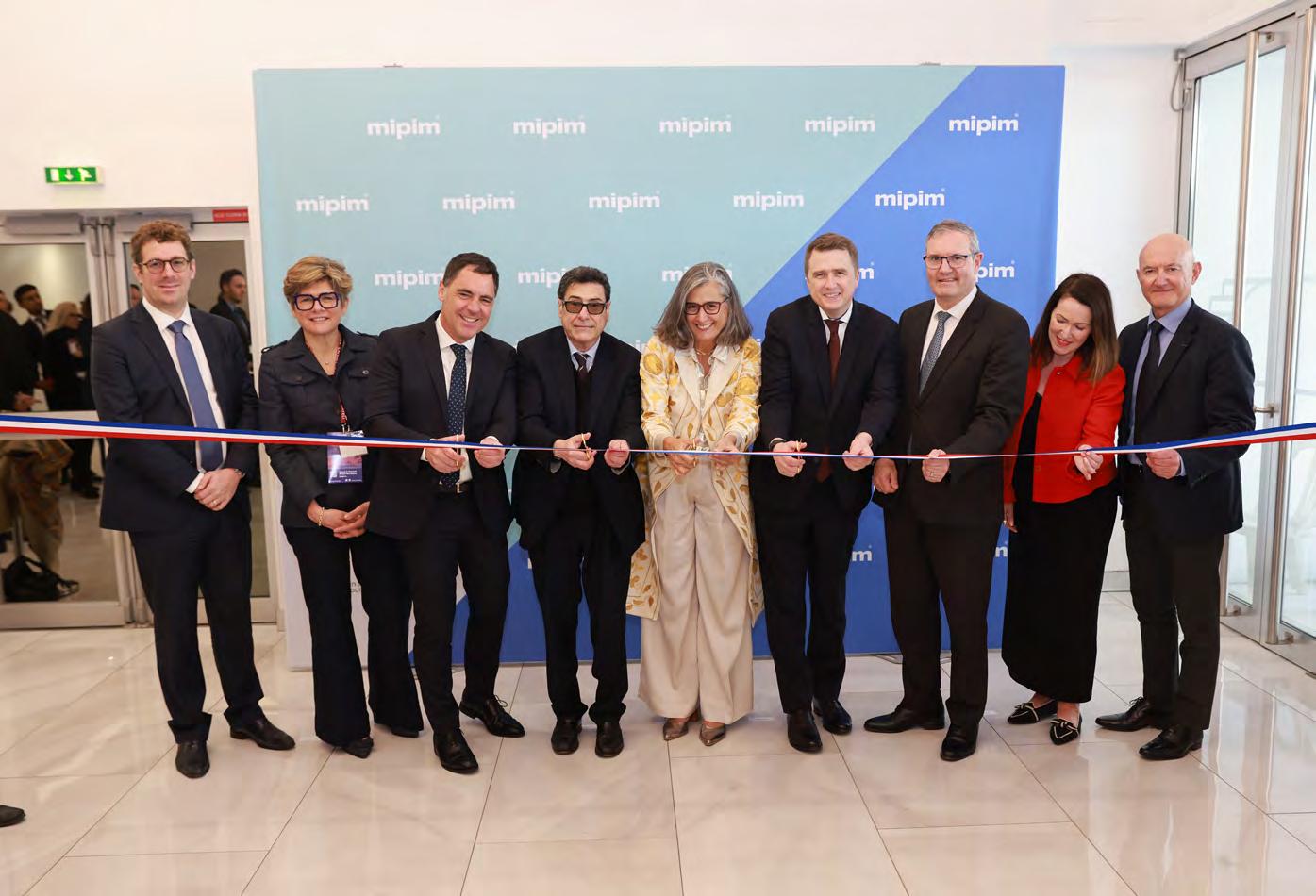
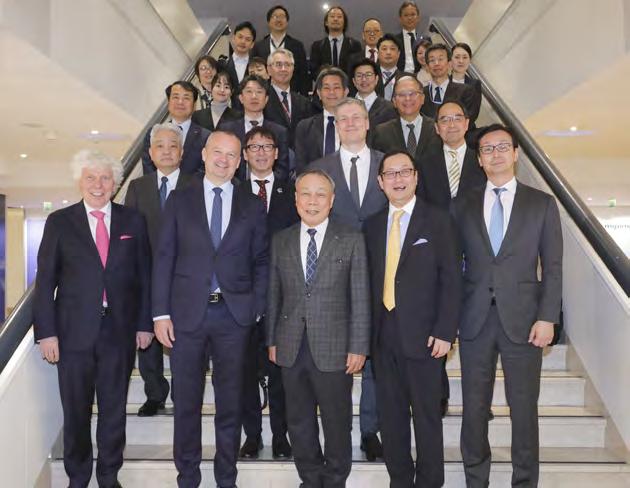
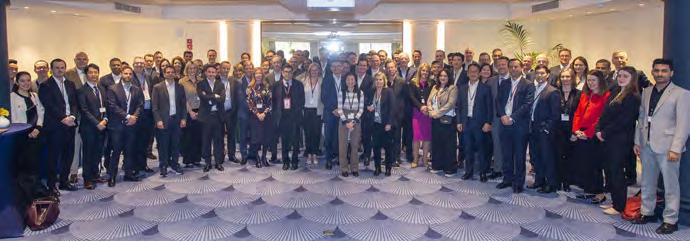
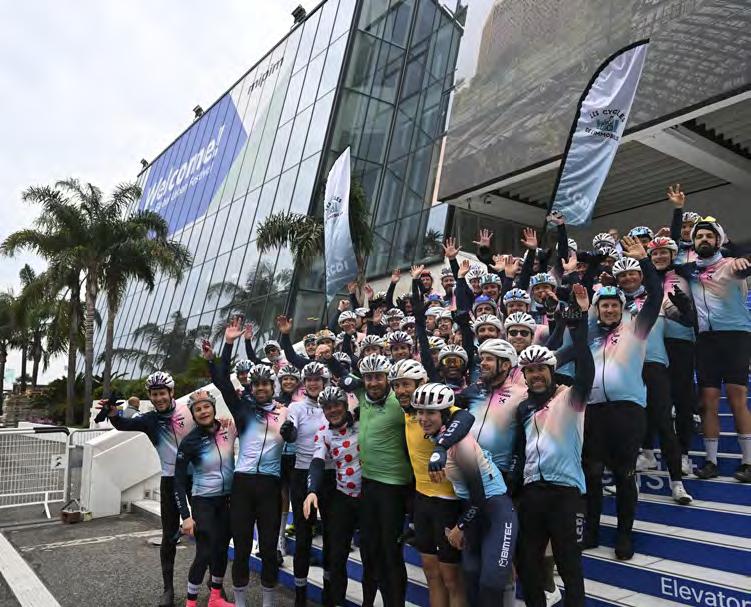
Political and business leaders launched MIPIM 2026 with round tables, ribbon-cutting events and shows of athletic prowess
Cutting the ribbon in Cannes: MIPIM’s Nicolas Boffi (left); Isabelle Scemama of BNP Asset Management; Cannes deputy mayor Thomas de Pariente; Philippe Aghion, Nobel Prize in Economics 2025; Anacláudia Rossbach of UN-Habitat; Minister for Housing Ireland James Browne; Michel Filzi, RX France; Anne Breen, Aberdeen Investments; and SEMEC’s Jean-Michel
German leaders met with Japanese residential experts. Front row, from second left: Jürgen Fenk, DIH; Hideki Nose, Sumitomo Forestry; Haruhiko Toyoda, Judanren; Itsuhiro Miura, Deputy Director General MITL; and second row, third from left, Christian Junge, Berlin’s Senate Department for Urban Development, Building and Housing
Les Cycles de l’Immobilier — one of three incredible groups making their way to Cannes by bike this year –completed the 700km journey from Paris to reach MIPIM
The RE-Invest Summit brought the global investment community together to discuss fundraising and capital deployment strategies, behind closed doors
Arnaud
The Political Leaders’ Summit gathered city chiefs to tackle the urgent urban issues of the day, from housing supply to regional growth strategies
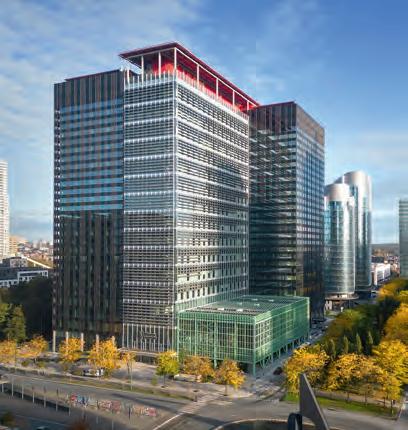
1. MONTAGNE DU PARC | Brussels mixed-use for BNP Paribas Fortis
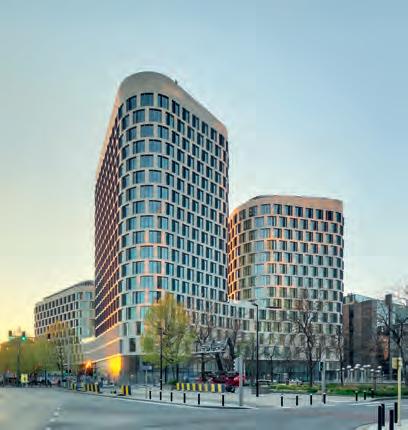
2. WARSAW SPIRE | Poland mixed-use for Ghelamco Poland
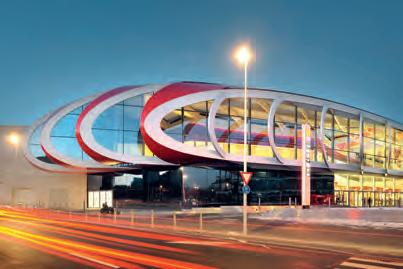
3. MEDIACITE | Liège shopping for Wilhelm & Co
4. ZIN | Brussels mixed-use for Befimmo
5. BARCO ONE CAMPUS | Kortrijk offices - logistics for Barco
6. QUATUOR | Brussels mixed-use for Befimmo
| Germany residential for Immobel
7. EDEN TOWER
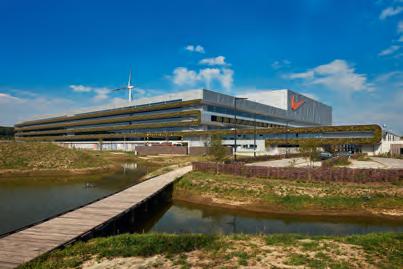
8. NIKE | Laakdal logistic HQ for Nike Europe Holding
// with TLBS (initial project Jahn - MK)
// with BE Baumschlager Eberle, Styfhals & Partners
// with Futureproofed, Arcadis
// with Ron Arad Associates, Chapman Taylor
// with 51N4E & L’AUC
// Designer: Pierre Lallemand
You put your stamp on MIPIM with shows of colour and cultural cross-pollination brightening the day in Cannes
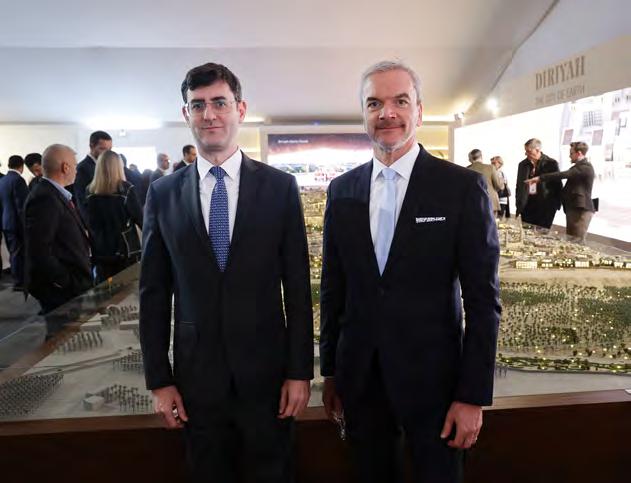
Henning Badenhop and Josep Forroll of Diriyah Company showed off the incredible model for the Diriyah megaproject in Saudi Arabia
Artist Felipe Caro brought to life the concepts of the Oman – Ministry of Housing & Urban Planning with his inspiring vision board
Miami Realtors and partners brought some Florida sunshine to MIPIM. Joining in the fun: Evian White De Leon (left), Denise Chambers, Joe Docal, Teresa Kinney, Rodrick Miller, Katherine Arteta, Lorry Santana, Alian Collazo
Stefan Shkembi, better known as DJ Yll Megi, crafted some Albanian soundscapes in the Palais
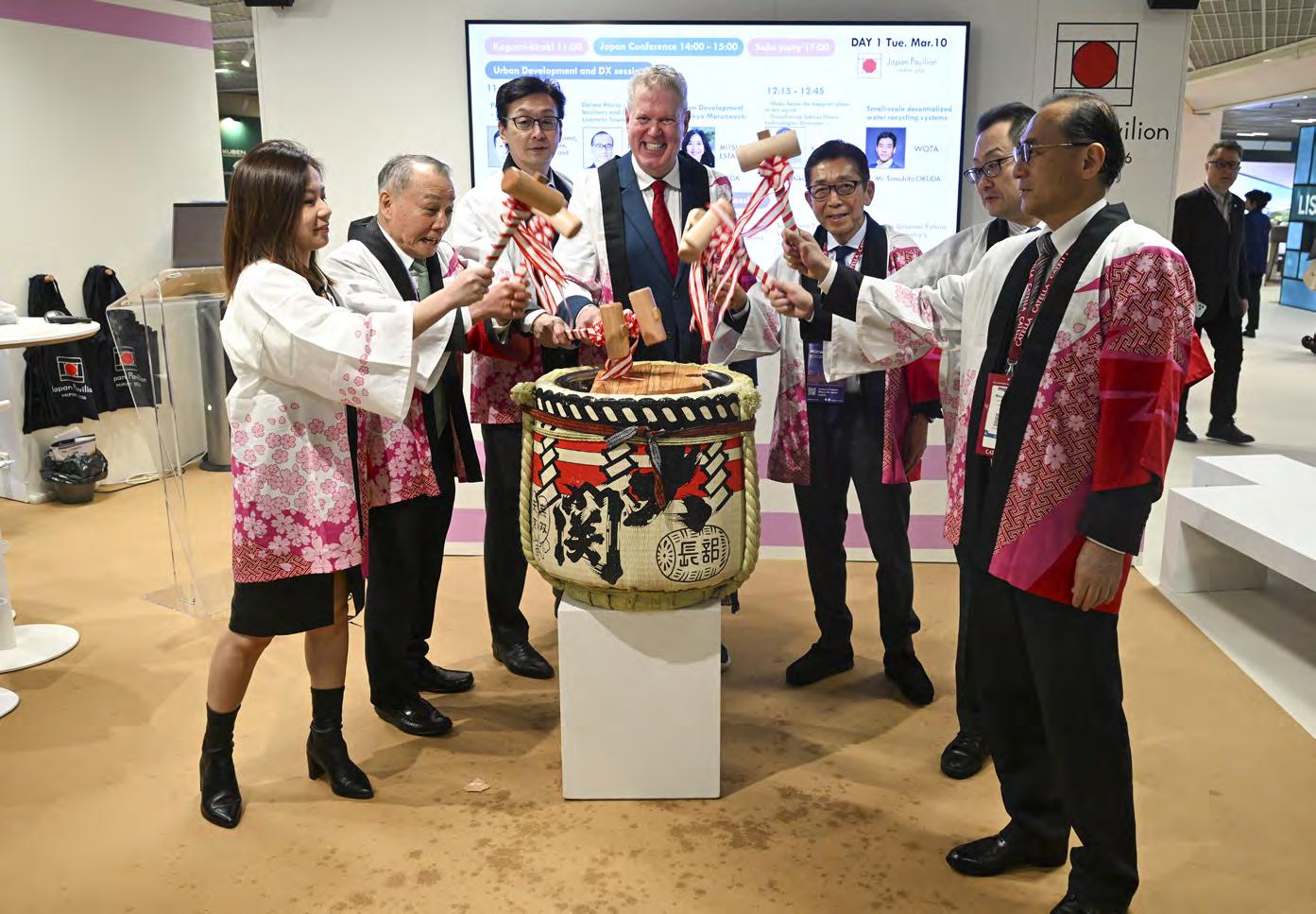
The Japan Pavilion’s annual sake ceremony connected Yue Lian, RX (left), Hideki Nose, Sumitomo Forestry; Itsuhiro Miura, Deputy Director General MLIT; seminar host Andrew Eborn; Ruo Shima, WOTA; Haruhiko Toyoda, Judanren; and Masayuki Kanda, Daiwa House
for
MARAEY
Best New Mega Development
“MARAEY
“MARAEY
Global Tourism & Education Destination
‘AI will destroy jobs but it will also create new jobs’
ACHIEVING dynamic growth requires creative destruction, whereby innovators create new ideas that replace old, tired ideas, according to Professor Philippe Aghion, joint winner of the 2025 Nobel Memorial Prize in Economic Sciences, who gave yesterday’s MIPIM keynote address.
“Our model of growth is all about new innovators coming in and trying to grow new ideas, but they face resistance by incumbents,” Aghion said. “They face resistance by those who innovated before and who want to defend their ranks. They want to protect their own models.”
And yet, progress is only made when former innovators are themselves displaced, he continued: “So the contradiction is that the world is all about new generations of innovators. They develop ideas, they grow firms. But then they don’t want to be subject to creative destruction themselves and therefore they will do anything they can to prevent new generations of innovators.”
As an example, Aghion referenced his own mother, who established the fashion brand Chloé. “She decided that women were badly dressed in France, except for the very high class, who would change clothes five times a day to please their husbands,” he said. “She thought that wom-
en should be free and decided to create luxury, ready-to-wear clothing. She had a vision of emancipation. She did creative destruction.”
Moderator Barry Gosin, Newmark Group chief executive officer, suggested that AI is a form of creative destruction. Aghion agreed. “AI is a technological revolution,” he said. “It is like a new horse. The horse can take you to death or it can get you to wherever you want, provided you know how to steer the horse.”
The point, Aghion said, is that the power of AI needs to be controlled by appropriate guard rails: “What we need are the appropriate institutions to harness the power of AI. AI has a fantastic growth potential because it can automate tasks in the production of goods and services, but the danger, the obstacle, is the lack of competition.”
He added: “You may have a few firms that monopolise everything and discourage any new entrants; any new innovators. So you need to adapt competition policy to make AI a driver of growth. Similarly, AI will destroy jobs but it will also create new jobs, because firms that adopt AI will become more productive, more competitive. Demand for their products will increase and that makes them increase employment.”
Square Mile revival: how the City of London bounced back
THE CITY of London is undergoing a “real renaissance” thanks to its magnetic effect on global companies and a strategy of opening up to more dining, leisure and tourism occupiers, the head of policy for the Corporation that runs the area has said.
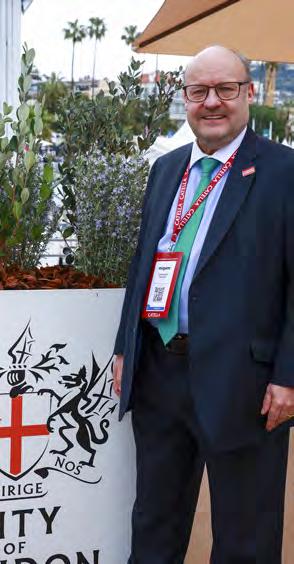
Chris Hayward, Policy Chairman for the City of London Corporation, is at MIPIM to showcase the area’s many investment and development opportunities, and to meet with global firms interested in potential relocations.
The City, also known as the Square Mile, has recently succeeded in attracting internationally renowned law firm Clifford Chance to a new 322,600 sq ft (30,000 sq m) site on Aldermanbury Square. And next year global bank HSBC is planning to relocate part of its operations from its current base in Canary
Wharf to the City.
“It’s fair to say that the City is in the middle of a real renaissance at the moment,” Hayward said. “We’re in a good place. There’s been a 25% increase in jobs in the area since COVID. Anyone who says that the age of the office is over should come to the City.
“A lot of it is down to our flagship ‘Destination City’ policy. We have reimagined the Square Mile as a place with more of a night-time economy, and as an opportunity for retail.”
He added that he felt the return of a more “bullish” market at MIPIM this year, and an increased confidence in real estate globally than in previous years.
Key to the Corporation’s strategy is the construction of new tall buildings and Grade A office space to draw in new companies to an area renowned for being the original home
of the UK’s financial sector.
A recent report by JLL showed vacancy rates in the City core area at 4.4% in the final quarter of 2025, and high demand from occupiers looking for Grade A office space in the area. There are currently 10 new tall buildings in the pipeline for development in the City.
As well as leading on policy at the Corporation, Hayward sits on the board of a Public Private Partnership (PPP) between representatives of the City, the UK Treasury, and industry with a goal of securing more foreign direct investment into the area.
The Square Mile reports the highest GVA of space in London by local authorities, above the boroughs of Westminster and Tower Hamlets, home of Canary Wharf. It is the oldest part of London, dating back to the first Roman occupation 2,000 years ago.
Belfast builds on strong foundations
BELFAST has stayed faithful to its “core DNA” as it has grown and developed, the top official from the city’s council has said.
Speaking to MIPIM News, Belfast City Council chief executive John Walsh said the significant growth of the capital of Northern Ireland over the past two decades has been carefully planned to retain its identity and honour its rich history.
“What we’ve done is to ensure our city has remained close to its core DNA. Other cities have not been so careful. They haven’t been as faithful to their cores,” he said.
Belfast has continued to grow and has seen a number of significant projects either completed or commenced over the past 20 years. Among these is the world-famous Titanic Belfast museum, which has since benefitted from a major multi-million-pound refresh, completed in 2023.
City leaders are at MIPIM seeking
investors to deliver new facilities in growth sectors such as health and life sciences, advanced manufacturing, clinical research, and in more traditional areas of tourism, hotels and retail.
The city is also experiencing high demand for developments in the private rented and build-to-rent sectors,
which Walsh said are now top priorities for the council.
“We have the fastest-growing rents in the UK,” he said. “There’s big competition for homes at the moment. We’re looking at a number of potential sites for more build-to-rent homes.”
Walsh said that there were a number
of big prime residential development sites to be found around the city, and potential for more. The council is working with delivery partner GRAHAM to deliver a major slate of future residential and residential-led mixed use developments.
The council believes it has the potential to unlock some £630m (€728m) of GDV through the development of hundreds of homes across the city, and has identified sites primed for new residential space. Later this year the Loftlines residential project in the Titanic Quarter will be completed, delivering 778 new apartments.
The residential sites form a part of the wider £1bn Belfast Region City Deal (BRCD) programme, of which Walsh said direct investment from international real estate firms was a key element.
Key sites for investment are the 8-hectare regeneration project in the Belfast Harbour area and Belfast Waterside, with a potential of 2m sq ft and estimated potential GDV of £500m private rental, build-to-rent, hotel, office, retail and dining uses.
Belfast City Council’s John Walsh
City of London Corporation’s Chris Hayward
Canada’s first indigenous-led eco village opens doors to the world
THE FOUNDERS of a project to build Canada’s first indigenous-led, eco-cultural village with educational and tourist facilities are at MIPIM seeking partners to take the development forward.
John Henri Commanda and Kyra Knapp of the Ginawaydaganuc Village have travelled to Cannes from Canada to meet with potential backers and developers who share their vision for the project.
Ginawaydaganuc Village was founded in 2022 in Almonte, Ontario as an indigenous-owned non-profit organisation with charitable status, dedicated to developing the village and a range of educational and cultural educational programmes. The project was envisioned as a way for tourists to learn and engage with indigenous practices, and to respect the impact of colonisation on those peoples’ lands. When complete, the Ginawaydaganuc Village will contain educational facilities designed as a traditional indigenous elders’ teaching lodge, a conference centre, an academy, retail space, and a hotel and restaurant building. The team estimates the site will require between 85 and 170 acres. The academy will form a key part of the non-profit complex and will host teachings on indigenous crafts and eco-friendly
Destination Canada begins journey
DESTINATION Canada makes its debut at MIPIM this week, showcasing tourism opportunities to investors from across the globe as Canada aims to unlock up to C$178bn (€113bn) in annual tourism revenue by 2030. “We want to showcase Canada as a great place to invest,” said Gracen Chungath, senior vice-president, destination development, at Destination Canada. “We are a safe place where the government comes in as a first investor and takes the money out last. This is our first time as a delegation and we are bringing in seven primary partners from destinations across Canada. Some of those partners are also bringing their investment promotion and economic development agencies with them so, in all, we have 38 individuals and are
construction methods, social and cultural awareness, social enterprise and natural medicines. The boutique hotel on the site will have a capacity of 20 rooms.
Knapp, economic development officer and interim chief executive of Ginawaydaganuc Village, said the team is seeking investment partners with “social impact capital”, such as charitable funds and foundations with sustainable mandates. “We’re looking for investors to get us off the ground,” she added. “The right partner will be someone with a social purpose. We are working to eventually provide space for indigenous communities across Canada.”
Executive director Commanda said: “It’s challenging because there are so many not-for-profit organisations out there. It’s become very competitive.” Commanda is also the president of Mahingan Consulting, which specialises in delivering indigenous awareness training in Canada’s National Capital Region.
One aim of the village will be to teach people, including the real estate industry, how to construct buildings using more traditional, sustainable methods and materials. The shop on site will sell sustainable building materials for a range of uses. Knapp said the wider project also aims to teach people “how to relate to mother earth and to each other”.
The name Ginawaydaganuc derives from the Algonquin language. It means ‘we/all things are connected’.
bringing 13 specific projects to showcase.”
These include a range of mixed-use, accommodation and tourism projects, such as a skywalk adventure park, Nordic spa and marine centre. Partners attending the show as part of Destination Canada include Destination Vancouver, which will be showcasing a number of mixed-use opportunities, and Destination Toronto, which will present its waterfront project, one of the biggest development opportunities in Canada. Indigenous projects will also be showcased, since indigenous tourism is a major differentiator for the country. It currently generates C$3.7bn of Canada’s C$130bn tourism revenue, Chungath said. She added that Canada works sensitively with its communities to prevent over-tourism
of such areas: “About four years ago, we made a very intentional choice that we were not going to measure volume as a measure of success. We will only do things that have been vetted by the community or the municipality. We will never have our communities be at odds with tourism development, so there should not be an issue with over-tourism because they decide what tourism development means to them in terms of growth.”
Destination Canada aims to take a holistic approach to development. It launched its Tourism Corridor Strategy Programme in 2023, aimed at strengthening Canada’s global competitiveness by identifying 60 projects that are seeking investment and partners to move forward. These include the Northern Sky corridor, the Cycle Ontario and Quebec corridor, the Juan de Fuca corridor and the Field to Fork Agritourism corridor.
Destination Canada’s Gracen Chungath
Ginawaydaganuc Village’s John Henri Commanda and Kyra Knapp
DAILY AGENDA 11 March
Join our
Urban infrastructure, services and real estate shaping an integrated ecosystem for long-term value
and attend our following "Italy 2026: Cities as Platforms for Investment and Innovation"
NETWORKING EVENT
Discover our
ITA - Italian Trade Agency
Investing in Italian Real Estate 11:00 am 12:15 pm 1:30 pm 3:30 pm
Presentation of the Sustainable Development Project for the Piazza D’Armi Area in Milan
Piemonte Agency for Investment & Export
Investment opportunities for Turin and Piemonte region
City of Genoa
Healthy Cities, Healthy Assets: The Future of Sports Venues in Genoa
Assoimmobiliare
Scan
Panelists explore politics of planning city’s next chapter
IN THE Politics Of Place session at the London stand on Tuesday morning, the panel explored how development, housing, planning and growth can be deeply political at national, mayoral and borough level, and why managing that will be London’s “next chapter”.
Joanna Averley, chief planner, Ministry of Housing Communities and Local Government, opened the discussion by framing London as a continually reinventing, culturally mixed city, with both huge assets and visible challenges that planning and investment must navigate. She said recent planning reforms aimed to speed up the system, give more certainty and unlock growth, including a stronger, better resourced Building Safety Regulator, which the government believes has now “turned the corner” and can be “expedient, right-sized, focused on all the right issues and an enabler for development”. Adding a developer’s perspective,
Piers Clanford, chief operating officer, The Berkeley Group, argued that what matters is getting reforms “live” quickly because London is in a housing emergency. “We all know the viability challenges but it’s still a world-class city and our founder, if he were sitting here today on our 50th anniversary, I’m sure he would be saying, ‘we need to work together to find a solution’.” For Berkeley, the top priority is rapid implementation of adjustments to the London Plan emergency measures that should apply not just to new applications but to schemes already in the pipeline. Councillor Shantanu Rajawat, leader, London Borough of Hounslow emphasised that growth happens “in places, in boroughs” and that boroughs are the ones who actually deliver housing, jobs and regeneration on the ground. On the coming London elections, he predicted more stability than some expect,
but accepted that politics can make planning tougher in places, adding that the GLA’s (Greater London Authority) role is to safeguard citywide needs while respecting local democracy, stepping in where necessary to keep growth and housing delivery on track.
Meg Carter, regional director, AtkinsRealis, said the private sector needs to better understand how councils actually operate — their cycles and competing pressures — adding that local elections were already creating nervousness and delay in some areas, especially where there isn’t a proven “engine of delivery”.
Samantha McClary, CEO, British Council for Offices stressed that debates about the politics of place can be too housing dominated; jobs, workspaces and mixed use environments were critical to inclusive growth, local services, and in turn the ability to fund and sustain housing.
K64 plan is Iceland’s hot property
THE K64 Keflavík Airport masterplan is providing the platform to invest and develop around Iceland’s international airport and Kadeco CEO Pálmi Randversson is in Cannes to showcase opportunities in a country that is a bridgehead between Europe and the US.
Kadeco has led a collaboration with the Icelandic state, airport operator Isavia, and two municipalities, Reykjanesbær and Suðurnesjabær, around a comprehensive strategy and vision for the Keflavík Airport area, which includes aviation, data centres, light industrial, offices and residential.
Located 50km from the capital, Reykjavík, the Suðurnes peninsula is the gateway to Iceland. The K64 scheme — so named as it straddles the 64th parallel north —has been created as a catalyst for driving the Icelandic economy, Randversson said.
The airport is expected to handle around nine million passengers this year and Randversson said the masterplan has created the platform for major international investment and development.
“Our role is to be a one-stop shop for investors, not only selling the land but leading them through the regulations and legal processes,” he said. “We have already developed land around aviation, data centres, agriculture, light
industrial and commercial and we are also looking to build residential to support workers. The only asset class we are not seeking is heavy industrial.”
Randversson stressed that Iceland has very strong sustainability credentials, with the country’s homes almost exclusively supplied by geothermal and hydro power. That ethos will continue in the K64 zone, which will have its own infrastructure and is also just 30 minutes from the capital.
“We are looking at K64 having its own ecosystem and being very well connected with Reykjavík and we also have the growing hospitality sector, with a number of hotels already developed on the highway to Reykjavík and more hotels are also included in our plans,” he added.
Randversson stressed that after several years showcasing the concept behind K64 at MIPIM, the established masterplan means that the K64 zone is now investor-ready and this year will be presented as an opportunity to join an emerging economic hub.
Kadeco’s Pálmi Randversson
Joanna Averley, chief planner, Ministry of Housing Communities and Local Government
Awards night celebrates ESG’s crucial role in industry’s future
YESTERDAY evening’s Global ESG Awards Trophy Ceremony was a night to remember, celebrating innovation, sustainability, and the outstanding achievements of industry leaders in Environmental, Social, and Governance (ESG) initiatives. The event gathered top nominees, distinguished guests, and key stakeholders from across the globe to honour those making a real difference.
Opening the event, Johannes Fütterer, managing director and founder of proptech company aedifion, said: “The Global ESG Awards show that ESG is no longer about compliance — it is a driver of resilience, efficiency, and lasting asset value. By combining data, technology and intelligent operations, we not only cut emissions but actively preserve and enhance the longterm worth of buildings. We are proud to support the pioneers proving that sustainable, digital building management is essen-
tial to securing the future of our industry.”
During the ceremony, each award category highlighted the groundbreaking work being done to drive sustainable impact. The winners of each category were applauded for their dedication and contributions, reinforcing the importance of ESG principles in shaping a better future.
Picking up the ESG Leadership Award,
Daniel Chang, managing director European head of ESG, Hines, said: “I’m honoured and humbled to receive this award, and I’m grateful to Eubin, MIPIM, GRESB, aedifion and RICS for this meaningful recognition. In a time when stability and long-term financial performance are top of mind for our industry, sustainability has never been more important. I’m inspired by the collaborative spirit of my peers, and this award reinforces the progress we can achieve when we all work together.”
Compliancy
Winner: Measurabl – United States. Recognising the best solutions that comply with regulations
EcoBalance
Winner: Next Sense – The Netherlands. Honouring the best solutions tackling climate change and pollution
Resource Excellence
Winner: Schindler –Switzerland. Highlighting innovations in resource use and the circular economy
CommuniCare Impact
Winner: Commu App – Finland. Awarding the best solutions for affected communities, consumers and end-users
ESG Leadership
Winner: Daniel Chang – Hines. Recognising the top corporate ESG personality
Whitewood: building sustainability
BELGIAN developer and asset manager Whitewood has put sustainability and reuse at the heart of the company’s approach. “We were a young company and we tried to be a bit different, so we made our commitment to reuse and recycling our USP, not just in construction of buildings but in what it consumes, its embodied carbon,” Valérie Vermandel, chief
development officer of Whitewood, said.
The company was set up in 2008 in Antwerp as a developer and is now headquartered in Brussels with an office in Rotterdam, the Netherlands. It made its first building acquisition in 2015, in Brussels, and now has equity in over 40 assets and is an alternative investment funds manager, creating portfolios that banks and insurers can invest in. It currently has €4.5bn under management. But this growth has remained rooted in its sustainability mission. “I would say we are one of the frontrunners in this area,” Vermandel said.
She also works with companies involved in recuperating products from older buildings: “The market is still not quite ready for it, but many contractors are now starting to look at it. It does not have to be arty-farty. It can enhance the building, for instance, using stone from Bruges in an entrance hall. You can make it good business.”
SOUDAH PEAKS PROJECT MARKS A FIRST FOR KSA
SOUDAH Development Company debuts at MIPIM as part of Invest Saudi. The Public Investment Fund company is showcasing its $2.9bn (€2.5bn) Soudah Peaks project, Saudi Arabia’s first luxury mountain destination.
Located in KSA’s Asir Province — at the country’s highest point, 3,015 metres above sea level — Soudah Peaks is spread across the mountainous terrain of Soudah and Rijal Almaa. It is set to become an iconic luxury destination, celebrating natural beauty, heritage and culture while contributing to Vision 2030.
Whitewood aims for at least 80% reuse, including the existing mass of buildings, foundations and basic structure etc. In terms of embodied carbon, it aims for no more than 200kg of carbon per square metre over a 60-year lifespan.
This compares, she said, with a current standard of 650kg. But one of the big challenges is measurement for sustainability, which is still developing along with sustainable practices. At MIPIM, the company is looking for growth opportunities in two ways. “We are meeting with our international partners to maintain good relations, but also looking at expanding, particularly in the Netherlands and Paris.
“We are also looking at diversification of assets. Our activity is still mainly in the office sector, with a little retail. We would like to take our approach to areas such as affordable housing, healthcare and infrastructure and make an impact there.”
Soudah Peaks covers 636.5 sq km, with a 3.6% built-up area. There are six development zones with over 2,800 hospitality keys, 1,337 second homes and more than 30 attractions, creating more than 1,000 jobs, and is aiming at two million annual visitors by 2030. Recent milestones include a $346m agreement with National Grid SA for advanced electrical infrastructure, and a strategic agreement with WSP. Also, the Heritage Commission, in collaboration with Soudah Development, announced the discovery of 20 ancient rock-art sites across the Soudah Peaks project area, which will be safeguarded and documented.
Soudah Peaks is expected to attract two million annual visitors by 2030
Whitewood’s Valérie Vermandel
Real IS sharpens its focus on all classes of European residential
THE RESIDENTIAL sector is currently the most attractive market segment in Europe, according to Christine Bernhofer, CEO of Real IS.
“We are really looking into European residential — all types of residential, including student housing,” she said.
“We’ve done residential for quite a while. We see that the demand is so strong that we have got to do more on this.”
Bernhofer said that the yields available in residential are compelling, but added that the real estate industry also has the opportunity to contribute to the good of society by providing more housing.
“Peace in society is very much linked to a good residential situation,” she said.
“I think that we, as an industry, need to invest and get more properties on the market as soon as possible. Our investors are very interested in this topic and in making things happen.”
In many places, it is simply the case that there are too few homes available, but Bernhofer added that construction-cost inflation had also distorted the market.
“That killed a lot of activity,” she said, adding that finance for small- and medium-sized developers had also become harder to obtain.
“There was a big market of small developers, but they don’t get financing anymore,” she said. “This was quite a big market, especially in the countryside. It has dried out, so institutional money has to step in and will step up.”
In order to deliver effectively, Bernhofer added, companies need to invest in operational capacity. “We have people on the ground in France, Spain, the Netherlands, Luxembourg, Ireland and Germany,” she said. “We are really able to manage this type of property in all the countries where we want to go.”
As well as residential, Bernhofer said there is still interest in office developments — but only assets that offer strong fundamentals. “People are interested in offices, but only ‘no brainer’ offices,” she added. “So that means a good location, Grade A, strong ESG credentials and so on.”
Bouygues responds to seismic change
WESTERN economies are in the midst of seismic change and the real estate industry has a key role to play, according to Pierre-Eric Saint-André, CEO of French construction giant Bouygues.
“This year’s MIPIM is taking place in a highly volatile geopolitical and economic environment, which is directly influencing real estate investment and urban development,” he hold MIPIM News. “At the same time, we are entering a new phase marked by re-industrialisation in many western countries and a growing focus on sovereignty and resilient supply chains. In that context, land management becomes a strategic issue for maintaining the attractiveness and competitiveness of cities. Urban agility will be essential.”
In that context, Saint-André said that he expected MIPIM 2026 to address some weighty issues. “First, the scarcity of land in major cities requires us to rethink how we use existing assets, particularly offic-
es,” he said. “Housing will also remain a major issue in France and across Europe. Addressing the shortage will require both strong political commitment and new development models that deliver low-carbon, energy-efficient housing while integrating more services, notably through build-to-rent approaches.”
He added: “Ultimately, the challenge is to adapt our cities to these economic, industrial and societal shifts while accelerating the environmental transition.”
In order to confront such challenges, the built-environment industry needs to change, Saint-André continued: “The real estate sector must continue its transformation. In the current geopolitical and economic environment, investors are understandably more cautious. This means prioritising projects that clearly demonstrate their long-term utility and resilience. For construction, the direction remains clear: decarbonisation is non-negotiable. Accelerating
this transition will require new methods, particularly greater industrialisation, prefabrication and digitalisation.”
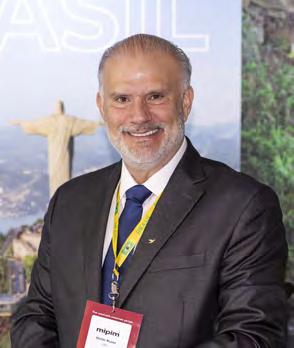
HEITOR Kuser, CEO of CIMI360, is at MIPIM to showcase opportunities in Brazil and promote CIMI360, the property event in Rio de Janeiro, August 27-18, which Kuser calls “the greatest event in Latin America”, attracting more than 10,000 attendees. “MIPIM is a most important event for us,” Kuser said. “Brazil is a huge and important country. We are the largest in Latin America. The most important thing for us is to showcase Brazil and our projects.”
One way is through the CIMI Invest platform which showcases projects, and matches investors and sellers throughout Brazil. In addition to Brazil’s flagship Maraey development, Kuser highlighted opportunities across several sectors, including logistics to service the country’s growing ecommerce and housing markets, huge profit margins in Airbnb properties and openings in social housing.
A memo of understanding will also be signed at MIPIM between COFECI (Brazil’s Federal Council of Real Estate Brokers), IBRADIP (Brazilian Institute for the Development of Public Properties, with Kuser as president) and ABM (the Brazilian Association of Cities) to better promote the development of public properties in the country.
BRAZIL’S CIMI360
Bouygues Construction’s Pierre-Eric Saint-André
Real IS’ Christine Bernhofer
CIMI360’s Heitor Kuser
Bleiben Sie immer auf dem Laufenden!
Mit den kostenlosen Newslettern vom immobilienmanager haben Sie alle Themen der Branche im Blick – einfach und bequem per Mail.
Themenletter:
Personal- und Unternehmensmeldungen, Nachrichten zu Deals & Projekten, Fach- und Meinungsbeiträge sowie exklusive Inhalte aus dem Magazin.
Jetzt anmelden unter www.immobilienmanager.de/newsletter
Infoletter: Informationen zu exklusiven Fachveranstaltungen, Sonderheften zu Spezialthemen sowie weiteren relevanten Produkten für die Immobilienbranche.
Spain’s real estate boom still attracting global investors
CELEBRATING its 10th edition at MIPIM, the Spanish Conference, which is taking place today at 12.30, will bring together international investors and industry leaders at a time when the country is attracting high levels of in-
vestment across asset classes.
When the first conference took place a decade ago, Spain had been particularly hard hit by the repercussions of the global financial crisis and the evolution of the market over the past 10 years has
been “extraordinary”, speaker Roger Pla, partner at RocaJunyent, stressed.
In particular he noted not only the diversification across real estate asset types but also geographically, as Spanish cities outside the twin hubs of Barcelona and Madrid have successfully expanded and continue to develop economically.
“If we look at cities like Valencia, Seville, Malaga and Bilbao, they have all attracted international investors and this is quite unusual compared with many European countires, where the economic activity is more focused on one or two cities,” he said.
“I think Spain has been very successful at showcasing itself as a safe and transparent place to do business and this, along with strong demographics and relative value compared with many other European hubs, has provided opportunities for very strong returns,” he said. “Spain’s attractiveness is all about the fundamentals.”
Henry Gallego, CEO and chair of
Debt, data and development collide
REAL ESTATE owners and developers should be thinking about cyber risks and security right at the inception of a future building, according to an expert in the field.
David Eden, managing director for restructuring at international risk advisory firm Kroll, believes that property developers and investors do not currently start thinking about cybersecurity early enough in the planning of buildings.
Kroll, which has a cyber-risk team, advises clients on the need to develop security measures into the design of new builds, especially those replete with high tech such as modern logistics centres.
“We believe that cybersecurity should be as important as ESG when it comes to planning new buildings,” Eden said. “We’re asking, should you be going
into a development with cyber resilience from the start?
“If you look at a modern distribution centre, there is so much tech in there and it is so sophisticated, that it can become a cyber burden to the owner because it is potentially a risk. Buildings are vulnerable.
“It’s become an important part of protecting value in buildings. But this concept is still quite nascent in real estate.”
Eden is in Cannes with a team of 30 Kroll colleagues from the UK, Europe and Middle East regions, and from across the company’s real estate advisory, financial advisory and valuation teams.
The firm offers a wide range of services to real estate firms, including debt restructuring and risk management advice. Eden said that an increasingly important aspect of real estate finance is the rise of private credit.
Ktesios, and a fellow speaker at today’s conference, added that different areas of Spain had managed to create niches for themselves, with the country also establishing itself as a major port operator and therefore an important logistics centre for southern Europe.
“If you take an area like Extremadura [a region north of Seville], this is very underdeveloped and as such provides very good value and we have seen increasing investment in logistics and data centres,” Gallego said.
“Investors see that they can get very stable but also very strong returns still in Spain compared with other locations.”
Hospitality — a well established and important economic driver for Spain — is also growing strongly thanks to a significant rise in tourism numbers, and Gallego pointed to the rise in luxury hotels in response as the market continues to develop.
As a housebuilder, he also stressed the opportunities to develop residential schemes across Spain to support the economic and population growth.
Pla added: “The big message we want to get across at MIPIM is that within your investment portfolio Spain is not a nice to have, it’s a must.”
The level of debt needing refinancing in European real estate alone, estimated at around €0.5tr, is an opportunity for private credit to step in, Eden said.
“That’s not all going to be done by traditional bankers,” he added. “Seven to eight years ago private credit was considered a bit of a buzz word, but now you can’t do real estate without it.
“Just look at the scale of investment going into that market. Now you have huge companies like the Grosvenor Estate operating private-credit divisions. We’re looking to meet people on the private credit side, to meet lenders and private credit firms.”
As well as private credit and cybersecurity, Eden said that the reuse, repurposing and financial restructuring of real estate assets across sectors is likely to be a key theme for MIPIM and looking ahead to 2026.
Kroll’s David Eden
RocaJunyent’s Roger Pla and Ktesios’ Henry Gallego
Arras sets out its strategy to attract industry and talent
THE GREATER Arras government is attending MIPIM this year to promote two major economic development projects, according to Anthony Blondeau, deputy general director in charge of the economic development, employment, and attractivity department in the Communauté Urbaine d’Arras.
Speaking to MIPIM News, Blondeau said that the first of the projects is a new business district involving the creation of 35,000 sq m of office space — 15,000 sq m of which is still available — close to the northern French city’s TGV railway station.
The second project involves the creation of a “new activity area” dedicated to four industries: agrifood; healthcare and pharmaceutical; technology; and luxury. The idea is to build on Arras’ existing economic strengths.
“We are looking for investors, but mainly end-users,” Blondeau said. “Our target is, real estate promoters, architects and end-user companies. We have a lot of agricultural land — we have around 250 farms and agriculture is in our DNA — and are already home to Häagen-Dazs’ worldwide factory. Two years ago, LFB Group set up in Arras, which was an engine for attracting other biomedical companies.”
Blondeau added that Arras’ geographic location makes it highly attractive for many businesses. “We’ve got a great location at the heart of the Paris, London and Brussels triangle,” he said. “We are one hour away from Calais and Dunkerque ports. We are located at the crossing of two motorways and we also have TGV station. So, our location is a great asset for any company that wants
to do business in Western Europe.”
In addition, Blondeau said that companies setting up shop in Greater Arras had access to a deep talent pool. The area is home to three universities and two engineering schools with more than 10,000 students living within its boundaries. “We are also very adaptable,” he said. “If a company needs some specific skills, we can discuss this with our higher education establishments to create the specific training needed.”
He added: “We are here to accompany companies that want to set up or extend their activities in our territory. So, we can help them to find a good location, be it greenfield or brownfield. It can be an empty or existing, an existing building. We also have some financial assistance available and we can help companies recruit their workers.”
Nextensa eyes next phase of growth
BRUSSELS-based Nextensa closed the 2025 financial year with profits of €33.8m, driven by a higher earnings contribution from development activities, lower financing costs and after it recyled around €360m in real estate assets over the past two years.
As a result, Nextensa significantly enhanced the group’s capacity to finance the next phase of its development pipeline, notably three significant mixed-use schemes; the Lake Side project and BEL Towers in Brussels and Cloche d’Or in Luxembourg.
“As both an investor and developer, our focus is very much on ESG-driven, large-scale, mixed-use projects and at MIPIM we are showcasing these major developments,” said Peter De Durpel, Nextensa chief operations officer. In Brussels the projects are slated to start in 2026, subject to permits, and will entail a construction cost of approximately €265m for the new 38,000 sq m Proximus headquarters building and the residential tower at Lake Side; and approximately €300m for the BEL Towers, a 115,000 sq m mixed-use redevelopment of the current Proximus HQ.
Both projects will also include an element of public services, including sports, healthcare and education facilities, while the BEL Towers will include a mixed residential and purpose-built student accommodation block. Nextensa will secure corporate tenants before commencing the refurbishment of the office towers.
“With these large projects it is also important that there is a social im -
pact as well,” De Durpel added. “At Lake Side the project has been divided into phases A and B and we are hoping to start construction this year on phase A, with the Proximus offices ready for the beginning of 2028 and the complete phase finished by 2029. Phase B, which will include around 135,000 sq m of residential and co-living, plus ground floor retail, will start after that.”
The entire complex will be heated and cooled using geothermal technology, Durpel said, as part of the company’s focus on sustainability.
At Cloche d’Or in Luxembourg, Nextensa has continued to shape the scheme through Grossfeld, in which the group holds a 50% stake. Several built-to-suit office project leasings have been secured, including the 4,600 sq m The Terraces for the Swiss private bank Lombard Odier and the 12,000 sq m Eosys for PwC. In addition, a new residential project of 50 units has been launched, with approximately half already sold.
“We are creating a new quarter for Luxembourg City and trying to extend the city as well,” De Durpel said.
Nextensa‘s Peter De Durpel
Communauté Urbaine d’Arras’ Anthony Blondeau
IZ Germany Real Estate Update
A weekly newsletter, curated and edited by the Immobilien Zeitung editorial team
The most important and relevant news of the German real estate market
For international real estate professionals interested or active in Germany
Europe’s cities debate integration, adaptive re-use and placemaking
CONVERSATIONS focused on how European cities are repositioning themselves for the next investment cycle will feature strongly at this year’s MIPIM, according to Elena Sainz de la Peña, head of urban development, Europe, at Turner & Townsend. “We are seeing growing alignment between hospitality, residential, office and mixed-use development, particularly where regeneration and placemaking are driving value,” she said, citing sporting hubs including the Bernabéu in Madrid, where Turner & Townsend has been working for more than five years. Such schemes are increasingly becoming “community-centric mixed-use developments in their own right”, she added.
Sainz de la Peña said that adaptive re-use, the rise of multi-purpose venues for entertainment, operational real estate and the integration of hotels and lifestyle assets into broader urban schemes will also be key topics at this year’s show.
“I also anticipate lots of debate about the relative merits of capital deployment across continental Europe, especially in gateway and emerging leisure destinations, as investors look for resilient sectors that balance experience-led demand with long-term fundamentals.”
Sainz de la Peña said that MIPIM is an invaluable networking event for Turner & Townsend: “MIPIM remains one of the most effective platforms for maintaining and expanding relationships across the European urban development ecosystem. For us, it brings together investors, operators, cities and developers in one place, enabling conversations that would otherwise take months to co-ordinate. It allows us to understand how capital is thinking, how public authorities are shaping planning priorities and to identify where cross-sector partnerships can unlock complex projects.”
She added: “Importantly, MIPIM is
not just about new business; it is also a chance to test ideas, compare market sentiment across different European regions, and stay close to the evolving strategies of our clients in the hospitality, living and workplace sectors.”
Looking ahead to the rest of 2026, Sainz de la Peña expects a continued blurring of the lines between real estate and operations. “Hospitality principles — flexibility, service and experience — are increasingly influencing residential and office development, while hotels themselves are becoming more integrated into mixed-use urban environments,” she said.
Across Europe, she forecasts a stronger focus on repositioning existing assets rather than solely launching new projects, driven by tighter sustainability targets, financing conditions and changing occupier expectations.
“Capital will remain selective, favouring projects that demonstrate a clear identity,
Logistics ‘resilient’ in uncertain times
LOGISTICS will remain a “core conviction sector” and show increasing returns and stability for investors, the director of a major European fund has said.
Evert Castelein, fund director for European logistics at Savills Investment Management (IM), said that logistics was “undoubtedly one of the most resilient asset classes in real estate at the moment”. He added: “Transaction volumes are
likely to recover further, albeit unevenly. Value-add strategies in logistics will remain attractive, while core capital should return more meaningfully as income visibility improves. Although macro-uncertainty will persist, the fundamentals underpinning European logistics are robust. For well-capitalised, pan-European managers with strong asset-management capability, 2026 should offer compelling
operational resilience and alignment with urban-regeneration goals,” she said. “At the same time, secondary cities and leisure-driven markets may attract renewed interest as travel patterns evolve and investors diversify beyond traditional core locations.”
opportunities to deploy capital selectively and at scale.”
Castelein said logistics has strong prospects for stability and growth due to a number of key factors, including the “short- to mid-term rental upside”, high occupier demand for a limited supply of the right, high-quality modern space and low vacancy rates.
He added that significant reconfiguration in supply chains, even the increased spends on defence budgets across Europe, are all contributing to the favourable environment for logistics investment.
“A central theme for me will be the continued strength of logistics and its role in institutional portfolios,” Castelein said. “Logistics is still seeing a lot of capital deployment, with investors drawn to long-term structural drivers and potential for short- to mid-term rental upside.”
Recent acquisitions by Savills include a logistics facility in Gothenburg, bought
from Sörred Logistikpark for €35.2m. Across real estate more widely, Castelein said: “There is strong appetite for pan-European platforms with the ability to pivot between markets and operate across the risk spectrum. Savills IM’s heritage as a core manager, combined with our development, repositioning and refurbishment capabilities, positions us well to capture opportunities in logistics and beyond.”
Castelein praised MIPIM’s role as a “market barometer” for real estate professionals, noting that the event regularly sets the tone for the next phase of transaction activity: “It brings together a global investor base. As liquidity returns, many will be focusing on progressing live-transaction opportunities and discovering new ones. This year, we expect sentiment to reflect a gradual recovery, supported by improving investor confidence and sustained occupier demand, particularly in logistics. We’re coming from a position of strength as we have capital to deploy as well as onthe-ground access across in Europe’s key markets.”
Savills Investment Management’s Evert Castelein
Turner & Townsend’s Elena Sainz de la Peña
Rien ne vous empêche de penser autrement
Sur tous les fronts, nous enquêtons pour vous raconter notre époque en encourageant le doute et la curiosité. Rejoignez les esprits libres.
OFFRE SPÉCIALE
la première année (sans engagement)
POUR EN PROFITER
RENDEZ-VOUS SUR LE SITE OU directabo.lepoint.fr/partenariats
SCANNEZ CE QR CODE
Des contenus variés L’accès à tous les contenus du Point, les palmarès, des newsletters thématiques…
Des chroniqueurs et invités inédits à retrouver uniquement sur nos supports.
En exclusivité
Le journal numérique en avant-première dès le mercredi soir.
Development opportunities flourish across Indonesia
THE HEAD of a real estate firm based in Bali is at MIPIM to promote the wealth of opportunities for investment and development on the Indonesian island.
Yohann Mohamed, co-founder of Tema Global Invest, has travelled to Cannes to meet potential partners and investors interested in hearing more about what he says is a huge development opportunity.
Along with partner company Coco Development Group, which is also at MIPIM, Tema is engaged in a raft of projects in Bali, largely focused around tourism and residential.
Mohamed’s firm is seeking partners and investors to join in the development of a number of significant projects serving to open up Bali to more tourism, including a new airport expansion.
He said that he considers his role to
be a “bridge between European investors and Indonesia”.
“We’re here to promote the Indonesian market to real estate investors from around the world. I believe I may be the only person here promoting Indonesia. There are lots of opportunities in Indonesia.
“There is the development of a new capital city, and an airport with it. And there are several development zones.
“There’s been very fast growth over the past 10 years. It’s also very stable politically. The level of construction is still very low and there’s growing demand.”
Both Tema and Coco are engaged in numerous projects in Bali, including the construction of holiday resorts and villas to cater for a rising demand from international tourists.
Among these are the Azoria Living Suluban Beach Resort, the Azoria
Living Nyang Nyang Beach Resort, outside Uluwatu, Bali, and the Aura Apartments Ubud affordable housing project.
Bali currently attracts some seven million tourists annually; a figure that is increasing by a million a year.
Construction is under way at the city of Nusantara, on the east coast of Borneo, which will eventually replace Jakarta as the capital of Indonesia. Nusantara is being prepared for inauguration as the new national capital, and will be served by Nusantara International Airport, which was completed in 2024.
As well as being invested in a range of residential and tourist development projects, Tema is also invested in land banking in Indonesia, a potentially lucrative opportunity Mohamed said was open to others.
Japan’s WOTA targets water crisis
UN SCIENTISTS say 2026 is the year that the world entered an era of “global water bankruptcy” with water systems pushed beyond the point of recovery.
Kaveh Madani, director of the UN University’s Institute for Water, Environment
and Health and lead author of a report on the subject has warned that managing such failures as temporary crises will only deepen the ecological damage and fuel conflict.
“We must act because water bankruptcy is a justice and security issue,” he said.
Step forward WOTA, a Japanese firm that has developed a range of decentralised water recycling products that it believes can help alleviate the crisis.
Tomohito Okuda, head of business development, EMEA at WOTA, says the company currently has three products — two that are active in the field and one that is expected to be commercially available in the next 12 to 24 months.
“We are generating a completely new water and sanitation infrastructure,” he said. The existing products, WOTA Box and WOTA Wosh, make it possible to clean water for use in showering and washing. A portable product, the WOTA Box has been deployed across Japan and as part of the Türkiye–Syria earthquake response.
Most intriguing is the upcoming WOTA Unit — a fixed unit which collects rainwater and regenerates up to 97% of wastewater from showers, kitchens, and washing machines into high-quality water. The Unit’s multifunctional design
means that it can direct different reservoirs of water for different uses — for instance, rainwater can be filtrated for drinking and toilet water can be cleaned and recirculated back round to toilets.
Ryo Shima, executive officer, business development, overseas at WOTA has no doubt that WOTA’s water-recycling products will be key to addressing the world’s emerging water problem. But he also stresses that the development of smaller decentralised units has advantages for logistically challenging locations, “The traditional water-treatment infrastructure involves huge structures that are not suitable for everywhere in the world. But we provide small scale water-recycling solutions.”
The ultimate ambition is for WOTA Units to be available globally to residential and other real estate end-users. But for now, WOTA is looking for “early adopters” Shima said. “At MIPIM we are introducing the idea. The product is not yet ready for general consumers, so we are looking for partners who can deliver use cases. That could be eco-friendly communities or remote luxury destinations, such as safari resorts.”
Tomohito Okuda (left) and Ryo Shima of WOTA
Yohann Mohamed of Tema Global Invest
From VPs to VIPs.
Belgian architect shares vision
o
f flexible future for buildings
FRÉDÉRIC Haesevoets, founder of Belgium-based architecture firm AAFH, is passionate about finding flexible solutions for short-term, medium-term and long-term living. This week at MIPIM, he will share insights from one of his most recent pro -
jects, an innovative redevelopment in the city of Namur, Belgium. “The most interesting thing for me right now is working with existing buildings, re-developing sites that were not intended to be housing from the beginning. In the case of the Namur Ryckmans pro -
ject, for example, we have converted an old swimming pool into a location where there is a hotel, an apartment and student housing — while also keeping the pool.”
The project will be presented to MIPIM delegates today by a variety of stakeholders involved in the project, Haesevoets said. “We want to present the projects from different points of view, not just that of the architect.” Haesevoets believes that the Namur project is a powerful indicator of the way the living sector must move. “I think the issue today is creating buildings where there is a mix of different ways of living, and where elements can be adapted between short-term and longer-term living if the market demands it. For example, hotel units could be transformed into student housing if there is a request for that.”
Most of Haesevoets’ work is in Belgium, but he believes the issues his work addresses are relevant across
Big role for smart AI application
COMPETITIVE financing conditions and more investment in technology and AI are high on the agenda for 2026, according to Arvi Luoma, chief investment officer of London-based Cain (formerly Cain International).
Luoma was appointed CIO earlier in the year and will serve on the global investment committee, working alongside Jonathan Goldstein, co-founder and chief executive of Cain, to help shape the company’s investment strategy, oversee capital allocation, and guide portfolio development.
“Financing conditions should remain competitive supporting renewed investment activity,” he said. “But capital will continue to concentrate around assets with reliable income, operational efficiency and genuine occupier demand, while weaker assets fall further behind.”
He also gave a qualification on AI and
related investment. “I think we will also see more grounded views on technology and AI, focused on how they will be used in practice to shape how assets are designed, built and operated.
“We expect to see more investment in technology and AI, but access alone will not set anyone apart. Everyone has that now. What will matter is who actually implements it well, embedding it into how assets are operated, decisions are made and experiences are delivered.”
Luoma brings to his new role 20 years’ experience in global real estate investment, acquiring more than $10bn of assets in 20-plus countries and diverse sectors including living, office, retail, industrial and logistics, and hospitality. He remains cautiously positive about prospects for the industry in Europe.
“Commercial real estate recovery will be led by the strongest markets and asset classes. Real estate is likely to become increasingly attractive on
territories. “We worked on a similar project in the 15th arrondissement of Paris. Here the task was to transform offices into quality housing.”
In addition to presenting his work, Haesevoets said MIPIM was a great opportunity to connect with other industry stakeholders and share ideas across borders. “There is a large community of Belgians here, so it is a great platform for building a shared vision. At the same time, it is really interesting to see how different countries are approaching the issues that we all face. Every country has its own local challenges but I am always intrigued about whether it is possible to integrate other people’s solutions in my country.”
Haesevoets is also a university teacher and in this role he brings a student with him to MIPIM — not simply to learn but to “share their point of view as an architect of the future”.
This year, he is in Cannes with Drissia Zouak, a student from the University of Liege, whose trip is supported by the Wallonia Export & Investment Agency. She said: “It’s my first time and it is a great opportunity to understand what matters to everyone in the real estate business, not just those of us in architecture.”
a relative basis, encouraging greater capital allocation to the sector — assuming the continued easing of interest rates and a steadier level of stability in Europe.”
At MIPIM, he expects a lot of discussion about risk and where capital can genuinely be put to work. “Living and living-adjacent assets, alongside industrial & logistics, selective hospitality and income-driven net lease strategies, are likely to feature heavily,” he said.
MIPIM remains central to those discussions, he added. “No matter how advanced technology becomes, it cannot replace the value of face-toface interaction, and that has become even clearer in recent years.
“MIPIM’s in-person, cross-border format makes it highly efficient, allowing our team to hold more than 200 meetings over the course of the week. It also provides a valuable read on market sentiment, offering a clear sense of where confidence is returning and where caution remains.”
Cain’s Arvi Luoma
From Left: Frédéric Haesevoets and Drissia Zouak
BNP Paribas consultancy helps landlords meet new challenges
BNP PARIBAS Real Estate is in town to promote its new Property Management Consultancy, a strategic consulting offer within its UK property management division designed to help investors and landlords respond to rapidly evolving occupier expectations, sustainability requirements and operational challenges.
The consultancy brings together expertise in customer experience, environmental, social and governance (ESG), and operational design to better advise and assist clients by combining strategic advice with hands-on implementation. It is an extension of the My Services solutions available across Europe.
The consultancy supports clients throughout the full property life cycle — from pre-acquisition and mobilisation through to asset maturity,
repositioning and redevelopment — with a focus on occupier retention, climate resilience, risk management and cost efficiency.
As demand grows for more sustainable, people-centric and operationally efficient buildings, the consultancy is designed to bridge the gap between strategy and delivery. Services can work as part of a property management agreement or on an on-demand, project-led basis.
BNP Paribas Real Estate currently manages more than 10m sq m of commercial real estate in the UK and over 48m sq m across Europe.
Speaking to MIPIM News, Steve Harber, head of property management at BNP Paribas Real Estate, said: “Clients are looking at how to position their assets and there’s a fine line between social value, certifica -
tion, animation of space and creating a destiny for occupiers and the wider community. So, we decided that it would be better to bring those people together under one roof in order to provide a much more joined-up service to our clients.”
The consultancy is broadly aimed at the office market, but Harber said that it has the ability to service other sectors. “We have been historically more office dominant, but we do retail as well,” he said. “We do lots of retail in terms of retail parks and shopping centres. We have mixed-use schemes and so on, so it’s not exclusively offices.”
Harber added that since the COVID-19 pandemic, clients are increasingly viewing property management in more strategic terms. “At the end of the day, transaction volumes have dropped,” he said. “People are sweat-
ing their assets more. They’ve got to reposition their assets. They need to be a little bit leaner and depend more on their advisors. What we wanted to do is give them more strategic advice.”
Jain here to spread the ESG message
THE ENVIRONMENTAL, social and governance agenda remains at the forefront of thinking in the built environment despite changes in the
political atmosphere in some territories. That is the message from Snigdha Jain, director and head of ESG at UKbased consultancy Turley.
Speaking to MIPIM News, Jain said the fundamentals were still in place.
“We think that this is limited to short term ripples, but that the ocean currents are still headed in the right direction when it comes to ESG,” she said.
“We are heavily involved with net-zero infrastructure and whether you’re calling it ESG or energy security or whatever, we know that’s still sound. We still need all of that infrastructure in place. We need good places because that is what is going to drive people to move there and to live there. That is what is going to drive good rental incomes. None of the fundamentals have changed.”
Jain admitted that there was “caution in the market”, but said: “There is also a lot of capital waiting to be deployed. It just needs to find the right location, the right asset class and the right credentials to make investment worthwhile. That is the message coming from our clients. A lot of them have
had successful funding rounds.” She added: “What has died down is some of the hype around ESG, but I think that it is a good thing that we have moved from tick-box reporting to the fundamentals. ESG is having to justify its place, signalling that it has matured. That is what we hear from our investors and developers as well.”
However, despite reforms undertaken by the Labour administration in the UK since the 2024 general election, Jain said the planning system remained a hurdle when it comes to development. “What is a blocker is the maturity of the planning system and how that is sometimes still seen as a break on getting things off the ground,” she said.
“They had all the right ideas and were saying all the right things. There was a strong kickstart when they came into power and we had a number of net-zero infrastructure pipeline projects that were just sitting there and rapidly received planning permission. But now there has been a backlash and I feel like [the government] has lost the way a little bit.”
Turley’s Snigdha Jain
BNP Paribas Real Estate’s Steve Harber
•
• Exclusive in-depth interviews with industry leaders
• Full access to the Property Week digital archive
• Access to our Planning Dashboard
• Access to our Residential Dashboard
Don’t miss out. Stop by and say hello.
Funding deal puts Madrid surf lagoon on the crest of a wave
STONEWEG InfraSports, a joint venture between Stoneweg and Teras Capital, in collaboration with Atlético Madrid, has secured €60m of funding to complete the development phase of the 23,000 sq m artificial surf lagoon Gemswell Surf Madrid.
Located within Ciudad del Deporte, Atlético Madrid’s major urban development project, the scheme is scheduled to open in early 2027 and the financing comprises bank debt, institutional funding and equity contributed by the project sponsors and investors.
This includes a syndicated loan, with Banco Santander and BBVA each holding a
50% share, and a €15.7m participating loan from funds managed by Buenavista NextGen Urbano, a vehicle designated by the European Investment Bank to channel funds from Spain’s Recovery, Transformation and Resilience Plan and financed by NextGenerationEU.
The Ciudad del Deporte is the flagship urban development scheme surrounding the Riyadh Air Metropolitano Stadium, featuring more than 265,000 sq m of sporting facilities within a total area of 1.14m sq m that also includes approximately 380,000 sq m of green space.
The facility, operated by Gemswell Ventures, will feature a 23,000 sq m surf
lagoon — the largest in Europe — with capacity for up to 120 surfers at one time. The complex will also include 3,000 sq m of food and beverage space, 500 sq m of retail, a surf school and dedicated areas for corporate events and experiential activities. The project is expected to attract more than 500,000 visitors annually.
Stoneweg InfraSports is focused on developing surf parks in high-density European urban spots and a second project is under development in Birmingham, also operated by Gemswell Ventures.
“This transaction represents a new investment from our fund, which channels resources financed by the NextGeneration EU programme and is aimed at projects related to affordable housing, urban regeneration and sustainable tourism,” said Victoriano López-Pinto, managing partner at Buenavista Infrastructure.
“This transaction consolidates the final phase of the project and strengthens our strategy to advance the establishment of Gemswell as a European surf park platform, developing innovative, first-class sports infrastructure aligned with sustainability and urban regeneration criteria,” Ramón Romero, managing director at Stoneweg InfraSports, added.
Loan boosts DFI’s Niding portfolio
PAN-EUROPEAN private equity real estate manager DFI has secured a €200m loan from JP Morgan against Niding, its Spanish residential rental homes platform. The new loan replaces and increases an existing 2021 facility, extending it by an additional five years while also lowering the cost of debt, the company said.
The portfolio comprises around 2,900 affordable rental homes across the Comunidad de Madrid, Andalusia, Comunidad Valenciana and Catalonia. It was assembled by DFI, alongside local operating partner BRIKS Real Estate, between 2020 and 2023 through 12 separate transactions.
The two companies have worked to grow the platform’s rental income, while also ensuring the homes remain affordable at an average rent of around €500 per unit a month. They have also invested in refurbishment to bring the properties to insti-
tutional leasing quality.
“The new €200m loan from JP Morgan reaffirms the trust of our existing lender, allowing us to capture part of the value we have created through investment and asset management, and to return this to our investors,” said Juan Gómez Vega, managing director and head of Southern Europe at DFI.
“Spain’s major urban areas remain structurally undersupplied for residential accommodation as their populations grow and we are actively executing strategies to invest in the sector to both help bring forward good quality new supply while creating value for our investors.”
In Spain, a lack of housing supply is driving rental demand and annual average rental growth of 10%. Separately from Niding, DFI has also acquired around 1,000 units of living assets in Spain over the last nine
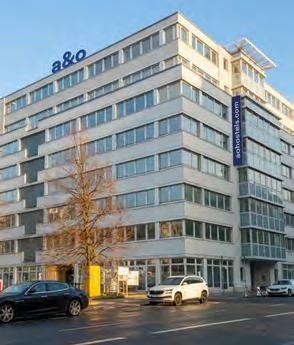
A&O ANNOUNCES PLAN FOR BERLIN SUPER-HOSTEL
EUROPE’s largest and fastest growing hostel chain, a&o Hostels, with 31,500 beds under management, has announced the freehold purchase of a 31,000 sq m vacant office building in a prime central Berlin location from PIMCO Prime Real Estate on behalf of Allianz.
years. These assets, in the for sale and for rent sectors, span a range of offerings from affordable rentals to luxury beachfront properties, the company said.
StepStone Group and Proprium Capital Partners sponsored the management-led acquisition of a&o at the end of 2023 and together they have invested around €500m in the platform’s expansion over the last 18 months. In line with its adaptive reuse strategy, a&o will leverage its in-house development arm to undertake a €40m conversion programme to deliver Europe’s largest hostel, with approximately 2,500 beds. The transaction extends a&o’s Berlin footprint, which will total 8,000 beds once complete. Located on RudiDutschke-Straße, in the heart of Berlin’s Kreuzberg district, the completed scheme will total 610 rooms offering a mix of private and shared space. With a building permit granted, a&o, alongside ANES Bau, which has been appointed as general contractor, is targeting a Q1 2027 opening date.
Atlético Madrid’s development project surrounding the stadium
Ignaczak says Patron Capital poised for transaction upturn
TRANSACTION activity is likely to increase, particularly if interest rates stay flat or trend downwards as liquidity improves and banks increase their financing, according to Christoph Ignaczak, investment director and senior partner Germany, Patron Capital.
“At Patron we have a significant capital base for growth and are actively investing across multiple countries and into different product offerings, including credit. In 2025, Mitsubishi Estate Co invested in Patron and provided €600m of equity commitments to our funds and financing for new subsector strategies,” Ignaczak said.
“We’re well placed with the firepower to take advantage of opportunities, at a time when deal flow is increasing and the macro backdrop is propelling many parts of the real estate market into a new positive phase,” he added.
Ignaczak believes that the revival of transaction activity across Europe’s real estate markets will be a major theme of this year’s MIPIM and he
said Patron Capital would be looking to meet local institutions in particular to understand how they are planning to re-enter the investment market, their appetite and strategies, and how Patron can support their objectives.
From a sector perspective, he said that
the company continues to see “excellent opportunities” in residential, where structural supply shortages and demographic trends will keep driving robust long-term returns.
“We also expect to be discussing the commercial sector, as occupier demand for limited prime space ripples out to well-located refurbished stock — a trend that’s supportive of our redevelopment value-add strategies,” he said.
Last year, Patron also embarked on the development of a new business in real estate credit, which is an area that it will be showcasing in Cannes.
“It’s gained excellent traction as we build on decades of success in opportunistic real estate investing in Europe. We’re a private business with real estate expertise able to step in and fill funding gaps borrowers are facing, including situations where traditional lenders may be constrained or unwilling to provide finance. So, for the first time at MIPIM, we’ll be discussing credit opportunities,” Ignaczak added.
KONE EVP calls for elevator upgrade
IF THE real estate industry is to respond to the challenge of climate change, it needs to invest in modernising elevators and escalators, according to Karla Lindahl, EVP Europe at KONE Corporation.
“The built environment accounts for approximately 40% of global carbon emissions and there’s urgent pressure to transform it,” she said.
“For KONE, this is about addressing a massive challenge: there are millions of aging elevators and escalators across Europe alone and that number keeps growing. Many of these are decades old, energy-inefficient, and completely disconnected from modern building systems.”
Upgrading such systems isn’t just good for the environment, Lindahl added, it is also good for business. “When we modernise equipment, we dramatically improve safety and reliability, cut energy consumption whilst improving efficiency, and make elevators digitally connected, enabling remote services and predic-
tive maintenance,” she said.
“That means building owners get transparency of the equipment’s performance, predictive maintenance that prevents breakdowns and results in increased uptime. What’s important is that we can modernise all kinds of elevators, KONE and non-KONE, across all generations and segments.”
She added: “At MIPIM, we’ll be discussing with clients how elevator and escalator modernisation delivers measurable value, lowers energy bills, reduces downtime, improves tenant experience and [delivers] significant carbon reduction.”
Lindahl also said that MIPIM is the ideal event for having such conversations.
“MIPIM brings together our clients, real estate investors, developers and building owners from across Europe and beyond, all in one place,” she said.
“Our clients have amassed portfolios with aging elevators and escalators, and they’re under pressure to improve
building performance and tenant satisfaction, reduce energy consumption and carbon emissions, and meet sustainability targets.”
ZAGA ANNOUNCES FIRST CLOSE FOR FLAGSHIP FUND
ZAGA Capital Partners has achieved a first close of its flagship ZAGA German Real Asset Opportunities II Fund SCA SICAV RAIF, securing equity commitments of approximately €210m through fund commitments and co-investments.
With ZAGA’s founders and anchor investor Attegia Holding having already committed and deployed substantial equity, the total capital raised to scale the firm’s German residential strategy has reached about €500m.
The fund is seeded with a €1.4bn portfolio of 14,000 rental homes managed by ZAGA’s portfolio company Net Zero Properties, providing investors with day-one income.
Located mainly across western and northern Germany, most of the portfolio was aggregated off-market over the past 24 months at more than a 40% discount to peak values.
ZAGA has identified a €3bn pipeline of complementary assets, with more than €400m already secured or in due diligence. Marco Zarges, owner and founding partner of ZAGA Capital Partners, said: “German residential-for-rent [is] a highly defensive and structurally undersupplied market with compelling entry pricing.”
KONE Corporation’s Karla Lindahl
Patron’s Christoph Ignaczak
ZAGA Capital Partners’ Marco Zarges
Innovinia grows IGPark network in big drive for CEE investment
DEVELOPER Innovinia is attending MIPIM to promote some of its newest projects, according to Balázs Czifra, director of sales and asset management at the company.
“At MIPIM 2026, Innovinia is showcasing its strategic growth and our focus on further strengthening our foreign presence,” he said. “We are highlighting the expansion of our IGPark network, which serves as a premier gateway for international investors and end-users entering the CEE region.”
Following the full lease-up of its 20,000 sq m facility in Debrecen next to the BMW plant, Innovinia is unveiling new flagship projects in both the east and west of Hungary.
“In the east, we are on track to complete our IGPark Nyíregyháza industrial-logistics building in H2 2026 for a renowned Chinese Tier 1 automotive supplier,” Czifra said.
“Simultaneously, we are expanding our footprint in the south west with IGPark Pécs, where we are preparing a 23,000
sq m industrial-logistics hall. These projects represent our commitment to providing world-class infrastructure in the most high-growth industrial corridors for our global partners.”
In recent years, Czifra added that he has seen occupiers taking a longer term view when it comes to real estate.
“We are witnessing a definitive move
toward long-term resilience in occupier strategy,” he said.
“A premium location is no longer defined simply by its proximity to a capital city, but by its ability to support sustainable growth over decades. There is a clear shift toward specialised regional hubs that offer superior scalability and labour availability.”
He added that occupiers also expect far more from their buildings in the modern economy. “Our current occupiers — predominantly from the high-tech manufacturing and automotive sectors — increasingly demand high-load technical specifications and energy autonomy, such as solar PV readiness,” he said.
“The market is moving away from generic warehousing toward tailor-made solutions. In these projects, the building is treated as a specialised, high-tech tool for production and logistics rather than just a shell for storage, requiring deep technical integration from the earliest planning stages.”
Albrecht: Hungary’s hot for investors
HUNGARY is now one of the most attractive regions in central and eastern Europe for investment, according to industrial and logistics developer INPARK.
Armand Albrecht, chief executive officer at the 10-year-old company, said its developments were a key part of the attraction for investors.
“INPARK provides partners with a comprehensive view of the innovative developments that position Hungary as one of the most attractive investment destinations in the region,” he said.
“With 900 hectares of development land, INPARK is still the only industrial real estate developer in Hungary with truly nationwide coverage: we are present in 15 counties and 20 cities.”
Albrecht added that several of INPARK’s recent developments illustrate the point perfectly. “Among the important industrial investments of 2025, we have to mention Halms Hungary’s development in Miskolc, which we completed in an exceptionally short time of eight months,” he said.
“We also launched Vulcan Shield Global’s development in Békéscsaba and a new
HELLOPARKS EYES WEST FOR NEW OPPORTUNITIES
HUNGARIAN developer
HelloParks is in Cannes to promote its industrial developments to western European investors, according to Rudolf Nemes, CEO and co-founding partner at the company.
“We will highlight that HelloParks is developing investment-grade industrial buildings in Hungary that fully meet western European investor expectations,” he said.
“Recently, we have completed two sales and two additional buildings are currently either under offer or in exclusive negotiations. We expect to announce additional deals in the near future.”
large-scale investment in Debrecen with the construction of a 44,000 sq m hall.”
Albrecht said that part of INPARK’s approach was to offer the high environmental credentials that modern occupiers increasingly demand. “We prioritise energy efficiency, smart infrastructure and an ESG approach,” he said.
“We propose a number of sustainable and environmentally friendly solutions to our tenants. INPARK was among the first companies to implement energy storage developments in its industrial parks: we have set up energy storage systems in the Budapest region and Eastern Hungary last year.”
He added: “We strive to become a pillar for the growth of our partners, delivering comprehensive property solutions. We cover a full range of services from land search and infrastructure development through planning and permitting to construction and longterm property management.”
Nemes said that the industrial sector is currently benefiting from occupiers’ desire to relocate to modern facilities. “We see a clear trend of occupiers relocating from older facilities,” he said. “Modern buildings are significantly greener and more efficient, which has become a key factor when making relocation decisions.”
Nemes added that moving to modern premises is not necessaily prohibitively expensive. “The all-in occupancy costs of HelloParks buildings are competitive, even compared to the oldest existing facilities,” he said.
Armand Albrecht INPARK
Innovinia’s Balázs Czifra
HelloParks’ Rudolf Nemes
2026 Conferences & Events
Palais
Wednesday 11 March
12.30 - 14.00 By invitation only Sponsored by Powered by
Hotel Asia Lunch
Charleroi
Tournai : where heritage inspires investment 11.45 - 12.40 Greater Liège: The Einstein Ambition at the Heart of a Territory Reinventing Itself 9.45 - 10.40
- 15.55
9.30 - 10.30
Building the Future: How Technology is Transforming Real Estate and Construction
Debussy Room
Verrière Californie
Audi A
Italian Real Estate in the European Context: Outlook, Capital and Returns 10.00 - 11.00 Organised by
14.00 - 15.00 Organisé
15.30 - 16.30
Palais 3 Salon Croisette People FlowRedefined
Investing in Germany: Which segments and locations are currently in demand? 11.00 - 12.00 Organised by Organised by Organised by
Immobilier : laissez-vous de la valeur sur la table ?
17.00 - 18.30
Immobilier des campus : catalyseur des enjeux de territoires
Organised by
Invest in the Nordics –Introduction of large scale opportunities in safe and sustainable Iceland, a high-growth market 11.00 - 12.00
There’s a way out! Crisis cannot resist creativity 11.30 - 12.00
- 12.30
How can we assess the financial impact of decarbonization?
- 15.30 Barcelona Catalonia Keynote – The New Biomedical Hub: Redefining Life Sciences in Barcelona Catalonia
- 15.00
European Logistics: Outlook and Investment Opportunities 15.30 - 16.30 Organised by 10 Years of the Spanish Conference: 10 Reasons to Invest in Spain 12.30 - 13.30 Organised by
- 14.45
in
Palais 3
Palais 5
Palais 3
Palais 4
UK and French Focuses Wednesday 11 March
Palais 1
8.30 - 10.00
BPF UK Investor Breakfast By invitation only
10.15 - 11.00
The Next Generation of Investment – What Creative Strategies Should Cities and Regions be Deploying In Turbulent Times?
11.15 - 12.00
Middleton, Greater Manchester - Our Town, Our Future, a co-operative approach to regeneration
Organised by
12.15 - 13.00
Delivering Real Returns on the Road to Energy Efficiency and Net Zero: Investment, Innovation, and Impact
14.00 - 14.45
Urban Reinvention & Resilience: Examples of Placemaking Having a Tangible Impact On Real Estate Investment
15.00 - 15.45
Future Living: Aligning Investment, Affordability, Sustainability, and Community Impact
16.00 - 16.45
Organised by UK’s untapped power player
9.00 - 10.00 – Harbour Room / Gare Maritime
Investment Guide: Unlocking Opportunities in French Regions
10.30 - 14.30 – Main Room & Harbour Room / Gare Maritime
By invitation only
14.00 - 15.00 – Salon Croisette (P3)
Immobilier : laissez-vous de la valeur sur la table
Organisé par
16.00 - 17.30 – Harbour Room / Gare Maritime
Equality of opportunities in real estate
Table francophone pendant le networking dirigé (workshop)
17.00 - 18.30 – Salon Croisette (P3)
Immobilier descampus : catalyseur des enjeux de territoires
Organised by
18.30 - 19.30 – Main Room / Gare Maritime
AFEX: 30 Years of Export, Many More to Come!
19.30 - 21.30 – Harbour Room / Gare Maritime
Organised by L’AFEX Cocktail (By invitation only)
Organised by
UK Hub: BPF Building our Future Drinks Reception
17.00 - 19.00 Organised by
Connected Capital
8.30 - 9.30 Sponsored by
10.00 - 11.00
Quartiers d’affaires internationaux : comment maintiennent-ils leur attractivité dans un monde en mutation ?
Organisé par
Asset or essential? Why the office is the newest tier of infrastructure
Terrace Event | SwiMIPIM 10.15
11.00 - 11.45
Balancing investment value and historic preservation
12.00 - 12.45
Digital Resilience: Securing London’s built environment for the Fourth Industrial Revolution
Sponsored by
10.00 - 10.45 In partnership with Sponsored by A panel
14.00 - 14.45 In partnership with
15.00 - 15.45
Digital infrastructure for a smarter city
16.00 - 19.00 Sponsored by Eastern City, Mixmag and the City BIDs
Reception | Sundowner Sessions DJ Set
11.30 - 12.30
Grand Paris 2026 : Reprendre l’avantage dans la compétition mondiale
12.30 - 13.30
Changement de programme à La Défense
Organisé par
14.30 - 15.30
Data Centers : infrastructures, scalabilité - quelles stratégies ?
16.30 - 17.30
Bureaux : transformer pour performer - les modèles qui s’imposent en 2026
17.30 - 18.00
Rives
Défense : place au projet urbain avec le dévoilement de l’équipe de concepteurs
Organisé par
C14
C12B
N RTH ENGLAND OF
WEDNESDAY
BREAKFAST BRIEFING: HOW TO BUILD A NEW TOWN
08:30-10:30, Canopy by Hilton • What works and what doesn’t when it comes to town and city centres, invitation-only
GREAT MINDS: WHAT IS SCOTLAND DOING TO ATTRACT INVESTMENT, NEW BRANDS, AND NEW BUSINESSES?
09:00-09:45, North of England Suite • How Scotland is driving investment and growth through collaboration and strategy
WOVEN WHISKY TASTING
11:30, Scotland stand, UK Hub
GREAT MINDS: HOW SMEs ARE TRANSFORMING THE NORTH
13:30-14:30, North of England Suite • How SMEs are making Northern investment even more tantalising, in partnership with Axis-RE and Marco Living
GREAT MINDS: LEISURE AS A REGENERATOR
THE UK’S UNTAPPED POWER PLAYER
15:00-16:00, North of England Suite • How leisure is being utilised to revitalise UK communities, in partnership with Newmark and theleisureway
16:00-16:45, UK Stage • Hear about the North of England projects that are due to transform the UK’s economy
Ringley expands commercial and living portfolios in UK
RICHARD Williams, CEO of UKbased real estate asset manager The Ringley Group, says his company is in growth mode despite the fact that “uncertainty is the new certainty”.
Speaking to MIPIM News, he said: “It’s challenging to make solid predictions when the world is so unpredictable. But we feel there is space in the market to expand. We’re having positive conversations and have a deep pipeline of opportunities.”
Increased activity is coming in tandem with “a greater focus on operational efficiency and driving net operating income. A lot of what we do this year will be helping our clients drive their net revenue; that’s where we see The Ringley Group adding real value.”
Williams said MIPIM is “a very important event for our valuations team. The banks attend MIPIM in a
major way and the event presents an opportunity to get alongside our clients. This year it’s a particularly interesting time, there will be a lot of talk about what is happening in the valuation world, with the banks starting to look very strongly at their loans at the beginning of the year.”
The living sector will be a big discussion topic, Williams said, because it is “the foundation of Ringley’s business”. Identifying “green shoots”, he says “we’ve adapted to the surge in the living sector — now 28% of the market — by leveraging our 30-year heritage to service high-volume portfolio requests without compromising quality.”
He also said the firm will be talking about the growth of its commercial business: in particular the UK’s key office cities, describing the return to the
office as “an ongoing metric of how our cities thrive”.
More generally, Williams said that Ringley is “embarking on ambitious plans to grow the commercial part of the business, leveraging both our existing platform, and increasing commercial instructions, to capitalise on the growing demand from investors and developers for advisors that can provide expertise across asset classes, either as standalone projects or as part of multi-asset developments.”
The Ringley chief said MIPIM continues to be a very important place to be seen. “A tip from a client many years ago that always resonates — if I’m not speaking with you at MIPIM, then I’m speaking to your opposition. Our clients are there and it’s a great opportunity to connect and reconnect, and also an excuse to follow up.”
UK real estate set for deals surge
THE HEAD of real estate for a major London law firm has expressed “cautious optimism” about the markets in 2026. Victoria Towers, head of commercial real estate at Forsters, has said that growth and confidence look set to
return, particularly in her specialist area of industrial and logistics, as well as prime office development, and the living and data centre sectors.
“I think overall the market is in a better place than it has been for some time
and we’re approaching 2026 with cautious optimism, which I’m hoping will be emboldened by what I see and hear in Cannes,” she said. “I’m expecting to see a continued surge in prime office development and refurbishment, while logistics, living and of course data centres will continue to grab the attention of investors.”
Towers said she also sees potential for some major deals, joint-venture partnerships, and increasing inward investment into the UK during 2026, further boosting volumes and confidence in real estate.
“I think we will see some significant megafund and portfolio deals this year. Like everyone else, I was fascinated by the conversations around technology and AI so I will be looking forward to hear how far the dial has moved over the last 12 months, and what we can expect on the horizon.”
Towers, who is known as an expert in the logistics and industrial real es -
tate sectors, has said that MIPIM is a “great barometer” of the industry and an ideal place for catching up on industry insights from a wide range of property professionals.
“MIPIM will do what MIPIM does best: provide a unique meeting place for the kaleidoscope of themes and topics shaping the world of real estate,” she said.
“Collaboration and joint-venture opportunities will be high on the agenda, with the importance of local knowledge and on-the-ground expertise being more important than ever in the continuously evolving and uncertain environment in which we’re living.
“The event is always a great barometer and indeed catalyst for how capital flows are shifting across regions and asset classes, the UK will certainly be hoping the momentum we’ve seen for overseas investment into the UK — particularly from the U.S and Middle East — will grow.
“No other conference or marketplace brings together such a broad and diverse range of developers, investors, advisors and decision makers.”
Victoria Towers
The Ringley Group’s Richard Williams
SINCE 1999
Most people only see the "deal." Europe-re.com sees the infrastructure, the research, and the future.
Quality ensures UK office market is ‘safe haven in turbulent times’
THE BRITISH Council of Offices (BCO) is back at MIPIM to showcase investment and leasing opportunities in the UK market, both in London and in the country’s strongly performing regional cities.
But while the BCO may have missed some recent editions of MIPIM, CEO Sam McClary , by contrast, is a long-time attendee, previously as editor of Estates Gazette. Her appointment last year to the BCO was announced on the first day of the Cycle To MIPIM ride from London, which “led to my phone ringing constantly on the ride”, she said.
“This is an important year for the BCO to be in Cannes, because I think it’s fair to say that offices are back but there has undoubtedly been a flight to quality,” McClary added. “Work
from home has stabilised and the need for well designed and developed offices that provide employees with a great experience has never been more important.”
She added: “In the UK, we have some of the best developers and operators, and world-class office buildings. In these turbulent times, it’s important to remember that Britain has always been seen as a safe haven for capital and has transparent rules and regulations. Obviously, the living sector is attracting a lot of interest at the moment, as you can see at MIPIM. But with offices slowly turning a corner, it’s a reminder that real estate is not just about housing and data centres.”
McClary also pointed to the value of commercial real estate opportunities beyond London, with many prime of -
fice locations in regional cities offering a significant yield gap compared with the capital, as well as a good work-life balance for employees.
As she approaches a year since her appointment at the BCO, McClary said she has been struck by the amount of content that the organisation has and disseminates to its members.
She wants to continue to find ways to make this available and to “bang the drum” for British workspaces.
“I’m passionate about the real estate industry and we want to get the word out about the opportunities that exist in the UK. For me, coming to MIPIM as CEO of the BCO for the first time means fact finding, representing the British office market and reconnecting with contacts and colleagues,” she said.
Le rendez-vous des solutions pour l’Habitat, l’Immobilier et la Ville 8è édition
Une journée pour découvrir les solutions innovantes pour le logement et pour la ville (réseaux de chaleur, confort d’usage, adaptation, résidences gérées…). Événement réservé aux maitres d’ouvrage sur inscription directement sur le site www.assisesdulogement.com
The British Council of Offices’ Sam McClary
WHERE REAL ESTATE DECISIONS ARE MADE
Canadian business publications read by decision-makers shaping real estate, construction and property management.
LÀ OÙ SE DÉCIDE L’IMMOBILIER
Des publications d’affaires canadiennes lues par les décideurs qui façonnent l’immobilier, la construction et la gestion immobilière.
Real estate remains resilient in era where volatility is ‘new normal’
IMPROVING fundamentals and an increase in the availability of capital have buoyed the real estate industry globally as a new cycle gathers pace, with greater stability around inflation and interest rates. There is also a sense that asset class valuations are rebounding from recent lows with liquidity returning to the US, Europe and Asia Pacific. However, the prevailing uncertainty arising from deglobalisation, including volatile geopolitics and challenging economic conditions, still presents investors with a “major test of nerve”. Those are the main findings in the Emerging Trends In Real Estate Global Outlook 2026 report from PwC and the Urban Land Institute (ULI), capturing the views of thousands of senior property professionals from Europe, the US and Asia Pacific to gauge sentiment on real estate investment and development prospects.
This year’s report illustrates a broadening in industry concerns across the globe arising from a number of geopolitical events in the last year. The international backdrop continues to shift at pace, requiring the industry to constantly pivot and adapt. The report says that the unavoidable risks from global volatility have led to a shift to diversification across both sectors and countries. Pricing has also fallen enough in Europe and Asia Pacific to present an attractive trade-off with risk, while occupier markets have remained relatively healthy despite the economic conditions. The report also reflects a strong belief among leaders that real estate’s resilience should continue to shine through, despite the volatility.
Simon Chinn, vice-president of research and advisory services at ULI Europe, said: “This year’s global outlook portrays an industry that is coming to terms with
068_CFNEWS_N3 DEMIE HORIZONTALE_PIM
UNE SOLUTION SaaS, UNIQUE EN FRANCE, DÉDIÉE AUX ACTEURS DE L’IMMOBILIER D’ENTREPRISE
ANALYSER
a changing investment landscape dramatically shaped by geopolitics. In an era where volatility might be our new normal, it’s clear that our industry’s leaders strongly believe in the resilience of real estate
despite the current turbulence.”
Gareth Lewis, PwC director and PwC Emerging Trends in Real Estate leader, added: “The real estate industry has been encouraged by improving fundamentals and the increasing availability of capital as a new cycle gathers momentum. Stepping back from the prevailing geopolitical uncertainties, our report identifies that it’s the changing nature — as much as the volume — of capital flowing into real estate that will be important to how the sector evolves in the coming years.”
Visualisez et explorez les données de marché en temps réel* avec un niveau de détail inégalé (chaque transaction est détaillée)
*Source CFNEWS DATA, données compilées et structurées par nos analystes, vérifiées par nos journalistes experts du Real Estate
SEGMENTER
Filtrage des données par stratégie, régions, typologie d’actifs, investisseur, valorisation métrique...
SUIVRE
Suivi jour après jour des grandes tendances de l’investissement
LOCALISER
Cartographie complète des transactions en France avec géolocalisation
On the 16th of September, at Business Arena Stockholm, we are proud to present the Transaction Stage. A dedicated stage focused entirely on the Nordic real estate transaction market.
Bringing together international investors, decision makers from real estate companies, advisors, and capital partners, the stage explores where opportunities are emerging and how capital is being deployed across the region. All sessions are held in English and features a mix of Nordic and international speakers, creating a global dialogue around Nordic assets. The Transaction Stage also hosts our International Investor Lunch, designed to foster meaningful connections and high level conversations.
Join us at Business Arena Stockholm to take part of the Transaction Stage and engage directly with the people shaping Nordic real estate transactions.
For more information, contact: Jimmy B Lehtinen jimmy.b.lehtinen@bonniernews.se +46 702-589 07 02
Business Arena Stockholm, 16 september, Stockholm Waterfront Congress Centre
Holistic approach helps W.Re build success close to home
IN A WORLD where international expansion is seen as a measure of corporate success, London-based W.Re stands out for its determination to remain London focused.
We’re a small business and we need to be really, really good in what we do,” said CEO Sascha Lewin. “We swim in a pond with big fish, so we want to be a strong and agile fish in that pond. We’re not trying to cover the whole ocean where we’ll get swallowed up.”
Based in London’s Soho, several of W.Re’s developments are barely a stone’s throw away from their offices. The core of their business is refurbishing existing office properties to create better value for tenants, landlords and the community, where local knowledge is key.
Feedback was central to its plan for
the redevelopment of the former Arding & Hobbs department store building in Clapham, south London. There were over 1,000 individual responses to its consultation, with 10 presentations to stakeholders, residents and businesses.
It now has retail and leisure, including a gym, on the ground floor and basement, with modern offices above and a new roof terrace with views over the city. Mixed use is emphasised by its venue space. “It’s used by corporates during the week and at weekends it’s used by families, with about a 70:30 split,” he said.
Mixed use along with high quality office environments is the way to create new value from existing buildings he believes. “I think we need to look at real estate in a more holistic way, especially now with people working
FORMULE PAPIER + NUMÉRIQUE
€ / an
(66 € pour les étudiants)
from home and a trend towards a four-day working week.”
Updating technology is also a factor, including energy management for sustainability reasons. W.Re has a project in the City with a gaming company as a key tenant. “They’re very technology-driven, so tech was really important for them — even having a phone app to order their coffee from the coffee shop on the ground floor.”
He is optimistic about MIPIM. “We have had a dire time as commercial developers and investors for the past five years. But I feel there is much more to talk about this year. We are seeing a lot of interest in London from investors.
“The tone of meetings now is ‘how can we do this together’, rather than ‘let’s just catch up and have a coffee’.”
Pour nous contacter : urbanisme@urbanisme.fr 01 45 45 45 00
Pour vous abonner, commander un numéro, s’inscrire à notre newsletter : www.urbanisme.fr
FORMULE NUMÉRIQUE
99 € / an
(48 € pour les étudiants)
W.Re’s Sascha Lewin
2026 Finalist
Best Urban Regeneration Project
Developed together by Tikehau Capital and ALMOND Real Estate, ALMOND Core Centre (ACC) demonstrates how institutional capital can regenerate the heart of Europe’s cities.
ACC acquires individual residential units, executes deep refurbishments, and consolidates them into an institutional-grade rental portfolio.
Rather than expanding cities outward, ACC upgrades existing housing stock, improving efficiency, reducing emissions and delivering high-quality homes within established neighbourhoods.
Urban regeneration is no longer a one-off intervention. It is a repeatable, scalable investment model.
‘Safe and peaceful’ Brazil showcases multiple investment opportunities
BRAZIL is rich with opportunities for inward investment into its tourist destinations, urban centres and agricultural land, the president of the country’s national real estate federation has said.
João Teodoro da Silva, president of the Brazilian Federal Council of Real Estate Agents (COFECI-CRECI), is in Cannes to highlight the many opportunities for investors.
COFECI-CRECI, which works to attract inward investment into the country, represents both Brazilian national real estate interests and those of the regional real estate councils representing Brazil’s regions.
Attending MIPIM for the 13th time, Teodoro da Silva stressed that Brazil offers international markets a wealth of opportunities across diverse sectors and a wide geographical spread. He highlighted the country’s many tourist destinations, including the great number located along the country’s 900 km of Atlantic coastline, as well as the underdevelopment of many secondary and tertiary cities now primed for investment and growth.
Teodoro da Silva said: “Brazil is a country of continental size, so we have many opportunities for business, in tourism, in commerce and in the agriculture industry. Agriculture is very important to Brazil, accounting for 24% of the economy.
“There are also big cities that are underinvested in; opportunities for investment in projects from commercial centres to hospitals; [and] a whole range of opportunities in these cities. Our population is more than 215 million people, which makes Brazil a big destination and a very attractive destination for investment.”
Teodoro da Silva added that Brazil is in a “very privileged position” in terms of geopolitical events. “Brazil is a calm destination and a peaceful destination from a political and geographic perspective,” he said.
Among the projects showcased at MIPIM is Maraey, a mixed-use residential and tourism development in Maricá, 45 km from Rio de Janeiro. The project will deliver huge swathes of mixed-use space over 840 ha across 12 km of lagoon coastline and 8.5 km of beaches on the Atlantic coast. The plans include hotels, residential buildings, beach resorts, a golf course, an equestrian centre, a tennis and sports club and a natural research centre developed in conjunction with universities from around Brazil.
COFECI-CRECI is heading a delegation of real estate professionals from Brazil’s 26 federal states and one federal district, which is the seat of the capital Brasília.
COFECI-CRECI’s
João Teodoro da Silva
European industrial sector benefits from Chinese expansion
THE INDUSTRIAL real estate sector is picking up with help from the growing interest of Chinese companies wanting to set up their own European distribution networks, said Jan Philipp Daun, managing director of Hamburg-based Garbe Industrial.
Garbe group, with 16 offices in 11 countries is in a good position to gauge the European market, with 400 of the company’s 650 employees in the industrial sector.
For the moment, discounting any impact from the situation in the Middle East —“it’s totally unknown to all of us” — Daun is optimistic.
“The last two years were for us a little more challenging because tenant demand was lower than in the past. But the last six months, I would say that tenant demand has increased quite a bit and we see it in leading activities,” he said.
“It’s quite interesting where this demand is coming from. On the one side we are seeing a lot of Chinese tenants — we signed a handful of leases with Chinese
‘‘The market is getting better than 12 months ago’’
companies in the last two to three months and I just heard that we are working on the next one.”
Chinese ecommerce is coming, but it is developing in a different way, he said. They are not trying to sell their goods through European distribution companies, now they want to build their own networks, and therefore want to lease their own sheds. Garbe has set up a China desk to support new clients.
JUST RETAIL
What’s also helping is more activity from the ecommerce companies, especially Amazon.
After the post-COVID boost there was a marked slowing down, but now there is a clear upturn, he said. “So from that perspective, the market is getting better than 12 months ago — from the investor side, from the capital side.”
Residential is the Garbe group’s second largest sector of activity, but it now has a new infrastructure sector and has installed 6m sq m of rooftop solar panels, Daun said.
Eastern Europe is also seen as a potential growth area. “We’re in the Czechia, in Poland and I think that’s quite interesting. A lot of German industrial players are moving their industrial facilities to the Czechia, Slovakia, Romania etc, and we have to follow them with the logistics.”
MIPIM is always a help, he said, having one place and one time of year to meet all its investment partners. “We like to put boots on the ground.”
Garbe Industrial’s Jan Philipp Daun
Nos émissions SMART IMMO et SMART PATRIMOINE en
direct
Rejoignez-nous en Gare Maritime à bord du yacht M7 (AFEX/Ficade) !
Hungary highlights investment offers beyond Budapest
HUNGARY is attending MIPIM this week to drum up investment for the country as a whole but in particular for areas outside its capital Budapest, according to Miklós Erik Tromler, Hungary’s ambassador-designate to France and the Principality of Monaco.
“The aim of the Hungarian presence is to broadly present trends in the real estate market and to enhance and diversify the inflow of foreign direct investment, domestic real estate development and investment opportunities, and the directions of regional development outside the capital,” he said.
“Within the framework of the conference, we are highlighting the current Hungarian real estate market trends, what changes can be observed with the rise of regional cities, how the green transition is appearing on the developers’ side and what expectations can be seen for 2026.”
‘‘A highly attractive destination for investors’’
Tromler said Hungary was keen to build on the success it achieved in 2025 against the odds. “Above all, it is important to emphasise that in 2025, despite the extremely challenging economic environment, Hungary reached new peaks in real estate market development, increased the inflow of foreign direct investment, and expanded the volume of job creation,” he said.
“According to official data, rental demand in the industrial and logistics market has grown by more than 30% compared to the previous year. In addition, development activity is picking up again with the volume of projects under construction approaching 600,000 sq m by the end of the year, which, with the planned completion of these projects in
2026, could mean a 25% increase in annual deliveries.”
More broadly, Tromler said Hungary was already ahead of the pack when it came to attracting foreign direct investment (FDI). “Hungary stands out in Eastern Central Europe as a prime location for FDI,” he said. “In recent years, Hungary has attracted more FDI than the other so-called Visegrád countries — Czechia, Poland and Slovakia — combined, creating a vibrant landscape of real estate development project, ranging from industrial parks to high-class residential property development projects.”
He added: “We are right in the middle of a period of ramping up major industrial investments. BMW Group launched their most modern factory in Debrecen in eastern Hungary last November and Mercedes-Benz is close to completing the expansion of their factory in Kecskemét in central Hungary, which is set to become the largest European production base of the German giant.”
Further such “megaprojects” will be finalised soon, Tromler said, including Chinese firm BYD’s first European car factory in Szeged in southern Hungary and battery market leader CATL’s factory in Debrecen. “These are only a few examples of a massive wave of FDI projects, which will serve as regional growth engines, creating once-in-a-lifetime opportunities for players in the real estate market,” he said.
“All in all, Hungary remains a highly attractive destination for real estate investors looking for markets where expected growth in industrial output and property demand go hand in hand. Overall, Hungary has an open economy and one of the most attractive environments in Europe for investing companies, with a record low 9% corporate income tax rate.”
He concluded: “The business-friendly environment, combined with the EU membership, a central geographical location, the high quality of transport and digital infrastructure, a competitive and motivated workforce makes Hungary a particularly attractive location for investments.”
Miklós Erik Tromler, Hungary’s ambassador-designate to France and the Principality of Monaco
089_Immogroup_N2 quart de page_PIM
Panel delivers some home truths about affordable housing
MIPIM 2026’s emphasis on affordable housing continued yesterday with a high-powered session entitled Making It Work: Scalable Solutions For Affordable, Sustainable Housing. With a sharp focus on solutions that are replicable, financeable and grounded in real-world collaboration, the session brought together city leaders, investors, planners, developers and innovators to identify practical pathways towards affordable housing. The session opened with a framing keynote, followed by an extended fireside chat. Participants then moved on to focused roundtables exploring the critical levers of land, planning, finance, community partnership and performance metrics.
The session’s moderator, ING Media’s Damian Wild, kicked off the event by saying that “delivering affordable, sustainable housing at scale requires co-operation and a sharing of best practice. Finding solutions will take bright ideas from bright people — but fortunately we have a room full of them this morning.”
The keynote was delivered by UN Habitat’s Anacláudia Rossbach, who suggested four takeaways. First, “we need to move from projects to systems. We have to recognise that the global housing crisis is not a market fluctuation.”
Another takeaway was that the investment climate is “complex and risky”, meaning there needs to be a public-private “coalition” to find
ways to minimise the risk. She also stressed the need for large-scale solutions that can be implemented at country level, as well as global co-operation “because the challenge is huge”.
Wild and Rossbach then joined the fireside-chat panel alongside representatives from the cities of Reykjavik, Toronto and New York.
Reykjavik’s Ólöf Örvarsdóttir said the issue of affordable housing was relatively new for her city and driven by increases in migration. She stressed the importance of “a strong, consistent planning strategy”.
Toronto’s Shelley Carroll, who was elected in 2003, said “even then we recognised the need to build in more density”. She said the plans that were put in place to address housing need have had to adapt to reflect changing demand. “Initially, it was about building housing into the downtown area, creating mixed-use environments for millennials. But now I’m focused on the growing need in the suburbs.”
New York City’s Joy Sinderbrand outlined the scale of the challenge her department faces: “We provide affordable public housing for over 500,000 people. Our most recent physical-needs assessment was a $60bn [€51.6bn] need to bring our portfolio to the state of full repair.”
Sinderbrand said her department’s response has been “a public-private partnership model that is bringing in billions of dollars to public housing”.
UN Habitat’s Anacláudia Rossbach (left), New York City’s Joy Sinderbrand, Toronto’s Shelley Carroll, Reykjavik’s Ólöf Örvarsdóttir and ING Media’s Damian Wild
The most comprehensive platform for commercial real estate information, analytics & news.
*La plateforme la plus complète en immobilier d’entreprise en matière d’information, de data et d’analyses.
Investing on an industrial scale
Asset location and quality are set to make the difference this year as investors hone their logistics strategies
INDUSTRIAL and logistics assets have helped boost the returns of real estate investors in recent years, with secular trends such as ecommerce and nearshoring supporting demand metrics.
As capital markets continue to evolve, however, investors are seeing a two-speed race emerge between the “best and the rest” in terms of asset location and quality.
Christian Jamison, founder of Valor Real Estate Partners, confirms that he has seen acquisition volumes ebb and flow in response to recent events. “In terms of deals, 2025 saw the markets slow in the wake of the US administration’s tariffs, with the sector having a quiet summer,” he says. “The market has stabilised since then, with buyers and sellers more aligned, and larger deals returning.”
Taking an optimistic view of the sector’s outlook, Jamison anticipates mo -
mentum returning throughout 2026, describing investor sentiment for urban logistics as “positive”. “Everyone recognises the attraction we have always had for the sector, which offers a mixture of resilience and returns,” he sayss. “On top of this, rents are still growing and intrinsic land value remains a factor.”
Notable deals for Valor have included an ultra-last-mile acquisition in Le Kremlin-Bicêtre on behalf of its joint venture (JV) with QuadReal Property Group. Built in the 1980s, the high-quality unit, purchased in November, is fully let to a leading construction materials company and a self-storage operator.
Following Valor’s recent leasing success at Arcueil Valor Park, the acquisition underlines the JV’s continued conviction in Paris’ south Périphérique cluster, where competition for land is exceptionally high due to the
predominance of residential use and limited industrial zoning. Adds Jamison: “The amount of ultra-last-mile stock is very small — we would love to do more deals like this, as tenant demand is significant. This asset in particular is a small unit surrounded by housing — a developer would never get permission to build another in that area.”
In terms of geographies, he says that major urban areas including Berlin, London, Paris and Milan are among chief targets. The Italian metropolis, he says, “is a good example of a strong, growing city, with relatively low ecommerce penetration”. Referencing a recent Berlin deal, he adds that “while the German economy has been quite slow growing, I expect that to improve with the rise in defence and infrastructure spending. It’s a young city, with an impressive consumer base.” Finally, he notes that the Dutch
The view on logistics is evolving
Valor’s Christian Jamison
DEMANDEZ UNE DÉMO
UNE SOLUTION DE DATAVIZ, UNIQUE
EN FRANCE, DÉDIÉE AUX ACTEURS DE L’IMMOBILIER D’ENTREPRISE
ANALYSER
Visualisez et explorez les données de marché en temps réel*
avec un niveau de détail inégalé (chaque transaction est détaillée)
*Source CFNEWS DATA, données compilées et structurées par nos analystes, vérifiées par nos journalistes experts du Real Estate
SEGMENTER
Filtrage des données par stratégie, régions, typologie d’actifs, investisseur, valorisation métrique...
SUIVRE
Suivi jour après jour des grandes tendances de l’investissement immobilier
LOCALISER
Cartographie complète des transactions en France avec géolocalisation
market is of interest, while other urban centres, such as Barcelona, Dublin and Lyon remain on the radar.
Acquisitions phase
Swiss Life Asset Managers has also been expanding its pan-European industrial and logistics strategy, acquiring its first UK asset in January. The modern warehouse property is situated in Avonmouth, a strategic South-West location for distribution warehouses near Bristol.
Marking Swiss Life Asset Managers’ first UK acquisition on behalf of its pan-European industrial and logistics fund, the purchase furthers the fund’s ambitions to acquire a combination of multi-let industrial estates and logistics assets, while enhancing its geographical diversification. It also strengthens the fund’s ESG credentials, with the asset aligned to net-zero objectives.
The property, which is let to a third-party logistics provider, has a weighted lease term of 8.7 years. The property is close to the Port of Bristol and Bristol Airport and benefits from the city’s deep, highly skilled labour pool and strong occupier base.
Björn Pfeiffer, deputy head of portfolio management at Swiss Life Asset Managers says: “This acquisition marks an important milestone for our pan-European industrial and logistics fund. As institutional capital continues to flow into the sector, demand for modern, energy-efficient warehouse space continues to grow across the UK, underpinned by stable valuations, resilient occupier markets, supply constraints and the ongoing shift toward e-commerce and streamlined supply chains. Avonmouth offers the type of high-quality, well-connected asset we look for across key European markets.”
Phil Sturdy, head of transactions, UK and Ireland at Swiss Life Asset Managers adds: “This asset is a good first addition to the fund’s UK portfolio. The lease includes attractive rent review provisions to the higher of open market rent or RPI. With constrained supply in the South-West and sustained demand for prime logistics space, this asset positions us well to capture attractive income and longterm value creation.”
The acquisition marks another milestone for Swiss Life Asset Managers in the UK, following a series of positive developments including the appointment of Tim Munn and
Eduardo Illitsch as co-CEOs and the launch of a joint venture with Homes England and Capital&Centric to deliver £860m in mixed-use residential developments.
UK market trends
The UK is considered one of Europe’s leading logistics markets in terms of property values and the speed of innovation. According to recent Knight Frank data, the average clear height of UK warehouses over 20,000 sq ft (1,860 sq m) has risen by over 50% from 7.6 m to 11.5 m over 20 years. The rise is partially driven by the growth of ecommerce and the need for managing larger inventories with greater efficiency, and is enabled by innovations in warehouse automation. Technology is a key enabler when it comes to making use of greater clear heights. Automated Storage and Retrieval Systems (AS/RS), Autonomous Mobile Robots (AMRs), and Automated Guided Vehicles (AGVs) make ultra-high-bay storage feasible, unlocking efficiencies that manual
CONFERENCES AND EVENTS AT MIPIM
Asset Class Stage (P3) Wednesday, March 11
The Logistics Forum
Part I: Global Forces, Geopolitics & the New Demand Equation 14:00 - 15:30
The Logistics Forum
Part II: From ESG to GSE: Sustainability, Infrastructure & Economic Reality
15:30 - 17:00
operations cannot achieve. Rising land costs, particularly in urban locations, also make vertical expansion more cost-effective than horizontal sprawl. Competing pressures for land in London and other cities have eroded the supply of industrial land and planners have sought to maintain current floorspace through the intensification of sites; either through reducing yard space or increasing the number of floors.
Johnny Hawkins, partner at Knight Frank, says: “Height is increasingly a defining feature of logistics facilities, playing a key role in driving value and performance. For investors, taller buildings can improve income resilience, support long-term value growth and reduce obsolescence risk. Those who integrate vertical thinking into their investment, development and operational decision-making will be best placed to mitigate cost increases and land availability challenges, as well as capitalising on the opportunities presented by a warehouse market that trends increasingly skyward.”
Swiss Life Asset Managers acquired its first UK asset in January, in Avonmouth
Combien vaut une villa avec piscine et héliport ?
Nous vous mettons en relation avec des experts de l’immobilier de prestige pour réaliser la plus juste estimation de vos biens.
2-3 December 2026
Rosewood, Hong Kong
THE GLOBAL boom in artificial intelligence (AI) investment and application has seen the creators of large language models grab plenty of headlines over the last few years. As the real estate industry considers how to harness AI to improve its processes, property investment divisions are also exploring how to participate in the digital infrastructure race.
The global data-centre sector is poised for continued unprecedented expansion, with capacity expected to nearly double from 103 GW to 200 GW by 2030, according to JLL’s newly released 2026 Global Data Centre Outlook. Artificial intelligence (AI) is rapidly reshaping the data-centre landscape, and JLL anticipates AI workloads will represent half of all data-centre capacity by 2030.
AI and data demand scale new heights
The property universe is exploring how to harness AI, while examining how its growth is affecting demand for commercial space
With the data-centre boom virtually inextricable from the rise and rise of AI, both themes will take centre stage at MIPIM once again this year.
Focus on AI
During last year’s conference, several sessions on AI were co-ordinated by Josh Panknin, director of real estate AI research & innovation at Columbia University. This allowed delegates to not only be able to explore recent case studies from the world of real estate, but also participate in Columbia AI Day, a 30+ hour taught module from Columbia University compressed into three hours for MIPIM attendees. MIPIM 2026 sees Panknin once again lead a series of practical sessions on the topic as its economic and social effects continue to be examined.
Panknin, a former head of credit modelling and analytics at Deutsche Bank’s secondary CMBS trading desk, today focuses on using practical applications of artificial intelligence and machine learning to address inefficiencies and create new capabilities within real estate. He describes AI as “not magic, but math”. “Last year at MIPIM we wanted to do something different than the typical proptech and real estate conferences,” he says. “We wanted to get deeper into the conversation about the technical requirements and challenges when it comes to developing and implementing AI, machine learning, and deep learning applications in the real estate industry,” he says. “This year we plan to go a little further into the practical processes that real estate companies need to think about when considering any technolo-
The rising use of artificial intelligence is changing the outlook for real estate
Columbia University’s Josh Panknin
19-21 April 2026
gy applications, but AI more specifically. “There’s a big gap between developing a dashboard and developing advanced analytics technology. The skillsets, resources, time, and experimentation are significantly different based on the type of technology you plan to build. We feel that the more we can highlight these differences, why these differences exist, and how real estate companies need to think about the resources needed for each specific project, the more the industry will start to see success.”
For Panknin, “real estate companies are still struggling with technology”. He notes that “most real estate companies seem to be slowly dipping their toes into technology, trying to avoid mistakes and failures.” But he adds that “these mistakes and failures are a big part of the learning process”.
Delegate interest
Plenty of delegates are attending MIPIM this year with the digital transformation topic top of mind. Alexandra Bryant, CEO, valuations & risk advisory, JLL, says: “MIPIM is a cornerstone of our annual calendar with strong representation from JLL’s global and local leadership. Our focus centres on key themes shaping the next cycle: AI and technology, and energy leadership, smart investment strategies, and the future of capital.”
She adds: “You’ll find our experts leading conversations across these topics, including our panel on AI in Real Estate Investment exploring adoption throughout the real estate lifecycle.
“Our overarching objective is demonstrating JLL’s strategic foresight in today’s market, where success comes from
turning vast amounts of data into competitive advantage. We’ll discuss how our unique combination of AI-powered intelligence and deep human insight delivers exactly that for clients and partners.”
Blackstone is another company at the forefront of the industry’s transformation, harnessing AI for diverse processes by crunching the significant stores of proprietary data generated by its vast portfolio. Samir Amichi, head of real estate acquisitions Europe at Blackstone, says: “We believe AI is a mega-trend that is just getting going, and our focus in the real estate group is on the ‘picks and shovels’ behind this transformational change.” The firm continues to bet on investing in digital infrastructure and sees the data-centre industry in Europe at a turning point, in terms of investment and project delivery. However, Amichi notes that “the supply of truly scalable, power ready sites remains limited in the region, placing a premium on market participants who can execute”.
AI impact
Despite volatile global stock markets suggesting that the future of AI is not entirely clear, plenty of funds — including real estate vehicles — are likely to keep betting on its success.
With AI workloads expected to represent 50% of all data centre capacity by 2030, compared to approximately 25% in 2025, JLL foresees demand metrics accelerating in all dimensions — power, scale and quantity.
“We’re witnessing the emergence of an entirely new infrastructure paradigm where AI training facilities demand 10x the power density and command 60% lease rate premiums over traditional data
centres,” says Andrew Batson, global head of data centre research at JLL. “Beyond the economics, AI has become a matter of national strategic importance, driving countries to develop domestic capabilities through sovereign infrastructure investments that represent an $8bn capex opportunity by 2030.”
AI chips are projected to grow their total revenue share from 20% to 50% of the semiconductor market by 2030, with custom silicon expected to capture 15% market share as hyperscalers develop their own processors. The future could include emerging technologies like neuromorphic computing for ultra-efficient inference tasks that could reduce infrastructure demands and enable data centres to be more power-efficient.
“We’re witnessing the most significant transformation in data-centre infrastructure since the original cloud migration,” says Matt Landek, global division president, data centres and critical environments at JLL. “The sheer scale of demand is extraordinary. Hyperscalers are allocating $1trn (€0.85trn) or data-centre spend between 2024 and 2026 alone, while supply constraints and fouryear grid connection delays are creating a perfect storm that’s fundamentally reshaping how we approach development, energy sourcing and market strategy.”
JLL concludes that these trends will help the data-centre sector market move towards greater maturity. Core investment strategies now represent 24% of fundraising activity, up from less than 10% previously. And while more than $300bn in global M&A activity has occurred since 2020, future investment is expected to shift toward recapitalisations and joint ventures.
CONFERENCES AND EVENTS AT MIPIM
Leaders’ Perspective Stage (P5)
Wednesday, March 11
Digital Real Estate Innovations lecture series
Lecture I: Understanding AI (For Real!): How It Actually Works and Why It Matters 10:00 - 11:00
Lecture II: AI in Real Estate Investment: What’s Being Used, What’s Possible, and What’s Next? 11:30 – 12:30
Lecture III: DataDriven Site Selection: Insights and Lessons Learned 14:00 – 15:00
Lecture IV: Data Infrastructure and AI: Driving Investment Through Public–Private Collaboration 15:30 – 16:30
Bytes and bricks: what future?
Invest in France, meet the entire ecosystem
Monday 9 March : Housing Matters! 9-13 March 2026
Palais des Festivals, Cannes
Destination France unites public and private French leaders at MIPIM. From a dedicated pavilion on the Croisette to conferences and high-level networking events, and a strong presence across the Palais, discover a coordinated ecosystem of regions, projects and companies shaping France’s investment opportunities.
Key Figures
Among our exhibitors
A responsible event
MIPIM 2026 remains committed to sustainability
Our
MIPIM Awards Ceremony
Followed by a cocktail reception open to all participants
Thursday 12 March 2026, from 18.30 Grand Auditorium, Palais des Festivals
Global Sponsor
BREAKING BOUNDARIES, BUILDING TOMORROW
11:15–12:00 | UK STAGE
MIDDLETON, GREATER MANCHESTER: OUR TOWN, OUR FUTURE, A CO-OPERATIVE APPROACH TO REGENERATION
Andy Burnham - Mayor of Greater Manchester
Cllr. Neil Emmott - Leader, Rochdale Borough Council
Steve Coogan - Co-chair, Middleton Mayoral Development Corporation
Rose Marley - Co-chair, Middleton Mayoral Development Corporation
12:15–13:00 | STAND C15B
NORTHERN POWERHOUSE RAIL: SUPER-CHARGING GROWTH
Cllr. Bev Craig OBE - Leader, Manchester City Council
Chris Woodroofe - Managing Director, Manchester Airport
Henri Murison - Chief Executive, Northern Powerhouse Partnership
Moderator
Colette Carroll - Managing Director - Transportation UK, AtkinsRéalis