FISHING • HUNTING • NEWS
NWSPORTSMANMAG.COM
Custom Boat Trailers
Reliable Quality Service & Craftsmanship For Over 50 Years!
• NMMA Certified • All Steel Weld Frame, Fenders & Bunks • 2 YEAR WARRANTY
343 Thain Rd., Lewiston, Idaho www.gateway-materials.com 208-743-0720
SHOP W W W. W I L L A P A O U T D O O R . C O M
ONLINE!
Willapa Marine & Outdoor is a family-owned Pacific Northwest company offering dependable gear for clamming, crabbing, shrimping, and fishing. We focus on quality materials, practical designs, and products built to perform. Shop fishing tackle, crab traps, clamming supplies, apparel, and more—plus trusted brands like Wicked Lures, BnR, Caddis, Gamakatsu, Pro-Cure, Eagle Claw, and others. From lures and jigs to nets and tackle boxes, we’ve got anglers covered.
www.willapaoutdoor.com • 360-942-2151 FREE IN-STORE PICKUP or FREE STANDARD SHIPPING on orders over $75 (some exclusions apply)
Your LOCAL Hunting & Fishing Resource
Volume 18 • Issue 12 PUBLISHER James R. Baker EDITOR Andy “long-winded is my schtick” Walgamott THIS ISSUE’S CONTRIBUTORS Dave Anderson, Rachel Crowhurst, Ryan DeLuca, Clint Epps, Scott Haugen, Rick Itami, David Johnson, MD Johnson, Randy King, Dave Pearce, Sara Potter, Karina Puikkonen, Buzz Ramsey, Bob Rees, Troy Rodakowski, Keifer Titus, Dave Workman, Mark Yuasa GENERAL MANAGER John Rusnak SALES MANAGER Paul Yarnold ACCOUNT EXECUTIVE Janene Mukai DESIGNER Katrina Ngor PRODUCTION ASSISTANT Emily Baker OFFICE MANAGER/COPY EDITOR Katie Aumann INFORMATION SYSTEMS MANAGER Lois Sanborn
2026 WELDCRAFT 200 REBEL
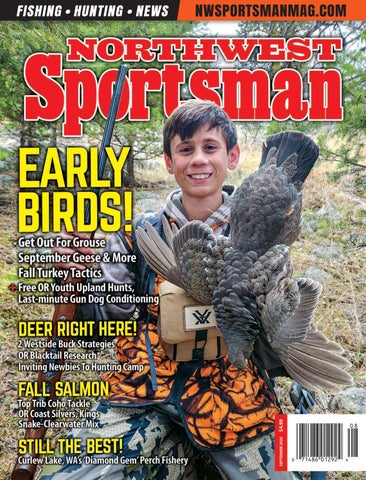
WEBMASTER/DIGITAL STRATEGIST Jon Hines ADVERTISING INQUIRIES ads@nwsportsmanmag.com CORRESPONDENCE Email letters, articles/queries, photos, etc., to awalgamott@media-inc.com. ON THE COVER Kage White shows off his first grouse, a dusky (blue) shot in Eastern Washington during 2024’s deer season. (KNIFE PHOTO CONTEST)
DEPARTMENT OF SOCIAL SERVICES Like us on Facebook, follow us on X and get dailyish updates at nwsportsmanmag.com.
MEDIA INDEX PUBLISHING GROUP
1-877-426-0933 12 Northwest Sportsman SEPTEMBER 2026 | nwsportsmanmag.com
verles.com
941 Powell Ave SW, Suite 120 Renton, WA 98057 (206) 382-9220 • (800) 332-1736 Fax (206) 382-9437 media@media-inc.com mediaindexpublishing.com
4
C
TO CATCH FISH YOU NEED TO GO TO WHERE THEY ARE!
FULL LIMITS ON KINGS, SILVERS, HALIBUT, LINGCOD & MUCH MORE! BRITISH COLUMBIA, CA
SCAN TO SEE OUR VIDEO
“BRING YOUR LARGE COOLERS. YOU WILL NEED THEM WHEN YOU FISH WITH US!”
BOOK NOW FOR 2027
(AT 2026 PRICES)
WE ALSO HAVE SPECIALS for B ring Y our O wn B oat Fishing/Catching
Lodging 4 PERSON DRIVE-IN FISHING/CATCHING •• 43 Nights Full days of Guided Fishing / Catching
Halibut, Lingcod & MORE CHARTER $2,100 ea. US •• Salmon, All your meals from our large restaurant menu MUST BE BOOKED BY SEPTEMBER 30 TO GET 2026 PRICING
250-287-1394
BOOK YOUR CANADIAN FISHING/CATCHING ADVENTURE NOW! info@westviewmarina.com | westviewmarina.com
CONTENTS VOLUME 18 • ISSUE 12
47
TWO PROVEN TACTICS FOR BLACKTAIL BUCKS
With their secretive, highly adaptable ways, blacktails aren’t the easiest quarry to pursue, but after nearly three decades of hunting them Ryan DeLuca shares what he’s learned about when and how to still-hunt or use a ground blind to ambush these Westside deer.
(RYAN DELUCA)
ALSO INSIDE 87
THE FAST AND SLOW OF FALL TURKEY HUNTING Most overlooked and fun fall hunting opportunity in the Northwest? It might just be turkeys, the upland bird world’s version of a big game animal. David Johnson walks you through two different methods for hunting longbeards, jakes and hens in autumn.
135 CATCH ’EM AT THE CONFLUENCE The waters where the Snake and Clearwater Rivers merge serve up multiple species, and while fall Chinook are what draw Rick Itami to the confluence, there’s also A- and B-run steelhead, coho, smallmouth and more to be had. Rick details this confluence of fish and how to hook them.
121 SEPTEMBER SCREAMS SEA-SIDE SALMON Go west, young fisherman! This time of year is when Oregon Coast waters sparkle for fall Chinook and coho, both in the ocean and estuaries. Bob Rees guides you to the fisheries to hit in late summer/early fall – the absolute best season to spend time on the sunset side of the Beaver State.
141 WASHINGTON’S PRINCE OF PERCH FISHING Curlew Lake remains the Evergreen State’s “diamond gem” for tasty yellow perch, but it’s also not the only spot to catch ’em. Mark Yuasa shares what spinyray biologists say about the Northcentral Washington destination lake, as well as other notable perch waters, and how to fish for them.
SUBSCRIBE TODAY! Go to nwsportsmanmag.com for details. NORTHWEST SPORTSMAN is published monthly by Media Index Publishing Group, 941 Powell Ave SW, Suite 120, Renton, WA 98057. Periodical Postage Paid at Portland, OR and at additional mail offices. (USPS 025-251) POSTMASTER: Send address changes to Northwest Sportsman, 941 Powell Ave SW, Suite 120, Renton, WA 98057. Annual subscriptions are $39.95 (12 issues). Send check or money order to Media Index Publishing Group, or call (206) 382-9220 with VISA or M/C. Back issues may be ordered at Media Index Publishing Group offices at the cost of $5 plus shipping. Display Advertising. Call Media Index Publishing Group for a current rate card. Discounts for frequency advertising. All submitted materials become the property of Media Index Publishing Group and will not be returned. Copyright © 2026 Media Index Publishing Group. All Rights Reserved. No part of this publication may be copied by any means, electronic or mechanical, including photocopying or recording by any information storage or retrieval system, without the express written permission of the publisher. Printed in U.S.A. nwsportsmanmag.com | SEPTEMBER 2026
Northwest Sportsman 15
113
BUZZ RAMSEY
Best Ways To Hook Tribs Coho
Silvers can be almost suicidal in the saltwater and estuaries, but when they get up into the rivers and tributaries, they have a reputation for being among the finickiest of biters. Fortunately for us, Buzz knows a thing or two about unlocking locked jaws – he details top methods and lures and baits to use for coho.
(KOHL BAXTER)
COLUMNS 55
BECOMING A BETTER HUNTER Don’t Be Afraid To Take Someone New “Why don’t you come with us?” That was the simple proposition Dave A. made at sea when a tuna angler said he was curious about big game hunting. Dave details the right way to bring new hunters – whether an adult like his friend or kids like his two boys – to hunting camp and the world of chasing deer and elk.
63
CHEF IN THE WILD On Trail Food Before We Had Energy Bars Before today’s plethora of protein bars there were plenty of portable food options for hunters, shepherds and others who found themselves away from camp or home for long periods. Ever curious about food history and how to use every last scrap of his ground game meat, Randy serves up a recipe for a Scotch egg.
69
ON TARGET Load Up! Seasons Are Finally Opening Good luck getting ahold of Dave W. on Tuesday, September 15. That’s when Washington’s grouse season opens, and our ruffie regulator and blue blaster will be up in the hills with his shotgun and .22-caliber pistol. He shares good loads for both, as well as new shotshells and binoculars on the market.
75
OUTDOORS MD The Early Birds Of Late Summer September arrives with a whole flock of bird hunting opportunities, and MD has your prescription for some of the best. From early Canadas and youth ducks to doves, pigeons and grouse, he offers up advice on decoying, ammo and more – and don’t overlook the great free Oregon upland hunts for kids either!
97
GUN DOG: ’SUP, Gun Dog Owner? Try Paddle Boards For Water Training, Exercise It’s the last chance to get your four-legged hunting partner into peak physical condition for the long, arduous bird seasons straight ahead, and Scott shares how a paddle board can help with that and last-minute training.
129 FOR THE LOVE OF THE TUG The Beast, Or, A Fish For All It was a battle royale on the bay for Sara and the gals last September. Deck handing for guide David Johnson on one of his Fish Like a Girl Adventures, Sara found herself hand-lining a monster Chinook that had every intention of going back to sea rather than give a Central Oregon woman a new personal best. Who won? 16 Northwest Sportsman SEPTEMBER 2026 | nwsportsmanmag.com
22
THE BIG PIC
Modern Blacktail Research In Oregon
How former shelter dogs and university analysts are helping state wildlife managers get a better understanding of deer population dynamics. (J. FLINT, ROGUE DETECTION TEAMS)
DEPARTMENTS
18 Northwest Sportsman SEPTEMBER 2026 | nwsportsmanmag.com
21
THE EDITOR’S NOTE Longtime fisheries advocate Frank Urabeck receives PSA State Board’s Lifetime Achievement Award
37
READER PHOTOS Kids’ catches, bucket-list striper, legend switches it up, Alaska hali haul and more!
41
THE DISHONOR ROLL Alleged fish and game trafficker charged; K-9 warden-in-training gets name; Jackass of the Month – when a wolf fan got too fanatical
43
OUTDOOR CALENDAR Upcoming fishing and hunting openers, events, deadlines, more
44
DERBY WATCH Ongoing and upcoming fishing contests and events around the region
Recently, we accepted the award from the Hewes family for being the 2025 Top Sales Dealer — an honor we don’t take lightly. I’m thankful for the support from Hewescraft and especially our sales, parts, and service teams at Tom-n-Jerry’s. Great job, team!!! — Kelly Hawley, President. Tom-N-Jerry’s Boat Center 11071 Josh Green Ln Mount Vernon, WA 98273 360-466-9955 Sales Hours Mon - Fri: Sat: Sun:
8:00 am - 5:00 pm 8:00 am - 4:00 pm Closed
Parts/Service Hours Mon - Fri: 8:00 am - 4:30 pm Sat - Sun: Closed
SEASPORTBOATS.COM
BUILT DIFFERENT HANDMADE IN THE PACIFIC NORTHWEST CUSTOM BUILT TO FISH ANY CONDITIONS
26’ ALEUTIAN
26’ KODIAK
24’ EXPLORER
FIND YOUR NEAREST PACIFIC NORTHWEST DEALER ALBERNI POWER & MARINE Port Alberni, BC 250-724-5722
JACOBSEN’S MARINE Edmonds, WA 206-789-7474
SEASPORTBOATS.COM/DEALERS
STEVENS MARINE Portland, OR 503-652-1444
STEVENS MARINE Tigard, OR 503-620-7023
Frank Urabeck (Carhartt jacket) receives his Lifetime Achievement Award from Puget Sound Anglers State Board President Ron Garner last month. (COURTESY IMAGE)
THE EDITOR’SNOTE
H
ow do you honor the work of a longtime Washington salmon fishing advocate? Take him salmon fishing, of course! Frank Urabeck of Bonney Lake received the Lifetime Achievement Award from the Puget Sound Anglers State Board early last month following a very lucrative coho trip out of Ilwaco with members of the organization as well as friends and relatives. The award was made “(in) grateful recognition of more than 50 years of extraordinary dedication, leadership, and selfless service to the salmon fisheries of Washington,” it reads, and it was presented by PSA State Board President Ron Garner. “It was awesome,” Garner told me. “I got choked up handing him the plaque.”
URABECK, WHO IS a very young 88 and still active in fishery issues, is probably publicly most associated with efforts to bring back Lake Washington sockeye, but he’s a perennial figure at North of Falcon meetings, has been involved in Baker Lake sockeye allocation issues and recreational access to the Skokomish River, and he and Garner worked to ease fishery constraints associated with a very small run of nonnative mid-Hood Canal Chinook. “Through your unwavering commitment, countless volunteer hours, and tireless advocacy, you have worked not for personal gain, but for the benefit of all who cherish our fisheries. Your vision, perseverance, and willingness to stand for what is right have helped protect and strengthen opportunities for present and future generations,” reads Urabeck’s award. In Garner’s recollection, it is the only lifetime honor the PSA State Board has awarded in his tenure, which dates to the early 2000s. Urabeck is a retired civil engineer who was with the Seattle District of the US Army Corps of Engineers and whose work there tied in with salmon and steelhead issues wrapped around water supply and flood control projects in the greater Seattle/King County area. He has been active as an advisor on various local boards and with other sportfishing organizations. His knowledge of how to move government and the connections to do so have few equals in our world.
OVER THE DECADES I’ve received hundreds – perhaps thousands – of emails and calls from Urabeck about his myriad irons in the fire, and there have also been many pics of fish he and his grandsons and great grandsons have hooked. His August trip for hatchery coho – back in the mid-1990s, Urabeck pushed state legislators on beginning the mass marking of salmon, so critical to today’s fisheries – was arranged by Garner and the PSA board and led by Ilwaco’s Butch Smith of Coho Charters, himself active in ocean salmon fisheries. In an email, Urabeck cast the day’s plaudits back to his two fellow angling advocates. “Without folks like Ron and Butch Smith we would not have much fishing opportunity for salmon anymore. They are the ones who should be recognized more and celebrated,” he said. Their days will come, but right now it’s yours. Keep up the good fight, Frank, we appreciate it. –Andy Walgamott nwsportsmanmag.com | SEPTEMBER 2026
Northwest Sportsman 21
PART I
Shelter Dog Redux: From Pound To Deer Poop Hound
Editor’s note: This and the following stories originally appeared on blacktaildeer.org and are reprinted with permission of the Blacktail Deer Foundation.
By Karina Puikkonen
I
f you saw an enthusiastic dog with its nose to the ground, weaving through thick forest brush, you would assume it was tracking an animal during hunting season. What if we told you that same dog was actually using its nose to assist with blacktail deer research and conservation? And what if we told you that dog wasn’t a hunting breed? As biologists and wildlife managers look for ways to better understand and monitor blacktail deer populations in Oregon’s dense forests and rugged landscapes, once “unadoptable” dogs have become part of researching this elusive species. While dogs have long been used for a variety of wildlife work, Rogue Detection Teams has a unique specialty for odor detection in the wild. While their dogs can sniff out invasive or native plants, toxins or viruses, and smells associated with living or dead animals, they have a primary use for fecal detection. This program adopts and teaches shelter and rescue dogs to detect wildlife scat that can then be collected and analyzed to glean information about an individual animal, species or population. Rogue Detection Teams collected blacktail deer scat over the past three years as part of a multi-year Oregon Department of Fish and Wildlife study that tested different methods for monitoring blacktail populations in the state. Fecal detection has proven to be an effective method in the quest to understand these deer better.
WHAT IS ROGUE DETECTION TEAMS? While Jennifer Hartman and Heath Smith began Rogue Detection Teams in 2018, they both have over 20 years of experience working with dogs in wildlife research. As professional wildlife biologists themselves, they wanted to specialize in a noninvasive way to sample animals that wouldn’t alter or affect wildlife behavior. As it turns out, wildlife poop has a ton of information in it, including DNA, diet, stress hormones and clues about how animals use the landscape. “Wildlife scat contains data, and we can collect this 22 Northwest Sportsman SEPTEMBER 2026 | nwsportsmanmag.com
Where once Oregon hunting managers relied on spotlight surveys and harvest data to estimate blacktail numbers, these days rescue dogs from Rogue Detection Teams are being used to help gather better data by sniffing out deer poop like this pile Stern detected. (J. FLINT, ROGUE DETECTION TEAMS)
without stressing wildlife or altering the environment,” Smith said. “We don’t want to add one extra pressure animals have to manage. We just quietly gather information and leave.” The team has worked with agencies and biologists around the world, building a portfolio that spans an impressive range of species, including wolves, deer, bears,
butterflies, bumblebees and even whales. The difficulty in this research isn’t analyzing the data; it’s finding enough of it. So what truly sets Rogue Detection Teams apart isn’t the animals they study, it’s the animals they do this work with. The dogs with Rogue Detection Teams originally come from rescue situations, labeled as “unadoptable” due
to their intensity or overwhelming need for stimulation. In other words, these dogs need a job to do, and if they aren’t given one, they don’t do well in a home environment. Think of cattle dogs, border collies or working dogs bred to track, herd or retrieve. When you think of it, these traits are an asset in wildlife research. When Smith and Hartman go to nwsportsmanmag.com | SEPTEMBER 2026
Northwest Sportsman 23
A PARTNERSHIP OF DRIVE AND DISCOVERY
shelters and rescues across the country, they are drawn to the ones everyone else has overlooked due to intense behaviors. When a dog has a strong work, play or ball drive, Smith and Hartman know they can then pair the dog’s natural desire to sniff with this reward they want even more. Their drive allows detection dogs to ignore wildlife entirely and keenly focus on scent and rewards. “Through adoption and this rehabilitation, they love having a job,” Hartman said. “When they are fulfilled, they are the same as any other dog with love, affection and play.”
Intense drives or overwhelming needs for affection make some dogs bad fits for families, resulting in being taken to the pound, but those traits are perfect for putting them to work as conservation K-9s. Ranger snuffles around for deer sign in a study area. (G. SANDERSON, ROGUE DETECTION TEAMS) 24 Northwest Sportsman SEPTEMBER 2026 | nwsportsmanmag.com
At Rogue Detection Teams, they aren’t called dog handlers or trainers; they are “bounders.” The name is fitting, as Hartman and Smith seek like-minded people who can be as intense and driven as the dogs are. “We find field biologists and ecologists who love the outdoors and thrive in living and working in rugged conditions to match our dogs with, and they then become a detection team who can work and camp for weeks or months at a time,” Hartman said. Each detection team has a unique relationship that depends on the individual dog’s wants and needs from the work. The bounders listen, learn, problem solve and develop empathy and compassion that becomes a back-andforth conversation with their four-legged
partner. Each dog’s unique obsession to chase a ball or play tug is paired with odor detection. When dogs locate a target odor, they alert by calmly sitting, locking eyes with their bounder or lying next to the scat. When the bounder reaches them, the dog is immediately rewarded, the sample is collected and the game then continues. “We aren’t programming and conditioning them to do a certain task. We look at their individual needs,” Smith said. “It took us a long time to get to this point of understanding, and the dogs were the ones that helped us let go of our preconceptions.” For example, Pips was an Arizona shelter dog that was adopted and returned six times because he was a shredder: curtains, blankets, you name it. Smith was contacted because word got out that he adopted
“cattle dogs.” Rogue Detection Teams was Pips’ last chance, and he passed his interview with flying colors. He’s worked on a variety of wildlife projects over the years, most famously finding the first Oregon silverspot butterfly larva in over 40 years (a threatened butterfly found in only four places in the entire world). Pips retired a few years ago and is estimated to be 17 years old now, as far as Hartman knows. “He’s the grandfather of Rogue Detection Teams,” Hartman said. “He helped open people’s eyes to see that cattle dogs can do this work and showed just how much potential these dogs have.” This type of adaptability is found in all their detection dogs. They learn many different odors, but in different projects, the dogs learn that their reward comes
The dogs love their job – here, now retired pup Pips gives “bounder” Heath Smith a lick. “When they are fulfilled,” says Smith’s Rogue Detection Teams cofounder Jennifer Hartman, “they are the same as any other dog with love, affection and play.” (ROGUE DETECTION TEAMS) from one odor over another. The fact that they can detect so many kinds of scat allows biologists the opportunity to expand their own understanding of how different species overlap and interact within the same environment. “Originally, researchers felt that dogs needed to be species specific, but now they realize there is so much more data we can collect by teaching dogs to alert to multiple odors,” Smith said.
of against it. Teams used wind patterns, topography and knowledge of deer behavior to guide their searches, allowing dogs to cover terrain efficiently. From a central base camp, multiple detection teams would work on a set of four square-kilometer grids for a few weeks and then move base camp for each set. Teams started early, during the predawn and dawn hours when scat was wet and more detectable, as the protocol centered
DOGS DETECT BLACKTAILS WHEN PEOPLE CAN’T The project with ODFW took eight detection teams to physically demanding field sites in Southwest and Central Oregon between 2023-25. Their task was to find blacktail deer scat across a large fire-scarred landscape amidst steep terrain, thick stands of snowberry and patches of poison oak. Smith said they had discussions with ODFW on how the dogs could best detect scat in this rugged area. “It had to be from the dog’s perspective from how they could see the work, not from ours,” Smith said. “The teams experienced new country that very few people get to see, and the sites needed to become a home away from home.” Smith helped design a survey approach that worked with the landscape instead
A field scientist preserves pellets located by detection dogs in ethanol-filled vials for later genetic analysis. (G. BROD, ROGUE DETECTION TEAMS) nwsportsmanmag.com | SEPTEMBER 2026
Northwest Sportsman 25
around fecal freshness. To keep the dogs’ stamina and energy up, they would work for two days on and two days off to reset. “This helps the dogs remain so driven by their chance to play that the scat doesn’t matter,” Hartman said. “They search for tiny bits of scat all day just for the chance to get the ball.” And lest we forget, the humans had an important job too! They learned to identify and collect fresh scat, based on characteristics like color, moisture and sheen. Each sample was carefully processed to avoid contamination, placed in labeled vials and preserved in ethanol to send for genetic analysis. Hartman estimates that they collected only 20 percent of what they really found, gathering samples from the fresh scat and leaving older scat behind per the protocol. “While many of our dog teams work off leash, our dogs love their work so much
that we sometimes have to leash them at the end of the day just to get them out of the field,” Hartman added. If a bounder missed a sample hidden under leaves or buried in forest duff, their dog located it with ease. Over the course of the project, Smith said the teams collected thousands of blacktail samples together as another data collection tool, which provided in-depth information about the deer over this broad landscape. Hartman also said the bounders commented that the dogs received so many rewards on the blacktail deer project that they were disappointed on followup wildlife detection projects because they weren’t receiving as many rewards on those studies.
NORMALIZING DOGS IN WILDLIFE SCIENCE Dogs that once sat in shelters and rescues, misunderstood and overlooked, are now playing a critical role in advancing blacktail deer research and wildlife science. As wildlife detection dogs, they give us the ability to conduct large-scale and highquality data collection through noninvasive
methods that broaden our understanding of wildlife movement, habitat use and ecosystem functions. “What we love about this field is that it’s been a resource for shelter dogs who don’t have the ability to be in our ’normal’ pet world,” Hartman said. “Humans have such a long history of partnering with dogs to help us understand wildlife and landscapes. We think this work helps us rediscover this multispecies connection that has been forgotten.” As these detection dog teams help the blacktail population picture come into focus for ODFW, it becomes clear that the future of deer conservation may depend on new kinds of innovation and collaboration that we haven’t yet thought of. And sometimes, additional progress requires us to take a leap and give another animal the chance to do what it was born to do. NS Editor’s note: Karina Puikkonen is a conservation content specialist with the Blacktail Deer Foundation.
WELCOME TO AMERICAN SUNSET RV & TENT RESORT Call us about our MONTHLY Winter Special at 360-268-0207 • 120 Full Hookup RV Sites • 60 Tent Sites • Cabin Rentals • Fish Cleaning Station
• Heated Pool • Large Clubhouse • Bathrooms w/showers • Laundry • Cable/Wifi
MENTION THIS AD TO RECEIVE
Make your reservations online. Go to americansunsetrv.com
*UP TO 2 NIGHTS
americansunsetrvresort@gmail.com
15% OFF
26 Northwest Sportsman SEPTEMBER 2026 | nwsportsmanmag.com
• Playground • Located in the heart of Westport, a mile from the beach and marina • Open 365 days a year
Maddie Berry processes blacktail fecal samples in the Epps Lab at Oregon State University. DNA developed from the testing has helped create “the first scientifically defensible estimates of blacktail deer populations” for Oregon. (OSU)
PART II
OSU Lab Analysis Helps Estimate Blacktail Numbers
By Clint Epps, Rachel Crowhurst and Dave Pearce
M
ost people have heard of using DNA to identify individuals, as in a forensic investigation, or studying DNA sequences to learn about gene functions. In wildlife research and management, DNA can answer many questions. In particular, the ability to collect DNA “noninvasively,” without having to capture and handle animals, has become an important way to study populations and track individuals. At Oregon State University, the Epps Conservation and Population Genetics Laboratory has specialized in noninvasive DNA work, particularly from animal droppings, or feces. Animal droppings can
be collected quickly over large landscapes, offering a less expensive way to sample wildlife populations without resorting to methods such as helicopters, nets or darts. We have worked with fecal DNA from many species, including bighorn sheep, blacktail, whitetail and mule deer, Roosevelt elk, pikas, pygmy rabbits and African wildlife such as giraffe, eland, elephants and aardvarks. We use this information to delineate distinct wildlife populations on large landscapes, understand movements between and the history of those populations, assess their genetic diversity (which reflects their ability to survive, fight off disease and thrive under changing conditions), corroborate species identification, detect hybrids and identify
and track specific individuals.
EXTRACTING DNA FROM BLACKTAIL DEER DROPPINGS Since 2011, we have collaborated with Oregon Department of Fish and Wildlife to use fecal DNA for population estimation of blacktail deer. With the help of dogs trained to detect deer fecal pellets, field teams collect samples from wildlife management units across Western Oregon, usually focusing on two units per year working in the spring. Given the damp conditions in Oregon’s Coast and Cascade Ranges, deer pellets are placed in ethanol (alcohol) to preserve them, then sent to our laboratory. Collecting and processing blacktail deer pellets is similar to how we handle nwsportsmanmag.com | SEPTEMBER 2026
Northwest Sportsman 29
material from other wildlife species, but with an important difference: Unlike many of our other study species, blacktail deer live in very wet environments. DNA degrades rapidly in such environments, requiring ethanol to stop the degradation immediately after collection, whereas in deserts and other dry environments, we simply dry fecal pellets in paper envelopes and store them at room temperature. The rapid degradation of samples during wet, rainy spring conditions is one of the primary challenges of this approach. Here at OSU, our technicians air-dry the ethanol-soaked pellets and then carefully scrape the outside surface, where cells containing the deer DNA are concentrated. We extract the DNA with a series of chemical washes and heating steps, then copy targeted sections of the DNA in each sample and incorporate a fluorescent tag using a process called polymerase chain reaction,
or PCR. We analyze samples in batches, but each step takes several hours to accomplish. Processing thousands of samples requires months of labor and analytical time. These regions of noncoding DNA are known to be variable between individuals, and, taken together, can be used to create a “DNA fingerprint” (genotype) that is unique for each deer. A machine with a laser then detects the fluorescent tags to estimate the size or sequence of those DNA fragments, allowing us to determine the exact genetic variations present in those regions for each sample, as long it is not too old or spoiled by long exposure to rain. The variations allow us to distinguish individual deer, determine whether they are male or female, and thereby determine whether two samples came from the same deer, or from different individuals.
WHAT DNA TELLS US OREGON BLACKTAILS
samples were collected from the same deer across each study area) and the numbers of males and females. ODFW applies statistical analyses to these data to estimate the size of the deer populations in the sampled areas. These data have provided the first scientifically defensible estimates of blacktail deer populations in Oregon and will allow ODFW to determine if deer population sizes change in the future. Our research group is also using these data to determine connections among deer populations in Western Oregon, and test for hybrids – deer resulting from matings between blacktail and mule deer, or even between blacktail and whitetail deer. This information will also help managers understand links between deer on the Eastside and Westside and could aid management of the remnant population of Columbian whitetail deer near Roseburg. NS
In most years, we analyze thousands of deer pellet samples. We provide ODFW with information about the number of individuals, the number of times those individuals were observed (in other words, how often pellet
Editor’s note: Clint Epps is a professor at Oregon State University; Rachel Crowhurst is a senior faculty research assistant II at OSU; and Dave Pearce is a Ph.D. student at OSU.
Something for everyone! Fishing •Bear Viewings •Ecotourism
907-246-8643
KINGSALMONLODGE.COM 30 Northwest Sportsman SEPTEMBER 2026 | nwsportsmanmag.com
New research methods and modeling is showing that Western Oregon blacktail populations have turned around after a long-term decline and could be increasing in some areas. In addition to the fecal sample study, state managers have begun using trail cameras to assess populations. (ODFW)
PART III
Fecal Sampling Among New Survey Methods Informing Managers On Blacktail Dynamics
By Keifer Titus
K
nowing how many animals are on the landscape – and whether that number is growing or shrinking – is one of the most fundamental challenges in wildlife management. For Columbian blacktail deer, that challenge is especially steep. Unlike elk or mule deer that migrate across open terrain, blacktail deer occupy dense coastal and mixed-conifer forests, maintain small home ranges and rarely venture into open country where they can
be easily observed. The result: Managers have historically had limited tools to accurately assess how blacktail populations are actually doing. The Oregon Department of Fish and Wildlife, in collaboration with partners at Oregon State University and Rogue Detection Teams, is working to change that.
ADDING FECAL SAMPLING AS A DATA COLLECTION TOOL For decades, the primary window into blacktail populations in Western Oregon
has been the spotlight survey. This is where biologists slowly drive roads through wildlife management units after dark, counting deer and noting whether individuals are bucks, does or fawns. These surveys have been valuable for tracking broad trends in population structure over time, but they capture only a fraction of the picture. Survival rates, recruitment of fawns into the population and true abundance have remained difficult to pin down. Recognizing these gaps, ODFW committed to developing more robust nwsportsmanmag.com | SEPTEMBER 2026
Northwest Sportsman 33
survey methods following the 2008 Blacktailed Deer Management Plan. That commitment led to a significant shift beginning in 2013, when ODFW began using trained detection dog teams to locate blacktail deer fecal samples across representative land ownerships within wildlife management units. More specifically, a series of 3x3square-kilometer sampling grids were stratified across different land ownerships. Within each grid, detection dog teams systematically surveyed for scats across nine 1-square-kilometer sub cells. This design ensures sampling effort is distributed across the landscape in a representative manner. Those samples were then sent to Epps Lab at OSU, where researchers used microsatellite marker analysis, essentially a genetic fingerprinting technique, to identify individual deer from their scat.
SPATIAL CAPTURE-RECAPTURE DATA MODELING From there, ODFW’s West Region Wildlife Research Program applied a modeling approach called spatial capture-recapture, or SCR, which estimates deer density by tracking how often the same individuals are detected across different locations over time. The result is a statistically rigorous estimate of deer density (deer per square kilometer), detection probability and herd composition, information that spotlight surveys alone simply cannot provide. To ensure that these density estimates were reliable, we evaluated the performance of the SCR models through simulation and sensitivity analyses to confirm that the sampling design and data collection methods could produce accurate estimates under realistic conditions. Together, these checks gave us confidence that fecal DNA-based SCR can provide robust, managementrelevant estimates of deer density and can be implemented as part of a long-term monitoring program. That said, density estimates are only part of the equation; understanding how a 34 Northwest Sportsman SEPTEMBER 2026 | nwsportsmanmag.com
Feeding fecal-based density estimates, GPS collar and game cam data into a regional framework generates “a far more complete picture” of blacktail population dynamics than individual methods could ever spit out. (ODFW)
population is truly changing over time also requires data on survival and recruitment, which remain active areas of investigation.
A COMBINATION OF FIELD METHODS In addition to fecal DNA surveys, ODFW has evaluated complementary monitoring approaches, including trail cameras and GPS collaring. Beginning in 2025, we deployed around 400 trail cameras across the landscape to passively detect deer herd composition (bucks, does, fawns) and provide information on relative activity patterns. These data can be used to estimate encounter rates and, in some cases, derive independent estimates of density. GPS collars, which have been deployed on blacktail deer in Western Oregon for several decades, provide detailed information on movement, survival, habitat use and seasonal behavior. Together, these methods provide different but complementary pieces of information: SCR provides rigorous estimates of density, cameras help track population structure and trends and GPS data reveal
the processes driving those patterns. With these complementary methods now in place, ODFW is entering a new era of blacktail deer monitoring in Oregon. Integrating these approaches allows managers to move beyond simply counting animals to understand how and why populations are changing over time. By combining fecal-based SCR density estimation, GPS collaring and trail cameras into a region-wide framework, the program will generate a far more complete picture of population dynamics than any single method could provide. That understanding, in turn, will give ODFW the foundation it needs to make sound, science-based management decisions and ensure that blacktail deer remain a thriving part of Oregon’s landscape for generations to come. NS Editor’s note: Keifer Titus is a wildlife research supervisor at the Oregon Department of Fish and Wildlife. The Albany and North Oregon Chapters chapters of the Blacktail Deer Foundation provided field equipment supporting recent ODFW-led research.
READER PHOTOS
Rhonna Schnell shows off a pair of “oversized” kokanee she caught at Wallowa Lake this spring. There is concern among some kokanee anglers that installing a fish ladder at the dam on the lake for sockeye reintroduction may impact the trophy landlocked salmon fishery. (KNIFE PHOTO CONTEST)
POW – wow! A trip to Coffman Cove on Alaska’s Prince of Wales Island served up a whole lotta halibut for Mark Hedges, Tim Johnson and Kyle Hedges. (KNIFE PHOTO CONTEST)
Kenny Howard was among the springer anglers who enjoyed June fishing for their quarry at the very bottom of the Willamette River. (KNIFE PHOTO CONTEST)
As the old saying goes, fourth time’s the charm! At least it was for Rick Itami, who scratched striped bass off his bucket list this past summer. Trips in October 2023, 2024 and 2025 to the Oregon Coast all fell through for one reason or another, so Itami decided to schedule a July outing, and he and family members landed on ’em. They caught eight, including his 10.5-pounder, while out with guide Joe Mello. (KNIFE PHOTO CONTEST)
For your shot at winning a knife in our Knife Photo Contest, send your full-resolution, original images with all the pertinent details – who’s in the pic; when and where they were; what they caught their fish on/weapon they used to bag the game; and any other details you’d like to reveal (the more, the merrier!) – to awalgamott@media-inc.com or Northwest Sportsman, 941 Powell Ave SW, Suite 120, Renton, WA 98057. By sending us photos, you affirm you have the right to distribute them for use in our print and Internet publications. nwsportsmanmag.com | SEPTEMBER 2026 Northwest Sportsman
37
READER PHOTOS Ta-da! Aubree Cole smiles over a Central Washington summer kokanee, caught while fishing with her grandpa, Chris Marcolin. (CHRIS MARCOLIN)
A smoky summer day on the mighty Columbia saw Brock Sande and sons Thomas and Wesley catch a bunch of smallies. They were jigging blade baits and soaking a worm or two, and the bass provided “great fun for the kids.” (KNIFE PHOTO CONTEST)
If you recognize the hat but not the hat and the fish species together, well, time to get with the times! Legendary Northwest salmon and steelhead angler Buzz Ramsey blew past Buoy 10 to fish for albacore off Astoria this summer, coming home with 11 fish he and wife Maggie turned into 32 pints and 48 half pints of canned tuna – “It’s the best!” (BUZZ RAMSEY)
An early adapter of using fishing personal watercraft to troll for salmon, Matt Little landed this pair of hatchery coho on the Lower Columbia last fall. Little is a policy rep for Ducks Unlimited and a Clark County Commissioner. (KNIFE PHOTO CONTEST) PHOTO CONTEST MONTHLY
Winner!
“I caught a fish!” That was Keoni Freitas’s first words after landing his first ever fish, this bluegill, at Cranberry Lake on far northern Whidbey Island this June. The 6-year-old was using a worm off the state park dock there. (KNIFE PHOTO CONTEST) 38 Northwest Sportsman SEPTEMBER 2026 | nwsportsmanmag.com
CALL THE LODGE FOR AVAILABLE DATES
MIXED BAG
Alleged Fish And Game Trafficker Charged
A
27-year-old man has been charged with four counts of illegally trafficking fish and wildlife and three counts of selling fish without a license, all felonies, following an investigation by Washington game wardens that began in 2022 with a Facebook ad allegedly posted by the man. According to the Tri-Cities Herald, Jonathan J. Fiander is alleged to have sold primarily salmon to undercover officers four times in late spring 2024 and early summer 2025 for $300 to $520 a transaction, as well as elk and buffalo meat one time. Reporter Cameron Probert wrote that Fiander is a member of the Spokane Tribe who gave varying accounts to detectives while being interviewed. He claimed fishing rights through his tribe and the Yakama Nation and that he’d harvested the fish and wildlife by himself or while with other people, and he also denied acquiring the fish personally and that he’d received it through a Spokane Tribe salmon allocation, according to Probert. He also claimed he couldn’t recall the social media ad that sparked the investigation.
By Andy Walgamott
The Oregon State Police Fish and Wildlife Division’s newest conservation K-9 finally has a name – Goose! That was the name chosen after troopers asked kids across the Beaver State to help them figure out what to call their four-legged game-warden-intraining. The 1-year-old male red Labrador retriever will soon join K-9s Scout and Drake and be stationed out of OSP’s La Grande office. OSP’s Conservation K-9 Program is a collaboration with the Oregon Wildlife Foundation, which provides funding for it. Program donations are accepted at myowf.org/osp-conservationk9-team. Senior Trooper Josh Wolcott and Drake will be at OWF’s gift store at the Bonneville Hatchery on September 6 from 11-3.
JACKASS OF THE MONTH
A
$10,000 bounty offered by an animal rights influencer for the names of hunters who lawfully kill wolves in an area of Wyoming open to hunting has since been retracted, but not before it was termed “outrageous” by that state’s fish and game agency head and it was also pointed out the viral offer might boomerang and lead to more wolf deaths. When he made the offer in late July, Jonas Black of Texas thought his money would help protect a wolf pack that had previously roamed Yellowstone National Park but this season denned in the Shoshone National Forest next door. Hunting there opens in mid-September. Black’s argument was that in this case hunting wouldn’t be fair chase because the wolves have had nothing to fear from man living in the national park. Never mind that that’s an artificial construct in itself that has also led to overpopulations of animals such as elk and bison that required culling because no hunting is allowed there.
With wolf hunting such an over-thetop emotional issue for some predator advocates, Wyoming, Montana and Idaho have had to protect the identities of wolf hunters to head off harassment – which is also illegal – from people like Black. “Putting an animal before the welfare of a person is outrageous,”Wyoming Game and Fish Department Director Angi Bruce told Cowboy State Daily. “This is the exact reason our legislators put this statute in place – to prevent harassment of our hunters.”
LAST MONTH SAW Black walk back his offer of “ten grand cash” to the “snitch” who outs a wolf hunter. It followed a thoughtful column by Gear Junkie hunting and fishing editor Rachelle Schrute, a fifth-generation Montanan. She argued what he’d actually done was sign the pack’s “death warrant,” making it more likely people would go shoot the wolves because his threat to “make them famous” would be seen as a promise worth pursuing in our click-driven times. Schrute also pointed out that Black’s plan was backwards from the get-go,
(OSP)
ensuring there would be a dead wolf or wolves even before his bounty payment was paid out. Her advice was for him to instead use his money to lobby to change hunting regulations he didn’t like. “I understand why Black feels passionately about them,” wrote Schrute, who has both carried a wolf tag in her pocket and watched in awe as this particular Wyoming pack and others have taken down weak elk. “I also know that offering $10,000 for the identity of someone who legally kills one won’t change a season date, a hunt boundary, or a mortality limit. It’ll only give the wrong hunter another reason to target the pack.” We should hunt for the right reasons – for meat, for usable parts, to further the conservation of species and assist with their management, all while abiding by hunting regulations and the ethical code of hunters. Black will look at this as blaming the victim, but people who think they can protect wolves through stunts like putting out a bounty for hunters’ names ultimately risk devaluing those animals for everybody – themselves, the public, hunters, all of us.
nwsportsmanmag.com | SEPTEMBER 2026
Northwest Sportsman 41
OUTDOOR
CALENDAR SEPTEMBER
1
WA cougar, mourning dove and bow deer openers; Eastern WA fall turkey opener; OR ruffed and blue grouse and mourning dove openers; Western OR and select Northeast OR units fall turkey openers; Western OR quail opener; Hatchery steelhead retention closure begins on mainstem Columbia from The Dalles Dam to Highway 395 Bridge in Pasco, WA; Tentative OR Central Coast ocean any-coho opener (27,500-fish quota) 3 Buoy 10 season switches to hatchery coho only (Chinook retention closed); Salmon fishing closure begins on Lower Columbia between west Puget Island line and Warrior Rock-Bachelor Island line 5-6 WA Goose Management Areas 4 and 5 September Canada goose season dates 5-13 WA GMAs 1, 2 and 3 September Canada goose season dates 9 Tentative wild coho opener on Nehalem, Tillamook and Nestucca systems (open Wednesdays, Saturdays and Sundays only) and Siletz, Yaquina, Siuslaw, Coos and Coquille (open daily) systems (see regs for more info) 12 WA bow elk opener; CAST For Kids fishing event, Lake Washington, Renton, WA – info: castforkids.org 12-13 WA youth upland bird (statewide pheasant, Eastside quail and chukar) hunt weekend 12-16 OR Southwest, High Desert and Blue Mountain, and Mid-Columbia Zones September Canada goose season dates 12-20 OR Northwest Permit Zone September Canada goose season dates 13 CAST For Kids fishing events at Henry Hagg Lake, Gaston, OR, and Lake Coeur d’Alene, Coeur d’Alene, ID – info above 14 OR fee pheasant hunting opener at Fern Ridge Wildlife Area (select units) 14-18 WA statewide 65-plus and disabled hunter pheasant hunting week 15 WA forest grouse opener 15-23 OR and WA bandtail pigeon season dates 15-25 High Buck Hunt season dates in select WA Cascades and Olympics wilderness areas and Lake Chelan National Recreation Area 16-30 Salmon fishing closure dates on Columbia from Warrior Rock-Bachelor Island line upstream to WA-OR border 17 ODFW Intro to Hunting In Oregon (registration, $10), Tualatin Bass Pro Shops – info: myodfw.com/workshops-and-events 17-20 Portland Fall RV & Van Show, Portland Expo Center – info: pdxrvshow.com 19 Western WA pheasant and quail openers; WDFW National Hunting and Fishing Day event, Waitsburg Gun Club, Waitsburg – info: wdfw.wa.gov/ hunting/requirements/education/hunt-fish-day 19-20 OR youth upland bird hunting weekend at Denman, Klamath, Ladd Marsh, Sauvie Island and White River Wildlife Areas and Prairie City private lands 21 OR fee pheasant hunting opener at Denman and Sauvie Island Wildlife Areas 26 54th Annual National Hunting & Fishing Day – info: nhfday.org; Western WA youth waterfowl hunt day; WA muzzleloader deer opener; OR youth upland bird hunting day at Irrigon Wildlife Area 26-27 OR youth waterfowl hunt weekend; OR youth upland bird hunting days at Coquille and EE Wilson Wildlife Areas 28 OR fee pheasant hunting opener at EE Wilson Wildlife Area 30 Last scheduled day of 2026 Northern Pikeminnow Sport-Reward Program season – info: pikeminnow.org; Last day of OR Zone 1 first mourning dove season
OCTOBER
1 1-4 3
Siltcoos and Tahkenitch Lakes coho opener; OR razor clam opener on Clatsop County beaches north of Tillamook Head WDFW Chris Christenson Mentored Youth Deer Camp (registration, free), Sherman Creek Wildlife Area, Kettle Falls, WA – info: wdfw.wa.gov/events Western OR deer and most Eastern OR controlled deer openers; WA muzzleloader elk opener; Eastern WA youth waterfowl hunting day; Eastern WA quail and partridge openers continued on page 44 nwsportsmanmag.com | SEPTEMBER 2026
Northwest Sportsman 43
continued from page 43
10
ID deer and elk rifle openers in many units; OR pheasant and partridge openers; Eastern OR quail opener; OR Zone 2 duck, scaup and snipe openers; Fall turkey opener in most of Northcentral and Eastern OR outside of upper John Day River watershed 15 ODFW Intro to Hunting In Oregon (registration, $10), Tualatin Bass Pro Shops – info above 16 OR recreational ocean crab season closure begins (bays open year-round) 17 WA general rifle deer opener; Eastern WA pheasant opener; Last day of bottomfish retention off WA Coast 17-25 WA early duck season dates 17-Nov. 1 OR Zone 1 early duck season dates 28 WA duck season resumes 31 Eastern WA rifle elk opener; Last day to fish many WA lowland lakes listed in regulations
1
NOVEMBER
Mussel harvesting opens on WA Coast beaches outside of Olympic National Park; Various WA trapping seasons open; WA GMA 4 and 5 goose seasons resume 6 Last day to hunt deer with Western OR any legal weapon tag 7 Western WA rifle elk opener; OR General West Cascade and Rocky Mountain elk second season openers; OR Zone 1 snipe and scaup openers 7-8 Extended Western OR youth deer season dates 7-19 Northeast WA late rifle whitetail season dates in select units 10 OR Southwest and Mid-Columbia Zones goose seasons resume 14 Southwest OR late bow deer opener in select units 14-17 Western OR Coast bull elk first season dates 15 Last day to hunt black bears in WA; Start of OR Zone 1 second mourning dove season
Now through end of fishing seasons: Westport Charterboat Association Derbies; charterwestport.com/fishing.html Now through October 31: Washington Department of Fish and Wildlife 2026 Trout Derby, select lakes across state; wdfw.wa.gov/fishing/contests/trout-derby Late summer (TBD): Annual Rogue Pikeminnow Roundup, Rogue River; dfw.state .or.us/fish/local_fisheries/rogue_river/fishing.asp September 2: Longview Salmon Derby, Lower Columbia; longviewsalmonderby.org September 5-7: 33rd Annual Gardiner Reedsport Winchester Bay Salmon Trout Enhancement Program Salmon Derby, Umpqua River estuary; umpquastephatchery.org September 8-15: Nootka Sound Tuna Showdown, Pacific off Vancouver Island; nootkamarineadventures.com September 12: Edmonds Coho Derby, Marine Areas 8-10; edmondscohoderby.com September 12-13: 25th Coos Basin Salmon Derby; facebook.com/profile .php?id=100063510016235 September 14-October 31: Boat Basin Salmon Derby, Westport; westportgrayland-chamber.org September 19: Kingston Coho Derby, Areas 9-10; kingstoncohoderby.com September 19-20: 4th Annual Whidbey Island Coho Derby, all open marine areas; whidbeypsa.org September 20: Salmon for Soldiers Day of Honor, North Puget Sound; salmonforsoldiers.org September 26-27: Everett Coho Derby, Areas 8-10 and open nearby rivers; everettcohoderby.com September 26-27: King of the Confluence Chinook and steelhead derby, SnakeClearwater confluence; extremefishingevents.com/king-of-the-confluence/derby Early fall (TBD): Alsea Bay Salmon Derby; facebook.com/AlseaSportsmansAssn Late October (TBD): King of the Reach live-capture derby, Mid-Columbia’s Hanford Reach; ccawashington.org/kingofthereach 44 Northwest Sportsman SEPTEMBER 2026 | nwsportsmanmag.com
HUNTING
Two Proven Tactics For Blacktail Bucks Here’s how and when to still-hunt or use a ground blind to ambush Westside deer. By Ryan DeLuca
T
he very first real hunt I ever went on was for blacktail deer in my home state of Oregon with my grandfather when I was 10 years old. Since then, I’ve hunted blacktail 24 of the last 28 seasons – taking three does in my early years, several solid bucks as I became more experienced, and one state record
scoring over 153 inches. I’ve hunted with both rifle and bow, leaning most heavily on two methods: still-hunting and ambush hunting from a ground blind. Tree stands are another solid option in this same category, though not one I’ve personally used. There’s merit in other methods, too, like rattling, calling and spot and stalk, but these are the tactics I’ve had by far the most success with.
WHAT THIS ARTICLE WON’T COVER The point of this article isn’t to give you a high-level overview of blacktail hunting – there’s plenty written on blacktail biology and general tactics already. My goal here is to give you a decision-making guide to help you think through your strategy this fall and how you want to tackle your hunt. The tactics I outline work whether you’re planning to
The adaptive nature of blacktail deer means there’s no one best way to hunt them, but after decades afield author Ryan DeLuca has found ambushes and still-hunting to be reliable methods. This buck fell to the latter. (RYAN DELUCA) nwsportsmanmag.com | SEPTEMBER 2026
Northwest Sportsman 47
HUNTING hunt with a rifle or bow. They work whether you’re targeting a mature buck or just your first legal blacktail.
TWO KINDS OF BLACKTAIL COUNTRY This guidance is specific to blacktail because of the terrain they inhabit across most of their native range in the Pacific Northwest. Unlike mule deer, which tend to live in more open country, or whitetail, which tend to stick to agricultural, lowland areas, the Columbian blacktail can call almost any of these habitat types home. From the dense rainforests of the Olympic Peninsula to the alpine country and oak savannas of northern California, they’re a very adaptable subspecies with a range of habitats. That versatility is exactly why a one-size-fits-all approach doesn’t Trail cameras told DeLuca that one area he monitors is usually dominated by does and fawns. But come October, bucks start prowling around, first smaller ones, then more mature animals. (RYAN DELUCA)
Covering ground through the timber during daily peak deer movement windows has driven up the author’s still-hunting success rate. (RYAN DELUCA) 48 Northwest Sportsman SEPTEMBER 2026 | nwsportsmanmag.com
work. In my experience, two habitat types account for the bulk of blacktail hunting success: thick, dense timber, and open ag land. That’s what I’m going to focus on here.
A STORY OF RECENT AMBUSH SUCCESS Last season I killed a handsome threepoint blacktail from a ground blind in a very brushy, timbered and steep area near my home in Western Oregon. I’d refined my blind’s location over almost a decade of hunting the same area. Years of running trail cameras, reading sign and tracking travel routes had shown me a pattern that repeats season after season: The spot is a “nursery” most of the year, with only does, fawns and yearlings hanging around. However, that changes in the first week of October, when young
HUNTING bucks start checking the area for does. A week or two later, more mature bucks follow. By the end of October, bucks of all sizes can be in the area chasing or breeding does. By the second week of November, the bucks have mostly vacated the area, with only local does and yearlings left. This particular hunt fell right at the tail end of that window. The rut activity had run its course, and I’d missed a massive three-by-four in late October. It was now mid-November, and the ghost-town phase was setting in. I was officially out of time to be picky, and I was starting to lose hope for the season when a handsome three-point showed up on camera one morning. I had the day off, so I went out that afternoon, planning to sit it out until dark. Around 4 p.m., I saw antler tips coming over the hill: The same threepoint was headed straight for my
blind. He stopped at 20 yards to feed. I drew, he lifted his head and looked in my direction at the sound of the draw, but hidden in the dark blind, he couldn’t see me. Then he lowered his head again. I settled my pin behind his shoulder and released the arrow. The distinctive smack sound told me the hit was solid. He ran 30 yards, staggered, and went down within sight.
A STORY OF STILL-HUNTING SUCCESS There’s a piece of agricultural property I’ve hunted for over a decade, and I’ve taken a few bucks there to date. It’s a unique challenge: Most of the deer don’t live on the property itself but bed on neighboring land and cross onto the property mostly during dawn and dusk. I spent several frustrating seasons running cameras and sitting natural ground blinds without a shot, trying
Window of opportunity. A nice buck walks in front of DeLuca’s perfectly placed ground blind. (RYAN DELUCA) 50 Northwest Sportsman SEPTEMBER 2026 | nwsportsmanmag.com
Rubs, a game trail or well-used, converging trails are good places to consider for an ambush. (RYAN DELUCA)
to find a pattern to where these bucks showed up. There wasn’t one. It was ag country, so food and water were everywhere, and the deer had no reason to go to the same place every day. The only constant was when they moved: dawn and dusk. That’s what changed things. Since I couldn’t pattern a precise location, I stopped trying to guess one and started covering ground instead, walking the property during the first or last hour of daylight. Moving through as many of their likely travel routes and feeding/ rutting areas as I could in that window meant I might cross paths with a buck regardless of where on the property he was, instead of gambling on one fixed spot and hoping he walked within sight. That shift – from picking a place to covering ground during that peak movement time window – is what drove up my sightings and my success. On a morning hunt several years ago, I started with my usual sit-andwait strategy, watching a field where
HUNTING deer frequently passed through. An hour after legal light, I grew restless. Sitting still had become my go-to instinct for blacktail, but it never panned out for me in this spot. So I got up from my ambush spot and walked the treeline, moving quietly along the damp ground toward a path cutting through a stand of timber. Inside the timber, I spotted two bucks standing like statues 40 yards away, staring at me as I passed. One was a solid three-by-four with a beautiful double throat patch, and the other was a smaller forked horn. I raised my rifle and dropped the bigger buck in his tracks. I’ve now taken several deer on this same property as well as others with this same tactic. It can be deadly when used in the right scenario, and especially in more open or mixed cover ag land.
HOW TO DECIDE BETWEEN THE TWO HUNTING METHODS Most of this decision gets made before the season even opens, not in the moment. Ambush hunting works best when the setup is planned out and put in place ahead of season for two reasons: One is that you’ll need to do some homework to see where the travel areas are, and the second is because the noise of putting up a blind, hanging a stand and trimming shooting lanes can spook deer out of the area for a week or so. Stillhunting, however, can be more of a game-day decision. Terrain determines the method. Thick, brushy country makes stillhunting less viable: Visibility is short, the ground is noisy and any buck in range hears you coming long before you see him. That’s ambush country, whether you’re set up in a ground blind or a tree stand. Open ag land with timbered edges or scattered patches of timber is the opposite. There, I’ll still-hunt the last 30 to 40 minutes of daylight, covering ground while deer are moving. The exception is a small ag property where I can see most of it from one 52 Northwest Sportsman SEPTEMBER 2026 | nwsportsmanmag.com
“Bow range demands a close, controlled shot, and a fixed setup gives you that in a way that closing the distance on foot rarely does with blacktail,” the author writes. (RYAN DELUCA)
spot. In that case, I’ll set up a ground blind and watch the timber edge for deer emerging at first or last light, since I don’t need to cover ground to see the whole property anyway. Weapon choice matters here too. If you’re hunting with a bow, ambush hunting is usually the stronger play, even in terrain that might otherwise favor still-hunting. Bow range demands a close, controlled shot, and a fixed setup gives you that in a way that closing the distance on foot rarely does with blacktail. Still-hunting with a bow isn’t impossible – I know people who’ve done it – but ambush hunting gives more predictability. Once terrain and weapon choice have pointed you toward an ambush setup or toward still-hunting, one more thing shapes how you actually execute it. Bait, if it’s legal where you hunt, sharpens an ambush setup. It adds a level of control that’s hard to match otherwise. Where bait isn’t an option, the work shifts to finding a spot with heavy natural traffic: converging trails, rubs, anything that tells you deer are moving through consistently
rather than passing by once in a while. Scents can also come into play here to help draw a buck into your shooting lane. Again, check for the legality of scents where you hunt.
DON’T SLEEP ON STILL-HUNTING There’s a fair amount of writing out there claiming still-hunting for blacktail is a fool’s errand, but I, and a handful of bucks on my wall, would disagree. Still-hunting has its time and place, and depending on the scenario, it can be the better method. Neither tactic is inherently better than the other. The only real mistake is committing to one without reading the terrain, the season and what you’re hunting with. Walk into thick, brushy timber expecting to still-hunt your way to a buck, or sit an open ag field all week without checking whether deer are actually using it, and you may be eating your tag at the end of season. As you head into your blacktail season this fall, take stock of your areas before you decide. Then be ready to use either of these workhorse tactics when the scenario calls for it. NS
nwsportsmanmag.com | SEPTEMBER 2026
Northwest Sportsman 53
54 Northwest Sportsman
SEPTEMBER 2026 | nwsportsmanmag.com
COLUMN
Don’t Be Afraid To Take Someone New O
ver the years, I have had the pleasure of introducing a handful of people to hunting and have helped some of them take their first big game animal. I’ve always felt a responsibility to share something that has given me so much enjoyment throughout my life. Each year, I focus on filling the freezer BECOMING A with elk and deer that BETTER HUNTER can be shared with By Dave Anderson my family and friends. Providing meat is a major reason I hunt, but it is not the only reason. Hunting has given me friendships, memories, life lessons and experiences that are difficult to explain to someone who has never spent much time in the field. Because of that, I have also tried to mentor friends and family members who have expressed an interest in learning to hunt.
ONE OF MY favorite examples started in a place that had nothing to do with big game hunting. I met a guy while fishing roughly 30 miles offshore in the Pacific for albacore tuna. During the trip, we started talking about hunting, and he mentioned that he had always wanted to try hunting big game. I looked at him and said, “Why don’t you come with us?” I think the invitation caught him off guard. People often say that they would like to hunt someday, but they may not expect someone to immediately open the door and invite them into camp. A couple of years went by before he finally took me up on the offer. Once he decided to go, the preparation began. He was starting from scratch. He needed camouflage clothing, boots, binoculars, a rifle and scope, a backpack and everything required for a properly equipped day pack. We exchanged many phone calls
A simple invitation made at sea led an adult hunting-curious fisherman to eventually take up author Dave Anderson’s offer to come with him to mule deer country. (DAVE ANDERSON) nwsportsmanmag.com | SEPTEMBER 2026
Northwest Sportsman 55
COLUMN and text messages about what he needed, what he did not need and which products were worth the money. We talked about one brand versus another, how much money he should spend on optics, what type of boots would work and what gear could wait until later. We also tried to be mindful of his budget. Experienced hunters sometimes forget how overwhelming it can be for someone who is just getting started. Walk through any sporting goods store and you can easily convince yourself that you need thousands of dollars’ worth of specialized equipment before you ever step into the woods. The truth is that new hunters need good boots, dependable clothing, safe equipment and a few basic tools. They do not need every new gadget hanging on the wall. Years of experience allowed us to help him buy the necessities while avoiding items that would have added expense without much value in return. That guidance alone can make a huge difference. A new hunter who purchases the wrong boots, an uncomfortable pack or an unsuitable rifle may become discouraged Success was all the sweeter for the hunter because it was finally earned after several seasons of putting in the time, effort and investment in the pursuit. (DAVE ANDERSON) before the hunt ever begins.
It did take some trust on the part of Anderson that his charge would not burn the spots he was teaching him. He also considered how the hunter would fit in with his well-oiled deer camp. (DAVE ANDERSON) 56 Northwest Sportsman
SEPTEMBER 2026 | nwsportsmanmag.com
THE AREA I took him was not some random place that I had found on a map. It was where my family had hunted for years. We hunted places that had been hunted by my father-in-law and by his father, family and friends. Some people may think I lost my mind by taking someone new into an area with that kind of family history. After all, hunters can be extremely protective of their spots. That protectiveness is understandable. We invest time, fuel, boot leather and years of trial and error in finding productive areas. Nobody wants to show someone a good location and then arrive the following season to find that person parked at the trailhead with six of his closest friends. Before the hunt, we had a straightforward conversation. “I am going to show you an area that
means a lot to us,” I told him, “and I would appreciate it if you didn’t share it with anyone else.” That was it. There was no complicated agreement. It was simply a conversation about trust and respect. Can you eventually get burned by sharing a hunting area? Absolutely. It happens. However, I can honestly say that I have never had anyone I mentored disrespect me in that way. We also need to keep the issue in perspective. A large percentage of the ground many of us hunt is public land. We do not own it. Sure, it is frustrating to arrive at a trailhead that has been empty for years and suddenly see another truck parked there. Nobody enjoys feeling like a quiet spot has been discovered. At the same time, we are incredibly fortunate to have millions of acres of public land available to hunt. Sharing the tradi-
COLUMN tion with one carefully chosen person does not mean you have to publish coordinates online or give away every place you have ever hunted. You can teach someone how to find animals without handing them your entire playbook.
When introducing kids to hunting, keep it light, let them help look for animals and avoid making it a survival trek. The goal is to have them ask, “When can we go again?” You can bet Anderson and wife Kristina’s boys Ryland and Barrett have asked just that! (DAVE ANDERSON)
DURING HIS FIRST year in our camp, my friend did not notch his tag. That does not mean his hunt was unsuccessful. He learned how to move through steep terrain, where to glass and when certain areas were most productive. He learned to check the wind, pay attention to changing thermals and understand how quickly a bad wind can ruin a good setup. In other words, the small details that experienced hunters often take for granted. It took him three years to finally notch his tag. When it happened, he was hunting with a longtime friend of mine in an area where my wife had filled her deer tag the previous day. That success meant more because it had not come easily. He had invested the time, taken the advice, purchased the equipment and kept returning after unsuccessful seasons. He learned that hunting is not about walking into the woods and expecting an animal to stand broadside on the first morning. Today, he continues hunting throughout the West. What began with a simple conversation on a boat way out at sea developed into something that has become an important part of his life. One day, he will have the opportunity to pass that love of hunting down to his son. That is how hunting traditions survive.
Escape to the peace and beauty of Flowing Springs Ranch!
Just minutes fr om Boise , Idaho
Horse riding available for day trips! Whether you’re seeking adventure or relaxation, our scenic horse ranch offers the perfect retreat. Book your stay today and experience the charm of ranch life, cozy lodging, and the great outdoors!
www.flowingspringsranch.com
208-703-4008 | elkkeller@gmail.com
58 Northwest Sportsman
SEPTEMBER 2026 | nwsportsmanmag.com
COLUMN SHARING THE WOODS with new hunters is enjoyable for me, but that does not mean everyone should immediately be invited into your hunting camp. You need to use good judgment. Camp chemistry matters. A person can be perfectly nice in normal life and still be a terrible fit for a remote hunting camp. Before inviting someone new, talk to the other members of your group. Make sure they are comfortable adding another person and explain what will be expected. A new hunter should understand that camp is not a guided vacation. Everyone should help gather wood, prepare meals, keep the area clean and contribute where they can. They should understand the importance of firearm safety, respecting other hunters, following regulations and taking care of the meat if an animal is harvested. You also do not have to take a beginner on your most important hunt of the year. Start small. Take them to the range. Invite them scouting. Bring them along on a day hunt, a bird hunt or a trip where suc-
60 Northwest Sportsman
SEPTEMBER 2026 | nwsportsmanmag.com
cess is not measured only by a punched tag. Let them learn how to read maps, use binoculars, understand wind and pack the right equipment. The same idea applies to taking children hunting. You do not need to bring your kids on every hunt. There are times when adults need to hunt hard, move quickly and cover country that may not be appropriate for young children. However, children should be introduced early and allowed to become fully involved. Let them help pack their gear. Teach them how to use binoculars. Let them look for tracks, help with camp, carry something useful and participate in the recovery of an animal. Explain why you are checking the wind and why you are choosing one ridge instead of another. Do not make their first experience a miserable test of endurance and then wonder why they do not want to return. The goal of a child’s first hunt should not necessarily be harvesting an animal. The goal should be creating an experience that
makes them ask, “When can we go again?”
MOST OF US can remember someone who helped us when we were getting started. Someone answered our questions, showed us what equipment worked, taught us how to look for animals or invited us into a place where we could learn. We did not figure everything out alone. You do not have to give away every secret, reveal every hunting location or sacrifice every season to help someone new. You simply need to be willing to open the door occasionally. Choose the right person. Set clear expectations. Teach them to respect the land, the animals, the camp and the people who invited them. Then give them a chance. Years from now, the person you took hunting may not remember every ridge you crossed or every piece of equipment you recommended. But they will remember the person who looked at them and said, “Why don’t you come with us?” NS
nwsportsmanmag.com | SEPTEMBER 2026
Northwest Sportsman 61
Voted BEST BUTCHER 5 years in a row!
S DER I NO OR RGE
A TOO L R O ! MALL O TO S
Proud to be family owned for over 50 years.
www.freedommeatlockers.com Shop Hours: Tuesday-Saturday 9-6pm | Butcher Shop: 831-724-4355 Deli Hours: 10-4pm | Deli Hours: 831-724-1167 160 Hi Grade Lane, Freedom, CA 95019
COLUMN
On Trail Food Before We Had Protein Bars I
spend a fair bit of time wandering around mountains looking for critters that would prefer not to be found and/or shot. In the old days that meant bringing a backpack full of jerky, a canteen and maybe a crushed peanut butter honey sandwich. One of my overnight favorites was a can of Dinty Moore stew I’d eat CHEF IN cold for lunch. But THE WILD the times they are By Randy King a-changing, as Bob Dylan says. Today I carry enough energy bars to survive a minor apocalypse and to ensure proper amounts of protein, fiber, calories and B12 in my diet. It feels like every year some company discovers that dates, nuts, berries, oats, chocolate or protein powder can be compressed into the shape of a brick and sold to hunters. We happily buy them because “this one is different” and “that one is from company X” or some such thing. Then we complain about the price while eating them. The funny thing is that portable hunting food is not even remotely a new invention. Hunters, shepherds, miners and explorers have been solving this problem for thousands of years. In fact, the more archaeologists learn about Ötzi the Iceman, the more he sounds like a hunter. Five thousand three hundred years ago he climbed into the Alps carrying a bow, spare gear and enough caloriedense food to survive rough country. Analysis of his remains showed a diet rich in wild game, grain and animal fat. Different packaging. Same problem. Hunters have always needed enough food in their pockets to keep moving. After all, if you are going to spend all day walking, climbing, digging, riding or chasing animals, you need food that can
Got some ground venison still lingering in the bottom of your freezer? It can serve as the meaty wrapper around a hard-boiled egg. Known as a Scotch egg, it's a handy protein snack from days of yore. (RANDY KING) nwsportsmanmag.com | SEPTEMBER 2026 Northwest Sportsman
63
COLUMN
AIR FRYER SCOTCH EGGS
D After combining venison, spices and Worcestershire, form the meat into a thin patty. (RANDY KING)
espite the name, the origins of Scotch eggs are a bit murky. I thought it would be a lot cooler, honestly. I wanted Clan MacWhateverthehell to have invented them on a campaign against the Welsh or dragons or something. But, well, no. Most food historians trace them to 18th century England, where London’s Fortnum & Mason department store claimed to have popularized a portable snack consisting of a hard cooked egg wrapped in sausage, breaded and fried. It was durable, filling and could survive a day of travel before coolers and convenience stores existed. So it just might be the OG fast food. Traditionally they are made with pork sausage, but I use venison breakfast sausage. I do a version of Alton Brown’s
breakfast sausage recipe. Thankfully, ground venison gives the dish a richer flavor and turns a British pub snack into something that feels right at home around a campfire or in a truck cab. This recipe serves four. INGREDIENTS 4 large eggs 1 pound ground venison ½ tablespoon fresh thyme ½ tablespoon fresh sage 1 teaspoon kosher salt 1 teaspoon black pepper 1 teaspoon garlic powder 1 teaspoon onion powder 1 tablespoon Worcestershire sauce 1/2 cup flour 1 egg, beaten
If you’ve ever fried up yellow perch or other white-meated fish, the breading step will look familiar. (RANDY KING) Place the peeled hard-boiled egg in the center of the patty. (RANDY KING)
The meat should look like this after being rolled in the egg, flour and breadcrumbs. It’s now ready for the air fryer. (RANDY KING)
Wrap the patty around the egg, plugging any gaps. (RANDY KING) 64 Northwest Sportsman SEPTEMBER 2026 | nwsportsmanmag.com
525 N. Graffiti Street, Post Falls, ID 83854
Some Things Never Go Out of Style — Like Dinner Together. Quality Meats & Services | Since 1992 | Locally Owned
Premium cuts, specialty meats, everything you need
All smoked products made in house (scan me) TimsSpecialCutMeats.com • (208) 772-3327
COLUMN 1 cup breadcrumbs Pan spray or olive oil spray DIRECTIONS Bring a pot of water to a gentle boil. Carefully add the four eggs and cook for seven minutes for a softer center (shown in photo on title page) or nine minutes for a firm center. Transfer immediately to ice water. Let sit in water until cool, about 15 minutes. Peel and set aside. In a mixing bowl combine the ground venison, salt, pepper, thyme, sage, garlic powder, onion powder and Worcestershire
survive being stuffed in a pocket.
LONG BEFORE PROTEIN bars were invented, there was pemmican. Pemmican was the original energy bar of North America. Indigenous peoples throughout the northern plains and Canadian prairies dried meat, mixed it with rendered fat and often added berries. The result was caloriedense, lightweight and shelf-stable. Mountain men and fur trappers practically lived on the stuff. It fueled exploration across huge chunks of the continent. Across the Atlantic, shepherds had their own answer. Meat pies and hand pies could be carried into the fields and eaten without much fuss. The crust protected the filling and helped preserve it (it was not as shelf-stable as the pemmican, but not much is). If you were tending sheep all day, it made sense. Cornish miners took the idea a step further with the pasty – a thick pastry shell wrapped around meat and vegetables. The shape was practical; the filling was hearty. It could survive being jammed into a lunch bucket and carried underground all day. All tribes and hunting groups developed their own solutions too. Jerky hangs on every branch of the family tree of portable food. Smoked fish, dried sausage, hard cheese, apples and boiled eggs all show up repeatedly in hunting camps around the world. None of them required refrigeration. None of them required a microwave. All of them filled the belly.
WHICH BRINGS US to the Scotch egg. At 66 Northwest Sportsman SEPTEMBER 2026 | nwsportsmanmag.com
sauce. Divide the venison into four equal portions. Flatten one portion into a thin patty in your hand and wrap it completely around a peeled egg (pro tip: roll the egg in flour first) and seal any cracks. Repeat with the remaining eggs and meat. Roll each venison-wrapped egg in flour, then the beaten egg, then breadcrumbs. Place the breaded Scotch eggs on a plate or sheet pan and refrigerate for at least 30 minutes. Do not skip this step. The chill time helps everything stay together and gives you a much better finished product. Preheat your air fryer to 375 degrees.
Spray the Scotch eggs generously with pan spray or olive oil spray. Folks love to skip this step and then wonder why things did not brown. Trust the process. Air fry for 12 to 15 minutes, turning once halfway through cooking. The outside should be GBD – golden brown and delicious. Venison should reach 160 degrees. Let the Scotch eggs rest for five minutes before cutting in half. Serve with coarse mustard, hot sauce or just eat them standing over the kitchen counter while wondering how an entire pound of venison disappeared so quickly. –RK
first glance a Scotch egg seems ridiculous. When I learned about it as a young chef, it was hilarious. Then “pub” food started to become fine food, and I enjoyed them. But when, in Toronto, I ate a quail-egg-stuffed buffalo Scotch egg (think golf ball), I was both impressed and pissed off. It was super duper delicious, but also $20. Anyhoo … can you imagine the person who looked at a perfectly good hard-boiled egg and said, “You know what this needs? To be wrapped in sausage … oh, and then coated in breadcrumbs … and fried until golden brown. It will be delicious!” I think about this stuff a lot – like who thought that letting anchovies ferment into fish sauce was a good idea? But I digress. The Scotch egg appeared in Britain sometime in the 1700s and quickly became a popular traveling food. It could be picked up and eaten with one hand. It held together well. It delivered enough calories to keep someone moving through a full day of work. In other words, it solved exactly the same problem as pemmican, hand pies, pasties, jerky and modern protein bars. The goal was never culinary sophistication. The goal was getting lunch into your pocket.
hunters have a freezer full of ground venison waiting for a purpose greater than becoming another batch of tacos. Let’s be honest. The backstraps disappear first. Steaks vanish quickly. Roasts seem to find a purpose. Ground meat lingers, as the Cranberries sing (god, how I wish they were Scottish and not Irish, but I could not, for the life of me, find a better song quote from a Scottish band/person. So here we are. Again, I digress.) Most every hunting family has a mystery layer at the bottom of their freezer consisting entirely of 1-pound packages of burger from seasons long past. Each package is labeled. None of them are being used. This is where venison Scotch eggs can shine. You get a portable meal that would have been recognizable to Ötzi the Iceman, a shepherd, a Cornish miner, a trapper or a hunter/mountain man from 200 years ago. You also get to use a full pound of ground venison on something far more interesting than spaghetti. A good Scotch egg has crispy breadcrumbs on the outside, seasoned venison underneath and a perfectly cooked egg hiding in the center. It is hearty without being complicated and portable without being boring. The next time you find yourself staring into the freezer wondering what to do with that last package of ground venison, maybe skip the tacos. Hunters survived many seasons without today’s protein bars. A venison Scotch egg is proof that they may have been onto something. NS
THAT IS ONE of the things I enjoy about food history. We often treat old recipes like cultural artifacts, but most of them started as practical solutions. Somebody was hungry and busy. The recipe survived because it worked. The Scotch egg worked. Traditionally, the outside layer of a Scotch egg is made with pork sausage. Nothing wrong with that. But most
SPECIALIZING IN FRESH BEEF, PORK, POULTRY AND OUR OWN SPECIALTY ITEMS We also carry game processing items such as fat, spices and casings
CALL US AT 907-349-3556 OR TOLL FREE WITHIN ALASKA 800-478-3556 MRPRIMEBEEF.COM
| PRIMEBEEF@MRPRIMEBEEF.COM
nwsportsmanmag.com | SEPTEMBER 2026 Northwest Sportsman
67
COLUMN
Load Up! Seasons Are Finally Opening T
wo things happen on Tuesday, September 15: Washington’s grouse season opens statewide, and the early high country buck hunt also kicks off in the Alpine Lakes, Henry M. Jackson, Mount Baker, Glacier Peak, Pasayten, Colonel Bob, Buckhorn, Brothers, Wonder Mountain and Mount Skokomish Wildernesses and the ON TARGET Lake Chelan National By Dave Workman Recreation Area. I’ll be out there chasing blue grouse with a shotgun, .22-caliber Ruger MK IV pistol, a cooler with a bag of ice for the birds and – by the end of the day – sore feet. But pay attention because the fire danger is high; we’ve already seen over Always have a rimfire around if you hunt Washington’s High Buck season or just go after grouse. The .22 Long Rifle or .22 Magnum are both grouse and rabbit busters. (DAVE WORKMAN)
What Washington hunters will be looking for come September 15, and what Oregon and Idaho shotgunners are already pursuing! Author Dave Workman snapped this image from about 15 feet. (DAVE WORKMAN) 720,000 acres burn in Washington as of August 10 – and a record 2.3 million acres in Oregon as of the same point – and this month will give everyone a chance to see if their traditional deer and elk hunting spots have been turned to ashes. Traditionally, the highest number of Evergreen State grouse are taken in Okanogan, Stevens, Ferry, Yakima, Chelan, Kittitas, Grays Harbor, Jefferson and Clallam Counties, pretty much in that order, but Lewis, Mason and Pacific are also in the mix. While the High Buck Hunt runs only through September 25, grouse seasons continue through January 15, 2027, providing wingshooters with plenty of time to put birds in the bag. As in past years, the daily bag limit is four grouse, of which only three may be of the same species (i.e., three blue grouse and one ruffed grouse, or maybe two of each).
SCOUTING NOW Use the early grouse hunting treks to scout for rifle deer seasons, especially if fires have caused your plans to be altered. This one strikes close to home. Last fall, I had to change plans, and when I returned to one of my alternate spots – Taneum Ridge – I discovered the place had been heavily logged, and I had lots of company. While the logging had opened the forested areas I had hunted in the past, and I spotted quite a few deer but couldn’t put the required three points on any mule deer rack, the campsites I had used in the past looked like small cities. Other displaced hunters were there as well. At the time of this writing, there were major fires burning in Kittitas, Chelan, Okanogan and Stevens Counties, and there was no guarantee other places I’ve hunted in the past wouldn’t go up in nwsportsmanmag.com | SEPTEMBER 2026 Northwest Sportsman
69
COLUMN Combining grouse hunts with fall deer scouting will be a little bit easier this season with the release of Hawke Optics’ second-generation Frontier ED X Binoculars, which feature a magnification just below many riflescopes. (HAWKE OPTICS)
smoke by October. Just pay attention to the evening news, break out your maps and hope for the best. What many people may not realize is that deer, and even elk, moved out of a fire area may not move all that far. Fires push game out of their normal range, but hunting in the surrounding landscapes that may not have been affected just might pay off. I’ve found deer pushed out of their area even by slash fires in November, including one that walked right in front of my crosshairs one late season. If you try this option, concentrate on areas with available water, feed and cover including the edges of previous clearcuts. Use late September to visit these areas with a shotgun for grouse, and a good pair of binoculars. More than once I’ve jumped deer while hunting grouse near an area where there had been a fire, and between then and the mid-October modern firearms deer opener, those animals might not move much, provided they have food, water and cover.
SPEAKING OF BINOCULARS, just in time for early-season scouting, Hawke Optics announced the second-generation Frontier ED X Binoculars. Designed with rareearth lanthanum optical glass, extra-lowdispersion (ED) glass, dielectric-coated and phase-corrected BAK-4 roof prisms and fully multi-coated optics, the Frontier ED X Gen 2 70 Northwest Sportsman SEPTEMBER 2026 | nwsportsmanmag.com
binoculars are offered in four models: 8x34 (18.5 ounces); 10x34 (18.5 ounces); 8x42 (27.9 ounces); and 10x42 (26.6 ounces). The 42mm models have specialized field-flattening lenses providing edgeto-edge sharpness without image blur at the periphery range, Hawke says. They are nitrogen-purged, waterproof and fog-proof. All of my binoculars are either 8x or 8.5x, for this reason: The magnification is close to the 9x maximum of my riflescopes. If I spot a buck through the binoculars, the image when I bring up my scope will be almost the same and I don’t have to be looking all over the place for the animal. Getting back to the business at hand, I’ve hunted in some of the High Buck areas, and one thing I can guarantee is that you may not see a lot of other hunters, but this time of year you could encounter late-summer hikers. Sometimes they tend to be noisy, and maybe even obnoxious, but on the other hand, I’ve seen them actually, and unintentionally, start moving deer around. Always be cognizant of their possible presence, and maybe use that to your advantage, and be darned certain of their location if you get a shot at a buck. If you hunt the High Buck areas, take a .22 pistol or rifle along, because you could easily bump into blue grouse, and they make superb dinner fare. If you haven’t been practicing with your rimfire sidearm or rifle, now’s the time to take care of business. I’ve killed a number of fool hens with a pistol, and the best part is that I don’t have to worry about biting down on
a piece of lead shot. Whether your .22 is chambered for Long Rifle or Magnums, you’re well equipped. Both rimfire rounds are proven small game killers. While I prefer shooting a .22 LR hollowpoint, I’ve also done well with 40-grain RNL standard loads. I like the .22 Magnum a lot, and have seen lots of small game taken with guns in that caliber.
MEANWHILE, DOVE SEASON kicks off September 1, and this summer Apex and Remington both announced new dove loads for shotgunners which – for people who have leftover ammunition – can also work on ruffed grouse. From Apex, the new loads are in its Stratified line, which features layered shot sizes of either L3 high-antimony lead or S3 steel pellets. They’re offered in 12- and 20-gauge, and lead loads feature size 7 and 8 layered shot payloads, while the steel shells carry layered charges of sizes 6 and 7. Naturally, they come in 25-round boxes, and most dove hunters of my acquaintance will confess to having shells left in their vests after they’ve been to the dove fields. It’s no crime to use the same shells for early season grouse. Late July saw Remington introduce new Nitro Dove Loads, also in both 12- and 20-gauge, 2¾-inch shells. The 12-gauge loads leave the muzzle at 1,350 feet per
New dove loads from Remington and Apex are available for 12- and 20-gauge shotguns. (REMINGTON; APEX)
CHEEK PADS and COMB RISERS for many types of rifles and shotguns
.COM
COLUMN Workman will be out there this month trying to put birds in the bag. He clobbered this blue grouse last fall using a 20-gauge Stoeger and size 6 Federals. (DAVE WORKMAN)
put one in the bag. On a deer/grouse hunt two years ago over on Bethel Ridge, my pal Brian Lull whacked a nice bunny with his 20-gauge while cruising a swampy area for birds, so never be surprised by a rabbit. My personal favorite load for grouse is a size 6, in low or high base depending upon what I grab off the shelf. While my sideby-side double guns are all fixed-choke models, my 20-gauge over-and-under Franchi has interchangeable choke tubes. I run the chokes so my improved choke is the first shot followed by a round out of the modified choke for a second shot.
EARLY WATERFOWL OPPORTUNITIES are
second, while the 20-gauge offerings clock 1,300 fps. In both gauges, the loads are available in either size 7½ or 8 shot, both of which are often found in the grouse woods. They also come in 25-round boxes. The shells feature Remington’s Power Piston wads and Unibody hulls.
Something else to remember is that shotguns, even when loaded with dove loads, will also clobber rabbits, and the season for cottontails and snowshoe hares also opens September 1 in Washington (it’s open year-round in Oregon). Rabbits are thin-skinned and it doesn’t take much to
also aflutter – open the Evergreen State’s 2026 regs pamphlet to page 20 and check out what’s on tap. There’s a September 5-13 Canada goose season in Goose Management Areas 1 and 3, and Area 2 Coast and Inland. You also have a two-day season – September 5-6 – in GMAs 4 and 5. GMA 1 covers Skagit and Whatcom Counties, and that portion of Snohomish County west of Interstate 5. GMA 2 is split with the Inland portion in Clark, Cowlitz and Wahkiakum Counties and that portion of Grays Harbor County east of Highway 101, and the Coast portion being Pacific County, and Grays Harbor County west of Highway 101. GMA 3 is all other parts of Western Washington not in GMAs 1 and 2. NS
CCI’S GOLDEN BOY COLLECTOR’S EDITION 22 LR BULK BOX
J
CCI Ammunition and Henry Repeating Arms teamed up to introduce CCI’s new Henry Golden Boy Edition 22 LR ammunition, which comes in a 275-round box of 36-grain copper-plated hollowpoints. (CCI/HENRY) 72 Northwest Sportsman SEPTEMBER 2026 | nwsportsmanmag.com
ust in time for this month’s issue, CCI Ammunition announced that it has teamed with Henry Repeating Arms, makers of the legendary Golden Boy lever-action rifle, to introduce CCI’s new Henry Golden Boy Edition 22 LR ammunition. The announcement says it is perfect for targets and small game. “Combining classic styling with proven CCI performance, this collector’s edition 275-round box is currently being delivered to retailers nationwide,” CCI says. The cartridge pushes a 36-grain copper-plated hollowpoint bullet out of the muzzle at a reported 1,260 feet per second. “When one of America’s most iconic firearms manufacturers teams with ‘The Leader in Rimfire,’ great things happen,” said Steven Monniere, rimfire product manager for CCI. “The Golden Boy Collector’s Edition celebrates Henry’s legendary lever-action rifle while delivering the reliable performance shooters have come to expect from CCI rimfire ammunition.” It delivers smooth and reliable cycling through the Henry Golden Boy rifle. And it is packaged in distinctive 275-round collector’s edition packaging. MSRP is $31.99. –DW
Scope Mounts Bolt Knobs Trigger Guards
Magazine Action Screws Rifle Sticks
MODERN RIMFIRE PARTS
www.DIProductsInc.com
74 Northwest Sportsman SEPTEMBER 2026 | nwsportsmanmag.com
COLUMN
The Early Birds Of Late Summer
I
like September. Not nearly as much as I like October, with her promise of chilly mornings, traditional waterfowl opener and the gratis candy free-for-all that is Halloween. But September, she’s fine on several levels. There’s excellent salmon fishing to be enjoyed. Given we’ve had enough rain, I OUTDOORS MD can find plenty of By MD Johnson chanterelle mushrooms – if, that is, someone hasn’t bogarted “my” spots like they did in 2025. All in all, September’s all right. September also ranks high in my book for other reasons. Flying feathered reasons, as month nine heralds the advent of a half dozen bird hunting opportunities, of which all I’m a huge fan. Need a warmup for the mid-October duck opener? Here’s your chance. Looking for a reason to get those young guns out and give them some field time before things get hectic? Here you go. You want to burn up three boxes of lowbrass size 71/2 shot and then go home to nurse your boo-boo shoulder and your booboo ego? Yes, sir, mourning doves, Eurasians and bandtail pigeon can help with that. And finally, searching for something to stuff with diced apples and onions, swaddle in tinfoil and bury in those hot-hot coals until the aroma starts you to drooling like Pavlov’s hound? Ah, forest grouse, I do love you so. So what are these wonderful opportunities? Let’s look, shall we?
EARLY CANADA GEESE I enjoy a love/hate relationship with early Canada goose hunting. The September season. It’s hot. The mosquitoes and buffalo gnats are still in abundance. The geese are tough to pattern and, getting
September’s for the birds – as well as young guns like John Ludwig and Easton Fox, who took advantage of Washington’s youth upland bird hunting weekend to bag these ringnecks near Pomeroy a few seasons back. It was also John’s first time out for pheasant. (KNIFE PHOTO CONTEST)
nwsportsmanmag.com | SEPTEMBER 2026
Northwest Sportsman 75
VERLES.COM
1-877-426-0933
78
ANNIV
Weldcraft 200 Rebel
CALL FOR PRICING & DETAILS!
Southbay 16’ Pontoon
CALL NOW!
Smokercraft 17’ Osprey
CALL NOW!
1-877-426-0933
ERSAR
Y
Weldcraft 200 Revolution
CALL FOR PRICING & DETAILS!
Southbay Black & White
CALL NOW!
Smokercraft 160 Pro Lodge Tiller Package
CALL NOW!
VERLES.COM
COLUMN Oregon, the season opens on September 12 and closes on September 16 or 20, depending on the unit. Oregon’s South Coast Zone is closed in September. Ammunition advice: I’m an admitted proponent of high pellet count and pattern density; however, early Canadas, though bigger, aren’t heavily feathered birds, thus allowing gunners to downsize notably from what they might shoot in, say, December or January. Steel, and I’ll shoot 3-inch size 2 shot during September. Tungsten or some other nonsteel exotic, and I’ll drop as far as size 4 shot. Remember, pellet count and pattern density.
YOUTH DUCK SEASON
No need for giant spreads of high-dollar decoys when a handful approximating a family group will get the job done on Canada geese. (JULIE JOHNSON) back to the “it’s hot factor,” the birds often don’t move much, choosing instead to loaf and nibble a blade of grass. All day long. That said, though, early goose season, when the stars align, can be an absolute hoot. It’s warm, true, but it’s not minus 8 degrees Fahrenheit. There’s no questioning your decoy spread, as it’s family group here and family group there, with plenty of space in between. You’re typically done by 9 a.m., the reason(s) being a limit, the temperature or the fact the geese have decided not to show that morning; however, if they do make an appearance, the daily limit of five Canadas in both Washington and Oregon is almost universally more liberal than the rest of the entire goose season – and it’s as many as 15 per person per day in Pacific County! All this, and your coffee doesn’t get cold. There’s a lot to be said for early goose season. There really is no secret for success with these birds. Scouting is key. Having multiple options is important. Midmorning on-the-water loaf hunts can be extremely productive. Get there early; generally speaking, forget about staying late. Now’s the time for silhouettes and a natural blind, i.e., a 5-gallon bucket in the tules. The aforementioned family groups – five decoys here, four there, six over yonder 78 Northwest Sportsman SEPTEMBER 2026 | nwsportsmanmag.com
with space – constitute rule of thumb. And tone down your calling. The appearance of aggression or territorialism to “strange” geese doesn’t usually sit well. Oh, and bug spray or a ThermaCell unit. In Washington, the Westside’s Goose Management Areas 1-3 early hunt is September 5-13, while in the Eastside’s GMAs 4-5 it’s only September 5-6. In
This is a fantastic opportunity to get young hunters, ages 15 and under, into the marsh or onto the river to see what waterfowling is all about. Young hunters must be accompanied by a licensed nonhunting adult age 18 or over. Dates vary. Oregon offers two days – September 26-27 – on a statewide basis. Washington splits single days, either September 26 west of the Cascades or a week later on October 3 east of the crest. Youth duck season is meant to be an introduction to waterfowl and waterfowl hunting in the very best of classrooms, the great outdoors. Safety, of course, is priority one; however, this is a great chance
Whatever your feathered quarry this month, remember to bring plenty of water for yourself and your four-legged hunting partner. (JULIE JOHNSON)
COLUMN to build a ’fowling foundation, including such subjects as duck identification, blind placement and construction, decoys, responsible firearm handling and, perhaps most importantly, field snack procurement and consumption. After all, this is supposed to be fun; it can’t all be business. Ammunition advice: The 20-gauge was made for young, often smaller shooters, and I’m of a mind it’s perfect for ducks during this early youth season. Ideally, you and your young charge have spent some time shooting clays over the summer, and he/she has had a chance to get accustomed to the firearm of choice. Ammunition for early ducks? I’m going with 2¾- or 3-inch size 4 steel. Twenty to 25 yards and a high probability of on-target success is what you’re looking for here.
MOURNING DOVES/EURASIAN COLLARED DOVES There’s a reason why mourning doves are the most popular game bird in the nation, with over 14.6 million harvested by some 950,000 hunters in 2024, according to the US Fish and Wildlife Service. Annual harvest of this fantastic game bird reaches 20 million; still, Zenaida macroura stands as one of America’s most abundant bird species with a population estimated at roughly 350 million individuals. The reason why mourning doves are so popular with wingshooters? They are indeed abundant, as well as widely distributed across vast portions of the Pacific Northwest and the Lower 48. Dove season typically opens early, e.g., September 1, and lasts – at least in Washington and most of Eastern Oregon – until October 30, with some states such as Texas offering 90-day seasons. Bag limits are liberal, usually ranging from 12 to 15 per hunter. And then there’s the challenge of actually placing a 1-ounce load of steel size 7 shot in the same general vicinity as a 60-mile-per-hour mourning dove. Finally, doves are excellent tablefare. Tuck half a jalapeño into a dressed bone-in breast, wrap in fat bacon, brush with olive oil and grill on high heat until the bacon is crispy on the edges. You won’t be disappointed. As if mourning doves weren’t enough of a draw come September, the Northwest 80 Northwest Sportsman SEPTEMBER 2026 | nwsportsmanmag.com
– in fact, the entire country – plays home to a visitor from the Bahamas, the Eurasian collared dove. In size somewhere between a mourning dove and rock dove (common pigeon), the light grey Eurasian sports a visible black neck ring or collar from which it gets its name. This invasive species made its way from the Caribbean to south Florida around about 1980; from there, Eurasians spread rapidly across the US and into southern Canada, where, as they are in Washington, they’re with few exceptions considered a non-game Decoying is also a viable tactic for mourning doves. Set up near grain and other fields they flock to for foraging. (JULIE JOHNSON)
species and can be hunted year-round. Like mourning doves, the grain-eating Eurasians are as noteworthy on the grill as they are challenging on the wing. Ammunition advice: There’s only one choice for me when it comes to dove loads, and that’s 12-gauge 23/4-inch steel size 7 shot. It’s light, it’s quick, it handles mourning doves, Eurasians and barnyard pigeons equally well, and with a little digging, it can be had for $85 to $90 for a box of 250 rounds via Al Gore’s internet. And just a sidenote, if you ever have a
OVER 50 YEARS OF SERVICE TO THE TRAP & FUR INDUSTRY
Cumberland’s
Northwest Trappers Supply, Inc. Cumberland’s Northwest Trappers Supply is your onestop trapping supply headquarters, featuring one of the largest inventories in the U.S. We are factory direct distributors on all brands of traps and equipment which allows us to offer competitive prices. Give us a try. Our fast, friendly service will keep you coming back. We are the new home of “Trappers Hide Tanning Formula” in the bright orange bottle. Retail & dealer inquiries are welcome.
.If you are in the area,
visit our store!
Place an order by phone, mail or on our website.
P.O. Box 408, Owatonna, Minnesota 55060 • (507) 451-7607 trapper@nwtrappers.com • www.nwtrappers.com
COLUMN chance to partake in a September tealonly season, say, during a trip to Ohio, Iowa or Missouri, light steel size 7 shot is the way to go. Again, it’s all about (IMHO) that pellet count and pattern density.
BANDTAIL PIGEONS A strikingly handsome bird roughly identical in size or slightly smaller than the common barn pigeon, the bandtail is a symbol of the Northwest. As with Oregon, in Washington, bandtails are primarily found west of the Cascades, though state biologists also say the species is “known to occur east of the Cascades in Yakima and Klickitat Counties.” While Washington’s bandtail population is unknown, it has been designated a species of greatest conservation need, with current threats being listed as effects of timber harvest and land development.
With the need for conservation in mind, Washington and Oregon both offer a nine-day season this month – September 15-23 – with a daily bag limit of two and a possession limit of six. Like mourning doves, bandtails are seed-eaters; however, they’re especially fond of small fruits and berries, e.g., Cascara, chokecherry, huckleberry and elderberry. Often, hunters will concentrate on these food sources as a preferred shooting venue. Pass-shooting opportunities, too, can prove productive, with stands between secluded waterholes or mineral sites and berry-rich feeds typically providing action. Ammunition advice: Again, let’s turn to 12-gauge 23/4-inch steel size 7 shot for bandtails; however, as shots can be longer and often through the leafy canopy, size 6 or even 5 steel shot might not be out of place.
FOREST GROUSE And finally, there’s forest grouse, which I’m certain Mr. Workman will address in detail. That said, we speak here of ruffed grouse, along with sooty and dusky, both of which fall under the category of “blue grouse,” and spruce grouse, also known as Franklin grouse. Grouse are where you find them, with ruffs common below 2,000 feet, blues above 2,000 and spruce grouse (off limits in Oregon) higher yet than blues. Some hunt grouse in a most traditional manner; that is, by walking them up and shooting them – or shooting at them – on the flush, either with (best) or without (OK) the help of a canine companion. Myself, if I’m specifically hunting grouse, it’s a drive through the mountains, stopping occasionally to investigate a likely chanterelle spot or upon making visual
FREE YOUTH BIRD HUNTS IN OREGON
O
regon wildlife managers will once again host a dozen free upland bird hunts around the state this month and next for youths 17 and younger. Nearly all of the hunts feature pen-raised ringnecks while one is for chukar. Some hunts include safety and shotgun clinics, and there will be volunteer mentors as well as trained hunting dogs on hand. All youths must have passed hunter education by the time their chosen hunt occurs, and registration is required for select events, though space is limited at all of them. “Youth pheasant hunts are a great opportunity for young hunters to experience early success and put the lessons learned in hunter safety education to work in the field,” says Jered Goodwin, the Oregon Department of Fish and Wildlife hunter education coordinator. Besides proof of passing hunter ed, youths aged 12 to 17 need a valid hunting license and upland game bird validation, which must be purchased beforehand. Kids under 11 don’t need a license. Wildlife area permits may be required for some hunts, but blaze orange hats and vests, as well as shooting glasses and federally approved nontoxic shot are participation requirements. Events are scheduled as follows: September 12-13 at Fern Ridge Wildlife Area near Eugene; September 19-20 at Denman WA near Medford, Klamath WA near Klamath Falls, Ladd Marsh WA near La Grande, Sauvie Island WA near Portland, White River WA near Tygh Valley and private lands near Prairie City; September 26 at Irrigon WA near Hermiston; September 26-27 at EE Wilson WA near Albany and Coquille Valley WA near Bandon; October 24 at the Miller Island Unit of the Klamath WA; October 24-25 at the Lower Klamath Hills Regulated Hunt Area near Klamath Falls for chukar. For more info, including registration links, see myodfw.com/ workshops-and-events/youth-upland-game-bird-hunts. –NWS
82 Northwest Sportsman SEPTEMBER 2026 | nwsportsmanmag.com
Volunteer gun dog handler Pat Wray helps a youth hunter with a ringneck pheasant. (SCOTT BRANCH VIA ODFW)
Choose quality Alaskan-made gear when planning your next adventure. GUN SCABBARD waterproof gun bag
ATTENTION NORTHWEST SPORTSMAN READERS
Mention this ad for a FREE carry strap with purchase of the gun scabbard.
Shop nomaralaska.com to see all the gear we make for outdoor adventures. Homer, Alaska • 800-478-8364 • nomaralaska.com
COLUMN Next to sage grouse and harlequin ducks, bandtail pigeons are the region’s rarest bird hunting op, just nine days in mid-September. Recent years have seen harvests of 150 to 250 bandtails in Washington, while federal estimates put it around 1,000 annually in Oregon. (BECKY MATSUBARA, FLICKR, CC BY 4.0)
contact with the bird in question. Times I’ll flush a bird and attempt to harvest same, often shooting my father’s 1952 Winchester Model 24 16-gauge side-byside; others, I’ll throw a scoped Ruger 10/22 .22 rimfire on my knee and try it that way. Most grouse, I’m guessing, are taken by deer and elk hunters while driving the forest roads. Just a guess. Ammunition advice: For the rimfire enthusiast, the tried-and-true 40-grain Winchester Wildcats will serve well, unless, that is, September’s grouse opener gives way to modern deer or elk season and the only thing available is the .300 Winchester Magnum. If that’s the case, head shots only might be the best route. Shotgunners use everything from single-shot .410s with 21/2-inch paper-hulled size 6 shot to $3,000 12-gauge autoloaders running whatever was rolling around the dresser drawer. Or 2¾-inch size 71/2 or 8 shot, if you’re a purist. It all starts in September, folks, so get outside and take advantage of what the Pacific Northwest has to offer. Dem’s the doctor’s orders. NS
SUCCESS WITHIN SIGHT
• Red dot optic mounts • No drilling & tapping required • Fits any gun with a rib • Improves sight picture • Optimal optic placement for fast target acquisition • Receiver mounts also available
www.meadowcreekmounts.com | Use code NWSM2025 for 10% off! 84 Northwest Sportsman SEPTEMBER 2026 | nwsportsmanmag.com
BLACKFOOT CANVAS
PRODUCTS WE PROVIDE: • Indian Tipis • Sheepherder Tepees • Wall Tents • Boat Covers • Vehicle Cover/Tops and RV Skirting • Awnings and Patio Shades • Wagon and Sheep Camp Covers
CU S PRODTOM U CT ? GET
Visit, Call or Email Us for Quotes! www.blackfootcanvascompany.com • 208-785-1303 • blackfootcanvas@hotmail.com
IN TO UCH!
79 West Idaho Street, Blackfoot, ID 83221
CUMBERLAND’S NORTHWEST TRAPPERS SUPPLY Hide Tan Formula has been used successfully by thousands of hunters and trappers across the U.S. and Canada. No more waiting several months for tanning. Now, you can tan your own hides and furs at home in less than a week, at a fraction of the normal cost. Our Hide Formula tans deer hides either hair-on for a rug or mount, or hair-off for buckskin leather. Tans all fur skins – muskrat, mink, beaver, fox, coyote, raccoon, squirrel, rabbit, etc. It also applies to bear, elk, moose, cowhide, sheep and even snakeskin. Hide Tan Formula is premixed and ready to use and produces a soft, supple Indian-style tan in five to seven days. One 8-ounce bottle will tan one deer hide in two medium-sized fur skins. Bear, elk, moose and caribou require three to six bottles. Complete instructions are included. You’ll be amazed how easy it is! Tanned hides and furs are great to decorate your home or camp and also to sell for extra income. Tanned hides and furs are in demand by black powder enthusiasts, American Indian traders, fly tyers, country trading posts and many crafters. Our products are proudly produced and bottled in the U.S. for over 20 years. Available at Cumberland’s Northwest Trappers Supply in Owatonna, Minnesota. Call (507) 451-7607 or email trapper@nwtrappers.com. nwtrappers.com
nwsportsmanmag.com | SEPTEMBER 2026
Northwest Sportsman 85
HUNTING
The Fast And Slow Of Fall Turkey Hunting How you hunt these big upland birds begins with how well your scouting went before autumn’s overlooked season opens. By David Johnson
T
here are two kinds of fall turkey hunters: those who begin the day knowing where the turkeys are, and those who start the day knowing only that there might be turkeys out there “somewhere.” In fact, just about every turkey
hunter will move back and forth between the two situations over the course of the general season, which begins August 30 in Idaho, September 1 in Eastern Washington, Western Oregon and portions of Northeast Oregon, and October 10 in much of the rest of Eastern Oregon. Obviously, knowing where the
birds are going to be at 7:30 in the morning vastly improves your odds of filling a tag quickly. But all is not lost if you have to work to find birds. The first situation requires patience and minimal movement; the second requires covering ground as fast as you can to find turkeys without bumping them. Let’s take a look at
Author David Johnson with a Blue Mountains fall turkey, one of a group of birds that moved into open areas to feed on insects by midmorning each day. Turkeys often maintain stable feeding patterns for weeks, so scouting pays off for hunters. (STEVE JOHNSON) nwsportsmanmag.com | SEPTEMBER 2026
Northwest Sportsman 87
HUNTING tactics that work in each case.
THE SLOW: GO EARLY FOR KNOWN BIRDS Early in the season, before late fall storms, turkeys can fall into very regular daily patterns. The weather is stable, their food sources are stable and they don’t need to change what they’re doing to get what they need out of the habitat. In areas with undisturbed flocks, it is not unusual to be able to scout fall turkeys with a high level of confidence. When you have good luck scouting turkeys before your hunt, it’s possible to figure out where to sit down on the day of the hunt so that the flock walks right by you shortly after dawn. If you’re like me, and your scouting works that way and the turkeys show up, you’ll begin to think that you’re pretty darn good at this whole hunting thing. That feeling will probably last until the next time you try to hunt
deer or elk – or turkeys, for that matter – so enjoy it while you got it. Also keep in mind you can still mess up in this situation. Your big advantage is that you know where the turkeys are going to be, and they don’t know you’re in their world. Turkeys, like ducks, rely on vision to spot danger. So the first way you can mess up is to get into the woods too late or move around so much once you’re there you let them know you’re close and that you’re hunting them. Arrive before the birds do, so you don’t blunder into the flock. Get in decent cover well before the turkeys arrive, and be patient enough to hold still until they get there. Make a decision about where to set up and commit to it. Turkeys roost in trees and so typically start the day in the woods. They can move through thick brush if they have to, but they prefer to move through open woods, along dirt roads
In most areas where general fall hunting takes place, hens as well as toms are legal game. The gobbler on the left, taken by Steve Johnson, and the hen on the right, taken by the author, were killed on the same hunt. Working with a partner can increase the odds of success for both hunters. (DAVID JOHNSON) 88 Northwest Sportsman SEPTEMBER 2026 | nwsportsmanmag.com
or through openings for four main reasons: They feel more secure when they can see each other; they are less likely to be ambushed by predators in open areas; they have access to more food in openings than closed-canopy forests; and it’s simply easier walking. Keep in mind what sort of terrain turkeys are most likely to move through when you are choosing the exact spot to set up. Also keep in mind that just because early morning is a prime time to kill birds, it’s not always the best time. I’ve hunted Coast Range flocks that roosted in more than one place (or places I couldn’t figure out) from day to day. Luckily, in the late afternoon their movements were much more predictable – they fed along a river bottom opening within gun range of trees and brush at the edge of the opening. It took me a surprisingly long time to realize that trying to hunt these
nwsportsmanmag.com | SEPTEMBER 2026
Northwest Sportsman 89
HUNTING birds early in the day by wandering around in thick brush on steep hillsides was not only unpleasant and unproductive, but also presented the risk that I’d blow them off the property I had permission to hunt. I guess I somehow thought that hunting harder meant hunting better. But the whole point of patterning birds (or deer or elk, for that matter) is to make the hunting easier. If there’s a simple way or a hard way to tag a bird, pick the simple one.
OVERCOMING TURKEY DEFENSES It’s helpful to know the strength and weakness inherent in the senses that turkeys use to identify danger. Turkeys spot even small movements quickly and leave quickly if they think the movement represents danger. Turkeys’ sensitivity to sudden motion is why the predators don’t wipe them out. The harder a particular turkey has been hunted, the more nervous
they are about movement. Yet even hard-hunted turkeys will often have trouble picking you out from the background if you hold absolutely still, especially if your outline is broken up. Keep in mind as you choose a place to set up that cover between you and the turkeys is not the only way to break up your outline. The cover behind you can help as well. A standard setup is for a hunter to sit on the ground against a large tree, in part because the tree prevents the hunter from being skylined. Also, if you are going to call fall turkeys and/ or you are hunting public land where there might be other hunters around, sitting with your back against a large tree trunk increases your safety. The effectiveness of holding still can be startling. On one hunt I’d been sitting with my back to a pine tree, my knees bent and my gun up, waiting for a tom to step into the open, while
MULTI-TASK YOUR TURKEY HUNT
F
all turkey season is underutilized by hunters in the Pacific Northwest, and those who skip it are making a mistake – and not just because the turkey hunting itself is fun. It’s also because fall turkeys favor the same kind of habitat that elk, blacktail and even the whitetails of Northeast Oregon, Eastern Washington and North Idaho like: a mix of woods and openings. You almost can’t help but scout for big game when you hunt turkeys. If I were thinking about putting in for a future deer or elk tag in country I hadn’t hunted, and I thought there was any chance turkeys might be there, I’d turn my big game scouting trip into a fall turkey hunt and do both. Taking careful note of the signs and sightings of big game you encounter while fall turkey hunting also gives you a better understanding of that habitat, which is interesting in itself. Big game isn’t the only potential benefit. In hilly areas both west and east of the Cascades, I see an awful lot of grouse in places I turkey hunt. On several occasions I’ve tagged a turkey in the morning and, once I dealt with the bird, gone back out and walked up grouse I’d seen earlier to fill out the day. Surprisingly, the same is true with waterfowl. Checking out the same ponds and creeks that turkeys are often near has caused me to jump ducks in places I didn’t know ducks were using. Fill your turkey tag and come back the next day to jump-shoot some ducks. You won’t be hunting huge flocks of greenheads fresh in from Alberta, but you’ll have them to yourself, and places that provide resting areas for ducks one season will likely do the same for years, assuming enough water. Build a network of such places and you’ll always have the option of variety in your hunting seasons. Obviously, you should take care that the seasons are overlapping, your equipment is legal and that you are legal/have permission to hunt both species in the same place. But taking careful notes on where you find game that is not turkeys while you hunt fall turkeys ultimately adds to all the other hunting you like to do. –DJ
90 Northwest Sportsman SEPTEMBER 2026 | nwsportsmanmag.com
a hen got so close she stepped over my feet and walked directly under the barrel of my shotgun. She simply couldn’t see me because I didn’t move. Turkeys also have exceptional hearing; in the spring, for example, a tom can hear you call and come to you through 200 yards of heavy cover and when he pops into the open he will be staring right at where you called from. That acute directional sense is not something most people have. On the other hand, turkeys don’t seem to be able to process soft whispers as danger. This can be pretty handy if you are hunting with a partner sitting next to you, because as long as you whisper quietly and don’t vibrate your vocal cords, turkeys right in front of you will usually show no signs of hearing you. The best-laid plans sometimes don’t work. Even though turkey flocks have routines, often there are multiple paths they can take from where they roost to where they want to feed. Also, they have brains the size of your thumbnail, so sometimes they just go a different direction than the day before. I’m fairly convinced that turkeys themselves often do not know why they decide where to go next. If you see the flock pass by you out of range, you can sometimes use contented feeding calls to cause them to drift over to you, especially if the flock is relatively large and spread out. But if you’re sure no birds are coming your way, it will be time to reposition. Be careful to make sure none of the turkeys can see you when you decide to move. If the birds are a couple hundred yards away, and you are in some sort of cover and they are in the open, you can usually move without alerting them. Once you commit to repositioning, keep in mind that it’s a lot easier to outthink turkeys than it is to outrun them. Try to determine where the turkeys are going, and get in front of them as directly and quickly as you can without getting busted.
HUNTING LANDSCAPE-BASED METHODS
In agricultural areas, fall turkeys often leave wooded areas next to large rivers and follow small streams or irrigation systems along the edge of fields to feed. Even small spring branches will funnel the movements of birds, providing hunters like Steve Johnson with a chance to fill his tag. (DAVID JOHNSON)
THE FAST: COVER GROUND TO FIND TURKEYS Even when I hunt ground that I know well and have scouted, on most days I spend part of the day not knowing where the turkeys are. In the spring, you can find turkeys by moving and calling, because toms might answer you from hundreds of yards away. In the fall, because it’s typically not possible to call turkeys to you from a long way away, the most efficient thing to do is to move and look, covering ground until you see a flock. It’s a bit like late-season elk hunting. You have to balance moving quickly enough to cover some ground, but not so quickly that the turkeys spot you before you spot them. Also, of course, you want to look for turkeys where they are most likely to be. I’ve not seen turkeys spend a lot of time drinking water, but most turkeys I’ve killed have been within a few hundred yards of 92 Northwest Sportsman SEPTEMBER 2026 | nwsportsmanmag.com
surface water, and most of the birds I’ve patterned have moved next to water at least twice a day – pretty early in the morning, and again in the afternoon. Once fall rains begin later in the season, of course, the bond between turkey movements and permanent water fades, but early in the season it’s worth keeping in mind. At the very least, you should know where standing water is on the property you hunt. Second, keep in mind that while birds such as grouse like cover and stay in it, turkeys are more like deer: they thrive in edge habitats. That’s where the most food is, and turkeys are even more comfortable feeding in openings than deer or elk are. When you are trying to locate turkeys, you want to cover ground quickly, but also efficiently. Plan your scouting path so that you check water sources, openings and dirt roads.
How you cover ground largely depends on the characteristics of the habitat you’re hunting. In open ponderosa and mixed pine country – think the Blue Mountains of Northeast Oregon, Southeast Washington and across the Snake in parts of Idaho – the habitat typically lets you see a long way. Find an old stock road, trail or unused logging road and you can walk a lot of country and see a long way but still be in the trees enough to conceal your own movements from watchful turkeys. In country with topographical relief – canyons or hillsides that slope down to meadows or agricultural land – you can move inside the tree line along the hillside or along the lip of the canyon or draw and spot any turkeys feeding below you. Elevation above birds you’re hunting is a surprisingly helpful form of cover. In some habitats, notably coastal hills and the west slope of the Cascade Range but also the relatively dense forests in places like the Idaho Panhandle and Pend Oreille County in Northeast Washington, walking through heavy brush on steep hillsides is slow going. You can be more efficient if you walk old logging or stock roads, or even hiking trails. If you know the locations of open natural meadows, clearcuts or regenerating burns, you can plan your hunting movements to spend as much of your time looking them over with as little bushwhacking as possible. In this sort of habitat, dirt roads – especially those built for logging jobs, then basically closed – can be the key to finding turkeys. Not only can you walk on them, but turkeys use them for the same reason. In some places, these roads are also planted with grasses and grains for soil stabilization, and turkeys will eat the young shoots of plantings made in the summer or fall. When you walk a dirt road that winds through the woods, always approach each curve on the inside
Ready to hunt? Come to Montana’s elk and deer hunting destination for over the last 15 years!
Plan your hunt today!
timbermountainoutfitters.com 406-366-0917 | 406-374-2512
7154 Buffalo Canyon Rd · Buffalo, MT 59418
HUNTING part of the curve, and keep as much cover between you and what’s around the corner as possible. Being on the inside of the curve (rather than the outside) makes you several yards closer to any birds feeding in or crossing the road just around the corner, and that can make a difference when you’re hunting with a shotgun. Even where old dirt two-track
roads have not been planted, the ground has been disturbed, and in areas west of the Cascades especially, the extra sunlight hitting the ground helps to grow a lot of food turkeys like. A few years ago in the Alsea district of Oregon’s Coast Range, I took a fall turkey on such a road and decided to check its crop contents to see what it had been eating. The
crop was full of dandelion greens. It wasn’t an accident that that tom was there – the edge of that road had lots of the leafy weeds. The road is a buffet for turkeys and I’ve hunted it successfully several times since. Checking a bird’s crop after a successful hunt can tell you a good bit about where that bird has been and aid in future scouting. NS
BEST FALL TURKEY UNITS
J
Buzz Ramsey accounted for two of the 190 turkeys taken last fall in far Southcentral Washington. It’s an overlooked season that can also serve as scouting for big game later in autumn. (BUZZ RAMSEY) 94 Northwest Sportsman SEPTEMBER 2026 | nwsportsmanmag.com
ust as with deer and elk, there are a few ways to determine the top spots to hunt turkeys – harvest, birds per hunter or per day, overall success rate, and percent taken on public versus private land. In Oregon, the Rogue Unit scored highly in two of those categories in 2024, the most recent year general season harvest stats for the fall season were available. It saw the most birds killed of any district west of the Cascades and a strong 69 percent taken on public land. The highest public land take was 79 percent in Chetco, which also boasted the highest success rate, 71 percent, though the overall harvest was on the low side at 33 birds, likely indicative of a smaller population. In Eastern Oregon, Murderers Creek and Northside hunters took just over 100 turkeys out of each unit during the general fall hunt, while Snake River and Wenaha hunters enjoyed success rates greater than 70 percent each, though participation and harvest numbers were lower in them. Ochoco yielded 80 birds, with 87 percent coming from public land, but the success rate of 40 percent was just below the average for Eastside units. Oregon’s still relatively new beardless turkey permit season open on private lands only was best in terms of raw take in the Murderers Creek and Northside Units, where 193 and 113 birds were harvested, while the Willamette and Stott Mountain Units were best west of the Cascades at 25 and 20, respectively. In the Evergreen State, just as you’d figure given dominant spring stats, Northeast Washington was tops in the fall, with 1,313 turkeys taken last year, followed by 238 in Southeast, 231 in Northcentral and 190 in Klickitat. –NWS
Arctic Wolf Tannery 1901 W 48TH AVE ANCHORAGE ALASKA 99517
(907) 868-3227
Taxidermy tanning services offered to the general public, along with expediting services. (Airport pick up, sealing, skinning, fleshing and tanning)
marine mammals bison • goat • bear • moose
96 Northwest Sportsman SEPTEMBER 2026 | nwsportsmanmag.com
COLUMN
Cross-current swimming in a river is a great way to get your dog in top hunting condition. (SCOTT HAUGEN)
’SUP, Gun Dog Owner? Try Paddle Boards For Water Training, Exercise A
lot is happening in the world of gun dog owners this month. Some of us are pounding the mountains in search of forest-dwelling grouse and quail. Others are sitting on the edges of crop fields and near water sources shooting speedy doves. Some of us might be targeting bandtail pigeons. Fall turkey seasons are also GUN DOG By Scott Haugen opening up. But September throughout the West has been blazing hot in recent years, and that means one of the best and
final opportunities to get your dog in top physical condition before the full onslaught of bird seasons. And this training has to do with water.
SINCE THEY WERE just pups, swimming workouts have been a major part of my two dogs’ lives. Stand-up paddle boards, or SUPs, have always played a role in our training, as they’re a great way to get a dog in shape and have fun. Swimming is the best low-impact workout for your dog, period. Having your dog swim alongside as you paddle is one of the best workouts possible. And I’m talking extended swims of 10 to 15
minutes, not short bursts you can get from shore. This isn’t a race and it’s not about you getting a workout. It’s important to pace yourself to keep your dog motivated and moving at a comfortable speed. Having your pup swim alongside a paddle board is like a distance runner’s workout, not a sprinter’s. If this is new for your pup, work up to longer swim times, keeping in mind that even though they’re in cold water, your pup can still overheat. Work to build endurance.
WE RECENTLY PICKED up a Wulf Aero paddle board from Bote (boteboard.com). Tabbed an entry-level board, it’s perfect for nwsportsmanmag.com | SEPTEMBER 2026 Northwest Sportsman
97
COLUMN Paddle boards are a fun and efficient training option for your dog, and they’ll welcome the change of pace. Depending on state laws, SUP operators may need a permit as well as have flotation and noise-making devices on board. (SCOTT HAUGEN)
dog training, and that’s the main reason we got it. We have some advanced SUPs, including hard shells, and they’re not as dogfriendly because they’re faster and harder to control with a dog on or near them. The Wulf is tough and offers exceptional stability while maintaining an easy flow with quick-reacting maneuverability.
From standing and paddling while having a dog swim alongside you, to kneeling and tossing bumpers, or pulling the pup up for a breather, the paddle board is well designed and functional. For extended swim workouts in lakes where your pup might be climbing onto the paddle board for a break, take your dog’s waterfowl vest, one with a handle on the back. This will allow you to assist your dog aboard for a breather. It’s much easier lifting your pup onto the surface of a paddle board than into a canoe or kayak, which is why this is my preferred exercise vessel in lakes, ponds and slow-flowing rivers. Remember to always try and keep your dog horizontal in the water because once they get vertical, they may panic, as it’s hard to swim in this position. This is when your pup will grapple for the side of the board, so be prepared to either help them up or keep them swimming. The quicker you can grab them and assist with a lift, the better. Do this with a soaking wet dog that’s 65 pounds when dry, and instantly the sturdy design of the Wulf is realized. Even Tiffany, my wife, can handle our dogs with ease. If wanting to toss bumpers from the Wulf, its stability makes it easy to do. Even multi-bumper retrieves are simple. It’s best to be on your knees in order to bend down so your pup can deliver the bumper to hand. This position also allows you to give a quick “back” command along with a hand signal so they can make a fast turnaround. Having your dog swim alongside with the bumper in its mouth is also good practice, as is tossing it in weedbeds, tall grass or lily pads to swim through. This in-the-water training, complete with commands and hand signals, will pay off come duck season. We got the 11-foot-4 Wulf, which is nice for a dog to haul out on, turn around and shake, or simply take a joy ride on. It barely weighs more than 20 pounds and the backpack/travel bag makes for an easy pack into lakes.
IN RIVERS, PADDLING across gentle currents is a great way to offer resistance training for your pup. If wanting more of a resistance training workout for your dog, position the board on the outside of the main current – between the current and the bank – and get your dog on the inside of the current seam. This will allow you to easily make your way upstream while your dog swims in the faster water. If the main river current is too fast for a paddle board, have some fun swim time with your pup in calm water for 10 minutes or so. Before your dog gets too tired, toss some bumpers into the faster moving water to end the workout with some speed training. Remember, we see a bumper from an elevated position on the paddle board, and that’s far different from your dog’s point of view, which is only an inch or so above the water’s surface. This is all a great opportunity to reinforce voice commands and hand signals. Recently, I took my dogs to the vet for their annual checkups. The vet said both dogs were in top shape, looking and behaving half their age. Echo is 12½ years old, Kona, 10. I credit year-round conditioning to their fitness, and swimming is a major part of it. NS Editor’s note: Scott Haugen is a full-time writer. See his basic puppy training videos and learn more about his many books at scotthaugen. com. Follow his adventures on Instagram and Facebook. 98 Northwest Sportsman SEPTEMBER 2026 | nwsportsmanmag.com
HUNTING SEASON IS CLOSING IN. ARE YOU READY?
UNION GAP
The biggest Lund Dealer in the Pacific Northwest. Come see our lineup in person and take a boat for a demo.
yvmarine.com | 509.453.6302
❶
① 2026 Lowe RX2070 CC HEAVY DUTY EDITION!!! (.125 Hull) Equipped with a Mercury 115hp ELPT, painted in Shadow Grass Mossy Oak, on a Galvanized trailer with spare tire and swing tongue this boat is ready for fishing or feathers fly'n!! MSRP $46,663. One in Stock at $38,950
② 2026 Lund 1760 Predator SC ❷
Mercury 60ELPT, Mossy Oak Camo Upgrade, Bunk Trailer with swing tongue and spare tire, tach and fuel gauges, livewell, navigational lighting, and 4 seats. This boat is compatible with Lund's sport track system as well. Was $31,872, Clearance Priced at $27,516
③ 2026 Lund 1870 Predator DLX Tiller ❸
Mercury 60ELHPT w/ Advanced Tiller 4-Stroke, Driver and Passenger Seat, Pedestal Seat, Bunk Trailer, Tilt Steering, Front and Rear Fishing Decks, 6.6 Gallon Portable Fuel Tank, Pair of Rachet Tie Down Strap 1 Only at $27,863
④ 2026 Lund 1879 Predator CC Jet
❹
Ordered with Optional .125" bottom. Includes Mercury Jet 80ELPT 4-Stroke, Center Console Seat, Pedestal Seat, Bunk Trailer, Tilt Steering, Front and Rear Fishing Decks 1 Only at $36,950
⑤ 2026 Lund 1870 Predator CC Prop Upgraded .125" bottom thickness with 70" Bottom, Mercury 90ELPT, Center Console Seat, Pedestal Seat, Bunk Trailer, Tilt Steering, Front and Rear Fishing Decks Was $38,694, now $33,816
❺
We also offer Parts, Sales, and Service for Lund and Duckworth welded aluminum boats as well as Yamaha and Mercury outboards.
DESTINATION ALASKA
DESTINATION ALASKA
DESTINATION ALASKA
DESTINATION ALASKA
ULTIMATE HUNT! AL ASKA
Experience the thrill of big game hunting in Alaska’s untamed wilderness with Deltana Outfitters—Alaska’s premier guide service. Whether you’re after Brown Bear, Grizzly, or Moose, our expert guides lead unforgettable Spring and Fall hunts in the remote, pristine Alaska Peninsula andWestern Alaska.
Adventure. Expertise. Results.
That’s what we do—and Deltana does it best.
90% Success Rate! Average Moose: 64” Grizzlies: 7’6” - 8’6” Black Bears: 6’ - 7’ Brown Bears: 9’ - 10’
Start your ultimate hunting experience today!
Visit: www.deltana.com | Email: hunts@deltana.com | Call: 907- 347-7204
DESTINATION ALASKA
B O O K Y O U R T R I P T O DAY ! www.islandpointlodge.com 1-800-352-4522 | frank@islandpointlodge.com
Island Point Lodge offers a 7-day, 6-night self-guided Alaska Salmon, Halibut, and Dungeness Crab trip for $2,699. The trip includes lodging, meals, fishing rods and reels, boat fuel, and fish cleaning/packaging. Add a self-guided Black Bear hunt at no extra charge, with over-the-counter bear tags available in town. The Black Bear hunt is self-guided, including cleaning and preparation.
DESTINATION ALASKA
calsportsmanmag.com | MARCH 2018 California Sportsman
105
DESTINATION ALASKA
(CAPTAIN/CREWED CHARTERS)
Charter Fishing For Salmon And Halibut
Near Juneau, Southeast Alaska.
Whale Watching Trips Also available.
“BE YOUR OWN CAPTAIN” EXPERIENCE
Juneau Boat Rentals Bareboat rentals
JuneauCharters.com • info@juneaucharters.com • 907-723-8472
DESTINATION ALASKA
DESTINATION ALASKA
Rated the# 1 Fishing Cha rt er in Alaska in 2021!! Rated in th e Top 3 Fishing Cha rter 2019-202 s 2 -Via An chorage Pr ess Picks 2019 -2022
Located in Seward, Alaska
HALIBUT, SALMON, ROCKFISH, AND LINGCOD AlaskaDreamCharters.com
907-422-7070
Alaska Dream Charters alaskadreamcharters
907.440.9510
Customize Your advenure in south Central alaska book your tour: fishwhittier.com
Do It Yourself rent from our selection of boats so you can explore the Prince William sound on your own!
Fishing Charters, Whale WatChing, glaCier tours
reserve your own boat:
alaska-boat-rentals.com
DESTINATION ALASKA Your one-stop destination for self-guided saltwater fishing adventures in Sitka, A laska. We offer comprehensive packages that include lodging, fully equipped rental boats, rods, reels, tackle, downriggers, depth finders, VHF radios, GPS, marine charts, safety gear, and more.
Book Today! w w w . f i s h b a ra n o f . co m
|
9 0 7-7 3 8 - 9 0 9 0
|
f i s h b a ra n o f @ g m a i l . co m
DESTINATION ALASKA W I L LO W ◆ M AT S U - VA L L E Y ◆ TA L K E E T N A ◆ W E S T E R N A LA S K A
NOW BOOKING
FOR THE 2026 SEASON!
Alaska
Visit
Join us for:
• Day Trips • Heli-Fishing
• Expedition Trips • Ice Fishing
Mention this ad and receive a FREE Swag Package! 907-382-1802 • fishhoundexp@gmail.com • www.fishhoundexpeditions.com
Something for everyone! Fishing •Bear Viewings •Ecotourism
907-246-8643
KINGSALMONLODGE.COM
DESTINATION ALASKA
COLUMN
Best Ways To Hook Tribs Coho
T
his month and next is the time when coho, sometimes referred to as silver salmon, start making their way into Northwest rivers. Many are hatchery fish, but strong wild runs do still exist on some of our streams. Given our low snowpack, combined with a continued lack of rainfall, it’s likely that many rivers will BUZZ be running at low RAMSEY levels this fall, which might cause swarms of coho to hold up low in the system. However, larger rivers maintaining decent flow, such as the Cowlitz, may not see inhibited migration as compared to smaller ones.
KNOW YOUR QUARRY Coho are similar in size to steelhead and are tough fighters. I’ve often joked that although they fight strong like steelhead, they are low on brain power, as I’ve had them torpedo up onto the opposite bank in an effort to escape my hooks. This breed of salmon can be a willing biter … or refuse any and all offerings. Often it just depends on conditions. For example, low, clear, warm water can make lockjaw pretty common. On the flip side, a burst of fresh rain and subsequent rise in river levels can make for some hot fishing and cause large numbers of fish to migrate into and up the rivers. Early morning or evening trips can add to your success, as can fishing on overcast days. And while they can sometimes be finicky biters, many times it’s just a matter of figuring out what they want, as they can instantly go from lockjaw to aggressive “slash and dash” biters. Figuring out what fishing method they will respond to best,
Malachai, Marcus and Mike Koenen show off a limit of North Fork Nooksack River coho. They were fishing with guide and custom tackle maker Kohl Baxter. (KOHL BAXTER) as well as the exact color or size offering they might attack, is the reason for this article. Here I review several proven fishing methods and lure/bait options to try.
DRIFT AND FLOAT FISHING Drift fishing is a proven method that works with all kinds of bait, such as an
egg cluster, sand shrimp or a whole nightcrawler threaded onto a hook, as well as artificials like a soft egg imitation, small Corky or Spin-N-Glo, or just a section of yarn tied onto a single hook. Depending on river flows, you may have to drop down to a small, size 4 or 5 shot slinky placed 24 to 36 inches above your bait, a single split nwsportsmanmag.com | SEPTEMBER 2026 Northwest Sportsman
113
COLUMN offering might be the right size. If your bait offering is light in weight, you can add one or more split shot onto your main line below your float so it will sink down to the colored portion of your bobber. In addition, you should add a steelhead jig to your list of offerings to run below a float. Don’t be bashful about trying as many different sizes and colors of jig as possible either; tipping them with a section pinched from a shrimp or other bait is another trick.
BACK-TROLLING OR CASTING PLUGS
This coho fell for an egg cluster that Marvin Holder was drift fishing. (KNIFE PHOTO CONTEST) shot or, if the water is really low and slow, no weight at all. In case you haven’t tried drift fishing before, here’s how: Cast your rigged outfit out, across and at a slight upstream angle using enough weight so your setup will sink to the bottom and drift along in the current. Your drift is complete after your outfit drifts through the run and swings in toward shore, which is when you’ll need to reel in and cast again. Drift fishing is a series of casts, drifts and retrieves. The hardest part once you’ve got the drifting down, which has a lot to do with using the right amount of weight, is learning to detect when a fish is mouthing your bait. You wouldn’t expect such a light take from a big fish like a coho. But the fact is that this fishing method requires an almost uncanny sense of feel in order for you to differentiate a coho mouthing your bait (or bait imitation) 114 Northwest Sportsman SEPTEMBER 2026 | nwsportsmanmag.com
from your outfit momentarily hanging on a rock or other obstruction. So you’ll need to pay close attention as your outfit drifts along in the river current and should it stop, pause or hesitate, set the hook! A really hard hookset is required because the river current will have pushed a big belly in your main line between where it enters the water and your sinker. One tip that might help you find success when drift fishing for coho is to not be in a big hurry to reel your bait back to you for another cast after completing your drift. Let your bait sit at the end of your drift for a minute or so, as coho will sometimes follow your offering but not bite until it stops drifting. Another way to drift your outfit into where these fish are holding is to suspend your weight and bait under a float. A bobber capable of floating a 3/8-ounce
Don’t think for a minute that coho won’t bite a plug. They can be savages when a wiggling plug invades their space. On a larger river, like the Cowlitz, where there is enough water to drift boat or run a jet sled, back-trolling plugs (like a 3.5 Mag Lip) is a proven method, while you can also flat-line troll some plugs on slower waters such as the Willamette. Just make sure to have a lot of different plug colors to run past them. As with other methods described here, coho can be picky about what they will and won’t attack. Casting and retrieving plugs can be a very productive technique, too, and can be accomplished from shore or a boat. Keep in mind that coho really like to hold where there is some kind of cover, like in and around downed trees, large boulders and under overhanging trees or brush. They will often be holding around this stuff. A Wiggle Wart or Brad’s Wiggler are two popular plug choices for this method.
TWITCHING JIGS Twitching is a relatively new fishing method that is widely used to catch coho but works for pretty much any fish species. The classic twitching method used in rivers is to cast out and across and at a slight downstream angle and allow your jig to fall freely to middepth or near bottom, at which time you need to lift your rod tip up sharply with a get-their-attention snap. This means moving your rod tip up 12 to no more than 24 inches. It’s then that you quickly drop your rod tip while reeling a quarter turn of the reel handle. This allows the jig to fall freely through the water column. The reeling is about keeping your line taut enough to keep your jig from
Everything we sell, we fish ourselves
fishermansgold.com
Offering the highest quality fishing weights and jigs
Use code FISHING10 for 10% OFF
COLUMN sinking all the way to the bottom where it might hang up. Since the fish will most often take your jig while it’s falling or at the bottom of the fall, it’s important to keep close tabs on what’s happening and to set the hook the instant you feel any hesitation or tightening up of your fishing line. A leaf catching on your jig hook might feel similar to the drag felt when a fish bites a falling jig. If you have experience jigging for bass, you will likely catch on to this fishing method pretty fast. Your rate of retrieve will likely vary depending on the water depth and influence the river current has on your line and jig. For example, if you are hanging bottom while using a 1/2-ounce jig, you might pick up your retrieve speed a little, say, from a quarter to half turn of the reel handle, or switch to a 3/8-ounce jig. Doing this helps keep the jig moving along and not catching bottom. Likewise, if you are fishing deep water or in heavy current, you might switch to a 5/8- or ¾-ounce jig. You should realize, however, that for most river applications it’s the 3/8- and 1/2-ounce jigs that are the most popular. River coho are known to accumulate in slackwater pools and hide around and among log structure and under overhanging trees or brush. And while you should try twitching every good looking spot, you will likely find the most success for coho by targeting them in moving water – the same water you would fish when going after steelhead. Brightly colored twitching jigs will likely produce best when searching/ prospecting for coho, while darker colors are the go-to when fishing clear water or when encountering reluctant-to-bite fish. Keep in mind that twitching jigs can and do work when fished in slack waters, where you might drop the offering straight down under your boat. When spooled up with super braid, most anglers splice a 5-foot, 15- or 20-poundtest monofilament or fluorocarbon leader, called a bumper, to the end of their line. A uni-to-uni knot works best for this. Keep in mind that your bumper should be no longer than 5 feet. The idea behind limiting 116 Northwest Sportsman SEPTEMBER 2026 | nwsportsmanmag.com
When coho get finicky – which is the natural habit of the species in freshwater – it pays to have a diversity of lures such as plugs, spinners and twitching jigs in various sizes and color patterns to try. (BEN HOWARD) the length of your bumper is so the splice cannot reach the reel spool, where it might catch other strands of line and pull a wad off the end of the spool when casting. As for which rods, reels and lines work best for twitching, most anglers employ one-piece, fast-taper spinning rods in the 71/2-foot to 7-foot-10 range, rated for up to 20-pound monofilament or 30-pound braid, in combination with a high-quality spinning reel. These short, somewhat stout rods facilitate strong hooksets, and because they are not overly long, they reduce the fatigue associated with the brisk lifting and then lowering of the rod tip while twitching.
CASTING SPINNERS The most common way to fish a spinner
in rivers is to cast out, across and slightly upstream and reel it back to you with a retrieve speed that keeps it working near bottom. If the water is deep, you should allow your spinner to sink near bottom before starting your retrieve. Fished this way, the river current will swing your spinner downstream through the fishholding water. Once your spinner swings in near shore, it’s time to reel in and cast again. In addition to allowing your spinner to work with the current, you can sometimes tease finicky coho into biting by working your spinner in an erratic fashion. Giving it lots of starts and stops, speed-ups and slowdowns, even changing the angle of your retrieve can sometimes produce results. When the water is extremely clear, to
OREGON FLORENCE Y Marina (541) 590-3313 www.ymarinaboats.com
WASHINGTON PORTLAND Sportcraft Marina, Inc. (503) 656-6484 www.sportcraftmarina.com
MOUNT VERNON CHINOOK Chinook Marine Repair, Inc. Tom-n-Jerry’s Boat Center, Inc. (800) 457-9459 (360) 466-9955 (360) 777-8361 www.chinookmarinerepair.com www.tomnjerrys.net
TACOMA Tacoma Boat Sales & Service (253) 301-4013 www.tacomaboatsales.com
nwsportsmanmag.com | SEPTEMBER 2026 Northwest Sportsman
117
COLUMN the point where upstream-looking fish might spook when seeing you, upstream casting can be the go-to spinner method. Position yourself within casting range of the fish-holding water and cast at an upstream angle. If the water is shallow, begin your retrieve just as or right before your spinner hits the water, which can help you avoid hang-ups. Especially where the water is shallow, after making an upstream cast, reel as fast as possible until you’ve picked up all slack line and begin to feel the resistance of the spinning blade. Then slow down your retrieve speed and work your lure just above bottom. Wide spinner blade shapes work best for upstream casting. Some popular spinners used when casting for coho include a Blue Fox, Mepps, Flying C, Flash Glo and Rooster Tail. Another productive technique is downstream casting, which works best in wide holes or tailouts. Cast your spinner out, across and at a slight downstream angle. Since the current is moving away from you, it requires a slow or no retrieve, as your
E
e h t e c n e i r xp e
Coho anglers are among the luckiest in the Northwest, thanks to the length of the return, which begins as early as September and in some rivers runs into December. Cindy Chapman and Colter Martinsen show off a Naselle River coho. (COLTER MARTINSEN)
Shyanne Bellante caught this coho while working a twitching jig near bottom. (CASEY WILSON) 118 Northwest Sportsman SEPTEMBER 2026 | nwsportsmanmag.com
spinner swings through the holding water. Realize that fish can be finicky about what spinner size, style and color they’ll respond to. Coho are famous for turning up their nose at nearly every offering but then going crazy (as in a fish-feeding frenzy) after only one cast with the lure they want. My advice: Try different offerings and let the fish tell you what they do or don’t like. Although fish will respond to solid metal finishes like nickel, brass or copper, they may prefer lures featuring a combination of color and reflective metal. Spinners with bodies in fluorescent chartreuse, pink, green, blue, black, orange or red in combination with metal blades should be included in your arsenal. Again, these fish can be fickle as the stock
market, so take along a wide assortment of different spinners, sizes and colors. Adding scent to your offering can up your odds of success, as coho can respond to scent the same way steelhead and Chinook do. Pro-Cure in the Bloody Tuna, Shrimp or Krill lines are good ones to try. NS Editor’s note: Buzz Ramsey is regarded as a sportfishing authority (as related to trout, steelhead and salmon), outdoor writer and proficient lure and fishing rod designer. Buzz built a successful 45-year career promoting gear related to Northwest and Great Lakes fisheries during his tenure with Luhr Jensen, Pure Fishing and Yakima Bait. Now retired, he writes for Northwest Sportsman and The Guide’s Forecast.
Experience the legend of Tikchik!
Come fish with us at southwest Alaska’s most remote full-service flyout fishing lodge. Giant char, leopard rainbows, salmon, grayling, pike… there’s something for everyone. Call or email today!
w w w. t i k c h i k l o d g e . c o m • ( 9 0 7 ) 2 4 3 - 8 4 5 0 • i n f o @ t i k c h i k . c o m
120 Northwest Sportsman SEPTEMBER 2026 | nwsportsmanmag.com
FISHING
September Screams Sea-side Salmon Your monthly Oregon fishing outlook provided by The Guide’s Forecast. By Bob Rees
S
eptember is one of the most exciting months of the year for anglers, especially now that our strongest salmon stocks return to so many watersheds both inland and along the coast this time of year. There are so many options that it’s hard to know whether to zig or zag, and hunting can interfere with some of the best opportunities, so it just depends on what your priorities are for this time of year.
ONE OF OREGON’S most productive September fisheries is for ocean coho, which can be quite robust in size. Coinciding with this option is what most would say is the nicest weather of the year, including offshore wind and swell, which will put a damper on any saltwater experience when seas are up. The best action traditionally takes place out of Newport, but Depoe Bay, Pacific City and Garibaldi can hold their own on this fishery, and this year’s quota is at least 27,500 adults. Any two salmon goes – Chinook or coho, hatchery or wild – and it’s an amazing opportunity. Under cooperative seas, there’s really no better fishery. Trolling a variety of plastics or spinner/chunk baits will be effective behind a 360 flasher. Anglers are still encouraged to rise early and get out there before the bite shuts down, or at least slows down, closer to 9 each morning. Sometimes coho are close to shore, especially adjacent to estuary entrances, but often, they are still actively feeding westward of 160 feet of water, putting on the last of the summer poundage before making their October and November spawning runs. Early-season performance of the fin-clipped-only coho fishery is giving anglers high hopes for a productive September.
Amanda Wiles shows off a nice wild coho caught out on the Pacific Ocean in September 2023. (AMANDA WILES) nwsportsmanmag.com | SEPTEMBER 2026
Northwest Sportsman 121
FISHING Fall Chinook are also moving into Oregon Coast estuaries, providing good fishing from the jetties into tidewater. (CHRISVSGUIDESERVICE.COM)
Although last year was a bit tougher, most years the quota is attained well before the end of the month. Ocean crabbing picks up, too, but many of the larger keepers can still be in a softshell state, so check your catch accordingly. Estuary crabbing picks up as well, and oftentimes these shellfish can be in better condition.
FOR THOSE NOT able to make the journey onto the ocean, there are estuary coho opportunities to be had. While most fisheries will still require a boat to properly access the fish, smaller boats or strategic points of land can provide some bank fishing for wild coho as well. Despite the more liberal season, it’s still critical that you check the regulations carefully before you go. They can be found on the Oregon Department of Fish and Wildlife website (myodfw .com), in the recreation report, by 122 Northwest Sportsman SEPTEMBER 2026 | nwsportsmanmag.com
hitting the “regulation updates” tab at the top of the page. September is also when fall Chinook start making their way back to coastal systems. Nearly every coastal river sees returns, although runs have been down in recent years. Biologists predict slightly better runs of fall Chinook this year, with the exception of the Nestucca Basin. Anglers typically fish herring close to and in the salt, but switch to spinners, most often behind a 360 flasher, when the fish enter the upper estuary and tidewater reaches of their respective watersheds. The Siletz has been the bright spot on the coast of late, but the Rogue, Coos, Siuslaw, Alsea, Tillamook and Nehalem should all be fair options into October this year. Limits and seasons vary, so check the above website for your favorite fishery.
FINALLY, ALBACORE TUNA make a strong showing in September, and this season is shaping up to be a good one. Action out of most coastal ports has been good, but the northern ports seem to produce the better catches this time of year. September albacore are amenable to a variety of strategies, but live bait fishing is one of the more popular and productive. Access to live bait can be challenging in many ports, but casting jigs (also called “iron”) and swimbaits can almost be equally effective. The tuna can still be 30 to 40 miles offshore this late in the season, but if warm waters encroach, they could be much closer to the beach. Fish over 30 pounds are not uncommon and besides being great grilled, this is the fish you love to can for the pantry. NS Editor’s note: For more information, visit TheGuidesForecast.com.
WASHINGTON charters & Guides
OREGON charters & Guides
OREGON charters & Guides
BO
N E O W N I L ! N O K O
• HALIBUT • SALMON • ROCKFISH • LING COD • ALBACORE TUNA • DUNGENESS CRAB
OCEAN SPORT FISHING
541-867-4470
YAQUINABAYCHARTERS.COM FISHING@YAQUINABAYCHARTERS.COM
Newport, Oregon
OREGON charters & Guides Book your next trip with RO Guide Service!
Come enjoy a day on the Oregon coast for fall salmon fishing! Booking for: September, October, and November Location: Siuslaw River, Siletz River, and Yaquina River Looking forward to fishing with you! www.ro-guide-service.com 541-619-1262 • roguideservice@gmail.com RO Guide Service
SALMON • STEELHEAD • STURGEON
NA • TU H S I F • ROCK
UT LIB A H •
NOW BOOKING HALIBUT OUT OF WINCHESTER BAY MAY-SEPTEMBER 541-863-9034 | JSUTCHGUIDESERVICE@GMAIL.COM
OREGON charters & Guides
COLUMN
The Beast, Or, A Fish For All
L
ife is funny in how opportunities come to you as fantastic firsts and sometimes they become so much more than that – they become a tradition. I am undeniably a somewhat private person. When I first began to fish the rivers I did it for myself and I FOR THE LOVE did it for my children. OF THE TUG I did it to embrace By Sara Potter the beauty of nature. I wanted to gain confidence in myself and allow my children to find comfort in each other and in nature. Through love, passion, time and drive, we succeeded. We were mildly isolated in our pursuit, but I didn’t mind that. What we gained in those first few years on the bank of the river was everything. I found gobs of purpose, found my ability to write and felt quite content, not realizing there was an entirely different pursuit and opportunity waiting for me down the road. Saying yes to opportunity in life despite feeling fear is oh so important. One simple yes broadened my fishing horizons immensely. I was eager in my writing desires, biting off almost more than I could chew. So hungry was I to turn my writing into something more than just my own adventures, I decided to write my “Angles of Ladies Angling” article almost 10 years ago now. Maybe deep down inside I did hope to find a bosom lady fishing friend, all while shedding some light on the ladies. However, I found something I wasn’t necessarily looking for. I found a friend and an opportunity that would teach me an entirely new realm of fishing and bring amazing women into my life year after year.
FISH LIKE A Girl Adventures with guide David Johnson came into my life as a writer, but it has led to so much more. The first time I ever
It was a battle royale on the bay between Terry Kolken (right), author Sara Potter and this Oregon North Coast fall Chinook last September. (SARA POTTER)
nwsportsmanmag.com | SEPTEMBER 2026 Northwest Sportsman
129
COLUMN conditions is not for everyone and yet it is for David. I feel safe and completely where I belong despite the conditions. As for the gear, it’s so important to be right there on the bottom, and finding that sweet spot isn’t the easiest. Knowing I can help make sure that all of our rods are fishing correctly is part of the beauty of David and I coming together each fall. However, the outgoing tide isn’t my favorite, and that’s because the weeds are a never-ending burden. If your lines are in the water but the weeds are on them, you are not fishing. To fish successfully in these conditions you basically reel in one rod at a time, constantly cleaning the debris and checking your bait before you send it back down once more. Even then I find this bite to be a tough one, and that day seemed to agree with me. Old friends reunited on one of guide David Johnson’s Fish Like a Girl Adventures. It brought Potter, Kolken, Kolken’s daughter Nikki Baird and Potter’s friend Gretchen Dearden together. (SARA POTTER) stepped foot on a sled boat became the first of so very many firsts, an almost countless number of them, in fact. But I tell you what, last year’s first was one for the record books. Over the last handful of years I have grown quite fond of a mother and daughter duo who make their way each September from Central Oregon to fish the North Coast with David and I. Their first trip was a gift to this special pair of ladies and now it has become a yearly tradition to them as well. Mother Terry Kolken and daughter Nikki Baird are both soft-spoken and sweet, just natural beauties. No social media, no big hype; they’re fishing for all the right reasons, and I truly enjoy them. This is their little escape from their busy, busy lives over east and I am super grateful to be a part of it year after year. Hearing their stories of fishing the Deschutes River when Nikki was growing up warms my heart. Perhaps it’s because I have never fished with my own mother, or perhaps it’s because I loved hearing Nikki’s perspective as a kid and hope that my own children will have stories and fond memories to share of our countless days on the river. I’m not totally sure, but their bond is special and the connection I felt towards them was instant and has only gotten stronger over the years. As they speak of chasing summer 130 Northwest Sportsman SEPTEMBER 2026 | nwsportsmanmag.com
steelhead from the bank, their eyes and hearts light up as they reminisce, and I love it. Seeing a mother and daughter sharing the water and sharing memories is special. Trolling for salmon on Oregon’s North Coast is a far stretch from their riverbank of home, but what a good thing it was to be back together on the water once more.
NO MATTER WHAT the tide may be doing, Terry has had some pretty amazing luck when it comes to Chinook. Our first year upriver on the outgoing tide, her rod went to knocking! Hard and committed, that fully pinned bite was 100 percent a fall Chinook. She fought that beautiful fish well with her daughter there to cheer her on, and victory was theirs as David netted it up. We have shared many a harvest as the runs swim by, and both Terry and Nikki fight salmon like they have done it before. However, nothing was quite as wild as the beast that became all of our battle last September. The swells were mighty and the tides weren’t much in our favor that day. I prefer whacking and stacking on the incoming tide, but David’s ability to hunker down and work that water is incredible to me. I love knowing I am useful, helpful and have purpose for these adventures at the jaws of the river. Running the boat in these
I’VE BECOME QUITE fond of running naked herring. Year after year I continue to learn as I pay attention to details no matter my walk of life. And when I find comfort in something that works, I tend to like to stay with it. But David is always brave and leads the way in sharing new fall fishing innovations with me. Yakima Bait had come out with a new Cut Plug stuffer bait that I had yet to see in real life and, of course, David had himself a nice little collection of them. Running a size 2.5 in the double trouble pattern as part of his fleet that day helped me see how they worked, how they swam and left me to wonder: Will they get a bite? Braided line cut deeply into Potter’s left pointer finger while she hand-lined the salmon for Kolken. (SARA POTTER)
OREGON charters & Guides
COLUMN
Kolken’s beast after it was finally subdued. “That one fish brought us all closer and we all felt gratification in being part of such a situation,” the author writes. (SARA POTTER) With a few uncommitted bites and one beauty on board, caught by my long-lost friend Gretchen, we were hanging in there. I was so happy to see Gretchen and have her meet the ladies I always look forward to fishing with. We were making the most of our time together when it happened – double trouble was no joke! That Cut Plug came to life with a vicious bite. Before Terry even began to fight her fish, that guy was screaming off back towards the jaws of the river! I’m pretty sure he was headed to the ocean! The pull of these Chinook is unlike others in the salmon department, and this one wasn’t stopping. As he swam off like the badass that he was, David knew he was gone. Even trying to holler to the other boats that the fish was headed right for them, it was too late. That beast made easy work of that entire boat, wrapping up five or six rods lickity-cut! Terry fought that fish to the best of her abilities and there was really nothing she could have done; he was just headed back to sea! She reeled until her setup became useless, as it was beyond tangled with other anglers’ gear. David quickly took charge and told me, “Sara, get over here, you are going to hand-line this fish!”
WITH TERRY BY my side, I grabbed hold of that braid and began pulling in arm loads of line. Thinking of hand-lining 132 Northwest Sportsman SEPTEMBER 2026 | nwsportsmanmag.com
tuna, I piled that braid beside me. When I finally connected with that fish I felt his strength, and it was no joke. He was in charge and took back that pile of line and then some, over and over. When he would run I couldn’t let the line completely go as he was running so hard it more than likely would have snapped us off. I kept pressure on the line as it burned me in between my hands, but I wasn’t even about to give up. As this wild battle continued, my adrenaline pumped and a good amount of fear ran through my head as well. I knew this fish was huge even though I hadn’t laid eyes on him. I tried my best not to get wrapped up in my work knowing how dangerous that braid could be to me and my limbs, let alone the chance of him possibly breaking off the line if it wrapped around my boots and Grundens. I truly was giving it my best, but somehow in one moment I found myself in trouble. While grabbing the line and pulling and twisting my hand inward while adding to the pile, he took off. My wet and salty dominant left hand was too slow and I got wrapped up in my work. Trying to escape this mess before I was out of line proved difficult and my index finger did not get out in time. No one really knew what was happening, but I felt the braid cutting into my completely wrapped up finger quickly and called out to Gretchen that I needed
help, that I needed slack in the line, as the fish was fixing to rip off the tip of my finger. She acted quickly and correctly and literally saved my fingertip from being stripped completely off. Crazy! Now free and with adrenaline 100 percent running the show, I went back to fighting this beast. Finally he began to submit and we saw the size of him. David let me know how big it was and the importance of getting that bastard to the net. No pressure! Working him to the boat once more while staying firmly up against the rail, it was time to lift. There was no 10-foot rod to help me, no drag, just 5-foot-5 me and this king. I got as far down the line as I could, listening to David to the best of my blockedout, adrenaline-flooded mind, and lifted. His head perfectly submitted on its side while coming to the surface, gigantic body following suit, and in one mighty scoop, that fish was ours! Absolutely incredible! An eruption of joy exploded amongst our boat! And not just on our boat but from the many that had watched this wildest fight unfold. Shaking, mildly injured, completely thrilled, we all jumped for joy celebrating Terry’s biggest Chinook of her life. We embraced that beautiful moment for what it was, and that is the joy of fishing.
THAT DAY WASN’T about the doubles on Chinook, it wasn’t getting multiple bites on the drop, it wasn’t all of us tagging out. No, it was one of those days where time was the real treasure. That one fish brought us all closer and we all felt gratification in being part of such a situation. The odds were mildly stacked against us, but it didn’t even matter. The joy we encountered wasn’t just for one of us, it was for all of us, and that’s the type of fishing that I love. That is the kind of company I prefer to keep. These Fish Like a Girl Adventures bring something into my life that secluded steelhead Sara would have never known. Not only am I thankful as I continue to learn, I am thankful for the friendships this chapter has brought into my life. I am super grateful that one moment turned into many, and many has now become a tradition. Call me old school, but I like them. My heart is on the river and I couldn’t change it, even if I tried. NS
OREGON charters & Guides
Now Booking For: October - December Kings and Coho December - April Winter Steelhead
CALL TODAY!
97 1-442-0409 jcolemansguideservice@gmail.com
Jordan Coleman
OREGON charters & Guides
EXPERIENCE THE BEST FISHING IN OREGON!
We fish for salmon, trout and steelhead throughout southern Oregon during all seasons. We can accommodate conventional anglers as well as fly fisherman. Multiple boats available if needed.
READY TO GET HOOKED? Let’s Talk! Call or text to book: 541-891-5461 Email: colemca21@gmail.com Visit: www.chrometalesguideservice.com Follow us on: Facebook and Instagram
FISHING
Catch ’Em At The Confluence
The waters where the Snake and Clearwater Rivers merge serves up multiple species this time of year, headlined by fall Chinook. By Rick Itami
D
o you know of a fishing venue where you can catch A- and B-run steelhead, fall Chinook, coho salmon, smallmouth bass, channel catfish, northern pikeminnow and even sturgeon all in the same day? Well, there is such a place on the Washington/Idaho border where the Clearwater River flows into the Snake River between the towns of Lewiston and Clarkston. Us sports anglers just refer to this fishing hotspot as the “confluence.” To be honest, I have never caught all these species in one day myself, but it’s still possible. As I recall, the best multispecies catch I had in one day included a 25-pound king, a B-run, a couple of smallmouth and a 4-foot sturgeon.
FALL CHINOOK SEASON typically opens around the third week of August, with this year’s beginning August 18. Opening day will have been crowded with a massive aluminum hatch on the water, and it should have produced fair fishing because the few salmon that have made it through Lower Granite Dam have built up in numbers in the confluence. The fish stay in the confluence because the Army Corps of Engineers releases cool water from Dworshak Reservoir into the Clearwater several miles upstream. Fishing is usually slow after opening day for a few weeks because the Nez Perce Tribe, which manages salmon and steelhead hatcheries in
Fall Chinook can be caught in the Snake-Clearwater confluence from midAugust through the end of October. Author Rick Itami caught this one jigging a Crippled Herring. (RICK ITAMI) nwsportsmanmag.com | SEPTEMBER 2026
Northwest Sportsman 135
FISHING the Clearwater Basin, trap up to 70 percent of the fall Chinook at Lower Granite Dam for broodstock. After about four weeks, the tribe drops the percentage trapped to 15 to 20 percent until the annual broodstock goal of 4,000 adults is achieved. The trapping occurs after the fish pass through the viewing stations where daily fish counts are recorded. Many anglers who get skunked early in the season are confounded when they go online and see pretty good daily counts of fall Chinook passing through Lower Granite, not knowing that most of them are trapped for broodstock. The tribe tries to trap the larger, mostly wild fish for broodstock, which hopefully will result in larger wild fall Chinook returning in the future. While some sports anglers get upset when they learn about the trapping
program, they should understand that it ensures to a high degree that broodstock goals for hatcheries will be met. One result is that the Idaho Department of Fish and Game and Washington Department of Fish and Wildlife usually set the daily limit of adult fall Chinook at three fish, and in most years those can be clipped or unclipped fish. Where else in the Pacific Northwest do you see such a liberal limit for fall Chinook? This year’s daily bag is again three, but due to a lower forecasted number of wild fish, only one can be an unclipped king. The techniques used to catch fall Chinook in the confluence are like elsewhere in the Northwest. Most boats troll flashers trailed by spinners, herring, or Brad’s Super Bait or Cut Plug stuffers. Jigging Crippled Herringlike lures just off the bottom can also
There are multiple ways to catch salmon and steelhead at the confluence, including coon shrimp under a bobber, flatlining plugs or trolling lighted plugs at night. (RICK ITAMI)
136 Northwest Sportsman SEPTEMBER 2026 | nwsportsmanmag.com
prove successful. In the past few years, guides have started hover fishing in the slowmoving backwaters of Lower Granite Dam using combinations of cured roe, sand shrimp and pieces of herring. In the confluence itself, anglers will anchor up in 15 to 30 feet of water and fish red or purple coon shrimp under floats, a tactic that will catch both salmon and steelhead. Finally, trolling lighted lures in the dark of night is often a productive method for fall Chinook. These salmon can be caught from August through October.
ON SEPTEMBER 1,
catch-and-keep steelhead season opens in the lower Clearwater and at the confluence. Normally, the smaller A-run fish arrive first, followed by the larger and much heralded B-run fish later in September and October. Water
Fishing for Walleye, Trout, Pike, Pan Fish, Bass, Stripers, Salmon and Whitefish with Bay de Noc Lures
WWW.BAYDENOCLURE.COM Dealer Inquires Welcome!
nwsportsmanmag.com | SEPTEMBER 2026
Northwest Sportsman 137
FISHING temperatures in the Snake in early September can exceed 70 degrees and have a negative effect on the bite and can also cause fish kills. Anglers anchor or drift in the slowmoving waters of the confluence and fish red or purple shrimp just off the bottom under bobbers, with most success occurring in the early morning hours. Boaters trolling flatlined plugs also catch a few of these early-run steelhead. Fishing picks up in October when the water cools. That’s when trolling lighted lures at night can get exciting. Both A- and B-run fish slam the lures and streak off across the river.
Anglers target steelhead in the confluence from September through November and even later if the weather allows. Note that this year’s A-run return is coming in weaker than expected. See wdfw.wa.gov and idfg.idaho.gov for any rule updates.
COHO
SALMON GENERALLY begin showing up in late September and if the run is sufficient to meet broodstock goals, sportfishing for these tasty fish is allowed, usually in October. Most of the coho are caught near the mouths of creeks where they spawn. Anglers cast and retrieve jigs, Blue Fox spinners or small spoons
from boats and on shore. I mentioned sturgeon, but let me be honest and say I have only caught one sturgeon in the confluence in over 25 years of fishing it. That was a 4-footer that munched my red coon shrimp that I obviously got too close to the bottom in 35 feet of water. You can’t keep any sturgeon in the confluence, so that fish may still be around getting bigger every year. I have never targeted channel catfish but have caught a few incidentally, again, fishing shrimp off the bottom. I once met a couple of kids who were fishing off the docks at a boat launch who showed me a couple of cats that looked like they were in the 10-pound range.
ALMOST EVERYONE FISHING the confluence catches smallmouth now and then on lures and bait. Several bass angling purists ignore steelhead and salmon and throw plugs toward the riprap along the shore from their fancy bass boats with good success. Northern pikeminnow, while not as numerous in the confluence as in the tailraces below Columbia and Snake system dams, can be caught mostly while trolling plugs for steelhead. One night, I was trolling lighted lures when my rod started bouncing in the holder. I figured it was another steelhead, as the fish put up a good fight. To my surprise, it was a 6-pound pikeminnow – by far the biggest I have ever landed. Can you imagine how many salmon and steelhead smolts a fish that big could gorge on? The Northern Pikeminnow Sport-Reward Program season runs through the end of September. The closest stations to the confluence are Greenbelt and Swallows Park, both in Clarkston. See pikeminnow.org for more. Bill Stanley shows off a nice B-run caught during an “epic evening” of fishing last season where the Clearwater flows into the Snake. While this year’s inland steelhead return started off weaker than expected, Bs return later than A-runs, so fingers crossed. (KNIFE PHOTO CONTEST)
138 Northwest Sportsman SEPTEMBER 2026 | nwsportsmanmag.com
THERE YOU HAVE it. The confluence of the Snake and Clearwater Rivers is a venue that can produce multiple fish species and you can be successful catching them if your timing and technique are right. NS
LIGHTWEIGHT. The lightest 200-hp four stroke on the market
POWERFUL.
2.8L displacement and Variable Camshaft Timing give it the best power-to-weight ratio of any 200-hp four stroke
COMPACT.
Nearly 120 pounds lighter than our four-stroke V6 F200
THE F200 IN-LINE FOUR.
FORWARD THINKING.
Show the water who’s boss with the F200 In-Line Four. Incredibly light, responsive and fuel efficient, it serves up plenty of muscle to handily propel a variety of boats. On top of that, its 50-amp alternator offers the power to add a range of electronics, and its 26-inch mounting centers and compatibility with either mechanical or digital controls give you the flexibility to easily upgrade your outboard or rigging. Experience legendary Yamaha reliability and the freedom of forward thinking, with the F200 In-Line Four. OREGON
WASHINGTON
COOS BAY Y Marina (541) 888-5501 www.ymarinaboats.com
CHINOOK Chinook Marine Repair, Inc. (800) 457-9459 www.chinookmarinerepair.com
SHELTON Verle’s Sport Center (360) 426-0933 www.verles.com
MOUNT VERNON Tom-n-Jerry’s Boat Center, Inc. (360) 466-9955 www.tomnjerrys.net
OLYMPIA Us Marine Sales & Service (800) 455-0818 www.usmarinesales.com
YamahaOutboards.com/F200InLine
Follow Yamaha on Facebook® and Twitter™
REMEMBER to always observe all applicable boating laws. Never drink and drive. Dress properly with a USCG-approved personal intended to be an endorsement. © 2013 Yamaha Motor Corporation, U.S.A. All rights reserved.
nwsportsmanmag.com | SEPTEMBER 2026
Northwest Sportsman 139
FISHING
Prince Of Perch Curlew Lake remains Washington’s ‘diamond gem’ for this tasty species, but isn’t the only place to catch ’em.
By Mark Yuasa
T
here’s a Northeast Washington lake elevating the standard for yellow perch fishing with a robust fish population that was first detected more than a decade and a half ago. “Curlew Lake is our diamond gem fishery for yellow perch because of its
ideal habitat, good water quality and plenty of food for the fish to thrive,” says Danny Garrett, a Washington Department of Fish and Wildlife warmwater fish biologist in Spokane. “These positive environmental factors contribute to a fast growth rate.” WDFW first documented low densities of perch at Curlew, a 989acre lake located in Ferry County
4 miles northeast of Republic, in 2011 during trout stock assessment sampling and confirmed them in 2012. There were no detections in sampling that occurred for the previous 13 years, which indicates the fish were illegally introduced. Yellow perch are a nonnative fish in Washington and were first introduced to the state in the late
Curlew Lake, tucked away in a beautiful valley in the northern tier of Eastern Washington, rocketed to the fore of the state’s yellow perch scene after the warmwater species was illegally planted there 15-plus years ago. They’ve taken advantage of ideal conditions to thrive. (WDFW) nwsportsmanmag.com | SEPTEMBER 2026
Northwest Sportsman 141
FISHING
Jerry Han has been catching some pretty nice-sized perch at Curlew this summer. “I found that the shallower weedbeds are producing bigger ones and the deeper school perch are averaging a little smaller, but more of them,” he reported. (JERRY HAN)
1800s. While they can be beneficial in some waterways, they compete for food and/or habitat, and are monitored by WDFW to balance abundance with the needs of other fish species. In some situations, this can lead to stunting of the perch population and slower growth and condition for other fish species. From 2014 through 2022, a rapid 142 Northwest Sportsman SEPTEMBER 2026 | nwsportsmanmag.com
perch boom in Curlew generated considerable enthusiasm and has become the benchmark for highquality perch fishing for anglers from across the state. Given the popularity of the fishery, WDFW conducted a fish survey and mark/recapture study to better understand angler use and harvest from 2021 to 2022. The
results released in 2023 uncovered some valuable information about the thriving population. “What we found is the majority of yellow perch in this fishery are 2 to 3 years old, and they grow to 9 inches in three years,” Garrett says. “In comparison, yellow perch in Lake Washington take four to five years to reach the same length.” During the study, WDFW tagged 466 perch. The study set out to estimate the abundance of fish greater than or equal to 8 inches (the portion of the fish population that anglers are generally willing to harvest) through in-person interviews, voluntary trip reports or email reporting. The results found that 78 tagged fish (17 percent of the total number tagged) were caught and reported while the fishery was monitored from May 2022 to February 2023. WDFW estimated a population of 154,345 8-inch perch. Total estimated fishing effort across all angler types was 40,682 angler hours. Catch and harvest of perch was substantial with a summer peak in June and a winter peak in January. The total catch by anglers from the summer and fall periods was 44,452 perch. Ice angler catch peaked in January with 14,317 fish and a total of 31,464 fish caught during the winter. The total perch catch for the entire survey was an estimated 81,147 fish. “The growth rate of yellow perch in Curlew Lake hasn’t changed since the study,” says Garrett. “Fishing is excellent and this fishery remains very popular. Soon, we plan to continue our study of the yellow perch population.” To read more on the survey, refer to “A creel survey of Curlew Lake: 10 years after the introduction of Yellow Perch” at wdfw.wa.gov/publications.
PLAY AND STAY Curlew Lake is open to angling yearround. Fishing for yellow perch is great in the late spring, summer and early fall, and the lake also offers one of the best ice-fishing opportunities in
THE LEELOCK MAGNUM SKEG The LeeLock magnum Skeg #LMS-05 is made for Garmin Force motors. It will drastically improve the steering performance and straight line travel of your bow-mounted motor. Not only does this Skeg improve your motor’s performance, it also makes it much more efficient. Your batteries will run longer on a charge. A LeeLock Skeg is a vital part of your trolling motor system. This oversized skeg is made of 5052 aluminum. The size is 8 3/4 inches high by 10 inches wide and it’s 3/16 inches thick. It comes with clear PVC coated stainless steel hose clamps. The magnum skeg is available for other motors as well.
HEAVY DUTY QUICK CHANGE BASE The Heavy-Duty Quick Change Base #QB-03 is like the standard Quick Change Base, but beefed up to provide a wider footprint. This provides a more secure mount. Like the standard Quick Change Base, the Heavy-Duty base allows you to easily and quickly switch between the #CRN-01 Columbia River Anchor Nest, any of the 3 Bow Mount Trolling Motor Mounts or the #BL-01 LeeLock Ladder. Simply remove the pin and slide an accessory out and slide another accessory in and replace the pin. The Heavy-Duty Quick Change base mounts to almost any power boat as long as the footprint fits on the bow area of the boat. It has 7 5/16 inch mounting holes. The Heavy-Duty Quick Change Base is handmade of aluminum. Go to LeeLock.com to order the Base alone or to add the CRN-01 Columbia River Quick Change Anchor Nest, the three Bow Mount Trolling Motor Mounts, or the LeeLock Ladder to your order.
LEELOCK #SP-04 1/2 INCH SIDE PULL LOCK UNIT Our LeeLock #SP-04 1/2 Inch Side Pull Lock Unit bolts on top of the frame of most rafts, and catarafts. This patented unit gives you a much easier and safer way to secure your anchor line and eliminates the need for a traditional jam cleat. Best of all it prevents accidental anchor release! It is constructed of 1/4” aluminum. This lock is designed to be used with most 3/8” to 1/2” anchor lines. It does not have mounting holes so it can be drilled to an individuals specific boat. 1/4” fasteners recomended (stainless steel recommended, not included) to mount. Hassle free, reliable and easy!
LEELOCK CRAB CRACKER This new tool from Leelock will allow you to measure your Dungeness crabs to determine which ones are legal to keep. Then use the Crab Cracker to crack them in half, separating the two clusters from the shell and guts. The Crab Cracker has been designed so that it sits nicely on top of a 5-gallon bucket, perfect for when you clean crabs. The bucket gives you a stable base, which makes it easier to clean – the guts and shell go into the bucket, making cleanup a snap. Crabs cleaned this way take up half as much space as whole crabs, so you can cook twice as many in your kettle. The Crab Cracker is a unique tool made from solid aluminum, and comes in handy for cleaning Dungeness crabs. US Patent 12564195-B2.
360-380-1864 · www.leelock.com
FISHING the state during the winter. “I can’t think of a single statewide lake equally as productive for yellow perch fishing,” Garrett says. “Curlew’s popularity is definitely an economic boost for the lake’s resorts and nearby businesses.” Other fish species in the lake include rainbow trout, kokanee, black crappie, largemouth and smallmouth bass and tiger muskie. The trout fishery is also quite popular. In 2025, Curlew was stocked with 80,000 8-inch rainbow trout in the fall from a cooperative netpen run by the Curlew Lake Association. An additional 15,000 fingerlings were stocked directly from the hatchery. Those fish recruit to the fishery the following spring. The
A recent study found Curlew’s perch were growing to 9 inches in just two to three years, a remarkable rate. The lake’s population was estimated at 154,000 8-inch-or-greater perch. (WDFW)
lake is also stocked with fish for the WDFW Trout Derby. The lake has a state park and three resorts with accommodations, trailer park and campsites, rental boats and motors, kayak and paddle board rentals, moorage, gas and other amenities. Curlew State Park and its 123 acres are located on the lake’s southeastern shoreline. The park offers access to boating, fishing, camping, biking, bird watching, hiking and biking trails, and other on-water and winter-time activities.
NOT THE ONLY PERCH OPTION
Han reported that 1/16-ounce crappie jigs tipped with worm or perch belly were the hot ticket for Curlew perch this summer. (JERRY HAN) 144 Northwest Sportsman SEPTEMBER 2026 | nwsportsmanmag.com
While summer is coming to an end, it doesn’t mean you have to give up on perch fishing at Curlew or many other state waters. Perch are colorful and identified by their golden-yellow, orange and brasscolored bodies with distinct olivegreen, vertical triangular bars along each of their sides. Their firm, whitefleshed meat makes for excellent table fare that is similar in texture and flavor to walleye, their distant cousins. A top Westside yellow perch water is Lake Washington near Seattle. It covers nearly 22,000 acres while stretching 20 miles from Kenmore in the northernmost section to Renton in the southeast corner. You can catch
OREGON
WASHINGTON
PORTLAND Sportcraft Marina (503) 656-6484 sportcraftmarina.com
SHELTON Verle’s Sports Center (877) 426-0933 verles.com
EVERETT Performance Marine (425) 258-9292 perform-marine.com
nwsportsmanmag.com | SEPTEMBER 2026
Northwest Sportsman 145
FISHING
Bookmark Curlew for winter, especially January, the other peak of perch fishing at the lake. (ANNEMARIE PRINCE)
these fish nearly year-round with summer through early fall being the best time. Yellow perch here average 7 to 10 inches (made up of 3- and 4-year-old age-class fish), although some will be 5 to 6 inches and as large as 12 to 14 inches or longer. The official state record for the species – a 2.75-pounder caught by Larry Benthien at Snelson’s Slough in Skagit County on June 22, 1969 – could be eventually broken and come from Lake Washington. WDFW biologists say this is based on ample feed and lots of space for yellow perch to grow. The fish spawn in spring well ahead 146 Northwest Sportsman SEPTEMBER 2026 | nwsportsmanmag.com
of many other warmwater species in Lake Washington. The female perch are the largest and tend to grow faster (maturing in three to four years) and are long-lived – up to eight to 10 years. Try fishing around the docks at Seward Park; Gene Coulon Park in Renton; Yarrow Bay in Kirkland; Magnuson Park; Andrews Bay; Newport area; Webster Point in Union Bay; Juanita Bay; Foster Island in the Montlake Cut; and docks at Mount Baker Park, Madison Park, Stan Sayres Pits, Leschi Park, Luther Burbank on Mercer Island, Kirkland and Kenmore. You can also find yellow perch in Lakes Sammamish, Beaver and Pine
near Issaquah; Lake Whatcom near Bellingham; Sawyer Lake northwest of Black Diamond; Lake Goodwin northwest of Marysville; Lake Stevens east of Everett; American Lake near Fort Lewis; Lake Kapowsin southeast of Puyallup; Angle Lake south of SeaTac Airport; Lake Desire in Renton; Mason and Spencer Lakes in Mason County; Lake St. Clair in Thurston County; and Lake Meridian in Kent. Eastside lakes where perch can be found include Moses Lake and Potholes Reservoir in Grant County; Leader, Palmer and Whitestone Lakes and Washburn Island Pond in Okanogan County; and Roses and Wapato Lakes in Chelan County.
INLAND BOATS & MOTORS
SERVING YOU SINCE 1975
111 N. Kittitas St. Ellensburg, WA 509-925-1758 • M-F 9-5pm
inlandboatsandmotors.com
Custom Boat Trailers Reliable Quality Service & Craftsmanship For Over 50 Years!
• NMMA Certified • All Steel Weld Frame, Fenders & Bunks • 2 YEAR WARRANTY
343 Thain Rd., Lewiston, Idaho • www.gateway-materials.com • 208-743-0720 nwsportsmanmag.com | SEPTEMBER 2026
Northwest Sportsman 147
FISHING WDFW’s website lists dozens upon dozens of other lakes, ponds and reservoirs across Washington where you can also find them.
FISHING GEAR, TIPS AND TACTICS It doesn’t take a lot of expensive gear to catch yellow perch, and they’re relatively easy to catch and accessible to bank and boat anglers. An ultralight- to medium-action trout fishing rod (5 to 7 feet in length) with a spinning reel attached to 4- to 6-pound-test monofilament mainline will work well. Use a 15- to 24-inch leader with a small salmon egg-style hook and a drop-shot egg-style weight. Tip the hook with a maggot, wax worm or shrimp. Colorful, tiny 3-inch plastic worms or small skirted crappie jigs and lures tipped with the same baits will also catch fish. An artificial lure like a small curltail jig or marabou jig are effective in
the winter when ice fishing. Once you catch your first perch, you can use a small chunk of their meat or, believe it or not, even one of their eyeballs for bait. The best period to target perch begins around July when the water heats up and will peak in August through October. Once winter settles in, perch become more difficult to catch as they’ll move into deeper water. Yellow perch often stay active all day and aren’t spooked by boaters and jet- or water-skiers. The fish tend to school at depths of 15 to 35 feet, and you’ll find them right along the shoreline and public docks, shallow bays or just on the edge of dropoffs. Look for them in shaded spots along the cover of weedbeds, milfoil, aquatic weeds and lily pads or under docks or overhanging trees and brush. They mainly feed on small fish, crayfish, snails, clams and smaller invertebrates. These fish are light biters and tend
to nibble on your bait, so don’t set the hook hard and let them play with the bait. Wait for the rod to bend before you gently reel them up. Yellow perch are bait stealers, so don’t be duped when you occasionally reel up bare hooks. It’s almost guaranteed that once you rebait your hooks and drop the presentation back down, you’ll likely catch another fish. Before heading out check the 2026-27 WDFW regulation pamphlet for specific rules at wdfw.wa.gov/ fishing/regulations. You can find perch information on the WDFW website at wdfw.wa.gov/species-habitats/ species/perca-flavescens, including an informative video with Garrett titled “Perch Fishing in Western Washington” that is also available on YouTube. NS Editor’s note: Mark Yuasa is a Washington Department of Fish and Wildlife communications manager and longtime local fishing and outdoor writer.
The best stocked sport fishing tackle store in British Columbia since 1973! Use code: NWSM for 10% OFF | FREE SHIPPING* on US purchases of $250 *conditions apply
604-273-5901 148 Northwest Sportsman SEPTEMBER 2026 | nwsportsmanmag.com
service@berrysbait.com
KICK ASS BOAT DEAL! 2026 Fish Rite 22’ Sportsman HT
00 $10,0
Brand new model for the 2026 season. Fish Rite 22’ Sportsman HT. This one has it all: offshore bracket with walk-through transom, huge fish box, full Alaskan cabin, bow fish box/anchor locker, 24” seats with tons of storage, powered by a Honda 200 HP, and a Yacht Club tandem-axle galvanized trailer with swing tongue. These amazing boats are made locally in Grants Pass, Oregon, with some of the finest fit and finish in the industry. Pricing is for the boat, motor, and trailer. This package is thousands of dollars less than most competitors and offers every bit of the quality. Kicker motor and electronics packages available. The absolute perfect all-season boat for the PNW. Don’t miss out on this one! $79,950.00 plus Tax, Title, and Neg Document Service Fee
E PRIC ON CTI U D RE
This one FISHES HUGE!! 2026 Fish Rite River Master 20’. Perfect for Puget Sound saltwater and all the river systems that feed it. Equipped with locking rod lockers, two Elite helm seats on slider boxes, bow fish box, bow anchor box, 40-gallon fuel tank, and much more! We have packaged this boat with a Honda 115 HP tiller handle jet pump. Price includes boat, motor, and trailer. You will not find a better quality-built boat at this exceptional price.
2026 Fish Rite 20’ River Master
$49,950.00 plus Tax, Title, and Neg Document Service Fee
2026 Fish Rite 18’ Angler
New center console T-top design for 2026. Fish Rite 18’ Angler powered with a 90 HP Honda outboard, fold-down windshield, front bow box, diamond plate bow guards, rod holders, and so much more. Fish Rite is one of the finest hand-welded, heavy-gauge boat manufacturers around. The design of this Angler, with its reverse chine, makes it nimble on open water and an incredibly stable fishing platform. Several motor options available. $39,950.00 plus Tax, Title, and Neg Document Service Fee
9316 Portland Ave. E Tacoma, WA, 98445
253-301-4013 tacomaboatsales.com
Always wear a personal flotation device while boating and read your owner’s manual. 2024 American Honda Motor Co., Inc. ®