
Northwest Sportsman Mag - Feb 2026

Page 1


Recently, we accepted the award from the Hewes family for being the 2025 Top Sales Dealer — an honor we don’t take lightly. I’m thankful for the support from Hewescraft and especially our sales, parts, and service teams at Tom-n-Jerry’s. Great job, team!!!

— Kelly Hawley, President.

Tom-N-Jerry’s Boat Center 11071 Josh Green Ln Mount Vernon, WA 98273 360-466-9955

Sales Hours Mon - Fri: 8:00 am - 5:00 pm Sat: 8:00 am - 4:00 pm Sun: Closed Parts/Service Hours Mon - Fri: 8:00 am - 4:30 pm Sat - Sun: Closed

Volume 18 • Issue 5

PUBLISHER

James R. Baker

EDITOR

Andy “the only one who actually read and improved my writing before publication!”

Walgamott

THIS ISSUE’S CONTRIBUTORS

Dan Amos, Ryan DeLuca, Scott Haugen, David Johnson, MD Johnson, Randy King, Sara Potter, Buzz Ramsey, Bob Rees, Trevor Torppa, Amanda Wiles, Dave Workman, Mark Yuasa

GENERAL MANAGER

John Rusnak

SALES MANAGER

Paul Yarnold

ACCOUNT EXECUTIVE

Janene Mukai

DESIGNER

Kha Miner

PRODUCTION ASSISTANT

Emily Baker

OFFICE MANAGER/COPY EDITOR

Katie Aumann

INFORMATION SYSTEMS MANAGER

Lois Sanborn

WEBMASTER/DIGITAL STRATEGIST

Jon Hines

ADVERTISING INQUIRIES

ads@nwsportsmanmag.com

CORRESPONDENCE

Email letters, articles/queries, photos, etc., to awalgamott@media-inc.com.

ON THE COVER

Angus Vlasaty admires a wild steelhead he caught on a coastal stream last month. February offers a great chance to catch winter-runs, both native fish and integrated broodstock keepers. (ANGUS VLASATY ) DEPARTMENT

BIG GAME YEARBOOK

It’s our 15th annual celebration of the hunt! Each February we liven up one of the slowest months of the sporting calendar with our readers’ and writers’ big game hunting pics and stories from recent seasons, honoring the tradition, the heritage and the animals. Enjoy!

32 WHAT I’VE LEARNED ABOUT HUNTING ELK, by Buzz Ramsey

44 LAST LIGHT, by Amanda Wiles

52 A HUNTER’S RHYTHM by Dan Amos

60 THE LEGEND OF EXCALIBUR, by Ryan DeLuca

71 MAKE IT A CULINARY TROPHY AS WELL, by Randy King

ALSO INSIDE

92 IT ’S WINTER TIME, AND THE TROUT FISHIN’ IS EASY

No need to wait for spring to get after rainbows! Western Oregon anglers with cabin fever have many close-to-home fishing options at planted lakes and ponds, and David Johnson shares how to catch ’em.

103 TURN FEBRUARY BLAHS INTO BLASTS

The kiddie pond at the sportsmen’s show ain’t the only fishery going in Washington this time of year! Mark Yuasa scoured the state to come up with three solid bets – Columbia Basin walleye, Deep South Sound salmon, and stocker trout.

113 5 KEYS FOR WILD STEELHEAD

February is prime time to latch into a trophy winter steelhead, and guide Bob Rees pulled out his playbook for targeting them. But if springers are more your thing, he also talks spots and tactics for super-early lower Willamette River Chinook!

119 READING WINTER-RUN WATER

Learning how to recognize and read Northwest winter steelhead water will help you focus your time and efforts, ultimately making you more successful. Guide Trevor Torppa delivers a primer for where these fish like to hang out in local streams.

(KNIFE PHOTO CONTEST)

OUTDOORS MD

Cap Off Waterfowl Season With Snows

It’s the absolute last blast of 2025-26’s waterfowl campaign – snow geese in the Columbia Basin. MD chats up longtime local guide Bill Saunders for tips on how to get in on this big-limit hunt.

COLUMNS

123 FOR THE LOVE OF THE TUG It’s A Family Tradition

Sara and her kids Nate and Ava are headed to family fish camp on their beautiful Oregon Coast winter steelhead river. As she looks forward to their 12th trip, she casts back over the years and shares how this time together has boosted their angling skills and helped them all grow as people as well.

149 GUN DOG Spring Goose Hunts Are For All Gun Dogs

Know who else has their eye on snow goose season? Scott Haugen, who shares how it not only offers ideal training time for pups, but a perfect opportunity to work out any behavioral bugs you might be having with your gun dog.

152 ON TARGET Ruger Redux: Red Label Returns; New MSR

Few things excite Dave W. as much as new guns, and this month he shares the specs on a pair of Ruger offerings – the reintroduced Red Label III over-and-under shotgun and the .223-compatible Harrier semiauto modern sporting rifle. And he also highlights what’s in the latest edition of the Hodgdon reloading manual.

(BILL SAUNDERS)

The

DEPARTMENTS

28 THE BIG PIC 15th Annual Big Game Yearbook: Bucks, bulls and bears, all in the family, first kills and more!

77 THE DISHONOR ROLL

Northern Puget Sound sea duck hunters accosted; Why to never lasso a moose; Jackass of the Month

79 OUTDOOR CALENDAR

Upcoming fishing and hunting openers, special events, workshops, deadlines, more

83 2026 NORTHWEST SPORTSMEN’S AND BOAT SHOW CALENDAR

Event schedule, venues, show links

yin and yang of Western Washington steelheading circa February 2026.
(BUZZ RAMSEY)

THE EDITOR’SNOTE

The yin and yang of the state of steelheading in Western Washington circa February 2026 was in full effect last month. Olympic Peninsula fish swam out of the net of a federal Endangered Species Act listing; the ESA-listed Skagit and Sauk run was forecast to see enough wild winter-runs to open a fishery … but of course there’s still no state money to hold one.

Yi yi yi. Let’s take these one at a time.

IN MID-JANUARY, the National Marine Fisheries Service published its final determination that a listing was “not warranted at this time” for runs headed back to the Quillayute, Hoh, Quinault, Queets and other OlyPen rivers, thanks to “generally good” habitat, ongoing restoration work and better harvest and hatchery practices, among other factors.

It was an abrupt U-turn from what had seemed like a pending listing in the waning days of the Biden Administration when a NMFS review team found the fish were at “moderate risk” of extinction. That was pilloried in comments from the Washington Department of Fish and Wildlife and OP tribes, who locked arms to say it fell “woefully short” for various reasons, as they also embraced the Trump Administration’s Restoring Gold Standard Science executive order.

The Wild Fish Conservancy and The Conservation Angler, which had petitioned to list the population, said they were reviewing the feds’ findings and assessing all of their own options as well. For Larry Phillips, a former WDFW fisheries biologist and regional manager who is now with the American Sportfishing Association, the nonlisting was essentially confirmation of the adequacy of strengthened regulations and monitoring.

MEANWHILE, PUGETROPOLIS STEELHEADING is an absolute mess anymore, so the Skagit-Sauk fishery basically represents the last best only hope. To open it requires a forecast of at least 4,001 fish and a minimum of $350,000 to perform the federally required extensive monitoring, catch surveys and “thorough” game warden patrols.

The good news? Last month, managers said they expect 4,557 steelhead this year. The bad? Last year’s cuts from state lawmakers stripped the necessary fishery management funding from WDFW’s budget. The ugly? With expected continued economic challenges, the agency didn’t even bother asking Olympia for the money to be able to potentially hold a season in 2027.

Legislators themselves could still find the funds for next year –the fishery more than pays for itself in terms of local spending, an estimated $2.33 million last year. Trout Unlimited state and local chapters are trying to rally support to Olympia, and I hope it works.

The 2007 ESA listing of Puget Sound steelhead and all that’s come with it has not produced a rebound in the runs, it crushed hatchery and catch-and-release fisheries and a once-proud pastime, and has hit local economies. From that perspective, I’m glad that Olympic Peninsula fish – a “crown jewel” of the state – avoided the list. But it sure wouldn’t hurt to have the Skagit and Sauk open to help reduce a little pressure on those OP steelies. –Andy Walgamott

The Olympic Peninsula and Sauk River from space and bank. (NASA; ANDY WALGAMOTT)
LOS SUENOS MARINA 10 minutes north of JACO, COSTA RICA
Mark & Merry Coleman 425-736-8920 | info@catchfishcostarica.com
Family-Friendly Travel & Vacationing!

Camp may not have been fully set up, but Nate Ichtertz was chomping at the bit to get into the woods! There, he bagged this handsome Eastern Oregon mule deer buck, his first. (KNIFE PHOTO CONTEST)

Declan Maguire, 11, put his freshly minted hunter education certificate to use, filling his blacktail tag on 2025’s opening day with his crossbow. (KNIFE PHOTO CONTEST)

The sun sure shined on the Smiths’ 2025 big game seasons! In his first year of muzzleloader hunting for elk, Chad (middle left) got a nice Roosevelt bull – “by far my best.” Then when blacktail season rolled around, he took youngest son Zac (lower left) out on a stormy day that yielded a threeby-two and plans to enroll the lad in hunter ed this year – he “loved every minute of it.” The year wrapped up in Montana, where wife Sara got her first mule deer (upper left and this image) and Chad tagged a buck as well. It all left him eager to head afield anew. “Now I just have to count down the days until next fall’s hunting season,” he says. (KNIFE PHOTO CONTEST)

You may recall Ashley Stanley from our December 2025 Real Women of Northwest Fishing feature, and she also belongs in our Big Game Yearbook! A brief – and we mean brief – hike from the cabin led to a small but tasty whitetail (upper right), while a 50-yard shot with her .300 Win. Mag. through the heart downed this cow elk (this image and lower right), producing a lot of great-eating meat to process. Laughed hubby Bill, “She was doing better than me with the knife, so I’m like, heck, let her go.” (KNIFE PHOTO CONTEST)

“Dad has a taxidermy bill now.” So says Chad White after youngest son Koen (right) shot his first deer, this beautiful dark-antlered blacktail that also filled more than a little space in the family’s freezer. Older bro Kage (left) bagged a one-antlered two-point. Both were taken in the last hour of the late hunt, while Chad himself got it done in midseason with a forked horn. (KNIFE PHOTO CONTEST)

What I’ve Learned About Hunting Elk

Elk are the most challenging of North American big game animals to hunt. Don’t let their size fool you; these critters can be as quiet as a mouse and avoid detection far better than a misplaced pocketknife. In fact, seasoned hunters often refer to elk as “the ghosts of the woods” for their stealthlike abilities.

For rifle hunters, elk are much more difficult to hunt than deer. For example, during last fall’s deer season, I had a buck come into view as he walked straight towards me. Even though I was 140 yards away and behind and next to heavy cover, upon seeing the movement of me raising my rifle, he made a quick right turn. It’s likely the buck didn’t know what he saw, as I was otherwise motionless, but he was just making sure to avoid any and all threats. When he made that turn, he disappeared behind a tree. As anticipated, he trotted out the other side, which is when I pulled the trigger.

BUZZ RAMSEY

I’ve told the above story to my hunting friends when sharing my adventure and added, “If that had been an elk, he would have never come out from behind that tree but instead gone directly away from me, never to be seen again.” To me, this is the classic difference between hunting deer and elk, especially elk that have been recently hunted.

SO HOW DO you find yourself an elk? First of all, realize that the somewhat tame elk that you might see this spring or summer will

Longtime elk hunter Buzz Ramsey poses with his November 2025 Eastern Oregon bull, taken on a controlled tag in the Ochoco Unit with guides Anthony Smith and Bailey Barton. (BUZZ RAMSEY)
Elk are big and can be tough to move around, especially when the terrain is steep. Here Barton and Smith move the author’s elk in preparation for pictures and harvesting the meat. (BUZZ RAMSEY)

be long gone by the time rifle elk season starts next fall. Earlier hunting activity by archery, muzzleloader and rifle deer and (perhaps) elk hunters, too, have already alerted elk to the human threat. In fact, elk (even cow elk) only get more difficult to hunt as the fall season progresses. The only time they begin to relax is after a week or two break in the hunting activity.

Serious elk hunters start their days well before first light, which is a good strategy since tracking studies show that elk move the most between 4 and 8 a.m. However, research also confirms elk often move every few hours during the middle of the day. This is mostly to feed, which might be due to their relatively small rumen, or stomachs, which cause them to eat frequently and take lots of breaks in between to digest their food while resting.

Hunting pressure can have a huge influence on elk movement. For example, if the hunting pressure is light, meaning there are only a small number of hunters in the woods and few or no shots fired, disturbed elk may only move over the next ridge or circle around you when disturbed.

Under heavy pressure, and especially when accompanied by rifle fire, elk may run for miles before slowing down. In one tracking study where shots were fired, one elk covered 2 miles in 12 minutes. This is why hunter success during the first few days of the season is often had by those watching known travel corridors elk use when vacating an area – assuming, of course, there were elk in the vicinity in the first place.

Keep in mind that traveling elk will normally restrict their movement to brushcovered draws, canyons and the edge of clearcuts. They almost never skyline themselves, instead choosing to navigate the sides of mountains, hills and canyons.

As you might guess, much of the hunting pressure subsides after the first few days of the season. This is when the remaining elk either settle into a more low-profile routine than normal or move into terrain where they think you won’t find them, places so steep and rugged that few hunters will venture there. Your best chance during this time period might be to stand hunt during the first and last hour or two of daylight (when elk feed and move the most) and glass steep, timbered areas where elk might

have gone into hiding during the day. Again, don’t underestimate the alertness of these animals. Even if you are quiet as a mouse while slowly still hunting through an area, elk can be onto your approach and leave way before you get close enough to see them. You can up your odds by having the wind in your favor while hoping there are no other critters, such as chattering squirrels or birds, around to give you away. That’s not to say you can’t walk into a herd undetected; it just won’t be very often and maybe not happen before your season ends.

AS A WASHINGTON resident who has been unsuccessful drawing a mature bull rifle tag in my home state, I’ve chased bulls with an over-the-counter spike-only tag several times over the years. And while it’s fairly common for at least one person in our party to tag a spike, it’s only happened to me once. I’ve had a lot more success hunting elk in other states, where I’ve shot a number of bulls and quite a few cow elk. However, and just like Washington, drawing an out-of-state bull tag is always a challenge – not to mention the cost – and seems to be only getting more difficult.

For example, last fall my friend Kim Hunter of Gig Harbor and I cashed in 15

preference points each to draw two of the four nonresident bull elk tags available for Oregon’s Ochoco Unit. The last time he and I drew bull tags for Eastern Oregon was in 2010. We were both successful then and were again last fall. Do-it-yourself hunts are what we have mostly done, but as we’ve aged guided adventures have become more frequent for us, especially when traveling out of state.

It’s always a challenge to select a hunting guide and/or outfitter. Your first goal should be to make sure the experience offered matches your expectations. And although success is never guaranteed, especially on a bull elk hunt, where weather can make or break your odds of success, you want to witness and be a part of hunting with true professionals. That is, guides who have a unique understanding of the animals, know in advance where they are likely to be found, and are willing to work as hard as possible to achieve success. After a lot of internet searching, recommendations and phone calling, Kim and I booked a trip with Mike Jenkins of Upfront Outfitters last year.

Kim and I arrived at camp the afternoon prior to our hunt where we met up with Mike and his seasoned guides Bailey Barton and Anthony Smith. Unlike most years, there was

Ramsey and his guides used the hide of his elk to keep the meat clean as they butchered the carcass. (BUZZ RAMSEY)

no snow and the long-range forecast wasn’t calling for any. Mike lived up to the name of his outfit by advising us that given the warm, dry conditions, it was likely to be a tough hunt. He also confirmed, based on their preseason scouting and trail camera images, that there were decent numbers of elk in the area we would be hunting.

OUR FIRST MORNING hunt was to traverse a rolling landscape, complete with pine-treed draws, in hopes of finding elk as they headed for their bedding area after feeding in an open field they’d been using. We did spot several elk a few ridges over and heard four or five shots a mile or more from our location. It was hard to determine if we had pushed the elk to the other hunters or if they’d located a different group.

The afternoon hunt was much different, in that after hiking a mile or so, Kim and his guide Anthony went one way and Bailey and I went another. The plan was to reach the edge of a deep and steep,

mostly timber-covered canyon with a few open areas we could glass until dark.

It didn’t take long before Bailey and I spotted a bull aggressively feeding on sparse forage 530 yards across the canyon. Given that there was no wind and I’d spent plenty of time practicing my long-range shooting, I was confident I could make the shot. Prone and with Bailey filming through his spotting scope, the bullet from my .338 RUM hit the elk through both lungs, causing him to run 40 yards before tipping over. No, it wasn’t the big bull I had dreamed of shooting (especially after 15 years of applying for an out-of-state tag), but given the dry conditions, I figured any bull was a good bull. Mike later told me that if he’d been with us at the time, he would have suggested I hold off and wait for a bigger bull, but in retrospect I have no regrets.

You should realize that long-range shots, from 400 to 600 yards, are not consistently doable or ethical unless done under ideal conditions and with real-life experience,

which means practicing in the field and at the range plenty before making any attempt at harvesting game at distances over 300 yards.

Afterwards, my guide Bailey teamed up with Anthony to help Kim find a bull. Having two young, aggressive guides working with Kim while Mike spent each day running support and often circling the area to make sure the elk hadn’t left the region was what it took for Kim to find success. It was on day four of our adventure that the guides got Kim on a bull and he made a 217-yard shot.

WHAT MADE THIS hunt special for Kim and me was the camaraderie shared between Mike and his seasoned guides Bailey and Anthony and how hard they worked together to provide us with the best possible public-land hunt given the unusually dry weather for previously hunted elk. Most of all was how they treated us as friends, all working together

The crew with Kim Hunter’s Ochoco elk. From left to right are Smith, Hunter, Ramsey, outfitter Mike Jenkins and Barton. (BUZZ RAMSEY)

on a common goal. This made it a great experience regardless of the outcome. What I know about Mike, which I learned while visiting with him each evening around camp, is that for much of his adult life he has hunted big game, guided big game hunts and/or outfitted hunters in all Western states. Because of this, he has an in-depth knowledge about all things hunting far beyond that of myself and most avid hunters I know. In addition, he has the desire and ability to share and explain his knowledge, and he does so willingly. He doesn’t hold back any secrets.

Although I’ve covered some of the elk hunting basics in this article thus far, I thought it would be good to interview Mike and get his take on a few elk hunting subjects and discover answers that might help you and me find success when chasing elk.

Buzz Ramsey What are some of the things hunters need to do to achieve success?

Mike Jenkins The most important thing a hunter can do is to practice shooting their weapon and being in good physical shape in advance of a hunt. It’s not enough to just sight in your rifle, as you want to practice while shooting freehand and from different positions until you are intimately familiar with your weapon and comfortable firing it.

When it comes to getting in physical shape, you’ve got to do more than just go on extended walks on level ground, as you want to give your lungs and heart a good workout by going up and down stairs or hiking up and down a hill. Gradually adding a backpack loaded with 20 pounds of weight and adding a few pounds more every week or so can really help.

Proper footwear, like a pair of quality hunting boots that are broken in in advance of the season, is important too.

BR What are some of the mistakes that hunters make?

MJ What we find is that most hunters don’t understand animal anatomy for the most lethal shot placement, and it’s something they need to become familiar with prior to showing up at any elk camp. Shot placement is everything, as it’s the single most important thing that determines the success of a hunt. Not to mention our ability to recover the animal in a reasonable amount of time rather than having to spend the rest of the hunt trying to find a wounded or dead animal. One way to improve your ability to connect with the vitals is to buy a printed photo target of an elk where the vitals are circled and practice hitting that zone at different distances.

Secondly, whether recognized or not, we find that a surprising number of hunters are not stealthy enough to get close enough to an elk for a decent shot. For example, they might kick a rock or break a stick by stepping on it while attempting to get within range. Our guides are only as good as our worst clients, in that success is often a matter of being able to sneak within range without being detected and having our client not be so winded that they can’t shoot accurately when we do arrive.

BR How important is preseason scouting and is there a right and wrong way to do it?

MJ Preseason scouting is very important, especially when you are not familiar with an area. After all, you want to figure out where the elk are in advance of the hunt, as there is a lot of territory where they don’t live. Scouting a few weekends before the season to find where the animals are living via the discovery of tracks and fresh droppings can be a game changer. If you are not finding

Hunter and Ramsey have pursued elk together on do-it-yourself hunts for decades, but they went guided last year. Hiring an outfitter who has an in-depth knowledge of elk and the area you hunt can go a long way in finding success. In addition, they can pack or help you pack the head and meat out, like Smith is doing with Hunter’s bull. (BUZZ RAMSEY)

these things, the elk are not there.

While scouting, it’s important to also learn everything you can about the elk and their habits, like which way the wind generally blows, where the elk tend to travel, which trails they use, and where they might bed and/or feed.

Once you determine elk are using an area and discover as much as you can about them, leave, as overdoing it can push elk out of the spot you spent time learning. Scouting from a distance with binoculars and a spotting scope is a great way to go. Doing this will allow you to know where they are likely to appear while feeding and the general area where they bed. If you are familiar with a spot because you have hunted it before, you may not need to scout or do so only enough to confirm they are still using the area.

BR How long should you wait before going after an elk you shot?

MJ Unless you see it fall and are sure it’s dead, giving it 30 to 60 minutes or longer to expire is a good idea. After all, if you jump a wounded elk, even a mortally wounded one, you are likely to never see it again, as they have an amazing ability to escape.

If you make a bad shot and hit the animal in the guts, I’d advise waiting four to five hours minimum before trying to pursue it; much longer than that and you risk losing the meat to spoilage. A gut-shot animal rarely bleeds but is going to die.

If at all possible, our guides always video the shot to determine exactly where the animal was hit and how long we might wait before pursuing it. I consider myself a good tracker, as I’ve had a lot of experience trailing wounded animals and have a high recovery success rate, but still, there is nothing that can replace a well-placed shot in the vitals.

A lot of hunters, especially ones not having a lot of experience, don’t realize how long it takes for a wounded animal to bleed even when hit in the vitals. Many animals will go 50 to 100 yards or more before leaking blood. What we have found is that an animal hit low in the chest will bleed a lot more than an animal hit high in the shoulder or lungs.

What it’s
about for

As long as we are on the topic of recovery, one thing that we deem very important when quartering an elk is to open up the hindquarters and fully expose the femoral bone. What I’ve learned in all my years of guiding is that not doing this can result in meat spoilage, as the hams are so thick that even when quartered and hung the meat in the area near the bone can sour. Opening up the hindquarters and exposing that hip bone allows the meat to cool much quicker than it otherwise would.

BR Do you recommend a minimum caliber rifle for your clients?

MJ Yes. The minimum caliber we recommend is the biggest cartridge you can shoot accurately without flinching. I’d much rather have a hunter show up with a .308 or .270 than a bigger gun they are uncomfortable shooting due to recoil. That being said, for shots over 300 yards

you want a caliber that will maintain enough energy to kill the animal, which is when a 7mm Remington Magnum, .300 Winchester or larger caliber comes into play.

BR How is hunting Rocky Mountain elk different than Roosevelt elk?

MJ Roosevelt elk have a lot smaller home range than Rocky Mountain elk. For example, the home range for Roosevelt elk is usually around 2,500 acres. In addition, Rosies are bottom dwellers; they like creek bottoms, which they often use as travel corridors, and thick brush.

One thing I’ve noticed in recent years that might surprise some readers is that Roosevelts tend to spend a lot of time near roads. I’m thinking the reason is because there is often a lot of fresh green grass growing on the shoulders and because there are fewer predators near roads. In addition, they know that if they hear a rig coming, all they have to do is step into

all
many hunters
meat for the freezer. Freshly bagged and tagged hindquarters await further processing on their way to eventually being eaten. (BUZZ RAMSEY)

nearby cover to avoid detection.

It’s different for Rocky Mountain elk, as their home range is much larger and they often migrate 30 or 40 miles from their summer to winter range. In Montana and Wyoming some herds travel over 100 miles to find winter range after escaping heavy mountain snow. Interestingly, in pressured areas we often find Rocky Mountain elk within 800 yards of roads.

Of course, in wilderness areas or regions where there is little or no pressure, elk are still a cautious critter in that while they will often feed in open areas, it’s seldom very far from escape cover. The difference is that they will tend to stay out feeding longer in the morning and come out of the cover to feed earlier in the evening. This can be a big advantage for hunters. Keep in mind that elk, by their nature, tend to wander while feeding and bedding, which can make them difficult to pattern.

BR Tell me about the outfitter tags the state of Oregon offers.

MJ Although Oregon limits the percentage of tags available to nonresidents to 5 percent for controlled deer and elk hunts, the state does have a program where outfitters can apply for up to half of the out-of-state tags in a separate draw with results out in December. Actually, it’s up to half of the nonresident tags drawn the previous year. The limit on out-of-state tags is why it generally takes two to three times as long for nonresidents to draw a controlled hunt tag in Oregon as opposed to residents. This is especially true in the more popular hunt units.

As guides and outfitters, we can buy and then sell tags we might draw to outof-state clients for a fee. Because outfitter tag results are available in December, it gives nonresident hunters extra time to plan their hunts. It’s important to also know that outfitter tags do not affect preference points already accumulated via the general controlled hunt draw. Many out-of-state hunters, after buying a tag

from us, just buy a point-saver under the general draw. This allows outfitters like me to book out-of-state clients, which brings in a lot of money to the department and state and is a big part of my business.

I’VE BEEN HUNTING big game since 1977 and although most of my hunts have been do-it-yourself experiences, I’ve been on enough guided hunts to be able to compare them. Upfront Outfitters (upfrontoutfitters.com) lived up to my expectations, and then some. If you are looking to book a guided hunt, I would encourage you to contact Mike Jenkins. NS

Editor’s note: Buzz Ramsey is regarded as a sportfishing authority (as related to trout, steelhead and salmon), outdoor writer and proficient lure and fishing rod designer. Buzz built a successful 45-year career promoting gear related to Northwest and Great Lakes fisheries during his tenure with Luhr Jensen, Pure Fishing and Yakima Bait. Now retired, he writes for Northwest Sportsman and The Guide’s Forecast.

Amanda Wiles and husband Tom smile over her spring black bear, taken on a guided hunt on the Quinault Indian Reservation last year. (AMANDA WILES)

Last Light

“Bear on hill! Bear on hill!” my husband Tom whispered. I quickly adjusted my aim from the bait station to the hill above it and instantly found the bear in my crosshairs.

Even as he continued to whisper –“Find his head, and to the right, put it in his shoulder and squeeze the trigger” – I had already let the round fly by the time he finished his sentence. I quickly looked up and saw the bear jump up, try to bite his shoulder, spin three times, and take off down the other side of the hill. I reloaded the 7 PRC and looked over at Tom with a shocked and scared look. “Did I just shoot a bear? Did I hit him OK?!”

BEHIND EVERY SUCCESSFUL hunt are multiple failed attempts, frustrations and learning curves, as well as a sheer will to keep going. The time spent learning your craft, prepping and running through your checklist never seems to end. But when that much-anticipated moment comes to fruition, the emotions and relief simply flow out instantly. This hunt was no different for me; in fact, it was an emotional roller coaster, to say the least.

In spring 2024, I was scrolling through Facebook when I saw a post by a friend about his spring black bear hunts. Tater Bryson of Quinault Bear Commanders is a wellknown fishing and hunting guide within the Quinault Indian Nation and throughout the Pacific Northwest. The size of the Quinault’s bears and the fact that this was a spring hunt piqued my interest. Washington no longer offers a spring bear hunt; however, the tribe has created a program to help manage the bruin population within their reservation lands north of Grays Harbor. It would be a rare opportunity, and I wanted more info

about this program.

I reached out to Tater and found out that the Quinault Nation donates one tag a year to him for a special scholarship hunt. The proceeds go toward local high school graduates. It’s made in memory of Tater and his wife’s son Misp Bryson, who was tragically killed in a hunting accident a handful of years ago. He was an amazing hunter, and this was a wonderful way to honor their son as well as help the community.

After hearing all this, it was a nobrainer on my part. My husband and I lost our daughter 18 years ago, and I felt a connection to the situation. You never want to bond with another parent over the shared loss of a child, but it happens and what a way for both of us to honor our children, all while doing something we love and helping the community. Tom was beyond onboard for me to have this experience, and so we quickly booked out the dates with Tater for 2025.

AS 2024 WENT on, I was extremely excited to possibly fill some tags on multiple different hunts. We started with turkey on the east side of the state and had a great weekend away exploring new parts and learning new techniques. Though the hunt was unsuccessful in terms of bagging a bird, I had plenty of other trips lined up and this was just hunt number one!

Soon we approached our fishing guide business’s busy season. My husband spent all of October in Forks guiding, and when he was not on the water, he was hunting. He managed to fill his deer and bear tags on his days off. I tagged along on the weekends in between client trips and went up in the woods to try and fill my tags. However, I was easily distracted by mushrooms and was unable to produce anything other than all the chanterelles my heart desired.

In November we had a big family deer

hunt set up down in Southern Oregon –a full week of hunting on my husband’s family’s land and public grounds. My oldest son was hunting with us as well, and I felt a lot of pressure, as my own child had tagged out more than me. It’s a bruise to the ego, but when raising a hunter and angler it is to be expected. I did have a few opportunities but just did not connect. It was a major hit to my confidence, as I had been working so hard to fill a tag. Still, I was able to pinpoint my errors and keep these corrections in mind for future hunts.

The final hunt of the year was my firstever Canada goose outing over east. It was an all-girls weekend, and we were ready to let those geese fall. Unfortunately, not a single goose came our way between sunup and sundown. At this point in my year, I had serious doubts if I was meant to be a hunter. The number of failed attempts and just lack of animals was baffling and – let’s be real –annoying. True, I had that Quinault spring bear hunt on the books, and if I couldn’t make it happen on a guided trip, then maybe the Lord just wanted me to only be a fisher lady and that was it.

BEFORE WE KNEW it May was here, and

my bruin hunt was ready to go. Tater had been feeding me trail cam pictures of all sorts of bears through the months and I was beyond excited. After getting the kids and puppy off to Grammy’s and the remaining animals all set up with the petsitters, Tom and I took off, excited about time away from daily life and this hunt.

We were so excited that we’d neglected to pay attention to the weather forecast. The previous weeks had been so lovely, but alas, Washington’s “spring before the actual spring” got the best of us. However, in my mind, I knew that I had always seen bears out while deer hunting, and so I thought nothing of the cooler, rainy weather in store for us.

The day we arrived, Tater had us get right to hunting for the late afternoon and evening sit. I had no idea what to

expect, as I had never experienced blind hunting other than my goose hunt with the girls – and that was us taking naps and eating snacks all day. This was all unfamiliar territory for Tom and I. As we were dropped off at the blind and set up inside, my ADHD immediately was triggered. Simply focusing on one thing, one task for multiple hours, was difficult for my scattered brain. However, I pushed through, and we finished the evening in the dark with no bears coming in or any sounds or movement to be seen or heard.

On day two we decided to do the afternoon to evening hunt at a new location that had more activity and trail cam pictures of multiple bears in the area. The bears had been more active just before last shooting light, yet as we closed in on the 8 to 9 p.m. hour, I began to wonder

what was going on. Why were these bears not coming to the bait stations? It began to drizzle, and I was more relieved to be out of the blind and to race off to the nearby store for a quick dinner before they closed. As we planned for day three, we noticed it would in fact rain almost the whole day. So we decided to do a morning and later afternoon to evening hunt, just to get as much time in the blind as possible.

We met Tater in the wee morning hours and headed off to a different bait location. This station was in thick woods and much darker. I thought, “Wow, if I was a bear, I would hang out here all day!” The station had a lot of little critters running around and I was fully entertained watching them as I also grazed the landscape for a potential morel mushroom find.

With the rain, by afternoon we decided to take a break and meet back up to return to the station with the multiple sightings of bears for the evening hunt. As we arrived there later, the rain started again and continued for the entire evening. These spring bears didn’t like the rain and seemed to hunker down until it passed, which directly affected my hunt and the possibility of being selective with bears.

It was a miserable long evening in the blind. I struggled to stay warm and focused, to not move too much, and to stay positive, as it was now the end of day three. My spirits were low, and doubt was setting in. Is this really going to happen for us? Now that we only have one day left to hunt, what happens if I miss an

The author hunted out of blinds set near several different bait stations, which are legal under the tribe’s hunting regulations. (AMANDA WILES)
Overall, the woods were pretty quiet during the hunt, though at one point a barred owl flew by to say hello. (AMANDA WILES)

opportunity and it’s the only one I get? Am I letting down everyone who invested time and energy into this hunt for me? I didn’t want to face another failed hunt.

But after all that self-doubt, I knew I needed to try my hardest to stay as positive as possible and enjoy this time and learn what I could from the experience.

WE HEADED INTO the last day – day four – with a plan. We would hunt this same blind with multiple bear sightings in the early morning to midafternoon, take a break for under two hours and then get back at it until last shooting light. The weather was looking much better, and we went in with higher hopes.

The bears had not visited this bait station in almost two full days, so I knew there was a much better chance of seeing one. As our morning continued with no bear sightings, we headed out of the blind for a quick lunch break. I was terrified bears

would visit in the brief time that we would not be there, but we desperately needed a break and to stretch our legs and refuel. I prayed on the drive back to the blind for that bait station to be untouched, and indeed, as we came around the corner, an undisturbed bait station stood in front of us. “Thank god,” I thought to myself.

We quickly got back in the blind and Tater refilled the bait even more. The first four hours were full of doubt, and I could feel my spirits dropping. Soon it was 7 p.m. and I knew I had at best two hours left in the hunt. Next to me, my husband dozed off and on, while I randomly scrolled through my phone to pass the time. I happened to look up and magically, with no sound at all, there was a bear walking right to the station! “Thank you, Lord,” I remember thinking, and then I realized my gun was not sitting in a shooting position anymore, as it had become cumbersome during the hours in the blind. I quickly grabbed Tom’s knee and whispered, “Bear! Bear! I need the gun quick!”

The bear was very leery of the whole situation. It was a lengthy young bear we’d seen in photos. As Tom got the gun and sat it in the window of the blind, the bear looked over at us and then grabbed a piece of bait and walked off quickly before

I could aim properly and put him in my crosshairs. My heart sank and I thought I’d just missed my only opportunity because I hadn’t been prepared. But then I thought, “Knock that off, girl, that bear hasn’t been here in over two days, and he is definitely wanting this easy meal. He will circle back.”

So I sat frozen in that shooting position and didn’t move for an entire hour. I would randomly check my aim to make sure I had my hands where I wanted them, that I had my body exactly twisted however would make this shot possible, and I memorized everything. If that bear came back, I would be ready for him.

“He’s back! He’s back!” my husband whispered. I told him I was not going to move from my position but to let me know when he came in further, as I could not see the bear in my field of view.

Then there was a discouraging update. “He is turning around and going back into the woods,” said Tom.

I sat there in silence and put my head down a bit. I just could not believe it. I had 30 minutes of light left and this was how it would end.

But then I heard Tom whisper, “Bear on hill! Bear on hill!” I quickly adjusted my aim to above the bait station on the hill and

“We
had done it. We accomplished this task, and it was a perfect moment,” writes the author. (AMANDA WILES)
Emotions overcome Wiles. Self-doubt; the shared loss of children with Quinault guide Tater Bryson; redemption; success. (AMANDA WILES)

instantly found the bear in my crosshairs. Even as he continued to whisper – “Find his head, and to the right, put it in his shoulder and squeeze the trigger” – I had already let the round fly by the time he finished his sentence. I looked up and saw the bear jump up. He tried biting his shoulder, spun three times, and took off down the other side of the hill.

I quickly reloaded the 7 PRC and looked over at my husband with a shocked and scared look. “Did I just shoot a bear? Did I hit him OK?!” Tom tossed up his hand and – no longer whispering at this point – said, “You nailed him, you nailed him!”

We high-fived and I put my gun on safety and immediately started to cry. The buildup to that moment, the pure relief that I had accomplished this hunt, that I hadn’t let everyone down, and that I did this in honor of Tater’s son and my daughter who are no longer with us, got me right in the heart

strings and I sobbed and thanked God.

AFTER I COMPOSED myself, we realized that it hadn’t been the same bear we’d seen earlier. It was a larger one, in fact. For that, I was also thankful. Tom quickly messaged Tater, who had just turned off his truck and heard my gun shot. As we met up, we were all relieved that it had happened in the last 30 minutes of shooting light on the last hunt day. We made our way to the top of the hill and began the search for the bear. It lasted about two minutes.

“Hey, I think I see a bear,” said Tater. “Yup! There is a bear here!”

The bear had fallen down the back side of the hill and died instantly less than 10 yards from where I’d shot him. I hit the front shoulder and the bullet went through all the vitals and out the back right side of him. He was dead before he realized it, and for that I was truly thankful. Thankful for the hunt and thankful that I was able to take down this beautiful bear and not cause him extended pain or only wound him. It was a perfect shot.

CUMBERLAND’S NORTHWEST TRAPPERS SUPPLY

Hide Tan Formula has been used successfully by thousands of hunters and trappers across the U.S. and Canada. No more waiting several months for tanning. Now, you can tan your own hides and furs at home in less than a week, at a fraction of the normal cost. Our Hide Formula tans deer hides either hair-on for a rug or mount, or hair-off for buckskin leather. Tans all fur skins – muskrat, mink, beaver, fox, coyote, raccoon, squirrel, rabbit, etc. It also applies to bear, elk, moose, cowhide, sheep and even snakeskin. Hide Tan Formula is premixed and ready to use and produces a soft, supple Indian-style tan in five to seven days.

One 8-ounce bottle will tan one deer hide in two medium-sized fur skins. Bear, elk, moose and caribou require three to six bottles. Complete instructions are included. You’ll be amazed how easy it is! Tanned hides and furs are great to decorate your home or camp and also to sell for extra income. Tanned hides and furs are in demand by black powder enthusiasts, American Indian traders, fly tyers, country trading posts and many crafters. Our products are proudly produced and bottled in the U.S. for over 20 years.

Available at Cumberland’s Northwest Trappers Supply in Owatonna, Minnesota.

Call (507) 451-7607 or email trapper@nwtrappers.com. nwtrappers.com

They pulled the truck back to the hill and once the bear was on the top of the hill, we let him roll down and he landed perfectly in the back of the truck. We had done it. We accomplished this task, and it was a perfect moment.

I am so thankful for this opportunity and for Tater and the tribe who offer this amazing hunting program. The Quinault Tribe is amazing at their land and wildlife management. They have done an amazing job, from their fisheries to managing these bears for the good of their land.

I am also thankful for Tom, who has spent the last 18 years molding me into the hunter and fisherwoman I am today. It is beyond special to have a partner who invests in you and helps you develop your passions. We have created a wonderful life with our guiding business and our little family. Here’s to future hunts, both those with good outcomes and ones with letdowns. Learning more and enjoying the entire process along the way, that is the hunt.

Even when it comes down to the last 30 minutes of shooting light. NS

A Hunter’s Rhythm

Where does that drive come from to keep going when facing down true hardship? Is it success or luck – maybe even pleasure? I happen to disagree with most. I think it’s personality. It takes a certain type to keep pressing onward. You know who I’m talking about. I’m describing the Rocky Balboas, John Wicks and, yes, even Bilbo. It’s not just the big and strong who push back hard against

life, but those with resiliency. This story I’m going to tell you is about a man who actually kept pressing onward for all of the reasons I mentioned.

LET ME INTRODUCE you to a 71-yearold bowhunter who has been pushing his limits for 50 years, every September. It’s perseverance, dedication, will and stubbornness that are all part of the yearly journey. He’s into his eighth decade, but he doesn’t care. He takes out his traditional bow and steps into the forest with a goal, but with weathered expectations.

Elk hunting with a bow is no simple feat, and it takes a lot of traveling. Elk roam vast distances within the forest. They are large creatures and require a lot of water and feed. They don’t have someone showing up every evening with bales of alfalfa to keep them healthy. They have to know the terrain, where to find water, what areas have the most nutritious foods at specific times – and they all know the fear of man.

This hunter reaches into a primal instinct to do what we have done for thousands of years. Whether or not that instinct is part of what pushes him to keep going, we will never know, but I believe it’s part of the equation. The will to hunt is as primal as it comes, and I think that is a big part of who he has become, this 71-year-old hunter who doesn’t want to let go of nature’s ways.

He taps into the world in fall like a radio tuning to a frequency. He absorbs the rhythms and moves in tandem. Each bow season he prepares to hide in the forest to stalk his prey, to reach back into nature with an open hand and pull it back with a harvest more often than not. He doesn’t just

A 71-year-old traditional bowhunter calls for elk early last September. (DAN AMOS)

Hunting with traditional archery gear gives a Western Oregon bowman an unmatched intimacy with nature over 50 years of hunting and a 50 percent success rate. (DAN AMOS)

hunt the animals; he butchers, preserves and honors them. He absolutely loves to eat the meat from a successful harvest. Tradition is what he has created – a yearly sequence of preparation for times unknown. All in all, I believe he has done well with his efforts, with a success rate of over 50 percent across all those years. He has experienced unbelievable wins, utter

defeat, and all the while created his own culture of success. He has trophies to prove his achievements and stories to tell those willing to listen. There is a lot of knowledge in all those lived experiences, and each one is a small piece of a greater puzzle that shows us that age is the greatest teacher.

HIS WEAPON OF choice was always a bow and he carries a bugle in hand. He uses it like a singer utilizes his voice. He speaks to bull elk and brings out their native instinct to confront competition. It’s not unlike a

matador’s cape – bold, loud and timeless. This past season brought new lessons –and perhaps, a kind of coping. Time has etched its story across his body. Hunting isn’t what it once was. I joined him last season, and we found ourselves just 20 yards from a magnificent herd bull, shrouded in the early-morning mist. The old hunter raised his bugle and called softly, mimicking a rival bull edging close to the herd. It was a perfect ruse –enough to stir the instincts of the dominant male.

First light begins to brighten Western Oregon elk country. “Elk hunting with a bow is no simple feat, and it takes a lot of traveling,” writes author Dan Amos. (DAN AMOS)

Moments later, the great bull answered, moving silently through the fog, closing the distance to confront his unseen challenger. I could hear him – the measured steps, the brush shifting – but the old hunter could not.

Time had taken one of his sharpest

tools: his hearing. The bull appeared suddenly, and for a fleeting heartbeat, they locked eyes. Man and elk – two beings bound by instinct and respect – caught in the stillness. Then, as quickly as it came, the moment was gone.

Time is a bringer of both the new and exciting, and of burdens. The hunter developed a culture of intimacy

with nature and, all the while, could never truly walk away – even to this day. It’s a personality that is rare, unique, and most of all, human. He doesn’t let changes or burdens stop his traditions, and he doesn’t let time keep him from living yet another story.

Here’s to time never taking away our soul – for it keeps walking with us, burdens and all. NS

Jeff Ramsey (this image) burned some boot leather to tip over this Central Oregon three-by-two. And his Uncle Buzz (above) also put in some serious time afield – 10 days solo – before this Klickitat buck showed itself on the last day of his deer season.

(KNIFE PHOTO CONTEST)

The Bensons got it done again! First, dad Jeff Benson waited two hours for this Walla Walla County muley get out of its bed and come down the trail for a 40-yard shot with his muzzleloader. Then during rifle season, kids Jack and Carly notched their own tags. “Preparation plus opportunity and a little bit of luck turned 2025 into a great season for harvesting some mature deer,” says Jeff.

(KNIFE PHOTO CONTEST)

For your shot at winning a knife in our Knife Photo Contest, send your full-resolution, original images with all the pertinent details – who’s in the pic; when and where they were; what they caught their fish on/weapon they used to bag the game; and any other details you’d like to reveal (the more, the merrier!) – to awalgamott@media-inc.com or Northwest Sportsman, 941 Powell Ave SW, Suite 120, Renton, WA 98057. By sending us photos, you affirm you have the right to distribute them for use in our print and Internet publications.

What with school, work, outof-state hunts and – his fave – being a daddy, Brandon Jewett went with the pointsaver option for years, but in 2025 finally put in for and drew a late buck special permit in Washington. After spotting this dandy with just a half hour of shooting light, he held off on a pursuit so as to not chase the mule deer onto private property. When he came back the next morning, it was on the wrong side of the fence – but then chased a doe onto state land.

“It took awhile to get into position, but it all worked out. I couldn’t be happier,” he says. (KNIFE PHOTO CONTEST)

Buy a lotto ticket, man! Fresh off his 2024 Chelan Butte bighorn, Chris Daniels (middle) drew into a Mount Spokane moose tag last year. “After several days of scouting, this 38-inch-wide bull stepped out from some thick timber, and at 106 yards the 180-grain Nosler AccuBond from my .300 Win. Mag. did the trick,” he reports. With help from son Brendon, brother Tom and nephew Dustin, they had the moose in the cooler in short order. Then, despite warm weather keeping the herds in thick, dark timber, Chris and Brendon both lucked out on a pair of Wyoming bull elk – “an incredibly fun outing with my favorite hunting partner, my son,” Chris recalls. (KNIFE PHOTO CONTEST)

Two seasons ago, Cash Craig was tagging along on his dad’s quality elk tag, then last fall he found himself hunting his own special permit. On day three of his five-day bull hunt, Cash downed this six-by-seven with a 100-yard shot from his 6.5 PRC. “Rough score of 340 beats mine by 40 inches,” says proud pa Nathan (second from left). With them were Brett Armstrong and Mike Abrams.

(KNIFE PHOTO CONTEST)

Ryan DeLuca’s four-season-long hunt for a blacktail buck he nicknamed Excalibur for its long eyeguards went down to the wire.
(RYAN DELUCA)

The Legend of Excalibur

The last remaining minutes of daylight were quickly fading when I saw him. He was with a doe and inside 40 yards, standing in the treeline. After four seasons of chasing this ghost, with nothing but a few trail camera photos and massive rubs on alder trees to keep me going, I laid eyes on him for the first time.

Or at least, I was pretty sure it was him.

In the faint light, his rack was partially obscured by branches – it was impossible to be sure, but he was big. Big enough to make my heart skip a beat as I raised the rifle for the shot. Could it really be Excalibur?

2021 – A LEGEND IS BORN

This hunt began in 2021 when I set up a few trail cameras in early November at a spot in the Willamette Valley I had hunted occasionally but never found much beyond a rare passing small buck. I had already filled my general season tag with a nice threeby-four in another area and now I was out to fill my secondary tag from a draw unit. This spot was closer to home than where I had hunted earlier in the season, and to be honest I wasn’t expecting much.

I had set my camera up in a new location where several deer trails converged. After letting it soak for a few days, I hiked back in to check the photos. I was pleasantly surprised to see several bucks had already passed through – mostly forked horns and

young 3-year-olds. But one buck stood apart from the rest.

My first glimpse of the buck I later named Excalibur came from a series of nighttime trail cam photos. The moment I saw him, I knew he was in a class of his own. His size alone made him stand out, but what truly set him apart was his character. There were a couple of 3-yearold bucks on the camera that I considered shooters at the time, but Excalibur was something else entirely.

The first thing anyone would notice about him was his eyeguards – unusually long, almost sword-like in shape. Each one resembled an English longsword pointing skyward, which is how he earned the moniker Excalibur. Like the legendary blade of King Arthur, his towering eye guards gave him an almost mythical presence.

Beyond that, his antlers were heavy, with a distinctive kicker on one side; a kicker had been broken off on the other side.

2022 – A LESSON IN PATIENCE

In 2022, I set my trail cameras a few weeks earlier than the year before, well ahead of rifle season. At first, all I captured were does and yearlings. As the prerut kicked in, small 2- and 3-year-old bucks began showing up. As I had done the previous season, I hunted a different property while keeping an eye on my cameras from this property, but by

the end of the general season, I was eating tag soup, having passed on a couple of small three-points.

But once again, I had drawn the same secondary deer tag, which allowed me to hunt through the rut. With the general season over, I turned my full attention to the Excalibur spot. By early November, the 3-year-old bucks were moving in daylight regularly. I still hadn’t seen anything bigger, so I set my sights on a particularly handsome and symmetrical three-point.

On November 6, after work, I headed out to check my cameras, rifle in hand –just in case. As I closed the final 100 yards while moving toward my trail camera, the handsome three-point suddenly stood up from his bed in the timber, just 50 yards

away. Instinct took over. In one motion, I raised my rifle, flipped off the safety and fired. He ran 20 yards before collapsing into a thick patch of ferns. My final tag of the 2022 season was filled.

As I placed my hands on his antlers, I felt satisfied – but for the first time in my blacktail hunting career, that satisfaction was tinged with something else. A flicker of regret. Had I been too quick to pull the trigger? What if I had waited just a little longer? Would a bigger buck have appeared during the peak of the rut? I pushed the thoughts aside, quartered out the buck, prepped the skull for a Euro mount and headed home with my harvest.

Three days later, Excalibur showed up on my cameras. He looked bigger and

more dominant than ever. My heart sank. That flicker of regret turned into a pit in my stomach. He chased does around my camera for three days, mostly at night, but on one of those days, he was there just as legal light broke, then vanished.

A week later, I pulled my cameras. I’ll never know if he came back again that year.

2023 – TAG SOUP

In 2023, I was determined to find Excalibur, if he was still alive. I would settle for nothing less than him, or a buck of his caliber. I hung my cameras earlier than ever before, in late spring, and I hung lots of them. I scoured the landscape, scouting on foot and with trail cameras trying to find his core area. But despite my efforts,

Befitting the pursuit of a legend, photos of massive rubs and trail camera images were all DeLuca had to go on as he chased the big Willamette Valley buck. Drawing an Oregon premium tag allows hunters to take a second deer. (RYAN DELUCA)

the only deer I encountered between May and mid-October were does and spikes.

As the season began, I watched as the usual deer activity progressed with the coming rut. I tried a different location that year, further down towards the creek bottom, near where I had seen one of Excalibur’s distinctively massive rubs, but I only got one series of photos of him that year, on October 27, in the middle of the night. I passed up a few 2- and 3-year-old bucks that year, and had a couple of shooters pass by my camera sporadically at night, but never had the opportunity at anything I wanted to hang my tag on, so I ended the season with nothing to show except my strengthening resolve to push myself as a blacktail hunter.

2024 – AT LONG LAST

As I began this season, Excalibur was top of mind, but I tried to be realistic. He had been big for several years now, and had to be getting very old. I knew the chances of him still being alive were slim. I decided I would hold out my tag for one of his age-class or close to it.

I set up my cameras in September and watched as the usual progression of

buck appearances began, starting with spikes and forked horns in early October. Then on October 15 at 11:15 a.m., I was in a virtual meeting at work when I heard some notifications come in on my phone. I picked it up and saw they were from my Strike Force trail camera app. I opened the app and stared for a moment in disbelief. Excalibur stood there in broad daylight, in all of his glory.

Grey in the face, his antlers were crowned with kickers and extra points, and were heavier than ever with mass. The sound of the voices speaking on the video call faded to dull murmurs in my mind. I put my phone down and attempted to reengage in my call. I did to some degree, but my brain was lost in thought about what to do next. The call ended at noon, and I checked the app again. He had stayed for about 10 minutes, he and a doe, and then was gone.

I spent that afternoon until last light in my blind. It had been the first day of a significant temperature drop, and I was getting photos of mature bucks daylighting in two different spots within the same unit. During the last 10 minutes of daylight, I watched a three-point come out, chasing a

doe around 70 yards in front of my blind. I thought to myself, “I have two tags; maybe I should shoot him with my general tag and save my second tag for Excalibur.”

I trained my crosshairs on the buck, placed them behind the shoulder, rested my finger on the trigger and began to squeeze, but then I stopped.

“What if Excalibur is nearby, and my shot scares him away?” I worried.

I removed my finger from the trigger and took my eye from the scope. I watched the buck circle and posture around the doe until he left just before dark.

After that night of the cold front, the buck activity slowed down until late October when the rut was getting into full swing. I began to get more and more photos of Excalibur, as well as another mature buck I nicknamed Paddles, on a different property nearby. I was tempted to sit at the other spot for a more likely chance at Paddles, since Excalibur was more sporadic and unpredictable.

I have a few people I text regularly during deer season. One is my friend Barrett, who I’ve known for years and shared many hunts with, and another is well-known blacktail expert Scott Haugen. A few times I told

From his blind, DeLuca nearly took a shot at a smaller three-point chasing a doe, but held off so as not to spook Excalibur from the area. Afterwards, the buck showed up more and more on his game cams as the rut neared. (RYAN DELUCA)

Barrett I was getting fed up with Excalibur’s unpredictability and was planning to hunt Paddles instead, but he just kept saying, “X or bust.” He was reminding me of what I knew I should do, which was to stick it out for Excalibur no matter what. He was the buck of a lifetime, and worth the effort, even at the cost of an opportunity at another mature but smaller buck.

By early November, I had dozens of trail camera photos of Excalibur from over the last couple of weeks. Out of all the years I had been chasing him, this was by far the most I had seen of him in this area. He would occasionally spend much of the night in the area, feeding and chasing does. I was hunting every morning, evening or full day I could possibly get. Yet as the season progressed, the burnout was beginning to set in.

Finally, on the evening of November 2, my luck changed. Towards the end of another evening sit, the final minutes of daylight ticked by. There were less than three minutes left until last light when suddenly I saw a buck and a doe just inside the treeline from the opening in the woods. He was large; of that I could be sure, but was it him? I peered intently through my scope as I settled the crosshairs behind his shoulder. There were branches and twigs around his antlers and I couldn’t be sure if it was him.

I decided I would take the shot regardless of whether it was him or a different large buck. My finger was on the trigger. The rifle spoke, and the familiar recoil of my .30-06 Tikka drove sharply into my shoulder. In the dim light, the muzzle flash was like an old-time camera flashing with a pop of an incandescent bulb. The buck and doe melted into the darkening woods. My ears rang and my heart pounded in my chest. I

GEAR LIST

• Browning Defender Scout trail cameras

• Tikka T3 Lite chambered in .30-06

• Crispi Nevada boots

• Montana Knife Company Blackfoot

2.0 knife

• Ameristep Brick House blind

waited, listening. All was silent except for the gentle sound of rain falling on leaves. I began to search and I soon found him in the ferns. I reached down, grasping the heavy antlers, and pulled them up for a better look. It was Excalibur.

I had often wondered what it would feel like to finally put my hands on these unique heavy antlers – I had expected pure elation. In reality, there was a tinge of sadness tugging at me. This legendary animal I had chased for years now lay at my feet, and the excitement was intense, but it also mingled with an unexpected sadness that the chase was over and that Excalibur was no more. This was the first time I had ever harvested an animal I had such a history with, and that added a lot of intensity to the emotional roller coaster ride.

I had a few phone calls to make. The first was to Barrett, who’d told me more than once he wanted to be my first phone call if

and when I ever killed Excalibur. He had been along for the ride in stories, texts, phone calls, trail camera photos and updates of my pursuit. Then I called my wife, who had been so gracious in holding down the fort for the past couple of weeks while I focused most of my free time on crossing paths with this buck of a lifetime. I told her Excalibur was dead, and that I was going to be late getting home. And I called a couple other local friends to see if anyone was available to help me pack out, but no one was. It began to sink in that I had a lot of work ahead of me, now in the dark, in the rain, and all alone. I snapped a few quick photos, and got to work, cutting and packing meat and antlers out of the steep jungle. In the following days, multiple people, including my taxidermist, insisted I get the antlers officially scored, so I did. His official Boone and Crockett score was 153 3/8 inches and he took first in category at the Pacific Northwest Sportsmen’s Show last winter. NS

DeLuca’s buck scored 153 3/8 inches Boone and Crockett. (RYAN DELUCA)

It was a bittersweet deer season for Chase Gunnell. He could only hunt the opener, but the rest of his Grande Ronde/ Okanogan crew couldn’t, so the Washington Department of Fish and Wildlife spokesman went alone. In the rain of the second day, he found a buck in the high timber where they like to bed. “Glad to be successful on a solo hunt, but wishing I was still at deer camp,” he said afterwards. (KNIFE PHOTO CONTEST)

PHOTO CONTEST MONTHLY Winner!

First year, first buck! Gage Jeffrey of Seattle made it happen during the late blacktail season in Lewis County. “Very proud of him,” says his uncle, Norvel Aesquivel. (KNIFE PHOTO CONTEST)

Chris Spencer calls being there with son Jamison (above) as he glassed, shot and packed out this Southwest Washington buck “probably one of my greatest hunting experiences.” Then five days later and not far away, he got his own buck, making for an “amazing year” with lots of animals spotted. (KNIFE PHOTO CONTEST)

ongratulations! You shot the big buck/bull/ram/ boar. Now, guess what – you get to eat it!

Make It A Culinary Trophy As Well C

CHEF IN THE WILD

Not as stoked about the eating of an old critter as you were for the harvesting of it? Totally understandable; after all, commercial production of meat relies on young animals to keep consumers happy. Steaks from old dairy cows are not sold in the grocery store, nor are steaks from that grumpy old bull on your uncle’s back 40.

Why? Simply put, older animals are tougher, often leaner and have had impactful hormones circulating in their system for a much longer time. This is not the expectation of US consumers –our steaks have to be tender! But don’t think for a moment that dry dairy cows are not used for meat – oh, they are, just not as steaks. They are ground up and served as burgers, canned in stew, dry aged and many other preparation methods. Waste not, want not!

The obvious parallel is that your rutted-up old bull elk will not make great steaks –but it can still make great food.

FIELD CARE

Field care matters more with the elders of the herd. Here’s some simple advice to help make eating the trophy as much fun

A whopper need not be a monster on the table. “You have a culinary trophy,” writes wild game chef Randy King, who shares how to deal with the tougher meat of an old or rutty animal. (KNIFE PHOTO CONTEST)

ORANGE

YOU GLAD

YOU GOT A BIG ’UN

Chimichurri is one of those sauces that seems simple until you look at where it came from. Argentina and Uruguay – landscapes shaped by wind, hooves, open range and people who learned long ago that tough, older cattle could still sing if you know how to cook them. Honestly, it kind of reminds me of the deserts of the Inland Northwest.

To be plain, the gauchos weren’t eating delicate veal steaks. They were cooking mature animals over open fire. And they needed a companion condiment that didn’t hide the flavor, but rather sharpened it. Enter chimichurri – raw herbs, garlic, vinegar, chili, oil. It is a “bright” sauce on many levels, and it can cut through gaminess like nothing else.

For me, that is why it needs to be a staple on the menu for older game meat. The acidity wakes the palate up – it is a changeup from the “dark” flavors that are often used on older cuts. The garlic reminds you you’re alive – so raw it’s almost spicy. Add in the vinegar and orange and, damnit son, this stuff sings.

ORANGE-SESAME CHIMICHURRI

½ cup parsley, finely chopped

3 to 4 cloves garlic, minced

½ teaspoon red pepper flakes

1 teaspoon orange zest

2 tablespoon rice wine vinegar

1/3 cup olive oil

1 teaspoon toasted sesame oil

Salt and pepper (adjust to taste)

Optional: fresh oregano

Start by rough chopping the greens and then add them to a small bowl. Add garlic, chili flakes and orange zest. They’re your punchiness.

Stir in rice wine vinegar, olive oil and just enough sesame oil to smell it but not dominate it. Add salt and pepper. Let it rest for at least 10 to 15 minutes so it “marries up.” I like mine to think about what it has done overnight in the fridge.

Spoon generously over medium-rare venison steaks, especially from older animals, right out of the pan. This stuff has so much zing that it’s hard to fight the flavor. Enjoy! –RK

Medium-rare venison steak with orange-sesame chimichurri sauce. (RANDY KING)

as hunting it was.

Dump heat quickly: Open the cavity, remove the quarters and get the meat into a shady spot with airflow. That first hour can determine eating quality.

Dry-aging and hanging: Hang in cool air (approximately 34 to 40 degrees Fahrenheit) with airflow to let enzymes relax muscle fibers and tenderize. You are letting controlled rot help tenderize meat. Remember, the key word is controlled! Trim dried crust and oxidized fat after. You can hang meat for a loooong time if you want.

“No community grind, please”: If using a game processor, insist on single-animal grinding to avoid inheriting off-flavors from other carcasses.

BUTCHERY AND PREP TECHNIQUES

TL; DR? Remove what tastes bad, keep what tastes great and set the meat up to succeed.

Trim it like you mean it: Strip silver skin, oxidized fat and waxy tallow to eliminate bitterness and metallic notes.

Cut strategy: The workhorse parts of a big game animal – shanks, necks and shoulders – shine and are collagen goldmines, perfect for braises (barbacoa, sauerbraten, osso buco). They will take longer than the recipe calls for, FYI.

Marinades and tenderizers: Salt the meat ahead of time and use the salt for steady diffusion into the muscle, letting it season from within. Add mild acids, like citrus, wine or yogurt, not to overpower the meat but to bring brightness and lift heavy flavors without harshness. And use natural enzymes such as papaya or pineapple with a light hand; they can soften tough fibers beautifully, but too much can turn the exterior mushy.

Equilibrium brining: A precise 1- to 2-percent salt brine by weight evens seasoning and boosts moisture, especially for lean roasts you’ll smoke or roast. This is why a ham can be tender on an older pig.

Thin slicing and hot-and-fast finishing: For steaks, an aggressive trim, mediumrare to medium cook, proper rest and slicing across the grain keep chewiness in check. Deglaze the pan to add a sauce.

COOKING METHODS THAT LOVE AGE

By converting connective tissue into silky gelatin, you can showcase depth without drying out otherwise lean wild game meat.

Braising, a classic fix: Gentle, moist heat with aromatics, stock and a touch of acid turns sinew spoon-tender (think ragù, chile colorado and stews).

Pressure cooking: When time is tight, this method drives moisture into fibers and accelerates collagen conversion. It won’t be as good as a normal braise, but an Instant Pot has become a friend in recent years.

Sous vide, for precision: One of my better turkey leg experiments was with this method that combines vacuum packing and hot water. I cooked an old tom’s legs for a long time at 140 degrees to tenderize him while guarding juiciness. I then finished by searing him and getting some great color and flavor. The meat came out fall-off-the-bone tender.

Smoking, then braise (“smoke-braise”): Start with clean smoke for aroma, then pan with stock and cover to finish tender. Elk brisket? Yes, please!

Grind and blend: Add 20 to 30 percent quality fat (pork backfat/beef suet) and keep everything cold for a clean bind in burgers, meatballs and sausage. It does seem like a lot of fat, I know, but it is worth it!

Sausage is your secret weapon: Spice, salt and fat turn assertive flavors into celebrated profiles (bratwurst, jalapeñogarlic, Italian). Just be sure to cook bear and wild hog sausages thoroughly.

Stocks, demi-glace and marrow: If you have the time, don’t toss the bones from older animals – they can yield deeper broths. Slow extraction builds sauces and soups with luxurious body. Front shoulder bones (the ones without bullet holes) work awesome for this.

Rillettes, confit and terrines: Slow-poached shoulder/neck meat shredded in fat, or layered terrines, transform mature flavors into spreadable or sliceable delights. Indeed, confit is not just for ducks and geese!

FLAVOR BUILDING, PAIRINGS AND STORYTIME

Embrace the character of age and elevate it with smart flavors.

Flavor, age and “terroir”: Really, an elk

tastes like an elk and deer like a deer, and when they are older, they taste more like what they are. Understanding that older animals taste more like their landscape, pair their meat with complementary ingredients (juniper, rosemary, smoked chiles) to amplify, not hide, those notes.

Spice routes that flatter age: Chili, curry and stew act as “flavor architects.” Robust sauces use tannin, acid and spice to balance richness, while gelatin provides body. Whether the recipe is German sauerbraten, Mexican barbacoa, North African shanks or Indian biryani/curry for shoulders, each can turn intensity into a feature, not a flaw.

Pairings that work with age: What to serve with your trophy? Consider starchy root vegetables (turnips, parsnips), bitter greens, tangy pickles, smoky beans/ polenta. For wine look at big, structured reds and malty ales to counterweight intensity. Dark beer goes well with cooking – and Valhalla stories!

MYTH-BUSTING

As you can see, older does not equal inedible. Indeed, age isn’t the villain at all; it’s usually poor field care, weak trimming and rushed, high-heat cooking that ruin otherwise excellent meat. When older animals are handled deliberately – cooled quickly, cleaned up properly and cooked with patience – the dense muscles and deeper flavors transform from what some call “chewy” into what skilled cooks recognize as a genuine chef’s favorite, proof that maturity can be an asset rather than a flaw.

I tell my wife this all the time about my gray hair – I’m not sure she agrees.

In the end, the tenderloin and backstraps off Uncle Steve’s old bull or that dairy cow down the road are still going to be pretty good steaks – if they are treated correctly. The same is true with your big bull elk. And just like the old dairy cows, the rest of the critter can be delicious, too, but you must understand what you are working with.

The pride of the harvest comes in many forms. From the grip-and-grins with buddies showcased in these pages, to the antlers or horns on your wall, to the freezer out in the garage that is hard to close. Be proud. You are partaking in a tradition that is lost on so many these days. You have a culinary trophy to share as well. NS

North Sound Duck Hunters Accosted

You’ve heard of boo birds, but how about the one that shrieks “f*** you!” and “f***-offs!” at the top of its lungs?

That’s the new species Puget Sound sea duck hunters ran into last month – or at least were accosted by, as a very angry woman confronted them in a very high-pitched way.

In a viral video filmed by one of the hunters as they stood on the shoreline, the woman let fly with no less than 26 f-bombs as well as several other curses directed their way in the space of just a minute and a half. She also tossed a few rocks in the water to scare nearby ducks away from the hunters –only to learn they were actually their decoys.

To be fair, the hunters also dropped a few f-bombs of their own in response, but they were more composed in comparison.

The woman claimed she and others didn’t want them shooting there, and one hunter replied they didn’t want her wandering around by them either. She argued that the beach was “public property,” to which the hunter said, “Exactly my point!”

Her squawking done, the woman walked off – and just then a lone sea duck flew into the decoys and was harvested.

“Thanks for calling in some birds for us lady! LOL,” posted Brett Winegarden on his Facebook video of the confrontation.

Asked about it later, he termed it “a regular thing out here.” His post drew thousands of reactions, shares and comments, and among the jokes (as well as many eye-rollers about the woman’s assumed political affiliations), one person

said they thought they recognized the gal from past run-ins. The incident occurred on the eastern shores of Whidbey Island.

Sportsmen who are lawfully pursuing wildlife are protected by the state’s hunter harassment law, RCW 77.15.210.

“We highly recommend anyone who may witness illegal activity to call us at 877933-9847, online, or text or send photos/ videos to WDFWTIP at TIP411 (847411),” said Washington Department of Fish and Wildlife Police spokeswoman Becky Elder. “The sooner we receive those reports, the quicker we can engage.”

WDFW has worked to smooth relations between waterfowlers and bird watchers, but there’s at least one other person out there who can go a little – er, a lot – cuckoo.

Why To Never Lasso A Bull Moose

Aman who inexplicably decided to rope an Idaho moose that subsequently died and went to waste has been banned from hunting for the rest of his life.

Spencer Oldham, 39, lassoed the bull around the neck and a leg last summer while moving cattle in a mountain valley south of Salmon, but after taking his rope off it, the “balled up” moose couldn’t get up and was “breathing heavy,” he said, according to East Idaho News.

After Oldham, as well as his fellow cowboys, left the scene, the moose was found by people on an ATV that same day and then was investigated by a conservation officer.

When questioned, Oldham reportedly admitted he knew he “had f***** up,” and “I’m 100 percent guilty of it … it was all me,” according to the online news outlet.

In court, Oldham pled guilty to unlawful take of a game animal and possession of wildlife, and gave an Alford plea on a wastage charge, meaning he didn’t admit

JACKASS OF THE MONTH

Despite plenty of competition this issue for the Jackass of the Month crown, I’m awarding it to two big game statue poachers. Yep, you read that right. Very early the morning of New Year’s Eve, two people made off with the lifesize bronze statue of a bighorn ram installed outside the

headquarters of outdoor clothing maker Kuiu. A security camera caught the duo using a power tool to shear “Rocky” off its pedestal and then attempting to stuff the sculpture into their getaway vehicle.

Unfortunately for them, statues don’t fit into a four-door sedan quite as easily as, say, a dead deer (ask me how I know), so they came back a bit later with what looked like a hotel luggage cart and hauled the bronze off on that, presumably to cut into smaller pieces and sell as scrap metal.

wrongdoing but a jury was likely to find him guilty. He received a three-month jail sentence that was suspended in lieu of a year of unsupervised probation, and was ordered to pay $10,000, a typical restitution in Idaho for illegally killing a bull moose.

The unit where the incident occurred offered eight antlered moose permits last season. Outdoor Life reported that via the Interstate Wildlife Violator Compact, Oldham’s hunting privilege ban will also extend to all 50 states in the country.

Kuiu was offering a $5,000 reward for information leading to the arrest of the replica ram rustlers.

“I think deep down all of us hope we find Rocky,” staffer Kevin Wilkerson told Outdoor Life. “If we don’t, we’ll probably look at figuring out a good option to put something else in place.”

Maybe something like one of those glitter bombs used to ward off porch pirates, except in the shape of another big game critter.

OUTDOOR CALENDAR

FEBRUARY

1-4 Tentative razor clam digs scheduled on select WA Coast beaches, dependent on marine toxin levels – info: wdfw.wa.gov

4 ODFW Intro To Hunting In Oregon, Newport (register by February 1; $10) –info: vem.myodfw.com

5-15 NEW! 2026 ID nonresident second application period for general deer and elk tag drawings

6

ODFW Hunter Safety Conventional Course, Burns (register by February 2, classes on February 6, 7 and 14; $10) – info above

7-15 WA Goose Management Area 1 white-goose-only and GMA 2 Inland goose late-season dates (see regulations for land, day restrictions)

10 OR spring black bear permit application deadline

11-14 ODFW Hunter Safety Field Days, Portland Expo Center (register by February 2 or 9, depending on date of field day; $10) – info above

14-15 OR Free Fishing Weekend

14-19 Tentative razor clam digs scheduled on select WA Coast beaches, dependent on marine toxin levels – info above

15 ID spring black bear permit application deadline; Last day of steelhead season in select Puget Sound terminal areas and the Chehalis River and tribs; Deadline to file WA brant, sea duck and harlequin hunting reports; Last day of OR Zone 1 snipe season; Last day of OR Northwest Permit Zone goose late season

19 ODFW Intro To Hunting In Oregon, Tualatin Cabela’s (register by February 17; $10) – info above

21 WA GMA 4 white goose late-season opener; OR South Coast Zone Canada, white and white-fronted goose late-season opener

21-22 ODFW Steelhead 101 workshop with Association of Northwest Steelheaders, Sandy River at Glen Otto Park (registration, fee) – info above

22 Last day of OR Mid-Columbia Zone white and white-fronted goose late season

26-March 4 Tentative razor clam digs scheduled on select WA Coast beaches, dependent on marine toxin levels – info above

28 Last day of OR bobcat and fox seasons

1 Fishing opens on Metolius Arm of Lake Billy Chinook, OR; Numerous Eastern WA lakes open for fishing; ODFW Hunter Safety Field Day, Roseburg (register by March 6; $10) – info above

3 ODFW Hunter Safety Conventional Courses, Sisters and Hermiston (register by February 27 and March 1, respectively; $10) – info above

7-8 ODFW Hunter Safety Conventional Course, Creswell (register by February 25; $10) – info above

10 Last day of OR South Coast and High Desert and Blue Mtns. Zone goose seasons

14 WA bottomfish, lingcod, rockfish, cabezon and flatfish (sanddabs, flounder, etc.) season openers on Marine Areas 1-3 and Area 4 west of Bonilla-Tatoosh line

15 Last day of WA bobcat, fox, raccoon, rabbit and hare seasons; Leftover OR spring black bear tags go on sale at 10 a.m.

19 ODFW Intro To Hunting In Oregon, Tualatin Cabela’s (register by March 17, $10) – info above

20 Deadline to file WA GMA 1 snow goose and GMA 2 Canada goose reports 20-22 Ocean Shores Razor Clam and Seafood Festival – info: tourismoceanshores.com

31 Last day 2025-26 WA fishing and hunting licenses valid; Deadline to purchase WA 2026 multiseason deer and elk applications; Last scheduled day of steelhead season on WA North Coast and Willapa Bay rivers

1 Start of new WA fishing and hunting license year; OR spring bear hunt opener; ID spring bear hunt opener in select units; Scheduled WA Marine Areas 10-11 blackmouth opener (open Wednesdays-Saturdays only)

The LeeLock magnum Skeg #LMS-04 is made for Minnkota Instinct Quest motors. It will drastically improve the steering performance and straight line travel of your bow-mounted motor. Not only does this Skeg improve your motor’s performance, it also makes it much more efficient. Your batteries will run longer on a charge. A LeeLock Skeg is a vital part of your trolling motor system. This oversized skeg is made of 5052 aluminum. The size is 8 3/4 inches high by 10 inches wide and it’s 3/16 inches thick. It comes with clear PVC coated stainless steel hose clamps.

HEAVY DUTY QUICK CHANGE BASE

The Heavy-Duty Quick Change Base #QB-03 is like the standard Quick Change Base, but beefed up to provide a wider footprint. This provides a more secure mount. Like the standard Quick Change Base, the Heavy-Duty base allows you to easily and quickly switch between the #CRN-01 Columbia River Anchor Nest, any of the 3 Bow Mount Trolling Motor Mounts or the #BL-01 LeeLock Ladder. Simply remove the pin and slide an accessory out and slide another accessory in and replace the pin. The Heavy-Duty Quick Change base mounts to almost any power boat as long as the footprint fits on the bow area of the boat. It has 7 5/16 inch mounting holes. The Heavy-Duty Quick Change Base is handmade of aluminum. Go to LeeLock.com to order the Base alone or to add the CRN-01 Columbia River Quick Change Anchor Nest, the three Bow Mount Trolling Motor Mounts, or the LeeLock Ladder to your order.

Your Outdoor Adventures start here

LIVE “WILD EAGLE ENCOUNTER” HIGH-FLYING ACTION!

WIN THE “GREAT MAINE LOBSTER HUNT” BOARD A LOBSTER BOAT TO HAUL IN YOUR CATCH!

WIN OHA’s “GUIDED MAINE BEAR HUNT” STAY IN AN AUTHENTIC MAINE HUNTING CAMP!

ENTER THE “CAPTURE THE WILD” PHOTOGRAPHY CONTEST

INCLUDING A NEW TRAIL CAMERA CATEGORY!

SEVEN FEATHERS BIG GAME ROOM

• LEGENDS OF THE OREGON RECORD BOOK

• 2026 TOUR OF NORTHWEST BIG GAME

• 2026 HEAD & HORNS COMPETITION

Presented by Busch Light, 10 Barrel Brewing Co., Black Gold Premium Dog Food, and Northwest Big Game

100s OF EXHIBITS

TO GET YOU OUTDOORS HUNTING, FISHING, BOATING, OFF-ROADING, CAMPING, FORAGING AND MORE!

Presented by Bi-Mart Presented by Bi-Mart Presented by Bi-Mart
Presented by Bi-Mart

Public lands advocate

Randy Newberg tapes a podcast with Oregon Department of Fish and Wildlife Director

Debbie Colbert at the 2025 Pacific Northwest Sportsmen’s Show. (ANDY WALGAMOTT)

2026 BOAT AND SPORTSMEN’S SHOW CALENDAR

FEBRUARY

Thru Feb. 1 Washington Sportsmen’s Show, Washington State Fair Events Center, Puyallup, WA; wasportsmensshow.com

Thru Feb. 1 Lane County Sportsmen’s & Outdoor Recreation Show, Lane Events Center, Eugene, OR; exposureshows.com

Thru Feb. 1 Willamette Sportsman Show, Linn County Expo Center, Albany, OR; willamettesportsmanshow.com

Thru Feb. 7 Seattle Boat Show, Lumen Field Event Center and Bell Harbor Marina, Seattle, WA; seattleboatshow.com

6-8 Douglas County Sportsmen’s & Outdoor Recreation Show, Douglas County Fairgrounds, Roseburg, OR; exposureshows.com

11-15 Pacific Northwest Sportsmen’s Show, Expo Center, Portland, OR; pnwsportsmensshow.com

13-15 Northwest Traditional Archers Expo, Pendleton Convention Center, Pendleton, OR; tradarcheryoregon.com

20-22 Jackson County Sportsmen’s & Outdoor Recreation Show, Jackson County Expo, Medford, OR; exposureshows.com

21-22 Saltwater Sportsfishing Show, Oregon State Fairgrounds, Salem, OR; oceaned.org/saltwater-sportfishing-show

MARCH

5-7 NW Hunt Expo, Wingspan Event & Conference Center, Hillsboro, OR; nwhuntexpo.com

5-8 Central Oregon Sportsmen’s Show, Deschutes County Fair & Expo Center, Redmond, OR; cosportsmensshow.com

5-8 Idaho Sportsman Show, Expo Idaho, Boise, ID; idahosportsmanshow.com

6-8 BC Sport & Wilderness Show, Tradex, Abbotsford, BC; bcsportsmenshow.ca

13-14 Northwest Fly Fishing Expo, Linn County Fairgrounds, Albany, OR; nwexpo.com

13-15 Klamath County Sportsmen’s & Outdoor Recreation Show, Klamath County Fairgrounds, Klamath Falls, OR; exposureshows.com

19-22 Big Horn Outdoor Adventure Show, Spokane Fair & Expo Center, Spokane, WA; bighornshow.com

27-29 Montana Outdoor Expo, Lewis and Clark County Fairgrounds, Helena, MT; montanaoutdoorexpo.com

10-12 Vancouver Island Outdoor Show, Cowichan Exhibition Park, Duncan, BC; homeshowtime.com/vi-outdoor-show

19 Fly Casting & Tying Fair, Pickering Barn Park, Issaquah, WA; wscffi.org

24-26 Victoria Outdoor Adventure Show, Juan de Fuca Recreation Centre, Victoria, BC; homeshowtime.com/victoria-outdoor-adventure-show

25 McKenzie River Wooden Boat Festival, Eagle Rock Lodge, Vida, OR; oregonsboat.org

14-16 Anacortes Boat & Yacht Show, Cap Sante Marina, Anacortes, WA; anacortesboatandyachtshow.com

The lightest 200-hp four stroke on the market

2.8L displacement and Variable Camshaft Timing give it the best power-to-weight ratio of any 200-hp four stroke

Nearly 120 pounds lighter than our four-stroke V6 F200

Show the water who’s boss with the F200 In-Line Four. Incredibly light, responsive and fuel efficient, it serves up plenty of muscle to handily propel a variety of boats. On top of that, its 50-amp alternator offers the power to add a range of electronics, and its 26-inch mounting centers and compatibility with either mechanical or digital controls give you the flexibility to easily upgrade your outboard or rigging. Experience legendary Yamaha reliability and the freedom of forward thinking, with the F200 In-Line Four.

COOS BAY Y Marina (541) 888-5501 www.ymarinaboats.com

CHINOOK

Chinook Marine Repair, Inc. (800) 457-9459 www.chinookmarinerepair.com

EDMONDS Jacobsen’s Marine (206) 789-7474 www.jacobsensmarine.com

SHELTON Verle’s Sport Center (360) 426-0933 www.verles.com

EVERETT

Everett Bayside Marine (425) 252-3088 www.baysidemarine.com

MOUNT VERNON

Master Marine Boat Center, Inc. (360) 336-2176 www.mastermarine.com

MOUNT VERNON

Tom-n-Jerry’s Boat Center, Inc. (360) 466-9955 www.tomnjerrys.net

OLYMPIA

Us Marine Sales & Service (800) 455-0818 www.usmarinesales.com

Deltana Outfitters Alaska

At Deltana Outfitters, big game hunters can experience the hunt of a lifetime with spot-and-stalk adventures for moose as well as grizzly, black and brown bears in some of Alaska’s most remote and pristine areas.

for me to take over when they retired,” said Bob Summers, now owner of the company. “Ralph passed away suddenly and I came in as a partner with Jim, and three years later Jim retired and I took the business over solely.”

Deltana Outfitters offers spring and fall hunts with highly experienced guides. While some of their hunts are on state leases, others are on refuge concessions. All of their tent camps are remote and reached via bush plane, and all camp meals are prepared by the guide and consist of fresh food (steak, chicken, ham, etc.).

Celebrating four decades in business, Deltana Outfitters was originally founded in 1985 by Ralph Miller with partner Jim Weidner. “I guided for them and the goal was

“We do moose, grizzly and black bear out of our western camp. We glass from low ridges and hills and mainly focus on calling the moose to us and then spot-and-stalk the bears as they are feeding on berries in September,” explained Summers.

“Our brown bear hunts are on the Alaska Peninsula and they are alternating years. Odd years, it’s a fall season where we concentrate on streams with fish and travel corridors between streams. Even years are spring hunts and we are looking for male bears looking for sows. There is more walking in the spring because

the bears are on the move.”

In addition to bagging trophy big game, Deltana Outfitters customers can look forward to working with dedicated and diligent guides and staff who will do everything in their power to make your hunt an experience of a lifetime.

“We say what we mean and mean what we say. We are very upfront and honest. No hidden costs or surprise fees,” said Summers. “We will always give 100 percent for your success. We will always do our part and you just have to do yours and hunt. We will take care of the rest.”

For more information, visit deltana.com.

DESTINATION BIG SKY MONTANA

It’s Winter And The Fishin’

Author David Johnson shows off one of the “trophy” trout that the Oregon Department of Fish and Wildlife plants in lakes around the state. This fish came from Trojan Pond, a recreational lake northwest of Portland. (SEAN BURKE)

Winter Time, The Trout

Fishin’

Western Oregon anglers with cabin fever have close-to-home fishing options at planted trout lakes and ponds.

AIs Easy FISHING

t the final phase of winter, folks who like fishing and hunting can develop a gloomy case of cabin fever. Most hunting seasons are over, fishing seasons are at a slow point and rivers can be blown out with rain.

Oregonians, however, have access to a laid-back cure: fishing the dozens of lakes that receive regular doses of planted trout. Many of these lakes, especially in the Willamette Valley, are put-and-take ponds that get too warm to support trout year-round, but are planted in late winter, spring and fall. Winter plantings occur regularly west of the Cascades, including some coastal lakes. Eastern Oregon lakes get planted, too, but later in the spring, as weather conditions allow.

Fishing Western Oregon’s planted trout lakes, in most cases, won’t exactly be a wilderness adventure – if you go during a stocking period, you will certainly be around other anglers, and in some cases, you will be inside city limits. But they do give you a chance to simply go fishing, catch some fish and – because the lakes are so widespread – they can allow you to be back home in time for a supper of trout. Many are kid-friendly. And it beats cleaning out the garage.

Some, like Henry Hagg Lake near Portland, cover more than 1,000 acres, and are best fished in boats, but others, like Timber-Linn Pond (Albany), EE Wilson Pond (north of Corvallis), Trojan Pond (northwest of Portland), Walter Wirth Lake (in Salem’s gateway park), the Junction City Pond and the Alton Baker Canal (Eugene) are small

FISHING

waters with very easy shoreline access for anglers, including kids.

That’s just a very small sample of the planted lakes available. Do a search for “Oregon stocked trout lakes” and you’ll see an easy-to-use digital map on the Oregon Department of Fish and Wildlife website (myodfw.com). It shows the location of each lake in the program, with clickable links for directions and the weekly stocking schedules. The vast majority of anglers in Western Oregon are within an hour of stocked water.

The stocking schedule is organized by region in the state, so you can look at lakes near where you live (or those where you might be traveling for a weekend). The schedule lists plantings by week and the lakes that receive fish and about how many fish will be in each planting. You can also click on an icon for the lake itself, which gives you an idea of how big it is (for an angler interested in bringing

home supper, it can be useful to know whether the 1,000 planted trout are being put in a 20-acre pond or an 800-acre lake). Most planters are typical pan-sized hatchery trout, but the program also sometimes puts larger “trophy” fish in the mix. The dates and lakes that receive these

bonus big fish are also listed.

CASTING AND TROLLING TACTICS FOR STILL-WATER TROUT

Hatchery fish are not sophisticated, and at the moment they are planted, have never been fished for. Within a short time of their introduction to

Open banks and easy angler access are common at Oregon’s stocked trout waters. Timber-Linn Lake (above and this image) in Albany features fishing docks and other forms of access ideal for kids and wheelchair anglers. The concrete fishing platform is right next to the parking lot. (DAVID JOHNSON)

FISHING

a pond, they need to eat. Their lack of sophistication, coupled with their need to eat, famously makes hatchery fish vulnerable to anglers.

Unlike warmwater game fish like bass, trout in lakes and ponds are not ambush predators. They hunt like coyotes, constantly in motion, cruising along until they run into food. Hatchery fish do this by instinct.

For anglers in boats, that means trolling allows you to cover ground as well, putting your offering in front of as many fish as possible. Trolling obviously works best with a small motor, but slowly paddling a canoe or kayak – or even allowing the wind to push you across likely spots – will work as well. Typical rigs, even those as simple as inline spinners, will work. Experiment with different speeds, depths, lure and baits until you find the fish.

For bank anglers, the fact that

trout cruise along the shoreline in small ponds within casting distance from shore can make the fishing easy: set up in a spot, cast out and let the fish come to you.

Spinning gear, with slip weights above a swivel or stopper, 18 inches or more of leader and a hook with commercial or natural baits is by far the most common gear used by anglers hitting these lakes. Float rigs that suspend the bait off the bottom are another option.

Most anglers seem to favor commercial baits like Mad River scented eggs, Berkley PowerBait, Pautzke Fire worms or Fire Bait, or any number of scented marshmallow baits (which have the advantage of floating a bit, helpful in keeping the bait out of any muck or debris on the lakebed). And, of course, there’s nothing wrong with old-school options like

nightcrawlers or even small shrimp. Hatchery fish may not have ever seen any of these baits, but they feed by instinct and will be attracted to them. They know what to do with food.

A reasonable approach is to bring a couple of bait options. Try one for a while and if the fish cooperate, keep throwing that bait. If not, switch to another option and see if that yields better action. Give your baits –especially scented ones, as trout find food by smell as well as by sight – time to work, but change if it’s not working. This is pretty straightforward fishing.

Many anglers bring fairly sturdy rods for fishing with weight-andswivel rigs, as the rod needs to be stout enough to throw the setup.

Particularly in smaller planted ponds, because the fish are freely cruising as they feed, and because many of the lakes do not have complicated bottom

Hatchery trout releases offer an early-season chance for Western Oregon anglers to get outside and do some fishing. The program plants lakes near larger towns, offering a laid-back fishing option near home for many. (SEAN BURKE)

structure, you may not gain much by moving around frequently. But fish do alter their preferred cruising and feeding depths based on conditions, so experiment with casting distance (farther is not necessarily better, but it can be) and fishing depth.

Obviously, if action is slow, move to a new spot. Generally, I’ve found patience to be a stronger ally than frequent location changes, but sometimes trout find one section of a pond suits them better than others. Often this seems to be related to how quickly the lakebed breaks into deeper water. I have less confidence in broad, shallow sections of a lake, and more confidence in fishing a spot where there is a lakebed ledge or creek channel that offers a sudden change in depth within casting distance.

FLY FISHING FOR PLANTED TROUT

Another advantage of fishing these planted ponds is that many of them,

especially those located in city or county parks (or, in the case of the Trojan recreational pond, utility-owned land), have well-maintained sections that are free of brush. In some cases, the bank will be essentially like a lawn. This not only makes it easier to access for kids, but provides a useful setting for practicing or learning to fly fish.

Hatchery fish, of course, have never seen flies, but they have a strong instinct to eat aquatic insects, which constitute the majority of the food in most of these ponds, so soon after being planted they can be convinced to bite.

Generally, the fly fishing action gets better as the spring warms up, but nymphs or Woolly Buggers fished a couple of feet deep, and retrieved in short strips, can do surprisingly well both early and later in the season. Though not many people do fly fish these ponds, long-rod anglers frequently are among the anglers who get the most strikes. If you see any

surface activity, fly fishing is a good bet, and on cold days lack of rises shouldn’t discourage you. No fly rod? Use a clear bobber you can partially fill with water, your spinning rod and reel, and a fly.

Some of these lakes attract more than just human anglers. Pairs of ospreys set up on some. Ospreys can hit fish at least a foot and a half deep in still water, so if you see these whitebellied raptors around, try fishing your flies below the surface. Planted trout have no idea what an osprey is, of course, but the fish that are most inclined to swim near the surface are most likely to be removed first.

Many classic flies work with planted trout. Prince Nymphs, ants, Adams, various emergers in the mayfly category, and old-school attractor artificials such as Coachman and Wulff patterns will work. Bring a variety, fish each thoroughly, and then switch to find the size, pattern and color the fish prefer. NS

2024 FishRite 23’ Outfitter

-$10,000 PRICE DROP

Blow out sale on the last 2023 fish boat in stock. This boat needs a home. Priced with a Honda 150hp EFI outboard and a Karavan galvanized trailer with led lights and disc surge brakes. This boat has a deck washdown system, hydraulic steering, welded bow rails, full canvas enclosure with drop curtain, bow anchor box, metallic paint upgrade, 36’ bench seats and dual wipers. Priced to sell!

2024 Custom Weld Deep and Wide 22’ Bush

If you are looking for the perfect Puget Sound and Ocean machine. You have found it. This boat has an overall length of over 25’. With an 8.5’ beam and huge deep sides, it can take what ever you are looking to do. Powered by the awesome Honda 250hp with fully remote 15hp Honda controlled by the rear steering station. You also have a rear steering station that can be set up for a kicker or for another set of controls for the big motor. This also comes with the 48” bench seats, bulkhead door with lock, metallic red paint upgrade, stern rails with downrigger mounts, huge bow fish box, floor fish box, transom fish box, trim tabs, hydraulic steering and dual wipers. The boat is supported by a Karavan I-beam trailer with electric over hydraulic brakes. Get out on the water.

2026 FishRite 20’ Sportsman

PRICE-$5,000 DROP

$96,995 $64,995 $47,995

Talk about a huge boat. This thing is massive for its size. Super deep and super wide. This boat has a 7’ bottom. Massively stable. Priced with a 200hp V-6 Honda, this boat can get with the picture. Karavan trailer gets you to the water with led lights and hydraulic surge disc brakes. It also has a nice boarding ladder on the offshore bracket, bow and stern rails, 3 battery trays in the bow for group 31 batteries, auto bilge pump, dual batteries with a switch for main motor, huge fish box in transom, washdown system, hydraulic steering system and dual wipers.

Turn February Blahs Into Blasts

Columbia Basin walleye, Deep South Sound salmon and statewide stockers serve up winter fishing action.

Every month, I sit in front of my computer screen, assigned to write encouraging thoughts about Washington’s recreational fisheries, so for starters, welcome to February!

Yes, you’re probably thinking it’s one of the dullest months of the year as far as fishing goes, but that doesn’t shake my tree nor increase the odds of not having a fish tugging on the end of your line.

I really like February for a number of reasons. First off, while still on the wintry side, it suggests a sense of hope as the days become longer and spring nears. Second, there are usually decent windows of opportunity for anglers to get on the water. Third, unlike the busy spring and summer months, you’ll often have plenty of elbow room to fish. Lastly, it is a legitimate time to actually have a successful outing. With that said, here are my top three statewide fishing choices to avoid cabin fever.

EASTSIDE WALLEYE

One possibility in winter and early spring is walleye fishing in many Eastern Washington lakes and reservoirs and the Columbia River.

Walleye – a nonnative fish species in Washington and member of the perch family – aren’t the greatest fighters, but they are considered as one of the better tasting white-fleshed freshwater fish. They average 2 to 8 pounds (16 to 25 inches) with a few tipping the scales in excess of 18 pounds.

Walleye can be found in Banks

February’s a great time to jig or troll for walleye on Columbia Basin waters, as both trophies and eating-sized fish begin to stage for the spawn. Just bundle up because it can be cold on these windswept reservoirs.

(KNIFE PHOTO CONTEST)

FISHING

Lake; Billy Clapp Lake; Moses Lake; Lake Entiat; Lake Pateros; Lake Roosevelt near Kettle Falls; Lake Wallula; Potholes Reservoir; Rufus Woods Lake; Scooteney Reservoir near Othello; the Snake River below and above Ice Harbor Dam; and Soda Lake.

The Columbia River’s basin covers thousands of miles of waterways but there are some known spots for walleye. They include The Dalles Pool from The Dalles Dam up to John Day Dam – also known as Lake Celilo; Wallula Pool above McNary Dam; Hanford Reach area; and the John Day Pool, also known as Lake Umatilla, from the Paterson Slough to McNary Dam.

Walleye can also be found below

Rocky Reach Dam; Wanapum Pool from Vantage to below Rock Island Dam; Bonneville Pool near The Dalles Dam and Stevenson areas; and below Bonneville Dam at Beacon Rock, Camas, Vancouver, Kalama, Kelso and Cathlamet.

Walleye can be caught almost yearround with the best fishing occurring from February through March when they stage to spawn and are often on the hunt for their next meal. During the late winter and early spring, walleye like to hold below dams, where they are easier to catch.

Walleye are sensitive to light and will avoid bright and sunny areas.

Oftentimes, the best fishing occurs before sunset or sunrise or at night

when they rise to the surface or move into shallow areas to feed or spawn.

During the winter, look for walleye in deeper water (30 to 40 feet) since it tends to be in the warmer zone. Be sure to troll very slowly (0.6 to 1.1 mile per hour) and sometimes even in reverse if pushed by the wind. For a consistent lure color, chartreuse tends to show up well in dirtier water.

Troll a bottom walker rig – 3- to 4-ounce size depending on your depth and current – or worm harnesses equipped with Smile Blades (size 0.8, 1.1 or 1.5) and cover a lot of ground. Keep a 45-degree angle with your presentation hitting bottom as you troll. For bait a nightcrawler worm works well, as do Berkley Gulp!

Austin Han shows off a Mid-Columbia walleye caught on a day that turned out to be more blustery than forecast. He was running a jig tipped with a nightcrawler. (KNIFE PHOTO CONTEST)

December 12 - Start of Tubing Season (Weather Permitting)

December 13 - Snow Dance and Penguin Plunge

December 25 - Christmas Day Buffet (Reservations suggested)

December 31 - New Years Eve Grand Buffet & adult party with live music (Dinner reservations suggested)

January 3 - High School Cross Country Ski Races

January 10 - High School Cross Country Ski Races

January 19 - MLK Day Bonus Tubing Day

February 14 - Rogue Snowmobile Mt. Bailey $5K Poker Run

February 16 - Presidents Day Bonus Tubing Day

February 21, 22 - Dog Sled Races

March 21-29 - Spring Break Bonus Tubing Days

March 29 - Last Tubing Day for the Season

FISHING

worms. Crankbaits and plugs can be trolled right on the bottom too. You can also vertically jig a plain leadhead jig with a fresh nightcrawler worm or curl-tailed plastic worm.

The state record walleye was caught on Lake Wallula on February 28, 2014, by John Grubenhoff, and weighed 20.32 pounds. Find more on the Washington Department of Fish and Wildlife website (wdfw.wa.gov).

SOUTH PUGET SOUND WINTER SALMON

While the vast majority of Washington

marine areas are closed for winter salmon opportunities, Chinook and coho fishing is open daily in most locations of Marine Area 13, Puget Sound south of the Tacoma Narrows Bridge. These winter fisheries target hatchery-marked Chinook and coho, while protecting wild stocks of concern that must be released if caught.

During the winter timeframe, the main key to success is locating the schools of herring, candlefish and anchovy baitfish, which salmon rely on as one of their primary food sources.

Look for winter Chinook and coho around Gibson Point on the south side of Fox Island; Point Fosdick and Fox Point in Hale Passage; the northwest corner at the Sand Spit; Toy Point; and the Fox Island Fishing Pier. Other spots include the Nisqually Flats; south side of Anderson Island; Dover Point near Zangle Cove; Itsami Ledge; and Johnson Point.

The majority of winter Chinook tend to hug the bottom, so keep your presentation near or bouncing right off the bottom.

Tidal influence and knowing where to fish during an incoming or outgoing tide is essential, and you don’t need to be out at the crack of dawn like you’d normally do in the summer. Winter Chinook can be predictable and knowing where action occurs at a certain time of the day during a specific tide change means it’s almost likely they’ll follow suit the next day too.

Be sure to study tidal movements and view topographic maps to find out where dropoffs, ledges and underwater structures are. This could help you find areas where the salmon tend to congregate. Also, watch what other anglers are doing in their boats nearby and even ask them for tips –anglers are usually friendly – which could provide benefits in the long run.

There are three techniques –trolling, drift mooching and jigging – mainly utilized by anglers to catch winter salmon.

Downrigger trolling covers a lot of ground, especially in the winter when baitfish schools can be scarce. Run plastic squids (hoochies), spoons, plugs or a cut-plug or whole herring with a bait helmet on a 6- to 8-foot leader to a flasher or dodger that’s set about 8 to 20 feet behind a 10- to 15-pound downrigger lead ball. Make sure your downrigger ball is bouncing right off or near the bottom.

Drifting or motor mooching with a herring or candlefish are two other effective ways to catch winter salmon. This time of year you’re highly

Trolling, drift mooching or jigging can turn up blackmouth south of the Tacoma Narrows Bridge in late winter and early spring. A client of guide Justin Wong shows off a nice pair of hatchery Chinook. (CUT PLUG CHARTERS)

FISHING

unlikely to encounter pesky leaderfraying dogfish that are problematic in the summer months when abundant. Use a cut-plug or whole herring tied on a 6- to 8-foot leader with tandem 2/0 or 3/0 barbless hooks attached to a 3- to 6-ounce banana weight and constantly work it up and down the entire water column. The weight size depends on wind and current, but keeping a 45-degree line angle is critical. Those who mooch will often back up their boat to keep the right line angle, especially when battling wind or tidal current.

Jigging with a 3- to 6-ounce metaltype jig in candlefish or herring pattern is also very effective. My go-to colors are white glow-in-the-dark, chartreuse and a green-silver pattern. A reminder to take off the illegal treble hooks on store-bought jigs and add 2/0 and 3/0 barbless-style hooks instead.

Resident coho can also be caught within casting distance from the

shoreline in bays, inlets and estuaries. Look for coho during a soft incoming or outgoing tide or at slack water, when baitfish and other forage tend to congregate. Avoid a strong tidal exchange, which scatters fish and bait. Public beach accesses near the Tacoma Narrows Bridge and the Fox Island Public Fishing Pier are two primary areas worth trying. There are many other public piers open year-round for salmon fishing within Puget Sound, so check the WDFW regulation pamphlet for details.

In Area 13, the Chinook minimum size is 22 inches, and other salmon species have no minimum size restrictions. The daily limit is two salmon, release chum, wild coho and wild Chinook. Anglers may fish with the Two-Pole Endorsement.

TROUT IN STATEWIDE LAKES AND PONDS

Nobody can predict what kind of weather we’ll see this month, but as of

this writing in January, it hasn’t been extremely cold and in fact it’s been on the warm side, and that should keep rainbow trout active in many yearround lakes across the state.

Before the winter holidays, WDFW stocked around 26 statewide lakes with more than 64,000 jumbo-sized rainbows, averaging 1 to 2 pounds apiece, and it is likely many of them are still waiting to be caught.

The waters include Roses in Chelan County; Battle Ground and Klineline in Clark County; Kress in Cowlitz County; Cranberry in Island County; Leland in Jefferson County; Alice, Beaver and Green in King County; Rowland in Klickitat County; Fort Borst and South Lewis County Park in Lewis County; Cases in Pacific County; American and Tanwax in Pierce County; Ballinger, Blackmans, Gissberg, Silver and Tye in Snohomish County; Black, Long and Offutt in Thurston County; and

I-82 Pond No. 4 in Yakima County.

Lakes planted on the Eastside include Fourth of July on the Lincoln/Adams County line; Hatch and Williams in Stevens County; and Hog Canyon in Spokane County.

There are many other statewide lakes open year-round, including good ice fishing options in the winter when ice coverage becomes thick enough. You can read about ice fishing and safety measures at wdfw.medium.com.

Use a lightweight, limber rod with a medium-sized spinning reel. For bait stick with the soft, moldable dough baits or worms, maggots, salmon eggs and scented marshmallows. Small spinners, jigs and spoons also catch their fair share of fish.

Before heading out the door, be sure to check either WDFW’s fishing rules pamphlet or the Fish Washington App to make sure the lake is legally open. This is especially important because gates remain open at some lakes despite fishing being closed. An open gate doesn’t necessarily mean the lake is open for fishing. Keep in mind there is a lot of information out there that’s been generated by artificial intelligence that can be outdated or incorrect. NS

Editor’s note: Mark Yuasa is a Washington Department of Fish and Wildlife communications manager and longtime local fishing and outdoor writer.

charters & Guides

5 Keys For Wild Steelhead

Your monthly Oregon fishing outlook provided by The Guide’s Forecast.

While we’re still in the throes of winter steelhead season, February has also become a trigger word for frenzied spring Chinook anglers, particularly on the Willamette River – and especially given the king caught on the nearby Lewis early last month. We’ll get into springers a bit later, mostly because this is the time of year when steelhead anglers are experiencing peak fishing.

Following the early-season returns of winter-runs to Oregon’s small North and Central Coast rivers and streams, those still seeking a consumptive opportunity for steelhead are reliant on broodstock programs that bring good numbers of quality adults back to the Sandy, Clackamas, Wilson, Nestucca, Siletz, North Fork Nehalem and Alsea River systems. The Alsea and its North Fork have small hatchery broodstock returns because of some of the early-season opportunity that they also provide.

Wild fish fans have even more rivers to choose from, largely based on rain and snowfall in Oregon’s Coast Range from the Columbia River to Gold Beach. Early-season numbers are encouraging, despite the likelihood that high seas steelhead have been challenged by poor ocean conditions in recent years.

February is prime time to latch into a trophy wild winter steelhead like this beauty from an Oregon Coast stream. (BUZZ RAMSEY) continued on page 116

What makes Mutineer Charter Boats so special?

We offer world class fishing with expert crews, right on the edge of the Pacific ‒ where you’ll reel in big catches, meet new friends and make unforgettable memories.

We’re a new office in Westport, with familiar boats, dedicated skippers and great deckhands. A variety of boats to choose from to suit any size party, or individual anglers on mixed trips. We strive to offer fishing for any budget with a little planning. Mutineer Charters opened in 2024 with six boats from 38 to 55 feet and capacities of 6 to 18 anglers.

Our skippers have over 180 years of combined experience and are known to be some of the best in the business. Whether you prefer a large comfortable boat that can accommodate large groups or private parties, or a smaller “express trip” boat that still has all the safety equipment and a stand up head like our big boats, we’ve got you covered.”

Meet the Mutineers

Mike – Fury

Ben – Gold Rush

Dave – Hot Pursuit

Karl – Reel Electric

Rhett – Slammer

Johnny – Stardust

The allure of ocean fishing draws anglers of all ages. In a time when making friendly connections can feel like work, sharing a boat full of excited, hopeful strangers often sparks instant camaraderie. Most of us in the industry will agree—there’s nothing like witnessing the joy of someone’s first fish, the awe of whales feeding nearby, or the laughter that erupts when someone reels up a

Westport waters never cease to surprise—even the saltiest of fishermen and women—and offer far more than just fresh table fare. www.mutineercharters.com boats@mutineercharters.com

FISHING

5 Keys, continued from page 113

THE RULES FOR targeting native winterruns are simple:

1) Rivers not containing any hatchery broodstock – in other words, wild fish only – will have far fewer anglers fishing them, oftentimes providing a more serene and pleasurable experience.

2) While broodstock steelhead will return into early April on many of these systems, February and early March seems to be the peak return timing for fish that can sometimes exceed 20 pounds in weight.

3) If you’re in pursuit of the lifetime achievement award for a steelhead in the 20-pound class, hardware such as spoons or plugs fished in Chinooktype water is strongly recommended. Of course, they can also be found in traditional steelhead water as well.

4) As a general rule, in higher flows, fish are on the move and the higher reaches of these river systems will produce some of the better catches. As flows subside and become low and clear, the extreme lower reaches

of these rivers will often produce the better action, even into tidewater where few fish with confidence.

5) Bait – eggs, sand shrimp or coon shrimp – often works best in higher flows, while artificial lures such as pink worms, hard or soft beads or jigs fished under a bobber produce better results in lower flows.

Reliable action will last well into March for many of these systems, so if you can tolerate inclement weather, there should be fish to be had. Keep in mind that Coast Range roads can be treacherous, so watch the weather carefully for the threat of black ice.

FEBRUARY ALSO MARKS the month where typically the first Willamette spring Chinook falls to a troller working herring near the Sellwood area. It’s all about water conditions this time of year, as weather windows are often short with the amount of rainfall that commonly falls in late winter.

When the Willamette exhibits a reading less than 11 FNUs on the U.S.

Geological Survey turbidity meter at the Morrison Bridge gauge in Portland and the river is on the drop, that’s when it’s time to break out the greenlabel herring and troll them close to the bottom in the Sellwood area, the head of the channel near St. Johns or in the Multnomah Channel itself.

Keep those herring scented in the hard-to-see-through waters of the Willamette and target both sides of high tide as it works its way upriver each day.

While the mainstem Columbia is also open to hatchery salmon fishing, the vast majority of spring Chinook turn into the Multnomah Channel near St. Helens in the higher flows of winter, giving boaters the edge when working the aforementioned reaches of the Willamette.

A February spring Chinook is as good as it gets, but effort won’t start to jump until mid-March for most of the fleet. NS

Editor’s note: For more information, visit TheGuidesForecast.com.

Spring Chinook anglers work Sellwood’s shelves early last April. Trollers begin to sniff around this stretch of the Willamette in Portland in February, and increase their attention through March and April. Unfortunately, the two-rod endorsement isn’t available this year due to a hatchery forecast a bit below the 34,000-fish threshold. (ANDY WALGAMOTT)

Reading Water

A primer for where winterrun steelhead like to hang out in Northwest streams.

What is a steelhead? A steelhead is a member of the trout family. This specific type of trout is similar to a rainbow trout, just with a different way of life. The steelhead is one of two trout species in our rivers that go to the ocean after reaching a certain age or size. The other trout involved in this migration is the sea-run cutthroat trout, which are often targeted in similar time frames to wild winter steelhead.

Steelhead grow up in streams for a period of time feeding on bugs, fish debris and other forms of protein that will help them grow strong and be able to endure a long journey to the ocean. After they’re ready to make this trip, they spend the rest of their life commuting between ocean and river. Unlike salmon, steelhead can spawn multiple times. This is what makes steelhead different, resilient, hard fighting and a bucket-list fish for many.

TIDEWATER

Now that we know what a steelhead is and what it does, let’s talk about the entirety of the river and break it down into every section that these fish have to travel through in order to get to their spawning grounds.

The first section of many Northwest rivers is frequently called tidewater by most anglers. Tidewater is simply the lower section of the river heavily affected by the tide. As the tide rises, this section will often get bigger and slower as the incoming water moves upstream or stops downstream flow completely. As the tide goes down, water will then flow outwards again, creating a smaller

section of river with faster flows.

Tidewater is where a fish “tests out” the waters they remember as home. Thus, it may be a great place to fish for them, as they are still really fresh and probably still feeding.

Tidewater is often a great spot to fish for coho and fall Chinook salmon, as they tend to come into the rivers at a time of year when the water is very low. What is often forgotten is that you can catch steelhead in the tidewater as well.

Salmon and steelhead both come into the rivers sporadically, but certain

variables such as the tide affect more specifically when these fish will begin their journey upstream. These fish come into the river systems when the tide is up, and also when the water is up because of rain. More water equals more fish able to travel to their desired location to spawn.

Tidewater can be a great place to target steelhead, and can teach you when they tend to travel upstream in accordance to the tide.

RIFFLES

As a steelhead angler, you will often

Learning how to recognize and read the various waters winter steelhead hold in will help new anglers focus their time and efforts, and ultimately make them more successful. (TREVOR TORPPA)

FISHING

refer to a “steelhead run” as a riffle or a seam. In a river, the formation of ledges or rocky stretches creates different types of places for these fish to lay and travel along. Riffles in particular are always a great place to start when learning to fish for steelhead, or when trying out a new river. The reason is that these runs are often great holding areas for steelhead to rest and recover during their journey upstream.

A riffle is often considered a widespread and very level hole with heavy turbulence at the beginning of the run. The beginning, or upstream end, of a hole is always considered the “head,” for reference. After the head, it drops down into anywhere from a foot to 6 feet of water with good structure throughout the run (rocks, ledges, etc). The tailout (the end of the run) always tapers out slowly, getting more shallow as you travel downstream.

A steelhead will hold in these riffles in particular because the water itself provides cover for the fish to feel safe. Usually there is a chop on the surface, and that prevents predators from being able to see the fish.

Riffles are spread throughout the entirety of the river. When fishing them, present your offering throughout the head, middle and tailout portions of the run. The fish

don’t necessarily stay in the same spot when they are located in these types of areas. Therefore it is crucial you spend time picking it apart.

SEAMLINES

Learning to read water is crucial in any river fisherman’s career. A seam is often recognized as where faster and slower moving water meet, creating a seamline that often congregates fish, making them easier to find and target.

Fish are lazy, just like people. The path of least resistance is always used to conserve as much energy as possible. A seam features lower resistance and is an easier place to hold and travel.

Steelhead will often be in places you least expect, but fishing a seamline needs to be in your repertoire. There’s no better place to target these fish than a seamline, which are often created by a rock or some sort of structure away from the main current line.

When fishing a seamline – or any other steelhead run we may talk about here – enter your offering at the very top of the hole and run it all the way down to the very end where the water either speeds back up or gets shallow again.

DEEP POOLS

“Deep” is often considered anywhere

from 8 to 20 feet of water when steelhead fishing in a tributary. These are often very fast and boily pieces of water that don’t tend to hold steelhead when the river is high due to turbidity. These holes often fish best when the water is at a low-flow state, as these are the only places a steelhead may feel safe from predators.

When fishing a deep hole, it is crucial to make sure you are running your gear deep enough so the fish will see your presentation. Typically in every spot you fish, the idea is to be close to the bottom because that is where the fish will be.

Some deep holes are often overlooked and only thought to hold salmon, not steelhead. But I am a big advocate of fishing everything the river has to offer, because ultimately the fish have to swim through all of it on their way to the spawning grounds.

FINAL THOUGHTS

No matter the river, steelhead will all hold and travel in each of the above sections of water. The only real way of knowing is by presenting your offering at the desired depth a steelhead would be in the water column and hope that it likes what you have. Steelhead are often considered the fish of a thousand casts. This often might scare people away from trying, but you shouldn’t shy away from pursuing them. Finding where these fish live, rest, travel and like to hang out is a feat in itself, but once you figure that out, you’ve won half the battle.

Hopefully this information will aid your success in finding steelhead within a river system near you. Whether you know how to fish for steelhead, what to use or where to go, the one thing that gets you closer to that first one is being on the water fishing. Time on the water will teach you things and ultimately lead to more success on the river. NS

Editor’s note: Trevor Torppa operates Chrome City Guide Service (360-7518748; chromecityguideservicellc.com) in Southwest Washington.

A fisherman works a seamline behind a large midriver boulder on an Olympic Peninsula stream. (CHASE GUNNELL)

It’s A TraditionFamily

Traditions: the transmission of customs or beliefs from generation to generation, or the fact of being passed on in this way.

There are so very many things we give our children. Some are intentional, some not. Some are learned behaviors, while others are helping them believe in themselves enough to ask themselves, What’s your dream?

Some things we give them are material items. Matter of fact, we give a ton of material items throughout our children’s lives. However, the most important thing we can give our children is time. There is no substitute for time. Others may beg to differ, but with my babes quite literally well on their way to being grown up, I wholeheartedly see the importance of time and traditions more so than ever.

FOR THE LOVE OF THE TUG

The holidays bring so many families together to embrace their own cozy traditions, but it’s what awaits us at this particular time of year, midwinter, that

Sara Potter and her kids Nate and Ava have enjoyed many family fish camps on an Oregon Coast winter steelhead river, and this year’s will mark an even dozen. (SARA POTTER)

COLUMN

is my favorite of family traditions. In the beginning, I honestly didn’t see the tradition that was coming to life. I simply was beyond eager to fish my favorite coastal rivers for those majestic winter beauties.

Having a 4-year-old and a 2-yearold along for the ride, I also had to think everything out. I did a couple day trips with the babes early on in my pursuit of winter steelhead, but I found more cons than pros to having my little cherubs endure these winter rivers as a day trip. There was no place to truly take a break, read a story, get warm, change their clothes, nourish their bodies. It was too much, and the fishing fell to the back burner, showing me we had to go about it differently.

Family fish camp wasn’t premeditated. No, it came into our lives to accommodate our little unit. Even as a steelhead-huntingsmitten mother, the children came first, as they had to have what they needed in

order to truly enjoy these coastal streams. We needed a home base away from home, and in that need for us to succeed bloomed our family fish camp.

AS 2026’S CAMP draws near, I can’t help but think back to camps past, and smiles flow out from deep within my soul. This year will mark a dozen winter fish camps for the three of us, and I think, Wow, I never even planned this – and I am a planner! This tradition found us at exactly the right time and has become much more than camping, and so much more than fishing. The three of us have been through so much together, and the reality of life is that you never really know what is in store. Some runs you fish more than others, and some runs are fishier than others, but at the end of the day, what matters is we pause from our everyday life to go get lost in nature together.

We never set out to catch the most; never boast that we are the best. Truth is, we are not the best. We are just thankful to be there. Thankful for the few days where I get to give them all the time in the world and we check out from this system we all live in.

This past run was beyond beautiful, as I was able to step back and watch more than ever. Son Nate was confident in his drift fishing and persistent in every approach he pitched at the river. He was hooking fish and feeling good about himself!

Watching him tend to his own rigging with zero need of my help was bittersweet. Yet even as my fingers become older and more numb each year, I feel as though it’s leaning more towards sweet than bitter. Nate also made new friends his own age, and watching them share in the brotherhood of bank fishing warmed my heart.

Our good buddy Larry shared his passion and presence with us, which has become a staple of these camps. Matter of fact, if Larry hadn’t been there, the biggest fish of the day more than likely wouldn’t have made it into the net. These friendships come into your life without you even realizing just how significant they might become. That is one of the many incredible things about embracing what it is that calls you and believing in yourself enough to chase it.

It is so important we help our children truly believe in themselves. Without it, life will be harder than it should. There are times we will find ourselves alone, where we have literally no one to lift us up other than ourselves. This isn’t easy, and so I hope I have done my kids right by helping them see they are capable of anything and everything as long as they believe it. The tradition of this camp has helped them learn so much more about life than simply fishing. Though it was the core reason to embrace such a thought in the beginning, it has proven to be so much more than that.

THOUGH DAUGHTER AVA didn’t fish a ton last run, she was hands-on at camp and enjoyed our time there after dark. As we fished, she would show up down at the river’s edge with hot cocoa for a visit and to check on the fish count and such before heading back to camp to get cozy for a bit.

Nate has really come into his own as a young steelheader over the years at fish camp. Last winter, Anthony Catanzaro was teaching him how to use a centerpin when this one bit, so he handed it off to Nate, and it became his first steelhead with this rod style. (SARA POTTER)
Ava isn’t as gung ho about the fishing as her mom and bro, but she supports them in her own ways, including carting this heavy load back to the cabin, and is building a self-confidence that will help her “know how to trust in herself and hold her own” in life. (SARA POTTER)

No more wiped-out outfits and dismay. No more needing to pull Momma away from river’s edge because she’s bored and hungry. No, she is coming into her own. Comfortable in nature and on the river even though she’s not hell-bent on fishing right now, Ava has an amount of self-confidence, and in the life that awaits her, she will know how to trust in herself and hold her own.

The amount of effort I used to put into having a harmonious camp was a lot. Now, I have genuine mates who help, who grow and who bring benefits to the table as individuals. I’m no longer in a constant position of serving my children on a winter’s river. We are a team, and I absolutely love giving them my time, my perspectives and my love for all that this camp has become.

As we all tied leaders in our tiny cabin and listened to the rain fall while the river roared outside, I thought, Wow, this is what this feels like. It seems almost silly that these are the words I have chosen to share because the fishing was off-the-charts great! We caught the river just right; we caught that glorious push of fish, and the joy of tugs was all around us. As I reflect, though, I see so much more than just those beautiful creatures who stole my heart some time ago.

WITH CAMP 12 upon us, I realize the number of camps ahead of us is unknown, but my hope is that no matter where Nate and Ava walk in life, they will remember this place and these moments for all that they are and have ever been. No matter their chapter, I would love for them to keep this tradition alive, to find the time to pack up and step away from the hustle and bustle of their own lives long enough to pause and remember. My heart is on the river and I couldn’t change it, even if I tried. NS

CONNECTICUT

Connor’s and O’Brien Marina Pawcatuck, CT connorsandobrien.com

Defender Industries Inc. Waterford, CT defender.com

O’Hara’s Landing Salisbury, CT oharaslanding.com

MASSACHUSETTS

It’s a glorious sunrise, viewed in fast forward thanks to the power of your 250 ProXS. Because you need to get there while the fish are still eating breakfast. Learn more at mercurymarine.com or visit your local dealer, today.

Captain Bub’s Marine Inc. Lakeville, MA captainbubsmarine.com

Doug Russell Marine Worcester, MA WorcesterBoating.com

Essex Marina LLC. Essex, MA essexmarinallc.com

McLellan Brothers Inc. Everett, MA mclellanbrosinc.com

Action Marine & Watersports Inc. Holyoke, MA actionmarineholyoke.com

Bill’s Outboard Motor Service Hingham, MA billsoutboard.com

Merrimac Marine Supply Methuen, MA merrimacmarine.com

Obsession Boats East Falmouth, MA capecodboatcenter.com

Portside Marine Danvers, MA portsidemarine.us

Riverfront Marine Sports Inc. Salisbury, MA riverfrontmarine.com

South Attleboro Marine North Attleboro, MA www.sammarine.com

NEW HAMPSHIRE

Dover Marine Dover, NH dovermarine.com

Winnisquam Marine Belmont, NH winnisquammarine.com

RHODE ISLAND

Billington Cove Marina Inc. Wakefield, RI bcoveyc.com

Jamestown Distributors Bristol, RI jamestowndistributors.com BUT AT 70 MPH YOU

Nauset Marine-Orleans Orleans, MA nausetmarine.com

Wareham Boat Yard W. Wareham, MA wareham-boatyard-marina.com

Experience the thrill of big game hunting in Alaska’s untamed wilderness with Deltana Outfitters—Alaska’s premier guide service. Whether you’re after Brown Bear, Grizzly, or Moose, our expert guides lead unforgettable Spring and Fall hunts in the remote, pristine Alaska Peninsula and Western Alaska. Adventure. Expertise. Results. That’s what we do—and Deltana does it best.

Bears: 9’ - 10’

DESTINATION ALASKA

DESTINATION ALASKA

DESTINATION ALASKA

Alaska’s Preeminent Float Fishing Trips

Come fish with us at southwest Alaska’s most remote full-service flyout fishing lodge. Giant char, leopard rainbows, salmon, grayling, pike… there’s something for everyone. Call or email today! www.tikchiklodge.com

Indigenous Adventure offers:

Full/Half Day Trips

• Flyfishing

• Saltwater fishing

• Glacier tours

• Whalewatching

Fish Camps

• Guided all-inclusive camps

• Remote cabin locations on world class rivers

• All inclusive

DESTINATION ALASKA

Alaska’s Premier Mothership Sportfishing Experience

THE EXPERIENCE

THE BEST WAY TO FISH ALASKA,

IS FROM THE WATER

Wild Alaska offers an unmatched mothership sportfishing adventure in Southeast Alaska. With over 25 years of experience, we provide exclusive access to vast, untouched marine wilderness—far beyond the reach of traditional charter operations.

Immerse yourself completely in Southeast Alaska’s marine wilderness. Fish calm, sheltered waters of Frederick Sound, Stephens Passage, and Chatham Strait, surrounded by glaciers, wildlife, and breathtaking scenery. Our mobility ensures new waters and fresh opportunities every day—keeping you where the fish are.

LIFE ONBOARD

• Hot breakfast each morning

• Soup and sandwich lunch

• Fresh seafood dinners

• Relaxed evenings—or continue fishing and exploring

• Comfortable cruising in 50–70° temperatures

WHAT YOU’LL ENJOY

• World-class sportfishing

• Up-close wildlife viewing

• Photography opportunities found nowhere else

• Safe, warm, and welcoming onboard environment

• Exceptional crew and personalized service

Join Wild Alaska for the adventure of a lifetime! Pack a smile—and get

Cap Off Season With

COLUMN

Waterfowl With Snows

Say “Columbia Basin” to a group of waterfowlers in the Pacific Northwest, and most will think of mallards or Canada geese. Few would say snow geese. But the fact of the matter is this. Thirty years ago, these folks wouldn’t be wrong. Snow geese and Columbia Basin in the 1980s were not synonymous terms. Today, though, that connection has changed.

“This will be my 31st season I’ve guided in the Columbia Basin,” stated Bill Saunders, “and I can say that those first couple years (circa 1994-95), if I saw a snow goose, it was a big deal. And if you shot one, it was a really big deal.”

“Then,” he added, “15 or 20 years ago, we were starting to see a few, and by a few, I mean 500 to 1,000 a day.”

A legend in the ’fowling world, Saunders, 53, is originally from the Upper Midwest, moving from Wisconsin to Idaho when but a boy, and then on to Kennewick in the mid’90s. Today, as he has for the past 26 years, he owns and operates Bill Saunders Calls, along with running Big Guns Waterfowl Outfitters. He’s a busy man; still, he finds plenty of time during February and March to chase the white birds.

COLUMBIA BASIN SNOW goose numbers aren’t what they are in the Midwest –Missouri’s Swan Lake Refuge can see 750,000 at the peak of the spring migration – but Saunders estimates that “when we build up big, we’re probably in that 75,000 to 90,000 range.”

These birds, he continued, will hold on Washington’s McNary National Wildlife Refuge, along with impoundments like Potholes Reservoir and Moses Lake.

On the south side of the Columbia River, snows will stage on Oregon’s Cold Springs NWR in Umatilla County, as well as on the big river itself.

Snow numbers have grown, Saunders said, “from having very few birds to where several years in a row, I could honestly say I’m seeing twice as many snows every year.”

But just because the goose population

Where snow geese were as rare as windmills 30 years ago in the Columbia Basin, today the birds can number in the “75,000 to 90,000 range,” states longtime guide Bill Saunders, here with one. (BILL SAUNDERS)

A ton of decoys and snow goose hunting are synonymous, but the most important thing is motion in your spread. Saunders uses wind, pull strings, flags and more –“I got all the gimmicks,” he says – to try and bring in birds. (BILL SAUNDERS)

has been steadily growing doesn’t mean it’s easy. In fact, as Saunders said, quite the opposite might be true.

“Having guided in Canada and South Dakota,” he told me, “I did have a huge jump-start when it came to hunting (snows) here in Washington. It helped a lot. They’re so different, different from hunting Canada geese. It’s easy to get frustrated.”

“I saw a lot of guys (around here) that when the numbers were booming,” he continued, “bought big spreads. And a lot of guys were chasing them and a lot of guys wanted to be snow goose hunters. But you go out there and get kicked in the teeth a few times … well, you start seeing a lot of those same spreads go up for sale.”

Interestingly, and of note to those who have hunted the spring migration in places like Missouri’s Golden Triangle, western

Iowa, South Dakota, Nebraska and Kansas, Saunders seems to think “his” white geese are just a little bit different from the Midcontinent population of lesser snows.

“I believe that my birds here stage a lot longer in my area than they do in the Midwest. There, the birds are often here today/gone tomorrow, or gone today and here tomorrow. We can see a little of that here, but more often than not, it’s not this giant mass exodus when you get that first good south wind,” he contrasted. “You lose some, but you’ll gain some, too, as there are enough on the refuge to stop groups from pushing north.”

Before going into detail on the tactics he uses when targeting spring snows, Saunders had this to say about numbers; that is, what ’fowlers can expect to see throughout the course of the day.

“I don’t need to see 10-, 20-, 30,000, 100,000, or half a million birds every day to be successful,” he said. “Often in the Dakotas, you need to see that volume (of birds) in order to be successful. Here, they’re not pressured as much. They’re not as ‘smart,’ per se, as they can seem when hunting in the Midwest. But every day is different. I’ve run into (less than intelligent) snows in the Midwest, but generally speaking, I’d say these birds are a little easier to hunt.”

CAN WHITE GEESE be hunted like Canadas? They’re all geese, right? What, then, are the differences between snows and darks?

“Snows are running in bigger numbers,” Saunders began. “And that’s what they’re looking for. They’re looking for that mass of birds on the ground. They’re way more vocal on the ground than Canadas, and

COLUMN

that’s why the E-caller (electronic caller) can be such a big help.”

Electronic callers were first allowed in Washington for snow geese by emergency rule during February 2022’s late season and are currently approved in Goose Management Areas 1 (north Puget Sound) and 4 (most of the Columbia Basin proper) after February 1 when snows and Ross’s geese are the only species open. Electrically amplified calls are not legal in Oregon.

“Movement,” Saunders continued, “is vital. Three ‘dead’ decoys is one thing; 3,000 decoys that aren’t moving is another. So you need some sort of motion in that spread, whether it’s wind or a flag or pullstring this or pull-string that, to help bring the spread alive.”

Saunders, then, brings his spread alive by way of “pull-string rotary machines made out of an old bicycle sprocket. We have wind-activated fliers. Pull-string fliers. We have traditional flags. And I’ll be honest. There have been times when I’ve wanted to pound my head against the

wall, so I’ll run and grab something, put it up, and it works great on one flock. Next flock? Hates it. I got all the gimmicks.”

TRUE,

MOST HUNTING opportunities for white geese during any portion of Washington’s mid-October through early March goose season are conducted on private lands, fields either leased, managed and maintained for the purpose of waterfowl hunting, or ground otherwise in the hands of private individuals. However, and lest the do-it-yourselfer despair, there are options for the ’fowler without deep pockets or an annual lease.

“There are freelance opportunities for snows here,” said Saunders, who, while staying tight-lipped about the specifics, did have this to say to the guns willing to do their research:

“If a guy gets on the Internet and does his homework, (he’ll find) there are a lot of public hunting opportunities around here. You can set up on a migration corridor. You can knock on doors. If you get away from the refuge, it might be possible to get

permission on a (private) place. Yes, there are opportunities for the average guy to get out there and hunt spring snows.”

And Saunders sees these public options produce annually for those not shy about putting in the legwork.

“I know a fellow who hunts here exclusively on public ground,” he said. “Most days, I beat him, but there are a lot of days where he’s neck and neck with me, and a few where he beats me (numberswise). And it’s all on public ground.”

Private. Public. Water. Wheat stubble. It’s in the Columbia Basin. Ready and waiting for the temperatures to rise, albeit slightly, and that first southerly breeze; those winds that have many a goose gunner’s eyes to the sky searching for those skeins of white birds as they make their way north. The question is, Are you ready?

Until next month, take the time and get outdoors. There are clams to be dug, walleye to be caught and, yes, snow geese to be chased. So don’t let that door hit you in the behind. And be safe. Doctor’s orders. NS

Where Northwest hunting seasons tend to be conservative, not so with snow geese, which in open portions of Washington and Oregon’s Columbia Basin have a 20-bird daily limit. That’s a function of managers’ efforts to limit their impact to Arctic nesting grounds as the population has increased markedly. (BILL SAUNDERS)

BLACKFOOT CANVAS

Spring Goose Hunts Are For All Gun Dogs

With this past season’s more restricted Canada goose opportunities, targeting those birds took a back seat to chasing ducks for many hunters. But spring white and white-fronted goose seasons are fast approaching, meaning there’s still time to get in some last-minute hunting, and more importantly, training time with your dog.

Spring goose hunts offer excellent training opportunities for owners of new pups. They’re also great hunts if looking to fix bad behaviors or habits that your adult dog may

have developed late in the duck season.

IF YOU ACQUIRED a pup this winter, water and air temperatures could have been too cold to get on many hunts. One of the most detrimental things we can do is force pups to enter cold water. The chilling temperatures won’t only impede a pup’s desire to hunt, it can totally shut down all the training and commands you’ve been building. You want that pup to succeed on its first hunts, and severely cold temperatures can force a pup to struggle. At the same time, if looking to correct some unwanted behaviors or redirect poor habits your adult dog was displaying at the end of duck season, spring geese

can be just the remedy.

Spring goose hunts are ideal training grounds for many reasons. First, the weather is usually good. Even if it’s cold when the hunt starts, by midmorning, temperatures are typically warm. Better yet can be an afternoon hunt where the hunt starts and ends amid warm temperatures. If a dog is comfortable, it’s level of performance is optimized.

Second, spring goose hunts offer highvolume shooting opportunities. I hunted a place last year with a buddy and his dog. With a limit of 20 snow geese and 10 white-fronted geese per person, per day, high-volume retrieves ensued. Thanks to so much shooting, dog fixes happened

GUN DOG
By Scott Haugen
The Northwest’s February and March white and white-fronted goose late seasons and their high-volume retrieves offer ideal training for pups. (SCOTT HAUGEN)

COLUMN

fast and efficiently.

Third, because so much shooting can take place on spring goose hunts, there will be many opportunities to correct or shape your dog’s behavior, but you might need to set down your gun to do so. By letting your buddies shoot, you’ll be able to focus 100 percent of your training

efforts on your dog. This can be anything from getting it used to sitting and staying in a dog blind, to not breaking at a volley of shots, to pulling off multiple retrieves via the use of hand signals.

When Kona, my male pudelpointer, was 6 and 7 months old I took him on multiple spring goose hunts. On one of his first big

hunts he had 105 retrieves in one day. A spring snow goose hunt in Canada found him nearly doubling that in two days. Those early, formative hunts helped shape him into the exceptional dog he is today.

SPRING GOOSE HUNTS often take place in dry fields, which is a big benefit if temperatures are cold or your pup shies away from jumping into cold water. Dry fields and warm conditions make for ideal training situations.

If water work is a priority, take a few dead geese to a nearby pond or whatnot for your pup to retrieve. This is good to do during a midday lull, and is easy if there’s water near where you’re hunting. Taking the time to get in some water retrieves while on the hunt will keep your dog’s interest piqued. And if they have a clean field to run in and dry off, even better.

Just don’t turn these water training sessions into something laborious. Keep them short and positive. If your pup struggles with water retrieves, toss a goose out a short distance, then praise the pup on the retrieve. Repeat it a couple more times, tossing it a bit further each time. If it’s your pup’s first water training session, you might need to take waders and get in the pond with the bird, splashing it along the surface and offering words of encouragement for your pup to enter the water. Never physically force a pup into the water, as doing so can cause major setbacks. Pups need to enter the water under their own power.

IF YOU’RE SADDENED over the ending of duck season, don’t be, as there are still plenty of upcoming goose hunts to be had. Once your dog gets dialed in to the behaviors you’re seeking, it’s time to pick up your gun and get some shooting in yourself. It’s a long wait until next fall’s waterfowl season, so make the most of what time remains with spring goose hunts. Your pup will thank you, and you’ll come away ahead of the training game. NS

Editor’s note: Scott Haugen is a full-time writer. See his puppy training videos and learn more about his many books at scotthaugen.com and follow him on Instagram and Facebook.

Need to work out some behavioral bugs with your gun dog? These late-winter and early-spring opportunities can help. (SCOTT HAUGEN)

Ruger Redux: Red Label Returns; New MSR

Ruger beat a lot of people to the punch when in the final days of December, it announced the launch of the Harrier semiauto rifle line, and the return of the legendary Red Label shotgun in 20-gauge, designated the Red Label III.

This was weeks before January’s annual Shooting, Hunting and Outdoor Trade Show in Las Vegas.

ON TARGET

In my humble opinion – and I don’t own one, which I really ought to remedy – the Red Label earned its reputation for reliability the only way that counts: in the field. According to the Ruger announcement, the Red Label III “is offered in both 28- and 30-inch barrel

configurations and features a beautiful walnut stock with a classic checkering pattern and a hand-rubbed oil finish.”

Chambered to handle 3-inch magnums, this over-and-under comes with five TruChoke-style choke tubes: skeet, improved cylinder, modified, improved modified and full.

While the 30-inch barrel setup on this classic shotgun is undoubtedly for clays shooters, with applications also for waterfowl, the 28-inch tubes will work well in the field for upland birds or waterfowl. And let’s not forget spring turkey!

I own more than a couple of shotguns, one of which is an O/U, with interchangeable choke tubes, and I have taken a lot of grouse over the past decade or so with that gun. I’ve also been able to shoot Red Label

shotguns over the years, and not one of them ever gave me any trouble.

According to the Ruger announcement, the Red Label III is the product of Ruger’s collaboration with the Connecticut Shotgun Manufacturing Company. Ruger CEO Todd Seyfert was quoted as saying the new smoothbore “meets Ruger’s standards for durability and reliability while elevating the craftsmanship to a level that honors the legacy of the original.”

“Its return also marks an important milestone for Ruger as we reestablish ourselves as a full-line manufacturer of firearms, reaffirming our commitment to providing a complete lineup of firearms to our customers,” he said.

The Red Label III is a single-trigger shotgun with a safety on the tang. My guess

The return of Ruger’s Red Label III in a 28-inch barrel promises to excite ringneck pheasant hunters and other wingshooters. (PHEASANT: CHAD ZOLLER; SHOTGUN: RUGER)

COLUMN

is that Red Label fans will start visiting their favorite gun shops over the next few months as these guns begin showing up.

HARRIER SEMIAUTOS

As noted above, Ruger also has announced the launch of its Harrier rifle line of modern semiauto sporting rifles which, according to Ruger, “represents the latest evolution in AR-pattern firearms.”

Harrier rifles are manufactured at Ruger’s recently acquired factory in Hebron, Kentucky.

Chambered for the 5.56mm NATO (.223 Remington compatible), the introductory Harriers come in two configurations. While both feature a free-floating handguard with M-Lok accessory slots, one (Model 28600) features a midlength gas system, while the other (Model 28601) sports a carbine-length gas system.

There are other differences. The M28600 features a Magpul MOE-K2 grip, Magpul DT Carbine stock and the handguard has a full-length STANAGspec top rail for accessories.

The M28601 wears a black A2 grip, M4 collapsible stock, and a lighter profile handguard without a fulllength top rail, Ruger said.

Both models feature forged 7075 aluminum upper and lower receivers, crafted to meet mil-spec standards, and they are finished with type-III hard-coat anodizing. They feature GI single-stage triggers, traditional safety selector and an integrated tension screw.

According to Ruger, “The bolt carrier group is engineered for reliability, with the bolt, carrier and gas key finished in black nitride, the firing pin chrome plated, and the gas key staked for secure attachment. These enhancements ensure smooth operation and long-term performance in even the most adverse conditions.”

HODGDON’S NEW ANNUAL MANUAL

One of the most oftenasked questions by people who are considering reloading their own ammunition is, “How do I get started?”

This is typically followed up with, “How much should I expect it to cost?”

I started reloading ammunition decades ago, first for the .38 Special and .357 Magnum, and for my .300 Savage Model 99 lever-action rifle. Over the years, let’s say my horizons broadened considerably to include at least six handgun calibers and about a half-dozen rifle cartridges. Nearly every deer I’ve shot over the past 50 years fell to a handload. A couple were tumbled with factory rounds because I was on hunts testing ammunition and/or

rifles in different calibers. My longest shot, an estimated 350-plus-yard uphill feat with a .30-06, was completed with a load using a Nosler AccuBond 180-grain bullet propelled by a full charge of Hodgdon’s Hybrid 100V.

The same rifle and load also accounted for a two-by-three mule deer buck taken with a cross-canyon shot on the moving animal. One round fired, and down he went. All of this brings me around to the 2026 edition of Hodgdon’s Annual Manual, a publication which I’ve always considered a piece of pure genius. In preparation for this month’s column, I strolled out to the workshop and discovered I’ve got Annual Manual editions dating back more than a decade. The older ones have dog-eared pages, some notes written here and there along the margins, and they are loaded with data.

The 2026 edition has more than 12,000 load recommendations in pretty much all popular calibers, although once again, they didn’t include data for that .300 Savage lever-gun, which was my granddad’s rifle, given to me upon graduation from high school.

But Hodgdon more than makes up for the slight by offering lots of load choices for my .257 Roberts, plus the .308 Winchester and the aforementioned ’06.

And there’s also something else in this edition. It’s a memoriam to the late John Brewster “J.B.” Hodgdon, who “left the range” in 2025. I didn’t know J.B. all that well – not nearly as well as his brother, Bob, who I considered a dear friend and served with for a time on the National Rifle Association’s Board of Directors – but I met him a couple of times, and he was a genuinely nice guy.

This year’s Annual Manual also includes informative articles on reloading basics, a

You can bet author Dave Workman’s copy of the Hodgdon 2026 Annual Manual won’t be in pristine condition for very long! (DAVE WORKMAN)
The Harrier line of AR-platform rifles from Ruger is chambered in 5.56mm NATO and is .223 Remington compatible. (RUGER)

tutorial on how brass brands affect velocity and chamber pressure, tips on bullet seating and tips on loading the .25 Creedmoor, .338 ARC, .22 ARC, .22 GT and 30 Nosler.

You will also find a history of Pyrodex, the black powder substitute, authored by Chris Hodgdon, Bob’s son and another great pal. The development of Pyrodex might easily be credited with reviving and greatly expanding muzzleloading hunting in North America. When Pyrodex creator Dan Pawlak and three Pyrodex employees were killed in a fire at the Pyrodex facility located east of Issaquah, Washington, in January 1977, I was working at a weekly newspaper in nearby Snoqualmie and was actually the first reporter to get to the site.

This was more than a year after Pawlak and Hodgdon Powder Company had entered into an agreement for exclusive distribution of the new powder. After the tragedy in 1977, Hodgdon acquired majority interest in the Pyrodex company and continued production. The rest, as they say, is history, and it’s been a good history.

The Annual Manual is done in magazine format, spans 192 pages and retails for $12.99. For the handloader, regardless of how much experience one has, this publication is a great investment. NS

through March 15 in

WINTER HUNTING CONTINUES

Save some deer and elk, shoot some coyotes. When the Seattle news media carries reports of coyotes lurking in urban neighborhoods, it’s time to acknowledge Washington has too many ’yotes and not enough people hunting them.

February is a good month to remedy that, and I suggest you break out your favorite hunting rifle and do a bit of predator control, months before deer fawns and elk calves start showing up and making easy prey.

Folks interested in the fur market or just having a couple of pelts will find them in prime condition over the next few weeks, well into March.

And you might take along a .22-caliber rifle or pistol, because where there are cottontails, there are typically coyotes trying to make a meal out of them.

Coyotes are legal to shoot year-around, and Washington’s rabbit season continues to March 15. A hunting license is required for both species. –DW

Rabbit hunting continues
Washington. In your treks afield, take a 22-caliber pistol along and put a bunny in the bag. (DAVE WORKMAN)

Cumberland’s Northwest Trappers Supply is your onestop trapping supply headquarters, featuring one of the largest inventories in the U.S. We are factory direct distributors on all brands of traps and equipment which allows us to offer competitive prices. Give us a try. Our fast, friendly service will keep you coming back.

We are the new home of “Trappers Hide Tanning Formula” in the bright orange bottle.

Retail & dealer inquiries are welcome.

If you are in the area, visit our store!

Place an order by phone, mail or on our website.

Turn static files into dynamic content formats.
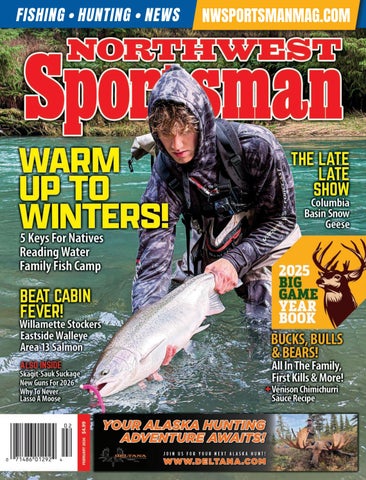
Create a flipbook