FISHING • HUNTING • NEWS
NWSPORTSMANMAG.COM
SHOP W W W. W I L L A P A O U T D O O R . C O M
ONLINE!
Willapa Marine & Outdoor is a family-owned Pacific Northwest company offering dependable gear for clamming, crabbing, shrimping, and fishing. We focus on quality materials, practical designs, and products built to perform. Shop fishing tackle, crab traps, clamming supplies, apparel, and more—plus trusted brands like Wicked Lures, BnR, Caddis, Gamakatsu, Pro-Cure, Eagle Claw, and others. From lures and jigs to nets and tackle boxes, we’ve got anglers covered.
www.willapaoutdoor.com • 360-942-2151 FREE IN-STORE PICKUP or FREE STANDARD SHIPPING on orders over $75 (some exclusions apply)
Custom Boat Trailers
Reliable Quality Service & Craftsmanship For Over 50 Years!
• NMMA Certified • All Steel Weld Frame, Fenders & Bunks • 2 YEAR WARRANTY
R a f D t s e s G
—
343 Thain Rd., Lewiston, Idaho www.gateway-materials.com 208-743-0720
Recently, we accepted the award from the Hewes family for being the 2025 Top Sales Dealer — an honor we don’t take lightly. I’m thankful for the support from Hewescraft and especially our sales, parts, and service teams at Tom-n-Jerry’s. Great job, team!!! — Kelly Hawley, President. Tom-N-Jerry’s Boat Center 11071 Josh Green Ln Mount Vernon, WA 98273 360-466-9955 Sales Hours Mon - Fri: Sat: Sun:
8:00 am - 5:00 pm 8:00 am - 4:00 pm Closed
Parts/Service Hours Mon - Fri: 8:00 am - 4:30 pm Sat - Sun: Closed
Your LOCAL Hunting & Fishing Resource
Volume 18 • Issue 11 PUBLISHER James R. Baker EDITOR Andy “I’m not sure how to pronounce this next one” Walgamott THIS ISSUE’S CONTRIBUTORS Dave Anderson, Ryan DeLuca, Scott Haugen, MD Johnson, Randy King, Chris Marcolin, Sara Potter, Buzz Ramsey, Bob Rees, Troy Rodakowski, Dave Workman, Mark Yuasa GENERAL MANAGER John Rusnak SALES MANAGER Paul Yarnold ACCOUNT EXECUTIVE Janene Mukai DESIGNER Katrina Ngor PRODUCTION ASSISTANT Emily Baker OFFICE MANAGER/COPY EDITOR Katie Aumann INFORMATION SYSTEMS MANAGER Lois Sanborn
2026 WELDCRAFT 200 REBEL
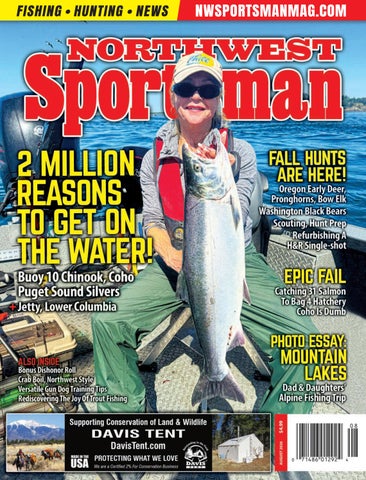
WEBMASTER/DIGITAL STRATEGIST Jon Hines ADVERTISING INQUIRIES ads@nwsportsmanmag.com CORRESPONDENCE Email letters, articles/queries, photos, etc., to awalgamott@media-inc.com. ON THE COVER Sharon Hunter shows off a nice hatchery coho she caught at Buoy 10 last August while fishing with Northwest Sportsman contributor and salmon fishing icon Buzz Ramsey. Nearly 1 million fall Chinook and silvers are expected to return to the mouth of the Columbia River this season. (BUZZ RAMSEY)
DEPARTMENT OF SOCIAL SERVICES Like us on Facebook, follow us on X and get dailyish updates at nwsportsmanmag.com.
MEDIA INDEX PUBLISHING GROUP
1-877-426-0933 12 Northwest Sportsman AUGUST 2026 | nwsportsmanmag.com
verles.com
941 Powell Ave SW, Suite 120 Renton, WA 98057 (206) 382-9220 • (800) 332-1736 Fax (206) 382-9437 media@media-inc.com mediaindexpublishing.com
4
C
TO CATCH FISH YOU NEED TO GO TO WHERE THEY ARE!
FULL LIMITS ON KINGS, SILVERS, HALIBUT, LINGCOD & MUCH MORE! BRITISH COLUMBIA, CA
SCAN TO SEE OUR VIDEO
“BRING YOUR LARGE COOLERS. YOU WILL NEED THEM WHEN YOU FISH WITH US!”
AUGUST 2026 SPECIAL WE ALSO HAVE SPECIALS for B ring Y our O wn B oat Fishing/Catching
Lodging 4 PERSON DRIVE-IN FISHING/CATCHING •• 43 Nights Full days of Guided Fishing / Catching
Halibut, Lingcod & MORE CHARTER $2,100 ea. US •• Salmon, All your meals from our large restaurant menu MUST BE BOOKED BY AUGUST 30 W/ 20% DEPOSIT TO GET THIS SPECIAL PRICE
250-287-1394
BOOK YOUR CANADIAN FISHING/CATCHING ADVENTURE NOW! info@westviewmarina.com | westviewmarina.com
CONTENTS
ALSO INSIDE 73
AUGUST OFFERS DOGGONE GOOD FISHING OPS The dog days of summer play host to some howlin’-good angling, and nobody knows that better than guide Bob Rees. He spotlights good bets, from Lower Columbia Chinook to Oregon Coast albacore.
77
GOLD-MEDAL SILVER PROSPECTS With a forecast of 900,000 coho, Puget Sound anglers can look forward to a pretty good season, one that could help drive catches to a two-plus decade high. Mark Yuasa details top spots, best setups and more!
VOLUME 18 • ISSUE 11
121 FIND OREGON PRONGHORN SUCCESS Patience, sweat and finding water holes will go a long way to filling an antelope tag this season. Troy Rodakowski has been there and done that, and he shares timely tips that have worked out well for himself and his father on Oregon Outback pronghorn. 127 THE ‘FINE DETAILS’ OF FALL BLACK BEARS Jesse Hurley is “a camo-clad encyclopedia of bear hunting knowledge,” and our MD Johnson caught up with him just in time for the start of bruin season across the Northwest. Hurley cracks open the big book on black bear tactics and myths. 135 HUNTING EARLY-SEASON DEER IN A DROUGHT YEAR Fact check: Deer hunting doesn’t just occur in October and November – there’s opportunity as summer draws to a close in the Northwest. The early season just happens to be a favorite of Troy Rodakowski, and he has advice for finding bucks while the weather’s still hot and dry.
111
(RYAN DELUCA)
UNDER PRESSURE: OREGON ARCHERY ELK
The stakes were higher than usual for an out-of-work Beaver State archer chasing bulls on public land last season. Ryan DeLuca recounts how he tagged out in the Cascades and refilled his freezer in the nick of time – and his proven preparation and hunting strategies could help you this year.
SUBSCRIBE TODAY! Go to nwsportsmanmag.com for details. NORTHWEST SPORTSMAN is published monthly by Media Index Publishing Group, 941 Powell Ave SW, Suite 120, Renton, WA 98057. Periodical Postage Paid at Portland, OR and at additional mail offices. (USPS 025-251) POSTMASTER: Send address changes to Northwest Sportsman, 941 Powell Ave SW, Suite 120, Renton, WA 98057. Annual subscriptions are $39.95 (12 issues). Send check or money order to Media Index Publishing Group, or call (206) 382-9220 with VISA or M/C. Back issues may be ordered at Media Index Publishing Group offices at the cost of $5 plus shipping. Display Advertising. Call Media Index Publishing Group for a current rate card. Discounts for frequency advertising. All submitted materials become the property of Media Index Publishing Group and will not be returned. Copyright © 2026 Media Index Publishing Group. All Rights Reserved. No part of this publication may be copied by any means, electronic or mechanical, including photocopying or recording by any information storage or retrieval system, without the express written permission of the publisher. Printed in U.S.A. nwsportsmanmag.com | AUGUST 2026
Northwest Sportsman 15
45
BUZZ RAMSEY
Chasing Salmon At Buoy 10 Just under a million Chinook and coho will enter the Lower Columbia this fall season, and so catching them should be easy-peasy, right? Er, not quite. Buzz lays out the best tidal strategies, trolling setups and more to help you bring it to the vast management area known as Buoy 10.
COLUMNS
(BUZZ RAMSEY)
64
OUTDOORS MD Tossing Bobbers And Bait Off Big Ol’ Boulders Not all of us have salmon fishing boats, but we do have MD Johnson, governor of the gargantuan gravel, aka, the jetty. Break out your floats, mooching rigs and anchovies for a tutorial on catching coho and even Chinook off these navigational aids.
87
FOR THE LOVE OF THE TUG Fun And Legal Doesn’t Always Mean Wise Or Fair The fishing was epic that day on the ocean last summer for Sara and crew – 31 fish to the boat and four keeper coho that cooked up swimmingly well. But it also left a bad taste in her mouth: Should we really handle so many unkeepable wild fish to eke out a hatchery limit, even if the regs allow that? Isn’t there a better way?
93
CHEF IN THE WILD The World’s Easiest Foraging Trip The target was rockfish and lingcod, but when the Newport charter crew asked if he also wanted to soak some crab pots on the way out to the fishing grounds, the $40 cost was too good to pass up for Chef Randy. He serves up a Northwest-style crab boil with his dozen keeper Dungies.
141 ON TARGET The Rifle, Or, My Summer Project An H&R single-shot in .308 Winchester slumbered at the back of Dave W.’s gun safe for far longer than he’d care to admit, and when he dug it out recently, the scope had shifted and his handloads weren’t zeroing. With an eye to carrying the rifle in the woods this season, Dave shares how he refurbished it and got it on target again. 149 BECOMING A BETTER HUNTER Boots On The Ground: Why August Matters Most True, you fill your tag on the deer or elk opener or the following days and weeks, but smart hunters know it all begins in August, when they have time to attend to all the little things that go into the hunt. Dave A. lines out how to use late summer to maximize your fall success. 155 GUN DOG More Versatile Gun Dog Training Tips Scott wraps up his two-part series on getting pudelpointers, pointers, setters, spaniels and other versatile gun dog breeds back in the hunting mindset via a variety of drills. From sniffing out shed antlers to water training, long runs to hunting invasives, he shares how to get the most out of your pup with focused training. 16 Northwest Sportsman AUGUST 2026 | nwsportsmanmag.com
NO HERRING?
H S I F N N I P S E US
™
26
THE BIG PIC
Mountain Waters
CATCH MORE SALMON!! PULLS APART FOR EASE OF FILL • PULL-APART “EASY-FILL” BAIT CHAMBER • FOUR SIZES, 2, 2.5, 3 AND 4 INCH • PRE-RIGGED W/ TWO HOOKS ON 20 LB. AND 30 LB. FLUOROCARBON LEADER. ALSO AVAILABLE IN UNRIGGED 2-PACKS • CAN BE RIGGED-TO-SPIN CLOCKWISE OR COUNTER CLOCKWISE
www.yakimabait.com Follow us! Tag us @yakimabaitco, #yakimabaitco, #roostertaillures
18 Northwest Sportsman AUGUST 2026 | nwsportsmanmag.com
U.S. Patent # 8474174. Canadian Patent # 2,741,915.
Photo essay: A father and his girls enjoy summer in one of the most Northwest ways possible – fishing for trout in the heights.
(NICK CHRISTOPH)
DEPARTMENTS 23
THE EDITOR’S NOTE Rediscovering the simple joys of trout fishing
31
READER PHOTOS Westport kings, Baker sockeye, Willamette Chinook, Oregon Coast spring bear, and more!
35
THE DISHONOR ROLL Massive fines for Umatilla poacher; New chief WDFW game warden; Kudos; North Idaho trio sentenced; Dressed (not) for success; Jackass of the Month
41
OUTDOOR CALENDAR Upcoming fishing and hunting openers, events, deadlines, more
43
DERBY WATCH Ongoing and upcoming fishing contests and events around the region
SEASPORTBOATS.COM
BUILT DIFFERENT HANDMADE IN THE PACIFIC NORTHWEST CUSTOM BUILT TO FISH ANY CONDITIONS
26’ ALEUTIAN
26’ KODIAK
24’ EXPLORER
FIND YOUR NEAREST PACIFIC NORTHWEST DEALER ALBERNI POWER & MARINE Port Alberni, BC 250-724-5722
JACOBSEN’S MARINE Edmonds, WA 206-789-7474
SEASPORTBOATS.COM/DEALERS
STEVENS MARINE Portland, OR 503-652-1444
STEVENS MARINE Tigard, OR 503-620-7023
Fighting a rainbow trout at Trillium Lake, on the flanks of Mount Hood. (AMY WALGAMOTT)
THE EDITOR’SNOTE
T
ime really does fly. Exactly 17 years ago this month I went from 37 miles deep in Washington’s North Cascades to 7 miles off the Columbia over a 24-hour period while chasing alpine trout and ocean coho. Last August, I found myself more or less doing the same thing, except in reverse (and at a more leisurely pace in my dotage), trolling at Buoy 10 with Buzz Ramsey and two days later camping and fishing at Trillium Lake by Mount Hood. A lot happened in the years between. We moved from the Seattle area to Oregon City; our oldest went off to college; our youngest is a straight-A high schooler; Amy is going great guns with her artwork; the Seahawks won the Super Bowl, the Sounders two MLS Cups and the Timbers one. As for me, my fishing moved heavily towards salmon, but I rediscovered the joys of trout fishing at Trillium.
THERE I WAS, perched on a paddleboard with a rustic collection of Dick Nites and other spoons and the crappiest leader ever. The life span of my lures was roughly 10 to 15 casts before the old, skimpy line would break off in a rainbow’s jaw or submerged logs or weeds. But I was having fun, and one of the fish I caught and released was nice-sized. Our campout probably occurred just after the lake’s final Oregon Department of Fish and Wildlife stocking of the season (this year’s last one is scheduled for the week of August 24), but it was great because the target species was actually biting – looking at you, Willamette springers and coho! It was like I was a kid again, enjoying the grabs, the moment, the simplicity, the views, not worried about bringing anything home to restock the freezer. We had plenty of food back in camp, though one trout fried up quite deliciously on the grill. THIS MONTH, MY thoughts (and our stories) return to both sea level and the mountains. Buzz and MD Johnson get us ready to fish Buoy 10 as just under 1 million salmon begin to return to the Columbia River, while a banner forecast of 900,000 Puget Sound coho has Mark Yuasa previewing top spots, gear and more. And in a photo essay, Chris Marcolin recalls an Okanogan backcountry outing that takes me back to when – inspired by my beloved Lakes of Washington books – friends and I trekked the Cascades for brookies and cutts. It really is the best of both worlds this issue. From sea to sky, August in the Northwest packs a lot of opportunity into the end of summer, and I hope to see you out there. –Andy Walgamott nwsportsmanmag.com | AUGUST 2026
Northwest Sportsman 23
Mountain Waters
Photo essay: A father and his girls enjoy summer in one of the most Northwest ways possible – fishing for trout in the heights.
When the mountains are calling, alpine fishermen must go. (NICK CHRISTOPH) 26 Northwest Sportsman AUGUST 2026 | nwsportsmanmag.com
Callie Christoph tries her luck while perched on a boulder with Hank the Weimaraner, since passed away. (NICK CHRISTOPH)
By Chris Marcolin
S
ummer’s heat and smoke-filled skies have returned to Central Washington, making for less than perfect air conditions. In the midst of the unbearable heat and haze, some make it a yearly ritual to return to remote lakes far from the crowds to find fish in pristine environments. These clear mountain waters have warmed up moderately and their trout are making the most of the high season. Food is plentiful but short-lived before the cold returns. The surrounding scenery is verdant with new growth, another draw for those willing to make the trek into the heights. A family has planned a trip and is now packed to the limits with ample gear and tackle. They’ve set aside enough time to make the most of the fishing once they get to the lake. nwsportsmanmag.com | AUGUST 2026
Northwest Sportsman 27
Nick Christoph and daughter Kinsey hit the trail to a lake in Northcentral Washington. (NICK CHRISTOPH)
Kinsey shows off an eastern brook trout. (NICK CHRISTOPH) As the morning sun begins to lighten the sky, the father and his daughters depart from home for the day. They are not alone, as two canine companions join them on this trip. The drive begins with the silence of tiredness progressing into limited conversations and intermittent naps. As the road gets bumpier and corners more frequent it is only a matter of time before they arrive at their jumpoff point. There, a last-minute gear check ensures everything they need for the day is with them. The lake looks just like their previous trip, save for the renewals of spring and
A beautiful cutthroat flashes its colors as it comes to hand. (NICK CHRISTOPH)
28 Northwest Sportsman AUGUST 2026 | nwsportsmanmag.com
Callie smiles as her dad holds a rainbow trout. (NICK CHRISTOPH)
summer. The fishing begins with picking a perfect rock to cast from, one that has enough room for a pup to sit close by. With every cast the silence of the high country is broken by a lure splash. The anglers slowly reel in while trying their best not to snag on rocks or submerged logs. Then a sudden abrupt resistance signals a trout full of fight is on one of their lines! It breaks the surface in its full cutthroat colors. This is where life brings everything together. The rest of this day is filled with memories and stories to share. NS
The day’s last light ebbs away over jagged Cascade peaks. Words never do justice to such outings, but the memories are sure to live long afterwards. (CHRIS MARCOLIN)
Motel Rooms - Cabins - Cafe Mt. Bailey Sports Bar and Grill South Shore Pizza Parlor - Store Marina - Gas Station w/ Non Ethanol Fuel Post Office - Laundromat Diamond Room Lounge Diamond Lake RV Park
December 12 - Start of Tubing Season (Weather Permitting) December 13 - Snow Dance and Penguin Plunge December 25 - Christmas Day Buffet (Reservations suggested) December 31 - New Years Eve Grand Buffet & adult party with live music (Dinner reservations suggested) January 3 - High School Cross Country Ski Races January 10 - High School Cross Country Ski Races January 19 - MLK Day Bonus Tubing Day February 14 - Rogue Snowmobile Mt. Bailey $5K Poker Run February 16 - Presidents Day Bonus Tubing Day February 21, 22 - Dog Sled Races March 21-29 - Spring Break Bonus Tubing Days March 29 - Last Tubing Day for the Season
Come and join us as we celebrate winter in our wonderland! Diamond Lake Resort is located at the summit of the Southern Oregon Cascade Mountains. On Hwy 138 just 5 miles North of Crater Lake National Park. We are the hub of 300 miles of groomed Snowmobile trails and the only snowmobile access to Crater Lake National Park
541.793.3333 | www.diamondlake.net
READER PHOTOS
A couples trip yielded some nice kings for Darrel and Linda Smith (above) and Adrienne and Jay Golden. They were trolling out of Westport over the long Fourth of July holiday weekend, and Linda’s 20-pounder was her biggest Chinook yet! (KNIFE PHOTO CONTEST)
Brothers James and William Solomon enjoyed some pretty good Chinook fishing just off Westport early last month. (KNIFE PHOTO CONTEST)
For your shot at winning a knife in our Knife Photo Contest, send your full-resolution, original images with all the pertinent details – who’s in the pic; when and where they were; what they caught their fish on/weapon they used to bag the game; and any other details you’d like to reveal (the more, the merrier!) – to awalgamott@media-inc.com or Northwest Sportsman, 941 Powell Ave SW, Suite 120, Renton, WA 98057. By sending us photos, you affirm you have the right to distribute them for use in our print and Internet publications. nwsportsmanmag.com | AUGUST 2026 Northwest Sportsman
31
READER PHOTOS
PHOTO CONTEST MONTHLY
Winner!
Steve Fall credits his first Buoy 10 Chinook all to his cousin Gary. The pair have been fishing since they were kids, when their grandpa started taking them out, and while Steve took to freshwater venues and Gary to salmon and steelhead, it all came together at the mouth of the Columbia last August. “Once you try it, you’ll be hooked!” Gary urged Steve, who called their week there “a bit of a crash course and out of my comfort zone, to say the least, but I was fully committed. I paid close attention to every detail and suggestion that came my way.” It turned out to be one of Steve and Gary’s best fishing trips together ever. “It reminded us of when we were kids fishing on the bank of the Columbia with our grandfather. Ahhhh, what it’s like to be 10 years old again – running around, laughing, joking and telling stories nobody else would believe!” Even better, “The fishing Gods were kind, as we caught plenty of fish to share with our family and friends, but the memories we made together will last a lifetime. He was right – I’m hooked and we cannot wait to go again this year! I sure love my Cuz.” (KNIFE PHOTO CONTEST) Jen Strohmaier made quick work of her Oregon spring black bear permit, filling it with this coastal bruin. The pack out required a little more effort, says Skylar Masters of their 4 1/2-hour endeavor. He reports that, unbeknownst to them, another group of hunters also had eyes on this bear, but rather than get all bent out of shape after Jen pulled the trigger, the “top-notch sportsmen” shared video of her hunt as well as drinks and snacks back at the truck. (KNIFE PHOTO CONTEST)
Dennis Schwartz and pals took advantage of the long tail of the Willamette spring Chinook fishery to put this and two others in the bleed bucket one June day at the mouth of the river. (KNIFE PHOTO CONTEST) 32 Northwest Sportsman AUGUST 2026 | nwsportsmanmag.com
Frank Urabeck’s 14-foot Livingston strikes again – this time with him aboard! After grandson Spencer Ewing borrowed it to load up on Drano Lake spring Chinook this season, the duo got together to fish Baker Lake shortly after it opened for sockeye, going seven for 15 on fish weighing up to 9 pounds. With another big run expected back to the North Cascades reservoir, Urabeck is hopeful there’s enough excess eggs to supply the Cedar River hatchery with some. (KNIFE PHOTO CONTEST)
Relax. Reel. Repeat. Whether you’re working the water, playing a round of disc golf, or basking in the perfect sunset, Odell Lake Resort is your place to unwind and explore. • Lakeside Sauna • 18-hole Disc Golf Course • Boat Rentals • Guided Fishing Trips • Restaurant
Come experience Odell Lake Lodge Life! Book your stay today! w w w . o d e l l l a k e r e s o r t . c o m | ( 5 4 1 ) 4 3 3 - 2 5 4 0 | o d e l l l a ke re s o r t @ g m a i l . co m
WELCOME TO AMERICAN SUNSET RV & TENT RESORT Call us about our MONTHLY Winter Special at 360-268-0207 • 120 Full Hookup RV Sites • 60 Tent Sites • Cabin Rentals • Fish Cleaning Station
• Heated Pool • Large Clubhouse • Bathrooms w/showers • Laundry • Cable/Wifi
MENTION THIS AD TO RECEIVE
Make your reservations online. Go to americansunsetrv.com
*UP TO 2 NIGHTS
americansunsetrvresort@gmail.com
15% OFF
B O O K Y O U R T R I P T O DAY ! www.islandpointlodge.com 1-800-352-4522 | frank@islandpointlodge.com
34 Northwest Sportsman AUGUST 2026 | nwsportsmanmag.com
• Playground • Located in the heart of Westport, a mile from the beach and marina • Open 365 days a year
Island Point Lodge offers a 7-day, 6-night self-guided Alaska Salmon, Halibut, and Dungeness Crab trip for $2,699. The trip includes lodging, meals, fishing rods and reels, boat fuel, and fish cleaning/packaging. Add a self-guided Black Bear hunt at no extra charge, with over-the-counter bear tags available in town. The Black Bear hunt is self-guided, including cleaning and preparation.
MIXED BAG
Massive Fines For Umatilla Poacher
C
hristopher George Matson will never hunt in Oregon or anywhere else in the United States again after receiving a lifetime hunting license revocation as part of his sentencing in two big game poaching cases. The 48-year-old Umatilla man was also ordered to pay more than $114,000 in restitution and serve 300 hours of community service, given two years of probation as well as forfeited numerous firearms, deer skulls and predator parts. The Oregon State Police Fish and Wildlife Division said the penalties were the result of a “significant investigation” into Matson’s activities, and they thanked both the Washington Department of Fish and Wildlife for its assistance in the case
as well as the “many witnesses” who lent information against the former Oregon Department of Corrections officer. “This is another example of serial poaching which rises to the level of felony conduct based solely on the repeated poaching conduct and impact of one individual on Oregon’s game mammals,” said Jay Hall, the state Department of Justice’s anti-poaching prosecutor who was tasked with the case.
ACCORDING TO OSP, Matson’s activities came to fish and wildlife troopers’ attention in 2024, and that led to a February 2025 search warrant. At the time, OSP seized “multiple big game animals” as well as firearms, then referred a whopping 67 criminal charges to
JACKASS OF THE MONTH
A
repeat sturgeon poacher learned the hard way after trying to illegally retain a fish on back to back May days, earning himself a trip to jail. Oregon fish and wildlife troopers report they were surveilling the Gilbert River area on Sauvie Island between the Columbia and Willamette Rivers when they saw the man catch and illegally retain a sturgeon, which he put inside his truck. There has been no
sturgeon retention season anywhere in the Columbia system below Bonneville Dam for several years due to concerns related to spawning recruitment, population structure and long-term decline, and the Gilbert River is closed to all sturgeon fishing, even catch and release. When troopers contacted the man, they found that the fish was still alive and were able to release it back into the water. The man was cited for felony take/ possession of an oversized sturgeon and misdemeanor angling in closed waters.
By Andy Walgamott
Big game animal parts and firearms seized from Christopher G. Matson as part of an investigation into his poaching activities in Northcentral Oregon. (OSP) prosecutors across multiple counties. Per a press release, the alleged offenses covered quite a gamut: “… unlawful take/possession of a black bear with the aid of bait, falsely applying for a license/tag, unlawful take/possession of buck deer, unlawful take of antlerless elk, loaning/borrowing big game tags, unlawful possession of silencers, unlawful
Troopers seized his fishing rod and large net as evidence. Think he’d get the message? Nope. The very next day, they responded to a call from the same area and stopped the man again with another unlawfully kept sturgeon. This time he was placed under arrest and taken to the Columbia County Jail, where he was booked for the offense. Troopers were able to again release the fish alive, and they seized yet another rod from him, as well as had his vehicle towed. nwsportsmanmag.com | AUGUST 2026
Northwest Sportsman 35
MIXED BAG possession of a short-barreled rifle, hunting during prohibited hours, failing to validate a big game tag, and unlawful take/possession of a game bird.” It wasn’t Matson’s first brush with the law. The Oregonian reported that he began working at the state’s Two Rivers Correctional Institution in Umatilla in 2019, and DOC records show that in February 2020, while applying for training and certification, he self-reported four drivingrelated convictions from 2004 through 2009, as well as dishonesty after claiming to have swerved to avoid hitting an elk on a road in one of two 2009 cases. Notes from a corrections committee acknowledge Matson came forward on his own about the convictions but also that the multiple cases across five years demonstrated a pattern of abuse and lack of personal responsibility. The newspaper reported Matson worked for DOC until this past January, when he was fired. He is the subject of an ongoing DOC professional standards review that was spurred by big game violation charges filed last September. He was reported as suicidal in December. This June, Matson entered guilty pleas in two different Northcentral Oregon circuit courts. In Grant County, he pled guilty to four felony and misdemeanor counts of unlawfully taking buck deer and three felony and misdemeanor counts of unlawfully taking black bear. For those, he received 18 months of probation, a lifetime hunting ban, 300 hours of community service, forfeiture of seized property and a $52,500 fine to be paid to the Oregon Department of Fish and Wildlife. And in Umatilla County, he pled guilty to felony unlawful possession of a shortbarreled rifle, felony unlawful possession of a silencer, felony unlawful take of mule deer and misdemeanor unlawful possession of wildlife. Those pleadings resulted in 24 months of probation, lifetime hunting license revocation, 300 hours of concurrent community service, forfeiture of seized property and a $62,000 fine due ODFW. “The conduct across the several counties amounts to one of the highest damage amounts done to Oregon wildlife by any singular actor,” said Hall, the state poacher prosecutor. 36 Northwest Sportsman AUGUST 2026 | nwsportsmanmag.com
NEW CHIEF WDFW WARDEN
T
here’s a new law enforcement chief at the Washington Department of Fish and Wildlife. Mike Jewell was sworn in to the post July 15, replacing Steve Bear, who had served in that role since September 2017 and retired last month. Jewell was most recently WDFW Enforcement Program captain for Region 2, the northcentral portion of the state, and his credentials were lauded at the June Fish and Wildlife Commission meeting when his promotion was announced. WDFW Director Kelly Susewind termed him a “spectacular candidate who had “served at all levels within the Enforcement Division, from officer through training officer up through sergeant, and now a captain.” You may recall Jewell from New Washington episodes of the mid-2010s Animal Planet show Rugged Justice. Susewind said recruitment for a new chief occurred outside as Department of Fish and Wildlife Law well as inside the agency but that internal applicants “were just the Enforcement Chief cream of the crop, and then I think we got the cream of the crop in Mike Jewell (top), who replaces the retiring Captain Jewell, soon to be Chief Jewell.” Steve Bear. (WDFW) The director also praised Bear, who came over to WDFW from the Alaska Wildlife Troopers. “He’s the only chief that’s been here since I’ve been here – phenomenal job with that division, really, really bringing them along. Talk about collaboration and coordination,” Susewind said. Both Bear and Jewell are graduates of the FBI National Academy, a 10-week leadership training program, the only two WDFW officers to have done so. Bear is also an Army veteran. Thanks for your service!
KUDOS
Last issue we told you about Oregon’s newest conservation K-9, a four-legged game warden in training who needed a name (no word on that as of press deadline). This issue we celebrate the career of its first. Buck, a yellow Labrador retriever who has been on the trail of poachers and other treacherous individuals since 2018, retired in mid-May after being part of 184 missions and 156 outreach events, according to the Oregon State Police Fish and Wildlife Division. “Some of Buck’s deployments led to the recovery of key evidence that contributed to convictions in wildlife crime investigations, as well as homicide and major assault cases,” stated troopers. At his retirement festivities, Buck and handler Senior Trooper Josh Wolcott were presented with their agency’s Harold R. Berg Lifesaving Award for work last December to rescue a suicidal subject. After tracking the individual through some woods to a pond, they spotted the person lying in the water and, with assistance from a search-andrescue team member, the trio pulled them to shore and rendered first aid for hypothermia until medics could take over. “Your conduct and actions on December 6, 2025 represent the highest values of the Oregon State Police. The courage and leadership you displayed in your response to the situation are a testament to the measure and strength of your character and exemplify the qualities of an Oregon State Police Trooper,” reads a plaque (OSP) awarded to Buck and Wolcott. Kudos to both of you, and enjoy your retirement, Buck, it’s well deserved! OSP’s Conservation K-9 Program is a collaboration with the Oregon Wildlife Foundation, which provides funding for it. Donations are accepted at myowf.org/osp-conservation-k9-team.
nwsportsmanmag.com | AUGUST 2026
Northwest Sportsman 37
MIXED BAG
North Idaho Trio Sentenced
Conservation Officers Mark Maret and Bryce Compton pose with the heads of seven North Idaho whitetails seized during the investigation of three St. Maries residents. (IDFG)
S
“
moked a beauty today.” So states text accompanying a November 2024 social media post with photos showing multiple angles of a five-point North Idaho whitetail. With its split left eyeguard, the rack is a dead ringer for one displayed by state conservation officers at the resolution of a case involving
the killing of seven mature bucks outside legal hunting hours and the wastage of three, all of which resulted in significant penalties for three St. Maries residents. The Idaho Department of Fish and Game reported that Will Clark and Lucas Mitchell both had their hunting licenses revoked for 10 years, while Laura Willis lost
hers for one year. Mitchell was also sentenced to seven months in county jail, five years of probation and was ordered to pay $17,200 in restitution jointly with the other three. Clark, who is currently incarcerated, received zero to four years in prison. According to IDFG, an investigation found 56 alleged wildlife violations between Clark and Mitchell, who were subsequently charged with more than half a dozen felony counts related to unlawful deer killing. The agency said that all of the deer were killed in November 2024, with five killed in a 24-hour period. Because three met the state definition for a trophy whitetail – a buck with a rack that measures 130 or more inches under Boone and Crockett Club scoring protocols – they were subject to enhanced fines. Willis pled guilty to unlawful possession of big game and transfer of a tag and received a year of unsupervised probation and fines and fees amounting to several hundred dollars. IDFG thanked the public for reporting crimes against wildlife via Citizens Against Poaching (citizensagainstpoaching.org) and the Kootenai County Prosecutor’s Office for prosecuting the case.
DRESSED (NOT) FOR SUCCESS
O
A screenshot from a Washington Department of Fish and Wildlife Police video shows crabs being pulled out of custom pouches sewn into a puffy jacket. (WDFW) 38 Northwest Sportsman AUGUST 2026 | nwsportsmanmag.com
n one coast this summer, Taylor and Travis got married; on the other, Tailor and Stitch married their sewing skills to an attempt to poach a bunch of illegal crabs. In one of Washington game wardens’ most viewed social media videos, Officer Kyle Garrison gives a dressing-down – literally and figuratively – to four people who used “Three purposely-built crab hiding bandoliers and one puffer jacket with pouches” to conceal 21 Dungeness, including 19 undersized crabs and one female. The quartet were working a Tokeland beach at low tide, and video shows a man stuffing a crab into the hood of one woman’s jacket. Contacted by Garrison back at their vehicle, shellfish slowly emerged from the four people’s clothing – the hood, waist-worn bandoliers, one woman’s bra – as he repeatedly asked to see all of their catch. Even after all the crabs appeared to have been removed from the clothing, a patdown search yielded still more, wardens reported. The suspects appeared to have used tight-fitting plastic bags to contain the crabs before placing them into their clothes. Garrison cited them criminally for failure to submit their catch for inspection and retaining undersized crabs.
OUTDOOR
CALENDAR AUGUST
1
Columbia River fall salmon fishery opener (regulations vary by area); OR fall black bear opener; WA fall black bear opener in most bear management units; Steelhead retention closes on mainstem Columbia River from Buoy 10 to The Dalles Dam; OR Central Coast all-depth halibut summer season opens (open seven days a week); 2026 Washington Waterfowl Calling Contest, Abrams Park, Woodland – info: washingtonwaterfowl.org 1-9 Buoy 10 any-Chinook open days (hatchery coho also open) 8 WDFW National Hunting and Fishing Day event, North Central Washington Gun Club, East Wenatchee – info: wdfw.wa.gov/hunting/requirements/ education/hunt-fish-day 10-24 Buoy 10 hatchery-Chinook-only open days (hatchery coho also open) 15 Fall bear opener in WA Okanogan and Willapa Hills units; OR any legal weapon controlled pronghorn season begins in many units; Oregon Zoo Lead-free Ammunition Testing Day (free), Klamath Sportsman’s Park, Keno, OR – info: hannah.dinell@oregonzoo.org ; CAST For Kids fishing event, Black Canyon Reservoir, Emmett, ID – info: castforkids.org 16 CAST For Kids fishing event, Snake River, Lewiston, ID – info above 20 ODFW Intro to Hunting In Oregon (registration, $10), Tualatin Bass Pro Shops – info: myodfw.com/workshops-and-events 23 Last scheduled day of OR Central Coast hatchery coho season 25-Sept. 2 Buoy 10 any-Chinook open days (hatchery coho also open) 29 OR bow deer and elk openers in many units; CAST For Kids fishing event, Clear Lake, Cheney, WA – info above 30 ID bow deer and elk openers in many units
1
SEPTEMBER
WA cougar, mourning dove and bow deer openers; Eastern WA fall turkey opener; OR ruffed and blue grouse and mourning dove openers; Western OR and select NE OR units fall turkey openers; Western OR quail opener; Hatchery steelhead retention closure begins on mainstem Columbia from The Dalles Dam to Highway 395 Bridge in Pasco, WA; Tentative OR Central Coast ocean any-coho opener (27,500-fish quota) 3 Buoy 10 season switches to hatchery coho only (Chinook retention closed); Salmon fishing closure begins on Lower Columbia between west Puget Island and Warrior Rock-Bachelor Island line 5-6 WA Goose Management Areas 4 and 5 September Canada goose season dates 5-13 WA GMAs 1, 2 and 3 September Canada goose season dates 9 Tentative wild coho opener on Nehalem, Tillamook and Nestucca (Wednesdays, Saturdays and Sundays only) and Siletz, Yaquina, Siuslaw, Coos and Coquille (open daily) systems (see regs for more info) 12 WA bow elk opener; CAST For Kids fishing event, Lake Washington, Renton, WA – info above 12-13 WA youth upland bird (statewide pheasant, Eastside quail and chukar) hunt weekend 12-16 OR Southwest, High Desert and Blue Mountain, and Mid-Columbia Zones September Canada goose season dates 12-20 OR Northwest Permit Zone September Canada goose season dates 13 CAST For Kids fishing events at Henry Hagg Lake, Gaston, OR, and Lake Coeur d’Alene, Coeur d’Alene, ID – info above 14 OR fee pheasant hunting opener at Fern Ridge Wildlife Area (select units) 14-18 WA statewide 65-plus and disabled hunter pheasant hunting week 15 WA forest grouse opener 15-23 OR and WA bandtail pigeon season dates 15-25 High Buck Hunt season dates in select WA Cascades and Olympics wilderness areas and Lake Chelan National Recreation Area 16-30 Salmon fishing closure dates on Columbia from Warrior Rock-Bachelor Island line upstream to WA-OR border nwsportsmanmag.com | AUGUST 2026
Northwest Sportsman 41
By Andy Walgamott
Now through August 31: 2026 Baker Lake Sockeye Derby; ccawashington.org/bakerlake
Now through end of fishing seasons: Westport Charterboat Association Derbies; charterwestport.com/fishing.html
Now through October 31: Washington Department of Fish and Wildlife 2026 Trout Derby, select lakes across state; wdfw.wa.gov/ fishing/contests/trout-derby August 8: 30th Annual Gig Harbor Puget Sound Anglers Salmon Derby, South Puget Sound; gigharborpsa.org August 8: Odell Lake kokanee derby; kokaneepoweroregon.com August 14-15: 19th Annual Oregon Tuna Classic, Pacific off Garibaldi; oregontunaclassic.org August 14-15: Battle of the Bay Derby, Rogue Bay; battleofthebayderby.com August 15: 4th Annual Salmon Harbor Fishing Derby, Winchester Bay; salmonharborfishing.com August 15: Lipstick Salmon Slayers, Buoy 10 and Pacific off Astoria; lipsticksalmonslayer.com August 15: Salmon for Soldiers Seiku Summer Slam, Strait of Juan de Fuca; salmonforsoldiers.org August 19-22: Curry Anadromous Fishermen Rogue River Salmon Derby; indiancreekhatchery.org August 21-22: Columbia River Salmon Derby 2026, Lower Columbia below Tongue Point; DebTessier@aol.com August 29-30: The Resurrection Derby, Bellingham Bay; resurrectionderby.com Late summer (TBD): Annual Rogue Pikeminnow Roundup, Rogue River; dfw.state.or.us/fish/local_fisheries/rogue_river/fishing.asp September 5-7: 33rd Annual Gardiner Reedsport Winchester Bay Salmon Trout Enhancement Program Salmon Derby, Umpqua River estuary; umpquastephatchery.org September 8-15: Nootka Sound Tuna Showdown, Pacific off Vancouver Island; nootkamarineadventures.com September 12: Edmonds Coho Derby, Marine Areas 8-10; edmondscohoderby.com September 12-13: 25th Coos Basin Salmon Derby; facebook .com/profile.php?id=100063510016235 September 14-October 31: Boat Basin Salmon Derby, Westport; westportgrayland-chamber.org September 19: Kingston Coho Derby, Areas 9-10; kingstoncohoderby.com September 19-20: 4th Annual Whidbey Island Coho Derby, all open marine areas; whidbeypsa.org September 20: Salmon for Soldiers Day of Honor, North Puget Sound; salmonforsoldiers.org September 26-27: Everett Coho Derby, Areas 8-10 and open nearby rivers; everettcohoderby.com September 26-27: King of the Confluence Chinook and steelhead derby, Snake-Clearwater River confluence; extremefishingevents.com/king-of-the-confluence/derby Early fall (TBD): Alsea Bay Salmon Derby; facebook.com/ AlseaSportsmansAssn October (TBD): King of the Reach live-capture derby, MidColumbia’s Hanford Reach; ccawashington.org/kingofthereach Editor’s note: To list your derby or event here, email editor Andy Walgamott at awalgamott@media-inc.com. nwsportsmanmag.com | AUGUST 2026 Northwest Sportsman
43
COLUMN
Chasing Salmon At Buoy 10
T
he number of coho and fall Chinook expected to return to the Columbia River this year, although down slightly from last season, still looks good with nearly a million total salmon expected. State managers believe 636,500 Chinook and an additional 358,700 coho will enter the Columbia, mostly during the August BUZZ time frame. RAMSEY A split season for Chinook retention has again been instituted for the Buoy 10 portion of the fishery. The dates on which both Chinook and coho must be fin-clipped to retain are August 10-24. But August 1-9 and August 25-September 2, any one adult Chinook (fin-clipped or not) can be retained as part of your two-salmon daily limit. Throughout the season on the big river’s estuary, all coho must be fin-clipped to keep, and these waters will remain open for two hatchery fin-clipped coho per day September 3-October 31. A few other regulations to remember: Minimum adult coho size is 16 inches. Minimum adult Chinook size is 24 inches. All jack salmon must be released. Steelhead cannot be kept, fin-clipped or not. And barbless hooks are required. The above rules apply to what’s known as the Buoy 10 Management Zone, which extends from an imaginary north/south line through the number 10 red navigation buoy, located west of the Ilwaco Harbor entrance, upriver 29 miles to a line located just west of Puget Island. As always, regulations are subject to inseason modifications, so it’s a good idea to monitor fishing regulation updates/ news releases.
Author Buzz Ramsey and Tom Rulo pose with a Chinook caught at the mouth of the Columbia River. Like last year, there will be days early and late in the Buoy 10 fall salmon season when wild kings can be kept and others when it’s hatchery only. (BUZZ RAMSEY) nwsportsmanmag.com | AUGUST 2026 Northwest Sportsman
45
COLUMN a sportfishing closure within and in front of the entrance to Youngs Bay. It extends east from Warrenton Fiber to the green buoy line, including Buoys 29, 31, 33 and 35A, all the way upriver/east to the AstoriaMegler Bridge abutment and then south following the bridge to the Oregon shore. See your Oregon Sport Fishing Regulations book to see a map. To understand ocean tides, realize that waters change direction four times daily, with each 24-hour time frame having two high- and two low-water exchanges. These fluctuations are never the same from year to year, let alone day to day. What some might refer to as the wild card is when a large nighttime tide is bigger than the daytime one and therefore can push more fish into and perhaps through the estuary under the cover of darkness. In addition, rain events can inspire concentrations of fish to move quickly through the estuary
EVEN THOUGH NEARLY a million salmon are expected to enter the Columbia this season, catching them at the mouth can be a challenge unless you understand how ocean tides move concentrations of fish into and through the estuary. Here’s what happens: Fish wanting to enter the river each day collect in front of the river mouth when the tide is outgoing (ebbing). As the incoming tide begins, salmon will allow the flooding ocean water to carry them into the river. How far each group of salmon is carried into the estuary just depends on how big the tide is, as big tides will carry more fish farther into the estuary than small water exchanges. Intercepting this pulse of salmon as the water carries them along should be the centerpiece of your Buoy 10 strategy. The actual Buoy 10 and the north/ south line extending from it represents the first place you can ambush salmon as they enter the Columbia. You see, there is a closed area, known as the Columbia River Control Zone, that extends from there to the tip of both jetties out into the ocean’s green buoy number 7 on the north side and then southward to red buoy number 4 and a straight line from there to the tip of the south jetty. You should also be aware that there is 46 Northwest Sportsman AUGUST 2026 | nwsportsmanmag.com
Many anglers, especially when a big flood tide is in play, will arrive at the actual Buoy 10 at low tide, and as the incoming water increases, hold into the current and allow the flooding ocean water to carry fish to them. You don’t have to put your gear out very far – 15 to 20 feet on your linecounter reel is a good place to start. (BUZZ RAMSEY)
CALL THE LODGE FOR AVAILABLE DATES
COLUMN
Rotating and spinning flashers like this pair of Pro-Trolls (left) and Fish Flash are popular for drawing salmon into your gear at Buoy 10. The latter attractor’s advantage is that it works at all trolling speeds and has no or very little drag, while the former (also known as a 360) imparts a pulsating action into the lure or bait as it rotates, which can be very appealing to fish. (BUZZ RAMSEY)
Size 3.5 spinner blades are popular when trolled in combination with Pro-Trolls at Buoy 10. These can be rigged in combination with a small squid or not. This 3.5-size Northwild Outdoors blade was Ramsey’s most productive color here last season. (BUZZ RAMSEY)
and upriver, causing fishing success at Buoy 10 to slow down for a couple of days. Big tide exchanges of 8 feet or more (the difference from low to high) can carry swarms of coho into the lower estuary, and boats will often crowd around Buoy 10 itself to target them. When this happens, especially during the first half or more of August, many of those same coho can ride the ebb tide right back out into the ocean. Those same big tide exchanges can push large numbers of Chinook into the estuary. And while a few Chinook might be found near the surface when trolling near the western boundary, many more are riding upriver deep in the water column. A large tide can carry these fish to and above the Astoria-Megler Bridge on a single flood.
THE STRATEGY FOR many during big tide exchanges is to troll shallow while targeting mostly coho near the fishery’s western boundary during the first three to four hours of the flood or until the bite slows before running upriver to catch the wave of Chinook that zipped past them while riding deepwater currents upstream. 48 Northwest Sportsman AUGUST 2026 | nwsportsmanmag.com
Given a big incoming tide, this wave of Chinook may not stop or slow until they are at or near the bridge. The best Chinook bite, which can occur just west or above the bridge during big tide exchanges, is often during the last half of the flood and first half of the outgo. What many anglers do is troll east with the current during the latter half of the flood before turning around and trolling westward with the ebbing water. Keep in mind that although a big tide will likely offer the best opportunity to catch limits of Chinook at or upstream from the Astoria-Megler Bridge, if the ebb tide occurs in the afternoon it’s quite possible that a west wind will develop and make for rough conditions. I’m always amazed by how much the bridge blocks the west wind when fishing the north channel on the Washington side upstream from the bridge. However, it’s a different story on the Oregon side, where a west wind can make the river lumpy, as the bridge was built high above the water to allow ship traffic to pass. To avoid what might be big waves pushed by an afternoon wind, try timing
nwsportsmanmag.com | AUGUST 2026 Northwest Sportsman
49
COLUMN your afternoon trip back to ports west of the bridge when the tide is still flooding or as it goes slack. In addition, if you fish the afternoon tide east of the bridge, you may be able to escape much of the rough ride back to port by launching at the East Mooring Basin or John Day County Park boat ramp, rather than Hammond, Warrenton, Chinook or Ilwaco.
Ramsey nets a coho for Jeff Flatt last August off the Hammond Boat Basin. The Buoy 10 fishery sprawls from its namesake navigational marker up through the 5-mile-wide estuary east to the western end of Puget Island, but is best from Astoria downstream. (ANDY WALGAMOTT)
DURING LESSER TIDE exchanges the bulk of the Chinook may only flood in as far as Chinook or Hammond. This is when a lot of anglers will focus their efforts from Baker Bay to Chinook on the Washington side of the river and around Hammond on the Oregon side. And, with no big tide to carry large numbers of coho into the river, the bite around Buoy 10 itself can be lacking. It’s also true that a series of lesser tide exchanges, often referred to as “bathtub tides,” can cause large numbers of Chinook to accumulate in the middle estuary. This is especially true during the latter half of August. According to the Tides app on my smartphone, 2026’s bathtub tides will occur August 18-24. A lot of anglers like to fish during times of small tide exchanges because it makes
qqqfor easy trolling, as you are not fighting the strong currents associated with big tide exchanges, and it can sometimes combine with an all-day bite. It’s also when rotating flashers, such as a Pro-Troll, work well, as it’s easier to maintain the most productive flasher speed. And while the middle estuary can fill
Anchovies and herring remain popular baits at Buoy 10. One way to rig them is to use a long toothpick to hold the bait in a slight “U” shape and place one single hook up through the bait’s chin and let the second hook dangle near the tail of the bait. (BUZZ RAMSEY)
Super Baits and SpinFish filled with canned tuna fish are also popular. (BUZZ RAMSEY)
50 Northwest Sportsman AUGUST 2026 | nwsportsmanmag.com
with salmon after multiple days of bathtub tides, this accumulation of salmon can make a big move to and above Tongue Point as ocean tides begin to build again. It’s all a cat-and-mouse game, with hundreds of boats and thousands of anglers making moves based on daily tide fluctuations and cell phone communications
OREGON charters & Guides
BO
N E O W N I L ! N O K O
• HALIBUT • SALMON • ROCKFISH • LING COD • ALBACORE TUNA • DUNGENESS CRAB
OCEAN SPORT FISHING
Newport, Oregon
541-867-4470
YAQUINABAYCHARTERS.COM FISHING@YAQUINABAYCHARTERS.COM
N OW BOO K I N G
Ocean Salmon Fishing Trips and Striped Bass Trips
Coastlandoutfitters.com
541-206-8788 ◆ COASTL ANDOUTFIT TERS@GMAIL .COM
COLUMN from friends and fishing guides.
FOR THOSE WHO don’t already know, there is a big sand island that starts 2 miles west of Hammond and extends eastward all the way to Rice Island, well above the Astoria-Megler Bridge. This island, named Desdemona Sands, separates the dredged south shipping channel from the north channel. The north channel, although ultimately a false one, maintains mostly reasonable depth over 3 miles above the AstoriaMegler Bridge and can offer success equal to – and sometimes better than – the deepwater shipping channel. Although there are a few places you can cross Desdemona Sands, especially during a high tide, many anglers wanting to fish the north channel, when traveling from Oregon, will navigate around its western tip before heading eastward. Given a decent exchange of water, your strategy near and upstream from the bridge should be to troll upstream (the same direction as the flooding water) during the latter half of the flood and switch directions, going westward, when the tide begins to
A well-stocked Buoy 10 tackle box would include many of these items. Remember that barbless hooks, as unpopular as they are, remain required on the Columbia River. (BUZZ RAMSEY)
ebb. Fishing this area is popular for those wanting to target Chinook. A different trolling strategy that works near the bridge during times when there is a big flood tide is to hold your boat into the incoming water, just like you might when targeting coho near the fishery’s western boundary, and allow the flooding tide to push fish into your gear as you hold
SAFETY FIRST AT B10
A
s always in waters that are part of the “Graveyard of the Pacific,” be aware that fog, rough water, fast-moving tides, wind, sometimes hundreds of other sport boats and ship traffic can up the odds of a mishap here at the mouth of the Columbia River. For example, seagoing freighters move quicker than you might think and have the absolute right-of-way, so keep your eyes peeled and move out of the shipping channel well in advance of vessels coming in off the ocean. My fishfinder includes GPS mapping that displays my exact location on a built-in map of the area. It’s great for knowing my location at all times, especially if and when the fog rolls in. Of course, I have waypoints of all my favorite fishing spots, and boat ramps are marked on the unit too. In addition, just to be safe, I carry a compass and portable GPS unit as a backup. After all, electronic devices can and do fail and the last thing I want is to be caught in a thick fog without knowing where I am and what direction to go. Keep in mind that although much of the water is deep enough to easily navigate, there are areas besides just Desdemona Sands where underwater sand bars can spoil your day. And while Desdemona can be crossed, depending on the stage of the tide and how much water your boat drafts, you will need to know where it is safe to do so in advance of just trying your luck. What many boaters do when wanting to head to the North Channel from the Oregon side of the river is to navigate around the western tip of the sands rather than to try a crossing. The western tip is marked by a three-pillar piling, located midchannel, with a black-and-white checkerboard on top. Most guides and anglers, including me, insist that everyone on board wear an inflatable life jacket while navigating this area. As you might know, these inflatable jackets are comfortable to wear, even with a big salmon on the end of your line, and can be quickly inflated should a mishap occur. Remember that inflatables are not legal unless they are worn. –BR
52 Northwest Sportsman AUGUST 2026 | nwsportsmanmag.com
steady into the current. In the south channel, since it is a wellmaintained shipping channel, anglers generally let their lines out 20 to 35 feet on their linecounter reels, as many salmon will suspend at middepth over deep water, especially when tides are soft or flooding. The fish can be found deep or along current edges when the tides, especially a strong one, are outgoing. Assuming you are fishing four or more people, a strategy used by many is to place your front rods (closest to the bow) out 20 feet with 16-ounce cannonball-style sinkers, and back rods out 30 to 35 feet with 12 ounces of weight. Linecounter baitcaster-style reels are what most anglers employ when trolling for salmon. With Pro-Trolls, strong currents and how hard they pull can make it difficult to maintain the correct speed for the flasher to work, so what many anglers do is run Fish Flash-rigged setups on their front, or bow, rods and Pro-Trolls on the rods trailing out the back of the boat. NS Editor’s note: Buzz Ramsey is regarded as a sportfishing authority (as related to trout, steelhead and salmon), outdoor writer and proficient lure and fishing rod designer. Buzz built a successful 45-year career promoting gear related to Northwest and Great Lakes fisheries during his tenure with Luhr Jensen, Pure Fishing and Yakima Bait. Now retired, he writes for Northwest Sportsman and The Guide’s Forecast.
OREGON charters & Guides
BOOK TODAY!
OU T OF WI N CH E ST ER B AY, OR E G ON
541-954-0661
RaleighFoster1975@gmail.com sweetspotguideservice.com
6
Come hang out with the nicest guy I know!
OREGON charters & Guides
OREGON charters & Guides
Now Booking For: October - December Kings and Coho December - April Winter Steelhead
CALL TODAY!
97 1-442-0409 jcolemansguideservice@gmail.com
Jordan Coleman
OREGON charters & Guides
OREGON charters & Guides
OREGON charters & Guides
• SALMON • STEELHEAD • STURGEON
NA • TU H S I ROCKF
UT LIB A H •
NOW BOOKING HALIBUT OUT OF WINCHESTER BAY MAY-SEPTEMBER 541-863-9034 | JSUTCHGUIDESERVICE@GMAIL.COM
EXPERIENCE THE BEST FISHING IN OREGON!
We fish for salmon, trout and steelhead throughout southern Oregon during all seasons. We can accommodate conventional anglers as well as fly fisherman. Multiple boats available if needed.
READY TO GET HOOKED? Let’s Talk! Call or text to book: 541-891-5461 Email: colemca21@gmail.com Visit: www.chrometalesguideservice.com Follow us on: Facebook and Instagram
OREGON charters & Guides
OREGON charters & Guides Book your next trip
OUR TOP-NOTCH GUIDE SERVICE WILL KEEP YOU REELING!
with RO Guide Service!
Come enjoy a day on the Oregon coast for fall salmon fishing! Booking for: September, October, and November Location: Siuslaw River, Siletz River, and Yaquina River Looking forward to fishing with you! www.ro-guide-service.com 541-619-1262 • roguideservice@gmail.com RO Guide Service
Join us for Spring Chinook on the Siletz River!
BOOK NOW! 54 1.974.3197
inf o@ke epingi tre elguide ser vic e .c om www.ke epingi tre elguide ser vic e .c om
WASHINGTON charters & Guides WALLEYE • SALMON • STURGEON
SALMON SALMON B O O K YO UR TRIP TO DAY! www.preszlersguideservice.com • 509 521-7141 • thepresz@frontier.com
WASHINGTON charters & Guides
WASHINGTON charters & Guides
Tossing Bobbers A Off Big Ol’ Boulde
64 Northwest Sportsman AUGUST 2026 | nwsportsmanmag.com
COLUMN
And Bait ders
A pair of anglers cast for fall salmon from the North Jetty of the Columbia River. Anchovies under a float are a great option here. (JULIE JOHNSON)
I
t’s August. There’s a lot of things happening in August in the Northwest. Bear openers in all three states. Buoy 10 fall salmon. Big game archery seasons start late in the month in Oregon and Idaho. On the Lower Columbia, the northern pikeminnow bounty fishery is kicking into full gear. We – my wife and I – will take her 1971 Volkswagen OUTDOORS MD bus to our second By MD Johnson DubsVibes gathering. OK, so that last one is purely entertainment and has nothing to do specifically with the outdoors; nonetheless, still a great time with great folks. Even with a full calendar, August means something else to me. Something bigger. An event I look forward to not more so than Halloween, which is my favorite, but definitely more than Thanksgiving, Christmas or Groundhog Day – let the poor guy sleep, for Pete’s sake! No, I speak of the North Jetty. Silver salmon. Time to break out the bobbers and mooching rigs, and cover everything I own with eau de anchovy and, with any luck, plenty of coho scales. What’s that? Never fished the jetty for silvers using bobbers ’n bait? That’s all right; we all had to start somewhere. My tutorial began in ’93 with Julie in the driver’s seat as lead instructor. Back then, the fishery was basic beyond belief. Red-and-white pear-shaped Styrofoam bobbers that, combined with the weight, made a distinctive “click-clack” sound when cast. Forty-, maybe 50-pound monofilament, year of manufacture unknown. Rod and reel? Think old-school logging tower and cable/choker system. Yeah, it was that big and that heavy. Today, my jetty gear is different. Better, I’d like to think; however, the technique and the thrill still remain. There’s just something, even at 62 and with 55-plus years of fishing under my belt, about seeing that bobber dance … dance … dance … and then disappear, especially when the bobber is the size of a Pabst Tall Boy can and the bait big enough to make a meal for me! This month, then, let’s cover a topic near and dear to my angling heart, the North Jetty, bobbers and bait.
nwsportsmanmag.com | AUGUST 2026
Northwest Sportsman 65
COLUMN ROD AND REEL I won’t say I’ve seen it all in the 33 years I’ve been bobber fishing the jetty when it comes to rods and reels; however, I’ve seen a lot. Trout poles. Pieces of rods, many – sadly – left on the jetty. A Spongebob rod and reel. An older Russian gentleman, his spinning outfit of unknown origin, who sat all day, never once standing, working his gear upside down, spinning reel up, and reeling backwards. Did he catch fish? The year was 2015, my friend. Everyone who stepped onto the jetty in ’15 caught fish. But I digress. Spinning gear. Casting gear. The Zebco 404 I’ll use this year. It comes down to personal preference, really; however, my choice when throwing a bobber is an 8-foot-6 Okuma SST mediumheavy casting rod matched to an Abu Garcia Ambassadeur 5500 C3 reel spooled
with 30-pound braid. Or an older Okuma Celilo, also 8-foot-6 and medium-heavy, carrying an even older Ambassadeur 5000-series levelwind, again spooled with 30-pound braid. Spinning gear for bobber fishing? This combo, then, would be an 8-foot6 Shakespeare Ugly Stik Elite Salmon/ Steelhead rod with a Pfleuger President C30series reel strung with … you guessed it.
BOBBER BUSINESS There are, perhaps literally, 101 different bobbers available, any or all of which are capable of serving quite well on the jetty. Two points of order here. One, use a bobber you can see. Obvious, perhaps, but the Columbia off the jetty can often be a little rough, making seeing a wee little piece of flotsam difficult, if not impossible.
Regardless of what bobber brand or style you use, make sure can float both your weight and bait and that it features a high-vis top to track against the murky, choppy waters here at the mouth of the Columbia. (JULIE JOHNSON) 66 Northwest Sportsman AUGUST 2026 | nwsportsmanmag.com
Julie Johnson shows off a nice hatchery coho caught off the jetty. (MD JOHNSON) My eyes aren’t what they used to be, so I’m throwing a high-vis float; that is, orange, yellow, fluorescent red or white/red. This isn’t 6 feet of crystal clear cobblestone river water here at Buoy 10, and these silvers aren’t at all, it’s been my experience, bobber-shy. Use what you can see. And two, it’s important to match your bobber to your weight, which, when done correctly, aids in the visual aspect, as well as ensures your bait works as it should. This means the combined weight of your inline sinker and your bait – always keep that in mind. Last year, preseason, I bought four 100-gram bobbers on Temu, the 100-gram designation indicating the combined weight that float will fish properly. They float high in the water, meaning they’re easier to see, and they support my 1- to 11/2-ounce weight and bait nicely. My jetty pack also holds bobbers ranging from 11/2 to 3 ounces, and these also work well. A word on bobber shape. I’m partial to a stick-type float; a torpedo shape, so to speak. High-vis upper with a black bottom half, just in case my theory on silvers not being bobber-shy doesn’t, er, hold water. The Temu floats, as well as the ones I carry from Beau Mac and Danielson, all cast well, partly due, I would think, to aerodynamics. Will the old-school pear-shaped redand-white bobber serve the purpose?
COLUMN A look at author MD Johnson’s terminal setup. His selftied mooching leaders run 36 to 40 inches, and in recent years he’s been adding a small Colorado-style blade that sits just in front of his anchovy. (JULIE JOHNSON)
pick it up. Oh, believe me, some of these jetty gulls have learned that bobbers and a free lunch go together. Braid scissors: On a tether! Please. On a tether. The governing rule on the jetty is the same as it is on a boat. Don’t take anything out there you don’t intend on losing. Order of operations: Assembling the bobber rig is simple, though differs from person to person, especially as to the beads. Mine goes something like this: bobber stop; tiny 2mm bead; 5mm bead; bobber; 5mm bead; snap swivel; weight; mooching rig; bait. Done. Wait! Depth, or where to set the bobber stop? For silvers, I always set my bobber stop to the length of the rod, or 8-foot-6, and typically never change it. Rule of thumb.
MOOCHING RIGS
Absolutely. They’re less expensive, one, and they seem to thread easier with the floppy braid than do the longer torpedo floats. Note: While it might seem silly, always, always, always pack at least two extra bobbers. Take one, lose one, and you’re done, save for the kindness of strangers. Why two? I’ve been that “kind stranger” on more than one occasion, and instant karma works for salmon fishermen too.
TERMINAL GEAR In a compartmentalized plastic locktop tray in my jetty pack, I’ll have the following terminal tackle to complete the rigging process: Bobber stops: Some folks tie their own bobber stops, and more power to ye. I buy the nylon string style in bulk; pink or green, doesn’t matter, but I make sure I have plenty. And I prefer the stops tied on the short split straws. That way when I forget to remove the straw prior to finishing my rig, I’m not pulling out a knife. Pro tip: String stops tend to slide on braided line, so you may find it necessary to tighten them securely using your multitool. Also, resist the temptation 68 Northwest Sportsman AUGUST 2026 | nwsportsmanmag.com
to leave the tag ends long, as they’ll eventually fray and catch passing through the rod tip eye, causing all sorts of creative language to be used. Snap swivels: Do not skimp here. Buy the best snap swivels you can afford, preferably stainless to resist rusting. I like the duolock style, as they’re both strong and feature a good barrel swivel that helps prevent line twist. There’s a lot of spinning going on if you’ve rigged your anchovy right, and a quality barrel swivel helps immensely. Beads: Two sizes – “wee little,” which usually come with the bobber stops, and then 5mm beads, any color, to use above and below the float. Pack plenty; you’ll spill them on the rocks. Weights, aka mooching weights: I carry a selection of these beaded banana-shaped weights ranging in size from 1 to 2 ounces; however, I seldom, if ever, use anything more than a 1-ounce sinker. It does depend on current, though, which can at times be quick and call for more than my usual 1-ounce weight. Pro tip: Go as light, e.g., 1-ounce, as possible, but heavy enough to sink the bait out of sight before the seagulls can
My brother-in-law Gordie taught me how to tie my own mooching rigs many a moon ago, and I’ve been doing it ever since. Mine are tied on 30-pound monofilament, are 36 to 40 inches long, and sport either two 5/0s or one 5/0 in front and 4/0 in back. I use red hooks – Owner, Gamakatsu and Eagle Claw all make them – when it comes to fishing anchovies under a bobber. To me, it makes all the difference in the world; for you, maybe not. I’ll take that chance. A couple years back, I began tying some of my mooching rigs to include small size 1 to 3 Colorado spinner blades in, preferably, silver or fire tiger. The blades are positioned at the nose of the anchovy when in use, and again – my theory only – seem to make a difference in the number of strikes I get throughout the morning. Success on the jetty often comes by working a tiny bait in a huge expanse of water, and that small spinner blade often provides the extra umph I need.
THE PROCESS So you’re almost there. Almost ready to make that first cast from the rocks into the Columbia River. Before you give ’er the old heave-ho, a few notes. When to go: This is easy. When you can go, go. We used to fish the jetty only an hour before to an hour after the flood tide. Now, we fish flood, ebb or slack. Rain. Shine. Clouds. The only thing that can keep me from the jetty are big swells and a strong
COLUMN Coho are the main target off the North Jetty, but Chinook cruise in close too. Salmon daily limit and size restrictions follow the most liberal rules between Marine Area 1 and Buoy 10. (JULIE JOHNSON)
southerly wind. You can’t fish from the top, and it might not even be dry/safe up there. Bait, and “the bend”: Use fresh anchovies, preferably purchased that morning. And then sprinkle a little rock salt (ice cream salt) overtop them to toughen them up a bit. As for “the bend,” I prefer a sliding mooching rig versus a fixed or static rig, simply because the bend is easier to achieve with a sliding rig. Everyone on the jetty hooks up their anchovy a little differently; there really is no right or wrong, as long as you achieve the aforementioned bend. I pin the head with the top hook, mouth closed. The bottom hook goes in about 11/2 inches ahead of the tail, behind the spine for strength and longevity, and out j-u-u-s-s-t-t above the belly. Finally, I’ll tighten the two hooks together until I get the bend I’m looking for. What’s that look like? It’s hard to describe; something between straight and the letter “C.” What you’re looking for is a tight spin as the anchovy moves through the water. 70 Northwest Sportsman AUGUST 2026 | nwsportsmanmag.com
Not the lazy Chinook spin, but tight, quick revolutions. Practice, my friends. “The swing”: Resist the temptation to retrieve the rig too quickly; rather, fish as far downcurrent as you can without greatly irritating the angler next to you. Current running left to right? Go right. Right to left? Let ’er go left. An increase in current translates into an increase in speed, and this jump in speed picks up the revolutions your bait is making, and that flash is often the ticket. I’m going to say a full 75 percent of our bobber fish come on what we call “the swing.” So take your time. Don’t be in a hurry. Close, not far: Ask yourself this question: Am I casting over most of the run coming through on any given day? The chances are good the answer is yes. Just because you can cast 100 feet off the rocks doesn’t mean you shouldn’t be fishing 50 feet away. Or 30 feet. Just as the majority of our silvers come on the swing, most of our strikes happen within 50 feet of the jetty. Occasionally we’ll get one way out there,
but why throw to 100 feet when the fish are coming by at 50 feet? Lift and fall: Flat water? No side-to-side current or movement? Bait just hanging there looking dead? It happens out there, and when it does, the action typically lessens. When the water’s like a mirror, I’ll do this: Cast out and let the bobber settle for a moment or two. Then pick the bait up without reeling until 1) I hear the “clack” of the weight hitting the underside of the bobber, or 2) I see the flash of the anchovy just below the surface. On a slack line now, let the bait free fall, but be ready for a hit. That silver baitfish wobbling down through the top 8 feet is often irresistible to passing coho. Ah, and when that anchovy falls and the bobber follows it down … down … down until it’s gone; that’s when I’m 8 again. Or still. And I can’t get enough of it. Until next time, be safe out there. And make time to spend time with Ma Nature in the great outdoors. Doctor’s orders. NS
LIGHTWEIGHT. The lightest 200-hp four stroke on the market
POWERFUL.
2.8L displacement and Variable Camshaft Timing give it the best power-to-weight ratio of any 200-hp four stroke
COMPACT.
Nearly 120 pounds lighter than our four-stroke V6 F200
THE F200 IN-LINE FOUR.
FORWARD THINKING.
Show the water who’s boss with the F200 In-Line Four. Incredibly light, responsive and fuel efficient, it serves up plenty of muscle to handily propel a variety of boats. On top of that, its 50-amp alternator offers the power to add a range of electronics, and its 26-inch mounting centers and compatibility with either mechanical or digital controls give you the flexibility to easily upgrade your outboard or rigging. Experience legendary Yamaha reliability and the freedom of forward thinking, with the F200 In-Line Four. OREGON
WASHINGTON
COOS BAY Y Marina (541) 888-5501 www.ymarinaboats.com
CHINOOK Chinook Marine Repair, Inc. (800) 457-9459 www.chinookmarinerepair.com
YamahaOutboards.com/F200InLine
SHELTON Verle’s Sport Center (360) 426-0933 www.verles.com
MOUNT VERNON Tom-n-Jerry’s Boat Center, Inc. (360) 466-9955 www.tomnjerrys.net
Follow Yamaha on Facebook® and Twitter™
REMEMBER to always observe all applicable boating laws. Never drink and drive. Dress properly with a USCG-approved personal intended to be an endorsement. © 2013 Yamaha Motor Corporation, U.S.A. All rights reserved.
nwsportsmanmag.com | AUGUST 2026
Northwest Sportsman 71
Something for everyone! Fishing •Bear Viewings •Ecotourism
907-246-8643
KINGSALMONLODGE.COM 72 Northwest Sportsman AUGUST 2026 | nwsportsmanmag.com
FISHING
August Offers Doggone Good Ops Your monthly Oregon fishing outlook provided by The Guide’s Forecast. By Bob Rees
F
ull-on summer fishing is upon us, and anglers have almost too many options to simply decide what’s best for success. Halibut, albacore, bottomfish and salmon will all top the list, but summer steelhead and high lakes trout are strong options as well. It’s the start of the harvest season, and anglers take to the waters to fill their freezers and canners to keep their families fed for the long winter months ahead.
SALMON IS ALWAYS front and center this time of year, and as the Lower Columbia consistently gets the largest returns of Chinook and coho in the Northwest, it will become the clear destination for salmon seekers from the most populated region of Oregon. Buoy 10 will be the most popular stop for most anglers, at least through the predicted close after September 2, but the mainstem Columbia above Warrior Rock near St. Helens is predicted to remain open through September 15, and Chinook action
Cameron Boaz shows off a nice Lower Columbia Chinook from last August. Buoy 10 is the big draw, but the river below Bonneville puts out kings too. Last year, the score was 33,247 for 109,556 angler trips below Puget Island to 20,932 for 99,430 angler trips from there to the dam. (BOB REES)
should be good, although anglers often refer to this section of the river as “The Dead Zone.” However, the evolution of the 360 flasher and spinner or stuffer bait setup has improved catch success in this reach of river, and it will likely provide some excellent opportunity for quality Chinook during this brief
period of peak migration. Fishing your gear deep and in the shipping channels often produces the best results, as warm water keeps Chinook deeper and close to the bottom, where current is often softer than the midwater column this time of year. A-run hatchery coho will also be available during this time, but the river nwsportsmanmag.com | AUGUST 2026
Northwest Sportsman 73
FISHING from West Puget Island to the Highway 395 Bridge near Pasco in the Columbia Basin will close to all salmon fishing during the peak migration, September 16-30, before it reopens to coho fishing. Note that wild coho retention will be allowed for a brief period in early October, so check the “2026 Columbia River Summer/Fall Non-Treaty Fishery Plan” on your state’s Department of Fish and Wildlife website (dfw.state .or.us; wdfw.wa.gov). It is a complex fishery to manage, forcing the agencies to term these regulations as “plans” versus regulations at this stage of the game. They are subject to change at any time in-season. Although there are still some anglers who continue to anchor fish with wobblers in 30 to 50 feet of water, the bulk of the sportfishing fleet has switched to flashers and spinners. Both methods can be productive, but trolling affords anglers the chance to find more biters over the course of a
74 Northwest Sportsman AUGUST 2026 | nwsportsmanmag.com
fishing day, as well as not have to worry about setting an anchor in the shipping channel, which causes navigational hazards to both anglers and shipping traffic. It’s critically important that anglers fish deep enough to where the biters are, and keep the gear working in a thumping manner to attract biters.
ON THE OCEAN, hatchery coho salmon fishing is likely to wrap up by the third week of August along Oregon’s Central and South Coasts, but anglers between Cape Falcon and Humbug Mountain will have a golden opportunity for any salmon – wild or hatchery coho and Chinook salmon – starting September 1. This fishery offers anglers one of the best chances for success of the year, with Garibaldi and Newport often seeing the best catches. Both ports, along with Pacific City, will also remain strong options for bottomfish and albacore as well. If you’re tuna fishing, be prepared to
travel west at least 30 miles, but there are short periods of opportunity, especially with an El Niño event, when albacore come in much closer for anglers to take advantage of. While albacore can often be finicky, they are often eager to take live bait (anchovies) and jigs or casted plastics too. These hard-fighting fish often produce the best fight of any species, pound for pound, and provide excellent table fare served any manner of ways, for fresh or canned varieties alike. Finally, crabbing is likely to start picking up in the ocean and coastal estuaries, too, but most Dungeness will remain fairly empty and a waste of a great resource until they start to fill out better later in the fall and winter months, such as October through January. Ocean crabbing remains open through October 15. NS Editor’s note: For more information, visit TheGuidesForecast.com.
Everything we sell, we fish ourselves
fishermansgold.com
Offering the highest quality fishing weights and jigs
Use code FISHING10 for 10% OFF
FISHING
Gold-medal Silver Prospects A big Puget Sound coho forecast could help power ‘potential for the highest statewide coho catch in more than two decades.’ By Mark Yuasa
T
he front end of 2026’s coho run is starting to filter into the waters off Washington’s coast, the Strait of Juan de Fuca and Puget Sound. Also referred to as silvers for their brightly colored chrome bodies, coho spread excitement for their leaping abilities when hooked, and unpredictable movements across the water’s surface. They aren’t big and brawny – usually in the 4- to 15-pound range, with some pushing 20-plus pounds – but they often put up a good scuffle when hooked on the end of a fishing line. Puget Sound coho returns have gradually made a comeback from a downtrend that began in 2015 due to negative environmental factors like drought, warm water temperatures both in the ocean and freshwater habitat, and flooding. “Expanded coho fishing opportunities in Puget Sound marine areas and the lower Columbia River should create the potential for the highest statewide coho catch in more than two decades,” said Kelly Cunningham, director of the Washington Department of Fish and Wildlife’s Fish Program. The combined 2026 Puget Sound hatchery and wild coho forecast is
Puget Sound anglers can look forward to what looks like a pretty good season for both wild and hatchery coho, like this pair caught by Kate Anderson. (MARK YUASA) nwsportsmanmag.com | AUGUST 2026
Northwest Sportsman 77
FISHING 897,190. Compare that to recent years – 727,058 in 2025; 722,134 in 2024; 760,029 in 2023; 666,317 in 2022; 614,948 in 2021; and 504,604 in 2020 – and the prospects look good. Another good sign of what to expect has been the decent fishing for resident coho caught in Marine Area 10 (the Seattle and Bremerton area) from early June through early July. Their abundance is often a
reflection of krill, a major part of their diet, which has been plentiful in the area. Many of these coho have grown since early summer and will join their larger ocean-going cousins during late-summer and early-fall marine and freshwater fisheries.
KNOWING WHEN TO target migrating coho is key and initially involves keeping tabs on sportfishing catch
rates in the Strait of Juan de Fuca’s Areas 5 (Sekiu-Pillar Point) and 6 (Port Angeles). These waters are the barometer of when to go fishing, as these coho eventually move into Puget Sound. The Area 5 salmon fishery is open daily through September 24 with a twosalmon daily limit, release Chinook, chum, sockeye and wild coho. Then the area is open daily for all coho retention
COHO GEAR AND TACTICS
C
The west and south sides of the San Juan Islands, where Logan and Zach Smith and their parents got into this pile of silvers, should be among the better places to fish in Washington’s inside waters. (KNIFE PHOTO CONTEST) 78 Northwest Sportsman AUGUST 2026 | nwsportsmanmag.com
oho are very aggressive in saltwater and, believe it or not, they’ll grab just about anything “flashy” put in front of them. While most coho are willing biters, there are some proper strategies and fishing gear to use to make sure you’re in the game of catching instead of just being a spectator on the water. Trolling, especially with a downrigger, is the most popular way to catch coho, since you can cover a lot of area and adjust your depth based on where the fish are located on your fishfinder. At daybreak or near sunset it is recommended to start shallow anywhere from the surface down to depths of 25 to 50 feet. As the day progresses, drop your gear to deeper water. Troll in a zigzag pattern and circle back over the schools of fish once you locate them. The optimum trolling speed is always up for debate but usually 2.0 to 3.5 miles per hour gets the job done. Anglers will troll with bucktail-type flies; herring or anchovies (brine your bait ahead of time and also use a helmet head to prevent the bait from being damaged while trolling); plastic squid; stuffer baits like Spinfish; and hardware such as spoons, plugs and spinners. As the season progresses coho can become more finicky biters, so it’s best to bring along a variety of gear. You should also use a flasher. Adding some scent attractant to your gear and flasher or a herring strip on your lure improves your odds too. Tide changes early in the morning or just prior to sunset are usually the best times to fish, although you will find biters all day long. Another key is knowing the right spots to fish before heading out. While trolling seems to be the main show, it doesn’t appeal to all anglers. For them there are two other effective methods to catch salmon, including mooching and jigging. You can mooch bait like a cut-plug or whole herring using a tandem 2/0 or 3/0 octopus-style barbless hook with a 6- to 8-foot-long, 15- to 25-pound fluorocarbon leader. The size of your inline banana-style weight depends on current strength and tidal fluctuations, so bring a selection from 2 to 6 ounces. Work the cut-plug or whole herring along the entire water column but keep your eyes peeled on the fishfinder to see where the fish are schooling. For jigging, the type of lure used is usually a judgment call by the angler, as one rarely outperforms the other. Salmon tend to be more reactive to whatever flashes in front of their face, so jigs in a glow, chartreuse, pearl-white, green-nickel, blue-pearl or blue-gold pattern are best. Many store-bought jigs come with a treble hook, but remember that they’re illegal for salmon in all marine areas. Only single-pointed barbless hooks and one line with up to two hooks may be used. Boat anglers aren’t the only ones who can enjoy catching coho, since many of these fish tend to travel very close to shore. This gives the beach fishing crowd a good chance to bring a fish home for dinner, and there are good locations found throughout Puget Sound. From shore most will cast and retrieve a jig or cast out a herring under a large sliding bobber/float. Fly fishing with a weighted pattern that imitates a baitfish is another effective way to catch coho from the shore. –MY
VERLES.COM
1-877-426-0933
78
ANNIV
Weldcraft 200 Rebel
CALL FOR PRICING & DETAILS!
Southbay 16’ Pontoon
CALL NOW!
Smokercraft 17’ Osprey
CALL NOW!
1-877-426-0933
ERSAR
Y
Weldcraft 200 Revolution
CALL FOR PRICING & DETAILS!
Southbay Black & White
CALL NOW!
Smokercraft 160 Pro Lodge Tiller Package
CALL NOW!
VERLES.COM
FISHING
There are many good ways to catch coho in the salt, but a good ol’ flasher and hoochie – with or without a herring strip – is a great bet from the start of the run clear into October, when this big wild fish was caught a few seasons back. (ANDY WALGAMOTT)
from September 25 through October 15 with a two-salmon daily limit, release Chinook, chum and sockeye. The Area 6 salmon fishery is open daily through September 24 with a two-salmon daily limit, release Chinook, chum, sockeye and wild coho. Then the area is open daily for all coho retention from September 25 through October 15 with a twosalmon daily limit, release Chinook, chum and sockeye. Usually, the highest catch ratio for coho occurs offshore in the unmarked shipping lanes of the Strait, the main migratory highway for these salmon as they return to Puget Sound and Hood Canal. These deepwater areas are located around 1 to 10 miles out in 200 to 500 feet of water – sometimes even deeper. Remember to stay within the US side of the shipping lane. 82 Northwest Sportsman AUGUST 2026 | nwsportsmanmag.com
Look for tide rips and current breaks where krill and baitfish tend to concentrate and attract coho, and also watch for schools of fish jumping and rolling on the surface. In the eastern Strait, the Dungeness Bay hatchery-coho-only fishery is open October 1-31, release all other salmon. The 2026 Dungeness River coho forecast is a paltry 7,879 fish, down considerably from 13,328 in 2025, 14,305 in 2024 and 14,654 in 2023.
THE AREA 7 (San Juan Islands) coho season is open daily August 1-31 with a two-salmon daily limit, release Chinook, chum, sockeye and wild coho. Then the area is open daily for all coho retention September 1-30 with a two-salmon daily limit, release Chinook, chum and sockeye. Seek out coho staging along the
outer western side of the island chain and southern portion, as the fish hang out before moving into Deception Pass’s North Beach area, which also provides good shore access. Coho fishing in Area 8-1 (Deception Pass, Hope Island and Skagit Bay) is open daily through October 11 with a two-salmon daily limit, release Chinook and chum. In Area 8-2 (Port Susan and Port Gardner) coho fishing is open daily through September 25 with a twosalmon daily limit, release Chinook and chum. The Tulalip Bay Terminal Area Fishery has rules that differ from Area 8-2 and anglers should check the WDFW fishing regulations webpage for details. Both Areas 8-1 and 8-2 are popular locations for coho, and anglers will be able to find a good number of fish
THE LEELOCK MAGNUM SKEG The LeeLock magnum Skeg #LMS-05 is made for Garmin Force motors. It will drastically improve the steering performance and straight line travel of your bow-mounted motor. Not only does this Skeg improve your motor’s performance, it also makes it much more efficient. Your batteries will run longer on a charge. A LeeLock Skeg is a vital part of your trolling motor system. This oversized skeg is made of 5052 aluminum. The size is 8 3/4 inches high by 10 inches wide and it’s 3/16 inches thick. It comes with clear PVC coated stainless steel hose clamps. The magnum skeg is available for other motors as well.
HEAVY DUTY QUICK CHANGE BASE The Heavy-Duty Quick Change Base #QB-03 is like the standard Quick Change Base, but beefed up to provide a wider footprint. This provides a more secure mount. Like the standard Quick Change Base, the Heavy-Duty base allows you to easily and quickly switch between the #CRN-01 Columbia River Anchor Nest, any of the 3 Bow Mount Trolling Motor Mounts or the #BL-01 LeeLock Ladder. Simply remove the pin and slide an accessory out and slide another accessory in and replace the pin. The Heavy-Duty Quick Change base mounts to almost any power boat as long as the footprint fits on the bow area of the boat. It has 7 5/16 inch mounting holes. The Heavy-Duty Quick Change Base is handmade of aluminum. Go to LeeLock.com to order the Base alone or to add the CRN-01 Columbia River Quick Change Anchor Nest, the three Bow Mount Trolling Motor Mounts, or the LeeLock Ladder to your order.
LEELOCK #SP-04 1/2 INCH SIDE PULL LOCK UNIT Our LeeLock #SP-04 1/2 Inch Side Pull Lock Unit bolts on top of the frame of most rafts, and catarafts. This patented unit gives you a much easier and safer way to secure your anchor line and eliminates the need for a traditional jam cleat. Best of all it prevents accidental anchor release! It is constructed of 1/4” aluminum. This lock is designed to be used with most 3/8” to 1/2” anchor lines. It does not have mounting holes so it can be drilled to an individuals specific boat. 1/4” fasteners recomended (stainless steel recommended, not included) to mount. Hassle free, reliable and easy!
LEELOCK CRAB CRACKER This new tool from Leelock will allow you to measure your Dungeness crabs to determine which ones are legal to keep. Then use the Crab Cracker to crack them in half, separating the two clusters from the shell and guts. The Crab Cracker has been designed so that it sits nicely on top of a 5-gallon bucket, perfect for when you clean crabs. The bucket gives you a stable base, which makes it easier to clean – the guts and shell go into the bucket, making cleanup a snap. Crabs cleaned this way take up half as much space as whole crabs, so you can cook twice as many in your kettle. The Crab Cracker is a unique tool made from solid aluminum, and comes in handy for cleaning Dungeness crabs. US Patent 12564195-B2.
360-380-1864 · www.leelock.com
nwsportsmanmag.com | AUGUST 2026
Northwest Sportsman 83
FISHING rips and current breaks are commonly found. Try Midchannel Bank off Port Townsend; Point Wilson at Fort Worden State Park (good shoreline fishing access); the east side of Marrowstone Island (some shoreline fishing access); Fort Casey to Bush Point and Lagoon Point (some shoreline fishing access); Double Bluff off the west side of Whidbey Island; Point No Point on the Kitsap Peninsula (excellent shoreline fishing area); Possession Bar; Scatchet Head; and Pilot Point.
No doubt that a boat provides the best access to inside coho, but casting from shore is not a bad bet either, as Eric Schager knows. He spends his September days on Deep South Sound beaches. The west side of Whidbey Island and Deception Pass are also good. (KNIFE PHOTO CONTEST)
bound for the Skagit River system, where the 2026 forecast is a strong 203,112 compared to 103,580 in 2025. Anglers should find a nice silver lining of coho along the entire eastern side of Whidbey Island, including the Langley/Sandy Point area, off the Clinton Ferry Terminal and outside Oak Harbor; Possession Point; the Shipwreck to Mukilteo; Hat Island and Camano Head; and the entire west side of Camano Island. Stretching from Port Townsend to Apple Cove Point-Edwards Point is Area 9 (Admiralty Inlet), which is open daily through September 18 for hatchery-marked coho with a twosalmon daily limit, release Chinook, chum and wild coho. Fishing is also open for all coho September 19-30 with a two-salmon daily limit, release Chinook and chum. In Area 9, focus your time in the unmarked shipping lanes where tide 84 Northwest Sportsman AUGUST 2026 | nwsportsmanmag.com
THE GOOD TIMES for coho began in June around Area 10, and fishing should only get better as we head into late summer and fall. Fishing is open daily through September 30 with a twosalmon daily limit, release Chinook and chum. Fishing is also open daily October 1-November 15 with a twosalmon daily limit, release Chinook. There are closure areas and open terminal areas within Area 10, so refer to the WDFW fishing regulation pamphlet or webpage for updates. In Area 11 (Tacoma and Vashon Island) fishing is open daily through September 30 with a two-salmon daily limit, release chum and wild Chinook (note: the hatchery-marked Chinook fishery that opened on July 23 may close sooner, so check the WDFW fishing regulation pamphlet or webpage for updates). Fishing is also open daily October 1-November 15 with a two-salmon daily limit, release Chinook. In Areas 10 and 11, look for coho in the deepwater shipping lanes off Jefferson Head to Kingston; Richmond Beach to Meadow Point; Point Monroe; West Point; Elliott Bay; the Fauntleroy Ferry area southeast to Dolphin Point; both sides of Vashon Island; Redondo Beach to Dash Point and Browns Point; and Tacoma’s Commencement Bay and Point Defiance Park, from the Slag Pile to the Clay Banks. Note that Shilshole Bay is closed for salmon through August 30 and reopens on September 1. Two popular events tied to the arrival of coho in the Central
Sound are the Edmonds Coho Derby (edmondscohoderby.com) on September 12 and the Everett Coho Derby (everettcohoderby.com) on September 26-27. Area 13 (South Puget Sound) is open daily for hatchery-marked coho through September 30 with a twosalmon daily limit, release chum, wild coho and wild Chinook. Fishing remains open daily beginning October 1 with a two-salmon daily limit, release chum, wild coho and wild Chinook. Anglers may fish with two poles with purchase of a two-pole endorsement. Look for coho from the Narrows Bridge south to Anderson Island. The Squaxin Island area is popular, too, thanks to net pen facilities there. The 2026 forecast is 58,392 coho, down slightly from 59,596 in 2025 but up from more than 48,000 in 2024 and nearly 45,500 in 2023. NS Editor’s note: Mark Yuasa is a Washington Department of Fish and Wildlife communications manager and longtime local fishing and outdoor writer.
STAY CLEAR OF VESSELS IN SHIPPING LANES
M
any coho tend to congregate in the shipping lanes, and fishing is legal there as long as the lanes are kept clear for ships, according to the Board of Pilotage Commissioners of Washington. Shipping lanes should be cleared when ships – which have the right-ofway – are five minutes away (about 2 miles) to avoid impeding traffic, so be aware of your surroundings and monitor vessel traffic on VHF radio channel 14. Lastly, anglers should stay out of ferry lanes when ferry boats are present. The US Inland Navigation Rules and COLREGS Rule 10 states: Vessels less than 65 feet in length shall not impede the passage of vessels transiting the traffic lanes. For more, refer to the Board of Pilotage website at pilotage .wa.gov. –MY
nwsportsmanmag.com | AUGUST 2026
Northwest Sportsman 85
INLAND BOATS & MOTORS
SERVING YOU SINCE 1975
111 N. Kittitas St. Ellensburg, WA 509-925-1758 • M-F 9-5pm
inlandboatsandmotors.com
Custom Boat Trailers Reliable Quality Service & Craftsmanship For Over 50 Years!
• NMMA Certified • All Steel Weld Frame, Fenders & Bunks • 2 YEAR WARRANTY
343 Thain Rd., Lewiston, Idaho • www.gateway-materials.com • 208-743-0720 86 Northwest Sportsman AUGUST 2026 | nwsportsmanmag.com
COLUMN
Fun And Legal Doesn’t Always Mean Wise Or Fair
A Chinook gets a reprieve. A day on the ocean last summer saw author Sara Potter and crew land 31 salmon – most of which were wild coho – to be able to retain four hatchery silvers. (SARA POTTER)
T
he ocean has never been my comfort zone; I wouldn’t be able to call it my happy place. Matter of fact, I feel quite nervous out there dang near every time I cross the bar. Once in a great while, though, the stars align, the ocean lays down and timing is on my side, making for a truly unforgettable Pacific Northwest ocean FOR THE LOVE experience. OF THE TUG Last year produced By Sara Potter one of those times, and my heart was so full of joy from this somewhat National Geographic-like adventure that I embraced just beyond the bar. I kid you not, balls of bait the size of a city block; birds, birds and more birds, indulging by the hundreds; seals, sea lions – everybody was there for the feast. There were also dolphins less than a football field outside the bar getting in on the ocean’s beautiful bounty. I have never seen dolphins while trolling for salmon inshore. All my dolphin experiences up until then occurred offshore while chasing tuna and halibut. The day was pretty special already.
BUT AS FISHERMEN, we’re there for the star of our show – salmon! So very many beautiful, hungry salmon! I have learned to feel great love in trolling for them. There is no denying the excitement I feel when those rods rigged with such gigantic setups come to life. When these incredible fish are biting it is quite the thrill! Having them hammer your cut-plug herring when letting your line out right there on the surface – 10 feet behind the boat, there it is! Having multiple salmon chase your line when you are reeling in to check the bait after an uncommitted bite. Having every rod in the boat go off at the same time! Fight them, release them, get that bait back out just to do it all over again! Unreal! That day on the ocean I decided to keep count, as the fish talk back at the coastal tackle shop where I worked told me the ongoing bite was a good one. With the bait close and abundant weeks before the nonselective coho season opened, it took nwsportsmanmag.com | AUGUST 2026 Northwest Sportsman
87
COLUMN
While happy to harvest a pair of hatchery coho fresh from the ocean, Potter has qualms about having to handle so many wild fish in the process. She thinks the limit should be the first two landed. (SARA POTTER)
31 landed salmon in order to come up with our four hatchery coho. That tally included two giant Chinook (there was no Chinook retention allowed on the ocean in my region last year), 25 wild coho and the four hatchery coho. Thirty-one salmon. It was the funnest ocean salmon fishing of my life and I am very grateful to have had that day. It will be with me forever. However, it got me thinking: Was it truly best for the fish? Should we have to release 27 salmon in order to keep four? Is it not worse for our salmon to have to release so many when extensive studies out of British Columbia show that handled ocean coho have a higher mortality rate? While running the tackle shop where the mighty Umpqua meets the sea I got to talk to many people. I remember it was a daily conversation with my guests that when the bite was good they had to let seven go, nine go, 12 go to catch their hatchery limit. Others came a fish or two shy of the daily bag despite releasing a dozen wild coho. Studies have shown that coho are less resilient in the saltwater when caught and released, like we must do during selective summer seasons up and down the Northwest Coast. I would love to think
every boat has a seasoned fisherman on board using a dehooking device to pop the barbless hook or hooks out at water’s edge, but the truth is, that isn’t always the case. These fish are netted with their unset, loose, shiny scales and fragile fins, and handled more than any of us should. From time to time, some of them even slap about on the deck before being released back into the ocean. Nearby, giant sea lions bob about just waiting for an easy snack. All of these factors leave us with an uncertainty as to whether the coho will even survive after the release.
I BELIEVE, ALONGSIDE countless fishermen whom I have spoken with, that we should be able to harvest the first two salmon we catch. The handling of so many excess fish needs to stop. Sportsmen are some of the greatest conservationists out there. We all really do care. We love providing fresh organic meat to our families – and we most definitely also care about the health of such a resource. In order to bring a, say, two-and-done proposal to the table we need to first federally delist Oregon Coast coho. Our river seedings are strong. There is a surplus of wild coho to harvest, as shown by yet
The Pacific boils with life – pelicans and seagulls on the surface, baitfish below and salmon slashing through the school. (SARA POTTER) 88 Northwest Sportsman AUGUST 2026 | nwsportsmanmag.com
❶
UNION GAP
BIGGEST Lund Dealer in the Pacific Northwest! Demo rides available | yvmarine.com | 509.453.6302
❷
① 2026 Thunder Jet 229 Rush Equipped with a Mercury 225 XL 4STK O/B Lower Jet Unit - V6, Smartcraft Gauge Upgrade, Merc Big Tiller W/Power Steering, Gunwale Rod Lockers Strbd, 30" Transom Configuration, Bow Livewell Pump Kit Bow Mountr Trolling Motor Pre-Rig, Port Swim Step w/Undermount Ladder, Aft Sink Basin, Fish Seat Arm Rests (Helm &Passenger), Additional Premium Seats, Washdown, Dual Bilge Pumps 1 in stock starting at $71,950
② 2026 Duckworth 28' Offshore ❸
Well equipped with Twin Yamaha 250HP Outboards, Yamaha T25 Kicker Motor, Heavy-Duty Offshore Deep-V Hull, Upswept Bow Design, Full Hardtop for All-Weather Protection, Spacious Offshore Fishing Deck, Premium Interior Comfort Layout, Extended Range Fuel Efficiency & Performance, Triple Axle Trailer Included, Built for Offshore, Coastal & Long-Range Fishing
③ 2026 Thunder Jet Rush 1 Only at this price! Equipped with Mercury 150/105hp JET, Full Canvas Enclosure, Bench Seats, Vinyl Floors, Boarding Ladder, Galvanized Trailer w/ Mag Wheels and MORE!
❹
$56,950
④ 2026 Lund 1875 Impact Mercury 115 EXLPT PRO XS, Garmin Echomap 93sv w/ transducer, Minnkota Terrova 60”, Sport Top w/walkway Curtain, Mercury Smartcraft Gauges, Air ride pedestal Upgrade, and so much more!!! 5 in stock starting at $51,959
⑤ 2026 Duckworth 24 Navigator ❺
25" Single engine offshore bracket with integral bottom sheet and full width swim platform, Extruded chine, toe rail, keel strip, and gunwales, Full reverse chine bottom design 5 piece welded, walkthrough windshield with grab handles. Recessed self bailing diamond tread bow and bow box 3" polished bow & stern rails w/downrigger brackets, Bow storage (Room for 2nd battery), Passenger console tray w/grab handle, Fishermen’s transom with livewell, self draining utility area, 2 piece cutting board hatch lid and framed rigging access panels, Side storage trays with gunwale rod racks- 2 per side, Welded remote kicker motor bracket, Welded double bow eye, 2 – welded stern eyes 5 – 8" welded cleats, 3-step boarding ladder and grab handle, Pressure tested subfloor fuel cell – diurnal system compliant, Transducer brackets, Trim tab brackets
⑥ 2026 Lowe 20 Roughneck ❻
Last one in Stock! HEAVY DUTY EDITION!!! (.125 Hull), Equipped with a Mercury 115hp ELPT painted in Shadow Grass Mossy Oak, on a Galvanized trailer with spare tire and swing tongue this boat is ready for fishing or feathers fly'n!! $38,950
We also offer Parts, Sales, and Service for Lund, Duckworth, Weldcraft welded aluminum boats as well as Yamaha and Mercury outboards.
COLUMN another solid slate of fall fisheries proposed from the Nehalem River to Floras Creek. It’s time to delist these fish from Endangered Species Act protections so an option like harvesting the first two salmon we catch is even possible. We stopped overfishing for coho on the Oregon Coast thanks to Amendment 13 of the National Marine Fisheries Service’s 1999 Pacific Coast Salmon Fishery Management Plan, and the recovery since then is undeniable. We used to harvest up to 90 percent of the runs; now it’s 8 to 45 percent, and the numbers of Oregon Coast coho are back up. And with proper management they are here to stay. But proper management isn’t handling 31 salmon to get four keepers. That’s not what’s best for the fish or for our coastal communities.
“We love providing fresh organic meat to our families – and we most definitely also care about the health of such a resource,” writes Potter. (SARA POTTER)
AT THE END of the day, the rules that
this-world connection with nature. I dig it, I am thankful for it, but I care more about the fish than I do my own euphoria. I hope the day that we can bring these kinds of conversations to the table is closer
allow that, however, are placed before us, for us to follow, to do what’s best for our fisheries. Because of these rules we, from time to time, get to experience an out-of-
than we think. It’s time to delist Oregon Coast coho and rethink our approach in how we harvest ocean salmon as a whole. My heart is on the river and I couldn’t change it, even if I tried. NS
Fishing for Walleye, Trout, Pike, Pan Fish, Bass, Stripers, Salmon and Whitefish with Bay de Noc Lures
WWW.BAYDENOCLURE.COM Dealer Inquires Welcome!
90 Northwest Sportsman AUGUST 2026 | nwsportsmanmag.com
OREGON FLORENCE Y Marina (541) 590-3313 www.ymarinaboats.com
WASHINGTON PORTLAND Sportcraft Marina, Inc. (503) 656-6484 www.sportcraftmarina.com
MOUNT VERNON CHINOOK Chinook Marine Repair, Inc. Tom-n-Jerry’s Boat Center, Inc. (800) 457-9459 (360) 466-9955 (360) 777-8361 www.chinookmarinerepair.com www.tomnjerrys.net
TACOMA Tacoma Boat Sales & Service (253) 301-4013 www.tacomaboatsales.com
nwsportsmanmag.com | AUGUST 2026 Northwest Sportsman
91
KICK ASS BOAT DEAL! 2026 Fish Rite 22’ Sportsman HT
00 $10,0
Brand new model for the 2026 season. Fish Rite 22’ Sportsman HT. This one has it all: offshore bracket with walk-through transom, huge fish box, full Alaskan cabin, bow fish box/anchor locker, 24” seats with tons of storage, powered by a Honda 200 HP, and a Yacht Club tandem-axle galvanized trailer with swing tongue. These amazing boats are made locally in Grants Pass, Oregon, with some of the finest fit and finish in the industry. Pricing is for the boat, motor, and trailer. This package is thousands of dollars less than most competitors and offers every bit of the quality. Kicker motor and electronics packages available. The absolute perfect all-season boat for the PNW. Don’t miss out on this one! $79,950.00 plus Tax, Title, and Neg Document Service Fee
E PRIC ON CTI U D RE
This one FISHES HUGE!! 2026 Fish Rite River Master 20’. Perfect for Puget Sound saltwater and all the river systems that feed it. Equipped with locking rod lockers, two Elite helm seats on slider boxes, bow fish box, bow anchor box, 40-gallon fuel tank, and much more! We have packaged this boat with a Honda 115 HP tiller handle jet pump. Price includes boat, motor, and trailer. You will not find a better quality-built boat at this exceptional price.
2026 Fish Rite 20’ River Master
$53,950.00 plus Tax, Title, and Neg Document Service Fee
2026 Fish Rite 18’ Angler
New center console T-top design for 2026. Fish Rite 18’ Angler powered with a 90 HP Honda outboard, fold-down windshield, front bow box, diamond plate bow guards, rod holders, and so much more. Fish Rite is one of the finest hand-welded, heavy-gauge boat manufacturers around. The design of this Angler, with its reverse chine, makes it nimble on open water and an incredibly stable fishing platform. Several motor options available. $39,950.00 plus Tax, Title, and Neg Document Service Fee
9316 Portland Ave. E Tacoma, WA, 98445
253-301-4013 tacomaboatsales.com
Always wear a personal flotation device while boating and read your owner’s manual. 2024 American Honda Motor Co., Inc. ®
COLUMN
The World’s Easiest Foraging Trip T
here are meals you earn. Then there are meals that practically volunteer as tribute to my pot. My last Dungeness crab pot drop was one of the latter. Honestly, I wish I had some heroic story for you. Normally I do. There is usually a storm, a long drive, equipment failure, questionable d e c i s i o n - m a k i n g , CHEF IN or at minimum a THE WILD fish that refuses to By Randy King cooperate. That’s kind of the deal; that’s my shtick. That is what the 15 years of this column has been about. The food tastes better when it costs you something. Not this time. This past May I simply boarded a rockfish trip out of Newport with Yaquina Bay Charters (who did a great job, by the way). In the lobby they asked if I wanted to drop crab pots. “Yes,” I said. A few hours later the deckhand dropped my allotted number of crab pots into the ocean. We went rockfish fishing and caught our limits. Then on the way back in to the dock the deckhand pulled up the crab pots. Somehow, I had “caught” my limit. Then the nice people at the dock boiled them for me. My contribution to the entire process was approximately $40 and a moderate willingness to stand near saltwater. By wild food standards, it felt a little like cheating. I didn’t struggle; I didn’t get seasick; I didn’t even get rained on. Nada. That is saying something because I have caught crab just about every other way imaginable. I’ve tossed traps from docks. I’ve caught them on rod and reel while targeting surfperch. Years ago, I even grabbed a bright red rock crab off a jetty with my bare hands and turned it into dinner (that one needed a hammer to
You’d be smiling too if your crab pots were full of tasty Dungeness like the pair held by Chef Randy King, caught on a half-day bottomfishing and crabbing trip out of Newport with Yaquina Bay Charters this spring. (RANDY KING) accomplish, but it was fun). Every one of those felt like a small adventure. This trip felt more like running out for groceries. I had a similar feeling on a deer hunt in Texas one time. My cousin had me targeting a forked horn on trail camera. It was a “cull” buck on his low-fence property. I was not out of the rental car and in the stand 15 minutes before that
exact buck showed up and I shot him. It was like harvesting wild groceries … The crabs, fortunately for my ego, did not seem to care.
DUNGENESS CRABS OCCUPY a huge stretch of North America’s Pacific Coast, ranging from Alaska all the way to Mexico. They spend their lives on sandy and nwsportsmanmag.com | AUGUST 2026 Northwest Sportsman
93
COLUMN
CRAB BOIL, PNW STYLE
I
highly recommend having a professional clean your crabs for you. For one thing, they will do it better and faster. But honestly, unless you have the equipment and space (aka, a place to boil them outside), it only costs a few bucks and paying those folks removes a possible part you can screw up. Not all of the crab is “good eats,” as Alton Brown says. So after mine were cooked at the dock, I iced them down, froze them at home, and then packed them along with enough sides to feed a small army of hungry archers at the Eagle Cap Traditional Archers shoot. Often when people think of crab, they think of a crab boil. Why? Well, it’s a classic for a reason. A crab boil works because every item brings something different to the table. The crab is sweet and delicate. Potatoes soak up all the seasoned water and butter. Corn adds more sweetness. The sausage brings smoke, spice and richness. My recipe, it should not surprise you, is a little different. By the time my Dungeness made it to La Grande and the shoot, my entire job was reheating them and staying out of the way. Still, there is something satisfying about feeding family and friends with food that came all the way from the Pacific. Twelve crabs disappeared fast. The sausage was demolished. The corn was gone. The potatoes took a beating. Everyone left full, happy and smelling faintly of Old Bay. Eating sea bugs never made so many people so happy at the same time.
INGREDIENTS 12 cooked Dungeness crabs, frozen or thawed For the boil: 2 gallons water 1/2 cup Old Bay seasoning 1/4 cup kosher salt 2 lemons, halved For the potatoes Lyonnaise: 3 pounds Yukon gold potatoes, sliced into thick coins 6 each sausages (I used Cajun mule deer sausages I had from last fall) 2 large yellow onions, thinly sliced 4 tablespoons butter 94 Northwest Sportsman AUGUST 2026 | nwsportsmanmag.com
2 tablespoons olive oil Kosher salt Black pepper 2 tablespoons chopped parsley 6 to 8 ears sweet corn, shucked, cut in half
COOKING THE FEAST Bring the water, Old Bay, salt and lemons to a boil in a large stockpot. Add the corn and cook for about 5 minutes. Add the cooked crabs. Since the crab is already cooked, you are simply reheating everything and letting the seasoning work its way into the shells. Give it another 8 to 10 minutes. While the water is coming to a boil prepare the potatoes. Heat half the butter
Precooked and reheated Dungeness, part of a crab boil with potatoes Lyonnaise, sweet corn and Cajun mule deer sausage. (RANDY KING)
and olive oil in a large skillet. Add the onions and sausage and cook until both are deeply golden and sweet. Remove and reserve. Increase the heat slightly and add the remaining oil. Add the potatoes and cook until crisp around the edges. Return the sausage and onions to the pan, season with salt and pepper and finish with parsley. Cover as needed; this will let the residual heat finish the spuds. I recommend you eat outside or be ready to embrace the consequences. Pile the potatoes onto a platter. Add the corn and sausage. Dump the crabs right in the middle and serve with melted butter, extra lemon wedges and lots of napkins. –RK
The best stocked sport fishing tackle store in British Columbia since 1973! Use code: NWSM for 10% OFF | FREE SHIPPING* on US purchases of $250 *conditions apply
604-273-5901
service@berrysbait.com nwsportsmanmag.com | AUGUST 2026 Northwest Sportsman
95
COLUMN muddy bottoms, prowling around bays, estuaries and nearshore waters looking for anything edible. Clams, fish, shrimp, dead things – they’re not picky. And that is why our crab pots were baited with the cleaned bodies of yesterday’s catch from the charter company. The crabs I brought home were large males. They make this nifty little measuring device for making sure the crabs are large enough to keep, and all mine were legal to harvest and packed with sweet meat. Crabs – like lobsters, shrimp and crayfish – are the bugs of the bottom. They are aquatic cockroaches in many ways.
And I find it kind of funny that they had spent years growing into “keeper” size. A Dungeness crab may live anywhere from 8 to 13 years, molting multiple times as it grows. Every molt allows the crab to outgrow its old shell and build a larger one. It sounds miserable. Imagine spending your entire life wearing increasingly tight pants until you finally decide to explode out of them. It’s like not putting on sweatpants after Thanksgiving dinner. For a brief period after molting, crabs are vulnerable. The new shell is soft and offers little protection. But if they survive the process and avoid becoming lunch for something bigger, they continue growing
Bowmen at an Eagle Cap Traditional Archers shoot near La Grande enjoy marine nutrients some 300 air miles from the sea, courtesy of King and his crab boil. (RANDY KING) 96 Northwest Sportsman AUGUST 2026 | nwsportsmanmag.com
until they become the garlic-butterdipped treats that people travel hundreds of miles to catch. And catch them we do. Dungeness crab is one of the most valuable and iconic West Coast fisheries. The species supports commercial fleets, recreational crabbers, coastal communities, seafood processors and a tourism economy built partly around the promise of bringing home a cooler full of fresh crab. It always impresses me that these sea roaches have largely remained a conservation success story. The states of California, Oregon and Washington, along with several tribes, all manage the fishery carefully, focusing harvest on male crabs while requiring females and undersized animals to be released. This is a very common conservation practice. Just like with only shooting bucks or rooster pheasants, a species can still survive and thrive even if a few of the males are removed each year. The result as it applies to crabs is a fishery that remains productive year after year. Rockfish is the working man’s trip. Salmon gets the headlines (and all the love from editor Andy W.). Halibut gets the bragging rights. But I can honestly say that when I offer a person a whole Dungeness crab to themselves, they are much more excited about it than if I offer them a nice salmon fillet. Part of that is the meat itself. Sweet. Delicate. Rich without being heavy. It feels fancy despite coming from a creature that spends its life rooting around in mud and eating whatever it finds. So yeah, sure, this meal came easy, but I am just gonna take the “W” and move on. Most of the wild food I chase requires effort. Long days. Planning. Missed opportunities. Empty coolers. The occasional bruised ego. Dungeness crab, at least on this trip, required none of that. I bought a tag. The deckhand dropped a couple pots. I got lucky. Sometimes that’s enough. And judging by the pile of empty shells left on our camp table the night I fed them to my friends and family, nobody seemed too interested in hearing how hard I worked for it anyway. NS
OREGON
WASHINGTON
PORTLAND Sportcraft Marina (503) 656-6484 sportcraftmarina.com
SHELTON Verle’s Sports Center (877) 426-0933 verles.com
EVERETT Performance Marine (425) 258-9292 perform-marine.com
DESTINATION ALASKA
DESTINATION ALASKA
DESTINATION ALASKA
DESTINATION ALASKA
DESTINATION ALASKA
TROPHY MOOSE & BEAR HUNTING Alaska’s Premier Fully Guided River Hunts
MORE THAN A HUNT This is an unforgettable Alaskan adventure that blends raw wilderness, world-class game, and the thrill of pursuing some of North America’s most iconic animals in their natural environment. Long days on the river. Close encounters. The kind of moments you’ll talk about for the rest of your life.
WHY HUNT WITH US • Trophy moose & bear hunts in prime river systems • Regular 60”+ bull moose opportunities • Near-100% opportunity rate on legal bulls • High success on large Alaskan bears • Fully guided & all-inclusive hunts • Expert guides with deep local knowledge • Carefully selected locations for consistent results • 11–15 day hunts with 15-day combo moose & bear hunt available Every hunt is carefully planned and professionally guided from start to finish. From scouting and calling to field care and logistics, your guide handles every detail so you can stay focused on the hunt.
BOOK YOUR ALASKAN TROPHY HUNT! Contact us today to secure your hunt and discuss available dates. www.alaskaeliteoutfitters.com 218-434-0068 • 907-464-6165 mike@alaskaelieteoutfitters.com
DESTINATION ALASKA
ULTIMATE HUNT! AL ASKA
Experience the thrill of big game hunting in Alaska’s untamed wilderness with Deltana Outfitters—Alaska’s premier guide service. Whether you’re after Brown Bear, Grizzly, or Moose, our expert guides lead unforgettable Spring and Fall hunts in the remote, pristine Alaska Peninsula andWestern Alaska.
Adventure. Expertise. Results.
That’s what we do—and Deltana does it best.
90% Success Rate! Average Moose: 64” Grizzlies: 7’6” - 8’6” Black Bears: 6’ - 7’ Brown Bears: 9’ - 10’
Start your ultimate hunting experience today!
Visit: www.deltana.com | Email: hunts@deltana.com | Call: 907- 347-7204 calsportsmanmag.com | MARCH 2018 California Sportsman
103
DESTINATION ALASKA
W I L LO W ◆ M AT S U - VA L L E Y ◆ TA L K E E T N A ◆ W E S T E R N A LA S K A
NOW BOOKING
FOR THE 2026 SEASON!
Alaska
Visit
Join us for:
• Day Trips • Heli-Fishing
• Expedition Trips • Ice Fishing
Mention this ad and receive a FREE Swag Package! 907-382-1802 • fishhoundexp@gmail.com • www.fishhoundexpeditions.com
DESTINATION ALASKA
Experience the legend of Tikchik!
Come fish with us at southwest Alaska’s most remote full-service flyout fishing lodge. Giant char, leopard rainbows, salmon, grayling, pike… there’s something for everyone. Call or email today!
w w w. t i k c h i k l o d g e . c o m • ( 9 0 7 ) 2 4 3 - 8 4 5 0 • i n f o @ t i k c h i k . c o m
E
le
DESTINATION ALASKA Fish Alaska’s Epic Float Fishing Rivers Experience the difference with over 30 years of expert-guided trips on Alaska’s premier rivers!
Book Kanektok | Arolik | Alagnak | Goodnews & More Today Comfortable Camp ~ World-Class Fishing!
www.akrainbow.com | 907-357-0251 | info@akrainbow.com
907.440.9510
Customize Your advenure in south Central alaska book your tour: fishwhittier.com
Do It Yourself rent from our selection of boats so you can explore the Prince William sound on your own!
Fishing Charters, Whale WatChing, glaCier tours
reserve your own boat:
alaska-boat-rentals.com
DESTINATION ALASKA Your one-stop destination for self-guided saltwater fishing adventures in Sitka, A laska. We offer comprehensive packages that include lodging, fully equipped rental boats, rods, reels, tackle, downriggers, depth finders, VHF radios, GPS, marine charts, safety gear, and more.
Book Today! w w w . f i s h b a ra n o f . co m
|
9 0 7-7 3 8 - 9 0 9 0
|
f i s h b a ra n o f @ g m a i l . co m
DESTINATION ALASKA
Rated the# 1 Fishing Cha in Alaska in rter 2021!! Rated in th e Top 3 Fishing Cha rter 2019-202 s 2 -Via An chorage Pr ess Picks 2019 -2022
Located in Seward, Alaska
HALIBUT, SALMON, ROCKFISH, AND LINGCOD AlaskaDreamCharters.com
907-422-7070
Alaska Dream Charters alaskadreamcharters
Something for everyone! Fishing •Bear Viewings •Ecotourism
907-246-8643
KINGSALMONLODGE.COM
DESTINATION ALASKA
(CAPTAIN/CREWED CHARTERS)
Charter Fishing For Salmon And Halibut
Near Juneau, Southeast Alaska.
Whale Watching Trips Also available.
“BE YOUR OWN CAPTAIN” EXPERIENCE
Juneau Boat Rentals Bareboat rentals
JuneauCharters.com • info@juneaucharters.com • 907-723-8472
HUNTING
Ryan DeLuca takes a moment to admire his first branch-antlered bull elk taken with a bow. He was hunting in Oregon’s Cascades late last September. (RYAN DELUCA)
Under Pressure
The stakes were higher than usual for an out-of-work Oregon archer chasing elk on public land – his preparation and hunting strategies could help you this season. By Ryan DeLuca
T
here’s a certain kind of pressure that sets in when you’re trying to fill an elk tag and you also happen to be down to your last package of elk burger from the previous season. Mine was
sitting alone on the bottom shelf of the freezer, and with only a few days left in Oregon’s 2025 archery season, I could feel the clock ticking. On top of that, I had just lost my job. Putting meat in the freezer would be more than just a novelty this season. I was seven days into my over-
the-counter, do-it-yourself publicland bow elk hunt and although I had had a few close encounters so far, I had yet to put an animal on the ground.
A GAME OF INCHES Midway through my season, I shared nwsportsmanmag.com | AUGUST 2026
Northwest Sportsman 111
HUNTING a day hunt with my friend Lorne, who was visiting from Montana. He wanted to learn more about elk hunting so he could start chasing them back home. We struck a herd early in the morning with a location bugle and began the chess match. Again and again I bugled, the bull answered and we closed the distance, but I was
not able to get a shot. He was a herd bull, and a monarch at that; heavy, mature, the kind of bull that owns the drainage. We bugled our way to 30 yards of him twice. The second time, I was able to come to full draw, but dense undergrowth covered his vitals and I had no ethical shot before he took off. He drifted off with his cows, leaving me replaying
Being able to call bulls in is the great equalizer in such brushy country. (RYAN DELUCA) 112 Northwest Sportsman AUGUST 2026 | nwsportsmanmag.com
the encounter in my head the entire hike back out. That’s archery elk hunting. Always a game of inches.
A TALE OF TWO CALLERS The morning it finally happened, I was hunting with my friend Jared. He didn’t have an archery elk tag last season, but he came anyway because he’s as fit as a mountain goat and loves a physical challenge and an outdoor adventure. Weeks later, he would place second in the Portland Marathon. On this hunt, our combined physical fitness would be crucial. We hiked approximately 3 miles from the truck, starting in the dark and ending up in a remote drainage where I had already called a bull in the week before but only glimpsed his feet before he winded me. By 7:20 a.m., we had a bull bugling. He was immediately fired up and cutting the distance just like every bowhunter dreams. He loved the sound of my Phelps bugle tube and answered aggressively. As he drew to within 100 yards in the dense timber, I gave the signal that Jared should take over bugling since I was the shooter. I needed to be ready for what I hoped would be a close-range shot opportunity. To my shock, as soon as we switched callers, the bull would no longer answer, and things went quiet. Jared is a great caller, but there was just something that that bull liked about the sound of my particular tube, or the notes of my call. After sitting in silence at the base of a large fir for a minute or two, I pulled my tube out again, pointed it back behind me to simulate distance and let rip with one last bugle. That was all he needed. He immediately bugled back, and the unmistakable sound of cracking limbs and swishing brush commenced. My heart pounded as he emerged at around 60 yards into an opening and kept coming. While he was moving behind some brush, I drew and held.
HUNTING I had ranged a few stumps and small trees in the opening. He stopped right at a tree I had ranged at exactly 30 yards.
THE SHOT Archery hunting for elk is such an all-encompassing activity. Sure, there are those who go out and get lucky with little preparation, but it’s extremely rare. The odds favor the prepared. The success rate with a bow in Oregon hovers around only 10 percent on any given year. I spend each preseason practicing my shooting relentlessly at the range, at varied yardages and under different types of conditions. I spend countless hours e-scouting for areas that hold elk in the vast landscape. I train hard so that my legs and back hold up to the grueling task of navigating the mountains in search of these elusive creatures. And each day of the hunt, I wake up often as early as 3:30 a.m. just to get to my hunting spots at first light. When it all finally comes together and I have the ethical shot opportunity I’ve been dreaming about all year, the pressure can be intense. All the work of a whole year’s preparation and anticipation hangs in the balance of a single shot with a relatively feeble weapon. After the bull stopped at the tree 30 yards away, I held the pin behind his shoulder, settled and released the arrow. Time seemed to slow down as I watched the arrow en route to its mark. I heard the unmistakable thud as it hit vitals. As the elk ran for the timber, I could see blood on his side and I had a good feeling my arrow had struck true. I listened intently for any sound that would indicate the outcome of my shot. Another bull bugled nearby, and then there was silence. Doubt and negative thoughts can weigh heavy on the mind of a hunter who awaits the outcome of his shot. When hunting with a bow, even an apparently good shot does 114 Northwest Sportsman AUGUST 2026 | nwsportsmanmag.com
not guarantee a found elk. I slipped back to Jared and we conversed about how the shot looked and how long we should wait. We agreed we should wait an hour before beginning our search. As we sat quietly listening to the still morning, we heard what sounded like a delayed crash less than a minute after the bull disappeared.
THE WORK BEGINS The blood trail was surprisingly sparse. There was blood to follow, and there were tracks, but it took careful scrutiny. We found a pindrop-sized spot of blood on a white stick here, a fresh track there. The search was painstaking, and not wanting to lose the trail, we stuck to it for about an hour, inching along covering only 70 yards. A few times, we lost blood and had to circle back, and eventually the fresh tracks merged with older tracks and the
DeLuca smiles over the prize – fresh meat, in this case backstrap. (RYAN DELUCA)
blood drops completely stopped. My heart sank. I made the call to walk ahead in the trajectory of the 70-yard trail we had established through small blood drops and tracks. I walked through the timber, scanning as I went. My eyes landed on a tan patch. Was it deadfall timber, or a dead elk? I raised my binoculars. “I think I found him!” I said excitedly to Jared. He looked, too, and agreed it looked good. I nocked an arrow as I approached. As I closed the distance, I saw antlers and then my bull, expired on the ground. I was elated. Then it occurred to me that this was my first branch bull with a bow! I had taken a six-point over a decade before with a rifle, along with four spikes in subsequent years with my bow, but this was my first archery branch bull, and I was ecstatic. We took some photos, celebrated the win, then quickly got to work.
Oregon Big Game, Done Right! Blade Outfitters LLC offers premier access to Oregon big game, specializing in guide-allocated deer and elk hunts for nonresident hunters. Services include full-service guiding, western big game consulting, and scouting packages—delivering the expertise and access needed for a successful, high-quality hunt.
BOOK YOUR HUNT TODAY! bladeoutfittersllc@gmail.com Follow us on
@bladeoutfitters
HUNTING It was now late morning and we were 3 miles from the trucks in rough, steep country. With the first round of loaded packs, we didn’t give our exit route much thought. We simply went out the way we came in. There was a steep, brushy ½-mile grade with some deadfall to navigate. Once we got through that, there was a decent trail for another 2½ miles or so, but there was also some significant elevation gain and loss over that distance. When we finally got to the trucks, we felt surprisingly wiped. We had just covered 6 miles round trip, half of that with heavy loads. We put meat in the cooler, then
took a few minutes to examine the map for a better route for the next load. We found what looked like a good alternative – only a mile each way, but it appeared very steep and brushy. We decided to take a chance. We drove to the new access point and began our ascent.
THE VINE MAPLE JUNGLE At first, the going was pretty good. It was uphill and steep, but the timber was relatively open and navigable. Then we reached a wall of nearly impenetrable vine maple. The patch was several acres in size, and we were funneled into it with no reasonable way around it due to rocky bluffs on
It took the author and buddy Jared three trips to pack out the bull. (RYAN DELUCA) 116 Northwest Sportsman AUGUST 2026 | nwsportsmanmag.com
one side, or a massive detour around it on the other side. Eventually we committed to punching straight through. We quickly realized we were in a pickle. With every step, the hostile vine maple trees swallowed us, snagging our packs and trekking poles, tripping our feet and slapping our sweaty faces. The experience was almost mythical, but in the worst kind of way. After what felt like hours, we finally emerged – red in the face and drenched in sweat from the fullbody exertion required to persevere through this steep jungle. Following the initial pack-out
nwsportsmanmag.com | AUGUST 2026
Northwest Sportsman 117
HUNTING Job done. Back at the vehicles with the last load of meat and the bull’s skull. (RYAN DELUCA)
and then the uphill battle through the vine maple hellscape, we were cooked. We packed up a modest load each and headed back out. We used a creek bottom for the descent back to the vehicles, and it was better, but still rough as exhaustion set in. When we arrived at the trucks again, it was nearly dark. We were spent, and rather than make another trip in the dark on shaky legs, we made the call to play it safe and camp for the night, then grab the last load in the morning.
THE BURGER There is something profound about the effect of a brutal hike or pack-out
GEAR LIST Bowtech Reckoning bow Easton 6.5 arrows G5 Outdoors Montec broadheads Crispi Nevada boots Phelps bugle tube Kuiu Pro 3600 backpack Leupold RX-1400i TBR rangefinder –RD 118 Northwest Sportsman AUGUST 2026 | nwsportsmanmag.com
game in the freezer; this had become a subsistence hunt, and I was coming home successful. For me, hunting has always been about all of it – the passion, the challenge, the wild places and, when it all goes right, the meat that comes home at the end. This season didn’t change that, but it gave me an even deeper appreciation for the sustenance value of high-quality protein. With a job loss hanging over me and a single package of burger left on the freezer shelf, feeding my family had carried a weight it hadn’t in seasons past. I’d prepared all year for the shot that finally came, and savored every hard mile getting there. The pain of the pack-out would soon fade, but the gratitude of this hunt’s success is something I hope to remember for a lifetime. NS
on the appetite – especially when good food is involved. With the packing done for the day, we stopped in a brewery not too far from camp. I had every intention of buying Jared his meal as a thank you, but I was shocked when he waved me off. “First branch bull with a bow,” he said. “This one’s on me.” That’s the kind of guy he is. I got a sourdough patty melt burger with fries. Words cannot describe how good it tasted. Our bodies were depleted, our glycogen stores were running on empty, and we enjoyed the meal as if we hadn’t eaten in weeks.
THAT’S A WRAP – WRAPPED VENISON, THAT IS We returned at daybreak for the final load. We had found a course around the vine maple jungle, and were back to the trucks by midmorning. When the last of the meat hit the cooler, I felt a different kind of satisfaction than I had ever experienced as a hunter. This was not just a hunt for the experience or the novelty of wild
Freezer refilled. Packages of venison mark the end of what was more than just another hunt for DeLuca, one that ensured he and his family had sustenance for the winter at a time he was out of a job. (RYAN DELUCA)
Voted BEST BUTCHER 5 years in a row!
S DER I NO OR RGE
A TOO L R O ! MALL O TO S
Proud to be family owned for over 50 years.
www.freedommeatlockers.com Shop Hours: Tuesday-Saturday 9-6pm | Butcher Shop: 831-724-4355 Deli Hours: 10-4pm | Deli Hours: 831-724-1167 160 Hi Grade Lane, Freedom, CA 95019
HUNTING
Find Oregon Pronghorn Success Patience, sweat and finding water holes will go a long way to filling a tag this season. By Troy Rodakowski
N
ow that you have finally drawn a pronghorn tag it’s time to start preparing for a challenging but rewarding hunt. It’s quite likely that the Oregon Outback will once again be short on
water this season. Many water holes will likely be dry by the time late summer arrives, making for some tough hunting. Preseason scouting is where you will create your success. Finding good water sources that will not dry up near available food will be the ticket, especially this year. But
with limited time left prior to opening day – which ranges from mid-August to early September for the vast bulk of this year’s 2,059 controlled tags – you better get your rear in gear if you plan to keep up with North America’s fastest mammal. If you didn’t plan on drawing but
Pronghorn antelope make a break for it near Fort Rock in Central Oregon. The state’s population ranges from the Columbia River to the Nevada state line but is strongest in the so-called Sagebrush Sea of Southeast Oregon. (SUNNI IVERSON) nwsportsmanmag.com | AUGUST 2026
Northwest Sportsman 121
HUNTING were lucky and now feel rushed, there is still time to find good success. Of course, it never hurts to get out and scout early, shed hunt, camp and fish ahead of time, but the reality is we don’t always have that luxury. Keep in mind that the hunts that seem easier to draw are likely in units with very low success rates and fewer animals per square mile. If you are one of these folks, be prepared to put on even more miles than the average antelope hunter.
HERD STATUS Oregon’s pronghorn population was estimated at 16,000 to 19,000 and reported as “relatively stable” about a year ago when the state Fish and Wildlife Commission signed off on this year’s controlled tag numbers. Some of the toughest places in Southeast Oregon can take almost
20 preference points or more just to be in the running for a tag. Top units like Beulah, Juniper, Whitehorse, Wagontire, Silvies, Warner, Beatys Butte and Hart Mountain are all very long waits. Then again, there are always a few folks who are lucky enough to draw with fewer preference points in their pockets. Either way, be sure to get out the onX and mark guzzlers, watering holes, creeks and locations where you see animals feeding now or even during the first few days of the season. “The 2026-27 season could be really great for mature bucks due to the fact there was a very good production of fawns in 2024,” states Lee Foster, an Oregon Department of Fish and Wildlife biologist based in Hines. He notes that antelope tend to have really good horn growth once they reach the age of 3½ years or older.
Planning ahead never hurts and gives you a head start when it comes to speed goats. Here in Oregon, we usually find out about draw results in mid-June, and that gives most of us barely 60 days to plan for a special hunt and possibly a once-ina-lifetime opportunity. Foster adds that most mature bucks will be found away from roads and quad trails, so driving hundreds of miles isn’t always the best move. Save your gas and put some miles on your legs and glass early in the morning to find that special animal in 2026.
WHAT WORKS The good thing about hunting antelope is that you have options. Your best friend is a good set of binoculars or a spotting scope. You can locate animals from long distances
This nice buck was taken recently by the author’s father Terry Rodakowski in Lake County. Last season saw 1,685 hunters hit the field and harvest 998 bucks and 77 does for an overall 64 percent success rate. (TROY RODAKOWSKI) 122 Northwest Sportsman AUGUST 2026 | nwsportsmanmag.com
HUNTING and usually put together a good plan. Waiting at watering holes is usually a good idea, but knowing the travel routes animals will take to and from them is even more important and beneficial. We have set decoys out in these locations and lured animals right into our laps. Pronghorn are very curious and also very territorial, especially with the rut not too far off. However, make sure to always use caution when using decoys, as they may also attract other hunters. Antelope will approach slowly
and carefully, stopping several times to survey their surroundings. They are very wary and extreme patience is the key to bagging one. That being said, make sure to work up the right bullet load and develop some good consistency before heading to the field. Though it may take hours of laying on oven-baked shale ledges or finding good hiding spots behind tall sage, we usually seem to find something worth looking at through our glass. It’s a long process scouring the desert that these ’lopes call home.
This year water will be at even more of a premium than most seasons, as Oregon is experiencing one of if not the worst droughts on record, so plan on spending numerous hours watching and waiting. Also, keep in mind that wild horses and other animals will also be frequenting water holes, and horses have been known to zealously guard these spots.
THE COMFORTS OF HOME Finding a good place to stay and/or camp is also very important. The desert this time of year is unforgiving with its hot days and cool nights. If camping, make sure to find a place with good shelter from the sun and wind. Luckily, there are also small hotels throughout Central and Eastern Oregon and booking a room or cabin ahead of time will make for a more enjoyable trip. It’s nice to have a place to take a dip in a creek, hot spring or shower to stay fresh during your hunt as well.
MAKE IT COUNT
Pronghorn slow cooked in barbecue and cranberry sauces and served with potatoes and fresh vegetables. (TROY RODAKOWSKI)
CRANBERRY CROCK-POT PRONGHORN
E
very year folks tell me that antelope meat “isn’t worth eating,”“it’s too gamey,” etc. I can tell you for a fact that that is far from the truth. Antelope, if properly cooled, cleaned and taken care of, is some of the best table fare around. Here’s a recipe I like to use: Add one bottle of your favorite barbecue sauce to four to six round or tenderloin steaks in a Crock-Pot. (Season meat generously with your favorite wild game seasoning prior to adding sauce.) Dice one sweet onion and chop two cloves of garlic and add to the slow cooker. Add 1 cup brown sugar and a can of cranberry sauce and stir ingredients together. Cook on low for six to eight hours. Serve with your favorite salad or sides. –TR
124 Northwest Sportsman AUGUST 2026 | nwsportsmanmag.com
In early September, bucks will establish territories and gather does for breeding. Dominant bucks will want to maintain their territory and be on guard to chase subordinates away. Many pronghorns – and especially pressured herds – are now finding secluded habitat in sparse pine or juniper forests. In fact, recently some of the largest bucks have been found in these hidden locations. Patience and a little desert sweat will be the two main ingredients hunters will need to notch their pronghorn permit this year, and if you are looking for a trophy, plan to pass up a good number of smaller bucks along the way. Too often hunters shoot the first buck they come across, and that can be a mistake, especially in a unit with good numbers. Years ago in Hart Mountain I waited until the last day of the season to pull the trigger, and it ended up being well worth it when I was able to harvest a 15-plus-inch trophy buck. NS
HUNTING
The ‘Fine Details’ Of Fall Bears A Northwest hunter talks tactics for early-season bruins. By MD Johnson
F
irst rattle out of the box, a confession. You wanna talk duck hunting, I can talk duck hunting. Fifty-two years worth of duck hunting. Goose hunting? Same story. Turkeys? My wife, Julie, and I have at last count 109 gobblers in the books. That doesn’t make me an expert, but I’ve made enough mistakes since my first longbeard in 1990 to know a thing or two. Or at least about what not to do. Whitetails. Grouse. Quail. Pheasants. Pigeons. Again, I’m no expert, but I’ll say I know enough to make me dangerous – if, that is, you’re a pigeon. But black bears? I killed my one and only black bear in 2016, the story in Reader’s Digest condensed fashion going something like this. I’m sitting in a pop-up blind at the edge of an orchard next to the landowner’s mother-in-law house reading a Zane Grey novel. I look up and there’s a bear peering out of the bushes. He nonchalantly walks out and I, conjuring up 18 years of Iowa whitetail wisdom, let out a cough trying to get him to stop and stand still. News flash! Bears don’t play that game, and he runs back into the bushes at a high rate of speed. So I’m texting my wife to tell her I just scared my target animal off when he meanders out of the brush again. Now, I’m not a smart man, but I am capable of learning from my mistakes. This time, no cough. I give him a little lead and put a .50-caliber bullet right behind his shoulder. He runs back into
Fall black bear hunting begins August 1 around most of Washington and all of Oregon, and the early season can be productive. (PHIL OGLE) nwsportsmanmag.com | AUGUST 2026
Northwest Sportsman 127
HUNTING the brush but only makes it about 60 yards before piling up. The landowner, nice gentleman that he is, drags him out into the yard with his John Deere, hoists him high so I can remove the beast’s innards, and lays him in the back of my truck, at which point I drive the hour or so home. That’s my bear hunting experience. Fortunately for those of you paying for a bit more detail when it comes to the finer points of bruins, there are guys like Buckley, Washington’s Jesse
Hurley, a camo-clad encyclopedia of bear hunting knowledge. A fulltime plumber by trade, the 35-yearold husband and father of one spends half the year afield in search of blacktails, whitetails, archery elk and, beginning in early August, black bears. Spare time? Not much, but Hurley does make time to guide for Bill Saunders’ Big Guns Waterfowl Outfitters, headquartered in the birdrich Columbia Basin during the fall. Early last month, I was able to pin The old maxim, Find the berries – in this case, trailing blackberry – find the bears is generally accurate, but also not as simple as that, says bear hunter Jesse Hurley. Hunting pressure can move the animals, and it’s also a good idea to stay mobile instead of camping out, per se, on a spot. (JESSE HURLEY)
Hurley down in between early “berry scouting” trips and leaky faucets, and ask him some what I thought were pretty in-depth questions about hunting blacks bear right out of the gate during August and September.
Northwest Sportsman First question, Jesse. I asked a mutual friend if he knew of a good bear hunter with whom I could do an interview. No hesitation. Absolutely none, and he gave me your name. Why you? Jesse Hurley I think it’s because I’m always interested in the fine details when it comes to why bears are in certain areas. It just comes down to those fine details: how to consistently find bears. NWS What’s the biggest challenge when it comes to August bears?
JH Finding the berries is the biggest thing. The last few years, we’re coming off some hot years, and that can have a lot to do with elevation and where you’re going to find those ripe berries. August bears have one thing on their minds, and that’s getting enough food in them before hibernation. And that can start even in mid-July. So it’s a combination of heat and finding the berries. Maybe you had a sweet honey hole for three or four years, a place that had lots of berries come August 1 128 Northwest Sportsman AUGUST 2026 | nwsportsmanmag.com
HUNTING after daylight you’re not going to see bears. We’ve done it before. You can find bears and shoot bears at 1 o’clock in the afternoon on a 100-degree day feeding in a clearcut. I wouldn’t say (with bears) there’s a golden hour. I would say if you’re going bear hunting, it’s an all-day deal.
NWS Westside summers have been dry. That said, what role does water play in this bear equation? Would you ever opt to hunt water over berries? JH No. Now, the ideal clearcut will have water nearby. Usually, (the cut) will have some sort of water source, maybe in the timber. Or maybe they have to drop down 400 or 500 feet. A lot of that moisture does now bring berries too. NWS But what if I don’t have berries?
Hanging game cameras for bruins is a double-edged sword. They’ll provide proof the area holds bears … which have been known to gnaw on the devices. (PHIL OGLE)
and you could find bears no problem. Next year and the berries are burnt out. Heat. Drought. You have to stay on top of the berries. That’s the one thing that drives these bears to do what they’re doing.
NWS True or false: If I find the berries, I’m going to find the bears.
JH [Sighs loudly] There’s a lot of variables that go into that. I would say … [pause] … Man, that’s a loaded question. Eventually, yes. But there’s hunting pressure; just a lot of variables. But I would say yes. If you consistently hunt the berries and you stay mobile, you’re going to find bears. That’s their main resource for 130 Northwest Sportsman AUGUST 2026 | nwsportsmanmag.com
food, so … it’s a loaded question, but I would say yes.
NWS Another true or false, Jesse. Mornings are always better than evenings for bears. JH False. Bears aren’t set as much to a schedule as deer or elk are. They’re not as weather dependent. They’re not on a time frame. Deer and elk rely so much on sunrise and sunset – that last golden 45 minutes before dark that everyone lives by. Deer aren’t in survival mode prior to hibernation, so they don’t have to pack on weight. These bears in the fall are 100 percent in survival mode. So if you find bears, don’t assume that an hour
I’m hunting public ground, maybe state ground. I haven’t sprung for a private timberland permit where I can be, as you say, as mobile as I could otherwise. Do I just hang ’er up and spend August salmon fishing? JH What I would say is to shift your major efforts in August to the third or fourth week, and then move up higher (in elevation) and hunt huckleberries instead of not getting on private ground and not having wild blackberries to hunt. Come that third week of August, depending on the weather, that’s when I start moving up and I’m hunting public huckleberry patches. That could be Forest Service land.
NWS Trail cameras helpful for bears? JH If you know there’s bears in a clearcut, there’s no reason to have a trail camera in the clearcut. I know I’m going to go hunt that area. You definitely could, and I know people who do run cameras. But bears also have their way with cameras. I’ve lost a lot of cameras I’ve been running for elk to bears. I think they can smell the lithium, and they’ll eat your camera. It’s pretty wild. But generally speaking, I’d say no. I focus more energy on preseason scouting and looking for sign.
nwsportsmanmag.com | AUGUST 2026
Northwest Sportsman 131
HUNTING NWS Beating a bear’s nose is tough, if not impossible. Do you practice some type of scent elimination program, or do you concentrate on playing the wind? JH This goes regardless of whether I’m hunting deer or elk or bears. Their nose is king, and you’re never going to beat it. I don’t care if you practice scent elimination or not; they’re going to beat you. And if you take the chance of cutting corners, you may push a target bear out of an area permanently due to one little mistake. I’m 100 percent playing the wind.
Be smart about it. If I have a bear working an area and the wind’s not right, I’ll back out and go back another day. Don’t take a chance on the wind.
NWS Finish this sentence, Jesse. “When I’m going bear hunting, I never leave home without my … what?” JH My pack. [Laughs]. Knives. Game bags. Rangefinder. Binocular. Spotting scope. My boots are in there. Hunter orange. If you get a bear down and you’re down in one of those holes, people might chuckle at
Ralynne Ogle beams over her first bear, taken in Wahkiakum County. (PHIL OGLE) 132 Northwest Sportsman AUGUST 2026 | nwsportsmanmag.com
it, but having hunter (blaze) orange on is smart, especially with as popular as bear hunting is getting anymore. So I definitely have hunter orange in my pack as well.
NWS Last one, Jesse. Favorite bear rifle?
JH Christensen Arms .300 Ultra Mag. NWS OK, I lied. Do you think it’s common, especially for the inexperienced bear hunter, to underestimate how tough these animals are and thus go afield undergunned, per se? Is it important not, then, to go afield without enough gun? JH That’s a good statement to live by, but there’s also the hunter’s responsibility to take the summer to practice (and become proficient) with his or her rifle. This, too, is a loaded question, I think. Long-range hunting is popular these days, but we have to remember that it’s our responsibility that we are capable of dispatching an animal as quickly as we can. I wouldn’t say shooting a larger caliber (rifle) is something we should rely on to compensate for poor shot placement as much as we should take the responsibility with the firearm we have to make sure we’re proficient.
AT THIS POINT in our interview, I turned my recorder off. However, I do want to paraphrase Hurley’s final words as he discussed the importance of watching a bear as long as possible – “20 to 30 minutes, if you’re able” – to determine whether or not it’s a sow with young-of-the-year cubs. Per a rule that went effect last season in Washington (see page 69 of the 2026 Big Game Hunting Regulations pamphlet), it is illegal to shoot cubs or females with cubs, a cub being defined as less than 1 year old and weighing from 30 to 50 pounds. Just take your time, be patient, “visually dissect the area around the bear you’re watching looking for cubs,” said Hurley, and make that first shot count. NS
nwsportsmanmag.com | AUGUST 2026
Northwest Sportsman 133
Savage Anschutz CZ Marlin Kimber Henry Bergara
MODERN RIMFIRE PARTS
www.DIProductsInc.com
HUNTING
Velvet-covered antlers will keep bucks out of the thickest brush early in Oregon’s deer season, but getting to them might take some extra walking in 2026 as the ongoing drought and fire weather combine to restrict hunter access. (TROY RODAKOWSKI)
Hunting Early-season Deer In A Drought Year It’ll be extra crispy in Oregon’s woods and fields, but there are bucks to be had. By Troy Rodakowski
I
have fond memories of earlyseason deer hunting, of chasing velvet bucks while hoping for an opportunity at a real good one. Deer still in their summertime patterns are much easier to pursue than October’s hard-horned nocturnal creatures that
seem to disappear from the landscape. Oregon’s early archery season, which opens August 29, the September 12-20 High Cascade any legal weapon controlled tag and the early general rifle hunts continue to provide some decent opportunities. Some top prospects for the early season include the lower sections of
the Santiam, McKenzie and Indigo Units near old logging sites and private ranchlands. To the west, the Alsea, Trask and Siuslaw Units have produced some decent deer over the last few seasons. Lower reaches of the Coast Range, say, 1,000 feet in elevation near tree farms, orchards and other agricultural operations, nwsportsmanmag.com | AUGUST 2026
Northwest Sportsman 135
HUNTING hold very good numbers of deer. To the south, the Melrose Unit near Roseburg and large sections of Jackson County around Grants Pass and Medford, where recent fires have burned, will be hot beds providing abundant feed for animals. Over on the Eastside, sections of the Eagle Cap Wilderness, Snake River, Wallowas, Steens and Strawberries are home to numerous high-elevation mule deer. Good portions of Central Oregon near Fort Rock and the upper Deschutes Basin, Maupin and Columbia Gorge areas have excellent habitat, especially near ranches and farmlands where deer thrive.
Of course, all of Oregon east of the Cascades is only open for deer hunting by controlled tag, and new for this year nearly all of the wildlife management units have been redrawn and reorganized into herd-based deer hunt areas. Be aware that there’s likely to be new boundaries for your tag.
TOWARDS SUMMER'S END, most bucks will rub their velvet off during nighttime hours. To do so, they will start looking for small saplings about 2 to 4 inches in diameter. Finding trails that are well traveled is another key ingredient for success when looking for that early-season
Get ready! It won’t be long till the start of Oregon bow seasons in late August, the state’s version of Washington’s High Buck Hunt in mid-September, and controlled and general rifle seasons in the following weeks. (KNIFE PHOTO CONTEST) 136 Northwest Sportsman AUGUST 2026 | nwsportsmanmag.com
score. I have had so many deer run, walk or bounce under my stand or past my ground blind during the first week of September that I have come to realize that it is a great time to be in the woods. Sometimes they have shown up so quick that I was caught off guard. By late summer deer will have well-established routines and many of them will continue to maintain them into mid- to late September, right up to the start of the any legal weapon season. Creek bottoms, springs and swampy seeps are my favorite places early on. Animals will visit these places often and be nearby throughout the month of September, or at least until the first considerable rains of fall arrive. Most small creeks and water holes have dried over the summer, so locations still with water are magnets for animals. Find them and I guarantee you will find deer. Another magical time to be in the early deer woods is the first big rain of the season. The falling barometer, smell of moisture and settling of the dust seems to be an urgent trigger for ungulates to move about. It’s almost as if they are throwing a backwoods party to celebrate the return of water. So keep a close eye on the barometer and weather forecasts for the first good storm and make sure you are in the woods when they hit. You will likely be surprised at the number of deer you see. Also be sure to watch the moon phases closely, as they trigger major movements during clear nights. I have found that evening hunts can be optimal during these cycles.
LAST YEAR, HUNTERS with a Western Oregon general any legal weapon tag killed 12,811 buck deer in the Northwest Zone while the Southwest Zone came in at 12,299, which isn’t too shabby considering it was a tough season with fires and lack of water. In the Northeast, 5,547 bucks were harvested during the general controlled seasons, with only 1,134 bucks taken
nwsportsmanmag.com | AUGUST 2026
Northwest Sportsman 137
HUNTING from Central Oregon units. Northwest Zone archery hunters managed to put 660 bucks in their freezers, with Southwest archers adding 744. The entire buck deer harvest across Eastern Oregon and the Columbia zones for archers was 1,410 last year. The decline in the mule deer population continues to be a huge issue east of the Cascades. Unfortunately, environmental impacts, predators and habitat issues remain the main obstacles moving forward for these herds. We continue to see climate shifts and pattern changes that have increased droughtlike conditions and provided abundant fuels for increased wildfires. As hunters we do what we can to adapt year to year. Here in the Willamette Valley, at this writing in early July we are over 10 inches below average for the water year with seemingly no relief in sight. Greg Roberts, chief meteorologist/
138 Northwest Sportsman AUGUST 2026 | nwsportsmanmag.com
forecaster at Rogue Weather (rogueweather.com) based in Medford, says, “El Niño is going to affect the already dry season we are experiencing and push animals into locations that normally they would not be found.” He is quick to remind people out camping, whether families out for one last end-of-summer getaway or bowhunters setting up deer camp, that they need to have an action plan and escape routes if prompted to evacuate from an unexpected wildfire. Make sure to always carry a shovel, axe, water and chainsaw in case of an emergency. And with little or no relief in sight, Roberts points out that fire closures will probably be widespread during the early deer season. Indeed, in midJuly, private lands in the Jackson Cooperative Travel Management Area outside Eagle Point were closed due to high fire danger. Hunters will likely be
dealing with nonmotorized access only, which equates to more hiking and less travel in vehicles and ATVs. “Fires in 2026 are very likely to impact hunting seasons this fall, and people need to be aware of the potential implications,” adds Roberts. Still, archery and High Cascade rifle hunters who do their homework will likely find higher success rates this season. Preparation in July and August will help to make your hunt not only more enjoyable but also increase your chances for great earlyseason success. Deer will find the easiest places to feed, water and rest during the late summer and early fall away from heaviest human traffic, main roads and trails systems. Plan now to put on a few extra miles this season to find your game. Just remember to always take plenty of water, food and a first aid kit no matter how far you plan to head away from your vehicle or camp site. NS
Escape to the peace and beauty of Flowing Springs Ranch!
Just minutes fr om Boise , Idaho
Horse riding available for day trips! Whether you’re seeking adventure or relaxation, our scenic horse ranch offers the perfect retreat. Book your stay today and experience the charm of ranch life, cozy lodging, and the great outdoors!
www.flowingspringsranch.com
208-703-4008 | elkkeller@gmail.com
CUMBERLAND’S NORTHWEST TRAPPERS SUPPLY Hide Tan Formula has been used successfully by thousands of hunters and trappers across the U.S. and Canada. No more waiting several months for tanning. Now, you can tan your own hides and furs at home in less than a week, at a fraction of the normal cost. Our Hide Formula tans deer hides either hair-on for a rug or mount, or hair-off for buckskin leather. Tans all fur skins – muskrat, mink, beaver, fox, coyote, raccoon, squirrel, rabbit, etc. It also applies to bear, elk, moose, cowhide, sheep and even snakeskin. Hide Tan Formula is premixed and ready to use and produces a soft, supple Indian-style tan in five to seven days. One 8-ounce bottle will tan one deer hide in two medium-sized fur skins. Bear, elk, moose and caribou require three to six bottles. Complete instructions are included. You’ll be amazed how easy it is! Tanned hides and furs are great to decorate your home or camp and also to sell for extra income. Tanned hides and furs are in demand by black powder enthusiasts, American Indian traders, fly tyers, country trading posts and many crafters. Our products are proudly produced and bottled in the U.S. for over 20 years. Available at Cumberland’s Northwest Trappers Supply in Owatonna, Minnesota. Call (507) 451-7607 or email trapper@nwtrappers.com. nwtrappers.com
nwsportsmanmag.com | AUGUST 2026
Northwest Sportsman 139
How To Have FUN Making Money Working On Guns, PartTime, FullTime or in Retirement!
BECOME A CERTIFIED GUNSMITH!
Study from home and become an AGI Certified Professional Gunsmith! Learn through the American Gunsmithing Institute’s studyathome Virtual Campus™ where Master Gunsmiths teach you gunsmithing stepbystep using video instruction with cutaway firearms to take you deep inside the guns. You will understand complete Design, Function, and Repair for all pistols and revolvers, shotguns, centerfire, and rimfire rifles.
AS A GUNSMITH YOU CAN BE YOUR OWN BOSS!
BE IN CONTROL OF YOUR TIME AND INCOME! You can open a small shop or even work from home! Anyone can learn this important and essential INDEMAND TRADE. 18007970867
• The ONLY Gunsmithing School with Design, Function, and Repair Training • Comprehensive how to instruction on video • How to stepbystep courses on customizing firearms Get Your FREE • Complete machine shop and welding courses • Start making money Gunsmithing in as little as 90 days! Information On How • Ongoing support from AGI Master Gunsmiths To Get Started In • Gunsmithing Business Success Training Gunsmithing Today! • FFL starter kit included The American Gunsmithing Institute’s approval to operate as a private postsecondary institution in the state of California is based on provisions of the California Private Postsecondary Education Act (CPPEA) of 2009 (California Education Code, Title 3, Division 10, Part 59, Chapter 8), which was effective January 1, 2010. The Bureau can be reached at 2535 Capitol Oaks Drive, Suite 400, Sacramento, CA 95833, www.bppe.ca.gov, tollfree telephone number (888) 3707589 or by fax (916) 2631897. Professional Gunsmithing Courses not available to Oklahoma residents at this time. Go to
www.AmericanGunsmithingInstitute.net/NWSM
use code
NWSM26
AGI is the #1 highest rated Gunsmithing School in the nation, recognized for outstanding customer satisfaction! Rated by what truly matters - actual online reviews from AGI Gunsmithing Students. Check out AGI Student reviews at www.AGIReviews.com
HOW-TO GUNSMITHING COURSES ON VIDEO!
1-800-797-0867 AGI, Preserving Freedom One Gun at a Time Since 1993!
• Cerakote Application Course Step-by-Step Instruction • Extractors & Ejectors Course GET CERTIFIED NOW! • Survival Gunsmithing Course • Certified Master Armorer Course • Build A Custom Mauser Rifle • Certified Glocksmithing Course • Building An M-1 Garand vailable • Certified 1911 Pistolsmithing Course A • How To Build An AR-15 on DVDe! • Certified AR15 Riflesmithing Course • Building The Ultimate Onlin • Certified Machine Shop Course Tactical or Varmint Rifle or • Building A Custom Ruger 10/22 Rifle • Certified Professional Welding Course • Pillar Bedding Rifles for Accuracy • Certified Reloading from A-Z Course • Professional Gun Cleaning Course • Certified Red Dot Installer Course • Stock Refinishing Course • Certified Firearms Appraiser Course • Glass Bedding Course • Certified Cowboy Action Armorer Course • Custom Barreling Bolt Action Rifles • Certified Law Enforcement • How To Rebarrel, Blueprint and Armorer Course Tune Mauser Bolt Action Rifles • How To Install a Recoil Pad Scan the QR to Learn More! • Relining .22 Barrels
www.AmericanGunsmith.com
COLUMN
Author Dave Workman resurrected this classic H&R break-action single-shot rifle from longterm storage in his gun safe. He installed a new scope, spruced up the laminated stock and replaced the recoil pad, and now plans to take it afield for the deer opener. (DAVE WORKMAN)
The Rifle, Or, My Summer Project
F
our months ago, I dragged out of the closet a rifle I hadn’t really handled in a rather long time; too long for a guy who habitually burns quite a bit of powder in preparation for making a single, precision shot some morning in mid-October. I dusted off the classic single-shot Harrington & Richardson bull barrel rifle chambered for the .308 Winchester cartridge, a gun patterned after breakaction shotguns produced by this company with an eye on fledgling hunters who had just finished their hunter education courses. I say “classic” in regard to the influence the break-action singleshot platform from H&R and its alter ego New England Firearms ON TARGET had on generations of By Dave Workman young outdoorsmen and -women, and even some older folks for whom one shot always seemed to be enough. My first shotgun was an old, exposedhammer H&R chambered for 16-gauge shells. It initially didn’t have a front bead,
and the finish was in rough shape, but it was mine, and I killed my first grouse with it on the slopes of Huffaker Mountain, just outside of Randle in Southwest Washington’s Lewis County, when I was 11 or 12 years old. As for the rifle, I acquired it decades ago while working as the managing editor of a publication titled Hunter Education Instructor. I even carried it during one Washington hunting season, first packing it along on that year’s early High Buck Hunt in September, and then during the late season that November. I originally topped it with a Bushnell 3-9x variable and it shot MOA (minute-ofangle, meaning the bullets struck within an inch of one another at 100 yards) off a sandbag rest. But the years passed. When I traveled to the range many weeks ago, the scope had somehow shifted, the exposed hammer actually tapped on the underside of the ocular lens housing as it arced toward the firing pin, and I could not really get the rifle to zero using my handloads. It took about a nanosecond to decide I needed a little summer project.
(Note: If your rifle needs maintenance, do it now! Waiting until a few days before the opener can really mess things up in the field.)
WORKHORSE, NOT SHOW HORSE The H&R break-action rifle is not exactly a top-of-the-line eye-catcher, despite the fact that back in the 1990s when this particular specimen came into my hands, it was not unpleasing to look at. The heavy barrel has a recessed target crown, and the bore is cut with six lands and grooves on a 1-in-12-inch righthand twist, which is fine for bullets in the 150- to 180-grain range. In .308 Winchester, my personal preference goes to the 165-grain Nosler Ballistic Tip or AccuBond, with bullets of the same weight from Hornady or Speer running a very close second. The Noslers share the same ballistic coefficient (0.475) and sectional density (0.248), which works for me, and the load has put venison in my freezer. Now, my initial plan was to completely refinish the stock, but upon close examination, it turned out that some of the flaws on the brown laminated stock nwsportsmanmag.com | AUGUST 2026 Northwest Sportsman
141
COLUMN To prep it for hunting season, Workman disassembled the rifle and went to work to remove scratches and what appeared to be paint marks (circle). A bit of light sandpaper, elbow grease and hand-rubbing with shoe wax restored it to like-new. (DAVE WORKMAN)
Pulling the buttstock away from the receiver required a very long ratchet. (DAVE WORKMAN)
The barrel and receiver of a single-shot break-action H&R rifle are pretty basic, but the design has worked well for more than a century. (DAVE WORKMAN)
142 Northwest Sportsman AUGUST 2026 | nwsportsmanmag.com
were superficial. They needed just a bit of touch-up with – believe it or not – very fine sandpaper and neutral Kiwi shoe wax vigorously rubbed by hand into the wood. The result is a like-new finish. However, the original ventilated recoil pad had to go, and by remarkable coincidence, I had a Remington recoil pad made from some modern neoprene-like material that almost perfectly fit. I had to redrill one screw hole, but the pad looks sharp. As for the scope, it’s history. In its place now rides a matte black 3-9x40mm Redfield Revolution scope with a 4-Plex reticle, which unfortunately has been discontinued. I’ve had this scope for a while, and, well, one classic deserves another.
USER-FRIENDLY For what it’s worth, the break-action H&R rifle is simplicity defined. A press of a lever on the right side of the hammer releases the action. Slide a cartridge into the chamber, close it back up and wait for a target to show. Simply cock the hammer, and up comes a transfer bar to engage the firing pin when the hammer falls. To uncock, thumb down the hammer while gently pressing on the trigger. As the hammer goes down, so does the transfer bar and it is impossible for the hammer to strike the firing pin. The thing about single-shot rifles that has fascinated me since I was a kid is that they require you to spend time at the range, making absolutely certain the bullet will go where it’s supposed to, time after time. Once the rifle is fired, open it up, the barrel tilts forward and the spent cartridge is ejected to the rear. The same principle applies whether you’re shooting a Ruger No. 1, any muzzleloader, or any other single-shot rifle. The H&R platform reminds us all to stay calm, be patient and don’t take an unnecessary or risky shot. Be sure. The .308 Winchester cartridge is a superb deer stopper. Rifles chambered for this round have been taking bucks from the North Maine Woods to Northern California for decades. I’ve tagged some nice mule deer bucks in Eastern Washington with my bolt-action Savage in .308 Winchester, and
©2026 Prolix Lubricant
COLUMN A close look down into the action reveals H&R’s transfer bar mechanism. If the trigger is not fully depressed, the rifle will not fire. (DAVE WORKMAN)
never felt undergunned. The cartridge in any rifle is a flat shooter with good downrange ballistics. I zero to shoot about 2 to 2½ inches high at 100 yards, so I’m essentially dead on at 200 to 225 yards. The 165-grain .30-caliber boattail bullet delivers the goods, and several notched tags prove it. I run my loads with IMR 4895, a consistent propellant that has produced good results in four of my rifles: the .308; a .30-06; a .257 Roberts; and a little .32 Special brush gun. In the H&R, I wanted a reliable cartridge with good ballistics, and the .308 Winchester fit my needs.
RANGE TIME With a new scope, the H&R’s hammer now rotates about 3/8 inch below the ocular bell for positive ignition. (DAVE WORKMAN)
Workman replaced the original ventilated recoil pad with this almost-sized-to-fit Remington pad he had. (DAVE WORKMAN)
144 Northwest Sportsman AUGUST 2026 | nwsportsmanmag.com
So, now it’s August, the month I traditionally spend a quiet morning or two at the range, making sure all of my rifles are still shooting straight, as detailed earlier. (Right, this is also a hint for you readers to visit the range and make sure your rifle is still on target.) The proper way to zero a rifle with a new scope is to first set the target at 25 yards, fire a single shot with the crosshairs dead center and see where the bullet hits. Then fire a second shot. If your impact point remains the same, adjust your scope accordingly. Remember, you adjust point-of-impact (up/down, side-to-side) ¼ inch per click at 100 yards, so at 25 yards, you have to adjust four clicks for that ¼-inch POI. To move an inch at 100 yards takes four clicks; at 25 yards it’s 16 clicks. I typically fire a three-shot string and then allow the rifle barrel to cool. The reason for this is simple: In the field, I’m certain to be making a cold-bore shot and I want to duplicate the condition as closely as possible. Now, for this particular exercise, once my H&R rifle was reassembled, I grabbed three different factory offerings – Federal Fusion loads pushing 150-grain boattails; Hornady InterBonds, also launching 150-grainers; and half a box of Lapua TRX loads with 150-grain polymer-tipped bullets – and headed for the range. Once the scope was adjusted to hit dead center on the 25yard target, I moved my target back to the 100-yard line and cut loose. My first three rounds were high and right, so I let the bore cool, adjusted the scope accordingly and
SUCCESS WITHIN SIGHT
• Red dot optic mounts • No drilling & tapping required • Fits any gun with a rib • Improves sight picture • Optimal optic placement for fast target acquisition • Receiver mounts also available
www.meadowcreekmounts.com | Use code NWSM2025 for 10% off!
Arctic Wolf Tannery 1901 W 48TH AVE ANCHORAGE ALASKA 99517
(907) 868-3227
Taxidermy tanning services offered to the general public, along with expediting services. (Airport pick up, sealing, skinning, fleshing and tanning)
marine mammals bison • goat • bear • moose nwsportsmanmag.com | AUGUST 2026 Northwest Sportsman
145
The author’s first foray to the range to adjust his replacement scope involved shooting this target at 25 yards. It’s easy to see the progression, with bullets initially striking high, but once he got it dialed in, he produced that tight three-shot group just to the right of the “10.” (DAVE WORKMAN)
my next three shots using the Hornady loads struck MOA at the top of the 10-ring. Before I cased the rifle, I spotted one of those 5-inch clay targets someone had placed at the 200-yard line. Off the sandbag rest, I steadied the rifle, put the crosshairs right on the clay and pressed the trigger. The target disintegrated. Well, this gun is ready for fall! Now it’s back to the loading bench where I have a full box of Hornady 150-grain InterBond bullets, a pound of IMR 4895 and plenty of primers. For this H&R single-shot, it will be a diet of 150-grainers, loaded to approach the factory spec velocity listed on the Hornady cartridge box. I absolutely rely on a good sandbag rest for sighting in a scoped rifle. It’s a stable, steady platform and has never let me down. Mine was made by Caldwell, and it’s a dandy. It will be cooler, of course, in October, but the barrel of my H&R single-shot rifle will be clean, or only have had a fouling shot fired through it. We’ll see whether this resurrected rifle will allow me to notch a tag. Maybe I’ll see you out there. I’ll be the old guy, in the woods, leaning against the big tree. NS Once Workman had the rifle dialed in – it initially shot high and right at 100 yards – he put three rounds into the 10-ring (quarter for scale). That translates to a notched tag! (DAVE WORKMAN)
146 Northwest Sportsman AUGUST 2026 | nwsportsmanmag.com
Choose quality Alaskan-made gear when planning your next adventure. GUN SCABBARD waterproof gun bag
ATTENTION NORTHWEST SPORTSMAN READERS
Mention this ad for a FREE carry strap with purchase of the gun scabbard.
Shop nomaralaska.com to see all the gear we make for outdoor adventures. Homer, Alaska • 800-478-8364 • nomaralaska.com
COLUMN
Boots On The Ground: Why August Matters Most B y August, every hunter I know is starting to get restless. The bows have been tuned for months. Rifles are dialed in. Packs are hanging by the garage door, loaded and ready to go. We’ve swapped field points for broadheads and checked the trail cameras more times than we’ll ever admit. And still, the BECOMING A calendar just won’t BETTER HUNTER By Dave Anderson move fast enough. The long, hot days of late summer can feel endless, even with big game season finally within reach. The hills are bone-dry, every dusty logging road seems to be calling your name, and somewhere out there, velvet bucks are feeding in the evenings. Bachelor groups of elk are still hanging together, and the bulls are just starting to get that look in their eyes – the one that says the rut is only a few weeks away. For hunters across Idaho, Washington, Oregon and Montana, August is a month filled with pure anticipation. Archery seasons are about to begin, rifle seasons aren’t far behind, and all those months of planning are about to be put to the test. Most people think the hunt starts on opening morning. However, after more than 25 years of chasing game across the Northwest – and spending plenty of time guiding in Idaho, Montana and Wyoming – I can tell you that’s simply not true. The hunt begins long before the first arrow is released or the first rifle shot cracks through a frosty canyon. It begins right now, in August.
THE MODERN HUNTER TECH TRAP Today, we have more info at our fingertips than any generation before us. With a few clicks, we can study satellite imagery, read topographic maps, review harvest stats, mark public land access and boundaries,
Between the rifle range and getting out to the mountains, notching your tags begins in August. (DAVE ANDERSON) check wildfire history, locate water sources – you name it. I’ll be honest, it’s pretty wild how many spots I recognize in YouTube hunting videos these days. Those resources are valuable, and I use many of them myself. But at the end of the day, they are just tools. Nothing more. No map has ever told me exactly where a mature mule deer is going to bed after opening weekend. No satellite image has ever shown me where a pressured bull is going to vanish once the woods get loud and the over-bugling starts.
Technology can help you prepare, but it shouldn’t replace the hunt itself. That’s one reason I appreciate Idaho putting clearer guardrails around certain hunting technologies. Beginning with the 2026 season, Idaho’s new restrictions limit the use of transmitting trail cameras on public land, drones, thermal imaging and night vision for hunting or scouting during the core fall season. Hunters should read the regulations closely, because the details matter, but the larger point is simple: Fair chase still matters. Every hunter will have a different opinnwsportsmanmag.com | AUGUST 2026
Northwest Sportsman 149
COLUMN No doubt, the tools at our fingertips are vast improvements from decades ago, but until you step foot in the field, it’s impossible to know real-world conditions like hunting accessibility and where animals will actually be. (BEN HOWARD)
ion on where to draw the line when it comes to technology. That is a healthy conversation we need to keep having. But let’s not lose sight of why we are out here in the first place: the challenge, the uncertainty and the very real chance of coming home empty-handed. That is what makes the success worth it. If you use tech to strip all that away, you are losing the best part of the experience. But I hope we never lose sight of why we hunt in the first place. The challenge, the uncertainty, and even the possibility of coming home empty-handed are what make success meaningful.
BOOTS STILL BEAT SCREENS Every year I see guys spend dozens of hours behind a screen researching but almost zero time actually walking the country. Nothing replaces boots on the ground. Maps can tell you a ridge is there, but only hiking tells you if it’s a death march or a hidden gem. Hiking tells you how steep or thick a patch of ground really is. Satellite imagery might show you a meadow, but sitting there at first light tells you which direction the deer enter, where the elk feed, how the thermals shift in the basin and whether another hunter is already glassing that same hillside. 150 Northwest Sportsman
AUGUST 2026 | nwsportsmanmag.com
Scouting isn’t just about finding animals. It’s about learning the country. Where are the easiest access points? Where are the other hunters going to park? Which overlooked pockets does everyone drive past? Which springs are still flowing after a dry summer? How does the wind act in the morning versus late afternoon? Those are questions no computer can answer. Where I hunt in Idaho, I’ve found elk holding surprisingly close to off-road trails and truck traffic. I saw the same thing in Washington: I hunted the places most people dismissed as “too busy” or “too close to the road.” I never would have found those spots on a screen. I found them by being in the woods. Every scouting trip teaches you something. Sometimes you find animals and sometimes you find out where they aren’t. Both are wins.
PAY ATTENTION TO THE SMALL STUFF One thing guiding taught me: Successful hunters notice the things unsuccessful hunters overlook. Fresh tracks crossing a road. A single new rub. Droppings that are still warm with
steam rising off of them. The smell of elk drifting through dark timber before daylight. The way birds flush off a hillside. A trail being used today instead of last month. None of that happens behind a computer. You have to be there, and more importantly, you have to slow down. I’ve had plenty of scouting trips where I never laid eyes on a legal elk or deer. I didn’t call those failures. They taught me exactly where I wasn’t going to waste my time on opening morning. Sometimes, scratching bad country off the map is just as valuable as finding the good stuff.
PREPARE YOURSELF, NOT JUST YOUR GEAR Last month I wrote about getting your gear ready before the season. By now, your equipment should be prepared. Now it’s time to make sure you yourself are ready. Western hunting isn’t easy. It wasn’t designed to be. Whether you are chasing mule deer through steep breaks or following bugles into high, dark timber, your body is going to eventually determine how long you can stay in the game. I’ve watched hunters spend thousands of dollars on optics while neglecting the one piece of equipment they carry every
525 N. Graffiti Street, Post Falls, ID 83854
Fresh Meats, Smoked Products and Seafood Quality Meats & Service Locally Owned Since 1992
ALL SMOKED PRODUCTS MADE IN HOUSE
PREMIUM CUTS, SPECIALTY MEATS, EVERYTHING YOU NEED (208) 772-3327 • TIMSSPECIALCUTMEATS.COM
COLUMN step of the hunt – themselves. You don’t have to be an ultramarathon runner, but you do need enough gas in the tank so that climbing one more ridge doesn’t sound like a punishment. I’ve been working on getting in better shape myself this year. Better conditioning doesn’t just make the hunt easier; it also makes it more enjoyable. When you aren’t gasping for air every hundred yards, you notice more, you glass longer and you make better decisions. You simply enjoy being there more.
HAVE A PLAN FOR SUCCESS One mistake I see every season is hunters spending months planning how to harvest an animal and almost no time planning what happens afterward. That’s backwards. The second you recover an animal, the clock starts ticking – especially in that warm September heat. Before opening day, get the basics sorted: quality game bags, sharp knives, extra blades, reliable headlamp, plenty of water and a realistic pack-out plan. Know where you are going to cool the meat and have a buddy on speed dial if things go well. Thinking through that stuff isn’t pessimistic. It’s being respectful. Every animal deserves to be cared for and handled properly. In a lot of ways, the real work starts the moment your tag is filled.
RESPECT THE RESOURCE As I’ve gotten older, my perspective on hunting has changed. When I was younger, success meant an animal lying at my feet. Don’t get me wrong – I still want that. But today, success looks different. It’s introducing our boys and new hunters to the outdoors. It’s watching the sunrise from a ridge I’ve climbed for years. It’s hearing a bull bugle close enough to make the hair on my neck stand up. It’s packing out every ounce of meat and appreciating the fact that we still have wild places worth protecting. Preparation is just another way of showing respect – for the animal, the land, your hunting partners and for the generations that will follow us. Taking my boys into the woods matters more to me than being “quiet” or “efficient.” They talk. They make noise. They step 152 Northwest Sportsman
AUGUST 2026 | nwsportsmanmag.com
Game cameras will still play a role for Idaho hunters, but be advised that a new rule bars use of transmitting units on public lands beginning August 30. It’s part of a suite of new restrictions on technology that reinforces the concept of fair chase in a world where man holds most of the cards. (DAVE ANDERSON) on sticks at the worst possible time. But showing them the mountains and passing down what I have learned is just as important as the kill or meat in the freezer. I’ve never once sat around a campfire listening to guys brag about how good their cell service was. They talk about the bugle they still hear in their head, the buck that gave them the slip, the sunrise they watched alone or the buddy who grabbed the last heavy quarter when their legs were done. Those are the moments you carry home.
THE HUNT STARTS NOW If you’re reading this in August, you are probably already thinking about opening day. Good. You should be. Just don’t let opening morning be your starting line. Study another map. Take one more scouting trip. Recheck your boots. Shoot a few more arrows. Confirm your zero. Walk another mile. Read the regulations again –
they do change. Spend less time wondering where the animals are and more time learning why they are there. When opening morning finally rolls around, you will step onto the mountain with something a whole lot more valuable than just luck. You’ll have confidence. Somewhere this fall, a young hunter will harvest their first deer. Somewhere an oldtime hunter will finally fill a tag after years of persistence. Someone will hike out empty-handed but richer for the experience, and someone else will just sit and watch the sunrise, remembering exactly why they fell in love with hunting in the first place. Those moments aren’t created on opening day. They are earned during the long, dusty, quiet days of August. Because long before a tag is filled or a bull bugles, every great hunting story begins with a guy willing to put in the work when no one else is watching. NS
OVER 50 YEARS OF SERVICE TO THE TRAP & FUR INDUSTRY
Cumberland’s
Northwest Trappers Supply, Inc. Cumberland’s Northwest Trappers Supply is your onestop trapping supply headquarters, featuring one of the largest inventories in the U.S. We are factory direct distributors on all brands of traps and equipment which allows us to offer competitive prices. Give us a try. Our fast, friendly service will keep you coming back. We are the new home of “Trappers Hide Tanning Formula” in the bright orange bottle. Retail & dealer inquiries are welcome.
.If you are in the area,
visit our store!
Place an order by phone, mail or on our website.
P.O. Box 408, Owatonna, Minnesota 55060 • (507) 451-7607 trapper@nwtrappers.com • www.nwtrappers.com
SPECIALIZING IN FRESH BEEF, PORK, POULTRY AND OUR OWN SPECIALTY ITEMS We also carry game processing items such as fat, spices and casings
CALL US AT 907-349-3556 OR TOLL FREE WITHIN ALASKA 800-478-3556 MRPRIMEBEEF.COM
154 Northwest Sportsman AUGUST 2026 | nwsportsmanmag.com
| PRIMEBEEF@MRPRIMEBEEF.COM
COLUMN
Hunting for carefully placed shed antlers should be part of the summer training schedule for versatile gun dog breeds, a list that includes pudelpointers like author Scott Haugen’s Echo, as well as pointers, setters, spaniels and others. (SCOTT HAUGEN)
More Versatile Gun Dog Training Tips Editor’s note: In the second of this two-part series, Scott Haugen looks at conditioning options and training tips for owners of versatile gun dog breeds.
O
nce a week or so, my two gun dogs and I head into the hills early in the morning. Here, I train them for shed hunting and to keep the pair of pudelpointers in good condition. Do this early, when thermals are still dropping and dogs can catch the whiff of an antler. Before starting out, wash the antlers and GUN DOG By Scott Haugen only handle them with rubber gloves. You want the dog smelling the antler, not the scent of your hands. Abrasive paper can help freshen an antler. Also, use bleached sheds for sight recognition training. I put half a dozen antlers into a backpack
without the dogs knowing. I carry a couple bumpers in my hand, tossing them as we work our way into the hills. This keeps it fun. Then I let the dogs explore ahead, out of sight, while I toss antlers into strategic places. Set them up for success. Challenge them, but make it so they can win.
IF MORNING TEMPERATURES are low and there’s a cloud cover, I’ll do conditioning work in the hills. This is a notch above educational training. Typically, conditioning work is reserved for later in the day, but some days I’ll change it up. That’s because one of the biggest takeaways I’ve learned in training versatile dogs like pudelpointers is to break the routine. Getting in a rut leads to dogs rushing through a specific task to please you or, worse yet, becoming bored. They want to be done and move on. Breaking up the training regimen with your dog is
important, both physically and mentally. Morning training sessions aren’t long. Sometimes, 15 minutes is plenty. If life gets busy and I have to cut training short, a five-minute disciplined workout is all we get done, and that’s OK. It doesn’t have to be full speed all the time. When doing hill runs, be it morning or evening, I either take an electric bike, ATV or truck and let the dogs run ahead of me. A simple stroll up a knoll won’t cut it. Seek extended runs with intermittent sprint sessions to keep dogs in shape, build muscle and toughen their feet. Intense hill work is usually saved for later in the afternoon. For these 30to 45-minute sessions, I drive into the mountains. In addition to running ahead of the truck, we’ll do bumper drills on steep hillsides and rock slides. These uphill sprints are great for narrow-waisted breeds that need back-end strength. nwsportsmanmag.com | AUGUST 2026 Northwest Sportsman
155
COLUMN EVENING IS WHEN the majority of swim training is done. We swim at least three times a week, as this is one of the best allaround workouts for hunting dogs. Using a canoe or paddle board and having the dog swim beside you is ideal. Seek extended swims in order to optimize conditioning, not 20 bumper tosses into the water. That said, bumper work in water is great for reinforcing verbal commands and hand signals. I sometimes bumper train in water during the heat of the day when I know an evening training session will be missed. These midday workouts are no more than 15 minutes. The dogs welcome the cool water, and the short sessions keep them focused. If they grow hot and lose interest, stop. When riding a bike on flat ground with a dog running alongside, 3 miles is my minimum, and 5 miles is better. Be sure to do it early in the morning or in the evening. Having water for them to drink is essential, and a pond or stream to jump into is a big bonus. Don’t let your dog overheat; it can be lethal.
156 Northwest Sportsman AUGUST 2026 | nwsportsmanmag.com
ONCE A WEEK we train with live birds, either with launchers or planted birds. Pointing and holding is the focus. Sometimes I’ll shoot a good point and flush to reward the dogs, but most of our summer shooting practice comes with starlings, Eurasian doves and ground squirrels. There are a good number of invasive Eurasian doves and starlings in our area, and we’re shooting these all summer, sometimes twice a week. They’re great training tools for many reasons. This time of year, the dogs know the moment I grab a gun what’s happening. We also have a lot of ground squirrels in the farmlands and hills. Many versatile dogs hit another level when hunting fur. We hunt gray squirrels in the fall, which my dogs love to tree and retrieve. I shoot a lot of nuisance ground squirrels in the summer, for shooting and dog training practice. Their burrows wreak havoc on farm equipment and livestock, and landowners despise them. Because these squirrels are on the
ground, dogs rarely spot one before I shoot. This is great practice for heeling, holding steady in the shot and following hand signals on the retrieve.
MY HIGH SCHOOL buddies and I were athletes. We often talk about how bored and burned out we would have been if we had had to choose one sport to compete in all year, as is the case for many kids today. Versatile gun dogs are no different. They’re wired to achieve multiple tasks and hunt a variety of species in a range of conditions. Focused, dedicated training will help them reach their full potential. It takes time and commitment on your end, but when you invest in a versatile breed, that’s what you sign up for. Enjoy every moment. NS Editor’s note: Scott Haugen is a full-time writer. See his basic puppy training videos and learn more about his many books at scotthaugen.com. Follow his adventures on Instagram and Facebook.
Quality Fresh Meat You Can Trust!
4STARMEAT.COM 90362 PRAIRIE RD, EUGENE, OR 97402 | 4STARMEAT.COM | (541) 689-1350