Dave Anderson, Henry Brannan, Scott Haugen, David Johnson, MD Johnson, Randy King, Hannah Pennebaker, Sara Potter, Buzz Ramsey, Bob Rees, Troy Rodakowski, Tom Schnell, Trevor Torppa, Dave Workman, Mark Yuasa
GENERAL MANAGER
John Rusnak
SALES MANAGER
Paul Yarnold
ACCOUNT EXECUTIVE
Janene Mukai
DESIGNER
Kha Miner
PRODUCTION ASSISTANT
Emily Baker
OFFICE MANAGER/COPY EDITOR
Katie Aumann
INFORMATION SYSTEMS MANAGER
Lois Sanborn
WEBMASTER/DIGITAL STRATEGIST
Jon Hines
ADVERTISING INQUIRIES ads@nwsportsmanmag.com
CORRESPONDENCE
Email letters, articles/queries, photos, etc., to awalgamott@media-inc.com.
ON THE COVER
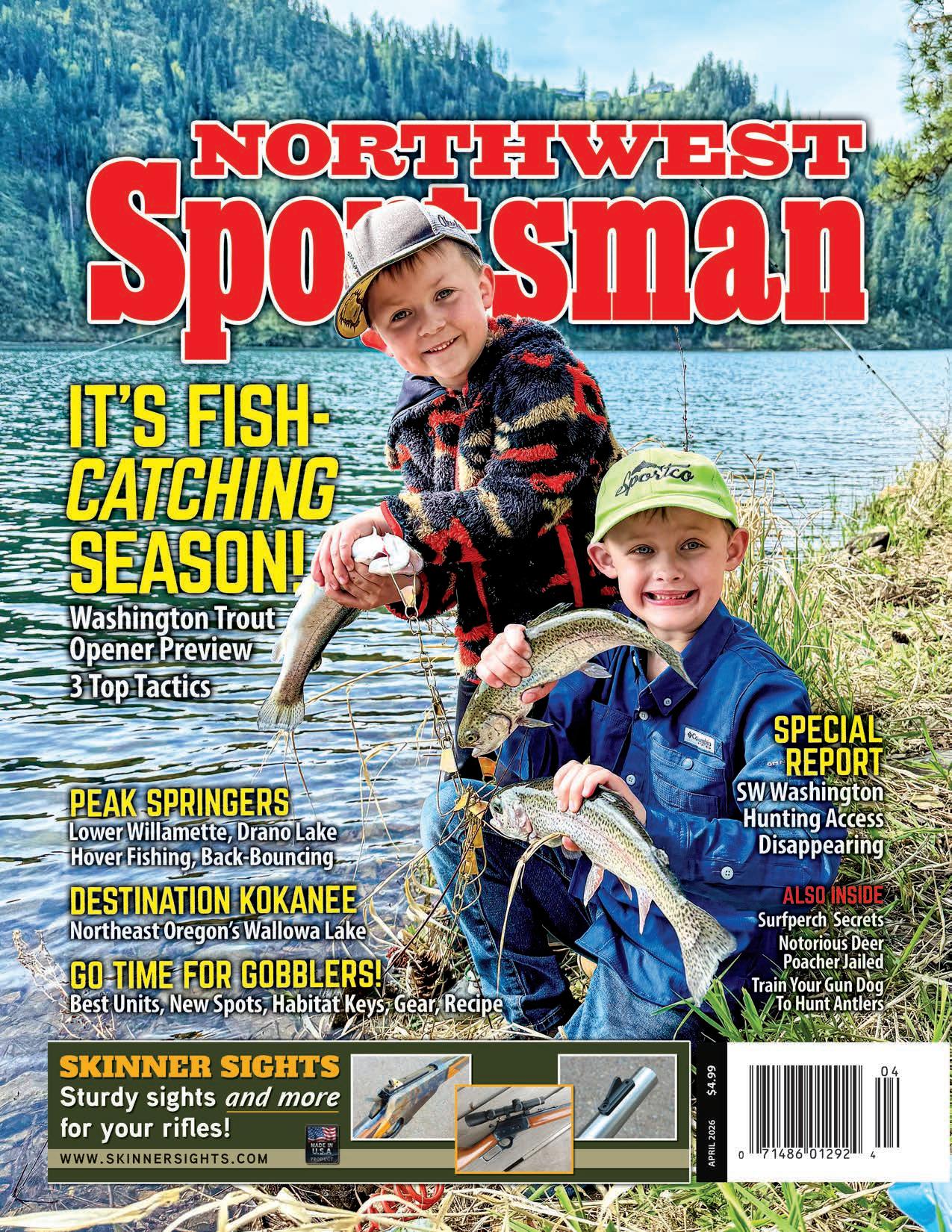
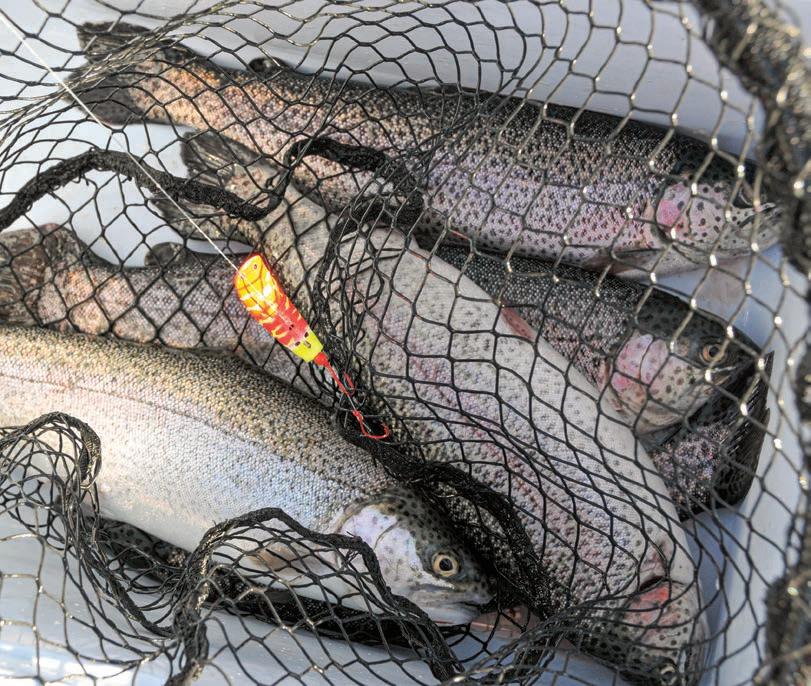
Ryland and Barrett Anderson show off three nice rainbows they caught late last April. This month marks the kickoff of the heart of trout fishing season across the Northwest. (DAVE ANDERSON) DEPARTMENT
at nwsportsmanmag.com.
71 WATCH WATER TEMPS FOR WILLAMETTE CHINOOK
April is when effort and catches peak for Willamette River springer anglers, and a key driver is how warm the water is running. That determines the best offering to troll, and old hand Bob Rees lines out what to put on the end of your line based on the temperature.
81 SPRINGER TACTICS FOR SLOWER WATERS
It’s not all trolling, all the time for spring Chinook! As the salmon begin to hit the tributaries, guide Trevor Torppa talks hover fishing and back-bouncing and when each technique shines best.
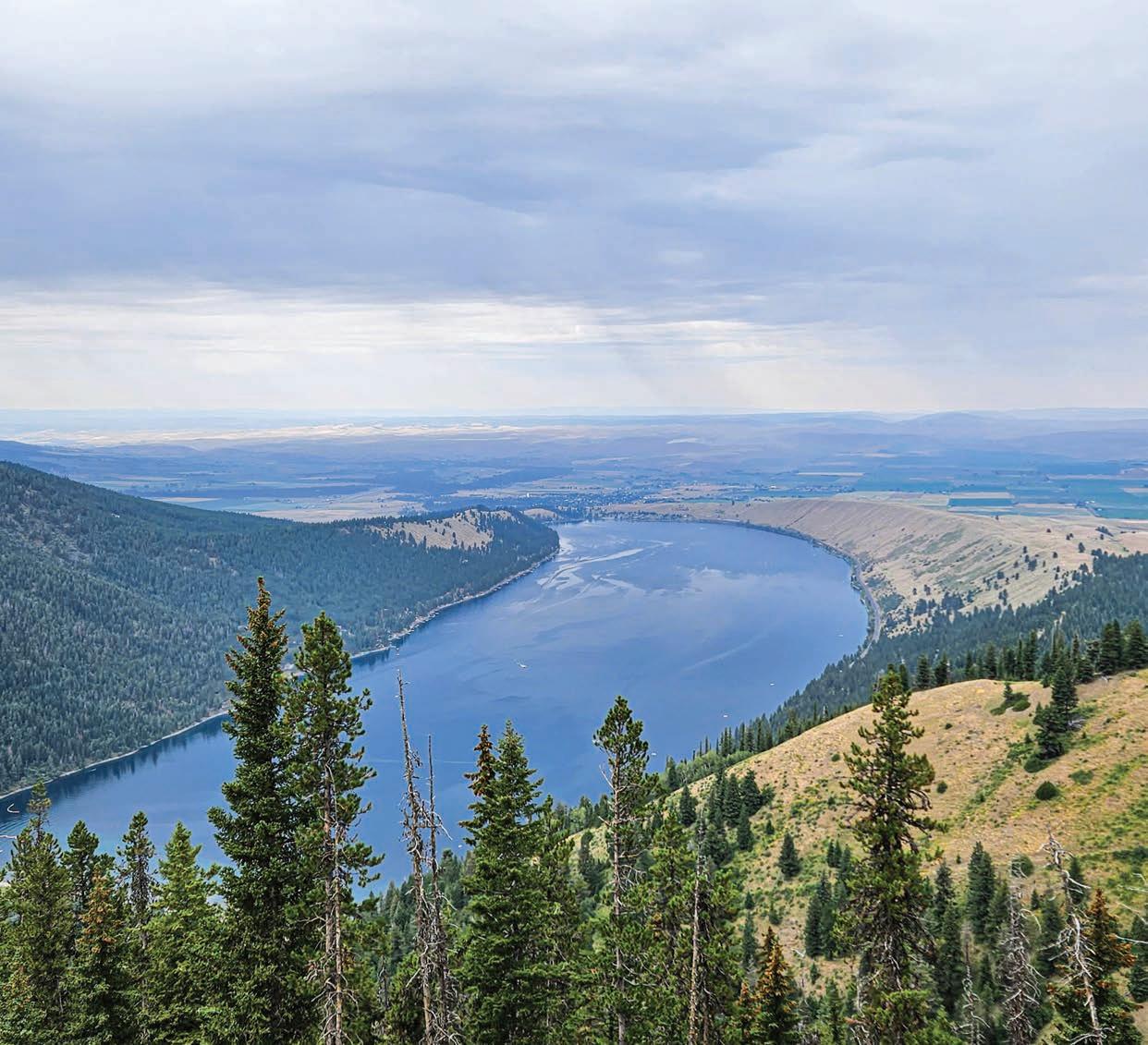
88 WALLOWA KOKANEE BECKON
Northeast Oregon is a long haul from most places around the Northwest, but one that’s well worth it for spring kokanee fishing and more, Tom Schnell has found. He shares what keeps pulling he and wife Rhonna back to this stunning corner of our region.
97 PERCH OF THE PACIFIC
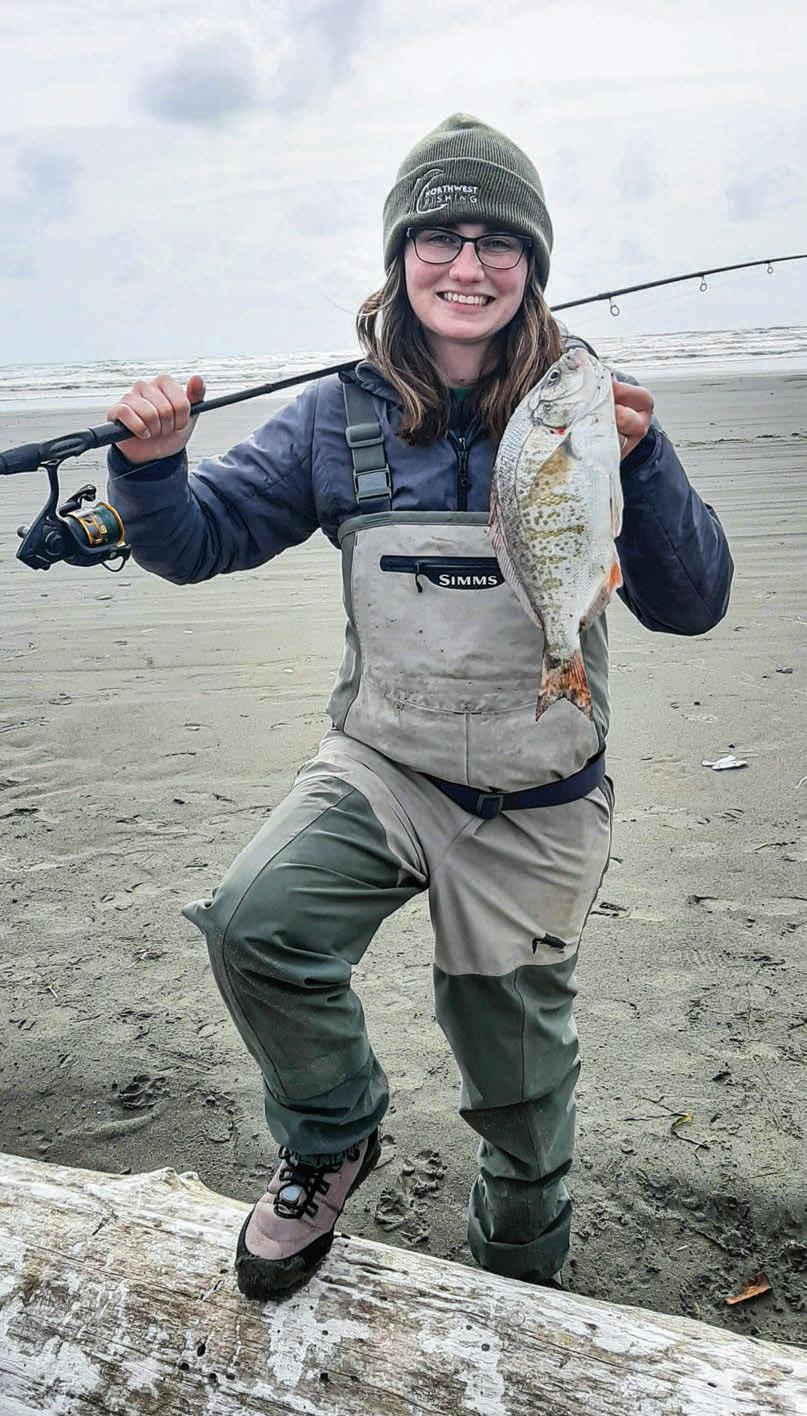
It’s the lakes and rivers that draw a whole lot of attention this time of year, but Hannah Pennebaker reminds us that the salt shouldn’t be overlooked. Surfperch draw her to the beach, and she details how to get after ’em with gear you probably already have.
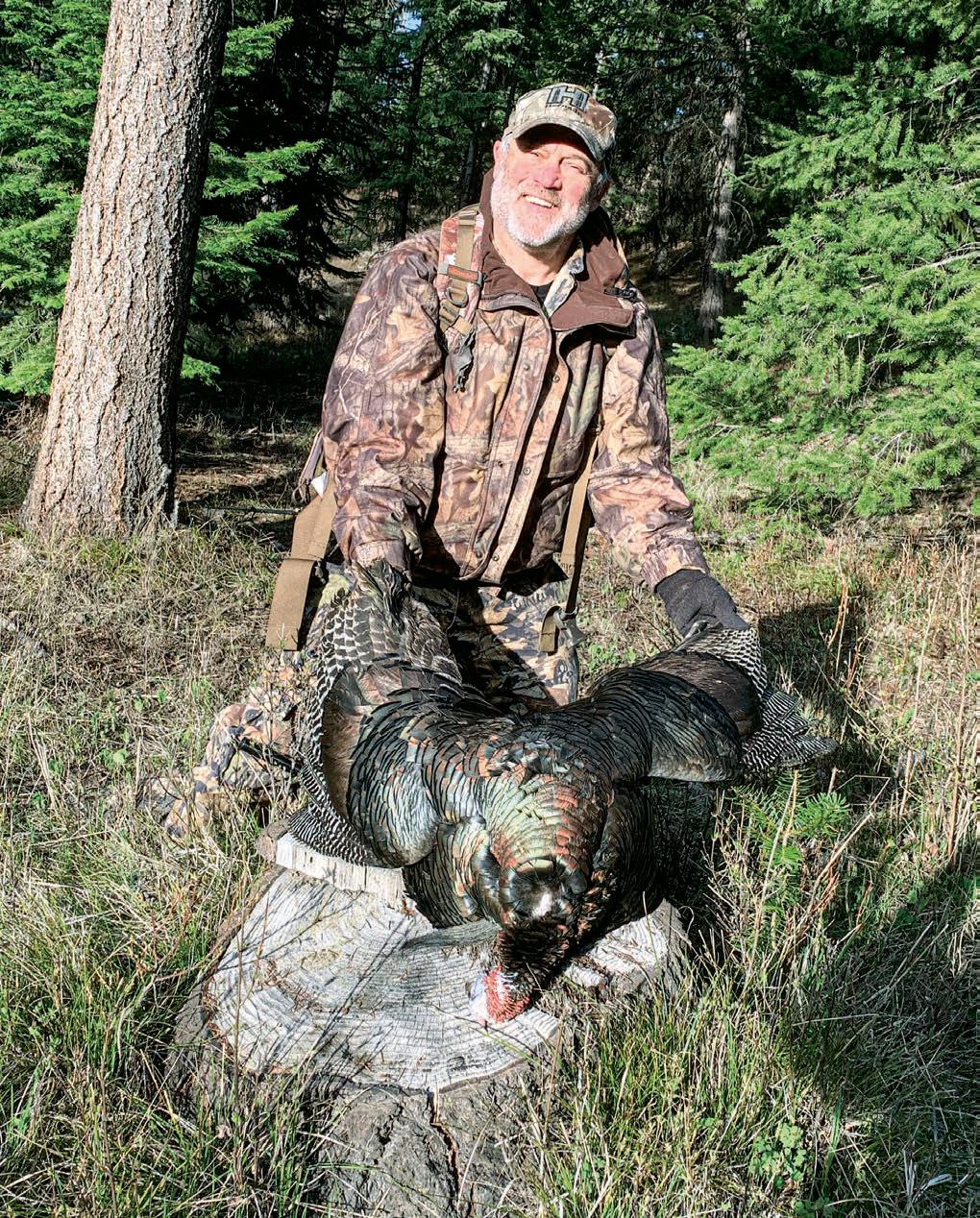
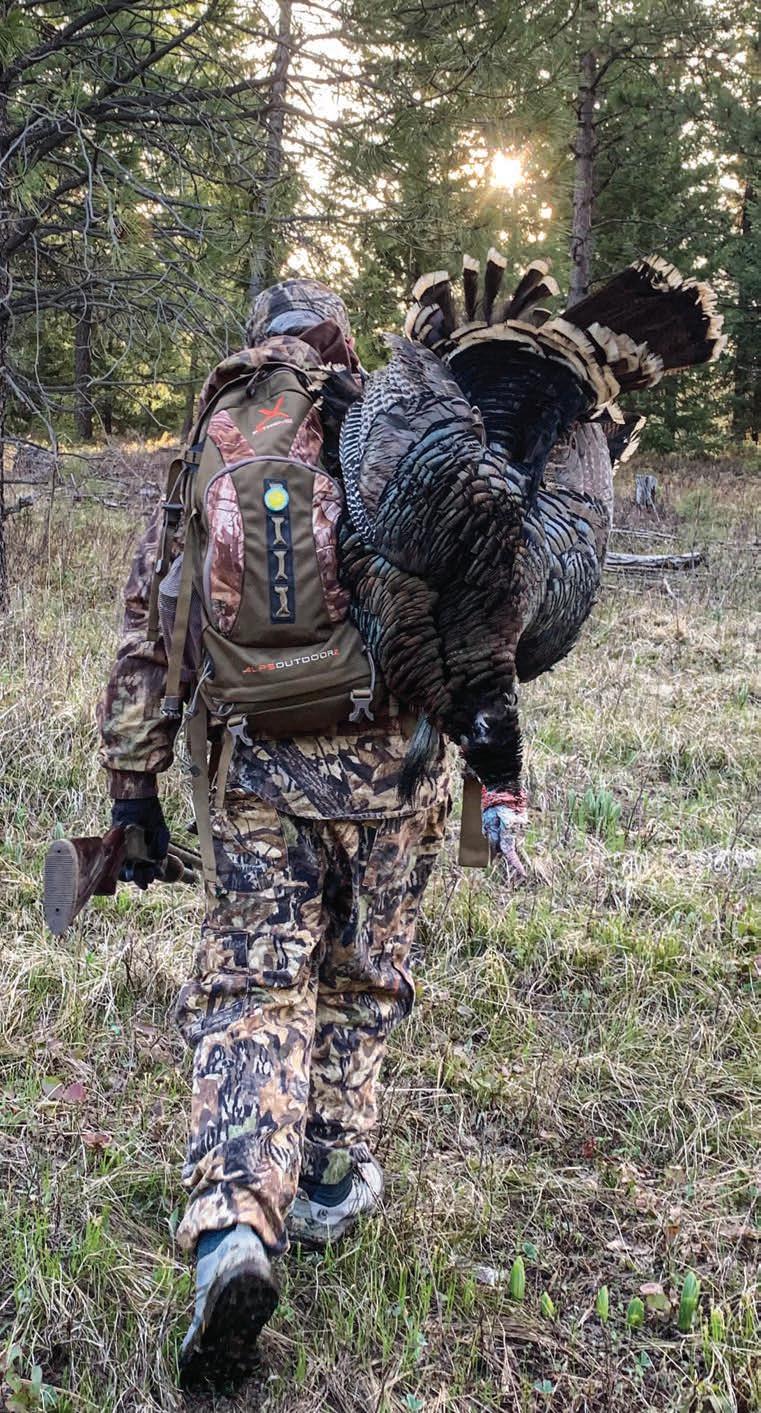
127 TIME TO FOOL AN OREGON TURKEY
It’s officially go time for gobblers, and with prospects looking pretty good, “Turkey Troy” Rodakowski offers up some tips, tactics and a few new spots in Oregon to hunt this spring season.
133 HABITAT SIGNPOSTS FOR FINDING NORTHWEST LONGBEARDS
It seems like a given – the key to tagging a turkey is to hunt where they live. But where’s that? It ain’t where you saw birds last fall. David Johnson knows that better than most. He highlights what to look for, as well as the best units in the tristate area.
With opening day coming right up, Mark Yuasa takes a look at stocking stats, top lakes, best gear, web resources and more. And he details what’s on tap in the 11th annual edition of the Washington Trout Derby!
OUTDOORS MD Horn In On ‘Controlled Chaos’ Kings
Ever hear of Drano Lake springers? Of course you have, as has guide Shane Magnuson, a regular there. MD hits him up for best trolling setups and how to deal with the uber-popular fishery.
COLUMNS 75
63 BUZZ RAMSEY The Three Top Ways To Catch Trout
Buzz may be best known as our region’s salmon and steelhead guru, but did you know that he also loves to fish for trout? Yep! He offers up plunking, casting and trolling advice for putting springtime limits on your stringer!
103 FOR THE LOVE OF THE TUG The Men On The Oars
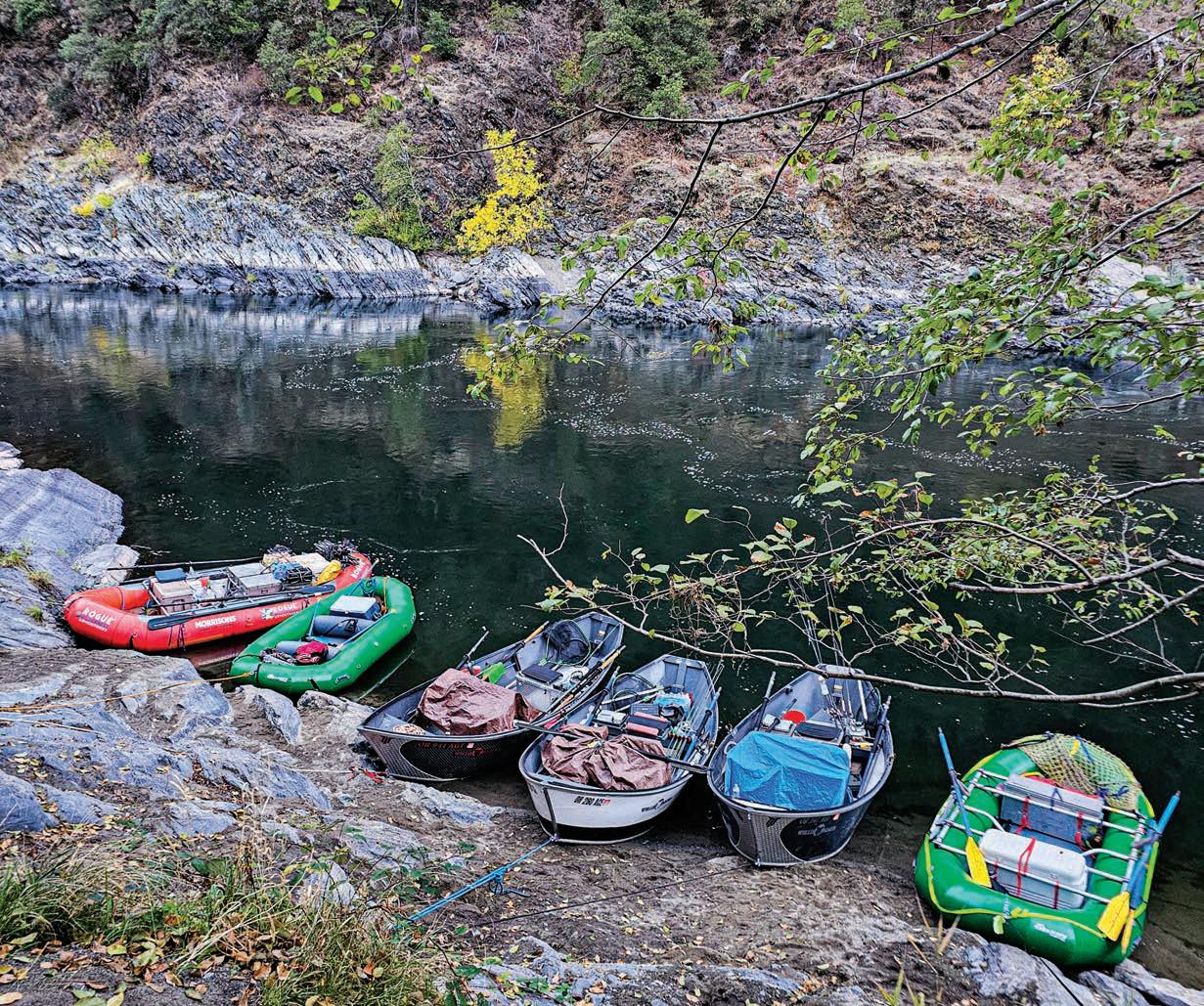
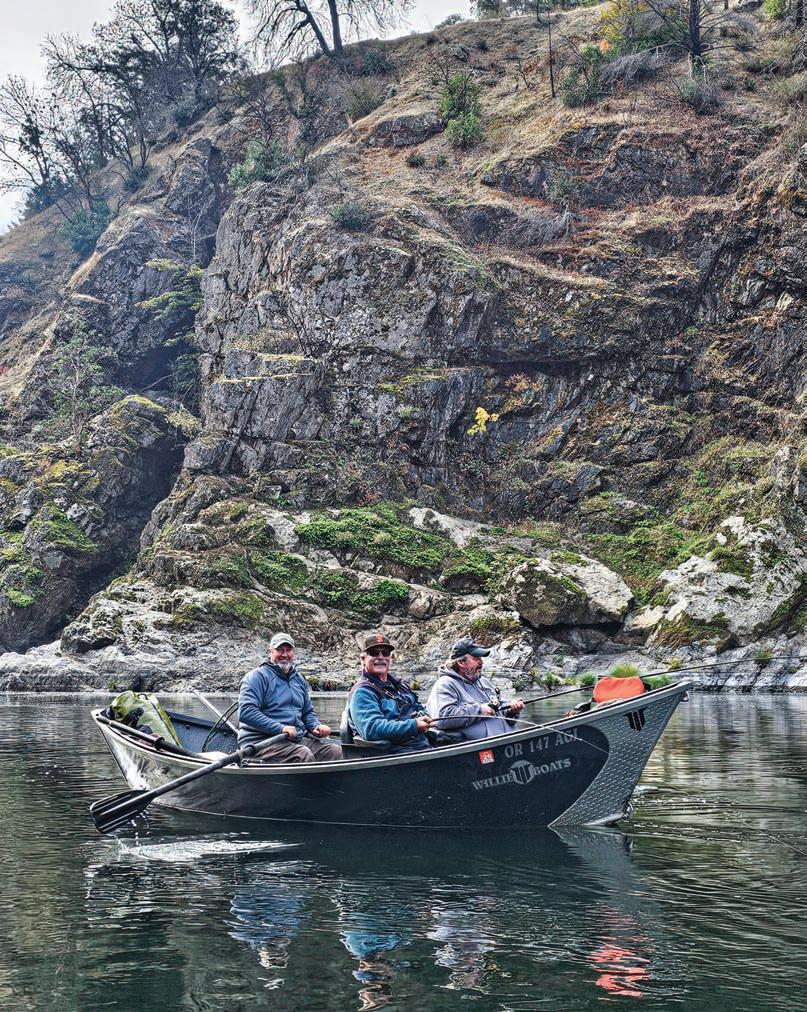
The wild and scenic canyon of the Rogue River is some pretty rugged country, and you have to be, too, if you want to row these waters. Sara sketches three gents who make their living guiding fishermen and others through one of the Northwest’s most beautiful places.
143 ON TARGET Of Gobblers And A Few Oregon Goobers
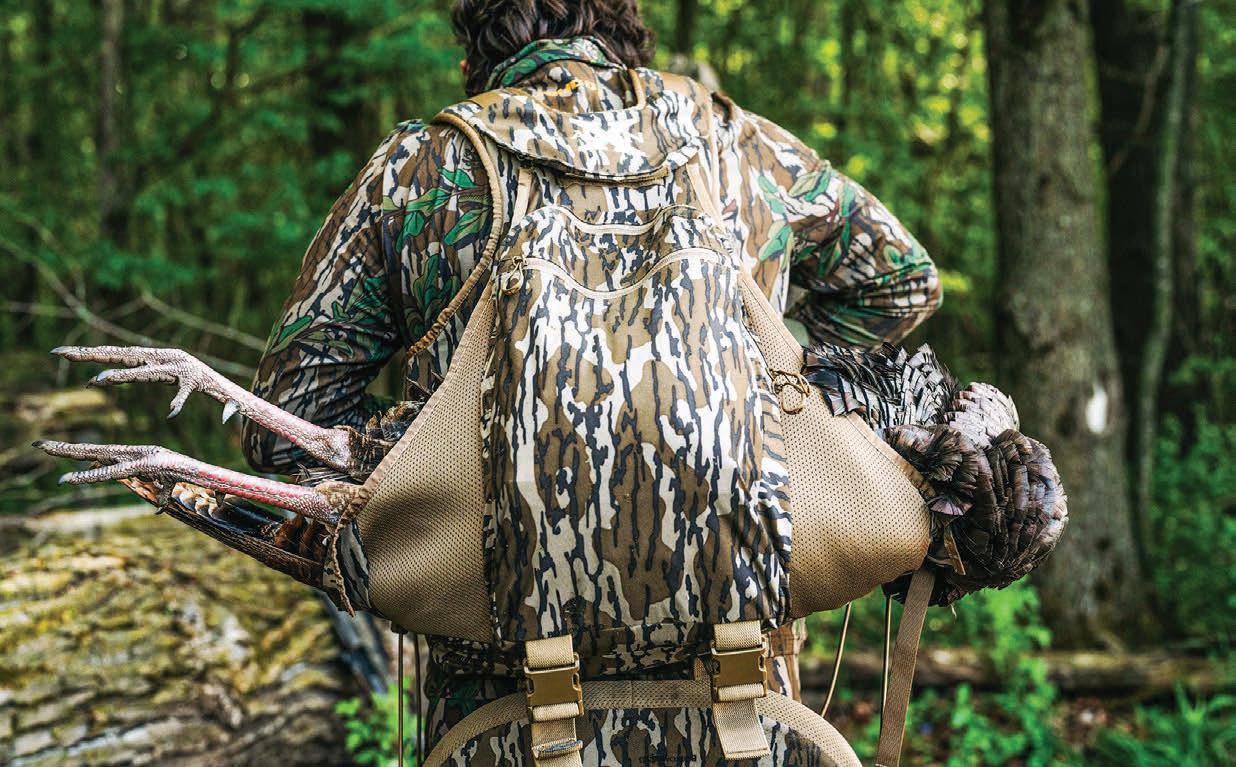
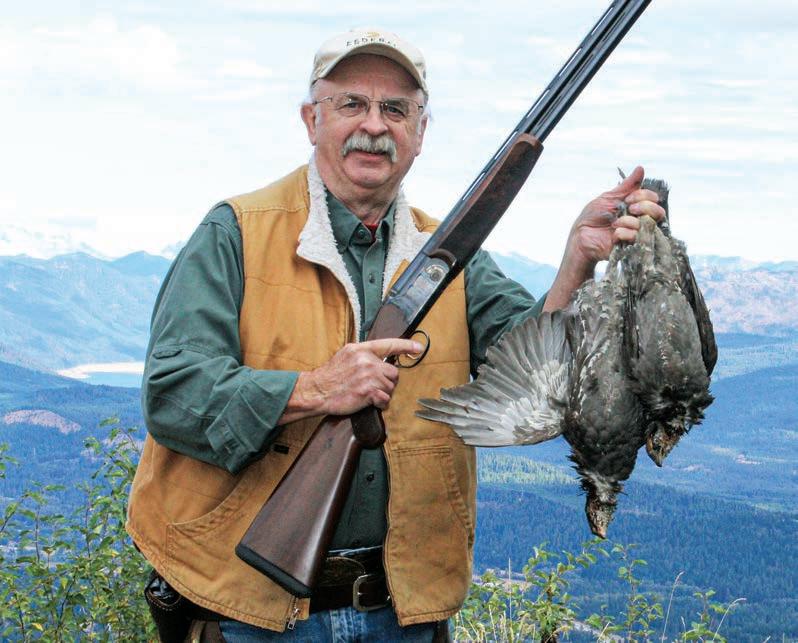
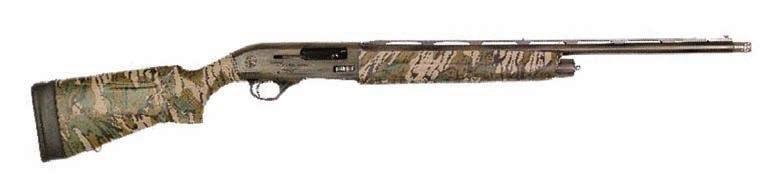
Just in time for the start of season, Dave W. has details on new turkey loads, a shotgun from Beretta and vests for hauling your gear and any bird you tag out of the woods. He also has a warning about Oregon’s proposed PEACE Act, which would ban hunting, as well as an attaboy for you shooters for contributing to a combined $35 million headed to Northwest wildlife managers and shooting ranges.
149 CHEF IN THE WILD Sharing Game Meat Without Selling Out
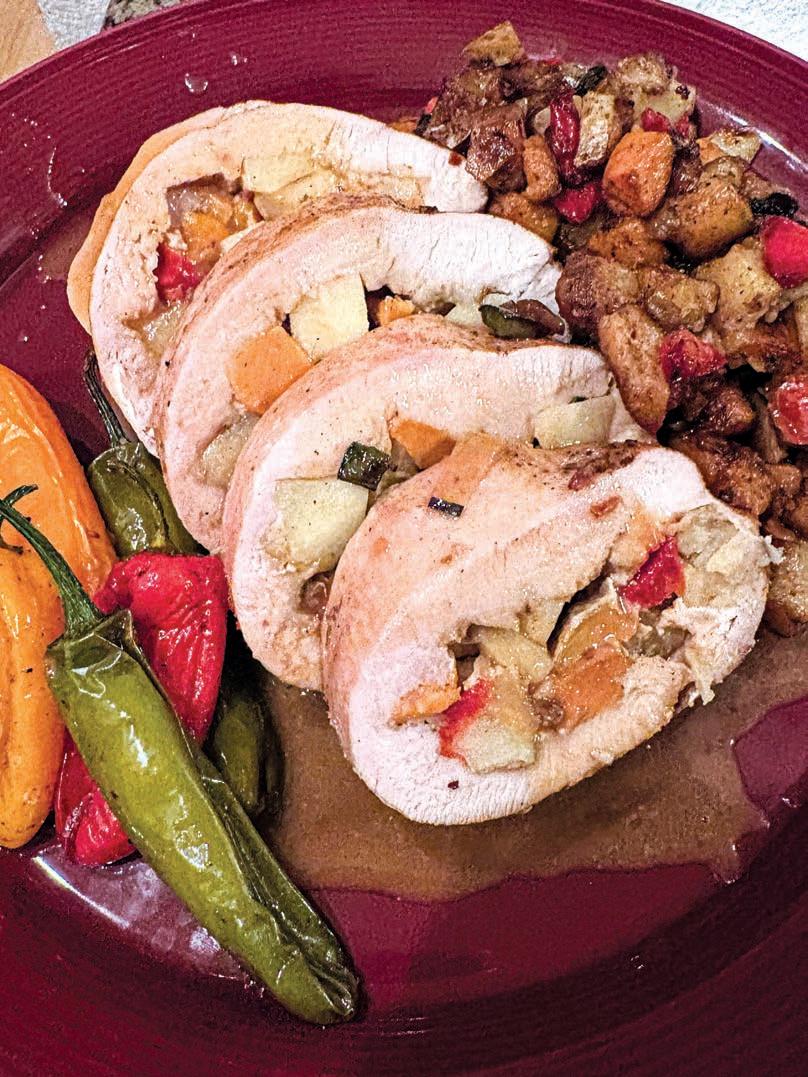
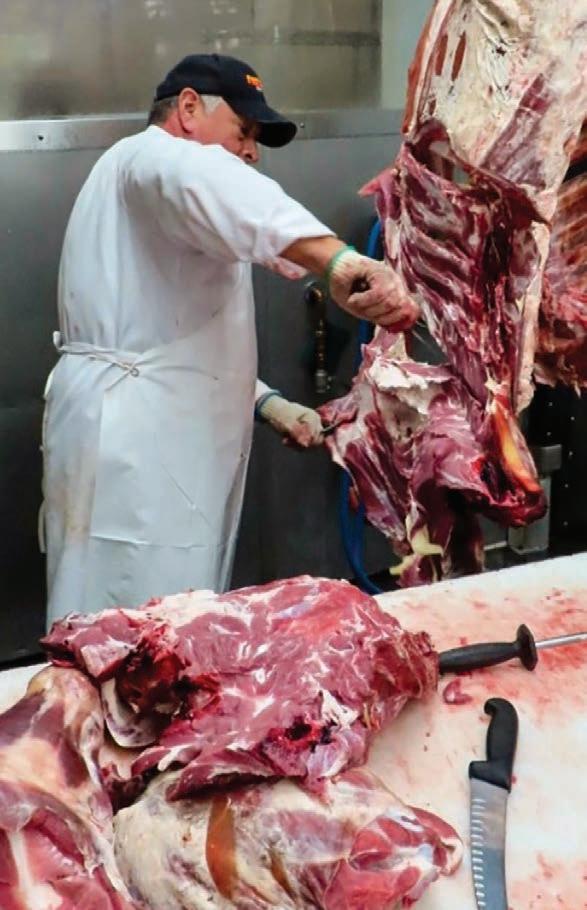
The 1800s and early 1900s were the bad old days for fish and wildlife in North America, as market hunting led to widespread population declines – but also the birth of a justifiably proud conservation movement. Chef Randy recalls lessons from that bygone era as he also rolls up with a spring turkey roulade recipe.
155 BECOMING A BETTER HUNTER The Value Of A Good Hunting Partner
We hunters spend far more of our time focused on which unit to hunt, what tag to put in for and whether we need to upgrade our equipment than the guy or gal who will be alongside us during those seasons. Dave A. aims to correct that as he shares the qualities that make for a great hunting partner.
163 GUN DOG How To Train Your Dog To Hunt Horn
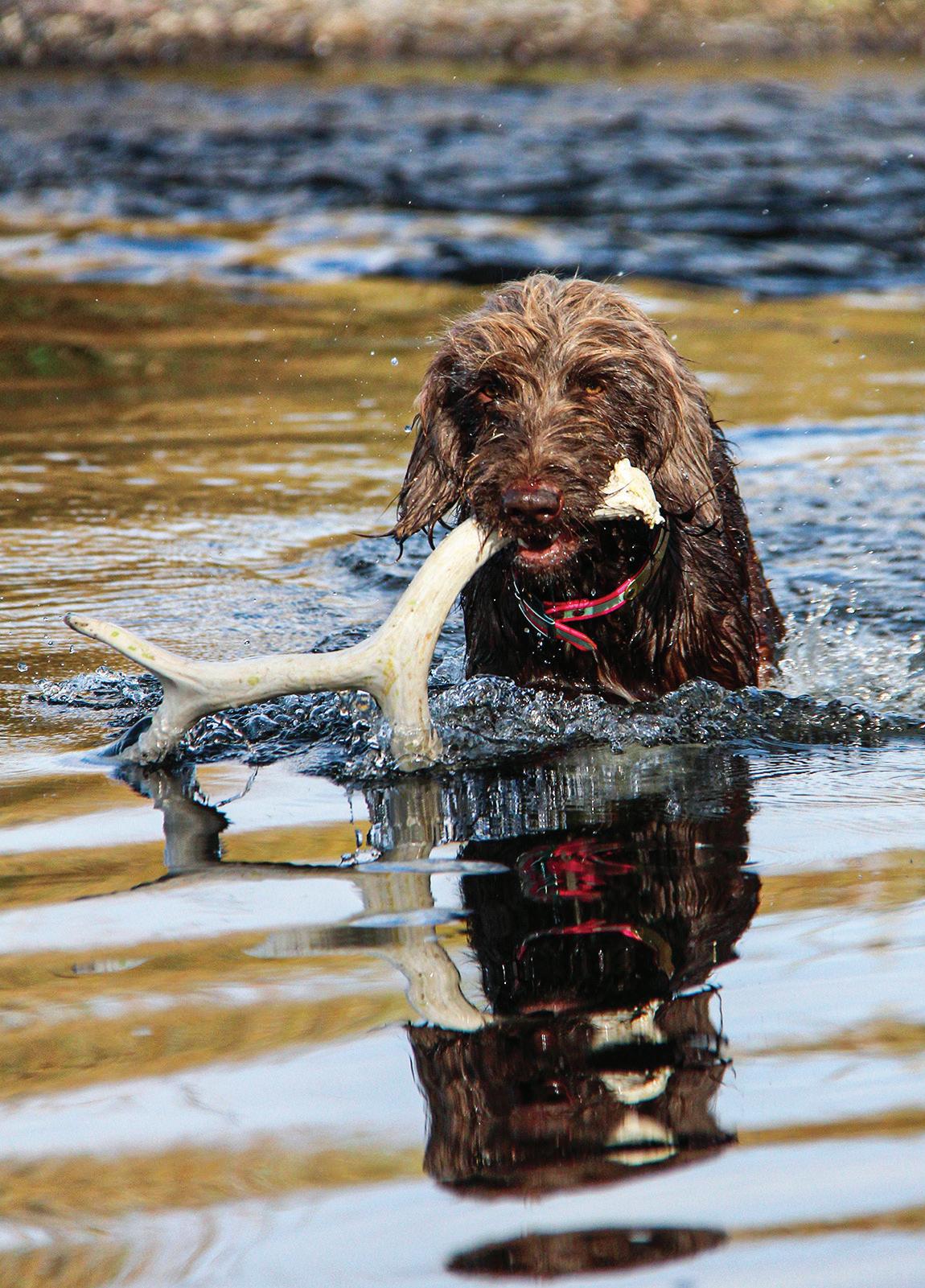
Shed hunting season is here, and a well-trained dog can boost your success to new heights. As one of his pups enters her 12th year of finding antlers, Scott has advice on the raising and training of a natural-born horn hunter.
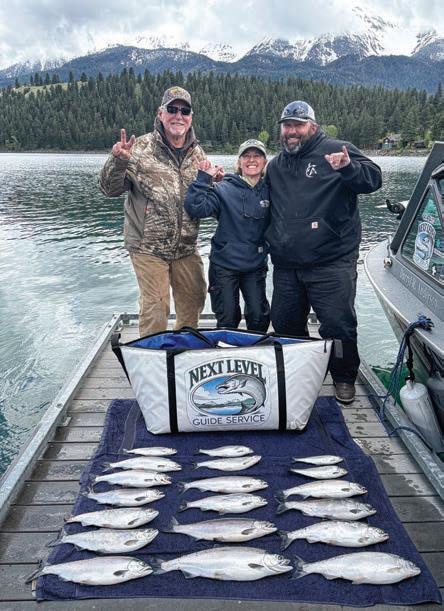
(UPPER COLUMBIA GUIDE SERVICE)
How timberland sales to investment companies are increasingly blocking access to otherwise open hunting lands in Southwest Washington.
25 THE EDITOR’S NOTE WDFW budget woes, ODFW budget grows
41 READER PHOTOS
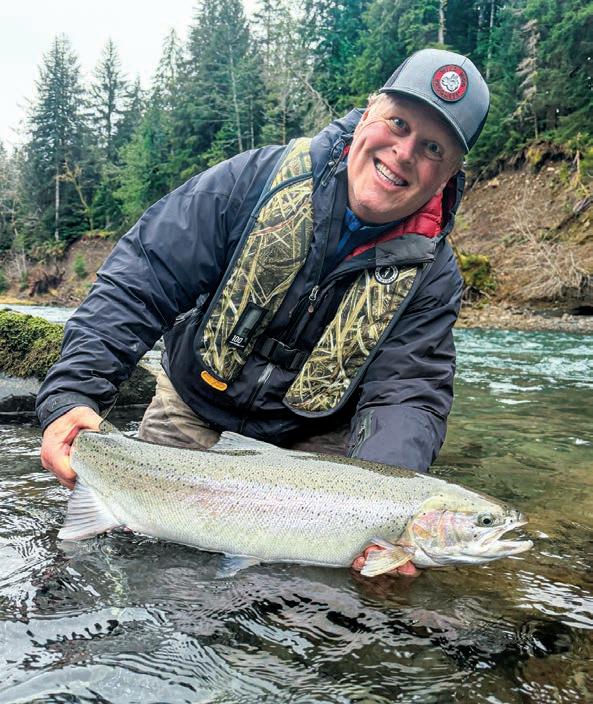
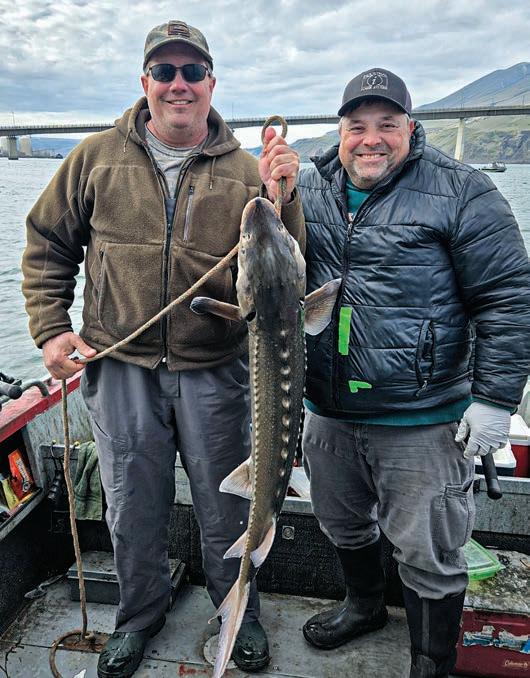
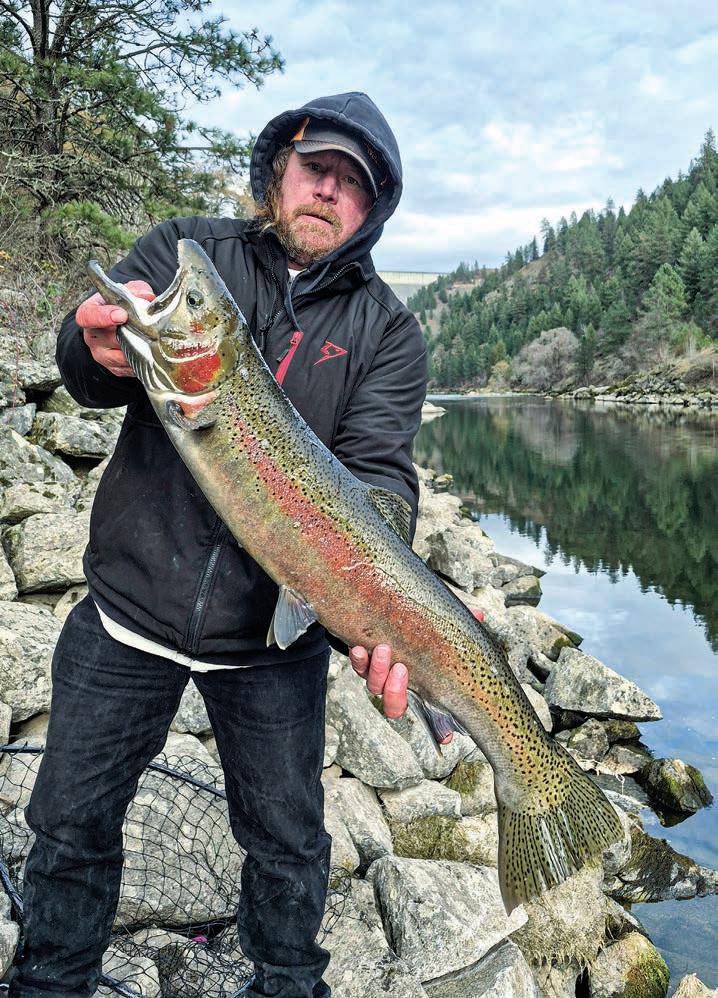
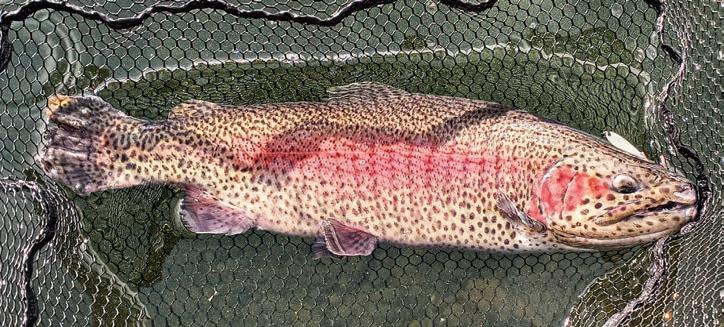
Steelies from Forks to Orofino, a Gorge-ous sturgeon, and the spottiest rainbow you’ve ever seen in the Lower 48!
43 THE DISHONOR ROLL
Notorious deer poacher back in the slammer; Smelt seized for egregious overlimits; Jackass Of The Month
47 OUTDOOR CALENDAR
Upcoming fishing and hunting openers, events, deadlines, more
(HENRY BRANNAN)
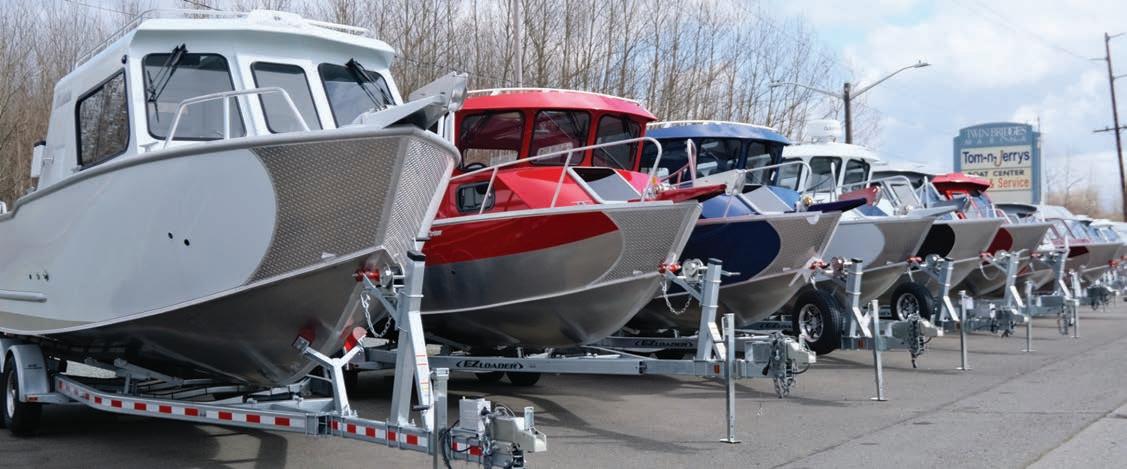
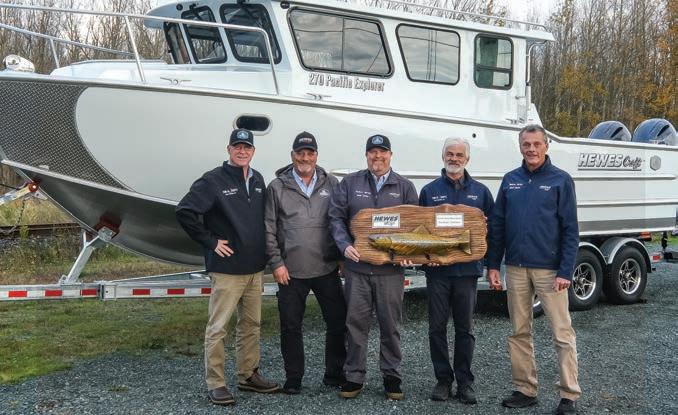
Recently, we accepted the award from the Hewes family for being the 2025 Top Sales Dealer — an honor we don’t take lightly. I’m thankful for the support from Hewescraft and especially our sales, parts, and service teams at Tom-n-Jerry’s. Great job, team!!!
— Kelly Hawley, President.
Tom-N-Jerry’s Boat Center 11071 Josh Green Ln Mount Vernon, WA 98273 360-466-9955
Sales Hours
THE EDITOR’SNOTE
This past session, the Washington and Oregon legislatures went in very different directions when it came to funding their Departments of Fish and Wildlife.
In the former state, lawmakers cut $10 million from WDFW’s budget, including money for fishery monitoring and lands maintenance, as well as the Administration, Business Services, Wildlife Program and Fish Program divisions. In the latter, legislators increased the lodging tax to fund critter work by ODFW and other Oregon agencies, a move estimated to generate $30 million annually.
It made for jealous feelings among a few Washington Fish and Wildlife Commission members during last month’s meeting. Former Chair Barbara Baker rued having relied on the General Fund to fuel her coveted ongoing biodiversity package, as she has found out that those dollars can also be dialed down by lawmakers – as seen this year and last – due to huge state revenue shortfalls.
Down in Oregon, upping the tax on Airbnb, RV, hotel, campground and other short-term stays by 1.25 percent will provide funding for wildlife habitat and recovery efforts, poaching prevention, wolf depredation compensation, wildlife corridors and combatting invasive species. The move was widely supported (well, outside of the lodging industry), including by hunting, fishing, livestock and many other outdoor-related organizations.
“Oregon anglers and hunters are glad to see conservation costs shared beyond license fees, our industry’s excise taxes and federal funds,” said the Northwest Sportfishing Industry Association’s Liz Hamilton. “It’s a great day for Oregon’s natural resources.”
BACK IN WASHINGTON, the fallout from a second straight year of significant cuts to WDFW’s budget – 2025 saw $19 million fileted away – is still to be fully fleshed out, but in Director Kelly Susewind’s words, “The bottom line is bad for us, frankly.”
One million dollars was snagged out of the Fish Program, as was $700,000 for fishery monitoring. The latter could draw alarm from anglers, as similar cuts last year kiboshed the Skagit-Sauk steelhead fishery this season. But that was funded through the legislature’s “Quicksilver Portfolio,” and in this case Susewind indicated that the final budget language provides managers with more flexibility.
Another $580,000 was weeded out of WDFW’s lands maintenance budget, which comes on top of an ongoing $1.2 million pruning that began last year, frustrating Susewind’s efforts to be “better neighbors” with landowners adjacent to agency wildlife areas and water access sites. And a $3.3 million bid to fill 11 vacant game warden positions went unfulfilled. Word also emerged from the budget that WDFW is being strongly pressured to sell a rough but irreplaceable Lower Columbia boat launch and the equally important Port Whitney shellfish beaches to a port and tribe, respectively.
It all left Susewind needing to recruit better support in Olympia, and he tasked staffers with finding a legislative “champion,“ someone who can get WDFW priorities and bills in front of the right politicians.
I DON’T HAVE answers to WDFW’s funding woes, but speaking theoretically, I could see them making a future argument to tie a Washington lodging tax hike to maintaining and upgrading wildlife areas, water accesses and other state sites that provide public hiking, biking, rafting, bird watching and other recreational benefits.
But I do know that, as seen through the lens of this issue’s The Big Pic (see page 28) on global investment firms cutting off entry to traditionally accessible hunting grounds, acquiring land and taking better care of it for all of us to enjoy and fish and wildlife to thrive on is more important than ever it’s ever been. –Andy Walgamott
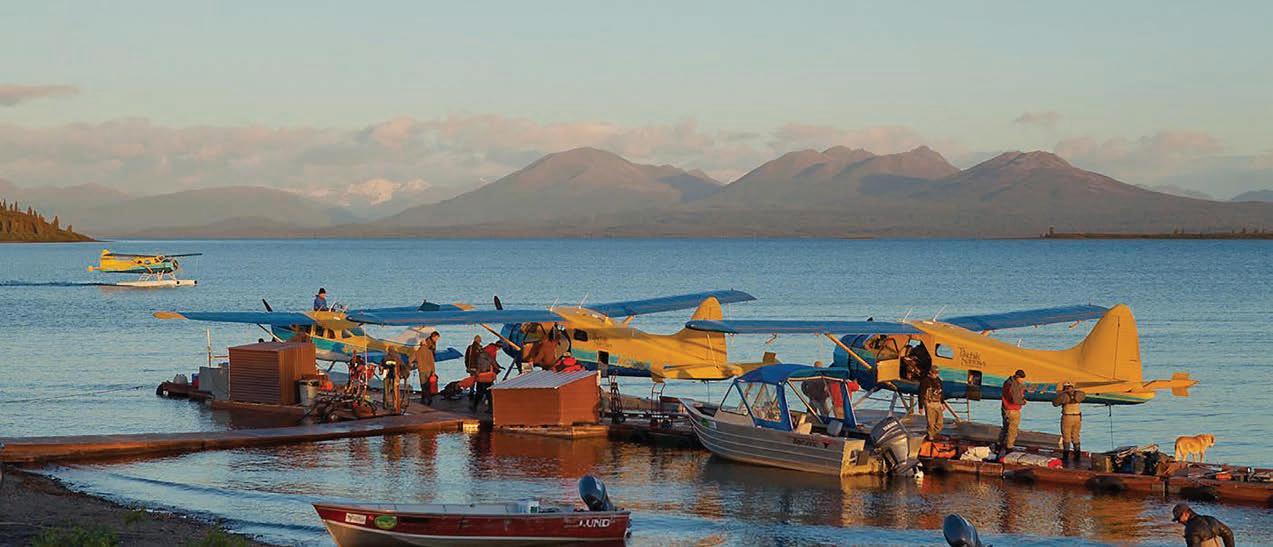
Come fish with us at southwest Alaska’s most remote full-service flyout fishing lodge. Giant char, leopard rainbows, salmon, grayling, pike… there’s something for everyone. Call or email today!
legend of Tikchik!
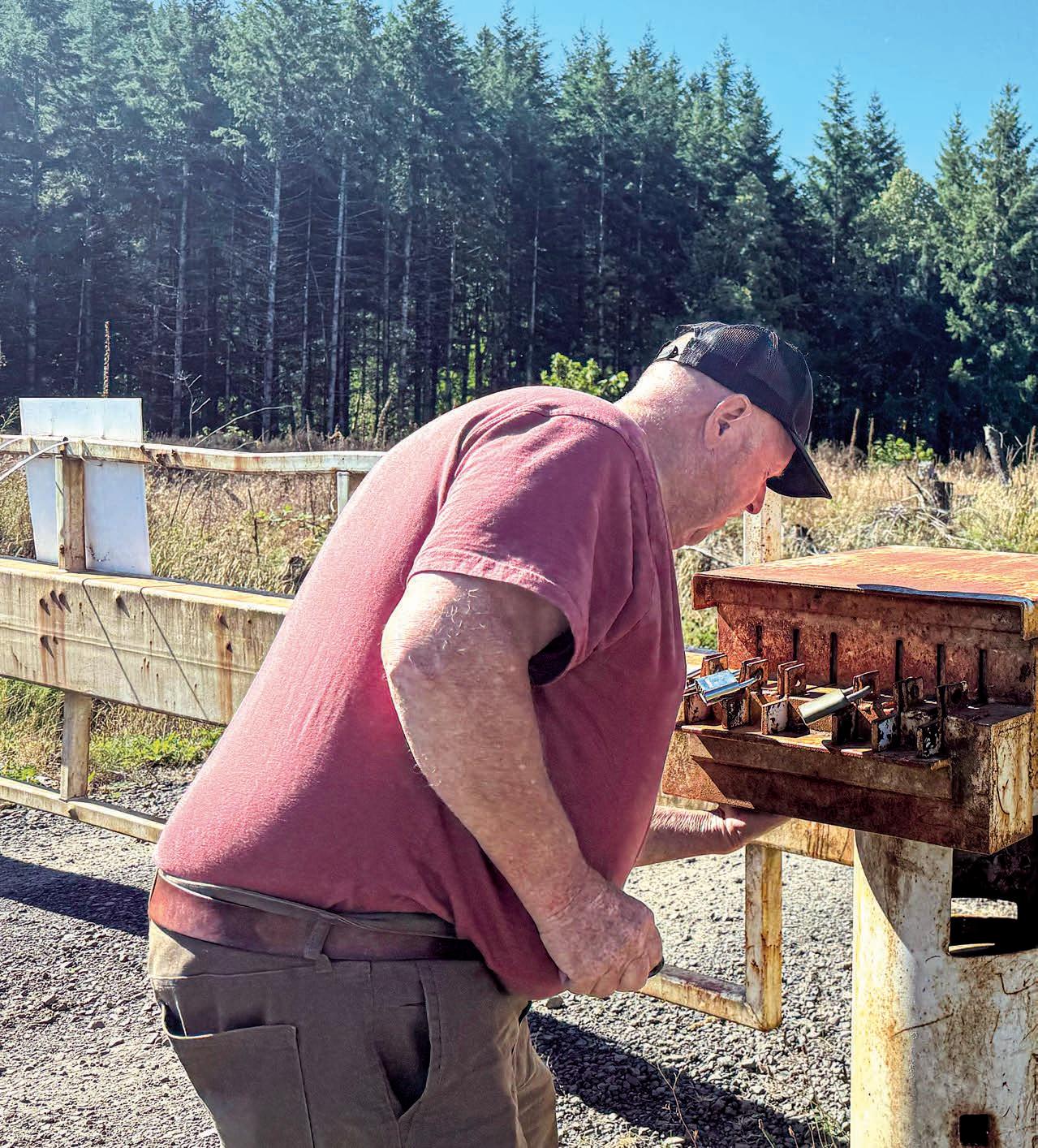
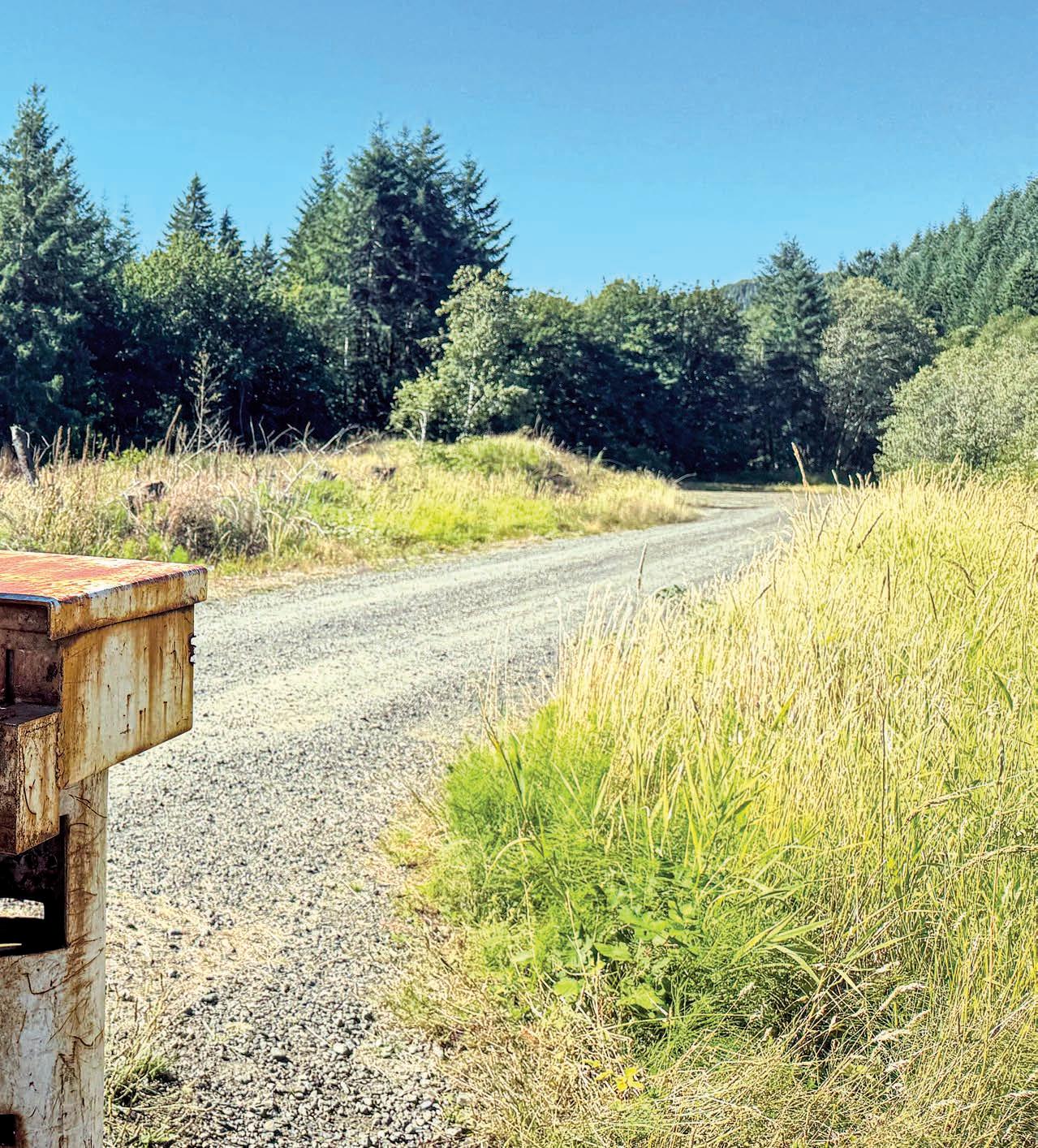
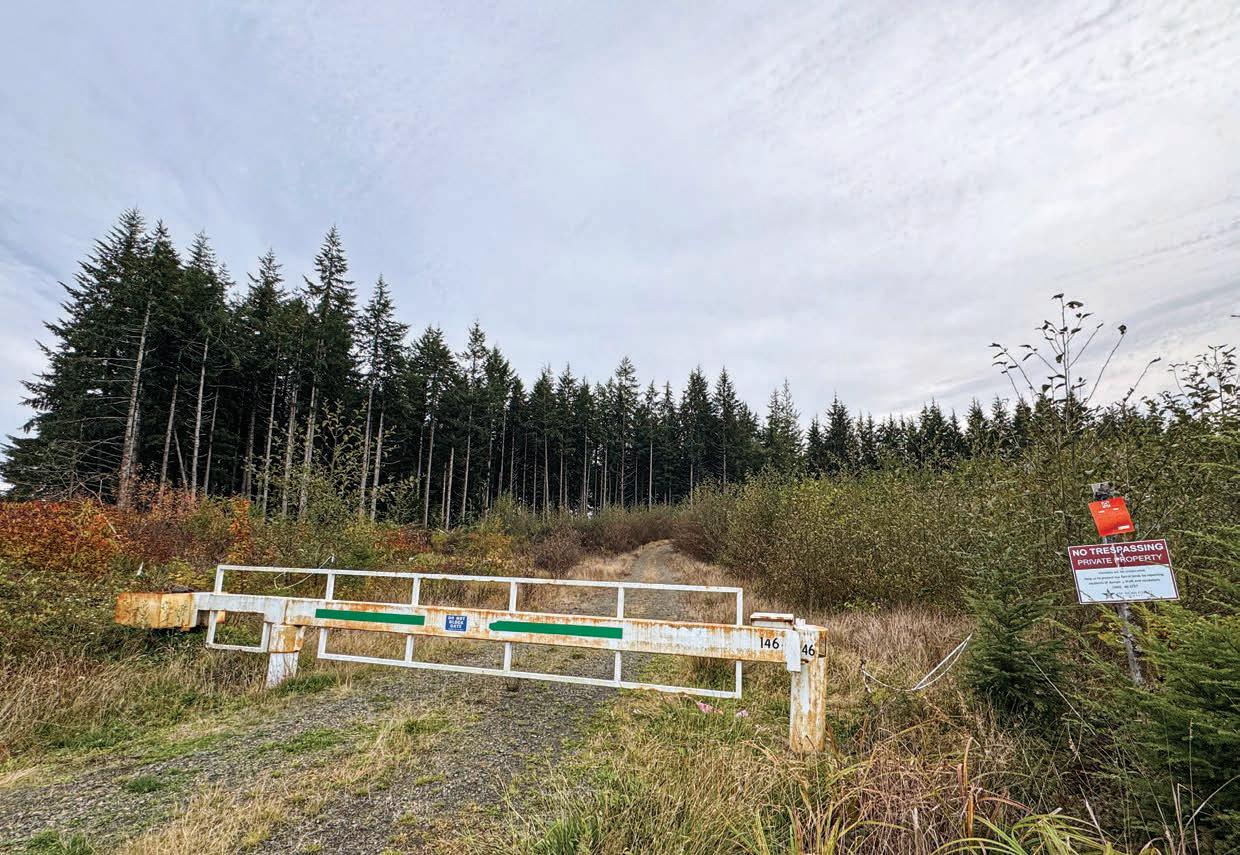
Dan Cothren, a part-time security contractor for American Forest Management, locks a gate after patrolling lands in Wahkiakum County owned by companies associated with a German prince. Vehicular access to several square miles of “prime longtime hunting grounds” has been blocked by the gate. Cothren is also a county commissioner here. (HENRY BRANNAN, THE DAILY NEWS)
The Gate Closes Tighter On Tradition (Part I)
How timberland sales to investment companies are increasingly blocking access to otherwise open hunting lands in Southwest Washington and beyond.
By Henry Brannan, Murrow News
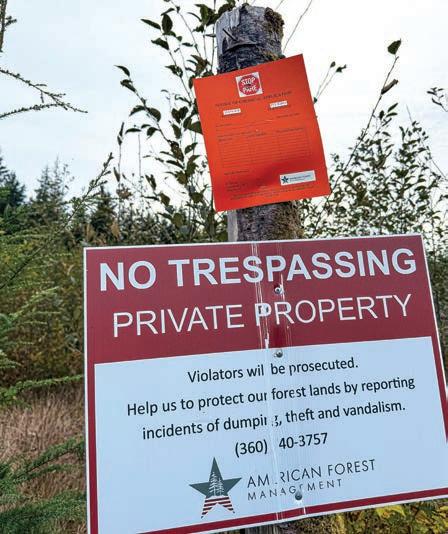
Investment companies have whittled away the land hunters can use in Wahkiakum and Pacific Counties. Access to tens of thousands of acres of locally treasured, longtime hunting grounds is now blocked because a new generation of private landowners won’t offer access.
The landowners are often investment companies, not based in the region or even the country (see related story, page 33). Not only is hunting off limits on their lands, they also often block access to adjacent properties that are state-owned – and therefore should be public – or adjacent privately owned property that still allows free hunting.
Steve Ogden, an assistant manager for land operations at Washington Department of Natural Resources, acknowledged the problem, but said the agency’s hands are tied – private landowners can’t be forced to allow people on their land.
The companies’ land restrictions have begun to erase generations-old family traditions, especially among the working
class, and reduce access to affordable, healthy foods, like elk, in Wahkiakum –Washington’s second-poorest county.
TIMBER GIANTS CROWN Zellerbach and Weyerhaeuser owned nearly the whole forest when longtime Wahkiakum County Commissioner Dan Cothren was growing up.
“It was just totally different than it is now,” said the 72-year-old. “Our entertainment was jump in a rig, take off in the back woods, and you could travel and go fish, go hunt – there were no gates.”
Cothren started cutting down trees for logging operations straight out of high school, following in his father’s and grandfather’s footsteps.
The companies employed hundreds of people around the area – and they allowed employees first access to the forests during hunting season. The key to that access was – and still is – a road known as the Elochoman Mainline, or “The 500,” that runs along the Elochoman River north into Lewis County. The road is the only way to access tens of thousands of acres of prime logging
and hunting land from Wahkiakum County.
But over Cothren’s nearly four decades in logging, ownership and access has changed dramatically. Corporate consolidation took off as Wall Street transformed timberland from a construction commodity into an investment vehicle for global financial giants to diversify their multibillion-dollar asset portfolios.
Crown was bought out in a 1985 corporate takeover by Sir James Michael Goldsmith, a French-British politician, financier and member of a German noble family. In the following decades, land in the valley and around the region was cut up and sold off countless times. And with those sales, Cothren, and other generational hunters The Daily News spoke to, saw access slowly stripped away.
By the 1990s, roads Cothren had grown up on were increasingly blocked off with private gates.
“When the gates went in, maybe they’d open up for two weeks for access, and then they’d shut it off,” he said while driving The 500 late last summer. “And when these different groups came in and bought it, they’d all have different rules.”
SOME COMPANIES BEGAN to charge for hunting land access. Hunting – which many families in the poor county use to put food on the table – started to turn into a hobby for the haves, not a means of survival for the have-nots.
Hunters say the problems were exacerbated when a new company came to town: American Forest Management, which oversees 5.7 million acres of forest land in the Americas for its owners, who are often not local or even live in the country.
When Wahkiakum County native Shawn Jacob, 54, tried to reach a popular hunting spot along The 500 a few years back, he found an American Forest Management gate completely blocking access.
For nearly two decades Jacob hunted in the upper Elochoman River Valley, including this site past an old Crown camp, near where Cothren said he lived while his family worked for the company.
“Came up to go in and the sign was up,” Jacob recalled. “‘No trespassing? Why can’t I go in there?’”
He called Cothren to ask how American Forest Management could lock away the county’s hallmark hunting grounds – also blocking off access to tens of thousands of acres of state and private land hunters were still allowed to use.
Jacob wasn’t the only one with that question.
In addition to his role as a longtime commissioner, Cothren also works as a jackof-all-trades contractor for American Forest Management, enforcing the company’s policies and dealing with the public’s complaints firsthand.
“I even told the forester. I said, ‘Why don’t
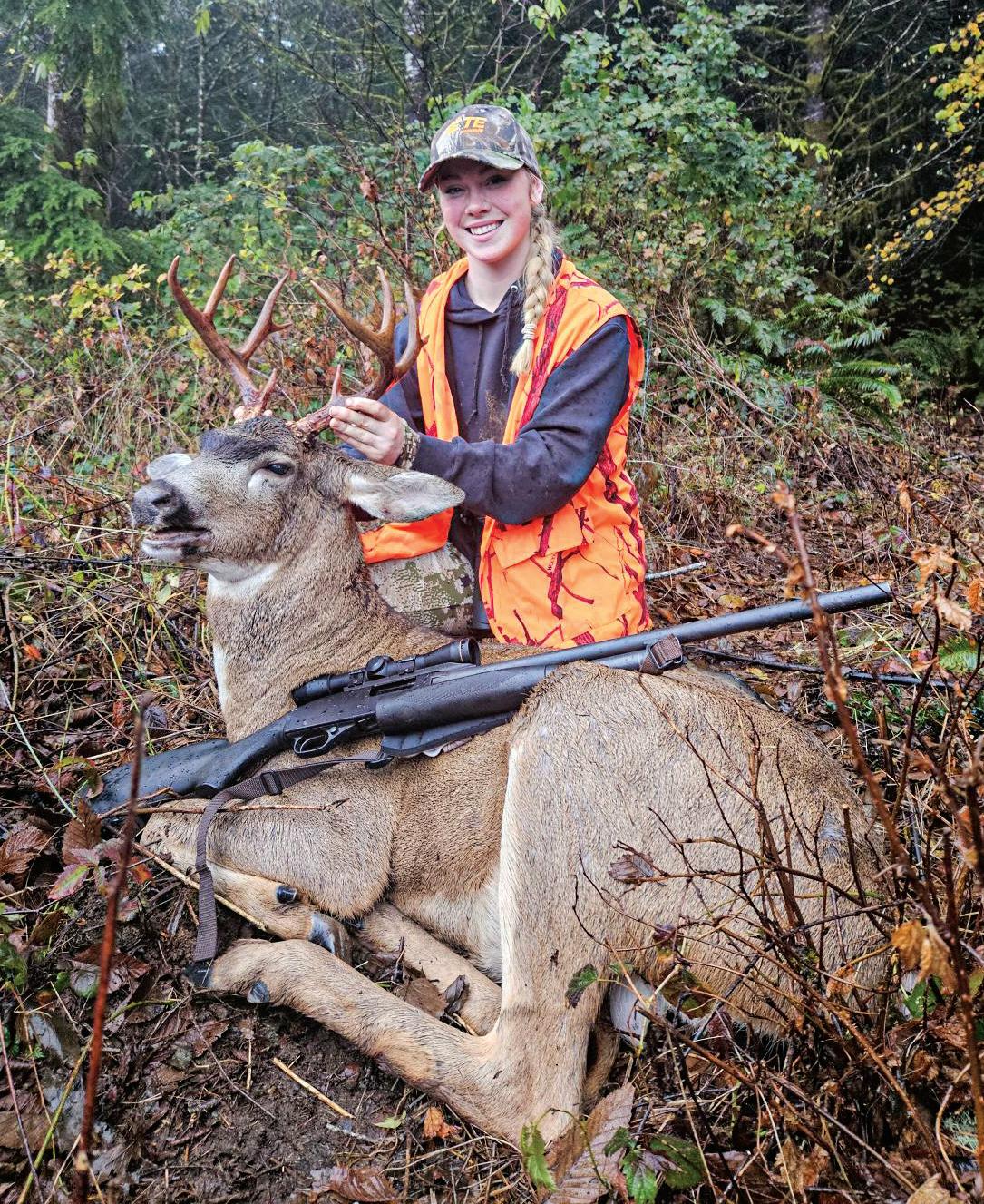
Timberlands – whether state, federal or privately owned – play a huge role for Northwest deer, elk, bear and grouse hunters, but recent decades have seen local, outof-state and international tree farm owners switch from open access to by lease or permit only, or close their grounds entirely, threatening a cherished way of life. Emily Foytack took this blacktail buck in Southwest Washington’s Stella Unit during 2024’s hunt. (KNIFE PHOTO CONTEST)
you get me a bulletproof vest?’” Cothren recalled saying to an American Forest Management staffer because of the number of angry calls about the restricted access.
Marisa Bass is an American Forest Management regional manager, making her responsible for about 255,000 acres of that land around Washington and Oregon.
“By and large, we follow the direction of our clients,” Bass said about who decides if hunters can access timberland. “It is their land. We just manage it.”
Bass said two clients currently allow access to the land for now: the nonprofit The Conservation Fund (conservationfund .org) and the company Clover Forest LLC. She declined to name other American Forest Management clients in Wahkiakum
and Pacific Counties. She also declined to say which lands hunters can or can’t access, or how access has changed over the last decades.
HOWEVER, THE DAILY News talked with more than a dozen hunters and county commissioners around the counties, looked at property ownership records and drove hundreds of miles to find tens of thousands of acres blocked off by American Forest Management.
That includes hundreds of acres of state land in Pacific County’s Bear River area, as well as thousands of acres of surrounding land owned by Mid-Valley Resources, a registered trade name of Hampton Lumber, state records show. Hampton allows free hunting access on its lands.
But access to all that is blocked off by American Forest Management gates along State Route 401 that warn against trespassing, The Daily News confirmed in person in October.
The Daily News asked Bass about
hunters’ frustrations that they’ve been cut off from their traditional hunting grounds and that neither American Forest Management nor the web of landowners would sit down and talk to them about the problem.
But she declined to comment and ended an interview after the question.
The lack of communication and land restrictions aren’t sitting well with locals.
“Not saying I support it, but a lot of people felt upset enough that they vocalized threats – that have come to nothing, no fruition –but they had mentioned just burning it all down,” said Gabe Bergman, a Wahkiakum County gunsmith, about privately owned, inaccessible timberland.
Cothren said he’s also heard threats, including those who want to cut the locks off private gates.
Shawn Jacob, who lives in the county to hunt and contributes to its economy with his boat and engine repair shop, said he’s already seen people move, and is considering leaving himself.
“That’s how it works,” he said. “Take it away, they’re still going to hunt, they’re still going to fish – they’re just going to do it somewhere else.” NS
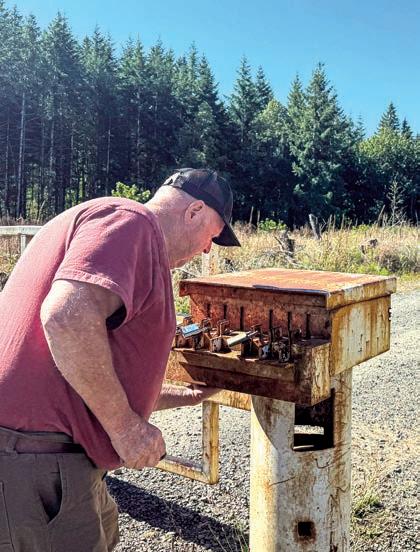
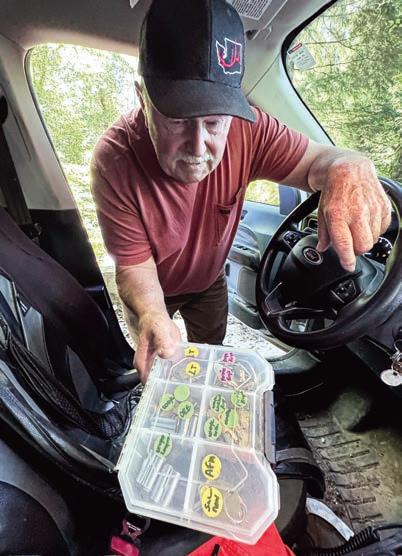
Cothren shows some of the keys he uses to open locked gates while patrolling for American Forest Management. He’s asked company officials for a bulletproof vest due to anger over newly restricted access. (HENRY BRANNAN)
Editor’s note: This article was first published by The Daily News of Longview through the Murrow News Fellowship, a state-funded program managed by Washington State University. Henry Brannan was a Murrow News Fellow with TDN and The Columbian until recently.
Ach! Why A German Prince Owns 7 Percent Of A PNW County (Part
By Henry Brannan, Murrow News
An investment company cofounded by a 21st century German prince is joining other timber industry goliaths in gobbling up and shutting down access to hunting land in Wahkiakum and Pacific Counties.
The change comes as Pacific Northwest timberland values are rising, making the region attractive to European investors who value the cheap, privately owned land – unlike in much of Europe.
In 2024 alone, companies affiliated with Constantin Prinz zu Salm-Salm (aka Prince Constantin) spent more than $100 million on roughly 12,000 acres of timberland in Wahkiakum County, records show, or about 7.3 percent of the county’s total land.
The conflict over the counties’ hunting land highlights the growing tension between a global elite who use timberlands to balance investment portfolios worth hundreds of millions of dollars, and local lower- to middle-class hunters impacted by their investment strategies – including possible misdemeanors when accessing land on which previous generations hunted.
AMERICAN FOREST MANAGEMENT is a timberland management giant, filling the need for on-the-ground hands to care for forests that are increasingly owned by distant financial giants. Hunting is banned on much of the land the company manages across Wahkiakum and Pacific Counties.
A regional manager for the company told The Daily News in the fall that American
II)
Forest Management enforces those owners’ policies, no matter the rules.
Brent Mahitka, 52, learned that the hard way. He has lived and hunted in the region for about 30 years and said he has paid Weyerhaeuser hundreds of dollars to hunt a prime location in Pacific County.
But Mahitka said he accidentally ran afoul of the patchwork ownership regime in November, when he realized an elk he shot was actually about 150 yards into American Forest Management-managed land. He said he immediately called Wahkiakum County Commissioner Dan Cothren, who works for American Forest Management, to report his mistake.
Still, Wahkiakum County District Court records show Mahitka faced a $2,000 ticket and 90-day county jail sentence.
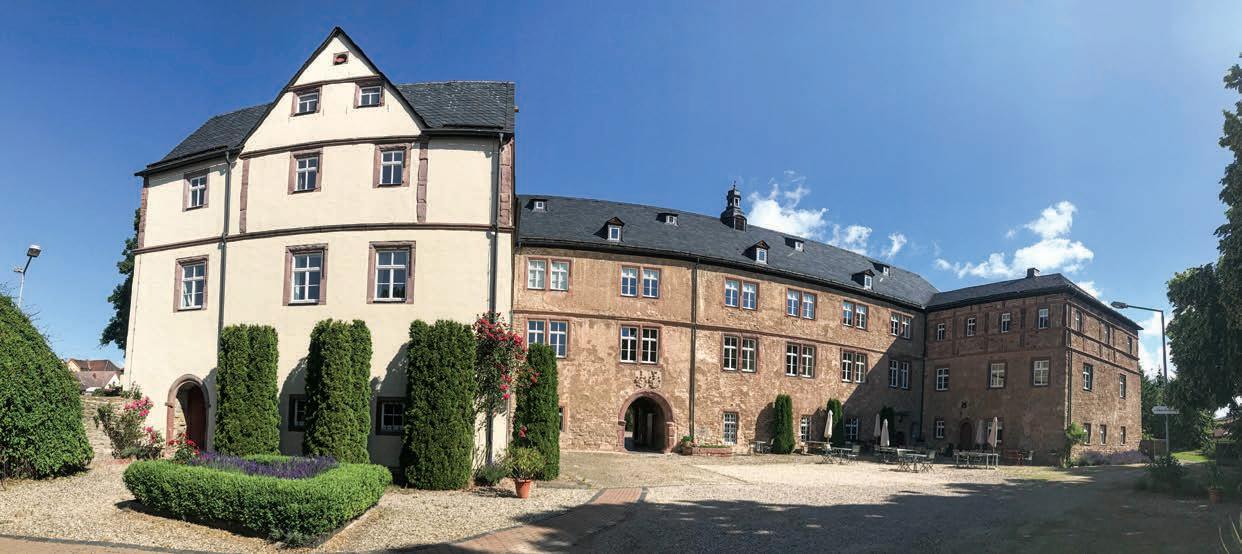
Wallhausen Castle in Germany’s Harz region is home to a prince whose affiliated companies acquired around 12,000 acres of Wahkiakum County in 2024. (RKASS, WIKIMEDIA COMMONS, CC0 1.0 UNIVERSAL)
Records show Washington Department of Fish and Wildlife officers also considered charging him with “hunting while trespassing,” a more serious misdemeanor that can result in one year in county jail, a $1,000 fine and an automatic two-year hunting license revocation.
In the end, Mahitka was fined $500.
Nine other people received elk violations from WDFW in 2025 around Wahkiakum and Pacific Counties, according to agency spokesperson Becky Elder. Those violation numbers have hovered around that number for the last five years, during which time two incidents involved American Forest Managementcontrolled land, Elder added.
The agency did not answer how many incidents led to jail time or hunting while trespassing charges. County records show the land Mahitka accidentally crossed into is owned by VGI Forest Lewis & Clark, one of Prince Constantin of Salm-Salm’s companies.
RUMORS THAT SOME of the American Forest Management land was actually internationally owned added insult to injury for some in the county, though no one The Daily News talked to said they
knew for sure who owned the land.
However, records reveal around the two counties, VGI Forest Lewis & Clark often owns lowlands that allow the company to block access to neighboring state and private lands hunters are allowed to use.
All told, the company and a network of affiliated shell companies own about 25,000 acres of forestland around Wahkiakum and Pacific Counties, a TDN analysis of property records shows. That includes in the Elochoman River Valley, where they own more than 10,000 key acres.
The ownership blocks off access to thousands of acres of free-to-use hunting lands owned by the state, as well as a company called Manulife and the nonprofit The Conservation Fund – unless hunters have the stamina to walk miles up the American Forest Management easement before they step off The 500, the Elochoman Mainline logging road, to then walk to approved hunting grounds.
Steve Ogden, an assistant manager for land operations at Washington Department of Natural Resources, confirmed that thousands of acres of state land around the area are indeed currently inaccessible.
Records from the Washington
Department of Revenue reveal VGI Forest Lewis & Clark LLC is run by senior leadership at German investment giants Salm Schulenburg LLC and Viessmann Generations Group.
Salm Schulenburg was cofounded in 2014 by Constantin Freiherr von Wendt and Constantin Prinz zu Salm-Salm, along with the Schulenburg family.
The Schulenburg family is a storied German noble family, as is the Wendt family. Freiherr means “baron,” which is a title within German nobility. And Constantin Prinz zu Salm-Salm is a German prince living in Wallhausen Castle outside Frankfurt, according to Salm-Salm & Partner.
Bolko Graf von der Schulenburg leads US operations for the company. His title “Graf” translates to “count,” a hereditary status in German nobility.
Asked about the optics of a company run by foreign nobility buying huge swatches of timberland in Washington’s second poorest county, then ending hunting access, Schulenburg said the company’s ties to German nobility are positive.
“In Germany, actually, investors are quite happy about it,” he said, “because they know that through our lineage
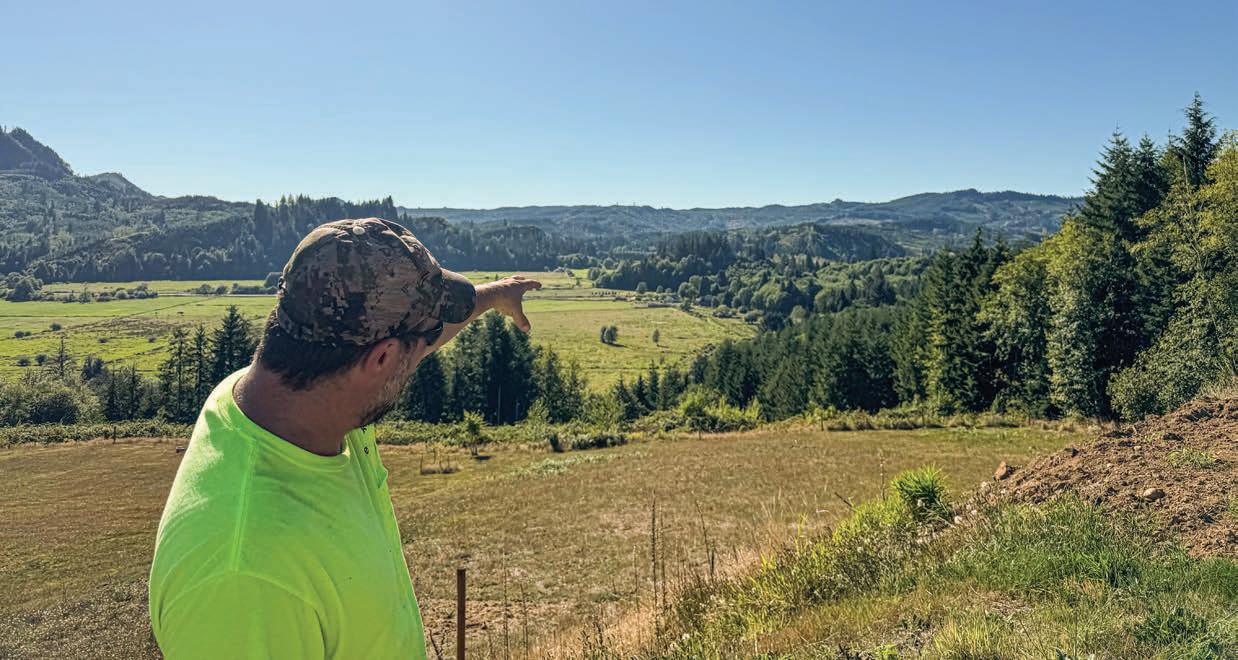
Brent Mahitka gestures across the Skamokawa Valley at former hunting lands blocked off in recent years by gates. He was fined $500 last year for accidentally shooting an elk on land now owned by the German prince’s companies. (HENRY BRANNAN)
over not only decades, but centuries our families have managed and owned forests and agriculture.”
He added that European influence may still benefit Wahkiakum and Pacific Counties because his investors are generally more open to free public access on private land. That right is enshrined in law across much of Europe in a doctrine known as “freedom to roam” and “everyone’s right.”
“They actually are surprised when I tell them private land in the US is actually that: private,” he said. “You can block it off and tell people, ‘No trespassing, this is my land, nobody enters’ – that is a foreign concept to the Europeans.”
That ability also allows Schulenburg to moderate some risks, such as humancaused accidental fires, hunting accidents and illegal dumping. Other factors that drew the companies to the region include good soils, lower fire risk compared to east of the Cascades and land prices that are far less expensive than back home, Schulenburg said.
“The returns on timberland are better here in the US,” he said. “The land in Europe has gotten so expensive, it almost is (that) you have to inherit the land; you cannot buy the land anymore.”
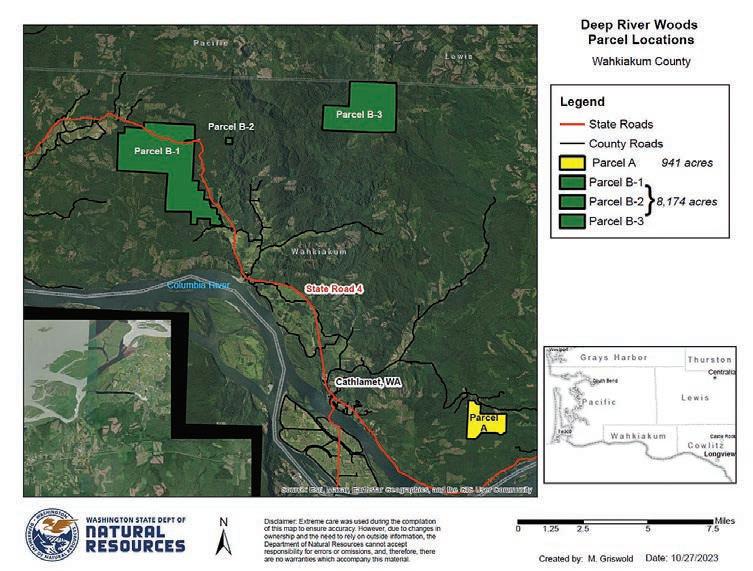
In 2023, a Washington Department of Natural Resources board purchased the outlined lands from Manulife, while partners The Conservation Fund acquired another 11,400 acres to eventually transfer to DNR, a seeming win for access. But in some cases in Wahikiakum County and neighboring Pacific County, lands that are open for hunting are well behind private gates, blocking access or necessitating much longer hikes. (DNR)
THOSE CONDITIONS HAVE led the company to facilitate huge investments from ultrawealthy Europeans. County property transfer records show a handful of limited liability companies – set up to facilitate land purchases for European mega-investors – spent about $114 million on lands in Wahkiakum County across two purchases in 2024 alone. One of those was roughly 8,000 acres for about $85 million. Another deal was nearly 4,300 acres for about $29 million.
While access is currently shut down to the companies’ properties around the counties, Schulenburg said the company has not yet finalized the land’s access policy after the purchases, instead focusing on timber harvests.
He asked for patience.
“If I have a $10,000-an-acre harvest and a hunting lease might be a dollar or two an acre, that is sort of the scale we’re dealing with,” he said, “so it’s very easy then to
Ironically, the right of the public to recreate – hike, bike – in private forests is enshrined in German laws. While that country’s new owners of Wahkiakum County land say that access policies for their ground here aren’t finalized and could still benefit locals, they are also reportedly leaning toward “large-scale hunting leases,” which is typical for hunting on private land in Germany. (HENRY BRANNAN)
prioritize where my time ought to be spent.”
Cothren’s efforts to negotiate public access with American Forest Management have been unsuccessful so far.
Schulenburg said he is open to discussions, adding he leans toward eventually opening the land up for largescale hunting leases where a group of insured hunters pays thousands for exclusive access to a large block of land.
Schulenburg advised people to be diplomatic, especially to his company’s land managers: “Tone is everything; if you talk to someone nicely, you usually get better results.”
But ultimately, he said, change is coming to the whole region no matter what, as land values continue to rise.
“These changes will come. I don’t think just because the public had been able to use the land for a long time as they please,” he said. “Basically, I think that is a change that is unstoppable.” NS
Editor’s note: Part III of this series next issue will look at how counties are reacting to the closing of hunting on private timberlands. This article was first published by The Reflector of Battle Ground, Washington, through the Murrow News Fellowship.
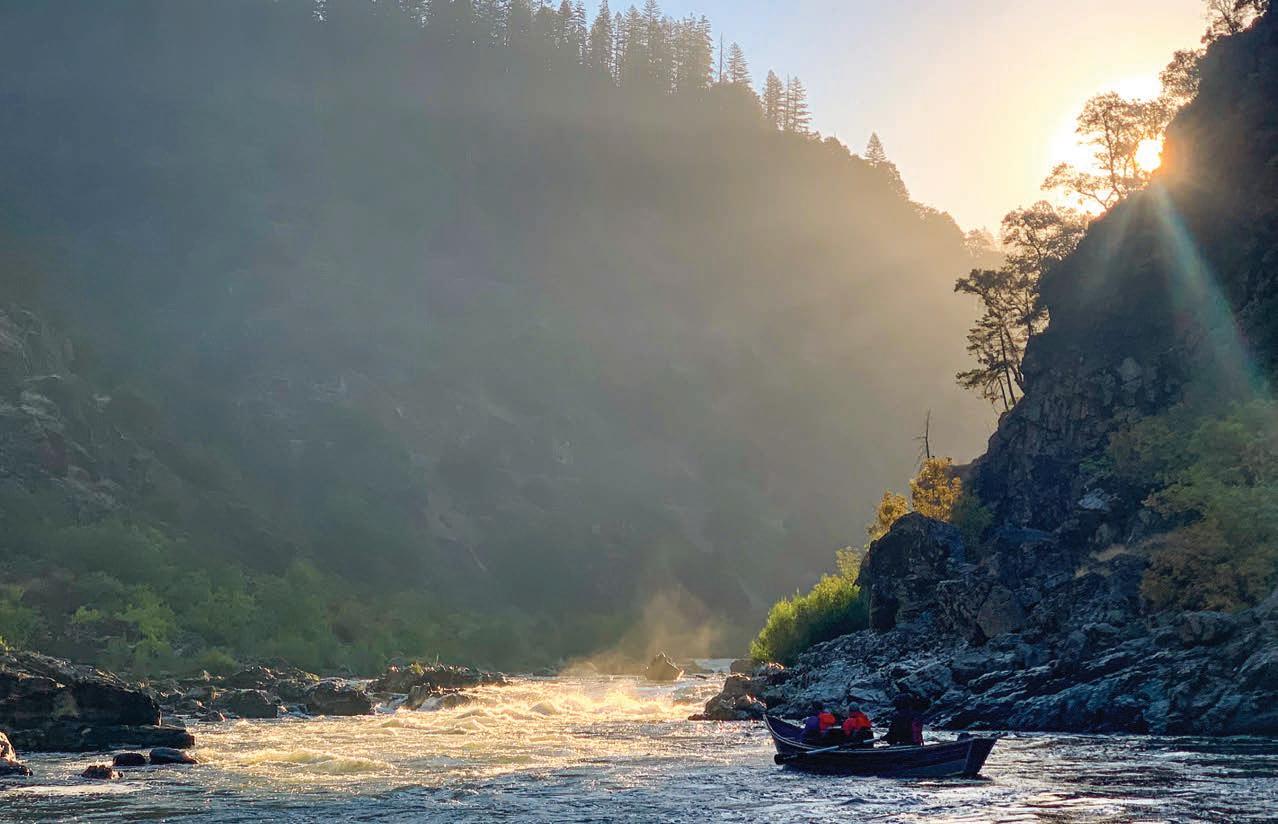
A 4-Day Lodge-to-Lodge Drift Boat Fishing Experience on Oregon’s Wild & Scenic Rogue River!
The Rogue River is the granddaddy of salmon and steelhead, plain and simple. This 4-day Rogue River drift boat trip is about good fishing and doing it right. You’ll float classic stretches of the Wild & Scenic Rogue with seasoned guides who know the river and know the fish.
Fish it how you like—fly, lure, spinner, whatever works. There’s no single “right” way here. At the end of the day, you’ll pull into a private riverside lodge with hot showers, real beds, and solid meals. It’s not camping. It’s a comfortable, no-nonsense fishing trip on one of the West’s great rivers.
THREE ALL-INCLUSIVE LODGES
• Lucas Lodge
• Black Bar Lodge
• Paradise Lodge
Each lodge is accessible only by river and reserved exclusively for our guests,—offering privacy, comfort, and a true escape into Rogue River country.
WHAT’S INCLUDED
• Fully guided drift boat fishing
• Private riverside lodges each night
• All meals, gear, and logistics provided
• Lodge-to-lodge travel by drift boat
• Small groups with hands-on guiding You just show up ready to fish.
Darrel Smith got into “some nice-looking specimens” on the Washington Coast this past winter steelhead season. (KNIFE PHOTO CONTEST)
State managers’ delay of most Columbia Gorge keeper sturgeon seasons until the dead of winter had nothing on Mark Hadory (left). He used one of February’s open days to retain his first diamondside in 23 years, this 46-incher. He was fishing with buddy Dennis Schwartz on an otherwise slow day with a water temperature of 39 degrees, which biologists figured would tamp down catch rates and at least stretch the opportunity out. It worked to a degree on The Dalles Pool, the Bonneville Pool not so much. (KNIFE PHOTO CONTEST)
Perseverance put Jerry Sumner into some catch-and-release North Fork Clearwater River steelhead. He was running a shrimp and Mack’s Jig. (KNIFE PHOTO CONTEST)
They’ve never seen a squid in their lives, but the broodstock rainbows at a certain Deep South Sound lake do not care. Eric Schager took the Nikko Baits Octopus hoochie off the lure he was using for ocean-returning coho and added it to his Kastmaster to catch this and other large trout. “Pink has been good,” he reports. (KNIFE PHOTO CONTEST)
For your shot at winning a knife in our Knife Photo Contest, send your full-resolution, original images with all the pertinent details – who’s in the pic; when and where they were; what they caught their fish on/weapon they used to bag the game; and any other details you’d like to reveal (the more, the merrier!) – to awalgamott@media-inc.com or Northwest
Notorious Deer Poacher Back In The Slammer
By Andy Walgamott
ANorthwest man with a deeply disturbing criminal record involving wild and domestic animals was sentenced to 43.5 months in prison last month after pleading guilty to seven felony counts involving unlawful firearms possession and illegal deer hunting.
Ronald Albert Livermore, 78, of Riverside, Washington, received the “longest agreed recommendation for an illegal hunting sentencing in almost a decade,” say state officials. It follows on jail sentences of fourplus years in two of his past Oregon cases.
This latest case stems from 2023 and 2024 when Washington Department of Fish and Wildlife officers caught Livermore hunting with a gun despite his firearms rights never having been restored from a 2016 conviction. According to the state Attorney General’s Office, Livermore was found driving at night in the Sinlahekin Wildlife Area of Okanogan County, shining a spotlight and “shooting into the woods whenever he saw something he thought might be an animal.”
After pleading not guilty, Livermore was released to home confinement while pending trial and ordered to wear an ankle monitor. But in the meanwhile, game wardens found a deer on his property that was paralyzed after having been spine-shot with a bullet fired from a small-caliber gun.
A search warrant served on his home led to the discovery of “multiple homemade firearms in a secret compartment in Livermore’s bathroom.”
“The firearms were made of materials such as umbrella handles, canes and PVC pipe, but functioned and fired accurately. The officers also found an additional shot
deer and evidence that Livermore was baiting deer to his porch and then shooting them,” the AG’s Office reported.
State game wardens were happy to see their hard work turn into a strong sentence.
“Washington Department of Fish and Wildlife Police are thankful to see this case completed with the Attorney General’s Office, as fish and wildlife officers worked diligently conducting night patrols and increasing their presence in the backcountry to discover this illegal activity,” officers said online. “We are committed to ensuring safe and ethical opportunities while conserving our big game natural resources.”
AS WE REPORTED here last December, Livermore’s wildlife crimes go back nearly 20 years and include a three-year jail sentence in Oregon after pleading no contest in a 2016 case to aggravated abuse of an
animal, felon in possession of a firearm and possession of a prohibited silencer.
That involved a Crook County rancher’s calves, according to the Bend Bulletin, and while sexual abuse of an animal charges were dropped as part of his plea deal, Livermore was required to pay the rancher $3,000 for the loss of the calves. Two dozen dead deer were also found nearby, though there reportedly wasn’t enough evidence to charge Livermore. Still, the animal abuse conviction prohibited him from possessing a gun, per the Washington AG.
Prior to that, Livermore was convicted in 2008 of poaching deer in the Prineville area of Central Oregon. Troopers working by air and ground caught him spotlighting in 2007 with a sawed-off .22-caliber rifle and homemade suppressor and said he stored them in a secret compartment in his vehicle.
They said that Livermore, who “is
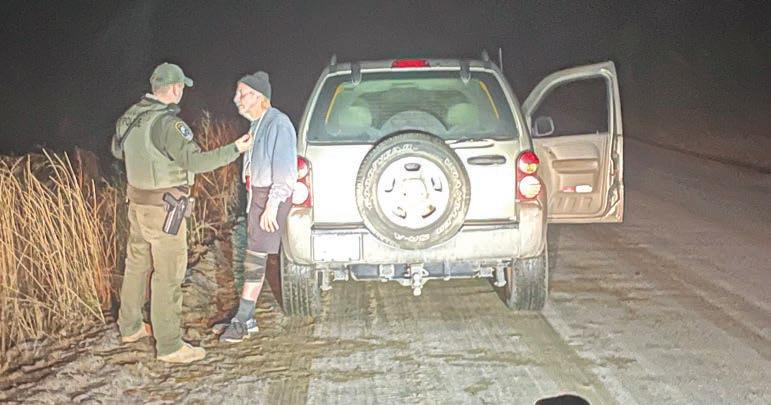
A Washington Department of Fish and Wildlife officer speaks with Ronald Albert Livermore during an overnight stop in late December 2023. (WDFW)
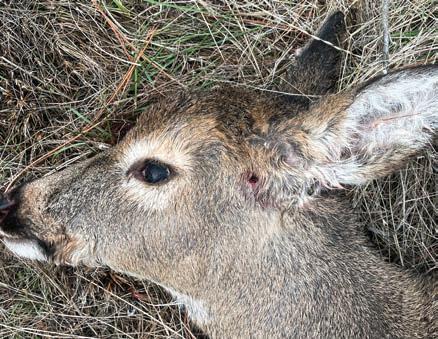
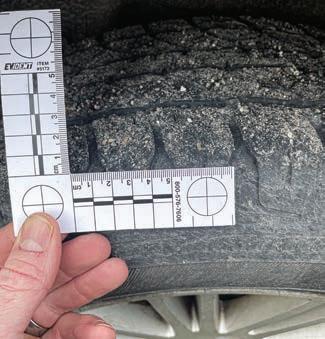
Evidence against Livermore included a young head-shot mule deer, tire treads and footprints. (WDFW)
primarily a vegetarian, would usually drive around in the darkness shining his spotlight, and when he saw eyes he would just shoot at them and then drive on looking for more.”
Initially facing 22 charges in that case, Livermore pled guilty to four felony counts of unlawful killing of deer, four counts of wastage and one felony count of possession of an unlicensed suppressor in exchange for prosecutors dropping a charge of attempted sexual abuse of wildlife.
Per the Bulletin, at sentencing Livermore said, “At my age, I’m not going to be out there doing something like this again.”
He received more than a year in jail and was ordered to pay $6,000 in restitution to the Oregon Department of Fish and Wildlife for eight deer as well as directed to undergo a mental evaluation, according to KTVZ.
The station reported that most deer he shot with his “survivor weapon” were pregnant does. Other reporting from the time indicated more than a dozen deer had been found shot and wasted along Forest Service roads. The case occurred at a time ODFW said poachers were taking as many deer here as hunters were harvesting legally.
ACCORDING TO THE Washington AG’s Office, this latest sentence “reflects Mr. Livermore’s significant criminal history and the severity of the offenses he committed in this case.”
“Washington’s hunting laws maintain opportunities for hunters while ensuring that hunting is as safe, ethical and sustainable as possible. Cases like this remind us why these laws exist,” said AG Nick Brown. “We were happy to work with local law enforcement and the Department of Fish and Wildlife in this case to protect public safety and animal welfare.”
The seven felony charges Livermore pled guilty to include four counts of seconddegree unlawful possession of a firearm, and one count each of first-degree unlawful big game hunting while armed with a firearm, first-degree unlawful big game hunting and unlawful possession of a short-barreled rifle.
The AG’s Office was granted “concurrent authority” from the Okanogan County Prosecutor’s Office to try Livermore in court.
“Working together, the AGO added felonies and a firearm enhancement to the initial list of charges. These additions significantly increased Livermore’s sentence, ensuring he is held accountable for his crimes,” officials stated.
State records show that on March 12 Livermore was lodged at the Washington Corrections Center outside Shelton.
SMELT SEIZED FOR EGREGIOUS OVERLIMITS
March’s two Cowlitz River smelt openers saw dippers harvest an estimated 114,675 pounds of the oily little fish, but as usual a few slick individuals tried to slip away with more than their daily limit – a lot more, in one case.
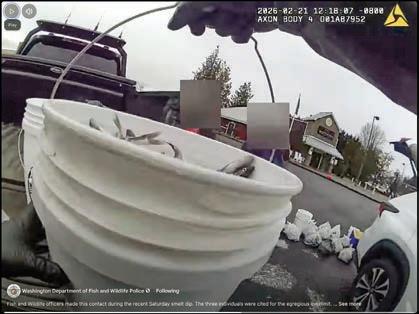
Washington game wardens released a video showing officers producing bags upon bags of smelt in possession of three people stopped at Kelso’s Three Rivers Mall, about half a mile from the water.
“You are grossly overlimit, to the point you could be taken to jail for it. You have 250 pounds of smelt,” one officer told the trio, who were cited for egregious overlimits.
Around 14,300 dippers participated in the openers and, averaged out, most went home with their limit of 10 pounds apiece.
But after witnessing others near him dip more than their legal share, harvester Jonah Kubecka offered up “a call to action.”
Washington wardens cited three people for possessing 250 pounds of Cowlitz smelt. (WDFW)
“We as anglers need to support fair, legal, ethical harvest of this wonderful resource. Spread the word within our communities, hold those accountable who break the rules, and encourage law enforcement efforts to maintain and keep this fishery healthy,” Kubecka wrote in an email posted to this magazine’s blog. “Report those who break the rules, set the example for those who partake and teach the younger generation about responsible harvest.” Hear, hear.
JACKASS OF THE MONTH
Whether spurred by a big jackpot or the need for recognition, a Texas angler faces serious charges after allegedly adding weights to a bass.
Curtis Lee Daniels of the Dallas-Fort Worth area is accused of putting three ¾-ounce bullet sinkers in a 2-plus-pounder he brought in during a two-day March tournament featuring $100,000 in prizes.
The weights were discovered via metal detecting wand, and during a subsequent investigation, several sinkers of the same size and style were also found in Daniels’ boat, according to Texas game wardens.
Daniels was arrested and charged with a violation of fishing tourney rules. Because the contest’s overall prize was greater than $10,000, it’s considered a third-degree felony, punishable by up to a $10,000 fine and/or two to 10 years in prison.
Event results show Daniels, regarded as a regular “check casher,” weighed in 2.56- and 2.28-pounders, good for $1,250 for each, though it wasn’t clear if he kept that.
Organizers thanked investigators who looked into the “fish manipulation incident.”
“Maintaining fairness and integrity in competitive fishing is incredibly important to us, and we greatly appreciate the diligence and attention you gave to this matter. Your efforts help protect the reputation of the sport and ensure that honest anglers can compete on a level playing field,” said Big Bass Splash.
Online reaction was brutal. “We got weights in fish iykyk,” said one, a reference to the dramatic discovery of lead and other items in the bellies of walleye at a 2022 Lake Erie tournament. “Guess they thought no one has ever tried this stunt before??” said another. Added someone else, “I hope he loses his fishing and hunting license for the next 15 yrs.” Said a fourth, “Absolute disgrace to the sport.”
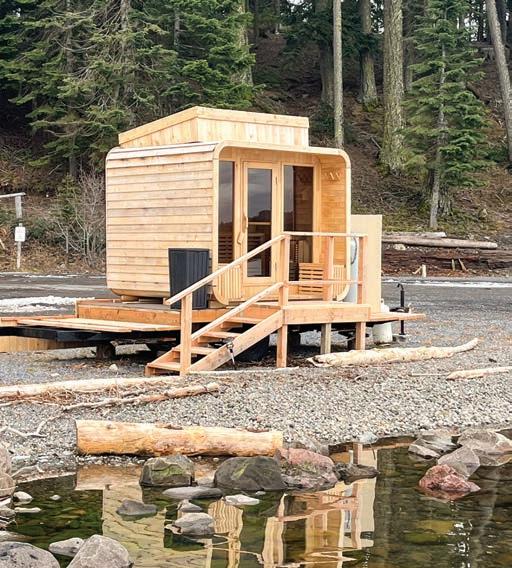
Lakeside Lodge Life at Odell Lake Resort
Whether you’re working the water, playing a round of disc golf, or basking in the perfect sunset, Odell Lake Resort is your place to unwind and explore.
• Lakeside Sauna - a private, relaxing extraordinary experience
• Revitalized Outdoor Patio - a great time any day of the week
Come experience Odell Lake Lodge Life! Book your stay today!
OUTDOOR CALENDAR
1
Start of new WA fishing and hunting license year; OR spring bear hunt opener; ID spring bear hunt opener in select units; Scheduled WA Marine Areas 10-11 blackmouth opener (open Wednesdays-Saturdays only); Start of mainstem Columbia Gorge pools spring Chinook season (open daily; see e-regs for open areas; may close earlier or be extended based on catches or quota)
1-7 WA youth spring turkey hunting week; Tentative razor clam digs scheduled on select WA Coast beaches, dependent on marine toxin levels – info: wdfw.wa.gov
2 Halibut opener on Areas 5-10 (open daily)
4 ODFW Youth Turkey Hunting Clinics, White River and Denman Wildlife Areas (register by April 2; $10) – info: vem.myodfw.com
7-12 Pacific Fishery Management Council West Coast salmon-season-setting meetings, Portland – info: pcouncil.org/council-meetings/upcoming-meeting
8 Last scheduled day of Lower Columbia spring Chinook season (may close earlier or be extended based on catches or quota)
10-11 Klineline Kids Fishing Derby ($5 per child, registration), Vancouver, WA –info: klineline-kf.org
10-12 49th Annual Oregon Knife Show, Lane Events Center, Eugene, OR – info: oregonknifecollectors.com; Vancouver Island Outdoor Show, Cowichan Exhibition Park, Duncan, BC; homeshowtime.com/vi-outdoor-show
11 ODFW Hunter Safety Conventional Course, Creswell (register by April 1; $10) – info above
11-12 OR youth spring turkey hunting weekend; ODFW Turkey Hunting Workshops, Salem, Bend, Klamath Falls, White City (registration deadline varies; $50) – info above
15 ID, OR and WA general spring turkey season opener; ID spring bear hunt opener in remaining units
17-18 Long Beach Razor Clam Festival – info: longbeachmerchants.com
19 Fly Casting & Tying Fair, Pickering Barn Park, Issaquah, WA; wscffi.org
20 Northern Pikeminnow Sport-Reward Program fishery opener at Washougal, The Dalles, Umatilla and Columbia Point stations – info: pikeminnow.org
22 OR fishing or bait opener on select waters
24-26 Opening Weekend Fishing Derby, Offut Lake Resort, Tenino, WA – info: offutlakeresort.com; Victoria Outdoor Adventure Show, Juan de Fuca Recreation Centre, Victoria, BC; homeshowtime.com/victoria-outdoor-adventure-show
25 WA lowland lake fishing season opener; Start of Washington Trout Derby at select lakes – info: wdfw.wa.gov/fishing/contests/trout-derby; Kid’s Fish In ($10 per child, register), Lake Sacajawea, Longview, WA – info: facebook .com/ LongviewRecreation; Kitsap Poggie Club’s Kid’s Fishing Party, Jarstad Park, Gorst, WA – info: kitsappoggieclub.com; Family Fishing Event, Trojan Pond, Prescott, OR – info: myodfw.com/articles/take-family-fishing; McKenzie River Wooden Boat Festival, Eagle Rock Lodge, Vida, OR; oregonsboat.org
30 Halibut opener on Areas 1-4 and OR Coast north of Cape Falcon (open dates vary by area) – info: wdfw.wa.gov/fishing/regulations/halibut
1 2025 Northern Pikeminnow Sport-Reward Program fishery begins at rest of Columbia and Snake Rivers stations – info: pikeminnow.org; ODFW staffrecommended halibut opener on Central Coast and Southern Subareas – info: dfw.state.or.us/mrp/finfish/halibut/management.asp
2 Scheduled one-day mainstem Columbia Gorge spring Chinook reopener (see e-regs for open areas; may close earlier or be extended based on catches or quota); Auburn Kids Fishing Derby, Auburn Mill Pond, Auburn, WA – info: saveourfish.org; Jennings Pond Kids Fish-In, Everett, WA – info: bnmartin71@hotmail.com: Kids Fishing Derby, Thompson Pond, SedroWoolley, WA – info: bob.nielsen@hotmail.com
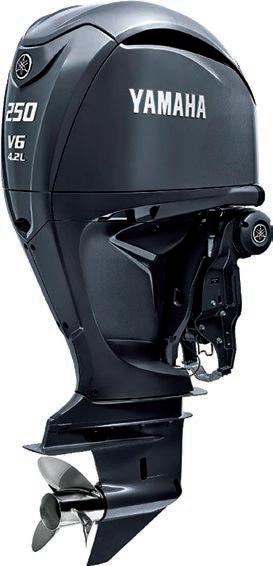
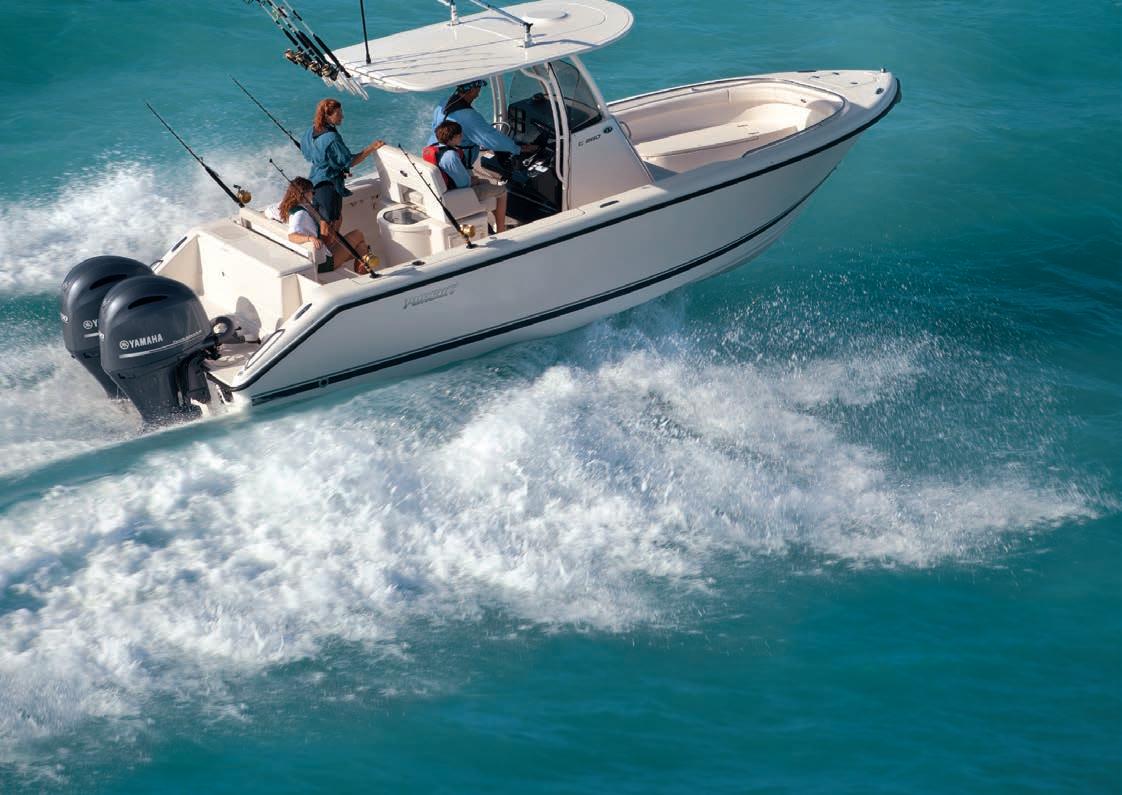
The lightest 200-hp four stroke on the market
2.8L displacement and Variable Camshaft Timing give it the best power-to-weight ratio of any 200-hp four stroke
Nearly 120 pounds lighter than our four-stroke V6 F200
Show the water who’s boss with the F200 In-Line Four. Incredibly light, responsive and fuel efficient, it serves up plenty of muscle to handily propel a variety of boats. On top of that, its 50-amp alternator offers the power to add a range of electronics, and its 26-inch mounting centers and compatibility with either mechanical or digital controls give you the flexibility to easily upgrade your outboard or rigging. Experience legendary Yamaha reliability and the freedom of forward thinking, with the F200 In-Line Four.
COOS BAY Y Marina (541) 888-5501 www.ymarinaboats.com
CHINOOK
Chinook Marine Repair, Inc. (800) 457-9459 www.chinookmarinerepair.com
Master Marine Boat Center, Inc. (360) 336-2176 www.mastermarine.com
MOUNT VERNON
Tom-n-Jerry’s Boat Center, Inc. (360) 466-9955 www.tomnjerrys.net
OLYMPIA
Us Marine Sales & Service (800) 455-0818 www.usmarinesales.com
Welcome To CATCHING
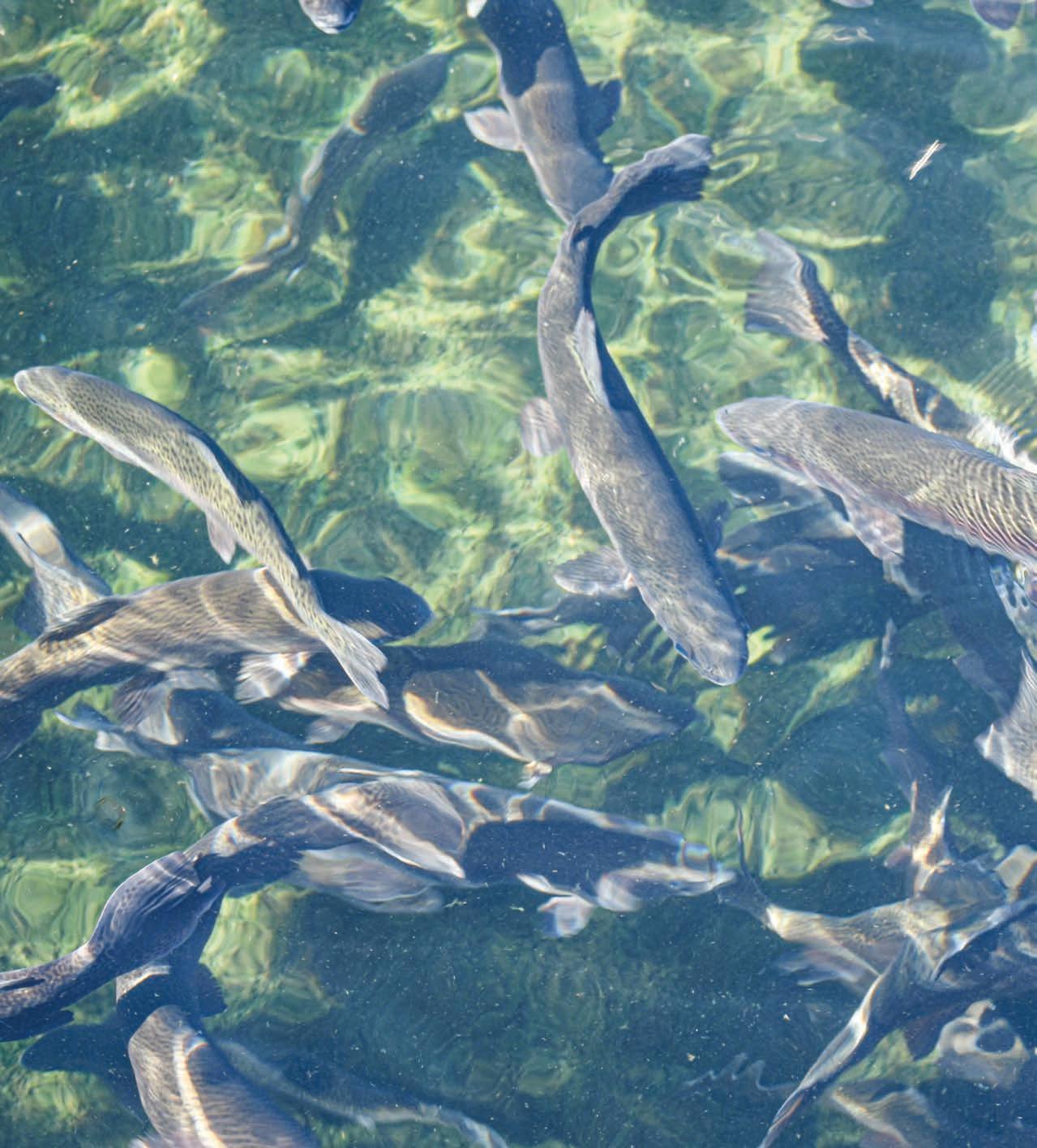
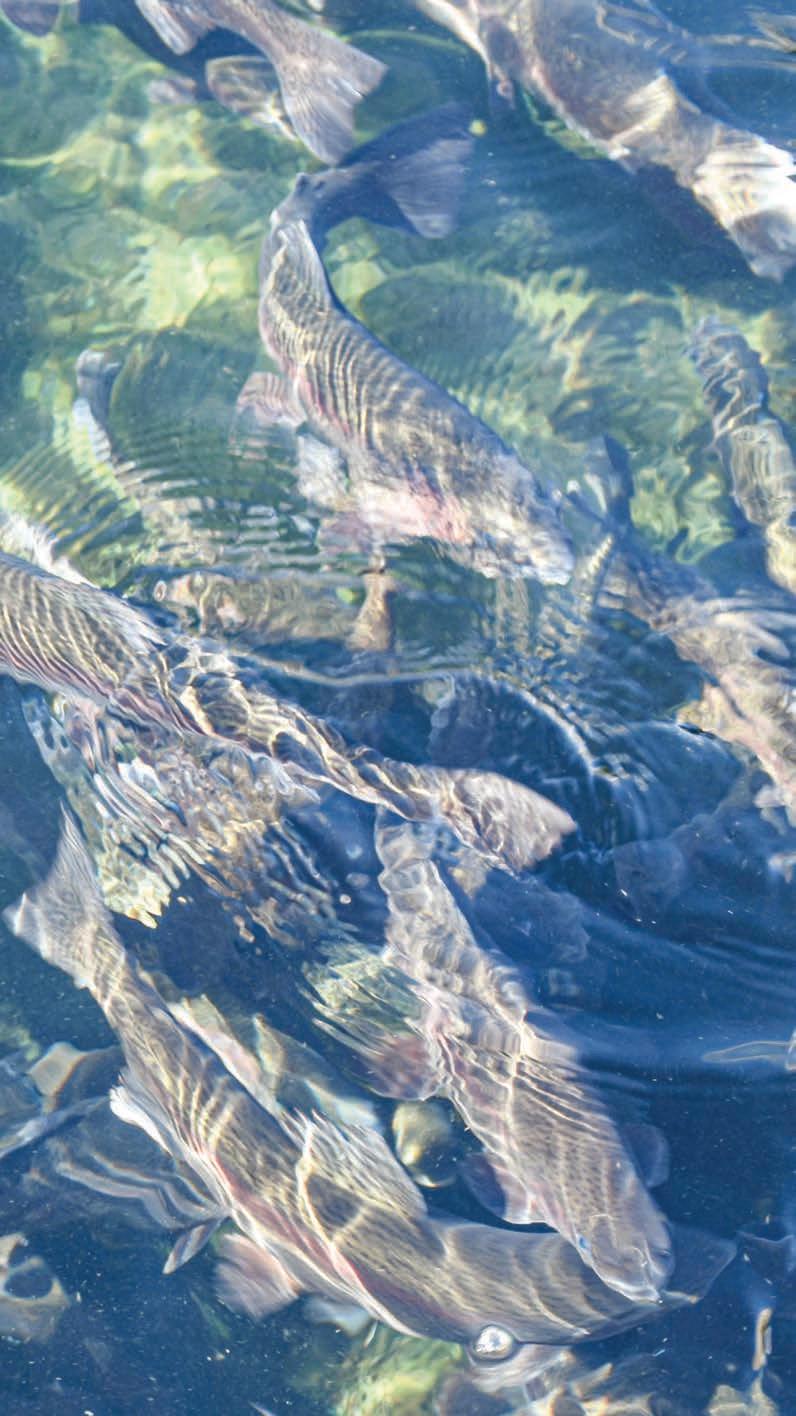
Rainbow trout swim at the Puyallup Hatchery ahead of being planted for opening day. Between jumbos, catchables, “put, grow and take” fish, fingerlings and fry, some 15.5 million trout and kokanee have been stocked in Washington lakes. (WDFW)
FishCATCHING Season!
With Washington’s opening day coming up, here’s a look at stocking stats, top lakes and more.
By Mark Yuasa
When it comes to trout fishing, the weekend of April 25-26 is going to be a splendid time to be on the water in Washington.
The fourth Saturday of this month is the juncture each spring when tens of thousands of anglers trek to around 525 statewide seasonal lowland lakes and ponds stocked in 2026 with nearly 15.5 million trout and kokanee, and the majority of the fish will be around to catch in time for the opener.
“Opening day is one of our biggest and most important days for anglers to get out on the water,” said Steve Caromile, Washington Department of Fish and Wildlife Inland Fish Program manager. “Spring weather can be hard to predict, but we’ve had a mild winter and hopefully that’ll lead to plenty of success for weeks to come.”
Breaking it down, the 2026 stocking plan calls for the release of more than 2.1 million catchable-size trout of 11 to 13 inches, averaging 2.5 fish per pound.
Anglers should also find around 157,000 larger “jumbo” trout measuring 14 inches or longer. Most of the jumbos were planted in March and April, with other trout saved for fall planting. Some lucky anglers may even have a chance to catch a bigger “carryover” rainbow that survived over the past year.
Ramping it up is 1.6-plus million trout categorized as “put, grow and take” – fish reared in hatcheries to 2.6 to 10 per pound in size – that were stocked in 2025 and now measure from 8 to 12 inches.
On top of that, an estimated 11.5 million fingerling and fry trout and kokanee planted one or two years
FISHING
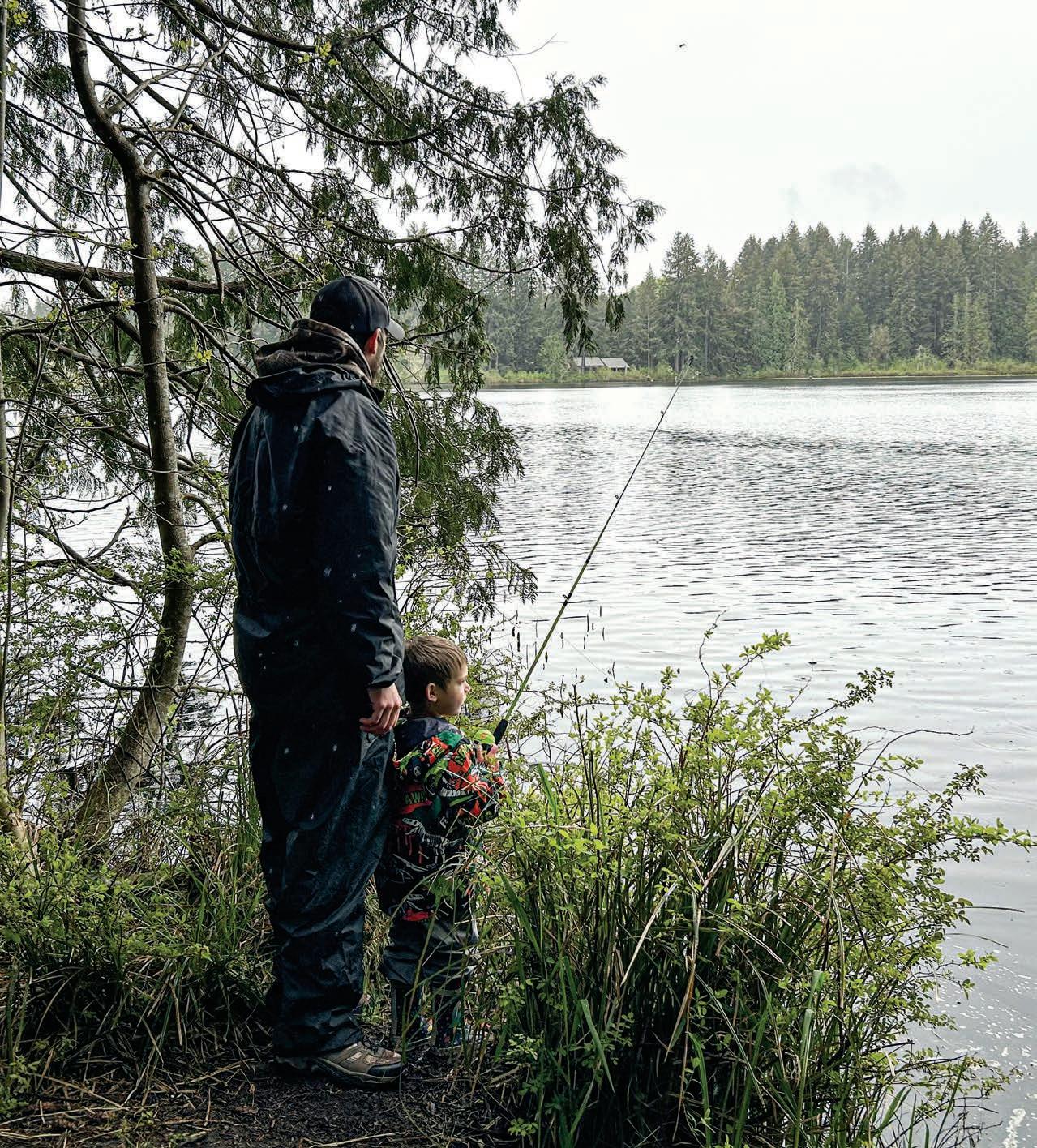
Access abounds for Evergreen State anglers. Between Washington Department of Fish and Wildlife and others’ boat ramps, city, county and state parks, roadside access, resorts and whatnot, it’s easy to find a spot to cast a line, like this dad and kiddo are doing at Deep Lake in Region 6. (WDFW)
ago will be in the catchable-size range during the 2026 fisheries. Most fry were stocked into Eastern Washington opening day lakes, which are managed to create decent fry survival.
TROUT STOCKING EXPECTATIONS
In the Puget Sound region – Island, King, San Juan, Skagit, Snohomish and Whatcom Counties – the projected number of trout stocked in 2026 is down slightly from 2025. Think of it as quality over quantity with the result being a better outcome on opening day and beyond.
“Many fisheries in the North Puget Sound region will see a slight reduction in the number of trout stocked,” said Justin Spinelli, WDFW Puget Sound regional biologist. “This is a result of growing larger fish at our regional hatchery facilities, and an effort to reduce the burden on a lake’s food web chain to improve trout health and condition in the summer and fall.”
“Larger fish are typically caught at higher rates, so we don’t anticipate impacts to the fishery on opening day,” Spinelli said. “Despite the reduced number stocked, we also expect a substantial proportion of trout to support fisheries well beyond spring.”
The Puget Sound regional trout plant for the 2026 season is 395,900 catchables (204,600 will be stocked in time for opening day), 24,875 jumbos and 30,000 put, grow and take trout. In addition, another 4.5 million trout fry were planted in 2025, and those that survived should be in the catchable-size range for 2026. Most fry planted in Westside lakes are kokanee.
Southwest Washington and the coast (Regions 5 and 6) also offer a good number of lakes and ponds stocked for opening day.
In Region 5 – Clark, Cowlitz, Klickitat, Lewis and Skamania Counties – the projected plant is 458,751 catchables, 13,320 jumbos and 93,000 put, grow and take trout.
In Region 6 – Clallam, Grays Harbor, Jefferson, Kitsap, Mason, Pacific, Pierce and Thurston Counties
– the projected plant is 566,206 catchables, 86,921 jumbos and 78,000 put, grow and take trout.
You can find the 2026 statewide hatchery trout and kokanee stocking plan by referring to the WDFW fish stocking webpage at wdfw.wa.gov/ fishing/reports/stocking/statewide.
OPENING DAY TIPS AND TRICKS
As for trout fishing gear, you can keep it fairly simple and you don’t have to spend much money.
A basic trout rod and reel combo usually costs $60 to $100, and an expensive set is about $130 to $200. Look for a fishing pole length of 6 to 7 feet, and keep it relatively light and limber, in the 4- to 10-pound range. Stick with a medium-size spinning reel and capacity to hold more than 100
yards of 6- to 8-pound-test fishing line.
On the main line attach one or two number 9 egg sinkers with a rubber bumper to a small barrel swivel. Leader length is the most important factor; avoid the store-bought, pretied 12-inch leaders, which are way too short. Leaders should be 3- to 8-pound test and 18 to 30 inches long.
One pro tip to keep in mind is the hook size tied to the end of your leader. Smaller is better, so use an egg or worm hook in a size 8 to 14 or a size 14 or 16 treble.
Most of the time, it doesn’t take a lot of homework to find out what a stocked trout will bite. The top old-school baits are worms, maggots, salmon eggs and scented marshmallows. Today’s preferred offerings are the softer dough baits
WDFW TROUT DERBY RETURNS
The highly popular Washington Trout Derby begins on April 25 and runs through October 31 at over 100 stocked statewide lakes.
“We’ve got hundreds of prizes for those who catch a tagged fish, and we plan to stock most of the same lakes as we have in the past,” said Steve Caromile, Inland Fish Program manager for the Washington Department of Fish and Wildlife. “It has been very popular over the past 11 years. The generosity of our license vendors and donors is what makes the trout derby a huge success, and something many anglers look forward to.”
More than 70 statewide businesses are offering an estimated 750 prizes valued around $30,000 and worth about $48 per prize. The number of tags turned in during the 2025 season was 59 percent. The success of the trout derby would only be possible through WDFW’s ongoing partnerships with business dealers/vendors throughout the state.
Prizes include gift cards; fishing gear and tackle; annual magazine subscriptions; Seattle Mariners game tickets; hooded jackets; books; rounds of golf at multiple golf courses; local aquarium admission; car detailing bucket; and kayak rentals. Higher valued prizes include a kayak; guided lake fishing trip for two; handheld GPS units; lifetime memberships for a streaming app to locate trout streams in Washington; stays at local resorts and campgrounds; backpack; and beverage refrigerator.
This season, each of the prize-winning trout can be identified by a green tag inserted near the dorsal fin.
Anglers can participate in the WDFW photo contest during the first week of the trout derby on Instagram by using the hashtag #watroutderby.
Join WDFW staff for the WDFW/Filson Trout Derby Kickoff Party hosted by Filson on April 18 from 11 a.m. to 3 p.m. at the Filson Seattle Flagship store, 1741 1st Avenue South in Seattle’s SoDo neighborhood. Get trout derby information, watch a fly-tying demo, learn from local fishing experts and eat some incredible trout served by a local chef. For details, see filson.com/pages/seattle-store.
The derby is open to anyone with a valid 2026-27 fishing license, and a temporary license may be used. There is no entry fee or registration required. Children under age 15 fish for free.
The WDFW Trout Derby website, wdfw.wa.gov/fishing/contests/trout-derby, will be updated soon so you can see what statewide lakes contain tagged trout and learn more about how the derby works. –MY
FISHING
like Berkley PowerBait. Dough baits come in all sorts of colors and varieties of shapes, with some mimicking salmon eggs, maggots and worms, just to name a few. You can also mold your own (think PlayDoh) into round balls of various sizes, or squares or triangles, or whatever shape that comes to mind.
Various fly patterns work well, and the top choices are a black or blackand-olive Woolly Bugger in a size 8 or 10 attached to a 5- or 6-foot leader and trolled weightless close to the surface. Speaking of trolling, also try running a gang flasher ahead of a worm, maggot or salmon egg laced with a tiny piece of scented dough bait.
You can also troll or cast and retrieve from shore with a small spoon like a Dick Nite, Yakima Bait Triple Teazer or Luhr Jensen Super Duper.
Many shore anglers will cast out a bobber with their presentation sitting just below the surface in 3 to 6 feet of water. Others hang their presentation a few feet off the bottom where the
WEB RESOURCES FOR WASHINGTON ANGLERS
Fish now: Anglers can avoid the opening day madness and head out now to year-round Westside lakes stocked with trout between March and May. Other lakes also receive bonus plants in the autumn/winter, and thousands of trout averaging 1 to 11/2 pounds apiece go into some Puget Sound region lakes for the “Black Friday” fishing event in late November. For more on the statewide stocking schedule, see wdfw.wa.gov/fishing/reports.
License up: A 2026-27 fishing license is required for anyone age 16 or older and is available online or from hundreds of license vendors across the state. A new licensing functionality is now available on the mobile app platforms MyWDFW (wdfw.wa.gov/about/apps/mywdfw) and Fish Washington (wdfw.wa.gov/ fishing/regulations/app). Your 2025–26
fishing (and hunting) licenses expired on March 31, 2026. For details and to learn more about the new licensing app system, go to the WDFW’s licensing webpage at wdfw.wa.gov/licenses/fishing.
Water access: There are thousands of lakes, ponds and reservoirs across Washington, and hundreds of WDFWmanaged water access areas, including some that are accessible for people with disabilities. Details on all the sites can be found on WDFW’s “Water access areas” website at wdfw.wa.gov/places-to-go/ water-access-sites.
Parking pass: Anglers parking at WDFW vehicle water access areas are required to display the WDFW Vehicle Access Pass – provided when you buy eligible annual fishing licenses – or a Discover Pass. Anglers visiting Washington State Parks or Department of Natural Resources
lands need a Discover Pass. Information on parking passes can be found at WDFW’s “Parking and access passes” webpage at wdfw.wa.gov/licenses/parking.
Regulations check: Before you head on out, check WDFW’s “Fishing regulations” webpage at wdfw.wa.gov/fishing/ regulations for permanent regulations, and “Emergency rules” webpage at wdfw .wa.gov/fishing/regulations/emergencyrules for rule updates affecting fisheries.
Where to go: An excellent fishing resource can be found by going to the WDFW “Places to go fishing” webpage at wdfw.wa.gov/fishing/locations.
Youth events: There are statewide kids fishing events held throughout the year and you can find more information by going to the WDFW “Youth fishing events” webpage at wdfw.wa.gov/fishing/ contests/youth. –MY
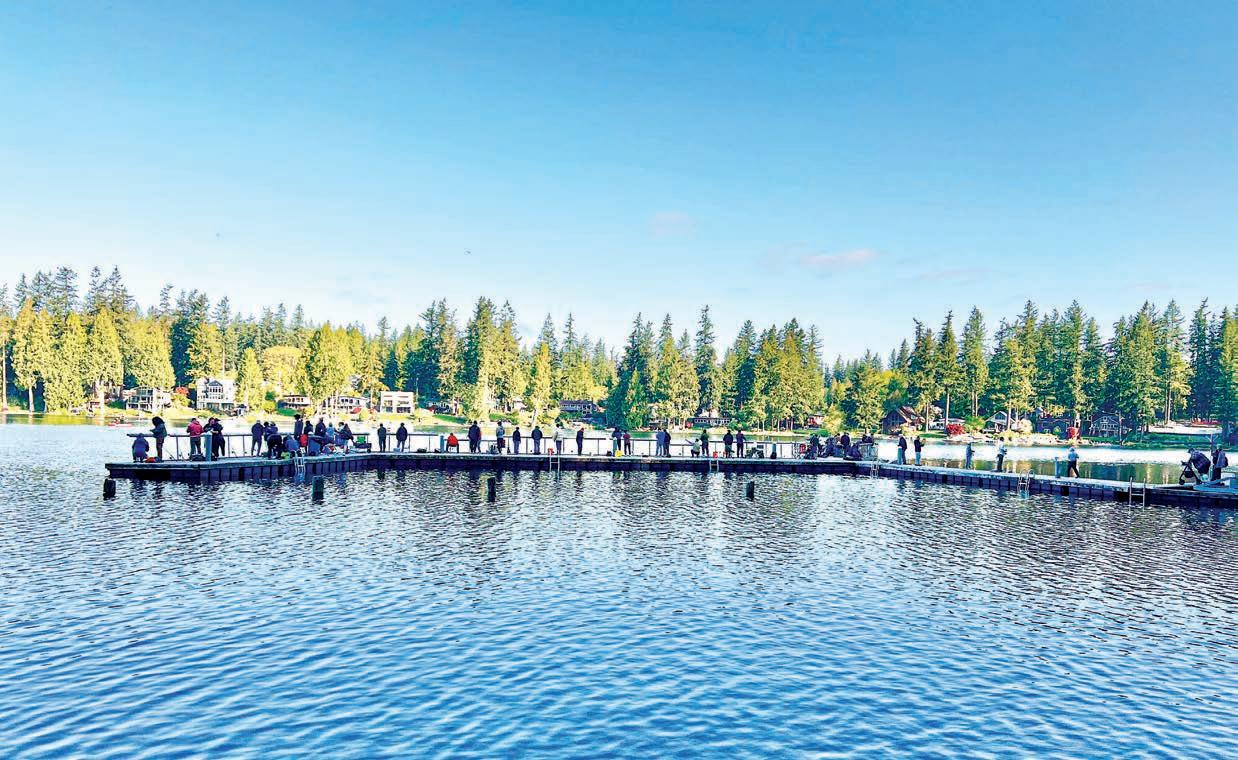
Opening day is one of the most well-attended outdoor gatherings in the Northwest. Just under 200,000 turned out on last April’s opener, including the four dozen or so pictured on the dock at Pine Lake on the Sammamish Plateau. (MARK YUASA, WDFW)
FISHING
bigger carryover trout tend to lurk. Keep in mind that most recently stocked trout tend to school near the surface, and many of these fish tend to hang around where the hatchery truck placed them in the lake, usually within yards of the shoreline, boat ramps and docks.
Planted trout like to stay just under the surface in 3 to 6 feet of water before they acclimate to their new surroundings and eventually spread out and move to deeper areas of the lake as the season progresses.
TOP LAKES
In no certain order, here are some likely top-producing statewide lakes to try on opening day (these are based on 2025 catch and historical data):
Westside: Tarboo in Jefferson County; Geneva, Langlois, Margaret, Shady and Wilderness in King County; Horseshoe in Kitsap County;
Horsethief in Klickitat County; Mineral in Lewis County; Devereaux and Wooten in Mason County; Clear and Silver in Pierce County; Erie, McMurray and Sixteen in Skagit County; Bosworth, Echo (Maltby) and Ki in Snohomish County; Clear, Hicks, Summit and Ward in Thurston County; and Cain, Padden, Silver and Toad in Whatcom County.
Eastside: Wapato in Chelan County; Jameson in Douglas County; Warden in Grant County; Alta and Pearrygin in Okanogan County; Williams in Spokane County; and Waitts in Stevens County.
In 2025, anglers on opening day saw ideal weather, generating an increase in statewide turnout and higher success rates.
Data showed the statewide effort was roughly 199,000 anglers (142,987 in 2024) with a higher catch of 852,000 trout landed (521,000 in 2024) and
475,000 kept (366,000 in 2024). The 2025 statewide trout caught per angler average was 3.9 (3.4 in 2024) and trout kept was 2.3 per angler (2.1 in 2024) in the 72 lakes checked by WDFW catch samplers.
Of the 19 lakes surveyed in Region 4, north Puget Sound, during the 2025 opener, an estimated 13,254 anglers fished with a total catch of 73,588 trout and 36,000 of those were kept.
When heading out to lakes in the coming weeks and months, please be respectful of fellow anglers and other recreationists, obey posted signage at all water access areas and follow parking regulations and have a backup plan in case your preferred destination is overcrowded. NS
Editor’s note: Mark Yuasa is a Washington Department of Fish and Wildlife communications manager and longtime local fishing and outdoor writer.
The goal? A stringer full of fat fish, a memorable trophy, a good time in
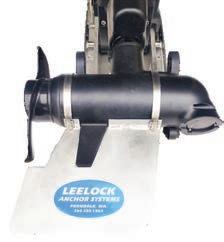
THE LEELOCK MAGNUM SKEG
The LeeLock magnum Skeg #LMS-04 is made for Minnkota Instinct Quest motors. It will drastically improve the steering performance and straight line travel of your bow-mounted motor. Not only does this Skeg improve your motor’s performance, it also makes it much more efficient. Your batteries will run longer on a charge. A LeeLock Skeg is a vital part of your trolling motor system.
This oversized skeg is made of 5052 aluminum. The size is 8 3/4 inches high by 10 inches wide and it’s 3/16 inches thick. It comes with clear PVC coated stainless steel hose clamps. The magnum skeg is available for other motors as well.
HEAVY DUTY QUICK CHANGE
BASE
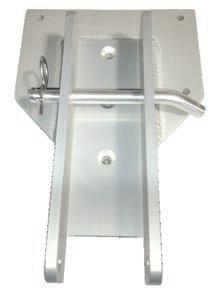
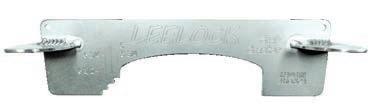
The Heavy-Duty Quick Change Base #QB-03 is like the standard Quick Change Base, but beefed up to provide a wider footprint. This provides a more secure mount. Like the standard Quick Change Base, the Heavy-Duty base allows you to easily and quickly switch between the #CRN-01 Columbia River Anchor Nest, any of the 3 Bow Mount Trolling Motor Mounts or the #BL-01 LeeLock Ladder. Simply remove the pin and slide an accessory out and slide another accessory in and replace the pin.
The Heavy-Duty Quick Change base mounts to almost any power boat as long as the footprint fits on the bow area of the boat. It has 7 5/16 inch mounting holes. The Heavy-Duty Quick Change Base is handmade of aluminum. Go to LeeLock.com to order the Base alone or to add the CRN-01 Columbia River Quick Change Anchor Nest, the three Bow Mount Trolling Motor Mounts, or the LeeLock Ladder to your order.
LEELOCK #SP-04 1/2 INCH SIDE PULL LOCK UNIT
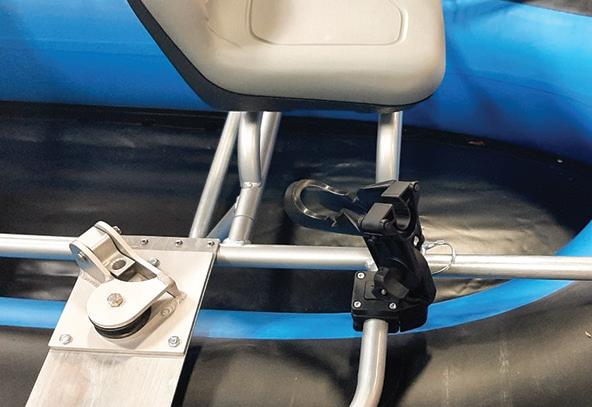
Our LeeLock #SP-04 1/2 Inch Side Pull Lock Unit bolts on top of the frame of most rafts, and catarafts. This patented unit gives you a much easier and safer way to secure your anchor line and eliminates the need for a traditional jam cleat. Best of all it prevents accidental anchor release!
It is constructed of 1/4” aluminum. This lock is designed to be used with most 3/8” to 1/2” anchor lines. It does not have mounting holes so it can be drilled to an individuals specific boat. 1/4” fasteners recomended (stainless steel recommended, not included) to mount.
Hassle free, reliable and easy!
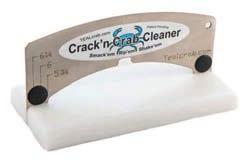
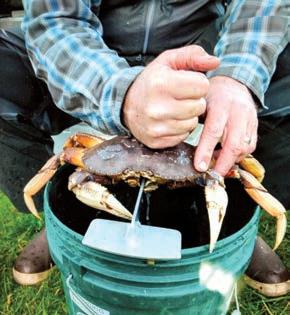
LEELOCK CRAB CRACKER
This new tool from Leelock will allow you to measure your Dungeness crabs to determine which ones are legal to keep. Then use the Crab Cracker to crack them in half, separating the two clusters from the shell and guts.
The Crab Cracker has been designed so that it sits nicely on top of a 5-gallon bucket, perfect for when you clean crabs. The bucket gives you a stable base, which makes it easier to clean – the guts and shell go into the bucket, making cleanup a snap. Crabs cleaned this way take up half as much space as whole crabs, so you can cook twice as many in your kettle.
The Crab Cracker is a unique tool made from solid aluminum, and comes in handy for cleaning Dungeness crabs. US Patent 12564195-B2.
The Three Top Ways To Catch Trout
It’s the warming weather and the Departments of Fish and Wildlife stocking hundreds of lakes with plentiful numbers of easy-to-catch trout that draw anglers to the outdoors for fishing fun and (mostly) limits. And while you might catch fish only measuring 10 inches long, there are bigger trout to be caught, too, as state agencies are raising more bigger fish, often referred to as trophy trout, than ever before. The effort is all about satisfying the wants of avid trout enthusiasts around the Pacific Northwest.
Trophy trout – fish measuring 12 to 20 inches in length – put up a good fight due to their size. In addition to the states raising more bigger fish, they also release broodstock trout (fish having been held at the hatchery multiple years for spawning purposes) into lakes, and they can weigh 3 to 10 pounds or more. Indeed, there’s a lot of fun to be had on a pond, lake or reservoir near your home.
A good way to find a nearby lake that’s been recently stocked with trout is to visit your state’s fishing website (idfg.idaho.gov/ fish; myodfw.com/fishing; wdfw.wa.gov/ fishing). There you will find where and when trout are being stocked and how big they might be. Oregon even offers a mapping tool, available by region, so you can zero in on lakes close to you or one you might visit while vacationing later this year.
Washington raises more than 2 million trout each and every year, with 150,000 of those larger than 14 inches. The size of the trout you may catch is often based on the number of fish per pound when listed on stocking schedules. For example, if the fish being planted are listed as 2.0 per pound, they likely average 11 inches; for a trout to weigh 1 pound (1.0 per pound), it likely
measures 13 to 14 inches; and for a trout to weigh 2 pounds (0.5 fish per pound), it likely measures at least 17 inches.
Idaho also stocks catchable size trout into a number of lakes and reservoirs. And in all three states, many high-elevation lakes, which remain cold all year and have
good feed, produce decent numbers of trout that grow to trophy size as they age. There are many ways to catch trout. If fishing from shore, the majority of anglers plunk/still-fish PowerBait, but trout can be caught while casting and retrieving spoons and spinners from the bank too. Having a
BUZZ RAMSEY
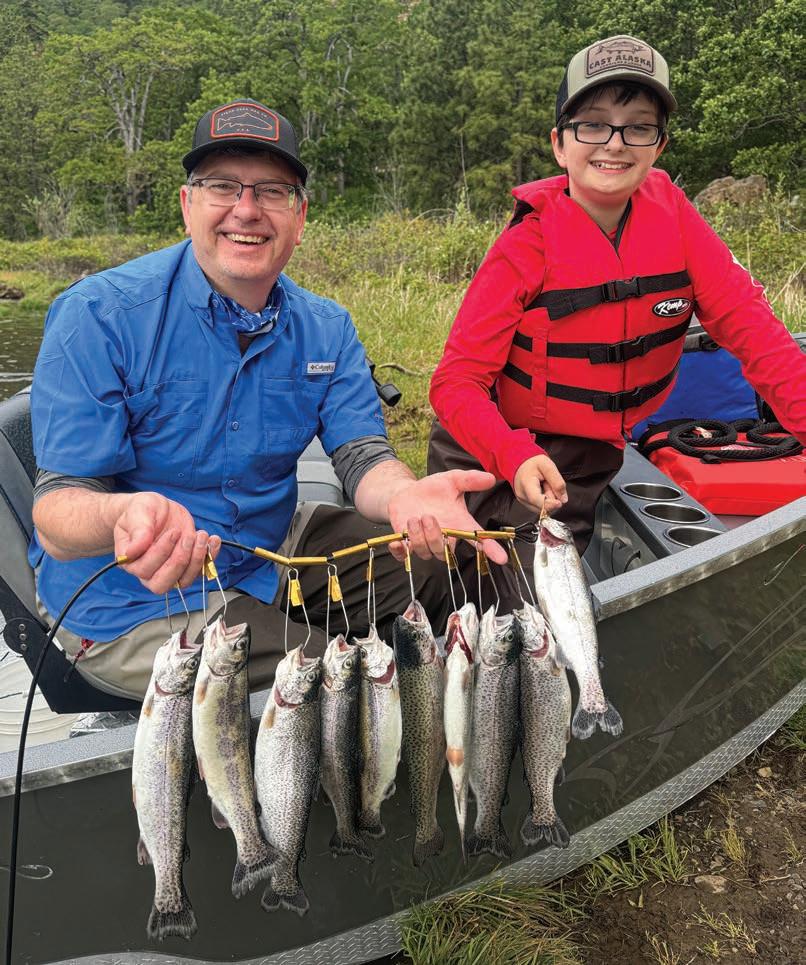
Michael Hass and son Sebastian show off a limit of fat trout taken last spring while still-fishing PowerBait and trolling SpinFish lures. Heading to the lake set up to fish multiple different methods will make for a more productive outing. (BUZZ RAMSEY)
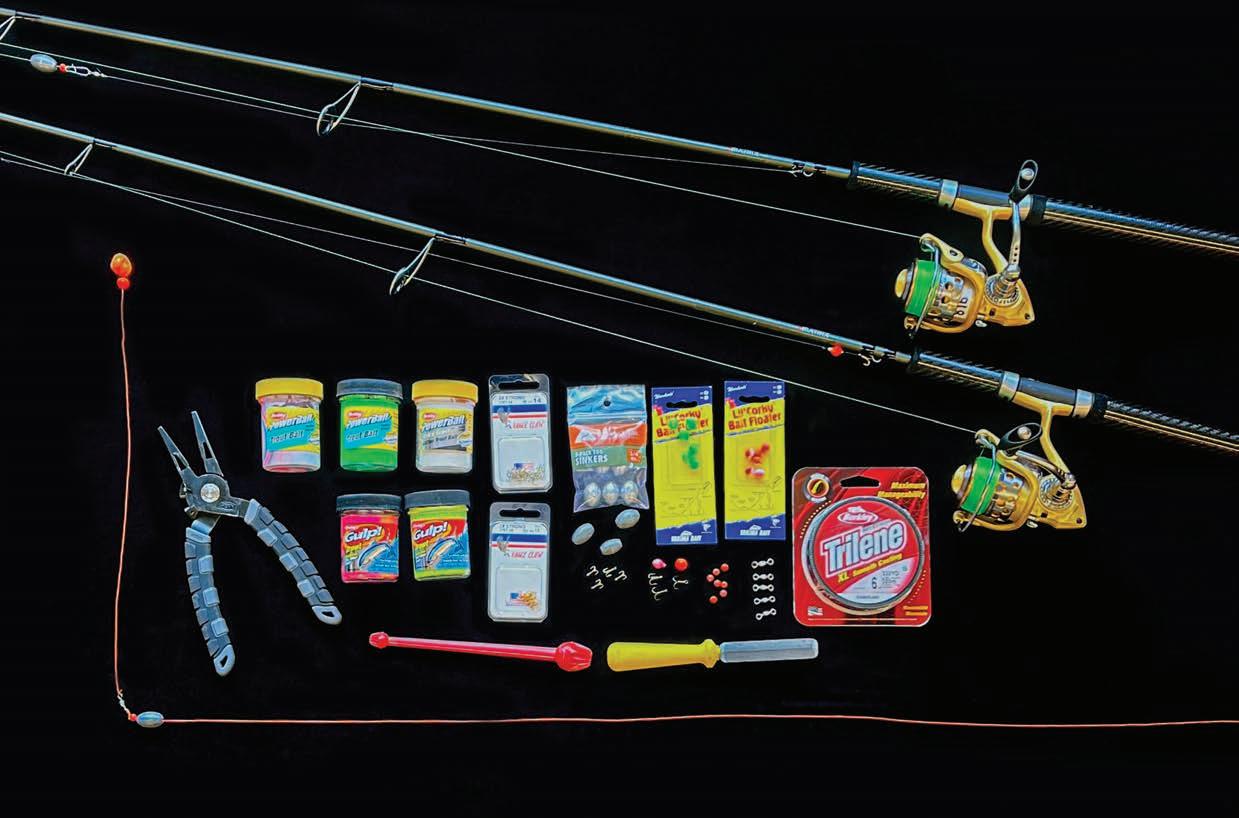
Above are some of the basic items you will need for still-fishing PowerBait. In addition to a rod and reel filled with 6- to 10-pound-test monofilament fishing line, you will likely need a pair of pliers, hook file, dehooker, small treble hooks, oval egg sinkers, small plastic beads, swivels, 6-pound-test leader and selection of PowerBait, which might include a jar or two of Berkley Gulp! Colored line was used for illustrative purposes. (BUZZ RAMSEY)
boat allows you to access the entire lake, catch trout while fishing PowerBait, cast spoons and spinners, and troll around while trailing spoons, spinners, plugs and/or bait. I’ll cover them all in this article.
HOW TO RIG AND FISH POWERBAIT
PowerBait, sometimes referred to as dough or trout bait, really works; so good, in fact, that it has surpassed worms as the most popular bait used by trout enthusiasts. It comes in jars and has a similar feel and texture as wood putty. And while there are similar products available, according to my experience, none are as effective as those marketed under the Berkley label.
Rigging up is as simple as threading your mainline (extending from your rod tip) through the hole in a ½- to 1-ounce oval egg sinker, adding a 4mm plastic bead on your line and then attaching the end to a size 10 barrel swivel. After doing this, attach a 20- to 30-inch leader
to the other end of your swivel complete with size 16 treble hook. It’s then that you mold a dime-size ball of PowerBait (Berkley Gulp! trout bait works too) around your hook and cast the works into a lake recently stocked with trout.
Fundamental to success when using dough/trout bait is to use enough buoyant PowerBait to float your hook above bottom so cruising trout can quickly find it. Doing this will make your offering much more effective than a nonbuoyant offering lying on the bottom that might take fish an hour or more to find.
To ensure that your bait will float above bottom try adding a Lil’ Corky single egg imitation to your rigging. Simply thread a small Corky onto your leader above your hook. The smallest Corky, a size 14, is what works, and its buoyancy may allow you to step up to a size 12 or 14 treble hook.
And while still-fishing means just what it says – cast out and allow your outfit to
sink to the bottom and wait until a fish bites – you will need to set the hook when the fish does bite. In case you are a parent who hasn’t fished before, setting the hook is the motion of pulling back on your rod tip such that the hook will become embedded in the fish’s mouth or lip.
It’s important to leave a little slack in your main line after casting into the lake so trout can swim and swallow your bait without feeling the resistance of a taut line – that’s the reason we’ve suggested using a freesliding, oval egg sinker rather than a weight fixed onto your line. When you or your young angler see the slack in the line begin to tighten up, set the hook by pulling back on the rod tip.
FISHING SPOONS AND SPINNERS
Another method – and this one works from shore or boat – is to cast and retrieve spinners. Trout are attracted to spinners (like a Rooster Tail) due to their size, color,
COLUMN
flash and vibration. While the above factors all play a role in attracting hungry trout, spinner vibration is often credited as the key to spinner appeal.
In lakes, most anglers searching for trout cast and retrieve spinners while working their way around the edges, which can be done from shore or a boat. By changing locations, you are constantly covering new water where hungry fish may be lurking.
And while you may retrieve your spinner a little faster when searching for trout, once you locate them, slow down your retrieve speed and try bringing in your spinner (or spoon) at different depths. This is a time when trying different spinner sizes and colors might up your rate of success, as trout can be finicky about what they will respond to. Some of the more popular spinner colors include yellow, chartreuse, white, brown, black or green. The most productive sizes are generally in the 1/8- to ¼-ounce range.
One thing that has upped our success when using spinners is to tip them with a short section pinched from a scent-filled worm, like the 3-inch PowerBait or Gulp!
worm. And while different worm colors can work, what often adds to our spinner success is to hang a 1/2-inch section of a dark red- or black-colored worm from one prong of the treble hook – just let it hang straight back.
Spoons can be fished the same way. One I’ve had a lot of success with is a Thomas Buoyant Minnow in the 1/6-, 1/8- or ¼-ounce size. You can tip spoons, too, but realize that adding too large of a worm section can interrupt the action, so keep your tips small with spoons, or just rub some Pro-Cure gel scent on it.
TROLLING FOR TROUT
When it comes to trolling for trout, there exists a whole host of fishing strategies and lures that work. One of our favorites, especially early in the season when many trout can be found near the surface of lakes, is to slowly troll a small FlatFish plug 40 to 60 feet behind our boat.
Although we’ve caught trout on larger FlatFish, sizes F-4 and F-5 are our favorites. We just troll them on a flat line, meaning we rig this small plug on our main line with no additional weight added. What
always works best for us is to troll slowly; we are talking really slow when using the small FlatFish sizes – .5 mile per hour or so should be your average speed.
It’s when the sun is bright that we might add a size 5 split shot a few feet up the line from our FlatFish or switch to a deeper diving plug like a 2.0- or 2.5-size Mag Lip. This is because trout, not having eyelids, can only control the amount of light entering their eyes by location, which is why they will often be found deeper in the water column when the sun is bright.
You can troll faster when towing a Mag Lip. And while the small 2.0 and 2.5 sizes will handle current speeds up to 2 mph, you might find better success keeping your speed in the 1- to 11/2-mph range. A faster trolling speed can sometimes add to your success, especially as the water warms with the season, as you can cover more water in a shorter amount of time.
A relatively new lure we have had a lot of trout trolling success with is Yakima Bait’s SpinFish. This is a pull-apart lure that you can separate the halves and stuff the body cavity with any bait or scent. To rig just snell a 30- to 40-inch leader onto a
This rainbow trout was taken while casting and retrieving a Thomas Buoyant Minnow. Spoons and spinners are good bets from both the boat and bank. (BUZZ RAMSEY)
single hook (two single hooks snelled in tandem works too) setup and add one or two small beads before threading your leader through the small holes in the tail and front sections of the lure.
While you can troll your SpinFish in combination with a trolling sinker placed 30 to 40 inches away, we usually rig it in combination with a lake troll. Our favorite lake troll is a standard size Cowbell. We mostly use canned tuna fish to stuff into the bait chamber but have had luck using PowerBait, Gulp! Single Eggs and chunks of store-bought precooked shrimp too. NS
Editor’s note: Buzz Ramsey is regarded as a sportfishing authority (as related to trout, steelhead and salmon), outdoor writer and proficient lure and fishing rod designer. Buzz built a successful 45-year career promoting gear related to Northwest and Great Lakes fisheries during his tenure with Luhr Jensen, Pure Fishing and Yakima Bait. Now retired, he writes for Northwest Sportsman and The Guide’s Forecast.
A SpinFish is a pull-apart trolling lure that you can stuff with any real or prepared bait like PowerBait. (BUZZ RAMSEY)
Watch Water Temps For Willy Chinook
Your monthly Oregon fishing outlook provided by The Guide’s Forecast.
By Bob Rees
With the onset of April, spring Chinook take front and center for anglers throughout the Portland/Metro area. A bevy of options exist, but with Columbia River seasons volatile, most anglers are focused on the tens of thousands of springers headed up the Willamette River, typically peaking around the third week of April. The dynamic has changed,
however. Although April remains the statistical peak for spring Chinook success, changes in water temperatures throughout the Columbia Basin have shifted the run timing for both Upper Columbia-bound salmon and those in the Willamette Basin as well.
NONETHELESS, EFFORT AND catch peaks this month, with trollers working the Willamette from Milwaukie downstream to the mouth of the Multnomah Channel in St. Helens. Most
choose to troll herring in the green label size, either in cut-plug or whole herring form. Flashers are often incorporated into the rigging, as the Willamette is a big body of water and fish have to find your gear before biting it.
As a general rule, trollers working water deeper than 30 feet will run their gear in the upper 20 feet of the water column. Using lead in the 10to 12-ounce range, fish shallower at first light, say, 12 to 24 feet on the linecounter, and then work your way
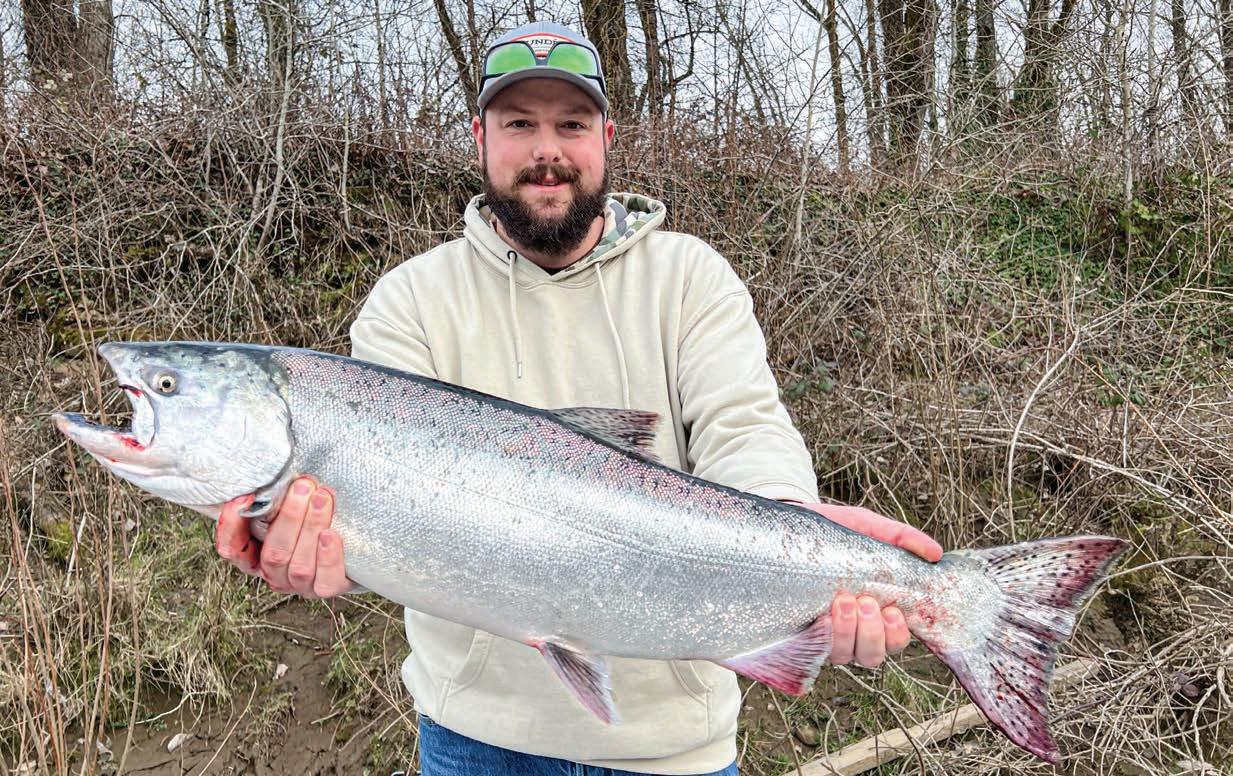
Blake Finnegan shows off a bright spring Chinook caught early last month on the Willamette River. April is traditionally the peak of the fishery, at least in terms of raw catches and angler effort. It attracts attention well beforehand and looooong after this month. (VIA THE GUIDE’S FORECAST)
FISHING
deeper as the day progresses. After about the first hour of daylight, trollers work the 14- to 30-foot range on their linecounters, adjusting depths based on what their fish finders are telling them.
It’s a gentlemen’s fishery, but keep a watchful eye on your fellow trollers while covering as much water as quickly as you can to up your chances for a successful interception. Trolling in a zig-zag manner will increase your reach.
In periods of low flow, the highest success rates take place in the lower Multnomah Channel around St. Helens. Following a bump in water levels, the Oregon City area will turn on for hogliners, back-trollers and back-bouncers. As flows subside, so will success rates for anglers in this reach of the Willamette.
TECHNIQUES MAY CHANGE based on water temperatures. When the Willamette hits 57 degrees, anglers will often switch from using bait (eggs, coon shrimp and sand shrimp) to hardware such as spinners, wobblers and plugs. Eggs fish best around 53 degrees, but
after that, trash fish get more active and rob you blind, making it hard to get your bait in front of a willing Chinook.
One further dynamic impacting success rates is spring spill on the mainstem Columbia. When flows increase, the Willamette actually backs up, slowing flow through the Portland Harbor, depressing angler success. There’s nothing we can do about that but fish early in the morning as well as around the high tide, times when the salmon are most likely to bite.
While spring Chinook will remain the focus for most anglers, Skamaniastrain summer steelhead start to enter the Sandy, Clackamas and Willamette River systems, providing another good opportunity for a high-quality fish. While occasionally intercepted by trollers in the springer fishery, this is when bank anglers get a fair chance at success, as steelhead tend to travel closer to the river’s edge for Meldrum Bar plunkers, as well as bank anglers on the Clackamas and Sandy. These fish are incredible fighters and second in flavor only to spring Chinook.
In Southwest Washington, the Drano Lake and Wind River fisheries are also peaking, providing high-quality springers in very crowded situations. This fishery is not for the impatient angler; with the crowds, it can be intimidating but also offer up good results well into May. Trollers fish spinners and coon shrimp for best results.
WILLAMETTE VALLEY LAKES get robust numbers of stocked rainbow trout that can be harvested under ideal conditions. This is a fishery built for beginners, with high success rates and excited young anglers getting their “gateway” experience into better opportunities ahead. For the stocking stats and release schedule, see myodfw.com/fishing/ species/trout/stocking-schedule.
It’ll be another month before high lakes trout and kokanee fishing kicks in, but with a low snowpack this year, April opportunity may bring about some early success on both fronts. NS
Editor’s note: For more information, visit TheGuidesForecast.com.
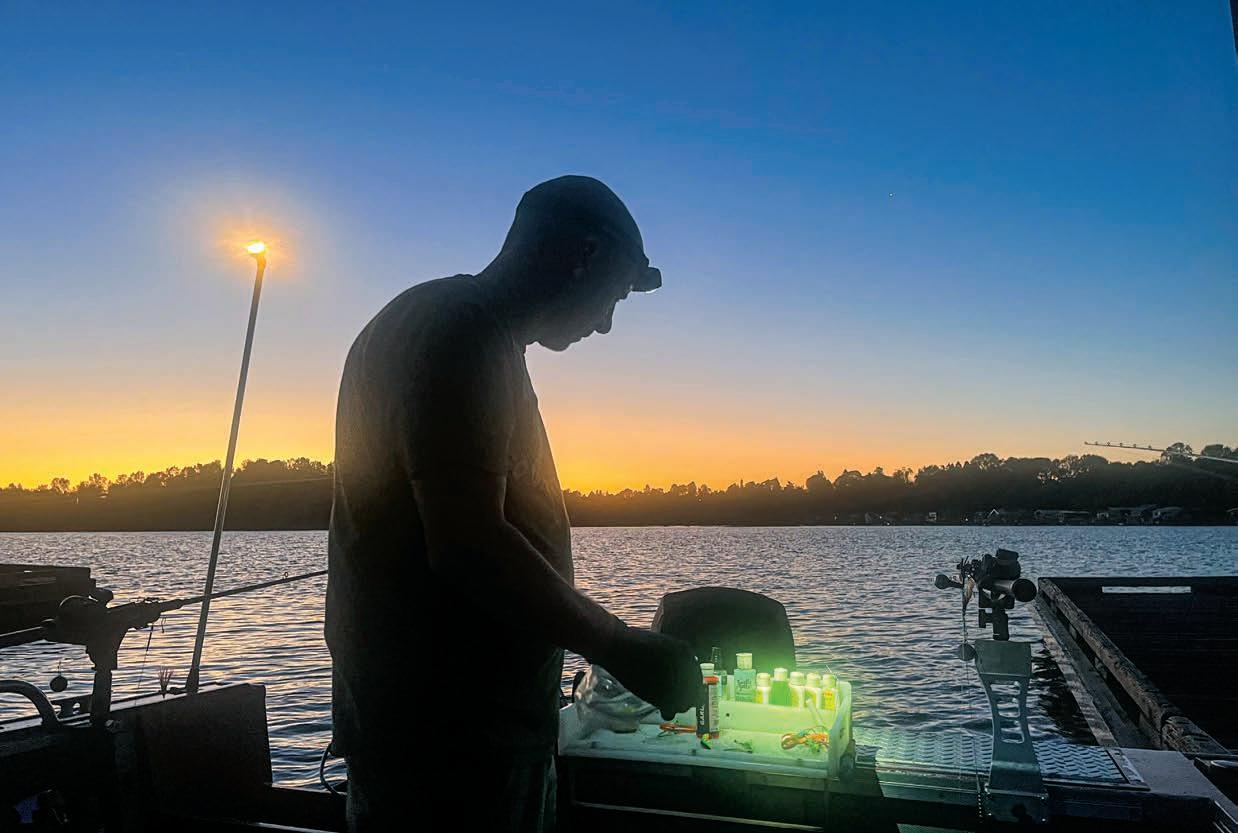
Guide Stephen “Spicy” Gettel prepares for an early departure for Willamette springers. Water temperatures best determine what to troll, with herring good in early cold flows, followed by eggs and shrimp as the river warms, then hard baits such as spinners and stuffer baits at 57 degrees and up.
Horn In On ‘Controlled Chaos’ Kings
YBy MD Johnson OUTDOORS MD
ears ago when I first moved to Washington, say, 1993 or ’94, I had a 16-foot Smoker Craft Alaskan, a young girlfriend (who’s been my wife for 27 seasons now), time on my hands and a hankering to learn this Pacific Northwest salmon fishing thing. So one day, we hooked up the boat and made the short drive to Cedar Creek on the North Fork Lewis River, a wildly popular fishing hole I’d later find out was affectionately called the Meat Hole. Well, there I was on the upper road
looking down onto this so-called Meat Hole. What I saw were boats. Bank to bank boats, all jockeying for position on what I considered a wee little stretch of river. An aluminum bridge from one side to the other.
A Midwestern crappie fisherman, I’d not seen nor heard anything like it before. Never. Trolling motors spinning semisilently. Voices. Metal against metal against the occasional wooden hull.
I stared, dumbfounded.
Finally, Julie broke the spell. “You,” she said quietly, “don’t have the personality for that.”
And with that, I dropped the F-150 into gear and we drove to the Woodland AM/ PM, where we bought 69-cent hamburgers
and sodas, and where my blood pressure stayed close to 120/80.
She was right, you know. I didn’t have the personality needed to fish the Meat Hole on the Lewis in 1994, and I still don’t today. I love to fish, yes, but I’m anti-social on my father’s side, so that sort of closequarters angling, otherwise known as combat fishing, isn’t my style. Which is why I am both intrigued by and yet view from a distance the spring Chinook fishery offered at the infamous Drano Lake in the Columbia Gorge.
BRIEFLY, FOR THOSE not familiar with Drano Lake – though if you fish springers
A prawn spinner is a popular option for spring Chinook at Drano Lake, and guide Shane Magnuson likes size 3.5 or 3.0 Hildebrandt blades and other options ahead of his bait, which is rigged on a single hook with a treble trailer. (UPPER COLUMBIA GUIDE SERVICE)
COLUMN
and don’t know of it, you need to spend more time outside – the lake, per se, was at one time a bay on the north side of the Columbia River just above the hamlet of Cook, Washington, and an open-water estuary, we’ll call it, at the mouth of the Little White Salmon River. In the latter part of the 1800s, a levee was constructed that essentially cut off the bay from the mainstem Columbia, upon which was built Highway 14 and a rail line. A narrow inlet to the newly formed lake was left at the downstream end, through which salmon, both spring fish and fall, access the US Fish and Wildlife Service’s Little White Salmon National Fish Hatchery, a facility founded
in 1898 and ranking as the Columbia’s oldest hatchery.
Anyway, Drano Lake and spring Chinook. A tremendous fishery, one that attracts outfitters and anglers from throughout the Pacific Northwest. One of these is Shane Magnuson, a nearby Home Valley, Washington, resident and owner/operator of the well-respected and successful Upper Columbia Guide Service, as well as a thriving associated venture, Northwest Bait & Scent. Magnuson knows springers, and Drano Lake kings, like nobody’s business, and I was fortunate to catch him and Jarod Higginbotham, the public relations/social media guru for the
Yakima Bait Company, in the hour before their day began at the recent Central Oregon Sportsmen’s Show in Redmond last month. Magnuson had these words of wisdom for those looking to cash in on Drano Lake kings this spring.
Northwest Sportsman Describe the Drano Lake spring fishery in two words.
Shane Magnuson “Controlled chaos” would be a good way to describe Drano. It gets busy, but it’s fun and there’s a nice run of fish to catch.
NWS How important then, Shane, is patience to Drano success? I’m sure having the right gear, the proper presentations and highly coordinated boat handling skills are important, but in a world that is your “controlled chaos,” where does patience fit in?
SM Patience is the biggest key to these fisheries here in the Gorge, especially at Drano. And it starts right with your morning routine of heading to the boat launch. Give yourself plenty of time, and understand that everybody is doing the best they can getting their boat in, their gear ready and the morning started. If you can exercise patience, you’re going to have a good time. Being in a hurry and getting frustrated makes it tough.
NWS True or false then. If an angler’s new to Drano or is not the most capable captain or doesn’t know what they’re doing on Drano specifically, it’s perhaps best to go with a guide?
SM It’s a good learning experience, for sure. But on the other hand, there’s no better way to learn how to run your boat than to be in your boat running it. What I tell people, folks who are coming to Drano (for that first time), is to just wait until after the morning rush and then work your way into the situation. After that morning crowd is gone and they’re out on the water, use the daylight to your advantage to get things going. It’s a fishery that sees fish coming in off and on all day long and bites all day long, so there’s fish to be caught even in the afternoon.
NWS Drano is known as a boat fishery, but there is a bank-based springer fishery available near the highway bridge, yes?
Drano is a hugely popular springer fishery, and this year’s forecast is for 11,300 of the salmon back to the lake, well above the five- and 10-year average returns. For those who can handle the “controlled chaos” at the Toilet Bowl end of the lake and busy ramp, the reward is nice kings like this one held by a Magnuson client. (UPPER COLUMBIA GUIDE SERVICE)
What makes Westport Charter Boats so special?
We offer world class fishing with expert crews, right on the edge of the Pacific ‒ where you’ll reel in big catches, meet new friends and make unforgettable memories.
We’re a new office in Westport, with familiar boats, dedicated skippers and great deckhands. A variety of boats to choose from to suit any size party, or individual anglers on mixed trips. We strive to offer fishing for any budget with a little planning.
Mutineer Charters opened in 2024 with six boats from 38 to 55 feet and capacities of 6 to 18 anglers.
Our skippers have over 180 years of combined experience and are known to be some of the best in the business. Whether you prefer a large comfortable boat that can accommodate large groups or private parties, or a smaller “express trip” boat that still has all the safety equipment and a stand up head like our big boats, we’ve got you covered.”
Meet the Mutineers
Mike – Fury
Ben – Gold Rush
Dave – Hot Pursuit
Karl – Reel Electric
Rhett – Slammer
Johnny – Stardust
COLUMN
SM There are times when the bank guys do well. I occasionally will wander down after my guide trips to throw a few casts and do something different. If the Columbia is open, the guys plunk outside (the bridge) with bait and Spin-N-Glos. The guys inside are casting Mag Lips and spinners, and they do catch some fish.
Author's note: There is an established boundary on the inside of the Highway 14 Bridge that designates that particular section of Drano as “Bank Fishing Only,” or no boats. Sometimes, I’m told, it works; sometimes, I’m told, not so much.
NWS Do you have a go-to rigging when you’re fishing Drano? Something that’s tried-and-true and has consistently
Magnuson’s other go-to here is the Yakima Bait Cut Plug, which he tested for multiple seasons. “... Day in, day out, it’s a solid fish catcher,” he says. (UPPER COLUMBIA GUIDE SERVICE)
produced over the years?
SM There’s really two of them. I like to troll the Yakima Bait Cut Plugs. I’ve been testing and running in Drano for quite a few years now, and day in, day out, it’s a solid fish catcher.
The second one, and one that’s seen on a lot of boats, is the prawn and spinner rig. A Hildebrandt blade with a shrimp behind it. Various colors. Super effective in the spring in Drano.
NWS And you’re running those riggings on what type of gear?
SM There’s a couple different rods out there for that 360 (flasher) fishing that are really effective in making that flasher run correctly. I’m an Edge Rods guy, so I run
an Edge 360 Pro rod, either a 9-foot-2 or 10-foot-6 length. Those run the Pro-Trolls really well when it comes to getting the action right. I put a Daiwa size 20 Saltist reel on those rods, spooled with 50- or 65-pound – whatever your preference might be – P-Line EndurX. That EndurX line has been great.
NWS Do your techniques or your presentation change as the morning progresses at Drano?
SM You know, they do change. We start mornings often with the Cut Plugs that I mentioned earlier. It’s a more aggressive type of fishing. Trolling a bit faster.
But as all the boats get onto the water and those fish get beat on a bit and start losing buddies, you have to start using more finesse. We’ll downsize the majority of the gear then to those prawn spinners with the 3.5 Hildebrandt blades, or sometimes even a 3.0 Hildebrandt blade, in order to finesse those fish and keep that bait right in front of their noses. You’ll see the bite adjust off and on throughout the day, and it has a lot to do with how many people are in there too.
NWS Drano, Shane, isn’t very deep. Say, 40 feet by the bridge and 30 feet, more or less, overall. Are you experimenting with water depth as you troll; that is, you’re running different rods at different points in the water column?
SM Yes, and especially first thing in the morning. I’ve found those “Drano fish” will come out of the Columbia and into the lake, where that water is typically a little colder than the Columbia itself. And those fish will suspend, and we’ll catch a lot of fish that are only 12 to 18 feet down. They’re suspended up high.
But as the day goes on, things warm up, and you have a lot of boats on top of those fish, you’ll start to see them sink down and hug the bottom a little tighter.
THERE YOU GO, a crash course; Drano 101 (with a bit of Drano 102) for spring Chinook. If you go, remember that a permit is required to launch here. They’re available online (skamaniacounty.org) and locally.
Until next time, get outside and do something. Anything. Doctor’s orders. NS
Springer Tactics For Slower Waters
Hover fishing versus back-bouncing in the tributaries.
By Trevor Torppa
Hover fishing is probably familiar to most of you Chinook anglers who fish bigger tributaries, as well as some fisheries within the Columbia River itself. Hover fishing is often used in areas where there is very little to no
current, or if there is current, you let it drift your boat as your bait follows along directly underneath.
The hover fishing rig consists of some sort of a three-way setup along your main line, or a slider for your weight. The weight is something that you will have to play with while figuring out this technique, as each
spot may have a different depth, current, etc. Off of your three-way swivel or slider for your lead, you will have a short leader around 30 to 45 inches, with a couple big Corkies pegged in the middle of the line, or slid up against your offering.
For bait, since we usually are hover fishing within a river mouth,
It’s not all trolling for spring Chinook. When the year’s first salmon hit the tributaries, work deep, slow-moving waters vertically or by slowly backing a bait downstream, techniques known as hover fishing and backbouncing. (CHROME CITY
GUIDE SERVICE)
FISHING
“When everyone is on the same page, and a system is developed within a group while using both of these techniques, it can be a deadly combination for both success and fun,” writes author and guide Trevor Torppa. (BEN HOWARD)
or in the actual river, using salmon roe and other things such as sand shrimp or chunks of any baitfish works extremely well.
The basis of hover fishing is fairly easy: Drop your bait to the bottom of the river directly under the boat and reel up two to three cranks on the reel to be slightly above the contour of the bottom. Sometimes these fish are suspended, so finding a specific depth also may be crucial whether you have a Livescope or not. Using a linecounter on your rod is another thing that may increase your odds while hover fishing, as you are able to decipher where the bulk of the fish are and be able to get down to them consistently.
Another key factor while hover fishing can be the length and action of your rod. The lighter the tip, the better when hover fishing, as being able to detect a strike while you have a lot of line out can be hard, especially the way these fish like to bite sometimes. Although a soft tip is crucial, a lot of backbone is also critical due to the fact that these are
usually Chinook that we hover fish for and they typically fight fairly hard. Other than that, the only other thing you will need to know is where to use this technique.
HOVER FISHING WATER
Whether fishing tributaries big or small, you can always tell a good hover fishing spot. A great spot to start is by learning the layout of the hole itself. Ideally, a slow-moving corner of the river that has some depth is a good place that fish will tend to hang out and it can be very effective to hover fish here.
When picking your spot, scour the edges of the hole, picking apart the different depths and ledges within the hole where the fish could possibly hold better. From there, find a good starting point and drop your gear to the bottom and come up a couple cranks and wait for a bite. A lot of times within these holes there is very little to no current flow, so being able to run the boat with either your motor or oars is fairly easy. If there is any current, be sure to move with it,
as you want your gear directly below you in this type of fishing.
If you want to hover fish in a spot that isn’t particularly slow moving, you may have to use a heavier lead to stay under the boat as well as just off the bottom of the river where the fish are. When you start getting into holes where the flow increases and hover fishing becomes harder and harder, this is where back-bouncing takes over as your go-to technique.
BACK-BOUNCING BASICS
Back-bouncing is very similar to hover fishing. You can use the same exact setup, same rod and reel combination, and the same baits. The only difference is where you are fishing and what type of water you are in.
Back-bouncing was created unintentionally on the Rogue River while fishing for king salmon. What they would do was drop their gear to the bottom and slowly float downstream, going from side to side bouncing their weight off the bottom occasionally to keep from hanging up on rocks. This technique was usually
UNION GAP Demo Rides
North River 228 Pursuit
FISHING
done via drift boat, making it very technical and exhausting for the oarsman running the boat.
That was until a boat decided to use a lighter weight and essentially “walk” their gear back into the hole from anchor. They caught a fish and proceeded to do this technique, which later was named back-bouncing.
Back-bouncing, therefore, can be done while anchoring above a specific hole where you know fish may lie, or it can be done while the captain positions the boat in the middle of the run and slowly moves back through the entirety of the hole. Either way works, but a lot of the time anchoring above a desired location and working your gear back is the preferred option.
This method is all up to the angler, not the captain. The angler must know what the weight hitting the bottom feels like, and they also have to know how to let the correct amount of line out with each lift of the
rod. The presentation we are trying to get with back-bouncing is a slow drift throughout the run while making sure your bait is right on the bottom where the fish lie. The amount of lead you use is very crucial in this type of fishing, as you have different currents and different depths. The heavier the flow, the more lead; the deeper the hole, the more lead. It is all based on feel; back-bouncing is an art form of sorts that only certain anglers can partake in.
WHEN TO CHOOSE WHICH TECHNIQUE
As a fishing guide, I have to be able to decipher when to hover fish and when to back-bounce. A lot of this decision is made based on the anglers’ skill set. Hover fishing is a very family-friendly way of targeting these salmon: Simply send the bait to the bottom, come up a couple cranks on the reel and wait for a bite. Backbouncing requires the angler to pay
attention to where they are within the run, making sure they are on the bottom of the river and out of everyone else’s way.
At the end of the day, it is not a big deal to spend time teaching whomever it may be to do whatever it is we need to do to succeed while fishing. But for the sake of writing this for people who may not know, I wanted to explain the difference between these techniques from both a fisherman’s perspective and a captain’s perspective. When everyone is on the same page, and a system is developed within a group while using both of these techniques, it can be a deadly combination for both success and fun. NS
Editor’s note: Trevor Torppa operates Chrome City Guide Service (360-7518748; chromecityguideservicellc.com) in Southwest Washington and Soldotna Fishing Guides – Kenai River LLC (soldotnafishingguides.com) in Alaska.
charters & Guides
charters & Guides
Wallowa Kokanee
The Northeast Oregon lake is a long haul, but well worth it for spring fishing and more.
By Tom Schnell
As we entered the quaint Northeast Oregon town of Joseph we were reminded of why we make this annual trek to fish renowned Wallowa Lake. This pristine 1,500-acre lake was formed through glacial activity and is nestled in the foothills of the Wallowa Mountains. With a depth of nearly 300 feet, the lake is the home of some prize-sized
kokanee, with the world-record 9-pound 6-ounce fish coming from here in 2010. Although fish are not being caught at this size anymore, 4and 5-pounders still can be had.
The fact that the lake still produces large fish, along with the serene setting and the friendly atmosphere of the surrounding towns continue to draw us to make the nearly ninehour drive. For us it is worth it, even though we live in the center of some
of the most amazing kokanee fishing in the state.
While Wallowa Lake is remote, Joseph and the nearby town of Enterprise have most of what we need to make our stay comfortable. There are many RV parks and Airbnb rentals in the area, although our favorite is still the state campground on the south end of the lake. During and after Memorial Day reservations go fast due to the popularity of
Beckon
this well-cared-for and clean campground. The park staff does an amazing job of maintaining the park. If camping is not your forte, there are many lakeside house rentals, some featuring their own private dock. There are also some motels in Joseph that can offer lodging for shorter stays.
EARLY IN OUR stay, we chose to hire Kevin Anderson with Next Level
Guide Service (541-974-1135), as he, along with Curtis Hyde of Hydeout Guide Service (541-936-4736) are two of the most well-known and knowledgeable guides on Wallowa Lake. Even though we have our own boat, we had gone with Anderson the previous three years, as he not only puts us on fish, but he is also a great teacher, showing us the small little tricks that make this fishery a very technical one. We seem to learn
something new every time we go with him. We also enjoy having a nice prime rib dinner with Anderson and Hyde at the Stubborn Mule in Joseph on Saturday nights, as that is when the stories really come out.
Every year that we have fished Wallowa Lake, it has taught us something new. The one consistency is the high quality of kokanee the lake puts out. The fish provide brightorange filets and some of the best-
Tucked into a stunning valley under the northern face of nearly 10,000-foot-high mountains, Wallowa Lake serves up solid spring fishing for kokanee, author Tom Schnell and wife Rhonna have found. They make annual trips this time of year to get in on the action. (TOM SCHNELL)
FISHING
tasting kokanee we have ever had. Their diet of mysis shrimp enables them to grow to trophy size and the cold, deep water gives the fish an incredible table quality of meat yearround. My wife Rhonna outfished me again this trip, landing her personal best, a 21-plus-inch, 3 1/2-pound kokanee. It definitely put her to the test for handling a runaway fish!
Last spring’s weather varied from freezing, wet and windy to hot and dry. The water temperature went from 47 degrees to 57 degrees in the two weeks we were there. The bite also changed. The first few days we were consistently catching 14- to 17-
inch kokanee with the occasional fish over 20 inches. As the days went on, the fishing slowed and the bigger fish were harder to find. There are many theories on why this is: change in weather, fishing pressure, activity on the lake due to Memorial Day and many others.
One thing we observed is that the Oregon Department of Fish and Wildlife plants stocker rainbow trout the week before Memorial Day. Whether or not these planters have an impact on the kokanee fishing is up for debate, but with their presence, it is hard to hook a kokanee while fighting off the trout. We also noticed
that the larger kokanee were scarcer to come by as well. After Memorial Day, with the trout having time to disperse throughout the lake and many having been caught by then, the fishing slowly started to pick back up.
For prime fishing, though, late April and early May seem to be the best times to fish it, although the weather can be iffy. Last year we experienced some cold mornings and wind-driven snow early on as we tried to ply the waters for the trophy fish we were after. It seemed like the nastier the weather, the better the fishing. As the weather turned nicer, the fishing did not.
THE TIME OF day that we did best varied. Sometimes there was a hot bite before the sun hit the water; other times it was midday before the fish decided to play. We also found that an evening bite was to be had on hot, sunny days. On those bright sunny days, we found the fish close to shore and in shallow water early in the morning, but as the day drew on, they seemed to move offshore and go into deeper water.
The one consistency, though, is that we found them high up in the water column. The larger ones were also dispersed; if we found a large school, it was usually smaller 10- to 12-inch fish. Many times, the larger fish would not show up on the depth finder, indicating that they were higher up in the water column and potentially shying away from the boat. But they were there.
Productive lure colors varied from day to day, but the standard pink, orange and red consistently caught fish. We never had much luck on chartreuse. The normal kokanee trolling speed of 1.2 to 1.4 miles per hour did the trick, and most of our fish came on rigs behind Arrow Flash dodgers. Short leaders in the 8- to 10-inch range also seemed to work better than longer ones. Tuna and garlic corn were our go-to scents.
We found that both the Wallowa
It’s been more than a decade and a half since Wallowa cemented its place as the king of all kokanee producers with the world-record 9.67-pounder, but personal bests are still very possible. Rhonna caught her PB 21-plus-inch, 3.5-pound koke while fishing with guide Kevin Anderson last spring. (TOM SCHNELL)
charters & Guides
FISHING
Lake Marina, located on the south end by the boat launch, and the Sports Corral, in downtown Joseph, stock some kokanee and other fishing gear tailored to Wallowa Lake if you forget something. The staff are friendly and eager to help out.
ONCE WE FINISHED our time on the water, we were able to explore the many things around the Joseph area. The tram and the hikes around the top of Mount Howard offer a breathtaking view into the Eagle Cap Wilderness to the west and south, along with Hells Canyon and the Seven Devils in Idaho to the east and the Wallowa Valley to the north. On the ride up and down we could see how Wallowa Lake was formed by a glacier flowing out of the mountains, creating the moraines that dammed up the lake. We also saw the many waterfalls and streams cascading from the various peaks to provide the cold, clean water that the kokanee and all salmonids thrive in.
An ample diet of mysis shrimp makes for plump, deep-orange-meated kokanee. Late April and early May are top times to fish the lake, though you’ll want to go prepared for inclement weather. (TOM SCHNELL)
The lake is also stocked with trophy and legal-size rainbows ahead of Memorial Day Weekend and afterwards in June, July and August. The trout make it a little harder to get down to kokanee, the Schnells have found on their outings on this destination getaway. (ANDY WALGAMOTT)
FISHING
Once we were done with our scenic gondola ride, we headed into town for some great food, including a stop at Arrowhead Chocolates for some locally made chocolate and a cup of coffee. We also visited the Wallowa County Museum, which was a great history lesson in what life used to be like in that section of Northeast Oregon. We could have spent all day there and would still have missed things. Fortunately, there were some volunteers there when we visited to help us find some interesting artifacts that we had passed over.
Although most of our meals were either out on the boat or cooked over the campfire, three restaurants that are our favorites are the Blythe Cricket in Joseph for breakfast, Saturday night prime rib at the Stubborn Mule in Joseph, and Leo’s Mexican Bar and Grill for lunch or dinner in Enterprise. Joseph and Enterprise are well renowned for their bronze art casting factories and galleries as well. As we drove through Joseph we were able to appreciate many of the sculptures on the street corners. A trip to the Wallowa County Farmer’s Market in Joseph on Saturday proved
to be a great opportunity to pick up some fresh local produce, along with making some new friends.
We also enjoyed picking up a new-to-us sport – geocaching – that friends introduced us to. We found several geocaches right around our campsite and then others dispersed throughout the surrounding area. We may be hooked now, as this led us on yet another adventure – a tour of the many elegant barns located throughout the valley as we went about looking for hidden treasures.
Our final nonfishing excursion was to drive to the overlook of Hells Canyon, a breathtaking view of the deepest canyon in the US. The drive was along a winding Forest Service road and brought me back to the area I used to hunt many years ago.
OUR TWO WEEKS at Wallowa Lake were filled with some fantastic fishing and adventures shared with family and friends. It is a trip well worth doing, as Wallowa County and the cities of Lostine, Wallowa, Enterprise and Joseph offer a variety of adventures outside of fishing. We found the Northeast Oregon enclave
to be beautiful, earning the nickname “Little Switzerland.” The locals are friendly, the atmosphere relaxing and the kokanee fishing is world class. We will be back.
Tight lines and fish on! NS
Editor’s note: Tom Schnell is an avid outdoorsman who lives with his wife Rhonna in Central Oregon. He is a past board member of Kokanee Power of Oregon and a past local Ducks Unlimited and Oregon Hunters Association president.
Northeast Oregon is a wonderland of tall mountains, deep canyons and working ranches and farms, and in high summer, Wallowa Lake is a watersports playground while the nearby towns of Joseph and Enterprise are excellent places to visit and shop. The editor recommends the Saturday farmers market and bronze statues along the main drag in Joseph, named after the Nez Perce chief whose people maintain ancestral ties to this land. (ANDY WALGAMOTT)
KICK ASS BOAT DEAL!
2026 Fish Rite 22’ Sportsman HT
This one FISHES HUGE!! 2026 Fish Rite River Master 20’. Perfect for Puget Sound saltwater and all the river systems that feed it. Equipped with locking rod lockers, two Elite helm seats on slider boxes, bow fish box, bow anchor box, 40-gallon fuel tank, and much more! We have packaged this boat with a Honda 115 HP tiller handle jet pump. Price includes boat, motor, and trailer. You will not find a better quality-built boat at this exceptional price.
$53,950.00 plus Tax, Title, and Neg Document Service Fee
2026 Fish Rite 18’ Angler
Brand new model for the 2026 season. Fish Rite 22’ Sportsman HT. This one has it all: offshore bracket with walk-through transom, huge fish box, full Alaskan cabin, bow fish box/anchor locker, 24” seats with tons of storage, powered by a Honda 200 HP, and a Yacht Club tandem-axle galvanized trailer with swing tongue. These amazing boats are made locally in Grants Pass, Oregon, with some of the finest fit and finish in the industry. Pricing is for the boat, motor, and trailer. This package is thousands of dollars less than most competitors and offers every bit of the quality. Kicker motor and electronics packages available. The absolute perfect all-season boat for the PNW. Don’t miss out on this one!
$89,950.00 plus Tax, Title, and Neg Document Service Fee
2026 Fish Rite 20’ River Master
New center console T-top design for 2026. Fish Rite 18’ Angler powered with a 90 HP Honda outboard, fold-down windshield, front bow box, diamond plate bow guards, rod holders, and so much more. Fish Rite is one of the finest hand-welded, heavy-gauge boat manufacturers around. The design of this Angler, with its reverse chine, makes it nimble on open water and an incredibly stable fishing platform. Several motor options available.
$39,950.00 plus Tax, Title, and Neg Document Service Fee
Perch Of The Pacific
How to get in on the Northwest’s most underrated shore catch.
By Hannah Pennebaker
The salt in the air, the sand squishing beneath your feet, the crashing waves, a fish thrashing on your line … That’s right, we’re talking about surfperch fishing! There’s no better way to spend a day at the beach.
Millions of surfperch school up and hunt for food on the edges of Pacific Northwest beaches yearround. These opportunistic fish put up great fights and taste even better on the grill. You don’t need a boat or expensive equipment to try out this fishery either. You probably already have most of the gear you’ll need! Let’s dive into setups, locations and proven tactics to help you have a successful day fishing for surfperch.
TACKLE AND BAIT
Rigging up for surfperch is simple. Because they do tend to hang out near the bottom, you’ll want to use a leader suited for bottomfishing, such as high-low rig or a Carolina rig. I usually use a high-low rig because I like the possibility of getting two fish at once, but it does use up twice as much bait – surfperch are notorious bait stealers! If you don’t want to tie up a rig yourself, most tackle shops offer pretied ones that work just fine.
The high-low rig consists of – from top to bottom – a swivel, 6 feet of line with two dropper loops evenly spaced, and then a 1- to 2-ounce weight
Author Hannah Pennebaker smiles over a nice surfperch. Unlike many Northwest fisheries, this one doesn’t require a lot of specialized gear – a good salmon or steelhead rod, an easy-to-tie/ cheap rig, 1- to 2-ounce pyramid weight, some bait and you’re good to go. (HANNAH PENNEBAKER)
FISHING
at the bottom. The heavy weights are necessary so that your offering will sink to the bottom quickly and not get tossed around by the surf. I recommend size 2 or 4 baitholder hooks for your dropper loops. The barbs on the hooks will help hold your bait on the hook a little longer. Any style of weight will work.
Carolina rigs are a bit different. You’ll have a sliding weight on your mainline, a swivel, then your 6 feet of leader tied to a hook.
Fortunately for surfperch anglers, these fish aren’t very picky. They are opportunistic feeders and will readily strike most offerings. You can either use artificial bait or cut bait. Grocerystore shrimp, squid and sand shrimp all work great. You can buy sand shrimp at most tackle shops near the beach, or you can dig your own! Just grab a sand shrimp pump and look for holes on the beach. For artificial bait, Berkley Gulp! sandworms are a favorite. It’s best to carry a couple of different colors to see what the fish want that day.
EQUIPMENT
Especially if you’re already a salmon/ steelhead angler, you probably
already have most of the equipment you’ll need to have a fun and safe day fishing for surfperch at the beach. Most salmon/steelhead rods are more than capable of slinging out the weights you’ll be using. Pair your rod with a size 3000 to 4000 reel and you’re all set!
One word of caution, however. Saltwater and sand are hard on reels, and surfperch fishing can be chaotic. Your reel will likely get splashed or even dunked while you’re reeling in fish after fish during a hot bite. I’d recommend investing in a sealed reel or rinsing your reel (including the line) thoroughly in freshwater after use.
If you don’t already have a set of waders, you’ll want to invest in these as well. Neoprene waders are handy to have on those cold, rainy days on the beach. Make sure you have a wading belt in addition to a life jacket, especially if you’re fishing alone. Safety first! Those clam bags that sporting goods stores sell for holding clams work very well for surfperch too. Trust me, when the bite is hot, you won’t want to be running back and forth between the surf and your cooler.
Even after years of surfperch fishing,
I’m still learning new tricks. While I was packing the car after a long day of fishing, I looked over at the anglers next to me and noticed them rinsing off their waders and reels with a pump sprayer, like the kind you’d get at a home improvement store for applying pesticides. I glanced back down at my sand-filled trunk and decided right then and there that I needed to invest in one! Pump sprayers are a game changer for keeping your trunk or truck bed clean.
LOCATIONS AND TACTICS
Pretty much any beach on the Washington Coast will hold schools of surfperch. The Grayland area, Long Beach and Ocean Shores offer miles of coastline with hungry fish. Pick your favorite beach and head out there!
As their name suggests, surfperch live in the surf. You’ll want to wade out slowly at first, until you get used to the pattern of the waves. Never turn your back on the ocean! Once you’ve stood in a few rounds of waves, cast out your line. Wait for your weight to hit the bottom, and then flip your bail. Wait for 10 to 20 seconds, then reel in a few feet. Repeat until you get bites.
(ANDY WALGAMOTT)
FISHING
There actually are more than half a dozen surfperch species in Northwest waters, but redtail and striped may be the most common. The former are more oriented towards sandy beaches, the latter towards more gravelly stretches. (HANNAH PENNEBAKER)
The tricky part of surfperch fishing is that these schools move around constantly. You’ll need to move around as well. Reading the water can help you locate these schools of fish. Keep in mind that surfperch are opportunistic scavengers. Scan the water and think like a fish. Look for holes and deep channels where baitfish, worms, shrimp and other bits of food will collect. It’s a good idea to go to the beach at low tide and look for structures and divots where fish will hold when the tide comes in.
CHECK WAVE HEIGHTS FOR GO/NO GO
I’ll wrap things up with a last word of advice. Before heading out, always go online and check the wave height of the beach you plan to fish at. I would highly recommend changing your plans if there is an average wave height of 10 feet or more.
Safety always comes first. The ocean claims the lives of surf fishermen every year (see sidebar below). Rough surf tends to push the fish to deeper waters that are out of casting range anyway.
As with any fishing trip, preparation goes a long way towards having a fun and safe day on the water. I hope to see you out there on the beaches this year. Get out there and fill those coolers! NS
ALWAYS BEWARE
There’s a fine line between a good day of fishing for surfperch, which most are, and a bad one. For five Oregon and Washington Coast fishermen, June 26, 2025, was a very bad one. All five were swept into the ocean that morning – one near Seaside, and then about 70 minutes later, four near Copalis Beach –but only two made it out alive.
While surf fishermen know this better than most, the tragedies were a reminder to always, always keep at least one eye out for sneaker waves whenever you’re near the ocean, no matter whether you’re angling or building sand castles, and the advisability of wearing a personal flotation device even when fishing from shore. Sneaker waves are a real menace, and they don’t just get tourists. –NWS
The Men On The Oars
Iknow what it feels like to have the rivers call. The rivers are beautiful, strong and true. Completely captivating to some, that captivation can literally form your life.
only to stack their Willie drift boats six high to haul them back upriver just to do it all over again for two months each year?
By Sara Potter
The level that a river runs through our lives is different for everyone, but I tell you what, the group of men who rowed me down the Rogue River last fall left me wondering, What in the world led these guys to this incredible yet dangerous way of life where they descend wild waters
FOR THE LOVE OF THE TUG
Skill, talent, drive and passion are very much needed in order to be a fishing guide in such a place. I mean, the beauty of Mother Nature is beyond thick as you wind down through these canyons, but her power is more undeniable than her beauty, and that is saying a lot! She is without a doubt in charge here and you must play by her rules and be able to stay in the game.
Dangerous is an understatement, and
seeing these men push downriver, rapid after rapid after rapid, gave me a whole different level of respect for them as river guides. That is not to take away from any of the passionate, fishy guides who work our Pacific Northwest waters, but damn, these three are a notch above. They literally have to be.
Running 30 massive rapids unlike anything I have ever encountered left me in a total state of awe at each evening’s lodge during the trip. Yet for the guides, it appeared to be all in a day’s work. Making jokes as they readied their gear for the
Drift boats and pontoons at the start of a day’s float down the wild and scenic stretch of the Rogue River. Author Sara Potter was very impressed by her guides’ ability to fish and safely navigate these storied waters. (SARA POTTER)
COLUMN
next day, securing their boats from the bears, flicking a fair amount of sh*t at one another – you see just how close they are. It left me wanting to know, How did this trio get here? How did they become these fishy oarsmen?
Spending four days in the heart of nature with them allowed me to get to know them better. I found they are so much more than coworkers; they are family, and in order to be the top whitewater drift boat rowers out there, it’s clear to me that they
have got to be! You work together, you work as a team, you work smart and you work hard, all while entertaining clients, providing historical and geographical facts and putting them into fishy spots.
ONE COMMONALITY THE three men share is that their desire to be on the water and test what lies beneath it has been there since day one. Mike Springer, Travis Price and Marcus Robles all have a different yet somewhat similar love for fishing. This love
started young. All three are in different stages of their careers now and originally came from different walks of life, yet the fundamentals that make them such rowing machines remain the same. The rivers called them and even with different mentors and drives, they have found themselves in an elite group that so many will never truly comprehend.
Springer recalls that his desire to fish was far stronger than his gear growing up, but that never stopped him. He caught his first steelhead on a Spin-N-Glo and a spark plug. Though that plug had zero spark as it bounced along the river’s bottom, it ignited a spark that never left him. Springer grew up on the waters of Western Oregon, and they were by far the places he preferred to be. Still are.
He began working after school every evening at the feed and grain store for $7 a day and was able to buy himself the first gear he was proud of, helping pave his way into a life most people only dream of. He devotedly worked to pay for his fishing and somewhere in the midst of wishing boyhood farewell and saying hello to becoming a young man, the Rogue River canyon came into his life. A teacher who was also his baseball coach invited him to join him on a trip through the canyon. Captivated by all that it was, he found ways to go down through it as often as he could each summer.
Rowing a drift boat for Beaver State Adventures down the canyon since before he even received his diploma, Springer has put a lifetime of love and hours into the wild and scenic Rogue River, not to mention countless hours, days, months and years guiding other gems in our region. With nearly four decades of
Mike Springer smiles right after going through one of the most dangerous spots on the Rogue during stormy weather. The leader of the crew of guides, the canyon came into Springer’s life “somewhere in the midst of wishing boyhood farewell and saying hello to becoming a young man.” (SARA POTTER)
COLUMN
guiding, his experience, knowledge and heart make for the perfect man to lead the way in such a place.
There has to be the right amount of fun and games alongside a sure and steadfast man to make these trips what they are. The love he feels for his crew and that place aren’t something you see every day, but I am thankful I got a glimpse into how special it truly is.
TRAVIS. LET’S JUST say Travis has basically been fishy since birth. Set up with love and success from his parents, the river has
been a part of Travis’s life since before he could ever remember. His family’s first drift boat came along when he was 2 years old and tiny Travis started rowing boats right then and there, on his dad’s lap.
Though he has always hung his hat on our shared home river, he spent many a childhood summer on the upper Rogue with his family and began learning somewhat technical rowing at a very young age. He loved it. He got better and better with each passing year and looked forward to his time on the river. He remembers his dad taking him and a couple buddies down
to the river, helping them launch the boat and wishing them luck as Travis rowed downstream when he was just 12 years old! The wild thing is, he was ready.
Receiving attaboys from the old-timers as he became fishier and fishier, Travis was at home on the oars. His dad bought a brand-new Willie boat when he was 15 and passed the first family drift boat on to Travis. Technically, he’s had a drift boat longer than a vehicle, let alone a license to drive it.
Travis looks back on those days with much love and respect for the memories, and for his dad – I could feel it. Just a kid and his buddies figuring it all out, running solo and catching salmon! His dad was a good enough man to share passion with his son and allow Travis to believe in himself. What a gift!
Travis knew he was happiest on the river and seeing him now, it makes perfect sense. I saw such a strong rower pushing through storms that were out of this world in those canyons. That place isn’t for everyone, and yet it is for him.
Timing was on Travis’s side and he was able to take that leap of faith, leaving a job that felt like a job in exchange for putting his skills and passion for fishing to work. Two days after he received his guiding license he was embracing the canyon as a hungry young guide with rowing skills to back it all up. With his 18th season in the canyon right around the corner, I think how incredible it is when you see a person succeed in a life where they are chasing their dreams and providing for their family while doing so.
JUST A BABY compared to some, Marcus is as genuine as his smile. As he enters his fifth year as a full-time fishing guide, I love that he knows how special his job/life is. The men who have been after it for years give credit where credit is due; they remain humble, which makes them even more badass in my opinion. Marcus, though he is young, he is eager; he looks up to them and he knows the caliber of guides he rows with. So he isn’t afraid or ashamed to say he is learning from the best. I actually appreciate it!
Marcus guides year-round, but his heart is always calling him back to the canyon where it all began. His love for adrenalinerushing whitewater led him to this family of
Fishy since birth, Travis Price first rowed the Rogue at 12 years old. “The wild thing is, he was ready,” writes Potter. (SARA POTTER; TRAVIS PRICE)
COLUMN
world-class oarsmen and a whole new life. Saying yes to an opportunity to work the summer at Lucas Lodge, Marcus found his passion for whitewater and steelhead. He also was able to embrace time with each outfitter, as the lodge was their final night in the wild and scenic section of the Rogue.
Learning the river, the fish and rowing on a whole new level, that summer Marcus grew and felt a sense of belonging. I believe fate brought Marcus to the Rogue and into their lives. Springer offered him a job on the Morrison crew and in saying yes, Marcus has changed his life for the better. Five runs later, Springer has all the faith in the world in “The Kid.”
The day will come when Springer passes the torch, and seeing young Marcus so hungry for the pursuit, so helpful, so respectful and on the river for all of the right reasons, I believe Springer has found
himself a keeper. Marcus’s lifelong love for adventure, fish and all that is water led him here. He recalls fishing with his big brother as some of his fondest childhood moments, beating the banks in pursuit of the tug. Always making the time to be on the water no matter the chapter, he is right where he belongs. His story is only beginning. He has a steady strength to push on through no matter the weather, and I look forward to all that awaits young Marcus.
AT THE END of the day, those who choose nature and pursue it are truly some of the happiest people on Earth. Mother Nature teaches us so very much without ever saying a word, it just depends on if you listen. How special is it to be able to share the beauty and power of nature with others and level up their lives, all while constantly leveling up your own? Pretty darn special!
The growth and insight that I experienced traveling those 64 miles downriver was one of a kind. I can’t even put into words how incredible this fournight wild and scenic section of the Rogue actually is. No matter what you are seeking, or possibly not even know you are seeking something, I guarantee you, you will find it. One of the most beautiful, peaceful yet wild places on the planet is right here in our own big backyard. Book yourself with one of these elite guides through Morrisons Rogue Wilderness Adventures or reach out to Mike Springer himself. You will not regret it.
The depths of who I am made me want to dive a little deeper into who these men are after I had such an amazing experience on the Rogue River. I realize I have told many a fish tale, but at times it’s so much more than the fish. This was one of those times, so I’m trying something different in this tale about a handful of adrenalinedriven, nature-loving river guides, the men behind the oars of so many people’s memories, so many people’s fish tales. I hope these words do them justice, as these men of the Rogue River canyon are unique. Even though they are all individuals with a different story to tell, in a lot of ways they are one. And so it’s clear to me: Their hearts are on the river and no one could change it, even if they tried. NS
Ready to do it all over again. The guides’ busy season on the Rogue is indeed busy, but well worth it for themselves and those who go along for the ride through one of the most special corners of the Northwest.
(SARA POTTER)
He’s “The Kid” of the bunch, but Marcus Robles found his passion for whitewater and steelhead while working out of a lodge on the river. (SARA POTTER)
DESTINATION ALASKA
DESTINATION ALASKA
www.islandpointlodge.com 1-800-352-4522 | frank@islandpointlodge.com BOOK YOUR TRIP
Island Point Lodge offers a 7-day, 6-night self-guided Alaska Salmon, Halibut, and Dungeness Crab trip for $2,699. The trip includes lodging, meals, fishing rods and reels, boat fuel, and fish cleaning/packaging. Add a self-guided Black Bear hunt at no extra charge, with over-the-counter bear tags available in town. The Black Bear hunt is self-guided, including cleaning and preparation.
DESTINATION ALASKA
DESTINATION ALASKA
We are a rafting and fly fishing guide service based in Willow, Alaska, with more than 20 years of experience on the rivers of Southcentral Alaska. We offer road-accessible day trips as well as fly-out, multi-day adventures for those seeking a more remote fishing experience. Our team is made up of highly skilled, experienced guides who are passionate about Alaska’s rivers and dedicated to providing a safe, professional, and enjoyable trip on the water.
DESTINATION ALASKA
DESTINATION ALASKA
THE EXPERIENCE
THE BEST WAY TO FISH ALASKA,
IS FROM THE WATER
Wild Alaska offers an unmatched mothership sportfishing adventure in Southeast Alaska. With over 25 years of experience, we provide exclusive access to vast, untouched marine wilderness—far beyond the reach of traditional charter operations.
Immerse yourself completely in Southeast Alaska’s marine wilderness. Fish calm, sheltered waters of Frederick Sound, Stephens Passage, and Chatham Strait, surrounded by glaciers, wildlife, and breathtaking scenery. Our mobility ensures new waters and fresh opportunities every day—keeping you where the fish are.
LIFE ONBOARD
• Hot breakfast each morning
• Soup and sandwich lunch
• Fresh seafood dinners
• Relaxed evenings—or continue fishing and exploring
• Comfortable cruising in 50–70° temperatures
WHAT YOU’LL ENJOY
• World-class sportfishing
• Up-close wildlife viewing
• Photography opportunities found nowhere else
• Safe, warm, and welcoming onboard environment
• Exceptional crew and personalized service
Join Wild Alaska for the adventure of a lifetime! Pack a smile—and get ready for the
Indigenous Adventure offers: Full/Half Day Trips
• Flyfishing
• Saltwater fishing
• Glacier tours
• Whalewatching
Fish Camps
• Guided all-inclusive camps
• Remote cabin locations on world class rivers
• All inclusive
Alaska’s Preeminent Float Fishing Trips
Experience the thrill of big game hunting in Alaska’s untamed wilderness with Deltana Outfitters—Alaska’s premier guide service. Whether you’re after Brown Bear, Grizzly, or Moose, our expert guides lead unforgettable Spring and Fall hunts in the remote, pristine Alaska Peninsula andWestern Alaska.
Adventure. Expertise. Results. That’s what we do—and Deltana does it best.
90% Success Rate!
Average Moose: 64”
Grizzlies: 7’6” - 8’6”
Black Bears: 6’ - 7’
Brown Bears: 9’ - 10’ Start your ultimate hunting experience today! Visit: www.deltana.com | Email: hunts@deltana.com |
Time To Fool A Turkey
By Troy Rodakowski
ITips, tactics and a few new Oregon spots to hunt for spring toms.
Eastern Oregon and Washington.
feel like I’m getting old. Why, might you ask? It’s not just age but looking back on the evolution of turkey hunting here in the Northwest.
As a young boy, I remember going on my first turkey hunt when I was about 12 years old. At that time in the late 1980s there weren’t many turkeys around. We’d drive for several hours and be lucky to see a
small flock. Of course, there weren’t many other hunters looking for birds either, but I think my father thought it was a great excuse to get into the woods during the springtime.
Today, the Northwest is host to a robust population of wild turkeys scattered from Oregon’s Coast Range forests and Willamette Valley farmlands across the Cascades to ranches and Forest Service and Bureau of Land Management tracts in Central and
So how do you come away a successful hunter in April? Seems pretty easy with turkeys gobbling their heads off and looking for love all over, right? Well … each year I learn something new, and the minute I think that I have it all figured out is when the turkeys prove me wrong. However, there are a few simple things to keep in mind that will likely tip the odds in your favor. These important tactics will
Shoot now! It’s go time for spring turkeys, and prospects across the Northwest look pretty good. With a weak winter, hunting should be strong from the get-go of this month’s early youth seasons and the April 15 general opener. (TROY RODAKOWSKI)
HUNTING
give you a better chance at harvesting a gobbler during the early season.
FIRST OF ALL, be prepared for the unexpected. The weather can change and this will surely affect the birds vocally and likely restrict and change their movements. Stormy weather will shut them down. Although I have had success during thunderstorms, when the birds were very fired up and gobbled like mad, when the weather
gets nasty, it’s best to wait for breaks when the birds will begin to move, vocalize and feed.
It’s important to know the birds you are hunting and know where they like to travel, feed and roost. Early in the season, toms will be following receptive hens off the roost and it will be difficult to coax them away. That said, I have found that hunting between 10 a.m. and 2 p.m. will find gobblers out and about looking for receptive hens.
Over the years some of my best hunts have been during the middle of the day or in the afternoon. In my expert opinion, unless you have birds roosted, getting up at 3 a.m. is usually a waste of time. Sleep in, eat breakfast and take your time getting into your hunting area. Turkeys will be moving around and receptive to calls from midto late morning. Now, I’m not saying that you won’t be successful getting up early, but if you like your sleep, chances are you will still do just fine.
“HENNED UP” TOMS are not entirely impossible to hunt. Establish a dialogue with a hen and challenge her dominance. Call back and forth repeating her exact cadence. It will drive her crazy and likely bring her right to you with old Mr. Longbeard in tow.
Two-year-old toms are very aggressive and are always looking for a hen that will show them some attention. Much like young satellite bull elk, these birds are looking for any attention they can possibly get from the females. Most birds harvested by hunters are of this age class or younger jakes. April turkeys are fired up with the rut in full swing once seasons open on April 11 with Oregon’s youth weekend and the regular season starting on April 15.
I only use decoys about 30 percent of the time. Why? Number one, I like to stay mobile and decoys add to what I have to pack in and out of the woods. I’m not saying decoys don’t work, but curiosity has killed a lot of turkeys for me. Many birds on public land are decoy-shy and have seen too many fake painted ladies and know better. I literally have had birds come in on a string, see the decoy, turn around and run right back from where they came.
Along with patience, another very important piece of the early-spring puzzle is to have options. I like to have at least three different places to hunt. Things can go wrong quickly with other hunters, logging operations, landowners working their property, etc. In fact, last season I ended up at my third option on opening weekend.
Skip the o’dark hundred wake-up call! Author Troy Rodakowski, here with a very nice Rio Grande he took on opening morning last season, has taken plenty of birds at midday and says that the only reason to be in the woods at dawn is if you roosted the gobblers the night before. (TROY RODAKOWSKI)
HUNTING
But patience is probably the single most important thing a hunter needs to have success hunting turkeys.
THE MILD WINTER will provide early access to higher elevations in April. Birds will be well up the slopes due to less snow early on.
“Turkeys are found throughout the Blue Mountains and on the margins of agricultural areas in Eastern Oregon, and beyond,” notes Mikal Cline, the Oregon Department of Fish and Wildlife’s upland game bird coordinator. “In Western Oregon, turkeys are often found associated with edge habitats between forest and field, preferring open canopies to deep, dark forest. They typically migrate up in elevation for the breeding season where there are safe nesting areas and fresh greenup.”
As always, the Umpqua and Rogue Valleys are good bets thanks to their mix of private and public lands. As for new areas to try, ODFW reports that flocks are building up on the coast from Coos Bay south, along the lower Deschutes River, and also on the southern front range of the Blue Mountains in Harney County.
Survival rates this last winter were well above average, so the 2026 season is really looking good and, in my opinion, we might have one of the best openers in recent history throughout Oregon. Make sure to pattern your shotgun as well as go through your gear and restock your turkey vest prior to heading out. You don’t want to realize you forgot your shells, calls, mosquito/tick repellant and toilet paper when you are miles from the truck. A few more important things include rain gear, dry socks, water and high-energy snacks. Boy, I’d be in major trouble with my daughter if I forgot the snacks! NS
Don’t forget the snacks! Take the time to go through your turkey hunting vest and pack to make sure everything’s in order and you have what you need to stay warm and in the field for several hours, including energy bars like the one Rodakowski’s daughter Reese is gnawing on. (TROY RODAKOWSKI)
You might kill your spring gobbler at the edge of an opening, but somewhere in the background nearby you’ll likely see mixed-age tree cover and good nesting habitat. (DAVID JOHNSON)
Habitat Signposts For Finding Longbeards
The key to tagging turkeys is to hunt the habitat they use in the spring, and here’s what to look for.
By David Johnson
Hunters who recognize habitat features that are important to turkeys in the spring kill more birds because they hunt where the most birds are. And what turkeys need from their habitat varies over the year, so birds move. Where they are in the fall is not necessarily where they’ll be when the spring opener hits.
For example, if you are deer
hunting in the fall and see a big flock of turkeys, it seems sensible to think to yourself, “I’m going to come back here in the spring and hunt turkeys right here. They’re all over the place!” But when you do come back in the spring, you might find the turkeys have left the country.
The first year I hunted turkeys in Northeast Oregon, this happened to me. My brother had found a huge flock of birds the previous autumn –we’re talking more than 100 turkeys in a couple of loosely knit groups –and we both filled our fall tags by 7:30 on the first day we hunted.
We eagerly came back the next spring, but in two days of hard run-and-gun hunting we heard no
gobblers or hens. We covered a lot of ground but didn’t even see any birds. The turkeys were gone.
I was stumped. How could more than 100 turkeys just disappear? Clearly this area had good roosting trees, water and food – if there wasn’t, the birds wouldn’t have been there in the fall in the first place. In the spring there was even more water and food, so why would they leave, and where did they go?
After two days of looking and lots of miles wandering around Blue Mountains flats and ridges, my brother and I found the birds about 3 miles away. There were a lot of them. Once we found them, the hunting was pretty easy: They were
HUNTING
very eager to get themselves a ride in a pickup truck.
In the fall turkeys were using classic open ponderosa stands, interspersed with mixed fir on the northern slopes and open grass and weedy areas on dry south-facing slopes. That’s a fairly common forest structure east of the Cascades, and not just in Oregon but parts of Idaho and Washington as well.
It’s a great place for turkeys to be most of the year, except it lacked the one thing turkeys really need in the spring: nesting habitat.
IF THE HENS AIN’T HAPPY, NOBODY’S HAPPY
Understanding that good nesting habitat is important to turkeys in the spring is one thing, but to take advantage of that, you need to know
what good nesting habitat looks like.
The best nesting areas have a multilevel canopy structure. The first level of structure usually means woodystemmed brush that provides cover up to about the head height of a nesting hen. She’s hidden at ground level sitting on the nest, but if she wants to look around, she can stand up, lift her head and see much farther than any ground predator can see her nest.
Second, an experienced hen will also choose a spot with overhead protection: bent saplings or tree branches that hide the nest from above.
Third, hens favor placing their nest near or against a backstop of big cover on one side of the nest: a large tree trunk, a big fallen log or root ball, a boulder or even a bank or canyon wall. These backstops decrease the area that the hen has to watch for predators approaching while she’s on the nest and may help her keep chicks together when they first hatch.
Fourth, survivability of the brood dramatically increases if the cover in the area of the nest is not too thick near the ground. When the chicks hatch, they must soon move to forage. Very thick ground cover – unmowed hayfields or multi-acre thickets of Himalayan blackberries – is hard for small chicks to move through, and makes it difficult for chicks to stay near the hen. Even in very good nesting sites, two-thirds of chicks die. In bad sites, total nesting failure is not uncommon.
Fifth, chick survival increases if the chicks don’t have to move too far from the nest to get to good feeding ground, regardless of ground cover. The longer the chicks have to spend walking from nest to food, the more exposed they are both to weather and predators, and the less time they spend eating and growing.
NESTING COVER SCOUTING TIPS
Spring hunters will want to be within calling distance of good nesting habitat, because hens won’t be more than half a mile from it, and the gobblers will be with the hens. This is the kind of
The author’s brother Steve Johnson took this tom next to classic spring habitat in the Blue Mountains: a gentle north slope where the ground holds enough moisture to produce a mixed pine and fir forest. (DAVID JOHNSON)
DISCOVER YOUR ULTIMATE HUNTING ADVENTURE!
It’s time you treat yourself and indulge in an unforgettable hunting experience at our exclusive ranch, where the thrill of the hunt meets luxurious living. With 5-star accommodations in our stunning lodge that comfortably sleeps up to 20 guests, you can bring friends and family along for the adventure of a lifetime.
WHAT WE OFFER:
• Luxurious Lodge: Enjoy spacious and comfortable living areas, perfect for relaxing after a day in the great outdoors.
• Gourmet Dining: Our amazing cooking staff takes pride in crafting delicious meals, ensuring you savor every moment of your stay.
• Expert Guides: Our knowledgeable and experienced guides will handle all the details, from planning your hunts to assisting you in the field. All you have to do is focus on pulling the trigger!
Whether you’re a seasoned hunter or a novice looking for a thrilling experience, our ranch offers the perfect combination of luxury and adventure. Book your stay now, and let us show you why hunting at our ranch is an experience like no other.
HUNTING
If the slow approach of toms makes it hard for you to be patient, keep in mind that life for gobblers is dangerous. Long before this old gobbler stepped into a load of turkey shot, he made some kind of a mistake that cost him the ends of two of his toes. He recovered from his first mistake, but not his second. (DAVID JOHNSON)
habitat you want to hunt, because rule number one in turkey hunting is to hunt where the turkeys are.
In open country like ponderosa forests and desert drainages east of the Cascades turkey flocks can move long distances in the course of a year. But in other places, turkeys will be homebodies. West of the Cascades, particularly in fir forests and river bottoms of coastal areas, they can live in much smaller ranges, like blacktails.
I’ve hunted a flock in the Oregon Coast range for years that pretty much spends all year in about 160 acres. They do that because they have all they need right there: forested hillsides, a stream, open pasture, strut zones, small clearcuts of various ages, abandoned logging roads for easy movement and a wealth of scattered
nesting habitat.
In other kinds of habitat – big agricultural fields, whether wheat country or the Willamette Valley or desert areas with rivers running through arid lands – turkeys tend to roost where the trees are, which means they’re close to rivers. Oaks and cottonwoods along the rivers at the edge of fields provide roosting cover, and the streamside brush, especially where the cover is wide along the river banks, can provide nesting habitat.
Once you discover good nesting habitat, look around for potential roosting trees. Turkeys tend to favor trees with trunks over 14 inches in diameter, and trees that have straight, limbless trunks for 20 feet above the ground. They like to roost
on substantial branches – 4 inches in diameter is not unusual – and that branch has to be open enough that a large bird can fly up to it and land without crashing into other branches.
Most turkeys also strongly favor roosting trees with relatively open landing zones near the base of the tree. This allows them to check for predators, avoid fighting brush while trying to land and to find each other quickly after flydown.
Though turkeys can fly strongly for hundreds of yards if they need to, they are also kind of lazy. So I’ve noticed that in hilly country they often roost in large trees on moderately sloped hillsides. They choose roosting limbs that are below the top of the hill. They take off uphill of the base of the tree and then are
HUNTING
able to fly horizontally right to the branch, because it takes less effort.
When you scout, look for several roosting trees together. Unless roosting areas are very limited, turkeys tend to roost two to six birds a tree. In cases where a gang of turkeys has more members than that, they will roost in more than one tree, but the trees will be close together.
When you can’t find turkeys, think of places you know that have nesting habitat with nearby roosting trees and that are also near feeding areas.
THE NESTING PROCESS
At some point early in hunting season, hens begin to lay eggs. The old-school rule of thumb is that once they begin to lay, hens produce an egg a day until they have as many as nine eggs.
Early on, the hens roost with the flock, fly down in the morning, get bred, feed for a while, then they break off to go to the nest and lay an egg. They don’t stay long, but instead go back to feeding. They continue to roost in trees at night. But once the nest is full, the hens get progressively more broody and eventually spend the night on the nest, actively incubating the eggs.
This process has practical implications for hunters wanting to kill a gobbler. First, the period from sunrise to about 9:30 a.m. or so is when most gobblers get tagged by hunters, because this is when both hens and toms actively look for breeding partners, move to find other turkeys and respond readily to calling.
The later in the season it is, the sooner the hens will head to the nests. Turkeys of both sexes have been tiring themselves out breeding for a couple of weeks, so the later in the day, the more likely it is that they are feeding rather than breeding. Sunrise is when you want to be set up in the right place for fired-up gobblers. Sleep in, lose out.
Here’s a calling tip: If you hear gobblers gobble on the roost and then fly down, a hen-flying-down
Toms and hens both actively look for mates early in the morning after flydown. Be in the woods before dawn and as the sun rises, you’ll be packing your bird to the truck. (DAVID JOHNSON)
HUNTING
calling sequence can bring toms in. Make a couple of abrupt putting calls, then imitate flight noises by beating your arms on your sides. After that, you can make some short aggressive sounds as if multiple hens are sorting out their pecking order.
Or, if you think the gobbler is roosting close to you, make soft, contented feeding noises. Normally hens come to a gobbling tom, but if you can convince your gobbler that hens are in a really good foraging spot, and that’s why they are not coming to him, he’s more likely to let his guard down and come toward you.
Do not make long flydown noises. A distant tom can interpret that as a group of turkeys moving rapidly away from their roosting area – and
away from him. Turkeys usually don’t fly farther than they have to, so a long flight might also suggest danger. That’s not attractive to the gobbler you’re calling. A few wing beats is all you need.
Setup tip: You don’t need to be right next to the roost tree. Setting up too close might blow turkeys out of the area if they spot you. If you know of good roosting trees about a couple hundred yards from a well-used strut zone (lots of tracks, places where strutting toms drag their feathers in the dust, lots of scratch marks), set up between the roost trees and the strut zone, but closer to the strut zone. The gobbler hearing hens in his strut zone will want to get there quickly.
Third, don’t give up on the hunt
TOP TURKEY-PRODUCING AREAS
Success rates for Pacific Northwest turkey hunters vary significantly in different parts of each state.
In Washington, for example, state stats show that the leader in turkey production is the Northeast P10 Population Management Unit. And it’s not even close: In 2024, hunters here had a 63 percent success rate and killed 4,622 spring turkeys. The second-best region was the Southeast P15 PMU, which had a success rate of 46 percent but produced almost 4,000 fewer turkeys.
Well over half of all turkeys taken in Washington come from the Northeast. Hunters here spent an average of eight hunting days to fill a tag. (Note that starting last fall, Manulife Investment Management, formerly known as John Hancock, went to permit- or lease-only access on its sizeable land holdings in Ferry, Stevens, Pend Oreille and Spokane Counties.) In the Southeast, 10 days. In Northcentral, 14 days; Klickitat, 15 days; Southcentral, 20 days; and in the Northwest and Southwest, 30 and 33 days, respectively.
In Oregon, the top unit was the Melrose Unit, with close to a 70 percent success rate (measured by birds per hunter). Units with success rates of 59 percent or greater include Stott Mountain, Evans Creek and Walla Walla.
However, Oregon also tracks whether hunters tagged their birds on private or public land. In the case of Stott Mountain and Melrose, 90 percent of birds were on private land. To hunt there, you might have to spend more time scouting for landowners who will let you hunt than you do for turkeys. In this top group, Evans Creek had the lowest private-land harvest percentage, at 60 percent.
For public land hunters, units with greater than 50 percent success rate and more than half the birds coming from public land include Sled Springs (60 percent public land), Snake River (76 percent), Minam (64 percent), Wagontire (93 percent), Dixon (53 percent) and Northside (64 percent). Just be aware that while Manulife has not renewed its cooperative travel access program in Northeast Oregon and Jackson County, that change does not take effect until June 1, after spring turkey season ends.
In Idaho, the best turkey hunting (as measured by number of days of hunting it takes on average to kill a turkey) is dominated by units in Southeast Idaho and the Clearwater Region. Units where it takes less than two days to tag a tom included 75 and 78 in the Montpelier area. The Salmon area, Unit 38, came in at 4.3 days per bird. Clearwater Units 10, 16, 11A and 10A made up the other units where hunters killed a tom every six days or less. –DJ
if you don’t tag a bird right after flydown. Early morning might be the best time to call in a tom, but until late in the season, hens only visit the nest briefly. After that short visit, they start looking for other turkeys. That gives unattached gobblers a chance to run into unattended hens in the late morning.
Dominant toms want to reform their flocks. Also, because dominant toms hog most of the hens, in healthy turkey populations hens that have left the dominant gobbler groups to visit their nests represent breeding opportunities for a lot of bachelor 2-year-old gobblers.
That means that in late morning, you can call some toms into your position by making a couple of different hen noises: soft “where are you” keekee sounds, contented feeding noises and, if you want or need to get louder, fighting hen noises.
Normally, early in the morning toms that are killable will respond to calls by gobbling. Later in the morning, killable toms, especially younger toms, will often come to a call slowly and silently.
The reason they don’t have their own hens is that older toms beat them up when they try to take hens that dominant toms want. So younger gobblers approach vocal hens (you, calling) very cautiously. They may not even gobble. They will be looking carefully to see the “hen” and to find out whether she’s already with a gobbler bigger than he is.
Set up in spots where approaching toms cannot see the hen (you) until they are in gun range. And call sparingly. All turkeys have an almost supernatural ability to hear a noise in the woods and be able to tell exactly where it came from, even if it’s hundreds of yards away, and come right to that spot. As soon as you make your first call, gobblers know exactly where you are. If they are eager to come in, they’ll find you.
So avoid overcalling, keep a sharp eye out and be very patient. NS
Cumberland’s Northwest Trappers Supply is your onestop trapping supply headquarters, featuring one of the largest inventories in the U.S. We are factory direct distributors on all brands of traps and equipment which allows us to offer competitive prices. Give us a try. Our fast, friendly service will keep you coming back.
We are the new home of “Trappers Hide Tanning Formula” in the bright orange bottle.
Retail & dealer inquiries are welcome.
If you are in the area, visit our store!
Place an order by phone, mail or on our website.
If your spring plans include hauling a gobbler out of the woods, a few new products have been introduced to that end, including the Ridge Runner vest from Avian-X. Lightweight with lots of storage, it comes in
Of Gobblers And A Few Oregon Goobers
April brings spring wild turkey hunting to the Pacific Northwest, and shotgunners on both sides of the Columbia River are looking forward to conking a longbeard sometime between April 15 and May 31.
ON TARGET
By Dave Workman
Of course, on the Oregon side, some of the turkeys are running around collecting signatures in an effort to put the PEACE Act on the November ballot. That’s the effort to ban hunting in the Beaver State. More about this in a moment.
Where real wild turkeys are concerned,
both states offer some serious opportunities. In Washington, the turkey population has really taken off in recent years. The state has populations of easterns (ironically in Westside counties), Rio Grandes and Merriam’s.
I run into turkeys every time I venture up South Cle Elum Ridge, or the south side of Bethel Ridge above the Tieton River. I find turkeys along the Teanaway, over around Liberty east of Highway 97, down in Klickitat County, and way over in Stevens County in the hills from Chewelah to Kettle Falls.
JUST IN TIME for the spring hunt, Federal Ammunition has shipped its 40th anniversary Realtree ammunition featuring Heavyweight
TSS and Grand Slam turkey loads. According to an announcement I got from Federal, the former shells feature tungsten super shot. Federal says the tungsten-alloy shot is 56 percent denser than lead and the payloads contain “the highest pellet counts possible.”
Grand Slam shells feature Federal’s FlightControl Flex wad. The packaging features Realtree Legacy camouflage.
There are No. 5 loads in 12- and 20-gauge in the Grand Slam column, and 12- and 20-gauge and .410 bore in the Heavyweight TSS series, with No. 9 shot.
Apex also offers TSS loads, which it showed off during the National Wild Turkey Federation convention. Apex choices
Mossy Oak Original Bottomland camo. (AVIAN-X)
include Turkey TSS, Smalltown Hunting Blend and Mossy Oak Greenleaf TSS. Apex offers turkey loads in 10-, 12-, 16-, 20- and 28-gauge and .410 bore.
There’s also a new shotgun on the landscape, a collaboration between Beretta and Mossy Oak featuring the Mossy Oak Greenleaf camo pattern. The shotgun is Beretta’s A300 Ultima Turkey model in 12- or 20-gauge, featuring Beretta’s rugged gasoperated system.
Beretta, incidentally, is this year celebrating its 500th anniversary! Yes, you read that correctly; it is the oldest firearms manufacturing company on the planet.
If you need a new vest for turkey hunting, check out the Ridge Runner and Ridge Runner X models from Avian-X. Announced a couple of months ago, these vests are lightweight yet they offer plenty of storage space for shells, calls and other essentials. They feature Mossy Oak Original Bottomland camouflage. The Ridge Runner X has four zippered internal pockets and dual-fleeced
handwarmer pockets.
This time of year, weather is no guarantee, and it could still be pretty chilly as things open up in mid-April. It may be a blessing in disguise for me, since I’ve been invited to participate in a round-table discussion the weekend of April 18-19 at the 20th anniversary observation of the Jack O’Connor Hunting Heritage and Education Center in Lewiston. I’ll be there with old pal Jim Zumbo, who is scheduled to be the keynote speaker at an evening event on April 18. I never met Jack, but I knew his son, Brad, when he was the outdoor editor at The Seattle Times, many decades ago.
If you’ve never been to the Jack O’Connor center, it’s located south of the downtown area overlooking the Snake River, and it’s really an experience. So, I’ve got an excuse to wait a week or so before grabbing my shotgun and heading for the woods.
THERE’S A LOOMING threat to hunting in Oregon with the PEACE, or People for the
Elimination of Animal Cruelty Exemptions, initiative. Also known as Initiative Petition 28, it would literally end lawful hunting in the state, along with cattle and other livestock ranching, keeping animals for rodeos or similar exhibitions, stop commercial poultry farming, and “wildlife management under color of law.”
When I traded email with Kevin Starrett at the Oregon Firearms Federation, he called the 10-page measure “flat out…crazy.”
The initiative requires 117,173 valid signatures by July 3, and at the time I was writing this column, the petition had reportedly already garnered 105,000 signatures. Anybody who thinks something like this could never pass must have been asleep when Oregon voters, by a very narrow margin, passed Measure 114 in 2022. That’s the extremist gun control scheme to turn the right to keep and bear arms into a government-regulated privilege, for which Oregonians would need permission from the state police in order to buy a firearm.
Don’t think for a heartbeat the people behind this radical campaign aren’t serious, because they are. If the initiative is validated, Oregon hunters and ranchers are in for the fight of their lives, and the rest of us will somehow, by extension, also be on the playing field.
When I say it would end Oregon hunting, that’s no exaggeration. Under this measure, among the things which would be prohibited:
Lawful fishing, hunting and trapping activities; Wildlife management practices under color of law.
Beaver State turkey hunters better savor this spring’s season because if the PEACE Act passes this fall, you could be out of luck, at least until it is successfully challenged in court.
UNDERLINING THE IMPORTANCE of hunting,
the US Fish and Wildlife Service recently announced its annual state-by-state apportionments of revenues raised by the federal Pittman-Robertson Wildlife Restoration Act, and both Oregon and Washington have made out rather well.
Oregon’s Department of Fish and Wildlife reportedly comes away with $20,075,259, which will help fund all kinds of good things for wildlife, both game and
Even upland bird hunting would be stopped in Oregon if the PEACE Act makes it to the November ballot and is passed by voters. (DAVE WORKMAN)
As he’s been doing each month so far in 2026, author Dave Workman is highlighting new shotguns, this one perfect for spring gobbler season. Beretta’s A300 Ultima Turkey model comes in 12- and 20-gauge models and features Mossy Oak Greenleaf camo pattern. (BERETTA)
COLUMN
If you bought a gun and/ or ammunition, your purchase contributed to the Pittman-Robertson Act fund, which helps wildlife restoration, and not just hunted game either. (DAVE WORKMAN)
non-game species.
Washington’s share is $15,447,463, which means that Evergreen State gun owners need to buy a new gun and lots of ammunition. P-R funding comes from federal excise taxes on guns and ammunition, whether someone is a hunter or just a recreational shooter or competitor.
According to USFWS, the funds not only help restore wildlife populations, they support target shooting facilities on public land, and the all-important hunter education programs. They are also used to conserve public land, where a lot of hunters on both sides of the Columbia River go in pursuit of big and small game.
It’s a good idea to check up on this program every couple of years, just to be able to factually say you’re among the nation’s best conservationists. Since the P-R fund was established back in 1937, more than $31 billion has been doled out to state fish and wildlife agencies. Add to that all the money raised by private organizations including the Rocky Mountain Elk Foundation, Safari Club International, Ducks Unlimited, Delta Waterfowl, Ruffed Grouse Society, Mule Deer Foundation, National Wild Turkey Federation, Quail Forever, Whitetails Unlimited, Wild Sheep Foundation and many others.
If you’re a member of one or more of these organizations, pat yourself on the back, and if you happen to live in Oregon, roll up your sleeves and get ready to fight to protect your heritage. NS
Sharing Without Selling Out
SCHEF IN THE WILD
By Randy King
haring wild game can be a real balancing act. On one hand, you want to share all of it, all the time. There is a real satisfaction in feeding people something you hunted yourself. It is hard not to say, “Look what I did” when you put a plate down. You get to brag to the neighbor who didn’t get his deer, and you can rub your brother’s nose in it when he is eating yours. Just me?
On the other hand, you hoard the best cuts for a perfect day that never quite arrives. Backstraps get saved for a grill night that always seems a week away. Indeed, wild meat is special because it is limited and stamped with a whole lot of memories.
In the name of conservation or the culinary arts, the urge to share sometimes pushes past your immediate circle. You want to talk about wild game as food, not novelty. You want to highlight its quality, its flavor and the fact that it is delicious. This is where people tend to run into the line of legality.
IN AMERICA, YOU’RE absolutely forbidden by federal law from charging anyone for eating wild game. No plates sold. No tickets. No clever workarounds. You cannot sell the meat, and you cannot sell the experience of eating the meat. At first glance, that feels restrictive. In reality, it is the guardrail that keeps the whole system upright.
Some history … Before the North American Model of Wildlife Conservation took hold, wild game was treated like any other commodity. Deer were shot and sold in town. Ducks were stacked by the wagonload. Restaurants advertised wild
The market hunting era of the late 1800s and early 1900s led to severe declines in wildlife populations but also the birth of the conservation movement. Bans on the sale of wild game meat remain in place. (USFWS)
A DINNER TO ROLL UP ON
Iwent “big” on this year’s United Way dinner. I served a hallmark-style dish – a turkey roulade. This recipe takes a simple roasted vegetable hash and turns it into something more. Hash rolled inside a wild turkey breast and finished with a whiskey butter sauce, it lands solidly in the space between everyday and “oh, fancy!”
ROASTED POTATO AND VEGETABLE HASH
This is the backbone of the dish. Most of it goes inside the turkey. A little gets saved for the plate.
2 pounds Yukon gold or red potatoes, diced into half-inch pieces
1 red bell pepper, diced
1 green bell pepper, diced
1 yellow onion, diced
1 cup zucchini, diced
1 cup mushrooms, quartered
3 tablespoons olive oil
1 teaspoon kosher salt
1 teaspoon smoked paprika
1 teaspoon garlic powder
1 teaspoon onion powder
½ teaspoon black pepper
½ teaspoon dried thyme or rosemary
Preheat the oven to 425 degrees. Place the diced potatoes in a large bowl and add olive oil, salt, paprika, garlic powder, onion powder, pepper and herbs. Toss until everything is evenly coated.
Spread the potatoes on a large baking sheet in a single layer and roast for 25 minutes, flipping once halfway through.
While the potatoes roast, toss the peppers, onion, zucchini and mushrooms with a small drizzle of olive oil and a pinch of salt.
Remove the pan from the oven, add the vegetables to the potatoes and gently mix. Return to the oven and roast another 15 to 20 minutes until the potatoes are golden and the vegetables are tender with caramelized edges.
Taste and adjust seasoning. Finish with parsley. Let the hash cool slightly before stuffing the turkey.
TURKEY ROULADE
1 large boneless turkey breast, about 2 to 2 ½ pounds
Kosher salt and black pepper
2 tablespoons olive oil
2 to 3 cups roasted potato and vegetable hash (see above)
2 tablespoons butter
Butcher’s twine
Preheat the oven to 375 degrees. Butterfly the turkey breast and pound it to an even thickness, roughly ¾ inch. Season generously with salt and pepper.
Here’s a pro tip for this: Put one layer of plastic wrap down on the counter, place
Turkey roulade stuffed with roasted potato and vegetable hash. (RANDY KING)
the turkey on the wrap, then cover the meat with an additional layer of wrap. This will keep you from hammering the meat into your cutting boards.
Add a 2-inch-high, 2-inch-wide mound of hash in the middle of the breast. I like to pretend the breast is a tortilla and I am making a taquito.
Roll the turkey tightly from the long side, tucking as you go. Tie with butcher’s twine every inch or so until secure.
Heat olive oil and butter in an oven-safe skillet over medium-high heat. Sear the roulade on all sides until golden brown. Transfer the skillet to the oven and roast for 20 to 30 minutes, until the internal
meat the same way they advertised beef. Pintail ducks were a huge delicacy, for some reason.
If you could kill it, you could sell it. That system had a name. Market hunting. It paid cash, fed cities – and emptied the countryside. There is a reason people still call a dollar a “buck.” The common explanation is that a good whitetail hide back east was worth about a dollar and functioned as a kind of currency. Whether that story is perfectly clean or was polished a little at a campfire, it reflects a time when wildlife had a price tag and very few limits.
That open market worked right up until it did not. We got too big for our britches and almost hunted ourselves into disaster. Buffalo nearly vanished, driven by commercial slaughter and a broader effort to dismantle tribal food systems and mobility. Passenger pigeons went from darkening the sky to extinct, hunted by the train car and sold by the barrel. Deer, elk and waterfowl followed the same path. When everyone is racing to sell first, nobody leaves anything for later.
By the late 19th century, the country was staring at the bill. Empty skies. Empty plains. Empty woods.
The response was radical for its time: Teddy Roosevelt and his conservation blokes invented what would become the North American wildlife management system.
Wildlife would belong to everyone, not just the person with the fastest trigger or
temperature reaches 160 degrees. Remove from the oven, tent loosely with foil, then let rest for 10 minutes before slicing.
WHISKEY BUTTER SAUCE
This sauce is the reason people ask for seconds.
4 tablespoons unsalted butter
1 small shallot, finely minced
1/3 cup whiskey
½ cup chicken or turkey stock
Salt and black pepper to taste
Using the same pan the turkey cooked in, pour off excess fat if you have any, leaving
the nearest rail spur. Seasons, bag limits, licenses and enforcement were not about control. They were about survival of hunting as a sport, not an economy.
THAT HISTORY’S WHY the rules around sharing wild game are so specific. You can give it away. You can share it with friends, family and neighbors. You can host people in your home and feed them. You can donate legally harvested meat to approved programs that process and distribute it to food banks. You can trade it in nonmonetary ways, like swapping elk for garden produce or labor.
What you cannot do is turn it into a product. The moment money enters the transaction, even indirectly, you slide back toward market hunting.
This is also why wild game banquets, once wildly popular, have slowly declined. For decades, church basements and gun clubs were packed with people eating venison chili, elk roasts and mystery sausage. I remember them fondly as a kid. It’s how I knew my uncle didn’t know how to cook ducks.
Often these events were in the name of conservation fundraising. Over time, the margins narrowed. Health regulations became clearer and more strictly enforced. Liability increased. Big foodborne illness events happened and public perception shifted. What once felt like a community celebration started to look dangerous and illegal.
about a tablespoon. Add the shallot and cook until soft.
Pour in the whiskey and let it simmer until reduced by about half, scraping up all the browned bits stuck to the pan.
For some drama, you can light the whiskey on fire. Do this only with a high ceiling or outside!
Add the stock and simmer until slightly thickened. Whisk in the butter a little at a time until the sauce is glossy. Season to taste.
Now that everything is ready to plate, slice the turkey roulade into thick rounds. Spoon whiskey butter sauce over the top. Serve with the reserved hash. –RK
The old-school wild game feed is now a memory of a bygone era.
But hope lives on, and there are still ways to do this right. One example is how I participate in the United Way charity auction each year. I auction myself off as a chef. What the winning bidder buys is my time and my labor. The food is simply the food I like to cook. That food happens to be wild game. The menu is whatever is in my freezer, and my freezer has a lot of wild game in it. No one is paying for meat. No one is paying for a plate. They are paying for a night of cooking in their home, and I show up with what I have.
This year, that meant canapés made from smoked trout out of the canal by my house. It’s known as Wilson Creek, though it is really a crick – ask Patrick McManus what the difference is. It meant wild turkey roulade, mule deer meatballs with elderberry barbecue on a crunchy potato cake, and mango pound cake for dessert. The food was the vehicle, not the transaction. The rules were followed, the spirit was intact, and nobody confused generosity with commerce.
That balance is the through line. Share the meat. Share the story. Share the work and the responsibility that comes with it. Just do not sell the wild thing itself. The reason we still get to have these conversations, and these meals, is because we decided a long time ago that wild food is not for sale. It is a privilege. It is a responsibility. NS
The Value Of A Good Hunting Partner
Ihave been hunting for more than 30 years now, and over that time I have learned something important.
A good hunting partner can transform an ordinary hunt into something unforgettable. Conversely, a bad partner can turn it into a miserable experience that tests your sanity.
Most hunters spend a lot of time thinking about gear, rifles, optics, tags and units. We research boots, backpacks and bullet weights like our success depends on it. But one thing that
often gets overlooked is the person standing next to you on the mountain. How often do we pause to consider who that is?
The truth is that your hunting partner can have as big of an impact on your hunt as any piece of equipment you bring along.
proved to be valuable teachers in what to avoid. Through these experiences, I have cultivated a sense of what makes a truly great hunting partner.
FITNESS MATTERS
BECOMING A BETTER HUNTER
By Dave Anderson
Over the years I have hunted with a lot of different people. Some were outstanding partners who made every outing a joy, while others
First and foremost, fitness is crucial. Now, don’t get me wrong: We do not need to be ultramarathon runners or part mountain goat, but we must be honest about our physical abilities and limits. Hunting partners’ fitness levels should complement each other, not deter one another.
Picture this: One of us is eager to tackle a 6-mile trek before dawn, climbing 2,000
Author Dave Anderson and his buddy Dave give the thumbs up while afield. Good hunting partners “are just as rare – and valuable – as a great hunting spot,” he writes. (DAVE ANDERSON)
COLUMN
feet, while the other is gasping for breath after the first mile. It is a recipe for frustration, and suddenly the joy of hunting is thrown out the window for both of us.
A good hunting partner knows their limits and communicates them honestly. It is far better to say, “Hey, I’m good for 3 or 4 miles but not much more,” than to pretend you can keep up and end up slowing the entire hunt down. Discussing expectations before the season can save both parties from unnecessary tension while out in the mountains.
SKILL LEVEL AND EXPERIENCE
Next, let’s talk about skill levels. Hunting with beginners can be one of the most rewarding experiences. I love introducing new hunters to the wonders of the out-
doors, but expectations should be clear.
Are you the seasoned hunter bringing someone new along? Be prepared: You might find yourself teaching more than hunting and chasing animals.
And for those stepping into the hunting world for the first time, understand that you have a responsibility to learn and prepare before the hunt too. Watch videos, read articles and maybe even attend some local seminars or local conservation group events together. Sending each other relevant content throughout the offseason is a great way to stay motivated and learn as a team. The best hunting partnerships grow together.
SHOOTING PROFICIENCY
Now, let’s dive into something a bit more
technical: shooting proficiency. Nothing creates tension faster than poor preparation at the range. Every hunter owes it to their partner – and the animal – to be confident behind their rifle or bow.
Know your equipment inside and out. Spend quality time practicing at realistic distances before the season starts. There is nothing worse than trekking for miles into the backcountry only to blow it when the perfect shot finally arrives because someone did not put in the effort and practice ahead of time.
Great partners push each other to be better shooters by encouraging one another to improve and practice their shooting skills. Reaching out and planning range days together is a fantastic way to hold one another accountable and, in the end, will make each of you better hunters.
CARRY YOUR OWN WEIGHT
This goes both ways – literally and figuratively. In the backcountry, pulling your own weight is essential. That means carrying your own gear, bringing the equipment you are responsible for and contributing to the overall hunt. It is not fair to show up with half the gear and expect your partner to make up for the difference.
If you are sharing camp responsibilities, share them evenly. If one hunter brings the stove, maybe the other brings the water filter. If someone brings the spotting scope, the other carries the tripod.
And let’s not forget our game bags. Each of us should come prepared to break down an animal and care for the meat properly postharvest. When an animal hits the ground, everyone helps pack meat. A good partner does not vanish when the hard work begins.
ANTICIPATE ONE ANOTHER
What I have found is that the longer you hunt with someone, the more you develop a sense of how they think. Great partners do not always need to exchange many words. There is an unspoken understanding that evolves. They can read the situation, anticipate the next move and work together naturally.
Maybe one person moves to cut off an animal while the other circles wide; one stays focused on spotting while the oth-
Anderson helps son Ryland with a shot. Shooting proficiency is up there with physical fitness in terms of qualities to bring to the table in a relationship based around hunting. (DAVE ANDERSON)
COLUMN
er advances. Those instincts develop over time, built on excellent communication and the ability to trust each other’s judgment.
TRUST IS EVERYTHING
Speaking of trust, this might be the most important part of all. Hunting partners share a lot with each other: our time, camp, our efforts and sometimes our most cherished hunting spots.
Respect is key. If someone shares a loca-
tion or area with you that they have worked hard to scout, it is understood that it remains between you and your partner. Broadcasting someone else’s hard-earned spot to other hunters is one of the fastest ways to destroy a partnership. Good, respectable hunters protect those relationships.
BUILDING ON EXISTING RELATIONS
Some of the best hunting partnerships are built long before the hunt even starts. For many hunters, those partners come from family. Maybe it is a father, an uncle, a brother or a cousin. Sometimes it is someone you grew up with and have shared
decades of campfires, early mornings and stories with.
Those relationships can make hunting together incredibly special. You already know each other’s personalities, strengths and weaknesses. Communication often comes naturally because you have spent so many years around each other.
But let’s be real: Just because someone is a family member or longtime friend does not guarantee or automatically mean they will always be the most ideal hunting partner.
PEOPLE CHANGE OVER TIME
Fitness levels shift, priorities change, life can become hectic. While some hunters yearn for challenging backcountry adventures, others may favor more accessible hunts
A good hunting partner is so much more than a buddy willing to help pack an animal – a cow elk for Anderson’s friend Chuck, in this case. It’s someone who makes the overall experience better through their preparation, doing their part, competence, trust and belief in the project. (DAVE ANDERSON)
COLUMN
closer to home. Neither approach is wrong, they are simply different, and that is OK.
One of the hardest conversations hunters sometimes need to have is simply being honest about expectations. If a partnership is not working the way it once did, it is better to address it openly rather than allowing resentment to fester and frustration to quietly build.
Sometimes that means taking a season off from hunting together. Sometimes it means adjusting expectations or hunting in different styles. And sometimes it just means hunting together less often.
I have experienced that myself over the years. I have had hunting partners who went in a different direction with their fitness or their hunting style. At the same time, my own priorities shifted as well. Now, my two young boys and my wife, who all love to hunt alongside me, shape how I spend my time in the field. I still enjoy hunting with my friends, but nothing compares to the joy of creating memories with my family.
And honestly, that has been one of the most rewarding changes of all.
PREPARATION OFF THE MOUNTAIN
Building a strong hunting partnership does not only happen during the season; it also requires dedication and commitment during the offseason too. The best partners stay connected year-round. They talk about strategy, share information and continue learning together.
Preparation strengthens the partnership long before opening day arrives.
RESPECT AND ATTITUDE
Finally, attitude matters. Hunting can be hard and incredibly challenging. The weather can turn, animals can disappear, long days in the field may end without a single shot being fired or without even having a legal opportunity.
Good partners maintain a positive outlook, encouraging each other after tough days, sharing a laugh when things go sideways. They understand that while not ev-
CUMBERLAND’S NORTHWEST TRAPPERS SUPPLY
Hide Tan Formula has been used successfully by thousands of hunters and trappers across the U.S. and Canada. No more waiting several months for tanning. Now, you can tan your own hides and furs at home in less than a week, at a fraction of the normal cost. Our Hide Formula tans deer hides either hair-on for a rug or mount, or hair-off for buckskin leather. Tans all fur skins – muskrat, mink, beaver, fox, coyote, raccoon, squirrel, rabbit, etc. It also applies to bear, elk, moose, cowhide, sheep and even snakeskin. Hide Tan Formula is premixed and ready to use and produces a soft, supple Indian-style tan in five to seven days.
One 8-ounce bottle will tan one deer hide in two medium-sized fur skins. Bear, elk, moose and caribou require three to six bottles. Complete instructions are included. You’ll be amazed how easy it is!
Tanned hides and furs are great to decorate your home or camp and also to sell for extra income. Tanned hides and furs are in demand by black powder enthusiasts, American Indian traders, fly tyers, country trading posts and many crafters. Our products are proudly produced and bottled in the U.S. for over 20 years.
Available at Cumberland’s Northwest Trappers Supply in Owatonna, Minnesota.
Call (507) 451-7607 or email trapper@nwtrappers.com. nwtrappers.com
ery hunt ends with a filled tag, it can still be a wonderful experience.
Some of my best hunting memories have nothing to do with the animal itself. They are about the conversations around the campfire, the early-morning hikes and the shared excitement when something finally comes together. Those experiences are defined by the people I am alongside.
CHOOSE YOUR PARTNERS CAREFULLY
Over the years I have become more selective about who I hunt with. Not because I am trying to exclude people, but because I have learned that the right partner makes the experience so much better.
A great hunting partner shows up prepared. They pull their weight, practice consistently, respect each other’s spots and, most importantly, they value the friendship just as much as the hunt itself.
When you find someone like that, hold onto them. Because good hunting partners are just as rare – and valuable – as a great hunting spot. NS
How To Train Your Dog To Hunt Horn
Shed hunting with your dog takes dedication. The goal is to set them up for success.
I like hunting for antlers, just me and my dogs. That way there are no distractions from other people or their dogs who are competing for the same thing.
By Scott Haugen
Done right, shed hunting with a dog can take your success to another level. While picking up sheds, or any bones, comes naturally to most dog breeds, there are certain aspects to teach a pup that will help it become a more proficient shed hunter.
WHEN YOUR PUP is 8 or 9 weeks old, saw off an antler tine from a deer or elk rack and give it to the dog. Avoid giving the pup a big shed with multiple points, eye guards and burrs, as you don’t want the pup getting poked and having a bad experience.
When introducing a shed to your pup, lay down with it, get it excited and let it mouth the antler. As the pup chews the antler, rub its ears, back and neck and encourage it to keep going. Let it bite, lick and chew on the antler. This will tell the pup that what it’s doing is great, and the more fun it’s having, the more of it the pup will want. After a few minutes take away the antler. By taking away the shed when the pup is engaged, you’re instilling a desire to want more in your dog. Do this before the pup loses interest in it.
Antlers are not chew toys. I want the antlers to become something special with the end goal of the dog finding them, bringing them to me, getting verbal praise, then getting right back on the search.
A few days after introducing a shed to a pup, repeat the session. Keep it fun,
GUN DOG
Shed hunting season is here, and a well-trained dog can take the number of discoveries to a whole new level, even on old, bleached sheds. This marks the 12th season of shed hunting for author Scott Haugen’s female pudelpointer Echo. (SCOTT HAUGEN)
COLUMN
brief and don’t let the pup run off with the antler. Get the pup excited about the shed and recognizing what it is. Don’t let it take possessive ownership of it. After a minute or two, take the antler away while the pup wants more.
Once a pup sees the shed and gets excited, hide it in the yard. Place it so the pup can easily find it after walking a few feet. You may need a leash to direct the pup. Reward the pup with praise and ear rubs. Repeat this a couple times, making sure the pup doesn’t see where you’re hiding the shed. Your goal is to set them up for success each time.
AS THE PUP progresses and gains interest in the shed, tie it to a string and drag it on the ground – moist grass is best to capture the scent. Let the pup track the smell until it finds the shed.
When the pup is comfortable with the
piece of antler, introduce a full deer shed. Before the pup’s baby teeth start falling out, encourage it to pick up a shed, rather than just handing it directly to the pup. This will help it learn how to manage the awkward shed. Place the shed on the ground, tines down. Back up 5 feet, put the pup down and give the command to fetch it. The pup will likely run to the shed, which is why placing it with the tines down is important.
As their baby teeth start falling out, some pups may quit picking up a shed for a couple months. Reintroduce the shed at 6 or 7 months of age, once the adult teeth are firm.
When a pup starts training with a whole shed, it will learn to recognize it by size and shape. Because bleached antlers that have been on the ground for a year or two hold little scent, your dog will find them by sight recognition. Sight training with bleached sheds, or plastic antler
dummies, is time well spent.
As training for fresh sheds progresses, you want the dog to recognize the antler by its natural smell, not odors transferred to the antler by your bare hands. Wash the antler and handle it with rubber gloves when hiding it. Roughing it up with abrasive paper will help freshen the antler’s scent and remove human odors.
WHEN ACTUALLY HUNTING for fresh deer and elk sheds, head into the wind so your dog can smell the antler. Mornings are best because the air is heavy. The hotter the day gets, the harder it will be for a dog to smell a shed.
I do a lot of scouting with trail cameras year-round. When I see antlers starting to drop in the spring, things get exciting. But if there are several deer or elk in an area, I give them time before scouring it with my dogs because I don’t want to spook the animals. Having just survived winter, big game herds are in a weakened state, which is why some areas are closed to public access until spring and new growth.
If there is a target buck or bull that’s dropped and I don’t want coyotes or foxes to run off with the sheds, I’ll often go searching for the sheds in the middle of the day when animals are bedded down and less active. I’ll take one dog with me and keep it working close. Once all the bucks or bulls have shed, then I’ll go into the area with both dogs and scour it to see what they can find.
My dogs have found whitetail, mule deer, blacktail deer, Roosevelt elk, Rocky Mountain elk, even moose sheds. They love it, and they know when we’re shed hunting versus just going for a walk in the woods. That’s what proper training teaches them. Dogs are smart – don’t underestimate them.
Start shed training your pup as soon as it comes home. If you stay disciplined and consistent in the training, your shed hunting joy and success will rise to the point you won’t want to go into the woods without your dog. NS
Editor’s note: Scott Haugen is a full-time writer. See his basic puppy training videos and learn more about his many books at scotthaugen.com. Follow his adventures on Instagram and Facebook.
Haugen and his male pudelpointer Kona with a good day in the woods. Using trail cameras will reveal when antlers drop so you can try to find them before a canine predator does. (SCOTT HAUGEN)