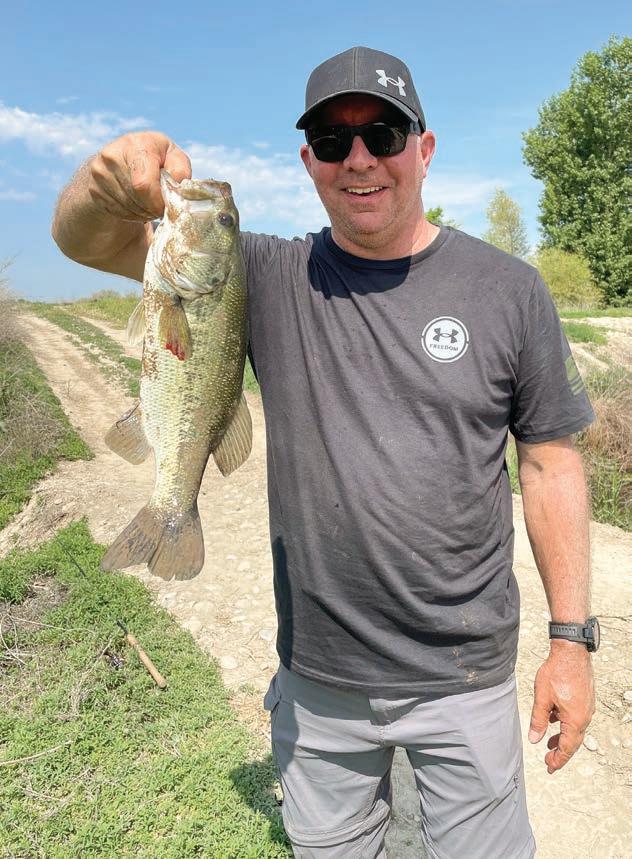
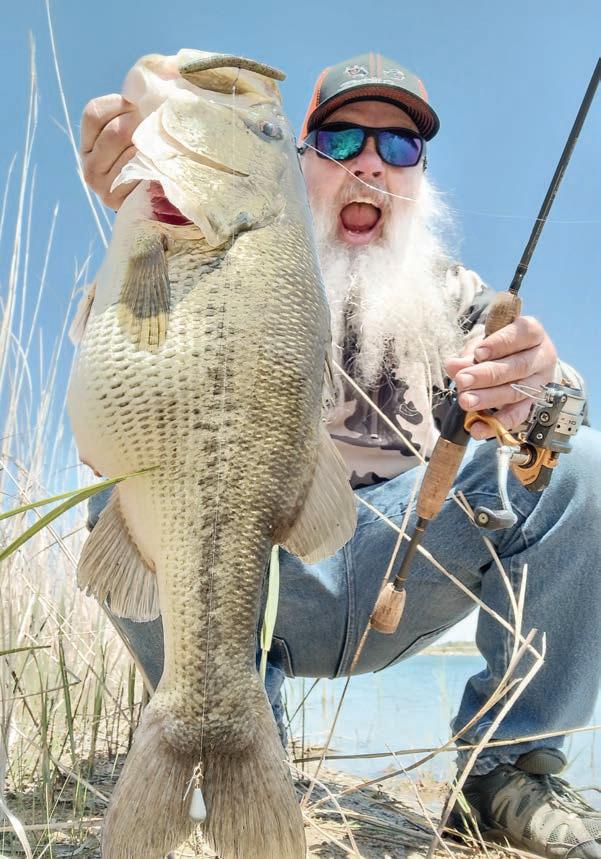
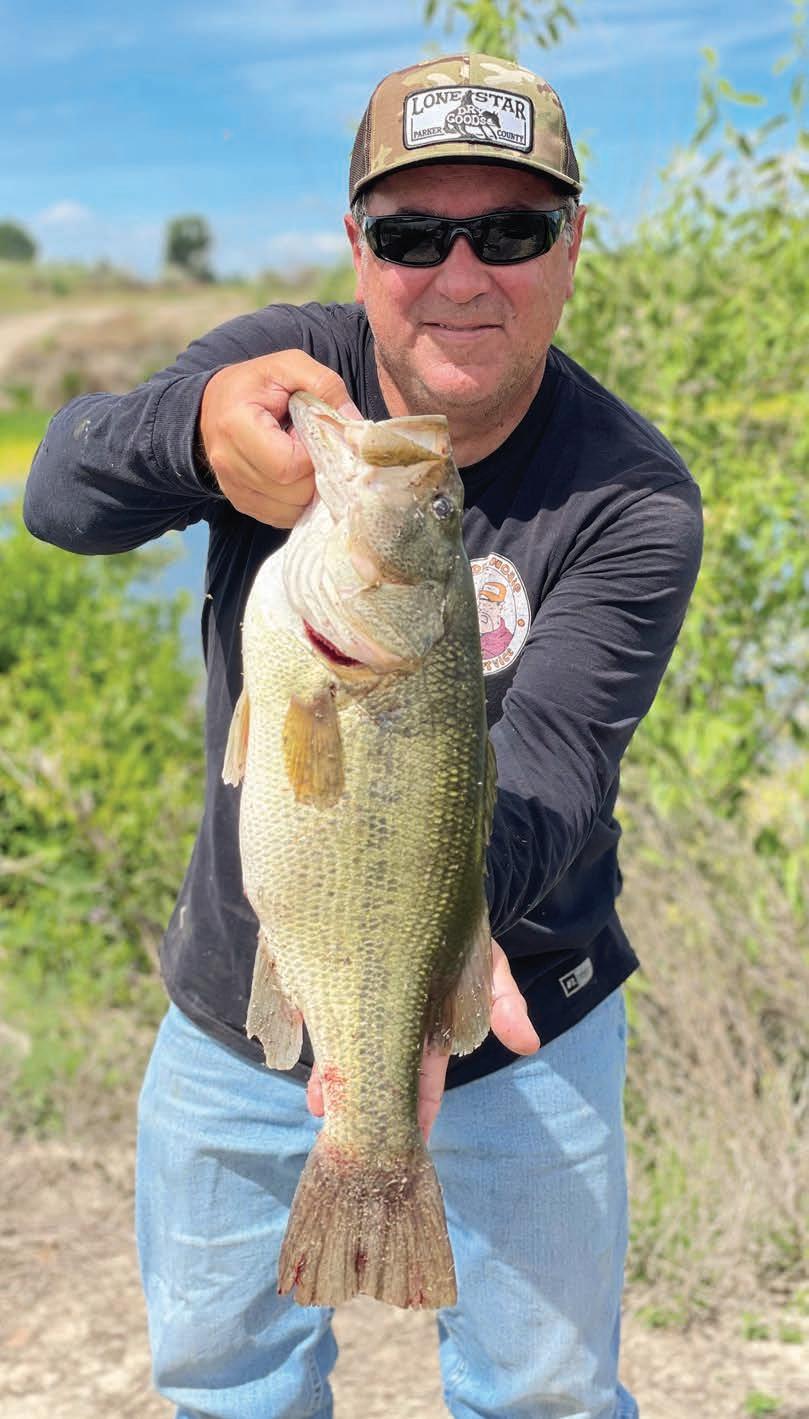
Mark Fong, Scott Haugen, Tiffany Haugen, Tim E. Hovey, Cal Kellogg, Logan Sebela
SALES MANAGER
Paul Yarnold
ACCOUNT EXECUTIVE
Janene Mukai
DESIGNER
Kha Miner
WEB DEVELOPMENT/INBOUND
MARKETING
Jon Hines
ADMINISTRATIVE ASSISTANT
Katie Aumann
INFORMATION SERVICES MANAGER
Lois Sanborn
ADVERTISING INQUIRIES
media@media-inc.com
CORRESPONDENCE
Email ccocoles@media-inc.com
X @CalSportsMan Facebook.com/californiasportsmanmagazine
ON THE COVER
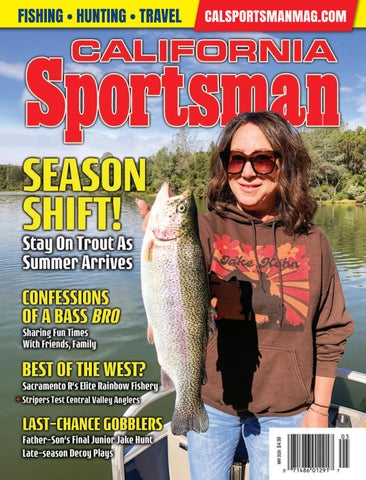
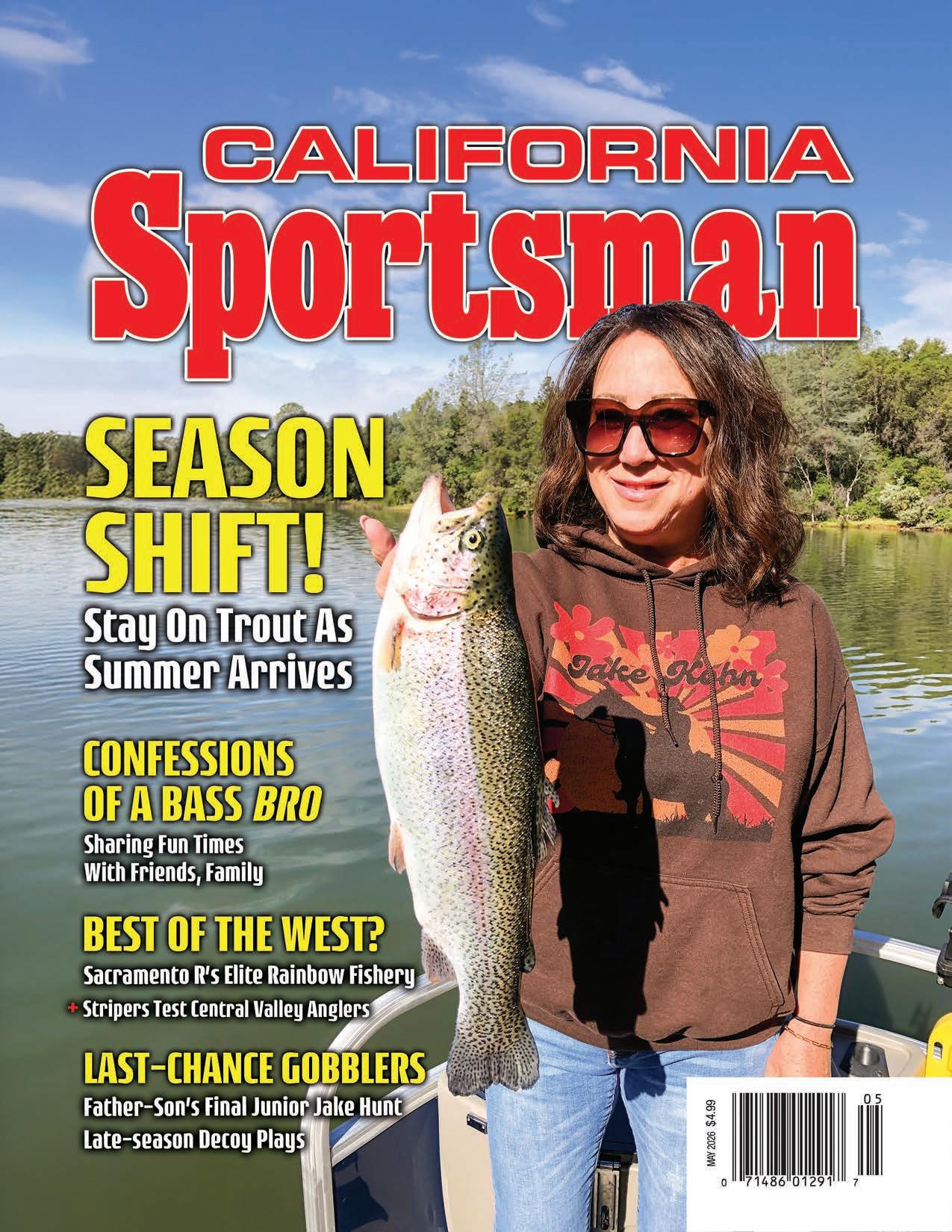
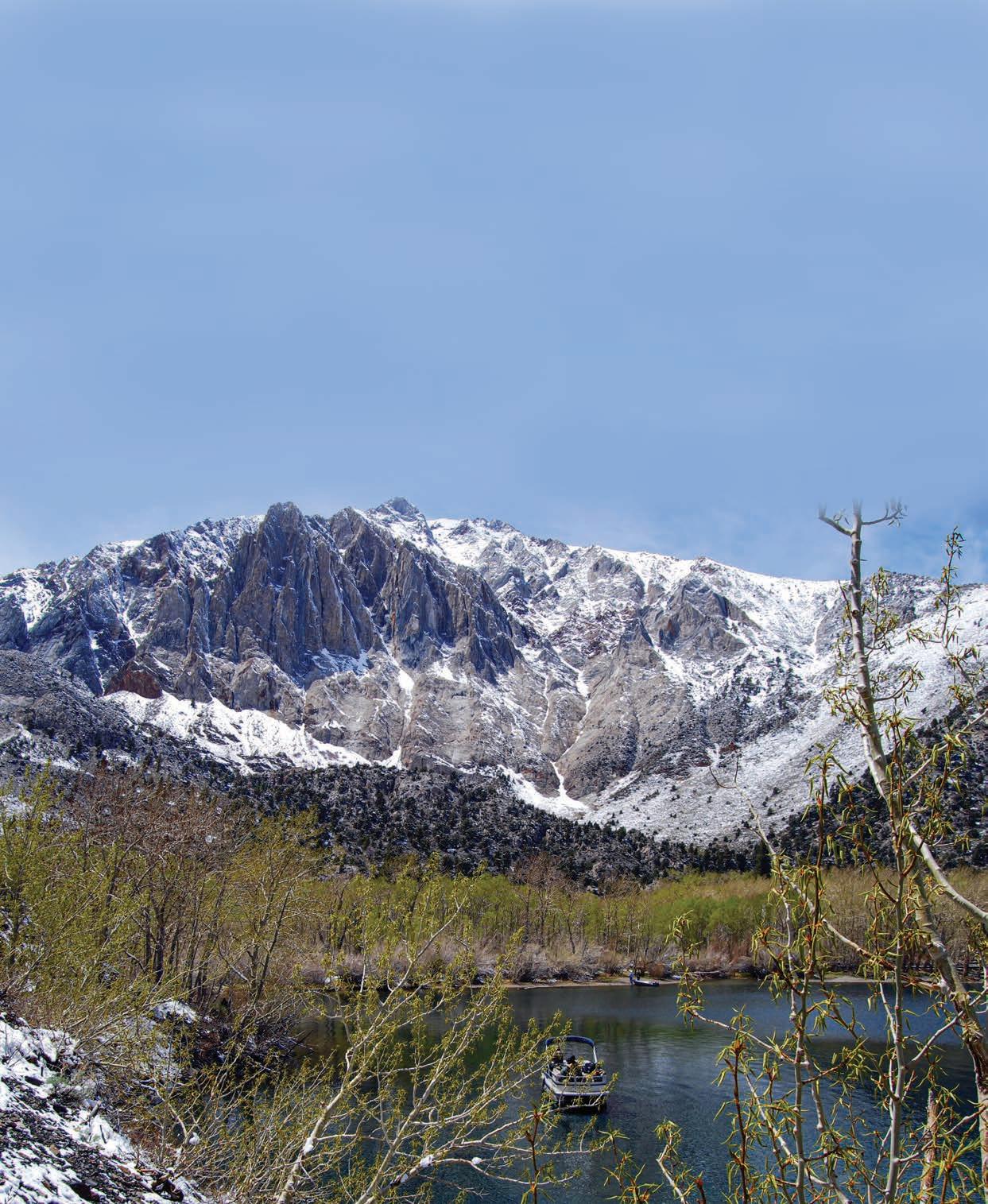
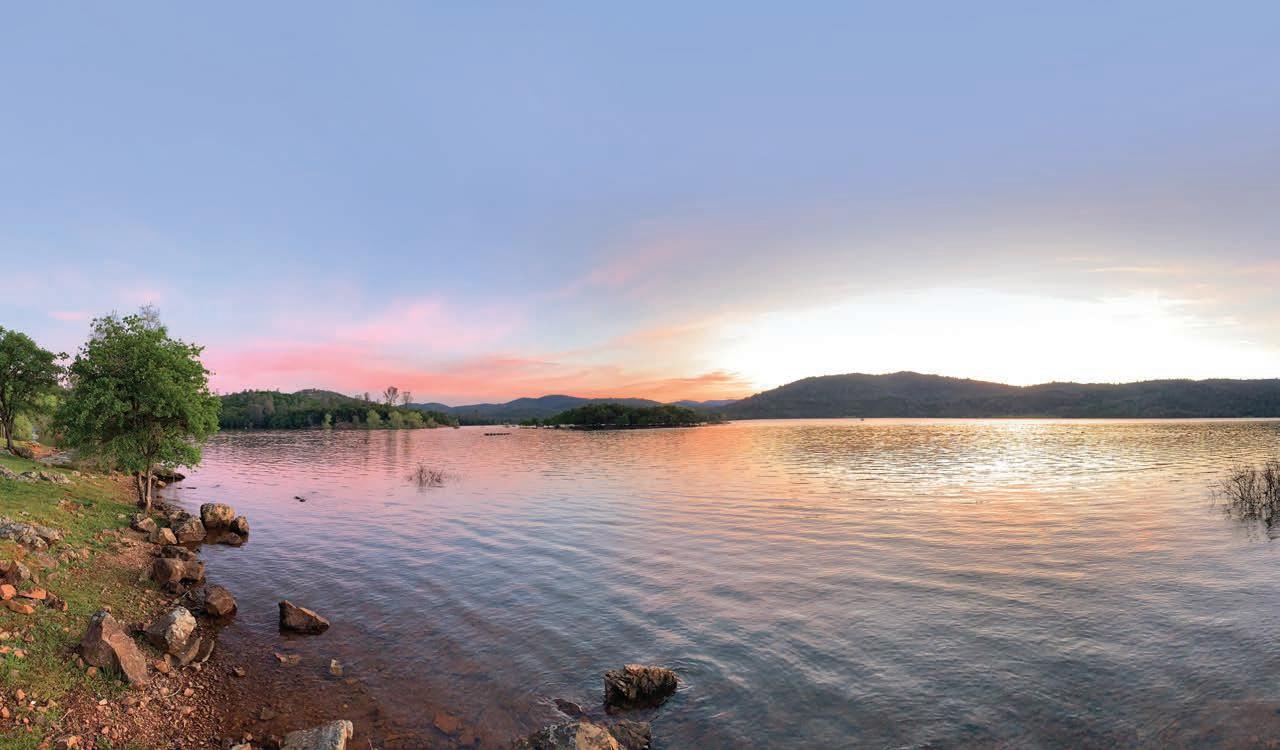
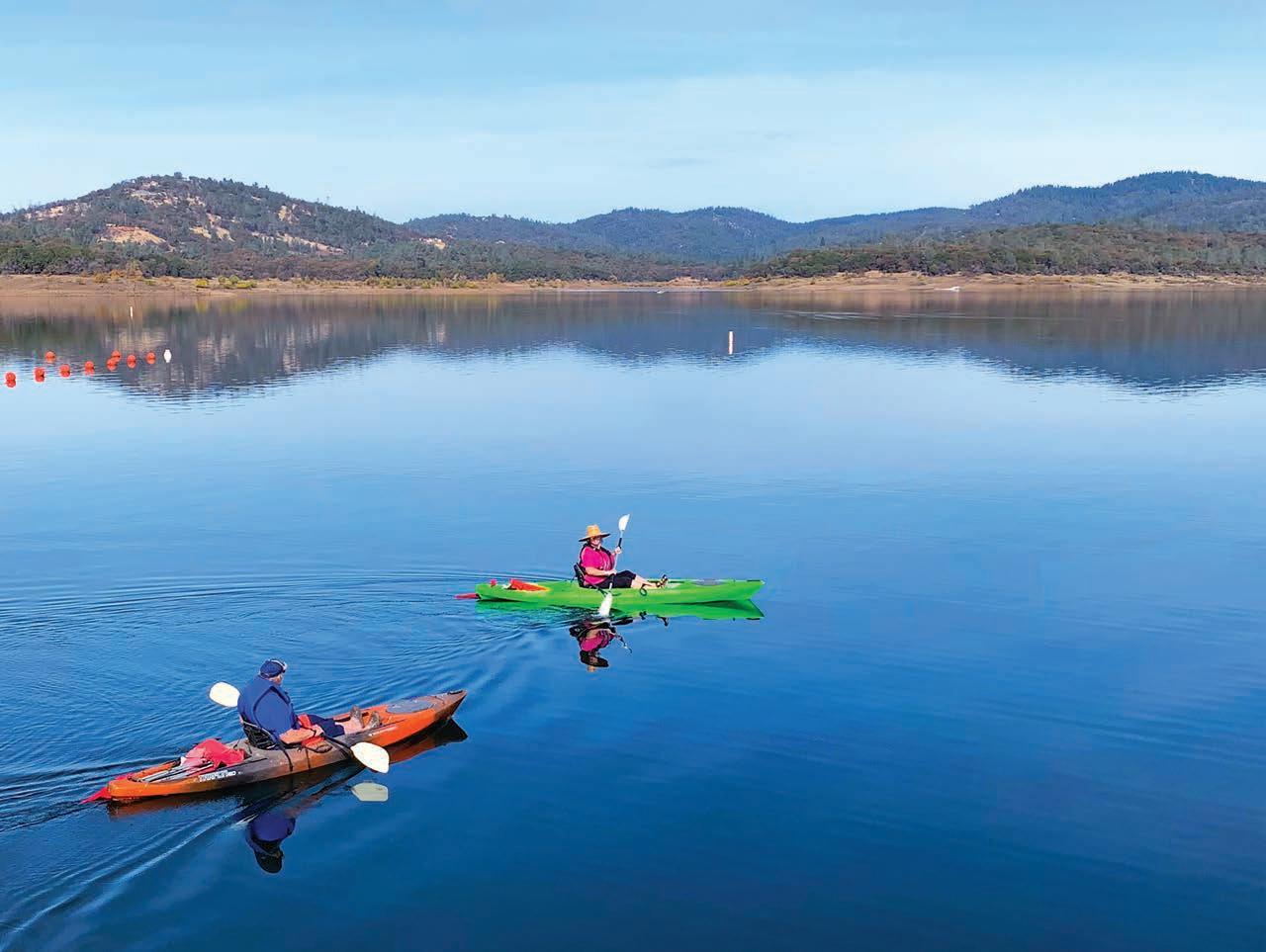
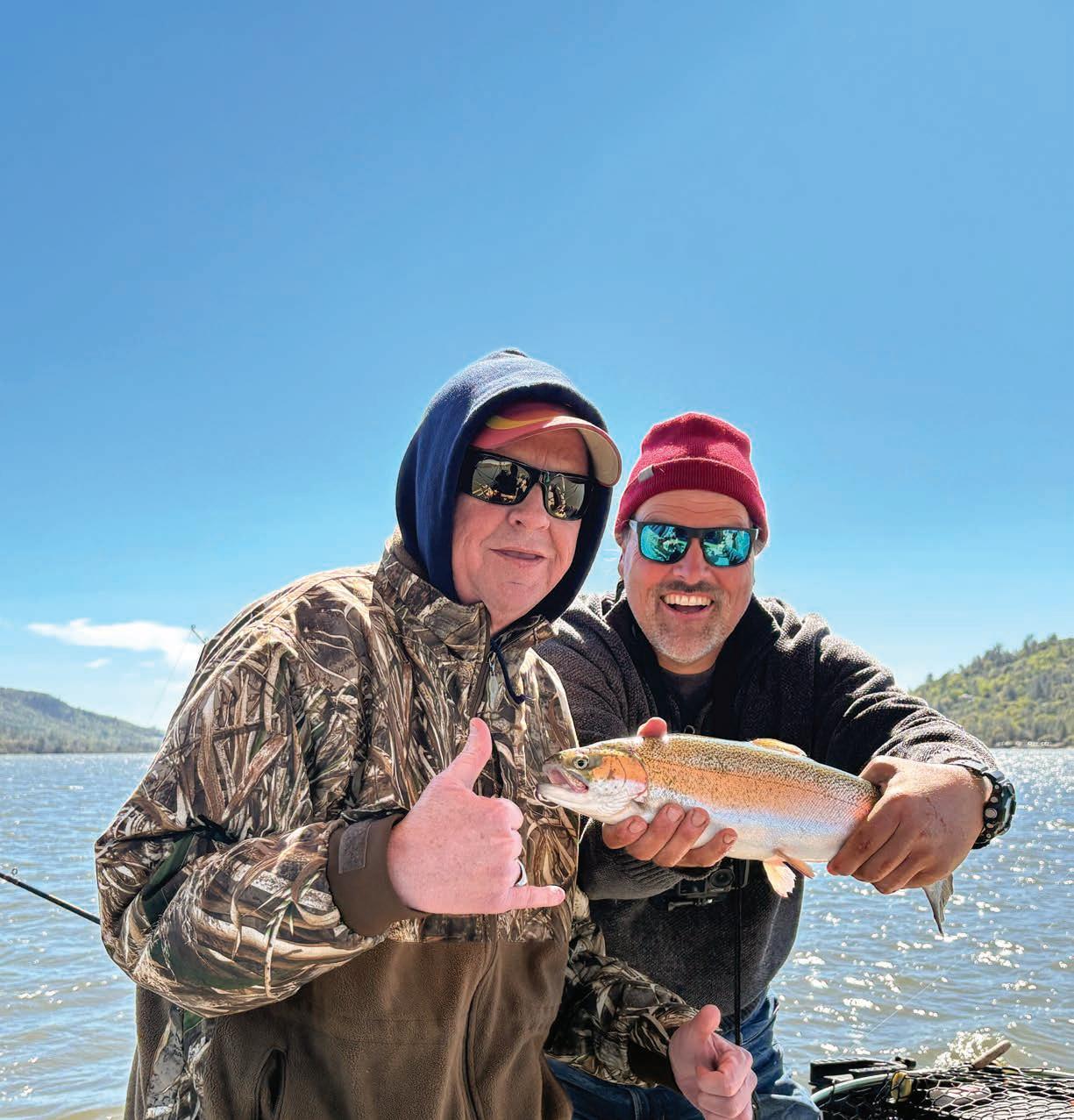
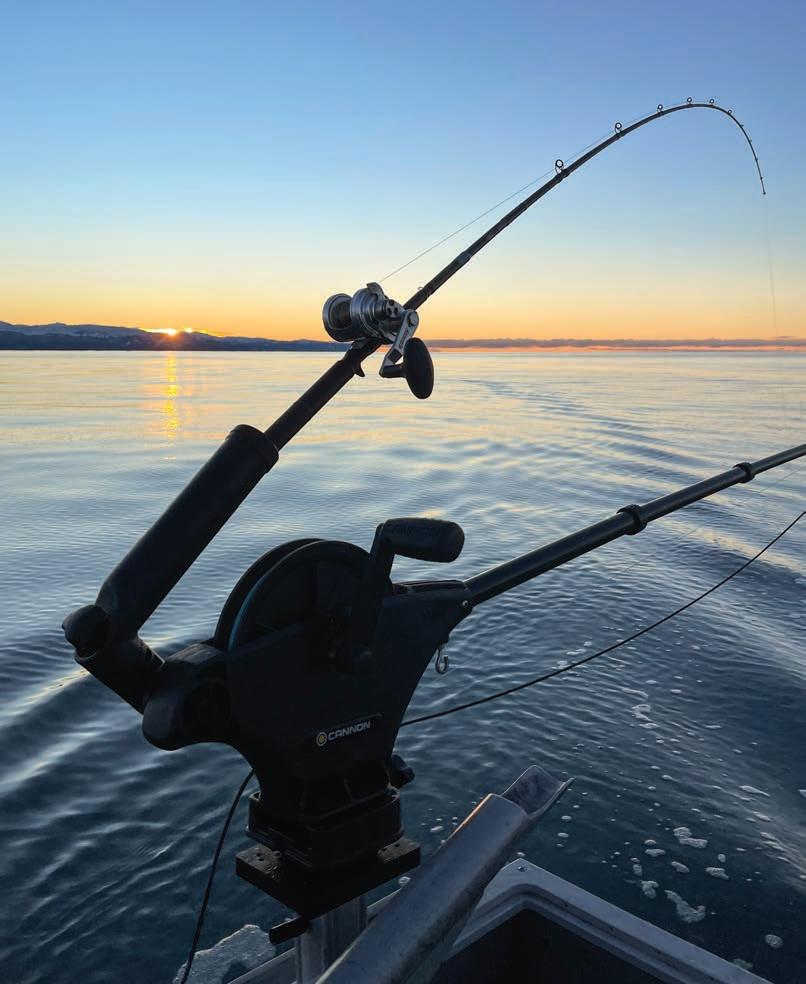
With spring’s cooler water temperatures warming up as summer inches closer, trout anglers should know what changes to make to their tactics and setups as the fish transition to deeper water. See Cal Kellogg’s story on page 19 for more details on where to find fish and how to entice them to bite. (CAL KELLOGG)
MEDIA INC PUBLISHING GROUP 941 Powell Ave SW, Suite 120 Renton, WA 98057
(800) 332-1736 • Fax (206) 382-9437
media@media-inc.com www.mediaindexpublishing.com
13 THE EVOLUTION OF A BASS BRO
In his earlier days, Tim Hovey’s fishing passion gravitated to California’s saltwater fisheries, but a chance encounter with a wily veteran angler at a Southern California lake introduced Hovey to the magic of bass fishing with plastic worms. These days, he shares the shoreline of lakes and ponds with friends and family. Discover some of Hovey’s secrets that trigger bites.
19 TRANSITION-TIME TROUT
For Cal Kellogg, our trout guru who’s always looking to wet a line at Northern California lakes, rivers and streams, the transition from spring’s mostly pleasant conditions to the hotter summer months means a lot of changes for anglers’ setups. If you’re struggling to stay on trout as they head deeper, Kellogg’s here with some help!
27 IN SEARCH OF SACRAMENTO STRIPERS
When Mark Fong accepted guide Brett Brady’s invitation to join he and another guide on a Sacramento River spring striped bass scouting trip, Fong and the experts faced some challenging water conditions and had to work hard to get the linesides to play. As hopes rise for the rest of the run, Fong recaps an on-the-river learning experience.
DEACON’S LAST DANCE WITH A JAKE
Breaking down one of California’s most underrated trout rivers
43 From Field to Fire: Late-season turkey decoy plays; Gobbler burger recipe
51 Consider longterm costs before getting a gun dog
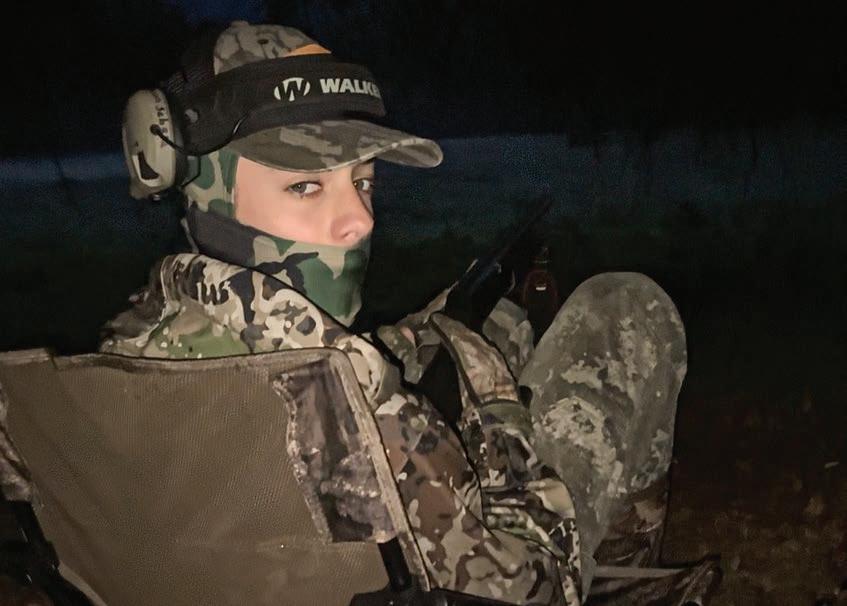
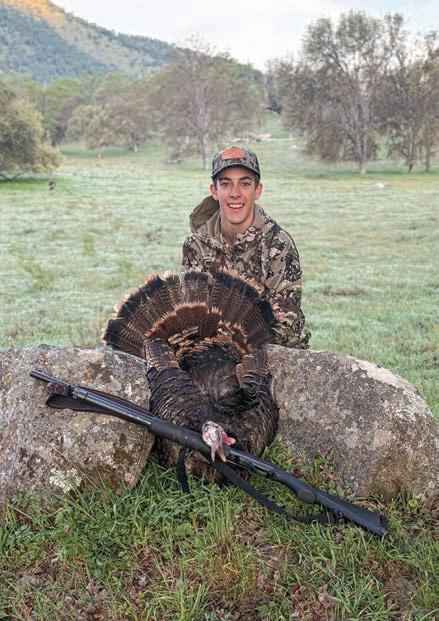
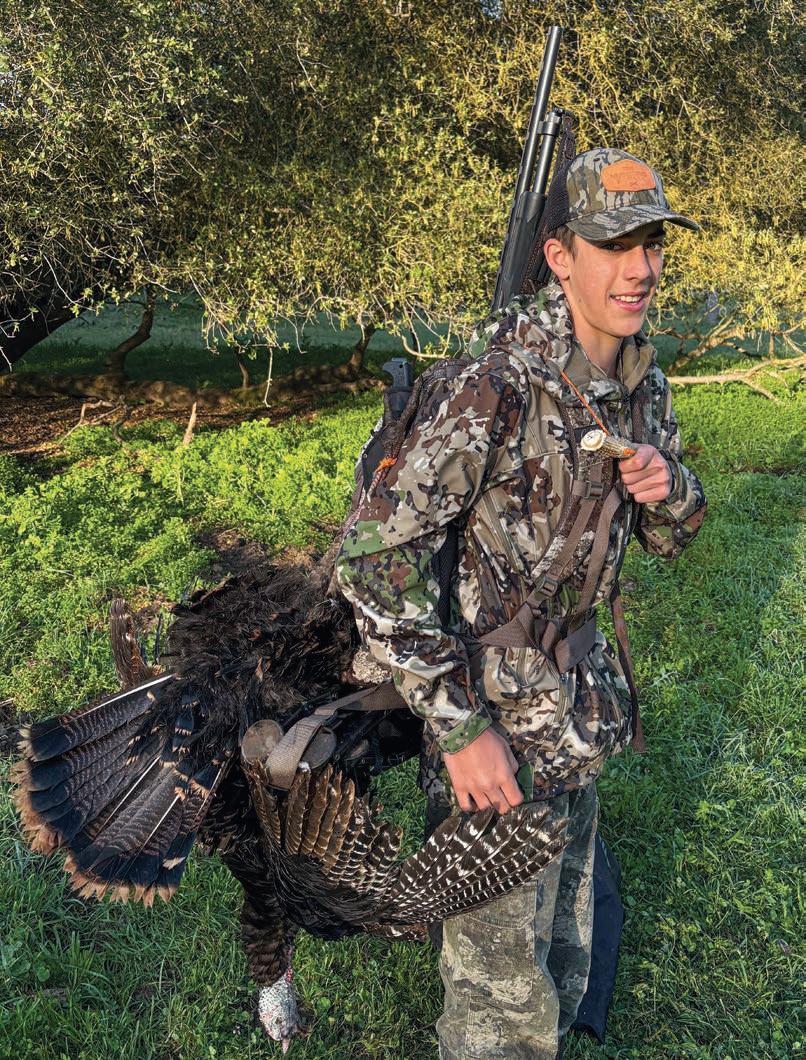
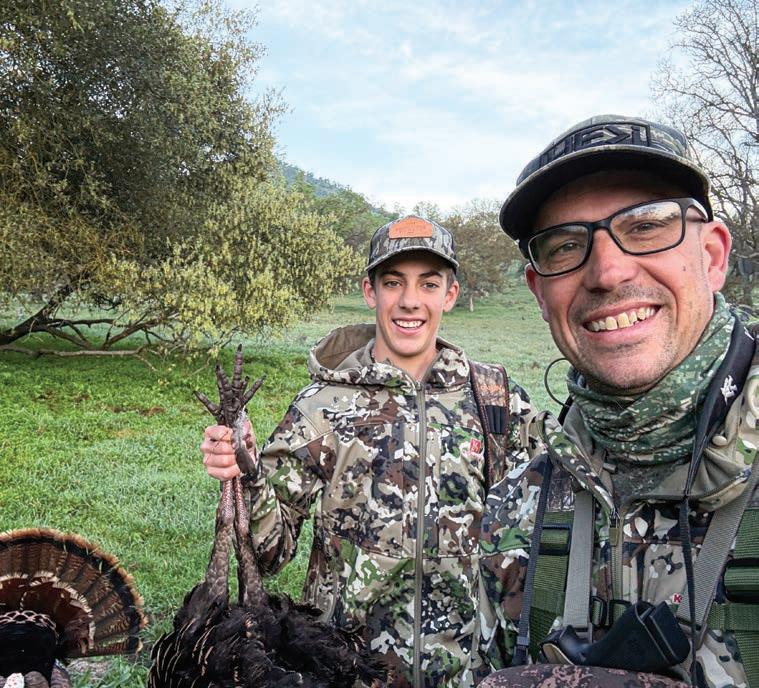
Proud dad Logan Sebela has seen his son Deacon grow up as a young hunter. In the lad’s final spring turkey season as an eligible junior hunter, the duo trekked out into the Fresno foothills in hopes a bird would serve up a proper sendoff from childhood for this up-and-coming sportsman. Logan shares Deacon’s memorable hunt.
(TIM E. HOVEY)
THE EDITOR’SNOTE
When I was a kid, I know I pestered my parents about fishing way too much. Now when I think back about those days, I must have driven them bonkers.
Recently, I visited Northern California for a weekend getaway and to join our extended family for a Greek Orthodox Easter Sunday feast at my cousins’ home near Sacramento. Twice I flashed back to my youth. I was a passenger in my sister and brother-in-law’s SUV as we drove up Highway 99 near Stockton. When I saw the Hammer Lane exit, I remembered my mom and I had booked a Motel 6 there one spring break, and the next day we drove over to Pardee Lake, where I threw out a Rapala and ended up catching what was then known as a squawfish, now called a Sacramento pikeminnow. For me at the time it might as well have been a trophy Pardee rainbow.
After we arrived for the gathering and caught up with each other before lunch, Cherie, who’s married to my first cousin Mike, took me aside and said she’d stumbled onto an online link to a previous Editor’s Note I’d penned about nearby Camanche Lake. She and Mike had hosted our family at their home near Valley Springs, close to those famous Mother Lode lakes I fished often back in the day. Later, Mike joined in on the conversation about my admiration for those lakes.
Which brings me to this month’s feature by Tim Hovey (page 13), who recalled getting hooked on targeting largemouth during spring bass fishing adventures on private ponds.
That’s the kind of water I used to badger my poor pops about the most. I wanted us to move out of the Bay Area to a rural property, at worst maybe a summer retreat. Based on several real estate booklets I’d collected on many of our out-of-area fishing trips, my dream home had an adjacent pond we could stock with bass, catfish, bluegill – it really didn’t matter what species.
Alas, it never happened.
Instead, I had Hammer Lane, the Motel 6 and dragging my mom out of bed and telling her to forget her morning cup of coffee so we could get to the lake as early as possible.
Mike and Cherie have since moved to a new larger property around the same Mother Lode location that they planned to host us for Greek Easter in April, but spring rains muddied up the grounds around the house, so the family switched locations to another cousin’s digs. But I told them I can’t wait to see it next time. Maybe they’ll have a stocked pond full of fish to catch someday! -Chris Cocoles
Tim Hovey’s passion for fishing for bass in small bodies of water had the editor reminiscing about his youth, when he begged his dad to move to a rural Northern California property with a private pond they could stock with fish. Unfortunately, it never happened. (TIM E. HOVEY)
MAY
OUTDOOR CALENDAR
2-3 Shasta Lake Classic Team Kokanee Derby (kokaneepower.org/derbies.php)
4-17 Archery-only spring wild turkey season dates
4-17 Additional junior spring turkey season dates
15-17 Clearlake Oaks Catfish Derby, Clear Lake (clearlakeoaks.org/derby/registerfor-the-derby)
16 Lassen Sportsmen’s Club Junior Kids’ Fishing Derby, Susan River Memorial Park, Susanville (facebook.com/lassensportsmensclub)
22-June 29 Crowley Lake Perch Derby (760-935-4301; crowleylakefishcamp.com)
23 Arrowhead Lake Association Fishing Derby (ala-ca.org/fishing_derby.php)
23-25 Hangman’s Cash Bonus Derby Weekend, Convict Lake (760-934-3800)
30 Bay Area Catfish Challenge, San Pablo Reservoir (anglerspress.com/ events/2026-bay-area-catfish-challenge)
30 Catfish Bash, Clear Lake (catfishbash.com)
For a list of upcoming bass tournaments, go to nrm.dfg.ca.gov/FishingContests/default.aspx.
JUNE
5 Golden State Salmon Association Fundraising Dinner, Friedman Events Center, Santa Rosa (goldenstatesalmon.org)
6 El Dorado County Kids’ Fishing Derby, Sawmill Pond (eldoradocounty.ca.gov/County-Government/County-Departments/ Fish-and-Wildlife/Kids-Fishing-Derbies)
6 Angler’s Press Pro Teams Tour event, Sacramento-San Joaquin Delta (916768-0938; anglerspress.com/events/pro-teams-tour)
6 New Melones Reservoir Team Kokanee Derby (kokaneepower.org/derbies.php) 12-13 Finest Annual Trout Invitational Tournament, Crowley Lake (crowleylakefishcamp.com/new-events/fatit-finest-annual-troutinvitational-tournament)
13 Greg Marks Youth Fishing Derby, Shaver Lake (shaverlaketrophytroutproject.org/ youth-fishing-derby)
13 Recreational ocean salmon seasons open from the Oregon-California border to Point Arena
27 Bridgeport June Trout Tournament, Bridgeport Reservoir and East Walker River (760-616-4214; bridgeportfish.com)
27 Recreational ocean salmon season opens from Point Arena to Pigeon Point
28 Green Hornet Invitational Fishing Derby, Bridgeport Reservoir (760-616-4214; bridgeportfish.com)
Convict Lake will host the popular Hangman’s Cash Bonus Derby Weekend trout contest May 23-25. Call (760) 934-3800 for more information. (MONO COUNTY TOURISM)
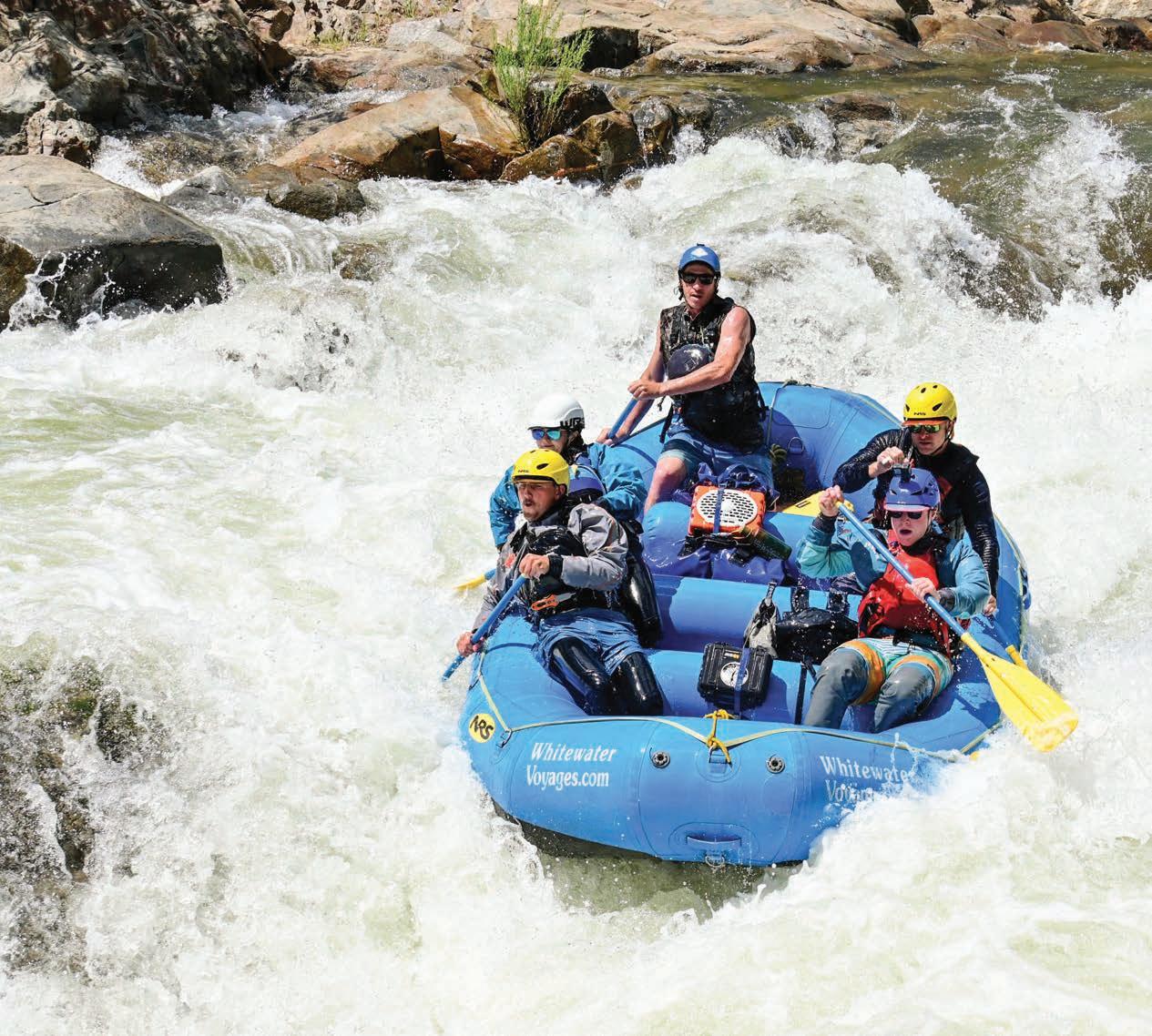
WHITEWATER VOYAGES! KERN RIVER RAFTING
Since 1975, Whitewater Voyages has been rafting the Kern River offering whitewater rafting trips from “Mild to Wild”
1/2 Day Class 3 trips, 2-day Camping and Class 4, all the way to 3-Day Wilderness Class 5 trips to satisfy all ages and thrill-seeking appetites.
Whether you’re a first-time paddler or seasoned adventurer, our group friendly Kern River trips are designed to make every participant feel confident, supported, and part of something extraordinary.
BORN-AGAIN BASSER
AN ANGLER’S SPRING TRADITION: CHASING LARGEMOUTH
By Tim E. Hovey
As the weather warms and the days get longer, I start getting everything set for spring fishing. The boat is prepped and ready, and I use the internet to check the water temperatures of several lakes near me. Reels are refilled, tackle boxes organized and I hit Bass Pro Shops to restock my gear. Ask anglers and they’ll tell you the only thing better than fishing season is prepping for fishing season.
LEARNING TO LOVE BASSIN’
Growing up in California, I would fish whenever and wherever I could. Living near the coast, those fishing forays would usually lead me to the ocean, to either fish from shore or on a boat. However, every year, I’d find myself carving out some time to figure out the subtleties of freshwater fishing. It really didn’t matter where I was in life; if I was located near a body of water, I wanted to fish it.
In those early years, I’d occasionally catch largemouth bass while fishing
local ponds and lakes. Yeah, I caught them on spinners, crankbaits and spinnerbaits, but hookups were few and far between, and usually I was surprised when they hit my setup. Understanding that bass were the prized gamefish of freshwater, I wanted to be able to target them consistently. A chance meeting at a local pond would help me smooth out this learning curve.
ON-THE-WATER LESSON
When I was in high school, I lived
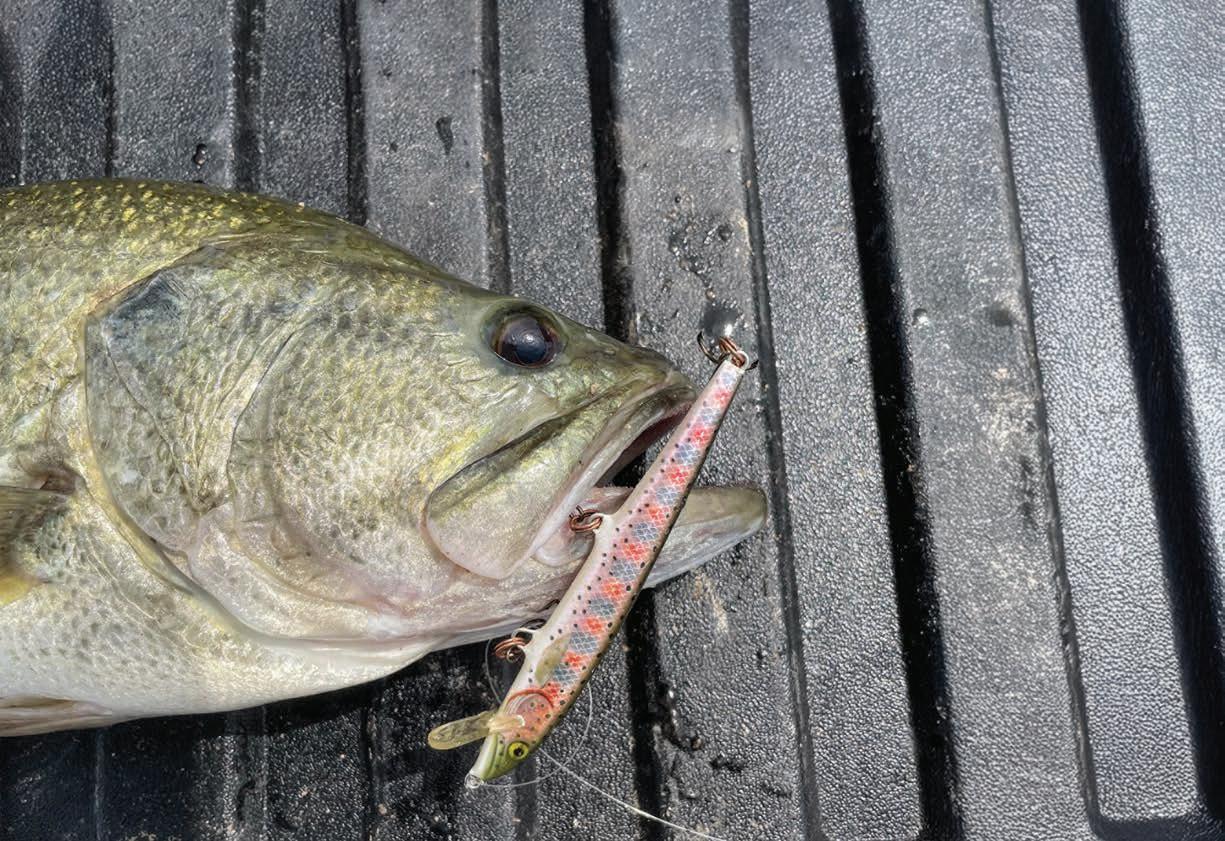
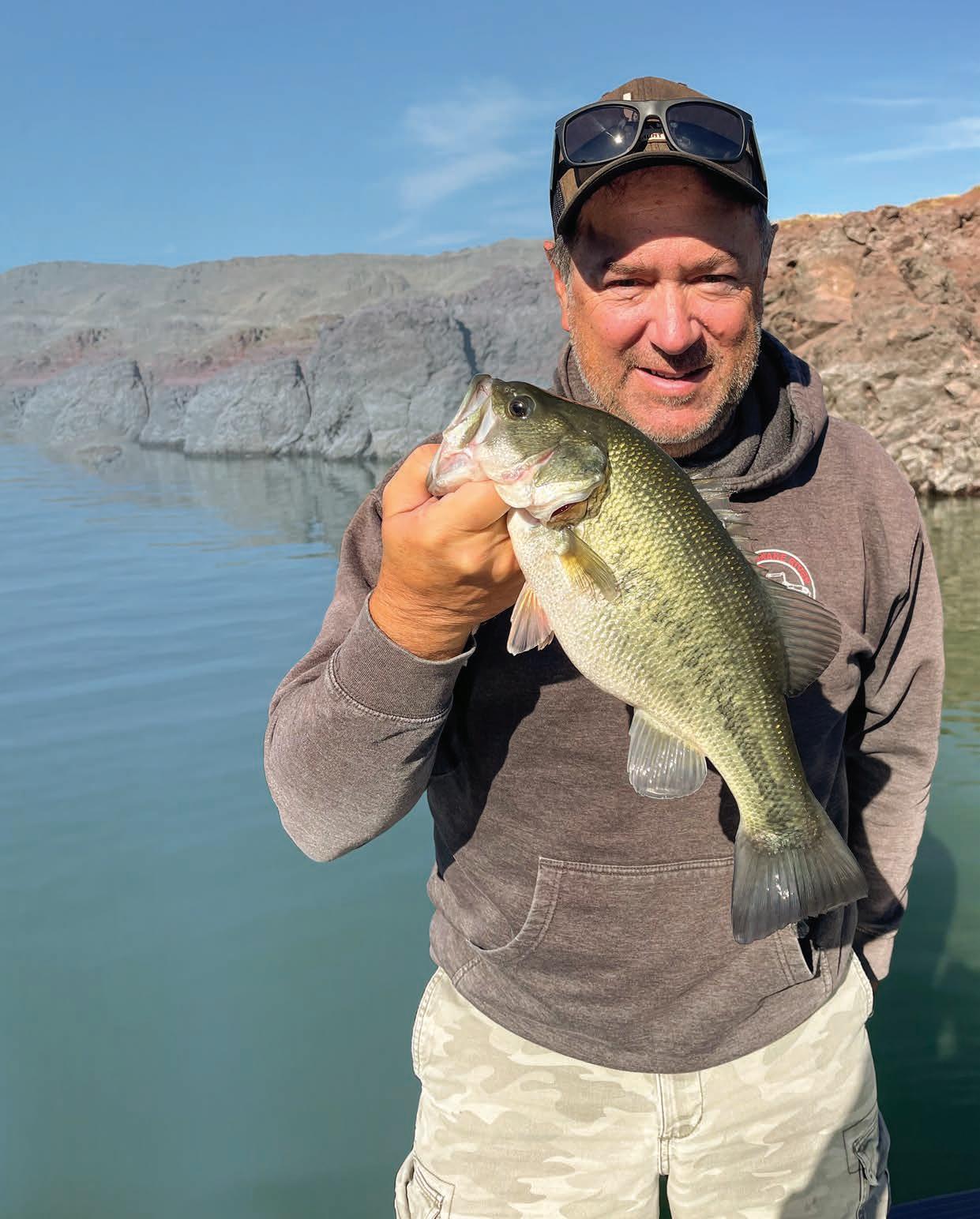
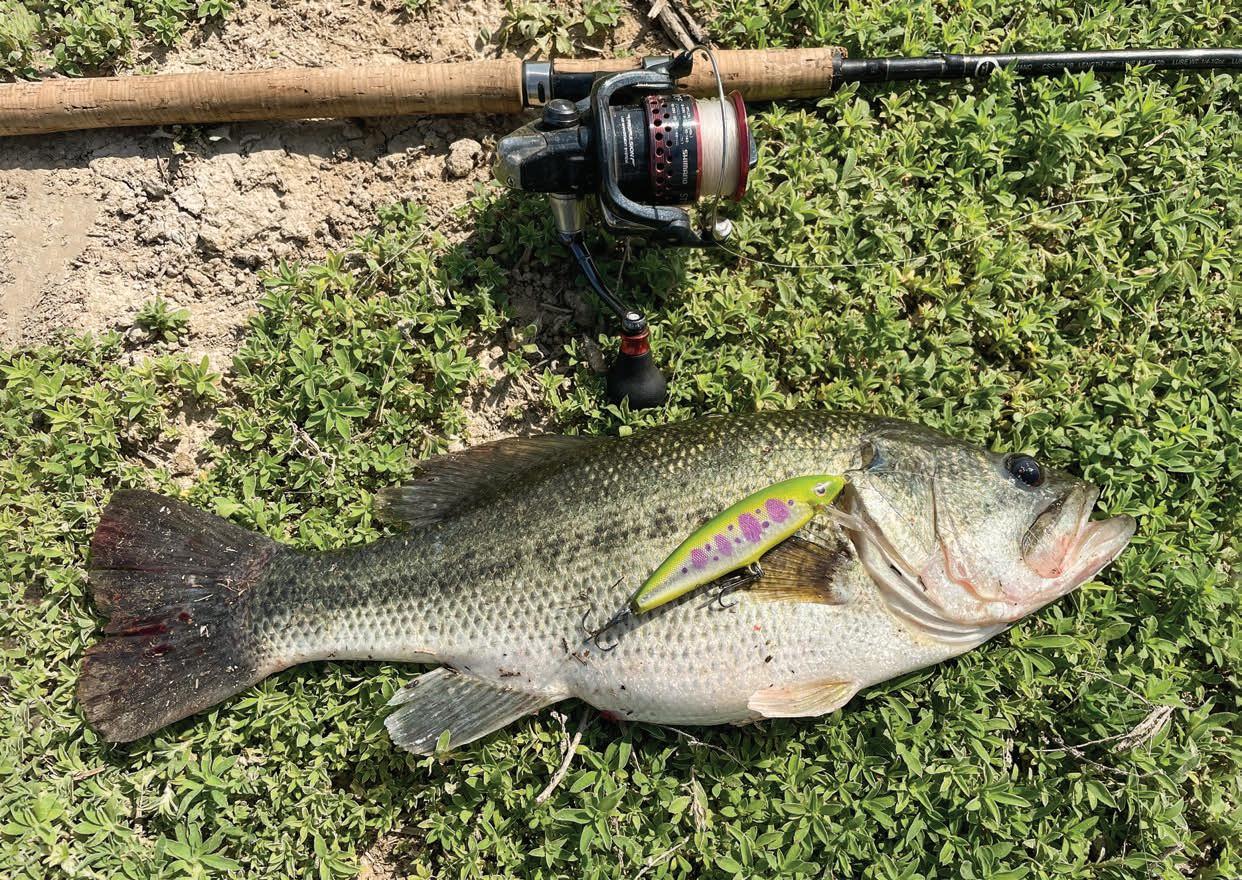
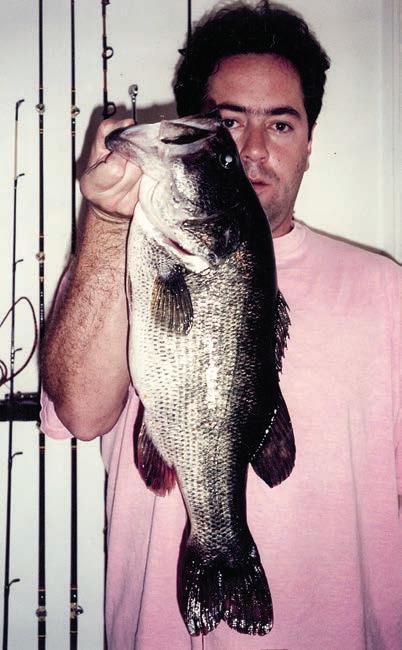
For author Tim Hovey, catching spring bass – like this beauty that bit a homemade bait from Redjaw Lures – was a passion that he caught onto slowly growing up in Southern California. Now it’s a huge part of his spring routine. (TIM E. HOVEY)
FISHING
near a sizable lake that was located less than a mile from my home. I fished it often, and one spring morning I decided to ride my bike to the pond to see what was biting. Arriving at the shore with my diverse bag of tackle, I tied on a spinnerbait and spent the better part of an hour fan casting and retrieving without a hit, bump or follow.
An older gentleman, standing at the point to my right, had caught at least six bass during the time I had been frothing up the shore with my lure. I also noticed that he never left his spot. As all anglers do, I was trying to see what he was throwing, but I was too far away. As it turned out, he would come to me.
On his way back to the parking area, he stopped by and asked me how I was doing. This was clearly the price a fishless man must pay to learn the secret of a true angler. He had been close enough to me to notice that all I had been doing for the last hour was practicing my casting. He knew how I was doing, but he made me say it.
He then showed me his simple rig. A skinny, purplish worm with a curly tail – no longer than 6 inches – and a hook were attached to the end of his line; nothing more. His presentation was equally simple. After casting the light lure out, he’d simply let it sink. Once on the bottom, he’d twitch it once or twice, then reel it in and repeat. He concluded the short lesson by telling me I needed to watch the line for a pickup. That encounter occurred almost 40 years ago.
The next day, I was back at the lake with this same setup. Three casts in, I caught my first bass of the day. It was nothing huge, maybe a pound, but I had just been introduced to a bass fishing technique that I would be using for the rest of my life. Using spinning gear to cast the light offering out and then watching the line floating on the water for any sign of interest, I considered this technique finesse fishing.
With this new fishing tool in my back pocket, I continued to figure out what worked and what didn’t when chasing largemouth. I kept detailed
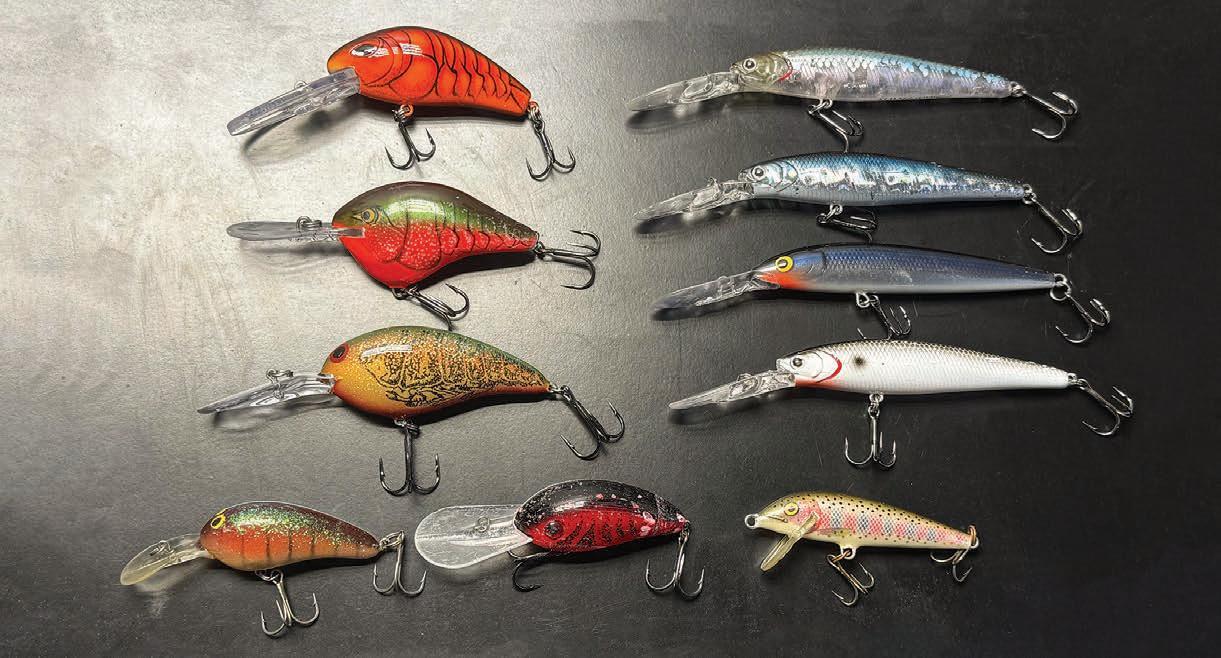
Crankbaits – these are some of Hovey’s favorites – have become one of his go-to setups at the lake … (TIM E. HOVEY)
… And this fat 6 -pound, 9 -ounce largie was a product of Hovey’s second option when targeting bass: his “magic” purple worm.
(TIM E. HOVEY)
For destinations found on a map, or ones that are simply a state of mind, trust a reliable Honda outboard to get you there. And back. Find out more at marine.honda.com or visit your Authorized Honda Marine Dealer.
FISHING
notes of my sessions. I would include water temperatures, lure types and fishing techniques.
GO-TO STAPLES
As the years piled up, I noticed that no matter what tackle I had brought along with me, I was only using two types of bass lures: the magic purple worm and crankbaits.
Casting and retrieving crankbaits is what I call a “turn and burn” aggressive bass fishing technique, and I find nothing more satisfying than the sudden stop of a retrieved lure. I have my favorite patterns, and if fish are active and the water is a bit warmer, I’ll reach for my baitcaster and my favorite crankbait first.
I understand that differently shaped crankbaits have specialized
names, but I consider them all crankbaits. I like deep divers when the water is a bit colder, floating divers in the morning and skinnier stickbaits for casting up close to rocky lake structure. Honestly, it doesn’t matter if it’s a new body of water or a familiar lake, no matter what, I grab the crankbait rod first to turn and burn. And if things are slow, I start throwing the finesse lure.
These two techniques work well for me. My two biggest bass came from fishing the purple worm and burning a crankbait. These are the techniques I’ve gladly shared with my outdoor daughters and my fishing friends.
GEMS OF THE GEM STATE
Now living in Idaho, I feel like I’ve
further perfected these bass-catching techniques. The southern portion of the state is loaded with rivers, lakes and ponds, most of which hold solid populations of bass. It didn’t take me long to start exploring my new state and catching largies.
In 2021, my good buddy John Mattila made a trip out to visit. He had recently relocated to Texas and had yet to explore his new home state for outdoor opportunities. I assured him that there was plenty to do in the Gem State.
I picked him up at the airport and we headed for a couple of farm ponds I had access to. I had four rods for the fishing session: two for crankbaits and two rigged with the magic purple worm. After a quick stop for lunch, we were at the
Hovey’s buddies such as John Mattila (left), who caught this bass an hour after his plane landed on a trip to Idaho to see him, and Tim “Spike” Davis also have gotten in on the fun. (TIM E. HOVEY)
property in the early afternoon.
As I looked through my tackle, we each picked a crankbait from my extensive collection. John picked a shallow-running floating diver and I picked a longer bait that just happened to be the oldest one in my collection.
We split up to cover more ground and started fishing. Less than 10 minutes after we began – and not even an hour after his plane had landed – I heard a whistle from John. I looked over and he was holding a nice-sized largemouth bass. I ran over and took a few photos, and he told me he was going to continue fishing around the larger pond. I told him I’d stick to the other pond on the property.
Having caught a couple of smaller bass, I was working my way to the back of a nice-looking cove. I made a long cast off a point, and as soon as the floating lure hit the water, I saw a swirl next to the crankbait. I waited, but nothing grabbed the trout imitation. I started the retrieve, and about halfway back to the shore, the lure stopped abruptly. I set the hook hard and nothing happened. Seconds later the surface exploded with the largest bass I’d ever hooked.
As soon as I saw the fish, I noticed two of the three treble hooks firmly hooked on the outside of its mouth. This was not ideal, but two hooks are better than one. After a give and take on my reel’s 8-pound test, I landed the 7-pound largemouth on the gravel bench I was fishing on. John had seen the fight and rushed over to check it out. Once I landed the beast, it was his turn to take photos of the largest bass I had ever caught on a 30-year-old lure.
’TIS THE SEASON
Now that spring is here, you can find me and my wife fishing from our new boat in the southern portion of Idaho just about weekly. The vessel holds 12 rods and tons of tackle, but the only two poles I use are the ones rigged with my favorite crankbait and the magic purple worm. CS
FISHING
Hovey slammed this 7-pounder on a 30-year-old Rapala. “Now that spring is here, you can find me and my wife fishing from our new boat … just about weekly,” he writes. (TIM E. HOVEY)
MASTERING THE TRANSITION GAME
SOLVE TROUT LAKES’ SPRING-TO-SUMMER SHIFT AND YOU’LL FIND CONSISTENT FISHING
By Cal Kellogg
There’s a moment every year when trout fishing changes. It doesn’t happen overnight, and it doesn’t come with a clear signal, but if you spend enough time on the water you feel it.
The easy, shallow spring bite
starts to fade, the fish begin to slide out and suddenly, the patterns that produced limits a few weeks earlier don’t seem quite as reliable. That’s the spring-to-summer transition, and it’s where the wheels come off for a lot of anglers.
For those who understand what’s happening beneath the surface, it’s
actually one of the most productive – and consistent – windows of the entire year. The key is recognizing that trout don’t disappear; they simply reposition. They follow temperature, oxygen and food, and if you track those three things, you can stay on fish from May right through the heat of summer.
Winter and early spring offer easy trout fishing because the fish are near the surface. When they start to drop down in the water column as spring transitions to summer things get more challenging, but author and guide Cal Kellogg (right) knows the adjustments to make. (CAL KELLOGG)
FISHING
THE HEAT IS ON
In California reservoirs, this transition is driven by warming surface temperatures and the gradual development of stratification. In early spring, lakes are typically well mixed. Water temperatures are relatively uniform from top to bottom, oxygen is abundant and trout can roam freely. That’s why you can catch fish in the top 10 feet of water and tight to shore, often within casting distance of the bank.
As days lengthen and the sun gains strength, the upper layer of the lake – the epilimnion – begins to
warm. Because trout are coldwater fish, they’re comfortable in water generally ranging from the mid-40s to low 60s. Once surface temperatures push beyond that comfort zone, fish begin to drop. Not because they want to, but because they have to.
GIVE THE BAND A HAND
At the same time, the lake begins to separate into layers. You get warmer water on top, colder water below and eventually a transition zone – the thermocline – where temperature and oxygen levels create a band of ideal habitat. That band becomes the
highway trout use to travel, feed and hold through the summer. For the trolling angler, everything revolves around finding and fishing that band.
Early in the transition – from late April into May and even early June at many foothill lakes – trout may still be relatively shallow, often 10 to 25 feet down. This is the window where a lot of anglers continue to do well flat-lining or using minimal weight. Fish are still spread out, still willing to move and still feeding heavily on spring forage.
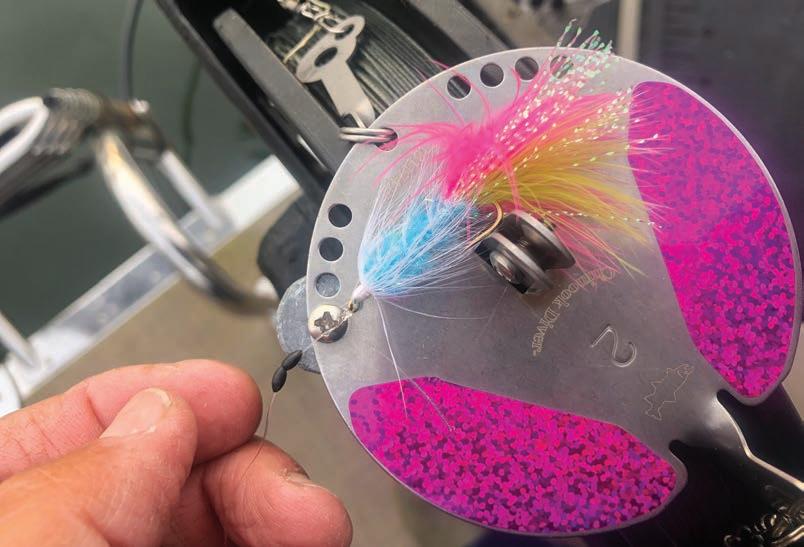
That forage is a mix of emerging aquatic insects, small baitfish and opportunistic food sources like worms and terrestrials that end up in the water. This is why traditional trolling offerings – think small spoons, minnow plugs, spinners and trolling flies – are so effective. They mimic a range of prey items and trigger both feeding and reaction strikes.
INTO THE DEEP
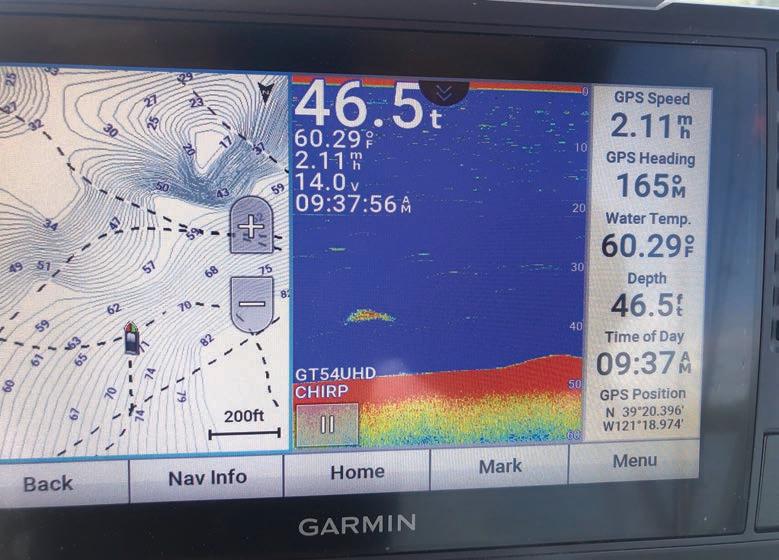
As you move deeper into May and June, things change. Surface temperatures climb and trout begin to consolidate. Instead of being scattered throughout the upper water column, they start to group up along the most favorable temperature and oxygen levels. In many California reservoirs, that means 25 to 50 feet down, sometimes deeper depending on the lake and the year. This is where precision becomes critical.
If you’re trolling above the fish, you might as well not be fishing. Trout will move up a few feet to intercept a bait, but they won’t come up 20 feet. You need to be in their zone. That’s where downriggers, leadcore, divers or weighted line systems come into play. They allow you to consistently present your lures at the depth where trout are actually living.
Electronics are a huge advantage here. Modern sonar units make it easy to identify bait schools, individual fish and the general depth where life is concentrated. If you’re marking fish at 35 feet, that’s where you need to be. Not 20; not 50; 35.
Downriggers are a key tool once trout drop beyond 25 feet deep as surface temperatures soar. (CAL KELLOGG)
I WANNA TROLL FAST
Trolling speed also becomes more important as the season progresses. In cooler water, trout will chase. In warmer conditions, they tend to be more deliberate. Speeds in the 1.6- to 2.2-mile-per-hour range are a good starting point, but subtle adjustments can make a big difference. Pay attention to what your gear is doing. Watch your rod tips. Let the fish tell you what they want.
Structure plays a major role during the transition as well. Trout don’t just suspend randomly in open water. They relate to features such as old river channels, points, dropoffs, submerged reefs and areas where the bottom contours change. These features concentrate both bait and fish.
One of the most productive approaches is to follow the edge of structure at the depth you’re targeting. If the thermocline sets up at 30 feet, work that 30-foot contour along points and channel edges. This keeps your lures in the strike zone while also intersecting fish that are using structure as travel routes.
LIGHT, LURE AND COLOR VARIABLES
Another key factor is light. Trout are extremely light-sensitive, and as water clarity increases and sunlight penetrates deeper, they often shift their feeding activity to low-light periods. Early morning and late afternoon can be prime, especially in clear reservoirs. That doesn’t mean midday fishing is dead; it just means you may need to fish deeper or adjust your presentation.
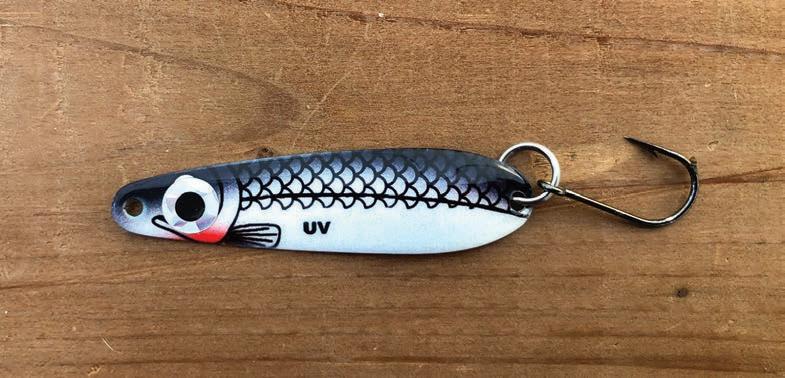
Lure selection during the transition should match both depth and forage. Small spoons remain a staple because they imitate a wide range of prey and can be fished effectively at various speeds. Minnow-style plugs come into play when trout are keyed on baitfish. Trolling flies are deadly when fish are feeding on baitfish.
Color can matter, but not in the way many anglers think. It’s less about finding a magic color and more about visibility. In deeper water,
Go-to trolling options include spoons and colorful flies that mimic baitfish. (CAL KELLOGG)
FISHING
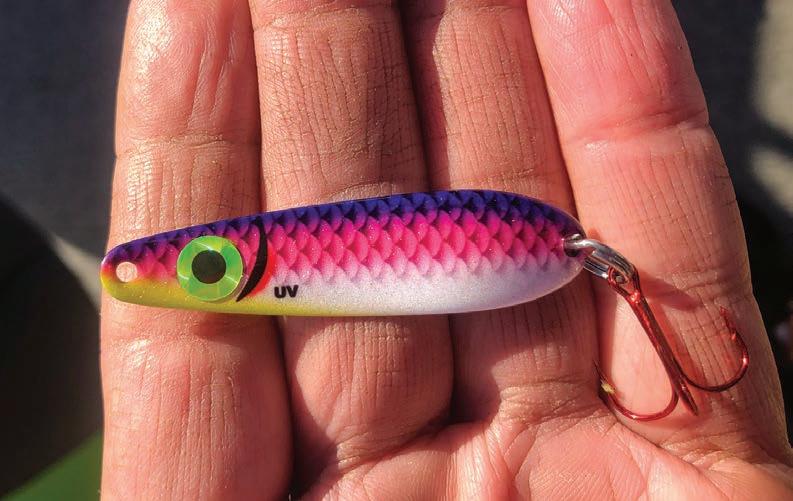
dark lures, glow lures and UV finish lures tend to stand out. In clearer, shallower conditions, more natural tones – silver, blue, brown or bright colors like pink or orange – often produce better results.
BANK STAYS OPEN
While trolling dominates during this period, bank anglers still have opportunities if they understand the same principles. As trout move deeper, shore fishing becomes more location-specific. Anglers need to focus on areas where deep water comes close to shore. Steep banks, dam faces and points that drop off quickly are good starting points.
Fishing bait off the bottom can still produce, particularly if you’re targeting that transition zone where trout move in and out. Inflated nightcrawlers, PowerBait and similar offerings remain effective. The key is depth and patience. You’re no longer fishing for cruising fish in shallow water, but rather waiting for fish to come to you along deeper travel routes.
Casting hardware – spoons, spinners, small plugs – can also be effective during low-light periods when trout move more shallow to feed. Early mornings and evenings are your best windows, especially in late spring and early summer.
BE INVENTIVE, CONFIDENT
One thing that separates consistently successful anglers from the rest is adaptability. The spring-to-summer transition is not static. It evolves week by week, sometimes day by day. Water temperatures change, fish adjust, forage shifts. Anglers who pay attention and make adjustments stay on fish. Those who stick to what worked last month often struggle.
It’s also a time when confidence matters. When the bite slows or changes, it’s easy to start secondguessing everything. But if you understand the fundamentals we’ve run down – temperature, oxygen, food, structure – you can make informed decisions and stay in the game.
Underwater structure that concentrates baitfish is a classic location to prospect for transition trout. (CAL KELLOGG)
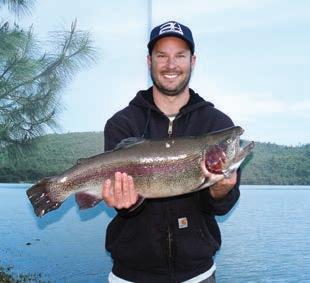
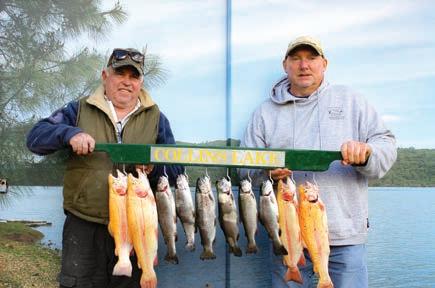
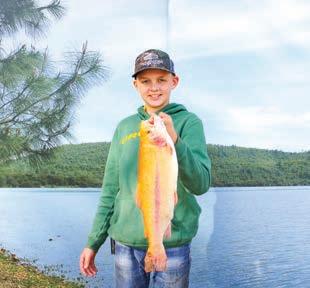
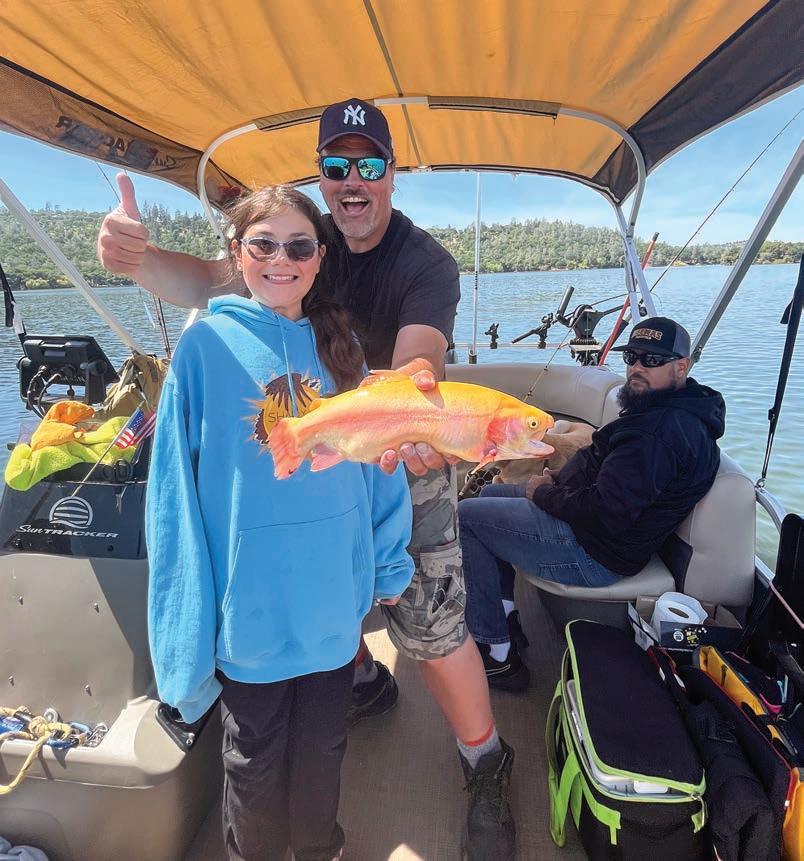
This hefty Collins Lake lightning trout blitzed a trolling fly pulled off a downrigger during a late-spring outing. (CAL KELLOGG)
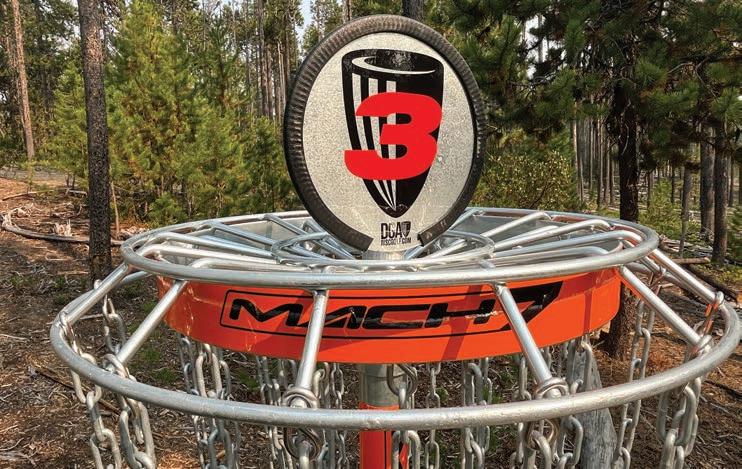
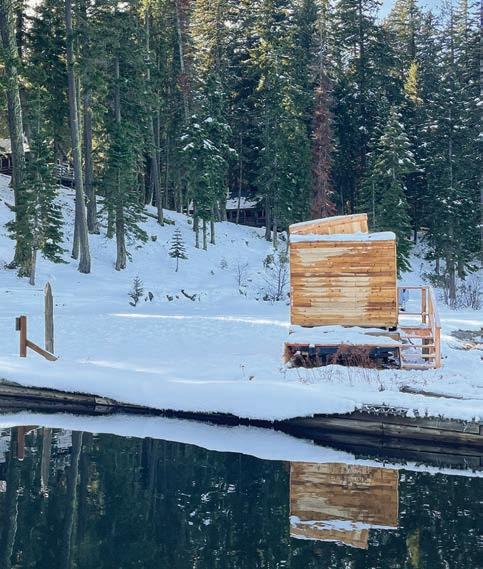
Lakeside Lodge Life at Odell Lake Resort
Whether you’re working the water, playing a round of disc golf, or basking in the perfect sunset, Odell Lake Resort is your place to unwind and explore.
• Lakeside Sauna - a private, relaxing extraordinary experience
• Revitalized Outdoor Patio - a great time any day of the week
Come experience Odell Lake Lodge Life! Book your stay today!
FISHING
“The transition from spring to summer isn’t the end of good trout fishing,” Kellogg writes. “It’s the start of a more refined, more technical and often more rewarding phase. The fish are still there.” (CAL KELLOGG)
EMBRACE THE TRANSITION
From a guide’s perspective, this is one of my favorite times of year. Spring’s crowds thin out, the fish settle into predictable patterns and anglers who are willing to learn can experience some of the best fishing of the season. The transition from spring to summer isn’t the end of good trout fishing. It’s the start of a more refined, more technical and often more rewarding phase. The fish are still there. In many cases, they’re feeding heavily and growing fast. You just have to go with them. Follow the temperature. Follow the food. Follow the structure. Do that, and you’ll stay on trout from the first warm days of spring all the way through the long, bright days of summer, and you’ll do it with consistency that most anglers never achieve. CS
Editor’s note: Cal Kellogg is a longtime Northern California outdoors writer. Subscribe to his YouTube channel Fish Hunt Shoot Productions at youtube.com/ user/KelloggOutdoors.
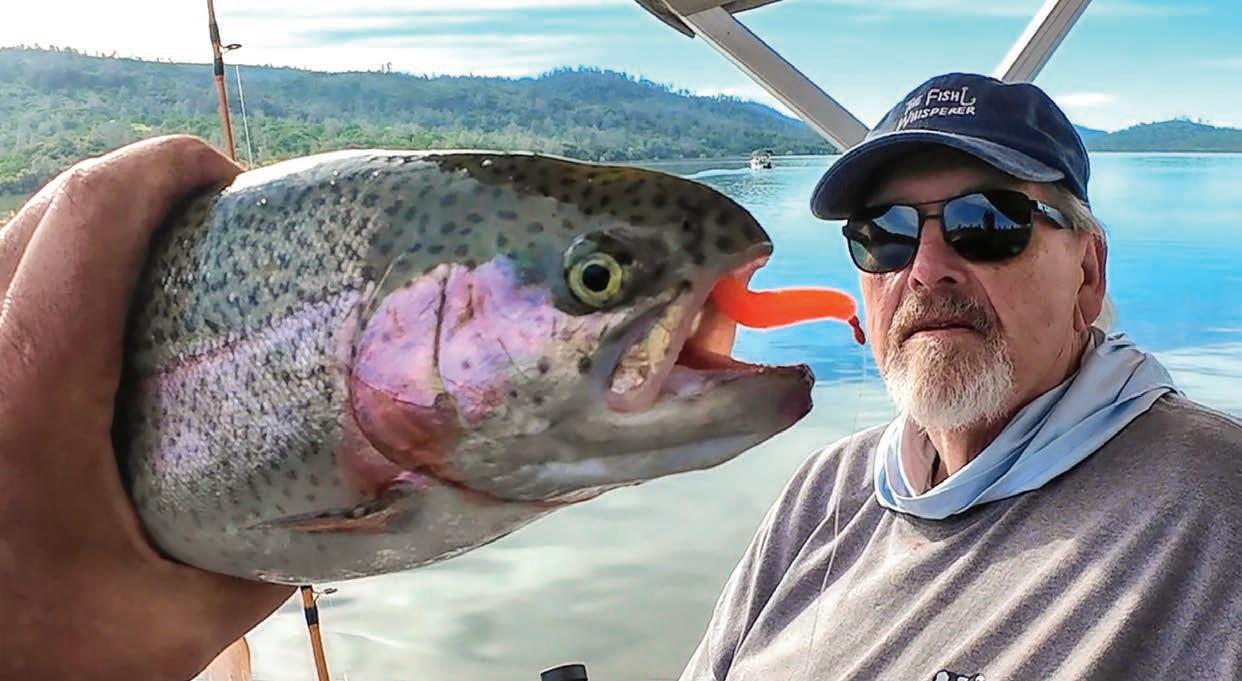
This rainbow hammered a Trout Trix Minnow. Soft plastics are a great offering during this period. (CAL KELLOGG)
TROPHY MOOSE & BEAR HUNTING
River
MORE THAN A HUNT
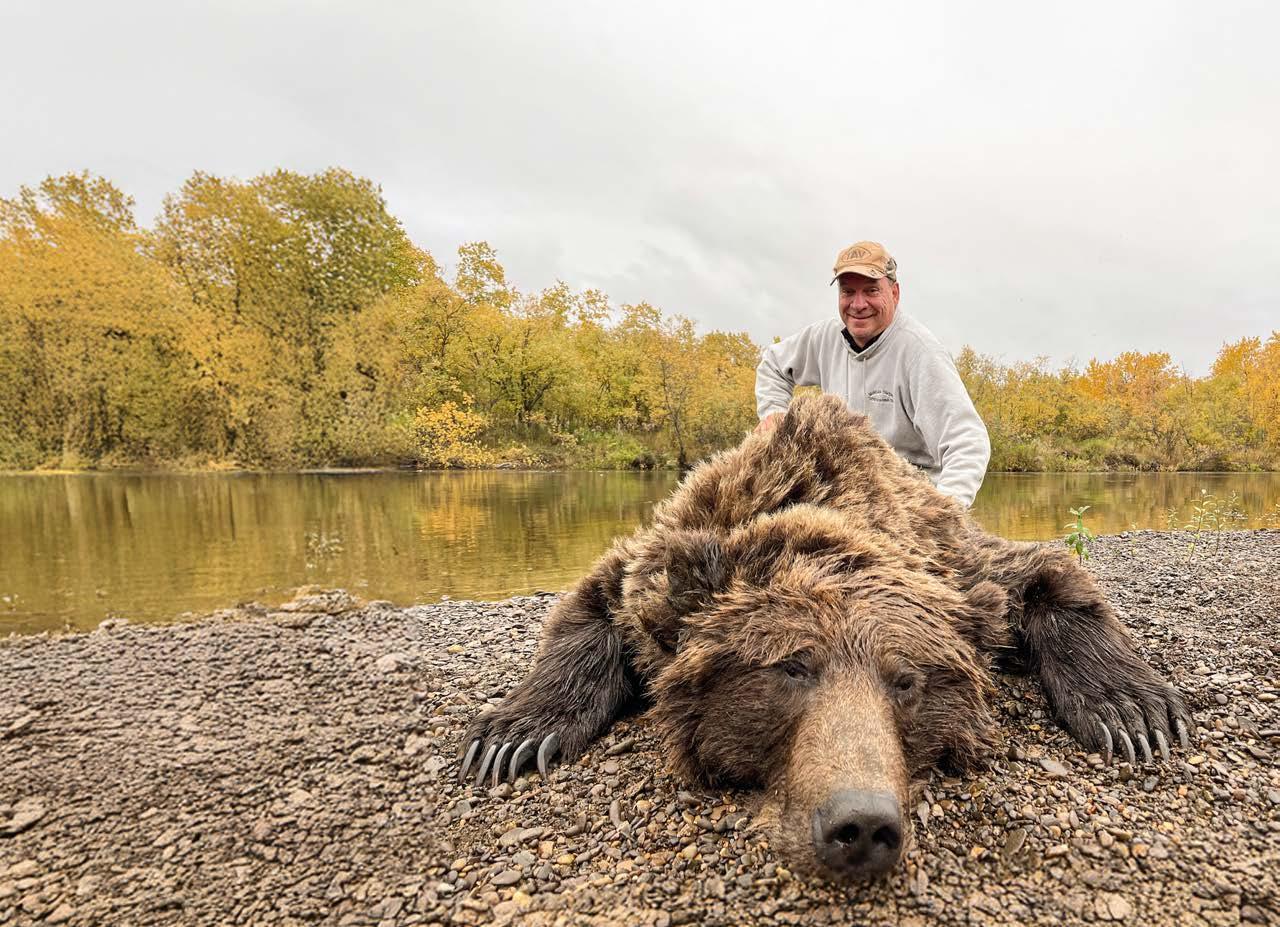
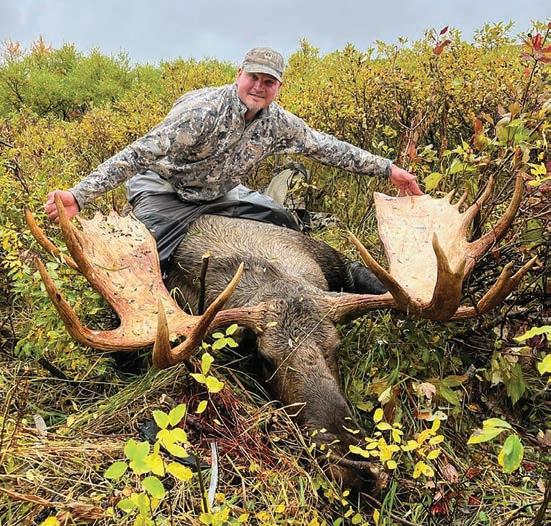
This is an unforgettable Alaskan adventure that blends raw wilderness, world-class game, and the thrill of pursuing some of North America’s most iconic animals in their natural environment. Long days on the river. Close encounters. The kind of moments you’ll talk about for the rest of your life.
WHY HUNT WITH US
• Trophy moose & bear hunts in prime river systems
• Regular 60”+ bull moose opportunities
• Near-100% opportunity rate on legal bulls
• High success on large Alaskan bears
• Fully guided & all-inclusive hunts
• Expert guides with deep local knowledge
• Carefully selected locations for consistent results
• 11–15 day hunts with 15-day combo moose & bear hunt available
Every hunt is carefully planned and professionally guided from start to finish. From scouting and calling to field care and logistics, your guide handles every detail so you can stay focused on the hunt.
Contact us today to secure your hunt and discuss available dates.
2.8L displacement and Variable Camshaft Timing give it the best power-to-weight ratio of any 200-hp four stroke
Four.
IN SEARCH OF STRIPERS
A SPRING SCOUTING TRIP ON THE SAC RIVER FINDS CHALLENGING FISHING CONDITIONS
By Mark Fong
One of the few certainties of spring is that it is certain that the weather will be uncertain. This spring is a perfect example.
After many weeks of unseasonably warm temperatures, Northern California was impacted by a series of late-season cold fronts that brought snow, rain and thunderstorms. And nothing impacts striped bass fishing in the Sacramento and Feather Rivers more than water temperatures, water flows and water clarity.
On a recent scouting trip to the Sacramento River with Brett Brady of Bare Bones Guide Service, I experienced this first hand.
A FORTUITIOUS INVITE
Late one Saturday afternoon, Brady reached out and asked me if I would like to join him and fellow guide Wes Hoskins of Grey Light Guide Service the next morning, as they were making a quick scouting trip to the river in preparation for client trips that they had scheduled for the following week.
After a week of relatively stable weather, a cold front had arrived and dumped a bunch of rain up and down the Sacramento Valley. With the forecast calling for more rain and high winds, I was prepared to get wet.
When I arrived at the Tisdale boat ramp, Brady was already in the process of launching his 22-foot Rogue jet boat. I quickly grabbed my gear from my truck and met Brady and Hoskins at the ramp. The sky was overcast, but thankfully it was not raining. The river level was high and the water was somewhat off-colored.
BASS ON THE MOVE
Before we get to the fishing, it’s important to set the scene on the Sac River. Over the previous week or so, river levels had been falling as water releases from upstream were reduced. When this happened, the large group of striped bass that anglers were catching upriver in the Colusa area made a hurried retreat back downriver. As this was happening, releases from upstream were increased to generate a pulse flow to push a large release of salmon smolts downriver towards the ocean.
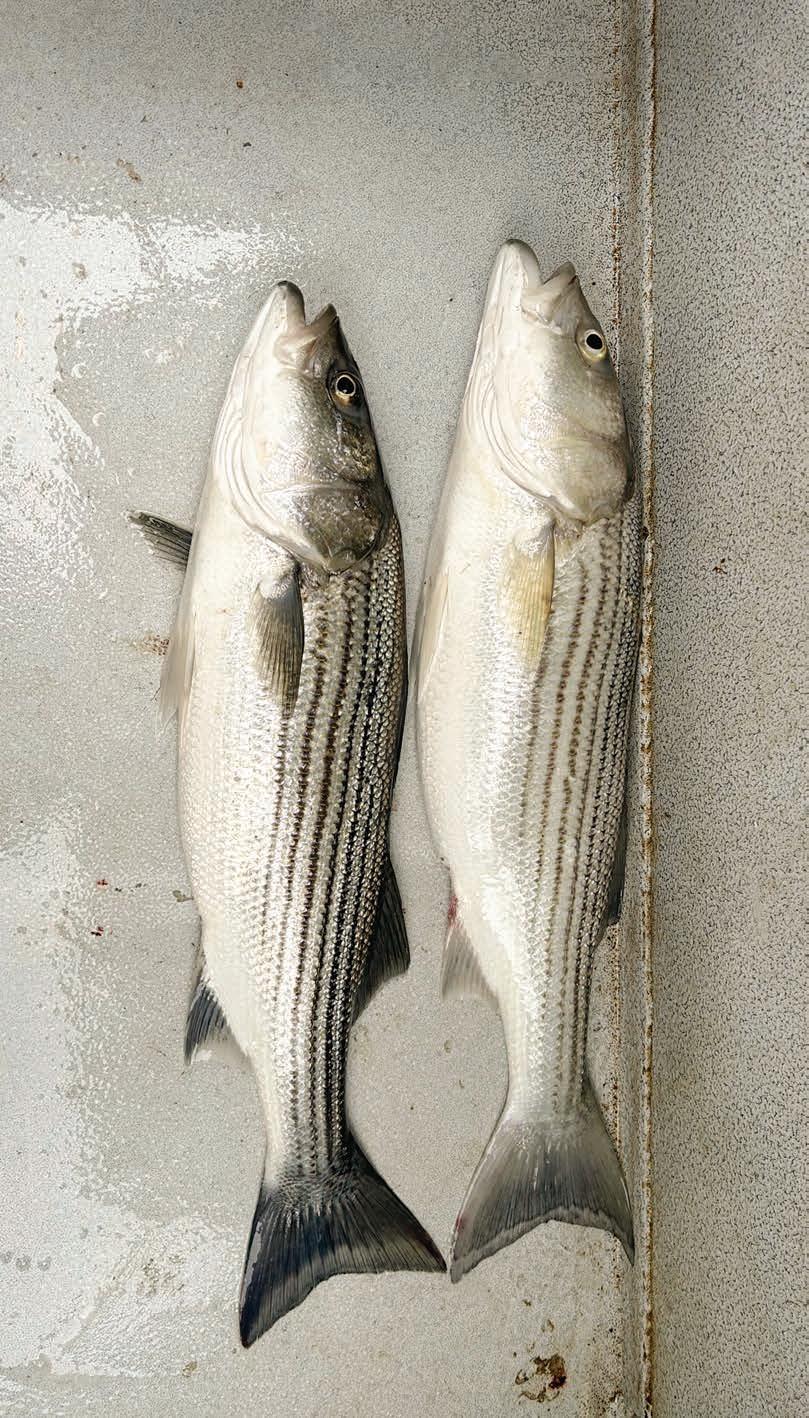
Two guides’ Sacramento River spring striped bass scouting trip with author Mark Fong wasn’t a slam dunk, but the group was able to score some nice fish in anticipation of better days ahead for the rest of the run. (MARK FONG)
FISHING
The increased water flows subsequently lured the stripers back upriver. Add in the runoff from the recent rain storms, and what you have is a rising river with decreased clarity, lots of debris and – more importantly – striped bass that are moving and scattered throughout the system. Brady and Hoskins routinely face challenges like this every season in their quest to put fish in the boat for their clients.
SWIMBAIT SWAGGER
After leaving the ramp, Brady headed upriver towards Grimes. Brady likes to fish swimbaits, and our first stop of the morning was a large sandy flat with a group of deadheads protruding just above the surface of the water.
The anticipation of the first fish of the morning always creates a high level of intensity. On my first cast towards the flat, it took just a few cranks of the reel before I felt a fish smack my swimbait, but it did not connect. I kept a steady wind, and halfway back to the boat another fish ate my bait. It took one quick run
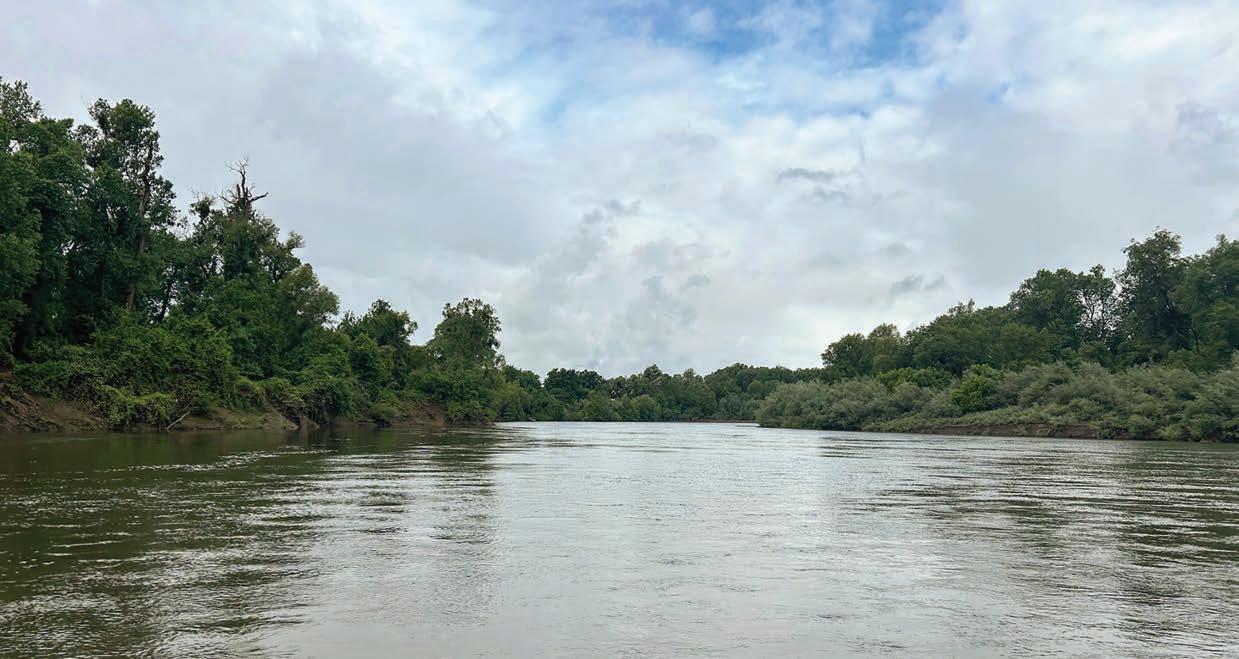
Changing water conditions made for tough lineside fishing. “The increased water flows subsequently lured the stripers back upriver. Add in the runoff from the recent rain storms, and what you have is a rising river with decreased clarity, lots of debris and – more importantly –striped bass that are moving and scattered throughout the system,” Fong writes.
and then it was just gone. All went quiet for me after that, but Brady was busy in the back of the boat catching and releasing several nice fish in the 5-pound range.
Just before we were about to move to another spot, I finally hooked up with my first fish of the morning. After several strong runs, I had the striper at the side of the boat where I reached over and released the fish to fight another day.
‘FEEDING FRENZY’
Now back underway, Brady again headed upriver. As we approached another sandbar, Brady and Hoskins spied a flurry of surface action near the upper end. A group of stripers had pinned some of the recently released salmon smolts against the sandbar and were in the middle of a feeding frenzy.
This time it was Hoskins who was the first to connect. Over the next half hour or so the fish were on a steady bite. Unfortunately, all the boat traffic and added fishing pressure soon put the fish down.
(MARK FONG)
The swimbait bite marked the highlight of the day for the guys. (MARK FONG)
GOING LIVE, GOING HOME
With the swimbait bite over, Brady decided to fish a few areas with live minnows before heading back to the ramp. The stripers were scattered and pretty finicky. We had a few grabs where the fish would bite but then were gone, as they simply failed to hold onto the bait.
As the morning progressed, water clarity continued to deteriorate and the river began to fill with debris. It was time to call it a day after a little bit of productive fun.
Now spring striper season is ready to take off. Give it a shot this month in the Delta. CS
Editor’s note: Brett Brady is a multispecies guide specializing in striped bass, trout, kokanee and landlocked salmon. To book a trip with Brett or to learn more, please visit his website at fishbarebones .com, follow him on Facebook at Bare Bones Guide Service or contact him directly at (530) 263-4451.
Overall, it was a mixed bag with bites coming sporadically and the river not cooperating. But Fong and the two guides did catch some nice stripers, and they hope it sets the tone for a great spring run of striped bass. (MARK FONG)
GET TO KNOW BLUECOLLAR ’BOW RIVER
THE SACRAMENTO FROM SHASTA DAM TO RED BLUFF SHOULD BE CELEBRATED MORE, AND HERE’S WHY.
By Cal Kellogg
This might sound like a stretch, especially when you consider the reverence anglers have for Western trout rivers like the Madison, Yellowstone and Henrys Fork of the Snake. Those rivers have earned their reputations, no doubt.
But if you measure a trout fishery by consistency, accessibility, size of fish and sheer productivity, the Sacramento River from Shasta Dam down to Red Bluff belongs in the same conversation, and in some ways, it surpasses them.
WHAT MAKES THE SACRAMENTO so special begins with water. More specifically, it begins with Shasta Dam. Cold, nutrient-rich water released from the depths of Shasta Lake creates a tailwater environment that remains stable and productive throughout the year. Unlike freestone rivers that fluctuate wildly with snowmelt and weather, the Sacramento flows with remarkable consistency. Temperatures stay within a range that trout can tolerate and thrive in, even during the heat of summer.
That stability fuels an incredible food base. The Sacramento is loaded with aquatic insects – mayflies, caddis, midges, stoneflies – and those bugs are available to trout nearly year-round.
Add in scuds, worms, eggs from spawning salmon and occasional baitfish, and you have a system that
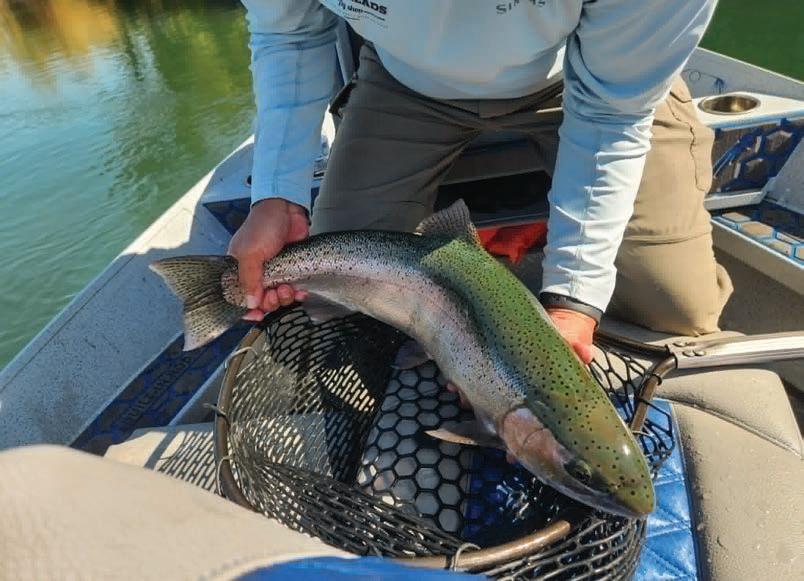
The 60-plus miles of the Sacramento River below Shasta Dam can go pound for pound with the West’s best trout rivers, and it is also a user-friendly fishery that consistently produces fish for anglers of all skill levels. (JASON THATCHER/RIVER PURSUIT GUIDE SERVICE)
FISHING
produces fast-growing, hard-fighting rainbow trout that often exceed 20 inches and can push well beyond that mark.
It’s a river where numbers and quality intersect, and that’s a rare thing.
THE STRETCH BETWEEN SHASTA Dam and
Red Bluff is the heart of this fishery. It’s a broad, powerful river, but it’s also highly fishable thanks to its defined riffles, runs, seams and gravel bars. Trout spread throughout the system, holding in classic current breaks and feeding lanes, and they are accessible to a variety of techniques.
While the Sacramento is a true year-round fishery, spring and summer are when it really shines.
Spring brings ideal flows, warming water temperatures and a surge in insect activity. This is when the river comes alive. Caddis hatches build, mayflies become more consistent and trout shift into aggressive feeding patterns. It’s a time when fish are spread out, willing to move and often less selective than they will be later in the season.
Summer fishing, despite the heat in the Sacramento Valley, remains excellent thanks to the cold water releases from Shasta. While many rivers in California become marginal or even unfishable during peak summer, the Sacramento continues to produce.
Early mornings and evenings can be outstanding times to be on the river, but even midday fishing can be productive if you focus on deeper runs and faster water where trout find oxygen and cover.
For fly anglers, the Sacramento is a nymphing river first and foremost. While there are opportunities for dry fly fishing, particularly during heavy caddis activity or occasional mayfly hatches, the bread and butter is getting your flies down to where the fish are feeding.
A typical setup involves a twofly nymph rig under an indicator. Stonefly patterns or egg-imitating beads paired with smaller mayfly or caddis imitations are a proven combination.
Depth control is critical. The Sacramento is a big river, and fish often hold near the bottom in moderate to heavy current. Getting your flies down into that zone –and keeping them there – is the difference between a slow day and a banner outing.
Drift is everything. Long, dragfree drifts through productive water consistently produce fish. Pay attention to seams where a faster current meets slower water, edges
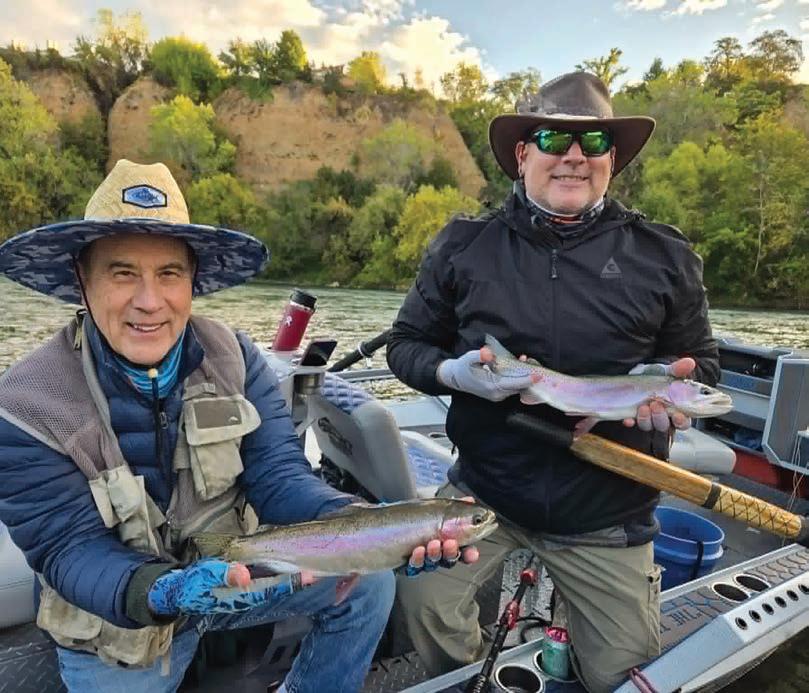
Captain Jason Thatcher (left) is one of the premier fly fishing guides on the Sac, putting his anglers on both big numbers of rainbows and huge trophy-class trout. (JASON THATCHER/ RIVER PURSUIT GUIDE SERVICE)
“Unlike freestone rivers that fluctuate wildly with snowmelt and weather, the Sacramento flows with remarkable consistency. Temperatures stay within a range that trout can tolerate and thrive in, even during the heat of summer,” author Cal Kellogg writes. (JASON THATCHER/RIVER PURSUIT GUIDE SERVICE)
of riffles and transitions into deeper runs. Those are the conveyor belts that bring food to trout, and that’s where they set up.
CONVENTIONAL GEAR ANGLERS ARE far from left out on the Sacramento. In fact, some of the most effective techniques mirror fly fishing approaches. Side-drifting or drifting small presentations through current lanes can be deadly. Nightcrawlers, beads or small artificial offerings presented naturally will take fish throughout the system.
Casting lures also has its place, especially in areas where fish are holding tighter to structure or when covering water is the goal. Small spinners, spoons and even lightweight plugs can produce, particularly in low-light conditions or when trout are feeding more aggressively. The key, as with fly fishing, is presentation. The more natural the drift or retrieve, the better your chances.
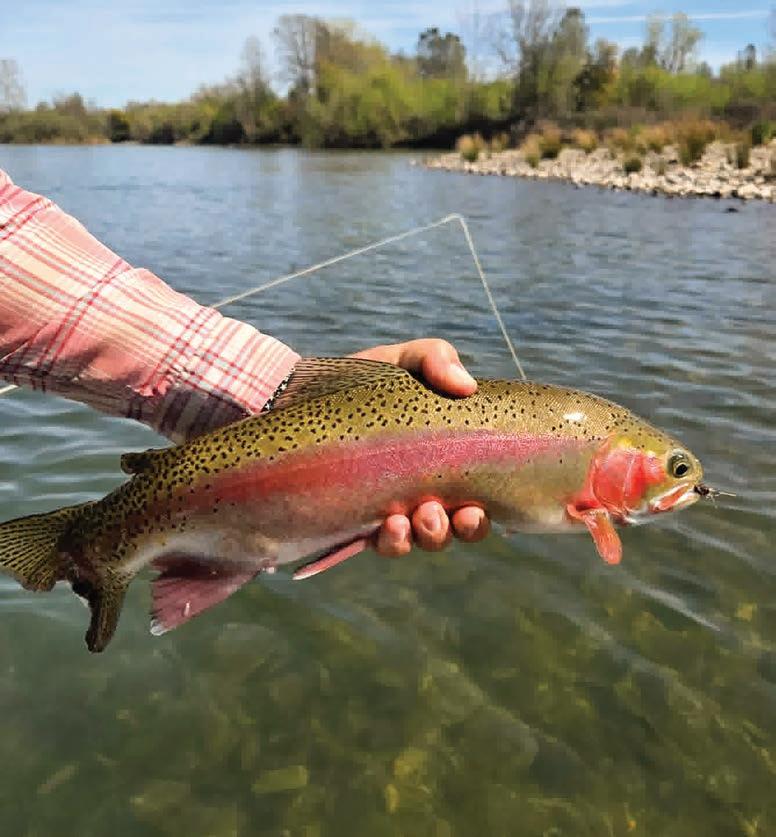
The stretch of the Sac below Lake Shasta is full of hard-fighting rainbows like these. (JASON THATCHER/ RIVER PURSUIT GUIDE SERVICE)
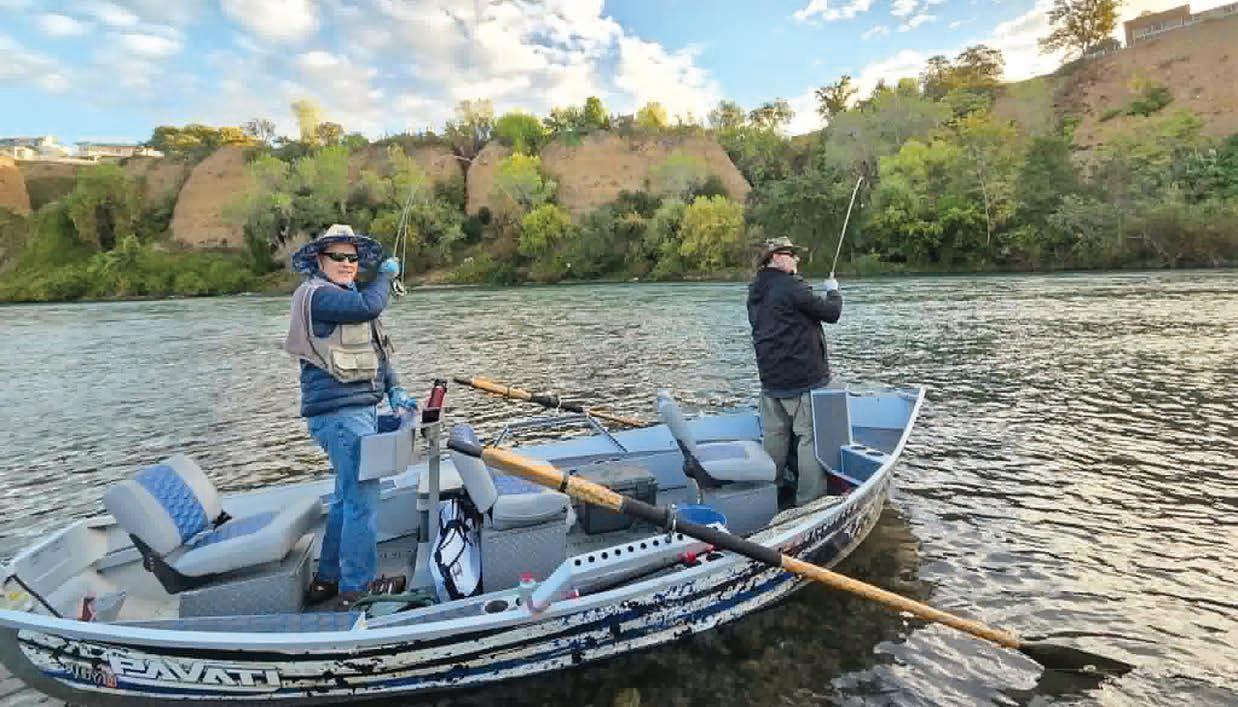
Fly fishing from a drift boat is a great way to get to know the fabulous Sacramento. (JASON THATCHER/RIVER PURSUIT GUIDE SERVICE)
FISHING
Boat fishing is the dominant approach on the Sacramento, and for good reason. The river is large, and so being able to cover a lot of water efficiently is a major advantage. Drift boats and rafts allow anglers to move with the current, hitting prime water while maintaining ideal presentation angles with their offerings.
A TYPICAL DAY ON this river involves working a series of productive runs, riffles and seams, making repeated passes through high-percentage water. The ability to adjust position, control drift and stay in the strike zone is what makes boat fishing so effective.
That said, bank anglers have more opportunities than many realize. There are numerous access points along the river, including public
areas, bridges and stretches where gravel bars extend into the current.
Wading can be productive in certain areas, but caution is essential; the Sacramento is powerful and flows can change, so knowing your limits and picking your spots carefully is critical.
For shore anglers, targeting inside bends, tailouts and areas where the current slows slightly can produce consistent action. Fishing bait under a float or working spinners through accessible seams can be very effective. Early morning and evening tend to be the best times, especially during warmer months.
One of the most overlooked aspects of the Sacramento is just how forgiving it can be. This is not a technical spring creek where every cast must be perfect. While
experienced anglers will certainly catch more fish, the river offers enough opportunity that even those with modest skills can enjoy success.
At the same time, it rewards refinement. Better drifts, better depth control, better reading of water – all translate directly into more fish. It’s a river you can grow with, one that continues to teach even seasoned anglers.
Another factor that sets the Sacramento apart from other river fisheries is its accessibility. You don’t need to hike miles into the backcountry or navigate rugged terrain to find quality trout water. The river runs through a corridor that is easy to reach, yet once you’re on the water, it still feels expansive and wild.
Despite all of this, the Sacramento remains somewhat under the radar compared to the iconic rivers of the West. It doesn’t have the same mystique or postcard reputation, but for those who fish it regularly, that’s part of the appeal. It’s a blue-collar trout river – reliable, productive and unpretentious.
AND THEN THERE ARE the fish – strong, thick-shouldered rainbows that know how to use current to their advantage. They run hard, jump often and fight well above their weight. Hooking into one in heavy current is a reminder of just how alive this river is.
The Sacramento between Shasta Lake and Red Bluff isn’t just good; it’s exceptional. It offers yearround opportunity, peak fishing conditions in spring and summer and a combination of numbers and quality that rivals some of the most celebrated trout waters in the country.
For anglers willing to look past reputation and focus on results, it stands as one of the finest trout fisheries in the West.
And the best part?
It’s right here in California –flowing strong, cold and full of fish. CS
“The Sacramento between Shasta Lake and Red Bluff isn’t just good; it’s exceptional,” Kellogg writes. “For anglers willing to look past reputation and focus on results, it stands as one of the finest trout fisheries in the West.” (JASON THATCHER/RIVER PURSUIT GUIDE SERVICE)
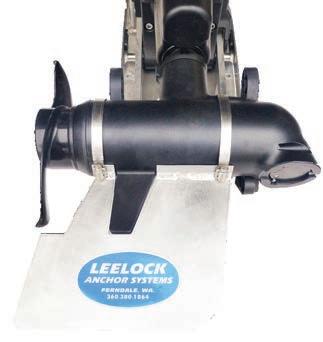
The LeeLock magnum Skeg #LMS-04 is made for Minnkota Instinct Quest motors. It will drastically improve the steering performance and straight line travel of your bow-mounted motor. Not only does this Skeg improve your motor’s performance, it also makes it much more efficient. Your batteries will run longer on a charge. A LeeLock Skeg is a vital part of your trolling motor system. This oversized skeg is made of 5052 aluminum. The size is 8 3/4 inches high by 10 inches wide and it’s 3/16 inches thick. It comes with clear PVC coated stainless steel hose clamps.
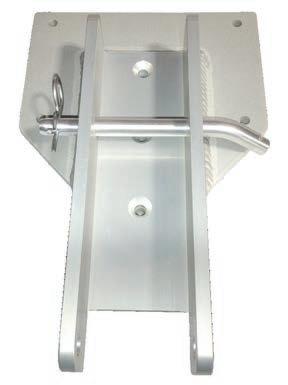
The Heavy-Duty Quick Change Base #QB-03 is like the standard Quick Change Base, but beefed up to provide a wider footprint. This provides a more secure mount. Like the standard Quick Change Base, the Heavy-Duty base allows you to easily and quickly switch between the #CRN-01 Columbia River Anchor Nest, any of the 3 Bow Mount Trolling Motor Mounts or the #BL-01 LeeLock Ladder. Simply remove the pin and slide an accessory out and slide another accessory in and replace the pin. The Heavy-Duty Quick Change base mounts to almost any power boat as long as the footprint fits on the bow area of the boat. It has 7 5/16 inch mounting holes. The Heavy-Duty Quick Change Base is handmade of aluminum. Go to LeeLock.com to order the Base alone or to add the CRN-01 Columbia River Quick Change Anchor Nest, the three Bow Mount Trolling Motor Mounts, or the LeeLock Ladder to your order.
END OF AN ERA
A HUNTER AND HIS GROWING SON GET IN ONE FINAL YOUTH TURKEY SEASON ADVENTURE
By Logan Sebela
The weekend was bittersweet, to say the least. I have been taking my son Deacon out into the field to hunt with me since he was 5 years old or so. Ahead of most of his peers, he harvested his first bird when he was 8 years old.
But this spring felt like a culminating event, as he will have aged out of the youth turkey hunts after this season. I am sure that we will continue to hunt together, but
he is moving into the adult realm and leaving his childhood behind. This was just another reminder of that, so I tried to savor it just a bit more.
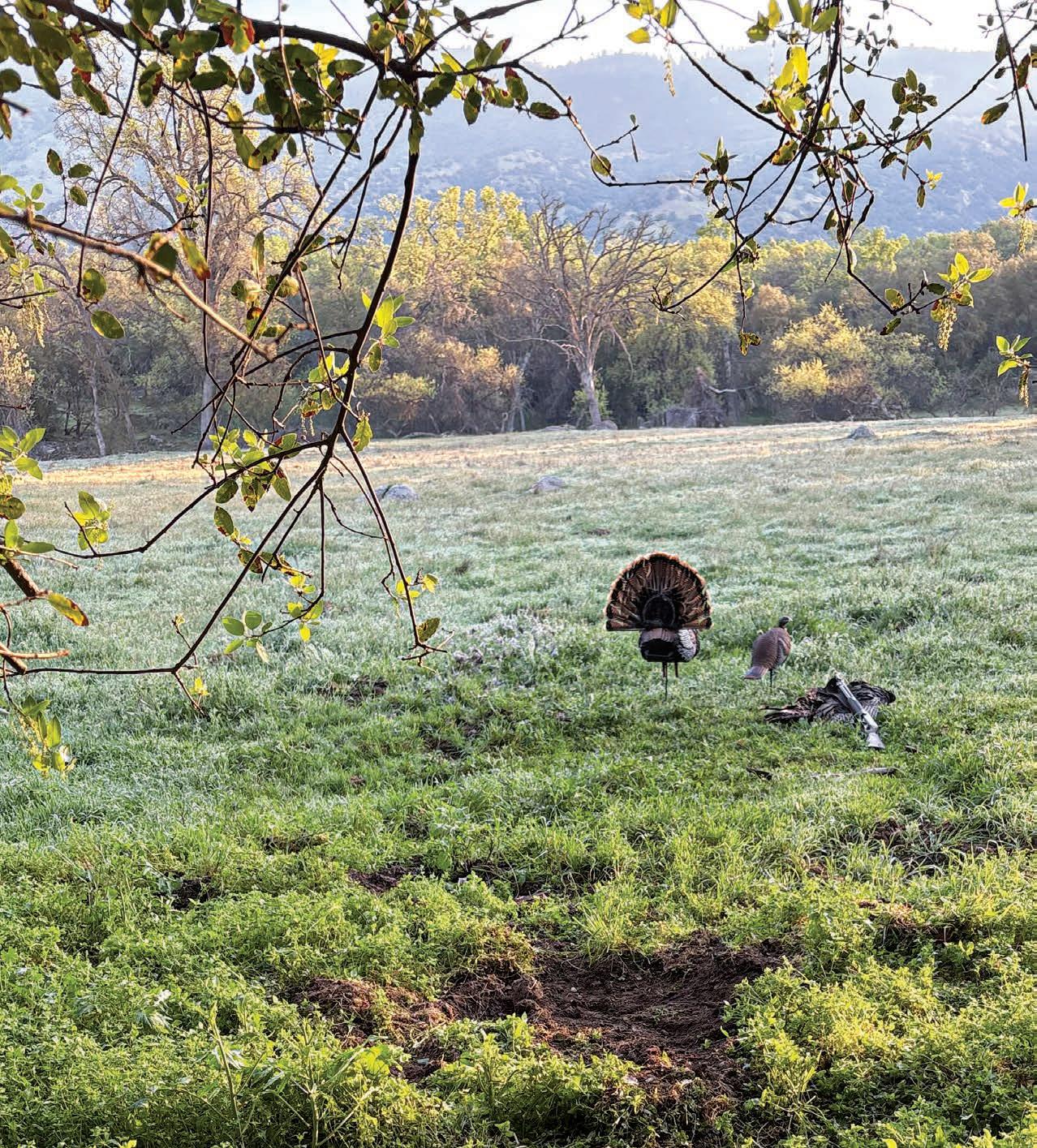
WE GOT TO THE ranch in the foothills around Fresno at about 5:30 a.m., giving us plenty of time to set up and listen for gobbles. We picked a high spot so we could hear both sides of the property. Several sets of gobblers sounded off early, but a group of two birds were especially close.
As the sky began to gray, we made
Deacon Sebela’s last eligible youth turkey hunt with dad Logan Sebela brought both some nostalgia when they hunted the upland birds near Fresno. (LOGAN SEBELA)
HUNTING
our move to the cover of a large oak tree. A thin layer of fog masked our movements as we set out our decoys. The branches nearly touched the ground, creating a canopy to break up our outline.
We have been hunting this property for a number of years, and I have always desired to take a bird from this setup. I had tried several times before, but it never quite worked out. The tree is strategically positioned just out of sight of a popular roost tree, with
a wide-open field in front and a game trail to the left. It has some options and we have seen birds come into this location from several directions to strut and do their morning business.
The two nearby birds gobbled pretty consistently and with about 20 minutes until fly down, I began to interject with some soft hen yelps. Not too long after, a hen began to argue with me about the morning plan with increasing volume. The toms shut up, and it was just me and her engaging in
a verbal altercation. She’d fire up and I’d step all over her with my yelps.
In case you’ve never tried this, it can work one of two ways: She flies down and leads the toms away from the hussy across the way, or she comes in to set the rival hen straight. She went for option No. 2.
TWO HENS APPEARED FIRST, followed quickly by the two toms about 100 yards out. The toms seemed hesitant as they strutted back and forth, never
These father-son moments date back years, as Deacon first accompanied his dad as a 5-year-old, and Deacon harvested his first bird at 8. In California, hunters younger than 16 as of July 1 qualify for state junior licenses and hunts like this year’s March 21-22 youth turkey weekend. (LOGAN SEBELA)
HUNTING
once gobbling. I strained my eyes to see if long beards were present. I quietly whispered to my boy in front of me, “I think they are jakes.”
The one larger bird had a fully formed tail fan, while the smaller bird had some clear indicators of being a jake. I was merely providing my son information to help him make his decision if the opportunity presented itself. He had wisely ranged some rocks in front of us to help guide his actions as the birds moved closer.
“The show the birds put on from the roost to the field was what turkey dreams are made of. I will be replaying that reel in my head for many years to come,” Logan writes. (LOGAN SEBELA)
At one point, the jakes seemed to be drifting off as the hens milled around. I began forming secondary plans and moves we could make if the birds moved out of sight. But as if right on cue, the hens moved in closer to investigate our strutter decoy and his hen. At almost 10 steps, I was sure we were going to get busted by the feathered ladies.
We both froze and watched the display. The jakes, in turn, began weaving closer to us until they were
right on our decoys. Deacon had several shot opportunities as they moved in, but I could tell he was contemplating his options. This is the same kid who passed on a jake when he was 8 because he wanted a “big tom.” I’ve let him run the show for a while now, and was not going to interject on his hunt.
THE TWO JAKES PACED back and forth for several minutes. On their third pass by the decoys, I saw Deacon slowly begin to inch his gun up to his shoulder and
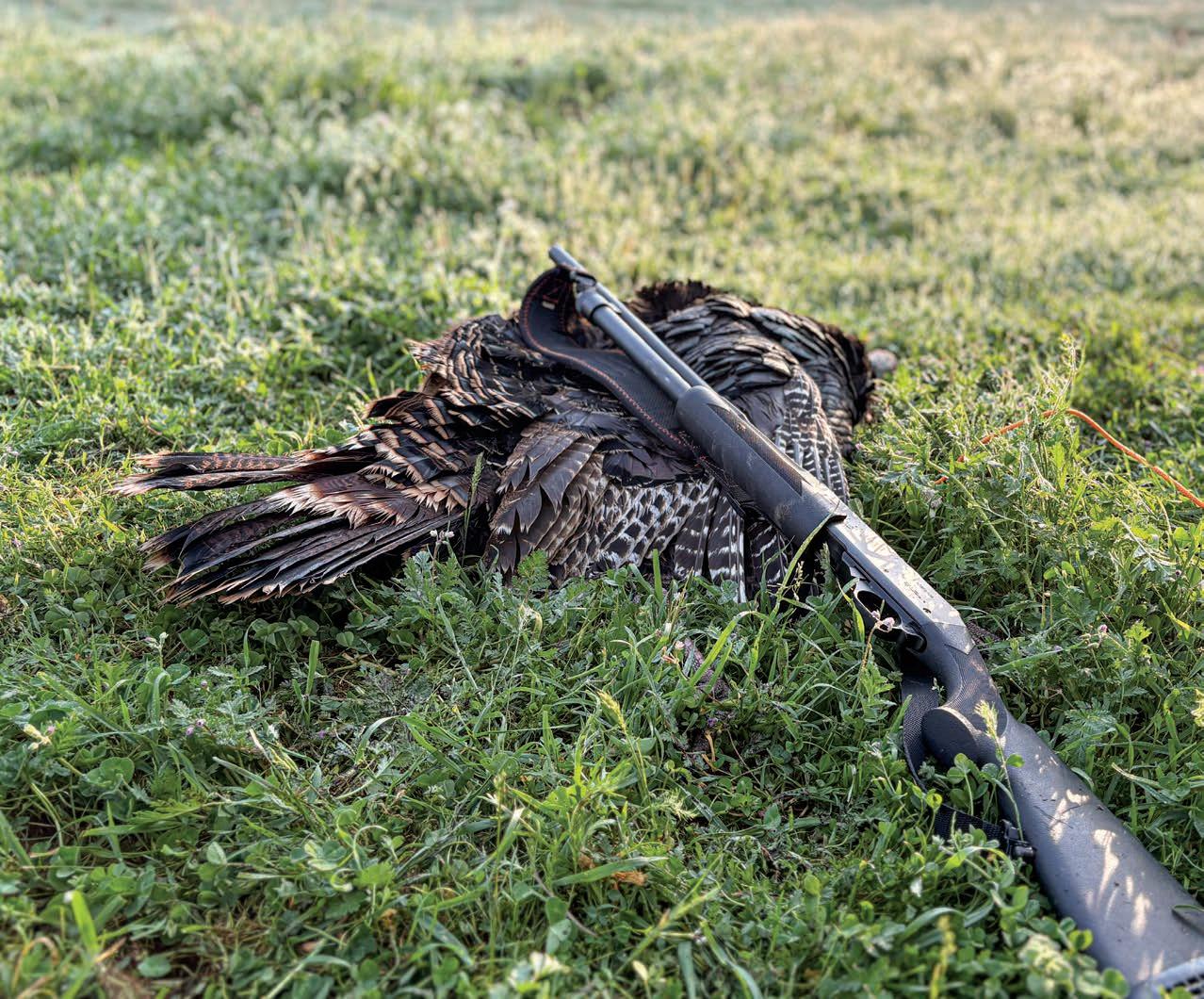
Taking this jake made it worthwhile for Deacon. (LOGAN SEBELA)
HUNTING
weld his cheek to the stock. He could endure the temptation no longer. The bird was quickly on the ground, and as the smoke lifted, he was all smiles. No regrets. It was not his biggest bird by a long shot, but he was proud, as was I.
The show the birds put on from the roost to the field was what turkey dreams are made of. I will be replaying that reel in my head for many years to come.
As we walked back to the truck, a mix of sadness and joy intermingled in my head. I am so proud of the man Deacon is becoming, but feel a bit homesick for the passage of his youth I was privileged to take part in. I am excited to see what God has in store for him. I know he will do well, and I am eternally thankful for the time we have spent together in the woods. CS
Editor’s note: A second junior wild turkey hunt takes place May 4-17. See wildlife .ca.gov/Hunting/Upland-Game-Birds.
As a dad Logan knew this day was coming, and even as his son’s passage from youth is “bittersweet,” he knows that as an adult Deacon “will do well, and I am eternally thankful for the time we have spent together in the woods.” (LOGAN SEBELA)
LATE-SEASON DECOY PLAYS
By Scott Haugen
Turkey season is winding down. By basing your choice of decoys on what’s happening behaviorally with the birds, you can boost the odds of punching a tag. Here are some late-season decoy options to consider, and why they work.
MATING HEN DECOY
This is one of my favorite early-
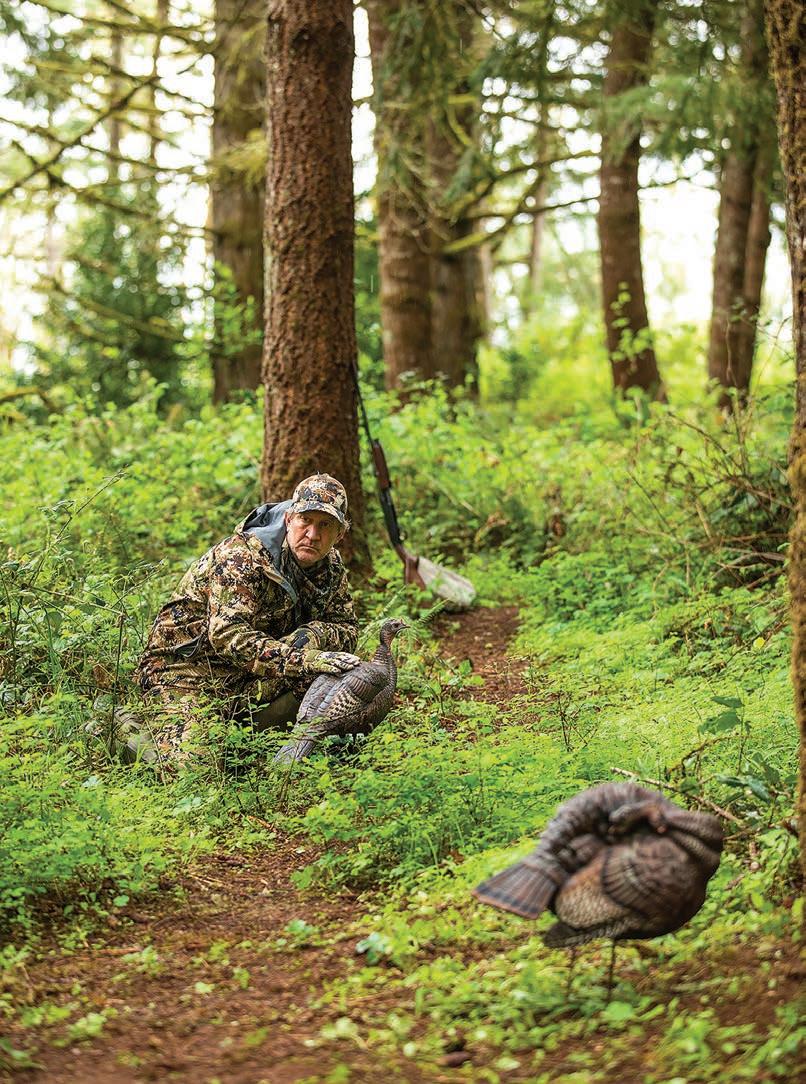
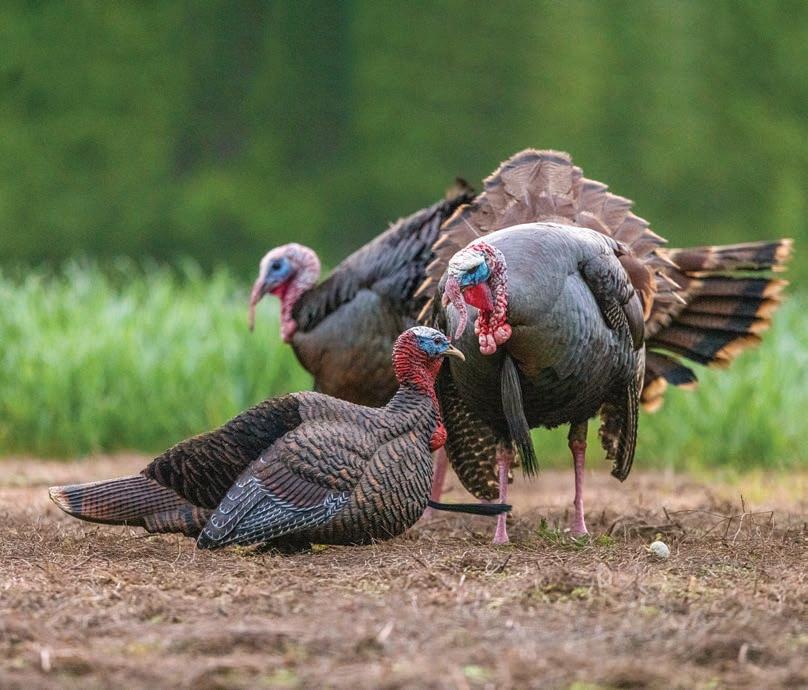
season decoys, but it can be a great late-season option if hens lose their first clutch. When a tom sees this decoy it can be a race to reach it. If scouting reveals a solid number of toms in an area, pair it with a jake decoy. This look ignites fights and the urge to breed, often resulting in multiple toms coming in. If hunting with a buddy, this can be a solid bet to fill two tags. Two seasons ago I paired these decoys and had six toms come at once.
AS SPRING TURKEY HUNTING NEARS AN END, MAXIMIZE YOUR ODDS WITH FAUX HENS, JAKES
A mating hen decoy is low profile, so it needs to be placed where toms can see it. Small openings in the timber, gravel bars along a stream and the edges of meadows are prime locations.
JAKE DECOY
When mature toms that have been hunted all season form bachelor flocks, they can be reluctant to confront strutting decoys, and they’re not easily fooled by a lone
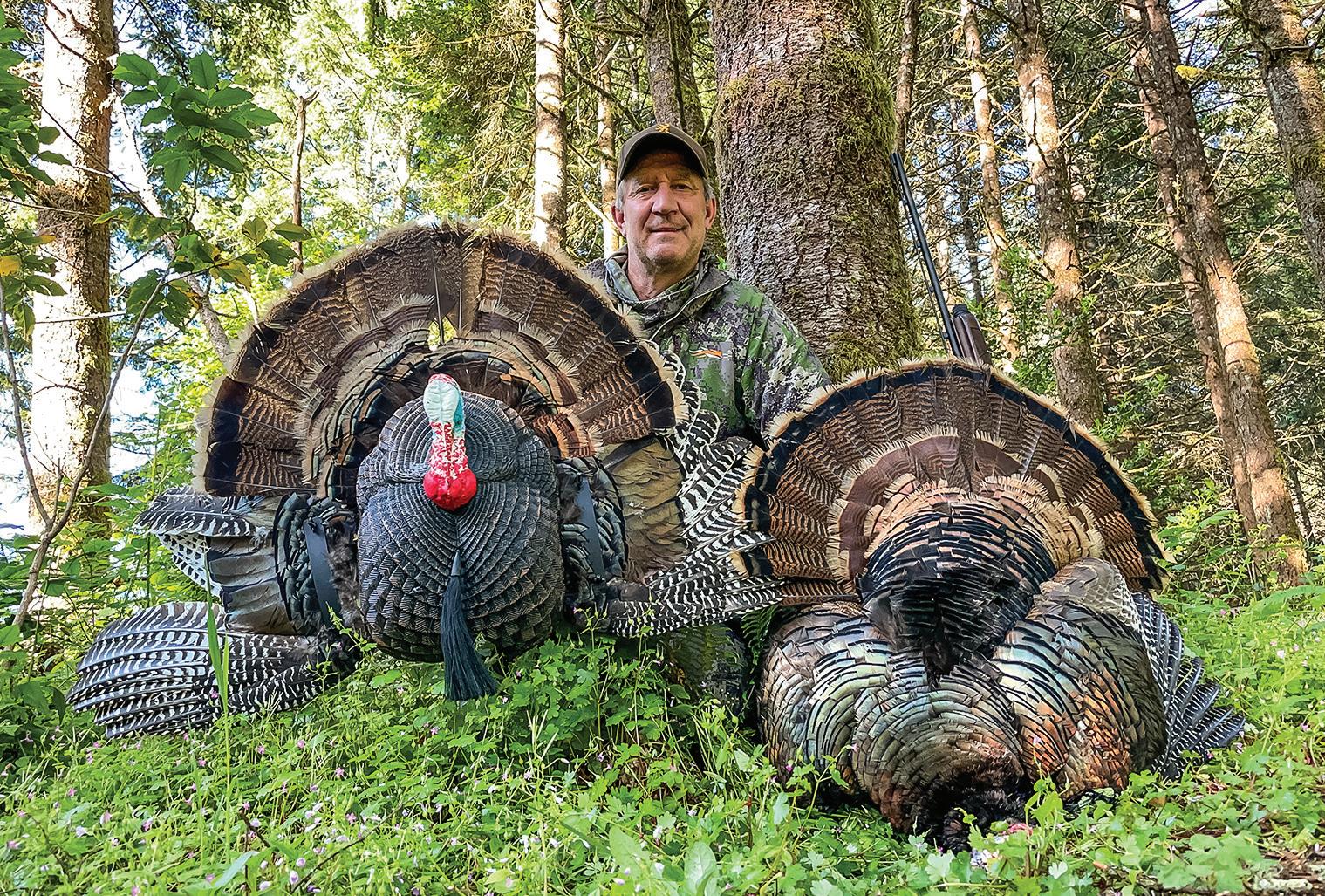
This marks author Scott Haugen’s 40th season of turkey hunting, and one thing he’s learned over the years is when and how to deploy decoys. He used a Mojo Scoot-N-Shoot Max to bring this lone tom into .410 range last season. (SCOTT HAUGEN)
HUNTING ... TO FIRE
your
BETTER WILD TURKEY BURGER STARTS WITH PROPER CARE, COOKING TIME
By Tiffany Haugen
Wild turkey is one of the besteating upland game birds on the planet. If anyone tries to tell you otherwise, either they’re overcooking the bird or not taking proper field care of it, or both.
This late in the season, temperatures are hot. The quicker you can get that bird cleaned and in the freezer, or better yet, cooking, the better tasting it will be. Turkey meat is very lean, especially lateseason toms that have burned off their fat during the rut. For this reason, take care not to overcook them or they will be tough and dry. This is especially true with ground turkey burgers.
Wild turkey meat is mild, so it nicely takes on the flavor of the ingredients
it’s cooked with. Between spring and fall season birds, we eat a lot of wild turkeys in our family, and this recipe is one everyone likes.
1 pound turkey breast, ground or minced
One egg
½ onion, minced
3 to 4 cloves garlic, minced
½ cup breadcrumbs
2 tablespoons yellow mustard
1 tablespoon gochujang or chili sauce
½ teaspoon smoked paprika
½ teaspoon salt
½ teaspoon black pepper
2 tablespoons coconut or avocado oil
In a medium bowl, mix all ingredients until thoroughly combined. Form turkey mixture into patties. Refrigerate until
ready to cook, up to eight hours.
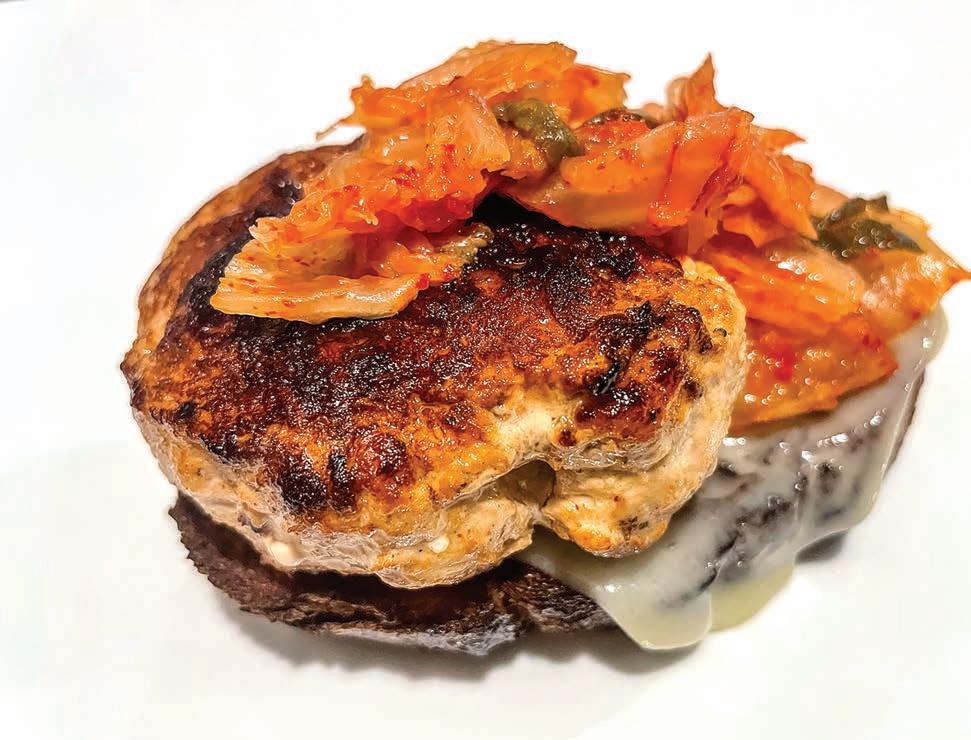
In a large skillet, melt coconut oil on medium-high heat. Carefully place burgers in the pan and fry for two to four minutes or until they turn a deep brown. Do not move burgers around in the pan, as they can fall apart before they are fully cooked. Flip burgers and cook until deep brown on the other side. Cook to desired doneness or until burgers reach an internal temperature of 150 degrees. Add cheese if desired and serve on a bun with kimchi on the side.
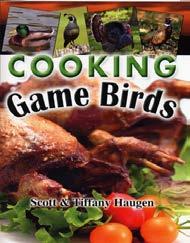
Editor’s note: For signed copies of Tiffany Haugen’s popular cookbook, Cooking Game Birds, visit scotthaugen.com.
Want
wild turkey burger to be the hit of your outdoor cookout this spring? It starts with efficient field care and not overcooking the meat. (TIFFANY HAUGEN)
Start your dry age now and be ready for Father’s Day!
Father’s Day isn’t as far away as you think.
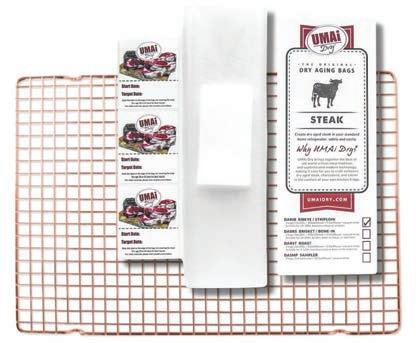
The perfect dry-aged steak takes time. Time to deepen flavor, time to tenderize, and time to transform something great into something unforgettable. With UMAi Dry®, you can start today and serve something extraordinary when it matters most. Start aging now. Taste the difference later.
And while you’re planning ahead…
UMAi Dry® is the ultimate Father’s Day gift. For the dad who takes pride in doing it right—this is more than a gift. It’s an experience!
HUNTING
hen decoy. An insubordinate jake decoy can spike adrenaline levels in toms, and this can result in a reactionary approach as toms come in looking for a fight. Combining a jake decoy with a hen decoy can be even more effective. Once a tom sees there might be a chance to breed, they can quickly close in.
In brushy or forested habitat, place an upright hen decoy heading down a trail with a jake decoy
behind it. Arrange the set so it looks to be moving away from the anticipated direction of the target tom’s approach. Doing so often forces a tom to react fast to catch up to the birds that are moving away. In open habitat, setting a jake decoy next to a breeding hen decoy can bring toms on the run.
UPRIGHT HEN
One of the most effective decoys is an
upright hen. I’ve shot toms all season long over this decoy in multiple states and in a range of conditions.
The upright position of this decoy makes it easy for turkeys to see, be it on the edge of a meadow, on a game trail or where only its head is sticking above cover.
Combining a feeding hen decoy with an upright hen is a natural look that toms like. While approaching toms come to the upright hen decoy, once they notice a feeding hen it reassures them that all is safe, so they come in without hesitation.
When jakes are present and aggressive, adding a jake decoy to the upright hen is a good move, as the younger males’ aggression often forces mature toms to react. The past two seasons, I’ve had great success with a Final Approach flocked back jake decoy in a range of decoy sets. The realism of this decoy simply fools the wisest of toms.
STRUTTERS
Strutting tom decoys can be effective all season long, but they really shine in the closing days. Fitting a Mojo Shoot-N-Scoot decoy with a real tail and wings is something I’ve had consistent success with. It can be an intimidating look for approaching toms, but is very effective where mature toms prevail, as well as where aggressive groups of 2-yearold toms are wreaking havoc.
In addition, newly arriving toms, as well as fall bachelor flocks that are already establishing pecking orders, are good opportunities to use a strutting decoy. When wet conditions or predators claim a clutch and hens are forced to renest, a strutting decoy along with an upright, feeding or preening hen decoy can be effective in the final days of the season.
LONE HEN DECOY
When tom ratios are high but hens few, a simple hen decoy can be very effective late in the season. If a new tom moves into an area or there’s
Not sure which turkey decoy to use this late in the season? Let the birds help you decide. (SCOTT HAUGEN)
HUNTING
a timid or educated tom nearby, a single hen decoy can help coax them in. In places where jake numbers are high, a hen decoy often pulls them in, which forces dominant toms to follow.
Setting an upright hen decoy on a trail along the inside edge of a wooded area or river bottom is effective this time of the season because lone hens, even nesting ones, often travel these paths. If placed in the open where toms can see them from a distance, toms often hang up and expect the hen to come to them at this point in the season.
There you have it; a mix of lateseason decoy game plans that have brought me success for 40 years. Good luck out there. CS
Editor’s note: For signed copies of Scott Haugen’s popular book, Western Turkey Hunting: Strategies For All Levels, visit scotthaugen.com. Follow Scott on Instagram and Facebook.
A Final Approach flocked back jake decoy fools the wisest of toms and has a range of applications throughout the season. (SCOTT HAUGEN)
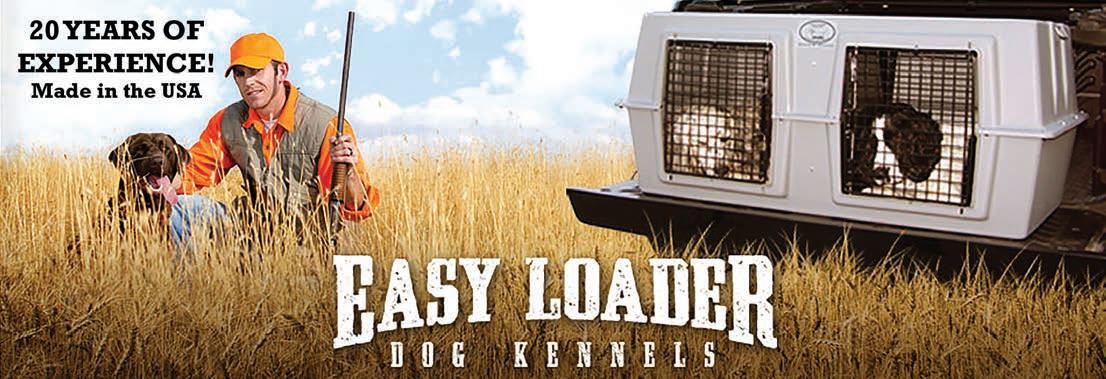
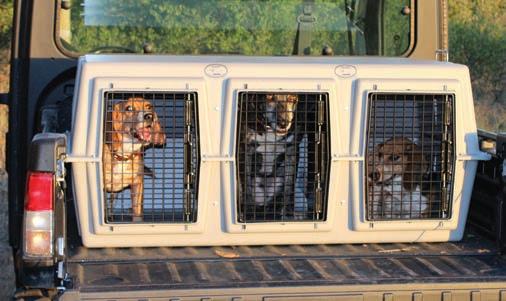
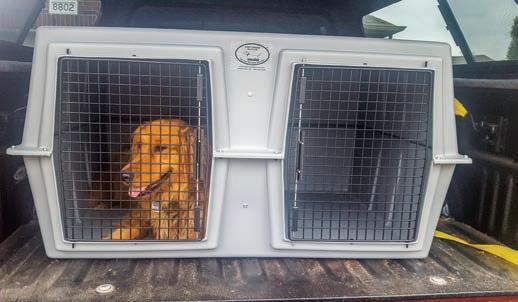
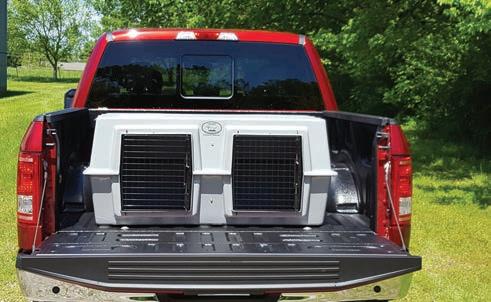
• EZ-XL accommodates 2 dogs over 65 lbs each
• Made from High Density Polyethylene with UV protection
• Easy Loader fits most full size pickups, SUVs & large UTVs
• Deuce fits smaller pickups, SUVs & UTVs
• EZ-XL is for larger breed dogs & full size vehicles
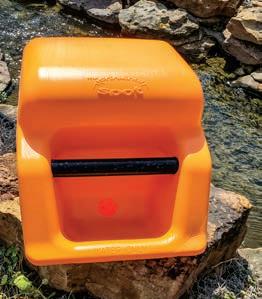
• Vents, cold weather door covers, insulated covers & custom kennel pads available
WHAT THEY DON’T TELL YOU ABOUT GUN DOG OWNERSHIP COSTS
CONSIDER FINANCIAL IMPACT BEFORE BRINGING HOME FOUR-LEGGED HUNTING PARTNER
By Scott Haugen
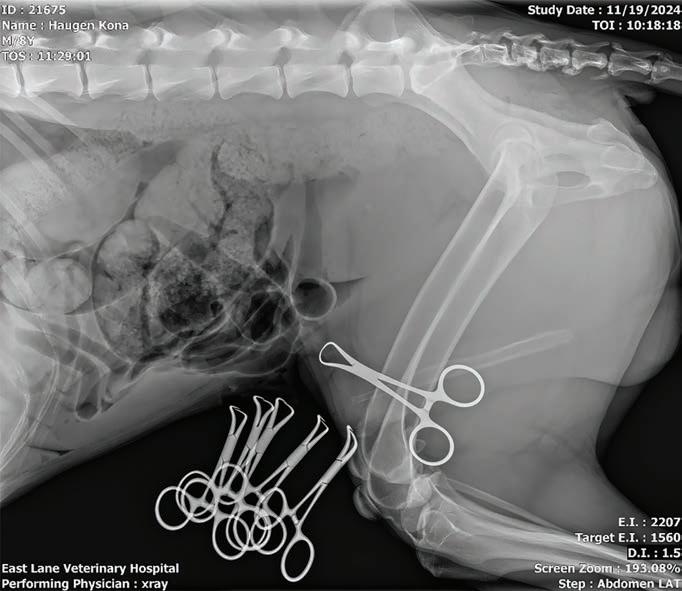
Shortly after bird season ended this year, Kona got sick. Physically, he experienced stomach pains only when going to the bathroom. Mentally, you wouldn’t know anything was wrong. After two days of diarrhea, I thought it would pass based on his positive demeanor, which was totally normal.
The next day Echo, my 12-yearold female, got the same thing. That spurred a visit to the vet. Blood and stool sample tests ensued. Two days later we were back. The diarrhea hadn’t improved. Immediately, both dogs received large doses of fluid therapy and anti-nausea meds, one by injection, some to be used orally over the course of the next two weeks. They were also prescribed a special blend of probiotics.
The vet figured it was either salmonella or E. coli. By this point we were more than $800 into treatment. We could have spent another $300 to find out which of the two ailments the dogs had, but since they’d be treated the same way, we passed.
LAST SUMMER KONA EXPERIENCED bladder stones. That emergency surgery lasted nearly four hours. It was touch-andgo for him surviving at one point due to excessive loss of body heat. That bill and treatment came to almost $5,000.
When Kona was 5 he suffered stomach twist, which required an emergency surgery that cost $5,000. A buddy’s dog experienced stomach
Having a gun dog –heck, any pet – is not an inexpensive proposition. Establishing a slush fund for emergencies is a must. (SCOTT HAUGEN)
twist at the same time and his bill would have been $7,000, but he opted to put his dog down since it was old. Sometimes that’s the sensible thing to do.
Kona and Echo have also had a few scares with grass seeds during the summer training months, and that adds up fast.
Emergency surgeries can and do happen – not to every gun dog, but the possibility is real. At times you’ll have to make tough decisions as to what’s right, or what’s best, for both your dog and your family.
When we got our dogs we set aside a slush fund for emergencies. In
other words, we were prepared. But that’s not the case for a lot of gun dog owners. Vets and feed store owners are seeing more problems with dogs and pet owners than ever, thanks largely to impulse buys during Covid. As dogs age, they can cost more money.
IF YOU’RE LOOKING TO make the investment in a gun dog, here are some general dollar figures to consider.
Gun dog breeds run the gamut in terms of cost. Let’s hit the middle with, say, $2,000 for a dog with a good bloodline. The lifespan of a hunting dog is around 12 years.
During that 12-year timeframe
HUNTING
the dog is going to consume food every day. If you spend $65 on a bag of quality food that lasts a month, that’s $780 a year, or $9,360 over the dog’s lifespan.
Figure another $50 a month for treats and chews. That comes to $600 a year, or $7,200 over 12 years.
Many gun dog owners give their dogs food supplements. Let’s go with $25 a month for that, or $3,600 over its life.
Then comes dog gear. I have two crates for each dog, one inside the house, one for travel. That’s about $600 per dog.
I went through a lot of dog beds until I found what I liked and the dogs loved. High-end beds can change a dog’s life, offering relief and quicker recovery following long, hard days afield. Figure $1,200 for dog beds during the course of your dog’s life, and another $250 for sleeping pads in the kennels.
We like having rugs in the house that trap dirt, hair and mud. Let’s go $200 for those.
Truck seat covers are a must, and the more you hunt and travel, the more you go through. That’s an easy $600 spend if you hunt a lot, especially for waterfowl, where dogs regularly get muddy and wet. A lot of hunters let their dog ride in the backseat, choosing not to kennel it all the time.
Electronic tracking collars are a must-have tool. These can vary greatly in price, but let’s go with $550. A quality one should last the life of your dog, but in case it fails, keep that slush fund handy.
For dog food and water bowls, along with water jugs for the road, $200 should do it. Collars and leashes will be around another $150.
If you hunt both upland and waterfowl, figure $800 on dog vests over 12 years. Depending on where you live and how often you hunt, one vest can last a few seasons or only a year. If you’re a duck hunter, you’ll need a dog blind or two, and a stand to keep them out of the water, so $500 for a couple of those.
The cost of training gear can add
up fast and keep accruing over the life of your dog. Cost also depends on what kind of dogs you have and what hunting you do. Versatile gun dogs, for instance, require upland and waterfowl training gear, along with shed hunting tools and a range of general training tools. This figure can vary, depending on things like dummy launchers, bumpers, etc. Let’s say $2,500.
As for vet care and routine meds for fleas, ticks and heartworm, we’ll keep that at an even $700 a year, or $8,400 during the dog’s life.
SO, NOT COUNTING THE options of a professional dog trainer, boarding a dog should you choose to go on a family vacation, play toys, personalized items like dog bowls, beds and collars, a dog first aid kit and non-essential accessories, what does it cost to own a gun dog for 12 years? About $38,110. Toss in another $10,000 for emergency vet bills but hope you never have to dip into it. They’re not cheap, but the joy gun dogs bring to your life makes it worth every penny – as long as you’re prepared. CS
Before investing in a gun dog, weigh the costs over a 12-year period, the typical lifespan of a hunting dog. By the estimate here, the bill for food, treats, bedding, training supplies, hunting gear and vet care can run over $38,000 – a tally that doesn’t include inevitable emergency room visits either. (SCOTT HAUGEN)
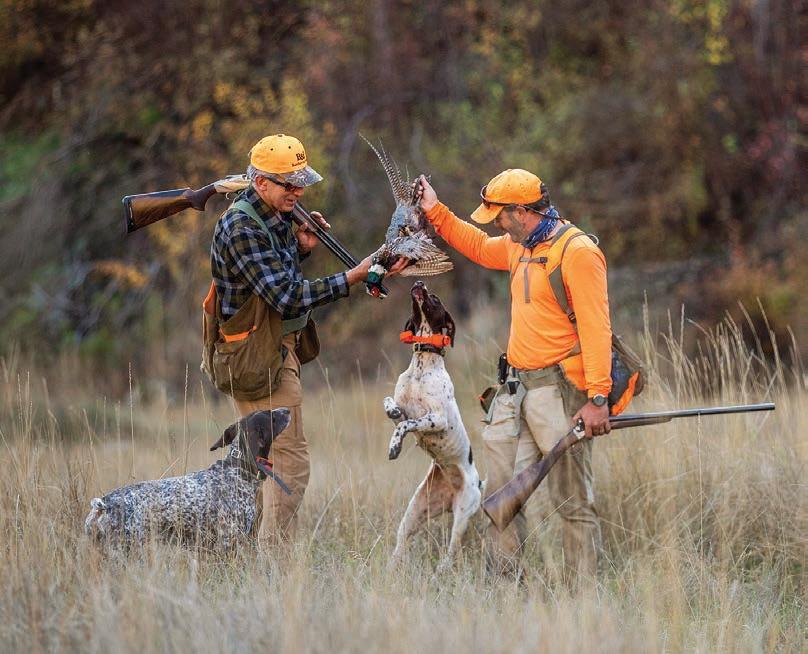
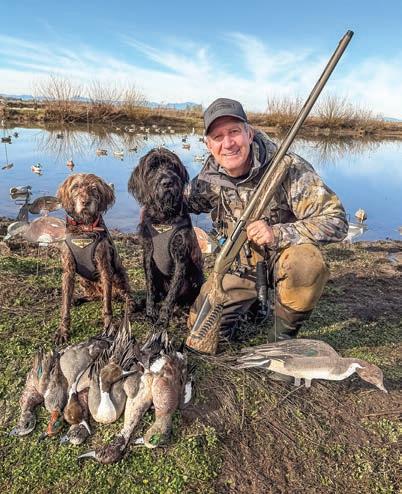
Author Scott Haugen and pudelpointers Echo, 12, and Kona, 9, enjoy over 150 days afield every year. “They’re not cheap,” he acknowledges, “but the joy gun dogs bring to your life makes it worth every penny – as long as you’re prepared.” (SCOTT HAUGEN)