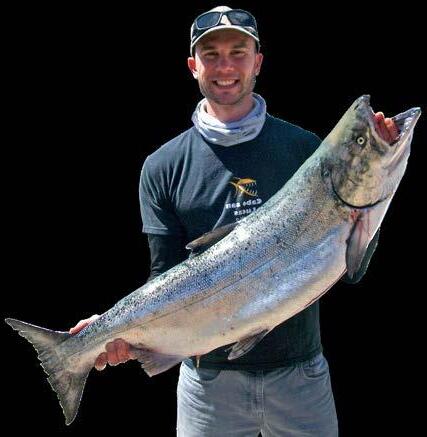
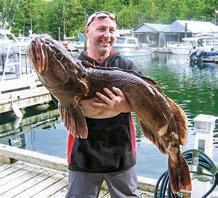
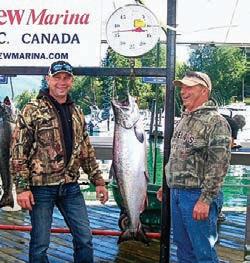
Mark Fong, Scott Haugen, Tiffany Haugen, Tim E. Hovey, Cal Kellogg, Joe Sarmiento
SALES MANAGER
Paul Yarnold
ACCOUNT EXECUTIVE
Janene Mukai
DESIGNERS
Kha Miner, Katrina Ngor
WEB DEVELOPMENT/INBOUND MARKETING
Jon Hines
ADMINISTRATIVE ASSISTANT
Katie Aumann
INFORMATION SERVICES MANAGER
Lois Sanborn
ADVERTISING INQUIRIES
media@media-inc.com
CORRESPONDENCE
Email ccocoles@media-inc.com
X @CalSportsMan Facebook.com/californiasportsmanmagazine
ON THE COVER
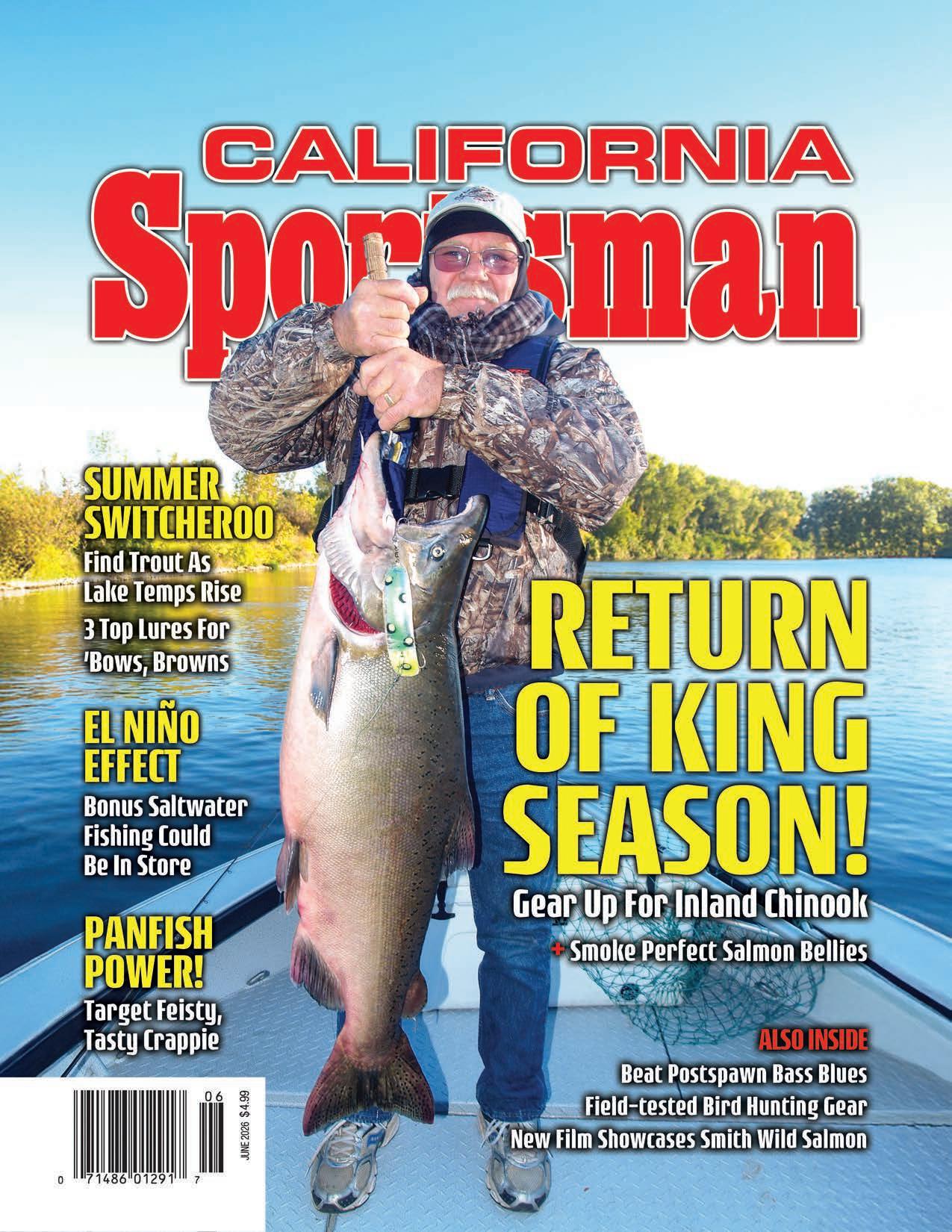
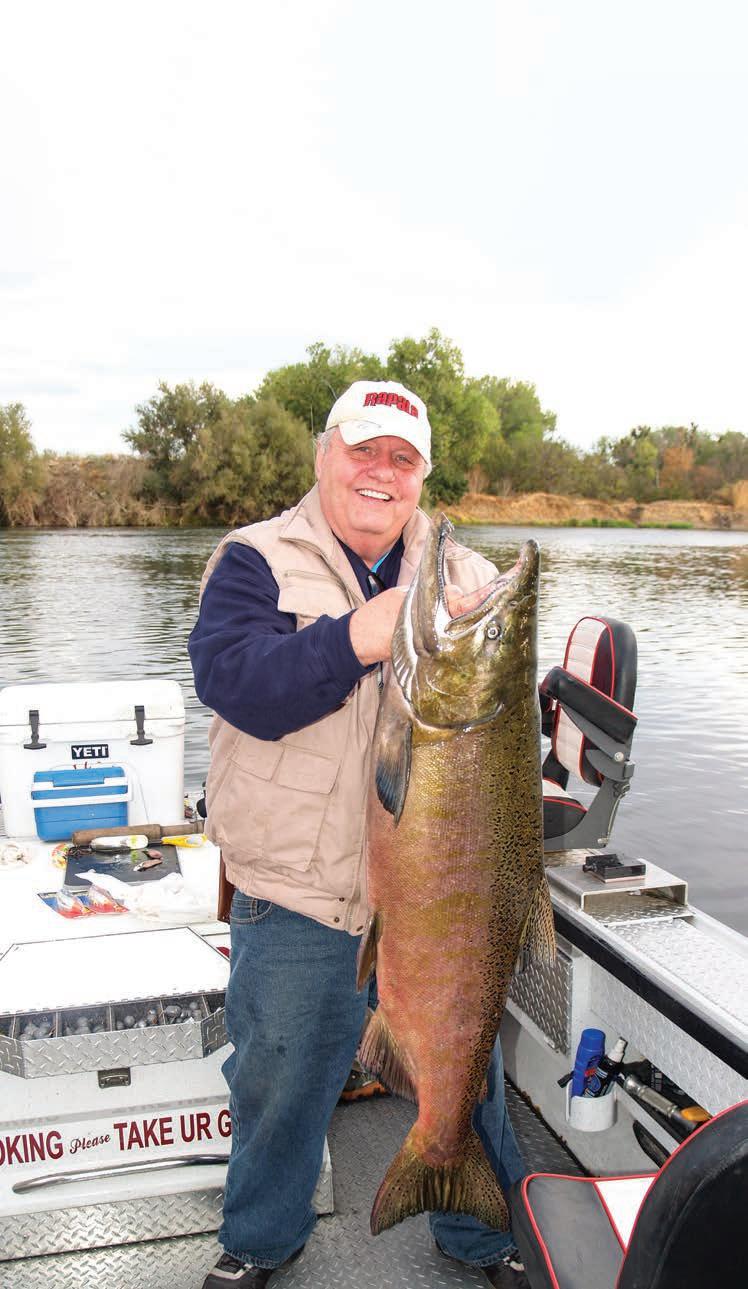
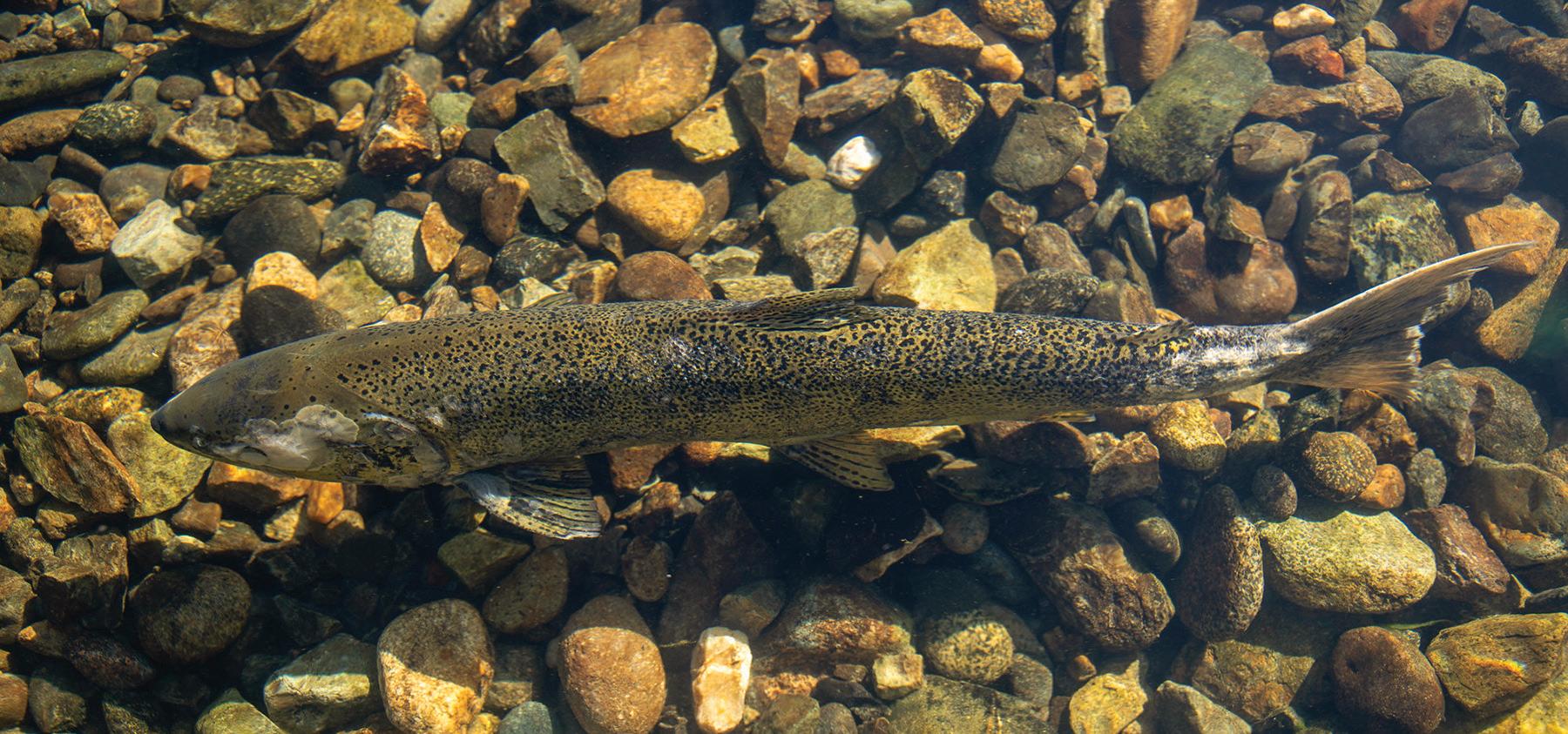
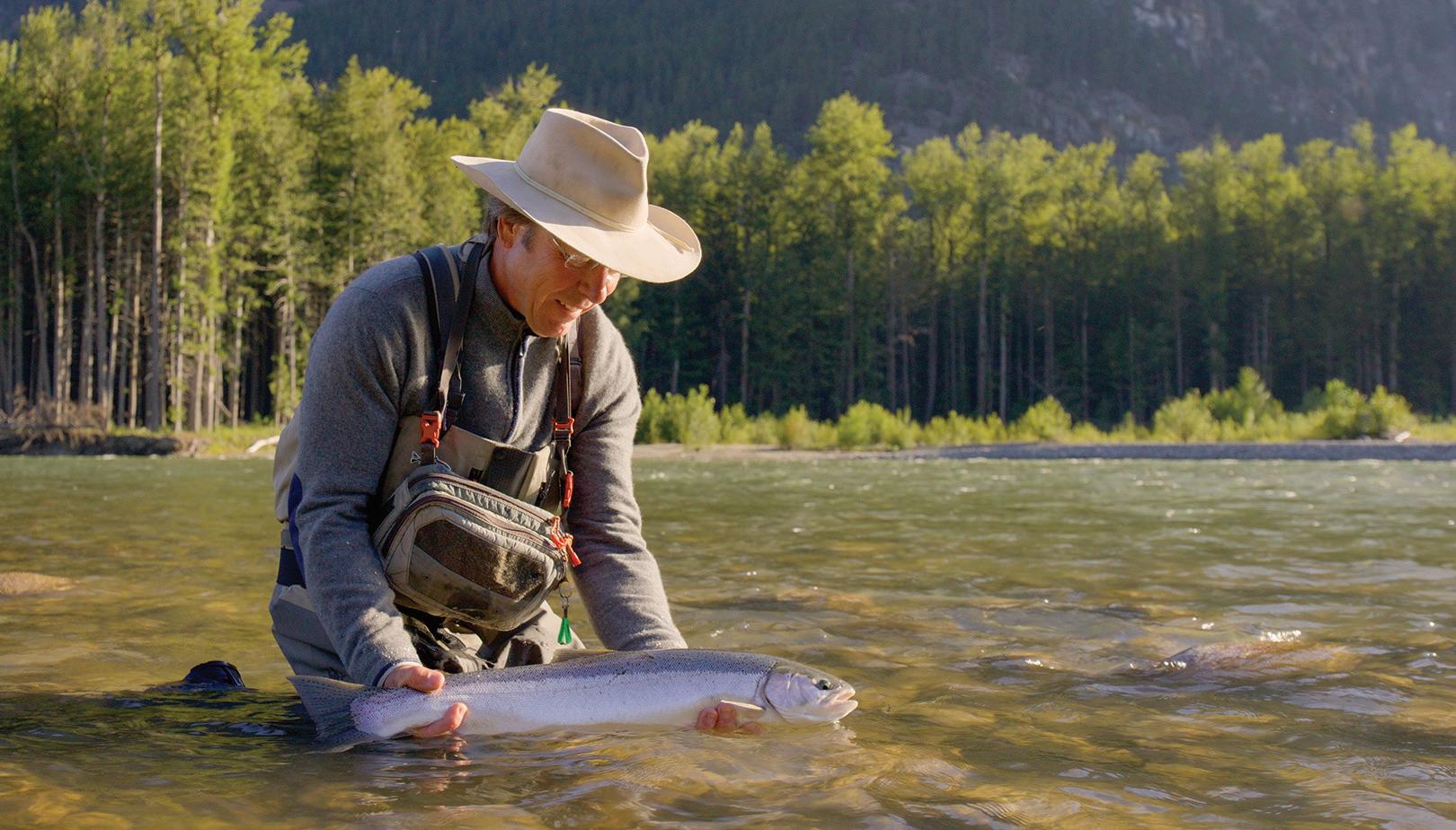
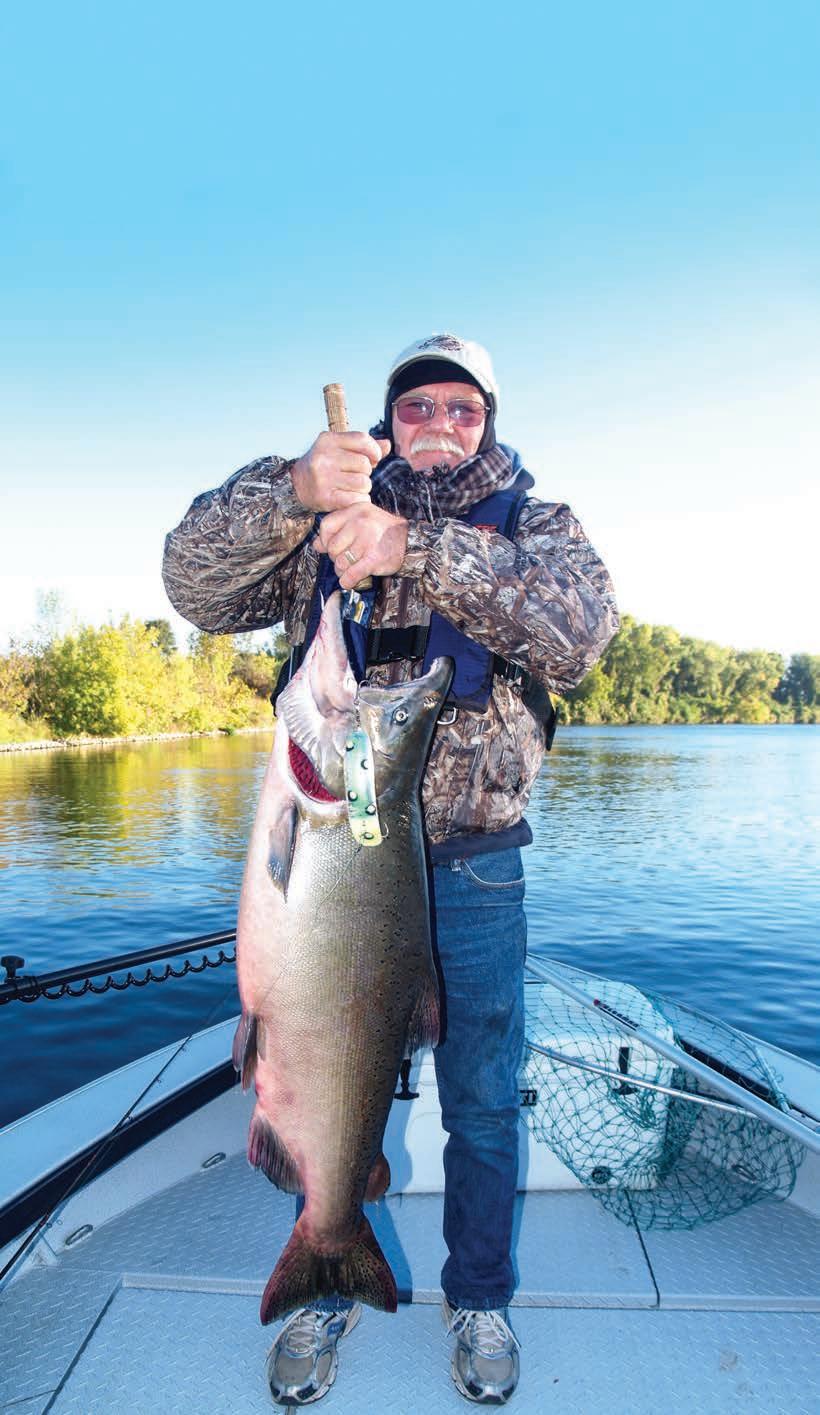
Inland salmon anglers, rejoice! After multiple years of full closures and a very limited season in 2025, the Sacramento River is among several fisheries that will reopen this year. Sac River fall-run kings can be targeted starting July 16, and our Cal Kellogg has a primer on backbouncing plugs and roe to help you get in on this California comeback story. (CAL KELLOGG) MEDIA
GEARING UP FOR RIVER KINGS
23 THREE TROUT STAPLES
In their From Field to Fire column, Scott and Tiffany Haugen have all of your bases covered for catching and cooking up your favorite fish this summer. First up, Scott breaks down his three all-time most effective trout lures, and Tiffany shares a salmon belly recipe to die for. Savor the flavor from the fish you’ve tangled with!
33 CLAP FOR CRAPPIE
They may be among the smallest fish in all of anglerdom, but on light tackle, crappie not only offer a feisty tussle on the end of your line but fixins for some pretty fine fish tacos. Tim Hovey details how to load up a stringer at lakes all over the Golden State as well as two ways he fries ’em up – get in my belly already!
47 SUPER EL NIÑO, SUPER FISHING?
Joe Sarmiento is a veteran of saltwater fishing trips off Southern California and Mexico’s Baja Peninsula, and early indications this year suggest to him that the fascinating meteorological phenomenon known as El Niño will make a reappearance. With memories of the good fishing 2015-16’s super El Niño produced, he’s reading the portents, gathering gear and offering advice for how to take advantage of this oceanic event.
KELLOGG)
THE EDITOR’SNOTE
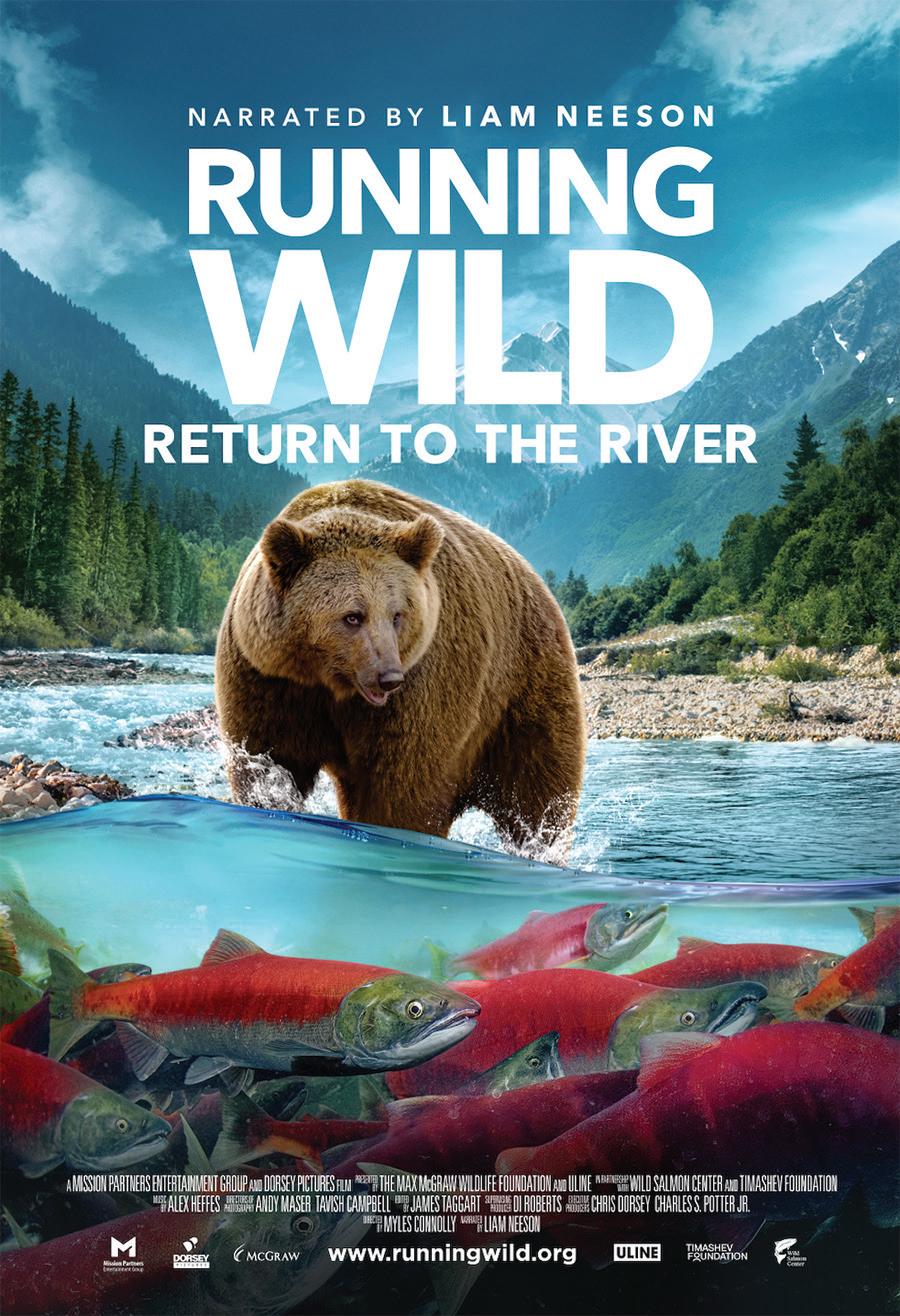
Just to age myself, I remember my first 3D movie experiences in the mid-1980s, when I donned the glasses to watch the not-exactly-classic part three sequels in the Jaws and Friday the 13th franchises. I can say I had a much better 3D experience about a month ago when I saw an IMAX screen showing of a new conservation film, Running Wild: Return to the River.
A brainchild of the Portland, Oregon-based conservation organization Wild Salmon Center (wildsalmoncenter.org) and directed by longtime documentary filmmaker Myles Connolly of California, Running Wild was made not so much to preach about the sometimes uncertain future of Pacific salmon but celebrate the fish themselves – their journey to and from the rivers that spawned them – along with the people who revere them and the wildlife that depend on them for survival.
Needless to say, witnessing through 3D glasses the underwater scenes of salmon spawning and hatching, brown bears splashing around Alaska creeks in search of migrating sockeye, and a memorable scene highlighting Northern California’s pristine Smith River wild Chinook made for an epic cinematic adventure.
“I saw an IMAX film on (British Columbia, Canada’s) Great Bear Rainforest years ago, and I was so moved and so impressed, and saw the effect it had on people, I realized how powerful the IMAX medium is. It really is the next best thing to physically being there,” Wild Salmon Center president and CEO Guido Rahr, the film’s scientific advisor, told me.
One of California’s last remaining wild salmon strongholds, the Smith River plays a key role in a new 3D documentary about the importance and life cycle of these iconic fish in Running Wild: Return to the River. (KEN MORRISH)
“For us to succeed in getting people to really care about these places we’re trying to protect and the reasons for protecting those places, it just seemed like the most powerful way to embed that message and that connection,” Rahr added. “It’s hard for us to build critical mass to protect the critical strongholds without more help.”
EARLY IN THE FILM, a drone shot spectacularly covers ground over Del Norte County’s Jedediah Smith Redwoods State Park, where the Smith River cuts between massive redwood trees in one of the state’s most gorgeous forested areas.
The movie’s narrator, actor (and passionate angler/ conservationist) Liam Neeson, says, “The Smith River is one of California’s last strongholds for wild salmon. A vital highway to the ocean.”
The Smith scene is one that should provide some hope for California’s embattled salmon populations, which saw fall-run Chinook stocks crash out to the point of entire recreational and commercial fishing closures in 2023 and 2024. Last year finally saw brief (but successful) ocean salmon sportfishing season windows and limited inland opportunities for Central Valley rivers while longtime mainstays like the Sacramento, Feather and Klamath Rivers remained closed. But this year’s commercial fishing reopener in May and increased river fishing opportunities – the Sac and Klamath open later this summer; see Cal Kellogg’s story on page 15 – provide some optimism.
“It’s definitely promising,” Rahr noted.
Still, the Smith River’s ability to maintain wild salmon runs is sadly an outlier.
“In California, there’s not a lot to work with, because those rivers have been staggered, and so our role is to ask the question, ‘OK; we want to have wild spring Chinook here someplace in 100 years, so where should we really focus?” Rahr pondered.
He pointed out the work his organization has contributed toward Butte Creek, a Sacramento tributary that has managed to produce good numbers of wild spring Chinook, and as Running Wild explains, the Smith is the shining light for wild salmon.
“The Smith is protected because of the work by the Smith River
Alliance (smithriveralliance.org). They do a great job. We’ve been a partner and we’ve helped them in all ways that we can,” Rahr said.
“We’ve been supportive when we could be. We’ll always be committed to supporting the Smith River Alliance and protecting that amazing system because it’s just a remarkable watershed, especially for Chinook and winter steelhead,” he added.
Rahr also pointed to the removal of four dams on the Klamath River, which has opened up miles of now accessible water for anadromous fish to reach critical habitat. But the job is never quite finished, which is part of what this movie aspires to accomplish.
The hope is that a generation of future anglers, conservationists and biologists will be swayed by the rugged beauty of the Smith River and the other filming locations – from Katmai National Park and Bristol Bay in Alaska to Russia’s wild salmon watersheds – and join the fight to save these incredible fish.
“Really the main part is to bring people to us who can help us protect these places, and we want the kids seeing this and saying, ‘Man, I want to go to that river someday,’” Rahr said. “Or maybe, ‘I want to focus on science or conservation’ to have that embedded in their hearts – that these are beautiful places and they’re not going to be around if we don’t do something.”
CONNOLLY, RUNNING WILD’S DIRECTOR, has been a cinematographer, producer, writer and director on various projects, covering documentary subjects on everything from the Alaskan Arctic to Mount Everest to blue whales. In our lengthy conservation, the 62-year-old Ojai resident talked about being rekindled by fishing years ago when he was in his late 20s and early 30s.
“I did a camping trip to Kings Canyon (National Park) and my buddy said, ‘Hey, I’m going to bring some fly rods,’ and I said, ‘That sounds a little boring.’ So we go out there and he says, ‘Just try it.’ I told him I didn’t know anything. And then he did the ‘10 and 2, 10 and 2’ casting thing and told me to look at the riffle behind the rock and that’s where the fish would sit,” Connolly recalled.
Sure enough, it went from boring to beautiful for Connolly, who after about 15 minutes of casting practice, “where I wasn’t hooking on trees or the back of my ass,” his fly landed upstream a bit, floated
The North Coast’s spring-run Chinook are barely hanging on, but the Wild Salmon Center has worked to keep a wild run going in Butte Creek, a Sacramento River tributary. (JOHN HEIL/US FISH AND WILDLIFE SERVICE)
down into a pocket, and quickly a feisty trout grabbed his offering.
It’s now gotten to the point where every river or lake he walks by, Connolly asks himself where the fish are hiding.
“As soon as that fish hit, my life changed forever. Because I have a very obsessive type of personality, I was in, man,” Connolly said. “Fishing became my thing, and for the next sort of 10 years, I fished all over the West. I was building fly rods on the weekends.”
And though he was a bit hesitant to take on this particular film project without having a great deal of knowledge about salmon, he said he’d take a weekend to ponder the pitch.
“Over the course of that weekend, I dug into it and I realized that this is like a Greek drama. There are so many stories and so much stuff going on in that world, so I called back on Monday and said, ‘Sign me up,’” he said.
“You start to realize that, to be honest, salmon was just a food for me in the past, but I came to realize that it’s so much more than that. And it is in many places, not just here in the Pacific, but it is the keystone to life and a critical part of life,” Connolly stated.
THE SMITH RIVER FOOTAGE is some of the most compelling in a documentary full of stunning visuals. The film follows volunteers with the Smith River Alliance program donning wetsuits and scuba gear to count Chinook in the Smith.
Connolly was inspired that many of those involved in the counting process weren’t biologists but simply curious volunteers who wanted to be involved.
“The cool thing about the Smith River is it’s science-minded people, but they’re all just regular citizen scientists,” he told me.
“They’re there because they love the place and want to have a little adventure in the water and they get to do something cool and help to make a difference.”
Jeff Hester, who worked with Connolly on the 2023 documentary short Blue Whales: Return of the Giants, captured the extraordinary underwater shots of the salmon spawning.
“Jeff is like Superman in the water. He came up there and I remember some of the (volunteers) saying, ‘The camera guy – is he going to wear scuba (gear)? Does he have a rebreather?’ ‘No, he just holds his breath,’” Connolly recalled. “And Jeff is one of those guys who can literally hold his breath for three and a half or four minutes. He would go downstream and he would just sit on the bottom and they would swim over the top of him.”
Trust me when I say the 3D alone makes this worth a trip to your local IMAX big screen theater for a showing. You can find upcoming showtimes at wildsalmoncenter.org/running-wildfilm/#find-a-theater. The film’s California premiere takes place on June 23 at San Francisco’s AMC Metreon 16 theater.
Seeing the emotional reactions from those Connolly interviewed throughout the roughly 45-minute production, you can understand why so many are so passionate about one of the animal kingdom’s most revered and respected cornerstones. As the narrator Neeson pointed out, “137 species, including humans, depend on this majestic creature.”
“We’re so disconnected from nature; most of us are on our screens, especially our kids,” Rahr said. “That link and connection with nature, we’re losing it. And we have to keep that alive and also keep alive that commitment to saving these places.” -Chris Cocoles
Guido Rahr, the Wild Salmon Center’s president and CEO, was the scientific advisor for the salmon documentary. “We want the kids seeing this and saying, ‘Man, I want to go to that river someday,’” he said. “Or maybe, ‘I want to focus on science or conservation’ to have that embedded in their hearts – that these are beautiful places and they’re not going to be around if we don’t do something.” (MISSION PARTNERS ENTERTAINMENT GROUP)
TROPHY MOOSE & BEAR HUNTING
River
MORE THAN A HUNT
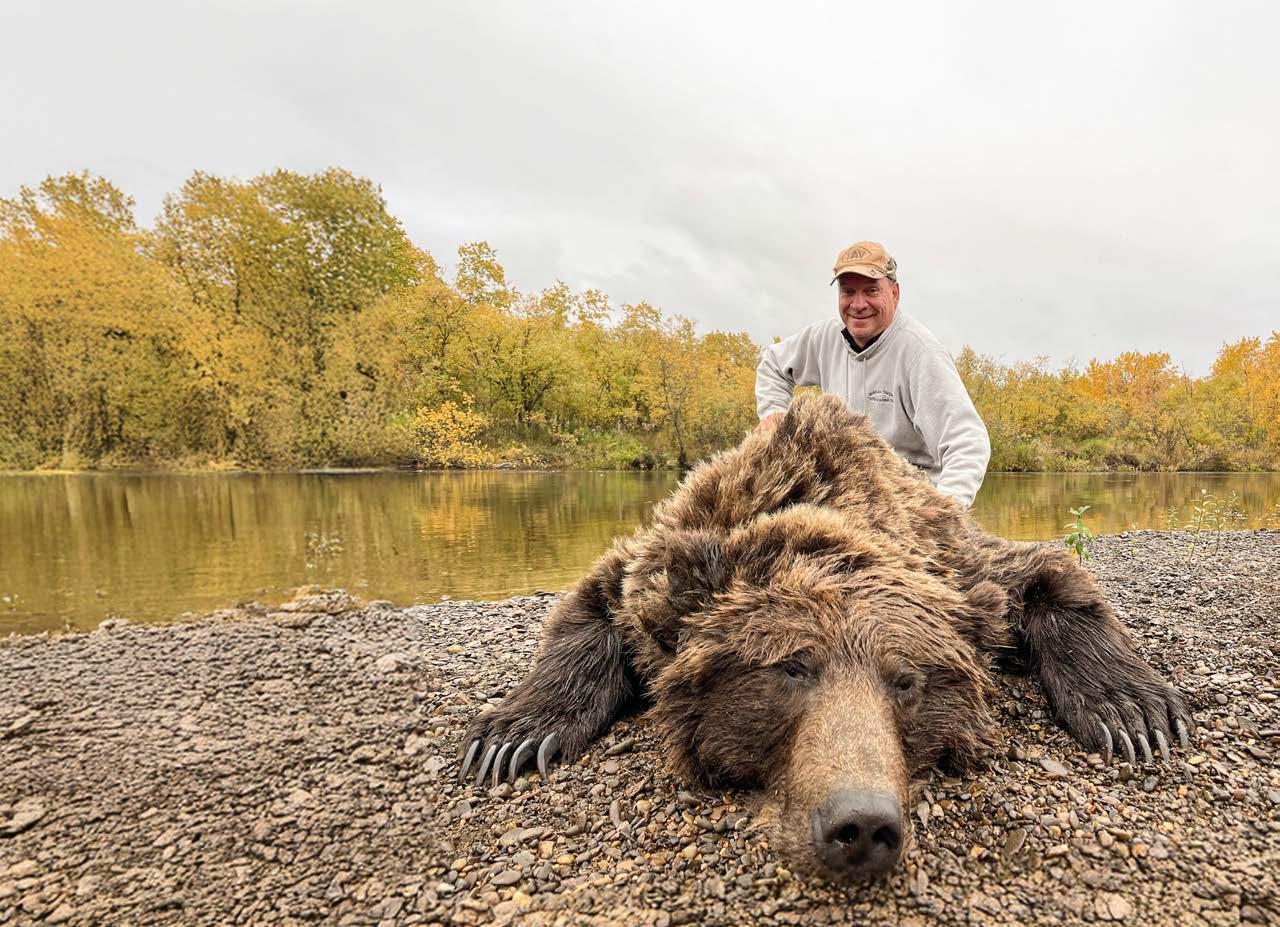
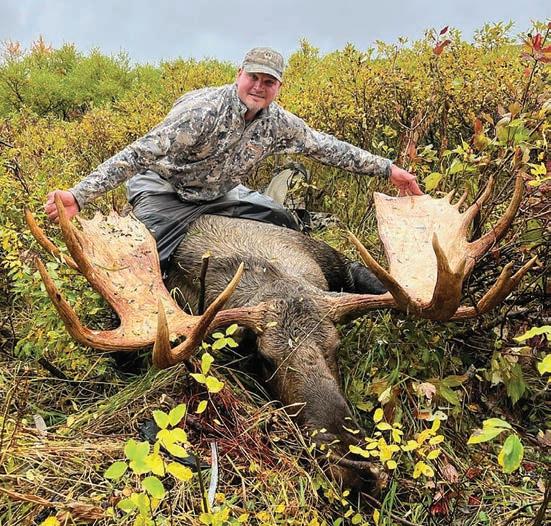
This is an unforgettable Alaskan adventure that blends raw wilderness, world-class game, and the thrill of pursuing some of North America’s most iconic animals in their natural environment. Long days on the river. Close encounters. The kind of moments you’ll talk about for the rest of your life.
WHY HUNT WITH US
• Trophy moose & bear hunts in prime river systems
• Regular 60”+ bull moose opportunities
• Near-100% opportunity rate on legal bulls
• High success on large Alaskan bears
• Fully guided & all-inclusive hunts
• Expert guides with deep local knowledge
• Carefully selected locations for consistent results
• 11–15 day hunts with 15-day combo moose & bear hunt available
Every hunt is carefully planned and professionally guided from start to finish. From scouting and calling to field care and logistics, your guide handles every detail so you can stay focused on the hunt.
Contact us today to secure your hunt and discuss available dates.
31-Aug. 1 Bridgeport Fish Fest, Twin Lakes Resort (twinlakeresort.com/fishstocking-%26-fish-fest)
For a list of upcoming bass tournaments, go to nrm.dfg.ca.gov/FishingContests/default.aspx
New Melones Reservoir will host the latest installment of the Kokanee Power-sponsored derbies tour on June 6. Go to kokaneepower.org/derbies.php for more information. (CAL KELLOGG)
MOVE WITH THE TROUT
By Cal Kellogg
For trout anglers, the transition from spring into summer is one of the most overlooked yet potentially productive periods of the entire fishing season.
Trout are literally in motion during this window. Water temperatures are climbing, baitfish are relocating, thermoclines are beginning to form, and trout are transitioning from relatively shallow spring patterns toward deeper and more structured summer behavior.
This movement creates a great opportunity for anglers willing to adapt. Many fishermen struggle during the spring-to-summer transition because they continue fishing exactly the same way they did a month earlier.
Meanwhile, trout are changing locations, changing feeding behavior and changing depth preferences almost daily during this seasonal shift. Successful anglers recognize those changes and evolve right along with them.
TROLLERS’ TIME TO SHINE
For trollers, this period can produce some truly exceptional fishing. That’s because trout are often actively feeding while also becoming more concentrated around specific depth bands and forage zones.
The first major change anglers need to understand revolves around temperature. During early spring, trout may roam nearly anywhere in the water column. Surface temperatures remain cool and
WHERE TO FIND FISH AS SUMMER HEATS UP
Author Cal Kellogg says that as summer arrives, trout retreat from shallow water, but it doesn’t mean you’ll stop catching them. Just refine your approach and adapt to the changing conditions and you’ll continue to enjoy excellent action. (CAL KELLOGG)
FISHING
oxygen levels stay high throughout much of the lake. But as the season progresses, surface temperatures climb steadily and trout gradually slide deeper and search for cooler, more stable conditions.
That doesn’t mean the fish immediately disappear into extreme depths. In many Western reservoirs during the spring-to-summer transition, trout commonly hold
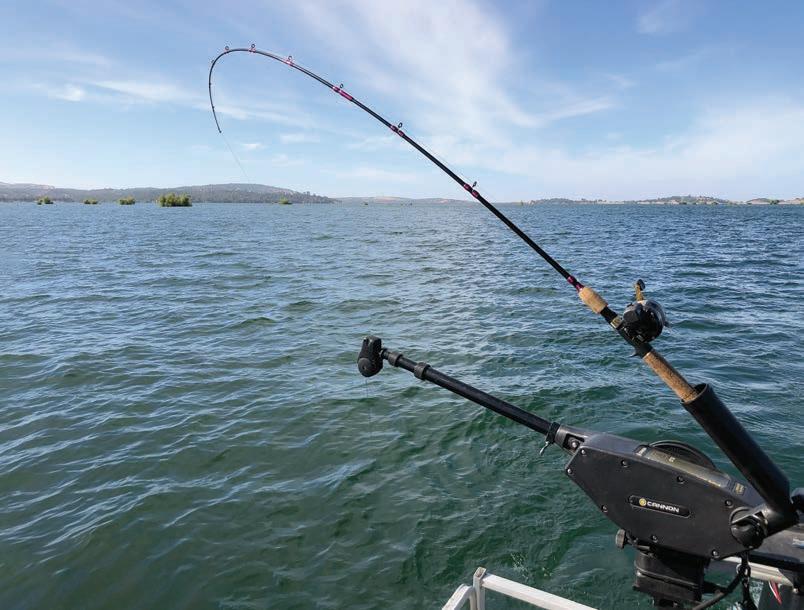
For anglers who spent the spring months toplining and trolling with leadcore, June is the month when downriggers become an important asset.
anywhere from 15 to 50 feet deep depending on weather, water clarity, forage availability and lake elevation. This depth range is where modern trolling systems really shine, because anglers can systematically cover water while maintaining precise lure placement.
PRECISION EQUALS PERFECTION
Precise trolling matters enormously
during this seasonal shift, which is why downriggers become critically important. Many anglers wait too long before deploying downriggers each year. They continue toplining long after trout have already begun slipping deeper. The reality is that once trout consistently move below roughly 15 feet, downriggers provide a major advantage and allow anglers to maintain exact depth control while trolling efficiently.
During the transition period, I generally begin each day by targeting the upper portion of the productive depth zone before gradually working deeper, if necessary. Trout are often surprisingly willing to rise for a lure, especially during low-light periods or under overcast conditions. There is usually no reason to immediately start scraping bottom in 60 feet of water unless sonar clearly indicates fish are holding there.
This is one reason sonar becomes such an important tool this time of year. Successful anglers constantly monitor bait schools, suspended fish, thermocline development and depth changes. The trout are almost always related to food during this time of year. In many Western lakes, that means threadfin shad, pond smelt or juvenile kokanee become primary targets for feeding trout. Once anglers locate forage concentrations, they are often well on their way toward finding trout.
Key structural areas also become increasingly important as summer approaches. Points, creek channels, submerged humps, dam faces and steep shoreline transitions all deserve careful attention, as trout often use these areas as travel routes and feeding zones. Windblown structure can be especially productive, as wind concentrates plankton and baitfish, which in turn attract trout.
SLOW DOWN, TRICK TROUT
One of the biggest mistakes anglers make during this transition is trolling too quickly. Yes, trout can absolutely
(CAL KELLOGG)
Spoons are a great choice when trout drop down in the water column and begin keying on schools of bait. (CAL KELLOGG)
Lakeside Lodge Life at Odell Lake Resort
Whether you’re working the water, playing a round of disc golf, or basking in the perfect sunset, Odell Lake Resort is your place to unwind and explore.
• Lakeside Sauna - a private, relaxing extraordinary experience
Come experience Odell Lake Lodge Life! Book your stay today!
FISHING
be caught at faster speeds, and there are days when speed triggers reaction strikes, but during much of the spring-to-summer transition, moderate trolling speeds tend to dominate. Roughly 1.8 to 2.5 mph remains the sweet spot much of the time; it keeps lures working naturally while still covering water efficiently.
TACKLE BOX STAPLES
Lure selection during this period should revolve around versatility. Minnow plugs remain tremendous producers with trout becoming increasingly forage-oriented as summer approaches.
Small- to medium-sized Rapala Countdown plugs excel. They can be fished naturally at moderate speeds while imitating wounded baitfish extremely effectively. Natural baitfish finishes like black back/silver body, blue back/silver body and rainbow trout consistently produce fish during this seasonal transition.
At the same time, however, bright, aggressive finishes such as clown, orange and gold, and hot pink absolutely deserve space in the spread. This is because spring trout often still respond aggressively to high-visibility offerings.
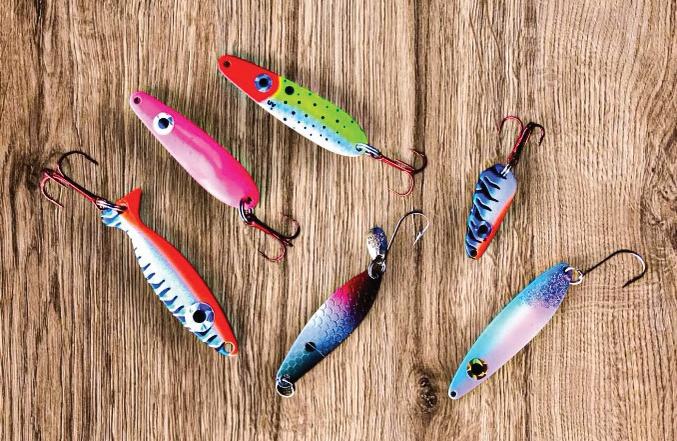
Spoons also remain deadly throughout the transition period.
Medium-sized spoons trolled at moderate speeds cover water efficiently while imitating fleeing baitfish. Metallic finishes continue shining during this period, particularly silver, chrome and blue, and copper patterns. If the lake contains threadfin shad or pond smelt, spoons in silver color schemes become especially effective.
As trout become less aggressive or conditions grow difficult, trolling flies and hoochies begin playing larger roles. These presentations offer subtle movement and natural profiles trout often respond to when larger, faster-moving lures become less effective.
Trolling flies are underutilized offerings that often produce trophy-caliber trout, so they should always be part of your trolling spread. (CAL KELLOGG)
FISHING
MIX AND CATCH
One factor many successful anglers discover during this transition period is that mixed spreads become extremely valuable. Rather than running identical lures on every single rod, smart trollers experiment constantly with depth, speed, lure profile and color.
Pull a spoon high in the water column with one rod, work a plug deeper with another, and on a third setup, troll flies behind an action disc. This systematic experimentation allows anglers to quickly identify the day’s productive pattern. Once the trout reveal their preferences, successful anglers refine and tighten the spread around the presentations producing consistent action.
CHECK YOUR LOCAL FORECAST
Weather also plays a major role as the seasons change. Stable, mild weather often produces steady, predictable fishing, while abrupt heat waves or severe cold fronts can temporarily reposition trout or reduce feeding activity.
Wind, however, is generally your friend. A moderate breeze creates surface chop, positions bait and breaks up light penetration, making trout more comfortable and feeding aggressively. Glass-calm conditions frequently make trout more cautious and difficult.
As summer approaches, earlymorning fishing also becomes increasingly important. Trout commonly feed actively during lowlight periods before sliding slightly deeper as sunlight intensifies. That said, many anglers make the mistake of quitting too early. Some of the best trout action during late spring and early summer actually occurs between roughly 10 a.m. and early afternoon once baitfish become active and water temperatures stabilize slightly.
One important truth about this transition period is that trout often suspend rather than hold tight to the bottom. Anglers dragging gear
directly on the bottom frequently troll beneath actively feeding fish. This is why sonar interpretation and precise depth control matter so much. Pay attention to where the bait is holding because the trout are usually nearby.
TAKE SHORE LEAVE
While trolling dominates much of the spring-to-summer trout conversation, bank anglers absolutely still have opportunities to remain highly effective during this seasonal shift. The biggest adjustment shore fishermen must make is mobility. Spring trout may cruise shallow flats and shoreline areas freely, but as the
water warms bank anglers need to target areas that naturally provide access to deeper water.
Dam faces, steep rocky banks, points, marina areas and locations adjacent to creek channels all become increasingly important. Trout can move between shallow and deep water efficiently in these zones.
Timing also becomes critical for shore anglers. Early mornings, evenings and windy periods often provide the best opportunities, as trout will move shallower to feed under reduced light and increased surface disturbance. Overcast skies can extend shallow feeding activity dramatically.
This big Collins Lake trout blitzed a shad-imitating soft plastic trolled 20 feet deep during a late May trolling adventure. (CAL KELLOGG)
FISHING
DON’T GIVE UP ON MEATY OFFERINGS
Bait anglers remain very much in the game during the springto-summer transition. Traditional offerings like PowerBait and nightcrawlers continue producing fish, especially when presented near deeper structure or transition zones. Floating bait rigs that allow presentations to suspend slightly above bottom often outperform stationary bottom-hugging setups
because trout frequently cruise just off the substrate.
Nightcrawlers remain especially important with trout transitioning toward summer feeding patterns while continuing to respond strongly to natural bait.
Inflated ’crawlers, threaded ’crawler presentations and ’crawler chunks fished beneath sliding sinker rigs all deserve serious attention. Shore anglers would also be wise to carry
a selection of casting lures, including small spoons, spinners and minnow plugs. These offerings can be deadly when worked near points, current areas and wind-blown structure during low-light feeding periods.
NIGHT VISION
One tactic many bank anglers overlook this time of year is fishing after dark. As lakes warm, larger trout frequently move shallow at night to hunt baitfish and cruise shoreline structure. Night fishing with plugs, inflated nightcrawlers or glow presentations can produce spectacular action while daytime anglers struggle.
SAVOR THE SUMMER
Ultimately, the key to success right now is all about understanding movement. The trout are moving, the bait is moving, the productive depth zones are moving and the seasonal patterns are evolving almost daily. Anglers who recognize these shifts and adjust accordingly often experience some of the best trout fishing of the year. Those who stubbornly cling to fading spring patterns frequently struggle and wonder where the fish disappeared to.
The trout haven’t disappeared. They’ve simply transitioned into summer behavior. For anglers willing to follow them, the weeks ahead offer outstanding opportunities to connect with everything from aggressive rainbows and heavy trophy browns to deep-water Mackinaw. Whether trolling structure with downriggers, probing suspended bait schools with spoons and plugs or working shoreline access points with bait and lures, the spring-to-summer transition remains one of the most dynamic and rewarding periods in the trout fishing calendar. CS
Editor’s note: Cal Kellogg is a longtime Northern California outdoors writer. Subscribe to his YouTube channel Fish Hunt Shoot Productions at youtube.com/ user/KelloggOutdoors.
“The trout haven’t disappeared. They’ve simply transitioned into summer behavior,” Kellogg writes. “For anglers willing to follow them, the weeks ahead offer outstanding opportunities to connect.” (CAL KELLOGG)
FROM FIELD...
TRUSTED TROUT TEMPTATIONS
By Scott Haugen
Atraveling angler recently asked what my top three lures would be for trout fishing on the West Coast. They planned on fishing rivers and lakes, from shore and in a small craft. They didn’t want to deal with bait.
My answer was easy.
NO DOUBTING THOMAS
I started fishing Thomas Buoyant spoons in the early 1970s when I was a kid. After school I’d hop on my bike and pedal to a nearby river and fish for trout (rainbows and cutthroat). I also used these spoons with surprising effectiveness in deep pools of small creeks.
Copper, gold and nickel are my three color choices. Ninety percent of the time I fish the 1/6-ounce spoons, as they’re great for working a range of water types. In deeper lakes and holes in rivers, a ½-ounce spoon is nice for not only casting farther but getting deeper.
I once fished a big lake from shore. I worked ½-ounce Thomas lures near rocky shorelines where dropoffs were sharp, and 1/6-ounce sizes on the flats. Two buddies fished other lures. They didn’t get a bite. After landing my third rainbow between 2 and 5 pounds, they switched to Thomas Buoyants and caught fish. These spoons can produce three different ways: on the fall, during the swing and when slowly retrieved.
RULE THE ROOST
Another boyhood lure I still use today is a Rooster Tail. This spinner has likely caught more fish than any other lure invented. I’ve caught an array of species with Rooster Tails, from king salmon and monster pike in Alaska, to grayling, brown trout, crappie, largemouth and smallmouth bass, and even sheefish through 7 feet of ice in the Arctic.
What I like about the Rooster Tail is how easy it is to fish. A steady, medium-speed retrieve makes them simple to fish in lakes and rivers. In fast-flowing sections of river the Rooster Tail can be swung to the bottom of
3 FISHING LURES ONE ANGLER LOVES
Author Scott Haugen, a veteran trout angler, has three lures in his tackle box he can’t be without when heading to a river or lake to try his luck. He has caught many trout on Mag Lips since their introduction to the fishing world. (SCOTT HAUGEN)
FISHING ... TO FIRE
A BELLY-BUSTING SALMON TREAT
By Tiffany Haugen
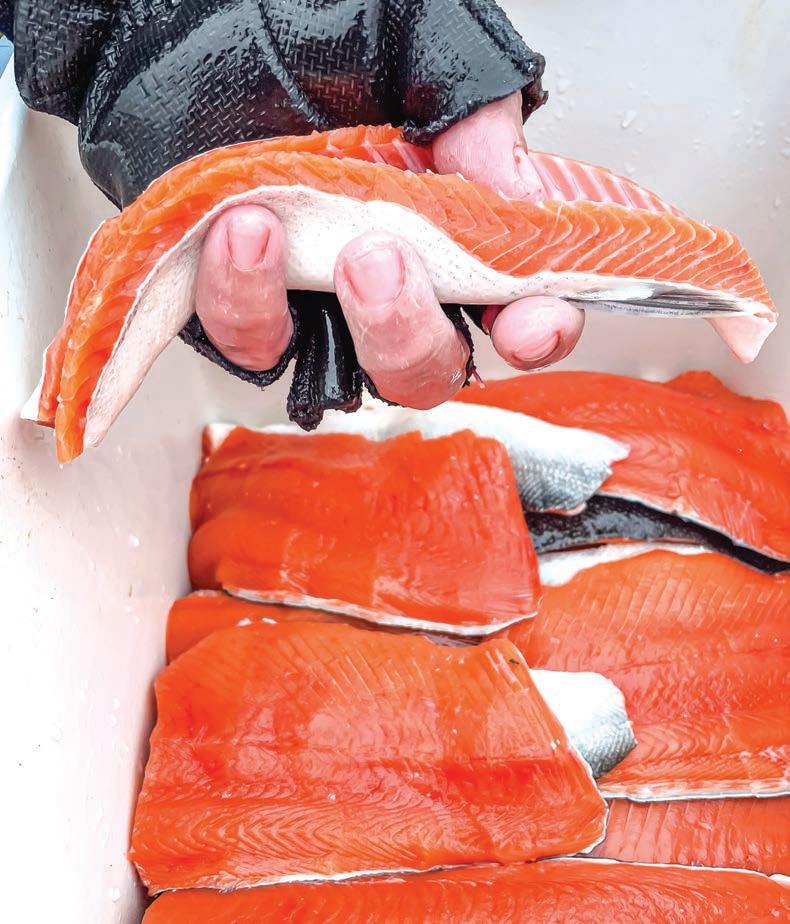
Salmon bellies are fattier than filets, making them the ideal part of the fish to smoke. The key to a quality smoked salmon belly starts with the moment you catch the fish. Give it a quick blow to the head and immediately cut a gill rake or two so the fish bleeds out, thereby optimizing the flavor of the meat. When fileting a salmon, leave the belly intact on the carcass. Do not remove the
belly meat with the filets. With both filets removed, cut around the belly meat and remove it from the carcass. With big silver salmon or Chinook, the belly meat can be cut in half, crossways, in order to achieve an even smoke.
Be sure to leave the subcutaneous layer that’s inside the belly in place. This not only helps retain fat that’s in the belly, but it keeps
“Salmon bellies are fattier than filets, making them the ideal part of the fish to smoke,” author and chef Tiffany Haugen writes, adding that quick cleaning after the catch will optimize the flavor of the meat. (TIFFANY HAUGEN)
thin sections of meat from drying out in the smoker. Once done smoking, the subcutaneous sheath can be removed.
2 to 4 pounds salmon bellies with the skin on 1 quart cold water
½ cup brown sugar
¼ cup non-iodized salt
2 teaspoons granulated garlic
2 teaspoons granulated onion
2 teaspoons black pepper
In a large container, whisk all brine ingredients until salt and sugar dissolve. Submerge salmon bellies in brine. Refrigerate for two to four hours. Remove from brine and pat dry. Lay on smoker racks and air dry one hour, or until fish forms a pellicle (tacky surface).
Smoke in a preheated 150- to 170-degree smoker for two to six hours or until fish reaches desired texture and doneness (or an internal temperature of 135 to 140 degrees). For a stronger smoke flavor, replace chips up to two more times during the smoking process.
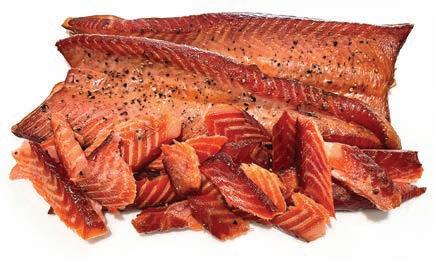
For a candied-style fish, glaze bellies with a brush of honey or maple syrup a few times during the last hour of smoking time. Enjoy the fish hot from the smoker, or break it into pieces for dips, salad toppings or whatever else pleases the palate.
Editor’s note: For signed copies of Tiffany Haugen’s popular cookbook, Cooking Seafood, visit scotthaugen.com.
Give Dad something unforgettable this Father’s Day with gift cards and our favorite “Ultimate Dad Gift” bundles:
• Grill Master Gift Set
• Just Add Meat Gift Set
• Easy Capicola Bundle
Perfect for dads who love grilling, smoking, snacking, and sharing great food.
Learn how to get started in just minutes!
FISHING
the drift without reeling. The sensitive blade spin and pulsating hackle work with little resistance, and it is a combination movement trout love.
Rooster Tails can also be jigged. I’ve caught a number of fish with them by dropping them off ledges and walking them down shelves. I’ve also jigged them through the ice with success. The tiny 1/24-ounce models are great for small-stream, clear-water trout fishing. The 1/16- to 1/8-ounce versions cover most of the rest of the trout fishing situations in both rivers to lakes. The Sonic and Vibric Rooster Tails, along with the Rooster Tail Minnow, are also proven trout catchers.
MORE THAN JUST LIP SERVICE
An overlooked trout lure is the Mag Lip. Back in the early 1970s, plugs that made their way to West Coast
rivers were largely fished by casting. The techniques soon transitioned to trolling plugs in lakes and backtrolling them in rivers with the goal of covering more water. Mag Lips are very effective when casted or trolled, even when used as a hookless diver to present bait by way of trolling in lakes and back-trolling in rivers.
Casting is one of my favorite ways to fish these versatile plugs. Mag Lips float, but the faster you retrieve them, the quicker and deeper they dive. The 2.0 Mag Lip dives up to 5 feet; the 2.5 to 8 feet; the 3.0 down to 10 feet. The 2.0 and 2.5 models have only a trailing hook, and casting them in small pocket water, riffles and seams, as well as working them in shallows, is very efficient.
If casting into deeper water, reel fast to get the plug diving quickly.
As the water shallows, reel slower so the plug rises and won’t get hung on the bottom. Quick retrieves and swinging a Mag Lip through fastmoving water triggers an erratic skip-beat action out of the plug, which often draws aggressive strikes.
When fishing lakes and deep holes in rivers, the 3.0 Mag Lip is not too big. For many trout anglers, this is their favorite size Mag Lip to troll due to increased visibility, its ability to dig deeper and run true at faster trolling and retrieval rates.
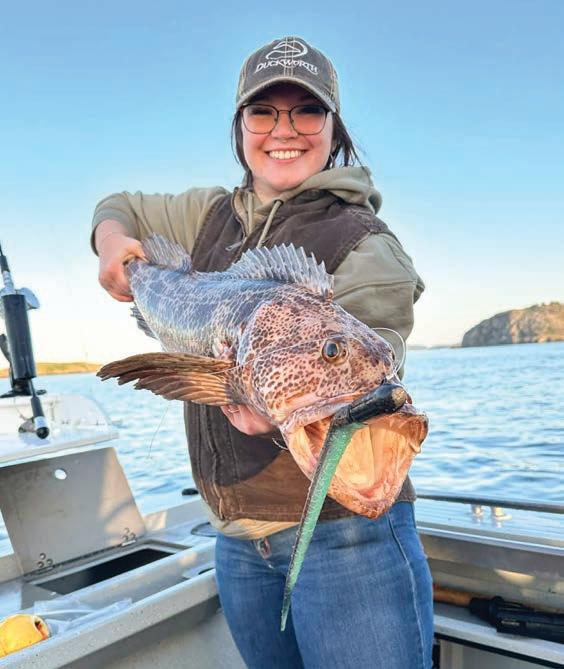
I once went fishing on a river with a guide buddy. He’d never fished the Mag Lip. When I showed him how they could be cast as well as backtrolled without any weight or flasher, he was hooked. So were his clients. Today it’s his go-to lure for trout. Customers love holding the rod when a feisty trout turns on it.
The 3.0 Mag Lip also works great as a diver/flasher to troll bait in lakes. Simply remove both hooks, then attach a 2-foot leader to the tail, bait the hook and start trolling. This is my 85-yearold father’s favorite way to troll for trout; it’s something he’s enjoyed doing since he was a young boy.
For casting these lightweight presentations I like a G. Loomis TSR 901-2, a 7-foot-6 fast-action, twopiece rod. This rod handles 2- to 6-pound-test line and is rated for 1/32- to 3/16-ounce. It handles slightly heavier terminal gear with efficiency, be it casting, jigging or trolling. I like a thin braid for a mainline and running a fluorocarbon leader. In small streams, a straight 4-pound copolymer is fine.
TRIPLE THREAT
With several weeks of summer trout fishing fun ahead, you don’t need to fill a giant tackle box with gear to catch fish. A few color and size selections of these three picks will work, just as they have for me for many years. CS
Editor’s note: For signed copies of Scott Haugen’s popular books, visit scotthaugen.com. Follow Scott on Instagram and Facebook.
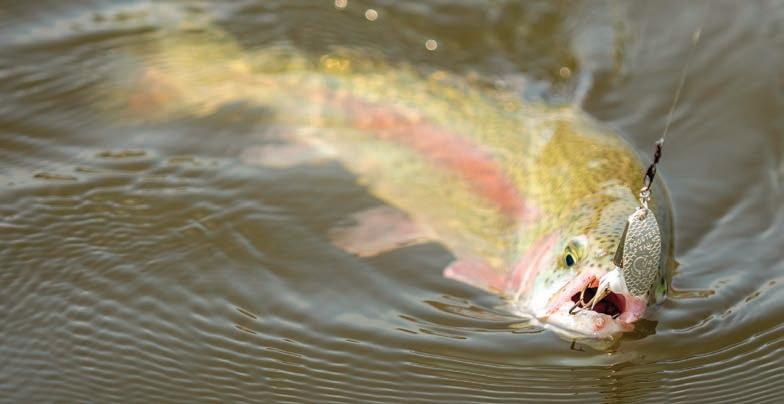
There’s a reason Rooster Tails have likely caught more fish than any other lure on the planet. “A steady, medium-speed retrieve makes it simple to fish in lakes and rivers,” Haugen writes. (SCOTT HAUGEN)
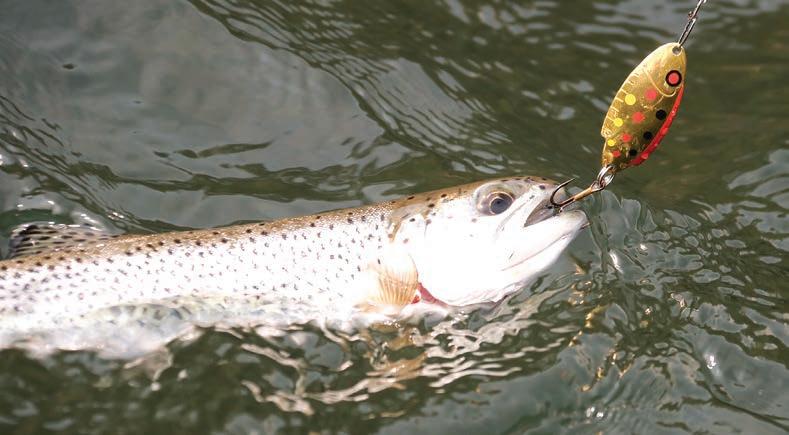
This cutthroat couldn’t resist a Thomas Buoyant spoon, one of the most effective trout lures ever made. (SCOTT HAUGEN)
TURN THOSE POSTSPAWN FROWNS UPSIDE DOWN
HOW TO COAX BITES OUT OF BLASÉ BASS
By Mark Fong
If you are a bass fisherman, you know the highs and lows of springtime bassing.
First comes the prespawn, which is definitely the best time of year to catch the biggest fish of the year. Next comes the spawn, when it seems that every bass in the lake is in 5 feet of water – or less – and ready to strike your bait. Once the spawn is complete, it’s time for the dreaded postspawn blues. Bass are tired and stressed from the rigors of spawning and can be very difficult to catch, but as time progresses and the fish have had time to recuperate, they will eventually come out of their funk.
WHERE TO GO
Once the bass have finished their reproductive duties, they begin a journey to their summer haunts. Just as the fish migrated from deep water to the shallows to spawn, they will return to lower depths and take the same migration routes they followed during the prespawn, but this time in reverse.
Fish tend to group up in predictable locations during the prespawn migration, making them
Author Mark Fong likes a good fishing challenge, and that sums up targeting bass in their unpredictable postspawn mode. (MARK FONG)
FISHING
easier to locate. Unfortunately, during postspawn the fish don’t behave the same; instead, they have a tendency to scatter.
Good places to start searching include secondary points just outside of spawning coves and flats. Look for any structure on the points such as weedlines, stumps, trees, rockpiles or docks.
As time goes on, bass continue
moving back towards the main lake. When this occurs, main lake points and offshore structure are good places to check.
WHAT TO DO
On lakes with shad as a forage base, the shad spawn typically occurs during the same time period as the bass postspawn, which can supercharge an otherwise tough bite.
“If the fish are in no mood to eat a moving bait, then it is time to slow down and grind it out,” tips Fong. “When the fish are in less than 10 feet of water, I always like to throw a wacky-rigged 5-inch Senko.” (MARK FONG)
Shad typically spawn during lowlight conditions, meaning that it can be over after the first hour of daylight. And not all bass spawn at the same time. This is especially true of the three major species. Spotted bass and smallmouth will spawn earlier when the water is cooler, followed by largemouth when the water warms even more. What this means is that even though the spots and smallies may be in postspawn mode and difficult to catch, largies may still be on their way to their spawning locations and in a much more agreeable mood to bite.
In addition, the spawn can occur at different times for different locations on a given lake, so keep this in mind as well. Because the fish are scattered, it pays to cover a lot of water. At the same time, because the fish are negative, it is important to fish a variety of baits.
WHAT TO THROW
If I am lucky enough to find an active shad spawn, my first bait choice is always a topwater lure. My favorites include a walk-the-dog-style bait,
Lake Berryessa is one of Northern California’s premier lakes to take a shot at bass. (MARK FONG)
a popper or a wakebait. If the bass won’t respond to a topwater, then a swimbait such as a Yamamoto Baits Shad Shape Swimmer or a Shibo Swimmer fished on a ballhead jig is a good option.
If the fish are in no mood to eat a moving bait, then it is time to slow down and grind it out. When the fish are in less than 10 feet of water, I always like to throw a wacky-rigged 5-inch Senko. If they are deeper than that, I’ll instead opt for a 6-inch Roboworm fished on a drop-shot rig.
PUTTING THE THEORY TO PRACTICE
Recently, fishing buddy Paul Parks and myself made a trip to Lake Berryessa. With the water temps in the mid-70s and the calendar settling on the middle of May, it did not take long to figure out that the majority of fish in the lake were in the postspawn stage.
We started out fishing near a wellknown spawning area in the south
end of the lake. We caught quite a few spent female bass with big heads and skinny bodies on Baby Bass Senkos and Roboworm drop-shot worms in morning dawn. That was the first clue that the fish in this area were definitely of the postspawn variety.
We ran around the lake looking for something different but found more of the same. The fish were definitely scattered. We’d catch one here and a few there, but nothing grouped up. We came across just two areas with fish chasing bait, so the shad spawn really did not play for us. There were zero topwater fish, as they were definitely not in the mood to chase down a moving bait.
But we stuck to it and just kept grinding. At the end of the day, we ended with some nice, quality fish – albeit spawned out – and a fair number of them as well. It just goes to show that with knowledge and some perseverance, the postspawn blues can be overcome. CS
Paul Parks and the author had a productive day at Berryessa despite the challenges of figuring out postspawn bass. “We stuck to it and just kept grinding,” Fong concludes. (MARK FONG)
CARPE DIEM FOR CRAPPIE
FEISTY, TASTY PANFISH OFFER FAST ACTION
By Tim E. Hovey
The screen on the Garmin fishfinder lit up. From the display it looked like the fish were gathered in a huge school, about 10 feet thick, 15 feet below the boat. My wife Cheryl dropped her double-jig rig down and it never reached the bottom. The rod tip twitched several times and she set the hook. Seconds later two keeper crappie were on the deck. We had finally found the school!
Small but hard fighters on light tackle, crappie also can provide anglers both young and old with some delicious meals after a day on the water. (TIM E. HOVEY)
FISHING
A FUN FISHING TARGET
One of the best times to target crappie is during the prespawn period when the fish are feeding aggressively to prepare for the spawn. Crappie can also be caught during the spawn as the fish, mostly males, switch to aggressively defending territories, biting out of defense rather than hunger. If you can locate postspawn fish moving out to deeper water, you can also catch them as they transition back into feeding mode.
The bottom line: If you understand why and when crappie schools move, you can successfully target them for a larger portion of the spring-summer season.
THREE FACTORS TO KNOW
Three things influence crappie movement during this time of year. Most anglers know that when the water warms, usually in the 60- to 65-degree range, crappie move into the shallows (3 to 15 feet) to prepare for the spawn.
However, there are a few other environmental conditions that can precisely predict crappie movement. One is daylight photo period. Essentially, when the days get longer, it triggers crappie to really focus on preparing for the spawn. Finally, add in consistently warm weather, and the movement pattern of crappie from deep water to shallow during this time of year is easy for anglers to forecast.
The spring spawn usually occurs in water temperatures from 60 to 65 degrees. Big schools of crappie move into shallow water, often near some sort of structure to spawn. These gatherings can be absolutely huge, and if you’re lucky enough to find a group, you will catch fish.
WHERE TO FIND CRAPPIE
Both local species of crappie, black and white, are available in almost all California lakes, particularly warmer, lower-elevation lakes, and they often thrive in the same systems.
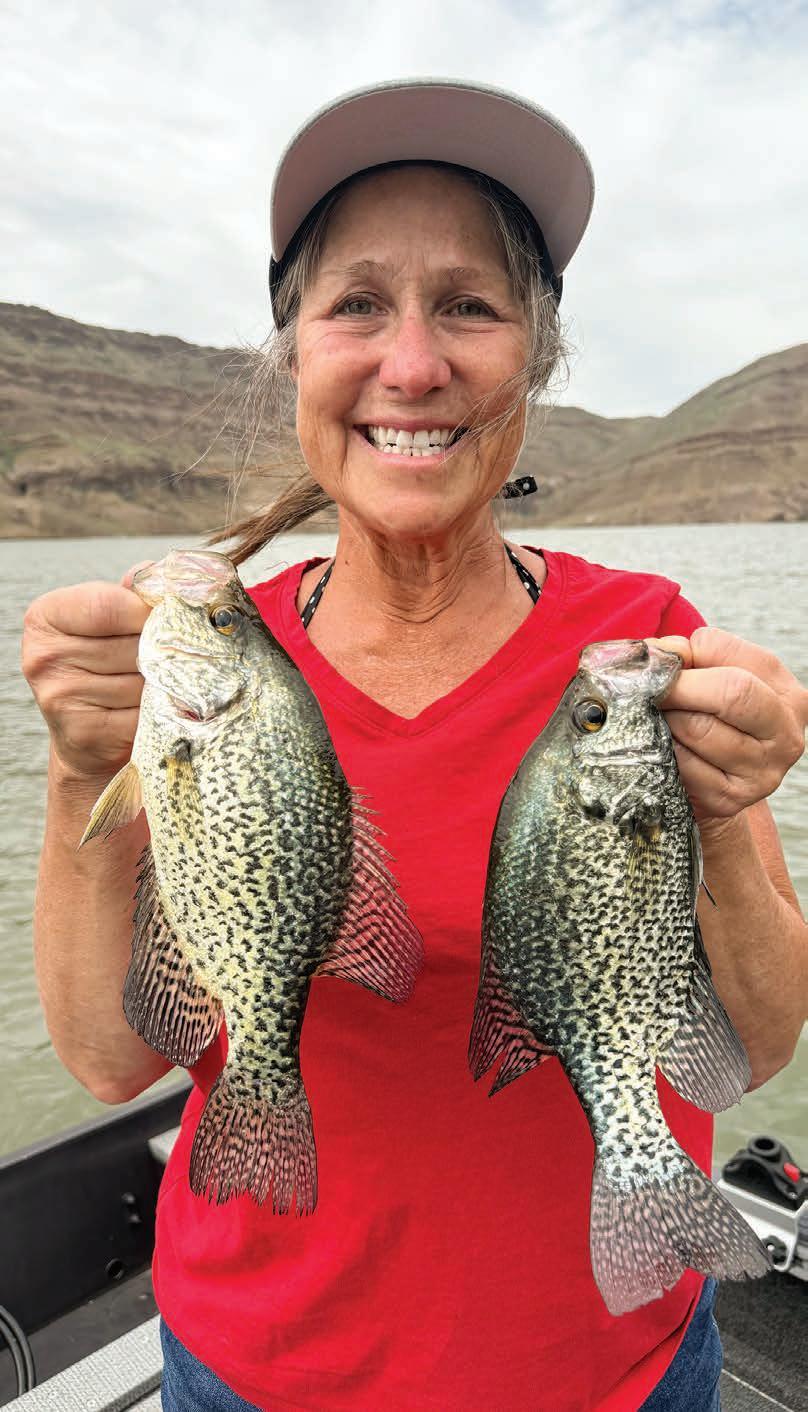
Cheryl Hovey with a nice double of crappie, which can be found in many of California’s low-elevation warmwater lakes. (TIM E. HOVEY)
FISHING
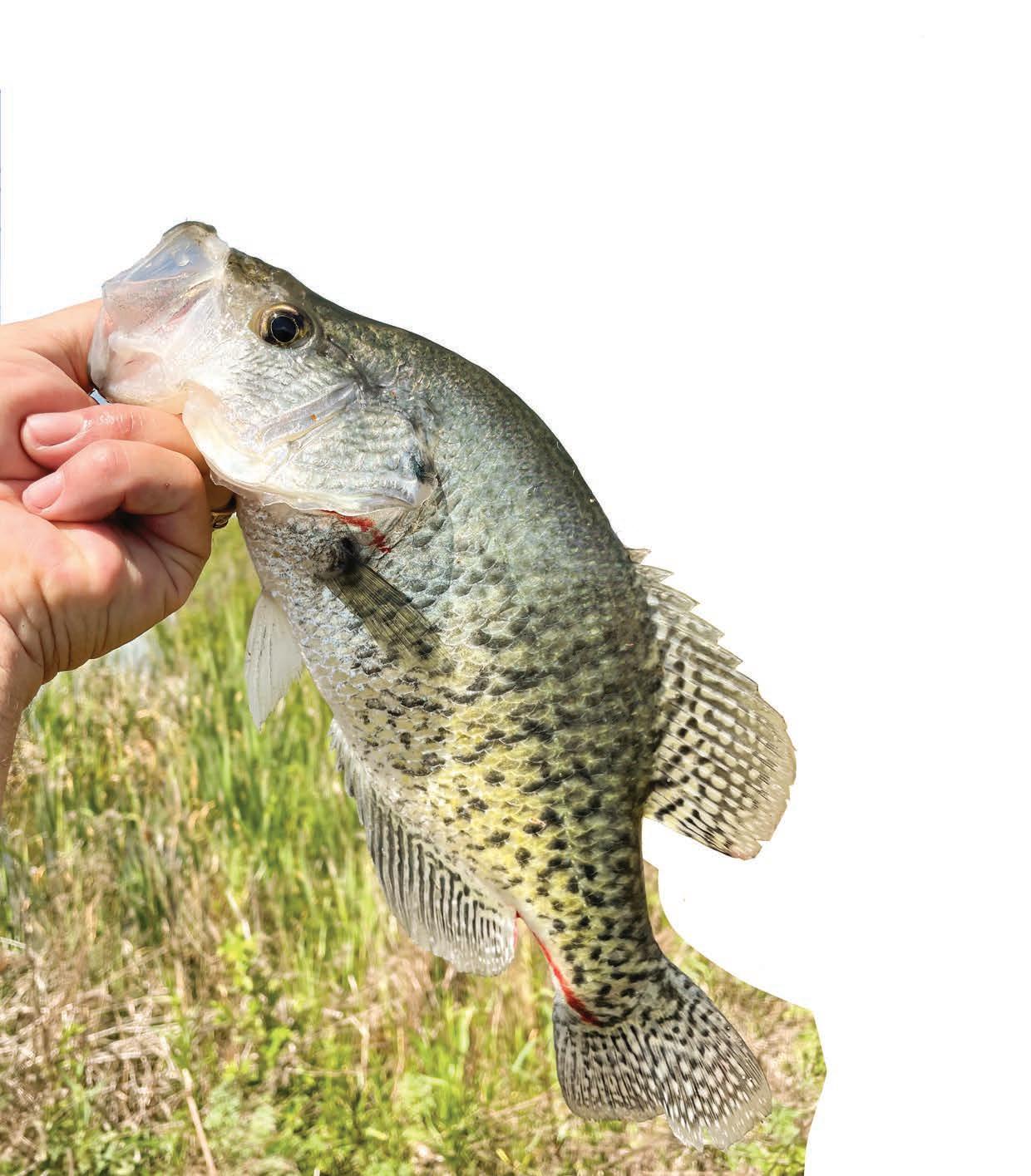
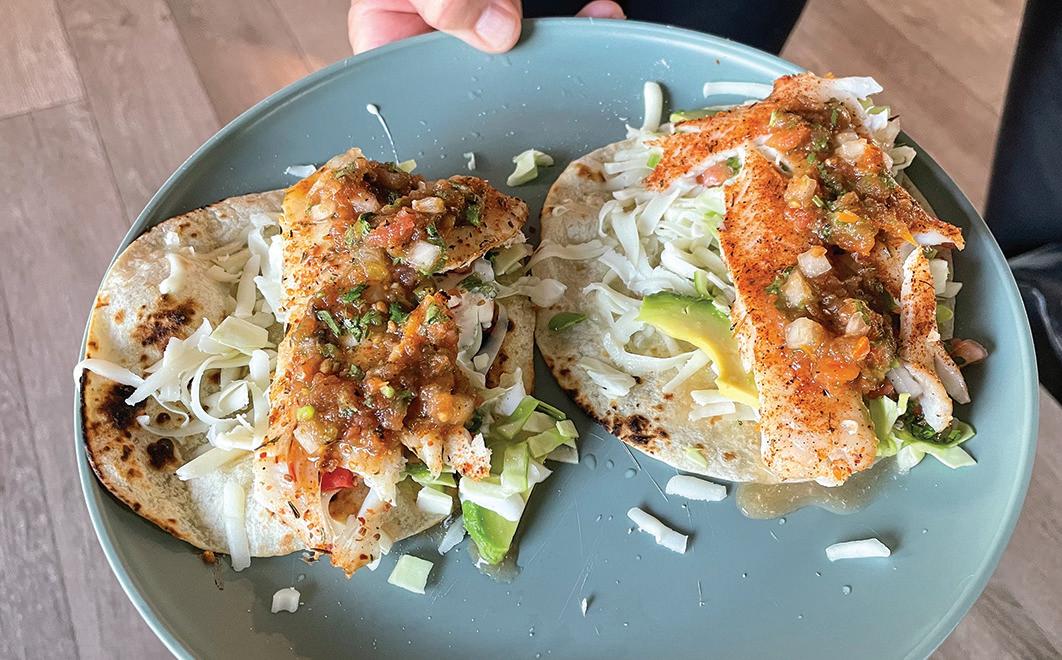
Hovey loves him some fish tacos powered by a stringer full of black or white crappie. (TIM E. HOVEY)
CRAPPIE FOR SUPPER? YOU BET
Iam a catch-and-release angler for the most part. I love catching both largemouth and smallmouth bass, but after a few photos they are carefully released. However, when we encounter an aggressive crappie school, we always save a few for dinner. If you’ve never tried fried crappie or had crappie tacos, do yourself a favor and save a few for lunch next time you catch them. You won’t be sorry. After fileting the panfish, we rinse them off and dry them on a paper towel. We then prepare them in one of two ways. 1) We sprinkle them with our favorite seasoning and pan fry them in butter and olive oil. Or 2) We run the filets through an egg wash, coat them in seasoned breadcrumbs and fry them in a fryer for fish tacos.
There’s nothing better after a long day on the water. TH
Black crappie typically spawn earlier in the season in cooler water (58 to 62 degrees), with white crappie showing up a little later when conditions warm up a bit more.
When we head out to target crappie, I’m always referencing the water temperature and the screen of my fishfinder. Being a fair-weather angler, I’ve already checked the weather and looked at the forecast to hopefully establish a warming trend. Understanding that June 21, the summer solstice, is the longest day of the year and daylight will gradually increase moving towards that date, we plan our crappie trips using these parameters.
NO PATTERNS DETECTED
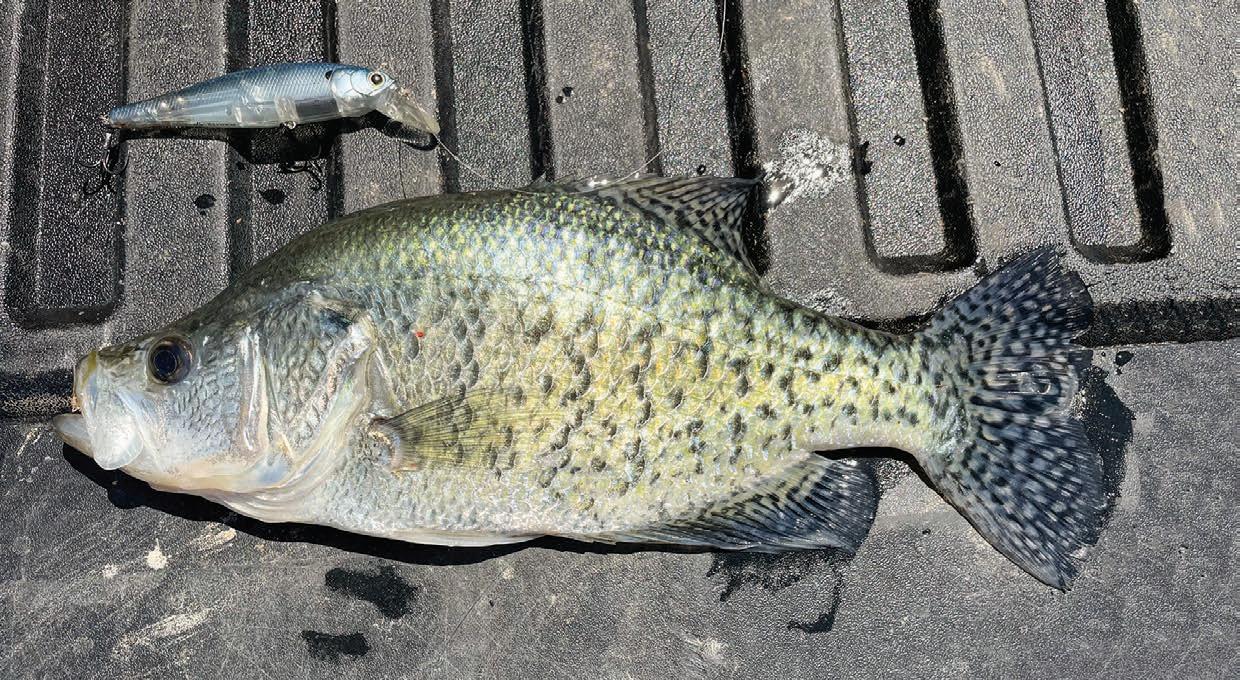
Honestly, I have caught crappie on lots of different lures, and while I haven’t really seen a pattern, I do have my favorites. It also should be noted that larger crappie can be caught using crankbaits as well. In fact, the largest crappie my wife and I have caught were with crankbaits.
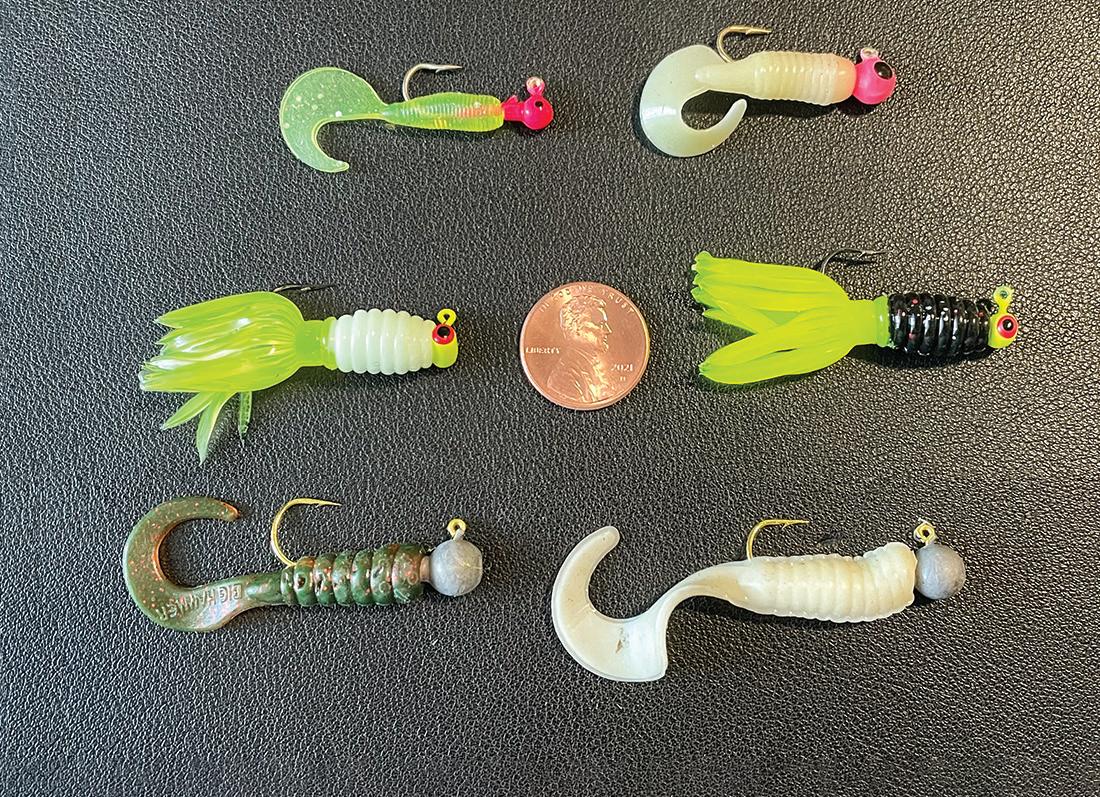
When we locate a school, we usually rig up with two small crappie jigs about 18 inches apart. These jigs are usually smaller leadheads and they come in a variety of different colors. We also make sure that each lure is a different style and color. With two of us fishing, that’s four different lures being presented to the school. This should give us an idea of what lure style and color the fish prefer.
Last year we decided to experiment with our crappie rigs. Using a drop-shot rig, we tipped the hook with a Berkley Gulp! 3-inch minnow and did very well. In fact, not only did the lure last through dozens of fish, but we also noticed that we were catching larger specimens as well. Needless to say, when we locate a cooperative school of crappie, we are rigging up with the Gulp! lures.
TAKING SHORE LEAVE
Shore anglers can also do well when
Small jigs can be irresistible to these panfish. As author Tim Hovey says, “I have caught crappie on lots of different lures, and while I haven’t really seen a pattern, I do have my favorites.” (TIM E. HOVEY)
the crappie move shallow and start to school within casting range. Using small jigs under a bobber is a great way to target suspended fish without getting hung up on the bottom.
If you don’t have access to a boat and pay attention to the movement guidelines of crappie, you can still load up a stringer with crappie for a fish fry (see sidebar, last page).
FUN FOR ALL AGES
If you’re prospecting for a school of prespawn or spawning crappie, where you find one or two, usually more are nearby. This type of fishing is perfect for young kids, as the bites will always be fast and furious and the action constant. The tackle required is simple and all they have to do is reel.
I always look forward to the crappie migration as we ease into spring and then summer. I’m constantly checking water temperature readings and watching the weather. Once things line up, we’ll launch the boat and start the search. Crappie are a great fight on light tackle, and I will never tire of locking on a school in the shallows and putting a few nice fish in the fish hold.
If you’re looking to catch something different this summer and maybe bring home a few filets for dinner, head out to your local lake and fish the shallows. Just like clockwork, crappie will be staging for the spawn and ready to eat. CS
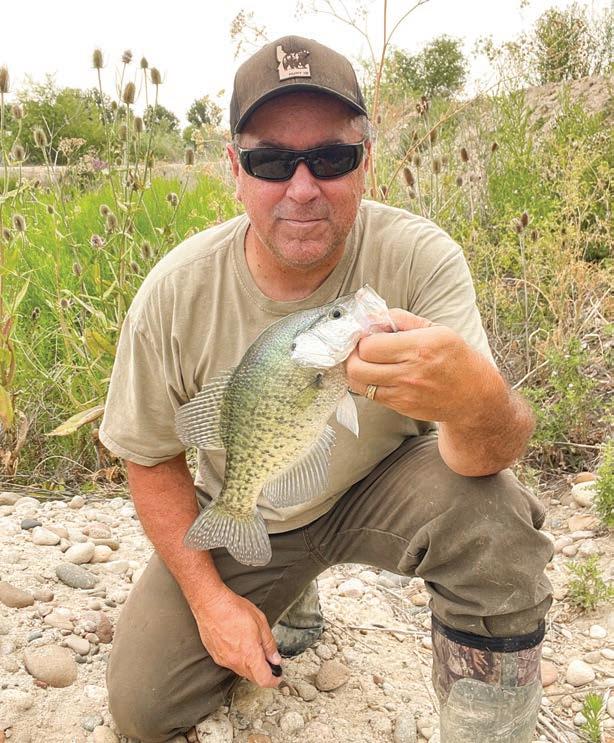
Hovey shows off a plump crappie. Most anglers use boats to catch them, but the fish are also available off the bank when they move into the shallows.
(TIM E. HOVEY)
“I always look forward to the crappie migration as we ease into spring and then summer,” Hovey writes. “I’m constantly checking water temperature readings and watching the weather” to time trips to the lake. (TIM E. HOVEY)
For destinations found on a map, or ones that are simply a state of mind, trust a reliable Honda outboard to get you there. And back. Find out more at marine.honda.com or visit your Authorized Honda Marine Dealer.
TAKE ME TO THE RIVER!
WITH INLAND SALMON FISHING FULLY BACK, HERE’S HOW TO GET ON KINGS
By Cal Kellogg
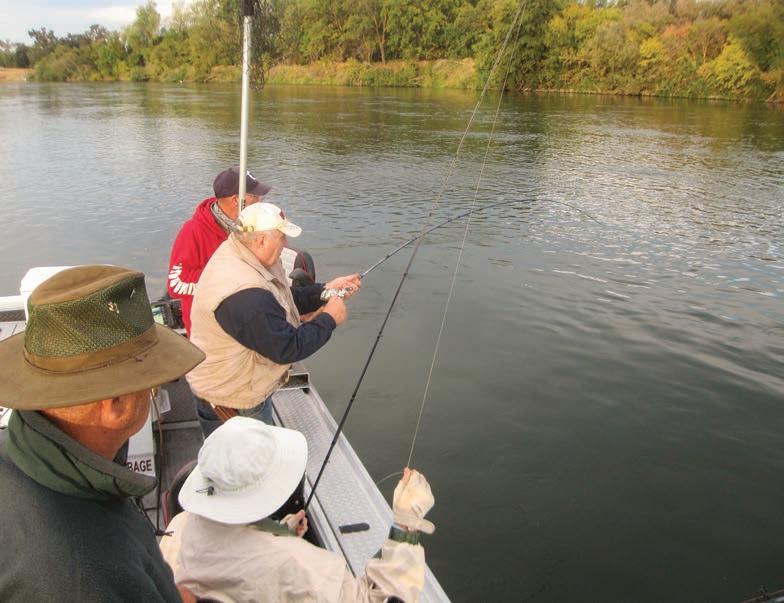
For California salmon anglers, this season feels different. For the first time in four years, anglers are looking at a basically full river salmon season, with the excitement surrounding the upcoming opener impossible to ignore.
After years of closures, restrictions and uncertainty, king salmon fishermen throughout the state finally have a real opportunity to get back on the water and pursue Chinook in the rivers that built California’s salmon fishing tradition.
And with that, it changes the entire tone of this season. Instead of talking about what was lost, anglers are once again digging tackle out of storage, checking river flows, tuning plugs and preparing boats for the return of a fishery that has long defined summer and fall fishing throughout Northern California. Beginning July 16, inland salmon fishing opportunities in one form or another will unfold across the state and, depending on migration timing, river conditions and seasonal regulations, anglers will have opportunities to chase kings all the way into December. That’s a long-awaited return to something resembling normalcy.
Early in the season, much of the attention will center on the Sacramento River system, where fresh salmon push inland from the Delta and stage in classic travel lanes and deep current seams. As summer transitions toward fall, fish spread throughout the river systems and anglers begin intercepting kings further upstream in places like
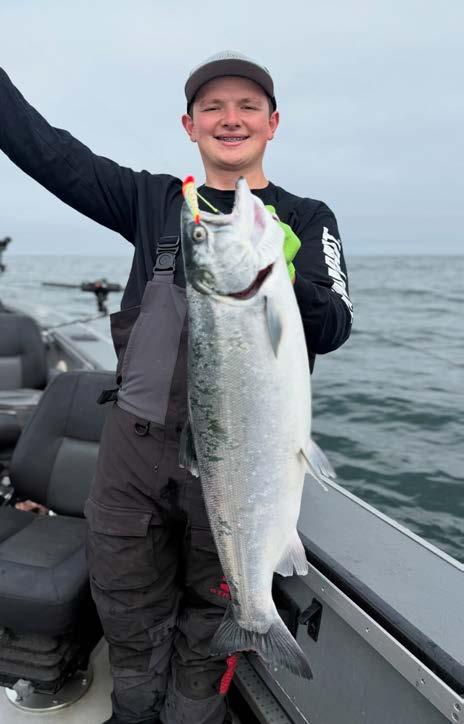
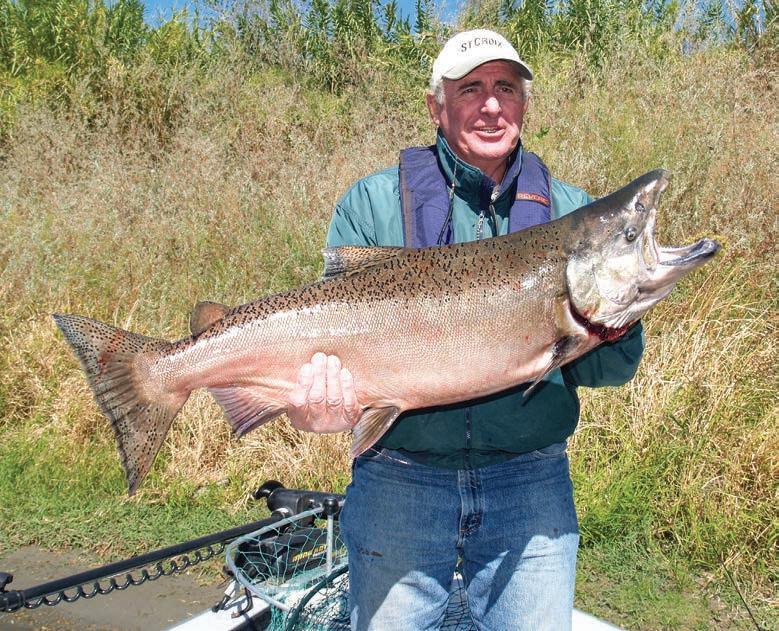
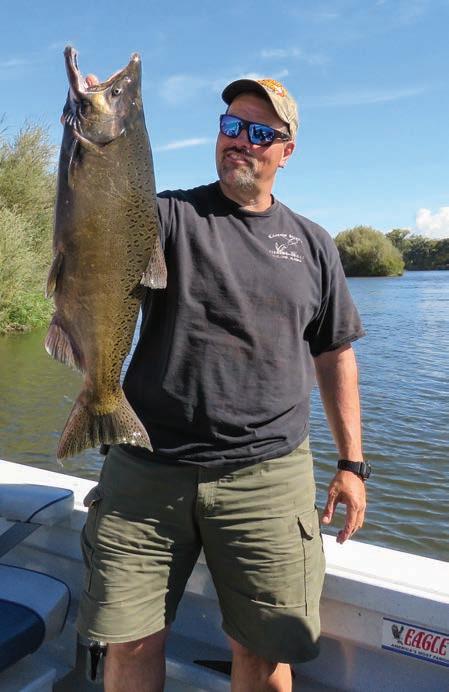
Photos of thrilled Golden State anglers showing off big, bad river-run king salmon will be commonplace once again this summer and fall thanks to more traditional fishing seasons after multiple years of full or partial closures. (CAL KELLOGG)
FISHING
the Feather River. Because the season stretches across such a broad window, right now is the perfect time for veteran salmon anglers to revisit foundational tactics and newer fishermen to familiarize themselves with the methods that consistently produce California kings year after year.
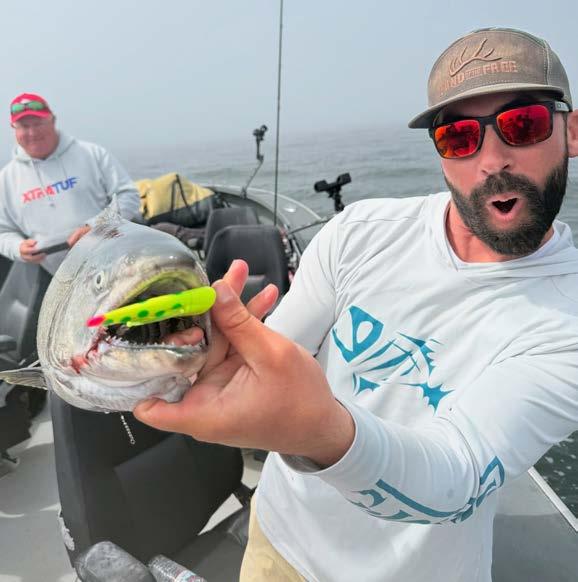
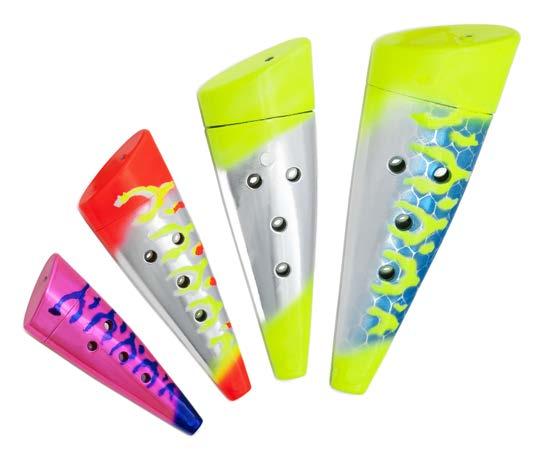
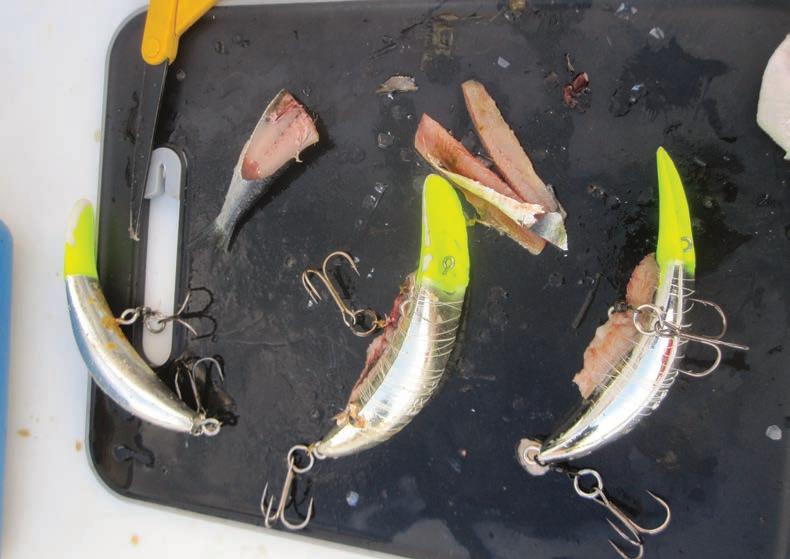
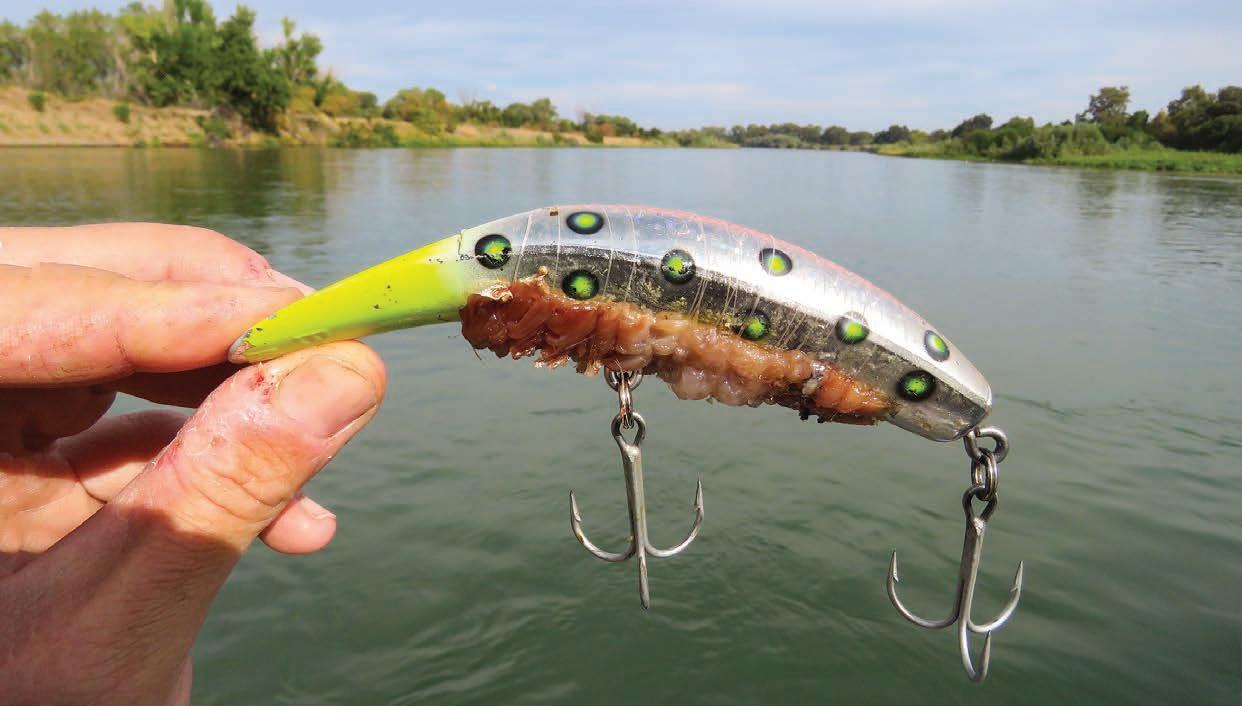
For back-bouncing, FlatFish plugs in chrome and chartreuse have a strong following in the northern reaches of the state. (CAL
BACK-BOUNCING PLUGS
One of the most effective and enduring techniques of all is backbouncing plugs. At first glance, plug fishing for salmon appears fairly straightforward. The boat slips downstream while diving plugs work near the bottom where migrating salmon travel. But in reality, truly
effective plug fishing is a highly refined technique built around precise boat control, tuned lures, current awareness and maintaining exact bottom contact. Done correctly, it is one of the deadliest salmon tactics ever developed.
The heart of the method involves presenting an aggressive diving plug directly in the salmon’s travel lane while the boat slips downstream slightly slower than the surrounding current. Salmon naturally migrate close to the bottom, where current is softer and movement requires less energy. By keeping the lure digging and hunting near bottom, anglers place the plug directly in front of traveling fish.
Sometimes plugs can be run without additional weight, particularly in shallower water or slower current. Many times, however, anglers employ a three-way swivel system that allows a sinker to be used in conjunction with the plug.
This is the classic California backbouncing setup. The main line attaches to one eye of the three-way swivel. A dropper line carrying a sinker is attached to the second eye, while the leader and plug trail from the third eye. This system allows the sinker to maintain bottom contact while the plug works slightly behind and above it in the strike zone.
The term “back-bouncing” comes from the constant lifting and dropping motion anglers use with the sinker. As the boat slowly slides backward, the sinker repeatedly taps bottom while the plug hunts aggressively behind it.
That rhythmic bouncing action is critical. You are not dragging the sinker continuously. You are lifting it, letting it fall, feeling it touch bottom, then repeating the process while slipping through productive water. The sinker becomes both a depth control tool and a way of reading the river bottom.
Experienced salmon anglers develop an almost instinctive feel for this process. They can tell whether the sinker is ticking properly, hanging up
KELLOGG)
The mighty Sacramento will be among the rivers anglers will be working in hopes of fighting big kings. (CAL KELLOGG)
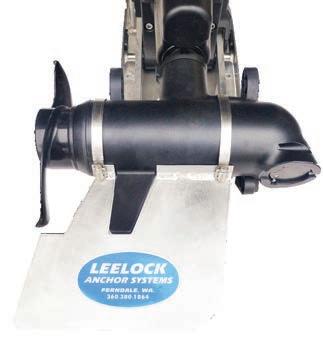
The LeeLock magnum Skeg #LMS-04 is made for Minnkota Instinct Quest motors. It will drastically improve the steering performance and straight line travel of your bow-mounted motor. Not only does this Skeg improve your motor’s performance, it also makes it much more efficient. Your batteries will run longer on a charge. A LeeLock Skeg is a vital part of your trolling motor system. This oversized skeg is made of 5052 aluminum. The size is 8 3/4 inches high by 10 inches wide and it’s 3/16 inches thick. It comes with clear PVC coated stainless steel hose clamps. 360-380-1864 www.leelock.com
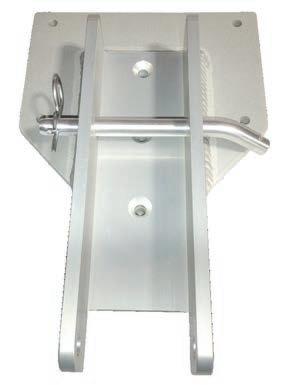
The Heavy-Duty Quick Change Base #QB-03 is like the standard Quick Change Base, but beefed up to provide a wider footprint. This provides a more secure mount. Like the standard Quick Change Base, the Heavy-Duty base allows you to easily and quickly switch between the #CRN-01 Columbia River Anchor Nest, any of the 3 Bow Mount Trolling Motor Mounts or the #BL-01 LeeLock Ladder. Simply remove the pin and slide an accessory out and slide another accessory in and replace the pin. The Heavy-Duty Quick Change base mounts to almost any power boat as long as the footprint fits on the bow area of the boat. It has 7 5/16 inch mounting holes. The Heavy-Duty Quick Change Base is handmade of aluminum. Go to LeeLock.com to order the Base alone or to add the CRN-01 Columbia River Quick Change Anchor Nest, the three Bow Mount Trolling Motor Mounts, or the LeeLock Ladder to your order.
FISHING
excessively or riding too high simply by feel transmitted through the rod.
Maintaining that precise relationship with the bottom is absolutely essential, as river salmon generally travel close to the substrate while migrating upstream. If the plug rides too high, fish may never see it. If it’s too low, anglers spend the day snagged on rocks and debris.
STEERING INTO SALMON
Boat control is equally important. Most anglers use either a kicker motor or electric trolling motor to slow the boat’s downstream drift while following productive current seams, ledges and travel lanes. The goal is maintaining just enough resistance against the current for the plugs to work aggressively without overpowering the presentation. Too much speed kills lure action. Too little movement causes the plugs to rise unnaturally or lose their hunting motion.
Good plug fishermen become
a plug supercharges its fishiness.
almost obsessive about this balance because they understand that proper boat speed governs everything else.
BE ‘KWIK’ ABOUT IT
Plug selection matters tremendously as well. Classic salmon offerings like the Kwikfish remain legendary due to their wide-searching wobble and ability to trigger violent reaction strikes from migrating kings. FlatFishstyle plugs continue producing salmon, too, particularly when fish want a slower, exaggerated wobble.
By no means are these big salmon lures finesse presentations. They hunt aggressively, push water hard and create heavy vibration signatures salmon can detect from considerable distances away. River kings often strike them out of aggression or territorial instinct rather than pure feeding behavior.
One thing salmon anglers quickly learn, however, is that no plug is truly ready to fish straight out of the package.
SUPER SARDINES
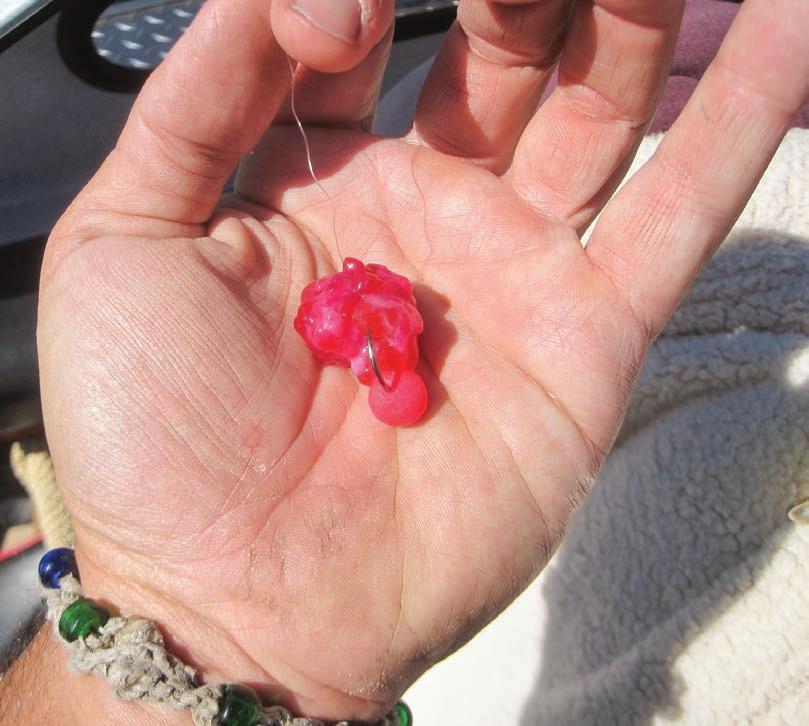
Every serious river salmon plug needs a sardine wrap. This is one of the defining elements of California plug fishing culture – and for good reason. The sardine wrap adds scent, flash and a subtle, wounded baitfish quality that dramatically increases the effectiveness of the lure.
The wrapping process is simple but important. A sardine fillet is trimmed carefully and affixed to the belly of the plug – meat side out –using elastic thread. The wrap must be secured tightly enough to survive trolling current while still remaining streamlined and balanced.
Equally important, the sardine wrap cannot interfere with the action of the bait. That point matters enormously. A poorly wrapped plug loses its hunting action, and its effectiveness drops dramatically. The plug should still wobble aggressively and track properly while carrying the sardine fillet. Properly wrapped, the lure creates a deadly combination
Wrapping
“The sardine wrap adds scent, flash and a subtle, wounded baitfish quality that dramatically increases the effectiveness of the lure,” explains author Cal Kellogg. (CAL KELLOGG)
of vibration, flash and natural scent that salmon find extremely difficult to ignore.
Experienced salmon anglers often spend a surprising amount of time perfecting sardine wraps, since they know that details matter. Clean wraps fish better, hold longer and maintain proper lure action.
COLORFUL CHOICES
Color selection also plays a major role in the game. Bright colors excel in stained water or low-light conditions, while metallic and baitfish finishes often shine in cleaner flows. Chartreuse, flame orange, hot pink, and silver and chartreuse combinations remain perennial salmon producers, plus they maintain strong visibility in moving water.
Chrome and blue, black and silver, and metallic baitfish patterns also deserve serious attention, especially during clear-water periods when salmon become more selective.
TUNING IN
Another critically important aspect of plug fishing is tuning. Every plug should run straight with a hard, aggressive hunting wobble. If a lure tracks sideways or rolls excessively, slight adjustments to the eye are necessary until the plug runs correctly. A poorly tuned plug simply won’t consistently produce fish.
Leader setups also tend to be heavier than what trout anglers are accustomed to. Most salmon anglers employ leaders ranging from roughly 20- to 40-pound test, depending on river conditions and fish size. Heavy leaders withstand abrasion from rocks and salmon teeth while also helping stabilize plug action in heavy current.
THINK LIKE THE FISH
Understanding salmon positioning within the river is equally important. Kings rarely distribute randomly. Migrating fish generally follow predictable travel lanes shaped by current speed, depth and structure.
FISHING
Softer seams adjacent to heavy current become migration highways, while deeper, slower pockets provide resting areas where salmon pause before continuing upstream. This means successful anglers constantly analyze the river itself.
You can ask yourself the following questions: Where does the current soften? Where does the river funnel? Where are the deeper slots? Where are fish likely to travel or rest? The answers matter constantly when back-bouncing plugs.
Another thing river newcomers need to understand is that salmon often come in waves. Hours may pass quietly and then suddenly a fresh push of kings enters the system and rods begin burying violently all around the boat. That unpredictability is part of the addiction.
QUITE A RUSH
Few freshwater experiences compare to the moment a heavy Chinook
absolutely crushes a back-bounced plug in shallow river currents. The rod buries violently, the reel erupts and chaos instantly fills the boat. Once hooked, river kings become brutally powerful opponents, using the current and their weight and raw strength to full advantage.
At its core, back-bouncing remains one of the finest salmon techniques ever created. It perfectly matches the behavior of migrating Chinook. The system places aggressive vibrating plugs directly into the lanes salmon naturally travel while allowing anglers to systematically dissect productive current seams and holding water.
BACK-BOUNCING CURED ROE
While plugs dominate much of the early California river salmon discussion, there are times when nothing outfishes cured roe. Salmon eggs are one of the most natural offerings anglers can present to
If plugs aren’t working, back-bouncing cured roe is a great option for getting big Chinook to play. (CAL KELLOGG)
FISHING
migrating kings, considering salmon instinctively recognize eggs as food. Whether feeding opportunistically or reacting aggressively, Chinook will absolutely hammer a properly presented roe cluster under the right conditions.
As with plugs, back-bouncing roe revolves around maintaining precise bottom contact while slipping downstream slightly slower than the surrounding current. The setup is fairly straightforward: A three-way swivel is employed with the main line attached to one eye, a dropper line and sinker attached to the second and a roe leader trailing from the third.
As the boat eases backward downstream, the sinker constantly taps and bounces along the bottom while the roe cluster drifts naturally just behind it in the strike zone. The key word here is naturally.
Good roe fishing is all about achieving a believable drift. The sinker should maintain intermittent contact with the bottom while the bait glides freely in the current rather than dragging unnaturally.
This is where experienced salmon anglers separate themselves from beginners. Subtle adjustments in boat speed, sinker weight and line angle dramatically influence how naturally the roe behaves beneath the boat.
Most roe leaders range from roughly 24 to 48 inches, depending on water clarity and current speed. In clear water, I often favor longer leaders because they create a more natural presentation. In dirtier water or heavier current, shorter leaders offer better control and strike detection.
Roe preparation itself is critically important. Fresh uncured eggs catch fish, but properly cured roe is on another level entirely. Good cures toughen the eggs, enhance color, improve scent dispersion and help the bait remain on the hook despite repeated bottom contact and strong current.
Every serious salmon angler eventually develops personal cure preferences involving combinations of salt, sugar, sulfites, dyes and/ or scent additives. Bright red and
orange cures remain standards, with salmon responding strongly to those colors in moving water.
Hooking the roe properly matters too. Most anglers fish roe clusters on bait loops using octopus-style hooks ranging from roughly 2/0 to 5/0 depending on bait size and river conditions. The eggs should appear full and natural without becoming an oversized sloppy mass that spins or drifts unnaturally.
A CASE FOR ROE
One major advantage roe holds over plugs is subtlety. While plugs excel at triggering aggressive reaction strikes, roe often shines when salmon become pressured, lethargic or less responsive to loud, vibration-based presentations. On difficult days, cured roe can dramatically outproduce hardware because it behaves like a genuine natural food source moving naturally with the current.
Again, boat positioning remains enormously important. Successful roe fishermen constantly work productive travel lanes, softer seams adjacent to heavy current, deep troughs and classic salmon-resting water. Migrating kings rarely scatter randomly through a river system. They travel predictable routes, and successful anglers learn to identify and repeatedly work those lanes.
What newcomers will quickly discover about roe fishing is that salmon bites are not always violent. Sometimes kings absolutely hammer the bait, but other times the bite feels surprisingly subtle. A slight hesitation, a soft pull or a heavy sensation where the sinker suddenly feels different may indicate a salmon has inhaled the roe cluster. That’s why concentration matters.
At its core, back-bouncing cured roe remains one of the most refined and productive river salmon techniques ever developed. It combines natural scent, realistic presentation and precise depth control into one deadly system.
This impressive king was caught backbouncing a Kwikfish on the Sacramento, which will open for fishing on July 16. (CAL KELLOGG)
When kings become wary of plugs or conditions call for a subtler approach, few methods consistently produce more salmon than a properly cured roe cluster drifting naturally through the heart of a migration lane.
FINALLY FISHING AGAIN!
After four years of frustration, closures and uncertainty, California salmon anglers finally have something they’ve been missing for a long time: a real season to look forward to. From the July 16 Central Valley opener through the late fall push of upriver kings, the months ahead promise opportunity, excitement and the return of one of the West Coast’s greatest fishing traditions.
There will be early mornings on the Sacramento, screaming drags in heavy current, chrome kings rolling behind the boat and all the chaos and adrenaline that only river salmon fishing can deliver.
Veteran anglers will once again sharpen skills they haven’t fully exercised in years, while a new generation of fishermen will finally get the chance to experience the magic of California king salmon fishing first-hand. Dust off the plug rods, cure some roe, spool fresh braid and get ready. The kings are coming, and after a long wait California salmon anglers are finally getting their season back. CS
Editor’s note: For more inland salmon fishing season dates and details, check out the California Department of Fish and Wildlife freshwater regulations at wildlife.ca.gov/Fishing/Inland.
This summer will be a special one for longtime salmon angler Kellogg, who gets essentially a full season to target kings in Central Valley rivers. “Veteran anglers will once again sharpen skills they haven’t fully exercised in years,” he writes, “while a new generation of fishermen will finally get the chance to experience the magic of California king salmon fishing.” (CAL KELLOGG)
THE EL NIÑO EFFECT
By Joe Sarmiento
True confession, guys: I’m not a professional meteorologist. So I’m not going to get in the weeds of what an El Niño is in those kinds of terms.
What I will tell you is that an El Niño is an atypical climate pattern where the water around the equator in the Eastern Pacific – the West Coast of the Americas – builds up to be hotter than normal. It creates more tropical storms, which in turn pushes warm water our way.
Technically, the last El Niño happened in 2023-24, but those particular years didn’t really hit us that hard in terms of changing angling activity in my normal Southern California and Baja California fishing zones. However, there was a super El Niño event in 2015-16, the effects of which lingered on for a couple years afterwards. During that period of time, we had some amazing fishing years. I saw things I had never seen before –it was my first El Niño as a full-blown sportfishing fanatic – and it has me excited for the potential return to those kinds of conditions.
WHY THIS COULD BE AN EL NIÑO YEAR
Other than the fact that a lot of the information sources I trust are speculating that we will see an El Niño year this year, I’ve noticed some unusual things so far that lead me to believe it’s really going to happen.
For me, it started this year on the beach. I live in Rosarito Beach, Baja California, Mexico. Typically, the water temperature here is a few degrees warmer than the beaches I fish in the
Is
WHAT TO EXPECT FROM SOCAL SALTWATER SCENE AS CLIMATE PATTERN RETURNS
the climate phenomenon El Niño coming back for the 2026 saltwater fishing seasons off the California coast? It’s pretty likely, and anglers have seen some earlier-than-normal action in Southland waters and beyond.
(JOE SARMIENTO)
FISHING
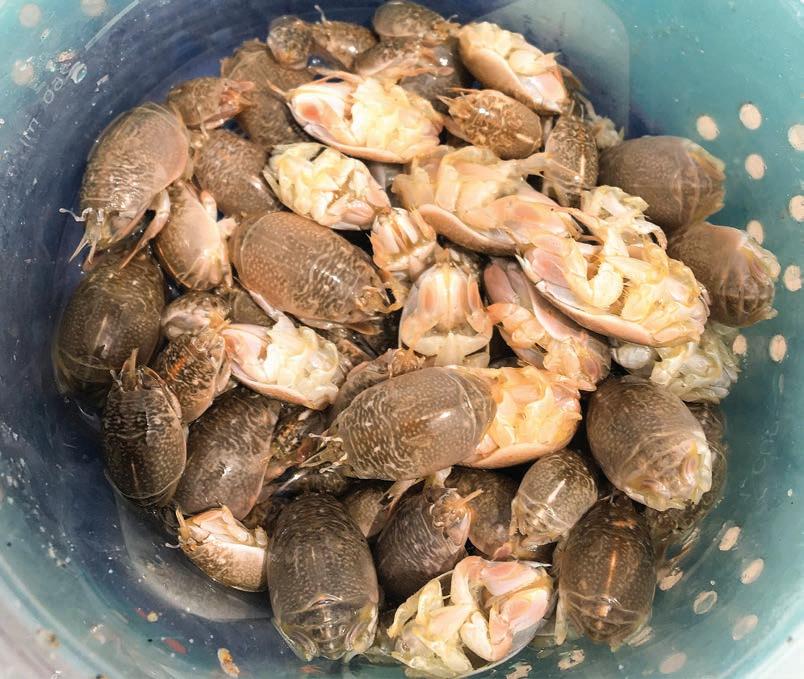
San Diego area (usually Del Mar and Solana Beach). Even so, in the almost five years I’ve lived south of the border, the appearance of sand crabs on the beach has followed the same pattern I was used to when surf fishing Los Angeles and Orange County beaches. They would typically start to show up around April and then be mostly gone by October. When they are in full
swing in the summer, then fishing the surf gets good.
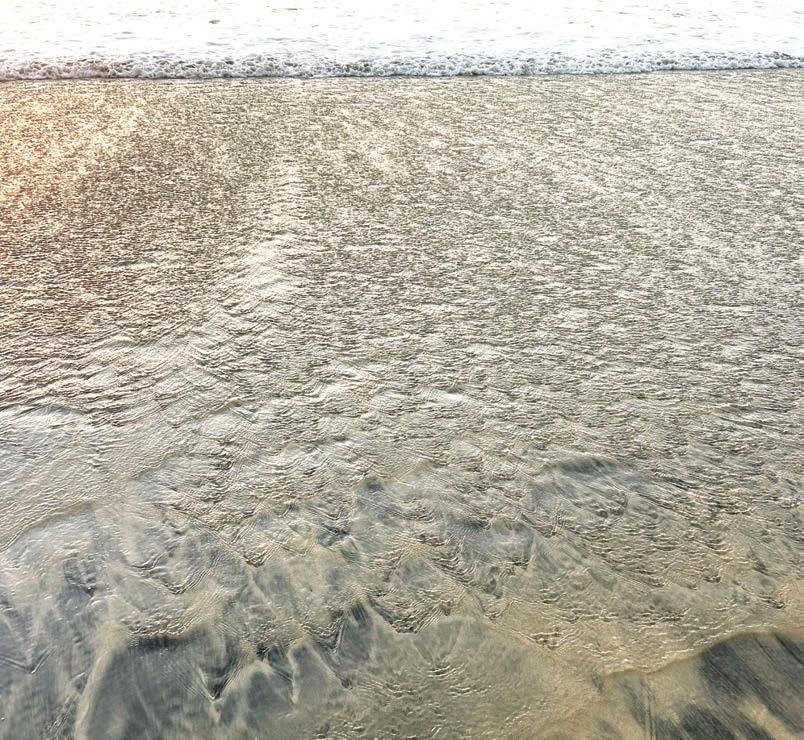
But in late January of this year, I found signs of a massive bed of sand crabs on Rosarito Beach. That’s a typical sight in, say, July, not January. In the early months of the year, plastic worms or grubs are the preferred bait, but when I was surf fishing in January, I think even the fish were confused
that I was using sand crabs, as they bit better on the plastic.
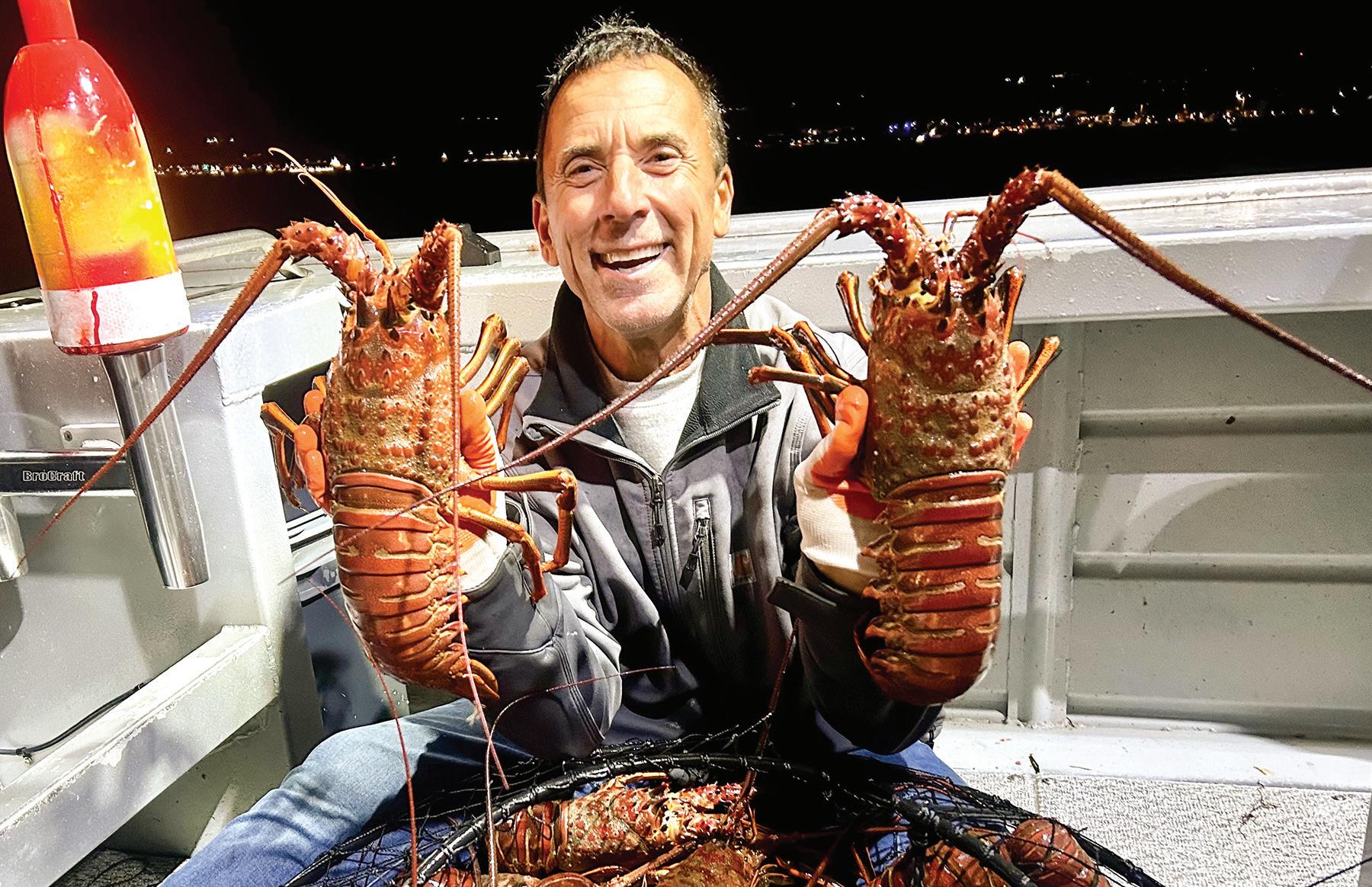
Once the rockfishing season closed at the end of last year, I mixed in hooping for spiny lobster. I haven’t done a ton of lobster hooping over the years. Part of the reason why is that it is a nocturnal activity. Getting wet and being cold at night on a boat just didn’t hold a lot of appeal for me. But this year, my good buddy, Captain John Anjard, got into it for the first time to great success.
I was able to get out with him four times before the season closed in April. Each session, we both got limits (seven apiece). I don’t know if consistently getting our limits each outing was unusual or not. What was unusual was that the water temperature was comfortably above 60 degrees each time we went.
So, if the weather pundits are saying an El Niño is going to happen, and you accept that my personal observations back up those assertions, what are some things that we can expect to see this season?
TIMING COULD BE OFF
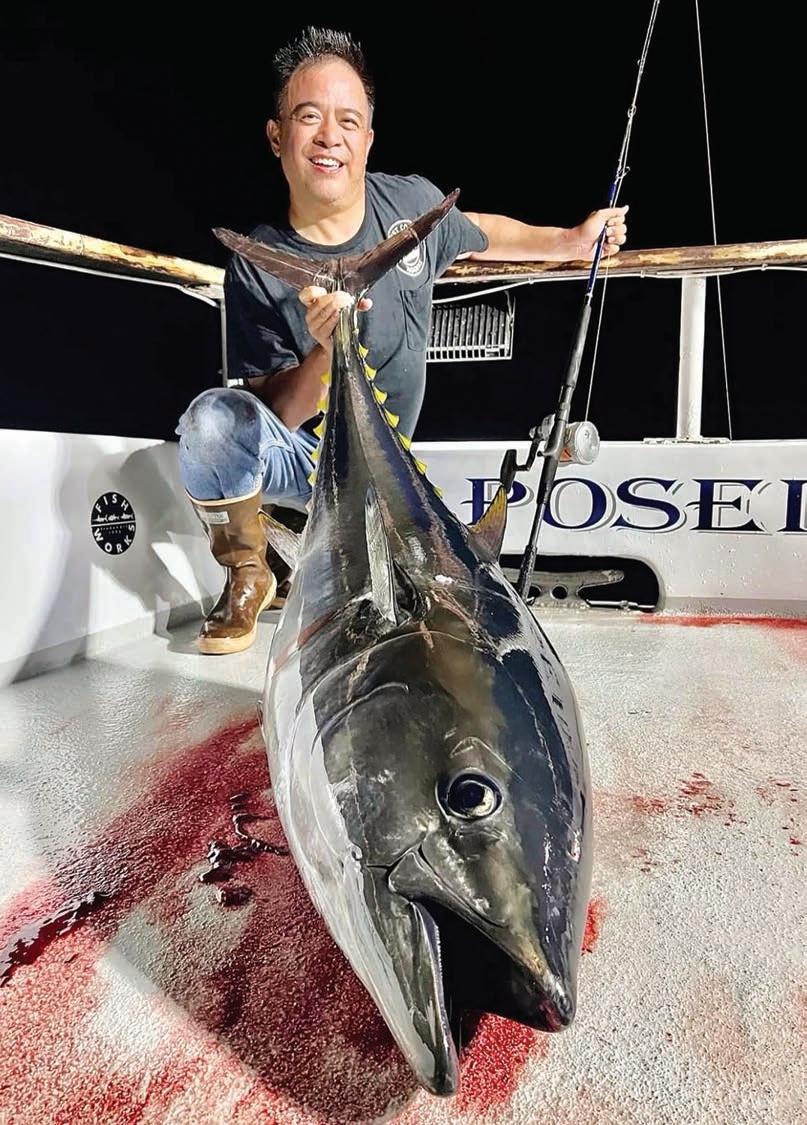
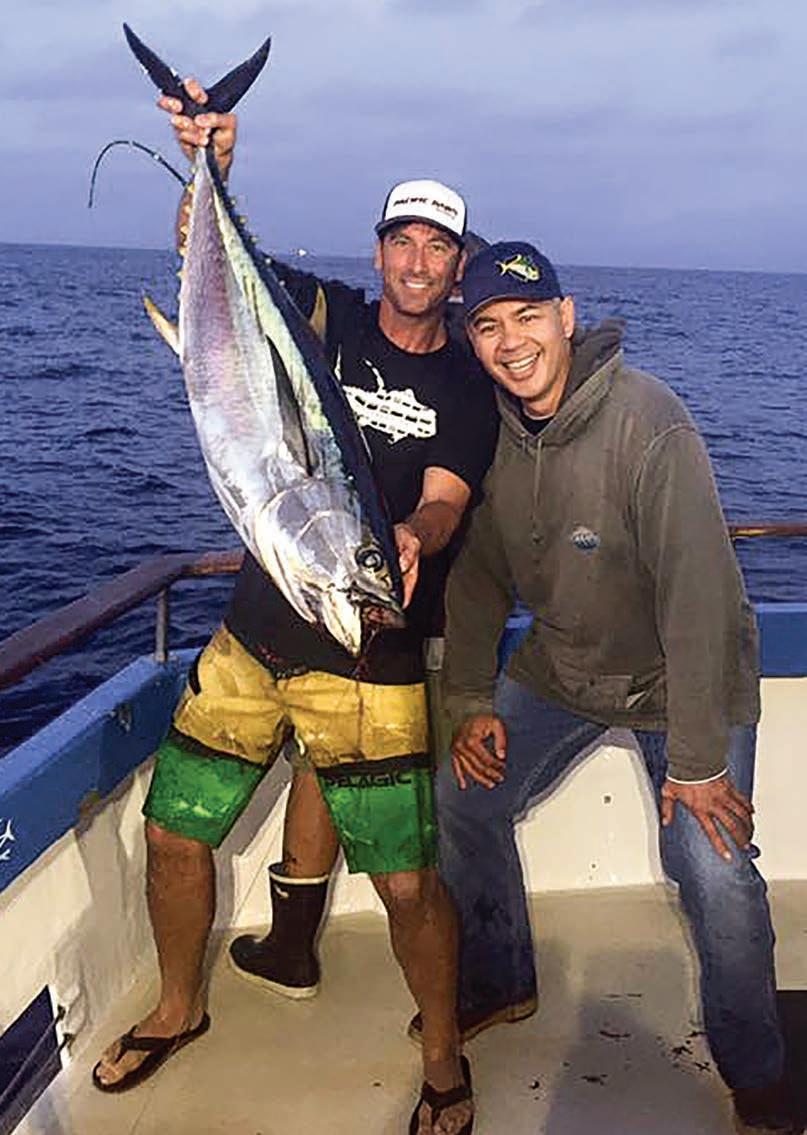
During those super El Niño years, the bluefin tuna lingered around and there were a couple years where they got caught all year long. Once that climate pattern ended, we settled into a typical pattern where they’d start showing up around May or June and last until fall. This year they already started by April. Fisherman’s Landing in San Diego was advertising overnight trips because tuna had already been within that range of trips. My panga captains, or pangeros, out of Ensenada, Mexico, started catching them in the middle of April.
However, I think that if you want to catch bluefin tuna this season, you better get out there as soon as possible. Yellowfin tuna have already been caught on the first day of a three-day trip out of San Diego. Yellowfin like water closer to 70 degrees. We haven’t really had a good hit on yellowfin for the last several years. I feel like the bluefin will head north to colder
During a previous super El Niño year, author Joe Sarmiento (right) did a trip out of Ventura with Captain Bill Cavanaugh. Such exotic species could return to these waters again this season. (JOE SARMIENTO)
water when our local waters hit that 70-degree mark.
EXOTIC SPECIES ON THE WAY?
During those last super El Niño years, I got a call from Captain Jeremy Maltz of Spitfire Sportfishing in Marina del Rey, near Los Angeles. Maltz’s is a threequarter-day boat, so they leave the dock at 6:30 a.m. and return at 3 p.m. “Hey Joe, I got a tip from a commercial guy I know. We’re going to go out Wednesday looking for tuna. You should come out,” he told me. I did, and to my surprise we caught yellowfin tuna. There’s a picture hanging in their galley of that day. It was the first – and currently the only – time that the boat got tuna. We called the Native Sun, a three-quarter-day boat out of 22nd Street Landing in San Pedro, and they got them too. Even more amazing, as we were leaving, a couple of the longrange San Diego boats found the bite.
The following week, I drove up to Ventura to fish on the same bite. I wanted to be able to say I caught tuna on an 805-area-code boat. I rode the Amigo, which was based out of Ventura Sportfishing at the time, with Captain Bill Cavanaugh. We got them again. Mission accomplished!
Along with yellowfin, we should also see more dorado (aka mahi mahi), yellowtail and maybe even wahoo.
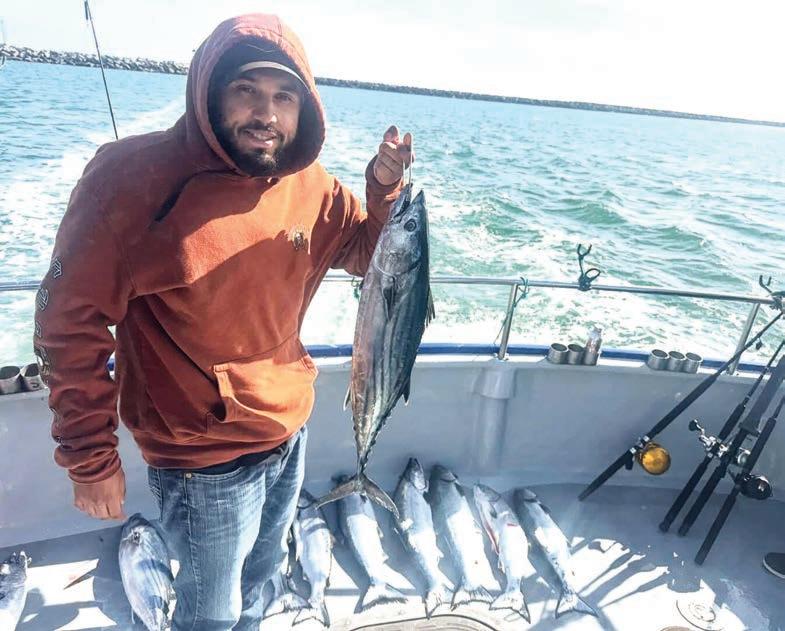
If we end up having a good yellowfin year in Southern California, it bodes well for bluefin in Northern California waters. I heard some Monterey boats had already found a few. Recently, the New Easy Rider out of Berkeley Marina in the Bay Area caught some bonito mixed in with their salmon. It’s unusual to see bonito there.
And I know a commercial captain who runs an albacore boat in Washington State, and he’s shown me pictures of yellowtail he caught that far north during those super El Niño years!
WHAT YOU’LL NEED
Get ready, folks. Things are already happening and it should only get more exciting as the season progresses. Time to dust off your gear and get it in order.
FISHING
This sand crab bed on Mexico’s Rosarito Beach appeared strangely on January 30. Typically, these crustaceans don’t show up until around April. (JOE SARMIENTO)
FISHING
The spiny lobster success Sarmiento had with his buddy, Captain John Anjard, was epic. “I don’t know if consistently getting our limits each outing was unusual or not,” the author concludes. “What was unusual was that the water temperature was comfortably above 60 degrees each time we went.”
Start watching some YouTube videos if you’re unfamiliar with catching some of the fish I mentioned.
If you decide to come visit us in Southern California, check for offshore trips. I’d recommend going one and a half days minimum. If you have the time, it would be a good idea to get on a half-day boat fishing inshore and familiarize yourself with flylining a live bait before you go offshore. Flylining live bait means to fish without a weight. It sounds simple enough, but there are nuances to it. Understanding selecting a lively bait, the various ways you can hook one, and just getting a feel for it will go a long way toward your success offshore. A 30- and 40-pound outfit is all you’ll need. Use the former when fishing kelp paddies, the latter if you run into bluefin. For my 30-pound offshore setup, I like using a Fishing Syndicate FSC 800M (20-50) paired
(JOE SARMIENTO)
Even the Bay Area waters are experiencing signs of El Niño, as a rare bonito or two have been caught here. (NEW EASY RIDER SPORTFISHING)
FISHING
“If we get them at all, it’s typically a
with a Shimano Trinidad 30A reel. For inshore applications, I use a Trinidad 16A to fish 30-pound line, but for offshore it’s helpful to have that extra line capacity. A lot of people like to use braid to a short topshot of fluorocarbon, but I like having the stretch that monofilament line provides. Mono is also easier to cast, and getting your bait out and away from the boat is critically important.
My reels for this application are filled with braided line for about half the spool and then topped off with mono. For my 40-pound setup, I bump up to the Fishing Syndicate FSC 800H (30-60) paired with either a Shimano Talica 12II or Daiwa Saltiga 40 two-speed lever drag reel. You should bring 20-, 30- and 40-pound fluorocarbon line.
For line connections, I use the Seaguar knot for mono to fluoro and then a simple uni knot to tie on the hook. Use extra-strong live bait hooks on the 30-pound setup and extra-strong circle hooks on the 40-pound. Size 2 hooks are good if you only bring one hook size.
If you’re unfamiliar with tying these knots, have a deckhand tie them for you. Also have them set the drag on your reels.
That’s about it. It wouldn’t be a bad idea to look at your calendar and book your trip(s) fast to make sure you get in on this year’s bite. Good luck if you get out there. CS
Editor’s note: Joe Sarmiento’s blog can be found at socalsalty.com.
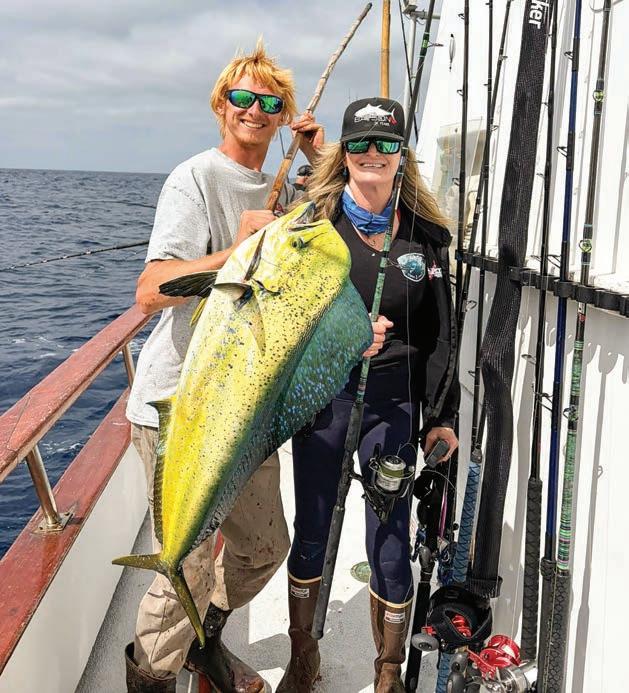
Lori Heath (right) caught this SoCal waters dorado back in April aboard the San Diego-based sportfishing boat Legend. “To see dorado this early in our zone was very unusual,” Sarmiento says.
July or August thing.” (ROB TRESSLER)
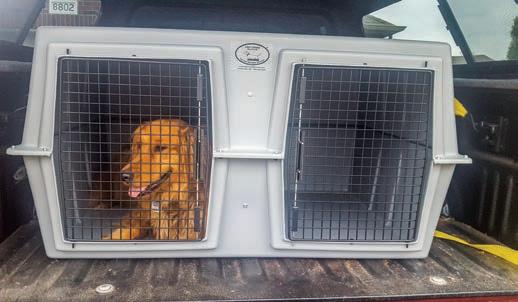
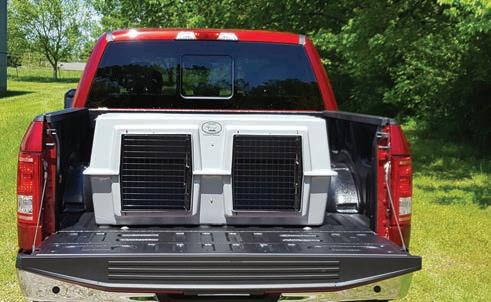
• Easy Loader & Deuce accommodate 2 dogs up to 65 lbs each
• EZ-XL accommodates 2 dogs over 65 lbs each
• Made from High Density Polyethylene with UV protection
• Easy Loader fits most full size pickups, SUVs & large UTVs
• Deuce fits smaller pickups, SUVs & UTVs
• EZ-XL is for larger breed dogs & full size vehicles
• Vents, cold weather door covers, insulated covers & custom kennel pads available
GUN GEAR THAT’S WORTH GRABBING
TREAT YOURSELF WITH NEW SHOTGUN STORAGE, CLEANING EQUIPMENT
By Scott Haugen
Usually we address everything gun dogs in this column, but this month we’re switching gears. I get to test a lot of bird hunting gear over the course of a year, and fellow wingshooters should know about the good stuff.
ORVIS HAS BEEN SYNONYMOUS with quality gear since its inception. I’ve highlighted some of the company’s items in this column over the years, and I still use every one of those pieces of gear. Last season I learned of four more Orvis items.
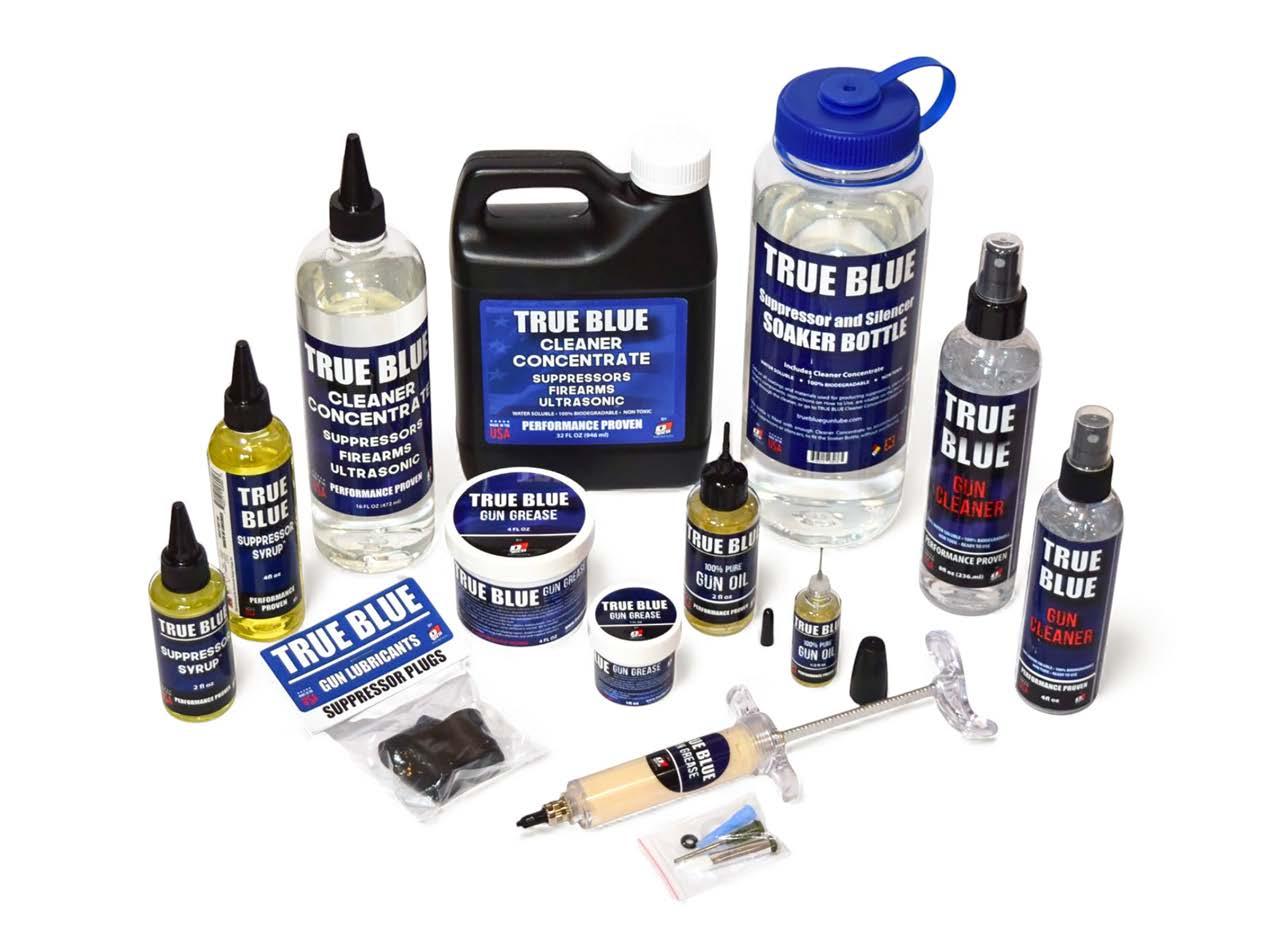
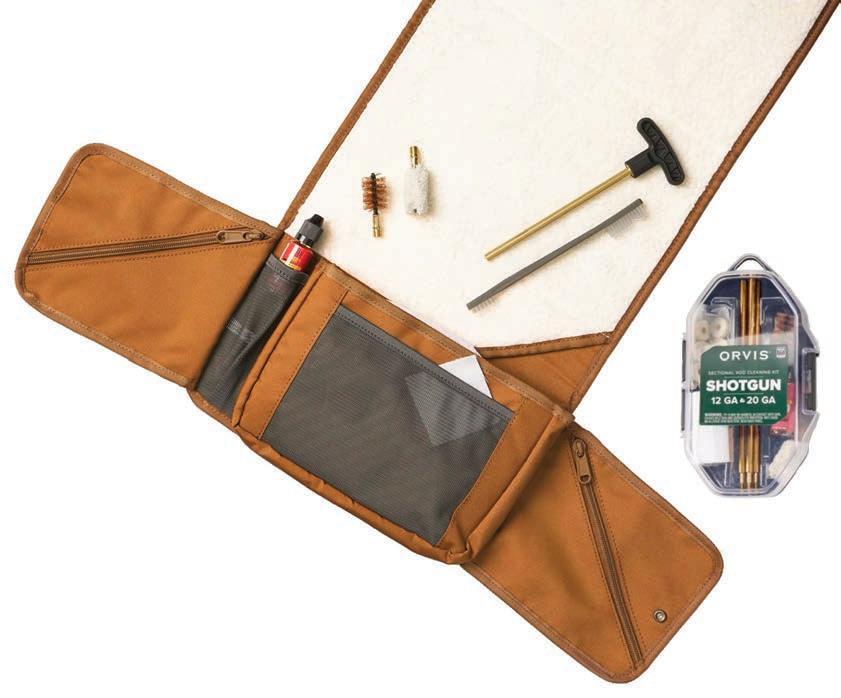
The Loaded Upland Gun Cleaning Station combines an Orvis Gun Cleaning Station with their Gun Cleaning Kit. The Gun Cleaning Kit includes all the tools you need to remove carbon, fouling and other debris in both 12- and 20-gauge shotguns. It features solid brass rod sections, bronze bore brushes, wool mops, patches and lubricant. These items can be stored in the hard case they come in or pieced out into the pouches of the Cleaning Station.
The Upland Gun Cleaning Station can be used at home or on the road. Ninety percent of the time I unrolled it on my tailgate. The exterior is tough while the soft inside makes for easy handling of your gun. It’s quick and easy to roll out and then snap closed when done, and is simple to travel with. Gone are the old towels I used to line the tailgate with to clean my guns in the field. With this station, the process is quick, efficient and dirt-free.
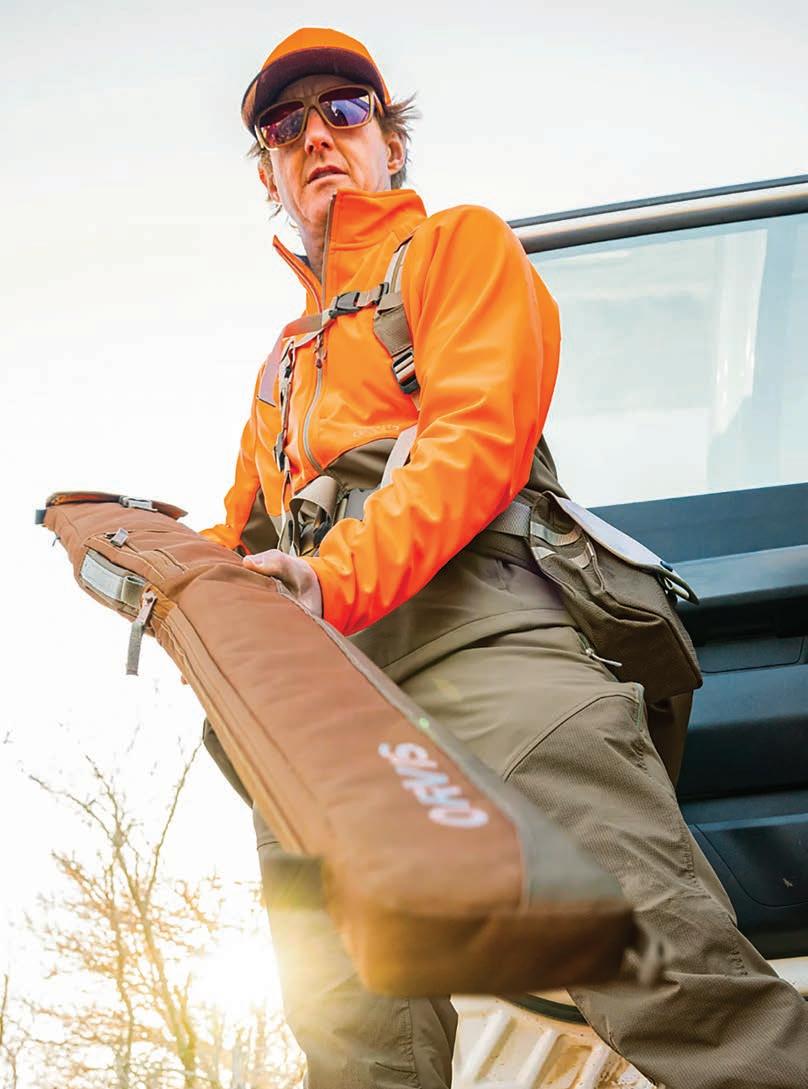
The pups get the month off, as Scott Haugen takes a look at some of the gear around hunting with bird dogs that makes things easier, including the Orvis Upland Gun Slip he uses to ensure his shotgun is protected. (ORVIS)
HUNTING
I love a good field bag. I especially like versatile ones I can use yearround, and not just to stow hunting gear. The Orvis Upland Field Bag is lightweight and durable, and the Cordura Eco polyester is super tough and coated with Durable Water Repellent. It has a 210-denier polyester liner.
The customizable internal storage system of the Field Bag features sturdy dividers that hold in place. Not only did I use this field bag on multiple upland hunts but dozens of waterfowl hunts. It was also my go-to bag to house over $10,000 worth of camera gear on multiple wildlife shoots; that’s how much I like and trust this bag. The internal zipper pockets are well designed. I’ve also used this bag for dog training, even carrying trail camera gear afield. It’s easy to customize the compartments to fit day-to-day needs.
The Orvis Upland Gun Slip is constructed from the same materials as the Field Bag. This tough, durable, low-profile gun slip is one I can stow anywhere in my truck that’s
Compact and classy, Orvis’s Loaded Upland Gun Cleaning Station has all the tools for swabbing out a 12- or 20-gauge after a long day of wingshooting, plus a soft surface to lay the gun on while working.
(ORVIS)
convenient at the time, or toss into any ATV and know my gun will be protected. The removable shoulder strap is convenient, as is the grabhandle and storage hang loop. The long zippered vent is perfect for allowing moisture to escape.
WHILE ON THE TOPIC of shotguns, this is my second year of using SC-14 Gun Cleaner. I first tried it on a gummedup shotgun during a high-volume
There are many such products on the market, but Haugen has gone all in on SC-14 Gun Cleaner, which not only removes barrel fouling but acts as a lubricant for moving parts. (SCOTT HAUGEN)
spring goose hunt. I now have big spray bottles of it in my shop and truck and a small bottle in my field bag. The first thing you’ll notice is the citrus scent, which confirms the SC-14 Gun Cleaner is free of chemicals and harsh toxins common among gun solvents. It’s safe and won’t harm surfaces that it comes in contact with.
SC-14 Gun Cleaner removes carbon, lead and copper fouling. Simply spray and let sit for a few minutes, then wipe clean. For difficult deposits, a brush will be needed. Once the gun is dry, apply a light coating of your favorite lubricant. On a recent hunt I actually relied on the SC-14 as a lubricant to keep the action of my inertia gun working. Back at camp that night I gave it a thorough cleaning and resumed shooting geese the next two days.
There you have it, bird hunting gear that I have used, like and will keep using. CS