FISHING • HUNTING • ADVENTURE
CALSPORTSMANMAG.COM
California
Sportsman Your LOCAL Hunting & Fishing Resource
PUBLISHER James R. Baker GENERAL MANAGER John Rusnak EXECUTIVE EDITOR Andy Walgamott EDITOR Chris Cocoles WRITERS Mark Fong, Scott Haugen, Tiffany Haugen, Tim E. Hovey, Cal Kellogg, William “Will” Murray SALES MANAGER Paul Yarnold ACCOUNT EXECUTIVE Janene Mukai DESIGNER Kha Miner WEB DEVELOPMENT/INBOUND MARKETING Jon Hines ADMINISTRATIVE ASSISTANT Katie Aumann INFORMATION SERVICES MANAGER Lois Sanborn ADVERTISING INQUIRIES media@media-inc.com
4 California Sportsman JANUARY 2026 | calsportsmanmag.com
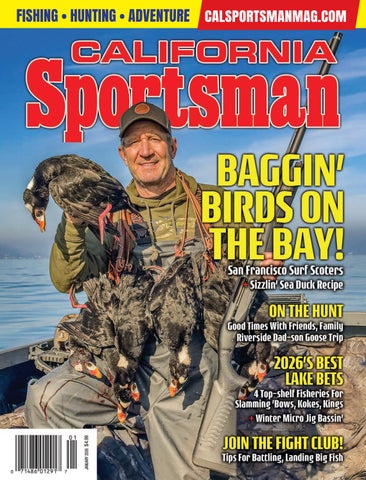
Volume 18 • Issue 3 CORRESPONDENCE Email ccocoles@media-inc.com X @CalSportsMan Facebook.com/ californiasportsmanmagazine ON THE COVER Scott Haugen got a chance to leave his heart in San Francisco but also take home some tasty waterfowl. Haugen chronicles his guided adventure on San Francisco Bay targeting surf scoter sea ducks, which are open for hunting in the Balance of the State Zone through January 28. (SCOTT HAUGEN) MEDIA INC PUBLISHING GROUP 941 Powell Ave SW, Suite 120 Renton, WA 98057 (800) 332-1736 • Fax (206) 382-9437 media@media-inc.com
CONTENTS
VOLUME 18 • ISSUE 3
47
FISHING’S FIGHT CLUB Every angler’s dream – hooking and landing a trophy fish of a lifetime – can also be his or her nightmare if that lunker trout or salmon wiggles its way free before you can net it during the angler-fish fight. Fear not, as professor Cal Kellogg provides a tutorial for how to prepare before fishing and not panicking during the bout. Be sure to take good notes!
(CAL KELLOGG)
FEATURES
ALSO IN THIS ISSUE
12
WHAT THE HUNT IS ALL ABOUT FOR ME
9
As Tim Hovey prepares for another year of hunts with family and friends, nostalgia left him recalling some recent memorable adventures, including targeting ducks with buddies, a father-daughter Canada geese and sandhill crane trip and pursuing predators with wife Cheryl. He shares why for him the hunt is more about the company than the kill.
11 31
19
MOM’S FUDGE AND DAD’S SHOTGUN
35
The Editor’s Note: Restoring faith in humanity among a crowded tackle shop line Outdoor Calendar Making use of bird parts for offseason gun dog training Four freshwater fisheries to flock to in 2026 Micro jig fishing for winter bass
More tales of hunts to remember, this time courtesy of our pal William Murray, who 41 turned his clock back to winter 1959. That’s when a then 9-year-old Will cherished his time together with his at-times gruff dad in a cramped Riverside County blind, where they called in Christmas geese and his mom’s delicious fudge helped break the tension between father and son.
25 BIRDS ON THE BAY Scott Haugen didn’t just leave his heart in San Francisco, which he and his family love to visit and savor the attractions and dining delights. Haugen also enjoys sea duck hunting on the bay. He recaps an outstanding outing with a local waterfowl guide, while in her half of their From Field to Fire column, wife Tiffany Haugen shares a recipe to get the most flavor out of harvested scoters.
Get the digital version of California Sportsman for free. Go to www.calsportsmanmag.com/digital California Sportsman is published monthly by Media Index Publishing Group, 941 Powell Ave SW, Suite 120, Renton, WA 98057. Annual subscriptions are $39.95 (12 issues). Send check or money order to Media Index Publishing Group, or call (206) 382-9220 with VISA or M/C. Display Advertising. Call Media Index Publishing Group for a current rate card. Discounts for frequency advertising. All submitted materials become the property of Media Index Publishing Group and will not be returned. Copyright © 2026 Media Index Publishing Group. All Rights Reserved. No part of this publication may be copied by any means, electronic or mechanical, including photocopying or recording by any information storage or retrieval system, without the express written permission of the publisher. Printed in U.S.A. 6 California Sportsman JANUARY 2026 | calsportsmanmag.com
THEEDITOR’SNOTE
L
IVERMORE–The holidays are undefeated when it comes to stressing out many of us. Whether you have kids to keep happy when they open presents, are hosting sometimes awkward family gatherings or enduring chaotic travel itineraries, it’s understandable to be on edge. But I did notice both sides of the spectrum when it comes to showing some patience and restraint when things don’t always go like you’d prefer. On the Friday after Thanksgiving, I went with family members to a holiday matinee San Jose Sharks hockey game. On the drive back north to San Mateo we stopped at a local Hofbräu for an early dinner. It’s one of our favorite dining establishments in the Bay Area, and we weren’t alone grabbing some food on this day. A line backed up around the counter, where customers grab trays and order main courses, sides and salads in front of them down the line towards the cash register. A family of four or five was in the process of choosing their items when, within seconds of getting in line behind us, a guy loudly complained to us about how slow the family was ordering. We took the high road and patiently waited for our chance to hit the counter, but the eye rolls were evident after we sat down to eat. But again, it’s the holidays, so maybe the guy had a rough family party the previous day and was just hungry. But the next day I had a different experience, one featuring compassion and understanding. My sister and I got up early and drove across San Francisco Bay so I
The editor had to wait in a slow-moving line to fish at Los Vaqueros Reservoir, but it was a patient crowd during the usually stressful Thanksgiving holiday weekend. It offered some hope at a time when rage meltdowns are all the rage. (CHRIS COCOLES)
could get in a quick morning of fishing at Livermore’s Los Vaqueros Reservoir. I was taken aback when we reached the front gate, where you typically can pay your park entry fee and purchase a one-day fishing permit, and a park employee wasn’t there. A sign instructed to make these purchases at the marina store. So we drove past the area I usually like to fish at and went ahead to the main parking lot. Eager to cast my line given that we were on a time schedule to make a family birthday party later in the day, I was dismayed when I saw a line that stretched well outside the door that overcast and chilly early December morning. As I took my place in line, I had an instant flashback to the day before at the Hofbräu. I started making conversation with the guys in front of me, and they confirmed my suspicions that the staff was short-handed on this holiday weekend. The queue was
progressing extra slow due to some folks inside who were buying their California fishing licenses, which can be timeconsuming to process the paperwork. But a funny thing happened as we potentially irritated anglers awaited our turn: We were all pretty calm about the delay instead. One of the guys in line with me was fishing for the very first time, so we offered some ideas and encouragement. As we finally worked our way inside the store, there were two lines of people either buying a fishing permit or renting a boat. Just two clerks worked their tails off to get us out as quickly as possible. “Thanks for being so patient with us,” they kept repeating. I felt like humanity had some hope – everyone was in good spirits before finally checking out and heading down to the water. It’s time to say happy New Year and gain a new opportunity to be nicer to each other. Let’s see how long it lasts. -Chris Cocoles
calsportsmanmag.com | JANUARY 2026 California Sportsman
9
OUTDOOR CALENDAR JANUARY Online harvest reporting begins for steelhead, sturgeon and North 1 Coast salmon report cards Second white and white-fronted geese season opens in Northeastern Zone 2 Catfish Bash New Year Bash, Clear Lake 10 (facebook.com/clearlakecatfishbash) Prado Trout Derby, Prado Regional Park, Chino (parks.sbcounty.gov/ 10 event/prado-trout-derby) Last day of Canada geese regular season in Northeastern Zone 11 Last day of duck and scaup season in Northeastern Zone 14 Sacramento International Sportsmen’s Exposition, Cal Expo 15-18 (sportsexpos.com/attend/sacramento) Northeastern Zone Veterans and Active Military Personnel Waterfowl 17-18 Hunting Days We Can Fish event, Lake Cahuilla, La Quinta (wecanfish.org) 24 Last day of most quail seasons 25 Falconry-only rabbits and varying hare season opens 26 Last day of waterfowl season in most zones 28 Last day of waterfowl season in Colorado River Zone 31 31-Feb. 1 Balance of State (ducks only), Southern San Joaquin Valley and Southern California Zones (same species as regular season) Veterans and Active Military Personnel Waterfowl Hunting Days
FEBRUARY Falconry take of waterfowl (ducks only) season dates in Colorado 1-4 River Zone 1-6, 12-20 Late white geese season dates in Imperial County Late white and white-fronted geese season opens in Northeastern Zone 5 NorCal Trout Challenge, San Pablo Reservoir (anglerspress.com/ 7 events/norcal-trout-anglers-challenge) Falconry take of waterfowl season dates in Balance of State, Southern 7-8 San Joaquin Valley (ducks only) and Southern California Zones Colorado River, Balance of State, Southern San Joaquin Valley and 7-8 Southern California Zones Youth Waterfowl Hunting Days Golden State Salmon Association Crab Feed Fundraiser, Marin Rod and 14 Gun Club, San Rafael; (goldenstatesalmon.salsalabs.org/2026Crab Feed/index.html) Late Canada geese season dates in Balance of State Zone 14-15 Late white-fronted and white geese season dates in Balance of 14-18 State Zone NorCal Trout Challenge, Rancho Seco Reservoir (anglerspress.com/ 21 events/norcal-trout-anglers-challenge) For a list of upcoming bass tournaments, go to nrm.dfg.ca.gov/FishingContests/default.aspx.
January marks the conclusion of most California waterfowl hunting seasons. The Northeastern Zone’s duck and scaup seasons finish on the 14th, with several other zones wrapping up on the 28th. (BOB WICK/BUREAU OF LAND MANAGEMENT) calsportsmanmag.com | JANUARY 2026 California Sportsman
11
Author Tim Hovey, Duy Phan and Jose De Orta (from left to right) found epic waterfowl hunting and great camaraderie when the California crew reunited in Idaho, where Hovey now lives. For Hovey, the hunt isn’t about filling tags or bagging trophies; it’s about who he hunted with and the memories they now share. (TIM E. HOVEY) 12 California Sportsman JANUARY 2026 | calsportsmanmag.com
HUNTING
THE TRUE SPIRIT OF HUNTING A SPORTSMAN’S REWIND CONJURES UP MEMORIES, PERSPECTIVE By Tim E. Hovey
A
s we begin another year, I find myself thinking about memorable hunts I’ve experienced over the last season or so. As I get older, I find that I really treasure these events with family and friends. I’m also very aware of subtle changes in the way I hunt as time moves forward. I no longer hike the hills like I used to. Waking up before dawn for a waterfowl hunt or staying up late and shining a light for predators seems to get harder to do each season. Time waits for no man. That’s what makes these special hunts so important to me. Over this last season or two, I’ve been fortunate enough to participate in a few hunts that rank at the top of my outdoor list. It’s not because we bagged trophy animals or drew a once-in-a-lifetime tag. I’ve never been a trophy hunter, and honestly that stuff doesn’t matter to me. These hunts stand out because of who was at my side when I was on them. And they will forever be some of the best.
JOSE AND DUY Once I relocated to Idaho, my hunting friends made plans to come up for a sportsman’s weekend. In fall 2024,
my good friends Jose De Orta and Duy Phan landed at the Boise airport on a Thursday. After I picked them up, we grabbed some dinner and discussed the plan for the rest of the weekend. Being that we were right in the middle of upland game season, I wanted to take them to some of the spots I had discovered once I started investigating my new home state. However, I also had a surprise: The pair had arrived at the beginning of waterfowl season, and hunting ducks is where we’d start. We arrived at the private parcel at 3:30 a.m. I had done a few years of trapping on the property, and the owner was gracious enough to let us hunt ducks while my buddies were visiting. We grabbed several dozen decoys and waders and tossed them into a jon boat. At the blind, we walked the boat out front and started creating our decoy spread in the shallow pond. In the dark, we could hear ducks getting up from surrounding ponds. I knew we were at the right place at the right time. Duy had never been on a waterfowl hunt before, so the goal of the morning shoot was to get him on a few ducks. We stowed the boat and waded back to the hidden blind. We organized our gear in the cramped
calsportsmanmag.com | JANUARY 2026 California Sportsman
13
HUNTING wooden structure and put Duy in the center spot after deciding he’d take the first shots. With 10 minutes until shooting time, we watched the sky come alive. Ducks flew over and soon started dropping into our decoy spread. We waited. When shooting time arrived,
there were over 20 ducks paddling around our decoys. We whispered to Duy that when the next group flew in, he should take the shot and Jose and I would shoot cleanup when the swimming ducks took flight. We didn’t have to wait long. A group of five ducks banked hard
14 California Sportsman JANUARY 2026 | calsportsmanmag.com
on Jose’s side and cupped their wings; they were committed to land among the decoys. Duy tracked the lead bird, took the shot and dropped the drake mallard. At that first shot, the entire group of ducks out front exploded into instant flight and we took aim. Once the shooting eased, six ducks
HUNTING floated dead in the water in front of us. I quickly got out of the blind, grabbed our ducks and got back into the structure. As the morning unfolded, the ducks kept coming. We had placed the decoys in a U-shaped pattern, with the open space directly in front of the A father-daughter hunt in Canada featured plenty of Canada geese and sandhill cranes for Tim and Alyssa Hovey. (TIM E. HOVEY)
blind. The pattern seemed to be that groups of ducks would approach from behind us and bank hard to land in the open space. Before they landed we’d take the shot, and despite quite a few misses, the ducks started piling up. As the flight started to slow down, I spotted a Canada goose flying the edge of our spread. I made a couple of goose calls with just my voice, and he banked a bit but didn’t commit. As he closed the distance, I led him a bit and took the shot. He folded and landed hard at the edge of our decoy set. On that morning hunt, we bagged 17 ducks of varied species and one goose. To this day it remains one of my favorite waterfowl hunts. Not for what we killed, but because I was once again hunting with my good friends.
OH, CANADA! In the fall of 2024, I was invited on an all-expenses-paid writers’ trip to Saskatoon, Saskatchewan, to hunt geese and sandhill cranes. A month before the trip, the coordinator stated that 10 outdoor writers had confirmed and two had cancelled. That got me thinking. After a few calls and with approval from Delta Waterfowl, which was putting on the event, I got one more person invited on the hunt. Accompanying me on this once-ina-lifetime trip would be my hunting daughter, Alyssa. After three flights, a full day of travel and losing our shotguns for a short period, we arrived at base camp at midnight on the evening before the hunt. Paul, the coordinator, met us and strongly suggested we get some sleep for the 3:30 a.m. wakeup call early the next morning. A short four hours later, Alyssa and I were in a field with four other hunters and our guide for the morning hunt. We placed the laydown blinds in a semicircle with the wind at our backs. We gathered grass at the edge of the field to further camouflage the tan-colored blinds. We stowed our gear, climbed into our blinds and got ready. That first morning hunt would be for sandhill cranes, a species I had calsportsmanmag.com | JANUARY 2026 California Sportsman
15
HUNTING never hunted before. Before shooting time, I glanced to the blind next to me where Alyssa was sitting. She looked back, smiling and nodding her head in excitement. I was so glad she was once again hunting with me. While we had received some
pointers on crane behavior and flying patterns from the guide, I wasn’t prepared for that first experience. The sharp shrills and massive wingspan of sandhill cranes made it feel like we were hunting pterodactyls. Advised that they have excellent eyesight, we
were told to wait until they got close before we took the shot. That first group came in straight downwind and directly in front of us. Their high prehistoric shrills filled the air as they looked for a place to land. When they dropped in altitude and were about 25 yards out, the guide yelled, “Take ’em!” We exploded from the blinds firing. Several of the lanky birds fell from the sky, as the lucky ones peeled away. We ran out and grabbed the downed cranes, stowed them under a camo tarp and got back into the blinds. For the next few hours, the birds kept coming. As the flight slowed down, the guide informed us that we were only two birds away from a limit. The sandhill crane limit there was five birds per hunter. With six hunters, we were currently sitting at 28 birds. The guide suggested that Alyssa and one other hunter take the last two. Back in the blinds, within minutes we had two birds approach the spread. When they got close, the guide gave the command, and Alyssa popped up, put the bead on the lead bird and dropped it with one shot. The following days, we hunted twice a day and got into more cranes, some of the largest Canada geese I’ve ever seen, and several species of ducks. We enjoyed great food, great hunting and great company. Honestly, the only reason this was a hunt of a lifetime was because my daughter got to be there with me.
CHERYL’S FIRST COYOTE
In recent years, Tim and his wife Cheryl have become sporting spouses. Cheryl taking her first coyote on a Nevada predator expedition was another marriage milestone. “What matters most to me … is those who stood by my side during the event,” he writes. (TIM E. HOVEY) 16 California Sportsman JANUARY 2026 | calsportsmanmag.com
While my wife Cheryl and I share a passion for fishing, she always left hunting to me and my outdoorsy daughters. That all changed in 2021 when Cheryl decided she wanted to start hunting with me. And she wanted to start with the most technically challenging and difficult type of hunting: predator calling. Cheryl had already taken her hunting safety course, accompanying my daughters when they took theirs
HUNTING a decade earlier. We picked up her Idaho license, and for the first few months we practiced firearm safety and target shooting. Once she felt comfortable shooting my .22-250, we started hunting. For the next year, she experienced a lot of frustration. The opportunities were slim, as only a handful of coyotes responded to the call. They would either come in way too fast for her or well out of her comfortable shooting range. It was time to change things up. Last spring, we planned a trip to Nevada to hunt predators. The Silver State does not require a hunting license to pursue coyotes. After checking into our hotel, we drove out to the desert to explore. We made a few stands without luck, then the stars aligned. Cheryl and I hiked into a small canyon loaded with sagebrush. We set up in front of a dark shrub with the sun at our back. Anything looking our way
would be looking right into the sun. The shallow canyon opened up and contained great-looking habitat both to our left and right. As I always do, I had Cheryl pick her side. With her covering the right side and me on the left, we set up to start calling. At around the eight-minute mark, a coyote appeared at the edge of the sage about 120 yards out. Cheryl spotted him and I could instantly hear her breathing change. I just felt it; this was her chance. But Cheryl’s rifle was not in a position to take a shot, and with the coyote carefully searching the area, she couldn’t move. “Just wait,” I whispered. With the volume on the caller lowered, the coyote decided he needed to get closer. He trotted out and moved behind a huge sagebrush. When he was out of sight, Cheryl moved her setup just like I taught her and was in line for him to reappear on the backside of the sage. When he stepped
out in the open again, he stopped. Cheryl got on him instantly, found him in the scope, squeezed the trigger and dropped her first coyote there. After over a year of practice, training and calling, Cheryl became a predator hunter in a narrow canyon in Nevada. She was so excited, and I was beyond proud. My wife is now my lifelong hunting partner.
WHAT HUNTING REALLY REPRESENTS For me, the reason these hunts stand out has very little to do with the game we pursued. As I stated earlier, I am not in search of a trophy; that has never mattered to me. What matters most to me, and the reason these hunts are so memorable, is those who stood by my side during the event. Whether it’s chasing waterfowl, hunting the lanky birds of the north or calling the common coyote, the only thing that will ever matter is who is hunting with me. CS
calsportsmanmag.com | JANUARY 2026 California Sportsman
17
30
TOUGH • DURABLE • LIGHT Easy Loader, Deuce & EZ-XL Models
• • • •
Easy Loader & Deuce accommodate • 2 dogs up to 65 lbs each EZ-XL accommodates 2 dogs over • 65 lbs each Made from High Density • Polyethylene with UV protection Easy Loader fits most full size pickups, SUVs & large UTVs
Deuce fits smaller pickups, SUVs & UTVs EZ-XL is for larger breed dogs & full size vehicles Vents, cold weather door covers, insulated covers & custom kennel pads available
TRIPLE
NEW! KENNELS
THE DRINKING SPOT
Outdoor Gravity-Fed Pet Watering System
Introducing the th e EASY XL. For large breed dogs. EASY-LOADER Dog Kennels
ww
w. e as
yloaderkennel
s.co
m
Bartlesville, OK • 800-853-2655
Call 800-853-2655 Check out our website for new accessories www.easyloaderkennels.com
HUNTING
MOM’S FUDGE AND DAD’S GOOSE GAMES YEARS LATER, A HUNTER RECALLS HIS DREAM DAY IN THE BLIND By William “Will” Murray
I
t was a Saturday evening on our ranch there in Riverside, and I, then an 8-year-old, was busy cleaning my room. I had high hopes that night and wanted everything to be just perfect when my dad arrived home. My father worked six and seven days a week and always came home tired and grumpy. This evening had to be different! I’d heard him tell my mom that on his day off, he and a friend from work were going hunting and that they’d be after the wily and smart Canada honkers that migrated through the old Moreno Valley there in California. It was late December 1959. A cold front had just moved out and I heard Dad tell Mom that Sunday morning would be clear and sunny, a sure-fire day to harvest a Christmas goose. Night after night I’d listened to those honkers as they traveled south over our tough-luck ranch, and I wanted nothing more badly than to spend a morning with my father in a goose pit meant for one man. Little did I know what this meant.
William Murray (inset) was just 8 years old when he joined his gruff, no-nonsense father on a holiday goose hunt around their Riverside County ranch. It was a lifechanging experience for the son. (WILLIAM MURRAY)
I’D ALREADY TALKED TO Mom, and she promised to work some magic on my dad. She would tell him to take his son
calsportsmanmag.com | JANUARY 2026 California Sportsman
19
along and leave his friend at home. Right after dinner and just before us kids were sent to bed, the discussion started between my champion (Mom) and my tough and gruff father. I couldn’t hear it all, but I did hear Mom using her secret word over and over again, used when she wanted something from my father. The word? “No!” I was so excited when my dad woke me up that night to ask me to go with him (a dream come true). I got up and out of that bed like my jammies were on fire. I carefully laid out the next day’s clothes: two pairs of socks, Jersey gloves, my homemade canvas coat, and riding jodhpur knee-highs that had belonged to my grandad on my mom’s side. Next came my red wool cap, fresh bought from Woolworth’s catalog, and my trusty Jon-e hand warmer! I even cleaned and shined my new pair of Frye cowboy boots; I was ready! Sure enough, at 3 the next morning my dad woke me up to go and, as always, he was in a hurry. I dressed in record time but wasn’t ready until I’d slicked my hair down with plenty (too much) Brylcreem hair dressing. Then it was time to surprise my dad.
“Dad never talked much, and he was real quiet on the way home,” Murray recalls, “so I offered him another piece of that precious fudge and things seemed to be all right. I couldn’t wait to go again.” (WILLIAM MURRAY)
Mom had taught me how to make scrambled eggs and so I walked into our tiny kitchen that still sported an icebox and whipped up a scrambled egg breakfast for my father. Looking back, I can see why he claimed to have no hunger that morning, what with the eggs running off his plate and from his fork! He wasn’t going to eat until my savior, Mom, appeared in the kitchen doorway and announced that he would be so proud to eat the breakfast that his son had cooked, or undercooked, for him. This time she never had to use the word no! Dad survived his breakfast, or at least there were no significant side effects. As my father and I went out the front screen door, my mother pressed a package into one of the pockets on my handmade canvas coat. It was several pieces of her legendary fudge – both light and dark – all wrapped up in wax paper. Furthermore, she then instructed me not to share my fudge with Dad. He had his own!
WE JUMPED INTO DAD’S truck and off we went. His truck was an old Chevy with the three-speed shifter on the dash and the starter button down on the floorboard. The heater didn’t work, and it was cold in the cab of that old rattler. I sat on the passenger side, and while trying to stay in the seat (we were late), I was entrusted to hold Dad’s Model 12 Winchester 16-gauge shotgun. Furthermore, I was treated to a lecture on why every hunter should have a Model 12 pump and why a 16-gauge was as big a shotgun that a man could ever need! Later in my life, I ordered and hunted with a Charles Daly fullchoke 12-gauge side-by-side shotgun, and was once again on numerous occasions treated to the same lecture! I was too young to remember exactly how we got to the goose fields that morning, but I do know that we drove through what was then a very small, one-block-long city of Moreno Valley. We went east from there until we came to the northern end of the San Jacinto Valley and the Searle Ranch,
20 California Sportsman JANUARY 2026 | calsportsmanmag.com
which consisted of about 10,000 acres of flatland grain fields: in other words, goose heaven. All of this took place long before the popular Lake Skinner was built, and yes, when they built this lake they destroyed some very good fields for goose hunting. Finally, we arrived at the edge of a large field of barley, and Dad and I started walking out into the pitchblack darkness with dawn still an hour away. I still don’t know how he found that pit in the ground that was located all of a quarter-mile from the truck, but he did! A few years later I found that I always found my goose pit, except for the foggy and black morning when I failed to see it and stepped right on into it!
ONCE WE WERE AT the pit Dad hauled his dozen Dupe-A-Goose silhouette decoys up and out of that hole in the ground, and while I put them together, he placed them around our goose-for-Christmas hole in the dirt. He put them in a horseshoe shape – with the goose pit in the center – while lecturing me over and over again about why this was the best. Finally, just as the sun started showing pink on the horizon, my dad told me to jump down into the pit, and when I did, I realized that it wasn’t big enough for one man, let alone a man and a boy! I buried myself in one corner and my dad sat right down on top of me with both his feet on my boots, then he said to me, “Don’t move!” Up until then I’d been too excited to feel the cold, but down in the bottom of that hole in the ground being smothered by my father two things started to happen: 1) I could no longer feel my feet or hands; and 2) The smell of my dad’s old coat mixed with the most bitter cold that I’d ever felt started to make me think again about goose hunting as a career! What I remember to this very day is the smell of that silty and sandy earth and how it felt to have it running down the back of my pants to you know where. My father then lectured me once
HUNTING dad’s blind was made out of an old burlap sack, and you’d have thought that it had been soaked in gasoline when my patented Jon-e save-yourhands-from-certain-frostbite hand warmer caught fire and, of course, set on fire the burlap sack that my mom had so lovingly dyed green for my dad. Luckily, there was more smoke than fire, but Dad took my hand warmer, and to this day I’m not exactly sure what he did with it. Let’s just say that its hand-saving heat would be felt no more.
Years later, young William went on his own waterfowl hunting adventures, even taking his own son out. But the next generation of Murray’s family didn’t become a hunter. And what about his mom’s sweet treat that he shared with Dad? “My wife never learned to make fudge,” he writes. (WILLIAM MURRAY)
more on gun safety and how he wouldn’t load his Model 12 until he could see geese in the air. Personally, at this point, the pain in my feet that had become a place for my dad to sit was overwhelming, and I couldn’t actually look up from my 2-square-foot prison. I knew not to complain, and in fact my pops had instructed with a few beforeunheard-of words not to make noise. It was then that I made my first grave error; I attempted to light my Jon-e warmer so that I could once again feel my hands. The top of my
I SANK BACK INTO my tiny corner of that frozen pit in complete despair when an idea came into my now frozen and sand-covered head. I reached into my pocket, and after carefully unwrapping two pieces of my fudge, I tried with all my might to buy my dad’s sometimes smile with a piece of fudge. Did it work? I’ll never know for sure, but from the sound of that fudge going down his throat, I’d at least done no harm. Then it started; the sounds of faroff honking! Dad whispered to me to shut up, even though I hadn’t actually spoken a single word. I couldn’t see anything from my tortured position, but I could hear that honking getting louder and louder; so loud, in fact, that I now had to pee-pee. I mentioned my predicament to my pops, and with a voice that was deadly serious, he said, “Hold it!”
His feet got wet, his body chilled and he “never saw a thing” from the blind that December day, the author writes. Still, the sounds of honking geese, the wind in their wings and thumps of downed birds hitting the ground “made a goose hunting fool out of me!” (U.S. FISH AND WILDLIFE SERVICE) calsportsmanmag.com | JANUARY 2026 California Sportsman
21
HUNTING I was just about to explode when he loaded that gun and started calling on his box call to those geese. Every time he’d call, one or two honkers would answer back. No, I didn’t wet my pants. I couldn’t. I was so excited that everything just sort of closed up! Those honkers were close, and even though I couldn’t see them myself with my face in the dirt, I could now hear their wings over the top of their incessant honking. My father put his hand on my head and attempted to push me lower still into where there was no more room. Then he said something to me that I’d never heard from him before, but I would hear every time he took me hunting: “Pray!” I could actually feel the wind from those Canada honkers’ wings in the bottom of that now not-so-bad pit, when all at once my dad threw that partially burnt burlap cover off and stood up. I never attempted to follow
him, as my legs and feet were frozen in place. My pops was shooting. He fired three times and it was over, and by the time I was able to stand and look up those geese were gone. I never saw a thing, but I’d heard the sound of geese honking and landing almost on top of the pit, and the experience made a goose hunting fool out of me! As for my dad, he decided to include me in the proceedings and instructed me to get up and out of the pit and retrieve the three big Canada geese that he’d dropped out of that flock. It was pretty darned exciting for an 8-year-old boy, and from the time that we left the pit, walked to his truck and started for home, he lectured me once more on how to put out decoys, dig pits and, of course, shoot like Daniel Boone! On a side note, I proudly carried those magnificent birds all the way to the truck, or, as my dad pointed out several times, dragged them!
22 California Sportsman JANUARY 2026 | calsportsmanmag.com
DAD NEVER TALKED MUCH, and he was real quiet on the way home, so I offered him another piece of that precious fudge, and things seemed to be all right. I couldn’t wait to go goose hunting again. Later that morning I learned to pluck geese, and at Christmas dinner that year I further learned how dry and tough their meat could be. As my dad would always say, “Goose meat is drier and tougher than the bottom of my boots.” Some years later I put my young son through this same man-growing procedure, and when he got home, whatever he told his mother had me in serious trouble! My boy never hunted again. My wife never learned to make fudge! CS Editor’s note: Order William Murray’s book, Worn Out Saddles and Boot Leather, at mcfarlandbooks.com/product/ Worn-Out-Saddles-and-Boot-Leather.
HUNTING A payload of Baschieri & Pellagri Dual Steel in size 2 and 3 shot puts the smackdown on a drake surf scoter. Author Scott Haugen hunted the majestic waterfowl species during a San Francisco Bay Area outing. (SCOTT HAUGEN)
FROM FIELD...
BIRDS ON THE BAY
HUNTING SURF SCOTERS IN THE SHADOWS OF SAN FRANCISCO By Scott Haugen
J
ust when it looked like the black string of ducks flying low to the water was going to skirt around us, they turned. Quickly, they sucked into the decoys, their colorful bills getting brighter as they approached. “Get ready … We’ll take ’em when they pass between the first two lines,” directed Melynda Dodds. “Now!” We shot. Ducks fell. Some were red feet up in the decoys. Some needed swatting. Nova, Dodds’ female Lab, started the morning with impressive retrieves. There was no need to pull anchor, as the tide was slow to move. Before we had a chance to admire the striking drakes, two more threads
of ducks approached. One banked left between our spread and a line of industrial buildings dotting the south shoreline. The other flock turned right and passed behind us, directly in line with a bridge that spanned the bay and was crammed with rushhour traffic. Neither flock finished. With a pause in the action, I grabbed a mature drake surf scoter in one hand, twisted and turned its head in the other. The white patches on the back of the head and between the eyes shined bright in the morning sun; they were the whitest of white imaginable. The reds, oranges and yellows painting the odd-shaped bill glowed. The tightly stacked feathers looked like velvet. This was what I had come to San Francisco
Bay for: surf scoters.
LIVING ON THE WEST Coast, I’ve been to San Francisco a number of times. When our sons were young, they had a blast traveling the city’s rolling hills in cable cars. My wife’s favorite neighborhood is Chinatown, the biggest and best one in the country, she’s always said. We love seeing foodies there. The waterfront offers unique variety, culture and beauty that has to be experienced to be appreciated. I’ve fished the bay multiple times for halibut, striped bass and leopard shark. All are excellent eating. But this time surf scoters were to thank for bringing friends together in S.F. Bay. We hunted
calsportsmanmag.com | JANUARY 2026 California Sportsman
25
HUNTING Having lived in remote Alaska and hunted sea ducks there, chef Tiffany Haugen knows how to prepare waterfowl taken from the salt, including scoters, which duck hunters can target on refuges and preserves around San Francisco Bay.
... TO FIRE
(TIFFANY HAUGEN)
FEAST ON A SENSATIONAL SCOTER DISH By Tiffany Haugen
W
hen Scott and I lived a semisubsistence life in Alaska’s high Arctic in the 1990s, I had to quickly learn the best way to cook sea ducks. From king and common eiders to scoters, goldeneyes and more, this recipe is one that helps turn a wide range of waterfowl, which many hunters struggle to eat, into something that will fool the palate of even veteran duck hunters. The key to good-tasting sea ducks is properly bleeding the meat. Be sure to remove all bloodshot and thoroughly clean the wound channels. Cutting the breast meat into thin strips or small chunks will further help combat that strong flavor. Eight to 12 scoter duck breasts, skinless 2 tablespoons mustard oil One onion, thinly sliced
Two to three green chilies, sliced 2 cloves garlic, minced 1 teaspoon fresh ginger, grated 10 to 12 cherry tomatoes 1 teaspoon ground coriander 1 teaspoon ground cumin 1 teaspoon turmeric ½ teaspoon salt 2 tablespoons cold water 1 teaspoon corn starch (optional) Fresh cilantro for garnish Chop duck breasts into cubes or slices. Let sit in your refrigerator overnight in water. In a medium skillet, heat mustard oil on high heat until it begins to smoke. Set aside and let it cool down for a few minutes. Add onions to the warm oil and sauté two to three minutes at medium-high heat. Add green
26 California Sportsman JANUARY 2026 | calsportsmanmag.com
chilies, garlic, ginger and tomatoes and sauté two or three more minutes. Add spices and sauté another minute. Push vegetable mixture to the edges of the pan and add duck breasts to the middle of the pan. Press evenly into one layer and let duck meat brown. Turn the duck over and brown on the other side. Mix duck in with the vegetable mixture and simmer a few minutes. Dissolve 1 teaspoon cornstarch in 2 tablespoons cold water and add in the duck mixture. Bring to a boil for one minute. Serve with rice or naan, garnished with fresh cilantro. Editor’s note: For signed copies of Tiffany Haugen’s popular cookbook, Cooking Game Birds, visit scotthaugen.com.
Create dry aged steak and cured meats from home! Whether you’re preserving whole muscle for charcuterie or grinding coarse for fermented salumi, our time-honored spice blends, easy starter kits, and UMAi Dry® technology make it safe and simple to cure like a pro!
Learn how in just minutes and get started with your next wild game — just in time to make this season extra merry!
SCAN TO WATCH
Hunter’s Tip: For salumi, ask your butcher for a coarse grind. For charcuterie, keep whole muscle cuts intact. Proper prep makes all the difference!
WITH
SALUMI PRO TIPS
CHARCUTERIE PRO TIPS
HUNTING
Melynda Dodds, owner and operator of California Guide Service, bags up the decoys being handed to her by assistant guide Maddie after a successful surf scoter hunt. (SCOTT HAUGEN)
with noted guide and all-around badass Melynda Dodds, owner and operator of California Guide Service (californiaguideservice.com). “I started working for a guide over 10 years ago,” Dodds shared between scoter flights. “It was fun and I learned a lot, but the more time I spent doing it, the more I felt there was for this style of hunting.” The old-timer Dodds worked with moved on, and he’d hunted from a stationary blind. If the tides weren’t right or winds shifted or commercial boat traffic was stagnant, the birds wouldn’t move. Dodds wanted to be more flexible, more aggressive with her approach.
EQUIPPED WITH A 25-FOOT seaworthy
Bankes Boats watercraft – one she had custom-built specifically for this style of hunting – Dodds met us at the boat ramp each morning. It was a short, quick run to the hunting spots. “Tides, winds and boat traffic determine where we’ll hunt each morning,” Dodds shared. “Sometimes we make plans the evening prior and the following morning they change. It’s nice having the flexibility to move and the gear that allows for quick adjustments. You never know exactly what’s going to happen until you arrive at the dock or hit the water.” Halfway through our limits on the first morning, the tide went slack and bird movement slowed. “We’ll wait here until the tide swings,” Dodds said. She knew what
28 California Sportsman JANUARY 2026 | calsportsmanmag.com
my three buddies and I were thinking. An hour later, bubbles on the bay began flowing upstream. Then a cargo ship materialized on the horizon, followed by another, then more. “The wind is perfect and the boats are heading into the bay,” Dodds confirmed. Get ready; this could happen fast. Three lines of Tanglefree scoter decoys drew taut. Silver splashes of seawater glared in the morning sun as raft after raft of scoters took wing in the distance. The first flock approached but turned just outside the decoys. The next flock set down 10 yards beyond the last blocks, as did the next. “Maddie, pull that front anchor; we’re moving closer,” Dodds said as she brought in the rear anchor. Maddie is
HUNTING Dodds’ ace assistant. She rocks, too, and she just got her Coast Guard license. With the tide moving heavily, Dodds nosed the boat into the center point of the ray of decoy lines, 15 feet from the closest ones. “Don’t worry, these birds aren’t shy,” she said with a smile. I’d hunted scoter a number of times in various places and knew of their aggressive nature. We don’t call them stupid; just curious. The move cut the distance by 20 yards. In less than 90 minutes we were admiring four limits of surf scoters. I picked all drakes. It was easy and fun to do on a sunny morning. By 11 a.m. we were at the dock. By noon we’d changed from our hunting attire and were cruising the streets of San Francisco, deciding where to eat lunch. We ate, walked around, checked out a park and a few shops lining the waterfront. Before long it was dinner time. With an international selection that’ll give any city in America a run for its money, deciding where to eat wasn’t easy. We even experienced a driverless car, a first for all of us.
THE NEXT MORNING, WE met Dodds at the same boat ramp. The tides would be similar to the day prior, but the winds were forecast to be higher. “We’re going to put out two more lines of decoys this morning and suck in tight right away,” Dodds shouted over the engine as she sped to the sweet spot. The rougher water meant a more aggressive offense. The outgoing tide pushed hard. The wind blew perfectly for the setup. Five rays of a dozen scoter decoys each bobbed in the surf. The first two flocks sped by, low to the water. They didn’t even look. That’s when Dodds broke out the flag. The added flagging action caught the attention of scoters in the distance. Line after line of surf scoters sped into the decoys. The shooting was fast-paced action. Big flocks of birds worked. The winds and strong-moving water quickly carried dead ducks beyond the decoys. The conditions were tough for Nova the Lab. Working
Scott Haugen shot all drakes, feet down in the decoys, on his first surf scoter hunt in San Francisco Bay. He did the same on day two. “We didn’t want the hunt to end,” he writes. (SCOTT HAUGEN)
against a strong tide and high winds is not a good combination, not even in sunny San Francisco Bay. Dodds and Maddie zoomed and scooped dead birds. Every time we returned to the decoys, dozens of surf scoters were swimming among them. One time I counted over 100 as we approached. In less than two hours we were done. Again, I picked all drakes. I love when opportunities like that transform.
While bagging the decoys, a feeling of emptiness consumed us. We didn’t want the hunt to end. “Next time we’ll hunt from layouts,” Dodds smiled. Right then, my plans to return were confirmed. CS Editor’s note: Scott Haugen is a waterfowl hunter of 49 years and a full-time writer for the past 23 years. Learn more at scotthaugen .com, and follow him on Instagram.
calsportsmanmag.com | JANUARY 2026 California Sportsman
29
LEATHER HOLSTERS, GUN BELTS, AMMO POUCHES AND ACCESSORIES
PROTEC T WH A T YOU LO VE Simply Rugged Holsters, P.O. Box 6480, Chino Valley, AZ 86323
ORDER NOW: www.simplyrugged.com | 928-227-0432
HUNTING
Game bird carcasses with all meat removed can be frozen and used in training, or you can skin birds and cable tie the skin to a bumper. (SCOTT HAUGEN)
WING IT FOR GUN DOG TRAINING TOOLS MAKING USE OF GAME BIRD PARTS CAN ENHANCE OFFSEASON PUP RETRIEVING LESSONS By Scott Haugen
W
ith the New Year comes the final month of many bird seasons throughout the West. Whether you’re looking to get a new pup or simply train with your old friend from now until next hunting season, plan ahead. Now is the time to make sure you have the proper training tools in order to successfully train your dog in the long offseason. And some of
the most important training tools are bird skins and wings, even turkey tails if you plan on hunting fall turkeys with your gun dog. From chukars to geese, ducks to quail, here are some tips to help optimize these valuable training tools.
THE KEY TO MAXIMIZING performance of any bird parts is keeping them in good condition and properly freezing them. With bird wings, cut them off at the elbow joint. There’s no need to
remove the meat or fatty tissues on the wing bones, as these carry scent. With geese and turkeys, the large wings can be cut at the wrist joint, providing two training tools in one. And with turkey tails, cut them off far enough down the base so all the fatty tissues stay intact. When freezing wings, first wrap them in a wet paper towel. This will ensure they don’t dry out in the freezer. Placing each wing inside a sealable baggie will make getting
calsportsmanmag.com | JANUARY 2026 California Sportsman
31
HUNTING them out to train with easier than if they’re packed in a wad and frozen together. Single-wrapped and frozen wings will last longer and are easier to work with. You can also separate them with waxed paper and stack them into a bag to freeze. Come training time, take out what wings you want for that session. It only takes 15 minutes or so for the wings to begin to thaw. They don’t need to be totally thawed in order for a dog to smell them. When done training, wrap each wing in a wet paper towel, or layer with waxed paper, and place them back in the baggie and put in the freezer. Done properly, you’ll get months of training work from these wings. Just remember, wings are training tools, not chew toys.
BIRD SKINS, EVEN CARCASSES, are also
excellent training tools. If skinning a bird, keep all fat and both wings attached. Place a wet paper towel against the skin, then roll it up and freeze. Thaw it out and cable tie the skin to a training bumper, and you have a great training tool, complete with scent, feathers and flopping wings; these are excellent for pups to work with. Skins take time and patience to prepare. Another option is to remove the breast meat, along with the legs and thighs, then freeze the rest of the carcass, internal organs and all. Simply fold the head under a wing, place the carcass in a sealable baggie and wrap it tightly to get the air out of the bag before freezing. Remove the carcass from the freezer about 30 minutes prior to training. They don’t have to be fully thawed in order for a dog to smell them. In fact, if they’re
still slightly frozen, it’s a good way to combat hard-mouth issues, should you be dealing with that. You only need to get a few retrieves with these carcasses, then you can put them back in the freezer for another time.
BE IT FOR TRACKING on a drag, blind retrieves, multiple fetches, handsignal training or other gun dog training lessons, now is the time to save bird skins and wings. By planning ahead, you’ll make more progress in your offseason training and your dog will love the change of pace over simple bumpers. Remember, just like us, dogs get bored doing the same thing in the same places. Changing up your training tools and rotating training locations go a long way in getting the most out of each and every training session. CS
Natural training tools offer a change of pace that will help get more out of field sessions for your pup, writes author Scott Haugen. (SCOTT HAUGEN) 32 California Sportsman JANUARY 2026 | calsportsmanmag.com
calsportsmanmag.com | JANUARY 2026 California Sportsman
33
LIGHTWEIGHT. The lightest 200-hp four stroke on the market LIGHTWEIGHT. The lightest 200-hp four stroke on the market POWERFUL. 2.8L displacement and Variable Camshaft Timing give it the best power-to-weight ratio POWERFUL. of any 200-hp four stroke 2.8L displacement and Variable Camshaft
Timing give it the best power-to-weight ratio of any 200-hp four stroke
COMPACT. COMPACT. Nearly 120 pounds lighter than our Nearly 120 pounds lighter than our four-stroke V6 F200 four-stroke V6 F200
THE F200 IN-LINE FOUR.
FORWARD THINKING. FORWARD THINKING. THE F200 IN-LINE FOUR.
Show the water who’s boss with the F200 In-Line Four. Incredibly light, responsive and fuel efficient, it serves up plenty of muscle to handily propel a variety of boats. On top of that, its 50-amp alternator offers Show the water boss the F200 In-Line Four. Incredibly responsive and fuel efficient, the power to addwho’s a range of with electronics, and its 26-inch mounting light, centers and compatibility with either itmechanical serves up plenty of muscle handily propel a variety of boats. On top of outboard that, its 50-amp alternator offers or digital controlstogive you the flexibility to easily upgrade your or rigging. Experience the power Yamaha to add a reliability range of electronics, and its centers legendary and the freedom of26-inch forwardmounting thinking, with the and F200compatibility In-Line Four.with either mechanical or digital controls give you the flexibility to easily upgrade your outboard or rigging. Experience legendary Yamaha reliability and the freedom of forward thinking, with the F200 In-Line Four.
OREGON
FLORENCE Y Marina (541) 590-3313 www.ymarinaboats.com YamahaOutboards.com/F200InLine
Follow Yamaha on Facebook® and Twitter™
REMEMBER to always observe all applicable boating laws. Never drink and drive. Dress properly with a USCG-approved personal
YamahaOutboards.com/F200InLine
Follow Yamaha on Facebook® and Twitter™
intended to be an endorsement. 2013 Yamaha Motor Corporation, U.S.A. All rights reserved. REMEMBER to always observe all©applicable boating laws. Never drink and drive. Dress properly with a USCG-approved personal intended to be an endorsement. © 2013 Yamaha Motor Corporation, U.S.A. All rights reserved.
34 California Sportsman JANUARY 2026 | calsportsmanmag.com
FISHING
YOUR BEST FISHING YEAR, EVER!
2026 FRESHWATER PLANNING GUIDE FEATURES FOUR LAKES PRIMED FOR BREAKOUT SEASONS
By Cal Kellogg
A
s I sit at my desk watching another wave of cold rain sweep across the Sierra foothills – with snow piling deep in the high country – I can’t help but grin. This is the kind of winter that makes anglers feel like kids again – a winter of promise. In late December, Northern and Central California were getting
hammered with moisture, and that’s the best news possible for anyone who loves chasing trout and landlocked salmon in the Golden State. Big-water years change everything. Reservoirs rise, newly flooded shorelines teem with life, forage blooms, oxygen levels stabilize, and trout and salmon respond the only way they know how – by feeding aggressively and growing fast.
When the lakes fill and stay cold deep into spring, we see a bump in survival rates, a surge in recruitment and a noticeable uptick in average size across the board. Simply put: Wet winters build strong seasons, and 2026 is shaping up to be one for the books. From the Sacramento Valley to the crest of the Sierra, the stage is set. The rains have washed away the memory of late summer’s low
With reservoirs now full again thanks to wet weather, 2026 could be a banner year for trout, kokanee and landlocked king salmon fisheries. Author Cal Kellogg, here showing off a Lake Shasta king, details where to go and how to do it. (CAL KELLOGG) calsportsmanmag.com | JANUARY 2026 California Sportsman
35
FISHING Brown trout are Lake Almanor’s crown jewels. They range from average 3- to 4-pounders like this handsome fish to 10-plus-pound monsters. (CAL KELLOGG)
waterlines, and now California’s storied trout and salmon reservoirs are brimming with possibility. Kokanee fans can expect a banner year; trophy-trout hunters will have more targets than ever; and family anglers should find steady, dependable action. Whether you run a full-sized sled, a kayak or just favor a shoreline stroll with a spinning rod, if you fish for trout or salmon in reservoirs, this is going to be a memorable year. What follows is a tour through a handful of standout destinations for 2026 – lakes that are poised to deliver fast action, big fish and a season full of stories worth telling. LAKE SHASTA
Chunky, hard-fighting kokanee like this one are a recent addition to the Lake Shasta fishery. They are providing thrills both on light tackle and on dinner tables. (CAL KELLOGG)
36 California Sportsman JANUARY 2026 | calsportsmanmag.com
The undisputed heavyweight of California’s reservoir scene, Lake Shasta is a sprawling, 30,000-acre inland sea tucked into the rugged northern end of the state. Formed in 1945 with the completion of Shasta Dam, the lake quickly became a powerhouse fishery, and in wet years like 2026, Shasta shows anglers exactly why it’s considered one of the most versatile trout and salmon destinations in the West. With 365 miles of broken shoreline, countless coves, and deep, nutrient-rich basins, Shasta has the room and the resources to grow fish fast. Rainbow trout remain the mainstay for most anglers, and after several wet winters in a row, Shasta’s rainbows are thriving. Spring – March through May – is prime time when surface temps are cool, and big rainbows slide up to graze on young shad and insects pushed off the flooded banks. Longliners pulling Speedy Shiners, Cripplures or soft plastics can enjoy steady action. As summer heat pushes the fish deeper, downriggers become mandatory. Target the 40- to 80-foot zone, depending on thermocline depth, especially in the Sacramento Arm and the main lake. Kokanee have become an increasingly important part of
FISHING Lake Berryessa is a premier destination for coldwater trollers seeking Eagle Lake-strain rainbows, kokanee and kings. King salmon, like this handsome specimen displayed by Captain Nathan Kelch of Big Nate’s Guide Service, are the largest, hardest-fighting salmonids in the reservoir. (CAL KELLOGG)
Shasta’s identity. While not as famous as those at Whiskeytown or Stampede Reservoirs elsewhere in California, Shasta’s kokes regularly run 14 to 17 inches, with the occasional 18-plus-inch trophy in strong years. They favor the deeper, colder water in the McCloud Arm. The best bite typically hits in June and July. Small dodgers, pink or orange hoochies and micro spinners fished 60 to 120 feet down take limits when the schools stack tight. Then there are the landlocked king salmon, which are Shasta’s sleeper species. Kings often run 2 to 5 pounds but occasionally push 8 to 10 in boom years. They hold deep, frequently 80 to 150 feet, and chase big meals. Think larger spoons, bigprofile trolling rigs and anchovystyle bait imitations behind flashers. The best king action usually peaks from late May into August. The beauty of Shasta is that you can target all three species in a single trip. It’s a massive, productive lake that rewards anglers willing to
adapt as the seasons shift. In bigwater years like this one, Shasta becomes a fish factory – where trout, kokanee and salmon all have the potential to flourish and give anglers a season to remember. LAKE ALMANOR
A high-country classic, Lake Almanor is a big, cold, food-rich reservoir set in the shadow of Mount Lassen, which is an active volcano. Completed in 1914 by the Great Western Power Company, Almanor sprawls across roughly 28,000 surface acres when full and boasts more than 50 miles of diverse shoreline. Wide-open basins, submerged river channels, long flats and deepwater dropoffs combine to create one of the most productive trout and salmon environments in Northern California. In wet winters like 202526, with cold water pouring in from the Feather River system, Almanor fires on all cylinders. Rainbow trout and brown trout are the stars of the show. Almanor
browns have a well-earned reputation for size – double-digit fish are caught every year – and 5- to 7-pounders are common when the feed is right. Spring and fall are the peak windows. In March, April and early May, trout prowl the shallows chasing pond smelt and juvenile bass along the east shore and around Canyon Dam. Slow-trolled minnow plugs, threaded nightcrawlers and classic spoons like the Speedy Shiner or Needlefish draw savage strikes. Fly anglers score with baitfish patterns on sinking lines when the wind lines push smelt up. As summer settles in and water temperatures climb into the 60s, trout push deeper. Almanor’s famous “thermocline trench” – that 25- to 40-foot sweet spot – becomes the main highway. Downrigging small spoons, soft plastics or flies behind dodgers keeps rods bending. Rainbows in the 2- to 5-pound class dominate the summer fishery, and they feed aggressively on
calsportsmanmag.com | JANUARY 2026 California Sportsman
37
FISHING In 2025 New Melones Reservoir kicked out some of the biggest kokanee in the state, and 2026 should offer even better action. (CAL KELLOGG)
the lake’s phenomenal aquatic insect life. Midges, hex mayflies and caddis hatches all influence fish location throughout the season. Almanor also holds a modest but meaningful population of king salmon. These aren’t giants, but 2to 4-pound kings show up regularly for anglers who fish deep, especially near the dam and in the Hamilton Branch area. They key on cold water and smelt schools, and they’ll hammer small spoons and smallprofile trolling rigs, which run 40 to 80 feet down in early summer. What makes Almanor special is its balance of trophy potential, steady action, spectacular scenery and year-round opportunity. It’s a big, beautiful lake that rewards anglers who pay attention to water
temperature, forage and seasonal movement. With all the cold water entering the system this year, Almanor is primed for one of its best trout and king salmon seasons in recent memory. NEW MELONES RESERVOIR
This is one of the gems of the Mother Lode region. New Melones Reservoir has always been a solid multi-species fishery, but in the past few seasons it has stepped into the spotlight as one of the premier kokanee destinations in California. Located in the Sierra foothills near Angels Camp, the lake sprawls across roughly 12,500 acres at full pool and reaches depths beyond 400 feet, making it one of the deepest and most stable coldwater reservoirs
38 California Sportsman JANUARY 2026 | calsportsmanmag.com
in the state. Completed in 1979, the New Melones Dam created a massive, steep-sided lake that has proven to be a kokanee-producing machine, and after another wet winter, 2026 is shaping up to be another banner year. Kokanee are the main draw, and for good reason. Last season, Melones consistently produced bright, thickbodied 15- to 17-inch fish, with scattered reports of 18-inchers – the kind of size that puts it at the top of every serious kokanee angler’s list. The combination of deep, cold water, stable nutrient levels and a thriving plankton base gives New Melones an edge that few California lakes can match. With rising water levels and long stretches of cool temperatures this year, survival rates should remain excellent, meaning schools will be big and aggressive when spring rolls around. The kokanee season typically heats up in May and peaks from June through August. Early in the season, fish hold 20 to 40 feet down over deep water in the main body and up the river arms. By midsummer, they drop to the 50- to 90-foot zone, forming tight schools that are easy to spot on sonar. Standard kokanee gear rules here: small dodgers in pink, orange or chartreuse, hoochies and micro squids, glow beads, and bright spinner rigs. Scent is key, and trolling speeds in the 1.1- to 1.4-mile-per-hour range usually outproduce everything else. Trout anglers shouldn’t overlook Melones either. While rainbows and browns aren’t the headline act these days, they’re still plentiful. Springtime sees rainbows working the surface and shoreline zones chasing shad and small minnows. A mix of spoons, trolling flies and bait rigs all produce, especially in the Angels Arm and along the face of the dam. But make no mistake: New Melones will be a kokanee lake first and foremost in 2026. It’s the place where fleets gather, limits stack up
FISHING Get your gear out, hitch the boat to your rig and then head out for some potentially epic 2026 fishing success at various freshwater fisheries. “The rains have washed away the memory of last summer’s low waterlines,” Kellogg writes, “and instead California’s storied trout and salmon reservoirs are brimming with possibility.” (CAL KELLOGG)
fast and anglers leave talking about the kind of thick, hard-charging kokes that define great seasons. If you’re serious about kokanee, this is the lake you circle in red ink. LAKE BERRYESSA
Lake Berryessa has always been one of California’s great multi-species reservoirs, but in wet years the lake takes a noticeable step forward. Nestled in the foothills of Napa County and completed in 1958 with the construction of Monticello Dam, Berryessa stretches over 20,000 surface acres when full and holds more than 1.6 million acre-feet of water. Long, deep and fed by multiple coldwater tributaries, it has the ingredients to support a diverse trout and salmon fishery that thrives when water levels run high and stable – just like we’ll see in 2026. Rainbow trout anchor the action for most anglers, and Berryessa ’bows are known for being fast, clean and hard-charging fish. In spring, when surface temps linger in the low 50s, rainbows push shallow and feed heavily on pond smelt and young shad.
Trollers score with small spoons, minnow imitations and shad-pattern trolling flies run high in the water column from the dam to the Big Island area. Shoreline anglers can enjoy good success tossing Kastmasters, PowerBait and nightcrawlers around deeper points and coves as long as the water remains cool. King salmon are Berryessa’s ace in the hole. The lake has long been one of California’s most consistent landlocked Chinook reservoirs, producing fat 2- to 5-pound kings with the occasional 7- or 8-pound standout in strong years. Kings love depth and cold water, and they stack in the main lake basin, especially from the dam north toward the Big Island region. Downriggers are essential equipment. Target the 60- to 120-foot zone in summer with larger spoons, rotary bait rigs and natural-profile lures behind flashers. Kings here are predators; they want big meals. Kokanee, once a quiet component of Berryessa’s fishery, have been gaining momentum once again. While they don’t rival the giants of New Melones or Whiskeytown these
days, Berryessa’s kokes are steady producers, typically running 12 to 16 inches, with a few bigger fish mixed in during strong cycles. The kokanee hold deep – sometimes very deep – and experienced anglers know to watch the graph carefully. Small dodgers, pink or orange hoochies and tipped micro spinners fished 70 to 100 feet down take the majority of limits from June through August. Lake Berryessa’s strength lies in its balance. It’s one of the few lakes in California where you can legitimately target rainbows, kings and kokanee in a single outing and come away with quality fish of each species. With the reservoir full and the water cold, 2026 should be a comeback year that reminds anglers why Berryessa has long been considered one of the Golden State’s most versatile salmonid fisheries. Have a great fishing year in 2026! CS Editor’s note: Cal Kellogg is a longtime Northern California outdoors writer. Subscribe to his YouTube channel Fish Hunt Shoot Productions at youtube.com/ user/KelloggOutdoors.
calsportsmanmag.com | JANUARY 2026 California Sportsman
39
40 California Sportsman JANUARY 2026 | calsportsmanmag.com
FISHING
GOOD THINGS COME IN SMALL SIZES WINTER BASS FISHING WITH MICRO JIGS By Mark Fong
I
f you are a bass fisherman, you know that winter brings frigid temperatures, stormy weather, blue bird days and cold water. These conditions are not exactly optimal for catching fish. However, despite becoming less active, bass still need to eat, and one of the most effective ways to catch them is with a slow-moving, bottom-bouncing offering like a jig, which effectively imitates so many different aquatic creatures that bass like to feed on, especially crawfish. Lately, I have been catching a lot of fish on micro jigs. They’re like a standard jig, just smaller – more finessey and lots of fun. Micro jigs have become a mainstay in my arsenal, especially on the deep, clear-water impoundments across Northern and Central California. Thankfully, many of these bodies of water have great populations of spotted bass. Spotties, unlike largemouth bass, are more active in cold water, making them easier to target and to catch. FACTORS TO CONSIDER
Winter isn’t exactly a coveted time of year to fish for bass, but if you dig into your tackle box for micro jigs, you can still enjoy some productive days on the water. Spotted bass in particular are feasible targets since they are more active in colder water temperatures than largemouth. (MARK FONG)
Water temperatures and clarity are important considerations. During the winter, water temps can vary from the upper 40s to the low 50s. A lot also depends on air temperature as well as the type of storms feeding the area. Northern storms bring cold rain and runoff, while storms fed by warm atmospheric rivers can produce huge calsportsmanmag.com | JANUARY 2026 California Sportsman
41
FISHING amounts of warmer precipitation. While bass can still be caught in warmer, off-colored water, there is nothing worse than cold, muddy water to put the fish off the bite. As a result, finding water with good clarity is important. The clearest water can often be found in the lower sections of a reservoir near the dam, as the upper reaches can be dirty from incoming runoff. Bite windows play an important role in success this time of year. In my experience, spotted bass will bite first thing in the morning during lowlight conditions. If you don’t feel like getting on the water first thing in the morning, don’t despair, as the bite tends to pick up again later in the day once the sunlight warms the water in the afternoon. When the water is cold, the first place I like to look for fish is on vertical structure. Bluff walls and step points that have deep water nearby are key locations. These types of areas are feeding stations for bass, as they are not required to travel long distances and expend a lot of energy to move up to eat. And once they are done feeding they can simply slide back into the deeper water to rest and feel secure. With their metabolism at the lowest levels of the year, bass typically won’t chase a fast-moving bait. A micro jig is very lifelike and can be fished at a pace to match the activity level of the bass. Indeed, slow draggin’ and dead stickin’ is what gets bit this time of year. WHY DETAILS MATTER
Over many a season, author Mark Fong has put a lot of faith in 4- and 5-inch Yamamoto Hula Grub jigs (middle, bottom), but come winter, he’s found that the finesse-sized 2.5-incher (top) excels in the cold water. (MARK FONG) 42 California Sportsman JANUARY 2026 | calsportsmanmag.com
Over the years I have relied on 4- and 5-inch Yamamoto Hula Grubs or a standard-sized living rubber-skirted football head jig matched with a Yamamoto Double Tail Grub trailer. Recently, I have been fishing a new, smaller 2.5-inch Hula Grub. This downsized version has all the same fish-catching attributes of its bigger brothers – just in a smaller, more finesse-style package that truly excels in cold water. Besides being shorter in overall length, it has a much
FISHING
“When the water is cold, the first place I like to look for fish is on vertical structure,” Fong writes. “Bluff walls and step points that have deep water nearby are key locations.” (MARK FONG) calsportsmanmag.com | JANUARY 2026 California Sportsman
43
FISHING Paul Boudreau landed this pretty spot on a micro jig. “There is little doubt that jigs put a lot of fish in the boat during the winter,” the author proclaims. (MARK FONG)
44 California Sportsman JANUARY 2026 | calsportsmanmag.com
more compact profile. The 2.5-inch Double Tail Hula Grub is a true bite getter. I’ll pair it with a ¼-ounce football head with a size 1 hook. As for color selection, I prefer to stick to what’s tried and true. You can’t go wrong with either green pumpkin or cinnamon purple. Having the right gear is another key to success. I prefer a 7-foot, 6-inch medium-light-action spinning rod. The rod has a nice fast sensitive tip and plenty of backbone to generate positive hooksets. The extra length allows me to make longer casts and to control hard-fighting fish. I match the rod with a 2500-series spinning reel filled with 10-pound hi-vis braid mainline finished with an 8-pound fluorocarbon leader. There is little doubt that jigs put a lot of fish in the boat during the winter. If you are looking to try something a little different, try fishing a micro jig. You’ll find proof that good things do come in small packages. CS
Destination Honda
For destinations found on a map, or ones that are simply a state of mind, trust a reliable Honda outboard to get you there. And back. Find out more at marine.honda.com or visit your Authorized Honda Marine Dealer.
OREGON COOS BAY Y Marina (541) 888-5501 www.ymarinaboats.com
© 2017 American Honda Motor Co., Inc. Always wear a personal flotation device while boating and read your owner’s manual. All Honda outboards meet EPA and CARB emission levels.
46 California Sportsman JANUARY 2026 | calsportsmanmag.com
FISHING Little details determine whether or not you successfully land your trophy. This angler is battling a huge sturgeon. Note how he’s extended the rod tip to keep the line from rubbing the boat. (CAL KELLOGG)
HOOK A GIANT, LAND A LEGEND THE ART OF WINNING FIGHTS WITH BIG FISH By Cal Kellogg
I
’ve lost my share of big fish. I’ve seen many big fish lost. And I’ve heard many dozens, perhaps hundreds, of tear-evoking stories detailing the big one that got away. Yes, sometimes big fish just get away, but in the majority of cases
big fish escape because of angler error. Sometimes the error is one of preparation; in other cases the angler fumbles at the critical moment. You won’t come out on top every time you pick a fight with a big fish, but there are measures you can take to drastically skew the odds in your favor. Let’s dig deeper!
HOOK IT, LAND IT
There are two parts to catching the fish of your dreams, and they are not created equal. The first part is hooking it – that magical moment when everything aligns, when steel meets flesh and the water erupts with life. The second part is landing it, and
calsportsmanmag.com | JANUARY 2026 California Sportsman
47
FISHING Braided line has changed the fishing world, but to land trophy fish, attention to detail and solid technique are still required. (CAL KELLOGG)
The anglers who consistently score big understand that success begins with preparation – not at the strike, not at the boat, but at home on the workbench with fresh line, sharp hooks and a mindset tuned for battle. THE FINE ‘LINE’ BETWEEN FAILURE AND GLORY
that’s where big dreams often unravel. Hooking a lunker can be the easy part, especially if you’re using proven tactics. But putting that fish in the net? That’s where the real work begins. Landing a giant fish requires preparation, patience and flawless
execution, and that execution starts long before a trophy ever eats your lure. I’ve watched anglers lose the fish of a lifetime for more reasons than I care to count, but here’s the tough truth: Most of those failures are preventable. A rod should never be deployed unless you have 100-percent confidence it can land the fish of a lifetime. (CAL KELLOGG)
Nothing causes heartbreak faster than an old, weak fishing line. Monofilament is wonderful – it casts beautifully, it knots well and it performs admirably across techniques – except that it has one major weakness: a time and place when it’s just done. Sunlight, UV exposure, nicks from rocks and sticks, pressure from big fish – all of it adds up. The line that looked fine yesterday might be the line that costs you a trophy today. Fishing line is the one thing standing between you and that 30-pound striper or 8-pound rainbow. Think about that. How much would you pay to not lose that fish? Suddenly, spooling up fresh mono doesn’t feel expensive at all; it feels like cheap insurance. Braided line has changed the game for many anglers. It doesn’t degrade in the sun, it doesn’t absorb water and it lasts practically forever. It’s more expensive upfront, sure, but the long-term value is undeniable. I’ve got a reel with braid (Fireline) that’s been working hard for three solid years without a hint of failure. Mono may never disappear – and frankly, I hope it doesn’t – but braid gives anglers an option that is virtually immune to the aging process. Whatever option you choose, the lesson is the same: Your line must be flawless if you expect flawless performance. KNOTS: THE LITTLE LINKS CARRYING THE BIGGEST BURDEN
Most anglers know a few standard knots – the improved clinch, the Palomar, maybe a loop knot or two – but knowing how to tie them and actually tying them correctly every single time are two very different 48 California Sportsman JANUARY 2026 | calsportsmanmag.com
MO
H AN ISHING T T E R F
AN JUST
RIP!
R OT HE
Berkeley,Ca • Private & Group Fishing Charter • Team Building • Sightseeing • Ladies Only
415-717-8675 | FishInvader.net
calsportsmanmag.com | JANUARY 2026 California Sportsman
49
FISHING This sturgeon bait is perfect, but are the leader, line and knots perfect too? That might make the difference between success and failure. (CAL KELLOGG)
things. A sloppy knot is like a frayed safety rope: it will work … until it doesn’t anymore. When tying knots, slow down. Wet the line. Cinch the knot smoothly. Check your work visually and with your fingers. I’ve tied tens of thousands of knots in my lifetime, and I still throw out a bad one now and then. When that little voice in your head whispers, “Hmm … that one didn’t feel right,” listen to it. Retie the knot. The moment you ignore it is the moment a giant decides to bite. Indeed, if you fish long enough, you’ll discover a profound truth: Big fish have uncanny timing, and they show up exactly when your weakest link is exposed. WIN THE MENTAL BATTLE BEFORE THE PHYSICAL FIGHT BEGINS
Gear matters; knots matter; but they don’t matter at all if your mind isn’t ready. For anglers who’ve never tangled with a true monster – a fish that rips line, bends graphite to its limits and forces you out of your comfort zone – the shock can
trigger panic. Panic leads to mistakes. Mistakes lose trophies. Before you hit the water, visualize success. See yourself fighting a big fish. Mentally rehearse your reactions: What will you do when it takes its first blistering run? What if it dives under the boat? What if it shakes violently at the surface? How will you guide it toward the net? If you’ve played the scenario through in your mind, you’re far less likely to unravel in the heat of the moment. DRAG SETTINGS: RESPECT THEM OR LOSE FISH
Drag settings are one of the most overlooked parts of trophy fishing. Before you ever make a cast, you should know exactly where your drag sits, how much pressure it’s applying and how smoothly it’s performing. Over the course of a fishing day, drags can tighten or loosen slightly depending on temperature, vibration and use. Recheck regularly. A drag that’s too tight turns big fish into breakoffs. A drag that’s slightly too loose still lands fish. Err on the side of caution; you can always pump
50 California Sportsman JANUARY 2026 | calsportsmanmag.com
A trophy largemouth is the fish of 1,000 casts. When that strike happens, your gear has to be in perfect working order to achieve success. (CAL KELLOGG)
and reel to apply pressure. What you can’t do is undo a sudden break because the drag is jammed or seized. Once you’re hooked up, resist the temptation to crank the drag tighter – even if the fish is burning line. That line peeling off the reel isn’t a sign of losing; it’s the process of winning. The drag and the rod are wearing the fish down for you. Let them work. FIGHT POWER WITH PATIENCE
When you finally hook a monster – the kind of fish that makes your knees shake – what now? Rule one: Don’t rush! A trophy fish doesn’t need to be delivered to the boat in two minutes. You are far better off fighting it well away from the hull, where sharp edges, props and anchor ropes aren’t waiting to ruin your day. Also, keep the rod tip up. Keep steady pressure on the fish. Keep the line tight but not tortured. Smoothness is everything. When the fish finally approaches the boat, that’s when the real danger begins. Big fish almost always make one last punishing run. Expect it. When the
WELCOME TO
OCEAN CREST RESORT Located in beautiful Moclips Washington, Ocean Crest Resort is the resort for all seasons, and all sportsmen! Fishing, game hunting, clam digging, hiking, trail biking, and much more, all less than 45 minutes away from your home base! With studio, 1 bedroom, and 2 bedroom units, ranging from rustic to renovated, on-site pool, hot tub, sauna, and restaurant, the perfect vacation is just a phone call away! Mention codeword “SPORTSMAN” when booking by phone to save at least 25% on stays between 9/15/2025 and 6/15/2026.
www.oceancrestresort.com | 360-276-4465
FISHING Want to land a massive 30-plus-pound striper? To do it, your tackle and mindset need to be dialed in. (CAL KELLOGG)
hit comes, don’t lock up; let the drag and the rod absorb the shock. If you’re anticipating the run, you’ll be ready. If you’re not, the fish will teach you a painful lesson. NETTING A TROPHY: WINNING THE DAY WITH A CALM HAND
The net man – whether that’s you or a fishing partner – can make or break the moment of truth. Overeager netting attempts ruin more trophy catches than bad line and bad knots combined. Netting should be slow, patient and deliberate. Here’s the play: Keep the net over the water and be still without waving it in the air like a lacrosse stick. Let the angler lead the fish, as a tired fish will follow gentle pressure. Guide the fish headfirst toward the waiting net. Once the fish is positioned, make your move. Slide the net beneath the fish smoothly, then scoop and lift. Never swipe or stab at the fish. It rarely ends well. The combination of a worn-down fish, a ready angler and a calm netter produces a clean, drama-free scoop. And just like that, the fish of your dreams becomes a fish in your hands. It’s a memory, a story, a victory earned through preparation and execution. THE BIGGER PICTURE As author Cal Kellogg shows off, catching a giant sturgeon is the reward for being ready for such a fight. “You won’t come out on top every time you pick a fight with a big fish,” he writes, “but there are measures you can take to drastically skew the odds in your favor.” (CAL KELLOGG)
52 California Sportsman JANUARY 2026 | calsportsmanmag.com
Hooking big fish is exciting. Landing them is an artform. The anglers who consistently put trophies in the net all share the same traits: They maintain flawless gear; they tie perfect knots; they prepare mentally; they trust their drag; they fight patiently; and they net calmly and deliberately. When you combine all these elements, the odds shift dramatically in your favor. Suddenly, the fish you used to lose become the fish you proudly photograph and release, or take home as the trophy they are. Dream fish don’t happen every day, which is what makes them so very special. But when they do, you want to be ready. And with preparation, discipline and confidence, you will be. CS
54 California Sportsman JANUARY 2026 | calsportsmanmag.com