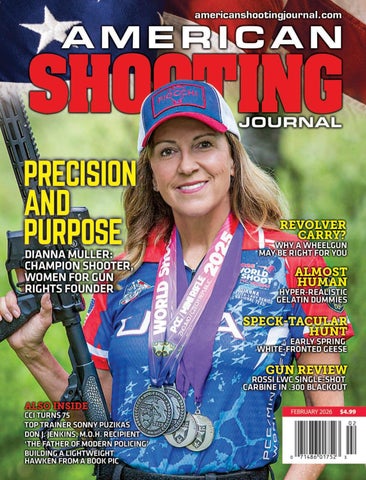
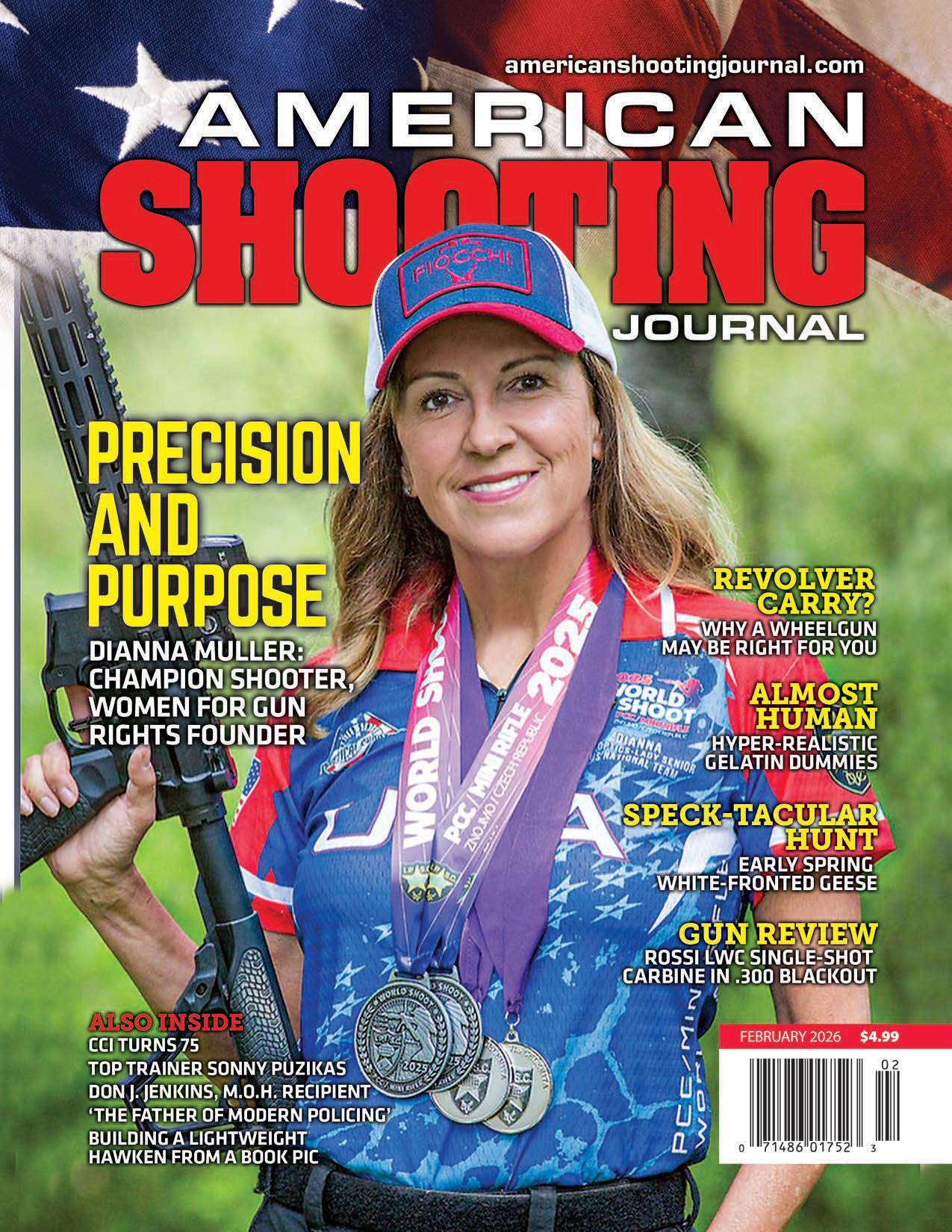
Decades in the shooting world and law enforcement community has put Dianna Muller at the intersection of female empowerment and firearms. Linda Pawela profiles the founder of Women for Gun Rights. (DIANNA MULLER)
PRECISION AND PURPOSE 14
Guided by a journey from law enforcement to competing in the shooting world, Dianna Muller heads up Women for Gun Rights. Linda Pawela details Muller’s feats on the range and messages in the halls of power and for women.
22 ALMOST HUMAN
Ballistic Dummy Lab creates everything from full-body to torso-only hyper-realistic gelatin dummies, and Paul and Linda Pawela recently enjoyed a tour through the company’s Georgia factory. Find out how these dummies are made and their applications for effective self-defense training.
28 THE ROUND FILE: WHY TO CARRY A REVOLVER
Semiautomatic handguns dominate the concealed carry world, but Dave Workman will stand by his wheelguns, thank you very much. If you’re considering carrying something besides a 1911 clone, Workman outlines why a good old revolver might just be right for you.
44 ROAD HUNTER: GETTING AFTER SPRING SPECKS
Waterfowl season is over, but not if you’re a white or white-fronted goose hunter! A chance to pursue north-migrating geese was a siren song for our Scott Haugen, who tells the tale of his very productive but also personally painful hunt for specklebellies and snows in far Northern California.
60 BULLET BULLETIN: ON CCI’S 75TH ANNIVERSARY
What began, in part, in a chicken coop at the mouth of Idaho’s Hells Canyon has grown into an ammunition brand with 149 different products on offer. Phil Massaro traces Dick Speer’s Cascade Cartridge, Inc. from its humble beginnings to worldwide success today.
81 BL ACK POWDER: PICTURE PERFECT
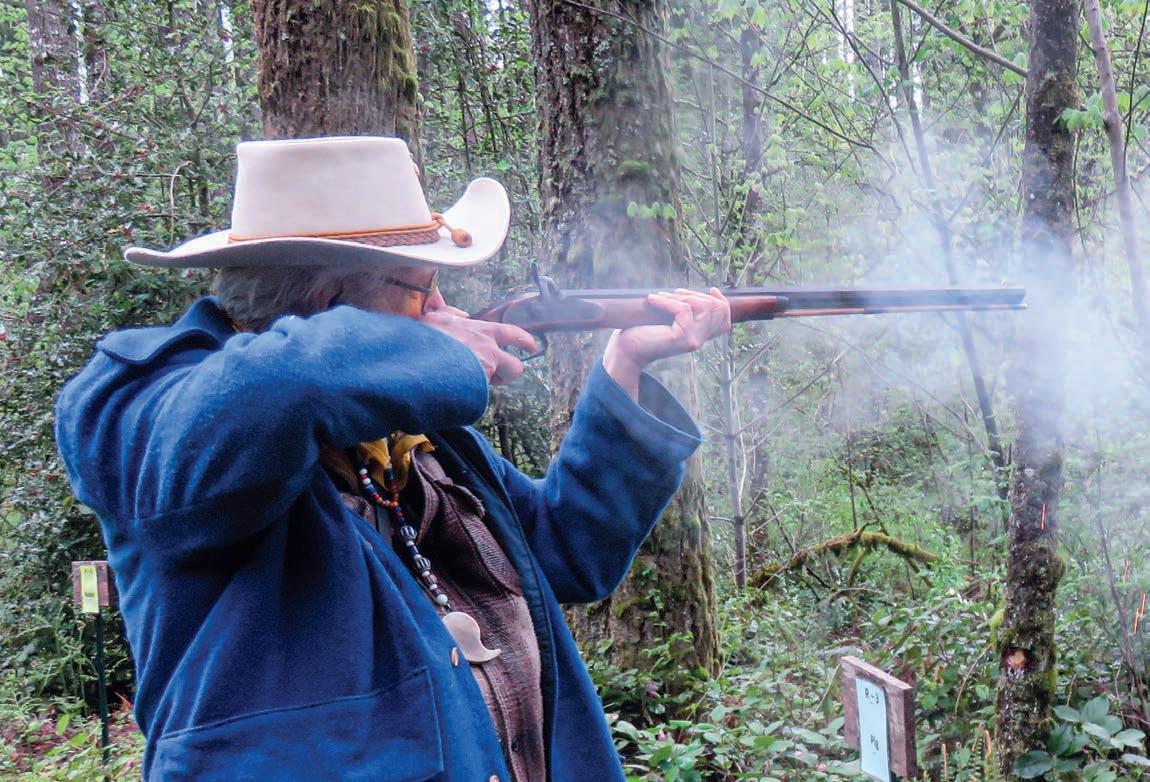
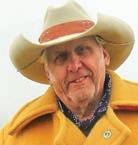
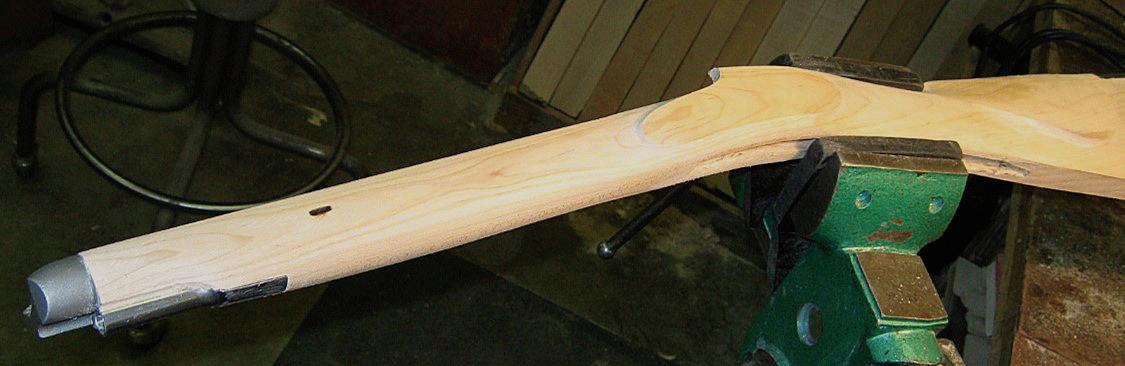
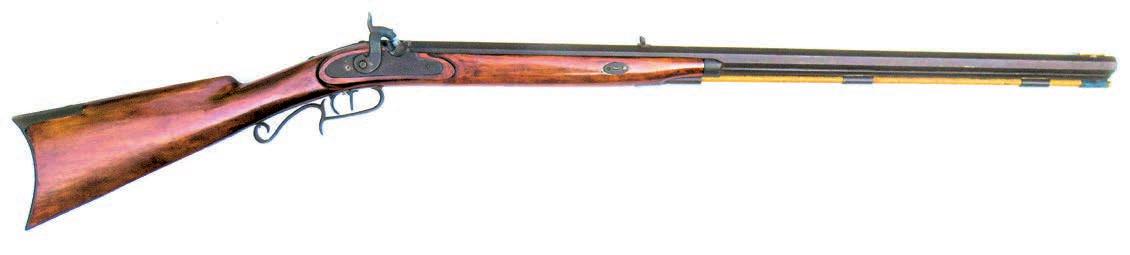
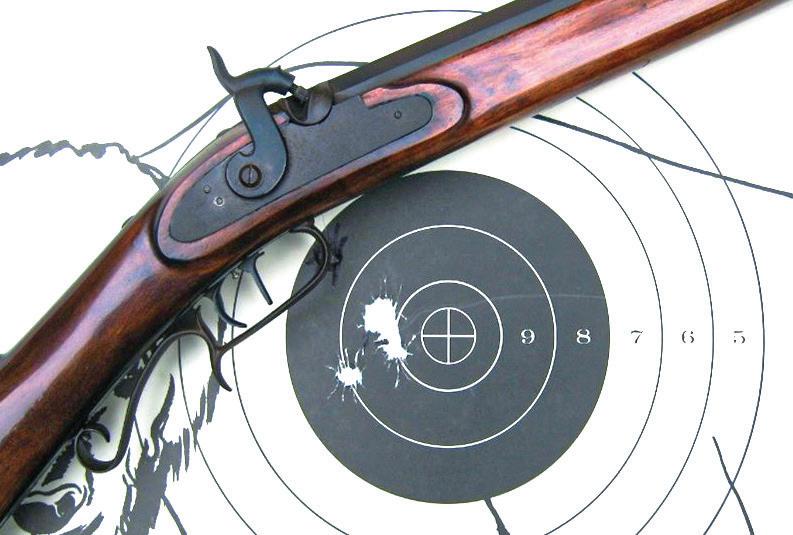
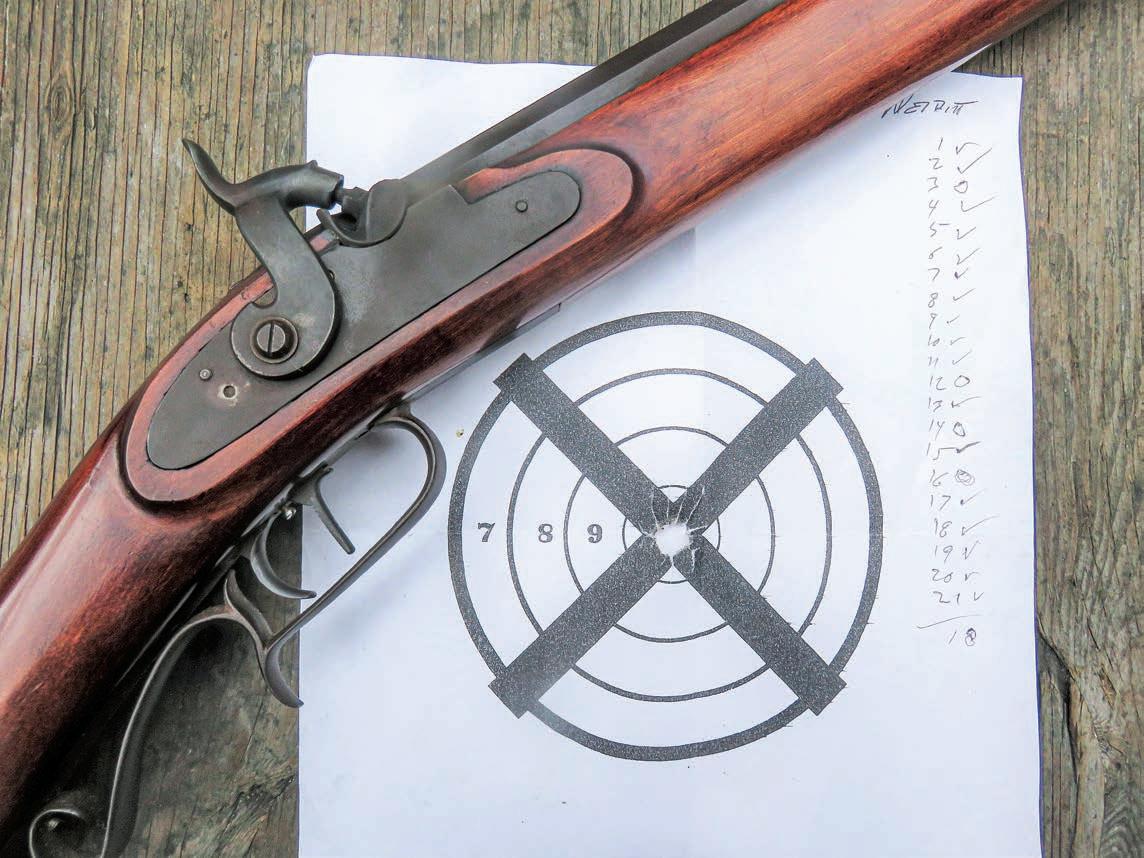
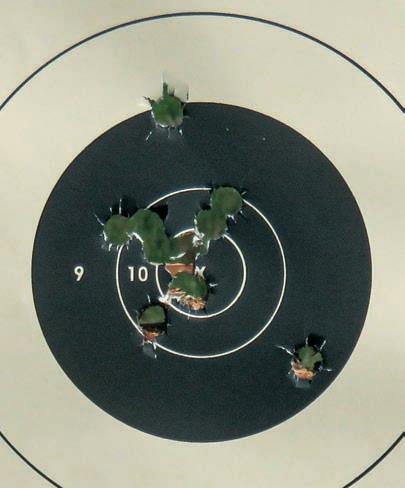
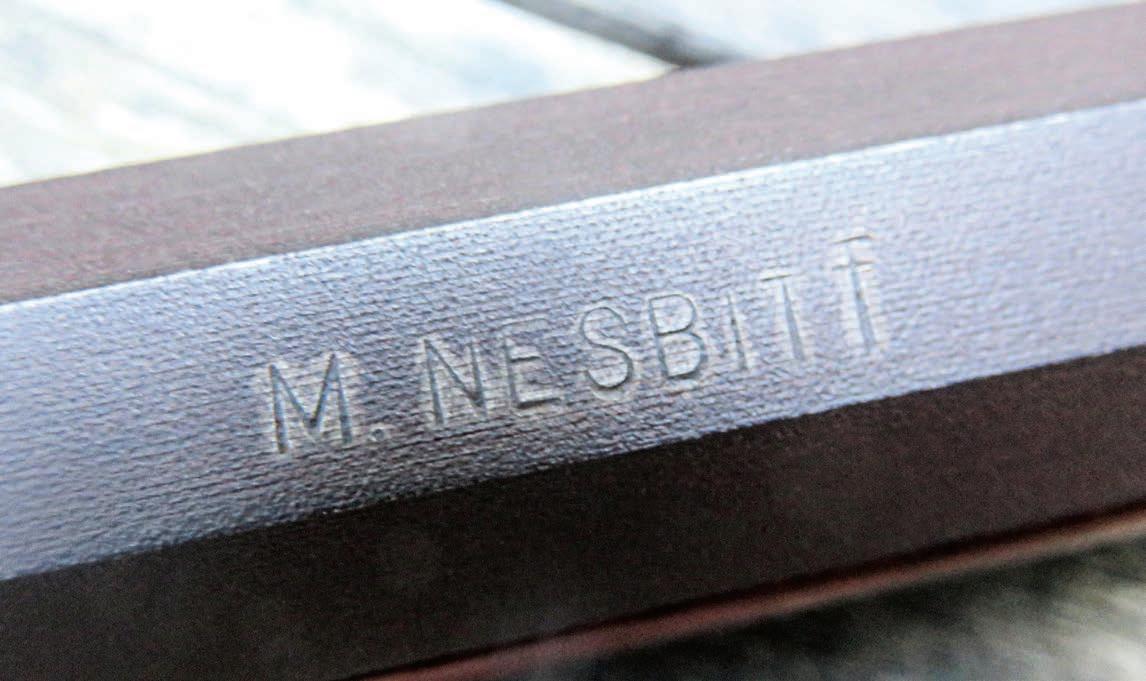
It’s a “shooter.” So writes Mike Nesbitt about the lightweight Hawken he built from scratch based off of a photograph in the famed book, The Plains Rifle. Nesbitt shares his gunsmithing and target shooting trip, right down to proudly stamping his own name on the .50-caliber’s barrel.
(DIANNA MULLER)
MORE FEATURES
37 SELF-DEFENSE TRAINING: A TOP TIER TRAINER
Paul Pawela offers up high praise for Saulius “Sonny” Puzikas, a Lithuanian-born former Spetsnaz operator now based in Texas and who is an international self-defense instructor with backgrounds in multiple martial arts techniques and unique firearms training methods.
73 L AW ENFORCEMENT SPOTLIGHT: ‘THE FATHER OF MODERN POLICING’
Sir Robert Peel may not be a household name, but it’s an important one. Nick Perna traces the through line between early 1800s London, England, and Peel’s creation of the first metropolitan law enforcement agency and policing principles, and his own time as a keeper of the peace.
75 MILITARY SPOTLIGHT: DON J. JENKINS – MEDAL OF HONOR RECIPIENT
Pablo Martinez profiles Vietnam War hero Don Jenkins, who received the Medal of Honor for his incredibly brave actions under fire but whose story is far from done.
Martinez shares how nearly 60 years on from that fateful day Jenkins continues to represent a “living testament to courage and humility.”
Gun REVIEW
54 R OSSI LWC
Looking for a lightweight, inexpensive and handy hunting or truck gun? Take a gander at the Rossi LWC, a single-shot carbine available in .300 Blackout. Larry Case details the simple yet accessorizable firearm, and gives it a field test at a special youth deer hunt in his native West Virginia.
DEPARTMENTS
(PAUL PAWELA)
C&E Gun Shows cegunshows.com
Crossroads Of The West Gun Shows crossroadsgunshows.com
Florida Gun Shows floridagunshows.com
RK Shows rkshows.com
Texas Gun Shows gunshowstx.com
Tanner Gun Shows tannergunshow.com
Wes Knodel Gun Shows wesknodelgunshows.com
GunTVShows.com guntvshows.com To have your event highlighted
GUN SHOW CALENDAR
February 7-8
February 7-8
February 14-15
February 14-15
February 21-22
February 28-March
February 14-15
February 21-22
February 21-22
February 28-March
February 7-8
February 14-15
February 21-22
February 6-8
February 14-15
February 28-March
February 7-8
February 7-8
February 14-15
February 14-15 Kansas City, Mo. KCI Expo Center
February 21-22 Paducah, Ky.
Trader’s Mall
February 21-22 Knoxville, Tenn. Knoxville Expo Center
February 28-March 1 Clarkesville, Ga. Habersham County Fairgrounds
February 28-March 1 Joplin, Mo. Joplin Expo
February 13-15 San Antonio, Texas Alzafar Shrine Auditorium
February 14-15 Galveston, Texas Moody Gardens Convention Center
February 14-15 Castle Rock, Colo. Douglas County Fairgrounds
February 28-March 1 Loveland, Colo. Larimer County Fairgrounds
February 22-23 Redmond, Ore.
Deschutes County Fair & Expo Center
COMPETITION CALENDAR
February 7
Rocky Mountain Regional PTO Colorado Springs, Colo.
March 12-16
2026 Pistol Spring Selection Colorado Springs, Colo.
March 20-24
2026 Rifle Spring Selection Colorado Springs, Colo. USA Shooting usashooting.org
United States Practical Shooting Association uspsa.org
February 21-22
Western States Single Stack Championship Mesa, Ariz.
March 6-7
North Texas Race Gun Sectional Waxahachie, Texas
Glock Sport Shooting Foundation gssfonline.com
Cowboy Mounted Shooting Association cmsaevents.com
February 7-8
Charleston Glock Challenge Ridgeville, S.C.
March 14-15
International Practical Shooting Confederation Rifle Worlds Qualifier Match Maxton, N.C.
March 19-22
South Carolina Section Championship Belton, S.C.
March 20-22
Aim For The Coast USPSA Match Holt, Fla.
February 14-15
North Florida Regional Classic Midway, Fla.
February 21-22
Volusia County GSSF Match New Smyrna Beach, Fla.
February 13-15
SW Spectacular CMSA Regional Championship Queen Creek, Ariz.
February 18-21
CMSA Winter Championship Queen Creek, Ariz.
International Defensive Pistol Association idpa.com
February 12-22 Winter Classic New Castle, Pa.
February 20-21
Florida State Championship Lady Lake, Fla.
February 27-March 1
Shoot For Hope Shootout Williamston, N.C.
March 6-7
Southeast Regional Championship Perry, Ga.
February 27-28
Sharpshooters IDPA Championship Greenville, S.C.
To have your event highlighted here, send an email to kaumann@media-inc.com.
February 28
Northern Illinois Rifle and Pistol Club IDPA Classifier Rockford, Ill.
A Modern Vision Of Women And Guns
Guided by precision and purpose, Dianna Muller is educating and empowering women about their firearms rights.
STORY BY LINDA PAWELA
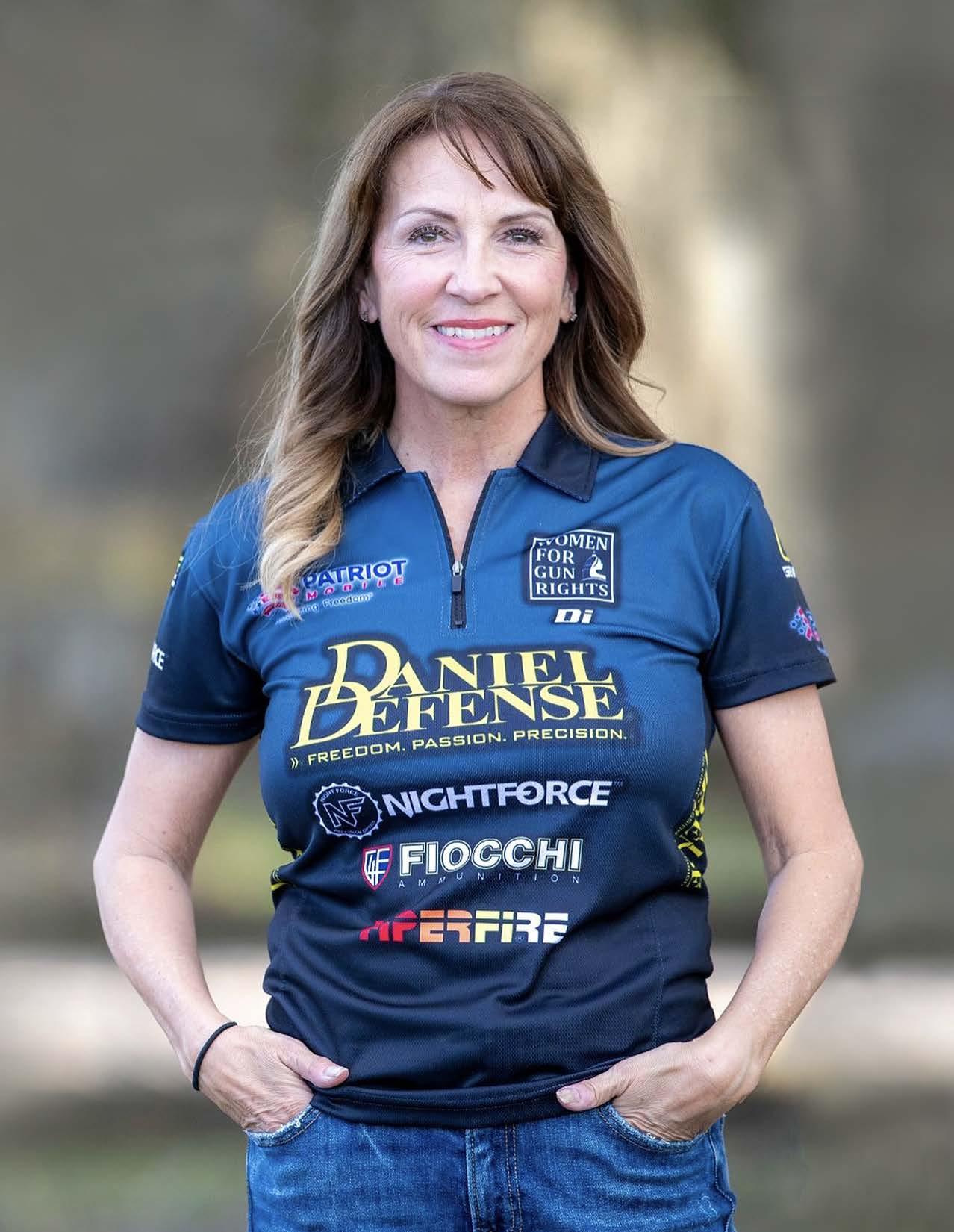
In a rapidly shifting American political landscape, few debates ignite as much passion, misunderstanding and urgency as firearms policy. At the intersection of that national conversation stands Dianna Muller, a retired law enforcement professional, elite competitive shooter and founder of Women for Gun Rights. Her story is one of discipline under pressure, competitive excellence and an unwavering commitment to education, empowerment and constitutional freedoms.
At an early age, Muller’s father, a highway patrolman, taught her gun safety and started her shooting. When he took her to a United States Practical Shooting Association, or USPSA, match, she was intrigued by the running and gunning. While in high school she started competition shooting. For 18 years Muller also pursued horse shows and barrel racing.
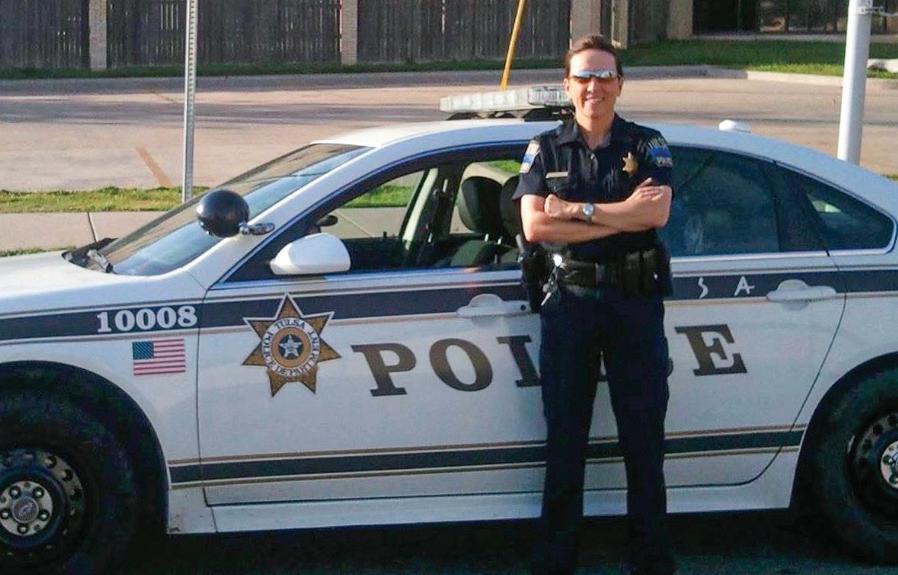
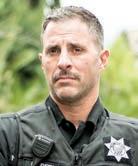
After earning a Bachelor of Science degree in Criminal Justice and Psychology from the University of Central Missouri, Muller continued to hone her skills while serving in law enforcement. She moved to Tulsa, Oklahoma, and began working as a police officer for the Tulsa Police Department. For 22 years, she worked assignments that ranged from patrol and street crimes to narcotics and gang units.
Those decades on the front lines shaped not only her understanding of firearms as tools of public safety, but also her conviction that responsible ownership, consistent training and education (not prohibition) are the most effective means of
PHOTOS BY DIANNA MULLER
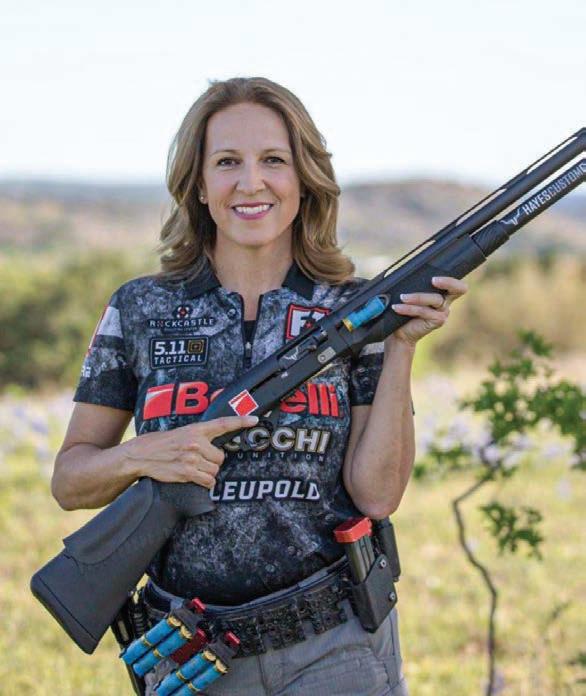
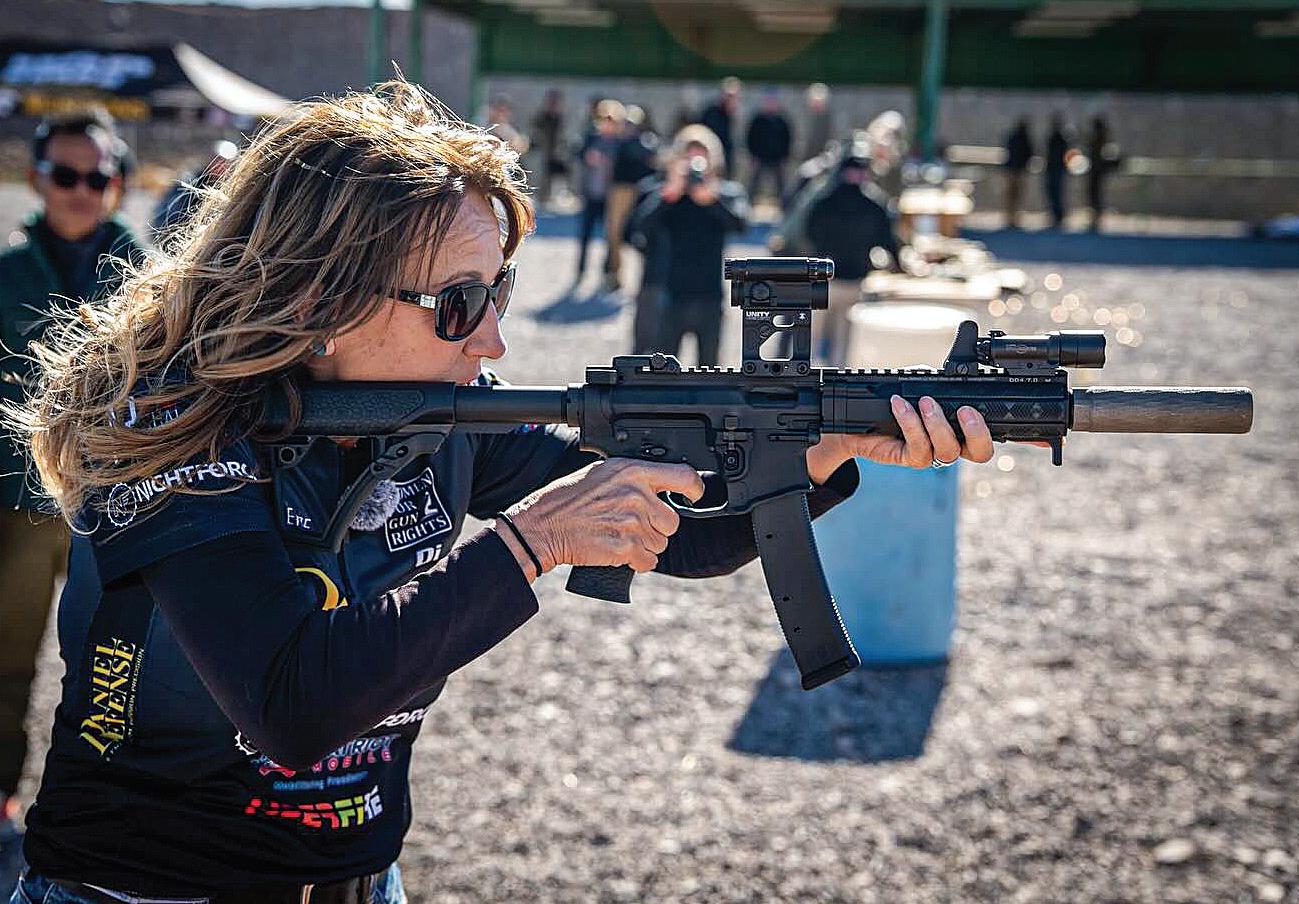
Dianna Muller’s journey has taken her from municipal law enforcement and the elite shooting world to national advocate for women’s gun rights.
reducing violence. A Council on Law Enforcement Education and Training-certified firearms instructor, Muller spent her law enforcement career immersed in both training environments and real-world application, experiences that would later anchor her advocacy work and distinguish her voice in policy discussions.
IT WAS DURING this period that she found her true competitive calling in multi-gun competition, and particularly 3-Gun, a demanding discipline requiring mastery of pistol, rifle and shotgun under intense physical and mental pressure. Her professional foundation seamlessly merged with a parallel passion: competitive shooting.
Drawn to its complexity and precision, Muller made a bold and unconventional decision in 2009: She sold her farm and barrel racing horses and transitioned from police officer to professional shooter, committing fully to competition at the highest levels. It was a gamble few would take, but one that paid off decisively.
Muller’s competitive résumé places her among the elite of the shooting sports world. She is a two-time USPSA Ladies Open National Champion and also captured the 2015 NRA World Shooting Championship Ladies title, underscoring her versatility across multiple platforms. On the
international stage, she has represented the United States with distinction at the International Practical Shooting Confederation (IPSC) World Shotgun Championships, earning individual silver medals and contributing to team gold finishes against the world’s top competitors.
Her success has continued well into the current decade. In 2025, Muller
once again stood on the world podium at the IPSC Pistol Caliber Carbine and Mini Rifle World Shoot in the Czech Republic, taking home individual and team silver medals in one of the most competitive international fields the sport has seen. Domestically, she claimed Hi-Lady honors at the Texas State 3-Gun Championship, reaffirming her reputation for excelling under the most demanding conditions. These achievements reflect not only technical mastery, but resilience competing at an elite level across decades in a sport that rewards precision, preparation and mental toughness.
YET MULLER’S INFLUENCE extends far beyond trophies and titles. After retiring from active law enforcement, she turned her experience toward advocacy, founding Women for Gun Rights, a nonpartisan organization dedicated to protecting the Second Amendment through education rather than restrictive legislation. WGR operates on three core pillars: education, preservation and advocacy. Its mission centers on informing communities and lawmakers about
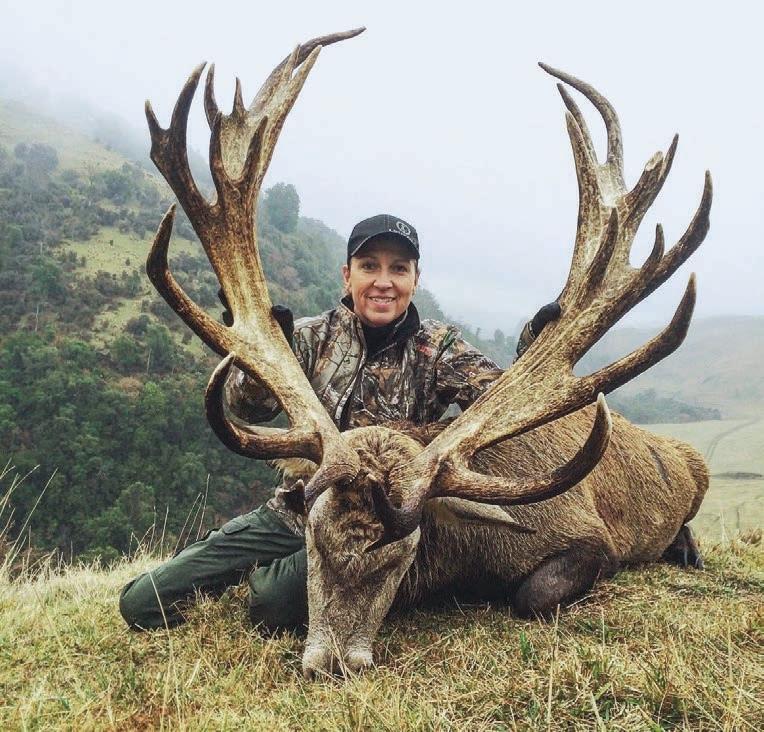
Muller with a red stag taken on the South Island of New Zealand during a hunt filmed for the Outdoor Channel.
Muller worked as an officer for the Tulsa, Oklahoma, Police Department for 22 years.
In 2009, Muller turned her attention to shooting competitions full time. She is a two-time USPSA Ladies Open National Champion and captured the 2015 NRA World Shooting Championship Ladies title. A decade later, Muller once again stood on the world podium at the IPSC PCC and Mini Rifle World Shoot in the Czech Republic, taking home individual and team silver medals.
firearm safety and responsible ownership, protecting America’s hunting and shooting heritage, and elevating the voices of women – one of the fastest-growing demographics of gun owners in the United States.
Under Muller’s leadership, WGR has grown into a nationwide grassroots network with state directors and community leaders actively engaged in the policy process. The organization regularly participates in legislative hearings, national conferences and public testimony at both the state and federal levels. In 2025, WGR delegates testified at the Massachusetts State House on proposed firearm legislation, representing everyday citizens: mothers, professionals and small-business owners who believe constitutional rights and public safety are not mutually exclusive.
Muller herself has become a
prominent and frequently calledupon voice in contemporary firearms policy debates. She has testified before Congress, including appearances before the House Judiciary Subcommittee on Crime, where she has argued that enforcement of existing laws, combined with education and training initiatives, is far more effective than sweeping bans that disproportionately affect law-abiding citizens. Central to her mission is ensuring that women’s perspectives are not merely present, but influential in shaping the future of firearms policy. Education remains a defining thread throughout Muller’s work. On the range, she continues to mentor shooters of all experience levels, emphasizing safety, accountability and confidence. Alongside her husband Ryan Muller, himself a decorated competitive shooter and instructor, she cofounded Ambassador Academy,
an immersive program designed to develop informed, articulate representatives for the shooting community. The academy focuses on media literacy, policy understanding and effective communication, preparing participants to engage responsibly in public discourse.
The Mullers’ commitment to responsible growth of the sport is further reflected in their roles as brand ambassadors for the NRA’s America’s Rifle Challenge, an initiative aimed at promoting safe handling, marksmanship and structured competition for AR-platform rifles. Through these efforts, Muller continues to bridge the gap between sport, safety and civic responsibility.
WHAT SETS MULLER
apart is her comprehensive approach. She embodies a philosophy in which excellence, safety, discipline and civic engagement
The DC Project was Muller’s first organization of women committed to safeguarding the Second Amendment. Here she was back in 2022 with fellow members who met with legislators, both Republican and Democrat, to advocate for the Second Amendment. They attended 135 meetings, including a reception hosted by the Congressional Second Amendment Caucus.
coexist. Whether she is strategizing on the firing line, mentoring first-time competitors, organizing grassroots advocates or addressing policymakers in Washington, DC, Muller represents a modern vision of the shooting sports – one defined not just by precision, but by purpose.
As the national conversation around firearms continues to evolve, Muller and Women for Gun Rights remain focused on redefining what leadership in this space looks like: informed, inclusive and unapologetically committed to individual liberty. Her journey from law enforcement officer to world-class competitor and national advocate stands as a testament to the power of experience, education and resolve in shaping both sport and policy on the world stage.
Dianna Muller is an amazing person and women from around the world can look up to her for what she believes in and what she has accomplished. ★
Editor’s note: For more info, visit womenforgunrights.org.
Muller with husband Ryan.
ALMOST HUMAN
Exclusive inside look at Ballistic Dummy Lab.
In an unassuming industrial building in Woodstock, Georgia, a company is quietly redefining what it means to simulate the human body. Ballistic Dummy Lab produces some of the most hyper-realistic ballistic dummies and gel targets on the planet. These dummies aren’t the crash-test figures most people imagine; they’re remarkably accurate human analogs used in research, forensics, television and even law enforcement training. What began as a niche idea has grown into a full-fledged industry presence. Christopher Mills, a special effects and materials expert with a passion for realism and precision, founded Ballistic Dummy Lab. The idea emerged in the early 2000s, when Mills supplied materials for film and television productions
STORY AND PHOTOS BY LINDA AND PAUL PAWELA
Ballistic Dummy Lab creates everything from full-body to torso-only gel dummies. They also offer different options for heads – with or without skulls, zombie or alien.
across Georgia, including shows that demanded realistic depictions of human injury and ballistic impact. Mills noticed that the world of ballistic testing and forensic education needed something better than watermelons, clay blocks or gelatin molds to simulate the human body’s complexity. From that realization, Ballistic Dummy Lab was born.
IF YOU’VE EVER seen hyperrealistic gelatin bodies take a bullet on YouTube, or wondered how professionals simulate real human trauma without endangering lives, the story behind this unique outfit offers a fascinating glimpse into a world where art, science and shock value collide. Ballistic Dummy Lab specializes in crafting hyperrealistic human replicas from advanced ballistic gel. Their products include organic formulas and a proprietary synthetic option, PermaGel, designed to withstand repeated use and maintain fidelity under testing conditions. This substance
mimics the density and behavior of human tissue under impact. These lifelike dummies are used across a wide range of industries: from firearms enthusiasts and forensic analysts to medical trainers and film crews seeking convincing special effects. Unlike simple targets or mannequins, Ballistic Dummy Lab’s creations are engineered to simulate human tissue and wound behavior. Imagine standing at a firing range, watching how different projectiles behave when striking what looks disturbingly like a human torso. This is the kind of realism that sets Ballistic Dummy Lab apart. While their products push the limits of authenticity, the company’s origins are rooted in craft and creativity rather than cold, clinical research. Unlike conventional ballistic gel blocks, Ballistic Dummy Lab’s creations include synthetic bones embedded in the gel matrix. Their individual body parts, from arms to hands to heads, are useful for focused testing and cinematic effects. These dummies are often used by police departments, military researchers, weapon manufacturers and universities engaged in forensic studies. Ballistic Dummy Lab’s products are
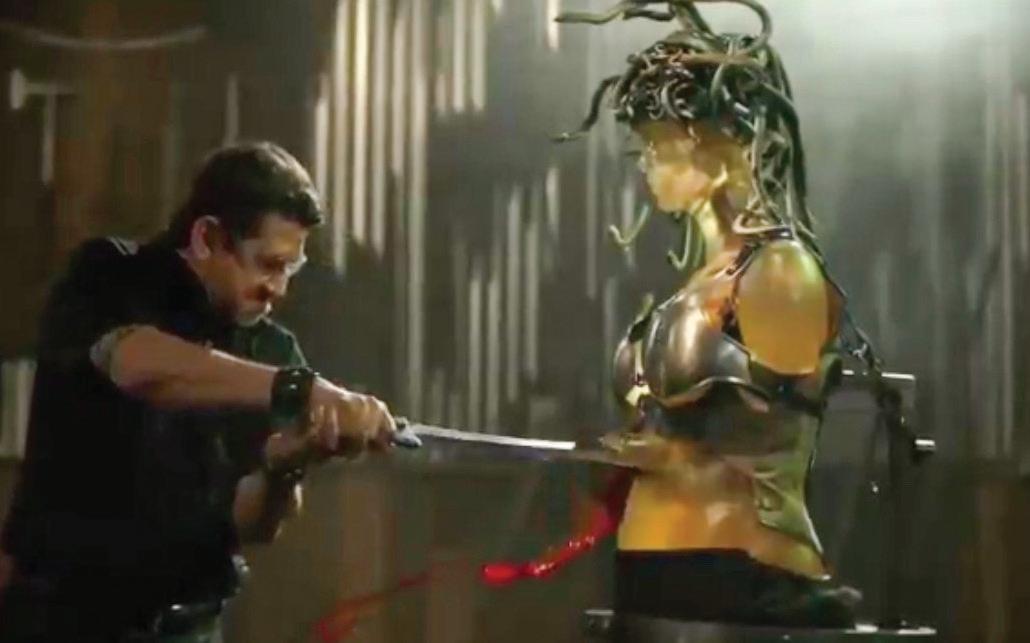
distinguished not only by their realistic appearance but also by their functionality. Constructed from organic and synthetic gelatin blends, these dummies replicate how human flesh and organs respond to impact from bullets, blades or blunt force. Professionals use them for ballistic testing, forensic reconstruction, medical procedure rehearsal, and even entertainment content that demands visceral realism. Their hyper-realistic dummies have appeared on major television shows such as MythBusters, Forged in Fire and Deadliest Warrior, as well as in multiple crime docuseries and films where realism is paramount.
AT THE CORE of Ballistic Dummy
Lab’s process is advanced ballistic gelatin, a material engineered to replicate the density, elasticity and resistance of human soft tissue. Unlike basic gelatin blocks, however, their dummies are built as layered anatomical systems rather than as single-mass molds.
The process begins with sculpted human forms, often derived from detailed anatomical references. These forms serve as molds for the gel, enabling the company to recreate the accurate proportions of the head, torso, limbs and internal cavities.
The gelatin is carefully prepared and conditioned to ensure consistency. Temperature control, curing time and mixture ratios are critical; even slight variations can affect how the material responds to penetration, fragmentation or bluntforce impact.
Within the gel bodies, the lab can embed simulated skeletal structures, organ analogs or reinforced target zones, depending on the intended use.
For example:
• Bone-like inserts replicate fracture behavior;
• Organ representations allow visualization of wound paths;
• And layered densities mimic skin, muscle and deeper tissue.
Once cast, the dummies are finished by hand. Surface details,
Here is another torso option. As shown on the opposite page, other body parts are available too.
The hyper-realistic dummies have appeared on television shows like Forged in Fire, where they test out the blades of knives and swords.
(COURTESY OF THE HISTORY CHANNEL)
facial features, skin texture and anatomical landmarks are refined to enhance realism. The result is a model that not only looks human but also responds to trauma in a visually and physically accurate manner.
Each dummy is then inspected, stored and shipped under controlled
conditions to preserve structural integrity until testing or filming begins.
FROM ITS WORKSHOP in Woodstock, Ballistic Dummy Lab is carving out a unique space at the intersection of science, training, testing and entertainment. With a commitment
to innovation and a growing global customer base, this company is proving that, even in a world of digital simulation, the tactile, visceral power of a well-crafted dummy still matters.
On a personal note, the authors recommend Ballistic Dummy Lab dummies for anyone serious about lethal force training. To be effective, self-defense training must be as realistic as possible and there is a vast difference between shooting paper or steel targets and shooting at a simulated body. The same goes for stabbing a knife into the body; those who have never done it may think it is a relatively easy task, but it is not. Ballistic Dummy Lab dummies help make that experience easier to understand.
You may be asking, “Who cares?” If you’re ever in a deadly-force encounter, odds are you’re going to end up in criminal or civil court, or both, and you should absolutely have all the correct answers to defend yourself in that arena as well. When asked, “Did you have an understanding of what happens to the human body when you shoot or stab someone?” You can answer to the best of your abilities, “Yes!” ★
Editor’s note: For more information, visit ballisticdummylab.com.
The authors say that effective self-defense training must be realistic and that the lab’s dummies help make the experience easier to understand. At press time, cost runs from just under $500 for a clear, headless torso to nearly $7,000 for a full “analog body” dummy.
Lab techs Hannah Mallam (above) and Will Zuidema.
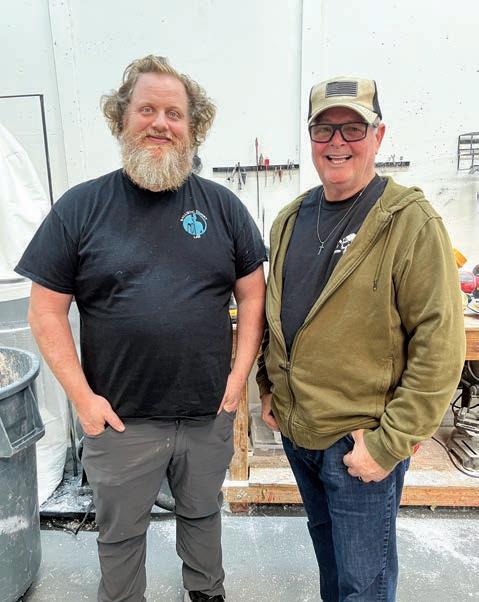
Ballistic Dummy Lab owner Christopher Mills (left) and coauthor Paul Pawela.
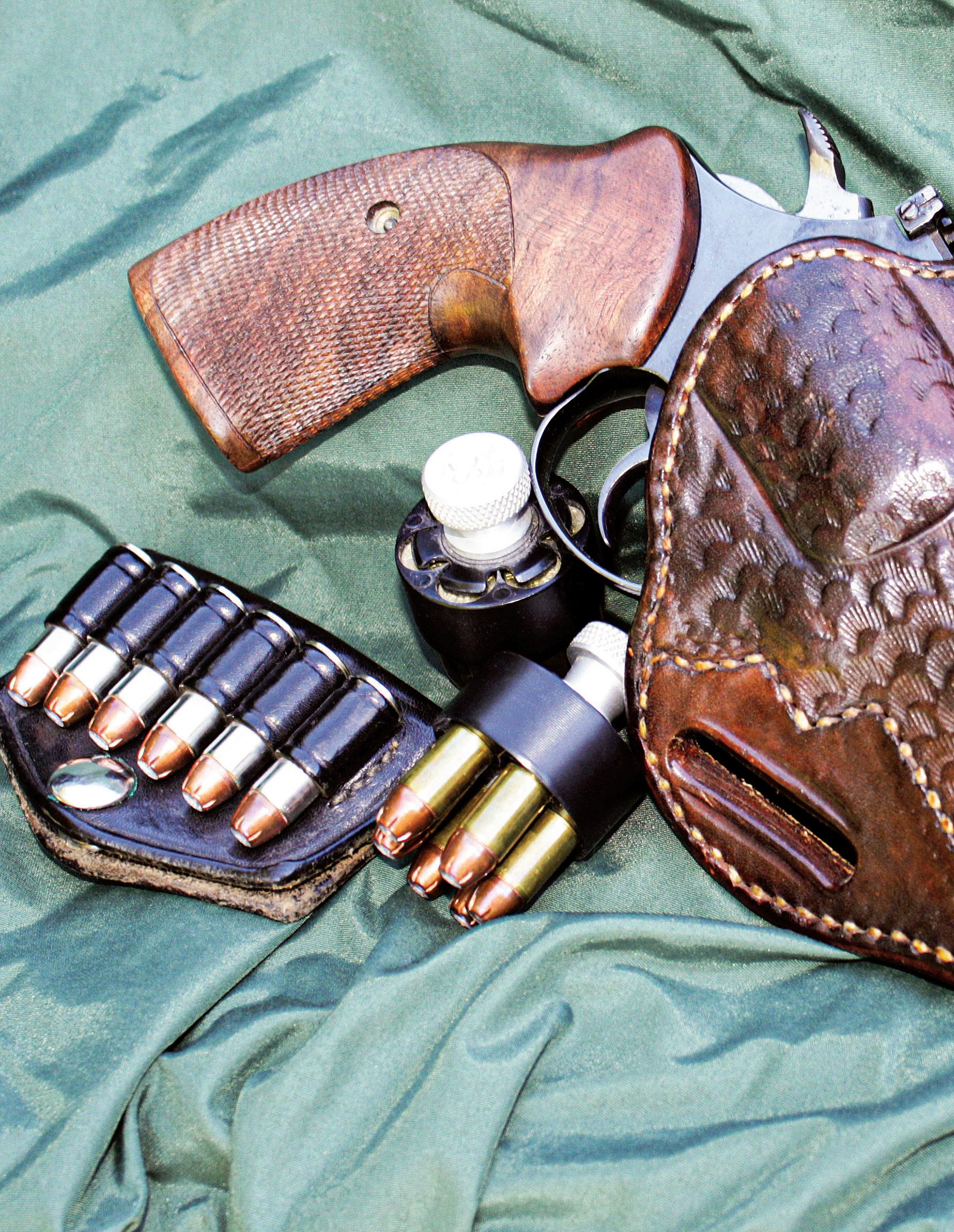
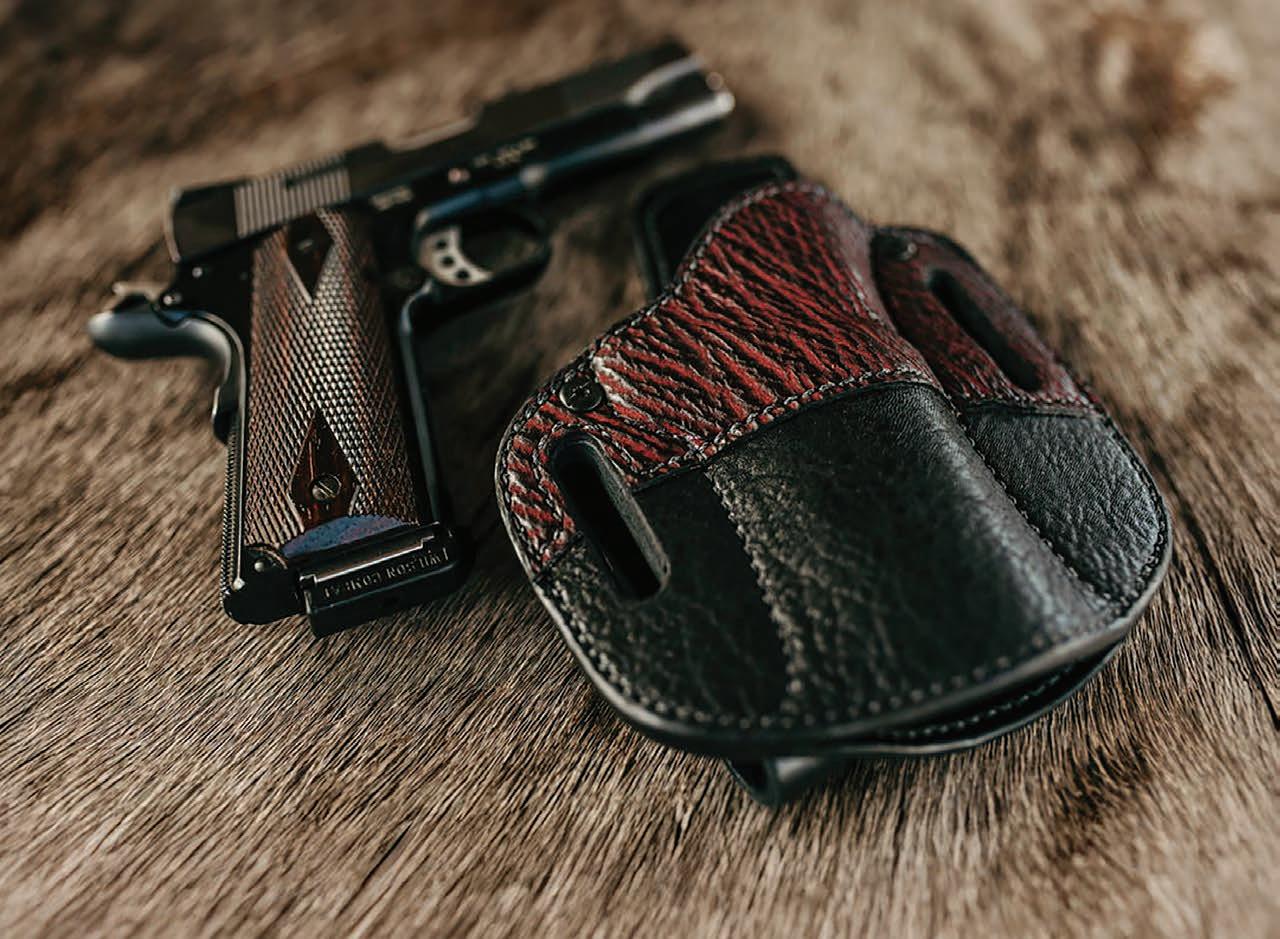
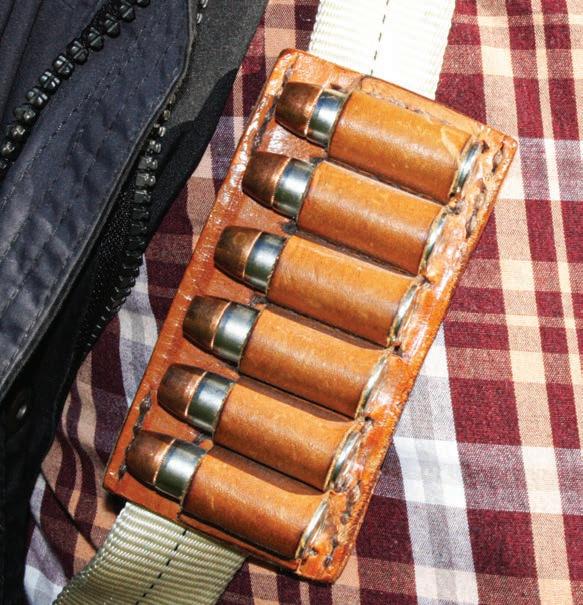
Semiauto handguns dominate the concealed carry world, but author Dave Workman has good reasons to stand by his wheelguns, like this Colt Diamondback carried in a pancake-type holster with speedloaders and six extra rounds in a snap-on belt slide.
THE ROUND FILE
So, you’re considering a revolver for personal protection ...
STORY AND PHOTOS BY DAVE WORKMAN
Call me an anachronism, but I’ve been carrying revolvers for personal protection possibly longer than some of you have been around, and I’ve learned some things that make round guns a sensible option in a world dominated by semiautos.
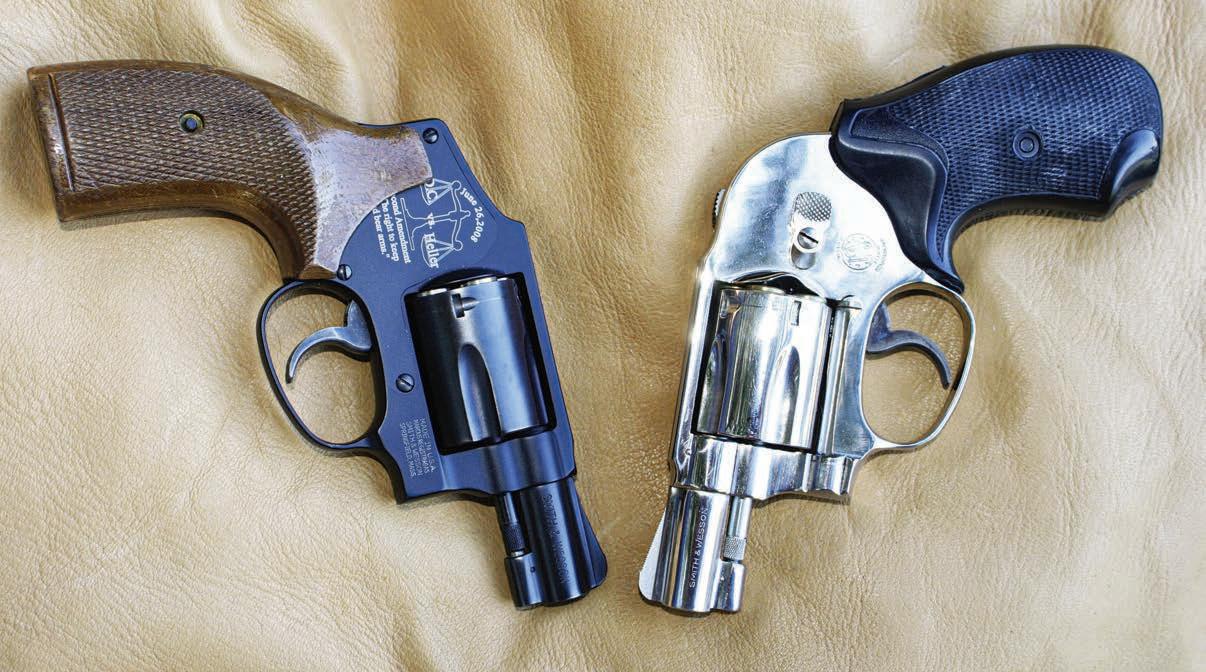
Back in the 1970s, it was either a .357 Magnum Model 19 Smith & Wesson with a 6-inch barrel, carried in a Safariland shoulder holster, or a Model 36 S&W “Chief’s Special” chambered for .38 Special. It had a 2-inch barrel, fixed sights and tucked nicely into an inside-the-waistband holster or an ankle rig concealed inside of my cowboy boot.
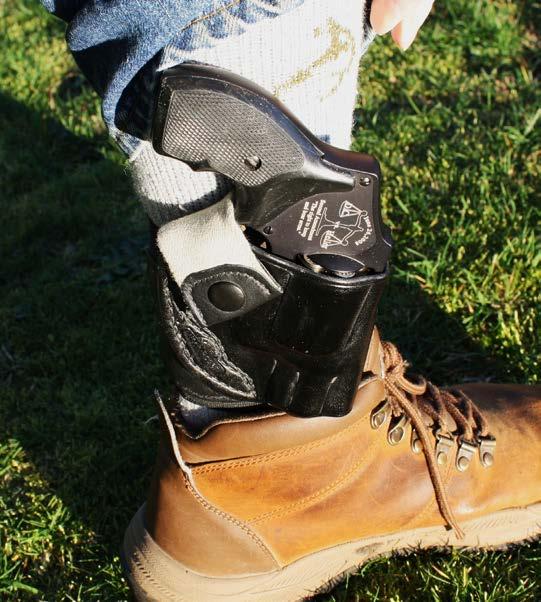
Even worn without a boot, and with regular street shoes or chukkatype boots with the sock pulled up over the holster, this is a reliable way to carry a small revolver. After all, not many people spend any time looking at someone else’s feet, so it’s not likely anyone will notice if you just move about, minding your own business.
In those days, all of the local state troopers and sheriff’s deputies were packing .357-caliber revolvers, so everyone was equally armed. When the “great transition” came along in the 1990s, I stuck with revolvers because I was used to the platform.
Popular defensive revolver calibers include the .32 H&R Magnum, .327 Federal Magnum, .38 Special, .357 Magnum, .44 Special (Smith & Wesson and Lipsey’s introduced a new fiveshot model during the January SHOT Show), and even .45 Colt. Those who prefer a .41 or .44 Magnum must always be concerned about overpenetration, not to mention selecting the right cover garments.
There were occasions during the winter months when I could invisibly carry an N-frame S&W Model 57 in .41 Magnum, also with a 6-inch barrel, and that is no small handgun! This gun was carried in a shoulder holster under a winter parka, while strolling through an upscale shopping mall or supermarket, and nobody noticed.
On other treks through civilization, I also managed to hide a Model 19 Smith with a 2½-inch barrel, in an upside-down shoulder holster, either under a jacket or a pullover sweater or sweatshirt. I know other people who carry snubbies such as the Colt Detective Special or Cobra in belt holsters, and one guy who habitually
carries two J-frame Smiths, one in each pocket of his jacket. It’s the quickest reload there is, and it is fairly easy to conceal two smallframe revolvers.
TUCKED IN
Several years ago, I designed the original “tuckable” holster to be worn on the inside of the waistband with a shirt tucked over it. This is strictly for a small revolver
Almost nobody looks at someone’s shoes and lower pantlegs. Surprise! There’s a .38 Special hiding down there in the event of an emergency.
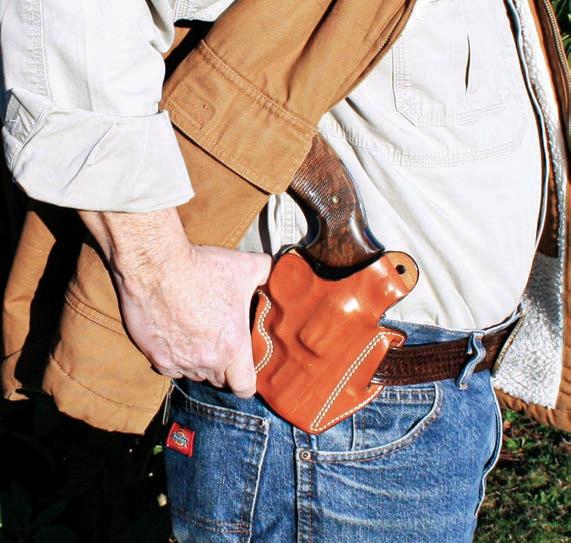
One of the best holsters for carrying a revolver concealed, even under just a vest, is the pancake-type rig. This one is from DeSantis and the gun is a Smith & Wesson .357 Magnum.
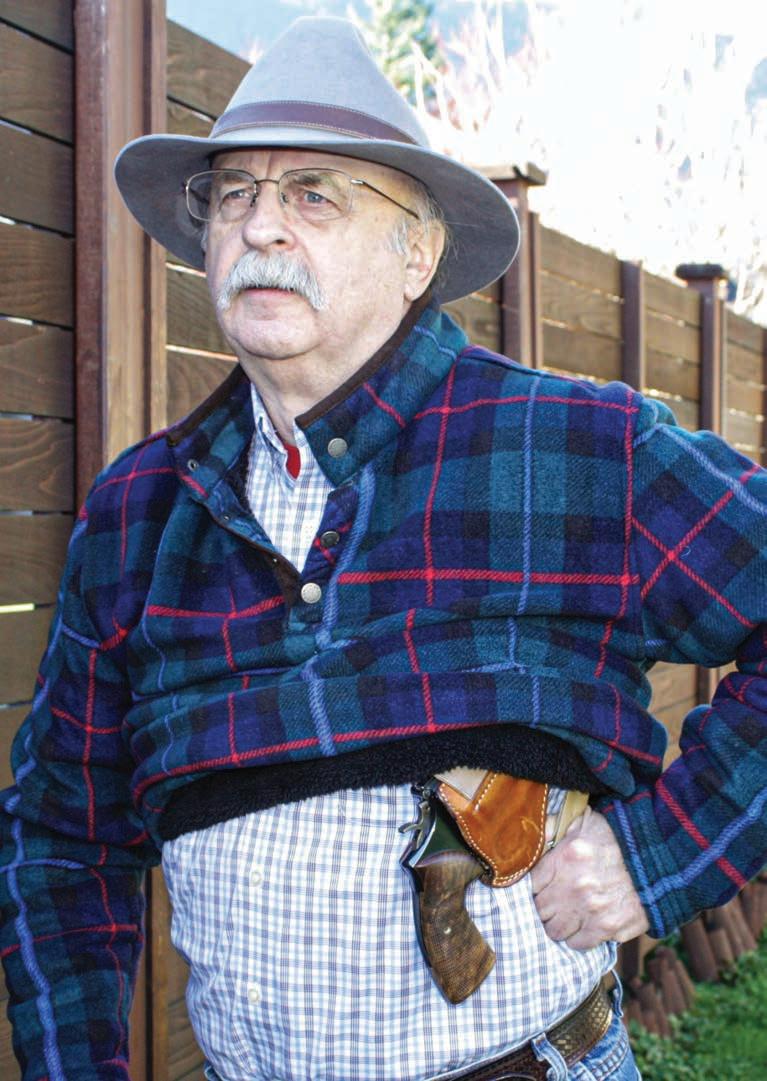
You can easily hide a defensive revolver under a pullover, like Workman is doing here. To reach your sidearm, just pull up, reach underneath and draw!
or semiauto, such as the Walther PPK. The design is now marketed by Mitch Rosen Extraordinary Gunleather and it was almost immediately – and shamelessly –copied by just about everybody.
Successful concealment of a revolver is all a matter of clothing choice combined with the specific model and a good holster. Your cover garment must be loose-fitting without being too large for your
frame, and the holster must be capable of remaining relatively flat against the body, with either an IWB or pancake-type design. The unwritten rule of concealed carry is, of course, that nobody in your immediate presence should know you are armed. With more than
20 million citizens licensed to carry, and an unknown number of people carrying without a license or permit in the 29 states where “constitutional carry” laws have been adopted, the likelihood you may be in close proximity to someone else who is legally armed has increased.
Although these days I might opt for a .45-caliber lightweight Colt semiauto, carrying a revolver in no way puts me at a disadvantage, perhaps because I’ve had plenty of experience. And here are some of the things I’ve learned over the years that might come in handy if you choose a wheelgun.
Last year, during interviews with a trio of holster makers, each told me –
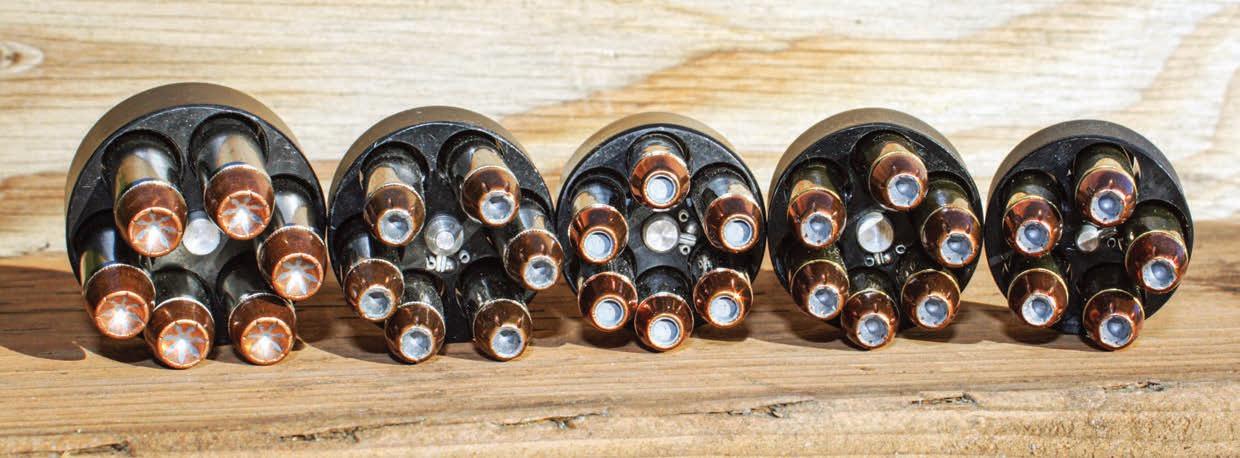
Speedloaders are a must for anyone carrying a revolver for personal protection. Here are five, each for a different handgun. They are sized to correspond to the chambers in the cylinder for a quick reload.
Spare cartridges may be carried on a slide attached to the offside shoulder strap of a shoulder holster.
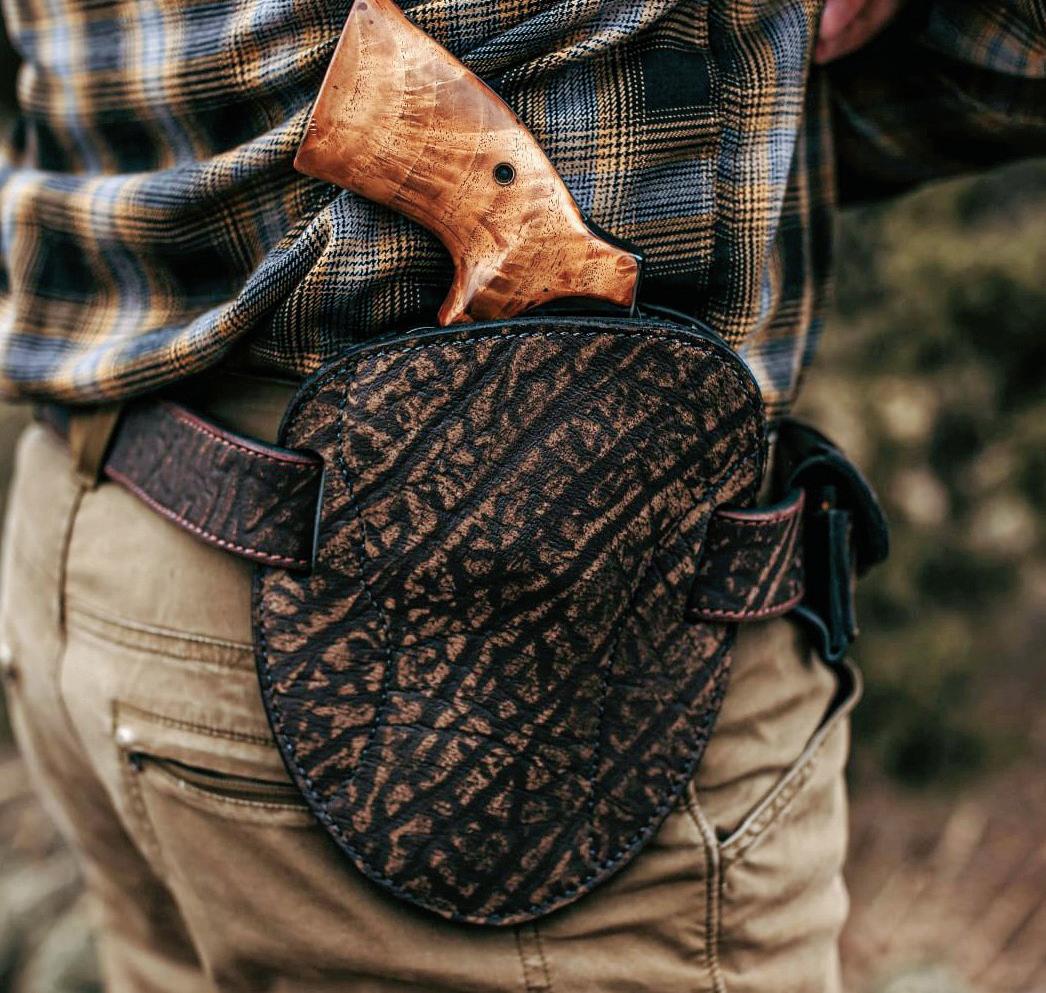
The author’s pal Rob Leahy, proprietor of Simply Rugged Holsters, provided this photo of a classic pancake made with exotic leather to carry a .44 Magnum with a 4-inch barrel, which is a pretty big handgun. (ROB LEAHY)
independently of one another – that they are definitely seeing more people asking for holsters to accommodate revolvers than semiautos. The revelation got my attention.
Same as with carrying a semiauto, make sure you’ve got spare ammunition. Where one or two magazines easily satisfy that requirement for any automatic, I recommend carrying two and possibly three speedloaders. HKS produces speedloaders matched to specific handgun models. I’ve got speedloaders for J-, K- and N-frame S&W revolvers – which hold five or six cartridges, respectively – plus models matched to my Colt Diamondback or vintage 1980s Python. Depending upon which gun I’m carrying, there is always spare ammunition, either carried in speedloaders in a belt pouch, or when they’re just carried in my jacket or vest pocket.
Pay attention to the handle. Oversize “target” type grips can produce the telltale bulge in your cover garment. I hid my .41 Magnum in the shoulder holster by swapping the factory grips for a wraparound Pachmayr rubber grip. It was relatively flat, and in wet weather, it provided a solid hold and was
impervious to rain or snow. It also sucked up a lot of recoil.
Some revolver users choose rubber speed strips, which hold five, six or more cartridges securely and allow for fairly speedy reloads.
Practice reloading a revolver, and your speed will increase accordingly. Many years ago when I was competing in handgun matches, I managed to pop my empties and reload in a couple of seconds, which is important against a clock, and would be equally important – if not more so – in the event of a lifethreatening emergency.
These drills force the shooter to forget about retaining his/her empties. Just let them fall and reload. Empty brass is not worth your life. Ditto your speedloader. Get used to letting it drop to the ground; worry about picking it up later. Once it drops, it is not likely to go anywhere.
NO ‘SPRAY AND PRAY’
A disappointing phenomenon has become commonplace with more people carrying semiautos, and this is generically known as “spray and pray.” Simply put, with more firepower, there is a tendency among some shooters to rapidly fire toward a target rather than at the target, which is not
the same thing.
One must still align his/her sights with the target, whether it’s a cardboard cutout, aggressive wild animal or predator of the two-legged variety. Years ago when I was helping a deputy sheriff pal put together a training drill, I put this in writing and to my knowledge, it’s still being taught today: “A bullet that misses the target will hit something else.” Call it the fifth rule of gun safety, or perhaps the “Eleventh Commandment.”
Shooting a revolver helps overcome, or prevent, such shooting habits. Over time, the revolver shooter learns instinctively to keep a count of his/her shots. Experienced wheelgunners are not as likely to fire errant shots, instead practicing self-control to put bullets where they will do the most good.
Revolvers are fairly easy to maintain, thanks to modern cleaning aerosols. All you need to keep them working is spare ammunition. There is no concern about dropping a magazine.
There are plenty of new and used revolvers in good condition available. Check local gun shops, gun shows and even online sources such as GunBroker.com.
Be sure of your local laws. Carry with confidence and do it discreetly. ★
Some people carry two small revolvers. This is known as a “New York reload.”
A TOP TIER TRAINER
High praise for Sonny Puzikas, who's gone from Spetsnaz operator to international self-defense instructor.
STORY AND PHOTOS BY PAUL PAWELA
When you hear the name Sonny Puzikas, you’re not just talking about another self-defense/firearms instructor; you’re talking about a man whose life has been shaped by violence and discipline.
Saulius “Sonny” Puzikas was born in 1969 in Lithuania. He began training in martial arts at age 6, studying kyokushinkai, judo and boxing. Puzikas served in the Soviet Spetsnaz, the elite special forces unit renowned for its brutal training and unconventional combat tactics, before immigrating to the
Self-Defense TRAINING
United States in the 1990s, following Lithuania’s independence from the USSR. His background in elite military units shaped his philosophy: combat is not about rigid drills but about surviving chaos.
By the late 1990s, Puzikas was studying under Vladimir Vasiliev, a Russian martial arts instructor based in Toronto, Canada, whose instruction shaped much of his later teaching. His instruction has also been shaped by many teachers of Southeast Asian combative methods, such as kuntao, silat and Filipino arts.
After immigrating to the US, Puzikas carved out a niche as a trainer specializing in systema, a Russian martial art that integrates combat
conditioning, firearms handling and psychological resilience. His seminars often blur the line between martial arts and military science, teaching students not only how to fight but also how to think in violent environments. Puzikas has often argued that traditional shooting schools fail to prepare civilians for the chaotic reality of armed conflict, where moral, legal and psychological factors weigh as heavily as technical skill.
His military background gave him firsthand experience in unconventional warfare, closequarters combat and survival tactics. Unlike many firearms instructors who focus solely on marksmanship, Puzikas emphasizes a systemic
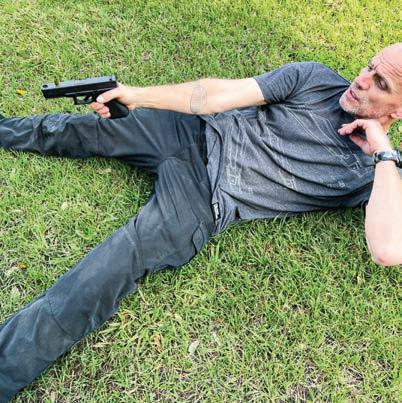
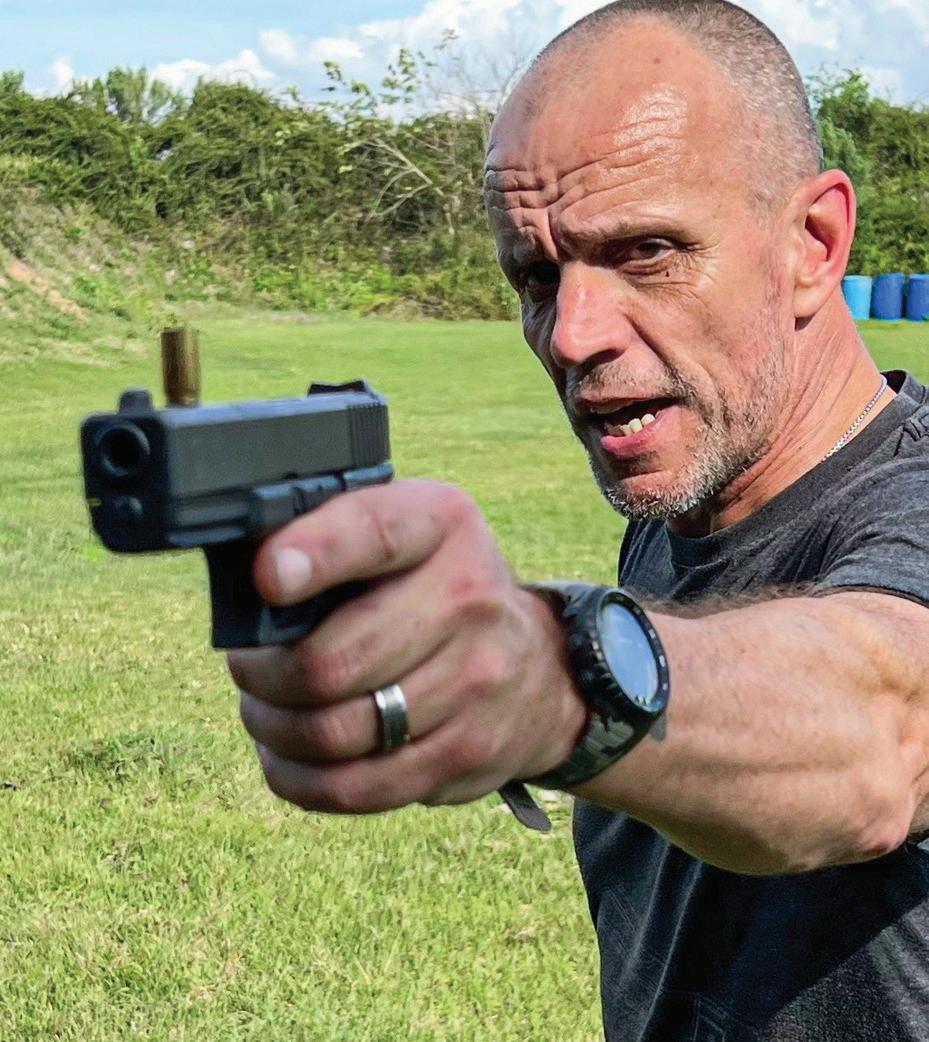
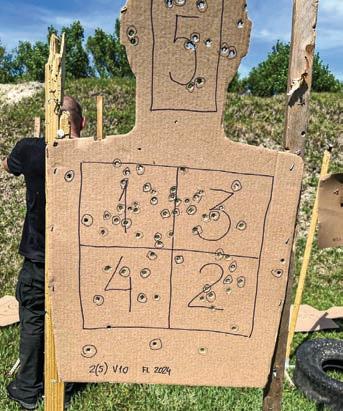
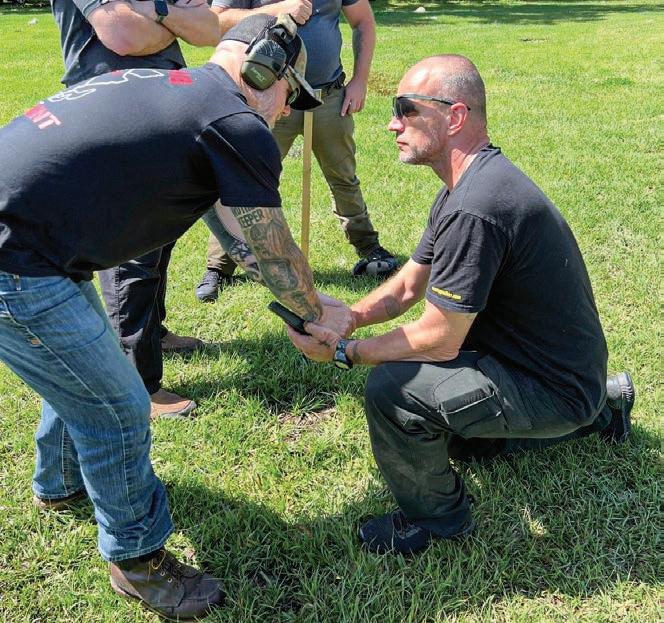
Many firearms instructors demonstrate trigger control while shooting with a shell casing near the front sight. Here instructor Sonny Puzikas takes that demonstration to an entirely higher level.
SELF-DEFENSE TRAINING
understanding of violence, what he calls the “why” behind the “what.”
His work even reached pop culture: He consulted with video game developer Treyarch on the Call of Duty: Black Ops series and motion-captured Spetsnaz maneuvers for the game.
WHETHER DESCRIBED BY supporters, reported on in media profiles or emphasized in his own past narratives, the image of Puzikas is consistent, portraying him as the hardened professional, shaped by Eastern Bloc military doctrine and capable of teaching others how to fight, shoot and survive.
During the Cold War and its aftermath, Soviet special operations,
often loosely labeled as Spetsnaz, occupied a near-mythical place in Western imagination. Ruthless efficiency. Relentless conditioning. A philosophy of warfare that emphasized aggression, endurance and psychological dominance.
Within extremist circles, invoking Soviet special operations training carried weight. It suggested not only tactical skill but also ideological hardness: a man forged by an unforgiving system, unburdened by Western legal or moral constraints.
Puzikas’s reputation as a firearms and tactics trainer drew heavily on this symbolism. He was portrayed as someone who understood weapons not
as hobbies or abstractions but as tools of applied force, to be mastered through repetition, discipline and obedience.
Regardless of the precise details of his military background, Puzikas undeniably served as an instructor. He trained others in firearms handling, small-unit tactics and a combatoriented mindset, which elevated him within militant networks and lent him legitimacy among those seeking preparation for conflict.
Unlike many firearms academies that focus on stance, grip or marksmanship, Puzikas emphasizes fundamentals as guiding principles rather than rote basics. He teaches that fighting is unpredictable, and training must
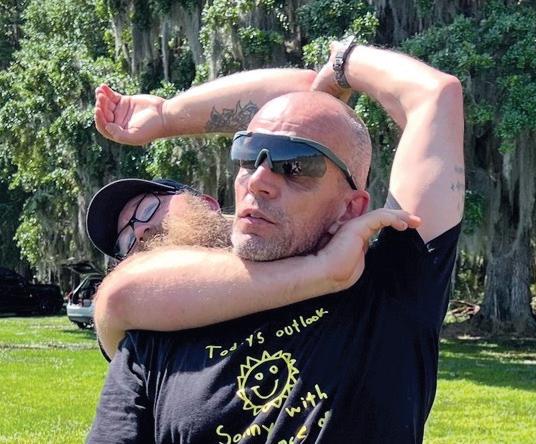
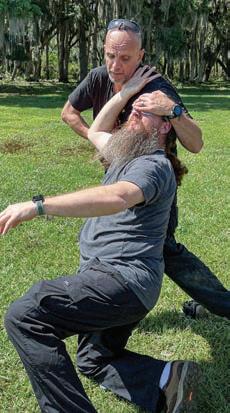
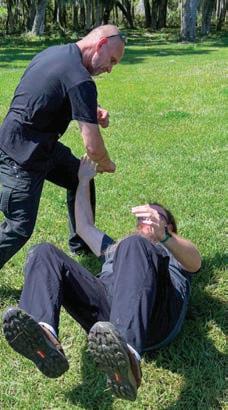
Puzikas is one of only a few combat self-defense trainers who incorporate hand-to-hand combatives into his firearms programs, part of the reason author Paul Pawela ranks him among the very top tier of instructors in the country to train with.
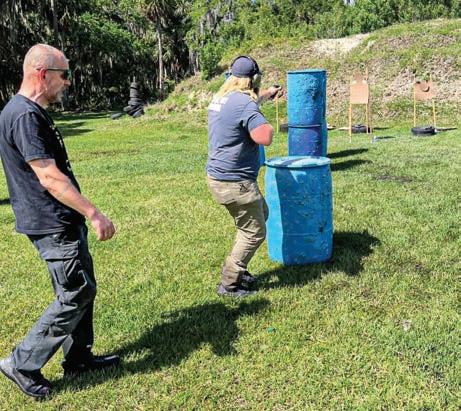
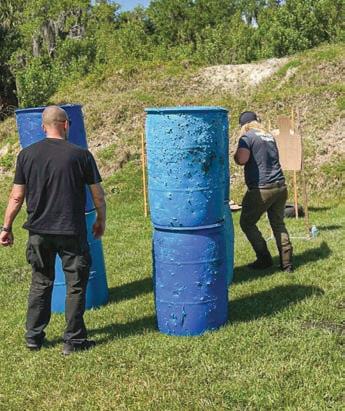
Using knowledge, training and experiences based on real, lifelong exposure to the ugly reality of the horrors of violence is what Puzikas’s training is all about. He doesn’t just teach trainees to shoot while moving, but demands individuals be proficient using both hands as he calls out which zone to shoot.
SELF-DEFENSE TRAINING
prepare students for fluid, real-world scenarios. His courses often combine firearms handling with systemainspired movement, force-on-force drills and psychological conditioning.
CURRENTLY, PUZIKAS IS the director of training at Patriot Training, a one-of-akind indoor facility in Plano, Texas.
Puzikas’s courses are not about static drills or rigid stances. Instead, he teaches students to adapt fundamentals to dynamic situations rather than memorizing rigid techniques. To wit:
Adaptability over repetition: Students learn why techniques matter, not just how to perform them.
Civilian context: Puzikas emphasizes that armed self-defense differs drastically from military combat. Condition both body and mind for the unpredictability of violence.
Integration of mind and body: Integrate firearms with broader combat skills, including movement, awareness and stress inoculation. This approach mirrors how Soviet and post-Soviet military doctrine is often characterized: less emphasis on individual
Here Puzikas teaches shooting from the position you’re given, not the stance you’ve been taught.
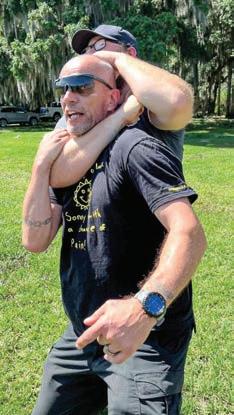
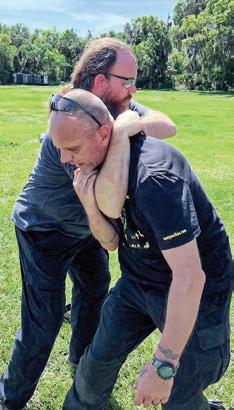
Pawela, a national self-defense instructor himself, notes that very few fellow firearms trainers have a clue about weapons disarms, but Puzikas is an exception to the rule.
SELF-DEFENSE TRAINING
expression, more on function, cohesion and mission completion.
Puzikas also runs seminars across the US. His training classes include:
AK Fundamentals (AK-1): Focuses on the guiding principles of efficient performance with the AK platform, emphasizing why techniques are used rather than just memorizing drills.
Advanced AK Courses: Builds on fundamentals to develop adaptability in chaotic, real-world combat situations.
Shooter Fighter Matrix: A hybrid course combining handgun use with empty-hand fighting skills. Teaches students to integrate firearms into the broader reality of violent encounters, shifting the mindset from “gunfight” to “fight with a gun.”
Systema Training: Rooted in Russian martial arts, focusing on fluidity, adaptability and psychological resilience. Courses like Fear Inoculum emphasize stress inoculation and transformation under pressure.
Force-on-Force and Combat Conditioning: Scenario-based training where students face simulated combat situations. Includes conditioning drills designed to prepare both body and mind for the unpredictability of violence.
Instructor Development Courses: Designed for those who want to teach others, focusing on pedagogy, safety and advanced combat concepts.
PUZIKAS OCCUPIES
A unique niche in the firearms training world. To some, he is a visionary who strips away dogma and prepares civilians for the harsh realities of violence. To others, his methods are risky. Regardless, his blend of Spetsnaz heritage and modern civilian instruction has left a lasting imprint on the tactical training community.
On a personal note, readers are familiar with the fact that I write about people who are not only well known in their disciplines but also happen to be
personal friends of mine. Puzikas is no different. I have known him for many years, and will state on the record that, while known for understanding brutal violence and its realities, he would automatically be among my top five instructors in the country.
And over the years, I’ve watched a total transformation in the man – a man who dedicated his life to Jesus Christ and a man who has become a loving husband as well as a role model father. All of this has given Puzikas a new resolve in life, and with it, a highly intellectual/philosophical approach to all things necessary for life’s survival. Sonny Puzikas is now in my top three instructors in the country to train with! And that’s my two cents! ★
Editor’s note: Author Paul Pawela is a nationally recognized firearms and self-defense expert. For his realistic self-defense training, see assaultcountertactics.com.
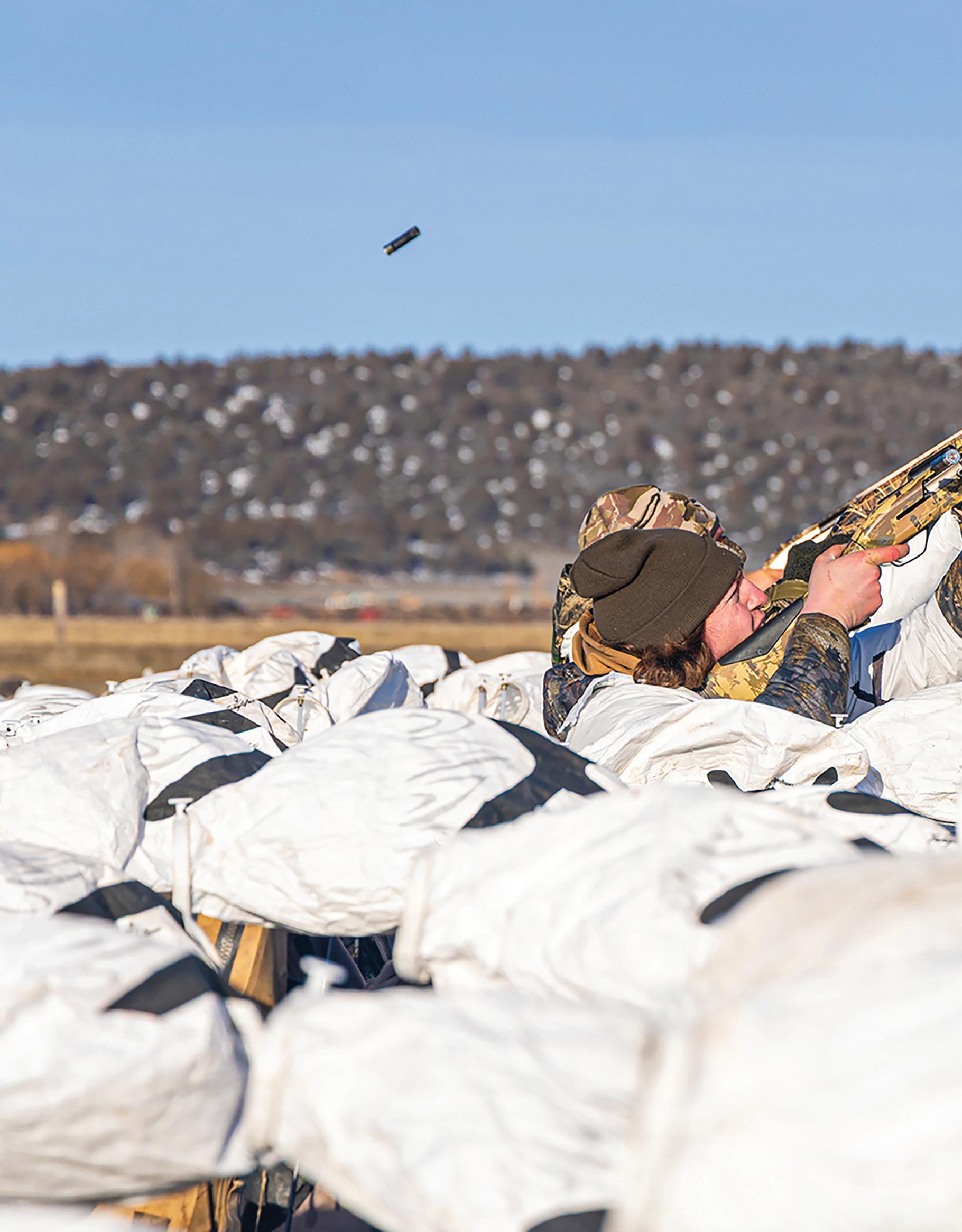
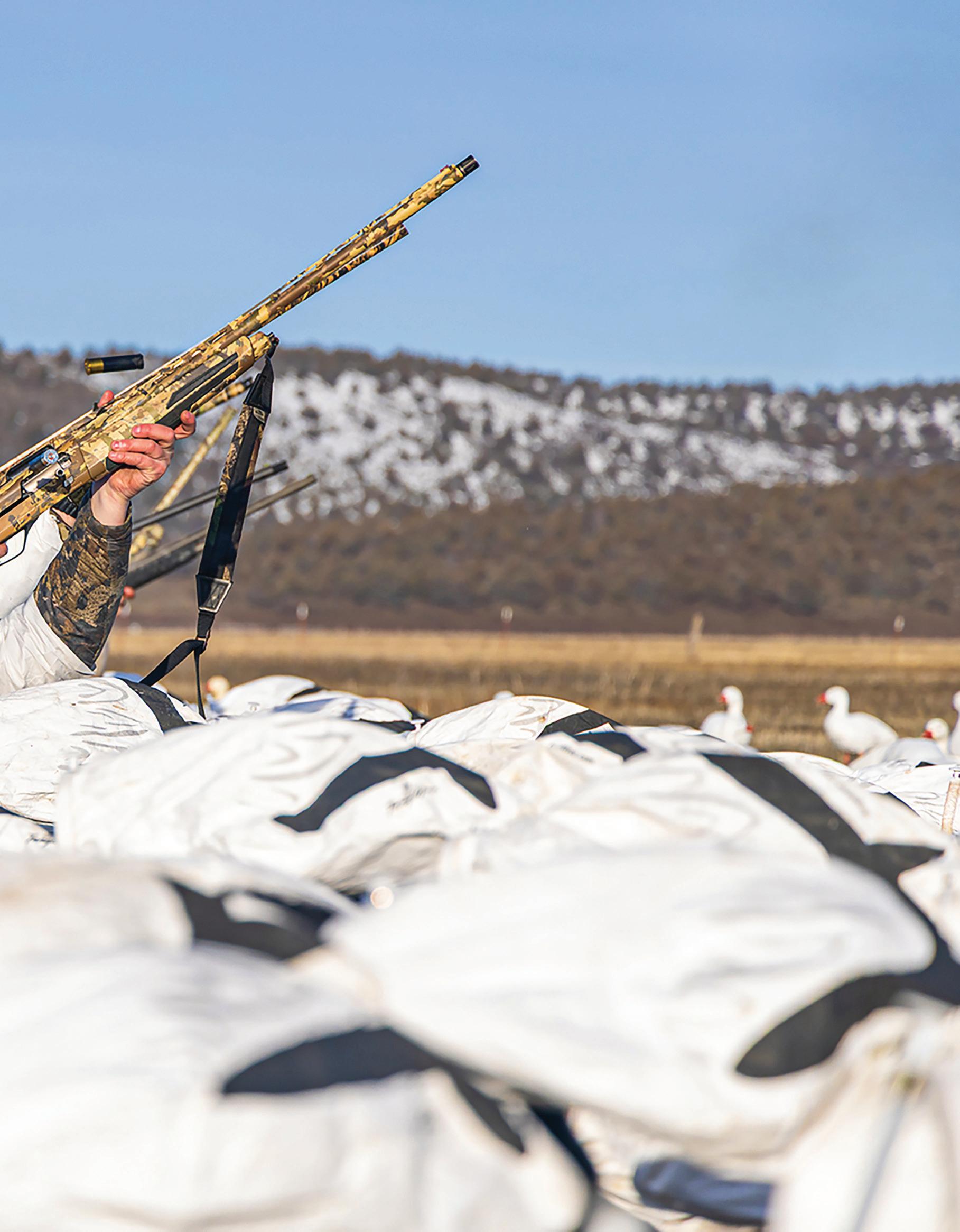
With cover sparse in Northern California’s flat fields, snow goose sock decoys hid author Scott Haugen’s fellow hunters in their layout blinds during a spring hunt.
ROAD HUNTER
GETTING AFTER SPRING SPECKS
Hunt for white-fronted geese proves very productive, and a bit painful.
Feathers filled the air. The resounding thuds of geese hitting hard dirt followed.
“Grab ’em quick, here come more,” hollered Jake. We’d barely hopped back into our layout blinds when the next wave of geese coasted toward the decoys. More birds fell from the sky.
“Whatchya think?” smiled my buddy Austin Crowson. I shot him a wink. We were hunting white-fronted geese in Northern California. It was late in the afternoon of early March. Temperatures were warm.
Eight specks fell from the next volley. Another string of dark geese was right behind them. I was on the far right, with four hunters to my left. I went two for three on the next flock. Specks decoyed with insane aggression. It was a good start to three days of spring goose hunting.
STORY AND PHOTOS BY SCOTT HAUGEN
ROAD HUNTER
A SPECK-TACULAR START
By the time we picked up decoys and cleaned and packaged five limits of specklebellies, it was late. “Before you guys got here we scouted some other spots,” shared Jake, as we packed the last of the birds into coolers. “We’re going to hunt another place in the morning that’s been loaded with snow geese.” His enthusiasm was invigorating.
The plan was to get up at 4 a.m., hopefully allowing us time to set out 2,000 decoys. Three trucks pulled trailers and another hauled a John Deere ATV and flatbed trailer to move decoys. The haul from trucks to the X was over half a mile long. The going was wet and muddy, but the shuffle, fast and furious. Minutes before shooting light, the last of the decoys were in place.
We hid in layout blinds engulfed in
white decoys. Full bodies, socks, shells and silhouettes – you name it, these kids had it.
Seven specks were the first geese to arrive. They cupped straight into the decoys. None left.
Forty-five minutes and over 30 dead tar bellies later, the first flock of snow geese finally came our way. As with the specks, they approached on a string. But they didn’t finish. Instead, they veered to the right at the last moment.
The next two strings of snow geese peeled off at the same place. They didn’t flare, but just casually drifted to the side and kept flying. That’s when someone broke the silence. “Look behind us!” they shouted.
Unbeknownst to us, a roost pond beyond the hills behind us found snow geese leaving it and landing in a field to graze. They were landing a mile from us.
With the wind we couldn’t hear them. Every snow goose that left the roost in front of us funneled into that field. There was nothing we could do about it.
“That’s all right,” piped Kaden. “The specks are flying and working good. Let’s finish up on these, get outta here and go scout for tomorrow’s hunt.”
By late morning six of us were done and picking up decoys. It was the best speck hunt I can remember. Every flock closed without hesitation. They were in perfect range for my 20-gauge. While Pacific black brant are my favorite eating waterfowl, specks are a close second, so I was elated.
That afternoon we split up to scout different fields. We met after dark for dinner and made a plan. Geese were found using four fields, but one in particular was loaded. It was the same field we hunted the first evening.
Big Al’s Super Speck silhouette decoys were an integral part of the group’s success three days in a row.
TROPHY MOOSE & BEAR HUNTING
River
MORE THAN A HUNT
This is an unforgettable Alaskan adventure that blends raw wilderness, world-class game, and the thrill of pursuing some of North America’s most iconic animals in their natural environment. Long days on the river. Close encounters. The kind of moments you’ll talk about for the rest of your life.
WHY HUNT WITH US
• Trophy moose & bear hunts in prime river systems
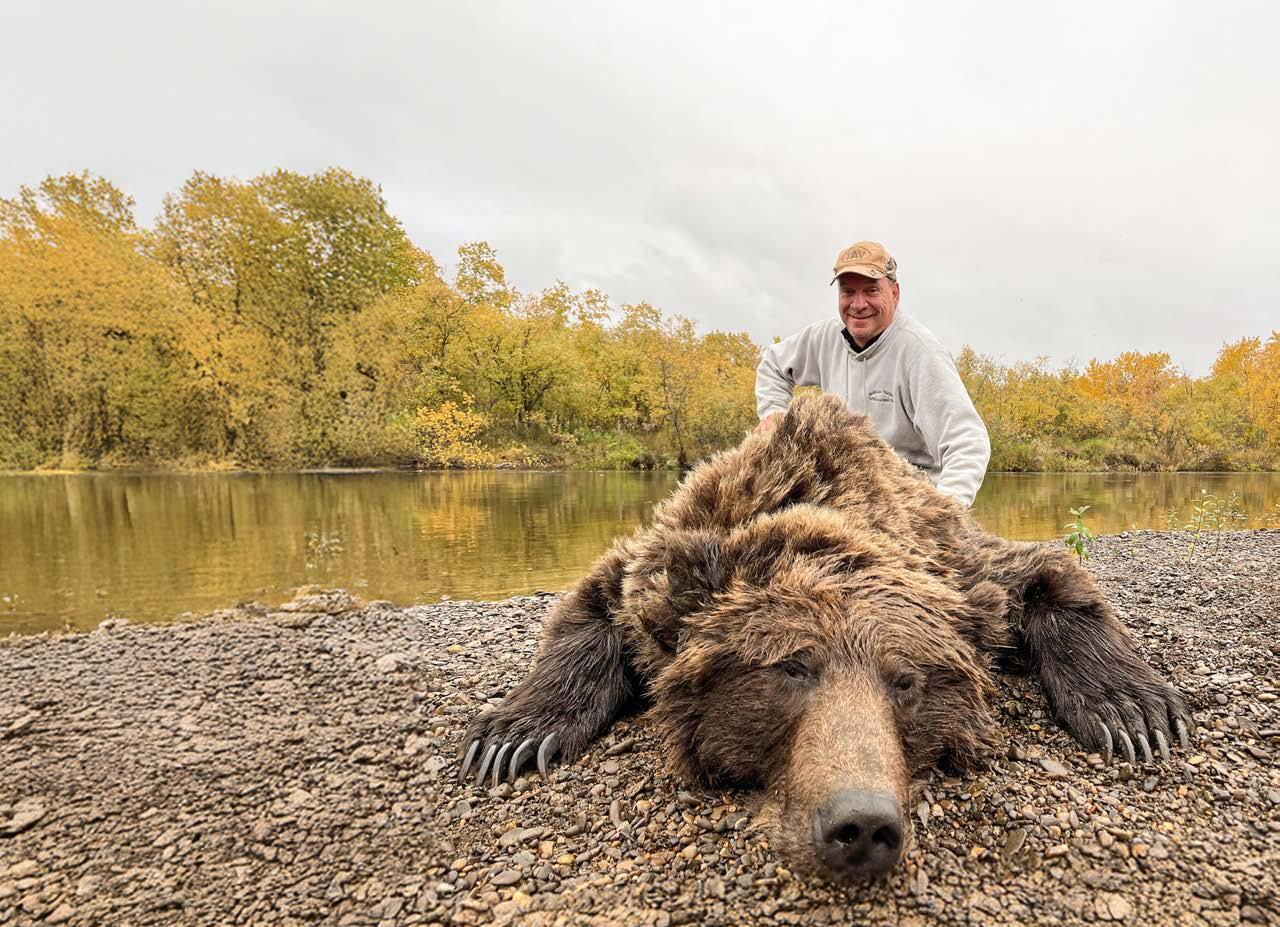
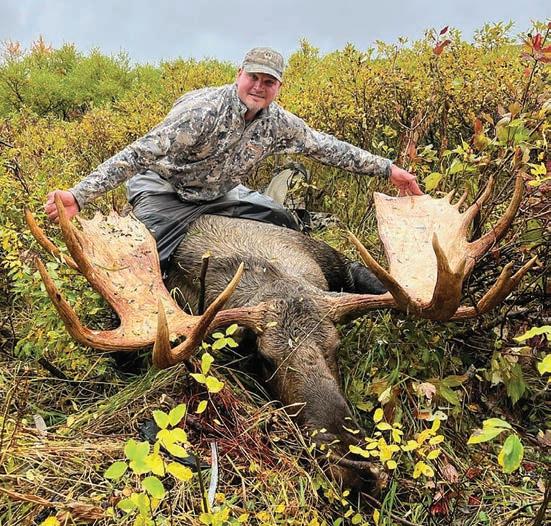
• Regular 60”+ bull moose opportunities
• Near-100% opportunity rate on legal bulls
• High success on large Alaskan bears
• Fully guided & all-inclusive hunts
• Expert guides with deep local knowledge
• Carefully selected locations for consistent results
• 11–15 day hunts with 15-day combo moose & bear hunt available
Every hunt is carefully planned and professionally guided from start to finish. From scouting and calling to field care and logistics, your guide handles every detail so you can stay focused on the hunt.
Contact us today to secure your hunt and discuss available dates.
“Set your alarms for 2:30; tomorrow’s going to be an early one,” Kaden said matter of factly. “We’re throwing the kitchen sink at ’em in the morning.”
With daily limits of up to 20 snow geese and 10 specklebellies per person, the potential to burn a lot of shells was real. We just had to fool the snow geese and we intended to do it with a massive decoy spread.
A BIG SPREAD – AND A BIG PAIN
I didn’t get much sleep and 2:30 a.m. came quickly. Even after 49 years of waterfowl hunting, I was excited.
Soon we were in the field, trying to organize the chaos. Determined to set out 6,000 decoys, the crew was on a mission. Two of the group’s energetic buddies, who owned a lot of snow goose decoys, joined us.
Two ATVs with trailers hauled tote
after tote of decoys into the field. A few long-legged, fast-moving kids carried decoys to me and a couple others, who set them in the field. The pace lasted for nearly four hours.
Mixed in with the snow goose decoys were about 100 full-body speck decoys, and another 10 dozen Big Al’s white-front silhouettes. The flat, dark decoys were set on the fringes of the snow goose decoys, optimizing visibility and contrast.
As the horizon began to glow, we had to call it quits. “We’re only going to get about 4,500 decoys set,” Kaden told me, huffing and puffing as he picked up empty decoy bags to take back to the trucks. The field was laden in dew. Mud stuck to our boots, making every step heavy and laborious. It drastically slowed our progress.
I didn’t know it at the time, but I
was less than two weeks away from an emergency back surgery. I was aware that I’d need it, but not so soon. Stenosis, bone spurs and calcium buildup in the lower back had me in excruciating pain for months. I was of little help in setting out the decoys. Merely taking a step felt like my legs were on fire and I was being stabbed in the back with hot swords. It gets worse.
Three weeks prior I tore a rotator cuff in my shooting arm. I couldn’t sit up in the blind, let alone lift and shoulder my gun. It was painful and frustrating. Aging isn’t for the weak. I tried to hide it, but on day two the kids noticed as I was struggling to shoot a limit of tar bellies with my 20-gauge. They soon figured out why I’d left the 12-gauge home.
“Here’s your blind this morning,” Kaden said, shining his headlamp on
Specks decoyed with aggression for the author and his buddies.
ROAD HUNTER
it early in the decoy shuffling process. “It has arm rests so you should be able to brace against it and shoot. We’ll put you in the middle so you don’t have to swing. Just pick your spot and let the birds work into it.”
I didn’t know what to say. A simple thank you didn’t suffice. The youngsters could have stuck me on the end where I would have struggled. They did just the opposite. Fine young men, all of them.
FINISHING STRONG, BUT EARLY
While the two drivers – I didn’t catch the names of the new kids – carted multiple loads of empty bags and decoys back to the truck, the rest of us tidied up blinds. The horizon to the west soon glowed a fiery orange. Shooting light was near.
Two young men moved sock decoys from the middle of the spread to open up a hole. Halfway through their efforts, the first flock of geese approached. They came in low and silent. None of us saw them until they were right on us. The two men stood in the hole, still as statues. The flock of specks landed 10 yards from them.
When the first flock of snow geese took to the air, calls blared and flags waved. It took them a while to buck the wind, but the birds made progress. Then, 200 yards out, they banked to the west, skirted around a big pivot line and landed in a field behind us. Every flock of snow geese followed.
“Looks like we have another speck shoot this morning,” someone blared. Everyone laughed. They weren’t defeated. They were just happy to be
hunting. So was I.
The first flock of whitefronts hit the X. I dropped a pair. The group killed several more. I was in too much pain to even fetch my birds. “Don’t worry, I got ya,” Austin smiled, as he handed me two beautiful specks. Austin says that when he’s looking after me: “I got ya.” It’s his kind, sensitive way of saying he’s looking after this aging man. I wouldn’t hunt nearly as much as I do were it not for Austin. I love hunting with that kid. He has a genuine respect for adults and he’s a hard worker.
We shot limits of specks in short order. It was a glorious morning, and Austin and I would now head for home.
“Sure you guys don’t want to stick around and try for snows this afternoon?” Jake asked as we milled around the decoy spread, kicking
Though snow geese were elusive, white-fronted geese more than made up for it.
ROAD HUNTER
sticky mud from our boots. “The wind is supposed to change this afternoon and birds should hit this spot.”
Still, with our possession limits of specks in hand, Austin and I decided it was best to hit the road.
About the time we arrived home, Austin got a text from Jake. “You didn’t miss anything. The wind didn’t change and we didn’t fire a shot,” it said. “We’re leaving the decoys out and trying it again in the morning.”
The next morning Austin got another text from Jake. “The wind changed!” was all it said.
A few minutes later a picture came through of five happy hunters with 100 snow geese. No specks.
Their efforts had been rewarded. ★
Editor’s note: Scott Haugen is a fulltime freelance writer and photographer of 25 years. Follow his adventures on Instagram and learn more at scotthaugen.com.
Haugen with a morning limit of great eating white-fronted geese, his second favorite waterfowl on the plate.
• Easy Loader & Deuce accommodate 2 dogs up to 65 lbs each
• EZ-XL accommodates 2 dogs over 65 lbs each
• Made from High Density Polyethylene with UV protection
• Easy Loader fits most full size pickups, SUVs & large UTVs
• Deuce fits smaller pickups, SUVs & UTVs
• EZ-XL is for larger breed dogs & full size vehicles
• Vents, cold weather door covers, insulated covers & custom kennel pads available
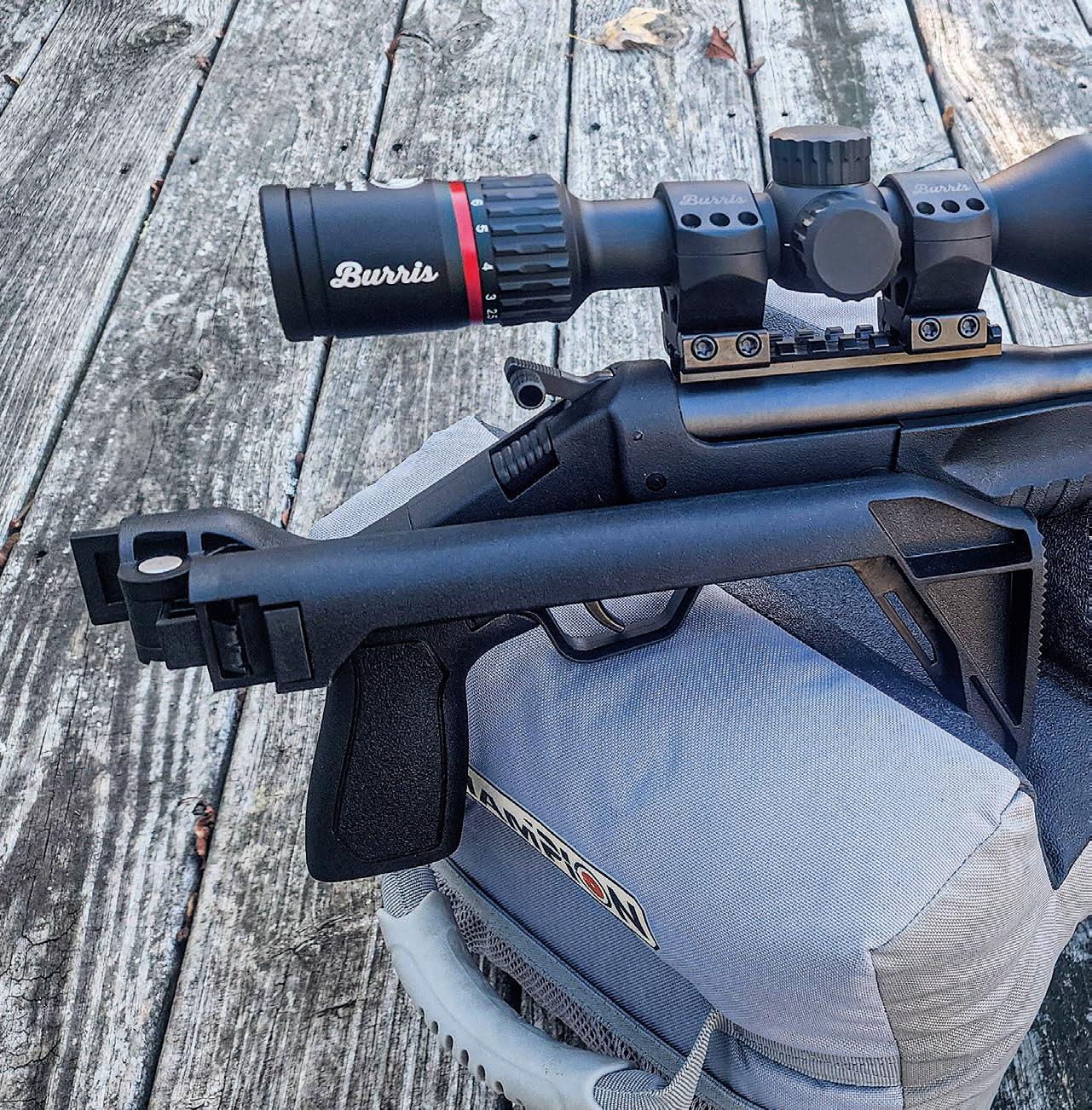
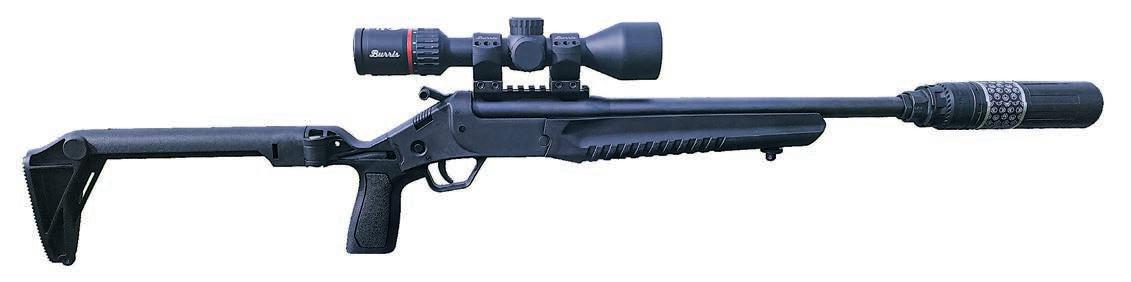
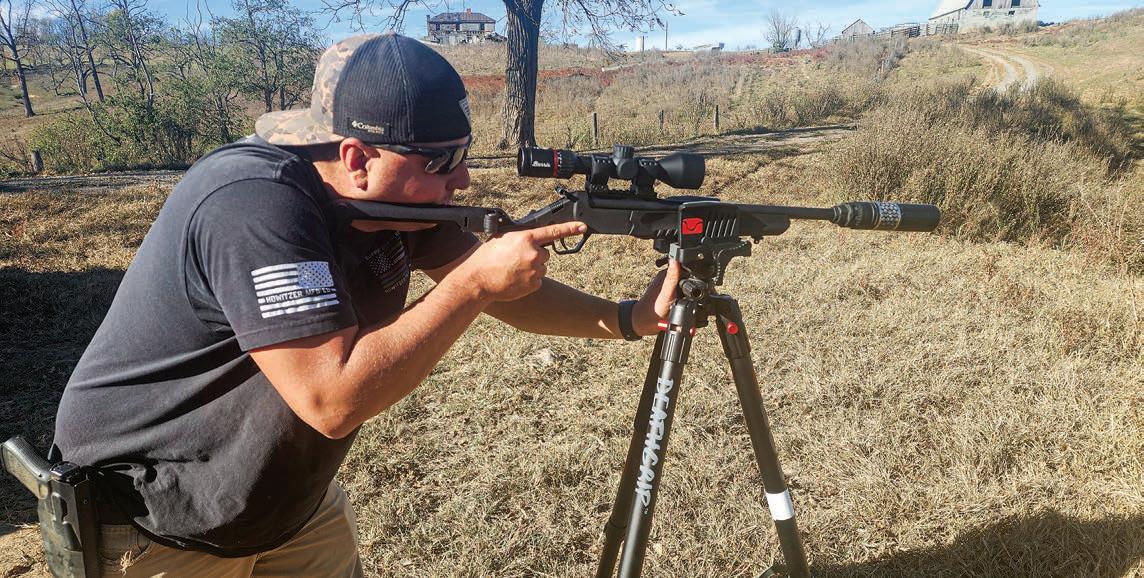
The Rossi LWC (Lightweight Carbine) with a folding stock.
gun review
ROSSI LWC
Single-shot carbine in .300 Blackout a simple, lightweight and handy hunting or truck gun.
STORY AND PHOTOS BY LARRY CASE
In the gun world today, there is no doubt that if you want a firearm with some new bell or whistle on it, you can find it. No offense to anyone on the shooter or manufacturer side, but it seems we sometimes do add-ons and any sort of goodie to attach on a gun to get the “cool” factor. Now don’t get me wrong here, I like guns, and I like cool guns. But to paraphrase a line from a certain dinosaur movie we’ve all seen: Just because we can do it doesn’t mean we should do it.
In general, I think most shooters and hunters out there want things to be simple. In the real world of a soggy duck blind or cold, dark deer stand, the less buttons and levers we have to deal with to make a gun ready to go “bang,” the better. (Even worse in the fog of war or dealing with a toothy critter like a bear with a bad attitude.)
FIRST IMPRESSIONS
To keep it real here, when I first opened the box for the Rossi LWC (Lightweight Carbine), I probably did a frown. The model sent to me is the newer one with a folding stock. My chief reservation was about attaining a good cheek weld on the stock and “settling in” on the gun when mounting it to shoot. These fears were soon dispelled when I brought it to bear on a target. (I was also reminded by others several times over the testing period that the folding stock is a very handy feature for stuffing the gun in a pack and storing it in a vehicle.)
As we continued to test and hunt with the LWC (this one
gun review
was chambered in .300 Blackout), the advantages of the folding stock became obvious. The 16 5-inch barrel along with the folding stock make for a very handy combination.
For the hunter, this rifle is a great gun for a blind or other situation where you may be restricted in terms of space. For the deep-woods deer or bear hunter who does a lot of walking, you would fold the stock, stuff it in your pack and go. If you are hunting farm country and are in and out of the vehicle, the LWC with the folding stock may be the essence of what we would call a “truck gun.”
LWC AT A GLANCE
With the Rossi LWC folding stock model, what you see is what you get,
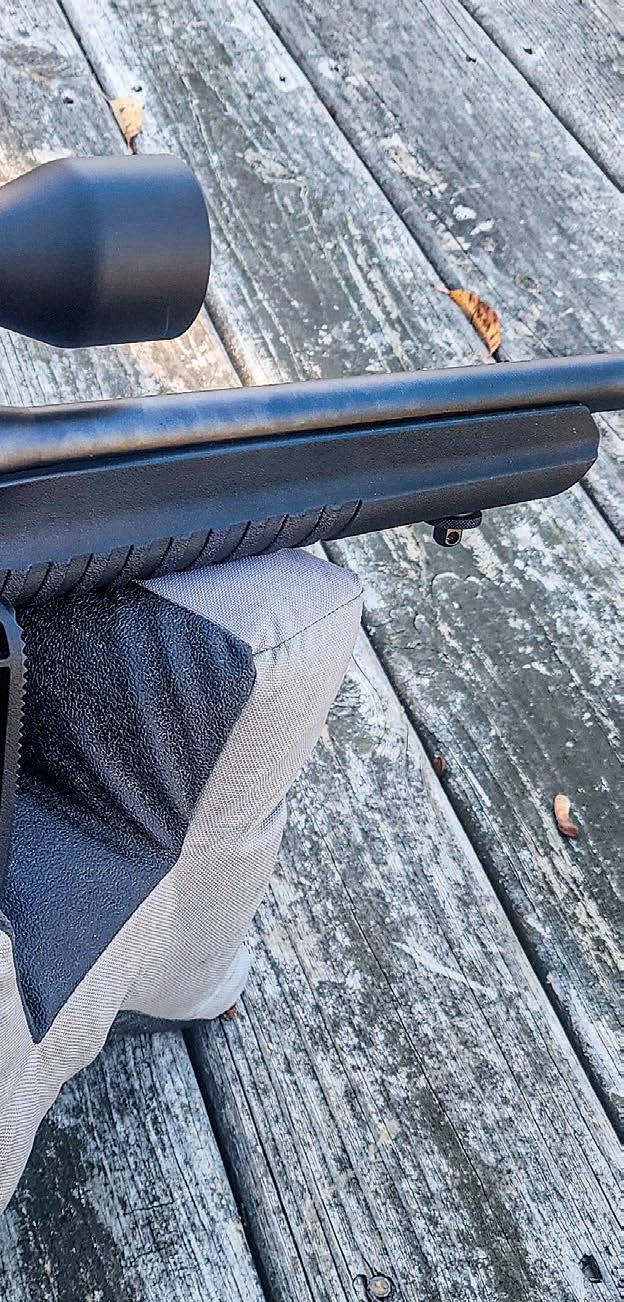
and I am saying that is good. There are no frills here, not that real hunters and shooters need or want any. The LWC is a simple break-action singleshot (a great safety feature for young hunters and everyone else) shortbarreled rifle. The receiver is steel overmolded with polymer. The forend and stock, as well as the trigger guard, are polymer. The barrel is alloy steel coated with black oxide.
The trigger pull on the gun I received measured 3 pounds, 15 ounces – not light, but I would not want a light trigger on a kid-friendly, safety-conscious gun. The safety on the LWC is a cross bolt design and also has a transfer bar mechanism, which allows the hammer to be lowered without contacting the firing
pin. This gun has an extractor for spent rounds, not an ejector, but this proved to be no problem. The release button to open the gun is located beside the hammer, which has a hammer spur for cocking the gun.
The Rossi LWC also comes supplied with a Picatinny rail for mounting scopes and optics. On this particular rifle we mounted a Burris Fullfield 2 5-10x42mm (burrisoptics. com). This scope is somewhat short and compact, a good match for the LWC. I can also see the LWC being a very good candidate for one of the red dot optics like the Burris FastFire For short-range (100 thick-woods deer and bear hunting, the LWC with a red dot optic would be a deadly combination.
While there are no frills on a stock Rossi LWC – the receiver is steel overmolded with polymer; the forend, stock and trigger guard are polymer; the barrel is alloy steel coated with black oxide; and it comes with a Picatinny rail – on his, author Larry Case mounted a Burris Fullfield 2.5-10x42mm scope and Dead Air RXD30Ti suppressor.
An officer tests the Rossi in the field.
gun review
The LWC is of course threaded for a suppressor, and we mounted the Dead Air RXD30Ti (deadairsilencers.com) and got good results. The Dead Air silencer performed as flawlessly as I have experienced on other rifles; it is lightweight, easy to install and remove and has great sound reduction. Because of the short barrel, the LWC was still handy and maneuverable with the suppressor.
ON THE RANGE/IN THE WOODS
The LWC is a very easy and fun gun to shoot. The simple break-action makes for stress-free handling of the firearm – just open the action and you have no worries of accidental discharge. I had heard from others of the surprising accuracy of this gun and they were not fibbing. I shot Federal Power-Shok 150-grain softpoint loads, Remington UMC 150-grain rounds and Fiocchi loads with a 125-grain SST polymertipped bullet. The gun seemed to like the Fiocchi load the best and we got hole-touching accuracy at 50 yards and sometimes less than 1 5-inch groups at 100
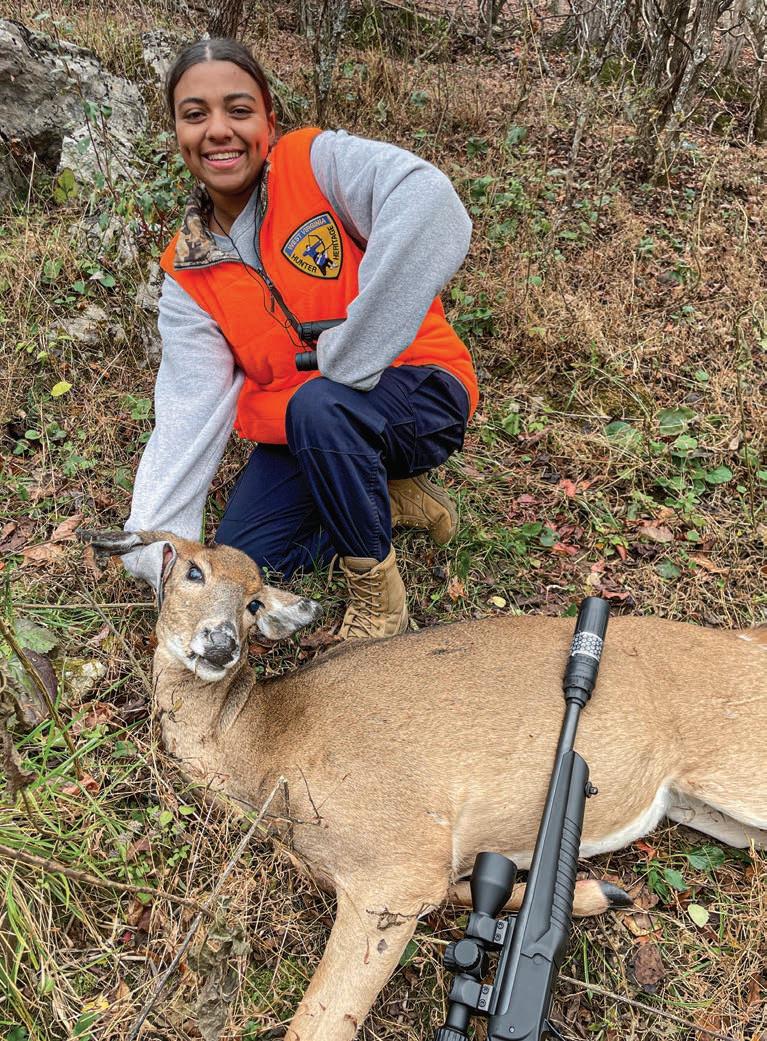
I was able to incorporate the Rossi LWC into a couple of youth day deer hunts in my area. These hunts are sponsored by the West Virginia Division of Natural Resources and local volunteers and are geared toward young hunters who would likely not have an opportunity to go hunting were it not for such an event. The young hunters get a full day of hunter education training and marksmanship practice from the DNR officers and trained volunteers who put on the hunt. Everyone who got a chance to use the Rossi LWC seemed impressed with it, on the bench and in the field. This was for all the reasons we have noted here: the gun’s light weight (just a shade under 5¼ pounds), which is essential for young and smaller-stature shooters; the shorter length’s handiness; and the overall ruggedness of the LWC. Two antlerless deer were taken with the LWC .300 Blackout, and both dropped immediately at the shot.
BACK TO BASICS
America needs a basic, low-cost deer rifle and I think the Rossi LWC is it. While the folding stock model has an MSRP of $413 99, if you shop around you will see it for a lot less. I believe it may be the ultimate throw-it-in-thetruck-and-go-huntin’ rifle for whatever you are after: deer, bear, hogs, coyotes or whatever it may be.
Rossi saw fit to listen to hunters –make it plain and simple – and that is just what we got.
Editor’s note: For more information, visit rossiusa.com. Larry Case has been a devoted outdoorsman since he was a child. He will admit to an addiction to turkey hunting (spring and fall), but refuses any treatment. He enjoys the company of gobblers and cur dogs that are loud and people who speak the truth softly. Case served 36 years as a game warden in West Virginia and retired with the rank of district captain. You can check out his podcast and other stories at gunsandcornbread.com.
The Rossi makes for a great rifle for youth hunters. Here Ka’Lea Burkes shows off her deer she shot during a youth hunting event last year.
Create dry aged steak and cured meats from home!
Whether you’re preserving whole muscle for charcuterie or grinding coarse for fermented salumi, our time-honored spice blends, easy starter kits, and UMAi Dry® technology make it safe and simple to cure like a pro!
ON CCI’S 75TH ANNIVERSARY
Tracing ammo company, from humble beginnings to worldwide success.
STORY BY PHIL MASSARO • PHOTOS BY MASSARO MEDIA GROUP
f you mention rimfire ammunition while chatting with your hunting and shooting buddies, it certainly won’t be long until the CCI name crosses someone’s lips. The same can be said for reloading circles, where everyone eventually has their “pet” primers; CCI
Irifle and pistol primers have been the choice of generations of reloaders. In 2026, the small company started by Dick Speer – Cascade Cartridge, Inc. – celebrates its 75th anniversary, and
it shows no signs of slowing down at all.
From the speedy Stingers, to the famous MaxiMags, to the Shotshells for handguns that are so effective on snakes and rodents, to the lineup of component primers, CCI has a diverse selection of products.
My introduction to CCI ammunition
BULLET BULLETIN
came as a youngster, when my dad had that box of Stingers that made the unforgettable rattle on the dashboard of the old International pickup truck, as we bounced down the road taking raccoon pelts to the fur buyer. Ol’ Grumpy Pants carried those Stingers in his gun belt, using them in both the Ruger Single Six revolver and 10/22 rifle. I can’t begin to estimate how many raccoons fell to those Stingers.
Once I was old enough to start shooting, my budget (nearly nonexistent) went toward the affordable
Remington ammo at the local gun shop, but my horizons have since widened, and I enjoy many different CCI products. I’m not sure how many CCI primers I’ve loaded over the decades, but it’s well into the tens of thousands, for sure. Let’s take a look at how a company that once ran quality control operations in a chicken coop became a global giant.
IN 1942, VERNON Speer – yes, the Vernon Speer of Speer Bullets – began making 22-caliber component bullets for
reloading as a hobby, but by 1944 he’d set up shop full time in a former grocery store in Lewiston, Idaho. He was using spent .22 LR cases to form his bullet jackets, and three years later his younger brother Dick left Seattle to join his brother, with the intent of making cartridge cases. Renting a small room in Vernon’s factory, Dick started Speer Cartridge Works and set forth making cases, though that endeavor didn’t fare well. Within a couple years, Dick decided that making component primers for the booming reloading
Dick Speer’s Cascade Cartridge, Inc. turns 75 years old in 2026.
market sounded like a much better idea.
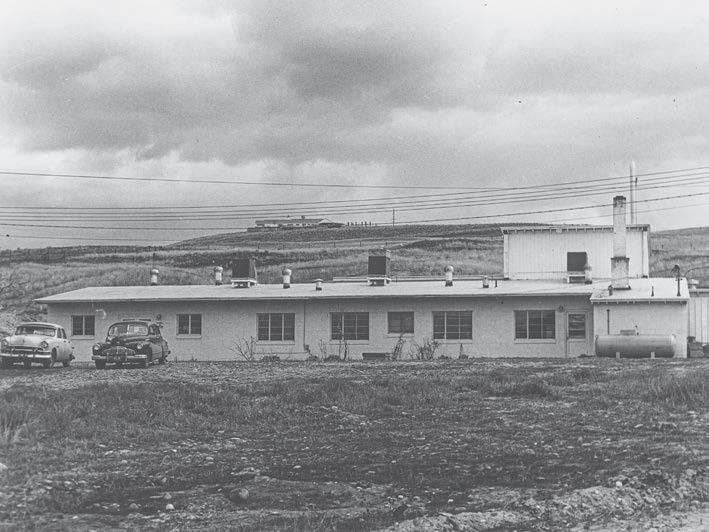
A Lithuanian chemist – one Dr. Victor Jasaitis – was brought onboard in 1951 to help with the priming compound, and Dick purchased a small chicken farm a short distance away from his brother’s bullet business. Where the farmhouse was converted into both an office and warehouse, all the quality control work for the primer production was performed in the chicken coop. Dick signed a big contract to provide the US government with his primers; this would account for nearly all the company’s production for the majority of the 1950s. To avoid confusion with his brother Vernon’s Speer Bullets, Dick changed the name of his company in 1953; Cascade Cartridge, Inc. was born, and the name would be shortened to CCI.
The mid-1950s saw the commercial release of CCI primers to the shooting public, starting with the CCI 200 large rifle primer. By 1957, the primer line included the No. 300 large pistol primer, the No. 400 small rifle primer and the No. 500 small pistol primer. All of these are still available today, and are still relied upon by reloaders everywhere. CCI primers would go on to become a standard, with Ralph Pride setting a world record in the benchrest category, delivering a 10shot group measuring less than ¼ inch at 100 yards using CCI primers in his handloaded ammunition. These primers were referenced as a component in the Speer Reloading Manual as early as the second edition.
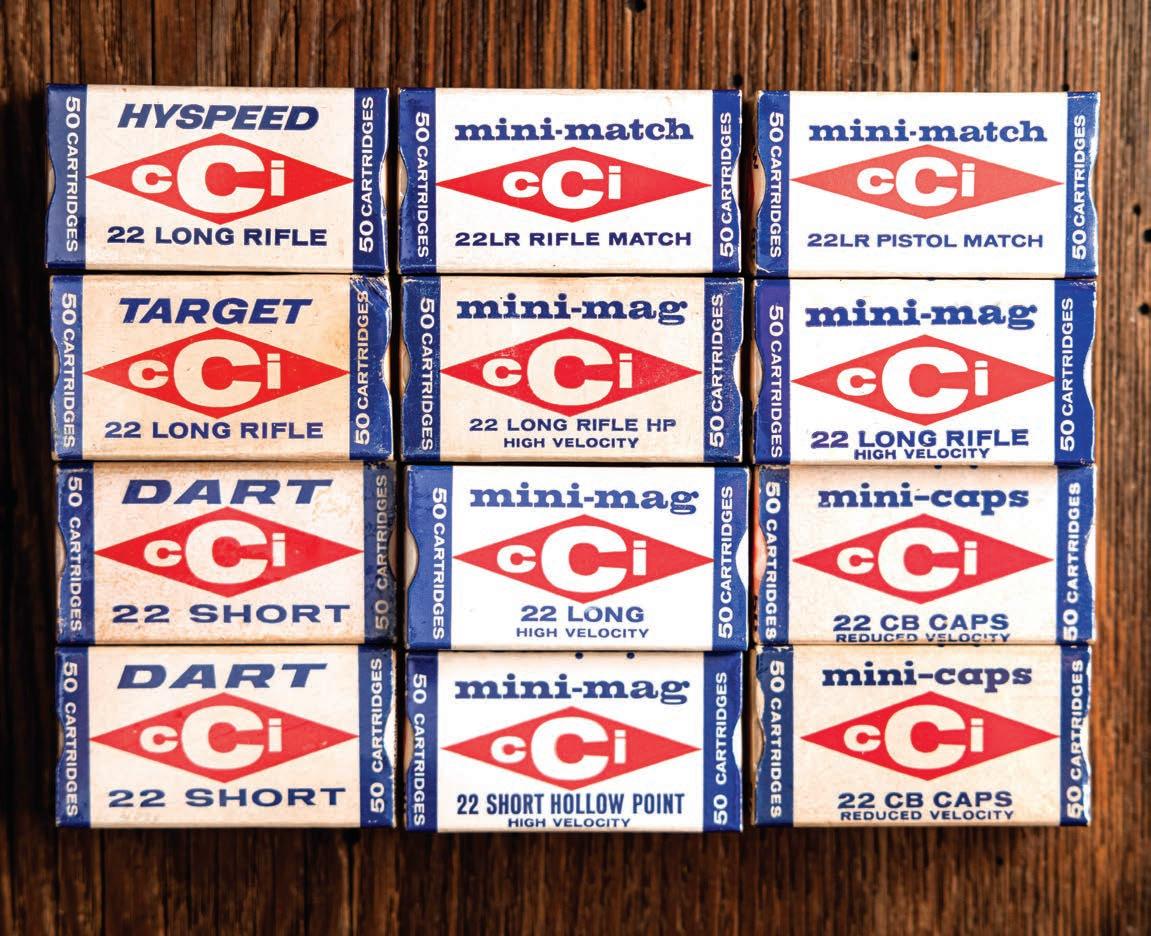
IT WAS A venture into manufacturing the charges for nail guns that led to the production of rimfire ammunition in 1960. The process took some time, but by 1963 the shooting market saw the release of CCI rimfire ammunition, packaged in 50-count paper boxes. Among the product lines were the HySpeed, Target and Dart, though they would be renamed to Mini-Mag, Mini-Group and Mini-Match within two years of release. The successful business Dick Speer built was
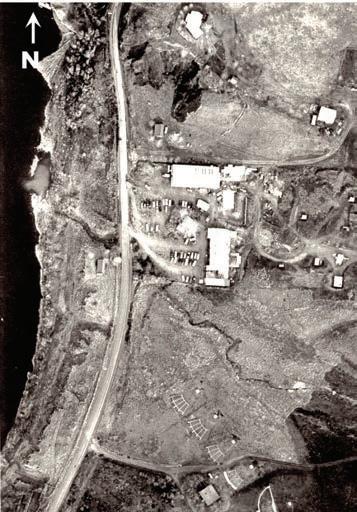
Speer extruding brass cartridge cases in Lewiston, Idaho. (CCI) An aerial photo of the CCI plant, circa 1961. (CCI)
Humble beginnings: the chicken coop where CCI product testing was conducted in the 1950s. (CCI)
The CCI Chemistry building, where the priming compounds were made, circa 1962. (CCI)
sold to Omark Industries in 1967, becoming the first company in the conglomerate’s Sporting Equipment Division. By the end of the decade, the famous rattling plastic box with the sliding lid would be in production.
Under Omark leadership, CCI gained major ground in the 1970s. The “C” headstamp would be on the affordable Blazer line of rimfire ammunition, the Stinger line (released in 1976), and the Pest Control line of rimfire ammo shotshells. That rimfire ammo, which passed the most rigorous testing, was sold under the “Green Tag” label, which remains to this day. The 1980s saw the introduction of CCI centerfire handgun
ammunition under the Blazer line, utilizing aluminum alloy cases for a more affordable price point, as well as CCI Percussion Caps for the resurgence of muzzleloading rifles. By 1985, Omark
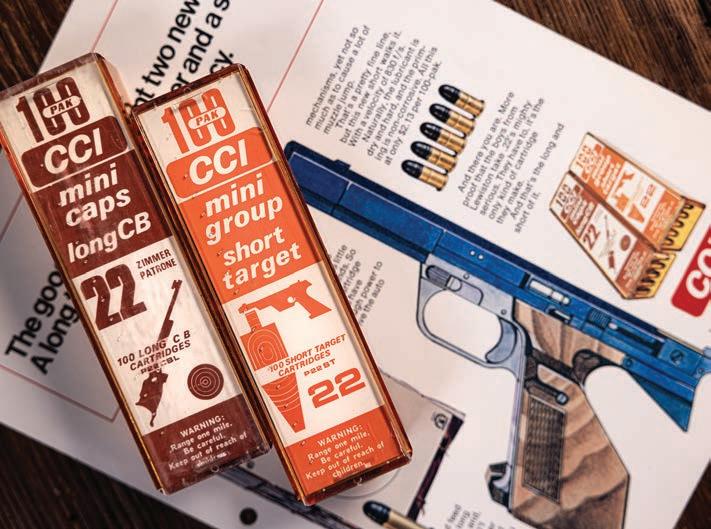
Some of the early rimfire packaging, with the original names. (CCI)
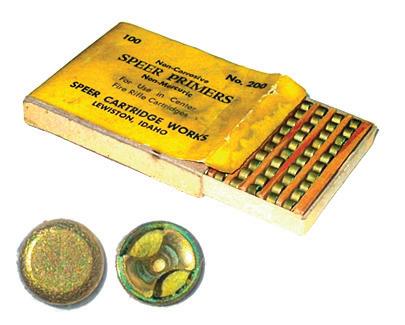
The early 100-count cardboard boxes of CCI No. 200 large rifle primers, still in production today. (CCI)
An early announcement for the release of the CCI No. 450 small rifle magnum primer, designed to work well with cartridges like the .222 Remington Magnum. (CCI)
BULLET BULLETIN
Industries was acquired by Blount, Inc. and became part of the Sporting Equipment Division.
The 1990s saw a number of innovations for CCI, including the Maxi-Mag +V (a higher-velocity .22 WMR cartridge, loaded in a nickel
Some older
boxes
ammunition. Below: 1976 saw the release of the CCI Stinger, with its elongated case. They remain a bestseller to this day.
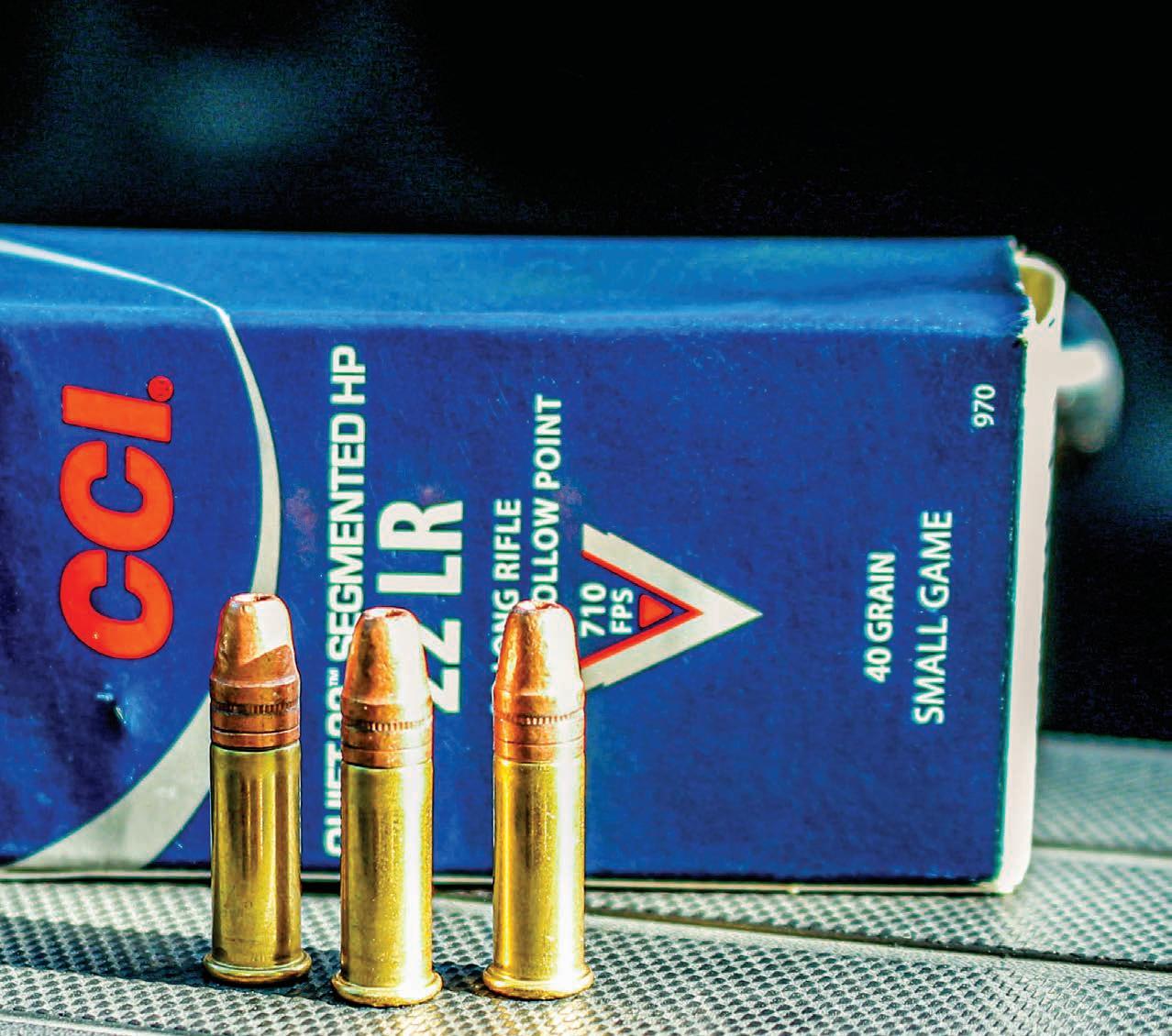
case) and the Segmented Hollowpoint bullet, designed to fragment into three pieces. Despite the primer shortage at the beginning of the decade, CCI managed to be the only domestic primer manufacturer to deliver component primers to the market without interruption.
JUST AFTER THE turn of the century, Blount, Inc. sold CCI to ATK (Alliant Techsystems), and we saw a whole
Left:
100-count
of CCI MiniCaps and Mini-Group target
(CCI)
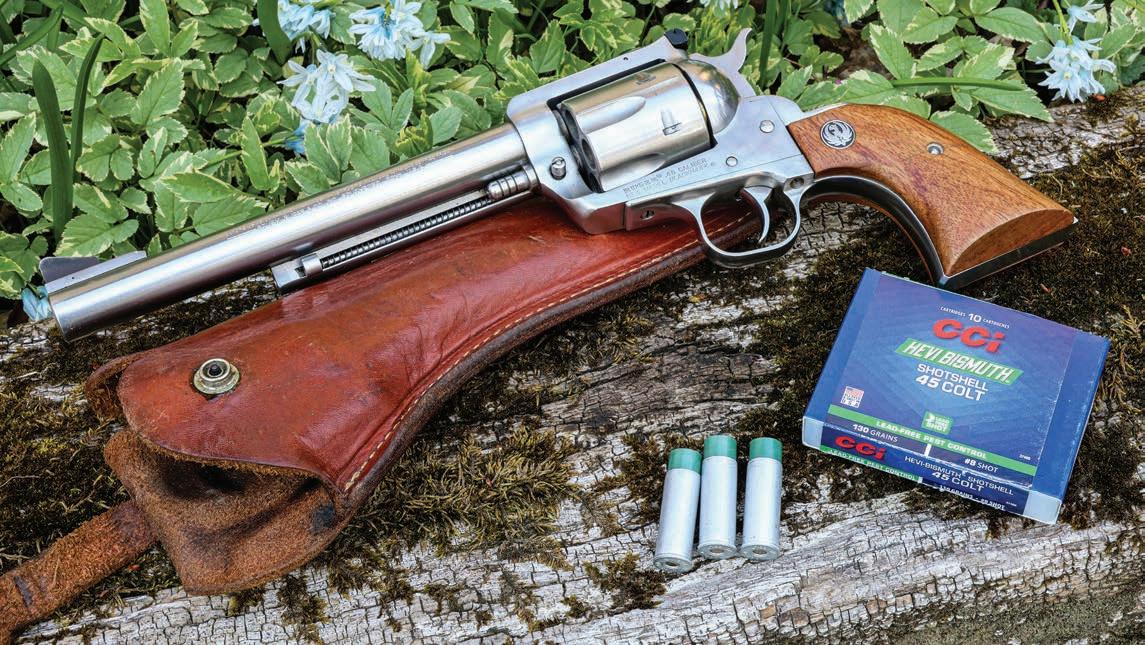
CCI pioneered the shotshell cartridge for handguns, and the line has been expanded to include No. 4 lead shot and (shown here) No. 8 Hevi-Bismuth lead-free shot.
bunch of new product lines, as well as collaborations with other ammunition companies to develop some groundbreaking cartridges. Among my favorites of this era were the Velocitor –driving a 40-grain bullet to over 1,400 feet per second – and the lead-free TNT Green and Copper-22 lines. And of course, it needs to be mentioned that CCI worked with Hornady to develop
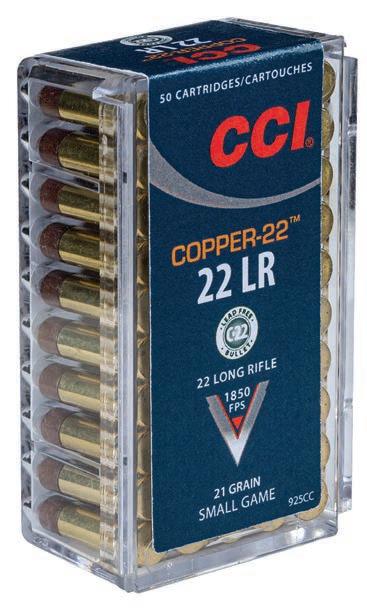
CCI’s Copper-22 gives a lead-free ammo alternative for those legally required or who simply choose to use copper alloy projectiles. (CCI)
The CCI Velocitor delivers a 40-grain bullet at over 1,400 feet per second, one of the highest velocities available in .22 Long Rifle. (CCI)
CCI collaborated with Hornady to develop the highly popular .17 Hornady Magnum Rimfire, based on a necked-down .22 WMR case. (CCI)
the .17 HMR and .17 Mach 2, with CCI producing excellent ammunition for both. The Quiet-22 gives excellent performance at subsonic levels, perfect for those situations where the report of
a rifle might not be appreciated, and the Semi-Auto variant has enough energy to properly cycle my Ruger 10/22
Celebrity collaborations with CCI include a run of .22 LR and .22 WMR
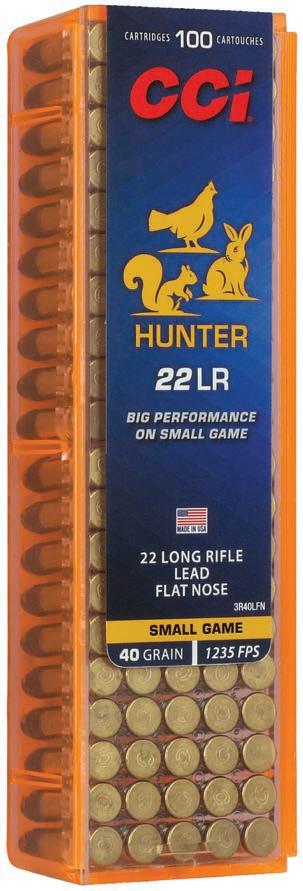
New for 2026 is the CCI Hunter ammo line, featuring a simple flatnose lead bullet designed for hunters, in blaze orange plastic boxes. (CCI)
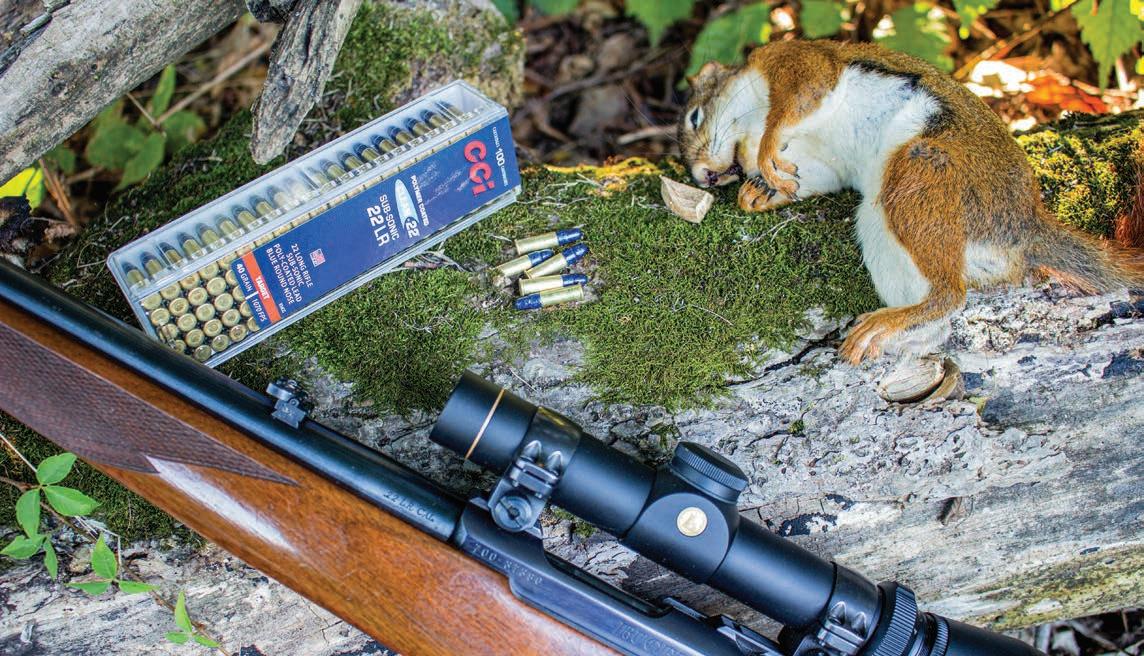
CCI’s Clean-22 Sub-Sonic is a great choice for areas where the report of a shot isn’t desired. Author Phil Massaro finds it great for the War of the Red Squirrels.
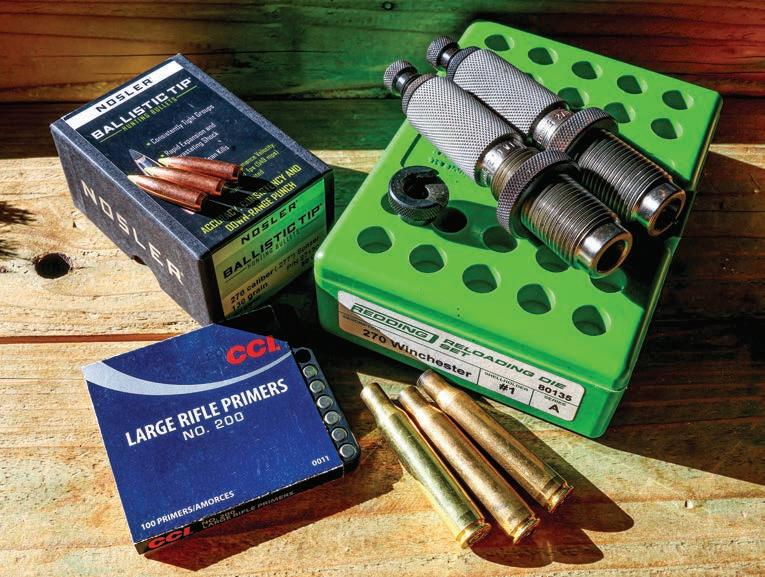
CCI No. 200 large rifle primers are a staple at Massaro Ballistic Laboratories; many great recipes have been made using that primer, including this classic .270 Winchester load.
BULLET BULLETIN
featuring Troy Landry of Swamp People, as well as the Special Edition “Stangers,” a favorite of 22plinkster of YouTube fame. The Clean-22 line sees
a polymer-coated projectile, resulting in a major reduction in barrel fouling. That product line has included a commemorative pink coating, with a
portion of the proceeds going to the fight against breast cancer. And the Pest Control shotshell line has been expanded to include Big 4, where a load of lead No. 4 was added to the centerfire handgun product line.
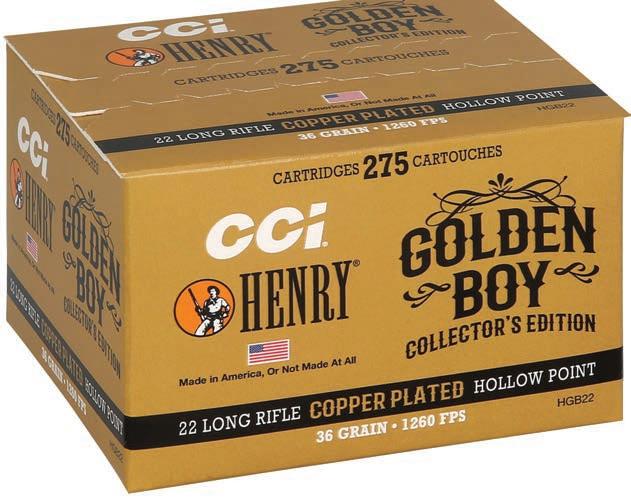
In 2024, along with their sister companies Speer, Federal Premium and Remington Ammunition, CCI was organized into The Kinetic Group, and was sold to CSG – a group headquartered in Prague, Czech Republic. As of this year, the little company that once occupied a chicken farm now catalogs 149 different products, including the new Hunter line of ammo built around a simple flatnose lead bullet, and a collaboration with Henry Rifles to celebrate the Golden Boy lever-action rifle.
I wonder what Dick Speer would think of his company if he could see it today; I’m sure he would smile with pride at the fact that his brainchild has become a household name. Happy anniversary, CCI, and many happy returns. ★
For 2026, CCI and Henry Rifles have teamed up to produce the Golden Boy Collector’s Edition .22 LR ammo line, offering a 36-grain copper-plated hollowpoint at 1,260 fps. (CCI)
‘THE FATHER OF MODERN POLICING’
Sir Robert Peel’s leadership led to the first metro law enforcement bureau and principles still in use today.
STORY BY NICK PERNA
Did you ever wonder why peace officers are called cops?
Some in law enforcement don’t like the term “cop.” My wife is the daughter of a New York state trooper, and while growing up she was not allowed to use the term. Her father considered the label derogatory, and in some circumstances I can appreciate his viewpoint.
Personally, I don’t take issue with it and have often referred to myself as a cop – I’ve definitely been called worse! –but I can also understand why some do.
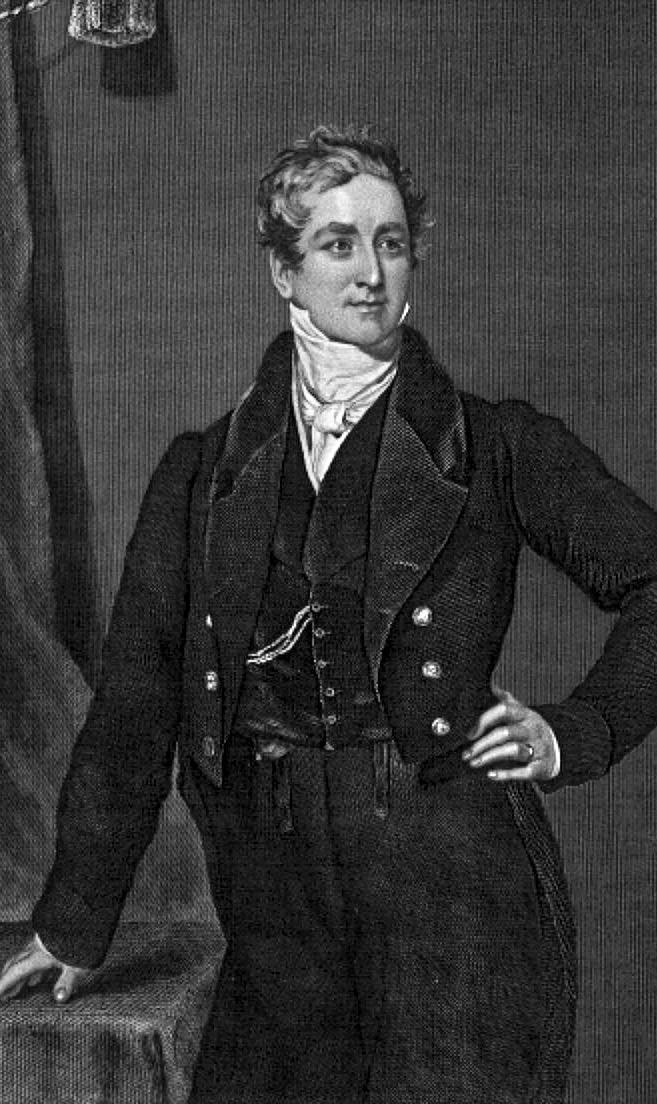
In 1828, Sir Robert Peel formed the first metropolitan police force in London. The officers were known as “bobbies” – a nickname for Robert –and their task was to keep the peace. This duty eventually led to police being referred to as “peace officers.” This designation continues today and is actually a defined term in many of the legal/penal codes and definitions throughout the United States.
In early 1900s London, the lowest ranking police officers were called constables. The term “cop” is derived from the reference of a constable on
patrol. Detectives and inspectors were distinctly more senior and experienced officers. However, the higher levels of
rank were established years after the term constable was put to use.
But let’s give Sir Robert Peel a bit
Portrait of Sir Robert Peel, 2nd Baronet (1788–1850), former Prime Minister of the United Kingdom. (COURTESY OF THE UNIVERSITY OF TEXAS LIBRARIES, THE UNIVERSITY OF TEXAS AT AUSTIN)
L.E. SPOTLIGHT
more credit than just establishing terminology that is still in use nearly 200 years later.
PEEL GRADUATED FROM Oxford in 1808 with degrees in mathematics, physics and classic literature. He then served as Britain’s chief home secretary from 1812 to 1818 and helped establish an Irish police force to assist with conflicts that arose after Ireland’s unification with England.
Peel went on to establish the Metropolitan Police Act of 1829, which was the foundation for London’s Metropolitan Police Service. He and his commissioners would come up with nine policing principles. These principles are part of the foundation for policing that we still use today. This concept and Peel’s contribution to policing reform have led to him being called the “Father of Modern Policing.”
The core values taken from Peel’s work are essentially:
Crime prevention: An effective police department doesn’t need high arrest statistics; they need low crime statistics. Preventing crime with proactive law enforcement is always better than a reactionary force.
Community support: In areas where there is a lack of community support for law enforcement, the crime statistics tend to be higher. Of course, this is assuming the communities are reporting according to the Unified Crime Reporting, or UCR, program and not skewing the data reporting process.
Mutual respect and responsibility: Part of successful policing is maintaining public support for law enforcement by hiring officers who represent and understand their community, who enforce the laws by exercising courtesy and compassion and who use only the force necessary to restore order. However, one of the key points in Peel’s principles also states that every community member
must share the responsibility of preventing crime.
These concepts are still a key part of the policing philosophy in the modern era. Hopefully, communities and the citizens therein will get back to the basics and begin taking more responsibility in the prevention of crime – and maybe start using the more respectful term of “officer” instead of “cop.” ★
Editor’s note: Author Nick Perna served for more than 24 years with the Redwood City Police Department in Northern California before his retirement in early 2025. He previously served as a paratrooper in the US Army and is a veteran of Operation Iraqi Freedom. He also has a master’s degree from the University of San Francisco. He is a frequent contributor to multiple print and online forums on topics related to law enforcement, firearms, tactics and veterans issues.
DON J. JENKINS – MEDAL OF HONOR RECIPIENT
Vietnam War hero
‘a living testament to courage and humility.’
STORY BY PABLO MARTINEZ
n the annals of American military history, certain names stand out not simply for gallantry but for the enduring inspiration they provide. Medal of Honor recipient Don Jenkins is one
IMILITARY SPOTLIGHT
such individual. His service in Vietnam was marked by extraordinary courage and self-sacrifice; his post-military life by a quiet but resolute commitment to the memory of those who serve. Over the years I’ve had the honor of being his friend – of being coined by him, of working alongside him in two powerful music-video projects, as well as other events – and I’ve come to value not just his heroism but his humility, his insight, and his unwavering dedication.
EARLY YEARS, ENLISTMENT AND THE STAGE FOR HEROISM
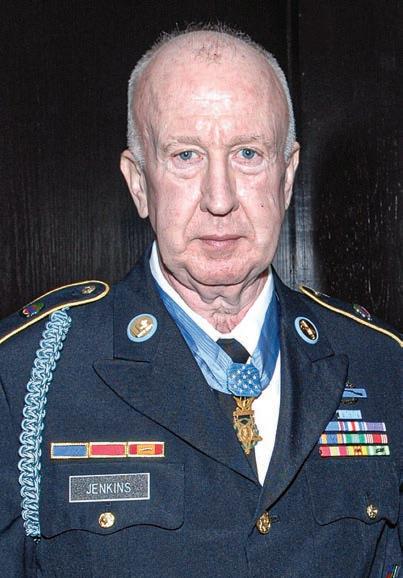
Born April 18, 1948, in Quality, Kentucky, Jenkins was drafted in the US Army. In January 6, 1969, he was serving as a Private First Class in Company A, 2d Battalion, 39th Infantry Regiment, 9th Infantry Division, in the Republic of Vietnam. On that day his unit came under heavy hostile fire in Kien Phong Province. With extraordinary presence of mind and fearless determination,
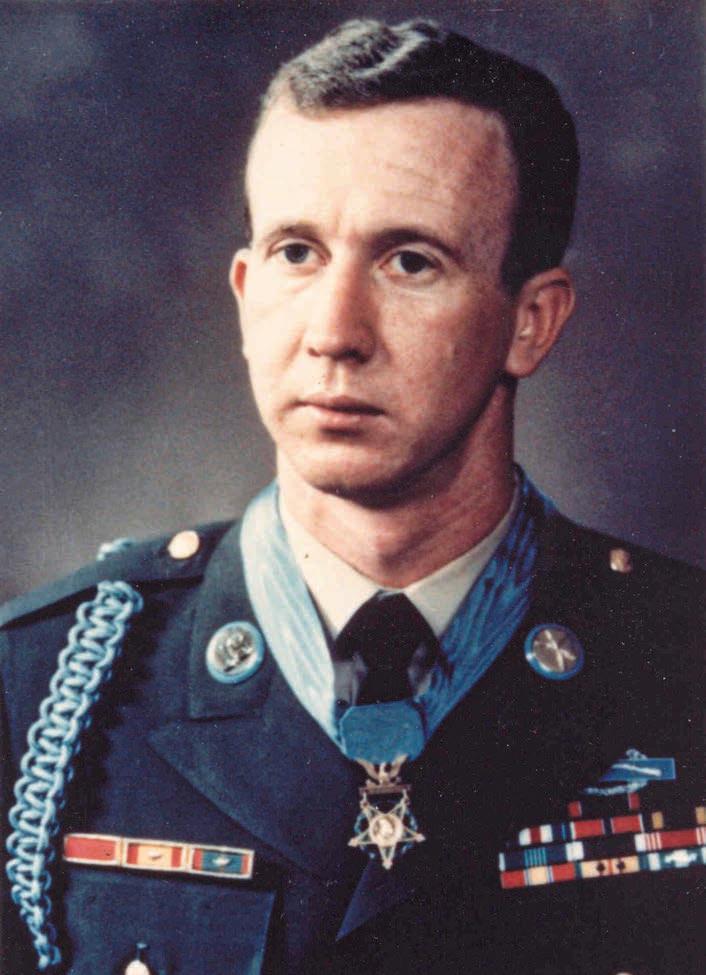
Don J. Jenkins in 1971 and more recently (below left). (CONGRESSIONAL MEDAL OF HONOR SOCIETY)
MILITARY SPOTLIGHT
Jenkins maneuvered into exposed terrain to engage the enemy in a suppressive role. When his machine gun jammed, he grabbed a rifle and continued the fight. Despite being seriously wounded by shrapnel, he repeatedly crossed open ground under extremely heavy fire to resupply himself with ammunition. Jenkins also armed himself with anti-tank weapons and a grenade launcher, destroyed an enemy bunker, and made three separate trips into occupied hostile positions to rescue wounded comrades pinned down mere meters from the enemy bunkers.
It was this sequence of actions –relentless forward movement, rescue of wounded teammates, disregard for personal wounds, and the refusal to yield to an enemy advance – that earned him the Medal of Honor. On March 2, 1971, President Richard Nixon presented him with America’s highest decoration for military valor.
THE CITATION AND WHAT IT REVEALS
The official citation underscores that Jenkins “distinguished himself while serving as a machine gunner on a reconnaissance mission … unhesitatingly
maneuvered forward to a perilously exposed position … when his own machine gun jammed, he immediately obtained a rifle and continued firing … he then armed himself with two anti-tank weapons and … a grenade launcher … ignored continuing intense fire and his painful wounds … made three trips to the beleaguered unit … each time pulling a wounded comrade back to safety.” What stands out beyond the raw facts is the sequence: weapon system fails, improvisation occurs; ammunition runs out, he secures more; wounded, he continues the rescue efforts. There is no pause, no abdication of duty. It’s not simply valor – it’s relentless resolve under fire.
WHY THIS MATTERS TODAY
In an era when public discourse often eclipses the individual soldier’s story, Jenkins’s actions provide a singular case study in humility amid heroism. His story reminds us that valor isn’t a one-time act for show – it’s sustained action when no one else is watching, when the weapons jam, when wounds threaten, when comrades depend on you. And he did so not for recognition, but out of loyalty and duty.
BEYOND VIETNAM: LIFE AFTER THE WAR
After returning from Vietnam, Jenkins returned to working in the coal mines. He continued to live in service even as he shifted into civilian life. He became a visible figure at veteran events, appeared in school tributes (for instance, his tribute at Butler County High School in Kentucky) and served as a living example to younger generations. In 2025, he was recognized by the US Department of Veterans Affairs as “the only living Medal of Honor recipient in Tennessee and one of two in Kentucky.”
A BROTHER SAVED: THE STORY OF TIM BRINKLEY
Among the men whose lives were forever changed by Jenkins’s heroism is Tim Brinkley – one of the wounded soldiers Jenkins pulled from the kill zone during the January 6, 1969 engagement.
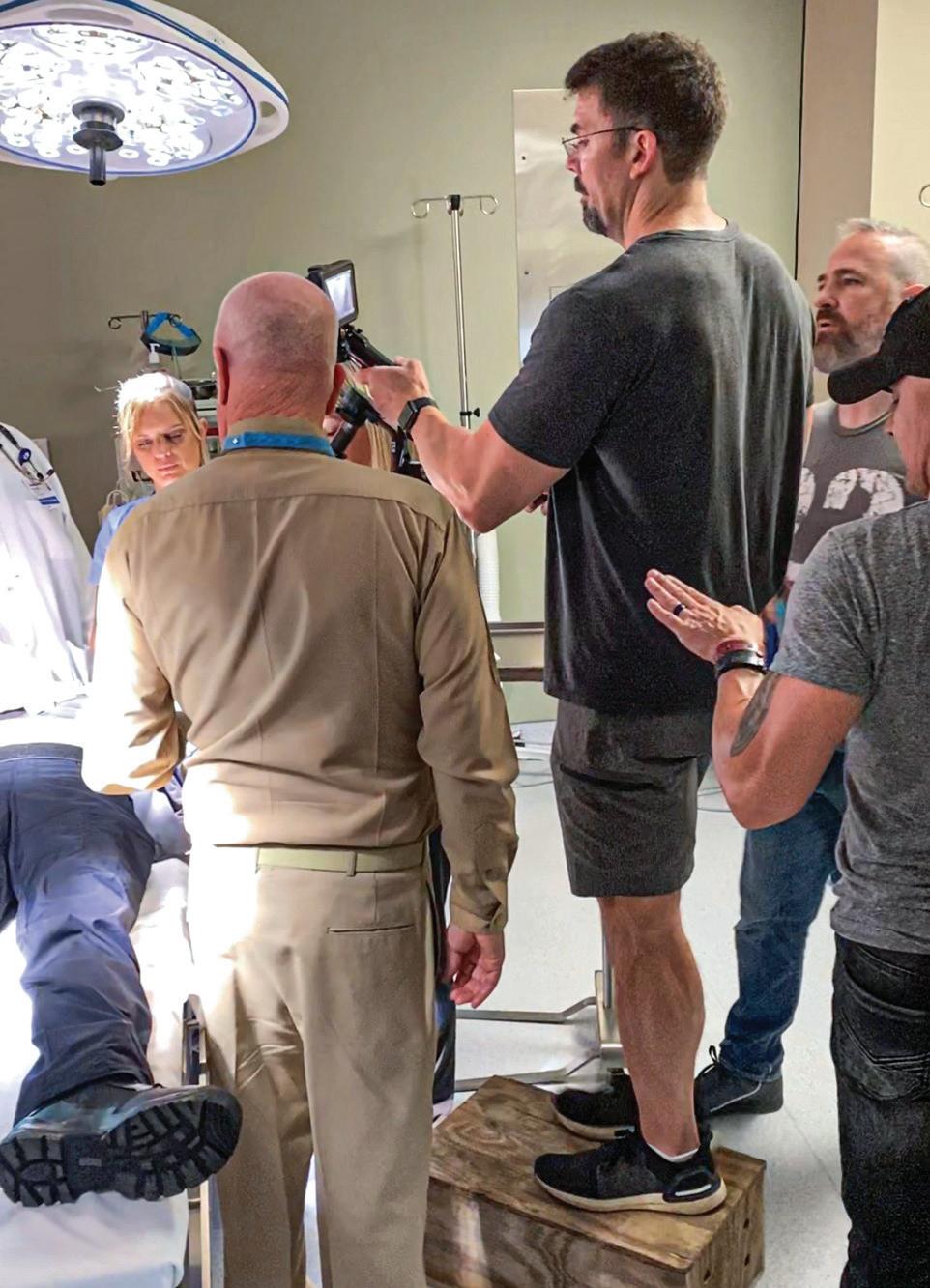
Behind the scenes filming the “Let’s Talk About Heroes” video emergency room scene. Featured from left to right: Dianna Muller, patient; Kristi Statum, ER nurse; Jenkins, Medal of Honor recipient in uniform; Chad Campbell, cinematographer; Christopher Martini, director; Ryan Weaver, singer. (FROM THE AUTHOR’S PERSONAL COLLECTION WITH PERMISSION FROM CHRISTOPHER MARTINI AND RYAN WEAVER)
MILITARY SPOTLIGHT
MILITARY SPOTLIGHT
Brinkley’s survival is directly tied to Jenkins’s willingness to leave cover again and again, running through open ground under relentless fire to reach wounded comrades who had no hope except the bravery of someone willing to risk everything for them.
Decades later, Brinkley’s presence at the fundraising event for the MOH music video added a powerful, deeply human dimension to the project. During the gathering, he stood before those in attendance and told his side of the story – what it felt like to be wounded, immobile, and under direct threat, and how he watched Jenkins fight his way toward him through smoke, explosions, and enemy fire. Brinkley spoke with a quiet force that only lived experience can give. He described hearing Jenkins’s voice, feeling himself being pulled to safety, and knowing even in that moment that Jenkins was risking his own life to save his.
For those present – including the author – it was an honor not only to meet Tim Brinkley, but to spend time with him, hear his firsthand recollection, and witness the bond between two men whose lives were forever merged on a battlefield half a century earlier. His testimony reinforced the magnitude of what Jenkins did that day. It reminded
everyone in the room that behind every Medal of Honor citation are living men – rescued, healed, and given the gift of more life – because someone like Jenkins refused to leave them behind.
HONORING JENKINS THROUGH MUSIC AND MEDIA
Jenkins’s legacy has been honored in two significant music-video projects in which he participated – projects that fused art, memory, and military service.
First, the video for “Let’s Talk About Heroes” by Ryan Weaver and directed by Christopher Martini. Released for Veterans Day, the video features real-life heroes – among them Don Jenkins –alongside first responders and military veterans including former POW Jessica Lynch. Weaver, himself a veteran Black Hawk aviator, described the project as intentionally telling the story of “everyday heroes” who do not wear capes. The inclusion of Jenkins anchors the video in real history – a living embodiment of extraordinary action behind the badge.
Second, the video for “MOH (Medal of Honor)” by Blackbird Anthem – a production also directed by Christopher Martini – depicts the heroic January 6, 1969 action of Jenkins in Vietnam. The video won the 2023 Josie Music Awards Social Impact – Music Video of the Year. Jenkins appears in the video – not
simply as subject, but as partner in the telling of his story. Jenkins in talking of the Medal of Honor said, “… be truthful, didn’t know what it was, just another day in Vietnam ...”
MY PERSONAL CONNECTION
On a more personal note, I’ve had the honor of being named “Pancho” and coined by Don, and to work alongside him in both of these video projects as well as many other events. To walk into a set alongside him, to observe his poised professionalism, his openness to sharing his story, his gentle willingness to mentor younger participants – those are moments I treasure. I’ve enjoyed conversations with him that range from the tactical (his memories of small-unit action in Vietnam) to the personal (his reflections on leadership, responsibility and legacy). His advice – constant, insightful, grounded – has influenced not just how I view military service (especially my friends and my own) but how I view character: the quiet, sustained kind.
THE BIGGER MESSAGE: HEROISM, LEGACY AND LIVING EXAMPLE
What Jenkins gives us is not only a story of battlefield valor, but a model of how to live post-valor. Many soldiers perform heroism – but few become living bridges between history and the future. Jenkins
President Nixon awards Jenkins the Medal of Honor in a screenshot from the “MOH” video. (USED WITH PERMISSION FROM CHRISTOPHER MARTINI, DIRECTOR, AND ADAM MARTIN, BLACKBIRD ANTHEM)
MILITARY SPOTLIGHT
has embraced that role. He has not rested on the medal; he has continued to engage, to mentor, to remind.
I have personally witnessed his selflessness while attending fundraisers for veteran foundations. He gives of himself, helps to bring in thousands of dollars, and never asks for anything in return.
His involvement in the musicvideo projects is significant for several reasons. First, they bring the military story of someone like Jenkins into accessible cultural media – so that younger generations or nonmilitary audiences encounter not just a name but a human story. Second, Jenkins’s willingness to appear and to collaborate shows his understanding of legacy: his heroism is not solely for his own record, but for all those who serve. Third, his advice and friendship underscore that leadership is not only what you do under fire, but how you act after the medals are awarded.
FINAL REFLECTION
For those of us fortunate to know him, Jenkins is more than a Medal of Honor recipient. He is a friend, a mentor, a living testament to courage and humility. His actions in Vietnam changed the lives of his fellow soldiers – and his engagement since then has enriched the lives of many civilians and veterans alike.
To readers: as you reflect on this story, I invite you to ponder three questions:
• What does it truly mean to step into danger when the machine gun fails and the ammunition is gone, yet continue the fight anyway?
• How does one translate extraordinary action into everyday leadership after the war?
• And how do we honor those who serve not once, but over a lifetime?
Jenkins offers one answer: by continuing to serve, by choosing to share his story, by collaborating in
cultural mediums that amplify the message of sacrifice, and by offering his time and wisdom to others.
In honoring him, we honor the countless unnamed who also gave –and continue to give – in lesser-known battles. But Don Jenkins’s story stands out, not simply for the medal he received, but for the life he has lived since. It has been a profound honor to call him friend – to be coined by him, to walk beside him on sets and stages, and to learn from his steady example. I hope readers will see his face, read his service, and carry forward his message: true heroism is sustained, selfless, and enduring. ★
Editor’s note: Pablo Martinez is a NASA engineer as well as a firearms trainer. He has worked with Kris “Tanto” Paronto of the 2012 Benghazi attack and Paul Pawela, who has featured him as his “bad guy” in pictures for this magazine. He has also worked with many veterans organizations.
BLACK POWDER
PICTURE PERFECT
Building a lightweight (or local) Hawken based off of an image in ThePlainsRifle.
STORY AND PHOTOS BY MIKE NESBITT
hose (mostly percussion)
THawken rifles simply have “the look” of guns that can be depended on. They were built to be the toughest and most rugged guns available at the time of the mountain men, during the fur trade and through the rendezvous era. We might say those Hawken rifles were
just as tough as the mountain men who used them.
Another side of the story can be told about the owners and shooters of those Hawken rifles made in a St. Louis shop. There the Hawken brothers also made rifles for local Missouri customers, guns that might be called sporting rifles rather than plains rifles, as they were smaller and lighter than the “mountain rifles.” Those lighter rifles made by Hawken have not found
the same degree of fame as the heavier plains rifles, but they are certainly worthy of just as much praise.
A picture of one in the book The Plains Rifle by Charles Hanson Jr. really caught my eye. (It is on page 28 in the book if you want to take a look.) The photograph features three rifles and the top rifle is mentioned in the caption as a “Light Hawken Rifle. Probably made for local Missouri trade.” Below that is a typical iron-mounted S. Hawken
Author Mike Nesbitt takes a shot with the Hawken rifle he built from scratch. It’s “a shooter,” he writes.
BLACK POWDER
“Mountain Rifle” and the bottom gun is a Spencer/Hawken, which was most likely actually made by J.P. Gemmer, who bought the Hawken shop in the early 1860s. No other notes were given about the lightweight Hawken.
For me, that picture was enough. It was good enough to see some of the details and for me to make some guesses about the size of things, such
as the barrel length. I estimated that the gun had a 32-inch barrel and then measured closely with a ruler in order to get a ratio so all the pieces could be measured and scaled up by using that ratio. If I might say so myself, the rifle turned out very nicely. Building that rifle was done in the late Dave Dolliver’s shop and it is one of the better guns that I’ve built.
I BEGAN BY gathering the needed parts. The first piece I ordered was the rifle’s barrel. While the original lightweight Hawken sporting rifle might have been a .40 or a .45, or even smaller, mine was to be made in .50 caliber. The 32-inch barrel was ordered from Rice Barrel Company, a tapered octagon barrel, 15/16 inch wide at the breech and 7/8 inch wide at the muzzle. Rice barrels in calibers larger than .40 have seven rifling grooves, like many of the old originals, and the flat-bottomed grooves are .012 inch deep. This barrel had a rate of twist equaling 1 turn in 66 inches, although other rates of twist can be ordered.
Next, a lock was ordered from R.E. Davis & Company, now part of Log Cabin Shop. Their Hawken percussion lock was selected over other Hawkenstyle locks mainly for the shape of their lock’s hammer. The original in the photo sports a rather wide or heavy hammer, and the hammer on the Davis lock better followed that shape than the other locks I looked at.
For the triggers, my order was sent to the L&R Lock Company. The
Nesbitt’s finished lightweight Hawken, in .50 caliber with a 32-inch barrel and weighing 8 pounds.
The stock after being fitted with nose cap and entry pipe.
An early target the author shot with the rifle – five hits in the black at 25 yards.
BLACK POWDER
lightweight Hawken rifle could be built with either the long tang or the short bar double set triggers; I really don’t know what the original was equipped with because the photo in the book simply doesn’t show that detail. By “long bar or short bar,” I mean the length of the trigger plate that the set trigger mechanism is attached to. The heavier Hawken mountain rifles usually used the long bar version, with screws coming down from the long tang on the top of the stock’s wrist threaded into the trigger plate. The long trigger plate was selected for this rifle. Also, the L&R triggers were picked because their straightforward trigger was the best match for the triggers of the original in the small photograph.
Other steel parts were ordered from Track of the Wolf. Those parts included the cast butt plate, trigger guard, nose cap and the breech plug. Other small parts were also obtained from Track, such as the rear sight, steel under-rib, lock bolt escutcheon and the ramrod pipes. Track is also a good source for all of the screws and pins used in the assembly of the rifle. In fact, all of the other parts already mentioned could be ordered from Track because they are one of the biggest supply houses of muzzleloading parts.
One more source for good parts is my old friends at Cash Manufacturing Company, although the only part on this rifle that was purchased from them was the wide German silver-bladed front sight, on the copper base.
A tiebreaker target on a trail-walk match, almost perfectly centered.
Offhand hits on a target in another shooting match.
BLACK POWDER
ALL OF THOSE pieces and parts were wrapped up in or around a stock that was cut from a very plain maple blank. The stock was cut to the drop at the comb and at the heel that I wanted, and it was made to have a length of pull of just less than 13½ inches. To maintain that length of pull, one of the first metal pieces to be installed was the butt plate, and the stock shaping proceeded from there. A cast steel nose cap was used and the forearm of the stock was filed to shape behind it, with the ramrod’s entry pipe installed with two steel pins. Of course, the barrel was installed at the same time, and a lot of the stock shaping was done with the barrel in place. Having the barrel in place protects the stock by giving it support while the stock shaping work is being done.
After the final sanding, the stock was stained to the shade of dark walnut that I do favor and then the wood was finished with at least five coats of Tru-Oil from Birchwood Casey. When the stock was finished and the rifle
was then reassembled, it looked like a brand-new gun.
While I will never actually consider myself a real gunsmith or riflemaker, this was one of perhaps only three rifles that I’ve made “from scratch” instead of from a prepared kit. That makes it a rather unique rifle, perhaps as unique as the original shown in The Plains Rifle, and it makes me proud to show the “M. Nesbitt” on the barrel (even though it was double stamped). It turned out to be just what I wanted: a lighter-weight percussion rifle that could be used “on the trail” either as a hunting rifle or a target gun at rendezvous and for other doin’s. This gun does please me and now I should use it with some regularity.
The load I like using in the lightweight .50 has just 45 grains of 3Fg GOEX powder under the patched .490-inch ball. That’s a light load that works rather well out to and even beyond 50 yards. For a hunting load, perhaps for deer, I’d certainly increase the powder charge.
Most recently I’ve used this rifle in two shooting matches. At western Washington state’s Paul Bunyan Club we enjoyed a special Easter match, featuring rabbits for targets, both paper and steel, plus some challenging novelty targets such as little Peeps candies hanging on strings. I took fourth in that match out of the 15 shooters, which pleased me quite well. And just a week later, this rifle was used again in the season wrap-up for the Puget Sound Free Trappers. Our standings in this match were never revealed but I did take second place, behind Bob DeLisle, in the season’s aggregate, winning a pound of Swiss 2Fg powder. This lightweight Hawken is a shooter.
Our muzzleloading rifles don’t have to be big and heavy to perform well. Some of the heavy rifles need to be big and husky because they fire very heavy bullets with equally heavy powder charges, but those we’ll save for more serious shooting and not just the fun. I really should be using this lightweight Hawken more often. ★
That last T may have been a double stamp, but putting his own name on the barrel of the rifle he made was a mark of pride for Nesbitt.