30
TOUGH • DURABLE • LIGHT Easy Loader, Deuce & EZ-XL Models
• • • •
Easy Loader & Deuce accommodate • 2 dogs up to 65 lbs each EZ-XL accommodates 2 dogs over • 65 lbs each Made from High Density • Polyethylene with UV protection Easy Loader fits most full size pickups, SUVs & large UTVs
Deuce fits smaller pickups, SUVs & UTVs EZ-XL is for larger breed dogs & full size vehicles Vents, cold weather door covers, insulated covers & custom kennel pads available
TRIPLE
NEW! KENNELS
THE DRINKING SPOT
Outdoor Gravity-Fed Pet Watering System
Introducing the th e EASY XL. For large breed dogs. EASY-LOADER Dog Kennels
ww
w. e as
yloaderkennel
s.co
m
Bartlesville, OK • 800-853-2655
Call 800-853-2655 Check out our website for new accessories www.easyloaderkennels.com
CHEEK PADS and COMB RISERS for many types of rifles and shotguns
.COM
SHOTGUN SHOTGUN LIQUIDATION LIQUIDATION FIREARMS FIREARMS
INC. INC.
4242 YEARS YEARS ININ BUSINESS BUSINESS
1818 FIREARM FIREARMSHIPPING! SHIPPING!
$ $ 9999
$ 70 $ 70 PlusPlus 6 Adult 6 Adult Signature Signature fee as feerequired as required by law. by law.
” S”EMI GF1 GF1 1212 GA GA 2020 SEMI -AUTO -AUTO SHOTGUN SHOTGUN
FREEFREE INSURANCE INSURANCE
GFP3 GFP3 1212 GA GA COMBO COMBO PUMP PUMP SHOTGUN SHOTGUN
DEFENSE DEFENSE & HUNTING & HUNTING BARRELS BARRELS BEAUTIFUL BEAUTIFUL WALNUT WALNUT STOCK STOCK
•4+1•4+1 CAPACITY CAPACITY
•20”•20” BARREL BARREL WITHWITH 3” C3” HAMBER CHAMBER •RAMP •RAMP FRONT FRONT SIGHTSIGHT •ONLY •ONLY 7 LBS7 LBS STOCK STOCK AND AND FOREND FOREND •SYNTHETIC •SYNTHETIC
•3 M •3OBIL MOBIL EXTENDED EXTENDED WITHWITH CASECASE CHOKES CHOKES
2 GUNS 2 GUNS IN ONE! IN ONE! •3” C•3” HAMBER CHAMBER •28”•28” HUNTING HUNTING BARREL BARREL -VENT-VRENT IB-1RM IB-1 OD M CHOKE OD C-HOKE BEAD - BSEAD IGHTSIGHT 4+1 4+1 CAPACITY CAPACITY •18.5” •18.5” DEFENSE DEFENSE BARREL BARREL -FIXED-FCIXED YL CCHOKE YL C-R HOKE IFLE-RSIFLE IGHTSIGHT •WALNUT •WALNUT STOCKSAND TOCK FAND OREARM FOREARM •MODIFIED •MODIFIED CHOKECHOKE INCLUDED INCLUDED $ $ 8888 REG REG 6.1-6.6 6.1-6.6 LBS •A LBS LUMINUM •ALUMINUM RECEIVER RECEIVER •WEIGHS $ REG REG 330 $330•WEIGHS $ $ 42999 42999 •28”•28” BARREL BARREL ACCEPTS ACCEPTS MOBILMSOBIL TYLE SCTYLE HOKES CHOKES #GFAGF11220B #GFAGF11220B #GFA862919 #GFA862919
1177998888
198 198
$$
FULL,FM ULLODIFIED , MODIFIED , CYLINDER , CYLINDER
INERTIA INERTIA ONE ONE 1212 GAGA 18” 18” SEMI SEMI -A-A UTO UTO 4+1 CAPACITY 4+1 CAPACITY
INERTIA INERTIA ONE ONE 1212 GAGA 24” 24” SEMI SEMI -A-A UTO UTO
5+1 CAPACITY 5+1 CAPACITY
•18.5” •18.5” BARREL BARREL 3” C3” HAMBER CHAMBER •FIBER •FIBER OPTICOPTIC SIGHTSIGHT •ADJUSTABLE •ADJUSTABLE REARRSEAR IGHT SIGHT •PICATINNY •PICATINNY OPTICOPTIC RAILRAIL •SYNTHETIC •SYNTHETIC STOCKSTOCK AND AND FOREND FOREND
•4 M •4OBIL MOBIL CHOKES CHOKES WITHWITH CASECASE
FULL,FM ULLODIFIED , MODIFIED , IMP,. ICMP YLINDER . CYLINDER , CYLINDER , CYLINDER
179 1798888
$ $
REG REG 399 $399
$
#SES01SA1218S #SES01SA1218S
•24”•24” BARREL BARREL 3” C3” HAMBER CHAMBER •FIBER •FIBER OPTICOFPTIC RONT FRONT SIGHTSIGHT •ADJUSTABLE •ADJUSTABLE REARRSEAR IGHTSIGHT •PICATINNY •PICATINNY OPTICORPTIC AIL RAIL •SYNTHETIC •SYNTHETIC STOCKSTOCK AND F AND OREND FOREND
•4 M •4OBIL MOBIL CHOKES CHOKES WITHWITH CASECASE
179 1798888
$ $
FULL,FM ULLODIFIED , MODIFIED , IMP,. ICMP YLINDER . CYLINDER , CYLINDER , CYLINDER
REG REG $ 39999 39999
$
#SES01SA1224S #SES01SA1224S
MAG-35 MAG-35 1212 GA GA 24”/30” 24”/30” PUMP PUMP SHOTGUN SHOTGUN
MAG-35 MAG-35 1212 GA GA 24”/30” 24”/30” PUMP PUMP SHOTGUN SHOTGUN
4+1 CAPACITY 4+1 CAPACITY
4+1 CAPACITY 4+1 CAPACITY
3.5”3.5” CHAMBER CHAMBER
3.5”3.5” CHAMBER CHAMBER
•24”•24” BARREL BARREL 3.5”3.5” CHAMBER CHAMBER •BEAD •BFEAD RONT FRONT SIGHTSIGHT •SYNTHETIC •SYNTHETIC STOCKSTOCK AND AND FOREND FOREND •SLING •SLING SWIVELS SWIVELS
•6” •6” BARREL BARREL EXTENSION EXTENSION
$ 189 1898888
$ PERFORMS PERFORMS AS A 30” AS A S 30” HOTGUN SHOTGUN WITH WITH FULL FCULL HOKECHOKE
•5 C•5 HOKES CHOKES WITHWITH CASECASE
REG REG $ 404 $404
FULL,FM ULLODIFIED , MODIFIED , IMP, M IMP OD,MCOD YLINDER , CYLINDER , IMP, CIYL MP CYL#SESSMSYN1224 #SESSMSYN1224
MAG-35 MAG-35 1212 GAGA 28” 28” PUMP PUMP SHOTGUN SHOTGUN
4+1 CAPACITY 4+1 CAPACITY
REALTREE REALTREE MAX-5 MAX-5 CAMO CAMO
•24”•24” BARREL BARREL 3.5”3.5” CHAMBER CHAMBER •BEAD•BFEAD RONT FRONT SIGHTSIGHT •SYNTHETIC •SYNTHETIC STOCKSTOCK AND F AND OREND FOREND •SLING •SLING SWIVELS SWIVELS
$ 198 1988888
•6” •6” BARREL BARREL EXTENSION EXTENSION
$ PERFORMS PERFORMS AS A 30” AS A S 30” HOTGUN SHOTGUN WITH WITH FULL FCULL HOKECHOKE
•5 C•5 HOKES CHOKES WITHWITH CASECASE
$
•5 C•5 HOKES CHOKES WITHWITH CASECASE
189 189
REG REG
404 404 FULL,FM ULLODIFIED , MODIFIED , IMP, M IMP OD,MCOD YLINDER , CYLINDER , IMP, CIYL MP CYL#SESSMSYN1228 #SESSMSYN1228 $
$
MAG-35 MAG-35 1212 GAGA 28” 28” PUMP PUMP SHOTGUN SHOTGUN 4+1 CAPACITY 4+1 CAPACITY
REALTREE REALTREE MAX-5 MAX-5 CAMO CAMO
4+1 CAPACITY 4+1 CAPACITY
3.5”3.5” CHAMBER CHAMBER
•28”•28” BARREL BARREL 3.5”3.5” CHAMBER CHAMBER •BEAD•BFEAD RONT FRONT SIGHTSIGHT •SYNTHETIC •SYNTHETIC STOCKSTOCK AND F AND OREND FOREND •SLING •SLING SWIVELS SWIVELS •DUAL•DCUAL OCKING COCKING ACTION ACTION BARSBFOR ARS SFOR TRENGTH STRENGTH •14.25” •14.25” LENGTH LENGTH OF PULL OF PULL $ $ 8888
198 198
•5 C•5 HOKES CHOKES WITHWITH CASECASE
REG REG
404 404 #SESSMRTM51228 #SESSMRTM51228 FULL,FM ULLODIFIED , MODIFIED , IMP, M IMP OD,MCOD YLINDER , CYLINDER , IMP, CIYL MP CYL $
$
RZ17 RZ17 1212 GAGA 28” 28” PUMP PUMP SHOTGUN SHOTGUN
REALTREE REALTREE XTRA XTRA CAMO CAMO4+1 CAPACITY 4+1 CAPACITY 3.5”3.5” CHAMBER CHAMBER
•28”•28” BARREL BARREL 3.5”3.5” CHAMBER CHAMBER •BEAD•BFEAD RONT FRONT SIGHTSIGHT •SYNTHETIC •SYNTHETIC STOCKSTOCK AND F AND OREND FOREND •SLING •SLING SWIVELS SWIVELS •DUAL•DCUAL OCKING COCKING ACTION ACTION BARSBFOR ARS SFOR TRENGTH STRENGTH •14.25” •14.25” LENGTH LENGTH OF PULL OF PULL $ $ 8888
•5 C•5 HOKES CHOKES WITHWITH CASECASE
$
MAG-35 MAG-35 1212 GAGA 28” 28” PUMP PUMP SHOTGUN SHOTGUN
3.5”3.5” CHAMBER CHAMBER
•28”•28” BARREL BARREL 3.5”3.5” CHAMBER CHAMBER •BEAD•BFEAD RONT FRONT SIGHTSIGHT •SYNTHETIC •SYNTHETIC STOCKSTOCK AND F AND OREND FOREND •SLING •SLING SWIVELS SWIVELS •DUAL•DCUAL OCKING COCKING ACTION ACTION BARSBFOR ARS SFOR TRENGTH STRENGTH •14.25” •14.25” LENGTH LENGTH OF PULL OF PULL $ $ 8888
REG REG
404 404 FULL,FM ULLODIFIED , MODIFIED , IMP, M IMP OD,MCOD YLINDER , CYLINDER , IMP, CIYL MP CYL #SESSMRTM51224 #SESSMRTM51224
198 198
REG REG 404 $404
FULL,FM ULLODIFIED , MODIFIED , IMP, M IMP OD,MCOD YLINDER , CYLINDER , IMP, CIYL MP CYL#SESSMRTX1228 #SESSMRTX1228 $
Order Order online online WWW.CDNNSPORTS.COM WWW.CDNNSPORTS.COM oror byby phone phone 800-588-9500 800-588-9500
SPRING SPRING -ASSISTED -ASSISTED PUMP PUMP ACTION ACTION
•28”•28” VENTVRENT IB R BIB ARREL BARREL 3” C3” HAMBER CHAMBER •BEAD •BEAD FRONT FRONT SIGHTSIGHT •SYNTHETIC •SYNTHETIC STOCK STOCK AND AND FOREND FOREND •SLING •SLING SWIVELS SWIVELS
139 1398888
•5 M •5OBIL MOBIL CHOKES CHOKES WITHWITH CASECASE $ $ FULL,FIULL MP,. IM MPODIFIED . MODIFIED , MODIFIED , MODIFIED , , IMP. ICMP YLINDER . CYLINDER , CYLINDER , CYLINDER
NO NOFEES FEES
REG REG 256 $256
$
#SESRZ17 #SESRZ17
FORFOR USING USING YOUR YOUR CREDIT CREDIT CARD CARD
©2026 Prolix Lubricant
Voted BEST BUTCHER 5 years in a row!
S DER I NO OR RGE
A TOO L R O ! MALL O TO S
Proud to be family owned for over 50 years.
www.freedommeatlockers.com Shop Hours: Tuesday-Saturday 9-6pm | Butcher Shop: 831-724-4355 Deli Hours: 10-4pm | Deli Hours: 831-724-1167 160 Hi Grade Lane, Freedom, CA 95019
A M ERIC AN
SHOOTING JOURNAL Volume 15 // Issue 12 // August 2026 PUBLISHER James R. Baker GENERAL MANAGER John Rusnak EDITOR-IN-CHIEF Andy Walgamott OFFICE MANAGER / COPY EDITOR Katie Aumann LEAD CONTRIBUTOR Frank Jardim CONTRIBUTORS Scott Haugen, Phil Massaro, Mike Nesbitt, Paul Pawela, Dave Workman SALES MANAGER Paul Yarnold ACCOUNT EXECUTIVE Janene Mukai DESIGNER Katrina Ngor PRODUCTION ASSISTANT Emily Baker WEBMASTER / INBOUND MARKETING Jon Hines INFORMATION SERVICES MANAGER Lois Sanborn ADVERTISING INQUIRIES ads@americanshootingjournal.com
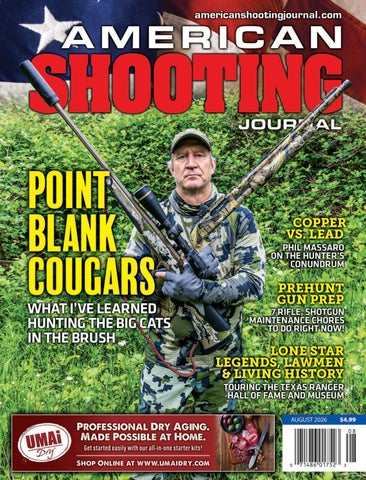
ON THE COVER Scott Haugen is going in armed for … cougars. Calling big cats in the thick brush near his western Oregon home means many shots are taken at close range with either his Browning 6.8 Western or 12-gauge Mossberg Model 535 Turkey Thug. (SCOTT HAUGEN)
Website: AmericanShootingJournal.com Facebook: Facebook.com/AmericanShootingJournal X: @AmShootingJourn Reddit: r/AMSJ/
MEDIA INDEX PUBLISHING GROUP 941 Powell Ave SW, Suite 120, Renton, WA 98057 (206) 382-9220 • (800) 332-1736 • Fax (206) 382-9437 media@media-inc.com • www.media-inc.com
12 American Shooting Journal // August 2026
VOLUME 15 • ISSUE 12
CONTENTS
cover story
25
CALLING COUGARS IN CLOSE
There’s no room for error when you’re hunting up close and personal for problem cougars. Scott Haugen shares what works for “some of the most exciting, thrilling, addicting hunting imaginable.”
FEATURES 31
BULLET BULLETIN: COPPER VERSUS LEAD – THE HUNTER’S CONUNDRUM It’s the “Golden Age of projectiles,” and after a bit of a rocky start with them, these days that includes copper bullets for Phil Massaro. He explores the differences between today’s monometal and lead-core bullets and how both kinds get the job done on big game animals here and in Africa.
42
LOOKING FOR TROUBLE AND PREVENTING IT BEFORE FALL Best thing about August? It ain’t hunting season yet (at least for most of us), and that means there’s still time to ensure your rifles, shotguns, even pistols, are ready for big game and birds and whatever weather autumn throws at us. Dave Workman runs down seven routine maintenance chores to do right now.
48
EXPLORING THE TEXAS RANGER HALL OF FAME AND MUSEUM They’re one of the most famous and celebrated police forces in history, so Paul Pawela was in his happy place at the Texas Ranger Hall of Fame and Museum in Waco, Texas. Take a tour with him of the displays and exhibits here detailing the rich 200-year history of these legendary Lone Star law enforcers.
(SCOTT HAUGEN)
AMERICAN SHOOTING JOURNAL is published monthly by Media Index Publishing Group, 941 Powell Ave SW, Suite 120, Renton, WA 98057. Display Advertising. Call Media Index Publishing Group for a current rate card. Discounts for frequency advertising. All submitted materials become the property of Media Index Publishing Group and will not be returned. Copyright © 2026 Media Index Publishing Group. All Rights Reserved. No part of this publication may be copied by any means, electronic or mechanical, including photocopying or recording by any information storage or retrieval system, without the express written permission of the publisher. Printed in U.S.A.
americanshootingjournal.com 15
61
(MIKE NESBITT)
MORE FEATURES 57
MILITARY SPOTLIGHT: QUIETLY, AND WITHOUT EQUAL Little did Mike Vining know the impact he would have on the US Army and special operations when he signed up in 1968. Paul Pawela profiles how the retired sergeant major who embodies the quiet professionalism of the American soldier transformed the service over a 30-year career.
61
BLACK POWDER: KEEPING UP WITH FATHER TIME Muzzle rests may be pooh-poohed by some in the black powder cartridge world, but for older shooters with poor eyesight and less steadiness of hand, they can be a game saver. Mike Nesbitt shares how a club match was made more inviting when cross-sticks were allowed for those of, er, much experience.
DEPARTMENTS 17 19 16 American Shooting Journal // August 2026
Gun Show Calendar Competition Calendar
americanshootingjournal.com 17
Create dry aged steak and cured meats from home! Whether you’re preserving whole muscle for charcuterie or grinding coarse for fermented salumi, our time-honored spice blends, easy starter kits, and UMAi Dry® technology make it safe and simple to cure like a pro!
Learn how to get started in just minutes! SCAN TO WATCH
Hunter’s Tip: For salumi, ask your butcher for a coarse grind. For charcuterie, keep whole muscle cuts intact. Proper prep makes all the difference!
WITH
SALUMI PRO TIPS
CHARCUTERIE PRO TIPS
Savage Anschutz CZ Marlin Kimber Henry Bergara
MODERN RIMFIRE PARTS
www.DIProductsInc.com
PRIMER
GUNSHOW C A L E N D A R
C&E Gun Shows
August 8-9
Winston-Salem, N.C.
Winston-Salem Fairgrounds
August 15-16
Hamilton, Ohio
Butler County Fairgrounds
August 22-23
Dayton, Ohio
Montgomery County Event Center
August 29-30
Harrisburg, Pa.
PA Farm Show Complex
September 5-6
Raleigh, N.C.
NC State Fairgrounds
August 8-9
Prescott Valley, Ariz.
Findlay Toyota Center
August 15-16
Bakersfield, Calif.
Kern County Fairgrounds
August 22-23
Spanish Fork, Utah
Spanish Fork Fairgrounds
August 29-30
Mesa, Ariz.
Centennial Hall
September 12-13
Phoenix, Ariz.
Arizona State Fairgrounds
August 15-16
Orlando, Fla.
Central Florida Fair Grounds
August 22-23
Tampa, Fla.
Florida State Fairgrounds
August 29-30
Palmetto, Fla.
Bradenton Convention Center
August 15-16
Phoenix, Ariz.
Shriners Auditorium
August 22-23
Glendale, Ariz.
Glendale Civic Center
August 29-30
Huntington Beach, Calif.
Elks Lodge #1959
oregon guns & more SHOW
October 3-4
Redmond, Ore.
Deschutes County Fair & Expo
RK Shows
August 8-9
Knoxville, Tenn.
Knoxville Expo Center
August 8-9
Kansas City, Mo.
KCI Expo Center
August 15-16
Springfield, Mo.
Ozark Empire Fairgrounds
August 15-16
Clarksville, Tenn.
Clarksville Speedway & Fairgrounds
August 22-23
Lawrenceville, Ga.
Gwinnett County Fairgrounds
August 22-23
Joplin, Mo.
Joplin Expo
August 29-30
Chattanooga, Tenn.
Camp Jordan Arena
August 29-30
Blue Ridge, Ga.
Kiwanis Fairgrounds
August 7-9
Bryan, Texas
Legends Event Center
August 22-23
Buda, Texas
Central Texas Fieldhouse
August 28-30
Galveston, Texas
Galveston Convention Center
September 12-13
Aurora, Colo.
Arapahoe County Fairgrounds
cegunshows.com
Crossroads Of The West Gun Shows crossroadsgunshows.com
Florida Gun Shows floridagunshows.com
GunTVShows.com guntvshows.com
oregongunsandmoreshow.com rkshows.com
Texas Gun Shows gunshowstx.com
Tanner Gun Shows tannergunshow.com
To have your event highlighted here, send an email to kaumann@media-inc.com. americanshootingjournal.com 21
PRIMER
COMPETITION C A L E N D A R
August 19-23
September 3-7
September 17-20
August 6-8
August 7-9
August 19-23
August 6-9
August 14-16
Rifle Fall Selections Colorado Springs, Colo. USA Shooting usashooting.org
Shotgun Fall Selections - Skeet Colorado Springs, Colo.
Area 8 Championship New Tripoli, Pa.
Treasure State Championship Billings, Mont.
August 21-23
August 8-9
August 15-16
August 22-23
August 8-9
August 15-16
Northwest Regional Classic Port Townsend, Wash.
August 7-8
Northern Ohio Outlaws Ohio State Shoot Wooster, Ohio Cowboy Mounted Shooting Association cmsaevents.com
August 13-14
Starline Brass Missouri State Fair Classic Sedalia, Mo.
August 8-9 International Defensive Pistol Association idpa.com
Vortex Optics Race Gun Nationals Marengo, Ohio
Illinois Sectional Havana, Ill.
Rocky Mountain Regional Classic Lima Sabres For All Eaton, Colo. Lima, Ohio Glock Sport Shooting Foundation gssfonline.com
ISSO Senior Open 2026 Hillsboro, Ore.
August 28-September 1
Free State USPSA Championship De Soto, Kan.
United States Practical Shooting Association uspsa.org
Shotgun Fall Selections - Trap Colorado Springs, Colo.
Michigan State IDPA Championship Linden, Mich.
Eastern Lakes Section Championship Fulton, N.Y.
Northern California Regional Classic Richmond, Calif.
Keystone State Ballistic Challenge Mertztown, Pa.
August 29-30
August 15
August 21-23
August 15-16
August 22-23
August 20-22
August 22
Colorado State Championship Eaton, Colo. Minnesota State Shoot Fergus Falls, Minn.
Oak Park Glock Challenge Plainfield, Ill.
North Central Regional Cedar Rapids, Iowa New York State Championship Pittsfield, Pa.
North Carolina State IDPA Match Dairyland Duel Oxford, N.C. Ripon, Wis.
To have your event highlighted here, send an email to kaumann@media-inc.com. americanshootingjournal.com 23
TROPHY MOOSE & BEAR HUNTING Alaska’s Premier Fully Guided River Hunts
MORE THAN A HUNT This is an unforgettable Alaskan adventure that blends raw wilderness, world-class game, and the thrill of pursuing some of North America’s most iconic animals in their natural environment. Long days on the river. Close encounters. The kind of moments you’ll talk about for the rest of your life.
WHY HUNT WITH US • Trophy moose & bear hunts in prime river systems • Regular 60”+ bull moose opportunities • Near-100% opportunity rate on legal bulls • High success on large Alaskan bears • Fully guided & all-inclusive hunts • Expert guides with deep local knowledge • Carefully selected locations for consistent results • 11–15 day hunts with 15-day combo moose & bear hunt available Every hunt is carefully planned and professionally guided from start to finish. From scouting and calling to field care and logistics, your guide handles every detail so you can stay focused on the hunt.
BOOK YOUR ALASKAN TROPHY HUNT! Contact us today to secure your hunt and discuss available dates. www.alaskaeliteoutfitters.com 218-434-0068 • 907-464-6165 mike@alaskaelieteoutfitters.com
ROAD HUNTER
Author Scott Haugen’s last gun setup, a 12-gauge Mossberg Model 535 Turkey Thug and Winchester 3-inch size 00 buckshot shotshell, dropped this cougar at 12 paces.
CALLING COUGARS IN CLOSE
What one hunter has learned about big cats in brushy country. STORY AND PHOTOS BY SCOTT HAUGEN
T
he transition from full speed to stealth mode was instant. Thirty-three minutes into my calling sequence, a cougar busted out of the brush. Its muscles rippled beneath a dull, gray coat. Its head cocked 90 degrees to pinpoint the distress squirrel sounds coming from an
electronic speaker tucked into brush on the ground. I anticipated the cougar coming down one of two trails. It took neither. My shotgun was already in the shooting sticks. I had to adjust my point of aim to the left. The lion caught the slight movement and grew tense. I was unsure if it was going to flee or charge, but it didn’t matter. A payload of 00 buckshot was on the way. At 12 paces, it was over in an
instant. Thirteen of the 15 pellets hit the cat, nine of which I’d consider lethal impact.
CALLING IN BIG predators that have the
ability to kill you is the ultimate rush. I’ve experienced it with big bears in Alaska, man-eating lions in Africa and multiple cougars. In this game there’s no room for error. The entire approach is based on precision. This is my fifth year of calling americanshootingjournal.com 25
ROAD HUNTER cougars in this specific location in western Oregon. It’s the third one I’ve called in and killed over the last two years. I’ve called in five others that hung up in thick cover too dense to shoot through. Some of those have passed less than 10 feet from where I sat using mouth calls. The mountainous area is small, just under a square mile. But it’s thick and steep in places. Blacktail deer, cottontails, a mix of squirrels and loads of birds thrive here, and that’s what attracts these mountain lions.
A smattering of old logging roads have turned into narrow, mostly overgrown ATV trails meandering through the dense, 18-year-old Douglas fir trees. Beneath the trees, visibility is limited to mere feet. Several of my setups in cover find me anticipating shots to come between 10 to 20 feet, sometimes closer. Thankfully, I live in a state that still allows the use of cellular trail cameras, which are perfect for this type of problem predator control. I now have over 40 trail cameras set
throughout this area, and gradually expand that number as cats continue to humble me. Between information gleaned from trail cameras and spending countless hours on foot, I’ve learned where cats want to be and what paths they travel to get there. I used to spend hours blindly calling in these foothills of the Cascade Range, just hoping to bring in a cougar. I’ve learned that approach is a game of chance that rarely results in victory.
Haugen often enters the cougar woods with a rifle and shotgun. Which one he chooses depends on shooting lanes and potential shot distances, which can change with each set.
26 American Shooting Journal // August 2026
FOR ME, SUCCESS has come down to knowing every inch of the landscape, being aware what time of year cougars pass through and even thrive here, and wasting no time getting on them when they appear on cellular trail camera. Knowing exactly where I have to be to effectively set up and call in a lion is planned before a cat even arrives. Three-quarters of the game cams I run are Moultrie cellular units.
The author likes using mouth calls in combination with e-callers. This is where he shot his last cougar, from behind a makeshift blind of fresh-cut fir boughs.
Cellular trail cameras are one of the most important tools in my cougar hunting success where timing is everything. Exactly 1 hour and 43 minutes elapsed from the time I caught the last lion on a Moultrie camera, drove from home, got set up, called and pulled the trigger. Mind you, this is not a backcountry ordeal. These cougars are coming to kill some of the local wildlife, but largely to hunt for house cats, dogs and livestock in people’s yards that adjoin the timbered, brush-choked hills. A major highway runs less than a mile from most of my setups, and the number of cougars I’ve caught within 50 feet of houses is mind boggling. In some of the thick cover and wooded draws, cell coverage is absent. These are the places I rely on Stealth Cam DS4K Ultimate trail cameras. I set them on the highest quality video mode and for the longest run time
option, three minutes. I load them with 64GB SD cards to hold all the footage. These cameras have provided me with invaluable insight as to when and where cougars are moving, in places where cell cameras don’t function. A Stealth Cam DS4K trail camera helped me pinpoint where the last cat I killed was spending its days. The sooner you can get on a cougar, the greater the odds of calling it in. But it’s not a guarantee. Over 80 percent of the cats I’ve gotten on within two hours of being seen on trail camera, or by a landowner, have come to calls. I’ve never called in a cougar that’s had a three-hour or longer head start. And I’ve never had luck calling the big cats back to a place where they’ve already been, which is where knowing the habitat and the cat’s path of travel allows you to get ahead of them. This is the epitome of situational calling.
Haugen with a problem mountain lion that had been stalking livestock and neighborhood pets for weeks. It had recently killed three house cats and attacked a dog in broad daylight. He called it in and shot it at 12 yards.
There’s no magic bullet. I’ve had to figure it all out alone. On a recent set, I hung a turkey wing as a decoy in a tree above my e-caller. A cougar came in and laid in thick brush for 35 minutes, staring at the wing. It was too brushy for a shot, even with my shotgun. It made me wonder how many times this has happened without my knowing, where a cat hangs up in brush that I have no idea is there. Now, when calling in thick cover where cats can potentially hide, I go without a decoy. I want them coming out of the cover. When a mature tom appears, I like running cougar mating sounds and cougar whistles. This combo brought in the last adult female I shot; there was a big tom in the area too. I’ve tried these sounds many times when females with yearlings show up, and when lone females are in the area, with no success. americanshootingjournal.com 27
ROAD HUNTER THE LAST COUGAR I called in was a
juvenile female. I called to her three times in a week. I think my first two attempts were overly aggressive with loud fawn and livestock distress sounds. I also used other aggressive predator sounds. I think this cat was
too timid. She’d left her littermates – both males – six weeks prior. Given her propensity to stalk cats and dogs near homes meant she was having trouble killing wild game, so the next time I used subtle calls to bring her in. The sequence began with very light
Haugen caught five cougars on one trail camera this particular morning. This one came down a trail to his calls and was shot at 48 yards with a Browning 6.8 Western.
28 American Shooting Journal // August 2026
rodent sounds on a FoxPro X24. I let them run four or five minutes, paused two minutes, then upped the volume for three minutes on the next series. After a minute or so pause, I started the third sequence with mid-volume rodents, then ran it to full volume, then toned it down. That lasted about four minutes. The next two sequences on the FoxPro were flying squirrels. We have a lot of squirrel subspecies in the woods, including flyers, but I just like the sounds of these unique tree squirrels that actually spend a lot of time on the ground at night. The first sequence was low volume for three minutes, then about a minute pause, then it built to louder – not maxed – on the followup. I let things settle down for a few minutes, then used my Slayer Call External Cow Call to produce bird distress sounds. This is my favorite allaround predator calling sound. After a few minutes and no cat, I went back to low volume flying squirrel sounds on the FoxPro. It ran only a few seconds before the cat busted out of 3-foot-tall grass and thick briars, skirted around low-growing fir boughs and stared at the speaker. The speaker was 30 feet from where I sat, the cat 6 feet from that when I shot. When it comes to calling cougars, I still have a lot to learn, but at this point one of my biggest takeaways is that each calling is very site-specific. My goal is to pique the curiosity of a mountain lion. I think a lot come in but we never see. My run times are longer than most hunters – often two hours – and I switch species and fluctuate volumes more than anyone I’ve talked with. It’s working, and all my moves are based on what I’ve learned through trial and error, spending time in the woods, and studying hours of trail camera video clips. When it comes to consistently calling in brush country cougars, the best way to learn is by being afield. Once you get dialed in, hold on, for some of the most exciting, thrilling, addicting hunting imaginable will consume your life – that, I do know. ★
How To Have FUN Making Money Working On Guns, PartTime, FullTime or in Retirement!
BECOME A CERTIFIED GUNSMITH!
Study from home and become an AGI Certified Professional Gunsmith! Learn through the American Gunsmithing Institute’s studyathome Virtual Campus™ where Master Gunsmiths teach you gunsmithing stepbystep using video instruction with cutaway firearms to take you deep inside the guns. You will understand complete Design, Function, and Repair for all pistols and revolvers, shotguns, centerfire, and rimfire rifles.
AS A GUNSMITH YOU CAN BE YOUR OWN BOSS!
BE IN CONTROL OF YOUR TIME AND INCOME! You can open a small shop or even work from home! Anyone can learn this important and essential INDEMAND TRADE. 18007970867
• The ONLY Gunsmithing School with Design, Function, and Repair Training • Comprehensive how to instruction on video • How to stepbystep courses on customizing firearms Get Your FREE • Complete machine shop and welding courses • Start making money Gunsmithing in as little as 90 days! Information On How • Ongoing support from AGI Master Gunsmiths To Get Started In • Gunsmithing Business Success Training Gunsmithing Today! • FFL starter kit included The American Gunsmithing Institute’s approval to operate as a private postsecondary institution in the state of California is based on provisions of the California Private Postsecondary Education Act (CPPEA) of 2009 (California Education Code, Title 3, Division 10, Part 59, Chapter 8), which was effective January 1, 2010. The Bureau can be reached at 2535 Capitol Oaks Drive, Suite 400, Sacramento, CA 95833, www.bppe.ca.gov, tollfree telephone number (888) 3707589 or by fax (916) 2631897. Professional Gunsmithing Courses not available to Oklahoma residents at this time. Go to
www.AmericanGunsmithingInstitute.net/ASJ
use code
ASJ26
AGI is the #1 highest rated Gunsmithing School in the nation, recognized for outstanding customer satisfaction! Rated by what truly matters - actual online reviews from AGI Gunsmithing Students. Check out AGI Student reviews at www.AGIReviews.com
HOW-TO GUNSMITHING COURSES ON VIDEO!
1-800-797-0867 AGI, Preserving Freedom One Gun at a Time Since 1993!
• Cerakote Application Course Step-by-Step Instruction • Extractors & Ejectors Course GET CERTIFIED NOW! • Survival Gunsmithing Course • Certified Master Armorer Course • Build A Custom Mauser Rifle • Certified Glocksmithing Course • Building An M-1 Garand vailable • Certified 1911 Pistolsmithing Course A • How To Build An AR-15 on DVDe! • Certified AR15 Riflesmithing Course • Building The Ultimate Onlin • Certified Machine Shop Course Tactical or Varmint Rifle or • Building A Custom Ruger 10/22 Rifle • Certified Professional Welding Course • Pillar Bedding Rifles for Accuracy • Certified Reloading from A-Z Course • Professional Gun Cleaning Course • Certified Red Dot Installer Course • Stock Refinishing Course • Certified Firearms Appraiser Course • Glass Bedding Course • Certified Cowboy Action Armorer Course • Custom Barreling Bolt Action Rifles • Certified Law Enforcement • How To Rebarrel, Blueprint and Armorer Course Tune Mauser Bolt Action Rifles • How To Install a Recoil Pad Scan the QR to Learn More! • Relining .22 Barrels
30 American Shooting Journal // August 2026
www.AmericanGunsmith.com
BULLET BULLETIN
Variety is the spice of life, and we have a wide variety of big game bullets to choose from these days.
COPPER VERSUS LEAD: THE HUNTER’S CONUNDRUM
The differences between today's monometal and lead-core bullets and how they get the job done. STORY BY PHIL MASSARO • PHOTOS BY MASSARO MEDIA GROUP
e’d tracked the Cape buffalo bull and his two companions for about a mile from the tiny spring where we’d cut spoor, when our excellent tracker Albert stopped short in his tracks and fully extended his right arm, pointing at something I couldn’t see. It didn’t matter; I’d hunted with Albert enough to trust
W
that he knew what he’d seen. My professional hunter – the estimable Brian van Blerk – crept over to Albert’s shoulder and whispered in Shona. Within seconds, Brian motioned for me to come forward, slowly, as he spread the shooting sticks. I brought the Heym 89B to my shoulder, placing my left hand in the V of the sticks, properly identified the right shoulder of the quartering bull and, after being given the go-ahead, broke the right trigger.
The .470 Nitro Express went into recoil, sending a 500-grain Peregrine BushMaster into the boiler room, and I saw the bull drop seconds later. The death bellow is one of the happiest sounds any buffalo hunter could hear, and I was more than pleased to hear it. Those copper Peregrines would go on to be one of my favorite buffalo bullets.
I AM OLD enough to remember when the Barnes X came onto the scene in the late 1980s and early 1990s, and how americanshootingjournal.com 31
BULLET BULLETIN skeptical many hunters – including my father – were of the new concept. A rifle bullet without lead? How was this even possible? I saw the articles in those hunting magazines I loved so much, and despite the smiling trophy photos and recovered bullets, it just didn’t make sense. Fast forward eight or 10 years, and you’d find me cobbling together Barnes X bullets and IMR 4064 in my .308 Winchester, only to see groups I couldn’t cover with my hand. Same thing with the .375 H&H I’d just picked up; I’d pretty well sworn off copper bullets. Now, lead-core projectiles were an entirely different story. I had great results as a new handloader with Hornady Interlocks, Sierra GameKings, Speer Grand Slams,
Author Phil Massaro has become a big fan of Peregrine BushMaster copper projectiles. The South African bullets have performed very well on a number of different game species, including Cape buffalo.
The Hornady Interlock is a good cup-and-core bullet; it’s wonderful on deer and other thinskinned game, but on larger species you might opt for something tougher.
32 American Shooting Journal // August 2026
Nosler Partitions and Ballistic Tips, and Remington Core-Lokts. From deer to caribou to moose, as well as loading for a couple safaris (sadly not my own, yet), I had all sorts of faith in those classic designs. I went out on a limb in bullet choice when I booked a bison hunt in South Dakota, experimenting with the Swift A-Frame. The performance of that bullet on such a huge slab of meat made an undeniable impression on both the bison and me, and I came to appreciate the benefits of bonded-core projectiles. It was on a Texas deer hunt, my first as a writer, when I was forced to use a copper projectile in a .243 Winchester, dropping a big seven-point in his tracks. Maybe these things weren’t so bad after all … Since those days, I’ve come to use a very wide variety of projectiles, both lead-core and copper monometal, and I have come to form many opinions on both. I’m frequently asked for recommendations for a particular hunting situation, whether a buddy is going on a first safari or a reader is looking for advice for an antelope hunt out West, and there are many different correct answers. I feel, however, that there are interesting points of difference between copper monometal and leadcore bullets that many people aren’t aware of, and that I will highlight here.
BULLET BULLETIN
Hornady’s DGX (Dangerous Game eXpanding) had some structural issues initially, but once the company bonded the core and jacket, the bullet became a favorite in the game fields, as it held together and penetrated wonderfully. Randy Brooks had the concept of removing the lead core from the common projectile, resulting in the Barnes X bullet. Shown here is a newer iteration, the TSX.
34 American Shooting Journal // August 2026
LEAD WAS CHOSEN for the material for our earliest firearm projectiles because of its low melting point and its malleability. But as powder technology improved, ballisticians reached the velocity limit – somewhere around 2,000 feet per second – and saw the bullets moving too fast to “take” the barrel’s rifling and smearing lead throughout the bore. Copper is a harder and lighter metal than lead, and coating a lead bullet in a thin jacket of copper allowed the bullet to withstand the effects of enhanced velocity, while keeping fouling to a minimum. By the time the 19th century gave way to the 20th, a jacketed rifle bullet – either a softpoint with some lead exposed at the nose or a full metal jacket with the entire bullet jacketed in copper – became the norm. But hunters were quick to push the limits of the jacketed bullet, as the velocities increased and the commonly accepted caliber minimums decreased. If the copper jacketed bullet was too light/ short, penetration was poor. If you
BULLET BULLETIN
The Barnes TSX copper bullet has become a favorite of hunters, and is loaded in Barnes ammunition, as well as by Federal Premium and more boutique companies like Choice Ammunition. Nosler’s Ballistic Tip performs as you’d want a cupand-core bullet to – it transfers energy quickly and gives good expansion, perfect for thinskinned game.
The Barnes X was named for the resulting shape of the upset bullet: a bright copper X.
John Nosler’s frustration with cupand-core bullets led him to add a partition of copper to divide the core in half. The result – the Nosler Partition – gives reliable expansion up front and deep penetration for a quick kill.
36 American Shooting Journal // August 2026
are a fan of older hunting articles, the recommended cartridges and bullet weights will reflect this. Numerous attempts were made along the way to keep the cup-and-core bullets together during the terminal phase, including locking the jacket to the core via a cannelure or crimping groove (think Remington Core-Lokt), using two cores of differing hardness (Speer Grand Slam), using a partition of copper between two cores (Nosler’s Partition), or chemically bonding the jacket to the core (Swift Scirocco II). All worked with varying degrees of success. It was Randy Brooks’ idea to remove the lead core altogether, using a hollowpoint bullet constructed of a single copper alloy. The design was eventually perfected, and nearly every major manufacturer offers some sort of lead-free copper rifle projectile; you might use them because you like the performance or because local legislation demands it. Despite my initial loathing of copper bullets, I’ve come to love them. The Peregrine BushMasters (a South African bullet) are absolutely lethal on big game animals, and the Barnes
BULLET BULLETIN
The Swift Scirocco II was among the first commercially successful bonded-core bullets, and is both tough as nails and wonderfully accurate. The author has used it for deer, bear and more species with great results.
TSX and Banded Solids can greatly enhance the capabilities of already proven cartridges, like the .30-06 or the .375 H&H Magnum. Hornady’s CX, Federal’s Trophy Copper, Nosler’s E-Tip and more are available to those who want the performance of copper projectiles. But how do they differ from lead-core projectiles, and which will best suit your needs?
BECAUSE COPPER IS lighter than lead, comparing two projectiles of the same conformation, weight and caliber will easily show that the copper projectile is longer. In a cartridge with plenty of room to seat a bullet both in and out of the case mouth, there won’t be an issue. But those cartridges with less wiggle room, like the .300 Winchester Magnum, .350 Remington Magnum and .308 Winchester, the longer/heavier copper projectiles might pose an issue. Either case capacity or overall cartridge length will be compromised. However, because the copper slugs generally have a higher weight retention, you might be able to get the same terminal performance from a lighter copper bullet as you would from a heavier cup-and-core copper jacketed lead bullet. Lead-core bullets tend to be shorter, and their center of gravity tends to be closer to the meplat. If your chosen cartridge has a limited case 38 American Shooting Journal // August 2026
capacity, a good lead-core bullet might be the smarter choice. Now, a standard cup-and-core bullet is not a bonded-core bullet, as the latter will usually retain more weight and offer deeper penetration. But whether or not the stiffer construction of the bonded-core or partitioned lead-core bullet is needed can be debated. For the average deer hunter, those traditional cup-and-core designs
Swift’s A-Frame operates on much the same principle as the Nosler Partition, but sees the front core chemically bonded to the thick jacket. Shown here is a .416-inch 400-grain A-Frame, recovered from a Zambian buffalo bull.
like the Remington Core-Lokt and Hornady InterLock should be just fine; they transfer energy quickly, and if of appropriate sectional density will penetrate deep into the vital organs, if not exit. Change the game animal to elk or moose, and you might want a partitioned bullet or a bondedcore, especially if using a cartridge that is usually at the bottom of the recommended spectrum. When it comes to dangerous game animals, especially the thick-skinned heavyweights, I prefer either a copper monometal or one of the bonded-core, partitioned or combination bullets. The Woodleigh Hydrostatically Stabilized Solid is a solid copper bullet that offers just a bit of expansion at the nose, creating a cavitation bubble which allows for very deep, straight-line penetration. The Swift A-Frame is a fantastic bullet, being both partitioned and bonded (the front core, anyhow). Among the lead-core bullets, it offers great expansion, deep penetration and high weight retention, if the animal is big and tough enough to properly upset the bullet. I can say the same for the famous Barnes TSX;
americanshootingjournal.com 39
BULLET BULLETIN a bigger animal with thicker hide and bones will see that copper bullet give better expansion. Smaller animals might see this pair of projectiles sail right on through, depending on velocity and caliber. While most monometal projectiles exhibit high weight retention, there are some examples that are designed to shed the frontal portion of the bullet, breaking into fragments for initial trauma, with the base of the copper bullet giving straight-line penetration. Among these are the Hammer bullets, Lehigh Defense’s Controlled Chaos and Cutting Edge Bullets’ Raptor. I tend to err on the side of caution, equipping myself with a bullet a bit tougher than I might need in case of a less-than-desirable shot angle. This principle absolutely applies to magnum cartridges, where the higher impact velocities might not work well with a traditional cup-and-core design, yet I need the guarantee of reliable expansion at longer distances. That’s where many of the polymertipped designs come into play, be it in a bonded-core design or one of the monometals. Nosler’s AccuBond, Barnes’ TTSX and LRX and Swift’s Scirocco II all fall into this category.
Though one of the strong points of copper bullets is their high weight retention, some bullets like the Cutting Edge Raptor are designed to fragment for a unique blend of shallow impact trauma and deep penetration from the base, which stays at caliber dimension.
40 American Shooting Journal // August 2026
The Woodleigh Weldcore is a great bonded-core bullet, with a profile very similar to that of the old Kynoch projectiles. They are hell on game, and regulate well in vintage double rifles.
The author used a 250-grain Woodleigh Weldcore in his .318 Westley Richards to take a good kudu bull in Zimbabwe. Despite nearly 5 feet of penetration, the bullet was recovered and gave good expansion and weight retention.
One word of warning regarding the modern copper bullets and vintage rifle barrels: There is the risk of damaging older barrels with the heavier copper bullets, as the harder material can actually cause the rifling to “print” on the outside of the barrel. This phenomenon often rears its ugly head in vintage double rifles, so in those guns with softer barrels, stick to lead-core bullets. Being honest, I am glad I don’t have to decide between these two designs. We are, undeniably, living in the Golden Age of projectiles, and I enjoy the preparation and choice of cartridge and projectile almost as much as the hunt itself. Experiment with a few of the different designs, and you might find the bullet that your hunting rifle likes best. ★
americanshootingjournal.com 41
Looking For Trouble and Preventing it Before Fall Do these seven things to ensure your guns are ready for big game and bird hunting seasons.
STORY AND PHOTOS BY DAVE WORKMAN
T
he best thing about August is not that it’s only a couple of months before big game and bird hunting seasons kick off in most states; rather, it’s the availability of warm, lazy summer afternoons and evenings to get ready. I’m not only speaking about trips to the range to make sure your rifle(s) still shoot to zero, and to brush up your shotgunning skills. I use this time to prepare each of my hunting rifles and shotguns for what just might be some nasty times ahead. There is much more to it than firing a few rounds at a target, and I have known people who waited until a week before the opener, or didn’t do it at all, and paid the price for a ruined hunt. August allows one to find problems and fix them, or prevent problems from happening in the first place. Here’s a check list for the hunters out there:
1
Before even thinking about a range visit, pull your rifles and shotguns out of the safe or their case, and look them over carefully. A couple of years ago, I wound up having to replace the recoil pad on my over-andunder shotgun right as the grouse season opened because it was literally crumbling apart; why, I don’t know and never bothered to find out. Rather than send off a note to the manufacturer, I found a suitable replacement online, had it shipped directly second day, and had it mounted within an hour of my arriving home from the office. It only took a tiny amount of sanding to make it match up with the butt. (Hint/tip: Whenever you replace a recoil pad, be sure to wipe a bit of linseed oil on the exposed butt end wood before screwing the new pad on tightly.)
42 American Shooting Journal // August 2026
Author Dave Workman advises people preparing for fall hunting seasons to do routine maintenance on their rifles, shotguns and pistols right now.
americanshootingjournal.com 43
2
Now is a good time to pull the stock off of your rifle, or if it has a free floating barrel, run an oiled patch full length down the underside of the barrel. Surprising as it may seem to some folks, rust or corrosion can form in areas you might never expect. Even if your rifle barrel is bedded, months in a safe or in a case stuck in the corner of a closet just might allow condensation to form. Do this whether your rifle has a wood or synthetic stock. In the event you discover rust, get some fine steel wool and start rubbing. Use cold blue and follow the directions to touch up any bare metal. One product I discovered several years ago is Ballistol. It’s a slick lubricant which also cleans and penetrates, can be used for cleaning muzzleloaders, and there are wipes available. Run one of these thin wipes under your gun barrel and it leaves a protective film that resists condensation. I’ve pulled the stock off a rifle, and when it was all back together, it shot right back to point of aim, since I did not tamper with the scope or the mounts. I cannot guarantee this will be your experience, but don’t be surprised if it is.
3
Call this the “old neutral shoe wax trick.” Decades have passed since I learned about hand rubbing a rifle or shotgun stock with neutral Kiwi shoe wax on a nice, warm day and allowing it to set a while before rubbing it off. If there is a scratch in your stock, the wax will penetrate because of the warm weather, providing an extra layer of protection from rain, snow and the kind of moisture that just might present a problem. I refinished the entire stock on a .54-caliber muzzleloader one summer, first applying a 50-50 mix of warm linseed and tung oil, and a couple of days later, an application of warm neutral shoe wax. That stock sheds water better than duck feathers.
4
Back in the December 2025 issue of American Shooting Journal, I covered revolver maintenance, and those principles still apply
44 American Shooting Journal // August 2026
Gun oil, solvent, Ballistol wipes, cleaning patches and tools – what anyone needs for keeping their valuable guns working.
Preseason maintenance involves more than running a patch down the bore to make sure it is clean. This is a good start, but much more is involved.
Here, Workman is running an oily patch along the underside of his rifle barrel to protect it from moisture and resulting rust.
Remove the bolt and wipe it all around with an oiled cloth. This slicks up the action and protects the bolt surface.
Workman likes to do his maintenance projects outside, with his rifles held in a portable mount.
on
americanshootingjournal.com 45
today. Pull and lubricate the cylinder, the internal mechanism – anywhere you can add a drop of oil down into the hammer and trigger. On a singleaction, clean and lubricate the ejector rod housing. This is also the best time to be practicing with, and cleaning, your .22-caliber semiauto pistol if you carry one while hunting big game. It’s a tradition here in the West for popping grouse or rabbits, and exactly 10 years ago this month, I bought a Ruger MKIV, which is easily field-stripped, compared to the MKI, MKII and MKIII, all of which can be a pain in the neck to reassemble. (Been there, done that!)
Examine your muzzle to see if it might be damaged.
5
If you have interchangeable choke tubes in your shotgun, wipe the threads with an oily cloth, and that includes pulling the tube(s) out of the barrel(s). Check the bore(s) and run a brush down the barrel(s) to clean out any lingering crud from last season. Finish cleaning with oiled and then clean patches.
Workman had to replace a recoil pad a couple of years ago when the factory pad literally began crumbling! Fortunately, he made a quick fix, but you can head such problems off right now!
6
Of course you will want to run a patch down your rifle barrel. First soak a patch in Hoppe’s No. 9 or some other solvent, and follow it up with a couple of dry patches to remove the crud. Then, add just a couple of drops of oil to a patch and run it down the barrel. This is also a good time to examine the muzzle to see if there are any accuracy-destroying nicks. I have known people who claim they never clean their guns. Ignorance may be bliss to some people, but it can turn into a costly act of neglect at the wrong time.
7
Now, after all of this preventive maintenance has been accomplished, head to the range – or wherever you practice – and make sure everything is working properly. Waiting until the day before your hunting season opens is likely to result in disappointment. ★
46 American Shooting Journal // August 2026
One trick Workman learned years ago is to rub a rifle stock with neutral shoe wax and allow it to set for a while. In warm weather, the wax will penetrate scratches and protect the wood.
Once your maintenance has been completed, then you should retire the range and check your accuracy.
Workman’s cleaning kit contains bore brushes, mops, cleaning rod, various patches, a clean cloth and more.
e has been hould retire to ur accuracy.
Remove the choke tubes from your shotgun(s), clean the threads, and oil them.
Now is also a good time to clean your rimfire pistol in anticipation of spotting a grouse or rabbit during a big game season. americanshootingjournal.com 47
Exploring the Texas Ranger Hall of Fame and Museum Displays and exhibits detail history of the legendary Lone Star law enforcers.
F
STORY AND PHOTOS BY PAUL PAWELA
ew law enforcement organizations in the United States have captured the public’s imagination quite like the Texas Rangers. Their stories have inspired countless books, films, television series and legends that portray fearless officers riding across the Texas frontier in pursuit of justice. Yet behind the mythology lies a much richer and more complicated history, one that spans more than two centuries and reflects the growth of Texas itself. For anyone interested in learning about that history, there is no better destination than the Texas Ranger Hall of Fame and Museum in Waco, Texas. The museum serves as the official historical center dedicated to preserving the heritage of the Texas Rangers. Visitors from across the United States and around the world come to explore exhibits featuring authentic artifacts, historic documents,
48 American Shooting Journal // August 2026
interactive displays and personal stories that illustrate how the Rangers evolved from a small frontier militia into one of America’s most recognized state law enforcement agencies. From the moment visitors enter the museum, they discover that it is much more than a collection of old uniforms and antique weapons. It is a place where history comes alive through carefully preserved artifacts, educational exhibits and thoughtful storytelling that invites guests to examine both the achievements and the challenges of the Rangers’ long history.
Author Paul Pawela (right) and colleague Pablo Martinez at the Texas Ranger Hall of Fame and Museum and some of the displays on the grounds outside. americanshootingjournal.com 49
50 American Shooting Journal // August 2026
THE STORY BEGINS in 1823,
when Stephen F. Austin organized small groups of mounted volunteers to protect settlers in Mexican Texas. The frontier was vast, communications were limited and settlements were often isolated. These early Rangers served as scouts, defenders and messengers, facing harsh conditions that demanded courage, endurance and resourcefulness. As Texas grew, so did the Rangers’ responsibilities. They served during the Texas Revolution, protected communities during the Republic of Texas and later became an official state law enforcement organization after Texas joined the United States. Throughout the 19th century, they adapted to changing conditions, from frontier conflicts to investigations into cattle theft, bank robbery and other crimes that accompanied a rapidly expanding population. The museum presents this evolution chronologically, allowing visitors to understand how each generation of Rangers faced distinct challenges while adopting modern technologies and investigative methods. The galleries are arranged to guide visitors through more than 200 years of Texas history. Rather than focusing solely on famous individuals, the exhibits explain how historical events shaped the Rangers and how the Rangers, in turn, influenced Texas’s development. Interactive exhibits allow guests to examine historical evidence, explore maps and view multimedia presentations featuring interviews, photographs and historical footage. Families often find these exhibits especially engaging because they encourage visitors of all ages to participate in the learning experience rather than simply viewing artifacts behind glass. That said, the museum’s greatest strength is its remarkable collection of authentic artifacts. Every badge, revolver, letter and photograph represents a personal story rather than simply an object from the past. Original uniforms display the practical clothing Rangers wore across
Inside, exhibits include many artifacts showing the iconic symbols and history of the Rangers. americanshootingjournal.com 51
different eras, while weathered saddles and equipment illustrate the hardships of traveling across the rugged Texas landscape. Visitors can examine official documents, handwritten reports and historical correspondence that reveal how investigations were conducted long before computers and digital communications transformed police work. Historic patrol vehicles illustrate how transportation evolved throughout the 20th century, while exhibits on forensic science explain how modern Rangers investigate complex criminal cases with advanced technology unimaginable to their predecessors. These collections help visitors appreciate that history is built not only on major events but also on the everyday work of dedicated individuals.
ONE OF THE museum’s most
meaningful spaces is the Hall of Fame itself, where distinguished Rangers are honored for exceptional service. Portraits, biographies and personal
The museum showcases many firearms and the stories that made them famous.
memorabilia celebrate individuals whose dedication has left a lasting impact on Texas law enforcement. Nearby memorial exhibits honor Rangers who lost their lives while serving their communities. Rather than glorifying conflict, the memorial emphasizes sacrifice, professionalism and public service. For many retired Rangers and their families, the museum is a place of pride, preserving their history and contributions for future generations. Popular culture has often portrayed the Texas Rangers as mythical heroes. Western novels, radio programs, comic books, television series and Hollywood films have helped create an image of 52 American Shooting Journal // August 2026
fearless lawmen who always prevail against overwhelming odds. The museum acknowledges this popular image while encouraging visitors to distinguish between legend and documented history. Exhibits explain how fictional portrayals sometimes exaggerate events or simplify complex historical situations for entertainment. One of the most valuable aspects of the museum experience is its recognition that history is rarely simple. Over the years, historians have examined controversial episodes involving the Rangers’ relationships with Native American tribes, Mexican Americans and other communities during periods of
The collection would not be complete without telling the stories of the people who served as Rangers.
conflict and political change. Beyond its public galleries, the museum houses an impressive research center that preserves thousands of historical records, photographs, manuscripts, books, newspapers and official documents. Historians, authors, students, genealogists and documentary filmmakers frequently consult these collections to research Texas history and the development of law enforcement. The archives help ensure that valuable historical materials remain accessible to future generations while supporting ongoing scholarship that deepens our understanding of 54 American Shooting Journal // August 2026
the Texas Rangers and their role in American history.
MUSEUMS PRESERVE MORE
than objects; they preserve stories. The Texas Ranger Hall of Fame and Museum reminds visitors that history is an ongoing conversation rather than a fixed set of facts. Every artifact, photograph and document contributes to a broader understanding of Texas’s development and of how law enforcement evolved alongside the communities it served. The museum offers an unforgettable experience. Long after visitors leave Waco, they carry more than memories
of exhibits and artifacts. They leave with a deeper understanding of the people who helped write Texas history, the challenges they faced and the importance of preserving that history for generations yet to come. That is what makes the Texas Ranger Hall of Fame and Museum not simply a museum but a living connection to the past and an essential stop for anyone seeking to understand the Lone Star State. If you ever find yourself traveling on I-35 between Dallas-Fort Worth and Austin, stop by the Texas Ranger Hall of Fame, which is well worth the $10.50 admission fee. ★
MILITARY SPOTLIGHT
QUIETLY, AND WITHOUT EQUAL
Mike Vining's 30-year military career transformed the Army and special operations. STORY BY PAUL PAWELA
B
orn on August 12, 1950, in Greenville, Michigan, Mike Roger Vining developed an early fascination with science and engineering. As a teenager, he built chemistry apparatus, studied explosives from technical manuals and excelled in science competitions. Like many young Americans of his generation, he watched the Vietnam War unfold on television. The Tet Offensive in 1968 convinced him to pursue military service. In 1968, he enlisted in the US Army at age 17, completed basic training at Fort Knox, and then attended advanced ammunition training at Redstone Arsenal. Recognizing his technical ability and attention to detail, the Army selected him for the demanding Explosive Ordnance Disposal Course and later the Nuclear Weapons Disposal Course. These schools prepared soldiers for one of the Army’s most dangerous specialties. EOD technicians identify, render safe and dispose of everything from conventional artillery shells to sophisticated explosive devices. Vining was deployed to Vietnam with the 99th Ordnance Detachment (EOD), where he quickly realized that no amount of classroom instruction could fully prepare a soldier for combat. His duties included clearing unexploded ordnance, destroying enemy ammunition stockpiles and supporting combat operations in dangerous environments. One of his most significant assignments was helping to destroy enormous enemy weapons caches discovered in Cambodia, where EOD teams worked inside tunnels and underground storage
US Army Sergeant Major (retired) Mike R. Vining in 1999. (US ARMY)
complexes filled with ammunition and booby traps. The work was painstaking and hazardous. Soldiers crawled through confined tunnels infested with poisonous insects, snakes and other wildlife while placing demolition charges capable of destroying hundreds of tons of captured enemy ammunition. During one operation,
American forces used more than 100 cases of C-4 to eliminate a massive cache of munitions. For his meritorious service in Vietnam, Vining received the Bronze Star. After completing his tour in Vietnam, Vining briefly left the Army and worked in Michigan’s automotive industry. Although the civilian job offered stability and good pay, he soon americanshootingjournal.com 57
MILITARY SPOTLIGHT realized that military service remained his calling. He reenlisted in 1973 as an EOD specialist at Fort Leonard Wood, Missouri. During this assignment, he responded to numerous bomb threats and terrorist bombings. During a highly dangerous operation in Quincy, Illinois, he displayed exceptional courage while responding to a series of bombings, earning recognition for his heroism. IN THE LATE 1970s, Colonel Charles “Charlie” Beckwith was creating an elite counterterrorism unit modeled after Britain’s Special Air Service. Volunteers underwent one of the Army’s toughest selection processes. Vining volunteered. He became one of the first EOD technicians selected for the new unit and completed Operator Training Course 1, making him one of Delta Force’s earliest members. His assignment marked a significant milestone because expertise in explosives was becoming increasingly important in counterterrorism missions involving aircraft, buildings, hostage rescues and sabotage. Unlike conventional Army units, Delta Force demanded versatility. Operators needed to master shooting, demolitions, communications, medical skills, intelligence gathering and closequarters combat. Vining’s engineering background made him especially valuable for mission planning and breaching operations. One of Delta Force’s earliest major missions was Operation Eagle Claw in April 1980, an ambitious attempt to rescue 52 American hostages held in Tehran after the Iranian Revolution. The mission required extraordinary coordination among Army, Air Force, Navy and Marine units. Mechanical failures, severe dust storms and logistical problems forced the operation to be aborted. Although Eagle Claw failed, it profoundly reshaped US special operations. The lessons learned directly informed reforms that led to the creation of US Special Operations Command, improved 58 American Shooting Journal // August 2026
joint training and better integration among America’s elite military units. Veterans like Vining carried those lessons into future operations. Three years later, Vining participated in Operation Urgent Fury, the 1983 invasion of Grenada. Assigned to a rescue mission targeting Richmond Hill Prison, he came under heavy anti-aircraft fire as his helicopter approached the objective. Although the assault plan changed, the operation underscored the unpredictable nature of special operations missions and reinforced the importance of adaptability in combat. After an assignment in Alaska with the 176th Ordnance Detachment, Vining returned to Delta Force, where he served as Chief EOD Technician, Research and Development Sergeant Major, and Breaching Sergeant Major. His responsibilities extended well beyond explosives, shaping equipment development, operational techniques and specialized breaching methods that enhanced mission effectiveness across the unit. During Operation Desert Storm in 1991, Vining again deployed with America’s premier special operations forces. He also contributed to Operation Pocket Planner during the 1987 federal prison riot in Atlanta and later served as Senior Enlisted Advisor to the Joint Special Operations Task Force during Operation Uphold Democracy in Haiti in 1994. In 1996, following the Khobar Towers bombing in Saudi Arabia that killed 19 US Air Force personnel, Vining served as an explosives expert on the investigative task force. Lessons from the investigation led to improvements in force protection measures at American military installations worldwide. AMONG EOD TECHNICIANS, Delta Force veterans and military historians, Vining has earned legendary status. His career spanned more than three decades, blending technical mastery, combat experience, innovation and leadership.
As one of the first EOD specialists assigned to the newly formed 1st Special Forces Operational Detachment Delta (Delta Force), he helped establish capabilities that remain essential to US special operations. By the time Sergeant Major Mike Roger Vining retired from the US Army in January 1999, he had participated in many of the defining military operations of the late 20th century. Yet outside military circles, his name remained unknown. That anonymity was no accident. It reflected the culture of the elite units he served in, where success is measured by completed missions rather than public recognition. His decorations include the Legion of Merit, Bronze Star, Master Explosive Ordnance Disposal Badge, Combat Infantry Badge, Military Free Fall Parachutist Badge and numerous other awards recognizing a career spent in some of the military’s most demanding assignments. In 2018, he was inducted into the US Army Ordnance Corps Hall of Fame in recognition of both his distinguished service and his pioneering role in integrating EOD expertise into elite special operations. Today, Vining’s influence extends beyond his accomplishments. The procedures he helped develop, the operators he mentored and the standards of professionalism he exemplified continue to shape the special operations community. His career reminds us that history is often written not only by famous commanders but also by quiet professionals whose technical skill, courage and dedication make extraordinary missions possible. For those who know military history, Vining embodies the ideal of the American soldier: intelligent, humble, relentlessly prepared and committed to service without seeking the spotlight. In an age that often celebrates celebrity, his life stands as a testament to a different kind of greatness, measured by competence, integrity and the respect of those who served beside him. ★
BLACK POWDER
Jerry Johnson fires his Hawken in an offhand match.
KEEPING UP WITH FATHER TIME
Muzzle rests may not be authentic for some, but do help older shooters, make matches more inviting. STORY AND PHOTOS BY MIKE NESBITT
one of us are getting any younger. We black powder cartridge shooters, that is. While some younger black powder cartridge shooters do join us, and we’re glad to have them, the majority of our shooters have, shall we say, more experience. What this means, for many of us, is that our years of good eyesight and steadiness of hold were enjoyed some time ago and now we no longer shoot the good scores we once liked to brag about. One thing we can do, which is a big help, is to shoot from a rest such as a bench or with our rifle’s muzzles supported by cross-sticks. Doing that, however, is looked upon as being “non-
N
authentic” and many clubs either avoid or do not allow such added support during their shooting matches. However, the authenticity of using muzzle rests can be addressed right away. Years ago, in one of the first books I read about the mountain man Joe Meek, when he went west with William Sublette along with a pack train of supplies and trade goods, they were challenged by a party of the Sioux. Those Sioux wanted some peace offerings or “toll” for crossing their prairies and they stopped the pack train with a charge. That was most probably a mock charge, a show of strength. But Joe and the rest were dismounted; they kneeled, facing the charge, with their rifles aimed at the Sioux while the guns were rested over their “wiping sticks.” If the order came to “fire,” they didn’t
want to miss. The order to fire never came and the Sioux called off the charge before it was too late. That is just one example that shows how shooting over a rest is certainly authentic. Our shooting benches of today might be modernized but shooting benches certainly existed in several areas, although usually not on the frontiers. But we can assume that any time a rifleman wanted his shot to really count, if a chance to use a muzzle rest was available, it was used. Wanting our shots to count today is no different than it was in those previous eras.
AT OUR OWN club, the Capitol City
Rifle and Pistol Club near Olympia, Washington, we had a match recently where shooters could use cross-sticks. This match was put on by Mike americanshootingjournal.com 61
BLACK POWDER Holeman. The way Mike put it, we’d shoot offhand at a “bear” target posted at 25 yards, but if offhand shooting was troublesome, the shooters could use cross-sticks. Then we’d shoot at a large “turkey” posted at 50 yards. This was to be shot at over cross-sticks, but any shooters who didn’t want to shoot with cross-sticks could shoot offhand. That was followed by a “buffalo” target posted at 75 yards, again to be shot at over cross-sticks unless the shooter preferred to shoot from the offhand position. Each target was to be shot at five times, making this a 15-shot match. Now I want to introduce “Loco Jeff” Ritter. Loco gets his name not for simply being crazy but because he was also a railroad locomotive engineer before he climbed out of the cab and retired. He likes to avoid offhand matches because he feels that his steadiness is almost gone but he still loves to do as much shooting as he can. He was at this match, but he was not
Author Mike Nesbitt fires his .50-caliber flintlock in the match over cross-sticks.
62 American Shooting Journal // August 2026
going to enter; he would just shoot at his own targets from the bench while the match was being shot. And his rifle was, we might say, really geared up for benchrest shooting. It was a .50-caliber percussion half-stock with a heavy barrel and target-style peep sights. Then somebody told Loco (probably me) that he could shoot at all of the targets while using the cross-sticks as a muzzle rest. At this match we had a light turnout, only eight shooters, and that made shooting from the cross-sticks rather easy without crowding the firing line. After all, you’ve got to get up and reload, then sit back down for every shot. Having a fairly small group of shooters like that also made it easy to try something new – that something new being the option of using the cross-sticks at all distances. On that first target, the standing bear, Mike tried his best to live up to his reputation by getting a score of
“Loco Jeff” Ritter in dandy attire and holding a Remington #2.
BLACK POWDER
This turkey target shows Nesbitt’s group at 50 yards.
50-3X, the top shooter on that target. But in second place was Loco with an impressive score of 49. I was well down the list with a score of 33-2X, but my score was still looked upon as an accomplishment, at least by me, because all of my shots had scored. The weather for that morning’s shoot started out completely in our favor. It was bright but overcast. If the sun was shining, it would be right behind the targets and shining right into our eyes. That overcast remained in place for our first two targets. That second target, the turkey, was shot next. Once again, shooters could use the cross-sticks or not. I used my cross-sticks for all five shots and was 64 American Shooting Journal // August 2026
rewarded with a fairly good group. Shooting a .490-inch round ball over about 52 grains of GOEX 3Fg powder, my group of five shots was not placed where the highest scores were, with the 10-X on the turkey’s head, but I still had a score of 33 points. Jerry Mayo had the high score of 39 on that target and Jerry Johnson (must be something to do with the name “Jerry”) had the second highest score with 35-X, which put my target in third place. That was my best shooting of the day. For our third target, the buffalo, the sun came out with revenge in mind and that made my rifle’s front sight gleam terribly. At least that’s my best excuse. Other shooters did very well,
shooting over the cross-sticks again. Jerry Johnson had the high score of 39, followed by Loco Jeff with 34; Loco was followed by “Doc” Ritter (Loco’s son) with 32. This just shows how competitive Loco was that day – and he’s the guy who wasn’t going to shoot in the match because of not being as steady as he used to be for offhand shooting. Jerry Johnson, by the way, was our top shooter for the day, scoring 117-4X out of the 150 points possible.
ANOTHER MUZZLELOADING CLUB locally
that includes benchrest or cross-stick matches is the Paul Bunyan Plainsmen. At least one of their benchrest matches
americanshootingjournal.com 65
BLACK POWDER features longer distance shots than the usual muzzleloading rifle match, if there is a “usual.” That is the annual silhouette match for the Washington State Muzzleloading Association, or WSMA, where both offhand and benchrest shots are taken. This match is held in February, when winter is at its best. The temperature was 23 degrees, a good time to break out the fur hats and mittens. The match consists of 16 shots – shooting four animal targets at four different distances with one shot per target. There were ram targets at 150 (or so) yards, turkeys at 100 yards, piglets at 50 yards and chickens at 35 yards. The pigs and chickens would be shot offhand; the rams and turkeys could be shot from the bench. Each silhouette hit counted for 1 point, even if the target didn’t fall over. (That differs from other silhouette rules where the targets must be shot down or fall in order to count.)
There were 19 shooters, so they needed three relays. Those who were not in the shooting relay would spot targets, usually while huddled around the wood stove. Shooting four shots doesn’t take very long but the firing continued at a leisurely pace, with the requisite number of gun problems, such as misfires and dull flints, just to make things interesting. After each relay, the range would go cold and the targets were reset and repainted. Once all three relays finished at their initial firing point, everyone shifted to the right to the next animal, and shooting began again. In addition to the regular prize table, the WSMA provided medals for the top three scorers. Ties would be determined by who had the most targets at the furthest distance. When it was tallied, the top position was tied between Cody Mehr and Lawrence Salterelli with each scoring 14 hits out of the 16 targets. (Cody and Lawrence
are shooting partners.) They settled the tie without a shoot-off.
DOING MORE SHOOTING while using muzzle rests, either from the shooting benches or over cross-sticks, has a real good way of including more shooters. We can all enjoy things that make our shooting matches more inviting. Upon reflection of the amount of gray hair on our black powder firing lines, we might say that doing more shooting while using a barrel rest, either from the shooting bench or over cross-sticks from a kneeling or sitting position, is becoming a trend of the times. While you might not favor that idea right now, let me suggest that the day will come when you will welcome using a muzzle or barrel rest with your rifle shooting. There is certainly good reason for doing so – it means more and better hits. Back in mountain man Joe Meek’s day, it meant more chances of staying alive. ★
SUCCESS WITHIN SIGHT
• Red dot optic mounts • No drilling & tapping required • Fits any gun with a rib • Improves sight picture • Optimal optic placement for fast target acquisition • Receiver mounts also available
www.meadowcreekmounts.com | Use code NWSM2025 for 10% off! 66 American Shooting Journal // August 2026