• Easy Loader & Deuce accommodate 2 dogs up to 65 lbs each
• EZ-XL accommodates 2 dogs over 65 lbs each
• Made from High Density Polyethylene with UV protection
• Easy Loader fits most full size pickups, SUVs & large UTVs
• Deuce fits smaller pickups, SUVs & UTVs
• EZ-XL is for larger breed dogs & full size vehicles
• Vents, cold weather door covers, insulated covers & custom kennel pads available
The lightest 200-hp four stroke on the market
2.8L displacement and Variable Camshaft Timing give it the best power-to-weight ratio of any 200-hp four stroke
Nearly 120 pounds lighter than our four-stroke V6 F200
Show the water who’s boss with the F200 In-Line Four. Incredibly light, responsive and fuel efficient, it serves up plenty of muscle to handily propel a variety of boats. On top of that, its 50-amp alternator offers the power to add a range of electronics, and its 26-inch mounting centers and compatibility with either mechanical or digital controls give you the flexibility to easily upgrade your outboard or rigging. Experience legendary Yamaha reliability and the freedom of forward thinking, with the F200 In-Line Four. THE F200 IN-LINE FOUR.
PUBLISHER
James R. Baker
GENERAL MANAGER
John Rusnak
EXECUTIVE EDITOR
Andy Walgamott
EDITOR
Chris Cocoles
WRITERS
Jillian Garrett, Scott Haugen, Tiffany Haugen, Tiffany Herrington, Lamar Underwood
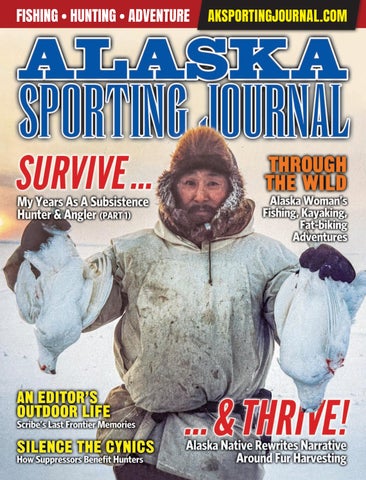
ON THE COVER Point Lay is an isolated Arctic outpost with few connections to the outside world, making subsistence hunting a necessity for residents. Our Scott Haugen shares stories about his experiences living there, including hunting ptarmigan, caribou and geese with the late Danny Pikok Sr. (SCOTT HAUGEN)
CORRESPONDENCE X @AKSportJourn Facebook.com/alaskasportingjournal aksportingjournal.com Email ccocoles@media-inc.com
PADDLING, PEDALING ON HER OWN POWER
Tiffany Herrington continues her excellent series on influential Alaskan outdoorswomen with a profile of Kim McNett, a Pacific Northwest native who’s made her mark in the Last Frontier through her artwork, journaling and exploring via subsistence fishing and hunting, fat-biking and kayaking. “I love Alaska for its smaller human impact,” McNett says. Find out what makes her tick.
23 LIFE AND TIMES OF A HOOK-AND-BULLET EDITOR
Famed outdoors editor and author Lamar Underwood has edited a new book of fishing stories from some of the greats in angling literary lore. He shares an essay covering some of his own Alaska backstory, including high school years spent exploring the Fairbanks area for grayling, ducks and grouse, plus how he became one of the top outdoor magazine editors in the biz. And he also features a salmon fishing excerpt from his The World’s Greatest Fishing Stories.
55 THE HARVEST YOU SEW
Arctic subsistence hunting memories, part I
A proud Alaskan Native Tlingit Eagle, Christy Ruby has embraced the traditions of her ancestors. Hunting marine mammals such as seals and sea otters – not just for the meat but for clothing and other purposes – is critical to her culture’s survival. “Using skills taught to us from the past will ensure we will never go hungry and we can always clothe ourselves,” she tells author Jillian Garrett in an enlightening feature that shifts the narrative around harvesting furs.
65 SILENCING THE CYNICS
Once difficult to acquire and an anathema to some in the outdoor community, suppressors, or silencers, are an effective tool for hunting big game. In his half of our From Field to Fire column, Scott Haugen breaks down the advantages of a device that, as he puts it, “equates to more accurate shots.” And in her half, Chef Tiffany concocts a big game recipe flavored by Indonesian spices.
(BJORN OLSON)
Ihaven’t been to the Tongass National Forest and soaked in that pristine, diverse Southeast Alaska ecosystem roughly the size of West Virginia. But I’ve been to similar places here and abroad that are protected, just as the Tongass has been for a number of years through the Alaska Roadless Rule, first established by then President Bill Clinton in early 2001. Fast forward a quarter century, and the Tongass is embroiled in the second Trump Administration’s agenda to repeal safeguards on public lands, including some of America’s most revered backcountry places and critical habitats for fish and wildlife.
Trump 2.0 has gone all in with plans to drill for natural gas, fast-track certain mining projects and, in the case of the Tongass, reverse Roadless Rule protections and open the national forest for large-scale timber, mining and other projects. On February 18, the Forest Service announced a 30day comment period amid plans to revise the Tongass plan.
“We’re taking another step forward in the process to modernize the Tongass National Forest plan by prioritizing long-term regional prosperity, adapting to 25 years of economic and ecological changes, and improving clarity of direction within the plan,” Tongass supervisor Monique Nelson said in a press release. “This is another opportunity to work collaboratively with tribes, communities, partners, and the public to ensure the revised plan meets the needs and values of the public we serve.”
When I think of the Tongass, I look back at one seemingly comparable area that also should not be touched. In 2018, I took a trip to Croatia and Slovenia, savoring the gorgeous scenery in these two former regions of Yugoslavia that are now thriving as independent nations.
After spending time island hopping off Croatia’s Dalmatian Coast, we started a drive into the country’s interior enroute to Slovenia. We took a detour to spend a few hours in one of the
EDITOR’S NOTE
natural gems of Europe, Plitvice National Park.
Croatians have called these fish-filled, azure-, turquoiseand teal-colored lakes and waterfalls their first national park since 1949. And it’s every bit as stunning as it sounds.
It stormed heavily on the late-summer day we visited Plitvice. We donned rain jackets and didn’t let the weather ruin the moment. A boat ferried us across one of the series of lakes to a spot where we could hike around. A maze of trails and boardwalks took us along forested areas and the shores of lakes with water so clear the fish could be spotted right away. Waterfalls laced into beautifully colored water in the distance.
It’s the kind of place where you sense the more it’s developed, the less perfect it would become. About the only blemish I noticed was some graffiti left on a bridge, which is commonplace throughout that corner of Europe. This is a Balkan paradise that shouldn’t be ruined by greed and political posturing.
As for the Tongass, there’s a reason why so many Alaskans have fought to prevent the kind of development the Trump Administration is adamant to cash in on.
“I’m deeply concerned that the Trump Administration is fast-tracking the Tongass forest plan revision so it can force large-scale clearcut logging of beautiful old-growth trees,” Marlee Goska, Alaska attorney at the Center for Biological Diversity, said in response to the 30-day comment period announcement. “Logging in the Tongass has never delivered lasting prosperity for Southeast communities. What the region really needs is a future built on safeguarding oldgrowth forests, restoring salmon habitat and supporting sustainable recreation. We’ll be watching closely to make sure the Tongass’s old-growth forests and remarkable fish and wildlife remain protected from Trump’s shortsighted extraction agenda.”
From Croatia to the Alaskan Panhandle, let’s do our best to preserve these special places. -Chris Cocoles
From the editor’s visit to Croatia’s Plitvice Lakes National Park to his admiration from afar for the lush timber, wildlife like bears and critical anadromous fish habitat that define the Tongass National Forest, protecting these lands should be priority No. 1. (CHRIS COCOLES; MARCI JOHNSON/US FOREST SERVICE)
THE EXPERIENCE
THE BEST WAY TO FISH ALASKA,
IS FROM THE WATER
Wild Alaska offers an unmatched mothership sportfishing adventure in Southeast Alaska. With over 25 years of experience, we provide exclusive access to vast, untouched marine wilderness—far beyond the reach of traditional charter operations.
Immerse yourself completely in Southeast Alaska’s marine wilderness. Fish calm, sheltered waters of Frederick Sound, Stephens Passage, and Chatham Strait, surrounded by glaciers, wildlife, and breathtaking scenery. Our mobility ensures new waters and fresh opportunities every day—keeping you where the fish are.
LIFE ONBOARD
• Hot breakfast each morning
• Soup and sandwich lunch
• Fresh seafood dinners
• Relaxed evenings—or continue fishing and exploring
• Comfortable cruising in 50–70° temperatures
WHAT YOU’LL ENJOY
• World-class sportfishing
• Up-close wildlife viewing
• Photography opportunities found nowhere else
• Safe, warm, and welcoming onboard environment
• Exceptional crew and personalized service
Join Wild Alaska for the adventure of a lifetime! Pack a smile—and get ready for
NO RETURN OF THE KINGS AS MORE SEASONS CLOSING, LIMITED IN 2026
In that week between the euphoria, chaos and political division generated by Super Bowl Sunday and Valentine’s Day, love was not in the air for Alaska king salmon anglers.
As has been the case in recent seasons amid salmon struggles up and down the Pacific Coast, the Alaska Department of Fish and Game announced multiple Chinook sportfishing closures and restrictions in a flurry of press releases.
Among 2026 closures announced so far:
• “Kenai River early-run, late-run king salmon sport fisheries closed.”
• “West Cook Inlet fresh waters closed to king salmon fishing.”
• “Westside Kodiak salt waters closed to king salmon fishing.”
• “Ayakulik and Karluk Rivers closed to king salmon fishing.”
• “Susitna and Little Susitna River drainages closed to king salmon fishing.”
• “Anchor River and Deep Creek closed to all sport fishing through July 15.”
There were also announcements about gear restrictions in the Kenai Peninsula’s popular Kasilof River – including a daily limit of just one hatchery-produced king of 20 inches or longer – and a reduced one-fish daily limit in the Ninilchik.
It’s just another reminder of the dire situation with kings in many watersheds in Alaska. ADFG biologists were bleak in their assessment of recent years’ runs.
“Historic low escapements were experienced area wide in 2024-2025 and no king salmon goals were made in the Northern Cook Inlet management area in 2023-2025,” area rep Samantha Oslund said of the Susitna and Little Su drainages, which were shut down for king fishing. “ADFG staff understand the frustrations and tremendous impact closing this fishery has on anglers, local businesses and guides. However, there is every indication that the 2026 king salmon returns will not have a harvestable surplus.”
Former Alaska U.S. Representative Mary Peltola (D), who recently declared she’ll challenge incumbent Republican U.S. Senator Dan Sullivan for his seat in this fall’s midterm elections and who has made “fighting for fish” a major part of her platform, tweeted her frustration after another year of closures.
“This is devastating. No other way to put it. Alaskans have relied on strong (king) salmon runs to feed their families for generations, but factory trawling and excessive bycatch are contributing significantly to the decimation of our fisheries,” Peltola posted. “We don’t need more studies. We need leaders dedicated to solving this.”
Doldrums again in Alaska for king salmon sport anglers, who face plenty of closures in various rivers and ocean waters this year. (LANCE CHEUNG/U.S. DEPARTMENT OF AGRICULTURE)
AL ASKA BEAT
SOCIAL MEDIA POST OF THE MONTH
“The Last Great Race” will get started on March 7.
Fairbanks resident Rose Crelli played her violin as part of Bad Bunny’s Super Bowl halftime show. She grew up in Alaska after being adopted by a local family from an orphanage in China.
“We had a dog team of huskies, went dog mushing, went for skis, cross-country skis,” she told Alaska’s News Source. “We had a Christmas Eve tradition of going for midnight skis under the moon and the stars and the northern lights.”
Can you imagine any classically trained violinists with those backstories to tell?
THEY SAID IT FROM THE ASJ ARCHIVES – MARCH 2023
“
“If the (Trump) Administration’s decision to sell off public lands in the Western Arctic to oil and gas development were truly for the common good, it wouldn’t face such widespread opposition. A long history of community leaders has worked for decades to protect the Teshekpuk Lake area from harmful oil and gas development, and all of these protections have been eliminated so that this area, essential to our subsistence practices, can be sold for development. When will it be enough? We must stand together for goodness over destruction, and demand better from our leaders.”
”-Rosemary Ahtuangaruak, executive director of Grandmothers
Growing Goodness, on a March 9 lease sale that could open up drilling in an area with vital subsistence resources.
ALASKA BEAR ENCOUNTERS
Over the years I’ve been on multiple brown bear and inland grizzly hunts, and I love spending time on the upper Alaska Peninsula. But one hunt based out of the tiny village of Egegik stands out. The excitement began to build upon my arrival. Once commercial fishermen leave the town in late summer, brown bears move in to scavenge. I walked through part of the town on the north side of the bay and found house after house that had been broken into by hungry brown bears. Bear boards – sheets of plywood with long screws drilled through them every few inches – were placed outside most windows and doorways. They didn’t stop the bears. Bloody footprints from the holes in their feet made by the bear boards they walked on to access the homes told the story. Some bears plowed through plate-glass windows, demolishing the insides of houses to get every ounce of food. Other bears busted down doors to gain access, while some simply ripped the siding off and walked in. Though only a couple people occupied this side of town in late fall, the bears were nocturnal and hard to deal with.
I once killed a massive brown bear 7 miles from Egegik. We spotted it early in the morning, but the wind was never right to make a move. Finally, 11 hours later I killed the brute (there’s a lot of daylight this far north in the month of May). The bear squared 10 feet, 9 inches, and was 23 years old. It had many scars and a couple very old bullet wounds, making me wonder if this was one of the marauding bears the locals had shot at in years past. -Scott Haugen
NUMBER
200,000
Since 2021, the total annual payout of prize money at the Homer Winter King Salmon Tournament has averaged more than $200,000. This year’s event is set for March 21.
(LB PHOTOGRAPHY/HOMER WINTER KING SALMON TOURNAMENT)
Scott Haugen has had his share of close –sometimes too close – meetups with bears in the Alaskan backcountry. (SCOTT HAUGEN)
OUTDOOR CALENDAR
The Homer Winter King Salmon Tournament is set for March 21. Last year’s winner, Zach Weimann, won over $84,000 in prize money for his 30.66-pound winning fish. (LB PHOTOGRAPHY/HOMER WINTER KING SALMON TOURNAMENT)
MARCH 7 Scheduled ceremonial start of Iditarod sled dog race, downtown Anchorage (iditarod.com)
MARCH 15 Spring brown bear season opens in Game Management Unit 1 (Southeast Mainland)
MARCH 15 Resident spring brown bear season opens in GMU 3 (Petersburg/Wrangell)
MARCH 15 Spring brown bear season opens in GMU 4 (Admiralty-Baranof-Chichagof Islands)
MARCH 21 Homer Winter King Salmon Tournament (homerwinterking.com)
MARCH 28 Kids Fishing Derby, Lost Lake Scout Camp (907-452-1976)
MAY 23 Start of Valdez Halibut Derby (valdezfishderbies.com/halibut-derby)
2026
SPORTSMEN’S SHOWS
MARCH 6-8 Great Alaska Sportsman Show, Sullivan Arena, Anchorage (greatalaskasportsmanshow.com)
MARCH 19-22 Big Horn Outdoor Adventure Show, Spokane Fair & Expo Center, Spokane (bighornshow.com)
APRIL 17-19 Mat-Su Outdoorsman Show, Menard Center, Wasilla (matsuoutdoorsmanshow.com)
APRIL 24-26 Fairbanks Outdoor Show, Carlson Center (fairbanksevents.com/fairbanksoutdoorshow)
For more information and season dates for Alaska hunts, go to adfg.alaska.gov/index.cfm?adfg=hunting.main.
Island Point Lodge offers a 7-day, 6-night self-guided Alaska Salmon, Halibut, and Dungeness Crab trip for $2,699. The trip includes lodging, meals, fishing rods and reels, boat fuel, and fish cleaning/packaging. Add a self-guided Black Bear hunt at no extra charge, with over-the-counter bear tags available in town. The Black Bear hunt is self-guided, including cleaning and preparation. www.islandpointlodge.com
MY ALASKA CONNECTION
FAMED OUTDOOR SCRIBE LAMAR UNDERWOOD ON LAST FRONTIER BACKSTORY, LIFE IN JOURNALISM
BY LAMAR UNDERWOOD
On a map – or globe if you have one – draw a line from Savannah, Georgia, to Seattle, Washington, and you will see that it cuts almost all North America into diagonal halves.
The distance from Savannah to Seattle is 2,887 miles, and with my mother, brother and two sisters I rode that route in Greyhound buses in late August 1952. After an overnight in Seattle, we flew in a propeller-driven Pan-Am DC-6 up the coastline to Fairbanks – smack in the middle of Alaska.
From our seats on the right side of the airplane, the views were mind-boggling spectacular. That was pure luck, because we did not know that savvy travelers always took the right side going to Alaska, with the coastline view instead of the sea, and the left side returning from Alaska.
Our luck held later in the journey when on an approach through fog to Juneau, Alaska’s capital city, I had my face against the window as I saw brown, waving marsh grass seemingly close enough to touch. We broke off the approach and continued to Fairbanks, but to this day I still recall the marsh views that could have ended in an aviation disaster.
I did not know it at the time, but that day was the beginning of a lifetime good-luck link with Alaska.
MY FATHER, LIEUTENANT-COLONEL JOHN Douglas Underwood, was waiting for us in Fairbanks and had been waiting since April. His Army radar early-warning unit was stationed at Fairbanks’ Ladd Air Force Base, and though the Korean War had been raging since June 1950, and quarters were being built at Ladd, there were none available when we arrived. Civilian quarters were hard to find, and expensive, and rather cabin-like. My sisters shared one bedroom, my mom and dad another, while my brother and I made do with a fold-open couch in the living room.
Editor’s note: Chronicling some of the greatest words from outdoor writers is part of Lamar Underwood’s DNA. A longtime editor at revered fishing and hunting publications Sports Afield and Outdoor Life, he has both written books – such as his 1989 Alaska bear attack novel On Dangerous Ground – and edited collections of short stories ranging from Theodore Roosevelt’s hunting tales to dispatches from the battlefield. His most recent
Lamar Underwood has enjoyed quite a life as an outdoorsman, editor and writer chronicling the fishing and hunting he loves. His relationship with Alaska’s outdoors began in 1952 when he and his family moved to Fairbanks to be with his Air Force father. (LAMAR UNDERWOOD)
compilation, The World’s Greatest Fishing Stories, features bylines from some sluggers in the field, including Zane Grey, Ernest Schwiebert, Nick Lyons and Ernest Hemingway (Underwood also penned a chapter on the latter literary giant). Along with sharing an excerpt from his book about salmon fishing in remote Norway, Underwood wrote the above essay on both his time in Alaska and a storied career as an outdoors editor.
“Our fishing adventures were confined to Arctic grayling and northern pike. The big Tanana River and its Shaw Creek tributary, plus the Chena River upstream from Fairbanks, were our fishing holes,” Underwood writes of his youth in Interior Alaska. (K. SOWL/US FISH AND WILDLIFE SERVICE)
I was a junior in the 11th grade, my brother two years behind me, my sisters in elementary school. I could walk to school a few blocks away on Cushman Street. I see on Google Earth that the school building is still there, despite its school days being long past, and the main town center still sprawls beside the Chena River. Finally, in January, in the coldest and darkest days of winter, we got our quarters at Ladd, with an Air Force bus taking us kids to school.
We wore Army-surplus parkas as we waited for the bus on the street outside our condominium-type quarters. On clear days, across miles of tundra, we could see the frozen hulks of the Alaska Range – the mountains called Deborah, Hayes and Hess – looming on the southern horizon, the right side ending in infinity.
As I looked at the storied peaks of hunting, fishing and trapping adventures, I knew that I only had to go to the parking lots of the University of Alaska on the northern side of Fairbanks, where I could gaze across miles of seeming emptiness, to see the grandest peak of them all – Denali, the “High One,” the “Home of the Sun.” Alaskans called it
“The Mountain.” Books called it “Mount McKinley” because that was the name given it by a young Princeton University graduate during an early exploration to celebrate his president’s support of the gold standard. (Most people do not realize today that Denali is the most prominent mountain in the world, from the bottom to the top. Its bottom starts at 2,000 feet, its peak is 20,300. Mount Everest’s peak is 29,029, but the base of the mountain is already 14,000 feet.)
My dreams of living in a hunting and fishing paradise – still a territory, not even a state – were quickly swept aside by a very hard reality: Alaska had very few roads. Its best hunting, fishing, trapping and wilderness living sites were scattered throughout its vastness.
A few roads like the Steese Highway, going north out of Fairbanks, and the highway south to Big Delta and a few points beyond, were well used. And they provided access for some of my greatest days afield. But the wilderness of Alaska, then and now, is the domain of the float plane, which uses skis in winter.
Float planes fill the state’s skies daily, carrying Alaskans to places roads have never reached, serving Alaskan needs like family cars. Aviation is one of
Alaska’s greatest activities. The terrain and weather, however, are frequent killers of pilots who cannot handle the conditions or the planes needed to fly in them, or, sometimes, plain old bad luck.
SINCE THERE
ARE NO
trout north of the Alaska Range, and salmon were in places we didn’t know about or could only be reached by float plane, our fishing adventures were confined to Arctic grayling and northern pike. The big Tanana River and its Shaw Creek tributary, plus the Chena River upstream from Fairbanks, were our fishing holes. And everybody else’s, as we quickly learned.
We caught and ate some pike and grayling (the grayling were a new and wonderful tasty treat), but this was not the Alaska fishing we had been dreaming about.
Our hunting was better, even though we were not big game hunters. The country around Fairbanks was not on a caribou migration route, but locals bagged one occasionally and did well enough with moose to keep freezers full. Before winter clamped down with thermometers so low they were frightening, we had consistent action
with grouse and ptarmigan, snowshoe hares and ducks. The grouse and ptarmigan were kicked up from brushy covers alongside the roads we could travel. Shooting birds on the roads themselves was strictly prohibited and led to fines for some hunters. (We’ll talk more about the grouse hunting in an episode to come later in this narrative.)
We were tipped off on duck hunting by a couple of airmen from Ladd Field. They took us with them on a long nighttime drive headed south past Big Delta to the area around Northway. There were abundant mallards and pintails in a spot worth keeping secret, which we did.
WHEN
OUR
FAMILY LEFT
Alaska at the end of May 1954, the day after Fairbanks High graduation, Alaska was still a territory and there were many shortcomings to my 11th- and 12thgrade education. Nevertheless, I had already been blessed with experiences that would open doors and help build a professional background that would serve me to this day. I was made editor of the high school newspaper, named The Paystreak, and with the help of my English teacher I had a part-time job writing for Jessen’s Weekly newspaper. Another bond with Alaska strengthened my special connection shortly before our graduation ceremony at the end of May 1954. I opened a copy of the May issue of Field & Stream, and there with excellent color paintings by artist Bob Kuhn was the complete text of Ernest Hemingway’s long story “Big TwoHearted River.” Every word – parts one and two. The details of the story and how Hemingway wrote it are covered in a Nick Lyons story in the latest editions of my fishing anthologies, The World’s Greatest Fishing Stories. I do not want to include redundant coverage here, but I do want to say that the inclusion of the story by editor Hugh Grey was one of the bravest I had ever seen. The story is about a simple trout fishing camping trip, using grasshoppers as bait. The story is an American classic, still being read and republished today. It confirms
Underwood, who wrote his thrilling novel On Dangerous Ground about an Alaskan bear attack, has had his own experiences around Last Frontier bruins. When he stepped into these grizzly prints, “My heart felt like an explosion in my chest. I wanted to yell, yet I wanted to remain invisible at the same time.” (LAMAR UNDERWOOD)
BATTLING MYTHICAL SALMON IN NORWAY
An excerpt by acclaimed outdoors writer Ernest Schwiebert from the Lamar Underwood-edited book, The World’s Greatest Fishing Stories:
The occasions when I had the opportunity to fish with my friend the late Ernie Schwiebert were far fewer than I would have liked, but they qualified as memorable experiences in every way. In Iceland, and on the storied Brodheads in Pennsylvania, I watched Ernie dissect salmon and trout water with the skilled cuts of a master surgeon. Ernie didn’t merely fish a stream: he stripped it bare, from the outer layers of skin to the marrow of the bones. No secrets could remain hidden long from his detailed analysis. It’s all very simple, really. Ernest Schwiebert found where the fish were, figured out why they were there and what they were doing, then proceeded to catch them. Or maybe I’ve got it backward. Perhaps he figured out what they were doing first, then found them. In any case, as likely as not, when you looked his way on the stream, you’d see the bowed, straining hoop of his rod.
“The Night of the Gytefisk” is from Ernie’s collection of stories A River for Christmas and Other Stories, published by the Stephen Greene Press Inc., of Viking Penguin Inc., in 1988. In this tale we’ll be journeying as close as most of us will ever get to Norway’s legendary Alta, home of record-breaking Atlantic salmon and the proving ground where reel drags, backing and fish-playing skills are tested to their limits. -LU along the river.
The river is the finest salmon fishery in the world. It is the storied Alta.
The Alta has been fished since the Duke of Roxburgh first sailed his yacht into its fjord in 1862 and discovered that the river teemed with big salmon. Roxburgh shared its sport for many years with the Duke of Westminster, who was famous for both salmon fishing and his liaisons with the French couturier, Coco Chanel. Roxburgh built the Sandia and Sautso camps in Victorian times, but in earlier seasons his parties fished from steam yachts moored off Bossekop. The beats were fished in rotation, splitting the rods into four groups. Each party was patiently ferried and poled to Sautso, where they camped and floated back to their luxurious quarters on the yachts. When the first party reached the middle beats at Sandia, the second was ferried past them to the upper river, and the third group soon followed. These parties poled and portaged along the river throughout July, fishing back from Sautso to the comfort and cuisine of the yachts, stopping at rough camps
It was a time of great wealth and privilege.
Charles Ritz has written about such sport in A Fly Fisher’s Life, and I have heard him sing its praises from the little bar just off the Rue Cambon, in his famous hotel at the Place Vendôme in Paris. It is simply unique! Ritz insisted excitedly with Gallic gestures and staccato speech.
It’s the Valhalla of salmon fishing –and once you have tasted it, nothing in your life is the same!
My first night at Sandia was something of an accident. I had been fishing the Reisa, and it had been so poor that we decided to leave three days early. When I arrived at Bossekop, there was a message telling me to come immediately to Sandia. Its party was a rod short, since one of the fishermen had become ill, and I had been asked to fish out his last day.
It was not so much a day of fishing I had been offered, since the salmon I might catch belonged to the river owners and were worth considerable money. The night’s fishing proved wonderful. Although I felt a little like a Danish trawler, I took 10 salmon
averaging 23 pounds with a 10-foot Garrison that had belonged to the late Paul Hyde Bonner.
The boatmen arrived after lunch to ferry me farther up the river to Sautso, and we motored upstream through famous pools like Ronga and Mostajokka to the foot of the boulderstrewn portage at Steinfossnakken. We changed boats there. The ghillies carried my duffle and baggage between them on a heavy pole, past the wild torrent of the Gabofoss Rapids to the lip of the Gabofoss Waterfall itself. I carried the tackle and a small duffle of fly-tying gear. Gabofoss thundered past in its chill explosions of spray, its roar blotting out all thought and other sounds, filling the morning with its icy breath. The rocky trail was traversed slowly, and finally we reached the Sautso stillwater.
We spooked a great fish lying off the upper boat mooring, and its wake disturbed the rocky shallows. The old boatman stood looking at the towering cliffs, squinting into a surprising midday sun.
“Sautso is a paradise,” he said. –Ernest Schwiebert
my personal admiration of Hemingway’s prose and like many others, confirms my view that Hemingway critics who have never been hunting or fishing don’t know what they’re talking about.
THE MANY YEARS THAT followed Alaska leave much to tell, but the peak event of all my years was being made editor of Sports Afield in 1970, succeeding Ted Kesting. He had built the magazine from its fledgling days in Minneapolis through its purchase by Hearst in 1953. Its current circulation during my years as editor was 1.35 million. Field & Stream and Outdoor Life, the other members of the so-called “Big Three,” both reached 2 million and beyond, However, Hearst, my parent company, refused to chase them. So we languished at 1.350 million while emphasizing newsstand sales which were well over 200,000 every month. Field & Stream and Outdoor Life were even better. I was destined to leave Sports Afield and become editorial director of Outdoor Life in 1977.
As I write these words in 2026, the magazine world has shifted like
tectonic landmass plates moving. Most of the titles that have survived are part of the digital world. Some have a few actual copies that you can hold in your hands and read. But there is very little space on newsstand racks, and cracking into them takes effort and money; lots of effort and money.
As a sworn and card-carrying print man who swears he will never change, I can look back with fond memories to the climactic years of the magazine business. In 1968, when I first sold a magazine article, you had to work your way past the “slush pile.” That was the name given to the stacks of unsolicited manuscripts waiting to be considered, begging to be considered.
In magazines like Sports Afield, there were usually dozens waiting in the mail room. In big magazines like The Saturday Evening Post there were many hundred. The only way your submission won’t be trapped in the slush pile is to be famous or published somewhere, or having an editor who glances at your manuscript, expecting nothing, but is hooked by your story idea or your prose. If the editor’s
eyes glaze over with boredom, you’ll become the owner of a freshly printed rejection slip. Sometimes – there’s that lucky break again – an editor might scribble a note on a rejection slip, like “try us again.” Such encouragement was heaven-sent.
Getting out of the slush pile wasn’t easy, and it was impossible if your manuscript was not professionally presented and you had not studied your market. Both requirements are in place today, with book submissions even tighter. Except with very, very few exceptions, you can’t sell a book without an agent. And your chances of getting an agent are between nil and none. Today’s fledgling writers are fortunate in having available dozens of books on writing, agents and editing.
My own slush pile escape was made possible by Hugh Grey, editor of Field & Stream. He liked a quail hunting story of mine so much that he assigned a photographer, Wade Thornton, to join me quail hunting in Georgia to shore up the weak gallery of photos I had submitted. In those early days I regarded Field & Stream as something
The spectacular prominence of Mount Denali/ McKinley, as seen from Wonder Lake. To this day Underwood loves “flying” the region he knew as a high schooler via Google Earth. (JACOB W. FRANK/NATIONAL PARK SERVICE)
holy. My heroes were Robert Ruark, who wrote the “Old Man and the Boy” column, plus memorable features, and included Corey Ford, Warren Page, A. J. McLane and, towering over them all, Ted Trueblood.
I worshipped every word of Ted Trueblood like he was a saint. I had read somewhere that he had come to work at the New York office of Field & Stream from being a freelancer in Idaho. Steady jobs are clarion calls to freelancers who don’t know when their next payday will happen. Trueblood lived in Westchester County and took the train to New York every day. Then one day his nextdoor neighbor
dropped dead from a sudden heart attack. Immediately, Trueblood went back to Idaho and began his lifetime work of writing for Field & Stream and Fawcett’s True magazine and their special editions.
It was Trueblood who became part of my Alaska connection two years after I was back in the continental U.S. in college. His article in the September 1954 Field & Stream was about grouse and ptarmigan hunting in Alaska. In Fairbanks! My Fairbanks! Along my roads! I had been trying to tell anybody who would listen that some of the grouse were the same type of ruffed grouse
we hunted in Pennsylvania and New England. Now I had Ted Trueblood in my Alaska cosmos.
As things turned out, my quail hunting article was still in production when I visited Hugh Grey in his New York office, completing a childhood fantasy. I had seen Hugh Grey introduced by Ed Sullivan on Sunday night television. He showed me the layout planned for my article (it ran in the September 1959 issue) and told me much about the realities of freelance writing life. I made up my mind to try for a staff job when I had gained more experience. I sold a couple of other articles to Field & Stream and six to Sports Afield, where I landed a staff job in New York in 1967. Editor Ted Keating liked my work and gave me promotions over the next three years, culminating with being made editor of Sports Afield in 1970.
MY GLORY YEARS, WHEN I was editor of Sports Afield and could hunt and fish anywhere in the world I wanted to, got off to a shaky start. In my beloved Alaska, death was only a heartbeat away on a rainbow trout/salmon trip to a camp on the Alagnak River out of King Salmon. This trip to the Alaska Peninsula was my first – and almost my last.
A well-equipped guide and another angler were with me when we boated upriver, looking for a good spot to fish by wading along the bank. Our fly rods were rigged and ready. The guide and the other angler headed upstream straight away, while I diverted toward an open sandy bank beside the alder thicket a few yards downstream.
I pushed aside a cluster of alder bushes, and there in front of me was a vision that stopped time and froze me like a statue. I couldn’t move or cry out.
I had almost stepped on a grizzly track. The huge paw print was still oozing water from the claw marks. I glanced around, quickly at first, then slowly as I looked upstream for my companions. They had disappeared around a bend in the alders. My heart felt like an explosion in my chest. I wanted to yell, yet I wanted to remain invisible at the same time.
When it comes to Alaska salmon, coho have always been Underwood’s clarion call over kings. (LAMAR UNDERWOOD)
Alaska’s Preeminent Float Fishing Trips
During the long minute or so it took me to regain my composure, I gradually became aware of a new threat: a deep, musty odor like a wet rug. My misery deepened into complete terror. My mind kept flashing images of a bear attack. There were no accessible TV or movie documentaries of bear attacks back then. However, my imagination flared with images of blood and guts being torn to shreds.
To my credit, I did not try to run screaming from that spot. Instead, I managed to carefully reach into my wading vest and pull out a small camera. I clicked one image and was putting the camera away when I heard voices from upstream. My companions had returned. The event was over.
There have been six Alaska trips since then, all to the Alaska Peninsula but none back to Fairbanks. The fish that has pulled me back to Alaska has always been the coho, the great silver salmon. Not the Chinook; they are huge beyond belief, but they arrived before the coho run started and held deeper in the rivers than the silvers. I found out that the best times for silvers, with rainbow trout and chum salmon, were from mid-August to early September.
TODAY, I LOVE SPENDING time looking at Fairbanks on Google Earth. Zoom
in and there by the Chena River sits downtown Fairbanks. Cushman Street takes you past the building that was Fairbanks High and to Mapes Road to another military base now. But in my day Mapes ended at the gates of Ladd Air Force Base, where shuttle buses ran from the gates to the heart of the base, which was mostly underground. But you can still see
where the runways ended right at Mapes Road. Sometimes you had to wait as F-86 Sabres swooped over the road, reminding you that we were at war, which did not end until 1953 when the conflict ended in Korea.
No, I never went back to Fairbanks, but I think about it a lot. On many nights now I close my eyes and the Air Force shuttle bus has left me standing beside Mapes Road. There are now open fields where a few quarters have been built. The snow crunches underfoot in January and February as I walk toward home, after an evening reporting on a basketball game for Jessen’s Weekly
The northern lights are sweeping across the sky in waves, flowing in shapes that change colors as they move, from light green to darker shades. The sight is so compelling that it almost makes me afraid in its vastness and my feeling of loneliness, a mere speck amid so much grandeur.
That’s one of many, many reasons Alaska will never cease being a part of me.
ASJ
Editor’s note: Order The World’s Greatest Fishing Stories at amazon .com/Worlds-Greatest-Fishing-Stories/ dp/1493088955.
Of his career as an outdoors editor and writer, Underwood (right) called his time as editor at iconic outdoors magazine Sports Afield “my glory years … As a sworn and card-carrying print man who swears he will never change, I can look back with fond memories to the climactic years of the magazine business.” (LAMAR UNDERWOOD)
Hunting quail here, Underwood got his feet wet as a waterfowl and upland bird hunter around the Fairbanks area during his childhood days before Alaska became the 49th state. (LAMAR UNDERWOOD)
UNDER HER OWN POWER
VIA TWO WHEELS OR WATERCRAFT, TRAVELING HARD-EARNED MILES IN ALASKA’S BACKCOUNTRY IS WORTHWHILE FOR ARTIST-EXPLORER KIM MCNETT
Editor's note: Alaskan Women and the Outdoors is an ongoing Alaska Sporting Journal series highlighting women whose lives and work are deeply rooted in Alaska’s wild places. Through hunting, fishing, wilderness travel and stewardship, these women are building meaningful relationships with the land and shaping what it means to live outdoors in Alaska today.
Based in Homer, Kim McNett is a wilderness traveler, educator and artist whose life in Alaska has been shaped by long, human-powered journeys across the state. Traveling by fat bike, packraft and sea kayak, she has crossed some of Alaska’s most remote terrain while building a life centered on wild food, stewardship and moving through the landscape at the pace it demands.
BY TIFFANY HERRINGTON
The wind had been building for days by the time Kim McNett and her expedition partners reached the Lisburne Hills in far Northwest Alaska. Gusts pushed past 50 miles per hour, strong enough to knock riders off fat bikes and send loose rock sliding across open tundra. Travel became less about pedaling and more about staying upright, reading the ground ahead and choosing carefully when to move and when to wait.
They retreated from the coast, where cliffs and gullies concentrated offshore wind into an overwhelming and unpredictable force. It was only because the wind was at their backs that the group could move at all. Even then, control was never guaranteed. At one point, a gust came down a narrow valley and knocked all of them off their bikes at once.
When they finally reached the Arctic Coast, the wind was still driving hard. Sunglasses and hoods stayed on to protect against flying debris. Out over a lagoon, a flock of swans circled and called, holding themselves upright against the wind. Against a landscape with almost no vegetation, the birds appeared much larger than they were.
“They say a sense of awe comes from seeing beauty while feeling fear,” McNett says. “That was the time I saw angels.”
Whether she’s fishing for rainbows from her packraft or fat-biking Alaska’s most remote terrain with husband Bjorn Olson, Kim McNett covers a lot of ground in the Last Frontier.
(BJORN OLSON)
McNett, fat-biking Caribou Hills near her home base of Homer, grew up in the Pacific Northwest before moving to the Last Frontier. “You could put a motor on” the bike, she allows. “But the truth is, we can go way farther without one.”(BJORN OLSON)
That pairing of beauty and consequence is familiar territory for McNett. Based in Homer, she has built her life around long-distance, humanpowered travel through Alaska’s backcountry, crossing large portions of the state by fat bike, packraft and sea kayak. Her routes are not about efficiency or novelty. They are about moving through wild country at the pace the land allows and earning distance through steady effort and careful decisions. Alongside that travel runs a deep commitment to wild food and stewardship, shaped by years spent moving slowly through remote terrain and watching Alaska change in real time.
DRAWN NORTH BY THE UNTAMED McNett did not grow up in Alaska, but she arrived already oriented toward wild places. She was raised in the mossy Pacific Northwest, deep in forests of red cedars with a stream running through. That water, she says, shaped her sense of the world. “That water is the primordial soup of my soul,” she
explains, and it inspired a lifetime of curiosity about the natural world.
She went on to earn a degree in ecology, a foundation that still informs how she understands landscapes and systems. In 2009, she moved to Homer to work as an outdoor educator, drawn by Alaska’s scale and by the way the land still resists being controlled.
“I love Alaska for its smaller human impact,” McNett says. “Humans tend to try to control the world around them, whether it’s for security, predictability, efficiency or fear of the unknown. But the more we try to control it, the worse off we become.”
For McNett, Alaska’s refusal to bend easily is not a barrier. It is an invitation. Traveling under her own power forces her to confront limitations and adapt. “By using human power to travel long distances of wild terrain, we confront our limitations and learn humility,” she says. “Nature is the reference, and we belong within it.”
Soon after arriving in Homer, she met Bjorn Olson, a lifelong Alaskan who
would become her husband and longtime expedition partner. Olson taught her to sea kayak, fat bike and travel confidently through winter conditions, but McNett emphasizes that what sustained their partnership was not just shared skills. It was a shared intent.
“Long trips put any relationship to the test,” she says. “Each day is filled with a hundred little spontaneous choices, most of them trivial and some very serious.” Over time, they learned that when you depend on each other in remote country, helping your partner is not optional. It is essential.
WHY HUMAN POWER WORKS IN ALASKA
McNett’s preference for humanpowered travel is rooted in practicality as much as philosophy. People often look at a loaded fat bike and suggest an obvious upgrade: a motor.
“You could put a motor on that,” she says. “But the truth is, we can go way farther without one.”
In Alaska, weight determines what is possible. Motors and fuel add
Whether you’re chasing the thrill of reeling in a powerful King Salmon or hoping to witness a 50-ton whale breach, set out on one of our dedicated wildlife or charter boats. We make unforgettable adventures possible.
WHAT’S INCLUDED:
• Snacks and water
• State of the art fishing gear
• On board restroom
• An exciting Sitka Alaska fishing experience
Painting, exploring and journalizing, McNett is able to take in Alaska from various perspectives, an act of awareness that creates a record of what she sees now and over time.
(BRETWOOD
HIGMAN; BJORN OLSON; KIM MCNETT)
complexity and limit flexibility. Human power, by contrast, allows McNett and Olson to move lightly and adapt to changing terrain. Packrafts play a central role in how they travel. Without motors, they can lift their bikes, load them onto a raft and cross rivers and lakes that would otherwise stop them.
“As soon as you make that first water crossing, you are really in the wilderness,” McNett says, “because you’ve gone beyond where motors can go.”
The logic is familiar to hunters and anglers who understand that effort often determines access. Whether hiking past the end of a trail or floating into the backcountry, distance earned under one’s own power often brings a deeper relationship with the place itself.
WINTER MILES ON THE IDITAROD TRAIL
One of McNett’s defining journeys came in the winter of 2013, when she and Olson fat-biked the Iditarod Trail, then turned north at Koyuk toward Kotzebue. They were on the trail for more than a month, riding frozen snow
during the day and sleeping at night in a floorless pyramid tent warmed by a small titanium wood stove.
Winter travel demands discipline. Stay dry. Manage sweat. Keep small problems from becoming large ones. Build camp with enough daylight to address what needs fixing. Melt snow. Eat. Rest. Repeat.
Over time, the routine narrowed their focus. Conversation dropped away. Their bodies adapted to repetition and cold. McNett describes moments of deep mental concentration that came from days of steady movement.
By the time they reached Unalakleet on Norton Sound and sat down on bare sand, euphoria set in. “Our bodies were so activated,” she says. Along the way, they detoured to a hot spring in the mountains, where they met a Native family from Elim. The family shared pickled beluga, as well as caribou hides for bedding. In turn, McNett and Olson shared smoked Kenai reds. They traded stories and talked about food preservation and daily life.
When it was time to get back on the trail, McNett was asked if she was ready to be done. Her answer surprised her. She felt like she could keep going. Looking down a long white line marked by wooden tripods, descending into lowlands where temperatures would drop sharply that night, she knew they would make it to Kotzebue.
“That moment when I mounted my bike and dropped down into the valley was the highest point in my life,” she says.
BOAT BUILDING, TRUST BUILDING
Some of McNett’s most formative experiences came on the water. During their first winter together, she and Olson built a double kayak from plywood using a stitch-and-glue method. Neither of them had done it before. The project became an early test of how they would make decisions together and work through disagreement.
By the time they launched the kayak, McNett felt confident they would make a solid crew. That confidence was put to the test during a month-long circumnavigation
of Prince William Sound.
It rained every day. By the time they reached Montague Island, McNett’s shoulders were inflamed from constant paddling. Then came Hinchinbrook Entrance. Fog moved in and out, revealing and hiding their heading 9 miles away. Turning back meant camping on wet rocks in bear country. Going forward meant exposure and commitment. They launched.
Once underway, the reality of distance and vulnerability became unavoidable. The heading appeared, disappeared, then appeared again. When they finally reached the far shore, McNett took off her hat and realized her hair had turned gray.
WILD FOOD AND RESPONSIBILITY
McNett and Olson have increasingly focused on filling their freezer with local wild food. The work extends far
beyond the moment of harvest. Gear maintenance, processing, cooking and sharing all require time and effort.
“We eat organs and all kinds of weird bits,” McNett says. “We salvage and scavenge.” Beneath the humor is a serious ethic. Wild food is not just sustenance; It is a relationship.
“Wild food is better,” she adds. “I can taste the minerals and see vitality in the color.”
She frames humans as stewards within natural systems, capable of seeing the larger picture and therefore responsible for how much pressure they place on wildlife and habitat. Hunting, fishing and foraging, she says, can be practiced with restraint and appreciation, or they can become exploitative. The difference lies in intent.
ALASKA, CHANGING UNDERFOOT
Because McNett travels slowly and often
returns to the same places, she sees change clearly. Brush is overtaking open tundra. Winter trail formation and ice stability are less predictable. Coastlines are eroding. Glaciers are retreating. Storms behave differently.
Within her lifetime, she believes some of the routes she has traveled by bike will no longer be possible. These shifts are not abstract. They affect access, safety and the landscapes people depend on for hunting, fishing and travel.
PAYING ATTENTION AS A BACKCOUNTRY SKILL
McNett’s work blends science, art and adventure, but at its core is attention. She keeps illustrated journals during her travels as a way to notice patterns, record observations and reflect on what she sees. For her, journaling is not about producing an object; it is a practice of awareness.
“By using human power to travel long distances of wild terrain, we confront our limitations and learn humility,” says McNett, sea kayaking around Gore Point on the Kenai Peninsula. “Nature is the reference, and we belong within it.” (BJORN
OLSON)
In Alaska, that awareness translates directly to safer and more thoughtful travel. Reading weather, ice, water and animal behavior is a skill developed over time, whether recorded on paper or held in memory.
WHAT COMES NEXT
McNett’s plans are always forming. A winter fat-bike trip; a sea kayak journey; time in the field with family. In 2026, she looks forward to teaching workshops in Seward and Denali and to spending more time painting.
For Kim McNett, Alaska continues to be learned a mile at a time, through effort, restraint and attention. The reward is not simply distance covered, but a deeper understanding of what it takes to move through the land responsibly and remain part of it. ASJ
Editor’s note: For more on Kim McNett’s artwork, go to kimsnaturedrawings.com, and follow on Facebook and Instagram (@ kimsnaturedrawings). Tiffany Herrington is a Seattle-based writer.
“Humans
(BJORN OLSON)
Experience the thrill of big game hunting in Alaska’s untamed wilderness with Deltana Outfitters—Alaska’s premier guide service. Whether you’re after Brown Bear, Grizzly, or Moose, our expert guides lead unforgettable Spring and Fall hunts in the remote, pristine Alaska Peninsula andWestern Alaska.
Adventure. Expertise. Results. That’s what we do—and Deltana does it best.
90% Success Rate!
Average Moose: 64”
Grizzlies: 7’6” - 8’6”
Black Bears: 6’ - 7’
Brown Bears: 9’ - 10’ Start your ultimate hunting experience today! Visit: www.deltana.com | Email: hunts@deltana.com |
WHEN MY BIG DREAM CAME TRUE
SPORTSMAN RECALLS HIS YEARS IN AN ISOLATED ARCTIC VILLAGE AND LEARNING TO LIVE OFF THE LAND FROM ALASKA NATIVES
BY SCOTT HAUGEN
Editor's note: In this first of a two-part series, Scott Haugen reflects on some of his most memorable times living a semisubsistence lifestyle in Point Lay, on the Chukchi Sea, in the 1990s.
Springtime in Alaska’s high Arctic unveils itself in many special ways. Migrating to prime habitats to perpetuate their species, massive bowhead whales swim past tiny coastal villages. White-fronted geese paint the skies across the still-white tundra, while wave after wave of king and common eiders wing their way over the open leads in the Arctic Ocean. Caribou begin their ritual trek north to reach calving grounds. Insects mark the season by emerging from seemingly every cubic inch of water. And the sun’s path transitions to smaller and smaller circles, not dipping below the horizon for months as it did a short time ago.
From 1990 to 1993, Point Lay was home to my wife Tiffany and I, when jobs as schoolteachers took us there. Fewer than 100 Iñupiat people
inhabited Point Lay at the time, and it’s still one of the smallest Native villages in Alaska’s vast, 88,000-square-mile North Slope Borough.
After a year of living in Point Lay, we qualified for subsistence living. Because we weren’t Alaska Natives, we couldn’t hunt sea mammals; whales, pinnipeds and polar bears were off limits. But everything else was fair game. And because there was no store in the village at the time, all the meat we ate was what we hunted and fished for. Since boyhood, this was my dream: to learn to hunt, trap and fish with the Indigenous people of Arctic Alaska, amid some of the harshest conditions on the planet.
OUR FIRST YEAR IN Point Lay, the temperature dropped below zero in early
Scott Haugen once relied on the natural resources of the remote Alaskan Arctic when he and his wife Tiffany were teachers in Point Lay. Caribou, which sometimes ventured onto the frozen Arctic Ocean during their spring migration, represented dinner. “Because there was no store in the village at the time, all the meat we ate was what we hunted and fished for,” he writes. (SCOTT HAUGEN)
October, and never got above that mark for 199 consecutive days. Two months of total darkness reigns in winter. In the middle of the summer the sun’s path is no more than a tiny circle overhead.
Spring was my favorite time in the Arctic. While temperatures were still cold – and snow and ice prevailed –sunlight lifted the spirits. Increased animal activity brought further joy.
By early May, 20 hours of daylight shines. Dusk is slight, making for 24 hours of hunting opportunities every day. I was surprised how quickly I got used to running on only a few hours of sleep each night.
Many of the locals put tinfoil in their windows to block out the sunlight. Not us. After the long, dark winter, we welcomed the light – every bit of it – 24 hours a day, seven days a week. And I wanted to look out the windows to watch caribou streaming by, spy flocks of ducks and geese flying overhead and see Arctic fox hunt for voles and lemmings around our home. Spring was go time; winter was a time of rest.
Since most waterfowl on the North Slope head south for the winter prior
to the September 1 fall general opener, spring is the only realistic option for subsistence communities this far north to hunt ducks and geese. It’s in the early spring when most Iñupiat hunters break out the shotguns in anticipation of earlyarriving ducks and geese.
One spring day in 1992 I headed out on a goose hunt with good friend and esteemed Iñupiat hunting partner, Danny Pikok Sr., who is no longer with us. But what this man taught me about hunting and trapping in the Arctic changed my life.
The author’s Iñupiat hunting partner, the late Danny Pikok Sr., with a pair of willow ptarmigan taken near Point Lay, Alaska, on a day when the temperature was 35 below zero. (SCOTT HAUGEN)
Point Lay, where Scott and Tiffany Haugen called home from 1990 through 1993. They had many incredible adventures in this remote corner of Alaska. (SCOTT HAUGEN)
Create dry aged steak and cured meats from home!
Whether you’re preserving whole muscle for charcuterie or grinding coarse for fermented salumi, our time-honored spice blends, easy starter kits, and UMAi Dry® technology make it safe and simple to cure like a pro!
This caribou fetus provided a few very appreciated meals for elders in the village of Point Lay. The tender flesh made for easy chewing for those who had no teeth. “Nothing is wasted in a land where the people are dependent upon the animals for survival,” Haugen writes. (SCOTT HAUGEN)
A FEW FLOCKS OF white-fronts had been seen the previous two days by people in the village. Danny wanted to get out and hunt them. His family loved eating geese – what they call nigliq in the Iñupiat language. Danny often invited me on his hunts, and I almost always accepted the kind offers. I saw parts of the Arctic and experienced things I only dreamed of, thanks to Danny.
The snowmobile ride across the tundra to the goose hunting spot was bumpy. It was so desolate, so flat and so white in all directions. It felt lifeless, like we could spend days and never see a goose or any other living creature. No water was visible, but Danny assured me that if flocks of specks were moving north, they would pass by this prime location.
Where we stopped, the land surrounding us appeared the same in all directions. Danny pointed out that we were on a small rise where two depressions in the tundra met. He said he’d shot a lot of geese from this spot over the past 20 years.
We cut blocks of snow and ice and piled them atop one another. Soon we
had a couple of respectable-looking goose blinds. Temperatures were well below freezing, and with the wind blowing hard and gusting in excess of 20 mph, the wind chill was well below minus 20 degrees. It felt good to huddle behind the blind out of the wind. Danny assured me the conditions were right for hunting nigliqs. We had no decoys. We’d be pass shooting, hoping that if any birds did fly by, they’d pass within shooting range overhead. The odds seemed slim.
NO SOONER HAD I settled into my blind when a lone willow ptarmigan flew right at me. It landed five paces away. I stood up, the bird flew and I shot it.
We sipped hot chocolate, fidgeting to keep warm, but we didn’t see a living creature for the next two hours. Then, from nowhere, as if it were a figment of our imagination, a lone caribou appeared miles away on the stark white horizon. The animal caught Danny’s eye. He glanced in my direction. Even at 50 yards I could tell Danny was smiling beneath his fur cap and dark sunglasses. He loved caribou, and if there was one
in sight, he’d do all he could to get it.
As he got up from his blind, Danny headed toward his snowmachine sled. He pulled a rifle out of its case, slipped some shells into the magazine, then unhitched the sled. Danny yanked the starter rope of his machine and was off.
I stayed in the goose blind and watched as Danny approached the caribou through low spots in the tundra. Then Danny stopped his machine. Resembling a four-legged animal more than a human figure, Danny walked a few hundred yards in a slouched-over position, closing the distance between himself and the caribou. I watched through binoculars.
Danny shouldered his gun, then fired. The off-hand shot set Danny back on his heels. The caribou bolted. I heard another shot. The lone caribou cow took off running and Danny fired again, and again, until he was out of shells. Then the cow turned and began trotting my direction.
Still over half a mile away, I figured there was no way the caribou would pass within shotgun range. At 200 yards, it continued right at me. Its gait was slow and steady. At 100 yards, I
hunkered behind the blind, wishing I’d brought my .30-06. At 50 yards the cow was still on a beeline for me. How the situation was actually unfolding baffled me. Danny remained where he’d shot from, not wanting to spook the animal.
At 25 yards, the caribou sauntered by the left side of my blind. This was as close as it was going to get. I raised up, put the bead of my 12-gauge on its nose and fired. It fell stone dead. It was the last day of the cow caribou season.
Danny watched the whole thing unfold. “I told you this was a good spot,” he said with a smile, the snowmachine engine still sputtering as he got off next to the dead caribou where I stood. Danny was elated. He took off his right mitten and reached out to shake my hand. I removed my glove. We shook hands –
flesh to flesh – as is the culture no matter how cold it is.
DANNY DUG OUT A knife from his parka pocket and opened the caribou’s belly. He yanked out a kidney. We consumed the raw organ in our usual ritual. I had flashbacks of my first caribou hunt with Danny’s son Perry three years prior, when I got my first taste of this tradition. Unable to contain his excitement, Danny dove back into the cow’s gut cavity through the same incision. I wasn’t sure why.
Seconds later Danny extracted an 8-pound, hair-covered fetus. Proudly, he held it out in my direction. “I don’t have to eat that, do I?” I asked, laughing. He smiled, “This will be very good eating for the elders.”
As a fetus matures within the womb of a cow, it becomes a much-soughtafter delicacy of the Native people this time of year. The fetus is tender to gum and is popular among the elders, since so many are missing their teeth due to lack of dental care. I was honored to see Danny so jovial. Nothing is wasted in a land where the people are dependent upon the animals for survival. It was just the beginning. Danny’s next move was to pluck large larvae from the backhide of the caribou and gobble them up, one after another. ASJ
Editor’s note: Look for part two of this memory next month. For personally signed copies of Scott Haugen’s best-selling book, Hunting The Alaskan High Arctic, visit scotthaugen.com.
Haugen with the willow ptarmigan and caribou taken on a chilly spring day on the tundra where white-fronted geese were the primary target. He writes, “Since boyhood, this was my dream: to learn to hunt, trap and fish with the Indigenous people of Arctic Alaska, amid some of the most harsh conditions on the planet.” (SCOTT HAUGEN)
Indigenous Adventure offers:
Full/Half Day Trips
• Flyfishing
• Saltwater fishing
• Glacier tours
• Whalewatching
BOOKYOURTRIP TODA Y!
Fish Camps
• Guided all-inclusive camps
• Remote cabin locations on world class rivers
• All inclusive
TROPHY MOOSE & BEAR HUNTING
River
MORE THAN A HUNT
This is an unforgettable Alaskan adventure that blends raw wilderness, world-class game, and the thrill of pursuing some of North America’s most iconic animals in their natural environment. Long days on the river. Close encounters. The kind of moments you’ll talk about for the rest of your life.
WHY HUNT WITH US
• Trophy moose & bear hunts in prime river systems
• Regular 60”+ bull moose opportunities
• Near-100% opportunity rate on legal bulls
• High success on large Alaskan bears
• Fully guided & all-inclusive hunts
• Expert guides with deep local knowledge
• Carefully selected locations for consistent results
• 11–15 day hunts with 15-day combo moose & bear hunt available
Every hunt is carefully planned and professionally guided from start to finish. From scouting and calling to field care and logistics, your guide handles every detail so you can stay focused on the hunt.
Contact us today to secure your hunt and discuss available dates.
When it comes to the concept of tradition, some people may conjure up more recent memories, perhaps of mornings spent gathered around the Christmas tree or hanging out with relatives at the annual autumn deer camp. For Christy Ruby, tradition has a much deeper meaning, one that is imbued with cultural practices going back thousands of years.
Ruby is an Alaskan Native Tlingit Eagle from the Kéet Gooshi Hít (Killer Whale Dorsal Fin House), an award-winning fur fashion designer, recent recipient of a prestigious Rasmuson Foundation grant and a skilled seal and sea otter hunter. Ruby may also be about the last person proficient in the art of proper sealskin tanning techniques, a knowledge that she hopes to still pass on to the next generation.
CHATTING WITH RUBY IS a bit like peeling back the layers of an onion, although any eye-watering is purely the result of laughter from her ribald sense of humor. Ruby sees the world with a clear eye, has lived one heck of a full life and isn’t afraid to speak her mind about the things that matter to her. She is also possessed of a sort of rare pragmatic optimism that makes it hard not to like her.
For Ruby and other Native Alaskans, carrying on tradition means maintaining cultural practices such as seal and sea otter hunting. This can be a tough pill to swallow for many modern-day sensibilities (especially when it involves “cute” animals), but continuing these hunts is an important way for Native Alaskans to reconnect
A NATIVE SUBSISTENCE HUNTER ON SAFEGUARDING TRADITIONS FOR THE FUTURE
Christy Ruby, an Alaskan Native Tlingit Eagle, wears one of her handmade sealskin hats as part of her hunting wardrobe. She is proud of her heritage and hopes future generations can follow in her footsteps. (KILIII YUYAN)
to their ancestral roots, as well as help keep vital knowledge and skillsets alive to pass down to the next generation.
“Using skills taught to us from the past will ensure we will never go hungry and we can always clothe ourselves,” Ruby is quick to point out, and it’s true: Hunting these animals provides both food and wearable fur.
Natural furs offer superior warmth from cold Alaskan winters, and unlike many of our modern petroleum-based
synthetic textiles, are a far more sustainable clothing option; high-fat foods such as seal blubber and the rendered oil are prized as ways to help keep people warm, something not easily understood in today’s fat-free, diet-crazed world.
Though seals and sea otters are safeguarded under the Marine Mammal Protection Act, or MMPA, they are legally allowed to be harvested by Native Alaskans for the purposes of
subsistence as well as for the creation of handicrafts. However, seal and sea otter fur may only be sold to nonNatives after it has been extensively altered to no longer resemble a whole pelt, such as by sewing it into a hat, purse, mittens or scarf (among other options). This is where Christy Ruby’s talent as an artist and fur fashion designer really shines: She has an exceptional eye for form and detail, meaning that her pieces are not only well made and highly serviceable, but unique works of art too. You won’t find any mass-produced items in her studio. Every piece she produces is carefully handmade and one of a kind.
While Ruby’s spectacular designs have won awards at fashion shows around the country (and some pieces are also on display in museums), it’s unfortunate that you won’t find her work gracing the runways at affairs such as New York Fashion Week. Natural furs have been largely banned at these types of events, thanks in part to years of campaigning by anti-fur activists.
WEARING FUR CONTINUES TO be highly contentious, in part because many people seem to confuse the questionable ethics of farmed furs with those obtained as part of a sustainable natural harvest. This lack of understanding makes it doubly difficult for Native artists to continue traditional cultural practices and modes of self-expression, negatively impacting their way of life. Plus, as any hunter certainly knows, hunting can be expensive, especially when it involves a marine animal; rifle, boat and fuel costs all add up, and once you include expenses such as tannery fees, can quickly turn into a very steep price tag. Being able to sell handicrafts made from these furs is a way to help recoup some of the costs associated with a lifestyle that still strives, even in modern times, to live in close connection to the land.
The ability to hunt and sell handicrafts is also a way for Native artists to continue to create beautiful clan art, as well as pass along tribal history and stories, something seen
Ruby sews fur handicrafts in her studio, the final step that starts with the subsistence hunts her people have depended on. (KILIII YUYAN)
in many of Ruby’s clothing designs. One of her most notable pieces is the exquisite “Black Blood Coat,” a threequarter-length fur coat consisting of 68 pieces of red- and black-dyed sea otter, with a custom-printed lining containing a poem that, translated into Tlingit, remembers the abused Native children of Alaska’s boarding schools.
The “Black Blood Coat” has won multiple awards, including the Innovation Award at the 2024 Santa Fe Indian Market, but it honestly deserves wider recognition everywhere, not simply for its expert craftsmanship but for the painful moral of its multilayered story.
The irony of the anti-fur/antihunting movement is that it seeks to push so-called “modern” ideals onto Indigenous peoples, trying to end long-held cultural practices for which it has no stake and no understanding. It condemns Native Alaskans (as well as hunters and trappers everywhere) for killing animals and using their furs, without stopping to consider the larger context of the story. In short, those quick to criticize the “Black Blood Coat” and the practices involved in creating it are missing the entire point. Twice.
This lack of understanding about the importance of hunting and cultural self-expression through fur art is one of the many reasons that Ruby is motivated to keep working. “I want the story of my life to be accepted by all,” she says.
By continuing to uphold her ancestral values and remain deeply rooted in the natural world, she strives to find a way to connect with others who are often at times deeply disconnected from nature. It’s a testament to how she presents both herself and her lifestyle that even a few customers who would generally fall on the anti-fur side of the spectrum have been impressed enough to buy some of her pieces. That alone speaks volumes and provides an important element of hope for turning the tide of understanding.
WITH THE ANTI-FUR AND anti-hunting crowd seeming to gain greater traction
It’s difficult for designers/hunters like Ruby in an era where anti-hunting and anti-fur activism has grown and become even more vocal. But she is undaunted by the critics. “Using skills taught to us from the past will ensure we will never go hungry and we can always clothe ourselves,” she says. (KILIII
YUYAN)
Cumberland’s Northwest Trappers Supply is your onestop trapping supply headquarters, featuring one of the largest inventories in the U.S. We are factory direct distributors on all brands of traps and equipment which allows us to offer competitive prices. Give us a try. Our fast, friendly service will keep you coming back.
We are the new home of “Trappers Hide Tanning Formula” in the bright orange bottle.
Retail & dealer inquiries are welcome.
If you are in the area, visit our store!
Place an order by phone, mail or on our website.
every year, it’s easy to get depressed about the future of hunting and tradition, but Ruby refuses to see it that way. She plans to keep living her life and sharing her experiences with the wider world, being a torchlight in the darkness. “I want to be the hope that there are good things in life,” she says.
That eternal optimism bore fruit in 2025, when Ruby received an Individual Artist Award from the Rasmuson Foundation, an Alaskafocused philanthropy created in 1955 by the Rasmuson family. The grant will allow her to build a small personal tannery for the purpose of processing seal and sea otter skins.
This grant-funded tannery will also
aid her in teaching others how to tan these difficult skins, a knowledge that is in danger of being lost.
Few commercial tanneries remain that are able or even willing to work with seal skins, as they are easy to mess up given their higher oil and fat content and difficulty to process. “It’s like trying to shave pizza dough!” Ruby laughs. The skins also require five additional steps in the tanning procedure, making them much more expensive and time consuming for any tannery to produce, even those willing to jump through the hoops of applying for the U.S. Fish and Wildlife Service federal permit and dealing with the subsequent recordkeeping requirements.
This lack of tanneries has hampered the ability of Native Alaskans to continue maintaining their traditional practices. It’s also led to a worrisome bottleneck of knowledge. With so few people and tanneries left that understand how to properly process seal and sea otter skins, how will this vital skillset continue to be shared with future generations?
With the help of her Rasmuson grant, Ruby hopes to change that.
The grant’s $10,000 award will allow her to design a small-scale tannery, as well as purchase (and in some cases build) the machinery needed to run it, including a hide-shaving wheel, flesher, sander, staking machine and a unique
Ruby takes aim while hunting Alaska sea otters. As an Alaska Native, she’s permitted to hunt sea otters and seals for subsistence purposes. Virtually no part of the animal goes to waste, and clothing also becomes a byproduct of harvested sea life. (KILIII YUYAN)
The “Black Blood Coat” is, as author Jillian Garrett explains, “a threequarter-length fur coat consisting of 68 pieces of red- and black-dyed sea otter.” For its creator, this work of art is more than a fashion statement. “I want the story of my life to be accepted by all,” Ruby says. (KILIII YUYAN)
sawdust tumbler. The funding also provides for the creation of educational videos and classes on how to hunt, tan and sew seal and sea otter skins, thus aiding in keeping traditional knowledge alive for the future.
By creating and sharing design details for a smaller-sized tannery, Ruby hopes to encourage other Native artists to start up their own personal tanneries, thus leading to an increase in collective knowledge and a subsequent rise in availability of properly tanned skins. In this way, Ruby hopes to grow
the number of skilled fur sewers, which will not only safeguard cultural traditions but will hopefully increase the exposure and therefore acceptance of a way of life that has been practiced for countless generations.
THIS SMALL-SCALE TANNERY IS the first step in what is a much bigger goal: the construction of a large Alaska Native tannery and sewing center in a “highvisibility” region of the state. The center would teach vital traditional skills and provide employment, as well
as be an outlet to sell handicrafts for Native skin sewers, who would work with high-quality seal and sea otter skins produced by the tannery.
In turn, the tannery would support Native hunters by paying them for skins harvested as part of a subsistence lifestyle, continuing to ensure that nothing of any animal goes to waste. Any meat donated by the hunters would be given to the Native hospital in Anchorage for its traditional foods program, thus further supporting the community.
Amongst these important services, the center would also offer tours to showcase traditional skills and art, including to the thousands of cruise ship passengers who visit each day during the height of tourist season. With more exposure to and a better understanding of the importance of these cultural practices, the hope is to breed greater acceptance of their values by the wider world.
Yet the idea of the tannery goes far beyond being simply a self-supporting powerhouse for Native Alaskans wanting to preserve their traditions. At its core, it is a testament to the interconnectedness of that way of life, something Ruby refers to as the “Dream Tree.” It’s an understanding of the symbiotic relationship of how the land and the animals sustain the hunters who in turn sustain them; it’s about how those gifts from the land are then used to support the community, through food, clothing and art, and how the creation of these things ensures that thousands of years of culture remain alive and well into the future. ASJ
Editor’s note: To learn more about Christy Ruby and her work, please visit her website crubydesigns.com. Author Jillian Garrett is a hunter, farmer and conservationist living in northeast Washington State. Her writing and photography have appeared in numerous publications including Sports Afield, Backcountry Journal and Northwest Sportsman, and she has also been a guest on the Randy Newberg Hunt Talk Radio podcast (episode 263). You can find her on Instagram (@jillianoriginals).
SUPPRESS YOURSELF
HOW REDUCING A SHOT’S SOUND AND RECOIL WITH A SUPPRESSOR CAN IMPROVE YOUR HUNTING SUCCESS
BY SCOTT HAUGEN
This isn’t a piece on the mechanics, weights, tax stamps or even how to acquire a suppressor. This is about efficiently taking animals by using suppressors.
In the early 1990s I hunted in South Africa using a suppressor for the first time. Shortly after that I hunted in the South Pacific with suppressors. Besides the proficient shooting capabilities suppressors instantly revealed in these foreign lands, three things caught my attention about them.
First, in a number of outdoor stores I visited while abroad, suppressors could be purchased in an over-thecounter manner.
Second was how some of the covered shooting ranges I went to required the use of suppressors –otherwise you couldn’t shoot a gun.
And third was the question in my mind as to why suppressors weren’t legal in the U.S. when they were allowed in other countries.
As for that last one, the answer likely lies in the media, more specifically Hollywood movies that depicted “silencers” as being just that: silent deliverers of bullets. That is not the case – especially when not shooting subsonic bullets – but the powers to be interpreted them that way, which set hunters back.
TIMES HAVE CHANGED
When my writing career launched in the mid-1990s, I couldn’t get an editor
Suppressors reduce noise and recoil, resulting in more accurate shot placement. Now legal in the United States,
to even consider a story on the value of silencers; that’s what they were referred to then.
In 2001, I began hosting TV hunting shows. In one episode I culled springbuck in South Africa. I sat in one spot and headshot 25 common springbuck with the aid of a flat-shooting rifle and a silencer. The episode was an accurate portrayal of the value of suppressors and how they truly performed, from accurate shot placement to not spooking game.
When the show aired in the U.S.,
you’d have thought I was a convicted felon destined for San Quentin. I was scorned, chastised and called names by an embarrassing number of people in the hunting community. In my home state, the leading outdoor columnist in Portland called me a poacher, not a hunter, among other things.
Despite the crystal clear fact that nothing was illegal about my using a silencer in South Africa, people failed to see the obvious value brought to the screen of how efficient a hunting tool these silencers can be. No one stood
it’s an attachment worth adding to your rifle. (SCOTT HAUGEN)
Living in Indonesia sharpened chef Tiffany Haugen’s cooking skills, and here she shares her Southeast Asian-infused recipe that works great with Alaskan big game meat.
AN ASIAN SPIN WITH ALASKA GAME MEAT
BY TIFFANY HAUGEN
When Scott and I lived in the Arctic for most of the 1990s, we planned trips to other parts of the world. These were places we’d often visit for a couple weeks in the summer. Food was often a motivating force behind many of the trips.
We love Asian food. In fact, after moving from Arctic Alaska, we took teaching jobs in Sumatra, Indonesia. Going from the Arctic to the equator was a shock, but the food was incredible. That’s where my cooking repertoire really expanded, leading to more than 15 cookbooks as well as this recipe, which, by the way, works great with any big game meat.
1 pound ground big game meat
1 egg
½ onion, minced
3 to 4 cloves garlic, minced
½ cup breadcrumbs
¼ cup tomato paste
1 cup kimchi, drained and chopped
2 tablespoons yellow mustard
½ teaspoon smoked paprika
½ teaspoon salt
½ teaspoon black pepper
2 tablespoons ketchup or gochujang for the top
Fresh scallions or chives for garnish
Butter to grease the pan
In a large bowl, mix all ingredients until fully combined. Grease a large
loaf pan with butter. Cover the top of the meatloaf with a thin layer of ketchup or gochujang.
Bake in a preheated 350-degree oven for 30 to 40 minutes until meat reaches desired doneness (or 160 degrees). Serve over a bed of stir-fried or roasted vegetables or a bed of rice. Garnish with scallions or chives if desired.
Editor’s note: For signed copies of Tiffany Haugen’s popular cookbook, Cooking Big Game, visit scotthaugen.com.
in my corner – not even industry folks. Using suppressors over the decades, I’ve shot more than 100 big game animals around the world. Today, I still hold to the beliefs that took root more than 30 years ago regarding the value and efficiency of suppressors.
A MODERATING EFFECT
Finally, suppressors are popular and accepted in the U.S. today. Suppressors offer good hearing protection due to their reduced noise level. Many guns fitted with suppressors can be shot without wearing hearing protection. If shooting on a covered range or one with cubicles, hearing protection is wise. But on the hunt, it’s typically not necessary in wide-open country. The reduced recoil resulting from the use of suppressors equates to more accurate shots. Increased accuracy is credited to the technology behind suppressors and the fact shooters are less likely to flinch since recoil is decreased.
Trigger yank due to fear of recoil in big bore rifles is real and is a major contributor to poor shot placement. I’ve read spec sheets claiming suppressors reduce recoil by on average 35 percent. That seems low to me, based on the shooting I’ve done with them.
HOW IT WORKS
On a depredation hunt last season, I dropped a cow elk from the back of a herd, less than 100 yards from where two buddies and I sat. I was shooting a Browning 6.8 Western fitted with a Silencer Central Banish Backcountry 300 suppressor.
After my shot, the rest of the herd kept walking, unconcerned. My two buddies let the elk move over a knoll before following. They caught up to them a few minutes later and filled
their two tags. Both were shooting suppressed rifles.
In less than five minutes we had three elk down. The rest of the herd never ran. In fact, they bedded down for the day a short distance from where the last two elk fell.
“Over 50 percent of the elk hunters I take are shooting suppressed rifles now,” says Jody Smith, a well-known Roosevelt elk guide in Oregon. “We often shoot bulls from big herds in
November or from bachelor herds, and after a shot with a suppressor, the rest of the herd usually just keeps feeding. Suppressors have not only increased our hunting efficiency, but (they) greatly cut down on stressing the elk.”
GETTING STARTED
I picked up my first suppressor from Silencer Central. They walked me through the entire process from start to finish via phone calls and efficient
Suppressors also disturb game animals less. “Over 50 percent of the elk hunters I take are shooting suppressed rifles now,” guide Jody Smith says. “We often shoot bulls from big herds in November or from bachelor herds, and after a shot with a suppressor, the rest of the herd usually just keeps feeding.” (SCOTT HAUGEN)
emails. I never had to leave my home. Nine months later I was fitting their Banish .223 to my predator rifle. I followed that up with the Banish Backcountry 300, then a Banish 22 for my scoped squirrel rifle. Both of those arrived in just over a month. I like the size and performance of each suppressor. Since then, I’ve picked up a titanium and another Banish from Silencer Central. They’re game changers.
Not only do suppressors optimize the efficiency of big game and predator rifles, but rimfires as well. Squirrel hunting with my dogs is more enjoyable with increased kills thanks to a suppressed .22 rifle. I shoot subsonic CCi .22 ammo in my squirrel rifle. The sound is so slight, other squirrels don’t flee and my dogs don’t go berserk at the shot.
“Nothing has changed the way we hunt and boosted our success rates on elk like suppressors have,” shares Jon Woolard, another guide buddy who focuses on depredation cow elk hunts. “In fact, clients don’t hunt with us unless they have a suppressor.”
The United States was late in coming to the suppressor game, but we finally arrived. Buying a suppressor is getting easier and wait times are now shorter. Once you try a suppressor and see how efficient of a tool it truly is, you’ll be wanting more. ASJ
Editor’s note: For copies of Scott Haugen’s popular line of hunting and fishing books, and Tiffany’s cookbooks, visit scotthaugen.com.
Author Scott Haugen has been a fan of suppressors for over 30 years. He took this big Roosevelt elk last season using a Browning 6.8 Western fitted with a Silencer Central Banish Backcountry 300. “Increased accuracy is credited to the technology behind suppressors and the fact shooters are less likely to flinch since recoil is decreased,” he writes. (SCOTT HAUGEN)