the minetta review
Established in 1974, The Minetta Review is a literary and arts publication managed by undergraduate students at New York University. After a brief hiatus, Minetta was relaunched in 2023 by Julia E. Mejia and Ananya Chibber.
Book Design and Layout by Whitney Sederberg. All rights reserved to the contributors, whose authorization is required for reprints.
Contact: minettareviewmag@gmail.com
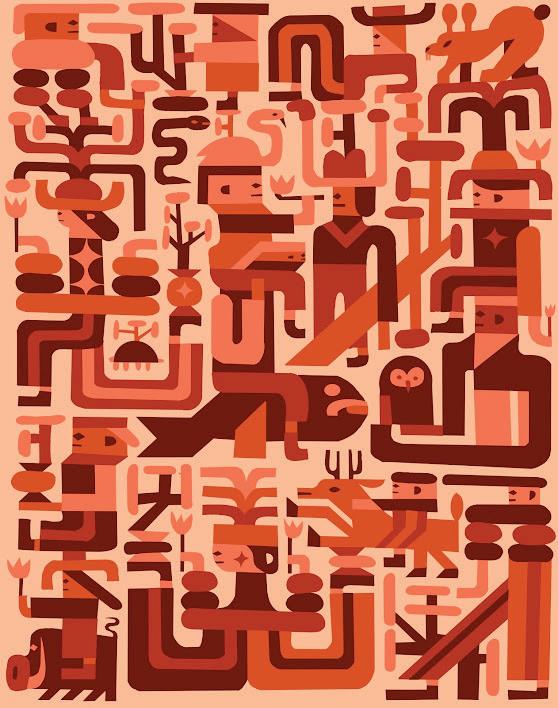
Cover art by Keya Tama
Letter from the Editor
Dear Reader,
I am thrilled you have chosen to interact with this vibrant collection of art.
This issue’s prose and poetry, while bravely reaching into the territory of surrealism, find their grounding emotionally. Whether we are in a therapist’s office in “Mother May I?” by Caroline Huckeba, at a frat party with Dionysus in Brooksie C. Fontaine’s short story, or surfing the internet in Mel Connelly’s “Search Terms,” our authors find profundity in the sometimes absurd nature of our everyday. We hope you will laugh and cry with these pieces like we did (as cliché as that sounds). While it may be true that “poets are the worst capitalists,” as Sanjana Choudhary writes, our artists are quite good at revealing what is more important in our lives. We are excited to publish this variety of narrative voices and to share the wonderful experiences that these pieces provided for us.
I give my love and thanks to our incredible editorial staff who worked hard to read over a hundred submissions to the magazine this fall. Additionally, I send my gratitude to the contributors; we recognize the hard work each piece took to create and celebrate the words which resonated with our editors. The Fall 2025 issue begins the third year since the post-pandemic relaunch and finishes the 51st year of Minetta’s existence. It has been an honor to contribute to this legacy and I thank you for engaging with it.
Sincerely,
Whitney Sederberg Editor-in-Chief of The Minetta Review
Mother, May I?
Caroline Huckeba
“I’m a writer,” Greer says, crossing her legs like she’s on The View. “And I’m addicted to stalking Mormon mommy influencers on Instagram.”
Jessalyn blinks, then nods, perfectly neutral in the way only therapists can manage.
“Thank you for sharing that. Let’s hold space for it.”
“My stalking started harmless,” Greer says. “Normal, even. You know—high school people. Girls I grew up with. One of them lost custody of her daughter last year and announced it by posting a TikTok of herself lipsyncing to ‘Make You Feel My Love.’”
Jessalyn’s pen hovers.
“And honestly,” Greer continues, “she should be grateful. She missed the window to get the baby one of those little helmets, and now the back of the girl’s head is as flat as the face of a cliff.”
Greer picks at her thumbnail. “But then… it escalated. I found the Mormon mommy influencers. And it was like something broke open in me.”
Jessalyn leans forward. “Tell me more.”
“I collect them now. Like Beanie Babies. @ServantWife4Ever. @LaurenLambOfGod. @HolisticHeartsForHim. Their entire brand is worshipping their husbands, God, and the aesthetic of bare feet on hardwood floors.”
Jessalyn scribbles something.
“One of them posted a photo of her toddler and captioned it, ‘My tiny husband.’ I felt my soul leave my body. I used to report their posts for misinformation. I’d hover over the options like, Is this fraud? Violence? Dangerous organizations?”
“And how does that feel in your body?” Jessalyn asks.
“Physically? Horrible. I bought a workbook from @SacredHeartHouseWife titled How to Prosper Your Husband.”
Jessalyn’s pen stalls. “Greer… are you married?”
“Well, no.” Silence.
“I’ve even branched out,” Greer admits. “Evangelicals. TradCaths. Prepper homesteader wives who post unboxing videos of butter churns. Last week, I got high and doomscrolled this ballerina-turned-survivalist who looks exactly like my mom. She was explaining how to hand-grind wheat in case of government collapse, and I—” Greer inhales. “I started crying.”
Jessalyn folds her hands. “Tell me more about your mom.”
Greer laughs, sharp and papercut-thin. “Oh, my mother? Yeah. She’s basically a ‘mommy impressionist.’ Flat Earth. Illuminati. Last night on the phone, she said—‘You know, Greer, Hollywood and NASA are both owned by lizards.’”
Jessalyn raises a brow. “And how does that—”
Greer presses a finger up like she’s in church. “I’ve booked a flight to Ohio. I have to see their houses. Not in a stalking way. More in an anthropological way. A pilgrimage. I need to know if their lawns are as manicured as their souls claim to be.”
Jessalyn’s lips flatten. “Greer.”
“I know, I know. It’s bad. But listen. I’m not actually crazy or one of them. I don’t actually need advice on apocalypse prepping when hubby doesn’t think it’s necessary, but wifey does, but wifey wants to submit. But I already know their answer. Submit. Pray. Obey. Reference Ephesians. DM him links to @ServantWife4Ever’s podcast. @ServantWife4Ever always says she is “with child” when she means pregnant. Her dog’s full name is
Our Savior Jesus Christ.”
Jessalyn closes her notebook. “Okay. Okay.”
“And you should know,” Greer adds, voice dropping low, conspiratorial, “I was a thespian in high school. That feels like very important information about me.”
Jessalyn folds her hands. “Greer…why do you think you’re doing this?”
Greer fidgets. “I mean, part of it is the horror. Part of it is the spectacle. And sometimes it feels so real—this little ecosystem of women loving their babies, loving their husbands, loving their lives—that when I put my phone face down on the couch… it feels like I’m drowning a baby. Like I’ve killed something.”
Jessalyn holds Greer’s gaze. “When you grow up without a mother—without a mother figure—you don’t stop needing one. You just learn how to forage for scraps of it. Wherever you can find it. On Instagram. On Pinterest. In the comments of a woman posting a tutorial for non-toxic diaper cream.
“It’s like… being hungry for something you’ve never tasted. You don’t even know what it would feel like to be held that way. To be cared for in that quiet, suffocatingly boring, relentlessly gentle way. Where someone wipes your mouth without comment. Where someone packs your lunch because they were thinking of you. Where someone braids your hair because you are theirs.
“And the worst part,” Jessalyn says, voice tightening, “is the lie that because you’re an adult now, you shouldn’t still want it. Shouldn’t still need it. As if adulthood dissolves the wound. As if becoming a woman magically erases the fact that you were never mothered into one.”
Greer’s voice comes out hollow. “Yeah.” A whisper. “Yeah.”
“And so,” Jessalyn continues, “you stare at these women. You watch them perform motherhood—not just to their children, but to themselves, to their husbands,
to each other. You watch because you’re trying to solve it. Trying to decode the steps. How does someone become someone who is loved like that?”
“But no matter how long you stare, it doesn’t translate. Because it was never a skill set. It was never a checklist. It was something you were supposed to receive. And you didn’t.”
List of Lost Lands
Brendon McLeod
If you’re not careful and you noclip out of reality in the wrong areas, you’ll end up in the Backrooms, where it’s nothing but the stink of old moist carpet, the madness of mono-yellow, the endless background noise of fluorescent lights at maximum hum-buzz, and approximately six hundred million square miles of randomly segmented empty rooms to be trapped in God save you if you hear something wandering around nearby, because it sure as hell has heard you —ANONYMOUS
The generation that grew up in the wistful daze of darkened rooms and Disney movies with the sunlight streaming through cracks in the curtains feels especially nostalgic for the vicarious childhoods described by relatives whose parents did not so fear the broken bone or the predator, who went bike-riding and rock throwing, who caught gudgeon and dace and cricket and tadpole and frog, whose childhood projects were constructing clubhouses with nails and scrap timber, who, like the Fantastic Five, engaged in projects adjacent to law-enforcement and espionage, which, if, like my father, you grew up in the capital of a country that was young to electricity, could actually become trespassing on properties of such organisations which would be investigating the psychological warfare of the cold war, use of psychedelic drugs and altered states of consciousness as brainwashing techniques, and torture. And yet my generation grew up, when Timon and Pumba and Sebastian the crab had stopped singing and the credits on the VCR and later DVD rolled, from the living room to the kitchen, walking, hypnotised, and so lost in the moving lights and colours that still played out in narrative
tension and dance on projected walls of the Platonic cave of our psyches that we could not think, could not remember our names, our places in the cosmos, or what kind of snack food we had waddled to the pantry in want of.
I once had an out-of-body experience facilitated by a bean bag chair, copious amounts of marijuana and the Thundercat album The Golden Age of Apocalypse. My friend Eric Blair, with the other guys who were leaving the apartment, asked me if I wanted to go to the party with them. It was the furthest thing from my mind. In a faraway voice I said no, and my other friend Henri, seated around the stereo in the beanbag chair next to me, said I think we’ll stay here. In a significant pause I imagined Eric, the more experienced dope smoker, looking lovingly down on me as a father would a son, learning the wholesome pleasures of life at its truest and most pure, full of compassion and joy, with the bittersweet saudade of knowing that time is passing, that youth cannot last forever, and that the course to crepitation and mortality is unimpedable. When the door closed, I saw my own body from outside myself, but I saw the chakras and the great cord of kundalini, which in modern scientific parlance is the neurons of my spinal column, brilliant and buzzing, charged like a high-voltage electric wire running with brilliant shining current, and though I was outside my body observing this phenomenon visually, I felt my spinal cord alive with electricity, vibrating in resonance with the melody and the rhythm of the intricate and ebulliently joyful jazz-fusion bass solo.
At another party there was an ideological conflict playing out without direct argument between friends. To love someone despite conflict of opinion is difficult, but it consists in seeing the person for who they are, having grown up with their unique profile of psychological traits and their diverse experiences, which have led them to
become who they are. If the person’s opinions come from goodness in their soul it is easy to like them, no matter how strange or abhorrent they are. It was New Year’s Eve. I heard my beloved friend talking across the backyard fire about Charles Manson, remarking that Manson believed that The White Album by The Beatles was sending him secret messages, and that the song “Maxwell’s Silver Hammer” was about killing whitey. I’d be first on the anvil, he said. I just hate it. His martyr complex—which I could not for the duress of modernity explain to him was an unhealthy way of relating to other people and himself—came from his deep empathy and courage. He wanted the world to transcend the hatred it embodied so ubiquitously. This was not the first time he had said something like this—but he hated whites. He was white. He did not realise that to die innocently at the hands of a force, even willingly, is the ultimate act of defiance, that from the blood of the holy martyrs spring the seeds of the church, that when an evil kills one, their immortal deaths constantly stand as spiritual testimony to the injustice of the killer, and that structurally, cosmically, injustice cannot stand, because its imbalance is inherently unstable. This was why he felt desire for martyrdom as retribution. This spoke to him across history. No one comes out clean of history.
For most of my life I have absent-mindedly used the internet and the loose association of brilliant and bizarre images has produced a dream-like quality to my intellect—there is an encyclopedia on the internet that I like to constantly skim for ephemera obscura, the meanings of Hindu mantras, the deities they reference and the locations of the incantations in historical epics and 20th century political violence, places in the tectonic plates likely to cause earthquakes, volcanic action, and catastrophic loss of life by cities being swallowed by the Earth, lists of lost lands—mythical, fictional, 8
metaphorical, and real—which I visit in the voluble and involuntary fantasies of my dreams and waking hallucinations, information which seeps like groundwater into the heavily eroded strata of my mind and nurtures the lush jungles of my fantasy, which at times become frightening and strange, in keeping with the sum of all human knowledge, which is a digital catalogue written by a pack of ravenous beasts.
Sometimes I reconsider myself. This period of deep reflection brought about by extended periods of solitude and isolation can at times be incredibly painful, as I become aware of what I have lost, not only the things I remember but also the vast swaths of the terrain of my imagination and experience that have been lost to memory. I comfort myself by knowing that this loss is not total—the memory is an involuntary organ of the soul; like the whole of the digestive tract besides the oesophageal and anal sphincters, it churns like a great sentient ocean which disintegrates and absorbs for nutrients, which arise in phantoms, dreams, associations; sensory experiences in the immediate locale of spacetime evoke these lost lands—drawing once sunken continents to the surface of the ocean to reveal the intricate and unthinkable architectural structures of the complex society which once inhabited the mythic remnant, extirpated by ferocious fate. But usually my character is inexcusably vain, prideful, brash, inconsiderate, and occasionally unpredictably violent.
Every night, especially when under the influence of drugs, I watch Family Guy while trying to sleep. It plays all night. I delude myself into thinking it helps me sleep. Sometimes I listen to its inane chirping all night. It is like hypnosis. I awake with gags from disparate episodes giggling through me, chasing away my dreams.
My Father, whose generation was born in the early sixties, was friends with a boy who was killed by ASIO
for trespassing on their property at night, and in the dark during wartime a figure not responding to radio communication on the property of the national intelligence agency was shot without question. My Father was never radicalised, his parents of an older generation who had participated in military service and as such possessed the unquestioning respect for authority characteristic of such earlier generations and they passed down the same beliefs to him. In addition, he was a young adult in the eighties, an insufficiently radical, but, like the sixties and seventies, exhaustingly hedonistic milieu. He did tell me that he wrote letters and signed petitions to Central American dictators requesting the freedom of political prisoners on humanitarian grounds.
I was smoking with a girlfriend of mine once—I liked her because she had pale skin and large breasts and black hair and wore black clothing and made me think of death—and up comes this person canvassing for a religious organisation; clearly, he was wearing brown trousers and a collared shirt and everyone else in the venue was dressed goth in some way. It was a damp night. Oil slicked the bitumen with iridescence. He began asking me about Jesus. I inhaled deeply of my smoke and breathed from my nostrils wordlessly. My girlfriend, polite as Opeth, told him that she had grown up in a small community, which was a pseudo-autonomous commune in which the priest had overmuch power over the way the community ran, and that he was a man who was himself twisted by psychosexual disturbance, that confidential confessions were condemned from the pulpit, that some things were outlawed for disconcerting reasons, such as certain items of clothing, and the playing of guitars and other musical instruments which reminded him of the shape of the phallus, and especially of the movement of the hands in a manner which he thought mimicked masturbation. When rumours began to spread about
suppressed illegitimate children of the priest, many of the women, who did not know any other life than the commune, braved the outside world. They believed they were going out into a hellscape of sin which was soon to assume the brutality of God’s just commination. Still they ventured there for their safety. So, she said to the religious canvasser, you can understand why I don’t want your religion, thank you very much, I just want to steer clear of that whole thing. He was persistent. We’re a mainstream denomination, he said. And we just want your soul, she said. He looked shocked, and faded into the night.
I am convinced there are cosmic forces that vindicate the oppressed and continually restructure the great chain of being according to the righteousness of those in their respective, temporary, positions of might or disempowerment. No power on Earth is eternal. Then again, the ruminant majority of humankind are ignorant of their position in such a structure, may even dispute the existence of the structure, as they are forced by a system to work for a pittance and eat the fast food they serve. Moreover, this system makes nature seem a grey uniformity, a panopticon of enforced mundanity, a presentiment of doom, not from volatility and fire, but from rot. There are places where you wander forever in constructed edifices, matrices of grayscale, jaundiced, unfurnished offices, where your memories drift further and further from you in extended spans of timeless limbo. This is the punishment a lack of awareness and gratitude gets: to wander aimlessly in a world which seems insensate and brutal. What have I to be grateful for? I thought, indignant.
My body is decaying. I once had the body of a svelte, powerful colt. Now, because of the consequences of injury, poor diet, lack of exercise, surgery, medication, and drug and alcohol addiction, I ache to my bones with chronic muscular and arthritic and bursitic pain, I groan, 11
I am flabby and groggy and lethargic, I am constantly tired and in pain, I cannot move with the flexibility, speed, or strength I used to be able to, I am scarred by eczema, psoriasis, dermatitis, stretch marks, pimples, self-harm burns, skin tags, surgery scars. And my mind collapses, and all this is predominantly from the traumatic response to having survived abuse and sought patterns of catharsis by continuing to abuse myself, which I cannot break. What have I to be grateful for?
I read a declassified CIA dossier I found on the internet which described the research they were undertaking into astral projection and its potential for application in espionage. Since the Timaeus in the West and the Vedas in the East philosophers have known the soul is not inseparably anchored to the body. There was once a philosopher named Chrysippus who feasted heartily on wine and figs, and became so drunk that when he saw a donkey eating ripe figs from the tree, exclaimed: give him a drink of fine wine to wash down the figs! And laughed himself to death. I know I do not know who I am, that my self-concept is warped and opaque, like heated fiberglass.
There is a theory that at the birth of the universe, the two fundamental states of being, matter and energy, were accompanied by a third, equally fundamental state of being with which all that exists is infused: psyche, or consciousness.
Every day the fates get more gnarled like mycorrhiza. I am overwhelmed. Social isolation and lockdowns sound like advanced interrogation tactics at Guantanamo. Evidence mounts. I communicate with people who were once my friends but I now suspect may themselves suspect I am alt-right. They show they are tired of my memes and tomfoolery. They call me cringe. I smoke a pack a day. I am obese. My lungs are collapsing. I have no money.
In a phone call with my girlfriend she told me that in a telehealth zoom call with a psychiatrist she had been diagnosed with ADHD, and she was filled with rage because she was screened for ADHD when she was nine but was not diagnosed, because despite showing symptoms, the medical consensus at the time was that ADHD did not affect girls—and now that the diagnostic criteria is approached differently, women are in fact thought to be affected by ADHD, but in different ways to men. She could finally receive the treatment she needed. The reason, she said, that she was so furious was because she had spent years in therapy and taking drugs for anxiety, potentially harmful treatment that was not targeting the root cause of her problems, and she had wasted time and money, because men made an assumption about women’s health and didn’t bother to research it, and generations of girls and women suffered because of it. I told her I agreed with her, that the lack of research into women’s medical health was criminal. I knew that conditions like endometriosis and related conditions were understudied, underfunded, and underand misdiagnosed, and it was incredibly difficult for women who live with these conditions to get appropriate support. It is a preventable tragedy. Something occurred to me, and I voiced it without thinking. I said that efforts for gender parity were focussing on the wrong areas, that now in education and employment, men were doing significantly worse than women, that there are opportunities that only women have that men don’t have. I told her that suicide in men was increasing at dismal rates. She said that she thought that women were doing better because women were actually doing the work and that men were being lazy, and that lifting other people out of oppression did not constitute oppression to the groups who were historically the oppressors. I told her that women’s philosophical movements were now controlling
the cultural landscape to the point where even me pointing out that men are disproportionately committing suicide because they feel like they’re not needed in work or intellectual pursuits is met with an indignant retort because it is seen as heresy to a system of thought which is the dominant mode of cultural philosophy. No, she said, feminism rebels against the dominant mode of cultural philosophy and provides liberation for oppressed groups. What about poor men? I asked. What about poor women? She responded. We used to cooperate, I said. Never willingly, she said. I didn’t respond. I could hear the fury in her silence. She broke up with me two weeks later.
I have always wanted to save the world.
And for years I had been fantasising about Doggerland and Lemuria and Atlantis and Mu, Ultima Thule, Novaya Zemlya, and the Subterraneans, and had lost myself wondering where was perfection and where was a wasteland of animalistic predation. Woven up in my fantasy was the fall of great civilisations, of the Maya, of the Mesopotamians, and of Rome. In the 20th century, after millennia of speculation about mythic lands and glimmering utopias, generations of philosophers going mad over continents sunk in the ocean and the myriad archetypes of the human consciousness lost to the poets in the tight-lipped vault of the sea, satellite imaging, a technology unthinkable a short time ago, measured the topographical ridges submerged at the bottom of the ocean. There is a sunken continent called Zealandia, of which Aotearoa and Te Waiponamu are the highest of the mountain ranges. So near, yet so far. Perhaps when the ice age glaciation withdrew the seas there was a society living in Zealandia, a kingdom of light and peace, run with moa and passerines, and enlightened anarchomonarchism. Perhaps there were monsters—roving bands of carnivorous shadow. Life in any here and now is never perfectly idyllic.
One night, about a month after a weekend dazed with acid, I lay in bed unable to sleep because of uneasy visions. I was watching Family Guy. It was an obsession. I had been researching astral projection, pagan and Hindu deities, closed timelike curves, the possibilities of general relativity, the physics of black holes and wormholes. My ancestral patrons watching me from Valhalla, golden structures building upwards, elephants marching carrying anthropomorphic spirits in their howdahs, palanqueens, golden warriors with scimitars, dancers with ribbon and tambourine, marching in an uphill spiral, as though around me a great structure was being built. Stewie Griffin chattering at me from my computer. I always watched Family Guy—it fuelled my selfish bitterness. It was 2AM. It was over in an instant. A spirit who identified himself as Vishnu looked me dead in the face and said are you ready, and turned himself away and a wormhole opened, consuming my field of vision with swirling colours, red, green, purple, and blue, overmuch blue.
I have been deceived. I do not know where I am anymore. What world is this that behaves thus? Speaks thus? Thinks thus? Is thus inclined?