Reducing carbon emissions doesn’t have to come at a cost. Renewable natural gas (RNG) is an affordable biofuel made from organic waste. By moving your goods with RNG-fueled trucks, you can displace fossil fuels, decarbonize your value chain, and drastically reduce your Scope 3 emissions. RNG is a proven, ready-now solution that carriers are putting on the road today for their sustainability-minded shippers. Do wonders for the environment , and your bottom line, by switching to low-carbon RNG.
FLEX YOUR FLEET
JANUARY FEBRUARY MARCH
When your needs change, Premier makes it easy to scale, switch, and change your fleet. Set up your account today to unlock fast access to the trailers you need, whenever you need them.
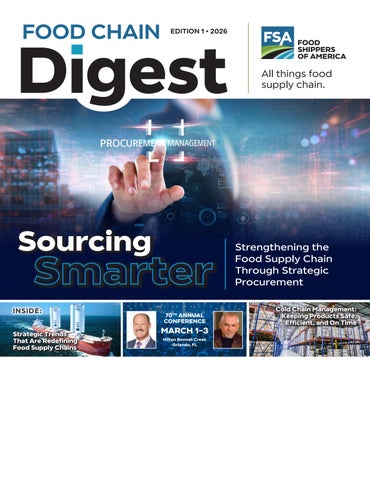
FOOD CHAIN Digest
EDITION 3 • 2025
Published three times a year for:
Food Shippers of America
1144 East State Street, Suite -288A Geneva, IL 60134
Brian Everett, Publisher Senior Partner, MindShare Strategies
952-442-8850 x201
brian@mindshare.bz
Inside the Modern Supply Chain
The food and beverage industry is a fastgrowing, ever-changing industry. Total revenue in the food manufacturing and grocery retail market reached about U.S. $11.93 trillion in 2023, and it’s still growing steadily. The forecast CAGR for that segment from 2024-to-2030 is approximately 3.2%.
As the supply chain industry in this market segment continues to evolve, companies are navigating a landscape defined by rapid technological advancement, shifting consumer expectations, and persistent operational pressures. AI-driven analytics, forecasting, and autonomous systems are helping businesses anticipate disruptions, optimize inventory, and enhance responsiveness across planning, sourcing, and logistics functions. These tools are now becoming indispensable for real-time visibility and agility in an unpredictable market.
In fact, such technologies are leading to new opportunities in creating efficiencies, product enhancement, and cost savings in procurement. See
Sourcing Smarter: Strengthening the Food Supply Chain through Strategic Procurement on page 6 and Sourcing Strategy Checklist on page 8.
Another key development is the rise of end-to-end supply chain visibility. Companies are investing in Internet of Things (IoT) sensors, RFID tracking, and “control tower” platforms that integrate data from every tier of the chain. These technologies provide richer insights into product movement, temperature-sensitive conditions, and potential bottlenecks, which is especially critical for perishables and food safety compliance. See Cold Chain Management: Keeping Products Safe, Efficient, and On-Time on page 13.
Traceability and transparency have also become non-negotiable for both consumers and regulators. Demand for detailed origin information—from farm to fork—is accelerating investments in digital traceability systems. These not only reinforce food safety and compliance but build consumer trust and support brand reputation.
Despite these opportunities, the industry faces significant challenges. Persistent cost pressures from inflation, energy prices, and ingredient volatility continue to squeeze margins and make planning more complex. Regulatory complexity—varying standards across regions and new reporting requirements—adds operational burdens and compliance costs.
Looking ahead, supply chain leaders who prioritize digital transformation, traceability, and resilience while managing cost and workforce dynamics will gain competitive advantage. In an industry where timing, quality, and trust matter, the capacity to adapt quickly and make data-driven decisions is no longer optional—it’s essential for survival and growth. My advice to you? As you navigate all of this, make sure to leverage the resources, content, networking, and conference engagement available to you as a member of Food Shippers of America!
Sourcing
Strengthening the Food Supply Chain Through Strategic Procurement Smarter
Sourcing and procurement are no longer back-office functions— they’re strategic levers that directly impact quality, sustainability, cost, and resilience across the entire food chain. As global supply networks face mounting pressures from inflation, geopolitical
disruptions, climate change, and shifting consumer preferences, food companies are quickly rethinking how and where they source ingredients, packaging, and equipment to ensure continuity and competitiveness. They’re also looking at shifting
their procurement strategies that effectively balance cost and responsibility, leverage technology for better transparency and productivity, and enhance partner collaboration for a competitive advantage.
The New Reality of Food Sourcing
Traditionally, food procurement focused on price and availability. Today, it’s about far more. Food manufacturers, distributors, and retailers are being held accountable for transparency, sustainability, and ethical sourcing practices. Consumers want to know where their food comes from, how it’s produced, and the impact it has on people and the planet.
This shift has driven companies to strengthen relationships with trusted suppliers, invest in traceability technology, and diversify sourcing networks to reduce risk. Many food companies are moving away from singlesource suppliers and embracing regional or multi-tier sourcing strategies to avoid disruptions like those seen during the pandemic.
For example, Chipotle Mexican Grill sources produce from dozens of local farms across the United States, defining “local” in relation to distribution centers and increasing regional procurement. This helps diversify tiered supply and reduce dependence on long-haul imports.
Balancing Cost and Responsibility
Procurement leaders are uniquely positioned to drive both cost efficiency and corporate responsibility, turning strategic sourcing into a powerful engine for business and social impact. “Volatile commodity markets and inflationary pressures make cost management essential, but short-term savings can’t come at the expense of long-term brand integrity or supplier relationships,” says one procurement executive for a major food manufacturer.
Progressive food companies are using total-cost-of-ownership models and supplier scorecards to evaluate vendors not just on price, but also on reliability, environmental impact, and labor practices. Large
food enterprises such as Nestle, PepsiCo, Coca-Cola and Unilever are publicly committed to supplier engagement and performance evaluation systems, particularly around sourcing, sustainability and emissions reduction KPIs.
Supply Chain Technology and Transparency
Transforming Procurement
Digital transformation is reshaping how food companies deploy and manage sourcing strategies. Cloudbased procurement systems, blockchain traceability tools, and predictive analytics are helping companies anticipate supply chain shocks before they occur.
Three leading food companies have made significant progress in leveraging technology and transparency to make an impact on their procurement strategy.
Retail giant Walmart, in partnership with IBM, deployed a blockchain platform (IBM Food Trust) to digitize traceability across its fresh produce and other categories. This has had a positive impact on sourcing in a number of ways, including quickening the time required to trace food products. Walmart has since expanded blockchain to more products and suppliers, boosting transparency and supplier accountability.
European retailer Carrefour implemented blockchain to track multiple food products—including chicken, eggs and vegetables – from source to shelf. Each product’s journey through the supply chain becomes transparent and verified, enhancing sourcing decisions based on quality, origin, and compliance. Consumers can scan QR codes to view product origin data, tying supply source visibility to brand trust and retailer differentiation. This digital transformation ultimately moves traceability from an internal compliance too into a strategic consumer engagement and sourcing quality lever.
Lastly, major agricultural origination and processing company ADM has a vast and complex supply chain that extends from the farm gate to the consumer’s plate. In recent years, the company’s procurement function has leveraged technology to accelerate its digital transformation and create new capabilities to drive greater agility and growth. In the process, the team has evolved from a corporate-service function to a business-critical team of highly strategic and trusted advisors within the ADM organization.
Collaboration as a Competitive Advantage
The most resilient food supply chains are built on strong partnerships, not transactional relationships. Leading companies are collaborating closely with farmers, ingredients suppliers, and logistics partners to improve forecasting, share data, and co-create solutions for challenges like sustainability and waste reduction.
By fostering open communication and mutual trust, procurement teams can drive innovation across the value chain—from developing alternative ingredients to redesigning packaging for circularity.
Sourcing for the Future
As the food industry continues to evolve, procurement will play a central role in shaping its future. Tomorrow’s sourcing leaders will need to think like strategists— balancing efficiency with ethics, agility with accountability, and local sourcing with global reach.
Ultimately, successful food sourcing is about more than securing ingredients at the right price—it’s about ensuring that every link in the supply chain supports a stronger, more sustainable, and more transparent food system.
Sourcing Strategy Checklist
There are eight key categories that can be part of an overall sourcing strategy for food companies. Check out these categories and examples of sourcing-related activities to see if they may have a fit for your company’s sourcing approach.
• Continuous improvement and benchmarking in place
Strategic Trends That Are Redefining Food Supply Chains
Major food enterprises are navigating one of the most consequential periods of change the supply chain has seen in decades. Heightened food safety expectations, rising transportation costs, labor constraints, and increasing pressure to reduce environmental impact are forcing shippers to rethink how products move from farm to fork.
In response, leading food brands are sharpening their focus on safety and operational efficiency, recognizing that resilient supply chains depend on both flawless execution and proactive risk management.
At the same time, food shippers are accelerating supply chain transformation initiatives that balance near-term performance with long-term sustainability goals. Investments in technology, network optimization, and collaborative partnerships are helping companies improve visibility, streamline operations, and reduce emissions— without sacrificing service or reliability.
Here’s a look at where three major food companies are prioritizing their time, energy and resources to create a major impact on their supply chain success.
UNFI Drives Safety, Effectiveness, Efficiency Through Supply Chain Strategy
United Natural Foods, Inc. (UNFI), a major North American food wholesaler, has seen improvements across its supply chain from the introduction of a new approach to operations, particularly at its distribution centers. While continuing its push for stronger profitability and efficiency as part
of a larger turnaround, UNFI has introduced a standardized lean operating model in 34 of its 49 distribution centers, according to Mark Bushway, Chief Supply Chain Officer during a recent investor day. The model is built on a Lean management philosophy, which prioritizes continuous process improvement.
“Our supply chain at scale creates a competitive advantage for retailers, suppliers and UNFI,” says Bushway. He says improved fill rates and on-time delivery enhance reliability and effectiveness across the company’s network. In addition, investments in effectiveness build resilience and agility to serve evolving market needs.
The company is working toward creating a “next generation supply chain” through four focused areas in their supply chain roadmap:
1. Expand automation to strengthen operational performance
2. Broaden AI capabilities to increase forecasting and replenishment accuracy
3. Optimize the company’s DC network to support growth and returns on invested capital
4. Scale Lean across all DCs to standardize processes.
“We’re confident in our roadmap,” he concludes. “Every step strengthens our commitment to safety, effectiveness and efficiency – fueling long-term value creation.”
Walmart is driving success through a supply chain transformation that has capitalized on the retailer’s incredible speed capabilities, enabled by store and supply chain assets. But this transformation isn’t just about improving operations, it’s fueling growth, according to David Guggina, Chief eCommerce Officer, Walmart U.S., who led the retail giant’s supply chain initiatives at a critical time of its transformation.
“The foundation of our progress – and the fuel for our future – is our people, our supply chain, and the unmatched reach of our store network,” says Guggina. “Before I stepped into this role, I led the Supply Chain team as we set out to transform and connect our U.S. network.”
“When you look at all the pieces coming together, you can see the true end-to-end platform we’ve built,” continues Guggina.
“It’s powered by data, intelligent software, AI, and physical automation – all working together
to create a faster, smarter, and more seamless experience for our customers.”
This supply chain transformation has given Walmart clearer visibility into inventory, expanded its capacity, created more accuracies, accelerated speed, and allowed Walmart to scale its eCommerce business in a way that’s more sustainable, efficient, and drives a lower cost to serve, he says.
Cargill Advances Dry-Bulk Maritime Decarbonization Through Fleet Technology
Cargill is one of the largest transporters of dry and bulk cargo, completing more than 4,500 voyages each year. Cargill operates around 650 vessels at any one time. With this in mind, this global food and agricultural giant has placed a significant investment of time and resources to help decarbonize global shipping.
Cargill recently announced the maiden voyage of Brave Pioneer, the first of five green methanol dual-fuel dry bulk vessels chartered by the company. The deployment of the Brave Pioneer marks another important milestone in Cargill’s broader decarbonization efforts –one focused on innovation, testing
and learning as the company works with customers and partners to refine future-ready solutions for Cargill and the industry.
Owned by Mitsui & Co., Brave Pioneer is equipped to operate on both conventional marine fuels and green methanol, a lower-carbon alternative. The estimated CO2 saving of using green methanol compared to conventional fuel is up to 70%.
Cargill will conduct a series of operational trials designed to evaluate green methanol bunkering readiness, understand how environmental attributes can be traced and verified through carbon accounting systems, and assess market appetite for low-carbon freight services.
“Decarbonizing global shipping requires a mix of technologies and the willingness to take bold steps before the entire ecosystem is ready,” says Jan Dieleman, President of Cargill’s Ocean Transportation business. “Technologies like green methanol or wind-assisted propulsion come with uncertainty. But as an industry leader, we have a responsibility to test these innovations on the water, share what we learn, and help shape the systems and standards that will enable wider adoption.”
The launch of Brave Pioneer paves the way for the four additional vessels that will join Cargill’s fleet over the coming years.
The addition of these vessels strengthens Cargill’s multi-solution decarbonization approach, which includes wind-assisted propulsion, voyage optimization technologies, energy-efficiency retrofits and exploration of alternative fuels such as biofuels and ethanol.
David Guggina
Jan Dieleman
Walmart is now using autonomous forklifts across four high-tech DCs within its supply chain network.
Each represents another step in the company’s broader efforts to embed sustainability into global ocean supply chains and support customers looking for practical, lower-carbon freight options.
“We know the road to low carbon shipping will require a mix of solutions and green methanol is one part of that portfolio,” Dieleman continues. “Our new fleet is about optionality and adaptability. These vessels are engineered to perform at a bestin-class level on conventional fuel today, while allowing us to switch to greener fuels as availability improves. It’s a practical way to future-proof ocean transport.”
As one of the world’s largest charterers of dry bulk freight, Cargill’s actions send a strong demand signal to the market and serve as an open invitation for others in the maritime sector to join in advancing the transition to sustainable shipping.
The initiative supports Cargill’s broader effort to reduce supply chain emissions and invest and test practical innovations that advance progress toward a more sustainable global food system. Green methanol-enabled vessels—
24_014513_Food_Chain_Digest_Edition_1
paired with the eventual expansion of renewable fuel supply—are expected to play a meaningful role in reducing maritime emissions over the coming decade.
In 2023, Cargill tested new technology to bring cutting-edge wind propulsion to commercial shipping for the first time. This vessel is retrofitted with two WindWings, which are large wing sales to harness the power of wind while in transit.
Photo Source: Cargill
COLD CHAIN MANAGEMENT: KEEPING PRODUCTS SAFE, EFFICIENT, AND ON TIME
Managing the flow of perishable foods remains one of the most complex challenges in supply chain operations. From production and processing through distribution, each stage introduces risks ranging from overproduction and delays to spoilage, waste, and significant financial loss.
Perishable goods that commonly move through the cold chain, such as fresh produce, dairy, and meat, require careful handling to maintain quality from farm to fork. These distinctive supply chains are highly complex, involving multiple stakeholders across production, processing, distribution, retail, and logistics, where even small breakdowns in coordination can lead to significant losses.
In fact, according to the Food and Agriculture Organization (FAO), roughly 14% of food is lost before reaching retail, representing an estimated $400 billion in annual losses. Beyond the financial impact, food spoilage contributes to food insecurity and safety, and environmental waste.
Minimize Spoilage by Mitigating Risk
Anticipating risk is one of the most effective ways to reduce perishable food spoilage, especially as disruptions caused by natural disasters, geopolitical events, and other factors become more frequent. Preventing transportation delays before they occur is often the difference between protecting product integrity and incurring costly losses.
To stay ahead of disruption, supply chain teams are increasingly relying on data-driven strategies that combine location tracking, temperature monitoring, and shipment condition data. Technologies such as GPS, RFID, and IoT-enabled track-and-trace systems provide real-time visibility from production through distribution.
This enhanced visibility enables supply chain leaders to proactively address operational risks— including transportation delays, regulatory challenges, and supplier disruptions—through comprehensive risk assessments and contingency planning. With real-time analytics in place, teams can quickly identify emerging threats, respond to unexpected events, and minimize the impact on perishable goods while maintaining continuity of operations.
For example, Walmart Global Tech (Walmart’s technology and digital innovation division) uses AI
An industrial engineer uses a digital tablet to program a robotic arm in a modern manufacturing facility.
and advanced analytics to predict potential supply chain disruptions, including delays in refrigerated transport. Predictive models optimize routing, delivery timing, and storage allocation to minimize risk to perishable goods. The impact? Higher on-time delivery rates and lower spoilage rates across the cold chain.
Network Mapping to Identify Where Disruptions May Occur
Network mapping is a powerful tool for identifying vulnerabilities in the supply chain. By visualizing the flow of goods, information, and resources, companies can spot bottlenecks, single points of failure, and inefficiencies before they disrupt operations.
No other company combines the knowledge and experience in cold storage construction and warehousing that Tippmann Group offers. As owners & operators of more than 140,000,000 cubic feet of temperature-controlled space, Tippmann Group is your single source for cold storage excellence.
Supply chains are complex systems that require constant monitoring, visibility and improvement. Network mapping not only highlights weak links but also provides insight on how to strengthen them, ensuring smoother, more resilient operations.
For example, Taylor Farms, a large fresh produce manufacturer, has adopted digital supply chain visibility technologies that integrate temperature and GPS tracking across shipments and warehouses. Their systems merge data from WMS and TMS platforms with integrated temperature and geo-tracking capabilities to allow planners to see the flow of goods throughout the cold chain in real time, anticipate delays, and optimize routing to minimize spoilage risk. This kind of digital integration is equivalent to real-world mapping of the physical cold chain — enabling dynamic response rather than static plan execution.
Using Data to Future-Proof Your Cold Chain
Reducing perishable food spoilage in supply chains requires a comadfadfasdffbination of proactive measures, strategic planning, and collaborative partnerships—all of which can be powered by insights from reliable data. With enhanced visibility, companies can strategically invest in optimizing their supply chain design, implementing the best cold chain management practices, and adjusting routes or renegotiating with suppliers and shippers. This way, companies can dramatically minimize losses, improve efficiency, and enhance the sustainability of their operations. Collectively, this creates an environment that reduces worldwide food spoilage losses, and, in doing so, maximizes profits for all stakeholders across a supply chain.
EMERGING TRENDS IN COLD CHAIN MANAGEMENT
Digitization & Real-Time Monitoring
IoT sensors and telemetry for temperature, humidity, and shock monitoring in transit; real-time alerts to prevent spoilage before it occurs; blockchain traceability to ensure data integrity for food safety and regulatory compliance; and predictive analytics to anticipate deviations and reroute shipments if needed.
AI & Predictive Demand Forecasting
Machine learning models to predict demand fluctuations for perishable items with short shelf life; integration with point-of-sale data from retailers for more accurate inventory planning; and dynamic production and delivery planning to reduce waste and avoid stockouts.
Automation & Robotics in Warehousing
Automated sorting, palletizing, and packing systems designed for fragile and temperature-sensitive items; robotic forklifts and conveyor systems in cold storage reduce labor costs and improve safety; collaborative robots (cobots) for high-accuracy picking in chilled environments.
Sustainable & Energy-Efficient Cold Chain
Energy-efficient refrigeration and transport systems to reduce carbon footprint; alternative fuels for refrigerated trucks (e.g., electric, hydrogen); and reusable and recyclable packaging materials for sustainability and insulation efficiency.
Integrated Transportation Management Systems (TMS)
Cloud-based TMS for end-to-end shipment visibility; integration with GPS, weather, traffic, and route optimization platforms; real-time carrier performance tracking to reduce delays and spoilage risk.
Multi-Modal & Last-Mile Optimization
Combining air, land, and sea transport for faster and cost-effective delivery of perishable goods; last-mile solutions, including cold lockers or micro-distribution centers, for urban delivery; and partnerships with on-demand delivery services to maintain product integrity.
Smart Packaging Innovations
Temperature-sensitive labels and time-temperature indicators that signal spoilage risk; insulated or phasechange materials that extend shelf life during transport; and sensors that communicate with supply chain systems to automate recalls or rerouting.
Regulatory & Food Safety Compliance Automation
Automated documentation for FSMA, USDA, and FDA compliance; AI-driven audits of cold chain logs for proactive issue detection; and traceability software to quickly manage recalls and reduce liability.
Circular Supply Chain & Waste Reduction
Using AI and logistics planning to redirect nearexpiry products to secondary markets; partnerships with food banks and donation programs integrated into the supply chain; and composting or recycling programs for unavoidable spoilage.
Pictured here and on page 13 is one of five state-of-the-art cold storage facilities operated by Interstate Cold Storage. The company ranks among the largest 25 public cold storage warehousing companies in North America, operating nearly 22,000,000 feet of refrigerated space.
— MIKE C., ASSISTANT TRANSPORTATION DIRECTOR OF WHOLESOME FOODS INC.
We’re with you through every freight journey, solving food logistics challenges with real-world trucking expertise, a track record of success and relationships built on trust. Ship with Schulz Logistics.
Transportation across Canada, the U.S., and Mexico—built for speed, reliability, and visibility from pickup to delivery. Solutions include FTL/LTL, cross-border moves, drayage, and specialized/heavy haul, backed by experienced coordination and responsive service. Capacity is supported by a versatile fleet mix, including dry van, reefer/heated, flatbed, step deck, lowboy, and RGN equipment to match the shipment.
Food-grade warehousing with certified processes and the controls customers need for confidence in storage and distribution. Facilities support ambient, cooler, and freezer requirements and include key certifications such as CFIA/BRC/FDA with strong audit results (including AA ratings where applicable). Beyond storage, services include bulk and racked storage, inventory management (WMS), order fulfillment, kitting, co-packaging, and display builds to keep product moving.
A regionally focused transportation provider delivering dependable service across Ontario and key lanes. Services include dry van and flatbed capacity with a strong emphasis on consistent performance and day-to-day reliability. Waveline offers Heavy Haul with vans and flatbeds Triaxle & Quadaxle equipment. Fully integrated into the Advantech network, Waveline connects seamlessly to broader capacity and brokerage support when your needs scale.
Mode Matters
How to Optimize Your Supply Chain
For many food shippers, transportation decisions are about far more than cost. The right freight transport mode can mean the difference between fresh, safe product on the shelf—or spoilage, waste, and unhappy customers. With increasingly complex supply chains, tighter margins, and higher customer expectations, food companies take a strategic approach to determine how their products move.
Many factor in six considerations as they determine mode usage in their supply chain strategy.
Product Characteristics Come First
The nature of the product largely determines transportation choices. Perishable items such as fresh produce, dairy, meat, and frozen foods require temperature control, limited transit times, and careful handling, while shelf-stable goods allow more flexibility.
Of course, maintaining food safety is non-negotiable. Transportation modes must support continuous temperature control, real-time monitoring and alerts, clean, foodgrade equipment, and regulatory compliance (FDA, FSMA, USDA). Other key considerations include:
• Required temperature range (ambient, refrigerated, frozen)
• Shelf life and spoilage risk
• Sensitivity to handling, vibration, or delays
• Packaging durability and pallet configuration
Highly perishable items often favor truckload or expedited modes, while longer-life products may move via intermodal or rail to reduce costs.
Distribution expenses as a percentage of sales at Nestlé have remained flat, an accomplishment in part achieved by effectively leveraging multimodal strategy. High-volume, non-perishable items are often shipped by rail or ocean to reduce costs, while fresh or sensitive products are transported by dedicated refrigerated trucks for faster, reliable delivery. This allows the “Good food, Good life” company to balance cost efficiency with quality assurance while controlling transportation spend.
Transit Time vs. Cost Tradeoffs
Food companies constantly balance speed and cost. Faster modes such as truckload or air freight reduce transit time and inventory risk but come at a premium. Slower, lower-cost options may increase inventory carrying costs or raise spoilage concerns. Executives typically evaluate:
• Time-to-market requirements set by customers or retailers
• The financial impact of potential spoilage
• Inventory carrying costs versus transportation savings
• Service level agreements (SLAs)
For many, the optimal solution is a blended freight transport strategy, using premium modes for urgent
or high-risk shipments and costefficient modes for predictable, longer-lead-time lanes.
With 4,000 stores, Chipotle Mexican Grill sources fresh produce from local and regional farms to reduce transit times and preserve quality. Most fresh produce moves via short-haul refrigerated trucks, minimizing time from farm to restaurant. This ensures freshness, reduces spoilage, and allows responsiveness to changing customer demand without relying on long-haul transport.
Distance and Lane Characteristics
Geography plays a major role in mode selection. Short-haul regional moves can rely on truckload or less-than-truckload (LTL), while longer distances may justify intermodal or rail for appropriate
freight. When determining mode usage, supply chain executives usually analyze lane length and frequency, origin and destination, access to refrigerated equipment, and seasonal volume fluctuations.
Dedicated lanes with consistent volume are more likely to support rail or intermodal, while variable or time-sensitive lanes favor trucking.
PepsiCo uses regional distribution centers (DCs) to optimize transportation modes and distances to retailers. For example, large-volume shipments to major retailers use full truckloads (FTL) for efficiency, whereas less-thantruckload (LTL) or dedicated fleets are deployed for smaller stores or urgent replenishment needs. This tiered mode approach improves on-time delivery, reduces empty miles, and enhances flexibility in responding to demand spikes.
Reliability and Risk Management
Reliability often outweighs lowest cost in food supply chains. Missed delivery windows can lead to rejected loads, lost sales, or food safety risks. Companies assess mode strengths, carrier performance history, on-time delivery metrics, equipment availability, weather and disruption risk. Many diversify transportation modes and carriers to reduce dependency and improve resilience during disruptions.
Sysco uses a combination of FTL, LTL, and intermodal transportation to manage a wide range of products, from frozen foods to dry goods. For example, high-volume, less-perishable products move via intermodal rail to regional DCs. Temperature-sensitive items are shipped directly via refrigerated
truck for quick turnover. This approach optimizes speed, cost, and reliability for a highly complex, multi-product food supply chain.
Sustainability and Environmental Impact
Many leading food shippers such as Kraft Heinz, Nestlé, PepsiCo/ Tropicana, General Mills, Unilever
and Conagra Brands are known to factor in sustainability goals to increasingly influence their transportation decisions. Rail and intermodal offer lower emissions per ton-mile compared to trucking, making them attractive for companies with ESG targets. Factors considered include carbon footprint by mode, fuel efficiency, alignment with corporate
Located to serve the Northeast, Bettaway’s state-of-the-art beverage management facility was built to meet the needs of food and beverage manufacturers. Capability, warehousing, inventory management and distribution through Bettaway’s dedicated fleet make this the efficient, turn-key solution you’ve been looking for. To learn more, go to Bettaway.com or call 908-222-2541
sustainability goals, and customer expectations around environmental responsibility.
Some food companies now factor emissions data directly into their transportation optimization models.
Customer and Retailer Requirements
Retailers and foodservice customers often dictate delivery windows, modes, or service levels. Food companies must align transportation choices with these expectations to protect relationships and shelf space. Common requirements include tight delivery appointments, dropand-hook capabilities, appointment scheduling compliance, and temperature documentation.
Meeting customer expectations is often a deciding factor in mode selection.
The Bottom Line
Selecting the right mode of transportation in the food supply chain is a strategic decision that balances product integrity, cost, speed, reliability, and sustainability. The most successful food companies avoid one-sizefits-all solutions and instead build flexible, data-driven transportation strategies that adapt to product needs, market conditions, and customer expectations.
As technology advances and supply chains grow more complex, transportation mode selection will continue to be a critical lever for protecting margins, reducing waste, and delivering safe, highquality food to consumers.
Leading food companies like Nestlé, PepsiCo, Chipotle, and Sysco demonstrate that a datadriven, flexible, and multi-modal approach not only preserves product quality but also provides a competitive edge in today’s fast-moving, demand-driven food market.
2025-2026
FOOD CHAIN PROVIDERS
BUYER’S GUIDE
Welcome to the 2026 Food Chain Providers Buyer’s Guide! This resource is published by Food Chain Digest to help supply chain professionals find potential providers of valuable services, including for-hire motor carriers, 3PLs, brokers, drayage, maritime, rail, intermodal, expedited, warehousing, air cargo, TMS, and last-mile/final mile. All companies listed in this Resource Guide are paid advertisers and are not in any way officially endorsed by Food Shippers of America (FSA).
Acme Distribution, Inc. acmedistribution.com
303-739-2126
James_Lee@acmd.com
Acme Distribution delivers comprehensive, tailored third party logistics solutions designed to streamline your supply chain from start to finish. With almost 80 years of expertise, we offer flexible pallet warehousing, contract storage, and industrial outdoor space, integrated retail distribution (DSD & DTS), and efficient fulfillment services for both B2B and B2C operations. Our company owned fleet and carrier network ensure reliable FTL/LTL freight movement, on-time delivery, and seamless transportation. Value-added services like packaging, labeling, compliance support, and custom solutions help you reduce costs and boost efficiency. Acme’s experienced team supports major retailers and diverse industries with scalable, high-performance logistics you can trust.
AWC Logistics
awclogistics.net
786-822-1500 operations@awclogistics.net
We are an asset-based trucking company and freight brokerage that specializes in temperature-controlled product. We haul primarily in the Northeast and Mid-West.
Capital Express Lines, Inc.
capitalexpresslines.com
916-408-5630
andy@capitalexpresslines.com
Capital Express Lines, Inc. is a trusted, asset-based transportation and warehousing provider supporting food manufacturers and distributors across the Western United States. Operating a fleet of 100+ power units and 350+ dry-van trailers, we deliver reliable full truckload and dedicated solutions with a strong focus on food-grade
standards, equipment integrity, and on-time performance. Our Sacramento, California facility offers dry ambient warehousing and cross-dock services to support flexible supply chains. With over 25 years of operational experience, Capital Express Lines provides food shippers the consistency, communication, and accountability required to protect product quality and meet today’s demanding service expectations.
Clean Energy
cleanenergyfuels.com
949-315-9959
john.hodgkinson@cleanenergyfuels.com
Clean Energy is the country’s largest provider of renewable natural gas (RNG) for the transportation industry. Our mission is to decarbonize transportation through the development and delivery of RNG, a sustainable biofuel derived by capturing methane from organic waste. We operate a vast network of fueling stations across the U.S. and Canada, along with dairy based RNG production facilities nationwide, giving shippers a ready-now pathway to reduce Scope 3 emissions. Clean Energy enables thousands of vehicles—from city buses to waste and heavy duty trucks—to displace fossil fuels and cut climate harming greenhouse gases. Visit cleanenergyfuels.com to learn more.
Custom Goods Logistics
custom-goods.com
310-241-6700
info@custom-goods.com
Custom Goods Logistics is a full-service logistics company with over 60 years of experience and a refined focus on Warehousing, Transportation, and Custom Examination Sites, offering 34 warehouses and 9 million sq ft nationwide. We provide tailored solutions for dedicated and multi-client warehousing and offer distribution, cross-dock / transload, omnichannel, and fulfillment services. We are uniquely
positioned to provide comprehensive logistics solutions with a personal touch. As a number one strategic partner, our customers benefit from our unrivaled dedication to customer excellence.
Dynamic Logistix dynamiclogistix.com
913-274-3800
sales@shipdlx.com
Logistics is chaotic. That’s why here at Dynamic Logistix, we build tailored solutions that combines powerful technology, a dedicated team of experts, and a carefully curated carrier network to help shippers turn supply chain chaos into clarity.
Flock Freight
flockfreight.com
855-744-7585
marketing@flockfreight.com
Flock Freight is the largest Shared Truckload (STL) freight brokerage in the U.S., transforming underutilized truckload capacity into tangible value: cost savings for shippers, increased earnings for carriers, and a smaller carbon footprint. Their AI-powered, patented pooling technology optimizes across Flock’s entire customer network, combining shipments from thousands of businesses into efficient Shared Truckloads. With STL, shippers enjoy truckload-level service while only paying for the space they need. Trusted by thousands of customers, from some of the
largest enterprises to growing brands, Flock Freight delivers an unmatched combination of cost efficiency, exceptional service, and a streamlined shipping experience.
M2 Logistics
m2logistics.com
920-662-6266
gfalk@m2logistics.com
M2 Logistics is a leading non-asset based logistics provider delivering strategic transportation and supply chain solutions. We transform logistics from a transactional service into a strategic partnership, leveraging our proprietary enCompass TMS platform to drive operational excellence. Through deep carrier relationships, advanced analytics, and flexible technology, we help companies integrate business strategy with supply chain initiatives by reducing costs and increasing productivity. Our approach is simple: people working with people. We don’t just move freight; we become an extension of your team, providing the partnership, flexibility, and scalability needed to adapt as your business grows.
Premier Trailer Leasing premiertrailerleasing.com
888-434-0889
corporate@premier-us.net
Premier Trailer Leasing partners with food shippers nationwide to keep operations moving smoothly, no matter
IT’S YOUR BUSINESS
the season or scale. With more than 40 locations across the U.S. and a fleet of 65,000+ trailers, including reefers, dry vans, flatbeds, and chassis, Premier helps customers stay flexible and protect uptime without the capital burden of ownership. Our in-house RoadCARE support and GPS-enabled visibility provide peace of mind around the clock, so shippers can focus on delivering fresh, on-time products. From peak season surges to long-term growth, Premier shows up as a dependable partner, ready to say “yes” when it matters most and help customers stay ready for the road ahead.
SFL Companies
sflcompanies.com
859-334-5100
alang@sflcompanies.com
Service First Logistics (SFL Companies) delivers Logistics Without Limits by combining innovation, expertise, and integrity to redefine how freight moves across America. As a full-service third-party logistics and supply chain management provider, we create customized solutions across truckload, LTL, drayage, cross-border, and temperaturecontrolled shipping. From growers and manufacturers to Fortune 500 companies, we manage missioncritical freight with the reliability, precision, and accountability shippers depend on. Our experienced supply chain strategists act as an extension of each client’s team, using modern freight technology and real-time visibility to anticipate challenges, simplify complexity, and build longterm, service-first partnerships.
Spartan Logistics
spartanlogistics.com
614-497-1777
nharmon@spartanlogistics.com
Spartan Logistics is an assetbased warehousing and logistics provider, specializing in food-grade warehousing and distribution. With over four million square feet across 22 warehouse locations in the Midwest and South, we provide safe, clean, and compliant storage, with specific expertise in handling food, beverage, and paper products. Our services include warehousing, cross-docking, inventory management, order fulfillment, and much more. We own the majority of our facilities, trucks, and equipment, ensuring reliability, flexibility, and cost control for our customers. Since 1988, Spartan has delivered dependable supply chain solutions that help food shippers move products from production to consumption.
Stokes Trucking stokestrucking.com
435-799-8538
mark@stokestrucking.com
Founded in 1979 with just one truck, our company has grown while keeping the same strong trucker spirit that started it all. Based in Tremonton, Utah, we specialize in regional transportation services, delivering dry goods and refrigerated items with reliability and care. Serving customers across the Western and Midwestern United
States, we take pride in our decades of experience and commitment to exceptional service. Our dedication to quality has made us a trusted partner for businesses seeking dependable transportation solutions in these key regions.
Tippmann Group / Interstate Warehousing
tippmanngroup.com
260-490-3000
tippsales@tippmanngroup.com
Tippmann Group is a unique combination of two companies, Tippmann Construction and Interstate Warehousing, which are dedicated to safe and efficient design, construction and operation of multi-temperature food processing and distribution facilities for the food industry. Interstate Warehousing is the 5th largest PRW company in North America with SQF certified facilities in key markets around the U.S. and more than 140,000,000 cubic feet of cold storage space. As a design/build company, Tippmann Construction has been in business since 1968, and our refrigeration expertise and owner/operator experience make Tippmann Group your single-source provider for all your temperature-controlled facility needs.
Trademark Transportation
trademarktrans.com
800-646-2550
info@trademarktrans.com
Trademark Transportation is an employee owned 4PL that specializes in managing time and temperature sensitive shipments. Over four decades Trademark has specialized in freight consolidation, pool distribution and an exclusive technology suite built specifically for the food industry. In a world that never stops moving, Trademark Transportation provides a seamless approach to supply chain solutions designed around your business needs. From the first mile to the last, our dedicated team ensures your freight arrives on time, intact and without surprises.
United Facilities
unitedfacilities.com
612-598-3988
darrin.stuhr@unifac.com
United Facilities is a family-owned, asset-based 3PL specializing in food-grade and organic warehousing across key U.S. markets. With nearly nine million square feet of space, Lean operations, and AI-assisted analytics, we help food shippers reduce risk, eliminate waste, and scale seamlessly through demand shifts. Our advanced WMS, automationenabled facilities, and data-led decision making deliver predictable KPIs, real-time visibility, and operational agility. With direct access to decision-makers, United Facilities brings control, clarity, and confidence to complex food supply chains.
Vomela vomela.com
951-226-6263
Michael.burrafato@vomela.com
from design and manufacturing to installation and removal anywhere in North America. With decades of experience managing complex fleet programs, Vomela can help simplify your fleet graphics requirements, reduce vehicle downtime, and maintain brand consistency across multiple locations and vehicle types.
Werner Enterprises werner.com
877-330-8090
salessupport@werner.com
Werner delivers a comprehensive portfolio of supply chain solutions backed by award-winning customer service and innovation. We specialize in the complexities of transporting time-sensitive, perishable food and beverage products. Our diverse multi-modal solutions—including temperature-controlled truckload, dedicated capacity and intermodal—are designed to optimize supply chains and ensure on-time delivery. Leveraging cutting-edge technology and a modern refrigerated fleet, Werner provides real-time visibility and operational excellence. From produce logistics to cross-border expertise, we serve as a scalable extension of your team, protecting your brand and keeping the global food chain moving.
Vomela is a National leading provider of fleet graphics in the U.S., delivering reliable, end-to-end solutions for branded vehicles. We support regional and national fleets,
• Our locations: Chambersburg, PA Greensburg, PA Pittsburgh, PA Davenport, IA