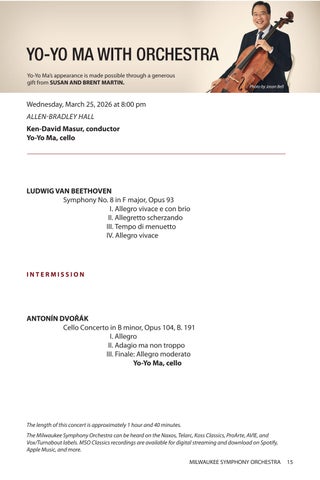

YO-YO MA WITH ORCHESTRA
Yo-Yo Ma’s appearance is made possible through a generous gift from SUSAN AND BRENT MARTIN.
Wednesday, March 25, 2026 at 8:00 pm
ALLEN-BRADLEY HALL
Ken-David Masur, conductor
Yo-Yo Ma, cello
LUDWIG VAN BEETHOVEN
Symphony No. 8 in F major, Opus 93
I. Allegro vivace e con brio
II. Allegretto scherzando
III. Tempo di menuetto
IV. Allegro vivace
INTERMISSION
ANTONÍN DVOŘÁK
Cello Concerto in B minor, Opus 104, B. 191
I. Allegro
II. Adagio ma non troppo
III. Finale: Allegro moderato
Yo-Yo Ma, cello
The length of this concert is approximately 1 hour and 40 minutes.
The Milwaukee Symphony Orchestra can be heard on the Naxos, Telarc, Koss Classics, ProArte, AVIE, and Vox/Turnabout labels. MSO Classics recordings are available for digital streaming and download on Spotify, Apple Music, and more.
Photo by Jason Bell
Guest Artist Biographies

YO-YO MA
Yo-Yo Ma’s multi-faceted career is a testament to his belief in culture’s power to generate trust and understanding. Whether performing new or familiar works for cello, bringing communities together to explore culture’s role in society, or engaging unexpected musical forms, Yo-Yo strives to foster connections that stimulate the imagination and reinforce our humanity.
Most recently, Yo-Yo began Our Common Nature, a cultural journey to celebrate the ways that nature can reunite us in pursuit of a shared future. Our Common Nature follows the “Bach Project,” a 36-community, six-continent tour of J. S. Bach’s cello suites paired with local cultural programming. Both endeavors reflect Yo-Yo’s lifelong commitment to stretching the boundaries of genre and tradition to understand how music helps us to imagine and build a stronger society.
Yo-Yo is an advocate for a future guided by humanity, trust, and understanding. Among his many roles, Yo-Yo is a United Nations Messenger of Peace, the first artist ever appointed to the World Economic Forum’s board of trustees, a member of the board of Nia Tero, the U.S.-based nonprofit working in solidarity with Indigenous peoples and movements worldwide, and the founder of the global music collective Silkroad.
His discography of more than 120 albums (including 20 Grammy Award winners) ranges from iconic renditions of the Western classical canon to recordings that defy categorization, such as Hush with Bobby McFerrin and the Goat Rodeo Sessions with Stuart Duncan, Edgar Meyer, and Chris Thile. Yo-Yo’s recent releases include Six Evolutions, his third recording of Bach’s cello suites, and Beethoven for Three, the fourth in a series of Beethoven recordings with pianist Emanuel Ax and violinist Leonidas Kavakos.
Yo-Yo was born in 1955 to Chinese parents living in Paris. He began to study the cello with his father at age four and three years later moved with his family to New York City, where he continued his cello studies at The Juilliard School before pursuing a liberal arts education at Harvard. He has received numerous awards, including the Avery Fisher Prize (1978), the National Medal of the Arts (2001), the Presidential Medal of Freedom (2010), Kennedy Center Honors (2011), the Polar Music Prize (2012), and the Birgit Nilsson Prize (2022). He has performed for nine American presidents, most recently on the occasion of President Biden’s inauguration.
Yo-Yo and his wife have two children. He plays four cellos: two modern instruments made by Moes & Moes, a 1733 Montagnana from Venice, and the 1712 “Davidoff” Stradivarius.
Photo by Brantley Gutierrez
Program notes by David Jensen

LUDWIG VAN BEETHOVEN
Born 17 December 1770; Bonn, Germany
Died 26 March 1827; Vienna, Austria
Symphony No. 8 in F major, Opus 93
Composed: April – October 1812
First performance: 27 February 1814; Ludwig van Beethoven, conductor; Redoutensäle, Hofburg Palace, Vienna
Last MSO performance: 11 March 2017; Karina Canellakis, conductor
Instrumentation: 2 flutes; 2 oboes; 2 clarinets; 2 bassoons; 2 horns; 2 trumpets; timpani; strings
Approximate duration: 26 minutes
In the eight years that separated Beethoven’s landmark third symphony, the “Eroica,” from his eighth, the famously irascible and individualistic composer had cultivated a revolutionary “symphonic ideal” that rocked the foundations of the genre’s traditions. This singular musical vision tested the limits of orchestral writing in the extreme: increasingly preoccupied by his own psychological frame of mind, his forms assumed ever-broader dimensions, his harmonic language became increasingly radical, and his shocking contrasts in volume, texture, and emotional inflection reached ecstatic heights. This is precisely why the eighth has been met with ambivalence since its premiere. Unrestrained in its merriment and briefer than any of his sublime “middle period” symphonies, it seems to stand in opposition to everything he had been working toward, betraying nothing of the troubles that bedeviled him.
Closer in style to his 18th-century precursors, the apparent distance separating this buoyant, distinctly cheerful music from the painful emotional upheavals taking place in Beethoven’s personal life was captured by the German poet Johann Wolfgang von Goethe, who crossed paths with the composer in the spa town of Teplice in the summer of 1812. He was hardly exaggerating when he described Beethoven’s condition in a letter to his friend, Carl Friedrich Zelter: “Altogether he is an utterly untamed personality, who is not altogether wrong in holding the world to be detestable, but surely does not make it any the more enjoyable either for himself or for others by his attitude.” Apart from the torment of his worsening deafness, it was at Teplice that Beethoven penned the unsent, notoriously inscrutable letter to his “immortal beloved.”
As a probing, deeply introspective testament to his innermost feelings for the unnamed object of his unrequited passion (almost certainly the Hungarian countess Josephine Brunsvik), the document has puzzled scholars since its discovery, though it makes one thing perfectly clear: he was wholly alone, without recourse, and his love would never find satisfaction. Beethoven did, however, make things harder for himself than necessary. That autumn, apparently motivated by righteous indignation and quite possibly envy, he travelled to Linz, where his brother Johann had unwisely taken on one of his renter’s unwed sisters as both housemaid and mistress. After petitioning both the church and the local authorities to intervene, Beethoven was successful in obtaining a police order to have her expelled from the city. Johann managed to put an end to things by simply marrying the girl, though he would eventually blame his brother for trapping him in an unhappy marriage.
Written in only a few months’ time, the eighth symphony exhibits a masterful economy of style, and the music, in the words of Michael Steinberg, “takes off like a house afire.” Like Franz Joseph Haydn’s famously comical musical experiments, much of it is permeated by a tongue-in-cheek
sense of humor. In place of his usual finely spun adagio in the second movement, for example, we enjoy a spritely allegretto whose insistent tickings in the woodwinds have been interpreted as a satire of the mechanical metronome, a device only recently perfected in Beethoven’s day by his friend Johann Nepomuk Maelzel. As an homage to his predecessors, the minuet-and-trio that follows is treated with typically Beethovenian flair: heavily accented sforzando punctuations exaggerate the main theme’s metric pulse, which surrounds the demure duet for clarinet and horn nestled in the heart of the movement.
The finale demonstrates Beethoven’s signature daring as the interjection of a low C♯, a harmonically distant “wrong” note in F major, sets the music roving, eventually arriving (after a few ingenious modulations through impossibly remote key areas) with no fewer than 53 measures of cadential figures to assure us that the music has, at last, reached its end. Despite its harmonic cunning and blitheness of spirit, the eighth only rarely appears in contemporary programming. When asked why his “little” symphony in F — so called to distinguish it from his sixth in the same key, the “Pastoral” — wasn’t as popular as his seventh, Beethoven retorted: “Because the eighth is so much better.”

ANTONÍN DVOŘÁK
Born 8 September 1841; Nelahozeves, Bohemia
Died 1 May 1904; Prague, Bohemia
Cello Concerto in B minor, Opus 104, B. 191
Composed: 8 November 1894 – 9 February 1895; revised May – 11 June 1895
First performance: 19 March 1896; Antonín Dvořák, conductor; Leo Stern, cello; Philharmonic Society of London
Last MSO performance: 18 November 2018; Jader Bignamini, conductor; Joshua Roman, cello
Instrumentation: 2 flutes (2nd doubling on piccolo); 2 oboes; 2 clarinets; 2 bassoons; 3 horns; 2 trumpets; 3 trombones; tuba; timpani; percussion (triangle); strings
Approximate duration: 40 minutes
The cello is not an instrument that is characteristically well-suited to the concertante tradition. Its lush, resonant baritone register encounters great difficulty in cutting through the walls of sound produced by an orchestra, and Antonín Dvořák, having freelanced as a violist in his younger years, is known to have complained that the instrument “whinges up above and grumbles down below.” But few works of art command a greater presence or inspire such awe as his cello concerto: its lyrical and dramatic virtues have been universally hailed since its inception, earning a reputation as the triumph and final end of every serious cellist’s artistic endeavors.
Dvořák himself felt the inward impulse to compose the work to be inexplicable. He was never drawn to the genre (a piano concerto from nearly twenty years earlier failed to find a permanent place in the repertoire, though his violin concerto fared considerably better), but the spark of inspiration was apparently ignited by the premiere of Victor Herbert’s second cello concerto in the spring of 1894. Herbert, Dvořák’s colleague at the National Conservatory and principal cellist of the Philharmonic Society of New York, naturally appeared as soloist, and Dvořák was reportedly so taken by the skillful balancing of the instrument’s solo line against the accompanying symphonic forces that he eventually requested a copy of the score from Herbert for personal study.
The process of writing his own, however, coincided with a famously difficult chapter in the composer’s private life. As the lavish salary he had been promised as head of the National Conservatory evaporated in the economic chaos of the Panic of 1893, his longing to return to his native Bohemia, where his children had remained behind as he pursued his American dream,
became a source of intensely personal anguish. Letters from home only confirmed the worst: Josefina Kaunitzová, Dvořák’s first love and the sister of his wife, Anna, wrote to tell him that she was dying. Two months after completing the cello concerto, he finally returned to his homeland in April 1895, where Josefina succumbed to her illness only weeks later.
It had been some time since he was first approached by Hanuš Wihan, a friend from his teaching days at the Prague Conservatory, with a request for a cello concerto, but Dvořák at last had something to offer him. When the two met that September to play through the work together, Wihan suggested several revisions to the solo part, only some of which the composer found serviceable. Wihan requested that his own cadenza be inserted at the close of the third movement, but this was a crucial point from which Dvořák would not waver. Writing to his publisher, Fritz Simrock, about his “differences of opinion,” he was uncompromising: “I told Wihan straight away when he showed it to me that it was impossible to cobble the work together in this manner … The finale ends gradually in a diminuendo, like a sigh … That was my idea, and I cannot abandon it.”
This integrity of vision is an important point in the work’s conception — Dvořák had initially included a quotation from one of his art songs, “Kéž duch můj sám” (“Leave Me Alone”), a favorite of Josefina’s, in the stormy heart of the second movement. Devastated by her death, he had revised and expanded the coda of the finale that summer to include both another allusion to the song, in the form of a dulcet concertmaster solo, as well as recollections of the themes heard in the first two movements, infusing the closing measures of the concerto with a heart-wrenching sense of nostalgia. The inclusion of a virtuoso display at the work’s conclusion would not only compromise the emotional atmosphere of the music, but would, as a tribute to his lost love, miss the point entirely.
The orchestra, which plays a particularly prominent role throughout, provides a sumptuously nuanced tapestry of sound, while the cellist alternates between the most extreme expressions of furor, melancholy, blissful rapture, and tenderhearted affection. The two contrasting forces are interlaced with the utmost sensitivity to structural and acoustic balance, musical pacing, and dramatic timing, making for music of unqualified beauty and constant discovery. As evidenced by the intimate chamber music that emerges so readily from the symphonic texture, placing the soloist in loving conversation with individual members of the orchestra, the work is rightfully cherished as the “king” of the cello concerto.
2025.26 SEASON
KEN-DAVID MASUR
Music Director
Polly and Bill Van Dyke Music Director Chair
EDO DE WAART
Music Director Laureate
BYRON STRIPLING
Principal Pops Conductor
Stein Family Foundation
Principal Pops Conductor Chair
RYAN TANI
Associate Conductor
CHERYL FRAZES HILL
Chorus Director
Margaret Hawkins Chorus Director Chair
TIMOTHY J. BENSON
Assistant Chorus Director
FIRST VIOLINS
Jinwoo Lee, Concertmaster, Charles and Marie Caestecker Concertmaster Chair
Ilana Setapen, First Associate Concertmaster, Thora M. Vervoren First Associate Concertmaster Chair
Jeanyi Kim, Associate Concertmaster
Alexander Ayers
Autumn Chodorowski
Yuka Kadota
Elliot Lee
Dylana Leung
Kyung Ah Oh
Lijia Phang
Vinícius Sant’Ana**
Yuanhui Fiona Zheng
SECOND VIOLINS
Jennifer Startt, Principal, Andrea and Woodrow Leung
Principal Second Violin Chair
Ji-Yeon Lee, Assistant Principal (2nd chair)
Hyewon Kim, Acting Assistant Principal (3rd chair)
Heejeon Ahn
Lisa Johnson Fuller
Clay Hancock
Paul Hauer
Sheena Lan**
Janis Sakai**
Yiran Yao
VIOLAS
Victor de Almeida, Principal, Richard O. and Judith A. Wagner Family Principal Viola Chair
Samantha Rodriguez, Acting Assistant Principal (2nd chair), Friends of Janet F. Ruggeri Assistant Principal Viola Chair
Alejandro Duque, Acting Assistant Principal (3rd chair)
Elizabeth Breslin
Georgi Dimitrov
Nathan Hackett
Michael Lieberman**
Erin H. Pipal
CELLOS
Susan Babini, Principal, Dorothea C. Mayer Principal Cello Chair
Shinae Ra, Assistant Principal (2nd chair)
Scott Tisdel, Associate Principal Emeritus
Madeleine Kabat
Peter Szczepanek
Peter J. Thomas
Adrien Zitoun
BASSES
Principal, Donald B. Abert Principal Bass Chair
Andrew Raciti, Acting Principal
Nash Tomey, Acting Assistant Principal (2nd chair)
Brittany Conrad
Broner McCoy
Paris Myers
HARP
Julia Coronelli, Principal, Walter Schroeder Principal Harp Chair
FLUTES
Sonora Slocum, Principal, Margaret and Roy Butter Principal Flute Chair
Heather Zinninger, Assistant Principal
Jennifer Bouton Schaub
PICCOLO
Jennifer Bouton Schaub
OBOES
Katherine Young Steele, Principal, Milwaukee Symphony Orchestra League Principal Oboe Chair
Kevin Pearl, Assistant Principal
Margaret Butler
ENGLISH HORN
Margaret Butler, Philip and Beatrice Blank English Horn Chair in memoriam to John Martin
CLARINETS
Todd Levy, Principal, Franklyn Esenberg Principal Clarinet Chair
Jay Shankar, Assistant Principal, Donald and Ruth P. Taylor Assistant Principal Clarinet Chair
Besnik Abrashi
E-FLAT CLARINET
Jay Shankar
BASS CLARINET
Besnik Abrashi
BASSOONS
Catherine Van Handel, Principal, Muriel C. and John D. Silbar Family Principal Bassoon Chair*
Rudi Heinrich, Acting Principal
Matthew Melillo
CONTRABASSOON
Matthew Melillo
HORNS
Matthew Annin, Principal, Krause Family Principal French Horn Chair
Krystof Pipal, Associate Principal
Dietrich Hemann, Andy Nunemaker French Horn Chair
Darcy Hamlin
Dawson Hartman
TRUMPETS
Matthew Ernst, Principal, Walter L. Robb Family Principal Trumpet Chair
David Cohen, Associate Principal, Martin J. Krebs Associate Principal Trumpet Chair
Tim McCarthy, Fred Fuller Trumpet Chair
TROMBONES
Megumi Kanda, Principal, Marjorie Tiefenthaler Principal Trombone Chair
Kirk Ferguson, Assistant Principal
BASS TROMBONE
John Thevenet, Richard M. Kimball Bass Trombone Chair
TUBA
Robyn Black, Principal, John and Judith Simonitsch Principal Tuba Chair
TIMPANI
Dean Borghesani, Principal
Chris Riggs, Assistant Principal
PERCUSSION
Robert Klieger, Principal Chris Riggs
PIANO
Melitta S. Pick Endowed Piano Chair
PERSONNEL
Antonio Padilla Denis, Director of Orchestra Personnel
Paris Myers, Assistant Manager of Orchestra Personnel
LIBRARIANS
Paul Beck, Principal Librarian, James E. Van Ess Principal Librarian Chair
Matthew Geise, Assistant Librarian & Media Archivist
PRODUCTION
Tristan Wallace, Production Manager/Live Audio
Lisa Sottile, Production Stage Manager
* Leave of absence during the 2025.26 season
** Acting member of the MSO for the 2025.26 season