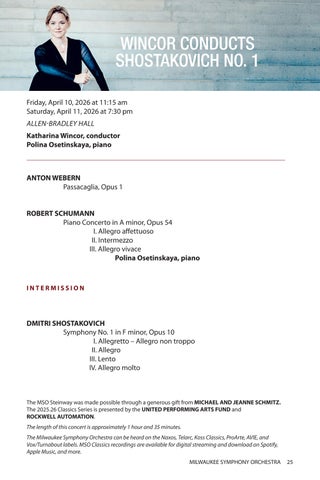
The MSO Steinway was made possible through a generous gift from MICHAEL AND JEANNE SCHMITZ. The 2025.26 Classics Series is presented by the UNITED PERFORMING ARTS FUND and ROCKWELL AUTOMATION
The length of this concert is approximately 1 hour and 35 minutes.
The Milwaukee Symphony Orchestra can be heard on the Naxos, Telarc, Koss Classics, ProArte, AVIE, and Vox/Turnabout labels. MSO Classics recordings are available for digital streaming and download on Spotify, Apple Music, and more.
Guest Artist Biographies
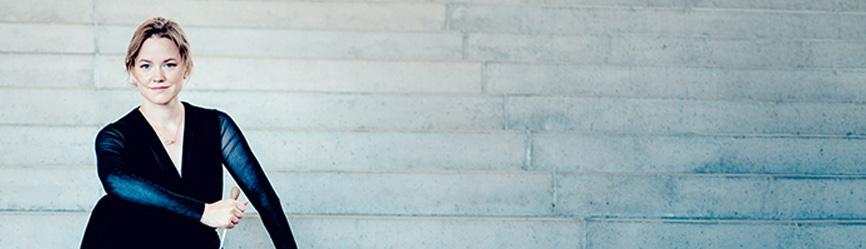
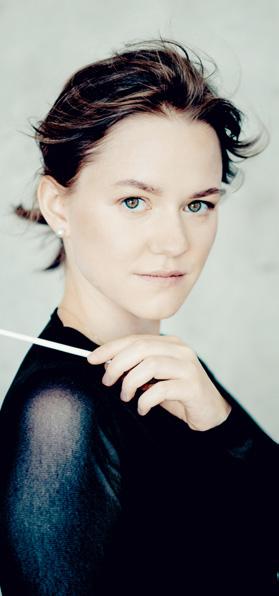
KATHARINA WINCOR
Austrian conductor Katharina Wincor is a force on the podium and has quickly established an international reputation.
In the 2025-26 season, she debuts with The Hallé, the hr-Sinfonieorchester, Rundfunk-Sinfonieorchester Berlin, Milwaukee Symphony Orchestra, Bremer Philharmoniker, Jenaer Philharmonie, Biel Solothurn Symphony Orchestra, and Orquesta Sinfónica de Castilla y León, and returns to collaborate with the Sarasota Orchestra, North Carolina Symphony, Altomonte Orchester St. Florian, and the Upper Austrian Youth Orchestra. Wincor also makes her debut with the Bavarian State Opera in Munich with a new production of Hans Werner Henze’s Die englische Katze to mark the 100th anniversary of the composer’s birth.
Highlights include guest conducting engagements with the SWR Symphonieorchester, WDR Sinfonieorchester, Bamberger Symphoniker, Wiener Symphoniker, Detroit Symphony Orchestra, National Symphony Orchestra, Tucson Symphony Orchestra, Utah Symphony, Phoenix Symphony, Orquestra Sinfônica do Estado de São Paulo, Orquesta Sinfónica RTVE, Yomiuri Nippon Symphony Orchestra, and Queensland Symphony Orchestra. She returns to work with the Frankfurter Opernund Museumsorchester, Bruckner Orchester Linz, Cincinnati Symphony Orchestra, Romanian Radio National Orchestra, Ensemble Reflektor, Klangforum Wien, and the Orquesta Filarmónica de la UNAM. Recent and upcoming collaborations with soloists include James Ehnes, Elisabeth Leonskaja, Daniel Müller-Schott, Julian Steckel, Alexander Malofeev, Sheku Kanneh-Mason, Rafał Blechacz, Lucas and Arthur Jussen, Jean-Yves Thibaudet, David Fray, and Anna Lapwood.
Wincor first gained international attention as assistant conductor of the Dallas Symphony Orchestra under music director Fabio Luisi. In 2020, she was a prize-winner at the Mahler Competition in Bamberg and was invited to the Ammodo Conducting Masterclass with the Royal Concertgebouw Orchestra under Iván Fischer, who subsequently engaged her as an assistant for several projects with the Budapest Festival Orchestra. Her early experience with the Arnold Schoenberg Choir in Vienna shaped her natural approach to working with singers. After conducting Bernstein’s Candide at the 2022 May Festival with the Cincinnati Symphony Orchestra, she also led a production at the Salzburg State Theatre and a children’s opera at the Salzburg Festival.
Born and raised in Upper Austria, Wincor studied conducting at the University of Music and Performing Arts Vienna and the Zurich University of the Arts. She has participated in master classes with Riccardo Muti, Jaap van Zweden, Robert Spano, and David Zinman.
Guest Artist Biographies
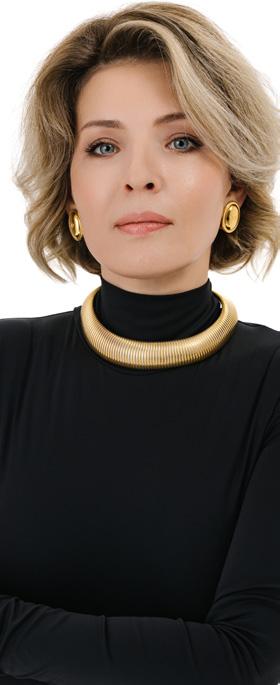
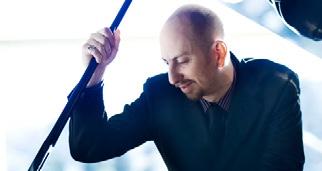
POLINA OSETINSKAYA
Admired for “depth, polish, flair … and an inquisitive musical mind” (Sun Sentinel), pianist Polina Osetinskaya’s “elegant and nuanced” (Boston Musical Intelligencer) performances have endeared her to audiences around the globe.
A rare musician who made the leap from child prodigy to celebrated soloist, Osetinskaya has performed at Vienna’s Musikverein and Konzerthaus, London’s Barbican Centre, Carnegie Hall, the Sydney Opera House, Salzburg Festival, and Berliner Philharmonie, and has appeared with musicAeterna, the Mariinsky Orchestra, Tokyo Philharmonic Orchestra, Brno Philharmonic, and Slovak Philharmonic. She has performed with conductors Teodor Currentzis, Dennis Russell Davies, Laurent Petitgirard, Vladimir Spivakov, Andrey Boreyko, and Yan Pascal Tortelier, and enjoys an ongoing chamber music collaboration with Maxim Vengerov.
Osetinskaya released her newest album of the music of Giya Kancheli, Valentin Silvestrov, and Arvo Pärt in November 2024 with the French label Evidence and has also recorded on the Quartz, Naxos, Sony Music, Bel Air, and Melodiya labels. She is the author of the bestselling autobiography Farewell, Sadness.
Born in Moscow, Osetinskaya made her orchestral debut at eight years old playing Bach’s D minor concerto with the Lithuanian Chamber Orchestra and Saulius Sondeckis and became a nationally celebrated phenomenon at the age of eleven when she played Mozart’s Piano Concerto No. 23 at the legendary Moscow Conservatory.
Proud supporter of the Milwaukee Symphony Orchestra
Mequon, Wisconsin
Program notes by David Jensen
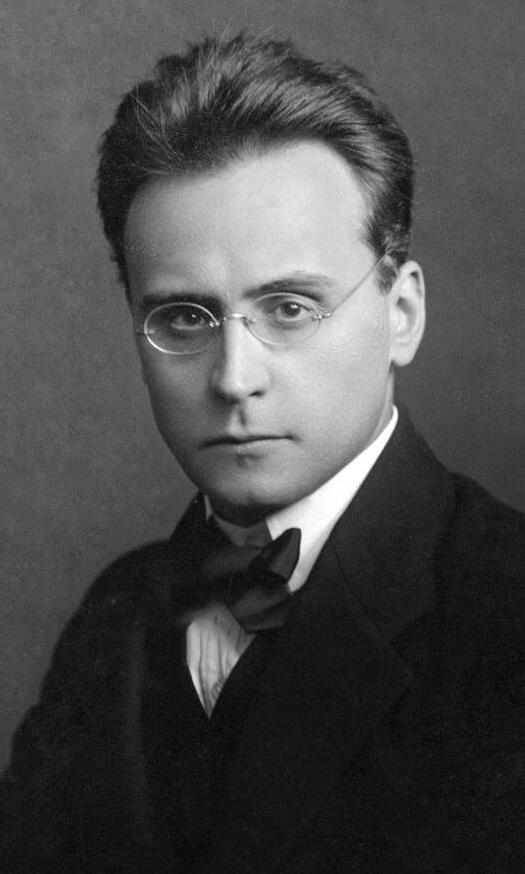
ANTON WEBERN
Born 3 December 1883; Vienna, Austria-Hungary
Died 15 September 1945; Mittersill, Austria
Passacaglia, Opus 1
Composed: 1908
First performance: 4 November 1908; Anton Webern, conductor; Tonkünstler Orchestra
Last MSO performance: 18 March 2001; Andreas Delfs, conductor
In the autumn of 1908, a young cellist, singer, and historian took to the stage of Vienna’s Musikverein to present the fruit of his creative labors. Anton Webern had been taking composition lessons with Arnold Schoenberg for four years, and his premiere as a composer marked the beginning of his professional life. Having been raised in a musical household on the chamber music of the “First Viennese School” (that revered triumvirate of Haydn, Mozart, and Beethoven), Webern, along with his fellow classmate Alban Berg and Schoenberg himself, would retroactively be identified as the “Second.” Between the three of them, they would radically alter perceptions of how music was to advance into the future.
Webern had entered the University of Vienna six years earlier, studying art history and philosophy while immersing himself in his musical pursuits, analyzing the works of the old masters and engaging with the revolutionary new music of Strauss, Mahler, and Wagner during his frequent visits to the concert hall. It was there that he first encountered Schoenberg’s Pelleas und Melisande and Verklärte Nacht, instilling a fascination for the iconoclast’s highly dissonant, expressionistic, post-Romantic style. By 1907, after three years of study under Schoenberg, he had produced his first orchestral essay, Im Sommerwind, been awarded a doctoral degree for his musicological research, and prepared three sketches for what he viewed as his first substantial symphonic work.
The passacaglia itself can be traced back to Spanish and Italian music of the 17th century. Eventually transmitted to France and Germany, the masters of the Baroque era expounded upon its style and, as the century progressed, codified its form as a set of variations which unfolded over a repeating bass line. Like all “early” music, it never fell entirely out of fashion, the most recent and well-respected example in Webern’s lifetime being the colossal passacaglia that makes up the finale of Johannes Brahms’s fourth symphony. Two distinct strains of influence are immediately evident in Webern’s: the highly gestural writing of the late Romantics and the chromatically inflected aesthetics of his teacher.
Webern’s passacaglia is most clearly indebted to Schoenberg’s technique of “developing variation,” in which the fragmentation, rhythmic manipulation, or transposition of an idea provides the basis for its transformations. Though the score calls for expansive performing forces, Webern’s careful application of individual colors elicits ghostly, transparent textures from the orchestra. The principal subject that underpins the music and from which Webern derives his 23 variations is first introduced in the strings, then contrasted with a countermelody in the first variation for flute and trumpet. These two ideas are metamorphosed through a series of varied instrumental
combinations, during which only flashes of blissful optimism shine through, before reaching the fever pitch of the final coda and dissolving into a bleak silence.
Unfortunately for the young visionary, the piece was almost unilaterally panned. One reviewer railed against Webern’s “confusion, cacophony at any price, dissonance not for the sake of necessity, but for amusement” and “respect for form without content.” Only Elsa Bienenfeld, writing in the Neues Wiener Journal days later, praised “the peculiar melodic inventiveness, the free harmonic treatment, and the manifold interlacings of counterpoint. The composition, surprising in its curiosities of tonal combinations and their progressions, nevertheless convinces through the depth of the moods evoked.”
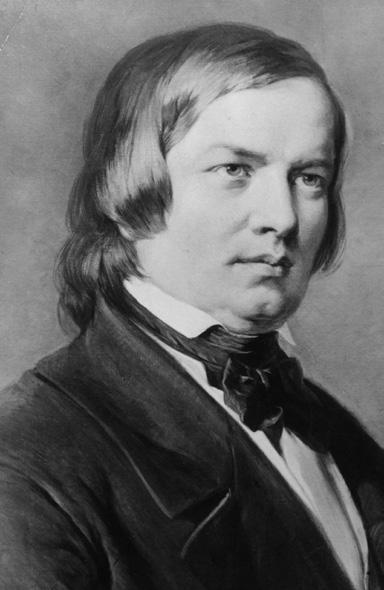
ROBERT SCHUMANN
Born 8 June 1810; Zwickau, Saxony
Died 29 July 1856; Endenich, Prussia
Piano Concerto in A minor, Opus 54
Composed: May 1841 – 31 July 1845
First performance: 4 December 1845; Ferdinand Hiller, conductor; Clara Schumann, piano; Hôtel de Saxe, Dresden
Last MSO performance: 15 September 2019; Ken-David Masur, conductor; Nicolas Namoradze, piano
Few artists led more difficult inner lives than Robert Schumann. His family of origin was plagued by mental illness: committed to an asylum for her depressive tendencies, his sister Emilie flung herself from a window, a traumatic death followed almost immediately by his father’s, himself afflicted by a “nervous disorder” since Robert’s birth. Resisting the legal education imposed by his widowed mother, Christiane, he eventually persuaded her to allow him to pursue his literary and musical ambitions. At 18, he was accepted by Friedrich Wieck, one of Leipzig’s preeminent piano teachers, who assured Christiane that Robert could be molded into a virtuoso within a few years. Already haunted by presentiments of his own insanity, Robert’s dreams were shattered in as much time by an injury that left his hands partially paralyzed.
The saving grace of Schumann’s trials was Wieck’s daughter, Clara. A miraculously gifted pianist and composer with an inimitable musical mind, her genius inspired Schumann for the remainder of his brief creative life. Her domineering father, however, was categorically opposed to her marrying a man he considered a degenerate, third-rate composer, leading to a bitterly protracted and complicated courtship. After years of seemingly interminable legal proceedings and emotional turmoil, their marriage in the spring of 1840 afforded Schumann the psychological foundation that became instrumental in furthering his career and inaugurated years of inspired creativity. For her part, Clara gave up her life as an internationally acclaimed virtuoso, bearing eight children by Robert in a little more than a dozen years.
As early as 1839, Clara had confided in her diary that Robert’s “imagination cannot find sufficient scope on the piano … My highest wish is that he should compose for orchestra — that is his field! May I succeed in bringing him to it.” It was her insistence, and the shining example of her talent, that induced him to reach beyond the character pieces and art songs that had hitherto occupied his attention. After no less than four abandoned attempts, he produced a single-movement fantasy for piano and orchestra in 1841. It was only after four more years of teetering on a razor’s edge between manic prolificacy and total mental collapse that he revised the work and appended the final two movements to produce his only concerto for the instrument. Continued on page 30
Schumann described his conception of the genre as “something between symphony, concerto, and grand sonata,” a point of view underscored by his concerto’s intrepid pianism, handsomely devised accompaniment, and wildly mercurial character. Following a thundering string of chords from the piano, the oboe introduces a musical cryptogram, a favorite device of Schumann’s. The motif C-B-A-A (B♮ rendered as an “H” in German) is shorthand for “Chiara,” an Italianate spelling of Clara’s name which recurs in varied guises throughout the freely structured movement. The fleeting intermezzo contains some of Schumann’s most sensitive writing: a simple, refined melody encloses the lyrical theme intoned by the orchestra at its center as the pianist recedes quietly into the background. We spring directly into the high-flying glory of the finale, whose spirited acrobatics make for the “big bravura piece” Clara eagerly described in her diary — and one she had the pleasure of playing at its premiere.
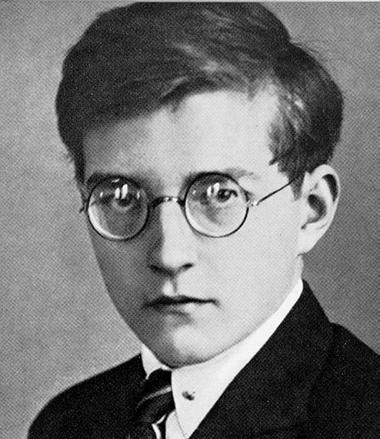
DMITRI SHOSTAKOVICH
Born 25 September 1906; Saint Petersburg, Russia Died 9 August 1975; Moscow, Soviet Union
Symphony No. 1 in F minor, Opus 10
Composed: 1924 – 1925
First performance: 12 May 1926; Nicolai Malko, conductor; Leningrad Philharmonic Orchestra
Last MSO performance: 23 April 2016; Francesco Lecce-Chong, conductor
Perhaps the most revolutionary symphonist of the 20th century, Dmitri Shostakovich became the musical darling of his homeland before his teenage years were behind him. Only four years after his first obligatory piano lessons with his mother, he was admitted to the Petrograd Conservatory at the tender age of 13, where his astonishing aptitude for composition and his effortless keyboard technique earned him the affection and material support of the composer Alexander Glazunov, then director of the institution. Anxious and withdrawn by disposition and physically fragile, he played the piano in movie houses to make ends meet for his family during the years of privation that followed the Russian revolution. His flair at the keyboard even earned him an “honorable mention” at Warsaw’s inaugural Chopin competition in 1927.
Even as a child, the music he was writing was unmistakably his own: clever, sardonic, patterned after classical models, and distinctly modern. Written as a graduation exercise under the auspices of his composition teacher Maximilian Steinberg when he was only 18, Shostakovich’s first symphony betrays a respect for both the Russian Romantics that preceded his generation and the avant-garde tendencies epitomized by the music of Sergei Prokofiev and Igor Stravinsky. Striking in its intellectual and emotional depth while foreshadowing a compulsion toward the grotesque that would tinge his mature works, its premiere in the spring of 1926 immediately launched young Dmitri to international stardom.
While the formal plan of the music is fairly conventional, hardly anything about the music itself is. A sizzling trumpet solo, soon accompanied by bassoon, sets the opening allegretto in motion, immediately undermining any sense of expectation on the part of the listener. The movement is built around the two principal subjects central to the standard sonata form: the first appears as the sarcastic clarinet solo heard in the martial allegro, while the second emerges as foreboding,
tonally unsteady waltz. Inverting the traditional order of the inner two movements, the devilishly playful scherzo places Shostakovich’s acerbic pianism in the spotlight, culminating in a brash outburst from the instrument in its final measures.
If the first half of the symphony was a light-hearted parody of the composer’s stringent, oldfashioned conservatory training, the second is anything but. The plangent strains of the slow movement most clearly presage the dissonant, dolorous expressions that became hallmarks of Shostakovich’s late style, a melody from the oboe soaring over the tenebrous harmonies sounded by the strings before drifting to a solitary cello. Tchaikovskian in scope and style, the orchestra develops these ideas to their fervent resolution, a single shimmering chord offering relief from the oppressive atmosphere — until the roll of the snare drum hurls the orchestra into the finale. The gloom and melancholy that prevailed tighten their grip as the music, by turns operatic and vehement, finds expression in a string of solos for clarinet, concertmaster, timpani, and cello. At long last, smoldering brass fanfares clatter and clang in a fury of sound, bringing the first of Shostakovich’s 15 symphonies to its ferocious end.
s
A CROWD
4 MONDAY
MAY
SEASON
7:00 pm
Schwan Concert Hall
Wisconsin Lutheran College
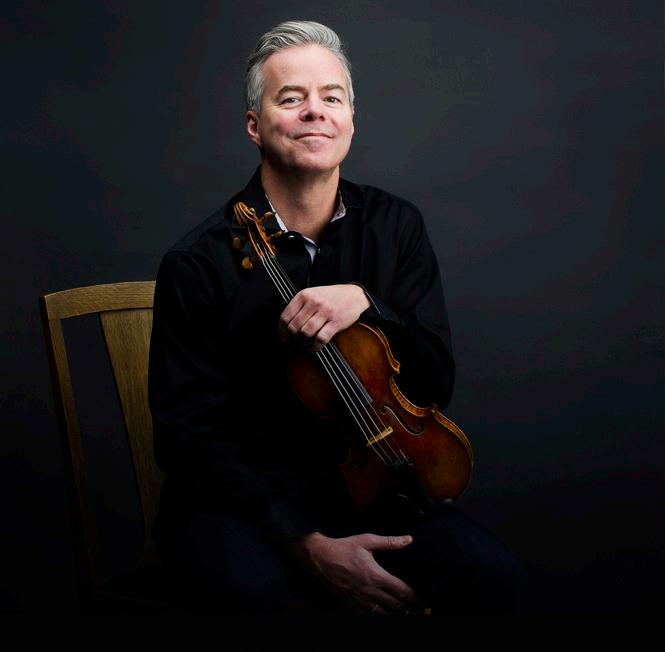
Frank Almond, violin
Charlene Kluegel, violin
Toby Appel, viola
Alexander Hersh, cello
Adam Nieman, piano Program and artists subject to change
2025.26 SEASON
KEN-DAVID MASUR
Music Director
Polly and Bill Van Dyke Music Director Chair
EDO DE WAART
Music Director Laureate
BYRON STRIPLING
Principal Pops Conductor
Stein Family Foundation Principal Pops Conductor Chair
RYAN TANI
Associate Conductor
CHERYL FRAZES HILL
Chorus Director
Margaret Hawkins Chorus Director Chair
TIMOTHY J. BENSON
Assistant Chorus Director
FIRST VIOLINS
Jinwoo Lee, Concertmaster, Charles and Marie Caestecker Concertmaster Chair
Ilana Setapen, First Associate Concertmaster, Thora M. Vervoren First Associate Concertmaster Chair
Jeanyi Kim, Associate Concertmaster
Alexander Ayers
Autumn Chodorowski
Yuka Kadota
Elliot Lee
Dylana Leung
Kyung Ah Oh
Lijia Phang
Vinícius Sant’Ana**
Yuanhui Fiona Zheng
SECOND VIOLINS
Jennifer Startt, Principal, Andrea and Woodrow Leung Principal Second Violin Chair
Ji-Yeon Lee, Assistant Principal (2nd chair)
Hyewon Kim, Acting Assistant Principal (3rd chair)
Heejeon Ahn
Lisa Johnson Fuller
Clay Hancock
Paul Hauer
Sheena Lan**
Janis Sakai**
Yiran Yao
VIOLAS
Victor de Almeida, Principal, Richard O. and Judith A. Wagner Family Principal Viola Chair
Samantha Rodriguez, Acting Assistant Principal (2nd chair), Friends of Janet F. Ruggeri Assistant Principal Viola Chair
Alejandro Duque, Acting Assistant Principal (3rd chair)
Elizabeth Breslin
Georgi Dimitrov
Nathan Hackett
Michael Lieberman**
Erin H. Pipal
CELLOS
Susan Babini, Principal, Dorothea C. Mayer Principal Cello Chair
Shinae Ra, Assistant Principal (2nd chair)
Scott Tisdel, Associate Principal Emeritus
Madeleine Kabat
Peter Szczepanek
Peter J. Thomas
Adrien Zitoun
BASSES
Principal, Donald B. Abert Principal Bass Chair
Andrew Raciti, Acting Principal
Nash Tomey, Acting Assistant Principal (2nd chair)
Brittany Conrad
Broner McCoy
Paris Myers
HARP
Julia Coronelli, Principal, Walter Schroeder Principal Harp Chair
FLUTES
Sonora Slocum, Principal, Margaret and Roy Butter Principal Flute Chair
Heather Zinninger, Assistant Principal
Jennifer Bouton Schaub
PICCOLO
Jennifer Bouton Schaub
OBOES
Katherine Young Steele, Principal, Milwaukee Symphony Orchestra League Principal Oboe Chair
Kevin Pearl, Assistant Principal
Margaret Butler
ENGLISH HORN
Margaret Butler, Philip and Beatrice Blank English Horn Chair in memoriam to John Martin
CLARINETS
Todd Levy, Principal, Franklyn Esenberg Principal Clarinet Chair
Jay Shankar, Assistant Principal, Donald and Ruth P. Taylor Assistant Principal Clarinet Chair
Besnik Abrashi
E-FLAT CLARINET
Jay Shankar
BASS CLARINET
Besnik Abrashi
BASSOONS
Catherine Van Handel, Principal, Muriel C. and John D. Silbar Family Principal Bassoon Chair*
Rudi Heinrich, Acting Principal
Matthew Melillo
CONTRABASSOON
Matthew Melillo
HORNS
Matthew Annin, Principal, Krause Family Principal French Horn Chair
Krystof Pipal, Associate Principal
Dietrich Hemann, Andy Nunemaker French Horn Chair
Darcy Hamlin
Dawson Hartman
TRUMPETS
Matthew Ernst, Principal, Walter L. Robb Family Principal Trumpet Chair
David Cohen, Associate Principal, Martin J. Krebs Associate Principal Trumpet Chair
Tim McCarthy, Fred Fuller Trumpet Chair
TROMBONES
Megumi Kanda, Principal, Marjorie Tiefenthaler Principal Trombone Chair
Kirk Ferguson, Assistant Principal
BASS TROMBONE
John Thevenet, Richard M. Kimball Bass Trombone Chair
TUBA
Robyn Black, Principal, John and Judith Simonitsch Principal Tuba Chair
TIMPANI
Dean Borghesani, Principal
Chris Riggs, Assistant Principal
PERCUSSION
Robert Klieger, Principal Chris Riggs
PIANO
Melitta S. Pick Endowed Piano Chair
PERSONNEL
Antonio Padilla Denis, Director of Orchestra Personnel
Paris Myers, Assistant Manager of Orchestra Personnel
LIBRARIANS
Paul Beck, Principal Librarian, James E. Van Ess Principal Librarian Chair
Matthew Geise, Assistant Librarian & Media Archivist
PRODUCTION
Tristan Wallace, Production Manager/Live Audio
Lisa Sottile, Production Stage Manager
* Leave of absence during the 2025.26 season
** Acting member of the MSO for the 2025.26 season