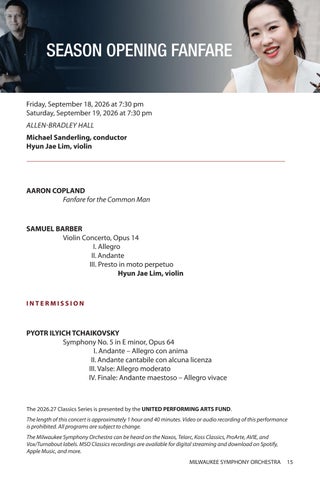
SEASON OPENING FANFARE Friday, September 18, 2026 at 7:30 pm Saturday, September 19, 2026 at 7:30 pm ALLEN-BRADLEY HALL Michael Sanderling, conductor Hyun Jae Lim, violin
AARON COPLAND Fanfare for the Common Man
SAMUEL BARBER Violin Concerto, Opus 14 I. Allegro II. Andante III. Presto in moto perpetuo Hyun Jae Lim, violin
INTERMISSION
PYOTR ILYICH TCHAIKOVSKY Symphony No. 5 in E minor, Opus 64 I. Andante – Allegro con anima II. Andante cantabile con alcuna licenza III. Valse: Allegro moderato IV. Finale: Andante maestoso – Allegro vivace
The 2026.27 Classics Series is presented by the UNITED PERFORMING ARTS FUND. The length of this concert is approximately 1 hour and 40 minutes. Video or audio recording of this performance is prohibited. All programs are subject to change. The Milwaukee Symphony Orchestra can be heard on the Naxos, Telarc, Koss Classics, ProArte, AVIE, and Vox/Turnabout labels. MSO Classics recordings are available for digital streaming and download on Spotify, Apple Music, and more. MILWAUKEE SYMPHONY ORCHESTRA
15
Guest Artist Biographies MICHAEL SANDERLING Since the 2021-22 season, Michael Sanderling has served as chief conductor of the Lucerne Symphony Orchestra. This appointment marked the logical continuation of a close, long-standing partnership aimed at further establishing the orchestra’s international reputation in the late Romantic repertoire — particularly with works by Bruckner, Mahler, and Strauss. Tours throughout Europe, Asia, and South America, as well as innovative projects, attest to the impact of this collaboration. Particular attention was drawn to the multimedia production of Shostakovich’s Photo by Symphony No. 10, featuring artist William Kentridge, which, following Marco Borggreve its premiere at the KKL Lucerne and in Pompeii, enjoyed triumphant performances at the Wiener Konzerthaus and the Philharmonie de Paris. Sanderling’s discography with the Lucerne Symphony Orchestra, including a celebrated Brahms cycle on Warner Classics as well as a recording of the piano concertos by Antonín Dvořák and Edvard Grieg with Elisabeth Leonskaja, documents the sonic depth of this era. Sanderling’s path to the conductor’s podium was shaped by a deep understanding of orchestral sound. Following a distinguished career as a cello soloist with ensembles including the Orchestre de Paris, Los Angeles Philharmonic, and Boston Symphony Orchestra, he served as principal cellist of the Leipzig Gewandhaus Orchestra under Kurt Masur from 1987 to 1992 and laid the foundation for his career as a conductor through his tenure as artistic director of the Kammerakademie Potsdam (2006 – 2011). From 2011 to 2019, he led the Dresden Philharmonic into a new era as its chief conductor and established the orchestra among Germany’s top-tier ensembles. A lasting monument to this period is the highly acclaimed recording of the complete symphonies of Beethoven and Shostakovich for Sony Classical. In addition to the great symphonies, his discography includes significant concert recordings with soloists such as Edgar Moreau and Katrin Scholz, as well as collaborations with the Berlin Radio Choir. He has also set new standards on the opera stage: for his production of Prokofiev’s War and Peace with the Cologne Opera, the magazine Opernwelt named him Conductor of the Year in 2011. Today he is a guest conductor with renowned orchestras worldwide, including the Berlin Philharmonic, Leipzig Gewandhaus Orchestra, Royal Concertgebouw Orchestra, Vienna Symphony, Helsinki Philharmonic Orchestra, Orchestre de Paris, Dallas Symphony Orchestra, Philharmonia Orchestra, and NHK Symphony Orchestra. In addition to the stage, Sanderling devotes himself with passionate intensity to the next generation. For many years, he has taught at the Frankfurt University of Music and Performing Arts. His longstanding commitment to ensembles such as the German String Philharmonic, Schleswig-Holstein Festival Orchestra, and German National Youth Orchestra underscores his belief that musical excellence and the passing on of experience are inseparably linked.
16
MILWAUKEE SYMPHONY ORCHESTRA
Guest Artist Biographies HYUN JAE LIM Korean violinist Hyun Jae Lim has triumphantly returned to the international stage following a four-year hiatus caused by a severe accident in 2020. Since resuming her career in June 2024, she has seamlessly continued her artistic path with remarkable success. Lim’s career is underscored by an impressive series of competition achievements. Most recently, she won first prize at the 2025 Seoul International Music Competition and first prize at the 2026 Elmar Oliveira International Violin Competition, where she also received three honors, including awards for the best performance of a commissioned work and best performance of a solo sonata by Eugène Ysaÿe. Following her return, she reached the semifinals of both the International Isang Yun Competition in 2024 and the International Jean Sibelius Violin Competition in 2025. Earlier in her career, she earned prizes at the Yehudi Menuhin International Competition for Young Violinists (2018) and became the youngest prizewinner at the Singapore International Violin Competition (2015), where she received fifth prize alongside the special prize for the best performance of Bach. In recognition of her artistic achievements, she was named one of Classic FM’s 30 Under 30 Rising Stars for 2026. As a soloist, Lim has performed with renowned ensembles such as The Philadelphia Orchestra, the Royal Philharmonic Orchestra, and the Houston Symphony, collaborating with esteemed conductors including Jaap van Zweden, Julian Rachlin, Christoph Poppen, Yunsung Chang, and Kensho Watanabe. Her performance venues include Marian Anderson Hall in Philadelphia, the National Gallery of Art in Washington, D.C., Victoria Hall in Geneva, Jordan Hall in Boston, and Houston’s Miller Outdoor Theatre, among others. In 2015, she was also featured on NPR’s 15thanniversary broadcast of From the Top. Highlights of her 2026-27 season include her performance of Mendelssohn’s violin concerto with the Seoul Philharmonic Orchestra under the baton of Jaap van Zweden, a Korean tour as soloist with the Orchestra da Camera di Mantova, and a series of engagements in the U.S. Lim began her musical studies early, learning the piano at age four and the violin at seven. She completed her bachelor’s degree as a Howard and Carol Lidz Fellow at the Curtis Institute of Music, studying with Midori, Shmuel Ashkenasi, and Arnold Steinhardt, and is currently pursuing her master’s degree at Curtis under the guidance of Midori.
MILWAUKEE SYMPHONY ORCHESTRA
17
Program notes by David Jensen AARON COPLAND Born 14 November 1900; New York City, New York Died 2 December 1990; North Tarrytown, New York
Fanfare for the Common Man
Composed: August – November 1942 First performance: 12 March 1943; Eugene Goossens, conductor; Cincinnati Symphony Orchestra Last MSO performance: 15 March 2009; Andreas Delfs, conductor Instrumentation: 4 horns; 3 trumpets; 3 trombones; tuba; timpani; percussion (bass drum, tam-tam) Approximate duration: 3 minutes By the end of 1942, Aaron Copland was riding high as one of the leading figures of modern musical America. Only a few years earlier, he had broken new ground in the business of film scoring, ushering in an age of broader stylistic possibility for the Hollywood composer. With the success of his ballets Billy the Kid and Rodeo around the turn of the decade, he had distilled his artistic tendencies into a refined, simplified approach characterized by a freer handling of tonal harmony and a more immediately accessible quality, intending to appeal to the widest audience possible. Only a few months earlier, Copland had composed his Lincoln Portrait for narrator and orchestra, commissioned by Andre Kostelanetz and the New York Philharmonic, as a sort of act of musical patriotism as his nation became enmeshed in the turmoil of World War II. Halfway across the continent, Eugene Goossens, in his capacity as music director of the Cincinnati Symphony Orchestra, was likewise busy extending a series of commissions to American composers, an undertaking that had met with great success with his British orchestras during the first World War. Of the 18 fanfares that the Cincinnati orchestra premiered during the 1942-43 season, only Copland’s has earned a permanent place in the repertoire. “It is my idea to make these fanfares stirring and significant contributions to the war effort,” Goossens wrote, “so I suggest you give your fanfare a title, as for instance, ‘A Fanfare for Soldiers, or for Airmen or Sailors.’” At Goossens’s suggestion, Copland relegated himself to a complement of brass and percussion instruments, but the title he eventually selected stood out quite conspicuously from the rest. While other composers were content to honor paratroopers, marines, soldiers, or other Allied nations, only Copland, inspired by Vice President Henry Wallace’s recent speech on the “Century of the Common Man,” saw fit to recognize his fellow citizens. Perhaps the most recognizable of all of Copland’s music, the opening strikes of the bass drum, timpani, and tam-tam immediately convey an air of solemnity. Trumpets enter with a three-note motif built of a perfect fifth and fourth, which Copland develops by means of progressively richer harmonizations, layering multiple chords in spacious voicings for a “direct and powerful” affect “with a contemporary sound.” Copland was a painstaking composer, and his habit of working slowly led him to miss the proposed October premiere. Goossens suggested a new date in March, which Copland felt would be an especially appropriate gesture — in his words, “I was all for honoring the common man at income tax time.”
18
MILWAUKEE SYMPHONY ORCHESTRA
SAMUEL BARBER Born 9 March 1910; West Chester, Pennsylvania Died 23 January 1981; New York City, New York
Violin Concerto, Opus 14
Composed: August – November 1939 First performance: 7 February 1941; Eugene Ormandy, conductor; Albert Spalding, violin; The Philadelphia Orchestra Last MSO performance: 11 May 2024; Joseph Young, conductor; Alexei Kenney, violin Instrumentation: 2 flutes; 2 oboes; 2 clarinets; 2 bassoons; 2 horns; 2 trumpets; timpani; percussion (snare drum); piano; strings Approximate duration: 25 minutes Now a cornerstone of the modern repertoire, Samuel Barber’s violin concerto has long been mired in the intrigue surrounding its creation. Like much of the concertante literature, it was conceived with a particular fiddler in mind — Iso Briselli, a classmate from the Curtis Institute of Music who received his diploma alongside Barber in 1934 — but when the composer presented him with the first two movements in October 1939, Briselli “seemed disappointed,” as Barber recalled it, “that they were not of a virtuoso character, a bit too easy.” In an attempt to rectify the situation, Barber produced a fiendishly demanding finale, intending to give Briselli the showpiece he’d asked for. Briselli, according to legend, responded by flatly condemning it as unplayable. It’s a memorable story, but in 2010, previously unpublished correspondence between Barber, Briselli’s violin coach Albert Meiff, and Samuel Simeon Fels, the soap tycoon and philanthropist underwriting the commission, at last gave historians a more nuanced account of the facts. In November 1939, Briselli showed the first two movements to Meiff, who soon informed Fels that the concerto bore “a serious defect: it is not a composition gratifying for a violinist to perform.” Its technical requirements were, in his view, “childish in details,” and it was imperative that the music undergo a “surgical operation” if it were to have any chance of succeeding. It was Meiff who claimed that the “risky, tiresome ending” was “a dangerous thought,” insisting Barber should have consulted his intended soloist, as had Brahms, Glazunov, and Tchaikovsky in their own time. Then came Barber’s own letter to Fels that December, by which point Briselli had abandoned the project. Caught in Europe during the outbreak of World War II that September, he claimed that upon returning, neither Briselli nor Eugene Ormandy, music director of The Philadelphia Orchestra, had informed him that the premiere was slated for January. He was fatigued, working under pressure “in far from ideal circumstances” as he looked after his ailing father. Barber acknowledged Briselli’s criticism of the last movement as diametrically opposed, in stylistic terms, from the preceding two, but unwilling to “destroy a movement in which I have complete confidence,” they effectively agreed to disagree, remaining friends until Barber’s death in 1981. As Briselli later told it, he simply found the finale “too lightweight” — certainly not impossible to play — and that he very much liked the rest of the concerto. Barber privately referred to it as his “concerto del sapone” (or “soap concerto”), both a nod to Fels’s role in funding his work and the “soap opera” of its history. In light of the privileged status the concerto now enjoys (to say nothing of its purely musical virtues), the description Barber included in the program note he supplied for the premiere, which basically delineates the concerto’s structural features, seems a modest one: “The first movement … begins with a lyrical first subject announced at once by the solo violin, without any orchestral introduction. This movement as a whole has perhaps more the character of a sonata than concerto form. The second movement … is introduced by an extended oboe solo. The violin enters with a contrasting and rhapsodic theme, after which it repeats the oboe melody of the beginning. The last movement, a perpetuum mobile, exploits the more brilliant and virtuosic character of the violin.” MILWAUKEE SYMPHONY ORCHESTRA
19
PYOTR ILYICH TCHAIKOVSKY Born 7 May 1840; Votkinsk, Russia Died 6 November 1893; Saint Petersburg, Russia
Symphony No. 5 in E minor, Opus 64
Composed: May – August 1888 First performance: 17 November 1888; Piotr Ilyich Tchaikovsky, conductor; Saint Petersburg Philharmonic Society Last MSO performance: 22 October 2022; Jader Bignamini, conductor Instrumentation: 3 flutes (3rd doubling on piccolo); 2 oboes; 2 clarinets; 2 bassoons; 4 horns; 2 trumpets; 3 trombones; tuba; timpani; strings Approximate duration: 50 minutes Tchaikovsky spent the beginning of 1888 touring Europe in the glow of an international fame previously unknown to him, but his diary entries and letters from those months reveal a man ill at ease with life. Notoriously sensitive to criticism and prone to depression, he met with great difficulty in relating to an admiring public, frequently drinking to excess to alleviate his pain. Tchaikovsky passed through Germany, where he watched Brahms conduct his strange new “double” concerto, Bohemia, where he was warmly received by Dvořák, France, and England. “…I have gained some celebrity,” he wrote to his publisher, Pyotr Jurgenson, “but every hour I ask myself — Why? Is it worthwhile? And I come to the conclusion it is far better to live quietly without fame.” Returning to Russia that spring, Tchaikovsky rented a home in the village of Frolovskoye, intending to spend the summer writing in seclusion. “I’m now gradually beginning, with difficulty, to squeeze a symphony out of my addled brain,” he wrote to his brother Modest in May. Cryptic notes appeared in his sketches, suggesting an extramusical program: “Total submission before fate … the inscrutable designs of Providence … Murmurs, doubts, laments, reproaches against...xxx” Whether or not the “xxx” in question referred to, as has been suggested, Tchaikovsky’s homosexuality (a source of constant anxiety throughout his life) is uncertain, as is how much of a private narrative was actually woven into the score. Tchaikovsky later denied, in writing, that there was one. What is certain is that ten years had elapsed since he’d penned his fourth symphony, an imposing statement on the inevitability of fate, and he was terrified at the prospect of finding himself “written out, that my head is empty, that my time is past, etc.” Immersed in the Russian musical vernacular, which prized stasis and repetition, Tchaikovsky never quite came to grips with the highly formalized, harmonically dynamic precepts that propelled Western music. Requiring a mastery of tonal principles that were quite literally foreign to him, he struggled for years to make sense of the symphonic idiom. He felt as alienated by sonata form as he did by the explicitly programmatic music that gripped his peers, but his intensely charged temperament seemed to find no better outlet than the tone poems and fantasies then in fashion. His solution was to make the best of both worlds: distinctive motifs saturate his late large-scale works, linking together individual movements into an integrated whole and circumventing the need to modulate to specific key areas. The gloomy theme sounded by the clarinet in the opening bars permeates the entire fifth symphony, constantly remade in the image of its surroundings. Musicologist David Brown described the second movement, beloved for its exquisite horn solo, as “one of the composer’s most personal utterances, an extended flow of yearning melody that is quintessential Tchaikovsky,” while the balletic waltz that follows provides a blithe diversion. Tchaikovsky, who quickly disparaged the fifth as being “much too colorful, massive, insincere, drawn out, and generally most unsympathetic,” may have been responding to the ecstatic, nearly hysterical dimensions of the closing movement. He made a cut to the finale for a concert in Hamburg in March 1889, a performance so successful that he was convinced “to love it again.”
20
MILWAUKEE SYMPHONY ORCHESTRA
Matthew Melillo, Acting Assistant Principal Laressa Winters**
Georgi Dimitrov Nathan Hackett Michael Lieberman** Erin H. Pipal CELLOS Susan Babini, Principal, 2026.27 SEASON Dorothea C. Mayer Principal Cello Chair Shinae Ra, Assistant Principal (2nd chair) Scott Tisdel, Associate Principal Emeritus MUSIC DIRECTOR Polly and Bill Van Dyke Music Director Chair Esther Chae Madeleine Kabat BYRON STRIPLING Peter Szczepanek Principal Pops Conductor Peter J. Thomas* Stein Family Foundation Principal Pops Adrien Zitoun Conductor Chair BASSES RYAN TANI Principal, Donald B. Abert Associate Conductor Principal Bass Chair Andrew Raciti, Acting Principal CHERYL FRAZES HILL Nash Tomey, Assistant Principal Chorus Director (3rd chair)* Margaret Hawkins Chorus Director Chair Brittany Conrad TIMOTHY J. BENSON Nicholas De Laurentis** Assistant Chorus Director Broner McCoy Paris Myers FIRST VIOLINS Jinwoo Lee, Concertmaster, HARP Charles and Marie Caestecker Julia Coronelli, Principal, Concertmaster Chair Walter Schroeder Principal Harp Chair Ilana Setapen, First Associate FLUTES Concertmaster, Thora M. Vervoren Sonora Slocum, Principal, First Associate Concertmaster Chair Margaret and Roy Butter Jeanyi Kim, Associate Concertmaster Principal Flute Chair Alexander Ayers Heather Zinninger, Assistant Principal Autumn Chodorowski Jennifer Bouton Schaub Yuka Kadota Chihiro Kakishima PICCOLO Elliot Lee Jennifer Bouton Schaub Dylana Leung OBOES Kyung Ah Oh Katherine Young Steele, Principal, Lijia Phang Milwaukee Symphony Orchestra League Yuanhui Fiona Zheng Principal Oboe Chair SECOND VIOLINS Kevin Pearl, Assistant Principal Jennifer Startt, Principal, Margaret Butler Andrea and Woodrow Leung ENGLISH HORN Principal Second Violin Chair Ji-Yeon Lee, Assistant Principal (2nd chair) Margaret Butler, Philip and Beatrice Blank English Horn Chair in memoriam to Shannon Fitzhenry, Assistant Principal John Martin (3rd chair) Heejeon Ahn CLARINETS Lisa Johnson Fuller Principal, Franklyn Esenberg Clay Hancock Principal Clarinet Chair Paul Hauer Jay Shankar, Acting Principal, Hyewon Kim Donald and Ruth P. Taylor Assistant Principal Clarinet Chair Vinícius Sant’Ana** Besnik Abrashi, Acting Assistant Principal Yiran Yao Max Reese** VIOLAS Principal, Richard O. and Judith A. Wagner E-FLAT CLARINET Max Reese** Family Principal Viola Chair Kunjing Dai, Acting Principal, BASS CLARINET Friends of Janet F. Ruggeri Besnik Abrashi Assistant Principal Viola Chair Samantha Rodriguez, Acting Assistant BASSOONS Principal (2nd chair) Catherine Van Handel, Principal, Alejandro Duque, Acting Assistant Muriel C. and John D. Silbar Family Principal (3rd chair) Principal Bassoon Chair* Elizabeth Breslin Rudi Heinrich, Acting Principal
CONTRABASSOON Matthew Melillo HORNS Matthew Annin, Principal, Krause Family Principal French Horn Chair Krystof Pipal, Associate Principal Dietrich Hemann, Andy Nunemaker French Horn Chair Darcy Hamlin Dawson Hartman TRUMPETS Matthew Ernst, Principal, Walter L. Robb Family Principal Trumpet Chair David Cohen, Associate Principal, Martin J. Krebs Associate Principal Trumpet Chair Tim McCarthy, Fred Fuller Trumpet Chair TROMBONES Megumi Kanda, Principal, Marjorie Tiefenthaler Principal Trombone Chair Kirk Ferguson, Assistant Principal BASS TROMBONE John Thevenet, Richard M. Kimball Bass Trombone Chair TUBA Robyn Black, Principal, John and Judith Simonitsch Principal Tuba Chair TIMPANI Dean Borghesani, Principal Chris Riggs, Assistant Principal PERCUSSION Robert Klieger, Principal Chris Riggs PIANO Melitta S. Pick Endowed Piano Chair PERSONNEL Antonio Padilla Denis, Director of Orchestra Personnel Paris Myers, Assistant Manager of Orchestra Personnel LIBRARIANS Paul Beck, Principal Librarian, James E. Van Ess Principal Librarian Chair Matthew Geise, Assistant Librarian & Media Archivist PRODUCTION Tristan Wallace, Production Manager/Live Audio Lisa Sottile, Production Stage Manager * Leave of absence during the 2026.27 season ** Acting member of the MSO for the 2026.27 season
MILWAUKEE SYMPHONY ORCHESTRA
21