
MSO PROGRAM 5 MARCH - APRIL 2026

Page 1


MARCH — APRIL 2026

We believe retirement is the beginning of your next great adventure—no matter the season.

Wake up to the quiet beauty of freshly fallen snow and the peacefulness of the Kettle Moraine—right outside your door. Cedar Community offers lakefront charm, outdoor winter adventures, and vibrant community living designed for active adults who want more from retirement.

ENCORE

Volume 44 No. 5

15 March 25 — Special Yo-Yo Ma with Orchestra

20 March 27 – 29 — Pops Decades: Back to the 80s

25 April 10 & 11 — Classics Wincor Conducts Shostakovich No. 1

33 April 17 & 18 — Classics Schumann Romance

43 April 25 & 26 — Classics Fandango & Rapsodie

5 Orchestra Roster

7 Music Director

8 Music Director Laureate

9 Principal Pops Conductor

10 Associate Conductor

11 Milwaukee Symphony Chorus

58 MSO Endowment

Musical Legacy Society

59 Annual Fund

61 Corporate & Foundation

62 Matching Gifts Golden Note Partners

63 Marquee Circle Tributes

66 MSO Board of Directors

67 MSO Administration

This program is produced and published by ENCORE PLAYBILLS. To advertise in any of the following programs:

• Milwaukee Symphony Orchestra

• Florentine Opera

• Milwaukee Ballet

• Marcus Performing Arts Center Broadway Series

• Skylight Music Theatre

• Milwaukee Repertory Theater

• Sharon Lynne Wilson Center

• First Stage

Please contact: Scott Howland at 414-469-7779 scott.encore@att.net

MILWAUKEE SYMPHONY ORCHESTRA 212 West Wisconsin Avenue Milwaukee, Wisconsin 53203 414-291-6010 | mso.org

Connect with us! MSOrchestra

MilwSymphOrch

@MilwSymphOrch

The MSO and the Bradley Symphony Center have partnered with KultureCity to improve our ability to assist and accommodate guests with sensory needs. For information on available resources, visit mso.org.

“Living at Saint John’s enables us to continue our passion for music which we love to share with our fellow SJOL Neighbors and Friends.”

– Tom & Cheri Briscoe R Residents since 2011

MILWAUKEE SYMPHONY ORCHESTRA

The Milwaukee Symphony Orchestra, led by Music Director Ken-David Masur, is among the finest orchestras in the nation and the largest cultural institution in Wisconsin. Since its inception in 1959, the MSO has found innovative ways to give music a home in the region, develop music appreciation and talent among area youth, and raise the national reputation of Milwaukee.

The MSO’s full-time professional musicians perform over 135 classics, pops, family, education, and community concerts each season in venues throughout the state. A pioneer among American orchestras, the MSO has performed world and American premieres of works by John Adams, Roberto Sierra, Philip Glass, Geoffrey Gordon, Marc Neikrug, Camille Pépin, Matthias Pintscher, and Dobrinka Tabakova, as well as garnered national recognition as the first American orchestra to offer live recordings on iTunes.

In January of 2021, the MSO completed a years-long project to restore and renovate a former movie palace in the heart of downtown Milwaukee. The Bradley Symphony Center officially opened to audiences in October 2021. This project has sparked a renewal on West Wisconsin Avenue and continues to be a catalyst in the community.

The MSO’s standard of excellence extends beyond the concert hall and into the community, reaching more than 30,000 children and their families through its Arts in Community Education (ACE) program, Youth and Teen concerts, Family Series, and Meet the Music pre-concert talks. Celebrating its 36th year, the nationally recognized ACE program integrates arts education across all subjects and disciplines, providing opportunities for students when budget cuts may eliminate arts programming. The program provides lesson plans and supporting materials, classroom visits from MSO musician ensembles and artists from local organizations, and an MSO concert tailored to each grade level. The ACE program serves 5,500 students, teachers, and administrators in the Milwaukee area every year.

Photo by Jonathan Kirn

2025.26 SEASON

KEN-DAVID MASUR

Music Director

Polly and Bill Van Dyke Music Director Chair

EDO DE WAART

Music Director Laureate

BYRON STRIPLING

Principal Pops Conductor

Stein Family Foundation Principal Pops Conductor Chair

RYAN TANI

Associate Conductor

CHERYL FRAZES HILL

Chorus Director

Margaret Hawkins Chorus Director Chair

TIMOTHY J. BENSON

Assistant Chorus Director

FIRST VIOLINS

Jinwoo Lee, Concertmaster, Charles and Marie Caestecker Concertmaster Chair

Ilana Setapen, First Associate Concertmaster, Thora M. Vervoren

First Associate Concertmaster Chair

Jeanyi Kim, Associate Concertmaster

Alexander Ayers

Autumn Chodorowski

Yuka Kadota

Elliot Lee

Dylana Leung

Kyung Ah Oh

Lijia Phang

Vinícius Sant’Ana**

Yuanhui Fiona Zheng

SECOND VIOLINS

Jennifer Startt, Principal, Andrea and Woodrow Leung Principal Second Violin Chair

Ji-Yeon Lee, Assistant Principal (2nd chair)

Hyewon Kim, Acting Assistant Principal (3rd chair)

Heejeon Ahn

Lisa Johnson Fuller

Clay Hancock

Paul Hauer

Sheena Lan**

Janis Sakai**

Yiran Yao

VIOLAS

Victor de Almeida, Principal, Richard O. and Judith A. Wagner Family Principal Viola Chair

Samantha Rodriguez, Acting Assistant Principal (2nd chair), Friends of Janet F. Ruggeri Assistant Principal Viola Chair

Alejandro Duque, Acting Assistant Principal (3rd chair)

Elizabeth Breslin

Georgi Dimitrov

Nathan Hackett

Michael Lieberman**

Erin H. Pipal

CELLOS

Susan Babini, Principal, Dorothea C. Mayer Principal Cello Chair

Shinae Ra, Assistant Principal (2nd chair)

Scott Tisdel, Associate Principal Emeritus

Madeleine Kabat

Peter Szczepanek

Peter J. Thomas

Adrien Zitoun

BASSES

Principal, Donald B. Abert Principal Bass Chair

Andrew Raciti, Acting Principal

Nash Tomey, Acting Assistant Principal (2nd chair)

Brittany Conrad

Broner McCoy

Paris Myers

HARP

Julia Coronelli, Principal, Walter Schroeder Principal Harp Chair

FLUTES

Sonora Slocum, Principal, Margaret and Roy Butter Principal Flute Chair

Heather Zinninger, Assistant Principal

Jennifer Bouton Schaub

PICCOLO

Jennifer Bouton Schaub

OBOES

Katherine Young Steele, Principal, Milwaukee Symphony Orchestra League Principal Oboe Chair

Kevin Pearl, Assistant Principal

Margaret Butler

ENGLISH HORN

Margaret Butler, Philip and Beatrice Blank English Horn Chair in memoriam to John Martin

CLARINETS

Todd Levy, Principal, Franklyn Esenberg Principal Clarinet Chair

Jay Shankar, Assistant Principal, Donald and Ruth P. Taylor Assistant Principal Clarinet Chair

Besnik Abrashi

E-FLAT CLARINET

Jay Shankar

BASS CLARINET

Besnik Abrashi

BASSOONS

Catherine Van Handel, Principal, Muriel C. and John D. Silbar Family Principal Bassoon Chair*

Rudi Heinrich, Acting Principal

Matthew Melillo

CONTRABASSOON

Matthew Melillo

HORNS

Matthew Annin, Principal, Krause Family Principal French Horn Chair

Krystof Pipal, Associate Principal

Dietrich Hemann, Andy Nunemaker French Horn Chair

Darcy Hamlin

Dawson Hartman

TRUMPETS

Matthew Ernst, Principal, Walter L. Robb Family Principal Trumpet Chair

David Cohen, Associate Principal, Martin J. Krebs Associate Principal Trumpet Chair

Tim McCarthy, Fred Fuller Trumpet Chair

TROMBONES

Megumi Kanda, Principal, Marjorie Tiefenthaler Principal Trombone Chair

Kirk Ferguson, Assistant Principal

BASS TROMBONE

John Thevenet, Richard M. Kimball Bass Trombone Chair

TUBA

Robyn Black, Principal, John and Judith Simonitsch Principal Tuba Chair

TIMPANI

Dean Borghesani, Principal

Chris Riggs, Assistant Principal

PERCUSSION

Robert Klieger, Principal Chris Riggs

PIANO

Melitta S. Pick Endowed Piano Chair

PERSONNEL

Antonio Padilla Denis, Director of Orchestra Personnel

Paris Myers, Assistant Manager of Orchestra Personnel

LIBRARIANS

Paul Beck, Principal Librarian, James E. Van Ess Principal Librarian Chair

Matthew Geise, Assistant Librarian & Media Archivist

PRODUCTION

Tristan Wallace, Production Manager/Live Audio

Lisa Sottile, Production Stage Manager

* Leave of absence during the 2025.26 season

** Acting member of the MSO for the 2025.26 season

KEN-DAVID MASUR, MUSIC DIRECTOR

Hailed as “fearless, bold, and a life-force” (San Diego UnionTribune) and “a brilliant and commanding conductor with unmistakable charisma” (Leipziger Volkszeitung), Ken-David Masur is celebrating his seventh season as music director of the Milwaukee Symphony Orchestra and principal conductor of the Chicago Symphony’s Civic Orchestra.

Masur’s tenure in Milwaukee has been notable for innovative thematic programming and bridge-building, including a festival celebrating the music of the 1930s, when the Bradley Symphony Center was built; the Water Festival, which highlighted local community partners whose work centers on water conservation and education; and a new city-wide Bach Festival, celebrating the abiding appeal of J.S. Bach’s music in an ever-changing world. He has also instituted a multi-season artist-in-residence program, and he has led highly acclaimed performances of major choral works, including a semi-staged production of Peer Gynt

In the 2025-26 season, Masur leads celebrations of the 50th anniversary of the Milwaukee Symphony Chorus, featuring performances of Beethoven’s Symphony No. 9 and Missa solemnis, as well as Bach’s St. Matthew Passion as part of the MSO’s third Bach Week. Ken-David Masur and the MSO reunite with longtime collaborators such as Augustin Hadelich, Orion Weiss, Stewart Goodyear, Nancy Zhou, and Bill Barclay and Concert Theatre Works for a special project celebrating America’s 250th birthday with a program interweaving the music of Aaron Copland with the words of Mark Twain. In Chicago, Masur leads the Civic Orchestra, the premier training ensemble of the Chicago Symphony Orchestra, in a wide range of programs, including its annual Bach Marathon.

Masur has conducted orchestras around the world, including Boston, Chicago, New York, San Francisco, l’Orchestre National de France, Kristiansand Symphony Orchestra, NFM Wrocław Philharmonic in Poland, and Tokyo’s Yomiuri Nippon Symphony Orchestra. He makes regular festival appearances at Ravinia, Tanglewood, the Hollywood Bowl, Verbier, the Pacific Music Festival, and the Oregon Bach Festival. Masur is passionate about contemporary music and has conducted and commissioned numerous new works from living composers, including Wynton Marsalis, Augusta Read Thomas, and Unsuk Chin, among others. He has recorded with the English Chamber Orchestra and the Stavanger Symphony Orchestra and received a Grammy Award nomination from the Latin Recording Academy for the album Salón Buenos Aires.

Masur and his wife, pianist Melinda Lee Masur, are founders and artistic directors of the Chelsea Music Festival, an annual summer festival in New York City with programs ranging from the Baroque and Classical to contemporary and jazz, placing a special emphasis on the intersection of the culinary and visual arts. The festival celebrated its 16th anniversary in 2025 and has been praised by The New York Times as a “gem of a series” and by Time Out New York as an “impressive addition to New York’s cultural ecosystem.”

Born and raised in Leipzig, Germany, Masur was trained at the Mendelssohn Academy in Leipzig, the Gewandhaus Children’s Choir, the Detmold Academy, and the “Hanns Eisler” Conservatory in Berlin. While an undergraduate at Columbia University in New York, Masur became the first music director of the Bach Society Orchestra and Chorus, with which he toured to Germany and recorded the music of J.S. Bach and his sons.

Music education and working with the next generation of young artists are of major importance to Masur. In addition to his work with the Civic Orchestra of Chicago, he has conducted orchestras and led master classes at many international conservatories and festivals.

Photo by Adam DeTour

EDO DE WAART, MUSIC DIRECTOR LAUREATE

Throughout his long and illustrious career, renowned Dutch conductor Edo de Waart has held a multitude of posts with orchestras around the world, including music directorships with the Rotterdam Philharmonic Orchestra, San Francisco Symphony, Minnesota Orchestra, Netherlands Radio Philharmonic Orchestra, Hong Kong Philharmonic Orchestra, Milwaukee Symphony Orchestra, Antwerp Symphony Orchestra, New Zealand Symphony Orchestra, and Sydney Symphony Orchestra, as well as a chief conductorship with the De Nederlandse Opera and Santa Fe Opera.

Edo de Waart served as principal guest conductor of the San Diego Symphony, conductor laureate of both the Antwerp Symphony Orchestra and Netherlands Radio Philharmonic Orchestra, and music director laureate of the Milwaukee Symphony Orchestra.

As an opera conductor, de Waart has enjoyed success in a large and varied repertoire in many of the world’s greatest opera houses. He has conducted at Bayreuth, the Salzburg Festival, Royal Opera House, Covent Garden, Grand Théâtre de Genève, Opéra Bastille, Santa Fe Opera, and the Metropolitan Opera. With the aim of bringing opera to broader audiences where concert halls prevent full staging, he has, as music director in Milwaukee, Antwerp, and Hong Kong, often conducted semi-staged and opera in concert performances.

A renowned orchestral trainer, he has been involved with projects working with talented young players at the Juilliard and Colburn schools and the Music Academy of the West in Santa Barbara.

Edo de Waart’s extensive catalogue encompasses releases for Philips, Virgin, EMI, Telarc, and RCA. Recent recordings include Henderickx’s Symphony No. 1 and oboe concerto, Mahler’s Symphony No. 1, and Elgar’s Dream of Gerontius, all with the Royal Flemish Philharmonic.

Beginning his career as an assistant conductor to Leonard Bernstein at the New York Philharmonic, de Waart then returned to Holland, where he was appointed assistant conductor to Bernard Haitink at the Royal Concertgebouw Orchestra.

Edo de Waart has received a number of awards for his musical achievements, including becoming a Knight in the Order of the Netherlands Lion and an Honorary Officer in the General Division of the Order of Australia. He is also an Honorary Fellow of the Hong Kong Academy for Performing Arts.

Photo by Jesse Willems

BYRON STRIPLING, PRINCIPAL POPS CONDUCTOR

With a contagious smile and captivating charm, conductor, trumpet virtuoso, singer, and actor Byron Stripling ignites audiences across the globe. In 2024, Stripling was named Stein Family Foundation Principal Pops Conductor of the Milwaukee Symphony Orchestra. He also currently serves as principal pops conductor of the Pittsburgh Symphony Orchestra and artistic director and conductor of the highly acclaimed Columbus Jazz Orchestra. Stripling’s baton has led countless orchestras throughout the United States and Canada, including the Boston Symphony Orchestra at Tanglewood and the orchestras of San Diego, St. Louis, Virginia, Toronto, Baltimore, Milwaukee, Fort Worth, Rochester, Buffalo, Florida, Portland, and Sarasota, to name a few.

As a soloist with the Boston Pops, Stripling has performed frequently under the baton of Keith Lockhart, including as the featured soloist in the PBS television special Evening at Pops with conductors John Williams and Mr. Lockhart.

Since his Carnegie Hall debut with Skitch Henderson and the New York Pops, Stripling has become a pops orchestra favorite throughout the country, appearing as soloist with more than 100 orchestras. He has been a featured soloist at the Hollywood Bowl and performs at festivals around the world.

An accomplished actor and singer, Stripling was chosen, following a worldwide search, to star in the lead role of the Broadway-bound musical Satchmo. Many will remember his featured cameo performance in the television movie The Young Indiana Jones Chronicles and his critically acclaimed virtuoso trumpet and riotous comedic performance in the 42nd Street production of From Second Avenue to Broadway.

Television viewers have enjoyed his work as a soloist on the worldwide telecast of the Grammy Awards. Millions have heard his trumpet and voice in television commercials, TV theme songs including 20/20 and CNN, and soundtracks of favorite movies. In addition to multiple recordings with his quintet and work with artists from Tony Bennett to Whitney Houston, his prolific recording career includes hundreds of albums with the greatest pop, Broadway, soul, and jazz artists of all time.

Stripling earned his stripes as lead trumpeter and soloist with the Count Basie Orchestra under the direction of Thad Jones and Frank Foster. He has also played and recorded extensively with the bands of Dizzy Gillespie, Woody Herman, Dave Brubeck, Lionel Hampton, Clark Terry, Louis Bellson, and Buck Clayton in addition to the Jazz at Lincoln Center Orchestra, the Carnegie Hall Jazz Band, and the GRP All-Star Big Band.

Stripling is devoted to giving back and supports several philanthropic organizations, including United Way and the Community Shelter Board. He also enjoys sharing the power of music through seminars and master classes at colleges, universities, conservatories, and high schools.

Stripling was educated at the Eastman School of Music in Rochester, New York, and the Interlochen Arts Academy in Interlochen, Michigan. One of his greatest joys is to return periodically to Eastman and Interlochen as a special guest lecturer.

A resident of Ohio, Stripling lives in the country with his wife, Alexis, a former dancer, writer, and poet and their beautiful daughters.

Photo by John Abbott

RYAN TANI, ASSOCIATE CONDUCTOR

Now in his third season with the MSO and his first as its associate conductor, Ryan Tani has built a reputation for inventive programming, as well as an energetic connection with audiences in Milwaukee and beyond. At the MSO, he conducts a wide range of concerts — including education, family, pops, and classics — and has stepped in for Edo de Waart and led sold-out performances in his 2025 classics debut. He has served as cover conductor for the Minnesota Orchestra, New York Philharmonic, St. Louis Symphony Orchestra, Colorado Symphony, and Bozeman Symphony.

A committed advocate for new music, Tani was music director of Baltimore’s Occasional Symphony, commissioning over 20 works and supporting dozens of composers in just three years. At Yale, he served as conducting fellow of the Philharmonia and resident conductor of New Music New Haven, earning the Dean’s Prize for artistic excellence.

Tani’s community-focused work includes leading multiple ensembles across Montana, including the Bozeman, Missoula, Great Falls, and Montana State University symphonies. Committed to connecting with audiences off the podium, he also developed outreach programs, taught university courses, and fostered collaborations between artists and the public — efforts that continue to shape his approach today.

He holds degrees from Yale University, the Peabody Institute, and the University of Southern California, and has studied with Marin Alsop, Peter Oundjian, Markand Thakar, Larry Rachleff, and Donald Schleicher. He lives in Milwaukee with his wife Bronte and his corgi Darby and enjoys cooking, reading, and playing violin.

MILWAUKEE SYMPHONY CHORUS

Established in 1976 as a joint effort between the Wisconsin Conservatory of Music and the Milwaukee Symphony Orchestra, the Milwaukee Symphony Chorus has distinguished itself over the course of half a century as one of the preeminent choral ensembles in the United States. Celebrating their landmark 50th anniversary this season, the chorus appears alongside the MSO in monumental masterworks by Bach, Beethoven, and Handel, as well as the MSO’s annual Holiday Pops concerts.

Founded by legendary choral pedagogue Margaret Hawkins, the chorus’s meteoric rise in stature during the late 1970s broadened the orchestra’s repertoire and set a new standard of excellence in Milwaukee’s musical landscape. Under Hawkins’s baton, the chorus produced its first commercial recordings and made multiple appearances at New York’s Carnegie Hall. Their voices were heard in the MSO’s first radio broadcasts, receiving airtime nationally and internationally.

The chorus has made numerous guest appearances at the Ravinia Festival through the years, beginning in 1984 and as recently as 2019, performing with the Chicago Symphony Orchestra and Chorus, singing Gustav Mahler’s “Symphony of a Thousand.” Other collaborations include appearances with local performing arts groups, including the Milwaukee Ballet, Milwaukee Musaik, and Present Music.

The Milwaukee Symphony Chorus’s wide range of ability has been a signature of the ensemble throughout their history. They have moved seamlessly from works by Bach and Brahms to Prokofiev’s Alexander Nevsky, sung during a live screening of the film. Semi-staged productions of Wagner’s The Flying Dutchman and Grieg’s Peer Gynt are featured alongside performances with contemporary artists, such as their recent appearance with the esteemed mandolinist Chris Thile. Their repertoire spans the centuries, regularly placing their enormous versatility on full display.

Made up of musicians from every walk of life, the 150 members of the Milwaukee Symphony Chorus devote countless volunteer hours every season to preparing and performing the great cornerstones of the symphonic literature with an unqualified love for their craft.

To learn more about becoming a member of the chorus, visit mso.org/chorus.

Photo by Jonathan Kirn

CHORUS MEMBERS & STAFF

Jahnavi Acharya

Anna Aiuppa

Mia Akers

Laura Albright-Wengler

Alexander Z. Alden

Anthony Andronczyk

James Anello

Evan Bagwell

u Thomas R. Bagwell

Scott Bass

Marshall Beckman

Emily Bergeron

JoAnn Berk

Edward Blumenthal

Alice Boesky

Jillian Boes

u Scott Bolens

Madison Bolt

Neil R. Brooks

Riley Brown

Michelle Budny

Ellen N. Burmeister

John Bushman

Gabrielle Campbell

Gerardo Carcar

Elise Cismesia

Sarah M. Cook

Amanda Coplan

Sarah Culhane

Barbara Czarkowski

Phoebe Dawsey

Colin Destache

Rebeca A. Dishaw

Megan Kathleen Dixson

Rachel Dutler

James Edgar

Joe Ehlinger

Kaleigh Ellis

John Erzberger

Katelyn Farebrother

Michael Faust

STAFF

Catherine Fettig

Marty Foral

Madison Francis

u Karen Frink

Maria Fuller

Haley Gabriel

James T. Gallup

Jonah Gaster

Jonathan Gaston-Falk

William Gesch

Samantha Gibson

Jessica Golinski

Mark R. Hagner

Mary Hamlin

Beth Harenda

u Karen Heins

Mary Catherine Helgren

Kurt Hellermann

Melissa Kay Herbst

Nathan Hickox-Young

Eric Hickson

Michelle Hiebert

Laura Hochmuth

Mara Hoffman

Amy Hudson

Matthew Hunt

John Itson

u Tina Itson

Jane Jaikumar Knight

Christine Jameson

Paula J. Jeske

Robin Jette

John Jorgensen

Heidi L. Kastern

Summer Ketchell

Christin Kieckhafer

Katherine Kondratuk

Jill Kortebein

Kaleigh Kozak-Lichtman

Kyle J. Kramer

u Joseph M. Krechel

Cheryl Frazes Hill, chorus director

Timothy J. Benson, assistant director

Darwin J. Sanders , language and diction coach

Christina Williams, chorus manager

Julia M. Kreitzer

Harry Krueger

Benjamin Kuhlmann

Alexandra Lerch-Gaggl

Robert Lochhead

Grace Majewski

Rachel Maki

Ethan T. Masarik

Joy Mast

Justin J. Maurer

Betsy McCool

Hilary Merline

Kristine Mielcarek

Megan Miller

Bailey Moorhead

Jennifer Mueller

Matthew Neu

Kristin Nikkel

Jason Niles

Alice Nuteson

Robert Paddock

Daniel Edward Parks

Heather Pierce

R. Scott Pierce

u Jessica E. Pihart

Bianca Pratte

Abby Prom

Kaitlin Quigley

Mary Rafel

Jason Reuschlein

Rehanna Rexroat

James Reynolds

Marc Charles Ricard

Amanda Robison

Shawn W. Runningen

u Bridget Sampson

James Sampson

Joshua S. Samson

Darwin J. Sanders

Alana Sawall

Sarah Schmeiser

REHEARSAL PIANISTS

Melissa Cardamone

Jeong-In Kim

Teree Shofner-Emrich

Rand C. Schmidt

Randy Schmidt

u Allison Schnier

Andrew T. Schramm

Matthew Seider

Bennett Shebesta

u Hannah Sheppard

David Siegworth

Samuel Skogstad

Bruce Soto

u Joel P. Spiess

u Todd Stacey

u Donald E. Stettler

Scott Stieg

Donna Stresing

Sara Strommen

Shannon Sweeney

Joseph Thiel

Clare Urbanski

Bobbi Jo Vandal

Matthew Van Hecke

Maria Waldkirch

Maggie Walz

Stephanie Weeden

Tess Weinkauf

Amy Weyers

Erin Weyers

Christina Williams

Sally Witte

Kevin R. Woller

Rachel Yap

James Yarbrough

Ben Young

Jamie M. Yu

Katarzyna Zawislak

Stephanie Zimmer

DR. CHERYL FRAZES HILL, CHORUS DIRECTOR

Dr. Cheryl Frazes Hill is now in her ninth season as director of the Milwaukee Symphony Chorus. During their landmark 50th anniversary season, Frazes Hill prepares the Milwaukee Symphony Chorus for classical performances that include Beethoven’s Symphony No. 9, Handel’s Messiah, Bach’s St. Matthew Passion, and Beethoven’s Missa solemnis.

Frazes Hill also serves as associate conductor of the Chicago Symphony Chorus. In that role, she has prepared the chorus for maestros Alsop, Boulez, Barenboim, Conlon, Levine, Mehta, Salonen, and Tilson Thomas, among many others. Recordings of Frazes Hill’s choral preparations on the Chicago Symphony Orchestra label include Beethoven, A Tribute to Daniel Barenboim, and Chicago Symphony Chorus: A 50th Anniversary Celebration

Frazes Hill is professor emerita at Roosevelt University’s Chicago College of Performing Arts, where she served for 20 years as director of choral activities and head of music education. Under her direction, the Roosevelt University choruses have been featured in prestigious and diverse events, including appearances at national and regional music conferences and performances with professional orchestras, including the Chicago Symphony Orchestra, the Chicago Sinfonietta, the Civic Orchestra of Chicago, and the Illinois Philharmonic. The Roosevelt Conservatory Chorus received enthusiastic reviews for their American premiere of Jacob ter Veldhuis’s Mountaintop. Other recent performances have included the internationally acclaimed production of Defiant Requiem and three appearances with The Rolling Stones during a recent U.S. concert tour.

Frazes Hill received her master’s and doctoral degrees in conducting from Northwestern University and her bachelor’s degrees in voice and music education from the University of Illinois. An accomplished vocalist, she is a featured soloist in the Grammy-nominated CBS Masterworks release Mozart: Music for Basset Horns. An award-winning conductor and educator, Frazes Hill recently received the ACDA Harold Decker Conducting Award, the Mary Hoffman Music Educators Award, and in past years, the Commendation of Excellence in Teaching from the Golden Apple Foundation, the Illinois Governor’s Award, Roosevelt University’s Presidential Award for Social Justice, the Northwestern University Alumni Merit Award, and the Outstanding Teaching Award from the University of Chicago.

Frazes Hill’s recently released book, Margaret Hillis: Unsung Pioneer, a biography of the famed female conductor, received a commendation from the 2023 Midwest Book Awards. Frazes Hill is nationally published on topics of her research in choral conducting and music education. A frequent guest conductor, clinician, and guest speaker, Frazes Hill regularly collaborates with maestro Marin Alsop at the Ravinia Festival’s ”Breaking Barriers” series, providing seminars for Taki Alsop female conducting fellows.

Door County’s International, Philharmonic Orchestra

August 4 - American Masterworks

James Ehnes, violin

August 6 - String Serenades

James Ehnes, violin

August 8 - Scandinavian Sounds

August 11- Wizardry and Wonder: The Music of John Williams

Bob Bernhardt, guest conductor

August 13 - An Evening with Mozart Stewart Goodyear, piano

August 15 - La Dolce Vita

August 18 - Viennese Legacy

Michelle Cann, piano

August 20 - Revolution and Romance

August 22 - A World of Symphony

Michelle DeYoung, mezzo-soprano

Apollo Chorus of Chicago

Concerts held at 7:30pm

MAESTRO RUNE BERGMANN music director

YO-YO MA WITH ORCHESTRA

Yo-Yo Ma’s appearance is made possible through a generous gift from SUSAN AND BRENT MARTIN.

Wednesday, March 25, 2026 at 8:00 pm

ALLEN-BRADLEY HALL

Ken-David Masur, conductor

Yo-Yo Ma, cello

LUDWIG VAN BEETHOVEN

Symphony No. 8 in F major, Opus 93

I. Allegro vivace e con brio

II. Allegretto scherzando

III. Tempo di menuetto

IV. Allegro vivace

INTERMISSION

ANTONÍN DVOŘÁK

Cello Concerto in B minor, Opus 104, B. 191

I. Allegro

II. Adagio ma non troppo

III. Finale: Allegro moderato

Yo-Yo Ma, cello

The length of this concert is approximately 1 hour and 40 minutes.

The Milwaukee Symphony Orchestra can be heard on the Naxos, Telarc, Koss Classics, ProArte, AVIE, and Vox/Turnabout labels. MSO Classics recordings are available for digital streaming and download on Spotify, Apple Music, and more.

Photo by Jason Bell

Guest Artist Biographies

YO-YO MA

Yo-Yo Ma’s multi-faceted career is a testament to his belief in culture’s power to generate trust and understanding. Whether performing new or familiar works for cello, bringing communities together to explore culture’s role in society, or engaging unexpected musical forms, Yo-Yo strives to foster connections that stimulate the imagination and reinforce our humanity.

Most recently, Yo-Yo began Our Common Nature, a cultural journey to celebrate the ways that nature can reunite us in pursuit of a shared future. Our Common Nature follows the “Bach Project,” a 36-community, six-continent tour of J. S. Bach’s cello suites paired with local cultural programming. Both endeavors reflect Yo-Yo’s lifelong commitment to stretching the boundaries of genre and tradition to understand how music helps us to imagine and build a stronger society.

Yo-Yo is an advocate for a future guided by humanity, trust, and understanding. Among his many roles, Yo-Yo is a United Nations Messenger of Peace, the first artist ever appointed to the World Economic Forum’s board of trustees, a member of the board of Nia Tero, the U.S.-based nonprofit working in solidarity with Indigenous peoples and movements worldwide, and the founder of the global music collective Silkroad.

His discography of more than 120 albums (including 20 Grammy Award winners) ranges from iconic renditions of the Western classical canon to recordings that defy categorization, such as Hush with Bobby McFerrin and the Goat Rodeo Sessions with Stuart Duncan, Edgar Meyer, and Chris Thile. Yo-Yo’s recent releases include Six Evolutions, his third recording of Bach’s cello suites, and Beethoven for Three, the fourth in a series of Beethoven recordings with pianist Emanuel Ax and violinist Leonidas Kavakos.

Yo-Yo was born in 1955 to Chinese parents living in Paris. He began to study the cello with his father at age four and three years later moved with his family to New York City, where he continued his cello studies at The Juilliard School before pursuing a liberal arts education at Harvard. He has received numerous awards, including the Avery Fisher Prize (1978), the National Medal of the Arts (2001), the Presidential Medal of Freedom (2010), Kennedy Center Honors (2011), the Polar Music Prize (2012), and the Birgit Nilsson Prize (2022). He has performed for nine American presidents, most recently on the occasion of President Biden’s inauguration.

Yo-Yo and his wife have two children. He plays four cellos: two modern instruments made by Moes & Moes, a 1733 Montagnana from Venice, and the 1712 “Davidoff” Stradivarius.

Photo by Brantley Gutierrez

Program notes by David Jensen

Born 17 December 1770; Bonn, Germany

Died 26 March 1827; Vienna, Austria

Symphony No. 8 in F major, Opus 93

Composed: April – October 1812

First performance: 27 February 1814; Ludwig van Beethoven, conductor; Redoutensäle, Hofburg Palace, Vienna

Last MSO performance: 11 March 2017; Karina Canellakis, conductor

Instrumentation: 2 flutes; 2 oboes; 2 clarinets; 2 bassoons; 2 horns; 2 trumpets; timpani; strings

Approximate duration: 26 minutes

In the eight years that separated Beethoven’s landmark third symphony, the “Eroica,” from his eighth, the famously irascible and individualistic composer had cultivated a revolutionary “symphonic ideal” that rocked the foundations of the genre’s traditions. This singular musical vision tested the limits of orchestral writing in the extreme: increasingly preoccupied by his own psychological frame of mind, his forms assumed ever-broader dimensions, his harmonic language became increasingly radical, and his shocking contrasts in volume, texture, and emotional inflection reached ecstatic heights. This is precisely why the eighth has been met with ambivalence since its premiere. Unrestrained in its merriment and briefer than any of his sublime “middle period” symphonies, it seems to stand in opposition to everything he had been working toward, betraying nothing of the troubles that bedeviled him.

Closer in style to his 18th-century precursors, the apparent distance separating this buoyant, distinctly cheerful music from the painful emotional upheavals taking place in Beethoven’s personal life was captured by the German poet Johann Wolfgang von Goethe, who crossed paths with the composer in the spa town of Teplice in the summer of 1812. He was hardly exaggerating when he described Beethoven’s condition in a letter to his friend, Carl Friedrich Zelter: “Altogether he is an utterly untamed personality, who is not altogether wrong in holding the world to be detestable, but surely does not make it any the more enjoyable either for himself or for others by his attitude.” Apart from the torment of his worsening deafness, it was at Teplice that Beethoven penned the unsent, notoriously inscrutable letter to his “immortal beloved.”

As a probing, deeply introspective testament to his innermost feelings for the unnamed object of his unrequited passion (almost certainly the Hungarian countess Josephine Brunsvik), the document has puzzled scholars since its discovery, though it makes one thing perfectly clear: he was wholly alone, without recourse, and his love would never find satisfaction. Beethoven did, however, make things harder for himself than necessary. That autumn, apparently motivated by righteous indignation and quite possibly envy, he travelled to Linz, where his brother Johann had unwisely taken on one of his renter’s unwed sisters as both housemaid and mistress. After petitioning both the church and the local authorities to intervene, Beethoven was successful in obtaining a police order to have her expelled from the city. Johann managed to put an end to things by simply marrying the girl, though he would eventually blame his brother for trapping him in an unhappy marriage.

Written in only a few months’ time, the eighth symphony exhibits a masterful economy of style, and the music, in the words of Michael Steinberg, “takes off like a house afire.” Like Franz Joseph Haydn’s famously comical musical experiments, much of it is permeated by a tongue-in-cheek

sense of humor. In place of his usual finely spun adagio in the second movement, for example, we enjoy a spritely allegretto whose insistent tickings in the woodwinds have been interpreted as a satire of the mechanical metronome, a device only recently perfected in Beethoven’s day by his friend Johann Nepomuk Maelzel. As an homage to his predecessors, the minuet-and-trio that follows is treated with typically Beethovenian flair: heavily accented sforzando punctuations exaggerate the main theme’s metric pulse, which surrounds the demure duet for clarinet and horn nestled in the heart of the movement.

The finale demonstrates Beethoven’s signature daring as the interjection of a low C♯, a harmonically distant “wrong” note in F major, sets the music roving, eventually arriving (after a few ingenious modulations through impossibly remote key areas) with no fewer than 53 measures of cadential figures to assure us that the music has, at last, reached its end. Despite its harmonic cunning and blitheness of spirit, the eighth only rarely appears in contemporary programming. When asked why his “little” symphony in F — so called to distinguish it from his sixth in the same key, the “Pastoral” — wasn’t as popular as his seventh, Beethoven retorted: “Because the eighth is so much better.”

ANTONÍN DVOŘÁK

Born 8 September 1841; Nelahozeves, Bohemia

Died 1 May 1904; Prague, Bohemia

Cello Concerto in B minor, Opus 104, B. 191

Composed: 8 November 1894 – 9 February 1895; revised May – 11 June 1895

First performance: 19 March 1896; Antonín Dvořák, conductor; Leo Stern, cello; Philharmonic Society of London

Last MSO performance: 18 November 2018; Jader Bignamini, conductor; Joshua Roman, cello

Instrumentation: 2 flutes (2nd doubling on piccolo); 2 oboes; 2 clarinets; 2 bassoons; 3 horns; 2 trumpets; 3 trombones; tuba; timpani; percussion (triangle); strings

Approximate duration: 40 minutes

The cello is not an instrument that is characteristically well-suited to the concertante tradition. Its lush, resonant baritone register encounters great difficulty in cutting through the walls of sound produced by an orchestra, and Antonín Dvořák, having freelanced as a violist in his younger years, is known to have complained that the instrument “whinges up above and grumbles down below.” But few works of art command a greater presence or inspire such awe as his cello concerto: its lyrical and dramatic virtues have been universally hailed since its inception, earning a reputation as the triumph and final end of every serious cellist’s artistic endeavors.

Dvořák himself felt the inward impulse to compose the work to be inexplicable. He was never drawn to the genre (a piano concerto from nearly twenty years earlier failed to find a permanent place in the repertoire, though his violin concerto fared considerably better), but the spark of inspiration was apparently ignited by the premiere of Victor Herbert’s second cello concerto in the spring of 1894. Herbert, Dvořák’s colleague at the National Conservatory and principal cellist of the Philharmonic Society of New York, naturally appeared as soloist, and Dvořák was reportedly so taken by the skillful balancing of the instrument’s solo line against the accompanying symphonic forces that he eventually requested a copy of the score from Herbert for personal study.

The process of writing his own, however, coincided with a famously difficult chapter in the composer’s private life. As the lavish salary he had been promised as head of the National Conservatory evaporated in the economic chaos of the Panic of 1893, his longing to return to his native Bohemia, where his children had remained behind as he pursued his American dream,

became a source of intensely personal anguish. Letters from home only confirmed the worst: Josefina Kaunitzová, Dvořák’s first love and the sister of his wife, Anna, wrote to tell him that she was dying. Two months after completing the cello concerto, he finally returned to his homeland in April 1895, where Josefina succumbed to her illness only weeks later.

It had been some time since he was first approached by Hanuš Wihan, a friend from his teaching days at the Prague Conservatory, with a request for a cello concerto, but Dvořák at last had something to offer him. When the two met that September to play through the work together, Wihan suggested several revisions to the solo part, only some of which the composer found serviceable. Wihan requested that his own cadenza be inserted at the close of the third movement, but this was a crucial point from which Dvořák would not waver. Writing to his publisher, Fritz Simrock, about his “differences of opinion,” he was uncompromising: “I told Wihan straight away when he showed it to me that it was impossible to cobble the work together in this manner … The finale ends gradually in a diminuendo, like a sigh … That was my idea, and I cannot abandon it.”

This integrity of vision is an important point in the work’s conception — Dvořák had initially included a quotation from one of his art songs, “Kéž duch můj sám” (“Leave Me Alone”), a favorite of Josefina’s, in the stormy heart of the second movement. Devastated by her death, he had revised and expanded the coda of the finale that summer to include both another allusion to the song, in the form of a dulcet concertmaster solo, as well as recollections of the themes heard in the first two movements, infusing the closing measures of the concerto with a heart-wrenching sense of nostalgia. The inclusion of a virtuoso display at the work’s conclusion would not only compromise the emotional atmosphere of the music, but would, as a tribute to his lost love, miss the point entirely.

The orchestra, which plays a particularly prominent role throughout, provides a sumptuously nuanced tapestry of sound, while the cellist alternates between the most extreme expressions of furor, melancholy, blissful rapture, and tenderhearted affection. The two contrasting forces are interlaced with the utmost sensitivity to structural and acoustic balance, musical pacing, and dramatic timing, making for music of unqualified beauty and constant discovery. As evidenced by the intimate chamber music that emerges so readily from the symphonic texture, placing the soloist in loving conversation with individual members of the orchestra, the work is rightfully cherished as the “king” of the cello concerto.

DECADES: BACK TO THE 80S

A Schirmer Theatrical/Greenberg Artists Co-Production Arrangements by Jeff Tyzik

Friday, March 27, 2026 at 7:30 pm

Saturday, March 28, 2026 at 7:30 pm

Sunday, March 29, 2026 at 2:30 pm

ALLEN-BRADLEY HALL

Byron Stripling, conductor

Brie Cassil, vocalist

Paul Loren, vocalist

Colin Smith, vocalist

Oscar Rodriguez, guitar

Eric Metzgar, drums

JOHN COLLA, CHRIS HAYES, AND HUEY LEWIS

The Power of Love

JANNA ALLEN AND DARYL HALL

Kiss on My List

JACKIE DESHANNON AND DONNA WEISS

Bette Davis Eyes

MARTIN PAGE AND BERNIE TAUPIN

These Dreams

WILL JENNINGS, JACK NITZSCHE, AND BUFFY SAINTE-MARIE

Up Where We Belong

ANNIE LENNOX AND DAVID STEWART

Sweet Dreams (Are Made of This)

BILLY JOEL

Tell Her About It

ROB HYMAN AND CYNDI LAUPER

Time After Time

ELTON JOHN AND BERNIE TAUPIN

I’m Still Standing

INTERMISSION

PHIL COLLINS AND HUGH PADGHAM

Sussudio

MICK HUCKNALL AND NEIL MOSS

Holding Back the Years

ROBERT PALMER

Addicted to Love

RICHARD MARX

Right Here Waiting

GEORGE MERRILL AND SHANNON RUBICAM

I Wanna Dance With Somebody

CHRIS HUGHES, IAN STANLEY, AND ROLAND ORZABAL

Everybody Wants to Rule the World

PETER BROWN AND ROBERT RANS

Material Girl

DEBBIE GIBSON (I Get) Lost in Your Eyes

JOHN DENICOLA, DONAL MARKOWITZ, AND FRANKE PREVITE

I’ve Had the Time of My Life

WILL JENNINGS AND STEVE WINWOOD

Higher Love

ALL ARRANGEMENTS LICENSED BY SCHIRMER THEATRICAL, LLC

Creative Team

Jeff Tyzik, Producer & Arranger

Jami Greenberg, Producer & Booking Agent

Alex Kosick, Producer

Robert Thompson, Producer

Betsey Perlmutter, Producer

Evie Miller, Assistant Producer

For more information on the music and artists featured in Decades: Back to the 80s, use the QR code below to access the digital concert program.

This weekend’s media sponsor is WISCONSIN PUBLIC RADIO

The length of this concert is approximately 2 hours. All programs are subject to change.

The Milwaukee Symphony Orchestra can be heard on the Naxos, Telarc, Koss Classics, ProArte, AVIE, and Vox/Turnabout labels. MSO Classics recordings are available for digital streaming and download on Spotify, Apple Music, and more.

Guest Artist Biographies

BRIE CASSIL

Brie Cassil is a versatile singer, actor, and composer who has captivated audiences worldwide with her remarkable talent. As a child in Missouri, she nurtured her passion for music by performing in school shows and with her high school orchestra. After graduating, she embarked on a bold journey to New York City, where she has graced the stages of numerous musical productions.

Cassil’s versatility is evident in her portrayal of iconic characters like Mimi in Rent, Little Sally in Urinetown, Belle in Beauty and the Beast, and Suzy in the off-Broadway cast of The Marvelous Wonderettes. Her remarkable ability to seamlessly transition between various musical styles, including rock, opera, pop, and musical theater, has allowed her to perform on some of the world’s most prestigious stages.

From leading musical workshops in Brazil to opening for renowned artists like Adler, Cassil’s international performances have taken her across the globe. She has had the privilege of performing on the grand stages of hundreds of theaters, including the iconic Nassau Coliseum and the legendary Carnegie Hall.

Driven by her deep gratitude for the opportunity to pursue her passion and share her voice with the world, Cassil continues to travel and perform, spreading joy and inspiration through her music.

PAUL LOREN

At a young age, singer-songwriter Paul Loren fell in love with the classic sounds of New York oldies radio and the Great American Songbook. With his throwback voice, tailored sense of style, and twinkle-in-his-eye personality, Loren has since won over fans and devotees around the world.

Loren launched his solo career in early 2014 with a string of sold-out shows in New York City at the famed venue Joe’s Pub at the Public Theater, accompanied by his “One-Night-Only Band.” His first solo single, “All By Myself,” released in 2015, was supported by SiriusXM and terrestrial radio stations in markets such as Nashville, Seattle, Charleston, and Philadelphia.

During this time, Loren was personally selected by Jennifer Lopez to perform at her birthday gala in Las Vegas. He appeared on The Tonight Show starring Jimmy Fallon, partnered with the Ryan Seacrest Foundation, performed at the legendary STAX Museum in Memphis, Tennessee, and recorded in the world-renowned Sun Studio. Loren and his band have been permanent fixtures at storied venues such as the Rainbow Room, the Dinah Shore residence in Palm Springs, Cipriani, Hotel Chelsea in New York, the SLS Hotel in Las Vegas, and performance halls from Rio de Janeiro to Rome.

He has opened for and supported touring artists such as The Temptations, singer-songwriter Brendan James, American Idol winner Taylor Hicks, folk singer and guitarist David Bromberg, and British soul singer James Hunter, and has shared the stage with Paul Shaffer, Queen Latifah, Christie Brinkley, and culinary personality Giada De Laurentiis. Showcasing his unique style and sound, Loren has partnered with many legacy brands, including Cartier, Target, Squarespace, Campari, and Nordstrom.

Guest Artist Biographies

Since 2018, Loren has performed with orchestras across the U.S. and Canada, leading pops shows with a diverse repertoire, including “Legends: The Paul Simon Songbook,” both The Beatles’ “Revolution” and “Twist & Shout,” and “Decades: Back to the 80s.”

Launching his own orchestral show, “Come Swing With Me!” in 2024, Loren brings his first love of Great American Songbook standards and mid-century big band music to the symphony stage, sharing timeless classics by Frank Sinatra, Bobby Darin, and his own original music with audiences across the country.

Currently based in Nashville, Tennessee, Loren continues to write and record his own material in addition to producing music for other artists at his studio, Realtone Ranch. To date, his music has been streamed tens of millions of times, and his songs can be heard in major motion pictures, television shows, and ad campaigns.

COLIN SMITH

Colin Smith is an Irish-born vocalist and guitarist whose dynamic career spans multiple decades and genres. Born in Dublin, he first gained recognition as the frontman of the alternative rock band MrNorth. Under RCA Records, the band toured extensively, sharing stages with renowned acts such as The Who, Van Halen, Sheryl Crow, and Journey, and performing at festivals like Bonnaroo and Lollapalooza.

As a solo artist, Smith has collaborated with industry luminaries such as Alicia Keys, Adele, and Christina Aguilera. He toured globally with Aguilera from 2014 to 2019, performing the Grammy Award-winning duet “Say Something” and providing background vocals. His versatile vocal talents were also showcased over three seasons on Saturday Night Live

Smith’s original compositions have been featured in major motion pictures and television series, including appearances on the soundtracks for The Lincoln Lawyer, the BBC’s Being Human, and Lucifer, as well as on the City of Lies soundtrack in collaboration with Joe Perry of Aerosmith.

In his solo endeavors, Smith released his debut album The Wilderness in 2009 and followed it with The Candles EP in 2023, reflecting his growth as a singer-songwriter. Singles like “Is It Ever Now” and “The Tree” have achieved international success, with the former reaching number one on the Irish Alternative iTunes chart and number eight overall in Ireland. He is currently writing and recording a new full-length project, slated for release in 2026.

Beyond his recording career, Smith co-founded the Sounds from the Cellar podcast alongside the Olive Tree Madmen. Recorded live at New York City’s Olive Tree Café, the podcast features candid conversations and performances with guest artists, offering listeners an intimate glimpse into the creative process, with past episodes including discussions with Lalah Hathaway and Peter Gunz.

Smith’s versatility also extends to symphonic and theatrical performances. As a Greenberg Artist, he has been a featured vocalist in productions such as “Revolution: The Music of The Beatles,” “Twist & Shout,” “Decades: Back to the 80s,” and “The New Wave,” collaborating with various symphonies throughout the U.S. Looking ahead, he is preparing to make his screen debut in both television and film, opening a new chapter in his career.

Guest Artist Biographies

OSCAR RODRIGUEZ

A producer, engineer, multi-instrumentalist, and songwriter, Oscar Rodriguez grew up in Rhode Island, graduated with a jazz guitar degree from New York University, and made Brooklyn his home base in 2000. Since then, he’s played every DIY venue and basement in North America with his punk and hardcore bands De La Hoya and Nakatomi Plaza, freelanced with innumerable New York City singer-songwriters and bands, performed in Broadway musicals (most notably Hedwig and The Angry Inch), and toured the world with the Grammy Award-winning duo A Great Big World.

Oscar started producing and engineering at Russell Street Recording in 2013 and soon after began collaborating with Zach Jones. Since then, the two have played in each other’s bands (Albis and Zach Jones & the Tricky Bits) and have co-produced records for artists such as Jenny Owen Youngs, Elizabeth Wyld, Hannah Winkler, Talay, Jesse Dylan & the Scaredy Cats, and A Great Big World. On his own, Oscar’s production credits include Jukebox the Ghost, Jon the Guilt, and Rikki Will. He’s also written and produced hundreds of songs for the YouTube audio library, the Facebook sound collection, Marmoset Music, and Premium Beat and is a co-founder of the music and media collective Track Tribe. oscaralbisrodriguez.com

ERIC METZGAR

Eric Metzgar is an in-demand drummer and versatile collaborator who offers his musicianship to various jazz and pop artists and symphony orchestras worldwide. He has had the opportunity to play with numerous first-rate performers, including Jeff Tyzik, Sutton Foster, Joe Locke, Jimmy Greene, Shayna Steele, Byron Stripling, and Delfeayo Marsalis.

Metzgar is a passionate educator deeply invested in music teaching and learning. Each summer, he teaches at the Cape Ann Jazz Workshop under the direction of saxophonist Alexa Tarantino. He maintains a private studio and serves as a clinician at grade schools and universities.

Metzgar holds a Bacher of Music degree in Drum Set Performance and a Master of Music degree in Music Teaching and Learning from the Eastman School of Music. He lives in New York City and tours frequently around the world.

WINCOR CONDUCTS SHOSTAKOVICH NO. 1

Friday, April 10, 2026 at 11:15 am

Saturday, April 11, 2026 at 7:30 pm

ALLEN-BRADLEY HALL

Katharina Wincor, conductor

Polina Osetinskaya, piano

ANTON WEBERN

Passacaglia, Opus 1

ROBERT SCHUMANN

Piano Concerto in A minor, Opus 54

I. Allegro affettuoso

II. Intermezzo

III. Allegro vivace

Polina Osetinskaya, piano

INTERMISSION

DMITRI SHOSTAKOVICH

Symphony No. 1 in F minor, Opus 10

I. Allegretto – Allegro non troppo

II. Allegro

III. Lento

IV. Allegro molto

The MSO Steinway was made possible through a generous gift from MICHAEL AND JEANNE SCHMITZ. The 2025.26 Classics Series is presented by the UNITED PERFORMING ARTS FUND and ROCKWELL AUTOMATION

The length of this concert is approximately 1 hour and 35 minutes.

The Milwaukee Symphony Orchestra can be heard on the Naxos, Telarc, Koss Classics, ProArte, AVIE, and Vox/Turnabout labels. MSO Classics recordings are available for digital streaming and download on Spotify, Apple Music, and more.

Guest Artist Biographies

KATHARINA WINCOR

Austrian conductor Katharina Wincor is a force on the podium and has quickly established an international reputation.

In the 2025-26 season, she debuts with The Hallé, the hr-Sinfonieorchester, Rundfunk-Sinfonieorchester Berlin, Milwaukee Symphony Orchestra, Bremer Philharmoniker, Jenaer Philharmonie, Biel Solothurn Symphony Orchestra, and Orquesta Sinfónica de Castilla y León, and returns to collaborate with the Sarasota Orchestra, North Carolina Symphony, Altomonte Orchester St. Florian, and the Upper Austrian Youth Orchestra. Wincor also makes her debut with the Bavarian State Opera in Munich with a new production of Hans Werner Henze’s Die englische Katze to mark the 100th anniversary of the composer’s birth.

Highlights include guest conducting engagements with the SWR Symphonieorchester, WDR Sinfonieorchester, Bamberger Symphoniker, Wiener Symphoniker, Detroit Symphony Orchestra, National Symphony Orchestra, Tucson Symphony Orchestra, Utah Symphony, Phoenix Symphony, Orquestra Sinfônica do Estado de São Paulo, Orquesta Sinfónica RTVE, Yomiuri Nippon Symphony Orchestra, and Queensland Symphony Orchestra. She returns to work with the Frankfurter Opernund Museumsorchester, Bruckner Orchester Linz, Cincinnati Symphony Orchestra, Romanian Radio National Orchestra, Ensemble Reflektor, Klangforum Wien, and the Orquesta Filarmónica de la UNAM. Recent and upcoming collaborations with soloists include James Ehnes, Elisabeth Leonskaja, Daniel Müller-Schott, Julian Steckel, Alexander Malofeev, Sheku Kanneh-Mason, Rafał Blechacz, Lucas and Arthur Jussen, Jean-Yves Thibaudet, David Fray, and Anna Lapwood.

Wincor first gained international attention as assistant conductor of the Dallas Symphony Orchestra under music director Fabio Luisi. In 2020, she was a prize-winner at the Mahler Competition in Bamberg and was invited to the Ammodo Conducting Masterclass with the Royal Concertgebouw Orchestra under Iván Fischer, who subsequently engaged her as an assistant for several projects with the Budapest Festival Orchestra. Her early experience with the Arnold Schoenberg Choir in Vienna shaped her natural approach to working with singers. After conducting Bernstein’s Candide at the 2022 May Festival with the Cincinnati Symphony Orchestra, she also led a production at the Salzburg State Theatre and a children’s opera at the Salzburg Festival.

Born and raised in Upper Austria, Wincor studied conducting at the University of Music and Performing Arts Vienna and the Zurich University of the Arts. She has participated in master classes with Riccardo Muti, Jaap van Zweden, Robert Spano, and David Zinman.

Guest Artist Biographies

POLINA OSETINSKAYA

Admired for “depth, polish, flair … and an inquisitive musical mind” (Sun Sentinel), pianist Polina Osetinskaya’s “elegant and nuanced” (Boston Musical Intelligencer) performances have endeared her to audiences around the globe.

A rare musician who made the leap from child prodigy to celebrated soloist, Osetinskaya has performed at Vienna’s Musikverein and Konzerthaus, London’s Barbican Centre, Carnegie Hall, the Sydney Opera House, Salzburg Festival, and Berliner Philharmonie, and has appeared with musicAeterna, the Mariinsky Orchestra, Tokyo Philharmonic Orchestra, Brno Philharmonic, and Slovak Philharmonic. She has performed with conductors Teodor Currentzis, Dennis Russell Davies, Laurent Petitgirard, Vladimir Spivakov, Andrey Boreyko, and Yan Pascal Tortelier, and enjoys an ongoing chamber music collaboration with Maxim Vengerov.

Osetinskaya released her newest album of the music of Giya Kancheli, Valentin Silvestrov, and Arvo Pärt in November 2024 with the French label Evidence and has also recorded on the Quartz, Naxos, Sony Music, Bel Air, and Melodiya labels. She is the author of the bestselling autobiography Farewell, Sadness.

Born in Moscow, Osetinskaya made her orchestral debut at eight years old playing Bach’s D minor concerto with the Lithuanian Chamber Orchestra and Saulius Sondeckis and became a nationally celebrated phenomenon at the age of eleven when she played Mozart’s Piano Concerto No. 23 at the legendary Moscow Conservatory.

Proud supporter of the Milwaukee Symphony Orchestra

Mequon, Wisconsin

Program notes by David Jensen

Born 3 December 1883; Vienna, Austria-Hungary

Died 15 September 1945; Mittersill, Austria

Passacaglia, Opus 1

Composed: 1908

First performance: 4 November 1908; Anton Webern, conductor; Tonkünstler Orchestra

Last MSO performance: 18 March 2001; Andreas Delfs, conductor

Instrumentation: piccolo; 2 flutes; 2 oboes; English horn; 2 clarinets; bass clarinet; 2 bassoons; contrabassoon; 4 horns; 3 trumpets; 3 trombones; tuba; timpani; percussion (bass drum, cymbals, tam-tam, triangle); harp; strings

Approximate duration: 11 minutes

In the autumn of 1908, a young cellist, singer, and historian took to the stage of Vienna’s Musikverein to present the fruit of his creative labors. Anton Webern had been taking composition lessons with Arnold Schoenberg for four years, and his premiere as a composer marked the beginning of his professional life. Having been raised in a musical household on the chamber music of the “First Viennese School” (that revered triumvirate of Haydn, Mozart, and Beethoven), Webern, along with his fellow classmate Alban Berg and Schoenberg himself, would retroactively be identified as the “Second.” Between the three of them, they would radically alter perceptions of how music was to advance into the future.

Webern had entered the University of Vienna six years earlier, studying art history and philosophy while immersing himself in his musical pursuits, analyzing the works of the old masters and engaging with the revolutionary new music of Strauss, Mahler, and Wagner during his frequent visits to the concert hall. It was there that he first encountered Schoenberg’s Pelleas und Melisande and Verklärte Nacht, instilling a fascination for the iconoclast’s highly dissonant, expressionistic, post-Romantic style. By 1907, after three years of study under Schoenberg, he had produced his first orchestral essay, Im Sommerwind, been awarded a doctoral degree for his musicological research, and prepared three sketches for what he viewed as his first substantial symphonic work.

The passacaglia itself can be traced back to Spanish and Italian music of the 17th century. Eventually transmitted to France and Germany, the masters of the Baroque era expounded upon its style and, as the century progressed, codified its form as a set of variations which unfolded over a repeating bass line. Like all “early” music, it never fell entirely out of fashion, the most recent and well-respected example in Webern’s lifetime being the colossal passacaglia that makes up the finale of Johannes Brahms’s fourth symphony. Two distinct strains of influence are immediately evident in Webern’s: the highly gestural writing of the late Romantics and the chromatically inflected aesthetics of his teacher.

Webern’s passacaglia is most clearly indebted to Schoenberg’s technique of “developing variation,” in which the fragmentation, rhythmic manipulation, or transposition of an idea provides the basis for its transformations. Though the score calls for expansive performing forces, Webern’s careful application of individual colors elicits ghostly, transparent textures from the orchestra. The principal subject that underpins the music and from which Webern derives his 23 variations is first introduced in the strings, then contrasted with a countermelody in the first variation for flute and trumpet. These two ideas are metamorphosed through a series of varied instrumental

combinations, during which only flashes of blissful optimism shine through, before reaching the fever pitch of the final coda and dissolving into a bleak silence.

Unfortunately for the young visionary, the piece was almost unilaterally panned. One reviewer railed against Webern’s “confusion, cacophony at any price, dissonance not for the sake of necessity, but for amusement” and “respect for form without content.” Only Elsa Bienenfeld, writing in the Neues Wiener Journal days later, praised “the peculiar melodic inventiveness, the free harmonic treatment, and the manifold interlacings of counterpoint. The composition, surprising in its curiosities of tonal combinations and their progressions, nevertheless convinces through the depth of the moods evoked.”

ROBERT SCHUMANN

Born 8 June 1810; Zwickau, Saxony

Died 29 July 1856; Endenich, Prussia

Piano Concerto in A minor, Opus 54

Composed: May 1841 – 31 July 1845

First performance: 4 December 1845; Ferdinand Hiller, conductor; Clara Schumann, piano; Hôtel de Saxe, Dresden

Last MSO performance: 15 September 2019; Ken-David Masur, conductor; Nicolas Namoradze, piano

Instrumentation: 2 flutes; 2 oboes; 2 clarinets; 2 bassoons; 2 horns; 2 trumpets; timpani; strings

Approximate duration: 31 minutes

Few artists led more difficult inner lives than Robert Schumann. His family of origin was plagued by mental illness: committed to an asylum for her depressive tendencies, his sister Emilie flung herself from a window, a traumatic death followed almost immediately by his father’s, himself afflicted by a “nervous disorder” since Robert’s birth. Resisting the legal education imposed by his widowed mother, Christiane, he eventually persuaded her to allow him to pursue his literary and musical ambitions. At 18, he was accepted by Friedrich Wieck, one of Leipzig’s preeminent piano teachers, who assured Christiane that Robert could be molded into a virtuoso within a few years. Already haunted by presentiments of his own insanity, Robert’s dreams were shattered in as much time by an injury that left his hands partially paralyzed.

The saving grace of Schumann’s trials was Wieck’s daughter, Clara. A miraculously gifted pianist and composer with an inimitable musical mind, her genius inspired Schumann for the remainder of his brief creative life. Her domineering father, however, was categorically opposed to her marrying a man he considered a degenerate, third-rate composer, leading to a bitterly protracted and complicated courtship. After years of seemingly interminable legal proceedings and emotional turmoil, their marriage in the spring of 1840 afforded Schumann the psychological foundation that became instrumental in furthering his career and inaugurated years of inspired creativity. For her part, Clara gave up her life as an internationally acclaimed virtuoso, bearing eight children by Robert in a little more than a dozen years.

As early as 1839, Clara had confided in her diary that Robert’s “imagination cannot find sufficient scope on the piano … My highest wish is that he should compose for orchestra — that is his field! May I succeed in bringing him to it.” It was her insistence, and the shining example of her talent, that induced him to reach beyond the character pieces and art songs that had hitherto occupied his attention. After no less than four abandoned attempts, he produced a single-movement fantasy for piano and orchestra in 1841. It was only after four more years of teetering on a razor’s edge between manic prolificacy and total mental collapse that he revised the work and appended the final two movements to produce his only concerto for the instrument. Continued on page 30

Schumann described his conception of the genre as “something between symphony, concerto, and grand sonata,” a point of view underscored by his concerto’s intrepid pianism, handsomely devised accompaniment, and wildly mercurial character. Following a thundering string of chords from the piano, the oboe introduces a musical cryptogram, a favorite device of Schumann’s. The motif C-B-A-A (B♮ rendered as an “H” in German) is shorthand for “Chiara,” an Italianate spelling of Clara’s name which recurs in varied guises throughout the freely structured movement. The fleeting intermezzo contains some of Schumann’s most sensitive writing: a simple, refined melody encloses the lyrical theme intoned by the orchestra at its center as the pianist recedes quietly into the background. We spring directly into the high-flying glory of the finale, whose spirited acrobatics make for the “big bravura piece” Clara eagerly described in her diary — and one she had the pleasure of playing at its premiere.

DMITRI SHOSTAKOVICH

Born 25 September 1906; Saint Petersburg, Russia Died 9 August 1975; Moscow, Soviet Union

Symphony No. 1 in F minor, Opus 10

Composed: 1924 – 1925

First performance: 12 May 1926; Nicolai Malko, conductor; Leningrad Philharmonic Orchestra

Last MSO performance: 23 April 2016; Francesco Lecce-Chong, conductor

Instrumentation: 3 flutes (2nd and 3rd doubling on piccolo); 2 oboes; 2 clarinets; 2 bassoons; 4 horns; 2 trumpets; alto trumpet; 3 trombones; tuba; timpani; percussion (bass drum, cymbals, glockenspiel, snare drum, tam-tam, triangle); piano; strings Approximate duration: 33 minutes

Perhaps the most revolutionary symphonist of the 20th century, Dmitri Shostakovich became the musical darling of his homeland before his teenage years were behind him. Only four years after his first obligatory piano lessons with his mother, he was admitted to the Petrograd Conservatory at the tender age of 13, where his astonishing aptitude for composition and his effortless keyboard technique earned him the affection and material support of the composer Alexander Glazunov, then director of the institution. Anxious and withdrawn by disposition and physically fragile, he played the piano in movie houses to make ends meet for his family during the years of privation that followed the Russian revolution. His flair at the keyboard even earned him an “honorable mention” at Warsaw’s inaugural Chopin competition in 1927.

Even as a child, the music he was writing was unmistakably his own: clever, sardonic, patterned after classical models, and distinctly modern. Written as a graduation exercise under the auspices of his composition teacher Maximilian Steinberg when he was only 18, Shostakovich’s first symphony betrays a respect for both the Russian Romantics that preceded his generation and the avant-garde tendencies epitomized by the music of Sergei Prokofiev and Igor Stravinsky. Striking in its intellectual and emotional depth while foreshadowing a compulsion toward the grotesque that would tinge his mature works, its premiere in the spring of 1926 immediately launched young Dmitri to international stardom.

While the formal plan of the music is fairly conventional, hardly anything about the music itself is. A sizzling trumpet solo, soon accompanied by bassoon, sets the opening allegretto in motion, immediately undermining any sense of expectation on the part of the listener. The movement is built around the two principal subjects central to the standard sonata form: the first appears as the sarcastic clarinet solo heard in the martial allegro, while the second emerges as foreboding,

tonally unsteady waltz. Inverting the traditional order of the inner two movements, the devilishly playful scherzo places Shostakovich’s acerbic pianism in the spotlight, culminating in a brash outburst from the instrument in its final measures.

If the first half of the symphony was a light-hearted parody of the composer’s stringent, oldfashioned conservatory training, the second is anything but. The plangent strains of the slow movement most clearly presage the dissonant, dolorous expressions that became hallmarks of Shostakovich’s late style, a melody from the oboe soaring over the tenebrous harmonies sounded by the strings before drifting to a solitary cello. Tchaikovskian in scope and style, the orchestra develops these ideas to their fervent resolution, a single shimmering chord offering relief from the oppressive atmosphere — until the roll of the snare drum hurls the orchestra into the finale. The gloom and melancholy that prevailed tighten their grip as the music, by turns operatic and vehement, finds expression in a string of solos for clarinet, concertmaster, timpani, and cello. At long last, smoldering brass fanfares clatter and clang in a fury of sound, bringing the first of Shostakovich’s 15 symphonies to its ferocious end.

s

A CROWD

4 MONDAY

MAY

SEASON

7:00 pm

Schwan Concert Hall

Wisconsin Lutheran College

Frank Almond, violin

Charlene Kluegel, violin

Toby Appel, viola

Alexander Hersh, cello

Adam Nieman, piano Program and artists subject to change

SCHUMANN ROMANCE

Friday, April 17, 2026 at 7:30 pm

Saturday, April 18, 2026 at 7:30 pm

ALLEN-BRADLEY HALL

Ken-David Masur, conductor

Nancy Zhou, violin

GABRIELA ORTIZ

Clara

CLARA SCHUMANN/orch. William C. White

Three Romances, Opus 22

I. Andante molto

II. Allegretto: Mit zartem Vortrage

III. Leidenschaftlich schnell

Nancy Zhou, violin

JOSEPH JOACHIM

Variations for Violin and Orchestra in E Minor

Nancy Zhou, violin

INTERMISSION

ROBERT SCHUMANN

Symphony No. 2 in C major, Opus 61

I. Sostenuto assai – Allegro, ma non troppo

II. Scherzo: Allegro vivace

III. Adagio espressivo

IV. Allegro molto vivace

The 2025.26 Classics Series is presented by the UNITED PERFORMING ARTS FUND and ROCKWELL AUTOMATION.

The length of this concert is approximately 1 hour and 45 minutes.

The Milwaukee Symphony Orchestra can be heard on the Naxos, Telarc, Koss Classics, ProArte, AVIE, and Vox/Turnabout labels. MSO Classics recordings are available for digital streaming and download on Spotify, Apple Music, and more.

Trust Your Health to One of Milwaukee’s Most Respected Medical Practices.

It’s important to choose a physician who will listen closely to your needs and respond genuinely to your concerns. Fortunately for you and your family, our physicians have been providing exceptional care in Milwaukee and Ozaukee for over 120 years.

Unchu Ko, MD David Lucke, MD Rachel Oosterbaan, MD John Sanidas, MD Abraham Varghese, MD James Volberding, MD
Kathleen Baugrud, MD Avi Bernstein, MD John Betz, MD
Matthew Connolly, MD Kevin DiNapoli, MD
Deidre Faust, MD David Goldberg, MD Scott Jorgensen, MD
Carmen Balding, MD Camile Hexsel, MD MOHS SURGERY
Keely Browning, MD Abdullah Fayyad, MD Gene Kligman, MD Venelin Kounev, MD Srihari Ramanujam, MD Chad Stepke, MD
Amy DeGueme, MD Elaine Drobny, MD Antoni Gofron, MD
Usonwanne Ibekwe, MD Brent Jones, MD Kawaljeet Kaur, MD
Anne Lent, MD Kristin Schroederus, MD
Nicolette Deveneau, MD Erica Eggers, MD
Amanda Cooper, MD Tracy Donahue, MD
Michael Knabel, MD Valerie Lyon, MD Jack Maloney, MD Jason Rosenberg, MD
Debra Scarlett, MD
Kevin Gee, MD Christopher Kearns, MD
Jonathan Berkoff, MD Charles Chung, MD Katya Frantskevich, MD Shireen Jayne, DO Jennifer Moralez, MD
Thorsteinn Skulason, MD Heather Wells, MD

Guest Artist Biographies

NANCY ZHOU

Known for her probing musical voice and searing virtuosity, Nancy Zhou seeks to invigorate appreciation for the art and science of the violin. Her thoughtful musicianship and robust online presence resonate with a global audience in such a way that brings her onstage with leading orchestras around the world.

More than 20 years since her orchestral debut, Zhou has collaborated with the Royal Stockholm Philharmonic Orchestra, Munich Symphony Orchestra, Hong Kong Philharmonic Orchestra, Hangzhou Philharmonic Orchestra, New Jersey Symphony, Naples Philharmonic Orchestra, San Diego Symphony, and Kansas City Symphony, among others. A passionate soloist who cherishes chamber music collaborations and commits to the responsibility of education, Zhou has performed at festivals including the Verbier Festival, Tongyeong International Music Festival, and Marvão International Music Festival. She is a regular guest educator at various international summer festivals, holding not only master classes, but also workshops on fundamental training and wellbeing for musicians.

Over the years, Zhou’s interest in cultural heritage and the humanities manifested in a string of notable collaborations across the U.S. and in China. In collaboration with the New Jersey Symphony and Xian Zhang, she presented Zhao Jiping’s first violin concerto at Alice Tully Hall, gave the U.S. premieres of Unsuk Chin’s Gran Cadenza for two solo violins with Anne-Sophie Mutter, performed Chen Qigang’s La joie de la souffrance with the Rogue Valley Symphony, and, in partnership with the La Jolla Symphony, gave the West Coast premiere of Vivian Fung’s first violin concerto. On the other side of the globe, the past season saw Zhou bringing three cornerstone concerti to China in a five-city tour; her collaborative partners included the Shanghai and Guangzhou symphony orchestras and the China and Hohhot philharmonic orchestras.

In the summer of 2025, Zhou embarked on a research trip with Canadian-born Chinese composer Vivian Fung to Zhexiang, China — the hometown village of Zhou’s mother, a former professional folk dancer. The project culminated in a work for violin and electronics that explores the intersection of music as a cultural force and folk minority culture. In October 2024, Zhou recorded her debut album, STORIES (re)TRACED, in response to these questions. The critically acclaimed album features four seminal and inextricably connected works for solo violin, including Béla Bartók’s sonata, and was released in June 2025 on Orchid Classics.

The 2025-26 season brings forth collaborations with the Puerto Rico Symphony Orchestra, Milwaukee Symphony Orchestra, Austin Symphony Orchestra, Jakarta Simfonia Orchestra, Orquestra Vigo 430, and San Antonio Philharmonic, among others, as well as recital appearances in Europe and China.

Born in Texas to Chinese immigrant parents, Zhou began playing violin under the guidance of her father, who hails from a family of traditional musicians. She went on to study with Miriam Fried at the New England Conservatory while pursuing her interest in literature at Harvard University. Since 2019, she has been an associated artist of the Queen Elisabeth Chapel.

Program notes by David Jensen

GABRIELA ORTIZ

Born 20 December 1964; Mexico City, Mexico

Clara

Composed: 2021

First performance: 9 March 2022; Gustavo Dudamel, conductor; New York Philharmonic

Last MSO performance: MSO Premiere

Instrumentation: 2 flutes (2nd doubling on piccolo and alto flute); 2 oboes; 2 clarinets; 2 bassoons; 4 horns; 3 trumpets; 2 trombones; bass trombone; timpani (doubling on gong); percussion (bass drum, cabasa, claves, crash cymbal, crotales, glockenspiel, gong, guiro, snare drum, suspended cymbals, large suspended cymbals, tom-toms in 3 pitches, triangle, vibraphone, whip, wood block, xylophone); strings

Approximate duration: 18 minutes

The following essay was prepared by the composer. Reprinted by kind permission of Boosey & Hawkes.

I cannot begin to discuss Clara without first thanking Gustavo Dudamel for his generosity in having invited me to compose a work based on the relationship between two great artists: Clara Wieck Schumann and Robert Schumann. Thanks to him, I was able to delve into the broad legacy of both more deftly; especially that of Clara who, in addition to being a splendid composer and one of the most important pianists of the 19th century, was the editor of her husband’s complete works, as well as a teacher, mother, and wife.

Clara is divided into five parts that are played without interruption: Clara — Robert — My response — Robert’s subconscious — Always Clara. Except for “My response,” all of these sections are comprised of intimate sketches or imaginary outlines of the relationship between Clara and Robert. My original idea was to transfer onto an ephemeral canvas the internal sounds of each one without attempting to illustrate or interpret, but simply voice and create, through my ear, the expressiveness and unique strength of their complex, but also fascinating personalities.

Clara parts from the idea that music will grant us access to a non-linear conception of time that is more circular, where the past (them) and the present (me) can meet, converse, and get to know one another. During these imaginary dialogues of a poetic and musical nature, an intimate diary began to grow in me filled with nuances, confessions, and internal contradictions that find in music their own reference, significance, and internal coherence, expressing all that which cannot be read or explained, but rather must be heard. I like to think that through Clara, Clara Wieck Schumann is here, in this concert hall with us. In order to clearly identify these sections, I have employed two fundamental musical tools: a brief rhythmic sequence that appears constantly as a leitmotif or idée fixe, acting as a thread to guide me between the sections that correspond to Robert or Clara, and a melodic theme represented by the oboe that, in a more personal way, represents the latter’s private world. At the end of the piece, this leitmotif can be heard as breathing, leaving implicit the permanence and legacy of both figures.

In the central part of the work, “My response,” I seek two objectives: first, to bring Clara and Robert into my own world, one of a rhythmic strength and color characteristic of my language, of the unique vitality born out of the entrails of the land I come from; and second, to explore a quote considered to be very controversial, in which Clara wrote: “I once believed that I possessed creative talent, but I have given up this idea; a woman must not desire to compose — there has never yet been one able to do it. Should I expect to be the one?”

Throughout history, women have had to overcome major obstacles marked by gender differences. We have gradually unfolded within the musical arts with great difficulty. However, as is well known, there are many of us who have rebelled against these evident forms of injustice and struggled to gain recognition and a place in society. This piece represents an acknowledgement of Clara, a tribute to her, and my definitive, resounding response to her question. It also signals my gratitude to all the women who, in their time, challenged the society they were raised in by manifesting their artistic oeuvre.

CLARA SCHUMANN/orch. William C. White

Born 13 September 1819; Leipzig, Saxony

Died 20 May 1896; Frankfurt, German Empire

Three Romances, Opus 22

Composed: Summer 1853

First performance: Unknown

Last MSO performance: MSO Premiere

Instrumentation: 2 flutes; 2 oboes; 2 clarinets; 2 bassoons; 2 horns; strings

Approximate duration: 10 minutes

One can only guess at what Clara Schumann might have accomplished as a composer had she been unencumbered by the expectations of the men in her life. Her father, Friedrich Wieck, educated her in an uncompromising musical and domestic environment; at his insistence, she came to be recognized as one of the finest pianists of her day, composing and premiering her own piano concerto as a teenager. Renowned for her impeccable technique, discerning interpretations, and superb tone, she earned the admiration of Chopin, Paganini, Mendelssohn, and the whole of Europe, touring through its artistic centers while only a child. In 1838, she was appointed “Royal and Imperial Chamber Virtuoso” by the Austrian court and elected to the Gesellschaft der Musikfreunde, one of Vienna’s most prestigious institutions — distinctions which were then practically unheard of for a young woman.

For all of the honors bestowed upon the wundermädchen, her talents as a composer were never entirely legitimized. Her marriage to Robert Schumann, and the attendant responsibilities of raising their children and managing their household affairs, left those ambitions unrealized, though she remained an active performer for the rest of her life. In a century that was pointedly hostile toward women and their artistic ideals, her own prospects remained painfully limited. Robert himself acknowledged that “to have children, and a husband who is always living in the realm of imagination, does not go together with composing. She cannot work at it regularly, and I am often disturbed to think how many profound ideas are lost…”

Relocation to a new home in Düsseldorf in 1853, where Robert had been serving as the city’s music director, at last enabled Clara to work without disturbing him, allowing for a final flowering of her creative energies. The three romances for violin and piano that Clara authored that summer were the last work of chamber music she composed. Robert’s nervous breakdown,

suicide attempt, and consequent confinement to an asylum the following February seems to have extinguished the flame of her creativity. Over the course of the two years in which he was detained there, slipping further into madness, she was not permitted to see him until his final days, at which point he was unable to speak coherently.

Dedicated to the violinist Joseph Joachim, a friend and colleague of the Schumanns, Clara and Joachim are known to have played the romances for King George V of Hanover, Joachim’s patron, who described them as a “marvelous, heavenly pleasure.” This is music of a supremely personal and private character, as implied by the genre of the romance, and each selection is representative of her generation’s emphasis on melodic intrigue and potent harmonic language. The first, with its curling melodic line and richly shaded accompaniment, contains a quotation from Robert’s first violin sonata, while the second’s elegiac quality is realized in its syncopated rhythms, melodic leaps, and silken ornamentation. The longest of the collection, the third returns to the affectionate, untroubled atmosphere of the first, its sentimental melody weaving its way to the suite’s charming conclusion.

JOSEPH JOACHIM

Born 28 June 1831; Köpcsény, Hungary

Died 15 August 1907; Berlin, German Empire

Variations for Violin and Orchestra in E minor Composed: 1879

First performance: 28 February 1880; August Manns, conductor; Joseph Joachim, violin; Crystal Palace, London

Last MSO performance: MSO Premiere

Instrumentation: piccolo; 2 flutes; 2 oboes; 2 clarinets; 2 bassoons; 2 horns; 2 trumpets; timpani; strings

Approximate duration: 13 minutes

The musical treasures that line the way of Joseph Joachim’s path through life are the stuff of legend. One of the most famous child prodigies of his generation, his natural affinity for the violin earned him a place at the Leipzig Conservatory at just 11 years old. Finding himself surrounded by such luminaries as Robert Schumann, whom Mendelssohn had hired to teach composition, and sharing the stage with Schumann’s wife, Clara, undoubtedly provided the boy with a wealth of inspiration. But it was Mendelssohn’s mentorship that served as the vital force in Joachim’s musical development: then at the height of his powers as a composer, music director of the Gewandhaus Orchestra, and head of the conservatory, Mendelssohn provided the child with the education and practical experience necessary to reach his fullest artistic potential.

Under Mendelssohn’s direction, Joachim’s childhood debut with the Philharmonic Society of London in 1844 famously restored the public perception of Beethoven’s violin concerto (for which he had even composed his own cadenzas) and enthroned the 12-year-old virtuoso as a shining star in the firmament of his generation. He would go on to enjoy a wealth of opportunities: first as a faculty member at the Leipzig Conservatory, then as Franz Liszt’s concertmaster in Weimar, and even as violinist in the court of King George V in Hanover. The most illustrious and welldocumented chapter of his life was written during his time spent in the company of Robert, Clara, and Johannes Brahms — such was his notoriety as the leading violinist of his day that Schumann, Brahms, Max Bruch, and Antonín Dvořák each eagerly consulted him for advice in writing for the instrument.

Like most gifted performers of his time, he dabbled in composition throughout his life. Written at the peak of his career and dedicated to the celebrated Spanish violinist Pablo de Sarasate, the variations in E minor balance Joachim’s technical mastery against the verdant lyricism that

prevailed in his musical milieu. The soloist’s opening gesture, a melismatic flourish reminiscent of Romani fiddle-playing, is the clearest allusion to Joachim’s Hungarian roots. A lone flute presents the main theme, which the soloist immediately takes up and begins to embellish. Expressed as increasingly minute note values, a written-out accelerando leads into a brilliant solo display before transitioning to E major, ushering in a florid elaboration of new musical material. The program annotations for the premiere at London’s Crystal Palace note that the finale, wreathed with its ornamentation, ricochet bowing, double-stops, harmonics, and blistering runs, is “bristling with the most tremendous difficulties, which, however, it is necessary to say, are no difficulties in the hands of its author.”

ROBERT SCHUMANN

Born 8 June 1810; Zwickau, Saxony

Died 29 July 1856; Endenich, Prussia

Symphony No. 2 in C major, Opus 61

Composed: 12 December 1845 – 19 October 1846

First performance: 5 November 1846; Felix Mendelssohn, conductor; Gewandhaus Orchestra

Last MSO performance: 22 November 2014; Asher Fisch, conductor

Instrumentation: 2 flutes; 2 oboes; 2 clarinets; 2 bassoons; 2 horns; 2 trumpets; 3 trombones; timpani; strings

Approximate duration: 38 minutes

Robert Schumann spent the first five months of 1844 touring Russia with his wife, Clara, in the hopes that his music might find a wider audience. The effort came to nothing, and painfully aware that Clara’s talents as a pianist were the focal point of their appearances there, he was doubly burdened by the knowledge that he had written nothing of substance since the previous summer. Tormented by “fits of melancholy,” Schumann threw himself into his work upon returning to Leipzig. Dithering over his plans to write an opera, he sold his interest in the Neue Zeitschrift für Musik, the publication he had founded a decade earlier, to better devote himself to composition. That Niels Gade, rather than Schumann, was awarded a position with the Gewandhaus Orchestra around this time likely exacerbated his already imperiled state of mind.

By August, he was entirely diminished. Even listening to music, in his words, “cut into my nerves as if with knives.” In a career already inextricably interconnected with nervous instability, it marked one of his most debilitating breakdowns to date. Striking out in search of better employment — he was by then absorbed with the notion of composing and conducting opera — and a more peaceable environment, he relocated to Dresden that December, where insomnia, mental terrors, and auditory hallucinations gradually gave way to rehabilitation. He began working through Luigi Cherubini’s treatise on counterpoint with Clara, producing a handful of fugues in the process, completed his only piano concerto, and began to turn his mind toward his next symphony.

The past twelve months had marked a turning point in Schumann’s compositional technique: he was now able to develop his musical ideas in his mind rather than working them out at the piano, pointing to the newly cultivated polyphonic style heard in the clearly defined textures and interdependent melodic lines that make up his second symphony. After a year spent convalescing, Schumann produced its first draft over the course of about two weeks in December 1845, but suffering the ebbs and flows of his fragile psychological state, it took him another ten months to finalize the details of its orchestration. He produced almost nothing else in the whole of 1846.

As if alluding to the contrapuntal music of the past, a stately chorale tune in the brass and strings provides the material Schumann spins out across the angular rhythmic profile of the allegro. The scherzo — an unstable, lightning-fast revel that plays with the diminished seventh chord — contains not one, but two contrasting trios, the latter quoting the “Bach” motif (B♭-A-C-B♮) that

had been a subject of his fugal studies. Only the funereal adagio gives us any indication that the symphony, which he described as “a work so stamped with melancholy,” is autobiographical in nature; Schumann recounted the “peculiar pleasure” he took in writing out the part for its “mournful bassoon.” “…I sometimes fear my semi-invalid state can be divined from the music.

FANDANGO & RAPSODIE

Saturday, April 25, 2026 at 7:30 pm

Sunday, April 26, 2026 at 2:30 pm

ALLEN-BRADLEY HALL

Asher Fisch, conductor

Ilana Setapen, violin

MAURICE RAVEL

Alborada del gracioso [“The Jester's Aubade”], M. 43c

ARTURO MÁRQUEZ

Fandango

INTERMISSION

MAURICE RAVEL

I. Folia Tropical

II. Plegaria (Chaconne)

III. Fandanguito

Ilana Setapen, violin

Rapsodie espagnole, M. 54

I. Prélude à la nuit

II. Malagueña

III. Habanera

IV. Feria

JOAQUÍN TURINA

Danzas fantásticas, Opus 22

I. Exaltación

II. Ensueño

III. Orgía

The 2025.26 Classics Series is presented by the UNITED PERFORMING ARTS FUND and ROCKWELL AUTOMATION

The length of this concert is approximately 1 hour and 35 minutes.

The Milwaukee Symphony Orchestra can be heard on the Naxos, Telarc, Koss Classics, ProArte, AVIE, and Vox/Turnabout labels. MSO Classics recordings are available for digital streaming and download on Spotify, Apple Music, and more.

Guest Artist Biographies

ASHER FISCH

Making music with equal ease and command in the operatic and symphonic worlds, Asher Fisch conducts a broad repertoire from Gluck to 21st-century premieres, with a special command and following for German Romantic and post-Romantic repertoire. Fisch has served as the principal conductor and artistic advisor of the West Australian Symphony Orchestra since 2014, and from the 2024-25 season has been the music director of the Tyrolean Festival Erl in Austria. He was previously music director of the New Israeli Opera (1998 – 2008) and Wiener Volksoper (1995 – 2005) and was principal guest conductor of the Seattle Opera (2007 – 2013).

In addition to performances with the WASO, including the world premiere of Paul Stanhope’s choral-orchestral cycle Mahāsāgar this season, Fisch guest conducts the Milwaukee Symphony Orchestra and Düsseldorf Symphony Orchestra in concert and returns to the Royal Danish Opera to lead Barrie Kosky’s production of Dialogues des Carmélites, as well as to the Vienna State Opera for Carmen. Other opera productions include Lucia di Lammermoor, Parsifal, and Der fliegende Holländer in Erl.

Born in Israel, Fisch began his conducting career as Daniel Barenboim’s assistant and kappellmeister at the Berlin State Opera. He has built his versatile repertoire at the major opera houses such as the Metropolitan Opera, Lyric Opera of Chicago, San Francisco Opera, Teatro alla Scala, Royal Opera House at Covent Garden, Bavarian State Opera, and Semperoper in Dresden. Fisch has conducted leading American symphony orchestras, including those of Boston, Chicago, Cleveland, New York, and Philadelphia. In Europe, he has appeared with the Berlin Philharmonic, Munich Philharmonic, London Symphony Orchestra, Leipzig Gewandhaus Orchestra, and the Orchestre National de France, among others.

Fisch’s recent engagements included Ariadne auf Naxos with the Israeli Opera, La bohème, Parsifal, and the “Verdi trilogy” of Rigoletto, Il trovatore, and La traviata in Erl, the Spanish premiere of Aribert Reimann’s Lear at Teatro Real de Madrid, Carmen with the Vienna State Opera, Lohengrin and La forza del destino at Teatro Comunale di Bologna, Cavalleria rusticana and Pagliacci at the Tokyo Metropolitan Theatre, and Tannhäuser with Opera Australia, as well as orchestral performances with the Israel Philharmonic Orchestra, the Sydney, Queensland, and New Zealand symphony orchestras in the Oceania region, and the Indianapolis, Kansas City, Oregon, and Seattle symphony orchestras in North America.

Fisch’s award-winning discography includes Bruckner’s Symphony No. 8, Wagner’s Tristan und Isolde, tenor Stuart Skelton’s first solo album, recorded with the WASO, and a recording of Ravel’s L’heure espagnole with the Munich Radio Orchestra. In 2016, he recorded all four of Brahms’s symphonies with the WASO, released on ABC Classics to great acclaim. His recording of Wagner’s Ring cycle with the Seattle Opera was released in 2014. His first Ring cycle recording, with the State Opera of South Australia, won ten Helpmann Awards, including Best Opera and Best Music Direction. Fisch is also an accomplished pianist and has recorded a solo disc of Liszt’s transcriptions of Wagner’s music for the Melba label.

Guest Artist Biographies

ILANA SETAPEN

Since her solo orchestral debut at age 15, Ilana Setapen has been flourishing as a violinist with a powerful and original voice. She is hailed by the Milwaukee Journal Sentinel as a violinist with “a sparkling sound” and “the kind of control that puts an audience completely at ease.” She is currently the first associate concertmaster of the Milwaukee Symphony Orchestra.

Setapen has had recent solo performances with the Milwaukee Symphony Orchestra, Great Falls Symphony, and Amarillo Symphony, among others. She also held the assistant concertmaster position of the Grant Park Music Festival Orchestra in Chicago for six years and is a favorite guest concertmaster with the Chicago Philharmonic. She has served as guest concertmaster with the Kansas City Symphony, North Carolina Symphony, and Tallahassee Symphony Orchestra. She has performed at the Olympic Music Festival on Bainbridge Island and the Lakes Area Music Festival in Brainerd, Minnesota. She is currently on the violin faculty at Chicago Summer Opera and at the University of Michigan’s Center Stage Strings.

As a committed chamber musician, Setapen is in demand as a collaborator throughout the Midwest. She performs frequently with Present Music and Milwaukee favorite Yaniv Dinur. Her talent has led her to collaborations with such distinguished artists as Ron Leonard, Lynn Harrell, Toby Appel, Cynthia Phelps, Joseph Kalichstein, Robert DeMaine, Paul Coletti, the Fine Arts Quartet, David Geber, Joan Tower, and Chris Thile. Solo and chamber music performances have brought her abroad to China, France, Brazil, Holland, England, Monaco, and Italy.

Setapen grew up in Amarillo, Texas. Her father is a conductor, and her first violin teacher was her mother. She was a student of Robert Lipsett both at the University of Southern California and at the Colburn Conservatory. She received her Master of Music degree from The Juilliard School as a student of Donald Weilerstein and Ronald Copes. She is also a dedicated educator and has a thriving private studio. In her spare time, Setapen enjoys spending time with her husband and their two sons and swing dancing.

Program notes by David Jensen

MAURICE RAVEL

Born 7 March 1875; Ciboure, France

Died 28 December 1937; Paris, France

Alborada del gracioso [“The Jester’s Aubade”], M. 43c

Composed: 1904 – 1905; orchestrated 1918

First performance: 17 May 1919; René-Emmanuel Baton, conductor; Orchestre des Concerts Pasdeloup

Last MSO performance: 4 February 2006; Andreas Delfs, conductor

Instrumentation: 3 flutes (3rd doubling on piccolo); 2 oboes; English horn; 2 clarinets; 2 bassoons; contrabassoon; 4 horns; 2 trumpets; 3 trombones; tuba; timpani; percussion (bass drum, castanets, crotales, cymbals, military drum, tambourine, triangle, xylophone); 2 harps; strings

Approximate duration: 9 minutes

Beloved for his sensuous orchestral effects and immaculate craftsmanship, Maurice Ravel has belonged to a class of his own since emerging as one of the foremost composers of fin de siècle Paris. After years spent resisting the conservative pedagogical methods of the Paris Conservatoire, he found his home in the composition class of Gabriel Fauré, whose insistence that his students cultivate their own distinct voice allowed his talents to blossom, as well as comradery in that band of fellow artistic outcasts affectionately nicknamed “Les Apaches” (or “The Hooligans”). His unrivaled portraits of exotic landscapes, the world of antiquity, and the mythological have exerted an enormous influence over the development of concert music and captivated audiences for more than a century.

Like Franz Liszt, Ravel was a gifted pianist whose visionary writing broke new ground, expounding upon the instrument’s virtuoso potential. By the 1910s, Ravel had settled into the habit of crafting spectacularly refined miniatures for the piano, almost always with evocative titles implying alluring extramusical subjects, before reworking them as vibrant symphonic tableaus. Such was the case with his Miroirs (translated literally as “Mirrors”), a suite of five movements for solo piano, each inspired by a particular image and dedicated to a different member of Les Apaches. The fourth, the Alborada del gracioso, paid tribute to the musicologist Michel-Dimitri Calvocoressi, who had provided French translations of Greek texts for several of Ravel’s chansons

Its reimaging was set in motion by Sergei Diaghilev — the larger-than-life impresario whose long association with the Ballets Russes produced some of the most memorable works of the 20th century — whose journey to Spain in 1916 resulted in a string of Spanish-inflected commissions for his troupe. Born in the town of Ciboure on the French-Spanish border and raised by a mother of Basque heritage, Ravel was naturally inclined toward the sounds of the Iberian Peninsula. Following the publication of Miroirs in 1906, several of his most substantial works were tinted with a distinctly Spanish flavor, including the Rapsodie espagnole and the one-act opera L’heure espagnole.

In translation, the title is rich in programmatic meaning. “Alborada” is typically taken as a reference to the aubade, a genre dating back to the medieval troubadours and associated with lovers parting at dawn, while “gracioso” means something like “buffoon” or “jester” — and so the juxtaposition of the two gives us the satirical image of a clownish figure announcing the arrival of a new day. This is the fertile soil from which Ravel’s kaleidoscopic creation springs forth: highly rhythmic pizzicati in the strings imitate the Spanish guitar, while shifting metric impulses infuse

the music with a marvelous rhythmic vitality. The sharp contrasts in volume, rapidly repeated notes, and glissandi, flavored by castanets, tambourine, and harp, embody a raucous Spanish dance. The aubade in question appears as a doleful melody in the bassoon, supported by a shimmering corps of strings, before the music returns to the dance, terminating in an intoxicating whirlwind of sound.

ARTURO MÁRQUEZ

Born 20 December 1950; Álamos, Mexico

Fandango

Composed: 2018 – 2021

First performance: 24 August 2021; Gustavo Dudamel, conductor; Anne Akiko Meyers, violin; Los Angeles Philharmonic

Last MSO performance: MSO Premiere

Instrumentation: piccolo; 2 flutes; 2 oboes; 2 clarinets; 2 bassoons; 4 horns; 2 trombones; bass trombone; tuba; timpani; percussion (bass drum, cajon, claves, cymbals, guiro, snare drum, suspended cymbals); harp; strings

Approximate duration: 32 minutes

Little known outside of his own country until the 1990s, Arturo Márquez has risen in prominence over the course of the last three decades to become one of the most successful composers of his native Mexico. Born in the city of Álamos in the northwestern corner of the country, his earliest musical education came from his father, a mariachi violinist, and his grandfather, a guitarist and folk musician. As part of a mariachi quartet, they introduced him to the traditional styles and forms of his homeland — especially its “salon” music — that would become the raw materials from which he would eventually forge his identity as a composer.

Relocating to Los Angeles at 14, Márquez began playing violin, trombone, and tuba before returning to Mexico to study piano and music theory at the National Conservatory of Music and the National Institute of Fine Arts and Literature. He spent the latter half of the 1970s in composition workshops before winning a scholarship to study with Jacques Castéréde at the Paris Conservatory. As his work began to incorporate elements of jazz, Latin, and contemporary music, he completed his formal education as a Fulbright Scholar at the California Institute of the Arts. The overwhelming popularity of his Danzón No. 2, published in 1994, catapulted him to international fame, and he has since been decorated with numerous awards, residencies, and festivals devoted to his music, making him one of the most celebrated Latin American composers of our time.

In 2018, Márquez received a commission from the violinist Anne Akiko Meyers, who proposed a concerto infused with the Mexican musical aesthetic. He was immediately taken with the idea, as he had “already tried, unsuccessfully, to compose a violin concerto some 20 years earlier with ideas that were based on the Mexican fandango.” Composing the work over the course of the pandemic, which he described as an “intense and highly emotional” experience, the concerto was premiered by Meyers, Gustavo Dudamel, and the Los Angeles Philharmonic at the Hollywood Bowl — just a few dozen miles from La Puente, where Marquez first picked up his violin as a teenager. “Beautiful coincidence,” he added, “as I have no doubt that fandango was danced in California in the 18th and 19th centuries.”

Writing about the concerto ahead of its debut, Márquez identified his “seven capital principles: tonality, modality, melody, rhythm, imaginary folk tradition, harmony, and orchestral color,” and each of these aspects operate within the music with breathtaking originality. The opening movement is inspired by the folia, a dance that first appeared in Renaissance Portugal and Spain, and assimilates the clave rhythms of Caribbean music. Márquez described his sultry chaconne

(another dance of Spanish origin) as the “fruit of an imaginary marriage” between huapango, a type of folk music accompanied by dancers stamping on a wooden platform, and Pablo de Sarasate, Manuel de Falla, and Isaac Albéniz, “three of my beloved and admired Spanish composers.” The finale begins with a flashy cadenza for the violinist, whose technical acrobatics throughout the movement are inspired by the masterful fiddle-playing heard in Mexico’s Huasteca region. “It demands a great virtuosity from the soloist,” Márquez remarked, “and it is the music that I have kept in my heart for decades.”

MAURICE RAVEL

Born 7 March 1875; Ciboure, France

Died 28 December 1937; Paris, France

Rapsodie espagnole, M. 54

Composed: Summer 1907 – February 1908

First performance: 15 March 1908; Édouard Colonne, conductor; Orchestre des Concerts Colonne

Last MSO performance: 23 October 2021; Ken-David Masur, conductor

Instrumentation: 2 piccolos; 2 flutes; 2 oboes; English horn; 2 clarinets; bass clarinet; 3 bassoons; contrabassoon; 4 horns; 3 trumpets; 3 trombones; tuba; timpani; percussion (bass drum, castanets, cymbals, snare drum, tambourine, tam-tam, triangle, xylophone); 2 harps; celesta; strings

Approximate duration: 15 minutes

Maurice Ravel was something of an “odd man out” among his peers at the Conservatoire de Paris. After winning the top prize at the school’s piano competition in 1891, he did little to distinguish himself as a student. Unlike his friend and schoolmate, the skilled Spanish pianist Ricardo Viñes, Ravel was disinclined to live his life as a performer, and his idiosyncratic approach to composition was undoubtedly a contributing factor in his expulsion only four years later. Determined to become a composer, he was readmitted in 1897, now studying under Gabriel Fauré, who rightly identified and nurtured his pupil’s “engaging wealth of imagination.” As though congenitally indisposed to formal education, he was expelled again in 1900.

In the intervening years, however, Ravel’s maturation as a composer compelled even his detractors to concede that what he was doing was unprecedented. His fifth failed attempt to secure the Prix de Rome in 1905, then the most prestigious and sought-after award for rising French composers, became something of a cause célèbre among the thinkers and critics who had long since recognized Ravel’s supremacy as an utterly original artist. Ravel, famously unperturbed by the scandal that resulted from his elimination (and the ensuing shake-up of the school’s faculty that installed Fauré as its director), simply left Paris, enjoyed a vacation in Holland, and proceeded to craft an extraordinary series of orchestral masterworks that would define his career.

Though Ravel’s “Spanish rhapsody” was among his first full-scale symphonic compositions, the suite displays a prodigious mastery of orchestration and tonal color. Its genesis dates from 1895, when Ravel had been busying himself with programmatic pieces for piano and vocal chansons. It was during that year that he produced a habanera for two pianos, which would first be published as part of his Sites auriculaires with a delightfully pictorial description at the top of the page: “In that fragrant land caressed by the sun…” The music would eventually be reworked into the third movement of the rhapsody some 12 years later, which Ravel lovingly dedicated “à mon cher maître,” Charles-Wilfrid de Bériot, his piano teacher at the conservatory.

The opening prelude paints a nocturnal image of that “perfumed” country. This is indeed music of the night, its mystifying wash of sound only occasionally punctuated by glistening splashes of color. A hypnotic four-note motif, descending from F to C♯, sets the muted scene and reappears throughout the remaining movements. The capricious malagueña serves as a sort of scherzo — here the rhythmic line is taut, accentuated by voluntaries in the trumpet and rattling castanets, before the music suddenly vanishes into thin air — while the newly renovated habanera emerges as a languid, unhurried homage to the Cuban dance. As if tipping his hand, the concluding “feria” portrays all the excitement and atmosphere of a Spanish fair. The orchestra bursts forth with the “free use of the rhythms, modal melodies, and ornaments” that Manuel de Falla described with delight after hearing the work, erupting in an unrestrained, hurly-burly celebration of the carnival spirit.

JOAQUÍN TURINA

Born 9 December 1882; Seville, Spain

Died 14 January 1949; Madrid, Spain

Danzas fantásticas, Opus 22

Composed: 11 – 29 August 1919; orchestrated 15 September – 30 December 1919

First performance: 13 February 1920; Bartolomé Pérez Casas, conductor; Orquesta Filarmónica de Madrid

Last MSO performance: MSO Premiere

Instrumentation: 3 flutes (3rd doubling on piccolo); 2 oboes; English horn; 2 clarinets; bass clarinet; 2 bassoons; contrabassoon; 4 horns; 3 trumpets; 3 trombones; tuba; timpani; percussion (bass drum, chimes, cymbals, suspended cymbals, drum, glockenspiel, triangle); harp; strings

Approximate duration: 16 minutes

Alongside Isaac Albéniz, Enrique Granados, and Manuel de Falla, Joaquín Turina was one of the most prominent and influential Spanish composers of the early 20th century. Born in Seville, he was raised in an artistic environment by his Italian father, a professional painter. His first instrument as a child was, of all things, the accordion, and he soon abandoned the medical career his family had planned for him to pursue his musical inclinations. After finding success as a pianist and composer in his teenage years, Turina eventually relocated to Paris, where he took piano lessons with the Polish virtuoso Moritz Moszkowski and studied composition with Vincent d’Indy at the Schola Cantorum.

It was in France that Turina was exposed to the works of Claude Debussy and Maurice Ravel, whose vivid soundscapes left an indelible impression on the young composer. Another important influence came from Albéniz, who, after hearing a performance of Turina’s piano quartet in 1907, encouraged him to seek out Spanish folk music for inspiration. Drafted in 1919 after he had returned to Spain, Turina’s “fantastic dances” were originally conceived as a collection of character pieces for solo piano, though they were first premiered in the orchestral setting he prepared that winter. He dedicated the suite to his wife, Obdulia Garzón, with a simple note at the top of his score: A mi mujer (“To my woman”).

As if taking us on a musical tour of the Spanish countryside, each of the movements is modeled upon dances native to particular regions, and each includes a poetic preface from the novel La orgía by José Más, the literary inspiration behind the suite:

Continued on page 50

It seemed as though the figures in that incomparable painting were moving inside the calyx of a flower. “Exaltation” is stylized as an Aragonese jota, a lively dance in 6/8 time. Following a slow introduction, the English horn and oboe introduce a sanguine melody, which blossoms across the highly rhythmic backdrop of the orchestra. The mysterious introductory material eventually returns, newly entwined with the main theme.

The strings of the guitar, as they sounded, were like laments of a soul that could no longer bear the weight of bitterness. “Ensueño,” or “Daydream,” takes shape as the zortziko, a dance in the irregular meter of 5/8 from the Basque region straddling France and Spain, in which the winds present a gently swaying melody. Shadowy contrasting material culminates in a heroic brass fanfare, which leads into the light, airy reprise of the opening tune.

The perfume of the flowers mingled with the scent of manzanilla, and from the bottom of the narrow glasses, filled with the incomparable wine, joy rose like incense. The closing “Bacchanalia” opens with a thunderous stroke of the timpani, heralding the flavorful music of the Andalusian farruca, a flamenco dance traditionally performed by men. Teeming with bold, dramatic musical ideas, the solitary cello heard in the last measures is swept away in the energetic tumult of one last rousing gesture. Continued from page 49

IGNITING A CHILD’S POTENTIAL

Make your funeral or cremation plans in advance at our family owned historic building.

Personalized care, community roots, and compassionate guidance over corporate volume.

Serving all denominations in Shorewood and Milwaukee for over 100 years.

Jody Michael Armata, Resident Owner 3601 North Oakland Avenue • Milwaukee • 414-961-1812 NorthshoreFuneral.com

Every dollar of your tax-deductible donation is an investment in the music you love and the vital programming that enriches the fabric of Milwaukee’s artistic community.

Simply scan the QR code, give us a call, or mail your gift to secure a future of world-class orchestral experiences for hundreds of thousands of people annually — including 30,000 students and educators — in the city we proudly call home.

Loyal and generous supporters who choose to honor the Milwaukee Symphony Orchestra through bequests and planned giving become members of our distinguished Musical Legacy Society.

MLS members not only enjoy the satisfaction of knowing their gift will support the MSO for generations to come, but also receive special insider benefits, including lifetime access to the Wintrust Donor Lounge and invitations to exclusive behindthe-scenes experiences. To learn more about leaving your legacy with the MSO, scan the QR code or

contact our Planned Giving Manager, Julie Jahn, at 414-226-7896 or jahnj@mso.org.

Contact the MSO Advancement Department by phone at 414-226-7833 or by mail

Visionaries

Commitments of $1,000,000 and above

Two Anonymous Donors

Jane Bradley Pettit Foundation

Richard Bradley

Charles and Marie Caestecker

Concertmaster Chair

Ellen and Joe Checota

The Cudahy Foundation

Franklyn Esenberg

Herzfeld Foundation

Krause Family Principal Horn Chair

Dr. Keith Austin Larson

Principal Organ Chair

Laskin Family Foundation

Dr. Brent and Susan Martin

Andy Nunemaker French Horn Chair

Phyllis and Harleth Pubanz

Gertrude M. Puelicher Education Fund

Michael and Jeanne Schmitz President and Executive Director Chair

John and Judith Simonitsch Tuba Chair

Stein Family Foundation

Principal Pops Conductor Chair

John Stewig

Polly and Bill Van Dyke

Music Director Chair

James E. Van Ess

Principal Librarian Chair

Thora M. Vervoren

First Associate Concertmaster Chair

The Family of Evonne Winston and Paul Nausieda

Philanthropists

Commitments of $500,000 and above

One Anonymous Donor

Donald B. Abert Principal Bass Chair

Mr. Richard Blomquist

Patrice L. (Patti) Bringe

Margaret and Roy Butter

Principal Flute Chair

Bobbi and Jim Caraway

Donald and Judy Christl

Fred Fuller Trumpet Chair

Sandra and William Haack

Douglas M. Hagerman

Mrs. Alyce Coyne Katayma

Andrea and Woodrow Leung

Principal Second Violin Chair and Fred Fuller

Dorothea C. Mayer Principal Cello Chair

Milwaukee Symphony Orchestra League Principal Oboe Chair

Northwestern Mutual Foundation

Melitta S. Pick Endowed Piano Chair

Dr. Carol Pohl

Walter L. Robb

Family Principal Trumpet Chair

Robert T. Rolfs Foundation

Gertrude Elser and John Edward Schroeder Guest Artist Fund

Walter Schroeder Foundation

Principal Harp Chair

Muriel C. and John D. Silbar Family

Principal Bassoon Chair

Allison M. & Dale R. Smith

Percussion Fund

Marjorie Tiefenthaler

Principal Trombone Chair

Richard O. and Judith A. Wagner Family

Principal Viola Chair

Benefactors

Commitments of $100,000 and above

Four Anonymous Donors

Patty and Jay Baker Fund for Guest Artists

Mr. and Mrs. Frederick J.O. Blachly

Philip Blank English Horn Chair in memoriam to John Martin and his favorite cousin, Beatrice Blank

Judith and Stanton Bluestone

Estate of Lloyd Broehm

Louise Cattoi, in memory of David and Angela Cattoi

Lynn Chappy Salon Series

Terry J. Dorr

Elizabeth Elser Doolittle Charitable Trusts

Franklyn Esenberg

Principal Clarinet Chair

David L. Harrison Endowment for Music Education

Estate of Sally Hennen

Karen Hung and Robert Coletti

Richard M. Kimball

Bass Trombone Chair

William Randolph Hearst Foundation

Judy and Gary Jorgensen

Judith A. Keyes MSOL Docent Fund

Charles A. Krause

Donald and JoAnne Krause Music

Education Endowment Fund

Martin J. Krebs

Co-Principal Trumpet Chair

Charles and Barbara Lund

Mr. Peter L. Mahler

Marcus Corporation Foundation Guest Artist Fund

Annette Marra

Susan and Brent Martin

Christian and Kate Mitchell

William and Marian Nasgovitz

Estate of Jessica Nienas

John and Elizabeth Ogden

Lois and Richard Pauls

Gordana and Milan Racic

The Erika Richman MSO-MYSO

Reading Workshop Fund

Pat and Allen Rieselbach

Friends of Janet F. Ruggeri Assistant Principal Viola Chair

Sara and Jay Schwister

Nancy and Greg Smith

Estate of Walter S. Smolenski, Jr.

Bert L. & Patricia S. Steigleder Charitable Trust

Donald B. and Ruth P. Taylor

Assistant Principal Clarinet Chair

Gile & Linda Tojek

Haruki Toyama

Mrs. William D. Vogel

Barbara and Ted Wiley

Jack Winter Guest Artist Fund

Fern L. Young Endowment Fund for Guest Artists

MUSICAL LEGACY SOCIETY

The Musical Legacy Society recognizes and appreciates the individuals who have made a planned gift to the MSO. The MSO invites you to join these generous donors who have remembered the orchestra in their estate plans.

Nine Anonymous Donors

George R. Affeldt

Dana and Gail Atkins

Robert Balderson

Bruce and Margaret Barr

Adam Bauman

Priscilla and Anthony Beadell

Mr. F. L. Bidinger

Dr. Philip and Beatrice Blank

Mr. Richard Blomquist

Judith and Stanton Bluestone

Patrice L. (Patti) Bringe

Jean S. Britt

Laurette Broehm

Neil Brooks

Anthony and Vicki Cecalupo

Lynn Chappy

Ellen and Joe Checota

Donald and Judy Christl

Mary E. and James M. Connelly

Jo Ann Corrao

Lois Ellen Debbink

Mary Ann Delzer

Robert C. and Lois K. Dittus

Julie Doneis

Terry J. Dorr

Donn Dresselhuys

Beth and Ted Durant

Rosemarie Eierman

Franklyn Esenberg

JoAnn Falletta

Donald L. Feinsilver, M.D.

Susie and Robert Fono

Ruth and John Fredericks

Brett Goodman

Roberta Gordon

Marta P. and Doyne M. Haas

Douglas M. Hagerman

Ms. Jean I. Hamann

Ms. Sybille Hamilton

Kristin A. Hansen

David L. Harrison

Judy Harrison

Cheryl H. and Roy L. Hauswirth

Cliff Heise

Sidney and Suzanne Herszenson

Dr. and Mrs. Samuel Hoke

Glenda Holm

Jean and Charles Holmburg

Karen Hung and Robert Coletti

Myra Huth

William and Janet Isbister

Musical Legacy Society/Annual Fund

Lee and Barbara Jacobi

Leon and Betsy Janssen

Marilyn W. John

Faith L. Johnson

Jayne J. Jordan

Judy and Gary Jorgensen

Debra Jupka

James A. and Robin S. Kasch

Howard Kaspin

James H. Keyes

Judith A. Keyes

Richard and Sarah Kimball

Mary Krall

JoAnne and Donald Krause

Martin J. and Alice Krebs

Ronald and Vicki Krizek

Cynthia Krueger-Prost

Alice Kuramoto

Steven E. Landfried

Mr. Bruce R. Laning

Victor Larson

Tom and Lise Lawson

Andrea and Woodrow Leung

Mr. Robert D. Lidicker

Mr. and Mrs. John B. Liebenstein

Drs. John and Theresa Liu

Mr. Peter L. Mahler

Dr. John and Kristie Malone

Steven and Mary Rose Marinkovich

Ms. Kathleen Marquardt

Susan and Brent Martin

JoAnne Matchette

Rita T. and James C. McDonald

Patricia and James McGavock

Nancy McGiveran

Mark and Donna Metzendorf

Mrs. Christel U. Mildenberg

Dr. Mary Ellen Mitchanis

Christian and Kate Mitchell

Joan Moeller

Ms. Melodi Muehlbauer

Robert Mulcahy

Kathleen M. Murphy

William and Marian Nasgovitz

Andy Nunemaker

Diana and Gerald Ogren

Lynn and Lawrence Olsen

Mr. and Mrs. Philip W. Orth

Lygere Panagopoulos

Deborah Patel

Gerald T. and Carol K. Petersen

Mr. and Mrs. Ronald R. Poe

Dr. Carol Pohl

Julie Quinlan Brame and Jason Brame

Ms. Harvian Raasch-Hooten

Christine Radiske and Herbert Quigley

Steve and Susan Ragatz

Catherine A. Regner

Stephen and Frances Richman

Pat and David Rierson

Pat and Allen Rieselbach

Roger B. Ruggeri and Andrea K. Wagoner

Nina Sarenac

Mary B. Schley in recognition of David L. Schley

Michael J. and Jeanne E. Schmitz

James and Kathleen Scholler

Charitable Fund

James Schultz and Donna Menzer

Mason Sherwood and Mark Franke

John and Judith Simonitsch

Margles Singleton

Lois Bernard and William Small

Dale and Allison Smith

John Stewig and Richard Bradley

Dr. Robert A. and Kathleen Sullo

Terry Burko and David Taggart

Lois Tetzlaff

Gile and Linda Tojek

E. Charlotte Theis

James E. Van Ess

Thora Vervoren

Dr. Richard O. and Judith A. Wagner

Veronica Wallace-Kraemer

Michael Walton

Brian A. Warnecke

Earl Wasserman

Alice Weiss

Carol and James Wiensch

Janet Wilgus

Rolland and Sharon Wilson

Floyd Woldt

Sandra and Ross Workman

For more information on becoming a member of the Musical Legacy Society, please contact the Advancement Office at 414-226-7891.

ANNUAL FUND

The Milwaukee Symphony Orchestra truly values the music lovers in the concert hall, and we thank our contributors to the Annual Fund for investing their time and support in this treasure. We gratefully acknowledge their contributions to the Annual Fund as of February 20, 2026.

CONDUCTOR CIRCLE

$100,000 and above

Ellen and Joe Checota

Mrs. George C. Kaiser

Donald and JoAnne Krause

Marty Krebs

Sheldon and Marianne Lubar

Charitable Fund of the Lubar Family Foundation

Dr. Brent and Susan Martin

Michael Schmitz

Julia and David Uihlein

$50,000 and above

One Anonymous Donor

Laura and Mike Arnow

Anthony and Vicki Cecalupo

$25,000 and above

Bobbi and Jim Caraway

Mr. Franklyn Esenberg

Doug Hagerman

Mrs. Alyce Coyne Katayama

Judith A. Keyes

Robert and Gail Korb

Maureen McCabe

Dr. Carol Pohl

Nancy and Greg Smith

Drs. George and Christine Sosnovsky

Charitable Trust

Drs. Robert Taylor and Janice McFarland Taylor

Thora Vervoren

$15,000 and above

Two Anonymous Donors

Richard Bradley

Marilyn and John Breidster

Elaine Burke

Ms. Trish Calvy

Mary and James Connelly

Dr. Deborah and Jeff Costakos

Mary Lou M. Findley

The Paul & Connie Flagg Family Charitable Fund

George E. Forish, Jr.

Kim and Nancy Graff

Drs. Carla and Robert Hay

Jewish Community Foundation

Eileen and Howard Dubner Donor Advised Fund

Christine Krueger

Charles and Barbara Lund

Dr. Ann H. and Mr. Michael J. McDonald

Brian and Lesli McLinden

Teresa and Mike Mogensen

Lois and Richard Pauls

Pat Rieselbach

Sara and Jay Schwister

John and Judith Simonitsch

Allison M. and Dale R. Smith

Mr. and Mrs. Thomas R. Tiffany

Haruki Toyama

Mark Van Hecke

Alice Weiss

Herbert Zien and Elizabeth Levins

$10,000 and above

Four Anonymous Donors

Dr. Rita Bakalars

Robert Balderson

Dr. and Mrs. James D. Buck

Joanne Doehler

Jack Douthitt and Michelle Zimmer

Bruce T. Faure M.D.

Mrs. Susan G. Gebhardt

Elizabeth and William Genne

Judith J. Goetz

Stephanie and Steve Hancock

Katherine Hauser

Mr. and Mrs. Eric E. Hobbs

Dr. and Mrs. Samuel Hoke

Judy and Gary Jorgensen

Dr. Joseph E. and Jane C. Kerschner

Geraldine Lash

Mr. Peter L. Mahler

Mark and Donna Metzendorf

Dr. Mary Ellen Mitchanis

Patrick and Mary Murphy

Elaine Harmand Pagedas

Julie Peay

Leslie and Aaron Plamann

Lynn and Craig Schmutzer

Tracy S. Wang, MD

Evonne Winston

Diana J. Wood

PRINCIPAL CIRCLE

$5,000 and above

Six Anonymous Donors

Fred and Kay Austermann

Thomas Bagwell and Michelle Hiebert

Natalie Beckwith

Lois Bernard

Richard and Kay Bibler

Dr. Sherry H. Blumberg

William and Barbara Boles

Suzy and John Brennan

Marcia P. Brooks and Edward J. Hammond

Roger Byhardt

Ms. Trish Calvy

Ara and Valerie Cherchian

Donald and Judy Christl

Sandra and Russell Dagon

Paul Dekker

Mrs. William T. Dicus

Karen Dobbs and Chris DeNardis

Jacquelyn and Dalibor Drummer

Beth and Ted Durant

Dr. Eric Durant and Scott Swickard

Dr. and Mrs. Harry A. Easom

Elizabeth and Herodotos Ellinas

Dr. Donald Feinsilver and JoAnn Corrao

Stan and Janet Fox

Alison Graf and Richard Schreiner

James and Crystal Hegge

Ms. Mary E. Henke

Mark and Judy Hibbard

Peg and Mark Humphrey

James and Karen Hyde

Lee and Barbara Jacobi

Jayne J. Jordan

Lynn and Tom Kassouf

Kathryn Koenen Potos

Benedict and Lee Kordus

Charmaine and James LaBelle

Mary E. Lacy

Drs. Kaye and Prakash Laud

Dr. Joseph and Amy Leung

Peter and Kathleen Lillegren

Gerald and Elaine Mainman

Sara and Nathan Manning

John and Linda Mellowes

Judith Fitzgerald Miller

Barbara and Layton Olsen

Brian and Maura Packham

Ellen Rohwer Pappas and Timothy Pappas

Sharon L. Petrie

Dr. and Mrs. Richard A. Pierce-Ruhland

Jim and Fran Proulx

Christine Radiske and Herbert Quigley

Jerome Randall and Mary Hauser

Dr. Donna Recht and Dr. Robert Newby

Steve and Fran Richman

Roger Ritzow

Mary Roberts

Gayle G. Rosemann and Paul E. McElwee

Mr. Daniel J. Schicker

Carlton Stansbury

Richard and Linda Stevens

Jim Strey

Kathleen Thometz

Gile and Linda Tojek

Janet Wilgus

Jessica R. Wirth

$3,500 and above

One Anonymous Donor

Jacqlynn Behnke

Marlene and Bert Bilsky

David and Diane Buck

Daniel and Allison Byrne

Chris and Katie Callen

Mr. and Mrs. Thomas F. Christie

Mr. and Mrs. A. William Finke

Barbara Gill

Kurt and Rosemary Glaisner

Margarete and David Harvey

Barbara Hunt

David and Mel Johnson

Olof Jonsdottir and Thorsteinn Skulason

Megumi Kanda Hemann and Dietrich Hemann

Stanley Kritzik

Norm and Judy Lasca

Micaela Levine and Thomas St. John

Tom Lindow

Lynn Marzinski

Ann Rosenthal and Benson Massey

Dr. and Mrs. Debesh Mazumdar

Donald Petersen and Corinthia Van Orsdol

Mrs. David Y. Rosenzweig

Dottie Rotter

Judy and Tom Schmid

James Schultz and Donna Menzer

Joan and Kevin Schultz

Vickie Shufton

Sue and Boo Smith

Pamela and John Stampen

James and Catherine Startt

Jim Ward

Mr. and Mrs. Donald S. Wilson

Jim and Sandy Wrangell

Carol and Richard Wythes

Marshall Zarem

Sandra Zingler

Leo Zoeller

ORCHESTRA CIRCLE

$2,000 and above

Two Anonymous Donors

Drs. Helmut and Sandra Ammon

Richard and Sara Aster

Bruce and Maggie Barr

Mr. Jack Beatty

Elliot and Karen Berman

Karen and Geoffrey Bilda

Cheri and Tom Briscoe

Mike and Ericka Burzynski

Edith Christian

Lynda and Tom Curl

Larry and Eileen Dean

Ms. Nancy A. Desjardins

Art and Rhonda Downey

Steven and Buffy Duback

Signe and Gerald Emmerich, Jr.

Ms. Shirley Erwin

Kristin Fewel

Pearl Mary Goetsch

Ginny Hall

Robert S. Jakubiak

Leon Janssen

Maja Jurisic and Don Fraker

Dr. Bruce and Anna Kaufman

Dr. Jack and Myrna Kaufman

Mr. Rick Kirby

Julilly Kohler

Maritza and Mario Laguna

Mr. and Mrs. Mark Levy

Bruce Loder

Kathleen Lovelace

Guy and Mary Jo McDonald

Mrs. Debra L. Metz

George and Salie Meyer

Steve and Ellie Miller

Gregory and Susan Milleville

Mark and Carol Mitchell

Christine Mortensen

Ms. Mary Ann Mueller

Laurie Ocepek

Susan M. Otto

Dr. and Mrs. James T. Paloucek

Anthony Perella

Raymond and Janice Perry

Gerald T. and Carol K. Petersen

David J. Petersen

Donald A. Pollack and Adrienne Pollack-Sender Family Charitable Trust

Katie Quirk

Susan A. Riedel

Mr. Thomas Schneider

Elaine and Martin Schreiber

Mr. and Mrs. Mark W. Schwallie

Paul Seifert

Mrs. George R. Slater

Dr. and Mrs. Squat-Botley

Loretto and Dick Steinmetz

Jeff and Jody Steren

Terry Burko and David Taggart

Joan Thompson

Mr. Stephen Thompson

Joan and David Totten

Mike Uihlein

Mr. and Mrs. Lynn F. Unkefer

James Van Ess

Robert and Lana Wiese

Lee and Carol Wolcott

Mr. Wilfred Wollner

William and Denise Zeidler

$1,000 and above

Four Anonymous Donors

Ruth Agrusa

Sue and Louie Andrew

Mr. and Mrs. James B. Anello

Betty Arndt

Annual Fund/Corporate & Foundation

Dr. and Mrs. Robert Ashmore

Danielle Baerwald

Paul E. Barkhaus, MD

Steve and Mary Barney

James and Nora Barry

Paul and Paula Bartel

Rodney C. Bartlow and Judith K. Stephenson

Mr. James M. Baumgartner

Ms. Christine Beck

Ron and Mary Beckman

David A. Benner and Dianne Benjamin Benner

Richard Bergman

Ken and Kristine Best

Mr. Lawrence Bialcik

Jeff and Elizabeth Billings

Marjorie Bjornstad

Greg Black

Mr. Brian P. Blake

Robert Borch and Linda Wickstrom

Mr. and Mrs. Darold Borree

Art and Jacinda Bouton

James L Brown and Ann Brophy

Michael and Marianna Bruch

Karen and Harry Carlson

Ms. Carol A. Carpenter

Mr. John Chain

Margaret Cieslak-Etlicher and David Etlicher

Margaret Crosby

Marilou and Bryan Davido

Garrett and Anne de Vroome Kamerling

Gerald and Ellen DeMers

Ms. Kristine L. Demski

Mary Paula Dix

Amy Domagalski

Peter Drenzek

Dr. and Mrs. Peter Drescher

Tom Durkin and Joan Robotham

Margaret Eigsti

Lori Erickson and John Bell

Mrs. Suzy B. Ettinger

Jill and George Fahr

Mr. and Mrs. Gerald Freitag

Allan and Mary Ellen Froehlich

Drs. Mark and Virginia Gennis

Gerald R. Gensch and Ellen Conley

Jane K. Gertler

Ralph and Cherie Gorenstein

Sarah Gramentine

Greater Milwaukee Foundation

Dresselhuys Family Fund

Leesley B. and Joan J. Hardy

Jay Kay Foundation Fund

Mr. and Mrs. James Grigg

Mr. and Mrs. Douglas W. Haag

Karleen Haberichter

Ms. Caroline Ham

Lawrence and Tsui-Ching Hammond

Leila and Joe Hanson

Jean and John Henderson

Dr. Sidney and Suzanne Herszenson

Renee Herzing

Ms. Judy Hessel

Jenny and Bob Hillis

Dr. Peter Hinow and Dr. Yuqiang Wei

Mr. Bernard C. Hlavac

Jeanne and Conrad Holling

Richard and Jeanne Hryniewicki

Barbara Hunteman

Suzanne and Michael Hupy

Jerome and Alice Jacobson

Amy Jensen

Faith L. Johnson

Ms. Karen Johnson

Mr. William Johnstone

Stephen Jones

Mr. Stephen Kaniewski

Rose and Dale Kaser

Allan Kasprzak and Trudi Schmitt

Patrick and Jane Keily

Brian and Mary Lou Kennedy

Sarajane and Robert Kennedy

Robert and Dorothy King

Thomas Kelly

Joseph W. Kmoch

Dr. and Mrs. Anthony Krausen

Dr. and Mrs. John Krezoski

Mr. Eric Krismer

Ian and Katherine Lambert

Mr. and Mrs. David Leevan

John and Janice Liebenstein

Matt and Patty Linn

Xia Liu

Neill and Fran Luebke

Ms. Joan Maas

Ann MacIver

Stephen and Judy Maersch

Dr. John and Kristie Malone

Mr. Peter Mamerow

Jeanne and David Mantsch

Mr. Jonathan March

Steven and Mary Rose Marinkovich

Dr. and Mrs. Francisco Martinez

Dr. Daniel and Constance McCarty

Diane Griewank McGinn and Thomas McGinn

Mr. and Mrs. John S. McGregor

Robert E. Meldman and Lila F. Silverberg

Ray and Elaine Meyer

Dr. David Miyama

Rusti and Steve Moffic

Richard and Isabel Muirhead

David and Gail Nelson

Ms. Doris Nice

David Olson and Claire Fritsche

Gladys Omahen

Judith Ormond

Joseph Pabst and John Schellinger

Douglas E. Peterson

Eugene Pocernich

William Prost and Cynthia Krueger-Prost

John and Susan Pustejovsky

Mr. Ed Puzia

Mr. and Mrs. Thomas Quadracci

Dr. Francis J. Randall

Myron Re

Drake Reinick

Lysbeth and James Reiskytl

Robin Gerson and Tim Riley

Dan and Anna Robbins

Emily and Mike Robertson

Roger B. Ruggeri and Andrea K. Wagoner

Michael and Mary Ryan

Allen & Millie Salomon

Ms. LindaGale Sampson

Keri Sarajian, Rick Stratton & Family

Keri Sarajian

Dr. Mary Lynn Schneider and Paul Thielhelm

Lawrence and Katherine Schnuck

Mark and Marlene Schrager

Phil Schumacher and Pauline Beck

Bob and Sally Schwarz

Mr. Thomas P. Schweda

Fred and Ruth Schwertfeger

Ronald and Judith Shapiro

Margles Singleton

Reeves Smith

Mr. James Stanke

Ken and Dee Stein

Ms. Bonnie Steindorf

Ann Stevens

Mr. Andrew Stillman

Mr. and Mrs. Roland E. Strampe

Sally Swetnam

Mr. and Mrs. Robert E. Tenges

Tim and Bonnie Tesch

Kent and Marna Tess-Mattner

Winifred Thrall

Mr. and Mrs. James S. Tidey

Katherine Troy

Roy and Sandra Uelner

John Viste and Elaine Strite

Atty. Greg E. Vollan

We Energies Foundation

Ms. Beth L. Weckmueller

Henry Wellner and James Cook

Mr. and Mrs. Jerome T. Welz

Bill and Gwen Werner

Barbara Wesener

David Wesley

Lynn and Richard Wesolek

Bob and Barbara Whealon

A. James White

Linda and Dan Wilhelms

Terry and Carol Wilkins

Rolland and Sharon Wilson

Ron and Alice Winkler

Mrs. Melinda D. Wolf

Mr. Daryl and Mrs. Bonnie Wunrow

Mrs. Sharon S. Ziegler

CORPORATE & FOUNDATION

The Milwaukee Symphony Orchestra truly values the generosity of musicloving patrons in the concert hall and throughout the community. We especially thank our Corporate and Foundation contributors for investing their time and support in this treasure. We gratefully acknowledge contributions from:

$1,000,000 and above

United Performing Arts Fund

Corporate & Foundation/Matching Gifts/Golden Note Partners

$250,000 and above

Argosy Foundation

The Lynde and Harry Bradley Foundation

$100,000 and above

Greater Milwaukee Foundation

Dr. John H. and Sara Sue Esser Fund Milwaukee Symphony Orchestra Fund

Herzfeld Foundation

Laskin Family Foundation

Rockwell Automation

We Energies Foundation

$50,000 and above

Anonymous

Bader Philanthropies, Inc.

Chase Family Foundation

Greater Milwaukee Foundation

Norman and Lucy Cohn Family Fund

Helen and Jeanette Oberndorfer Fund

Melitta S. and Joan M. Pick Charitable Trust

National Endowment for the Arts

$25,000 and above

Anonymous

Greater Milwaukee Foundation

Gertrude Elser and John Edward Schroeder Fund

JayKay Foundation

Johnson Controls, Inc.

R.D. and Linda Peters Foundation

Schoenleber Foundation, Inc.

Wintrust Financial Corporation

Wisconsin Arts Board

$15,000 and above

A.O. Smith Foundation, Inc.

ATC

Bert L. & Patricia S. Steigleder

Charitable Trust

Greater Milwaukee Foundation

David C. Scott Foundation

Krause Family Foundation

U.S. Bank

$10,000 and above

Brico Fund

Ellsworth Corporation

Gladys E. Gores Charitable Foundation

Greater Milwaukee Foundation

William A. and Mary M. Bonfield, Jr. Fund

Margaret E. Sheehan Memorial Fund

Jane Bradley Pettit Foundation

Komatsu Mining Corp Foundation

Northwestern Mutual

Ralph Evinrude Foundation, Inc.

William and Janice Godfrey

Family Foundation

Wispact Foundation

$5,000 and above

Charles D. Ortgiesen Foundation

Frieda and William Hunt Memorial

Gene and Ruth Posner Foundation, Inc.

Hamparian Family Foundation

Harbeck Family Foundation

Herb Kohl Philanthropies

Joyce Foundation

Julian Family Foundation

Milwaukee Arts Board

Milwaukee County Arts Fund (CAMPAC)

Richard G. Jacobus Family Foundation

Stackner Family Foundation, Inc.

Versiti Blood Research Center

$2,500 and above

Camille A. Lonstorf Trust

Dean Family Foundation

Enterprise Holdings

Gardner Foundation

Greater Milwaukee Foundation

Del Chambers Fund

ELM II Fund

Henry C., Eva M., Robert H. and Jack J. Gillo Charitable Fund

Margaret Heminway Wells Fund

Mildred L. Roehr & Herbert W. Roehr Fund

Pieper Electric, Inc./Ideal Mechanical

PKSD Law

Theodore W. Batterman Family Foundation

Walker Forge, Inc.

$1,000 and above

Albert J. & Flora H. Ellinger Foundation

Anthony Petullo Foundation, Inc.

Barney Family Foundation

Clare M. Peters Charitable Trust

Curt and Sue Culver Family Foundation

Delta Dental of Wisconsin

DeWitt Law Firm

Educators Credit Union

Festival Foods

Greater Milwaukee Foundation

Cottrell Balding Fund

Bechthold Family Fund

Cream City Foundation

Irene Edelstein Memorial Fund

George and Joan Hoehn Family Fund

David and Marion Meissner Fund

George and Christine Sosnovsky Fund

Carrie Taylor & Nettie Taylor

Robinson Memorial Fund

Eleanor N. Wilson Fund

Gruber Law Offices LLC

Hupy and Abraham, S.C.

Mars Family Foundation

Michael Koss/Koss Foundation

Loyal D. Grinker

SixSibs Foundation

Summit Credit Union

Townsend Foundation

Usinger Foundation

$500 and above

Greater Milwaukee Foundation

Robert C. Archer Designated Fund

de Hartog Family Fund

Roxy and Bud Heyse Fund/Journal Fund

Wealthspire Advisors

Wisconsin Women’s Health Foundation

MATCHING GIFTS

The Milwaukee Symphony Orchestra gratefully acknowledges the following corporations and foundations who match their employees’ contributions to the Annual Fund.

Abbvie

ATC

Aurora Health Care

Benevity Community Impact Fund

BMO Harris Bank

Caterpillar Foundation

CyberGrants, LLC

Dominion Foundation

Eaton Corporation

GE Foundation

Google Inc.

Johnson Controls Foundation

Kohl’s Corp.

Microsoft Corp.

National Philanthropic Trust

Northwestern Mutual

Paypal Giving Fund

Renaissance Charitable Foundation

Rockwell Automation

SherwinWilliams

Stifel

Sun Life

Thrivent Financial

U.S. Charitable Gift Trust

United Way of Greater Milwaukee and Waukesha County

Wintrust Financial Corporation

Wisconsin Energy Corporation

GOLDEN NOTE PARTNERS

The MSO gratefully acknowledges the following organizations and individuals for their gifts of product or services:

Belle Fiori – Official Event Florist of the MSO

Beth and Michael Giacobassi

The Capital Grille

Central Standard Craft Distillery

Coffman Creative Events

Downer Avenue Wine & Spirits

Drury Hotels

Encore Playbills

Foley & Lardner LLP

GO Riteway Transportation Group

Hilton Milwaukee

Kohler Co.

Residence Inn – Marriott Milwaukee

Sojourner Family Peace Center

Steinway Piano Gallery of Milwaukee

Studio Gear – Official Event Partner of the MSO

Wisconsin Public Radio

Marquee Circle/Tributes

MARQUEE CIRCLE

The Milwaukee Symphony Orchestra proudly partners with the following members of the 2025.26 Marquee Circle. We thank these generous partners of our annual corporate subscription program for their charitable contributions and for connecting their corporate communities with the MSO.

DeWitt Law Firm

Ellsworth Corporation

Hupy and Abraham, S.C.

Walker Forge, Inc.

TRIBUTES

In memory of Patricia Anders

Kay and Douglas Simpkin

In memory of John “Steve” Anderson

Mr. and Mrs. Anthony W. Asmuth, III

Sara and Dick Aster

Warren, Cathy, Olin & Everett Banholzer

Priscilla and Anthony Beadell

Sandy and Jean Custer

Kurt and Rosemary Glaisner

James and Gisela Kuist

Serigraph Incorporated

Sharon, Sophia, and Sarkis at Kirkland

In memory of Louie Andrew

Michael Schmitz

In honor of Glenn Asch and his many years performing with the MSO

Stephen and Jerilyn Smith

In memory of Italo Babini

Terry Burko and David Taggart

In honor of Robyn Black, Principal Tuba

Dennis and Patricia DuBoux

In honor of Andrew Banach

James Banach

In memory of Clair Baum

Julie and Gary Anderson

Sara and Dick Aster

Barbara and Philip Bail, Jr.

Stacy Wilson-Baum

Richard Bergman

Richard and Kay Bibler

Jane Lee and William Buege

Barbara and Allen Cairns

Joan Callan

Sinikka and Gilbert Church

Joyce Cupertino

Ryan Daniel

Barbara Dobbs

Marcia Dollerschell

Carol Dolphin

Patricia and Daniel Fetterley

Louise and David Gartzke

Judith Goetz

Alison Graf and Richard Schreiner

Tonya Hennen

Joseph and Louise Hoffman

Jayne J. Jordan

Alice Kuramoto

Gerald and Joan Luettgen

Harold and Goldie Markey

Patricia Morrison

Roxy Mortvedt and Charles Lewis

J.C. Oehlschlager

Richard and Suzanne Pieper

Frederick and Patricia Rudie

Carol Ryan

Richard Schmidt

Mary Ann Schwartz

Dr. and Mrs. C. John Snyder

Judith Tarabek

Dean and Katherine Thome

Jack Warden

Kathleen and Thomas Wilson

In memory of Virginia Beatty

Jack Beatty

In memory of Margaret and Roy Butter

Anne Butter and Jeffrey Frey

Dr. John and Rev. Dr. Sarah Butter

In honor of Carol Cobus

Mary Jo Wolf

In honor of Beth and Mike

Giacobassi

Cindy and Tim Friedmann

In memory of Dr. Jon Gudeman

Howard and Eileen Dubner

In memory of Carmen Haberman

Terry Burko and David Taggart

In honor of Darcy Hamlin

Mimi Lewellen

In honor of the helpful

MSO Box Office Staff

Fred Keller

In honor of Celia and Stanley

Holland

Mark Holland

In memory of Dolores Johnson

Lynda Johnson

In memory of Roman Kontorovsky

Mr. and Mrs. Michael Hauer

In honor of Stephanie Kruse

Richard Kruse

In memory of Elaine Mainman

Ann and Mark Johnson

In honor of Susan Martin

Caroline Ham

In memory of Dr. A. Stratton

McAllister

Dr. Caryl McAllister

In memory of Gail Louise McCarthy

David and Ellen Easley

Dawn (Chris) Linder

Donald and Joan Logan

Tina (John) Muswieck

Starr (Jeff) Sanders

Jon and Jeanne Thayer

Curt Thomas

Kim (Martha) Thomas

In memory of Sally Prodoehl

Mr. and Mrs. J.T. Christofferson

Barbara and Daniel Dedrick

Janet Friestad

Diane Lane

Dr. William and Susan LeFeber

Nancy R. Little

Michele Masters

Robin B. Petzold and Allan E. Erickson

Tracie Zoll

In memory of Dr. Thomas Roberts

Mary Roberts

In memory of Carl Romer

Beulah Romer Erickson

In memory of Colleen Rose

Brenda Bertram

James and Maryellen Clinton

Mary Gerbig and William Houlihan

In memory of Leonhard Rose, 1960s Trombone

Barbara and Paul Ahlf

Ann and Richard Cotter

Mary Gerbig and William Houlihan

Laura and Victor Ruiz

In honor of Carol Seefeld

Doris Strunk

In honor of Hilde Strigenz

Maria Pretzl

In gratitude for their time:

David Taggart and Julie Jahn

David Harrison

In honor of Dr. Robert Taylor

Elizabeth Taylor

In honor of Julia Uihlein

Dr. Joseph E. and Jane C. Kerschner

In memory of Judith Margaret

Wagner

Steven A. and Lisa L. Wagner

S O U N D B I T E S

YOUR PRE-CONCERT DINING IN THE BRADLEY SYMPHONY CENTER

Enhance your pre-concert dining with Indulge Catering Company — A Bianchini Experience at the Bradley Symphony Center. Begin your evening with an elevated meal in the Ellen & Joe Checota Atrium and delight in a delicious selection of appetizers, salad, entrées, sides, and desserts. Located steps away from your evening’s MSO performance, this curated dining option allows for a seamless experience. Sound Bites meals are offered beginning at 6:00 pm before all Friday and Saturday night concerts.

MSO Board of Directors

OFFICERS

Gregory Smith, Chair

Susan Martin, Immediate Past Chair; Secretary; Chair, Governance Committee

David Uihlein, Honorary Co-Chair

Julia Uihlein, Honorary Co-Chair

Patrick Murphy, Treasurer; Chair, Finance Committee

Mark Niehaus, President & Executive Director, Michael and Jeanne Schmitz Chair

EX OFFICIO DIRECTORS

Douglas M. Hagerman, Chair, Chair’s Council

Ken-David Masur, Music Director, Polly and Bill Van Dyke Music Director Chair

Mark Niehaus, President & Executive Director, Michael and Jeanne Schmitz Chair

EXECUTIVE COMMITTEE

Gregory Smith, Chair

Susan Martin, Immediate Past Chair; Secretary; Chair, Governance Committee

Dan Byrne, UPAF Liaison

Douglas M. Hagerman, Chair, Chair’s Council

Renee Herzing, Chair, Audience Development Task Force

Robert Klieger, Chair, Players’ Council

Mark A. Metzendorf, Chair, Advancement Committee

Patrick Murphy, Treasurer; Chair, Finance Committee

Mark Niehaus, President & Executive Director, Michael and Jeanne Schmitz Chair

Michael J. Schmitz

Pam Stampen, Chair, Equity, Diversity, & Inclusion (EDI) Task Force

Haruki Toyama, Chair, Music Director Search Committee

ELECTED DIRECTORS

Steve Hancock, Chair, Education Committee

Alyce Coyne Katayama

Teresa Mogensen

Robert B. Monnat

Leslie Plamann, Chair, Audit Committee

Jay E. Schwister, Chair, Retirement Plan Committee

Laurie Simpson

Dale R. Smith

Tracy Tavolier

Tom Zale

Herb Zien, Chair, Facilities Management Committee

DESIGNATED DIRECTORS

City

Sachin Chheda

Theodore Perlick Molinari

Pegge Sytkowski County

Rene Izquierdo

Niko Ruud

PLAYER DIRECTORS

Robert Klieger, Chair, Players’ Council

Ilana Setapen, Player-at-Large

CHAIR’S COUNCIL

Douglas M. Hagerman, Chair

Chris Abele

Laura J. Arnow

Richard S. Bibler

Charles Boyle

Roberta Caraway

Judy Christl

Mary E. Connelly

Donn R. Dresselhuys*

Eileen Dubner

Franklyn Esenberg

Marta P. Haas

Jean Holmburg

Barbara Hunt

Leon Janssen

Judy Jorgensen

James A. Kasch

Lee Walther Kordus

Michael J. Koss

JoAnne Krause

Martin J. Krebs

Keith Mardak

Susan Martin

Andy Nunemaker

James G. Rasche

Stephen E. Richman

Michael J. Schmitz, Immediate Past Chair

Joan Steele Stein

Linda Tojek

Joan R. Urdan

Larry Waters

Kathleen A. Wilson

MSO ENDOWMENT & FOUNDATION TRUSTEES

Bruce Laning, Trustee Chair

Amy Croen

Steven Etzel

Douglas M. Hagerman

Bartholomew Reuter

David Uihlein

PAST CHAIRS

Susan Martin (2020-2025)

Andy Nunemaker (2014-2020)

Douglas M. Hagerman (2011-2014)

Chris Abele (2004-2011)

Judy Jorgensen (2002-2004)

Stephen E. Richman (2000-2002)

Stanton J. Bluestone* (1998-2000)

Allen N. Rieselbach* (1995-1998)

Edwin P. Wiley* (1993-1995)

Michael J. Schmitz (1990-1993)

Orren J. Bradley* (1988-1990)

Russell W. Britt* (1986-1988)

James H. Keyes (1984-1986)

Richard S. Bibler (1982-1984)

John K. MacIver* (1980-1982)

Donn R. Dresselhuys* (1978-1980)

Harrold J. McComas* (1976-1978)

Laflin C. Jones* (1974-1976)

Robert S. Zigman* (1972-1974)

Charles A. Krause* (1970-1972)

Donald B. Abert* (1968-1970)

Erhard H. Buettner* (1966-1968)

Clifford Randall* (1964-1966)

John Ogden* (1962-1964)

Stanley Williams* (1959-1962)

* Deceased

MSO 2025.26 Administration

EXECUTIVE

Mark Niehaus, President & Executive Director, Michael and Jeanne Schmitz Chair

Bret Dorhout, Vice President of Artistic Planning

Tom Lindow, Vice President & Chief Financial Officer

Kelley McCaskill, Vice President of Advancement

Terrell Pierce, Vice President of Orchestra Operations

Kathryn Reinardy, Vice President of Marketing & Communications

Rick Snow, Vice President of Facilities & Building Operations

Marquita Edwards, Director of Community Engagement

Sean McNally, Executive Assistant & Board Liaison

ADVANCEMENT

Colleen Bruce, Director of Major Gifts

Leah Peavler, Director of Institutional Advancement

Jessica Tedamrongwanish, Director of Individual Gifts

William Loder, Gift Officer

Julie Jahn, Campaign & Planned Giving Manager

Megan Martin, Donor Stewardship Manager

Tracy Migon, Development Systems Manager

Andrea Moreno-Islas, Advancement Manager

Abby Vakulskas, Giving Manager, Advancement Communications

EDUCATION & COMMUNITY ENGAGEMENT

Rebecca Whitney, Director of Education

Courtney Buvid, ACE & Education Manager

Nathan Hickox-Young, Concerts for Schools & Education Manager

FINANCE

Nicole Magolan, Controller

Jenny Beier, Senior Accountant

lyana Dixon, Accounting Coordinator

Crystal Reed-Hardy, Human Resources Manager

MARKETING

Lizzy Cichowski, Director of Marketing

Erin Kogler, Director of Communications

Adam Cohen, Patron Systems Manager

Katelyn Farebrother, Marketing Coordinator

David Jensen, Publications Manager

Zachary-John Reinardy, Lead Designer

BOX OFFICE

Luther Gray, Director of Ticket Operations & Group Sales

Al Bartosik, Box Office Manager

Marie Holtyn, Box Office Supervisor

Adam Klarner, Patron Services Coordinator

OPERATIONS

Sean Goldman, Director of Operations

Antonio Padilla Denis, Director of Orchestra Personnel

Paul Beck, Principal Librarian, James E. Van Ess Principal Librarian Chair

Sofia Castanho-Bollinger, Artistic Coordinator

Maiken Demet, Assistant to the Music Director

Matthew Geise, Assistant Librarian & Media Archivist

Miles McConnell, Artistic Operations Assistant

Paris Meyers, Assistant Manager of Orchestra Personnel

Emily Wacker Schultz, Artistic Associate

Lisa Sottile, Production Stage Manager

Tristan Wallace, Production Manager/Live Audio, MSO | Technical Director, BSC

Christina Williams, Chorus Manager

FACILITIES & EVENT SERVICES

Sam Hushek, Director of Events

Anthony Andronczyk, House Manager

Donovan Burton, Facilities Manager - 2nd Shift

Travis Byrd, Facilities Manager

Lisa Klimczak, House Manager

David Kotlewski, House Manager

Steve Pfisterer, House Manager

Jenn Sorvick, Event Operations Coordinator

Zed Waeltz, Event Services Manager

INDULGE CATERING CO.

Marta Bianchini, Chief Executive Officer

Marc Bianchini, Executive Chef

Cristina Bianchini, Director of Marketing and Event Coordinator

Valentina Bianchini, Director of Operations and Event Coordinator

E VERY STAGE

thrives with community suppor t.

Across Southeastern Wisconsin, per formances of ever y size come to life because the community shows up From premiere venues to emerging companies, shared suppor t keeps music, theater, and dance vibrant and accessible for all.

MSO and Chorus, Beethoven 9, Ken-David Masur, Photo by Jonathan Kirn.

Turn static files into dynamic content formats.
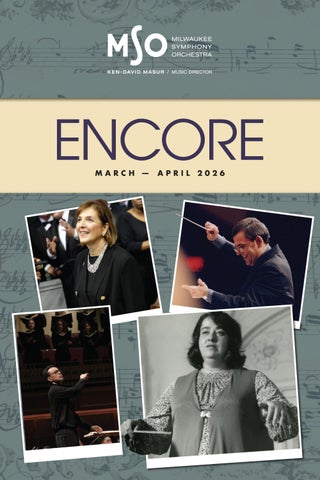
Create a flipbook
MSO PROGRAM 5 MARCH - APRIL 2026 by Milwaukee Symphony Orchestra - Issuu