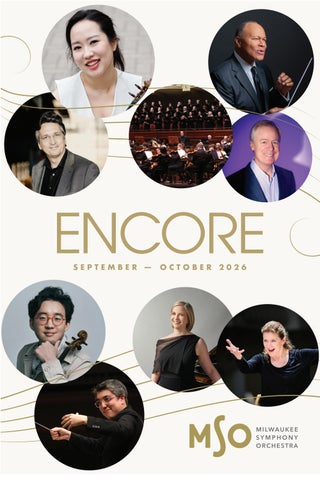
ENCORE SEPTEMBER —
OCTOBER
2026
ENCORE Volume 45 No. 1
15 September 18 & 19 — Classics Season Opening Fanfare 22 September 26 & 27 — Pops Kings of Soul
ENCORE SEPTEMBER —
OCTOBER
2026
27 October 2 & 3 — Film Pirates of the Caribbean: The Curse of the Black Pearl in Concert 29 October 9 & 10 — Classics Made in America: Korngold & Rachmaninoff 38 October 23-25 — Classics Movement & Melody 45 October 30 & 31 — Classics Beethoven Piano Concerto No. 1 5 7 8 9 10
A Note from Mark Niehaus Orchestra Roster Principal Pops Conductor Associate Conductor Milwaukee Symphony Chorus
58
MSO Endowment Musical Legacy Society
59
Annual Fund
61 Corporate & Foundation Matching Gifts Golden Note Partners 62 Marquee Circle Memorials 66
MSO Board of Directors
67
MSO Administration
This program is produced and published by ENCORE PLAYBILLS. To advertise in any of the following programs: • Milwaukee Symphony Orchestra • Florentine Opera • Milwaukee Ballet • Skylight Music Theatre • Milwaukee Repertory Theater • Sharon Lynne Wilson Center Please contact: Scott Howland at 414-469-7779 scott.encore@att.net MILWAUKEE SYMPHONY ORCHESTRA 212 West Wisconsin Avenue Milwaukee, Wisconsin 53203 414-291-6010 | mso.org
Connect with us! MSOrchestra MilwSymphOrch @MilwSymphOrch The MSO and the Bradley Symphony Center have partnered with KultureCity to improve our ability to assist and accommodate guests with sensory needs. For information on available resources, visit mso.org.
MILWAUKEE SYMPHONY ORCHESTRA
1
Can You Picture Yourself...
Independent Living Assisted Living
Memory Support
Skilled Care
Enjoying Life at Saint John’s?
Come and see for yourself. Call to schedule a personal tour and delicious lunch or dinner.
414-831-6900 1840 North Prospect Avenue www.SaintJohnsMilw.org
Hosting Celebrations of Life Cassie King
Pre-Arrangement Specialist Call for more information or to set up an appointment.
cassie@feerickfuneralhome.com
2025 East Capitol Drive • Shorewood • 414.962.8383
FEERICKFUNERALHOME.COM
SOUL OF A NATION: An American Portrait MILWAUKEE PREMIERE
Soul of a Nation | VICTORIA BOND
Written for Frank Almond and inspired by the writings of Thomas Jefferson
Appalachian Spring | AARON COPLAND MONDAY
SEP
28
7:00 pm St. Paul Episcopal Church
franklymusic.org PROUD AFFILIATE
4
Frank Almond, violin Musicians of the Milwaukee Symphony Orchestra
Ryan Tani, conductor Brian Mani, narrator Program and artists subject to change
These concerts are supported in part by a grant from the the United Performing Arts Fund, and the Milwaukee Arts Board.
MILWAUKEE SYMPHONY ORCHESTRA
A
A NOTE FROM MARK NIEHAUS, PRESIDENT AND EXECUTIVE DIRECTOR Welcome to the Milwaukee Symphony Orchestra. I still have that feeling of anticipation every September as I look forward to once again gathering together and hearing our MSO play something familiar in a new way — or experiencing a piece of music for the very first time. Whether you have been attending MSO concerts for decades or are joining us for the first time, we are grateful that you are here to share this experience with us. This season also marks an important moment in the artistic life of the Milwaukee Symphony Orchestra. Our search for the MSO’s next music director is well underway, and we are approaching this process with great care, thoughtfulness, and excitement for the orchestra’s future. Throughout the year, you will see an outstanding slate of guest conductors on our podium, each bringing a distinctive perspective and creating new opportunities for artistic excellence with our musicians.
Photo by Scott Paulus
While our search is underway, we are fortunate to welcome acclaimed conductor and MSO Artistic Partner David Robertson back to Allen-Bradley Hall, where he will lead the orchestra for three weeks this season.
We are also grateful for the ongoing artistic leadership of Stein Family Foundation Principal Pops Conductor Byron Stripling and Associate Conductor Ryan Tani. Both have built meaningful connections with our musicians and audiences, and we look forward to the energy they will bring to the stage. Connections are at the heart of everything we do. A concert is not complete without an audience. The energy you bring into Allen-Bradley Hall — the roaring standing ovations, the moments of stillness as a final note fades, and the conversations and memories that continue long after a performance — is all part of the experience of live music. We want the Bradley Symphony Center to be a place where you feel welcomed, inspired, and connected. We hope you will return to hear music you already love, discover something unexpected, introduce a friend or family member to the orchestra, and make the MSO part of your own traditions. And, of course, at the center of every performance are the remarkable musicians of the Milwaukee Symphony Orchestra. They are Milwaukee’s team that wins every night! Their artistry, dedication, and commitment make these extraordinary concerts possible, and your presence and support allow their great work for Milwaukee to continue. Thank you for being part of the MSO community and for sharing this season with us. We are delighted to welcome you back, and we cannot wait to see you again and again at the Bradley Symphony Center for years to come.
Mark Niehaus, President & Executive Director Michael and Jeanne Schmitz Chair MILWAUKEE SYMPHONY ORCHESTRA
5
ABOUT THE MILWAUKEE SYMPHONY ORCHESTRA
Photo by Jonathan Kirn
Within only a few years of its founding in 1959, the Milwaukee Symphony Orchestra rose through the ranks of the nation’s professional orchestras, quickly distinguishing itself as one of America’s finest symphonic ensembles. Devoted to engaging diverse audiences throughout the region, the MSO presents a wide variety of programming curated to meet the cultural needs of the state of Wisconsin. Its world-class performances encompass masterworks of the classical repertoire, semi-staged operatic and theatrical productions, vibrant arrangements of popular music, screenings of Hollywood classics accompanied by live renditions of their scores, and nationally acclaimed educational and community outreach initiatives. Dedicated to giving voice to contemporary artists and known as an innovator among its peer institutions, the MSO regularly commissions new works from living composers, frequently giving world and regional premieres of new music. With a legacy of commercial recording extending more than half a century into the past and celebrated as the first American orchestra to offer live recordings on iTunes, the MSO can be heard on the Telarc, Koss Classics, Pro Arte, AVIE, and Vox/Turnabout record labels. In the spring of 2026, the orchestra launched a revival of its MSO Classics label, releasing the world premiere recording of David Ludwig’s bassoon concerto and making dozens of its live recordings available for purchase and through digital streaming services. Following years of planning, restoration, and renovation, the MSO opened the doors of the Bradley Symphony Center to the public in the autumn of 2021, restoring the Warner Grand Theater on West Wisconsin Avenue to its status as a cultural destination in downtown Milwaukee and giving the MSO a permanent home in the community. Serving as a space for listeners from all walks of life to gather, the venue has opened a new chapter in the orchestra’s allegiance to civic engagement, embracing local arts and community partners as part of its programming and underscoring the orchestra’s standing as a focal point in the city’s artistic landscape. From its earliest days, the MSO has made its presence felt in the Milwaukee metropolitan area through its award-winning educational endeavors. Programs like Arts in Community Education and Concerts for Schools serve as a role model for modern orchestras and make classical music meaningful to thousands of school children every year. The Bach Double and Teen Choral Partners competitions provide students with the opportunity to cultivate their talent alongside the musicians of their hometown orchestra. Presented in partnership with Carnegie Hall’s Weill Music Institute and Sojourner Family Peace Center, the Lullaby Project connects local families with professional performers, arrangers, and recording artists, while the MSO’s Sensory Friendly performances provide vital resources and a safe, thoughtfully designed listening environment for people of any age on the autism spectrum or with sensory sensitivities, affirming the orchestra’s commitment to eliminating barriers and making live orchestral music accessible and engaging for every audience member. 6
MILWAUKEE SYMPHONY ORCHESTRA
Matthew Melillo, Acting Assistant Principal Laressa Winters**
Georgi Dimitrov Nathan Hackett Michael Lieberman** Erin H. Pipal CELLOS Susan Babini, Principal, 2026.27 SEASON Dorothea C. Mayer Principal Cello Chair Shinae Ra, Assistant Principal (2nd chair) Scott Tisdel, Associate Principal Emeritus MUSIC DIRECTOR Polly and Bill Van Dyke Music Director Chair Esther Chae Madeleine Kabat BYRON STRIPLING Peter Szczepanek Principal Pops Conductor Peter J. Thomas* Stein Family Foundation Principal Pops Adrien Zitoun Conductor Chair BASSES RYAN TANI Principal, Donald B. Abert Associate Conductor Principal Bass Chair Andrew Raciti, Acting Principal CHERYL FRAZES HILL Nash Tomey, Assistant Principal Chorus Director (3rd chair)* Margaret Hawkins Chorus Director Chair Brittany Conrad TIMOTHY J. BENSON Nicholas De Laurentis** Assistant Chorus Director Broner McCoy Paris Myers FIRST VIOLINS Jinwoo Lee, Concertmaster, HARP Charles and Marie Caestecker Julia Coronelli, Principal, Concertmaster Chair Walter Schroeder Principal Harp Chair Ilana Setapen, First Associate FLUTES Concertmaster, Thora M. Vervoren Sonora Slocum, Principal, First Associate Concertmaster Chair Margaret and Roy Butter Jeanyi Kim, Associate Concertmaster Principal Flute Chair Alexander Ayers Heather Zinninger, Assistant Principal Autumn Chodorowski Jennifer Bouton Schaub Yuka Kadota Chihiro Kakishima PICCOLO Elliot Lee Jennifer Bouton Schaub Dylana Leung OBOES Kyung Ah Oh Katherine Young Steele, Principal, Lijia Phang Milwaukee Symphony Orchestra League Yuanhui Fiona Zheng Principal Oboe Chair SECOND VIOLINS Kevin Pearl, Assistant Principal Jennifer Startt, Principal, Margaret Butler Andrea and Woodrow Leung ENGLISH HORN Principal Second Violin Chair Ji-Yeon Lee, Assistant Principal (2nd chair) Margaret Butler, Philip and Beatrice Blank English Horn Chair in memoriam to Shannon Fitzhenry, Assistant Principal John Martin (3rd chair) Heejeon Ahn CLARINETS Lisa Johnson Fuller Principal, Franklyn Esenberg Clay Hancock Principal Clarinet Chair Paul Hauer Jay Shankar, Acting Principal, Hyewon Kim Donald and Ruth P. Taylor Assistant Principal Clarinet Chair Vinícius Sant’Ana** Besnik Abrashi, Acting Assistant Principal Yiran Yao Max Reese** VIOLAS Principal, Richard O. and Judith A. Wagner E-FLAT CLARINET Max Reese** Family Principal Viola Chair Kunjing Dai, Acting Principal, BASS CLARINET Friends of Janet F. Ruggeri Besnik Abrashi Assistant Principal Viola Chair Samantha Rodriguez, Acting Assistant BASSOONS Principal (2nd chair) Catherine Van Handel, Principal, Alejandro Duque, Acting Assistant Muriel C. and John D. Silbar Family Principal (3rd chair) Principal Bassoon Chair* Elizabeth Breslin Rudi Heinrich, Acting Principal
CONTRABASSOON Matthew Melillo HORNS Matthew Annin, Principal, Krause Family Principal French Horn Chair Krystof Pipal, Associate Principal Dietrich Hemann, Andy Nunemaker French Horn Chair Darcy Hamlin Dawson Hartman TRUMPETS Matthew Ernst, Principal, Walter L. Robb Family Principal Trumpet Chair David Cohen, Associate Principal, Martin J. Krebs Associate Principal Trumpet Chair Tim McCarthy, Fred Fuller Trumpet Chair TROMBONES Megumi Kanda, Principal, Marjorie Tiefenthaler Principal Trombone Chair Kirk Ferguson, Assistant Principal BASS TROMBONE John Thevenet, Richard M. Kimball Bass Trombone Chair TUBA Robyn Black, Principal, John and Judith Simonitsch Principal Tuba Chair TIMPANI Dean Borghesani, Principal Chris Riggs, Assistant Principal PERCUSSION Robert Klieger, Principal Chris Riggs PIANO Melitta S. Pick Endowed Piano Chair PERSONNEL Antonio Padilla Denis, Director of Orchestra Personnel Paris Myers, Assistant Manager of Orchestra Personnel LIBRARIANS Paul Beck, Principal Librarian, James E. Van Ess Principal Librarian Chair Matthew Geise, Assistant Librarian & Media Archivist PRODUCTION Tristan Wallace, Production Manager/Live Audio Lisa Sottile, Production Stage Manager * Leave of absence during the 2026.27 season ** Acting member of the MSO for the 2026.27 season
MILWAUKEE SYMPHONY ORCHESTRA
7
BYRON STRIPLING, PRINCIPAL POPS CONDUCTOR
Photo by John Abbott
With a contagious smile and captivating charm, conductor, trumpet virtuoso, singer, and actor Byron Stripling ignites audiences across the globe. In 2024, Stripling was named Stein Family Foundation Principal Pops Conductor of the Milwaukee Symphony Orchestra. He also currently serves as principal pops conductor of the Pittsburgh Symphony Orchestra and artistic director and conductor of the highly acclaimed Columbus Jazz Orchestra. Stripling’s baton has led countless orchestras throughout the United States and Canada, including the Boston Symphony Orchestra at Tanglewood and the orchestras of San Diego, St. Louis, Virginia, Toronto, Baltimore, Milwaukee, Fort Worth, Rochester, Buffalo, Florida, Portland, and Sarasota, to name a few.
As a soloist with the Boston Pops, Stripling has performed frequently under the baton of Keith Lockhart, including as the featured soloist in the PBS television special Evening at Pops with conductors John Williams and Mr. Lockhart. Since his Carnegie Hall debut with Skitch Henderson and the New York Pops, Stripling has become a pops orchestra favorite throughout the country, appearing as soloist with more than 100 orchestras. He has been a featured soloist at the Hollywood Bowl and performs at festivals around the world. An accomplished actor and singer, Stripling was chosen, following a worldwide search, to star in the lead role of the Broadway-bound musical Satchmo. Many will remember his featured cameo performance in the television movie The Young Indiana Jones Chronicles and his critically acclaimed virtuoso trumpet and riotous comedic performance in the 42nd Street production of From Second Avenue to Broadway. Television viewers have enjoyed his work as a soloist on the worldwide telecast of the Grammy Awards. Millions have heard his trumpet and voice in television commercials, TV theme songs including 20/20 and CNN, and soundtracks of favorite movies. In addition to multiple recordings with his quintet and work with artists from Tony Bennett to Whitney Houston, his prolific recording career includes hundreds of albums with the greatest pop, Broadway, soul, and jazz artists of all time. Stripling earned his stripes as lead trumpeter and soloist with the Count Basie Orchestra under the direction of Thad Jones and Frank Foster. He has also played and recorded extensively with the bands of Dizzy Gillespie, Woody Herman, Dave Brubeck, Lionel Hampton, Clark Terry, Louis Bellson, and Buck Clayton in addition to the Jazz at Lincoln Center Orchestra, the Carnegie Hall Jazz Band, and the GRP All-Star Big Band. Stripling is devoted to giving back and supports several philanthropic organizations, including United Way and the Community Shelter Board. He also enjoys sharing the power of music through seminars and master classes at colleges, universities, conservatories, and high schools. Stripling was educated at the Eastman School of Music in Rochester, New York, and the Interlochen Arts Academy in Interlochen, Michigan. One of his greatest joys is to return periodically to Eastman and Interlochen as a special guest lecturer. A resident of Ohio, Stripling lives in the country with his wife, Alexis, a former dancer, writer, and poet and their beautiful daughters.
8
MILWAUKEE SYMPHONY ORCHESTRA
RYAN TANI, ASSOCIATE CONDUCTOR Now in his fourth season with the MSO and his second as its associate conductor, Ryan Tani has built a reputation for inventive programming, as well as an energetic connection with audiences in Milwaukee and beyond. At the MSO, he conducts a wide range of concerts — including education, family, pops, and classics — and has stepped in for Edo de Waart and led sold-out performances in his 2025 classics debut. He has served as cover conductor for the Minnesota Orchestra, New York Philharmonic, St. Louis Symphony Orchestra, Colorado Symphony, and Bozeman Symphony. A committed advocate for new music, Tani was music director of Baltimore’s Occasional Symphony, commissioning over 20 works and supporting dozens of composers in just three years. At Yale, he served as conducting fellow of the Philharmonia and resident conductor of New Music New Haven, earning the Dean’s Prize for artistic excellence. Tani’s community-focused work includes leading multiple ensembles across Montana, including the Bozeman, Missoula, Great Falls, and Montana State University symphonies. Committed to connecting with audiences off the podium, he also developed outreach programs, taught university courses, and fostered collaborations between artists and the public — efforts that continue to shape his approach today. He holds degrees from Yale University, the Peabody Institute, and the University of Southern California, and has studied with Marin Alsop, Peter Oundjian, Markand Thakar, Larry Rachleff, and Donald Schleicher. He lives in Milwaukee with his wife Bronte and his corgi Darby and enjoys cooking, reading, and playing violin.
MILWAUKEE SYMPHONY ORCHESTRA
9
MILWAUKEE SYMPHONY CHORUS
Photo by Jonathan Kirn
Established in 1976 as a joint effort between the Wisconsin Conservatory of Music and the Milwaukee Symphony Orchestra, the Milwaukee Symphony Chorus has distinguished itself over the course of half a century as one of the preeminent choral ensembles in the United States. Celebrating their landmark 50th anniversary during the 2025-26 season, the chorus appeared alongside the MSO in monumental masterworks by Bach, Beethoven, and Handel. In the coming season, they add their voices to choral treasures from Ravel, Mozart, Holst, and Walton, as well as the MSO’s annual Holiday Pops concerts. Founded by legendary choral pedagogue Margaret Hawkins, the chorus’s meteoric rise in stature during the late 1970s broadened the orchestra’s repertoire and set a new standard of excellence in Milwaukee’s musical landscape. Under Hawkins’s baton, the chorus produced its first commercial recordings and made multiple appearances at New York’s Carnegie Hall. Their voices were heard in the MSO’s first radio broadcasts, receiving airtime nationally and internationally. The chorus has made numerous guest appearances at the Ravinia Festival through the years, beginning in 1984 and as recently as 2019, performing with the Chicago Symphony Orchestra and Chorus, singing Gustav Mahler’s “Symphony of a Thousand.” Other collaborations include appearances with local performing arts groups, including the Milwaukee Ballet, Milwaukee Musaik, and Present Music. The Milwaukee Symphony Chorus’s wide range of ability has been a signature of the ensemble throughout their history. They have moved seamlessly from works by Bach and Brahms to Prokofiev’s Alexander Nevsky, sung during a live screening of the film. Semi-staged productions of Wagner’s The Flying Dutchman and Grieg’s Peer Gynt are featured alongside performances with contemporary artists, such as their recent appearance with the esteemed mandolinist Chris Thile. Their repertoire spans the centuries, regularly placing their enormous versatility on full display. Made up of musicians from every walk of life, the 150 members of the Milwaukee Symphony Chorus devote countless volunteer hours every season to preparing and performing the great cornerstones of the symphonic literature with an unqualified love for their craft. To learn more about becoming a member of the chorus, visit mso.org/chorus.
10
MILWAUKEE SYMPHONY ORCHESTRA
CHORUS MEMBERS & STAFF Jahnavi Acharya Anna Aiuppa Mia Akers Laura Albright-Wengler Alexander Z. Alden Anthony Andronczyk James Anello Evan Bagwell u Thomas R. Bagwell Marshall Beckman Emily Bergeron u JoAnn Berk Edward Blumenthal Jillian Boes Alice Boesky u Scott Bolens Madison Bolt Riley Brown Michelle Budny Ellen N. Burmeister JJ Bushman Gabrielle Campbell Gerardo Carcar Elizabeth Clare Sarah M. Cook Barbara Czarkowski Phoebe Dawsey Colin Destache Rebeca A. Dishaw Megan Dixson James Edgar Joe Ehlinger Kathleen Erdmann Katelyn Farebrother Michael Faust Catherine Fettig Marty Foral u Karen Frink
Clara Fuller Julia M. Kreitzer Maria Fuller Harold Krueger James T. Gallup Benjamin William Jonah Gaster Kuhlmann Jonathan Gaston-Falk Sarah Anne Labinski Samantha Gibson Alexandra Lerch-Gaggl Ryan Gintoft Robert Lochhead Jessica Golinski Teresa Cecelia Luke Daniel Grambow Grace Majewski Samantha Farmilant Rachel Maki Grambow Ariel Marks Mark R. Hagner Ethan T. Masarik Beth Harenda Joy Mast u Karen Heins Justin J. Maurer Deme Hellwig Evan Maxwell Melissa Kay Herbst Megan Miller u Nathan Hickox-Young Jennifer Mueller Eric Hickson Matthew Neu Michelle Hiebert Kristin Nikkel Amy Hudson Alice Nuteson Matthew Hunt Robert Paddock John Itson u Daniel E. Parks Tina Itson u Jessica E. Pihart Hayden Izumi Bianca Pratte Paula J. Jeske Orson Pritchard Robin Jette Abby Prom R. Zachary Karanovich Mary Rafel Heidi L. Kastern Jason Reuschlein Daniel Kerkman Rehanna Rexroat Summer Ketchell James Reynolds Christin Kieckhafer Marc Charles Ricard Laurie Knapp Amanda Robison Catherine Kocian u Bridget Sampson Kate Kondratuk James Sampson Jill Kortebein Joshua S. Samson Kaleigh Kozak-Lichtman Darwin J. Sanders Kyle J. Kramer Sarah Schmeiser u Joseph M. Krechel Rand C. Schmidt
STAFF
REHEARSAL PIANISTS
Cheryl Frazes Hill, chorus director Timothy J. Benson, assistant director Darwin J. Sanders, language and diction coach Christina Williams, chorus manager
Melissa Cardamone Jeong-In Kim Teree Shofner-Emrich
Randy Schmidt u Allison Schnier u Matthew Seider Bennett Shebesta u Hannah Sheppard David Siegworth Samuel Skogstad Joseph Smaldino Bruce Soto u Joel P. Spiess u Todd Stacey Scott Stieg Donna Stresing Joseph Thiel Matthew Van Hecke Bobbi Jo Vandal Karen Therese Vandervort Maria Waldkirch Maggie Walz Stephanie Weeden Tess Weinkauf Amy Weyers Erin Weyers Sian Whitney Christina Williams Kevin R. Woller Ben Young Jamie M. Yu Katarzyna Zawislak Stephanie Zimmer
u Section Leader
MILWAUKEE SYMPHONY ORCHESTRA
11
DR. CHERYL FRAZES HILL, CHORUS DIRECTOR Dr. Cheryl Frazes Hill is in her 10th season as director of the Milwaukee Symphony Chorus. Among the many works she has prepared with the chorus, Bach’s St. Matthew Passion, Beethoven’s Missa solemnis and ninth symphony, and Handel’s Messiah were most recently performed to celebrate the chorus’s 50th anniversary season. Frazes Hill has also prepared the chorus for Mahler’s Symphony No. 8 with the Chicago Symphony Orchestra and Chorus at the Ravinia Festival under the baton of Marin Alsop. Frazes Hill’s choral preparation of Brahms’s German Requiem, conducted by Ken-David Masur, was recently released through the MSO Classics label. Additionally, Frazes Hill has served as associate conductor of the Chicago Symphony Chorus since 1987. Recently celebrating her 50th season with the CSO, she began as a singer with the ensemble in 1976 and was then appointed to the conducting staff by Margaret Hillis, the chorus’s founder and first director. Over the course of her tenure with the CSO, Frazes Hill has prepared the Chicago Symphony Chorus for maestros Alsop, Boulez, Barenboim, Conlon, Levine, Mehta, Salonen, Tilson Thomas, and many others. Recordings of Frazes Hill’s choral preparations on the CSO Resound label include Beethoven, A Tribute to Daniel Barenboim, and Chicago Symphony Chorus: A 50th Anniversary Celebration. In addition to her roles with the Chicago and Milwaukee symphony orchestras, Frazes Hill is professor emerita at Roosevelt University’s Chicago College of Performing Arts, where she served for 20 years as director of choral activities. Under her direction, the Roosevelt University choruses were featured in prestigious and diverse events, including appearances with the Chicago Symphony Orchestra, Chicago Sinfonietta, Civic Orchestra of Chicago, and Illinois Philharmonic. The Roosevelt Conservatory Chorus received enthusiastic reviews for their American premiere of Jacob ter Velduis’s Mountaintop. Other recent performances included the internationally acclaimed production of Defiant Requiem and a semi-staged production of Considering Matthew Shepard. An accomplished vocalist, Frazes Hill is a featured soloist on the Grammy-nominated CBS Masterworks release Mozart: Music for Basset Horns. Frazes Hill has earned numerous awards, including the Illinois Governor’s Award, Northwestern University’s Alumni Merit Award, the Commendation of Excellence in Teaching from the Golden Apple Foundation, the University of Chicago’s Outstanding Teaching Award, and Roosevelt University’s Presidential Award for Social Justice. Frazes Hill is the recent recipient of the prestigious 2022 Harold Decker Conducting Award from the American Choral Director’s Association and the 2023 Mary Hoffman Award of Excellence for her distinguished work in the field of music education. Frazes Hill serves as a frequent guest conductor, clinician, and guest speaker, working with ensembles and young conductors throughout the U.S. Her book — Margaret Hillis: Unsung Pioneer — was released by GIA Publications in 2022. As an advocate for female conductors past and present, Frazes Hill has joined conductor Marin Alsop as a featured speaker for the Ravinia Festival’s symposium “Breaking Barriers: Women on the Podium” and has collaborated with Alsop and her female orchestral conducting fellows on rehearsal strategies with choruses. Frazes Hill shares her scholarship through published articles for national educational and choral journals on topics of her research in choral conducting and music education.
12
MILWAUKEE SYMPHONY ORCHESTRA
YOUR KIND OF PLACE
You love the eclectic, vibrant buzz. The café where they know you. Downer Avenue’s history, music and culture. Beautiful family parks and Lake Michigan beaches. That’s the East Side. And that’s us. Nestled in the heart of this friendly, walkable neighborhood, Eastcastle Place is a hidden gem. Come and discover our dynamic senior living lifestyle, in a community brimming with the energy of the East Side.
Call (414) 914-2761 to learn more.
It’s where you want to be.
2505 E. Bradford Ave. Milwaukee, WI 53211 eastcastleplace.com MILWAUKEE SYMPHONY ORCHESTRA
13
14
MILWAUKEE SYMPHONY ORCHESTRA
SEASON OPENING FANFARE Friday, September 18, 2026 at 7:30 pm Saturday, September 19, 2026 at 7:30 pm ALLEN-BRADLEY HALL Michael Sanderling, conductor Hyun Jae Lim, violin
AARON COPLAND Fanfare for the Common Man
SAMUEL BARBER Violin Concerto, Opus 14 I. Allegro II. Andante III. Presto in moto perpetuo Hyun Jae Lim, violin
INTERMISSION
PYOTR ILYICH TCHAIKOVSKY Symphony No. 5 in E minor, Opus 64 I. Andante – Allegro con anima II. Andante cantabile con alcuna licenza III. Valse: Allegro moderato IV. Finale: Andante maestoso – Allegro vivace
The 2026.27 Classics Series is presented by the UNITED PERFORMING ARTS FUND. The length of this concert is approximately 1 hour and 40 minutes. Video or audio recording of this performance is prohibited. All programs are subject to change. The Milwaukee Symphony Orchestra can be heard on the Naxos, Telarc, Koss Classics, ProArte, AVIE, and Vox/Turnabout labels. MSO Classics recordings are available for digital streaming and download on Spotify, Apple Music, and more. MILWAUKEE SYMPHONY ORCHESTRA
15
Guest Artist Biographies MICHAEL SANDERLING Since the 2021-22 season, Michael Sanderling has served as chief conductor of the Lucerne Symphony Orchestra. This appointment marked the logical continuation of a close, long-standing partnership aimed at further establishing the orchestra’s international reputation in the late Romantic repertoire — particularly with works by Bruckner, Mahler, and Strauss. Tours throughout Europe, Asia, and South America, as well as innovative projects, attest to the impact of this collaboration. Particular attention was drawn to the multimedia production of Shostakovich’s Photo by Symphony No. 10, featuring artist William Kentridge, which, following Marco Borggreve its premiere at the KKL Lucerne and in Pompeii, enjoyed triumphant performances at the Wiener Konzerthaus and the Philharmonie de Paris. Sanderling’s discography with the Lucerne Symphony Orchestra, including a celebrated Brahms cycle on Warner Classics as well as a recording of the piano concertos by Antonín Dvořák and Edvard Grieg with Elisabeth Leonskaja, documents the sonic depth of this era. Sanderling’s path to the conductor’s podium was shaped by a deep understanding of orchestral sound. Following a distinguished career as a cello soloist with ensembles including the Orchestre de Paris, Los Angeles Philharmonic, and Boston Symphony Orchestra, he served as principal cellist of the Leipzig Gewandhaus Orchestra under Kurt Masur from 1987 to 1992 and laid the foundation for his career as a conductor through his tenure as artistic director of the Kammerakademie Potsdam (2006 – 2011). From 2011 to 2019, he led the Dresden Philharmonic into a new era as its chief conductor and established the orchestra among Germany’s top-tier ensembles. A lasting monument to this period is the highly acclaimed recording of the complete symphonies of Beethoven and Shostakovich for Sony Classical. In addition to the great symphonies, his discography includes significant concert recordings with soloists such as Edgar Moreau and Katrin Scholz, as well as collaborations with the Berlin Radio Choir. He has also set new standards on the opera stage: for his production of Prokofiev’s War and Peace with the Cologne Opera, the magazine Opernwelt named him Conductor of the Year in 2011. Today he is a guest conductor with renowned orchestras worldwide, including the Berlin Philharmonic, Leipzig Gewandhaus Orchestra, Royal Concertgebouw Orchestra, Vienna Symphony, Helsinki Philharmonic Orchestra, Orchestre de Paris, Dallas Symphony Orchestra, Philharmonia Orchestra, and NHK Symphony Orchestra. In addition to the stage, Sanderling devotes himself with passionate intensity to the next generation. For many years, he has taught at the Frankfurt University of Music and Performing Arts. His longstanding commitment to ensembles such as the German String Philharmonic, Schleswig-Holstein Festival Orchestra, and German National Youth Orchestra underscores his belief that musical excellence and the passing on of experience are inseparably linked.
16
MILWAUKEE SYMPHONY ORCHESTRA
Guest Artist Biographies HYUN JAE LIM Korean violinist Hyun Jae Lim has triumphantly returned to the international stage following a four-year hiatus caused by a severe accident in 2020. Since resuming her career in June 2024, she has seamlessly continued her artistic path with remarkable success. Lim’s career is underscored by an impressive series of competition achievements. Most recently, she won first prize at the 2025 Seoul International Music Competition and first prize at the 2026 Elmar Oliveira International Violin Competition, where she also received three honors, including awards for the best performance of a commissioned work and best performance of a solo sonata by Eugène Ysaÿe. Following her return, she reached the semifinals of both the International Isang Yun Competition in 2024 and the International Jean Sibelius Violin Competition in 2025. Earlier in her career, she earned prizes at the Yehudi Menuhin International Competition for Young Violinists (2018) and became the youngest prizewinner at the Singapore International Violin Competition (2015), where she received fifth prize alongside the special prize for the best performance of Bach. In recognition of her artistic achievements, she was named one of Classic FM’s 30 Under 30 Rising Stars for 2026. As a soloist, Lim has performed with renowned ensembles such as The Philadelphia Orchestra, the Royal Philharmonic Orchestra, and the Houston Symphony, collaborating with esteemed conductors including Jaap van Zweden, Julian Rachlin, Christoph Poppen, Yunsung Chang, and Kensho Watanabe. Her performance venues include Marian Anderson Hall in Philadelphia, the National Gallery of Art in Washington, D.C., Victoria Hall in Geneva, Jordan Hall in Boston, and Houston’s Miller Outdoor Theatre, among others. In 2015, she was also featured on NPR’s 15thanniversary broadcast of From the Top. Highlights of her 2026-27 season include her performance of Mendelssohn’s violin concerto with the Seoul Philharmonic Orchestra under the baton of Jaap van Zweden, a Korean tour as soloist with the Orchestra da Camera di Mantova, and a series of engagements in the U.S. Lim began her musical studies early, learning the piano at age four and the violin at seven. She completed her bachelor’s degree as a Howard and Carol Lidz Fellow at the Curtis Institute of Music, studying with Midori, Shmuel Ashkenasi, and Arnold Steinhardt, and is currently pursuing her master’s degree at Curtis under the guidance of Midori.
MILWAUKEE SYMPHONY ORCHESTRA
17
Program notes by David Jensen AARON COPLAND Born 14 November 1900; New York City, New York Died 2 December 1990; North Tarrytown, New York
Fanfare for the Common Man
Composed: August – November 1942 First performance: 12 March 1943; Eugene Goossens, conductor; Cincinnati Symphony Orchestra Last MSO performance: 15 March 2009; Andreas Delfs, conductor Instrumentation: 4 horns; 3 trumpets; 3 trombones; tuba; timpani; percussion (bass drum, tam-tam) Approximate duration: 3 minutes By the end of 1942, Aaron Copland was riding high as one of the leading figures of modern musical America. Only a few years earlier, he had broken new ground in the business of film scoring, ushering in an age of broader stylistic possibility for the Hollywood composer. With the success of his ballets Billy the Kid and Rodeo around the turn of the decade, he had distilled his artistic tendencies into a refined, simplified approach characterized by a freer handling of tonal harmony and a more immediately accessible quality, intending to appeal to the widest audience possible. Only a few months earlier, Copland had composed his Lincoln Portrait for narrator and orchestra, commissioned by Andre Kostelanetz and the New York Philharmonic, as a sort of act of musical patriotism as his nation became enmeshed in the turmoil of World War II. Halfway across the continent, Eugene Goossens, in his capacity as music director of the Cincinnati Symphony Orchestra, was likewise busy extending a series of commissions to American composers, an undertaking that had met with great success with his British orchestras during the first World War. Of the 18 fanfares that the Cincinnati orchestra premiered during the 1942-43 season, only Copland’s has earned a permanent place in the repertoire. “It is my idea to make these fanfares stirring and significant contributions to the war effort,” Goossens wrote, “so I suggest you give your fanfare a title, as for instance, ‘A Fanfare for Soldiers, or for Airmen or Sailors.’” At Goossens’s suggestion, Copland relegated himself to a complement of brass and percussion instruments, but the title he eventually selected stood out quite conspicuously from the rest. While other composers were content to honor paratroopers, marines, soldiers, or other Allied nations, only Copland, inspired by Vice President Henry Wallace’s recent speech on the “Century of the Common Man,” saw fit to recognize his fellow citizens. Perhaps the most recognizable of all of Copland’s music, the opening strikes of the bass drum, timpani, and tam-tam immediately convey an air of solemnity. Trumpets enter with a three-note motif built of a perfect fifth and fourth, which Copland develops by means of progressively richer harmonizations, layering multiple chords in spacious voicings for a “direct and powerful” affect “with a contemporary sound.” Copland was a painstaking composer, and his habit of working slowly led him to miss the proposed October premiere. Goossens suggested a new date in March, which Copland felt would be an especially appropriate gesture — in his words, “I was all for honoring the common man at income tax time.”
18
MILWAUKEE SYMPHONY ORCHESTRA
SAMUEL BARBER Born 9 March 1910; West Chester, Pennsylvania Died 23 January 1981; New York City, New York
Violin Concerto, Opus 14
Composed: August – November 1939 First performance: 7 February 1941; Eugene Ormandy, conductor; Albert Spalding, violin; The Philadelphia Orchestra Last MSO performance: 11 May 2024; Joseph Young, conductor; Alexei Kenney, violin Instrumentation: 2 flutes; 2 oboes; 2 clarinets; 2 bassoons; 2 horns; 2 trumpets; timpani; percussion (snare drum); piano; strings Approximate duration: 25 minutes Now a cornerstone of the modern repertoire, Samuel Barber’s violin concerto has long been mired in the intrigue surrounding its creation. Like much of the concertante literature, it was conceived with a particular fiddler in mind — Iso Briselli, a classmate from the Curtis Institute of Music who received his diploma alongside Barber in 1934 — but when the composer presented him with the first two movements in October 1939, Briselli “seemed disappointed,” as Barber recalled it, “that they were not of a virtuoso character, a bit too easy.” In an attempt to rectify the situation, Barber produced a fiendishly demanding finale, intending to give Briselli the showpiece he’d asked for. Briselli, according to legend, responded by flatly condemning it as unplayable. It’s a memorable story, but in 2010, previously unpublished correspondence between Barber, Briselli’s violin coach Albert Meiff, and Samuel Simeon Fels, the soap tycoon and philanthropist underwriting the commission, at last gave historians a more nuanced account of the facts. In November 1939, Briselli showed the first two movements to Meiff, who soon informed Fels that the concerto bore “a serious defect: it is not a composition gratifying for a violinist to perform.” Its technical requirements were, in his view, “childish in details,” and it was imperative that the music undergo a “surgical operation” if it were to have any chance of succeeding. It was Meiff who claimed that the “risky, tiresome ending” was “a dangerous thought,” insisting Barber should have consulted his intended soloist, as had Brahms, Glazunov, and Tchaikovsky in their own time. Then came Barber’s own letter to Fels that December, by which point Briselli had abandoned the project. Caught in Europe during the outbreak of World War II that September, he claimed that upon returning, neither Briselli nor Eugene Ormandy, music director of The Philadelphia Orchestra, had informed him that the premiere was slated for January. He was fatigued, working under pressure “in far from ideal circumstances” as he looked after his ailing father. Barber acknowledged Briselli’s criticism of the last movement as diametrically opposed, in stylistic terms, from the preceding two, but unwilling to “destroy a movement in which I have complete confidence,” they effectively agreed to disagree, remaining friends until Barber’s death in 1981. As Briselli later told it, he simply found the finale “too lightweight” — certainly not impossible to play — and that he very much liked the rest of the concerto. Barber privately referred to it as his “concerto del sapone” (or “soap concerto”), both a nod to Fels’s role in funding his work and the “soap opera” of its history. In light of the privileged status the concerto now enjoys (to say nothing of its purely musical virtues), the description Barber included in the program note he supplied for the premiere, which basically delineates the concerto’s structural features, seems a modest one: “The first movement … begins with a lyrical first subject announced at once by the solo violin, without any orchestral introduction. This movement as a whole has perhaps more the character of a sonata than concerto form. The second movement … is introduced by an extended oboe solo. The violin enters with a contrasting and rhapsodic theme, after which it repeats the oboe melody of the beginning. The last movement, a perpetuum mobile, exploits the more brilliant and virtuosic character of the violin.” MILWAUKEE SYMPHONY ORCHESTRA
19
PYOTR ILYICH TCHAIKOVSKY Born 7 May 1840; Votkinsk, Russia Died 6 November 1893; Saint Petersburg, Russia
Symphony No. 5 in E minor, Opus 64
Composed: May – August 1888 First performance: 17 November 1888; Piotr Ilyich Tchaikovsky, conductor; Saint Petersburg Philharmonic Society Last MSO performance: 22 October 2022; Jader Bignamini, conductor Instrumentation: 3 flutes (3rd doubling on piccolo); 2 oboes; 2 clarinets; 2 bassoons; 4 horns; 2 trumpets; 3 trombones; tuba; timpani; strings Approximate duration: 50 minutes Tchaikovsky spent the beginning of 1888 touring Europe in the glow of an international fame previously unknown to him, but his diary entries and letters from those months reveal a man ill at ease with life. Notoriously sensitive to criticism and prone to depression, he met with great difficulty in relating to an admiring public, frequently drinking to excess to alleviate his pain. Tchaikovsky passed through Germany, where he watched Brahms conduct his strange new “double” concerto, Bohemia, where he was warmly received by Dvořák, France, and England. “…I have gained some celebrity,” he wrote to his publisher, Pyotr Jurgenson, “but every hour I ask myself — Why? Is it worthwhile? And I come to the conclusion it is far better to live quietly without fame.” Returning to Russia that spring, Tchaikovsky rented a home in the village of Frolovskoye, intending to spend the summer writing in seclusion. “I’m now gradually beginning, with difficulty, to squeeze a symphony out of my addled brain,” he wrote to his brother Modest in May. Cryptic notes appeared in his sketches, suggesting an extramusical program: “Total submission before fate … the inscrutable designs of Providence … Murmurs, doubts, laments, reproaches against...xxx” Whether or not the “xxx” in question referred to, as has been suggested, Tchaikovsky’s homosexuality (a source of constant anxiety throughout his life) is uncertain, as is how much of a private narrative was actually woven into the score. Tchaikovsky later denied, in writing, that there was one. What is certain is that ten years had elapsed since he’d penned his fourth symphony, an imposing statement on the inevitability of fate, and he was terrified at the prospect of finding himself “written out, that my head is empty, that my time is past, etc.” Immersed in the Russian musical vernacular, which prized stasis and repetition, Tchaikovsky never quite came to grips with the highly formalized, harmonically dynamic precepts that propelled Western music. Requiring a mastery of tonal principles that were quite literally foreign to him, he struggled for years to make sense of the symphonic idiom. He felt as alienated by sonata form as he did by the explicitly programmatic music that gripped his peers, but his intensely charged temperament seemed to find no better outlet than the tone poems and fantasies then in fashion. His solution was to make the best of both worlds: distinctive motifs saturate his late large-scale works, linking together individual movements into an integrated whole and circumventing the need to modulate to specific key areas. The gloomy theme sounded by the clarinet in the opening bars permeates the entire fifth symphony, constantly remade in the image of its surroundings. Musicologist David Brown described the second movement, beloved for its exquisite horn solo, as “one of the composer’s most personal utterances, an extended flow of yearning melody that is quintessential Tchaikovsky,” while the balletic waltz that follows provides a blithe diversion. Tchaikovsky, who quickly disparaged the fifth as being “much too colorful, massive, insincere, drawn out, and generally most unsympathetic,” may have been responding to the ecstatic, nearly hysterical dimensions of the closing movement. He made a cut to the finale for a concert in Hamburg in March 1889, a performance so successful that he was convinced “to love it again.”
20
MILWAUKEE SYMPHONY ORCHESTRA
2026-2027 Concert Season Nov 17 - “baroque brilliance” Vivaldi - Corelli - Handel - Geminiani MILWAUKEE MUSAIK CHAMBER ORCHESTRA Alexander Mandl - conductor
Nov 22 - “Chamber Music with Joyce Yang” A Special Fundraiser Concert - Farrenc & Brahms
Mar 1 - “Swans, Shepherds & Stars” Milhaud - Brahms - Ellenwood Roussel -Beach -Schubert Laura Strickling - soprano
MAY 17 - “Traditions Reimagined” Copland - Stravinsky - Respighi - Milhaud MILWAUKEE MUSAIK CHAMBER ORCHESTRA Alexander Mandl - conductor
Details: MILWAUKEEMUSAIK.ORG
MILWAUKEE SYMPHONY ORCHESTRA
21
KINGS OF SOUL A Schirmer Theatrical/Greenberg Artists Co-Production Arrangements by Jeff Tyzik Saturday, September 26, 2026 at 7:30 pm Sunday, September 27, 2026 at 2:30 pm ALLEN-BRADLEY HALL Byron Stripling, conductor Chester Gregory, vocalist Jeremy Keith, vocalist Darren Lorenzo, vocalist Chris Kuffner, bass guitar Eric Metzgar, drums ISAAC HAYES AND DAVID PORTER Soul Man BARRETT STRONG AND NORMAN WHITFIELD I Can’t Get Next to You ROQUEL DAVID, BERRY GORDY, AND GWENDOLYN GORDY Lonely Teardrops BERRY GORDY AND WILLIAM “SMOKEY” ROBINSON Shop Around NAPOLEON BROWN, OSCAR CADENA, MARGARET HENDRICKS, AND HERMAN LUBINSKY Night Time is the Right Time WILLIAM “SMOKEY” ROBINSON Get Ready AL BELL, ALLEN JONES, AND OTIS REDDING Hard to Handle JAMES CAMPBELL, REGINALD CONNELLY, AND HENRY WOODS Try a Little Tenderness WILLIAM “SMOKEY” ROBINSON AND RONALD WHITE My Girl JAMES BROWN AND BETTY JEAN NEWSOME It’s a Man’s Man’s Man’s World BEN E. KING, JERRY LEIBER, AND MIKE STOLLER Stand by Me SYLVESTER “SLY STONE” STEWART Dance to the Music 22
MILWAUKEE SYMPHONY ORCHESTRA
INTERMISSION
BARRY WHITE Love’s Theme LEON HUFF, GENE MCFADDEN, AND JOHN WHITEHEAD Back Stabbers CURTIS MAYFIELD Move On Up KENNY GAMBLE, CARY GILBERT, AND LEON HUFF Me and Mrs. Jones KENNY GAMBLE AND LEON HUFF You’ll Never Find Another Love Like Mine BARRETT STRONG AND NORMAN WHITFIELD Just My Imagination (Running Away With Me) KENNY GAMBLE AND LEON HUFF Close the Door MARVIN GAYE AND ED TOWNSEND Let’s Get It On AL GREEN AND MABON LEWIS “TEENIE” HODGES Love and Happiness ROD TEMPERTON Rock with You GARY JACKSON, RAYNARD MINER, AND CARL SMITH (Your Love Keeps Lifting Me) Higher and Higher ALL ARRANGEMENTS LICENSED BY SCHIRMER THEATRICAL, LLC
Creative Team Robert Thompson, Creative Producer Jeff Tyzik, Producer & Arranger Jami Greenberg, Producer & Booking Agent Betsey Perlmutter, Producer Alex Kosick, Associate Producer
This weekend’s media sponsor is WISCONSIN PUBLIC RADIO. The length of this concert is approximately 2 hours. Video or audio recording of this performance is prohibited. All programs are subject to change. The Milwaukee Symphony Orchestra can be heard on the Naxos, Telarc, Koss Classics, ProArte, AVIE, and Vox/Turnabout labels. MSO Classics recordings are available for digital streaming and download on Spotify, Apple Music, and more. MILWAUKEE SYMPHONY ORCHESTRA
23
Guest Artist Biographies CHESTER GREGORY Chester Gregory is an award-winning Broadway actor, singer, and recording artist, renowned for his extraordinary vocal talent, commanding stage presence, and deep emotional resonance. With starring roles in iconic productions such as Hairspray, Dreamgirls, Sister Act, Disney’s Tarzan, and Motown: The Musical, Gregory has become a dynamic force in musical theater and live performances, captivating audiences with a unique energy that resonates across both grand Broadway stages and intimate concert settings. His breakthrough role as legendary singer Jackie Wilson in The Jackie Wilson Story earned him widespread acclaim and a personal standing ovation from Michael Jackson. Known for blending soul, storytelling, and precision, Gregory brings authenticity to every performance, whether delivering an electrifying showstopper or a heartfelt ballad. A recipient of the NAACP Theatre Award, Joseph Jefferson Award, and Black Theatre Alliance Award, Gregory has performed across the U.S., gaining recognition not only for his vocal abilities, but also for his emotional depth and stage presence. His influence extends beyond live performances through his social media, where he engages millions, sharing his artistic journey, humor, and passion for wellness. JEREMY KEITH Jeremy Keith is a highly accomplished alternative and soul recording artist, known for his distinctive tone and impressive background vocal work. With a career spanning over 20 years, he has earned international recognition, notably as the lead vocalist for BB King’s All-Star Band at Sea and as a background vocalist for Grammy Award-winning artist Stephanie Mills, among other musical icons. One of his standout contributions includes background vocals on Kaleo’s double platinum hit, “Way Down We Go.” Keith’s music is marked by its emotional depth, powerful vocals, and heartfelt lyrics. Blending his passion for R&B with an alternative soul edge, he draws inspiration from his family and close friends. His latest release, “Try,” has garnered widespread acclaim for its refreshing sound and mature vocal delivery. When he’s not in the studio, Keith enjoys spending quality time with loved ones or unwinding at the beach. He’s currently touring as a solo artist and vocal coach. DARREN LORENZO Darren Lorenzo hails from Atlanta, Georgia, and received his Bachelor of Arts in mass communications at Clark Atlanta University. Lorenzo has appeared in numerous regional, international, and national tours, offBroadway, Broadway, concert, and theatrical productions such as Vegas! The Show, Way Back Music, Meeting at the Crossroads, Waitress: The Musical, Rock & Roll Man, The Wiz, The Color Purple, After Midnight, Five Guys Named Moe, Saturday Night Fever, Madagascar: The Musical, Smokey Joe’s Café, No Strings, Fosse, Hair, Daddy Cool, Philip Hamilton’s Voices, Freestyle Love Supreme, What the World Needs Now, and Solid Gold Soul.
24
MILWAUKEE SYMPHONY ORCHESTRA
Guest Artist Biographies CHRIS KUFFNER Chris Kuffner has been a professional bassist, guitarist, and music producer for 20 years. He has performed, produced, or recorded music with such visionary artists as Sara Bareilles, Regina Spektor, Ingrid Michaelson, David Byrne, Jason Mraz, A Great Big World, Jenny Owen Youngs, and many others. After a lifetime in New York City, Kuffner recently relocated to Nashville, Tennessee, where he found himself making music with up-and-coming country artists like Caylee Hammack, Brooke Eden, and Chris Housman. He has also become a member of the Nashville-based Americana band Steele Fountain, a group of incredible players who have toured extensively with the likes of Sting and Steven Tyler. ERIC METZGAR Eric Metzgar is an in-demand drummer and versatile collaborator who offers his musicianship to various jazz and pop artists and symphony orchestras worldwide. He has had the opportunity to play with numerous first-rate performers, including Jeff Tyzik, Sutton Foster, Joe Locke, Jimmy Greene, Shayna Steele, Byron Stripling, and Delfeayo Marsalis. Metzgar is a passionate educator deeply invested in music teaching and learning. Each summer, he teaches at the Cape Ann Jazz Workshop under the direction of saxophonist Alexa Tarantino. He maintains a private studio and serves as a clinician at grade schools and universities. Metzgar holds a Bacher of Music degree in drum set performance and a Master of Music degree in music teaching and learning from the Eastman School of Music. He lives in New York City and tours frequently around the world.
MILWAUKEE SYMPHONY ORCHESTRA
25
hallmarked-homos-6x9 encore.pdf 1 9/8/2026 3:22:15 PM
C
M
Y
CM
MY
CY
CMY
K
26
MILWAUKEE SYMPHONY ORCHESTRA
PIRATES OF THE CARIBBEAN: THE CURSE OF THE BLACK PEARL IN CONCERT FILM WITH ORCHESTRA Friday, October 2, 2026 at 7:30 pm Saturday, October 3, 2026 at 7:30 pm ALLEN-BRADLEY HALL Ryan Tani, conductor
Composer Hans Zimmer’s Complete Score Performed Live to Film Based on Walt Disney’s Pirates of the Caribbean FILM CREDITS Produced by Jerry Bruckheimer
Directed by Gore Verbinski
Screenplay by Ted Elliott and Terry Rossio
Executive Producers Mike Stenson Chad Oman Bruce Hendricks Paul Deason
Director of Photography Dariusz Wolski, A.S.C.
Screen Story by Ted Elliott Terry Rossio Stuart Beattie Jay Wolpert
Music by Klaus Badelt
Original motion picture soundtrack available on Walt Disney Records
Film projectors generously donated by the MARCUS CORPORATION. This weekend’s media sponsor is ONMILWAUKEE. The length of this concert is approximately 2 hours and 50 minutes, including a 20-minute intermission. This performance is a presentation of the feature film Pirates of the Caribbean: The Curse of the Black Pearl with a live performance of the film’s score. Out of respect for the musicians and your fellow audience members, please remain seated until the conclusion of the end credits. Video or audio recording of this performance is prohibited. The Milwaukee Symphony Orchestra can be heard on the Naxos, Telarc, Koss Classics, ProArte, AVIE, and Vox/Turnabout labels. MSO Classics recordings are available for digital streaming and download on Spotify, Apple Music, and more. Presentation licensed by Disney Concerts © All rights reserved. MILWAUKEE SYMPHONY ORCHESTRA
27
Yes, there are field trips. And yes, we try to ditch the chaperones.
At Harwood Place Luxury Senior Living, you’ll find the vibrant lifestyle you’re looking for, the support you expect and a community full of friends to share it with. HarwoodPlace.org
Playbill 4.625” x 7.25” 28
MILWAUKEE SYMPHONY ORCHESTRA
MADE IN AMERICA: KORNGOLD & RACHMANINOFF Friday, October 9, 2026 at 11:15 am Saturday, October 10, 2026 at 7:30 pm ALLEN-BRADLEY HALL Ryan Tani, conductor Julian Rhee, violin
SAMUEL BARBER Medea’s Dance of Vengeance, Opus 23a ERICH WOLFGANG KORNGOLD Violin Concerto in D major, Opus 35 I. Moderato nobile II. Romance: Andante III. Finale: Allegro assai vivace Julian Rhee, violin
INTERMISSION
SERGEI RACHMANINOFF Symphonic Dances, Opus 45 I. Non allegro II. Andante con moto (Tempo di valse) III. Lento assai – Allegro vivace
The MSO is proud to partner with the Nathan and Esther Pelz Holocaust Education Resource Center on educational programming related to these performances. The 2026.27 Classics Series is presented by the UNITED PERFORMING ARTS FUND. The length of this concert is approximately 1 hour and 40 minutes. Video or audio recording of this performance is prohibited. All programs are subject to change. The Milwaukee Symphony Orchestra can be heard on the Naxos, Telarc, Koss Classics, ProArte, AVIE, and Vox/Turnabout labels. MSO Classics recordings are available for digital streaming and download on Spotify, Apple Music, and more. MILWAUKEE SYMPHONY ORCHESTRA
29
Guest Artist Biographies JULIAN RHEE Winner of the coveted 2024 Avery Fisher Career Grant, Korean-American violinist Julian Rhee has been recognized for his refinement, beauty of sound, and “the kind of poise and showmanship that thrills audiences” (The Strad). Lauded for his soulful lyricism, magnetic charisma, and passion for collaboration, Rhee brings expressive depth, technical mastery, and interpretive insight to both familiar and contemporary works, establishing himself as one of today’s most captivating young artists. Rhee has appeared with leading orchestras across North America, Europe, and Asia, including the Calgary Philharmonic Orchestra, Stuttgart Chamber Orchestra, Oregon Symphony, Belgian National Orchestra, Pacific Symphony, Württemberg Chamber Orchestra of Heilbronn, San Diego Symphony, and the Milwaukee, Indianapolis, Antwerp, and Pittsburgh symphony orchestras, among others. He has collaborated with Photo by Shin-joong Kim distinguished conductors such as Alexander Shelley, Francesco LecceChong, Nicholas McGegan, David Danzmayr, Rune Bergmann, Valentina Peleggi, Antony Hermus, and Leonard Slatkin. Highlights of the 2026-27 season include debuts with the Gürzenich-Orchester Köln and Andrés Orozco-Estrada and the Orquesta Clásica Santa Cecilia and Daniel Raiskin, as well as returns to the Richmond, Milwaukee, and Brevard symphony orchestras. Following his prize-winning performances at the 2024 Queen Elisabeth International Violin Competition and his silver medal at the 11th Quadrennial International Violin Competition of Indianapolis, Rhee rose to international prominence as a soloist of remarkable artistry and maturity. He is also first prize winner of the Elmar Oliveira International Competition and Astral Artists’ National Auditions and the recipient of numerous honors, including the Aspen Music Festival’s Dorothy DeLay Fellowship, the North Shore Chamber Music Festival’s Arkady Fomin Scholarship Fund, and the Manfred Grommek Prize from the Kronberg Academy. A U.S. Presidential Scholar, he received his medal at the White House and serves as a Young Strings of America Ambassador sponsored by Shar Music. Rhee is a member of the Chamber Music Society of Lincoln Center’s Bowers Program, appearing regularly at Alice Tully Hall and on tour. He has performed at leading festivals including the Marlboro Music Festival, Bridgehampton Chamber Music Festival, North Shore Chamber Music Festival, Music@Menlo, and Rockport Music, and this season makes debuts at the Kingston Chamber Music Festival and as artist in residence at the Durango Music Festival. Rhee received his bachelor’s and master’s degrees from the New England Conservatory, where he was teaching assistant to Miriam Fried, and currently studies with Christian Tetzlaff at the Kronberg Academy. He performs on the extraordinary 1699 “Lady Tennant” Stradivarius and a Jean Pierre Marie Persoit bow on extended loan through the generosity of the Mary B. Galvin Foundation and the Stradivari Society, a division of Bein & Fushi, Inc.
30
MILWAUKEE SYMPHONY ORCHESTRA
Program notes by David Jensen SAMUEL BARBER Born 9 March 1910; West Chester, Pennsylvania Died 23 January 1981; New York City, New York
Medea’s Dance of Vengeance, Opus 23a
Composed: November 1945 – April 1946; concert piece arranged in 1955 First performance: 2 February 1956; Dimitri Mitropoulos, conductor; New York Philharmonic Last MSO performance: 28 April 2018; Hans Graf, conductor Instrumentation: 3 flutes (3rd doubling on piccolo); 2 oboes; English horn; E-flat clarinet; 2 clarinets; bass clarinet; 2 bassoons; contrabassoon; 4 horns; 3 trumpets; 3 trombones; tuba; timpani; percussion (bass drum, cymbals, snare drum, tam-tam, tom-tom, triangle, whip, xylophone); harp; piano; strings Approximate duration: 13 minutes Medea had been promised everything. A sorceress descended from the gods, she had abandoned her home and used her magic to help Jason, leader of the Argonauts, on his quest to retrieve the Golden Fleece and claim his rightful place as king of Iolcus. The gambit is successful, and Medea falls in love. She bears two sons and imagines the future she’ll build for her family. But Jason is ambitious, and he casts Medea aside for Glauce, daughter of king Creon, knowing that the marriage might one day secure him the throne of Corinth. This is where our story begins: in the thick of Medea’s scheme to exact her revenge upon Jason by murdering his new bride, his father-in-law, and her own children. The moral and feminist dimensions of Medea’s crime have occupied thinkers since the bestknown interpretation of her story, the eponymous Greek tragedy composed by Euripedes, debuted in 431 BCE. For the modern dancer Martha Graham, who viewed choreography as a kinesthetic expression of the subconscious, the scenario held an immediate appeal. In 1942, she requested incidental music from Carlos Chávez, but was dissatisfied; when she received funding from Columbia University to produce a new ballet for the school’s Festival of Contemporary Music, she commissioned Samuel Barber, who shared Graham’s vision of archetypal characters that projected “psychological states of jealousy and vengeance which are timeless.” Appearing under the title Serpent Heart, the ballet debuted in May 1946 to mixed reviews. “Mr. Barber has written a brilliant piece of theatre music,” wrote dance critic John Martin in The New York Times. “Though its mood and its orchestral color shift with dramatic variety, there is an underlying drive, a savagery beneath a surface of well-contained form, that echoes admirably in contemporary terms the quality and feeling that are basic to Greek tragedy. Often it is more eloquent than the choreography that accompanies it.” Graham revised the ballet and presented it anew the following February as Cave of the Heart, while Barber extracted a seven-movement suite. Curiously, Barber wasn’t finished. The composer Virgil Thompson, who heard the suite’s premiere in December 1948 and praised its “high expressive power,” suggested that “a little tightening up might be of advantage to it,” and a few years later, Barber reworked his Medea into a single, selfcontained statement. His preface to that score reads, in part: “The present version, rescored for large orchestra in 1955, is in one continuous movement and is based on material from the ballet which is directly related to the central character, Medea. Tracing her emotions from her tender feelings towards her children, through her mounting suspicions and anguish at her husband’s betrayal and her decision to avenge herself, the piece increases in intensity to close in the frenzied Dance of Vengeance of Medea, the Sorceress descended from the Sun God.” MILWAUKEE SYMPHONY ORCHESTRA
31
ERICH WOLFGANG KORNGOLD Born 29 May 1897; Brünn, Moravia Died 29 November 1957; Los Angeles, California
Violin Concerto in D major, Opus 35
Composed: Summer – October 1945 First performance: 15 February 1947; Vladimir Golschmann, conductor; Jascha Heifetz, violin; Saint Louis Symphony Orchestra Last MSO performance: 17 January 2015; Edo de Waart, conductor; Philippe Quint, violin Instrumentation: 2 flutes (2nd doubling on piccolo); 2 oboes (2nd doubling on English horn); 2 clarinets; bass clarinet; 2 bassoons (2nd doubling on contrabassoon); 4 horns; 2 trumpets; trombone; timpani; percussion (bass drum, chimes, cymbals, glockenspiel, tamtam, vibraphone, xylophone); harp; celesta; strings Approximate duration: 24 minutes To the composer, whose work is predicated upon the study and skillful assimilation of specific stylistic means and historical models, the question of legacy is a complicated one. For Erich Wolfgang Korngold, a career in music had never been in question: a born prodigy, he enjoyed immediate and unqualified success as a child, composing chamber, symphonic, vocal, and theatrical music throughout his life with great success. But musicians in the early 20th century contended with an especially divisive (though wildly bankable) new realm of expression: the cinema. In Korngold’s case, it was a curious confluence of the concert hall and the movie theater which eclipsed both his successes as a Hollywood composer and his ambitions as an author of serious music, leaving his legacy largely up to a single — albeit undeniably glamorous — piece of music. The son of the music critic Julius Korngold, Eduard Hanslick’s successor at the Neue Freie Presse, Erich was not yet 10 years old when Gustav Mahler pronounced him a genius. Richard Strauss likewise described the “awe and fear” he felt upon hearing the teenager’s already highly individual symphonic works. The international success of Korngold’s opera The Dead City in 1920 ensured that, at least for a time, he would be recognized as one of the most popular composers of his generation. Somewhat dubiously, a Viennese newspaper poll even placed him alongside Arnold Schoenberg as one of the day’s two greatest living composers. Unfortunately for Korngold, Vienna was not then an especially hospitable environment for a talented young man of Jewish heritage. Korngold began working in the U.S. in 1934, splitting his time between Vienna and Hollywood and enjoying a lucrative relationship with Warner Brothers Pictures before settling permanently in the states following the Nazi annexation of Austria. Among the last artists born into that endlessly emotive Romantic epoch, the film scores he composed after leaving Europe fully embodied the era’s stylistic values; their distinct, attractive melodies, sensuous instrumental effects, and emotional power essentially defined the studio sound of Hollywood’s golden age. He had, much to his father’s dismay, given up composing concert music — at least until the Nazi regime had fallen — so the death of both Adolf Hitler and Julius Korngold in 1945 must have felt like something of a mixed blessing. For years, the violinist Bronisław Huberman had playfully requested a concerto from Korngold whenever their paths crossed, but by 1945, Huberman was at the end of his own long and storied career. Korngold instead had the felicitous good fortune to have the work premiered by Jascha Heifetz, an artist so revered that he had been dubbed “God’s fiddler.” The concerto, which has since overshadowed practically everything else Korngold wrote, incorporates a plethora of material from his film scores, quoting the themes from Another Dawn (1937) and Juarez (1939) in the opening movement (the most serious in tone of the three), Anthony Adverse (1936) in the hushed, intimate romance, and The Prince and the Pauper (1937) in the gregarious closing rondo. 32
MILWAUKEE SYMPHONY ORCHESTRA
SERGEI RACHMANINOFF Born 1 April 1873; Semyonovo, Russia Died 28 March 1943, Beverly Hills, California
Symphonic Dances, Opus 45
Composed: Summer – October 1940 First performance: 3 January 1941; Eugene Ormandy, conductor; The Philadelphia Orchestra Last MSO performance: 16 October 2021; Ken-David Masur, conductor Instrumentation: 2 flutes; piccolo; 2 oboes; English horn; 2 clarinets; bass clarinet; alto saxophone; 2 bassoons; contrabassoon; 4 horns; 3 trumpets; 3 trombones; tuba; timpani; percussion (bass drum, chimes, cymbals, glockenspiel, tam-tam, tambourine, triangle, xylophone); harp; piano; strings Approximate duration: 35 minutes After leaving Russia in 1917, Sergei Rachmaninoff composed very little. Bound by the financial pressures of relocating his wife and children to the United States, he threw himself at the mercy of the public, aware that his income as a celebrity pianist would always be more dependable than that of a freelance composer. It was not only that “the incessant practice and eternal rush inseparable from life as a concert artist” had depleted his creative reserves; for Rachmaninoff, the problem was more than just an oppressive schedule: “For when I left Russia, I left behind me my desire to compose: losing my country, I lost myself also. To the exile whose musical roots, traditions, and background have been annihilated, there remains no desire for self-expression.” Rachmaninoff never completely adjusted to his self-imposed exile. He wasn’t particularly attracted to America in the first place (he had regarded his first tour in 1909 as little more than an extended inconvenience), and, remote by disposition, limited his social contact to a few select friends and artists. But the quarter of a century he spent living and working abroad was hardly unproductive: the legendary recordings he produced with the Victor Talking Machine Company secured his reputation as one of the greatest pianists to have ever graced the concert stage, and his seemingly endless public appearances, both in recital and alongside the world’s finest orchestras, provided his family with the comfort and stability of the upper middle class. The half-dozen scores he managed to complete during his American years, including the fourth piano concerto, the stunning variations on themes by Corelli and Paganini, and the Symphonic Dances, are usually regarded as the culmination and most direct formulation of Rachmaninoff’s musical ideals. The passionate, hot-blooded melodies are threaded through clearer and more vividly differentiated textures, the rhythmic elements are exaggerated and infused with a newfound vitality, and the dramatic range is expanded and intensified by an increasingly sophisticated command of chromatic harmony. Recuperating from both another grueling concert season and a minor surgery in the summer of 1940, Rachmaninoff may have known that the sketches in front of him would serve as his last word on the subject of orchestral writing. In a letter to the conductor Eugene Ormandy that August, Rachmaninoff suggested the title Fantastic Dances, with the pictorial “Noon,” “Twilight,” and “Midnight” heading the three movements, but by the time the details of its orchestration were complete, he had changed his mind. As though articulating his entire artistic philosophy, the Symphonic Dances both condensed and refined the composer’s musical vocabulary while clearly alluding to his personal history, quoting from his first symphony (written over 40 years earlier), his revelatory All-Night Vigil, and the Dies irae, the medieval chant from the Roman Catholic liturgy that resounds throughout many of his late works. The liner notes for The Philadelphia Orchestra’s recording under Ormandy’s baton mention that Rachmaninoff, lamenting his declining health just months before his death, was reminded of the triumph of his Symphonic Dances. “I don’t know how that happened,” he replied. “That was probably my last flicker.” MILWAUKEE SYMPHONY ORCHESTRA
33
INTERNAL MEDICINE At Every Chapter of Your Health Journey
MILWAUKEE • MEQUON
WHO KNOWS YOUR STORY? Your Primary Care Physician Does. Your Madison Medical Internal Medicine physician knows your history, understands your risks, and sees how your health changes over time. From preventive screenings and ongoing care to recognizing when a specialist should become part of your story, your physician helps connect every chapter of your care.
Your Health Starts With Primary Care. Schedule an appointment with a Madison Medical Internal Medicine physician today.
One Story. One Team. Your Health. SCAN TO MEET OUR DOCTORS
Allergy & Immunology | Comprehensive Eye Care | Dermatology | Endocrinology | Gastroenterology |
M A D I S O N M E D I C A L A F F I L I AT E S Milwaukee’s Premier Medical Practice
Kathleen Baugrud, MD
Avi Bernstein, MD
John Betz, MD
Matthew Connolly, MD
Kevin DiNapoli, MD
David Goldberg, MD
Scott Jorgensen, MD
Unchu Ko, MD
David Lucke, MD
Rachel Oosterbaan, MD
John Sanidas, MD
MILWAUKEE • MEQUON MadisonMedical.com Abraham Varghese, MD
|
414.272.8950 James Volberding, MD
| Internal Medicine | Mohs Surgery | OB/GYN | Pulmonary | Surgery | Urogynecology | Urology
y t i n u comm
DISCOVER AN ACTIVE, ENGAGING
where adventure, nature, and wellness meet. We offer independent living, assisted living, memory care, and everything you want in a retirement community. With nearby dining, shopping, cultural events, and entertainment, you’ll have everything you need to enjoy your next chapter. Join our vibrant community today: • State-of-the-art woodwork shop • Art studio for stained glass, painting, photography, and pottery • Indoor pool and whirlpool for relaxation • Casual and fine dining for every taste • Outdoor adventures like boating, kayaking, and fishing on Big Cedar Lake
Visit us today and explore all we have to offer! CONTACT: Abby Jonasson 262.338.4617 Julie Schickert 262.365.5200 VISIT US AT: cedarcommunity.org
EQUAL HOUSING OPPORTUNITY
812 N. Jackson Street (414) 276-9814 www.stjohncathedral.org
To dontate or become a patron of the Fine Arts Series, scan the QR Code:
FINE ARTS SERIES 2026-2027 SEASON Weekly Wednesday Afternoon Concert Series Every Wednesday beginning at 12:15PM. Please refer to website for schedule of performers
Third Annual Milwaukee Sings at Christmas December 13, 2026 | 4:00PM
Journey of Faith
Collaboration between Cathedral Fine Arts, Danceworks MKE & Milwaukee Opera Theater
Jaunary 22-23, 2027
Chanticleer in Concert April 13, 2027 | 7:00PM
KMF2026 CIVIC MSO Ad 9_26(FTP) .pdf
2
9/2/26
1:30 PM
DREAM! DISCOVER! DO! C
M
Y
CM
MY
CY
CMY
K
SUNDAY, NOV.15•1-5 PM
MILWAUKEE YOUTH ARTS CENTER
ADMISSION IS FREE! Hands-on music fun for kids! •Three stages •Six activity areas •Resource Fair: 20 local youth music organizations! MEET Curious George, Pete the Cat, & Clifford the Dog! PAINT your free MAKE MUSIC T-shirt! MARCH in the new KIDS MUSICFEST Parade! FOR MORE INFO: CivicMusicMilwaukee.org MILWAUKEE SYMPHONY ORCHESTRA
37
MOVEMENT & MELODY Friday, October 23, 2026 at 7:30 pm Saturday, October 24, 2026 at 7:30 pm Sunday, October 25, 2026 at 2:30 pm ALLEN-BRADLEY HALL David Robertson, conductor Milwaukee Symphony Chorus Cheryl Frazes Hill, director
FRÉDÉRIC CHOPIN/orch. Igor Stravinsky Selections from Les Sylphides Grande valse brillante in E-flat major, Opus 18 Nocturne in A-flat major, Opus 32, No. 2 CLAUDE DEBUSSY Jeux, CD 133
INTERMISSION
MAURICE RAVEL Daphnis et Chloé, M. 57 Milwaukee Symphony Chorus
The 2026.27 Classics Series is presented by the UNITED PERFORMING ARTS FUND. The length of this concert is approximately 1 hour and 50 minutes. Video or audio recording of this performance is prohibited. All programs are subject to change. The Milwaukee Symphony Orchestra can be heard on the Naxos, Telarc, Koss Classics, ProArte, AVIE, and Vox/Turnabout labels. MSO Classics recordings are available for digital streaming and download on Spotify, Apple Music, and more. 38
MILWAUKEE SYMPHONY ORCHESTRA
Guest Artist Biographies DAVID ROBERTSON
Photo by Chris Lee
David Robertson — conductor, artist, composer, thinker, American musical visionary — occupies the most prominent podiums in orchestral and new music, as well as opera. He is a champion of contemporary composers and an ingenious programmer. In the 2026-27 season, he expands his vision of inspiring the greatest orchestras and next generation of promising musical artists. He conducts on four continents and deepens orchestral friendships with the New York Philharmonic, celebrating Steve Reich at 90, and with the Leipzig Gewandhaus Orchestra, Czech Philharmonic, São Paulo State Symphony Orchestra, and others. Robertson makes two visits to Canada this season to conduct the Toronto Symphony Orchestra and the National Arts Centre Orchestra of Ottawa, and to Asia in the summer of 2027.
Robertson’s interest in the process of artistic partnership evolves with a two-year commitment to the Milwaukee Symphony Orchestra, including a guitar festival, delving deeper into his fascination with the instrument with his own compositions and other works, and he further explores its repertoire with the Houston Symphony. Robertson appears with the world’s great orchestras, such as those of New York, Philadelphia, Los Angeles, and Cleveland, the Royal Concertgebouw Orchestra, Vienna Philharmonic, Berlin Philharmonic, Leipzig Gewandhaus Orchestra, and major ensembles and festivals around the world. Since his 1996 Metropolitan Opera debut, Robertson has conducted a breathtaking range of Met projects, including the 2019 production premiere of Porgy and Bess, winning the Grammy Award for Best Opera Recording. In 2022, he conducted its Met revival and made his Rome Opera debut. Robertson has served in numerous leadership positions, including chief conductor and artistic director of the Sydney Symphony Orchestra, a transformative 13-year tenure as music director of the St. Louis Symphony Orchestra, with the Orchestre National de Lyon, BBC Symphony Orchestra, and, as protégé of Pierre Boulez, Ensemble intercontemporain. Robertson is in his ninth academic year as The Juilliard School’s director of conducting studies and distinguished visiting faculty and conducts the Juilliard Orchestra at David Geffen Hall at Lincoln Center and at Carnegie Hall. He serves on the Tianjin Juilliard Advisory Council. David Robertson is a Chevalier de l’Ordre des Arts et des Lettres of France.
MILWAUKEE SYMPHONY ORCHESTRA
39
Program notes by David Jensen In 1909, the opening season of the Ballet Russes inaugurated a new era of dance. Headed by the Russian cultural connoisseur and impresario Sergei Diaghilev, the troupe developed a freedom of physical movement that broke from the strict conventions of classical dance. Contemporary artists like Coco Chanel, Henri Matisse, Pablo Picasso, and Salvador Dalí contributed designs to their decadent productions, and only composers of genius were invited to provide them with incidental music. Assimilating and unifying the diverse elements of modern art, their performances reimagined ballet as a daring avant-garde spectacle, delighting Parisian audiences and giving rise to some of the most inspired musical achievements of the 20th century.
FRÉDÉRIC CHOPIN/orch. Igor Stravinsky Born 1 March 1810; Żelazowa Wola, Duchy of Warsaw Died 17 October 1849; Paris, France In February 1909, Sergei Diaghilev was present for the premieres of two orchestral works by a young, virtually unknown Russian composer named Igor Stravinsky. Impressed by his keen sense of timbre and color, Diaghilev invited the rising star to arrange two of Frédéric Chopin’s works for his restaging of Les Sylphides, an abstract, plotless “ballet blanc” intended as a fabulous display of his dancers’ talents.
Grande valse brillante in E-flat major, Opus 18
Composed: 1833; orchestrated in 1909 First performance: 2 June 1909; Mikhail Fokine, choreography; Alexandre Benois, set design; Léon Bakst, costumes; Théâtre du Châtelet, Paris Last MSO performance: MSO Premiere Instrumentation: piccolo; 2 flutes; 2 oboes; 3 clarinets; 3 bassoons; 4 horns; 2 trumpets; 2 trombones; bass trombone; tuba; timpani; percussion (bass drum, cymbals, hand bell, side drum, triangle); harp; celesta; strings Approximate duration: 6 minutes Physically small, chronically ill, and famously reluctant to concertize, Frédéric Chopin was the paragon of the suffering Romantic artist. Though he gave only a few dozen public performances, composed next to nothing for the orchestra, and succumbed to his congenital poor health before the age of 40, his was a natural talent of the highest order. Elevating the miniature forms he favored to diamond-like models of stunning originality, Chopin established his native Polish dances — the mazurka and polonaise — as serious genres worthy of consideration, produced a wealth of music that continues to serve as the acid test for every serious pianist, and radically extended the tonal, technical, and expressive capacity of his instrument.
Photo by Chris Lee IGOR STRAVINSKY
40
After relocating to Paris in 1830, Chopin never returned to his native Poland, a private tragedy which informed much of the nationalistic sentiment that flavored his work. But the Paris of his day was, after all, the cosmopolitan heart of the musical world; as a pianist, his playing created a sensation, possessed as it was by a seemingly preternatural
MILWAUKEE SYMPHONY ORCHESTRA
sensitivity that rendered the thorniest passagework with unrivaled delicacy. Preferring to earn his living by publishing his compositions and giving piano lessons to the wealthy, he befriended Berlioz, Bellini, Liszt, and practically every other artistic and literary notable attending the highsociety salons that appealed to his aristocratic inclinations. Perhaps nowhere else is the fine taste and wit of Chopin’s personal character felt as distinctly as in the waltz. The first of only eight published in his lifetime, the descriptive titling here refers to the so-called “brilliant” style typified by the post-Classical virtuoso flair of Hummel, Thalberg, Kalkbrenner, and Czerny. Often intending them as musical studies, Chopin made a practice of dedicating his works to his pupils, as was the case for Laura Horsford, whose name appears on the title page. With a brief call to attention in the customary waltz rhythm, Chopin presents a whirling succession of themes in grand fashion, alternating spritely, finely articulated lines with lilting lyrical statements — all framed by the crystal-clear (but deftly variegated) harmonies and rhythmic vitality that defined the dance as Chopin understood it.
Nocturne in A-flat major, Opus 32, No. 2
Composed: 1837; orchestrated in 1909 First performance: 2 June 1909; Mikhail Fokine, choreography; Alexandre Benois, set design; Léon Bakst, costumes; Théâtre du Châtelet, Paris Last MSO performance: MSO Premiere Instrumentation: 2 flutes; 2 oboes; 2 clarinets; 2 bassoons; 4 horns; percussion (bass drum); harp; celesta; strings Approximate duration: 8 minutes Though “night music” as a descriptive concept had appeared regularly in the titles of instrumental music throughout the 18th century, the nocturne came into its own in the early days of the Romantic era, becoming most intimately associated with Frédéric Chopin. Chopin did not “invent” the genre, as is sometimes hyperbolically claimed; that credit is usually given to the Irish composer John Field, whose 18 examples for solo piano effectively codified its form as a lyrical salon piece generally composed of a cantabile melodic line in the right hand accompanied by arpeggiated harmonies in the left. Chopin’s genius, of course, was to so thoroughly and beautifully elaborate upon Field’s model that it became the exemplar of his own musical identity. This embroidery of the truth points tellingly at the fact that Chopin alone became the nocturne’s most accomplished proponent, though Field himself apparently thought little of Chopin’s efforts, rather scathingly referring to the young man as a “sickroom talent” upon meeting him in Paris in 1832. But Chopin was equally indebted to that glorious tradition of bel canto singing that dominated the vocal music of his day, and his natural affinity for that singularly graceful style yielded the charming, handsomely decorated melodies which became a signature of his poetic style. His coloristic handling of harmony and groundbreaking textural effects not only supplied the nocturnes with their subtlety of musical thought and seemingly endless variety of character, but heralded a new type of pianism altogether. A simple two-bar chorale motif provides us with a sense of the nocturne’s subdued character, and the main subject that follows is indeed bucolic, elegant, and very nearly operatic, accompanied by a Chopinesque stream of triplets that only occasionally deviate from the strict conventions of tonal harmony. The central section, typical of the nocturnes, is scored in the neighboring key of F minor and reveals an entirely different psychological state — anxious, unsettled, and now enriched by a greater degree of chromaticism. Built as a simple three-part form, the first tune eventually returns, now marked appassionato and infused with the dramatic qualities of the preceding passage, before the piece concludes with a direct restatement of the chorale theme.
MILWAUKEE SYMPHONY ORCHESTRA
41
CLAUDE DEBUSSY Born 22 August 1862; Saint-Germain-en-Laye, France Died 25 March 1918; Paris, France
Jeux, CD 133
Composed: August – December 1912; score dated 24 April 1913 First performance: 15 May 1913; Pierre Monteux, conductor; Vaslav Nijinsky, choreography; Léon Bakst, set and costume design; Théâtre des Champs-Élysées, Paris Last MSO performance: 25 February 1973; Kenneth Schermerhorn, conductor Instrumentation: 2 flutes; 2 piccolos; 3 oboes; English horn; 3 clarinets; bass clarinet; 3 bassoons; contrabassoon; 4 horns; 4 trumpets; 3 trombones; tuba; timpani; percussion (cymbals, tambourine, triangle, xylophone); 2 harps; celesta; strings Approximate duration: 17 minutes One can only guess at what ran through Claude Debussy’s mind as he opened the telegram sent on behalf of Sergei Diaghilev and his enfant terrible in the summer of 1912. He thought little of the strong-willed entrepreneur, to say nothing of his notoriously provocative principal dancer and paramour, Vaslav Nijinsky, who had mired the Ballet Russes in controversy only weeks earlier with the salacious, sexually explicit choreography he’d designed for their staging of the composer’s Prelude to the Afternoon of a Faun. Debussy found the new scenario the two presented by wire, which amounted to little more than a lewd game of tennis interrupted by a plane crash, absurd, swiftly rejecting it as “idiotic” and assuring them that he was not interested. While Debussy was probably more inclined to think of himself as temporarily embarrassed, his final years were not happy ones. Already suffering from the cancer which would claim his life, the public fallout over his tawdry romantic affairs and outstanding debts had rendered him desperate. When Diaghilev offered to double Debussy’s compensation to 10,000 francs, he had little choice but to accept. Nijinsky later alleged in his diary that Jeux (invariably translated as “Games”) was intended to depict an erotic encounter between three young men — and that this was Diaghilev’s fantasy, not his own, of course — but given that such a public depiction of homosexuality was then a practical impossibility, two of the men were replaced with women, and the terminating accident was deleted entirely. Debussy, who made no bones about his personal grievances, was intractable when Diaghilev and Nijinsky visited him that August. “I refused to play them what I’d done,” he wrote to his publisher, Jacques Durand, “not wanting barbarians sticking their noses into my experiments in personal chemistry!” By November, Debussy had twice revised the music that accompanies the climactic “triple kiss” shared by the three dancers at Diaghilev’s insistence and sarcastically defended the title in a letter to Igor Stravinsky, who had suggested renaming it “The Park.”“Please believe me, Jeux is better. For one thing, it’s shorter; and for another, it’s a convenient way of expressing the ‘horrors’ that take place between the three participants.” Despite his flagrant lack of enthusiasm, Jeux amounted to some of Debussy’s most forwardlooking and unusual music. Made up of a series of motivic fragments, no aspect, whether metric, harmonic, or textural, remains stable for more than a few moments, as was observed by the contemporary French critic Émile Vuillermoz: “It changes speed and nuance every two measures; it abandons a figure, a timbre, a gesture, in order to go headlong in another direction.” Debussy took great pains with the work’s instrumentation in pursuit of “that orchestral color which seems to be illuminated from behind,” but its muted premiere essentially baffled its audience, and Diaghilev never revived the work. Just two weeks later, the disastrous premiere of Stravinsky’s The Rite of Spring roiled the musical world, blotting out Debussy’s mercurial “experiment.”
42
MILWAUKEE SYMPHONY ORCHESTRA
MAURICE RAVEL Born 7 March 1875; Ciboure, France Died 28 December 1937; Paris, France
Daphnis et Chloé, M. 57
Composed: June 1909 – April 1912 First performance: 8 June 1912; Pierre Monteux, conductor; Orchestre des Concerts Colonne; Mikhail Fokine, choreography; Léon Bakst, set and costume design Last MSO performance: 28 September 2013; Roberto Abbado, conductor Instrumentation: 3 flutes (2nd and 3rd doubling on piccolo); alto flute; 2 oboes; English horn; E-flat clarinet; 2 clarinets; bass clarinet; 3 bassoons; contrabassoon; 4 horns; 4 trumpets; 3 trombones; tuba; timpani; percussion (bass drum, castanets, crotale, cymbals, glockenspiel, military drum, snare drum, tam-tam, tambourine, triangle, wind machine, xylophone); 2 harps; celesta; strings Approximate duration: 50 minutes In the summer of 1909, Sergei Diaghilev invited Maurice Ravel, already regarded as one of the great masters of modern France, to partner with the Ballet Russes in the wake of their overwhelmingly successful first season. Diaghilev introduced Ravel to Igor Stravinsky in the process, who enthusiastically enlisted in Ravel’s coterie of creative outsiders, “Les “Apaches.” The company’s choreographer, Mikhail Fokine, provided Ravel with an adaptation of an ancient Greek novel — the pastoral romance of Daphnis and Chloe set down by an anonymous author, retroactively named Longus, sometime in the second or third century of the Common Era. As an artist, Ravel had always taken inspiration from the past. The litany of Baroque dances scattered throughout his catalog suggest he was more an admirer of tradition than a revolutionary; his adaptations of the fairy tales that became the Mother Goose suite, composed concurrently with Daphnis et Chloé, seem to affirm the image of Ravel as a reserved intellectual more at home in the childhood realms of fantasy than modern life. In his words, the ballet became “a vast musical fresco” depicting the arcadian landscapes of antiquity, though he was “less concerned with archaic details than with loyalty to the Greece of my dreams, which bears a striking resemblance to the one imagined and depicted by French artists at the end of the 18th century.” Ravel found the collaboration difficult. “I must tell you that I’ve just had an insane week: preparation of a ballet libretto for the next Russian season,” he wrote to his friend Marguerite de Saint-Marceaux. “What complicates things is that Fokine doesn’t know a word of French, and I only know how to swear in Russian … you can imagine the flavor of these discussions.” It took Ravel nearly three years to revise his score to everyone’s satisfaction, though the ballet ultimately failed to make an impression, closing after just two performances. The two suites Ravel prepared in advance of its premiere, alive with the plenitude of ingenious instrumental combinations and luscious modal harmonies that illuminate his ancient world, did much to secure the work’s reputation as the most sensuous and evocative music he ever produced. At only an hour in length, Daphnis et Chloé is frequently described as Ravel’s masterpiece. Our story unfolds on the island of Lesbos, where the goatherd Daphnis and the shepherdess Chloe are falling in love even as the local youths vie for their attention. The cowherd Dorcon dances brutishly in an attempt to seduce Chloe, while Lycaenion distracts Daphnis with a slow, suggestive dance. Pirates swarm the field and kidnap Chloe, and a triad of nymphs descend upon the distraught Daphnis, summoning Pan to his aid. Moved by the memory of his lost love, Syrinx, the faun god rescues Chloe with the help of his satyrs, and the reunited lovers dance in imitation of Pan and Syrinx until the scene descends into frenzied celebration. In his biography of Ravel, Roland Manuel alleged that the bacchanale, “whose impetuous rush seems to be so convincingly effortless, cost its creator no less than a year of work.” MILWAUKEE SYMPHONY ORCHESTRA
43
“Piano music should only be
Written for the Bechstein.” – C L AUDE D E BUSSY
At Hulbert Piano, we offer a carefully curated selection of world-class instruments defined by artistry, craftsmanship, and musical character. Authorized dealers of C.Bechstein, W.Hoffmann, Mason & Hamlin, Roland Digital Pianos, and offer a carefully curated selection of Steinway and Yamaha instruments — bringing together the world’s most celebrated piano makers under one roof. Whether you’re a performer, educator, or passionate player, our experienced team is here to help you find the piano that inspires. From selection to ongoing tuning, maintenance, and expert service, we’re dedicated to supporting your musical journey every step of the way.
Extraordinary Pianos. Expert Guidance. Visit Our Showroom & Be Inspired. 12555 W Wirth St. Brookfield, WI
(262) 202-8250 hulbertpiano.com
44
MILWAUKEE SYMPHONY ORCHESTRA
BEETHOVEN PIANO CONCERTO NO. 1 Friday, October 30, 2026 at 11:15 am Saturday, October 31, 2026 at 7:30 pm ALLEN-BRADLEY HALL Kristiina Poska, conductor Orli Shaham, piano
ÜLO KRIGUL Proteus Pulse LUDWIG VAN BEETHOVEN Piano Concerto No. 1 in C major, Opus 15 I. Allegro con brio II. Largo III. Rondo: Allegro Orli Shaham, piano
INTERMISSION
ROBERT SCHUMANN Symphony No. 3 in E-flat major, Opus 97, “Rhenish” I. Lebhaft II. Scherzo: Sehr mäßig III. Nicht schnell IV. Feierlich V. Lebhaft
The MSO Steinway was made possible through a generous gift from MICHAEL AND JEANNE SCHMITZ. The 2026.27 Classics Series is presented by the UNITED PERFORMING ARTS FUND. The length of this concert is approximately 1 hour and 45 minutes. Video or audio recording of this performance is prohibited. All programs are subject to change. The Milwaukee Symphony Orchestra can be heard on the Naxos, Telarc, Koss Classics, ProArte, AVIE, and Vox/Turnabout labels. MSO Classics recordings are available for digital streaming and download on Spotify, Apple Music, and more. MILWAUKEE SYMPHONY ORCHESTRA
45
Guest Artist Biographies KRISTIINA POSKA Acclaimed for her artistry and versatility, Kristiina Poska stands among the most sought-after conductors on today’s international music scene. She has served as principal guest conductor of the Latvian National Symphony Orchestra since the 2021-22 season and as music director of the French Youth Orchestra since 2025. Previously, she held the position of chief conductor of the Flanders Symphony Orchestra from 2019 through 2025. This season, Poska makes several important debuts. In the U.S., she continues to expand her presence through performances with the Atlanta, St. Louis, and Milwaukee symphony orchestras. In Europe, she debuts with the Helsinki Philharmonic Orchestra, Nuremburg State Philharmonic, Wuppertal Symphony Orchestra, National Symphony Orchestra Ireland, and Arturo Toscanini Philharmonic, and returns to the Hallé, Royal Liverpool Philharmonic, MDR Leipzig Radio Symphony Orchestra, National Orchestra of France, Paris Chamber Orchestra, Spanish National Orchestra, and Estonian National Symphony Orchestra. As music director of the French Youth Orchestra, she leads the ensemble on a Baltic tour, with performances in Estonia, Latvia, and Lithuania, in addition to concerts in France that continue the orchestra’s mission of fostering the next generation of exceptional young musicians. Recent highlights include her debuts with the Minnesota Orchestra, Colorado Symphony, and Cincinnati, Baltimore, and Toronto symphony orchestras in North America, the Swedish, Norwegian, Frankfurt, and Vienna radio symphony orchestras, London, Rotterdam, and Turku philharmonic orchestras, Lucerne, Lahti, BBC, and NHK symphony orchestras, Essen and Graz philharmonics, Sinfonia Varsovia, Montpellier National Opera Orchestra, and Basque National Orchestra. She has also appeared with the Royal Concertgebouw Orchestra, Royal Scottish National Orchestra, Royal Stockholm Philharmonic Orchestra, and Tonhalle-Orchester Zürich, among many others. Equally prolific in the operatic repertoire, Poska’s current season features a new production of Othmar Schoeck’s Penthesilea at the Bregenz Festival alongside the Vienna Symphony. Her recent operatic engagements include her debut with Opéra de Dijon conducting Bartók’s Bluebeard’s Castle and Strauss’s Metamorphosen (directed by Dominique Pitoiset), a return to the Berlin State Opera and Norwegian National Opera for Mozart’s The Magic Flute, Così fan tutte in productions at both the Norwegian National Opera and Royal Danish Theatre, Puccini’s La bohème (directed by Robert Carsen) with Opera Ballet Vlaanderen, Carmen with the Stuttgart State Opera, and The Abduction from the Seraglio at with the Saxon State Opera. Poska’s musical foundation was shaped at the Estonian Academy of Music and Theater in Tallinn, where she studied choral conducting, and at Berlin’s Hochschule für Musik Hanns Eisler, where she honed her orchestral conducting skills. Her remarkable talent was recognized early through her finalist placements at the prestigious Donatella Flick Conducting Competition (2010) and the Malko Competition (2012), where she was also awarded the audience prize. In April 2013, she won the esteemed German Conducting Award.
46
MILWAUKEE SYMPHONY ORCHESTRA
Guest Artist Biographies ORLI SHAHAM Recognized for her grace, subtlety, and brilliance, Orli Shaham is admired for her interpretations of both standard and modern repertoire. She has performed with many of the major orchestras around the world, and has appeared in recital internationally from Carnegie Hall to the Sydney Opera House. Since 2007, she has been artistic director of “Café Ludwig,” the Pacific Symphony’s chamber series in California, where she is host and featured performer in each of the concerts. Performance highlights of her 2026-27 season include Light forming by David Robertson and Reena Esmail’s double concerto with Gil Shaham with the Utah Symphony, as well as appearances with the Milwaukee Symphony Orchestra, São Paulo State Symphony Orchestra, Eugene Symphony, and Florida Orchestra, a recital of Clara Schumann’s music in New York, and a series of recitals and recordings with the violinist Deborah Buck. In 2026, Orli Shaham and the Pacific Symphony released an acclaimed album of American chamber music, including commissions by Margaret Brouwer and Avner Dorman, alongside works by Reena Esmail, Sarah Kirkland Snider, and others. Shaham’s discography of over a dozen titles on Deutsche Gramophone, Canary Classics, and other labels includes her complete set of sonatas by Mozart, her solo album, Brahms Inspired, John Adams’s Grand Pianola Music with pianist MarcAndré Hamelin and the San Francisco Symphony, and American Grace, featuring Steven Mackey’s Stumble to Grace, written for her, with the Los Angeles Philharmonic. Shaham is on faculty at The Juilliard School. She has served on the jury of numerous piano competitions, including the Van Cliburn, Honens, New York, Sydney, and Virginia Waring international piano competitions. Shaham is chair of the board of trustees of Kaufman Music Center. She is a major presence on public radio coast to coast as co-host and creative for NPR’s From the Top and was host of America’s Music Festivals and Dial-a-Musician, a radio feature series she created. She is regularly featured on the popular music education platform Tonebase. Founded in 2010, Shaham’s live interactive concert series for young children, “Orli Shaham’s Bach Yard,” has been cited as “magical” and “a terrific family event” in the press. It’s been presented by the 92nd Street Y, Aspen Music Festival, and elsewhere. In addition to her musical education at The Juilliard School, Orli Shaham holds a bachelor’s degree in history from Columbia University and pursued a master’s degree in musicology from Columbia. She is winner of the Gilmore Young Artist Award and the Avery Fisher Career Grant.
MILWAUKEE SYMPHONY ORCHESTRA
47
Program notes by David Jensen ÜLO KRIGUL Born 7 November 1978; Tallinn, Estonia
Proteus Pulse
Composed: 2022 First performance: 17 March 2022; Kristiina Poska, conductor; Flanders Symphony Orchestra Last MSO performance: MSO Premiere Instrumentation: 2 flutes (2nd doubling on piccolo); 2 oboes; 2 clarinets; 2 bassoons (2nd doubling on contrabassoon); 4 horns; 2 trumpets; 2 trombones; bass trombone; timpani; percussion (small cymbals, medium suspended cymbals, suspended cymbals, 4 rototoms, tam-tam, tubular bells, vibraphone); harp; strings Approximate duration: 9 minutes The following essay was prepared by the composer and appears here with his permission. Proteus Pulse derives its name from the Greek god of waters. Among his many powers, Proteus, the son of Poseidon and Phoenice, possesses the ability to foretell the future and transform himself into different shapes and forms. Yet he promises to tell the truth only to the one who captures him. Therefore, the skill of transforming himself in order to escape his captor is also essential. The constantly changing nature of things, the slow shifts within sameness, are common to the world of sound, as well. In one way or another, water has been the subject of many of my recent compositions. Its connective energy and ever-changing states of being, its physical qualities, encompassing both ice and vapor, and its endless source of symbolism continue to inspire me. This piece is clearly divided into four parts. However, these parts are connected without any gaps between them. Moreover, they share musical material that organically evolves from one into another. Thus, we can hear a kind of foretelling of what might come next, what shape the material is about to take, and observe certain motives escaping from the score. We can follow musical material beginning as tiny drops in the background, gradually gaining power until it takes over the entire soundscape. In turn, powerful waves rule the course for a certain time before vaporizing. An orchestra possesses all the necessary characteristics to express the multiple manifestations of water. Its unified body, rooted in the individuality of each musician and instrument within the ensemble, brings forth the variety, flexibility, and sensitivity that flow through the entire vertical axis of the score. Along the horizontal axis, we are carried forward by pulsating waves unfolding through time. There have recently been many discussions about the condition of the Earth’s oceans. It does not look good at all — at least as far as our eyes can see. It seems we are reaching the limits of the credit granted to us by the gods and by nature. Of course, this is more of a problem for human beings than for the waters or the Earth itself. They would recover and cleanse themselves rather quickly (on a more universal timescale) and continue on — only without us on board. Different times, cultures, and religions all have their stories about water — both as a master of genesis and as a master of flood whenever cleansing becomes necessary. And as we know from those stories, we have not always been good at listening to the foretellings. I think we can also hear in this piece that the good old Proteus is in dire straits. He is winding his horns, crying out loudly, as befits his position. We have captured him and are keeping him in far from elegant conditions. And, as promised, he is now willing to foretell the future. Will we listen? 48
MILWAUKEE SYMPHONY ORCHESTRA
LUDWIG VAN BEETHOVEN Born 17 December 1770; Bonn, Germany Died 26 March 1827; Vienna, Austria
Piano Concerto No. 1 in C major, Opus 15
Composed: 1795; revised 1800 First performance: 18 December 1795; Ludwig van Beethoven, piano and conductor; Kleiner Redoutensaal, Hofburg Palace, Vienna Last MSO performance: 10 February 2024; Iván López Reynoso, conductor; Jorge Federico Osorio, piano Instrumentation: flute; 2 oboes; 2 clarinets; 2 bassoons; 2 horns; 2 trumpets; timpani; strings Approximate duration: 36 minutes Our obsession with Beethoven’s personal life persists in large part because we see within it an unparalleled flowering of human genius taking place amid utterly impossible circumstances. Heir to a musical tradition that had reached dizzying intellectual heights, he revolutionized the genres he inherited from Haydn and Mozart: analyzing the whole of his contributions to the string quartet or the symphony, for example, we can discern his gradual metamorphosis from a gifted, self-conscious imitator to a singular visionary who shaped the course of history by sheer force of will. As an exceptionally powerful pianist endowed with an unmatched talent for improvisation, the quintet of piano concertos Beethoven left behind trace his development as an artist in constant search of the sublime. Beethoven’s independent streak is usually explained as the consequence of a particularly difficult childhood. By the time Beethoven arrived in Vienna in 1792, he had endured a traumatic musical education at the hands of his abusive father, Johann, and watched helplessly as his mother Maria succumbed to tuberculosis. As his father descended into alcoholic dysfunction in the wake of his wife’s death, he’d been forced to support the family financially, successfully petitioning to receive half his father’s pay. When Johann died just weeks after his son had relocated to Europe’s musical capital intending, in the words of his friend and patron Count Waldstein, to “receive Mozart’s spirit from Haydn’s hands,” the event went unrecorded in young Ludwig’s diary. What we now refer to as the “first” of Beethoven’s piano concertos was, in fact, his third. Practically no one knows of the abandoned, unpublished concerto of 1784, and he felt so uncertain of the much-revised concerto in B-flat major that its publication was delayed until months after the present specimen first appeared in print as “No. 1.” If Beethoven spent an inordinate amount of time trying to get things right, he could hardly be blamed: the concerto, rejuvenated by Mozart’s example, had become the principal means by which composers advertised both their technical facility and the originality of their musical thought, and he needed something that would establish him as Vienna’s leading virtuoso while simultaneously endearing him to the moneyed classes that would sustain his career. Beethoven’s vision unfurls with grandeur and pomp: from the pithy, nearly militaristic motif introduced at the very outset, he constructs an opening movement of typically expansive proportions, infusing its classically informed structure with more than a few harmonic surprises. The somewhat remote setting of A-flat major, accompanied by an especially beautiful line for the clarinet, casts the inner largo in a considerably warmer light. An amusing episode concerning the glittering, fleet-fingered finale comes from the physician Franz Gerhard Wegeler, Beethoven’s friend from his years in Bonn: “Only in the afternoon of the second day before the performance … did he write the rondo, plagued by a terrible colic he suffered from so often. I helped him as best I could. Four copyists were sitting in the hallway and Beethoven handed them every single sheet.”
MILWAUKEE SYMPHONY ORCHESTRA
49
ROBERT SCHUMANN 8 June 1810; Zwickau, Saxony 29 July 1856; Bonn, Prussia
Symphony No. 3 in E-flat major, Opus 97, “Rhenish”
Composed: 2 November – 9 December 1850 First performance: 6 February 1851; Robert Schumann, conductor; Düsseldorf Symphony Orchestra Last MSO performance: 30 January 2011; Edo de Waart, conductor Instrumentation: 2 flutes; 2 oboes; 2 clarinets; 2 bassoons; 4 horns; 2 trumpets; 3 trombones; timpani; strings Approximate duration: 33 minutes After living in Dresden for five years, Robert Schumann and his wife Clara had little to show for it. Their arrival in the city had been blighted by a precipitous decline in Robert’s mental state, and though he had managed to compose a substantial amount of music as his powers of creation ebbed and flowed, he had failed to develop a reputation worthy of the “official” musical world. Plans to move to Berlin in 1847 fell through with the deaths of their friends Fanny and Felix Mendelssohn, and Robert’s inquiries after posts in Vienna and Leipzig came to nothing. In November 1849, the conductor Ferdinand Hiller invited him to take over as the municipal music director of Düsseldorf, which Schumann met with immediate suspicion. “Your suggestion is very attractive, but I have some doubts,” he replied. “I have a clear recollection of Mendelssohn’s verdict on the Düsseldorf musicians, which was bad enough. … It is rare to find good manners among members of any orchestra, and I know how to deal with merely vulgar, though not rude or malicious, players.” That the city housed an asylum was particularly worrisome: “I have to avoid very carefully any depressing associations of the kind.” Terrified at the prospect of losing his mind, Schumann had long abhorred any reminder of his difficult family history. He asked about the quality of chorus, life in the city, and whether or not Clara could find work (“You know how impossible it is for her to be idle,” he remarked), but ultimately demurred, either hoping for a better offer or that his circumstances in Dresden would improve. In the meantime, his concert tours with Clara met with mixed reviews, the premiere of his only opera, Genoveva, was repeatedly delayed (and was poorly received by the time it finally debuted, in any event), and the frantic pace of the first quarter of his year prevented him from devoting any time to composing. By Easter, he relented, and the Schumann family was warmly received in Düsseldorf that September. A new cello concerto emerged in a matter of weeks, he began conducting the city’s subscription concerts, and produced, in about a month’s time, his final symphony. The appellation “Rhenish” comes from Schumann’s concertmaster in Düsseldorf, Wilhelm Joseph von Wasielewski, who stated in his biography of the composer that the work was inspired by the Rhineland, its river, and its “folkish” elements. Despite the auspicious introduction, Schumann’s mind soon deteriorated to such an extent that city officials were forced to remove him from his post in 1853. He was committed to the asylum at Endenich only months later, where he spent his last days in the grip of insanity. Schumann launches immediately into the first movement’s main theme, a hemiolic, rhythmically vigorous melody that continually surges across the score’s bar lines. After working through the structural components of classical sonata form, an unconventional sort of scherzo follows: its principal theme takes as its basis the ländler, a German folk dance in triple meter. The third movement, according to Wasielewski, was meant to imitate the waves of the Rhine, while the ecclesiastical overtones of the fourth, with its stately, contrapuntal chorale tune and sullen trombones, depict “a solemn ceremony” — specifically the inauguration of Cardinal Johannes von Geissel at the Cologne Cathedral during Schumann’s visit to the city in 1850. Per Wasielewski, “there is plainly a popular vein as far as was possible to Schumann” apparent in the finale, which returns to the rugged exuberance of the opening measures. 50
MILWAUKEE SYMPHONY ORCHESTRA
CHAI POINT
senior living
NO ENDOWMENT. ONLY ENJOYMENT. Situated on a bluff overlooking Lake Michigan, Chai Point offers a life steeped in culture and creativity. Enjoy rotating art exhibitions, intimate concerts from symphony to jazz, visiting international lecturers, and excursions to Milwaukee’s cultural treasures. With independent and assisted living options, you'll enjoy cityscape and lake views from your high-rise apartment — all with predictable rent and no buy-in. Step into a community where inspiration lives in every note, brushstroke, and conversation. To schedule your personalized tour, call Josh Kaplan at 414.277.8829. Visit ovation.org or scan the QR code to learn more. While rooted in Jewish tradition, our community welcomes residents of all faiths.
MILWAUKEE SYMPHONY ORCHESTRA
51
Northshore's Premier Aesthetic Center Medical Aesthetics • Aesthetic injectables • Advanced laser and device treatments • Clinical skincare treatments and products • Body contouring Wellness • Hormone optimization • Medical weight loss including GLP/GIP microdosing • IV infusions • Vitamin and peptide injectables • Hair and scalp health • Nutraceuticals Visit our new state of the art facility 10404 N. Port Washington Road, Mequon, WI 53092 ReFreshAestheticCenter.com (414) 964-1111
est 2011
Setting the Stage for Every Home Knight Barry Title delivers fast, accurate title work for every type of property. Rooted in the community with decades of experience, we’re here to protect your property rights. LEARN MORE BY VISITING
KnightBarry.com Lorem ipsum
Wisconsin
52
Minnesota
Michigan
MILWAUKEE SYMPHONY ORCHESTRA
Florida
Classical Music for More Joy
90.7 FM MILWAUKEE
Listen now
wpr.org
MILWAUKEE SYMPHONY ORCHESTRA
53
Celebrating Life One Family at a Time
For over 45 years, families have trusted Jody to take care of the many details involved in pre-need planning, cremation or a traditional funeral service. Jody has the compassion, answers and experience to guide you every step of the way.
NORTHSHORE
FUNERAL SERVICES
Jody Michael Armata, Resident Owner 3601 North Oakland Avenue • Milwaukee • 414-961-1812 NorthshoreFuneral.com 54
MILWAUKEE SYMPHONY ORCHESTRA
NOV 6-8
FRI- SAT 7:30pm SUN 2:30pm
Dolly Parton’s Threads: My Songs in Symphony features Dolly’s songs and the stories behind them in an innovative multimedia symphonic experience featuring Dolly on screen, accompanied by guest vocalists and your MSO.
CALL OR CLICK 414-291-7605 | MSO.ORG BRADLEY SYMPHONY CENTER 212 WEST WISCONSIN AVENUE, MILWAUKEE, WI 53203 Co-Produced by Dolly Parton with Schirmer Theatrical and Sony Music Publishing
EXPERIENCE THE BEETHOVEN PIANO CONCERTO CYCLE WITH YOUR MSO Orli Shaham piano
Ingrid Fliter piano
no.
1
o ctob er
30-31
FRI 11:15AM | SAT 7:30PM
no. a p r il
2
9-10
FRI 11:15AM | SAT 7:30PM
Benedetto Lupo piano
no.
3
m a rc h
5-6
FRI 11:15AM | SAT 7:30PM
Marc-André Hamelin piano
no. june
Simon Trpčeski piano
4
11-12
FRI 11:15AM | SAT 7:30PM
no. april
5
16-18
FRI-SAT 7:30PM | SUN 2:3OPM
CALL OR CLICK 414-291-7605 | MSO.ORG BRADLEY SYMPHONY CENTER 212 WEST WISCONSIN AVENUE, MILWAUKEE, WI 53203
MILWAUKEE SYMPHONY ORCHESTRA
55
WHERE GREAT PERFORMANCES LIVE A DYNAMIC 2026/27 SEASON OF MUSIC, STORYTELLING, AND ARTISTRY— FEATURING ACCLAIMED ARTISTS FROM ACROSS THE GLOBE. From genre-defying jazz to bluegrass brilliance, iconic tributes to holiday traditions and Broadway, the Mainstage season brings world-class artistry to every performance. Experience legendary musicians like Béla Fleck, John Scofield, and Terence Blanchard alongside unforgettable evenings of classical, comedy, and more. Discover the artists, the stories, and the sounds that make this season one you won’t want to miss.
SINGLE TICKETS: ON SALE NOW WWW.WILSON-CENTER.COM BOX OFFICE 262-781-9520 3270 MITCHELL PARK DRIVE, BROOKFIELD
56
MILWAUKEE SYMPHONY ORCHESTRA
MUSICAL LEGACY SOCIETY Play a part in the MSO’s future
Your bequest or planned gift to the Milwaukee Symphony Orchestra helps preserve a robust foundation of musical excellence for the next generation. Friends who honor our orchestra in their estate plans are invited to join the Musical Legacy Society and enjoy exclusive benefits. To learn more, scan the QR code or contact Julie Jahn, Planned Giving Manager.
jahnj@mso.org
| 414-226-7896 | msomusicallegacy.org
MSO Endowment • Musical Legacy Society Visionaries Commitments of $1,000,000 and above Two Anonymous Donors Jane Bradley Pettit Foundation Richard Bradley & John Stewig* Charles* and Marie* Caestecker Ellen and Joe Checota The Cudahy Foundation Franklyn Esenberg Herzfeld Foundation Krause Family Foundation Martin J. Krebs In memory of Dr. Keith Austin Larson Laskin Family Foundation Dr. Brent and Susan Martin Andy Nunemaker Phyllis* and Harleth* Pubanz Gertrude M. Puelicher Education Fund Michael and Jeanne* Schmitz John and Judith Simonitsch Stein Family Foundation Polly* and Bill* Van Dyke James E. Van Ess Thora M. Vervoren The Family of Evonne Winston and Paul Nausieda* Philanthropists Commitments of $500,000 and above One Anonymous Donor Donald B. Abert* Mr. Richard Blomquist Patrice L. (Patti) Bringe Margaret* and Roy* Butter Bobbi* and Jim Caraway Donald and Judy Christl Fred Fuller* Sandra and William Haack Douglas M. Hagerman Mrs. Alyce Coyne Katayma Donald and JoAnne Krause Andrea and Woodrow Leung Dorothea C. Mayer* Milwaukee Symphony Orchestra League Northwestern Mutual Foundation Melitta S. Pick* Dr. Carol Pohl Walter L. Robb Family Robert T. Rolfs Foundation Gertrude Elser* and John Edward* Schroeder Walter Schroeder Foundation Muriel* C. and John* D. Silbar Family John & Judith Simonitsch Allison M. & Dale R. Smith Marjorie Tiefenthaler* Richard O. and Judith* A. Wagner Family Benefactors Commitments of $100,000 and above Four Anonymous Donors Patty and Jay Baker Mr.* and Mrs.* Frederick J.O. Blachly Philip Blank* Judith and Stanton* Bluestone
58
Estate of Lloyd Broehm* Louise Cattoi* in memory of David and Angela Cattoi Lynn Chappy Terry J. Dorr Elizabeth Elser Doolittle Charitable Trusts Franklyn Esenberg David L. Harrison Estate of Sally Hennen* Karen Hung and Robert Coletti Richard M. Kimball William Randolph Hearst Foundation Judy and Gary Jorgensen Judith A. Keyes Charles A. Krause* Charles and Barbara Lund Mr. Peter L. Mahler Marcus Corporation Foundation Annette Marra Christian and Kate Mitchell William and Marian Nasgovitz Estate of Jessica Nienas* John* and Elizabeth* Ogden Lois and Richard Pauls Gordana* and Milan* Racic The Erika Richman MSO-MYSO Reading Workshop Fund Pat and Allen* Rieselbach Friends of Janet F. Ruggeri Sara and Jay Schwister Nancy and Greg Smith Estate of Walter S. Smolenski, Jr.* Bert L. & Patricia S. Steigleder Charitable Trust Donald* B. and Ruth* P. Taylor Gile & Linda Tojek Haruki Toyama Mrs. William D. Vogel* Barbara* and Ted* Wiley Jack Winter* Fern L. Young* MUSICAL LEGACY SOCIETY The Musical Legacy Society recognizes and appreciates the individuals who have made a planned gift to the MSO. The MSO invites you to join these generous donors who have remembered the orchestra in their estate plans. Nine Anonymous Donors George R. Affeldt Dana and Gail Atkins Robert Balderson Bruce and Margaret Barr Adam Bauman Mr. Richard Blomquist Judith and Stanton* Bluestone Patrice L. (Patti) Bringe Jean S. Britt Laurette Broehm Neil Brooks Anthony and Vicki Cecalupo Lynn Chappy Ellen and Joe Checota Donald and Judy Christl
MILWAUKEE SYMPHONY ORCHESTRA
Mary E. and James M. Connelly Jo Ann Corrao Mary Ann Delzer Robert C. and Lois K. Dittus Terry J. Dorr Beth and Ted Durant Rosemarie Eierman Franklyn Esenberg JoAnn Falletta Donald L. Feinsilver, M.D. Ruth and John* Fredericks Brett Goodman Roberta Gordon Marta P. and Doyne* M. Haas Douglas M. Hagerman Ms. Jean I. Hamann Ms. Sybille Hamilton Kristin A. Hansen David L. Harrison Cheryl H. and Roy* L. Hauswirth Cliff Heise Sidney and Suzanne Herszenson Dr. and Mrs.* Samuel Hoke Glenda Holm Jean and Charles Holmburg Karen Hung and Robert Coletti Myra Huth William and Janet Isbister Lee and Barbara Jacobi Leon and Betsy* Janssen Marilyn W. John Faith L. Johnson Jayne J. Jordan Judy and Gary Jorgensen Debra Jupka James A. and Robin S. Kasch Howard Kaspin James H. Keyes Judith A. Keyes Richard and Sarah Kimball Mary Krall JoAnne and Donald Krause Martin J. and Alice* Krebs Ronald and Vicki Krizek Cynthia Krueger-Prost Alice Kuramoto Steven E. Landfried Mr. Bruce R. Laning Tom and Lise Lawson Andrea and Woodrow Leung Mr. Robert D. Lidicker Mr. and Mrs. John B. Liebenstein Drs. John and Theresa Liu Mr. Peter L. Mahler Dr. John and Kristie Malone Steven and Mary Rose Marinkovich Ms. Kathleen Marquardt Susan and Brent Martin JoAnne Matchette Rita T. and James* C. McDonald Patricia and James McGavock Nancy McGiveran Mark and Donna Metzendorf Mrs. Christel U. Mildenberg Dr. Mary Ellen Mitchanis Christian and Kate Mitchell Ms. Melodi Muehlbauer * Deceased
Musical Legacy Society • Annual Fund Robert Mulcahy William and Marian Nasgovitz Mark Niehaus Andy Nunemaker Diana and Gerald Ogren Lynn and Lawrence Olsen Lygere Panagopoulos Deborah Patel Gerald T. and Carol* K. Petersen Mr. and Mrs. Ronald R. Poe Dr. Carol Pohl Julie Quinlan Brame and Jason Brame Ms. Harvian Raasch-Hooten Christine Radiske and Herbert Quigley Steve and Susan Ragatz Catherine A. Regner Stephen and Frances Richman Pat and David* Rierson Pat and Allen* Rieselbach Gayle G. Rosemann and Paul E. McElwee Roger B. Ruggeri and Andrea K. Wagoner Nina Sarenac Mary B. Schley in recognition of David L. Schley Michael J. and Jeanne* E. Schmitz James and Kathleen Scholler Charitable Fund James Schultz and Donna Menzer Mason Sherwood and Mark Franke John and Judith Simonitsch Margles Singleton Lois Bernard and William Small* Dale and Allison Smith John Stewig* and Richard Bradley Dr. Robert* A. and Kathleen Sullo Terry Burko and David Taggart Lois Tetzlaff Gile and Linda Tojek James E. Van Ess Thora Vervoren Dr. Richard O. and Judith* A. Wagner Veronica Wallace-Kraemer Michael Walton Brian A. Warnecke Alice Weiss A. James White Carol and James Wiensch Janet Wilgus Rolland and Sharon Wilson Sandra and Ross Workman For more information on becoming a member of the Musical Legacy Society, please contact the Advancement department at 414-226-7891. ANNUAL FUND The Milwaukee Symphony Orchestra truly values the music lovers in the concert hall, and we thank our contributors to the Annual Fund in investing their time and support to this treasure. We gratefully acknowledge their contributions to the Annual Fund as of July 23, 2026.
$100,000 and above One Anonymous Donor Ellen and Joe Checota Mrs. George C. Kaiser Marty Krebs Sheldon and Marianne Lubar Charitable Fund of the Lubar Family Foundation Dr. Brent and Susan Martin Julia and David Uihlein $50,000 and above One Anonymous Donor Laura and Mike Arnow Anthony and Vicki Cecalupo Donald and JoAnne Krause $25,000 and above Marily and John Breidster Mr. Franklyn Esenberg Doug Hagerman Mrs. Alyce Coyne Katayama Judith A. Keyes Robert and Gail Korb Dr. Carol Pohl Michael Schmitz Nancy and Greg Smith Drs. George and Christine Sosnovsky Charitable Trust Drs. Robert Taylor and Janice McFarland Taylor $15,000 and above Two Anonymous Donors Elaine Burke Ms. Trish Calvy Mary and James M. Connelly Dr. Deborah and Jeff Costakos The Paul & Connie Flagg Family Charitable Fund George E. Forish, Jr. Drs. Carla and Robert Hay Jewish Community Foundation Eileen and Howard Dubner Donor Advised Fund Christine Krueger Charles and Barbara Lund Dr. Ann H. and Mr. Michael J. McDonald Brian and Lesli* McLinden Teresa and Mike Mogensen Lois and Richard Pauls Pat Rieselbach Sara and Jay Schwister John and Judith Simonitsch Allison M. and Dale R. Smith Nancy and Greg Smith Mr. and Mrs. Thomas R. Tiffany Haruki Toyama Mark Van Hecke Alice Weiss Herbert Zien and Elizabeth Levins $10,000 and above Three Anonymous Donors Dr. Rita Bakalars Bob Balderson Richard Bradley Dr. and Mrs. James D. Buck Bruce T. Faure M.D.
Mrs. Susan G. Gebhardt Judith J. Goetz Katherine Hauser James and Crystal Hegge Mr. and Mrs. Eric E. Hobbs Dr. and Mrs. Samuel Hoke Judy and Gary Jorgensen Dr. Joseph E. and Jane C. Kerschner Geraldine Lash Mark and Donna Metzendorf Dr. Mary Ellen Mitchanis Patrick and Mary Murphy Elaine Harmand Pagedas Julie Peay Leslie and Aaron Plamann Pamela and John Stampen Tracy S. Wang, MD Diana J. Wood Sally and Tom Zale $7,500 and above One Anonymous Donor Natalie Beckwith Mark and Judy Hibbard Jim and Fran Proulx Gile and Linda Tojek Robert and Jessie Whitmore Charitable Trust $5,000 and above Six Anonymous Donors Fred and Kay Austermann Thomas Bagwell and Michelle Hiebert Lois Bernard Richard Bibler William and Barbara Boles Suzy and John Brennan Marcia P. Brooks and Edward J. Hammond Ara and Valerie Cherchian Donald and Judy Christl Sandra and Russell Dagon Paul Dekker Karen Dobbs and Chris DeNardis Mrs. William T. Dicus Jacquelyn and Dalibor Drummer Beth and Ted Durant Dr. Eric Durant and Scott Swickard Dr. and Mrs. Harry A. Easom Elizabeth and Herodotos Ellinas Dr. Donald Feinsilver and JoAnn Corrao Stan and Janet Fox Beth and Jim Fritz Elizabeth and William Genne Alison Graf and Richard Schreiner Stephanie and Steven Hancock Margarete and David Harvey Ms. Mary E. Henke Peg and Mark Humphrey James and Karen Hyde Lee and Barbara Jacobi Olof Jonsdottir and Thorsteinn Skulason Jayne J. Jordan Lynn and Tom Kassouf Charmaine and James LaBelle Mary E. Lacy Drs. Kaye and Prakash Laud
MILWAUKEE SYMPHONY ORCHESTRA
59
Annual Fund Dr. Joseph and Amy Leung Peter and Kathleen Lillegren Gerald and Elaine Mainman Lynn Marzinski John and Linda Mellowes Judith Fitzgerald Miller Barbara and Layton Olsen Brian and Maura Packham Ellen and Tim Pappas Sharon L. Petrie Dr. and Mrs. Richard A. Pierce-Ruhland Kathryn Koenen Potos Christine Radiske and Herbert Quigley Jerome Randall and Mary Hauser Dr. Donna Recht and Dr. Robert Newby Steve and Fran Richman Roger Ritzow Gayle G. Rosemann and Paul E. McElwee Wilbert and Genevieve Schauer Mr. Daniel J. Schicker Carlton Stansbury Richard and Linda Stevens Jim Strey Kathleen Thometz Nora and Jude Werra Janet Wilgus Mr. and Mrs. Donald Wilson Jessica R. Wirth Marshall Zarem Joan and Robert Ziegler $2,500 and above Dr. Joan Arvedson Bruce and Maggie Barr Jacqlynn Behnke Marlene and Bert Bilsky
Scott Bolens and Elizabeth Forman Cheri and Tom Briscoe Diane Buck Daniel and Allison Byrne Chris and Katie Callen Teri Carpenter Edith Christian Mr. and Mrs. Thomas F. Christie Nicole and Jack Cook Ms. Nancy A. Desjardins Dorothy Diggs Mr. and Mrs. Thomas Dougherty Steven and Buffy Duback Shirley Erwin Joseph and Joan Fall Mr. and Mrs. A. William Finke Jo Ann and Dale Frederickson Timothy Gerend Barbara Gill Kurt and Rosemary Glaisner Pearl Mary Goetsch Ginny Hall Dale and Sara Harmelink Charles and Jean Holmburg Howard and Susan Hopwood Terry Huebner Barbara Hunt Leon Janssen David and Mel Johnson Ms. Lynda Johnson Matthew and Kathryn Kamm Megumi Kanda Hemann and Dietrich Hemann Mr. Stephen Kaniewski Dr. and Mrs. Kim Thomas Kelly and Jane Kivlin Mr. and Mrs. F. Michael Kluiber
Suzette Kolaga Norm and Judy Lasca Micaela Levine and Thomas St. John Sara and Nathan Manning Mr. and Mrs. Dean Mehlberg Ms. Melodi Muehlbauer Dr. and Mrs. James T. Paloucek Donald Petersen and Corinthia Van Orsdol Gerald T. and Carol Petersen David J. Peterson Drs. Walter and Lisa Rich Susan A. Riedel Pat and David Rierson Curt and Patty Robinson Benson Massey and Ann Rosenthal Mrs. David Y. Rosenzweig Roger B. Ruggeri and Andrea K. Wagoner Judy and Tom Schmid Rev. Doug and Marilyn Schoen James Schultz and Donna Menzer Joan and Kevin Schultz Mr. and Mrs. Mark W. Schwallie Paul Seifert Vickie Shufton Greg and Marybeth Shuppe Dr. and Mrs. Kevin R. Siebenlist Mrs. George R. Slater Sue and Boo Smith Dr. and Mrs. C. John Snyder Leonard Sobczak James and Catherine Startt Loretto and Dick Steinmetz Ian and Ellen Szczygielski Joan Thompson Joy Towell
donate now
Sustain the Sound
YOUR SUPPORT fuels each season of artistic brilliance at the
Bradley Symphony Center. MAKE A GIFT OR RENEW your annual contribution to keep the music playing for many more to come.
mso.org/donate | donations@mso.org | 414-226-7833 60
MILWAUKEE SYMPHONY ORCHESTRA
Corporate & Foundation • Matching Gifts • Golden Note Partners Joan Urdan Jim Ward Ann and Joe Wenzler Prati and Norm Wojtal Jim and Sandy Wrangell William and Denis Zeidler Sandra Zingler Leo Zoeller CORPORATE & FOUNDATION The Milwaukee Symphony Orchestra truly values the generous patronage of our corporate, foundation, and government partners. We gratefully acknowledge the contributions made by: $1,000,000 and above United Performing Arts Fund $250,000 and above Argosy Foundation The Lynde and Harry Bradley Foundation $100,000 and above Greater Milwaukee Foundation Dr. John H. and Sara Sue Esser Fund Milwaukee Symphony Orchestra Fund Herzfeld Foundation Laskin Family Foundation We Energies Foundation $50,000 and above Anonymous Bader Philanthropies, Inc. Chase Family Foundation Greater Milwaukee Foundation Norman and Lucy Cohn Family Fund Helen and Jeanette Oberndorfer Fund Melitta S. and Joan M. Pick Charitable Trust National Endowment for the Arts Rockwell Automation $25,000 and above Anonymous Greater Milwaukee Foundation Gertrude Elser and John Edward Schroeder Fund JayKay Foundation R.D. and Linda Peters Foundation Schoenleber Foundation, Inc. Wintrust Financial Corporation Wisconsin Arts Board $15,000 and above A.O. Smith Foundation, Inc. ATC Bell Ambulance Bert L. & Patricia S. Steigleder Charitable Trust Brico Fund Greater Milwaukee Foundation David C. Scott Foundation Krause Family Foundation U.S. Bank
$10,000 and above Ellsworth Corporation Frieda and William Hunt Memorial Gladys E. Gores Charitable Foundation Greater Milwaukee Foundation William A. and Mary M. Bonfield, Jr. Fund David and Marion Meissner Fund Margaret E. Sheehan Memorial Fund Jane Bradley Pettit Foundation Ralph Evinrude Foundation, Inc. William and Janice Godfrey Family Foundation Wispact Foundation $5,000 and above Charles D. Ortgiesen Foundation Gene and Ruth Posner Foundation, Inc. Hamparian Family Foundation Harbeck Family Foundation Herb Kohl Philanthropies Milwaukee Arts Board Milwaukee County Arts Fund (CAMPAC) Richard G. Jacobus Family Foundation $2,500 and above Camille A. Lonstorf Trust Enterprise Holdings The Gardner Foundation Greater Milwaukee Foundation Del Chambers Fund ELM II Fund Henry C., Eva M., Robert H. and Jack J. Gillo Charitable Fund Margaret Heminway Wells Fund Mildred L. Roehr & Herbert W. Roehr Fund Pieper Electric, Inc./Ideal Mechanical The Quigg Fund Theodore W. Batterman Family Foundation Walker Forge, Inc. Wilbert and Genevieve Schauer Foundation $1,000 and above Anthony Petullo Foundation, Inc. Barney Family Foundation Clare M. Peters Charitable Trust Curt and Sue Culver Family Foundation Delta Dental of Wisconsin DeWitt Law Firm Educators Credit Union Festival Foods Greater Milwaukee Foundation Robert C. Archer Fund Cottrell Balding Fund Bechthold Family Fund Cream City Foundation Irene Edelstein Memorial Fund George and Joan Hoehn Family Fund George and Christine Sosnovsky Fund Carrie Taylor & Nettie Taylor Robinson Memorial Fund Eleanor N. Wilson Fund
Gruber Law Offices LLC Hupy and Abraham, S.C. Loyal D. Grinker Restricted Endowment Fund Mars Family Foundation Summit Credit Union Townsend Foundation Usinger Foundation MATCHING GIFTS The Milwaukee Symphony Orchestra gratefully acknowledges the following corporations and foundations who match their employees’ contributions to the Annual Fund. Abbvie ATC Aurora Health Care Baird Foundation Benevity Community Impact Fund BMO Harris Bank Caterpillar Foundation Eaton Corporation GE Foundation Google Inc. Johnson Controls Foundation Molson Coors Rockwell Automation Sherwin Williams Thrivent Financial UMB Fund Services United Healthcare United Way of Greater Milwaukee and Waukesha County Wintrust Financial Corporation GOLDEN NOTE PARTNERS The MSO gratefully acknowledges the following organizations and individuals for their gifts of product or services: Alyce Katayama Belle Fiori – Official Event Florist of the MSO Central Standard Craft Distillery Coffman Creative Events Downer Avenue Wine & Spirits Drury Hotels Encore Playbills Foley & Lardner LLP Godfrey & Kahn, S.C. GO Riteway Transportation Group Nancy and Greg Smith Hilton Milwaukee Kohler Co. Residence Inn – Marriott Milwaukee Sojourner Family Peace Center Studio Gear – Official Event Partner of the MSO Wisconsin Public Radio
MILWAUKEE SYMPHONY ORCHESTRA
61
Marquee Circle • Memorials MARQUEE CIRCLE The Milwaukee Symphony Orchestra proudly partners with the following members of the 2026.27 Marquee Circle. We thank these generous partners of our annual corporate subscription program for their charitable contributions and for connecting their corporate communities with the MSO. DeWitt Law Firm Ellsworth Corporation Hupy and Abraham, S.C. Walker Forge, Inc.
Nick Egan Bob Frontczak Millicent “Missie” Hawley Bernadine Hoeft Dolores Johnson JL Johnson Doris Jean Kuhn Lesli McLinden Mary Grimm Peterson Katherine Luhman “Tink” Thompson Francis Wasielewski
MEMORIALS Gifts to the MSO were generously given in loving memory of the following individuals: Marilyn Acklam J. Mark Baker Roberta “Bobbi” Caraway Paul DeCamp Joseph Dennert Helen Diggs Carlotta Durand
THE BEST CARROT CAKE IN TOWN.
62
MILWAUKEE SYMPHONY ORCHESTRA
Join Us For Our 71st Season FEATURED PERFORMANCES
Oct 14, 2026 | WPR Classical Music Day
Featuring MYSO Senior Symphony, Bradley Symphony Center
Nov 7, 2026 | Play Your Part Community Concert Sharon Lynne Wilson Center
Nov 15, 2026 | Festival of the Spheres
Debussy, Boulanger, Williams, & Holst’s “The Planets” Shattuck Auditorium, Carroll University
For a full list of concerts, visit MYSO.org
Sorel Etrog,The Source, 1964
The Lynden Sculpture Garden works with artists, educators, students, and our community to create, support, and share experiences at the intersection of art, nature, and culture.
Lynden operates as a laboratory, offering hands-on programs that integrate our collection of more than 50 monumental sculptures and temporary installations, and our community of artists, with the natural ecology of 40 acres of park, pond, and woodland.
LYNDENSCULPTUREGARDEN.ORG 2145 W BROWN DEER RD, MILWAUKEE, WI 53217 MILWAUKEE SYMPHONY ORCHESTRA
63
YOUR NEXT PRE-SHOW DATE IS SET WITH
MILWAUKEE’S #1 STEAKHOUSE DOWNTOWN MILWAUKEE 633 NORTH 5TH STREET
rsvp here 64
MILWAUKEE SYMPHONY ORCHESTRA
MILWAUKEE SYMPHONY ORCHESTRA
65
MSO Board of Directors OFFICERS Gregory Smith, Chair Susan Martin, Immediate Past Chair; Secretary; Chair, Governance Committee David Uihlein, Honorary Co-Chair Julia Uihlein, Honorary Co-Chair Patrick Murphy, Treasurer; Chair, Finance Committee Mark Niehaus, President & Executive Director, Michael and Jeanne Schmitz Chair EX OFFICIO DIRECTORS Douglas M. Hagerman, Chair, Chair’s Council Mark Niehaus, President & Executive Director, Michael and Jeanne Schmitz Chair EXECUTIVE COMMITTEE Gregory Smith, Chair Susan Martin, Immediate Past Chair; Secretary; Chair, Governance Committee Dan Byrne, UPAF Liaison Douglas M. Hagerman, Chair, Chair’s Council Renee Herzing, Chair, Audience Development Task Force Robert Klieger, Chair, Players’ Council Mark A. Metzendorf, Chair, Advancement Committee Patrick Murphy, Treasurer; Chair, Finance Committee Mark Niehaus, President & Executive Director, Michael and Jeanne Schmitz Chair Michael J. Schmitz Pam Stampen, Chair, Equity, Diversity, & Inclusion (EDI) Task Force Haruki Toyama, Chair, Music Director Search Committee
66
ELECTED DIRECTORS Steve Hancock, Chair, Education Committee Alyce Coyne Katayama Teresa Mogensen Robert B. Monnat Leslie Plamann, Chair, Audit Committee Jay E. Schwister, Chair, Retirement Plan Committee Laurie Simpson Dale R. Smith Tracy Tavolier Tom Zale Herb Zien, Chair, Facilities Management Committee DESIGNATED DIRECTORS City Sachin Chheda Theodore Perlick Molinari Pegge Sytkowski County Rene Izquierdo Niko Ruud PLAYER DIRECTORS Robert Klieger, Chair, Players’ Council Ilana Setapen, Player-at-Large CHAIR’S COUNCIL Douglas M. Hagerman, Chair Chris Abele Laura J. Arnow Richard S. Bibler Charles Boyle Roberta Caraway* Judy Christl Mary E. Connelly Eileen Dubner Franklyn Esenberg Marta P. Haas Jean Holmburg Barbara Hunt Leon Janssen Judy Jorgensen James A. Kasch Lee Walther Kordus Michael J. Koss JoAnne Krause Martin J. Krebs Keith Mardak Susan Martin
MILWAUKEE SYMPHONY ORCHESTRA
Andy Nunemaker James G. Rasche Stephen E. Richman Michael J. Schmitz, Immediate Past Chair, Chair’s Council Joan Steele Stein Linda Tojek Joan R. Urdan Larry Waters Kathleen A. Wilson MSO ENDOWMENT & FOUNDATION TRUSTEES Bruce Laning, Trustee Chair Amy Croen Steven Etzel Douglas M. Hagerman Bartholomew Reuter David Uihlein PAST CHAIRS Susan Martin (2020-2025) Andy Nunemaker (2014-2020) Douglas M. Hagerman (2011-2014) Chris Abele (2004-2011) Judy Jorgensen (2002-2004) Stephen E. Richman (2000-2002) Stanton J. Bluestone* (1998-2000) Allen N. Rieselbach* (1995-1998) Edwin P. Wiley* (1993-1995) Michael J. Schmitz (1990-1993) Orren J. Bradley* (1988-1990) Russell W. Britt* (1986-1988) James H. Keyes (1984-1986) Richard S. Bibler (1982-1984) John K. MacIver* (1980-1982) Donn R. Dresselhuys* (1978-1980) Harrold J. McComas* (1976-1978) Laflin C. Jones* (1974-1976) Robert S. Zigman* (1972-1974) Charles A. Krause* (1970-1972) Donald B. Abert* (1968-1970) Erhard H. Buettner* (1966-1968) Clifford Randall* (1964-1966) John Ogden* (1962-1964) Stanley Williams* (1959-1962) * Deceased
MSO 2026.27 Administration EXECUTIVE Mark Niehaus, President & Executive Director, Michael and Jeanne Schmitz Chair Bret Dorhout, Vice President of Artistic Planning Tom Lindow, Vice President & Chief Financial Officer Kelley McCaskill, Vice President of Advancement Terrell Pierce, Vice President of Orchestra Operations Kathryn Reinardy, Vice President of Marketing & Communications Rick Snow, Vice President of Facilities & Building Operations Sean McNally, Executive Assistant & Board Liaison ADVANCEMENT Colleen Bruce, Director of Major Gifts Leah Peavler, Director of Institutional Advancement Jessica Tedamrongwanish, Director of Individual Gifts William Loder, Gift Officer Julie Jahn, Campaign & Planned Giving Manager Megan Martin, Donor Stewardship Manager Tracy Migon, Development Systems Manager Andrea Moreno Islas, Giving Manager, Institutional Advancement Abby Vakulskas, Giving Manager, Advancement Communications EDUCATION & COMMUNITY ENGAGEMENT Rebecca Whitney, Director of Education Courtney Buvid, ACE & Education Manager Nathan Hickox-Young, Concerts for Schools & Education Manager FINANCE Nicole Magolan, Controller Jenny Beier, Senior Accountant Ben Mantay, Human Resources Manager MARKETING Lizzy Cichowski, Director of Marketing Erin Kogler, Director of Communications Adam Cohen, Patron Systems Manager David Jensen, Publications Manager Zachary-John Reinardy, Lead Designer
BOX OFFICE Luther Gray, Director of Ticket Operations & Group Sales Al Bartosik, Box Office Manager Marie Holtyn, Box Office Supervisor Adam Klarner, Patron Services Coordinator OPERATIONS Sean Goldman, Director of Operations Antonio Padilla Denis, Director of Orchestra Personnel Paul Beck, Principal Librarian, James E. Van Ess Principal Librarian Chair Sofia Castanho-Bollinger, Artistic Coordinator Maiken Demet, Artistic Administrator Matthew Geise, Assistant Librarian & Media Archivist Miles McConnell, Operations Coordinator Paris Meyers, Assistant Manager of Orchestra Personnel Emily Wacker Schultz, Artistic Associate Lisa Sottile, Production Stage Manager Tristan Wallace, Production Manager/Live Audio, MSO | Technical Director, BSC Christina Williams, Chorus Manager FACILITIES & EVENT SERVICES Sam Hushek, Director of Events Anthony Andronczyk, House Manager Donovan Burton, Facilities Manager – 2nd Shift Travis Byrd, Senior Facilities Manager Lisa Klimczak, House Manager David Kotlewski, House Manager Steve Pfisterer, House Manager Jenn Sorvick, Event Operations Coordinator Zed Waeltz, Event Services Manager INDULGE CATERING CO. Marta Bianchini, Chief Executive Officer Marc Bianchini, Executive Chef Cristina Bianchini, Director of Marketing and Event Coordinator Valentina Bianchini, Director of Operations and Event Coordinator
MILWAUKEE SYMPHONY ORCHESTRA
67
SMART CARD
SEE MORE. EXPERIENCE MORE.
SUPPORT THE ARTS.
BUY-ONE-GET-ONE TICKET OFFERS & DINING DISCOUNTS FOR GIFTS OF $150+
FOR GIVING LEVELS & BENEFIT DETAILS SCAN CODE OR VISIT SMARTCARD.UPAF.ORG
Milwaukee Symphony Orchestra with Ben Folds. Photo by Valerie Hill.
This Program Provided by
ENCORE P
L
A Y
B
I
L
L
S
Your tickets to advertising sales Reserve your ad space for 2026.27 Advertising Season Sales
• Milwaukee Symphony Orchestra • Florentine Opera Company • Milwaukee Ballet • Sharon Lynne Wilson Center • Skylight Music Theater • Milwaukee Repertory Theater
For adverising information contact: Scott Howland, Director of Sales and Marketing 414.469.7779 Scott.encore@att.net EncorePlaybills.com
MILWAUKEE SYMPHONY ORCHESTRA
69
We Create Dream Yards. Patios • Fire Features • Outdoor Living
Get Inspired
Start your project at davidjfrank.com