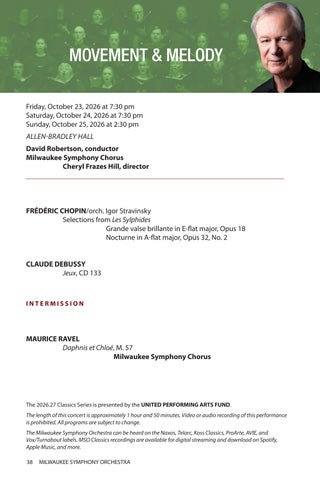
MOVEMENT & MELODY Friday, October 23, 2026 at 7:30 pm Saturday, October 24, 2026 at 7:30 pm Sunday, October 25, 2026 at 2:30 pm ALLEN-BRADLEY HALL David Robertson, conductor Milwaukee Symphony Chorus Cheryl Frazes Hill, director
FRÉDÉRIC CHOPIN/orch. Igor Stravinsky Selections from Les Sylphides Grande valse brillante in E-flat major, Opus 18 Nocturne in A-flat major, Opus 32, No. 2 CLAUDE DEBUSSY Jeux, CD 133
INTERMISSION
MAURICE RAVEL Daphnis et Chloé, M. 57 Milwaukee Symphony Chorus
The 2026.27 Classics Series is presented by the UNITED PERFORMING ARTS FUND. The length of this concert is approximately 1 hour and 50 minutes. Video or audio recording of this performance is prohibited. All programs are subject to change. The Milwaukee Symphony Orchestra can be heard on the Naxos, Telarc, Koss Classics, ProArte, AVIE, and Vox/Turnabout labels. MSO Classics recordings are available for digital streaming and download on Spotify, Apple Music, and more. 38
MILWAUKEE SYMPHONY ORCHESTRA
Guest Artist Biographies DAVID ROBERTSON
Photo by Chris Lee
David Robertson — conductor, artist, composer, thinker, American musical visionary — occupies the most prominent podiums in orchestral and new music, as well as opera. He is a champion of contemporary composers and an ingenious programmer. In the 2026-27 season, he expands his vision of inspiring the greatest orchestras and next generation of promising musical artists. He conducts on four continents and deepens orchestral friendships with the New York Philharmonic, celebrating Steve Reich at 90, and with the Leipzig Gewandhaus Orchestra, Czech Philharmonic, São Paulo State Symphony Orchestra, and others. Robertson makes two visits to Canada this season to conduct the Toronto Symphony Orchestra and the National Arts Centre Orchestra of Ottawa, and to Asia in the summer of 2027.
Robertson’s interest in the process of artistic partnership evolves with a two-year commitment to the Milwaukee Symphony Orchestra, including a guitar festival, delving deeper into his fascination with the instrument with his own compositions and other works, and he further explores its repertoire with the Houston Symphony. Robertson appears with the world’s great orchestras, such as those of New York, Philadelphia, Los Angeles, and Cleveland, the Royal Concertgebouw Orchestra, Vienna Philharmonic, Berlin Philharmonic, Leipzig Gewandhaus Orchestra, and major ensembles and festivals around the world. Since his 1996 Metropolitan Opera debut, Robertson has conducted a breathtaking range of Met projects, including the 2019 production premiere of Porgy and Bess, winning the Grammy Award for Best Opera Recording. In 2022, he conducted its Met revival and made his Rome Opera debut. Robertson has served in numerous leadership positions, including chief conductor and artistic director of the Sydney Symphony Orchestra, a transformative 13-year tenure as music director of the St. Louis Symphony Orchestra, with the Orchestre National de Lyon, BBC Symphony Orchestra, and, as protégé of Pierre Boulez, Ensemble intercontemporain. Robertson is in his ninth academic year as The Juilliard School’s director of conducting studies and distinguished visiting faculty and conducts the Juilliard Orchestra at David Geffen Hall at Lincoln Center and at Carnegie Hall. He serves on the Tianjin Juilliard Advisory Council. David Robertson is a Chevalier de l’Ordre des Arts et des Lettres of France.
MILWAUKEE SYMPHONY ORCHESTRA
39
Program notes by David Jensen In 1909, the opening season of the Ballet Russes inaugurated a new era of dance. Headed by the Russian cultural connoisseur and impresario Sergei Diaghilev, the troupe developed a freedom of physical movement that broke from the strict conventions of classical dance. Contemporary artists like Coco Chanel, Henri Matisse, Pablo Picasso, and Salvador Dalí contributed designs to their decadent productions, and only composers of genius were invited to provide them with incidental music. Assimilating and unifying the diverse elements of modern art, their performances reimagined ballet as a daring avant-garde spectacle, delighting Parisian audiences and giving rise to some of the most inspired musical achievements of the 20th century.
FRÉDÉRIC CHOPIN/orch. Igor Stravinsky Born 1 March 1810; Żelazowa Wola, Duchy of Warsaw Died 17 October 1849; Paris, France In February 1909, Sergei Diaghilev was present for the premieres of two orchestral works by a young, virtually unknown Russian composer named Igor Stravinsky. Impressed by his keen sense of timbre and color, Diaghilev invited the rising star to arrange two of Frédéric Chopin’s works for his restaging of Les Sylphides, an abstract, plotless “ballet blanc” intended as a fabulous display of his dancers’ talents.
Grande valse brillante in E-flat major, Opus 18
Composed: 1833; orchestrated in 1909 First performance: 2 June 1909; Mikhail Fokine, choreography; Alexandre Benois, set design; Léon Bakst, costumes; Théâtre du Châtelet, Paris Last MSO performance: MSO Premiere Instrumentation: piccolo; 2 flutes; 2 oboes; 3 clarinets; 3 bassoons; 4 horns; 2 trumpets; 2 trombones; bass trombone; tuba; timpani; percussion (bass drum, cymbals, hand bell, side drum, triangle); harp; celesta; strings Approximate duration: 6 minutes Physically small, chronically ill, and famously reluctant to concertize, Frédéric Chopin was the paragon of the suffering Romantic artist. Though he gave only a few dozen public performances, composed next to nothing for the orchestra, and succumbed to his congenital poor health before the age of 40, his was a natural talent of the highest order. Elevating the miniature forms he favored to diamond-like models of stunning originality, Chopin established his native Polish dances — the mazurka and polonaise — as serious genres worthy of consideration, produced a wealth of music that continues to serve as the acid test for every serious pianist, and radically extended the tonal, technical, and expressive capacity of his instrument.
Photo by Chris Lee IGOR STRAVINSKY
40
After relocating to Paris in 1830, Chopin never returned to his native Poland, a private tragedy which informed much of the nationalistic sentiment that flavored his work. But the Paris of his day was, after all, the cosmopolitan heart of the musical world; as a pianist, his playing created a sensation, possessed as it was by a seemingly preternatural
MILWAUKEE SYMPHONY ORCHESTRA
sensitivity that rendered the thorniest passagework with unrivaled delicacy. Preferring to earn his living by publishing his compositions and giving piano lessons to the wealthy, he befriended Berlioz, Bellini, Liszt, and practically every other artistic and literary notable attending the highsociety salons that appealed to his aristocratic inclinations. Perhaps nowhere else is the fine taste and wit of Chopin’s personal character felt as distinctly as in the waltz. The first of only eight published in his lifetime, the descriptive titling here refers to the so-called “brilliant” style typified by the post-Classical virtuoso flair of Hummel, Thalberg, Kalkbrenner, and Czerny. Often intending them as musical studies, Chopin made a practice of dedicating his works to his pupils, as was the case for Laura Horsford, whose name appears on the title page. With a brief call to attention in the customary waltz rhythm, Chopin presents a whirling succession of themes in grand fashion, alternating spritely, finely articulated lines with lilting lyrical statements — all framed by the crystal-clear (but deftly variegated) harmonies and rhythmic vitality that defined the dance as Chopin understood it.
Nocturne in A-flat major, Opus 32, No. 2
Composed: 1837; orchestrated in 1909 First performance: 2 June 1909; Mikhail Fokine, choreography; Alexandre Benois, set design; Léon Bakst, costumes; Théâtre du Châtelet, Paris Last MSO performance: MSO Premiere Instrumentation: 2 flutes; 2 oboes; 2 clarinets; 2 bassoons; 4 horns; percussion (bass drum); harp; celesta; strings Approximate duration: 8 minutes Though “night music” as a descriptive concept had appeared regularly in the titles of instrumental music throughout the 18th century, the nocturne came into its own in the early days of the Romantic era, becoming most intimately associated with Frédéric Chopin. Chopin did not “invent” the genre, as is sometimes hyperbolically claimed; that credit is usually given to the Irish composer John Field, whose 18 examples for solo piano effectively codified its form as a lyrical salon piece generally composed of a cantabile melodic line in the right hand accompanied by arpeggiated harmonies in the left. Chopin’s genius, of course, was to so thoroughly and beautifully elaborate upon Field’s model that it became the exemplar of his own musical identity. This embroidery of the truth points tellingly at the fact that Chopin alone became the nocturne’s most accomplished proponent, though Field himself apparently thought little of Chopin’s efforts, rather scathingly referring to the young man as a “sickroom talent” upon meeting him in Paris in 1832. But Chopin was equally indebted to that glorious tradition of bel canto singing that dominated the vocal music of his day, and his natural affinity for that singularly graceful style yielded the charming, handsomely decorated melodies which became a signature of his poetic style. His coloristic handling of harmony and groundbreaking textural effects not only supplied the nocturnes with their subtlety of musical thought and seemingly endless variety of character, but heralded a new type of pianism altogether. A simple two-bar chorale motif provides us with a sense of the nocturne’s subdued character, and the main subject that follows is indeed bucolic, elegant, and very nearly operatic, accompanied by a Chopinesque stream of triplets that only occasionally deviate from the strict conventions of tonal harmony. The central section, typical of the nocturnes, is scored in the neighboring key of F minor and reveals an entirely different psychological state — anxious, unsettled, and now enriched by a greater degree of chromaticism. Built as a simple three-part form, the first tune eventually returns, now marked appassionato and infused with the dramatic qualities of the preceding passage, before the piece concludes with a direct restatement of the chorale theme.
MILWAUKEE SYMPHONY ORCHESTRA
41
CLAUDE DEBUSSY Born 22 August 1862; Saint-Germain-en-Laye, France Died 25 March 1918; Paris, France
Jeux, CD 133
Composed: August – December 1912; score dated 24 April 1913 First performance: 15 May 1913; Pierre Monteux, conductor; Vaslav Nijinsky, choreography; Léon Bakst, set and costume design; Théâtre des Champs-Élysées, Paris Last MSO performance: 25 February 1973; Kenneth Schermerhorn, conductor Instrumentation: 2 flutes; 2 piccolos; 3 oboes; English horn; 3 clarinets; bass clarinet; 3 bassoons; contrabassoon; 4 horns; 4 trumpets; 3 trombones; tuba; timpani; percussion (cymbals, tambourine, triangle, xylophone); 2 harps; celesta; strings Approximate duration: 17 minutes One can only guess at what ran through Claude Debussy’s mind as he opened the telegram sent on behalf of Sergei Diaghilev and his enfant terrible in the summer of 1912. He thought little of the strong-willed entrepreneur, to say nothing of his notoriously provocative principal dancer and paramour, Vaslav Nijinsky, who had mired the Ballet Russes in controversy only weeks earlier with the salacious, sexually explicit choreography he’d designed for their staging of the composer’s Prelude to the Afternoon of a Faun. Debussy found the new scenario the two presented by wire, which amounted to little more than a lewd game of tennis interrupted by a plane crash, absurd, swiftly rejecting it as “idiotic” and assuring them that he was not interested. While Debussy was probably more inclined to think of himself as temporarily embarrassed, his final years were not happy ones. Already suffering from the cancer which would claim his life, the public fallout over his tawdry romantic affairs and outstanding debts had rendered him desperate. When Diaghilev offered to double Debussy’s compensation to 10,000 francs, he had little choice but to accept. Nijinsky later alleged in his diary that Jeux (invariably translated as “Games”) was intended to depict an erotic encounter between three young men — and that this was Diaghilev’s fantasy, not his own, of course — but given that such a public depiction of homosexuality was then a practical impossibility, two of the men were replaced with women, and the terminating accident was deleted entirely. Debussy, who made no bones about his personal grievances, was intractable when Diaghilev and Nijinsky visited him that August. “I refused to play them what I’d done,” he wrote to his publisher, Jacques Durand, “not wanting barbarians sticking their noses into my experiments in personal chemistry!” By November, Debussy had twice revised the music that accompanies the climactic “triple kiss” shared by the three dancers at Diaghilev’s insistence and sarcastically defended the title in a letter to Igor Stravinsky, who had suggested renaming it “The Park.”“Please believe me, Jeux is better. For one thing, it’s shorter; and for another, it’s a convenient way of expressing the ‘horrors’ that take place between the three participants.” Despite his flagrant lack of enthusiasm, Jeux amounted to some of Debussy’s most forwardlooking and unusual music. Made up of a series of motivic fragments, no aspect, whether metric, harmonic, or textural, remains stable for more than a few moments, as was observed by the contemporary French critic Émile Vuillermoz: “It changes speed and nuance every two measures; it abandons a figure, a timbre, a gesture, in order to go headlong in another direction.” Debussy took great pains with the work’s instrumentation in pursuit of “that orchestral color which seems to be illuminated from behind,” but its muted premiere essentially baffled its audience, and Diaghilev never revived the work. Just two weeks later, the disastrous premiere of Stravinsky’s The Rite of Spring roiled the musical world, blotting out Debussy’s mercurial “experiment.”
42
MILWAUKEE SYMPHONY ORCHESTRA
MAURICE RAVEL Born 7 March 1875; Ciboure, France Died 28 December 1937; Paris, France
Daphnis et Chloé, M. 57
Composed: June 1909 – April 1912 First performance: 8 June 1912; Pierre Monteux, conductor; Orchestre des Concerts Colonne; Mikhail Fokine, choreography; Léon Bakst, set and costume design Last MSO performance: 28 September 2013; Roberto Abbado, conductor Instrumentation: 3 flutes (2nd and 3rd doubling on piccolo); alto flute; 2 oboes; English horn; E-flat clarinet; 2 clarinets; bass clarinet; 3 bassoons; contrabassoon; 4 horns; 4 trumpets; 3 trombones; tuba; timpani; percussion (bass drum, castanets, crotale, cymbals, glockenspiel, military drum, snare drum, tam-tam, tambourine, triangle, wind machine, xylophone); 2 harps; celesta; strings Approximate duration: 50 minutes In the summer of 1909, Sergei Diaghilev invited Maurice Ravel, already regarded as one of the great masters of modern France, to partner with the Ballet Russes in the wake of their overwhelmingly successful first season. Diaghilev introduced Ravel to Igor Stravinsky in the process, who enthusiastically enlisted in Ravel’s coterie of creative outsiders, “Les “Apaches.” The company’s choreographer, Mikhail Fokine, provided Ravel with an adaptation of an ancient Greek novel — the pastoral romance of Daphnis and Chloe set down by an anonymous author, retroactively named Longus, sometime in the second or third century of the Common Era. As an artist, Ravel had always taken inspiration from the past. The litany of Baroque dances scattered throughout his catalog suggest he was more an admirer of tradition than a revolutionary; his adaptations of the fairy tales that became the Mother Goose suite, composed concurrently with Daphnis et Chloé, seem to affirm the image of Ravel as a reserved intellectual more at home in the childhood realms of fantasy than modern life. In his words, the ballet became “a vast musical fresco” depicting the arcadian landscapes of antiquity, though he was “less concerned with archaic details than with loyalty to the Greece of my dreams, which bears a striking resemblance to the one imagined and depicted by French artists at the end of the 18th century.” Ravel found the collaboration difficult. “I must tell you that I’ve just had an insane week: preparation of a ballet libretto for the next Russian season,” he wrote to his friend Marguerite de Saint-Marceaux. “What complicates things is that Fokine doesn’t know a word of French, and I only know how to swear in Russian … you can imagine the flavor of these discussions.” It took Ravel nearly three years to revise his score to everyone’s satisfaction, though the ballet ultimately failed to make an impression, closing after just two performances. The two suites Ravel prepared in advance of its premiere, alive with the plenitude of ingenious instrumental combinations and luscious modal harmonies that illuminate his ancient world, did much to secure the work’s reputation as the most sensuous and evocative music he ever produced. At only an hour in length, Daphnis et Chloé is frequently described as Ravel’s masterpiece. Our story unfolds on the island of Lesbos, where the goatherd Daphnis and the shepherdess Chloe are falling in love even as the local youths vie for their attention. The cowherd Dorcon dances brutishly in an attempt to seduce Chloe, while Lycaenion distracts Daphnis with a slow, suggestive dance. Pirates swarm the field and kidnap Chloe, and a triad of nymphs descend upon the distraught Daphnis, summoning Pan to his aid. Moved by the memory of his lost love, Syrinx, the faun god rescues Chloe with the help of his satyrs, and the reunited lovers dance in imitation of Pan and Syrinx until the scene descends into frenzied celebration. In his biography of Ravel, Roland Manuel alleged that the bacchanale, “whose impetuous rush seems to be so convincingly effortless, cost its creator no less than a year of work.” MILWAUKEE SYMPHONY ORCHESTRA
43
Georgi Dimitrov Nathan Hackett Michael Lieberman** Erin H. Pipal CELLOS Susan Babini, Principal, 2026.27 SEASON Dorothea C. Mayer Principal Cello Chair Shinae Ra, Assistant Principal (2nd chair) Scott Tisdel, Associate Principal Emeritus MUSIC DIRECTOR Polly and Bill Van Dyke Music Director Chair Esther Chae Madeleine Kabat BYRON STRIPLING Peter Szczepanek Principal Pops Conductor Peter J. Thomas* Stein Family Foundation Principal Pops Adrien Zitoun Conductor Chair BASSES RYAN TANI Principal, Donald B. Abert Associate Conductor Principal Bass Chair Andrew Raciti, Acting Principal CHERYL FRAZES HILL Nash Tomey, Assistant Principal Chorus Director (3rd chair)* Margaret Hawkins Chorus Director Chair Brittany Conrad TIMOTHY J. BENSON Nicholas De Laurentis** Assistant Chorus Director Broner McCoy Paris Myers FIRST VIOLINS Jinwoo Lee, Concertmaster, HARP Charles and Marie Caestecker Julia Coronelli, Principal, Concertmaster Chair Walter Schroeder Principal Harp Chair Ilana Setapen, First Associate FLUTES Concertmaster, Thora M. Vervoren Sonora Slocum, Principal, First Associate Concertmaster Chair Margaret and Roy Butter Jeanyi Kim, Associate Concertmaster Principal Flute Chair Alexander Ayers Heather Zinninger, Assistant Principal Autumn Chodorowski Jennifer Bouton Schaub Yuka Kadota Chihiro Kakishima PICCOLO Elliot Lee Jennifer Bouton Schaub Dylana Leung OBOES Kyung Ah Oh Katherine Young Steele, Principal, Lijia Phang Milwaukee Symphony Orchestra League Yuanhui Fiona Zheng Principal Oboe Chair SECOND VIOLINS Kevin Pearl, Assistant Principal Jennifer Startt, Principal, Margaret Butler Andrea and Woodrow Leung ENGLISH HORN Principal Second Violin Chair Ji-Yeon Lee, Assistant Principal (2nd chair) Margaret Butler, Philip and Beatrice Blank English Horn Chair in memoriam to Shannon Fitzhenry, Assistant Principal John Martin (3rd chair) Heejeon Ahn CLARINETS Lisa Johnson Fuller Principal, Franklyn Esenberg Clay Hancock Principal Clarinet Chair Paul Hauer Jay Shankar, Acting Principal, Hyewon Kim Donald and Ruth P. Taylor Assistant Principal Clarinet Chair Vinícius Sant’Ana** Besnik Abrashi, Acting Assistant Principal Yiran Yao Max Reese** VIOLAS Principal, Richard O. and Judith A. Wagner E-FLAT CLARINET Max Reese** Family Principal Viola Chair Kunjing Dai, Acting Principal, BASS CLARINET Friends of Janet F. Ruggeri Besnik Abrashi Assistant Principal Viola Chair Samantha Rodriguez, Acting Assistant BASSOONS Principal (2nd chair) Catherine Van Handel, Principal, Alejandro Duque, Acting Assistant Muriel C. and John D. Silbar Family Principal (3rd chair) Principal Bassoon Chair* Elizabeth Breslin Rudi Heinrich, Acting Principal
44
MILWAUKEE SYMPHONY ORCHESTRA
Matthew Melillo, Acting Assistant Principal Laressa Winters** CONTRABASSOON Matthew Melillo HORNS Matthew Annin, Principal, Krause Family Principal French Horn Chair Krystof Pipal, Associate Principal Dietrich Hemann, Andy Nunemaker French Horn Chair Darcy Hamlin Dawson Hartman TRUMPETS Matthew Ernst, Principal, Walter L. Robb Family Principal Trumpet Chair David Cohen, Associate Principal, Martin J. Krebs Associate Principal Trumpet Chair Tim McCarthy, Fred Fuller Trumpet Chair TROMBONES Megumi Kanda, Principal, Marjorie Tiefenthaler Principal Trombone Chair Kirk Ferguson, Assistant Principal BASS TROMBONE John Thevenet, Richard M. Kimball Bass Trombone Chair TUBA Robyn Black, Principal, John and Judith Simonitsch Principal Tuba Chair TIMPANI Dean Borghesani, Principal Chris Riggs, Assistant Principal PERCUSSION Robert Klieger, Principal Chris Riggs PIANO Melitta S. Pick Endowed Piano Chair PERSONNEL Antonio Padilla Denis, Director of Orchestra Personnel Paris Myers, Assistant Manager of Orchestra Personnel LIBRARIANS Paul Beck, Principal Librarian, James E. Van Ess Principal Librarian Chair Matthew Geise, Assistant Librarian & Media Archivist PRODUCTION Tristan Wallace, Production Manager/Live Audio Lisa Sottile, Production Stage Manager * Leave of absence during the 2026.27 season ** Acting member of the MSO for the 2026.27 season