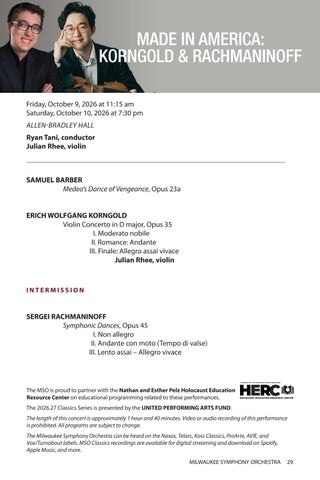
MADE IN AMERICA: KORNGOLD & RACHMANINOFF Friday, October 9, 2026 at 11:15 am Saturday, October 10, 2026 at 7:30 pm ALLEN-BRADLEY HALL Ryan Tani, conductor Julian Rhee, violin
SAMUEL BARBER Medea’s Dance of Vengeance, Opus 23a ERICH WOLFGANG KORNGOLD Violin Concerto in D major, Opus 35 I. Moderato nobile II. Romance: Andante III. Finale: Allegro assai vivace Julian Rhee, violin
INTERMISSION
SERGEI RACHMANINOFF Symphonic Dances, Opus 45 I. Non allegro II. Andante con moto (Tempo di valse) III. Lento assai – Allegro vivace
The MSO is proud to partner with the Nathan and Esther Pelz Holocaust Education Resource Center on educational programming related to these performances. The 2026.27 Classics Series is presented by the UNITED PERFORMING ARTS FUND. The length of this concert is approximately 1 hour and 40 minutes. Video or audio recording of this performance is prohibited. All programs are subject to change. The Milwaukee Symphony Orchestra can be heard on the Naxos, Telarc, Koss Classics, ProArte, AVIE, and Vox/Turnabout labels. MSO Classics recordings are available for digital streaming and download on Spotify, Apple Music, and more. MILWAUKEE SYMPHONY ORCHESTRA
29
Guest Artist Biographies JULIAN RHEE Winner of the coveted 2024 Avery Fisher Career Grant, Korean-American violinist Julian Rhee has been recognized for his refinement, beauty of sound, and “the kind of poise and showmanship that thrills audiences” (The Strad). Lauded for his soulful lyricism, magnetic charisma, and passion for collaboration, Rhee brings expressive depth, technical mastery, and interpretive insight to both familiar and contemporary works, establishing himself as one of today’s most captivating young artists. Rhee has appeared with leading orchestras across North America, Europe, and Asia, including the Calgary Philharmonic Orchestra, Stuttgart Chamber Orchestra, Oregon Symphony, Belgian National Orchestra, Pacific Symphony, Württemberg Chamber Orchestra of Heilbronn, San Diego Symphony, and the Milwaukee, Indianapolis, Antwerp, and Pittsburgh symphony orchestras, among others. He has collaborated with Photo by Shin-joong Kim distinguished conductors such as Alexander Shelley, Francesco LecceChong, Nicholas McGegan, David Danzmayr, Rune Bergmann, Valentina Peleggi, Antony Hermus, and Leonard Slatkin. Highlights of the 2026-27 season include debuts with the Gürzenich-Orchester Köln and Andrés Orozco-Estrada and the Orquesta Clásica Santa Cecilia and Daniel Raiskin, as well as returns to the Richmond, Milwaukee, and Brevard symphony orchestras. Following his prize-winning performances at the 2024 Queen Elisabeth International Violin Competition and his silver medal at the 11th Quadrennial International Violin Competition of Indianapolis, Rhee rose to international prominence as a soloist of remarkable artistry and maturity. He is also first prize winner of the Elmar Oliveira International Competition and Astral Artists’ National Auditions and the recipient of numerous honors, including the Aspen Music Festival’s Dorothy DeLay Fellowship, the North Shore Chamber Music Festival’s Arkady Fomin Scholarship Fund, and the Manfred Grommek Prize from the Kronberg Academy. A U.S. Presidential Scholar, he received his medal at the White House and serves as a Young Strings of America Ambassador sponsored by Shar Music. Rhee is a member of the Chamber Music Society of Lincoln Center’s Bowers Program, appearing regularly at Alice Tully Hall and on tour. He has performed at leading festivals including the Marlboro Music Festival, Bridgehampton Chamber Music Festival, North Shore Chamber Music Festival, Music@Menlo, and Rockport Music, and this season makes debuts at the Kingston Chamber Music Festival and as artist in residence at the Durango Music Festival. Rhee received his bachelor’s and master’s degrees from the New England Conservatory, where he was teaching assistant to Miriam Fried, and currently studies with Christian Tetzlaff at the Kronberg Academy. He performs on the extraordinary 1699 “Lady Tennant” Stradivarius and a Jean Pierre Marie Persoit bow on extended loan through the generosity of the Mary B. Galvin Foundation and the Stradivari Society, a division of Bein & Fushi, Inc.
30
MILWAUKEE SYMPHONY ORCHESTRA
Program notes by David Jensen SAMUEL BARBER Born 9 March 1910; West Chester, Pennsylvania Died 23 January 1981; New York City, New York
Medea’s Dance of Vengeance, Opus 23a
Composed: November 1945 – April 1946; concert piece arranged in 1955 First performance: 2 February 1956; Dimitri Mitropoulos, conductor; New York Philharmonic Last MSO performance: 28 April 2018; Hans Graf, conductor Instrumentation: 3 flutes (3rd doubling on piccolo); 2 oboes; English horn; E-flat clarinet; 2 clarinets; bass clarinet; 2 bassoons; contrabassoon; 4 horns; 3 trumpets; 3 trombones; tuba; timpani; percussion (bass drum, cymbals, snare drum, tam-tam, tom-tom, triangle, whip, xylophone); harp; piano; strings Approximate duration: 13 minutes Medea had been promised everything. A sorceress descended from the gods, she had abandoned her home and used her magic to help Jason, leader of the Argonauts, on his quest to retrieve the Golden Fleece and claim his rightful place as king of Iolcus. The gambit is successful, and Medea falls in love. She bears two sons and imagines the future she’ll build for her family. But Jason is ambitious, and he casts Medea aside for Glauce, daughter of king Creon, knowing that the marriage might one day secure him the throne of Corinth. This is where our story begins: in the thick of Medea’s scheme to exact her revenge upon Jason by murdering his new bride, his father-in-law, and her own children. The moral and feminist dimensions of Medea’s crime have occupied thinkers since the bestknown interpretation of her story, the eponymous Greek tragedy composed by Euripedes, debuted in 431 BCE. For the modern dancer Martha Graham, who viewed choreography as a kinesthetic expression of the subconscious, the scenario held an immediate appeal. In 1942, she requested incidental music from Carlos Chávez, but was dissatisfied; when she received funding from Columbia University to produce a new ballet for the school’s Festival of Contemporary Music, she commissioned Samuel Barber, who shared Graham’s vision of archetypal characters that projected “psychological states of jealousy and vengeance which are timeless.” Appearing under the title Serpent Heart, the ballet debuted in May 1946 to mixed reviews. “Mr. Barber has written a brilliant piece of theatre music,” wrote dance critic John Martin in The New York Times. “Though its mood and its orchestral color shift with dramatic variety, there is an underlying drive, a savagery beneath a surface of well-contained form, that echoes admirably in contemporary terms the quality and feeling that are basic to Greek tragedy. Often it is more eloquent than the choreography that accompanies it.” Graham revised the ballet and presented it anew the following February as Cave of the Heart, while Barber extracted a seven-movement suite. Curiously, Barber wasn’t finished. The composer Virgil Thompson, who heard the suite’s premiere in December 1948 and praised its “high expressive power,” suggested that “a little tightening up might be of advantage to it,” and a few years later, Barber reworked his Medea into a single, selfcontained statement. His preface to that score reads, in part: “The present version, rescored for large orchestra in 1955, is in one continuous movement and is based on material from the ballet which is directly related to the central character, Medea. Tracing her emotions from her tender feelings towards her children, through her mounting suspicions and anguish at her husband’s betrayal and her decision to avenge herself, the piece increases in intensity to close in the frenzied Dance of Vengeance of Medea, the Sorceress descended from the Sun God.” MILWAUKEE SYMPHONY ORCHESTRA
31
ERICH WOLFGANG KORNGOLD Born 29 May 1897; Brünn, Moravia Died 29 November 1957; Los Angeles, California
Violin Concerto in D major, Opus 35
Composed: Summer – October 1945 First performance: 15 February 1947; Vladimir Golschmann, conductor; Jascha Heifetz, violin; Saint Louis Symphony Orchestra Last MSO performance: 17 January 2015; Edo de Waart, conductor; Philippe Quint, violin Instrumentation: 2 flutes (2nd doubling on piccolo); 2 oboes (2nd doubling on English horn); 2 clarinets; bass clarinet; 2 bassoons (2nd doubling on contrabassoon); 4 horns; 2 trumpets; trombone; timpani; percussion (bass drum, chimes, cymbals, glockenspiel, tamtam, vibraphone, xylophone); harp; celesta; strings Approximate duration: 24 minutes To the composer, whose work is predicated upon the study and skillful assimilation of specific stylistic means and historical models, the question of legacy is a complicated one. For Erich Wolfgang Korngold, a career in music had never been in question: a born prodigy, he enjoyed immediate and unqualified success as a child, composing chamber, symphonic, vocal, and theatrical music throughout his life with great success. But musicians in the early 20th century contended with an especially divisive (though wildly bankable) new realm of expression: the cinema. In Korngold’s case, it was a curious confluence of the concert hall and the movie theater which eclipsed both his successes as a Hollywood composer and his ambitions as an author of serious music, leaving his legacy largely up to a single — albeit undeniably glamorous — piece of music. The son of the music critic Julius Korngold, Eduard Hanslick’s successor at the Neue Freie Presse, Erich was not yet 10 years old when Gustav Mahler pronounced him a genius. Richard Strauss likewise described the “awe and fear” he felt upon hearing the teenager’s already highly individual symphonic works. The international success of Korngold’s opera The Dead City in 1920 ensured that, at least for a time, he would be recognized as one of the most popular composers of his generation. Somewhat dubiously, a Viennese newspaper poll even placed him alongside Arnold Schoenberg as one of the day’s two greatest living composers. Unfortunately for Korngold, Vienna was not then an especially hospitable environment for a talented young man of Jewish heritage. Korngold began working in the U.S. in 1934, splitting his time between Vienna and Hollywood and enjoying a lucrative relationship with Warner Brothers Pictures before settling permanently in the states following the Nazi annexation of Austria. Among the last artists born into that endlessly emotive Romantic epoch, the film scores he composed after leaving Europe fully embodied the era’s stylistic values; their distinct, attractive melodies, sensuous instrumental effects, and emotional power essentially defined the studio sound of Hollywood’s golden age. He had, much to his father’s dismay, given up composing concert music — at least until the Nazi regime had fallen — so the death of both Adolf Hitler and Julius Korngold in 1945 must have felt like something of a mixed blessing. For years, the violinist Bronisław Huberman had playfully requested a concerto from Korngold whenever their paths crossed, but by 1945, Huberman was at the end of his own long and storied career. Korngold instead had the felicitous good fortune to have the work premiered by Jascha Heifetz, an artist so revered that he had been dubbed “God’s fiddler.” The concerto, which has since overshadowed practically everything else Korngold wrote, incorporates a plethora of material from his film scores, quoting the themes from Another Dawn (1937) and Juarez (1939) in the opening movement (the most serious in tone of the three), Anthony Adverse (1936) in the hushed, intimate romance, and The Prince and the Pauper (1937) in the gregarious closing rondo. 32
MILWAUKEE SYMPHONY ORCHESTRA
SERGEI RACHMANINOFF Born 1 April 1873; Semyonovo, Russia Died 28 March 1943, Beverly Hills, California
Symphonic Dances, Opus 45
Composed: Summer – October 1940 First performance: 3 January 1941; Eugene Ormandy, conductor; The Philadelphia Orchestra Last MSO performance: 16 October 2021; Ken-David Masur, conductor Instrumentation: 2 flutes; piccolo; 2 oboes; English horn; 2 clarinets; bass clarinet; alto saxophone; 2 bassoons; contrabassoon; 4 horns; 3 trumpets; 3 trombones; tuba; timpani; percussion (bass drum, chimes, cymbals, glockenspiel, tam-tam, tambourine, triangle, xylophone); harp; piano; strings Approximate duration: 35 minutes After leaving Russia in 1917, Sergei Rachmaninoff composed very little. Bound by the financial pressures of relocating his wife and children to the United States, he threw himself at the mercy of the public, aware that his income as a celebrity pianist would always be more dependable than that of a freelance composer. It was not only that “the incessant practice and eternal rush inseparable from life as a concert artist” had depleted his creative reserves; for Rachmaninoff, the problem was more than just an oppressive schedule: “For when I left Russia, I left behind me my desire to compose: losing my country, I lost myself also. To the exile whose musical roots, traditions, and background have been annihilated, there remains no desire for self-expression.” Rachmaninoff never completely adjusted to his self-imposed exile. He wasn’t particularly attracted to America in the first place (he had regarded his first tour in 1909 as little more than an extended inconvenience), and, remote by disposition, limited his social contact to a few select friends and artists. But the quarter of a century he spent living and working abroad was hardly unproductive: the legendary recordings he produced with the Victor Talking Machine Company secured his reputation as one of the greatest pianists to have ever graced the concert stage, and his seemingly endless public appearances, both in recital and alongside the world’s finest orchestras, provided his family with the comfort and stability of the upper middle class. The half-dozen scores he managed to complete during his American years, including the fourth piano concerto, the stunning variations on themes by Corelli and Paganini, and the Symphonic Dances, are usually regarded as the culmination and most direct formulation of Rachmaninoff’s musical ideals. The passionate, hot-blooded melodies are threaded through clearer and more vividly differentiated textures, the rhythmic elements are exaggerated and infused with a newfound vitality, and the dramatic range is expanded and intensified by an increasingly sophisticated command of chromatic harmony. Recuperating from both another grueling concert season and a minor surgery in the summer of 1940, Rachmaninoff may have known that the sketches in front of him would serve as his last word on the subject of orchestral writing. In a letter to the conductor Eugene Ormandy that August, Rachmaninoff suggested the title Fantastic Dances, with the pictorial “Noon,” “Twilight,” and “Midnight” heading the three movements, but by the time the details of its orchestration were complete, he had changed his mind. As though articulating his entire artistic philosophy, the Symphonic Dances both condensed and refined the composer’s musical vocabulary while clearly alluding to his personal history, quoting from his first symphony (written over 40 years earlier), his revelatory All-Night Vigil, and the Dies irae, the medieval chant from the Roman Catholic liturgy that resounds throughout many of his late works. The liner notes for The Philadelphia Orchestra’s recording under Ormandy’s baton mention that Rachmaninoff, lamenting his declining health just months before his death, was reminded of the triumph of his Symphonic Dances. “I don’t know how that happened,” he replied. “That was probably my last flicker.” MILWAUKEE SYMPHONY ORCHESTRA
33
Georgi Dimitrov Nathan Hackett Michael Lieberman** Erin H. Pipal CELLOS Susan Babini, Principal, 2026.27 SEASON Dorothea C. Mayer Principal Cello Chair Shinae Ra, Assistant Principal (2nd chair) Scott Tisdel, Associate Principal Emeritus MUSIC DIRECTOR Polly and Bill Van Dyke Music Director Chair Esther Chae Madeleine Kabat BYRON STRIPLING Peter Szczepanek Principal Pops Conductor Peter J. Thomas* Stein Family Foundation Principal Pops Adrien Zitoun Conductor Chair BASSES RYAN TANI Principal, Donald B. Abert Associate Conductor Principal Bass Chair Andrew Raciti, Acting Principal CHERYL FRAZES HILL Nash Tomey, Assistant Principal Chorus Director (3rd chair)* Margaret Hawkins Chorus Director Chair Brittany Conrad TIMOTHY J. BENSON Nicholas De Laurentis** Assistant Chorus Director Broner McCoy Paris Myers FIRST VIOLINS Jinwoo Lee, Concertmaster, HARP Charles and Marie Caestecker Julia Coronelli, Principal, Concertmaster Chair Walter Schroeder Principal Harp Chair Ilana Setapen, First Associate FLUTES Concertmaster, Thora M. Vervoren Sonora Slocum, Principal, First Associate Concertmaster Chair Margaret and Roy Butter Jeanyi Kim, Associate Concertmaster Principal Flute Chair Alexander Ayers Heather Zinninger, Assistant Principal Autumn Chodorowski Jennifer Bouton Schaub Yuka Kadota Chihiro Kakishima PICCOLO Elliot Lee Jennifer Bouton Schaub Dylana Leung OBOES Kyung Ah Oh Katherine Young Steele, Principal, Lijia Phang Milwaukee Symphony Orchestra League Yuanhui Fiona Zheng Principal Oboe Chair SECOND VIOLINS Kevin Pearl, Assistant Principal Jennifer Startt, Principal, Margaret Butler Andrea and Woodrow Leung ENGLISH HORN Principal Second Violin Chair Ji-Yeon Lee, Assistant Principal (2nd chair) Margaret Butler, Philip and Beatrice Blank English Horn Chair in memoriam to Shannon Fitzhenry, Assistant Principal John Martin (3rd chair) Heejeon Ahn CLARINETS Lisa Johnson Fuller Principal, Franklyn Esenberg Clay Hancock Principal Clarinet Chair Paul Hauer Jay Shankar, Acting Principal, Hyewon Kim Donald and Ruth P. Taylor Assistant Principal Clarinet Chair Vinícius Sant’Ana** Besnik Abrashi, Acting Assistant Principal Yiran Yao Max Reese** VIOLAS Principal, Richard O. and Judith A. Wagner E-FLAT CLARINET Max Reese** Family Principal Viola Chair Kunjing Dai, Acting Principal, BASS CLARINET Friends of Janet F. Ruggeri Besnik Abrashi Assistant Principal Viola Chair Samantha Rodriguez, Acting Assistant BASSOONS Principal (2nd chair) Catherine Van Handel, Principal, Alejandro Duque, Acting Assistant Muriel C. and John D. Silbar Family Principal (3rd chair) Principal Bassoon Chair* Elizabeth Breslin Rudi Heinrich, Acting Principal
Matthew Melillo, Acting Assistant Principal Laressa Winters** CONTRABASSOON Matthew Melillo HORNS Matthew Annin, Principal, Krause Family Principal French Horn Chair Krystof Pipal, Associate Principal Dietrich Hemann, Andy Nunemaker French Horn Chair Darcy Hamlin Dawson Hartman TRUMPETS Matthew Ernst, Principal, Walter L. Robb Family Principal Trumpet Chair David Cohen, Associate Principal, Martin J. Krebs Associate Principal Trumpet Chair Tim McCarthy, Fred Fuller Trumpet Chair TROMBONES Megumi Kanda, Principal, Marjorie Tiefenthaler Principal Trombone Chair Kirk Ferguson, Assistant Principal BASS TROMBONE John Thevenet, Richard M. Kimball Bass Trombone Chair TUBA Robyn Black, Principal, John and Judith Simonitsch Principal Tuba Chair TIMPANI Dean Borghesani, Principal Chris Riggs, Assistant Principal PERCUSSION Robert Klieger, Principal Chris Riggs PIANO Melitta S. Pick Endowed Piano Chair PERSONNEL Antonio Padilla Denis, Director of Orchestra Personnel Paris Myers, Assistant Manager of Orchestra Personnel LIBRARIANS Paul Beck, Principal Librarian, James E. Van Ess Principal Librarian Chair Matthew Geise, Assistant Librarian & Media Archivist PRODUCTION Tristan Wallace, Production Manager/Live Audio Lisa Sottile, Production Stage Manager * Leave of absence during the 2026.27 season ** Acting member of the MSO for the 2026.27 season