Guest Artist Biographies
ASHER FISCH
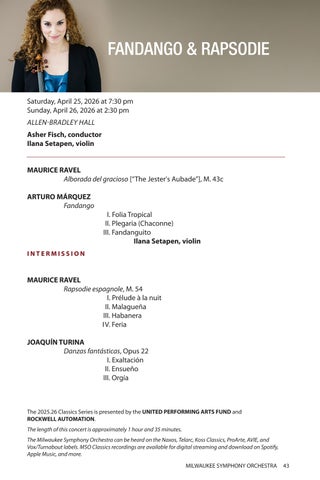
Making music with equal ease and command in the operatic and symphonic worlds, Asher Fisch conducts a broad repertoire from Gluck to 21st-century premieres, with a special command and following for German Romantic and post-Romantic repertoire. Fisch has served as the principal conductor and artistic advisor of the West Australian Symphony Orchestra since 2014, and from the 2024-25 season has been the music director of the Tyrolean Festival Erl in Austria. He was previously music director of the New Israeli Opera (1998 – 2008) and Wiener Volksoper (1995 – 2005) and was principal guest conductor of the Seattle Opera (2007 – 2013).
In addition to performances with the WASO, including the world premiere of Paul Stanhope’s choral-orchestral cycle Mahāsāgar this season, Fisch guest conducts the Milwaukee Symphony Orchestra and Düsseldorf Symphony Orchestra in concert and returns to the Royal Danish Opera to lead Barrie Kosky’s production of Dialogues des Carmélites, as well as to the Vienna State Opera for Carmen. Other opera productions include Lucia di Lammermoor, Parsifal, and Der fliegende Holländer in Erl.
Born in Israel, Fisch began his conducting career as Daniel Barenboim’s assistant and kappellmeister at the Berlin State Opera. He has built his versatile repertoire at the major opera houses such as the Metropolitan Opera, Lyric Opera of Chicago, San Francisco Opera, Teatro alla Scala, Royal Opera House at Covent Garden, Bavarian State Opera, and Semperoper in Dresden. Fisch has conducted leading American symphony orchestras, including those of Boston, Chicago, Cleveland, New York, and Philadelphia. In Europe, he has appeared with the Berlin Philharmonic, Munich Philharmonic, London Symphony Orchestra, Leipzig Gewandhaus Orchestra, and the Orchestre National de France, among others.
Fisch’s recent engagements included Ariadne auf Naxos with the Israeli Opera, La bohème, Parsifal, and the “Verdi trilogy” of Rigoletto, Il trovatore, and La traviata in Erl, the Spanish premiere of Aribert Reimann’s Lear at Teatro Real de Madrid, Carmen with the Vienna State Opera, Lohengrin and La forza del destino at Teatro Comunale di Bologna, Cavalleria rusticana and Pagliacci at the Tokyo Metropolitan Theatre, and Tannhäuser with Opera Australia, as well as orchestral performances with the Israel Philharmonic Orchestra, the Sydney, Queensland, and New Zealand symphony orchestras in the Oceania region, and the Indianapolis, Kansas City, Oregon, and Seattle symphony orchestras in North America.
Fisch’s award-winning discography includes Bruckner’s Symphony No. 8, Wagner’s Tristan und Isolde, tenor Stuart Skelton’s first solo album, recorded with the WASO, and a recording of Ravel’s L’heure espagnole with the Munich Radio Orchestra. In 2016, he recorded all four of Brahms’s symphonies with the WASO, released on ABC Classics to great acclaim. His recording of Wagner’s Ring cycle with the Seattle Opera was released in 2014. His first Ring cycle recording, with the State Opera of South Australia, won ten Helpmann Awards, including Best Opera and Best Music Direction. Fisch is also an accomplished pianist and has recorded a solo disc of Liszt’s transcriptions of Wagner’s music for the Melba label.
Program notes by David Jensen
MAURICE RAVEL
Born 7 March 1875; Ciboure, France
Died 28 December 1937; Paris, France
Alborada del gracioso [“The Jester’s Aubade”], M. 43c
Composed: 1904 – 1905; orchestrated 1918
First performance: 17 May 1919; René-Emmanuel Baton, conductor; Orchestre des Concerts Pasdeloup
Last MSO performance: 4 February 2006; Andreas Delfs, conductor
Instrumentation: 3 flutes (3rd doubling on piccolo); 2 oboes; English horn; 2 clarinets; 2 bassoons; contrabassoon; 4 horns; 2 trumpets; 3 trombones; tuba; timpani; percussion (bass drum, castanets, crotales, cymbals, military drum, tambourine, triangle, xylophone); 2 harps; strings
Approximate duration: 9 minutes
Beloved for his sensuous orchestral effects and immaculate craftsmanship, Maurice Ravel has belonged to a class of his own since emerging as one of the foremost composers of fin de siècle Paris. After years spent resisting the conservative pedagogical methods of the Paris Conservatoire, he found his home in the composition class of Gabriel Fauré, whose insistence that his students cultivate their own distinct voice allowed his talents to blossom, as well as comradery in that band of fellow artistic outcasts affectionately nicknamed “Les Apaches” (or “The Hooligans”). His unrivaled portraits of exotic landscapes, the world of antiquity, and the mythological have exerted an enormous influence over the development of concert music and captivated audiences for more than a century.
Like Franz Liszt, Ravel was a gifted pianist whose visionary writing broke new ground, expounding upon the instrument’s virtuoso potential. By the 1910s, Ravel had settled into the habit of crafting spectacularly refined miniatures for the piano, almost always with evocative titles implying alluring extramusical subjects, before reworking them as vibrant symphonic tableaus. Such was the case with his Miroirs (translated literally as “Mirrors”), a suite of five movements for solo piano, each inspired by a particular image and dedicated to a different member of Les Apaches. The fourth, the Alborada del gracioso, paid tribute to the musicologist Michel-Dimitri Calvocoressi, who had provided French translations of Greek texts for several of Ravel’s chansons
Its reimaging was set in motion by Sergei Diaghilev — the larger-than-life impresario whose long association with the Ballets Russes produced some of the most memorable works of the 20th century — whose journey to Spain in 1916 resulted in a string of Spanish-inflected commissions for his troupe. Born in the town of Ciboure on the French-Spanish border and raised by a mother of Basque heritage, Ravel was naturally inclined toward the sounds of the Iberian Peninsula. Following the publication of Miroirs in 1906, several of his most substantial works were tinted with a distinctly Spanish flavor, including the Rapsodie espagnole and the one-act opera L’heure espagnole.
In translation, the title is rich in programmatic meaning. “Alborada” is typically taken as a reference to the aubade, a genre dating back to the medieval troubadours and associated with lovers parting at dawn, while “gracioso” means something like “buffoon” or “jester” — and so the juxtaposition of the two gives us the satirical image of a clownish figure announcing the arrival of a new day. This is the fertile soil from which Ravel’s kaleidoscopic creation springs forth: highly rhythmic pizzicati in the strings imitate the Spanish guitar, while shifting metric impulses infuse
the music with a marvelous rhythmic vitality. The sharp contrasts in volume, rapidly repeated notes, and glissandi, flavored by castanets, tambourine, and harp, embody a raucous Spanish dance. The aubade in question appears as a doleful melody in the bassoon, supported by a shimmering corps of strings, before the music returns to the dance, terminating in an intoxicating whirlwind of sound.
ARTURO MÁRQUEZ
Born 20 December 1950; Álamos, Mexico
Fandango
Composed: 2018 – 2021
First performance: 24 August 2021; Gustavo Dudamel, conductor; Anne Akiko Meyers, violin; Los Angeles Philharmonic
Last MSO performance: MSO Premiere
Instrumentation: piccolo; 2 flutes; 2 oboes; 2 clarinets; 2 bassoons; 4 horns; 2 trombones; bass trombone; tuba; timpani; percussion (bass drum, cajon, claves, cymbals, guiro, snare drum, suspended cymbals); harp; strings
Approximate duration: 32 minutes
Little known outside of his own country until the 1990s, Arturo Márquez has risen in prominence over the course of the last three decades to become one of the most successful composers of his native Mexico. Born in the city of Álamos in the northwestern corner of the country, his earliest musical education came from his father, a mariachi violinist, and his grandfather, a guitarist and folk musician. As part of a mariachi quartet, they introduced him to the traditional styles and forms of his homeland — especially its “salon” music — that would become the raw materials from which he would eventually forge his identity as a composer.
Relocating to Los Angeles at 14, Márquez began playing violin, trombone, and tuba before returning to Mexico to study piano and music theory at the National Conservatory of Music and the National Institute of Fine Arts and Literature. He spent the latter half of the 1970s in composition workshops before winning a scholarship to study with Jacques Castéréde at the Paris Conservatory. As his work began to incorporate elements of jazz, Latin, and contemporary music, he completed his formal education as a Fulbright Scholar at the California Institute of the Arts. The overwhelming popularity of his Danzón No. 2, published in 1994, catapulted him to international fame, and he has since been decorated with numerous awards, residencies, and festivals devoted to his music, making him one of the most celebrated Latin American composers of our time.
In 2018, Márquez received a commission from the violinist Anne Akiko Meyers, who proposed a concerto infused with the Mexican musical aesthetic. He was immediately taken with the idea, as he had “already tried, unsuccessfully, to compose a violin concerto some 20 years earlier with ideas that were based on the Mexican fandango.” Composing the work over the course of the pandemic, which he described as an “intense and highly emotional” experience, the concerto was premiered by Meyers, Gustavo Dudamel, and the Los Angeles Philharmonic at the Hollywood Bowl — just a few dozen miles from La Puente, where Marquez first picked up his violin as a teenager. “Beautiful coincidence,” he added, “as I have no doubt that fandango was danced in California in the 18th and 19th centuries.”
Writing about the concerto ahead of its debut, Márquez identified his “seven capital principles: tonality, modality, melody, rhythm, imaginary folk tradition, harmony, and orchestral color,” and each of these aspects operate within the music with breathtaking originality. The opening movement is inspired by the folia, a dance that first appeared in Renaissance Portugal and Spain, and assimilates the clave rhythms of Caribbean music. Márquez described his sultry chaconne
(another dance of Spanish origin) as the “fruit of an imaginary marriage” between huapango, a type of folk music accompanied by dancers stamping on a wooden platform, and Pablo de Sarasate, Manuel de Falla, and Isaac Albéniz, “three of my beloved and admired Spanish composers.” The finale begins with a flashy cadenza for the violinist, whose technical acrobatics throughout the movement are inspired by the masterful fiddle-playing heard in Mexico’s Huasteca region. “It demands a great virtuosity from the soloist,” Márquez remarked, “and it is the music that I have kept in my heart for decades.”
MAURICE RAVEL
Born 7 March 1875; Ciboure, France
Died 28 December 1937; Paris, France
Rapsodie espagnole, M. 54
Composed: Summer 1907 – February 1908
First performance: 15 March 1908; Édouard Colonne, conductor; Orchestre des Concerts Colonne
Last MSO performance: 23 October 2021; Ken-David Masur, conductor
Instrumentation: 2 piccolos; 2 flutes; 2 oboes; English horn; 2 clarinets; bass clarinet; 3 bassoons; contrabassoon; 4 horns; 3 trumpets; 3 trombones; tuba; timpani; percussion (bass drum, castanets, cymbals, snare drum, tambourine, tam-tam, triangle, xylophone); 2 harps; celesta; strings
Approximate duration: 15 minutes
Maurice Ravel was something of an “odd man out” among his peers at the Conservatoire de Paris. After winning the top prize at the school’s piano competition in 1891, he did little to distinguish himself as a student. Unlike his friend and schoolmate, the skilled Spanish pianist Ricardo Viñes, Ravel was disinclined to live his life as a performer, and his idiosyncratic approach to composition was undoubtedly a contributing factor in his expulsion only four years later. Determined to become a composer, he was readmitted in 1897, now studying under Gabriel Fauré, who rightly identified and nurtured his pupil’s “engaging wealth of imagination.” As though congenitally indisposed to formal education, he was expelled again in 1900.
In the intervening years, however, Ravel’s maturation as a composer compelled even his detractors to concede that what he was doing was unprecedented. His fifth failed attempt to secure the Prix de Rome in 1905, then the most prestigious and sought-after award for rising French composers, became something of a cause célèbre among the thinkers and critics who had long since recognized Ravel’s supremacy as an utterly original artist. Ravel, famously unperturbed by the scandal that resulted from his elimination (and the ensuing shake-up of the school’s faculty that installed Fauré as its director), simply left Paris, enjoyed a vacation in Holland, and proceeded to craft an extraordinary series of orchestral masterworks that would define his career.
Though Ravel’s “Spanish rhapsody” was among his first full-scale symphonic compositions, the suite displays a prodigious mastery of orchestration and tonal color. Its genesis dates from 1895, when Ravel had been busying himself with programmatic pieces for piano and vocal chansons. It was during that year that he produced a habanera for two pianos, which would first be published as part of his Sites auriculaires with a delightfully pictorial description at the top of the page: “In that fragrant land caressed by the sun…” The music would eventually be reworked into the third movement of the rhapsody some 12 years later, which Ravel lovingly dedicated “à mon cher maître,” Charles-Wilfrid de Bériot, his piano teacher at the conservatory.
The opening prelude paints a nocturnal image of that “perfumed” country. This is indeed music of the night, its mystifying wash of sound only occasionally punctuated by glistening splashes of color. A hypnotic four-note motif, descending from F to C♯, sets the muted scene and reappears throughout the remaining movements. The capricious malagueña serves as a sort of scherzo — here the rhythmic line is taut, accentuated by voluntaries in the trumpet and rattling castanets, before the music suddenly vanishes into thin air — while the newly renovated habanera emerges as a languid, unhurried homage to the Cuban dance. As if tipping his hand, the concluding “feria” portrays all the excitement and atmosphere of a Spanish fair. The orchestra bursts forth with the “free use of the rhythms, modal melodies, and ornaments” that Manuel de Falla described with delight after hearing the work, erupting in an unrestrained, hurly-burly celebration of the carnival spirit.
JOAQUÍN TURINA
Born 9 December 1882; Seville, Spain
Died 14 January 1949; Madrid, Spain
Danzas fantásticas, Opus 22
Composed: 11 – 29 August 1919; orchestrated 15 September – 30 December 1919
First performance: 13 February 1920; Bartolomé Pérez Casas, conductor; Orquesta Filarmónica de Madrid
Last MSO performance: MSO Premiere
Instrumentation: 3 flutes (3rd doubling on piccolo); 2 oboes; English horn; 2 clarinets; bass clarinet; 2 bassoons; contrabassoon; 4 horns; 3 trumpets; 3 trombones; tuba; timpani; percussion (bass drum, chimes, cymbals, suspended cymbals, drum, glockenspiel, triangle); harp; strings
Approximate duration: 16 minutes
Alongside Isaac Albéniz, Enrique Granados, and Manuel de Falla, Joaquín Turina was one of the most prominent and influential Spanish composers of the early 20th century. Born in Seville, he was raised in an artistic environment by his Italian father, a professional painter. His first instrument as a child was, of all things, the accordion, and he soon abandoned the medical career his family had planned for him to pursue his musical inclinations. After finding success as a pianist and composer in his teenage years, Turina eventually relocated to Paris, where he took piano lessons with the Polish virtuoso Moritz Moszkowski and studied composition with Vincent d’Indy at the Schola Cantorum.
It was in France that Turina was exposed to the works of Claude Debussy and Maurice Ravel, whose vivid soundscapes left an indelible impression on the young composer. Another important influence came from Albéniz, who, after hearing a performance of Turina’s piano quartet in 1907, encouraged him to seek out Spanish folk music for inspiration. Drafted in 1919 after he had returned to Spain, Turina’s “fantastic dances” were originally conceived as a collection of character pieces for solo piano, though they were first premiered in the orchestral setting he prepared that winter. He dedicated the suite to his wife, Obdulia Garzón, with a simple note at the top of his score: A mi mujer (“To my woman”).
As if taking us on a musical tour of the Spanish countryside, each of the movements is modeled upon dances native to particular regions, and each includes a poetic preface from the novel La orgía by José Más, the literary inspiration behind the suite:
Continued on page 50
It seemed as though the figures in that incomparable painting were moving inside the calyx of a flower. “Exaltation” is stylized as an Aragonese jota, a lively dance in 6/8 time. Following a slow introduction, the English horn and oboe introduce a sanguine melody, which blossoms across the highly rhythmic backdrop of the orchestra. The mysterious introductory material eventually returns, newly entwined with the main theme.
The strings of the guitar, as they sounded, were like laments of a soul that could no longer bear the weight of bitterness. “Ensueño,” or “Daydream,” takes shape as the zortziko, a dance in the irregular meter of 5/8 from the Basque region straddling France and Spain, in which the winds present a gently swaying melody. Shadowy contrasting material culminates in a heroic brass fanfare, which leads into the light, airy reprise of the opening tune.
The perfume of the flowers mingled with the scent of manzanilla, and from the bottom of the narrow glasses, filled with the incomparable wine, joy rose like incense. The closing “Bacchanalia” opens with a thunderous stroke of the timpani, heralding the flavorful music of the Andalusian farruca, a flamenco dance traditionally performed by men. Teeming with bold, dramatic musical ideas, the solitary cello heard in the last measures is swept away in the energetic tumult of one last rousing gesture. Continued from page 49
IGNITING A CHILD’S POTENTIAL
2025.26 SEASON
KEN-DAVID MASUR
Music Director
Polly and Bill Van Dyke Music Director Chair
EDO DE WAART
Music Director Laureate
BYRON STRIPLING
Principal Pops Conductor
Stein Family Foundation Principal Pops Conductor Chair
RYAN TANI
Associate Conductor
CHERYL FRAZES HILL
Chorus Director
Margaret Hawkins Chorus Director Chair
TIMOTHY J. BENSON
Assistant Chorus Director
FIRST VIOLINS
Jinwoo Lee, Concertmaster, Charles and Marie Caestecker Concertmaster Chair
Ilana Setapen, First Associate Concertmaster, Thora M. Vervoren First Associate Concertmaster Chair
Jeanyi Kim, Associate Concertmaster
Alexander Ayers
Autumn Chodorowski
Yuka Kadota
Elliot Lee
Dylana Leung
Kyung Ah Oh
Lijia Phang
Vinícius Sant’Ana**
Yuanhui Fiona Zheng
SECOND VIOLINS
Jennifer Startt, Principal, Andrea and Woodrow Leung Principal Second Violin Chair
Ji-Yeon Lee, Assistant Principal (2nd chair)
Hyewon Kim, Acting Assistant Principal (3rd chair)
Heejeon Ahn
Lisa Johnson Fuller
Clay Hancock
Paul Hauer
Sheena Lan**
Janis Sakai**
Yiran Yao
VIOLAS
Victor de Almeida, Principal, Richard O. and Judith A. Wagner Family Principal Viola Chair
Samantha Rodriguez, Acting Assistant Principal (2nd chair), Friends of Janet F. Ruggeri Assistant Principal Viola Chair
Alejandro Duque, Acting Assistant Principal (3rd chair)
Elizabeth Breslin
Georgi Dimitrov
Nathan Hackett
Michael Lieberman**
Erin H. Pipal
CELLOS
Susan Babini, Principal, Dorothea C. Mayer Principal Cello Chair
Shinae Ra, Assistant Principal (2nd chair)
Scott Tisdel, Associate Principal Emeritus
Madeleine Kabat
Peter Szczepanek
Peter J. Thomas
Adrien Zitoun
BASSES
Principal, Donald B. Abert Principal Bass Chair
Andrew Raciti, Acting Principal
Nash Tomey, Acting Assistant Principal (2nd chair)
Brittany Conrad
Broner McCoy
Paris Myers
HARP
Julia Coronelli, Principal, Walter Schroeder Principal Harp Chair
FLUTES
Sonora Slocum, Principal, Margaret and Roy Butter Principal Flute Chair
Heather Zinninger, Assistant Principal
Jennifer Bouton Schaub
PICCOLO
Jennifer Bouton Schaub
OBOES
Katherine Young Steele, Principal, Milwaukee Symphony Orchestra League Principal Oboe Chair
Kevin Pearl, Assistant Principal
Margaret Butler
ENGLISH HORN
Margaret Butler, Philip and Beatrice Blank English Horn Chair in memoriam to John Martin
CLARINETS
Todd Levy, Principal, Franklyn Esenberg Principal Clarinet Chair
Jay Shankar, Assistant Principal, Donald and Ruth P. Taylor Assistant Principal Clarinet Chair
Besnik Abrashi
E-FLAT CLARINET
Jay Shankar
BASS CLARINET
Besnik Abrashi
BASSOONS
Catherine Van Handel, Principal, Muriel C. and John D. Silbar Family Principal Bassoon Chair*
Rudi Heinrich, Acting Principal
Matthew Melillo
CONTRABASSOON
Matthew Melillo
HORNS
Matthew Annin, Principal, Krause Family Principal French Horn Chair
Krystof Pipal, Associate Principal
Dietrich Hemann, Andy Nunemaker French Horn Chair
Darcy Hamlin
Dawson Hartman
TRUMPETS
Matthew Ernst, Principal, Walter L. Robb Family Principal Trumpet Chair
David Cohen, Associate Principal, Martin J. Krebs Associate Principal Trumpet Chair
Tim McCarthy, Fred Fuller Trumpet Chair
TROMBONES
Megumi Kanda, Principal, Marjorie Tiefenthaler Principal Trombone Chair
Kirk Ferguson, Assistant Principal
BASS TROMBONE
John Thevenet, Richard M. Kimball Bass Trombone Chair
TUBA
Robyn Black, Principal, John and Judith Simonitsch Principal Tuba Chair
TIMPANI
Dean Borghesani, Principal
Chris Riggs, Assistant Principal
PERCUSSION
Robert Klieger, Principal Chris Riggs
PIANO
Melitta S. Pick Endowed Piano Chair
PERSONNEL
Antonio Padilla Denis, Director of Orchestra Personnel
Paris Myers, Assistant Manager of Orchestra Personnel
LIBRARIANS
Paul Beck, Principal Librarian, James E. Van Ess Principal Librarian Chair
Matthew Geise, Assistant Librarian & Media Archivist
PRODUCTION
Tristan Wallace, Production Manager/Live Audio
Lisa Sottile, Production Stage Manager
* Leave of absence during the 2025.26 season
** Acting member of the MSO for the 2025.26 season