
C isi
rMilwaukee boasts a robust and diverse performing arts sector. But can we afford to sustain it?
By RICH ROVITO
Asttending a live performance is a wonderful way to spend an evening. And in our city, we have the luxury of many different options to choose from, including the symphony, Rep, the Florentine and the ballet.
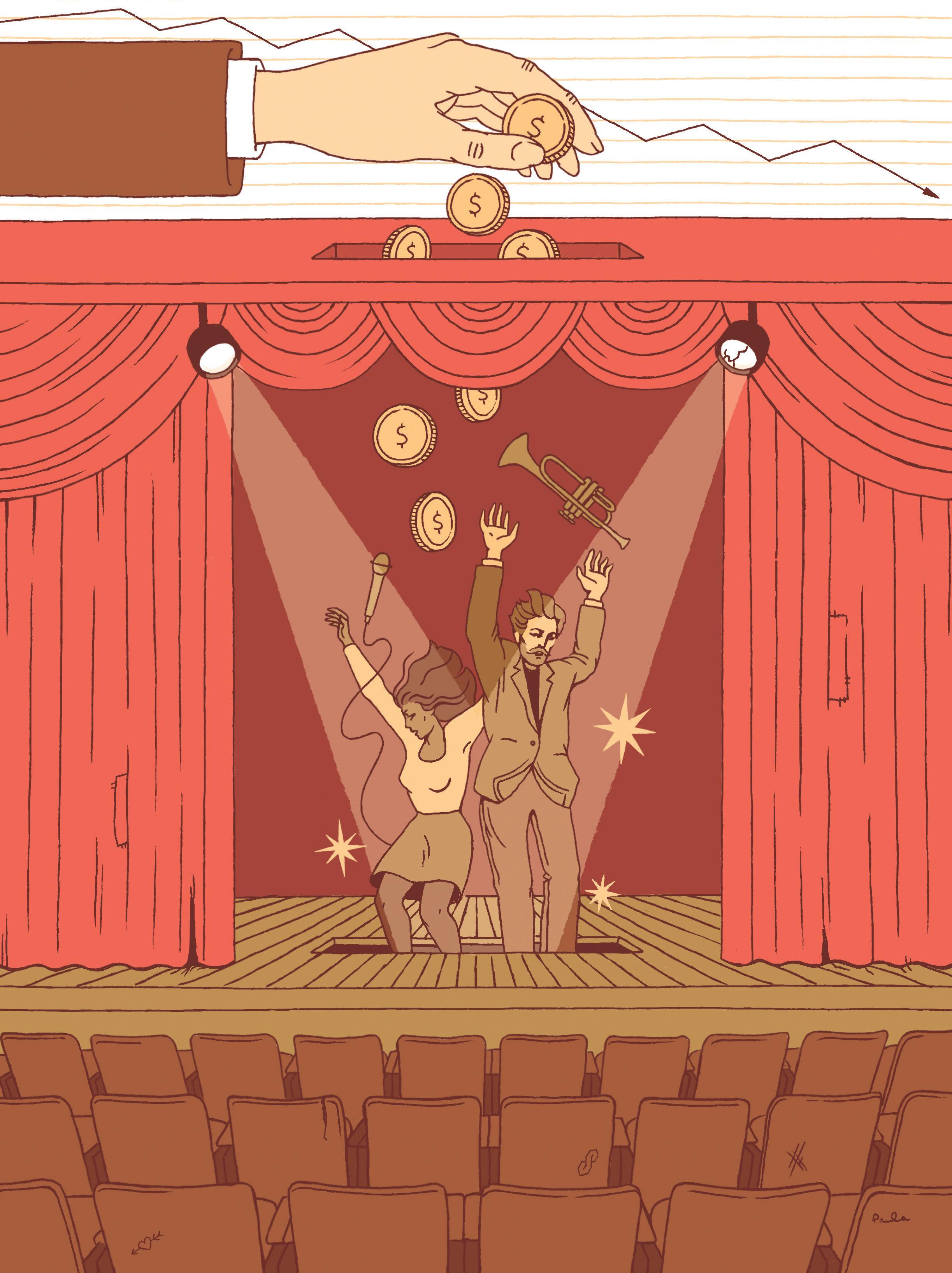
But the COVID-19 pandemic changed audience habits, not just here but across the nation. Audiences are significantly smaller than they were pre-2020. And the decrease in ticket sales has contributed to a tipping point for Milwaukee’s performing arts organizations, which were already competing for limited financial resources.
“After the pandemic, as organizations have spent down the liquidity and cash reserves that they had, they started figuring out that there is a weakening of private philanthropy,” says Milwaukee Repertory
Theater Executive Director Chad Bauman. “This is where public [i.e., government] support should be coming in, and it’s not.”
This fiscal year, Wisconsin ranked 49th per capita in terms of state funding for the arts, a statistic that has become a rallying cry among arts advocates. With a lack of public funds, organizations are heavily reliant on corporate and private giving. The post-pandemic erosion of ticket revenue has exacerbated the situation.
A new path forward, fresh partnerships and studying successful efforts in other cities are among the suggestions to buoy the performing arts and culture sector in Milwaukee in a recent report from the Wisconsin Policy Forum titled “Curtain Time,” which examines the longtime challenges facing Milwaukee’s performing arts groups.
UNSUSTAINABLE NEED
Commissioned by the Northwestern Mutual and Herzfeld foundations and Bader Philanthropies, “Curtain Time” analyzes the finances of six “cornerstone” members of the United Performing Arts Fund (UPAF) and seven regular members for which historical data is available.
“Philanthropic leaders have been very supportive of the arts, the performing arts in particular,” says Rob Henken, former president of the Wisconsin Policy Forum, who worked on the report and remains with the organization focusing on policy-related work.
But philanthropy cannot sustain the increased demand. The share of performing arts groups’ budgets
derived from earned income – primarily ticket sales and educational programs – plummeted between 2017 and 2022, according to information compiled by the Wisconsin Policy Forum.
The Milwaukee Repertory Theater went from 56.7% to 31.2% of revenue “earned,” Next Act Theatre from 40.2% to 21.3%, and First Stage Children’s Theater from 50.9% to 16.4%. Milwaukee Ballet is faring better than some groups, despite a drop in earned income from 51.4% of its budget in 2017 to 39.7% in 2022, due in part to revenue from dance classes.
“[Donors] are seeing increased requests for support, not only in terms of volume but urgency,” Henken says. “The expectation was that philanthropy would step up temporarily as pandemic relief aid was exhausted.”
LACK OF PUBLIC FUNDING
In 2023, Wisconsin ranked last in per capita state funding for arts agencies at 14 cents and stands second-to-last this year at 18 cents, compared with $9.62 for
neighboring Minnesota, according to the National Assembly of State Arts Agencies.
“Arguably, Milwaukee, from a public funding perspective, is the worst city in the country, and that is what is driving the dependence on private philanthropy,” Bauman says. “Of course, we are over-reliant on private philanthropy because there is essentially nonexistent public support, which is unheard of in any other state and any other city.”
The lack of public funding on both the city and state level is an issue that has plagued Milwaukee arts groups and creative industries for years, according to Adam Braatz, executive director of Imagine MKE, an arts organization whose goals include advocacy and developing partnerships across the arts, nonprofit, business and public sectors.
Braatz views the situation as unlikely to change anytime soon, so other solutions are in order. “The city has a $1.92 billion budget, and it has a lot of responsibilities and issues to deal with. I’m not placing the arts above any of those issues, but I would argue that a
New Leadership at the Herzfeld Foundation
By RICH ROVITO
IN A SURPRISING MOVE to some, the Herzfeld Foundation has turned to Rob Henken, longtime president of the Wisconsin Policy Forum and co-author of the “Curtain Time” report, to help set its future direction.
Richard Herzfeld, whose family owned the Boston Store, created the Milwaukee-based foundation with his wife, Ethel. After their deaths, Bill Haberman, a partner at Michael Best & Friedrich, became president. Haberman’s wife, Carmen, took on a paid position at the foundation in 2002. The Habermans’ two adult children, Fred and Sarah, were also appointed to the board.
The Haberman reign at the Herzfeld began to dissipate following Bill Haberman’s death in 2019. New board members were added, and Carmen Haberman resigned due to health reasons. With the hiring of Henken, a remaking of the Herzfeld Foundation seems complete.
“The foundation is looking to me to help it do some strategic planning as we continue to emerge from the pandemic and take a look about whether there’s a need for any shift in terms of our strategic priorities,” Henken says.
The foundation supports the arts with roughly 40% of its giving, education with another 40%, and 20% for civic and community initiatives.
“I fully expect that support for the arts and education are going to be priorities of the foundation, so that’s not going to change,” Henken says. “But within that, I think the board is really looking for me to come in and work with them and [Vice President] Julie Dahms in terms of identifying where it can make the biggest difference and fill gaps.”
Henken began his role as the foundation’s half-time executive director in mid-July. He remains in a part-time position at the Wisconsin Policy Forum, where Jason Stein has taken over as president.
The Search for Sustainable Models
The “Curtain Time” report explored collaborative efforts in three cities with similar demographics to Milwaukee that could offer a framework:
Pittsburgh
Led by philanthropists, the city incorporated the arts into its urban-renewal strategy in the 1980s, creating what would become a thriving downtown Cultural District, managed by the nonprofit Pittsburgh Cultural Trust. An important result has been the creation of partnerships between arts groups – including shared services, such as pooled negotiations for health insurance – where there was once competition.
Cincinnati
A matching grant established and endowed the Cincinnati Institute of Fine Arts, now known as ArtsWave, that serves as Greater Cincinnati’s primary funding mechanism for the arts. It currently supports 49 arts organizations through multi-year operating grants. ArtsWave’s Blueprint for Collective Action – a 10-year strategic plan that guides all ArtsWave grantmaking by linking funding decisions to strategic community objectives – may be particularly insightful for Milwaukee stakeholders, the report notes.
Kansas City
The vibrant arts and culture scene in Kansas City includes Charlotte Street, an arts incubator that supports artists in several disciplines. Construction began in 2019 on a new campus. Once completed, the center will be a multidisciplinary, multifaceted facility that aims to set a national standard for collaborative artist incubators.

“This is a very dire situation.”
–ADAM
BRAATZ, executive director, Imagine MKE
vibrant, robustly supported arts and culture sector is essential to a thriving society and economy,” Braatz says. “Obviously we have a lot of opportunities to improve where public funding at all levels is concerned and we all should advocate for expanded public funding at the local and state level. … [But] if the arts and culture sector tries to hang its hat entirely on advocating for public funding, we do so in error.”
QUESTIONS ABOUT UPAF
For decades, the performing arts community here has relied on UPAF as a significant source of funding. At the same time, many of the small and medium-sized groups question how UPAF funds are allocated.
UPAF was founded in 1967 to support performing arts tenants of the Marcus Performing Arts Center, including Milwaukee Repertory Theater, Milwaukee Symphony Orchestra, Florentine Opera Co. and Milwaukee Ballet. Referred to as the “cornerstone groups,” that cohort now includes First Stage Children’s Theater and Skylight Music Theatre. These organizations no longer share a venue, and each has its own fundraising staffs, but they still automatically receive the bulk of the millions that UPAF gives out annually.
UPAF currently supports 55 organizations, and its most recent annual report shows that $7.2 million (70%) of the nearly $10.6 million it raised in 2023 – just shy of its goal of $10.8 million – was allocated to operating support for its member groups. The Rep and the Milwaukee Symphony Orchestra received 41% of the total, with another 55% divided among UPAF’s four additional cornerstone groups and its eight


member groups. The remaining 4% was spread out among 41 mostly smaller “affiliates.” This structure “engenders conflict” among the different-sized organizations and “underpins a lack of trust and cohesion in the sector,” according to the Wisconsin Policy Forum report.
“This is not new,” Henken says. “Is the strategic vision here for a performing arts sector that has a very substantial breadth of large, medium-size and small organizations, and is it essential for the philanthropic sector here, as well as the public sector, to support such a framework? Or should our focus be on the biggest groups that serve the biggest audiences and [those] that do the most with regards to arts education and really ensure that they excel, even if that means that our overall universe of performing arts organizations has to shrink?”


DANCEWORKSMKE.ORG: INFO / TIX / SEASON SUBSCRIPTIONS
November 2024 dis/connect
February 2025 Rusalka with Milwaukee Opera Theatre
May 2025
Fables from the Wide Sky Continued
Photo: Christal Wagner DPMKE Artist: Katelyn Altmann





NO EASY ANSWERS
While many in the performing arts community thought that the groups funding the “Curtain Time” report were eager to find that an overabundance of arts organizations was in part to blame for the financial strain, the results did not bear that out. “When comparing Milwaukee to [Pittsburgh, Kansas City and St. Louis], we found that metro Milwaukee is in line or even on the low side in terms of the number of performing arts companies and the number of paid employees at those companies,” Henken says. “Consequently, any sentiment that Milwaukee has too many performing arts groups for a city our size would not be backed by our admittedly narrow comparison to these peer cities.”
The question remains, where do we go from here?
The report notes that Milwaukee’s arts and culture sector lacks a unified vision and a set of guiding principles on which to base a forward-looking strategy, something that Imagine MKE is addressing.
“We are focusing on creating a situation where we can [gather] a diverse array of voices who are important in this industry to come together, no matter how broadly, to establish this shared vision that can be the foundation of a move forward,” Braatz says.
Imagine MKE is “actively working to convene a coalition of diverse stakeholders from all industries to begin the process of developing this shared vision,” Braatz says. This will be an important first step toward creating a truly collaborative strategic plan, he says, noting that the arts sector is facing complicated, multifaceted and deep issues that no single action will resolve.
“This is a very dire situation,” Braatz says. “The arts and culture sector in the greater Milwaukee area is experiencing increasingly significant challenges. Without immediate action and substantial investment, the impact will reverberate throughout our communities.”
InSite: Cycles
OCT. 18 - 19
Join Wild Space Dance Company in Davidson Park, the new public oasis on HarleyDavidson’s campus on Milwaukee’s Near West Side. InSite: Cycles is a free dance performance that explores the park. A diverse group of artists choreograph and perform this dynamic dance, traversing the concentric circles of The Hub, the park’s wheel-inspired amphitheater. The circular design drives the audience through layers of visual rhythm, repetition and return, inspiring us to explore cycles of community, togetherness and inclusivity. The rumble of motorcycles and echoes of the past roll ever forward in this captivating ride.
Wild Space Dance Company
P.O. Box 511665 | 820 E. Knapp St.
WILDSPACEDANCE.ORG
Almost, Maine
NOV. 20 - DEC. 15
Welcome to Almost, Maine, a place that’s so far north, it’s almost in Canada. It’s not quite a town, because its residents never got around to getting organized. So it almost doesn’t exist. One cold, clear winter night, as the northern lights hover in the star-filled sky above, the residents of Almost, Maine, find themselves falling in and out of love in unexpected and hilarious ways. Knees may bruise and hearts may break, but as magic fills the air, the pieces finally fall into place – almost. Featuring Bree Beelow, Rudy Galvan, Jake Horstmeier and Rachael Zientek. Directed by Karen Estrada.
Play Your Part Concert
NOV. 9
The Milwaukee Youth Symphony Orchestra, one of the largest youth orchestra programs in the U.S., will present Play Your Part, an all-day, open-house concert at the Sharon Lynne Wilson Center from 10:30 a.m6:30 p.m. on Nov. 9. MYSO enrolls more than 900 musicians from 200 schools and 90 ZIP codes in Southeastern Wisconsin, 50% of whom represent populations of color. Three symphony orchestras, seven string orchestras, two wind ensembles, two flute choirs, numerous jazz combos and two steel bands will take the stage. The annual event is free as a thank you for the tremendous community support.
MYSO at the Sharon Lynne Wilson Center 3270 Mitchell Park Dr., Brookfield
MYSO.ORG
Covered Bridge Art Studio Tour
OCT. 11 - 13
Experience three days of creative inspiration. Visit the enchanting studios and workspaces where some of Southeastern Wisconsin’s finest artists create their work. You will find art in every imaginable medium and genre. Fiftysix artists open their doors for enthusiasts to ask questions, chat, see what inspires them, gain insight into their process, and take home a unique piece of art along with its “story of creation.” Free: no tickets, no reservations. Open Friday-Sunday 10 a.m.-5 p.m. On the Cedarburg Artist Guild’s website, you can download a tour map, get a list of the participating artists and watch videos of some of them in action.
Cedarburg Artists Guild bit.ly/coveredtour


OCT. 18 - NOV. 10
A spooky comedy from the playwright of the smash hit WITCH. A young governess arrives at a remote manor after exchanging semiromantic correspondence with one mysterious Mr. Branwell. But when the door opens, the only residents of the house seem to be Branwell’s two sisters, a maid (or maybe two maids?) and a lovelorn mastiff. And no man to be found, or child to be cared for. An inspired, whimsical satire that both embraces and sends up the gothic musings of the Brontë sisters; perfect for the Halloween season.
Work in Progress: Celebrating 50 Years of Arts/Industry
THROUGH MAR. 1, 2025
In a series of exhibitions, the John Michael Kohler Arts Center is celebrating the 50th anniversary of its Arts/Industry residency program through the theme “Work in Progress.” Since 1974, more than 500 Arts/ Industry artists-in-residence have created work in studios in the Kohler Co. factory using industrial materials and processes. Exhibitions showcase the value of the artists’ collaboration with factory associates. The ceramic and metal works featured include art made by the first to the most recent residents. Visitors can also participate in hands-on art making.
Renaissance Theaterworks
255 S. Water St.
John Michael Kohler Arts Center
608 New York Ave., Sheboygan
Viva la Mamma!
MAR. 21, 2025 - 7:30 PM MAR. 23, 2025 - 2:30 PM Pitman Theater at Alverno College
Donizetti’s Viva la Mamma hilariously portrays a theatrical company struggling with a stage mother who insists on controlling every aspect of her son’s career, much to the director’s dismay. Dueling divas, a meddling maestro and grocer/poet complicate the production woes. Amidst chaos and comedic mishaps, the opera satirizes operatic stereotypes, showcasing the absurdities and egos within the world of theater – all with glorious bel canto melodies and some terrific singing.
The Florentine Opera 205 W. Highland Ave., Suite 201
The Elaborate Entrance of Chad Deity
SEP. 11 - OCT. 6
In this corner, Chad Deity: the greatest champ professional wrestling has ever seen. But behind every winner lies the story of a really excellent loser. Enter Macedonio “The Mace” Guerra: a wrestler paid to lose night after night. For the chance to tell his own story in the ring, he’ll do almost anything. Kristoffer Diaz’s play is a high-octane powerbomb of thrilling spectacle, larger-than-life characters and pop culture commentary that you can’t find on pay-per-view. Featuring David Cecsarini, Adrian Feliciano, Dimonte Henning, Vince Nygro (aka “Demented” Chucky Bates) and Levin Valayil. Directed by Michael Cotey.
Next Act Theatre
255 S. Water St.
Milwaukee Symphony Orchestra 212 W. Wisconsin Ave. SEP. 27-29 SEP. 20-22
Join your Milwaukee Symphony Orchestra as it kicks off the 2024-25 season at the Bradley Symphony Center this September. First, welcome newly appointed Principal Pops Conductor Byron Stripling as he leads your MSO on a journey through the classic melodies that gave birth to the blues, joined by incredible vocalist Crystal Monee Hall. Then Music Director Ken-David Masur conducts RimskyKorsakov’s Scheherazade. Simon Trpčeski conquers the challenge of Rachmaninoff’s demanding yet romantic First Piano Concerto
2024/25 Season Highlights
The Marcus Performing Arts Center (MPAC) is Milwaukee’s premier performing arts community gathering space. Home to the Johnson Financial Group Broadway Series, MPAC offers a variety of live performances. Seasons highlights include Beetlejuice , The Neil Diamond Musical , Wicked , The Hip Hop Nutcracker , Martha Graham Dance Company, and Jazz at Lincoln Center Orchestra. For schedules, rental information and ticketing, visit marcuscenter.org . Tickets are available by calling 414-273-7206; groups of 10 or more can save by calling 414-273-7207.
The Marcus Performing Arts Center 929 N. Water St.
MSO.ORG
JMKAC.ORG