When you work with Cottonwood Title you can be confident you’ll leave a good impression on your clients. We’ve mastered the details and make signing paperwork feel like signing a work of art! The best real estate agents in Utah trust Cottonwood, you should too.
last a lifetime.
in
PRESIDENT
J. SCOTT COLEMERE
Colemere Realty Assoc.
1ST VICE PRESIDENT
JANICE SMITH
CB Realty (Union Heights)
2ND VICE PRESIDENT
KIM FARBER
Eleven11 Real Estate LLC
TREASURER
RUSS ORCHARD Century 21 Everest
PAST PRESIDENT
CLAIRE LARSON
Woodside Homes of Utah LLC
MEMBERS
MORELZA BORATZUK RealtyPath (South Valley)
ERIC SANTISTEVAN
Engel & Volkers (Holladay)
KRISTEL GOUGH
Summit Sotheby's (Draper)
LORI KHODADAD
CB Realty (Union Heights)
DONNA POZZUOLI BHHS UP (N. Salt Lake)
CARLYE WEBB
Summit Sotheby's INT (Draper)
BRYAN HURD Real Broker, LLC
TRISH NICHOLS
CB Realty (SL-Sugarhouse)
APPOINTED BOD
TONY KETTERLING Equity RE (Advantage)
LINDA MASCHER Realtypath LLC (Advisors)
PAST PAST PRESIDENT
DAWN STEVENS Real Broker, LLC
Advertising information may be obtained by calling (801) 467-9419 or by visiting www.millspub.com
Managing Editor Dave Anderton
Publisher Mills Publishing, Inc. www.millspub.com
President Dan Miller
Office Administrator Cynthia Bell Snow
Art Director Jackie Medina
Graphic Design
Salt Lake Board: (801) 542-8840 e-mail: dave@saltlakeboard.com Web Site: www.slrealtors.com
This Market Doesn’t Reward Hope— It Rewards Preparation
There’s something about spring along the Wasatch Front—the mix of sunshine, late snow, and a few rainy days—that brings a renewed sense of energy to real estate.
Listings begin to climb. Buyers step back in. Open houses fill up. Phones start ringing a little more often.
And with it comes a familiar assumption: this is when success happens.
But in reality, spring doesn’t create success—it reveals it.
What looks like sudden momentum in the Salt Lake market is usually the result of quiet, consistent effort that started months earlier. The calls made when no one answered. The follow-ups that felt repetitive. The relationships nurtured without immediate return.
Momentum is rarely built in the moment it’s seen. It’s built long before.
Early in my career, I learned this firsthand. Prospecting didn’t come naturally, so I made a game out of it—counting how many “nos” I could get in a day. What started as a way to push through discomfort ended up building something far more valuable: a pipeline.
Those “nos” didn’t feel productive at the time. But over time, they turned into conversations—and eventually, opportunities.
Seasons like this are when that hidden work begins to show up.
And in a market like ours, where conditions shift quickly and competition remains strong, the gap between preparation and inaction becomes clear.
Some agents enter spring reacting—trying to catch up, chasing leads, hoping momentum finds them. Others step into it ready—already in motion, already positioned to serve.
That difference isn’t created in spring. It’s revealed by it.
Because while the Salt Lake market brings more opportunities this time of year, it doesn’t distribute it evenly. It flows toward those who have been preparing for it.
Because in this market, hope is not a strategy. Preparation is.
positions of the Salt Lake Board of REALTORS® Permission will be granted in most cases, upon written request, to reprint or reproduce articles and photographs in this issue, provided proper credit is given to The Salt Lake REALTOR as well as to any writers and photographers whose names appear with the articles and photographs. While unsolicited original manuscripts and photographs related to the real estate profession are welcome, no payment is made for their use in the publication.
Views and opinions expressed in the editorial and advertising content of the The Salt Lake REALTOR are not necessarily endorsed by the Salt Lake Board of REALTORS . However, advertisers do make publication of this magazine possible, so consideration of products and services listed is greatly appreciated.
J. Scott Colemere President
Happenings
Touring Utah’s New Hockey Home
The Government Affairs Committee recently toured the Utah Mammoth Ice Center in Sandy, a major new sports complex that serves as both the NHL team’s headquarters and a community hockey hub. The 146,000-square-foot facility opened in September 2025. The visit was part of the committee’s ongoing effort to help Realtors® better understand the communities they serve. Unlike many NHL practice facilities, the Mammoth Ice Center offers public access—typically on weekends—and features rental spaces for events such as birthday parties and group activities.
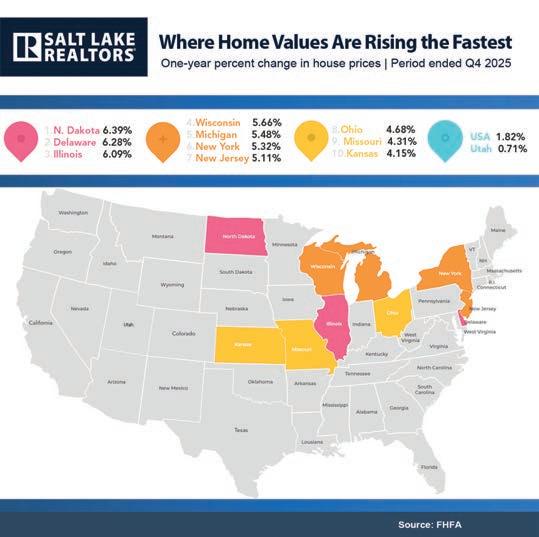
Utah Trails National Average in Home Price Growth
U.S. home prices rose 1.82% between the fourth quarter of 2024 and the fourth quarter of 2025, according to the Federal Housing Finance Agency’s House Price Index (FHFA HPI®). North Dakota led the nation in home appreciation with a 6.39% increase over the past year, while Florida ranked last with prices declining 2.73%. Utah saw a modest gain, with home prices rising 0.71% year over year, compared to the national average increase of 1.82%. Nine states and the District of Columbia saw home price declines in the fourth quarter.
In the News
Rates Swing Sharply in Early 2026
Recent reporting from The Wall Street Journal highlights a period of heightened volatility in the mortgage market, with interest rates shifting rapidly in early 2026. After dipping below 6% at the start of the year, mortgage rates climbed back into the mid-6% range by late March, creating uncertainty for both homebuyers and homeowners considering refinancing. This rapid fluctuation has made it difficult for consumers to plan effectively. Buyers who were preapproved at lower rates are finding those terms outdated by the time they are ready to lock in financing, while others are delaying purchases altogether. Economists note that this unpredictability is eroding confidence during what is typically the busiest spring homebuying season.
The volatility is being driven by a mix of economic and global factors, including persistent inflation concerns, Federal Reserve policy expectations, and geopolitical tensions that have influenced bond markets and borrowing costs. When inflation is the dominant concern— such as during energy shocks or supply chain disruptions—investors tend to demand higher yields rather than lower ones, which in turn pushes mortgage rates higher. Although mortgage rates remain below their peaks in 2025, recent swings have already reduced purchasing power and reversed some of the affordability gains seen earlier in the year.
Photo: Image licensed by Ingram Image
Congratulations to Our 2025 Top Producers
The Professional Difference
Tyler Quinn
Sue Mark-Lunde
Andrea Chapman Summerhays
Petra Winegar
Cindy Andersen
Rachel Kitterer
Gail Wathen
Trent Woolston
Janis Bennion
Ray Morrison
Steve Bryant
Joe Jensen
Megan Lewis
Jennifer Ramirez
Wes Brewer
Sue Mark-Lunde
Andrea Chapman Summerhays
Day Babs De
2025 REA L TOR ® 500 HALL OF F AME
Solo Tuiaki Justin Udy Mike Ulrich Tricia Vanderkooi Thomas Vogel Gigi Volk
Devin Tanner Jenni Thompson Brandy Tilo Kelly Tita
Kristi
2025 REALTOR ® 500
Andrew Adams, Ask Andrew RE
Mara Adams, Windermere
Jazmin Adamson, Align Complete RE
Sammie Aguilera, Keller Williams
Mohammed Alhareb, Equity Real Estate
Coral Alkashif, Black Diamond Realty
Scott Allen, Allen & Associates
Sally Alley, White Oak Real Estate
Brock Andersen, Berkshire Hathaway
Bryce Anderson, Intermountain Properties
David Anderson, A5 Real Estate
Ivonne Anderson, Realtypath LLC
Joilyn Anderson, Summit Sotheby’s
Kira Anderson, D.R. Horton
Lance Anderson, Jason Mitchell RE
Dorthy Androulidakis, Summit Sotheby’s
Mahonry Aquino, Signature Group RE
Stephanie Aragon, Signature Group RE
Christopher Armstrong, NRE
John Armstrong, Ari Realty
Tricia Ashby, Move Utah RE
Samantha Bagley, RANLife Real Estate
Elda Baker, Utah’s Wise Choice RE
Zula Balchinpurev, Keller Williams
Adam Bangerter, Bangerter Real Estate
John Baque, Coldwell Banker
Maria Barraza-Rodriguez, Conrad Cruz RE
Steven Barton, Equity Real Estate
Karina Bassett, Fathom Realty
Sydney Battersby, District Living Collective
Sara Beck-Broman, Domain Real Estate
Launie Belnap, Presidio Real Estate
Jerome Bennett, Realty Experts Inc
Sue Benson, RE/MAX Assoc.
David Bergstedt, Bergstedt Real Estate
Leigh Anne Bernal, Homeworks Property Lab
Ryan Bierman, Live Work Play
Ecaterina Bird, Real Broker
Lisa Blakemore, Blakemore RE
Nestor Boada Cardozo, Real Broker
Angela Bobowski, Weekley Homes
Jared Booth, Colliers International
Blake Bratcher, Blakemore RE
Jake Breen, Dijjit, LC
Amber Briem, Blakemore RE
Samuel Brinton, Brinton RE Group
Matt Broadbent, Take Flight Realty
David Brunet, Homie
Hyrum Brunsdale, Destination Real Estate
Robyn Buckwalter, Keller Williams
Erica Buehler, Cindy Wood Realty Partners
Danna Bui-Negrete, LRG Collective
Mandy Bullock, Summit Sotheby’s
Zach Bunker, Century 21 Everest
Abril Burgoyne, PAK Home Realty
Cameron Burnside, Keller Williams
Linda Burtch, Keller Williams
Brett Butler, Berkshire Hathaway
Mark Butler, Butler Realtors, Inc.
Sean Buttars, Real Estate Essentials
Lori Butterfield, Real Broker
Bradley Byington, Live Work Play
Austin Cales, Century 21 Everest
Jennifer Call, ERA Brokers Consolidated
Brandon Calton, RE/MAX Assoc.
Annie Cannon, Keller Williams
Sheridyn Cannon, Cannon & Co.
Deborah Caro, Advantage RE
Joel Carson, Utah Real Estate PC
Luis Carter, Signature Group RE
Robert Carter, D.R. Horton
Lori Chamberlain, Chamberlain & Co.
Bret Charlesworth, Summit Sotheby’s
Kim Chatterton, Coldwell Banker
Carolyn Chavez, The Agency SLC
Melissa Chiz, D.R. Horton
Aaron Christensen, Century 21 Everest
Shelli Clark, Keller Williams
Eryn Clarke, Lennar Homes
Brian Clinger, Coldwell Banker
Nicole Cloward, REMAX Complete
Humberto Coello, Edge Realty
Michael Coello, Berkshire Hathaway
Juliana Cole, Mansell Real Estate
Bryan Colemere, Colemere Realty Assoc.
Melissa Collings, REMAX Complete
Mason Conley, Keller Williams
Dana Conway, Keller Williams
Rob Corcoran, Keller Williams
Jennifer Cottam, ERA Brokers Consolidated
Dean Cotter, Redfin Corporation
Carmen Crane, Real Broker
Justin Crane, Century 21 Everest
Donna Crawley, Real Broker
David Croft, Chapman-Richards
Mike Crowder, In Depth Realty
Maria Cuevas, Coldwell Banker
Rikki Curtis, Signature Group RE
Bob Cusick, Realty HQ
Christina Dalton, Coldwell Banker
Jeffrey Daniels, Surv Real Estate
Karin Davis, Masters Utah RE
Jonathan Day, Homie
Babs De Lay, Urban Utah Homes
Leanna DeHerrera, Windermere
Hector Delgado, Innova Realty
Tyler Demars, Keller Williams
Nicolas DeSeelhorst, EXP Realty
Janie Despain Mathis, Garbett Homes
Kristin Deveraux, Vox Real Estate
Steven DeYoung, Equity Real Estate
Jesus Diaz, Century Communities
Kim Dixon, Berkshire Hathaway
Richelle Dopp, EXP Realty
John Dowdle, Destination Real Estate
Monica Draper, Windermere
Abbey Drummond, Windermere
Miriam Drury, Century 21 Everest
Parker Eads, Edge Realty
Desiree Eddy, Primed Real Estate
Blake Edwards, Summit Sotheby’s
Michael Egan, Windermere
Missy Elardi, Unity Group RE
We would like to recognize the following individuals for being named REALTOR® 500 Top Producers out of over 10,000 agents in the Salt Lake Board of Realtors. Thank you for being irreplaceable members of our company and congratulations again on your accomplishments!
Chris JonesScott HurdJill Saddler Sammie Aguilera Zula Balchinpurev
Josh JorgensenShelli ClarkRyan Pool Teisha Hawley
CONGRATULATIONS TO OUR ASSOCIATES
TOP 500 REALTOR
Monterey Lysy, Omada Real Estate
Adam Maack, Align Complete RE
Adrian Maco, Summit Sotheby’s
Alicia Madsen, Century 21 Everest
Juan Magana, Windermere
Cherie Major, Christies International
Misty Maki, Maki Real Estate
Tuiono Malakai, Equity Real Estate
Linda Mandrow, Coldwell Banker
Brenda Manookin, Redfin Corporation
Darren Mansell, Mansell Real Estate
Jared Mansell, Mansell Real Estate
Nicholas Manville, Century 21 Everest
Abraham Mardanlou, Masters Utah RE
Sue Mark-Lunde, Chapman-Richards
Patrea Marolf, Keller Williams
Susie Martindale, Masters Utah RE
Lisa Martinez, Signature Group RE
Ricky Martinez, Prime Residential Brokers
Scott Maruri, Windermere
Jennifer Mascaro, The Mascaro Group
Rylar Masco, Utah Key Real Estate
Tonja Masina, Paradise Real Estate
Harris Mataafa, EXIT Realty Success
Kathy McCabe, Align Complete RE
Jennie McCullough, RANLife Real Estate
Christen McLam, Meritage Homes
Lauren McMullin, Coldwell Banker
Sarah McNamara, Summit Sotheby’s
Michael McPhie, Equity Real Estate
Adrianne Meaders, Intermountain Properties
Carolee Mecham, Cannon & Co.
Connor Mecham, Cannon & Co.
Donald Mendenhall, Equity Real Estate
Andrew Merrill, Redfin Corporation
Ben Milar, Ulrich REALTORS
Amber Milton, Century 21 Everest
Daniel Moench, Century 21 Everest
Joshua Mondale, Omada Real Estate
Chelise Monson, Woodside Homes
Jose Montenegro Socorro, TMG Realty
Ab Moreno, Omada Real Estate
Regina Morrill, Edge Realty
Jeffrey Morris, Keller Williams
Martha Morris, Summit Sotheby’s
Rodney Moser, NextHome Navigator
Justine Muhlestein, Advantage RE
Cooper Murphy, Real Broker
Scott Murray, EXP Realty
Ivan Navincopa, Blue Key Realty
Leslie Neebling, Coldwell Banker
Taylor Neill, Edge Realty
Angie Nelden, Summit Sotheby’s
Kelli Nelson, Windermere
Matthew Nelson, Keyrenter Real Estate
Andrea Newby, Zander RE Team
Kristi Nicholl Durrant, Coldwell Banker
Alex Nickle, Century 21 Everest
Courtney Nielsen, Keller Williams
Evan Nielsen, Century Communities
Karly Nielsen, Niche Homes
Dan Nix, Coldwell Banker
Brian Noel, Century 21 Everest
Mary Nothum, Real Broker
Chuck O’Brien Jr., RE/MAX Assoc.
Danielle Olsen, Advantage RE
Katie Olsen, Coldwell Banker
Marcelina Ontiveros, Real Estate Essentials
Brad Orgill, Goldcrest Realty
Kim Orlandini, Keller Williams
Gaby Orona, Presidio Real Estate
Jeremy Osguthorpe, Realtypath LLC
Stephen Ostler, EXP Realty
Mark Overdevest, Summit Sotheby’s
Loreana Pachano Montilla, Real Broker
Felipe Pacheco, Forte Real Estate
Matt Page, Masters Utah RE
Tara Paras, Paras Real Estate
Anna Parker, Keller Williams
Holly Parkin, United RE Advantage
Jhoan Parra, Innova Realty
Tyler Parrish, Align Complete RE
Matthew Peay, Dimension Realty Services
Alexandria Pedroni, EXP Realty
Jacquelin Perry, Summit Sotheby’s
Michael Perry, Real Broker
Aaron Peters, Netlogix Realty
Sabrina Peters, Keller Williams
Joe Pierson, Real Broker
Mafer Pino-Deyevara, Presidio Real Estate
Jakie Pizana, Equity Real Estate
Bob Plumb, Plumb & Co. Realtors
Joan Pok, Signature Group RE
Ryan Pool, Keller Williams
Sandra Poole Sweetland, Coldwell Banker
Danielle Pope, Bickmore & Associates
Susan Poulin, Summit Sotheby’s
Stephanie Poulos Arrasi, Berkshire Hathaway
Maura Powers, Berkshire Hathaway
Greg Preston, Real Broker
Juston Puchar, Keller Williams
Cameron Purles, Equity Real Estate
Kelli Purser, Jason Mitchell RE
Karma Ramsey, The Group RE
Talmage Rawlings, Edge Realty
Joe Reardon, Keller Williams
Tony Reece, 4You Real Estate
Allison Reemsnyder, Berkshire Hathaway
Dale Rex, Black Sign Real Estate
Timothy Reynolds, Fathom Realty
Aaron Richardson, Century 21 Everest
Phil Richardson, Berkshire Hathaway
Belladonna Riso, EXP Realty
Scott Robbins, Summit Sotheby’s
Jordon Roberts, Advantage RE
Miranda Roberts, Summit Sotheby’s
Dakota Robison, Holmes Homes Realty
Dave Robison, goBE, LLC
Jill Rodeback, Weekley Homes
Ashley Rolfe, Alliance Residential RE
Robin Roller, Alta Realty
Trevor Rose, Real Broker
Sydney Rosenblatt, Presidio Real Estate
Hyrum Rosquist, Keller Williams
James Roth, Real Broker
Heather Roxburgh, Real Broker
Shane Roxburgh, EXP Realty
Joshua Rudder, Homie
Donna Rudzik, Signature Group RE
Angel Ruiz, Century 21 Everest
Susan Russell, Jordan Real Estate
Jill Saddler, Keller Williams
Pablo Sanchez, Equity Real Estate
Tiffiny Schindler, Woodside Homes
Linda Secrist, Berkshire Hathaway
Austin Seegmiller, NRE
Brett Sellick, Summit Sotheby’s
Gian Sexsmith, Coldwell Banker
Tyler Shenk, RE/MAX Assoc.
Kamee Shrope, Engel & Volkers
Jeff Sidwell, Summit Sotheby’s
Laurel Simmons, Summit Sotheby’s
Zack Simpkins, Meritage Homes
Scott Simpson, Summit Sotheby’s
Meredith Sinclair, Summit Sotheby’s
Joshua Skousen, Century 21 Everest
Marta Sloan, Summit Sotheby’s
Michael Slotten, Summit Sotheby’s
McKaylee Smith, Edge Realty
Michael Smith, Pulte Home Company
Jenn Sobas, Real Broker
Natalie Southwick, Aspen Creek Realty
Annie Sperry, Summit Sotheby’s
Christopher Sprunt, Utah Home Central
Matthew Sprunt, Utah Home Central
Kyrsten St John, Real Broker
Scott Steadman, Windermere
Scott Steele, Signature RE Utah
Sean Steinman, Summit Sotheby’s
Lee Stern, Keller Williams
Tyler Stevens, Smart Move Advantage
Stephanie Stewart, EXP Realty
Michael Stone, Lennar Homes
Max Strayer, Windermere
Kevin Strong, RE/MAX Assoc.
Andrea Summerhays, Chapman-Richards
Rich Summers, Keller Williams
Gary Sundwall, Keller Williams
Haylie Swenson, Golden West Properties
Brady Tanner, Prime Residential Brokers
Devin Tanner, Real Estate Essentials
Darian Taylor, EXP Realty
Lincoln Taylor, EXP Realty
James Telaroli, Axis Realty Inc
Dan Tencza, Richmond American Homes
Chad Thomas, Private Property Broker
Darin Thomas, Real Broker
Jennifer Thompson, The Group RE
Brandy Tilo, Presidio Real Estate
Tess Timothy, Lennar Homes
Kelly Tita, Selling Salt Lake
Jennifer Toomey, Real Estate Essentials
Greg Tracy, Real Estate Essentials
Hannah Traub, Real Broker
Brian Tripoli, Cityhome Collective
Shelly Tripp, Coldwell Banker
Annie Trujillo, Keller Williams
Connor Trupp, Summit Sotheby’s
Kyle Tucker, Real Broker
Anne Tuckett, Eleven11 Real Estate
Solo Tuiaki, RANLife Real Estate
Mony Ty, Summit Sotheby’s
Julia Uberty, Summit Sotheby’s
Justin Udy, Century 21 Everest
Mike Ulrich, Ulrich REALTORS
Cori Vanderbeek, Intermountain Properties
Tricia Vanderkooi, Summit Sotheby’s
Thomas Vogel, Bureau Real Estate
Gigi Volk, D.R. Horton
Chad Wagstaff, Summit Sotheby’s
Vanessa Wand, Windermere
Brandon Watson, Edge Realty
Greg Watts, Watts Real Estate
Jackie Weig, Redfin Corporation
Jared West, Modern and Main
Jason West, Century 21 Everest
Wendy Wheeler, Summit Sotheby’s
Tracy White, Weekley Homes
Craig Whiting, Prime RE Experts
Bob Whitney, Watts Group RE
Parker Whitney, Watts Group RE
Kaitlyn Whittle, Medlink Real Estate
Jennifer Wiechec, Axis Realty Group
Sue Ann Wilkinson, Summit Sotheby’s
Scott Willey, Real Broker
Jessica Williams, Keller Williams
Jim Williams, Williams Realty PC
Kari Williams, Holmes Homes Realty
Spencer Wilson, Equity Summit Group
Lori Wilson-Jewett, CDA Properties
Bree Winegar, Cannon & Co.
David Winters, RE/MAX Assoc.
David Wiser, Wiser Real Estate
Hannah Womack, Lennar Homes
Nataly Wood, Realtypath LLC
Lisa Woodbury, Windermere
Spencer Wrathall, Keller Williams
Rachel Wray Eliason, Keller Williams
Michael Wright, Upside Real Estate
Thomas Wright, Summit Sotheby’s
Kaelee Youngblood, Lennar Homes
Tamara Zander, Zander RE Team
Thank You Sponsors!
Why Summit Sotheby's International Realty?
For many agents, joining Summit Sotheby’s International Realty is more than a career move. It is a moment of arrival. The transition is often described not in terms of scale or statistics, but in feeling. That sense of belonging is paired with something equally powerful: aspiration.
Sotheby’s is a name that carries global reverence. It represents a standard. An expectation. A legacy of excellence that extends far beyond real estate. Within the industry, the move is unmistakable. Peers notice. Clients feel it.
But the distinction is not simply perception. It is the combination of elevated marketing, global reach and a deep commitment to community that sets Summit Sotheby’s International Realty apart. The brand opens doors worldwide while remaining firmly rooted in Utah, supporting the communities that make this place extraordinary.
In the end, choosing Summit Sotheby’s International Realty is about alignment. With excellence. With opportunity. With a network that feels both expansive and personal.
As one team put it simply,
“We feel like we’ve arrived."
It’s really felt like we're at home. We've truly appreciated the support because it really does start to feel like a family.
Since we've made our transition over to Summit Sotheby's International Realty, Lacy and I have both gotten lots of calls from our peers within the industry. Our answer is that Sotheby's is just so aspirational, and it's something where we've really admired the work that they've done.
LACY HARRISON & GRETCHEN HUDGENS GLOBAL REAL ESTATE ADVISORS
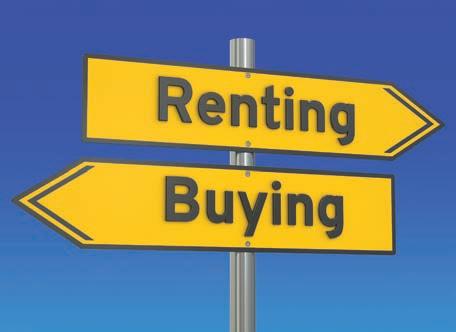
Who Is Renting in America and Why They Can’t Stop
A typical family renter household in the U.S. is headed by a 42-year-old adult, with a family size of 3 people living in a 2-bedroom unit, earning $68,000 annually.
By Jiayi Xu Realtor.com®
America’s rental market is often discussed as if it were a single, uniform experience. It is not. Drawing on 2024 American Community Survey data across the 100 largest metropolitan areas, this analysis profiles three distinct yet overlapping renter groups—young renters, family renters, and long-term renters—making up more than 80% of the total renting households in America, and each concentrating in different markets and renting for different reasons.
Young renters are being priced out of the markets they once defined. Family renters—disproportionately minority households—find homeownership structurally out of reach. And long-term renters are largely locked in place—many unable to afford the market they already live in. Together, they reveal a rental landscape shaped less by individual preference than by cost, geography, and unequal access.
Searching for Opportunity: America’s Young Renters
• Represent 31.9% of all renter households nationally
• Concentrated in midsize, affordable inland metros—not the expensive coastal cities
• Markets with high young renter shares show significantly lower affordability stress, higher shares of single-person households, and lower rates of doubled-up households
Who is renting: Young renter households—defined as households headed by an adult under 34—represented 31.9% of all renter households nationally. A typical young renter household in the U.S. is headed by a 28-year-old adult, with a household size of 2 people living in a 2-bedroom unit, earning $65,000 annually. Among these young households, 34% are single households and 10% live in doubled-up arrangements in which at least two unmarried or unpartnered
working-age adults share a unit, often as a strategy to manage rising housing costs.
Where and why: The geography of young renters in America is, surprisingly, not where most people expect. New York City, Los Angeles, San Francisco, Boston, and Miami—the metros that dominate popular narratives about where young people go to build careers and lives—do not appear among the top markets for young renter concentration. Instead, the top metros by young renter share are Colorado Springs (45.7%), Austin (44.6%), Denver (43.5%), Salt Lake City (41.7%), Grand Rapids (41.7%), Indianapolis (40.1%), Des Moines (39.8%), Columbia (39.5%), San Antonio (38.7%), and Charleston (38.6%). This list skews heavily toward midsize, inland, and relatively affordable markets with great job opportunities.
The absence of coastal gateway cities is not a coincidence. It is an affordability story. Our analysis shows that markets where young renters concentrate most heavily are significantly less financially stressed. On average, 52.6% of renter households in the top 10 young renter metros could afford a fair market rent if asked to move to a new unit within the same metro, assuming the same household incomes and bedroom sizes. Meanwhile, the share was just 32% in Miami and 33.6% in Los Angeles. Young renters are not avoiding expensive cities by preference. They are being priced out of them.
The affordability signal shows up in how young renters live as well. Where renting is affordable, young households have the financial breathing room to live independently. Where it is not, they double up or leave. In the top 10 markets where young renters concentrate, an average of 38.6% of renter households are singleperson households—higher than the national average of 34%. Meanwhile, the average share of doubledup young rental households in the top 10 markets averaged 8.6%. It is 16.3% in Los Angeles and 13.8% in New York.
Free Thermal Imaging & Radon Testing With Every Inspection
Christopher ArmstrongPorter Hawkins
Troy HodellDinko Keserovic
Christina LovellAustin Seegmiller
Moayeed AhmedJeremy BrandStratton Burns Ryan DastrupJuan DeLaPena
Morgan EadsNick EarlsJason Hawkins Josh Meidell Josh Mills
Pam Musselman David SalazarJennifer Salazar Steven Salazar Marissa Salazar
But affordability alone does not explain why young renters choose these markets over other affordable alternatives. The top markets also offer something equally important: jobs. In December 2025, the average unemployment rate across the top 10 young renter markets was 3.6%, compared to a national rate of 4.1%. This suggests these are not just cheap markets but also genuinely tight labor markets where early-career opportunities are abundant.1
Austin—named twice as a top destination for recent college graduates—has emerged as one of the country’s most dynamic labor markets, drawing technology companies, financial services firms, and corporate relocations that have created a deep well of early-career opportunity. Denver and Salt Lake City have built robust economies anchored in technology, aerospace, and financial services. Indianapolis and Des Moines have developed competitive job markets in health care, financial services, and logistics. Charleston has benefited from manufacturing expansion and a growing technology sector.
Trapped Between Culture and Cost: America’s Family Renters
• Represent 44.3% of all renter households nationally
• Concentrated in majority-minority markets across California, Texas, Florida, and Hawaii
• Face a double barrier: High home prices that put buying out of reach, compounded by a long-documented homeownership gap that disproportionately affects minority households
• Markets where family renters concentrate most heavily are among the most burdened and most crowded in the country
Who is renting: A family renting household—defined as a household headed by a married couple or a parent living with their own children. Family renters represent 44.3% of all renter households nationally—a substantial share of the rental market. Specifically, a
typical family renter household in the U.S. is headed by a 42-year-old adult, with a family size of 3 people living in a 2-bedroom unit, earning $68,000 annually. Among these households, 75.2% include children and 6.5% are multigenerational (spanning three or more generations) under one roof.
Where and why: The geography of family renting in America is, to a significant degree, the geography of minority America. The top metros by family renter share—McAllen (61%) and El Paso (53.3%) on the Texas-Mexico border; Stockton (63.3%), Fresno (58.3%), Bakersfield (60.6%), Riverside (61.7%), and Oxnard (55.7%) across California’s inland valleys and coast; Miami (53%) and Orlando (53.1%) in Florida; and Honolulu (54.3%) in Hawaii—are overwhelmingly markets where Hispanic, Latino, and Asian communities make up a large and often dominant share of the population.
This concentration reflects two forces working in the same direction. First, minority groups tend to have higher family formation rates. For example, among all Hispanic households, 67.9% are family households, compared to 60.1% among white-alone households. Second, and more fundamentally, minority families in these markets face a double barrier to homeownership.
Home prices have climbed far beyond the reach of median-income households— every one of these markets scores below the national affordability benchmark, according to Realtor.com® data. This affordability wall is compounded by structural barriers that persist regardless of market conditions— unequal access to credit and limited intergenerational wealth have produced a homeownership gap that remains wide and well-documented. For example, the homeownership rate among Hispanic households is 50.9% in 2024 and 73.3% for white households. In markets where both forces are present simultaneously, renting is not a lifestyle choice. It is the only option left.
These two forces also shape what family renters experience in these markets. Our analysis shows that the metros where family renters concentrate most heavily are among the most burdened and most crowded in the country. On average, 37.3% of renting households from the top 10 metros would face a severe affordability burden at fair market rents if asked to move to a new unit within the same metro, assuming the same household incomes and bedroom sizes, and 10.7% of them live in crowded conditions (vs. 6.2% at the national level). Larger households, paying higher rents, in units not built to accommodate them, are squeezed from both sides by financial pressure and limited space. For families where buying remains out of reach, the pressure is not abstract. It is monthly, and it compounds.
Where Affordability and Mobility Break Down: America’s Long-term Renters
• Represent 36.1% of all renter households nationally
• Concentrated in rent-regulated anchor cities (New York City, Los Angeles) and their spillover markets across California and the Northeast
• An average of 39.2% of renting households in the top 10 metros would face severe affordability stress if forced to move at fair market rent within the same metro, assuming the same household incomes and bedroom sizes
Who is renting: A long-term renter—defined as a household that has remained in the same rental unit for five or more years—represented 36.1% of all renter households nationally. A typical long-term renting household is headed by a 55-year-old adult, living in a household of 2 people and 2 bedrooms with a median household income of $48,500.
Not all long-term renters are the same. Some stay by choice—drawn by community ties, neighborhood familiarity, or a preference for stability, especially for senior renters. But for many others, staying put is not a preference. In high-cost markets where moving means surrendering a below-market lease for a unit that could cost hundreds of dollars more per month, the decision to stay is less about stability and more about survival.
Where and why: Our analysis showed that long-term renters are not randomly distributed across America. They cluster with remarkable consistency around the country’s most expensive anchor cities—and the markets that absorb their overflow.
The top 10 metros by long-term renter share fall into two distinct groups. The first are the anchor cities themselves—New York City (53.3%) and Los Angeles (49.6%)—where decades of rent stabilization and rent control have kept millions of tenants in below-market units they cannot afford to leave. These are not renters who chose to stay out of loyalty or inertia. They are renters doing the math and concluding, correctly, that moving means surrendering a lease that the market will never offer them again.
The second group tells the overflow story. Renters priced out of New York City end up in Bridgeport (43%). Renters priced out of the San Francisco Bay Area and Los Angeles land in Fresno (49.3%), Stockton (47.9%), Bakersfield (44.7%), Riverside (44.5%), and Oxnard (49.5%).
Some arrived seeking affordability and found it— staying by choice in markets that still work for them. Others find themselves in a familiar bind: Rents have risen even here, and the financial calculus of moving has once again tilted toward staying put. This is what happens to renters in Providence and Worcester. While Boston does not appear among the top markets for long-term renter concentration—in part because its high costs and lack of rent stabilization make longterm renting financially unsustainable for many—its impact on surrounding markets is significant. Renters priced out of Boston have moved to Providence and Worcester, where lower rents initially offered relief. But as costs have risen in these overflow markets, too,
many of those renters find themselves stuck—unable to afford Boston and increasingly unable to afford moving anywhere else. Providence (44.4%) and Worcester (44%) now rank among the highest in the country for long-term renter share—not because renters chose to stay, but because they ran out of affordable places to go. With rents growing rapidly in these areas, both Massachusetts and Rhode Island are now actively debating rent stabilization legislation.
Our analysis confirms what the geography suggests. Long-term renters tend to concentrate in markets with the highest rental cost burdens. On average, 39.2% of renter households in the top 10 long-term renter metros would face severe affordability challenges if asked to move to a new unit within the same metro at fair market rent, assuming the same household incomes and bedroom sizes. The burden is most acute in Providence, RI (45.8%), Bridgeport, CT (43.9%), and Los Angeles, CA (41.9%).
The contrast with young renter markets could not be sharper. Austin, San Antonio, and Denver—where young renters concentrate—see among the lowest shares of long-term renters in the country. Mobility and affordability go together. Where one is absent, so is the other.
Methodology
This analysis draws on 2024 American Community Survey 1-Year estimates across the 100 largest metropolitan areas. The sample is restricted to renter households headed by an adult over 18 who is not currently enrolled in school, focusing on households actively participating in the housing market. Affordability is measured using HUD’s 2024 Fair Market Rents as the rent benchmark rather than actual rents paid. This approach captures what households would face if forced to move to a new unit within the same metro today, holding household income and bedroom size constant. It is designed to answer a specific policy question: What share of current renter households could afford a typical market-rate unit in their metro if they had to move?
We define affordable housing as units where rent represents less than 30% of household income, consistent with the standard HUD threshold. Severe affordability challenges are defined as rent-to-income ratios exceeding 50%. Households reporting zero or negative household income are excluded from burden calculations, consistent with standard housing research methodology.
Crowding is defined as more than two persons per bedroom, a threshold that reflects practical space constraints for renter households. This definition is more conservative than HUD’s standard of one person per room, focusing specifically on bedroom capacity as the relevant measure of residential crowding for renter households.
Reprinted from Realtor®.com.
American Homebuilders
Are Being Scooped Up by Japanese Firms in Deals Worth Billions—Here’s Why
Japan’s Iida Group expands in U.S. homebuilding market with takeover of Utah-based Wright Homes.
By Tristan Navera Realtor.com®
Japanese homebuilders are on a buying spree of American firms, in a trend that’s only accelerating as the U.S. faces a shortage of 4.03 million homes
Since the start of 2026, four Japanese firms have announced deals to snap up homebuilders, including Sumitomo Forestry Co. Ltd.’s plan to acquire Tri-Pointe Homes Inc. in a $4.5 billion deal. The latest came Friday, as Washington-based JK Monarch was bought by Daiwa House brand Trumark Homes.
The housing shortage in the U.S. is a prime opportunity for the Japanese companies, which are locally faced with a shrinking population who are aging out of their homebuying years.
“Here stateside, we have a housing shortage in the millions of homes while in Japan these builders would struggle to find buyers,” said Joel Berner, senior
economist at Realtor.com®. “Building homes in America is a ripe business opportunity compared to doing so in some other countries.”
But, it’s more than population demographics driving the acquisitions. Many of these Japanese names are positioned with the support and resources that bolster their new U.S. companies.
Japanese firms target regional homebuilders In addition to Sumitomo’s plan to acquire Tri-Pointe, the firm has also scooped up half a dozen regional builders in recent years.
In a separate deal, Stanley Martin Homes, a U.S. homebuilder acquired by Daiwa House in 2017, bought North Carolina-based United Homes Group in a $221 million deal.
Then, an affiliate of Iida Group Holdings Co. Ltd. announced it would acquire Utah’s Wright Homes.
In a statement, Iida Group spoke highly of Wright Homes, in particular its regional focus.
“The northern part of Utah Lake in Utah, where WH Group primarily operates, is one of the places in the state where the demand for housing is fairly strong as it is near the center of major highways connecting large cities in Utah, providing commuting convenience,” the statement reads.
“In addition, Utah, with its high GDP growth ratio and much lower unemployment ratio than the national average, is expected to see the strong demand for housing continue, driven by steady migration from other U.S. states.”
In the process of its buy, Sumitomo has become the fifth-largest U.S. homebuilder. It has also leapfrogged Sekisui House, which surged up the list of largest homebuilders in 2024 when it acquired MDC Holdings, also known as Richmond American Homes, in a $5 billion cash deal.
Sekisui House CEO Yoshihiro Nakai spoke highly of that strategy at the time, arguing the firm could become “a one-of-a-kind entity in the U.S. by combining Japanese and U.S. technologies and, above all, sharing our passion for providing quality housing.”
In a statement to Realtor.com, the company reiterated the strategy.
“It has become apparent that the US is facing a severe housing shortage, an aging housing stock, and increasing demand for homes that are more resilient and better designed for how people actually live today,” the company said. “That’s an area where Sekisui House has deep global experience.”
America’s homebuilders are declining in numbers
The homebuilders cited fundamentals of the underbuilt U.S. housing market for driving their acquisitions.
“The Company’s Group has thought of business expansion in overseas markets as one of the growth strategies since the domestic housing market is expected to the mature phase from the growth phase against the backdrop of a declining birthrate and an aging population,” Iida Group said in its statement.
California fund manager Hennessy Funds also determined that the U.S. housing market offers a lucrative ramp-up. It singled out Sekisui, Sumitomo, and Daiwa in particular with potential for “significant” growth. These firms already have established manufacturing for homebuilding products they can pair with U.S. builders.
The U.S. homebuilding industry itself faces consolidation, with some large homebuilders growing in market share. Harvard University researchers estimated the number of homebuilders fell 22% from 2002 to 2017. That meant a loss of almost 19,000 firms.
And now, the top 100 homebuilders account for half of all sales from just a third two decades ago, Harvard found.
Given those trends, Hennessy said acquisitions are smart for Japanese firms. They can bring engineering skills, deep pockets, and manufacturing capacity to strengthen the U.S. firms. Their integrated structures mean raw material procurement and access to capital is easier for them.
The trend is even stronger amid the economic tumult of the last few years. Thanks to the rising cost of capital, which impacts smaller builders more than larger ones, more acquisitions are possible, Berner said.
“The likely targets would be smaller regional builders who are already well-established and have done significant land acquisition: ones that are ready to build and are just awaiting a cash infusion,” Berner said.
Reprinted from Realtor®.com.
Photo: Image licensed by Ingram Image
Ecaterina Bird Lori Butterfield Rachel Green Karen Hansen Bryan Hurd James Roth Nestor Boada Cardozo Ambry Fisco Spencer Ford
Brian Garlick Christopher Gerac Jenna Gianneschi Hailee Green M. Wade Gulden Cherlyn Jarvis Tanner Litchfield Cooper Murphy Mary Nothum
Loreana Pachano Michael Perry Joe Pierson Greg Preston Trevor Rose Darin Thomas Hannah Traub Kyle Tucker Scott Willey
Kyrsten St. John Carmen Crane Donna Crawley Heather Roxburgh Jenn Sobas
Sergio Armenta Dan Crawley Mindy Cronquist Jared Fields Curry Jones Steve McMurtrey Kodi Porter Sheri Linn Ramsay Paige Steckling Stephanie Summers
Scott Orison Laurie Read Gabrielle Schaefer Amanda Schleininger Karina VanOrman Lewis Weaver Jarad Winterton
Brittany Thogersen Jamie Tidwell
Graham Allen Emily Bowman Shanna Edwards Amanda Grove Adrian Hicks Ashley Johnson Annette Judd Shea Kopecky Bryson Leff
Brooke Barney Brendan Dalley Tony Engel Sue Gatchell Madison Giacomo Dustin & Angie Troy Moultrie
Jill Paulsen Shannon Rogers Hammer
Realtor® 500 Producers
Honored
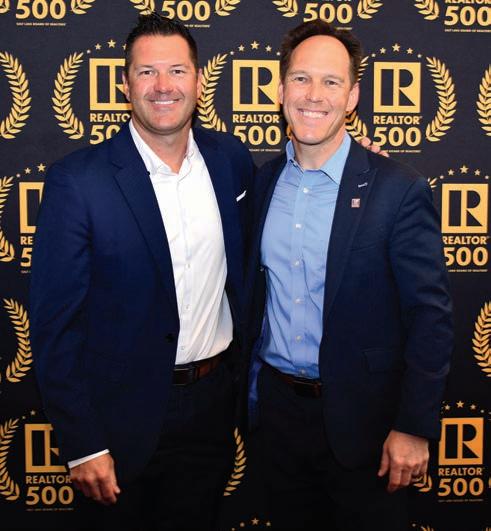
Congratulations to the 2025 Realtor® 500 Top Producers! This exclusive event honored the top-producing Realtor® members of the Salt Lake Board of Realtors®. Attendance was by invitation only and limited to 500 member-agents with the highest gross sales volume, as reported on UtahRealEstate.com, and to qualify, Realtors® had to achieve a minimum of $11.2 million in sales in 2025. The event was held at the Hale Centre Theatre in Sandy.
Photos: Kent Shelton, Dave Anderton
February 2026 Housing Watch
Lake County Home Sales Tick Up Slightly as Inventory Surges
Home sales in Salt Lake County edged slightly higher in February, reaching 830 transactions—up 1% from 821 sales in February 2025. Despite the modest annual gain, activity remains below the seven-year February average of 947 homes sold, reflecting ongoing affordability pressures tied to elevated home prices and mortgage rates.
Inventory, however, showed meaningful improvement. New listings climbed to 1,416 in February, a nearly 23% increase year over year. Meanwhile, pending sales—properties under contract but not yet closed—rose to 997, up 11% compared to the same period last year, signaling continued buyer engagement despite affordability challenges.
Home prices continued to inch upward overall. The median price across all housing types in Salt Lake County reached $540,450, a 1% increase from $535,000 a year earlier. Single-family homes followed a similar trend, with the median price rising 1% to $606,250. In contrast, multifamily properties experienced a notable decline, with median prices falling 5% to $414,900 from $436,900 last year.
Mortgage rate volatility has added another layer of complexity to the market. According to Inman News, rates dropped to their lowest level in more than three years in February. However, geopolitical tensions—specifically a U.S. and Israel military campaign in Iran—pushed gas prices higher and contributed to rising mortgage rates. After dipping to 5.99% near the end of February, rates climbed to 6.62% by March 27, according to Mortgage News Daily.
National housing trends reflect similar dynamics. Existing-home sales declined 1.4% year over year in February, according to the National Association of Realtors® (NAR). At the same time, the median U.S. existing-home price rose 0.3% to $396,800, marking the 32nd consecutive month of annual price increases.
“Housing affordability is improving, and consumers are responding,” said NAR Chief Economist Dr. Lawrence Yun. “Still, there is a long way to go to return to pre-pandemic levels of transaction activity. There are more than 6 million more jobs than in 2019, yet home sales per year are down by one million.”
Homes are also spending more time on the market. Nationally, the typical property remained listed for 47 days in February, up from 46 days in January and 42 days one year ago.
“There are more than 6 million more jobs than in 2019, yet home sales per year are down by one million.”
Lawrence Yun Chief Economist National Association of Realtors®
Salt
Salt Lake County
Local Market Update for February 2026
Source:
TOP 500
Congratulations to our Windermere agents recognized among the Top 500 Salt Lake Board of Realtors® in 2025. We’re proud to support professionals who continue to elevate the standard of excellence in our industry.