

for your client and you.
We’ve mastered “the art” of closing.
Experience peace of mind with Cottonwood Title. We’ve perfected our process and handle all the details to make every transaction a masterpiece. When real estate agents want to create a perfect closing for their clients, they choose Cottonwood Title.





in
in
PRESIDENT
J. SCOTT COLEMERE Colemere Realty Assoc.
1ST VICE PRESIDENT
JANICE SMITH
CB Realty (Union Heights)
2ND VICE PRESIDENT
KIM FARBER Eleven11 Real Estate LLC
TREASURER
RUSS ORCHARD Century 21 Everest
PAST PRESIDENT
CLAIRE LARSON Woodside Homes of Utah LLC
MEMBERS
MORELZA BORATZUK RealtyPath (South Valley)
ERIC SANTISTEVAN Engel & Volkers (Holladay)
KRISTEL GOUGH
Summit Sotheby's (Draper)
LORI KHODADAD
CB Realty (Union Heights)
DONNA POZZUOLI BHHS UP (N. Salt Lake)
CARLYE WEBB
Summit Sotheby's INT (Draper)
BRYAN HURD Real Broker, LLC
TRISH NICHOLS
CB Realty (SL-Sugarhouse)
APPOINTED BOD
TONY KETTERLING Equity RE (Advantage)
LINDA MASCHER Realtypath LLC (Advisors)
PAST PAST PRESIDENT
DAWN STEVENS Real Broker, LLC
Advertising information may be obtained by calling (801) 467-9419 or by visiting www.millspub.com
Managing Editor Dave Anderton
Publisher Mills Publishing, Inc. www.millspub.com
President Dan Miller
Office Administrator Cynthia Bell Snow
Art Director Jackie Medina
Graphic Design
Ken Magleby Patrick Witmer Sales Staff Paula Bell Dan Miller
Salt Lake Board: (801) 542-8840 e-mail: dave@saltlakeboard.com Web Site: www.slrealtors.com
The Salt Lake Board of REALTORS® is pledged to the letter and spirit of U.S. policy for the achievement of equal housing opportunity throughout the nation. We encourage and support the affirmative advertising and marketing program in which there are no barriers to obtaining housing because of race, color, religion, sex, handicap, familial status, or national origin.
The Salt Lake REALTOR is the monthly magazine of the Salt Lake Board of REALTORS . Opinions expressed by writers and persons quoted in articles are their own and do not necessarily reflect positions of the Salt Lake Board of REALTORS®
Permission will be granted in most cases, upon written request, to reprint or reproduce articles and photographs in this issue, provided proper credit is given to The Salt Lake REALTOR as well as to any writers and photographers whose names appear with the articles and photographs. While unsolicited original manuscripts and photographs related to the real estate profession are welcome, no payment is made for their use in the publication.
Views and opinions expressed in the editorial and advertising content of the The Salt Lake REALTOR are not necessarily endorsed by the Salt Lake Board of REALTORS . However, advertisers do make publication of this magazine possible, so consideration of products and services listed is greatly appreciated.
In The Comfort Crisis, author Michael Easter makes a straightforward but unsettling point: modern life is incredibly comfortable, and that comfort may be costing us more than we realize. When everything is easy, we lose some of the resilience, focus, and purpose that come from doing hard things. While the book often centers on physical challenge, its message applies just as clearly to our work, our leadership, and how we serve others.
Real estate has never been more convenient. Technology has simplified transactions, information is everywhere, and many of the physical demands of the job have disappeared. Yet stress, burnout, and disengagement are increasingly common. That isn’t a coincidence. Growth doesn’t come from comfort alone—it comes from challenge.
People are built for effort and responsibility. Not needless suffering, but meaningful difficulty. We think more clearly when we’re solving real problems. We become steadier when we’re pushed beyond what’s easy. Over time, avoiding challenge may feel safe, but it quietly limits our ability to lead, endure, and serve well.
That matters in real estate. We aren’t just facilitating transactions; we’re helping people make some of the biggest financial and emotional decisions of their lives. Doing that well takes more than technical skill. It takes emotional discipline during tense negotiations, moral clarity when shortcuts look tempting, and the stamina to stay consistent when markets are uncertain and deals fall apart.
The Comfort Crisis invites us to bring healthy challenge back into our lives. That might look like making the difficult phone call instead of sending another email. Having the honest conversation instead of avoiding it. Preparing thoroughly rather than scrambling at the last minute. Or taking our health seriously so we can show up with energy when our clients need us most.
There’s also a deeper layer to this idea. Growth rarely comes from ease. Meaning is shaped when we willingly take on responsibility in pursuit of something bigger than ourselves—providing for our families, serving clients with integrity, or contributing to our profession.
As president of the Salt Lake Board of Realtors®, I believe our profession is strongest when we don’t shy away from challenge. Anyone can perform well when conditions are easy. Professionalism shows itself when they’re not. Markets shift. Transactions fail. People struggle. How we respond in those moments defines our character and our credibility. Comfort has its place—but growth lives just beyond it. And if we’re willing to step there, we’ll be better for it—and so will the people we serve.
J. Scott Colemere President
ASSOCIATION OF REALTORS
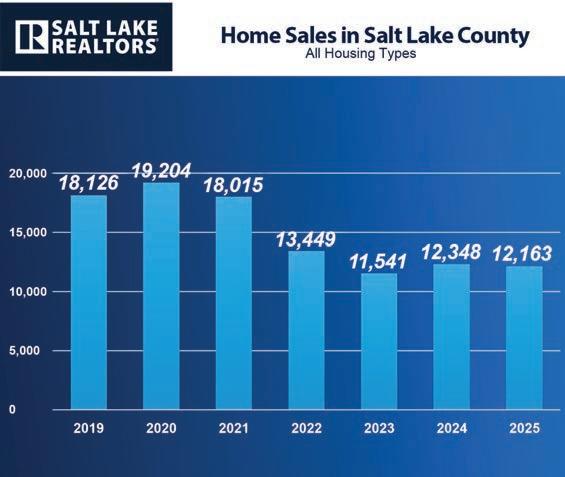
Limited inventory and elevated home prices have contributed to slower home sales. However, when mortgage interest rates climbed from 3.22% in January 2022 to more than 7% by October of that year, sales effectively hit a wall. Prior to the rate spike, the market was remarkably consistent. From 2019 through 2021, Salt Lake County averaged approximately 18,450 home sales per year—reflecting a strong, liquid market with steady buyer and seller activity. Once interest rates began rising in 2022, that dynamic shifted dramatically. From 2022 through 2025, annual sales have averaged about 12,375 homes, roughly 6,000 fewer transactions per year compared to the lower-rate period. This represents nearly a 33% decline in overall transaction volume.
The Salt Lake Board of Realtors® congratulates Joel Carson, broker and owner of Utah Real Estate, on achieving $50,000 in lifetime investment in the Realtors® Political Action Committee (RPAC). Carson, a former U.S. Navy servicemember, has been in the real estate profession for more than 35 years. “Homeownership is a cornerstone of financial stability,” Carson said. “RPAC plays a vital role in opposing policies, such as transfer taxes, that make it harder for families to buy, sell, and keep their homes.” RPAC is one of the key ways Realtors® support candidates who understand these issues and work to protect homeownership. Thank you, Joel, for your continued investment in the real estate profession.
The Wall Street Journal reports that the long-predicted great wealth transfer is now materializing, with real estate playing a major role in shifting wealth from older generations to their heirs over the next decade. According to a new Coldwell Banker Global Luxury trend report, Generation X and millennials are expected to inherit about $4.6 trillion in global real estate, with roughly $2.4 trillion of that located in the United States.
This transfer stems from baby boomers and older, high-networth individuals who have accumulated significant property holdings and are now beginning to pass those assets to younger family members.

Industry professionals — including brokers, attorneys, and family office advisers — say the effects of this shift are already visible in the luxury housing market. Wealthy families are increasingly involving their children in estate and real estate decisions earlier than in past generations, and in some cases are purchasing high-end homes outright for their kids instead of waiting for inheritance. This trend is reshaping luxury demand, with more properties tailored to the preferences of younger buyers.
In major markets like Manhattan and South Florida, family-funded purchases are influencing transaction patterns and price points, particularly in condominium segments that offer flexibility for mobile, globally oriented heirs. Brokers note that the dynamics of these transactions — including ownership structures such as LLCs or trusts — reflect both tax considerations and a desire for long-term investment value.



Members of the Salt Lake Board of Realtors® participated in the RPAC Basketball Tournament at the Delta Center, home of the Utah Jazz. Five teams competed in a double-elimination format. The Zander Team and the Elected Officials Team advanced to the finals, where the Zander Team ultimately claimed the championship. Events like this support RPAC, which plays a vital role in advocating for policies that protect property rights and strengthen the real estate profession.










The U.S. Treasury is projecting refunds will increase by an average of $1,000 per household.
By Eric Goldschein
When homeowners file their 2025 tax returns in spring 2026, many can expect bigger federal refunds than usual.
The U.S. Treasury is projecting refunds will increase by an average of $1,000 per household, thanks to new and expanded tax breaks that took effect for tax year 2025.
The biggest change for homeowners? The SALT (state and local tax) deduction cap quadrupled from $10,000 to $40,000. But not all homeowners will benefit equally—and some may still be better off taking the standard deduction. Here’s how to figure out whether you’re in line for a larger refund
The biggest tax change for homeowners filing their 2025 returns is the expanded SALT deduction. The SALT cap jumped from $10,000 to $40,000 for married couples filing jointly, or from $5,000 to $20,000 for those filing separately.
The SALT deduction allows homeowners who itemize to deduct property taxes plus either state and local income taxes or sales taxes from their federal taxable income. The Tax Cuts and Jobs Act capped this deduction at $10,000 in 2017. The One, Big, Beautiful Bill Act has now raised that cap significantly through 2029, when it reverts to $10,000.
Adding to refunds this year: The IRS didn’t update withholding tables after the OBBBA passed, so employers continued taking out taxes based on the old rules throughout 2025. Workers overpaid all year and will receive the difference in one lump sum.
“A refund just means you paid more tax during the year than you actually had to,” said Spencer Carroll, a certified public accountant and account executive at Gelt. “It’s basically an interest-free loan that you gave the government for months to over a year.”
The standard deduction also increased modestly for
2025, but the expanded SALT cap is the real gamechanger for homeowners in states with high property and income taxes.
Is everyone getting an extra $1,000 this year?
Not exactly. The Treasury projects an average $1,000 increase in refunds per household, and that number is far from guaranteed.
“Taxes are so individual, I would not be able to tell someone definitively that their refund is going to be $1,000 this year,” said Carroll. “The better headline is that people in general will pay less income tax, which is what everybody wants.”
Several changes contribute to this year’s lower tax bills: the modestly higher standard deduction (benefiting the 90% to 95% of taxpayers who don’t itemize), the raised SALT cap for those who do itemize, and an increased child tax credit. How much you personally save depends on your specific situation.
Who benefits most from the expanded SALT cap?
For homeowners specifically, the expanded SALT deduction is the most significant change among the various tax changes, particularly for those in high-tax states.
“Homeowners in high-tax states like New York , New Jersey, and California are far more likely to see meaningful benefits from the SALT expansion than homeowners in lower-tax states,” said Douglas Boneparth, a CFP and president of Bone Fide Wealth. “Higher-income households with large property tax bills and state income taxes stand to benefit the most, while middle-income homeowners may see a more modest bump or none at all.”
Homeowners have a distinct advantage over renters when it comes to the SALT deduction.
“The expanded SALT deduction benefits homeowners more than renters because homeowners typically pay property taxes in addition to state and local income taxes,” Boneparth explained. Renters may indirectly pay property taxes through their rent, but they can’t deduct those costs.
There’s an important income limitation: The $40,000 cap begins phasing down once modified adjusted gross income exceeds $500,000 ($250,000 for married filing separately), eventually reverting to the old $10,000 cap for the highest earners. And to benefit at all, your total itemized deductions must exceed the standard deduction.


To understand the real-world impact, consider a homeowner in a high-tax state like New York paying $18,000 in combined property and state income taxes.
“Under the prior $10,000 SALT cap, $8,000 of those taxes provided no tax benefit,” explained Boneparth. “If the expanded cap allows the full $18,000 to be deducted, that is an additional $8,000 deduction. For someone in the 24% federal tax bracket, that translates to roughly $1,900 in federal tax savings, which often shows up as a larger refund if withholding stayed the same.”
That’s nearly double the Treasury’s projected $1,000 average refund increase—and homeowners paying even more in state and local taxes could see substantially larger refunds. Those in the wealthiest, highest-taxed areas hitting closer to the new $40,000 cap could see refunds several thousand dollars higher than the national average.
For people considering buying their first home, tax deductions can sound like a compelling financial incentive—but the math often doesn’t work the way many assume.
“If I went and bought a home today—yes, I could maybe itemize and deduct my mortgage interest and property taxes, but I’m already getting a standard deduction no matter what,” said Carroll. “I could live on the street, not pay rent, and I’d still get $31,000 as a standard deduction if I’m married. If you’re single, it’s around $15,000.”
Here’s the reality: If you and your partner buy a home and your itemized deductions total $35,000, you only benefit
from the $4,000 difference above the standard deduction. “That $4,000 needs to be multiplied by your marginal tax rate. If it’s 20%, you’re saving $800 on your income tax. That’s less than $100 a month,” Carroll explained.
His bottom line: “You might have just doubled your monthly housing expenses by going from renter to homeowner to save $800 extra on your income taxes. People need to keep in mind it’s just a marginal difference.”
The decision to itemize versus taking the standard deduction comes down to simple math: Add up your mortgage interest, charitable contributions, and allowable SALT deductions, then compare that total to the standard deduction ($31,500 for married couples, $15,750 for singles). If your itemized deductions exceed the standard deduction, itemizing makes sense.
Keep all documentation for property tax payments and state income tax withholding, and consider talking to a CPA about whether you should adjust your withholding for 2026 to avoid another surprise refund. And remember that this provision is temporary, reverting to the $10,000 cap in 2029.
While the Treasury projects an average increased refund across all households, the reality for all of us, especially homeowners, varies dramatically. Those in high-tax states who were squeezed by the old $10,000 cap could see refunds several thousand dollars higher, while homeowners in lower-tax states may see little change at all.
Eric Goldschein is a writer covering real estate, personal finance, and travel trends.


Despite the lackluster sales total for 2025, there are reasons to believe that the coming year will bring improvements.
By Keith Griffith
Home sales rose substantially last month as mortgage rates eased, marking an upbeat coda to an otherwise grim year for the housing market, as full-year sales hit a 30-year low.
Closings on existing homes rose 5.1% in December from the prior month to a seasonally adjusted annual rate of 4.35 million, the largest monthly gain in sales since February 2024, the National Association of Realtors® reported Wednesday.
The December figure was up 1.4% from a year earlier and marked the strongest sales pace in nearly three years.
However, total home sales for full-year 2025 registered at 4.061 million without seasonal adjustment, coming in just 1,000 below the prior year’s sales of 4.062 million.
That marks the lowest annual total since 1995.
Annual home sales have now fallen for three straight years, with each year marking a new low not seen since 1995, when the country had 70 million fewer people than it does today.
Indeed, “2025 was another tough year for homebuyers, marked by record-high home prices and historically low home sales,” said NAR Chief Economist Lawrence Yun. “However, in the fourth quarter, conditions began improving, with lower mortgage rates and slower home price growth.”
December home sales, after adjusting for seasonal factors, were the strongest since February 2023, with all four major regions improving from the prior month, noted Yun.
“Perhaps this is the beginning of the breakout, or maybe it’s a fluke. We have to wait and see what’s going to happen in the upcoming months,” Yun told reporters on a call.
Mortgage rates helped, with the average rate on 30year home loans at 6.19% last month, the lowest in more than a year, according to Freddie Mac
“December homebuyers, who would likely have gone under contract in October and November, benefited from rates near their lowest levels in a year, and fortunately, mortgage rates have not climbed since,” said Realtor.com® Chief Economist Danielle Hale.
Hale expects mortgage rates to remain steady to slightly lower heading into 2026, a trend that should put a firmer floor under sales in the coming year. But affordability remains a challenge, particularly for first-time homebuyers, and home prices continue to rise. The median sales price for existing homes was $405,400 in December, up 0.4% from a year earlier.
Looking at full-year 2025, the median home sales price came in at $414,400, representing a 1.7% annual gain from the prior year.
Total housing inventory available for sale was at 1.18 million at the end of December, down 18.1% from November but up 3.5% from a year earlier.
It represented 3.3 months of supply at the current sales pace, down from 4.2 months in November but slightly above 3.2 months a year ago.
“Inventory levels remain tight,” said Yun. “With fewer sellers feeling eager to move, homeowners are taking their time deciding when to list or delist their homes. Similar to past years, more inventory is expected to come to market beginning in February.”
Indeed, in a weaker market, many sellers are choosing to delist their properties rather than accept offers below their dream price.
Delistings in October rose 45.5% year to date and 37.9% year over year. This makes 2025 the year with the highest national delisting rate since Realtor.com began tracking the metric in 2022.
Despite the lackluster sales total for 2025, there are reasons to believe that the coming year will bring modest and marginal improvements.
Affordability is expected to improve somewhat, with the Realtor.com economic research team forecasting that mortgage rates will average 6.3%, and that incomes will rise faster than home prices.
This is expected to bring the share of median income needed to pay the typical mortgage down to 29.3%, marking the first time it has fallen below 30% since 2022.
That would mark slight improvement, but not a revolution in affordability. To return to 2019 conditions, when mortgage payments consumed 21% of income, it would take sharp, unlikely changes.
Mortgage rates would need to drop to 2.65%, incomes would need to rise 56%, or home prices would need to fall 35%, a recent Realtor.com analysis found.
None of those changes are expected, but the economist Yun said he was hopeful that additional rate cuts from the Federal Reserve in 2026 would bring mortgage rates down by one or two decimal points, which could take rates below 6%.
“Lower mortgage rates always lead to home sales,” he said. “So, it looks like 2026 we will have an increase in home sales.”
Keith Griffith is a journalist at Realtor.com covering housing policy, real estate news, and trends in the residential market.

It is likely it will take seven years for Salt Lake County’s housing prices to finally adjust to the distortion created by the COVID-19 years.
By James Wood Ivory-Boyer Senior Fellow at The Kem C. Gardner Policy Institute
This report was commissioned by the Salt Lake Board of Realtors®
It is likely it will take seven years for Salt Lake County’s housing prices to finally adjust to the distortion created by the COVID-19 years.
By James Wood
Ivory-Boyer Senior Fellow at The Kem C. Gardner Policy Institute
This report was commissioned by the Salt
The housing market has endured two seismic shocks in recent years: first, the Great Recession, and second, the COVID-19 pandemic. Any long-term review of Utah’s real estate history would fail to uncover any comparable events. Both led to extreme but vastly different outcomes. The Great Recession saw the most prolonged loss of real estate values in Utah’s history (Figure 1). Over 18 quarters (4 ½ years) the median sales price of a single -family home in Salt Lake County fell from $256,000 in 2007 to $190,000 in 2012, a 26% drop in value, wiping out about $7 billion of homeowner equity. Over the same period, home sales fell 36%, and the median days on market increased from 19 to 73 days.
Lake Board of Realtors®
The housing market has endured two seismic shocks in recent years: first, the Great Recession, and second, the COVID-19 pandemic. Any long-term review of Utah’s real estate history would fail to uncover any comparable events. Both led to extreme but vastly different outcomes. The Great Recession saw the most prolonged loss of real estate values in Utah’s history (Figure 1). Over 18 quarters (4 ½ years) the median sales price of a single-family home in Salt Lake County fell from $256,000 in 2007 to $190,000 in 2012, a 26% drop in value, wiping out about $7 billion of homeowner equity. Over the same period, home sales fell 36%, and the median days on market increased from 19 to 73 days.
1
Median Sales Price of Single-Family Home in Salt Lake County
$265,000
$255,000
$245,000
$235,000
$225,000
$215,000
listings, and a two-year 40% increase in housing prices all fueled by low mortgage rates and the Federal Reserve’s infusion of five trillion dollars in fiscal stimulus.
The consequences of this Fed-induced two-year boom continued to suppress market conditions in 2025 and will likely carry over into 2026. Residential sales and the median price of a home in Salt Lake County saw little change in 2025. Sales dropped slightly by 2.4% to 11,797 homes, about 300 fewer than in 2024 ( Table 2). Meanwhile, the median sales price for single -family, condominiums, townhomes, and twin homes inched up by 1.9% to $550,000. Over the past three years, housing prices in Salt Lake County have flatlined. From 2022 to 2025, the median price has increased by just 3.8%, from $530,000 to $550,000. Single -family homes account for about 70% of sales in the county, while condominiums, townhomes, and twin homes account for 30%. Median days on market increased from 29 in 2024 to 36 in 2025, suggesting some softening in demand.
Fast forward to 2026. It’s been nearly six years since the COVID-19 outbreak, but the local housing market has yet to escape the pandemic’s long shadow cast by historically low mortgage rates in 2020 and 2021. For 18 months, from July 2020 to December 2021, mortgage rates fell below three percent. Consequently, records were set in sales of existing homes, residential construction activity, housing prices, rate of price increases, days on the market, low level of listings, and a two-year 40% increase in housing prices—all fueled by low mortgage rates and the Federal Reserve’s infusion of five trillion dollars in fiscal stimulus.
The consequences of this Fed-induced two-year boom continued to suppress market conditions in 2025 and will likely carry over into 2026. Residential sales and the median price of a home in Salt Lake County saw little change in 2025. Sales dropped slightly by 2.4% to 11,797 homes, about 300 fewer than in 2024 (Table 2). Meanwhile, the median sales price for single-family, condominiums, townhomes, and twin homes inched up by 1.9% to $550,000. Over the past three years, housing prices in Salt Lake County have flatlined. From 2022 to 2025, the median price has increased by just 3.8%, from $530,000 to $550,000. Single-family homes account for about 70% of sales in the county, while condominiums,
townhomes, and twin homes account for 30%. Median days on market increased from 29 in 2024 to 36 in 2025, suggesting some softening in demand.
Table 2
Summary of 2025 Real Estate Indicators for Salt Lake
Source: UtahRealEstate.com
Since 2000, the population of Salt Lake County has increased from 900,000 to 1.25 million. To accurately compare real estate sales in 2000 with those in 2025, one must adjust for this population growth. This is typically done by measuring, in this case, residential sales per 1,000 population. Real estate sales per 1,000 population have been at their lowest level in the past 25 years, averaging less than 10 per 1,000, and in the past three years sales totaled 9.4, 9.9, and 9.5 per 1,000 population. The 25-year average is 13.7 sales, 44% higher than current levels (Figure 2).
Since 2000, the population of Salt Lake County has increased from 900,000 to 1.25 million. To accurately compare real estate sales in 2000 with those in 2025, one must adjust for this population growth. This is typically done by measuring, in this case, residential Dansker Digital©/Adobe Stock
sales per 1,000 population. Real estate sales per 1,000 population have been at their lowest level in the past 25 years, averaging less than 10 per 1,000, and in the past three years sales totaled 9.4, 9.9, and 9.5 per 1,000 population. The 25-year average is 13.7 sales, 44% higher than current levels (Figure 2).
condominium is about $2,600 less than it was in 2022. Since 2000, the average annual change in the median sales price for single-family homes has been 5.8%, and for condominiums, 5.7%.
Figure 4 depicts the long-term price trends for all types of housing (single -family homes and condominiums, townhomes, and twin homes) in Salt Lake County. From 2012 to 2022, prices rose rapidly, but when mortgage rates rose above 6% in 2023, price increases nearly ceased In fact, the median sales price of a condominium is about $2,600 less than it was in 2022. Since 2000, the average annual change in the median sales price for single -family homes has been 5.8%, and for condominiums, 5.7%.
Figure 4
Median Sales Price of Single-Family Home and Condominium, Townhome
Source: U.S. Census Bureau and UtahRealEstate.com
Source: U.S. Census Bureau and UtahRealEstate.com
Housing Prices Are “Stick y ”
(Average Annual Rate of Change: Single-Family 5.8%, Condominium 5.7%)
$200,000
$100,000
Source: U.S. Census Bureau and UtahRealEstate.com
Housing Prices Are “Stick y ”
(Average Annual Rate of Change: Single -Family 5.8%, Condominium 5.7%)
Source: UtahRealEstate.com
Stable Prices Likely for Two More Years
The median sales price of a home in Salt Lake County increased 40% in two years (2020 to 2022), the strongest price surge in Utah’s real estate history. This unprecedented increase, coupled with the pandemic’s impact on demand and the doubling of mortgage rates in 2022, led to the prevailing view that housing prices were in for a severe decline in 2023. It did not happen. Prices fell a scant 2.8% (Figure 3). Severe price declines occur only during prolonged recessions, accompanied with job losses and foreclosures. Nevertheless, price increases have stabilized as the market catches its breath following the recent historic rise.
$108,000 $427,375 $0
The median sales price of a home in Salt Lake County increased 40% in two years (2020 to 2022), the strongest price surge in Utah's real estate history. This unprecedented increase, coupled with the pandemic's impact on demand and the doubling of mortgage rates in 2022, led to the prevailing view that housing prices were in for a severe decline in 2023. It did not happen. Prices fell a scant 2.8% (Figure 3). Severe price declines occur only during prolonged recessions, accompanied with job losses and foreclosures. Nevertheless, price increases have stabilized as the market catches its breath following the recent historic rise.
The median sales price of a home in Salt Lake County increased 40% in two years (2020 to 2022), the strongest price surge in Utah's real estate history. This unprecedented increase, coupled with the pandemic's impact on demand and the doubling of mortgage rates in 2022, led to the prevailing view that housing prices were in for a severe decline in 2023. It did not happen. Prices fell a scant 2.8% (Figure 3). Severe price declines occur only during prolonged recessions, accompanied with job losses and foreclosures. Nevertheless, price increases have stabilized as the market catches its breath following the recent historic rise.
Figure 3
Annual Percent Change in Median Sales Price of Home*/Salt Lake County
Source: UtahRealEstate.com
In the aftermath of the Great Recession it took seven years, from the third quarter of 2007 to the third quarter of 2014, for the median sales price of a single-family home to recover to its pre-recession level of $256,000. It is likely it will take seven years, two record-breaking years and five slow-growth years, for Salt Lake County’s housing prices to finally adjust to the distortion created by the COVID-19 years. Figure 2 Residential Real Estate Sales/1,000 Population
A comparison of actual price increases (2020-2025) to a hypothetical increase that assumes the absence of COVID and historically low interest rates shows that the actual and hypothetical median prices will nearly converge by 2027 at about $564,000 (Figure 5). The hypothetical price assumes a 5.8% annual growth rate (historical rate) from $380,000 in 2020 to 2027. Using the historic growth rate, the median price would be $564,000 in 2027. And if the actual increase continues at the recent pace of around 2% annually, the median home sale price in Salt Lake County would be $572,200 in 2027. In other words, by 2027, time will offset the COVID-19 price surge, and the local market will return to near normal price levels.
In the aftermath of the Great Recession it took seven years, from the third quarter of 2007 to the third quarter of 2014, for the median sales price of a single-family home to recover to its prerecession level of $256,000. It is likely it will take seven years, two record-breaking years and five slow-growth years, for Salt Lake County’s housing prices to finally adjust to the distortion created by the COVID-19 years.
A comparison of actual price increases (2020-2025) to a hypothetical increase that assumes the absence of COVID and historically low interest rates shows that the actual and hypothetical median prices will nearly converge by 2027 at about $564,000 (Figure 5). The hypothetical price assumes a 5.8% annual growth rate (historical rate) from $380,000 in 2020 to 2027. Using the historic growth rate, the median price would be $564,000 in 2027. And if the actual increase continues at the recent pace of around 2% annually, the median home sale price in Salt Lake County would be $572,200 in 2027. In other words, by 2027, time will offset the COVID-19 price surge, and the local market will return to near normal price levels.
*Includes single -family homes, condominiums, townhomes, and twin homes.
*Includes single -family homes, condominiums, townhomes, and twin homes.
Source: UtahRealEstate.com
*Includes single-family homes, condominiums, townhomes, and twin homes.
Source: UtahRealEstate.com
Figure 4 depicts the long-term price trends for all types of housing (single-family homes and condominiums, townhomes, and twin homes) in Salt Lake County. From 2012 to 2022, prices rose rapidly, but when mortgage rates rose above 6% in 2023, price increases nearly ceased. In fact, the median sales price of a
(f) forecast
Source: UtahRealEstate.com
Affordability has led to a significant decline in homeownership among young households (ages 25 to 34) in Salt Lake County. The increase in prices, along with higher mortgage rates, prevents many young households from becoming homeowners. In 2000, nearly 53% of households with householder aged 25 to 34 years were homeowners. That percentage dropped to 39% in 2024, totaling 34,881 households, about the same share as the nation (Figure 6). Since 2000, the number of young households has increased by 48%, 25,000 households, but the number of young homeowners is nearly unchanged at about 35,000 households.
Figure 6
ordability has led to a significant decline in homeownership among young households (ages to 34) in Salt Lake County. The increase in prices, along with higher mortgage rates, prevents many young households from becoming homeowners. In 2000, nearly 53% of households with householder aged 25 to 34 years were homeowners. That percentage dropped to 39% in 2024, totaling 34,881 households, about the same share as the nation (Figure 6). Since 2000, the number of young households has increased by 48%, 25,000 households, but the number of young homeowners is nearly unchanged at about 35,000 households.
Homeowners as a Share of Young Households in Salt Lake County (head of household 25-34 years old)
In 2025, Salt Lake County’s median sales price for a single-family home was $620,000. Of the thirteen cities in the county, Draper has the highest median price of $990,000 registering a modest increase in 2025 of 3% Table 3. However, since 2020 the median price in the city has increased by 57.9%, the largest five-year increase of the thirteen cities. Of course, comparing housing prices by city doesn’t capture the wide range of home prices in a city’s neighborhoods, but it does provide a reasonable measure of the overall increase in home values.
Table 3
Salt Lake County US
Source: U.S. Census Bureau.
Source: U.S. Census Bureau. $530,000
Median Sales Price of Single-Family Home in Cities of Salt Lake County
In the current high-interest rate environment, home sales in Salt Lake County received a boost from cash buyers. Higher interest rates do not deter cash buyers. In 2025, 16% of all home sales in Salt Lake County were cash purchases, totaling 2,013 homes. Statewide, cash sales accounted for 17.1% of residential sales in 2025, totaling 6,703 sales Figure 6 The increase in cash sales likely reflects a greater presence of investors in the local market and also the beginning of the “Great Wealth Transfer” as the baby boom generation passes on its wealth to its heirs, in some cases in the form homeownership.
In the current high-interest rate environment, home sales in Salt Lake County received a boost from cash buyers. Higher interest rates do not deter cash buyers. In 2025, 16% of all home sales in Salt Lake County were cash purchases, totaling 2,013 homes. Statewide, cash sales accounted for 17.1% of residential sales in 2025, totaling 6,703 sales Figure 6. The increase in cash sales likely reflects a greater presence of investors in the local market and also the beginning of the “Great Wealth Transfer” as the baby boom generation passes on its wealth to its heirs, in some cases in the form homeownership.
Figure 7
Percent of Cash Residential Real Estate Sales
Source: UtahRealEstate.com
2025, Salt Lake County’s
thirteen cities in the county, Draper has
Source: UtahRealEstate.com
Source: UtahRealEstate.com
rate forecasts for 2026 are tightly bunched
Source: UtahRealEstate.com
Mortgage rate forecasts for 2026 are tightly bunched around a 6% average. Wells Fargo has the highest forecast at 6.2% while Fannie Mae and the National Association of Realtors have average rates of 6.0% Table 4.
Mortgage rate forecasts for 2026 are tightly bunched around a 6% average. Wells Fargo has the highest forecast at 6.2% while Fannie Mae and the National Association of Realtors have average rates of 6.0% Table 4.
Table 4
Mortgage Rate Forecast, 2026
Mortgage rates are affected by several factors beyond

two percent, and listings were up ten percent; all conditions of a market trying to regain its footing after the three -year unprecedented impact of the pandemic Table 5.
rates, but mortgage rates went in the opposite direction due to the capital market's long-term inflation expectations for the U.S. economy.
Table 5
Residential sales were at low levels in 2025, median prices were up less than two percent, and listings were up ten percent; all conditions of a market trying to regain its footing after the three -year unprecedented impact of the pandemic Table 5.
were up less than two percent, and listings were up ten percent; all conditions of a market trying to regain its footing after the three-year unprecedented impact of the pandemic Table 5.
Fore
Mortgage rates are affected by several factors beyond the Federal Reserve’s monetary policy. The Federal Reserve’s policy affects short-term rates by lowering the federal funds rate. Mortgage rates are long-term rates and loosely tied to the ten-year treasury yield, which runs a little over two percent below mortgage rates. When the 10-year treasury rate goes up, mortgage rates tend to follow and vice versa. The ten-year rate reflects the bond market’s expectations for the Federal Reserve’s monetary policy, fiscal policy, inflation outlook, trade policy, consumer sentiment, and the job market. Consequently, the Federal Reserve can lower short-term rates, but that may have little impact on mortgage rates. In fact, in 2025, the Fed lowered short-term rates, but mortgage rates went in the opposite direction due to the capital market’s long-term inflation expectations for the U.S. economy.
Uncertain economic conditions, slowing demographic growth, and interest rate lock combine for market headwinds, while slightly lower interest rates give a little tailwind to demand. Prices remain very stable with a projected two to three percent increase. Slight improvement in sales, up 2.5%, with the median price nearly unchanged Table 6.
MarketHeadwinds
Uncertain economic conditions, slowing demographic growth, and interest rate lock combine for market headwinds, while slightly lower interest rates give a little tailwind to demand. Prices remain very stable with a projected two to three percent increase. Slight improvement in sales, up 2.5%, with the median price nearly unchanged Table 6.
Uncertain economic conditions, slowing demographic growth, and interest rate lock combine for market headwinds, while slightly lower interest rates give a little tailwind to demand. Prices remain very stable with a projected two to three percent increase. Slight improvement in sales, up 2.5%, with the median price nearly unchanged Table 6.
Slowing Utah economy and economic uncertainty. Jobs up 1.5% on 27,000 jobs, the weakest job market since the Great Recession.
Table 6 Forecast for 2026
Slowing net migration rate to 19,000 individuals, over 30,000 two years ago.
Interest-rate lock, over 61% of mortgage holders have mortgage rates at below 4%
MarketHeadwinds
MarketTailwinds
More favorable mortgage rates, low 6% range
Fourth year of recovery from the pandemic
Slowing Utah economy and economic uncertainty. Jobs up 1.5% on 27,000 jobs, the weakest job market since the Great Recession.
Favorable age structure of the population, relatively high share of young households
Residential sales
Single -family – 8,600 units, up 2%
Slowing net migration rate to 19,000 individuals, over 30,000 two years ago.
Interest-rate lock, over 61% of mortgage holders have mortgage rates at below 4%
MarketTailwinds
Condominium, townhome, twin home – 3,500 units, up 3%
Total 12,100 units, up 2.5%
Median sales price
Single -family - $630,000, up 1.3%
More favorable mortgage rates, low 6% range
Fourth year of recovery from the pandemic
Favorable age structure of the population, relatively high share of young households
Condominium, townhome, twin home - $440,000 up 3%
Total - $627,000 up 1%
Residential sales
Single -family – 8,600 units, up 2%
Condominium, townhome, twin home – 3,500 units, up 3%
Total 12,100 units, up 2.5%
Median sales price
Single -family - $630,000, up 1.3%
Condominium, townhome, twin home - $440,000 up 3%
Total - $627,000 up 1%


Homeowners who recently sold their residences had owned them for an average of 8.55 years, marking the longest tenure level in at least 25 years.
By Snejana Farberov
U.S. homeowners are staying in their homes longer than at any point in at least a quarter-century, particularly in expensive coastal markets—and when they finally sell, they favor all-cash buyers
In the fourth quarter of 2025, homeowners who sold their residences had owned them for an average of 8.55 years, up from 8.39 years the previous quarter, marking the longest tenure level in at least 25 years, according to the latest report from real estate data firm ATTOM
The authors of the analysis attribute the low level of inventory turnover in part to elevated mortgage rates stuck above 6%, which have discouraged many homeowners—especially those “locked in” to much lower pandemic-era rates—from selling.
“At the same time, tight housing inventory and stillhigh home prices have made trading up or relocating more difficult, keeping owners in place longer,”
according to the report.
Realtor.com® Senior Economic Research Analyst Hannah Jones confirms that near-record homeownership tenure reflects a housing market defined by affordability stress, limited supply, and strong lock-in effects—an environment that offers owners few reasons to move.
“With home prices elevated and mortgage rates well above pandemic lows, many homeowners see few compelling reasons to move,” said Jones. “For a large share of owners, selling would mean giving up a low mortgage rate and replacing it with a substantially higher monthly payment, even if they downsize or make a lateral move.”
On the other hand, all-cash sales surpassed 39% in 2025, reaching the highest level since 2013, suggesting that investors and other buyers not reliant on financing had a clear edge with sellers.
Coastal states see longest homeownership tenures
Housing turnover varies widely by region, with pricey coastal markets posting the highest rates of homeownership tenure at the end of last year, led by Massachusetts, where the average tenure was 13.29 years—up more than 4% compared to Q4 2024.
Connecticut ranked second, with the average homeowner there remaining in their home 13.02 years.
“Many homeowners have mortgage rates that are below 4%, and they have been reluctant to move given their low payments,” Carl Lantz, a West Hartford, CTbased real estate agent at Coldwell Banker Realty, told Realtor.com. “That, coupled with rising prices, make a move even tougher.”
Lantz noted that while long-time homeowners may have seen significant appreciation in their homes, it offers little benefit in today’s market.
“It’s hard to make use of it both with the rates on loans and the fact that a move up would also be at a higher price,” he said.
Another issue contributing to low inventory turnover in Connecticut is that many older people are choosing to age in place rather than downsize.
“They see the higher prices on smaller homes and feel like it’s too expensive to move, even though their current home is likely worth significantly more than when they bought it,” said Lantz.
California came in third in ATTOM’s Q4 ranking, with an average homeownership tenure of 11.24 years, up 4.8% year over year, followed by Rhode Island, at 11.04 years, with Washington rounding out the top five, at 10.86 years.
On the other side of the spectrum, Maine boasted the nation’s lowest average homeownership tenure of just 4.8 years, followed by Mississippi and South Dakota, both at 5.95 years; Georgia at 6.35 years; and West Virginia at 6.39 years.
What’s keeping owners in place?
“That the longest homeownership tenures are concentrated in coastal states such as Massachusetts, Connecticut, and California points to structural supply constraints and high replacement costs, not just short-term market conditions,” said Jones.
“These states tend to have some of the nation’s highest home prices, stricter land-use regulations, and limited
opportunities for large-scale new construction. As a result, moving within these markets often implies a meaningful step up in housing costs.”
Lock-in effects are especially strong in coastal markets because many homeowners snagged historically low mortgage rates during the pandemic. In high-priced metros, the gap between existing mortgage payments and the cost of buying a comparable home today is particularly wide, discouraging mobility.
“The result is persistently low turnover, longer tenure, and continued pressure on housing supply,” said Jones, adding that this dynamic is most challenging for firsttime buyers looking to break into the market without the benefit of existing equity.
Low resale activity keeps inventory tight, especially in entry-level price ranges, while prices remain elevated because of scarce housing supply.
At the metro low, Barnstable, MA—the largest town on Cape Cod with constrained housing inventory and sky-high prices—had the nation’s highest homeownership tenure of 14.12 years. Springfield, MA, ranked second at 13.49 years, followed by, New Haven, CT, at 13.37 years; Bridgeport, CT, at 13.2 year; and Hartford, CT, at 13.15 years.
Lantz said for homeowners in Connecticut to consider moving, mortgage rates would need to fall enough that they are no longer feeling locked in by their current lower rates.
There were some positive signs in the third quarter of 2025, as homeowners with mortgages above 6% outnumbered those with rates below 3%, indicating that some were swapping lower-rate loans for higher ones.
Snejana Farberov is a reporter at Realtor.com covering the U.S. housing market and the latest domestic real estate trends.


Salt Lake City home prices hit $596K, ranking 27th most expensive among 230 metros.
By The National Association of Realtors®
Home prices rose in 73% of metro markets (168 out of 230) during the fourth quarter of 2025, according to the National Association of Realtors®’ latest quarterly report. This is down from 77% in the third quarter. Five percent of metro areas (12 out of 230) recorded doubledigit price gains, up slightly from 4% last quarter. The report provides the real estate ecosystem—including agents and homebuyers and sellers—with quarterly metro-area data on median home prices and housing affordability.
The national median single-family existing-home price grew 1.2% year over year to $414,900, down from 1.7% annual growth in the third quarter.
Median existing single-family home price by region (year-over-year change)
• Northeast: $514,600 (+5.5%)
• Midwest: $317,100 (+4.3%)
• South: $367,300 (+0.2%)
• West: $625,800 (-1.2%)
“Home sales squeaked out a gain in the final quarter of 2025, helped by improving affordability conditions,” said NAR Chief Economist Lawrence Yun. “Mortgage rates fell, income growth outpaced home price growth, and the income required to buy a typical home declined.”
“While most metro markets continue to see record-high housing wealth, some areas are experiencing home price declines,” Yun added. “These declining markets are concentrated primarily in Florida and Texas, where robust supply and recent home construction are increasing competition among sellers to attract buyers.”
10 large markets with biggest year-over-year median price increases
1. Mobile, Ala. (+13.7%)
2. Canton-Massillon, Ohio (+9.8%)
3. Nassau County-Suffolk County, N.Y. (+9.6%)
4. Montgomery, Ala. (+9.4%)
5. St. Louis, Mo.-Ill. (+9.1%)
6. Shreveport-Bossier City, La. (+8.4%)
7. Youngstown-Warren-Boardman, Ohio-Pa. (+8.3%)
8. Providence-Warwick, R.I.-Mass. (+8.2%)
9. Fort Wayne, Ind. (+8.0%)
10. Hartford-West Hartford-East Hartford, Conn. (+8.0%)
10 most expensive markets
1. San Jose-Sunnyvale-Santa Clara, Calif. ($1,920,000; 0.0%)
2. Anaheim-Santa Ana-Irvine, Calif. ($1,396,500; +2.7%)
3. San Francisco-Oakland-Hayward, Calif. ($1,305,000; -0.8%)
4. Urban Honolulu, Hawaii ($1,142,100; +3.5%)
5. San Diego-Carlsbad, Calif. ($994,000; +0.9%)
6. Salinas, Calif. ($995,500; +1.2%)
7. Los Angeles-Long Beach-Glendale, Calif. ($939,700; 0.0%)
8. Oxnard-Thousand Oaks-Ventura, Calif. ($936,700; +1.8%)
9. San Luis Obispo-Paso Robles, Calif. ($917,100; -1.1%)
10. Nassau County-Suffolk County, N.Y. ($818,800; +9.6%)
Housing affordability
• 25% of markets experienced declining home prices
o Up from 23% last quarter
• $2,057: monthly mortgage payment on a typical existing single-family home with a 20% down payment
o 5.7% decrease from the previous quarter
o 3.1% decrease year over year
• 22.9%: average share of income typical families spent on mortgage payments
o Down from 24.5% last quarter
o Down from 24.7% last year
First-time buyers
• $2,019: the monthly mortgage payment for a typical starter home valued at $352,700 with a 10% down payment
• $122 decrease from last quarter
• $62 decrease from last year
• 34.6%: share of income first-time buyers spent on

monthly mortgage payments
• Down from 37.0% last quarter
• Down from 37.3% last year
The National Association of Realtors® is involved in all aspects of residential and commercial real estate. The term Realtor® is a registered collective membership mark that identifies a real estate professional who is a member of the National Association of Realtors® and subscribes to its strict Code of Ethics. For free consumer guides about navigating the homebuying and selling transaction processes – from written buyer agreements to negotiating compensation – visit facts.realtor.
NOTE: NAR releases quarterly median single-family price data for approximately 230 Metropolitan Statistical Areas (MSAs). In some cases, the MSA prices may not coincide with data released by state and local Realtor® associations. Any discrepancy may be due to differences in geographic coverage, product mix, and timing. In the event of discrepancies, Realtors® are advised that for business purposes, local data from their association may be more relevant.
Data tables for MSA home prices (single-family and condo) are posted at https://www.nar.realtor/researchand-statistics/housing-statistics/metropolitan-medianarea-prices-and-affordability. If insufficient data is reported for an MSA in a particular quarter, it is listed as N/A. For areas not covered in the tables, please contact the local association of Realtors®.
Areas are generally metropolitan statistical areas as defined by the U.S. Office of Management and Budget.
NAR adheres to the OMB definitions, although in some areas an exact match is not possible from the available data. A list of counties included in MSA definitions is available at: https://www.census.gov/geographies/ reference-files/time-series/demo/metro-micro/ delineation-files.html.
Regional median home prices are from a separate sampling that includes rural areas and portions of some smaller metros that are not included in this report; the regional percentage changes do not necessarily parallel changes in the larger metro areas. The only valid comparisons for median prices are with the same period a year earlier due to seasonality in buying patterns. Quarter-to-quarter comparisons do not compensate for seasonal changes, especially for the timing of family buying patterns.
Median price measurement reflects the types of homes that are selling during the quarter and can be skewed at times by changes in the sales mix. For example, changes in the level of distressed sales, which are heavily discounted, can vary notably in given markets and may affect percentage comparisons. Annual price measures generally smooth out any quarterly swings.
NAR began tracking of metropolitan area median single-family home prices in 1979; the metro area condo price series dates back to 1989.
The seasonally adjusted annual rate for a particular quarter represents what the total number of actual sales for a year would be if the relative sales pace for that quarter was maintained for four consecutive quarters. Total home sales include single-family, townhomes, condominiums and co-operative housing.


Salt Lake County home sales delivered a welcome holiday surprise in December, posting a 6.12% year-over-year increase. Single-family homes led the gains, with sales rising 8.15%, while multi-family transactions edged up to 269 sales, compared to 268 one year earlier.
New listings also increased, climbing 9.84% to 770 homes, up from 701 listings in December 2024. Under-contract listings dipped slightly to 726, down 2.81% from 747 a year earlier. Active inventory continued its upward trend, reaching 2,478 listings, compared to 2,116 year over year—signaling gradual improvement in housing supply.
Prices remained firm. The median sold price for all housing types rose to $552,663, a 3.30% increase from last year. Single-family home prices showed stronger appreciation, with the median climbing to $630,000, up 6.08%. In contrast, the median multi-family price declined 3.77% to $420,000, suggesting increased price sensitivity among entry-level and investor buyers.
Nationally, existing home sales increased 1.4% year over year in December, according to the National Association of Realtors®.
“2025 was another tough year for homebuyers, marked by record-high home prices and historically low home sales,” said NAR Chief Economist Lawrence Yun. “However, in the fourth quarter, conditions began improving, with lower mortgage rates and slower home price growth. December home sales, after adjusting for seasonal factors, were the strongest in nearly three years.”
Mortgage rates likely played a key role in the December bump. The average 30-year fixed-rate mortgage fell to 6.19%, according to Freddie Mac, down from 6.24% in November and 6.72% one year earlier. Even modest rate declines can unlock pent-up demand, especially among buyers who delayed purchases earlier in the year.
The national median home price reached $405,400, up 0.4% year over year, marking the 30th consecutive month of price increases.
“Inventory levels remain tight,” Yun added. “With fewer sellers eager to move, homeowners are taking their time deciding when to list. Similar to past years, more inventory is expected to come to market beginning in February.”
“December home sales, after adjusting for seasonal factors, were the strongest in nearly three years.”
Lawrence Yun
Chief Economist National Association of Realtors®
Pamela Abbott
Judy Allen
Suzanne Allred
George Anastasopoulos
Brent Anderson
Clay Anderson
Diane Anderson
Sue Avalos
Margaret Averett
Laurence Bailess
Les Bailey
Blair Bangerter
Brent Barnum
Veda Barrie-Weatherbee
Steven Barton
Edward Belka
Ken Bell
Raymond Bennett
Richard C. Bennion
Gregg Bohling
Russell Booth
Virginia Bostrom
Robert Bowles
Mary Ann Brady
Stephen Bryant
Stephen Bullock
Barbara Burt
Hedy Calabrese
Susan Calderon
Gary Cannon
Tracey Cannon
Julie Carli
Carol Cetraro
Scott Chapman
Garn Christensen
Byron Christiansen
Scott Claffey
David Clark
Deborah Clark
John Collins
Terry Cononelos
Jeffery Cook
Philip Craig
Kaye Cundick
Butch Dailey
Jaren Davis
Robert Davis
Brian De Haan
Babs De Lay
Lynn Despain
Jerard Dinkelman
Sally Domichel
Rebecca Duberow
James Dunn
Carol Edgmon
Douglas Edmunds
Michael Evertsen
Bijan Fakhrieh
Robert Farnsworth
Jack Fisher
Gale Frandsen
David Frederickson
Howard Freiss
Martin Gale
Brent Gardner
Heidi Gardner
Paul Gardner
Arthur Gayler
Linda Geer
Sheila Gelman
J. Carolyn Gezon
Anna Grace Sperry
Richard Grow
Klair Gunn
James Haines
John Hamilton
Mark Handy
Grant Harrison
Michael Hatch
Thomas Haycock
Jeanne Hayes
Bill Heiner
Jeffrey Helotes
Marvin Hendrickson
Terry Hill-Black
Lynda Hobson
Sheryl Holmes
Carol Howell
Gary Huntsman
Blake Ingram
Kent Ingram
Esther Israelson
Kevin Jensen
Ron Jenson
Jeffrey Jonas
Steven Judd
David Kenney
Henry Kesler
Douglas Knight
Peggy Knight
Randall Krantz
Leah Krueger
Gary Larson
Teresa Larson
Vann Larson
Fred Law
Michael Lawrence
Shauna Leake
Kaye LeCheminant
Daniel Lindberg
Michael Lindsay
Mildred Llewelyn
Daniel Lofgren
Don Louie
Ted Makris
Margaret Malherbe
Anthony Manning
Al Mansell
David Mansell
Dennis Marchant
Susan Mark-Lunde
Paul Markosian
Ronnald Marshall
Susie Martindale
Christopher McCandless
Curtis McDougal
Miriam McFadden
John McGee
Russell McKague
Andrew McNeil
Elizabeth Memmott
Uwe Michel
Gordon Milar
Kyle Miller
Preston Miller
David Moench
Gary Monk
H. Craig Moody
Randall Moore
Thomas Morgan
Klew Mori
Charles Mulford
Melanie Mumford
Jacqueline Nicholl
John Nielson
Robyn Nielson
Victor Oishi
Joseph Olschewski
Brent Parsons
Joan Pate
Derk Pehrson
Douglas Pell
Scott Pexton
Robert Plumb
David Read
George Richards
W. Kalmar Robbins
Emilie Rogan
Marie Rosol
Christopher Ross
Shelley Rozema
David Sampson
Mark Schneggenburger
David Seiler
Gary Shiner
Michael Shipler
Jeff Sidwell
Kent Singleton
Debra Sjoblom
Elizabeth Smith
Glen Smith
Kenneth Smith
Rick Smith
Skip Smith
Lorenzo Spencer
Kenneth Sperling
Robert Spicer
Trudi Stark
Lee Stern
Sandra Straley
Gary Strang
John Strasser
Kevin Strong
Thomas Swallow
Sonny Tangaro
Joan Taylor
Rosanne Terry
Martin Vander Veur
Craig Vierig
H. Blaine Walker
Hilea Walker
Dana Walton
Jerry Webber
William Wegener
David Weissman
Jeffrey Wells
Jeff White
Clayton Wilkinson
Thomas Wilkinson
Kimball Willey
Robert Wiskirchen
James Witherspoon
Linda Wolcott
Cynthia Wood
Margene Wrigley

BMW X3.
When you pair “adventure ready” with “city savvy,” you’ll find a vehicle that lives at the intersection of downtown avenues and mountain roads: the BMW X3.
With a reimagined design and sporty handling, the latest iteration of this icon doesn’t just tackle any journey with ease; it draws attention while doing it.
And it wouldn’t earn the X3 name without versatility at its heart and a premium interior that makes it unmistakably BMW.
Visit BMW of Murray or BMW of Pleasant Grove for exceptional offers on the BMW X3.
BMW of Murray
4735 S. State Street
Murray, Utah
801-262-2479
bmwofmurray.com
BMW of Pleasant Grove 2111 West Grove Parkway
Pleasant Grove, Utah
801-443-2000
bmwofpg.com