Realtor® Magazine is self-supporting. The advertisers in this magazine pay for all production and distribution costs. Help support this magazine by advertising. For advertising rates, please contact Mills Publishing at 801.467.9419. The paper used in Salt
Magazine comes from trees in managed timberlands. These
are
Counting No’s
COLEMERE Colemere Realty Assoc.
1ST
JANICE SMITH
CB Realty (Union Heights)
2ND VICE PRESIDENT
KIM FARBER Eleven11 Real Estate LLC
TREASURER
RUSS ORCHARD Century 21 Everest
PAST PRESIDENT
CLAIRE LARSON
Woodside Homes of Utah LLC
MEMBERS
MORELZA BORATZUK RealtyPath (South Valley)
ERIC SANTISTEVAN Engel & Volkers (Holladay)
KRISTEL GOUGH
Summit Sotheby's (Draper)
LORI KHODADAD
CB Realty (Union Heights)
DONNA POZZUOLI BHHS UP (N. Salt Lake)
CARLYE WEBB
Summit Sotheby's INT (Draper)
BRYAN HURD Real Broker, LLC
TRISH NICHOLS
CB Realty (SL-Sugarhouse)
APPOINTED BOD
TONY KETTERLING Equity RE (Advantage)
LINDA MASCHER Realtypath LLC (Advisors)
PAST PAST PRESIDENT
DAWN STEVENS Real Broker, LLC
Advertising information may be obtained by calling (801) 467-9419 or by visiting www.millspub.com
Publisher Mills Publishing, Inc. www.millspub.com President Dan Miller
Office Administrator Cynthia Bell Snow
Art Director Jackie Medina
Salt Lake Board: (801) 542-8840 e-mail: dave@saltlakeboard.com Web Site: www.slrealtors.com
quoted in articles are their own and do not necessarily reflect positions of the Salt Lake Board of REALTORS® Permission will be granted in most cases, upon written request, to reprint or reproduce articles and photographs in this issue, provided proper credit is given to The Salt Lake REALTOR as well as to any writers and photographers whose names appear with the articles and photographs. While unsolicited original manuscripts and photographs related to the real estate profession are welcome, no payment is made for their use in the publication.
Views and opinions expressed in the editorial and advertising content of the The Salt Lake REALTOR are not necessarily endorsed by the Salt Lake Board of REALTORS . However, advertisers do make publication of this magazine possible, so consideration of products and services listed is greatly appreciated.
We spend a surprising amount of our lives trying to stay comfortable.
We stick to familiar routines, safe decisions, and the quiet reassurance of knowing what tomorrow will look like. Comfort can feel like stability. But psychologically speaking, it’s often where growth quietly stalls.
More than a century ago, psychologists Robert Yerkes and John Dillingham Dodson discovered something counterintuitive: performance improves when we experience a moderate level of stress or challenge. Too little pressure and we disengage. Too much and we panic. But in the middle—what researchers call the “stretch zone”—people tend to do their best thinking, learning, and creating.
In other words, the comfort zone may feel safe, but it’s rarely where the interesting things happen.
I learned that lesson early in my real estate career.
Like many new agents, I quickly discovered that prospecting wasn’t just difficult—it was intimidating. Calling strangers, introducing myself, and asking for business pushed me well outside my comfort zone. Every “no” felt personal, and after a few in a row it was tempting to avoid the phone altogether.
So I changed the game.
Instead of chasing “yes,” I decided to see how many “no’s” I could collect in a day. Rejection became the goal.
Almost immediately, the pressure disappeared. Each “no” wasn’t failure anymore—it was progress. And somewhere in the middle of those no’s, the yeses started to appear.
The lesson turned out to be bigger than prospecting. Growth rarely comes from avoiding discomfort. It comes from stepping into it.
Research backs this up. Cornell psychologist Thomas Gilovich found that over time people regret the things they didn’t do far more than the things they tried and failed at. A bad decision fades into a story. The road not taken lingers as a question.
Psychologist Albert Bandura found something similar in his work on selfefficacy: confidence rarely comes before action. It develops afterward. We often wait until we feel ready to take a step forward, when in reality the step itself is what creates readiness.
So maybe the goal isn’t to become fearless. It’s simply to be a little braver than yesterday.
Because in this profession—where conversations create opportunities and persistence builds careers—the agents who succeed aren’t the ones who stay comfortable. They’re the ones willing to make the call, ask the question, and collect a few “no’s” on the way to a meaningful “yes.”
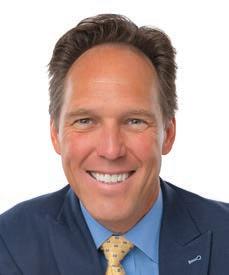
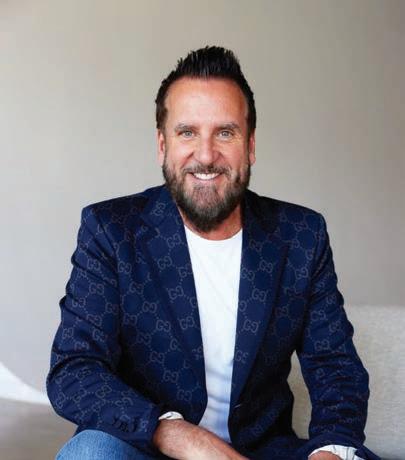
J. Scott Colemere President
REALTOR
The Salt Lake Board of REALTORS® is pledged to the letter and spirit of U.S. policy for the achievement of equal housing opportunity throughout the nation. We encourage and support the
Happenings
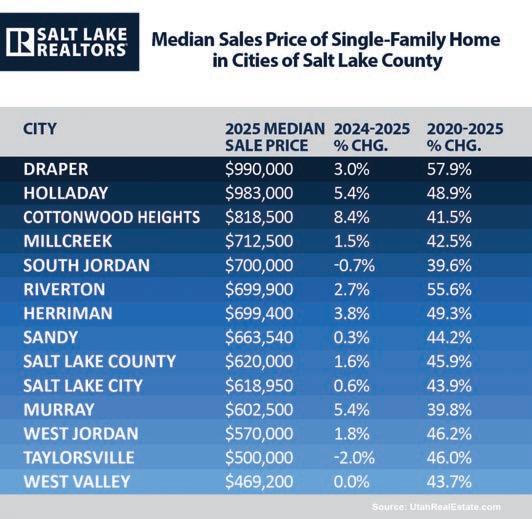
Salt Lake County House Prices Cool After Years of Rapid Growth
The rapid house-price acceleration that defined recent years began to ease in 2025, as Salt Lake County’s housing market showed clear signs of stabilizing. The median sales price for a singlefamily home reached $620,000, reflecting a market that has shifted from aggressive growth to measured balance. Among the cities analyzed, Draper recorded the highest median price at $990,000, marking a 3% increase year over year. While that annual gain was modest, the longer-term trend tells a more dramatic story: since 2020, Draper’s median home price has climbed nearly 58%, the strongest five-year appreciation in the group. Across most cities, year-over-year price changes were moderate, signaling a broader cooling after several years of rapid escalation.
First-Time Donors Step Up at Charity Committee Blood Drive
The Charity Committee hosted a blood drive Feb. 20 at the Realtor® Campus in partnership with the American Red Cross. According to committee chair Ashley Tuft, the event welcomed 23 first-time donors and collected 58 units of blood—potentially saving between 65 and 195 lives. The committee’s next service event will be held March 18 at 9 a.m. at the Realtor® Campus.
During the event, four $10,000 American Dream grants will be awarded to help firsttime homebuyers with their down payments. Realtors® are encouraged to have eligible clients apply at slrealtors. com. The Charity Committee is a 501(c) (3) organization dedicated to supporting charitable initiatives that serve the community.
In the News
Mortgage Rates Dip Below 6%
Mortgage rates fell below 6% for the first time in more than three years, a development that could provide a psychological and financial lift heading into the spring homebuying season. According to The Wall Street Journal, the average rate for a 30-year fixed mortgage dropped to 5.98% on Feb. 26—its lowest level since September 2022— citing data from Freddie Mac.
Rates climbed above 7% early last year but have trended downward in recent months amid cooling inflation, economic uncertainty, and three Federal Reserve rate cuts in the latter half of 2025. Industry professionals say crossing the 6% threshold may encourage sidelined buyers to reenter the market and prompt more homeowners to consider refinancing.
Still, the broader housing market remains sluggish. Existing-home sales fell 8.4% in January, marking the steepest monthly decline in nearly four years, though some economists attributed the drop to severe winter weather. Purchase mortgage applications also slipped recently to their lowest level since April, according to the Mortgage Bankers Association.
Affordability challenges persist. Home prices remain near record highs after rising more than 50% since 2019, while insurance, property taxes, and utility costs continue to climb. Job uncertainty has further dampened buyer confidence. Even so, lower borrowing costs improve purchasing power. Zillow estimates that at January’s roughly 6% rates, a medianincome household could afford a $331,483 home—the highest level since 2022.
FSBOs Have Hit a Record Low—Just 5% of Home Sales
In a world full of apps, platforms, and DIY tools, the human element still makes the biggest difference.
By The Lighter Side of Real Estate
Some people think that selling a house on your own should be easier than ever these days. After all, with apps, listing platforms, digital contracts, and social media marketing, going FSBO (For Sale By Owner) feels doable. It’s easy to imagine just taking some photos, setting the price, putting it online and talking directly to buyers — all without the help (or cost) of an agent.
But despite all that easy-to-access technology, FSBOs are now at an all-time low — just 5% of all home sales, according to the National Association of Realtors
Fewer people than ever are succeeding at selling on their own. So for anyone thinking tech should make it easier, that statistic is a little head-scratching.
FSBOs Who Failed Probably Saved Themselves From Losing Money
Even with all the tech at your fingertips, selling a house solo is a lot more complicated than posting it online and waiting for buyers to call. Pricing it correctly, marketing it to the right audience, negotiating offers, scheduling inspections, and navigating all the paperwork is a full-time job on top of, well, your actual life.
And it’s not just stressful — it can cost you. According to the National Association of Realtors, homes sold by FSBO sellers often sell for less than those sold with an agent, sometimes tens of thousands of dollars less. The median FSBO sale is around $360,000, while agentassisted homes go for about $425,000 — nearly a 20% difference.
It’s not that more people don’t try to sell on their own. Many FSBO sellers eventually hire an agent after trying for a short period of time struggling to attract serious buyers. Fortunately, those who ended up going with an agent probably avoided selling for far less than their home was worth.
While the idea of FSBO sounds simple, the reality is that it takes more than technology to pull it off successfully. Selling your own home isn’t impossible, but it’s never been “easy,” and these numbers show just how rare it really is.
Agents Probably Just Make It Look Easy…
Some people look at an agent and think, “All they do is put a sign in the yard and list it online, right?” Not quite. There’s a lot more behind the scenes than most sellers realize — and it’s often the difference between a smooth sale and a stressful one that leaves money on the table.
Agents help set the right price, so your home attracts serious buyers without leaving money behind. They handle marketing — not just posting online, but targeting the right audience and presenting your home in the best possible light. They coordinate showings, negotiate offers, manage inspections, and make sure all the paperwork is completed correctly and on time. Even with all the tech available today, those tasks require experience, timing, and knowledge of local market nuances. That’s why FSBOs often struggle — it’s easy to overlook a detail, misprice the home, or miss a motivated buyer. Agents are like a GPS through the selling process: you might get there on your own, but the guidance dramatically improves the odds of success.
But beyond all of the knowledge, skills, and work they provide, agents may be bringing more to the table in this day and age for other reasons…
What FSBOs Don’t Offer
(That Buyers Quietly Rely On)
Part of what makes agents so valuable isn’t just their knowledge or paperwork skills — it’s the sense of trust and ease they bring to the process.
Many (if not most) buyers appreciate having someone in their corner. A professional who can coordinate
showings, answer questions honestly, and guide them through what can be a complex, emotional experience. FSBOs can unintentionally make that harder. Scheduling visits, navigating negotiations, or just knowing what to ask can feel awkward or uncertain. Even with all the tech available today, buyers can hesitate when there’s no professional intermediary to set the tone, answer questions, and provide reassurance.
In addition, people are more cautious now than ever. Between stories of scams, misinformation, and missteps online, buyers are on high alert. A licensed agent — with a career, a reputation, and legal obligations on the line — signals reliability. They smooth the path, provide clarity, and make the experience feel safer, even in a market that’s increasingly digital.
It’s not just about getting the home sold; it’s about making the whole experience workable, predictable, and comfortable for both sides. Buyers feel more at ease. Sellers get smoother transactions. That’s a big
reason why FSBOs remain rare — even in an era of apps and online platforms, the human element matters more than ever.
The Takeaway:
Technology may make selling a home feel easier, but the results tell a different story. FSBOs are at an alltime low because most sellers discover that pricing, marketing, negotiating, coordinating, and protecting the deal is a lot harder — and riskier — than it looks. In addition, many buyers feel more comfortable working through a trusted professional, which can make FSBO sales even tougher.
Agents don’t just simplify the process; they help sellers get better outcomes. In a world full of apps, platforms, and DIY tools, the human element still makes the biggest difference.
Source: The Lighter Side of Real Estate. Check out their content marketing services at lightersideofrealestate.com.
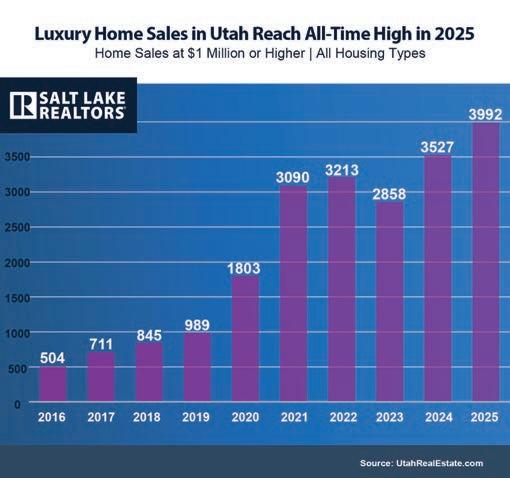
Compared to a decade ago, Utah’s $1 million-plus sales have surged nearly 700%.
By The Salt Lake Board
of Realtors®
Utah’s housing market reached a new benchmark in 2025: for the first time, one in every 10 homes sold statewide commanded a price tag of $1 million or more.
According to data from UtahRealEstate.com, 39,791 homes changed hands across the state in 2025. Of those, 3,992 properties sold for $1 million or higher — accounting for 10% of all transactions. That marks a 13% increase from 2024, when 3,527 homes crossed the million-dollar threshold.
The longer-term trajectory is even more dramatic. Compared to a decade ago, Utah’s $1 million-plus sales have surged nearly 700%, underscoring how rapidly the state’s housing market — once considered relatively affordable — has evolved. In 2025, the median sales price of homes in the million-dollar
category reached $1.425 million.
A Changing Market Landscape
“Wealthy transplants and several years of strong homeprice appreciation are fueling Utah’s million-dollar home sales,” said Scott Colemere, president of the Salt Lake Board of Realtors® and a Realtor® with Colemere Realty. “Although luxury home sales increased, the majority of homes sold in 2025 — 65% — were priced under $600,000.”
In other words, while the luxury segment is growing, Utah’s market remains diverse, with most activity still concentrated below the $600,000 price point. Several forces are driving the surge in high-end transactions.
Over the past five years, Utah home prices have risen 41%, according to the Federal Housing Finance Agency. That sustained appreciation has pushed many properties that once sold in the $700,000 range past the $1 million mark — in some cases due to appreciation alone rather than substantial renovations or redevelopment.
At the same time, Utah continues to attract higherincome buyers from out of state, particularly from California and other high-cost markets. For many of these transplants, Utah’s luxury homes offer comparatively strong value, along with lower taxes and a business-friendly climate.
The state’s robust economy has also played a role. Steady job growth, expansion in tech and professional services, and rising household incomes have broadened the pool of buyers capable of purchasing high-end homes. Utah has consistently ranked among the nation’s fastest-growing states, both in population and economic performance.
Lifestyle as a Luxury Amenity
Beyond economics, lifestyle remains one of Utah’s strongest selling points.
With world-class ski resorts, five national parks, and abundant year-round outdoor recreation, the state has become a magnet for affluent buyers seeking both primary residences and second homes. Proximity to the Wasatch Mountains, luxury communities in Park City and along the Wasatch Front, and expanding high-end developments in southern Utah continue to bolster demand.
Luxury homes also moved slightly faster in 2025. The typical $1 million-plus property spent 44 days on the market, down from 47 days in 2024 — a sign of sustained demand despite higher price points and broader market normalization.
The rise in million-dollar sales reflects both opportunity and challenge. For longtime homeowners, significant appreciation has created substantial equity gains. For new buyers, however, affordability pressures remain a central concern.
Even so, the data confirms what many industry observers have noted: Utah is no longer an emerging luxury market — it has arrived.
Free Thermal Imaging & Radon Testing With Every Inspection
The Median Age of Homeowners Surges
Potential homebuyers today earn roughly 30% less than the income needed to afford a typical starter home.
By Snejana Farberov
While the U.S. homeownership rate has hardly budged in more than a decade, the median age of American homeowners has grown considerably older as younger buyers find themselves locked out of the market.
In 2024, the median age of homeowners climbed to 57.5 years, up from 54 years recorded in 2010, even as the share of households owning homes remained just slightly above 65%, according to a new data analysis from the National Association of Realtors®.
Nadia Evangelou, principal economist and director of real estate research at NAR, contends that this demographic shift has profound implications for the housing market and who realistically can afford to enter it.
“Younger households are entering ownership more slowly or later in life, while existing owners are staying longer,” explained Evangelou. “So even though the homeownership rate hasn’t changed much since 2010, the people who own a home have.”
This dynamic becomes particularly apparent when comparing homeownership rates by age group.
Between 2010 and 2014, rates declined across every prime buying-age cohort, including 25 to 34 years old, 35 to 44, 45 to 54, and 55 to 64. Only households 65 years and older saw their homeownership rate tick up, reaching 78.7%—well above the national median.
The reason for this, according to Evangelou, is that the
65-plus population has exploded since 2010, growing by millions of households as the U.S. continues to age.
“In other words, older households are not just owning at high rates—there are many more of them,” said Evangelou. “That combination helps explain why the overall homeownership rate looks stable even though it’s harder for younger households to buy a home.”
In fact, NAR’s annual profile of homebuyers and home sellers released in November found that the median age of first-time buyers climbed to 40 in 2025, a record high, up from 38 the year before.
Evangelou attributes this trend to a combination of factors, including the fact that first-time homebuyers today earn roughly 30% less than the income needed to afford a typical starter home, coupled with the vanishing supply of entry-level housing options.
“The biggest hurdle is the gap between income growth and housing costs,” Tania Jhayem, a real estate agent at Keller Williams The Marketplace’s luxury division in Las Vegas, told Realtor.com®. “Home prices rose significantly over the past several years, and mortgage rates remain more elevated than the record-low levels many older homeowners were able to lock in during 2020 and 2021.”
As a result, younger would-be buyers end up renting longer and delaying homeownership, while older owners stay in their homes longer, resulting in the national rate keeping steady, at 65.3%.
Beyond high home prices, younger Americans are having to contend with high rents making it more difficult to save up for a down payment, and the lingering weight of student and consumer debt further eroding buying power.
“I truly believe that for many millennials, the barrier to becoming a first-time homebuyer is not for lack of desire or ambition; it’s just the widening gaps between income growth, their debts, and housing costs,” Christopher Raad, owner of Harvey Z. Raad Realtors in Allentown, PA, told Realtor.com. “It’s unfortunate but we see so many younger buyers carrying large amounts of debt, be it student loan, car, or credit cards.”
Jhayem points out that under these conditions, for many young adults, staying at home is “a strategic financial decision rather than a lack of independence.” Together, these persistent affordability headwinds have essentially erased more than 1.8 million millennial and Gen Z buyers from the market.
As the U.S. housing supply gap widened to 4.03 million units in 2025, more than 1.8 million would-be home shoppers ages 18 to 44 found themselves barred from entry into homeownership.
Owen Canavan, affiliate broker with Miracle LLC, said the consequences of Gen Z and millennial buyers being left on the sidelines could be far-reaching.
“The reduction of Gen Z and millennial buyers reduces market activity at large, especially when historically they made up a large portion of the first-time homebuyer pool,” Canavan told Realtor.com. “Its effect contributes to fewer home sales overall, slowing turnover and market fluidity.”
Snejana Farberov is a reporter at Realtor.com covering the U.S. housing market and the latest domestic real estate trends.
Photo: Image licensed by Ingram Image
ZACH
JANA
PREMIER��
Your Home May Be Part of the Great Wealth Transfer — But It Could Be Costly for Your Heirs
Even before an inherited home can be sold, the bills keep coming—property taxes, insurance, utilities, upkeep, and rising costs when the house sits empty.
By The Lighter Side of Real Estate
The oldest living generation today is often described as sitting on a tremendous amount of wealth. Much of it has been built slowly over decades, and a large portion of it is tied up in real estate — homes where decades of life took place — paid down slowly, maintained carefully, and held onto for years.
Lately, there’s been a lot of talk about how that wealth will eventually be passed on to younger generations, and how it could dramatically change their lives. Some of the headlines make it sound as though heirs are simply waiting in the wings, ready to receive an inheritance and turn it into luxury purchases, second homes, or dramatic lifestyle upgrades.
It can create the impression that the next generation is counting the days until they receive the wealth that took a lifetime to build, and the ways that it will be quickly spent.
But in reality, that picture doesn’t reflect what many families actually experience.
For many heirs, the wealth they inherit doesn’t arrive as money at all. It is often in the form of a home. And it usually takes time, effort, coordination, and decisions that aren’t simple to make, especially during an already emotional period before the house provides them with any form of money to spend on their own.
Inheriting a Home Can Actually Be a Financial Burden
When someone inherits a home, they haven’t inherited cash that can be used right away. They’ve inherited a property that comes with responsibilities, decisions, and ongoing costs.
Even before anything can be sold, there are practical
realities to manage. Property taxes still come due. Insurance needs to remain in place. Utilities, upkeep, and sometimes association fees don’t stop when they inherit the property. And if the home sits vacant, those expenses can actually increase, not decrease.
There are often administrative steps to work through as well. Settling an estate, navigating probate timelines, coordinating paperwork, or addressing title issues can take longer than people expect or can easily manage. When multiple heirs are involved, decisions can become more complex, even when everyone has good intentions.
All of this means there is often a long stretch between inheriting a home and being able to access any financial benefit from it.
In fact, that in-between period can be especially challenging because it may also require them to spend their own time and money in order to maintain the property, at a moment when they are already dealing with loss and transition.
The Money May Be Helpful… Just Not Life-Changing
The phrase “generational wealth” can create unrealistic expectations. While some heirs do inherit properties worth millions, many inherit homes with far more modest equity — especially once mortgages, liens, repairs, and selling costs are factored in.
For a lot of families, the proceeds from selling an inherited home won’t fund a luxury purchase or dramatically alter their lifestyle. Instead, it may:
• Pay down lingering debt
• Rebuild savings that were stretched thin
• Cover education expenses
• Serve as a long-awaited down payment on a home of their own
• Provide a financial buffer during uncertain times
All of that is meaningful. But for most heirs, their inheritance is more about stability than it is an immediate path to a high-end lifestyle often imagined when people hear “generational wealth.”
It Might Be Difficult to Talk About, But It’s Worth It
Talking about what will happen to a home after someone passes can feel morbid, premature, or even unnecessary. Many homeowners plan to live in their home for the rest of their lives, and updating it or thinking about the future may not feel necessary.
So if this isn’t an easy topic to bring up, that’s completely understandable.
But avoiding the conversation doesn’t make the responsibilities disappear. It simply passes them along to your heirs, who must navigate decisions, logistics, and costs while also coping with loss.
Thoughtful planning doesn’t have to mean selling early or making major changes. Often, it’s as simple as understanding the home’s condition, keeping records organized, knowing its likely market value, or having a clear sense of what will need to be done — and by whom — when the time comes.
As difficult as it might be, the most meaningful thing you can do for yourself and your heirs is to start open conversations now and discuss how the house will eventually be handled.
The Takeaway:
Headlines about the “great generational wealth transfer” often make it sound like an entire generation is about to become extremely wealthy and start buying luxury real estate.
Some heirs may use their inheritance that way. But for most, the reality is far less glamorous.
Much of the inherited wealth comes in the form of real estate — homes that need upkeep, management, and careful decisions before any financial benefit can be realized.
Proceeds from selling an inherited home can be meaningful (paying down debt, rebuilding savings, or helping with a down payment), but they rarely become a life-changing windfall. For most heirs, it’s about stability, not luxury.
Open conversations and thoughtful planning now can help ensure that when the time comes, an inheritance provides support instead of unexpected financial or emotional stress.
Source: The Lighter Side of Real Estate. Check out their content marketing services at lightersideofrealestate.com.
Photo: Image licensed by Ingram Image
$25,000 LIFETIME
PLATINUM R
2025 CONTRIBUTION LEVEL
2025 CONTRIBUTION LEVEL
CRYSTAL R
2025 CONTRIBUTION LEVEL
CRAIG HAWKER
JARED BOOTH
BOYD BROWN
SHERIDYN CANNON
DAVE ROBISON
GRADY KOHLER
JIM BRINGHURST TROY PETERSON
CLAIRE LARSON
CURTIS BULLOCK
DONNA POZZUOLI LISA JUNGEMANN ROB OCKEY
STERLING R
2025 CONTRIBUTION LEVEL
CHERYL ACKER
JESSICA ADAMS
JAZMIN ADAMSON
SAMANTHA AGUILERA
JOHN AGUIRRE
JUDY ALLEN
LANA AMES
MICHAEL ANDERSEN
JOILYN ANDERSON
STEPHANIE ARAGON
STEPHANIE ARRASI
ANN ATKIN
ELDA BAKER
ADAM BANGERTER
JOHN BAQUE
JENNIFER BARBER
KARINA BASSETT
LAUNIE BELNAP
SUSAN BENSON
AMITESHWAR BHATIA
TERRY BICKMORE
LAUREN BISHOP
KRISTY BLAIR
LISA BLAKEMORE
RUSSELL BOOTH
MORELZA BORATZUK
ROBYN BUCKWALTER
MANDY BULLOCK
CAMERON BURNSIDE
LINDA BURTCH
LORI BUTTERFIELD
ANNIE CANNON
GARYCANNON
MICHAEL CARMODY
JOEL CARSON
LORI CHAMBERLAIN
EVELYN CHANDLER
SCOTT CHAPMAN
BRET CHARLESWORTH
KIMBERLY CHATTERTON
RONNA CHRISTIAN
LESLIE CLEMENT
MATTHEW CLEWETT
BRIAN CLINGER
MICHAEL COELLO
HUMBERTO VILLATORO
BRYAN COLEMERE
J. SCOTT COLEMERE
TERRY CONONELOS
DANA CONWAY
VINCE CRAIG
BOB CUSICK
HANNAH CUTLER
CHRISTINA DALTON
JEFFREY DANIELS
TROY DARGER
JONATHAN DAY
R. BRIAN DE HAAN
JAY DEHER
LEANNA DEHERRERA
JESUS DELAROSA
KRISTIN DEVERAUX
KIMBERLY DEVRIES
STEVEN DEYOUNG
BENJAMIN DICKAMORE
LISA DIMOND
AMY DOBBS
JOHN DOWDLE
ABBEY DRUMMOND
BROOKE D'SOUSA
BLAKE EDWARDS
MELISSA ELARDI
CONNIE ELLIOTT
GREGORY FABIANO
KIMBERLY FARBER
KELLY FAVERO
MARK FEIGH
TODD FELD
THOMAS FOWLER
ERIC FREEBAIRN
ADAM FRENZA
MICHAEL GABEL
FRANK GARCIA
LORI GEE
AMY GIBBONS
JENNIFER GILCHRIST
ROLANDO GILL
NEIL GLOVER
KRISTEL GOUGH
KAT GRANDERATH
RACHEL GREEN
ROBERT GREEN
HEATHER GROOM
DAVID GUNTHER
JOEL HAIR
DONALD HAMPTON
VALERIE HAMPTON
BRADLEY HANSEN
JARED HANSEN
KAREN HANSEN
SCOTT HARDEY
HEATHER HEINE
WILLIAM HEINER
LORI LYN HENDRY
MONIQUE HIGGINSON
KELCEE HILDERMAN
SUZETTE HIRST
SARAH HOFFMANN
TARA HORTON
DAWN HOUGHTON
TERI HUDSON
BRYAN HURD
JUSTIN HURD
JANENE IHLER
CARISSA IRVING
MICHAEL JENSEN
MARCUS JESSOP
STACY JOHANSEN
MATTHEW JOHNSON
STEVEN JOHNSON
DAVID JONES
JESSICA KANEEN
TONY KETTERLING
LORI KHODADAD
JENNIFER KIKEL-LYNN
ADAM KIRKHAM
RYAN KIRKHAM
KAREN KNUTTGEN
KERI KRONEBERGER
JULIE KRUSHENSKY
AMIE LARSEN
BRADEN LAWSON
KRISTINA LEIKAM
MICHAEL LINDSAY
STACY LOCKHART
GENESIS HERNANDEZ
TAMARA LOSCHER
EMILY LOWRY
TERRIE LUND
MARIAMACIAS
ADRIAN MACO
JUAN MAGANA
DANNY MANDROW
LINDA MANDROW
LYNN MARCHANT
SUSIE MARTINDALE
RICARDO MARTINEZ
ABINADI MARTINEZ
SCOTT MARURI
JENNIFER MASCARO
RYLAR MASCO
HARRIS MATAAFA
KRISTIN MATULONIS
GINA MCBRIDE
KATHERINE MCCABE
CHRIS MCCANDLESS
ASHLEY MCCLELLAND
MARJORIE MCDERMOTT
LAURANN MCGUIRE
PAUL MCKINNEY
LAUREN MCMULLIN
JORDAN MCQUEEN
CAROLEE MECHAM
CONNOR MECHAM
AMBER MILTON
LISA MONTOYA
JEFFREY MORRIS
MARTHA MORRIS
REBECCA NAY
ANGIE NELDEN
ELIZABETH NELSON
ANDREA NEWBY
BINH NGUYEN
KRISTI DURRANT
TRICIA NICHOLS
JOSEPH OLSCHEWSKI
KATIE OLSEN
GABRIELA ORONA
RICHARD ORTIZ
FELIPE PACHECO
TARA PARAS
TYLER PARRISH
JOAN PATE
MARIA DEYEVARA
JAKIE PIZANA
JOAN POK
TALMAGE RAWLINGS
KEVIN KILPATRICK
JOSEPH REARDON
SOPHIE REECE
ALLISON REEMSNYDER
GEORGE RICHARDS
ELLIOTT ROBBINS
HYRUM ROSQUIST
JAMES ROTH
MICHAEL ROWE
MERILEE ROWLEY
DAVID RUPRECHT
DAVID SALAZAR
JAMES SANTISTEVAN
CHRISTINA SCHMIDT
MARK SCHWIEGER
LINDA SECRIST
BRITTON SHARP
JEFF SIDWELL
LAUREL SIMMONS
SCOTT SIMPSON
DANIEL SMITH
JANICE SMITH
LAWRENCE SMITH
SHARON SPRATLEY
KYRSTEN ST JOHN
JONATHAN STEADMAN
SEAN STEINMAN
LEE STERN
DAWN STEVENS
MAX STRAYER
BRIAN SUMMERS
SANDRA SWEETLAND
PATRICIA TANN
DEVIN TANNER
CHRISTY TERRILL
KELLY TITA
MICHELLE TODD
SHELLY TRIPP
ANNE TUCKETT
MANINITA TUIAKI
THOMAS UDY
DANIELLE VAUGHNS
AMY VOLCIC
ANGELI VOLK
CHAD WAGSTAFF
MELODIE WALDRON
CHARISSE WALKER
H. BLAINE WALKER
CARLYE WEBB
TRACY WHITE
CRAIG WHITING
PAUL WILLDEN
JESSICA WILLIAMS
KARI WILLIAMS
BREE WINEGAR
DAVID WINTERS
LISA WOODBURY
RACHEL WRAY ELIASON
JENNIFER YEO
ELAINE ZAMBOS
COREY ZANDER
LUKE ZANDER
TAMARA ZANDER
DONALD ZIMMERMAN
January 2026 Housing Watch
Single-Family Prices Climb While Multi-Family Softens In January
Salt Lake County’s housing market opened the year with mixed signals: slower sales activity, rising inventory, and a widening price gap between single-family and multi-family properties. A total of 661 homes sold in January across all housing types, a 4.62% decline from the 693 sales recorded in January 2025. Homes also took longer to sell, averaging 53 days on market compared to 43 days a year ago — an indication that buyers are exercising greater caution. Yet beneath the surface, supply conditions are shifting.
Inventory Expands as Buyer Activity Stabilizes
As of Jan. 31, 898 homes were under contract, up 7.16% year over year. Active listings climbed 12.87% to 2,403 properties, while new listings rose 10.90% to 1,363 for the month. This combination — rising inventory and modestly declining sales — suggests the market may be gradually rebalancing after several years of tight supply. Increased listings give buyers more options, reducing urgency and contributing to longer marketing times. However, the rise in under-contract properties indicates that demand has not disappeared; rather, it is operating at a more measured pace.
A Clear Split in Pricing Trends
The median sold price for all housing types reached $550,000 in January, up 4.76% from $525,000 a year earlier. The most notable trend is the divergence between property types: Single-family homes: Median price rose to $620,000, up 5.98% year over year. Multi-family homes: Median price declined to $414,990, down 2.36% from $425,000 last January. The continued appreciation of single-family homes reflects persistent demand for detached properties, likely driven by long-term lifestyle preferences and limited supply in that segment. Meanwhile, the modest pullback in multi-family pricing may signal greater price sensitivity among first-time buyers and investors, particularly in an environment still influenced by mortgage rate volatility.
National Headwinds
Nationally, existing-home sales fell 4.4% year over year in January, according to the National Association of Realtors® (NAR). However, prices continue to trend upward. The U.S. median existing-home price rose 0.9% to $396,800 — marking 31 consecutive months of annual price increases. NAR Chief Economist Dr. Lawrence Yun noted that weather may have contributed to weaker January sales activity. “The decrease in sales is disappointing,” Yun said. “The below-normal temperatures and above-normal precipitation this January make it harder than usual to assess the underlying driver of the decrease and determine if this month’s numbers are an aberration.” Yun added that affordability is gradually improving. Wage growth has outpaced home price growth, and mortgage rates are lower than a year ago. As a result, NAR’s Housing Affordability Index shows housing is at its most affordable level since March 2022. Still, supply remains historically constrained. “Due to low supply, the median home price reached a new high for the month of January,” Yun said. “Homeowners are in a financially comfortable position as a result. Since January 2020, a typical homeowner would have accumulated $130,500 in housing wealth.”
“Since January 2020, a typical homeowner would have accumulated $130,500 in housing wealth.”
Lawrence Yun
Chief Economist National Association of Realtors®
Salt Lake County
Local Market Update for January 2026
Source:
Pamela Abbott
Judy Allen
Suzanne Allred
George Anastasopoulos
Brent Anderson
Clay Anderson
Diane Anderson
Sue Avalos
Margaret Averett
Laurence Bailess
Les Bailey
Blair Bangerter
Brent Barnum
Veda Barrie-Weatherbee
Steven Barton
Edward Belka
Ken Bell
Raymond Bennett
Richard C. Bennion
Gregg Bohling
Russell Booth
Virginia Bostrom
Robert Bowles
Mary Ann Brady
Stephen Bryant
Stephen Bullock
Barbara Burt
Hedy Calabrese
Susan Calderon
Gary Cannon
Tracey Cannon
Julie Carli
Carol Cetraro
Scott Chapman
Garn Christensen
Byron Christiansen
Scott Claffey
David Clark
Deborah Clark
John Collins
Terry Cononelos
Jeffery Cook
Philip Craig
Kaye Cundick
Butch Dailey
Jaren Davis
Robert Davis
Brian De Haan
Babs De Lay
Lynn Despain
Jerard Dinkelman
Sally Domichel
Rebecca Duberow
James Dunn
Carol Edgmon
Douglas Edmunds
Michael Evertsen
Bijan Fakhrieh
Robert Farnsworth
Jack Fisher
Gale Frandsen
David Frederickson
Howard Freiss
Martin Gale
Brent Gardner
Heidi Gardner
Paul Gardner
Arthur Gayler
Linda Geer
Sheila Gelman
J. Carolyn Gezon
Anna Grace Sperry
Richard Grow
Klair Gunn
James Haines
John Hamilton
Mark Handy
Grant Harrison
Michael Hatch
Thomas Haycock
Jeanne Hayes
Bill Heiner
Jeffrey Helotes
Marvin Hendrickson
Terry Hill-Black
Lynda Hobson
Sheryl Holmes
Carol Howell
Gary Huntsman
Blake Ingram
Kent Ingram
Esther Israelson
Kevin Jensen
Ron Jenson
Jeffrey Jonas
Steven Judd
David Kenney
Henry Kesler
Douglas Knight
Peggy Knight
Randall Krantz
Leah Krueger
Gary Larson
Teresa Larson
Vann Larson
Fred Law
Michael Lawrence
Shauna Leake
Kaye LeCheminant
Daniel Lindberg
Michael Lindsay
Mildred Llewelyn
Daniel Lofgren
Don Louie
Ted Makris
Margaret Malherbe
Anthony Manning
Al Mansell
David Mansell
Dennis Marchant
Susan Mark-Lunde
Paul Markosian
Ronnald Marshall
Susie Martindale
Christopher McCandless
Curtis McDougal
Miriam McFadden
John McGee
Russell McKague
Andrew McNeil
Elizabeth Memmott
Uwe Michel
Gordon Milar
Kyle Miller
Preston Miller
David Moench
Gary Monk
H. Craig Moody
Randall Moore
Thomas Morgan
Klew Mori
Charles Mulford
Melanie Mumford
Jacqueline Nicholl
John Nielson
Robyn Nielson
Victor Oishi
Joseph Olschewski
Brent Parsons
Joan Pate
Derk Pehrson
Douglas Pell
Scott Pexton
Robert Plumb
David Read
George Richards
W. Kalmar Robbins
Emilie Rogan
Marie Rosol
Christopher Ross
Shelley Rozema
David Sampson
Mark Schneggenburger
David Seiler
Gary Shiner
Michael Shipler
Jeff Sidwell
Kent Singleton
Debra Sjoblom
Elizabeth Smith
Glen Smith
Kenneth Smith
Rick Smith
Skip Smith
Lorenzo Spencer
Kenneth Sperling
Robert Spicer
Trudi Stark
Lee Stern
Sandra Straley
Gary Strang
John Strasser
Kevin Strong
Thomas Swallow
Sonny Tangaro
Joan Taylor
Rosanne Terry
Martin Vander Veur
Craig Vierig
H. Blaine Walker
Hilea Walker
Dana Walton
Jerry Webber
William Wegener
David Weissman
Jeffrey Wells
Jeff White
Clayton Wilkinson
Thomas Wilkinson
Kimball Willey
Robert Wiskirchen
James Witherspoon
Linda Wolcott
Cynthia Wood
Margene Wrigley
DISCOVER THE ADVENTURE-READY, CITY-SAVVY 2025
BMW X3.
When you pair “adventure ready” with “city savvy,” you’ll find a vehicle that lives at the intersection of downtown avenues and mountain roads: the BMW X3.
With a reimagined design and sporty handling, the latest iteration of this icon doesn’t just tackle any journey with ease; it draws attention while doing it.
And it wouldn’t earn the X3 name without versatility at its heart and a premium interior that makes it unmistakably BMW.
Visit BMW of Murray or BMW of Pleasant Grove for exceptional offers on the BMW X3.