A8 | THE FLAGSHIP | JUL 9, 2015 | FLAGSHIPNEWS.COM
U.S. NAVY PHOTO The door gunner aboard a Huey helicopter opens fire on a target below in the Mekong Delta.
UU.S. S NAVY PHOTOS TOP: The USS Newport News (CA-148) with her guns firin ring from the No. 1 turret in 1972. MIDDLE: Navy SEALS on patrol in the Mekong Delta. BOTTOM: USS Patapsco (AOG-1) off shore of Cua Viet in 1967.
11950
U.S. Navy advisors first arrived in South Vietnam in the fall of 1950, and by 1969 numbered 564.
1964
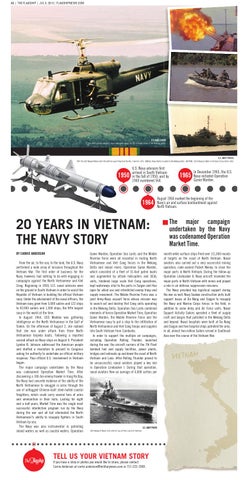
From the air, to the sea, to the land, the U.S. Navy performed a wide array of missions throughout the Vietnam War. The first order of business for the Navy, however, had nothing to do with engaging in campaigns against the North Vietnamese and Viet Cong. Beginning in 1950, U.S. naval advisors were on the ground in South Vietnam in order to assist the Republic of Vietnam in building the official Vietnam navy. Under the advisement of the naval officers, the Vietnam navy grew from 5,000 sailors and 122 ships to 42,000 sailors and 1,500 ships, the fifth largest navy in the world at the time. In August 1964, USS Maddox was gathering intelligence on the North Vietnamese in the Gulf of Tonkin. On the afternoon of August 2, she radioed that she was under attack from three North Vietnamese torpedo boats. Following a reported second attack on Navy ships on August 4, President Lyndon B. Johnson addressed the American people and drafted a resolution to present to Congress asking for authority to undertake an official military response. Thus official U.S. involvement in Vietnam began. The major campaign undertaken by the Navy was codenamed Operation Market Time. After discovering a 100-ton enemy trawler in Vung Ro Bay, the Navy had concrete evidence of the ability of the North Vietnamese to smuggle in arms through the use of unflagged Chinese-built steel-hulled coastal freighters, which could carry several tons of arms and ammunition in their hulls. Lasting for eight and a half years, Market Time was the single most successful interdiction program run by the Navy during the war and all but eliminated the North Vietnamese?s ability to resupply fighters in South Vietnam by sea. The Navy was also instrumental in patrolling inland waters as well as coastal waters. Operation
Game Warden, Operation Sea Lords and the Mobile Riverine Force were all essential in routing North Vietnamese and Viet Cong forces in the Mekong Delta and inland rivers. Operation Game Warden, which consisted of a fleet of 31-foot patrol boats and augmented by attack helicopters and SEAL units, hindered large scale Viet Cong operations, kept waterways vital to the ports in Saigon and Hue open for allied use and interdicted enemy troop and supply movement. The Mobile Riverine Force was a joint Army-Navy assault force whose mission was to search out and destroy Viet Cong units operating in the Mekong Delta. Operation Sea Lords combined elements of forces Operation Market Time, Operation Game Warden, the Mobile Riverine Force and the Vietnamese navy to put a stop to the infiltration of North Vietnamese and Viet Cong troops and supplies into South Vietnam from Cambodia. In order to support the multiple air campaigns, including Operation Rolling Thunder, launched during the war, the aircraft carriers of the 7th Fleet bombed fuel and supply facilities, power plants, bridges and railroads up and down the coast of North Vietnam and Laos. After Rolling Thunder proved to be unsuccessful, naval aviators played a key role in Operation Linebacker I. During that operation, naval aviators flew an average of 4,000 sorties per
U.S. NAVY PHOTO USS Newport News (CA-148) at sea off the coast of Vietnam.
TELL US YOUR VIETNAM STORY If you have a story or photos you would like to share, please contact Carrie Anderson at carrie.anderson@militarynews.com or 757-222-3983.
In December 1965, the U.S. Navy initiated Operation Game Warden.
August 1964 marked the beginning of the Navy’s air and surface bombardment against North Vietnam.
20 YEARS IN VIETNAM: THE NAVY STORY BY CARRIE ANDERSON
1965
The major campaign undertaken by the Navy was codenamed Operation Market Time. month while surface ships fired over 111,000 rounds at targets on the coast of North Vietnam. Naval aviators also carried out a very successful mining operation, code-named Pocket Money, to close the major ports in North Vietnam. During the follow-up Operation Linebacker II, Navy aircraft reseeded the major ports in North Vietnam with mines and played a role in air defense suppression missions. The Navy provided key logistical support during the war as well. Navy Seabee construction units built support bases at Da Nang and Saigon to resupply the Navy and Marine Corps forces in the field, in addition to some Army and Air Force units. Naval Support Activity Sailors operated a fleet of supply craft and barges that patrolled in the Mekong Delta and beyond. Naval hospitals were built at Da Nang and Saigon and two hospital ships patrolled the area. In all, almost two million Sailors served in Southeast Asia over the course of the Vietnam War.