IN THIS ISSUE
Camp Lejeune opens new Outdoor Infantry Immersion Trainer
This facilityis the first O-IITon Marine Corps Base Camp Lejeune,and the onlyO-IITon the East Coast.Its first training exercise,a joint-training event conducted byU.S.Marines and NATO allies, was held on May18,2023. PageA3
NUWC Division Newport scientist holds 40 patents, encourages innovation
ByPublicAffairsOffice
Naval Undersea Warfare Center Division Newport
NEWPORT, R.I. Dr Thomas Gieseke has a different way of looking at things His curiosity and unconventional approach to problems has made him the Naval Undersea Warfare Center (NUWC) Division Newport’s leading patent holder among current employees, with 40 patents issued duringhis29-yearcareer “Tomhasaninquisitivemindandpositive attitude,”ChiefTechnologyOfficerDr Jason Gomezsaidabouthisaccomplishment “He seessolutionswhereothersseeproblemsor roadblocks.”
Gieseke a resident of Dighton, Massachusetts also takes the lead among current employees a record held for many years by Dr Anthony Ruffa, who had 79 patents beforeretiringinDecember2022.



Gieseke, who manages advanced technologydevelopmentprojectsintheSensors andSonarSystemsDepartment,hasworked
as a first- and second-line supervisor and as a lead scientist, covering a wide range of technical subjects, such as hydrodynamics, ballistics,controlsystems,andsonar.

“Areaswheretherearedifficultunsolved problemsaregoodplacestogerminateideas forinvention,”Giesekesaid.
GiesekewashiredbyDivisionNewportin 1994tostudytransientflowsanddevelop,or advise in the development of new launcher systems At the time, there was considerable effort to develop a high efficiency inlet for a torpedo system. Essentially, designers wantedtousetheenergyofamovingsubmarine to force water through the torpedo launch system to give the launch pump a helpinghand.
“Welookedatabunchofdesignstoscoop moving water from the ocean and direct it to the back end of a torpedo waiting in the launch tube,” Gieseke said. “Many of the ideaswelookedatwereveryconventional.It occurredtomethatweweresolvingaproblemthatdidn’tneedtobesolved,andmore-
over,theentiredesignconceptwasnotideal. TheInletFreeTorpedoLaunchSystemwas conceivedtoeliminatetheneedforinletsall together.”
Not only did Gieseke’s idea save a lot of moneybyeliminatingtheneedtobuildgiant hydraulic doorways, it also could launch weaponsmoreefficientlyandquietly However,noteveryonewasexcitedabout Gieseke’sunconventionalsolution
“I had been working at NUWC for only a few years, so I had no influence and had no credibility,” Gieseke said “There really was noplaceinthecultureforradicalideas,especiallyfromyoung,inexperiencedengineers. However,therewasanavenuetodocument my idea, which was the patent process I wrote up the idea and published it making it easily accessible at the U.S. Patent and Trademark Office if a question ever came up or if someone wanted to do research on torpedolaunchsystems.”
The patent Gieseke is most proud of is a high velocity underwater jet weapon,
awardedin2005
“Idevelopedaconcepttoproduceatransientimpulsejetthatworksmoreeffectively than a steady jet for underwater water-jet cutting applications,” Gieseke explained. “Itwasbasedonanobservationmadewhile working on a hydro-ballistics project, but enabledanewlineofconceptdevelopment.”
Like Gieseke’s torpedo launch system, the underwater jet weapon concept wasn’t immediatelyembracedbyhispeers.
“Itwasmetwithconsiderableskepticism by scientists in the field and most thought the idea wouldn’t work,” Gieseke said. “In time,itwasdemonstratedinanexperiment and the underlying physics were proven to besound.Thereissatisfactionincomingup with an idea that not only was a new innovation butwasbasedonavisionthatothers could not see without having it shown to them.”
Fortunately,Giesekeisnoteasilydeterred
7
TurntoNUWCDivisionNewport, Page
recognized as part of 2023 EPA
of the Year Award
ByNavalFacilitiesEngineering SystemsCommandMid-Atlantic NORFOLK Va Marine Corps Base (MCB) Camp Lejeune North Carolina Partnering Team was recently announced asrecipientsofthe2023EPANationalNotable Achievement Award: Federal Facilities Excellence in Partnering Team of the Year for their exemplary partnership, and for effectivelyimplementinginnovative,timely, and sustainable remedial actions onboard the 156,000-acre military base Teams from all 10 EPA Regions submitted packages and competedforthisyear’shonors
The MCB Camp Lejeune Partnering
Team included: Dave Cleland and Lindsey Mills, from Naval Facilities Engineering SystemsCommandMid-Atlantic(NAVFAC MIDLANT)Environmental;JenniferTufts, from EPA Region 4; Thomas Richard and Laura Spung, from MCB Camp Lejeune; RandyMcElveen,BethHartzell,andAngela Moore,fromNorthCarolinaDepartmentof Environmental Quality; Matt Louth, Kim Henderson and Monica Fulkerson, from Jacobs; and Dylan Elks and Shaun Whitworth,fromMeadowsCMPG,Inc
“I’m extremely proud of this team but also proud of their ability to assess tough environmental issues by incorporating innovative thinking and reasoning, posi-
tive communication, and efficient managementpractices,”saidKellyKnight,NAVFAC MIDLANTEnvironmentalDirector.“Their efforts also helped to support beneficial goalsoftheDepartmentofDefenseandour partneringagencies.”
Workperformedwasmanagedunderthe Navy’sEnvironmentalRestorationProgram (ERP),whichutilizesapartneringconceptto facilitatecleanupactionsrequiredunderthe Comprehensive Environmental Response, Compensation,andLiabilityAct.

Theteamwaswidelyrecognizedfortheir functionality and for the performance of their duties During the submission period, the team’s combined efforts included: the


treatment of more than 6 million gallons of groundwater, injection of more than 3,000 gallonsofemulsifiedvegetableoilsubstrate as part of a bio barrier replenishment and recirculationsystem,andtheoperationofair sparge systems for more than 9,000 hours
Additionally, the team saved more than $40,000byreusingremediationequipment from a decommissioned site, and increased efficiency through the installation of a new solarpoweredtreatmentsystemthatreused 70cubicyardsofsoil,recycled7,530pounds of metal, reduced remediation-derived wasteandpaperwaste,andsavedmorethan 52metrictonsofcarbondioxideemissions,
Burning and turning below decks
USS Gerald R. Ford’s
machine shop
work
at
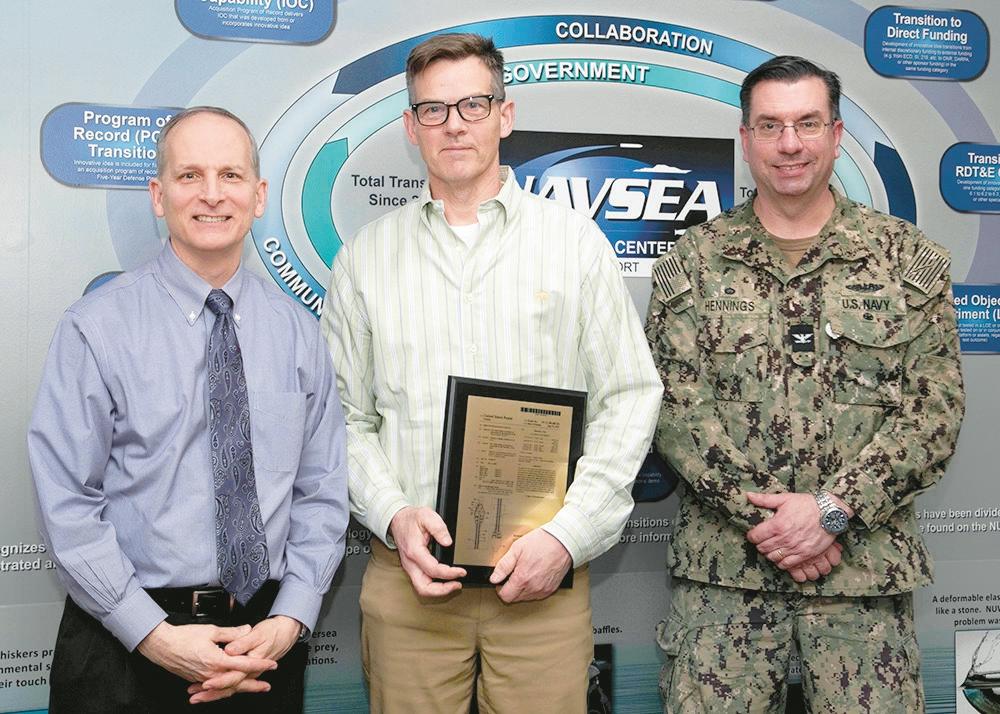
 Dr Thomas Gieseke (center),a scientist in the Naval UnderseaWarfare Center(NUWC) Division Newport’s Sensors and SonarSystems Department,was recognized forhis most recent patent award during a ceremonyheldwith formerDivision NewportTechnical DirectorRonVien (from left) and Commanding OfficerCapt.Chad F.Hennings on March 29 2023.Gieseke is Division Newport’s leading patent holderamong current employees with 40 patents issued during his 29-yearcareer (PHOTOBYRICHARDALLEN)
MIDLANT Environmental
Federal
VOL.31,NO 22 Norfolk,VA| flagshipnews.comJune 22-June 28 2023
NAVFAC
Facilities Excellence in Partnering Team
www.flagshipnews.com www.facebook.com/ The.Flagship www.twitter.com/ the_flagship THEFLAGSHIP’SFREEHOMEDELIVERY CALL TODAY! 757.446.9000 SOUTHHAMPTONROADS: Get the convenience ofyour Navy newspaper delivered to your door for free!
–
When people think of aircraft carriers, they picture jets being launched and Sailors conducting deck evolutions.What isn’t always top of mind are the Sailors who work below decks who keep the ship moving, fix one-off parts and keep the ship afloat. PageA6 www flagshipnews.com | The Flagship | Section 1 | Thursday, June 22 2023 1
Camp Lejeune opens new Outdoor Infantry Immersion Trainer
ByLanceCpl JorgeBorjas
Marine Corps Installations East
On a hot and bright afternoon, U.S. Marines and NATO allies move quietly throughanoccupiedtown Thistownisfull of small shops with people walking in and out.AstheMarinesandtheiralliestraverse slowly through the city center, the townspeopleconverseandlaughwitheachother, most of them paying no mind to the armed men in uniform. A shop owner dumps a pot of coffee out of her back window while watchingaMarineslowlypeekbetweentwo buildings The smell of old coffee diffuses through the wind as gunfire suddenly erupts from the rifles of the Marines and their allies, aimed toward armed hostiles stepping out from behind closed doors and vehicles Shouting comes from both sides, and the sounds of panicked screams from the townspeople and thudding footsteps of people running away are drowned out by the gunfire. Gunpowder fills the air while the Marines and friendly forces engage the armed combatants But this scenario isn’t real; it’s just a simulated training exercise at Camp Lejeune’s new Outdoor Infantry Immersion Trainer, or O-IIT, which is now openfortrainingoperations
This facility is the first O-IIT on Marine Corps Base (MCB) Camp Lejeune and the only O-IIT on the East Coast. On May 18, 2023, MCB Camp Lejeune’s O-IIT conducted its first training exercise, a joint-training event conducted by U.S. MarinesandNATOallies.

“I’dsayitgivesauniqueexperience,especially with MOUT (Military Operations in Urban Terrain) training Yes, we have the indoorfacilityaswell butthisoutdoorfacility is a lot larger in scale,” said U.S. Marine Corps Capt. Michael McLaughlin, a firepowerpatrolteamleaderwith2ndAirNaval GunfireLiaisonCompany(ANGLICO)after conductingatrainingexerciseontheO-IIT “Ithinkthismaybetheclosestthingyoucan tosimulatetheactualfogofwar.”
The first phase of the training scenario started with role-players working in shops speaking to each other and laughing togetheruntiltheyheardasimulatedexplosion through the facility’s speakers The role-players then went into a dramatized panic,withscreamsandcrieseruptingfrom inside the shops On one side, a role-player withamaskandbandanastartedfiringatthe Marines and foreign allies who were trying tocommunicatewiththepopulaceamidall thechaos
“The role-players they bring in are actually from other countries and they may not even speak English, so you actually have to have an interpreter with you,” said
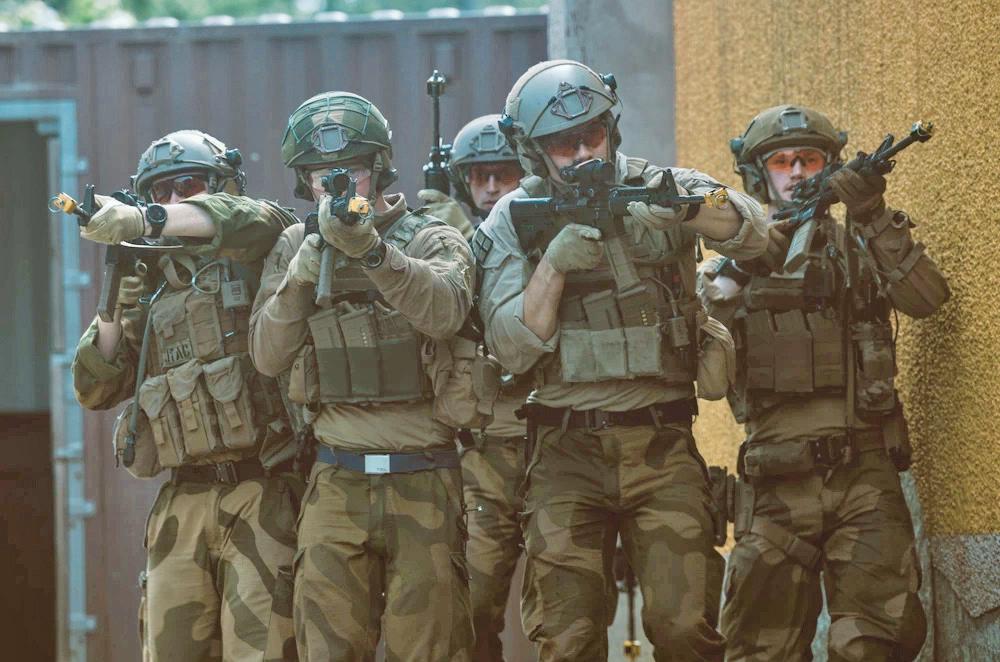
NorwegianArmed Forces clearan alleywhile at the OutdoorInfantryImmersionTrainer(OIIT) on Marine Corps Base Camp Lejeune,North Carolina,May18,2023.U.S.Marinesworked alongside partners and allies from Norway,France,Finland,and Sweden.The OIITprovided Marines and international partnerswith scenario based realistic training creating a fullyimmersive environment using role players pyrotechnics,subject matterexperts and sound and smell generators.(U.S.MARINECORPSPHOTOBYLANCECPL ZACHARYZEPHIR)
McLaughlin
Role-players are commonly used in the IndoorInfantryImmersionTrainer,butnot at the same scale as now achievable by the O-IIT.
While the O-IIT shares similarities with theIndoorInfantryImmersionTrainer,one of the things that sets the O-IIT apart is its size which allows it to be used by platoonsizedelementsincomparisontotheindoor facility which can only hold squad-sized elements This also allows for units to conduct multiple training scenarios at one time, which diversifies the training and pushes it closer to the chaotic nature of a realcombatenvironment TheoutdoorfacilityisalsolocatednexttotheMOUTcomplex area on MCB Camp Lejeune, allowing it to be used as even larger MOUT operational scenariosbycompaniesandbattalions
Tim Seamon, operations officer, Marine Corps Installations East-MCB Camp LejeuneRangeandTrainingAreaManage-
Editorial Staff MilitaryEditor | MC1 Maddelin Hamm 757-322-2853 | maddelin.v.hamm.mil@us.navy.mil

ment explained that the O-IIT is a 13-acre site consisting of 80 buildings divided between three roads This training area includes an embassy area, mid-town area andalowerincome,‘slum’area.
ThedesignoftheO-IITrequiredthefacility designers to construct structures that could withstand coastal environments and endure the rigors of Marine training while also maintaining the ability to be reconfiguredandmodifiedinthefuture.Thedesigners used precast concrete, formed using a reusable mold, and cured in a controlled environment,toachievethisgoal.
The Precast/Prestressed Institute, the technicalinstituteandtradeassociationfor theprecast,prestressedconcretestructures industry awarded Camp Lejeune’s new O-IIT with the 2023 Best Military Buildingaward.
“We chose this project as the winner because we found it incredibly fascinating in the use of precast” said Vanessa Schutte,
K-12 Central Region Section Leader DLR Group “The training that happens by the Marines can be customized time and time againandmovedtodifferentfacilities.”
Units can customize the award-training compound to fulfill the needs of different training exercises By utilizing pyrotechnics, sound systems and scent systems, unitsenhancethetraining’simmersiveness providingtheirMarineswithmorerealistic training.
TheOutdoorInfantryImmersionTrainer provides Marines with a unique training experience and the opportunity to conduct various specialized large-scale scenarios The facility’s immersive nature, customizability, and personnel support gives unit leaders more versatility on the exercises they can perform on MCB Camp Lejeune. It solidifies the base’s reputation as worldclass training facility and increases MCB Camp Lejeune’s Marines’ readiness to face ournation’sadversaries
or any other non-merit factor of the purchaser, user, or patron. If a violation or rejection of this equal opportunity policy by an advertiser is confirmed, the publisher shall refuse to print advertising from that source until the violation is corrected. Editorial content is edited, prepared and provided by the Public Affairs Department of
757-446-9000 distribution@pilotonline.com

on Marine Corps Base Camp Lejeune,North Carolina,May18 2023.The OIITprovided Marines and international partnerswith scenario based realistic training creating a fullyimmersive environment using role players pyrotechnics,subject matterexperts,and sound and smell generators.(U.S.MARINECORPSPHOTOBYLANCE CPL ZACHARYZEPHIR)
U.S
Marine Corps Capt.Quinton Boyed,field artilleryofficer,2dAirNaval Gunfire Liaison Company,II Marine ExpeditionaryForce Information Group provides securitywith NorwegianArmed Forces at the OutdoorInfantryImmersionTrainer(OIIT)
AssistantEditor | MC2 Leo Katsareas 757-322-2853 | news@flagshipnews.com GraphicDesigner | TeresaWalter teresa.walter@virginiamedia.com Contributing Staff Ninoshka Basantes Kaitlyn Hewett MC3 Jordan Grimes 757-322-2853 | news@flagshipnews.com Flagship, Inc. MNVMilitary Manager | Ski Miller ski.miller@virginiamedia.com FreeClassifiedAdvertising 757-622-1455 Distribution&HomeDelivery
Commander,NavyRegionMid-Atlantic(CNRMA): RearAdm Christopher“Scotty”Gray RegionalprogrammanagerforNavyRegion Mid-Atlantic(NRMA): PublicAffairs Director | Beth Baker The Flagship® is published by Flagship, Inc., a private firm in no way connected with the Department of Defense (DOD) or the United States Navy under exclusive written contract with Commander, Navy Region Mid-Atlantic. This civilian enterprise newspaper is an authorized publication for members of the military services. Contents of the paper, including advertisements, are not necessarily the official views of, nor endorsed by the U.S. Government, DOD or the Department of the Navy (DON). The appearance of advertising in this publication, including inserts and supplements, does not constitute endorsement by the DOD; DON; Commander, Navy Region Mid-Atlantic or Flagship, Inc. of the products or services advertised. Everything advertised in this publication shall be made available for purchase,use, or patronage without regard to race, color, religion, gender, national origin, age, marital status, physical handicap, political affiliation,
Stories
23510. © 2021 Flagship, Inc. All rights reserved This month,we celebrate the LGBTQIA+ community and honor those - both past and present - who proudly fight to protect this nation. www.health.mil/pride Happy #PrideMonth!
Commander, Navy Region Mid-Atlantic.
may be submitted via email to news@flagshipnews.com. The Flagship® is published every Thursday by Flagship, Inc., whose offices are located at P.O. Box 2820, Norfolk, Va
2 The Flagship | www flagshipnews.com | Section 1 | Thursday, June 22 2023
Sea turtle nesting season on Dam Neck Annex
ByPettyOfficer2ndClass
MeganWollam
Naval Air Station Oceana
Sea turtle patrols are underway on Dam Neck Annex beach. In the Virginia Beach area, sea turtle nesting season runs from May 15 to August 31. Each morning, staff members from Naval Air Station Oceana’s natural resources department have been surveying the beach for evidence of a nestingsite
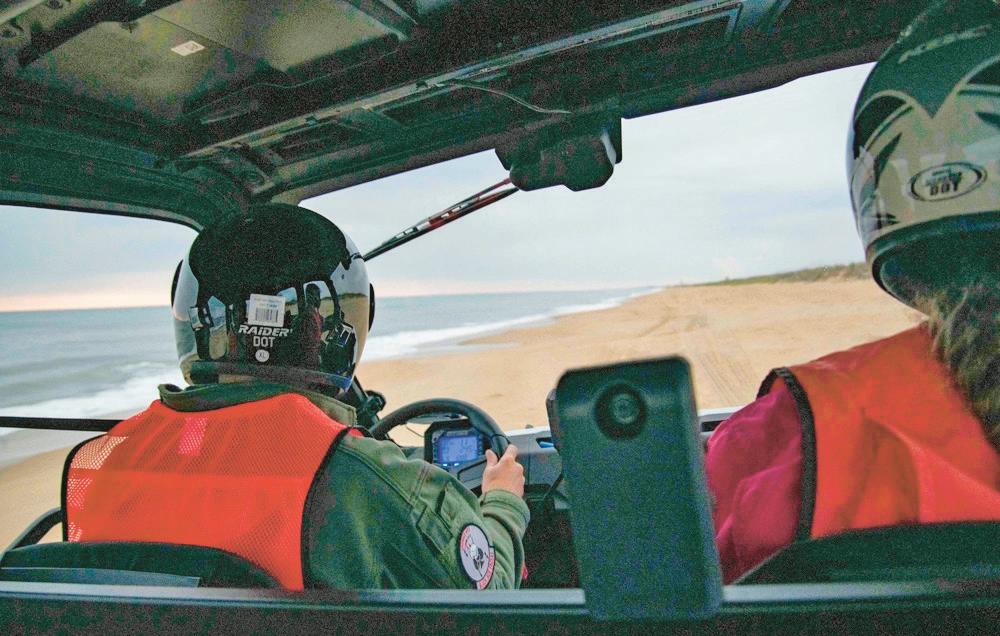
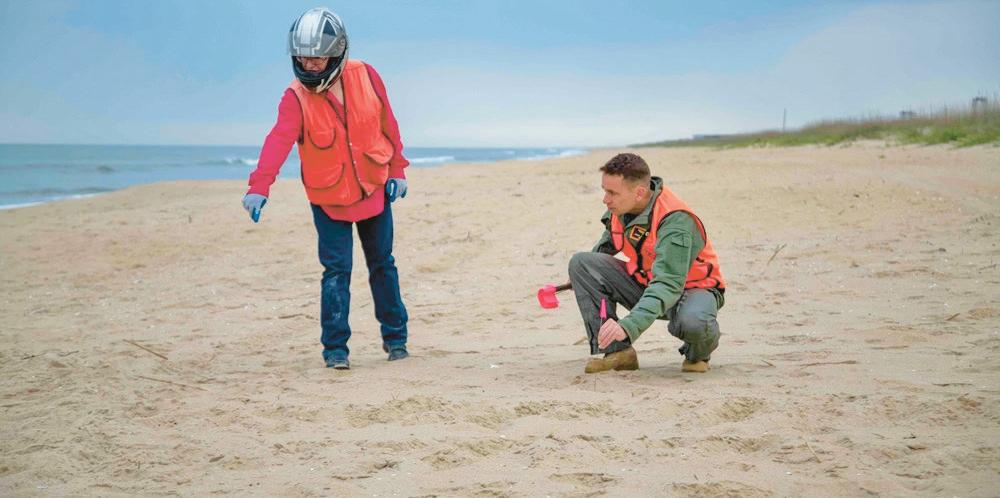
Patrollers are on the lookout for a crawl, the tracks left in the sand by the sea turtles. Each sea turtle species has a unique and identifiable track pattern. Three different speciesofseaturtleshavebeenconfirmedto nestorattempttonestontheshoresofDam Neck Annex: Loggerhead, Kemps Ridley, andGreen
“Over the last ten years, on Dam Neck Annex we’ll see one to three turtle nests a year,” said Michael Wright, NAS Oceana’s natural resources manager “In general where the water temperatures and air temperaturesarewarmer,that’swhereyou’ll seemorenests,sointhecontiguousUSA,as you go further south along the coast you’ll seemorenestingactivity.”
Onceaseaturtlecrawlisfoundandanest
is identified, natural resources staff will determinewhetheritissafeforthenesttobe leftinplaceorifitneedstoberelocated The
nestswillbefittedwithmonitoringsensors that measure temperature and moisture levels in the nest, which helps determine




when the sea turtle hatchlings may emerge fromthenest.Apredatorguardcagewillbe placedoverthenestandsignswillbeposted to alert beachgoers to stay clear of the nestingsite.
Whenitgetsclosertoanest’santicipated hatchlingemergence,thenestingsitewillbe visited twice daily Natural resources staff and volunteers will also monitor the nest overnight to protect potential hatchlings frompredators
“Weprovideaconservationeducationand outreach opportunity for people tobecome ‘nest-sitters,’ ” Wright said. “These individuals take training to be able to help protect hatchling sea turtles make their way to the ocean.”
Allofthedatacollectedduringthenesting seasoncontributestoseaturtleconservation effortsforNASOceanaanditspartners
“WearepartneredwithBackBayNational Wildlife Refuge, State Military Reserve, United States Fish & Wildlife Service, Virginia Aquarium and Marine Science Center, Virginia Department of Wildlife Resources universities andotherlocalcitizens, saidWright “Proactiveconservation for NAS Oceana has been a win-win situationfortheNavy,forseaturtleconservation, andforourpartners.”
VIRGNIABEACH,Va (May16,2023) -NavalAirStation Oceana Natural Resources ManagerMichaelWright,left,and NAS Oceana Executive OfficerCapt.JoshuaAppezzato demonstrate how to identifyand marka simulated sea turtle crawl.Nesting season runs from May15 toAugust 31 and three different species ofsea turtles have been confirmed to nest orattempt to nest on the shores ofDam NeckAnnex: Loggerhead,Kemps Ridley,and Green.(U.S.NAVYPHOTOSBYMASSCOMMUNICATIONSPECIALIST2NDCLASSMEGANWOLLAM/RELEASED) Virginia Beach,Va (May16 2023) - NavalAirStation Oceana Executive OfficerCapt.Joshua Appezzato,left and NAS Oceana Natural Resources ManagerMichaelWright patrol Dam Neck AnnexBeach forevidence ofsea turtle nesting sites www flagshipnews.com | The Flagship | Section 1 | Thursday, June 22 2023 3 50% OFF INSTALL all shower &bath projects 12 MONTHS no payments &nointerest SUMMER SALE OFFER VALID UNTIL 6/25/23 SCHEDULE YOUR APPOINTMENT TODAY FOR AN ADDITIONAL $1,000 OFF1 YOUR BATH OUR STRESS-FREE PROCESS DESIGNED FOR YOU From start to finish, we provide customers with a quick and easy bathroom remodeling experience Simply meet with one of ourdesign consultants, view our styles and options, design your new shower or bath, and receive an exact quote. Afterwards, our in-house installers will remove yourold unit, get your new project installed in as little as 1day andyourhomecleaned up before they leave 4.8/5 COMPANY AVERAGE OUT OF 18,670+ GOOGLE REVIEWS (Company reviews across all branches as of 5/22/2023) EVENING &WEEKEND APPOINTMENTS AVAILABLE! CALLNOW TO STARTYOUR PROJECT 757-280-2257 *Financing offers anopayment -nointerest feature (during the “promotional period”) on your purchase at an APR of 17.99%. No finance charges will accrue on your account during the promotional period, as set forth in your Truth in Lending Disclosures,and you will not have to pay amonthly payment until the promotional period has ended. If you repay your purchase in full before the end of the promotional period you will not have to pay any finance charges. You may also prepay your account at any time without penalty.Financing is subject to credit requirements and satisfactory completion of finance documents. Any finance terms advertised are estimates only.Normal latecharges apply once the promotional period has ended. Call 866-393-4573 for financing costs and terms. Minimum purchase $9,999 required. See design consultant for details. Other restrictions may apply.**50% offinstall is equal to 10% offthe total project price. 1$1,000 offtotal project price. New orders only.Offer not valid on previous sales or estimates and cannot be combined with other offers. Offer expires 6/25/23. CALL TODAYOFFER ENDS SOON
Introducing Capt. Billy Barefoot: The Devil Dog of Wall Street
ByJohannesSchmidt
Marine Corps Systems Command
In order to appreciate the commanding globalpresencetheUnitedStateshasmaintained since the close of the Cold War, it is importanttoconsiderthestrong,symbiotic link between America’s economic prowess anditsmilitarystrength.
Forthisreason withintheannalsofAmerican history individuals like J.P. Morgan, John D. Rockefeller, and Andrew Carnegie areoftenlaudedalongsidemilitarystalwarts such as Generals Dwight D. Eisenhower, LewisB.“Chesty”PullerandJamesMattis, allbathedinthesamepatrioticlight.
But from this rich tapestry of American exceptionalism emerges a man who left the promises of a financial career on Wall Streettoservethecountryheoncevowedto support and defend. Meet Capt. Billy Barefoot—theDevilDogofWallStreet.
Barefoot was born to an All-American family in the Texas heartland and raised in the vibrant city of Fort Worth, where his childhood was imbued with the values of community, patriotism, and a deep sense of duty From a young age Barefoot knew he wanted to follow in the footsteps of his family members who joined the Corps but recallsthatitwaswatchingthetransformation his close friend experienced after boot campthathelpedmakeuphismind.
“The transition was swift,” Barefoot recalls “We graduated high school on a Friday,andbyMonday,Iwasalreadyatboot camp It was a fast-paced introduction to a wholenewworld.”
Shortly after enlisting in the Marine Corps in June 2007, Barefoot left for boot campattheMarineCorpsRecruitDepotin SanDiego,California Therigoroustraining and demanding environment of boot camp provided him with a swift introduction to the world of military service. During his tenureinthefleet,Barefootmadeastrategic decision tochart auniquepath thataligned with his call to serve and his interest in the business world. Rather than pursuing a conventionalcombatarmsrole,heoptedfor the Supply Admin and Operations Specialist military occupational specialty, focusing onthefiscalaspectsofsupplymanagement.
This decision would ultimately help prepare him for the world of acquisition, and the work ethic, leadership, and values he picked up while serving in the fleet have helpedmakehimintotheofficerheistoday
According to Marine Corps Systems Command Chief of Staff Col. Devin Licklider, “Diversity of thought and experience lendsadaptabilityandflexibilitytoanyteam.
Billy’s breadth of life experience, passion and dedication to the Marine Corps and its mission strengthen the Marine Corps SystemsCommandteam.”
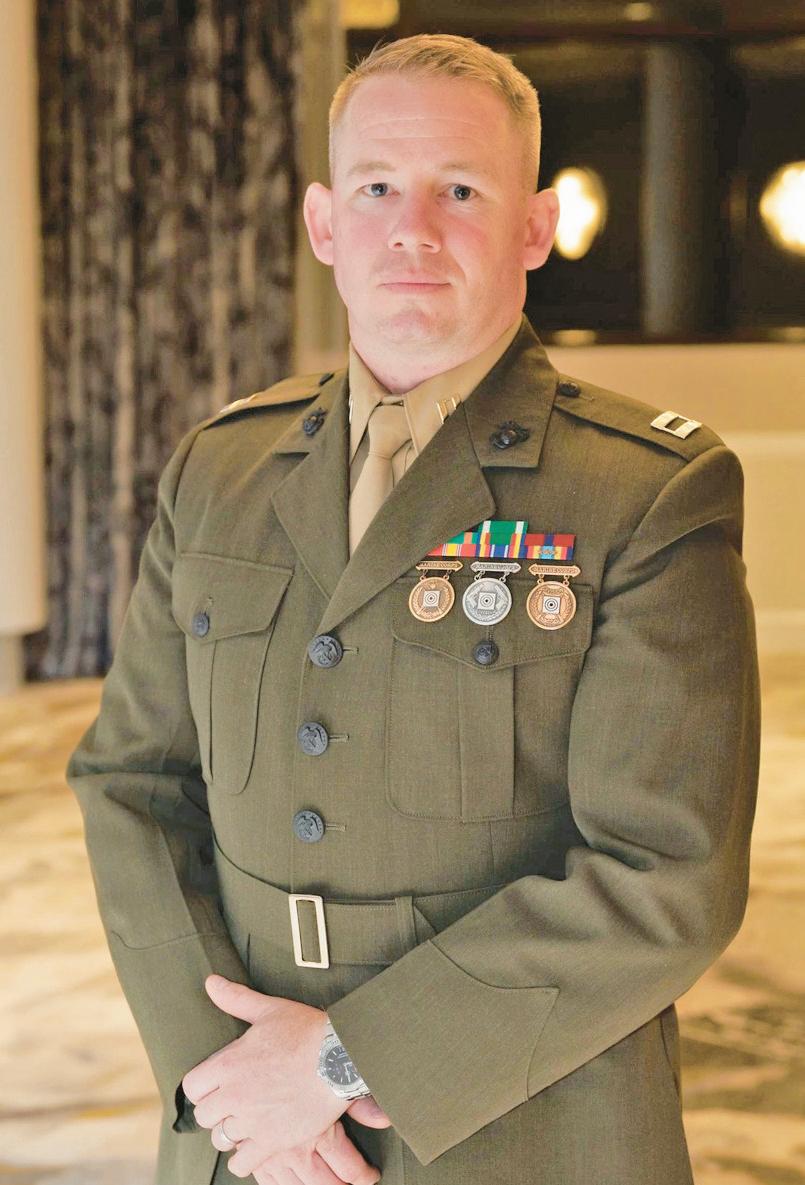
After receiving an honorable discharge asaSergeantinJune2011,Barefootquickly found his way to one of New York’s Ivory Towers,beingacceptedtoPaceUniversity’s Lubin School of Business—a well-regarded institution located in the heart of Manhattan’sfinancialdistrict
Although Barefoot remembers considering other programs across the city, Pace’s participationintheYellowRibbonProgram allowed him to attend tuition-free—ultimatelyallowingBarefoottofocushisenergy on his studies and immerse himself fully in NewYork’sdynamicworldoffinance Ashe pursuedhisstudies,Barefootwassupported by his loving wife, a fellow Marine veteran whowasjuststartinglawschoolinthecity.
“I swear, she’s a big part of what’s motivatedmealongtheway,alwayspushingme to do better. We were always very competi-
tive, you know, like, who’s going get Corporal first, who’s going to get sergeant first,” he recalled with a grin, adding “It really helps having a like-minded partner in your corner.”
WhileatPace,Barefootcapitalizedonhis proximitytoWallStreetandsecuredaprestigioussummerinternshipwithaSwissbank renowned for its service to ultra-high net worth individuals. During his four-month tenure, Barefoot was assigned to the alternative investments division, focusing on hedge funds, private equity and non-traditionalrealestateinvestmentstrategies The dynamic,fast-pacedenvironmentofalternativeinvestmentscaptivatedhim
After graduation, Barefoot received an offer to work at the Swiss bank’s Portfolio Strategy Group, a leading independent wealth management firm. The next year, his career would lead him to Boston where he received an offer to work with another prestigious trading facility, whose services includeproprietarydata,investmentanalytics, data management, portfolio modeling, andelectronictradingandclearing.
Yet,evenashenavigatedtheexhilarating waters of finance, a longing for a different kindofchallengegnawedathim Theworld ofhighfinancewasundeniablyexciting but Barefoot found himself yearning for some-
thingmore.Althoughhefoundcomfortand camaraderie in various veterans organizations, such as Team Red, White & Blue and AmericanCorporatePartners,heknewthat ultimatelyhelongedtoserve,yetagain.
“I came to the realization that, yeah, the money’sgreatandit’sanexcitingfieldtobe in,but what I truly missed was the mission, thesense ofpurposethattheMarineCorps and the military as a whole embody,” Barefootsaid.
“OnWallStreet,companieshavecarefully crafted mission statements. But at the end oftheday,it’salwaysaboutthebottomline; that’s the focus. I missed having a mission, being part of a command that prepares for deployments, supports them, or returns from them. I longed for that continuous planning, working together towards something worth more than a dollar sign,” he added.
Barefoot ultimately applied—and was accepted to—Officer Candidate School, whereheinitiallyenteredasanaviatorwith a flight contract. Although he enjoyed his timeinflightschool,herecallsbeingunable toshakethefeelingthatsomethingwasstill missing,echoinghisexperiencesinfinance
But like many individuals with a calling, Barefoot would find clarity while attending Sunday service at his local church. He
remembers the pastor spoke about finding purpose in various roles—such as being a spouse, parent, or police officer—and how weareallcalledtoserveinourownway.
“It made me reflect on my own situation and it struck me that my true passion lay in working with and leading Marines, but in a different capacity—one that allowed me to leverage my past skills and experiences effectively,”herecalled.
Ultimately he would re-designate from flight school to become a manpower officer—a role in which he excels today at MARCORSYSCOM.
“I love the MOS, I’m passionate about it, and I’m able to leverage those things that I had previously picked up and put in my toolbagfrombothmyenlistedMarineCorps experience and on Wall Street,” Barefoot said.
Yet, that passion isn’t just a talking point; it’s something palpable to anybody who comesacrossBarefootandhearshisstory.
AccordingtoCol.RaymondFeltham,militaryassistanttotheAssistantSecretaryofthe Navy, Research, Development and Acquisitions, “I was able to learn more about Capt Barfoot’stimeasacivilianthroughanumber of MCSC sanctioned social events at the O Club Hisexcitementabouthisexperiences on Wall Street was only dwarfed but his passiontobebackservingintheMarines.”
Today, Barefoot is the principal advisor to the commander on manpower staffing and administrative issues that directly impactunitreadiness.Thissummer,hewill leave the command for a one-year post at the Marine Corps’ Expeditionary Warfare SchoolinQuantico Virginia.
But he won’t leave his current post without leaving a deep mark on the contractors, civilians, and Marines with whom he tirelesslyworkstoequipthewarfighter
“He’s not just a good dude; he’s a hardworking, top-rate officer,” said CWO3 Khosbayar Rentsendorj, a personnel officer and data systems engineering officer at MARCORSYSCOM. “Personally I admire his qualities especially in this job where being a good dude matters. In our line of work, we need individuals who make importantdecisionsforotherswithouthesitation, decisions that impact their well-being When it comes to combat, having good dudes on your side is crucial, especially in leadershiproles So,inmybook,he’sagood dude and I’d be honored to serve with him inbattle.”
Ashecontinuestoforgehisuniquecareer path, however, he is quick to offer sage advice to other Marines hoping to leverage their Marine Corps experience in the civilianworld “ThebestadvicethatIcangiveistomake your decisions based on the opportunities available to you at the time Always plan ahead, have multiple backup plans but remain open to deviating from them. The keyistokeepmovingintherightdirection.”
Barefoot’s life highlights an unconventional journey from military service to the world of finance and back again, illustrating the profound sense of duty that drives the American warfighter His story is not just about personal ambition or financial success but rather an exemplification of dedicated service and an unyielding quest forpurpose Ashecontinuestocharthisown path in service of his nation and the Corps, his example continues to shine as a beacon ofinspirationforothers,remindingusallof thevalueofpurpose,therichnessofdiverse experiences, and the power of an unwaveringcommitmenttoservice
Bataan turns concept to reality with 3-D printer
BySeamanDarrenNewell
USS Bataan (LHD 5)
Wasp-class amphibious assault ship USS Bataan (LHD 5) Repair Division Sailors recently utilized newly installed additive manufacturing equipment to for a much neededshipboardrepair
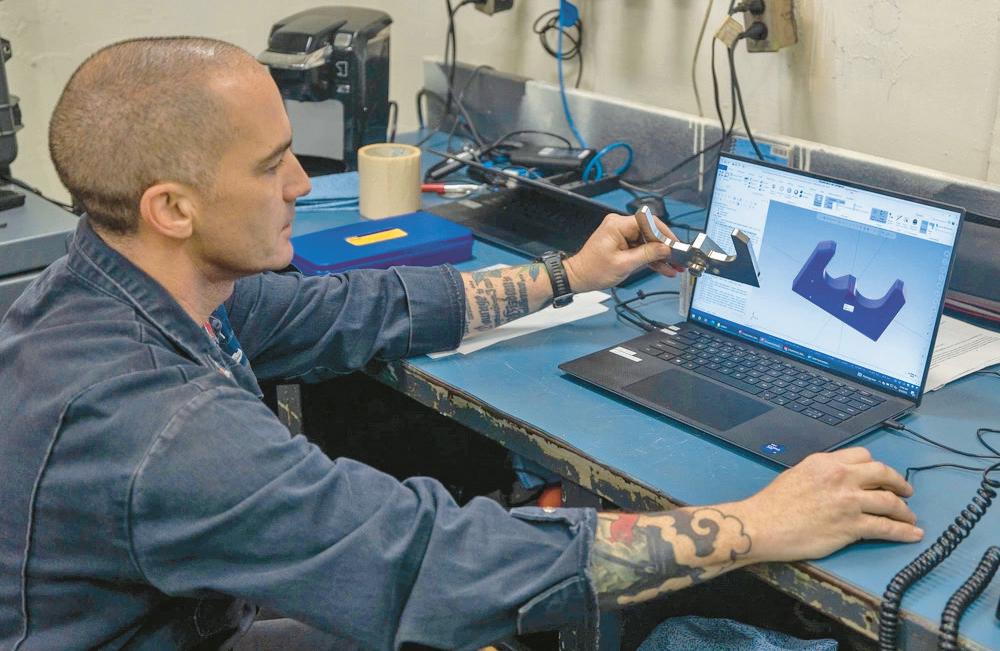
The ship’s machinery repairmen produced a stainless steel sprayer plate, which was used to repair one of the ship’s de-ballastingair-compressors(DBAC).The piece was fabricated using the ship’s additivemanufacturingequipment,comprised of a Haas TM-1 three-axis mill, a Meltio laser-wire deposition-head, and a Markforged X7 polymer and polymer-composite printer.
“[The sprayer plate] is designed to disperse lubricating and cooling oil on the helical gears as wellas the bearings behind thehelicalgears anditwasallfullymanufactured on the ship,” said Machinery Repairman1stClassCoryHover.“Nowthatwegot alloftheDBACsup,wecanofficiallyoperate our de-ballasting system and get our well deck from eight to 10 feet down to the seal [moreefficiently].”
Hoversaidonceapieceisprinted,certain tools such as mills and drills are then used to machine away the rough shape into the smooth and exact shape desired after the additiveprocessiscompleted
“[It’s]definitelythecoolestthingI’veever done as a machinist,” said Hover. “To take thatpartfromthemachineforthelasttime, blow off the coolant, blow away the chips, and see the final product is always very rewarding Your measurements are right, everything lines up and a nice beautiful machine product is what every machinist strivesfor.”
The ship received the 3-D printing capabilities as part of a partnership with Naval SeaSystemsCommandandJohnsHopkins University Applied Physics Laboratory in
ATLANTIC OCEAN (June 5,2023) MachineryRepairman 1st Class CoryHoverdemonstrates the software used to design the sprayerplate used to cool,lubricate,and maintain oil pressure fortheWasp-class amphibious assault ship USS Bataan’s (LHD 5) #4 deballasting aircompressor The sprayerplatewas completelydesigned and fabricated aboard the ship using the newlyadded HaasTM1Additive Manufacturing Hybrid CNC Machine.(U.S.NAVYPHOTOBYMASSCOMMUNICATIONSPECIALIST2NDCLASSBRADLEYRICKARD)
October2022.Priortotheadditivemanufacturing capabilitiesbeinginstalledonboard, five Sailors from Bataan’s Repair Division receivedtrainingfromPhillipsCorporation, the system manufacturer and integrator, in
ordertooperatetheadditivemanufacturing machinery
“3-D printing is the way of the future,” said Bataan’s Chief Engineer Lt Cmdr Gaston Hatfield “We took a part that
was not available in the stock system and printed it while at sea in less time than normalsupplychainscouldhavedelivered it for repair Five days from project start to operational test satisfactory.”
Captain BillyBarefoot posing fora portrait taken during the 2023 MCAAcquisitionAwards Dinner (PHOTOBYJAMESVANMEER)
4 The Flagship | www flagshipnews.com | Section 1 | Thursday, June 22 2023
Firefighterswith CherryPoint Fire and EmergencyServices use








Cherry Point Fire and Emergency Services conduct EV Extraction Training
 ByLanceCpl LauralleWalker









Marine Corps Air Station Cherry Point

In recent years the number of electric hybridandplug-inelectric vehiclessoldin the United States has been on the rise The structural and mechanical changes with such vehicles prompted local firefighters and emergency responders to gather and talk about how to better understand and reacttoanypotentialemergencieswiththe unique vehicles



Paul Shoemaker, a researcher for the National Fire Protection Association, gave a class and guided practical application at CherryPointFireandEmergencyServices (CPF&ES),June7,2023 Shoemaker,having years of experience as a firefighter, has spent countless hours researching electric

and hybrid cars to better understand and instruct firefighters on how to respond to fires with the special vehicles Accredited nationally and internationally Shoemaker has helped create guidelines and standard operating procedures for such events










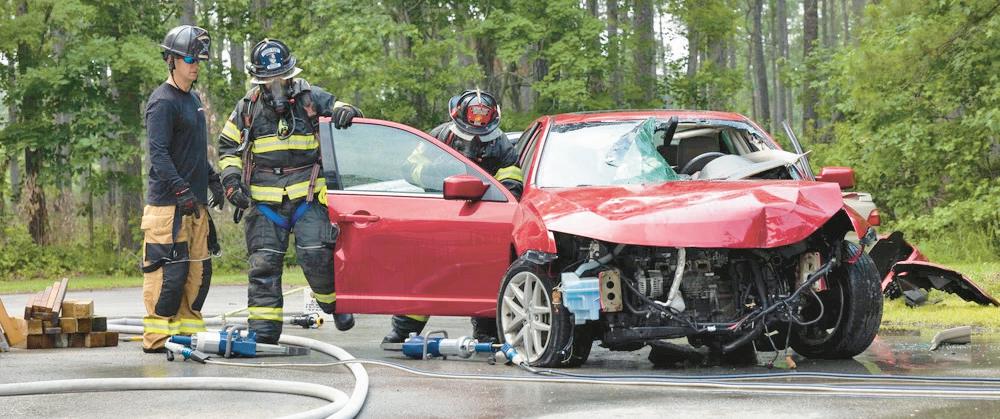
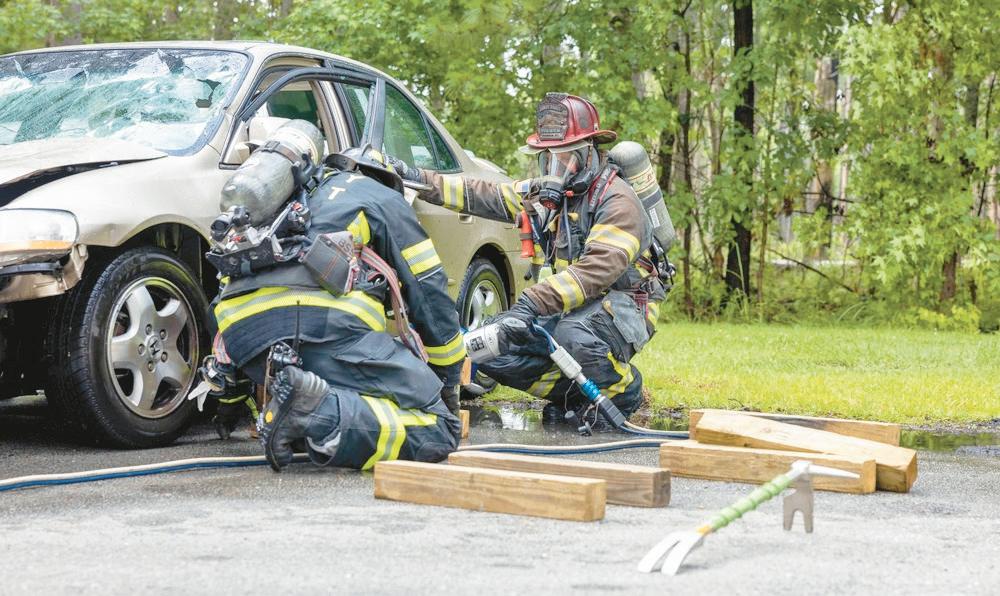
Afterclassroominstructions,Shoemaker andtheparticipatingfirefightersconducted simulated exercises with various pieces of equipment. During the practical application events, members of the CPF&ES donned full turnout gear and respiratory systems in order to mimic the conditions they will face during a real emergency
The electrical vehicle training session was the first time such training had been conducted among the MCAS Cherry Point emergency responders
the jaws oflife to lift a carduring a training scenario at the firefightertraining grounds,MCAS CherryPoint North Carolina,June 7,2023. Thiswas part oftraining held byPaul Shoemaker a firefighterand researcherofelectric and hybridvehicle extraction techniques.(U.S.MARINECORPSPHOTOBYLANCECPL LAURALLEWALKER) Paul Shoemaker farright guides the team through a mockextraction scenario at the firefightertraining grounds.Shoemakers class delves into the differences betweenvehicle structure and howto safelyand quicklyreact to an electric and hybridvehicle fire (U.S.MARINE CORPSPHOTOBYLANCECPL LAURALLEWALKER) www flagshipnews.com | The Flagship | Section 1 | Thursday, June 22 2023 5 Auto Home LifeBanking Credit Cards We do that, too. Need abank accountorcredit card? USAA has that. Insurancecoverage foryour car,home or other belongings?USAAhas that. Looking foradviceand discounts?USAAhas that, too. All in one spot and all with award-winning service. In stments/Insur Not aDeposit •Not FDIC Insured •Not Bank Issued, Guaranteed Underwritt •May Lo Value Membership eligibilityand productrestrictions apply andare subjecttochange.Property and casualtyinsuranceprovided by United Services Automobile Association (USAA), USAA CasualtyInsuranceCompany, USAA GeneralIndemnityCompany, Garrison Property and CasualtyInsuranceCompany, basedinSan Antonio Te ;USAALimited (UK) and USAA S.A. (E ope) and is ilable onlytop ligible forp perty and casualtyg up membership.Each mpanyh sol financial sponsibilityf its np ducts.C ages subj ttothe te dconditio of the policy. Life insur nd annuities pr ided by USAALifeI Company, SanAntonio,TXand in NewYork by USAA LifeInsuranceCompanyofNewYork,Highland Falls,NY. All insuranceproducts aresubjecttostate availability, issue limitations and contractual terms andconditions.Each companyhas sole financial responsibilityfor its ownproducts.Credit cards areissued by USAA Savings Bank and iced by USAAFederal SavingsBank.Other bank products ep vided by USAAFederal Savings Bank.Both banks eM ber FDIC. Allc dit ds bjectt ppr l. No DepartmentofDef go nt ag yendorsem t. ©2023USAA.292575 -0423 Find out whatUSAAhas foryou. usaa.com
Burning and turning below decks
Gerald R. Ford’s machine shop at work
ByPettyOfficer2ndClass
JacksonAdkins
USS Gerald R. Ford (CVN 78)
NORTH SEA When people think of aircraft carriers they picture jets being launchedandrecovered,Sailorsconducting deckevolutions,orinteractionswithforeign partners and allies; big picture evolutions. Whatisn’talwaystopofmindveryoftenare theSailorswhoworkbelowdecks-theSailors who keep the ship moving, fix one-off parts,andkeeptheshipafloat.
The world’s largest aircraft carrier USS Gerald R. Ford’s (CVN 78) engineering department’s machine shop helps fabricateandfixvitalpartsfortheshipaswellas the entire strike group, upkeep the vacuum collection holding and transfer system (VCHT), and oversee all piping systems acrosstheship
Ford’s machine shop can take a piece of stock or scrap metal and turn it into nearly anything. Their potential is unlimited when it comes to fabricating tools needed for specific jobs or creating parts for ship systemsaboardFordorothershipsattached totheGeraldR.FordCarrierStrikeGroup
The machine shop is comprised of two different rates: hull technicians (HT) and machineryrepairman(MR).Theshopitself is broken down into four different work centers

Each work center provides different trades or skills depending on what type of workneedstobedone
“We’re here for all emergent repairs that have to deal with the hull of the ship or repairs that have to deal with brazing or welding throughout any of the piping systemsorhulloftheship,”saidHullTechnician1stClassRemigioDavila,fromHouston, assignedtoengineeringdepartment’srepair division. “We also deal with any repairs on the VCHT system, and we fill in wherever weareneededaswell.”
Sailors in the machine shop are given on-the-jobtrainingincertaintradesthatare criticalonaship Thisincludestheupkeepof theVCHTsystem,whichallowsSailorstouse therestroomorshowerinasanitarymanner

“The VCHT system, that is a very vital system. Everyone has to use the restroom and we are in charge of the disposal [of waste] and upkeep of those systems,” said Hull Technician Fireman Josiah Donato, from Elmwood, Wisconsin, assigned to Ford’s engineering department. “It’s a dangeroussystem,butwe’retrainedonhow to repair any component of it such as a gas leakorspill.”
In addition to ensuring Sailors have
unclogged toilets and hot showers, Sailors in the machine shop are part of the ship’s damagecontrolteam.
“We are also secondary damage controlmen. When they ring those bells, we’re the guysrunningthroughtheshiptofightwhatevercasualty,”saidDavila.“Firstonesin,last onesout,theretosaveit.
TheHTsandMRsareaprimeexamplesof being damage control professionals as well ashoningthecraftsoftheirassignedrates
The craftsmanship of the machine shop is what makes it special. In certain situations averyspecificpartmaybeneededand shipping it to the aircraft carrier in a timely mannermaynotbeanoption Thisiswhere theirexpertisecomesintoplay
“We can’t always order parts to the ship So, if we get into a pinch and we don’t have the part on-hand, it needs to be made from scratch,” said Machinery Repairman 2nd Class Bowen Kincaid, from Battle Creek, Michigan, assigned to Ford’s engineering department. “So without us there’s no way tofixthoseone-offparts.”
Kincaidenjoystheaspectofhisjobwhere hecancraftspecificpartsneededacrossthe ship
“My favorite part of the job is watching rawmaterialgettingturnedintosomething,” saidKincaid.“Havingachunkofmetalthat is absolutely worthless, machining it down, cutting it, and running it through different processes untilitisnowapiecethatisgoing togointoamultimilliondollarsystem.
Just like most professions, there’s a plan andsetfinishpoint.Donatoenjoysgettingto see his work from the beginning point until theendwhereit’susedtorepairavitalship system.
“When you’re done with a job, it’s complete,”saidDonato “You’vemadesomething or repaired something and I really enjoythetangibilityofthat.”
The next time you see a ship, think about theSailorsyoucan’tsee Theoneswhowork below the waterline The ones burning and turninginthemachineshop Gerald R. Ford is the U.S. Navy’s newest and most advanced aircraft carrier As the first-in-classshipofFord-classaircraftcarriers CVN 78 represents a generational leap in the U.S. Navy’s capacity to project power on a global scale Ford-class aircraft carriers introduce 23 new technologies, including EMALS, AAG and Advanced Weapons Elevators.
The new systems incorporated ontoFord-classshipsaredesignedtodeliver greater lethality, survivability and joint interoperability with a 20% smaller crew than a Nimitz-class carrier, paving the way forwardfornavalaviation.
—
MachineryRepairman 3rd Class Carzelle Elicke,from Chicago,assigned to theworld’s largest aircraft carrierUSS Gerald R.Ford’s (CVN 78) engineering department manufactures an adapter using a lathe in the machine shop June 6,2023 Gerald R.Ford is the U.S.Navy’s newest and most advanced aircraft carrier representing a generational leap in the U.S.Navy’s capacityto project poweron a global scale.The Gerald R.Ford CarrierStrike Group is on a scheduled deployment in the U.S.Naval Forces Europe area ofoperations,employed byU.S.Sixth Fleet to defend U.S.,allied, and partnerinterests (U.S.NAVYPHOTOBYMASSCOMMUNICATIONSPECIALIST2NDCLASSJACKSONADKINS) Hull MaintenanceTechnician 2nd ClassTytanWombwell,from Placerville,California,assigned to theworld’s largest aircraft carrierUSS Gerald R.Ford’s (CVN 78) engineering department welds steel in the machine shop June 6,2023 Gerald R.Ford is the U.S.Navy’s newest and most advanced aircraft carrier representing a generational leap in the U.S.Navy’s capacityto project poweron a global scale.The Gerald R.Ford CarrierStrike Group is on a scheduled deployment in the U.S.Naval Forces Europe area ofoperations,employed byU.S.Sixth Fleet to defend U.S., allied,and partnerinterests (U.S.NAVYPHOTOBYMASSCOMMUNICATIONSPECIALIST2ND CLASSJACKSONADKINS) Listen to our top news stories for free. Tribune Publishing Company Staying in the know is easy Each weekday,you’ll get the latest stories curated by our editors on your smart speaker or streaming service. Available on Amazon Echo, Apple Music, Google Home, Spotify and more. Start now at PlayOurNews.com 6 The Flagship | www flagshipnews.com | Section 1 | Thursday, June 22 2023
USS
II MEF Marines, Sailors return to Naples in support of Task Force 61/2
FromIIMarineExpeditionaryForce
NAPLES, ITALY. Marines and Sailors from II Marine Expeditionary Force (II MEF), return to Naples, Italy as the fourth evolution of II MEF support to Task Force 6½,NavalAmphibiousForceEurope(TF6½).
TF6½continuestoalignmultipleexisting forces under the Naval Amphibious Force commander; deployed Amphibious Ready Groups (ARG), Marine Expeditionary Unit (MEU) FleetAnti-TerrorismSecurityTeam (FAST)CompanyEurope(FASTEUR),and other II MEF units that support the Fleet Commander’srequirements.
from Page 1
ordiscouragedbyothers’skepticism.
“Ifyouremainopentosolutionsthatdon’t align with conventional wisdom and you are willing to shed the shackles of practical application,unusualideascanevolveandin unexpectedways,”Giesekesaid OneofGieseke’sinventionscounteredhis ownfather’sconventionalwisdom.
“When I was starting my career in engineering, my father, who was also an engineer,toldmeoneoftheuniversaltruthswas that‘youcan’tpusharope,’”Giesekesaid “I designedtheElastomericSurfaceActuation Systemtodojustthat.Sorrydad.”
Embedded in the design are tubes that when pressurized elongate They become ropesthatpushandwhendistributedproperly, can be used to control the shape of a surface.
“Iamnotsureiftheideaisusedanywhere else, but I found another use for it when a large Rhode Island-based toy company came to us fishing for ideas,” Gieseke said. “Inresponse,Iappliedtheideastoatoyfish OscillatingAppendageForFinPropulsion.”
WhenGiesekecomesupwithanewidea heneverknowsifitwillendupbeingimplemented in the future, but regardless of the end result, he views the patent process as important and well worth the time and effort.
“I’mnotsureifanyoftheideasIpumped through the patenting process will amount to anything, but maybe the next patent will
from Page 1
amongotherbenefits.
Their dynamic structure allowed them to establish and maintain effective working relationships with external organizational units, including the Restoration Advisory Board, a stakeholder organization that provides input on MCB Camp Lejeune’s cleanup program. The team’s partnership involved frequent engagement and collaboration with stakeholders to execute the Navy’s ERP in a timely, efficient, and cost-effective manner It also focused on strengtheningrelationships improvingopen communication, and meeting stakeholder
Since its establishment, TF 6½ has overseen a wide range of integrated operations from port visits, exercises and contingency planning to crisis response following the devastating earthquakes in Turkiye and Syria this past February TF 6½ has proven thenecessitytoestablishanintegratedNavy and Marine Corps staff within U.S. Sixth Fleet TF 6½ demonstrates II MEF’s support to the U.S. Sixth Fleet’s Commander while operationalizing integrated concepts and capabilities discussed in Force Design TF 6½,headquarteredinNaples,Italyisahighly flexible and dynamic task force, capable
be ‘the one,’ ” said Gieseke. “The only way to find out is to write it up and see what happens The surest way for an idea to die isfornooneelsetoseeit.”

JimKasischke,supervisorypatentcounsel inDivisionNewport’sOfficeofCounsel,said that it’s wise for employees to try to patent theirideasbecause90percentoftheirideas canbepatented.
To start the process inventors should gather enough information to submit an inventiondisclosure
The invention disclosure should include adescriptionoftheinventionbystatingthe problem that needs solving, what the Division is currently doing, and how the inventionproposestosolvetheprobleminanew way. The description also highlights the advantages of the invention, has a photo or preferably a drawing, and states how the inventionisenabledtosolvetheproblem.
“The more the invention disclosure is developed,theeasieritistoprepareapatent application,”Kasischkesaid.
The invention disclosure requires the signature of two people with associated technical knowledge and the signature of thedepartmentsecurityofficial
After receipt, Office of Counsel staff assessesthecompletenessofthedisclosure.
Once accepted the disclosure is forwarded to the NUWC Invention Evaluation Board (IEB)for anevaluation of the noveltyofthe invention and value to the Division and the U.S. Navy If approved by the IEB, a patent application is written internally or with the assistance of a contract patent attorney. Theinventorisencouragedtoprovideinput
objectivessositescanberemediatedquickly andreturnedformissionusage
“Congratulations to each of the team recipients, and the entire MIDLANT Environmental Restoration Team, on this great achievement,” said Capt. Matt Riethmiller NAVFAC MIDLANT Commanding Officer “This a testament to the hard work and tremendous effort done by the Navy and Marine Corps team to not only protect, but alsorestoretheenvironment Italsodemonstratestheimpactenvironmentalrestoration hasonthemission,andwherewelive,work andtrain.”
NAVFAC’s Environmental Program provides high quality timely cost-effective,andefficientenvironmentalsupportto the Navy, Marine Corps and other clients
of enhancing the fleet’s maritime domain awareness inordertoadvanceU.S.national interests, security, and stability throughout NavalForcesEurope’sareaofoperations.
Historically, the Navy and Marine Corps are an integrated team. Together the BlueGreen team answer’s the Nation’s Call, no matter the time or place Task Force 6½ provides the Navy and Marine Corps team with an opportunity to synchronize and conduct operations at NAVEUR/U.S Sixth Fleet’shigherheadquarters.
High-resolutionimageryofTaskForce6½ is available at the DVIDS feature page link: https://www.dvidshub.net/feature/Task-
during the writing process and will have a finalreviewofadraftpatentapplication.
Once an internal public release review is complete, staff will file the official patent application with the U.S. Patent and Trademark Office (USPTO). A patent examiner evaluates the draft application for novelty and conformance with U.S. law. Typically, the Division Newport patent attorney will havetoprosecutetheapplicationandnegotiate with the patent examiner to allow a patent to issue on the invention This is not asurethingbutthepatentattorneyshavean almostperfectprosecutionrecord
The process from submission of an invention disclosure to possible issuance of a patent from the USPTO can take two to threeyears.
Michael Stanley, patent counsel in Division Newport’s Office of Counsel, added that continuing to patent ideas after the first patent can be beneficial to Division Newport, as well as to the inventors Stanley, who has processed many of Gieseke’s patents, said that a family of patents (especially in the same technology) can be solicited to industry to enhance the value of a licensepackage.
PatentlicensingprovidesroyaltiestoDivision Newport, as well as to the inventor of the patented technology Recently retired Division Newport inventors Ruffa and Paul Cavallaro, as well as Gieseke, have patents thatcontinuetobesolicitedforlicensingby the Division Newport Technology PartnershipOffice Gieseke encourages other scientists who have new ideas to an existing problem to
Environmental management is the means of conserving, protecting and restoring the environment, and natural and cultural resources, for future generations NAVFAC offers sound environmental management and technical support necessary for Navy andMarineCorpscompliancewithfederal state, local and host nation regulations We strive to continually improve our relationships with our clients, regulators and other stakeholders through focus on common operational goals, sharing of information regarding our products and services and availability of a highly skilled environmentalworkforce. NAVFAC MIDLANT provides facilities engineering publicworksandenvironmental products and services across an area of
Force61
For more information on the entirety of the deployment please see 2d MEB’s article at this link: https://www.dvidshub.net/ news/446599⁄2nd-marine-expeditionary-brigade-deploys-task-force-61-2
For a “Year in Review” of Task Force 6½, please see the article at this link: https:// www.dvidshub.net/news/446799/taskforce-recond-with
For more information about the Task Force, please contact II MEF Communication Strategy and Operations at iimefcommstrat@usmc.mil
pursuethepatentprocess
“Patentingisagreatwaytodocumentthe process and mark the path along the way, Giesekesaid.“Togetapatent,youdon’thave toconvinceanyonethattheideaistheright solutionfortheparticularproblemathand. It just needs to be novel and sufficiently developedtoshowthatitcouldwork.”
NUWC Newport is the oldest warfare center in the country tracing its heritage to the Naval Torpedo Station established on Goat Island in Newport Harbor in 1869
Commanded by Capt Chad Hennings, NUWC Newport maintains major detachments in West Palm Beach, Florida, and AndrosIslandintheBahamas,aswellastest facilitiesatSenecaLakeandFisher’sIsland, New York, Leesburg, Florida, and Dodge Pond,Connecticut. Joinourteam!NUWCDivisionNewport, one of the 20 largest employers in Rhode Island, employs a diverse, highly trained, educated, and skilled workforce We are continuously looking for engineers, scientists,andotherSTEMprofessionals,aswell as talented business, finance, logistics and othersupportexpertswhowishtobeatthe forefront of undersea research and development Please connect with NUWC DivisionNewportRecruitingatthissite-https:// www.navsea.navy.mil/Home/Warfare-Centers/NUWC-Newport/Career-Opportunities/ and follow us on LinkedIn @ NUWC-Newport and on Facebook @ NUWCNewport.
responsibility that spans from South Carolina to Maine, and as far west as Michigan, anddowntoIndiana.Asanintegralmember of the Commander, Navy Region Mid-Atlantic team, NAVFAC MIDLANT provides leadership through the Regional Engineer organizationtoensuretheregion’sfacilities and infrastructure are managed efficiently andeffectively Visit NAVFAC Mid-Atlantic online at www.navfac.navy.mil/navfac_worldwide/ atlantic/fecs/mid-atlantic.html.Also“like,” ‘follow” and share and visit the official NAVFAC Mid-Atlantic Facebook page at https://www.facebook.com/navfacmidatlantic.
NUWC Division Newport
NAVFAC MIDLANT
www flagshipnews.com | The Flagship | Section 1 | Thursday, June 22 2023 7
STHE











BESTRESALEVALUE OFALLBRANDSFOR2023 ACCORDINGTOKELLEYBLUEBOOK’SKBB.COM





KELLEY
SPROJECTEDRESALEVALUEISSPECIFICTOTHE2023MODELYEAR FORMOREINFORMATION,VISITKELLEYBLUE BOOK’SKBB.COM.KELLEYBLUEBOOKISAREGISTEREDTRADEMARKOFKELLEYBLUEBOOKCO.,INC.
CHESAPEAKE 1800GreenbrierParkway•Chesapeake 757.213.5000•prioritytoyotachesapeake.com PRIORITYTOYOTAHAMPTON 2301W.MercuryBlvd.•Hampton 757.838.5000•prioritytoyotahampton.com





1$750REBATEOFFEREDBYTOYOTAMOTORNORTHAMERICA,INC.ANDMAYBEAPPLIEDTOWARDFINANCEORLEASECONTRACTSONNEWTOYOTAVEHICLESTHROUGHPARTICIPATINGTOYOTADEALERSANDTOYOTA FINANCIALSERVICES,DATEDFROMMAY31,2023THROUGHJULY5,2023.TOQUALIFYFORTHEREBATE,ATTHETIMEOFPURCHASEORLEASEYOUMUSTBE(1)INCURRENTACTIVEDUTYSTATUSINTHEU.S.MILITARY (NAVY,ARMY,AIRFORCE,MARINES,NATIONALGUARD,COASTGUARDANDACTIVERESERVE)ORAU.S.MILITARYINACTIVERESERVE(I.E.,READYRESERVE)THATISPARTOFTHEINDIVIDUALREADYRESERVE,SELECTED RESERVEANDINACTIVENATIONALGUARD;ORARETIREEOFTHEU.S.MILITARY,ORAMILITARYVETERANWITHINTWOYEARSOFTHEIRDISCHARGEDATE;ORAHOUSEHOLDMEMBEROFANELIGIBLEU.S.MILITARY PERSONNEL,INCLUDINGGOLDSTARFAMILYMEMBERS;AND(2)PROVIDEVERIFIABLEPROOFOFMILITARYSTATUSORACTIVESERVICE;(3)RECEIVEASALARYSUFFICIENTTOCOVERORDINARYLIVINGEXPENSESAND PAYMENTFORYOURNEWVEHICLE;AND(4)RECEIVECREDITAPPROVALFROMANDEXECUTEAFINANCEORLEASECONTRACTTHROUGHAPARTICIPATINGTOYOTADEALERANDTOYOTAFINANCIALSERVICES NOTALL APPLICANTSWILLQUALIFYONLEASECONTRACTS,REBATEMUSTBEAPPLIEDTOWARDTHEAMOUNTDUEATLEASESIGNINGORTOWARDTHECAPITALIZEDCOSTREDUCTION.ONFINANCECONTRACTS,REBATEMUST BEAPPLIEDTOWARDTHEDOWNPAYMENT.LIMITONEREBATEPERFINANCEORLEASETRANSACTIONPERELIGIBLEU.S.MILITARYPERSONNELORELIGIBLEHOUSEHOLDMEMBER.OFFERNOTCOMBINABLEWITHTHE COLLEGEGRADUATEREBATEPROGRAM,ANDTHELEASE-ENDREFIPROGRAM.VEHICLEMUSTBETAKENOUTOFDEALERSTOCK.TERMS,CONDITIONSANDRESTRICTIONSAPPLY.PROGRAMISNOTAVAILABLEINAL,FL, GA,HI,NC,ANDSC.REBATETERMSMAYBEMOREGENEROUSINYOURLOCALAREA.ASKYOURPARTICIPATINGDEALERABOUTTHEMILITARYREBATETERMSINYOURAREA.MUSTPAYSALESTAX.VOIDWHEREPROHIBITEDBYLAW.NOTREDEEMABLEFORCASH.©2023TOYOTAFINANCIALSERVICES.ALLRIGHTSRESERVED.TOYOTAFINANCIALSERVICESISASERVICEMARKUSEDBYTOYOTAMOTORCREDITCORPORATION(TMCC).RETAIL INSTALLMENTACCOUNTSMAYBEOWNEDBYTMCCORITSSECURITIZATIONAFFILIATESANDLEASEACCOUNTSMAYBEOWNEDBYTOYOTALEASETRUST(TLT)ORITSSECURITIZATIONAFFILIATES.TMCCISTHESERVICER FORACCOUNTSOWNEDBYTMCC,TLT,ANDTHEIRSECURITIZATIONAFFILIATES.YOUMUSTMEETALLOFTHESECONDITIONS:BEINCURRENTACTIVEDUTYSTATUSINTHEU.S.MILITARY(NAVY,ARMY,AIRFORCE,MARINES,NATIONALGUARD,COASTGUARDANDACTIVERESERVE)ORAU.S.MILITARYINACTIVERESERVES(I.E.,READYRESERVES)THATAREPARTOFTHEINDIVIDUALREADYRESERVE,SELECTEDRESERVEANDINACTIVE NATIONALGUARD;ORAMILITARYRETIREEWITHINTWOYEARSOFRETIREMENTORHONORABLYDISCHARGEDVETERANOFTHEU.S.MILITARYWITHINTWOYEAROFTHEIRHONORABLEDISCHARGEDATE;ORAHOUSEHOLDMEMBER*OFANELIGIBLEU.S.MILITARYPERSONNEL;ANDPROVIDEVERIFIABLEPROOFOFMILITARYSTATUSORACTIVESERVICEATTHETIMEOFPURCHASEINTHEFORMOFONEOFTHEFOLLOWINGDOCUMENTATIONS:LEAVEANDEARNINGSTATEMENTMILITARYIDENTIFICATIONCARDVETERANS/RETIREESDDFORM-214RECEIVEASALARYSUFFICIENTTOCOVERORDINARYLIVINGEXPENSESANDPAYMENTSFORYOURTOYOTA BECREDITAPPROVEDBYTFS.*HOUSEHOLDMEMBER(S):-HOUSEHOLDAND/ORFAMILYMEMBEROFTHEQUALIFIEDMILITARYPERSONNELLIVINGATTHESAMEADDRESSASTHEQUALIFIEDMILITARYPERSONNEL.AN ELIGIBLESERVICEMEMBERANDHISORHERHOUSEHOLDMAYRESIDEINPERMANENTORTEMPORARYHOUSING.-GOLDSTARFAMILYMEMBERSAREFAMILYMEMBERSOFAFALLENHERO(S)ANDAREALSOCONSIDERED ASHOUSEHOLDAND/ORFAMILYMEMBERANDAREELIGIBLEFORTHISPROGRAM.MUSTPROVIDEVERIFIABLEPROOFOFMILITARYSTATUSORACTIVESERVICE;ORRETIREDVIAANID.MEACCOUNTANDCOMPLETETHE VERIFICATIONPROCESSATAPARTICIPATINGTOYOTADEALER SPECIALAPRFINANCINGEXCLUDESHYBRIDS 3.99%APRFINANCINGUPTO48MONTHSON2023CAMRY,2023COROLLA(EXCLUDESCOROLLACROSS), 2023HIGHLANDER,2023RAV4AND2023TACOMAAVAILABLETOQUALIFIEDBUYERSTHRUTOYOTAFINANCIALSERVICES.TOTALFINANCEDCANNOTEXCEEDMSRPPLUSOPTIONS,TAX,TITLE,LICENSEANDDEALERFEES 48MONTHLYPAYMENTSOF$22.57FOREACH$1000BORROWED NOTALLBUYERSWILLQUALIFY.OFFERSMAYNOTBECOMBINEDWITHOTHEROFFERSUNLESSSPECIFIEDOTHERWISE.DEALERFEESAREEXTRA.VEHICLE SHOWNMAYBEPROTOTYPEAND/ORSHOWNWITHOPTIONS.ACTUALMODELMAYVARY.DELIVERYMUSTBETAKENFROMDEALERSTOCKBY7/5/23ANDISSUBJECTTOAVAILABILITY.SEEPARTICIPATINGCENTRALATLANTICTOYOTADEALERFORDETAILS.OFFERSEND7/5/23 3TOYOTACARECOVERSNORMALFACTORYSCHEDULEDMAINTENANCEFORTWOYEARSOR25,000MILES,WHICHEVERCOMESFIRST.CERTAINMODELSREQUIRE ADIFFERENTMAINTENANCESCHEDULEASDESCRIBEDINTHEIRMAINTENANCEGUIDE.24-HOURROADSIDEASSISTANCEISALSOINCLUDEDFORTWOYEARS,UNLIMITEDMILEAGE.ROADSIDEASSISTANCEDOESNOT INCLUDEPARTSANDFLUIDS,EXCEPTEMERGENCYFUELDELIVERY.SEEYOURTOYOTADEALERFORDETAILSANDEXCLUSIONS.VALIDONLYINTHECONTINENTALU.S








8 The Flagship | www flagshipnews.com | Section 1 | Thursday, June 22 2023 $750U.S.Military REBATE1 THANKSTOALLTHEBRAVEMENANDWOMENFORYOURSERVICETOOURCOUNTRY. 2 AVAILABLEON2023:CAMRY,COROLLA, HIGHLANDER,RAV4&TACOMA. ASLOWAS CASEYTOYOTA 601EastRochambeauDrive•Williamsburg 757.259.1000•caseytoyota.com CHECKEREDFLAG TOYOTA 5301VirginiaBeachBlvd.•VirginiaBeach 757.490.1111•toyota.checkeredflag.com FIRSTTEAMTOYOTA 3400WesternBranchBlvd.•Chesapeake 833.628.1653•firstteamtoyota.com GLOUCESTERTOYOTA 6357GeorgeWashingtonMemorialHwy. Gloucester 804.693.2100•gloucestertoyota.com HALLTOYOTAVIRGINIA BEACH 1877LaskinRoad•VirginiaBeach 757.437.4000•halltoyotavirginiabeach.com PEARSONTOYOTA 12978JeffersonAve.•NewportNews 757.874.6000•pearsontoyotascion.com PRIORITYTOYOTA
3
uarterdeck
FRCE marks first with adoption of battery-powered ground power units
Fleet Readiness CenterEast’s UH-1N Huey production line is swapping out dieselpowered ground powerunits (GPU) fora sustainable alternative. PageB2

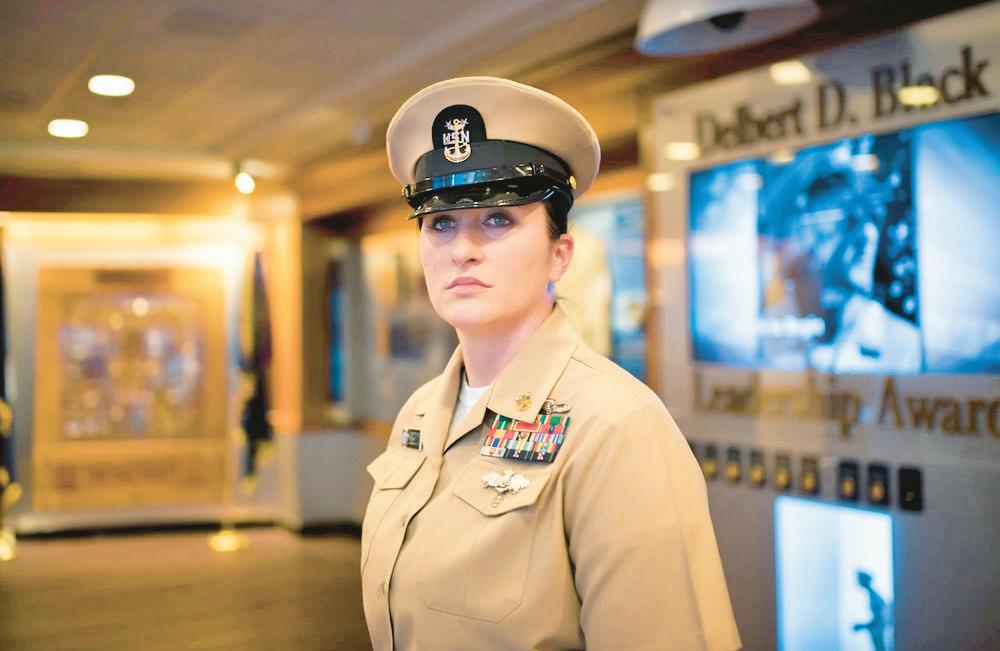
WASHINGTON (April 28 2023) MasterChiefGunner’s MateJessica Harrison,fromTwin Falls,Idaho is the firstwoman in the U.S.Navyto achieve the rankofE-9
Navy Sailor becomes first female Master Chief Petty Officer in Gunner’s Mate rating
ByPettyOfficer1stClass
JeanetteMullinax
Chief of Naval Personnel
History was quietly made during a ceremony inside the Delbert D. Black National Chief’s Mess at the U.S. Navy Memorial in Washington, D.C. April 28 2023 when reserveMasterChiefGunner’sMateJessica Harrisonbecamethefirstwomantoachieve therankofMasterChiefPettyOfficerinthe Gunner’sMaterating
Gunner’s Mate is one of the five original ratings established in The Naval Armament Act of 1794 along with Boatswain’s Mate Quartermaster, Master-at-Arms and Yeoman.
Duringabriefspeech,Harrisonreflected on her achievement, answering a question thatshecommonlyreceives “Howdidyou doit?”
“ThethingIalwayssayis:notbymyself,” Harrison said “It’s my sailors, my mentors, my friends It’s through the connections thatwehavewithourshipmates.”
While Harrison’s advancement was a historical achievement for the Gunner’s Mate community, her milestone also signifiedatriumphforallenlistedSailorsasasign of the progress that women have made in themilitary
Chief of Navy Reserve, Vice Adm. John Mustin presided at the event to recognize Harrison’s accomplishments and administer the oath of enlistment in front of her
family and friends, as well as visitors of the memorial.
“This is a pretty significant accomplishment as an individual milestone, but also fortheservice;probablylongoverdue,butI couldn’tbemorepsychedtobeheretoshare this moment with you,” Mustin said during the ceremony. “I am thrilled that every one of you has an opportunity to reflect on this moment because we’re going to be able to lookbackonthisandsaythatwewerethere themomentithappened.”
By achieving the rank of E-9, Harrison joinedasmallfractionofleadershipcharged with bridging the gap between officers and enlistedpersonnel whileactingassupervisorsandadvocatesfortheirSailors
In keeping with ceremonial customs, Harrison also handed down her Senior ChiefinsigniatoaSailorwhoshebelievesis readytotakeongreaterresponsibilityatthe nextrank.ChiefGunner’sMateKaliLarraga acceptedthemwithanembrace
Aspartofherspeech,Harrisonrecognized Larraga’sgrowthasaSailorandleader Elaboratingmoreduringaninterview Harrison described how Larraga’s words helped her realizetheweightofherachievement.
“She said, ‘we’re looking for someone to show us it can be done’... that was a big eye-opener for me,” Harrison said. “Looking up and seeing somebody who looks like you is a powerful thing She made me see that, and she probably doesn’t understand theenormityofit,butonedayshewill.”
Although Harrison’s promotion marks a firstfortheservice,unrestrictedopportunitiesforwomenintheNavywerenotalways present.
Only since 1994 has the service allowed women to lawfully work in combat roles, despite the critical positions that women have held in the Navy since 1908 when the Navy Nurse Corps was first established by Congress. Over the years, the Navy has made strides toward the inclusion of women and throughout her time in service, Harrison has witnessed first-hand the cultural shift regardingwomeninthemilitary “I remember when I walked in [to my first command], I was asked if I was the newadmin, Harrisonsaid.“ButIdon’thear those questions anymore I see it becoming more commonplace to have females work in weapons fields And I think the only way that we continue to drive that as a Navy is toremovethebarriersandremovethedivision.”
Committed to further removing barriers forSailors HarrisonnowworksattheChief ofNavalPersonnelheadquarters inArlington, Virginia. In the Navy’s Culture and ForceResilienceOffice,leadingenlistedSailorsandadvisingateamofofficersinmatters that include diversity, equity, and inclusion policyupdatesandholisticsupportservices forthefleet.
Previously, Harrison delivered educational training to the fleet on the Navy’s
WarriorToughnessprogram,whichemphasizes developing the physical, mental and spiritualwell-beingofSailors
Harrison has served in the Navy Reserve for 17 years, 14 of those years on active duty orders During that time she deployed to Iraq and Kuwait completed a Bachelor’s degree, a Master’s degree and a Ph.D in Education,whilealsoraisingheryoungsons, LoganandTrey
“I always wanted to show my children that it could be done, and I was the first of mysiblingstoevengraduate,”Harrisonsaid Harrison’s accomplishments have demonstratedherdrive,determinationand commitment to the Navy and to her family Her story should serve as inspiration to not only past and present Sailors, but also to anyone who hopes to someday serve in the armedforces
“One day, we’re going to not be a Navy of firsts,”Harrisonsaid.“Ilookforwardtothat day.”
Harrison’saccomplishmentwasmirrored byGunner’sMateSeniorChiefJessicaSaunders, who screened for Master Chief Petty OfficerbytheFiscalYear2024Active-Duty NavyE9ScreeningBoardinMay.
For more news from the Chief of Naval Personnel, follow us on Facebook, Instagram,Twitter,andYouTube,orvisithttps:// www.navy.mil/cnp
Navy Reservists honor fallen shipmate
ByPettyOfficer1stClass
AmberWeingart Navy Reserve Region Readiness and Mobilization Command
SPOKANE, Wa Friday, May 26 at 11:36amElectronicsTechnician-Navigation
1stClassJeffreyS.ThomasJr.,aninstructor assignedtoTridentTrainingFacilityBangor (TTFB), was riding his motorcycle from Naval Base Kitsap alongside three other Shipmates when he collided into another vehicle according to reports from officials Thomaswaspronounceddeceasedonscene
Thomas, a native of Spokane, Wash., was aninvolvedmemberoftheSpokanecommunity Thomas left for bootcamp in 2009 and returned to serve as a recruiter for the area from 2015 to 2018 During his recruitment tour hewasrecognizedwithseveralawards including FY17 Navy Recruiting District (NRD) Seattle’s Top Recruiter of the Year and the FY17 Admiral’s Warrior Challenge Award in appreciation of his commitment to providing Naval opportunities for young menandwomenintheSpokanearea
“He impacted everyone he met,” said Thomas’ mother, Holly Swink. “He would go to his recruit’s graduations and support them in every way he could He wouldn’t show up in his uniform and distract from the ceremony he just wanted to be there to show his support. He was very humble but soproudtobeapartoftheNavy.”
Thomas’ wife, Paula Thomas, said his recruitswereveryimportanttohim “When
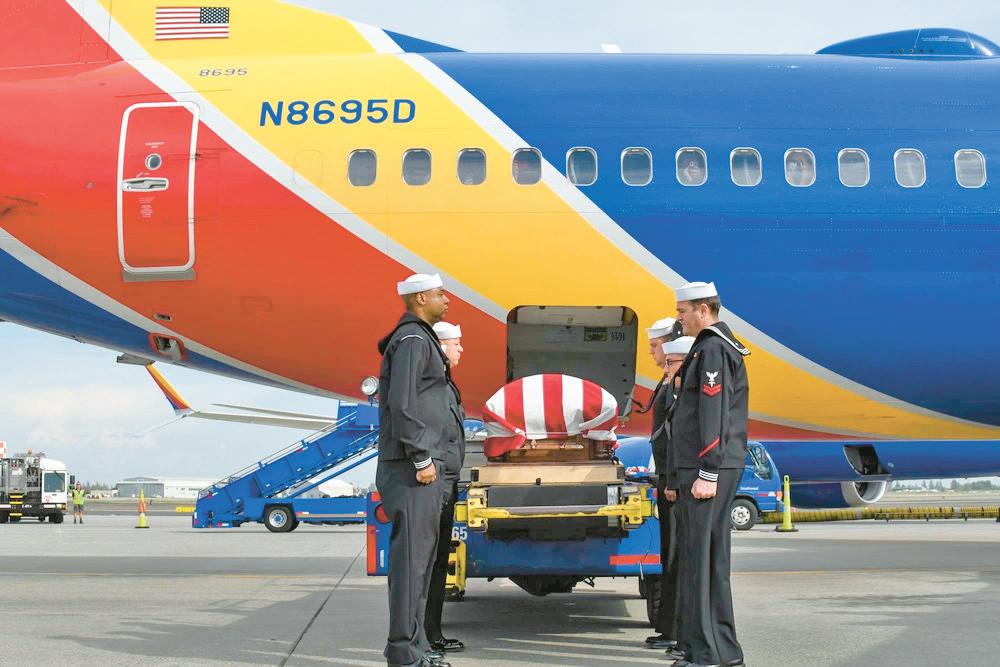
SPOKANE,Wash.(June 13,2023) Naval Reserve Center(NRC) Spokane Funeral HonorGuard
plane side honors forElectronicsTechnician – Navigation 1st Class JeffreyS.Thomas,Jr.,a native ofSpokane,Wash.Navymilitaryfunerals are conducted to recognize the proudAmerican tradition ofhonorable servicewhich Navymen andwomen have given to theircountry (U.S.NAVYPHOTOBYMASSCOMMUNICATIONSPECIALIST1STCLASS AMBERWEINGART)
hecamehome hisfacewouldlightupashe told me stories After recruiting duty, he continued to keep tabs on his recruits and theircareers.Hewassoproudofthem,and sohappytoseethemgrow.”
On June 13 Thomas’s remains were honorably transported back to the community he was born in, raised in, and contributedsosignificantlyto Naval Reserve Center (NRC) Spokane
FuneralHonor Guardsupported hisarrival at the Spokane International Airport with planesidehonors Thomaswillbeawarded full military honors at Heritage Funeral HomeinSpokane,Wash.onJuly8,2023.
“Wearesogratefultoyouallforthisbeautiful ceremony,” said Swink “Thank you so muchforbringingmysonhome.”
TheFuneralHonorGuardwashonoredto betrustedwiththesolemnresponsibilityof receivingafallenShipmatewhohadserved hisnationwithcommitmentanddedication.
“It’s an honor to be involved, to be here forthisservicememberandhisfamily, said Construction Electrician 2nd Class Petty OfficerRobertSmith,FuneralHonorGuard coordinator. “Being in the Funeral Honor GuardisanimportantdutyandIamgrateful fortheopportunitytobehere.Conductinga CACO(CasualtyAssistCallOfficer)service isespeciallyemotionalbecausewearethere on the tarmac alongside the family greetingtheplane as theservice member arrives homeforthelasttime.”
NRC Spokane Funeral Honor Guard represents the Navy for every requested servicewithina44,000squaremileradius,a responsibilitythatcoversMontana,Oregon, Washington,andIdaho
“Last year we represented the Navy at more than 337 funerals,” said Smith. “The Funeral Honor Guard has a no fail policy When a service member passes and our presenceisrequested,wehaveadedication tobethere,rainorshine.”
ceremoniouslyconducts
in the gunner’s mate rating a careerfield dating backto the birth ofthe Navy Harrisonwas promoted during a small ceremonyinside the Delbert D.BlackNational Chief’s Mess at the U.S.NavyMemorial inWashington,D.C April 28 2023.(U.S.NAVYPHOTOBYMASSCOMMUNICATIONSPECIALIST1STCLASSJEANETTEMULLINAX)
www flagshipnews.com | The Flagship | Section 2 | Thursday, June 22 2023 1
Q: Whattypesoffamily housingareavailable?
A: There are three types of housing available to families:
�Public/PrivateVenture(PPV)
Housing is also referred to as privatized housing in the Navy
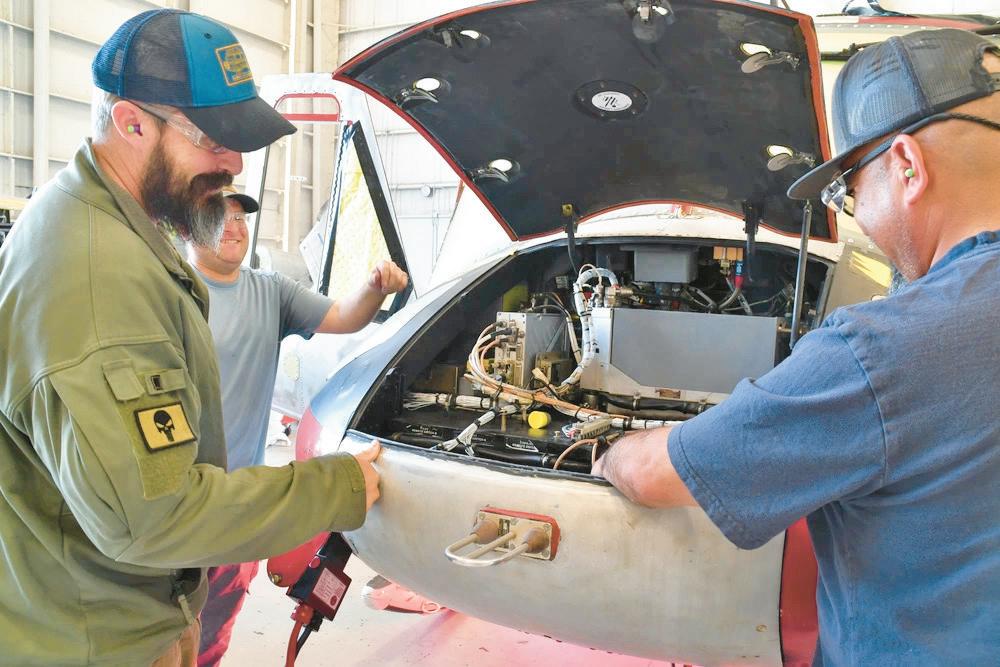
Sean Maher an aircraft electrician on Fleet Readiness CenterEast’s (FRCE) UH-1N production line,utilizes a battery-powered ground powerunit (GPU)while conducting checks on a UH-1N helicopter.FRCE’s UH-1N production line is swapping out diesel-powered GPUs forbattery-powered GPUs,becoming the first adapterofthis technologywithin the NavalAviation community.Depot officials saythe battery-powered GPUs minimize energyconsumption,increase efficiencyand enhanceworkplace safety (PHOTOSBYJOSEPHANDES,FLEETREADINESSCENTEREAST)
FRCE marks first with
ByHeatherWilburn
Fleet Readiness Center East
MARINECORPSAIRSTATIONCHERRY
POINT N.C. FleetReadinessCenterEast’s (FRCE)UH-1NHueyproductionlineisswappingoutdiesel-poweredgroundpowerunits (GPU) for a sustainable alternative with the recent purchase of battery-powered GPUs, becomingthefirstadapterofthistechnology withintheNavalAviationcommunity.
According to Allen Broadway, FRCE’s UH-1N branch head, the battery-powered GPUs minimize energy consumption, increase efficiency and enhance workplace safety.
“Our main focus was on the safety and environmental aspects,” said Broadway “Using the new battery pack, you are reducing noise hazards Because it’s so portable, you’re reducing the possibilities of strains and injuries, as well as trip hazards All this leads to a safer workplace for our people It also allows us to reduce environmental footprintandfuelconsumption.You’renotburning diesel There are no fumes or emissions You’re cutting costs It’s a win for us across theboard.
The UH-1N line operates out of the North CarolinaGlobalTransParkinKinston.There, the team performs maintenance, repair and overhaul operations for the UH-1N helicoptersflownbytheAirForce.
Prior to the arrival of the battery-powered GPUs, the UH-1N line relied on the NC-10CMobileElectricPowerPlant,atrailer-mounted, self-contained power plant, to supplyelectricalpowerforservicing,starting andtestingthehelicopters.TheNC-10C,used throughout the Naval Aviation community, usesdieselfueltogenerateelectricity.
“When you look at the environmental impact, this is our way of going from a gas guzzler to electric,” said Matthew Pitts the UH-1Ndeputybranchheadandtestpilot
According to Pitts, the UH-1N line began using two Tesla TI3000 GPU-24 battery packsinthespringof2023
“Theyareaself-containedunitthatcando everything that the NC-10 does, but with a footprint of a large carry-on bag,” said Pitts “They produce no noise and no emissions They work like an external battery pack for your phone and even plug into an ordinary wall socket. There’s no special outlet required.”
adoption
of battery-powered ground power units
Thebattery-poweredGPUsweighinat127 pounds,comparedtotheNC-10C’sweightof more than 6,500 pounds when carrying the dieselfuelnecessarytogeneratepower.
“It came in a really big box,” said Gabriel Rodriguez,aplanecaptainontheUH-1Nline “But whenweopenedit itwasjustthislittle thing inside. It’s much easier on us, as far as ergonomicsgo,tomovethisaround.
Pittscitedthatsmallsizeasakeyfactorin theUH-1Nline’sdecisiontoadoptthetechnology
“Oneimportantaspectofthisisminimizing our footprint,” said Pitts “You’re taking a large entity the NC-10, and you’re reducing that to the size of a carry-on bag You’re reducingthecostsandtimeassociatedwith moving, maintaining and using that asset.
Sean Maher, an aircraft electrician on the UH-1N line, said the portability and simplicityofthebattery-poweredGPUshave already made a positive impact on production.
“We do a lot of operational and functionalcheckswhichrequirebatteryinverter power,”saidMaher “Thehelicopterbattery itself can’t sustain the amount of checks we do So we have to have some sort of additional power source to continue our checks without having to stop what we’re doing That used to mean calling transportation and getting an NC-10 delivered.
“With these, it just takes a minute or two to roll it over to the aircraft and we’re hookedupforpower,”hecontinued “Hooking it up is quick and easy As far as maintenance, we’ve had no trouble with them and we’ve put them through the wringer With theNC-10,we’dhave to call ground support equipment if it needed to be fixed. We don’t have to worry about any of that with these.”
The battery-powered GPUs are also making a positive impact outside of the UH-1N line’s operations at Kinston. Broadwaysaidtheirusedrivesdowncostsrelated to the support and maintenance of the NC-10Cs
“Thesefreeupourgroundsupportequipment folks from having to do preventative maintenanceandthingsofthatnatureonthe NC-10s,”saidBroadway “Italsoreducesthe costsrelatedtoorderingpartsandmaterials to maintain and repair the NC-10s.”
Unlike a diesel-powered generator, the battery-poweredGPUsemitzeroemissions Broadwaysaidthisresultsinreducedenergy
consumption.
“If you crank an NC-10 indoors, you have to open up the hangar doors,” said Broadway. “That means increased utility costs andwastedenergy especiallywhenit’scold outside.”

Rodriguezsaidthebattery-poweredGPUs are not only reducing utility usage, they make for a more comfortable working environment.
“Whenwerandiesel-poweredequipment in the hangar, we had to open the doors for ventilation,”saidRodriguez.“Wedon’thave to do that now, which is nice. We don’t have to worry about rain, wind, heat or cold and having to open the doors It’s definitely increased our comfort levels in the hangar.”
The battery-powered GPUs also contribute to the comfort level on the shop floor in regards to noise levels Pitts recounted the firsttimetheteamusedthebattery-powered GPUs; he described being almost startled by the complete lack of noise that accompanied it.
“Thefirsttimethatweconnectedittothe aircraft,itwasjustkindoffunnybecausewe wereallexpectingsomekindofabig,climactic moment, Pitts said “Silence is what we heard.Itwaslike,that’sit-silence Itwasso quiet that it was almost a surreal.”
Pitts said the battery-powered GPU’s silentoperationbeliestheimpressivebenefitsthetechnologyhasbroughttothedepot, benefits he said can be shared throughout the enterprise
“We are setting new standards to drive down production costs, reduce our environmental impact and ultimately be a safer line,” Pitts said. “Once the depot proves that we’releadingthewaywiththis,Icanseethis getting pushed out into Fleet. Imagine the savingsandthereducedenvironmentalfootprintthatwecouldhavethroughouttheNavy andMarineCorps.”
FRCE is North Carolina’s largest maintenance,repair,overhaulandtechnicalservices provider,withmorethan4,000civilian,military and contract workers Its annual revenue exceeds $1 billion. The depot provides service to the fleet while functioning as an integral part of the greater U.S. Navy; Naval Air Systems Command; and Commander, FleetReadinessCenters.
Learn more at www.navair.navy.mil/frce or https://wwwfacebook.com/FleetReadinessCenterEast
The Navy partnered with different private management companies to provide housing to Service Members. These companies are responsible forthe construction, renovation,maintenance and day-to-day management ofthe housing PPVhousing may be located on oroffgovernment property and in most cases will be formermilitary housing �GovernmentOwned (also known as Military Housing orNavy Managed Housing is what was formerly called on-base housing While only available in limited quantities CONUS,Government Owned Housing is still widely available OCONUS. �CommunityHousing is any housing that a Service Member may choose that is not PPVor government operated This is housing outside ofthe base that is privately owned and operated NAVY HOUSING Norfolk: 757.445.2832

JEBLCFS: 757.462.2792
Oceana/DamNeck: 757.433.3268 Yorktown: 757.847.7806
Mid-Atlantic Fleet and Family Support Centers (FFSC) programs and services are designed to help you make the most of your military experience, and they’re all available to you at no cost.
FUNCTIONSAND/OR SERVICESFFSCPROVIDES:
�ClinicalCounseling – Individual, Couplesand ChildCounseling
�Personal Financial Management
�Information & Referral
�Family EmploymentAssistance

�TransitionAssistance
�FamilyAdvocacy Program
�Deployment and Mobilization Support
�Ombudsman Support
�RelocationAssistance
�Parenting Programs
�Stress andAngerManagement
�Command Support
�Crisis Support
�Suicide Prevention
�SAPR Support
2 The Flagship | www flagshipnews.com | Section 2 | Thursday, June 22 2023
MatthewPitts left the UH-1N deputybranch head and test pilot at Fleet Readiness CenterEast (FRCE),and artisans from the UH-1N production line utilize a battery-powered ground powerunit (GPU)while conducting checks on a UH-1N helicopter.
Sentara is committed to making an impact in the communities we serve by proudly partnering with our neighbors and local community organizations to deliver equitable and accessible solutions. Together, with these partners, we build on ourcommitment to create healthier communities by meeting them where they live, work, play, and learn.
www flagshipnews.com | The Flagship | Section 2 | Thursday, June 22 2023 3
Improving Health In OurCommunities. EveryDay.
2022,Sentara
$260
in ourcommunities $157M UNCOMPENSATED PATIENT CARE $6.7M HEALTH &PREVENTION PROGRAMS $48.5M TEACHING &TRAINING OF HEALTHCARE PROFESSIONALS $48M COMMUNITY GIVING For community updates visit SentaraCares.com
In
invested morethan
million
USS Boxer Sailor earns Aviation Boatswain’s Mate of the Year
ByPettyOfficer2ndClassZachIssa
USS Boxer (LHD 4)
SAN DIEGO On the flight deck of the world’stopwarfightingnavalwarships,you willfindacrewofSailorsthatmanagesome of the most dangerous jobs on the vessel, flight operations. From scorching heat to shivering winds, the crew stays vigilant in completingthemission sendingandreceiving vital aircraft. In this dangerous work environment,leadersareforged
For 13 years, Aviation Boatswain’s Mate (Handling) 1st Class Robby Canlas, Air Department’s leading petty officer aboard USS Boxer (LHD 4), and native of Dededo, Guam, has worked tirelessly to embody the core values of honor, courage and commitment. He applies these values with every crew he has worked on in his naval career, andwasrecentlyrecognizedastheAviation Boatswain’sMateoftheYearforPacificFleet in2023
“Success does not have to be fast—what’s moreimportantisthatonesimplydoestheir absolute best and remains persistent,” said Canlas “I never dreamed of winning this award.TheworkIputinwasnotforrecognition but I am grateful to the people who helped along the way and the Sailors who puttheirtrustinmeeveryday.
The Aviation Boatswain’s Mate of the Year is awarded by PEO Tactical Aircraft Programs (PMA 251) and was designed to recognize a Sailor that exhibits all the traits that make the Aviation Boatswain’s Mate ratespecial.Thisencompassesthreespecific rates: Aviation Boatswain’s Mate (Equipment), Aviation Boatswain’s Mate (Fuel) and Aviation Boatswain’s Mate (Handling). The award focuses on mentorship, attentiontodetailandsafelyaccomplishingtheir mission
“Being named the Aviation Boatswain’s Mate of the Year is no small feat,” said Boxer’sAirDepartmentHead,knownasAir Boss,Cmdr DanBoutros “ABH1Canlasisa model Sailor for ABs everywhere. His selfless devotion drives him to put the needs of Boxer,AirDepartmentandhisfellowSailors ahead of his own. He is a man of character day in and day out, and is most deserving of thishonor.”
Hisexceptionalworkethicandleadership is evident on a day-to-day basis, not only in AirDepartment,butthroughoutBoxer.His leadershiphastouchedhundredsofSailors aboardtheshipthoughhisworkastheFirst Class Petty Officer Association Master-at-
Arms,dutysectionassistantwatchbillcoordinator, repair locker leader, a command drug and alcohol program advisor and a member of the damage control training team.Hisdeterminationindirectsupportof hisshipmatesthroughanymissionisevident withinhisteamandthecommunity

“ABH1 Canlas exemplifies our Navy core valuesofhonor courageandcommitment,” said Master Chief Aviation Boatswain’s Mate Troy Tracy, Air Department’s leading chief petty officer “He possesses some of theverybestleadershiptraitsdemonstrated throughout the Aviation Boatswain’s Mate community, and is the cornerstone of Air Department We are all extremely proud of him, and I expect nothing but big things to comeinhisfuture.
In June 2019, Canlas reported onboard Boxer and quickly gained the trust of V-1 division and assumed the duties as the crash leading petty officer. Shortly after, he was then prompted to assume duties as V-3 division leading petty officer, and eventually took on the role as the Air Department leadingpettyofficer Heledthedepartment throughtheBoardofInspectionandSurvey (INSURV), dry-docking phased maintenance availability, aviation certification, an Afloat Training Group inspection and contractor sea trials While working tirelessly on Boxer, he also attended American MilitaryUniversityandcompletedhisBachelor’sDegreeinManagement. “IsetouttobeagoodmentorformySailors and to be the best version of myself that
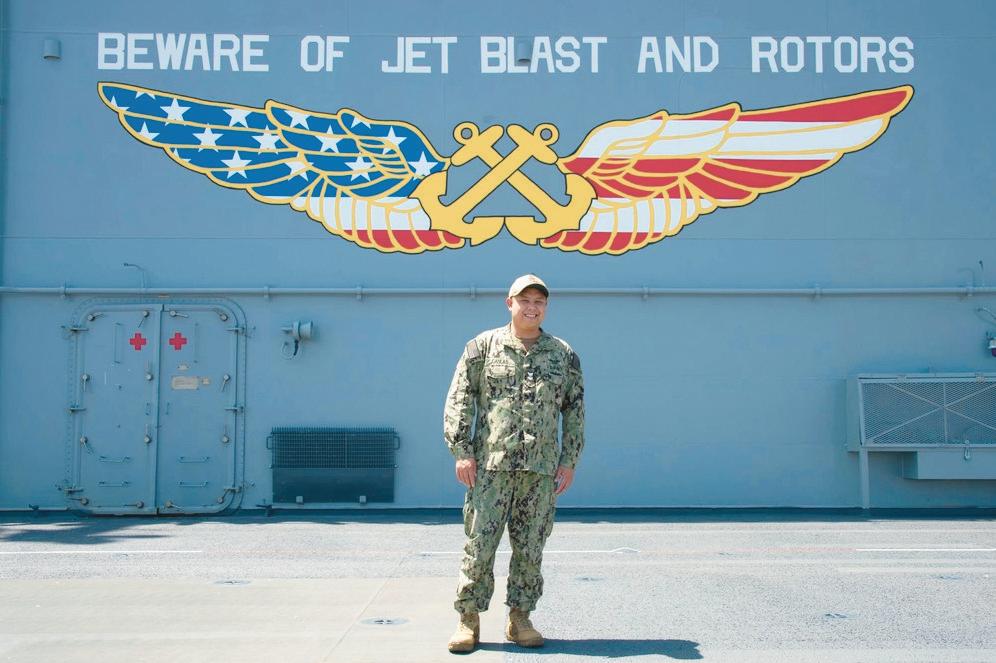
Icould, saidCanlas.“Ialwaystrytoremind them of one of my favorite proverbs, ‘Fall seventimesandgetupeight’,becausesometimesworkinginsuchahighstressenvironmentyoucanreallygetlostinitall.”
BoxerisaWasp-classamphibiousassault shipcommissionedFebruary11 1995andis thesixthshiptobearthename Boxer’screw is made up of approximately 1,200 officers and enlisted personnel and can accommodateupto1,800Marines
FormoreinformationorimageryforUSS Boxervisit:https://www.dvidshub.net/unit/ USSB-LHD4
Follow us on Facebook at: https://www facebook.com/ussboxer/
Follow us on Instagram at https://www. instagram.com/ussboxer/
USS Charleston returns from 26-month deployment
FromCommander,LittoralCombat
ShipSquadronOne
SAN DIEGO Independence-variant
littoral combat ship USS Charleston (LCS 18) returned to her homeport of Naval Base San Diego, June 14, 2023, following a 26-monthrotationaldeployment
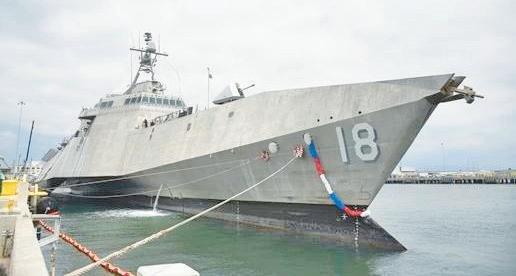
On April 7, 2021, Charleston departed SanDiegoforhermaidendeploymentwith an embarked detachment from Helicopter Sea Combat Squadron (HSC) 21. While deployed, the ship completed mission taskingforbothU.S.3rdandU.S.7thFleetAreas of Operation like patrolling the East and South China Seas, training for contested maritime resupply tasking, and operating withanAmphibiousReadyGroup Charleston was also the first LCS to conduct mine countermeasuretrainingoutsideU.S.waters and was the first commissioned U.S. naval shiptoentertheportofManilla,Philippines since2019.
“Returning from the longest littoral combat ship deployment to date is an extremelyproudmomentforourcrew,”said Cmdr.MatthewKnuth,commandingofficer of Charleston Gold crew “Our work overthe-horizon would not have been possible without the dedication of each and every Sailor of both Charleston crews and all the entitiesthatsupportedusoutthere.
Charleston participated in various exerciseswhileundertheoperationalcontrolof DestroyerSquadronSevenincludingCooperation Afloat Readiness Training Brunei, Malaysia, Sri Lanka, and Timor Leste, Exercise Kakadu 2022, integrated Operation Noble Vanguard 22, Operation Loaded Stingray Operation La Perouse and Super GarudaShield.
The ship completed joint missions in support of forward presence and maritimelawoperations.TheU.S.CoastGuard’s Pacific Tactical Law Enforcement Detachment104teamedwithCharlestonandHSC 21toprotectUnitedStatesandPacificIsland Nation resource security and sovereignty during a Secretary of Defense Oceania Maritime Security Initiative mission. The ship also conducted combined, integrated, navaloperationswithcountrieslikeAustralia, Japan, France, Sri Lanka, Philippines, Indonesia, Singapore, New Zealand, and the United Kingdom. During its 26-month deployment it conducted several patrols
in the East and South China Seas, providing a forward presence to deter aggression andmaintainanopenandfreeIndo-Pacific region.
“Our presence in the Indo-Pacific strengthenedpartnerships developedrelationships and increased the Fleet’s lethality,” said Cmdr Nellie Wang commanding officerofCharlestonBluecrew Icouldnot be more honored to have been a part of this deployment’sCharlestonteam.”
As a littoral combat ship, Charleston has both a Blue crew and a Gold crew, which alternate being “on-hull” aboard the ship and “off-hull” conducting training in San Diego Goldcrewspentthreeperiodson-hull forward-deployedaboardtheship,andBlue crew spent two periods on-hull. The ship remained away from homeport during the entirety of its deployment thanks largely in part to the work of both crews and Maintenance Execution Teams (METs) that met Charleston in maintenance hubs through-
out Oceania to include Guam, Hawaii, and Singapore.
“From the days of COVID seclusion in Guam to return to normal operations in Singapore,themightyCharlestonwasthere answering the call for every type of tasking imaginable,” said Cmdr John Actkinson, who was aboard Charleston Gold crew as bothexecutiveofficerandcommandingofficerduringthedeployment “Mostnoteworthy to me was after we were the first LCS to pull into Sasebo, Japan, we were tasked to take 45 pallets of goods out into the Philippine Sea to replenish a destroyer that couldn’tcomeintoport.”
The crews also deepened relationships with allies, partners and friends through distinguished visitor meetings aboard the ship CharlestonhostedtheGermanMinister of Defense, Annegret Kramp-Karrenbauer; Japanese Maritime Self-Defense Force Vice Adm. Fukuda Tatsuya, commander of Fleet Escort Force, and Rear Adm. Shimizu
Hitoshi,commanderofEscortFlotillaTwo; and the Chief of Naval Operations, Admiral MikeGilday.
With Charleston’s arrival back to homeport, there are currently three Independence-variantlittoralcombatshipsdeployed to provide forward presence and conduct maritime security sea control, and deterrence missions both near-shore and on the highseas CharlestonishomeportedinSanDiegoas part of Mine Division Twelve and Littoral CombatShipSquadronOne LCSareversatile, mission-focused platforms designed to operateinnear-shoreenvironmentsandwin against21st-centurycoastalthreats.
For more news from Commander, LittoralCombatShipSquadronOne visithttps:// www.surfpac.navy.mil/comlcsron1/ or followonFacebookatwww.facebook.com/ COMLCSRONONE/
SAN DIEGO (June 5,2023) –Aviation Boatswain’s Mate (Handling) 1st Class RobbyCanlas,a native ofDededo,Guam,poses fora photo on the flight deckaboard USS Boxer(LHD 4) afterreceiving theAviation Boatswain’s Mate oftheYearaward forPacific Fleet Boxeris aWasp-class amphibious assault ship homeported in San Diego.(U.S.NAVYPHOTOBYMASSCOMMUNICATIONSPECIALIST3RDCLASSBRADLEYKAMINSKI)
4 The Flagship | www flagshipnews.com | Section 2 | Thursday, June 22 2023
SAN DIEGO (June 14 2023) Independence-variant littoral combat ship USS Charleston (LCS 18) moors pierside at its homeport ofNaval Base San Diego,June 14 Charleston returned to Naval Base San Diego following a 26-month deployment to the U.S.3rd and 7th Fleets in support ofa free and open Indo-Pacific.(U.S.NAVYCOURTESYPHOTO)
NSA Souda Bay commemorates 75th anniversary of the Women’s Armed Services Integration Act
ByNicholasTenorio
U.S. Naval Support Activity Souda Bay
NAVAL SUPPORT ACTIVITY SOUDA BAY,Greece NavalSupportActivity(NSA)
Souda Bay service members and personnel commemoratedthe75thanniversaryofthe
Women’s Armed Services Integration Act (WASIA) during a ceremony held at The Anchor on June 12, 2023 During the event, Sailors assigned to NSA Souda Bay highlighted some of the contributions made by women to the U.S. military since the AmericanRevolution
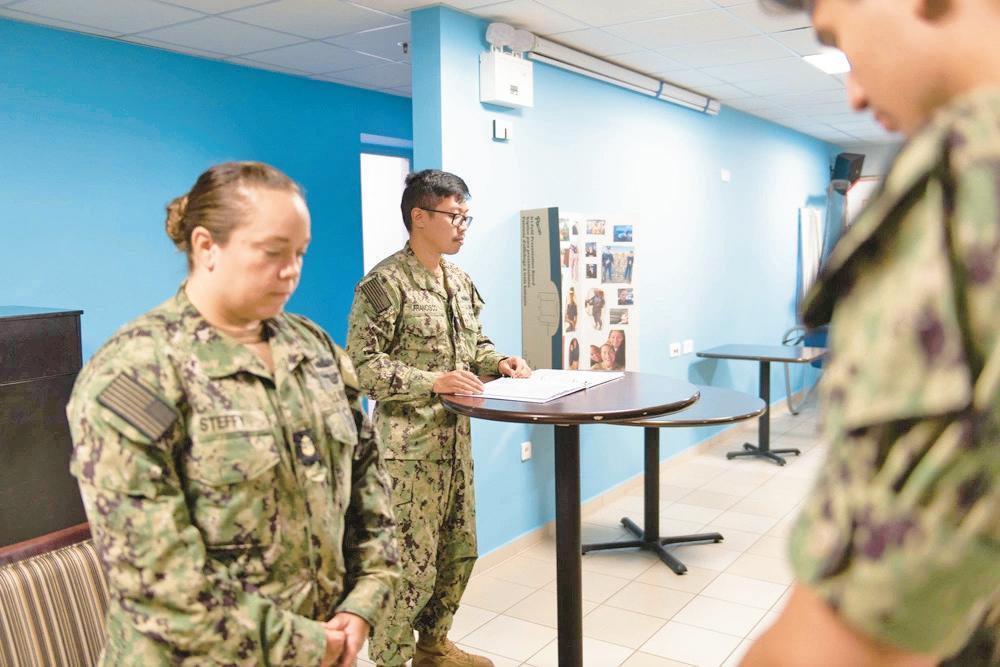
“Thisyear wemarkthe75thanniversary oftheWomen’sArmedServicesIntegration Act,whichpavedthewayforwomentoofficiallyserveinallU.S.militarybranches,and the 10th anniversary of opening all combat rolestowomen,”saidChiefNavyCounselor MeganSteffy.“Thelogicbehindthesedecisionswasclearandcompelling:ourmilitary needsthebestwarfightersineverydomain.”
PresidentHarryS.TrumansignedWASIA into law on June 12, 1948, which legally grantedwomentherighttoserveaspermanent, regular members of the U.S. military services Additionally,formerU.S.Secretary of Defense Leon Panetta changed Department of Defense policy in 2013 to allow womentoserveinfront-line,combatunits
“From America’s first days women have made profound sacrifices for our republic,” said Steffy. “They have made innovative contributionstoournationalsecurity,blazed trailsforfuturegenerationsandinspiredus with their dedication, skill, and patriotism. Since the Revolutionary War, more than 3 million women have stepped up to serve their country in uniform, even before the militaryfullyrecognizedtheirservice.”
“Today is about celebrating the past and ongoing contributions made by the women who have served and continue to serve in our armed forces,” said Capt. Odin J. Klug, commanding officer, NSA Souda Bay. “We
NAVALSUPPORTACTIVITYSOUDABAY,Greece (June 12 2023) Machinist’s Mate 2nd Class Erian Francisco,assigned to Naval SupportActivity (NSA) Souda Bay,delivers an invocation during a commemoration ofthe 75th anniversaryoftheWomen’sArmed Services IntegrationAct on June 12,2023.NSASouda Bayis an operational ashore installationwhich enables and supports U.S.,Allied,Coalition,and Partnernation forces to preserve securityand stabilityin the European,African,and Central Command areas ofresponsibility.(U.S.NAVYPHOTOBYNICHOLASS.TENORIO)
stand on the shoulders of giants who have made possible the opportunities that we havebeforeustoday.” NSA Souda Bay is an operational ashore installationwhichenablesandsupportsU.S.,
Allied, Coalition and Partner nation forces topreservesecurityandstabilityintheEuropean, African, and Central Command areas of responsibility For more information, visit us at www.cnic.navy.mil/SoudaBay or
findusonFacebookatwww.facebook.com/ NSASoudaBay.
A Stellar Showcase: Seabees participate in Touch-a-Truck at Moorpark City Library
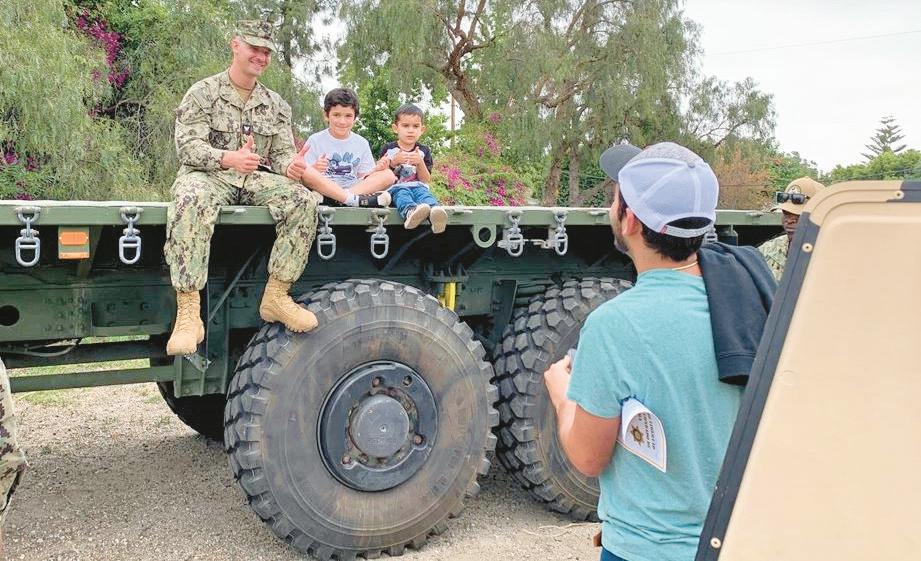
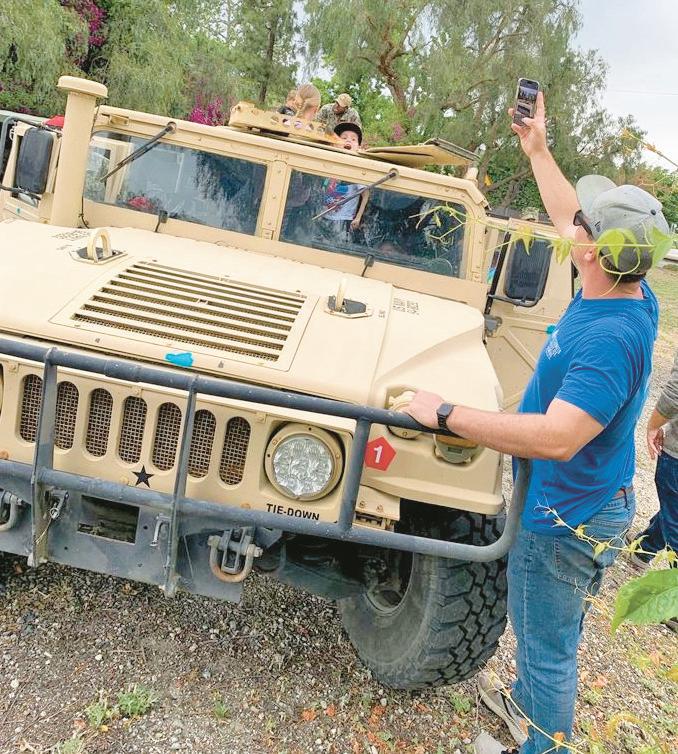
ByOscarGarcia
Naval Construction Group One
MOORPARK, Calif
The 2023
Summer Reading program at the Moorpark City Library kicked off with Touch-a-Truck, an opportunity for all the young and young-at-heart to touch and interact with specialized vehicles from participating government agencies TouchaTrucktookplaceonSaturday, June 10 and was an unparalleled success bringing together the local communityforadayofexplorationand learning Among participating guests at the event were the Seabees, whose involvement added a unique layer of excitement and educational engagement.
The Touch-a-Truck event allowed children and families to discover and interact with a variety of service vehicles including trucks and emergency vehicles The Department of Waste Management, the Moorpark Police Department, the Moorpark Fire Department,theDepartmentofPublic Works, and the Department of Public Transportation were among the organizations in attendance, each offering attendees an insightful, close-up look at their daily vehicles and operations
The Seabees participation in the event was a shining testament to their dedication to education, community engagement, and the inspiration of the nextgeneration.Communitymembers weregiventherareopportunitytolearn about logistics, witness the intricacies of construction and tactical operations and understand the teamwork involved in operating and maintaining critical infrastructure overseas Naval Construction Group One’s (NCG1) Commodore, Captain Michael W. Meno, expressed his satisfaction with Seabee participation with Touch-aTruck and added: “The U.S. Navy’s presence at events like ‘Touch a Truck’ contributes to inspire our future leaders Today’s young library goers could betomorrow’sengineers scientists and naval officers Through these interactions, we’re cultivating an interest in Science, Technology, Engineering, and Math (STEM), and contributing to the development of a more informed and engaged community.”
A highlight of the event was the announcement of the winners of the Summer Bookmark Contest which underscoredthecommunity’scommitment to promoting literacy, creativity, and the joy of reading As the Moorpark local community, staff and volunteers enjoyed the flavored shaved ice, all funds from the flavored ice went towardsthesupportoflibraryprograms such as Storytime LEGO Robotics, Future Einsteins and much more.
TheSeabeeslookbackonitsinvolvement in this wonderful community event.Bylettingthecommunityaccess current Navy technology, their work, andtheirpassionforservice,theyhope they’veinspiredtheyoungergeneration and fostered a deep sense of appreciation for all those who work in service roles The2023Touch-a-Truckeventatthe MoorparkCityLibrary wasmorethana day of fun and games, it was part of the U.S. Navy’s effort to connect with our localcommunitiesandenhanceSTEM education nation-wide.
ABOVE: NickNoble takes a photo ofhis kids as theyexplore the gunner’s turret seat fora High MobilityMultipurpose Vehicle (HMMV) during theTouch-a-Truck event at the MoorparkCityLibraryon June 10th,2023,marking the beginning of the library’s SummerReading Program. Naval Construction Group One’s (NCG1) participationwith the MoorparkCity LibraryinTouch-a-Truckcontributes to the 2023 outreach effort from the U.S.Navy’s Pacific Fleet to engagewith local communities and promote STEM education.
LEFT: PayanAframian prepares to take a photo ofhis kids next to EO2 Chris Gross, a Seabeevolunteerwith Naval Mobile Construction Group 18 (NMCB - 18) in the cargo-bed ofa MediumTacticalVehicle Replacement (MTVR) during theTouch-aTruckevent.(PHOTOSBYOSCARGARCIA, NAVALCONSTRUCTIONGROUPONE)
www flagshipnews.com | The Flagship | Section 2 | Thursday, June 22 2023 5
USS Columbia returns from deployment
FromCommander,SubmarineForce,U.S.PacificFleet
The Los Angeles-class fast-attack submarine USS Columbia (SSN 771) returned to Joint Base Pearl Harbor-Hickam following a seven-month deployment,June12
Columbia departed Pearl Harbor in November 2022 for the regularly-scheduled deployment, during which the submarine and its crew performedafullspectrumofoperationsintheIndo-Pacificregion
“The Columbia crew demonstrated the extreme resiliency and endurancerequiredtofightandwinatsea,”saidColumbia’sCommandingOfficer, Cmdr Corey Barksdale, from Matoaca, Va “Operating a deployed submarine is incredibly challenging, but we were able to accomplish this mission knowingourfamilieswerestrongbackhome.Icouldnotbemoreproudof mySailors,theirfamilies,andourColumbiasupporters.”
Columbia’screwtrainedtobecombatreadypriortodepartureandmaintainedthosehighstandardsthroughoutthedeployment.Duringtheseven months deployed, Columbia traveled approximately 20,000 leagues, or 60,000nauticalmiles,underthesea
“ThegritandpositiveattitudedisplayedbytheentireColumbiacrewhas been extraordinary,” said Columbia’s chief of the boat, Master Chief InformationSystemsTechnician(Submarines)BrianPriess,fromMinot,N.D.“I couldn’tbemoreproudoftheworkourSailorshaveputinwhiledeployed. Eachday,ColumbiaSailorsdemonstratedourabilitytomaintainasustained, lethalpresenceatsea.Specialthanksareowedtoallthefamiliesforkeeping the home front secure. Our nation is stronger and our loved ones are safer becauseofyoursacrifice.”
Duringthedeployment,morethan25ColumbiaSailorsbecamefullyqualifiedinsubmarinesandearnedtheirsubmarinewarfarespecialistdesignation,andwalkedashorewearingtheir“dolphin”insignia.
“The most memorable part of deployment was the moment I qualified in submarines,” said Culinary Specialist (Submarines) Seaman Apprentice Skylar Magallenes, from Las Vegas. “Earning my silver dolphins was hard, butIhadalotofhelpalongtheway.I’mextremelyproudtobeapartofthe Columbiacrew.”
ColumbiawascommissionedSept.24 1994,isthe60thLos-Angelesclass submarine,andisnamedforthecitiesofColumbiainMissouri,Illinois,and SouthCarolina.Itis360feetlongwithabeamof33feet.
The Los Angeles-class submarine is capable of supporting various missions, including anti-submarine warfare, anti-surface ship warfare, strikewarfare,andintelligence,surveillance,andreconnaissance
TOP: PEARLHARBOR Hawaii (June 12 2023) –The LosAngeles-class fast-attacksubmarine USS Columbia (SSN 771) returns to homeport atJoint Base Pearl Harbor-Hickam,June 12 2023.(U.S.NAVYPHOTOBYCHIEF MASSCOMMUNICATIONAMYBILLER)
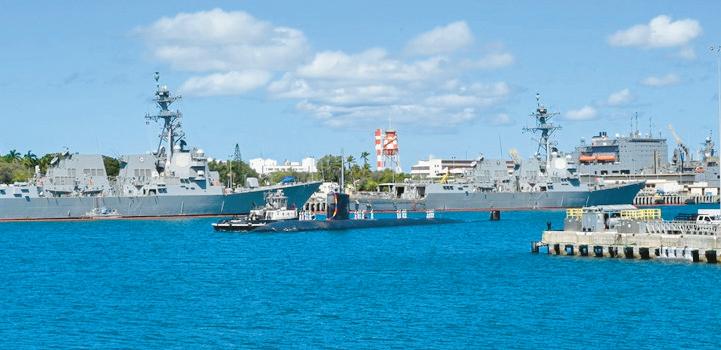
ABOVE: Cmdr CoreyBarksdale,commanding officerofthe LosAngeles-class fast-attacksubmarine USS Columbia (SSN 771),embraces his familyas Columbia returns to homeport atJoint Base Pearl Harbor-Hickam, June 12 2023.(U.S.NAVYPHOTOBYMASSCOMMUNICATIONSPECIALIST1STCLASSSCOTTBARNES)
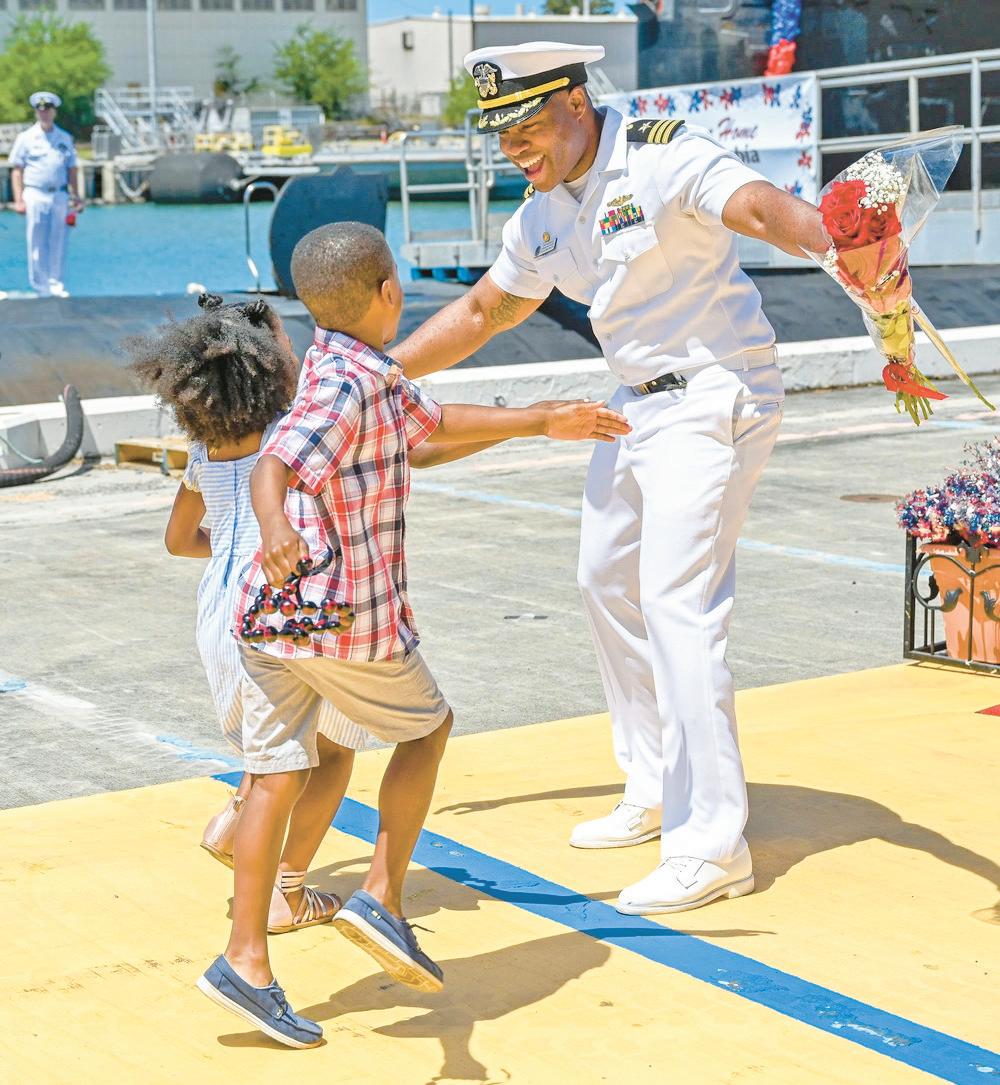
BELOW: SeniorChiefHospital Corpsman MatthewBiecker assigned to the LosAngeles-class fast-attack submarine USS Columbia (SSN 771),greets his familyas Columbia returns to homeport atJoint Base Pearl Harbor-Hickam,June 12 2023.operations,surveillance and intelligence gathering and special forces insertions. (U.S.NAVYPHOTOBYMASSCOMMUNICATIONSPECIALIST1STCLASSSCOTTBARNES)

6 The Flagship | www flagshipnews.com | Section 2 | Thursday, June 22 2023
Exchanging cultures and ideas: Cmdr. Philipp Klimmek, German Navy
ByPettyOfficer1stClassMatthewFink
U.S. Naval Forces Europe-Africa/U.S Sixth Fleet
“I joined the German Navy in 2001, and I started my career in operations After a year Imadethedecisiontobecomeamine clearance diver, so I went through that process for another year My first assignment was on a German mine hunter, and after that I got the opportunity to become anofficer Istudiednauticalscienceforfour years at Jade College in Elsfleth, Germany, andthatiswhenIstartedmyminecountermeasures career Over the next ten years I was a diving officer executive officer and
then commanding officer of the minehunter FGS Bad Rappenau (M1067).
Being a commanding officer has been one of my favorites so far I sailed a lot: in the Baltic Sea, North Sea and Mediterranean Sea. Working with German sailors and officers for four and a half years, it was awesome The Germany Navy has a personnel exchange program with the United States to trade knowledge and experience, and I signed up to move to San Diego and work with U.S. Navy Mine Countermeasures Group (MCMGRU) 3. I had been on ships my whole career so this was different
because it was a level higher We are the ones making those decisions on what the ships have to do
Moving was tough at first, and it was a decision I had to make with my family It wastheirfirsttimemovingoutofGermany, and it was also during COVID But I would say it was a very good experience for all of us to have the opportunity to learn the language and to experience how things work in the States We will be sad to leave, and I would definitely do it again.
This is my third BALTOPS and second as the MCM syndicate lead. My commodore asked me if I would like to take the job and
I was a little bit nervous in the beginning, but after the first conference it was amazing to see how many people and nations work together to make BALTOPS happen. It is really fascinating to build up a plan watch NATO forces execute it and then get feedbackafterwards Ithasbeenapleasureandan honortoworkwithothernationsinthisway.
In the end, it is the people that keep me doingthisjob.Idon’twanttositintheoffice withawindowandcomputerscreen.Istay in this job for the experience of working with people and with other nations That is why I am here.”
U.S.NavyRearAdm.DerekTrinque congratulates RearAdm.Chris Stone,commander,TaskForce 76/3 and ExpeditionaryStrike Group 7,aftertheirchange ofcommand on Camp Courtney, Okinawa,Japan,June 9,2023 TaskForce 76/3 is comprised ofthe U.S.Navy’sTaskForce 76 and the Marine Corps’3rd Marine ExpeditionaryBrigade,III Marine ExpeditionaryForce,andwas created bydirection ofthe ChiefofNaval Operations and the Commandant ofthe Marine Corps to formalize integratedAmerican naval poweras awarfighting imperative.(U.S.MARINECORPS
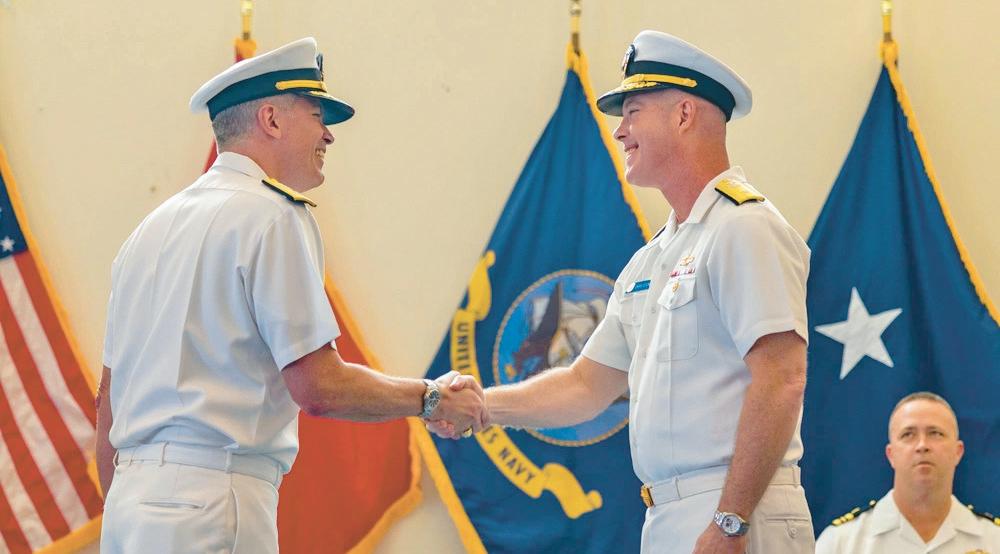
PHOTOBYSTAFFSGT.ANDREWOCHOA)
Commander, Task Force 76/3 change of command
By1stLt IsabelIzquierdo
Commander, Expeditionary Strike Group 7 OKINAWA, Japan Rear Adm. Christopher D. Stone assumed command of Task Force76⁄3fromRearAdm.DerekA.Trinque during a change of command ceremony at CampCourtneyChapel,Okinawa,June9.
DuringTrinque’stimeascommander,the SailorsandMarinesofTF76⁄3expandednaval integrationandwarfightingconceptsduring the campaign of learning and experimentation based on guidance from the Secretary of the Navy Chief of Naval Operations and Commandant of the Marine Corps In thepastyear thetaskforcewasacommand elementforseveralforwarddeploymentsin arangeofamphibiousoperationstoinclude embarkingandoperatingtheF-35BLighting II aircraft on USS Tripoli (LHA 7), expedi-
tionaryminecountermeasuredetachments and expeditionary strike force operations Morethanadozenexercisesandoperations with U.S. allies and partners in the region wereconducted “I have been blessed with extraordinary commandersinthisStrikeGroup commodores, captains, colonels, and skippers who commanded in the best interest of our Nation,ourNavyandMarineteam,andtheir Sailors and Marines. They have made my job incredibly rewarding and I have loved watching them succeed,” said Trinque “ I amfilledwithaweoftheamazingthingsyou have done and for the incredible structure youhavebuilt.Youhaveshownthatwecan commandAmericanships,aircraft,Marines ashore in expeditionary bases, and forces fromourAlliesandPartners,anddoitfrom basicallyanywhere.”
Trinque’s next assignment is as director, Strategy, Policy, Programs, and Logistics, J5⁄4, U.S. Transportation Command, Scott AirForceBase Illinois.
Stone, a native of Fort Worth Texas, is a 1994 graduate of the United States Naval Academy. Prior to assuming command od TF 76⁄3, Stone served as Special Assistant to the Vice Chief of Naval Operations, Washington,D.C.
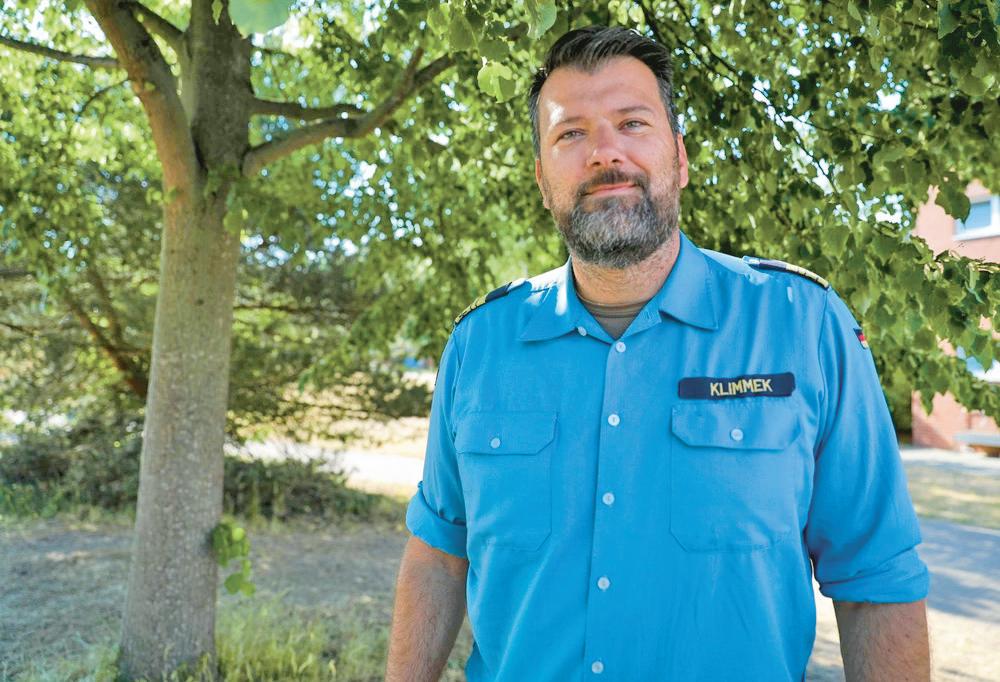
“Thisteamhasandwillcontinuetosetthe example on the combined might of a fully integrated Navy and Marine Corps team! I intend to empower our team at every turn tomaintainandenhancewarfightingexcellence,”saidStone “Itisaprivilegeandhonor totakecommandofthiswinningteamandI lookforwardtoservingalongsideyouatthe tipofthespear.”
Stone will now command Task Force
76⁄3, which consists of Destroyer Squadron 7, Amphibious Squadron 11, USS Blue Ridge(LCC19),USSAmerica(LHA6),USS Green Bay (LPD 20), Mine CountermeasuresSquadron7,USSChief(MCM14),USS Pioneer (MCM 9) USS Patriot (MCM 7), USS Warrior (MCM 10), Helicopter Mine CountermeasureSquadron15,FleetSurgical Team7,HelicopterSeaCombatSquadron25, TacticalAirControlSquadron12,andNaval BeachUnit7.
TaskForce76⁄3recentlyformedasaresult of merging the staffs of Navy’s Task Force 76 7th Fleet, and 3d Marine Expeditionary Brigade IIIMarineExpeditionaryForce.
U.S. 7th Fleet is the U.S. Navy’s largest forward-deployed numbered fleet, and routinely interacts and operates with Allies and partners in preserving a free and open Indo-Pacificregion
PUTLOS
11,2023)
Klimmekposes fora photograph nearthe NATO CommanderTaskGroup 162.40 command staffarea at the Bundeswehrmilitary training area in Putlos,Germany,during exercise Baltic Operations 2023 (BALTOPS 23).BALTOPS 23 is the premiermaritime-focused exercise in the Baltic Region.The exercise,led byU.S.Naval Forces Europe-Africa,and executed byNaval Striking and Support Forces NATO
a unique training opportunityto strengthen combined response capabilities critical
Germany(June
German NavyCmdr Philipp
provides
to preserving freedom ofnavigation and securityin the Baltic Sea (U.SNAVYPHOTOBYMASSCOMMUNICATIONSPECIALIST1STCLASSMATTHEWFINK)
www flagshipnews.com | The Flagship | Section 2 | Thursday, June 22 2023 7


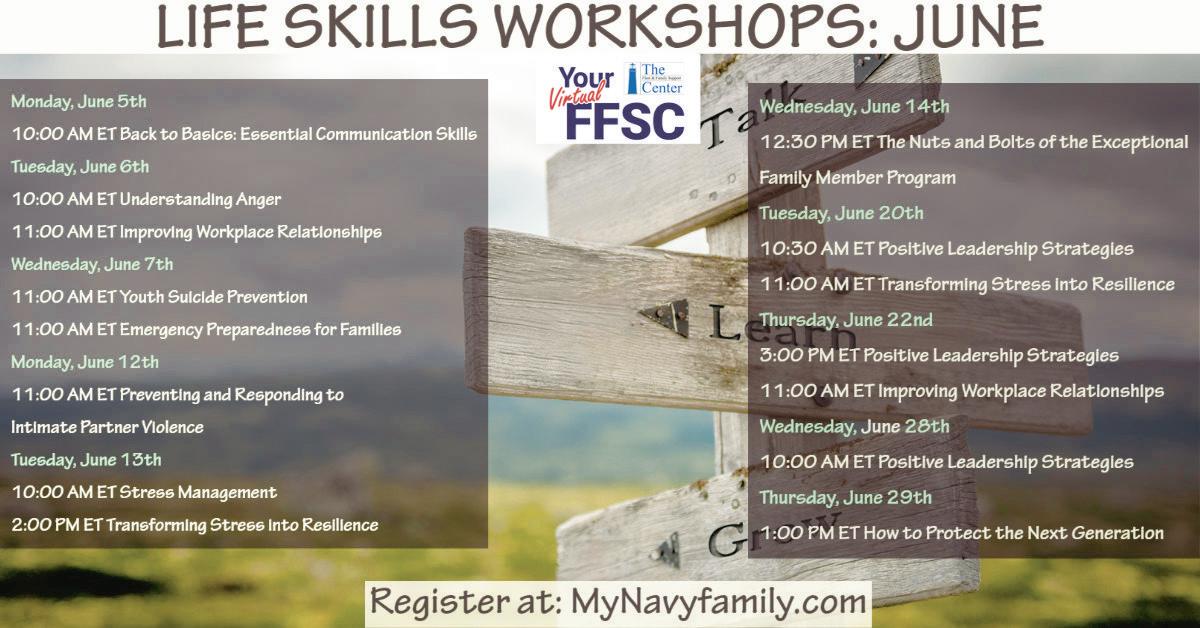
8 The Flagship |www flagshipnews.com|Section 2| Thursday, June 22,2023
On iberty
World renowned psychic comedian and AGT mega-star Peter Antoniou to perform at the Virginia Beach Funny Bone this Wednesday
InterviewByYiorgo
Virginia Beach Funny Bone is proud to announce that international superstar, psychic comedian Peter Antoniou, by special engagement will be performing live Wednesday June21stattheVirginiaBeachFunnyBone FromLondon’s West End to being a semi-finalist on America’s Got Talent Peter has left his audiences around the world speechless with his highly entertaining show. His uncanny ability of mind reading, improvised comedy and great storytelling is aoneofakindexperiencenottobemissed.

For tickets to the show Wednesday night, go to: https:// vb.funnybone.com/ShowDetails/c91b6fa9-0d16-467e-882773d8a1255f00/eaf5e248-1faf-437c-8832-2fb72fdee936/ Peter_Antoniou/Virginia_Beach_Funny_Bone Yiorgo:WetalkedwithPeteroverthephonerecently.Tell usPeter whyshouldpeoplecometoyourshowattheFunny Bone?Whatwilltheyseeandexperiencelive?
Peter Antoniou: It is a fun interactive, hour and a half showwhereIreadmembersoftheaudience’sminds.Iknow that sounds spooky but really it’s a lot of fun and there is a lotofcomedyinvolvedinitaswell Itisagreatwaytoexperience the impossible because I talk about facts from their pasts that I couldn’t possibly know or random numbers, or people they have not thought of in 20 years It’s my job to try and figure out details about those things and everyone gets involved to some extent So it’s a lot of fun and very interactive
I’ve also designed some new psychic demonstrations specifically for this show that I have not shown before. I spend so much time traveling around, I have a lot of time in planes andcars to think of new ideasand I always like to trythemwithaudiences.IhavearoutinewhereIputupmy skills on the test and gamble some money and objects and it’s a lot of fun with a lot of surprises as well It is a 21 and overshowbecauseofthevenuesellingalcohol.Myshowis veryfamilyfriendly
Y: Since you mentioned it. What is that process like of comingupwitharoutine?
PA: It varies of course, but sometimes I’ll see something inamovieortherewillbeafunny,sillyidea WhenIwason
AGT I did a routine where I used a thousand cans of food. That idea came from when I had my covid jab/shot and I hadafeverdreamandwhenIwokeupIhaddreamtupthe whole routineinits entiretyandIscribbleditdown.Iwish the creative process was that easy. Sometimes I’ll think of a little nugget of an idea. The show is what people’s first impressionofmeis WhataretheythinkingandItrytobuild fromthere,fleshitoutandgetmorepeopleinvolved.
Y:Whataresomeofyourfavoritepartsofyourshowthat youcan’twaittodoandseethatreactionfromtheaudience?
PA:Somuchofmyshowisimprovisedbecauseitinvolves the audience I have no Idea what’s going to happen every nightandthat’ssomuchfunforme Itrytofindthatskeptic in the crowd and say, ok think of that question that If I can knowtheanswerto itwouldconvinceyouofmyskills That can take the show in so many different directions dependingonwhatthepersondecidestothink,orwho’stherethat night and how they respond. It makes the show different everynightandthatkeepsmeexcited.
Y: The beauty of live entertainment is just that live and given the different venues you perform in, can you share someanecdotesofunexpectedinteractionswithfans,skeptics,hecklersetc.?
PA: One of my favorite things that happened was that
InterviewByYiorgo
SevenVenues is proud to present, Lazer
Invazion: A Rock-n-Roll Odyssey of Lasers LightsandAlienInvasionsattheHarrisonOpera House on Friday June 30th Lazer Invazion is truly a mind-bending and blending celebration ofsciencefiction,spaceexplorationandpop-culture. The use of multi-media, high-tech lasers, theatricallighting,andHighDefinitionvideosare all choreographed and synchronized to rock-nroll classic tunes by David Bowie Queen Duran Duran The Police The B-52’s, Portishead, Daft Punk, The Church and more. To reference the original Star Trek TV show, Lazer Invazion is a warp-driven laser ride through time and space, guaranteedtoboldlytakeyouwhereyou’venever beenbefore.
For tickets and more info, go to https://www. sevenvenues.com/events/detail/lazer-invazion

Yiorgo: With us today is the Producer, DirectorandCreatorofLazerInvazionDavidDenson. Tell us David, why should people come to the show?Whatwilltheysee,hearandexperience?
David Denson: Thank you for having me, Yiorgo We build these shows as multi-media showsthatinvolvelasersbutnotthelazershows of the 1970’s. These are truly immersive, engaging, visualizations to great music. It is visuals that are pulled from movies, TV, the Internet, commercialsalongwithlaserdesigns theatrical lighting haze and smoke all to create choreographed, unified visual experience that goes along with the great rock and roll that backs it allup
Y:Sothisisyourbaby.Youcreateditright?

DD: Yes I did. I’ll tell you and granted, I’m biased I have spent 30 plus years in live entertainment, there’s absolutely nothing like these mult-mediashowsoutthereintheworld.
Y:Canyoutalkusthroughthecreativeprocess? When,howdidyouconceptualizeitandthengo aboutcreatingit?
one of my segments is where the audience members think of questions they would like to ask me, and I try to figure outwhatthequestionis Ifindoutfactsthattheynevertold anyone Soonetime,I’mdoingashowinLondon,talkingto awomananditdawnsonmethatithastodowithherbeing pregnant.I’mstressedandIaskedpermissionifIcouldsay it. So I say, you are pregnant with twins The woman says yes.Shehadbeentothedoctorearlierthatdayandhadnot had a chance to tell her daughter who was sitting next to her Thedaughtergaveamassivereactionanditwassucha fun,specialmoment Iwasverygladsheallowedmetoshare thatwitheveryone.
Because the show is so interactive, I very rarely get any hecklers because I’m talking to the audience and they are talkingbackthewholetime.Iquiteenjoytheskepticsinthe showbecauseifyoufullyacceptthatIcanreadmindsthen they think, well of course he can do that. Whereas those
DD: It came by due to the pandemic. My company is in live entertainment and due to the pandemic, it’s dead in the water You were prevented from doing any business. So I started thinking, what do we do that requires a low amountofpeopletoavoidthatcovidstuff Several yearsprior,IhadproducedthePinkFloydLaser Spectacular which is one of the longest running lazershowsontheroad.Soduringthepandemic itwasn’tahardequationtosaymaybeweshould lookatlazershowsagain.Sowestartedthinking about it These shows can operate with just two peopleoncethetimeisspentindevelopingthem beforeyouputthemoutontheroad.Wehadtwo ideas OnewasLazerInvazion,becauseweknew we wanted to use lasers and multimedia pulling footage from great science fiction movies, find musicthathastodowithspacetravelandthings like that Let’s have an examination of science fiction’s influence on our culture as interpreted through music, movies and what not. The other ideawasthelasershow,Lazed&Confused:The 420LaserExperience.
There are a group of four of us: Michael Dunn-laser design, Marissa Anz Steiner-editor and Christopher M. Ham-lighting design and we started that process by gathering songs It’s a long process of ending up with 300 songs and cuttingthemdownto18 Wethenlistentothose songs, and they give us ideas about what kind of visuals to use. We collaborate together everybodythrowsinideasandwestartbuildingitone stepatatime.Weputvideostogether,thenlazers together, we go back and re-edit the videos to match with the lasers and there’s this back and forth as we fine tune all these elements into a cohesiveexperience
Y: Do you have a favorite part or segment of the show that you can’t wait to see the reaction oftheaudience?
DD:Absolutely In the Lazer Invazion we use
Page 3
thatsayitcan’tbedone,it’simpossible,it’snicetogetthem to experience something that’s impossible, you’ll see their headsspin.I’mnottryingtoconvinceanyoneifpsychicsare real.Aslongastheyarehavingafuntime,Iconsiderthatto bemyprimaryjob.
Y: People are very familiar with your performances on AGT.Let’stalkaboutthem
How did the initial audition happen? Can you talk us throughtheprocess?
PA: I had sent some videos to them a couple of years before.Theysaidcomeandauditionbutitneverworkedout becauseIwaslivingintheUKatthattime ImovedtoAmerica in January 2021 and about three weeks after I landed, I got an email from them checking on me and wanted me to audition for them. We’ve seen your videos, we know we
Invazion,
Harrison Opera
Friday June
Director and Creator of Lazer Invazion
Denson tells us all about it INSIDE: Check out Flagship Values, your source for automobiles, employment, real estate and more! Pages C6-7
Lazer
invades the
House
30th, Producer,
David
An easy-to-make summer sweet treat Trythis 3-Ingredients StrawberryIce Cream onwarm days ahead.It’s chilled to perfectionwith fresh strawberries and fluffywhipping cream to create a creamytexture PageC4 TurntoPsychicComedian, Page 3 TurntoLazerInvazion,
www flagshipnews.com | The Flagship | Section 3 | Thursday, June 22 2023 1
YOUR EVENTS, NEWS AND PHOTOS
The Flagship welcomes submissions from ourreaders online.
Pleasesubmiteventshere: www.militarynews.com/users/admin/calendar/event/
Pleasesubmitnewsandphotoshere: www.militarynews.com/norfolk-navy-flagship/submit_news/
Travel back to the 1940’s at The South Pacific Luau and Hangar Dance on Saturday, July 22

PressRelease
Takeastepbackintimeatour2ndAnnual
South Pacific-themed Luau and Hangar
Dance!PutonyourbestHawaiianshirtand jointhefunastheMuseum’sHangars,ramp andaircraftcollectionareusedtotransport you to an island base in the 1940s Grace Street Seven, our Big Band for the evening willbeplayingintheshadeofthePBYCatalinawing Thedancefloor?Ourhangarfloor!
Completewithtikibars palmtreesandcold
adultbeveragestobeattheheat!
Dinner ticket holders will be welcomed to the Luau with a Lei Greeting and entertained with authentic Hula and Tahitian dances from Hālau Kahealani O Tulipa. Sit with your friends at our communal style tables, or reserve your own table for the VIP experience The band leader is ready toswingandswaythenightawaywithyour favorite 40’s tunes along with others that
Swim on over for FantaSea Evenings at the Aquarium July 11th & 13th

Aquarium & Marine Science Center is located at 717 General Booth Blvd., Virginia Beach, Virginia 23451. For more information call Guest Services at 757.385.3474. ThiseventispresentedbyPRAGroup
willkeepyourtoestapping!
Our island air strip will of course feature the Museum’s incredible collection of WWII-era aircraft, some of which will be prepared for photo opportunities with guests, and others which will participate in the evening’s entertainment, weather permitting! This fundraising event for the Military Aviation Museum supports our education programs and in honor of our WWII PBY Catalina which is celebrating
its80thBirthdaythisyear!
Doors open at 6pm. Parking is free and just like in the islands this is a rain or shine event! Advance tickets are now on saleandcanbepurchasedonlineathttps:// www.militaryaviationmuseum.org/event/ south-pacific-luau-hangar-dance-2/. The museum is located at 1341 Princess Anne Road Virginia Beach, VA 23457 For additionalinformationpleasecall757.721.7767
ONE NIGHT OF TINA:
Tina Turner tribute show comes to the Harrison Opera House Thursday, Dec. 14
PressRelease
Prepare to be transported into the electrifying world of one of music’s greatest legends as the highly anticipated tribute show, One Night of Tina, returns to the Harrison Opera House December 14th at 7:30pm. Celebrating the iconic career and indomitable spirit of the legendary Tina Turner this unforgettable live performance will leave audiences awestruck and filled with the spirit of rock ‘n’ roll.

One Night of Tina promises to deliver an unparalleled experience that honors the legacyoftheincomparableTinaTurner Thistributeshowcapturestheessenceofthe Queen of Rock and Roll, taking spectators on a journey through her remarkable life and showcasing her chart-topping hits that have defined generations.
From powerful anthems like “Proud Mary” and “What’s Love Got to Do with It” to soulful ballads like “Private Dancer” and “Simply the Best,” the production brings togetheratalentedcastofperformerswhoembodytheenergy charisma,andunmistakablevoiceofTinaTurner Withstunningvocals mesmerizingdanceroutines anda bandthatflawlesslyrecreatestheiconicsoundofherliveconcerts OneNightofTina promises an evening of pure entertainment and nostalgia.
“One Night Of Tina” is not just a show; it is a celebration of the unparalleled career andenduringlegacyofatruemusicallegend.TinaTurner’scontributionstotheworld ofmusicmadeanindelibleimpact,breakingbarriers,andinspiringcountlessartiststo this day. Her electrifying performances and empowering presence continue to resonate with audiences worldwide
One Night of Tina offers a chance for new and old fans to experience the magic of TinaTurner’smusicinalivesetting TheshowcomestoyoudirectlyfromLondonand has graced stages all over Europe and Brazil in unstoppable tours since 2019
Whetheryou’readie-hardfanorsimplyappreciatetheartistryandinfluenceofTina Turner,OneNightofTinapromisesanunforgettablenightofentertainmentthatwill haveyousinging,dancing,andcheeringinyourseat.Getreadytobetransportedback intimeasthisincredibletributeshowpayshomagetotheiconicperformerwhotruly deserves the title of a music legend.
OneNightofTinawillbelightingupstagesworldwide,bringingtheessenceofTina Turner’s legendary concerts to audiences everywhere. Don’t miss this chance to be partofamemorableeveningthatcelebratesthelife,music,andenduringspiritofthe one and only Tina Turner Tickets are on sale now and start at $29.50 and can be purchased online at Ticketmaster.com or at the Scope Arena Box Office The box office is located in the Scope parkinggarageat201E.BrambletonAve,Norfolk,VA23510 ItisopenMondaythrough Fridayfrom10a.m.to4p.m.Foradditionalquestions,pleasecontacttheboxofficeat 757.664.6464 or info@sevenvenues.com.
Community
SUBMIT
PressRelease EnjoyaneveningofimaginationandexplorationforallagesattheVirginiaAquarium& Marine Science Center! Take an enchanting journey through our galleries to snap a photo with a fluttering fairy, meet a mermaid on dry land, and swap stories of adventure with a pirate Add your own bit of magic to the experience by dressing up in your favorite FantaSeacostume! TheeventwilltakeplaceonJuly11and13from6:30pm-9:30pm.Ticketscanbepurchased online at https://www.virginiaaquarium.com/plan-your-visit/events/fantasea-evenings Adultticketscost$32.95,childrenages5+cost$27.95 childrenage4andunderarefreeand membersget50%offticketprice The Virginia
2 The Flagship | www flagshipnews.com | Section 3 | Thursday, June 22 2023
A
like you, we want you to be on the show. It wasperfecttimingbecauseIknewitwould restartmycareernowthatIwasinAmerica. I would have the opportunity to go on AGT and be seen by everyone I agreed to it and startedworkingonademonstrationthatwas gearedtothem EverythingIdidonAGTwas designedjustforthatshow,maximizingthe space thinking about the judges building demonstrationsaroundthemandhowthey wouldreact.Itwasarealfunexperienceand agreatopportunitytoworkwiththem.
Y:Also,congratulationsareinorder Iread that you performed from May to Decemberin“America’sGotTalentPresents:Super Stars Live” at Luxor in Las Vegas How did thatopportunityhappen?
PA: It was an incredible experience I came to the show initially to cover for the Clayvorents who are another mind reading act They had some commitments and they asked me to come in for a few weeks initially to cover their slot which was quite exciting AndwhileIwasthere,theyoffered methejobofhostingtheshowfortherestof the year So I became the MC for the whole thing got to welcome the crowds in introduce them to all these incredible acts talk aboutmyexperienceontheshowandgetto be the faceofthisginormousproduction.It was so exciting Being in Vegas and getting to perform is always a fun dream but not anythingthatIthoughtwaslikelytohappen. Gettingtobethereandperformeverynight wasadreamcometrue
Y: And then you returned this year on “AGT” for its first “All-Stars” season. How didthathappen?
PA:Igotanemailsaying,heywe’redoing anAllStarsshowandwewouldloveforyou tobeon.TherewasnotalotofwarningsoI decidedtoshowthemadifferentsideofme then of what they have seen. Usually I have big props, but I scaled it down in prop size butbiggerinemotions.
Y: Let’s do sentence association with the AGT judges and Terry Crews I’ll say their names and you share the first thought that pops in your head about them. Let’s start withTerry
PA:Terryissoloving Heshowsupearly, says hello to all of us and is really welcom-
ing Heisagreatenergytohavearound Heis alwayssopositive.Also hesmellsincredible. The nicest smelling man I’ve ever encountered. He is exactly what you see on the screen
Y:SimonCowell.
PA:Simonislikeatoddler.Sometimeshe isalwayshappyandjolly,butifhe’sinabad mood he will throw a strop, a tantrum and you have to give him attention. He’s very exactwithwhathewantsandIthinksometimesthat’sgoodandsometimesheneedsto learntobealittlemorepatient
Y:HowieMandel.
PA:IreallyrespectHowie He’ssomeone who has done comedy for over 40 years He’sbeenonstageandhasdoneitall.When HowiegivesfeedbackItakeitallinbecause
out of all the judges, he’s been in the same arena that I’m putting myself in I want to hearthatwealthofexperience.
Y:SofiaVergara.
PA: I absolutely love Sofia, she is pure chaos. As I experienced in my season, If I need to do something that is quick, Sofia is notthepersontochoosebecauseshewillbe distractedandoverwhelmed.Sheisexactly theenergyIloveinaliveshowbutwhenthe producers are on the side saying wehave to throw it to a commercial can you rap it up, withSofia,itcanbeslightlymorestressful
Y:HeidiKlum. PA: Heidi is really great. She is quietly demanding what she wants She has very high standards who watches quietly and pays attention. I really appreciate that.
When you see Heidi make a big reaction, youknowyou’veearnedit
Y: Let’s talk about you. Where were you born and what made you fall in love with mindreading,psychingandentertaining?
PA: I was born in London, England and when I was about 9, I decided I wanted a superpower. I was a big fan of comics like X-Men and in only the way that kids think, I said to myself, ok, I’m going to learn how to read minds I’m Greek-Cypriot and Irish and I had seen my Cypriot auntie read the future of someone by looking at the coffee grounds in a coffee cup and tarot cards and palms so it didn’t feel that weird of an idea And then I just spent years learning from psychics, hypnotists and magicians. I put it alltogetherandnowIdomydemonstrations ofmindreading
Y: How about a wow, pinch me moment ortwo?
PA:Therehavebeensomany.Gettingto perform in the Dolby Theater on AGT live infrontof16millionpeoplewasanincredible experience Also performing in Vegas IhadgonebythesetofAGTthisyeartosay hello to some people and to support an act that I knew was auditioning Heidi Klum walkedpast,didadoubletakeandsaid,“Oh Peter hello.” And just the idea that supermodelHeidiKlumwouldrecognizemeand know my name is still a bit wild and crazy to me
Y: There is a documentary in the works aboutyou.Canyoutellusallaboutit?
PA:ThereisagroupinSeattle,Washington that primarily makes documentaries They have seen my shows, reached out and now they have filmed my shows and have interviewed me about my process. It’s very flattering whenever someone reaches out likethat.
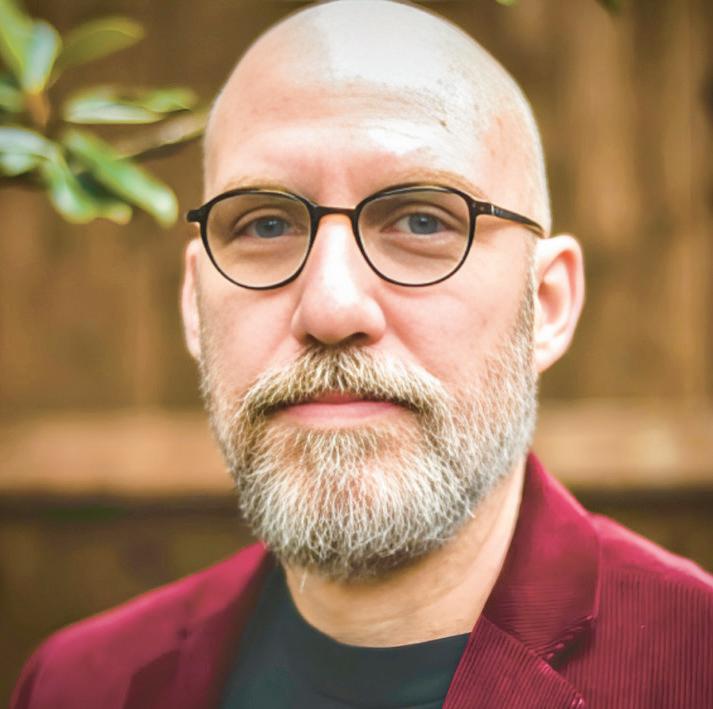
Y: Besides the tours, what else are you workingonnow?
PA: I am working on a full special that will be an hour long with mind reading and demonstrations that were too big or too longforAGTandarealotoffun.Peoplecan follow me on Instagram at peterantoniou and can find out more about me at https:// www.peterantoniou.com/home Yiorgo is an arts, entertainment and sports writer A stage, TV and movie actor, he is also a sports entertainer, educator, motivational speaker, writer, storyteller and columnist
asongbyDaftPunkcalledTechnologicand by far it is my most favorite segment of the show because our editor Marissa did an amazingjobwiththevideoaccompaniment. It is really really stunning and exciting and Michael’slaserdesignisamazing.Iamnever notexcitedtoseeit.
Y:Let’slearnaboutyou.Wherewereyou born and how or what made you fall in love withthisformofentertainment?
DD: I was born in Henrico County, Virginia. I grew up in Midlothian and went toMidlothianhighschoolwhereIwaslucky to have some drama teachers there and at the junior high school that really encouraged me I was welcomed into an environmentwhereIhadasensibilityforit Ifound acommunitythereandIlovebeinganaudience member I love seeing and experiencingwhattheaterdoes,howitaffectsyouand howitcanchangeyourperspective.Itreally wastheeducationinVirginiathatsetmeon thatpath.
Y: What are some of your favorite shows that you have produced and are very proud of?
DD: Dolly Parton’s Smoky Mountain Christmas Carol is absolutely one of my favorites We produced that in the US and London last Christmas It’s just a really feel good musical Dolly’s music is amazing and areallygreatholidayexperiencethatIreally like a lot. The other thing that I am excited aboutrightnowisthatwehavedevelopeda newmusicalcalledCowboyBobaboutareal life bank robber in Texas. This past spring, we did a run at the Audi Theater in Houston, Texas and now we are looking to move
it to New York and I am excited about the futureofthat.
Y:I’mahugefanofDollyParton.Issheas sweetasweseeonTV?Whatcanyoushare abouther?
DD:Dollyisevennicer.Sheisthesweetest human being who really cares about everyone Sheissmartandveryinsightful Whateverpositiveimageyouconjureinyourhead abouther,thatisaccurate.
Y: So, how do you go about becoming a producer? Do you need a lot of money or know people who have the money to invest inashow?
DD:Ithinkthat’samisconception.Obviously part of producing is financial responsibility raising money and managing the funds necessary to build what you want to build. But that is not the whole job by any stretchoftheimagination.Ibelievethatthe way you become a producer is you decide
that something needs to exist that doesn’t exist and then you endeavor to make it. That means gathering the talent, the idea, the script, whatever it is you need and the finances in putting them all together in a way that you can then go out and entertain peopleandhopefullymakealittlemoneyat it. There are definitely some white knuckle nights There is always a risk and you are always rolling the dice If any of us knew whatpeoplewouldflockto,weallwouldbe billionaires You have to trust your gut, put things out there and build. I am still losing money on shows that went down in 2020 becauseofthepandemic.
Y:Howaboutawowpinchmemomentor twothatyoucan’tbelievethatlittleboyfrom Henrico Virginiagottoexperience?
DD: Oh my God, my whole life! I can’t imagine working for a living This is what I know. Obviously there are run-ins with celebrities that are really fascinating We talkedaboutDolly Thatkindofopportunity israre IpresentedanEveningwithMichelle Obamaandgottospendtimewithherandit makes you reflect in a totally different way whenyouarearoundthesepersonalities But mostly it’s watching audiences Every time I’m in the back of the house watching an audience and they are excited and engaged with what we are putting up, I can’t believe that I get paid to do this When you see the effectonpeopleandthejoyyoucreatewith athought,there’snothingasamazingasthat
Y: On June 29th, the night before the Lazer Invazion at the Harrison Opera House you have a homecoming with your otherlasershowwementionedearlier back homeinRichmond,VirginiaattheCarpenter Theatre Dominion Energy Center. Can youtellusallaboutit?
DD: The laser show in Richmond on the

29th of June is called Lazed and Confused the 420 Experience It’s exactly like the Lazer Invazion show but it goes through the window of lets collect and examine the influenceofcannabisonthepopularculture. Inthatshowwehavemusicfromthe1930’s starringCabCallowaysingingasongcalled Reefer Man, all the way up to contemporary music featuring: Snoop Dogg Willie Nelson, Lana Del Rey, Bob Dylan, RUSH, BobMarley,MissyElliotandsomuchmore We have clips from every Stomp Pineapple Express, half baked and every stoner film you’veeverseen Itreallyisanexamination of this plant that has been a part of human historysince2,500BC.
Cannabis has influenced our art, culture, music,everythingandthereisalotofhumor when you get into stoner stuff Also a lot of people that go to lazer shows often are enhanced. So part of it was, let’s preach to the choir And to be fair, we have tons of audiences that show up the the Lazed and Confusedshowwhotellme,“I’veneverbeen high, I’ve never smoked weed and I had a blast at this show.” Even though marijuana is the theme it’s still coming from everybody’s popular cultures so the references that are being made, everybody gets and understands Youdon’thavetohaveexperiencedmarijuanatoenjoythatshow.It’struly a hilarious show. For tickets to the show in Richmond, go to https://www.dominionenergycenter.com/events/detail/lazed-andconfused
Yiorgo is an arts entertainment and sports writer A stage TV and movie actor, he is also a sports entertainer, educator, motivational speaker, writer, storyteller and columnist

from Page 1
Psychic Comedian
PeterAntoniou as a contestant onAmerica’s GotTalent (COURTESYPHOTO)
(PHOTOBYMORGANLIEBERMAN©2022ALLRIGHTSRESERVED)
Lazer Invazion from Page 1
www flagshipnews.com | The Flagship | Section 3 | Thursday, June 22 2023 3
Producer Directorand CreatorofLazer Invasion David Denson. (COURTESYPHOTO)
Take salads al fresco for a sweet summer meal

FromFamilyFeatures&TheNorth CarolinaSweetpotatoCommission
Get out of the kitchen and head outdoors this summer for fresh, delicious meals that call for lighting the grill and relaxing in the warmth of the season. Take some of your favoritecourses-likesalads,forinstance-to the next level by adding grilled ingredients forthatperfectbitofchar
This Grilled Sweetpotato and Blueberry
Salad offers all the tastes of the season with springsaladmix,freshblueberries,walnuts and blue cheese Topped with homemade lemon honey vinaigrette, it’s a light yet filling meal fit for warm days thanks in part to the superfood that takes it to new heights: sweetpotatoes. As one of the most versatile vegetables that’s easy to add to a variety of recipes for flavor and nutrition enhancement sweetpotatoes can be a key ingredient in simple or elevated, sweet or savory dishes alike. Whether they’re cooked on the stove, baked, microwaved, slow-cooked or grilled
toaperfectdonenesswithacrispychar they can be an ideal addition to better-for-you summermeals.
Plus, they’re a “diabetes superfood” per theAmericanDiabetesAssociationbecause they’re rich in vitamins, minerals, antioxidants and fiber, all of which are good for overall health. When enjoyed with the skin on, one medium sweetpotato contains more than 100% of the recommendeddaily amount of vitamin A, an important vitamin affecting vision, bone development and immune function They’re also a good sourceoffiberandrichinpotassium.
Another fun fact: the National Sweetpotato Collaborators officially adopted the one-wordspellingin1989toavoidconfusion withequallyuniqueanddistinctivepotatoes, which are also grown and marketed in the U.S.Sweetpotatoisanoun,notanadjective, meaning“sweet”isnotadescriptorbutpart of the actual nomenclature. This is differentthanotherpotatoesusingadjectiveslike white, red or russet to describe an entirely differentvegetable
Find more nutritional information, fun factsandsummerrecipeideasatNCSweetpotatoes.com.
Grilled Sweetpotato and Blueberry Salad
Recipe courtesy of the North Carolina Sweetpotato Commission and Andrea Mathis (beautifuleatsandthings.com)
Servings: 4
LemonHoneyVinaigrette:
6tablespoonsoliveoil
¼cuplemonjuice
2tablespoonsDijonmustard
2½tablespoonshoney
salt,totaste
pepper,totaste
Salad:
3mediumsweetpotatoes, peeledandsliced
2tablespoonsoliveoil
salt,totaste
pepper,totaste
4cupsspringsaladmix
1cupfreshblueberries
⅓cupchoppedwalnuts
¼cupbluecheesecrumbles


lemonwedges,forgarnish(optional)
To make lemon honey vinaigrette: In bowl, mix olive oil, lemon juice, Dijon mustard and honey Season with salt and pepper to taste Refrigerate until ready to serve
Preheat grill to medium heat. Drizzle sweetpotatoeswitholiveoilandseasonwith salt and pepper, to taste. Grill sliced sweetpotatoes on each side about 5 minutes, or until sweetpotatoes are tender and slightly charred.Removefromgrillandletcool.
To arrange salad: Spread spring salad mix onto large platter and top with grilled sweetpotatoes blueberries walnuts and bluecheesecrumbles
Top with lemon honey vinaigrette and garnishwithlemonwedges,ifdesired.
An easy-to-make summer sweet treat
FromFamilyFeatures/Culinary.net
Whenit’sbeyondhotoutsideandthekids arebeggingforadeliciousafternoonsnack, sometimes it’s difficult to know where to turn. The pantry is full and the refrigerator is stocked, yet nothing sounds appetizing whenit’sscorchingoutside
Combining three simple ingredients you probably already have in your kitchen can save the day and provide a refreshing and scrumptioussnack.
Try this 3-Ingredients Strawberry Ice Cream on warm days ahead. It’s chilled to perfectionwithfreshstrawberriesandfluffy whipping cream to create a creamy texture perfectforthekiddos

Start by pureeing 1 pound of fresh strawberries Add 1 pint of whipping cream and sweetenedcondensedmilktoamixingbowl thenbeatuntilstiffpeaksform.
Fold the strawberry puree in with the whipping cream mixture Pour into a loaf panandfreezefor5hours
Before serving, let ice cream soften for 5-10minutes.
It’s delicious, rich and has sweet strawberry flavor that can help satisfy nearly any sweettooth.It’sawonderfultreatafterlong summerdaysspentplayingoutside,splashing in the pool or just relaxing, soaking up thesun.
Find more summer dessert recipes at Culinary.net.
If you made this recipe at home use #MyCulinaryConnection on your favorite social network to share your work.
3-Ingredient Strawberry
Ice Cream
Servings: 4-6
1poundfreshstrawberries, stemsremoved
1pintheavywhippingcream
1can(14ounces)sweetened condensedmilk
Inblender,pureestrawberries
In bowl of stand mixer beat whipping creamandsweetenedcondensedmilkuntil stiff peaks form. Fold in strawberry puree
Pourintoloafpan Freeze5hours
Before serving, let ice cream soften 5-10 minutes
Food
4 The Flagship | www flagshipnews.com | Section 3 | Thursday, June 22 2023
4 TRICARE tips to avoid bug bites this summer
ByTRICARECommunications
Summerisatimeforhavingfunoutdoors
Unfortunately you and your family aren’t the only ones having fun outside Bugs— and bug bites—increase dramatically in the summer months Although most bug bites areharmless,somebugscanspreaddangerous diseases For example, mosquitos can carrymalaria,WestNileVirus,Zika,dengue, and chikungunya, while ticks carry Lyme andotherdiseases So it’simportanttolearn howtoprotectyourself
To help prevent bug bites stay safe with thesetips

1.Useinsectrepellent
AccordingtotheEnvironmentalProtection Agency, using insect repellent can prevent mosquitoes, ticks, and other bugs from landing on you and biting you. Make sure to follow the product instructions especially when applying to children. If you’re also using sunscreen, apply your sunscreen first, let it dry, and then apply insect repellent.
2.Wearappropriateclothes Ifyouknowyou’regoingtobeoutatnight orhikinginwoodyareas,dressappropriately to prevent bug bites. Cover exposed skin as much as possible by wearing long-sleeved shirts longpants andhats
3.Takestepstocontrolinsectsinsideand outsideyourhome
Sleep in places that are air conditioned or screened against bugs If you’ll be sleeping outdoors, use a mosquito net to protect againstinsects.“Chooseamosquitonetthat is compact, white rectangular with 156 holes per square inch, and long enough to tuck under the mattress,” says the Centers forDiseaseControlandPrevention(CDC).
4.Iftraveling,payattentiontolocalrisks andoutbreaks
Different regions and countries pose differentrisks Forexample,it’sgoodtoknow whichbugsarecommoninareasyou’revisitingandwhatdiseasestheyspread
Before you travel overseas go to CDC
gov/travel to find travel notices and other healthinformationforyourdestination.The CDCrecommendsvisitingyourhealthcare provider at least a month before your trip to discuss vaccines or medicines you may need. TRICARE covers age-appropriate vaccinesrecommendedbytheCDC,somake sureyou’reuptodateonallroutinevaccines before every trip Depending on your travel plans you may need other vaccines that TRICAREmaynotcover.
Sometimes despitebestefforts bugbites stillhappen.Fortunately,youcansafelytreat mostbugbitesandstingsathome However, if you experience any serious symptoms afterabugbite,suchasarash,fever,orbody aches, you can contact the Military Health SystemNurseAdviceLineforadvice
Remember that some activities, such as hiking,camping andworkingwithanimals can increase your encounter with bugs and risk for bug bites. Throughout Bug Week,
learn facts about common creepy crawlers and flying pests, as well as how to prevent and treat bug-borne illnesses. Prevention is keytokeepyousafeandhealthy.
Would you like the latest TRICARE news sent to you by email? Visit TRICARE Subscriptions, and create your personalized profile to get benefit updates, news, andmore
ByTRICARECommunications
For military families, summer can be a time of big changes due to permanent change of station (PCS) season. When moving, it helps to make a list of items you want to pack up and move with you. Fortunately,youdon’thavetoworryaboutlosing yourTRICAREcoverageduringyourmove
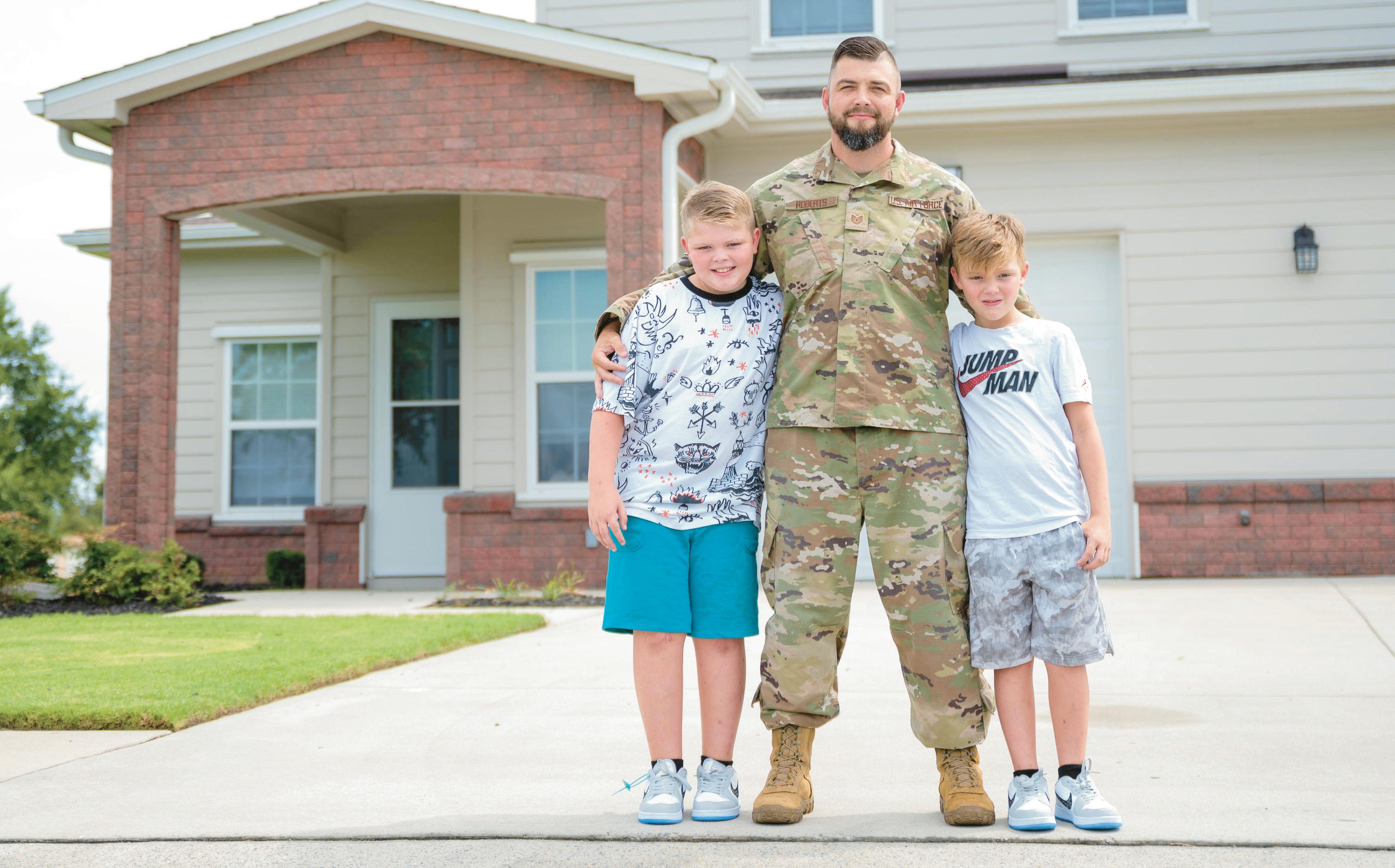
“Whenyoumove yourTRICAREbenefits move with you, said Jeremy Schneider, a managementanalystwithTRICAREPolicy andProgramsattheDefenseHealthAgency. “Youmayhavetochangeyourplan,provider, andpharmacyifyoumovetoanewarea,but your medical, dental, and pharmacy coverage remain unchanged throughout your relocation.”
Here are some tips on how to make a smooth transition with your TRICARE benefitsthisPCSseason
1. Understand your health plan options andhowtomakechanges Youshouldn’tdisenrollfromyourcurrent TRICAREhealthplanbeforemoving.After you’vemoved,yourplanoptionsmaychange
As outlined in the TRICARE Qualifying Life Events Fact Sheet your PCS counts as a Qualifying Life Event (QLE). You have 90 daysfromthedateofyouraddresschangeto changeyourTRICAREhealthplan
Your health plan options for your new location depend on your status and where youmove:
Stateside: Ifyou’reanactivedutyservice member (ADSM), you must have either TRICARE Prime or TRICARE Prime Remote Active duty family members (ADFMs) may also be able to choose the US Family Health Plan or need to enroll in TRICARE Select, depending on their new location.
Overseas: ADSMs must enroll in TRICARE Prime Overseas or TRICARE PrimeRemoteOverseas Ifcommand-sponsored,ADFMsmayalsoenrollinoneofthese options, as well as TRICARE Select Overseas. If you aren’t command-sponsored, TRICARESelectOverseasisanoption.
Check the TRICARE Plan Finder or review the TRICARE Plans Overview Fact SheettolearnaboutTRICAREhealthplans. Comparecoststolearnhowtheplans’costs differ Ifyou’rechangingTRICAREregions,you cantransferyourenrollmentonline,bymail, orbyphoneafteryoumove Ifyouneedhelp completingyourtransfer,calltheTRICARE contractorforyournewregion. Onceyou’reatyournewlocation,youmay needtofindanewprimarycaremanageror health care provider Use the Find a Doctor tool or go to your TRICARE contractor’s onlineproviderdirectorytostartasearch.
2. Choose the right pharmacy for your newlocation Wherever you’re moving, you can move your prescriptions with you. You can get
yourprescriptionsfilledatthenearestmilitary pharmacy or TRICARE retail network pharmacy You can also transfer eligible prescriptionstoTRICAREPharmacyHome Delivery Outside the U.S. and U.S. territories, you can only use home delivery if you have an APO/FPO/DPO address, or you’re assigned to a U.S. Embassy or Consulate Homedeliveryisn’tanoptioninGermany.
Before moving remember to fill your prescriptions to ensure you have enough medication to last throughout your move andimmediatelyafteryouarriveatyournew location.VisitPharmacytolearnmore
3. Find a TRICARE Dental Program dentist
If you have dental coverage through the TRICARE Dental Program (TDP), your coverage remains in place After you’ve moved, use the Find a Dentist tool to find a new dentist near you. You can also call the TDPcontractor,UnitedConcordia,forhelp and to share your new address and contact information.Ifyou’reaneligibleADFMwith nodentalcoverage,youcanenrollinTDPat any time Remember that TDP is separate from your health plan, so you must enroll separatelyfordentalcoverage If you have dental coverage through the FederalEmployeesDentalandVisionInsuranceProgram,reachouttoyourdentalplan providerforguidance
4.UpdateyourinformationinDEERS
After you move update your family’s information, like your new address and contact info, in the Defense Enrollment Eligibility Reporting System (DEERS) Any changesyoumaketoyourhealthplanwillgo intoeffectafteryouraddress change shows inDEERS.Remember,DEERSdoesn’ttransferyourTRICAREenrollment.
5.Getroutinehealthservicesbeforeyou move TreatthisPCS asanopportunitytocatch up on getting your routine health care, if needed.Beforeyoumove,besuretodiscuss anyongoinghealthissueswithyourcurrent primary care manager, family doctor, or specialist.Youshouldalsoscheduleroutine physicals and immunizations If you have any civilian medical or dental providers be suretoaskforcopiesofyourrecordstotake with you. Talk to your TRICARE contractor for moreinformationon requestingand transferringrecords
KnowinghowtoprepareyourTRICARE coverage to move with you will help you and your family have a smooth PCS Visit TRICARE Moving for more information, including how to prepare based on your currentTRICAREplan.
Would you like the latest TRICARE news sent to you by email? Visit TRICARE Subscriptions, and create your personalized profile to get benefit updates, news, andmore
Health
TRICARE moves with you: 5 tips to help ease your PCS move U.S.AirForceTech Sgt.Clifford Roberts 325th Contracting Squadron contracting officer,and his family pose fora photo atTyndallAirForce Base,Florida.Roberts and his familyrecentlymoved into base housing aftera permanent change ofstation toTyndall.(U.S.AIRFORCEPHOTOBYAIRMAN1STCLASSANABELDELVALLE) U.S.AirForceAirman
www flagshipnews.com | The Flagship | Section 3 | Thursday, June 22 2023 5
EdgarGrimaldo 86thAirliftWing PublicAffairs apprentice applies insect repellent to his arm at RamsteinAirBase, Germany.The 86AWsafetyoffice highlyrecommends insect repellent during the summermonths to keep insects and bugs awayfrom the body
(U.S.AIRFORCEPHOTOBYSENIORAIRMANTAYLORSLATER)


































6 The Flagship | www flagshipnews.com | Section 3 | Thursday, June 22 2023 Renting or Selling Your Home? placeanad.pilotonline.com reach your buyersat The rightplaceto advertise your Merchandise, Pets, Auto, Real Estate, TagSales &Flea Markets, Vacation Property, Wanted to Buy Items and more! placeanad.pilotonline.com COMPANION CAREGIVER *Day/Nite *Multi-Purpose Cleaning 757-386-7425 Care For The Elderly 757.622.1455 |placeanad.pilotonline.com Subscribe to The Virginian-Pilot today Call 757-446-9000 or go to PilotOnline.com Early home delivery. 757-446-9000 or PilotOnline.com LITTLE NECK ESTATE SALE 3732 Redwood Farm Dr VB Sat-Sun., June 24-25, 10-4. Beautiful eclectic home bdrms dining living study sunroom, kit, Waterford, art, china, lamps rugs vintage collectibles sports/superbowl memorabilia, patio garden, sterling fine jewelry. Blvd Treasures: A Waddell Enterprise ESTATE SALE 912 Five Point Road, Va Beach Thurs/Fri June 22/23, 8:30 am-3 pm Partial Listing: Teak bookcases ship’s clock & barometer din rm table, 6 needlepoint chairs, 2 lift reclining chairs, sofas & chairs, marble lamps prints leather-top knee-hole desk, books kit. & gar. items Nordic Trac exercise bike, costume & silver jewelry, more Pics at Estatesales net. Cash or Check only. Larry Zedd, Va Bch Antiques 757-422-4477 virginiabeachantiquecompany.com Estate Sales Estate Sales NOW ENROLLING FOR K-8TH GRADE Tidewater Classical Academy is a Christian school now enrolling K-8th grade We offer affordable tuition (discounts for multiple children), half-day model, small class sizes and classical curriculum. Please call 757-3013546 for more information, to tour the school, or to meet the principal. Tidewaterclassical.com HAMPTON RAILS TRANSIT ADVOCACY Announcing the formation of the Hampton Rails Transit Advocacy group serving the Hampton Roads area. We are dedicated to improving public transportation and infrastructure throughout the area, but are currently focusing on Virginia Beach. Join us at https://linktr.ee/hampton_rails Announcements DRIVEWAY & MASONRY WORK Landscaping Grading Top Soil, Yard Clean Up & Tree Removal. 757-714-4848 CONCRETE 10X40 Driveway $2,750 or 15’X15’ patio w/stone fire pit. 35 years experience. Mark 757-633-4765 Call for your free estimate. Licensed/Insured Estate Sales Concrete/Asphalt SENIOR SERVICES AFFORDABLE PRIVATE DUTY Let Me Work Alongside of You While You Remain In The Comfort of Your Home! (757) 406-2723. References Available Subscribe to The Virginian-Pilot today Call 757-446-9000 or go to PilotOnline.com
ANTIQUES &ESTATES 18th,19th &20thCentury, Furniture,Artwork, China, Crystal& Collectibles 1Piece Or Entire Contents. We ComeToYou With & Courteous&Professional Service.NoObligation Offers. Please Get My OfferBeforeYou Sell! TagSales &Estates Settled LARRY ZEDD 422-4477 Virginia BeachAntiqueCo. Appraisal Service With 40 YearsExperience virginiabeachantiquecompany.com ESTATE & MOVING SALES WE ARE THE “STRESS RELIEVERS” When We Handle Your Estate or Moving Sale We Offer On-Site Tag Sales with a Knowledgeable & Courteous Sales Team Over 45 yrs. Exp. in Antiques, Estates & Moving Sales References. LarryZedd422-4477 virginiabeachantique company.com Estate SalesAntiques & Collectibles ★GENERAL REPAIRS★ ★AFFORDABLE★ All Handyman, Complete Repair Int & Ext: A-Z Jobs, Rot Repair Bathrooms, & Alterations 35 Yrs. Exp. BBB A+ Rating 757-430-2612. Handyman Services ACTION ONE FENCE & DECK Custom wood, aluminum, chain link, vinyl. Quality work, great prices. Free Estimates. 40 Yrs. Exp. Call 757-438-7057. Fencing S & ENTERPRISE 20 YRS. Concrete Exp. All types of concrete work driveways, stamped & exposed. We accept credit cards. 757-652-4050. .shabazznva.com GERMAN SHEPHERD PUPPIES Pure Bred German Shepherd Puppies Parents on site. 5 Females and 2 Males First shots vet visit, and deworming 540 price 757-714-5505 FRENCH BULLDOG 9weekold female French Bulldog available,lastofthe litter. UTD on vaccinations next round due on July 1st, we will payfor that round also.No medication conditions,orknown allergies.$3200.Not AKC registered. Call 757-621-7137 COCKAPOOPUPPIES 5malecockapoo puppies.Family raised. Vetcheckedand up to dateon shotsand dewormer.BornApril 28. $1600 each. Contact Rebekah at 757343-4683 formorepicturesorinfo. CAVAPOO 14wks (M) Cavapoo (blk w/white markings), vet checked, hlth guarantee, vax, de-wormed, crate trained, pad trained. $1500 Call or text (757) 618-6569 AKC STANDARD POODLE PUPPIES Last one! Born1/1/23. $700. Cream girl! All shots! Chspk 757-705-6466 g p Dogs Cats, Other Pets WE BUY MUSIC RECORDS $$ Jazz, R & B, Rock albums & 45’s from the ’60’s, ‘70’s & ‘80s Call Howard 757-717-8945 We’ll come to you 24/7! Wanted To Buy BEST PRICE EXTERIORS Siding Windows, Roofing Soffit, Trim, Gutters. Licensed. & Insured. A+ BBB. Call 757-639-4692 AIR DUCT CLEANING UNIVERSAL DUCT CLEANING FREE INSPECTIONS MEMBER BBB. 757-502-0200 Home Improvements B & J MOVING Reasonable Rates, Licensed & Insured. bandjmoving.com 757-576-1290 (A) FAMILY TRASH MAN-HOUSEHOLD Demo inside & out construction sites, dumpster drop off, backhoe work. We haul it all! 20 yrs. exp., lic & ins. 485-1414 Hauling /Moving Shop smart. Save big! Sunday (and every day). TOYOTA 2010 HIGHLANDER Virginia Valid Inspection Excellent Condition limited Edition Sport Utility 2wd 15,000 O.B.O 757-949-1923 FORD 2006 F-150 Lariat Supercrew. Mileage 201,100, well maintained, no mechanical problems, very good condition. Carfax. Asking $6,200. 757-484-5486 or 757-513-8929. BMW 2017 530 The following vehicle will be sold for parts only at Copart 16 Nettles Lane Hampton VA 23666 on 6/27/23 2017 BMW: Owner: Geico Previous Owner Ekaterina Kulikova: VIN WBAJA7C3XHG906253 Autos for Sale 2004 HARLEY-DAVIDSON FXSTDI Softail Custom.V-Twin Cam 88 Motor. Valid Virginia Inspection. 12,000 O.B.O. 757-949-1923. Motorcycles and ATVs USE HAPPY JACK® Skin Balm® to relieve scratching and promotes healing for hot spots & allergies on dogs and cats without steroids At Southern States & Tractor Supply. (www.happyjackinc.com) LABRADOODLES Pups will be ready June 17th and will have firstshot &deworming.Males & Females available! Call or text 757556-5474$1200 GERMAN SHEPHERD German Shepherd Puppies AKC shots wormed, micro chip $500, Use code word $500 to get this price $200 deposit. 757-406-0677 Dogs, Cats, Other Pets ★ 100% DRAINAGE & YARD CLEANUP ★ Shrub & Tree Removal, Pruning Tractor Work & Grading French Drains, Mulching Fences. ★★757-282-3823★★ Lawn and Tree Service PEST/TERMITE CONTROL Universal Pest & Termite. FREE INSPECTIONS. 757-502-0200 (Mention This Ad and Get $25 Off) FRANK’S SIDING & REPAIRS Repairing Siding & Trim. Lic/Ins FREE ESTIMATES 757-227-8964 BULKHEAD & PIER REPAIR Grading Excavation & Demolitio Services, Free Est 757-262-6511 Make extra cash Sell Pilot subscriptions. For more info, call 757-222-5625 ABANDON WATERCRAFT Notice is hereby given that the following watercraft has been abandoned for more than 60 DAYS on the property of Robert Pepper 3944 South Military Highway Chesapeake, VA 23321, telephone 1-757-949-1620. 1991 Bayliner White, ID BYQA68FSB191 Application for Watercraft Registration/Title will be made in accordance with Section 29.1-733.25 of the Code of Virginia if this watercraft is not claimed and removed within 30 days of the first publication of this notice Please contact the Virginia Department of Wildlife Resources with questions Boats & Watercraft ABSOLUTELY ABLY ACQUIRING AUTOS All Makes & Models Best Price Paid!! FREE TOWING. 757-749-8035 Wanted Automotive Autos. We will purchase your collectible, classic, late model autos, we will come to you. Call 757-675-0288 CLASSIC & COLLECTIBLE Classic, Antique Cars VOLVO2005 S80 Sedan. Estate Car Ordered Sold! To settle Moore Estate. 69,500 miles. Black, tan interior.Can be seen in BayColony, Va.Beach. $7000 obo. Call KennyKeeter 757-718-2464. Autos for Sale Early home delivery. 757-446-9000 or PilotOnline.com ROOF REPAIR DEMOLITION Roof repair shingles, flat rubber tar metal slate 757-718-1072 LANDSCAPE SPECIALIST For all your landscaping and lawn care needs give us a call. Renovations, monthly maintenance, mulching shrub trimming Buddy 757-535-0928 CLEANUP Grass Cutting Mulching & Trimming Planting & Transplanting 25yrs exp. 918-4152 AMERICANTREESERVICE.CO ★Catering to all your tree & yard needs.★ ★757-587-9568. 30 years experience★ Don’t pay full price! With The Virginian-Pilot’s coupons and sales inserts, shop smart and save big every week! Place an in-paper classified with EZ-Pilot To place an ad, go to EZPilotClassified.com
WANTED


Crossword Sudoku CryptoQuip LAST WEEK’S CRYPTOQUIP ANSWER: LAST WEEK’S ANSWERS Religious Serivices For your installation’s religious service times visit wwwflagshipnews.com⁄ base_information⁄ religious_services INTERPLANETARY The young child’s loose incisiormade his gums pretty sore. I told him“This tooth shall pass. www flagshipnews.com | The Flagship | Section 3 | Thursday, June 22 2023 7 YOUR PERFECT HIRE IS WAITING Extend your reach. Access customized technology Simplify your search. jobs.pilotonline.com


Start nowat StartDigitalBenefits.com OUR NEWS SUBSCRIBERS GET GREAT DIGITAL BENEFITS: Tribune Publishing Company ONLINE STORE Free shipping and additional savings NEWSAPP Unlimited access to stories on the go WEBSITE Unlimited access with even morestories than print NEWSLETTERS Popular news topics emailed to you ALERTS Breaking news throughout the dayonevery device eNEWSPAPER Thedigital paper emailed daily 8 The Flagship | www flagshipnews.com | Section 3 | Thursday, June 22 2023
