M MILITARY SYSTEMS & Technol-
MILITARY SYSTEMS & Technology www.militarysystems-tech.com
The Defence Suppliers Directory Magazine
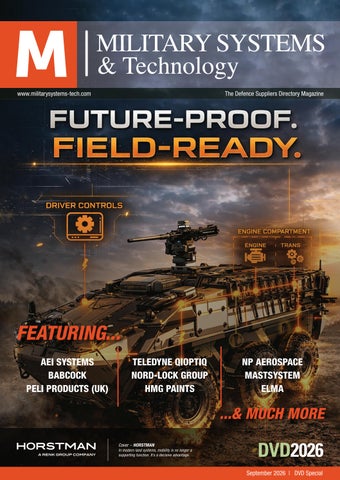
FEATURING... AEI SYSTEMS BABCOCK PELI PRODUCTS (UK)
TELEDYNE QIOPTIQ NORD-LOCK GROUP HMG PAINTS
NP AEROSPACE MASTSYSTEM ELMA
...& MUCH MORE Cover – HORSTMAN In modern land systems, mobility is no longer a supporting function. It’s a decisive advantage.
www.militarysystems-tech.com
1
DVD2026 T. +44 (0) 1884 258019 E. sales@militarysystems-tech.com September 2026 | DVD Special
M MILITARY SYSTEMS & Technology
www.militarysystems-tech.com
2
T. +44 (0) 1884 258019
E. sales@militarysystems-tech.com
M MILITARY SYSTEMS & Technology
CONTENTS 4 6
DVD2026 - SMES, Systems and Seminars NP Aerospace - Combat-Proven Protection for the Connected Battlefield
elcome to this special edition of Military Systems & Technology, dedicated to DVD 2026 and the people, technology and equipment shaping the future of military land capabilities.
W
Produced exclusively for the event, this edition brings together insight from those shaping future requirements, alongside editorial from leading companies and organisations across the land equipment sector, with key exhibitor and event information. We hope you enjoy the read, discover new technologies and find this edition a useful guide throughout your time at DVD 2026 and beyond.
A Multi-Media Portal for the International Defence & Aerospace industry. For more information on how to submit editorial or advertising options please contact us and one of our team will be happy to assist you.
8 10
Babcock - The Babcock General Logistics Vehicle AEI Systems - to Showcase Comprehensive Firepower Portfolio at DVD 202
14 18
Teledyne Qioptiq - Innovation That Delivers Nord-Lock - The discipline of bolting solutions approved for defense
24
HMG Paints - Expanded Defence Coatings portfolio for HMG Paints
28
AATG - Discovering Your Edge. The British Army Adventurous Training Group
30
Mast Systems - Why Telescopic Masts Matter in Modern Warfare
34
Defence Marketing - Why experience still matters when communicating complex capability
36
Fischer Panda - Integrated Onboard Power for today's connected defence platforms
42 44
Wescom Defence - The Age of Visibility CMCA - Innovative Solutions For Extreme Environments
We are at DVD... We are at DVD, so feel free message me and arrange a meeting.
Anthony Nutt Managing Director T: +44 (0) 1884 258019 | M: 07495 890601 E: tony.nutt@militarysystems-tech.com W: www.militarysystems-tech.com
48
Elma - Leading the Way for Combat Vehicle Electronics Designs Using Open Standards
Plus...
FAUN OXLEY CHESS FRICTAPE NSSS WILL-BURT HORSTMAN SCHROTH PIEDRAFITA
... & much more www.militarysystems-tech.com
3
T. +44 (0) 1884 258019
E. sales@militarysystems-tech.com
M MILITARY SYSTEMS & Technology
www.militarysystems-tech.com
4
T. +44 (0) 1884 258019
E. sales@militarysystems-tech.com
M MILITARY SYSTEMS & Technology
www.militarysystems-tech.com
5
T. +44 (0) 1884 258019
E. sales@militarysystems-tech.com
M MILITARY SYSTEMS & Technology
COMBAT-PROVEN PROTECTION FOR THE CONNECTED BATTLEFIELD Engineering Survivability for Modern Defence Modern warfare is evolving. Survivability now depends on more than armour alone.
NP Aerospace is supporting the uncrewed systems sector through the design and volume manufacture of advanced composites for UAV, USV and UGV applications
As defence forces worldwide accelerate the modernisation of land capabilities, survivability has become a defining priority for vehicle programmes. Protection is no longer viewed as a standalone feature—it is an integrated capability combining advanced armour technologies, vehicle engineering, lifecycle support and resilient supply chains. Celebrating its centenary year, NP Aerospace will return to DVD 2026 at UTAC Millbrook as one of the UK's leading independent survivability specialists, showcasing an expanded portfolio of protected mobility solutions, armour systems and advanced composite engineering. The event also highlights the company's growing international capability following its announcement to acquire US armour specialist Iten Defense, and ever expanding UK supply chain.
Advanced Composites for Drone Applications Building on this expertise, NP Aerospace is also supporting the rapidly evolving uncrewed systems sector through the design and volume manufacture of advanced composites for UAV, USV and UGV applications. Drawing on decades of lightweight composite engineering experience, the company delivers high-performance aerodynamic structures, protective housings and mission-specific composite assemblies that maximise strength while minimising weight. The result is increased payload capacity, extended operational range and enhanced durability for next-generation uncrewed platforms.
Integrated Survivability, Reduced Programme Risk Visitors to DVD 2026 will see how NP Aerospace continues to invest in innovative technologies that improve platform survivability while reducing programme risk. Its integrated engineering capability enables the delivery of complete survivability solutions—from armour design and lightweight composite technologies through to vehicle integration, manufacture, sustainment and upgrade programmes for a current fleet of over 18,000 vehicle platforms.
Team LionStrike: A Proven Mobility Partnership A key feature of NP Aerospace's presence at DVD will be Team LionStrike, the strategic partnership between NP Aerospace, BAE Systems and GM Defence formed to deliver a highly capable solution for the British Army's Land Mobility Programme. The partnership combines expertise in military vehicle engineering, systems integration, manufacturing and long-term support to provide proven, low-risk solutions tailored to the future operational requirements of the UK Armed Forces. Visitors will have the opportunity to see the team's mobility platforms and discuss how LionStrike combines proven commercial technologies with military-grade engineering to deliver exceptional mobility, protection, reliability and through-life affordability.
Team LionStrike combines proven commercial technologies with military-grade engineering to deliver exceptional mobility, protection, reliability and through-life affordability
www.militarysystems-tech.com
Protected Mobility in Production The company has expanded into full-rate production of its upgraded Civilian Armoured Vehicle (CAV). Based on the Toyota Land Cruiser LC300, leveraging its expertise in vehicle engineering, armour 6
T. +44 (0) 1884 258019
E. sales@militarysystems-tech.com
M MILITARY SYSTEMS & Technology
NP Aerospace delivers vehicle upgrades, refurbishment programmes, armour integration, spare parts, maintenance and technical support for customers around the world
NP Aerospace has achieved VPAM VR7 and PAS 300 certification for its LC300 CAV.
integration and production management, NP Aerospace has further enhanced the platform, achieving VPAM VR7 and PAS 300 certification while expanding manufacturing capacity and strengthening supply chains to meet growing international demand. The independently certified LC300 provides high levels of ballistic and blast protection, giving government, military and security customers confidence in a platform that combines proven survivability with exceptional reliability.
body armour system, developed to improve fit, mobility and operational comfort while delivering up to 40% greater ballistic coverage for female military personnel. The curved hard armour is a UK first and is already being supplied for operations in Ukraine.
Next-Generation Ballistic Plates The company has also expanded its ballistic plate portfolio with the introduction of the lightweight BZ API multi-shot armour plate, providing protection against armour-piercing threats while helping reduce soldier burden.
Supporting Allied Defence Programmes Alongside its protected vehicle production capability, the company is also delivering assembly of the Light Troop Transport Vehicle (LTTV) for the Belgian Armed Forces, further demonstrating its ability to support international defence programmes through UK-based manufacturing, systems integration and resilient supply chains. Together, these programmes highlight NP Aerospace's growing role as an exportfocused defence manufacturer delivering proven, mission-ready mobility solutions to allied nations.
Together, these innovations demonstrate NP Aerospace's commitment to developing protection systems that evolve alongside changing operational requirements and diverse users.
Supporting Capability for the Long Term Beyond manufacturing, NP Aerospace provides comprehensive through-life support designed to maximise platform availability and operational readiness.
Establishing a US manufacturing Presence A major milestone in 2026 will be NP Aerospace's acquisition of Iten Defense. Subject to regulatory approval, it will establish the company's manufacturing presence in the United States and significantly expand its global survivability offering across land, sea and air domains.
Its engineering teams deliver vehicle upgrades, refurbishment programmes, armour integration, spare parts, maintenance and technical support for customers around the world, enabling defence organisations to extend platform service life while incorporating evolving protection requirements efficiently and cost-effectively.
The acquisition adds specialist expertise in transparent and opaque armour technologies alongside an established US production capability.
Combined with its established expertise in specialist blast protection, survivability engineering, NP Aerospace provides comprehensive support across multiple defence domains.
Strengthening International Programmes The expanded footprint will strengthen the company's ability to support multinational defence programmes while reinforcing its long-term strategy of investing in sovereign capability, resilient supply chains and engineering excellence.
Ready for Tomorrow’s Battlefield The defence environment continues to evolve rapidly, demanding faster procurement, resilient UK sovereign supply chains and adaptable technologies capable of responding to emerging threats.
Women's Body Armour Innovation As one of the UK’s largest body armour manufacturers and exporters, NP Aerospace continues to advance personal protection technologies and lead innovation with its highly skilled R&D team.
NP Aerospace is investing accordingly - expanding internationally, strengthening strategic partnerships, increasing manufacturing capability and continuing to innovate across vehicle survivability, personal protection and advanced composites.
Recent developments include the launch of a next-generation women's
Mission Ready. Combat Proven. Combining 100 years of engineering heritage with international capability, innovation and agility, NP Aerospace remains a trusted global partner delivering mission-critical protection for the future.
Visit NP Aerospace at DVD 2026 in the Off-Road Area OR11, Ride & Drive area and Team LionStrike at OR12. The next-generation curved body armour delivers up to 40% greater ballistic coverage for female operators
www.militarysystems-tech.com
npaerospace.com
7
T. +44 (0) 1884 258019
E. sales@militarysystems-tech.com
M MILITARY SYSTEMS & Technology
The Babcock General Logistics Vehicle The result is a formidable and versatile range of practical off-road vehicles – with the ‘Best of British supply chain ensuring significant value is delivered in country. We re Babcock s General Logistics Vehicle GLV) family is designed creating and sustaining highly skilled jobs while delivering a practical and innovative solution for defence customers. to support a wide range of military and security operations, delivering the mobility, reliability and versatility troops need A variant for every mission to accomplish mission-critical tasks.
Built For Every Mission: The Babcock General Logistics Vehicle Family
Built on the proven Toyota Land Cruiser LC70 platform, the GLV combines reliability, practicality and operational effectiveness in a highly capable all-terrain vehicle.
We re engineering a GLV variant for every mission, with the Medium Wheelbase MWB , Long Wheelbase LWB) and Utility models forming the core of the range.
Tough, easy to maintain and supported by a global spares network, the GLV enables customers to operate a large, multi-role fleet with confidence, both in the UK and overseas.
The GLV MWB features four individual crew seats and sufficient storage capacity for a four-person team to comfortably carry equipment for a 72-hour patrol. This makes it an ideal command-and-control or small-team patrol vehicle. With a turning circle of just 12.6 metres, it offers exceptional manoeuvrability compared with other military and security vehicles in its class.
Vehicles undergo military-specific modifications at Babcock s engineering facilities in the West Midlands, transforming a globally trusted platform into a mission-ready military capability.
The Long Wheelbase variant accommodates four occupants in independently adjustable military crew seats, alongside their personal weapons and equipment, while retaining the capability to carry a NATO pallet in the load space.
In line with Babcock s commitment to strengthening UK sovereign capability and delivering the defence dividend, the GLV programme is supported by a growing network of British SMEs. This includes collaboration with Supacat, following the successful delivery of the Jackal 3 programme, alongside specialist partners including Safety Devices. Together, these companies bring world-class expertise in vehicle engineering, protection, integration and manufacturing to create a British solution for defence customers.
With a payload of up to one tonne and space for up to four pallets, the Utility variant provides the logistical support required for mission-critical operations. Additional variants, including a rapid response ambulance and light utility model, are also available to meet specific operational requirements.
If you want to see the GLV up-close and experience it first-hand, visit our outdoor stand
www.militarysystems-tech.com
8
T. +44 (0) 1884 258019
E. sales@militarysystems-tech.com
M MILITARY SYSTEMS & Technology
Meeting the needs of different missions The GLV series offers a common vehicle base with a range of role-specific modules, enabling customers to tailor capability to evolving operational requirements. Value-engineered specifications deliver optimum operational effect while maintaining passenger comfort, ease of operation and affordability. Optional packages include: • 6 6 conversions • Wheelbase and chassis extensions • Zonal armour kit installations • High-output power system upgrades
Providing confidence through capability and support End-user comfort, safety and manoeuvrability have been central to the design and production of the GLV. The ergonomically designed cabin accommodates a wide range of driver sizes without compromising its on or off-road mobility. Drawing on our extensive experience in equipment support and asset management, Babcock ensures critical vehicles remain available, affordable and effective throughout their service life. This focus on through-life support helps minimise ownership costs while maximising operational readiness.
“
“
Whether operating across challenging terrain, supporting frontline operations or delivering critical logistics, soldiers need vehicles that won’t let them down. The GLV combines proven performance, exceptional versatility and through-life reliability in a package designed for modern military demands. We’ve taken the iconic Toyota Land Cruiser platform and transformed it into a mission-ready capability that armed forces can depend on whenever and wherever they are. Louise Atkinson, Chief Executive, Land and Mission Systems, Babcock
www.militarysystems-tech.com
9
T. +44 (0) 1884 258019
E. sales@militarysystems-tech.com
M MILITARY SYSTEMS & Technology
AEI Systems to Showcase Comprehensive Firepower Portfolio at DVD 2026 UTAC Millbrook, 16–17 September 2026 | Stand SP-18 AEI Systems, a core company of CANiK, is pleased to confirm its participation at DVD 2026, where it will present its most comprehensive firepower portfolio to date building on a successful demonstration at the Close Combat Symposium (CCS 26) earlier this year.
Expanding the Portfolio: CANIK Heavy Machine Guns At DVD 2026 CANIK will also showcase their heavy machine gun range. CANIK, a sister company within the CANiK and a globally respected small arms manufacturer, produces some of the world's most reliable and innovative weapons for military and law enforcement agencies. Their HMG portfolio comprising the M2, M2 QCB and M3, and the rapid-firing twin-mounted M2F complement AEI's medium-calibre product range, delivering 12.7mm firepower that is both battle-proven and engineered for the demands of today's battlefield.
At CCS 26, the VENOM LR 30×113mm revolver cannon delivered an outstanding performance, impressing UK Armed Forces representatives and allied delegations with its accuracy, low recoil, and platform adaptability. Mounted on the Dragon 4×4 armoured vehicle as part of a fully integrated weapon system with the UNIROBOTICS TRAKON 30 Remote Controlled Weapon Station (RWS), the VENOM LR demonstrated precisely the kind of operational versatility that modern forces require.
Designed for pressing operational needs The VENOM LR has been designed to address the most pressing operational requirements. Its advanced gas-operated action and low-recoil architecture allows 30×113mm firepower to be mounted on platforms previously limited to smaller calibres. These range from lightweight tactical vehicles and unmanned ground systems to naval vessels and counter-UAS platforms. AEI Systems is actively expanding its footprint across Scandinavia, Eastern Europe and the Baltic states, where demand for non-ITAR exportable, high-performance medium-calibre solutions continues to grow.
Production Scale to Match Global Ambition AEI Systems is significantly expanding its manufacturing capacity, with the goal of producing over 400 medium-calibre units annually. A scale that positions the Company to become the world's largest producer of 30×113mm cannon. Combined with CANiK's full-spectrum integration capability and CANIK's www.militarysystems-tech.com
10
T. +44 (0) 1884 258019
E. sales@militarysystems-tech.com
M MILITARY SYSTEMS & Technology
complementary product range, AEI Systems is uniquely placed to deliver the rapid integration, production capacity, reliability and operational readiness that NATO allies require and demand.
Visit AEI Systems at DVD 2026 • Location: UTAC Millbrook, UK
"DVD 2026 gives us the opportunity to present what we believe is the most complete and capable medium-calibre firepower package available on the market today. The VENOM LR's performance at CCS 26 was truly exceptional and we are delighted to bring that capability alongside our colleagues at CANIK to the wider defence community. Our ambition is clear: to be the partner of choice for NATO allies and global partners seeking effective, integrated, and immediately deployable firepower solutions."
www.militarysystems-tech.com
• Stand: SP-18 • On Display: VENOM LR 30×113mm cannon, CANIK HMG Range (M2 QCB, M3, M2F), Counter-UAS integrations
www.aei-systems.com
11
T. +44 (0) 1884 258019
E. sales@militarysystems-tech.com
M MILITARY SYSTEMS & Technology
www.militarysystems-tech.com
12
T. +44 (0) 1884 258019
E. sales@militarysystems-tech.com
M MILITARY SYSTEMS & Technology
System partner for power transmission YOUR LEADING MANUFACTURER OF DRIVE SHAFTS AND FLANGES With 7 production sites and more than 1.100 employees we are close to our customers through global presence
The Elbe Group, founded in 1919, is the marketleading company in the production of drive solutions for vehicles and mechanical engineering.
DRIVE SOLUTIONS FOR MILITARY AND DEFENSE
PRODUCT VARIETY | CUSTOMIZING | TECHNICAL DESIGN LIFE EXPECTANCY CALCULATION | DEVELOPMENT AND TESTING (R&D)
elbe-group.de
Elbe Holding GmbH & Co. KG | Gerokstraße 100 | D-74321 Bietigheim-Bissingen | Germany | Phone: +49 7142 353 0 www.militarysystems-tech.com
13
T. +44 (0) 1884 258019
E. sales@militarysystems-tech.com
M MILITARY SYSTEMS & Technology
INNOVATION THAT DELIVERS:
MEETING THE AMBITION OF THE DEFENCE INVESTMENT PLAN helpful and starts becoming a liability. The smarter path forward is rarely another standalone device clipped to a rifle or stuffed into webbing. More often, it lies in making the systems a soldier already carries work together more effectively.
Spend any time at DVD in Millbrook and it quickly becomes clear the conversation has moved on.
This is precisely the territory Teledyne Qioptiq has been exploring for some time. With over fifty years of experience in British electro-optical engineering, the company has built a strong reputation for thermal imaging, night vision, Fused and precision sighting systems that have served British and allied armed forces for decades, with equipment in service in more than fifty countries. Its products have supported operations on land, at sea and in the air. Yet today the emphasis is shifting. Individual sensor performance remains important, but what increasingly counts is how those systems connect, share data and integrate into a broader digital architecture.
New vehicles and weapon systems still pull in the crowds, as they always have. Yet many of the more thoughtful discussions are happening away from the main displays. They centre on something subtler: how all these capabilities actually fit together in the hands of the people who will use them. That question lies at the heart of the Defence Investment Plan. Creating a more connected, more lethal British Army is not simply a case of buying the latest equipment. It requires linking sensors, platforms and people in ways that genuinely improve operational effectiveness, while making sure the technology reduces rather than increases the burden on the soldier.
Steve Rickard, Business Development Director at Teledyne Qioptiq, describes the company's guiding principle clearly. "Everything we do in the electro-optics world is about enhancing awareness and connectivity, and therefore lethality." It's a straightforward idea. Soldiers need the right information at the right moment, so they can make better decisions earlier and at greater ranges than their adversaries.
For the dismounted warfighter, the challenge is an easy one to understand. Every promising new capability comes with a catch: extra weight, another battery to carry, and one more interface to learn under pressure. There is a point where bolting on more gear stops being www.militarysystems-tech.com
14
T. +44 (0) 1884 258019
E. sales@militarysystems-tech.com
M MILITARY SYSTEMS & Technology
The physical side is evolving fast. Sensors are becoming smaller and lighter while offering higher resolutions. This promises improved range, sensitivity and image quality without the usual size and weight penalties. But the real leap comes when these sensors stop operating in isolation. Live footage from UAVs equipped with high-resolution cameras and thermal imagers can now be fed directly into a soldier's sighting system. This gives a much wider view of the battlefield, including areas hidden from direct line of sight. Human-machine teaming extends the soldier's sensory reach and supports quicker, more confident decisions.
Of course, innovation only delivers real value if the equipment can be sustained over time. Teledyne Qioptiq has demonstrated that commitment through its involvement in the Ministry of Defence's Surveillance and Target Acquisition Support (STAS) programme since 2017. This includes dedicated facilities for repairs, upgrades, maintenance and through-life management across a wide range of surveillance and targeting equipment. Wandering around Millbrook during DVD, you will see plenty of impressive hardware. That much is expected. What feels more significant is the growing emphasis on integration. Sensors, software, communications and platforms are no longer advancing in separate lanes. They are increasingly becoming part of the same operational picture, and Qioptiq are at the forefront of that discussion.
Another important enabler is spiral development. The days when a weapon platform might remain largely unchanged for thirty years are fading. Capabilities move too quickly now. Incremental upgrades allow forces to keep pace with technological change and steadily improve lethality without waiting for full replacement cycles. This approach sits comfortably with the long-term, partnership-focused thinking behind the Defence Investment Plan.
This convergence is exactly what the Defence Investment Plan is intended to encourage. Innovation remains essential, but innovation that cannot be properly integrated into the wider battlespace will only ever deliver part of the benefit. The organisations likely to make the greatest contribution will be those able to combine technical expertise with practical integration skills and a genuine understanding of through-life support.
Digitalisation is opening new possibilities. Sensor fusion, machine learning and AI-assisted tools are moving from concept to practical application. Systems can now help detect, recognise and identify threats faster than a human operator working alone. On-the-edge processing can cue the soldier to something worth closer attention, reducing cognitive overload in high-stress situations. Passive target tracking, for instance, continuously updates the point of aim as a target moves. Motion estimation analyses subtle changes in speed or direction. Atmospheric analysis can suggest wind corrections or highlight areas of distortion that might affect shot placement.
As the British Army continues its modernisation journey under the Defence Investment Plan, that balance, innovation delivered in a practical, integrated and supportable way, may prove every bit as important as the technology itself. Judging by the conversations taking place around Millbrook this week, that is where much of the focus now lies.
Teledyne Qioptiq has been embedding these kinds of capabilities into its roadmap. The GRYPHON AI Hub, which combines Collaborative Target Handoff, Passive Range Finding and AI Motion Estimation, is one example of a standalone module designed to support dismounted close combat users. www.militarysystems-tech.com
www.QIOPTIQ.com
DISMOUNTED TACTICAL SOLUTIONS 15
T. +44 (0) 1884 258019
E. sales@militarysystems-tech.com
M MILITARY SYSTEMS & Technology
Ride Height Control System (RHCS™) Module Active Damping System (ADS®) Module
www.horstmangroup.com
We power freedom. www.militarysystems-tech.com
16
T. +44 (0) 1884 258019
E. sales@militarysystems-tech.com
M MILITARY SYSTEMS & Technology
Expertise Horstman Group operates at the point where mobility defines battlefield effectiveness. In modern land systems, mobility is no longer a supporting function. IT IS A DECISIVE ADVANTAGE. The ability to move faster, adapt to terrain, maintain stability under fire, and integrate emerging technologies directly influences survivability and mission success. This is where Horstman’s expertise is focused.
Heritage With more than a century of engineering heritage, Horstman has built a reputation for delivering world-leading suspension solutions for both tracked and wheeled combat vehicles. Its technologies are not only proven in service across global fleets but are also designed with a clear forward trajectory. The company’s approach is grounded in a simple principle: deliver performance today while enabling evolution for tomorrow. Future Proof. Field Ready. Horstman challenges conventional thinking around vehicle mobility. Rather than treating suspension as a fixed subsystem, it is engineered as part of a broader mobility architecture. This includes the integration of optional upgrade kits such as Ride Height Control Systems (RHCS™), and Active Damping Systems (ADS®) designed to enhance vehicle dynamics across varying operational conditions. The result is improved crew effectiveness, reduced fatigue, greater on-the-move accuracy, and increased platform longevity.
Suspension Technology At the core of Horstman’s offering is a diverse portfolio of suspension technologies, including Hydrogas®, Hydrostrut®, InArm®, and both Rotary and Linear Damper systems, each tailored to specific vehicle requirements. These systems are complemented by modular upgrade kits that allow customers to incrementally enhance performance without the need for full platform redesigns. This modularity is critical in an era where vehicle lifecycles are extending, and operational performance demands are increasing.
Engineering At Horstman we believe mobility is a decisive advantage. That belief drives us to challenge convention, think differently, and relentlessly pursue better solutions. It’s why we push boundaries; we believe that every customer can build their optimal mission-ready vehicle. Our belief that mobility is a decisive advantage shapes how we work. We deploy globally experienced engineering and project teams to create multiple alternative solutions, drawing from our extensive suspension product portfolio and modular mobility upgrade kits. We then evaluate these options collaboratively with our customers, aligning performance outcomes with their mission needs and aspirations to determine the optimal path forward.
Approach This system-level approach enables Horstman to support a wide range of platforms, from Main Battle Tanks (MBT) and Infantry Fighting Vehicles (IFV) to wheeled Armoured Personel Carriers (APC) and logistics vehicles to next-generation Autonomous and Robotic Systems. As uncrewed and optionally crewed vehicles become more prevalent, the demands on mobility systems are increasing. Stability, control, and adaptability must now be achieved not only for human operators but also for autonomous decision-making systems. Horstman is actively developing solutions that align with these emerging requirements, ensuring that our mobility systems enable future force capabilities. A key differentiator for Horstman is its focus on upgrade-ready design. Through technologies such as Active Damping Systems (ADS®), Ride Height Control Systems (RHCS™), and advanced Prognostics and Diagnostics, vehicles can be enhanced with new capabilities as operational needs evolve. This aligns with a broader industry shift toward modular, open architecture that allows for rapid integration of new technologies without extensive redesign or downtime. Horstman’s commitment to innovation is matched by its dedication to reliability and support. We have solutions designed for all price points. Our systems are engineered to perform in the most demanding environments, from extreme temperatures to high-intensity combat conditions. At the same time, the company provides comprehensive support throughout the lifecycle of its products, ensuring that customers can maintain peak performance over decades of service. As defense forces around the world modernize and adapt to increasingly complex operational landscapes, the importance of mobility will only continue to grow. Platforms must be faster, more agile, and more adaptable than ever before. They must be capable of integrating new technologies while maintaining proven reliability. Horstman stands at the center of this challenge, delivering solutions that bridge the gap between current capabilities and future requirements. Mobility is not just about movement. It is about control, adaptability, and advantages. Horstman Group understands this at its core, and through its engineering expertise, global experience, and commitment to innovation, it continues to redefine what is possible in vehicle mobility.
HORSTMAN UK HORSTMAN US HORSTMAN CA www.militarysystems-tech.com
www.horstmangroup.com 17
T. +44 (0) 1884 258019
E. sales@militarysystems-tech.com
M MILITARY SYSTEMS & Technology
THE DISCIPLINE OF BOLTING SOLUTIONS APPROVED FOR DEFENSE Meeting strict military specifications and standards is essential to how the Nord-Lock Group provides a diverse and multifaceted array of products to the industry. In the defense sector, everyone adheres to rigid structures and protocols of one kind or another.
Based in England, Radnor admits that while the United Kingdom has a notable place in the global defense industry, the prime market is the United States. According to Bill Slatosky, Nord-Lock Group’s Head of Sales for North America, the company has decades-long relationship with a cavalcade of industry stakeholders in the US, from original equipment manufacturers (OEMs) to branches of the armed services.
Even equipment and machinery must be made with nearmilitary rigor. And manufacturers often struggle with the exacting requirements imposed on common components and tooling, like bolting technologies. Some can even find them constraining.
“We've worked with the US Navy and Coast Guard. We've worked with a multitude of defense contractors. We've done a lot of business across land, air, sea, and space – which are the four main categories for the sector,” says Slatosky.
For the Nord-Lock Group, however, aligning with such frameworks to gain necessary approvals and certifications enables versatility and flexibility.
THE PRODUCTS THAT MEASURE UP
“We're a long-established company within the sector,” explains Andy Radnor, Global Business Development Manager for Defense at the Nord-Lock Group. “We cover pretty much every size of bolted joint that is available, and we have the ability to do a lot of different things.”
The core applications for which OEMs and operators in the defense sector use Nord-Lock Group products consist of: • preventing vibrational loosening with Nord-Lock® wedge-locking washers, • precisely tightening multiple bolts at the same time with Boltight® hydraulic tensioners, • overcoming small space restrictions for high-load tightening with SuperBolt® multi-jackbolt tensioners.
www.militarysystems-tech.com
18
T. +44 (0) 1884 258019
E. sales@militarysystems-tech.com
M MILITARY SYSTEMS & Technology
And each product must meet certain technical specifications and regulatory standards for use as a component in defense or military applications. As Jacob Hice, a data analyst focused on government defense projects at the Nord-Lock Group, explains, the exact parameters depend on the application and tend to vary from project to project.
“That means Superbolt is an approved supplier for the US Navy,” explains Slatosky, who’s based in the same Pittsburgh location where Superbolt is manufactured. “It could be a nuclear reactor on a submarine or any other critical fasteners.”
“It could be anything from certain materials that have to be used to a very extensive 50-page document of criteria or something to do with testing,” he says.
CLOSE COLLABORATION AND CAREFUL CUSTOMIZATION The main bulk of the Nord-Lock Group’s defense industry business features customization. Nord-Lock® Washers are (for the most part) standardized components sold through distributors, so the vast majority of customized products for the sector are the company’s tensioning solutions. The most popular being Superbolt®.
Yet, approval for key specifications and standards can streamline implementation.
FROM THE NAVY TO NATO Out of all the military specifications and standards in the world that the Nord-Lock Group’s products can be approved for, two are the most important.
But tailor-made components still have to fulfill the necessary criteria for approval and certification.
• DEF STAN 00-35 (Part 3) / Issue 4 – the UK Defense Ministry’s standards for materials used in defense applications to withstand environmental conditions.
“If the customer needs us to meet certain military specifications or standards, they'll let us know,” says Hice. “A lot of times that means research, creating a bespoke design, and a lot of testing, whether non-destructive or destructive.”
• MIL-S-901D – the US military’s specifications to withstand shock testing for shipboard machinery, equipment, systems, and structures. Nord-Lock® washers have been certified to meet both of them, although Radnor characterizes being approved for MIL-STD as the “big win” for Nord-Lock.
And this collaborative approach to working with OEMs and operators in the defense sector isn’t limited to customization. Sometimes the right bolting and fastening solution already exists and can be found through consultation.
“For the US market, to have that approval is really, really important,” he explains. If you’re accepted in the US, you're going to be accepted elsewhere.”
According to Radnor, the combination of customized and stock products approved for meeting key specifications and standards enables the Nord-Lock Group to provide a level of adaptability unlike any bolting technology company in the defense sector.
Radnor also notes that the combined MIL-STD and DEF STAND approval covers many intergovernmental military standards, like those for NATO. As a result, most Nord-Lock® washer designs have a NATO Stock Number (NSN).
“What makes us attractive is that we have multiple solutions to the customer's problems and the ability to be flexible over what we offer,” he explains.
Superbolt® tensioners, meanwhile, are also certified to meet MIL-STD-901D as well as NASM 1312-7 – the US national aerospace standard for fasteners under accelerated vibration, like from explosions. What’s more, the US-made Superbolt is approved as a level 1 fastener supplier by the US Navy’s Naval Sea Systems Command (NAVSEA).
www.militarysystems-tech.com
www.nord-lock.com
19
T. +44 (0) 1884 258019
E. sales@militarysystems-tech.com
M MILITARY SYSTEMS & Technology
The Language of Capability Why real understanding matters in defence communications Anyone who has spent time at DVD will recognise that the value of the event goes well beyond what is displayed on the stands.
organisation’s capability. Before someone visits a facility, examines a system in detail or sits down for a technical discussion, they may already have formed an impression from how that organisation presents itself. Its brand, visual identity, exhibition presence, capability material, leadership communications and engagement with the sector all shape how the capability is understood.
The vehicles, systems and technologies are important, but so are the conversations around them. A discussion with a programme team. A question from an End User. A conversation between suppliers about integration, support or future requirements. Those moments matter because defence is built on understanding.
A company may have excellent engineering, strong technology and experienced people behind it. But if the explanation around that capability is unclear, poorly positioned or disconnected from the priorities of its audiences, the value can be harder to recognise. That is why defence communications requires more than good writing or attractive design. It requires an understanding of the environment in which those conversations take place.
In defence, being understood matters.
For many organisations, communications can feel secondary to the work itself. Engineering, trials, manufacturing, integration and delivery are the substance. The brochure, exhibition stand, website, media activity or social content can sometimes be treated as something that comes afterwards, a way of presenting work that has already been done. That view is understandable. It is also incomplete.
Marketing communications and public relations in defence are not simply about producing brochures, generating media coverage or creating a presence at an exhibition. They shape how an organisation is understood: its reputation, its credibility, the way it presents capability and the confidence others place in it.
Communications are often the first experience others have of an
A stand, a website, a press release, a leadership presentation, a photograph or a conversation with a journalist all form part of that picture. None of these things will win a defence programme on their own. Decisions are made on capability, value, delivery confidence and operational need. But poor communications can make good work harder to recognise. Anyone who has prepared material for a major defence event will recognise the process. The stand concept changes after technical review. A capability brochure goes through several revisions because the emphasis is not quite right. Photography does not reflect the capability properly. A senior leader’s presentation sounds polished but does not quite match the reality of the programme. The issue is rarely the quality of the design or the writing. The issue is the understanding behind it. Defence, particularly the land environment, has a level of precision that is easy to underestimate from outside the
www.militarysystems-tech.com
20
T. +44 (0) 1884 258019
E. sales@militarysystems-tech.com
M MILITARY SYSTEMS & Technology
sector. Terms such as availability, integration, survivability, modularity and through-life management are not simply technical phrases added to make communications sound credible. They describe real operational, engineering and support considerations. Using the terminology is the easy part.
Understanding why those issues matter is where experience makes a difference. A communications professional does not need to be a vehicle designer, a programme manager or a military specialist. They do need to understand why a vehicle is not judged only by its specification. Why supportability can matter as much as performance. Why a delivery team may focus on integration risk before a new technical feature. Why a capability that looks impressive on its own still has to work as part of a wider system of people, training, logistics and support. That context changes the quality of the communication.
The best decisions are often the ones nobody notices. A detail removed before publication. A claim adjusted after discussion with technical experts. A photograph held back because it reveals more than intended. These are not examples of unnecessary caution. They are examples of people understanding the environment. That judgement extends beyond information security. It applies to reputation as well. Defence is a relatively small community. People move between the Services, DE&S, industry and specialist organisations throughout their careers. They meet repeatedly. They remember organisations that understand the sector and those that do not. Reputation is built through those interactions.
There is a common assumption that good communicators can move between sectors without too much difficulty. In many industries that is probably true. Defence is one of the areas where the limits of that approach quickly become clear. The issue is not that people cannot learn the sector. They can. The issue is that the organisation paying for that support often carries the cost of the learning process. Someone has to explain why a phrase is inaccurate. Someone has to explain why a claim is too broad. Someone has to explain why a technical detail, while interesting, is not appropriate for public release. Someone has to explain why the audience at the other end of the conversation is asking a different question from the one the organisation is answering. By the time everyone understands the context, valuable resources have already been spent.
This is why specialist communications support is not simply about producing better material. It is about helping organisations present themselves properly, reducing avoidable friction and making sure the quality of the work behind the message is reflected in the message itself. The work extends well beyond an exhibition stand. It includes brand positioning, visual identity, exhibition design, capability messaging, photography and video, media relations, leadership communications, digital content and the many other points at which an organisation is judged.
That is why genuine defence experience matters.
The strongest defence communications rarely draw attention to themselves.
A communications team that understands the sector does not start with a blank page. They already understand the audiences, the language and the environment. They know that defence audiences tend to respond better to evidence than exaggeration. They understand that confidence is usually demonstrated through accuracy and restraint, not through making the biggest claim. This matters because defence communications are rarely aimed at one audience.
They allow technical experts to focus on technical discussions. They give leaders confidence that their messages reflect reality. They help organisations explain complex capability clearly without overstating what they can deliver.
The same organisation may need to engage with End Users, DE&S teams, industrial partners, government stakeholders, potential employees and the wider defence community. Each will view capability from a different perspective. The message should remain consistent, but the way it is presented needs to reflect what each audience is trying to understand. That requires judgement.
Nobody comes to DVD simply to read another brochure or look at a welldesigned stand. They come to understand capability, build relationships and assess the organisations behind the technology. Every part of that experience contributes to the impression an organisation leaves. Capability does not always speak entirely for itself. It needs to be understood in context: why it matters, where it fits and how it contributes to the wider defence enterprise.
Good communications do not simplify complex capability until it loses meaning. They make it accessible without removing the detail that gives it credibility. They explain why something matters, not just what it is. There is also a less visible side to defence communications that receives less attention, but it is just as important. Knowing what not to say.
That is the role of effective communications. Not to add polish to capability, but to create the clarity and confidence that allow people to recognise its value — whether through a conversation on a stand, a media interview, a leadership presentation, a visual identity or the way an organisation presents itself to the wider defence community.
Formal classification is only one consideration. Communications activity also sits alongside export controls, customer approvals, NDAs, commercial sensitivities and programme timelines. A photograph, a technical statement or a reference to a programme milestone can create problems if the context has not been properly considered.
In defence, where relationships are built over years and decisions are shaped by trust, experience and evidence, communications cannot be treated as secondary. It is one of the ways an organisation demonstrates that it understands the environment it operates in and maintains its reputation.
www.militarysystems-tech.com
21
T. +44 (0) 1884 258019
E. sales@militarysystems-tech.com
M MILITARY SYSTEMS & Technology
Mine Blast & Utility Seat Systems
The SCHROTH Mine Blast Protected Seat Systems are tubular lightweight systems with a unique resettable Energy Absorbing (EA) system designed into the seat. The Mine Blast protected seating system is available in two versions:
The EA design and technology comes from the years of experience SCHROTH has with energy management in seatbelt systems. The design of the seat gives the occupant not only excellent protection in a mine blast event, but also offers excellent protection in the event of an accident or impact. The All Belts to Seat (ABTS) design allows the vehicle manufacturer to optimize the installation of the seat within the hull. An integrated footrest can also be incorporated into the seating system for additional lower-leg protection. The unique SCHROTH EA technology is tunable to match the size and weight of the vehicle as well as the level of protection required and the available space within the vehicle interior. The EA is also designed to reset itself and offer high levels of protection for the secondary (slam down) event. www.militarysystems-tech.com
• SU-62 compact forward- or rear-facing seat • SU-63 side-facing seat with full or side specific headrest for exceptional side impact protection The SCHROTH seating comes standard with an ECE certified lightweight 4-point harness restraint. Restraint systems with ECE complaint 5-point seatbelts are also available. SCHROTH offers the ideal system for military personnel & troop transport configurations. 22
T. +44 (0) 1884 258019
E. sales@militarysystems-tech.com
M MILITARY SYSTEMS & Technology
www.schroth.com
KEY FEATURES • Quick release, wall-mounted interface • Modular construction • Spring Loaded Self-Folding, storable seat pan • Foldable backrest
CUSTOM APPLICATIONS Our lightweight seat systems may be adapted to many ground vehicle applications. We can assist with interface, integration, installation and ergonomic requirements as well as any vehicle specific seat modifications that may be required.
CONTACT: Werner Koch Tel: +49 2932 97420 E-Mail: Werner.koch@eu.schroth.com www.militarysystems-tech.com
23
T. +44 (0) 1884 258019
E. sales@militarysystems-tech.com
M MILITARY SYSTEMS & Technology
EXPANDED DEFENCE COATINGS PORTFOLIO FOR HMG PAINTS AHEAD OF DVD 2026 The HMG Paints Defence Coatings team will be showcasing their latest innovations in coatings resilience and technical application at DVD 2026 in September taking place at UTAC Millbrook, you can visit the team on Stand C3-MO8. In an ever-increasing volatile world HMG Paints is doubling down on UK Defence Supply Chain Resilience by innovating with new products. 2026 has seen the expansion of its IRR and CARC coatings range which is now available in Federal Standard 383 (FS 383), a flat camouflage olive green extensively used by the U.S. military and NATO for vehicles and equipment. The company has also developed a range of Advanced Fire-Retardant Coatings (AFRC) and initial trials, and testing has proved successful in several applications and markets. The AFRC range utilises technology which is water-based, eco-friendly and is PFAS free, fluorine free, non-carcinogenic, and non-toxic to humans, pets, and the environment.
equipment, infrastructure and practically any substrate which can be coated. A recent demonstration event for stakeholders saw HMG showcase the technology on substrates including steel, fabrics, wood, polypropylene, rubber and even straw. Rigorous testing is now underway with a number of principal partners for approvals across key European and British standards, including BS EN 13823 (Single Burning Item), BS EN ISO 11925-2 (Ignitability), EN 13501-1 (Reaction to Fire Classification), BS EN 15725 / EN/TS 15117 (Extended Application Reports), and EN ISO 9239-1 (Flooring Test).
HMG has also developed the solution so it is compatible with many of its existing products and can be incorporated across several defence standards and coating systems. The coatings can be used on vehicles,
The initial testing and partnerships have produced proven performance metrics in reaction-to-fire assessments. Performance is systematically evaluated using key fire growth rate (FiGRa), total heat release (THR), smoke growth rate (SmoGRa), and total smoke produced (TSP) metrics. “We’re pleased to be bringing this technology to the defence market and are delighted with the initial test results and benefits the product has brought to our initial partners” said Alan Sharples, Defence Sales Manager at HMG Paints. “At DVD 2026 we’re looking forward to discussing the new AFRC range and identifying new opportunities and partnerships for this truly innovative range of coatings.” www.militarysystems-tech.com
24
T. +44 (0) 1884 258019
E. sales@militarysystems-tech.com
M MILITARY SYSTEMS & Technology
INNOVATION TO PRESERVATION Along with innovating with modern coatings the business is also utilising its experience and extensive portfolio to help preserve some of the world’s most iconic aircraft. HMG Paints has extended its partnership with the AVRO Heritage Museum, the museum preserves the legacy of Alliott Verdon-Roe and his company A.V. Roe & Co (Avro). Located on the former Woodford Aerodrome near Stockport in Cheshire, the site saw the production of famous aircraft including the Lancaster, Vulcan, Nimrod and BAe 146. The Avro Heritage Museum is packed with fascinating exhibits and is home to the only example of an all-white Vulcan bomber. Standing proudly outside the Museum is Avro Vulcan XM603, the only Vulcan in the world to be preserved in the anti-flash white paint scheme. HMG’s "Agile Manufacturing" model allows for a level of responsiveness that remains unmatched in the sector. HMG maintains deep stocks of key products, including the vital Def Stan 80-225 system, the IRR and CARC resistant coatings utilised on many defence assets.
Rolling off the production line at Woodford in 1963, XM603 formed part of the V-Force, Britain's airborne nuclear deterrent during the Cold War. It was retired in 1982 and flown back to Woodford on 12th March by Charles Masefield (later Sir Charles). XM603 has racked up 5,733 flying hours, which included trips to the Far East, Canada, and Cyprus.
Additionally, HMG have a large portfolio of defence coatings which are easy to identify via their ever-popular coatings guide and can even assist specifiers, OEM’s and refinishers with NSN (NATO Stock Number) identification and codification for new equipment.
Working with HMG Paints the volunteer team repainted XM603 in its original anti-flash white paint so it looks exactly as it would have done when it rolled out of the Woodford Flight Sheds in 1963. Another recent restoration project completed in HMG products is the Yellow Sun nuclear weapon. Yellow Sun was the UK's first operational high-yield thermonuclear strategic weapon, serving as a primary freefall nuclear deterrent carried internally by the Royal Air Force's V-bomber fleet, including the Avro Vulcan.
All of HMG Paints products are made in Manchester and carry Made in Britain accreditation. With JOSCAR (Joint Supply Chain Accreditation Register) status, HMG continues to provide a streamlined, pre-qualified procurement route for the aerospace, defence, and security sectors. From tactical vehicles and armour to bridges and containers, HMG’s coatings are engineered for durability and delivered with the speed that modern defence industry demands. These accreditations stand alongside their existing ones for ISO 9001, ISO 14001, Cyber Essentials and SMETA to show that HMG has defence companies covered.
The weapon was composed of an aerodynamic 21-foot-long casing measuring 4 feet in diameter and weighing approximately 7,250 lbs. The Avro Vulcan could hold a single Yellow Sun bomb inside its bomb bay, and the restoration has seen it restored in the iconic BS381C 224 Deep Bronze Green.
MADE IN BRITAIN: TRUSTED WORLDWIDE
To discuss your defence paint and coatings requirements you can contact the HMG Defence team directly via defence@hmgpaint.com or visit the stand at DVD 2026 located at C3-M08.
By leveraging its Manchester-based manufacturing headquarters HMG is providing the UK defence market with unprecedented speed of supply and exceptional technical support. Attendees at DVD show are encouraged to visit the stand located at C3-M08 to discuss how HMG can assist with paint and coating requirements and de-risk their paint and coating supply chains through JOSCAR-accredited, Britishmade solutions.
Alternatively find out more about the range of Def Stan products and bespoke development services at: www.hmgpaint.com/products/landing/Defence
www.hmgpaint.com
www.militarysystems-tech.com
25
T. +44 (0) 1884 258019
E. sales@militarysystems-tech.com
M MILITARY SYSTEMS & Technology
Peli Products (UK) at DVD 2026 PELI UK HAVE EXHIBITED AT DVD FOR NEARLY 20 YEARS AND RETURN AGAIN IN 2026 ON STAND C3-K14. Military Packaging Accreditation Scheme Peli Products (UK) Ltd offer a full customisation service, with in-house military packaging design capability from MSA Foams Ltd, an MPAS registered company. Bespoke military level packaging is designed to Defstan 81-41, with close MOD liaison by MPAS approved designers. Custom foam inserts are highly durable and are tailored specifically for equipment, such as weapons and tools, for maximum protection. Protective packaging ensures the equipment arrives safely in theatre and is fully operational. CAD is used to ensure space is optimised, often amalgamating items into one case that were previously in several different storage systems. Reducing the size or quantity of the case(s) also reduces logistics costs. The bespoke insert holds the contents securely while specialised foams minimise the risk of damage during transit.
The Peli™ case range is ideal for protecting all types of military equipment. With US NATO stock numbers, many models are also Defstan 81-41 certified.
The Tool Case series from Peli UK is crammed with optimised tool storage solutions. Rugged and user-friendly, this range provides uncompromising military-grade protection. Each model in the Tool Case series has all the great Peli case features and is waterproof and dustproof. The Peli 1630 Tool Case is a large, wheeled case which has been modified for tool control. Utilising the 0.148m³ internal volume, the case has been engineered with 6 drawers which can be fitted with bespoke foam to protect tools in transit and storage. There is also a Heavy Duty
These cases undergo rigorous testing, including drop, vibration, and water immersion tests, ensuring they meet the demanding standards required for military use. As the market leaders in equipment protection, Peli cases are designed to withstand extreme conditions, offering unparalleled durability and security. The materials used, such as Peli’s proprietary HPX™ resin, provide superior strength while being lightweight. They are watertight, dustproof and crushproof, essential features in ensuring that sensitive and vital equipment remains functional in the most challenging conditions. Offering significant long-term cost benefits, the superior durability of Peli cases means they can withstand multiple deployments, reducing the need for frequent replacements. Additionally, the protection they offer to valuable equipment prevents costly damage and ensures the readiness of these items when they are needed most. www.militarysystems-tech.com
26
T. +44 (0) 1884 258019
E. sales@militarysystems-tech.com
M MILITARY SYSTEMS & Technology
version featuring metal drawers with upgraded ball bearing mounted runners, rated to 20Kg load. The 0450 Tool case offers the mobility and benefits of a rugged watertight Peli Protector™ Case and has been re-modelled to be even tougher in extreme conditions. The aluminum rail slide system ensures each tray slides out into a secure position for easy access to tools and is easily removed for repositioning or cleaning. It features stainless-steel, ball-bearing wheels for all terrain mobility and a widened wheelbase to stabilise the case on soft and hard surfaces. The Peli™ Air Case range has been expanded with the addition of new deeper and longer cases. Peli Air cases are waterproof and crushproof and offer additional sizes to the Peli Protector and Peli Storm case lines. Air cases are designed to maintain the same level of durability as the classic Peli cases, the Air models’ weight has been reduced by up to 40 percent. The range is constructed of premium lightweight HPX2 resin and includes the 1755 long case, which is ideal for rifles. Peli Air cases are now manufactured with press and pull latches to make opening easy but ensuring the case is securely fastened when closed. The Peli Hardigg range includes Mobile Medical Chests, Footlockers and Rack cases, providing reliable protection for all types of medical and personal kit as well as IT hardware. These rotomoulded cases are designed to the highest standards to keep sensitive and vital military equipment safe and fully operational. Peli rackmount cases are constructed with rugged materials to withstand extreme conditions, including impact, vibration, and harsh weather. Featuring shock-absorbing mounts and customisable interiors, Peli rack cases ensure that delicate electronic gear and mission-critical instruments remain secure and operational during transport and deployment. Their versatility and durability make them an essential component in military logistics, providing peace of mind that vital equipment is safeguarded against damage in the most challenging scenarios. When it comes to electronics, nothing protects better than Peli.
NEW PRODUCT LAUNCH Backpacks and Duffle cases New for 2026, Peli UK launch ATX and Aegis travel luggage, combining the brand’s legendary durability with slick design and functionality. The Peli Aegis™ Travel range includes Backpacks and Duffels offering lightweight versatility with trusted protection. Built with a Peli Shield™ front shell to protect against impact, this hybrid construction pairs hardcase durability with soft-pack flexibility for everyday travel.
For more details ring 01457 869999 or go to:
The Peli ATX™ range is premium hard-sided luggage which (according to Professional Photo Magazine) “oozes quality”. Engineered with the same protective DNA trusted by professionals worldwide, ATX cases feature impact-resistant shells, watertight seals, and quality components such as 360-degree spinner wheels and TSA locking systems.
www.peliproducts.co.uk TM
Peli Products (UK) Ltd is a JOSCAR registered company with ISO certification, ensuring quality systems and has been an ADS member for many years. www.militarysystems-tech.com
PELI UK
AUTHORISED DISTRIBUTOR TM
27
T. +44 (0) 1884 258019
E. sales@militarysystems-tech.com
M MILITARY SYSTEMS & Technology
DISCOVERING YOUR EDGE: THE BRITISH ARMY ADVENTUROUS TRAINING GROUP
You know those classic summit photos – everyone grinning, flag flapping in the wind, celebrating the achievement? They only tell you about the summit; the final outcome.
themselves. Those are just the setting. The point is developing people. If you’re serving and haven’t come across AATG yet, they are the organisation that supports Adventurous Training right across the Army. For those outside the military, they are the team that enables serving personnel to take on these challenges safely, professionally and with purpose.
The journey that came before is usually just as important, and often more interesting: the planning, the careful calculations, the butterflies. Then comes that moment when you push off from the riverbank or step onto the mountain, even though every nerve is telling you not to. That’s where the British Army Adventurous Training Group (AATG) comes in.
They cover ten main disciplines, including summer and winter mountaineering, climbing, kayaking, sailing, diving and skiing. Through their wings and centres, Adventurous Training takes place across the UK, Germany and Cyprus. Personnel can start their training here, which enables them to carry out expeditions globally and find their own challenges.
AATG is the Army’s specialist organisation for Adventurous Training. They facilitate the challenging activities that serving soldiers take part in, in challenging environments where risk is real and consequential, enabling soldiers to understand their response to pressure and challenge. The activities are managed, well-run, and use those experiences to build the qualities the Army relies on every day; leadership, resilience, teamwork and sound judgement. In these activities exist real risk, mitigated to prevent incident but provides individuals with the space to be outside of their comfort zone in a similar manner that they find themselves in within their Army careers. It’s not really about the mountains or rivers
The real value is giving soldiers an environment in which to face adversity before they meet it somewhere less forgiving. They get to test themselves, make mistakes, learn their limits and build the confidence to make sound decisions when things get difficult. And that matters. The Army needs people who can adapt when plans change, stay effective when things become difficult, make those tough calls and look after the team around them. AATG gives them a practical way to practise exactly that. One thing worth saying straight up: this isn’t just for the keen ones who already spend their weekends in the hills. That’s probably the biggest misconception. Adventurous Training is open to all serving personnel. All cap badges. All trades. All starting points. You’ll see infantry soldiers alongside medics, engineers, signallers, drivers, junior soldiers, senior NCOs and officers. Plenty arrive with no experience whatsoever. That’s the whole idea.
www.militarysystems-tech.com
28
T. +44 (0) 1884 258019
E. sales@militarysystems-tech.com
M MILITARY SYSTEMS & Technology
They run Foundation courses for beginners, Leader courses for those wanting to take charge, and Instructor qualifications for people who want to pass it on. Units can organise their own expeditions too, with AATG support and guidance in the background.
There is also the behind the scenes – assuring, advising and facilitating, like Tony Phinn, who has spent decades behind the scenes helping make thousands of expeditions happen safely. Most soldiers will never know his name, but many have benefited from his work.
What actually makes it worthwhile isn’t just the activity. It’s what comes from it. Through the ALeRT framework (Adventurous Leadership and Resilience Training), those challenging environments become places where soldiers learn about themselves, leadership, resilience and judgement. They experience pressure in genuinely difficult environments, see how they react, reflect on it, and carry those lessons back to their roles.
In the end, it’s about ordinary soldiers finding out what they’re capable of. Not every expedition looks the same. Some take years to pull together, some are over in a week. Some are major mountain trips, others start much closer to home. But the thread running through them is the same: preparation, facing the unknown, working together and learning from it. AATG exists to create those opportunities.
The best way to explain it is through the people who've done it.
It is not a holiday, and it is not easy. It can be demanding and uncomfortable. But from the experiences of those who have taken part, it works.
Corporal Basanta Gurung put in months of graft organising Exercise Wyvern Khukuri Alps so that 42 soldiers could take part in mountaineering, climbing, kayaking and mountain biking in Bavaria. The group included people with different levels of experience, but everyone got involved. It showed that Adventurous Training is not about being the best person in the team. It is about being willing to learn, support each other and take on the challenge.
If you are serving, and you’re at the DVD event in Millbrook, or just reading this and wondering if Adventurous Training is for you, the people who have done it tend to say the same thing: you don’t need to be the expert. You just need to be willing to give it a go. Yes, it's an adventure. It's exciting, different and sometimes genuinely intimidating. But its real value lies elsewhere. It gives soldiers the chance to face uncertainty and fear, learn how they respond, and discover they can keep going anyway. Because you never want the first time someone experiences those feelings to be on operations. That's why Adventurous Training matters.
In the Dolomites, a young soldier from 2 SCOTS who was scared of heights faced a demanding exposed via ferrata route. With support from instructors and the rest of the group, he took it one step at a time. By the end of the week, his confidence had grown noticeably. Then there was the British Army Everest expedition with Major Gethin Davies. After years of preparation, in extreme conditions, just below the summit, the team made the tough call to turn back– before returning a few days later to successfully reach the top. The right decision and one that says as much about the training as the summit itself. www.militarysystems-tech.com
29
T. +44 (0) 1884 258019
E. sales@militarysystems-tech.com
M MILITARY SYSTEMS & Technology
WHY TELESCOPIC MASTS MATTER IN MODERN WARFARE THE BATTLEFIELD’S EYES, EARS, AND VOICE INTRODUCTION A platoon leader kneels beside a snow-covered timberline. His radio crackles with fragments—terrain blocks the signal. Behind him, a carbon-fibre pole slides upward, locking at each section. Antennas and thermal optics rise above the pine trees. In seconds, the platoon gets clear contact, sees an incoming drone, and sends a fire mission. That slender mast turned confusion into clarity. Telescopic masts do one thing: they enhance the battlefield’s senses. That function helps with communications, electronic warfare (EW), and sensor fusion everywhere. The tactical antenna mast ensures that force stays connected. This keeps everyone informed and ready. This article explains why elevation is important. It also looks at how new mast designs help support high-tech payloads. Finally, it outlines what buyers should think next.
SPEED AND FLEXIBILITY IN THE FIELD
THE TACTICAL VALUE OF ELEVATION
Fast, Tool-Free Setup
Communication Lifeline at Height
Mastsystem’s mechanical deployment avoids power packs, compressors, or hydraulic pumps. Two operators can raise a 10 m composite mast in around 15 minutes under field conditions. For heavier loads—over 50 kilograms or over 30 meters—two or three people may be needed. This can take up to 30 minutes, but it provides longer heights and great strength in tough terrain.
LoS (Line-of-Sight radios) radios send key data, but hills, buildings, and trees can block the signal. A telescopic mast elevates antennas above those obstacles, restoring range and signal quality. Programs such as the U.S. WIN-T network use vehicle-mounted masts and 30 meters long TR-field masts. These masts connect frontline units to brigade and division nodes.
This speed of setup isn’t just convenient—it’s critical in domains like electronic warfare, where seconds can define who detects or disrupts first.
Why Elevation Matters • Each extra meter can enhance UHF coverage in rolling terrain. • Raised antennas reduce multipath fading, improving voice clarity and data throughput. • Elevated SATCOM terminals reduce local clutter. This speeds up the time to engage a satellite lock. • Field experience suggests that increasing an antenna to 10 meters can greatly extend the effective combat-net radio range over backpack antennas, though actual performance advantages vary with environment and equipment.
Materials and Mechanics: Built for the Battlefield Composite Strength Fiberglass-carbon hybrids give Mastsystem masts a strength-to-weight ratio that can reduce mass significantly compared to aluminum tubes. Lower mass allows easier rooftop installation on light tactical vehicles. Mounting on a range of platform options offers even more flexibility— high-performance mast systems can be fitted to vehicles, trailers, portable manpacks, or ISO containers, depending on mission requirement. Cable-, dual-belt-drive or steel wire vehicle-mounted systems of high capacity can hoist up to 600 kilograms in just two minutes, offering excellent performance for mobile radar or surveillance bases.
While satellite communications are significant, however, they have narrow bandwidth and are constantly vulnerable to jamming and spoofing in combat environments. This has increased the reliance on independent, line-of-sight tactical networks supported by elevated platforms. www.militarysystems-tech.com
No External Power Purely mechanical deployment works in blackout conditions. Crews 30
T. +44 (0) 1884 258019
E. sales@militarysystems-tech.com
M MILITARY SYSTEMS & Technology
keep full capability even when batteries run low or a generator fails. Former Finnish Defence Forces R&D Director Jyrki Kosola captured the design ethos: "If it works in Finland, it will work anywhere." As a Finnish company, Mastsystem designs and tests its mast systems in some of the harshest environments in Europe, including arctic conditions—ensuring reliability under extreme cold, wind, and snow. Minimal Maintenance Composite sections are built to resist dust, salt fog, UV exposure, and mechanical wear. The design avoids seals, pumps, or O-rings, minimizing components that could compromise performance in field conditions. Mastsystem mast structures are tested to meet MIL-STD810 and DEF STAN 00-35 environmental standards, ensuring durability under demanding operational scenarios.
MAST SYSTEMS IN ELECTRONIC WARFARE AND ISR
humidity, and barometric pressure gauges—providing critical local weather data for artillery fire support and air operations planning. As operations speed up and decision-making moves from human to machine pace, the need for quick data collection and integration increases. Elevating sensors quickly and reliably is essential to feed high-volume data into battlefield management systems that construct and update situational awareness in near real-time.
Elevated Edge in Electronic Warfare Spectrum dominance begins with detection. Direction-finding (DF) arrays mounted on a military mast can pick up weak enemy transmissions that ground-level sensors may miss. Jamming payloads then reach further with the same wattage because height improves line-of-sight to the target emitter.
ADAPTING TO THE NEXT THREAT CYCLE Height Multiplies Awareness
Open-source imagery from Ukraine shows EW teams using mastmounted DF antennas and high-gain yagis to locate control links for small unmanned aircraft. A key example of this model is the U.S. Army's Prophet system. It’s a tactical SIGINT and EW platform mounted on vehicles like Humvees. The system has a 7-meter telescopic mast that elevates antennas. This helps capture signals and find directions better near the front line. Operators say that higher antennas help with better coverage and may speed up signal acquisition.
A mast is a force multiplier due to the advantages of altitude. For example, raising a thermal imager from two meters to twelve meters can increase the drone-detection horizon under certain conditions. The added warning time may let shooters cue counter-UAS weapons before a threat enters lethal range. Sound ranging arrays, radar panels, and optical turrets all gain precision when elevated above vegetation and terrain. Even a modest height boost can reduce blind spots caused by obstacles.
Key EW Benefits • Better geolocation. Triangulation accuracy improves with antenna separation and a clear horizon. • Stronger jamming footprint. Elevated emitters can disrupt hostile drones at greater distances. • Lower visual signature. A slim mast blends with tree lines better than a hovering quadcopter.
Ready for the Next Threat Cycle
Modular Sensor Hub for C4ISR
Rapid enhancements in surveillance and electronic warfare technologies continue to propel communication infrastructure development. Nations maintain a constant competition to surpass their rivals by utilizing systems that are adaptable, cloak themselves, and are resistant to jamming and intercepting. Modern field mast platforms, especially modular and vehicle-mounted solutions, must evolve continuously to meet these shifting requirements. Increasingly, these systems support decentralized mesh radio networks which operate without reliance on traditional infrastructure. Elevated nodes distributed across the field enable resilient, self-healing communication architectures that are more difficult to disrupt and quicker to deploy.
The pace of conflict keeps rising. Future mast systems under development aim for faster setup times, improved wind resistance, and enhanced resilience against cyber or EMP threats. Designers are exploring the integration of encrypted radios within mast heads to simplify cabling and reduce snag points.
Modern masts resemble Swiss Army knives. NATO standard interface plates make it easy for crews to attach thermal cameras, groundsurveillance radars, and mesh-radio repeaters quickly. A single field-deployable mast can serve as a pop-up observation tower, a RF listening post, and a mesh node. All these functions send live data to a commander’s Common Operating Picture (COP). Typical Payload Mix • Thermal camera: capable of detecting a quadcopter several kilometers away under ideal conditions. • GSR module: tracks foot patrols and vehicles beyond the visual range. • Spectrum sensor: scans across military-relevant frequency bands (e.g., 20 MHz – 6 GHz). • C4ISR gateway: fuses sensor feeds and pushes them over IP via mesh radios. These stacks share power and data over a single lightweight loom, reducing clutter around the mast base. In some configurations, masts also carry meteorological sensors—such as wind speed, temperature, www.militarysystems-tech.com
31
T. +44 (0) 1884 258019
E. sales@militarysystems-tech.com
M MILITARY SYSTEMS & Technology
TETHERED DRONES AND TELESCOPIC MASTS Partners, Not Rivals Tethered drones are ideal for rapid aerial surveys but they depend on weather, power, and trained operators. A vehicle-mounted mast offers continuous coverage with minimal upkeep. Used together, these systems can complement each other—the mast provides persistent oversight, while the drone extends reach beyond line-of-sight. Feature Comparison Feature Telescopic Mast Field Mast Power Requirement None Weather Tolerance High Maintenance Minimal Payload Weight Heavy modules OK Elevation Duration Hours to weeks
Tethered Drone Continuous Moderate High Limited Minutes to hours
Combined systems have shown promising results in reducing coverage gaps, though quantified field data remain limited.
Contact us for a demo or data sheet. Our support is based on field experience, not sales talk.
SUMMARY FOR DECISION-MAKERS Key Takeaways for Mission Planners
FREQUENTLY ASKED QUESTIONS
• Elevation enhances communication and sensor range cost-effectively. • Mechanical masts offer high reliability in austere environments. • Composite tubes reduce weight and ease transport. • Modular mast heads enable multi-role sensor integration for C4ISR and EW. • Decision-makers should request validated technical specs, not rely solely on marketing claims.
1. What is a telescopic mast used in the military application? A telescopic mast is a mechanical platform used to elevate antennas, sensors, cameras and other payloads in order to improve communication, surveillance, and signal intelligence on the battlefield. 2. Why are mechanical masts utilized over hydraulic or pneumatic ones? Mechanical masts do not need external power or compressed air, making them more dependable, easier to maintain, and faster to deploy—ideal for combat operations.
Final Thoughts: See First, Act First Without elevated sensors and antennas, modern defense would be blind and voiceless.
3. How do masts improve electronic warfare? They elevate jamming and signal intercept equipment, providing better coverage and earlier detection of the enemy's signals.
They don’t fire shots. They don’t command units. But telescopic masts support the systems that do. They lift the battlefield’s “eyes, ears, and voice” to where they’re most effective.
4. Are telescopic masts used with drones? Yes. Masts offer persistence and stability, and drones offer flexibility. Together, they create a more comprehensive surveillance and communications system.
In fast-changing environments, where seconds matter and signals compete, these platforms enable your unit to see first, communicate clearly, and respond with confidence. If your force depends on information dominance, don’t overlook the mast.
5. What makes up Mastsystem masts? We use carbon fiber and fiberglass composites to reduce weight without compromising strength.
Mastsystem engineers have delivered field-deployable mast solutions to over fifty countries worldwide. Whatever your mission calls for a rugged vehicle-mounted mast or portable system for operations forward, Mastsystem can tailor height, payload, and mounting configurations to fit operational needs.
6. Do masts stand up to aggressive environments? Yes. Mastsystem masts are tested to be able to withstand dust, sand, UV-radiation, water, bullets and freezing conditions without loss of performance.
As multi-domain threats grow, don’t let your force operate in the blind. Elevate your capability—literally.
Request a consultation or technical specification from Mastsystem: Email: sales@mastsystem.com Web: www.mastsystem.com
www.militarysystems-tech.com
32
T. +44 (0) 1884 258019
E. sales@militarysystems-tech.com
M MILITARY SYSTEMS & Technology
LOCALLY MADE SOLUTIONS FOR
NOW CLOSER THAN EVER TO BRITISH DEFENCE WORKSHOP & DISTRIBUTION CENTRE PIEDRAFITA SYSTEMS LTD Swordfish Business Park Burscough L40 8JW United Kingdom www.militarysystems-tech.com
33
T. +44 (0) 1884 258019
E. sales@militarysystems-tech.com
M MILITARY SYSTEMS & Technology
Built Around Defence Why experience still matters when communicating complex capability Capability is developed over years, often through complex relationships between users, industry, government and the wider supply chain.
That is the foundation of Defence-Marketing.com The agency brings together more than three decades of experience supporting technology providers, prime contractors, SMEs, trade organisations and government departments across the defence sector. The focus has remained consistent: helping organisations explain complex subjects clearly, accurately and in a way that reflects the realities of the environment in which they operate. That experience sits within Defence-Marketing, bringing together specialist knowledge of the sector with dedicated marketing and communications expertise.
Communicating that capability requires an understanding of all those perspectives.
Organisations are increasingly required to explain not only what a product or technology does, but where it fits, how it contributes to wider capability and why it matters to those responsible for delivering, supporting and using it. A vehicle, system or specialist technology rarely exists in isolation. It has to sit within wider requirements, integration challenges, training needs, logistics and long-term support. Communications need to reflect that bigger picture. This is where sector experience makes a practical difference. www.militarysystems-tech.com
34
T. +44 (0) 1884 258019
E. sales@militarysystems-tech.com
M MILITARY SYSTEMS & Technology
Defence audiences do not all view capability in the same way. An engineer may focus on technical performance and integration. A procurement professional may prioritise delivery confidence, risk and value. A military user may look at operational effect. Industry partners may consider collaboration and future opportunities.
initiatives and priorities often need to be communicated across a wide range of stakeholders, where accuracy, context and judgement are essential. Events such as DVD show why this matters. Some of the most useful discussions happen away from formal presentations, when technical questions, operational experience and commercial realities come together. Organisations that communicate clearly are better placed to make those conversations productive.
The task is not to create a different message for every audience, but to explain the same capability in a way that is relevant to each of them. Without a genuine understanding of the sector, communications can quickly become detached from the reality of the work.
The role of Defence-Marketing is not to make organisations appear to be something they are not. It is to help them explain what they do, where they contribute and why their work matters within the wider defence landscape.
That sector knowledge is supported by experience across marketing communications, public relations, digital content and design. It allows organisations to present their capabilities consistently across the many touchpoints where reputation is built, including exhibitions, media engagement, online channels and stakeholder communications.
In defence, communication is not separate from capability. It is part of how that capability is understood, recognised and trusted. That is the thinking behind Defence Marketing: bringing together defence knowledge and communications expertise to help organisations explain their capabilities clearly, accurately and with a proper understanding of the audiences they need to reach.
For defence companies, this means working with people who understand both the subject matter and the audiences involved. Technical expertise can be translated without being diluted. Complex capability can be explained clearly without losing the detail that gives it credibility.
E: Tony@defence-marketing.com T: +44 (0) 1884 258019
The same applies to public relations. In defence, reputation is built over time through relationships, credibility and consistency. Communications are not simply about visibility; they help organisations explain their position clearly and maintain confidence among the audiences that matter.
GET IN T OUC H
Defence-Marketing.com
For government organisations and defence agencies, the requirement is different but equally important. Programmes, www.militarysystems-tech.com
35
T. +44 (0) 1884 258019
E. sales@militarysystems-tech.com
M MILITARY SYSTEMS & Technology
Integrated Onboard Power FOR TODAY'S CONNECTED DEFENCE PLATFORMS The role of onboard power within modern defence platforms has changed significantly.
Power consumption is now highly dynamic. Multiple systems operate simultaneously with rapidly changing load profiles, while mission-critical equipment often needs to function independently of the host platform's engine. Reliability remains essential, but resilience, efficiency and intelligent energy management have become equally important engineering considerations.
Advanced communications, surveillance equipment, electronic countermeasures, remote weapon stations and increasingly digital vehicle architectures are driving higher electrical demands, while silent watch capability, reduced acoustic signatures and extended operational endurance remain key programme requirements.
For vehicle manufacturers, system integrators and defence primes, the challenge is no longer selecting a generator with sufficient output. It is designing an electrical architecture capable of generating, storing, distributing and managing energy throughout the platform in a way that supports the mission while remaining efficient, maintainable and adaptable. Increasingly, successful programmes begin with the architecture rather than the equipment.
Meeting these demands requires more than increasing generating capacity. It requires carefully engineered electrical architectures that intelligently generate, store, distribute and manage energy across the entire platform. The result is not simply an increase in electrical demand, but a change in the nature of that demand.
Rather than specifying power generation, battery storage, mission electronics and auxiliary systems independently, engineers are considering how every electrical system interacts across the platform. Decisions made early in the design process can influence everything from fuel consumption and acoustic signature to maintenance intervals, available payload capacity and future upgrade potential. This systems-led approach also reflects the growing diversity of defence applications. An armoured vehicle operating close to the front line will have very different electrical priorities from a tactical communications shelter, an autonomous surface vessel or a permanently deployed monitoring buoy. Mission duration, payload demand, available installation space, maintenance schedules and environmental conditions all influence the most appropriate onboard power architecture. Consequently, there is no single technology capable of meeting every requirement.
www.militarysystems-tech.com
36
T. +44 (0) 1884 258019
E. sales@militarysystems-tech.com
M MILITARY SYSTEMS & Technology
JOSCAR registration, the company works closely with vehicle manufacturers, defence primes and system integrators to develop electrical solutions tailored to individual mission requirements. While Fischer Panda generators and Advanced Generator Technology (AGT) DC power systems remain central to many installations, the company's engineering capability has expanded alongside the industry's changing requirements. Today, complete onboard power architectures may also incorporate intelligent battery management, alternative energy technologies, electric propulsion and carefully integrated auxiliary systems, allowing each solution to be developed around the operational needs of the platform rather than a predefined product list. This engineering-led approach reflects a wider change taking place across the defence industry.
Conventional auxiliary generators continue to form the backbone of many military electrical systems, providing reliable continuous power where larger electrical loads are required. High-quality AC generation remains essential for many applications, while intelligent DC generation is increasingly supporting battery charging and electrical systems independently of the vehicle's primary engine.
As military capability becomes increasingly digital, electrical resilience is becoming as fundamental as mobility or protection. The ability to generate, manage and distribute power intelligently now influences mission effectiveness across almost every platform, whether crewed or autonomous.
Battery storage has also assumed a much more significant role. Modern lithium systems, combined with intelligent charging and power management, allow platforms to operate mission equipment without continuous engine running, reducing fuel consumption, lowering acoustic signatures and extending operational flexibility.
Looking ahead, the most successful onboard power systems are unlikely to be defined by any single technology. Instead, they will be characterised by carefully engineered architectures that integrate proven technologies into resilient, adaptable and mission-ready electrical systems. For defence engineers, the question is no longer simply how power is generated. It is how the complete electrical architecture supports the mission.
Where prolonged silent operation is required, fuel cell technology provides another valuable option. By maintaining battery charge independently of weather conditions or engine operation, fuel cells can significantly extend surveillance, communications and remote monitoring missions while reducing maintenance requirements and logistical support.
For more information about Fischer Panda UK | Power Solutions visit:
www.fischerpanda.co.uk
Renewable generation is also beginning to find its place within certain defence applications. Permanently deployed offshore assets, environmental monitoring platforms and autonomous surface systems can all benefit from supplementary charging through wind or solar generation, helping to extend deployment periods where environmental conditions permit. These technologies should not be viewed as competing alternatives. Instead, they represent complementary engineering tools, each suited to a particular operational requirement. The role of the systems engineer is increasingly to determine the most effective combination of technologies for the intended mission profile, balancing endurance, reliability, maintainability and lifecycle cost rather than selecting a single source of power. The same principle increasingly applies beyond power generation itself. Climate control, environmental management and water purification are no longer standalone additions to a platform but integrated elements of the overall electrical design. As electrical capability increases, these systems become part of the wider energy strategy, requiring careful consideration alongside primary power generation and storage rather than being added later in the integration process. This shift towards complete electrical architectures has naturally influenced the way companies supporting the defence sector operate. For more than 30 years, Fischer Panda UK | Power Solutions has worked with defence customers to design, integrate and support complete onboard power systems across military, marine and specialist vehicle applications. Supported by over a century of combined in-house engineering experience, ISO UKAS 9001:2015 accreditation and www.militarysystems-tech.com
37
T. +44 (0) 1884 258019
E. sales@militarysystems-tech.com
M MILITARY SYSTEMS & Technology
www.militarysystems-tech.com
38
T. +44 (0) 1884 258019
E. sales@militarysystems-tech.com
M MILITARY SYSTEMS & Technology
A Multi-Media Portal for the International Defence & Aerospace Industry
Established in 2006 as a comprehensive resource of information and news from international defence companies, associations and events, enabling companies to promote their capabilities to defence procurement organisations around the world.
Advertise with us
www.militarysystems-tech.com
Defence-Marketing.com Focused MarComms, PR and Design Support for Defence, Aerospace and Security
Defence-Design Clear, precise visuals that reflect technical capability.
Defence-Marketing Campaigns that position your offer effectively.
Defence-PR Communications that build trust and credibility.
www.militarysystems-tech.com
39
T. +44 (0) 1884 258019
E. sales@militarysystems-tech.com
M MILITARY SYSTEMS & Technology
SUSTAINING CAPABILITY:
THE TRUE STRENGTH OF THE STAS PROGRAMME At DVD in Millbrook, the spotlight naturally falls on new vehicles, advanced sensors and cutting-edge lethality.
Target Acquisition Support (STAS) programme plays a vital role. Launched by the UK Ministry of Defence, STAS provides a single, integrated support arrangement for a wide range of night vision, thermal imaging, weapon sights, observation systems and associated electro-optical equipment used across the British Armed Forces. Delivered through Teledyne Qioptiq as the prime delivery partner, the programme brings repair, overhaul, calibration, upgrade and throughlife sustainment together under one coherent framework. The aim is simple but important: maximise availability, control costs and ensure obsolescence is managed proactively, allowing front-line units to rely on their equipment when it matters.
Yet experienced professionals across the Army and MOD understand that sustained operational effectiveness depends just as much on what happens after equipment enters service. Keeping complex surveillance and targeting systems reliable, upgraded and available over many years is a challenge in its own right. This is where the Surveillance and www.militarysystems-tech.com
Teledyne Qioptiq has been the prime delivery partner for STAS since the contract was awarded in 2017. From its UK facility in North Wales, the company manages the programme on behalf of the Ministry of 40
T. +44 (0) 1884 258019
E. sales@militarysystems-tech.com
M MILITARY SYSTEMS & Technology
Defence, providing a dedicated support capability for a wide range of surveillance and targeting systems. This includes equipment inspection and assessment, repair and overhaul, calibration and verification, technical support, fleet management, configuration control and training. The programme covers not only current in-service systems but also legacy equipment that continues to provide operational value.
What makes STAS particularly relevant today is its alignment with wider modernisation goals. Spiral development and incremental upgrades are built into the approach. As new digital features and improved sensors become available, the programme provides a route to introduce them into existing platforms rather than waiting for full replacement. This approach helps the Army keep pace with evolving threats while controlling costs and reducing logistical complexity.
For the DVD audience, land equipment users, DE&S delivery teams and industry partners, STAS represents something reassuring and certainly vital. It reflects a recognition that modern defence is not only about acquiring new capability, but also about sustaining it effectively across the fleet. In an environment where budgets are scrutinised and operational demands remain high, a well-run support programme helps protect investment and maintain readiness without the constant need for new purchases.
In the end, STAS is not the most visible part of the defence enterprise. You will not see it dominating the main displays at DVD. Yet for those responsible for delivering credible land capability over the long term, it is one of the essential foundations. A robust, integrated support solution like STAS allows innovation to translate into sustained operational advantage. As the Defence Investment Plan drives investment in new equipment, programmes that ensure that equipment remains effective for years to come will be every bit as important as the technology itself. For land forces looking to balance modernisation with reliability, STAS offers a proven model that deserves serious consideration.
The breadth of equipment supported under STAS is significant. It includes image-intensified night vision sights, thermal weapon sights, fused imaging systems, handheld observation devices and longerrange surveillance cameras. Many of these systems are used by dismounted soldiers, vehicle crews and reconnaissance units, exactly the communities well represented at Millbrook. By ensuring these assets remain effective throughout their planned service life, STAS directly contributes to the Army’s ability to generate and maintain the reconnaissance-strike capabilities highlighted in the Defence Investment Plan. www.militarysystems-tech.com
www.QIOPTIQ.com
DISMOUNTED TACTICAL SOLUTIONS 41
T. +44 (0) 1884 258019
E. sales@militarysystems-tech.com
M MILITARY SYSTEMS & Technology
The Age of Visibility: Why Signature Management Belongs at the Centre of Force Protection Modern battlefields have changed in one fundamental respect:
Signature management is no longer a niche discipline reserved for specialist units or camouflage experts. It is a core survivability function that helps determine whether personnel, vehicles, equipment and infrastructure can operate without being located and engaged. For too long, camouflage and concealment have been treated as an afterthought rather than a capability designed into platforms, equipment and doctrine from the outset. That approach no longer holds. A vehicle, command post or dismounted unit may be well concealed from the naked eye while remaining conspicuous through near-infrared, thermal or radar sensors. Traditional visual camouflage still matters, but visual concealment alone is no longer enough. The question is not simply whether an asset can be seen. It is what signature that asset presents across the sensors an adversary is likely to use.
they are increasingly transparent. Multispectral sensors, commercial satellite imagery, thermal optics, unmanned systems and networked intelligence, surveillance and reconnaissance mean that forces can now be detected, tracked and targeted with a speed and precision unimaginable a generation ago.
This is the premise behind Wescom Defence’s Integrated Survivability framework, built around four pillars: Conceal, Protect, Train and Advance. Signature management sits at the Conceal pillar, but its effects run through all four. A force that cannot conceal itself cannot protect itself efficiently, cannot train realistically against the threats it will actually face, and cannot advance its equipment and doctrine to keep pace with sensor development.
We have entered the Age of Visibility: an environment in which concealment can no longer be assumed. It must be engineered, tested, maintained and continually adapted as threats evolve.
It is also important to be clear about what signature management does, and what it does not do. It does not make a soldier, vehicle or structure disappear. Nor would complete disappearance necessarily be desirable. A blank or uniform area within a complex visual or thermal scene could itself appear unnatural: a “black hole” in the sensor picture that alerts an operator or detection system to the presence of concealment. The objective is instead to manage contrast. Effective concealment disrupts recognisable shapes, reduces distinctive cues and blends the asset’s signature into the surrounding visual and thermal background. In
UK MOD © Crown copyright
www.militarysystems-tech.com
42
T. +44 (0) 1884 258019
E. sales@militarysystems-tech.com
M MILITARY SYSTEMS & Technology
thermal terms, this does not mean turning a person or vehicle cold. It means reducing or redistributing the contrast and patterns that make the target easy to detect, classify and track. The aim is not invisibility, but uncertainty: making an asset harder to distinguish from its environment and increasing the time and effort required to identify it. This mirrors broader military thinking on thermal masking as reducing the apparent size or purpose of a formation, while signature management is characterised as blending into background noise. ATMIS, Wescom Defence’s multispectral signature management system, designed and supplied by BCB International Ltd, has been developed around this understanding. Available in Flex, Crinkle and MK8 variants, ATMIS provides adaptable concealment for personnel, vehicles, equipment and infrastructure. Its purpose is not simply to reproduce the colours and textures of the surrounding terrain; its modular system is designed to help reduce signatures across relevant parts of the spectrum, visual, NIR, SWIR, TIR, Radar and UV, depending on the product configuration and operational application. A system that breaks up a visual outline but remains conspicuous through thermal or near-infrared observation has addressed only one part of the threat. It has moved the signature problem elsewhere in the spectrum. Multispectral systems instead seek to mitigate several detectable signatures rather than relying on visible pattern alone. This matters as much for the support fleet as it does for the front line. Logistics vehicles, fuel and ammunition containers, and command infrastructure are frequently unarmoured, staged in the open for extended periods, and hold a value that makes them attractive targets even when they present no direct combat role.
appearance alone. Testing should be repeatable, operationally relevant and supported by measurable evidence. The question is no longer whether signature management matters. Sensor proliferation has answered that. The question is whether forces are adapting quickly enough to visibility as a default condition of the battlefield.
Signature is also dynamic. It changes as vehicles move, engines warm, personnel occupy positions, equipment is deployed and vegetation is disturbed. Movement can be a major detection cue, while camouflage must be matched to the environment and supported by disciplined fieldcraft.
Signature management is not about making an asset invisible. It is about disrupting and blending its signature, increasing uncertainty, delaying engagement and preserving freedom of action.
Effective signature management therefore combines materials, platform design, operating procedures and tactical discipline, with concealment reassessed as the operational situation changes.
Wescom Defence’s work on ATMIS and Integrated Survivability reflects a simple principle: what can be detected can be targeted. Remaining difficult to distinguish or denying an adversary a clear view at the critical moment can provide the time needed to move, respond and survive. Signature management belongs at the centre of modern force protection.
However, reducing the probability of detection addresses only the first part of the threat. No camouflage system can guarantee that an asset will remain undiscovered in every circumstance. Forces must also be able to respond when detection occurs or an engagement is imminent. Visual and infrared screening smoke provides the next layer of that survivability response. Multispectral concealment supports the force before detection by reducing exposure and complicating surveillance. Screening smoke supports it during movement or engagement by obscuring observation, disrupting acquisition and helping to protect repositioning, withdrawal or manoeuvre.
www.wescomdefence.com
Viewed together, concealment and screening create a layered response across the detection to engagement sequence. That is integrated survivability in practice: reduce the probability of detection, complicate identification, disrupt acquisition and create time and space for action. For primes, original equipment manufacturers and Ministry of Defence stakeholders, the implications are clear. Signature performance should be considered earlier in platform and capability development. Requirements should reflect the realistic sensor threat rather than visual www.militarysystems-tech.com
43
T. +44 (0) 1884 258019
E. sales@militarysystems-tech.com
M MILITARY SYSTEMS & Technology
www.cmca.ltd.uk
info@cmca.ltd.uk INTEGRATED SYSTEMS
01388 764985
Innovative Solutions For Extreme Environments CMCA Integrated Systems Limited, a UK based OEM delivering market leading Power Generation, Environmental Control and Deployable Mission Systems to the global defence sector. Our goal is simple, deliver innovative solutions, proven to operate and provide a competitive edge in the most hostile environments on earth. We achieve this across a range of design and manufacturing capabilities providing end users with solutions such as the turn key ‘Command Post Hybrid Power System’ [NSN XYZ] which is powering the CMCA stand at DVD 2026, utilising the CMCA APHG-002 2kW Hybrid Diesel Generator, MPES-008 8.4kWhr Energy Storage System and MPDS-003 2kW AC and DC Distribution with 4.2kWhr Energy Storage. A fully integrated and intelligent power distribution system, providing silent power capability, overload resilience and power reliability in a market leading, modular form factor. The brief behind the CP-HPS was to provide 12 hours of silent power at the front of the modern battlefield, the CP-HPS delivered 72 hours before the APHG-002 autonomously started to recharge the 12.6kWhr Energy Storage and support the equipment load before stopping ahead of a further cycle of power delivered from the energy storage. This architecture consumed a fraction of fuel compared to a conventional generator running continuously, reducing the logistical resupply burden and risk as well as an optimised thermal and acoustic signature.
UK MOD © Crown copyright
www.militarysystems-tech.com
44
T. +44 (0) 1884 258019
E. sales@militarysystems-tech.com
M MILITARY SYSTEMS & Technology
In 2026 CMCA Integrated Systems secured a £18million contract to deliver a vehicle integrated hybrid power system to support Europe’s Air Defence capability. The CMCA MH-APU is a modular Hybrid Auxiliary Power Unit delivering 4kW 230VAC and 28VDC through diesel power generation, energy storage and intelligent power distribution to support a low continuous power demand with surges exceeding four times the continuous power demand. A comparable conventional generator would exceed 16kW resulting in a significant form and weight increase as well as premature engine wear, increased fuel consumption and a continuous thermal and acoustic signature, easily detectible in todays drone warfare. CMCA’s innovative and collaborative culture worked with the customer to optimise and standardise the system across multiple platforms.
Deployable Mission Systems As part of CMCA’s broad design and manufacturing capability, the 10ft ISO mission module on display at DVD has been developed to provide an unmanned, autonomous battlefield communication module. Fully integrated with onboard diesel power generation and 72 hour fuel tank, backup uninterruptable power supply and environmental control all of which have been designed, manufactured and installed by CMCA, providing a deployable and networked.
CMCA Capabilities The inhouse design, manufacturing and testing capabilities include mechanical, electrical, electronic and software design. Electromechanical component and system assembly and integration. Pre compliance testing capabilities including temperature testing from –50°C to +71°C, positioning CMCA as a trusted delivery partner.
CMCA Integrated Systems Limited, Crook, County Durham, DL15 8JL, England www.cmca.ltd.uk - info@cmca.ltd.uk - 01388 764985 www.militarysystems-tech.com
45
T. +44 (0) 1884 258019
E. sales@militarysystems-tech.com
M MILITARY SYSTEMS & Technology
HEAVY GROUND MOBILITY SYSTEM For over 75 years, FAUN Trackway Limited has delivered trusted ground mobility solutions to military engineers worldwide. The Heavy Ground Mobility System provides rapidly deployable, high-strength access solutions designed to support heavy wheeled and tracked vehicles in the most demanding environments. Engineered for exceptional load-bearing capability, durability and operational flexibility, it enables forces to maintain mobility across challenging terrain. With decades of innovation and engineering expertise, FAUN Trackway ® continues to set the standard for mission-critical mobility solutions worldwide.
www.militarysystems-tech.com
46
T. +44 (0) 1884 258019
E. sales@militarysystems-tech.com
M MILITARY SYSTEMS & Technology
Oxley is exhibiting at
STAND C3-B11
VEHICLE LIGHTING
Global pioneers in the development of new technology for vehicle applications World leaders in night vision lighting Best in class for all weather performance in extreme conditions Robust, rugged and designed with the user in mind
Gooseneck
DC Combi
Mini Floodlight
Breech Light
New IR Driving Light
+44 (0)1229 483226 • sales@oxleygroup.com • www.oxleygroup.com www.militarysystems-tech.com
47
T. +44 (0) 1884 258019
E. sales@militarysystems-tech.com
M MILITARY SYSTEMS & Technology
Leading the Way FOR COMBAT VEHICLE ELECTRONICS DESIGNS USING OPEN STANDARDS Elma's global presence and engineering expertise supports defence organisations across the UK, Europe, and allied nations in meeting open systems requirements for ground combat vehicle platforms.
Driving Innovation in Combat Vehicle Computing The adoption of open systems architectures is reshaping how ground vehicle electronics are designed, procured, and upgraded. Across UK and allied programmes, open architectures aligned with standards like SOSA and MOD’s Generic Vehicle Architecture (GVA) are replacing proprietary, single-source systems with modular, vendor-neutral platforms. Elma brings proven expertise to C5ISR, EW, SIGINT, and EO/IR mission-critical applications, helping programmes accelerate design cycles, improve interoperability across forces, and build resilience into the supply chain.
Elma stands at the forefront of implementing open standards computing solutions based on SOSA® and OpenVPX, supporting defence and commercial applications worldwide.
Field-Validated Solutions Ready for Global Deployment As industry-wide field trials continue to validate multi-vendor, standards-based solutions, adoption by forces across the UK and Europe
www.militarysystems-tech.com
48
T. +44 (0) 1884 258019
E. sales@militarysystems-tech.com
M MILITARY SYSTEMS & Technology
is accelerating. Elma's systems are field-proven and ready to meet this growing demand, giving programme managers a lower-risk path to modernisation.
precision components used extensively in military communication systems and proven in the harshest operating conditions.
Technical Excellence
Bridging Legacy and Future Technologies
Our commitment to excellence spans every aspect of defence electronics, from signal integrity in backplanes to thermal management in confined vehicle bays. MIL-STD-810 qualified enclosures ensure reliable operation in demanding environments, while optimised I/O solutions meet the strict SWaP requirements of modern combat vehicles.
With decades of experience in key open standards, Elma guides defence programmes through migration from legacy systems to modern platforms aligned to VPX and SOSA. This includes supporting the shift to AI-driven processing at the edge, where GPU-based sensor platforms are enabling faster onboard data analysis for surveillance and targeting applications. Elma's approach protects existing platform investments while enabling new capabilities to be added incrementally, minimising disruption during technology adoption.
Elma's global footprint ensures defence organisations across the UK, Europe and the U.S. receive expert local support in their migration to open standards, backed by regional engineering teams and global manufacturing. Elma is your solution partner.
Comprehensive Solutions Portfolio Elma delivers end-to-end solutions across the full spectrum of ground vehicle and dismounted electronics. Our rugged SOSA-aligned development and deployable chassis give integrators a proven starting point for designs based on open standards, reducing the engineering burden of building compliant systems from scratch. For programmes evaluating the emerging VNX+ (VITA 90) standard, Elma's VNX+ development chassis, paired with a VNX+ power supply unit and a clearpanel prototype module, gives engineers a hands-on way to explore the standard's smaller form factor and thermal characteristics before committing to a full design.
INSET: Comprehensive Expertise • Global leader in defence electronics & electro-mechanical solutions – Standards-based platforms enable rapid integration • Advanced packaging and cooling systems for harsh environments – MIL-STD-810 qualified ruggedised solutions – Sophisticated thermal management designs • Mission-critical computing systems for C5ISR and EW
Beyond the vehicle itself, Elma's Jetsys family brings NVIDIA GPU-based sensor processing to rugged platforms, supporting AI-enabled perception and targeting workloads at the edge. And for dismounted forces, Elma's man-wearable and man-pack systems extend the same open standards philosophy to soldier systems, ensuring components developed for vehicle platforms can carry forward into personal equipment.
• Worldwide engineering & procurement, local manufacturing and offset capabilities • Extensive in-house testing capabilities (thermal, shock, signal integrity) • Full lifecycle management across the lifetime of a programme
Each solution is designed with the warfighter in mind, drawing on Elma's deep knowledge of battlefield requirements and environmental challenges. Our sub-system integrations are backed by long-standing relationships with card and software suppliers across the ecosystem. Our renowned Swiss-Click rotary switches and encoders remain high-
www.militarysystems-tech.com
www.elma.com sales@elma.co.uk
49
T. +44 (0) 1884 258019
E. sales@militarysystems-tech.com
M MILITARY SYSTEMS & Technology
™
Frictape SpiderNet : Passive Safety Net Solution – Last Line of Defence Against Drones and UAVs The landscape of modern warfare has shifted.
Lessons from the Front: When Active Countermeasures Fail Recent global conflicts have exposed critical vulnerabilities in active defense systems. Active measures can be saturated, jammed, or simply avoided.
In 2025 and early 2026, we have witnessed a shift where commercial data centers, energy grids, oil storage tanks and nuclear facilities have become targets for attacks. While electronic warfare and kinetic interceptors remain critical, they are not infallible. As hostile actors evolve their tactics to bypass active countermeasures, Frictape SpiderNet stands as the world’s first entirely passive, highperformance physical C-UAS safety net — the final, failsafe safeguard for high-value assets.
• Saturation and Attrition: In early 2026, mass deployments of low-cost loitering munitions have been used to systematically "drain" air defense resources. These "attrition" campaigns launch hundreds of drones simultaneously to overwhelm radar and exhaust expensive interceptor stockpiles. • Precision Strikes on Infrastructure: In March 2026, drone strikes on data centers in the UAE and Bahrain proved that physical destruction can bypass even the most advanced digital redundancies. Similarly, a May 2026 strike on the Barakah Nuclear Energy Plant triggered fires at electrical generators, underscoring the gravity of threats to critical infrastructure. • Energy Warfare: Drones have increasingly targeted oil refineries—such as the 2026 Aramco Ras Tanura attack and successful Ukrainian strikes on major Russian refineries in May 2026—causing price spikes and operational shutdowns. • Attacks against key infrastructure without any countermeasures in place: Several European countries have experienced significant increase in attacks and vandalism against critical infrastructure. These locations are often in remote, unpopulated areas without any active countermeasures in place.
www.militarysystems-tech.com
50
T. +44 (0) 1884 258019
E. sales@militarysystems-tech.com
M MILITARY SYSTEMS & Technology
Frictape.com
SpiderNet: Physical Certainty in a 24/7 Threat Environment
our production capacity to meet demand over coming months, providing immediate protection to high-value assets across the globe. Beyond the netting itself, we offer comprehensive support for the design and implementation of the superstructure. Our team can help tailor the physical framework to complex shapes and environments. And to ensure safe and smooth deployment, we offer also installation services and installation training for our customers’ personnel to ensure correct, efficient and fast installation in all conditions.
SpiderNet is designed specifically for the moment active countermeasures fail to remove threat, or they do not exist. It operates as a "set-and-forget" physical shield that protects the asset directly, adding a crucial protective layer to active countermeasures. • Non-Electronic & Always Active: Unlike systems requiring power or sensors, SpiderNet is always "on". It cannot be jammed, spoofed, or blinded.
Whether you are shielding critical infrastructure or military field assets, SpiderNet provides the physical certainty needed to protect what matters most when active countermeasures fail.
• Extreme Stopping Power: Drawing on 40 years of aviationgrade engineering, the system can stop Group 3 UAVs—such as the Shahed 136—carrying high amounts of kinetic energy. • Modular Resilience: The failsafe design ensures that if one panel is impacted, the rest of the structure remains intact, allowing for rapid field repair and continued protection against subsequent waves of attack. • Made from synthetic fibres, not metal: Highly engineered fibre mesh is stronger and much lighter than typical metal mesh structures. Corrosion is no concern, and being RF neutral, it does not block radars that may be located inside the shelter.
Implementation and Support: Shipments and Design Large scale shipments of SpiderNet systems have begun with contracts in place with NATO allies, and we continue to increase www.militarysystems-tech.com
51
T. +44 (0) 1884 258019
E. sales@militarysystems-tech.com
M MILITARY SYSTEMS & Technology
Defence Industry Fasteners ➢ Sovereign capability - UK based fastener manufacturer. ➢ EU sourced raw materials with certification. ➢ Small volumes to many thousands. ➢ Fast turnaround of specials in just a matter of weeks. ➢ CNC Turning, Hot Forging, in-house Heat Treatment. ➢ 55 years of fastener manufacturing experience. ➢ Materials: high-grade alloys, stainless, duplex, titanium, brass and exotic’s. ➢ Specials to drawing or standards. ➢ BS ISO 9001:2015, ISO 14001 accredited.
www.militarysystems-tech.com
52
T. +44 (0) 1884 258019
E. sales@militarysystems-tech.com
M MILITARY SYSTEMS & Technology
Quality - Reliability - Traceability
NON STANDARD SOCKET SCREW LTD Web: www.nssocketscrews.com
email: info@nssocketscrews.com
Tel: +44 (0) 121 515 0121
Made in the UK, Sold to the World
www.militarysystems-tech.com
53
T. +44 (0) 1884 258019
E. sales@militarysystems-tech.com
M MILITARY SYSTEMS & Technol-
Integrated Trailer Systems
Integrated Elevation Systems for Mission Advantage Pan and Tilt Positioners
Man-Portable Field Masts
From mast to mission—engineered for performance, mobility, and reliability Cable-Drive Telescopic Masts
Will-Burt Integration delivers complete elevation and platform solutions that enable sensors, ISR payloads, and communications equipment to perform at their full potential—anywhere the mission demands. From deployable trailer systems to advanced telescopic masts and precision pan & tilt positioners, our systems are engineered for rapid deployment, stability, and sustained operation in austere environments. Backed by global engineering expertise and ISO 9001:2015 certified manufacturing, we partner with defense integrators and end users to deliver reliable, mission-ready solutions.
Electro-mechanical Telescopic Masts www.willburt.com www.militarysystems-tech.com
54
info@willburt.com T. +44 (0) 1884 258019
+1 330-684-4000
E. sales@militarysystems-tech.com
M MILITARY SYSTEMS & Technology
MILITARY SYSTEMS & Technology
ADVERTISE WITH US
For further information and friendly advice... SALES & GENERAL ENQUIRIES
www.militarysystems-tech.com
Tony Nutt (Managing Director) T. +44 (0) 1884 258019 E. tony.nutt@militarysystems-tech.com
Military Systems & Technology is a web portal designed for the International Defence & Aerospace Industry. It is a source of daily information for Manufacturers, OEM’S, System Integrators and Contractors. We have MOD and Government Readers. The portal encompasses all aspects of Military equipment, technology, design and services.
DESIGN & ARTWORK T. +44 (0) 1884 258019 E. guy@militarysystems-tech.com
Westlake Publications Ltd
We welcome any enquires and are always happy to discuss individual requirements.
17 Uplowman Road, Tiverton Devon EX16 4LU
A Multi-Media Portal for the International Defence & Aerospace Industry
www.militarysystems-tech.com
tony.nutt@militarysystems-tech.com
55
+44 (0) 1884 258019
M MILITARY SYSTEMS & Technology
A Multi-Media Portal for the International Defence & Aerospace Industry
Established in 2006 as a comprehensive resource of information and news from international defence companies, associations and events, enabling companies to promote their capabilities to defence procurement organisations around the world.
Advertise with us
www.militarysystems-tech.com
Defence-Marketing.com Focused MarComms, PR and Design Support for Defence, Aerospace and Security
Defence-Design Clear, precise visuals that reflect technical capability.
Defence-Marketing Campaigns that position your offer effectively.
Defence-PR Communications that build trust and credibility.
www.militarysystems-tech.com
56
T. +44 (0) 1884 258019
E. sales@militarysystems-tech.com