Lawyer SACRAMENTO
Vol. 3-2026
SACRAMENTO COUNTY BAR ASSOCIATION MAGAZINE
l a i c SpeEditon Pet www.sacbar.org
INDEX SACRAMENTO COUNTY BAR ASSOCIATION MAGAZINE
Vol. 3-2026
Lawyer SACRAMENTO
6
EDITOR’S MESSAGE
6
PRESIDENT’S MESSAGE
FEATURE ARTICLE 8
Who Takes Care of the Dog? Planning for Pets Before the Crisis
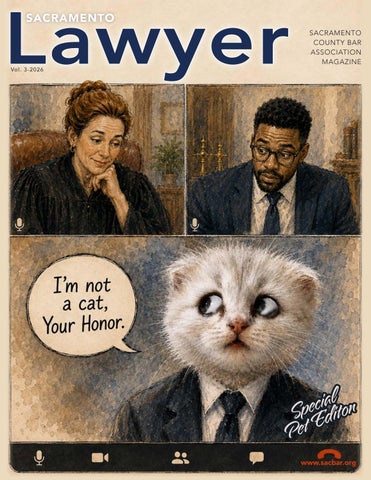
10 Who Gets the Dog? Pet Trusts Under California Law 12 2026 Pfeiffer Award Recipient 16 Beyond Criminal Charges: The Untapped Role of Civil Litigation in Animal Abuse Cases 22 Attorney Wellness and Animals A courtroom classic, reimagined for our Special Pet Edition.
26 Liability at First Bite: California’s Dog Bite Statute & Beyond SCBA NEWS AND EVENTS 30 You Spoke. We Listened. SacBar+ Is Coming in 2027 32 Welcoming the Next Generation of Legal Professionals: The Barristers’ Club of Sacramento’s 31st Annual Summer Associates Reception 34 Join Us for the SCBA & SCBF Scholarship & Grant Celebration 35 Bench Bar Reception 2026 SCBA PETS 36 Pet Bar Poll 41 Pet Stories SCBA MEMBER HIGHLIGHT 44 From Europe to Sacramento: One Attorney’s Journey from Military Service to Building a Legal Organization for Veterans
EDITOR-IN-CHIEF Ellen Arabian-Lee Arabian-Lee Law Corporation EDITOR EMERITA Heather Hoganson PRODUCTION DESIGN, ADVERTISING Milenko Vlaisavljevic milenko@sacbar.org
EXECUTIVE DIRECTOR Tom Roberts (916) 604-9682 • troberts@sacbar.org
EVENT SERVICES Hannah Vogel, Manager (916) 604-9667 • hvogel@sacbar.org
SCBA OFFICERS - 2026 Brittany Berzin - President Samantha Tanner McKay - Vice President Andrew Blan - Treasurer Glen Williams - Secretary
MEMBERSHIP & ADMINISTRATION TJ Prasad, Coordinator (916) 604-9725 • TPrasad@sacbar.org FEE ARBITRATION PROGRAM Nadine McMillon, Administrator (916) 604-9726 • nmcmillon@sacbar.org
6
15
17
22
26
30
33
Sacramento Lawyer welcomes letters and article suggestions from readers. Please e-mail them to support@sacbar.org. The SCBA reserves the right to edit articles and letters submitted for publication. Please contact the SCBA at 916-564-3780 for deadline information. Web page: www.sacbar.org. Caveat: Articles and other work submitted to Sacramento Lawyer become the copyrighted property of the SCBA. Returns of tangible items such as photographs are by permission of the editors, by pickup at the SCBA office only.
Sacramento Lawyer (USPS 0981-300) is published by the Sacramento County Bar Association, 8950 Cal Center Drive, Bldg. 2, Ste. 346, Sacramento CA 95826. ISSN 1087-8771. Periodicals postage paid at Sacramento, California. Postmaster: Send address changes to Sacramento Lawyer, 8950 Cal Center Drive, Bldg. 2, Ste. 346, Sacramento CA 95826. Copyright 2026 by the Sacramento County Bar Association.
EDITOR’S MESSAGE Ellen Arabian-Lee, Arabian-Lee Law Corporation.
his month, we’re celebrating some of the most beloved honorary members of our SCBA community – our pets! Whether they’re loyal companions, enthusiastic office assistants, or simply the ones who remind (or require) us to step away from the computer once in a while, our furry friends bring joy, comfort, and plenty of personality to our lives. In this special pet edition of Sacramento Lawyer, we’re delighted to introduce you to the cats, dogs, and other cherished companions who share the homes, and sometimes the offices, of our members. Along with these photos and stories, this special edition features informative articles about animal law and related legal issues. I hope these pages bring a smile to your day while also offering useful insights into the laws that affect animals and the people who care for them. And, of course, we couldn’t ask everyone else to show off their pets without introducing you to mine. Meet Chloe!
6
PRESIDENT’S MESSAGE
A Summer of Momentum By Brittany Berzin
Brittany Berzin is the President of the Sacramento County Bar Association. She can be contacted at brittany@norcaladvocates.com.
s summer draws to a close, I’ve been reflecting on just how much has been happening at SCBA this year. Our Event Committee and staff brought us together for another successful Bench Bar, and our Divisions and Sections have kept things going throughout the summer. Barristers hosted its Summer Associates Reception, several of our Sections have joined forces for the upcoming Evening at the Zoo, and we’ve been pleased to support our Affiliates by helping promote their events. We’re also partnering with the Sacramento Bar Foundation on the upcoming Community & Justice Scholarship and Grant Celebration. And that’s in addition to the many other social events and MCLE programs organized throughout the year by our volunteers. There has been a lot happening behind the scenes as well. The Bylaws Committee has been working to modernize our governing documents, while the Membership Committee has been exploring new ways to enhance member value and position SCBA for future growth, including SacBar+ (see the related article). Our volunteers and staff have also undertaken a significant overhaul of
SACRAMENTO LAWYER | Vol. 3-2026 | www.sacbar.org
the Fee Arbitration Program. Staff has refreshed our newsletter, marketing and branding, streamlined the event application process, and added new functionality to our membership software. There is plenty still ahead. Board election season and Attorney of the Year nominations are coming up, SacBar+ is about to launch, and our Trial Advocacy Conference is just around the corner (do you have your ticket yet?). Thank you to our members, volunteers, Board and Committee members, and staff for the time and energy you continue to give to SCBA. So much of what the Association accomplishes is possible because of the people who choose to be involved, and I’m grateful to be part of it.
Brittany Berzin SCBA President
www.sacbar.org | Vol. 3-2026 | SACRAMENTO LAWYER
7
FEATURE ARTICLE Editor’s Note Why companion articles about advance planning for pets? Because for many clients, planning for their pets is not a single estate-planning question. It is two different questions: Who will care for my pet if something happens to me? And what happens to my pet after I die? These companion articles approach these questions from different angles. “Who Takes Care of the Dog? Planning for Pets Before the Crisis” focuses on the conversation lawyers should have with clients while they are alive and well. Hospitalization, accident, incapacity, or a move to assisted living can create an immediate problem for a pet long before an estate plan ever takes effect. This article offers practical suggestions for lawyers in a range of practice areas, not just estate planning, to help clients identify caregivers, provide access to funds, and make sure their wishes are known. “Who Gets the Dog? Pet Trusts Under California Law” takes the next step. For clients whose circumstances call for more than a simple designation of a caregiver, California law provides a legal framework for establishing a pet trust. The second article looks more closely at how pet trusts work, what they can provide, and the issues lawyers should consider when drafting one.
Who Takes Care of the Dog?
Planning for Pets Before the Crisis By Mauriah Conway
Mauriah Conway is a certified specialist in Estate Planning, Trust & Probate Law, State Bar of California Board of Legal Specializations, and an attorney at Meissner Ruggles Thompson, Inc.. She can be reached at conway@lawofficeinc.com.
eople love their pets, so it is no surprise that pets come up often in estate planning conversations. Pet owners, myself included, love to share pictures of our animals. Here is one of Sammy and Mr. Biscuit at my office, hanging out while I worked:
People worry about what will happen to their pets, and that is not new. What has changed is how
8
much money and emotion are now wrapped up in that worry. When I was growing up, each of my dogs had one leash and one bed. My dogs now have different types of leashes, beds throughout the house, specific winter and summer beds, pet insurance, and no shortage of toys and treats for my “baby boys.” Americans are spending more on their animals than ever. Veterinarians can provide specialized care that once would have been hard to imagine, and pets are living longer as a result. Many owners no longer think of their dog or cat as property. They think of them as family. Yet, pet planning is one of the most consistently skipped pieces of an estate plan. Clients will spend an hour agonizing over who gets the vacation house and then say nothing about who feeds the
SACRAMENTO LAWYER | Vol. 3-2026 | www.sacbar.org
dog if they end up in the hospital next week. For lawyers, not just estate planners, but also elder law, personal injury, family law, and litigation attorneys, this gap is worth noticing. It is a small conversation that can spare a client a real crisis. Most people assume this is a death planning issue. Usually, it is not. Incapacity is often the more immediate concern. A stroke, a bad fall, or a long hospital stay can keep someone out of the home for weeks, sometimes months, with no warning. Meanwhile, someone needs authority and access to funds to care for the animals left behind. More often than you might expect, family members do not know the client’s wishes, do not know where the vet records are, and sometimes do not even know how many pets there are.
The first step is simple: ask whether the client has pets. Often, clients will respond, “Yes, but our dog is very old.” The next question is whether they might get another pet in the future. The answer is usually yes. Clients should name a few people, in order of preference, and confirm those people are willing to step in immediately if needed. That conversation needs to happen now, while the client is healthy enough to ask and actually get a yes. Too many people assume a grown child or close friend will take the dog without ever checking. Sometimes that assumption is wrong. This is where estate planning documents earn their keep. Durable powers of attorney are often written broadly for financial matters but say nothing specific about pets. Adding language that authorizes the agent to spend the principal’s money on veterinary care, boarding, transportation, and grooming closes that gap. It also protects the caregiver, so they are not fronting money out of pocket while everything else gets sorted out. Something like this works well: My Agent may use my assets as my Agent deems reasonable for the care, maintenance, and welfare of any pets I own, including veterinary care, boarding, grooming, training, transportation, and related expenses. My Agent may reimburse any person, including my Agent, who provides care for my pets. My Agent may also acquire a service animal if my Agent determines it would benefit me. If my Agent determines that continued ownership of any pet is impractical or unduly burdensome, my Agent may arrange for placement of the pet with a person or organization willing and able to provide appropriate care. California allows pet trusts, and they make sense when real money will be involved in future care, when the client wants tighter over-
sight, or when the animals have greater needs. That may mean multiple pets, horses, a parrot that might outlive the client by thirty years, or a pet with an ongoing medical condition. A pet trust lets the client name a caregiver and, separately, someone to manage the funds. Splitting those roles should be done deliberately, because it builds in a check that a single caregiver and trustee arrangement does not have. There is also the question nobody likes to think about: what happens to whatever is left in the trust once the pet dies? That should be decided up front
rather than left to guesswork later. Often, though, a trust is more machinery than the situation requires. If a client already has a caregiver in mind, a straightforward gift under a revocable trust may be enough to cover the cost of care without creating unnecessary complexity. Bigger is not always better here. A gift that is too generous can create more disputes than it prevents. Often clients may leave it up to the trustee, but this can be problematic because the role of a trustee is a big job, having to figure out who is able and willing to take care of the pets while managing all the other trustee duties can be overwhelming and often if there is no easily identifiable person the pet will end up at the local shelter.
Never assume a child will take the pet either, I have seen this over and over where the child has no interest in taking on the pet and the pet ends up at the local animal shelter. Sometimes, there are breeder agreements or nonprofits that will receive animals along with a donation and this could be a very positive agreement for certain families, but exploring this option now rather than in an emergency is always preferred. It’s not unusual for a senior to resist hospitalization, or push back on moving into assisted living, purely because they’re not sure what happens to their pet. Once that question has an answer, the rest of the conversation about long term care often gets a lot easier. Elder law attorneys in particular should keep an eye out for this. The same issue shows up sideways in other practice areas. Personal injury clients suddenly can’t manage a dog they’ve had for years. Divorcing couples fight over who keeps the cat. Families end up in probate court arguing about a horse nobody planned for. All of it is avoidable with a little planning done early. None of this is really about the animals. It is about giving clients one less thing to lose sleep over and making sure that, if something happens to them, their dog does not end up at a shelter because nobody thought to ask the question. As pets keep moving further into the center of people’s lives, that is a conversation worth having sooner rather than later. Editor’s Note California law provides a surprisingly sophisticated legal mechanism for clients who want to provide for their animals after death. Companion article on the following page →
www.sacbar.org | Vol. 3-2026 | SACRAMENTO LAWYER
9
FEATURE ARTICLE
Who Gets the Dog? Pet Trusts Under California Law By Anthony S. Franceschi
Anthony S. Franceschi is a Certified Specialist in Estate Planning, Trust & Probate Law at Capital City Wills & Trusts, PC. He can be reached at tony@ capcitywills.com.
state planning involves many weighty questions: Who gets the house? Who manages the money? Who raises the minor children? And occasionally: Who gets Mr. Wiggles? For a surprising number of clients, that last question is not an afterthought. They may be perfectly comfortable allowing their children to divide the furniture themselves, but they have extremely specific opinions about where the dog will live, which veterinarian the cat will continue seeing, or whether anyone is authorized to substitute generic brand treats for the expensive ones. Fortunately, California law has an answer. Yes, Pet Trusts Are Actually a Thing California expressly authorizes trusts for animals. Probate Code § 15212 provides that “a trust for the care of an animal is a trust for a lawful noncharitable purpose.” This is not simply a trust provision saying, “I leave $25,000 to my sister, and I really hope she spends it on the dog.” A properly drafted pet trust creates an actual fiduciary arrangement in which the trustee controls the assets and is required to administer them for the animal’s benefit. Unless the trust provides otherwise, pet trusts continue for the
Tony and Phoebe, a 140 lb. English Mastiff.
lifetime of any animal that was alive when the settlor died. The statute also provides mechanisms for enforcing the trust and preventing the trustee from simply deciding that Fido would be perfectly happy being boarded with a $14 bag of kibble while the trustee heads to Maui with the balance. The Probate Code permits a person designated in the pet trust to enforce it. If the settlor does not designate anyone, the court may appoint someone. In certain circumstances, a person interested in the animal’s welfare – or even an animal-welfare nonprofit – may petition the court regarding administration of the pet trust. The statute also allows for inspection of the animal, the place where it lives,
10 SACRAMENTO LAWYER | Vol. 3-2026 | www.sacbar.org
and the trust’s books and records. The Trustee Does Not Necessarily Have to Walk the Dog A useful distinction is between the trustee and the caregiver. The caregiver feeds the animal, takes it to the veterinarian, and presumably deals with whatever unpleasant thing just happened on the carpet. The trustee controls the money. Those can be the same person, but they do not have to be. In fact, separating the two jobs can make considerable sense. The person most willing to take in a fifteenyear-old Labrador may not be the person the client wants managing several hundred thousand dollars. Conversely, the ideal professional
fiduciary may have no desire whatsoever to share a bed with three Pomeranians. The trustee can pay the caregiver for food, veterinary care, grooming, boarding, medication, insurance, and other appropriate expenses. The trust can also compensate the caregiver for the time and responsibility involved. The Cat Can Even Keep the House A pet trust is not limited to a little bank account set aside for veterinary bills. It can hold other assets, including real property. For example, a client might direct that a residence remain in trust so an elderly pet can continue living in the same home after the client’s death. The caregiver might be permitted to live there with the pet, while the trustee pays property taxes, insurance, maintenance, utilities, and other expenses. Obviously, the document should say what happens when the pet dies, whether the caregiver has to move out, when the house gets sold, and who ultimately receives it. The basic concept is perfectly workable: the owner dies, but the cat does not immediately have to pack. And Then There Was Trouble No discussion of pet trusts would be complete without mentioning hotel billionaire Leona Helmsley, who famously left $12 million in trust for her Maltese named Trouble. A court later reduced the amount to $2 million, apparently concluding that even in Manhattan a Maltese could scrape by on that. Trouble’s inheritance became the celebrity pet-trust story, but the idea itself was hardly unique. Tobacco heiress Doris Duke also created a trust for her dog, providing funds for its care, feeding, comfort, maintenance, and medical treatment. Florida heiress Gail Posner reportedly created a $3 million trust
for her dogs and arranged for them to continue living in her multimillion-dollar Miami Beach home, along with their caretakers. Other oft-repeated celebrity estate-planning stories involving pets include Betty White, who set up a pet trust to care for her own remaining pets and placed the majority of her estimated $75 million estate into a broader charitable trust supporting animal welfare, and Karl Lagerfeld, whose cat, Choupette, may be one of the few animals ever discussed in the financial press as a potential heiress. The lesson is probably not that ev-
children or other beneficiaries, or it might go to an animal shelter, rescue organization, veterinary school, or other charity.
ery client should leave $12 million to a Maltese; the lesson is that the legal structure works just as well with $20,000 as it does with $12 million.
Silly? Maybe. Useful? Absolutely. Under California law, animals are property. To most pet owners, of course, informing them that their Golden Retriever is legally comparable to a sofa is not particularly helpful. Pet trusts bridge that gap. For many people, a simple direction leaving the pet to a trusted relative is enough. But where there is substantial money, an expensive or long-lived animal, no obvious caregiver, several pets that should remain together, or a client who has very particular ideas about how Fluffy should get to spend her retirement, pet trusts can provide a surprisingly sophisticated solution. The client gets peace of mind, and the dog may even get the house.
How Much Does the Cat Need? The appropriate amount depends on the animal. A middle-aged indoor cat may require relatively modest funding. A horse is another matter. So is a tortoise that could live for several more decades. The planner can estimate ordinary annual expenses, anticipated veterinary care, the animal’s life expectancy, caregiver compensation, and an emergency reserve. The trust should also say what happens to the money and other assets left over when the last covered animal dies. It might pass to
The Instructions Can Be as Important as the Money For many clients, the most valuable part of a pet trust is not the money; rather, it is the ability to leave instructions. The trust can identify preferred caregivers and alternates, require animals to remain together, identify veterinarians, describe medications, authorize particular standards of medical care, provide for grooming or boarding, and address end-of-life decisions. A revocable living trust can also address a pet that may need care because its owner is hospitalized, suffers from dementia, or moves into a facility where the animal cannot follow. That is often the more immediate planning concern. Otherwise, one can inadvertently create a situation in which the heirs spend years quietly wondering exactly how healthy that parrot really is.
www.sacbar.org | Vol. 3-2026 | SACRAMENTO LAWYER
11
FEATURE ARTICLE
2026 Pfeiffer Award Recipient
Kelly Borelli By Andi Liebenbaum
elly Borelli was at the Sir Francis Drake in San Francisco for the first Pfeiffer Award in 2006. The award was presented to her former boss and early mentor, Jim Brosnahan, considered by the California Lawyers Association as the greatest trial lawyer of his generation. And, as the best of mentors would hope, the mentee is now the awardee, an incredibly accomplished attorney in her own right. SCBA member Kelly Borelli has been honored with the 2026 Pfeiffer Award on the 20th anniversary of its first presentation. The Pfeiffer Award, presented annually by the Conference of California Bar Associations (CCBA, formerly the Conference of Delegates for those of us with long memories), was named for Marin County attorney Jim Pfeiffer, the founding executive director of the Foundation of the State Bar. The award honors attorneys who demonstrate exceptional integrity, professional excellence, and a strong dedication to service. Since its inception, the Pfeiffer Award has been presented to two dozen lawyers around California, including several distinguished members of the Sacramento County Bar Association, including Jay-Allen Eisen (2010), Diane Wasznicky (2016), and yours truly (2017, received jointly with my dad, Larry Liebenbaum, who had been a CCBA delegate since the early 1970s).
Andi Liebenbaum is a past president of the SCBA. She can be reached at liebenbaum@gmail.com.
“I am still stunned to have been chosen as a recipient of this award and to have my name placed among this group of extraordinary attorneys and humans. I am humbled and honored beyond belief.” Well, Kelly, as your long-time friend and SCBA and CCBA colleague, I can say with confidence that you have earned this award, and your recognition is well-deserved. To the rest of SCBA membership and beyond, let me share why Kelly is worthy of this award and why the Sacramento legal community should be immensely proud of what she has accomplished. Early Life Kelly was born in Fresno and raised in the open space that separates Dos Palos and Los Banos. She had an incredibly loving childhood filled with good food and great memories with her large Italian family (she has around 20 first cousins just on her dad’s side). She describes her youth as “lots of Italian sausage making, my dad playing the accordion, EVERYONE in the kitchen trying to cook. Always way too much homemade Italian food, great stories, and tons of laughter.” As a rural kid in the Central Valley, Kelly learned to drive on canal banks and grew up picking fresh vegetables and fruit and raising livestock. She was in 4-H for 11 years and Future Farmers of America for four. She showed
12 SACRAMENTO LAWYER | Vol. 3-2026 | www.sacbar.org
Kelly Borelli
hogs, sheep, beef, and dairy at four livestock fairs a year (Los Banos, Merced, Chowchilla, and the California State Fair in Sacramento). For eight years she specialized in raising, breeding, and showing registered Chester White swine. Kelly graduated first in her high school class and was a National Merit Scholarship finalist, so she thought about a Cal State or UC for college. Her former junior high school principal suggested Stanford. That seemed like a stretch for a young woman from Los Banos, but when her high school counselor laughed and said she wouldn’t get in since his daughter had not gotten in, Kelly took the challenge and was accepted. I asked Kelly who was most proud of her for getting into this elite university.
“My parents grew up without much – my dad in rural Los Banos, and my mom in Salt Lake City. Neither of them graduated from high school. To have a daughter graduate first in her high school class and go to Stanford was something I think beyond what they ever imagined. I lost my parents when I was in my 20’s, but looking back, I can see now how they both were over-the-moon proud of me and could barely comprehend what my college life and experience was like. Everything that I told them about college life was like a movie to them, I think. It was a huge step forward from their lot in life, and they marveled at – and loved – every bit of it.” Kelly took four years off between undergrad and UC Davis School of Law. It was during that time when she met and started working for Jim Brosnahan at Morrison & Foerster, as Jim’s paralegal. And it was Jim who inspired her to go to law school. It was also during this time that Kelly fell deeply - (I cannot stress this enough) deeply in love with the San Francisco Giants. “In our ‘free time’ some of us paralegals would grab the firm’s Giants season tickets behind the visitors’ dugout and go to weeknight games at the Stick. The team had stunk for years, and no attorneys were using the tickets, especially on weeknights.” When Kelly reminisces about her early days with the Giants, even this Dodgers fan is moved… “That was the summer of Will Clark, Robby Thompson, Kevin Mitchell, Jose Uribe, Jeffrey Leonard, Candy Maldonado, Chili Davis, Bob Brenly – pitchers like Krukow, Dravecky, Kelly Downs, John Burkett, Scott Garrelts, Mike LaCoss, Atlee Hammaker, Rick Reuschel, Don Robinson. The Giants made the
post-season for the first time in 16 or 17 years and became the toast and talk of the town. I fell in love with Will Clark when he dropped F Bombs on live TV celebrating their victories, and the rest is history!” Law School and Legal Career When I asked Kelly about her time at UC Davis School of Law, she was emphatic: “THE BEST!” Even though her mother was diagnosed with cancer during her first year, and died in the middle of her second, Kelly says her years at Davis were three of the best years of her life. And while she met fabulous people including administrators, faculty, and students who were smart, kind, supportive, and fun, and though she made many life-long close friends, it may have been the intellectual discussions and debates that inspired her most. Plus, she felt it was somewhat of a relief… “After working so hard for two years at MoFo, law school was a treat!” Kelly says she found the whole process of law school to be stimulating, endlessly interesting, and energizing. And when she took Employment Discrimination her second year with Professor Martha West, she says, “I knew I had found my career path.” Like many of us, Kelly faced a rough job environment when she graduated from law school. She wanted to stay in Sacramento, so she worked as a contract attorney in election law with Olson Hagel & Fishburn. She landed her first firm job as an attorney with Greve Clifford Diepenbrock & Paras. She still wanted to get an employment law job but her first gigs included a lot of railroad accident litigation and appellate work. She moved on to Weintraub Genshlea & Sproul, working with Ken Malovos, who remains a
mentor and friend to Kelly to this day. Eventually an employment law practice was started at Weintraub, and, three years after graduating law school, Kelly finally got her opportunity to practice employment law. She has practiced primarily employment law, with a touch of general business litigation, ever since. Kelly left Weintraub in May 1997 with David Tyra and Mary Farrell to start an employment law practice at the local office of Graham & James, where she remained until they closed their local office in December 1999. She joined Murphy Austin Adams Schoenfeld in January 2000, where she made partner in 2002. She left Murphy Austin in November 2008 to join Employment Law Counsel, LLP, where she still practices. So now you know about her trajectory. Kelly is clearly smart, capable, and diligent. She also has a depth and warmth, and a well of compassion to inspire and fuel her. Kelly’s Service to the Law and Beyond It’s hard to imagine that a young lawyer launching an employment practice would have time for extracurricular activities, but Kelly has made time from very early on. She was encouraged to join the board of Women Lawyers of Sacramento (WLS) for 2001. One of the open board seats at WLS was for the Bar Delegation to the Conference of Delegates. When she learned more about the Delegation, it sounded new and interesting, so she agreed to take that on. The Conference of Delegates (now the Conference of California Bar Associations, or CCBA) started as a program of the State Bar, and is now an independent, all-volunteer organization. Drawing its member-delegates from local and affinity bar associations from across
www.sacbar.org | Vol. 3-2026 | SACRAMENTO LAWYER
13
California, the Conference is the way for lawyers to collegially, cooperatively, and methodically identify problems, gaps, even errors in the law, and recommend changes. Lawyers who participate in the Conference represent every imaginable practice area, and include attorneys from public practice, private firms, small firms, and enormous firms. The ideal is to promote an idea, present at the Conference, and ideally secure sufficient votes that the proposal, called a resolution in CCBA terms, becomes a bill in the California Legislature that the Conference sponsors. Highly charged issues like marriage equality, criminal justice reform, and access to legal abortions, among many more, have been the subject of Conference resolutions over the years. So have practical issues related to proof of service, dissolution declarations, common interest developments, and a gazillion other less explosive but still profound issues that impact how tens of thousands of us practice law every day. The Conference has rules and procedures (it is a group of lawyers working on improving the law, after all) and those rules and procedures are what make CCBA’s work excellent. It is these rules and procedures which are the domain of the CCBA’s Resolutions Committee (ResCom), where Kelly’s brilliance has shone for nearly two decades. When asked, Kelly says she is very proud of all of the work – and it is a sizeable amount – she did on ResCom, especially serving two consecutive years as chair. While she had been a member of ResCom for years, she was coincidentally elevated to chair by the CCBA board the same day that the long-time CCBA executive director suddenly resigned. The CCBA board decided to continue forward without a paid director, leaning heavily on a few key individuals, Kelly chief among
them. Kelly had a boutique legal practice to manage, so taking on substantial leadership responsibilities of this venerated organization on (arguably less than) a moment’s notice without staff was a heavy lift. Kelly spent her two years as chair diligently recruiting, organizing, and building ResCom. She put a stellar leadership committee in place (her words, not mine, since I was her deputy), and took full responsibility for transitioning
ResCom to a hard-working all-volunteer team. And if keeping the Conference afloat wasn’t enough, Kelly also led the drafting of a ResCom Chair’s manual, so that all the folks who followed would understand how to do the job. It is no understatement to say that ResCom is the lifeblood of CCBA. This is the committee where resolutions flow into and through the Conference for evaluation and consideration. ResCom is responsible for ensuring that the many ideas (sometimes more than 100 in a year) are carefully and thoroughly reviewed. In essence, the core mission of CCBA rests with ResCom, a responsibility that Kelly accepted gracefully, with humor, and probably more than a few sleepless nights. Kelly understood it
14 SACRAMENTO LAWYER | Vol. 3-2026 | www.sacbar.org
was critical to CCBA’s success that ResCom have a successful transition into the no-staff era, and she rose to the occasion beautifully. She was gifted at reimagining the committee. She understood and saw its outsized impact on the Conference, and, by extension, the Conference’s value to the practice of law. Many of the processes Kelly developed 10 years ago, as well as committee structure and quality control elements, remain to this day. Kelly has since left ResCom and joined the CCBA board of directors, where she has served ever since, regularly chairing the board’s Governance Committee. But Kelly has not limited her extracurricular work to CCBA. Among MANY other leadership activities, Kelly has served on the King Hall Alumni Board and taught Employment Law at King Hall. She has served on the Board of CASA (Court-Appointed Special Advocates), including as past President. Kelly channeled her love of theater to serve on the Sacramento Arts & Business Council Board. In addition to her service on the WLS board, for most of her career Kelly has been a member of WLS, California Women Lawyers, the Sacramento County Bar and State Bar Labor & Employment Law Sections, and the SCBA Bar Delegations Committee. And she is a 2001 graduate of the Leadership Sacramento program sponsored by the Sacramento Metropolitan Chamber of Commerce. There’s much more, but column inches are already stretched. Becoming a Cat Lady In the midst of all this – a successful employment law practice, and twoplus decades serving lawyers and the law – Kelly has remained a rabid (in the nicest sense of the word) San Francisco Giants fan. She also, along the way, became my friend and fellow cat lady. Here’s how a girl from
Kelly's cats.
farm country who raised prize swine and had dogs in her childhood made the transition to cats: “I grew up with animals all around me, domestic pets, feral critters, and livestock raised to show at the fairs and as a source of my family’s food. But as a young adult through college, law school, and starting my career, I had no pets due to my very busy schedule and time away from the house. By the time I married, and life settled down a bit, I was craving pets again. For both me and my husband that meant getting a dog, since neither of us had grown up with house cats. However, my husband rightly insisted that we still had no time for a dog, and neither of us could imagine having a cat. Fast forward
to a clerk in my law office soliciting homes for a litter of kittens that her promiscuous cat had after a dalliance with an alley cat. I asked several cat-owner friends, and all encouraged me to go for it. I even purchased Cats for Dummies. My husband said absolutely not. So, of course, I brought home a kitten. My husband was horrified. One day later, I came home from work. I saw my husband’s car but couldn’t find him. I discovered him in the back bedroom with Boris, our new tuxedo kitten, playing hide and seek. Boris already had him wrapped around his little paws. We later went on vacation and missed Boris the way folks miss their kids. From that day on we realized that we had become cat people.”
Congratulations If asked, I would say Kelly Borelli loves hard – her family, her friends, her pets, the Giants, and the law. And because of her love for the law, she has committed to it not just in her day job, but in her extracurricular life as well. Her honesty and hard work are apparent the moment you start working with her. Her incredible brain manages and processes copious amounts of information with ease. As a solo practitioner she is the ultimate team player. And so, for the CCBA Directors to select Kelly for the 2026 Pfeiffer Award seems the obvious choice to me. I honestly cannot think of a better recipient. Congratulations, my friend. You deserve everything about this recognition.
www.sacbar.org | Vol. 3-2026 | SACRAMENTO LAWYER
15
FEATURE ARTICLE
Beyond Criminal Charges: The Untapped Role of Civil Litigation in Animal Abuse Cases By Jill P. Telfer
Jill P Telfer serves as the Immediate Past President of the Sacramento Chapter of the American Board of Trial Advocates and the Vice President of the Disability Inclusivity Bar Association of Sacramento. She can be reached at jtelfer@telferlaw.com.
y love for animals has been lifelong. Dogs and cats have always been part of my life, and I have long understood that the bond between people and their companion animals is far more profound than the law’s traditional characterization of animals as property might suggest. When I attended law school, animal law was not offered. I entered practice without imagining that animal-related litigation would become an area in which I could make a meaningful difference. It was not until I had practiced law for more than 20 years that I discovered I could use the law on behalf of animals by handling cases that seek to save an animal’s life or obtain justice when an animal has been injured or killed. That realization raises an important question for the legal community: When an animal is abused, injured, or killed, must the legal response end with a criminal prosecution – or can civil litigation provide another meaningful avenue for justice? The answer is that civil litigation can play an important, and sometimes overlooked, role. For many Californians, a dog or cat is not simply personal property.
A companion animal is a member of the family. The loss of that relationship can produce grief, trauma, and emotional consequences that cannot be adequately described by a market value calculation. California law, however, continues to treat companion animals within the framework of personal property. Penal Code section 491 describes a companion animal as an animal kept and provides care for the purpose of companionship, emotional support, service, or protection, while the law generally treats the animal as personal property whose value is determined in the same manner as the value of other property. That legal framework creates a significant tension between the human experience of losing an animal and the remedies traditionally available under property law. For attorneys, however, that tension should not mean the end of the analysis. It should be the beginning. The Limits of a Market Value Approach The economic value of a companion animal often bears little relationship to the animal’s actual significance to its owner. A beloved dog may have no meaningful
16 SACRAMENTO LAWYER | Vol. 3-2026 | www.sacbar.org
market value. An adopted cat may have cost very little to acquire. Yet the animal may have been part of a family for years, provided companionship during difficult times, assisted a person with a disability, or simply occupied an irreplaceable place in its owner’s life. California courts have recognized this reality in negligence cases by permitting recovery of reasonable costs associated with the care and treatment of an injured companion animal, notwithstanding the limitations of traditional property valuation. This distinction matters. When a negligent act causes an animal’s injury, California law generally limits the owner’s recovery to legally recognized property-related damages, including the fair market value of the animal or reasonable veterinary expenses incurred before death, depending on the circumstances. Treatment, medication, rehabilitation, and related expenses may also be recoverable when legally permitted. But the legal analysis changes when the conduct is intentional. In 2012, a California appellate court addressed an important question in Plotnik v. Meihaus (2012) 208 Cal.App.4th 1590: whether a
pet owner could recover monetary damages for emotional distress resulting from the intentional conduct of a third party who injured or killed a pet. The decision marked an important development in California animal-related litigation. It demonstrated that the law’s treatment of companion animals cannot necessarily be reduced to a simple calculation of market value in every circumstance. For attorneys representing victims of animal abuse, Plotnik is an important reminder: the characterization of the defendant’s conduct may fundamentally affect the remedies available. Criminal Prosecution Is Not the Only Avenue Animal cruelty cases frequently begin with law enforcement. A district attorney’s office may pursue criminal charges when there is sufficient evidence to establish the elements of the offense beyond a reasonable doubt and when prosecutorial resources permit. Criminal prosecutions serve an essential public purpose. They punish unlawful conduct, deter future misconduct, and may result in fines, probation, restitution, imprisonment, and restrictions on future animal ownership. But criminal prosecution and civil litigation serve fundamentally different purposes. The criminal justice system asks whether the defendant committed a crime and, if so, what criminal consequences should follow. A civil action asks a different question: What legal remedy is available to the person or entity that has suffered a legally recognized injury or loss? That distinction is critical. Criminal cases are subject to the demanding beyond a-reasonable-doubt standard. Prosecutors
Jill Telfer on the March/April 2017 cover of Sacramento Lawyer with Ashley and Ella.
must also make decisions about charging priorities and the allocation of limited resources. Animal cruelty cases compete for attention with the many other crimes that prosecutors must address. The absence of criminal charges, however, does not necessarily mean that an injured animal’s owner has no civil remedy. A civil case may proceed even when criminal charges are never filed, are dismissed, or do not result in a conviction. Conversely, a criminal investigation or prosecution may generate evidence that becomes highly relevant to a later or parallel civil action, subject to applicable evidentiary and proce-
dural rules. For attorneys, this means that a decision not to prosecute criminally should not automatically close the legal file. It may instead be the point at which civil counsel begins asking a different set of questions. Building the Civil Case Successfully pursuing an animal-abuse case requires more than demonstrating that an animal was harmed. Counsel must identify the proper plaintiff, determine who has standing, select viable causes of action, establish causation, document damages, and identify any statutory or equitable remedies that may be available.
www.sacbar.org | Vol. 3-2026 | SACRAMENTO LAWYER
17
Traditional property-based tort theories may provide a starting point when an animal has been intentionally injured, taken, or wrongfully withheld. Depending on the facts, potential claims may include trespass to chattels and conversion. Other intentional tort theories may also become relevant when the defendant’s conduct causes a legally recognized injury to the plaintiff. Trespass to chattels may apply where a defendant intentionally interferes with an animal in a manner that causes injury or otherwise interferes with the owner’s legally protected rights. California appellate authority has recognized trespass-to-chattels claims involving intentional injury to companion animals. Conversion may be implicated when a defendant wrongfully exercises control over an animal in a manner inconsistent with the plaintiff’s ownership or right to possession which includes the death of an animal. Intentional infliction of emotional distress may also warrant consideration when its demanding legal elements can be established. The important point is not that every animal-abuse case supports every possible cause of action. It does not. Rather, counsel should resist the temptation to assume that an animal case is simply a property-damage case. The evidence may support legal theories that provide remedies beyond the animal’s market value. Negligence Requires a Different Analysis Not every animal injury involves intentional conduct. Dogs and cats can be injured through negligence, including veterinary malpractice, accidental injuries caused by another person, or other conduct that falls below the applicable standard of care.
In a negligence case, the plaintiff generally must establish that the defendant owed a legal duty, breached that duty, and that the breach was a substantial factor in causing the injury, along with legally recoverable damages. These principles are reflected in California Civil Jury Instructions, including CACI No. 400. The distinction between negligence and intentional conduct is therefore more than semantic. It can have significant consequences for damages and available remedies. Where negligence is the theory of liability, counsel should carefully document veterinary treatment, medication, rehabilitation, and
other expenses and evaluate the applicable limitations on recovery. Where intentional conduct is alleged, counsel should separately analyze whether the facts support additional tort theories and whether emotional-distress or exemplary damages may be available. Evidence Can Make or Break the Case Animal abuse litigation presents unique evidentiary challenges. An animal cannot describe what happened. Physical conditions can change rapidly. Injuries may heal or deteriorate. Witness memories fade. Digital evidence can disappear. Early investigation is therefore essential. Relevant evidence may include: • Veterinary medical records; • Photographs and video recordings; • Veterinary expert opinions and
18 SACRAMENTO LAWYER | Vol. 3-2026 | www.sacbar.org
testimony;
• Witness statements and declara-
tions; • Animal-control records; • Law-enforcement reports; • Criminal court records and other publicly available court records, when admissible; • Text messages, emails, social-media posts, and other communications; • Receipts and invoices documenting veterinary and rehabilitation expenses; and • Evidence establishing the animal’s condition before and after the alleged abuse. The attorney who waits until litigation is well underway to begin collecting evidence may discover that critical evidence is no longer available. The attorney who begins preservation immediately can substantially strengthen the factual foundation of the case. The Importance of Veterinary Experts Veterinary testimony can be particularly important because the central factual question may involve matters beyond the knowledge of an ordinary juror. A qualified veterinarian or other appropriate expert may be able to address the nature and extent of an animal’s injuries, the probable cause of those injuries, whether the injuries are consistent with an accident, neglect, or intentional conduct, the animal’s treatment and prognosis, and the necessity and reasonableness of veterinary care. Depending upon the circumstances, an expert may also address future medical or rehabilitation needs. Expert testimony, however, must be carefully developed. The expert’s opinions should correspond to the legal issues actually presented and remain within the expert’s qualifications and permissible scope of testimony.
In an animal abuse case, a well-qualified expert can help transform what might otherwise appear to be a dispute over competing accounts into an evidence-based analysis of what happened to the animal. Damages: Looking Beyond the Purchase Price One of the most challenging aspects of animal litigation is damages. The law may treat a companion animal as personal property, but the economic consequences of an animal’s injury frequently extend well beyond an acquisition price. Depending on the cause of action and facts of the case, potential damages may include reasonable veterinary and medical expenses, rehabilitation and related treatment costs, and other legally recoverable economic losses. In appropriate intentional injury cases, emotional distress damages may also be available. Punitive damages may be available where authorized by California law and where the required showing of oppression, fraud, or malice has been established. (Civil Code section 3940) The Judicial Council’s civil jury instruction materials recognize recovery of reasonable costs incurred for the care and treatment of an injured pet, while California authority has recognized the possibility of emotional-distress damages in certain intentional-injury cases. Counsel should therefore analyze damages claim by claim rather than assuming that the animal’s market value represents the ceiling of recovery in every case.
solved for months or years may provide little immediate protection. Equitable relief may therefore be critical. Depending upon the circumstances, counsel may seek a temporary restraining order, preliminary injunction, or permanent injunction to prevent continuing or threatened unlawful conduct. The importance of timely intervention cannot be overstated. An animal facing ongoing harm cannot wait for a trial date. As with other requests for extraordinary relief, counsel must establish the applicable legal and equitable requirements, including considerations such as likelihood
of success, irreparable harm, the balance of hardships, and the public interest. The request should be narrowly and carefully tailored to the conduct the court is being asked to prevent. Do Not Overlook the Criminal File Civil attorneys should also pay close attention to related criminal proceedings. A criminal investigation may produce evidence that would be expensive, difficult, or impossible for a private litigant to obtain independently. Police investigative records, search-warrant materials, veterinary forensic examinations, photographs, videos, witness statements, charging
When Money Is Not Enough: Injunctive Relief Some animal abuse cases present an urgent problem: the harm is continuing or the animal remains at risk. In those circumstances, a damages claim that will not be rewww.sacbar.org | Vol. 3-2026 | SACRAMENTO LAWYER
19
documents, and court records may all become relevant. That does not mean that a criminal conviction automatically establishes civil liability. The two proceedings have different purposes, burdens of proof, parties, and procedural rules. Evidence from a criminal proceeding must still satisfy the applicable evidentiary requirements before it can be used in a civil case. Nevertheless, counsel should monitor the criminal matter and consider the timing and potential evidentiary consequences of the related proceedings. The criminal case and civil case should not be viewed as competing systems. When properly managed, they can be complementary components of a broader effort to address unlawful conduct. A Practical Road Map for Counsel Attorneys who become involved in an animal abuse matter should consider acting quickly. The initial investigation should include preservation of physical, photographic, video, electronic, and documentary evidence. Counsel should obtain complete veterinary, animal control, and law enforcement records and identify witnesses while their recollections remain fresh. The attorney should then evaluate all potentially applicable statutory and common law causes of action, determine who has standing, identify available damages and other remedies, investigate insurance coverage when appropriate, and assess whether emergency or injunctive relief is necessary. Statutes of limitation and other procedural deadlines must also be identified at the outset. In animal abuse litigation, delay can be particularly costly. Medical conditions change. Witnesses become harder to locate. The oppor-
tunity to document the animal’s condition may disappear. Early action is therefore not simply good litigation practice. In some cases, it may be the difference between obtaining meaningful relief and obtaining none.
The Legal Community Has an Opportunity Animal law has evolved considerably, but there remains a significant gap between how many people understand their relationship with companion animals and how the law traditionally characterizes those animals. That gap presents an opportunity for lawyers. The purpose of civil litigation is not to elevate animals above people or to disregard the established legal framework governing property. It is to ensure that when the law recognizes a legally compensable injury, the available remedies are fully and thoughtfully pursued. Criminal prosecution remains an essential tool for addressing animal cruelty. But it is not necessarily the only tool. A civil action can give an injured owner an opportunity to seek compensation for legally recognized losses. In appropriate cases, it can provide a mechanism for obtaining emergency relief, pursuing damages arising from intentional conduct, and holding a defendant accountable even when the criminal justice system cannot or does not pursue charges. One Animal at a Time I did not learn about animal law
20 SACRAMENTO LAWYER | Vol. 3-2026 | www.sacbar.org
in law school. I discovered it after more than two decades of practicing law. What I learned is that lawyers can make a difference, one animal at a time. Sometimes that difference means helping save an animal from continuing harm. Sometimes it means seeking compensation for an owner whose companion animal has been seriously injured. And sometimes it means seeking justice after an animal has been killed. These cases can be emotionally difficult. They can also be legally challenging. They require attorneys to work at the intersection of established property principles, developing tort law, animal-protection statutes, veterinary science, evidentiary rules, and the very human bond between people and their animals. But difficulty is not a reason to overlook the claim. For California attorneys, animal abuse litigation should be approached with the same rigor applied to any other civil matter: identify the plaintiff, determine standing, investigate the facts, preserve the evidence, select viable causes of action, establish causation and damages, and pursue every remedy the law permits. The law may continue to classify companion animals as property. But the legal consequences of harming an animal need not end with a calculation of its purchase price. As our understanding of animals and their capacity to experience pain and suffering continues to evolve, so too will the legal questions surrounding them. For those of us who share our lives with animals, the stakes are obvious. For lawyers, the opportunity is equally clear: when the criminal justice system cannot provide the complete answer, civil litigation may offer another path to accountability, protection, and justice – one animal at a time.
A Higher Standard of Resolution Is Coming to Sacramento Signature Resolution is expanding to Sacramento with a new office on Capitol Mall, extending our panel of experienced neutrals and elevated client experience to the heart of the region’s legal community and California’s capital.
Rex Darrell Berry
Daniel V. Kohls
Peg Toledo
www.sacbar.org | Vol. 3-2026 | SACRAMENTO LAWYER
21
FEATURE ARTICLE
Attorney Wellness and Animals
By Rebecca Howlett and Cynthia Sharp
Rebecca Howlett, Esq.
Cynthia Sharp, Esq.
Rebecca Howlett, Esq. and Cynthia Sharp, Esq. are co-founders of The Legal Burnout Solution (legalburnout.com), a community dedicated to the well-being of lawyers. They can be reached at becky@legalburnout.com and cindy@legalburnout.com.
Editor’s Note The following two articles appeared as companion articles and are republished here with permission of the ABA.
PART 1
How Engaging with Animals Can Bolster Attorney Well-Being “Until one has loved an animal, a part of one’s soul remains unawakened.” -Anatole France ike music or art, animals speak a universal language that has the ability to transcend our perceived differences and help us connect with others and ourselves. When we talk about our pets, it gives others a sense of who we are without having to reveal specifics. Many people refer to animals as “fur babies.” They hold our hearts and represent some of our closest, most cherished relationships. In both our personal and professional lives, we have experienced firsthand how animals can reduce stress and anxiety, instantly boost our mood and bring people together. While presenting at the annual Indiana State Bar Association (ISBA) Solo and Small Firm Conference, we had the great fortune to connect with fellow kindred spirits
promoting attorney well-being, both humans and dogs alike. For example, we met Ranger, Thought Kitchen’s “Chief Snuggling Officer,” and his human, mindful life and work coach Loretta Oleksy. Ranger is a sixyear-old rescued German shorthair
22 SACRAMENTO LAWYER | Vol. 3-2026 | www.sacbar.org
pointer. Ranger has undergone formal training to finetune his manners and his next goal is to pass his American Kennel Club Canine Good Citizen Test. As if by magnetism, lawyers were drawn to Ranger, naturally facilitating connections among the
humans, who might otherwise not have interacted. “Can I pet your dog?” a tall, barrel-chested lawyer inquired. He leaned low to gently rub Ranger’s ears and speak to him in a soft, gentle voice. “Hi, buddy. How are you today? Beautiful dog.” He and Becky instantly struck up a conversation and, as the humans connected, Ranger looked on contentedly, as if to say, “My work here is done.” The Health Benefits of Interacting with Animals There is a growing body of research on the health benefits of interacting with animals. Indeed, a survey of 69 peer-reviewed studies of human-animal interaction (HAI) determined that people of all ages, including those with or without physical or mental health concerns, showed positive effects from interacting with animals. Overall, the study found well-documented evidence of the positive benefits of HAI on our mental and physical health, including: • Lowered cortisol, blood pressure levels and heart rate. • Improved mood and reduced fear and anxiety. • Improved interpersonal relationships and social interactions. According to one 2009 study, cat owners have a significantly lower risk of death due to cardiovascular disease, including heart attack and stroke. As any cat “owner” can attest, they are magical creatures. No, really. Did you know that cats have the ability to heal their own injuries, which may also support healing in humans? Cats purr at a frequency range of 25 to 140 Hz, which has known healing benefits, such as pain relief, reduced swelling and infection, and expedited wound healing, including mending broken bones! Not a cat person? Not to worry.
Dr. Layla Esposito, director of the National Institutes of Health’s Human-Animal Interaction Research Program, emphasizes that there is no one-size-fits-all approach. “If your goal is reducing stress, sometimes watching fish swim can result in a feeling of calmness.” Companionship and Support While we humans often struggle to “be here now” – either worrying about the future or ruminating about the past – animals are adept at helping us connect with the present moment. Our pets can provide a healthy form of entertainment, bringing joy, laughter and spontaneity into everyday routines. For example, when Pennsylvania attorney Jennifer Ellis found herself living alone and in need of companionship, she got a dog. Curtis, a yellow Labrador retriever, was her faithful companion of 13 years. Curtis brought joy, not only into Jennifer’s life, but also those of her coworkers, who were ecstatic when he visited the office. For those with diagnosed mental and physical health conditions, animals can offer particularized support for their human companions. Many people have emotional support animals, as well as service animals trained to do specific tasks for people with disabilities. For example, Jennifer’s service dog, Millie, is trained to alert if she is about to have a seizure. This enables Jennifer to get into a safe place and position and reduce her risk of injury. (There is a difference between emotional support animals and trained service animals, the latter being legally protected under the Americans with Disabilities Act (ADA) and allowed in public spaces. Familiarize yourself with the ADA’s guidance on service animals.) Fostering Healthy Connections Animals also provide a unique
opportunity to make connections, some of which may be lifesaving. We connected with Terry Harrell, executive director of the Indiana Judges and Lawyers Assistance Programs (JLAP). Terry has incorporated certified therapy dogs into JLAP programming for years. (Fun fact: Her rescue golden retriever dog, Gus, may have been the first canine to serve on a CLE panel when he contributed to a CLE on managing stress at the 2016 ISBA conference.) JLAP’s beloved therapy dogs, Gus and Kirby, served for years, helping lawyers and law students dealing with depression, anxiety, stress, grief and substance use. Moving Forward Animals can offer tremendous benefits to our overall health and well-being. Caring for an animal can be one of the most rewarding aspects of life. If you are considering adding a furry friend to your home, recognize that it is a life-altering, lifetime commitment not to be taken lightly. Be sure to thoroughly research in advance to ensure it’s a good fit before making the leap. Animals give us perhaps the greatest gift of all: unconditional love. We owe it to them to keep them safe, happy and healthy, even if we can’t personally take care of them any longer. As part of your estate plan, consider establishing a pet trust to set aside funds to care for your pets after your passing. If you get a pet and find it’s not working out, it’s your duty to rehome them in a secure, loving environment. If you find yourself in this situation, contact a local animal rescue organization that can provide help and support, including help finding a foster and “furever” home. Stay tuned for Part 2 of this series, where we will explore further
www.sacbar.org | Vol. 3-2026 | SACRAMENTO LAWYER
23
ways to incorporate the positive benefits of animal interaction into legal environments, including the workplace. ©2023 by the American Bar Association. Reprinted and edited for length with permission. All rights reserved. This information or any portion thereof may not be copied or disseminated in any form or by any means or stored in an electronic database or retrieval system without the express written consent of the American Bar Association.
PART 2
The Calming Influence of Pets and Animals in the Legal Environment Happiness is a warm puppy. — Charles M. Schulz Workplace Mascots
fices, and even judicial chambers. Certainly, there could be drawbacks to allowing pets in a legal setting. Some of your clients or visitors may dislike animals or have allergies. Others may simply consider them to be a distraction in the professional context. In light of the relaxed atmosphere that animals can bring to the workplace, however, some are willing to overlook or accept these potential issues. In reality, bringing pets to the office often happens informally without any set policy. If pets are allowed in your workplace, you may want to create a short policy regarding animal behavior and whether they are restricted to designated areas. Many years ago, when Cindy allowed the staff to adopt an office cat, the receptionist always informed clients and anyone else coming to the office what to expect. Even if it is not feasible for you to bring your dog, cat, or rabbit to
any of us who continue to work remotely are privileged to enjoy the company of our pets throughout most days. Indeed, that is one of the many benefits of maintaining a home office. When Becky feels even a little stressed, she seeks out her Siamese kitties, Phineas and Casper, for an instant mood lift. Even just watching them play together contributes to her calm demeanor. Likewise, Cindy frequently takes breaks to play ball with Rocky the Dog or to give pats and treats to Jackson the Cat. Similarly, many employers both permit and promote the presence of pets even in traditional workplace settings because it can lead to a more calming environment for employees and clients alike. We have heard of animal visitors to private law firms, government of-
24 SACRAMENTO LAWYER | Vol. 3-2026 | www.sacbar.org
work, there are a number of ways to still enjoy the positive effects that interacting with animals can offer. Here, we explore several creative strategies to harness the healing power of animals in legal work environments. Therapeutic Animals in the Office Setting As we examined in the first article of this series, many organizations, such as state lawyers assistance programs, provide therapeutic animals for on-site visits. Indeed, many of these organizations have experience working with law students, lawyers, and judges and can offer additional support and resources, including for mental health concerns and addiction. By bringing one of these therapeutic animals in-house, legal professionals can receive immediate stress relief and emotional comfort, enhancing their well-being and potentially improving their perfor-
mance. This is also a fun, creative way to support well-being in the workplace and actively demonstrate an organization’s commitment to promoting employee wellness. Puppy snuggles are indelible. Nurturing Well-Being by Watching Birds, Fish, and Other Living Beings We suggest broadening your horizons beyond the traditional cat-dog binary and exploring other ways to engage with unique animals, including those in nature! For example, Hoosier attorney Heather George Myers has found a way to enjoy the natural world on a maintenance-free basis. Heather reports that throughout her workday, she loves looking out her office window to enjoy the northern cardinals who reside year-round in the trees near her office. As the flash of a red cardinal flying among the greenery of the trees catches her eye, she is prompted to take a break, look away from the screen, and relax for a moment or two. Also, cardinals hold a special meaning for her as her dad loved them. Their presence is a reminder that he is watching over her from above and is always with her. Even watching fish swimming in an aquarium can have a calming effect. Dennis M. Sandoval, a brilliant and well-respected tax attorney, experienced firsthand the positive impact after he installed a 90-gallon aquarium in his law office. Ultimately, he collected 16 aquariums ranging in size from 45 to 300 gallons spread throughout the first floor of his law firm. Dennis’s passion for aquariums and their beneficial effects even evolved into a business opportunity! In 2020, Dennis and Richard Bausa co-founded Law Office Aquariums with the goal of making it easier for others to enjoy aquariums in their own office settings.
And we love their tagline: “We may be sharks, but we don’t bite.” Observing marine life can offer an effective, low-maintenance way to harness the positive benefits of animal engagement. Indeed, a 2019 study found that human interaction with fish “could be a more flexible and viable alternative to other forms of Human-Animal Interaction (HAI).”1 For example, in an aquarium environment, concerns about aggressive behavior or allergic reactions are generally minimal. Also, fish tend to be less expensive to maintain and require little care.
Speaking of our aquatic friends, we would be remiss if we didn’t also mention Howie the Crab, who has attracted 600,000 followers on TikTok and Instagram. Cindy can personally attest that watching even one minute of Howie’s antics will bring your stress levels down a notch or two. Office Field Trips Instead of indulging in a traditional happy hour, why not plan a group outing that involves animals? Suggestions for such an outing include: • Check out the local zoo. • Visit a public aquarium. • Volunteer at an animal shelter or rescue. • Go on a bird-watching excursion.
• Explore a park, trail, or butterfly
garden. The options are endless, and the world is your oyster! As a starting point, conduct a survey to see what particular activities resonate with folks. You could even look to start an annual office tradition of your animal-oriented office field trip. Having something “pawsitive” to look forward to on the office calendar can also boost morale and help set the tone for a workplace culture that actively prioritizes employee wellness. Moving Forward Overall, scientific research and anecdotal evidence show the positive benefits of directly interacting with or simply observing animals. We’ve provided a number of low-impact ways to integrate animal companions into the workplace setting. Let us know which of our suggestions resonate with you. And if you aren’t an animal lover, that’s perfectly okay, too! Our mission is to generate open and honest conversations about attorney wellness and how you can sustainably integrate healthy selfcare strategies into your everyday law practice and life. If nothing else, we hope this article got you thinking about what works for you to manage stress. 1 Heather Clements et al., The Effects of Interacting with Fish in Aquariums on Human Health and Well-Being: A Systematic Review, 14 PLOS ONE (July 29, 2019).
©2023 by the American Bar Association. Reprinted and edited for length with permission. All rights reserved. This information or any portion thereof may not be copied or disseminated in any form or by any means or stored in an electronic database or retrieval system without the express written consent of the American Bar Association.
www.sacbar.org | Vol. 3-2026 | SACRAMENTO LAWYER
25
FEATURE ARTICLE
Liability at First Bite: California’s Dog Bite Statute & Beyond By Natalie Dreyer and William Finkle hen I first started practicing as an attorney (which was not so long ago), partners and associates alike told me: beware of the dog bite case. “There is little value,” they said. “You won’t get much,” they advised. But, lo and behold, I have found that dog bite cases have significant and untapped potential that can round out your practice as a plaintiff’s attorney and provide you with an opportunity to help people who, almost always, have permanent scars from the trauma they have experienced. Generally, there are two types of dog injury cases that I have encountered: (1) the dog bite case and (2) the dog negligence case. The Dog Bite Case: Strict Liability Dog bite litigation is centered on the concept of strict liability, where neither the viciousness of the dog nor the owner’s knowledge of such viciousness has any bearing on liability. Civil Code section 3342 as well as CACI Jury Instruction No. 463 lay out the specific elements that a plaintiff must satisfy: 1. Defendant owned the subject dog. 2. The dog bit the Plaintiff in a public place or while lawfully on private property. 3. The Plaintiff was harmed. 4. The dog was a substantial factor in causing the harm.
Natalie Dreyer
Natalie M. Dreyer and William R. Finkle are associate attorneys at Dreyer Babich Buccola Wood Campora LLC. They can be reached at ndreyer@dbbwc.com and wfinkle@dbbwc.com.
If you prove the above elements of strict liability, a plaintiff will be able to recover his or her economic damages (medical expenses, lost wages, and future medical expenses) as well as noneconomic damages. Here are a few key concepts to remember about strict liability: • Liability attaches to the owner not the keeper of the animal, unless the keeper knows of the viciousness of the subject animal. (Menches v. Inglewood Humane Soc. (1942) 51 Cal.App.2d 415, 417.) • “[A] landlord owes a duty of care to his tenant’s invitees to prevent injury from the tenant’s vicious dog when the landlord has ‘actual knowledge’ of the dog’s vicious nature in time to protect against the dangerous condition on his property.”
26 SACRAMENTO LAWYER | Vol. 3-2026 | www.sacbar.org
William Finkle
(Yuzon v. Collins (2004) 116 Cal. App.4th 149, 152; see also Salinas v. Martin (2008) 166 Cal.App.4th 404, 413, as modified on denial of reh’g (Sept. 22, 2008) (adding the requirement that the landlord have “the ability to control or prevent the harm.”) • While there must be a bite, there need not be a wound. (Johnson v. McMahan (1998) 68 Cal.App.4th 173, 176 (“[T]here is nothing in the language. . . that requires that the skin be broken or a wound inflicted.”) The Dog Negligence Case: “The dog hurt me, but I didn’t get bit!” A dog bite case can also be a case of dog negligence, but not every dog negligence case is a dog bite
case. If you are a Plaintiff and have a dog bite case, you should also plead and argue dog negligence. On the other hand, dog injury cases outside the dog bite statute proceed as ordinary negligence claims, often strengthened by local ordinances or municipal codes under the legal doctrine of negligence per se. In practice, that means a dog owner must act reasonably in controlling the dog under the circumstances. Under a negligence theory of liability, the plaintiff will need to prove either that there was a violation of a law or ordinance or that the owner knew or should have known that the dog posed a risk of harm. Negligence Per Se – Utilizing Local Ordinances In these cases, negligence per se can provide the more specific doctrinal route when a local animal-control ordinance has been violated. (See Evid. Code § 669(b) (1).) While negligence per se is not a freestanding cause of action, it is the mechanism by which the ordinance supplies the standard of care in a negligence claim. The violation of a local animal-control ordinance will create a rebuttable presumption that the defendant failed to exercise due care. There are several cases directly on point that can assist a plaintiff in making negligence per se arguments. In Brotemarkle v. Snyder, the plaintiff alleged that an “unleashed and unattended” dog dashed into and collided with his motor scooter, throwing him to the pavement. (Brotemarkle v. Snyder (1950) 99 Cal. App. 2d 388, 388.) The defendants argued the ordinance only protected against dog bites, but the Court of Appeal rejected that limitation, holding that “for the purpose of pleading negligence, the ordinance is not to be restricted to injuries from dog bites only” and that a complaint alleging the accident plus violation
of the dog-leash ordinance stated a cause of action. (Id.) Garson v. Juarique demonstrates that “control” often means physical restraint, not merely voice control. The plaintiff was on a public sidewalk when the defendant’s trained Doberman, which had been ordered to sit on an unenclosed front lawn, bolted onto the sidewalk and collided with the plaintiff or her dog, causing plaintiff to fall. (Garson v. Juarique (1979) 99 Cal. App. 3d 769, 769.) The ordinance provided that dogs were not “at large” if they were in the custody and control of a competent person and restrained by a chain or leash not over six feet or confined within an automobile. (Id. at 774.) The court held that “verbal commands imposed on even a well-behaved dog that has received obedience training do not prevent a dog from being considered ‘at large’” because the ordinance required physical restraints. (Id. at 773.) Delfino v. Sloan is perhaps the strongest plaintiff authority and determined that an owner generally cannot defeat the ordinance violation simply by saying the dog escaped accidentally or that the owner did not intend for the dog to run loose. In that case, the plaintiff suffered serious injuries after a dog running loose on public streets chased her bicycle, struck the bike, and caused her to fall. (Delfino v. Sloan (1993) 20 Cal. App. 4th 1429.) The trial court refused a negligence per se instruction because it read the ordinance’s word “allow” to require proof that the dog owners willfully or intentionally caused the dog to run loose. (Id. at 1431.) The Court of Appeal reversed, holding that the ordinance was violated even without proof that the owner intentionally or willfully caused the dog to roam loose. (Id. at 1436.) The court explained that the absence of a direct bite did not preclude liabili-
ty based on proximate cause arising from violation of a local leash ordinance. (Id. at 1438.) Even more recently, Wolf v. Weber, shows how the same ideas apply even in leash-optional areas. (See Wolf v. Weber (2020) 52 Cal. App.5th 406, 413 (a triable issue of fact was raised in an off-leash area where the dog wandered off, did not respond initially to commands, and collided with the plaintiff.) In order to establish negligence per se, a plaintiff must make sure to read the local animal-control ordinances because each varies in its wording. (See Los Angeles County Ordinances, Animals, Title 10, section 10.32.010 (requiring a substantial leash not exceeding six feet by a person capable of controlling the dog); but see Sacramento County Ordinances, Animals, Title 8, section 8.08.056 (requiring a leash not exceeding eight feet used by a person who has the right to control the dog.).) The ordinance text matters because negligence per se depends on the specific duty imposed and whether the injury falls within the hazard the ordinance was designed to prevent. Negligence In the absence of an ordinance directly on point or in a case where the dog was on a leash, proving
www.sacbar.org | Vol. 3-2026 | SACRAMENTO LAWYER
27
negligence proceeds much in the same as any ordinary negligence case. Plaintiffs should plead and prove that 1) defendant owned the subject dog, 2) the defendant owed a duty to control the subject dog, 3) plaintiff was injured, 4) the failure to control the dog was a substantial factor in causing the injuries to plaintiff, and 5) the damages that resulted. California Civil Code section 1714(a) provides the general duty of ordinary care that applies. In a dog injury case, “negligence may be predicated on the characteristics of the animal which, although not abnormal to its class, create a foreseeable risk of harm.” (Drake v. Dean (1993) 15 Cal.App.4th 915, 929.) Furthermore, “[n]otice that the disposition of a dog is such that it is likely to commit injury or cause damage is sufficient to charge the owner with liability for its conduct. (Hicks v. Sullivan (1932) 122 Cal.App. 635, 638.) Put simply, if the dog does something that is inherent to the characteristics of the animal but causes harm to the plaintiff, there will be a foreseeable risk of harm. In order to establish breach, the plaintiff must show that the owner failed to exercise ordinary care to prevent the harm by failing to reasonably control his or her dog. Causation and damages are akin to an ordinary negligence case. The plaintiff will need to show that the failure to control the dog was a substantial factor in causing the harm to the plaintiff and the plaintiff’s damages (both economic and noneconomic) were proximately caused by the harm. Applicable Defenses There are also several defenses that can apply to dog bite and/or dog negligence cases. Provocation / Willfully Invited California courts recognize that
if a plaintiff intentionally teases, kicks, or otherwise provokes a dog, their recovery may be limited or liability could be denied because a plaintiff who provokes a dog may have invited the injury. (See Smythe v. Schacht (1959) 93 Cal.App.2d 315.)
Assumption of Risk (Primary and Secondary) Primary assumption of risk pertains to those who work around dogs and thus have assumed the risk of injury by voluntarily engaging in that line of work (veterinarians, kennel workers, dog groomers, etc.). This bars strict liability claims. General assumption of risk applies where a person knowingly and voluntarily exposes themselves to a risk of harm. As in Gomes v. Byrne (1959) 51 Cal.2d 418, where a salesman who opened a gate into an enclosed yard, after a dog was barking at him, assumed the obvious risk of being bitten. Contributory Negligence This defense does not bar recovery entirely but reduces the plaintiff’s recovery proportional to his or her percentage of fault. Evidence that a plaintiff acted unreasonably may establish the defense, such as approaching a chained dog after seeing a “Beware of Dog” sign. (Burden v. Globerson (1967) 252 Cal. App.2d 468, 470-71.) However, children under the age of five are incapable of contributory negligence as a matter of law. (Christian v. Goodwin (1961) 188 Cal.App.2d 650, 655.)
28 SACRAMENTO LAWYER | Vol. 3-2026 | www.sacbar.org
Trespasser Status (Unlawful Presence on Property) (applies only to Strict Liability) For Civil Code section 3342 to apply, the victim must be in a public place or lawfully in a private place. Thus, strict liability does not extend to trespassers. (Civ. Code § 3342(a); Accord, People v. Berry (1991) 1 Cal. App.4th 778, 787, reh’g denied and opinion modified (Jan. 10, 1992).) Governmental/Military-Police Dog Immunity (applies only to Strict Liability) Civil Code section 3342 provides immunity for governmental agencies using police or military dogs. There is no strict liability for military and police dogs in the course of duty when the victim is a party or suspect to the act that prompted the use of the dog and there is a written policy in place regarding the use of the dog. (Civ. Code, § 3342(b).) But the dog must have been “on the clock.” For example, if an off-duty K-9 attacks a person, the public entity may still be liable under strict liability or ordinary negligence. No Prior Notice of Dangerous Propensity (applies only to negligence cases) Defendant had no prior notice that the dog would behave in the way that it did. (See Johnson v. McMahan (1998) 68 Cal.App.4th 173, 17; see also Hicks v. Sullivan (1932) 122 Cal.App. 635, 638; but see Drake v. Dean (1993) 15 Cal. App.4th 915, 929 (characteristics of the animal may create foreseeable risk of harm.) In sum, plaintiffs and defendants alike should review the dog bite statute, any applicable local ordinances, and the relevant defenses to avoid getting bitten twice: know the ins and outs of dog bite law so you don’t end up in the doghouse.
Every Attorney Needs a Good Retriever
Reliable Document Retrieval has been helping attorneys retrieve the documents they need quickly,
Fast Turnaround Competitive Rates Live Customer Service
accurately, and reliably since 1998.
Local Attorney Service & Nationwide Coverage in: County Records Court Records
Secretary of State Records
Need Records? We’ll Fetch Them. RELIABLE DOCUMENT RETRIEVAL, INC.
916-438-3000
orders@reliabledocs.com www.reliabledocs.com
www.sacbar.org | Vol. 3-2026 | SACRAMENTO LAWYER
29
SCBA NEWS & EVENTS
You Spoke. We Listened.
SacBar+ Is Coming in 2027 By Tom Roberts
arlier this year, SCBA asked Sacramento attorneys what they wanted from their local bar association. You answered. And we listened. In the last issue, I shared the results of our countywide attorney survey and some of what we learned about how Sacramento attorneys obtain continuing legal education, what kinds of programs they value, and what SCBA can do to better meet their professional needs. One message came through particularly clearly: convenience matters. Attorneys increasingly want professional education that fits their schedules rather than the other way around. Nearly 70% of survey respondents told us they prefer attending MCLE programs virtually, and 57% reported that they already obtain MCLE credits
Mr. Roberts is the Executive Director of the Sacramento County Bar Association. He can be reached at troberts@sacbar.
from online providers. That presented SCBA with both a challenge and an opportunity. Beginning with 2027 membership renewals, SCBA members will have the opportunity to add SacBar+ to their membership, bringing comprehensive OnDemand MCLE within easy reach of our members. More Than 1,200 Programs Through a new partnership with the Beverly Hills Bar Association, SacBar+ provides unrestricted OnDemand access to BHBA’s nationally recognized CLE library. The library includes more than 1,200 CLE programs across 45 practice areas, covering required MCLE subjects, substantive legal developments, emerging trends, and practical insights attorneys can use in their practices.
30 SACRAMENTO LAWYER | Vol. 3-2026 | www.sacbar.org
Members electing SacBar+ will also have their own personalized dashboard where they can track completed credits and download MCLE certificates. In other words, whether you need a program in the middle of the afternoon, late at night, on a weekend, or as an MCLE compliance deadline approaches, the library will be there when you need it. Local Programming Isn’t Going Away SacBar+ does not mean SCBA is stepping away from our own educational programming. Quite the opposite. Another important message from the survey was that attorneys continue to value programs that an OnDemand library cannot replicate: local judges, Sacramento practi-
tioners, practice-specific programs, live interaction, and opportunities to learn alongside colleagues in our own legal community. SCBA will continue offering those programs. SacBar+ allows us to do something different. Instead of trying to duplicate the enormous libraries already available in the online MCLE marketplace, we can offer members access to a comprehensive OnDemand library while concentrating SCBA’s own programming on what a local bar association does best. That means continuing to bring Sacramento attorneys together for timely local education, our sections and divisions, conferences, judicial programs, networking opportunities, and the professional relationships that have been at the heart of SCBA for more than a century. Turning Feedback Into Action When we conducted the attorney survey, we said the purpose wasn’t simply to collect data. We wanted the results to help shape the future of SCBA. SacBar+ is one of the first major examples of that commitment in action. The attorneys we surveyed told us they wanted greater convenience. They told us online education has become an important part of how they meet their MCLE needs. And they told us that value matters. We heard you. SacBar+ is our response More than 1,200 programs. Forty-five practice areas. More flexibility. MCLE available when and where you need it. It’s a significant expansion of what SCBA can offer our members – and one we are very excited to bring to Sacramento’s legal community. Welcome to SacBar+ www.sacbar.org | Vol. 3-2026 | SACRAMENTO LAWYER
31
SCBA NEWS AND EVENTS
Welcoming the Next Generation of Legal Professionals: The Barristers’ Club of Sacramento’s 31st Annual Summer Associates Reception By Carly M. Moran, Barristers’ Club President
Carly M. Moran is the Barristers’ Club President and Practices Litigation in the Sacramento Region. She can be reached at cmoran@weintraub.com
n July 30, 2026, the Barristers’ Club of Sacramento hosted its 31st Annual Summer Associates Reception, a longstanding tradition celebrating participants in the SCBA’s Diversity Fellowship Program and welcoming law students, summer associates, and new attorneys into Sacramento’s vibrant and growing legal community. Held at the Mix Downtown, the reception brought together nearly 100 judges, attorneys, law students, and summer associates for an evening of mentorship, conversation, and connection. The evening reflected the collegiality and camaraderie that have long distinguished Sacramento’s legal community, providing emerging attorneys and
law students with the opportunity to expand their professional networks and engage with members of the bench and bar in an intimate and welcoming setting. Throughout the evening, attendees connected across generations, practice areas, and professional backgrounds, exchanging perspectives, sharing experiences, and cultivating relationships that will serve them throughout their careers. For law students and newer attorneys, the reception offered a unique opportunity to connect with seasoned practitioners and gain firsthand insight into the practice of law. For judges and established attorneys, it provided a meaningful platform to support, mentor, and invest in the future of
32 SACRAMENTO LAWYER | Vol. 3-2026 | www.sacbar.org
the legal profession in the Sacramento region. The Barristers’ Club of Sacramento extends its sincere gratitude to our sponsors and guests whose support helped make the 31st Annual Summer Associates Reception a tremendous success. Looking ahead, the Barristers’ Club remains dedicated to supporting the next generation of legal professionals and strengthening the connections that make Sacramento’s legal community uniquely collaborative and welcoming. We look forward to creating future opportunities for mentorship, professional development, and meaningful engagement while continuing to recognize and celebrate emerging talent throughout the profession.
Left to right: April Law, Krystan Miller-Caballero, Alexandra Darling, Carly Moran, Marisa Gonzalez, Sofia Schersei, Matthew Richard.
Left to right: Hon. Russell L. Hom (Ret.), Hon. Ronald B. Robie, Associate Justice, Court of Appeal, Third Appellate District. www.sacbar.org | Vol. 3-2026 | SACRAMENTO LAWYER
33
SCBA NEWS AND EVENTS
Join Us for the SCBA & SCBF Scholarship & Grant Celebration By Connor W. Olson
Connor is a past president of the SCBA, a board member with the SCBF, and an attorney with NorCal Advocates where he represents employees and consumers in litigation. He can be reached at connor@norcaladvocates.com.
2024 SCBA & SCBF Scholarship and Grant Celebration
n November 5, 2026, the Sacramento County Bar Association and Sacramento County Bar Foundation will gather at Empress Tavern to celebrate this year’s scholarship and grant recipients and support the Bar’s ongoing investment in our legal community. The scholarships help support the next generation of legal professionals from King Hall, McGeorge School of Law, and Lincoln Law School of Sacramento, while the grants provide meaningful assistance to organizations working to improve lives throughout our community. Together, they reflect a simple but powerful idea: investing in legal education and service strengthens the foundation of justice for all. Rather than a formal banquet,
guests can look forward to a social event with great food, delicious drinks, meaningful conversations, and a chance to connect. The setting itself will add an extra touch of energy and charm to an evening that promises to showcase the very best of Sacramento’s legal community. It might be cliché to say, but events like this are only possible because of the generosity of our supporters who expand scholarship opportunities, strengthen grant programs, and ensure the Foundation can continue serving our community for years to come. Supporting the event is also a meaningful way to demonstrate your firm’s or organization’s commitment to education, service, and access to justice. Whether you attend as donor or
34 SACRAMENTO LAWYER | Vol. 3-2026 | www.sacbar.org
guest, we hope you’ll join us on November 5 for what promises to be one of the most enjoyable and inspiring gatherings of Sacramento’s legal community. Interested in attending or supporting this year’s event? Please visit https://sacbar.site-ym.com/ event/SCHOLARSHIP2026 to learn more about this special opportunity.
DONATE
BENCH BAR RECEPTION 2026
S
CBA’s 2026 Bench Bar Reception welcomed 334 guests for an evening of connection, celebration, and camaraderie at the Hyatt Regency Sacramento. The evening honored Associate Justice Elena J. Duarte as the 2026 Judge of the Year mento Superior Court, Third District Court of Appeal, and U.S. District Court for the Eastern District of California. With colleagues from across the bench and bar gathering for live music, conversation, and celebration, the reception once again highlighted the strong relationships that make Sacramento’s legal community special. SCBA extends its sincere thanks to our sponsors, speakers, guests, and everyone who helped make the evening a success.
www.sacbar.org | Vol. 3-2026 | SACRAMENTO LAWYER
35
SCBA PETS
Brooke Bryant
Founding partner of Merus Law, APC, and a certified family law specialist. If your pet were a lawyer, what area of law would they practice?
Family Law - The heart of the household, always bringing everyone together. What is your pet’s ultimate negotiation tactic when they want a treat?
The Persistent Paw (Relentless litigation) Are you a cat person or a dog person?
Team Dog
🐶
Tell us why! What makes them the best?
I have a pug that warms everyone’s hearts. He has never met another animal or person he doesn’t like. He made friends with an injured squirrel I was rehabilitating, and he often spends his evenings in the hot tub, relaxing, or jumping into the bath with me if I’m trying to have alone time. Much like those of us who practice Family Law, he has an unbreakable spirit, even in the phase of adversity. Due to a genetic defect, he’s broken his arm two times and never let it slow him down. He also fell out of the car once, but just kept right on trucking (pun intended). Do you have an unusual or exotic pet you’d love to share with the Sacramento legal community?
I mean, he’s pretty quirky and a master of manipulation. He’s traveled quite extensively with us and also rides in a backpack on the electric bike. Sometimes he thinks he’s a lion, but as far as I can tell, he’s just a big snorting, fudgy, loaf of bread.
Christy Carlisle
Family law attorney at Carlisle Law Firm, APC.
Gayle Eskridge
Arbitrator/Mediator at Eskridge Law.
If your pet were a lawyer, what area of law would they practice?
Family Law - The heart of the household, always bringing everyone together. What is your pet’s ultimate negotiation tactic when they want a treat?
The “Puppy Dog/Kitty Cat Eyes” (Impeccable closing argument) Are you a cat person or a dog person?
Team Dog
🐶
Tell us why! What makes them the best?
They are wholly devoted to their people (person). The minute you get home it is the best part of their day. They love unconditionally and expect little in return. The calming effect a dog has after a long day of working as a lawyer is unmatched. A dog can turn a terrible day around and show you there is more to life than worrying about a case. Most dogs also require some level of exercise, a dog gets you out walking or playing ball which is great as most lawyers due a lot of sitting. Do you have an unusual or exotic pet you’d love to share with the Sacramento legal community?
Nothing exotic, just 3 wonderful pups which includes a black German Shepard, a Border Collie, and a terrier.
36 SACRAMENTO LAWYER | Vol. 3-2026 | www.sacbar.org
If your pet were a lawyer, what area of law would they practice?
Labor & Employment - Firmly believes every task deserves fair compensation… preferably in treats.
What is your pet’s ultimate negotiation tactic when they want a treat?
The “Puppy Dog/Kitty Cat Eyes” (Impeccable closing argument) Are you a cat person or a dog person?
Both!
🐾
Tell us why! What makes them the best?
I love all animals, but cats and dogs fit better into a household than horses and goats, and are more cuddly than snakes and turtles.
Angelica Green
Do you have an unusual or exotic pet you’d love to share with the Sacramento legal community?
I have two cats and two dogs. They would probably say they are unusual and exotic creatures, but say they are my best friends.
JD candidate at UC Davis School of Law. If your pet were a lawyer, what area of law would they practice?
Personal Injury - An expert at creating unexpected trip hazards and then looking completely innocent.
Alexis Gabrielson
Family Law - The heart of the household, always bringing everyone together.
What is your pet’s ultimate negotiation tactic when they want a treat?
Team Dog
🐶
Tell us why! What makes them the best?
Criminal Defense - A master at escaping consequences (even when caught red-pawed).
My “daug-ter” Charlie has the most human eyes. She is very expressive, whether she wants a treat or your socks!
What is your pet’s ultimate negotiation tactic when they want a treat?
The Dramatic Sigh (Passive-aggressive arbitration)
Charlie, a little girl, is the dog I never knew I needed or wanted until my wife, Tanya, decided we needed a doodle. She is a very sweet daddy’s girl, who will steal your socks and loves to cuddle.
Are you a cat person or a dog person?
🐱
Tell us why! What makes them the best?
Cats are definitely more aloof... when you know they can live without you, but they choose your company anyway, it makes spending time with them extra special.
Gus (aka “Gussy” or “Gusta-bing Longbottom”) is an ultra-rare domestic longhair tuxedo who hunts toes for a living.
If your pet were a lawyer, what area of law would they practice?
Are you a cat person or a dog person?
If your pet were a lawyer, what area of law would they practice?
Do you have an unusual or exotic pet you’d love to share with the Sacramento legal community?
Partner at Dreyer Babich Buccola Wood Campora, LLP.
The “Puppy Dog/Kitty Cat Eyes” (Impeccable closing argument)
Practices employment law at Cook Brown, LLP.
Team Cat
Hank Greenblatt
What is your pet’s ultimate negotiation tactic when they want a treat?
Direct Theft (Bypassing the legal system entirely) Are you a cat person or a dog person?
Team Dog
🐶
Tell us why! What makes them the best?
They have survived shelters and rescues and foster homes and still came out of it with the compassion, love and fiestiness that we should all strive to have. They are stubborn and sometimes cautious, but they love everyone and love being loved.
www.sacbar.org | Vol. 3-2026 | SACRAMENTO LAWYER
37
Annalissa Maitz
Associate in the Business Services practice group at Best Best & Krieger LLP (BBK). If your pet were a lawyer, what area of law would they practice?
Criminal Defense - A master at escaping consequences (even when caught red-pawed). What is your pet’s ultimate negotiation tactic when they want a treat?
The Dramatic Sigh (Passive-aggressive arbitration) Are you a cat person or a dog person?
Team Dog
🐶
Connor Olson
Attorney at NorCal Advocates. If your pet were a lawyer, what area of law would they practice?
Personal Injury - An expert at creating unexpected trip hazards and then looking completely innocent. What is your pet’s ultimate negotiation tactic when they want a treat?
Direct Theft (Bypassing the legal system entirely) Are you a cat person or a dog person?
Both!
🐾
to all negative stereotypes, and a sweet dog that the cat regularly terrorizes and hits on the nose. I am a fan of both dogs and cats! Tom Roberts
Executive Director of the SCBA. If your pet were a lawyer, what area of law would they practice?
Personal Injury - An expert at creating unexpected trip hazards and then looking completely innocent. What is your pet’s ultimate negotiation tactic when they want a treat?
The “Puppy Dog/Kitty Cat Eyes” (Impeccable closing argument); The Dramatic Sigh (Passive-aggressive arbitration) Are you a cat person or a dog person?
Team Dog
🐶
Tell us why! What makes them the best?
Tell us why! What makes them the best?
Winston, and Henrietta, the black one, were both rescued after being neglected as puppies, and they have filled my home with love, laughter, and so much personality ever since. They are professional nap-takers, expert snack negotiators, and loyal household supervisors who take their duties very seriously—especially when someone is cooking. Whether they are lounging dramatically, making irresistible faces, or teaming up for a joint treat demand, Winston and Henrietta make my days happier, funnier, and full of heart. Do you have an unusual or exotic pet you’d love to share with the Sacramento legal community?
No unusual or exotic pets here— just Winston and Henrietta, two rescued bulldogs with enough personality, attitude, and negotiation skills to run their own firm.
Mr. Kitty spent nearly 20 years hunting, roaming our rural property, and somehow surviving countless cat battles. Yet no matter how independent he was, he’d always tag along when I went to feed animals or explore the property. Whether he thought he was protecting me or simply looking for adventure, I’ll never know. He was a constant companion throughout my childhood and beyond. Seventeen years separate these two photos. Gregory Reaume
Lead Counsel at GMR Law. If your pet were a lawyer, what area of law would they practice?
Family Law - The heart of the household, always bringing everyone together. What is your pet’s ultimate negotiation tactic when they want a treat?
The “Puppy Dog/Kitty Cat Eyes” (Impeccable closing argument) Are you a cat person or a dog person?
Both!
🐾
Tell us why! What makes them the best?
We have a black cat that lives up
38 SACRAMENTO LAWYER | Vol. 3-2026 | www.sacbar.org
Tell us why! What makes them the best?
Loyalty, Love, Appreciation, and always willing to help. Kobe is 5 years old and was rehomed with me just four months ago. He’s my fourth purebred Dobie, and yes, the breed definitely has some very distinct traits: crazy smart, loyal, protective, goofy, and sometimes just plain ridiculous! Like kids, though, they each have their own distinct personality. Kobe loves to play fetch and can jump and catch a ball in midair with amazing agility. At other times, all 75 pounds of him seems convinced he’s a lap dog. Kobe is also a talker. He always has something to say and often feels the need to have the last word. Hmm. Maybe we are related.
Megan Shaw
Associate at Knox Lemmon & Anapolsky. If your pet were a lawyer, what area of law would they practice?
Personal Injury - An expert at creating unexpected trip hazards and then looking completely innocent. What is your pet’s ultimate negotiation tactic when they want a treat?
The “Puppy Dog/Kitty Cat Eyes” (Impeccable closing argument) Are you a cat person or a dog person?
Both!
🐾
Tell us why! What makes them the best?
Dogs and cats are too different to choose one over the other, it’s like comparing apples to oranges! I cherish the devotion and love that my small dogs gave. But I also appreciate that cats are more independent, which balances the fact that they’re more discerning with their affection. so we play every evening! I even have to hide her favorite toys before bed or she ambushes me in the middle of the night for more playtime!
are high. He walks the fine line. Never missing beat he “skips” to the point.
Bailie Sirhall
Attorney at Downey Brand. If your pet were a lawyer, what area of law would they practice?
Do you have an unusual or exotic pet you’d love to share with the Sacramento legal community?
Pandora is 1-year old American Shorthair cat whose color is described as dilute tortie (tortoiseshell). I adopted her in February 2026 from Sacramento’s Front Street Shelter, and she’s acclimated very quickly to being a house cat. I was shocked when Pandora started to bring her toys back to me after I threw them - she taught herself (or me) how to play fetch
Labor & Employment - Firmly believes every task deserves fair compensation… preferably in treats.
What is your pet’s ultimate negotiation tactic when they want a treat?
The Persistent Paw (Relentless litigation); Direct Theft (Bypassing the legal system entirely) Are you a cat person or a dog person?
🐶
Team Dog
Tell us why! What makes them the best?
Skip is a high energy go-getter. He doesn’t wait to be told about the next task, he just does it. He’s got the comedic relief too when stakes www.sacbar.org | Vol. 3-2026 | SACRAMENTO LAWYER
39
Tell us why! What makes them the best?
Michelle Stowell
Attorney at Purcell Stowell, PC. If your pet were a lawyer, what area of law would they practice?
Family Law - The heart of the household, always bringing everyone together.
What is your pet’s ultimate negotiation tactic when they want a treat?
The “Puppy Dog/Kitty Cat Eyes” (Impeccable closing argument) Are you a cat person or a dog person?
Team Cat
🐱
My Jetta - a Mainecoon- rules the house. She keeps my husband’s cats I line. This means she drinks first from the just cleaned water fountain and decides who can sleep where on the bed. The girl definitely does not keep her opinions to herself! Do you have an unusual or exotic pet you’d love to share with the Sacramento legal community?
Jetta is very opinionated. If she doesn’t like something she will let you know! Despite the attitude she is very motherly. We rescued a 5 week old kitten and Jetta immediately adopted him as her own. That ‘kitten’ is one year old but still comes to Jetta for his daily bath. Jim Weixel
Partner and Demler, Armstrong & Rowland, LLP. If your pet were a lawyer, what area of law would they practice?
Family Law - The heart of the
40 SACRAMENTO LAWYER | Vol. 3-2026 | www.sacbar.org
household, always bringing everyone together. What is your pet’s ultimate negotiation tactic when they want a treat?
The Persistent Paw (Relentless litigation) Are you a cat person or a dog person?
Both!
🐾
Tell us why! What makes them the best?
Our dog Gunner is a former street kid from South Sac and is the biggest sweetheart around. He was a complete trouper when we said goodbye to his older sister last year, and he has definitely settled into his role as “best dog in the world.” His energy is balanced (and regulated at times) by our seven-year old cat Yugi, who bonded with Gunner quickly. They are each a blessing and we’re so glad to have them as important parts of our lives.
Pawsgraf (Pawsy)
Woofer Descending a Window
Adam D. Saldana – founder of the Law Office of Adam D. Saldana, APC, a Sacramento-based firm focused on personal injury matters. Saldana graduated from Lincoln Law School of Sacramento in 2025 and passed the July 2025 California Bar Exam on his first attempt. He is the first in his family to graduate from college and law school.
In the middle of a stressful 1L Torts class, I adopted Pawsgraf and rescued her from the equally stressful life of a stray. She’s named after Palsgraf v. Long Island Railroad Co., the foundational tort case every law student comes to know and love. Pawsgraf has been by my side throughout law school and the tedious process of studying for the California Bar Exam. Even now that I’ve graduated, she still keeps me company, curling up on my lap while I work just as faithfully as she did during all those late-night study sessions. Her favorite foods include low-sodium Italian salami, boiled chicken, and any wet canned food she can get her paws on. She refuses to sleep anywhere but on top of my chest at night, and she remains the reigning champion of headbutting any part of you she can reach until you give her the attention she’s decided she’s owed. Quirks and all, she’s still the same loving cat I fell for when I first met her back in 1L.
Daniel Yamshon has Alternative Dispute Resolution experience in 13 countries on 5 continents as a neutral, trainer and program developer. He has published over 30 articles in journals ranging from Barrons to The Harvard Negotiation Law Review and contributed to chapters in three books published by the American Bar Association and Cambridge Scholars.
If my office had a window when I started practice at Karlton, Blease and Vanderaan, this is what you might have seen if you looked inside. The dog’s name was Woofer. The painting was created by a wonderful friend, P. Paris in 1974. It reminded me of Marcel Duchamp’s “Nude Descending a Staircase #2” which introduced cubism to the United States at the 1913 Armory Show in New York City. The painting named itself: “Woofer Descending a Window.” --Daniel Yamshon www.sacbar.org | Vol. 3-2026 | SACRAMENTO LAWYER
41
Attorney of the Year Nominations
SCBA Seeks Board Members for 2027
The SCBA annually honors the Distinguished Attorney of the Year. The award is presented to the lawyer who most exemplifies the best qualities of the legal profession and who, through the practice of law, has made Sacramento a better place to live and work.
SCBA is seeking members interested in serving on the Board of Directors as At-Large Board Members beginning January 1, 2027.
Emphasis is placed on the attorney’s efforts within the past five years. Nominations are due no later than October 1, 2026. Nominees must be members of the SCBA. NOMINATION FORM
Serving on the Board is an opportunity to help shape the direction of the Association, support Sacramento’s legal community, and contribute to SCBA’s programs, services, and priorities. If you are interested in being considered for an At-Large Board seat, please submit a brief statement of interest and bio (150 words or less), along with a current photo, by September 25, 2026 toTPrasad@sacbar.org. Board terms begin January 1, 2027. Thank you for your interest in serving SCBA and our legal community.
42 SACRAMENTO LAWYER | Vol. 3-2026 | www.sacbar.org
www.sacbar.org | Vol. 3-2026 | SACRAMENTO LAWYER
43
SCBA MEMBER HIGHLIGHT – LOCAL TRAILBLAZER
From Europe to Sacramento: One Attorney’s Journey from Military Service to Building a Legal Organization for Veterans
abi David came to the law by way of the United States Air Force, where he served for more than a decade as an aviator, an aircraft maintenance officer, and a Judge Advocate. The son of Indian immigrants, he grew up between Brussels and London, deployed twice to the Middle East in support of Operations Iraqi Freedom and Enduring Freedom, and has spent the last 16 years as a litigator and investigator in California. Today he is Senior Counsel at Meyers Nave, where he leads sensitive workplace investigations and conducts litigation. He is also one of the attorneys behind a brand-new effort to organize a bar association of veteran lawyers in the Sacramento region. We sat down with him to talk about the road that brought him here.
Q. You were born in the United States but grew up largely overseas. What took your family abroad? A. My parents emigrated from India to the United States in the late 1960s, settling first in Virginia. My father later worked as an aerospace engineer at Hughes Aircraft in Orange County before his work on government radar defense contracts, including NATO projects, took our family to Brussels and London through the 1980s and 1990s. I attended international schools and grew up among children from around the world, a multicultural education I largely took for granted. But even living abroad, I always thought of myself as American. That sense of identity deepened over time, especially during summer visits back to the United States. Growing up overseas gave me a different perspective on America’s value. You understand your country differently when you spend your childhood watching it from a distance – and wanting to return. Q. When did the idea of a military career start to take shape? A. The sense of patriotism was already there. The path itself took shape in high school, when I saw A Few Good Men in a movie theater – a courtroom drama about a military lawyer confronting the chain of command. It was genuinely life changing. I remember walking out thinking, that’s what I want to do.
44 SACRAMENTO LAWYER | Vol. 3-2026 | www.sacbar.org
The intensity of the final courtroom scene, and what it revealed about duty and accountability, stayed with me. What struck me most was how military law blended legal practice with service. I enrolled in Air Force ROTC at Tulane with the intention of eventually becoming a JAG. By the time I was commissioned in 1999, however, the Air Force had given me the chance to fly, and I couldn’t pass it up. Becoming a JAG had been the original goal, but the opportunity to be an aviator changed my trajectory. Q. Walk us through your time as an aviator. A. I trained on several aircraft, earned my Navigator Wings, and eventually upgraded to Electronic Warfare Officer. The most demanding platform I flew in was the AC130 gunship during my time in special operations. The EWO sat backward in the battle management center, jamming radar and countering anti-aircraft threats while the aircraft provided close air support and fired 25-, 40-, and 105-millimeter cannons. The training environment was a constant barrage of inputs: “beeps and squeaks” to monitor and simulated anti-aircraft threat calls to relay to the pilot for evasive maneuvers, all while seated backward with cordite fumes from gunfire in the air. It eventually led to persistent motion sickness, and I transitioned out of flying to retrain as an aircraft maintenance officer.
I deployed twice to the Middle East between 2004 and 2006 – first in support of combined joint special operations, including rescue and counterterrorism missions, and later as the maintenance officer in charge of the RC-135 Rivet Joint, an intelligence, surveillance, and reconnaissance platform that collects signals intelligence along international borders. I supervised a team of specialized maintainers who kept those aircraft missions ready. It was an honor to serve in the Global War on Terror.
Q. You began with civil litigation and then returned to the Air Force as a JAG. How did that chapter unfold? A. I started out in civil litigation in Los Angeles, where I cut my teeth on the mechanics of the practice, drafting motions, taking depositions, and learning how cases are built from the ground up. It was a strong foundation. But the original goal had always been to serve as a military lawyer, which is a Judge Advocate General. After a few years in private practice, the opportunity came to return to the Air Force, and I took it. This time, I returned to the role that had drawn me there in the first place. I was assigned to a large joint base, where I spent my time both working with commanders on legal issues and trying cases. Day to day, that meant helping address misconduct, discipline, and adverse actions. At the same time, I was in the courtroom prosecuting serious criminal cases, including assault and child endangerment. After a few years as a JAG, I began thinking about how to apply that experience in a broader legal
context. I had gained a great deal from the role, but I was ready for a new challenge. That led me back to private practice, where I joined Orrick in Sacramento after attending a veterans’ legal career fair the firm sponsored. Q. Investigations have become a central part of your practice. What does that work involve, and what has it taught you? A. Each stage of my career contributed something to the work I do now. In civil litigation, I learned the mechanics of building a case – how to develop facts through discovery and sharpen arguments. As a JAG, I appreciated how to converse with witnesses, including in sensitive situations involving trauma. And at Orrick, I worked on complex white-collar and FCPA matters, where I developed an ability to distill large volumes of data into something coherent and usable. At Medina McKelvey, and now at Meyers Nave, I have continued to build on those skills in both litigation and investigations. In investigations, the initial work involves speaking with the client to
Q. After eight years in the Air Force, you went to law school. Why then? A. Because I wanted to learn how to practice law. I had watched good lawyers do something I could not yet do; make an argument with reason and logic, build it carefully, and persuade through the discipline of the craft. I wanted that training. The original itch from high school had never gone away, and by 2007 it was time. I was also drawn to something more personal—the idea of helping ordinary people, whether family, friends, or neighbors, when they had legal questions and didn’t know where to turn. www.sacbar.org | Vol. 3-2026 | SACRAMENTO LAWYER
45
define scope and expectations, and with the complainant to understand what they are seeking. The work becomes more engaging as the pieces come together, after several interviews are conducted and documents and data are reviewed to form a clearer picture. What draws me to this practice is the role itself. As an outside investigator, my responsibility is to the integrity of a fair, fact-driven process. For a period of time, I step into someone else’s professional world – whether it’s a corporate office, a nonprofit, or a blue-collar workplace – and try to understand what happened. No matter the setting, the underlying issues are often the same. People want to be treated with respect and dignity, and when that breaks down, it tends to surface as a complaint. Being able to identify where things unraveled and bring clarity to the situation is work which I find genuinely meaningful. Q. You’ve lived all over the world. What has kept you in Sacramento? A. It’s true that I have lived in many places and traveled widely, but this is where I feel most at home. Over the past decade, I’ve come to appreciate the community here, the beauty of Northern California, and the relationships I’ve built. More than anything, I’ve put down roots. My parents and sister and her family moved out to join us, so we can all live close to one another and raise our children together. Q. You’ve been involved in efforts to bring veteran attorneys together in Sacramento. What’s behind that? A. It’s still very much in the early stages, but it’s something I’ve been thinking about for some time. I’ve done pro bono work for veterans over the years, helping them navigate VA benefits, and it’s clear that many still fall through the cracks.
At the same time, my experience on the Asian Bar Association of Sacramento’s board showed me what a strong bar organization can do – both for its members and for the broader community. Over the past year, I’ve been talking with a few colleagues, including Greg Scott, the former United States Attorney for the Eastern District of California, and Mark Smith, a fellow Orrick alum and combat veteran, about what something like this could look like. Greg and Mark were both enthusiastic about helping get the effort off the ground, and Matt Morris and Christa Hall joined our efforts to launch the Veterans Bar Association of Northern California (“VBANC”). The idea is to bring veteran attorneys in the Sacramento region together for connection and professional development, while also supporting efforts to expand access to legal services for veterans in need. We also hope it can serve as a resource for veterans transitioning into civilian legal practice. There’s a real gap between military and civilian practice and having mentors who have navigated that transition can make a meaningful difference. At this point, we are ready to launch VBANC on the evening of September 17, 2026 at the Sutter Club but the goal is to build something that can serve both the profession and the local veteran community over time. Those interested in supporting or joining VBANC can sign up at events@vbanc.org. Q. When you look back on your career, what ties it all together? A. If I had to pick one word, it would be flexibility. The Air Force has a saying that flexibility is the key to airpower, and I’ve found it travels pretty well outside a cockpit too. Officers are expected to
46 SACRAMENTO LAWYER | Vol. 3-2026 | www.sacbar.org
move every few years, a rhythm the military adopted after World War II to build broader experience. I’ve benefited from that same kind of variety, both in and out of uniform. I’ve learned not to be afraid of disruption. Growth doesn’t happen in a comfort zone, and moving forward often means being willing to be uncomfortable. Each stage of my career has added an additional skill, and I wouldn’t be where I am without those experiences. My focus now is on serving the people in front of me – in my relationships, in my work, and in my community – drawing on both my faith and the people and experiences that have shaped me. My wife, Hannah, whom I met in law school, works as an estate planning attorney, and together we are raising our two children here in Roseville and being active in our community. Sacramento attorneys with military service who are interested in helping build the new veterans bar association are encouraged to reach out to Rabi David at Meyers Nave.
Congratulations
Kelly Borelli 2026 CCBA PFEIFFER AWARD RECIPIENT The Pfeiffer Award honors the legacy of Jim Pfeiffer, founding Executive Director of the Foundation of the State Bar of California, and recognizes volunteer attorneys who demonstrate the highest levels of integrity, professional excellence, and dedication to legal service.
With admiration and congratulations, Jo Anne Bernhard • Jay-Allen Eisen Andi Liebenbaum • Sean McCoy • Jim Weixel
Justice Shama Mesiwala Preserving the Record for Appeal
Hon. Lauri A. Damrell Use of Discovery at Trial
Hon. Carlton Davis Jury Selection
Hon. Geoffrey A. Goodman Evidence Objections
Hon. Jonathan R. Hayes Opening Statements
Hon. Russell L. Hom Negotiation Skills for the Litigator: Strategy, Psychology and Tactics
Hon. Julie Weng-Gutierrez Direct Examination
Robert Bale Using Experts to Present Damages
John Demas Closing Statements
Glenn Guenard Cross Examination
Casey Hultin Use of Trial Software
Jeffrey Schaff Cross Examination
THANK YOU TO OUR PARTNERS
REGISTR AT IO N
PART N ER S H IP O PPO RT UN ITIES
GENERAL PUBLIC
E X C L U S I V E PA R T N E R S H I P S
Regular through September 27: $750
Mixer $5,000 SOLD • Keynote Lunch $3,500
On-site: $850
MEMBER
Regular through September 27: $600 On-site: $700
Morning Brew $2,500 PA R T N E R L E V E L S
Platinum $4,000 • Gold $2,000 • Silver $1,000 • Bronze $500
Sponsor/register on sacbar.org/trialadvocacy2026
The Community & Justice Scholarship & Grant Celebration SCBA’s Justice Arthur G. Scotland Commitment to Community Scholarship
SCBF’s Access to Justice Scholarship & Grant
THURSDAY NOVEMBER 5, 2026 | 6:00 PM - 9:00 PM EMPRESS TAVERN 1013 K Street, Sacramento, CA 95814
$100 for Non SCBA members • $75 for SCBA Members and Judges $25 for Law Students and Non-Attorney Legal Support Professionals Drink tickets and light appetizers provided
REGISTER
The Sacramento County Bar Foundation (SCBF) / Sacramento County Bar Association (SCBA) are pleased to present this year’s Community & Justice Scholarship & Grant Celebration which will be held November 5, 2026, from 6:00 PM to 9:00 PM at the Empress Tavern. Space is limited so please sign up early.
DONATE