NORTH MACEDONIA
NORTH MACEDONIA, SERBIA & MONTENEGRO
Butterflying in the Balkans 2026
SERBIA & MONTENEGRO
1
18 – 23 JUNE 2026
NORTH MACEDONIA, SERBIA & MONTENEGRO NORTH MACEDONIA, SERBIA & MONTENEGRO
Butterflying in the Balkans 2026
A QUICK SPIN AROUND THE BALKANS, with my pal János Oláh, targeting some very enigmatic and scarce butterflies began with a whistle-stop tour of North Macedonia and was followed by a couple of days in mountainous regions of Serbia and Montenegro. We booked overnight stays in Airbnbs as we went around, usually the same day, via booking.com and didn’t pay more than €50 for a two bedroom apartment! The edge of the European Union is still great value for money. A total of 93 butterfly species was respectable for only a few days, although we were not chasing numbers this time, instead we searched mostly for specific targets, testing theories about how to find the rarer species on Janó’s butterfly tours. Family totals were as follows: Skippers 13, Swallowtails 2, Whites & Yellows 12, Blues, Coppers & Hairstreaks 21 & Nymphalids 45. Balkan specialities included; Persian Skipper Spialia phlomidis, Eastern Greenish Black-tip Euchloe penia, the very local Balkan Clouded Yellow Colias (caucasica) balcanica, Krüper’s Small White Pieris krueperi, Balkan Copper Lycaena candens, Little Tiger Blue Tarucus balkanicus, Freyer’s Fritillary Melitaea arduinna, Balkan Marbled White Melanargia larissa, the crticially endangered Macedonian Grayling Pseudochazara cingovskii, Balkan White-banded Grayling Kanetisa circe, Delattin’s Grayling Hipparchia volgensis and Freyer’s Grayling Hipparchia fatua. We also saw some species on the edge of their European range such as; Oriental Marbled Skipper Muschampia orientalis, Sandy Grizzled Skipper Pyrgus cinarae, Lang’s Short-tailed Blue Leptotes pirithous, Iolas Blue Iolana iolas, Scarce (or Yellow-legged) Tortoiseshell Nymphalis xanthomelas Oriental Meadow Brown Hyponephele lupina, Great Sooty Satyr Satyrus ferula and the strangely named The Hermit Chazara briseis. I filled a few other more widespread gaps including; Oberthür’s Grizzled Skipper Pyrgus armoricanus, Eastern Wood White Leptidea morsei and Cardinal Argynnis pandora.
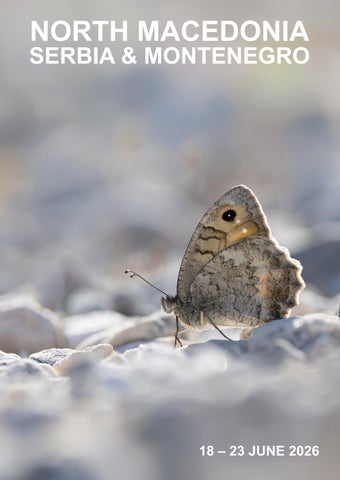
Cover & pages 2–3: Macedonian Grayling (Pseudochazara cingovskii) (Mike Watson)
2
NORTH MACEDONIA, SERBIA & MONTENEGRO
Butterflying in the Balkans 2026
3
NORTH MACEDONIA, SERBIA & MONTENEGRO
Butterflying in the Balkans 2026
Pages 4–5: Persian Skipper (Spialia phlomidis) (Mike Watson)
PERSIAN SKIPPER
We recorded a handful of interesting dragonflies too; however, the terrain we visited was mostly very dry. The star of the show being the magnificent Bladetail Lindenia tetraphylla, one of Eastern Europe’s most spectacular dragonflies! Arguably even more spectacular were: Grand Antlion Palpares libelluloides, the unfeasible Spoon-winged Lacewing Nemoptera sinuata and the owlfly Libelloides macaronius. Having passed through Serbia and almost all the way through North Macedonia on the fast motorway, our first butterfly stop was on the banks of the River Vardar, in a narrow, parched valley with dry grassland and scattered low bushes. We were in search of the striking Persian Skipper Spialia phlomidis, maybe the best looking of the Grizzled types? After some puddling, which produced Lang’s Shorttailed Blue Leptotes pirithous and Little Tiger Blue Tarucus balkanicus for Janó, we found the skipper, one mint fresh and another rather worn, so worn it was almost lacking white fringes. They stayed put for a lot of photos! Other butterflies of note here included; Mallow
‘Male Persian Skippers spend significantly more time patrolling than those of other Spialia species’
4
NORTH MACEDONIA, SERBIA & MONTENEGRO
Butterflying in the Balkans 2026
5
NORTH MACEDONIA, SERBIA & MONTENEGRO
Butterflying in the Balkans 2026
Persian Skipper habitat River Vardar & Grand Antlion (Palpares libelluloides). Page 7: János Oláh & Persian Skipper (Mike Watson)
Skipper Carcharodus alceae, Eastern Bath White Pontia edusa, Adonis Blue Lysandra bellargus, Southern White Admiral Limenitis reducta and a single Oriental Meadow Brown Hyponephele lupinus nectaring on black berry flowers. Spectacular Grand Antlions Palpares libelluloides flew up as I walked through the grass! Birdlife was distinctly Mediterranean with European Turtle Dove, European Bee-eater, Common Nightingale, Eastern Olivaceous Warbler and Black-headed Bunting. The dry landscape was verging on badlands along the banks of the river but there had clearly been a very recent flash flood here, with the cart tracks washed clean of vegetation and large drying puddles. There were some locals dumping agricultural waste at the entrance to the valley and nearby, there was also a tiny, overgrown and abandoned farmstead and some foxholes dug into the hillside. This was a site of conflict in WWII in 1944; the final German withdrawal from Greece was along the Vardar corridor. Could these remnants be more than 80 years old? 6
NORTH MACEDONIA, SERBIA & MONTENEGRO
Butterflying in the Balkans 2026
7
NORTH MACEDONIA, SERBIA & MONTENEGRO
Butterflying in the Balkans 2026
8
BLADETAIL
NORTH MACEDONIA, SERBIA & MONTENEGRO
Butterflying in the Balkans 2026
‘This spectacular insect is the largest of the Gomphidae in Europe and the only member of its genus’
9
NORTH MACEDONIA, SERBIA & MONTENEGRO
Butterflying in the Balkans 2026
Bladetail habitat, near Gevgelija, North Macedonia (Mike Watson)
An early morning search until 0800 (by which time it was already 25 degrees Celsius!) in a dry riverbed of the Sermeninska not far from Gevgelija for Small Bath White Pontia chloridice was not successful. It is usually seen here in May but there ought to be a second brood – obviously later than our search date? However, we did find something much better. BLADETAIL! Lindenia tetraphylla. One of Eastern Europe’s most sought-after dragonflies. Check those blades, like tail elevators on an aircraft! We found two, which appeared to have established hunting territories on the gravel of the riverbed, where the food plant of SBW’s caterpillar stage Cleome ornithopodioides was growing. There were plenty of its close relative Eastern Bath White Pontia edusa – we checked them all carefully. Oberthür’s Grizzled Skipper Pyrgus armoricanus was new here and we also spotted a few Wall Brown Lasiommata megera, Clouded Yellow Colias croceus and Spotted Fritillary Melitaea didyma. 10
NORTH MACEDONIA, SERBIA & MONTENEGRO
Butterflying in the Balkans 2026
FREYER’S GRAYLING
A nearby пекара (bakery!) was very welcome. It is interesting that apart from baked produce they sell very little apart from coffee, soft drinks and lots of kefir! It was warming up now and we headed back to the River Vardar to check some spots for Krüper’s Small White Pieris krueperi. Again, we didn’t manage to find any, but we would soon discover it was flying in this region. It is just scarce. Rocky grassland on the banks of the river produced some very nice other butterflies; Scarce Swallowtail Iphiclides podalirius, Little Tiger Blue Tarucus balkanicus, Southern White Admiral Limenitis reducta, Cardinal Argynnis pandora, Camberwell Beauty Nymphalis antiopa, Great Banded Grayling Kanetisa circe, Freyer’s Grayling Hipparchia fatua and Lattice Brown Kirinia roxelana as well as Small Pincertail dragonfly Onychogomphus forcipatus. A White Stork nest in a nearby village had a colony of Spanish Sparrows nesting in it!
‘Freyer’s Graylings aren’t very keen on floral nectar. They particularly enjoy the juice of rotting fruits and the sap from wounded trees’
Freyer’s Grayling (Hipparchia fatua).Page 12: Iolas Blue (Iolana iolas). Page 13: Lang’s Shorttailed Blue (Leptotes pirithous) & Oriental Skipper (Muschampia orientalis) (Mike Watson)
11
NORTH MACEDONIA, SERBIA & MONTENEGRO
Butterflying in the Balkans 2026
12
NORTH MACEDONIA, SERBIA & MONTENEGRO
Butterflying in the Balkans 2026
13
NORTH MACEDONIA, SERBIA & MONTENEGRO
Butterflying in the Balkans 2026
We headed uphill now into the hinterland, following up yet more Krüper’s Small White Pieris krueperi historical sightings and although we drew another blank, we did add some great other species like; Oriental Skipper Muschampia orientalis, Sandy Grizzled Skipper Pyrgus cinarae, Eastern Wood White Leptidea morsei, Lang’s Short-tailed Blue Leptotes pirithous, Iolas Blue Iolana iolas and Balkan Marbled White Melanargia larissa. There was masses of puddling action along the narrow jeep track attracting up to 16 Scarce Swallowtails Iphiclides podalirius together at a single puddle! Other interesting species included; Hungarian Skipper Spialia orbifer, Little Tiger Blue Tarucus balkanicus, Eastern Baton Blue Pseudophilotes vicrama, Osiris Blue Cupido osiris, Chapman’s Blue Polyommatus thersites, Southern White Admiral Limenitis reducta, Silver-washed Argynnis paphia, and Spotted Fritillaries Melitaea didyma. Another distinct eastern feel to birdlife featured Sombre Tit, Cirl Bunting and Levant Sparrowhawk. Wondering if the spring-flying Eastern Festoon Zerinthyia cerisy was still on the wing, we dropped back down to the river valley, finding only worn Common Swallowtail Papilio machaon and Black-veined White Aporia crataegi as well as more Balkan Marbled Whites Melanargia larissa and Great Banded Graylings Britensia circe.
BALKAN MARBLED WHITE
‘The eggs of most marbled white species do not stick to their substrate – they lack an adhesive surface and are simply dropped into grasses’ There was still time for another spot for the elusive Krüper’s Small White Pieris krueperi but again no luck, this was becoming boring now! Janó almost certainly saw one briefly but all too soon it was chased away by another target here Balkan White-banded Grayling Pseudocharaza anthalea, of which we saw several. We tried several historic waypoints for the little white without any luck. A Great Sooty Satyr Satyrus ferula was also here. A final dip on Mediterranean Skipper Gegenes nostradamus at another roadside spot ended a day of mixed success and failure. Balkan Marbled White (Melanargia larissa). Pages 13–15: János Oláh & Balkan White-banded Grayling (Mike Watson)
14
NORTH MACEDONIA, SERBIA & MONTENEGRO
Butterflying in the Balkans 2026
15
NORTH MACEDONIA, SERBIA & MONTENEGRO
Butterflying in the Balkans 2026
16
NORTH MACEDONIA, SERBIA & MONTENEGRO
Butterflying in the Balkans 2026
17
NORTH MACEDONIA, SERBIA & MONTENEGRO
less than 10 sq km
‘This is the astonishingly tiny extent of the known global range of the Macedonian Grayling Pseudochazara cingovskii; Europe’s most critically endangered butterfly.’ Macedonian Grayling (Pseudochazara cingkovskii (Mike Watson)
18
Butterflying in the Balkans 2026
NORTH MACEDONIA, SERBIA & MONTENEGRO
Butterflying in the Balkans 2026
Nogel’s Hairstreak Tomares nogelii has an even smaller range within Europe, although it occurs more widely beyond Europe). The ultra-rare grayling was only described as a new species in 1978 and named in honour of Dr Jonče Cingovski, a Macedonian entomologist. It was previously treated as a subspecies of Pseudochazara sintenisi. Although capture and export for commercial purposes have been prohibited in North Macedonia since 2011, illegally collected specimens still apparently appear for sale online in Europe. With North Macedonia outside the EU, enforcement of its protected status is likely more challenging. If one must collect things, why not buy stamps depicting it, as I did. A more immediate and severe threat to this remarkable butterfly is habitat destruction from marble quarrying. Vast sections of limestone scree have already been removed. I have never seen anything quite like it: the stark white quarry scars are visible from outer space. Fortunately, the species still persists in patches of flower-rich, relic limestone pavement in the Prilep district of North Macedonia. Janó had become concerned that the butterfly might have been collected out of its principal sites, having failed to find it on his last three attempts. Given that he is one of the most best finders of rare creatures I know — whether birds, mammals, or insects — this was worrying. Perhaps time was ticking away for Macedonian Grayling more quickly than I had realised. So I did some research. Janó had seen it during the second week of July, and his subsequent visits were at similar dates. References list the flight period as late July to early August (Collins Guide, 2008) and July to August (Princeton Guide, 2026). However, interestingly, Naturetrek reported not missing the species in five visits between 2018 and 2025 on their “Butterflies & Birds of North Macedonia” tour, with sightings ranging from 20–29 June. There are also recent late June records entered on Inat within the last few years. Was Janó simply searching too late in the season? Was his earlier success a result of an unusually late emergence year? Or is the flight period shifting earlier altogether? These
were the questions we wanted to explore on our whistle-stop tour of some of the Balkans’ most elusive butterflies. We selected 21 June — We assumed this would be the start of the flight period. We also knew that, in Greece at least, many butterflies had emerged slightly earlier than usual this year. We began at the classic, well-documented site. All known localities from a 2012 survey are available online. We arrived on a bright, sunny morning with almost no cloud and a pleasantly cool 17°C. After a short walk through a flower-rich upland meadow, we reached the limestone scree. Within minutes: BAM! Janó called out, “Maccy G!” while I was about 20m away, distracted photographing a Great Sooty Satyr Satyrus ferula. The Macedonian Grayling behaves like a classic grayling: it usually retracts its forewings on landing and angles its body perpendicular to the sun. This leaves little time to photograph the striking paired white forewing spots, and even less chance of open-wing shots. I focused instead on in-habitat images with natural backgrounds, though even this was tricky — they do not always settle in convenient positions for photography. In the cool early morning they were still sluggish, just warming up. As the morning progressed they became increasingly active and difficult to follow. Once the sun climbed higher, the glare from the limestone made photography even harder. Early morning is clearly essential if the aim is to photograph them. We spent a couple of hours at Site A and counted at least 15 individuals in a relatively small area; the earlier survey findings suggested the species is highly sedentary, even in continuous habitat. Also present was the fast-flying Eastern Greenish Black-tip Euchloe penia, which rarely settles long enough for a proper look. The graylings were pristine — freshly emerged, clearly at the very start of their flight period. Another butterfly dream realised. It was time for our pastry club to find a local пекара. Fuelled up, we moved on to a backup site. Driving through a heavily altered landscape — past stacks of 2–3 metre marble blocks — we eventually reached a more remote location. 19
NORTH MACEDONIA, SERBIA & MONTENEGRO
Macedonian Grayling (Pseudochazara cingkovskii (Mike Watson)
Butterflying in the Balkans 2026
20
NORTH MACEDONIA, SERBIA & MONTENEGRO
Butterflying in the Balkans 2026
21
NORTH MACEDONIA, SERBIA & MONTENEGRO
Butterflying in the Balkans 2026
22
NORTH MACEDONIA, SERBIA & MONTENEGRO
Butterflying in the Balkans 2026
23
NORTH MACEDONIA, SERBIA & MONTENEGRO
Butterflying in the Balkans 2026
Macedonian Grayling (Pseudochazara cingkovskii). Page 19: Eastern Greenish Black-tip (Euchloe penia) & Krüper’s Small White (Pieris krueperi) (Mike Watson)
A grassy meadow here produced the striking Sinuated Spoonwing Nemoptera sinuata, a surreal, long-tailed Balkan insect. From there we reached another limestone pavement, part of a much larger site that had recorded the highest numbers of Macedonian Graylings in the 2012 survey. Yet despite this, we found only two individuals across a wide area. Temperatures had now exceeded 30°C, and butterfly activity had dropped sharply. The only abundant species was the Great Banded Grayling Hipparchia semele, present in what were uncountable numbers. Eventually, we moved on — mission accomplished. On the way back, we disturbed a robber fly carrying a freshly killed Delattin’s Grayling Hipparchia volgensis. We managed to retrieve it briefly for a closer look, particularly the upper wing surfaces. We had also seen another individual at Site A, though not the upper wings clearly to be able to identify it with certainty. The Hermit Chazara briseis, also appeared.
An oddly named butterfly, the origin of its name is uncertain. British literature from the 19th century refers to it in that form, during a period when species were often called The something or other. It spends its life in recluse in remote rocky places or its behaviour, retreating into crevices or juniper edges, perhaps explains the association. We watched it repeatedly slipping into cover, possibly influenced by the extreme heat. It will be interesting to see how it behaves under cooler conditions in future. We had learned enough about the Macedonian Grayling for now. With the afternoon ahead of us, it was time to move on to another species whose fragmented range just reaches into the Balkans…Overnight we got news that Krüper’s Small White Pieris krueperi was indeed flying yesterday! So, we had another for it and right in the exact spot of Janó’s brief sighting there it was! Skipping around between the many flowers on the scree above us. After a quick scramble we were up and level with this little beauty! 24
NORTH MACEDONIA, SERBIA & MONTENEGRO
Butterflying in the Balkans 2026
25
NORTH MACEDONIA, SERBIA & MONTENEGRO
Butterflying in the Balkans 2026
26
NORTH MACEDONIA, SERBIA & MONTENEGRO
Butterflying in the Balkans 2026
‘The Hermit is an oddly named butterfly – the origin of its name is uncertain. British literature from the 19th century refers to it in that form, during a period when species were called ‘The’ something or other (as they still are in French). Spending its life in recluse in remote rocky places, or its behaviour of retreating into the shadows, perhaps explains the association.’
27
NORTH MACEDONIA, SERBIA & MONTENEGRO
balcanica!
‘Our target was one of Europe’s most localised butterflies: the Balkan Clouded Yellow Colias caucasica balcanica, confined to isolated mountain populations stretching from Bosnia and Herzegovina through Serbia and North Macedonia to Greece.’
Balkan Clouded Yellow (Colias caucasica balcanica) (Mike Watson)
28
Butterflying in the Balkans 2026
NORTH MACEDONIA, SERBIA & MONTENEGRO
Butterflying in the Balkans 2026
The weather had other ideas for us this morning. Back in Serbia, rain swept across Kopaonik National Park, washing out any hope of productive butterflying, so we decided we might as well put the time to good use. Rather than waiting for the weather to improve, we drove towards another, much more remote mountain, hoping the skies would clear by the time we arrived. As we approached our destination the rain began to ease and, encouragingly, patches of blue appeared between the clouds. Unfortunately, a far more serious obstacle awaited us. The forest track that Janó had identified as our route to the high-altitude meadows was exactly as he had feared—unsuitable for an ordinary four-wheel-drive SUV. Looking uphill through binoculars, we could see sections where rain had washed part of the road away. This was unfamiliar territory and didn’t want to become stranded several kilometres from the nearest village, unable to turn around on a muddy mountainside—or worse, slide into the forest. Our waypoint lay around five kilometres further up the mountain. Hiking that distance in uncertain weather, with no guarantee the rain would hold off, simply wasn’t worth the effort. Reluctantly, we admitted defeat and turned back towards the nearest village. Then fortune intervened. As we rolled away we heard the roar of a large engine approaching. Around the bend came an enormous Jeep with oversized tyres, raised suspension and, reassuringly, an “Off-Road Club” sticker on the side. The driver introduced himself as Almas, a young migrant worker (as a crane operator in Berlin). He was heading up the mountain to visit his aunt, who lived on a remote farm high above the forest, just where we wanted to go. “I can take you, and bring you back down, I’ll be there for a couple of hours.” We could hardly believe our luck. Sometimes our adventures produce moments that seem almost too perfectly timed to be coincidence. The journey uphill was memorable. Almas clearly regarded the climb as an extension of his off-roading fun afternoon and drove the deeply rutted forest tracks with remarkable speed. His Jeep, however, was every bit as
impressive as its appearance suggested. Obstacles that would have bounced our own vehicle into the trees were overcome effortlessly by its enormous suspension. I didn’t enjoy hurtling through the forest at full speed, expecting a disk to bulge at any moment, but I certainly appreciated the time saving. It was a considerable relief to climb out beside his aunt’s delightful little farmstead, surrounded by colourful flower meadows, accompanied by the smell of a burning clutch. With just two hours, we had to walk around a kilometre to our waypoint. Fortunately, the remaining track was almost level and along the way we passed an angry pair of nutcrackers, before the forest gave way to one of the most beautiful alpine meadows I have seen. The meadow stretched away towards the distant ridges in a riot of wildflowers beneath a clearing sky. Sunshine now flooded the mountains, transforming what had begun as a gloomy morning into a glorious summer afternoon. Now, where was balcanica? Janó followed the woodland edge towards the waypoint while I walked parallel across the centre of the meadow. Between us we hoped to intercept any Colias butterflies flying across the open grassland. As we approached a shallow dry hollow—more of a broad depression than a valley—I caught sight of movement. One. Then two. Then three unmistakably orange male Clouded Yellow-type butterflies patrolling the meadow. “Janó!” I shouted lots of times, so he could follow my voice as I chased after the buterflies. Janó had disappeared briefly while following another butterfly, before reappearing moments later.”They’re very orange!” he said. The butterflies patrolled tirelessly up and down the slopes in search of females, rarely pausing for more than a second. Photographing them proved demanding as usual with this genus. They flew with purpose, forcing us into sustained power-walking pace across the hillside. The intensity of the richly coloured alpine flowers gave the camera’s autofocus no end of trouble, making flight photography challenging. Eventually persistence paid off. I managed a 29
NORTH MACEDONIA, SERBIA & MONTENEGRO
Butterflying in the Balkans 2026
30
NORTH MACEDONIA, SERBIA & MONTENEGRO
Butterflying in the Balkans 2026
31
NORTH MACEDONIA, SERBIA & MONTENEGRO
Butterflying in the Balkans 2026
Balkan Clouded Yellow (Colias caucasica balcanica). Page 25: Balkan Copper (Lycaena candens) (Mike Watson)
few flight images before the butterflies finally began settling briefly to nectar. Every visit was to the vivid crimson blooms of Dianthus sanguineus, Blood Pink, a species I knew from last year’s trip to Stara Planina in southeastern Serbia. We were delighted—or at least we were until I studied the images on the back of my camera. “Oh dear...” Had we made a terrible mistake? The butterflies showed yellow veins crossing the black apical border of the forewing—a feature usually associated with the common Clouded Yellow Colias croceus. Worse still, they didn’t appear quite as intensely orange as many of the illustrations in the field guides. Fortunately, the scientific literature tells a more complicated story. A 2015 paper by Ana Nahirnić, Predrag Jakšić and Arne Lykke Viborg, Colias caucasica balcanica (Pieridae) rediscovered in Montenegro, with additional new records for Serbia, report-
ed that this feature is far more variable than identification guides suggest. Although most references state that male C. caucasica balcanica lacks prominent yellow veins in the black forewing border, the authors found that this is far from absolute. One specimen collected at Borje in southwestern Serbia had initially been identified as Colias croceus because of its conspicuous yellow veins. Closer examination revealed that around 30% of the Serbian males examined displayed yellow veining to some degree. A similar proportion—23%—was found among Greek specimens. In other words, the feature widely presented as a reliable field character is quite variable. That finding contradicts the impression given by both the 2008 Collins Butterfly Guide and the 2026 Princeton Field Guide, both of which continue to present the absence of yellow veins as a key identification feature. Janó wasn’t remotely concerned. 32
NORTH MACEDONIA, SERBIA & MONTENEGRO
Butterflying in the Balkans 2026
“Don’t worry,” he said. “They are balcanica, I’ve seen thousands of Clouded Yellows, and none of them has ever looked as orange as this. It’s exactly the same with myrmidae.” He was right. The field guides need a small revision on this point. The butterflies illustrated in many books also resemble the deeper orange individuals found further south in Greece, where the Balkan Clouded Yellow reaches its richest coloration. That striking southern form has become something of the ‘standard’ illustration, making more northerly Serbian butterflies appear unexpectedly pale by comparison. The specimen plates published in the 2015 study show just how much variation exists. Even so, our butterflies still looked distinctly different from the common Clouded Yellow. The habitat itself also provided an important clue. We were standing at 1,630 metres above sea level in flower-rich alpine meadow—exactly the sort of environment expected for Colias caucasica balcanica. Although Colias croceus occasionally wanders to over 2,200 metres in the Alps, it generally breeds below about 1,600 metres and is primarily a butterfly of lower elevations. Everything about the location pointed towards balcanica.
What appears a subtle distinction to us represents a much deeper evolutionary history. DNA studies suggest that Balkan Clouded Yellow diverged from the Danube Clouded Yellow, Colias myrmidae (from which it was originally described as a mountain subspecies) around 1.2 million years ago. In keeping with the Balkan name theme, a pristine male Balkan Copper Lycaena candens appeared by the track on our return to the farmstead. Its brilliant, purple-edged orange upperwings glowed in the afternoon sunshine, providing the perfect finale to an unforgettable afternoon. Almas’s aunt gave us some delicious homemade cheese served with Turkish coffee. Fabulous stuff! Looking at her friendly, Turkish Kangal guard dog, which was the size of a small horse, we asked “Do you get wolves here?”. “Yes, and bears too”. Gulp. Now, I found myself looking at the 1996 North Macedonian first day cover depicting both Balkan Clouded Yellow and the Macedonian Grayling Pseudochazara cingovskii. This time it means far more than just a stamp issue, bringing back memories of alpine meadows, a remote mountain farm, the generosity of strangers, and an afternoon when everything somehow came together. One of the best!
33
NORTH MACEDONIA, SERBIA & MONTENEGRO
Butterflying in the Balkans 2026
34
NORTH MACEDONIA, SERBIA & MONTENEGRO
Butterflying in the Balkans 2026
35
NORTH MACEDONIA, SERBIA & MONTENEGRO
Butterflying in the Balkans 2026
yellow-legged tortoiseshell ‘Massive summer outbreaks of the Yellow-legged Tortoiseshell have been observed over the past decades beyond the northern and western limits of its range.’ Yellow-legged (or Scarce) Tortoiseshell (Nymphalis xanthomelas) (Mike Watson)
36
NORTH MACEDONIA, SERBIA & MONTENEGRO
Butterflying in the Balkans 2026
‘We relocated the big, gorgeous nymph resting on a rocky cliff face, where we were able to clamber up for some closer looks before it eventually disgraced itself, at ground level in the late afternoon taking salts; a habit of this species.’
Back in 2014, I missed out on the unprecedented influx of around 30 Yellow-legged (or Scarce) Tortoiseshells to the UK. There had been a build up as far west as Denmark in 2013, followed by the appearance of hibernating adults in the spring of 2014. The westward push continued, and some crossed the North Sea, but sadly the cold and wet spring of 2015 ended the westward movement. There has been nothing like it since. While we were in western Serbia, weheard our pal Németh Lajos had photographed a fresh Yellow-legged Tortoiseshell Nymphalis xanthomelas, he sent us a photo too! It was pretty special! So, we still had time to nip (four hours) to the mountains of southeast Serbia and search for it. After some hours, and many fresh Large Tortoiseshells Nymphalis polychloros, between heavy showers (unhelpful when hoping for puddling butterflies in hot weather), Janó found what we thought was it, on a sandy track near the previous day’s sighting. Well, there it was a beautiful mint-fresh Yellow-legged Tortoiseshell Nymphalis xanthomelas, but it had some minor differences to yesterday’s! Janó’s friends had reported ‘many’ caterpillars from this area in the spring so he had been hopeful there would be an emergence. We relocated the big, gorgeous nymph resting on a rocky cliff face, where we were able to clamber up for some closer looks before it eventually disgraced itself, at ground level in the late afternoon taking salts; a habit of this species. This is a great butterfly spot, producing 40 species in a few hours, including the Balkan Speciality Freyer’s Fritillary Melitaea arduinna. Both Purple Emperors were also here; Purple Emperor Apatura iris and Lesser Purple Emperor Apatura ilia. My final addition was Large Grizzled Skipper Pyrgus alveus, a very showy individual by the track, along with several Large Chequered Skippers Heteropterus morpheus. We made our way back towards Belgrade through a terrific lightning and thunderstorm; after we had waited a couple of hours for a car crash to be removed from the road ahead. What another fabulous time we had butterflying in the Balkans, there is nowhere like it!
Pages 38–40: Yellow-legged (or Scarce) Tortoiseshell (Nymphalis xanthomelas). Pages 41 & 43: Large Tortoiseshell (Nymphalis polychloros). Page 42: Purple Emperor (Apatura iris), above & Lesser Purple Emperor (Apatura ilia) (Mike Watson)
37
NORTH MACEDONIA, SERBIA & MONTENEGRO
Butterflying in the Balkans 2026
38
NORTH MACEDONIA, SERBIA & MONTENEGRO
Butterflying in the Balkans 2026
39
NORTH MACEDONIA, SERBIA & MONTENEGRO
Butterflying in the Balkans 2026
40
NORTH MACEDONIA, SERBIA & MONTENEGRO
Butterflying in the Balkans 2026
41
NORTH MACEDONIA, SERBIA & MONTENEGRO
Butterflying in the Balkans 2026
42
NORTH MACEDONIA, SERBIA & MONTENEGRO
Butterflying in the Balkans 2026
43
NORTH MACEDONIA, SERBIA & MONTENEGRO
Butterflying in the Balkans 2026
Macedonian Grayling (Pseudochazara cingkovskii (Mike Watson)
Butterfly Species List: Scarce Swallowtail Iphiclides podalirius Swallowtail Papilio machaon Large Chequered Skipper Heteropterus morpheus Mallow Skipper Carcharodus alceae Tufted Marbled Skipper Carcharodus floccifera Oriental Skipper Muschampia orientalis Hungarian Skipper Spialia orbifer Persian Skipper Spialia phlomidis Grizzled Skipper Pyrgus malvae Oberthür’s Grizzled Skipper Pyrgus armoricanus Large Grizzled Skipper Pyrgus alveus Sandy Grizzled Skipper Pyrgus cinerae Small Skipper Thymelicus sylvestris Lulworth Skipper Thymelicus acteon Large Skipper Ochlodes sylvanus Eastern Wood White Leptidea duponcheli Wood White Leptidea sinapsis Eastern Bath White Pontia edusa Eastern Greenish Black-tip Euchloe penia Black-veined White Aporia crataegi Large White Pieris brassicae Small White Pieris rapae Krüper’s Small White Pieris krueperi 44
NORTH MACEDONIA, SERBIA & MONTENEGRO
Butterflying in the Balkans 2026
Green-veined White Pieris napae Clouded Yellow Colias crocea Balkan Clouded Yellow Colias (caucasica) balcanica Brimstone Gonepteryx rhamni Small Copper Lycaena phlaeas Sooty Copper Lycaena tityrus Purple-shot Copper Lycaena alciphron Balkan Copper Lycaena candens Green Hairstreak Callophrys rubi Sloe Hairstreak Satyrium acacia Blue-spot Hairstreak Satyirum spini Little Blue Cupido minimus Osiris Blue Cupido osiris Lang’s Short-tailed Blue Leptotes pirithous Little Tiger Blue Tarucus balkanicus Eastern Baton Blue Pseudophilotes vicrama Holly Blue Celastrina argiolus Silver-studded Blue Plebejus argus Brown Argus Aricia agestis Mazarine Blue Cyanirius semiargus Amanda’s Blue Polyommatus amandus Common Blue Polyommatus icarus Chapman’s Blue Polyommatus thersites Adonis Blue Lysandra bellargus Iolas Blue Iolana iolas Silver-washed Fritillary Argynnis pahpia Cardinal Argynnis pandora Dark Green Fritillary Speyeria aglaja High Brown Fritillary Fabriciana adippe Marbled Fritillary Brenthis daphne Lesser Marbled Fritillary Brenthis ino Twin-spot Fritillary Brenthis hecate Weaver’s Fritillary Boloris dia Marsh Fritillary Euphydryas aurinia Knapweed Fritillary Melitaea phoebe Freyer’s Fritillary Melitaea arduinna Lesser Spotted Fritillary Melitaea trivia Spotted Fritillary Melitaea didyma False Heath Fritillary Melitaea diamina Heath Fritillary Melitaea athalia Red Admiral Vanessa atalanta Painted Lady Vanessa cardui Peacock Aglais io Small Tortoiseshell Aglais urticae Comma Polygonia c-album Large Tortoiseshell Nympahlis polychloros Yellow-legged Tortoiseshell Nymphalis xanthomelas Camberwell Beauty Nymphalis antiopa White Admiral Limentis camila 45
NORTH MACEDONIA, SERBIA & MONTENEGRO
Butterflying in the Balkans 2026
Southern White Admiral Limentis reducta Purple Emperor Apatura iris Lesser Purple Emperor Apatura ilia Lattice Brown Kirinia roxelana Wall Brown Lasiommata megera Speckled Wood Pararge aegeria Pearly Heath Ceononympha arcania Chestnut Heath Ceononympha glycerion Small Heath Ceononympha pamphilus Meadow Brown Maniola jurtina Oriental Meadow Brown Hyponphele lupina Woodland Ringlet Erebia medusa Marbled White Melanargia galathea Balkan Marbled White Melanargia larissa The Hermit Chazara briseis Great Sooty Satyr Satyrius ferula Delattin’s Grayling Hipparchia volgensis Great Banded Grayling Brintesia circe Balkan White-banded Grayling Pseudochazara amalthea Macedonian Grayling Pseudochazara cingovskii Freyer’s Grayling Hipparchia fatua Great Sooty Satyr (Satyruis ferula) (Mike Watson)
46