26 April – 12 May 2026
Arizona (finally!) plus a whirl around a few last corners of California I had not yet visited made the 2026 Birdquest California & Arizona Specialities tour a very enjoyable one for me! 90 ‘diamond’ birds included 21 lifers, mostly from Southeast Arizona, and we did a pretty good job of finding the most important endemics. My personal highlights were not all lifers though, the Spotted Owl on a remote Sky Island in southeast Arizona topped the bill and I very much liked the LeConte’s Thrasher in the sagebrush of an abandoned oil field near Taft, even though I’d seen it before. Black-backed Woodpecker was a long overdue addition to my woodpecker list and to see an elegant Coppery-tailed Trogon (still can’t get used to that name) in Madera Canyon was a lifetime ambition. How beautifully it showed for us too! Other canyon-dwelling specialties impressed in the cool, shady woodlands, like Olive Warbler (it’s not a wood warbler!), Red-faced and Grace’s Warblers. Add to these Lucy’s Warbler and now only Connecticut, of the US-breeding wood warblers is left. Sparrow gaps were filled by the scarce Five-striped, Botteri’s and Rufous-winged Sparrows and Yellow-eyed Junco. Island Scrub Jay was one of only a few birds I needed in SoCal and the day trip to Santa Cruz in the Channel Islands National Park was another highlight. Even with such little time to spare to look at other things, we still managed to see some interesting other forms of life, notably mammals, reptiles and butterflies. Delicate Nabokov’s Satyr butterflies skipping through the shadows in the oak and Alligator Juniper woodland of Arizona’s Sky Island canyons was very special. We also racked up five
national parks with Channel Islands, Death Valley, Grand Canyon, Saguaro and Joshua Tree. Some of the best US national parks right there! National Forests included Inyo (including the Ancient Bristlecone Pine Forest), Coronado and Angeles and man-made American icon landmarks ticked off included the Hollywood sign, The Strip in Las Vegas and Route 66!
CITY OF ANGELS
My travels in California started a few minutes from LAX airport at Ballona Wetland Ecological Reserve. A few waterbirds could be seen around the reed-fringed lagoons including Ruddy Duck, Pied-billed Grebe and some Black-crowned Night Herons of note. Overhead a White-throated Swift was seen and, in the trees, along the hiking trail several Allen’s Hummingbirds perched. Belted Kingfisher, Nuttall’s Woodpecker, Black Phoebe and Bell’s Vireo were also noted here. In the
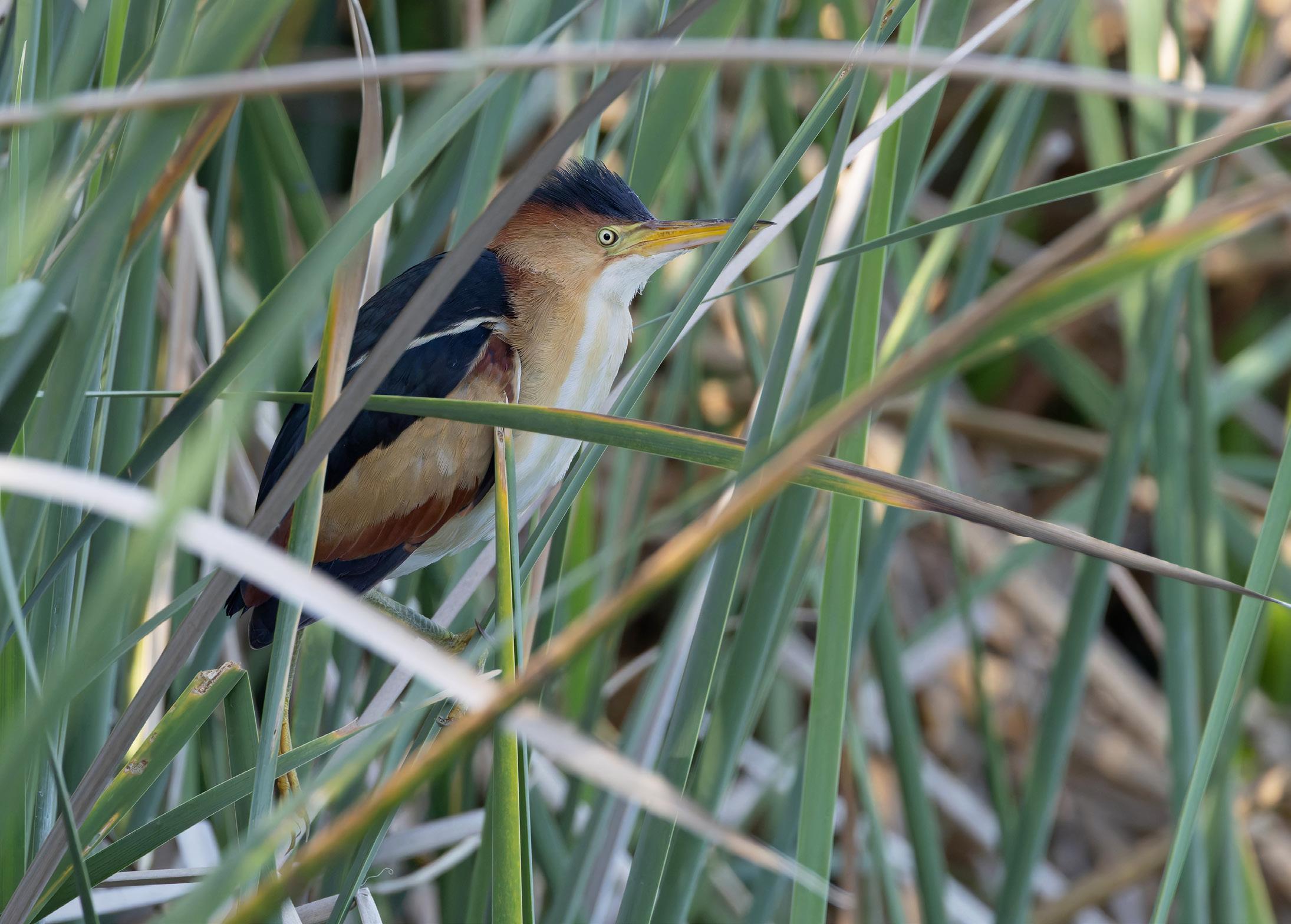
bushes, bushtits, Lesser Goldfinch and House Finch abounded and from the shadows, Song Sparrows and Common Yellowthroats could be heard. The highlight of this stop, however, was a Least Bittern seen from the last viewpoint. It climbed the reeds close-by before flying away across the lagoon. Several butterflies were seen today including one of my favourites, Mourning Cloak (AKA Camberwell Beauty), Grey Buckeye and Marine Blue, although the commonest butterfly was the 1860 introduction, European Small White! Making our way to the nearby coast, we checked Ballona Creek, part of the Marina del Rey complex. It felt like there must have been a recent storm, as a few rather sickly-looking seagoing birds were present here. Red-throated Loons are usually uncommon here, however, we counted at least five, some very close indeed. A Common Loon in breeding plumage was fishing just offshore. A couple of Blacknecked Grebes, some Western Grebes and
at least 12 Surf Scoters were also along the rocky breakwaters. Shorebirds were represented by Black Oystercatchers, handsome Wandering Tattlers, the soon-to-be split Western Willet, and, at long last, Black Turnstone (my first since ‘91). A Yellow-crowned Night Heron fed in the shadows, alongside Snowy Egret and the distant breakwater at the mouth of the marina was covered by Brandt’s Cormorants and Brown Pelicans. Further south along the LA coastline, we stopped at White Point, where another four Black Turnstones and a Spotted Sandpiper were feeding on a pile of seaweed high on the beach. Elegant Terns and Heermann’s Gulls could be seen offshore along with four Royal Terns. Passerines were a few but included our first Cassin’s Kingbirds and Hooded Oriole. Soon enough it was time to continue south to Huntington beach, the location of the actual Birdquest tour start. What better place to start a long tour than a wetland reserve? We saw more than 40 species at the Bolsa Chica Ecological Reserve. Beginning our exploration along the boardwalk
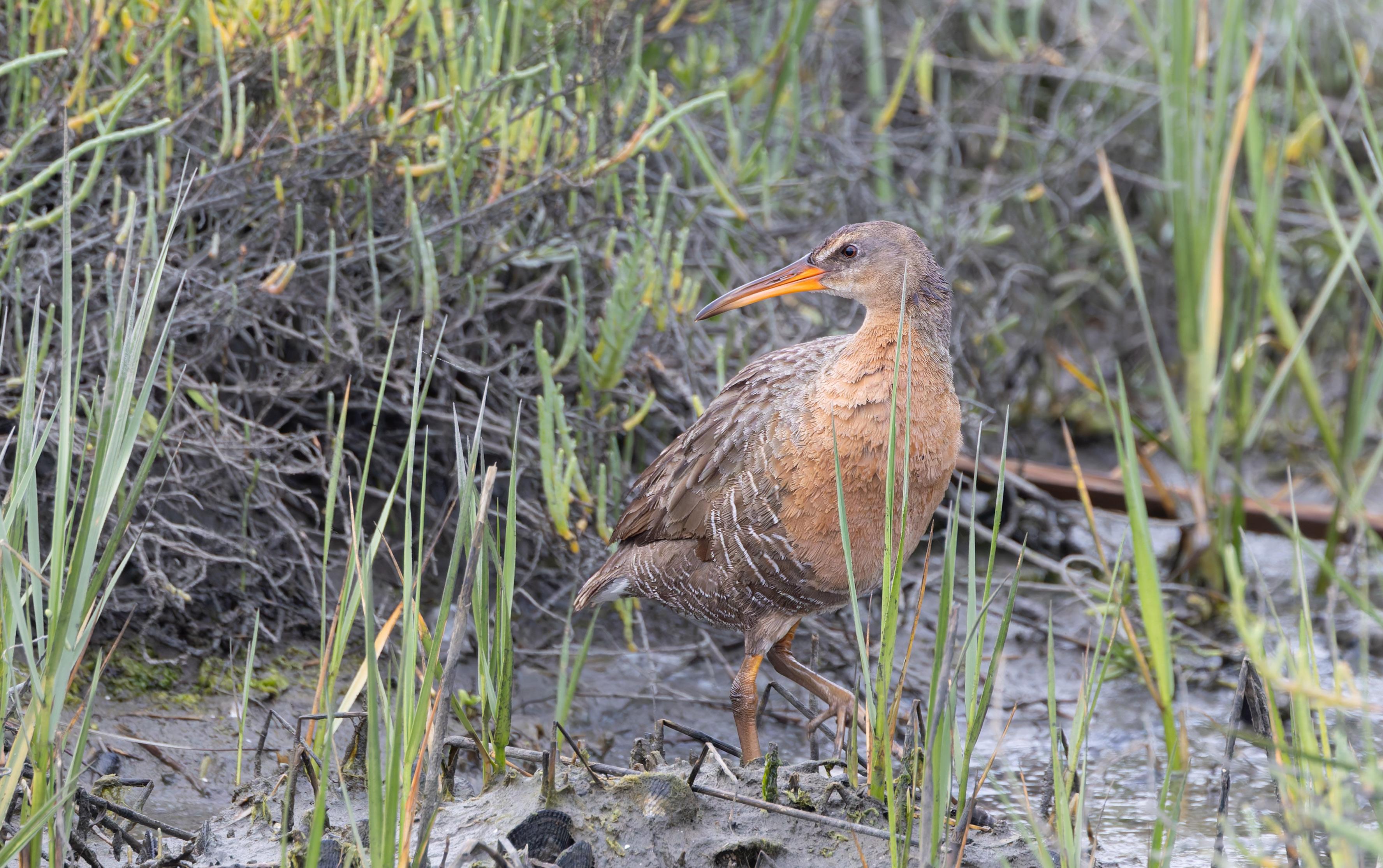
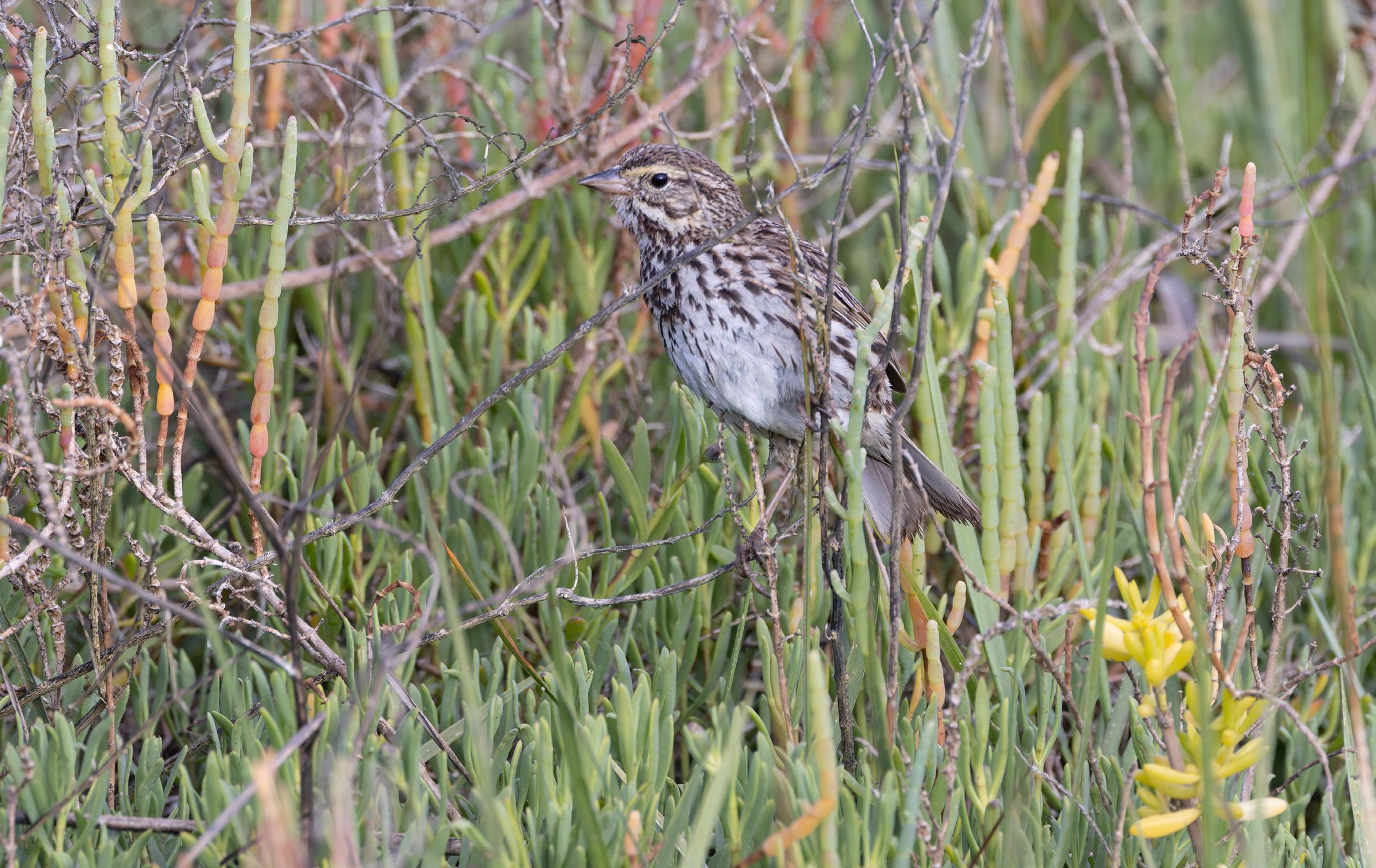
many species were new-for-the-tour like Redhead, Lesser Scaup, Blue-winged Teal, Blacknecked Stilt, Western Willet, Least, Forster’s and Caspian Terns and through the fence of the tern breeding compound, we added Semipalmated and Snowy Plovers, Long-billed Curlew (5), Marbled Godwit, Ruddy Turnstone, Western Sandpiper and Bonaparte’s Gull. Before we could continue our walk, Sjoerd called us back, having located one of the much-wanted Ridgway’s Rails. Some excellent views of this very noisy bird were had! Three Grey (or Black-bellied) Plovers in breeding plumage flew north, as did a couple of California Gulls. There were at least three Osprey nests in the vicinity and the distinctive Belding’s local race of Savannah Sparrow attracted attention in the salt marsh.
Next we had to show yesterday’s birds to people, so retracing our steps, we returned north. Before we hit the beach at White Point the hinterland coastal scrub of the nature reserve needed searching. This is a great spot for the perky little Californian Gnatcatcher and
Ridgway’s Rail, Bolsa Chica Ecological Reserve (Mike Watson)
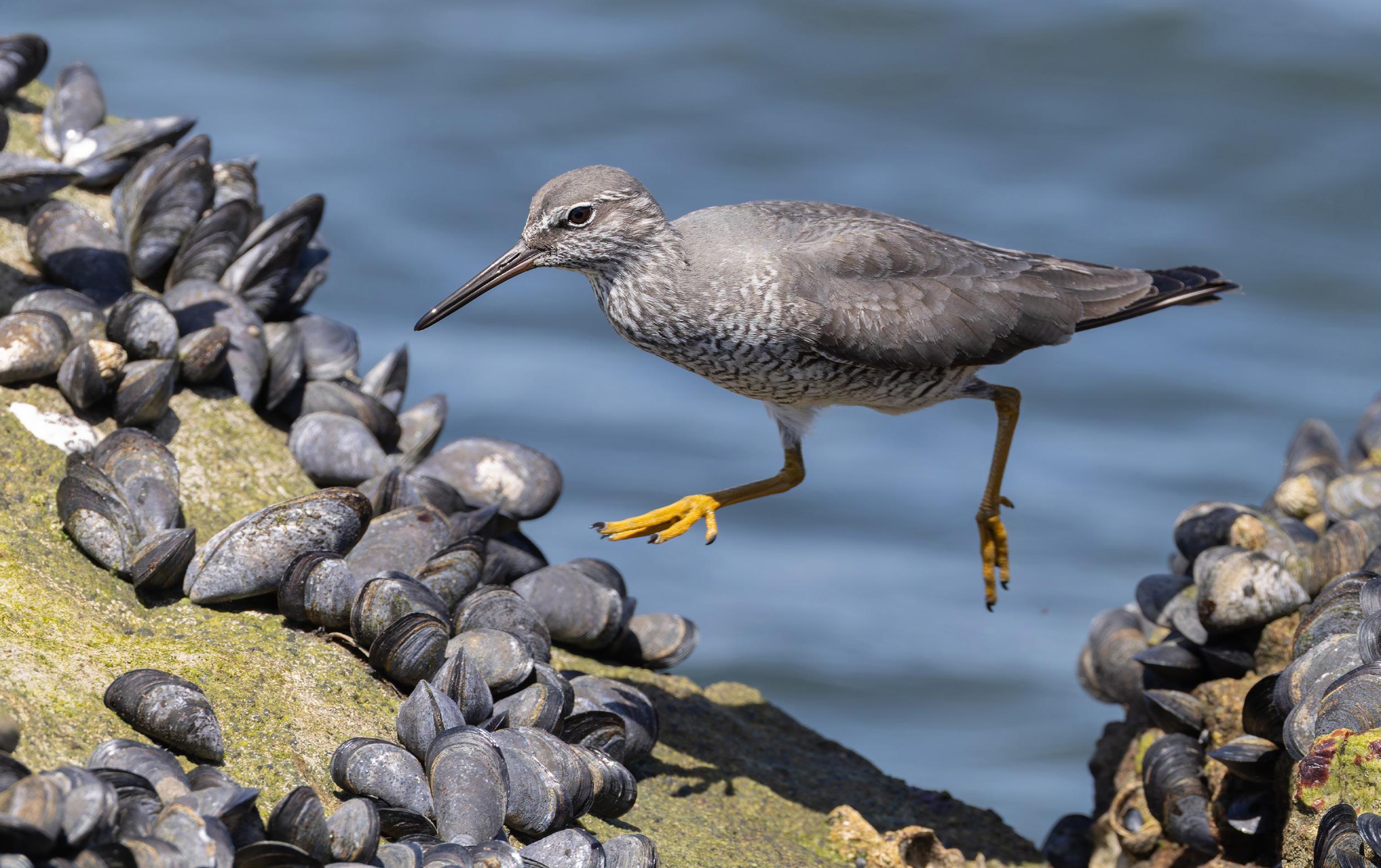
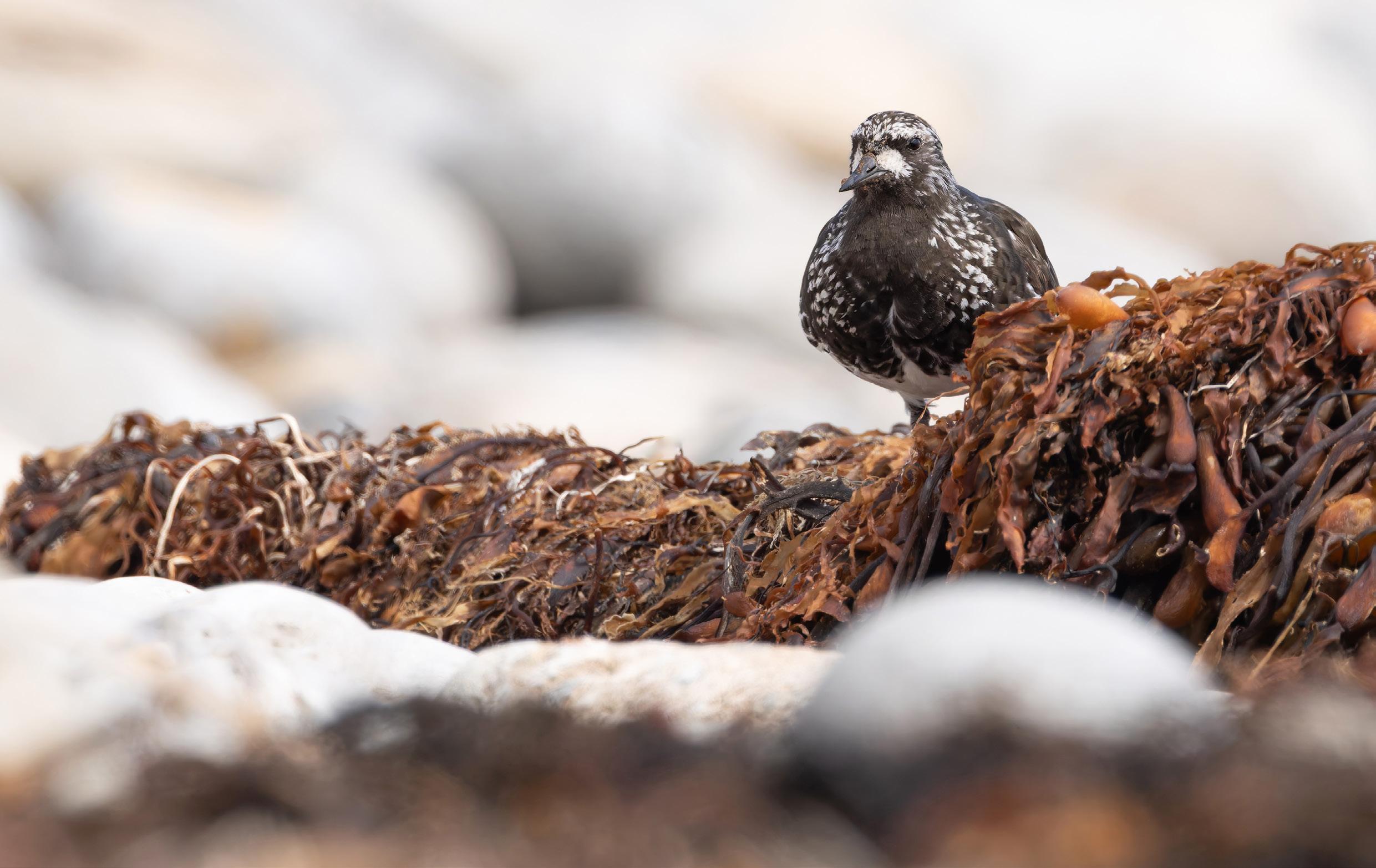
eventually we managed to locate a couple of them, first a rather plain female, and then a cracking little black-capped male. Other new birds in the scrub here were Northern House Wren, Northern Mockingbird and both California and Spotted Towhees. Back on the beach the Black Turnstones and Spotted Sandpiper were still around, as well as both Caspian and Royal Terns. A Pelagic Cormorant was among the much more numerous Brandt’s, and we also eventually managed to secure some nice views of Wandering Tattler. On the butterfly front both Monarch and Anise Swallowtail were noted.
Another site revisited was Ballona Creek/Marina del Rey, where yesterday’s birds obliged, particularly the point-blank views of Wandering Tattler. One final birding stop this afternoon was Ballona Wetlands Ecological Reserve where a Red-throated Loon was present on
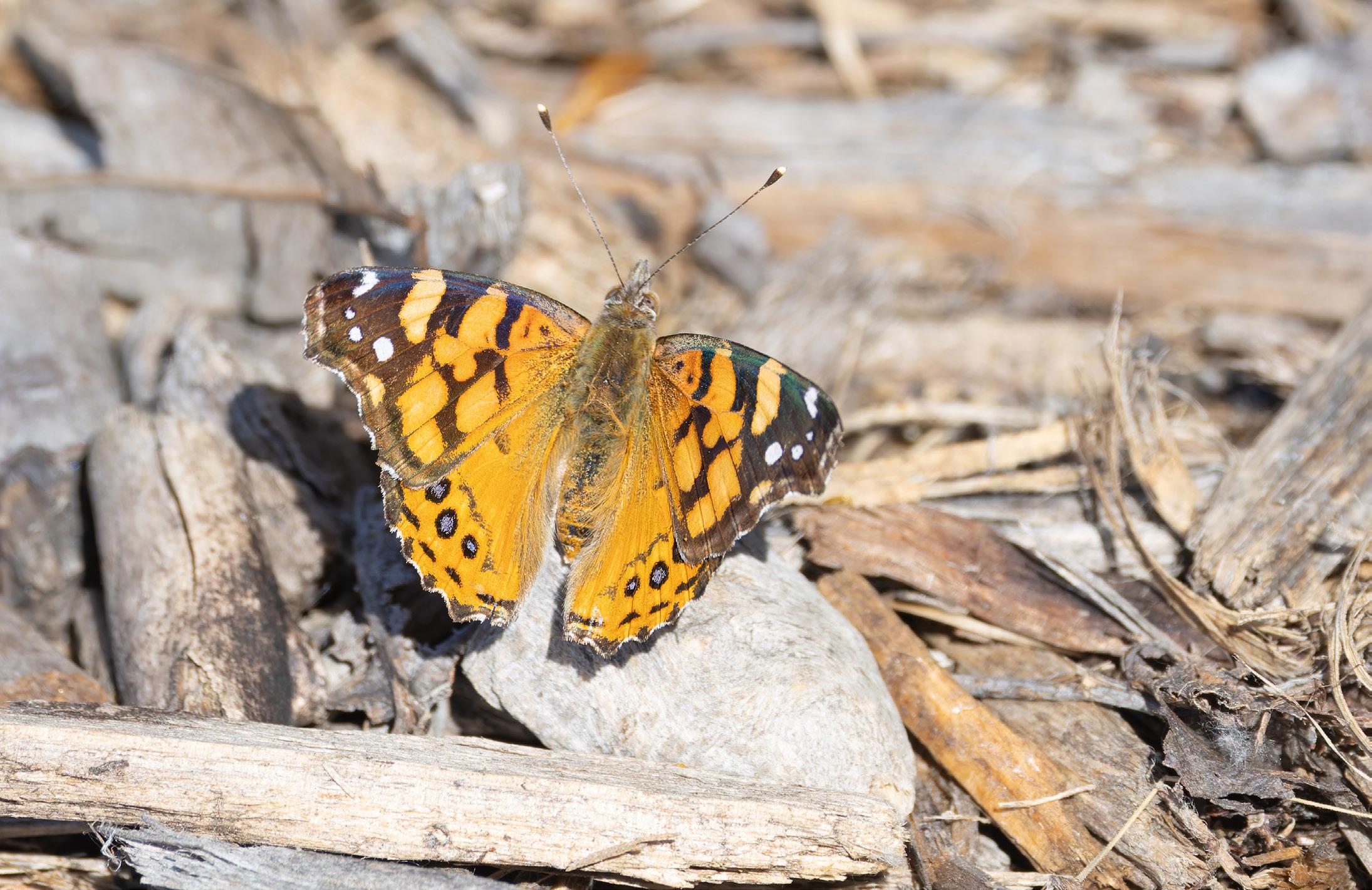
the main pool and cracking views were again had of the male Least Bittern in the same spot as yesterday. A noisy Marsh Wren showed to all, after some effort and butterflies included 6 Mourning Cloaks. a couple of Grey Buckeyes and a gorgeous West Coast Lady on the wood chippings of the hiking trail. A fitting end to a great first day in Southern California.
L.A. COUNTY TO VENTURA
Setting out again today in Pasadena, below the foothills of the San Gabriel Mountains, our first stop was the extensive Hansen Dam Recreation Area, a peculiar flood defence area, with lots of waste ground, full of seed-bearing plants and bushes. As a result, it is very popular with finches. Lawrence’s Goldfinch was at the top of our shopping list, and we were delighted to find a small group of five of them, including a couple of flashy males. It is not of-
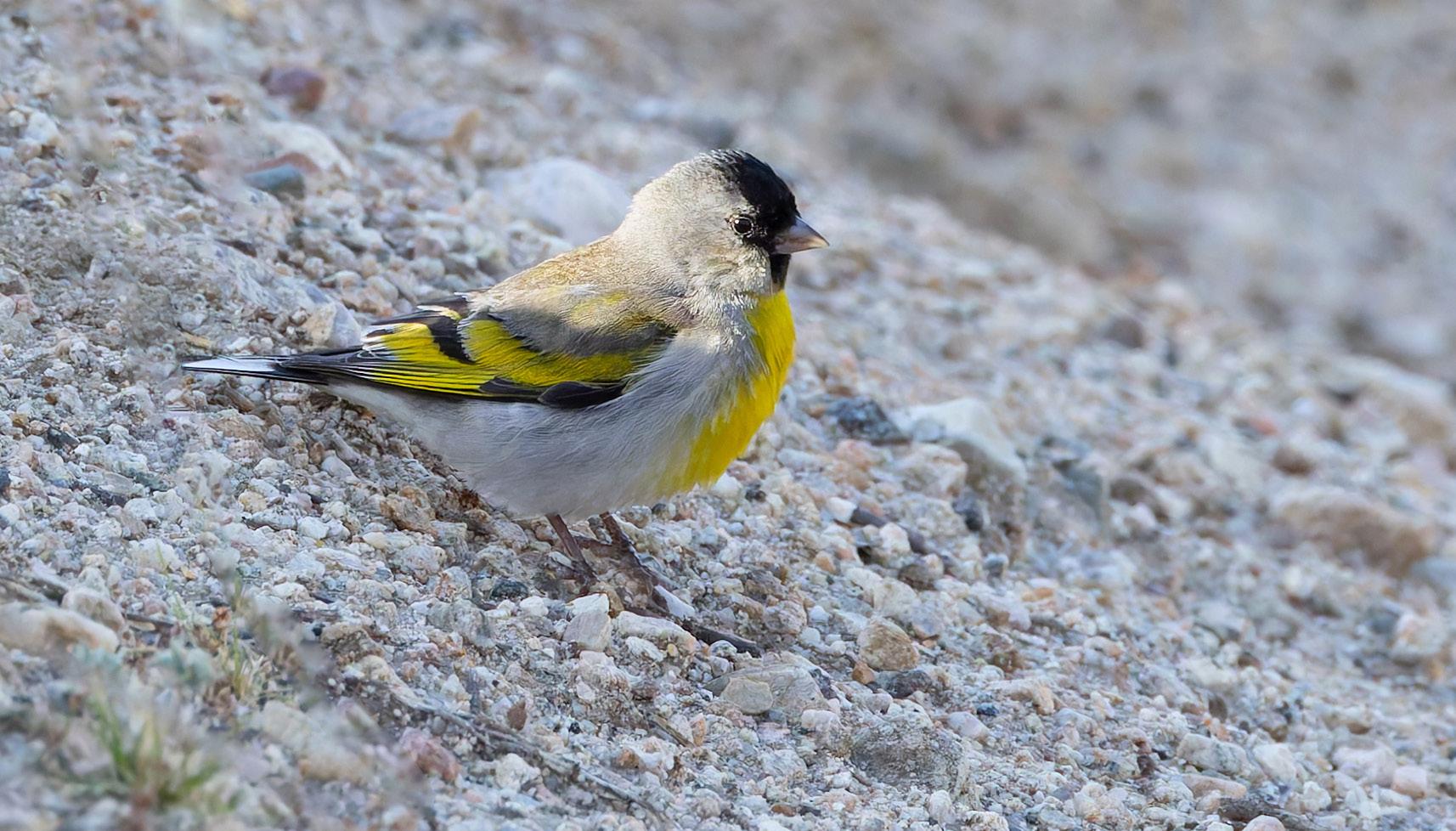
ten that you see all three American species of goldfinch at one spot! There were many Lesser Goldfinches and a smaller number of American Goldfinches here too. Some distant wetlands produced 3 Egyptian Geese and five Spotted Sandpipers but it was the scrub and rank grassland around the reservoir that was the most birdy. Anna’s Hummingbird was new here, as was Ash-throated Flycatcher, California Scrub Jay, Bewick’s Wren, Western Bluebird, Lark Sparrow (the only one of the tour), Yellow breasted Chat (also our only one of this tour) and a flurry of wood warblers that included Orange-crowned, Nashville, American Yellow and Yellow-rumped Warblers. A furtive Coyote slinked past us as we returned to the vehicles. For once we may not have been the strangest-looking people wandering around early in the morning! Hansen Dam attracts other weirdos too.
Our next stop at Sepulveda Basin was ultimately unnecessary. A sprawling recreational
area that included some decent riparian habitat. Both Acorn and Nuttall’s Woodpeckers were here, along with a family party of Vermilion Flycatchers, Western Bluebirds and a Blue Grosbeak of note. Butterflies included many Monarchs, a couple of Western Tiger Swallowtails and a Funereal Duskywing. Our ultimate destination today was Ventura, on the Pacific Coast, and as we made our way West towards it we spent the early afternoon in Malibu Creek State Park. This is a very picturesque site, which the fire season flames do not seem to have reached yet. Among the oak trees along the pretty creek, we saw more Acorn and Nuttall’s Woodpeckers, California Scrub Jay, our first Oak Titmouse and Wrentit. A spectacular Phainopepla was seen high in the oak trees and, among a nice selection of the passerines, Bullock’s Oriole stood out. Butterflies here included a small number of Acmon Blues and the spectacular California Sister. We still had time for one more brief session at Portrero Ranch
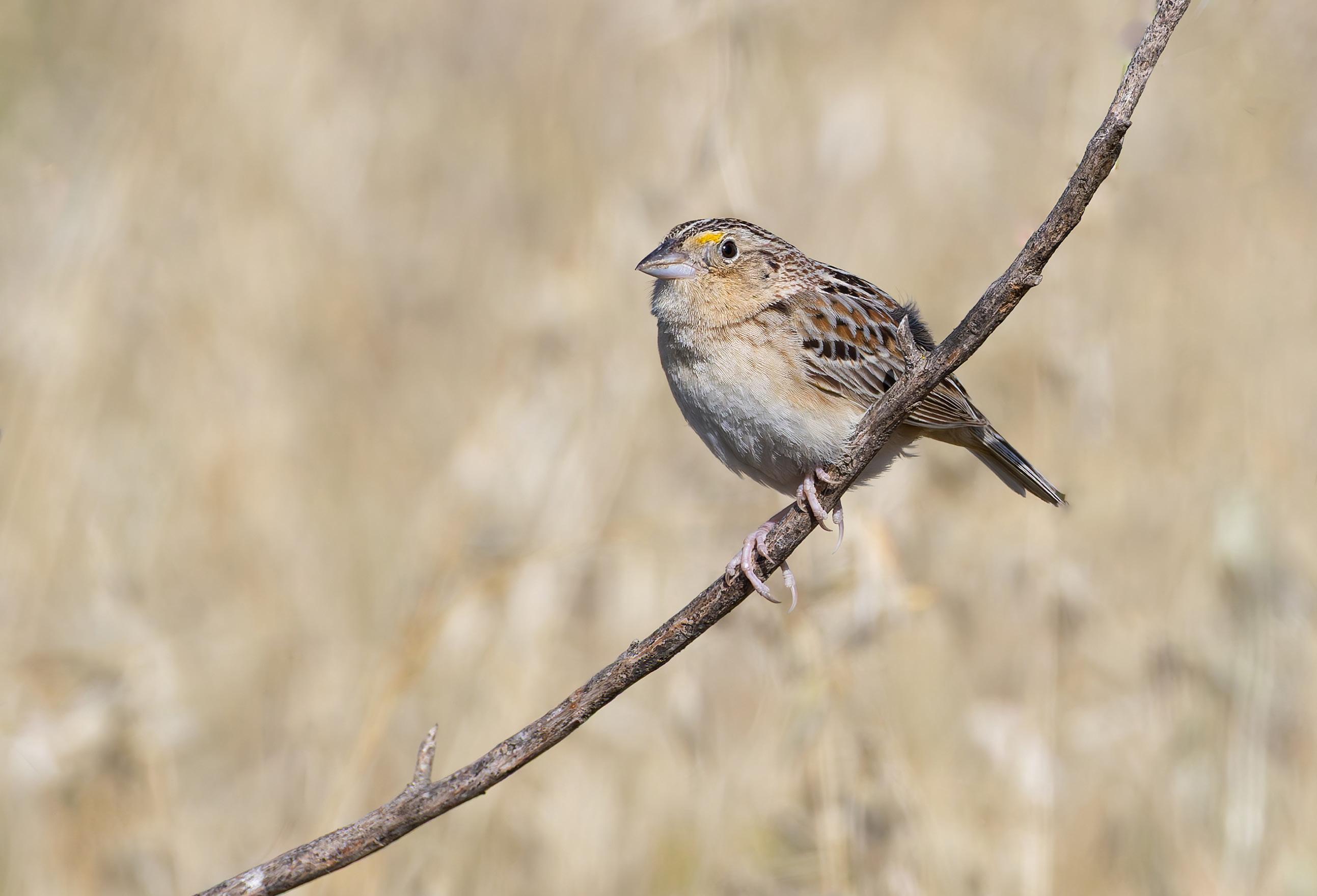
Open Space we made very short work of finding an incredibly showy Grasshopper Sparrow, which perched up in the weedy grassland for walkaway views. Another nice way to finish a great day’s birding.
CHANNEL ISLANDS NATIONAL PARK
The entire next day was devoted to a visit to Santa Cruz Island in the Channel Islands National Park, which is accessed via a small passenger ferry from Ventura. Once we had completed the order of what seemed like one million breakfasts and packed lunches against a strict deadline, we were soon on our way out of the marina choked with expensive yachts and motorboats. Goodness knows how much money was moored here. In the marina itself 3 Clark’s Grebes and a couple of Pacific Loons were notable. The Santa Barbara channel crossing was very calm and on the
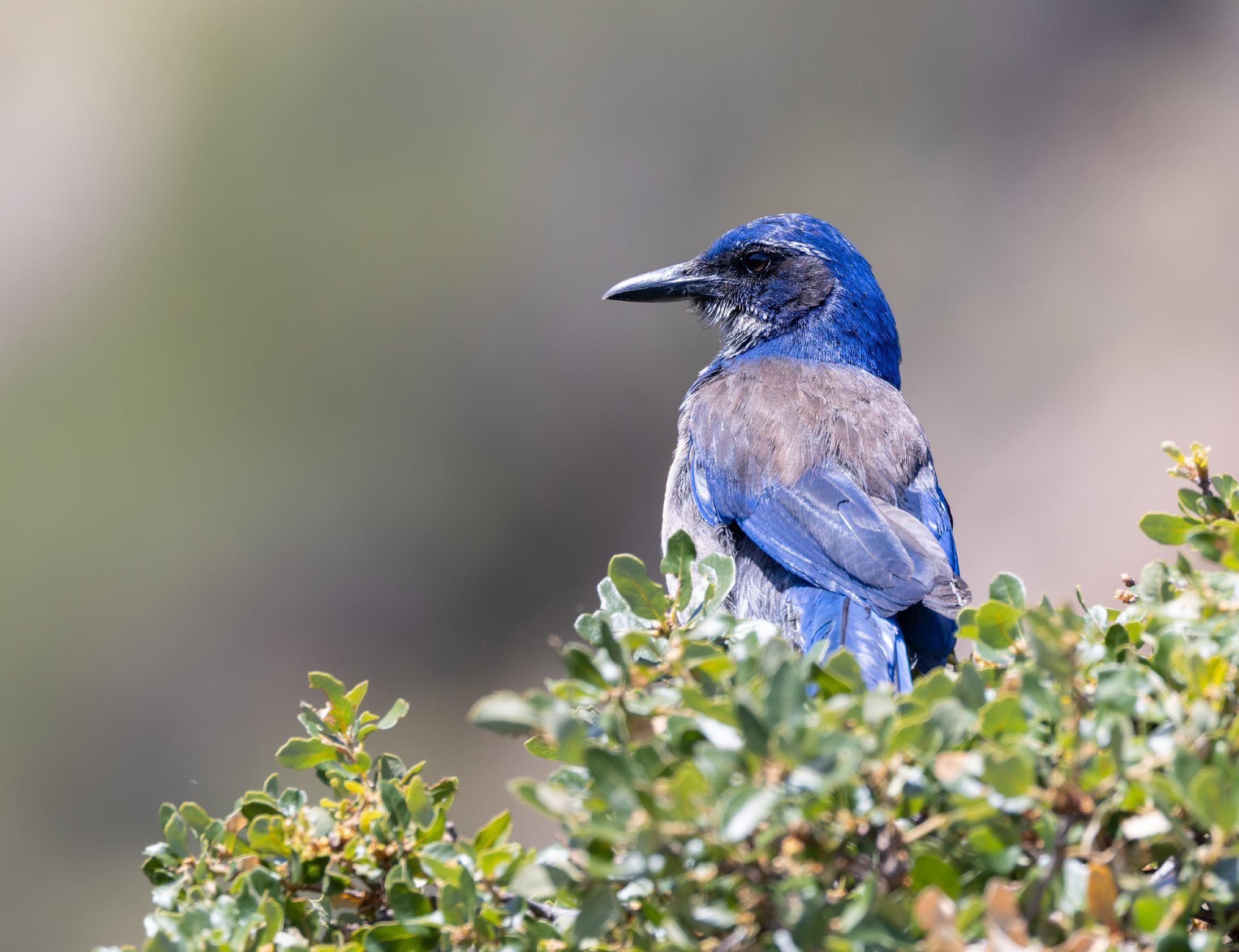
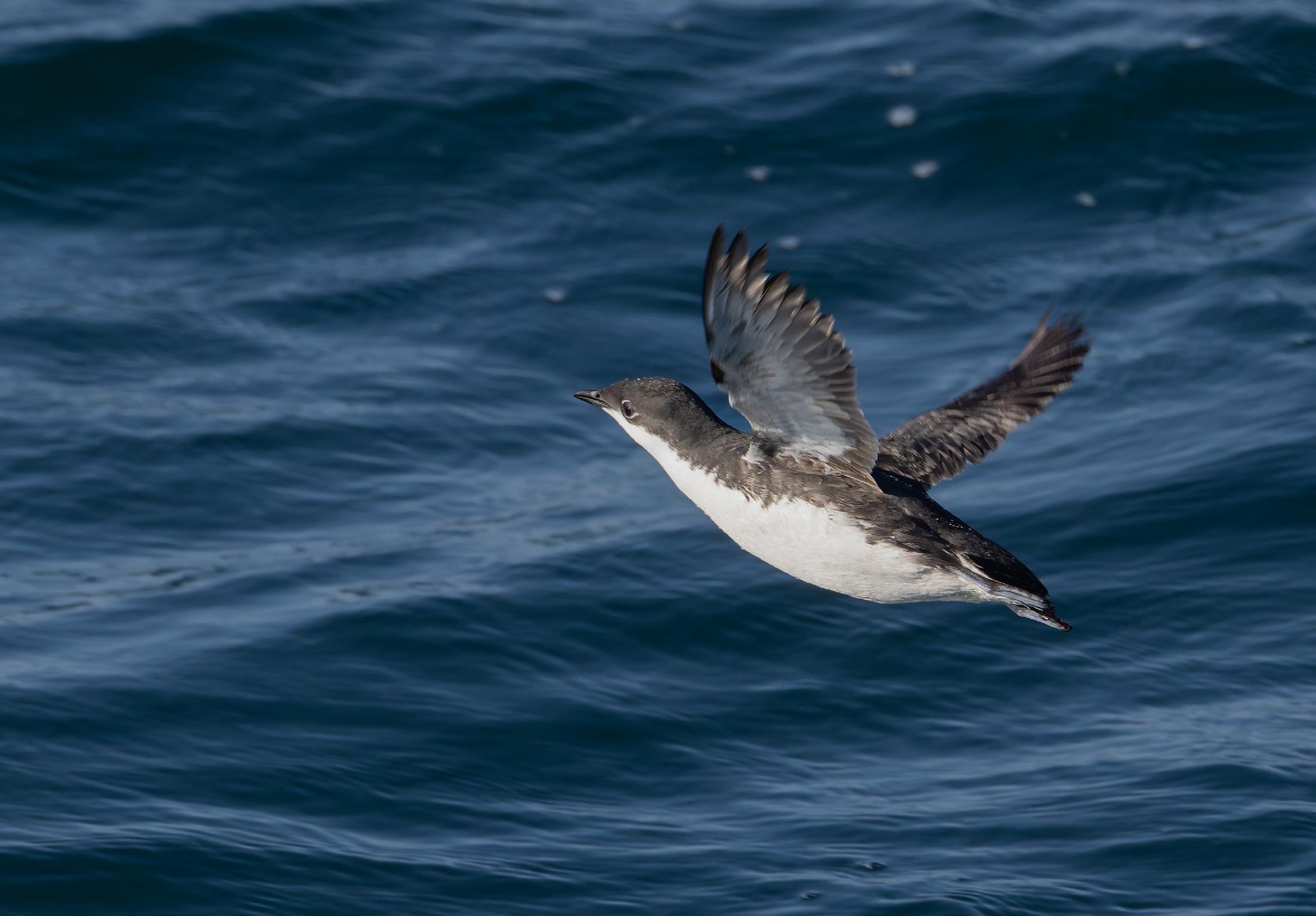
glassy waters we spotted numerous Common Murres as well as Red-necked Phalaropes, pausing on their northward migration, as well as 8 Scripps’s Murrelets and a brief Cassin’s Auklet. After a brief stop at Scorpion Harbour, where we dropped off some campers, it was on to the more substantial Prisoners Harbour, trailhead for the Pelican Bay hike. We were hardly off the jetty when the first Island Scrub Jays were called, mobbing a young Bald Eagle high in a tree overlooking the beach. Several Surf Scoters, and a terrific breeding plumage Common Loon feeding near the jetty. After a briefing concerning the many things, which you are not allowed to do here, we started on our short hike along the Pelican Bay trail. We even had to sign a waiver before we were let loose on it! The trail winds its way along the coastline to the north of Prisoners Harbour, passing through some lovely oak woodland. However,
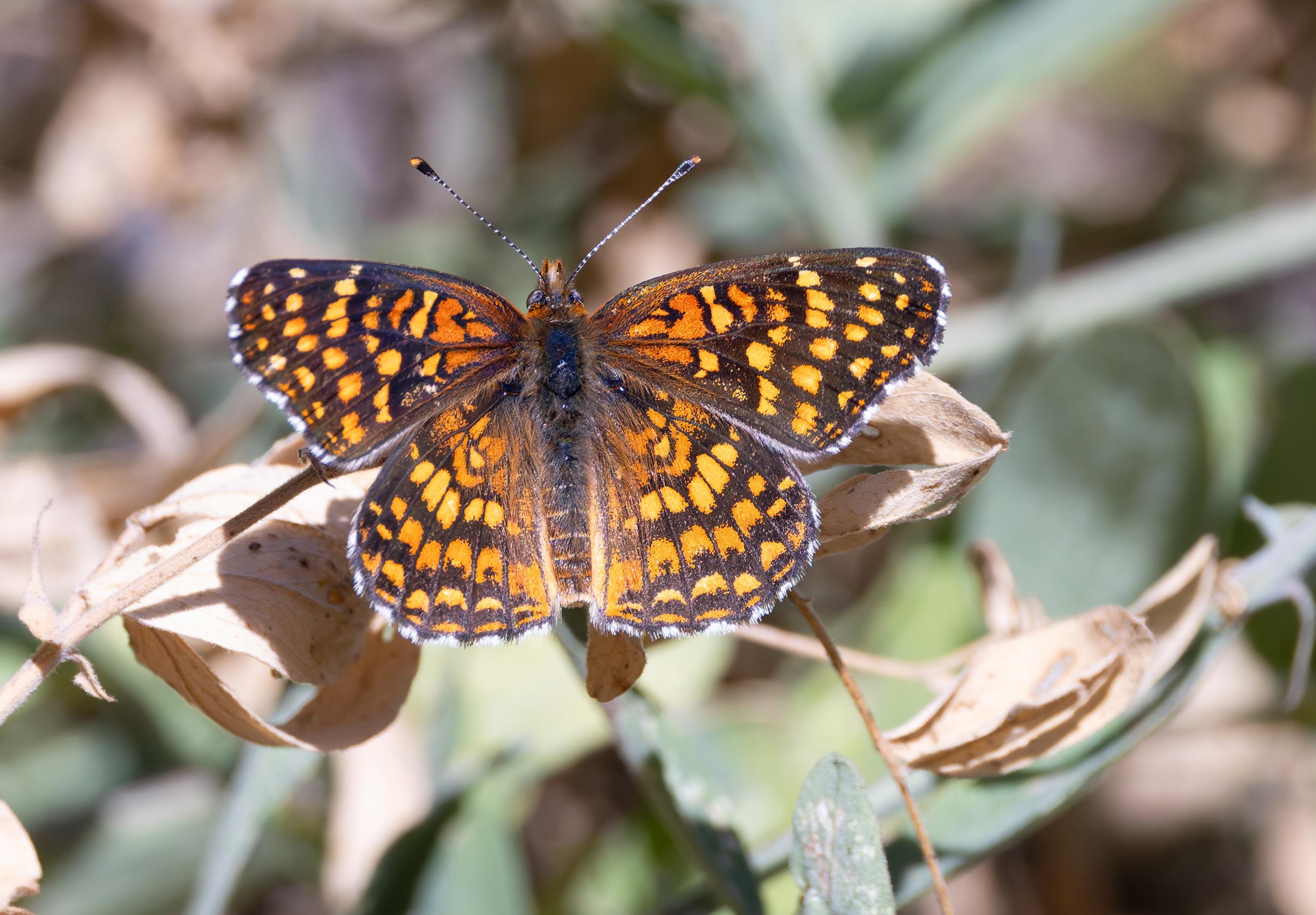
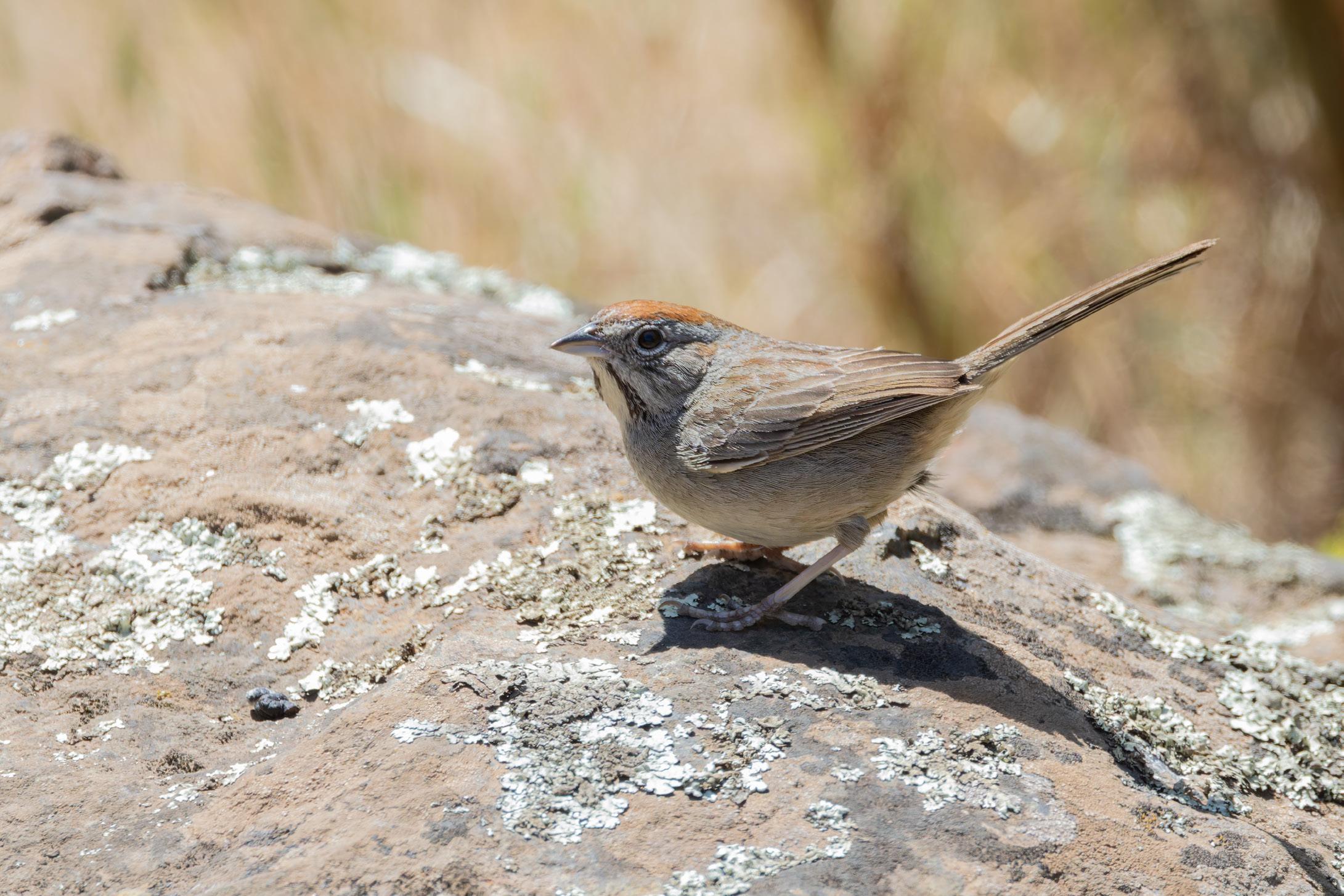
there were also many dead oak trees, maybe a sign of severe drought here recently? Birds seen along the trail included Western Warbling Vireo, many more Island Scrub Jays, American Bushtit, Rufus-crowned Sparrow of the island subspecies obscura and Black-headed Grosbeak of note but lizards abounded! The endemic Island Fence Lizard Sceloporus occidentalis was common alongside the more widespread and Common Side-blotched Lizard Uta stansburiana. However, it was the butterflies that I was really interested in and after many Marine Blues Leptotes marina and a couple of Grey Hairstreaks Strymon melinus we finally started to see our first Gabb’s Checkerspots Chlosyne gabbii. By now it was midday and they were extremely active, hardly pausing for more than a second or two, so it took some time to finally get an acceptable image of this beautiful butterfly, found more easily here than on the mainland. Towards the end of the hike, we gathered near the jetty, where a Western Flycatcher of the Chanell Islands form insulicola, was show-
ing and several Leopard Sharks could be seen on the seabed. At 4:30pm the Island Packers boat arrived to take us back to the mainland. The return crossing was much more birdy than the outbound journey, and we tallied a total of 40 plus Scripp’s Murrelets, as well as a stray Bonaparte’s Gull and many Pacific and Red-throated Loons. A number of Sooty Shearwaters were passing southward over at least a squillion Bythe-wind sailor jellyfish were dotted over the water’s surface, as far as the eye could see! An Ocean Sunfish/Mola mola was spotted on the surface about halfway, most likely attracted by the profusion of jellyfish on which it was happily munching. A Pomarine Skua was probably the most notable sighting before we reached land. On another sunny evening in SoCal we cruised gently back into Ventura Marina. What a unique and enjoyable day this had been!
TO THE CUYAMA VALLEY
Leaving Ventura behind, we headed a little further along the coast to Santa Barbara this morning, where our first stop was Rancho La Patera/Lake Los Carneros Ecological Reserve, where we wasted no time in finding a singing California Thrasher. Other new birds in the parkland included Band-tailed Pigeon, American Robin and the gaudy Western Tanager. The other bird we hoped for in the Santa Barbara area, that we had failed to find around LA, was Surfbird. However, it seemed they had all now gone north, leaving the rocky promontories that we checked empty of shorebirds at Campus Point, a couple of Heermann’s Gulls were present and at the nearby Coal Oil Point/ Sands Beach we spotted a handful of Snowy Plovers at their protected breeding site. Pacific Loons were still passing offshore and on nearby coastal lagoons Black bellied and Semipa-
lmated Plovers were seen. A small flock of 15 Western Sandpipers was among them. However, what was probably the most interesting sighting here was around 10 American Cliff Swallows collecting mud for their nests. Heading inland to chaparral country, we stopped at Zaca Station Road, a Yellow-billed Magpie spot. A large untidy nest in an oak tree was being visited, and a magpie was gathering food from something and taking it to the nest. The food turned out to be a dead Gopher Snake, which we placed in a more photogenic spot. Unfortunately, this placement coincided with the miss-timed arrival of a fellow selling fresh fruit who plonked his mobile food stand right next to it. Sigh! Western Kingbird was new here, as well as Golden Eagle (a pair overhead) and a Sharp-shinned Hawk. A minor detour to the northwest took us back to the coast where at Oso Flaco Lake we located
a couple of groups of Chestnut-backed Chickadees in the fen woodland along the entrance track and beyond the boardwalk, on the edge of the sand dunes. A most unusual habitat for this bird, which I had previously associated with the pine forests of the Pacific Northwest. Also here were our first Cinnamon Teal, a heard-only Virginia Rail, Townsend’s and Wilsons Warblers. We also had more good views of Wrentit and a profusion of Marsh Wrens, along the boardwalk. We had some distance to make up to reach our evening destination of Taft, in the Central Valley but we still had time to pause for Tricolored Blackbird at Caliente Ranch Wetland, gathering to roost in the cattails around a water tank, affording some nice views in the evening sunshine. Reaching the oil town of Taft on another lovely sunny evening, we ate at another excellent micro-brewery, combining craft ale and ammunition. The steaks were pretty good too.
MIDWAY–SUNSET OILFIELD DAWN
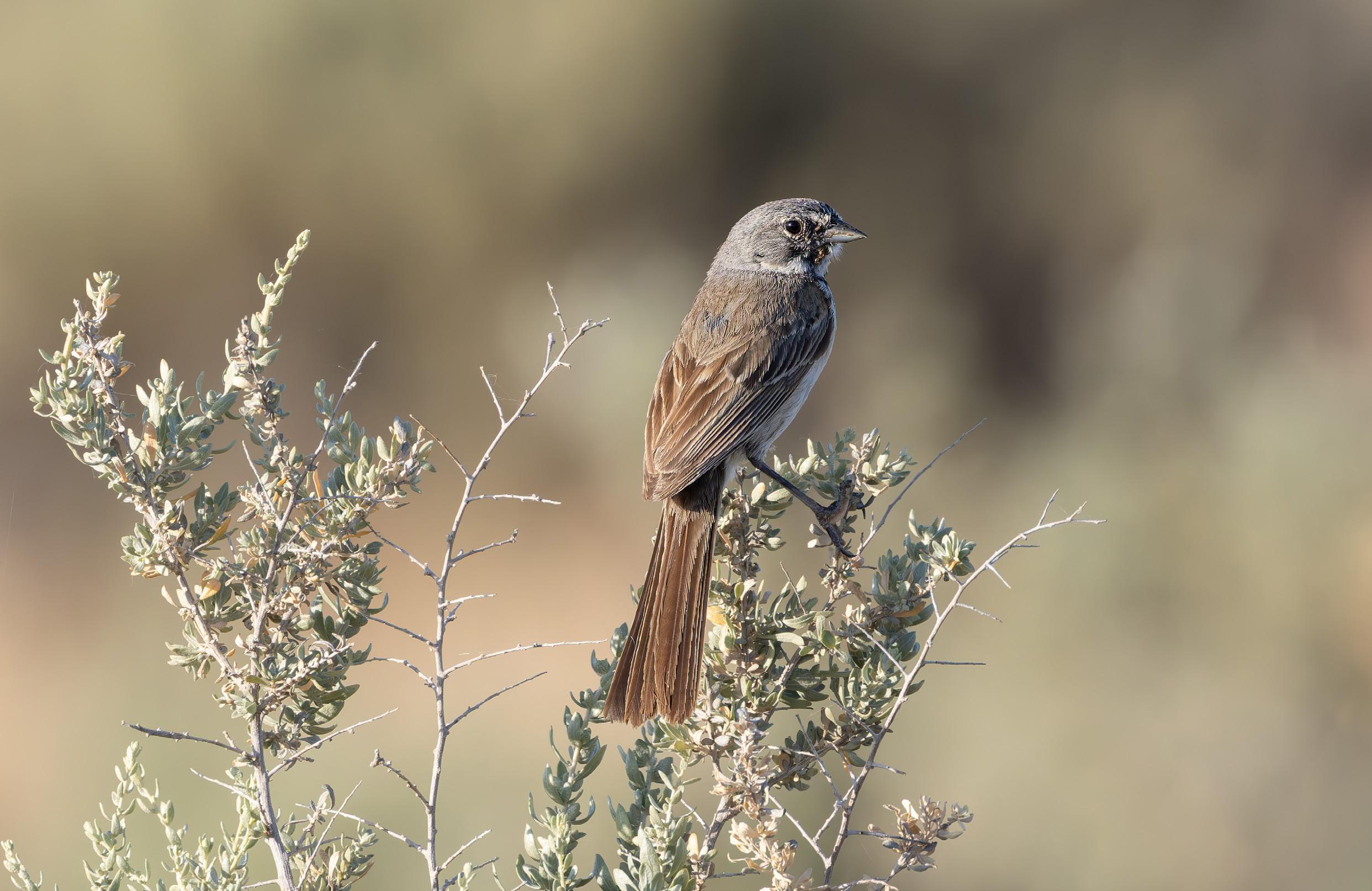
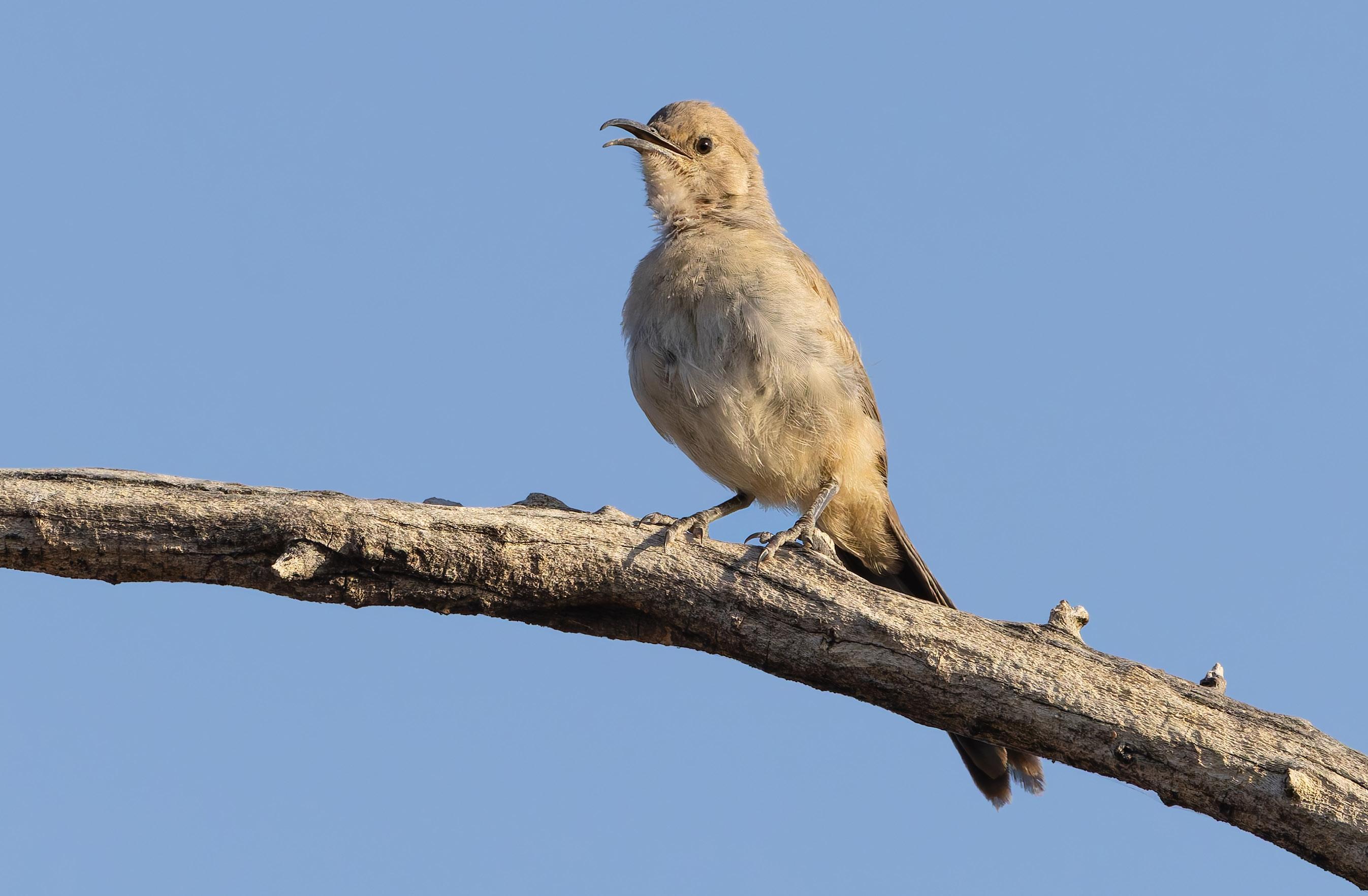
I don’t think I have seen so many nodding donkeys before. The sagebrush prairie around Taft is peppered with them but among the many seemingly abandoned oil fields and their pipelines etc, there is still excellent habitat. As soon as we pulled up by the roadside, Bell’s Sparrows were singing, Loggerhead Shrike was common (a declining bird that I do not see many of these days) but where was the thrasher? We knew they can be very too tricky to pin down in this vast landscape. Although their voice carries over quite a distance it can appear distorted and like meadowlark when it becomes faint. Straining our ears, we eventually figured out where a good candidate was singing from and after a couple of kilometres walk, we finally found a LeConte’s Thrasher. It was very confident for this species and eventually afforded some great looks, singing from a dead tree next to us. More walkaway views. Walking
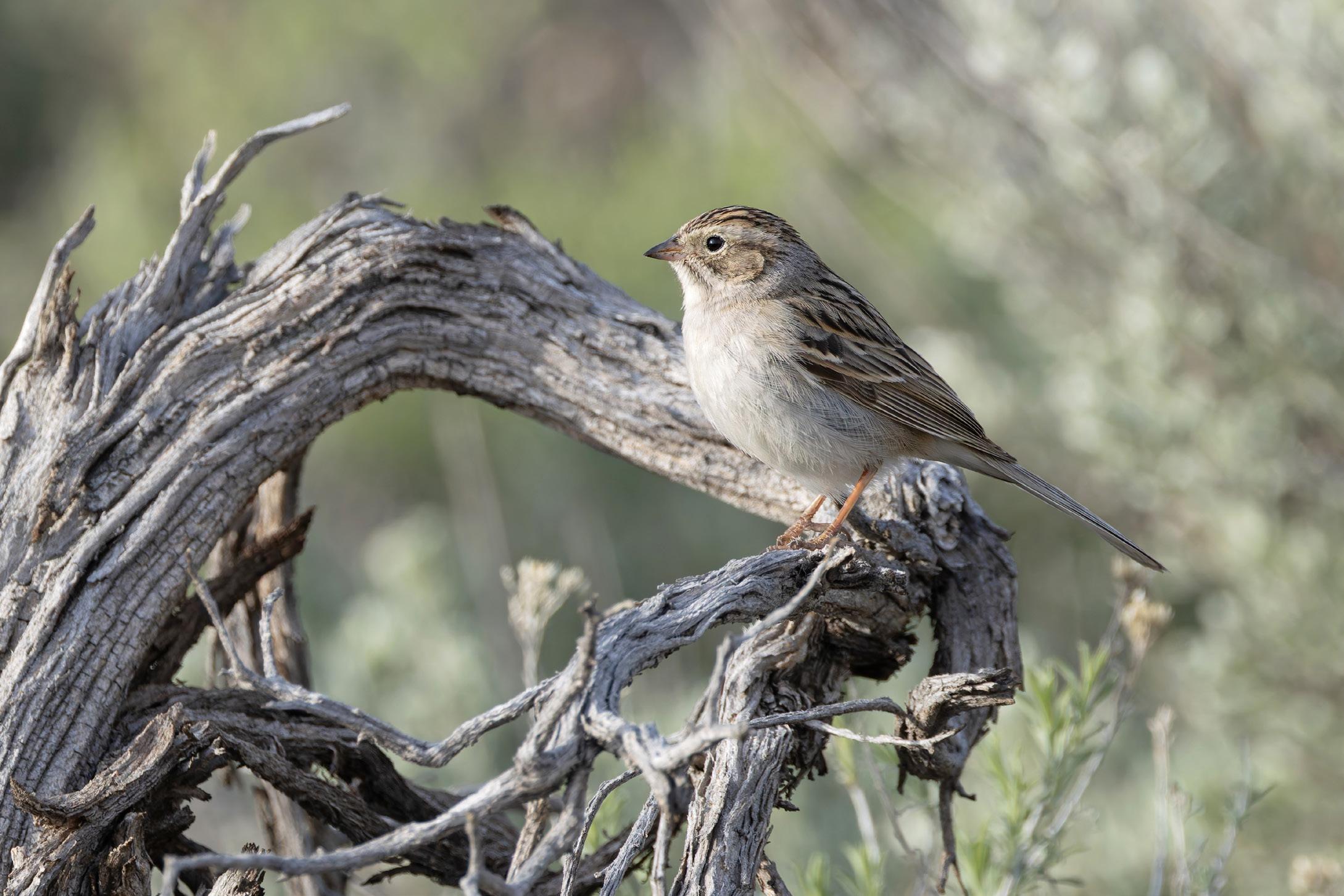
Bell’s Sparrow, Petroleum Club Road. Next page: LeConte’s Thrasher & Lesser Nighthawk (Mike Watson)
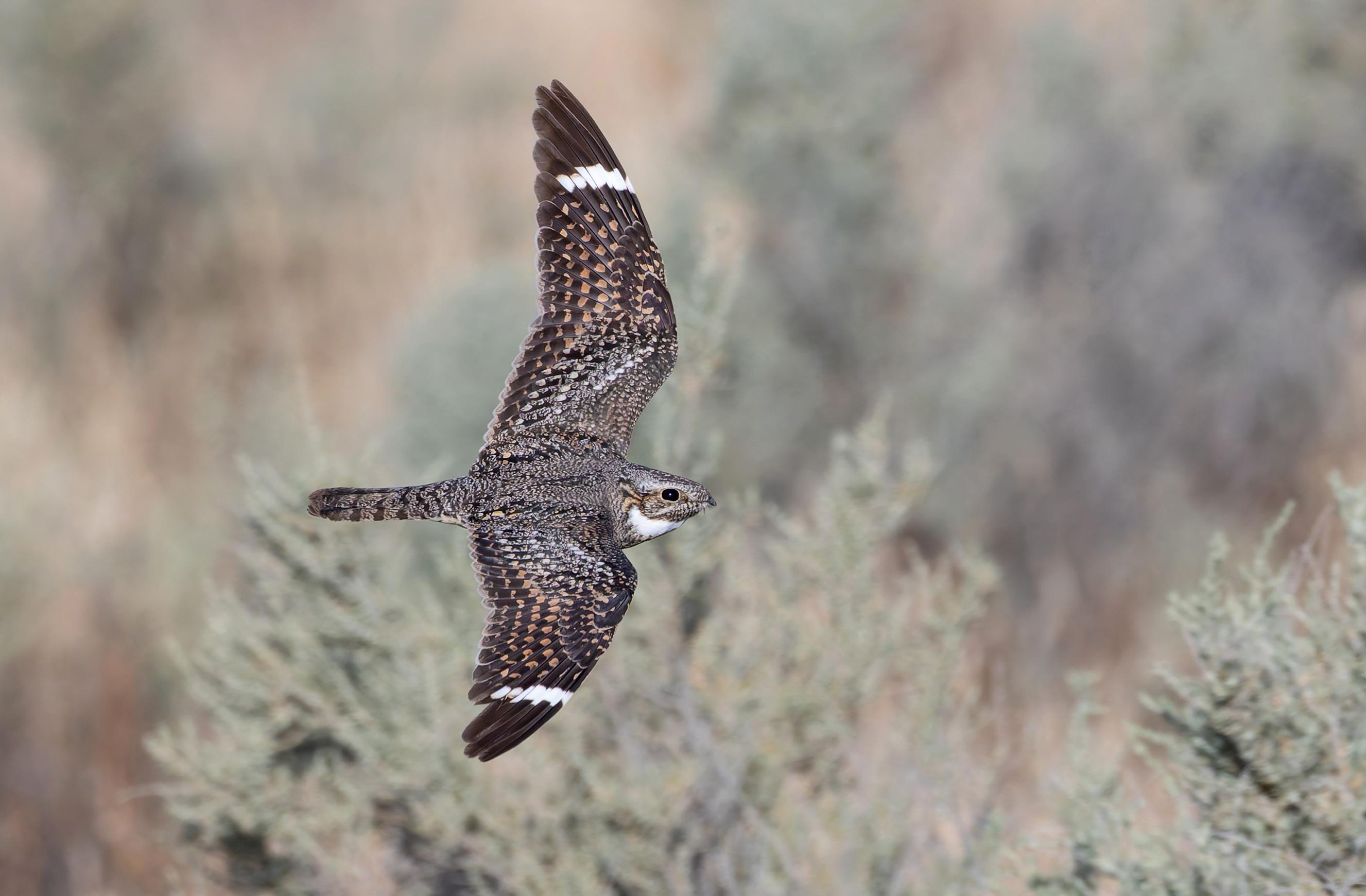
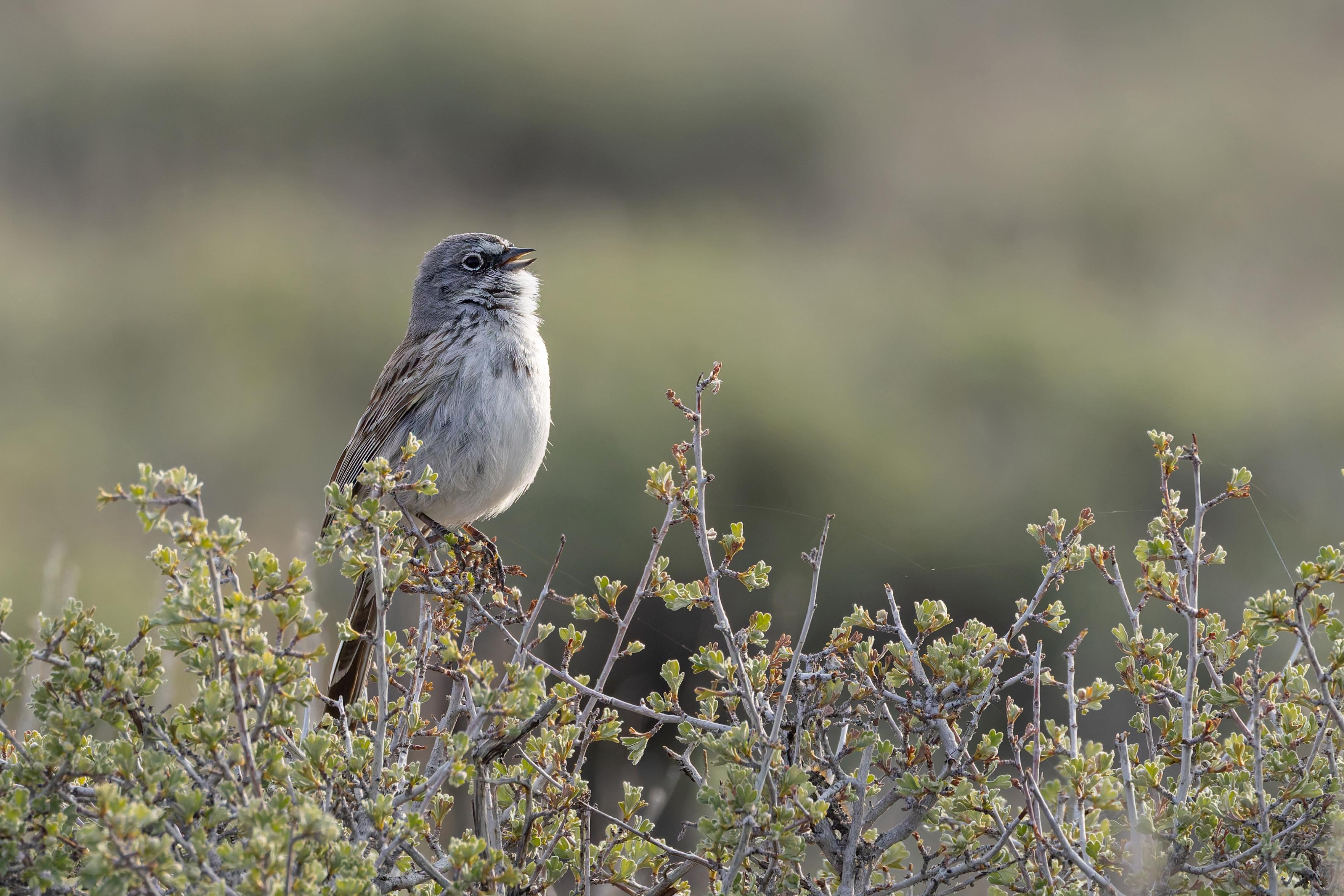
away, a bird fluttered out of the sagebrush at my feet, wow! Lesser Nighthawk. There was a pair of them, which proceeded to give some amazing views flying around us, quite unconcerned in the daylight. We made our way back to the cars, past more Bell’s Sparrows and Loggerhead Shrikes. Mammals here included Black-tailed Jackrabbit and the cute little Nelson’s Antelope Squirrel. A very enjoyable experience! It was now time for some plastic waterfowl, Wood Duck in Hudson Memorial Park, Bakersfield. Our ultimate destination today was Bishop in the far east of California and to get there, we had some mountainous terrain to cross. Stopping at Walker Pass Campground a short stroll quickly turned into a more strenuous hike uphill, following the calls of Mountain Quail. Piñon Jay was also here, as well as Lawrence’s Goldfinch and White-crowned and Golden-crowned Sparrows. Making our way up a rocky escarpment, we eventually had some decent views of the shy quails. Butter-
flies included Northern Checkerspot and more Acmon Blues. Unfortunately, not everyone was able to make the tricky hike uphill, off trail, so there was some catching up to do later. Heading north, we made one more birding stop this afternoon at the mount Whitney Fish Hatchery, a bizarre building, constructed for the purpose of rearing fish. It was more like a monastery/ castle! Our target here was the attractive Lewis’s Woodpecker and we were happy to find a single lingering winter visitor of this fine looking ‘pecker. Also here were Cassin’s Kingbird, Black-headed Grosbeak and Western Tanager of note.
EASTERN SIERRA
Next morning a painfully early start saw us deep in the heart of sagebrush country, well before dawn, on our way to a famous Greater Sage Grouse lek, news of which is obscured these days. After a hike of almost 2 miles, we enjoyed some good, although still quite distant,
views of the lek, which held at least 73 birds. Very nice, but a far cry from the 10-20 metre views I had in Colorado last month! A distant Sandhill Crane was Nick’s final crane species in the world and a surprising lifer for Sjoerd. Several American White Pelicans could be seen on the lake, the only identifiable birds at such a vast distance. Closer to hand, up to three Northern Harriers and a couple of Bald Eagles were seen. The sagebrush itself was very birdy indeed and was full of bird song this morning, with Horned Lark, Sage Thrasher, Sagebrush, Brewer’s and Vesper Sparrows and Western Meadowlark all performing beautifully, oh, and up to 10 Least Chipmunks, climbing to the top of the sagebrush to take in the early morning sun after a cold start to the day. From Crowley Lake we headed north into the Inyo National Forest, where at Indio Craters we enjoyed some great birding in the shadow of enormous Jeffrey Pines. Woodland birds here included Hairy and White-headed Wood-
peckers, Steller’s Jay and a single Clarks Nutcracker. A profusion of Mountain Chickadees was accompanied by White-breasted and Red-breasted Nuthatches and a Brown Creeper was also spotted. The pines were full of Yellow-rumped Warblers and a distant Cassin’s Finch was heard singing. At Deadman Creek Rd, Daniel excelled himself in spotting a cracking male Williamson’s Sapsucker, which flew across a forest track in front of his car. I’ve no idea how he saw it, he was driving into a dust cloud at the time. It proceeded to perform very well for all, including giving its distinctive tapping drum. A hike deeper into the forest eventually produced the wonderful Black-backed Woodpecker also performing beautifully, albeit a little shy of the gathered group, often hiding behind pine trees and peeking at us. A pair of White-headed Woodpeckers was also here, as well as the electric Mountain Bluebird. It was now time for lunch in nearby Mammoth Lakes. We finished the afternoon at Aspendell, a little
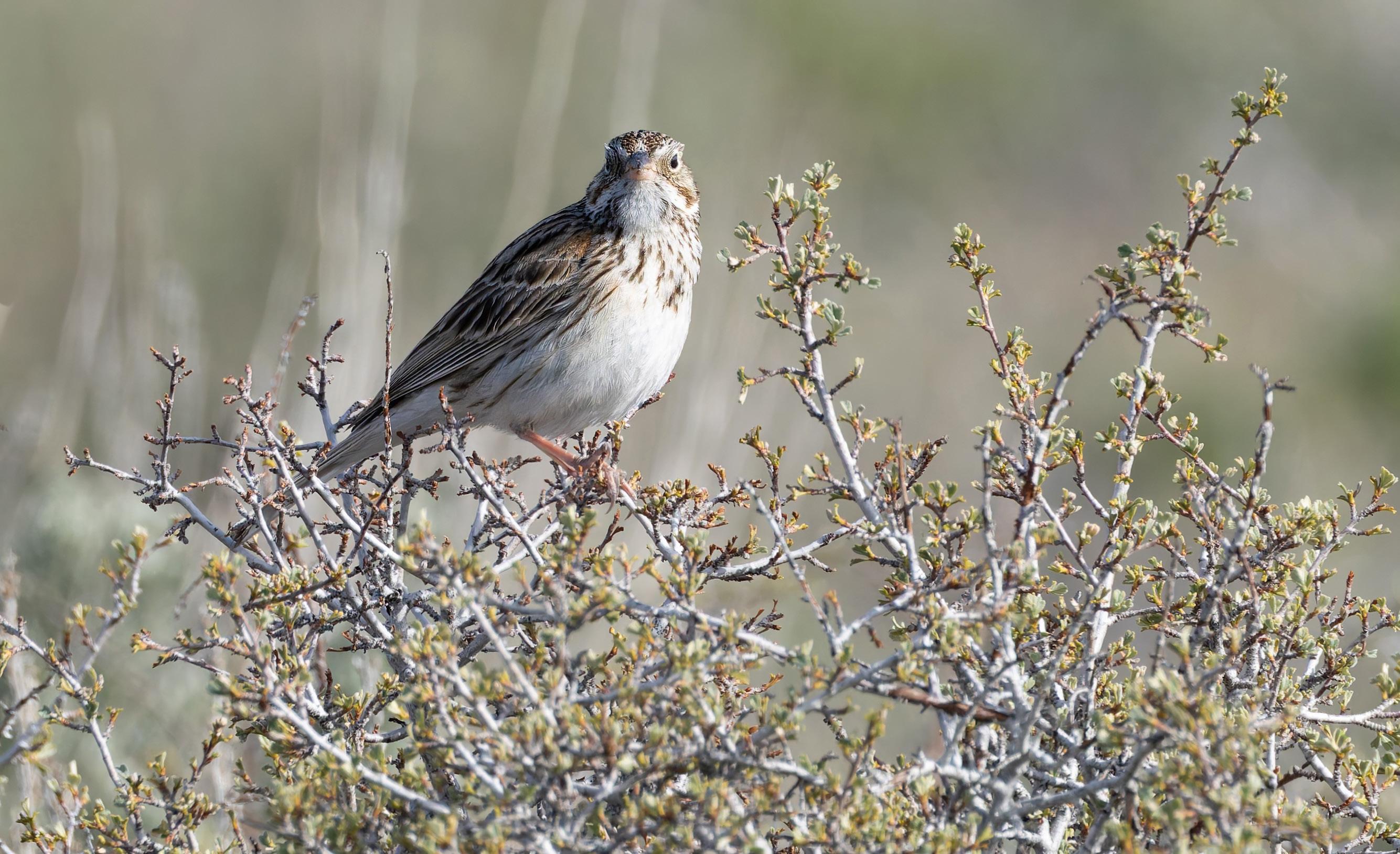
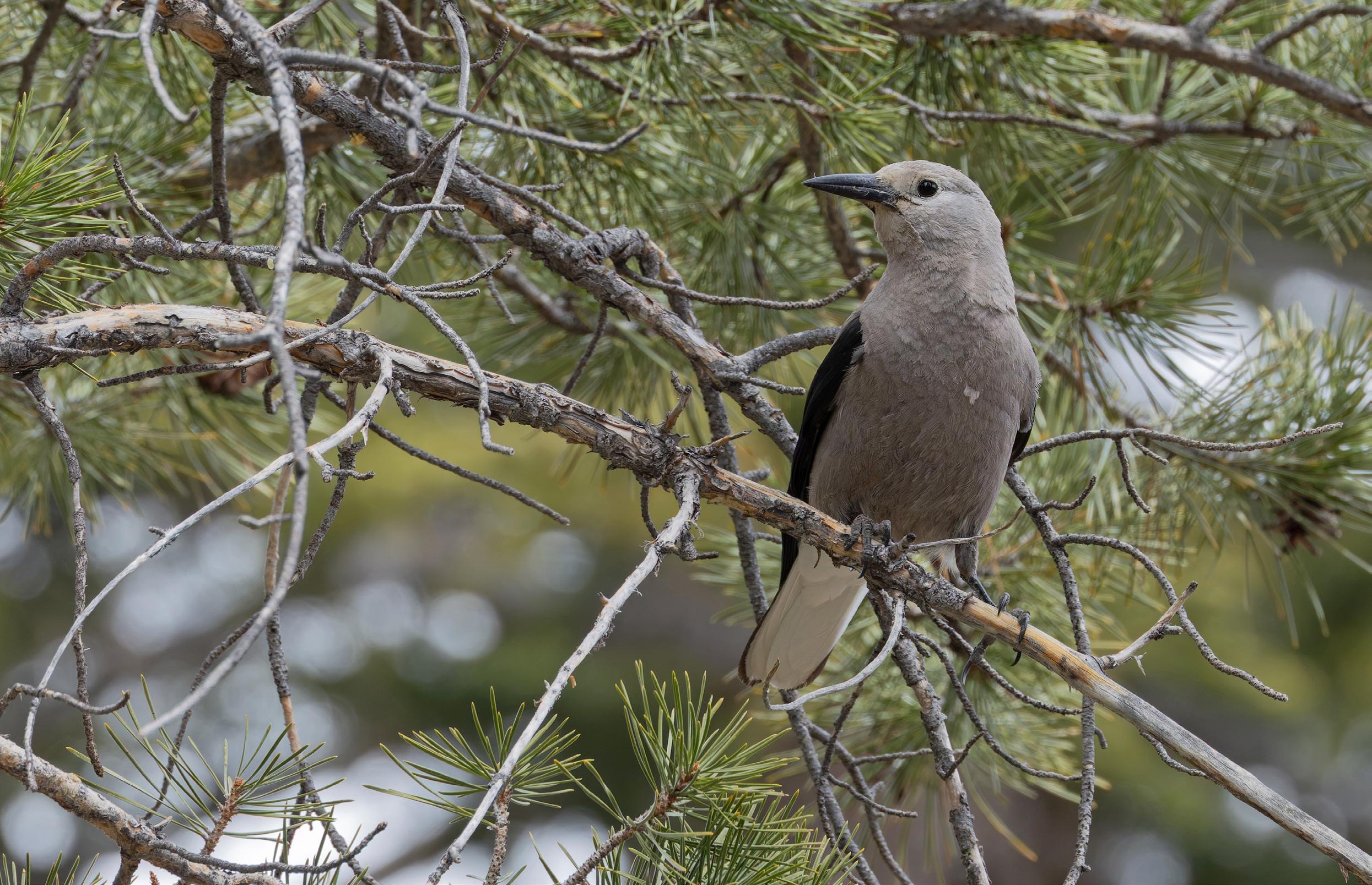
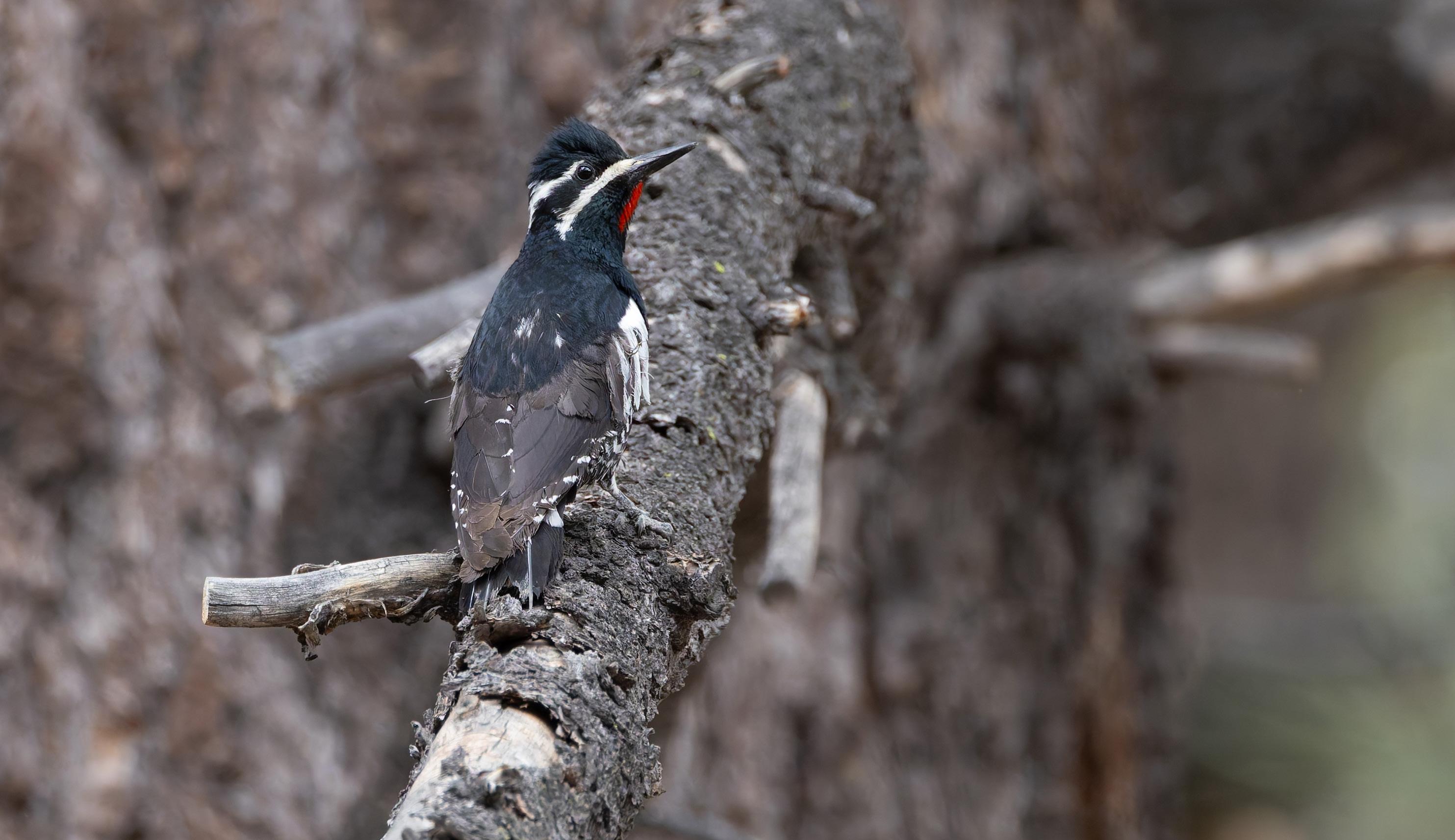
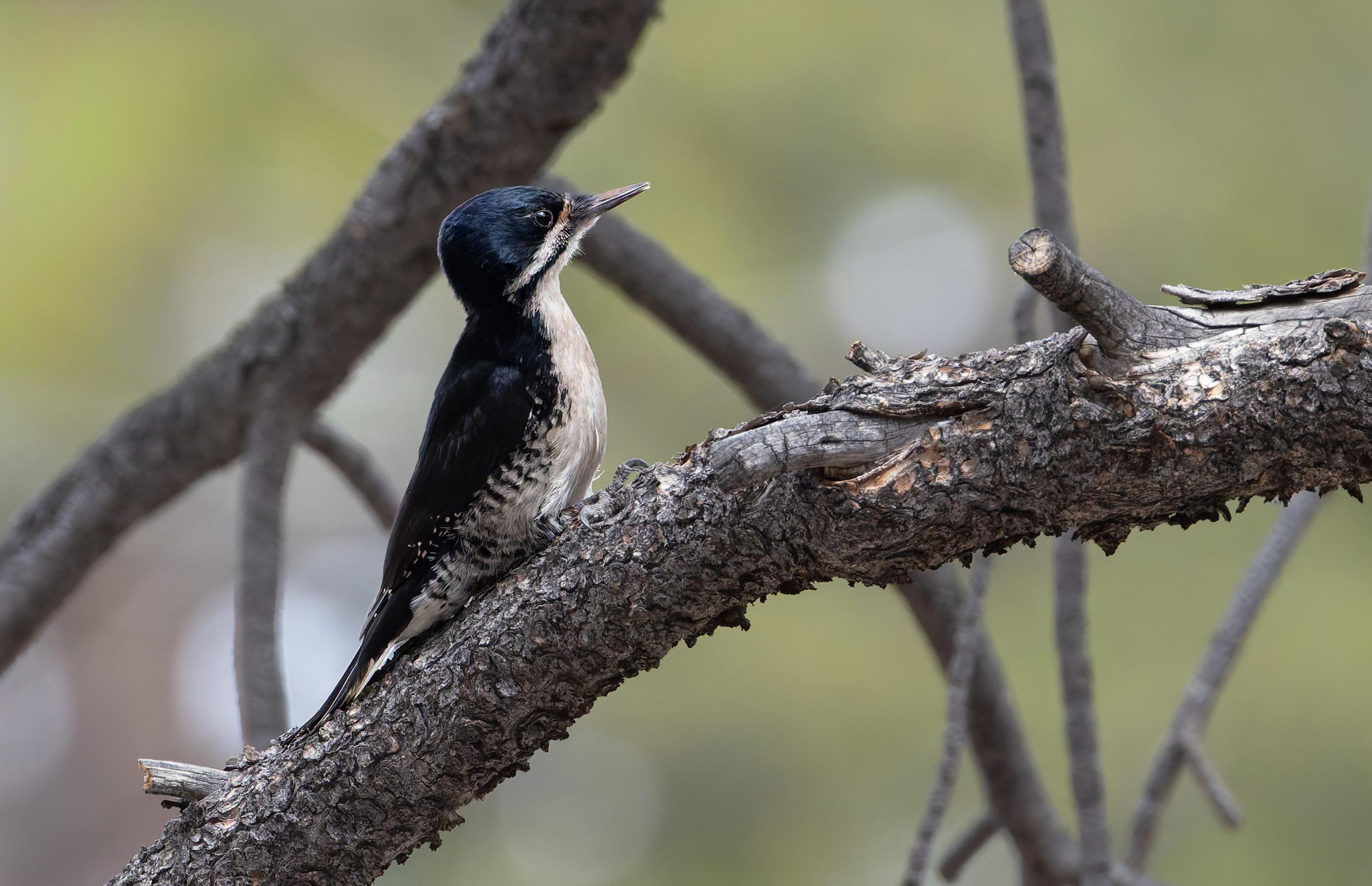
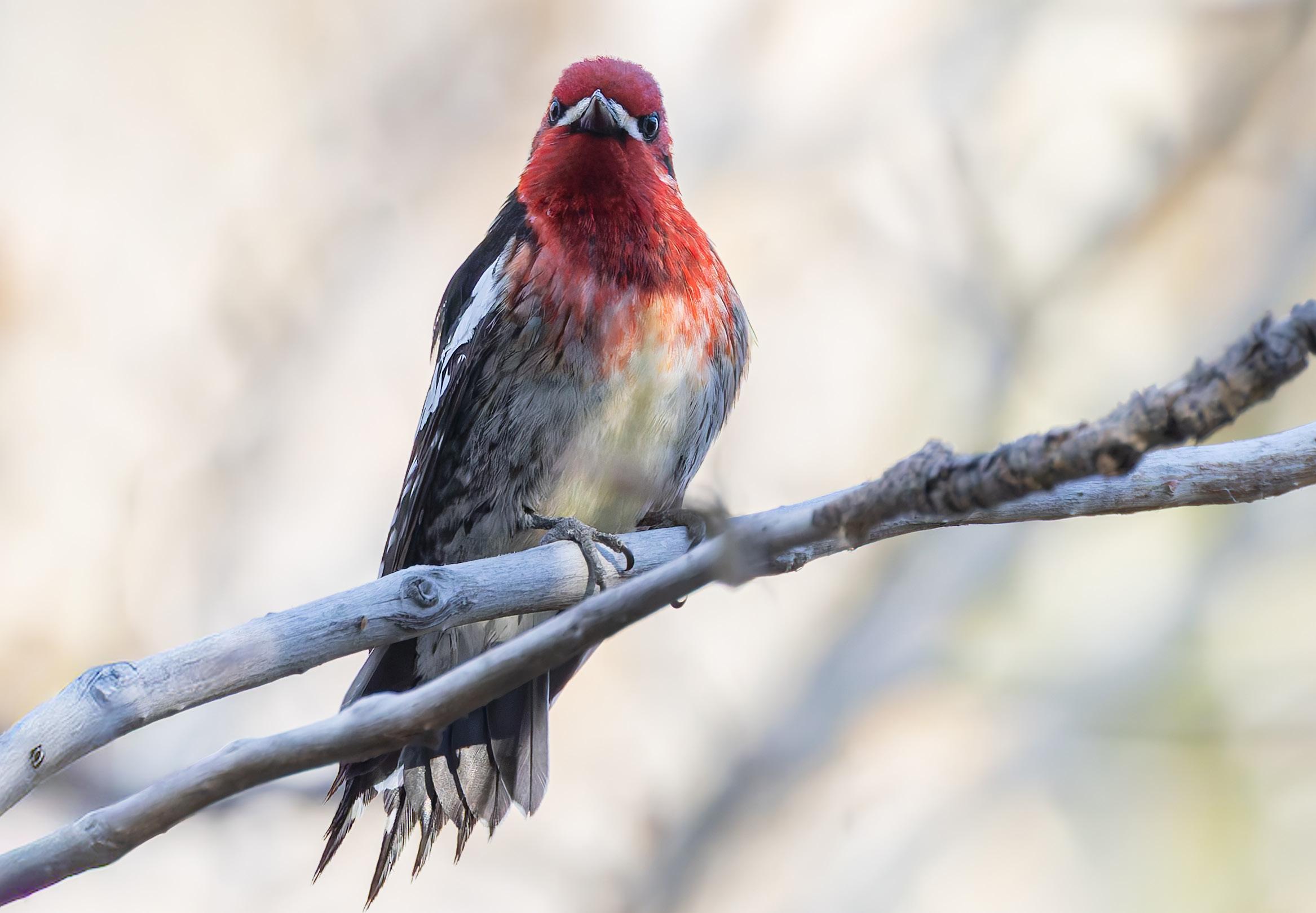
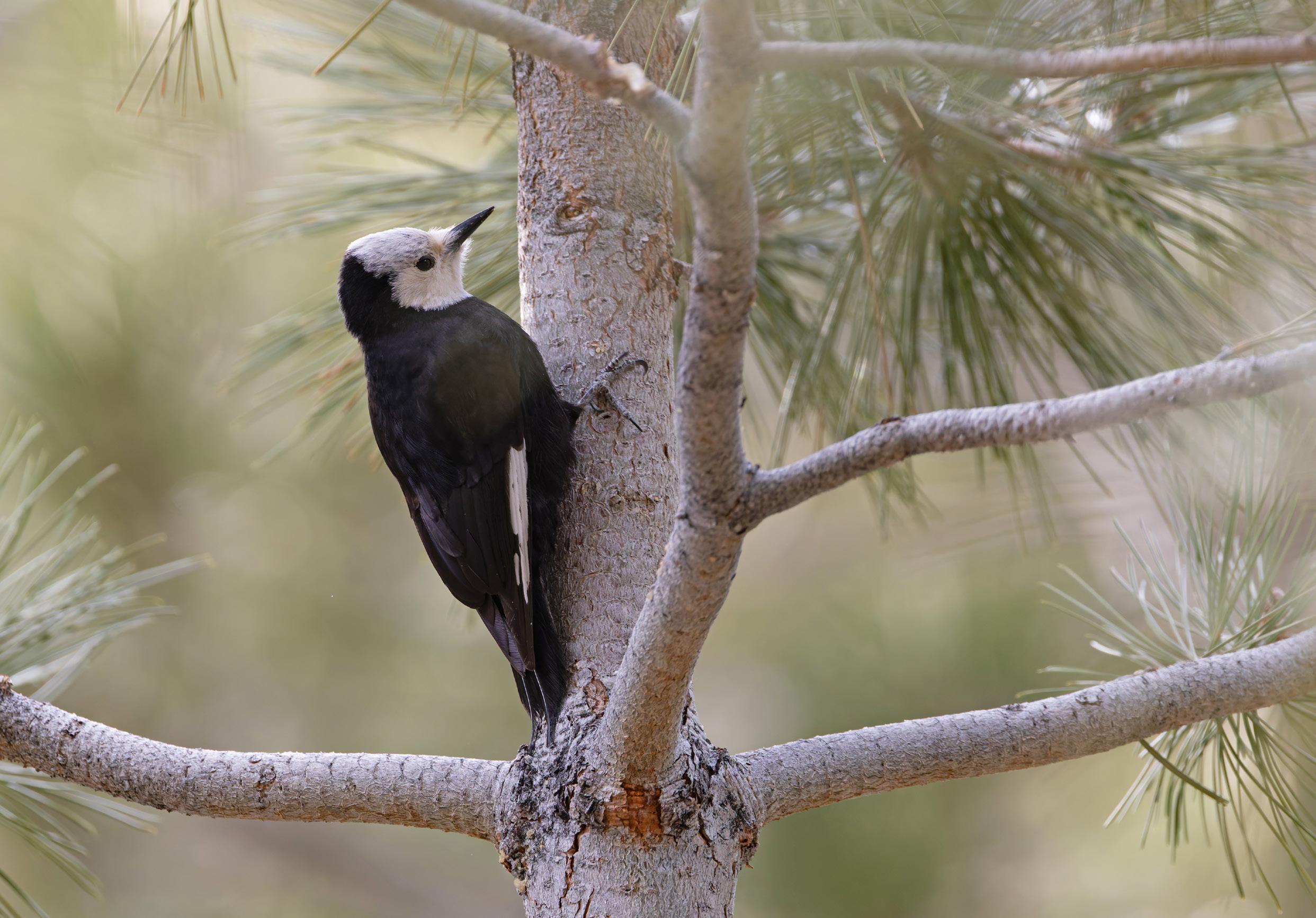
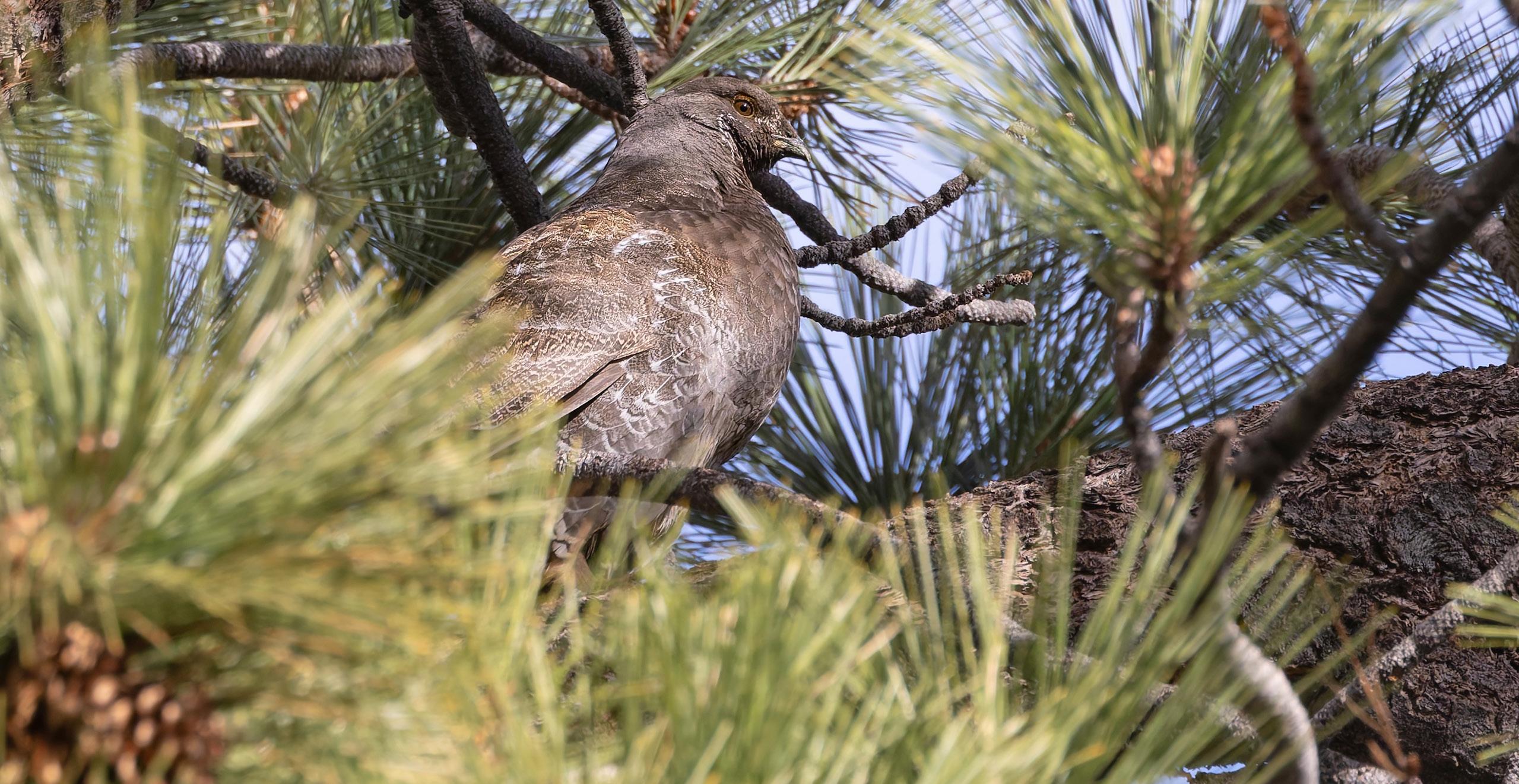
Sooty Grouse. Previous page: Red-breasted Sapsucker & White-headed Woodpecker. (Mike Watson)
development to the West of Bishop, where the bird feeders at 140 Iris Drive had attracted an excellent selection of birds. Top of the bill were three Grey-crowned Rosy Finches, in breeding plumage no less! Also, here we added a male Red-breasted Sapsucker both Downy and Hairy woodpeckers, Pygmy Nuthatch and Cassin’s Finch (three males). The sky had become quite overcast; we were in the mountains! And eventually it started raining. Not what I was expecting in California at this time of year. We had another vast distance to cover this afternoon, starting with a very enjoyable session at Big Pine Creek, to the West of Bishop, where at the Glacier Lodge Road Campground a couple of male Sooty Grouse were quickly located. One was not within sight, however, the other was booming from a hillside not far from the campground. After some time, the therminators spotted them high in pine trees! It was quite tricky to get to the same level as the first one, however, the second was much easier and enjoyed by all. In the valley below another pair of Red-breasted Sapsuckers and up to 3
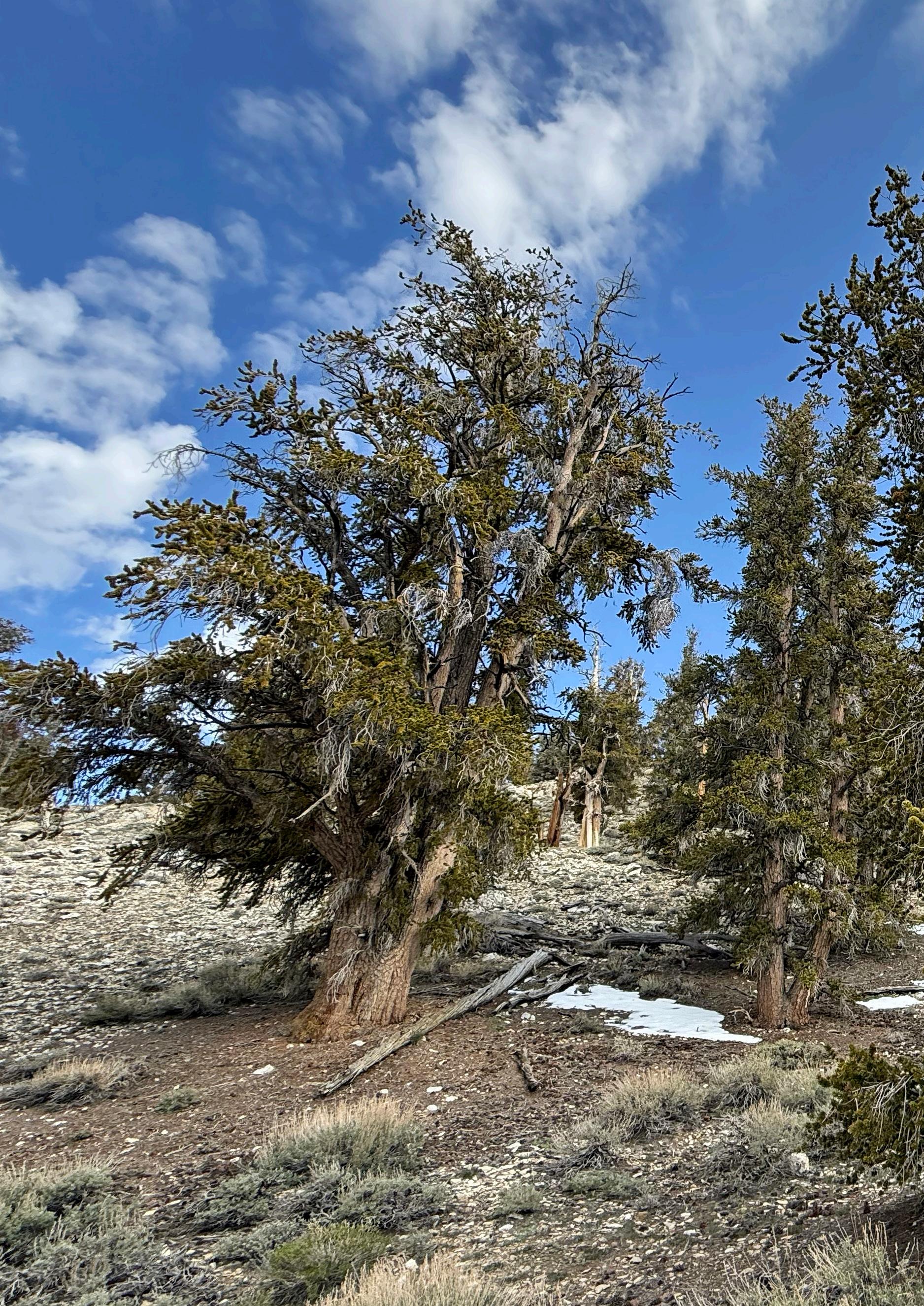
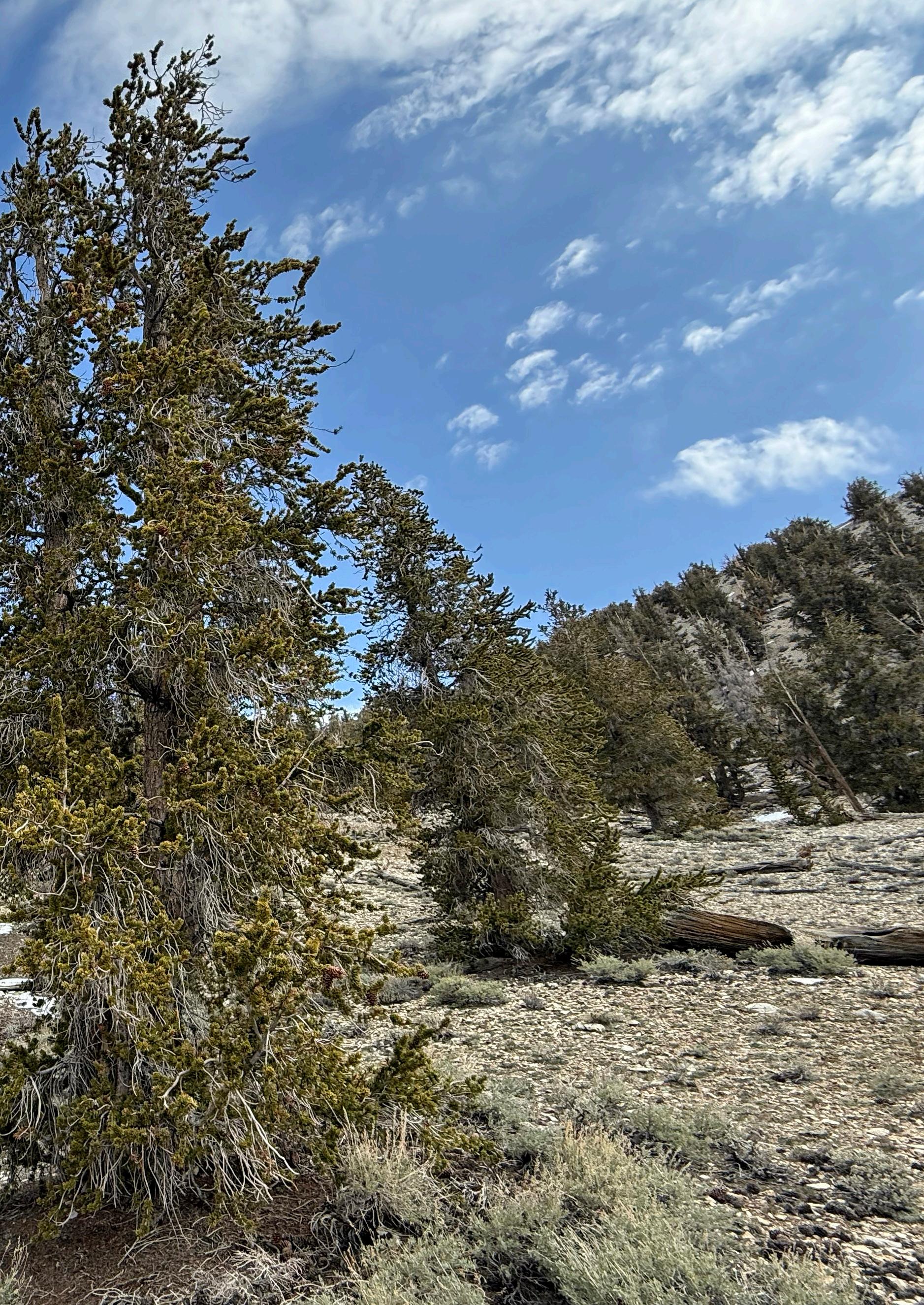
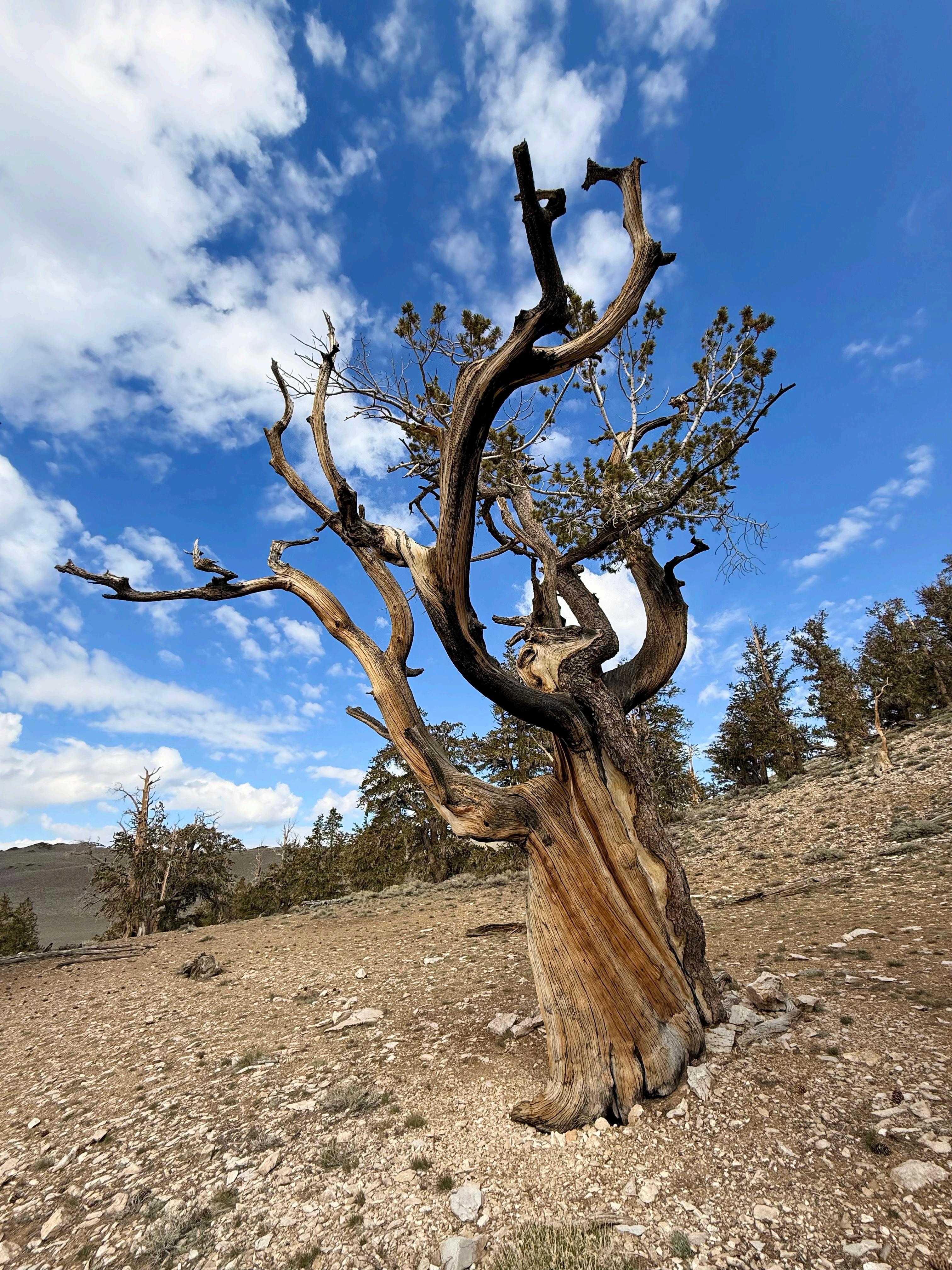
White-headed Woodpeckers were seen along with Hairy Woodpecker, Northern Flicker, a pair of American Dippers, which appeared to be nesting under a great bridge, as well as Cassin’s Finch and several feisty Northern House Wrens. A small group of Violet-green Swallows zoomed between the trees. While some of us went looking for Black-billed Magpie and Piñon Jay (already on the trip list), I took some others to the Ancient Bristlecone Pine forest to the east of Big Pine. I had been here more than 30 years ago, and it was nice to return to see one of the world’s most spectacular trees. We had time for a short walk along the Discovery Trail at Schulman Grove and were able to take a close look at, and touch, some of these incredible ancient trees. Birds were few above the snow line but included Mountain Chickadee, and Mountain Bluebird. Golden-mantled Ground Squirrels watched us from fallen trunks.
DEATH VALLEY NATIONAL PARK
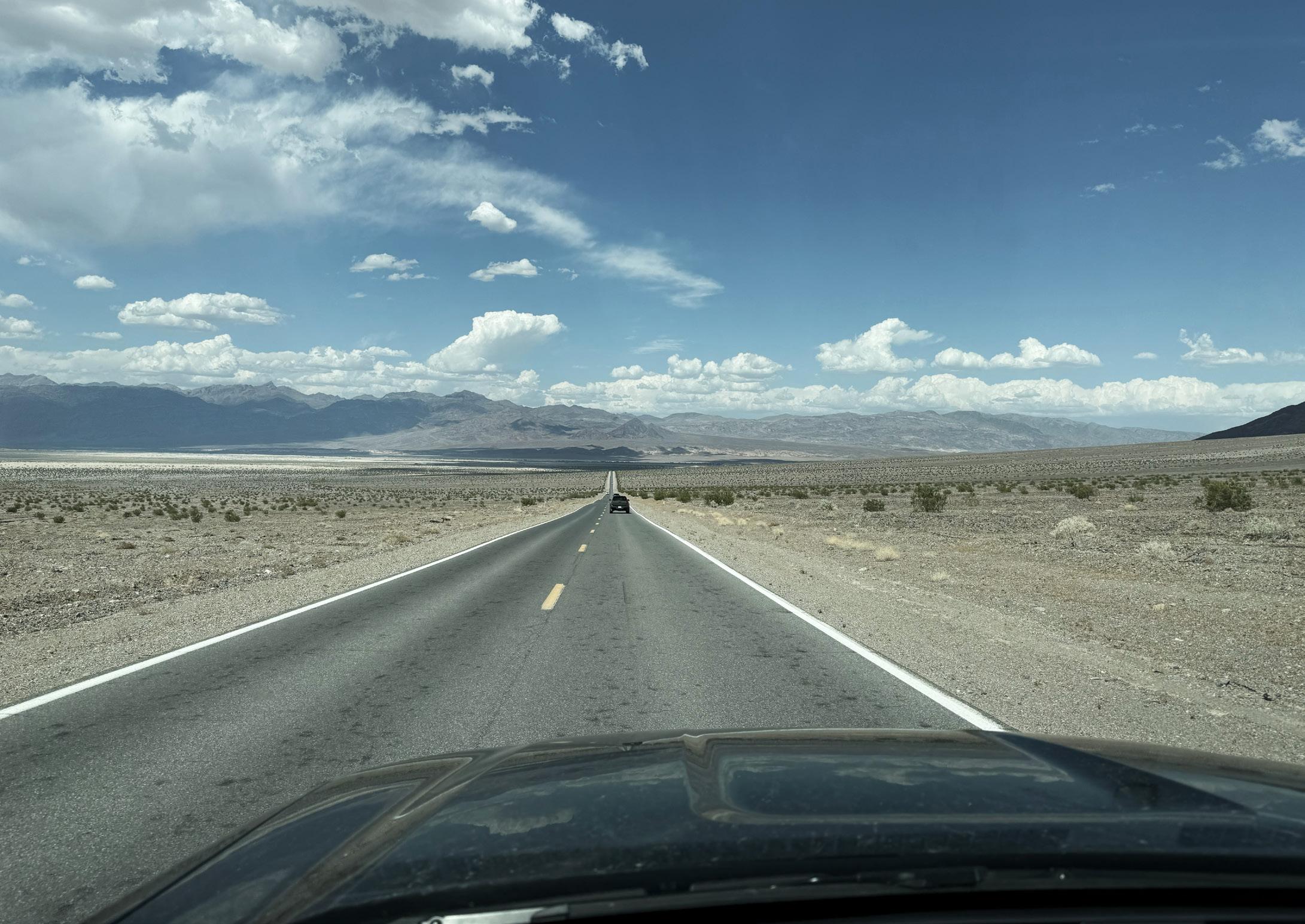
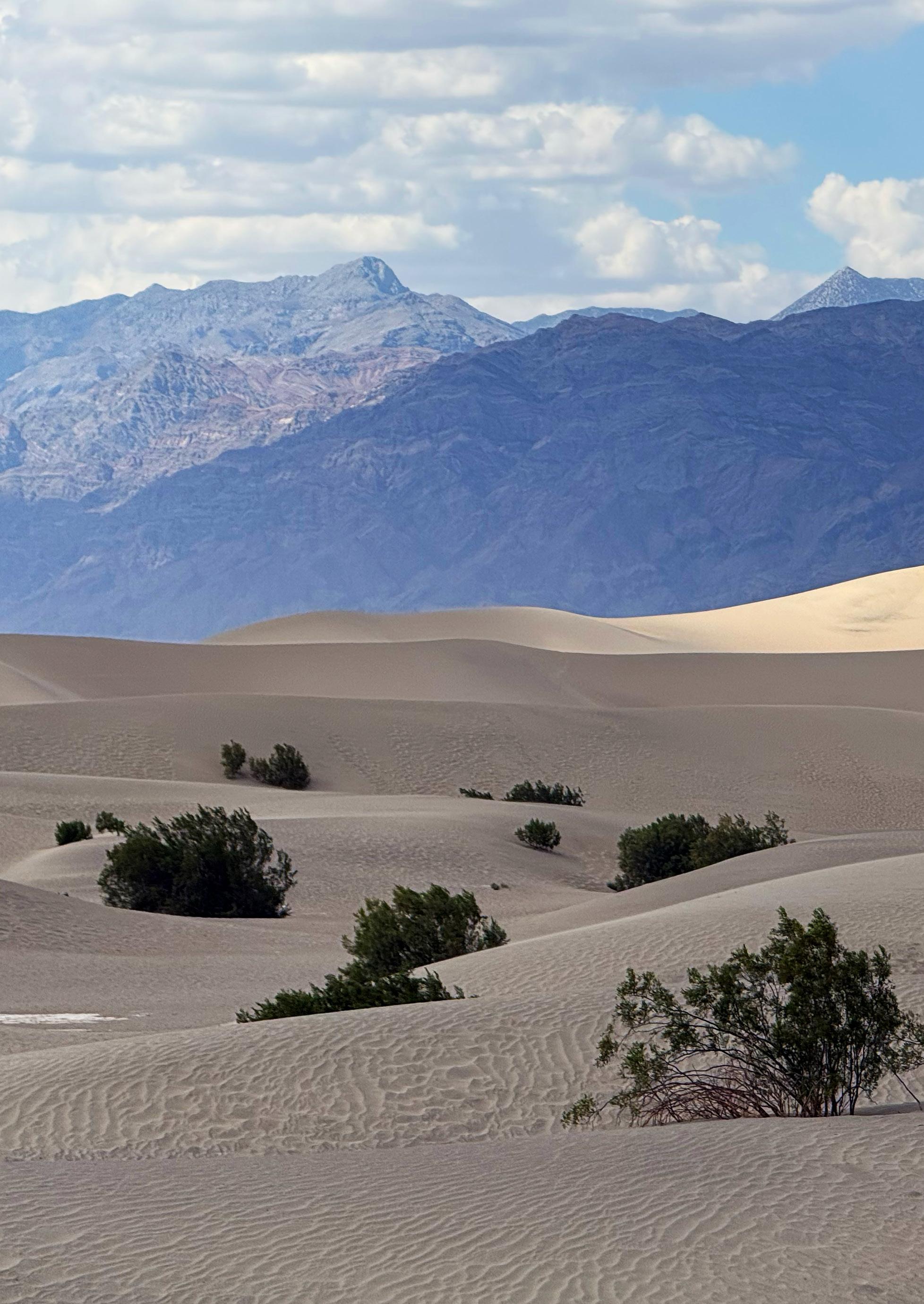
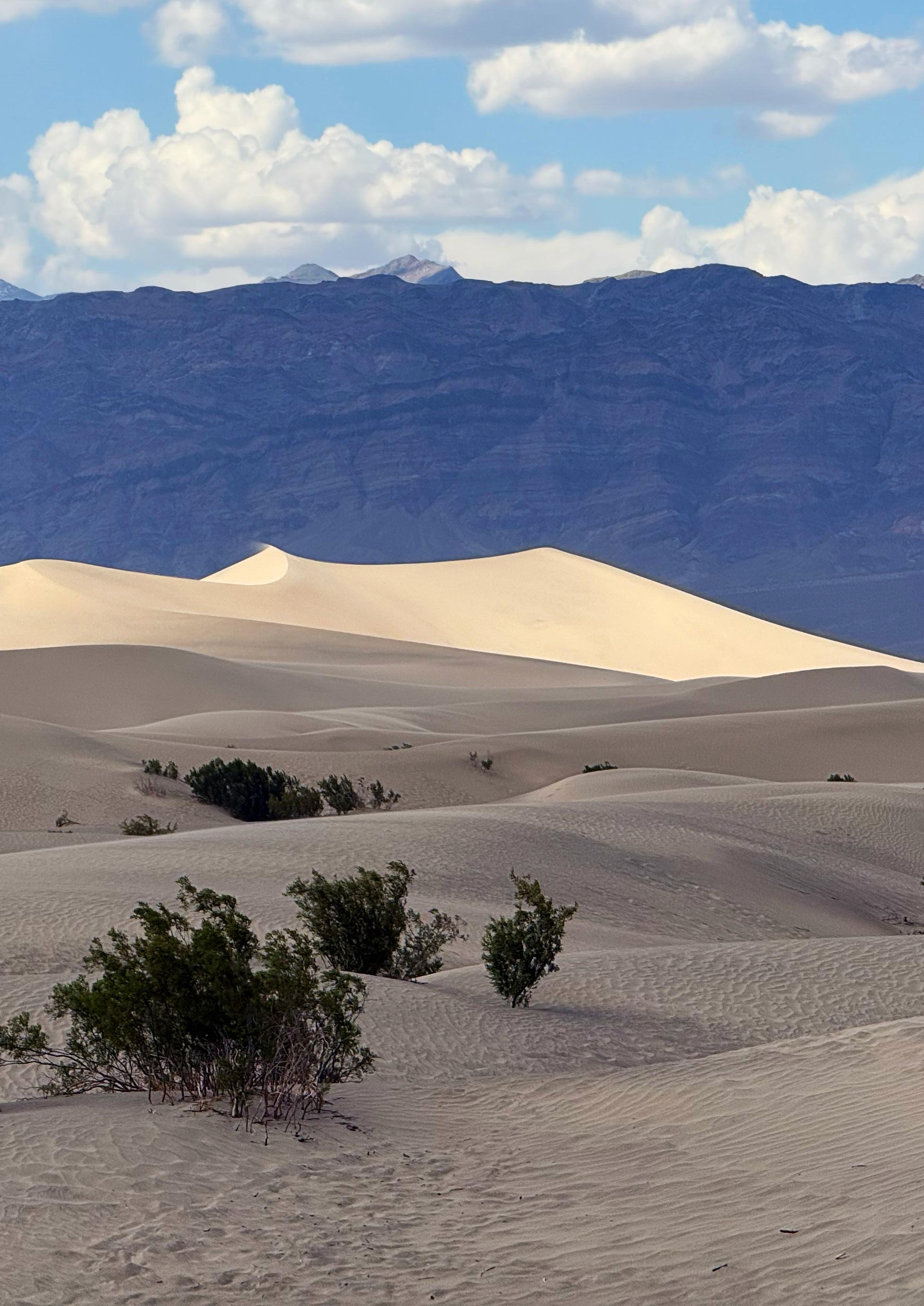
In the afternoon we cruised the incredible Death Valley National Park on our way to Vegas. Pausing at viewpoints including Father Crowley’s Vista, Stovepipe Wells and Mesquite Flats, but perhaps the most impressive experience was to watch the temperature gauge on the car rise from 79 Fahrenheit at the park’s entrance to 104 by the valley bottom. The park was almost birdless for miles, the only species noted were Turkey Vultures and a Golden Eagle, and amazingly the introduced Eurasian Collared Dove. Finally, we climbed out of the valley and rolled up at the world’s most glitzy, kitsch city. There is nowhere quite like Vegas! Surprisingly, it was very easy to drive into the heart of the strip. There is very little suburbia for a downtown of this size. Staying at the MGM Park Hotel, we were only a few steps off the strip and enjoyed a short walk across it for dinner. It is not somewhere I would like to spend much time, but was interesting to see,
nevertheless. Millions of people come here every year to get rid of their money, lured by the neon signs and bright lights. There are some good birding spots around Vegas and the next morning (minus hangovers thankfully) we spent a few hours at the Henderson Bird Viewing Preserve, a former water treatment plant. Waterfowl included new-forthe-tour Greater White-fronted Goose (immature), Long-tailed Duck (2!), Bufflehead, Ringnecked Duck, Redhead and Mexican Duck (drake). Gambel’s Quail was also new here, of a naturally occurring population! Tick! Also, around the various lagoons, three species of grebe included Pied-billed, Horned and Blacknecked. A Greater Roadrunner was spotted in the adjacent scrub. A Sora crept along the water’s edge, before being flushed by a Snowy Egret and shorebirds around the lagoons included American Avocet, Black-necked Stilt, Long-billed Dowitcher, Spotted Sandpiper and notably three Wilson’s Phalaropes (1 breeding
Descent to Death Valley. Previous pages: Schulman Grove, Ancient Bristlecone Pine Forest. Next page: Mesquite Flats, Death Valley NP (Mike Watson)
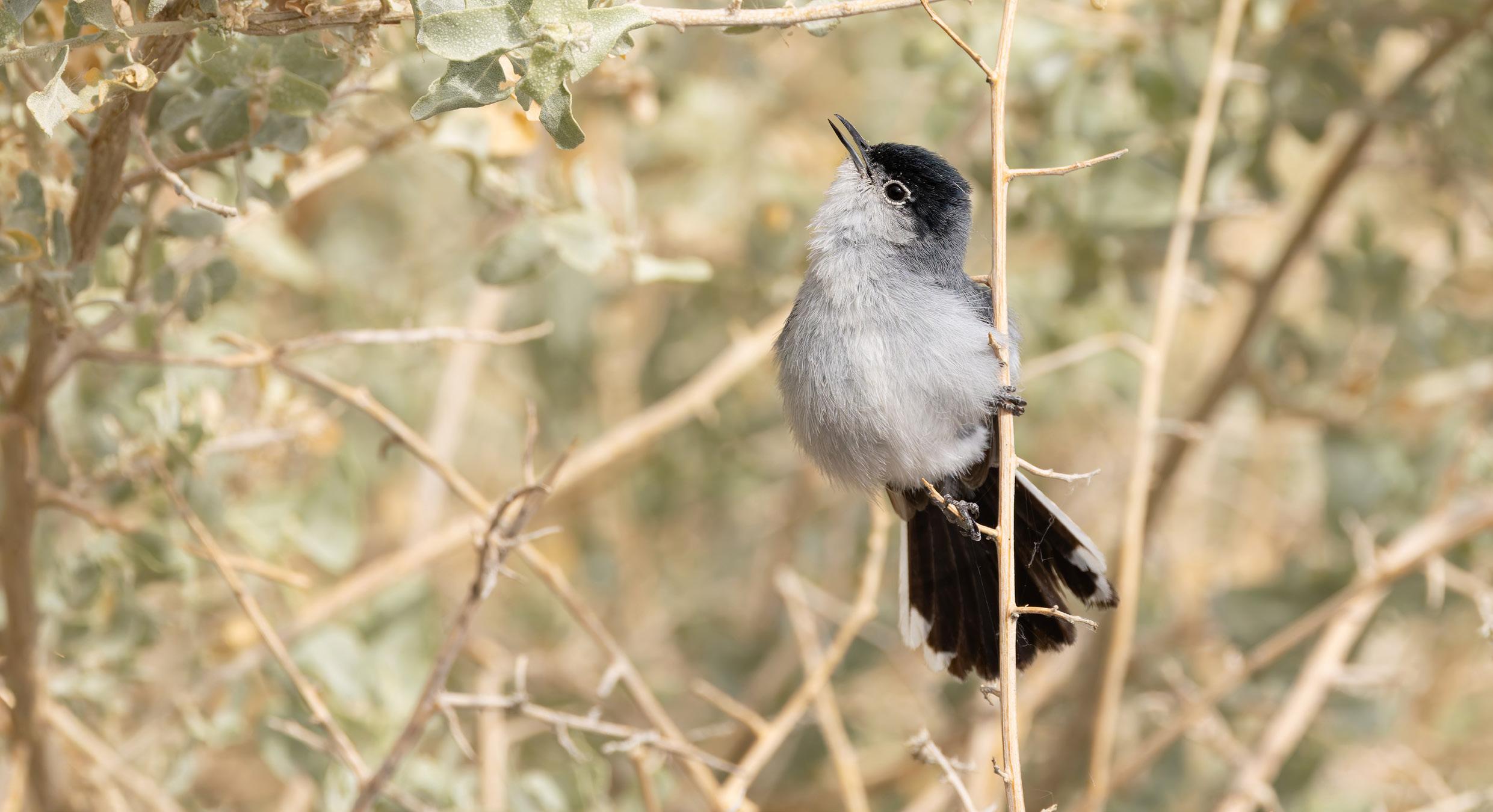
plumage male - an Aston Villa!). The scrub surrounding the lagoons was very birdy and held our first Say’s Phoebes, American Grey Flycatcher, Savannah Sparrow and Yellow- headed Blackbird as well as many Wilson’s Warblers and a couple of Orange-crowned. The main target proved very elusive, however, we eventually managed to find one or two Crissal Thrashers, although Black-tailed Gnatcatcher was much easier and unbelievably confiding in the scrub surrounding the lagoons.
CALIFORNIA CONDORS
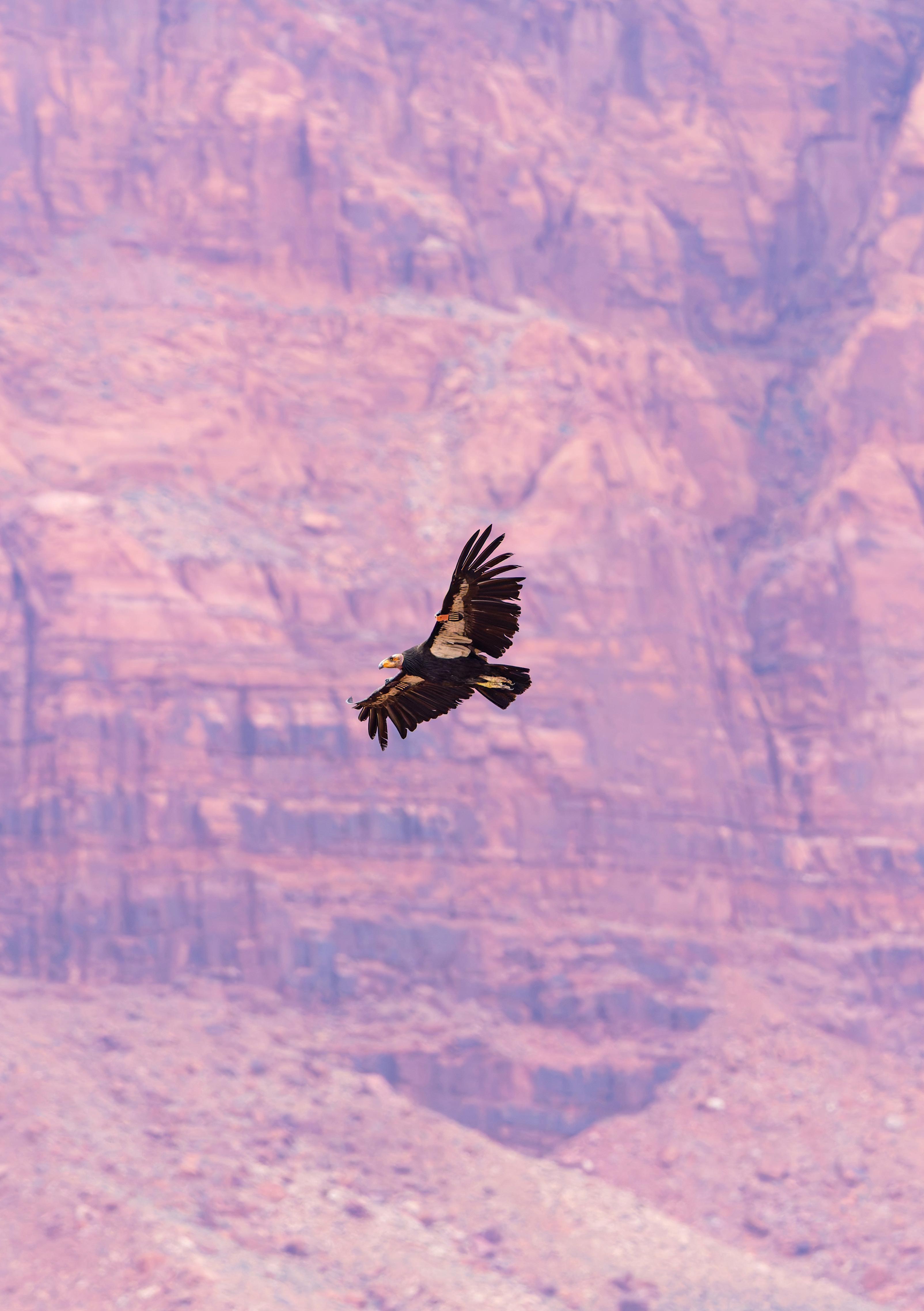
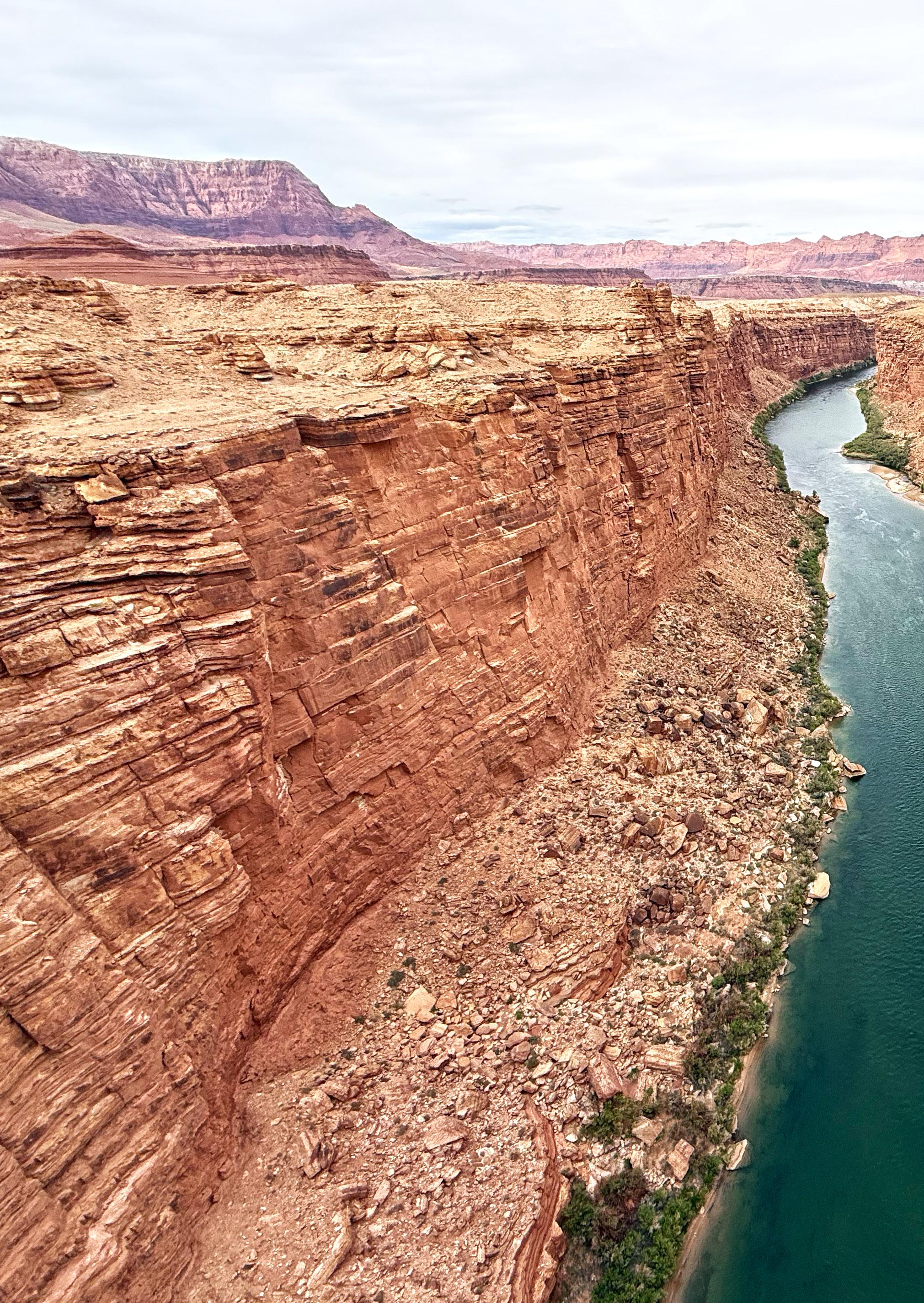
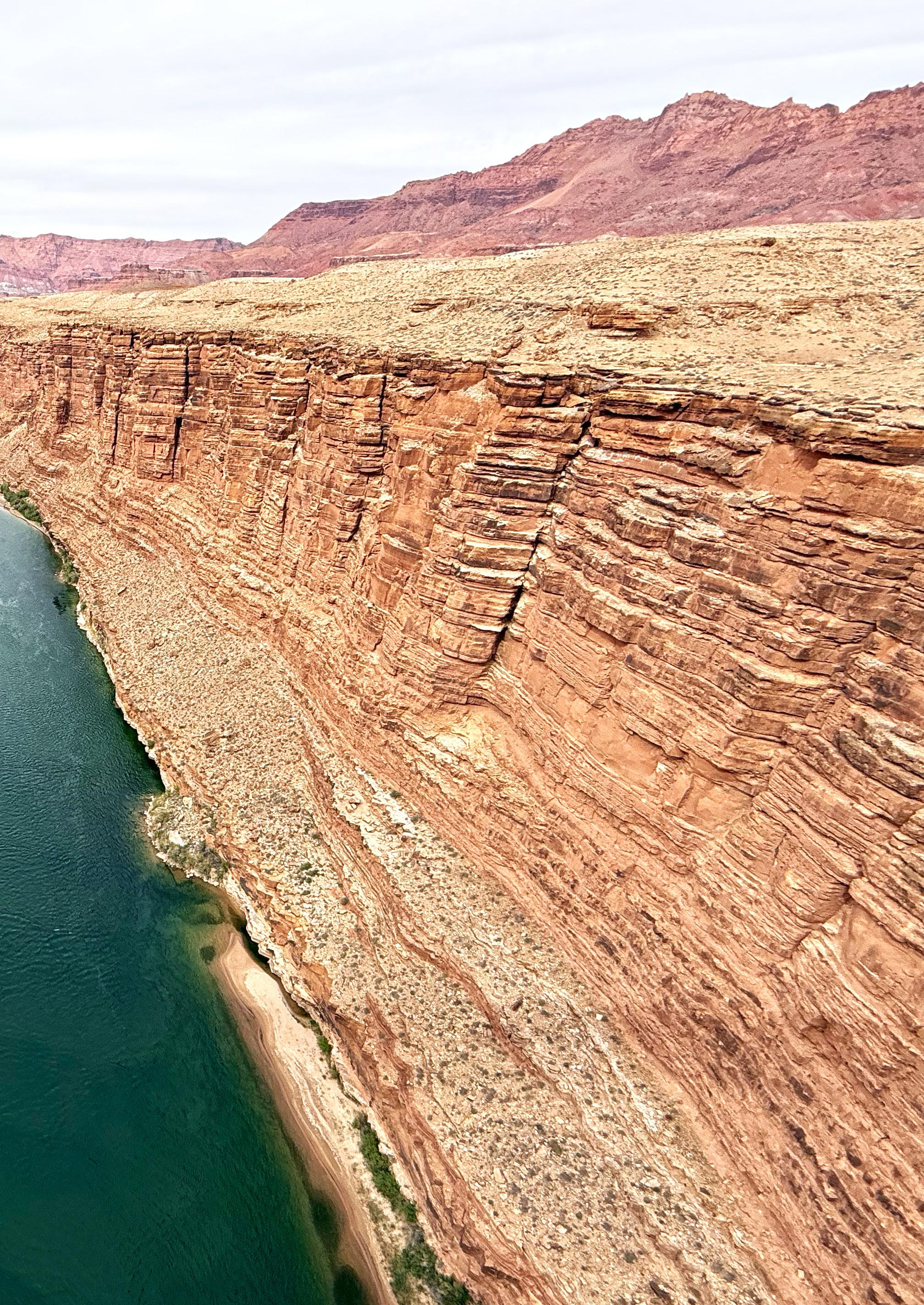
Leaving Vegas behind, we drove east, leaving Nevada, into our third state of the tour, Utah, for a while, before we swung southeast into Arizona. Pausing at Vermilion Cliffs, Gordon spotted five distant California Condors over an escarpment from the Fredonia highway, however, they were too far for all to see, so we pressed on to the surefire stakeout of Navajo Bridge, over Marble Canyon, in the Glen Canyon National Recreation Area. Condors were much easier to see here! We could see some well enough to read their tags; it was interesting to read their life histories:
V3 (#883): hatched in captivity at the WCBOP, Boise, Idaho 21 May 2017 and released in Northern Arizona September 2018. #1111: a wild-bred bird, hatched 16 April 2021 at the infamous Angels Landing, Zion National Park (only the second wild-bred bird in Zion National Park). It is the 1111th individual identified since the California Condor Recovery Programme began and was tagged in Arizona in early 2023. Its father is J3 (#523), hatched in captivity at the Peregrine Fund’s World Centre for Birds of Prey in Idaho in 2009 and released at Vermilion cliffs 2011. Its mother, #409 was hatched in San Diego Zoo in 2006. 55 (#1255): a two year old immature, hatched at San Diego Wild Animal Park 16 March 2024. Its father #25 was a wild-hatched bird 1 May 1982 and its grandfather on its father’s side was #3, hatched prior to 1976, and died in 1984. Its grandmother on its father side was a wild-hatched bird prior to 1976. Its mother’s (#157) was the daughter of the female #40, hatched at San Diego Zoo, however, her father was #1! hatched in or before 1966 in the wild. US (#1320): another 2-year-old immature wildhatched in 2024. However, it’s father #849 was
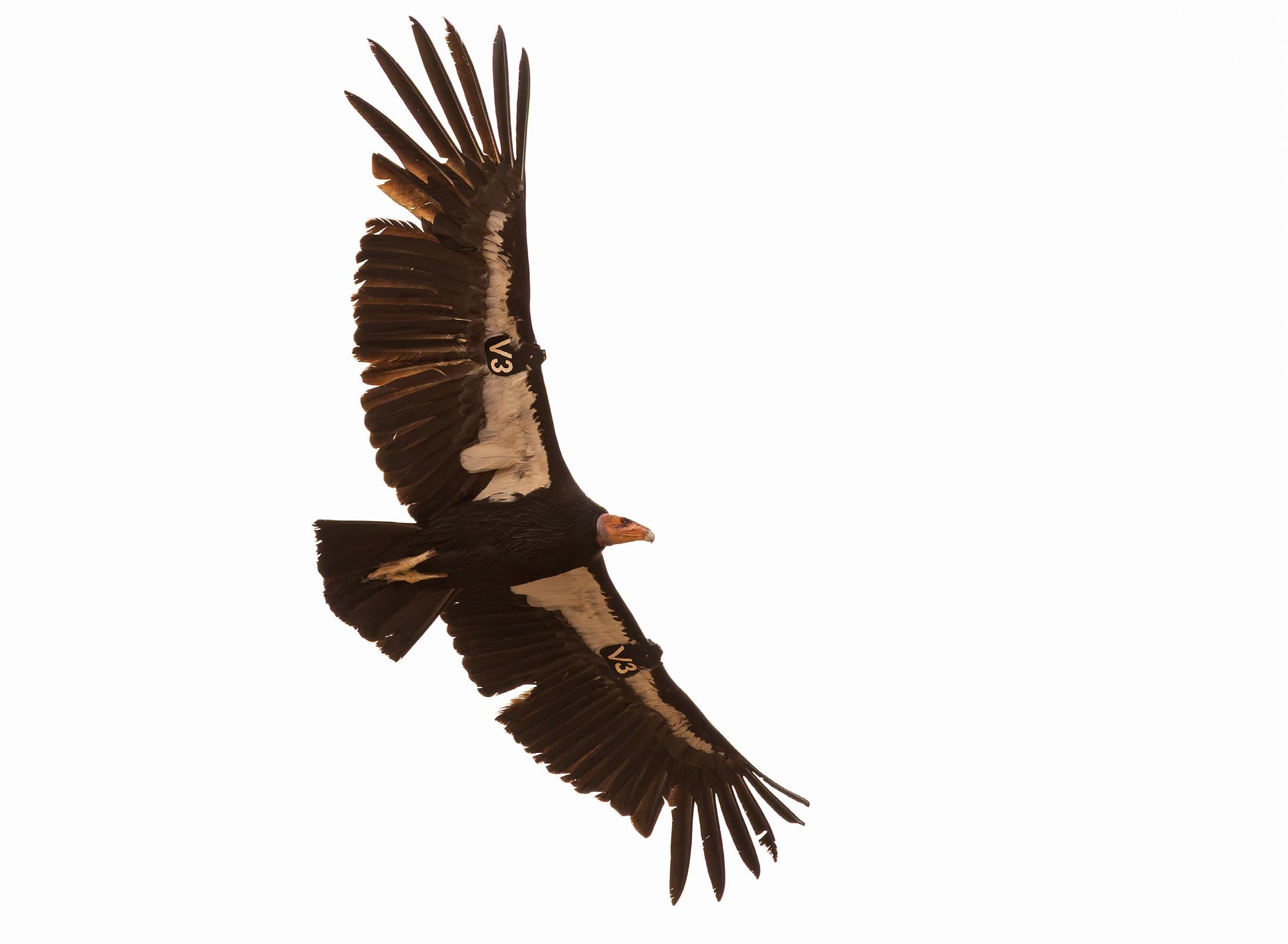
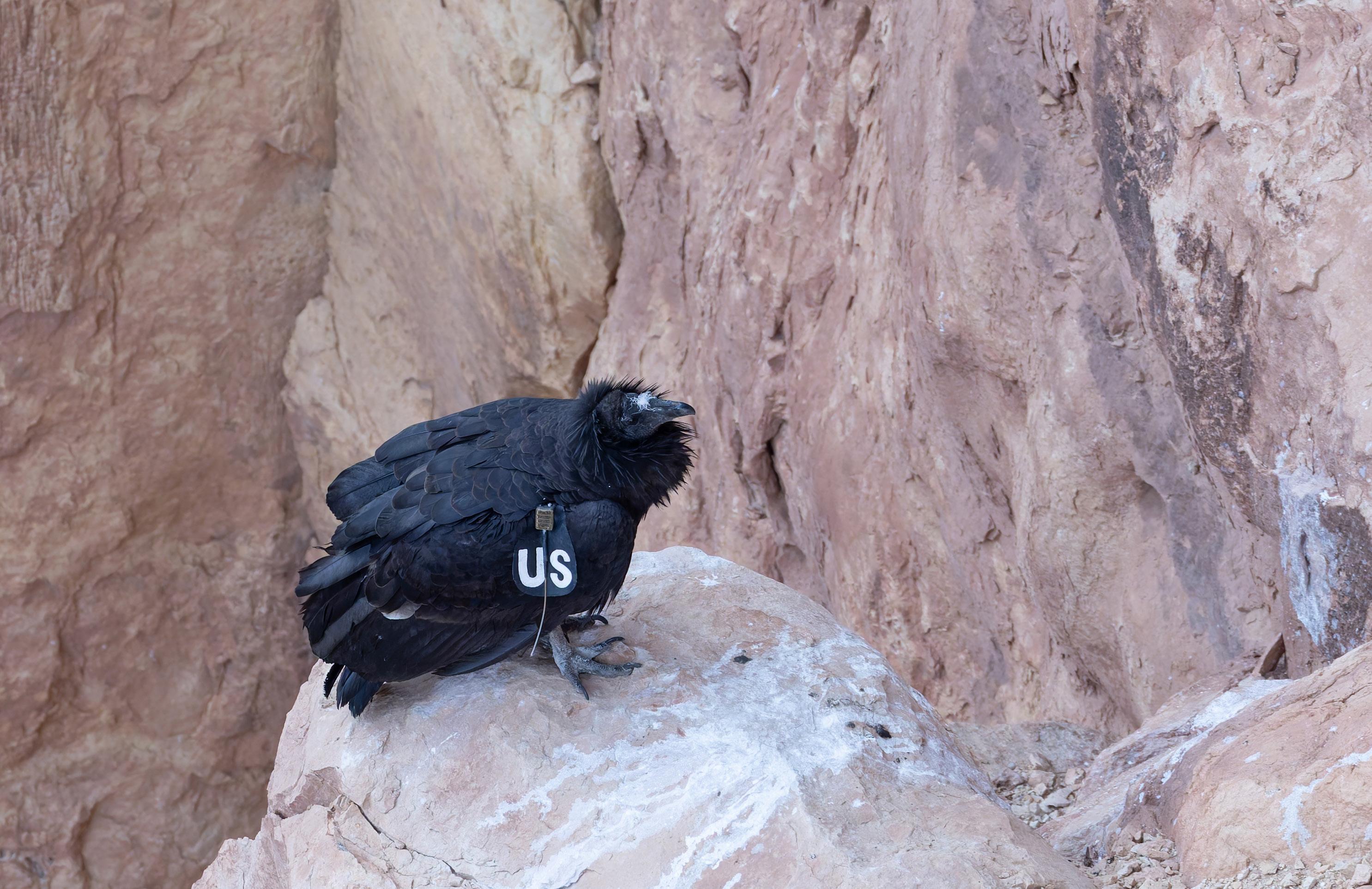
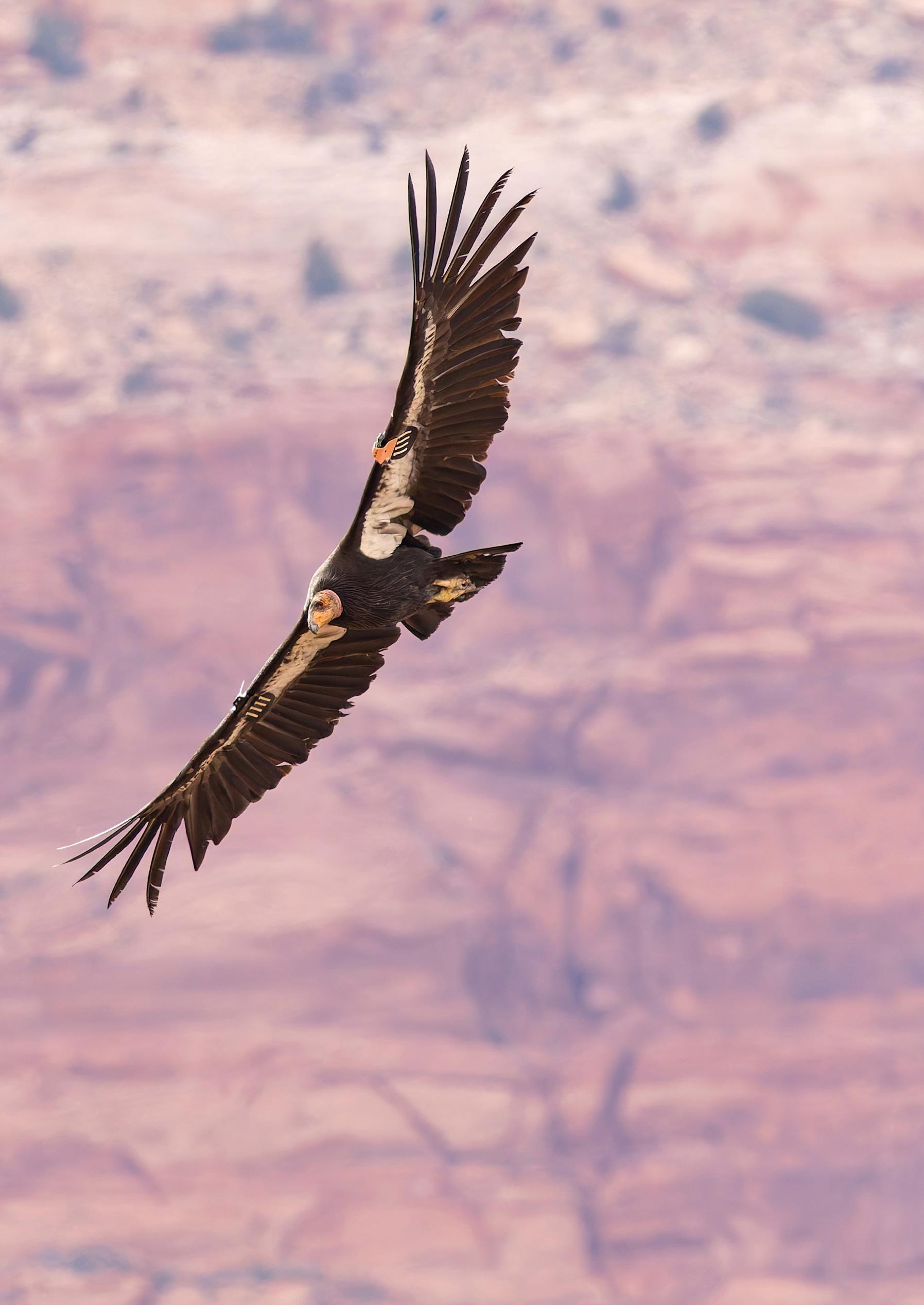
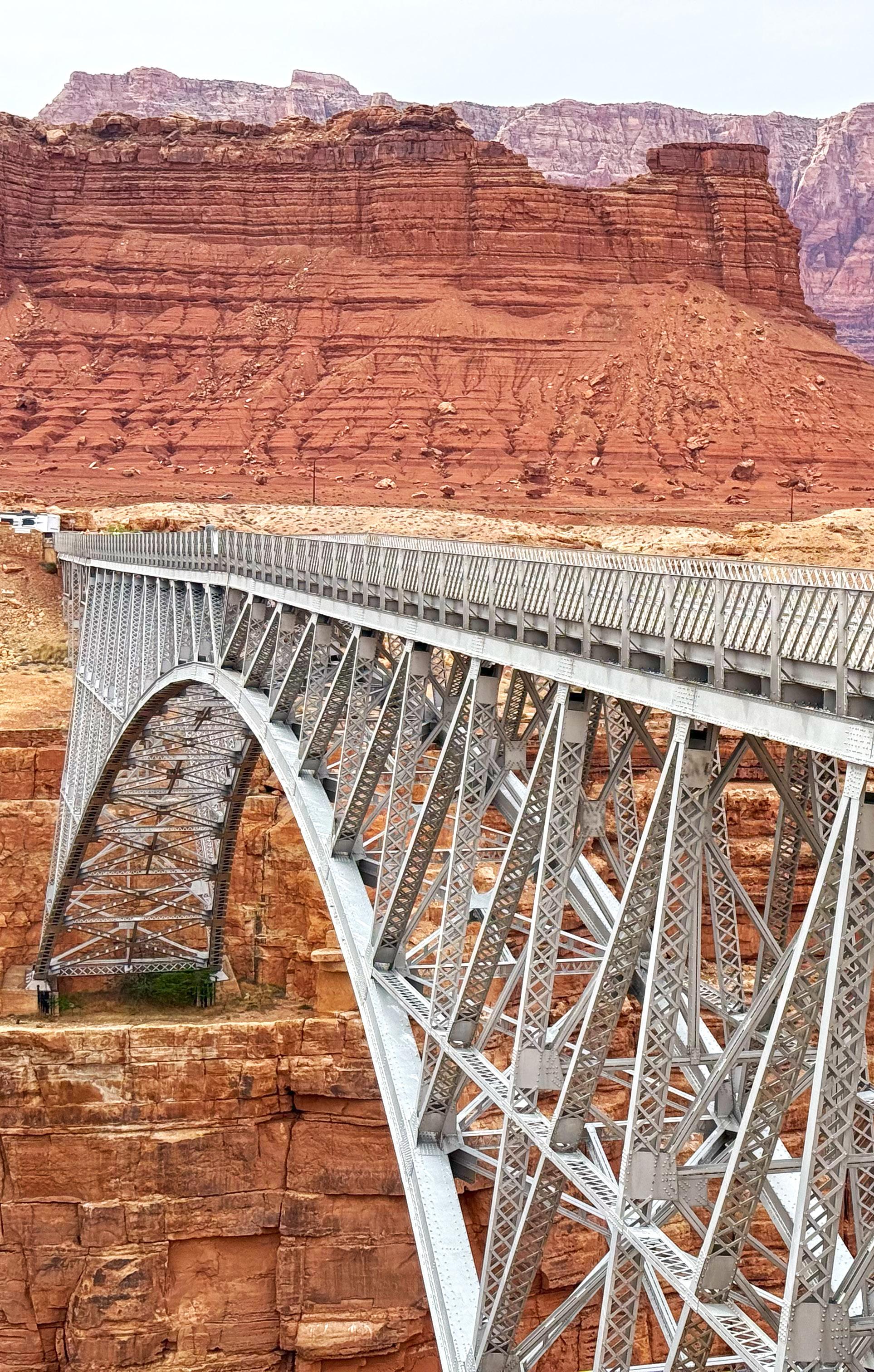
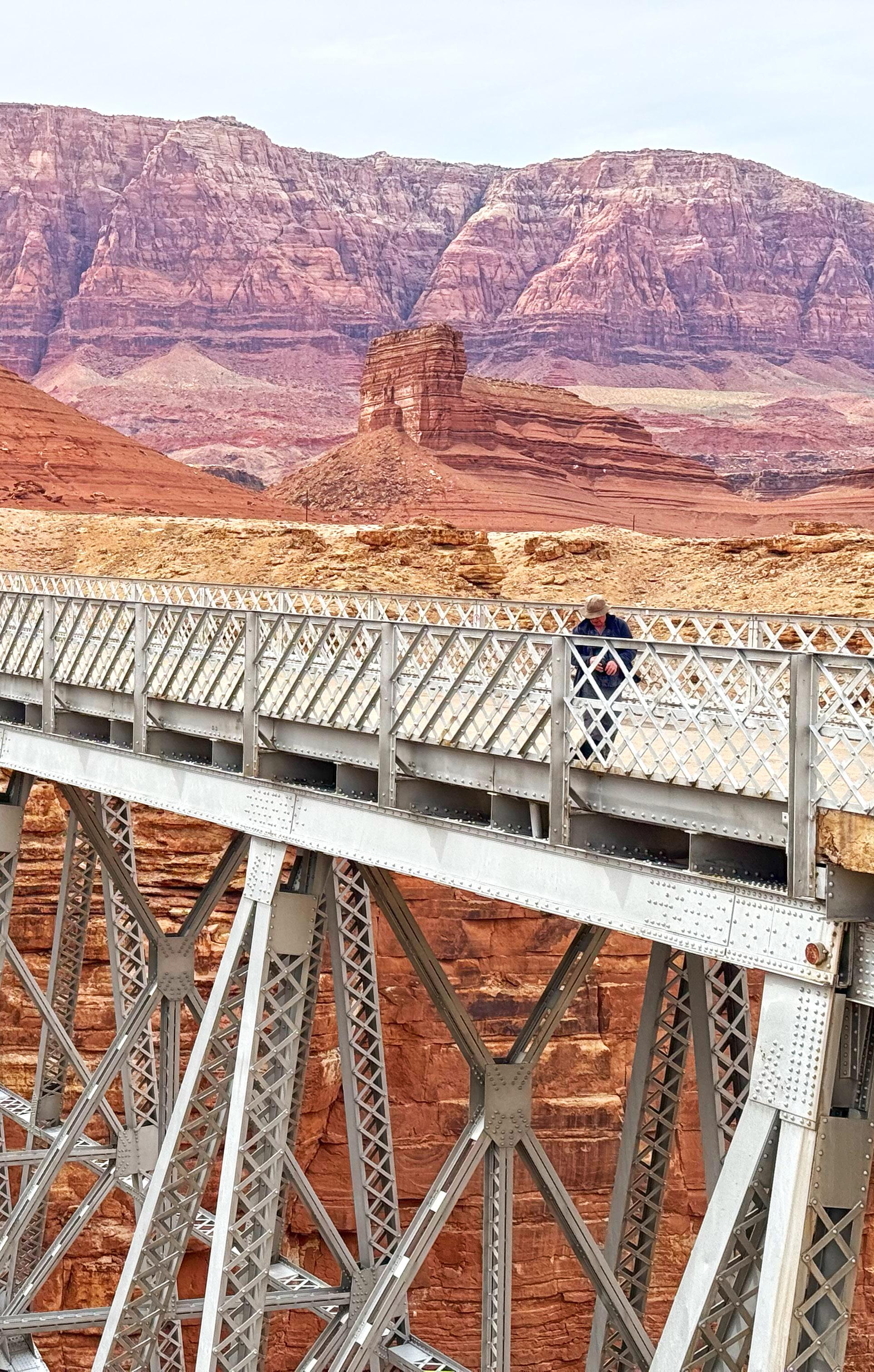
wild hatched 14 May 2016 (of two captive-bred birds: #206 a male from San Diego Wild Animal Park hatched 28 March 2002 and #296, a female from the WCBOP, hatched 10 April 2003. It’s mother #844 was a captive bred bird at the WCBOP, hatched 4 June 2016. This is probably the bird with the best credentials for counting that we saw. From Navajo Bridge we made the short drive south to Flagstaff, into heavy rain!
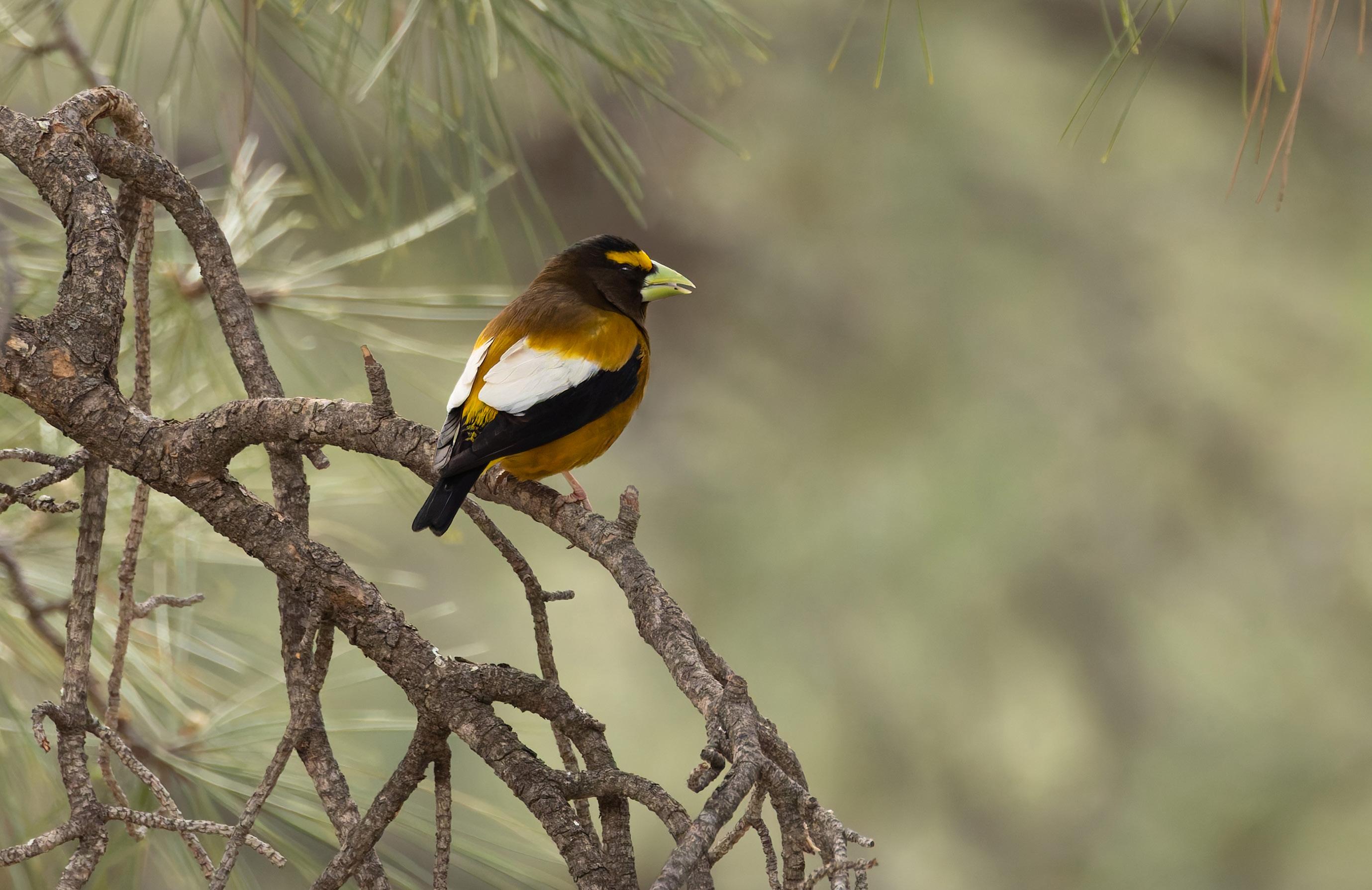
Not far from Flagstaff, at a subdivision in Kachina we visited some feeders, which had been reporting a flock of Evening Grosbeaks for several days. We were delighted to hear their calls as soon as we opened the car doors. A flock of around 10 birds was in pine trees in this pretty subdivision, eventually descending to the feeders. Also here were our first Broad-tailed Hummingbird buzzing around, White-breasted Nuthatch, Pygmy Nuthatch and Red-breasted Nuthatch, as well as a couple of Western Bluebirds, Pine Siskins and Black-headed Grosbeak singing. For the mammal lovers two very attractive Abert’s Squirrels
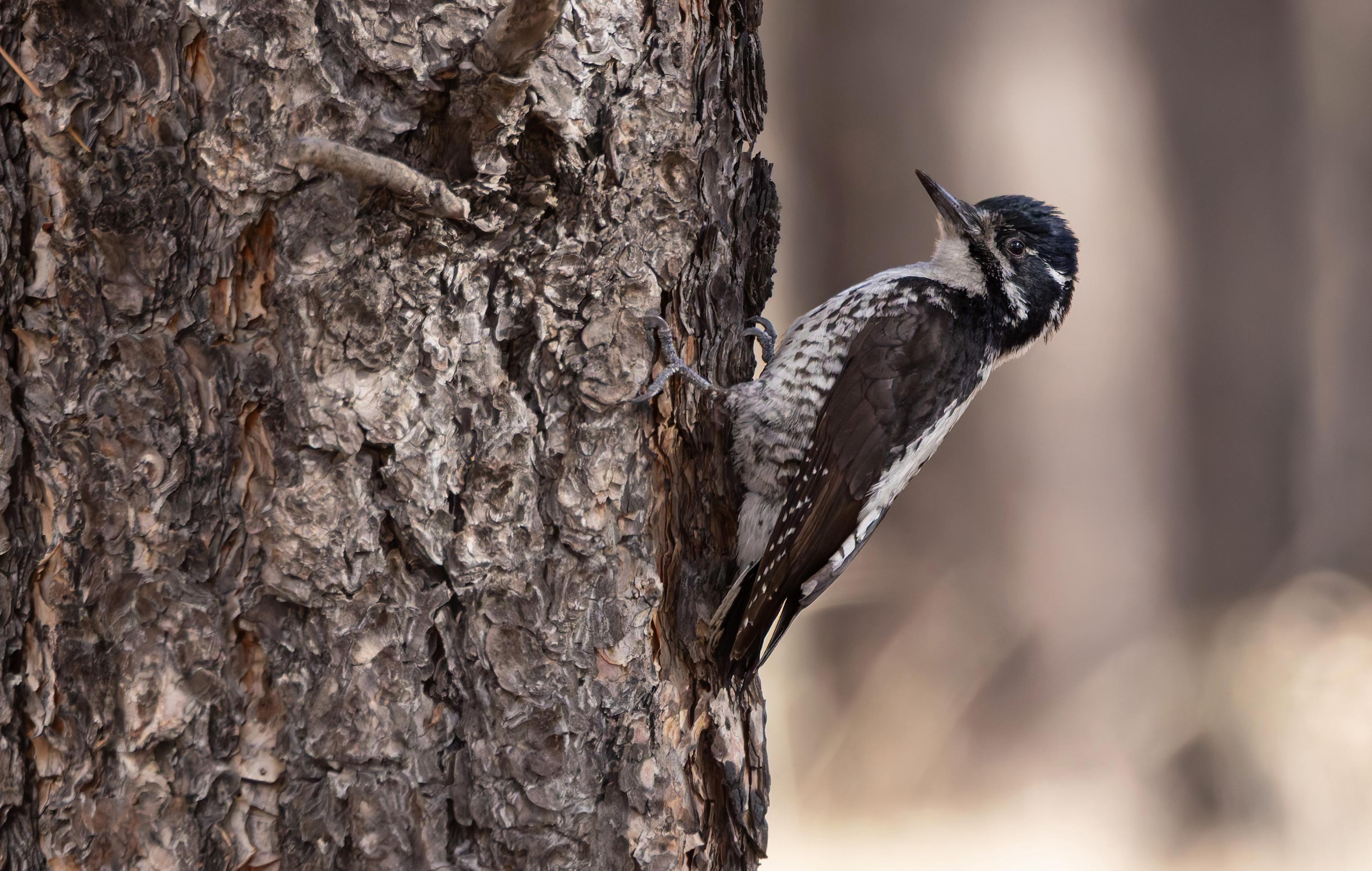
were hanging around the feeders as well. A significant backtrack north to Lockett Meadow Road proved very worthwhile, with the hoped for American Three-toed Woodpecker showing instantly near the parking lot. A Ruby-crowned Kinglet was also here, as well as several Redbacked, Dark-eyed Juncos.
GRAND CANYON NATIONAL PARK
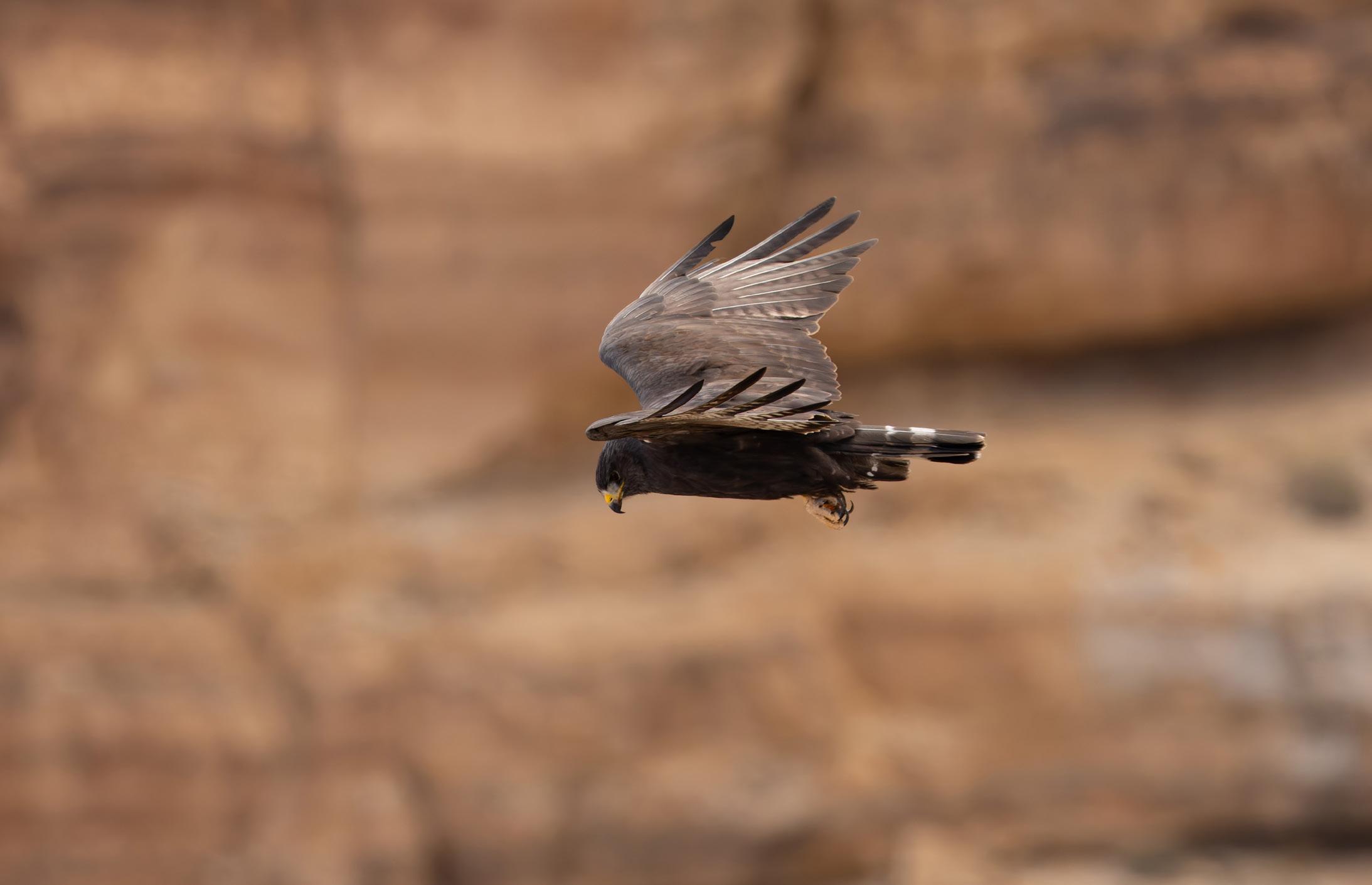
Now it was time to combine some sightseeing with birding. The northern rim of the Grand Canyon National Park had been badly burnt recently, as we could see driving southwards the previous day, but the southern rim remains intact and what a place it is. Another geology class lesson and probably the best view I have ever seen. The layers of multi-coloured sedimentary rocks stretching into the distance in the Canyon as far as the eye could see. We started at the Navajo Point Vista, where a smart Zone-tailed Hawk was soaring around the canyon below. Next came Lipan Point and then a roadside stop for Plumbeous Vireo, before we reached the South Rim Visitor Centre.
Zone-tailed Hawk. Previous page: Evening Grosbeak & American Threetoed Woodpecker (Mike Watson)
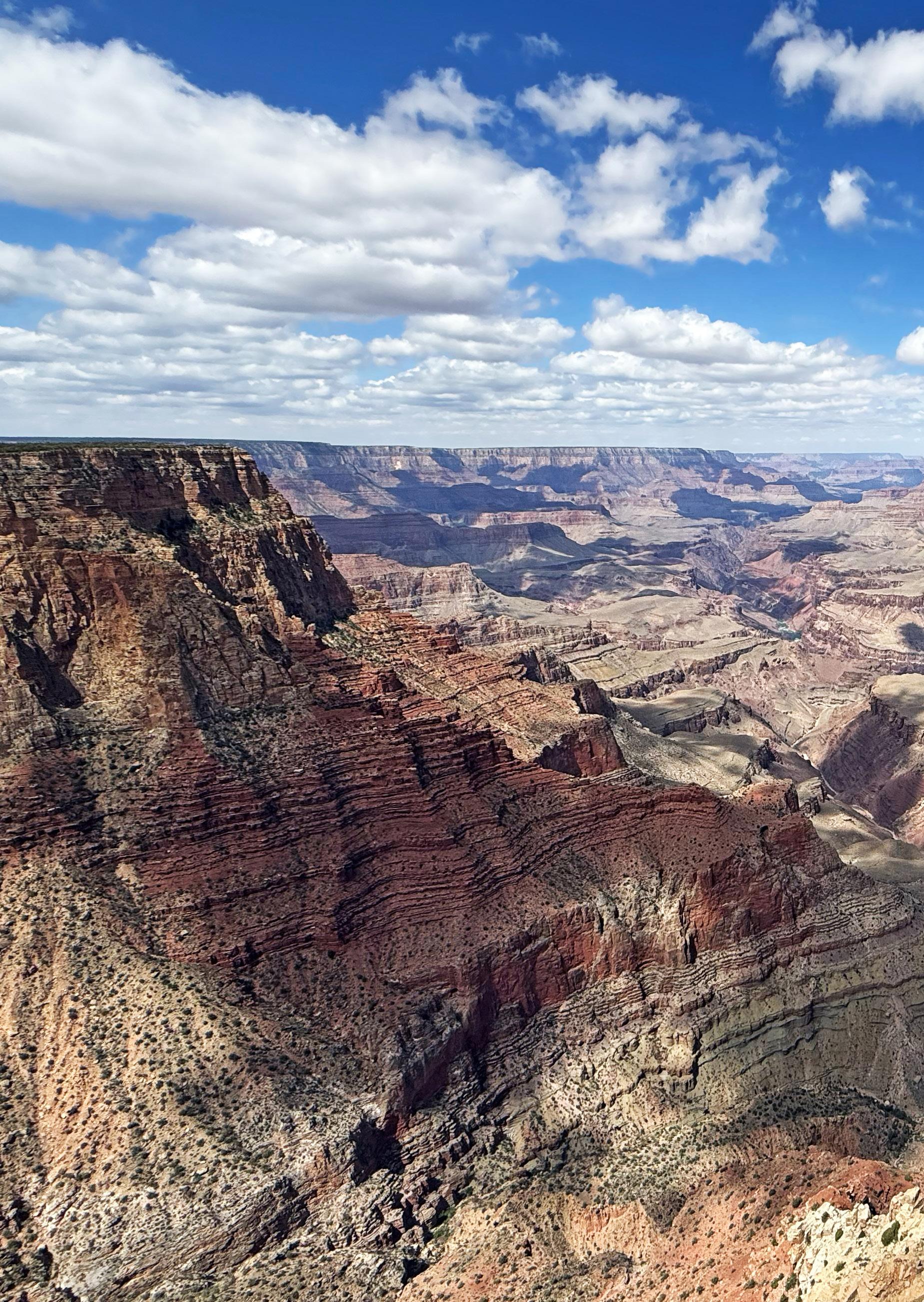
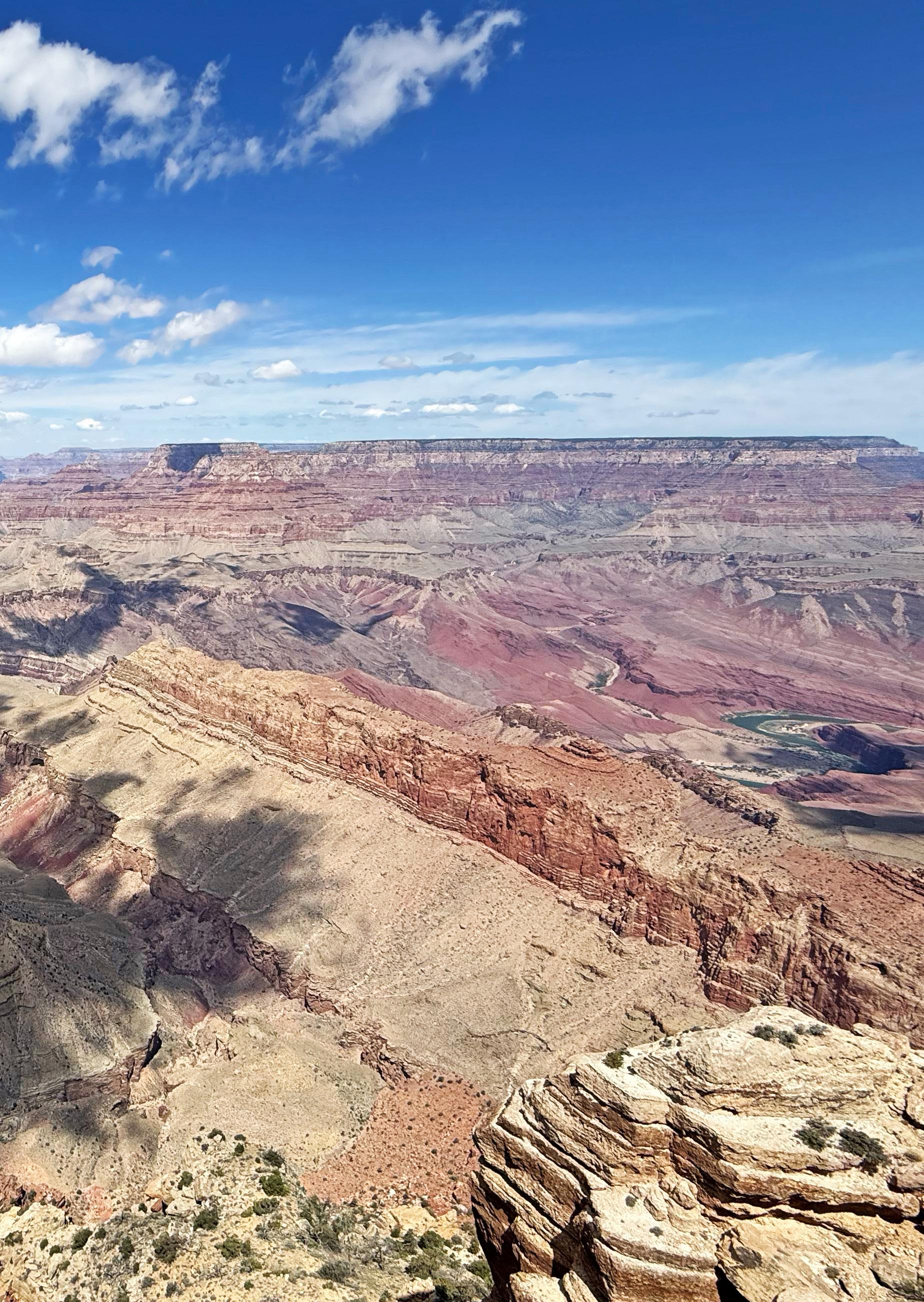
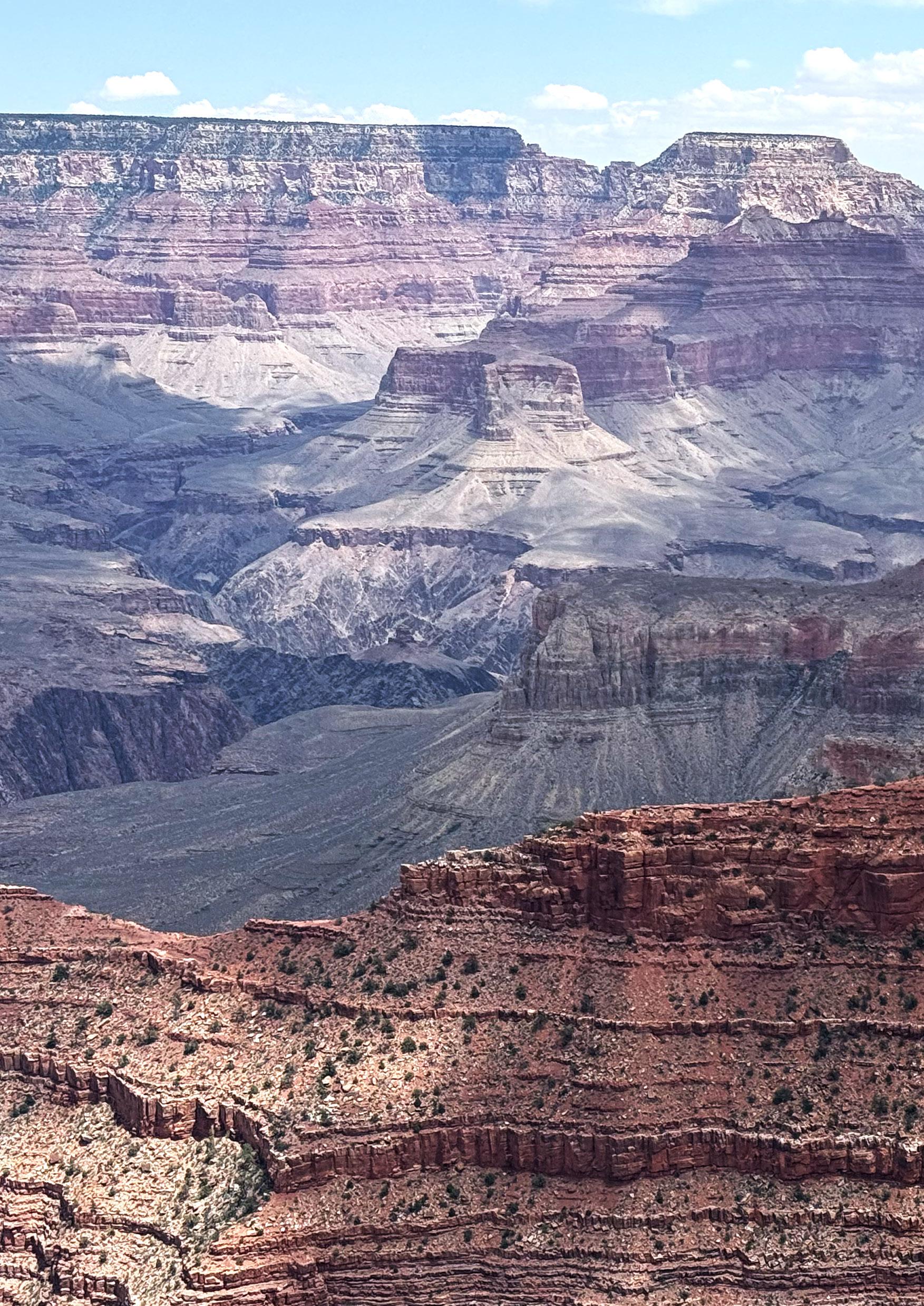
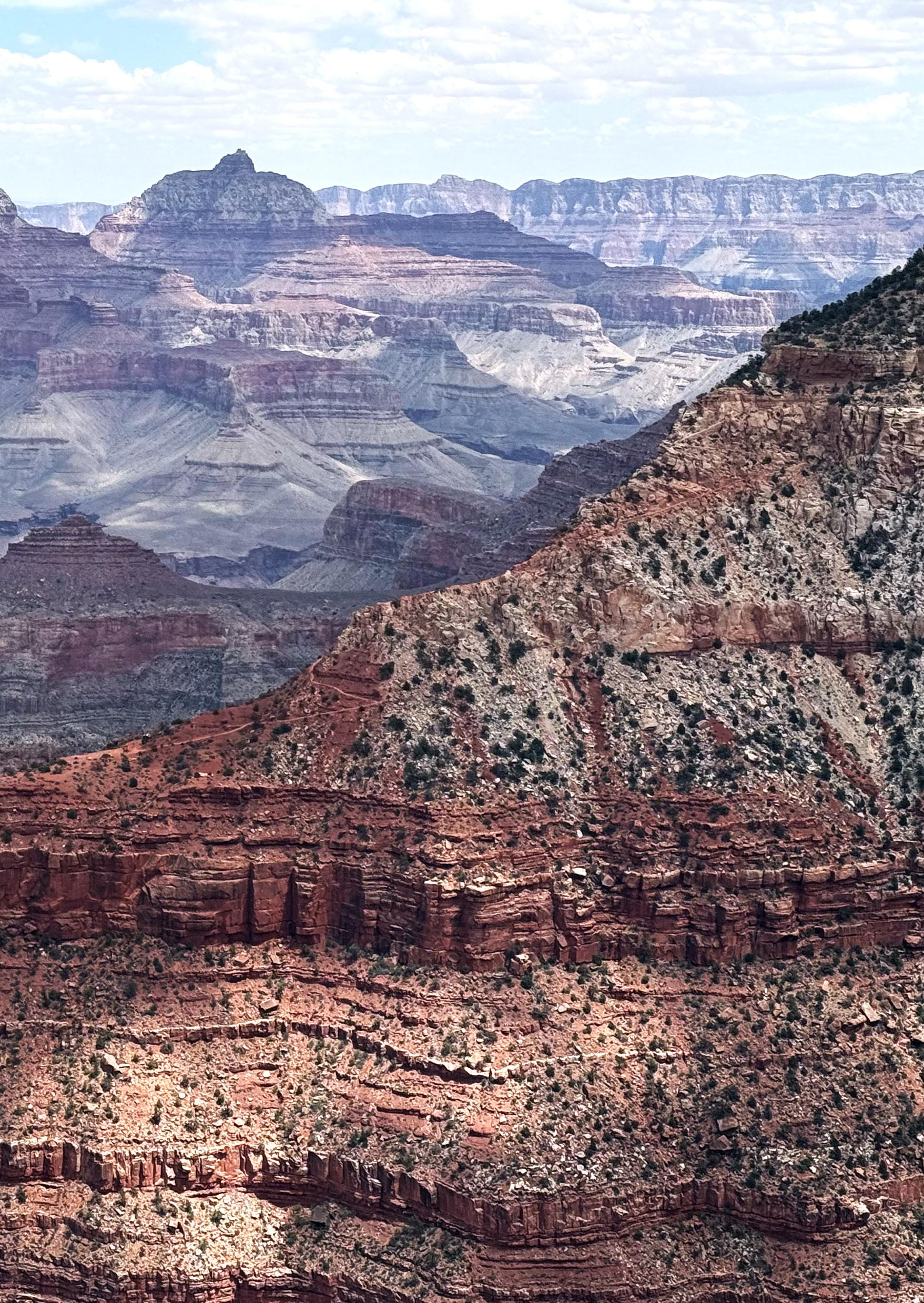
Nearby Mather Point produced Rock Wren and Blue-grey Gnatcatcher. Along the walk to the viewpoint a very obliging Juniper Titmouse was seen, along with several Woodhouse’s Scrub Jays. Mammals at the Grand Canyon included a small herd of Wapiti, Mule Deer, a couple of Cliff Chipmunks and the common and tame rock squirrels. Beyond the canyon on the way to Flagstaff we spotted 3 Pronghorns, scarce hereabouts and much welcomed by those who had not yet been to Colorado.
SOUTHEAST ARIZONA CANYONS
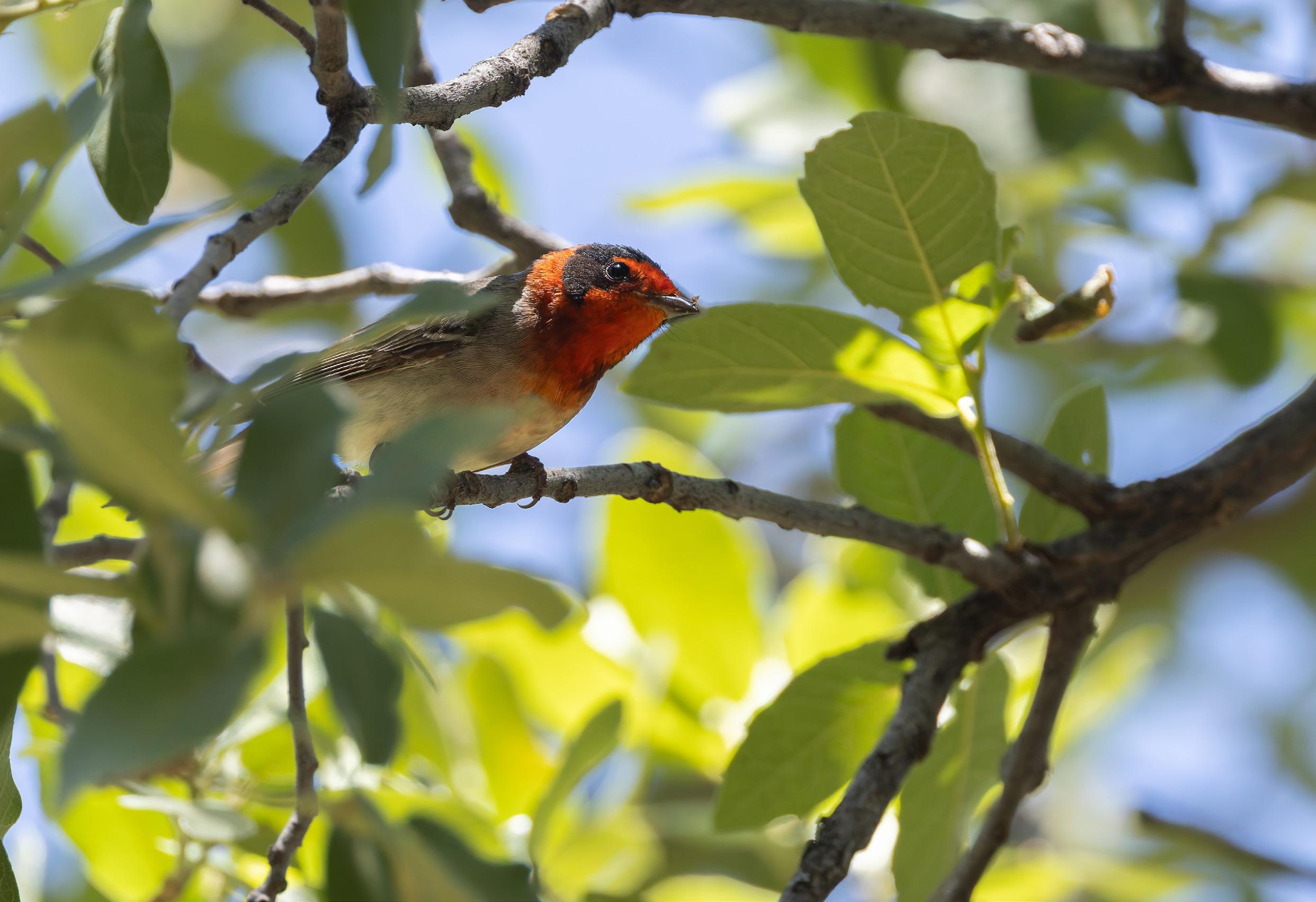
Today saw our first visit to the Sky Island Canyons of Southeast Arizona. A much anticipated part of the tour. Within a stone’s throw of Green Valley, lies Madera Canyon stop, one of the most famous of them. Winding our way through the gorgeous oak and Alligator Juniper woodland, which lines the Vault Mine/ Carrie Nation Trail. New birds came thick and fast! I got 10 lifers today! A pair of Yellow-eyed Juncos was gathering nest material; Lucy’s, Grace’s and Red-faced Warblers were all singing. Bridled Titmouse and Arizona Woodpecker were also here. However, the one we were
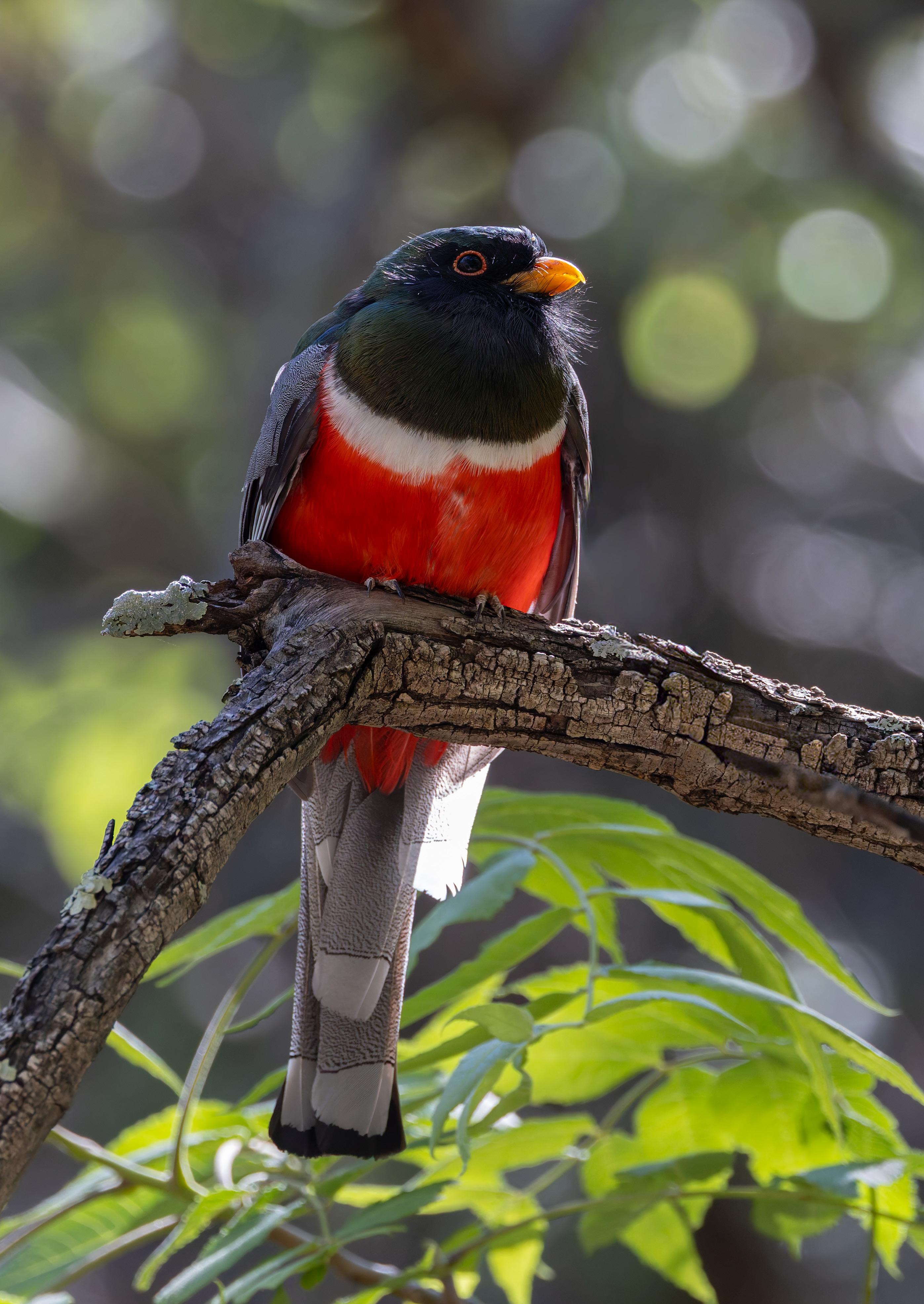
after today was Coppery-tailed Trogon and after hearing their calls for some time, we eventually set eyes on one of these beautiful birds. Better still, it came to within a few metres of us, at eye level. Wow! The bird formerly known as Elegant Trogon, it will take some time to get used to its new name. The also category included a nice selection of non-lifers: American Goshawk, Acorn Woodpecker, Brown-crested Flycatcher, Hutton’s and Plumbeous Vireos, Mexican Jay, Brown Creeper, Painted Whitestart, Black-headed Grosbeak and Hepatic and Western Tanagers. Quite a line-up! I had asked our folks to keep an eye out for small brown butterflies over the leaf litter of the woodland and after we connected with a few more obvious species like Echo Azure and Marine Blue and Red-spotted Purple, sharp-eyed Richard did indeed spot a small brown butterfly, which transpired to be a Nabokov’s Satyr. It allowed some decent views and a few images before it made off uphill through the undergrowth, however, unfortunately it had a notch out of its hindwing. Nevertheless, its gems were still intact. What a fabulous start to our birding (and butterflying) in this area!
Bridled Titmouse. Previous pages: Coppery-tailed Trogon & Grand Canyon NP scenes (Mike Watson)
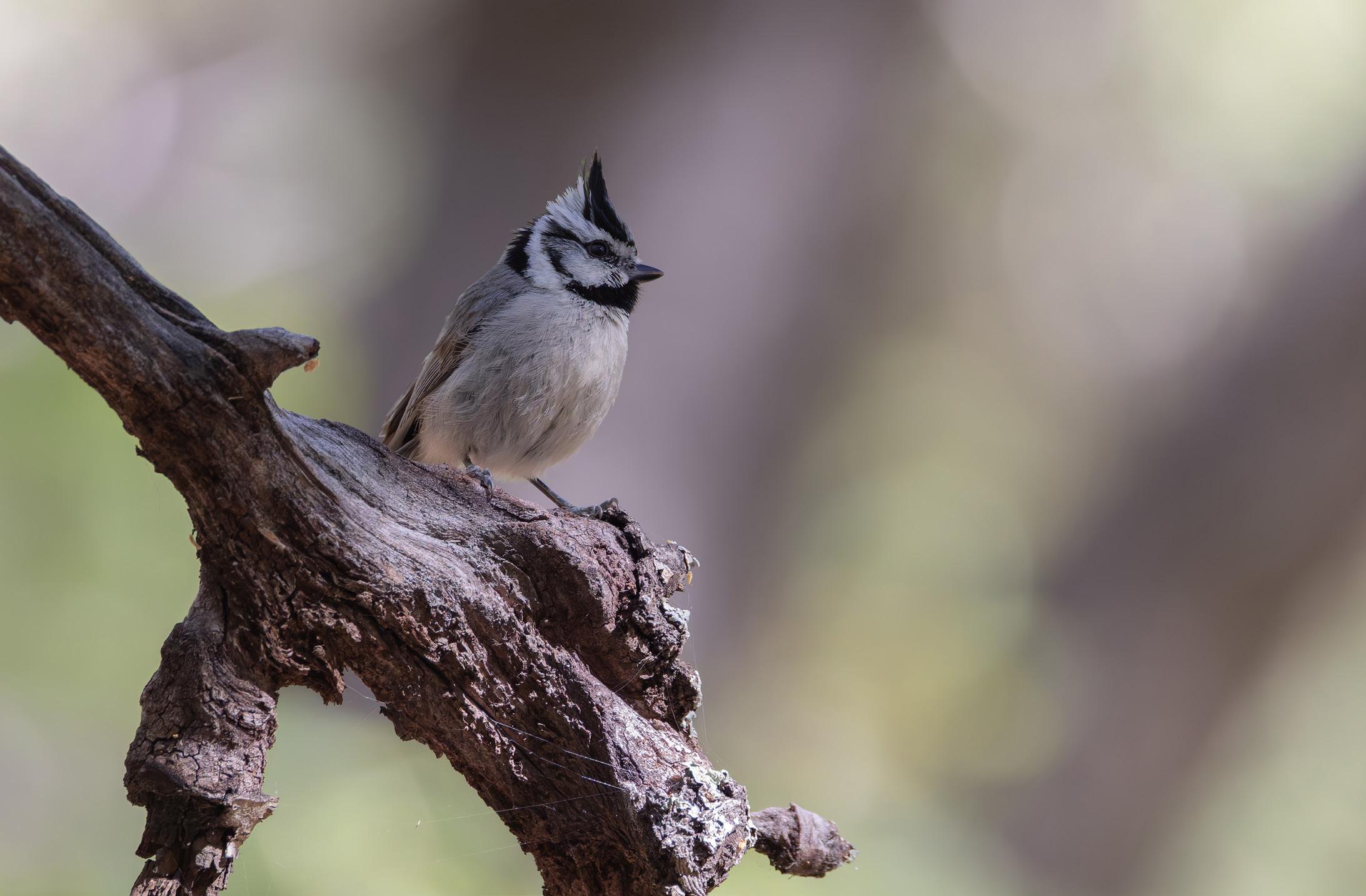
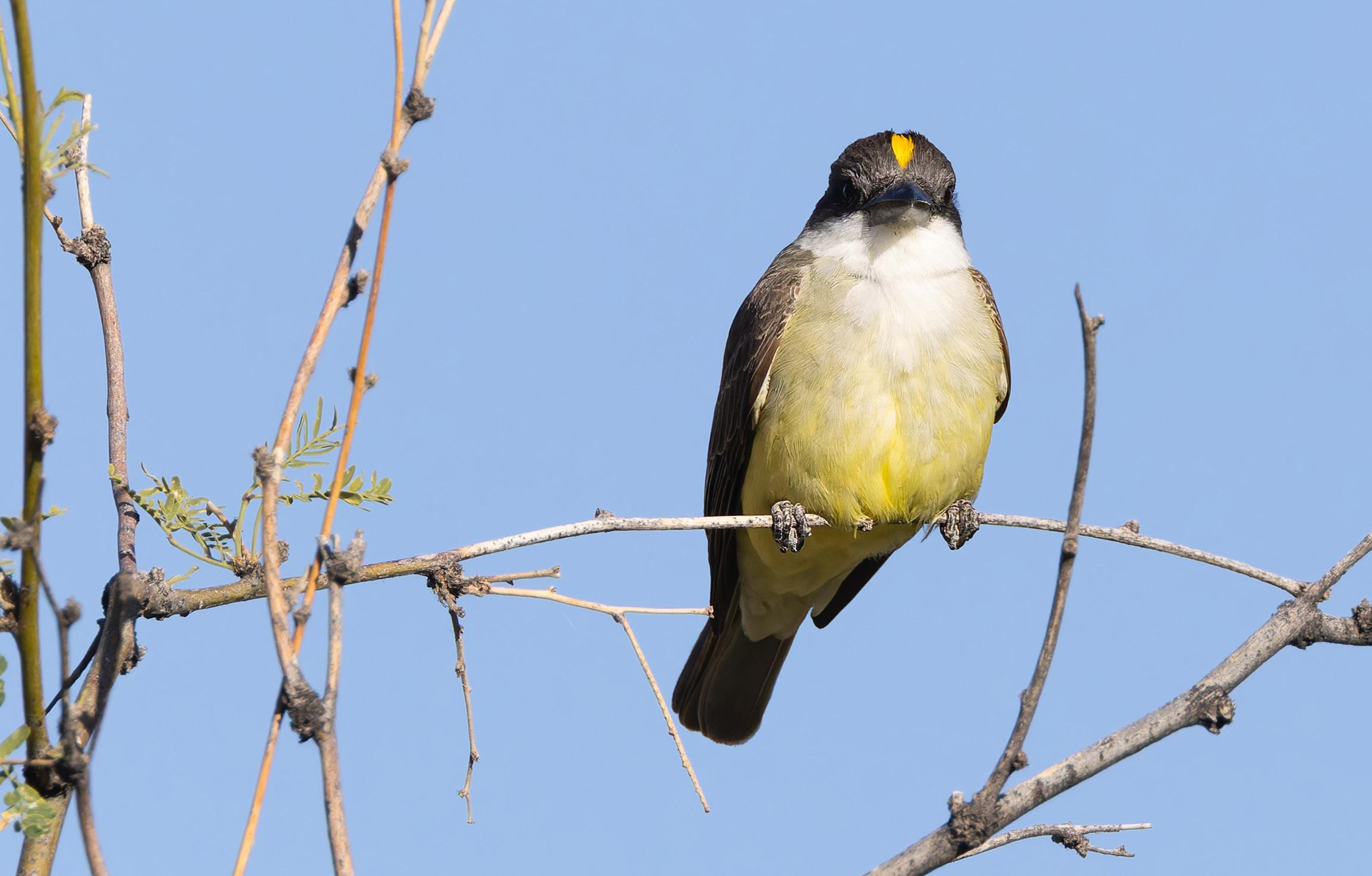
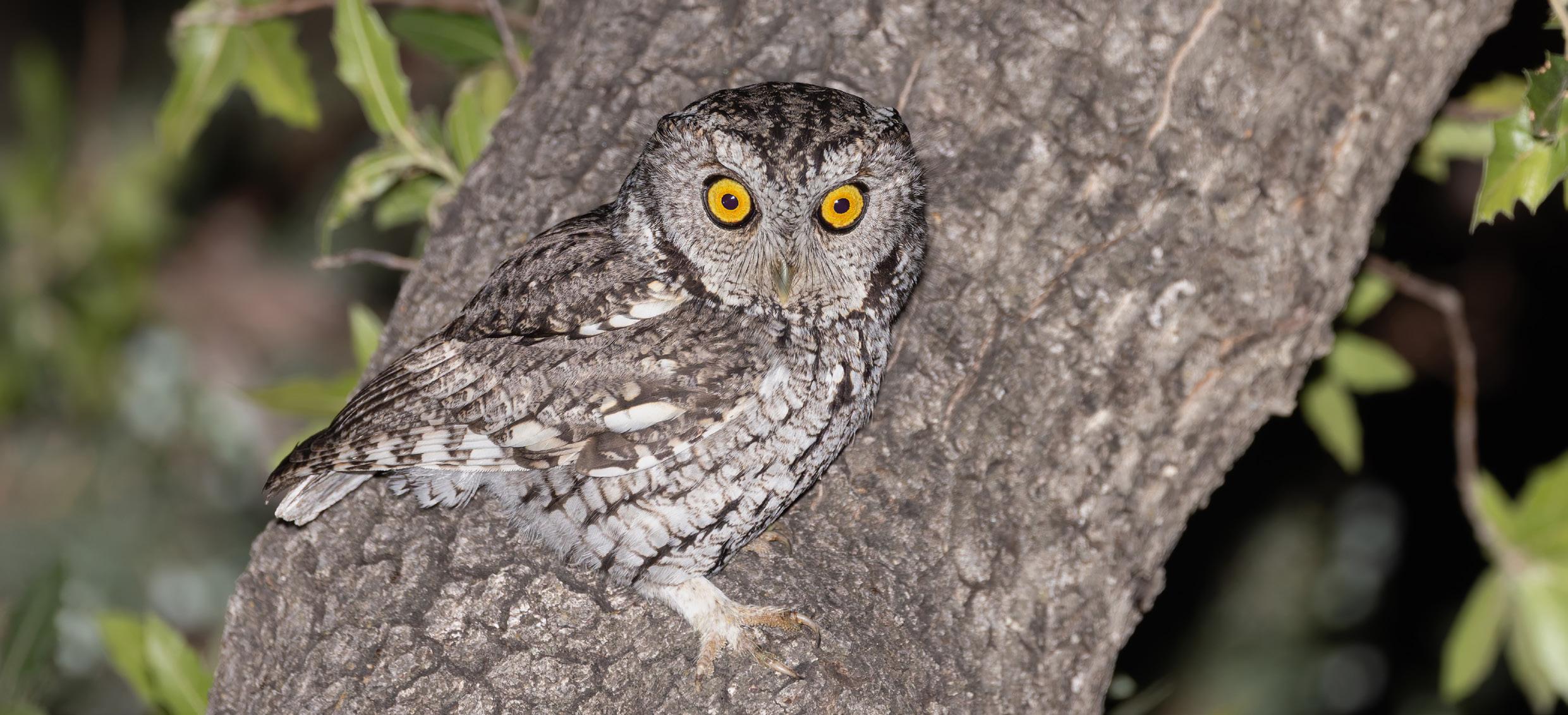
Moving slightly downhill, to Santa Rita Lodge, we spent some time at the very busy hummingbird feeders. Rivoli’s and Broad-billed Hummingbirds were new here, among the hustle and bustle of Black-chinned and Broadtailed Hummingbirds. Woodpeckers were also visiting the feeders, including Arizona again. After a much needed lunch break we headed to Box Canyon, another famous southeast Arizona birding spot, where our target was Fivestriped Sparrow, of which there was sadly no sign, however, we did add a few interesting birds to the list, in the form of Costa’s Hummingbird, Ladder-backed Woodpecker, Thickbilled Kingbird [it breeds here], Black-throated Sparrow and Northern Cardinal. After an earlyish evening meal, we were back to Madera Canyon for a nocturnal visit. Things started brightly with calling Mexican Whip-poor-will, Whiskered Screech Owl and Elf Owl, however, none came close. One of the problems with night birding in an ultra-popular spot, they have heard it all before. So, switching locations, we had much more luck and succeeded in see-
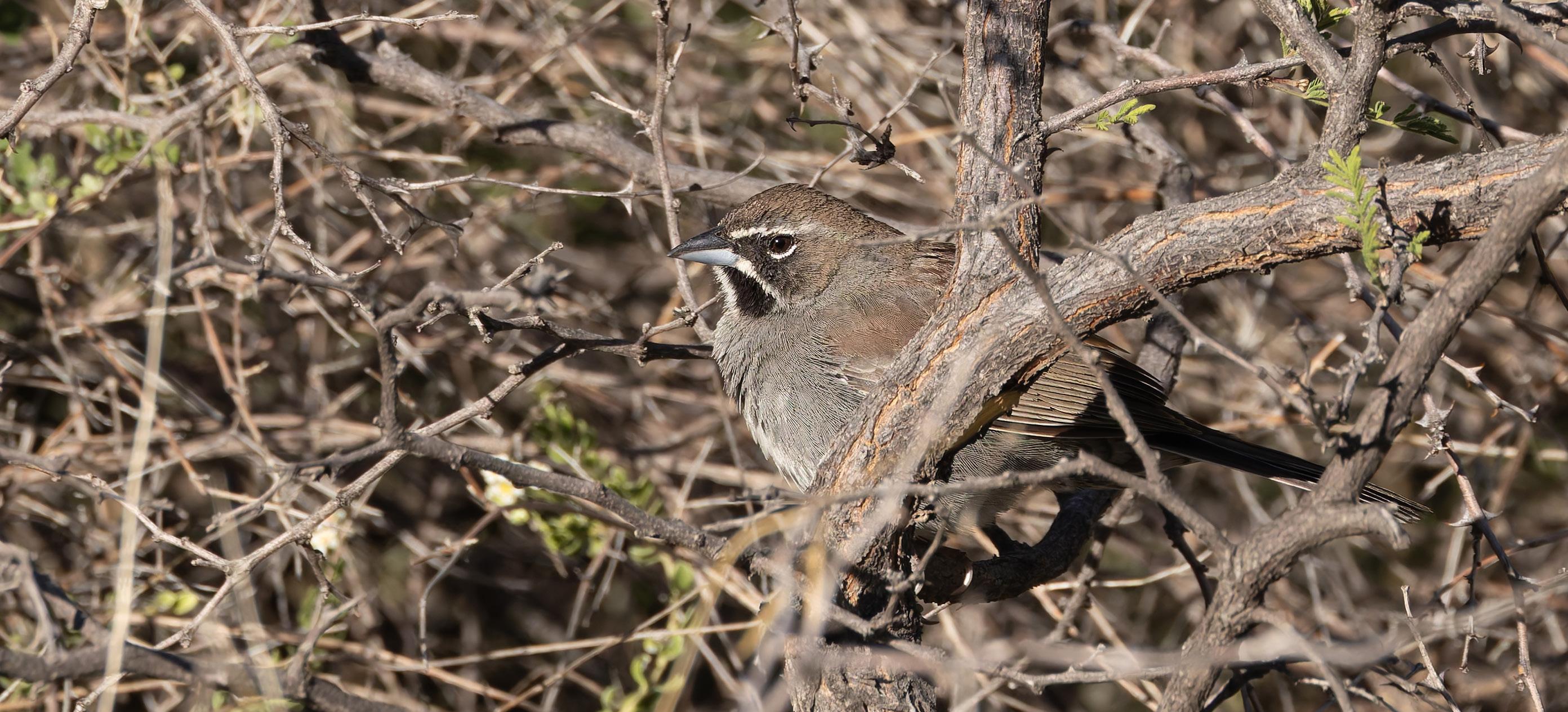
ing both Whiskered Screech Owl and Elf Owl very nicely. Sadly the nightjar eluded us. Montosa Canyon Road is another site for the big sparrow, and we started there the following morning. There was plenty of birdsong but only familiar friends, until we decided to try a side trail and quickly located a pair of Five-striped Sparrows, which came in and showed very nicely. A much sought-after Southeast Arizona bird! Also here were Broad-billed Hummingbird, Bells Vireo, Phainopepla, Canyon and Cactus Wrens, Canyon and Abbots Towhees, Townsend’s Warbler, Black-headed Grosbeak, Northern Cardinal and Hepatic Tanager. An American Snout butterfly in the nearby picnic area was also new for the tour.
Back in Green Valley, thanks to a tip off from one of our pals, we visited a pair of Great Horned Owls in the town centre, where they had been causing quite a stir, choosing to nest in the only tree in the car park, surrounded by vehicles! There must be plenty of vermin in this neck of the woods. The parents were visible and our presence attracted several onlookers
wondering what the fuss was about. A surreal twitching scenario. I’ve been to a few supermarket car park twitches before! A nearby site for Harris’s Hawk did not work, although another Phainopepla was some compensation. We tried another Harris’s Hawk spot in town, which was occupied this time. Four birds were perched in a large tree and nearby Gila Woodpecker, Say’s Phoebe, Verdin and Bushtit were also seen.
HUACHUCA MOUNTAINS
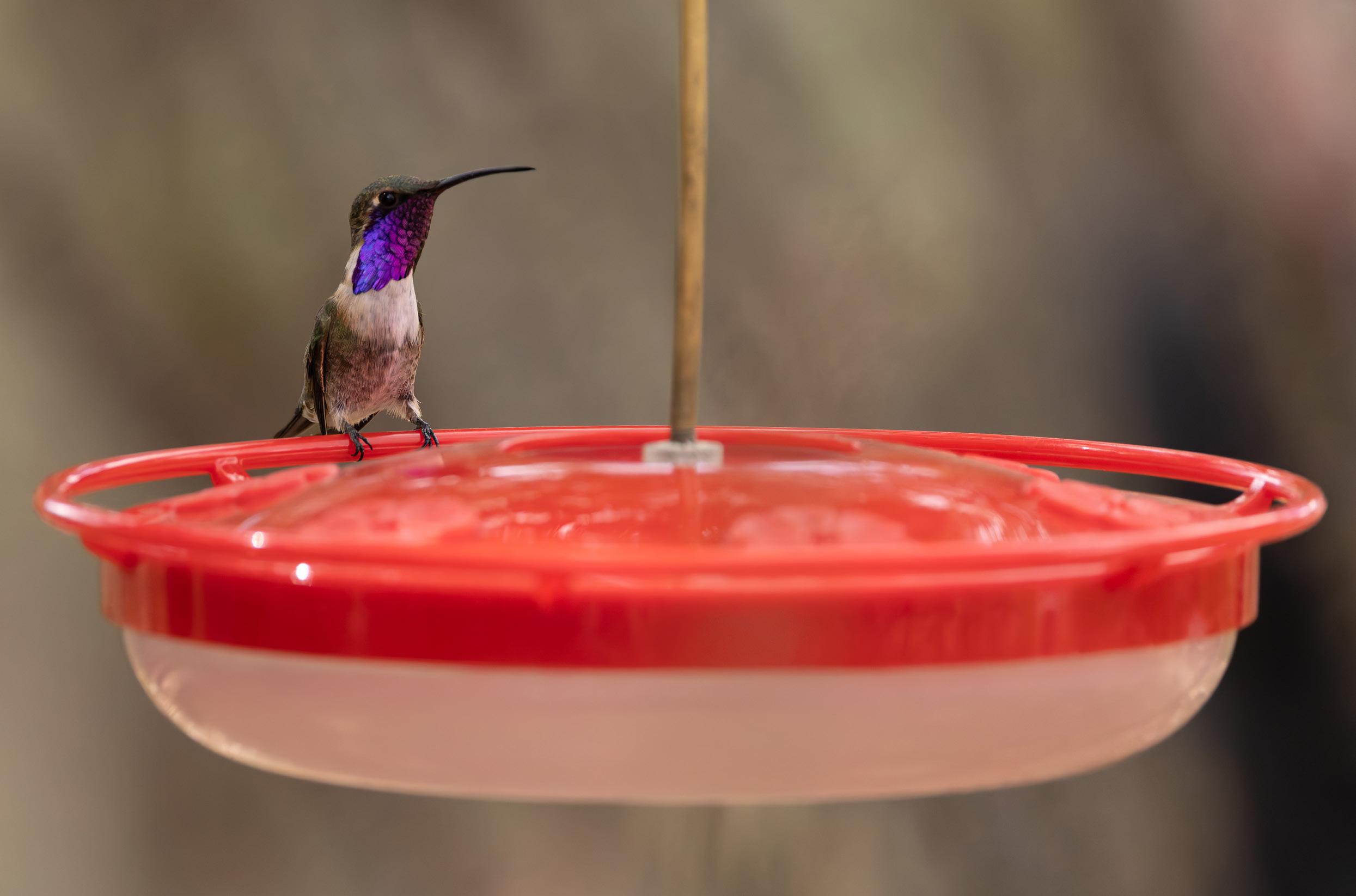
Leaving Green Valley, we drove southeast, stopping at Curly Horse Ranch where a pair of Brewer’s Sparrows was next. A Yellow-headed Blackbird was seen before we finally tracked down the desired Chihuahuan Meadowlark, looking suitably pale, singing from a fence line. A little further south at West Puesta del Sol/ North Chula Vista Road we scored with Scaled Quail. There was still time for another couple of birding spots this afternoon, the first being Ash Canyon Bird Sanctuary, where there is an impressive set of feeders for both hummingbirds
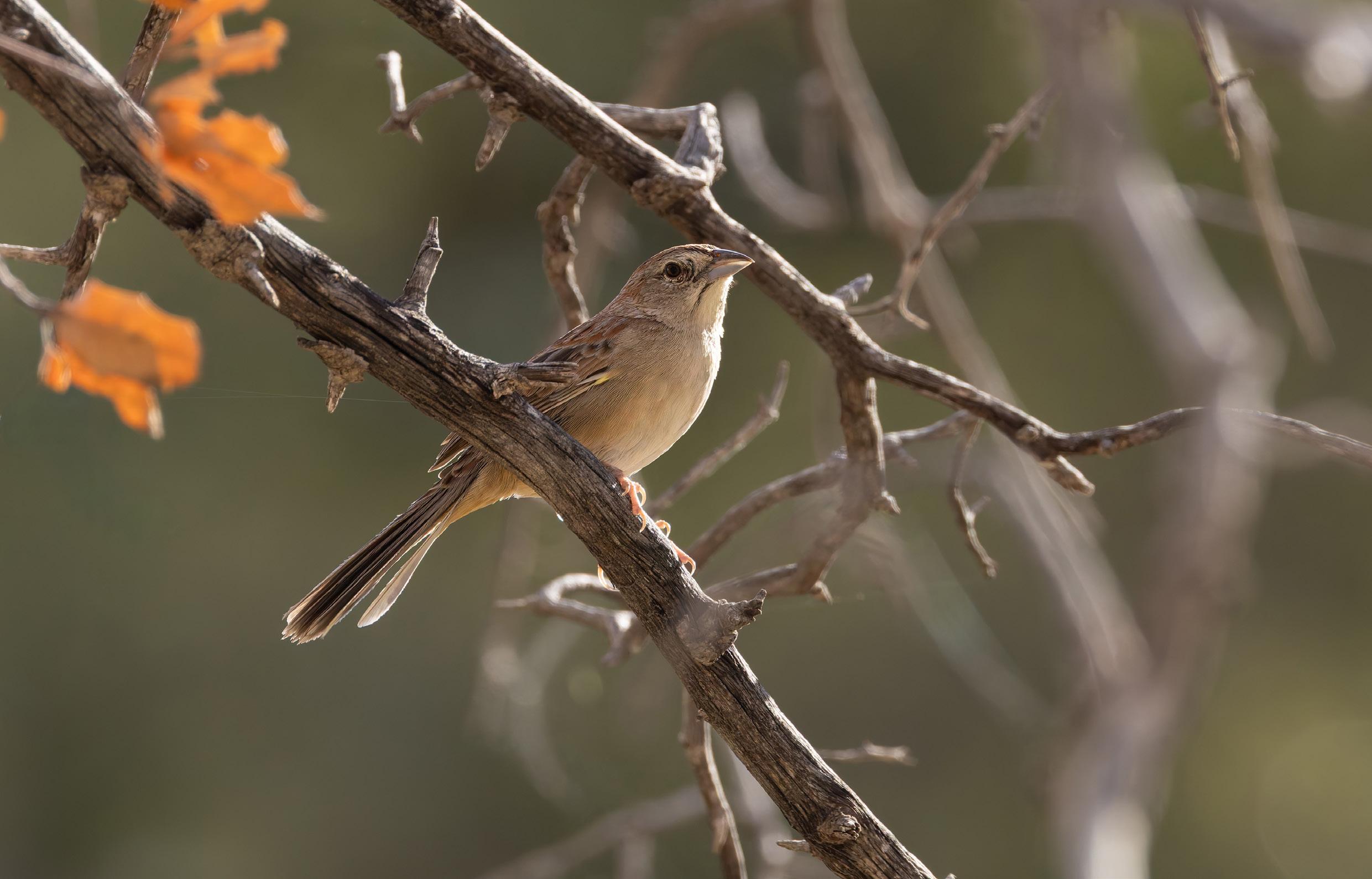
as well as fruit and seed eating species. The main target here was Lucifer Hummingbird (or sheartail) and happily a male quickly obliged, although only on the plastic feeders. Calliope Hummingbird was new, a female among the many Black-chinned, Anna’s, Broad-tailed and Broad-billed Hummingbirds. A Gray Hawk flew overhead and on the non-hummer feeders were Ladder-backed and Acorn Woodpeckers, White-breasted Nuthatch, Mexican Jay, Bewick’s Wren, Curve-billed Thrasher, Lesser Goldfinch, Lincoln Sparrow, Canyon Towhee, Scott’s Oriole, Black-headed Grosbeak and Lazuli Bunting, Northern Cardinal and Hepatic Tanager. We could have stayed longer but we had bigger fish to fry. Along the Coronado National Memorial Windmill Trail, within sight of Trump’s Wall, separating this part of Arizona from Mexico, we searched hard for Montezuma Quail. Only to hear it distantly and briefly, although the walk was made worthwhile by Loggerhead Shrike, Bridled Titmouse and particularly a couple of Botteri’s Sparrows, which were seen beautifully at very close range. But-
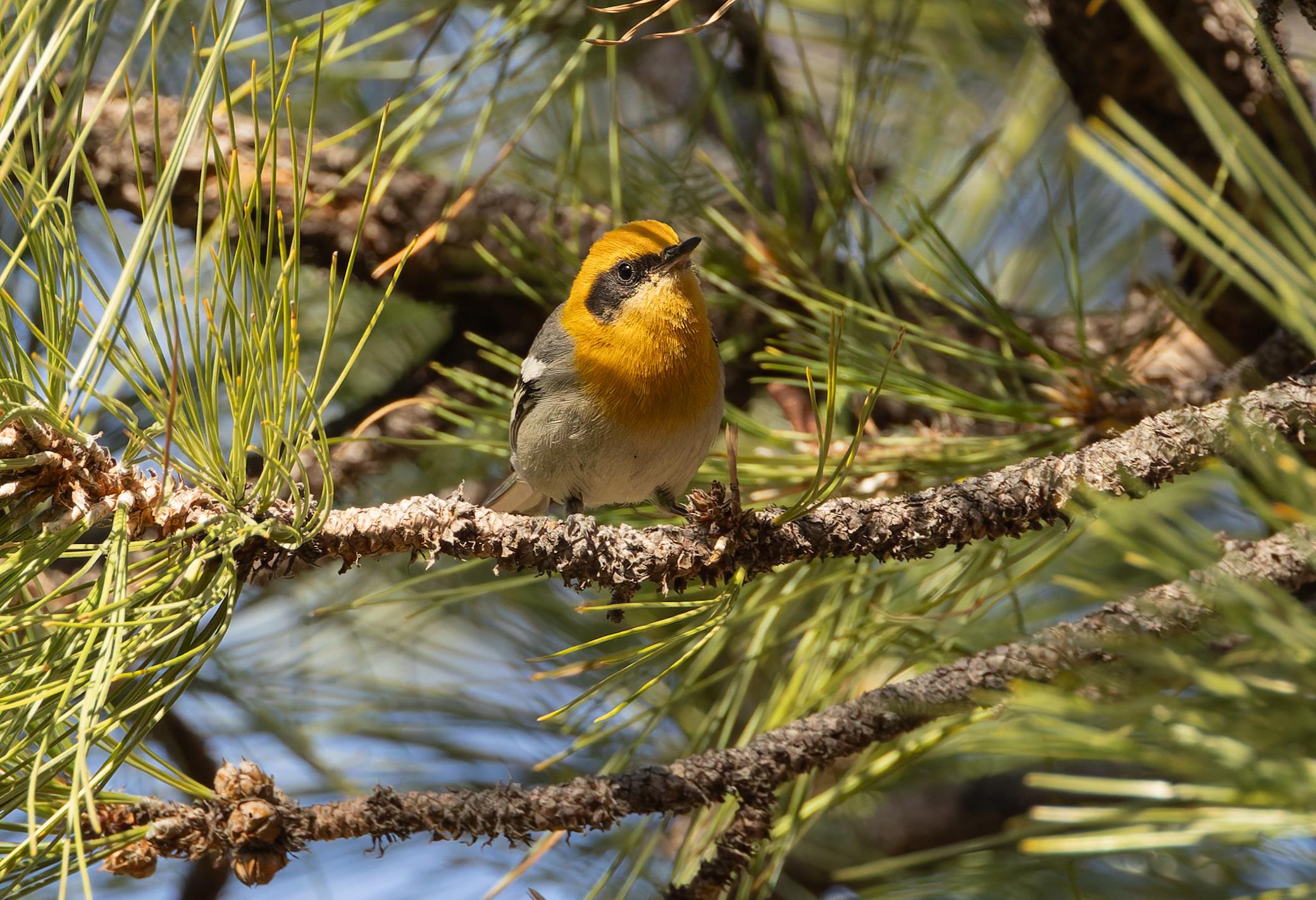
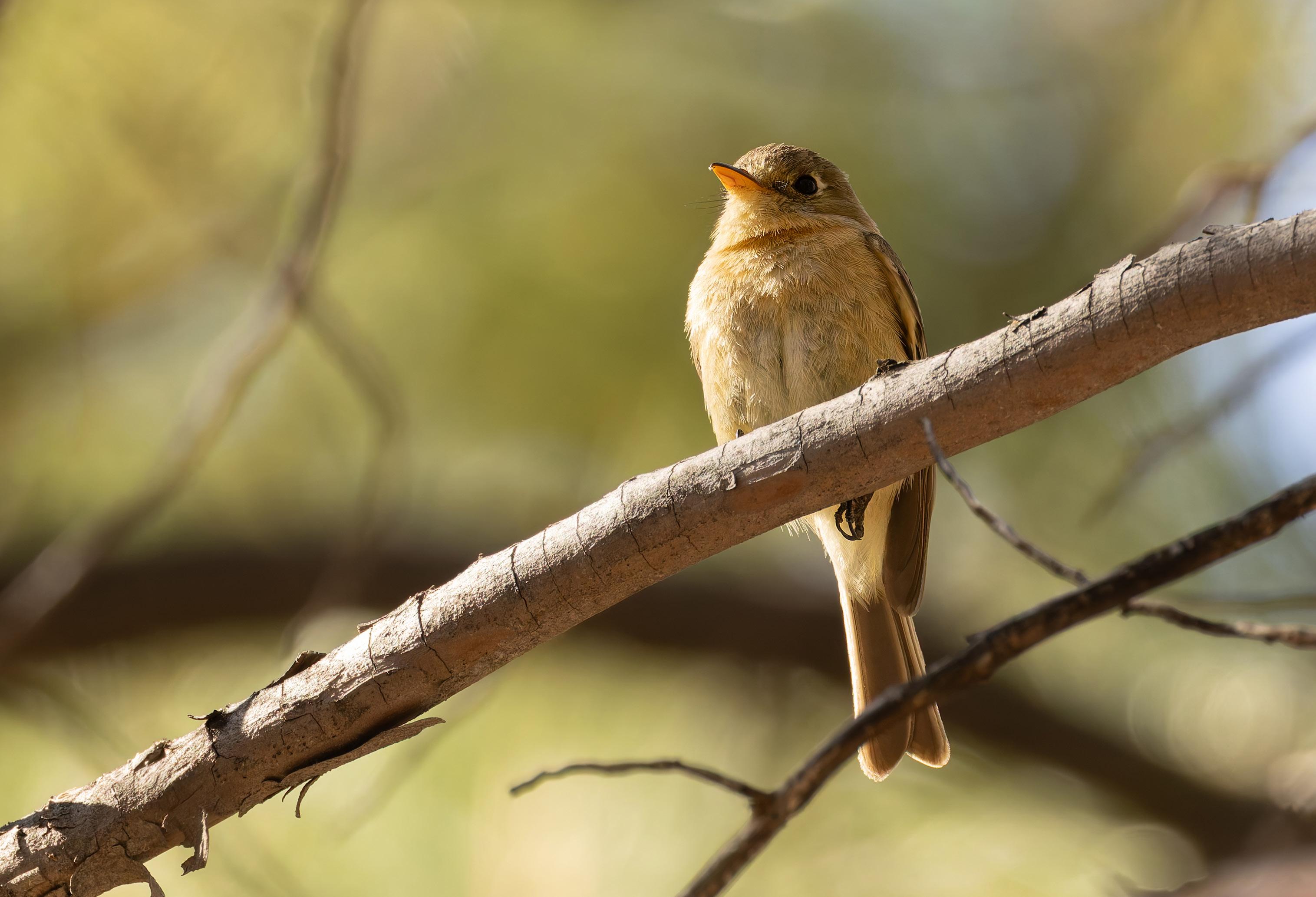
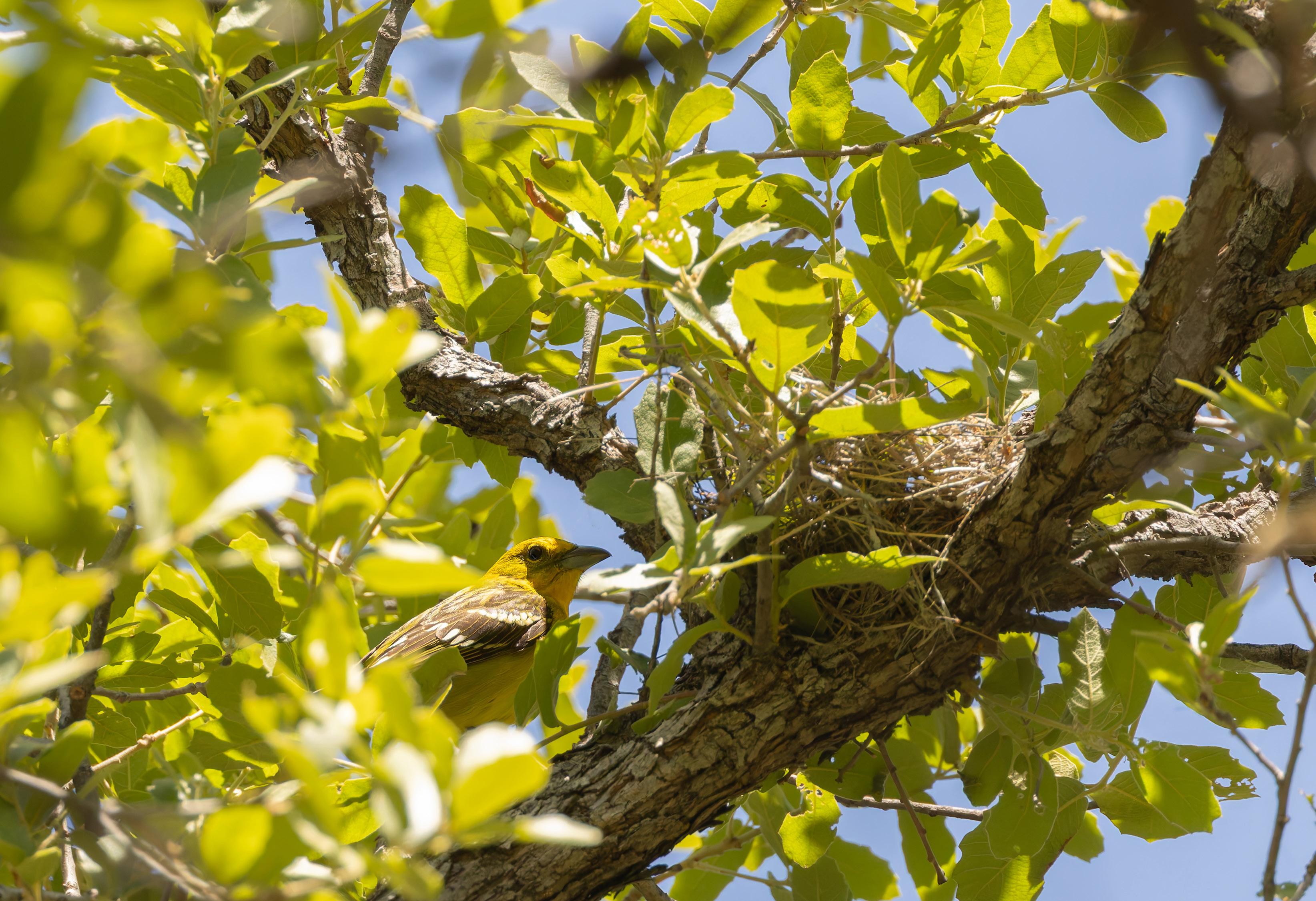
terflies included Acacia Skipper, the one with a white band below the tip of the antenna. We were now in the Huachuca Mountains to the West of Sierra Vista. The drive to the mountain top next morning took us straight to our two main targets: the monotypic family lifer Olive Warbler (it’s not a wood warbler) and Buff-breasted Flycatcher. Both were easily found in the pines surrounding a campground. In the also category here were Arizona Woodpecker, Western Wood Pewee, Eastern Bluebird, Pine Siskin, Yellow-eyed Junco, and Grace’s Warbler of note. Back downslope at Miller Canyon, the lower parking trail produced Virginia’s Warbler and Black-throated Gray Warbler and another Nabokov’s Satyr. The main reason we had come to Miller Canyon was further ‘upstream’; a pair of Flame-coloured Tanagers had taken up residence and built a nest above the main hiking trail. Armed with an exact waypoint, we were able to locate the nest easily in the crown of a tall Emory Oak tree.
The female revealed her presence by calling, a sign that the male was nearby. He was visiting her regularly and appeared a couple of times while we were there; a pale tangerine coloured bird. We could watch the duller female shuffling around in a rather ramshackle nest, as if she was rearranging eggs. Miller Canyon produced many now familiar birds in Rivoli’s, Blackchinned, Broad-tailed and Broad-billed Hummingbirds, Dusky-capped and Brown-crested Flycatchers, Plumbeous Vireo, Mexican Jay, White-breasted Nuthatch, Bewick’s Wren, Black-throated Grey and Red-faced Warblers, Black-headed Grosbeak and Hepatic Tanager. Nabokov’s Satyr butterfly was again skipping above the leaf litter of the main car park and other butterflies here included the spectacular Arizona Sister, Texan Crescent, Ceraunus Blue and Chequered White. We saved the most famous canyon until last, Ramsey Canyon. By now there were few birds we still needed in this area and Ramsey only added Blue Grosbeak
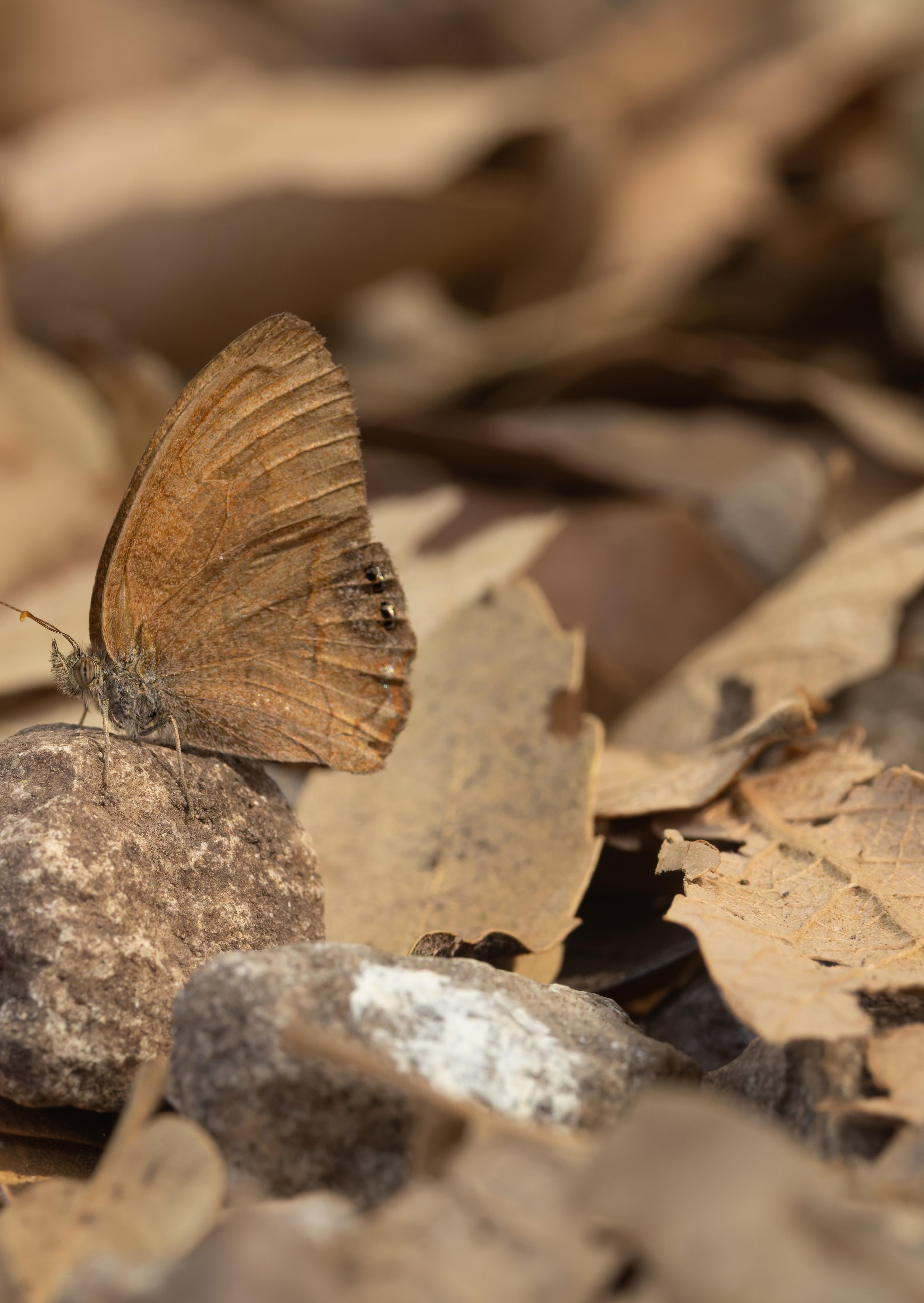
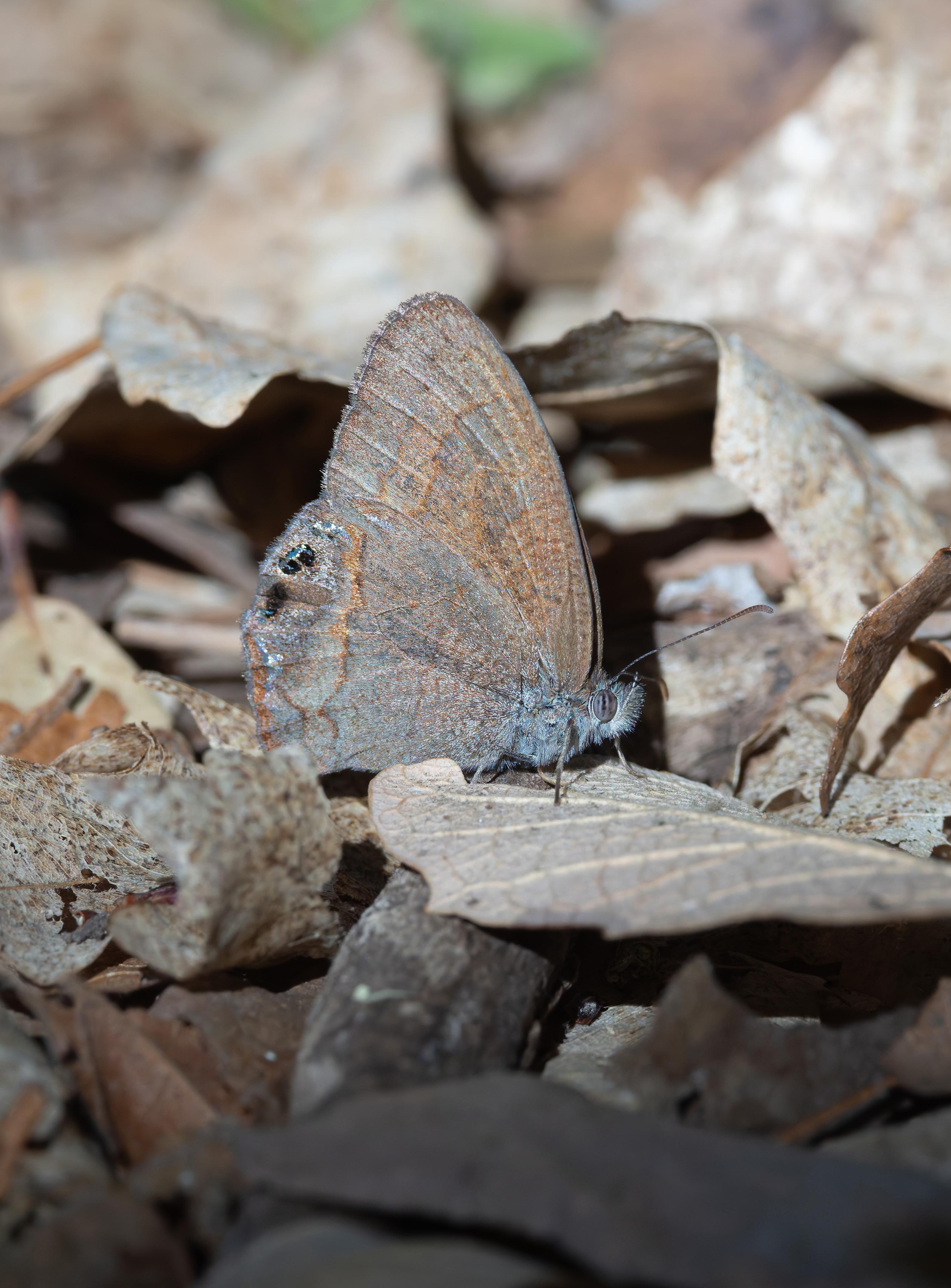
Researching range-restricted, spring-flying butterflies that I might see in California and Arizona, I was struck by the fact that most of the special butterflies fly in the Arizona ‘second spring’ monsoon season from July to September. However, there are a few that could be seen in the actual springtime of my visit, in early May. One of these caught my eye, Nabokov’s Satyr. Not only as it carries a famous name, but I noted that it belonged to a new butterfly genus for me Cyllopsis, the ‘gemmed satyrs’. Essentially subtle browns, with jewel-like studs embedded on their hindwing borders, like blues. What a wonderful combination! There are more than 30 members of this Neotropical genus, three of which occur in the southern United States: Gemmed Satyr Cyllopsis gemma; Canyonland Satyr C. pertepida and Nabokov’s Satyr C. pyracmon. My pal Craig Robson, who spends part of the year in Southeast Arizona, said the latter was ‘easy anywhere in the mountains on trails/in shade’ and looking at the number of INaturalist.org sightings I thought I should
have no trouble in catching up with it in early May. With many pairs of eyes in my group I mentioned that we should be on the lookout for any small brown butterflies and sure enough on our first morning in the Sky Island canyons, at the lovely Madera Canyon near Green Valley, while returning from a successful hike in search of Coppery-tailed Trogon, sharp-eyed Richard spotted one. It was a Nabokov’s, albeit a worn individual with a torn hindwing. Very exciting nevertheless! Thanks Richard! After alighting on a stone, it moved off quickly uphill and into dense scrub and out of reach. Moving with surprising speed at ground level, it skipped through the bases of thorn bushes, a most annoying habit of this species I was to discover in the coming days.
Interest in butterflies on our birding tours is very limited, so my opportunities are therefore compressed into a few minutes here and there. The next canyon bottom we visited, the lovely Miller Canyon also produced Nabokov’s Satyr at each stop, but in the heat of the mid-
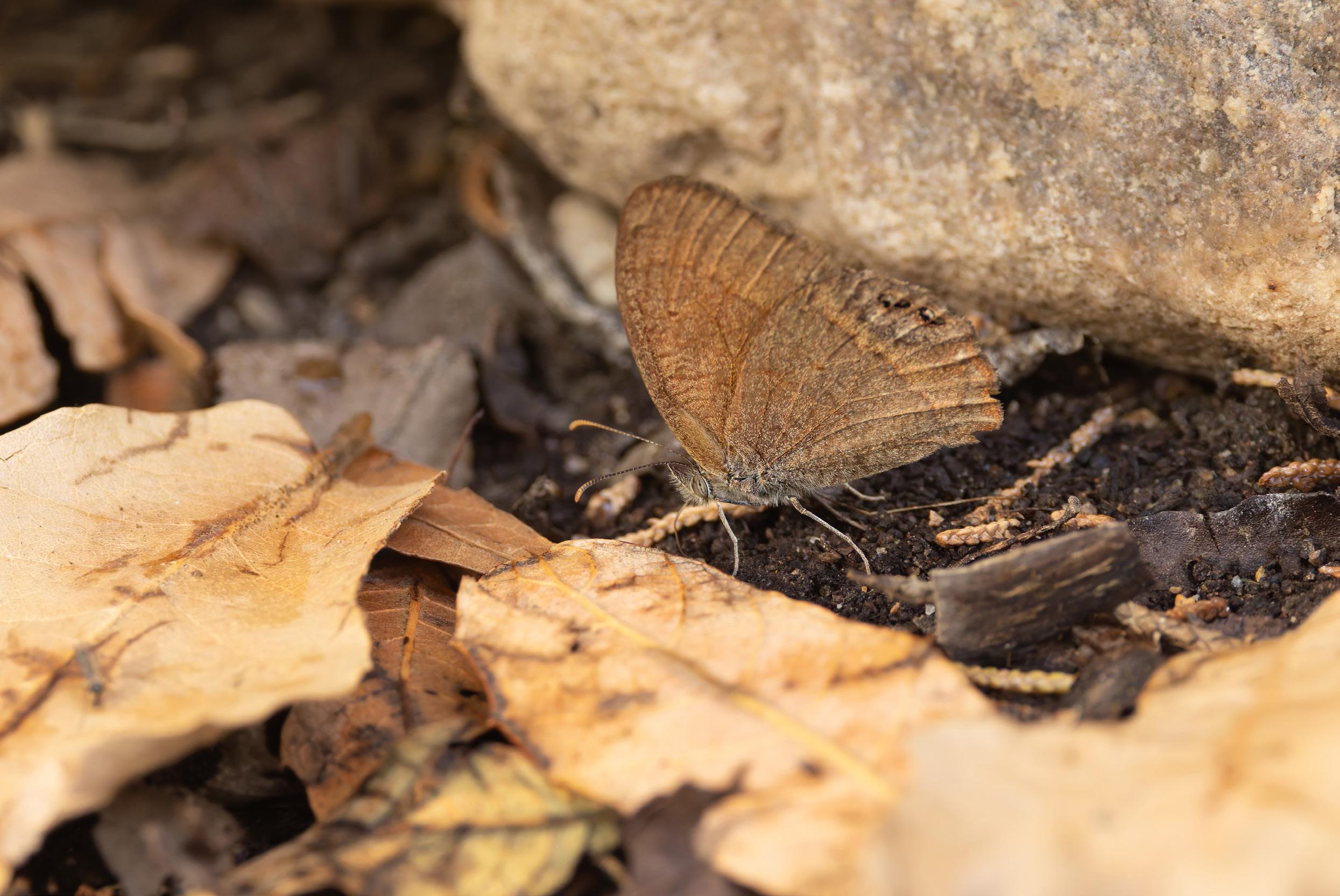
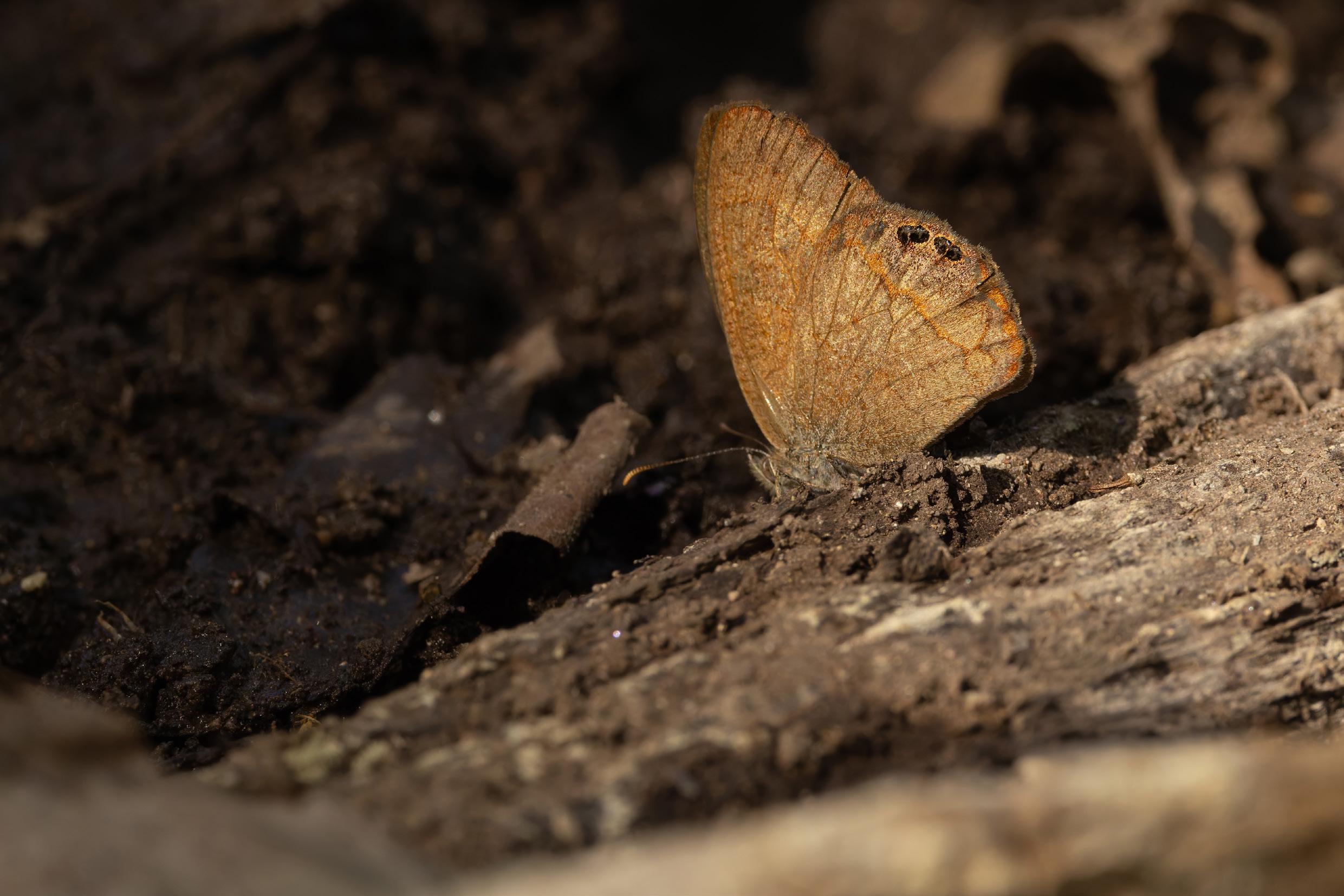
day they were completely restless and rarely paused for more than a few seconds on their ramblings through the shady understorey of the evergreen oak and Alligator Juniper woodland, when they would angle their wings perpendicular to the shafts of sunlight reaching the leaf litter, in the manner of a grayling back home. This did not allow me enough time to get in position for a photo before they were off again. Goodness me, it was hard work following these pesky creatures round and round a small patch of woodland, before ultimately losing contact, as they made off through the bushes. All too soon, my group returned from a hummingbird feeder sojourn with my co-leaders and that was that. They were indeed in each canyon and, finally, it was in Ramsey Canyon, the most famous of all the birding spots in the Huachuca Mountains, that I could finally spend some quality macro time with the satyrs, significantly late in
the afternoon when they settled down to visit wet patches of ground in the watercourses and directly under the hummingbird feeders! Most were quite worn by this stage in their flight season and it was more difficult to read their undersides to separate them from the very similar Canyonland Satyr (which is usually found further uphill rather than in the valley bottom) but they were very approachable now. A very satisfying experience to go alongside the other avian treasures of these precious habitats. How many takers for ‘I’ve got a settled Nabokov’s Satyr here’? None at all. We are so few. The butterfly is named after the Russian/American author Vladimir Nabokov (1899 – 1977), a fascinating character whose most famous work is the 1955 novel Lolita. It is hailed one of the greatest literary works of the 20th century but the subject is such a hot potato now! He was born of Russian nobility but moved gradually westwards, fleeing the Russian Revolu-
tion and then Hitler’s Germany, before settling in the United States and gaining citizenship in 1945. Nabokov was a true polymath and as well as an acclaimed author, he was also an accomplished entomologist and has several butterfly and moth species named after both him and his literary works! He wrote in three languages; Russian, English and French, gave boxing lessons and composed chess problems. He lectured at Cornell, (where one of his students was US Supreme Court Justice Ruth Bader Ginsberg). He was mostly concerned with studying blue butterflies and genetic research later supported his hypothesis that the Polyommatus blues came to the Americas over the Bering Strait in five waves, eventually reaching Chile. I was fascinated to read that Nabokov did not learn to drive, he got his wife Véra to drive him around in search of butterflies and in 1967, he commented ‘The pleasures and rewards of literary inspiration
are nothing beside the rapture of discovering a new organ under the microscope or an undescribed species on a mountainside in Iran or Peru. It is not improbable that had there been no revolution in Russia, I would have devoted myself entirely to lepidopterology and never written any novels at all.’ Interestingly ‘his’ satyr was first described in 1867 and the use of his name stems from the description of its subspecies named nabokovi in his honour by Lee D. Miller in 1974, from none other than Ramsey Canyon, Arizona (!). The epithet Nabokov’s was later adopted as the common name for the larger species. I hope it does not get cancelled, as is the current Cornell habit with birds. We would surely end up with some hopeless anodyne alternative.
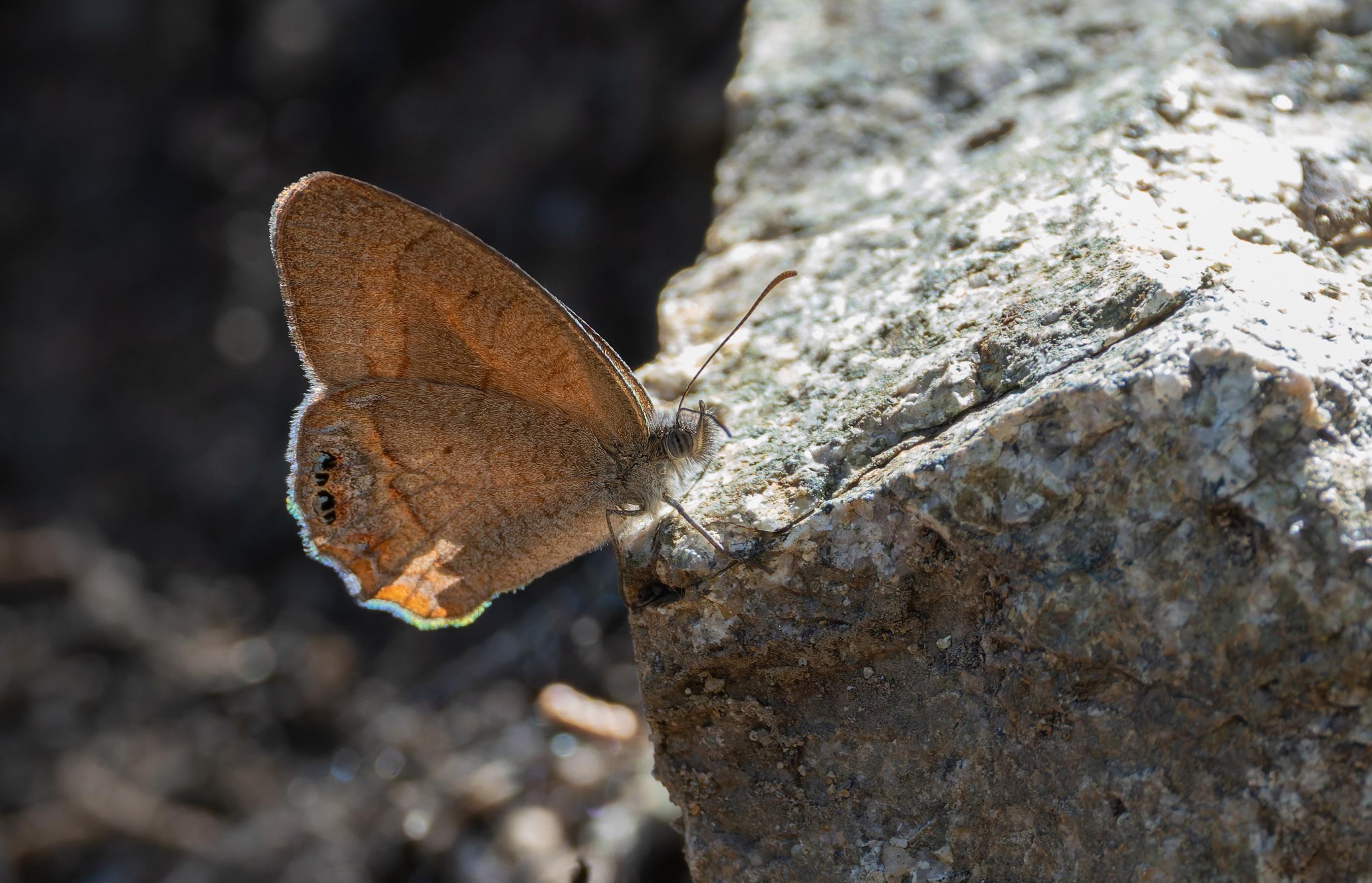
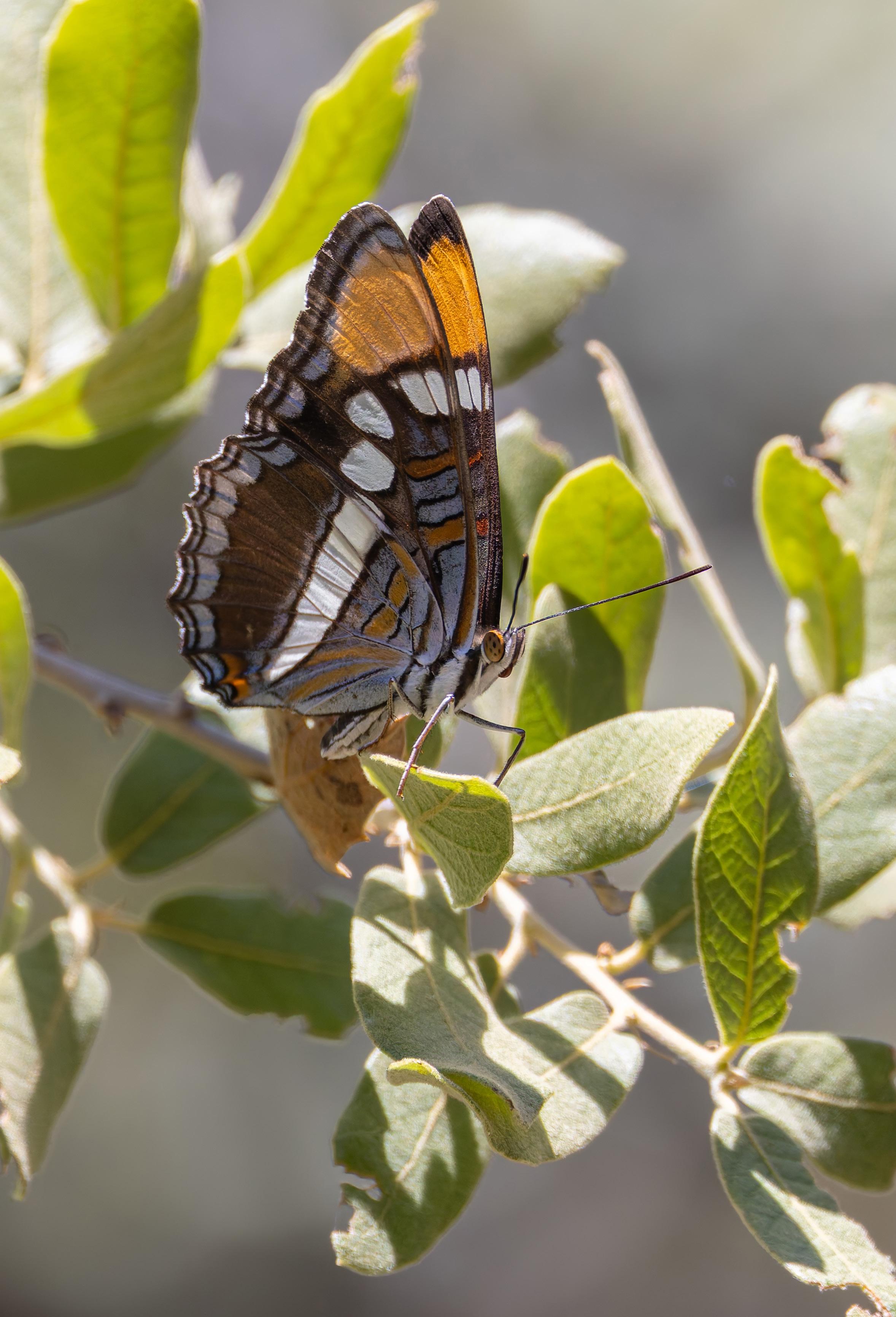
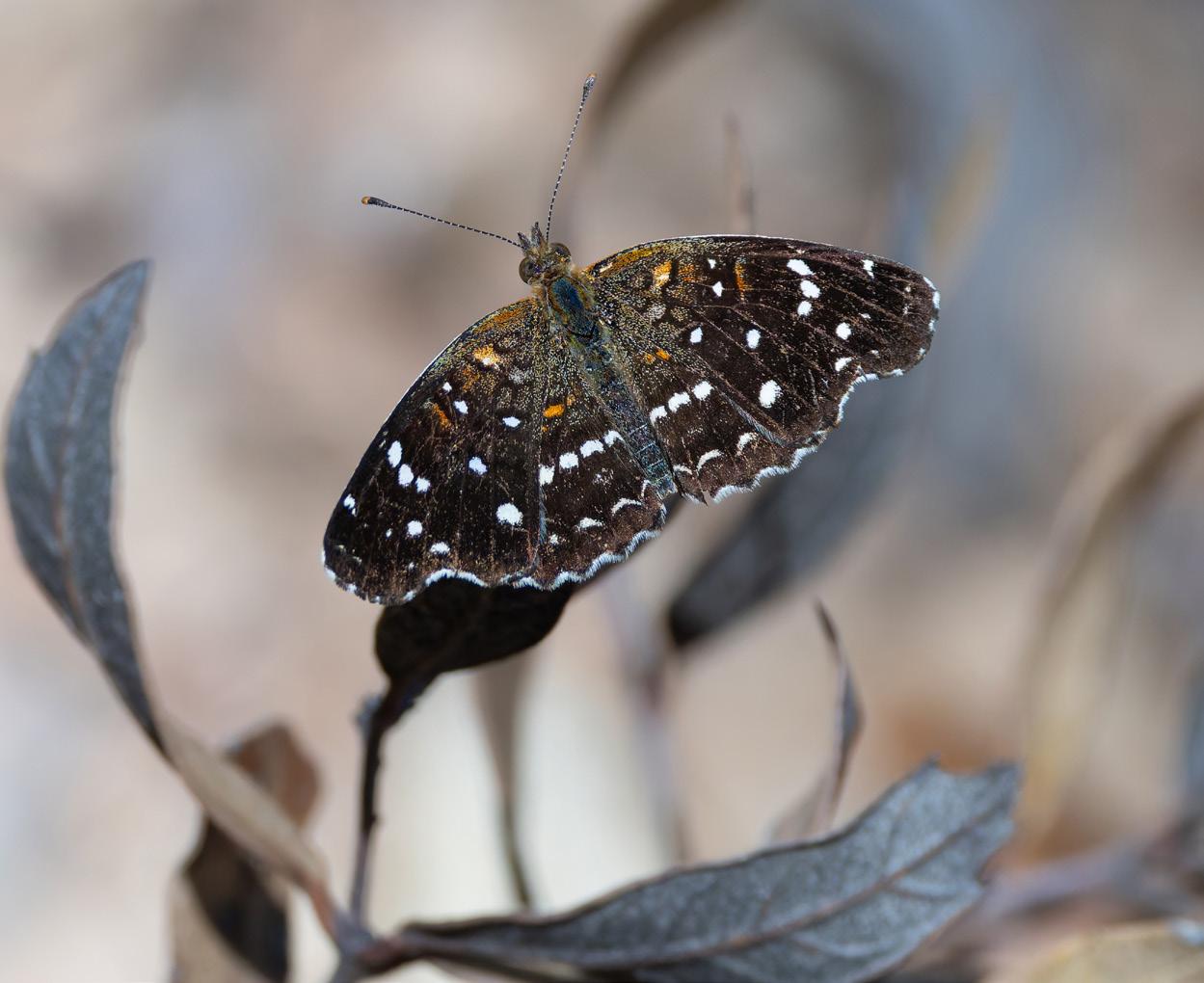
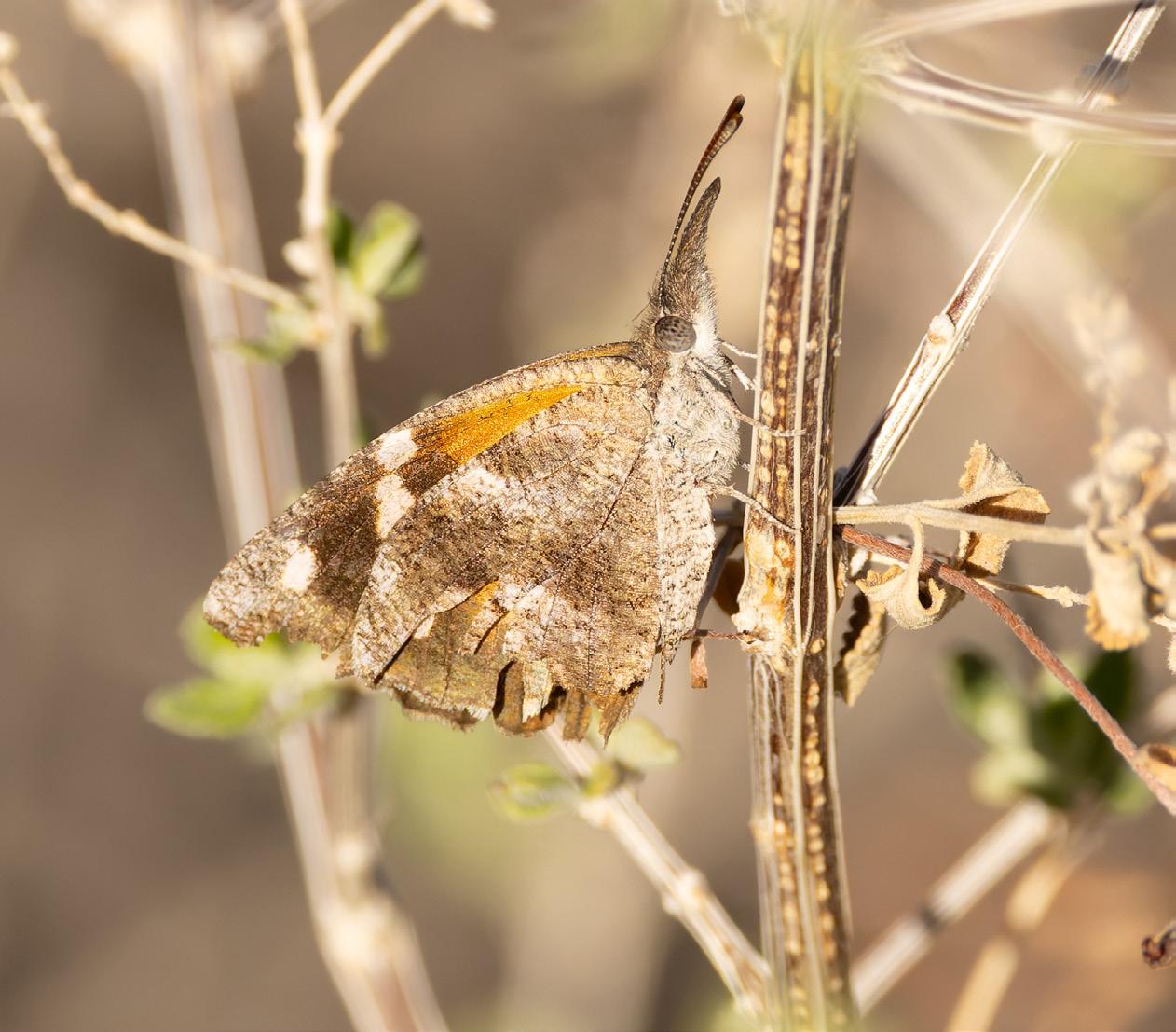
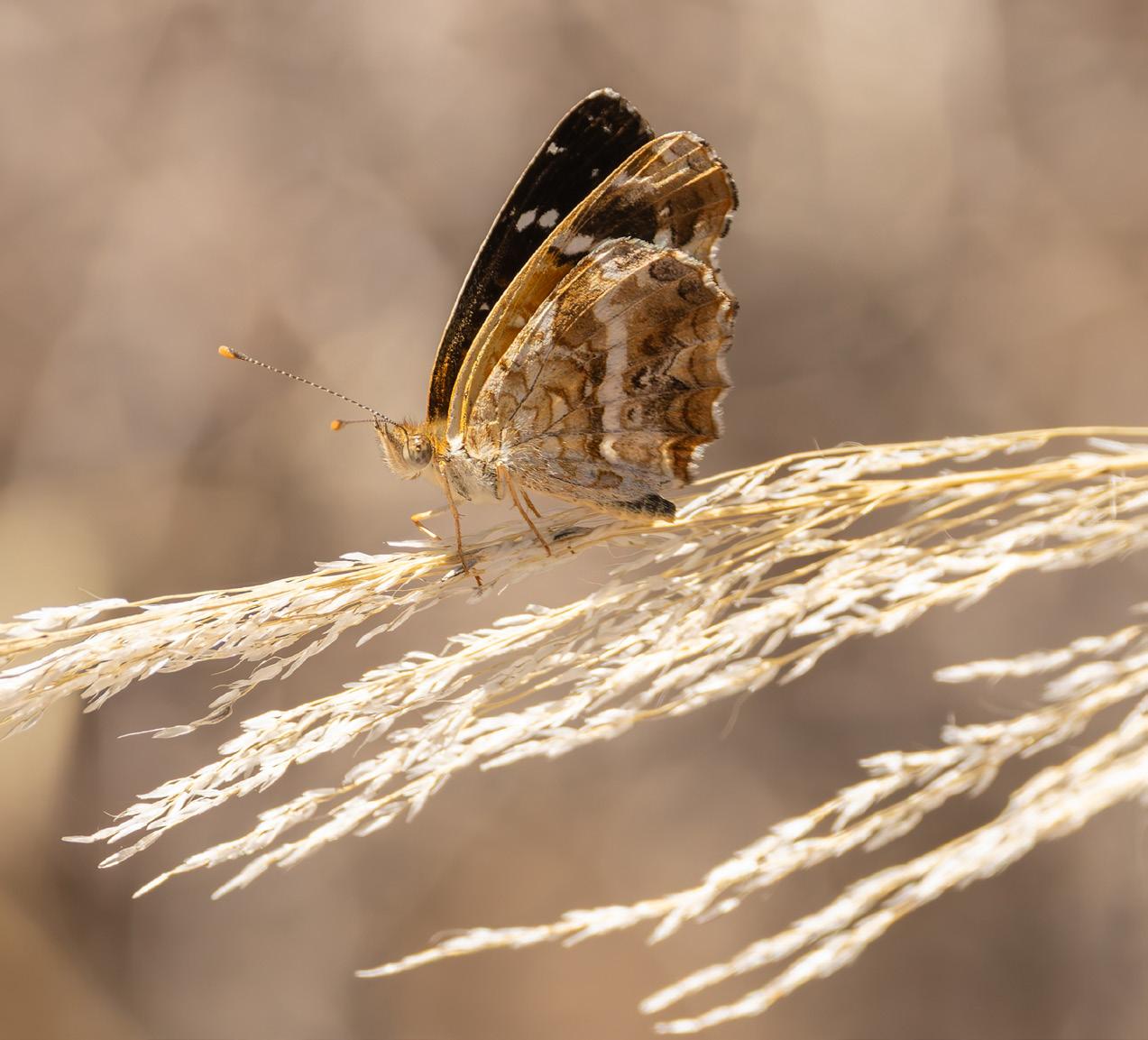
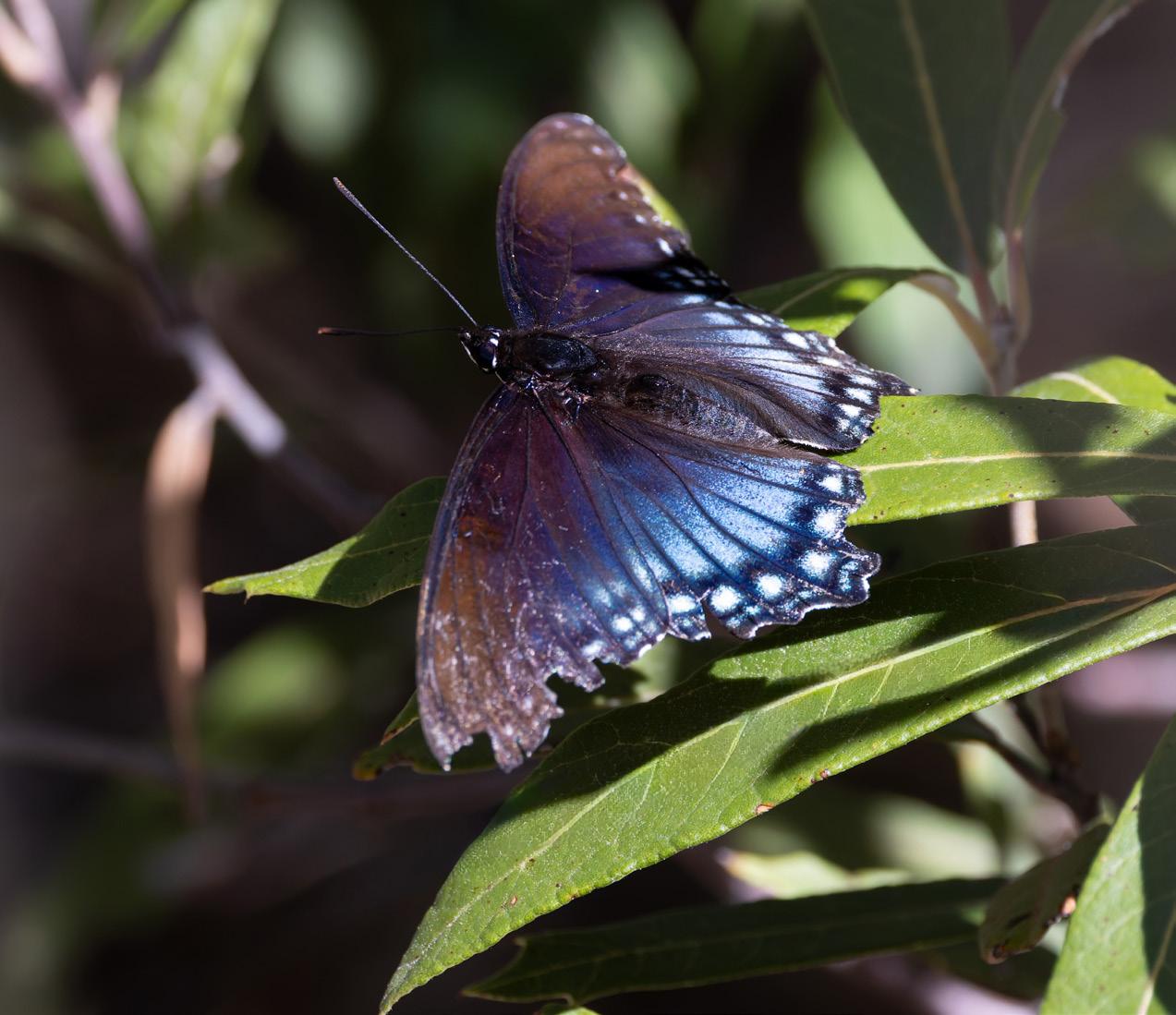
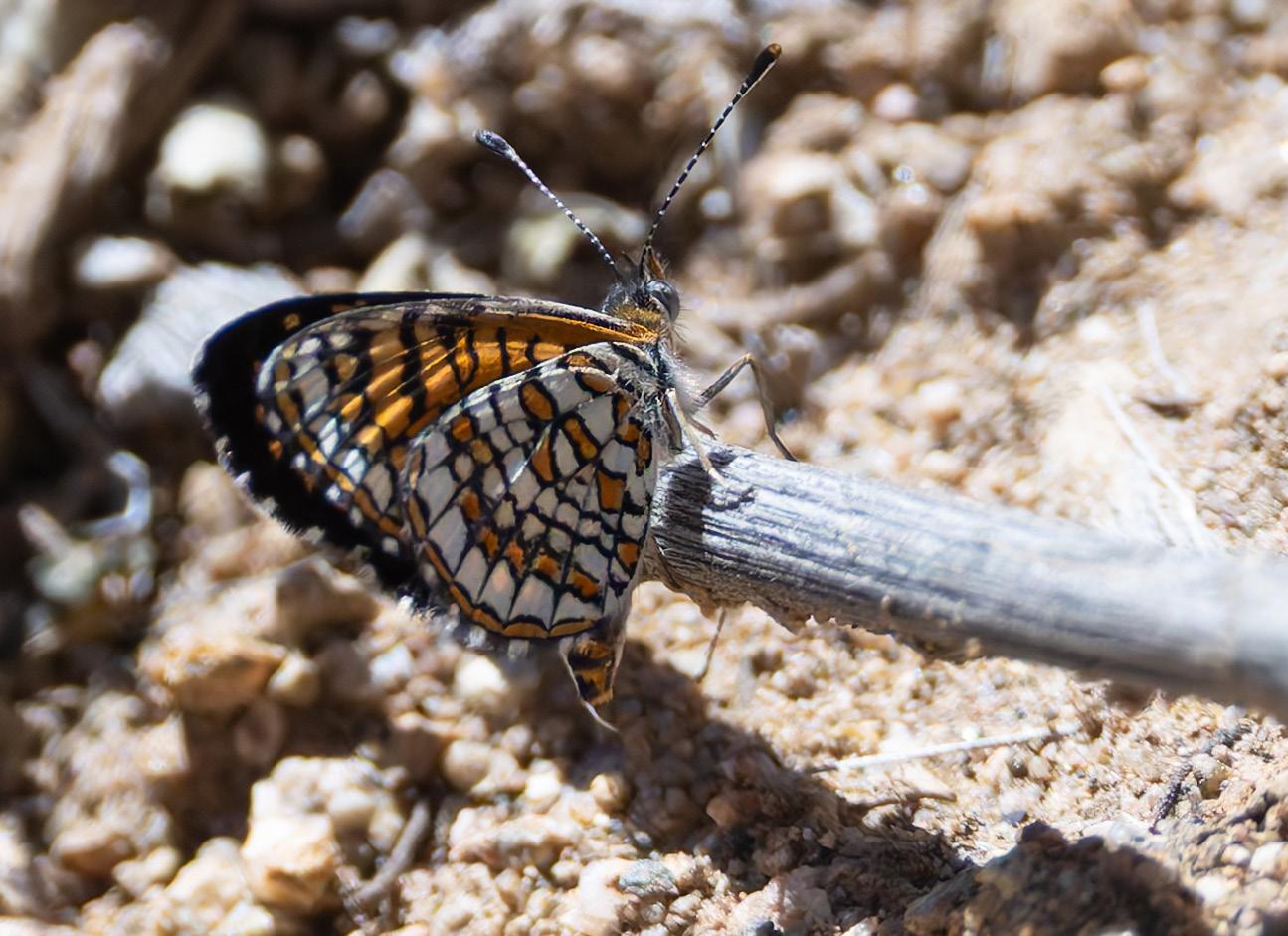
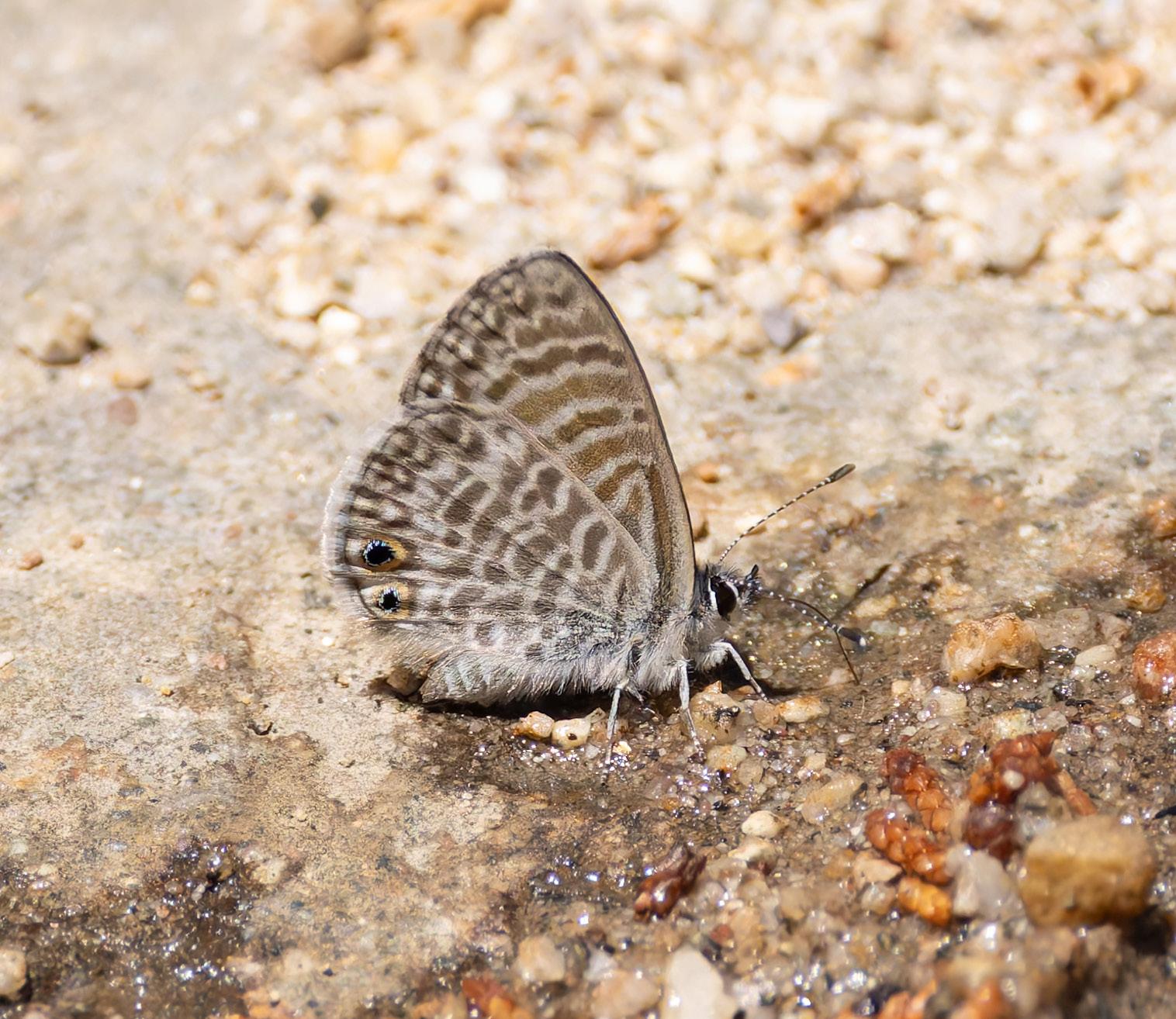
for me. Only a couple of the group managed to see a single Violet-crowned Hummingbird, which appeared briefly on a feeder in the Ramsey Canyon Cabins Bird Sanctuary. I did get some even better views of Nabokov’s Satyr in the Ramsey Canyon Preserve, and under the feeders at both Ramsey Canyon Inn and Ramsey Canyon Cabins Bird Sanctuary, our best views so far, as they settled down in the late afternoon.
Next morning in Tucson we set about looking for a few remaining Arizona birds. The bizarrely named Mile Wide Road CAP Recharge Basin, a rather bleak sport, produced a few interesting species in our only Crested Caracara, Cactus Wren, Curve-billed Thrasher, Great Horned Owl and Ladder-backed Woodpecker, but not the hoped-for Bendire’s Thrasher. In contrast, the excellent El Rio Preserve was very birdy and came up trumps with our target, Rufous-winged Sparrow, as well as Abert’s Towhee for those who had not seen it yet. In the ‘also’ category at this great reserve were Gambel’s Quail, Cooper’s Hawk, Ver-
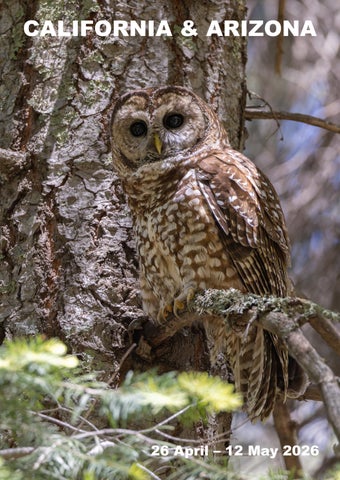
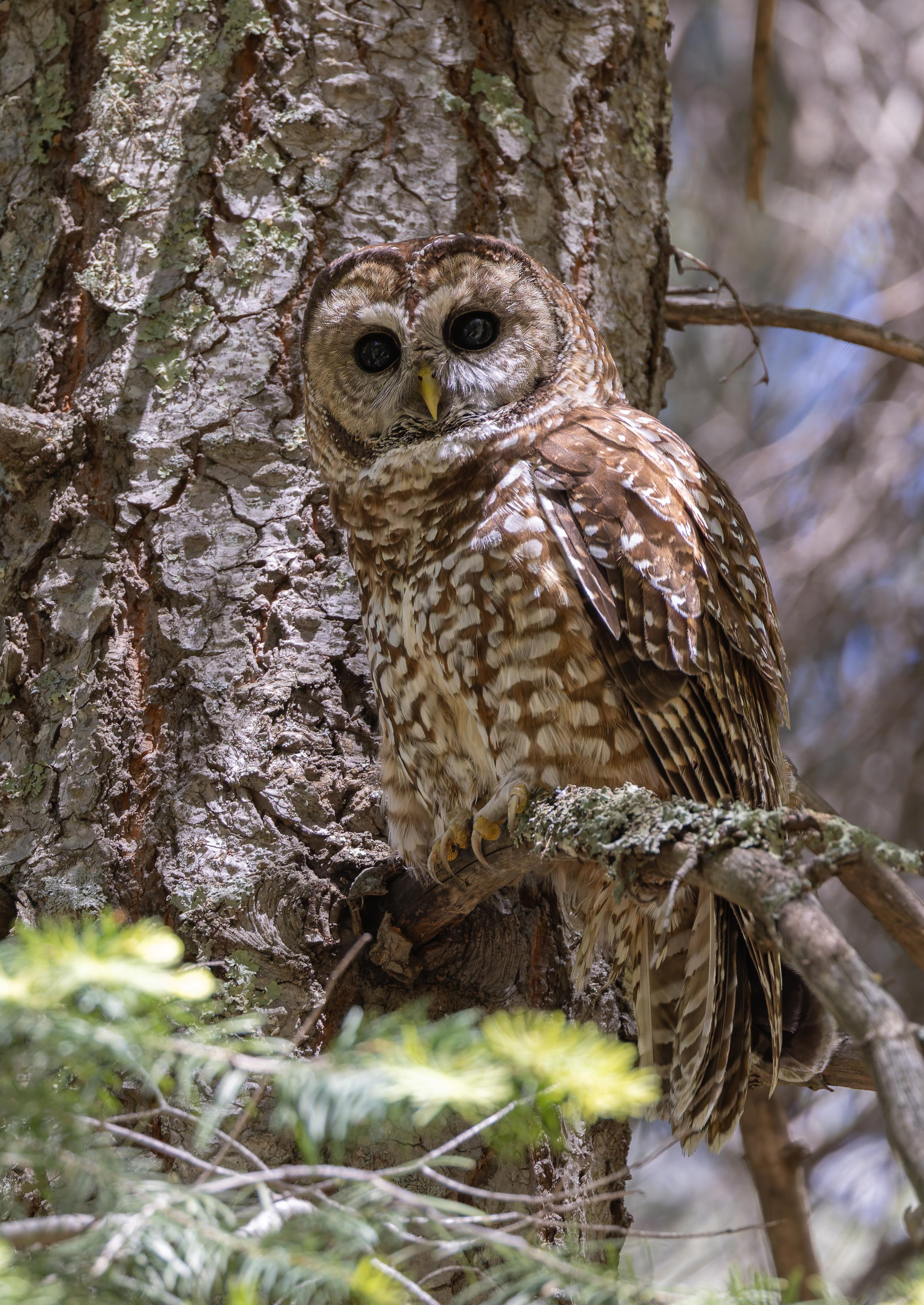
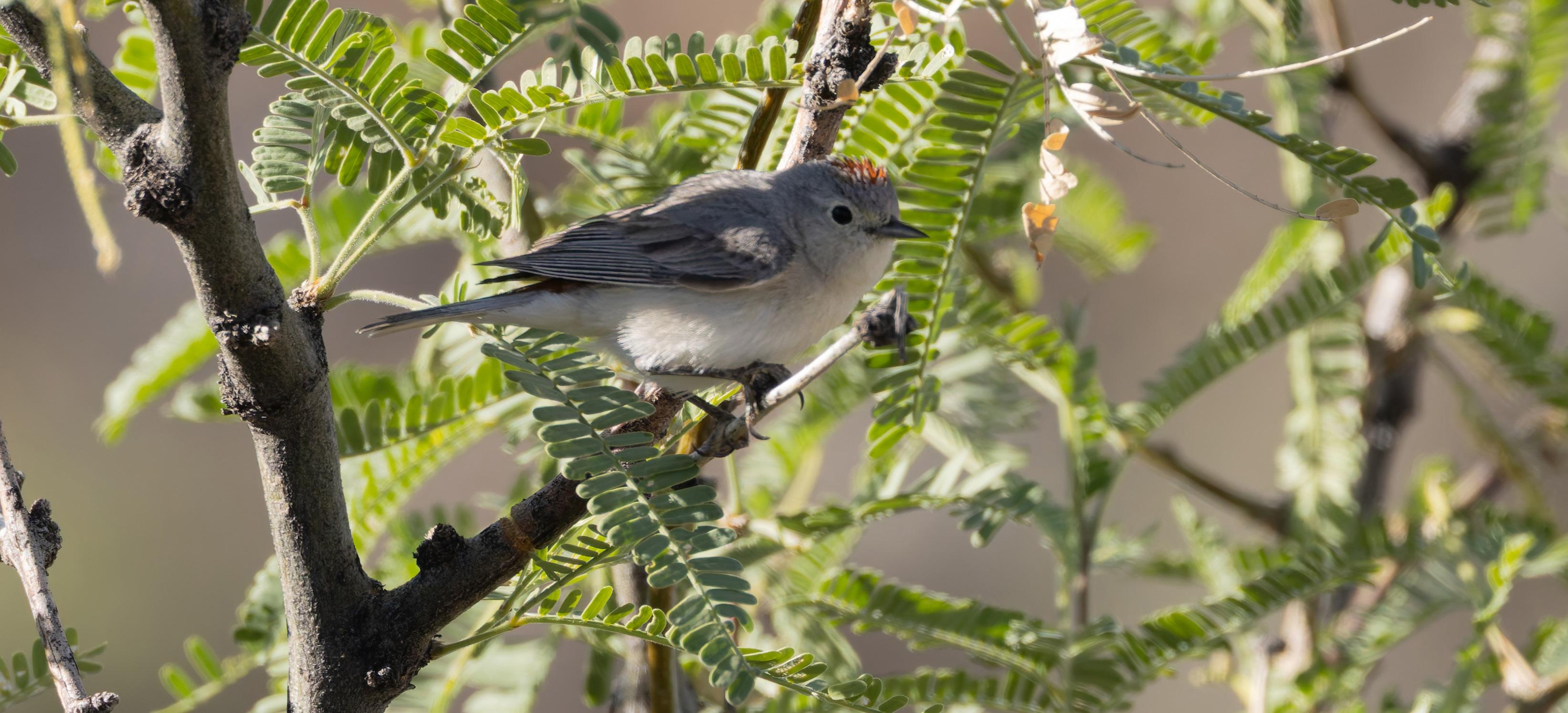
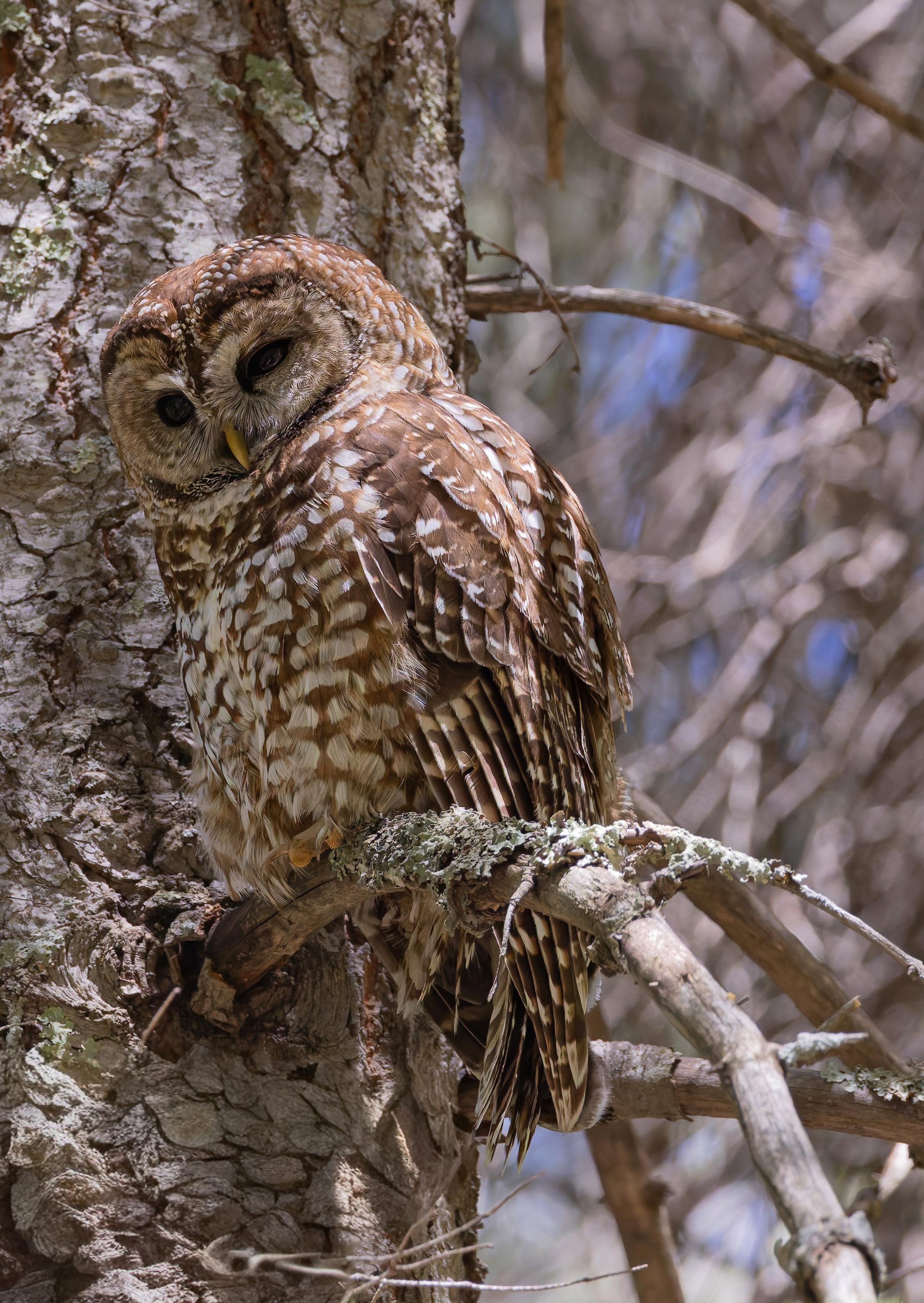
milion Flycatcher, Verdin, Lesser Goldfinch, Black-throated and White-crowned Sparrows, Sagebrush Sparrow, Green-tailed Towhee, Hooded Oriole, Lucy’s and American Yellow Warblers. Not far away, the ridiculously expensive Arizona-Sonora Desert Museum was a disappointment, with only a couple of new lizards to show for our efforts: Common Chuckwalla and Zebra-tailed Lizard. The museum is located just outside the Saguaro National Park, named after the cactus of the same name. Still in ‘organ pipe’ cactus habitat, we eventually managed to find a cracking male Pyrrhuloxia at the Brown Mountain Picnic Area, the temperature was now soaring! It was time to move on. We had enlisted the help of a friend, Ezekiel Dobson who performed a near-conjuring act producing a very close encounter with a magnificent (Mexican) Spotted Owl of a resident pair, which he and his friends monitor. This was by far the highlight of the tour for everyone, it appeared unconcerned at our presence and even started hooting! Walkaway views were had! Also in this lovely spot, high
Rufous-winged Sparrow, El Rio Reserve (Mike Watson)
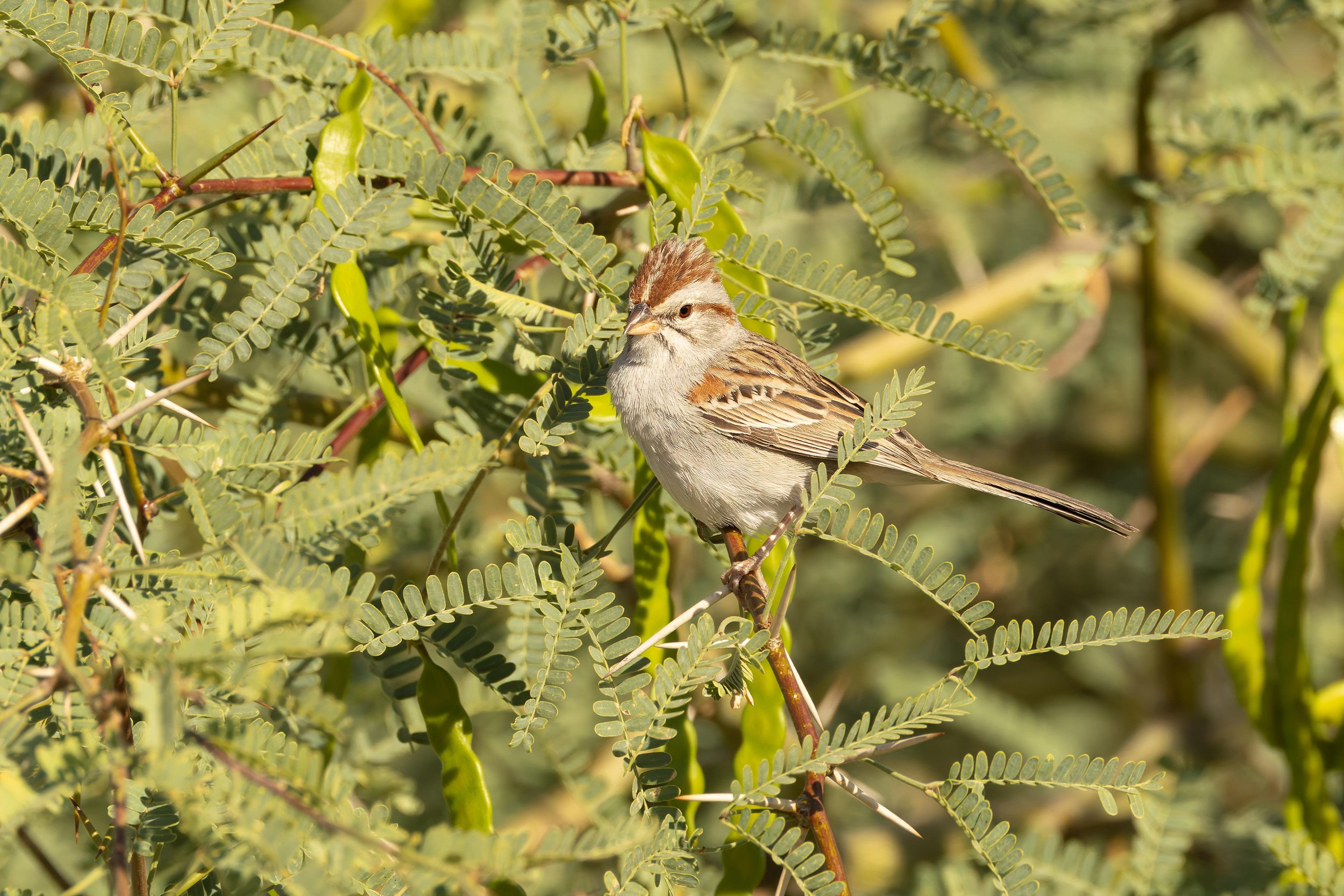
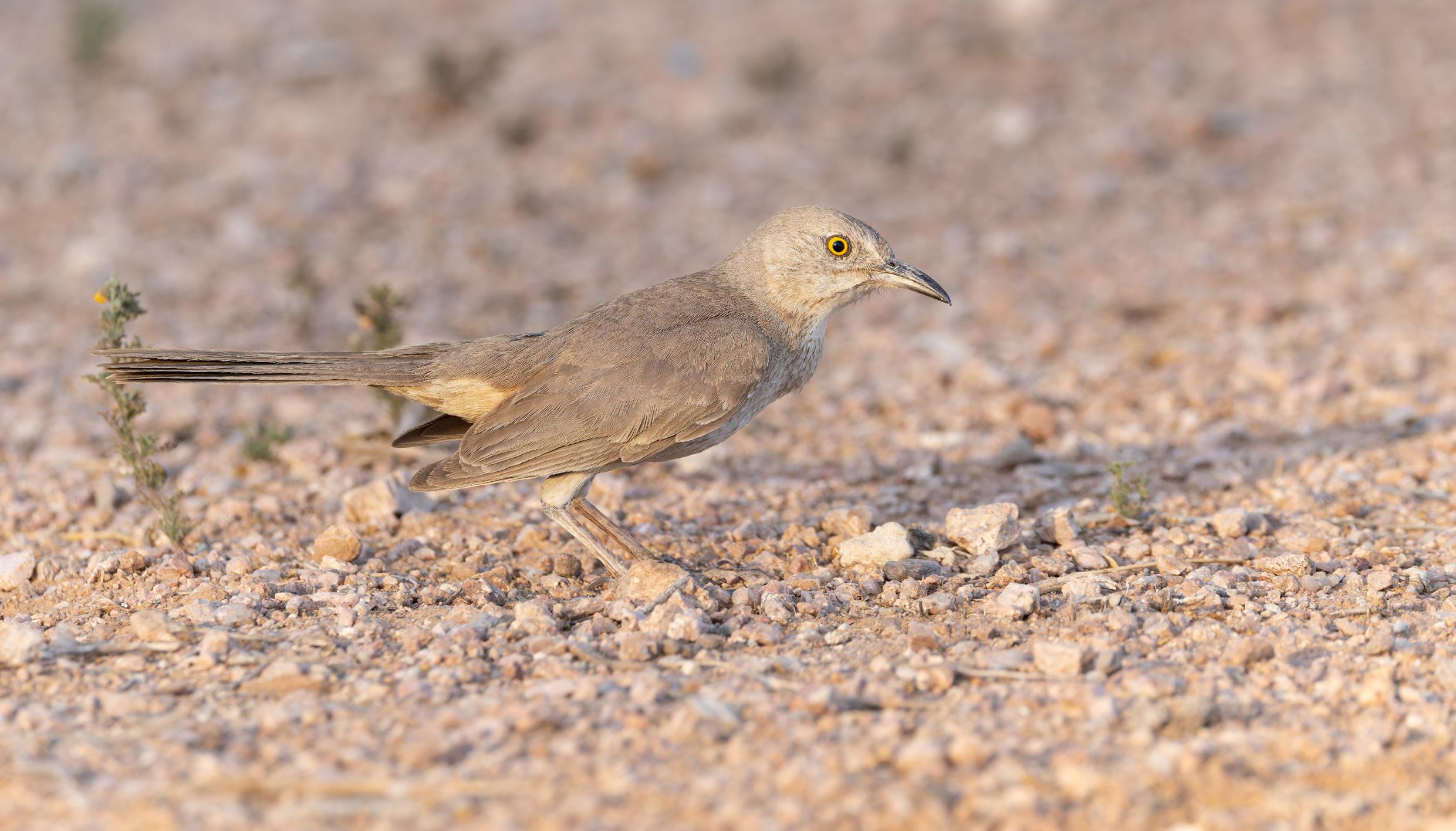
above the baking desert below, we also saw Hairy Woodpecker, Western Flycatcher, Mountain Chickadee, Hermit Thrush, Yellow-eyed Junco, Townsend’s and Red-faced Warblers, Black-headed Grosbeak and Hepatic and Western Tanagers. We had some distance to cover now to reach West Phoenix by nightfall, however, there was still time for a detour to Prospect Park, to the northeast of this sprawling city, where we were treated to a truly surreal encounter with Bendire’s Thrasher, with not a bush in sight! It was feeding on some grass of a playing field and popped up into a nearby tree on our arrival. Soon we had it feeding on bugs on the ground only a few metres away in the lovely evening sunshine! It was now 103°F! This tour highlight made traversing the scary and completely insane F1 track rush hour traffic of Phoenix worthwhile, passing numerous recent accidents in the process. The people here drive like crazy and you must exceed the speed limit simply to keep up with the flow. Next morning a walk at along the Maricopa trail
in Sun Valley was not very productive. I only managed Abert’s Towhee, Cactus Wren and Black-tailed Gnatcatcher of note. There was still a bird missing from our Southeast Arizona shopping list, Gilded Flicker, and we eventually tracked one down in the affluent Sun City West subdivision, setting off several neighbourhood watch alarms in the process. ‘What are you guys doing here?’ The bemused residents were surprised to learn that we were birding. Also here were Gila Woodpecker, Gambel’s Quails, including chicks and a couple of Bank Swallows, our only ones of the trip. It was now well into the morning and time to head west. We had a vast distance to cover to get to LA this evening and were stunned to discover that Mother’s Day is a massive thing in this part of the USA, particularly among its Hispanic population. Note to self; it proved impossible to get breakfast anywhere other than a gas station owing to massive queues stretching out of every cafe. The temperature was quickly more than 100°F again, so what to do in the middle
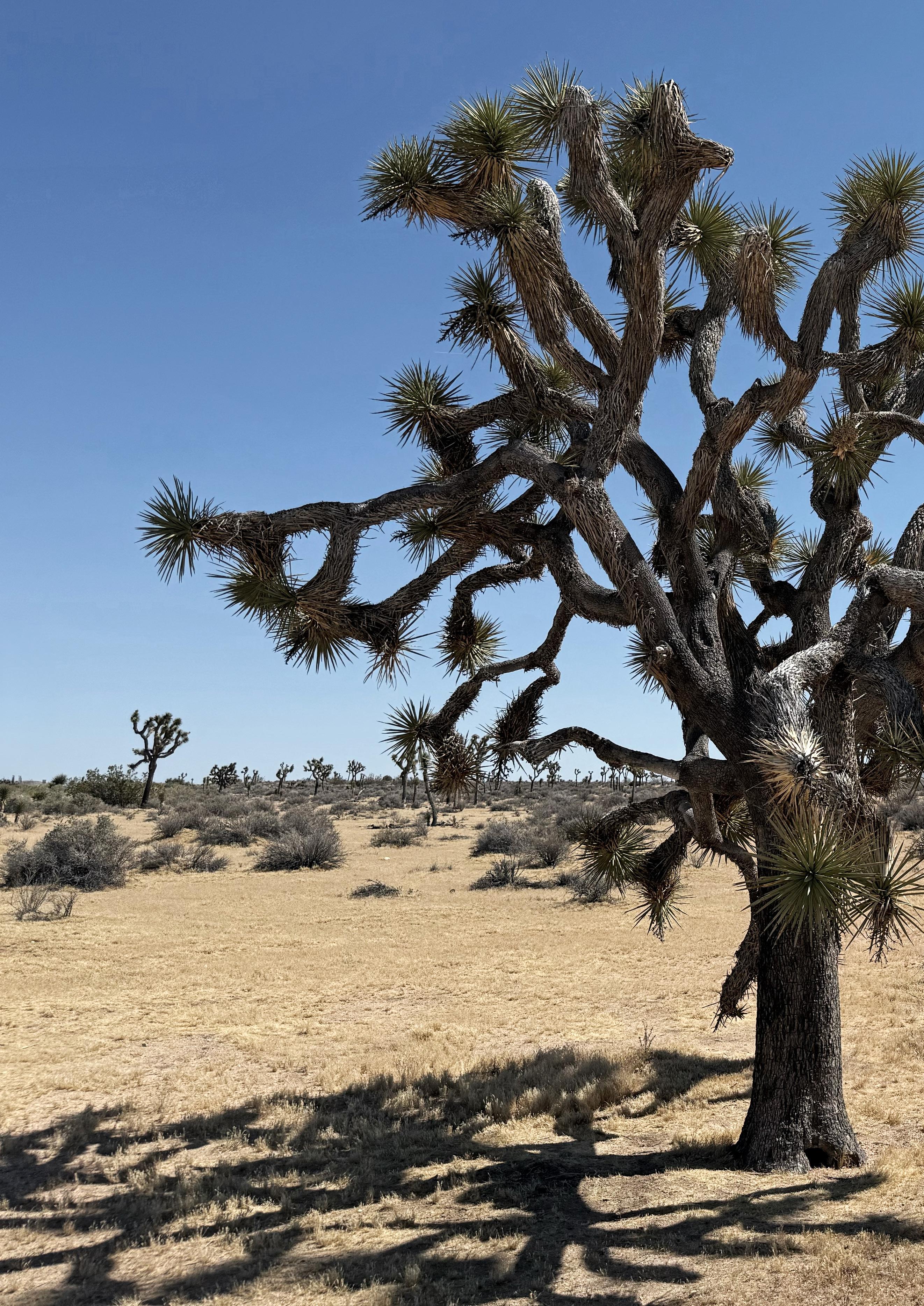
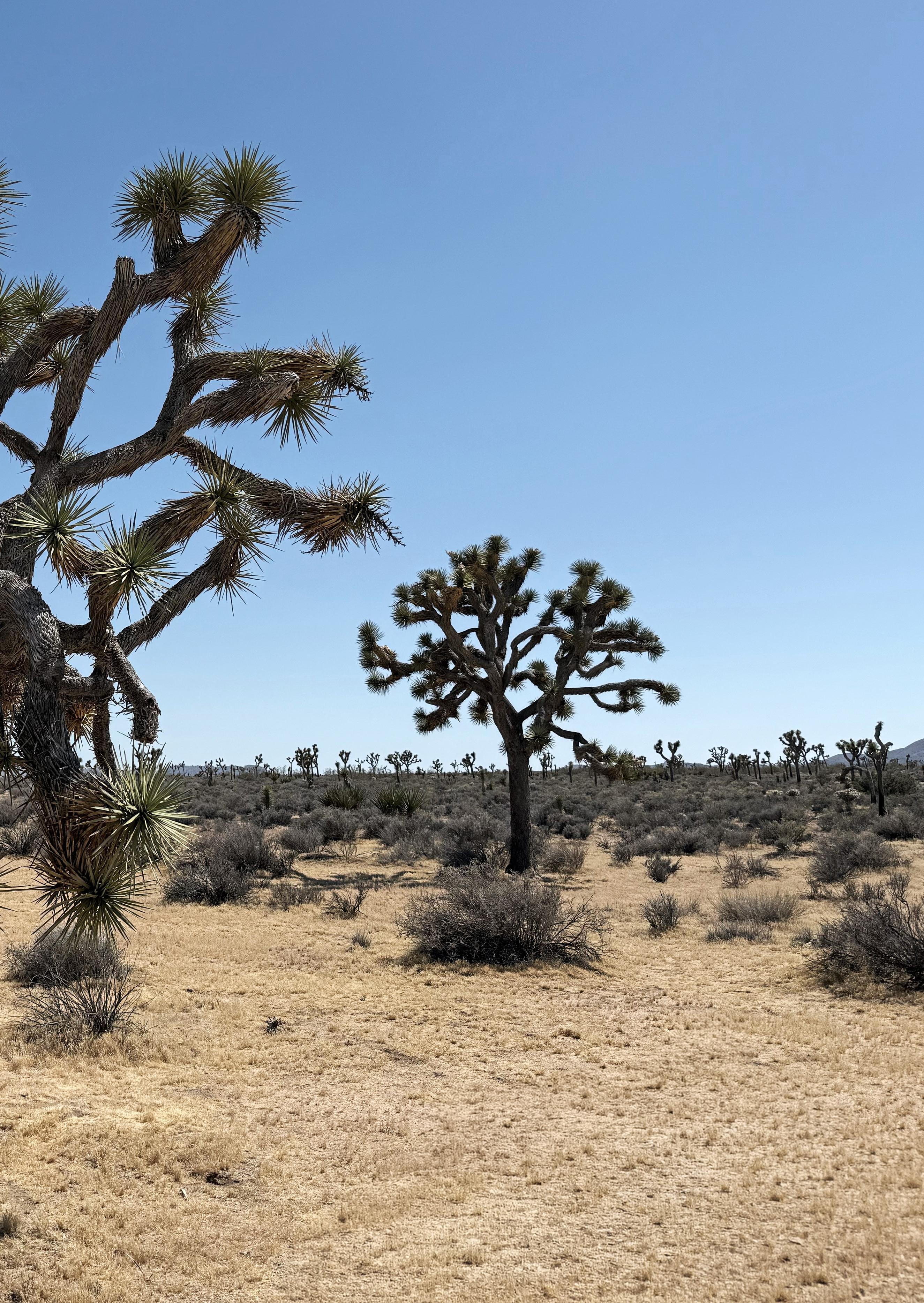
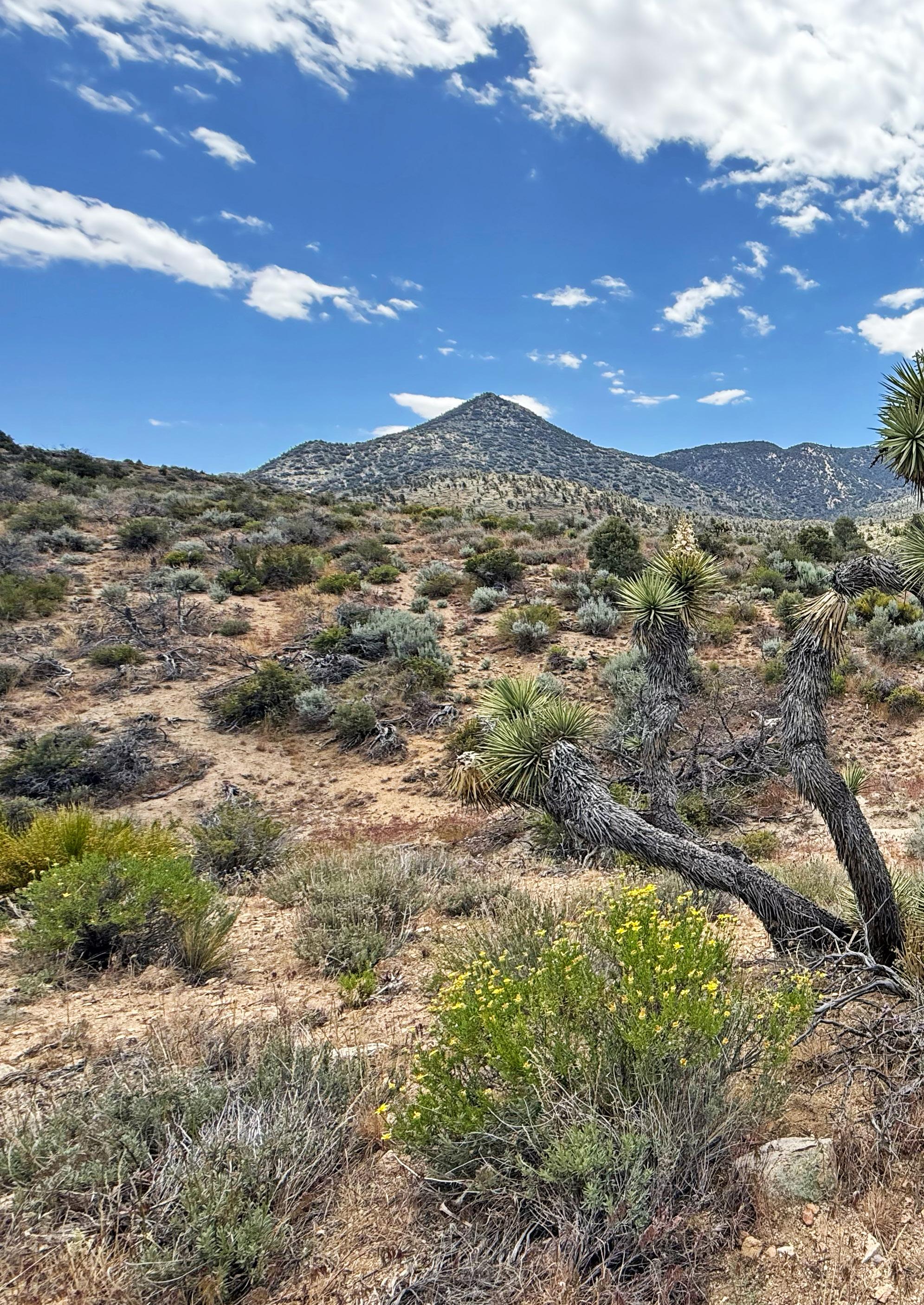
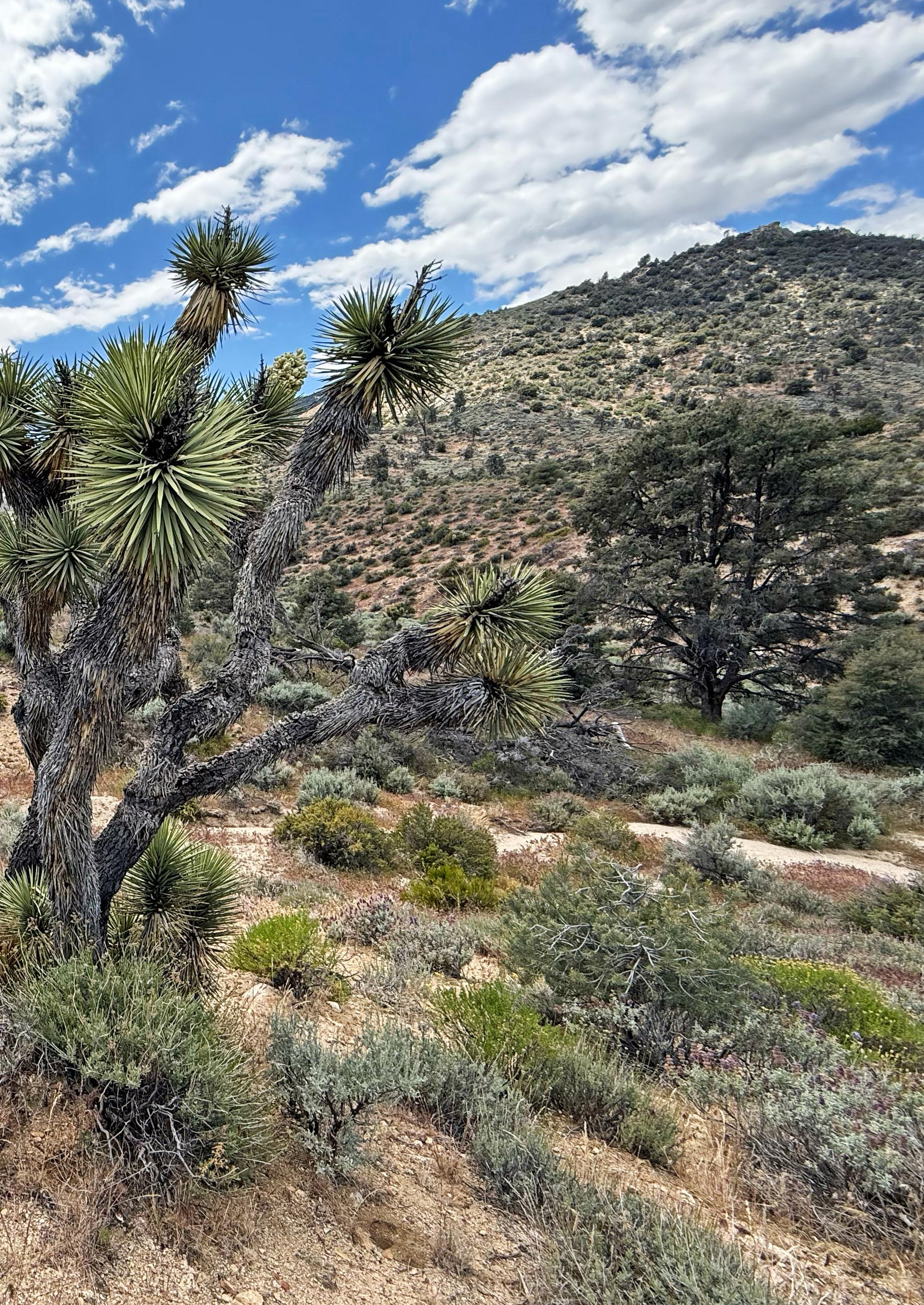
of the day, when any self-respecting birds are sheltering from the sun? Around halfway to LA lies the incredible Joshua Tree National Park, so we detoured there for a couple of hours in the early afternoon taking in sites such as the Cholla Garden and Skull Rock, as well as thousands of amazing Joshua Trees. We experienced the transition from the Sonoran Desert vegetation to the higher altitude Mojave Desert with its Joshua Trees. I had not heard of this member of the Yucca family until U2’s 25 million selling 1987 album. Ironically the Joshua Tree in the cover art was in Death Valley National Park to the north and is now dead. Birds were few in the national park at this time of day but included White-throated Swift, California Scrub Jay and a couple of mockingbirds. Reptiles were represented by a couple of very showy Common Chuckwallas at skull rock. We eventually made it to LA and were relieved to find a cracking little sushi restaurant
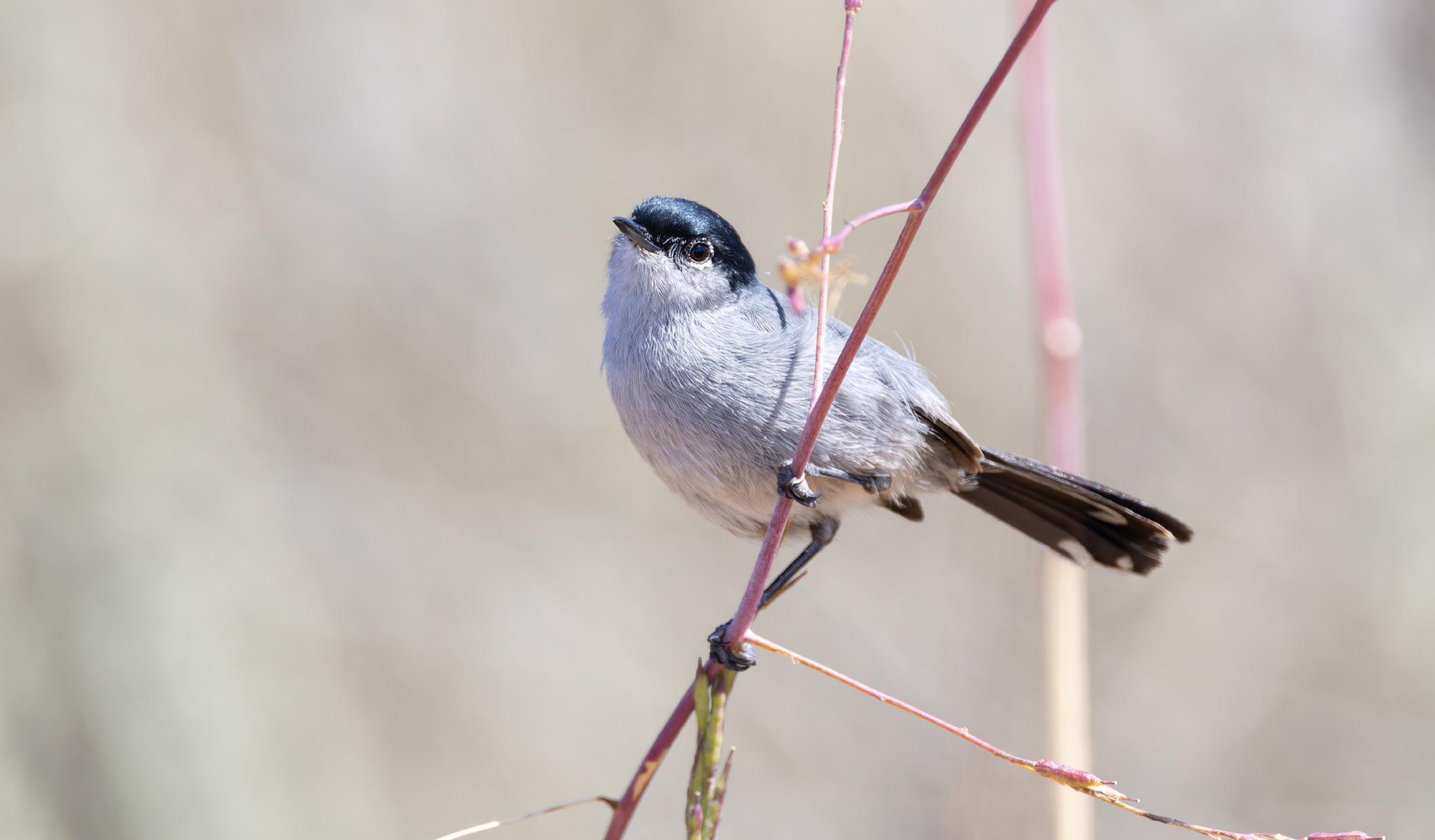
had space for us this evening, a very welcome and surprisingly good end to a tiring day. Time was first running out but we still had a whole day in the LA area to fill some gaps on our list. After breakfast from our favourite coffee shop, Unincorporated Coffee Roasters in Pasadena, we headed uphill to the Angeles Crest Highway, where it was now a very pleasant 52°F; this was a relief after the heat of the desert. Everyone eventually caught up with some terrific views of the lovely Mountain Quail, although they did make us work for it. Band-tailed Pigeon made a reappearance, as did Northern Flicker and White-headed Woodpecker. Both Steller’s and California Scrub Jays were here also. Western Bluebirds delighted at the Chilao Campground, Spotted Towhees sang from nearby hillsides, and several gorgeous Lazuli Buntings joined the chorus. Descending in midmorning, Sjoerd spotted an interesting sparrow fly across the
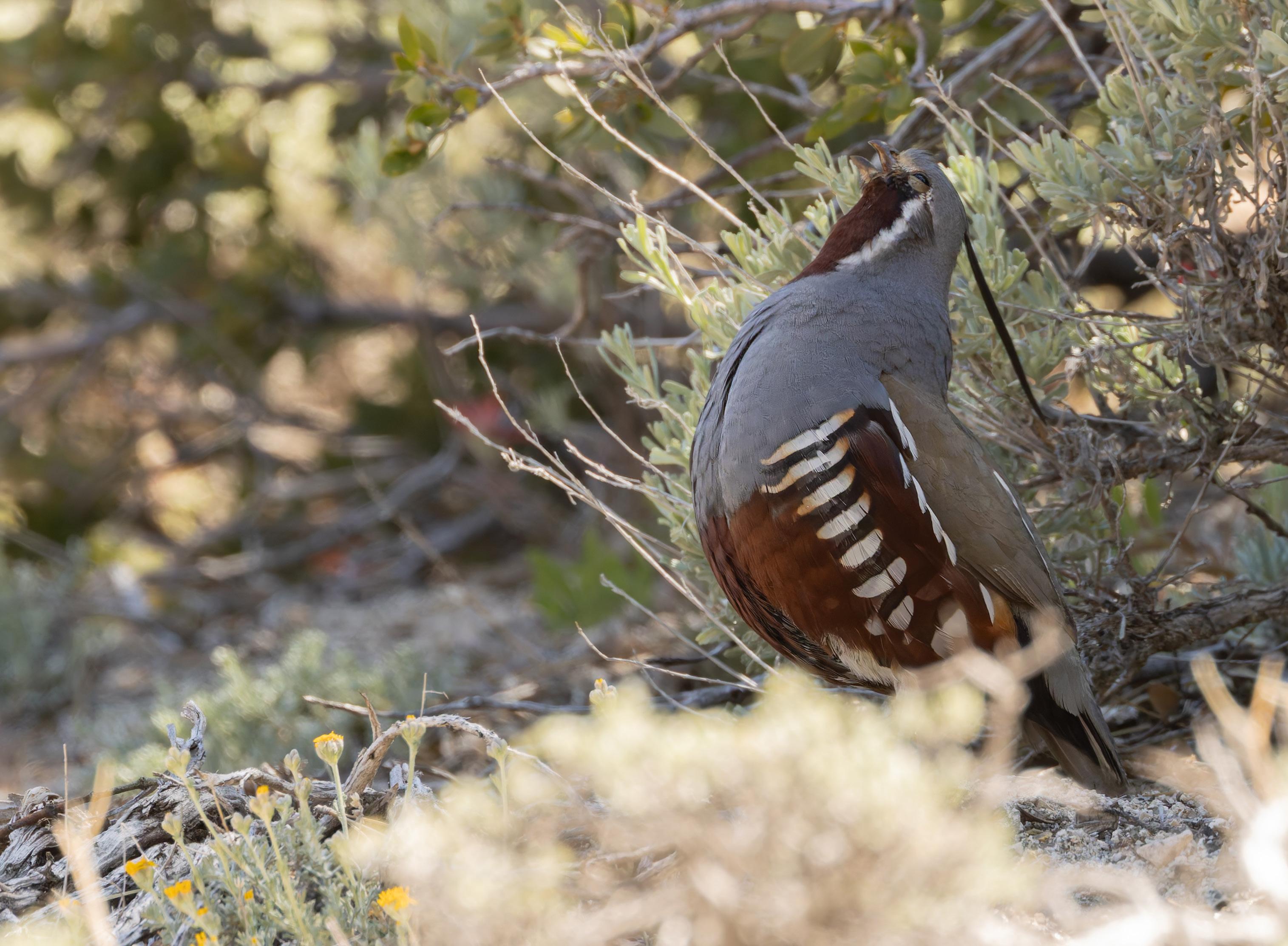
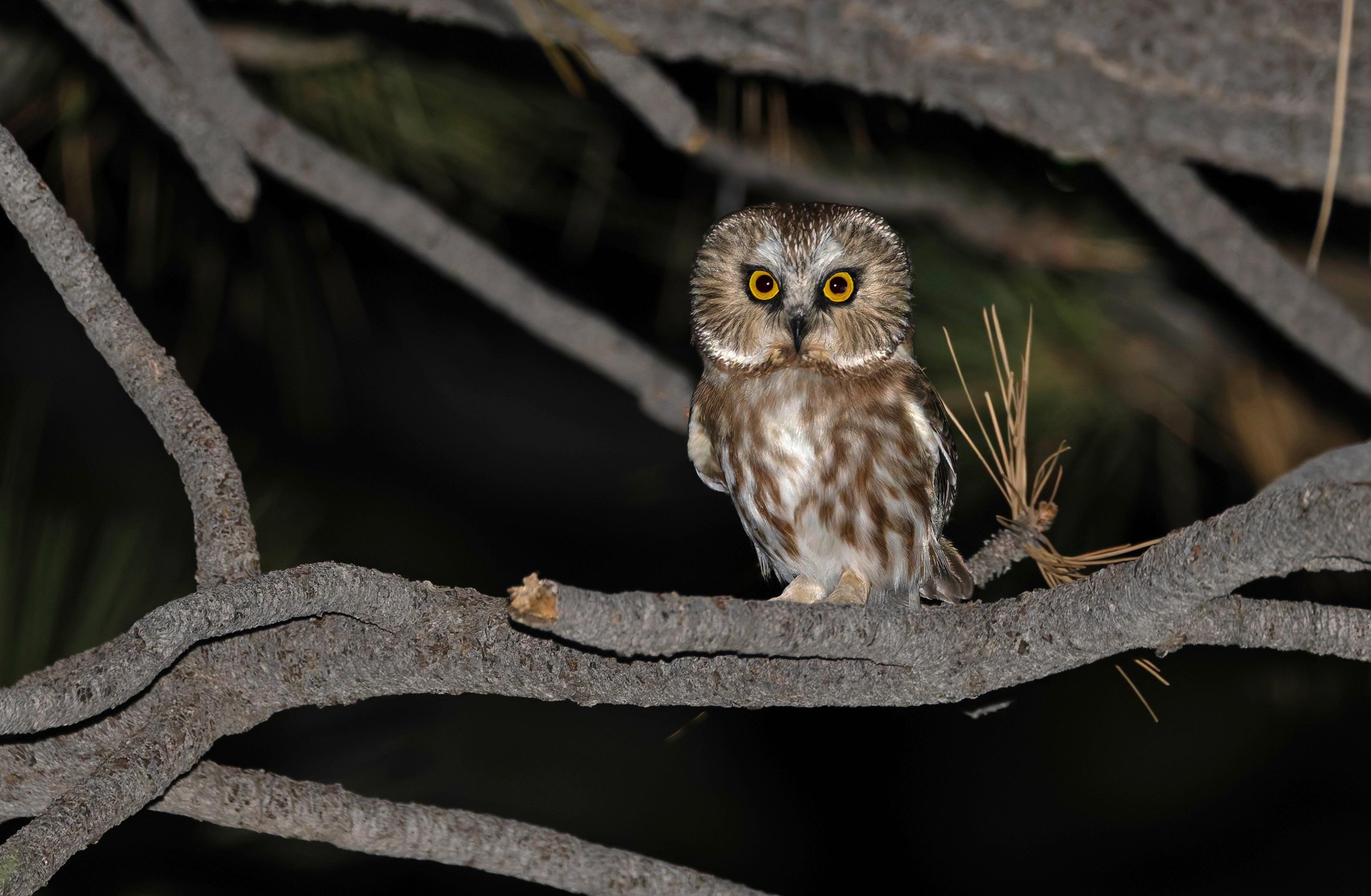
road in front of his vehicle and before too long we had located a Black-chinned Sparrow… at last! An amazing feat of skill by the Dutchman. Butterflies included Variable Checkerspot and Lupine Blue of note and lizards were represented by Western Whiptail and Western Fence Lizard. We took the afternoon off, with a long nocturnal session ahead. Unfortunately, this was ultimately quiet. We heard Great Horned Owl and Common Poorwill but only set eyes on the diminutive Northern Saw-Whet Owl, still a very sought-after bird though, and my first since 1990.
Our final morning in California was spent back in the San Gabriel Mountains again, in the vicinity of Mount Lowe Road. Similar birds were seen to the previous day plus Oak Titmouse, an elusive Purple Finch and a smart male Hermit Warbler. Funereal Duskywing butterflies abounded on the rocky hillsides here before it was time to descend back into the inversion
smog of LA. This had largely burnt off by early afternoon, and we had one final roll of the dice at Lewis MacAdams Riverfront Park, on the concrete banks of the LA River, which is basically a grim flood drain. Nothing new was added here, our last excursion was a dip on Cedar Waxwing before we made our way to LAX and departed in different directions.
Thanks to everyone for being great fun and making this such an enjoyable and eventful road trip.
‘Bird of the Trip’ as voted by the participants:
1. Spotted Owl
2. Mountain Quail
3. Coppery-tailed Trogon
4. Black-backed Woodpecker
5. Williamson’s Sapsucker
SYSTEMATIC LIST OF SPECIES RECORDED
Where species names followed by the diamond symbol (◊) indicated they are either endemic to the country, are range restricted or considered ‘special’ birds for some other reason (e.g., only seen on one or two Birdquest tours, are difficult to see across all or most of its range, the local form is endemic or restricted-range and may in future be treated as a full species).
BIRDS
Ruddy Duck Oxyura jamaicensis Common
Canada Goose (Greater C G) Branta canadensis Common
Greater White-fronted Goose Anser albifrons Imm. Henderson Bird Viewing Preserve.
Wood Duck Aix sponsa 10 Hart Memorial Park, Bakersfield
Long-tailed Duck Clangula hyemalis Pair Henderson Bird Viewing Preserve
Surf Scoter Melanitta perspicillata Common on the coast
Bufflehead Bucephala albeola Female Henderson Bird Viewing Preserve
Ring-necked Duck Aythya collaris Two drakes and a female Henderson Bird Viewing Preserve
Redhead Aythya americana Pair Bolsa Chica and four Henderson Bird Viewing Preserve
Lesser Scaup Aythya affinis Maximum 16 Bolsa Chica
Greater Scaup Aythya marila Female Henderson Bird Viewing Preserve.
Blue-winged Teal Spatula discors Pair Bolsa Chica
Cinnamon Teal Spatula cyanoptera Oso Flaco Lake and Henderson Bird Viewing Preserve
Gadwall Mareca strepera Common
American Wigeon Mareca americana One Malibu Creek State Park
Mallard Anas platyrhynchos Common
Mexican Duck ◊ Anas diazi A drake Henderson Bird Viewing Preserve
Green-winged Teal Anas crecca Three males Henderson Bird Viewing Preserve
Mountain Quail ◊ Oreortyx pictus Two Walker Pass plus four seen, nine heard San Gabriel Mtns.
Gambel’s Quail ◊ Callipepla gambelii A common sight from Henderson south to Sierra Vista.
California Quail ◊ Callipepla californica First time Hansen Dam Park. Also at Santa Cruz Island.
Scaled Quail ◊ Callipepla squamata A pair seen near Whetstone
Montezuma Quail ◊ Cyrtonyx montezumae Heard-only at Coronado National Memorial
Wild Turkey Meleagris gallopavo Several family groups at Madera Canyon
Sage Grouse ◊ Centrocercus urophasianus 73 birds at the lek around Lake Crowley
Sooty Grouse ◊ Dendragapus fuliginosus Two males seen ‘booming at Big Pine Canyon
Pied-billed Grebe Podilymbus podiceps 14 from Ballona Wetlands onwards.
Horned Grebe Podiceps auritus One Henderson Viewing Bird Preserve, alongside B-nG
Black-necked Grebe (Eared Grebe) Podiceps nigricollis 11 from Ballona Creek onwards.
Western Grebe Aechmophorus occidentalis Big groups of up to 50 seen along the coast Clark’s Grebe ◊ Aechmophorus clarkii Three in Ventura Harbour, with Western Grebes.
Greater Roadrunner Geococcyx californianus Only one, Henderson Bird Viewing Preserve
Inca Dove Columbina inca One at Ash Canyon Bird Sanctuary
White-winged Dove Zenaida asiatica Common after Henderson Bird Viewing Preserve
Mourning Dove Zenaida macroura Common
Band-tailed Pigeon Patagioenas fasciata First noted Rancho La Patera
Eurasian Collared Dove (introduced) Streptopelia decaocto One of few birds in Death Valley!
Rock Dove (introduced) Columba livia Common
Sandhill Crane Antigone canadensis One Lake Crowley. Rare in May!
Ridgway’s Rail ◊ Rallus obsoletus A pair at Bolsa Chica Wetland Preserve
Virginia Rail Rallus limicola Heard-only Oso Flaco Lake
Sora Porzana carolina One Henderson Bird Viewing Preserve
Common Gallinule Gallinula galeata Several Henderson Bird Viewing Preserve
American Coot Fulica americana Common
American Avocet Recurvirostra americana Seven Henderson Viewing Bird Preserve
Black-necked Stilt Himantopus mexicanus Bolsa Chica and Henderson Bird Viewing Preserve
Black Oystercatcher ◊ Haematopus bachmani Six tallied in LA
Grey Plover (Black-bellied P) Pluvialis squatarola Three Bolsa Chica and one Sands Beach
Killdeer Charadrius vociferus Common
Semipalmated Plover Charadrius semipalmatus Two Bolsa Chica and 33 near Santa Barbara. Snowy Plover Anarhynchus nivosus One Bolsa Chica Wetland Preserve and three Sands Beach
Hudsonian Whimbrel Numenius hudsonicus 12 tallied on the coast
Long-billed Curlew Numenius americanus Four Bolsa Chica Wetland Preserve
Marbled Godwit Limosa fedoa Six Bolsa Chica Wetland Preserve
Long-billed Dowitcher Limnodromus scolopaceus Up to 35 at Bolsa Chica Wetland Preserve and two in breeding plumage Henderson Bird Viewing Preserve
Spotted Sandpiper Actitis macularius 11 noted, the first at White Point
Wilson’s Phalarope Phalaropus tricolor Three at Henderson, one in breeding plumage
Red-necked Phalarope Phalaropus lobatus At least 600 in large flocks to/from Santa Cruz Island
Wandering Tattler Tringa incana Seven birds seen on the Los Angeles coast
Willet Tringa semipalmata 11 ‘Western’ birds in LA, first at Ballona Creek
Greater Yellowlegs Tringa melanoleuca Four near Santa Barbara
Black Turnstone ◊ Arenaria melanocephala One Ballona Creek and four White Point
Ruddy Turnstone Arenaria interpres Two Bolsa Chica
Western Sandpiper Calidris mauri Six Bolsa Chica Wetland Preserve and 15 Coal Oil Beach
Pomarine Skua Stercorarius pomarinus One seen just before entering the harbour at Ventura
Scripps’s Murrelet ◊ Synthliboramphus scrippsi 48 tallied to/from Santa Cruz Island
Pigeon Guillemot ◊ Cepphus columba One inshore at Santa Cruz Island
Common Murre Uria aalge Very common (250+) to/from Santa Cruz Island
Least Tern Sternula antillarum At least 20 birds at Bolsa Chica Wetland Preserve.
Caspian Tern Hydroprogne caspia 20 noted along the coast
Elegant Tern ◊ Thalasseus elegans Around 40-60 birds seen along the coast
Royal Tern Thalasseus maximus Five White Point
Forster’s Tern Sterna forsteri Min. 20 Bolsa Chica Wetland Preserve and 1 near Santa Barbara
Bonaparte’s Gull Chroicocephalus philadelphia Three seen along the coast
Heermann’s Gull Larus heermanni Around 30 on the coast.
Ring-billed Gull Larus delawarensis One Ballona Creek
Western Gull ◊ Larus occidentalis Up to 150 seen daily along the coast
California Gull ◊ Larus californicus Two Bolsa Chica and two Ballona Creek
Red-throated Loon (R-t Diver) Gavia stellata 15 including five close inshore at Ballona Creek
Common Loon (Great Northern Diver) Gavia immer Singles Ballona, White Pt & Santa Cruz Is Pacific Loon (P Diver) Gavia pacifica c.25 to/from Santa Cruz Island and Santa Barbara
Sooty Shearwater Ardenna grisea c.30 birds to/from Santa Cruz Island
Double-crested Cormorant Nannopterum auritum Common
Brandt’s Cormorant ◊ Urile penicillatus Very common on the coast.
Pelagic Cormorant ◊ Urile pelagicus One White Point
White-faced Ibis Plegadis chihi Three Ballona Wetlands and 00s flying to roost near Phoenix
American White Pelican Pelecanus erythrorhynchos 23 Lake Crowley was the only sighting. Brown Pelican Pelecanus occidentalis Common on the coast
Least Bittern Botaurus exilis A male seen beautifully at Ballona Freshwater Marsh
Snowy Egret Egretta thula Common
Black-crowned Night Heron Nycticorax nycticorax 17 from Ballona Wetlands onwards
Green Heron Butorides virescens Singles Malibu Creek and Henderson Bird Viewing Preserve
Great Egret Ardea alba c.20 noted
Great Blue Heron Ardea Herodias A scatter from Ballona Wetlands onwards
Common Poorwill ◊ Phalaenoptilus nuttallii Heard-only Chilao Campground, San Gabriel Mtns
Mexican Whip-poor-will ◊ Antrostomus arizonae Heard-only at Madera Canyon. Frustrating. Lesser Nighthawk Chordeiles acutipennis A pair in daylight at the LeConte’s Thrasher spot.
Vaux’s Swift Chaetura vauxi c.25 noted Hansen Dam and Sepulveda Basin
White-throated Swift Aeronautes saxatalis Noted seven days from Ballona Wetlands onwards.
Rivoli’s Hummingbird ◊ Eugenes fulgens Male Madera Canyon and three Huachuca Mountains
Lucifer Sheartail ◊ Calothorax lucifer Male Ash Canyon Bird Sanctuary
Black-chinned Hummingbird Archilochus alexandri First at Madera Canyon
Anna’s Hummingbird ◊ Calypte anna Seen on several days, up to 12 birds in the LA area
Costa’s Hummingbird ◊ Calypte costae Two males Box Canyon and another Montosa Canyon
Calliope Hummingbird ◊ Selasphorus calliope A female at Ash Canyon Bird Sanctuary
Allen’s Hummingbird ◊ Selasphorus sasin A total of 10 birds seen in the Los Angeles area
Broad-tailed Hummingbird ◊ Selasphorus platycercus Common in the ‘sky islands’ of Arizona
Broad-billed Hummingbird ◊ Cynanthus latirostris c.25 from Santa Rita Lodge onwards
Elf Owl ◊ Micrathene whitneyi One bird seen and three heard at Madera Canyon
Northern Saw-whet Owl ◊ Aegolius acadicus A great view in the San Gabriel Mountains.
Great Horned Owl Bubo virginianus Pair at a parking in Sierra Vista & two imms Mile Wide Rd.
Whiskered Screech Owl ◊ Megascops trichopsis One seen, three heard Madera Canyon
Spotted Owl ◊ Strix occidentalis A female in daylight at Mount Lemmon near Tucson
California Condor ◊ Gymnogyps californianus Five Navajo Bridge plus five Vermilion Cliffs
Turkey Vulture Cathartes aura Common
Osprey Pandion haliaetus Six in California
Golden Eagle Aquila chrysaetos Five noted, including great views at Zaca Station Rd
Sharp-shinned Hawk Accipiter striatus Only one over Zaca Station Rd
Cooper’s Hawk Astur cooperii Frequently overhead, eight noted.
American Goshawk Astur atricapillus One over at Madera Canyon
Northern Harrier Circus hudsonius Three, including two males Lake Crowley
Bald Eagle Haliaeetus leucocephalus Two Santa Cruz Island and another two Lake Crowley.
Harris’s Hawk Parabuteo unicinctus Four immatures Sierra Vista
Grey Hawk Buteo plagiatus One Ash Canyon Bird Sanctuary
Zone-tailed Hawk Buteo albonotatus Seen very well at Navajo Point, Grand Canyon NP
Red-tailed Hawk Buteo jamaicensis Common
Coppery-tailed Trogon ◊ Trogon ambiguus One perched at eye-level at Madera Canyon.
Northern Flicker Colaptes auratus Common
Gilded Flicker ◊ Colaptes chrysoides One Sun City West, Phoenix.
Williamson’s Sapsucker ◊ Sphyrapicus thyroideus A beautiful male at Deadman Creek
Red-breasted Sapsucker ◊ Sphyrapicus ruber A total of three birds around Bishop
Lewis’s Woodpecker ◊ Melanerpes lewis One Mt Whitney Fish Hatchery
Acorn Woodpecker Melanerpes formicivorus Common
Gila Woodpecker ◊ Melanerpes uropygialis Seven SE Arizona
Black-backed Woodpecker ◊ Picoides arcticus Great views of a female at Deadman Creek
American Three-toed Woodpecker ◊ Picoides dorsalis Great views of a female near Flagstaff
Downy Woodpecker Dryobates pubescens Only on the feeders in Aspendell, near Bishop
Nuttall’s Woodpecker ◊ Dryobates nuttallii Eight, including four at Malibu Creek State Park
Ladder-backed Woodpecker Dryobates scalaris Seven SE Arizona, great views at Ash Canyon
Hairy Woodpecker Leuconotopicus villosus Five sightings.
White-headed Woodpecker ◊ Leuconotopicus albolarvatus Five Bishop and one San Gabriel
Arizona Woodpecker ◊ Leuconotopicus arizonae Four birds, the first at Madera Canyon
Crested Caracara Caracara plancus One fly-by Mile Wide Road, Tucson
American Kestrel Falco sparverius Five was a low total, first at Malibu Creek SP
Peregrine Falcon Falco peregrinus One on an electricity pylon in Tucson
Nanday Parakeet (introduced) Aratinga nenday Two Malibu Creek SP
Dusky-capped Flycatcher Myiarchus tuberculifer Two seen and one heard Madera Canyon
Ash-throated Flycatcher Myiarchus cinerascens A scatter after the first at Hansen Dam RA
Brown-crested Flycatcher Myiarchus tyrannulus Seen and heard Madera and Miller Canyons
Thick-billed Kingbird ◊ Tyrannus crassirostris One performed brilliantly at Box Canyon
Cassin’s Kingbird Tyrannus vociferans Common after the first at White Point
Western Kingbird Tyrannus verticalis Noted at Zaca Station Road, easily missed.
Vermilion Flycatcher Pyrocephalus rubinus Family of four at Sepulveda Basin, four more after Say’s Phoebe Sayornis saya Maximum eight Henderson Bird Viewing Preserve, few after Black Phoebe Sayornis nigricans Common in California
Western Flycatcher ◊ Empidonax difficilis Two birds of the endemic ssp insulicola Santa Cruz Is American Grey Flycatcher Empidonax wrightii Two Henderson Bird Viewing Preserve
Buff-breasted Flycatcher ◊ Empidonax fulvifrons Two Carr Canyon
Olive-sided Flycatcher Contopus cooperi One Box Canyon
Western Wood Pewee Contopus sordidulus One Carr Canyon
Warbling Vireo Vireo gilvus First Santa Cruz Island, the imminent split as ‘Western’ WV.
Hutton’s Vireo Vireo huttoni First Oso Flaco Lake
Plumbeous Vireo Vireo plumbeus Common after Grand Canyon NP
Bell’s Vireo Vireo bellii First at Ballona Wetlands
Loggerhead Shrike Lanius ludovicianus c.10 Petroleum Club Road, near Taft & 1 nr Sierra Vista
Pinyon Jay ◊ Gymnorhinus cyanocephalus Three Walker Pass Campground.
Steller’s Jay Cyanocitta stelleri Seen mostly around Bishop and at San Gabriel Mountains
Island Scrub Jay ◊ Aphelocoma insularis At least 20+ birds at Santa Cruz Island.
California Scrub Jay ◊ Aphelocoma californica A total of c.25 birds seen around Los Angeles
Woodhouse’s Scrub Jay ◊ Aphelocoma woodhouseii Two Grand Canyon NP
Mexican Jay (Grey-breasted J) Aphelocoma wollweberi c.50 on the ‘sky islands’ in SE Arizona
Black-billed Magpie ◊ Pica hudsonia A couple of roadside sightings near Bishop
Yellow-billed Magpie ◊ Pica nuttallii Two pairs at the start of Zaca Station Rd
Clark’s Nutcracker ◊ Nucifraga columbiana Two Inyo National Forest, near Mammoth Lakes
Chihuahuan Raven ◊ Corvus cryptoleucus Two birds flying over at a parking in Sierra Vista
Northern Raven Corvus corax Common, even in downtown Pasadena
American Crow Corvus brachyrhynchos Common in California
Verdin Auriparus flaviceps c.20 in SE Arizona the first time in Henderson Bird Viewing Preserve
Bridled Titmouse ◊ Baeolophus wollweberi Eight on the ‘sky islands’ in SE Arizona
Oak Titmouse ◊ Baeolophus inornatus Four Malibu Creek SP and one San Gabriel Mtns
Juniper Titmouse ◊ Baeolophus ridgwayi One Grand Canyon NP South Rim Visitor Center
Chestnut-backed Chickadee ◊ Poecile rufescens Five Oso Flaco Lake
Mountain Chickadee ◊ Poecile gambeli Common Inyo Craters, Mt Lemmon and San Gabriel Mtns
Horned Lark (Shore Lark) Eremophila alpestris Two Bolsa Chica and four Lake Crowley
Sand Martin (Bank Swallow) Riparia riparia Two Sun City West, Phoenix was the only sighting
Tree Swallow Tachycineta bicolor c.20 seen the first few days
Violet-green Swallow Tachycineta thalassina First seen Glacier Lodge, west of Bishop
Northern Rough-winged Swallow Stelgidopteryx serripennis Common California
Barn Swallow Hirundo rustica Common California
American Cliff Swallow Petrochelidon pyrrhonota Common California
American Bushtit Psaltriparus minimus Common
Wrentit ◊ Chamaea fasciata Two Malibu Creek State Park and one Oso Flaco Lake.
Phainopepla Phainopepla nitens Singles Malibu Creek SP, Montosa Canyon and Green Valley
Ruby-crowned Kinglet Corthylio calendula One next to the American Three-toed Woodpecker White-breasted Nuthatch Sitta carolinensis First Malibu Creek SP, common later in SE Arizona
Pygmy Nuthatch Sitta pygmaea Two Aspendell then another two at Canyon Loop AZ.
Red-breasted Nuthatch Sitta canadensis Two Inyo Craters and another at Canyon Loop AZ
Brown Creeper Certhia americana One Inyo National Forest and two Madera Canyon
Blue-grey Gnatcatcher Polioptila caerulea Two at Grand Canyon NP were the first Black-tailed Gnatcatcher ◊ Polioptila melanura Four Henderson and one Maricopa Trailhead, California Gnatcatcher ◊ Polioptila californica A female and male at White Point Nature Preserve
Rock Wren Salpinctes obsoletus One at Mather Point, Grand Canyon NP
Canyon Wren Catherpes mexicanus A family of five Montosa Canyon & heard San Gabriel Mtns
Bewick’s Wren Thryomanes bewickii First Hansen Dam and several in SE Arizona
Cactus Wren Campylorhynchus brunneicapillus First Montosa Canyon then several in Arizona
Marsh Wren Cistothorus palustris Two Ballona Wetlands and c.10 Oso Flaco Lake
Northern House Wren Troglodytes aedon First noted White Point
Curve-billed Thrasher Toxostoma curvirostre Four sightings in SE Arizona
Bendire’s Thrasher ◊ Toxostoma bendirei Two Prospector Park, East Phoenix
California Thrasher ◊ Toxostoma redivivum Two Rancho La Patera, Santa Barbara
LeConte’s Thrasher ◊ Toxostoma lecontei One seen brilliantly at Midway-Sunset Oilfield
Crissal Thrasher ◊ Toxostoma crissale One or two skulkers at Henderson Bird Viewing Preserve
Sage Thrasher ◊ Oreoscoptes montanus c.8 Lake Crowley
Northern Mockingbird Mimus polyglottos Small numbers after the first at White Point
Common Starling (introduced) Sturnus vulgaris Common
American Dipper Cinclus mexicanus A pair breeding under the bridge at Big Pine Creek
Eastern Bluebird Sialia sialis One Carr Canyon and another Ramsey Canyon
Western Bluebird ◊ Sialia mexicana 15 sightings, first Hansen Dam RA
Mountain Bluebird ◊ Sialia currucoides An electric male at Deadman Creek, Inyo National Forest
American Robin Turdus migratorius c.20, the first at Rancho La Patera
Olive Warbler ◊ Peucedramus taeniatus A male and pair of the monotypic family lifer Carr Caryon
House Sparrow (introduced) Passer domesticus Common
Evening Grosbeak ◊ Hesperiphona vespertina c.10 birds Canyon Loop, S of Flagstaff.
Grey-crowned Rosy Finch ◊ Leucosticte tephrocotis Three 140 Iris Drive, Aspendell.
House Finch Haemorhous mexicanus Common throughout
Purple Finch ◊ Haemorhous purpureus Singing bird seen in flight only San Gabriel Mountains
Cassin’s Finch ◊ Haemorhous cassinii Several Aspendell and Glacier Lodge.
Pine Siskin Spinus pinus Five Canyon Loop and three Carr Canyon
Lesser Goldfinch Spinus psaltria Common, first noted Ballona Creek Wetlands
Lawrence’s Goldfinch ◊ Spinus lawrencei Five Hansen Dam RA and a male at Walker Pass
American Goldfinch Spinus tristis 15 birds Hansen Dam Park, in mixed flocks
Five-striped Sparrow ◊ Amphispizopsis quinquestriata A pair seen very well in Montosa Canyon
Black-throated Sparrow Amphispiza bilineata Noted Box Canyon and Mile Wide Road, Tucson
Lark Sparrow Chondestes grammacus One Hansen Dam RA Car Park was the only sighting
Chipping Sparrow Spizella passerina One Grand Canyon NP South Rim
Black-chinned Sparrow ◊ Spizella atrogularis One Angeles Crest Highway
Brewer’s Sparrow Spizella breweri c.10 Lake Crowley
Grasshopper Sparrow Ammodramus savannarum One showed very well at Rancho Portrero
Rufous-winged Sparrow ◊ Peucaea carpalis One seen perfectly at El Rio Reserve
Botteri’s Sparrow ◊ Peucaea botterii Two seen well at Coronado National Memorial Windmill Trail
Dark-eyed Junco Junco hyemalis Common, Oregon in California and Red-backed near Flagstaff
Yellow-eyed Junco ◊ Junco phaeonotus Collecting nest material Madera Canyon, another five in SE Arizona
Golden-crowned Sparrow Zonotrichia atricapilla One (late) individual Walker Pass Campground
White-crowned Sparrow Zonotrichia leucophrys Three California and one El Rio Reserve
Vesper Sparrow Pooecetes gramineus Six Lake Crowley
Sagebrush Sparrow Artemisiospiza nevadensis Eight Lake Crowley, another El Rio Reserve
Bell’s Sparrow ◊ Artemisiospiza belli c.10 Petroleum Club Road and one Walker Pass
Savannah Sparrow Passerculus sandwichensis c.10 ssp beldingi Bolsa Chica Wetland Preserve and one Henderson Bird Viewing Preserve
Song Sparrow Melospiza melodia Very common in California
Lincoln’s Sparrow Melospiza lincolnii One Ash Canyon Bird Sanctuary
Rufous-crowned Sparrow Aimophila ruficeps One seen and another heard of the endemic subspecies obscura at Santa Cruz Island
Canyon Towhee ◊ Melozone fusca One Montosa Canyon but the best views at Ash Canyon
Abert’s Towhee ◊ Melozone aberti Nine sightings, maximum six El Rio Reserve
California Towhee ◊ Melozone crissalis Common on the LA coast
Green-tailed Towhee ◊ Pipilo chlorurus Only noted at the El Rio Reserve
Spotted Towhee ◊ Pipilo maculatus Common in California after the first at White Point
Yellow-breasted Chat Icteria virens One seen Hansen Dam RA
Yellow-headed Blackbird ◊ Xanthocephalus xanthocephalus A male Henderson Bird Viewing Preserve and a female-type at Las Cienegas NCA
Western Meadowlark Sturnella neglecta Noted at Petroleum Club Road and Lake Crowley
Chihuahuan Meadowlark Sturnella lilianae Two Las Cienegas and on nr Sierra Vista.
Hooded Oriole Icterus cucullatus First noted at White Point
Bullock’s Oriole Icterus bullockiorum Two Sepulveda Basin and another malibu Creek SP
Scott’s Oriole Icterus parisorum Four Ash Canyon Bird Sanctuary
Red-winged Blackbird Agelaius phoeniceus Very common in California
Tricolored Blackbird ◊ Agelaius tricolor c.40 bird Caliente Ranch Wetland
Brown-headed Cowbird Molothrus ater Common
Brewer’s Blackbird Euphagus cyanocephalus First noted Oso Falco Lake, common Aspendell
Great-tailed Grackle Quiscalus mexicanus First noted Ballona Wetlands
Orange-crowned Warbler Leiothlypis celata Most common Santa Cruz Island
Lucy’s Warbler ◊ Leiothlypis luciae Eight SE Arizona, the first at Madera Canyon
Nashville Warbler Leiothlypis ruficapilla One Hansen Dam RA
Virginia’s Warbler Leiothlypis virginiae One Miller Canyon Lower Trail
Common Yellowthroat Geothlypis trichas Common in California wetlands
American Yellow Warbler Setophaga aestiva First noted Hansen Dam RA
Yellow-rumped Warbler Setophaga coronata First noted Hansen Dam RA, Audubon’s Warbler
Black-throated Grey Warbler Setophaga nigrescens Five, Miller Canyon and San Gabriel Mtns
Grace’s Warbler ◊ Setophaga graciae Two Madera Canyon and two Carr Canyon
Hermit Warbler Setophaga occidentalis A female-type seen at San Gabriel Mountains
Townsend’s Warbler Setophaga townsendi Six noted, first Hansen Dam RA.
Wilson’s Warbler Cardellina pusilla c.15 noted, first Hansen Dam RA
Red-faced Warbler ◊ Cardellina rubrifrons First Madera Canyon, eight incl. at Mount Lemmon
Painted Whitestart Myioborus pictus Two Madera Canyon
Black-headed Grosbeak Pheucticus melanocephalus Seen almost daily, up to c.10
Lazuli Bunting Passerina amoena Seen at Ash Canyon and San Gabriel Mountains
Blue Grosbeak Passerina caerulea Sepulveda Basin, Hansen Dam RA and Ramsey Canyon
Northern Cardinal Cardinalis cardinalis Noted only at Box and Montosa Canyons
Pyrrhuloxia ◊ Cardinalis sinuatus A male at Brown Mountain Trailhead, Tucson
Hepatic Tanager Piranga flava c.10, the first at Madera Canyon
Western Tanager Piranga ludoviciana First Rancho La Patera, Santa Barbara, eight tallied
Flame-colored Tanager ◊ Piranga bidentata A female and male at a nest in Miller Canyon
MAMMALS
Coyote Canis latrans The first at Bolsa Chica Wetland Reserve
California Sea Lion Zalophus californianus From the boat to Santa Cruz Island
Northern Minke Whale Balaenoptera acutorostrata One seen on the way to Santa Cruz Island
Northern Raccoon Procyon lotor One in the reeds in Oso Flaco Wetland
Pronghorn Antilocapra americana One outside Grand Canyon NP and two in Las Cienegas NCA
Wapiti Cervus canadensis Eight Grand Canyon NP
Mule Deer Odocoileus hemionus c.30 noted
White-tailed Deer Odocoileus virginianus Two Madera Canyon were the first Common Dolphin Delphinus delphis Several groups around the boat to Santa Cruz Island
Black-tailed Jackrabbit Lepus californicus At least three in the Maricopa ‘desert’
Desert Cottontail Sylvilagus audubonii c.20 noted
Harris’s Antelope-Squirrel ◊ Ammospermophilus harrisii Two Madera Canyon and one Arizona-Sonora Desert Museum
White-tailed Antelope Squirrel ◊ Ammospermophilus leucurus Two Henderson
Nelson’s Antelope-Squirrel ◊ Ammospermophilus nelsoni At least six in the Maricopa ‘desert’
Common Golden-mantled Ground Squirrel ◊ Callospermophilus lateralis c.10 Bishop
Cliff Chipmunk ◊ Neotamias dorsalis Three Grand Canyon NP
Least Chipmunk Neotamias minimus c.10 Lake Crowley
Merriam’s Chipmunk ◊ Neotamias merriami Six San Gabriel Mountains
California Ground Squirrel ◊ Otospermophilus beecheyi Very common in California, also in LA
Common Rock Squirrel Otospermophilus variegatus Grand Canyon NP
Abert’s Squirrel ◊ (Tassel-eared S) Sciurus aberti Two Canyon Loop. A good-looking squirrel!
Arizona Grey Squirrel ◊ Sciurus arizonensis Commonly seen in the ‘sky islands’ of SE-Arizona
Western Grey Squirrel Sciurus griseus Mount Lowe Railway in the San Gabriel Mountains
Eastern Fox Squirrel Sciurus niger One Bakersfield
Douglas’s Squirrel ◊ Tamiasciurus douglasii Two in the Bishop area
BUTTERFLIES
Family: Papilionidae (Swallowtails)
Western Tiger Swallowtail Papilio rutulus Sepulveda Basin and Oso Flaco Lake
Anise Swallowtail Papilio zelicaon One White Point
Family: Pieridae (Whites and Sulphurs)
Small White Pieris rapae Common in the LA area (introduced 1860!)
Checkered White Pontia protodice c.10 Petroleum Club Road
Family: Lycaenidae (Blues and Hairstreaks)
Gray Hairstreak Strymon melinus Four Prisoner’s Harbour, Santa Cruz Island
Echo Azure Celastrina echo Madera Canyon
Ceraunus Blue Hemiargus ceraunus Miller Canyon main trail
Marine Blue Leptotes marina Common. Ballona Wetlands, Santa Cruz Island and AZ canyons
Lupine Blue Leptotes lupini Angeles Crest Highway
Acmon Blue Plebejus acmon Malibu Creek SP and Walker Pass Campground,
Family: Nymphalidae (Brush-footed Butterflies)
American Snout Libytheana carineta bachmanni Montosa Canyon Picnic Area
Monarch Danaus plexippus Ballona Wetlands and common at Sepulveda Basin
Nabokov’s Satyr Cyllopsis pyracmon Madera, Miller and Ramsey Canyons
Mourning Cloak (Camberwell Beauty) Nymphalis antiopa Up to six Ballona Wetlands, five Sepulveda basin and two Mount Lemmon
Red-spotted Purple Limentis arthemis Madera Canyon
Arizona Sister Adelpha eulalia Two Miller Canyon
California Sister Adelpha bredowii Malibu Creek SP and Pelican Bay Trail, Santa Cruz Island
American Lady Vanessa virginiensis One Prisoners Harbour, Santa Cruz Island
Painted Lady Vanessa cardui Four Inyo National Forest
West Coast Lady Vanessa anabella One Ballona Wetlands
Grey Buckeye Junonia coenia 2-3 Ballona Wetlands and Portrero Ranch Open Space
Texas Crescent Athanassa texana Two Miller Canyon main trail
Variable Checkerspot Euphydryas chalcedona Angeles Crest Highway
Elada Checkerspot Texola elada Box Canyon
Northern Checkerspot Chlosyne palla Walker Pass Campground
Gabb’s Checkerspot Chlosyne gabbii Pelican Bay Trail and Prisoners Harbour, Santa Cruz Is Family: Hesperiidae (Skippers)
Silver-spotted Skipper Epargyreus clarus Miller Canyon main trail
Funereal Duskywing Erynnis funeralis Sepulveda Basin (worn) and Mount Lowe Railway
Acacia Skipper Cogia hippalus Coronado National Monument Windmill Trail
Umber Skipper Poanes melane Prisoners Harbour, Santa Cruz Island
REPTILES
Island Fence Lizard Sceloporus becki Pelican Bay Trail, Santa Cruz Island
Western Fence Lizard Sceloporus occidentalis Angeles Crest Highway
Common Side-blotched Lizard Uta standburiana Common Pelican Bay Trail, Santa Cruz Island
Zebra-tailed Lizard Calliasaurus dracanoides Arizona-Sonora Desert Museum (wild)
Common Chuckwalla Sauromalus ater Arizona-Sonora Desert Mus. (wild) and Skull Rock, Joshua Tree NP
Western Whiptail Aspidoscelis tigris Angeles Crest Highway
FISH
Ocean Sunfish Mola mola Santa Barbara Channel
Leopard Shark Triakis semifasciata c.5 Prisoners Harbour, Santa Cruz Island