NAMIBIA:
NAMIBIA: WILDLIFE SPECTACULAR 2026
WILD IMAGES
WILDLIFE SPECTACULAR
1
16 – 29 JULY 2026
NAMIBIA: WILDLIFE SPECTACULAR 2026
WILD IMAGES
ETOSHA NP Etosha – The Great White Place, is a true bucket-list destination, particularly for anyone with an interest in African wildlife. Like many wildlife enthusiasts, I had wanted to visit for years. The images of that enormous, almost impossibly white salt pan had lodged themselves in my imagination long before I ever set foot there. The Etosha Pan covers around 4,800 square kilometres and is so vast that it can be seen from space. Staring into it is an extraordinary experience. The whiteness stretches away to the north into a bright, almost horizonless void, and it is strangely disorientating to watch an ostrich or giraffe walk towards it, apparently heading into nothing. Etosha is also famous for its remarkable populations of large mammals. The most recent census figures I could find recorded 2,911 African Savannah Elephants, 1,280 Black Rhinos, 14,232 Burchell’s Zebras, 10,317 Springbok, 4,108 Southern Oryx, 4,207 Blue Wildebeest and 3,172 Angolan Giraffes. All of this wildlife occupies an area of almost 23,000 square kilometres; the size of Wales. The predators, naturally, are rather less numerous. Despite plenty of searching, most of us managed only Lion and Black-backed Jackal, although Gin had a brief Cheetah sighting. We received little help from the rather secretive local guide network, who seem reluctant to share their discoveries. Perhaps that is no bad thing for the animals, given that almost 400,000 visitors now pass through Etosha each year. But for us, the real magic of Etosha happened at its waterholes.
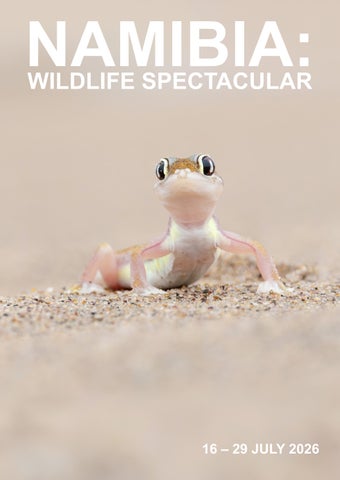
Cover: Namib Sand Gecko, Sandwich Bay, Namib Naukluft National Park. Pages 2–3: Lion, Onguma Private Game Reserve (Mike Watson)
2
NAMIBIA: WILDLIFE SPECTACULAR 2026
WILD IMAGES
3
NAMIBIA: WILDLIFE SPECTACULAR 2026
WILD IMAGES
4
NAMIBIA: WILDLIFE SPECTACULAR 2026
WILD IMAGES
5
NAMIBIA: WILDLIFE SPECTACULAR 2026
WILD IMAGES
‘The roar was a terrifying, reverberating sound. When the Lion reached the end of its sequence of roars, the finale seemed to come from somewhere deep inside its belly. Nothing else in nature makes a sound quite like it—not even a Tiger..’
6
NAMIBIA: WILDLIFE SPECTACULAR 2026
WILD IMAGES
7
NAMIBIA: WILDLIFE SPECTACULAR 2026
WILD IMAGES
ONKOLO HIDE ‘There are countless waterholes in and around Etosha National Park, and we were extraordinarily fortunate to spend much of our time beside one of them, in one of the best waterhole photography hides in Africa.’ African Savanna Elephant (Mike Watson)
8
NAMIBIA: WILDLIFE SPECTACULAR 2026
WILD IMAGES
The Onguma Private Game Reserve sits just outside the national park, away from much of the visitor traffic. Sunk into the white earth beside a waterhole, the Onkolo Hide gives you a remarkably intimate, almost water-level view of the animals coming to drink. Our encounters there easily surpassed almost everything else we experienced in Etosha. The only real contenders were the extraordinary lion encounter and perhaps the nocturnal rhino gatherings at Okakuejo. What struck me immediately about Onkolo was that every session was different. There were no repeat performances. I am not sure we saw the same individual animal twice. Everything seemed to be passing through, stopping briefly for a drink before continuing on their journey. A fence separates Onguma from the national park, but elephants apparently have a habit of pushing it over. If you own a private game reserve next to a national park, I suppose there is little incentive to spend too much time repairing a hole in a fence that brings more wildlife to you. One moment we were sitting quietly in the hide; the next, a shadow appeared in the corner of my eye. I looked up... An enormous bull elephant was towering over us. We enjoyed several elephant visits, each one different from the last. After dusk, a pair of Black Rhinos; a mother and her well-grown calf appeared at the waterhole as the light faded. The hide is renowned for its views of herbivores, and it certainly lived up to its reputation. Burchell’s Plains Zebras, Blue Wildebeest, Impala, Springbok, Warthogs and, particularly, the magnificent Southern Oryx and Kudu all came to drink. Even a diminutive Slender Mongoose made an appearance. The birdlife was also entertaining. Hamerkops worked the shallows, catching tiny invertebrates and occasionally providing those wonderful “between-the-mandibles” photographic moments. A resident pair of Blacksmith Lapwings appeared with their scruffy youngster. There were Kori Bustards, Grey Go-away-birds, Namaqua, Painted and (a single) Burchell’s Sandgrouse, Crested Francolins and, seemingly, an unlimited supply of Helmeted Guineafowl.
9
NAMIBIA: WILDLIFE SPECTACULAR 2026
WILD IMAGES
10
NAMIBIA: WILDLIFE SPECTACULAR 2026
WILD IMAGES
11
NAMIBIA: WILDLIFE SPECTACULAR 2026
WILD IMAGES
12
NAMIBIA: WILDLIFE SPECTACULAR 2026
WILD IMAGES
13
NAMIBIA: WILDLIFE SPECTACULAR 2026
WILD IMAGES
14
NAMIBIA: WILDLIFE SPECTACULAR 2026
WILD IMAGES
15
NAMIBIA: WILDLIFE SPECTACULAR 2026
WILD IMAGES
Black Rhino calf, Onguma Private Game Reserve (Mike Watson)
The bushes around the hide sheltered drinking passerines, including Blue Cordonbleus, Violet-eared and Common Waxbills and Crimson-breasted Shrikes. Out across the surrounding grassland we saw Angolan Giraffes and Northern Black and Red-crested Korhaans, particularly on our transfers to and from the hide. After dark, a furtive Spotted Hyaena appeared. And then there was the Milky Way. One night we ventured out, and Gin gave us a masterclass in Milky Way photography. It was as spectacular as ever to look up at the night sky and then put binoculars to your eyes and discover just how many more stars are actually there. There are perhaps 400 billion stars in our own galaxy, the densely-starred centre of which we are looking at. It puts things into perspective. We are rather insignificant. Our stay at the Onguma tented camp itself was a tour highlight. It is a seriously luxurious place; somewhere I imagine Richard Branson would be happy to call home for a few nights. The chalet-like tents surround a delightful waterhole, while the dining area, lounge and open-air fire pit (or boma) was an excellent place to relax after a day in the park. Meanwhile, I enjoyed my time in a guide’s cell.
16
NAMIBIA: WILDLIFE SPECTACULAR 2026
WILD IMAGES
‘Namibia has just over 2,000 black rhinos, according to the Namibia Nature Foundation in 2026 – roughly a third of the world’s wild black rhinos and the world’s largest population of the southwestern subspecies.’
EASTERN ETOSHA We spent time exploring the waterholes around Namutoni at the eastern end of the national park, but after Onkolo, the encounters inevitably felt somewhat anticlimactic. There were Angolan Giraffes, Plains Zebras and elephants, along with a couple of particularly cute Damara Dik-diks. A group of Lions had taken up residence around the Klein Okevi waterhole, but they remained mostly out of sight during the heat of the day. The evening lion sightings at Onguma were considerably better. First, a lone female walked along the boundary between the reserve and the seemingly endless sea of grass stretching into the national park. Later, we encountered another female being followed by two males. The males sauntered along behind her, occasionally pausing before continuing their pursuit. And then they roared. Hearing Lions at night is a completely different experience. From inside a tent they sound impossibly close, although then camp staff tell you they were half a kilometre away. These Lions, however, were about 15 metres in front of our vehicle. Thanks to our guide Salomon for a great time at Onguma!
Pages 17 & 22–25: (Burchell’s) Plains Zebra. Pages 18-19: Southern Oryx. Pages: 20–21: Blue Wildebeest. Pages: 26–27: Greater Kudu. Pages: 28–29: Slender Mongoose. Page 28: Namaqua Sandgrouse. Page 29: Kori Bustard (& Crimson-breasted Shrike). Pages 30–31: Hamerkop & Pages 32–33: Angolan Giraffe (Mike Watson)
17
NAMIBIA: WILDLIFE SPECTACULAR 2026
WILD IMAGES
18
NAMIBIA: WILDLIFE SPECTACULAR 2026
WILD IMAGES
19
NAMIBIA: WILDLIFE SPECTACULAR 2026
WILD IMAGES
20
NAMIBIA: WILDLIFE SPECTACULAR 2026
WILD IMAGES
21
NAMIBIA: WILDLIFE SPECTACULAR 2026
WILD IMAGES
22
NAMIBIA: WILDLIFE SPECTACULAR 2026
WILD IMAGES
23
NAMIBIA: WILDLIFE SPECTACULAR 2026
WILD IMAGES
24
NAMIBIA: WILDLIFE SPECTACULAR 2026
WILD IMAGES
25
NAMIBIA: WILDLIFE SPECTACULAR 2026
WILD IMAGES
26
NAMIBIA: WILDLIFE SPECTACULAR 2026
WILD IMAGES
27
NAMIBIA: WILDLIFE SPECTACULAR 2026
WILD IMAGES
28
NAMIBIA: WILDLIFE SPECTACULAR 2026
WILD IMAGES
29
NAMIBIA: WILDLIFE SPECTACULAR 2026
WILD IMAGES
30
NAMIBIA: WILDLIFE SPECTACULAR 2026
WILD IMAGES
31
NAMIBIA: WILDLIFE SPECTACULAR 2026
WILD IMAGES
32
NAMIBIA: WILDLIFE SPECTACULAR 2026
WILD IMAGES
33
NAMIBIA: WILDLIFE SPECTACULAR 2026
WILD IMAGES
34
NAMIBIA: WILDLIFE SPECTACULAR 2026
WILD IMAGES
‘Just like Saiga Antelope, the Damara Dik-dik has a specialised nasal cooling system. As it breathes, blood flowing through the nose can be cooled before reaching the brain. This helps it survive in a hot, dry environment.’
35
NAMIBIA: WILDLIFE SPECTACULAR 2026
WILD IMAGES
okaukuejo ‘Okaukuejo Waterhole is the best place in the world to watch Black Rhinos, we saw at least eight animals there each evening!.’
Black Rhinos, Okaujkuejo (Mike Watson)
36
NAMIBIA: WILDLIFE SPECTACULAR 2026
WILD IMAGES
THE LONG & DUSTY ROAD WEST Crossing Etosha from east to west was tedious hard work. There were extensive roadworks, several waterholes were inaccessible, and our mapping app seemed determined to find anything except the shortest route. We eventually encountered a couple of people watching two Black Rhinos, but the animals quickly disappeared into the bush. That was the highlight of a day spent driving through a dust cloud, while enduring what seemed like at least a million teeth-rattling corrugations. Eventually, though, relief arrived in the form of a sudden realisation: We were nearly there. Okaukuejo—the western hub of this part of the national park—was just a few minutes away. And then the ordeal was over. OKAUKUEJO AFTER DARK The tracks around Okaukuejo were dusty and corrugated too, and most of the wildlife seemed determined to remain at arms reach. Nevertheless, we added some worthwhile encounters to our Etosha portfolio: Giraffes and Ostriches silhouetted against the white of the salt pan, a Secretarybird methodically stomping around in search of prey, a feisty little Yellow Mongoose and a Martial Eagle that swooped into a gathering of guineafowl. But, the real action began after dark. Okakuejo’s waterhole is famous for its nocturnal wildlife, and it did not disappoint. The evening golden hour was interesting enough. Hordes of Helmeted Guineafowl gathered around the water, accompanied by Plains Zebras and Angolan Giraffes against a beautiful sky. Unfortunately, the quantity of dust in the air made the photographs a little soft. Then came dinner. Afterwards, we returned to the waterhole to find a crowd gathered around it like spectators at a major sporting event. We soon discovered why. On each of the two evenings we spent there, up to eight, or perhaps even nine, impressive Black Rhinos appeared. Some came remarkably close, and under the floodlights they were surprisingly photogenic, despite the challenging combination of high ISO and slow shutter speeds. There was plenty of interaction between mothers and calves, as well as between individual rhinos. There was pushing, shoving and plenty of snorting. Magic! Black Rhinos are essentially bad tempered, grumpy mammals with poor eyesight, and their encounters with the elephants that also ar-
37
NAMIBIA: WILDLIFE SPECTACULAR 2026
WILD IMAGES
rived after dark were not particularly cordial either. Spotted Hyaenas and Black-backed Jackals lurked in the shadows, while on the evening we arrived early, hundreds of Double-banded Sandgrouse descended on the waterhole for their own sundowner. They arrived in small groups, drank, and disappeared again into the darkness. The waterhole after dark was unquestionably one of the highlights of the whole trip. Our only regret was that we hadn’t conserved more energy during the afternoon so that we could have stayed even later to watch the endless comings and goings. But another busy day awaited us.
Kori Bustard (Mike Watson)
38
NAMIBIA: WILDLIFE SPECTACULAR 2026
WILD IMAGES
39
NAMIBIA: WILDLIFE SPECTACULAR 2026
WILD IMAGES
40
NAMIBIA: WILDLIFE SPECTACULAR 2026
WILD IMAGES
41
Yellow Mongoose (Mike Watson)
NAMIBIA: WILDLIFE SPECTACULAR 2026
WILD IMAGES
MOVING ON All too soon, it was time to leave Etosha and head west towards Damaraland. On the way, we stopped to refuel at one of the few fuel stations operating this year. Then, quite by chance, we came across a crowd of vehicles following the progress of a young male Lion. I was disappointed to see that he was collared. When he turned side-on, Mike pointed out that the collar was barely visible, but nevertheless it wasn’t exactly a photographic opportunity we’d been hoping for. Still, it seemed an appropriate final Etosha sighting. The Great White Place had delivered bull elephants towering over us, rhinos drinking under floodlights, lions roaring at point-blank range, giraffes walking into the white void, birds arriving by the hundreds and a night sky containing hundreds of billions of stars. Not a bad place to tick off the bucket list.
42
NAMIBIA: WILDLIFE SPECTACULAR 2026
WILD IMAGES
Double-banded Sandgrouse, Okaukuejo (Mike Watson)
43
NAMIBIA: WILDLIFE SPECTACULAR 2026
WILD IMAGES
mountain zebras ‘Compared with Plains Zebra, Hartmann’s Mountain Zebra has a more robust build, a dewlap beneath the neck and a largely unstriped belly.’
Hartmann’s Mountain Zebra (Mike Watson)
44
NAMIBIA: WILDLIFE SPECTACULAR 2026
WILD IMAGES
A Closer Look We had to wait another week before reaching the wilds of Namibia’s Damaraland; true Mountain Zebra country. During our road trip around Namibia, we had spent quite a lot of time worrying about the availability of diesel, so we were mightily relieved to discover that the crucial fuel station at Palmwag was operating. Another couple was at the station, and they headed off before us. About 20 kilometres later, we found them stopped beside the road, looking at something. A herd of Mountain Zebras! Magic. We parked and walked towards them across a plain scattered with quartz pebbles. Unfortunately, they were nervous. Most of the herd soon trotted away and disappeared from view, although their bold stallion remained behind for a while, standing his ground and keeping a watchful eye on us. Even so, it was a privilege to see Hartmann’s Mountain Zebras at a much closer range. Closer Encounters Hartmann’s Mountain Zebra is larger and more robust than the Cape Mountain Zebra and both are immediately distinguishable from Plains Zebra (Equus quagga) by their bold striping on the hindquarters. Hartmann’s also has a white belly and black stripes extending down the legs to the pointed hooves. Another distinctive feature is the distinct dewlap, a flap of loose skin beneath the neck. Its exact function is not fully understood, although it may provide visual information about an animal’s sex, age or condition and could potentially have a role in thermoregulation. Then, after another seven kilometres, my tour leader, Gin, spotted yet another herd beside the gravel road. These were a little closer still, although not quite as photogenic, so we pressed on. Another 40 kilometres of spectacular Damaraland scenery passed by in the soft evening sunshine. Then the radio crackled into life. Gin had done it again. She had found more Mountain Zebras and this time the herd was more or less point-blank beside the road. WOW! She is simply No.#1!
“Why is this meal taking so long?” That was the thought going through my mind 16 years ago at De Hoop Nature Reserve in South Africa’s Western Cape. I was keen to find Cape Mountain Zebra, for which the reserve is famous, and was becoming increasingly frustrated at the amount of time we were spending sitting around a dining table when all I wanted to do was get out into the field and look for mountain zebras. “Don’t worry, they’ll be on the plain near Die Opstal.” Well, they weren’t. By the time we had finished our meal, there was no longer enough time to search more extensively. They couldn’t have been too far away. They are resident at De Hoop, but we had simply run out of time. “One of those things.” Except the disappointment has gnawed away at the back of my mind ever since. It still does. Cape Mountain Zebra is the nominate subspecies of the two mountain zebra subspecies: • Cape Mountain Zebra — Equus zebra zebra • Hartmann’s Mountain Zebra — Equus zebra hartmanni Fast Forward to July 2026... I was feeling a little sleepy after a long journey and a morning spent transferring guests from Windhoek Airport. After eventually dropping my bags in my chalet at River Crossing Lodge, I stepped onto the veranda and raised my binoculars to scan the distant hillside. There was a group of Southern Oryx, or Gemsbok, in the valley below, while a distant ridgeline looked promising for Verreaux’s Eagle. I also knew that Eland was occasionally seen in the area. Then, almost instantly, some very distant mammals caught my eye. They were far too distant for me to identify through my binoculars, so I reached for my camera and used its zoom to take a closer look. Imagine my surprise when I saw they were zebras, and that they had two very bold black stripes on their hindquarters. BINGO! Hartmann’s Mountain Zebra. How lucky was that? They remained as a very distant handful of pixels, but they provided a nice distraction just minutes before the official start of the Wild Images tour.
45
NAMIBIA: WILDLIFE SPECTACULAR 2026
WILD IMAGES
46
NAMIBIA: WILDLIFE SPECTACULAR 2026
WILD IMAGES
47
NAMIBIA: WILDLIFE SPECTACULAR 2026
WILD IMAGES
48
NAMIBIA: WILDLIFE SPECTACULAR 2026
WILD IMAGES
49
NAMIBIA: WILDLIFE SPECTACULAR 2026
WILD IMAGES
50
NAMIBIA: WILDLIFE SPECTACULAR 2026
WILD IMAGES
51
NAMIBIA: WILDLIFE SPECTACULAR 2026
WILD IMAGES
desert giraffes
52
NAMIBIA: WILDLIFE SPECTACULAR 2026
WILD IMAGES
53
NAMIBIA: WILDLIFE SPECTACULAR 2026
WILD IMAGES
54
NAMIBIA: WILDLIFE SPECTACULAR 2026
WILD IMAGES
55
NAMIBIA: WILDLIFE SPECTACULAR 2026
WILD IMAGES
56
NAMIBIA: WILDLIFE SPECTACULAR 2026
WILD IMAGES
57
NAMIBIA: WILDLIFE SPECTACULAR 2026
WILD IMAGES
desert elephants ‘The elephants use the dry river system as a natural highway through the desert, but survival here depends on an intimate knowledge of the landscape. They need to know where food can be found, where water lies hidden beneath the sand,.’ Bull elephant in musth (Mike Watson)
58
NAMIBIA: WILDLIFE SPECTACULAR 2026
WILD IMAGES
The reason we made the long journey to this remote corner of Namibia was not to see the mountain zebras (although, for me, they would have made the journey worthwhile on their own). We had come to meet one of Africa’s most remarkable elephant populations: the extraordinary desert-adapted elephants of the Hoanib Valley, in the remote Kunene region of northwestern Namibia. The Hoanib River is an ephemeral river, meaning that it flows only occasionally, usually after heavy rains. For much of the year its sandy riverbed is completely dry, sometimes remaining so for months or even years. Yet beneath and around those sands, water can persist, allowing a surprisingly rich ribbon of vegetation to flourish. Ana trees and camelthorn grow along the riverbed, creating a vital lifeline through an otherwise harsh and seemingly endless desert. Our experience of the Hoanib was about as far removed from a conventional African safari as you could imagine. There were no vast green plains filled with herds of zebra, wildebeest and antelope, with attendant predators waiting somewhere in the grass. Instead, we spent hours driving through an apparently empty landscape of sand and towering rock formations, looking for signs of life. Apart from a couple of memorable encounters with giraffes, our attention was focused on one particular prize: the three small herds of elephants that move through the Hoanib river system. The combination of the dry river valley, spectacular rocky scenery and the precious elephant population make this place truly extraordinary. Elephants shaped by the desert The Hoanib’s famous “desert elephants” are not a separate species. They are African Savanna Elephants (Loxodonta africana), the same species found across much of Africa. Genetic research has found no evidence that these elephants constitute a genetically distinct species or subspecies. What makes them special is the way they have adapted their behaviour to survive in such an unforgiving environment. The elephants use the dry river system as a natural highway through the desert, but survival here depends on an intimate knowledge of the landscape. They need to know where food can be found, where water lies hidden beneath the sand, which areas have received recent rain and when conditions are favourable enough to leave the Hoanib altogether. This is why the knowledge held by older elephants is so important. A matriarch may know the location of a water source hidden beneath a seemingly featureless stretch of sand. She may remember which part of the river-
59
NAMIBIA: WILDLIFE SPECTACULAR 2026
WILD IMAGES
bed produces edible vegetation, where rainwater collects after a storm, or when it is worth travelling beyond the Hoanib in search of better conditions. Young elephants learn these survival skills from the older members of the herd. When an experienced animal dies, the herd can lose an irreplaceable store of environmental knowledge. And these elephants need an enormous amount of space. Their ranges can be vast, and individual bulls may travel considerable distances. Desert elephants have been recorded moving between different river systems and even reaching the Skeleton Coast. The elephants that dig for water. One of the most surprising things I learned in Namibia was that elephants can dig their own boreholes. When surface water is unavailable, they use their trunks, and sometimes their feet, to excavate into the soft river sand until they reach water below the surface. It is an extraordinary example of how these animals have learned to exploit resources that would be invisible to most other creatures. We were incredibly fortunate to come across one of the three Hoanib herds while they were doing exactly this. It was a magical encounter and, for some of us, one of the highlights of the entire trip. We were even allowed out of the vehicles to photograph them from ground level, although we had to remain alert and be prepared to climb back aboard quickly should the situation suddenly change. The females were particularly captivating. Despite the harshness of their environment, they appeared calm and gentle, carefully tending to the youngest members of the herd. Watching the adults patiently interact with the calves brought home just how dependent the next generation is on the experience and protection of the older animals. We also encountered the dominant bull of the area; and he was in musth. Our drivers were understandably cautious about getting too close. Musth is a powerful hormonal state in adult male elephants, associated with dramatically elevated testosterone, increased reproductive activity and heightened aggression. The bull’s condition was unmistakable; we could clearly see the dark secretions running from his temporal glands. A bull in musth can pose a serious threat, not only to other male elephants but also to people. This was one elephant we were very happy to admire
60
NAMIBIA: WILDLIFE SPECTACULAR 2026
WILD IMAGES
61
NAMIBIA: WILDLIFE SPECTACULAR 2026
WILD IMAGES
62
NAMIBIA: WILDLIFE SPECTACULAR 2026
WILD IMAGES
63
NAMIBIA: WILDLIFE SPECTACULAR 2026
WILD IMAGES
64
NAMIBIA: WILDLIFE SPECTACULAR 2026
WILD IMAGES
65
NAMIBIA: WILDLIFE SPECTACULAR 2026
WILD IMAGES
66
NAMIBIA: WILDLIFE SPECTACULAR 2026
WILD IMAGES
‘The Hoanib may look empty at first glance. But spend a little time there, and you begin to realise that the desert is anything but empty— and that its elephants are among its most remarkable inhabitants.’ from a respectful distance. A population with a fragile future The story of the Hoanib elephants has not always been a positive one. The population suffered badly from poaching and wartime hunting during the 1980s, when elephant numbers across the region were devastated. There are, however, encouraging signs of recovery. According to the 2025 research report on the Hoanib population, there have been no documented human-caused elephant deaths in the study area since 2021. Even more encouragingly, ten calves were born in the Hoanib between May 2023 and July 2024, with nine still surviving in May 2025. After spending time in this extraordinary landscape, those numbers felt particularly meaningful. These are not simply elephants living in a desert. They are animals carrying generations of knowledge about how to survive in one of the world’s most demanding environments. Seeing them digging for water, caring for their young and moving confidently through a landscape that initially appeared almost devoid of life was a privilege. Thanks to our awesome guides Oueera and Buck for a great day!
67
NAMIBIA: WILDLIFE SPECTACULAR 2026
WILD IMAGES
the living desert ‘Look a little closer, however, and the apparent emptiness begins to disappear. Beneath the sand lives an extraordinary collection of animals, many of them mind-bogglingly specialised for desert life. ’
Pages 68–73: Peringuey’s Adder (Mike Watson)
68
NAMIBIA: WILDLIFE SPECTACULAR 2026
WILD IMAGES
‘The Living Desert’ is a well-known phrase and is perhaps the best way to describe the world’s oldest desert, the Namib. Stretching from southern Angola, through Namibia and into northwestern South Africa, parts of this extraordinary desert are thought to have experienced arid conditions for up to 80 million years. At first glance, the Namib can appear to be little more than a vast, lifeless sea of shifting sand, punctuated by some of the most spectacular dunes on Earth. They may not be the world’s tallest; that is Duna Federico Kirbus in Argentina, which rises more than a kilometre above its surroundings, but the Namib’s great orange and red dunes are surely among the most beautiful. The adaptations of the desert’s inhabitants are the product of the sheer length of evolutionary time passed, and this is why the Namib is so special. Survival here is an art of exploiting every available source of shelter, moisture and food. The cold Benguela Current chills the air of the Atlantic coast of Southern Africa, suppressing rainfall, while persistent high-pressure conditions prevent cloud formation over much of the desert. The result is an extraordinarily arid environment, although coastal fog provides a vital source of moisture for its inhabitants. It is also a landscape marked by death. Whales and seals left their bleached bones along the coast, while countless ships have fallen victim to the treacherous combination of fog, currents and surf. The result is the evocatively named Skeleton Coast; a name that conjures up images of shipwrecked sailors, although the original “skeletons” were the remains of marine mammals. We were privileged to have some of the desert’s wildlife treasures revealed to us by a couple of genuine local experts. Without them, we would certainly have missed some of the Namib’s most elusive inhabitants, as well as being unable to access some of the best locations. Between them, Chantelle and Ben gave us some wonderful encounters and among them was a quartet of desert specialists; an A-list collection of herps, followed by one particularly accommodating little bird. NUMBER ONE: PERINGUEY’S ADDER At the very top of everyone’s wish list was Peringuey’s Adder Bitis peringueyi, also known as the Desert Sidewinder or Namib Sidewinding Adder. I was already contemplating a return to Namibia’s Skeleton Coast after the disappointment of missing this extraordinary snake on our first desert excursion in Dorob National Park, near Swakopmund.
69
NAMIBIA: WILDLIFE SPECTACULAR 2026
WILD IMAGES
Our guide, Chantelle Bosch, is a veritable snake whisperer, in fact, it seems she can conjure almost every creature out of the sand. But even she was thwarted by a violent sandstorm, which had blown up in the morning. The wind blew hard for hours, completely obliterating the tracks and other signs that she would normally use to read the famous “Desert Telegraph”. So, it was a massive relief when, the following day, on our Sandwich Harbour excursion in Namib-Naukluft National Park, south of Walvis Bay, Ben Brynard simply said: “We can find it too, no problem.” And, indeed, he did. Ben is usually free to concentrate on other things, such as driving the enormous dunes in his modified Landcruiser, when visitors have already had the full Living Desert experience with Chantelle the previous day. Like Chantelle, Ben is a protégé of the legendary Namib Desert guide Tommy Collard, who sadly passed away in 2025. They both inherited some of Tommy’s intimate knowledge of the Living Desert. A SNAKE DESIGNED FOR SAND Peringuey’s Adder is small by viper standards, reaching only a maximum of around 35cm, but it possesses an extraordinary collection of adaptations to its sandy home. It is an ambush predator, spending much of its time buried beneath the surface with only its eyes exposed. Its principal prey are small Meroles lizards, plenty of which we saw emerging after the sandstorm had passed. One of its most striking features is the position of its eyes. Both are positioned on the top of its head, allowing the snake to remain almost completely submerged while still watching the world above the sand. It is an adaptation reminiscent of the stargazer fishes (Uranoscopidae), which have independently evolved a similar solution to the problem of ambushing prey from below. Ben followed an unmistakable sidewinding track, ending in an expanse of sand. Then, a tiny flicker of a tongue caught his eye and betrayed the snake’s location. There it was.
70
NAMIBIA: WILDLIFE SPECTACULAR 2026
WILD IMAGES
71
NAMIBIA: WILDLIFE SPECTACULAR 2026
WILD IMAGES
72
NAMIBIA: WILDLIFE SPECTACULAR 2026
WILD IMAGES
SIDEWINDING Peringuey’s Adder’s famous method of locomotion is one of the great spectacles of desert biology. Rather than moving in the conventional serpentine S-shaped waves used by most snakes, the sidewinder lifts sections of its body from the ground and throws them forwards while other sections remain anchored. The result is an apparently effortless sideways movement across loose sand. We got to see this in action! Despite its superficial resemblance to the American Sidewinder Rattlesnake Crotalus cerastes, the two snakes aren’t closely related. Their similar locomotion is a beautiful example of convergent evolution. Péringuey’s Adder has another trick, too. The darkened tip of its tail can act as a caudal lure, potentially attracting prey close enough for the snake to strike. LIVING BENEATH THE SAND The sand isn’t merely somewhere to move across. It is also a shelter. By burying itself, the snake can escape the worst of the desert heat. The sand provides a cooler refuge below the baking surface, while simultaneously concealing the snake from predators such as the Pale Chanting Goshawk, which we saw hanging around nearby. Maybe the goshawk can also recognise the snake’s tracks? The sidewinder can also exploit the Namib’s coastal fog. Tiny droplets of water collect on its body, and by moving its head it can apparently direct those droplets towards its mouth. Under favourable conditions, this can increase its body mass by more than 10%; a remarkable amount for such a small animal. And reproduction is adapted to desert life too. Like many vipers, Peringuey’s Adder is ovoviviparous, giving birth to live young rather than depositing eggs externally. Retaining the developing embryos inside the female avoids exposing eggs to the unpredictable conditions of the shifting desert sands. WHO WAS PÉRINGUEY? The species was named in honour of Louis Albert Péringuey, a French-born entomologist and naturalist who worked extensively in southern Africa. The snake was described in 1888 by George Albert Boulenger, a Belgian-born zoologist whose name appears on a large number of reptile species. It was a privilege to see this iconic animal in its natural environment.
73
NAMIBIA: WILDLIFE SPECTACULAR 2026
WILD IMAGES
NUMBER TWO: NAMIB SAND GECKO Next on our wish list was another desert specialist that had eluded us during our first excursion in Dorob National Park: the exquisite Namib Sand Gecko Pachydactylus rangei. This is another animal that has been shaped by evolution for a life among soft sand, extreme heat and almost no rainfall. Ben simply said:“We can find that too, no problem.” He located a tiny daytime burrow, with almost no visible indication of its occupant; just some minute scrapings on the surface of the sand and a tiny hole. He carefully excavated the gecko for us and, importantly, returned it safely under the sand afterwards. The Namib Sand Gecko is a nocturnal predator and possesses enormous pupils, protected by transparent spectacle scales rather than conventional eyelids. Those enormous eyes are perfectly suited to a creature that emerges to hunt after dark. FEET MADE FOR SAND Its feet are perhaps its most obvious adaptation. The toes are webbed, forming effective little paddles that help the gecko move through loose sand and excavate its burrow. During the day it can retreat deep beneath the surface; sometimes up to around a metre down; where temperatures are considerably more stable. As Ben explained to us, loose desert sand contains a surprising amount of air, up to one third by volume in fact. What looks like an impenetrable mass is actually a mass of individual grains with air spaces between them. Beneath the surface, this creates a very different thermal environment from the sun-baked sand above, as we could see using the macro function of our smartphones! HARVESTING THE FOG Like Peringuey’s Adder, the Namib Sand Gecko is closely associated with the coastal fog zone. Water droplets condense on its body and even its eyes, and the gecko can collect these droplets with its tongue. There is even evidence of social water collection, with geckos licking moisture droplets from one another. It’s an extraordinary example of an animal exploiting a source of water that isn’t technically rainfall at all.
74
NAMIBIA: WILDLIFE SPECTACULAR 2026
WILD IMAGES
75
NAMIBIA: WILDLIFE SPECTACULAR 2026
WILD IMAGES
76
NAMIBIA: WILDLIFE SPECTACULAR 2026
WILD IMAGES
NUMBER THREE: NAMAQUA CHAMELEON Although Chantelle was also prevented from finding a sand gecko by the fact that the tell-tale burrow entrances had been obliterated by the sandstorm, she showed her skills spotting Namaqua Chameleons Chamaeleo namaquensis from her vehicle! We enjoyed a wonderfully slow-motion encounter with one of these remarkable reptiles. The Namaqua Chameleon occupies much the same broad desert environment as the previous two species, but it isn’t quite as committed to the soft dunes. It is more often associated with rockier substrates and sparse vegetation between dunes. On the hot day we encountered them, they were remarkably pale, presumably helping to reflect solar radiation and reduce heat absorption. This also made them just a little easier to spot against the tiny desert bushes. Sadly, we did not see its most impressive trick. The Namaqua Chameleon can regulate its body temperature asymmetrically. One side of the animal facing the sun can become pale, while the shaded side remains darker. A CHAMELEON THAT DOESN’T LIVE IN TREES Unlike the stereotypic chameleon, this species is primarily terrestrial. It therefore has a relatively short tail compared with many arboreal chameleons, and it can move surprisingly rapidly across the ground pursuing prey. It certainly retains the famous chameleon’s ballistic tongue, but it isn’t dependent on sitting motionless and waiting for food to come within range. But it can actively pursue prey, including insects and other reptiles. And its diet can be surprisingly ambitious: Namaqua Chameleons have been recorded eating lizards and even small snakes, including young Peringuey’s Adders! That creates one of the Namib’s most extraordinary predator-prey relationships: a venomous snake that specialises in hunting lizards whose offspring can itself become prey for a chameleon. MORE DESERT INGENUITY The Namaqua Chameleon is another inhabitant of the coastal fog zone and has adaptations that enable it to exploit atmospheric moisture. Moisture can collect on its body, with its scales assisting in the movement of water droplets. It also possesses nasal salt glands, allowing excess salts to be removed in a concentrated secretion rather than requiring the animal to lose precious water.
Namaqua Chameleon (Mike Watson)
77
NAMIBIA: WILDLIFE SPECTACULAR 2026
WILD IMAGES
78
NAMIBIA: WILDLIFE SPECTACULAR 2026
WILD IMAGES
NUMBER FOUR: TRACTRAC CHAT Our fourth Living Desert specialist was rather different from the reptilian trio: the charming Tractrac Chat Emarginata tractrac, a small Old World flycatcher and another characteristic bird of the arid landscapes of western southern Africa. The genus Emarginata contains three species: • Tractrac Chat Emarginata tractrac • Karoo Chat Emarginata schlegelii • Sickle-winged Chat Emarginata sinuata The Tractrac Chat is particularly associated with dry, open country, including the Namib Desert, gravel plains, desert scrub and other arid habitats. A BIRD NAMED AFTER ITS VOICE The common name is wonderfully onomatopoeic, derived from the “trac-trac” sound of its call. It is a small, pale, inconspicuous bird, but its tail provides a useful identification feature: largely pale with a contrasting dark tip. There is also geographical variation in colour. The forms nearer the coast are generally paler, matching the brighter sands and gravel of the Namib, while birds farther inland tend to be browner. The desert has again shaped an animal to match its surroundings. DESERT BREEDING Tractrac Chats usually lay only two or three eggs, and pairs are generally partners for life. Their nests are placed low down, often on or close to the ground beneath vegetation. Their food consists mainly of invertebrates; particularly insects such as beetles, ants, grasshoppers, bees and wasps. They are agile hunters, often making short flights from perches to capture prey before returning. These birds have learned to treat Chantelle’s vehicle as a mealworm buffet, and approach remarkably closely in exchange for a treat. Sometimes too close for our camera lenses. Tractrac Chat (Mike Watson)
79
NAMIBIA: WILDLIFE SPECTACULAR 2026
Dune Lark, Elim Dunes (Mike Watson)
WILD IMAGES
80
NAMIBIA: WILDLIFE SPECTACULAR 2026
WILD IMAGES
81
NAMIBIA: WILDLIFE SPECTACULAR 2026
WILD IMAGES
82
NAMIBIA: WILDLIFE SPECTACULAR 2026
WILD IMAGES
83
NAMIBIA: WILDLIFE SPECTACULAR 2026
WILD IMAGES
84
NAMIBIA: WILDLIFE SPECTACULAR 2026
WILD IMAGES
85
NAMIBIA: WILDLIFE SPECTACULAR 2026
WILD IMAGES
Butterfly Corner (clockwise from top left): Yellow Pansy (Junonia hierta), Topaz Arab Tip (Colotis calais), Zebra White (Pinacopteryx eriphia) & Guineafowl Butterfly (Hamanumida daedalus) (Mike Watson)
86
NAMIBIA: WILDLIFE SPECTACULAR 2026
WILD IMAGES
Rüppell’s Korhaan, Sesriem (Mike Watson)
87
NAMIBIA: WILDLIFE SPECTACULAR 2026
WILD IMAGES
88