
ServiceNow 2026: From Generative Assist to Agentic Execution
Executive briefing for C-suite & senior IT leaders — a pragmatic roadmap to evolve ServiceNow from human-assisted workflows into governed, autonomous operations that execute outcomes.



Why this matters now
Enterprises must convert ServiceNow into a digital operations backbone that proactively prevents incidents, automates resolution, and executes crosssystem ‑ actions. The transition unlocks sustained cost savings, faster time-to-value, and measurable risk reduction.
• From reactive tickets proactive operational autonomy →
• Short-term wins: Predictive avoidance, selfservice containment ‑
• Long-term goal: Agentic workflows that act under policy
The 2026 Landscape
ServiceNow is now positioned as the control plane for digital operations — integrating ITSM, ITOM, SecOps, HR and business apps into a single realtime fabric where AI moves from suggestion to action.

‑ Predictive Operations
ML models detect anomalies and surface avoidance actions before users notice impact.

Crossdomain ‑ Remediation
Agentic flows trigger validated fixes across tools without manual handoffs.

Containment &
Experience
Conversational AI contains issues via selfservice, ‑ reducing noise and demand on specialists.
Strategic Objectives
Operational Resilience
Reduce downtime with proactive detection and autonomous mitigation.
Cost
Optimization
Lower operational cost via automation of repetitive tasks and reduced escalations. Speed of Delivery Accelerate incident resolution and change lifecycles through agentic workflows.
Controlled Autonomy Enable decision-making within clear governance and measurable guardrails.
ROI Framework — How We Prove Value
We tie technology investment to business outcomes through focused pilots and iterative scaling. Core levers: Predictive Incident Avoidance and SelfService Containment — both deliver immediate cost and experience gains.

Predictive Incident Avoidance
Reduce incidents before they occur by surfacing highconfidence predictions and autoapplying containment policies.
SelfService Containment
Deflect repeatable demand via conversational assistants and guided remediation playbooks.
Operational Automation
Agentic workflows execute approved remediation steps across systems with audit trails and rollback capabilities.

Quantified Outcomes (Pilot to Scale)


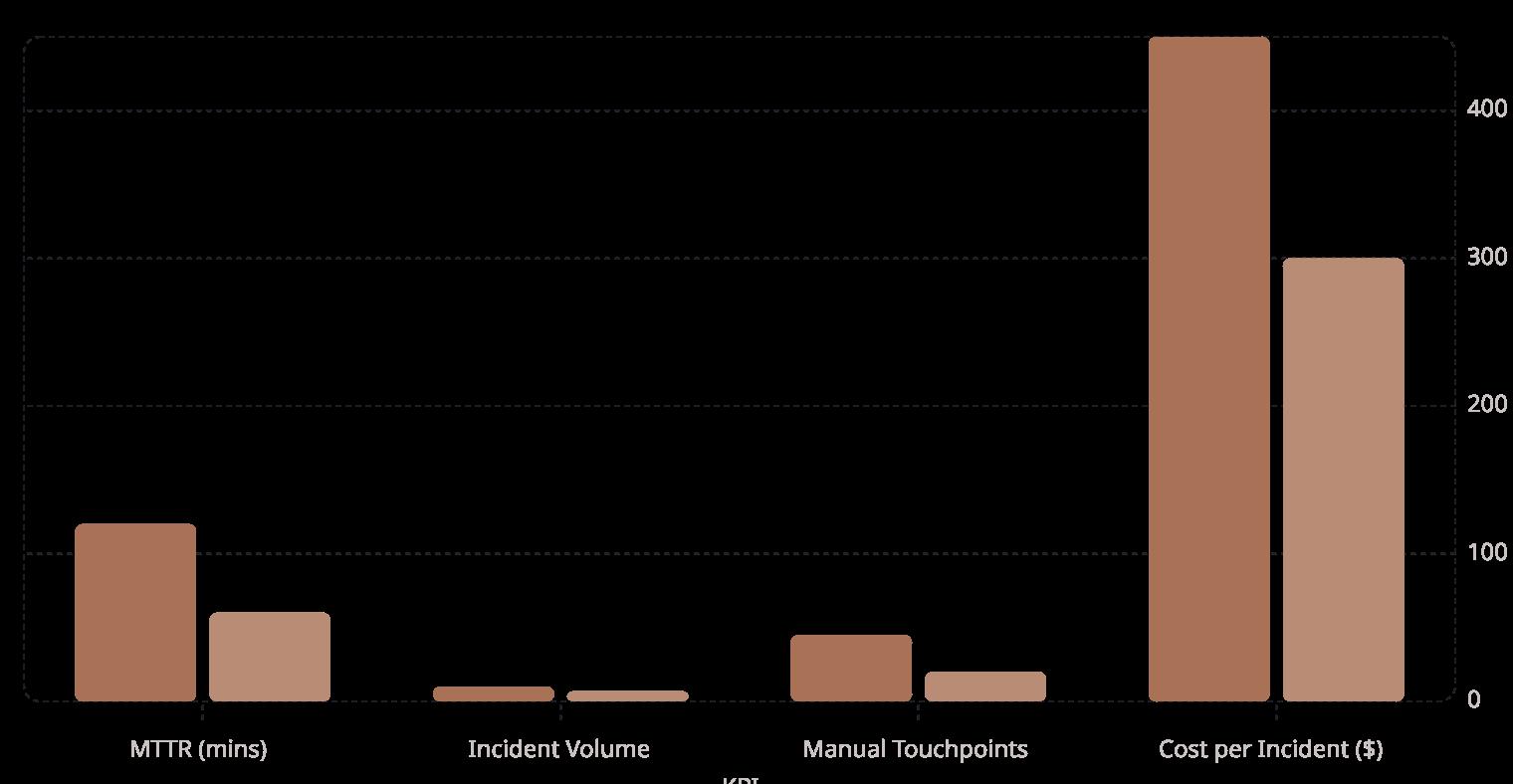
Target KPI improvements from pilots: MTTR reduction 30–50% (example range for planning), incident volume reduction via containment, and touchpoint automation that drives perincident cost down.
AI Governance & Compliance

Agentic systems require layered governance that aligns with the EU AI Act and enterprise risk frameworks. Our approach blends legal, security, and engineering controls:
• Risk classification of models & workflows (high/medium/low)
• Policy-driven guardrails: permitted actions, escalation thresholds, and humanintheloop ‑‑‑ triggers
• Data lineage, explainability logs, and audit trails for every autonomous action

KPI placeholders: policy compliance rate (target ≥95%), audit readiness score, and mean time to revoke (MTTRv) for misactions.
Platform Guardrails & Operational Controls

1. Policy Engine
Centralized, versioned policies that define allowed agentic operations per environment and risk tier.
3. SafeExecution Patterns ‑
Sandboxed runbooks, canary execution, and automatic rollback for highimpact actions. ‑
2. Observability & Explainability
End-to-end tracing of decisions, model inputs, and human approvals for forensic review.
4. People + Process
Rolebased access, training for incident owners, and SLAaware‑‑ supervision of agentic decisions.
Implementation Roadmap

Pilot Predictive detection trial Scale Cross-domain agentic flows
Validate Safe automation and containment
Govern Policy, audit, EU AI Act alignment
We recommend a phased approach: 3–6 month pilot validated automation scaled rollout by domain enterprise governance and continuous →→→ improvement. Each phase includes measurable KPIs and go/nogo gates. ‑
Next Steps & Ask

Proposed immediate actions:
1. Authorize a 90day pilot focused on Predictive Incident Avoidance (define scope & ‑ KPIs)
2. Approve governance blueprint & compliance checklist for EU AI Act alignment
3. Commit executive sponsor and crossfunctional owners for scaling decisions ‑

Being one of the best ServiceNow Consulting Services partner we provide endtoend delivery: assessment, pilot execution, platform hardening, ‑‑ governance enablement, and scale support. Estimated executive decision window: 2 weeks.