The transition from winter to spring in Western Wake is always a welcome shift. The quiet, instinctual desire to cozy up that de ned our last issue has begun to give way to a natural sense of renewal. For our team, this transition was marked by a truly special evening on January 22 at Raleigh’s Millbrook Manor. Our Diamond Awards gala was more than just a ceremony; it was a celebration of the creativity and passion of the businesses that make our corner of the world so vibrant. Seeing the local entrepreneurs we feature in these pages come together to toast one another’s success was a powerful reminder of the strength of our community. These winners are the foundation of Western Wake, and we move forward this season with our focus set rmly on honoring their stories.
With that sense of connection fresh in our minds, we turn our attention to our Home and Garden theme. This time of year invites a certain kind of “spring cleaning” of the soul—a desire to plant new roots, both literally and guratively. We know that the process of renewal is often easier with inspiration, and this issue is designed to provide exactly that.
We also highlight a local family who embraced a “smart over bigger” philosophy as they transitioned into a new chapter of life. By converting their underused dining room into a cozy cocktail lounge and transforming their bright breakfast nook into their primary dining space, the Pages showed us that a home’s value is found in its meaning, not its square footage.
If you are looking for inspiration for your own outdoor spaces, our partner Beverly Hurley—the editor of Triangle Gardener—details ve towns in North Carolina with gardens that are absolutely worth the trip. From sprawling estates to hidden oral gems, these locales offer the perfect excuse for a weekend road trip to see the best of our state’s natural beauty. Speaking of getaways, we also head toward the coast to visit The Ellie Beach Resort in Myrtle Beach, South Carolina. This resort perfectly balances modern luxury with that effortless coastal ease we all crave as the weather warms.
In honor of Earth Day, we are also exploring a unique way to give back to the land we love. Our contributor joined local enthusiasts for a day of geocaching at Jordan Lake, combining a high-tech treasure hunt with a community trash cleanup. It’s a fun, hands-on way to ensure our natural playgrounds remain pristine for the generations to come.
Just as the spring offers us a clean slate, it also encourages us to be present and dedicated to the people and places we love. As the season unfolds, I hope you nd time to step outside, breathe in the fresh air, and appreciate the wonderful place we all call home.
Warmly,
Kyle Marie McMahon Editor-in-Chief
With 5 West art director Sean Byrne at the 2026 Diamond Awards gala at Millbrook Manor
FOUNDER
Ronny Stephens
PUBLISHER
Joe Sanger
EDITOR-IN-CHIEF
Kyle Marie McMahon
ART DIRECTOR
Sean Byrne
CONTENT EDITOR & SENIOR GRAPHIC DESIGNER
Dathan Kazsuk
COPY EDITOR
Cindy Huntley
SOCIAL MEDIA MANAGER
Delaney Garver
AD PRODUCTION MANAGER
Erica Christy
DIRECTOR OF SALES
Collin Pruitt
ACCOUNT EXECUTIVE
Mackenzie Steiner
STAFF PHOTOGRAPHER
Jessica Bratton
DISTRIBUTION
Joe Lizana, Manager DistribuTech.net
CONTRIBUTING WRITERS
Samantha Carson, Autumn Coleman, Rachel Danielle, Kurt Dusterberg, Beverly Hurley, Jennnifer Primrose, Dolly Sickles, Matt Weiss
5 West magazine is published six times annually. Any reproduction in part or in whole of any part of this publication is prohibited without the express written consent of the publisher. Copyright 2026. All rights reserved.
5 West magazine is not responsible for unsolicited manuscripts, photography or art. Unsolicited material is welcome and is considered intended for publication. Such material becomes the property of the magazine and is subject to editing.
5 West magazine will not knowingly accept any real estate advertising in violation of U.S. equal opportunity law.
SUBSCRIPTIONS
6 print issues (1 year) Available online at 5westmag.com 1053 E. Whitaker Mill Road Raleigh, NC 27604
Phone: 919.782.4710 Fax: 919.782.4763
Photo by Jessica Bratton.
1. AKAMI SUSHI, APEX
Voodoo Roll (tuna and salmon roll topped with spicy tuna and caviar); Dancing Eel Roll (California roll topped with BBQ eel and eel sauce); and salmon and avocado roll.
3. HIMALAYAN NEPALI CUISINE, CARY
Baigan Bhartha. Mashed eggplant cooked with creamy sauce and Nepalese spices. While spice level varies by request, the base dish is slightly sweet.
Salmon served with a mushroom dashi, porcini, leek, and Carolina Gold rice. Accompanying vegetables vary by season, but pictured here with fresh beans. 3 1 2 4
2. CRÚ WINE BAR AND BISTRO, CARY
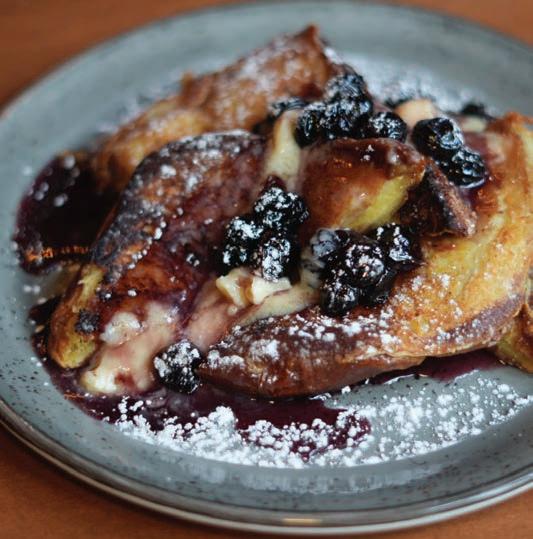
Fluffy and moist brioche French toast topped with tangy lemon mascarpone curd and drizzled with warm blueberry syrup. Photo courtesy of CRÚ Wine Bar and Bistro.
4. HERONS, CARY
On the evening of January 22, the halls of Millbrook Manor were filled with the kind of vibrant energy only a community as dedicated as ours can produce. Our Diamond Awards gala was a true milestone, bringing together the visionaries, the risk-takers, and the local favorites who make our region such a remarkable place to live and work. As you browse these snapshots, you will see more than just a formal event; you will see the laughter, the shared toasts, and the genuine camaraderie of a community coming together to celebrate one another’s hardearned success. These images perfectly reflect the spirit of a night dedicated to the excellence, passion, and connection that define us all. Photos by Jessica Bratton and Josh Conner.
SMALL SPACE, BIG SOUL
Rede ning the next chapter through intentional, unexpected design
STORY BY KYLE MARIE MCMAHON
PHOTOS BY JESSICA BRATTON
Thetransition to an empty nest is often framed as a period of loss—the loss of noise, the loss of frantic schedules, and, most commonly, the loss of square footage. But for Shane and Kerri Page, standing at the threshold of a new phase as their daughter, Zoe, prepared for college, the move from a beloved suburban house to a city-centered home wasn’t about losing anything. It was about a radical, joyful reclamation of space.
In the world of interior design, we often talk about downsizing with a sense of clinical pragmatism. We focus on what fits and what has to go. But for the Pages, the goal wasn’t just to fit their lives into a smaller footprint; it was to redefi ne what “home” actually meant for two people entering a season of independence and refi ned tastes. They didn’t need more rooms; they needed more meaning.
To translate this vision into reality, the couple partnered with Joey Napierkowski of Joseph William Interiors. Known for his ability to blend urban sophistication with a warmth that feels entirely livable, Napierkowski understood that this project wasn’t just about decor—it was about lifestyle architecture. Together, they set out to prove that when you think outside the traditional box, a smaller home can actually feel expansive.
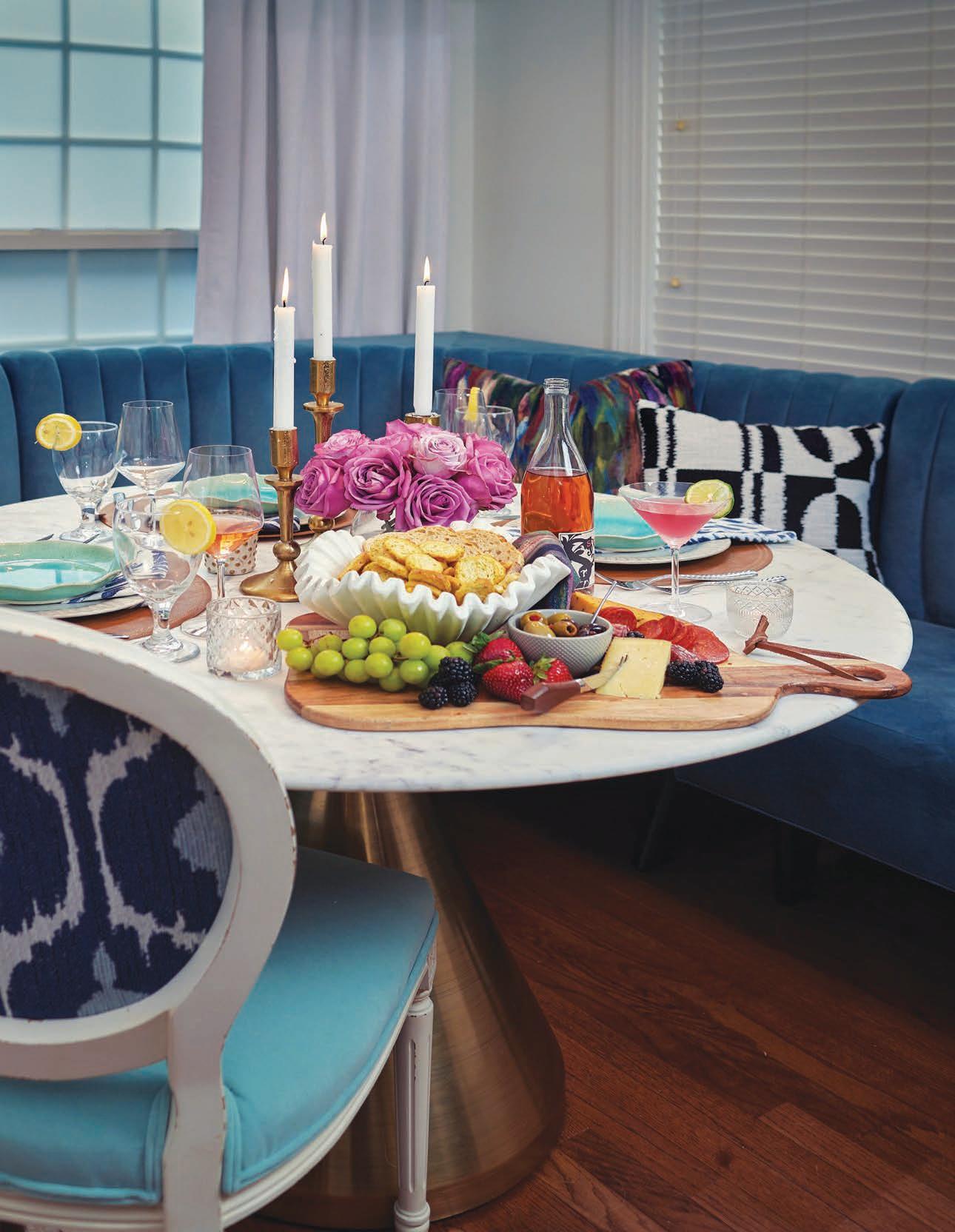
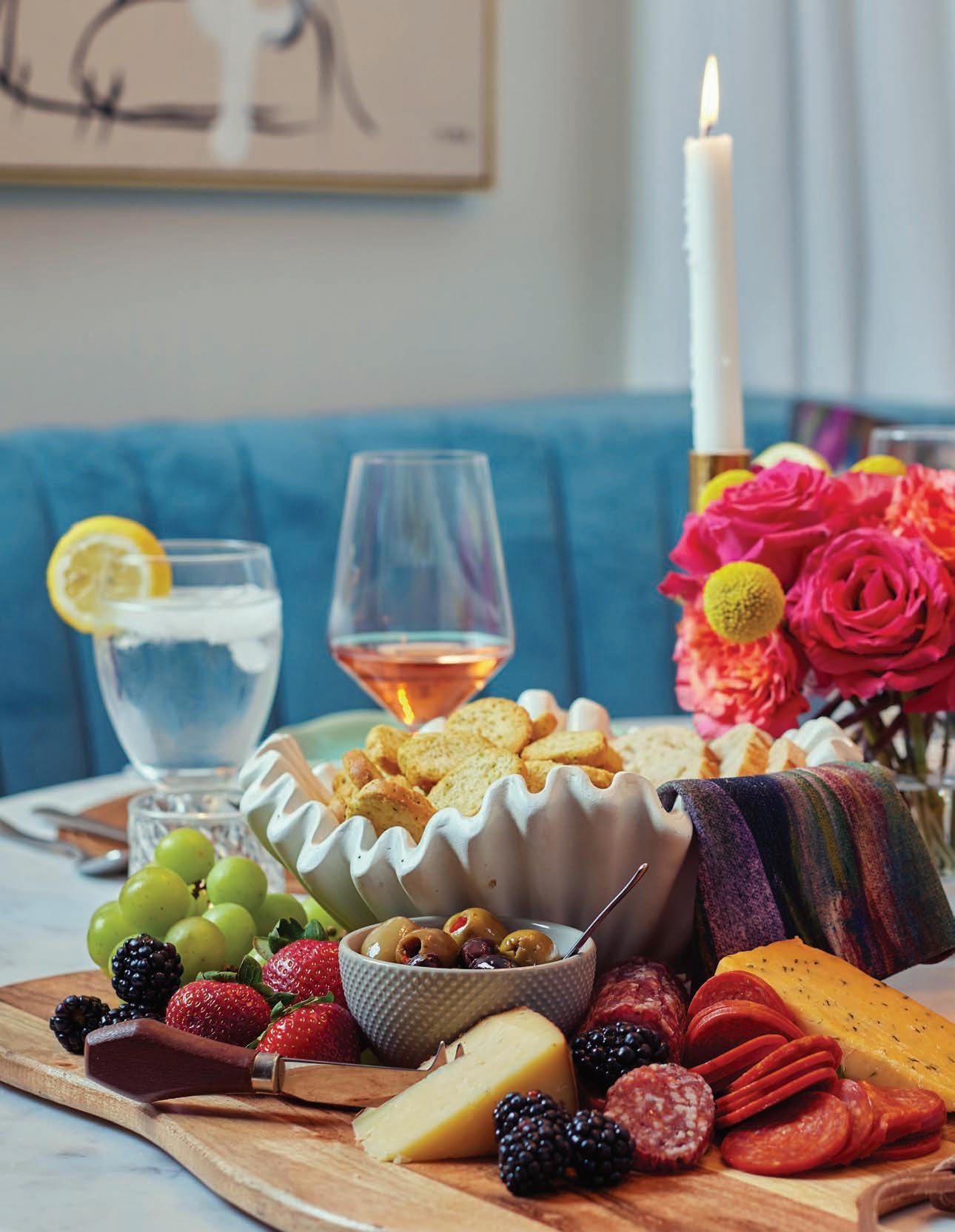
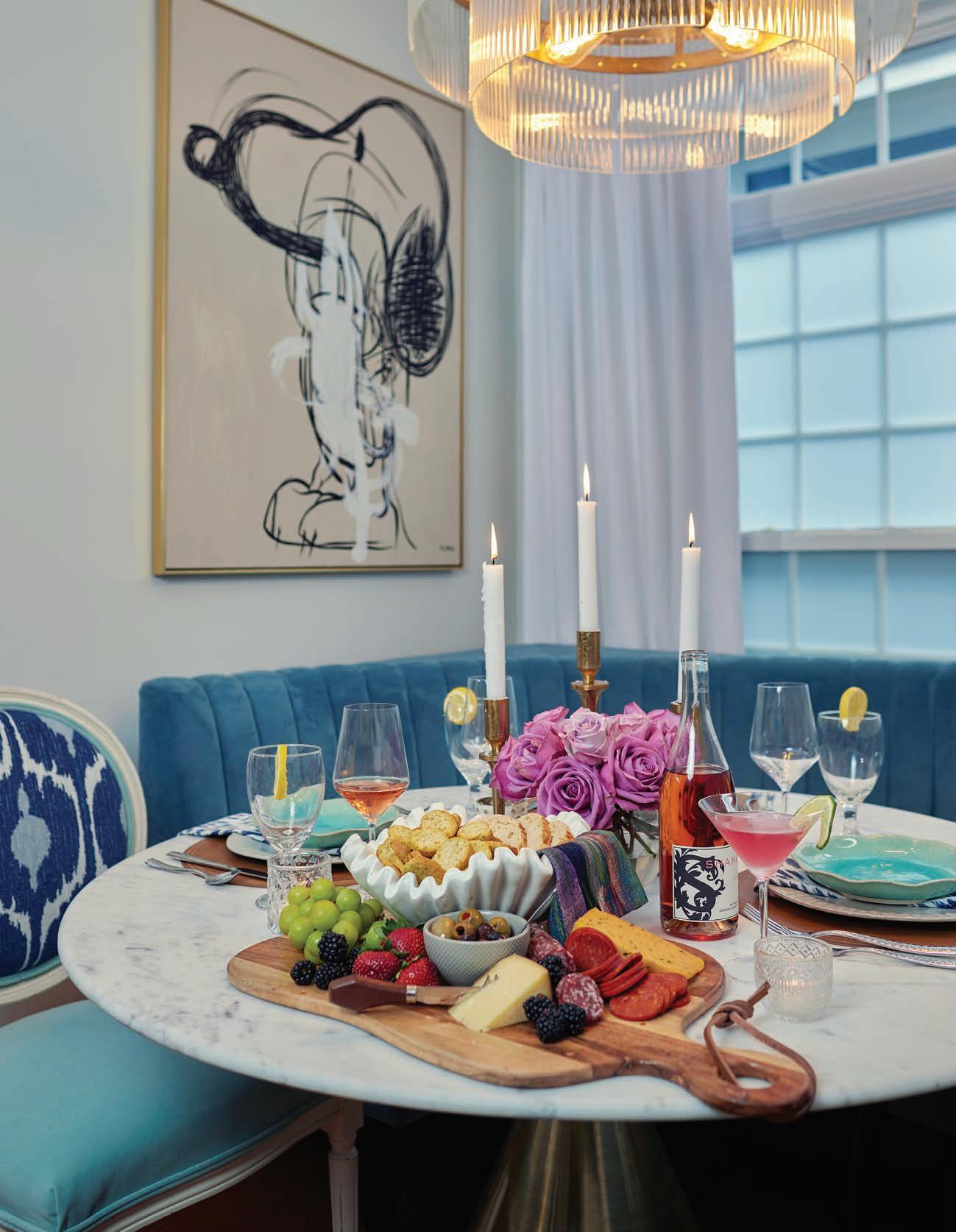
Napierkowski designed the Pages’ new nook to function beyond breakfast. Downsizing doesn’t have to mean doing less, just having less space to do it in. The redesigned nook allows the Pages to go from cozy mealtime to intimate dinner party.
THE DEATH OF THE FORMAL ROOM
One of the most persistent “boxes” in home design is the formal dining room. It is a space often held in a sort of architectural purgatory—dressed up i n fi ne linens and expensive mahogany, yet touched only three or four times a year during major holidays. For the Pages, this was the fi rst tradition to go.
“ We didn’t need all that square footage anymore,” Kerri explains. “What we did need was a home that feels intimate, easy, and inspiring.”
With Napierkowski’s guidance, the space originally earmarked for a dining table was completely reborn as a cocktail lounge. By stripping away the expectation of a table and chairs, they unlocked a room that became the ultimate grown-up sanctuary. The heart of the room is now a conversation circle, anchored by a round wood coffee table and framed by four deep navy chairs.
T he aesthetic is moody, layered, and unashamedly social. Warm ambient lighting casts a glow over rich textures, making the space feel like a private club nestled within the city. It’s an extension of the living room, but with its own distinct, elevated energy. “It’s become a signature move of mine,” Napierkowski says. “Instead of a table that gets used a handful [of times] throughout the year, you have a room that gets used from morning through night.”
For Shane and Kerri, this unexpected use of space has changed their daily rhythm. “It’s cozy and social—a place where we start the day with coffee and end it with a cocktail,” Kerri says. By removing the “formal” label, they gained a room that truly earns its keep.
THE VERSATILE ANCHOR: A NOOK WITH AMBITION
O f course, choosing a lounge over a dining room presented a logistical challenge: Where does one actually eat? This led to the home’s most impressive transformation—the elevation of the humble breakfast nook into the family’s primary dining destination.
L ocated in a bright corner just off the kitchen, this space had to work harder than any other in the house. It needed to handle a quick Tuesday morning espresso just as easily as a multicourse Saturday night dinner with friends.
OPPOSITE PAGE: The nook is lled with touches in a variety of textures and colors, showcasing the Pages’ personal style and personality without feeling cramped.
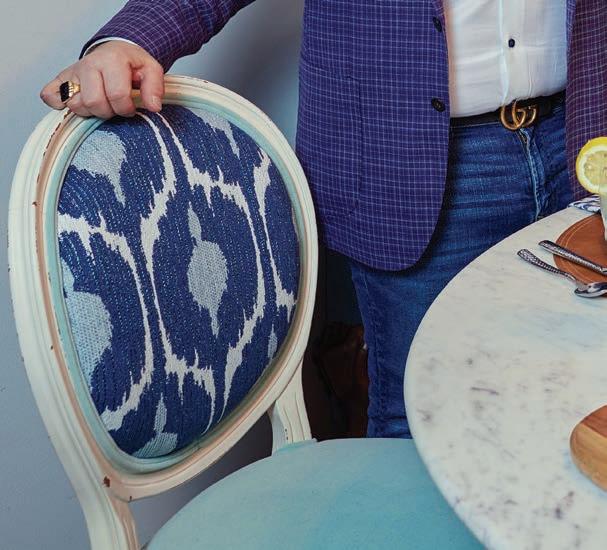
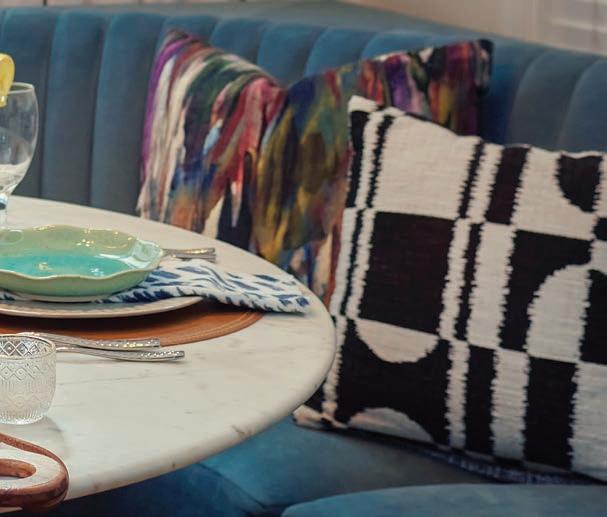
THIS PAGE, TOP TO BOTTOM: Additional chairs in a complementary pattern allow for additional seating when guests come over. Comfortable yet stylish pillows create a contemporary look and invite people to linger. The round glass chandelier illuminates the space with a soft glow without feeling overwhelming.
Napierkowski chose a curved, ocean blue velvet banquette that hugs the architecture of the corner, paired with a sleek white marble dining table. The juxtaposition of the soft, luxurious velvet against the cool, crisp marble creates a balance that feels both contemporary and timeless. Hanging above is a round glass chandelier that acts as the room’s jewelry; its shimmer casts elegant, shifting shadows that dance across the ceiling as the sun sets over the city.
T he result is a space that feels curated rather than cramped. “It feels like the best table in our favorite neighborhood restaurant,” Kerri remarks. “Whether it’s takeout, brunch, or just a quiet night in, this is where we end up.”
This is the beauty of intentional design: When you lean into the speci fic ways you live—rather than how a floor plan tells you to live—even a corner can become a masterpiece.
A NEW NARRATIVE FOR A NEW CHAPTER
A s the project neared completion, the house began to reflect the Pages’ new reality. The move to the city allowed them to be more connected to the local energy, but the interior design ensured they remained connected to each other.
E ven the four-legged members of the family, Moose and Ozzy, have found their places. The two dogs have happily staked out cozy corners in both the lounge and the breakfast nook, proving that sophisticated design doesn’t have to be precious— it just has to be thoughtful.
“ The house turned out gorgeous with Joey’s help,” Kerri says. “Every space earns its keep. It’s not about more rooms—it’s about more meaning.”
W ith Zoe now heading off to college, the home stands ready as a sanctuary for her return and a sophisticated retreat for her parents. It is a house that breathes with them—calm when it’s just the two of them, but full of potential when the doors are thrown open for guests.
Moose and Ozzy know that the banquette makes a great place to hang out thanks to the soft and lush crushed velvet covering. The curved nature allows for the whole family to sit together.
The ultimate seal of approval: Interior designerJoey Napierkowski’s signature morning-through-night nook gets two paws up from the home’s most frequent users.
THINKING OUTSIDE THE TRADITIONAL FOOTPRINT
T he story of the Page home is a lesson for anyone looking to refresh their space this year. It challenges the idea that downsizing is a series of compromises. Instead, it frames the process as a series of opportunities.
I f you fi nd yourself with an underused room, why not turn it into a library, a creative studio, or a lounge? If you have a corner with a view, why not make it your primary dining spot? Outside-the-box design is simply the act of giving yourself permission to ignore the labels on a blueprint.
“It’s the kind of house that brings people together,” Kerri says. “Whether Zoe’s home for the weekend or it’s just the two of us, it always feels special.”
The Pages didn’t just move into a city house; they moved into a home with heart, purpose, and a very bright future. It’s a design story where life itself—in all its changing, evolving glory—was the primary inspiration
HOW TO ZONE A SMALL SPACE
W hen you move into a smaller footprint, the biggest challenge isn’t necessarily the lack of square footage— it’s the lack of walls. Without traditional rooms to defi ne where one activity ends and another begins, a home can quickly feel cluttered or chaotic. The secret lies in visual zoning: using design cues to create “rooms” within an open floor plan. Here is how to create distinct areas that feel intentional and organized:
• A nchor With Rugs: Think of an area rug as the foundation for a room. By placing a rug under the conversation circle in your lounge or beneath the dining table, you create a physical boundary that tells the eye, “This is a separate space.”
• Vary Your Lighting: Don’t rely on a single overhead source. Use different types of fi xtures to defi ne zones. A low-hanging chandelier over a breakfast nook creates an intimate envelope for dining, while floor lamps or wall sconces in a seating area establish a mood for relaxation.
• Use High-Contrast Textures: You can defi ne a zone by changing the tactile feel of a space. In a small home, a velvet banquette creates a plush, stationary anchor for a dining area, contrasting against the more open, airy feel of leather or wooden chairs in an adjacent living zone.
• Think Vertically: When floor space is at a premium, use your walls to signal a change in purpose. A gallery wall or a bold piece of art can act as the backdrop for a home of fice nook, distinguishing it from the rest of the room without the need for a bulky room divider.
• T he Power of Round Furniture: As seen in the Page home, round tables and curved seating encourage flow. They soften the hard lines of a small room and make it easier to navigate between zones without bumping into sharp corners.
IT’S A DOG’S LIFE
Sophisticated design and dog ownership are not mutually exclusive. Here are some ways you can create a curated sanctuary where everyone—including our four-legged friends—feels perfectly at ease.
• Prioritize Performance Fabrics: High-quality performance velvet, like the ocean blue banquette in the Page home, is resilient because it lacks a looped weave for claws to snag.
• Opt for Smart Navigation: Choosing furniture that encourages ow, such as round tables and open seating, makes it easier for both humans and pets to navigate without bumping into sharp corners.
• Create Visual Zones: Using area rugs to anchor a conversation circle or a dining spot provides a landing pad for pets while physically de ning rooms in an open oor plan.
• Focus on Purposeful Meaning: By ignoring traditional blueprint labels and designing for your actual life, you ensure that every space earns its keep for every member of the family.
Moose and Ozzy Page.
MYRTLE BEACH, UNHURRIED A coastal escape on the town’s quieter edge
STORY BY JENNIFER PRIMROSE
You think you know Myrtle Beach. The ocean. The boardwalk. The common rhythm of umbrellas, sunscreen, and sandy feet. But perspective changes everything, and at The Ellie Beach Resort, that shift happens the moment you walk onto the balcony.
Below, the pools are already stirring. Beyond them, Springmaid Pier stretches into the Atlantic, steady and unhurried. The ocean fi lls the horizon—not as a backdrop, but as an unending presence. It’s the kind of view that quickly resets expectations. This isn’t simply a place to stay near the beach—it’s a place inspired by it.
S et on 30 acres of oceanfront property, The Ellie Beach Resort, part of Hilton’s Tapestry Collection, occupies a site with deep roots. The original retreat opened in 1948, welcoming guests long before Myrtle Beach became the destination it is today. Decades later, the resort has been reimagined, blending its history with the needs of modern travelers without losing its sense of place.
“ We want guests to feel the resort from the moment they arrive,” says resort manager Gary Rojas. That feeling is immediate. There’s no waiting to get oriented, no wondering where the beach is. It’s right there, shaping the day before plans even form.
OPPOSITE PAGE: Guests of The Ellie Resort enjoy complimentary access to the iconic Springmaid Pier. Photo courtesy of The Ellie Beach Resort.
THIS PAGE, TOP: A stroll along the shoreline offers close encounters with seagulls—and, if you’re lucky, dolphins just beyond the breakers.
Photo by Joseph D. Washburn/stock.adobe.com.
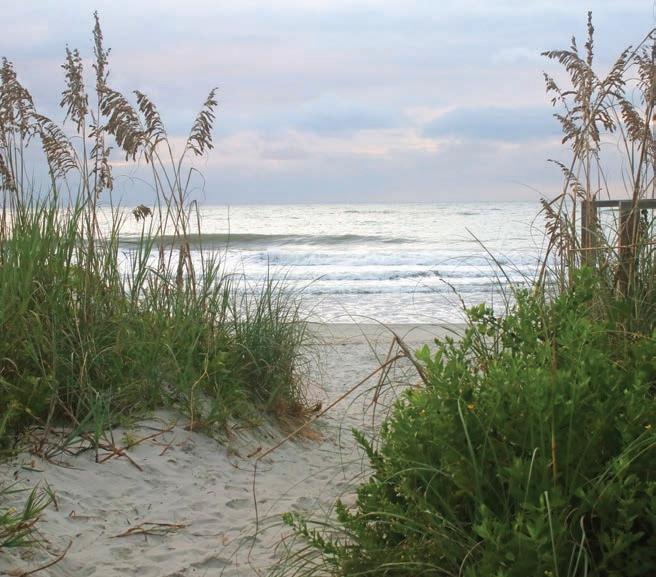
THIS PAGE, BOTTOM: Myrtle Beach slows to a peaceful rhythm in the offseason, when wide stretches of sand feel almost private.
Photo by Maryna/stock.adobe.com.
One of ou r fi rst mornings began with a walk along the shoreline. No agenda. A few early surfers were already in the water. Dolphins were frolicking in the ocean. Families wandered the sand looking for shells. Fishing lines dropped from the pier, quiet and patient. It was easy to imagine this same scene playing out summer after summer, year after year.
A fternoons at The Ellie tend to progress naturally. Some guests settle in by the pool, while others drift back and forth between the beach and their rooms. Balconies become front-row seats for reading, napping, or watching the shoreline change as the day moves on. There’s a comfortable familiarity to it all, even if it’s your fi rst visit.
Springmaid Pier anchors much of that rhythm. It’s part gathering place, part landmark, part indication that Myrtle Beach has always been about the experience. You’ll see couples walking hand in hand, kids peering over the railing, and more than a few people pausing simply to take in the view. It’s not flashy. It doesn’t need to be.
A s the sun sets, the energy shifts again. Bon fi res fl icker near the adult pool area. Conversations extend longer. Live music drifts across the property. The ocean fades into the background—still there, but no longer demanding attention. The resort feels less like a destination and more like a neighborhood by the sea.
T hat balance—between activity and calm, past and present—defi nes The Ellie.
T he accommodations are crafted wit h flexibility in mind, welcoming families, couples, and groups without feeling one-size-fits-all. Rooms are spacious and comfortable, with layouts that make sense whether you’re traveling with kids or simply want room to breathe. Throughout the property, there is a lot to do—but not so much that you feel like you’re missing out if you don’t have time to enjoy it all.
Multiple pools, three waterslides, and a splash pad keep younger guests entertained, while the Barnacles Entertainment Center offers programming that gives kids their own space. Adults aren’t forgotten. A fitness center equipped with Peloton bikes, cardio machines, and free weights makes it easy to maintain routines, while Harbor Oaks Mini Golf and the Fish Tales General Store add small touches that round out the stay.
One of the advantages of staying at The Ellie is its connection to the neighboring DoubleTree Resort by Hilton Myrtle Beach Oceanfront. This partnership gives guests access to an expanded lineup of amenities without ever leaving the area. As Rojas puts it,
OPPOSITE PAGE: Guests of The Ellie Beach Resort in Myrtle Beach enjoy access to the Springmaid Pier, along with complimentary shing rods for casting a line into waters that are home to more than 20 species of sh.
THIS PAGE, TOP TO BOTTOM: The Ellie Beach Resort is part of the Tapestry Collection by Hilton, with every room overlooking the ocean, pool, and water slides below. Inside, Ocean Blue restaurant offers a full bar and a menu of fresh seafood, shrimp and grits, steak, and sweeping ocean views. Photos courtesy of The Ellie Beach Resort.
“Between the two properties, visitors can enjoy everything from lazy rivers to additional pools and waterslides. It really allows guests to customize their stay.”
T hat sense of choice extends to adults looking for a quieter experience. The adult pool area offers a different pace altogether. Private cabanas, evening bon fi res, and live music create a social atmosphere that feels relaxed rather than crowded. It’s a spot where afternoons slip easily into evenings.
Dining is anchored by Ocean Blue, the resort’s waterfront restaurant. With the ocean just beyond the windows, it’s an easy place to linger. The shrimp and grits lived up to their reputation, rich without being heavy, while the ahi tuna tacos were fresh and wellbalanced. The bar area offers a casual setting for happy
hour, a glass of wine, or catching a game. “Ocean Blue is designed to be approachable for families and couples alike, with options everyone can enjoy,” Rojas notes, while Southern Tide Bar & Grill, the property’s other dining option, focuses on casual lunch and dinner fare—apps, handhelds, and tacos—perfect after a day in the sun and sand.
B eyond dining and amenities, the resort’s event calendar also highlights seasonal events and nearby attractions for guests to explore at their own pace. These programmed touches, combined with the resort’s range of amenities, offer guests both activity and relaxation during their visit. “Whether it’s kids’ programming at Barnacles or adult-focused cabana experiences, every detail is meant to make the vacation memorable,” Rojas says.
The Ellie’s location makes exploring Myrtle Beach straightforward. The Franklin G. Burroughs–Simeon B. Chapman Art Museum sits just across the street, offering a quieter counterpoint to the beach. The Market Common and the Myrtle Beach Boardwalk and P romenade are nearby, offering dining, shopping, and entertainment without much planning. Broadway at the Beach is a short drive away, and Myrtle Beach International Airport is less than ten minutes from the re sort, making arrival and departure refreshingl y simple.
B y the time the stay winds down, the moments begin to blur together in the best way—early walks on the sand, afternoons by the pool, dinners overlooking the water, and evenings spent listening to the ocean from the balcony. The Ellie doesn’t push a single version
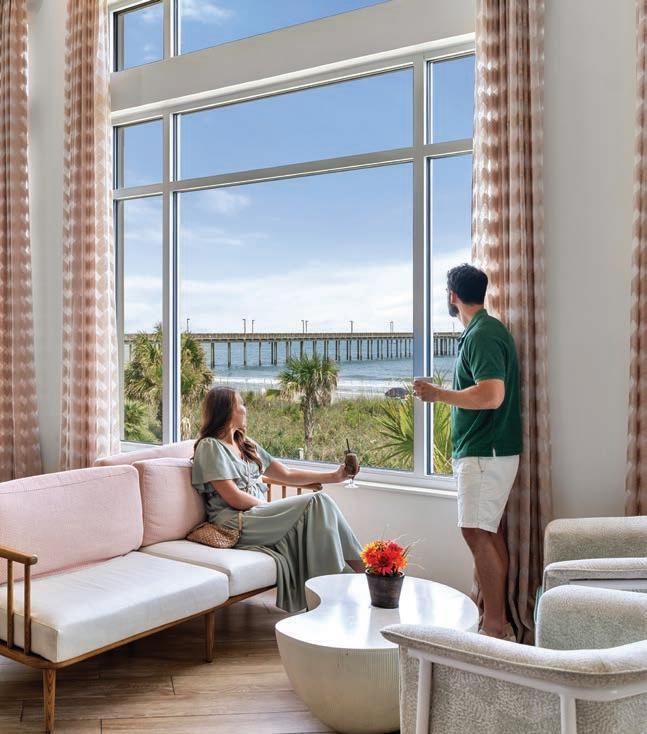
OPPOSITE PAGE: The Ellie Beach Resort offers serene views of the Atlantic Ocean, with spacious decks perfect for sharing a glass of wine and watching the waves roll in.
THIS PAGE, TOP TO BOTTOM: The resort’s lounge features a full bar with daily food and drink specials. From your seat, you can take in views of the Atlantic Ocean and Springmaid Pier—and, if you’re lucky, spot dolphins playing in the surf. Photos courtesy of The Ellie Beach Resort.
of what a Myrtle Beach vacation should be. Instead, it leaves room for guests to decide.
“ The Ellie is built to offer something for everyone,” Rojas says. “Guests can set their own pace and enjoy the coast their way.”
T hat flexibility is what lingers most. The Ellie Beach Resort isn’t about chasing the next attraction or fi lling every hour. It’s about settling into a place that understands why people return to Myrtle Beach in the fi rst place—and giving them a reason to come back again.
T he Ellie Beach Resort is located at 3200 South Ocean Boulevard, Myrtle Beach, South Carolina.
THIS PAGE: In Manteo’s Elizabethan Gardens, crepe myrtles highlight the statue and fountain in the sunken gardens.
OPPOSITE PAGE: The beautiful red bridge in the Japanese Garden at New Hanover County Arboretum in Wilmington.
AMONG AZALEAS AND OAKS:
A garden journey t hrough North Carolina
STORY AND PHOTOS BY BEVERLY HURLEY
From Murphy to Manteo, North Carolina is home to a variety of vibrant cities, each with its own unique charm. Whenever I travel across the state, I seek out places with gardens to enjoy. Here are just a few favorites.
C
HARLOTTE: A GARDEN ESCAPE AMID
THE URBAN BUZZ
K nown for its iconic skyline, culinary scene, and major league sports, Charlotte is also a city rich in botanical beauty. A must-see on my list is the Elizabeth Lawrence House & Garden, the former home and botanical laboratory of this pioneering garden writer and landscape architect. Lawrence,
the fi rst woman to graduate with a landscape architecture degree from NC State, fi lled her garden with 1,500 plant varieties. I love the way the pathways intersect, guiding me through the garden where plants spill over the beds in a seemingly natural way. Just down the street, Wing Haven Garden & Bird Sanctuary awaits. This charming garden was once the home of Elizabeth and Edwin Clarkson, and it continues to thrive as a sanctuary for bird and plant lovers alike. Brick paths lead visitors through lush landscapes fi lled with azaleas, camellias, weeping cherries, and chaste trees. The springtime burst of color is breathtaking. Wing Haven will celebrate its 100th anniversary in 2026.
For a more diverse experience, I recommend the UNC Charlotte Botanical Gardens. The indoor greenhouses feature tropical, desert, and carnivorous plants. Outdoors, the trails along the hillsides are lined with rhododendrons, hydrangeas, camellias, and dozens of other varieties, making it a perfect spot for a peaceful walk. If you’re looking for something a bit grander, the Daniel Stowe Conservancy in Belmont is a must-see. I enjoy wandering through the many themed gardens, each offering something different. Miles of trails make a walk in the woods easy on this sprawling 380-acre estate.
A hidden gem I discovered near the city center is the McGill Rose Garden. It began as a small collection of roses planted by Helen McGill along the edge of her family’s coal yard business. Today, the garden has expanded to feature native and pollinator-friendly plants, though 60 of McGill’s original roses still bloom. Enjoy a drink at Rosie’s Coffee and Wine Garden, nestled within the garden’s tranquil setting.
A nother historical gem is Historic Rosedale, where you can stroll through gardens dating back to the early 19th century. Original boxwoods from 1815, a Frenchstyle potager garden, and a pergola draped with Lady Banks roses are just a few of the gardens to enjoy. Five of Charlotte’s “treasure trees”—signi ficant specimens for the area—are also located here.
W ILMINGTON: A GARDEN LOVER’S COASTAL RETREAT
W hile Wilmington is known for its stunning beaches, I always make time to explore the area’s many gardens. Airlie Gardens is a highlight, with its winding pathways shaded by towering trees draped in Spanish moss. I particularly enjoy the Camellia Garden, the Spring and Tranquility Gardens, and the incredible array of azaleas that bloom each spring. The stately 500-year-old Airlie live oak stands sentinel over it all.
A nother must-see in Wilmington is the New Hanover County Arboretum. This demonstration garden is not only educational, but also a delightful place to wander. The Japanese Garden, with a replica tea house, is my personal favorite, along with the Camellia Walk, which features over 130 varieties of these Southern beauties.
The Wilmington area is the only place in the world where Venu s flytraps grow in the wild. The Stanley Rehder Carnivorous Plant Garden showcases thousands of flytraps and pitcher plants unique to this area. I also love visiting Carolina Beach State Park, where the Flytrap Trail offers a chance to see these fascinating plants in the wild. A pro tip: In May, look for tall white
TOP TO BOTTOM: Wing Haven Garden & Bird Sanctuary in Charlotte; a moon gate at UNC Charlotte Botanical Gardens; Daniel Stowe Conservancy in Belmont.
flowers emerging from the tiny Venus flytraps, making these easy to spot along the forest floor. Remember, removing Venus flytraps is illegal in North Carolina.
For even more garden exploration, I suggest visiting Harbor Way Gardens in Wrightsville Beach, the Fragrance Garden at Green field Park, and the various gardens on the UNC Wilmington campus, including the Bluethenthal Wild flower Preserve. And if you’re in town in early April, don’t miss the North Carolina Azalea Festival (April 8–12), when the city’s thousands of blooming azaleas put on a spectacular show.
F ROM BEACHES TO BLOOMS: THE OUTER BANKS’ GARDEN GEMS
W hile the Outer Banks are famous for their pristine beaches, I have discovered the region’s flora is equally enchanting. In Manteo, The Elizabethan Gardens are a treasure, with carefully manicured landscapes, stately statues, and fountains, all set against stunning views of the sound. Nearby, the Outer Banks Arboretum and Teaching Garden in Kill Devil Hills offers a shaded retreat fi lled with plants ranging from blueberries to azaleas and jasmine.
For those who love to explore wild terrain, Jockey’s Ridge is more than just a sand dune. The dunes support a surprising variety of vegetation, including trees, shrubs, wild flowers, and native grasses.
For a water view of the loca l flora, I love kayaking through the maritime forest at the Kitty Hawk Woods Coastal Reserve. The Milltail Creek Paddling Trail at the Alligator River National Wildlife Refuge is another stunning spot where vibrant blue flag irises bloom along the creek’s edge come springtime. Back on land,
by stock.adobe.com/zimmytws.
Nags Head Woods Preserve in Kill Devil Hills is home to over 550 plant species, including delicate orchids.
ASHEVILLE: A MOUNTAIN GARDEN WONDERLAND
A sheville’s Biltmore Estate, with its magni ficent grounds and gardens designed by famed landscape architect Frederick Law Olmsted (who also designed New York’s Central Park), is a must-visit. In the spring, the estate dazzles with tulips, daffodils, azaleas, and wisteria, creatin g a floral display that is nothing short of spectacular.
Nearby, The North Carolina Arboretum offers its own botanical wonders, including the National Native Azalea Collection, which is particularly stunning in spring. Just down the road in Hendersonville, I have discovered the Bullington Gardens with its eclectic mix of flowers, shrubs, and interesting trees.
P INEHURST AND SOUTHERN PINES: WHERE GOLF MEETS GARDENS
North Carolina’s home of golf is also home to gardens. The Village of Pinehurst, designed by Frederick Law Olmsted, features winding streets and a central village green. The nearby Sandhills Horticultural Gardens are a tranquil spot for a stroll. A personal favorite here is the Atkins Hillside Garden, where a 300-foot-long winding strea m flows past a butter fl y garden. In nearby Southern Pines, visit the Weymouth Center for the Arts & Humanities, where the gardens include long beds fi lled with pollinator-friendly plants.
Beverly Hurley is editor of the metro’s gardening publication, Triangle Gardener, and the website gardendestinations.com. When she isn’t gardening, she loves to travel and visit gardens.
VISIT A ROSE GARDEN
Buying roses for your loved one may seem thoughtful, but it’s not the most sustainable choice. Many roses are grown in South America, then shipped thousands of miles before they land on your kitchen table, leaving a signi cant environmental footprint. Instead of giving roses, why not experience these in a more eco-friendly way by visiting a rose garden this spring?
Start by exploring the Raleigh Rose Garden, JCRaulston Arboretum, and Sarah P. Duke Gardens, all of which showcase a, variety of beautiful roses. For a wider selection, head to the Wilson Rose Garden, an accredited garden with over 1,200 plants and 180 different varieties. The Fayetteville Rose Garden is another option, with 1,000 bushes and dozens of rose varieties. In High Point, the Mariana H. Qubein Arboretum & Botanical Gardens has an impressive collection of shrub and climbing roses.
Raleigh Rose Garden. Photo
CACHE IN:
Want to do something a little different for Earth Day? Geocaching is a way to help clean the trash out.
STORY BY SAMANTHA CARSON | PHOTOS COURTESY OF GROUNDSPEAK INC
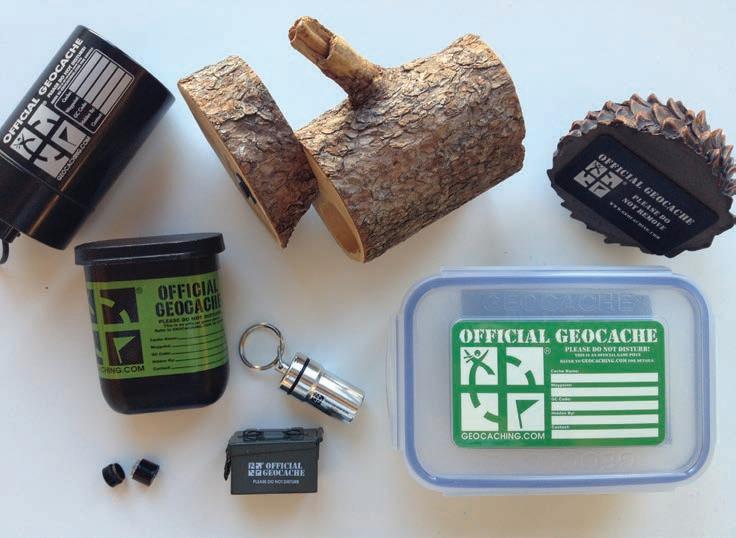
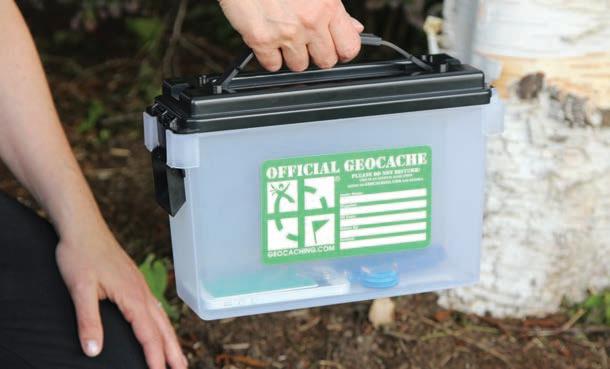
Geocaching is a scavenger hunt for all ages. People around the world put items inside small containers called geocaches or caches and hide them for others to fi nd using a set of coordinates. Caches can be hidden anywhere—I’ve found them everywhere from parking lots and public parks to deep in the woods, far from any public trail. Containers can hold a variety of items but will usually contain at least a small slip of paper, known as a log, where those who fi nd the cache can note their username and the date on which they found it. They then place the cache back where they found it, to await the next cacher
ABOVE: Caches come in a variety of shapes and styles, some of which are more dif cult to spot than others.
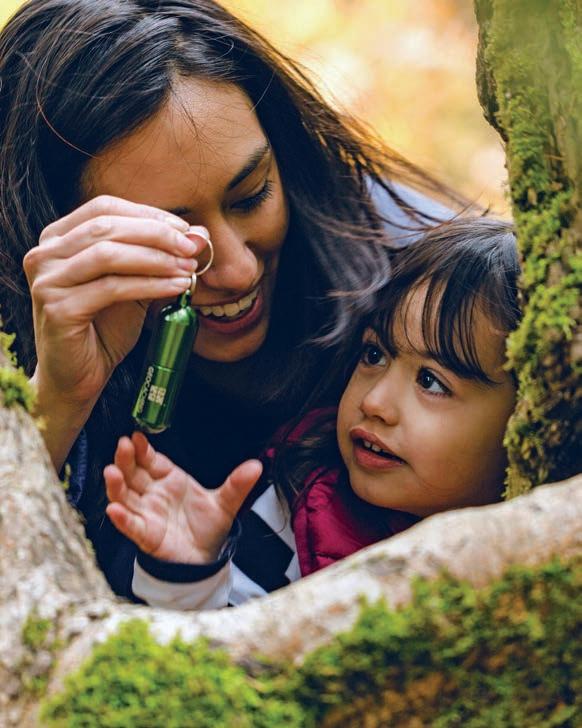
RIGHT: Treasure hunting for caches is a great family-friendly outdoor activity. With a low barrier to entry, anyone can join in the hunt.
The barrier to entry into geocaching and its community is low. Many beginners start out using either a GPS device or the of ficial Geocaching app, which includes a map showing cache locations, coordinates, clues, and more. Cachers can also connect with fellow enthusiasts on the app or online in various forums, and on social media. Many plan meals and other outings with their fellow hobbyists, forming friendships across geographical boundaries.
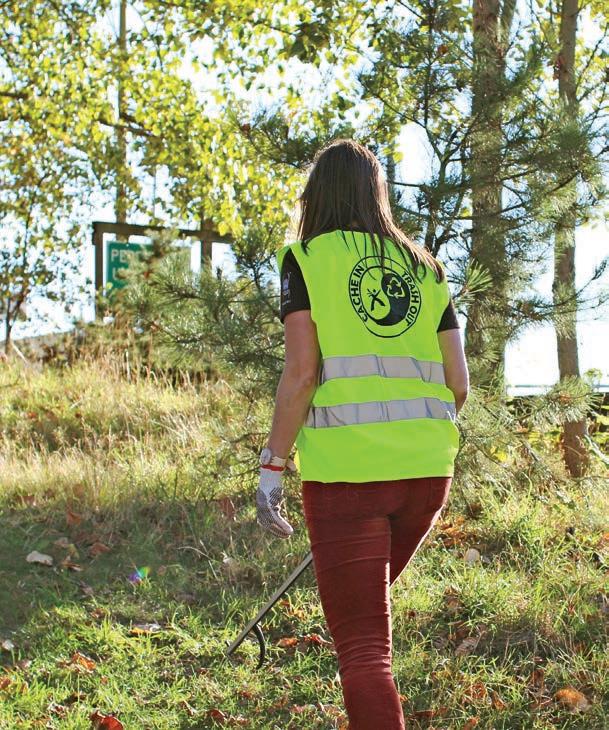
And it’s not only the caching itself that brings people together—it’s also the chance to make a difference in their communities. The Cache In Trash Out (CITO) environmental initiative was started in 2002 as a way for cachers to volunteer to preserve the beauty and integrity of their little parts of the Earth and its ecosystems. CITO events partner geocachers with community groups for activities like litter pickup, tree planting, and more. These events are organized by cachers all over the world.
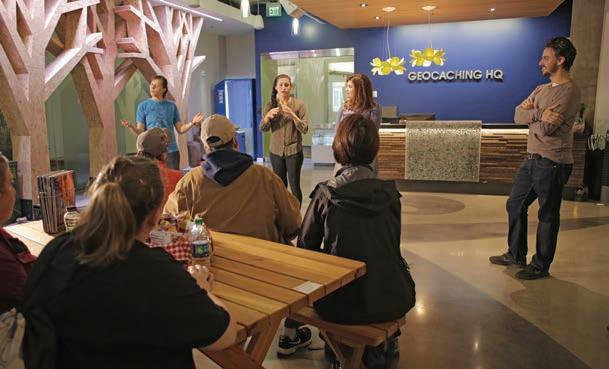
I have always wanted to participate, so when I learned about the CITO event held this past November at Jordan Lake, I jumped at the chance. The North Carolina Geocachers Organization has partnered with the nonprofit Clean Jordan Lake (CJL) since 2012 to clean up the lake’s shoreline. According to CJL, although the lake is a popular spot for recreation during the warmer months, most of the trash collected along the shoreline actually comes from the Haw River watershed, where stormwater carries down debris from as far away as Greensboro. Items found at Jordan Lake have included the expected bottles and cans, but also children’s toys, fuel containers, road construction barrels, and water meter covers.
I soon learned that signing up for this CITO event was the easy part. The starting coordinates were located on undeveloped game land, and Google Maps initially took me through a subdivision as I tried to fi nd them. I had to pull over and scrutinize the map carefully to figure out where I needed to go and how to get there. Eventually I found a dirt road and followed it until I reached a small cleared area where other cachers had already parked. There, veteran cachers welcomed the newcomers and provided donuts as well as work gloves, trash pickers, and garbage bags. While most attendees were fellow adult cachers, others were kids and teenagers volunteering for school.
Unlike some of the previous events at the lake, the weather was clear on this day, and we followed the dirt road until we reached the site of a cache. We logged it and continued onward to the site of another, logged it, and then split up to begin picking up trash. As part of a group of three, I turned off the road into the woods and
headed to the site where the most recent event had left off. The fi rst item we saw was the side of a porta-potty— which made us wonder what we were getting into—but nevertheless, we opened our trash bags and got to work.
It was clear that the lake had risen very far in July after Tropical Storm Chantal came through, for there was trash far from the shoreline in the woods. We picked up the usual beer cans and similar litter, but we also found tires, a small plastic chair, toys, and other miscellaneous items. I fi lled two bags before I left, and our group of three ended up fi lling eight bags in all. The total for the day among all attendees was 79 bags, 11 tires, and other items that wouldn’t fit in bags. After the pickup, many volunteers went out to dinner together.
All in all, it was a great event that I was happy to participate in. There are often one or two Jordan Lake CITO events in spring, so I plan to attend another to celebrate Earth Day. I hope to see you there!
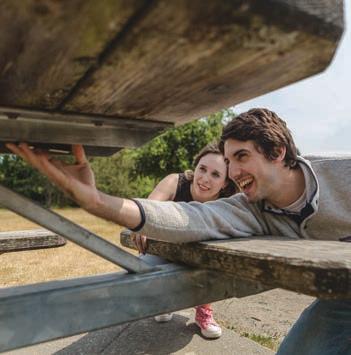
OPPOSITE PAGE, TOP TO BOTTOM: Caches may be found deep in the forest or right in the middle of a busy park, like this one under a picnic table. Caches vary from large containers to small tubes, depending on the treasure. Groundspeak Inc. does business as Geocaching and is a great resource for beginners. BELOW: The Cache In, Cache Out initiative brings together the excitement of the geocaching hobby and those who want to make an environmental impact cleaning up their community.
INFLUENTIAL WOMEN OF WAKE 2026
JENN BIRCH
BIRCH THERAPY
What aspect of your work are you most proud of?
I am most proud of both the incredible team we have built, and the change process we are fortunate to be a part of with those we serve. Every day, we come together with a shared commitment to improving the mental health and well-being of the kids and families in our community. What makes this work especially meaningful is the way we collaborate and support one another to ensure we are providing the highest quality care possible.
Where do you find energy and inspiration for what you do?
My inspiration comes from the Birch Therapy team of clinicians and staff. I genuinely look forward to work each day, as I am surrounded by dedicated colleagues who care deeply about their clients, value teamwork, and continuously strive to grow and do better for the families who trust us with their care. When I can support the team, the team supports the parents, and the parents support the kids, we all celebrate the “wins,” big and small. This work is unique, and I don’t take for granted the relationships at the core of the process.
How can women in your field support other women just starting out?
The most treasured relationships for me have been the women who have gone before me, my therapists through the years, mentors—several of whom we are fortunate to have on staff at Birch—and supervisors willing to meet for case consultation. One of the most important pieces to this stage of my career is for me to do the same: meet for coffee, offer the weekly case consultation, and check in on provisional licensed clinicians. Time with a new therapist is the biggest gift we can offer.
LAUREN BURNS
LAUREN BURNS INTERIORS
919.818.5683 | laurenburnsinteriors.com
What aspect of your work are you most proud of?
I’m most proud that I built a respected design business while raising three children and reinventing myself. That journey shaped how I design, creating layered and intentional homes that feel deeply personal to the families who live in them.
Where do you find energy and inspiration for what you do?
I find enery and inspiration in growth. Over the years, learning to adapt and embrace change has taught me to see possibility everywhere, whether in a dated flor plan or in a client’s vision. That perspective keeps my work evolving and grounded in real life.
How can women in your field support other women just starting out?
I think women in design thrive when we lift each other up. I love sharing what I’ve learned, offering advice, and cheering on those just starting out so they feel seen, supported, and ready to take risks. No matter the business, we’ve all been new once, and remembering that helps us support each other.
AMANDA STEINERT FRANCFORT
ASF INTERIORS
908.432.0987 | asfinteriors.com
What aspect of your work are you most proud of?
I am proud of the way ASF Interiors transforms a home into an experience. It’s not just a beautiful space, but a living, breathing expression of artistry. Every turnkey project we get our hands into is a blank slate where structure, emotion (sometimes a lot of it), and imagination connect. I love elevating the everyday— giving my clients not only function, but a sense of presence, confidence, and luxury they can feel the moment they walk into their renovated homes. The blend of creativity and purpose is what moves me the most.
Where do you find energy and inspiration for what you do?
This is a funny question. I believe that the energy is bountiful during the creation itself. The moment I see a pattern, a photograph, a color, or a shift in light, I usually have to say, “Oh, that’s yummy!” It’s fueled by art, travel (making plans now), craftsmanship, unexpected textures, and stories people carry with them. Inspiration appears when I allow myself to stand still for a second—which is not often—and absorb beauty, and then push it further. And honestly, watching a space go from “before” to “can you believe this?” is all the caffeine I’ll ever need.
How can women in your field support other women just starting out?
We lead best when we lift everyone. Women in design have a powerful ability to cultivate community, and that reach extends far beyond gender. An elevated, intentional way to support newcomers includes becoming a mentor. I have guided many students into this field, because artistry doesn't discriminate. Leading with grace and high standards is another way to guide the younger generation of hopefuls. To show them that excellence and compassion can absolutely coexist in a luxury-driven field, ecause we are all human after all.
SHERI HAGERTY
What aspect of your work are you most proud of?
I’m most proud of the standard I refuse to compromise. It can be tempting to rush listings to market or prioritize speed over preparation, but I take pride in doing things the right way. From thoughtful updates and intentional staging to strategic pricing and elevated marketing, I approach every property as a product that deserves care and precision. Details matter, and clients deserve a process that feels deliberate, not careless. I’m proud of the trust I build. I want to be the agent other agents respect and the advisor families return to.
Where do you find energy and inspiration for what you do?
Growing up with a highly successful interior designer as my mother, I learned to see possibility where others might not. Inspired by her example, I pursued a degree in design. It allows me to help clients see not just what a home is, but what it can become. I’m equally inspired by partnership. Real estate is a collaborative process built on trust, integrity, and shared vision. Working with clients who believe in the journey—and professionals who value honesty and excellence—reaffirms why I chose this career. It’s the relationships that make the work meaningful and enduring.
How can women in your field support other women just starting out?
By being accessible and honest. This business can feel overwhelming, and so much of what matters isn’t learned in a classroom. Taking the time to answer questions, share real experiences, and offer practical guidance can make a lasting impact. Just as importantly, we can advocate for one another. Referring business, celebrating wins, and choosing collaboration over competition creates space for more women to succeed. When we support each other, the entire industry becomes stronger.
KAT HAMLIL
KAT'S CLEANING SERVICES
What aspect of your work are you most proud of?
I started this journey five years ago a a solo cleaner while attending nursing school and supporting my family. Along the way, I discovered my passion wasn’t in healthcare—it was in helping families by creating clean, peaceful homes. I traded my stethoscope for a mop and built a company from the ground up. What I’m most proud of is transforming struggle into strength; building a successful business that supports families, creates jobs, and gives back to the community financiall and economically. Turning pain into power while making a meaningful impact is the heart of my work.
Where do you find energy and inspiration for what you do?
Running a service business is one of the most demanding journeys you can do. It requires constant mental, emotional, and physical resilience, especially for women who often balance multiple roles. As a single mother of two incredible boys, they are my greatest source of energy and inspiration. They are my daily reminder of why I push forward. Their love fuels my determination, and they are the light that keeps me focused, motivated, and grounded, no matter how challenging the day may be.
How can women in your field support other women just starting out?
My advice to women entering this field i simple: Work as if you were born to do it. Never cut corners. Deliver honest, highquality service every single time. Your reputation is your foundation. As you grow, remember where you started. Support others who are beginning their journey. Share knowledge, create opportunities, and give back to your community. Success is more meaningful when it lifts others with you. When women support women, industries strengthen and communities thrive. True success multiplies when it is shared.
KENDA KIST
KIST JEWELRY
What aspect of your work are you most proud of?
I’m most proud of the young people I’ve had the privilege to mentor over the years. Watching them grow into confident makers who trust their own hands and creative vision means more to me than any piece I’ve created. There’s something powerful about passing on metalworking skills and showing the next generation they can build beautiful, lasting things—whether that’s jewelry or a creative career.
Where do you find energy and inspiration for what you do?
I’m inspired by how jewelry can transform how someone feels—fierce, confident, or beautiful. My energy comes from seeing customers wear pieces I’ve made and knowing those pieces empower them and have become part of their daily lives. There’s nothing more rewarding than creating something with my hands that changes how someone carries themselves in the world.
How can women in your field support other women just starting out?
Creating space for emerging makers is essential—whether that’s sharing bench time, offering studio access, or simply making room for questions without judgment. I also believe in being transparent about the realities of this work: the challenges of running a small business, the learning curves, and the wins that make it worthwhile. When established makers are open and generous with their knowledge and resources, it demystifies the path forward for those just beginning.
JEWELRY
HOME, GARDEN, AND FASHION
The alchemy of your aesthetic vibe
STORY BY RACHEL DANIELLE
Artists like Lana Del Rey, Tilda Swinton, Pamela Anderson, and filmmakers suc as Sofia Copola know that personal style isn’t just something you wear—it’s a spell you cast over every part of your life. As an image consultant, I think of personal style as a kind of storytelling, where every piece you put on your body, or in your home, whispers something about who you are. When your wardrobe and your home begin to converse, you don’t just play dress-up or decorator—you create a living, breathing sanctuary that feels like an extension of your soul.
Inspiration blooms in the heart of spring and the wildness of your own garden. Spark your imagination with a quick exercise: Pause for a moment and look around your closet and home. Which items bring you the most joy or peace? Take two minutes—no overthinking— just gather your top five to ten fvorites.
These treasures are your personal icons, just as Lana’s vintage glamour drifts through her living room or Sofi’s soft palette bathes her garden in calm.
G et curious about yourself. There is no one else with your exact magic. Once you’ve gathered your favorites, hold them close and ask: Why do these speak to me? Are they in the same color or fabric family? What about these items pulls at me with bliss?
This exercise shows how you are already creating and showing up for your vision and how you can pull everything together, even without spending more money or adding items to your space and body. Are you the romantic, the minimalist, the free-spirited, the bohemian, or a genre all your own? Your fashion sense can shimmer in unexpected places, and it can make you feel at home when you are away. Your unique presence will echo in every corner.
Images courtesy of Pexels.com and Vecteezy.
After taking a playful inventory— what colors, patterns, and textures make your heart skip a beat—where do you begin? For me, it always starts with a feeling. Maybe the cozy nostalgia of a favorite sweater or the untamed spirit of a leather jacket. Ask yourself: Does your space crave breezy linens and sun-bleached woods, or does it long for velvet, candlelight, and a hint of drama? Maybe it’s an eclectic symphony, a joyful jumble of found treasures and bold colors. Maybe a combination of all! Whatever the answer, I believe it’s important to let your instincts lead the way and inspire you.
If your closet bursts with floals, stripes, or geometric prints, let those patterns escape the wardrobe. Wallpaper a hallway in wild botanical prints, tile your kitchen in playful stripes, or cover a vintage armchair in your favorite motif. In the garden, choose plants with leaves or petals that echo your signature patterns— hostas, foxgloves, or boldly variegated succulents. Personally, I adore shifting colors and textures with each season, both in my wardrobe and my nest—it’s a gentle reminder to embrace the changing rhythms of life with curiosity and delight.
Or imagine, for example, you have chic taste with a bohemian freespirited heart. Perhaps your home
is layered with rattan chairs, woven rugs, and world-traveled textiles. Lush plants tumble from shelves, your garden glows with glazed pots and lanterns. Now, how would you wear that feeling? It’s easier than you think—choose a garden hat tailored to your silhouette, a rattan-inspired tote for gathering blooms, and a natural fier blouse that lets your skin breathe. Add playful, chic accessories or boots that quietly echo your color palette, letting your outfit feel like a gentl extension of your home’s story.
Every great outfit needs showstopper, and so does every room—a velvet sofa in a daring color, a piece of artwork that stops you in your tracks, a planter that makes your entrance unforgettable. Don’t be afraid to let something steal the scene or change things up with the seasons, just as you swap sandals for boots come autumn and rotate textiles, switch out cushions, and let your home and garden feel as alive and evolving as your closet. After all, nature’s garden is everyone’s playground for inspiration.
When you invite your wardrobe’s spirit into your living spaces, you don’t just decorate—you create a world that feels unmistakably, achingly yours. And in that world, you’ll fin both beauty and belonging, every single day.
FUNGI FEVER
STORY BY AUTUMN COLEMAN
To the untrained eye, mushrooms are the randomly occurring and potentially dangerous fruit of the forest. But to foragers and farmers, they are ferocious fungi with unlimited benefits. All over North Carolina, people are trading their day jobs for foraging licenses and turning their mushroom madness into burgeoning businesses.
T he Appalachian–Blue Ridge Forests are among the most biodiverse in the world. The humid subtropical climate during the summer breeds around 14,000 different species of mushrooms. “It’s pretty cool that we have [this] very specific climate where we live in North Carolina,” says Anthony Montoya, a foraging hobbyist. “I think that would be the number one reason why people
are doing it the most in this area, is because we just have a super abundant fungi selection.”
Since the global pandemic, local mushroom cultivation and foraging has bloomed in popularity. Fungi hunters often turn into mushroom wholesalers. Avery Hughes, owner of High Country Fungi in western North Carolina, started foraging for the immense health benefits that mushrom consumption offers. He noticed positive changes in his life after foraging for fungi that boosted immune support and reduced stress. “I was seeking different mushrooms for some health issues and was foraging my own reishi [mushrooms]. I noticed that helped quite a bit with my issues, so that definitely got me more curious”
Hughes and his wife, Miika Greenwood, started their cultivation business in 2020. Today they sell
Photo courtesy of High Country Fungi.
gourmet mushrooms to restaurants and farmers markets, like Appalachian State University’s campus dining program and the Watauga County Farmers Market. “We do everything from casual places to super high-ends. We can see our mushrooms being transformed in just about every way,” Hughes says. “I’ve eaten our mushrooms on numerous occasions, prepared by chefs. I just need to get better at my cooking skills.”
C larence and Tanya Dubois own Gabor Farms in Rockingham. The fungi farmers, who champion mushroom education and accessible foods, have crafted their own mycelium recipes since starting their business after the pandemic. “As we move away from total trust in the food industry or in the agriculture industrial complex, people are taking health into their [own] hands and seeing mushrooms as one of the main sources of food that help bring those health aspects to our diet,” says Clarence Dubois, who sells at North Carolina’s Black Farmers Market and beyond.
Standing between two staff members, Amy Fox showcases a pizza made at Fenton’s Colletta using fresh mushrooms from her Apex business, Fox Farm & Forage. Photo courtesy of Fox Farm & Forage. Fresh mushrooms on display at Boone’s Watauga Farmers Market. Photo courtesy of High Country Fungi.
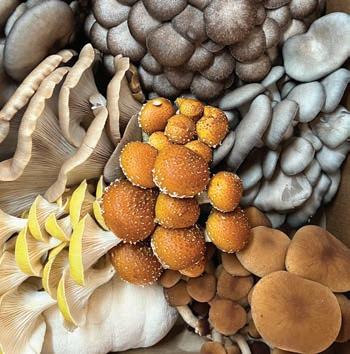
A n avid mushroom lover since childhood, Amy Fox is the owner of Fox Farm & Forage in Apex. Fox grows over 1,000 pounds of mushrooms a week. After starting as a forager, she realized that the only way her business could pay her bills was by growing her own mushrooms and selling them in 10–12 pound bags. She grows and supplies grey oyster, king oyster, maitake, lion’s mane, and beech year - round.
Fox’s mushrooms sprout up in Raleigh, Durham, and Cary on a weekly basis. She supplies Colletta Italian Food & Wine at Fenton and Oak Steakhouse in Raleigh, both of which are owned by The Indigo Road Hospitality Group—a collective that owns hotels, bars, restaurants,
cafés, and venues across the South. Additionally, she sells to Barcelona Wine Bar, Madre, and Il Falò in Raleigh; Sfiizio Pizzeria, Seraphine, and GoccioLina in Durham; and once a month at the Holly Springs Farmers Market.
“I celebrated 10 years in July,” Fox says. “We’ve been through a number of chefs and I’m still here, believe it or not.”
Mushrooms grow in different places across the country. Each region is known for specific mushrooms, and local mushrooms provide the most benefits. “There are some varieties you can find here that you can’t really find in California. I believe it’s harder to find chicken of the woods [mushrooms] out west,” Hughes says. “For morels, we have a really short window at the end of April, high up in the mountains, and it’s like a week, two weeks.”
Re searchers continue to uncover how mushrooms can ward off chronic disease and improve everyday health. Cultivators and growers keep an internal list of the benefits associated with different kinds of fungi. L ion’s mane is known for its positive effects on cognitive function. Morel, chanterelle, and maitake mushrooms can be great s ources of vitamin D after significant time spent in the s un. T he health-boosting abilities of fungi have spawned enterprising enjoyers and loyal fans
Montoya started foraging five years ago as a hobby while he lived in Boone. His scenic hikes became consumed with searching the floor of the woods to identify species of fungi with his Seek app then taking his found edible mushrooms home and incorporating them into his meals. Based in Apex, he now forages at William B. Umstead and Eno River State Park s.
“ When I’m foraging and I see a mushroom that I don’t recognize,” he says, “I’m even more excited than seeing a mushroom that I do recognize.
Yes, It’s Pink. No, It’s Not Sweet.
Sommelier Spring Rosé Selections
STORY BY MATT WEISS
Let’s suspend our preconceived notions about wine for a moment.
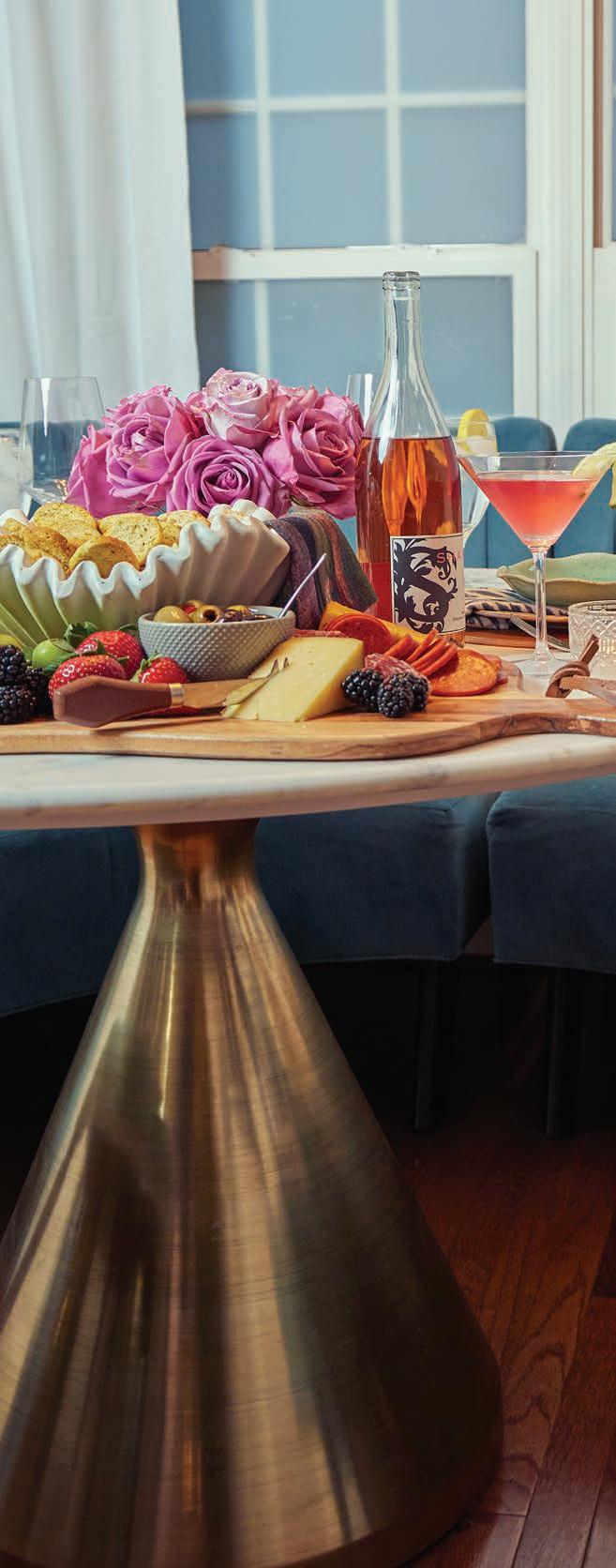
After more than 20 years in the wine industry, one of the most satisfying experiences for me is coming home at the end of a long day—whether it was spent working, chasing points on a pickleball court, or grinding through a session at the local CrossFit gym. The evening is warm. The sun is low. There’s a simple charcuterie board on the table. And in my glass is something cold, crisp, refreshing, and pink.
Yes, pink.
It quenches my thirst with bright, mouthwatering acidity. Direct and refreshing, yet layered in a way that holds your attention.
Even so, after all these years, I still hear the same hesitation whenever the bottle happens to be pink. “I’ll skip the rosé. I don’t like sweet wine.”
Somewhere along the way, especially in the United States, pink became shorthand for sugary, simple, and unserious. A wine for people who do not really like wine. But that assumption is wrong.
In fact, rosé is one of the oldest wine styles in history.
In ancient Greece and Rome, most wine looked more like today’s rosé than modern red wine. Early winemakers practiced field blends, fermenting red and white grapes together, often diluting the wine with water. At the time, wine was safer to drink than untreated water, so it became a daily staple. As winemaking spread through Marseille into southern France, pale, refreshing wines became part of Provence’s identity—a tradition that continues today.
Modern rosé is made primarily from red grapes. The difference lies in skin contact. Grape skins provide nearly all of a wine’s color, tannin, and structure. When making red wine, the juice remains in contact with the skins for days or weeks. For rosé, that contact may last only a few hours. The result is lighter color, softer texture, and brighter freshness.
Without heavy tannins, rosé does not require years to soften. It is meant to be enjoyed young, vibrant, and refreshing. As the French say, it is vin de soif, a wine for thirst. In other words, highly drinkable.
In the United States, pink wine’s reputation was shaped by white zinfandel. Partially fermented and sweetened, it helped introduce many Americans to wine. Sweet felt approachable. Sweet felt safe. And for decades, pink became synonymous with sugar. That association still lingers.
Today, one of the most common misconceptions I hear at tastings is that rosé equals sweetness. But color has nothing to do with sugar. Many popular red wines contain more residual sugar than most dry rosés. Pink does not mean sweet. It means intentional.
Rosé is now made all over the world, from countless grape varieties and in countless styles. The following three bottles capture the balance I look for most: freshness, precision, and the kind of drinkability that makes you reach for another glass or two without thinking about it.
Rosé is not a trend. It is not a compromise. And it is certainly not sweet by default.
It is a historic, intentional, and versatile wine style that belongs on your table year-round.So next time you see pink in your glass, do not assume.Taste first
You may just discover your new favorite serious wine.
Photo
Bodegas Santa Julia Chimango Rosé, Mendoza, Argentina
100% Malbec
A natural wine made with no added yeast, no ning, and no ltering. Juicy and crunchy, with a signature salted watermelon note and bright energy, all without sweetness.
Triennes IGP Méditerranée Rosé, Provence, France
Cinsault, Grenache, Syrah, Merlot
Created by Burgundy legends Jacques Seysses and Aubert de Villaine, this is classic Provençal rosé. Pale, dry, and re ned, with wild strawberry, citrus, subtle spice, and a clean mineral nish.
The Vice Rosé of Pinot Noir, Napa Valley, California
Pinot Noir, Carneros
Founded by Moroccan-born Malek Amrani, The Vice Wine re ects modern Napa craftsmanship built on precision and restraint. Bright and focused, with cherry, blood orange, jasmine, and gentle minerality. Minimal intervention and certi ed vegan.
RESCUE READY
Lifeguard certi cation through the YMCA
STORY AND PHOTOS BY DOLLY R. SICKLES
To learn more about lifeguard and water safety training with the American Red Cross, visit ymcatriangle.org/programs/swim/lifeguard-training. See you at the pool!
I’ve been a lap swimmer for three decades and still swim a mile three or four times a week, but it never occurred to me to take up lifeguarding. That was until a couple of years ago, when Christine Novak, a terrific guard at the Ingram Family YMCA in Sanford, wore me down.
There’s a national lifeguard shortage, which means that your local pool this summer is likely to have shortened hours because there are simply not enough trained professional lifeguards to go around.
Which is how, at this point in my life (early 50s), I find mysel working as a part-time lifeguard and lifeguarding instructor with YMCA of the Triangle (YOTA). And because my husband Matt is the best partner, it’s how he (also in his early 50s) find himself a part-time lifeguard, lifeguarding instructor, and certified ool operator (CPO).
Lifeguard certification for OTA occurs through the American Red Cross (ARC). I can attest to the rigorous training and certification prcess, in which I hold certifications in dee water lifeguarding, blood loss, oxygen, and AED. In short, I can swim a mile, jump in and pull a passive drowning person from ten feet of water, swim them to the side, work in tandem to get them on a backboard and out of the water, and then perform CPR until the EMTs arrive. Who knew?
LIFEGUARDING IS FOR EVERY BODY
On the one hand, it seems like lifeguarding is a young person’s game. Most people visualize teenagers taking the stand, donning their aviators, and twirling a whistle around their finge. But this is a new era in safety and accountability, and professional lifeguards come in all shapes, sizes, genders, cultures, and ages.
At the Chatham Park YMCA in Pittsboro, where I put in most of my hours, 33 guards will return for the summer and half a dozen of us are over 40. We’re a hearty bunch at Chatham County’s only Y facility, because we operate our outdoor-only pool with no bubble or retractable DynaDome. We keep the water a balmy 82 degrees and open during the day as long as it’s over 35 degrees. There’s camaraderie in the cold, between the guards and with the swimmers.
late 60s (and maybe beyond). Some are retired; some, like me, can flex their time. I work with one paamedic in Wake County, and my husband is an executive strategist at CDW and volunteer NREMT and firefighter with the Silkope Volunteer Fire Department in Chatham. We’ve got a high school guidance counselor and three retirees from varied, interesting backgrounds. One of those retirees also volunteers with Chatham Chuckwagon, and another is part of a surf rock band.
AN OPPORTUNITY TO BE EXTRAORDINARY
Jennifer Nelson, senior vice president of marketing and communications for YOTA, confirms that at this time we have about 400 lifeguards across the association,” who ensure the safety for thousands of swimmers in nearly 20 pools and aquatic programs like Safety Around Water, Camp Excel, and YOTA summer swim teams. YOTA has been around since 1857 and continues its effort to “strengthen people and communities by turning ordinary moments into extraordinary experiences.”
Lifeguarding is fun and it’s nice to be outdoors and active, but it’s also a very serious responsibility to keep swimmers safe. Always in the back of our minds is the fact that we have less than three minutes to reach and remove a drowning person—and ideally we need to have them out of the water and be actively performing CPR within the first 60 seconds. Prevention is th best safety protocol, but sometimes emergencies happen in the water.
Max Turner, Director of Aquatics for Ingram and Chatham Park YMCA, says of the adult guards he manages, “I believe there’s value in training and hiring adult lifeguards, ages 30 and over. From a practical perspective, we need folks with a schedule that isn’t aligned with a typical school schedule. I have no problem staffing high schol guards after 4 p.m., but any weekday hours before that require adults without a typical nine-to-five or college schedule”
The guards on rotation with me in the offseason—meaning, not summertime—range in age from high school (16 or 17) to
As a writer, I’m an observer of people by nature. Through my career, I’ve worked with lots of folks who started at the Y as teenagers and evolved into remarkable people. Now I’m working with dozens of young people and have an insider’s view of where that development begins. “One of the best things younger guards get out of working with older guards is an example of work ethic and professional skills,” Turner says. “For many, this is a first job and a positive role model can go a long way. Senior guards lead with life experience that has shown that doing the ‘little things’ correctly every time matters in an emergency situation. Older guards bring to the table a positive attitude and a spirit that adapts well to dynamic situations. It’s great to work with people who want to be here serving their community.”
It’s never too late to learn new life skills, and you’re never too old to try something new. Don’t just think outside the box … Work outside the box.
Sickles lifeguards at a heated outdoor pool at the YMCA, which can mean bundling up in the offseason as long as it’s above 35 degrees.
We all know that staying active is part of maintaining a healthy lifestyle. For many people, that includes making regular trips to the gym. For others, the idea of a health club membership is a nonstarter. Whether it’s the cost, the crowds, or the huffing an puffing in front of total stangers, some people want to put in their work away from the public eye. Fortunately, the gym isn’t the only option. Home workouts are a good alternative, and the results can be just as effective.
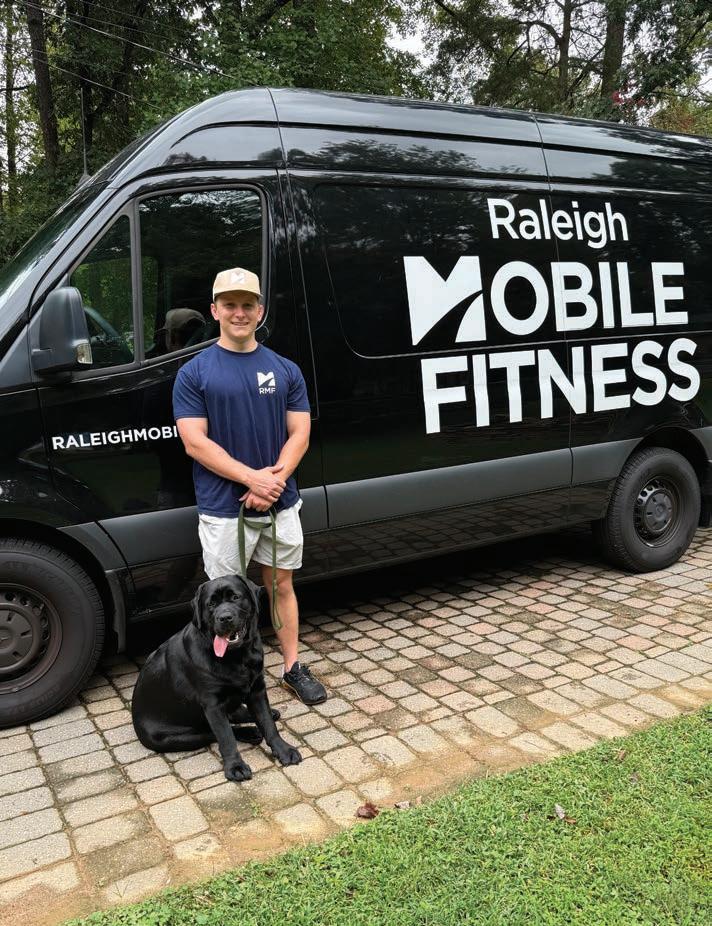
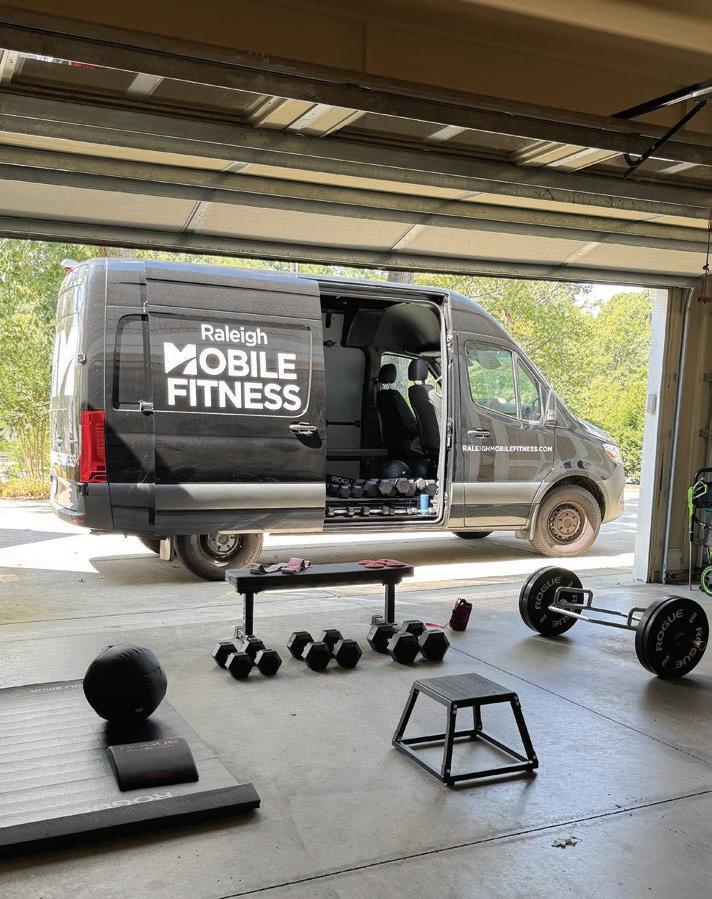
James Walsh is the owner of Raleigh Mobile Fitness. As the name suggests, his personal training business rolls up in a van with a full gym inside. His clients value privacy and convenience, but also accountability.
“It is very difficult to skip a workout when I pull up to your driveway at 6 a.m. and I’m already ready to go for you,” he says.
HOME WORK
If you’re not the type who enjoys the gym, a little planning makes home workouts an option
STORY BY KURT DUSTERBERG
W hile not everyone is ready for a boutique training regimen, Walsh encourages people to make the most of a home exercise routine, focusing on specific movement categories. We look at a squat, then a hinge—think bending at the hips,” Walsh says. “Then both a pushup or a bench press, then pushing up overhead, like an overhead press.”
Monitoring the ratio between pushing and pulling is important. “People run into issues, whether it’s shoulder tendonitis or some kind of other pain, when they’re pushing too much and the backside of the body doesn’tget worked.”
Maddie Grace is a trainer at Life Time in Cary. She promotes the importance of six fundamental multi-joint movement patterns: planks, squats, pulling, pushing, split squats, and hinges. “If we strengthen up the core, the back is going to hurt less,” she says.
“It’s a great way to get a little more activity in your day, and it’s super good mentally.”
Maddie Grace, Life Time
B ut what if structured exercise feels like too much of a chore, even at home? Walking is a no-excuse activity that provides real benefits
“ It’s a great way to get a little more activity in your day, and it’s super good mentally,” Grace says. “It’s great for destimulation. And walking is not going to spike your hunger cues. You won’t say, ‘I’m starving after that walk.’ It’s very low risk and high reward.”
Walsh agrees that the simple acting of moving your feet builds a good foundation. “Walking is where I start with a lot of my clients,” he says. “Just a couple of daily walks after meals, 10 or 15 minutes at an easy conversational pace. It lowers blood sugar, supports digestion, and increases daily movement. It can also aid in fat loss. That’s such an easy, free activity to do.”
I f you want to bring some equipment into your home exercise routine, try to get the most out of your purchase. “I would actually focus on one specific thing and get a ange of weight,” says Grace, who is a National Academy of Sports Medicine certified master tainer. “If you’re a beginner purchasing weights, and you’ve got $200 to purchase some equipment, I want you to get weights in 5, 10, 15, 20, and 25 [pounds]. I want you to lift a little heavier. Or save them until you can lift a little heavier. I want you to be able to vary your rep ranges and vary your sets.”
For those in the parenting years who need to squeeze in workouts when they can, there are easy ways to address age-appropriate concerns. “Strength and power would be my focus for that age group,” Walsh says. “There’s a lot of research that shows, as we age, those are the two things we lose the most. So things like easy jumps—like plyometrics, jumping jacks, or even jumping rope—are going to be great for the ankles, the Achilles tendon, and the calves.”
B oth trainers say it’s important to put in the time regularly in order develop and maintain skeletal muscle mass. “I like to break that up into three or four 30-minute sessions if someone is going to be working out at home,” Walsh says. “That’s plenty of strength - focused sessions if you know what you’re doing.”
The trick is to find the time, then send a few well-placed dollars. “I understand that people have a budget, and I respect that so much,” Grace says. “But it’s something I’m willing to budget for my health. It’s worth making an investment in.”
James Walsh with Raleigh Mobile Fitness brings the gym to you, saving you time traveling to a local gym. Photos courtesy of Raleigh Mobile Fitness.
HAVING A BALL?
Youth sports are evolving with new technology and increasing expectations
STORY BY KURT DUSTERBERG
For the past couple of decades, youth sports have been evolving into something almost unrecognizable.
Previous generations of kids learned the basics of their sport in a low-stress environment on local rec fields. And while that environment still exists, it’s often just a brief introduction to the all-in atmosphere of travel sports. Not only has travel taken over every team sport on the youth landscape, but specialized training has upped the ante.
Dan Gill has coached softball for more than 15 years. After several years as head coach at Apex Friendship High School, he is now an assistant at Seaforth High School in Pittsboro. Just in the past few years, he has seen his sport accelerate the learning curve. “For just about anyone looking to compete at a higher level
of high school softball, it’s going to be really rare for you to walk in, even playing travel ball, if you’re not doing the additional private instruction as well,” he says.
The increased focus on individual teaching is evident in all youth sports. To accommodate the demand, instructional businesses are popping up in every community. Gradum Gswing offers baseball and softball hitting instruction across the country, including locations in Cary and Wake Forest. “Whether it’s a baseball swing or a softball swing, it’s so technical,” says owner Carlos Garmendia. “The high school team has one or two coaches that are allocated to varsity and JV. There isn’t that one-on-one instruction. For something so technical, there isn’t a place in the team setting where you’re getting that instruction, let alone the technology.”
Youth baseball and softball players can get tehnical instruction to improve their swing beyond typical training programs.
Photo courtesy of Gradum Gswing.
While the availability of personal instruction has made it easier for young athletes to excel in a particular sport, there is a downside. Even 10 years ago, travel sports—with their costs and high-level competition— seemed to be the leg up kids needed to become a viable high school athlete. But adding another layer of commitment will force kids to decide how much effort they want to devote to the games they enjoy.
“I think you would find out that 80 or 90 percent of the kids are in private instruction,” Gill says. “Nearly every travel team is assuming you will not only spend the money for the travel team, but you will be doing outside private instruction as well, whether it’s pitching and hitting, or strength, conditioning and speed.”
For the young players who are willing to pour more into their playing careers, the payoff shows up in performance. For example, as pitchers improve with private instruction, hitters must counter that with a focus on finer details to sty competitive. As Garmendia says, “How do I hit the
inside fastball? How do I hit the slider away? If the hitter is never taught, they don’t have success and they think they’re not a good player.”
At the forefront of all the new baseball and softball training is technology. Assessment for hitters is data-driven, measuring metrics like exit velocity, launch angle, bat speed, and spin rate for ball flight. “For the younger kids, with the technology we have, they’re able to make adjustments much faster,” says Garmendia, who played collegiate baseball and was drafted by the Milwaukee Brewers. “I graduated high school in 2012. We didn’t have anything to measure the exit velocity.”
If all the expectations sound a bit unrealistic, it’s worth remembering that athletes can shape their own growth as they improve their skills. Hard work, self-correction, and repetitions play a critical role in reaching athletic goals.
“Some of these private instructors are very talented and have a way of connecting with the kids,” says Gill. “You need some instruction and you
need some technology, that’s great. But there is hardly a substitute for taking swings and squaring up balls. If you’re an athlete, you’re going to figureout how to make better contact.”
Garmendia agrees that young athletes—and their parents—should think carefully about how to commit time and resources. “We need to play and experience game theory to know how to play the game,” he says,“but instead of all these tournaments, why don’t we practice more than we’re playing the game?”
And even if the pursuit of a college scholarship makes all the opportunities seem worthwhile, remember that roughly one percent of high school athletes ever earn an athletic scholarship. Each year on the softball field,Gill is reminded that expectations for a young athlete can be fragile.
“Every freshman who plays for me, they have the dream that they’re going to play in college, 100 percent of them,” he says. “The kids who are maybe on the bubble get overwhelmed by it and decide they just don’t want to commit this much to it.”
Baseball and softball instruction facilities in the Triangle: