By Ebony JJ Curry SENIOR REPORTER
By Jeremy Allen EXECUTIVE EDITOR
Millions of dollars are finally flowing back to Wayne County residents who lost homes and other properties to tax foreclosure, marking a major shift after years of criticism over how Michigan handled delinquent property taxes and the devastating impact on Detroit-area homeowners.
As of early January 2026, more than $3.8 million has been returned to former property owners and interest holders in Wayne County, according to the Wayne County Treasurer’s Office.
By Ebony JJ Curry
SENIOR REPORTER
Late Thursday night, Sept. 14, a historic moment unfolded in American labor relations as the United Auto Workers (UAW) union initiated a strike against Ford, General Motors (GM), and Stellantis. For the first time, the union took simultaneous action against all three major Detroit-based automakers. The action involves approximately 13,000 UAW members in assembly plants across Michigan, Ohio, and Missouri, who walked off their jobs after existing labor contracts expired at 11:59 p.m.
Shortly before midnight on Sept. 14, GM released a statement expressing disappointment with the strike action, despite offering what it termed an “unprecedented economic package” that included historic wage increases. Stellantis

The payments follow landmark Michigan Supreme Court rulings and changes in state law that determined counties could no longer keep surplus profits generated when tax-foreclosed properties were sold at auction. For many residents — particularly in Detroit and older inner-ring suburbs — the money represents long-delayed restitution after years of aggressive tax enforcement that stripped families of generational wealth.
n a breathtaking celebration of talent, determination, and the unyielding spirit of Black excellence, the Michigan Chronicle marked its 10th Annual 40 Under 40 event Thursday evening. This year’s soirée, drenched in the theme “All Black Everything with Gold Accents,” transcended expectations and essentially illuminated the golden gems within the true essence of Black excellence. Hosted by the charismatic duo of Andre Ash and Lynzee Mychael from Michigan Chronicle’s Finally Friday, the night was a triumph for the city of Detroit and its vibrant community of young Black professionals.
For decades, Michigan’s tax foreclosure system allowed counties to seize properties over unpaid taxes and sell them at auction, often for more than what was owed. Until recently, former owners received nothing, even when the sale price exceeded the tax debt by tens of thousands of dollars.
By Jeremy Allen
EXECUTIVE EDITOR
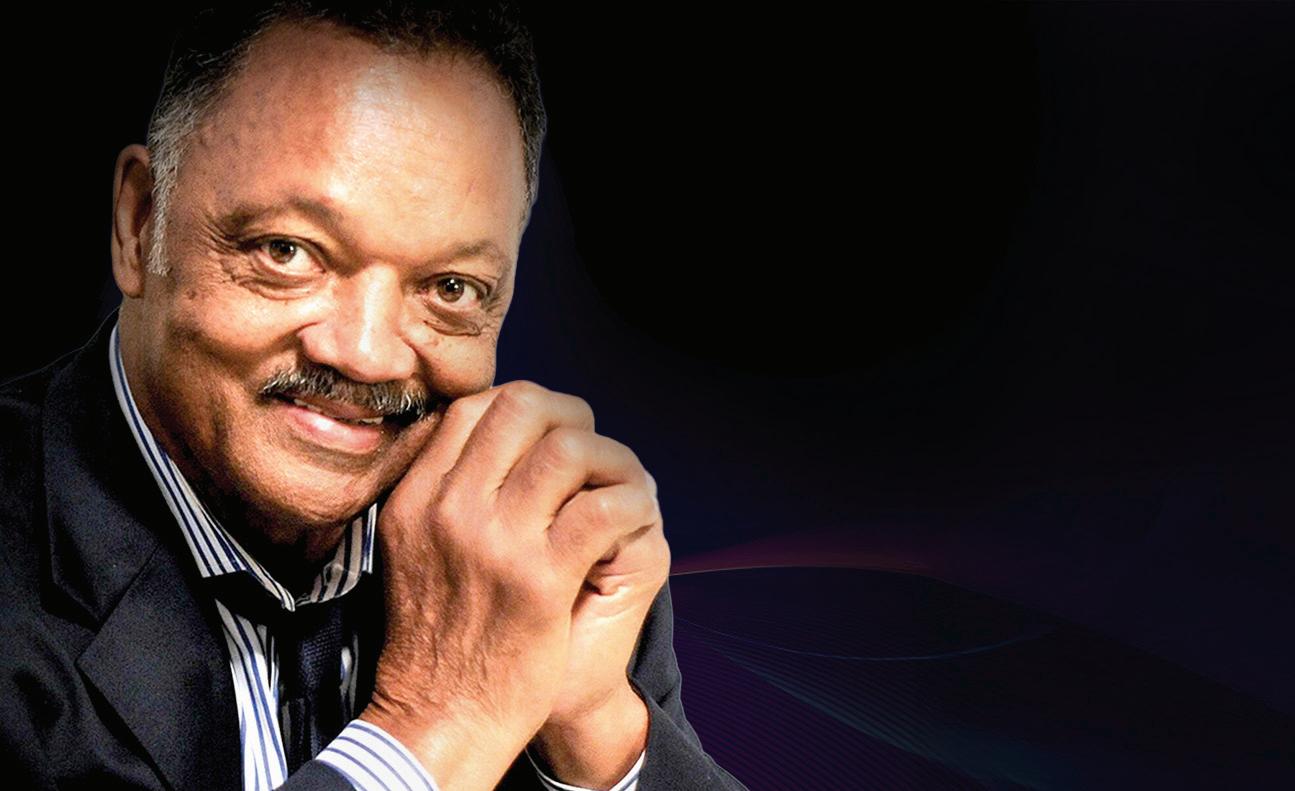
Rev. Jesse Jackson died during the morning hours of Feb. 17, 2026. He was 84 years old.
The evening sparkled with a golden promise as we celebrated remarkable individuals from various walks of life. Among the honorees were the brilliant and visionary co-founders of Detroit Hives, Nicole Lindsey and Timothy Paul Jackson. Their work has not only changed the landscape of beekeeping and urban farming in Detroit but also exemplified the transformative impact Black professionals can have on their communities.
Critics, housing advocates and legal scholars argued the practice amounted to government-sanctioned property taking, disproportionately affecting Black homeowners and low-income residents in Detroit.
also expressed disappointment in a statement, saying the company immediately went into contingency mode to protect its operations.
As the night unfolded, we had the privilege of honoring other outstanding individuals, each carving their own path to success. Clement “Fame” Brown, the creative mind behind Three Thirteen Detroit’s Brand Name, received the prestigious Entrepreneur of the Year Award. Brown’s commitment to empowering the city through fashion and entrepreneurship has left an indelible mark.
While the world remembers this civil rights icon for his fight to save humanity and for the way he centered his fight on the plight of Black folks, Jackson’s unique love and pride for Detroit meant something far more meaningful for its people.
“Entrepreneur of the year – that’s a big deal,” said Brown. “It’s always an honor to be honored and it’s always a blessing to be in a room full of so many talent ed, accomplished, and popular people that look like me. I’m geeked. I started making and selling clothes as a kid and I always knew that I would have a business, but I never knew it would be Detroit’s brand name business, so I take a lot of pride in the fact that our business rep resents our city’s pride.”
By Ebony JJ Curry SENIOR REPORTER
“Together we have created a social, environmental, and financial impact through bees,” said Jackson. Lindsey followed that sentiment with, “It is through our local partnerships and collaborative efforts that we exist in over 28 plus locations managing the health of 4.5 million honeybees – humbly speaking our movement has inspired others locally, nationally, and even internationally to take on similar missions.”
The roots of the crisis trace back to the aftermath of the Great Recession, when Detroit was grappling with job losses, population decline, and municipal instability. Detroit properties had been systematically over-assessed for years, inflating tax bills beyond constitutional limits. Thousands of homeowners fell behind on taxes they should not have owed.
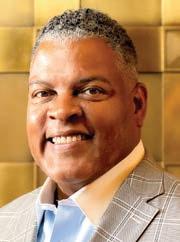
Taking home the Corporate Excellence Award was Dannis Mitchell, Director of Community Engagement at Barton Malow.
ness district that had been the lifeblood of the community.
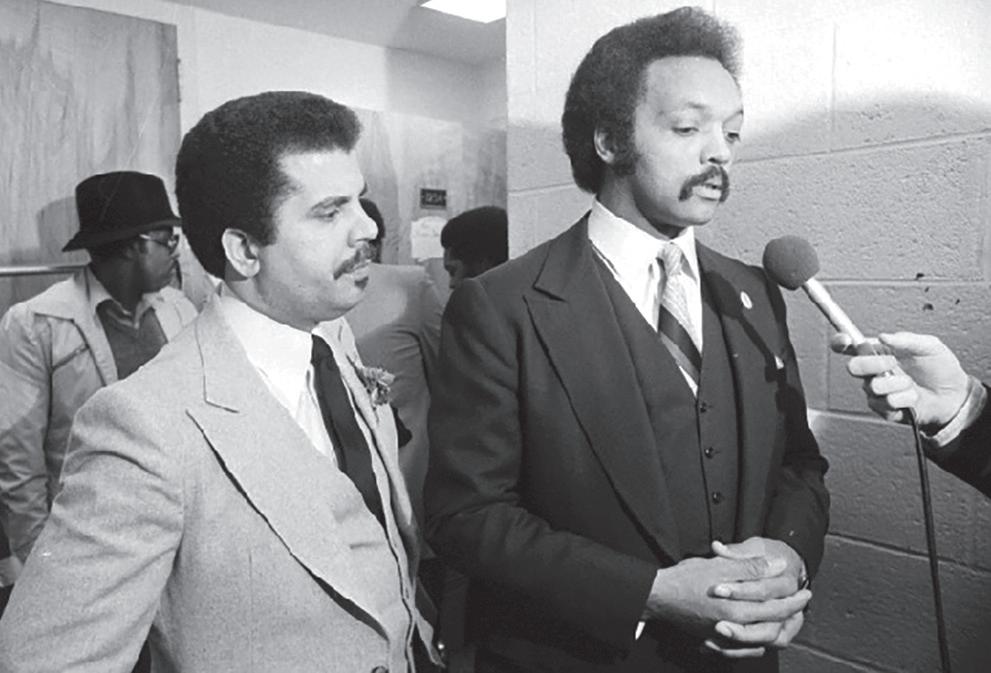
The UAW has branded the industrial action as the “Stand-Up Strike,” focusing on specific plants within each automaker. UAW President Shawn Fain stated, “This strategy will keep the companies guessing. It will give our national negotiators maximum leverage and flexibility in bargaining. And if we need to go all out, we will. Everything is on the table.” Union leaders have also indicated that additional plants could be targeted in future waves if negotiations remain stalled.
Jackson was born in Greenville, South Carolina in 1941 and moved to Chicago – a city much like Detroit – as a young man in the mid-1960s in his 20s, but the Motor City will fondly remember a man who had walked its picket lines, filled its churches, chastised its corporate boardrooms, and embraced its contradictions. For this city, Jackson was more than a presidential candidate or television orator. He was a regular presence in moments of crisis and possibility, and a man who came here to PUSH.
For many Detroiters, Interstate 375, or I-375, has long been just another stretch of urban highway, a concrete artery connecting different parts of the city. To some, it’s a mere convenience; to others, it’s an unremarkable part of their daily commute. However, there’s a deeper, far more troubling story beneath the surface of this seemingly ordinary freeway—a story of pain, displacement, and the lasting impact on Black Detroiters.
Detroit Hives, a pioneering organization founded by Lindsey and Jackson, harnesses the power of urban beekeeping to revitalize neighborhoods in the Motor City. Their initiative not only addresses critical issues like environmental conservation but also provides valuable education and employment opportunities to Black De-
Between 2011 and 2015, Wayne County foreclosed on tens of thousands of properties. Entire neighborhoods were hollowed out as homes moved through foreclosure auctions, often purchased by speculators for a fraction of their market value. Families lost houses that had been paid off for decades over tax debts sometimes totaling only a few thousand dollars. Even when properties sold for far more than the taxes owed, former owners never saw the excess.
PUSH – the name he gave to Operation PUSH in 1971 and later expanded through Rainbow PUSH Coalition –wasn’t just an acronym or poetic jargon from a preacher. It was an ethic. People United to Save Humanity.
“It is so important to recognize that there are young leaders across the country, many that are born here in Detroit. I represent our city nationally and I tell people, ‘Yea I’m a D-girl I’m from the west-side of Detroit,’” Mitchell expressed. “But more importantly, I’ve been able to have experiences within an industry that not many of us, specifically women of color, have the opportunity to engage in and I’ve been the youngest person in the room, the only Black person in the room, and the only Sistah in the room, and I really had to articulate the importance of showing up, giving chances when others won’t, and being persistent.” As a trailblazing Black woman thriving in a predominantly male-dominated industry, her unwavering commitment to fortifying the connections between businesses and Detroit’s communities is unde-
It’s a history marred by pain, injustice, and economic devastation. More than 130,000 residents, primarily Black, were forcibly displaced. Families were uprooted, generational wealth was obliterated, and a thriving community was torn asunder. The wounds inflicted by I-375 run deep, transcending the physical barrier of a freeway to penetrate the very soul of Black Detroiters.
This painful legacy can be traced back to the nation’s interstate highway program of 1956—a program that aimed to connect the country but often did so at the expense of marginalized communities. In the case of I-375, it meant carving a path through the heart of Black Detroit, reinforcing segregation, and perpetuating inequality.
both visitors and residents of this bustling downtown destination in awe. One of these shootings tragically claimed the life of a popular and beloved security guard following a dispute with a patron. The male suspect allegedly shot the guard before fleeing the scene, while his female companion is accused of concealing the weapon in her bra.
The I-375 Boulevard Project is about more than just correcting historical injustices; it’s about redefining the future. It will connect downtown Detroit to surrounding neighborhoods, bridging the gap that was placed upon the city decades ago.
“We don’t need diversity, we need equality,” Jackson declared during one of his Detroit visits tied to automotive industry negotiations, a line the Michigan Chronicle carried prominently. In a city where “diversity” often meant token appointments while Black workers bore the brunt of layoffs, Jackson’s words landed with force. Equality meant contracts. It meant supplier diversity with teeth. It meant Black dealerships and Black vendors beyond symbolic gestures, and as structural participants in Detroit’s economic engine.
Both men understood the language of confrontation. Both believed in leveraging power rather than pleading for it. Yet there were moments of friction. Detroit politics have always been intimate and intense, and Jackson’s national Rainbow Coalition sometimes clashed with local calculations. The Chronicle covered those tensions without flinching, recognizing that movements, like cities, are rarely monolithic.
By Andre Ash DIGITAL ANCHOR
That practice was overturned by two Michigan Supreme Court decisions: Schafer v. Kent County and Hathon v. State of Michigan. The court ruled that keeping surplus proceeds from tax foreclosure sales violated property owners’ rights. Former owners and other interest holders, the court held, may be entitled to the remaining proceeds after unpaid taxes, interest and administrative fees are deducted.
The tale begins in what is now Lafayette Park, once known as Black Bottom—a neighborhood rooted in African-American culture and history. Named after its dark, fertile soil, Black Bottom flourished during the mid1900s, nurturing the dreams and aspirations of prominent Detroiters like Coleman Young, Joe Louis, and numerous other Detroit legends. But in the name of urban renewal in the 1950s, this vibrant neighborhood was systematically dismantled, erased from the map, and replaced by a lifeless stretch of asphalt.
In Detroit, PUSH carried a literal meaning. It meant pushing automakers to hire Black workers and make cars that were affordable for Black residents. It meant pushing banks to lend in Black neighborhoods. It meant pushing elected officials to protect the city’s most vulnerable. It meant pushing a nation to see the humanity in a majority-Black city too often reduced to headlines about crime or bankruptcy.
A Holistic Approach to Providing Shelter and Support for Detroit’s Unhoused People
Fain clarified the union’s strategy: “I want to give a major shoutout to the thousands of members who are on the picket lines right now fighting for all of us. The Stand-Up Strike is a new approach to striking. Instead of striking all plants at once, select locals will be called on to stand up and walk out on strike. This is our generation’s answer to the movement that built our union – the sit-down strikes of 1937. We told the Big 3 that Sept. 14 was the deadline and we meant it. We gave the companies our economic demands eight weeks ago and it took more than a month to get to the table.”
While the residential areas bore the brunt of this demolition, the heart of Black Bottom, its thriving business center, remained largely untouched. Restaurants, theaters, clubs, and bars—the very places that brought Detroit’s Black community together—were concentrated around Hastings Street, the epicenter of African-American culture in the city.
The rulings applied retroactively to foreclosures that occurred before Dec. 22, 2020, opening the door for thousands to seek compensation. The Legislature subsequently updated state law to create a formal claims process, requiring eligible individuals to file motions in Circuit Court to recover surplus funds tied to their former properties.
The union is pushing for a comprehensive list of demands. This
Homelessness continues to plague urban communities, with families and individuals grappling with the challenges of making ends meet in today’s economic climate. Whether it’s struggling to meet monthly mortgage payments or coping with soaring rental costs in a housing market marked by shockingly high prices, a variety of factors contribute to the growing issue of people becoming unhoused.
Meagan DunnJulie Schneider
Then, in a cruel twist of fate, Hastings Street, too, was obliterated a few years later, making way for the construction of I-375. This marked the final blow, sealing the fate of Black Bottom and signaling the beginning of the end for Paradise Valley, the Black busi-
Housing Resource Helpline in response to the challenges that residents face in navigating the complex system of housing services. The helpline provides a single point of contact for people seeking housing assistance and connects them with the resources they need.
Jackson understood Detroit as a symbol and as battleground for Black liberation across the country. The Motor City was the arsenal of democracy, the home of the assembly line, the forge of the Black middle class. It was also the site of disinvestment, redlining, and industrial flight. He knew that if Black workers could secure a foothold here –in the plants of General Motors, Ford Motor Company, and Chrysler – then the promise of economic justice might become tangible.
Historically, shelters have provided a temporary respite for those in need, often serving as the first or second option after exhausting alternatives like staying with friends or family. Shelters offer a place to rest one’s head and a warm meal, albeit sometimes for extended periods. For others, being unhoused means living in cars or makeshift outdoor
By Lynzee Mychael MULTIMEDIA JOURNALIST
The causes of homelessness are as diverse and complex as the individuals experiencing it. In response, the City of Detroit has adopted a holistic approach to combat this issue.
By Jeremy Allen EXECUTIVE EDITOR
“Providing services and high-quality housing to persons at risk of or who are experiencing homelessness is a key priority of the City of Detroit, said Julie Schneider, Director of Detroit’s Housing and Revitalization Department.
What a Federal Government Shutdown Could Mean for Detroiters?
“This means focusing on building the pipeline of supportive housing and coordinating with the Continuum of Care on the delivery of critical resources such as emergency shelter, rapid rehousing, and diversion and prevention programs. It also means preserving and expanding affordable housing options for Detroiters of all incomes and improving housing stability though comprehensive service offerings available through the Detroit Housing Resource HelpLine and Detroit Housing Services Division within HRD.”

Support for the helpline comes from the Gilbert Family Foundation, which has pledged $10 million over three years to fund the program. Wayne Metro Community Action Agency manages the helpline, making it accessible to all Detroit residents. This initiative simplifies access to the City’s various housing services, ensuring that residents in need can easily find assistance.
For one to aptly recognize the harm caused by such projects, it is vital to note that some of the planners and politicians behind those projects built them directly through the heart of vibrant, populated communities—oftentimes to reinforce segregation and sometimes as part of a direct effort to replace or eliminate Black neighborhoods.
Today, the resurgence of Paradise Valley stands as a testament to the indomitable spirit of Black Detroiters and the enduring legacy of Black excellence. This historic district, once a vibrant hub for Black businesses and culture, is experiencing a renaissance that harkens back to its glory days. The destruction of Black Bottom may have torn apart a thriving community, but the resolute determination of a new generation of entrepreneurs and visionaries is reclaiming that lost legacy.
These incidents unfolded during an unseasonably warm spring, leading to increased pedestrian traffic and heightened tensions in the densely populated downtown area.
Detroit’s relationship with Jackson was layered: sometimes harmonious, sometimes tense. The city has never lacked its own civil rights leadership. Figures like the late Arthur L. Johnson and Horace L. Sheffield Sr., and the formidable Rosa Parks carried moral authority rooted in local struggle. The towering presence of Coleman A. Young, Detroit’s first Black mayor, reshaped the political landscape in ways that were at once transformative and controversial. Jackson entered that ecosystem as both ally and outsider as a Southern preacher with national ambitions stepping into a city fiercely protective of its own.
The surge in crime and the influx of visitors to Detroit’s downtown core garnered the attention of the Detroit Police Department (DPD), catching them somewhat off guard.
But now, after decades of enduring the scars of I-375, there is a glimmer of hope on the horizon. Plans have been unveiled to transform this once-divisive freeway into a vision that seeks to right the wrongs of the past while heralding a new era of inclusivity and community revitalization.
Fueled by more than $100 million from the Infrastructure Investment and Jobs Act and other partners, this ambitious project aims to create jobs, remove barriers to economic growth, and reconnect the neighborhood with the rest of Detroit. It is a step
“The city and its partners offer a lot of great services to help Detroiters with their housing needs, but they don’t mean much if people don’t know how to access them,” said Mayor Mike Duggan. “Thanks to the efforts of our partners and the generous support of the Gilbert Family Foundation, we now have a simple process to guide residents to the right housing resource and a growing number of programs to help them.”
From the days of the Great Migration when thousands of Black families flocked to Detroit in search of jobs and a better life, to the pivotal role they played in the city’s cultural and musical heritage, Black Detroiters have left an indelible mark on the city. However, in recent years, Detroit has experienced significant gentrification, which has raised concerns about the displacement of long-standing Black residents. Similar to a setting sun, there’s a rising spirit, and Black Detroiters are reclaiming their place in the city, despite the challenges posed by gentrification.
In a county long defined by fragmentation – city versus suburb, east versus west, Detroit versus everyone else – Wayne County Executive Warren C. Evans is making perhaps his most audacious pitch yet: that after more than a decade of steady stewardship, Wayne County is ready to think and act like one community.
In May 2023, the City of Detroit launched the Detroit
Inside a packed auditorium at the Ford Community & Performing Arts Center in Dearborn, Evans delivered his 11th State of the County address with the confidence of a leader who has survived fiscal crisis, political crosswinds and the slow grind of rebuilding public trust.
The Gilbert Family Foundation’s broader commitment involves pledging $500 million to support projects across Detroit over the next ten years, with housing initiatives being a significant part of their contribution.
Notably, Detroit has witnessed a consistent decrease in recent years, with the number of unhoused residents steadi ly declining. In 2019, approximately 7,847 people were unhoused and entered the City’s community response system. In 2021, about 5,687 people experienced homelessness.
According to the City of Detroit, since the start of the fiscal year 2019 to 2021, Detroit saw a 28% decrease in the
His message was equal parts report card and roadmap, while he recounted the milestones that have stabilized the county’s finances and reduced violent crime, paired with new initiatives aimed at transit expansion, workforce pipelines, student debt relief and maternal health.
“This trust was built through steady leadership, transparency, and a commitment to
James White, Chief of Police for the Detroit Police Department, said: “We were caught somewhat flat-footed right out the gate. By design we went into the spring deployment, which is less than the mid-summer deployment, and saw we say an uptick in violence that first warm weekend.”
In the heart of Paradise Valley, Blackowned businesses are not just flourishing but thriving, offering diverse services, products, and experiences that pay homage to the past while paving the way for a prosperous future. From jazz clubs to soul food restaurants, the Black Press, and art galleries to fashion boutiques, this revival is breathing life into the very essence of what once made this neighborhood a vibrant cultural epicenter. It’s a resurgence that extends beyond brick and mortar; it represents the resurgence of a spirit that refuses to be subdued.
There were seasons when Jackson and Young stood shoulder to shoulder, particularly when federal policies threatened Detroit’s economic survival.
For instance, in 1973, Jackson offered his support to Young as he was making a push to become Detroit’s first Black mayor. Someone from Young’s staff told Michigan Chronicle in 1973 that Jackson asked for $70,000 a week to help with the campaign. Jackson said that he didn’t need the money, but that he had to pay staff. Young declined the offer in a way that Young typically declined offers (vehemently and in an animated way), but Jackson showed up in solidarity weeks before the early November vote and helped Young defeat John Nichols by a three percent margin. In later elections, Jackson would put the full weight of his endorsement behind Young. But when auto jobs hung in the balance, Jackson returned to the city with
Chief White attributes the violence in Greektown to a combination of weather conditions and a surge in population.
During the Great Migration, thousands of Black families from the South came to Detroit in search of jobs in the booming automobile industry. Despite facing discrimination and segregation, they built vibrant communities on the city’s east and west sides. Over time, these neighborhoods became centers of Black culture and entrepreneurship. According to Historian Jamon Jordon Black resilience in the city has roots that extend far before the Great Migration and will persist
He explained, “ We saw numbers downtown that we have not seen, ever. People are emerging from COVID and there’s a feeling that we’re in a post-COVID era… and with the venues downtown and the reasons to come down with all the activities that are going on, we saw hundreds of more people and, in particularly, young folks, teenagers that we hadn’t seen.”
See REV. JESSE JACKSON Page A-2
Detroit City Councilman Fred Durhal III, representing District 7, where Eastern Market resides, told the Michigan Chronicle, “It’s still very early in the process, MDOT is
Responding swiftly to the surge in violence, DPD adjusted its deployment plans. Rather than waiting for mid-summer, they deployed officers in the spring itself to address the situation.
The rise in visitors to the Greektown area is evident in data from Placer.ai, a location analytics company specializing in visit trends and demographic insights through geolocation-enabled mobile devices. From
because of discrimination, but they were also coming because Black people was doing some stuff. When did Black people start doing things in the city? They started doing things in this area in the 1800’s. In the 1800’s the major thing that they were doing in Detroit is
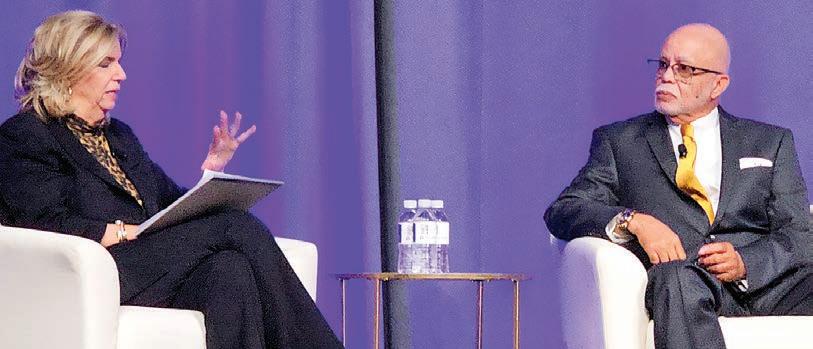
doing the work,” Evans said. “I’m grateful for that trust, and I’m proud of what we’ve accomplished.” The applause he got throughout the night wasn’t for his just rousing speech, but instead it was for 11 consecutive balanced budgets. That achievement seemed improbable a decade ago, when Wayne County was struggling with
long after our current phase of gentrification.
“Black people were coming to Detroit because Black churches were here, black schools were here, and its was Black businesses here,” said Jordon. “They were coming of course
From page A-1
singular clarity. During the auto industry crises of the late 2000s, as bankruptcy loomed and layoffs rippled through Black neighborhoods, Jackson called on national civil rights groups to intervene.
“Detroit is not just your city; it is the soul of industrial America,” he said, urging organizations and policymakers alike to treat the survival of Detroit’s workforce as a moral imperative. Those words were an echo of PUSH and a demand that the country recognize that what happened to Black workers on the line reverberated far beyond Michigan.
Jackson’s advocacy for Black auto workers was tangible. He pressed automakers to expand minority dealer programs and supplier contracts. Through Rainbow PUSH’s annual conventions in Detroit, he summoned corporate executives to public accountability sessions, asking them to report their numbers: How many Black managers? How many contracts with Black-owned firms? How many advertising dollars spent in Black media? Detroit’s auto industry executives grew accustomed to those questions. Jackson did not ask them quietly in private meetings. He PUSHed them in public.
For Black Detroiters who had migrated from Alabama, Mississippi and Georgia to work in the plants, Jackson’s presence felt familiar. He spoke their language with biblical cadences woven into labor statistics. He could pivot from quoting scripture to citing unemployment rates. And always, he returned to hope, even in the hardest seasons.
“If you’re behind in a race, you can’t run equally,” he said during his 1984 presidential campaign, words that resonated in union halls and church basements alike. Detroit knew what it meant to start behind.
His presidential campaigns in 1984 and 1988 were watershed moments here. Rallies on the city’s west side and gatherings in downtown churches drew multiracial crowds, but it was Black Detroit that formed the backbone of his support. The Rainbow Coalition message – that farmers, factory workers, the poor and the marginalized shared common cause – found fertile ground in neighborhoods shaped by both union strength and racial segregation. Jackson’s near-victory in the Michigan primary in 1988 signaled the seriousness of his candidacy and the political muscle of Black voters in this state.
Yet even as Detroit embraced Jackson’s national aspirations, it also measured him against its own icons. The city’s activists didn’t curtsy before his charisma. (Afterall, every Detroiter feels like an influencer in their own right.) They asked hard questions about strategy, about follow-through, about the balance between national spotlight and local grind. There were times when local clergy felt overshadowed by Jackson’s star power, times when grassroots organizers debated whether Rainbow PUSH’s interventions complemented or complicated their work. The Black press documented those debates as family conversations that were often intense but rooted in shared stakes.
Jackson’s connection to labor placed him in dialogue with the United Auto Workers, a union with a complicated racial history. He challenged the UAW to deepen its commitment to Black workers even as he praised its role in building the middle class.
In Detroit, where union membership was often the difference between stability and precarity, Jackson’s willingness to PUSH both corporations and labor leaders underscored his independence. He was not content with symbolic solidarity. He sought measurable change.
The bankruptcy era tested that resolve. As Detroit filed for municipal bankruptcy in 2013, and retirees feared for their pensions, Jackson warned against balancing budgets on the backs of the vulnerable.
He framed the crisis beyond fiscal mismanagement. He framed it as the cumulative result of disinvestment and structural inequality. Detroit, he argued in interviews and
From page A-1
fiscal house remains strong,” Evans said. “We’ve worked hard to earn and protect that reputation through careful planning and responsible stewardship.”
In his 2025 address, Evans had centered fiscal discipline as the foundation for everything, arguing that without financial stability, none of the county’s ambitions would be sustainable.
A year later, that stability appears intact. The balanced budgets have continued. The improved credit rating lowers borrowing costs for infrastructure and capital projects. For residents, that translates into more reliable services and the ability to invest without returning to the cycle of cuts and crisis.
But Evans is no longer content to run a tight ship. He wants to move it.
Perhaps the most consequential proposal unveiled this year is the push for expanded countywide transit. For decades, Wayne County’s transit landscape has been shaped by a patchwork of opt-outs, political stalemates and uneven service. Now, with the repeal of a decades-old opt-out clause, voters will have the opportunity to weigh in on a countywide transit proposal aimed at strengthening regional mobility.
The Evans administration has worked with the Regional Transit Authority, SMART and all 43 municipalities to craft a framework aligned with what he calls “One Wayne County.”
“Wayne County consists of 43 municipalities, but we are one community,” he said. “One county with one shared future. We’re stronger together.”
Transit has long been more than a transportation issue in Wayne County, as residents and leadership alike see it as an economic justice issue. Access to reliable transit can determine whether a resident can reach a job in Livonia, an internship at Metro Airport, or a class at Wayne State University.
In his 2025 address, Evans spoke about breaking down barriers to opportunity and knitting the region closer together. This year’s transit proposal is a tangible step toward that promise, though it will ulti-
speeches, deserved restructuring without humiliation. It deserved partnership, not punishment. PUSH, in that context, meant resisting narratives that cast the city as disposable.
Jackson’s critics in Detroit sometimes questioned whether his interventions were too theatrical, too rooted in the language of protest rather than policy. But even they conceded that his presence drew national attention to local fights. When he convened executives under the Rainbow PUSH banner, cameras followed. When he marched, headlines followed. In a media ecosystem that frequently made a caricature out of Detroit, that visibility carried weight.
There is poetry in the way Jackson’s life intersected with this city.
Detroit itself is an acronym of sorts. It’s a shorthand for resilience, reinvention, and resistance. Like PUSH, it is a word that implies motion. You push through layoffs. You push through plant closures. You push through emergency management and water shutoffs. You push because standing still is not an option.
Jackson’s theology of hope resonated here because it did not deny suffering. “Keep hope alive,” he would say – a refrain that Detroiters adopted as discipline.
Hope, in his framing, was not passive.
It was organized. It was registered to vote. It was unionized. It was seated at negotiating tables demanding contracts and capital.
In Detroit, hope looked like Black engineers in auto design centers, Black entrepreneurs in supplier diversity programs, Black families holding onto homes in neighborhoods long redlined.
At times, Jackson’s relationships with Detroit leaders were strained by the ego and ambition of himself and others’. This city has always produced strong personalities. But beneath the friction was a shared understanding: the fate of Black Detroit was inseparable from the broader Black freedom struggle.
When Jackson PUSHed automakers to increase minority dealerships, he was also PUSHing against centuries of exclusion. When he demanded advertising dollars for Black newspapers, including this one, he was affirming that narrative power is economic power.
The Michigan Chronicle covered Jackson as engaged participant. We chronicled his visits to the North American International Auto Show, his meetings with executives, his sermons in local churches. We also chronicled the debates, the questions from activists who wanted deeper structural commitments, the skepticism from those wary of national figures parachuting in. That is the work of the Black press: to honor, to question, to contextualize.
In the end, Jackson’s Detroit story is not reducible to harmony or discord. It is a story of PUSH, and pushing means that sometimes things are aligned, and sometimes things are contested, but pushing means that there’s always a forward-moving agenda.
Jackson’s Detroit story is of a preacher who saw in the assembly line as human aspiration. It is the story of a city that demanded more than rhetoric and often received both rhetoric and results.
Now, as Detroit reflects on his passing, the word PUSH lingers. People United to Save Humanity. In this city, it also meant People United to Save the plants, to Save pensions, to Save neighborhoods from foreclosure. It meant pushing power to recognize Black labor as indispensable. It meant pushing ourselves to vote, to organize, to build.
Jesse Jackson did not belong to Detroit alone. But Detroit shaped and sharpened his mission, just as he amplified the city’s struggles on a national stage. His voice rang out in union halls and corporate boardrooms, in sanctuaries and on sidewalks. Sometimes welcomed warmly, sometimes received warily, but never ignored.
In the Motor City, that may be the truest measure of his legacy. He came here to PUSH. And whether in triumph or tension, Detroit felt the force of that push toward jobs, toward dignity, toward a more equitable share of the prosperity its Black workers helped create.
mately be up to voters to decide whether the vision becomes reality.
Public safety, another cornerstone of last year’s address, remains central to Evans’ narrative of progress. In 2025, he highlighted the early impact of the county’s Violent Crime Reduction Initiative and pledged continued cross-agency collaboration. Now, he points to measurable outcomes.
“When we launched this initiative, there were 323 homicides,” said Executive Evans. “We’ve knocked that down by 49 percent. Even one homicide is still one too many, but we’re making progress that is being felt throughout all 43 communities.”
The data he cited – homicides down 49 percent and non-fatal shootings down 62 percent since 2020, with carjackings in Detroit reduced by 64 percent – reflects a coordinated strategy involving local law enforcement, prosecutors and community partners.
For a region that has grappled with national headlines about violence, the numbers represent a rebuttal to the narrative that urban counties cannot bend the curve on crime without sacrificing reform.
Yet Evans is careful not to declare victory. His acknowledgment that “even one homicide is still one too many” underscores the delicate balance between celebrating progress and recognizing the work that remains.
Beyond crime and transit, Evans is investing in what he describes as long-term economic resilience. One of the most intriguing initiatives involves aviation and aeronautics education. Eleven Wayne County school districts are now facilitating an Aviation Technician Pathway curriculum designed to prepare students for careers in piloting, maintenance and advanced air mobility. With Michigan anticipating a need for 250 new aircraft mechanics by 2032, the program aims to build a local pipeline to meet that demand.
Some districts begin the curriculum as early as elementary school, positioning students to pursue piloting, drone technology and aviation maintenance as they advance. The County Executive’s Office is working with Wayne RESA to secure funding for a comprehensive program.
The aviation initiative reflects a broader theme from Evans’ 2025 address, which it
From page A-1
In Wayne County, the treasurer’s office began processing claims once the legal framework was in place. Claims must be reviewed and approved by the Wayne County Circuit Court before any money can be released, a process that involves documentation and multiple legal steps.
Despite the complexity, millions in payments have steadily gone out, and county officials say more payments are expected as court decisions continue to be finalized.
Wayne County Treasurer Eric R. Sabree said the funds being returned were never the county’s to keep.
“This is money that belongs to the people,” Sabree said. “When someone is legally entitled to proceeds from the sale of tax foreclosed property, we believe it’s our responsibility to inform people that those dollars are available and can be returned to them.”
One of the biggest hurdles has been awareness. Many former property owners moved, lost paperwork, or assumed that foreclosure permanently severed any financial claim. Others remain distrustful of government processes after years of negative experiences tied to foreclosure and displacement.
In response, the treasurer’s office launched an outreach campaign to alert eligible residents. Efforts included targeted social media advertising, direct mail to last-known addresses, billboards across the county, television and radio ads, and multilingual materials designed to reach non-English-speaking residents.
“People can’t apply for something if they don’t know it exists,” Sabree said.
Housing advocates say the outreach is especially important in Detroit, where many residents who lost
so align education with workforce demand.
Last year, he emphasized the need to connect young people to high-growth industries within the county. The aviation pathway is a direct response, leveraging the presence of Detroit Metropolitan Airport and related industries to create opportunities that keep talent rooted in Wayne County.
At the same time, Evans addressed student loan debt, which is a financial burden weighing heavily on residents. Wayne County is partnering with Savi to offer free, personalized assistance to residents navigating more than $7 billion in student loan debt. The program will provide guidance on lowering payments and pursuing loan forgiveness, with a contract currently before the Commission and launch expected later this year.
For a county where many young professionals and working families carry substantial debt loads, the initiative represents a recognition that economic mobility is not just about job access but about financial breathing room. It also builds on Evans’ 2025 call to improve residents’ overall financial health, extending the county’s fiscal discipline to household balance sheets.
Perhaps the most quietly transformative program highlighted in the address is Rx Kids. Launched in November across six communities, the initiative has already delivered more than $1.5 million to over 900 families and welcomed more than 500 newborns. Expecting mothers receive a $1,500 prenatal payment and $500 per month for the first six months after birth, helping cover essentials such as medical care, baby formula, and clothing. Detroit joined the charge two months later after Mayor Mary Sheffield was inaugurated, making Rx Kids one of her first official initiatives as Detroit’s mayor.
In a state and nation where debates over maternal health and child poverty are often ideological, Rx Kids is practical and direct. It places resources in the hands of families at a critical moment. The early numbers suggest strong uptake, and if sustained, the program could become a model for other counties seeking to address infant well-being and economic stability simultaneously.
Infrastructure, too, remains high on Evans’ agenda. In 2025, he warned about aging systems and the growing threat of
homes during the foreclosure crisis remain economically vulnerable. For some families, returned funds could help cover rent, medical bills or long-delayed home repairs. For others, it represents a measure of justice after years of fighting a system they viewed as stacked against them.
Not every claim is approved, and not every former owner is eligible. Under Michigan law, only surplus funds from the auction sale are available, and claims must be filed within specific deadlines. Individuals who had mortgages, liens or other legal interests in the property may also qualify, depending on their standing at the time of foreclosure.
To recover remaining proceeds, eligible former owners or interest holders must file a motion with the Wayne County Circuit Court for the specific property that was foreclosed. The claim must include documentation showing ownership or legal interest at the time of foreclosure, along with proof of identity and other required materials. If approved, the Treasurer’s Office issues payment.
While returning millions of dollars marks a significant shift, county officials stress that preventing foreclosure remains the top priority. The treasurer’s office continues to offer payment plans, tax exemptions, and assistance programs. For Detroit, the payments represent a tangible acknowledgment that the system failed many residents, and that some measure of accountability is now being enforced.
More information about the claims process, eligibility requirements and available tax assistance programs is available on the Wayne County Treasurer’s website.
extreme weather. This year, he pointed to progress including ongoing bridge replacements, a record number of road improvements, and a $70 million stormwater initiative that has swept approximately 2,500 miles of roads and cleaned more than 6,500 catch basins.
“We’re seeing more extreme weather and more unpredictable storms,” Executive Evans said. “That means the infrastructure we relied on for decades has to work as intended and it currently does not.”
The statement is both a diagnosis and a challenge. Climate volatility has exposed vulnerabilities in Southeast Michigan’s infrastructure, from flooded basements to impassable roads. By investing in stormwater management and maintenance, the county is attempting to get ahead of the next crisis rather than merely reacting to it.
Throughout the address, Evans returned to the theme of unity as a governing philosophy. The idea of “One Wayne County” runs through transit expansion, crime reduction, education pipelines, and fiscal management, he said. It is an attempt to transcend the boundaries that have historically divided the county’s 43 municipalities.
“We don’t just talk about hopes and dreams,” he said. “We work with anyone willing to work to make those dreams real.”
The test of that philosophy will come in the months ahead. Voters will weigh in on transit. The student loan assistance program will move from proposal to practice. Aviation pathways will either secure sustained funding or struggle to scale. Crime trends will need to hold amid shifting national dynamics. And the county’s financial health will face new pressures as federal and state policies evolve.
For now, Evans is betting that a decade of disciplined governance has earned him the credibility to ask residents to think bigger. His 2026 address was a pivot from stabilization to expansion.
The question facing Wayne County is whether its residents are ready to embrace the proposition that their futures are intertwined. Evans has made his case. The next chapter of “One Wayne County” will be written not from a podium, but at the ballot box and in the daily lives of the people he serves.
A3 | February 18-24, 2026
By Ebony JJ Curry
SENIOR REPORTER
Detroit mothers know the math of survival before the first ultrasound photo ever makes it to the fridge. Rent due. DTE notice. A grocery cart that costs more each week. A body doing the work of building life while the bills keep coming.
Rx Kids, a cash aid program designed for pregnancy and a baby’s earliest months, opened applications in Detroit on Monday, Feb. 9, offering eligible Detroit moms $1,500 during pregnancy and $500 a month for the first six months of a baby’s life. The launch is the largest expansion in the program’s Michigan footprint so far, landing in a city where nearly half of children under 5 live below the poverty level and an estimated 8,000 babies are born each year.
Rx Kids began in Flint and has expanded to 29 Michigan communities, delivering nearly $24 million to more than 5,700 families, organizers said. The model is simple: direct cash, no income requirement, with the goal of reducing stressors that contribute to poor maternal and infant health outcomes.
At the Detroit launch event at the Bonstelle Playhouse, Rx Kids founder Dr. Mona Hanna described the program as a health intervention, not a handout.
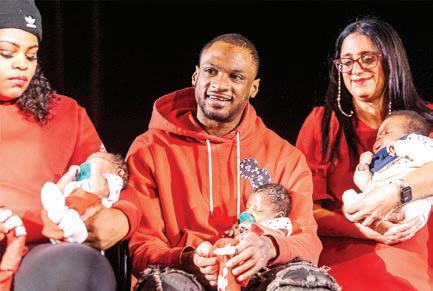
“Rx Kids is not charity, it is medicine,” Hanna said. “We give families a little bit of breathing room during pregnancy and infancy, when money is the tightest, because stress, housing, instability and hunger makes kids and communities sick.”
Newborn Detroiters — some born on the first day of 2026 — were brought onstage with state and local leaders as the room swelled with Detroit pride, including renditions of “Baby Love” by the Supremes. Mayor Mary Sheffield marked the moment by presenting the babies with symbolic keys to the city, welcoming them as Detroit’s newest residents.
For Black Detroit families, the stakes of this moment sit inside a larger truth that rarely gets addressed with the urgency it deserves: Black mothers face higher risks during pregnancy and childbirth, even when income and education are held constant. Nationally, the CDC reported a maternal mortality rate of 50.3 deaths per 100,000 live births for Black women in 2023, far higher than the rate for White women. Michigan’s own data has shown Black women were 2.2 times more likely to die from pregnancy-related causes than White women from 2016 to 2020.
That reality shapes how many Detroit mothers walk into prenatal visits: already braced for being dismissed, already carrying fear along with the baby. It also shapes why supporters of Rx Kids argue that cash stability can function like a health tool. Less financial crisis can mean fewer missed appointments, fewer days choosing between food and utilities, and fewer moments where housing instability crashes into postpartum recovery.
Mayor Sheffield framed the program as part of her administration’s poverty and homelessness work, tying it to how the city is reorganizing its approach to stability for families.
“Too many of our babies are starting life early carrying the weight of financial hardship before they even take their first steps and that is why this administration is moving with urgency,” Sheffield said. She also said that, as of 9 a.m., 743 Detroiters had already applied.
Eligibility in Detroit centers on pregnancy stage
See RX KIDS Page A-4
By Ebony JJ Curry SENIOR REPORTER
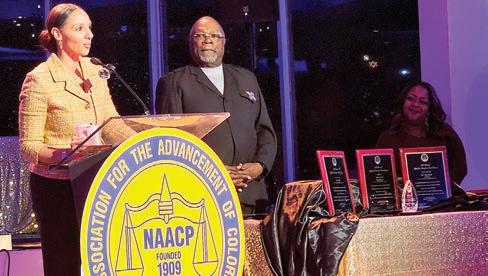
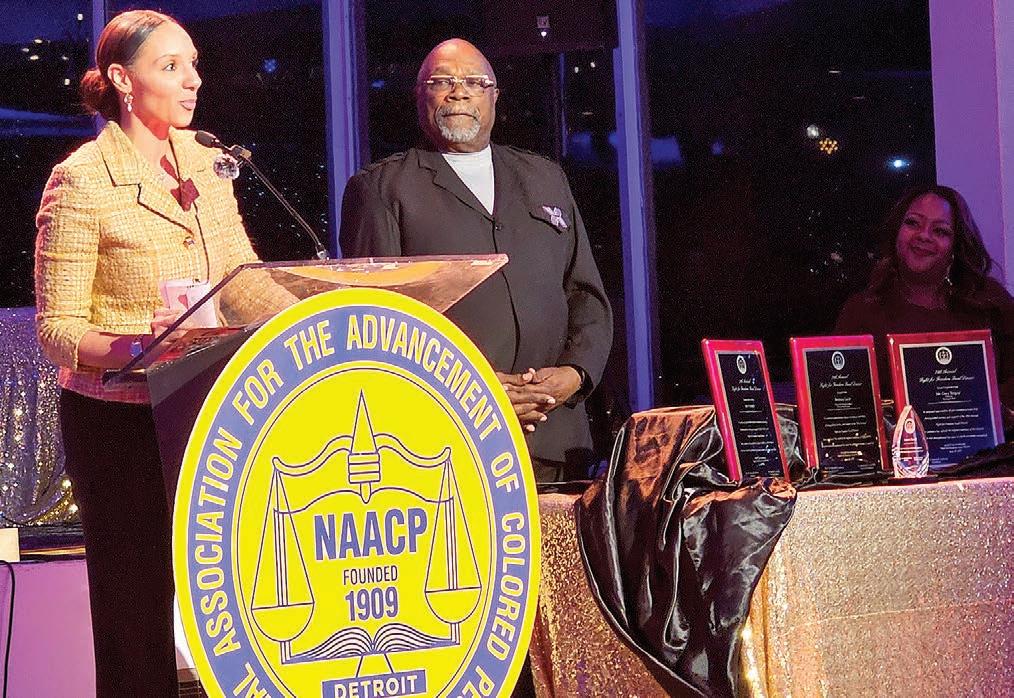
The 71st Detroit NAACP Fight for Freedom Fund Dinner season officially began Feb. 12 with the organization’s annual kickoff reception at the Roostertail, marking the NAACP’s 117th anniversary year as Rev. Dr. Wendell Anthony invoked Dr. Martin Luther King Jr.’s warning about “the fierce urgency of now.”
Anthony, president of the Detroit NAACP branch, framed the night around stakes far bigger than a single fundraiser. He told the room the NAACP was founded in February 1909 by people committed to “freedom, democracy, peace, and justice,” and said that founding mission has only intensified in 2026.
“This day is historic because 117 years ago the NAACP was founded,” Anthony said. “Founded by men and women who were committed and dedicated to the cause of freedom, democracy, peace, and justice.”
Anthony emphasized that the NAACP’s origin story includes multiracial and multi-faith partnership, then tied that foundation to today’s urgency.
“It was founded by Black and white people. Jews and Gentiles,” he said. “Why? Because of the historic parallels between the two people and the two movements, that cause of founding has never changed. As a matter of fact, 117 years later, it has been escalated.”
He pointed to a tradition of public moral clarity that has guided civil rights work across generations, invoking leaders whose words still shape movement language.
“Reverend Dr. Martin Luther King, Jr. called it the fierce urgency of now,”
Anthony said. “Fannie Lou Hamer said she was just sick and tired of being sick and tired. John Lewis said we all should be engaged in some good trouble… Indifference to evil is worse than evil itself.”
From there, Anthony delivered a message aimed directly at donors and supporters who may feel the work is already done.
“We got here tonight, we were all called to do more,” he said. “Not less, but to do more. You ain’t doing enough. You still breathing, you ain’t done enough. When one looks around at what’s happening in this nation, you have not done enough.”
Anthony warned against comfort in past victories and said the present moment requires forward motion.
“Now is not the time… to sit on the accomplishments of the past,” he said. “We must, in fact, stand upon the critical possibilities for our future.”
The kickoff also carried one of the branch’s signature rituals — the pass-
By Sam Robinson SENIOR REPORTER
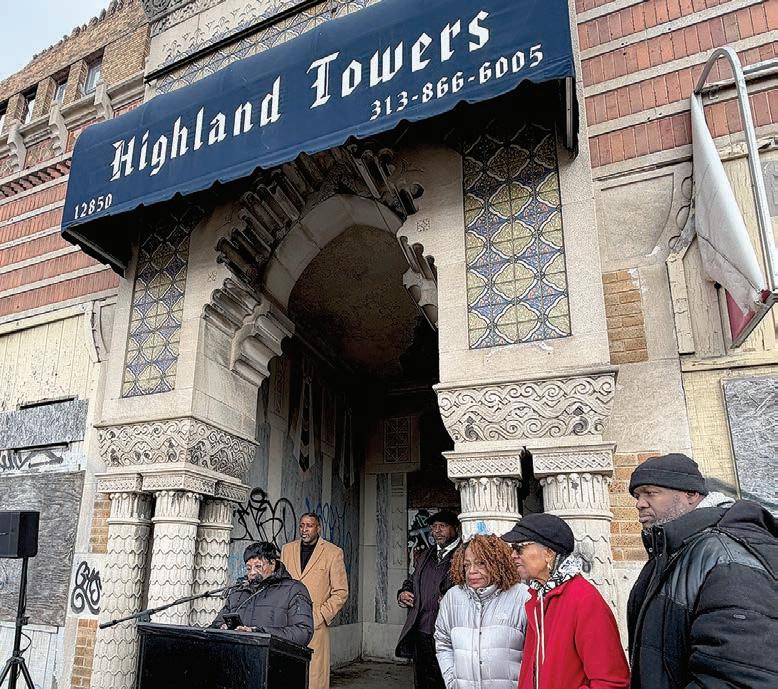
City of Highland Park and Wayne County officials stood in front of the historic Highland Towers building to announce its demolition after sitting vacant for 17 years.
The building, at 12850 Woodward Ave., at McLean and Farrand Park, stands as a symbol of the city’s blight since it was abandoned in 2009. The last remaining residents were forced out in after DTE turned off electricity due to non-payment.
“While the building holds sentimental memories for some, it has become a structure that puts our citizens at risk,” Highland Park Mayor Glenda McDonald told reporters at a press conference Thursday outside of the building.
The demolition that will be paid for by pandemic relief funds is expected to be complete this year, said Anthony Cartwright, acting executive director for the Wayne County Land Bank. He said it should be about $1 million to demolish the sprawling four story building.
Cartwright said the Detroit based
Adamo Group won the contract from to demolish the property.
“(Wayne County executive) Warren Evans has had HP deep in his heart to get blinded structures down so we can spearhead development in the city,” Cartwright said, adding that the razing of Highland Towers is part of a larger, $5 million effort by the county to eliminate blight. “Highland Park is doing a great turnaround, and we want to be a part of that. This is going to spearhead development in the neighborhood, and that’s what we’re looking at.”
Residents who showed up to the press conference said they hope they’ll get a say in the site’s future.
The building has tremendous historic value, though attempts at preserving the Art Deco-style structure that was constructed as a luxury apartment building have failed.
City officials said there isn’t currently a plan to save some pieces of the building, though most believe items of significant value have already been removed by thieves.
Activity around the building today is mostly happening from homeless res-
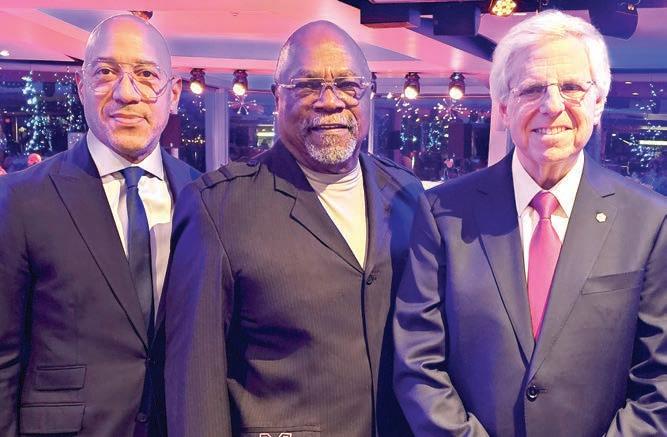
ing of the gavel — used to honor leadership and signal continuity in a movement where each generation inherits responsibility. Gary Torgow, chairman of Huntington Bank, returned as senior corporate chair for an eighth year, and during the gavel moment he presented Anthony with a handwritten, leather-bound book of Psalms, calling the writings “songs of individuals who refuse to make peace with injustice.”
“The Psalms are not quiet writings,” Torgow said, describing them as words “on lament and sharpened by truth,” with a reminder that “praise can rise from protest,” and “righteousness is not passive, it is practiced.”
Torgow’s ceremonial presentation also came with a major early investment toward this year’s campaign: a $250,000 check for the Freedom Fund.
Detroit Mayor Mary Sheffield delivered the evening’s first high-profile
From page A-3
show of support, stepping forward to present what she called a “ceremonial check” and purchasing the first ticket for this year’s dinner. Sheffield, speaking as a lifelong Detroiter, connected her presence to family roots and civic responsibility, telling attendees her household raised her with values tied to civil rights and cultural justice. She said her respect for the NAACP runs deep, including through her grandfather’s service with the organization.
“If there’s ever a time for us to organize… and strategize for racial and social justice, the time is now,” Sheffield said, adding that she intends to remain committed to supporting the Detroit NAACP’s mission.
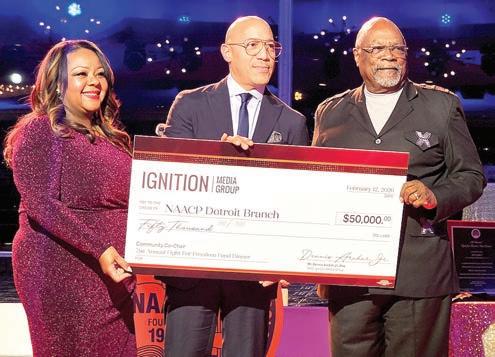
The night’s leadership baton moved again when the owners of Detroit’s Hot Sam’s passed their gavel in the role of community co-chair to Dennis Archer Jr., who announced a $50,000 donation. Archer Jr. urged the room to treat the organization’s work as essential infrastructure for the city and the country.
“The NAACP has been around 117 years,” Archer Jr. said. He told guests that some people question the group’s relevance at different points in history, then added, “I’m sure no one are asking those questions today, because of the time that we find ourselves in.”
Anthony pointed to this year’s Fight for Freedom Fund theme and told the room exactly what’s at stake.
“Liberty or oppression. The choice is ours,” he said.
He described a national climate where intimidation and misinformation have re-entered public life in ways that demand response.
A-2 | April
“The time is now,” Anthony said. He pointed to what he called rising “racial discrimination, anti-Semitism, anti-women, anti-diversity, anti-history,” and warned supporters not to let the advocacy drop.
From page A-3
and a baby’s birth timing. Detroit moms must be at least 16 weeks pregnant, or have a baby born this year as of Jan. 1, 2026. Eligible Detroiters can apply at RxKids.org to receive $1,500 before birth and then $500 monthly for six months.
the rights of all women are continued.
Rx Kids is led by Michigan State University and administered through GiveDirectly, a nonprofit specializing in cash delivery programs aimed at reducing poverty. State funding includes appropriations tied to the federal Temporary Assistance for Needy Families program and the Healthy Michigan Fund, according to reporting and program materials. Rx Kids’ website states that about 85% of state funding goes directly to recipients, with the remainder supporting program operations and overhead such as IT, accounting and compliance.
“At a time when our most critical advocacy must not be at an all-time low,” he said. “The NAACP needs you. Our nation needs you. The world needs you.”
Anthony also reminded attendees what the Freedom Fund Dinner is designed to fund and why the room’s dollars matter beyond a single night.
“The Fight for Freedom is more than a dinner,” he said. “Why would you just come and get a meal? It is a historic assembly that serves the nation as a call to action. A call to actually get engaged in community… get engaged in our country… and get engaged with our neighbors.”
This year’s Detroit NAACP Fight for Freedom Fund Dinner will honor three leaders who organizers say have demonstrated impact across Detroit’s civic and corporate landscape: Gary Torgow of Huntington Bank, Brittany Lavis of Detroit Medical Center, and Dennis Archer Jr. of Ignition Media Group. The dinner is scheduled for Sunday, April 26 at 5 p.m. at Huntington Place. For tickets, tables, and sponsorship information, contact freedomfund@detroitnaacp.org.
Ebony JJ Curry can be reached at ecurry@michronicle.com.
pointing to early evidence from Flint.
idents using it for shelter. It’s a far cry from the days when affluent auto executives and scientists walked through Moorish doorways and looked out of fancy stained glass windows.
Karen Nagher, then-executive director of Preservation Wayne (now Preservation Detroit), told the Detroit Free Press that the building was recommended to be listed as endangered, but arson after it became vacant made it impossible.
Highland Towers is located in the Highland Heights-Stevens’ Subdivision, a National Historic District. The building was designed in the late 1920s and opened in 1932.
The architects, Frank W. Wiedmaier and John B. Gay, also designed the Luxor and LaVogue Apartments in Detroit’s Palmer Park neighborhood.
Urban exploration blogger Nailhed compiled perhaps the most comprehensive photos of the abandoned Highland Towers, including stories from former tenants.
Residents stood outside of the building to express what they called bittersweet news of the building’s end.
Highland Park resident and activist Carolyn Baker said she expects neighbors living nearby to have a say in the future of the site’s development, expressing concerns about gentrification. Baker expressed sadness that the building wouldn’t be saved. She also compared the situation that happened at Highland Towers in 2009 to what is currently happening at the downtown Leland House.
Downtown, low-income seniors who were paying their rent were forced out of the historic former hotel because the owner of the building stopped paying the utility bill.
2, continuing a push into rural regions with high need.
cine and healthcare, may be adversely impacted by the decision to overturn Roe v. Wade.
For Detroit, the question is not whether mothers “deserve” help. Detroit has answered that every time a grandmother becomes a nighttime babysitter, every time a neighbor drops off diapers, every time a church pantry stands in for a missing safety net.
Dr. Hanna said Detroit fundraising includes $12 million secured for the city’s rollout.
The Detroit expansion also lands at a moment when Rx Kids leaders are
“PPMI has been preparing for this moment since the results of the 2016 election were final. We recently filed a lawsuit to stop the 1931 law from going into effect, and we’ve also asked the state courts to affirm that the Michigan constitution does already contain a right to abortion. Our advocacy arm, Planned Parenthood Advocates of Michigan, is a founding member of the coalition that launched Reproductive Freedom for All, a ballot initiative to affirm the right to abortion and reproductive freedom in the state constitution,” said Vasquez Giroux. “The bottom line is that we will do everything in our power to keep abortion legal in Michigan, and if SCOTUS makes that impossible, we will do everything we can to ensure our patients can access the care they need.”
Elected officials are also working to keep Roe v. Wade intact thus holding off Michigan’s 1931 trigger ban. Governor Gretchen Whitmer released a statement saying, in part:
Research evaluating Flint’s program has reported a steep drop in evictions among eligible moms after childbirth, along with declines in postpartum depression and fewer neonatal intensive care unit admissions. One analysis cited evictions falling by about 91% among Rx Kids-eligible Flint moms in 2024 after childbirth compared with Flint women who had babies the year before. It also reported postpartum depression declining from 46% to 33%, and NICU admissions down 29%, or 68 fewer admissions during the study period.
“The words ‘Roe overturned’ are no longer theoretical. I want every Michigander to know— no matter what happens in D.C., I’m going to fight like hell to protect access to safe, legal abortion in Michigan…”
More than legal implications, overturning Roe v. Wade would impact several systems across the spectrum. With the potential to drive both foster and adoption numbers upward, a ban on abortions could leave many women to choose a less safe route restoring ‘back alley’ and illegal abortion practices, including self-abortions. Moreover, African American women and women of color, who already have a long-storied history with access and inclusion in medi-
Still, Rx Kids has not avoided political backlash. The program has drawn bipartisan support, though Michigan House Speaker Matt Hall, R-Richland Township, has alleged the initiative gives cash payments to non-citizens to have children. Hanna responded publicly by emphasizing the program’s public-private structure and said nonstate dollars can support babies who may not have legal status.
As Rx Kids expands beyond Detroit, organizers say the program will be operating across all 15 counties in Michigan’s Upper Peninsula starting March
“What we are really concerned about is the impact on our patients. Access to abortion is already out of reach for far too many Michiganders, especially Black people and people of color who face additional barriers to care as a result of systemic inequalities and institutional racism. Losing access to legal abortion will impact those communities most, forcing people to become parents or expand their families against their will. Being able to decide and control if, when and how to become a parent is central to building and living a healthy, happy life,” said Vasquez Giroux.
The question is whether policy will finally match what Black families have practiced for generations: you protect babies by protecting mothers first. Cash does not replace good prenatal care, safe housing, respectful treatment in hospitals, or reliable transportation. It can reduce the pressure that makes every other barrier heavier.
what the Supreme Court will rule in the upcoming days. Despite the decision, advocates on both sides of the argument are willing to continue their pursuits.
“This did not have to happen. We could be here with hundreds of residents still living here — the same thing could end up happening to the Leland House,” Baker said. “Because DTE is allowed to shut people off in the winter, things like this happen. I’m reminded of the low-income people who suffered at the hands of the corporation who is still getting away with it.”
Larrea Young, a resident who lives on Farrand Park on the other side of the vacant building, says she’s happy to see the city move forward, but wishes the historic building could have been saved.
“We moved into our house about two years ago, obviously we knew this building was here, and we have kind of come to appreciate it in a certain way,” Young said. You can reach Sam at srobinson@michronicle.com.
And in a city where so many families are working, grinding, caregiving, and still one emergency away from crisis, that breathing room has a name now. It is Rx Kids.
How to apply (Detroit): Eligible Detroit moms who are at least 16 weeks pregnant, or who have a baby born in 2026 as of Jan. 1, can apply online through the city’s Rx Kids Detroit page and RxKids.org.
Ebony JJ Curry can be reached at ecurry@michronicle.com.
Beyond the scope of pro-choice versus prolife, the fight for reproductive choice is one of freedom. As Michigan officials work to ensure each woman who finds herself in the position to choose has access to care without the threat of legal action, many wonder
“Overturning Roe v. Wade would be a terrible break with nearly 50 years of judicial precedent and – more importantly – a blow against individual freedom. It is my hope that the majority of justices will reject the findings of this draft. If that is not the case, we need to stand with Senate Majority Leader Schumer and Gov. Whitmer in support of their efforts to preserve the right to reproductive freedom,” said Chair Alisha Bell, on behalf of the Wayne County Commission.
BLAC recommends data collection and professional analysis be initiated with the assistance of our Attorney General, Michigan Commission on Law Enforcement Standards (MCOLES), Association of Michigan Prosecutors and other stakeholders to collaborate, collect and analyze data strategically.
Ban no-knock warrants: Urging the House Government Operations Committee to hold hearings on HB 5013 and other legislation that would ban or limit the use of noknock or quick knock warrants, and urging the state legislature to pass meaningful reform and advise Gov. Whitmer to sign the bill after the leg-
islature adopts it. Increase school funding: Statutory changes to increase the School Aid Fund revenue by at least $3.6 billion and establish a permanent weighted funding formula based on student and community needs and universal preschool (0-3).
Reject censorship in history instruction: Encouraging Gov. Whitmer to ensure the goal for Michigan schools should be history instruction that is presented by professionals with the subject matter expertise, pedagogical skills, and judgment necessary to present complex information to students that are grounded in provable facts and add to the understanding of modern-day America. Increase mental health supports for the Black community: Recommending Michigan set a goal of increasing the number of Black mental health service providers by 20% each year over five years.
The health committee recommends reviewing state licensure policies to address the barriers that Black psychologists face in obtaining licensure in Michigan. Ensure equitable distribution of state health funds: Ensure all Michigan communities with a significant Black population receive adequate funds to address mental health issues.
Protecting Black voting rights: Urge state officials to remain vigilant in the fight against schemes to disenfranchise Michiganders of color.
“BLAC members have worked hard to identify the needs of the Black community and we feel these recommendations will provide a solid first step towards breaking down barriers in education, community safety, health and business,” said BLAC Co-Chair Dr. Donna L. Bell.






the chancellor embraces.
Lead exposure can happen when children:
• Put their hands, toys, or other objects in their mouths after touching lead dust.
All children should be tested for lead at ages 1 and 2, and by age 6. Children should also be tested at other ages if they are at high risk of lead exposure.
• Crawl or play in dust or soil that contains lead particles.
• Eat lead-contaminated food or spices.
“Chancellor Ivery is a true transformational leader and an outstanding CEO, who is more than worthy of the CEO of the Year Award he just received, “ said Prof. James C. Mays, who teaches entrepreneurship and supply chain management at WCCCD’s Corporate College. “In his 27 years at WCCCD, Dr. Ivery has elevated WCCCD to become nationally recognized for excellence and innovation and preparing our students professionally and personally to do great things in the world.”
BLAC will hold a virtual town hall meeting to discuss its policy recommendations on Thursday, May 12 at 4 p.m. Join BLAC and a virtual audience in discussing the recommendations to support the Black community. BLAC is housed in the Michigan Department of Labor and Economic Opportunity. Members represent many professional backgrounds, including economics, law, public safety, health and wellness, arts and culture and media. They leverage their experiences and expertise to make recommendations to the governor on critical issues affecting the Black community.
• Drink water from lead pipes or plumbing fixtures.
“I think of transformational leadership as a thoughtful approach that causes people to change but also causes the systems and circumstances they are operating in to change too,” Ivory said. “Transformational change doesn’t just ask people to do certain things; it asks them to change their view of what’s possible and excites them to drive that change together because they believe that what they’re doing will create positive change for everyone. That’s how entire systems change because people believe that they need to for themselves and others to live better lives.”
• Breathe in or swallow lead dust in homes built before 1978.
• Chew windowsills or other items with lead-based paint or coatings.
• Come into contact with lead from a parent’s job or hobby that involves lead.
To learn more about BLAC and this upcoming event, visit www.michigan.gov/BLAC.
Talk to your doctor about blood lead testing for your child. Michigan.gov/MiLeadSafe
A5 | February 18-24, 2026
Sponsored by JPMorganChase
Business optimism is returning for small and midsize business leaders at the start of 2026, fueling confidence and growth plans.
The 2026 Business Leaders Outlook survey, released in January by JPMorganChase reveals a turnaround from last June, when economic headwinds and uncertainty about shifting policies and tariffs caused some leaders to put their business plans on hold.

Midsize companies, who often find themselves more exposed to geopolitical shifts and policy changes, experienced a significant dip in business and economic confidence in June of 2025. As they have become more comfortable with the complexities of today’s environment, we are seeing optimism rebounding in the middle market nationwide – an encouraging sign for growth, hiring, and innovation. Small businesses, meanwhile, maintained steady optimism throughout 2025, but they aren’t shielded from domestic concerns. Many cited inflation and wage pressures as the top challenges for 2026 and are taking steps to ensure their businesses are prepared for what’s ahead.
“Michigan business leaders continue to show determination and adaptability, even as they navigate a complex and evolving economic landscape. Their willingness to embrace new technologies and pursue growth opportunities speaks to the strength and ingenuity of our local business community, said Terrah Opferman, Region Manager for Michigan and Ohio, J.P. Morgan Commercial Banking “I’m confident that this momentum will drive Michigan’s economy forward in 2026 and beyond.”
Overall, both small and midsize business leaders are feeling more confident to pursue growth opportunities, embrace emerging technologies and, in some cases, forge new strategic partnerships. That bodes well for entrepreneurs in Michigan. Here are a few other key findings from the Business Leaders Outlook about trends expected to drive activity in Michigan this year:
1) Local small and middle market businesses remain optimistic. Seventy four percent of Detroit small businesses are optimistic about their business next year, while 60% are optimistic about the local economy. Among the most positive Detroit small businesses surveyed, 78% feel more optimistic than at any time in the last five years. Michigan midsized businesses leaders are more optimistic (46%) about the national economy than the rest of the country (39%) at large.
2) Labor is a top three concern in the Midwest. Going into 2026, Labor is a top three concern among midsize business leaders in the Midwest (higher than revenue and sales growth, which was the third nationally). In Michigan, labor is the #2 challenge facing middle market business leaders, while tariffs are ranked
See GROWTH FOR MICHIGAN Page A-6
By Dr. Anthony O. Kellum CONTRIBUTING WRITER

By Jeremy Allen EXECUTIVE EDITOR
Contractors and small business owners across Michigan are being offered a major opportunity to expand their companies into one of the region’s largest construction and concessions markets when the Wayne County Airport Authority (WCAA) hosts a construction and concessions outreach event on Monday, Feb. 23 at the Vibe Credit Union Showplace in Novi.
The one-day event is designed to bring local and national construction contractors, subcontractors and concession owners face-to-face with the decision makers behind some of the largest upcoming infrastructure and commercial opportunities in southeastern Michigan, including at Detroit Metropolitan Wayne County Airport (DTW) and Willow Run Airport.
There are approximately $750 million in major contracting opportunities expected to be bid across the airport authority’s portfolio over the next two years, and the WCAA’s outreach event will walk attendees through how to compete for that work.
The morning session from 9 a.m. to noon will introduce the construction opportunities on the 2026-27 project calendar, covering major projects across airfield, landside and terminal areas.
The afternoon session from 1-4 p.m. will highlight the concessions program, including the long-term strategic vision for McNamara and Evans terminals and
clusion of an argument, it is the beginning of a process.
how emerging trends are shaping future designs.
“This is more than a networking meeting — it’s a vital bridge for local and national businesses to ensure that all, from small businesses to industry leaders, have an opportunity to share their expertise and help us maintain an airport environment that everyone enjoys,” said WCAA CEO Chad Newton.
Both sessions will offer detailed guidance on procurement, including solicitation, bidding, award procedures and contract management. Registration is required and will remain open through Thursday, Feb. 19.
For Black-owned businesses, particularly those certified as Disadvantaged Business Enterprises (DBE) or Airport Concession Disadvantaged Business Enterprises (ACDBE), this event could be transformational.
The airport authority’s DBE/ACDBE programs aim to give maximum opportunity for disadvantaged firms to participate in construction and concessions contracts, with support from certification through training and networking to help businesses that historically have been under-represented win federal and local work at the airport hub.
There are real examples in Michigan of how DBE status and targeted outreach can lead to business growth. Rowe Trucking, LLC, a Detroit-based Black-owned trucking company, has said that becoming DBE-certified helped it “get our foot in the door on many Michigan Department of Transportation (MDOT) projects,” lead-
ing to work hauling materials for major state road construction contracts.
Another DBE-certified company, Value Engineering in Lansing, expanded its engineering consultancy services to both public agencies and private developers following work through state transportation contracts, which is enabling the firm to open offices in downtown Lansing and Detroit and grow its team.
Experts say that for Black entrepreneurs in construction and concessions, understanding how to navigate the procurement process and build relationships with prime contractors and agencies can be the difference between remaining on the margins of big projects and becoming key players in multimillion-dollar work.
The outreach event at the Vibe Credit Union Showplace will help interested firms access that knowledge, meet potential partners and position themselves for bidding on work that could drive growth for years.
The invitation is open to all local and national firms, contractors, engineering firms, consultants, vendors, small business enterprises and disadvantaged business enterprise firms seeking aviation industry opportunities. For Black-owned enterprises ready to expand beyond smaller local projects, the scale and variety of work becoming available through WCAA – ranging from heavy civil construction to retail and hospitality concessions –represents one of the most significant openings in the region’s business landscape.
To register for the event, visit https:// wcaaoutreachdayfeb2026.rsvpify.com/.
Anthony O. Kellum
When Donald Trump, the sitting President of the United States, circulates or amplifies an image depicting the first Black President of this country Barack Obama and his wife, Michelle Obama, as monkeys, the nation is being told something important about itself. This is not a lapse in judgment. It is not dark humor. It is not political theater. It is an intentional act rooted in one of the most enduring and violent tropes in Western history the reduction of Black people to something less than human.
That image is not accidental. It is not harmless. And it is not disconnected from power.
I am deeply hurt by this moment. But more than hurt, I am deeply alarmed. Because history makes one thing unmistakably clear: dehumanization is never the con-
We are living in a time when many insist racism is behind us. When progress is spoken of as permanent and irreversible. When the presence of Black success is used as evidence that the system is now fair. And yet, here we are, watching Barack Obama, a former President of the United States, publicly reduced to animal imagery by his successor, Donald Trump, with little institutional resistance and even less accountability.
That silence matters.
History shows us that authoritarian and anti-democratic movements do not begin with laws or violence. They begin with narrative control. With ridicule. With the steady normalization of contempt. Hitler did not begin with camps; he began with caricatures, propaganda, and the erosion of empathy. Across cultures and continents, the pattern remains consistent once people are symbolically stripped of their humanity, stripping them of their rights, resources, and property becomes easier to justify.
This is why this moment cannot be dismissed as merely offensive. It is consequential precisely because it signals what is now acceptable. It lowers the cost of cruelty. It prepares the public to tolerate exclusion. And symbolism, in a society built on hierarchy, always precedes policy.
We are witnessing coordinated efforts to weaken institutions that preserve historical truth attacks on museums, on honest accounts of race, on the authority of places
like the Smithsonian. We see the rollback of diversity, equity, and inclusion initiatives under the language of neutrality and fairness. These developments are often treated as separate controversies, but they are part of the same architecture. Cultural erasure and economic dispossession have always moved together.
Racism in this era rarely announces itself loudly. It operates administratively. Through systems that claim objectivity while producing unequal outcomes. Through lending standards, appraisal practices, zoning laws, and capital flows that quietly but consistently disadvantage Black communities. Intent is denied, but impact is undeniable.
When Black leadership is openly mocked and dehumanized especially when that mockery is modeled by Donald Trump himself, it sends a signal through every layer of these systems. Appraisers feel safer undervaluing. Lenders feel safer tightening. Policymakers feel safer dismantling protections. Dehumanization at the cultural level creates permission at the institutional level.
This is where Property is Power becomes unavoidable.
Property is not simply about owning a home. It is about leverage, stability, and inheritance. It is the primary mechanism through which families secure their future and transfer opportunity across generations. In America, access to property has never been neutral it has always been shaped by race, policy, power, and this is not accidental, it is structural.
Black homeownership gaps are not the result of apathy or ignorance. They are the cumulative outcome of historic exclusion and modern systems that continue to reproduce inequality while claiming colorblindness. When Black communities are devalued symbolically, they are devalued economically. Equity is suppressed long before it is denied.
Many of the moral giants who once forced this nation to confront its contradictions are gone. King is gone. Malcolm is gone. Medgar is gone. The institutions that once carried their urgency have been diluted, minimized, or neutralized. The responsibility of this moment now rests with those who understand how systems function and how power consolidates. The question before us is not where are the leaders, the question is whether we are willing to raise our hands.
Silence in moments like this is not neutrality. It is consent. History will not judge us by our outrage, but by whether we recognized the season we were in and acted accordingly. Whether we defended access. Whether we protected the ground literally and economically that our children and grandchildren are meant to inherit.
Property is Power because permanence is power. And dehumanization has always been the first step toward dispossession. The time to pay attention is now.
Property is Power! is a movement to promote home and community ownership. Studies indicate that homeownership leads to higher graduation rates, family wealth, and community involvement.
#3 among middle market businesses in the state.
3) And tariffs are impacting businesses costs. Seventy percent of Midwest midsize business leaders said tariffs have had either a moderate or significantly negative impact on the cost of doing business. Seventeen percent of Detroit small businesses cite tariffs and imported goods as a major cost driver.
4) Despite challenges, leaders are bullish on their own enterprises. Though the overall outlook is mixed, 74% of Detroit small business owners are optimistic about their business for 2026.
5) Detroit small businesses (67%) increased use most in vertical-specific AI tools, in addition to virtual assistants and scheduling tools (64%), and e-commerce platforms (63%).
6) Big plans are on the horizon. Forty-one percent of midsize business leaders in Michigan say they are considering M&A activity in 2026. Additionally, over half (52%) of Michigan midsize business leaders plan to increase employee headcount in 2026, slightly the national average (48%).
The bottom line
Rebounding optimism among U.S. business leaders at the start of the year is setting the stage for an active 2026. With business leaders looking to implement ambitious growth plans that position themselves for the future, momentum in Michigan could be beneficial future goals for leaders looking to launch, grow or scale their business this year.
For informational/educational purposes only: Views and strategies described in this article or provided via links may not be appropriate for everyone and are not intended as specific advice/recommendation for any business. Information has been obtained from sources believed to be reliable, but JPMorgan Chase & Co. or its affiliates and/or subsidiaries do not warrant its completeness or accuracy. The material is not intended to provide legal, tax, or financial advice or to indicate the availability or suitability of any JPMorgan Chase Bank, N.A. product or service. You should carefully consider your needs and objectives before making any decisions and consult the appropriate professional(s). Outlooks and past performance are not guarantees of future results. JPMorgan Chase & Co. and its affiliates are not responsible for, and do not provide or endorse third party products, services, or other content.
Deposit products provided by JPMorgan Chase Bank, N.A. Member FDIC. Equal Opportunity Lender.
© 2026 JPMorgan Chase & Co.

By Gidon Jakar UNIVERSITY OF FLORIDA
Detroit’s population reportedly grew in 2023 for the first time in 60 years, a trend that has continued in recent years. Over the past decade, the city center has experienced substantial private and public investments and development.
I personally witnessed some of the changes in Detroit while I was studying for my Ph.D. at the University of Michigan’s sport management program. I am now an assistant professor at the University of Florida, where I research how sport affects local economies.
One of the changes I witnessed was the construction of Little Caesars Arena and its opening in 2017. The venue cost an estimated US$863 million, including $324 million in public money – a substantial amount, especially considering it was allocated so close to the city’s bankruptcy filing in 2013. The financing deal also included property development agreements, some of which have yet to materialize.
The arena’s primary users and operators are the NBA’s Detroit Pistons and the NHL’s Detroit Red Wings. The Red Wings are owned by the Ilitch family, which founded Little Caesars pizza in Detroit in 1959.
My colleagues Nasim Binesh, Kyriaki Kaplanidou and I recently published research examining how much impact the arena had on the hospitality industry in Detroit.
Sport venues and the promise of financial gains
A persistent debate on the benefits of sport venues to local economies is taking place at the same time public officials continue to commit substantial resources toward them.
In just the past five years, in cities such as Buffalo, Las Vegas and Nashville, local and state officials have partnered with sports teams to build new stadiums, fre-
quently offering the franchises incentives, including tax write-offs, free rent and construction cost-sharing.
Far less often, these attempts to build stadiums fail. That happened recently in Kansas City – where voters rejected a new stadium – and Philadelphia, where the team reversed its decision to build the arena near the city’s Chinatown.
As I note in a study co-authored with Mark Rosentraub, a professor at the University of Michigan, cities are competing with each other for new residents and tax revenue from development and economic activity. Some officials clearly perceive maintaining or obtaining “major league” status as an advantage so important that they are willing to spend tax dollars to assist wealthy franchises.
This may explain why it happens, but it does not necessarily justify it.
In our study, we examined the lodging industry, including hotels and short-term rentals, which experienced substantial growth coinciding with Detroit’s economic growth.
Short-term rental data was purchased from AirDNA, and hotel data was obtained from STR. Both of these sites compile and sell data, primarily to investors and owners of short-term rentals and hotels.
Our quantitative analysis examined millions of records from 2015 to 2022. Rentals within the city’s boundaries increased from 462 units in 2015 to 2,582 in 2022. A healthy cluster near the city’s downtown grew substantially over this period.
In 2015, 24,592 nights were booked in short-term rentals. By 2022, that number had increased to 161,952. Over the same period, demand for hotel rooms decreased by 19%.
However, hotel rates increased over the same period from an average of $128.20 in 2015 to $197.05 in 2023, meaning that despite the decreased demand, annual hotel revenues increased from $229.6 million in
2015 to $306.1 million in 2023.
Hotels and short-term rentals in Detroit are subject to the state’s 6% sales tax. Hotels also must pay citywide lodging taxes ranging from 3% to 6%, depending on the number of rooms. Lodging taxes are not currently collected for short-term rentals.
The arena opened, then what?
So, how much did the new arena affect the supply and demand for lodging?
To answer that question, we compared Detroit’s numbers with short-term rental data from Grand Rapids, the second-largest city in the state.
The answer is not that much.
Detroit’s short-term rental growth was not dissimilar to that in Grand Rapids –even though no major league franchises play there and no major stadium had been built there. Demand in Grand Rapids grew 1,210% versus 1,284% in Detroit. The number of units available grew by 702% in Grand Rapids, compared to 674% in Detroit.
Regarding the impact of Little Caesars Arena, our study suggests sport events there do not appear to have a positive impact on the lodging industry.
While sporting events had little impact, the arena also hosts concerts with big-name acts, including Harry Styles, Jay-Z and The Weeknd. Our research shows these concerts significantly increased occupancy rates in short-term rentals – although the effect did not translate to hotels.
But the rentals needed to be very convenient to the venue. Increases on concert nights were more than three times higher in short-term rental units located within a mile of the arena compared to the city as a whole.
Gidon Jakar, Assistant professor of sport management, University of Florida. This article is republished from The Conversation under a Creative Commons license. Read the original article.







the current leader.
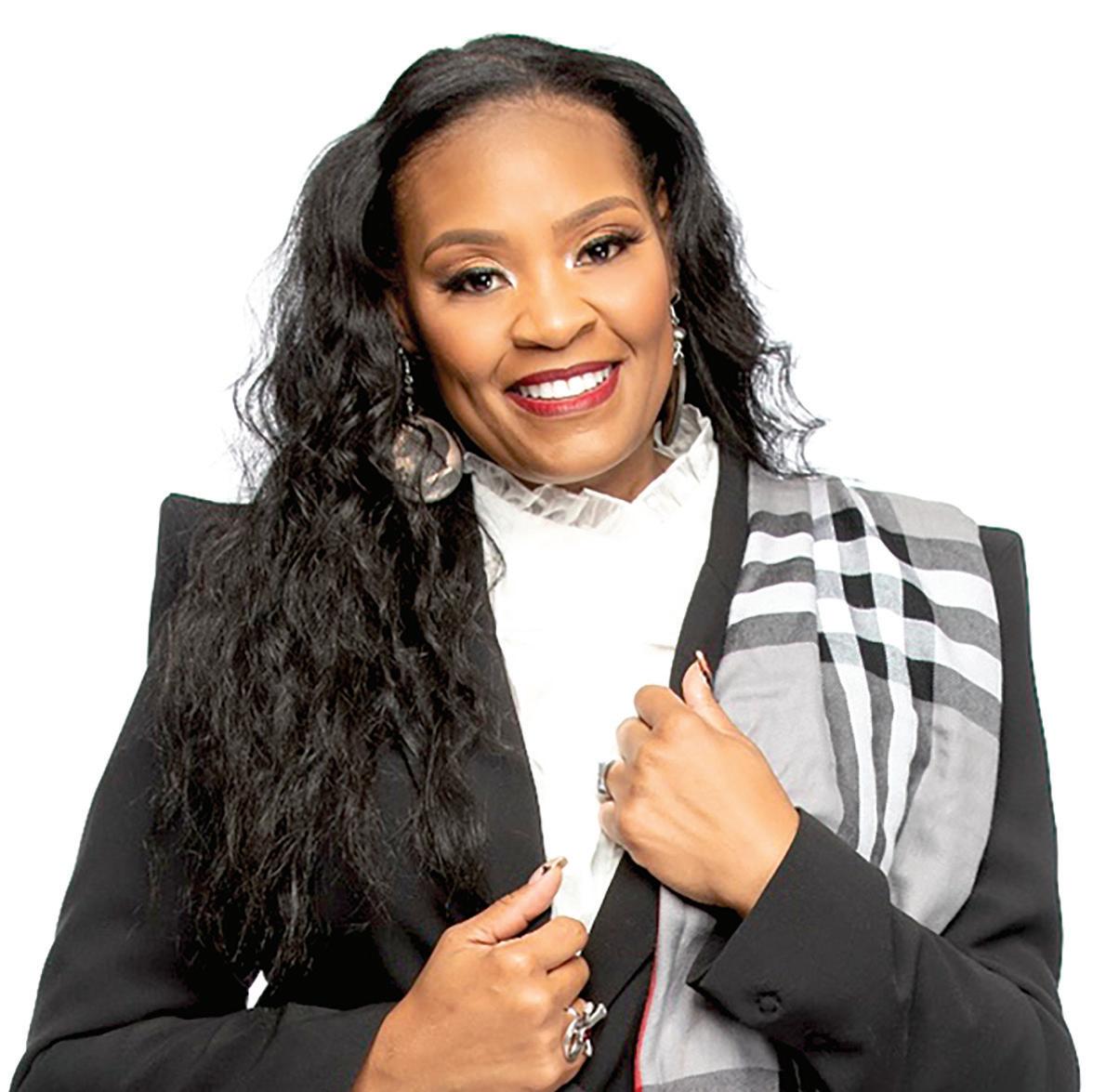
By Dr. Rema Vassar
CONTRIBUTOR
In the last few weeks, I have learned an old lesson in a new way: powerful institutions will work harder to defend their image than to confront the harm they inflict on Black people. Michigan State University’s reaction to my recent commentary in Bridge Michigan proves the point.
Instead of squarely addressing Black students’ outcomes and experiences, MSU issued internal memos and public statements accusing me of “misinformation,” quibbling over semantics, and rebranding its diversity infrastructure. All of this energy could have been spent on a different project: making sure Black students are safe, supported, and able to graduate without carrying disproportionate debt and trauma.
The university would like this conversation to be about language. I insist it must be about lives.
The Numbers Tell a Consistent Story
If MSU’s leaders want to argue with my characterization of their record, there is a simple way to do so: release longterm, disaggregated data and let the public see the trend lines.
Across multiple years, Black students at Michigan State have:
• The lowest graduation rates.
• The longest time to degree when they do graduate.
• The highest rates of academic probation.
• The heaviest student loan debt.
• The lowest sense of belonging on campus.
These are not isolated blips. They form a pattern in which Black students are consistently positioned at the bottom of nearly every measure of “student success.”
Black enrollment has remained stagnant for roughly three decades. In a state where Black communities have borne the brunt of economic restructuring, environmen-
By Sam Robinson SENIOR REPORTER
In the first time Michigan gubernatorial hopefuls took the stage together as candidates, independent former Detroit Mayor Mike Duggan expressed sympathy to families living in fear of deportation.
“The pain when ICE is in your community is very real,” Duggan said. “And I’ve dealt with it for 12 years as mayor of Detroit.” Duggan throughout his campaign has drawn comparison between him and his opponents by suggesting he doesn’t have to tell voters what he would do, but what he has already done as mayor. It’s a line he repeated during the forum hosted Friday by the Michigan Education Association at an annual conference at Detroit’s Renaissance Center.
“We have had the same policy in the city of Detroit for 12 years. The federal government has gone to local police departments and asked them into enter into socalled 2-87G agreements where the police become an arm of ICE enforcement. The city of Detroit have never signed that agreement because in the city of Detroit, the police department by policy doesn’t enforce federal law.”
The gubernatorial candidate forum featured Duggan, Secretary of State and Democratic candidate for governor Jocelyn Benson, Democratic Sheriff Chris Swanson and former attorney general Mike Cox.
Duggan left the Democratic Party last November, citing his unpopularity among progressives and the party establishment’s abandonment of the working class.
tal racism, and educational disinvestment, MSU’s failure to significantly expand access and completion for Black students is not an accident. It is a choice.
You do not need a PhD in statistics to read this pattern. You only need the courage to name it for what it is: an institutionalized structure of antiBlack outcomes.
Beyond Metrics: Everyday AntiBlack Harm
Behind every datapoint is a student, a family, and a set of daily indignities and dangers that rarely make it into official reports.
Black students at MSU have endured overt racial violence and threats over the past eight years. They have organized protests, penned open letters, and met with administrators who promised change. They have watched building names, statues, and slogans matter more than their safety in lecture halls, residence halls, and streets.
When Black students report harassment to the systems that are supposed to protect them, they often enter a maze with no exit. In one case, a Black trans student submitted nine complaints to the Office of Institutional Equity. Not a single one was investigated.
When a system can receive nine reports from one vulnerable student and take no action, that is not a matter of “process.” It is a statement of values.
Rebranding Is Not Repair
In response to a shifting legal and political landscape, MSU has rushed to emphasize “compliance” and cosmetic changes. Offices have been renamed. Strategic plan language has been rephrased. Longstanding funding streams for Black and other marginalized student organizations have been rerouted and made more precarious, all in the name of legal risk management.
We are told the vice president for diversity role was merely retitled, that the office was simply rebranded, that the work “continues.” We are told that identitybased student organizations are not under threat, they are simply being brought in line with policy language. Words matter. Titles and job descriptions ensure continued work beyond
His critics to the left say he’s running a campaign that stands for nothing and is taking orders from conservative billionaires and special interests. His critics to the right say he left the party at the height of its unpopularity to avoid a Democratic primary.
But the positions Duggan has taken on the campaign for governor don’t all fall into one political perspective. He angered public school advocates this week after Bridge Michigan reported he would “study” using public school funding for scholarship for private schools.
He also recently angered Republicans by criticizing the ICE killing of a 37-year-old Minneapolis man.
Duggan reiterated the city’s ICE policy when answering how he’d deal with the agency as governor. Detroit police officers on the street won’t ask immigration status, but local police do honor federal detainer warrants when they arrest criminal undocumented immigrants, he said.
“If the police start to do that, now you can’t get witnesses to come forward and say what happened. People who are here who are not documented won’t be able to report crimes. There is a high degree of trust between the Detroit police department and our immigrant community because of that. On the other hand, we need to be honest about what federal law is, it’s easy to boast about I will ignore federal ignore and stand up, we’ve seen how that happens. In Detroit, we are not a sanctuary city, and what that means is if you are arrested for armed robbery, we will take you to the Detroit lockup and we take
your fingerprint and ICE calls and says ‘That’s an undocumented immigrant we’re looking to pick up.’ We honor that detainer and turn that individual over. The alternative is, we release them, ICE goes into the neighborhoods and creates more distress.”
While immigration advocates would agree with Duggan when he says police enforcing immigration law would decrease public safety, those same advocates and the state Democratic Party have said Duggan didn’t do enough to protect residents. Duggan was slammed by critics for saying he did “everything he could do protect residents from ICE.”
“…the reality is under Duggan’s watch, Donald Trump’s ICE was targeting Detroit high schoolers and conducting controversial and chaotic raids while Duggan remained silent,” Democratic Party spokesperson Derrick Honeyman said in a statement.
The party pointed to what was reported as a chaotic deportation
But Black students do not experience these moves as neutral. They experience them as erosion.
There is a profound difference between stable, dedicated funding for Black student organizations and telling them they can apply for the same small pool as every other group if they petition hard enough. There is a difference between a clear, empowered equity office and a rebranded unit whose primary public mandate is “compliance.”
Rebranding is not repair. It is, at best, maintenance of the status quo.
What Reckoning Would Really Look Like
I do not raise these issues because I delight in “calling out” a major public university. Accountability is not antagonism. It is stewardship. Michigan cannot afford to pretend that Black students’ outcomes are a side story. This moment calls for clarity, not defensiveness.
Accountability strengthens institutions. Silence weakens them.
If Michigan State University is serious about confronting its legacy of antiBlack racism, here is what that would look like:
1. Radical transparency.
Publish 20–30 years of disaggregated data on enrollment, graduation, time to degree, academic probation, student debt, and climate for Black students. Make it easy to see what has improved, what has worsened, and where progress has stalled.
2. Restoration and expansion of support.
Restore and increase stable funding for Black student organizations and Blackserving programs, adjusted for inflation and the expanding scope of their work. Stop treating them as legal liabilities to be managed and recognize them as essential infrastructure for student survival and thriving.
3. Real accountability for harassment and violence. Transform the complaint and investigation process so that students can trust it. That means timelines, transparency, independent oversight, and consequences for inaction—not just an online dashboard and mass emails after the fact.
4. Structural, not symbolic change
Tie executive performance evaluations and budget decisions to measurable progress on Black student outcomes. As long as leaders can be praised and promoted while Black students lag on every major metric, nothing fundamental will change.
5. Powersharing with Black communities.
Establish binding, communityaccountable bodies— including Black students, alumni, faculty, staff, and community leaders—with real influence over policy, resource allocation, and climate priorities. Listening sessions are not enough; Black communities must have a say in how their futures are shaped.
This Is Bigger Than MSU
Michigan State is not unique. Universities across Michigan and the nation have perfected a script: celebrate diversity in marketing materials, offer carefully worded statements after each crisis, and treat the suffering of Black students as unfortunate but inevitable.
What makes MSU’s moment different is that the mask slipped. In its rush to defend itself, the university showed that it is more offended by the suggestion of antiBlackness than by the reality of antiBlack outcomes.
I do not accept that.
Black students are not a public relations problem. They are sons and daughters, firstgeneration trailblazers and multigeneration Spartans, Detroiters and Benton Harbor graduates, caregivers and community leaders. They deserve a university that is as ambitious for their futures as it is for its rankings.
Michigan’s future depends on whether Black students can move through our flagship institutions with dignity, support, and a fair shot at graduating on time and debtlight. That is the scorecard that matters.
President Kevin Guskiewicz has affirmed MSU’s commitment to access and student success. That affirmation now presents an opportunity. This is a moment for the university’s leadership to demonstrate that “Access, Opportunity, and Excellence” are not rhetorical substitutions but measurable commitments — particularly for students who have historically experienced the greatest disparities.
Access without equity is hollow. Excellence without accountability is incomplete. And Black students deserve both.
arrest which included the arrest of two protestors in Detroit after ICE detained an immigrant from Honduras. Protestors at the scene expressed anger at Detroit police assisting the federal agent’s arrest of a man who was removed from the country twice, according to an ICE spokesperson.
“A federal agency requested the Detroit police presence to keep the peace as they were executing a federal search warrant for a wanted individual,” police chief Todd Bettison told the Detroit Free Press at the time. “Officers were standing by when a subject interfered with the federal investigation by attempting to block authorities with his vehicle… Another subject was arrested for Malicious Destruction of Property of a separate federal vehicle.”
How local police interact with federal immigration agents is an ongoing debate between immigration activists and Democratic leaders. Activists say they fear a chaotic, politicized show of force like in Minneapolis, Los Angeles and Chicago, could happen in Detroit.
Duggan gave a statement condemning the killing of VA nurse Alex Pretti, but didn’t directly point blame toward President Donald Trump, a strategy Democrats have called out since Duggan left the party.
Benson at the forum Friday didn’t go into specifics when asked how she would deal with ICE if elected governor, but said that the next leader of the state must have and demonstrate they will live the moral courage the she said she’s shown as Secretary of State, “no matter what type of tactic the bully in the White House tries to bring to our communities.”
Swanson said he would ensure ICE agents say out of schools and places of worship.
Detroit’s elected officials are still seeking more information about how exactly the police department works with ICE.
Southwest City Council member Gabriela Santiago-Romero sent a memo to Detroit Police Chief Todd Bettison last month asking the city’s legislative policy division to answer questions painting a clearer picture showing exactly how ICE is being supported in Detroit by city taxpayers.
Activists at city council say they’ve seen ICE agents put Detroit residents in dangerous situations like dragging them out of their cars across broken glass from damaged windows.
While anti-ICE protestors have called for elected city leaders to pass a “Sanctuary City” ordinance, Santiago-Romero last year said she agreed with Duggan, who said he wouldn’t formally declare Detroit a “Sanctuary City,” to not draw unnecessary attention to the city.
Santiago-Romero on Friday met with Mayor Mary Sheffield and members of the city’s Immigration Task Force. She said the discussion centered around the impact of the federal government’s aggressive immigration policies.
“The city of Detroit can’t single handedly stop the actions of the federal government, but we can prepare and plan accordingly. I look forward to the continued collaboration with the mayor in our joint pursuit of ensuring the protection of all Detroiters,” Santiago-Romero said in a social media post.
You can reach Sam at srobinson@michronicle.com.

B1 | February 18-24, 2026
By Miss AJ Williams
For 25 years, the Detroit Symphony Orchestra’s Classical Roots Celebration has served as both a tribute and a testament to the transformative power of Black artistry in classical music. What began as a single concert at Detroit’s historic Bethel AME Church in 1978 has grown into a cornerstone of cultural and artistic expression. Since 1981, Orchestra Hall has been the home of this enduring event, which uplifts African American composers, musicians, educators, and community leaders while raising vital funds for the DSO’s African American music and musician development programs.
This year’s silver anniversary celebration will honor trombonist Kenneth Thompkins, who served as Principal Trombone with the DSO from 1997 to 2024. A musician, educator, and mentor. His recognition at this year’s gala reflects a career rooted in both artistic mastery and a deep commitment to equity. “When I began my position as principal trombonist of the Detroit Symphony Orchestra, my goals were to play well and make contributions towards making the organization better,” Thompkins said. “Being honored means to me that to some degree I have been successful in achieving my goals.” That success has been hard-won, not only in performance but in service. Over the past 25 years, Thompkins has helped cultivate generations of young musicians through the DSO’s African American Fellowship Program and beyond, modeling what it means to both play and uplift. In a return to the Orchestra Hall stage, Thompkins will perform Carlos Simon’s “Troubled Water,” a work he helped inspire. During the pandemic, frequent walks along the Detroit riverfront led him to rediscover the Gateway to Freedom monument, a stirring sculpture by Ed Dwight honoring enslaved Africans seeking freedom across the river in Canada. “Even though I had walked by this monument many times in the past, that day I took in the expressiveness of the figures,” he recalled. Moved by their determination and weariness, Thompkins proposed a musical tribute to composer Carlos Simon. The result is a piece “full of color and imagery that is a musical reflection on the Black experience in America.” Originally premiered by Thompkins in 2023, “Troubled Water” has become a symbolic centerpiece of this year’s Classical Roots concert program.
Beyond the stage, Thompkins has long championed mentorship and the music of Black composers. His early exposure to the Columbia Records Black Composers Series introduced him to the works of George Walker, Chevalier de Saint-Georges, William Grant Still, and Adolphus Hailstork, among others. That awareness shaped his career and sense of mission. “When I commission or perform and record the works of Black composers it is my contribution towards this legacy of documenting the brilliance of these musicians,” he said. As he sees it, audiences should hear these voices not as a niche offering, but as essential to the American musical canon. “Supporting these great composers who are producing wonderful compositions that often reflect Black musical themes and subject matter should be a given,” he added. “The question should be why isn’t there more support?”
Despite the progress marked by events like Classical Roots, Thompkins is clear-eyed about the work that remains. “The biggest change that I have seen in the Classical Music industry over the past 30 years has been the proliferation of Orchestra Fellowship Programs for musicians of color,” he said. Yet he points out that these programs have not translated into significant hiring gains. “For an orchestra to have a Fellowship Program for over thirty years and only hired two Black musicians is a questionable success rate.” He calls for meaningful reform in audition practices, including fully screened auditions and the elimination of “no hire” outcomes and biased “trial weeks.”
Now an Associate Professor of Trombone at Michigan State University, Thompkins continues to mold the next generation, embodying the very essence of Classical Roots. His latest recording, Compelling Portraits, features works by contemporary Black composers such as James Lee III and Shawn Okpebholo, extending his legacy of amplification and advocacy. With the gala concert approaching its 50th anniversary in 2028, Classical Roots remains more than a celebration. It is a call to listen, to invest, and to remember that classical music, like all great art, must reflect the full breadth of
See CLASSICAL ROOTS Page B-2
By Ebony JJ Curry SENIOR REPORTER
Warm butter on a waffle. Seasoning in the air. A table full of folks laughing loud enough to drown out the morning rush. Detroit knows that feeling, and for a lot of Black families, Kuzzo’s Chicken & Waffles helped make it routine.
Kuzzo’s, the popular soul food restaurant on the Avenue of Fashion at 19345 Livernois, is closing its doors for good after 11 years in business, according to a social media post published Monday.
The announcement landed heavy for many Detroiters who have treated the restaurant as a go-to for comfort, celebration, and community meals that felt like home.
“After 11 incredible years of serving the Detroit community, we’re closing this chapter of Kuzzo’s Chicken and Waffles with full hearts,” the post reads.
“While it’s bittersweet, we’re excited to move our family and brand toward new ventures and new possibilities. None of this would’ve been possible without the love, loyalty, and support you’ve shown us over the years.”
keeping quality high.
Kuzzo’s mattered in a way that went beyond plates and pictures.
Black Detroit loves a good family time, and Kuzzo’s consistently provided that space. It was the type of spot where birthdays, weekend catch-ups, postchurch meals, and weekday “I need something that tastes like it was made with love” moments could all live under one roof. People didn’t just pull up for food. They pulled up for each other.

The restaurant, which recently marked an anniversary last month, built its name as a neighborhood favorite for more than chicken and waffles.
Kuzzo’s became known for homemade Kool-Aid flavors, omelets, chicken and grits, and the kind of menu that brings people back because it feeds more than hunger. For regulars, it was the full experience: good eats, good drinks, and a space that welcomed Black Detroit the way we welcome each other.
Kuzzo’s owners said the brand is not disappearing, even though this location is closing.
“This isn’t goodbye, it’s see you soon. Stay tuned for what’s next.”
That promise leaves room for hope, yet the closing still hits as a real loss for Livernois and for a city that has watched Black-owned restaurants fight through rising costs, changing foot traffic patterns, and the constant pressure of staying afloat while
The Avenue of Fashion has long held a special place in Detroit’s Black business story. Livernois is a corridor where Black-owned retail and dining are part of the area’s identity, a stretch where entrepreneurship and culture meet everyday life. Every storefront on that avenue carries meaning, and every closing raises questions about what it takes to keep legacy businesses thriving in corridors that are still rebuilding, still being reinvested in, and still expected to carry the weight of community pride.
Kuzzo’s announcement did not include details about what comes next or a timeline for the closure beyond confirming the chapter is ending. The owners asked Detroiters to stay tuned.
When the Michigan Chronicle reached out for additional details, the owners responded in a brief message: “No other comments, working on the next thing.”
For now, the message many in the city are sitting with is simple and emotional. A place that held memories is leaving the block. A familiar dining room that felt like a community living room is going quiet. Detroit has a long memory for the spots that fed us right and treated us right. Kuzzo’s earned that place in the city’s story, and the farewell is felt from the Avenue of Fashion to kitchen tables across the city.
“Thank you, Detroit, for believing in us, rocking with us, and making this journey unforgettable,” the statement reads.
For Black Detroit, that gratitude runs both ways.
Ebony JJ can be reached at ecurry@michronicle.com.
By Miss AJ Williams
There is a quiet moment that happens on many spiritual paths, though few people speak about it openly. It is the moment when what you once believed with certainty no longer feels certain. Not because you woke up one day trying to rebel, and not because you set out to abandon your faith, but because something inside you began asking deeper questions that your old answers could no longer hold. For many people, this moment carries both awakening and grief, especially when you were raised in Christianity or any structured religion that gave you a clear map of morality, identity, salvation, and God.
Religion, at its core, offers spiritual structure. It provides doctrine, ritual, community, moral codes, and a defined relationship with the Divine. For a long time, that structure can feel grounding and safe. It can feel like truth itself. Until one day it does not. When that shift begins, it can feel like the floor beneath your spirit has moved. Because now the question is no longer what your religion says is true. The question becomes what you actually believe.
Many people sit with that question quietly, sometimes for years. If you are in that space right now, it is important to understand that spiritual questioning is not a failure of faith. It is often a deepening of it. There is a phase of spiritual evolution where inherited belief begins transforming into personal knowing. You move from believing because you were taught, to seeking because your soul is asking.
This transition can feel disorienting because religion often offers certainty, while spiritual exploration offers experience. Religion says this is the truth. Spiritual seeking asks what feels true in your lived experience. Neither framework is inherently wrong. They simply serve different purposes. Religion can be a foundation, but for some people, it is not the final destination. There are many reasons why Christianity may stop feeling aligned for someone. For some, it is a doctrine that feels rooted more
in fear than love. For others, it is church culture that feels performative, judgmental, or disconnected from the original teachings of Christ. For others, it is exposure to other spiritual systems that expands their understanding of God beyond what they were taught. And sometimes it is simply life experience. Healing, suffering, mystical encounters, shadow work, ancestral exploration, or inner awakening can open questions that traditional frameworks struggle to hold.
This is often where the heavier questions begin to surface. Is Christianity the only way to God? Is God bigger than religion? What if my connection to the Divine exists outside institutional structure? And then the question that carries the most emotional weight. What if what I believed before is no longer what I believe now? That realization can carry guilt and fear. Fear of being wrong. Fear of disappointing family. Fear of spiritual consequences. Fear of losing God. But questioning your faith does not mean you have lost your connection to the Divine. Sometimes it means you are seeking that connection more honestly than ever before. Belief that is never questioned often remains inherited rather than embodied. Embodied spirituality requires wrestling, seeking, asking, doubting, and rediscovering. Even sacred texts across traditions include stories of people who questioned God, wrestled with faith, and sought deeper understanding. Spiritual evolution has always included inquiry. What many people experience when leaving or redefining Christianity is a process often referred to as deconstruction. Deconstruction is the examination of beliefs you once accepted as absolute, and asking whether you believe them because they are true to you or because they were taught to you. It is not rebellion. It is discernment.
Discernment can feel destabilizing because the external authority that once
By Ebony JJ Curry SENIOR REPORTER
Classrooms across Michigan have been sounding the alarm for years — kids moving through grades without the reading skills that unlock every other subject. Gov. Gretchen Whitmer is now proposing a $625 million, one-time surge in state literacy funding in what her office is calling the largest single literacy investment in Michigan history.
Lawmakers will have the final say, yet the stakes land hardest in Black communities that already carry the weight of under-resourced schools, pandemic learning loss, and uneven access to tutors, stable housing, health care, and early childhood programs. When Michigan sits near the bottom nationally for fourth-grade reading, families in Detroit, Flint, Saginaw, Benton Harbor, Pontiac, and other majority-Black communities know this isn’t an abstract ranking — it shows up in report cards, special education referrals, graduation pathways, and job prospects. Michigan ranked 44th among states in fourth-grade reading on the 2024 NAEP.
Whitmer’s proposal would more than triple current-year literacy spending, adding a net $434.2 million increase, according to the Michigan budget office. The plan centers a “science of reading” approach and includes several major pieces:
Continuing no-cost preschool for 4-yearolds to improve kindergarten readiness
Expanding LETRS training (Language Essentials for Teachers of Reading and Spelling), which teaches educators the core components of literacy instruction; the administration says more than 5,000 educa-
By Sam Robinson SENIOR REPORTER
Abraham Aiaysh, a former Michigan House majority floor leader, has officially announced his run for the state’s newly redrawn first state Senate district.
Aiyash, who represented Hamtramck and parts of Detroit from 2020 to 2024 in the House, announced Monday he would be running in the seat currently represented by Sen. Erika Geiss, D-Taylor. He told Michigan Chronicle he was running for the seat in December after filing his campaign committee last fall.

tors have completed the training so far
Helping districts implement new literacy and dyslexia requirements passed in 2024, including curriculum and intervention work aligned with the science of reading
Expanding summer, before-school, and after-school supports
That list sounds like progress. The questions Black families deserve answered are sharper.
Will Detroit and other majority-Black districts get a fair share of the dollars — or will this become another statewide initiative where communities with the most need compete for scraps? A one-time investment can create momentum, yet only if distribution formulas and grant requirements don’t favor districts with bigger grant-writing staffs and more administrative capacity.
What happens after the one-time money runs out? Literacy gains don’t arrive on a single budget cycle. If a district uses shortterm funding to hire reading interventionists or expand tutoring, will the state help sustain those roles long enough for kids to actually catch up?
How will implementation be measured — and will the state be honest about results? Michigan’s reading crisis didn’t
appear overnight. Families will want clear, public benchmarks: third-grade reading outcomes by district, how many students received evidence-based interventions, how many teachers received training, and whether materials adopted under the 2024 laws are working for Black students — including those with dyslexia.
Will the strategy reduce harmful outcomes that hit Black kids first? Literacy gaps often drive higher retention rates, discipline issues tied to frustration and disengagement, and misidentification for special education services. If the state’s plan is truly about “what works,” will it directly confront those pipeline effects in Black communities — with culturally responsive supports, family engagement, and accountable oversight?
The proposal arrives amid broader political attention. Whitmer held a literacy summit in December and has said literacy will remain her top priority in her final year. Business Leaders for Michigan also put third-grade reading on its short list of statewide priorities, pointing to Mississippi’s improvement as proof that growth is possible — while acknowledging Michigan’s implementation work still lies ahead.
For Black communities, the biggest question is simple and urgent: Will this plan finally change what happens for children sitting in classrooms where reading support has been inconsistent for years — or will it become another headline-sized promise that fades once the budget cycle moves on? The dollars are substantial. The accountability will determine whether this moment becomes a turning point or a missed chance.
Ebony JJ Curry can be reached at ecurry@ michronicle.com.
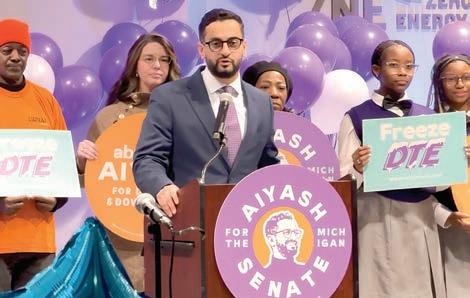
The seat was redrawn by the Michigan Citizens Redistricting Commission following the approved redistricting efforts after being sued for racial bias. The new district map stretches from part of Detroit through Downriver communities including Lincoln Park, River Rouge, Wyandotte and Ecorse.
“All across the district, folks have complained about how large utility bills have been compared to last year, the month prior — people need relief,” Aiyash said. “People have lost trust in government and the Democratic party. This campaign is about rebuilding that trust and delivering on our promises. The consistent concern we’ve heard is it is expensive as hell to live in Michigan and afford to raise a family.”
In its latest rate case, DTE told the state’s public utility commission that it needed to increase customer rates to fund infrastructure investments to improve the reliability of the grid while moving toward cleaner sources of energy generation.
“Natural gas plays a vital role in everyday life — from heating homes to cooking meals,” DTE president and COO Bob Richard said in a statement. “This request allows us to continue investing in the safety and reliability of our system, while keeping costs low for the customers who depend on us for generations to come.”
The rejection of DTE’s justification for raising prices has become a rallying cry for local candidates of both parties, despite the public utility deploying some of the most expensive lobbying of any special interest in the state.
Aiyash’s launch event Monday featured remarks from his endorsers, including Laborers’ International Union of North America members who took the stage at the IBEW Local 58 in Corktown.
Elected officials and candidates in attendance included Detroit City Council member Denzel McCampbell; Detroit state Reps. Donavan McKinney; Tonya Meyers Philips; Sens. Stephanie Chang; Stephanie Young; former Downriver Rep. Jamie Churches; 2nd State Senate District candidate Abbas Aliewu; plus 3rd State Senate District candidates Eboni Taylor and John Conyers III.
The Democratic primary race for the new 1st District seat is shaping up to be competitive.
Award for Innovation and Community Collaboration, highlighting the celebration’s commitment to honoring leaders across disciplines. In addition to the gala dinner and concert, the DSO has launched a multi-year in-
guided your spiritual life begins shifting inward. You become responsible for defining your own relationship with God, Source, or Spirit. That responsibility can feel liberating and frightening at the same time. There is no longer one institution telling you what is right. You must listen to your spirit, your intuition, your lived experience, and what expands your heart rather than contracts it.
This listening process takes time. One of the greatest misunderstandings about spiritual awakening is the belief that you must quickly land on a new belief system. You do not. You are allowed to sit in the in-between space. The space between who you were spiritually and who you are becoming. A space where answers are unfolding rather than fixed.
You may keep parts of Christianity that still resonate. You may release doctrines that feel misaligned. You may explore mysticism, meditation, ancestral spirituality, or other pathways that help you feel closer to the Divine. You may even return to Christianity later with a deeper, more conscious relationship to it. All of these paths are valid because spirituality is not about ideological perfection. It is about authentic connection.
So instead of asking what belief system is right, consider asking what understanding of God, life, and yourself feels most honest to your lived experience right now. That question removes pressure and invites presence. Because belief is not static, it evolves as you evolve. What you believed at one stage of life may not hold at another. That is not betrayal. That is growth.
Justin Onwenu, a Mary Sheffield appointee and the former entrepreneurship director under Mayor Mike Duggan, announced he would run for the seat in October. Onwenu, an environmental organizer who became a city economic development leader, announced Monday he earned endorsements from five of the nine Detroit City Council members.
The dynamic in the race between Aiyash and Onwenu is viewed by politicos as one pitting competing styles of progressivism, with Onwenu attracting the more politically moderate base.
Aiyash said he would aim to put community over corporate interests, proposing free universal childcare for Michiganders and an end to the so-called “zip-code tax” which causes Detroit residents to pay higher auto-insurance prices.
Aiyash said freezing DTE rates is already an active effort happening in Lansing. He pointed to SB 768, introduced last month by Sen. Kevin Hertel, D-Saint Clair Shores, which prohibits utilities from filing a rate case earlier than three years after the utility’s last rate case.
Aiyash says he would push that window to five years, effectively locking the current rate.
“The utilities claim data centers are going to be a massive boom for the state. Consumers Energy commissioned a report claiming that thousands of jobs and up to $5.5 billion could come to Michigan. If data centers are such a good opportunity, working residents who have seen rates go up 120% in the last 20 years, should be getting a break.”
Aiyash’s pitch to lock rates for five years comes as officials from both political parties opposing the public utility’s annual price increases.
Both Republican candidate for governor Tom Leonard and the Democratic frontrunner to become the party’s nominee for governor, Secretary of State Jocelyn Benson, has suggested freezing DTE rates.
“On her first day as governor, Benson would declare an electricity cost freeze to give families relief from excessive energy costs and demand a transparent, accountable rate-setting process,” Alyssa Bradley, communications director for Benson’s gubernatorial campaign, told the Detroit News.
In 2023, Aiyash became the first Arab
teractive exhibition tracing the full arc of Classical Roots, from its beginnings in Detroit’s Black churches to its current stature as a national model of inclusion in the arts. On display at the Max M. and Marjorie S. Fisher Music Center through 2028, the exhibit uses immersive storytelling, historic images, artifacts, and oral histories to guide visitors through five decades of Black excellence in classical music. It is both a retrospective and an invitation to reflect, to honor, and to continue building on what has been created.
Tickets for the March 7 Classical Roots Celebration Gala and concert are available now at dso.org/classicalroots. With a legacy of honoring Black excellence in classical music and a program that continues to deepen its cultural impact, this year’s milestone event offers both a reflection on the past and an investment in the future.
American majority leader of the House of Representatives. He also became the highest-ranking Muslim American in the state’s legislative history.
Aiyash said the piece of legislation he was most proud to pass while serving in the House is his sentencing guidelines laws for prosecutors.
“I created a commission to reform Michigan’s sentencing guidelines that have not been changed since 1988,” Aiyash said. “As a result, the state will waste less money on locking people up for petty crimes and have more balance in the justice system.”
Aiyash was also the lead sponsor on the the clean energy and jobs act, which Gov. Gretchen Whitmer hailed as one of the most progressive climate bills in the country. You can reach Sam at srobinson@ michronicle.com.
You are allowed to outgrow beliefs that once held you. You are allowed to question what you were taught. You are allowed to seek God beyond institutions. You are allowed to rebuild your faith in a way that feels embodied and true to your spirit.
Uncertainty is not the absence of faith. Sometimes it is the doorway to a more conscious one. If you find yourself in a season where Christianity no longer feels like the full truth of your spirit, do not rush yourself into another box just to feel safe. Sit with your questions. Let your soul speak. Let your relationship with the Divine become personal rather than prescribed.
Because faith that is chosen consciously will always feel different than faith that was inherited unconsciously, and wherever you land, let it be rooted in love, expansion, and truth as you have come to know it.

By Ebony JJ Curry SENIOR REPORTER
Wayne County Commission
leaders opened Black History Month at the seat of county government with youth-led performances and a new push to confront toxic chemicals in beauty products that are heavily marketed to Black women.
The Commission’s public observance took place during the regular Wayne County Commission meeting on Wednesday morning, Feb. 5, 2026. inside the Guardian Building in downtown Detroit. Commissioner Angelique Peterson-Mayberry (District 5) hosted the program, which featured nearly 20 students from the Detroit School of Artsperforming tributes through music, poetry and dance.
Commission Chairwoman Alisha Bell said the Commission intentionally centered young people to set the tone for the month.
“Black History Month invites us to honor the past while investing in the future,” Bell said. “Commissioner Peterson-Mayberry brings a deep commitment to culture, education, and community, and I wanted this year’s celebration to reflect that spirit while centering the next generation.”
The program began with a rendition of the Black National Anthem, paired with remarks on the song’s historical significance. A ceremonial pouring of libations followed, honoring ancestors and grounding the observance in spiritual and cultural tradition.
The presentation closed with spoken-word poetry and African drumming and dance, tying Black history to African heritage and cultural connection.
Peterson-Mayberry also credited Commissioner Jonathan Kinloch (District 2) for supporting Detroit School of Arts students’ participation, framing the turnout as a countywide investment in cultural education and youth voice.
“Bringing together gifted youth with reverence for ancestral legacy underscores the understanding that Black History Month is a living legacy—not a
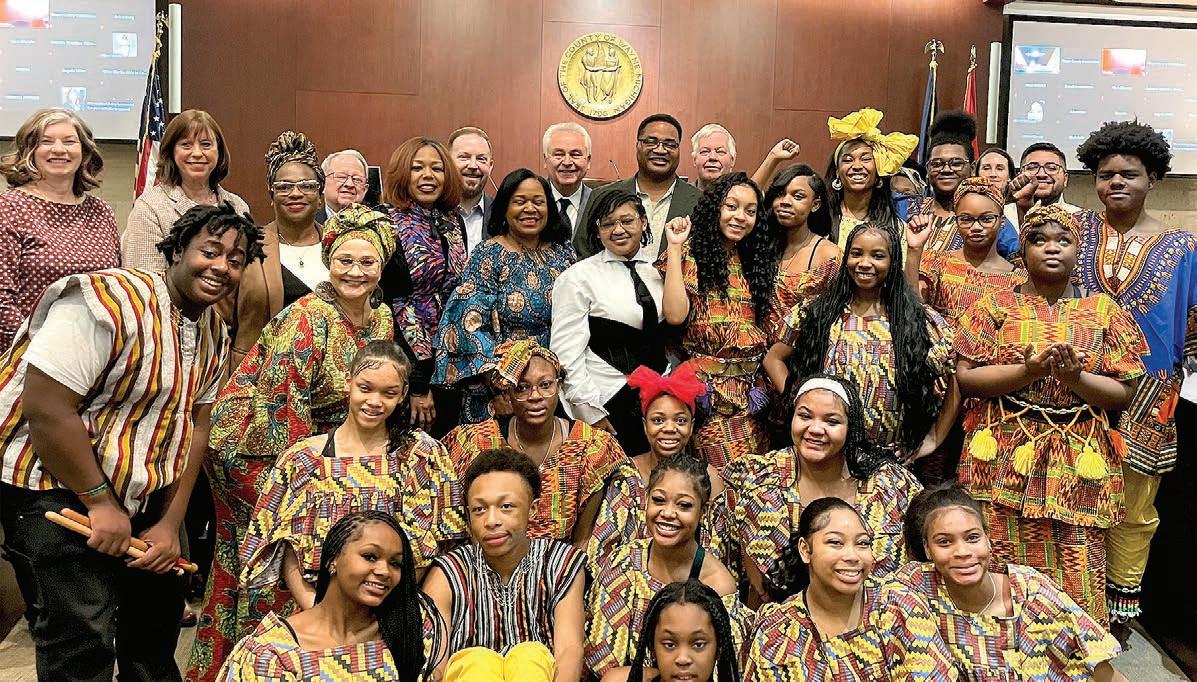
moment confined to the past,” she said. “This recognition connects generations—honoring where we’ve been, celebrating where we are, and inspiring where we are going.”
Alongside the cultural program, the Commission introduced a public health and consumer safety resolution titled “Our Hair, Our Health.” The resolution reaffirms the Commission’s stated commitment to racial equity by addressing toxic chemicals and carcinogens found in certain hair products that are disproportionately marketed to Black women and women of color.
“The Wayne County Commission has a responsibility to protect the health of our residents, especially when preventable risks disproportionately affect Black women,” Bell said. “This resolution reflects our commitment to consumer safety, public health equity, and ensuring that products sold in our communities meet standards that do not compromise long-term health.”
The resolution points to a
Black Information Network
Tennis star Coco Gauff is continuing her commitment to expanding opportunities for Black student-athletes.
According to theGrio, Gauff gifted $150,000 to the United Negro College Fund (UNCF) to support scholarships for competitive tennis players attending historically Black colleges and universities (HBCUs).
The donation, announced this week by UNCF, marks Gauff’s second major gift to the organization. Combined with her $100,000 donation in 2025, Gauff has now contributed $250,000 to help fund the Coco Gauff Scholarship Program, which supports HBCU students pursuing both academic and athletic excellence.
“Education has the power to change lives, and I hope this gift will help students achieve their dreams,” Gauff said in a statement shared by UNCF.

Gauff, 21, became one of the youngest major donors in UNCF history last year when she launched the scholarship program. UNCF leadership praised her continued support and its impact on student-athletes nationwide.
“We are incredibly grateful to Coco Gauff for her generosity,” Maurice E. Jenkins Jr., UNCF’s executive vice president and chief development officer, said in a statement. “Her commitment showcases her dedication to education and athletics and inspires the next generation of student-athletes to pursue their dreams.”
Although Gauff did not attend college, the tennis star said her family’s deep ties to HBCUs motivated her decision to give back.
“My family has a deep-rooted history with HBCUs, going all the way back to my great, great-grandfather,” Gauff said. “From aunts and uncles to cousins, HBCUs have played a huge role in shaping who we are.” Gauff added that representation and access matter, especially for young Black athletes navigating competitive sports.
“As a young Black athlete, I understand how impactful it is to see people who look like me thriving in both sports and education,” Gauff said. “I want to help the next generation continue pursuing their passion for tennis while reaching their academic goals.”
growing body of public health research and community advocacy raising concerns about harmful ingredients in some haircare and synthetic-braiding products. In the Commission’s framing, those ingredients include known or suspected carcinogens and chemicals associated with hormonal disruption, reproductive harm, and increased cancer risk.
Research has repeatedly found that hair products marketed to Black women carry a heavier chemical burden than products marketed to white women. One widely cited analysis linked to Harvard T.H. Chan School of Public Health reporting found about 50% of hair products marketed to Black women contained endocrine-disrupting chemicals, compared with about 7% of products marketed to white women — a gap tied to ingredients such as parabens and phthalates that can interfere with hormones. Separately, a 2025 Environmental Working Group (EWG) review of 4,011 personal care products marketed to Black women found only 21% rated “low hazard” in EWG’s
Skin Deep database, while nearly 80% were rated moderate to high hazard, underscoring how “targeted” marketing can also mean targeted exposure.
For Black women, the issue sits at the intersection of culture, labor, and health. Hair care is not a niche topic in Black communities. It impacts daily life, workplace experiences, school policies, and personal identity. The Commission’s action signals that the county is treating the products sold and marketed in Black neighborhoods as a public health matter worthy of government attention, not an individual consumer problem to shoulder alone.
The “Our Hair, Our Health” resolution also arrives during a period when Black women nationwide have been pressing for stronger oversight of personal care products and clearer accountability across the supply chain — from manufacturers to distributors to retailers. Locally, it places Wayne County’s governing body on record recognizing that beauty standards and beauty markets can
carry consequences, especially when regulation lags behind what consumers and advocates have flagged for years.
The Commission has not announced enforcement mechanisms as of now, yet the move sets up a public pathway for additional steps, including county advocacy to state and federal regulators, consumer education efforts, and partnerships with public health voices and community organizations.
The Feb. 5 meeting served as a reminder of what Black History Month can hold when government does more than issue proclamations.
Youth walked into the Guardian Building and performed Black history as living art. Elected officials used the same meeting to introduce a policy response to a health concern rooted in the everyday reality of Black women. Both actions, taken together, put culture and safety in the same sentence—and in the same room.
Ebony JJ Curry can be reached at ecurry@michronicle.com.
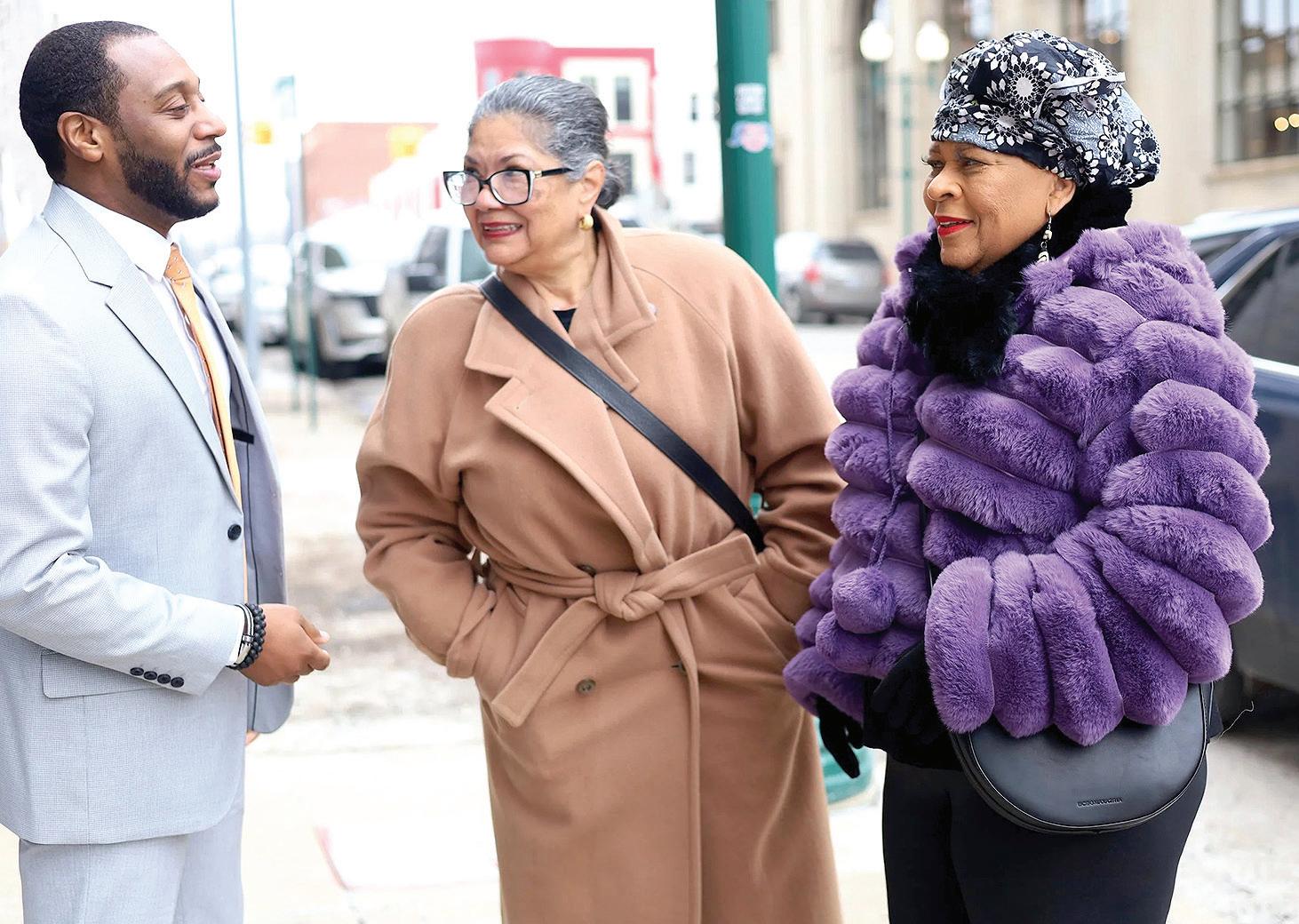
By Chris Jackson PONTIAC CITY COUNCILMEMBER
For nearly 30 years, Pontiac (my hometown) has been recovering from our version of an economic depression.
There is plenty of room to debate and speculate around why Pontiac, and communities like it, have had issues with figuring out the formula for combatting intentional and unintentional harm caused by corporate self-interest and years of compounded, short-sighted decision making. In my role as Pontiac City Councilman, I can only speak to what I have experienced and observed here – though our story mirrors many others.
Pontiac has often tried to be too many things to too many people at the same time. That’s not to say we should limit opportunity or options available to residents as Pontiac is a great example of a modern melting pot of ethnicities, skills, and lived experiences that contribute to the rich fabric of our community. We are still finding our way while remaining proudly and historically a predominantly Black community. Diversity is certainly a strength, but clarity of identity is equally important. If there is ever a time and need for specialization, that time is now. Specialization isn’t new to Pontiac. General Motors once played that role as our economic anchor. The problem was not specialization itself; the problem was overreliance on a single corporate part-
ner to sustain it.
If we are serious about learning from the past, we must acknowledge two realities: specialization provided a pathway to economic stability for generations of Pontiac families, and specialization cannot depend on a sole source of employment. It’s imperative that Pontiac identifies an industry we can intentionally build an identity around. I believe that industry is healthcare.
The healthcare sector offers a unique opportunity for branding, economic development, and long-term stability. Pontiac’s median household income places many of our residents at or near the poverty line, depending on the source, and a real problem is that Pontiac is in Oakland County – one of the wealthiest counties in Michigan.
The demand for healthcare services is growing and most of the new jobs added to the U.S. economy recently were healthcare or healthcare-related positions. This isn’t a temporary trend based on demographics, technology and public health needs. There are two areas where Pontiac can “claim” meaningful territory.
The first is that Pontiac faces a very real public health crisis. Addressing it requires continuous support and resources. In recent years, Oakland County has invested in partnerships with local organizations to move the needle in the right direction. That indicates an appetite to continue investing in finding solutions to public health concerns.
Second, we intentionally build career pathways within the healthcare ecosystem. That includes creating pipelines that begin with early exposure for our youth and extend to accessible on-ramps for adults seeking new opportunities –including returning citizens and individuals impacted by social injustice. From certified nursing assistants and medical technicians to health IT and administrative roles, healthcare offers layered entry points that can scale with the right training and support. To my earlier point, an ecosystem approach safeguards against dependency on a single institution by cultivating a diversified, interconnected network of employers and entrepreneurs. In many ways, Pontiac already has the infrastructure, institutional partners and civic enthusiasm to support Pontiac becoming a regional healthcare hub. As a top-five employment sector in Pontiac, healthcare is the invisible engine of Pontiac’s growth that needs to be made more visible. We have begun taking deliberate steps to activate Pontiac’s medical and healthcare ecosystem, convening partners to establish priorities and implement action plans. With the support of my City Council colleagues and in collaboration with our new Mayor, we are prepared to move from vision to implementation. Beginning with District 1 and expanding outward, Pontiac will be able to tap into a space of profound possibility and opportunity.

CITY OF HIGHLAND PARK
NOTICE OF HEARING ASSESSMENT BOARD OF REVIEW
NOTICE OF HEARING given that the City of Highland Park Board of Review will meet on the following dates and times: Hearings are by appointment only, please call 313-252-0050 Ext 228, to arrange for an appointment.
MARCH BOARD OF REVIEW:
Tuesday, March 3, 2026 10:00 am-11:00 am Organizational Meeting
Monday, March 09, 2026 10:00 am - 4:00 pm Hearings by Appointment
Tuesday, March 10, 2026 10:00 am - 4:00 pm Hearings by Appointment
Wednesday, March 11, 2026 3:00 pm - 9:00 pm Hearings by Appointment
All persons protesting their assessment must complete petitions prior to appearing before the Board of Review. A personal appearance is not required. Written protests to the Board of Review must be received by mail or delivered in person to the Assessing Office by March 11, 2026, at 9:00 pm
The Board of Review will be held in the Treasurers Conference Room on the first floor of the Robert B. Blackwell Municipal Building, 12050 Woodward Ave. Highland Park, Ml 48203
Please come prepared as a ten (10) minute time limit before the Board of Review will be strictly adhered to.

The Detroit Public Schools Community District is seeking qualified contractors for roof installation services under RFP 26-0232.
There will be a pre-bid meeting for this RFP hosted virtually on February 23, 2026, at 3:00 p.m. The conference can be viewed using the following link:
https://tinyurl.com/2s4jwyzr
Call-In: +1 (313) 462-2305
Conference ID: 772 877 554#
There will be a Mandatory walkthrough for this solicitation that will take place on Monday, February 23, 2026.
Bagley Elementary School, at 4:30 p.m., located at 8100 Curtis Street, Detroit, MI 48221.
Please meet in the visitor’s parking lot.
Mark Twain School, at 5:45 p.m., located at 12800 Visger Street, Detroit, MI 48217. Please meet in the visitor’s parking lot.
Proposals are due electronically by 12:00 p.m. on March 10, 2026. Late bids will not be accepted.
A virtual Public Opening will occur at 12:00 p.m. on March 10, 2026, and can be viewed using the below link:
https://tinyurl.com/4pw5mhpb
Call-In: +1 (313)-462-2305
Conference ID: 615 345 178#
This project is subject to Michigan State Prevailing Wage Laws (Michigan Public Act 10 of 2023) and the contractor must pay prevailing wages and fringe benefits to all its contractors, subcontractors, and construction mechanics working on the project in accordance with Michigan Public Act 10 of 2023. All bids must be accompanied by a sworn and notarized statement disclosing any familial relationship that exists between the submitting company and any employee of DPSCD. DPSCD shall not accept a bid that does not include this sworn and notarized disclosure statement.
If you have questions, please contact the Procurement Department at (313) 873-6531.


T
he key to easy preparation of high-quality meals, wasting less food and saving money may already be sitting in your kitchen. For many families, the freezer is for last-minute meal options. However, new federal nutrition guidance and growing scientific consensus reveal a different reality: frozen foods can be the starting point for healthy eating, not a backup plan. That’s why the American Frozen Food Institute (AFFI) is launching “Fresh Thinking About Frozen,” a campaign to help families discover these benefits of frozen foods.
Making Nutrition Achievable
The recently released 2025-2030 Dietary Guidelines for Americans, the nation’s top nutrition advice, emphasizes portion control and nutrient-dense foods. Frozen options deliver on both counts. Families who keep frozen produce on hand tend to eat more fruits and vegetables overall. Pre-portioned frozen meals also help people eat what they need without overdoing it. Plus, the convenience factor matters: frozen berries are ready for a morning smoothie, pre-cut frozen vegetables can be added to tonight’s stir-fry and a balanced frozen meal can be quickly paired with a salad. That isn’t cutting corners. It’s being smart on how best to feed a family well.

The Suburban Mobility
February
from
Bids are due by 3:00 PM ET, Thursday, March 19, 2026.
OPEN ENROLLMENT
Grades PK-6
Noor International Academy 37412 Dequindre Rd, Sterling Heights, MI 48310 (586) 365-5000, www.niapsa.org
Accepting Applications:
M-Fri 03/02 - 3/31/2026, 8 AM–3:30 PM Fri 3/06/2026, 9:00 AM–5 PM & Sat 3/07/2026, 1:00 PM–4:00 PM PUBLIC LOTTERY Fri 4/17/2026 @ 3:30 PM
OPEN ENROLLMENT
Grades PK-12 (Ages 4-18 yrs.)
Universal Academy 4833 Ogden St Detroit, MI 48210 (313) 581-5006, www.universalpsa.org
Accepting Applications: M-Fri 03/02 - 3/31/2026, 9 AM–3:30 PM Fri 3/06/2026, 9 AM–5 PM & Sat 3/07/2026, 1:00 PM–4:00 PM PUBLIC LOTTERY Fri 4/17/2026 @ 1 PM
OPEN ENROLLMENT
Grades PK-12 (Ages 4-18 yrs.)
Universal Learning Academy 28015 Joy Road Westland, MI 48185 (734) 402-5900, www.ulapsa.org
Accepting Applications:
M-Fri 03/02 - 3/31/2026, 9 AM–3:30 PM Fri 3/06/2026, 9 AM–5 PM & Sat 3/07/2026, 1:00 PM–4:00 PM PUBLIC LOTTERY Fri 4/17/2026 @ 11 AM
OPEN ENROLLMENT
Grades PK-12 (Ages 4-18 yrs.)
Star International Academy 24425 Hass & 24480 George St Dearborn Heights, MI 48127 (313) 724-8990 & 45081 Geddes Rd Canton, MI 48188 (734) 331-3081, www.starpsa.org
Accepting Applications: M-Fri 03/02 - 3/31/2026, 8 AM–3:30 PM Fri 3/06/2026, 9 AM– 5 PM & Sat 3/07/2026, 1:00 PM–4:00 PM PUBLIC LOTTERY Fri 4/17/2026 @ 8:30 AM
U.S. District Court, Eastern District of Michigan Administrative Analyst and Case Administrator Vacancy Announcements at http://www.mied.uscourts.gov. Located
Will Your New
(StatePoint) With Apple’s latest smartphone lineup featuring the biggest physical redesign in years, you may be wondering if it’s time for a mobile device upgrade.

New rectangular camera housing on the iPhone Air and 17 Pro models designed to accommodate more advanced camera systems, and 4K video recording in the Pro models, among other fresh features, certainly make the idea of an upgrade appealing. But before purchasing a new device, first check out the results of Allstate Protection Plans’ Breakability Drop and Bend Tests. The independent evaluation used robotic testing equipment to evaluate how the iPhone Air and iPhone 17 Pro withstand everyday accidents. The tests can be viewed online and include the following results: Improved Drop-Ability
Facing the Allstate Protection Plan’s DropBot, which drops devices 6 feet onto a sidewalk, both iPhones showed improved durability when dropped back-down, but still suffered significant damage when dropped face-down.
Face-down drop tests: Both the iPhone Air and 17 Pro shattered after one face-down drop. While both models remained fully functional, the damaged Ceramic Shield 2 front displays were too sharp to use with bare hands. Both iPhones would need their front screens replaced to be usable again.
Back-down drop tests: The iPhone 17 Pro survived one back-down drop with only cosmetic damage, including minor scuffing on its camera housing and along frame edges. The iPhone Air cracked across its rear panel after one back-down drop but was otherwise fully functional. These results are a big improvement from previous glass-back iPhone models, and most likely due to the models’ new Ceramic Shield rear panels.
No Bendgate 2.0
iPhone Air’s slim design raised concerns of another Bendgate, which plagued iPhone 6 and Samsung Galaxy S6 Edge devices. But BendBot, which applies controlled pressure to measure breaking points, discovered bending isn’t an issue.
• The iPhone 17 Pro bent at 200 pounds of pressure and was fully functional after Allstate’s bend test. The iPhone Air bent at 190 pounds of pressure and was also fully functional after the test. Though both models bent at fewer pounds of pressure than the iPhone 17 Pro Max (240 pounds), they were still well above industry standards for bend durability and the stresses most users encounter in everyday use.
• Though the iPhone Air is 35% thinner (0.22-inch depth) than the iPhone 17 Pro, it was nearly as durable in the bend test. This may be due to added reinforcement from its rectangular camera housing and titanium frame.
Watch the iPhone Air and iPhone 17 Pro take on the DropBot and BendBot in a full results video on Allstate Protection Plans’ YouTube channel.
Damage Costlier Than Ever
Smartphones have become the single device people use to capture, store and share their lives. In fact, 82% of Americans say their phone has replaced their digital camera, according to Allstate Protection Plans research. With the iPhone 17 Pro starting at $1,099 and repair costs reaching up to $749 without AppleCare, and the iPhone Air starting at $999 with repairs as high as $699, protecting these essential devices is more important than ever. Visit AllstateProtectionPlans.com to learn how to keep your new device protected from realworld damage.
“Apple avoided another Bendgate, but gravity still wins,” says Jason Siciliano, vice president of marketing at Allstate Protection Plans. “If you’re spending more than $1,000 on a phone, a case, screen protector and protection plan are smart investments.”

Freezing Hits the Pause Button on Fresh Foods
Freezing food only changes a food’s temperature, not its nutrition. Freezing keeps food close to its original state without requiring additives. Produce begins to lose nutritional value right after it’s harvested. Freezing fruits and vegetables hours after harvest pauses nutrient degradation and locks in the vitamins and minerals, so the food remains farm fresh even as it travels across the country to your grocery store. Frozen meals are similarly made with real ingredients and turned into just-cooked recipes then frozen for families to eat when they’re ready. The nutrition community understands this. A recent survey conducted by AFFI found 94% of registered dietitians agree frozen fruits and vegetables are just as nutritious as their fresh counterparts. Another 92% said frozen foods offer a variety of nutritious meal offerings. These findings are central to the “Fresh Thinking About Frozen” message: Frozen is not second-best. It’s simply smart.
Solving the Food Waste Problem
Nearly 40% of food in the United States gets thrown away, according to the nonprofit ReFED. That translates to roughly $1,500 per year per household, straight into the trash along with unused produce and forgotten leftovers. Frozen helps fix that problem. Eight in 10 consumers agree buying frozen helps reduce food waste at home, AFFI research finds. The reason is simple: You use what you need, when you need it and the rest stays perfectly preserved. No more dreading the refrigerator cleanouts and feeling guilty over the uneaten food going into the trashcan.
Time for Fresh Thinking Families already making this shift aren’t settling for less. They’re strategic about nutrition, budget and time. They integrate the freezer into regular meal planning. They feel confident about providing quality foods that are simply frozen. The freezer isn’t a place of last resort. It’s a tool for eating well in real life. Visit frozenadvantage. org/FTAF for tips, recipes and resources to make the most of your freezer.