HOME
Michigan Chronicle
Michigan Chronicle
All Black Everything:
UAW Triple Strike Against Detroit Automakers
A Night of Elegance and Excellence at the 10th Annual Michigan
By Sam Robinson SENIOR REPORTER
By Ebony JJ Curry SENIOR REPORTER
A
Officials told
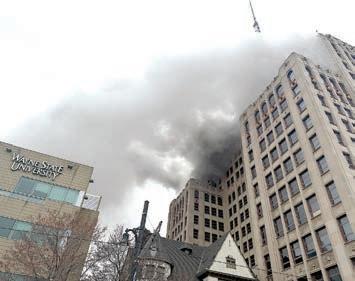
about an hour and a half after the fire started that the flames began on the 99-year-old building’s 11th-floor air handling unit.
By Ebony JJ Curry
“We have a platform outside the 11th floor, it looks like an air handling unit caught on fire, and we received an alarm I think, not sure the exact time, at 1:01pm, and alarm shows us it was the fire in the building. Officers immediately respond.”
SENIOR REPORTER
Late Thursday night, Sept. 14, a historic moment unfolded in American labor relations as the United Auto Workers (UAW) union initiated a strike against Ford, General Motors (GM), and Stellantis. For the first time, the union took simultaneous action against all three major Detroit-based automakers. The action involves approximately 13,000 UAW members in assembly plants across Michigan, Ohio, and Missouri, who walked off their jobs after existing labor contracts expired at 11:59 p.m.
A Michigan Chronicle reporter first captured the scene at 1:06 pm.
Shortly before midnight on Sept. 14, GM released a statement
n a breathtaking celebration of talent, determination, and the unyielding spirit of Black excellence, the Michigan Chronicle marked its 10th Annual 40 Under 40 event Thursday evening. This year’s soirée, drenched in the theme “All Black Everything with Gold Accents,” transcended expectations and essentially illuminated the golden gems within the true essence of Black excellence. Hosted by the charismatic duo of Andre Ash and Lynzee Mychael from Michigan Chronicle’s Finally Friday, the night was a triumph for the city of Detroit and its vibrant community of young Black pro-
The evening sparkled with a golden promise as we celebrated remarkable individuals from various walks of life. Among the honorees were the brilliant and visionary co-founders of Detroit Hives, Nicole Lindsey and Timothy Paul Jackson. Their work has not only changed the landscape of beekeeping and urban farming in Detroit but also exemplified the transformative impact Black professionals can have on their communities.
also expressed disappointment in a statement, saying the company immediately went into contingency mode to protect its operations.
“It’s mostly water damage right now… through the top floors, 11th 10th and 9th,” Wayne State police chief Anthony Holt told reporters, adding that crews will investigate and assess damage throughout the day. “We don’t know about the electrical damage yet.”
oring other outstanding individuals, each carving their own path to success. Clement “Fame” Brown, the creative mind behind Three Thirteen Detroit’s Brand Name, received the prestigious Entrepreneur of the Year Award. Brown’s commitment to empowering the city through fashion and entrepreneurship has left an indelible mark.
By Freelance Contributor
“Entrepreneur of the year – that’s a big deal,” said Brown. “It’s always an honor to be honored and it’s always a blessing to be in a room full of so many talented, accomplished, and popular people that look like me. I’m geeked. I started making and selling clothes as a kid and I always knew that I would have a business, but I never knew it would be Detroit’s brand name business, so I take a lot of pride in the fact that our business represents our city’s pride.”
By Ebony JJ Curry SENIOR REPORTER
“Together we have created a social, environmental, and financial impact through bees,” said Jackson. Lindsey followed that sentiment with, “It is through our local partnerships and collaborative efforts that we exist in over 28 plus locations managing the health of 4.5 million honeybees – humbly speaking our movement has inspired others locally, nationally, and even internationally to take on similar missions.”
Holt said there were no injuries, no classrooms involved. While the Wayne State Welcome Center is open, some professors decided to cancel afternoon classes, students told Michigan Chronicle.
Detroit Fire Department community relations chief James Harris said response time was under five minutes.
Can Reparative Investment Finally Heal the Wounds Left by
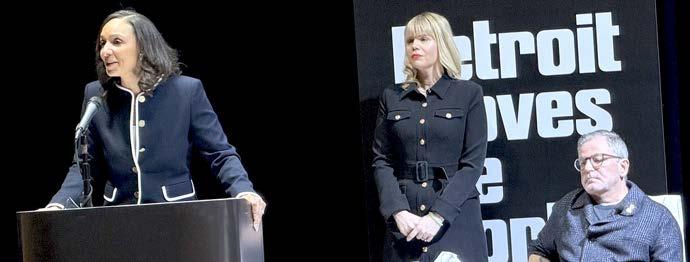
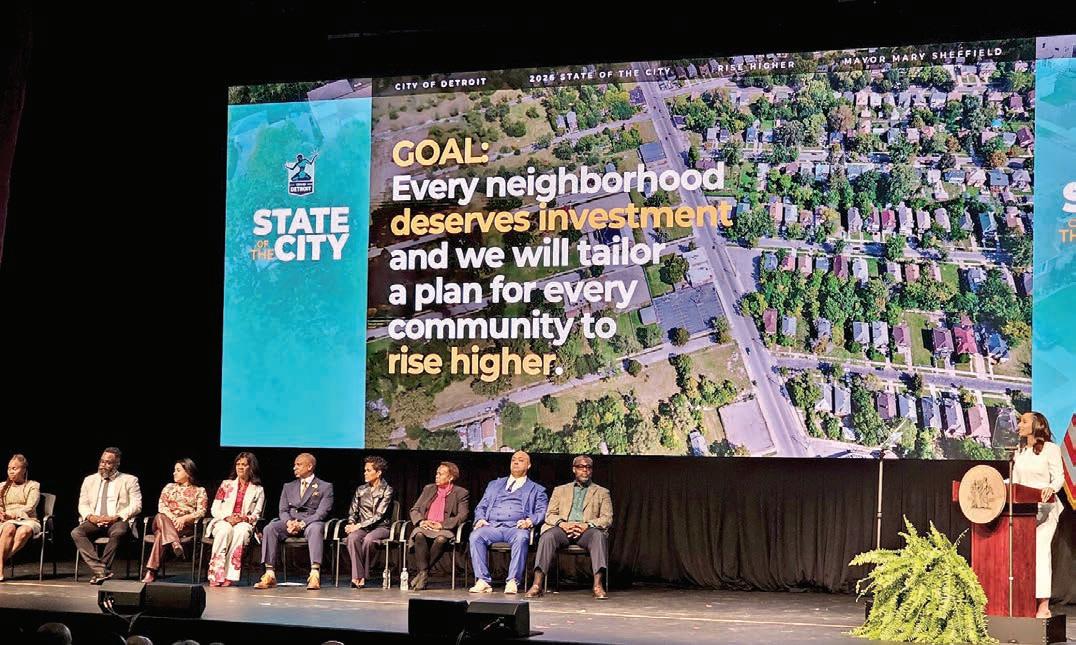
Detroit Mayor Mary Sheffield took her first State of the City back to the west side Tuesday night, delivering the address at Mumford High School in northwest Detroit and signaling that her administration intends to put neighborhoods, not just downtown development, at the center of the city’s agenda.
Taking home the Corporate Excellence Award was Dannis Mitchell, Director of Community Engagement at Barton Malow.
the theme “Leading Through the Voice of the People,” Sheffield said the direction of her administration has been shaped by 18 committees and more than 300 community leaders, an effort she framed as a direct response to residents who want to see their own realities reflected in city policy.
DPD Chief James White Says Increased Police Presence Culled Violence
pate in its first-of-its-kind cash assistance program to support maternal and infant health.”
By Andre Ash
DIGITAL ANCHOR
ness district that had been the lifeblood of the community.
The UAW has branded the industrial action as the “Stand-Up Strike,” focusing on specific plants within each automaker. UAW President Shawn Fain stated, “This strategy will keep the companies guessing. It will give our national negotiators maximum leverage and flexibility in bargaining. And if we need to go all out, we will. Everything is on the table.” Union leaders have also indicated that additional plants could be targeted in future waves if negotiations remain stalled.
For many Detroiters, Interstate 375, or I-375, has long been just another stretch of urban highway, a concrete artery connecting different parts of the city. To some, it’s a mere convenience; to others, it’s an unremarkable part of their daily commute. However, there’s a deeper, far more troubling story beneath the surface of this seemingly ordinary freeway—a story of pain, displacement, and the lasting impact on Black Detroiters.
Detroit Hives, a pioneering organization founded by Lindsey and Jackson, harnesses the power of urban beekeeping to revitalize neighborhoods in the Motor City. Their initiative not only addresses critical issues like environmental conservation but also provides valuable education and employment opportunities to Black De-
“It is so important to recognize that there are young leaders across the country, many that are born here in Detroit. I represent our city nationally and I tell people, ‘Yea I’m a D-girl I’m from the west-side of Detroit,’” Mitchell expressed. “But more importantly, I’ve been able to have experiences within an industry that not many of us, specifically women of color, have the opportunity to engage in and I’ve been the youngest person in the room, the only Black person in the room, and the only Sistah in the room, and I really had to articulate the importance of showing up, giving chances when others won’t, and being persistent.” As a trailblazing Black woman thriving in a predominantly male-dominated industry, her unwavering commitment to fortifying the connections between businesses and Detroit’s communities is unde-
It’s a history marred by pain, injustice, and economic devastation. More than 130,000 residents, primarily Black, were forcibly displaced. Families were uprooted, generational wealth was obliterated, and a thriving community was torn asunder. The wounds inflicted by I-375 run deep, transcending the physical barrier of a freeway to penetrate the very soul of Black Detroiters.
“This administration will ensure Detroit’s future is built block-by-block, neighborhood-by-neighborhood,” Sheffield said. “All too often, economic development is framed as a zero-sum game, where one neighborhood prospers at the expense of another. But we don’t have to pick winners or losers.”
towards mending the wounds inflicted on Black Detroiters and restoring a sense of belonging that was so callously torn away in the past.
The area was surrounded by emergency response vehicles as police closed off traffic on both sides of Woodward from W. Warren Ave. to Farnsworth Street. Shields Pizza and Chase Bank, the building’s street-level businesses, will remain closed until the investigation concludes, he said.
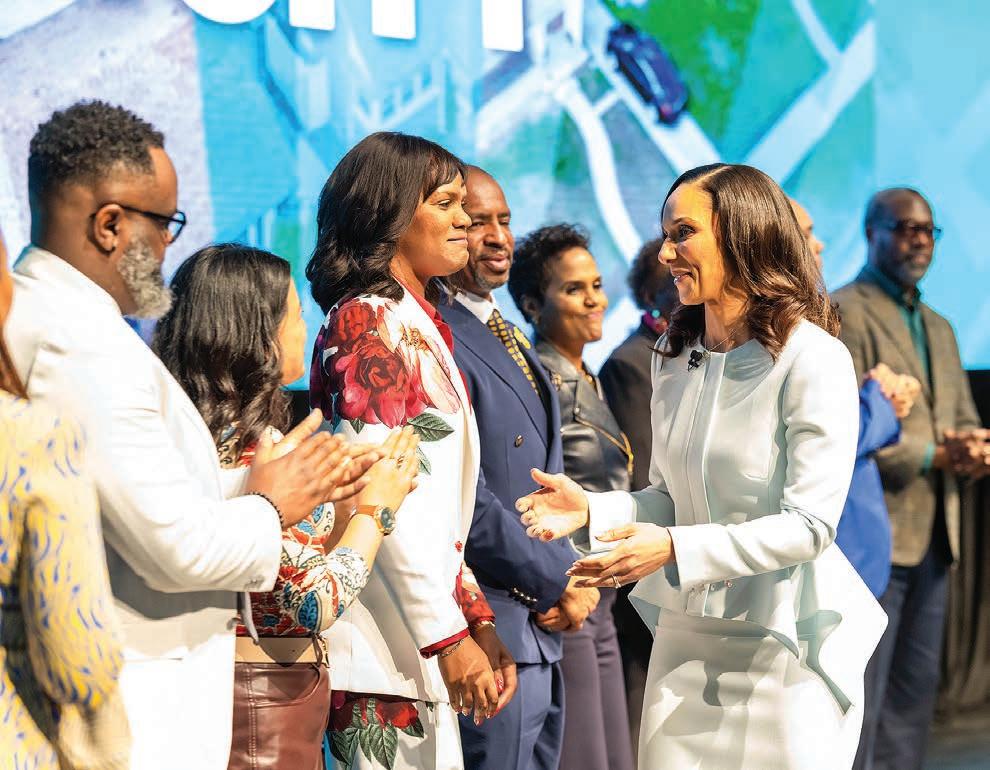
For Sheffield, a west side Detroiter now serving as Detroit’s first woman mayor, the location carried weight. So did the image on stage, where she graced the audience in a powerful skirt suit, a revamping and reimagining of her allwhite pant suit during the investiture back in January. Tuesday night, she stood alongside all members of the Detroit City Council and City Clerk Janice Winfrey, honoring a long-held city tradition as she outlined plans tied to housing, youth investment, public safety, transportation, and wages.
This painful legacy can be traced back to the nation’s interstate highway program of 1956—a program that aimed to connect the country but often did so at the expense of marginalized communities. In the case of I-375, it meant carving a path through the heart of Black Detroit, reinforcing segregation, and perpetuating inequality.
A string of shootings in Greektown in mid-April left both visitors and residents of this bustling downtown destination in awe. One of these shootings tragically claimed the life of a popular and beloved security guard following a dispute with a patron. The male suspect allegedly shot the guard before fleeing the scene, while his female companion is accused of concealing the weapon in her bra.
The I-375 Boulevard Project is about more than just correcting historical injustices; it’s about redefining the future. It will connect downtown Detroit to surrounding neighborhoods, bridging the gap that was placed upon the city decades ago.
She said more than 1,200 applications had been paid out, and over $1.6 million had already gone to families. Figures shared by the administration also showed that by March 31, the program had delivered about $1.8 million and enrolled 1,353 families. In Detroit, where nearly half of children under age 5 live below the poverty line, that support lands as more than policy language. It is rent money, grocery money, diaper money, utility money, and breathing room during one of the most vulnerable periods in a family’s life. Sheffield also acknowledged the advocacy that helped bring the program to Detroit, reinforcing that this was pushed into place by people who understood the stakes and demanded action.
All Hands On Deck to Combat Homelessness
By Andre Ash DIGITAL ANCHOR
The QLine streetcars were temporarily suspended due to the fire, the rail announced on social media.
About 60 firefighters and medics were outside of the building, Harris said.
The tale begins in what is now Lafayette Park, once known as Black Bottom—a neighborhood rooted in African-American culture and history. Named after its dark, fertile soil, Black Bottom flourished during the mid1900s, nurturing the dreams and aspirations of prominent Detroiters like Coleman Young, Joe Louis, and numerous other Detroit legends. But in the name of urban renewal in the 1950s, this vibrant neighborhood was systematically dismantled, erased from the map, and replaced by a lifeless stretch of asphalt.
Inside the Jemele Hill Auditorium in the Schulze neighborhood, Principal Nolan Proctor opened the evening with a welcome and thank you before Greater Emanuel’s youth choir serenaded the room with “The Star-Spangled Banner.”
A Holistic Approach to Providing Shelter and Support for Detroit’s Unhoused People
For Black Detroiters, that line gets to the center of the question hanging over this administration. For decades, many residents have watched splashy investments capture headlines while neighborhoods still carried the burden of vacancy, crumbling infrastructure, overassessments, low wages, unreliable transit, and limited access to healthy food and retail. Sheffield’s speech attempted to answer that frustration with a long list of commitments, executive orders, and budget priorities aimed less at spectacle and more at the everyday conditions shaping life in Black Detroit.
These incidents unfolded during an unseasonably warm spring, leading to increased pedestrian traffic and heightened tensions in the densely populated downtown area.
For one to aptly recognize the harm caused by such projects, it is vital to note that some of the planners and politicians behind those projects built them directly through the heart of vibrant, populated communities—oftentimes to reinforce segregation and sometimes as part of a direct effort to replace or eliminate Black neighborhoods.
Today, the resurgence of Paradise Valley stands as a testament to the indomitable spirit of Black Detroiters and the enduring legacy of Black excellence. This historic district, once a vibrant hub for Black businesses and culture, is experiencing a renaissance that harkens back to its glory days. The destruction of Black Bottom may have torn apart a thriving community, but the resolute determination of a new generation of entrepreneurs and visionaries is reclaiming that lost legacy.
Sheffield tied that same economic urgency to wages. She said 64% of Detroiters working full-time still do not earn a livable wage, a reality that continues to define life for many Black workers in the city.
The surge in crime and the influx of visitors to Detroit’s downtown core garnered the attention of the Detroit Police Department (DPD), catching them somewhat off guard.
“We’re built for this, it doesn’t matter the age of the building or how many flights, this is what we do,” Harris said. “The men and women of the Detroit Fire Department did an awesome job — no one’s injured, everybody got out okay.”
Fain clarified the union’s strategy: “I want to give a major shoutout to the thousands of members who are on the picket lines right now fighting for all of us. The Stand-Up Strike is a new approach to striking. Instead of striking all plants at once, select locals will be called on to stand up and walk out on strike. This is our generation’s answer to the movement that built our union – the sit-down strikes of 1937. We told the Big 3 that Sept. 14 was the deadline and we meant it. We gave the companies our economic demands eight weeks ago and it took more than a month to get to the table.”
Sheffield then opened her speech by acknowledging her family, her husband, the city’s first First Gentleman, and journalist Jemele Hill, the Mumford alumna for whom the auditorium is named.
That setting mattered.
Students, residents walking their dogs, and people waiting for their bus at shelters
The union is pushing for a comprehensive list of demands. This
Homelessness continues to plague urban communities, with families and individuals grappling with the challenges of making ends meet in today’s economic climate. Whether it’s struggling to meet monthly mortgage payments or coping with soaring rental costs in a housing market marked by shockingly high prices, a variety of factors contribute to the growing issue of people becoming unhoused.
While the residential areas bore the brunt of this demolition, the heart of Black Bottom, its thriving business center, remained largely untouched. Restaurants, theaters, clubs, and bars—the very places that brought Detroit’s Black community together—were concentrated around Hastings Street, the epicenter of African-American culture in the city.
Sheffield did not bring her first State of the City to a downtown stage or a corporate hall. She brought it to the west side, where her own roots run deep, and used that backdrop to make a point about what kind of mayor she intends to be. Under
Meagan DunnJulie Schneider
Historically, shelters have provided a temporary respite for those in need, often serving as the first or second option after exhausting alternatives like staying with friends or family. Shelters offer a place to rest one’s head and a warm meal, albeit sometimes for extended periods. For others, being unhoused means living in cars or makeshift outdoor
Then, in a cruel twist of fate, Hastings Street, too, was obliterated a few years later, making way for the construction of I-375. This marked the final blow, sealing the fate of Black Bottom and signaling the beginning of the end for Paradise Valley, the Black busi-
Housing Resource Helpline in response to the challenges that residents face in navigating the complex system of housing services. The helpline provides a single point of contact for people seeking housing assistance and connects them with the resources they need.
But now, after decades of enduring the scars of I-375, there is a glimmer of hope on the horizon. Plans have been unveiled to transform this once-divisive freeway into a vision that seeks to right the wrongs of the past while heralding a new era of inclusivity and community revitalization.
One of the strongest parts of the speech centered on poverty and what it means to raise children in a city where too many families are stretched thin before a baby is even born. Sheffield returned to Rx Kids Detroit, a direct cash assistance program for pregnant mothers and babies that she has made a signature part of her opening months in office.
In response, she highlighted her fourth executive order, which would ensure that, effective July 1, no public servant in the city earns less than $44,616 a year, or $21 an hour.
James White, Chief of Police for the Detroit Police Department, said: “We were caught somewhat flat-footed right out the gate. By design we went into the spring deployment, which is less than the mid-summer deployment, and saw we say an uptick in violence that first warm weekend.”
Support for the helpline comes from the Gilbert Family Foundation, which has pledged $10 million over three years to fund the program. Wayne Metro Community Action Agency manages the helpline, making it accessible to all Detroit residents. This initiative simplifies access to the City’s various housing services, ensuring that residents in need can easily find assistance.
“Pregnancy should not mean poverty but all too often it does,” Sheffield said. “Detroit is now the largest city to partici-
Fueled by more than $100 million from the Infrastructure Investment and Jobs Act and other partners, this ambitious project aims to create jobs, remove barriers to economic growth, and reconnect the neighborhood with the rest of Detroit. It is a step
By Sam Robinson SENIOR REPORTER
By Lynzee Mychael MULTIMEDIA JOURNALIST
The causes of homelessness are as diverse and complex as the individuals experiencing it. In response, the City of Detroit has adopted a holistic approach to combat this issue.
The Michigan Democratic Party’s endorsement convention on April 19 will determine the Democratic candidates who will face Republicans in the November general election.
“Providing services and high-quality housing to persons at risk of or who are experiencing homelessness is a key priority of the City of Detroit, said Julie Schneider, Director of Detroit’s Housing and Revitalization Department.
What a Federal Government Shutdown Could Mean for Detroiters?
“The city and its partners offer a lot of great services to help Detroiters with their housing needs, but they don’t mean much if people don’t know how to access them,” said Mayor Mike Duggan. “Thanks to the efforts of our partners and the generous support of the Gilbert Family Foundation, we now have a simple process to guide residents to the right housing resource and a growing number of programs to help them.”
Members at the convention will pick candidates for statewide positions, not including the governor.
“This means focusing on building the pipeline of supportive housing and coordinating with the Continuum of Care on the delivery of critical resources such as emergency shelter, rapid rehousing, and diversion and prevention programs. It also means preserving and expanding affordable housing options for Detroiters of all incomes and improving housing stability though comprehensive service offerings available through the Detroit Housing Resource HelpLine and Detroit Housing Services Division within HRD.”
In May 2023, the City of Detroit launched the Detroit

Under Michigan law, Democratic and Republican candidates for most statewide positions are elected not by voters but by members at a party convention. Political parties hold state conventions in even-numbered years to nominate candidates for certain offices.
The Gilbert Family Foundation’s broader commitment involves pledging $500 million to support projects across Detroit over the next ten years, with housing initiatives being a significant part of their contribution.
Notably, Detroit has witnessed a consistent decrease in recent years, with the number of unhoused residents steadi ly declining. In 2019, approximately 7,847 people were unhoused and entered the City’s community response system. In 2021, about 5,687 people experienced homelessness.
Those offices include the Secretary of State, the Attorney General, the State Supreme Court, the State Board of Education, the Michigan State University Board of Trustees, the Wayne State University Board of Governors, and the University of Michigan Board of Regents.
From the days of the Great Migration when thousands of Black families flocked to Detroit in search of jobs and a better life, to the pivotal role they played in the city’s cultural and musical heritage, Black Detroiters have left an indelible mark on the city. However, in recent years, Detroit has experienced significant gentrification, which has raised concerns about the displacement of long-standing Black residents. Similar to a setting sun, there’s a rising spirit, and Black Detroiters are reclaiming their place in the city, despite the challenges posed by gentrification.
According to the City of Detroit, since the start of the fiscal year 2019 to 2021, Detroit saw a 28% decrease in the
Running for Michigan Secretary of State include Whitmer appointee Suzanna Shkreli, Ingham County Clerk Barb Byrum, and Lt. Gov. Garlin Gilchrist. Washtenaw County Prosecutor Eli Savit and Oakland County Prosecutor Karen McDonald are running for Michigan Attorney General.
During the Great Migration, thousands of Black families from the South came to Detroit in search of jobs in the booming automobile industry. Despite facing discrimination and segregation, they built vibrant communities on the city’s east
and west sides.
Chief White attributes the violence in Greektown to a combination of weather conditions and a surge in population.
“Detroiters who put in a full day’s work shouldn’t have to work 2 or 3 jobs just to meet their most basic needs,” Sheffield said. “As Mayor, I believe in the dignity a living wage can provide, and I’m leading by example.”
She said the increase will affect more than 900 city employees and credited
In the heart of Paradise Valley, Blackowned businesses are not just flourishing but thriving, offering diverse services, products, and experiences that pay homage to the past while paving the way for a prosperous future. From jazz clubs to soul food restaurants, the Black Press, and art galleries to fashion boutiques, this revival is breathing life into the very essence of what once made this neighborhood a vibrant cultural epicenter. It’s a resurgence that extends beyond brick and mortar; it represents the resurgence of a spirit that refuses to be subdued.
Detroit City Councilman Fred Durhal III, representing District 7, where Eastern Market resides, told the Michigan Chronicle, “It’s still very early in the process, MDOT is
He explained, “ We saw numbers downtown that we have not seen, ever. People are emerging from COVID and there’s a feeling that we’re in a post-COVID era… and with the venues downtown and the reasons to come down with all the activities that are going on, we saw hundreds of more people and, in particularly, young folks, teenagers that we hadn’t seen.”
Responding swiftly to the surge in violence, DPD adjusted its deployment plans. Rather than waiting for mid-summer, they deployed officers in the spring itself to address the situation. The rise in visitors to the Greektown area is evident in data from Placer.ai, a location analytics company specializing in visit trends and demographic insights through geolocation-enabled mobile devices. From May 1-Aug. 27, 2022, there were 1.3 million visits and 655,000 visitors to Greektown, according to Placer.ai. In the same period this year, these numbers increased to 1.4 million visits and 670,000 visitors.
Eaton County Prosecutor Doug Lloyd were selected by MIGOP members last month as Republican candidates for Secretary of State and Attorney General.
Who Democrats pick at the April 19 endorsement convention will set the matchups for the general election in those races.
As Detroit’s downtown area continues to attract both residents and visitors, the police department has implemented various enforcement measures to manage the increased population. Notably, metal detectors have been strategically placed throughout Greektown to deter the illegal carrying of firearms.
Michigan Democratic Party affairs director Sarah Woolsey talked to Michigan Chronicle about how the convention works and how members of her party are feeling heading into a consequential midterm in November.
because of discrimination, but they were also coming because Black people was doing some stuff. When did Black people start doing things in the city? They started doing things in this area in the 1800’s. In the 1800’s the major thing that they were doing in Detroit is they were the leaders in the fight against slavery. The Underground Railroad is the root in the city of Detroit to all of this Black innovation that you see coming later.”
“We have strategically placed them at key points, “ Chief White explains. It has been a deterrent for some, and some have tested it. If you are legally carrying a weapon and carrying a CPL, have a great day. If you’re
Musical legends like Aretha Franklin, Marvin Gaye, and the Motown sound emerged from Detroit, providing a soundtrack for the civil rights movement and inspiring generations. Motown Records, founded by
a
churches were here, black schools were here, and its was Black businesses here,” said Jordon. “They were coming of course
Gordy Jr., was not
but a
and
“We as a party are laser focused on the midterm election, and all of the races we have on the ballot up and down the ticket,” Woolsey said. “There are additional statewide seats that are part of the general primary process as well. We’re going to be welcoming candidates from governor and (U.S.) Senate to all of our endorsement candidates to state legislative and city folks as well. It’s a great opportunity for us to show the enthusiasm that Democrats have and that we are feeling confident going into this midterm.” What to know before you go Delegates are made up of party members. To confirm your MDP membership, complete
of
However, as Detroit faced economic decline and population loss in the late 20th century, many
DPD Chief James White
Amidst the glitz and glamour, the event also showcased the diversity of talent within our community. From Paris T. Prichard, a forensic scientist pushing the boundaries of her field, to math wizards like Donna Laster, who
Detroit Fire Department community relations chief James Harris.
Photo: Sam Robinson
the rights of all women are continued.
Councilman Benson with partnering on the city employee raise. In a majority-Black city where public workers often hold together essential services while struggling to afford life in the communities they serve, that commitment carried both policy and symbolic weight.
Elected officials are also working to keep Roe v. Wade intact thus holding off Michigan’s 1931 trigger ban. Governor Gretchen Whitmer released a statement saying, in part:
Sheffield also placed young people squarely in the center of her speech, especially when it came to transportation and afterschool access. Beginning April 1, she announced, all K-12 students in Detroit can ride DDOT free through the city’s new “Show Your ID, Ride for Free” program. The rides will be available seven days a week, 365 days a year.
what the Supreme Court will rule in the upcomingsion, advocates on both sides of the argument are willing to continue their
“PPMI has been preparing for this moment since the results of the 2016 election were final. We recently filed a lawsuit to stop the 1931 law from going into effect, and we’ve also asked the state courts to affirm that the Michigan constitution does already contain a right to abortion. Our advocacy arm, Planned Parenthood Advocates of Michigan, is a founding member of the coalition that launched Reproductive Freedom for All, a ballot initiative to affirm the right to abortion and reproductive freedom in the state constitution,” said Vasquez Giroux.
“The words ‘Roe overturned’ are no longer theoretical. I want every Michigander to know— no matter what happens in D.C., I’m going to fight like hell to protect access to safe, legal abortion in Michigan…”
“The money currently spent on bus fare will go to afterschool programming,” Sheffield said.
Her administration is also investing $2.2 million in afterschool programming and says it is working to ensure those programs exist within a two-mile radius of all Detroit public schools. For Black Detroit families, that matters because transportation is often the hidden barrier sitting inside every other barrier. It affects attendance, enrichment, and employment for older students, and whether young people can safely move through the city without placing one more financial burden on households already doing too much with too little.
“The bottom line is that we will do everything in our power to keep abortion legal in Michigan, and if SCOTUS makes that impossible, we will do everything we can to ensure our patients can access the care they need.”
From page A-1 From page A-1
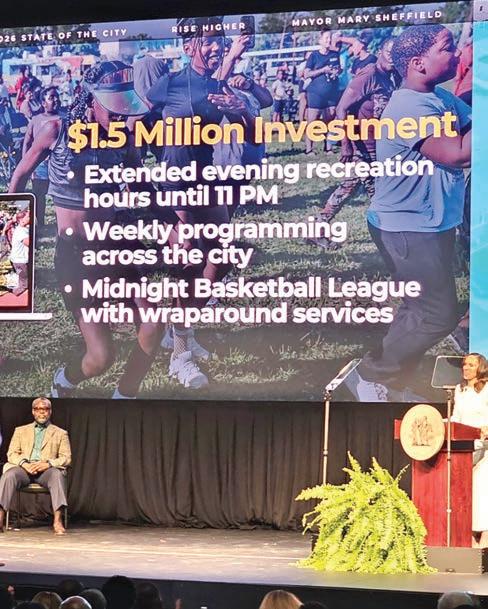
Sheffield pushed that youth conversation further into violence prevention. She highlighted her executive order establishing the Office of Neighborhood Safety and announced “Occupy the Summer,” a summer violence prevention strategy backed by a $1.5 million investment. She also said recreation centers will stay open later, with evening hours extended until 11 p.m., alongside weekly programming across the city and midnight basketball.
islature adopts it.
corporate boards to have more diverse representation and pass the legislation.
More than legal implications, overturning Roe v. Wade would impact several systems across the spectrum. With the potential to drive both foster and adoption numbers upward, a ban on abortions could leave many women to choose a less safe route restoring ‘back alley’ and illegal abortion practices, including self-abortions. Moreover, African American women and women of color, who already have a long-storied history with access and inclusion in medi-
Those moves matter in Black Detroit because residents have spent years saying that safety has to be built before a crisis, not only addressed after it. Open rec centers, structured programming, credible adults, and real summer investment do not solve everything, though they can interrupt the conditions that leave too many young people vulnerable when school is out, and options are limited.
Still, Sheffield also leaned into more traditional public safety responses. She pointed to what city officials are calling a 60-year decline in crime and announced that the Detroit Police Department will establish a property crime squad in all 12 precincts.
“Overturning Roe v. Wade would be a terrible break with nearly 50 years of judicial precedent and – more importantly – a blow against individual freedom. It is my hopeings of this draft. If that is not the case, we need toity Leader Schumer and Gov. Whitmer in support of their efforts to preservetive freedom,” said Chair Alisha Bell, on behalf of -





6,300 requested sidewalk repairs. She also committed to clearing dead and dangerous trees in neighborhoods, crediting Council President James Tate with pushing the tree cleanup effort, and pointed to a neighborhood beautification program designed to improve block-level conditions residents see every day.
Sheffield also announced “Brighten Up the Block,” a plan to install 3,000 new streetlights in neighborhoods this summer after residents and block clubs asked for more lighting.
Beyond the scope of pro-choice versus prolife, the fight for reproductive choice is one of freedom. As Michigan officials work to ensure each woman who finds herself in the position to choose has access to care without the threat of legal action, many wonder
“We also know that well-lit neighborhoods are safe neighborhoods,” Sheffield said. “Residents will have the opportunity to participate directly in community engagement sessions that will start next month. The goal is to begin installing these new streetlights this summer.”
The health committee recommends reviewing state licensure policies to address the barriers that Black psychologists face in obtaining licensure in Michigan.
the membership verification form. To meet the deadline to be eligible to vote, membership must have been established by 11:59 PM ET on March 20.
A full schedule for the convention can be found on the Michigan Democratic Party’s website. Woolsey says the party will be communicating with every member who is eligible to vote as much as possible in the lead-up to the convention.
Increase school funding: Statutory changes to increase the School Aid Fund revenue by at least $3.6 billion and establish a permanent weighted funding formula based on student and community needs and universal preschool (0-3).
“One of the things I’ve heard from residents is that they are also concerned with property crime, so I have directed DPD to create a property crime squad in all 12 precincts,” Sheffield said. “In addition to this new focus, our neighborhood police officers will be more visible and present in every neighborhood to build trust and enhance the overall quality of life for Detroiters.”
More information will hit the website, and the party will host informational sessions the week of the convention, Woolsey said.
Better collection and analysis of criminal justice data: BLAC recommends data collection and professional analysis be initiated with the assistance of our Attorney General, Michigan Commission on Law Enforcement Standards (MCOLES), Association of Michigan Prosecutors and other stakeholders to collaborate, collect and analyze data strategically.
In a city where far too many Black residents have had to organize for basic infrastructure that should already be there, those commitments go beyond appearance. Better lighting, repaired sidewalks, and cleared trees affect whether people feel safe walking home, whether seniors can move safely down the block, and whether neighborhoods are treated as places worth maintaining instead of simply managing.
Ensure equitable distribution of state health funds: Ensure all Michigan communities with a significant Black population receive adequate funds to address mental health issues.
She also said the city’s mental health co-response team will expand to operate around the clock.
“For the first time, this blended unit of police officers and mental health professionals will be operating 24 hours, 7 days a week,” Sheffield said.
For Black Detroiters, that piece of the speech mattered because residents are often forced to navigate two truths at once. They want violence down and neighborhoods safer. They also want fewer situations where mental health crises are met with force instead of care. A 24/7 co-response unit signals at least some recognition that public safety has to be broader than policing alone.
Ban no-knock warrants: Urging the House Government Operations Committee to hold hearings on HB 5013 and other legislation that would ban or limit the use of noknock or quick knock warrants, and urging the state legislature to pass meaningful reform and advise Gov. Whitmer to sign the bill after the leg-
the chancellor embraces.
Reject censorship in history instruction: Encouraging Gov. Whitmer to ensure the goal for Michigan schools should be history instruction that is presented by professionals with the subject matter expertise, pedagogical skills, and judgment necessary to present complex information to students that are grounded in provable facts and add to the understanding of modern-day America.
Protecting Black voting rights: Urge state officials to remain vigilant in the fight against schemes to disenfranchise Michiganders of color.
Older Detroiters were also central to Sheffield’s speech. She announced senior advocates to ensure residents’ needs are being met, a plan to bring 65 senior buildings into compliance by August, and a senior food program that will provide free fresh fruits and vegetables to senior buildings citywide. In Black Detroit, where many seniors are aging on fixed incomes and often carrying the quiet burden of housing, food access, and mobility concerns, those promises carry real weight. City policy that overlooks seniors overlooks the people who helped hold entire communities together.
There’s no additional registration required to vote — as long as members joined by March 20 or were eligible for a 30-day waiver, like precinct delegates, you’re eligible to vote at convention.
Members must also become successfully credentialed through the party’s electronic voting system in order to vote at the endorsement convention. Once a member gets credentials onsite, they will receive instructions to access the electronic voting system.
Credentialing will begin at 10 am Saturday, April 18, through the start of the legacy dinner, which starts at 6 pm. Obtaining credentials on Saturday means there’s no need to do so on Sunday morning, Woolsey said. Members will be able to obtain credentials from 7 a.m. to 2 p.m. on Sunday, the day of the convention.
Voting occurs at the general session at 3 pm.
Increase mental health supports for the Black community: Recommending Michigan set a goal of increasing the number of Black mental health service providers by 20% each year over five years.
Housing remained one of the clearest pillars of Sheffield’s address. She described the city’s housing agenda as rooted in the need for homes that are “safe, affordable, and accessible.” She noted that 3,000 new affordable housing units have been built over the last 10 years, though she made clear that the pace is still not enough for a city with mounting needs.
“In just about every conversation I have across this city, I hear someone say, ‘Mayor, we need more affordable housing,’ and they’re absolutely right,” Sheffield said. “We need more housing that is safe, affordable and accessible because when families have stable housing, our neighborhoods grow stronger, our children are more successful in school and families can build generational wealth.”
“BLAC members have worked hard to identify the needs of the Black community and we feel these recommendations will provide a solid first step towards breaking down barriers in education, community safety, health and business,” said BLAC Co-Chair Dr. Donna L. Bell.
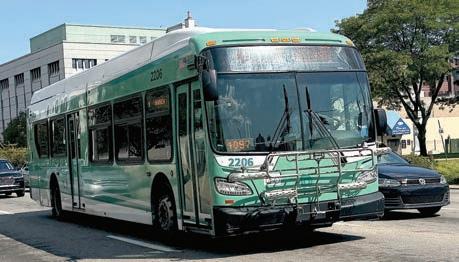
Transit remained another major theme. Sheffield said DDOT currently has 45 new buses in service and is scheduled to receive 80 more over the next two years, with a goal of having 240 buses operating daily. She also announced a $30 million increase in the transportation budget, along with plans to add 175 new benches and upgrade 100 bus shelters.
That matters because Black Detroiters are among the primary users of city transit. Reliable buses shape whether workers arrive on time, whether seniors make it to medical appointments, whether students get to school, and whether daily life requires impossible tradeoffs. Transit is not an add-on to equity in Detroit. It is one of its clearest tests.
BLAC will hold a virtual town hall meeting to discuss its policy recommendations on Thursday, May 12 at 4 p.m. Join BLAC and a virtual audience in discussing the recommendations to support the Black community.
“We encourage people to come early to get a lay of the land,” Woolsey said. “When folks approach the main entrance of the Huntington Place, kind of that circle near Jefferson, those entrances are where we’ll be. We’ll have signs and volunteers directing you to our credentialing area.”
On Sunday, caucus meetings are held at 9 am and 10:30 am. There will be a lunch break, and then Congressional district meetings at 1 pm before the 3 pm general session, which is where the endorsement vote actually happens. Caucus meetings Woolsey says there will be a schedule available on the party’s website of who’s meeting when and where throughout the convention hall.
She tied that need to several concrete moves: a fast-track PILOT process, a new round of down payment assistance now open to 450 more residents, and an executive order directing 100% of proceeds from the sale of city-owned commercial property into the Affordable Housing Development and Preservation Trust Fund. Sheffield said that change will add roughly $4 million this year to support affordable housing development and preservation.
She also pointed to the Detroit Housing for the Future Fund 2.0, a $50 million investment led by LISC, and signaled an intent to modernize zoning rules to make it easier and quicker to build housing. For Black Detroit, these are not abstract land use conversations. They touch families trying to stay in neighborhoods where they have deep roots, renters dealing with unstable costs, and longtime homeowners still living with the consequences of overassessment, tax foreclosure, and disinvestment.
“I think of transformational leadership as a thoughtful approach that causes people to change but also causes the systems and circumstances they are operating in to change too,” Ivory said. “Transformational change doesn’t just ask people to do certain things; it asks them to change their view of what’s possible and excites them to drive that change together because they believe that what they’re doing will create positive change for everyone. That’s how entire systems change because people believe that they need to for themselves and others to live better lives.”
“Chancellor Ivery is a true transformational leader and an outstanding CEO, who is more than worthy of the CEO of the Year Award he just received, “ said Prof. James C. Mays, who teaches entrepreneurship and supply chain management at WCCCD’s Corporate College. “In his 27 years at WCCCD, Dr. Ivery has elevated WCCCD to become nationally recognized for excellence and innovation and preparing our students professionally and personally to do great things in the world.”
Sheffield also highlighted an executive order aimed at making assessments better reflect the true value of property. That policy point may sound technical to some audiences. In Detroit, it is not. Property assessments have long been a source of pain in Black neighborhoods where inflated values contributed to overtaxation and the stripping of wealth from families who were already fighting to hold onto their homes.
The mayor broadened the housing discussion into a larger vision for neighborhood investment through what she called the Neighborhood Anchor Plan, built around three pillars: stabilize, strengthen, and grow.
“Every neighborhood deserve investment,” Sheffield said, returning again to the central message of the night.
That same neighborhood-centered framing showed up in infrastructure and quality-of-life commitments. Sheffield highlighted an $8 million investment to clear a backlog of
State of the City Electrical Fire
on Woodward near W. Warren took out their phones to capture the huge smoke clouds that could be seen for miles away from the building downtown and in New Center.
The building is known for its Art Deco style and ceiling mosaics in the lobby. Designed by Albert Khan, the building first housed the Maccabees, a fraternal organization that at one point had 200,000 members in North America.
The building, first opening to tenants in 1927, also housed a news radio station, WGHP, which switched its call letters to WXYZ in 1930. Nearly twenty years later, the station began broadcasting television from the building. Check out HistoricDetroit.org for more information on the historic Maccabees Building.
You can reach Sam at srobinson@michronicle.com.
Sheffield also made a direct pitch for small business growth, saying she wants Detroit to become “the best place to start and grow businesses.” She highlighted Motor City Match, the Detroit Legacy Business Project, the Detroit Startup Fund, and the Green Grocer program, which she said will help open five more small grocers this year. She thanked Councilman Coleman Young II for advocating for the grocer program and said many business owners are not simply asking for grants. They are asking for a city that moves with urgency.
Despite available resources, Sheffield said business owners need faster permitting, simpler zoning laws, and operational support to scale.
“Growth without access does not drive success,” Sheffield said.
BLAC is housed in the Michigan Department of Labor and Economic Opportunity. Members represent many professional backgrounds, including economics, law, public safety, health and wellness, arts and culture and media. They leverage their experiences and expertise to make recommendations to the governor on critical issues affecting the Black community.
That line may have been one of the most important of the night. Detroit has heard years of talk about growth. Black Detroiters have often had to ask who that growth is really for. Sheffield’s framing suggested that if city systems stay too slow, too confusing, or too uneven for neighborhood entrepreneurs, then development will remain concentrated in the same hands and in the same corridors.
To learn more about BLAC and this upcoming event, visit www.michigan.gov/BLAC.
She also tied the city’s future to a broader population strategy. Working with Dan Gilbert, Sheffield announced a “stay, return, move” growth plan meant to help current residents remain in Detroit, attract former Detroiters back, and encourage new residents to relocate to the city. She said applications are now open through movedetroit.com, with support that includes up to $15,000 for homeownership and business growth and $1,000 in relocation assistance.
“Whether it’s to stay, to return, or to move, it’s time to choose Detroit,” Sheffield said.
Detroit wants growth. Black Detroiters also want assurance that they will not be pushed aside by the very momentum they helped sustain through harder years. Sheffield tried to answer that concern by repeatedly returning to neighborhoods, affordability, wages, youth, and services rather than presenting growth as a downtown-only proposition.
She also stressed that the city’s finances remain stable, noting that the $3 billion budget is balanced “down to the penny.” She referenced the city’s 13th final budget and a 13th check for retirees, coupling new promises with reminders of fiscal discipline.
By the end of the night, Sheffield had offered a governing blueprint built around what Black Detroiters live every day: the cost of housing, the weight of low wages, the urgency of safe transit, the need for youth opportunity, the vulnerability of seniors, the pressure on small businesses, and the demand that city growth finally reach neighborhoods that have too often been asked to wait.
Her first State of the City did not unfold as a speech about downtown momentum.
It unfolded as an argument that the future of Detroit has to be measured block by block, bus stop by bus stop, school by school, and neighborhood by neighborhood. On the west side, in a school rooted in the life of Black Detroit, Sheffield used her first address to say that plainly.
Now comes the harder part: proving it. Michigan Democratic Party
“The MDP Black Caucus will be meeting, the MDP Veterans Caucus, the environmental caucus, the Young Democrats Caucus, the American Caucus, the Disability Caucus, our Progressive Caucus, the Michigan Democratic Women, the Labor Caucus, the Grassroots Caucus, the LGBTIA Caucus, are all planning to meet,” Woolsey said.
In 2025, caucus meetings at the Democratic Party’s spring nominating convention became contentious on separate occasions. The Michigan Democratic Party Black Caucus disqualified a candidate running for party chair because he didn’t sign up as a member within the required window.
And pro-Palestine members at the 12th Congressional District meeting booed Attorney General Dana Nessel over her effort to prosecute anti-Israel protestors who camped on the University of Michigan’s campus. Those chargers were later dropped.
There won’t be any elections for new caucus chairs at the upcoming convention, Woolsey said. That happens at the party’s February odd-year conventions, she said.
“If any caucus has business that they need to attend to, they are welcome to do that at that time, but there’s not specific mandated elections they have to do like the organizational conventions and odd years,” Woolsey said. “Most of those caucus meetings will be a really good opportunity for those members to hear from the different candidates about the issues that are most pertinent to their caucus or their group.”
General session
The 3 pm general session, in which members will be able to vote to endorse candidates for Secretary of State and Attorney General, will begin with some general housekeeping, like electing a convention chair.
“For attendees, we’ll be walking everyone step-by-step, both with our speaker, we’ll have slides,” Woolsey said. “We’ll have an ASL interpreter and closed captioning to make sure the information is as accessible to folks as possible.”
She said during the general session, there will also be separate satellite rooms for those wanting a little bit more space. The endorsement process involves thousands of people in a ballroom.
Candidates who are members will be voting for are required to collect endorsement petition signatures on-site. There are 12 different seats the Democratic Party will be voting on during the convention’s general session: Secretary of State, Attorney General, two state Supreme Court seats, two state Board of Education seats, and two to each of the three university boards.
All signatures must be gathered in person at the convention. Petition circulation begins at 10 am Saturday and must be returned by 1 pm Sunday.
Candidates will each be allowed to give a nominating speech before electronic voting begins. The Michigan Democratic Party has its members vote via an email form.
Candidates must gather a number of valid signatures equal to fifteen percent (15%) of the delegate vote, or 823 signatures.
The full, 16-page convention guidelines can be found on the Michigan Democratic Party’s website.
You can reach Sam at srobinson@michronicle.com.
A3 | April 8-14, 2026
Roots.
DDOT Offers Free Rides to Detroit K-12 Students
By Sam Robinson SENIOR REPORTER
Detroit Department of Transportation buses will be free for any K-12 public, private, or charter school student beginning Wednesday, April 1.
Mayor Mary Sheffield, during her first State of the City address on Tuesday, thanked the council for approving the “Rise to Ride” program, which encourages students to show their student IDs to get on city buses any day of the week.
Sheffield’s announcement follows a March 26 announcement from SMART CEO and General Manager Tiffany Gunter, who said that SMART will allow K-12, community college, and college students to ride its buses for free year-round.
Tuesday marked Sheffield’s first State of the City since her blowout victory in the November election, in which she defeated Triumph Church pastor Solomon Kinloch Jr. The first-term mayor, the former council president who represented District 5 for more than a decade under former Mayor Mike Duggan, highlighted her first accomplishments and budget goals.
After three terms, Duggan is now an Independent candidate for Michigan governor, but he found himself in attendance at Tuesday’s State of the State, the first without him in 13 years.
The mayor said she wants to see national retail stores in commercial corridors, announcing the creation of a new director of retail attraction role, calling for continued property tax cuts, and urged the city’s corporate leaders to follow her lead in paying their workers a living wage.
Sheffield’s recent executive order increased pay for 900 city employees to $44,616/year, or $21.45 per hour.
“This is an opportunity for us, under Mayor Sheffield’s leadership, to learn more about how transit and DDOT in particular can work more effectively for students and their families,” Detroit Department of Transportation Director Robert Cramer said during the Detroit City Council meeting on Tuesday.
Any K-12 student with a school-issued ID qualifies for the program, the city said.
“While the mayor does not control the school system, we are an important strategic partner,” Sheffield said. “We are actively collaborating with DPSCD and charter schools to address absenteeism, after school programming and transportation.”
Cramer on Tuesday suggested to council members an ordinance change to the fare system.
DPSCD Superintendent Nikola Vitti, in a district-wide email, said that the district supports the city’s effort “to empower youth to use citywide transportation without cost or barriers.”
“This investment by the city will create greater awareness and access to citywide transportation,” Vitti said. “We believe this will support the district’s efforts in promoting stronger student attendance citywide.”
Yellow school buses currently don’t pick up high school students, though the district pays for bus passes for students. Sheffield, on stage at Mumford High School, suggested that money could instead go toward beefing up after-school programs.
The mayor is proposing a $2.2 million budget for after-school programs. She said the city’s goal is for there to be an after-school program within two miles of every school.
You can reach Sam at srobinson@michronicle.com.
BY FREELANCE CONTRIBUTOR
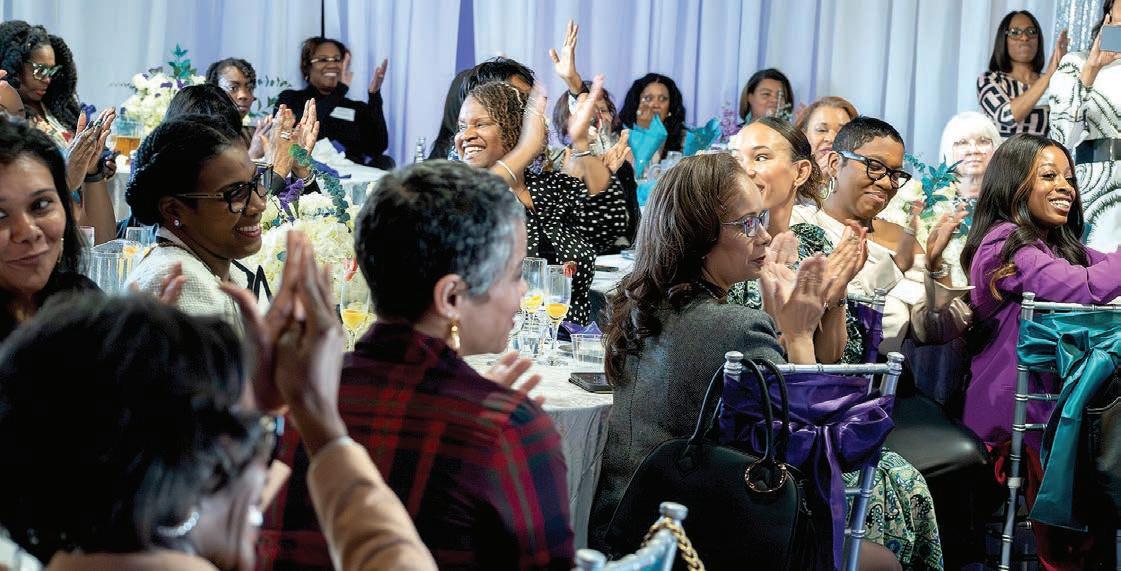
More than 100 people gathered in Detroit on Saturday for a Women’s History Month brunch that centered on a message Black women in this city have long understood: leadership means service, and service means showing up with purpose for your community, your family, and your future at the ballot box.
Equity Alliance of Michigan hosted its “Real Leaders Serve” Women’s Brunch on March 28, bringing together women leaders from across sectors for a conversation about civic engagement, community empowerment, and the role women continue to play in shaping policy and public life ahead of the 2026 midterm elections.
Led by founder and executive director Dr. Deanna L. Stewart, the gathering was designed as a space to honor women of impact while pushing attendees to think seriously about political awareness, leadership, and the responsibility that comes with both.
“Let your voice be heard at the ballot,” Stewart said. “Voting remains one of the most powerful tools we have to share – it influences policies and ensures our needs and priorities are represented.”
That charge set the tone for an afternoon rooted in practical conversation, lived experience, and direct reminders that
gagement
Sheffield: Neighborhood Investment Is a Priority
By Sam Robinson SENIOR REPORTER
Improving Detroit neighborhoods is a major priority of the city’s new administration, Detroit Mayor Mary Sheffield declared at Tuesday’s State of the City address.
Her address, inside the Jemele Hill Auditorium at Mumford High School, located on the city’s Northwest side, was intentionally held in a Detroit neighborhood as a symbolic nod to her campaign promise to focus more on neighborhood revitalization efforts as mayor.
She unveiled her neighborhood anchor plan and doubled down on her past comments, saying investment in the neighborhoods must go further than previous administrations.
“Every neighborhood deserves investment, and we will tailor a plan for every community to rise higher,” Sheffield said, adding that investment is coming to more than just a few square miles downtown.
The mayor announced the Detroit Housing for the Future Fund 2.0, led by LISC Detroit. A $50 million investment will provide grants and low-interest loans to build and preserve affordable housing in the neighborhoods.
Sheffield also announced what she called an aggressive retail strategy.
Currently, most Detroit neighborhoods lack adequate shopping centers, sit-down restaurants, and grocery stores. And some of those businesses currently set up in neighborhood commercial corridors are in desperate need of improvement.
Sheffield also said she will be creating a new director of retail role to attract and recruit national retailers like Meijer, Marshalls, TJ Maxx, and Aldi to come to Detroit. She said for too long, the city has waited for retailers to come.
“My administration will go out and compete for that investment,” Sheffield said. “Because strong neighborhoods need more than housing and infrastructure. They need vibrant commercial corridors where people can shop, work and gather close to home… The market is here, the residents are here, the opportunity is now.”
She said the goal is to make Detroit the easiest, most predictable, and attractive city in America for retail.
Sheffield also touched on the plan to use Public Lighting Authority bond savings to bring 3,000 new mid-block streetlights to Detroit neighborhoods. She signed an executive order on March 19 to direct the funds to be used for streetlights, which will be installed later this year.
“Residents will have the opportunity to participate directly in community engagement sessions that will start next month,” Sheffield said.
Sheffield, during her mayoral campaign, said she wanted to encourage homeownership.
The City of Detroit’s down payment assistance program is back online, funded with $9 million from the Community Development Block Grant and Community Development Block Grant Disaster Relief funds.
Eligible applicants can apply for up to $25,000 in down payment, prepaid, and closing cost assistance when buying a home.
The city is also part of an effort to bring those who left back, those who are here to stay, and gain new residents.
Sheffield was present on Thursday morning at the launch of a new citywide growth plan in partnership with Dan Gilbert and several other local organizations called the Move Detroit Coalition.
The program will support current and future residents with up to $15,000 to support homeownership and business growth, and $1,000 in relocation assistance to Detroit.
Former Michigan growth officer Hillary Doe is the president and CEO of Move Detroit. She was appointed by Gov. Gretchen Whitmer to help find solutions to raise the state’s population.
The state saw an increase of 27,922 people (.3%) from July 2024-2025, Census Bureau data shows. The U.S. Census estimate released last May shows Detroit’s population estimate at 645,705, a gain of 12,487 from the 2024 report.
You can reach Sam at srobinson@michronicle.com.
Women’s History Month Brunch
From page A-3 women know well.
Civic responsibility often gets carried out in quiet ways before it ever reaches a polling place. It shows up in the reminder phone call, the ride to vote, the conversation at the kitchen table, and the insistence that younger relatives know what is at stake, and older relatives are not left out of the process.
Bell pushed the audience to think local, making clear that real power is often closest to home.
“All politics are local,” Bell said. “Start by knowing who your elected officials are. Attend council and commission meetings. Understand what they’re doing and hold us accountable.”
That message matters in a city like Detroit, where local decisions shape everything from neighborhood investment to transit, housing, economic opportunity, and quality of life. Knowing who holds office and how those officials govern is part of what turns civic engagement from a slogan into a practice.
Trent widened the conversation even further, connecting leadership and organizing to the emotional and social infrastructure women build for one another.
“Every single organization needs a social-passion element,” Trent said. “Sisterhood and community are essential, not just for progress, but for our mental health.”
That framing gave the event depth beyond a standard brunch or recognition program. Saturday’s gathering was about leadership, but it was also about what sustains leadership. Sisterhood, mutual support, and a sense of shared responsibility remain central to how many women continue to navigate public life while carrying community expectations, professional responsibilities, and personal demands all at once.
Equity Alliance of Michigan grounded the event in its three core pillars: Entrepreneurship, Empowerment, and Employment Mobility. According to the organization, the brunch was not created to promote any political party or candidate. The goal was to unite women leaders, honor their work, and encourage informed civic participation at a moment when many communities are already looking ahead to the 2026 midterms.
Stewart said the organization’s mission remains centered on access, opportunity, and making sure people are not excluded from pathways to progress.
“Our work is about people,” Stewart said. “It’s about restoring hope, creating access, and ensuring no one is left behind simply because they weren’t given an opportunity. Real Leaders Serve is more than a brunch – it’s a space of alignment, where women
across industries come together with a shared responsibility to lead and uplift.”
That sense of alignment was visible in the room as the event also honored three women recognized for their leadership and service: Wendy Lewis Jackson, managing director of The Kresge Foundation’s Detroit Program; Anika Goss, CEO of Detroit Future City, the late Judy Mitchell, award received by her daughters Kylee Mitchell Wells and Dannis Mitchell, and Melinda Clemons, VP Market Leader and Sr. Advisor, Equitable Path Forward for Enterprise Community Partners.
Each honoree represents a different lane of influence across Detroit and Southeast Michigan, from philanthropy to policy to long-term community development. Their recognition reflected the broader purpose of the event: naming the women whose leadership continues to shape institutions, neighborhoods, and opportunity across the region.

For attendees, the brunch landed as more than a celebration. It was a reflection of what happens when Black women gather with clarity, shared purpose, and a commit ment to using their influence beyond the room.
“This was a room about sisterhood,” said Leona Medley, executive director of the Joe Louis Greenway Partnership. “Black women shape the world and this room was another indication of the power we hold when we understand and leverage our political voice in our families, communities, and work.”
That observation captured the spirit of the day. Women’s History Month often brings moments of recognition, but this gathering pressed beyond ceremony. It treated women’s leadership as active, nec essary, and deeply tied to the future being built right now.
As Equity Alliance of Michigan contin ues its work across Detroit and surround ing communities, the organization says it remains focused on advancing equity and opportunity through programs that support small business development, workforce readiness, and holistic community wellness.
Saturday’s brunch fit squarely within that mission. It honored women already doing the work while reminding everyone in the room that leadership is not reserved for title holders. It belongs to people willing to stay informed, speak up, organize, and serve.
With the 2026 midterm elections on the horizon, that message carried urgency. The room may have gathered for brunch, but the call was larger than a single event. Women left with a reminder that their voices matter, their leadership is needed, and their civic power reaches far beyond election season.


A5 | April 8-14, 2026
Money.
Property is Power!
The Economy of the Black Dollar
By Dr. Anthony O. Kellum
CONTRIBUTING COLUMNIST
There is a quiet contradiction at the center of the Black American economic experience, one that is rarely confronted with the seriousness it deserves. On one hand, Black Americans collectively command between $1.7 trillion and $2 trillion in annual buying power, a figure that would position us among the largest economies in the world. On the other hand, we continue to occupy one of the most economically vulnerable positions within the very system our consumption helps sustain. This is not simply a disparity it is a paradox.
For generations, the prevailing narrative has suggested that the challenge facing Black America is rooted in a lack of resources. But that framing, while convenient, obscures a more complex and ultimately more urgent truth. Black America is not poor in spending power we are misaligned in economic circulation. The issue is not fundamentally about how much money flows into the community. It is about how quickly it flows out, and more importantly, who controls what remains.
In functioning economic ecosystems, money is not merely spent; it circulates it moves with intention, reinforcing internal networks of businesses, institutions, and households. Each transaction becomes a building block, strengthening the foundation upon which future wealth is constructed. In these environments, a single dollar does not perform a single task. It works repeatedly supporting local business, paying wages, funding education, underwriting expansion before it ever leaves the community.
That is not the prevailing reality in Black America. Here, the economic cycle is truncated. The Black dollar circulates for approximately SIX HOURS before leaving the community. By comparison, dollars circulate for roughly 19 days in Jewish communities, 28 days in Asian communities, 17 days in White communities, and about 7 days in Hispanic communities. These differences are not trivial, they are structural. They represent the difference between economies that compound value internally and those that export value externally.
The consequence is not just missed opportunity it is systemic leakage. We are, in effect, participating in an economy in which we are essential as consumers but peripheral as owners. This pattern of consumption without control produces predictable outcomes. Wealth, by its nature, is not built through spending alone. It is built through ownership of assets that appreciate, generate income, and can be transferred across generations. When consumption is decoupled from ownership, economic activity becomes transient. Money is earned, spent, and disappears, leaving little behind to anchor stability.
The data makes this painfully clear. The result of poor circulation is not temporary, it becomes generational. The median wealth of Black households stands at approximately $27,100, compared to $250,400 for White households and $320,900 for Asian households.
Even when examining average wealth, the disparities persist, with Black households at roughly $352,000 compared to $1.5 million for White households. These figures are not simply reflections of income differences; they are the outcomes of fundamentally different relationships to ownership,
Sheffield, Gilbert, & Others Partner for New ‘MoveDetroit’ Coalition to Increase Detroit
By Aaron Foley EDITOR-AT-LARGE
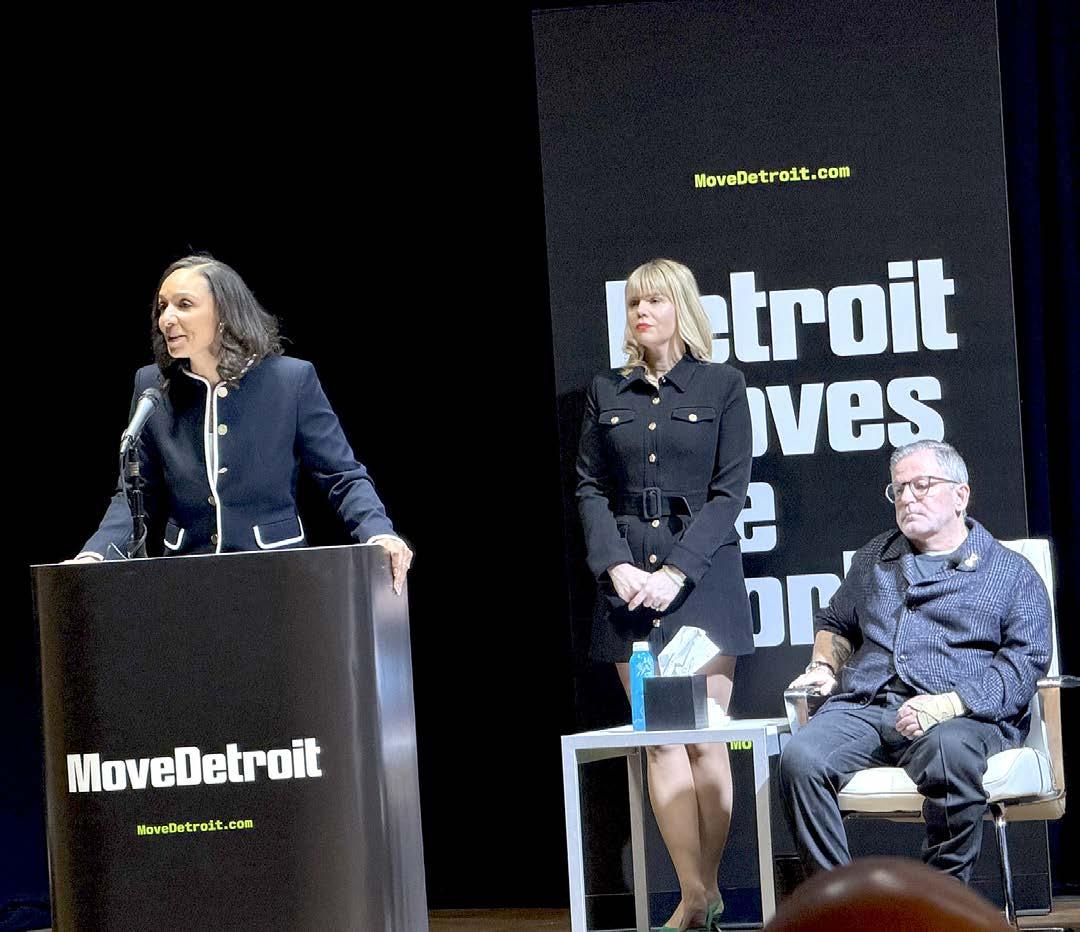
A new campaign seeking to woo newcomers to Detroit while encouraging existing residents to stay and expats to return launched this month with support across business, academic, and government entities, the latest iteration of long-running efforts to market Detroit as a leading talent hub.
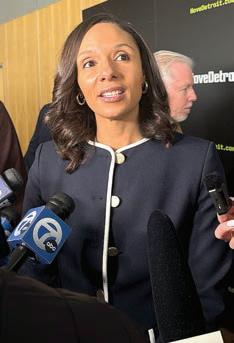
Billed as MoveDetroit, the campaign kicks off with a “Neighborhood Ambassador Program” that seeks to amplify the narratives of residents sharing their experiences in Detroit. Primarily supported by Rocket Mortgage CEO Dan Gilbert, who serves as chair of the new effort, the coalition has tapped Michigan Economic Development Corporation’s chief talent officer, Hilary Doe, as its president, and will work closely with Detroit Mayor Mary Sheffield in programming going forward.
“Detroit’s greatest asset is its people,” Doe said in remarks to a crowd of civic and business leaders during a press conference at Wayne State University’s Industry Innovation Center. “This program puts residents that are actively shaping Detroit’s story at the forefront to inform how we keep and attract talent, invest in neighborhoods and grow in a way that’s grounded in lived experience.”
MoveDetroit was briefly discussed by Sheffield in her March 31 State of the City address before she, Gilbert, and Doe offered more details during Thursday’s conference.
More than 50 partners across different economic sectors are involved with MoveDetroit so far, including tech-fo-
cused boosters like Black Tech Saturdays, Femology and Bamboo Detroit; Wayne County Community College District, Michigan State University and Wayne State University on the academic side; retailers Shinola and Gardner White Furniture; and larger entities, including DTE, J.P. Morgan Chase and General Motors, among several others.
The Neighborhood Ambassador Program seeks to select up to 100 Detroiters to help inform MoveDetroit’s strategy, including storytelling and weighing in on growth programs and keeping initiatives in line with the wants of Detroit residents.
A site, MoveDetroit.com, is live now and taking nominations for representatives.
Doe notes that the largest show of support for the coalition is involvement from the City of Detroit. Mayor Sheffield has previously announced developing similar initiatives around talent recruitment and housing availability, including expanding programs helping with down payment and implementing a new fund for relocation assistance, and is expected to work in tandem with MoveDetroit; a City spokesperson tells the Chronicle that MoveDetroit itself will not involve any public funding or administrative support from the City.
During her campaign leading to the mayor’s office and in her first 100 days after the election, Sheffield has continually noted improving neighborhoods and conditions for existing residents as priorities. Stemming the city’s population losses and attracting new residents was a cornerstone for previous Mayor Mike Duggan’s administration. Both mayors and nearly all their recent predecessors have had to contend with the longstand-
Population
ing issue of Detroit families leaving the city limits for the suburbs in search of lower property taxes, better education options, or both, which Sheffield briefly noted in remarks to reporters following Thursday’s announcement.
“Everyone agrees that [a lack of] property tax reform is a hindrance to businesses residents,” Sheffield said, adding to previous public remarks about working with state lawmakers to press for reevaluating how taxes are assessed in the city. “How we get there, we’re going to have to work through the details. I’m very, very encouraged that we will have some type of property tax reform done over the four years that I’m in office.”
The role of K-12 education in attracting new residents or encouraging returnees is also “at the forefront,” Sheffield says.
“No one wants to come to the city without a strong educational system. This mayor is so committed to figuring out ways we can partner with the school system,” Sheffield added, responding to a Chronicle journalist’s inquiry. “We have focused really on absenteeism, transportation, and after-school programming. If we can get kids in school, we believe that we can improve literacy, test scores…and we’re looking at better ways of transporting our kids to school through our public transportation system as well.
During Sheffield’s State of the City address, the mayor announced waiving fares for any K-12-aged students using Detroit Department of Transportation buses in the city. Sheffield said Thursday that the City is exploring other strategies
Money Matters – Investing in Business Growth
By Mark S. Lee
CONTRIBUTING WRITER
Detroit’s economic momentum is increasingly being defined not just by largescale development but by intentional investments in small businesses, neighborhood corridors, and homegrown talent. All critical components of a vibrant city.
In her first State of the City address Tuesday night, Mayor Mary Sheffield carved out a business-focused agenda centered on small business support, access to capital, streamlined processes, and workforce alignment—signaling a continued push to make Detroit more competitive while focusing on business sustainability and growth.
At the core of that strategy is a renewed commitment to entrepreneurs.
“We’ve got programs (like) Motor City Match, which supports business owners,” Sheffield said, pointing to grants of up to $50,000 designed to help activate storefronts and bring new ventures to life across the city.
The Mayor discussed ongoing support for startups.
Through a new round of funding for early-stage businesses, the city is working to ensure entrepreneurs can start and grow a business without leaving.
“We announced our second round of recipients…providing early money for innovative startups to scale right here in the city of Detroit,” Sheffield noted.
Mark S. Lee
That focus extends beyond startups. Longtime businesses are also a priority.
“Our legacy business program provides funding for businesses that have operated in our city for over 30 years,” she said, reinforcing the importance of sustaining businesses that have helped shape the city’s identity.
Access to everyday essentials—and the businesses that provide them—is another key piece of the equation. The city is expanding efforts to bring smaller-format gro-
cery stores into underserved neighborhoods.
“We’re bringing back and expanding our neighborhood grocery program,” she said.
“We need to see more small grocers open up…”
Still, access to funding alone won’t move the needle if businesses face barriers to opening or expanding. That’s why the administration is targeting one of the most consistent concerns from entrepreneurs: bureaucracy.
“Our small businesses want faster permitting, simpler zoning laws, and operational support,” Sheffield said, adding that city departments are actively working to address those challenges.
At the same time, she discussed the importance of aligning workforce strategy to ensure residents are prepared for both current and future job opportunities. Sheffield highlighted partnerships with education institutions and workforce programs like
Detroit at Work, which are key components central to that effort.
“Growth without access is not success,” Sheffield emphasized. “We are building both together.”
Underlying it all is a belief that Detroit’s greatest competitive advantage is its people.
“I truly believe that Detroit has some of the best untapped talent right here in our city,” she said.
It’s apparent this administration is working to create an environment for businesses where capital, talent, and opportunity intersect.
And as the city continues to evolve, that combination could prove critical in shaping Detroit’s next chapter of economic growth.
We invite readers, business owners, and future entrepreneurs to follow along, ask questions, and engage. If you have story ideas or questions, you can email Lee at mark@leegroupinnovation.com or visit leegroupinnovation.com.
Anthony O. Kellum
Economy of the Black Dollar
From page A-5
Other communities, whether by design, discipline, or historical positioning, have structured their economic behavior accordingly. In many cases, there is a deliberate emphasis on internal circulation, collective investment, and asset acquisition. Businesses are supported not only for convenience but for continuity. Property is acquired not only for shelter but for leverage. Education is funded not only for advancement but for preservation of advantage. These are not isolated decisions; they are coordinated patterns that produce cumulative outcomes over time.
The result is not merely higher incomes, but greater durability of wealth. Resources are retained, reinvested, and redeployed in ways that strengthen the community. Economic power becomes self-reinforcing, creating a cycle in which each generation builds upon the last rather than starting anew.
Within the Black community, the absence of this sustained circulation and ownership structure has far-reaching implications. It affects not only household wealth,
From page A-5 retention, and capital deployment.
MoveDetroit
centering on youth, to “change the narrative that our school systems are improving, and that will signal to families that they are more willing to come to Detroit and put their kids in our school system.
“As a part of any growth strategy, you have to center Detroiters at the forefront –through storytelling, as well as advocating and encouraging people to come to the city,” she added. “For me, this was important because you can’t talk about growth without talking about Detroiters being a part of retaining them here in the city. Having neighborhood ambassadors will really help elevate the Detroit story coming from Detroiters….who have lived experience to help market and sell Detroit as a destination city.”
If these marketing efforts sound familiar, consider the decades-long push on every level to publicly reshape Detroit’s image and attract new residents in the process.
In 2003, then-Gov. Jennifer Granholm launched the “Cool Cities” campaign in an effort to keep recent college graduates and young adults from departing for Chicago and elsewhere. In 2011, led by then-Detroit Mayor Dave Bing, a coalition of civic and business interests came together for the “I’m a Believer” campaign, which encouraged residents outside of Detroit to get to know the city better by volunteering. Also in 2011, Midtown Inc. launched its “Live Midtown” program, which offered incentives toward
but the condition of neighborhoods, the viability of businesses, and the capacity for political influence. Economic fragmentation limits our ability to shape the environments in which we live, work, and raise our families. It constrains our options and, over time, narrows our collective horizon.
At the center of any meaningful shift in this trajectory is a concept both simple and profound property. Property is often discussed in purely financial terms, but its significance extends far beyond balance sheets and valuations. Property is control. It is the ability to determine how land is used, how capital is deployed, and how value is distributed. It transforms income into an enduring asset, one that can produce returns long after the initial transaction has passed.
Without property, economic activity remains fleeting. With it, wealth gains permanence. This is why the question of ownership cannot be treated as secondary or optional. It is foundational. A community that does not control its assets cannot fully control its outcomes. And a community that cannot control its outcomes remains vulnerable, regardless of how much it earns.
To be clear, none of this exists outside of historical context. The economic position of
housing costs for new residents moving to the area, boosted by entities like the Henry Ford Health System, among others.
Gilbert himself launched the Rock Ventures-backed “Opportunity Detroit” in the same era, an initiative that brought together civic and business interests to bring new retail and residents to the city, advertising on billboards around the region. A
brief “Move to Detroit” billboard campaign popped up exclusively in New York City in 2015, just one year after Crain Communications launched its annual Detroit Homecoming event, bringing Detroit expats back to the city for the week with the hopes of spurring investment.
A variety of neighborhood storytelling platforms have arisen in the last decade, ranging from the Detroit Free Press’ “Detroit Is…” series to the existence of Bridge Detroit itself, all of which were preceded by the City of Detroit’s own storytelling platform launched in 2017.
The ultimate push came in 2018, when an all-hands-on-deck approach from city, county, and state leaders partnering with business, philanthropic, and academic interests attempted to win Amazon CEO Jeff Bezos’ favor in the widely publicized competition for the online retailer’s second headquarters, with the tagline “Detroit: Move here, move the world.”
“Yes, we went through decades where people forgot how much we were capable of,” Gilbert said in his remarks. “But now the world’s remembering, and the nation is taking notice once again. You can feel it.”

Black Americans has been shaped by a long and well-documented history of exclusion from redlining and discriminatory lending practices to broader patterns of disinvestment. These forces did not simply limit access to housing; they disrupted the very mechanisms through which wealth is typically built and transferred.
But history, while explanatory, cannot be allowed to become a permanent constraint on future action. The conditions we face today, while still imperfect, present opportunities that previous generations were systematically denied. The challenge now is whether we are prepared to align our economic behavior with the outcomes we say we desire.
Such alignment requires a shift in both mindset and practice. It calls for a more intentional approach to how we spend, where we invest, and what we prioritize. It demands that we begin to see consumption not as an endpoint, but as a lever one that can either reinforce external systems or help build our own. Even a 10% to 20% redirection of Black spending into Black-owned ecosystems would translate into hundreds of billions of dollars circulating internally, strengthening businesses, stabilizing communities, and accelerating wealth creation.
Equally important is the recognition that individual success, while valuable, is
insufficient on its own. Wealth that is not connected to a broader ecosystem remains isolated. To create lasting impact, economic activity must be coordinated. Businesses must support one another. Professionals must collaborate. Capital must be pooled and deployed with shared purpose.
The implications extend beyond economics, communities that control capital inevitably shape policy, influence institutions, and define the terms of their own development. Economic power, in this sense, is inseparable from political and social power, without it advocacy is limited with it, transformation becomes possible.
We are, in many ways, at a defining moment. The resources exist. The knowledge is accessible. The path is visible. Every dollar we spend with each other is a decision. Every investment in each other is a signal. Every property we acquire is a step towards a different future.
Because in the final analysis, property is not merely a tool of wealth. It is the foundation upon which wealth is sustained, power is exercised, and legacy is secured. Property is Power.
Property is Power! is a movement to promote home and community ownership. Studies indicate homeownership leads to higher graduation rates, family wealth, and community involvement.



WiFi on Buses: A Small Investment with a Big Payoff
By Cassandra Whitfield CHIEF TECHNOLOGY OFFICER
One of the first directives I received when I became Chief Technology Officer from CEO Tiffany Gunter: get reliable WiFi on our buses.
She understood, post-pandemic, that connectivity wasn’t a nice-to-have anymore. It was essential infrastructure, and my job was to make it happen. SMART actually offered WiFi on our FAST fleet years ago, but it was short-lived because of the pandemic.
Post-pandemic, we realized connectivity had shifted from luxury to necessity. Riders expect it and make decisions about where to go based partly on whether WiFi is available. We also knew that inconsistent WiFi creates a worse experience than no WiFi at all, so we invested in more powerful devices for reliable connections.
The potential benefits extend beyond rider convenience. Reliable WiFi attracts new riders who need to stay connected during their commute to work, school, or manage daily life. When people can use transit time productively, transit becomes more valuable.
More Than Just Internet Access
Each bus gets a router with a unique identifier, installed and tested by our inhouse electronics team. The system runs on T-Mobile’s 5G networks with high multiband capability to minimize dead zones.
We made the rider experience simple: connect and you’re online. No complicated logins or time limits. We currently have 5G routers installed on 50 buses as of April, with a goal of 175 devices fleet-wide.
It’s a phased rollout because we have to pull buses out of service for installation while keeping routes running. Here’s where WiFi becomes foundational infrastructure for our entire operation.
It enables our automatic vehicle locator system, which powers the real-time tracking riders depend on. It supports our camera systems and livestreaming for safety and incident management. It keeps our operations team connected to drivers in real time and helps with emergency response. All of this produces data we use to improve service. We better understand delays and on-time performance.
We can plan our fleet more strategically and even use connectivity for predictive maintenance, catching problems before they cause breakdowns. This isn’t surveillance, it’s smart operations using real-time information to make better decisions. For many riders, reliable internet access still isn’t a given, and that reality shows up in everyday ways.
Bus WiFi can help bridge that gap, whether it’s a student finishing homework, someone applying for a job, or a rider managing appointments and daily responsibilities. In that sense, we’re doing more than moving people from point A to point B. We’re helping people stay connected to the opportunities and services that shape their lives.
SMART is advancing this work with a clear commitment and sustained investment. Expanding WiFi across the fleet takes time and coordination, especially when installations have to happen alongside daily service. But we are steadily building toward a fully connected system, one that reflects how essential connectivity has become for our riders and for our operations.
This is the future of transit. It’s not just about getting from one place to another, but about making that time count. It’s about a system that works smarter, serves people better, and stays connected to the needs of the communities it supports. WiFi is one piece of that future, and as we continue to expand it across our fleet, we’re delivering a service that is more useful, more responsive, and more aligned with how people live today.
The Young Black Lawyers’ Organizing Coalition (YBLOC) brought its Black Ballots, Black Futures campaign to Detroit this weekend, launching a voter education effort aimed at helping Black residents prepare for Michigan’s 2026 primary in August and general election in November.
The nonpartisan organization, made up of young Black lawyers and law students, is sending members of the Black legal community into Detroit churches, barber shops, and beauty salons to talk with voters about how to participate in the election process with confidence and clear information.
The Detroit campaign launched with a cohort of law students who traveled to the city with YBLOC for the outreach effort.
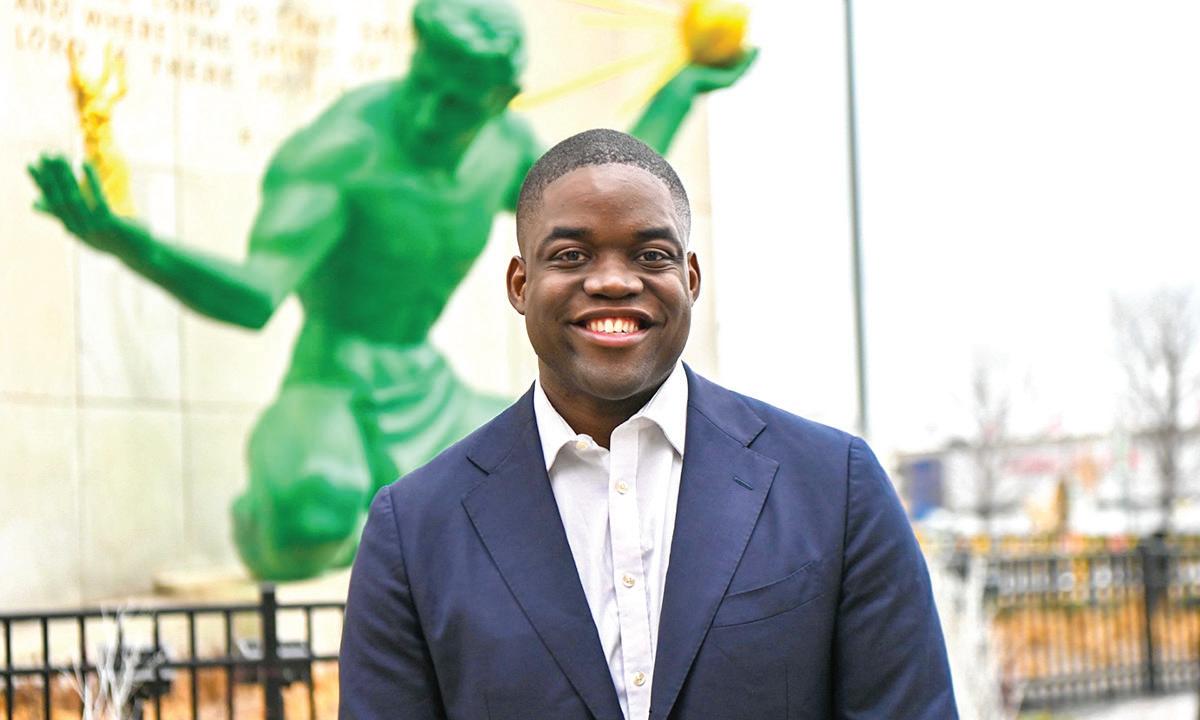
Council of Baptist Pastors Endorses Justin Onwenu for
BY FREELANCE CONTRIBUTOR
The Council of Baptist Pastors (COBAP) of Detroit and Vicinity has endorsed Justin Onwenu in the race for Michigan’s 1st State Senate District, adding one of Detroit’s longstanding faith-based civic voices to a campaign that is continuing to build support across labor, political, and community circles.
The endorsement, announced March 29, comes from a body that has served as a moral and civic force in Detroit since 1965, bringing together pastoral leadership committed to strengthening congregations, supporting ministers, and advancing justice across the city. For Onwenu, a fourth-generation Detroiter, attorney, community organizer, and the City of Detroit’s first Director of Small Business Affairs, the backing signals continued momentum in a race that carries weight for both Detroit and Downriver communities.
Pastor Orville K. Littlejohn, president of the Council of Baptist Pastors of Detroit and Vicinity, said the organization sees Onwenu as the kind of leader this moment requires.
“The Council of Baptist Pastors of Detroit and Vicinity is proud to support Justin Onwenu for Michigan State Senate, District 1,” Littlejohn said. “We believe he represents a new generation of thoughtful, community-rooted leadership, and we are confident that he will advocate with energy, integrity, and a deep concern for the people he seeks to serve.”
That language reflects the broader message laid out in the council’s endorsement letter, which pointed to Onwenu’s record in organizing, economic opportunity, and neighborhood advocacy as evidence of a serious commitment to public service. The council also emphasized the need for leadership that stays close to the people, particularly working families navigating economic pressure, disinvestment, and ongoing inequities.
“Our Council values leadership that remains grounded in community, attentive to the needs of working families, and committed to justice, dignity, and opportunity for all,” the letter states. “We recognize in your candidacy a serious commitment to public service and a vision for the people of Detroit and the Downriver communities you seek to represent. Your background in organizing, economic opportunity, and neighborhood advocacy reflects the kind of engaged leadership this moment calls for.”
The letter continues by naming the political climate directly, noting that many communities are searching for “responsive, principled, and energetic representation” and expressing confidence that Onwenu’s leadership could make “a meaningful contribution in Lansing on behalf of the residents of District 1.”
State Senate District 1 covers communi-
forward the legacy of Juneteenth through work focused on racial equality.
YBLOC founder and executive director Abdul Dosunmu is leading the campaign. Dosunmu was recently recognized by President Barack Obama and the Obama Foundation as one of several leaders carrying
“Our Black Ballots, Black Futures campaign is designed to provide Black voters in Detroit area churches, hair salons and barber shops with the tools they need to reclaim and reimagine democracy as a vehicle for Black empowerment,” said Dosunmu. “Over the course of this critical election year, this community outreach effort will give young Black lawyers and law students the opportunity to visit trusted establishments throughout the city to speak about the importance of participating in our democracy. We will partner with local Black communities to provide voter education and voter protection programming.”
The campaign focuses on meeting voters in familiar neighborhood spaces where people already gather and exchange information. That approach is especially important in Detroit, where churches, barber shops, and salons have long played a central
State Senate District 1
ties that have long dealt with overlapping pressures tied to economic instability, neighborhood need, and questions about who is truly prepared to fight for residents once elected. Endorsements from trusted institutions do not decide races on their own, though they do help define who the community leadership believes is equipped to carry those concerns into state government.
Onwenu said the council’s support carries deep significance because of its role in Detroit’s history and its voice on issues of justice and dignity.
“The Council of Baptist Pastors of Detroit and Vicinity has long been a voice for justice and dignity in Detroit, and I am deeply honored to have their support and confidence,” Onwenu said. “I am committed to delivering for our community in the fight for voting rights, affordability and economic opportunity, racial and social justice, and neighborhood investment.”
Those priorities line up with the record his campaign is highlighting. According to the announcement, Onwenu has organized in Detroit and Downriver alongside residents confronting environmental injustice, neighborhood disinvestment, and economic hardship. His work in city government also remains central to his case for office.
As Detroit’s first Director of Small Business Affairs under Mayors Sheffield and Duggan, Onwenu helped invest millions and support hundreds of Detroit entrepreneurs through initiatives including the Detroit Startup Fund, the Detroit Legacy Business Project, the Detroit Capital Hub, the Small Business Technology Fund, and other efforts designed to expand access and opportunity for local businesses.
He has also taught workers’ rights and labor law at Detroit Mercy School of Law, adding another layer to a public profile
rooted in law, organizing, and economic justice.
The endorsement from the Council of Baptist Pastors of Detroit and Vicinity joins a coalition that the campaign says already includes 10 labor unions, the Democratic Party Black Caucus, Wayne County Executive Warren Evans, and a majority of City Councilmembers, mayors, and state representatives within State Senate District 1.
Taken together, that support suggests Onwenu’s campaign is working to position itself at the intersection of faith, labor, local government, and grassroots organizing. That coalition-building approach often matters in Detroit politics, where trust is earned through proximity, service, and whether institutions with deep community ties believe a candidate will remain accountable once the campaign season is over.
Faith leaders, especially in Detroit’s Black community, have long played a role far beyond the pulpit. They have been organizers, validators, bridge-builders, and protectors of civic engagement in moments when residents needed both moral clarity and practical leadership. An endorsement from a body like COBAP lands differently because it comes out of that tradition.
This race will ultimately be decided by voters across District 1.
What this endorsement does make clear is that Onwenu is continuing to consolidate support from institutions that see public service not as performance, but as responsibility. That distinction still matters in Detroit. It matters in Downriver. It matters for working families who want representation that knows the community, answers to the community, and is prepared to fight for the community in Lansing.
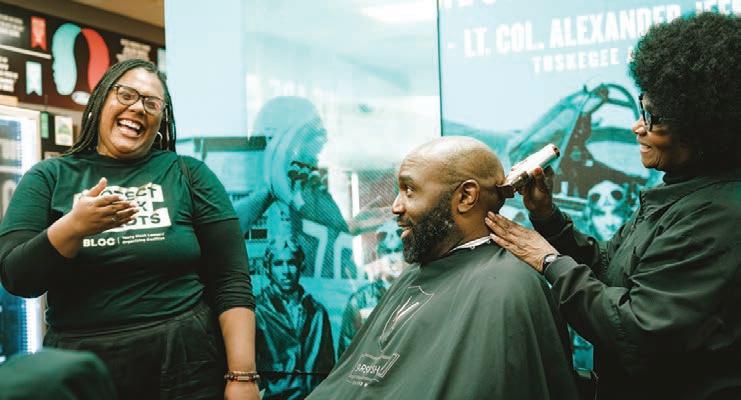
role in Black civic life.
Last month, YBLOC visited churches in the Dallas area for Democracy Sunday ahead of the Texas primary. Detroit now becomes part of that broader national organizing effort.
Last fall, the organization also convened its first Black Legal Brain Trust in Washington, D.C., bringing together young Black attorneys from across the country for a day of strategy focused on democracy and
racial justice. Since launching in 2019, YBLOC has grown into a national initiative focused on voter protection, building Black voting power, and redefining the role lawyers can play in strengthening participatory democ-
Tiffany Gunter
C ity . L ife .
B1 | April 8-14, 2026
OHM Advisors Names Kelly Jackson Vice President of Human Resources
Architecture, engineering, and planning firm
OHM Advisors has promoted longtime Human Resources Director Kelly Jackson as the company’s first vice president of human resources.
“People are the foundation of any successful business, and over the last three decades, Kelly has been crucial in building and expanding that foundation,” said OHM President Jon Kramer. “Since the firm’s inception, we have grown from fewer than 100 people working in one building to nearly 1,000 employees across eight states. Over the past 30+ years, Kelly has been instrumental in shaping and supporting the continuity of our company’s culture.”
As vice president of human resources, Jackson will focus on talent strategy, ensuring that the OHM’s workforce development aligns with its long-term vision and maintains its competitive edge. The move will also allow OHM’s human resources team to foster the growth of young leaders and enhance succession planning.
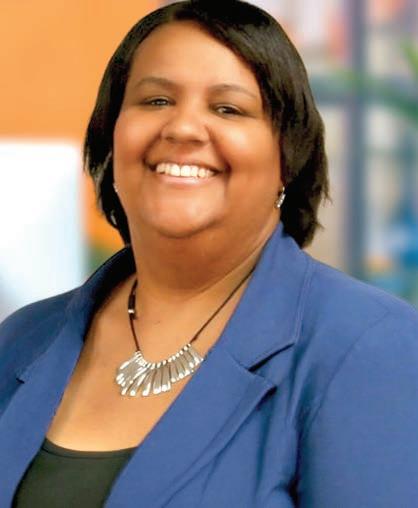
“OHM exists to help communities solve problems and make places better for people,” Jackson said. “The human resources team finds innovative ways to hire the right people, integrate them into a collaborative culture, nurture their strengths and talents and invest in their professional growth.”
Jackson experienced that kind of support in her own career. When she joined OHM, she worked for the company’s accounting team, which handled issues such as payroll and benefits. She pitched the idea of building a full-fledged human resources department to OHM’s leadership team – and they gave her the green light to create the department from the ground up. Over the years, Jackson has helped the company navigate major regulatory changes, expand during the Great Recession, and manage workplace disruptions associated with the COVID-19 pandemic.
Jackson holds a bachelor’s degree in business administration with a concentration in human resources from Cleary University. In 2022, she was recognized by Crain’s Detroit Business with an “Excellence in Human Resources” award.
Under Jackson’s leadership, OHM Advisors has been recognized with workplace awards from Gallup, Zweig Group, Crain’s Detroit Business, Columbus CEO, and many other organizations. Jackson has served on numerous boards, including the Michigan Business and Professional Association.
Where City Meets Life and Life Meets Style
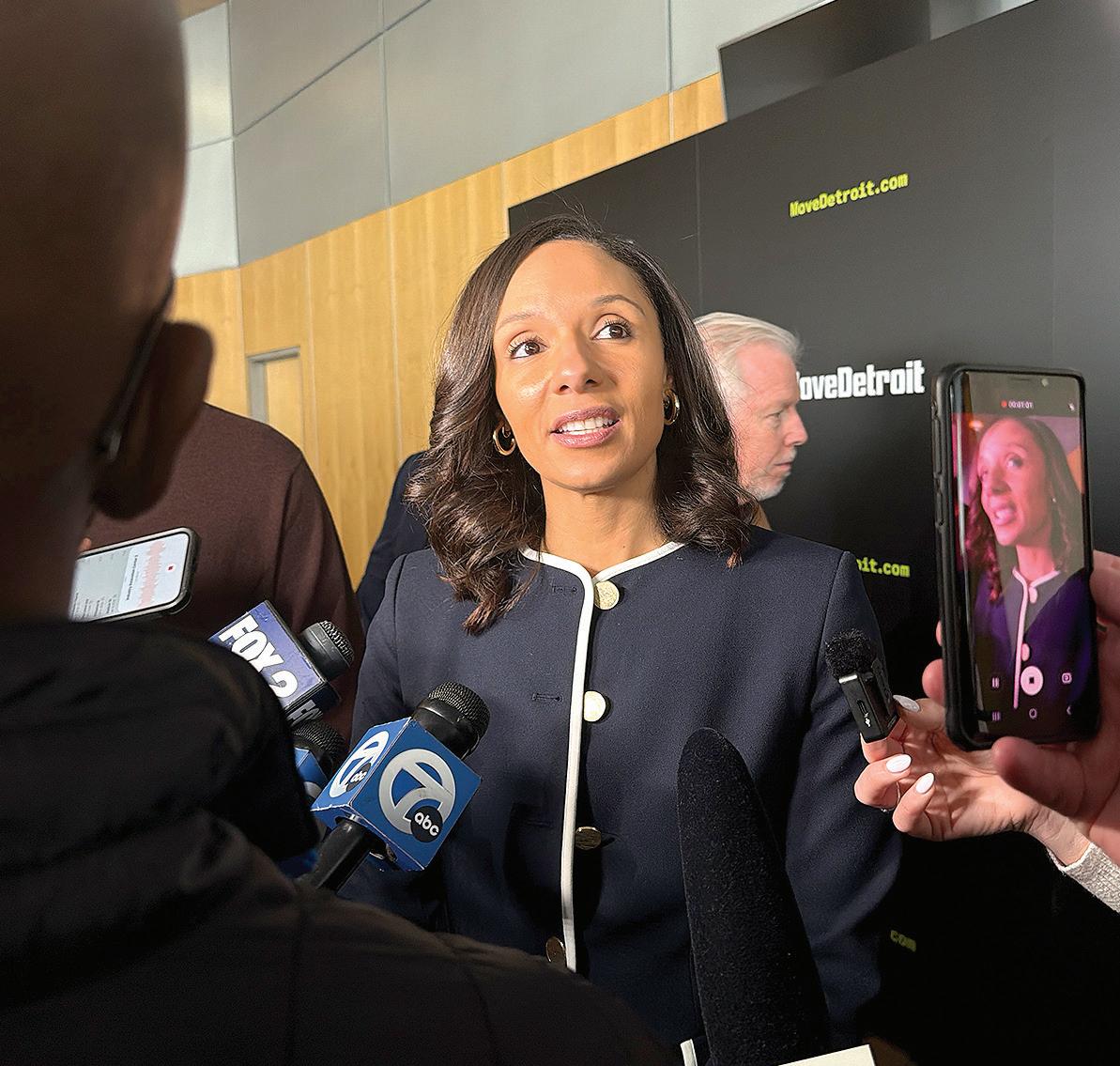
Detroit to Search for New Arts Director,
Explore Separating Culture Department
By Aaron Foley EDITOR-AT-LARGE
The City of Detroit will soon launch a talent search to replace its senior arts and culture officer, as well as possibly establish a standalone arts office separate from its current position within city government, a top-ranking staffer tells the Michigan Chronicle.
David Bowser, chief of staff to Mayor Mary Sheffield, says “within the next couple of months” the city will begin its recruitment efforts to seek a replacement for Rochelle Riley, the City’s previous arts and culture director, who departed Detroit earlier this year for a new position with Charleston, S.C.’s government.
“We want to make sure we’re creating something that’s integrated in every department,” Bowser says, noting that Detroit’s charter mandates an arts and culture council. “There needs to be an arts and culture aspect to our planning, to our economic development, to our housing, to our health.
“We’re putting all that together and we’re going to plug that individual in. It’s not going to be siloed, it’s

Photos by Monica Morgan
On March 30, 2026, Detroit’s own Nylon Keies delivered a career-defining performance at the Russell Industrial Center, earning the title of Artist of the Year at the HOT 107.5 (WGPR) Music Industry Showcase.
Known as “The Key to R&B,” Nylon Keies stood out among a competitive lineup of singers and rappers with a powerful, emotionally driven performance that blended live vocals with visual storytelling. Her set took the audience on a journey through love, heartbreak, and resilience — leaving a lasting impression on both the audience and an esteemed panel of judges, including Tone Tone, Trick Trick, Southwest Tee, and Detroit Rap Plug.
This milestone moment further solidifies Nylon Keies as a rising force in R&B and a standout voice within Detroit’s music scene—an artist known not only for her sound but for her ability to connect deeply through storytelling and performance.
Building on the momentum of her win, Nylon Keies continues to expand her impact beyond music through her initiative, Nylon Keies Cares—a purpose-driven movement focused on youth empowerment, self-worth, and community outreach.
The initiative will debut with its first program, “Nylon Keies Cares
– You’ve Been Keyed,” a school
going to be integrated into a lot of existing departments,” Bowser adds.
Under Mayor Mike Duggan, arts and culture were housed under the city’s General Services Department, which oversees a range of city operations from parks and recreation, fleet maintenance, to building repair. Bowser says the Sheffield administration is exploring how to make arts and culture an independent, “budget-neutral” office, and that its new director would report directly to the mayor rather than the current infrastructure of reporting to the head of GSD.
Bowser said the administration could seek philanthropic support to fund the office, but it would be primarily funded by the mayor’s office budget if it moves out from under GSD.
“It needs its own space reporting directly to the mayor’s office. [Riley] was really passionate about that. We want to make sure the structure makes sense, and also, the location makes sense to us. This is going to be different.”

and youth tour designed to combat bullying and promote self-esteem.
Through this program, Nylon Keies will personally connect with students while distributing Empowerment Care Packages that include:
• Signature “YOU’VE BEEN KEYED” apparel featuring affirmations such as love, self-esteem, bravery, hope, and confidence, alongside “Love Yourself” messaging;
• “Unlocking My Worth” journals and 10-day goal trackers to encourage reflection, healing, and personal growth;
• A “You’ve Been Keyed” QR code providing access to her music and a personal motivational message;
• Self-care essentials designed to sup-
port confidence, healing, and overall well-being. Each care package is intentionally curated to meet individuals where they are—providing tools that reinforce what they may be lacking, whether that be love, confidence, hope, or self-worth.
“Winning Artist of the Year at the Russell Industrial Center was a blessing,” says Nylon Keies. “But my purpose is bigger than the stage. I want my music and my platform to truly impact people’s lives.”
With this achievement, Nylon Keies continues to establish herself as not only an award-winning artist but a voice for purpose, empowerment, and lasting impact within the Detroit community.
Kelly Jackson
Search for New Arts Director
From page B-1
Bowser name-checked the mayor’s signature “Occupy” youth-centric programming -- which began with “Occupy the Corner” while Sheffield served on City Council and is now evolving into “Occupy the Summer,” which she described during her State of the City address on March 31 – as one area where arts initiatives can be implemented, as well as transportation and housing. The administration will study internally where arts already operate within the City’s framework and gather public input in the near future, Bowser says.
“We want it to be informed by our community, but we haven’t put those feelers out just yet,” he said.
Bowser’s comments come during a press conference announcing Move Detroit, a civic partnership between several local entities campaigning to attract and retain new residents to the city.
For decades, Detroit’s cultural landscape thrived off an abundance of affordable housing options, as well as a generally lower cost of living compared to other cities. But a persistent complaint among the city’s creative class has been increasing rental rates and a lack of municipal support for artists, prompting many to pursue creative ambitions elsewhere.
Bowser says the administration is aware and is exploring strategies to implement an economic development component to its arts initiatives, noting that former City Nightlife Economy Director Adrian Tonon is advising on “how to build an economic engine around arts and culture, as well as ensuring that local artists have priority when procurement opportunities arise.
“Move Detroit is all about opportunity, and we have to create opportunities for every segment of our population that’s here and to attract folks that left,” Bowser says.


the QR Code to
the Digital Daily


April 9, 2026
PUBLIC COMMENT PERIOD FOR THE STATE OF MICHIGAN’S DRAFT ANNUAL ACTION PLAN
Prior to submission for further funding from the Housing and Urban Development (HUD) Office of Community Planning and Development, Michigan is required to publish an Annual Action Plan document for public review and comment tied to the State's five-year Consolidated Plan. The Annual Action Plan proposes an action strategy by which needs will be addressed and reflects activities undertaken between July 1, 2026 - June 30, 2027.
The comment period will commence on Thursday, April 9, 2026, and end on Monday, May 11, 2026. In-person public hearings will be held on Wednesday, April 15, 2026, from 9:00-9:30a.m. at the MSHDA Meeting at Eagle Eye Golf & Banquet Center, 1550 Chandler Rd., Bath, MI 48808 and on Tuesday, May 5, 2026, from 1:00-2:00p.m. at the MSHDA Detroit office, Cadillac Place Building, 3028 W. Grand Boulevard, Suite 4-600, Detroit, MI 48202. A special virtual public hearing will be held on Monday, May 4, 2026 from 5:00-6:00 p.m. via Microsoft Teams, Join: https://teams.microsoft. com/meet/26690235843816?p=cNIlpIqOL0Tl7gCv04, Meeting ID: 266 902 358 438 16, Passcode: ir68eY9K OR call in (audio only) 1-248-509-0316, 447314986#, Phone Conference ID: 447 314 986#.
Introduction
The Annual Action Plan consists of funding by applicable formula programs: HOME, Community Development Block Grant (CDBG) and all related programs including CDBG Disaster Recovery, Housing Opportunities for Persons with AIDs (HOPWA), the Emergency Solutions Grant (ESG), the Recovery Housing Program (RHP) as applicable, and the Housing Trust Fund (HTF). The Michigan State Housing Development Authority (MSHDA) is responsible for preparing the five year plan, annual action plans, as well as the annual Michigan Consolidated Annual Performance and Evaluation Report (CAPER) and soliciting comments from the public regarding the outcomes tied to the draft Plan and reporting outcomes on an annual basis thereafter. A link to the draft annual action plan can be found at https://www.michigan.gov/mshda/neighborhoods/michigan-consolidated-plan.
All interested parties are invited to submit written comments directly related to the draft Michigan Annual Action Plan. Information gathered during the written comment period will be used to prepare the Michigan Annual Action Plan for submission.
Individuals and organizations may submit written comments to Tonya Joy and Pierre-Denise Gilliam, 735 East Michigan Avenue, P.O. Box 30044, Lansing, MI 48909.
Written comments must be received no later than May 11, 2026. Comments can also be submitted to the MSHDA Consolidated Plan Coordinator via e-mail to mshda-ndd@michigan.gov.
Copies of the Michigan Annual Action Plan may be downloaded free of charge from the MSHDA website link above.
Special Assistance: Feedback is encouraged from mobility-challenged individuals. Persons with disabilities needing accommodations for effective participation should contact the MSHDA Neighborhood Development Division at 517-335-2524 to request mobility, visual, hearing, or other assistance.


Leading Through Every Chapter of Public Health
Loretta V. Bush
Being recognized as a 2026 Hometown Health Hero in Lansing holds special meaning—particularly because it comes from peers who understand both the complexity of public health and the responsibility that comes with it.
What made the moment even more powerful was being surrounded by colleagues and leaders who have dedicated their lives to this work, alongside a new generation stepping forward with fresh perspectives and purpose. It felt like a full-circle moment, one that brought me back to where it all began.
Reflecting on more than four decades in public health, across city, county, state, and international systems, one truth has remained constant: meaningful progress doesn’t happen from a distance. It happens by being present, listening, and building solutions rooted in the lived experiences of the communities we serve.
Early in my career, I had the opportunity to work in Ethiopia, helping develop HIV/ AIDS prevention and care programs. That experience shaped how I view this work, not simply as service delivery, but as building sustainable systems that communities can carry forward.
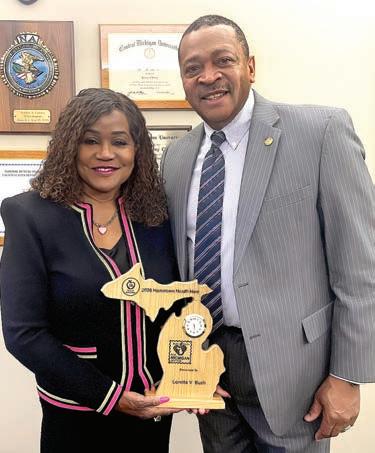
During the H1N1 pandemic, we built systems at the county level that delivered more than 1,000 vaccinations daily. Years later, during COVID-19, many of those same lessons came back into focus. At Authority Health, we supported Detroit Public Schools Community District as their compliance partner, helping schools reopen safely, while also meeting people where they were, providing testing in trusted community spaces like church parking lots.
Today, that commitment continues through our work at Authority Health, from leading one of the nation’s largest Graduate Medical Education Teaching Health Centers to expanding access through community-based care regardless of ability to pay.
In 2025, we reached an important milestone with our designation as a Federally Qualified Health Center Look-A-Like, further strengthening our ability to serve Detroit residents.
Yet the work continues. Too many communities still carry the greatest burden, shaped by limited access, chronic disease, and social determinants.
That understanding led me to create the Healthy and Resilient Communities (HaRC) initiative, addressing food access challenges in targeted Detroit and Wayne County neighborhoods. Through Smart Fridges, a mobile food truck, and community distribution, we have delivered more than 8,000 healthy meals directly into communities that need them most.
This work has never been about titles. It has always been about responding to real needs with practical solutions.
What gives me confidence is the next generation of public health leaders, stepping into this work with urgency, compassion, and a deep commitment to community.
My responsibility is not only to lead, but to share what I’ve learned and help prepare others to carry this work forward.
That commitment continues every day.
By Sam Robinson SENIOR REPORTER
You might see U.S. Senate candidate Abdul El-Sayed on a gas station screen near you, calling out President Donald Trump for the war in Iran, experts say, which is raising energy costs.
In the advertisement video, El-Sayed asks, “Know why gas costs more? Because of Donald Trump’s $200 billion war with Iran. Meanwhile, our schools are still crumbling, our roads are full of potholes and you still can’t’ afford to see a doctor.”
The ad that aims to reach thousands of commuters will run at gas stations across Detroit, Inkster, and Lansing, El-Sayed’s campaign said.
“Instead of fixing it, Trump is spending $200 billion of your tax dollars on a war with no justification. Now, every time you fill up, you’re paying for it,” El-Sayed.
Gas prices have risen sharply for American drivers, over a dollar per gallon, following the US military action in Iran launched by the Trump administration last month.
The U.S. average hit $4.06 a gallon on Wednesday after crossing $4 on Tuesday, according to AAA.
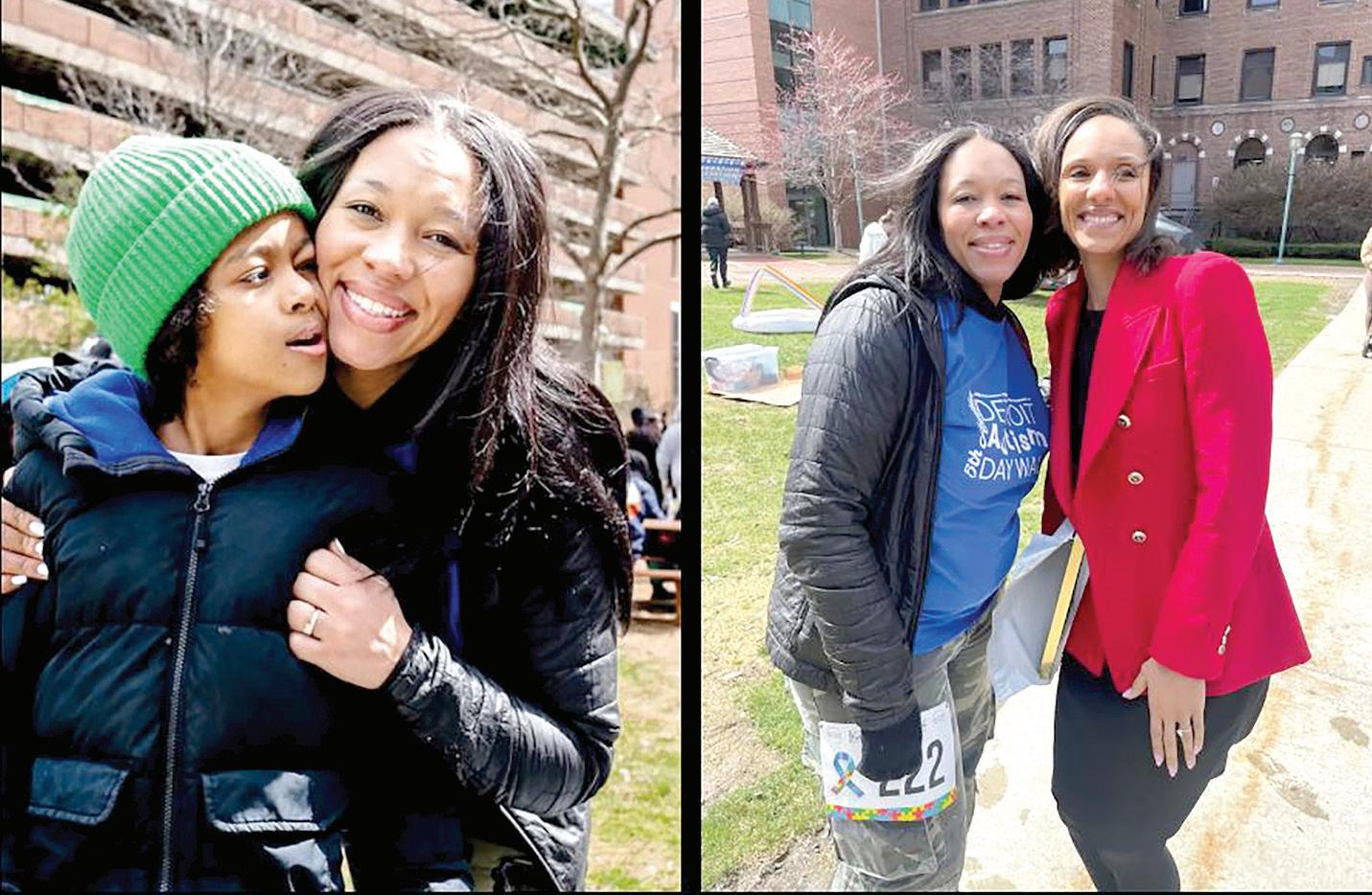

‘Autism
in the D’ Returns for Sixth Year with Goals of Building a Sensory-Friendly Safe Space
By Aaron Foley EDITOR-AT-LARGE
Six years ago, Tiera Moultrie needed someone to talk to about her oldest son being newly diagnosed with autism.
Set aside the fact that the diagnosis came during the height of the COVID-19 pandemic, Moultrie still would have had to deal with uncertainty, unsurety – “a lot of unknowingness,” she says. Relatives and loved ones were undereducated about neurodivergence, so Moultrie turned to the internet.
She quickly learned that several other local parents were in similar positions after starting a parent support group on Facebook for people in the Detroit area. Talking led to walking – Moultrie launched an autism awareness walk under the banner Autism in the D that same year. Six years later, with hundreds more parents joining the conversation along the way, Moultrie will kick off this year’s Autism in the D weekend with a new goal: Raising funds for a sensory-adaptive gymnasium in Detroit for neurodiverse children.
Autism in the D this year features three days of events. On April 10, there will be a shopping night at Swank A Posh, with 10% of proceeds going to AITD. On April 11, Moultrie will test-run a sensory-immersive pop-up at Chandler Park Fieldhouse. A preview of the future gym, complete with aromatherapy, silent DJ, and hands-on sensory zones. Closing out on April 12 is the autism awareness walk at DMC Children’s Hospital, Brush Mall –a path of 1.31 miles representing the 1 in 31 kids diagnosed with autism.
“I have a background in entrepreneurship. And I didn’t think that when I started Autism in the D, we would be what we are today,” Moultrie says.
The walk is the largest of its kind in the city of Detroit, Moultrie says. All of it comes from talking to each other and being honest about autism diagnoses –particularly among Black households.
“It wasn’t until my [son was diagnosed] that I found out that my husband
and the father of my children didn’t talk until he was three. It is something that is not discussed in the Black household,” she says.
“For me, explaining to people, friends, family, strangers -- I always find a joy in it because anytime anybody has anything to say about autism or not knowing, it’s just a blatant ignorance and that’s not on them, but as to me as an advocate, it’s my job to educate them,” Moultrie adds.
According to Autism Speaks, a nonprofit autism awareness organization, and statistics from the Centers for Disease Control, the prevalence and awareness of autism are rising among Black households, but Black children are still likely to be diagnosed at a later age than their non-Black peers.
A growing local issue as diagnoses rise, Moultrie says, is a lack of resources in both educational systems and supplementary outlets for children with autism in Detroit. Like several families, Moultrie had to move closer to a school district in the area that offered education for kids on the spectrum.
“I literally sold my home that I owned free and clear from the Detroit Land Bank and moved to get my son out of the [Detroit] district because of the lack of resources. Unfortunately, that’s what some families have to do.
“My son has a BCBA, which is a board-certified behavioral analyst -- that’s somebody who specializes in autism -on their roster at school. DPS probably couldn’t afford that.”
A handful of Wayne County’s 33 school districts, including Wayne-Westland, Allen Park, and Van Buren, offer specialized education for those with autism. The CDC tracks diagnoses nationally, but not on a city-by-city basis. One could presume, however, that the cities with the largest populations of Black children would have more autism diagnoses than average.
Michigan’s largest school district, Detroit Public Schools Community District, currently offers limited support for students with autism – something Moultrie
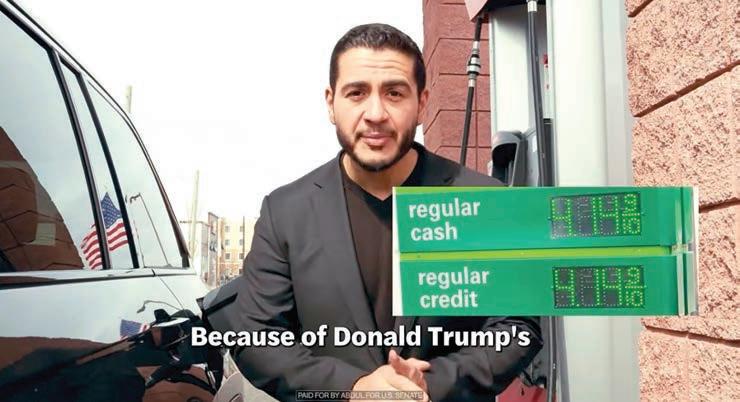
“While Trump puts America last, Abdul puts Michigan first by fighting for the things we all need: the ability to afford our basic needs, like healthcare, clean water and air, quality schools, to fill up our tanks without breaking the bank, and a future for our kids,” his campaign said in a release.
says is an issue.
“And that’s what’s daunting and that’s what’s draining. The Detroit Public School system fails these children, and it hurts my heart because I’m constantly advocating for parents with DPS, and they are constantly, constantly short-selling these babies. It’s not fair. It’s not fair to the kids,” she says.
Moultrie hopes to raise both funds – she and the AITD board already have banked more than $10,000 toward their goal of building their gym, which they’re planning on calling Inscape Detroit -- and awareness of the gaps.
“When I do pitch competitions for this, once this space is open, it’s going to open up the conversation about the lack of resources that the city of Detroit has. There are two ABA (Applied Behavior Analysis) centers in the city of Detroit. But if you check Southfield, Dearborn, especially anywhere on the outskirts… ABA centers are left and right, and ABA is the No. 1 recommended therapy for children on the spectrum,” Moultrie says.
Moultrie attacks each goal with ambition and discipline; something she says comes naturally because of her Zodiac sign, Capricorn. She also speaks freely about gardening (“I’m a smokey mama,” she laughs) and self-care, especially balancing the work she’s trying to do for other parents of autistic children while raising autistic children herself.
“I love being on their phone at work, and I get to tell [parents] I’m a two-time autism parent, and I literally can feel the tension just released because they have somebody on the other line who can relate to them,” Moultrie says. “A lot of autism parents, unfortunately, live in fight- or-flight mode constantly. And I am somebody who wouldn’t be where I am today without my faith, and I stand on that -- and I try to make sure my parents get that in them, because you can’t pour from an empty cup.
“If your cup is empty, your child is suffering.”
For more information about Autism in the D, visit www.autisminthed.com.
oration between El-Sayed and Piker “unacceptable.” And McMorrow compared Piker to far-right streamer Nick Fuentes.
Meanwhile, Michigan motorists are paying higher prices at the pump for the first time in years.
Gas prices in Michigan haven’t been this high since June 2022, months after the Ukraine war began and leaders imposed sanctions against Russia, a worldwide leader in oil production.
At the time, legislators in Michigan tried to temporarily suspend the state’s $27-cent gas tax, but the legislation was vetoed by Gov. Gretchen Whitmer. A non-partisan fiscal analysis found lifting Michigan’s gas tax for six months would bring a revenue loss of about $725 million for the state, saving drivers an average of $75. Whitmer supported the Democratic proposal to eliminate the state’s 6% sales tax on gas.
Piker and U.S. Rep. Summer Lee of Pennsylvania will join El-Sayed on Tuesday, April 7, at Michigan State University.
U.S. Rep. Haley Stevens called the collab-
National media have squared in on Michigan’s competitive Democratic U.S. Senate primary race between El-Sayed of Ann Arbor, U.S. Rep. Haley Stevens, D-Birmingham, and state Senator Mallory McMorrow, D-Royal Oak. El-Sayed’s campaign has come under fire from national pundits after political rivals and his U.S. Senate opponents called out his campaign rally with Hasan Piker, a popular political streamer.
Sen. Majority Leader Winnie Brinks told reporters, “If we do get to a point where this is a long and protracted conflict, we can have some conversations about that,” Brinks said, the Detroit News reported. You can reach Sam at srobinson@ michronicle.com.