equitable systems today will age no better than opposing civil rights legislation did in 1964.
In 30 or 40 years, when our children and grandchildren study this era, they will ask what side people stood on when voting rights were under attack. They will ask who defended inclusive education and who sought to erase uncomfortable truths. They will ask who protected marginalized communities and who dismissed their concerns as political theater. And if estimations come to fruition about the United States’ population being comprised mostly of minorities in 25 years, the phrase “It ain’t no fun when the rabbit got the gun” will become a calling card for the historically disenfranchised.
Elected officials are also working to keep Roe v. Wade intact thus holding off Michigan’s 1931 trigger ban. Governor Gretchen Whitmer released a statement saying, in part:
isn’t about performative allyship or symbolic gestures each February. It’s about consistent, sometimes-uncomfortable choices. It’s about defending principles when they are unpopular. It’s about recognizing that justice is not a zero-sum game.
cine and healthcare, may be adversely impacted by the decision to overturn Roe v. Wade.
For those who argue that DEI undermines merit, I ask: was segregation merit-based? Were poll taxes and literacy tests merit-based? When entire communities were locked out of housing markets through redlining, was that a fair competition?
“The words ‘Roe overturned’ are no longer theoretical. I want every Michigander to know— no matter what happens in D.C., I’m going to fight like hell to protect access to safe, legal abortion in Michigan…”
Many of those who now speak loudly against racial progress will insist they were misunderstood. They will claim they were simply concerned about “process,” about “fairness,” about “economic anxiety.” They will retreat to the corners of the internet, finding comfort among like-minded revisionists who reassure one another that history got it wrong, similar to the Confederacy sympathizers of today.
But we will have receipts.
“PPMI has been preparing for this moment since the results of the 2016 election were final. We recently filed a lawsuit to stop the 1931 law from going into effect, and we’ve also asked the state courts to affirm that the Michigan constitution does already contain a right to abortion. Our advocacy arm, Planned Parenthood Advocates of Michigan, is a founding member of the coalition that launched Reproductive Freedom for All, a ballot initiative to affirm the right to abortion and reproductive freedom in the state constitution,” said Vasquez Giroux. “The bottom line is that we will do everything in our power to keep abortion legal in Michigan, and if SCOTUS makes that impossible, we will do everything we can to ensure our patients can access the care they need.”
We will have voting records. We will have archived tweets and recorded speeches. We will have corporate memos and campaign ads. We will have the footage.
Equity is about removing barriers that were deliberately constructed, not about handing out advantages.
Civic equality isn’t a special interest. It’s the promise embedded in the Constitution, albeit imperfectly applied, often betrayed, but always worth fighting to realize.
More than legal implications, overturning Roe v. Wade would impact several systems across the spectrum. With the potential to drive both foster and adoption numbers upward, a ban on abortions could leave many women to choose a less safe route restoring ‘back alley’ and illegal abortion practices, including self-abortions. Moreover, African American women and women of color, who already have a long-storied history with access and inclusion in medi-
And racial harmony emerges from truth, not silence.
Black History Month reminds us that progress has always required tension. It required people willing to disrupt comfort for the sake of conscience. It required citizens who understood that legality and morality are not always aligned. Slavery was once legal. Segregation was once legal. Denying women the right to vote was once legal.
islature adopts it.
History isn’t just written by the victors anymore. It’s documented in real time.
corporate boards to have more diverse representation and pass the legislation.
The question, then, is not whether history will judge us. Because we know it will. The question is how will it judge us?
Better collection and analysis of criminal justice data: BLAC recommends data collection and professional analysis be initiated with the assistance of our Attorney General, Michigan Commission on Law Enforcement Standards (MCOLES), Association of Michigan Prosecutors and other stakeholders to collaborate, collect and analyze data strategically.
Being on the right side of history
Increase school funding: Statutory changes to increase the School Aid Fund revenue by at least $3.6 billion and establish a permanent weighted funding formula based on student and community needs and universal preschool (0-3).
Nicole Boynton
From page A-1
“What we are really concerned about is the impact on our patients. Access to abortion is already out of reach for far too many Michiganders, especially Black people and people of color who face additional barriers to care as a result of systemic inequalities and institutional racism. Losing access to legal abortion will impact those communities most, forcing people to become parents or expand their families against their will. Being able to decide and control if, when and how to become a parent is central to building and living a healthy, happy life,” said Vasquez Giroux.
Legality did not make those systems just. Today, when we see efforts to roll back voting access, to redraw districts in ways that dilute Black political power, to criminalize protest, or to stifle honest conversations about race, we must recognize the pattern. They are chapters in the ongoing struggle over who counts in America, not isolated policy debates.
very existence is proof of both injustice and resilience. We were founded 90 years ago because the truth about our communities was distorted, misrepresent, and often just flat-out ignored. We continue because that danger has not disappeared.
what the Supreme Court will rule in the upcoming days. Despite the decision, advocates on both sides of the argument are willing to continue their pursuits.
Our responsibility reaches far beyond simply reporting what’s happening. It’s also our job to contextualize it and to remind our readers that today’s debates are tomorrow’s history lessons.
There were newspapers in the 1960s that urged moderation over justice. There were editorial boards that warned against “radical change.” There were commentators who framed civil rights activists as threats to social stability. They, too, are part of the historical record.
Beyond the scope of pro-choice versus prolife, the fight for reproductive choice is one of freedom. As Michigan officials work to ensure each woman who finds herself in the position to choose has access to care without the threat of legal action, many wonder
“Overturning Roe v. Wade would be a terrible break with nearly 50 years of judicial precedent and – more importantly – a blow against individual freedom. It is my hope that the majority of justices will reject the findings of this draft. If that is not the case, we need to stand with Senate Majority Leader Schumer and Gov. Whitmer in support of their efforts to preserve the right to reproductive freedom,” said Chair Alisha Bell, on behalf of the Wayne County Commission.
This Black History Month, we stand firm in resisting the temptation to treat the past as safely concluded. It would be easy to frame the civil rights movement as a museum exhibit, but the truth is that exhibits have beginnings and ends, and the civil rights movement is an unfinished project.
Being on the right side of history requires intentionality.
It requires courage to stand with those pushing for a more inclusive democracy when the backlash is loud. It requires integrity to acknowledge systemic inequities when denial is politically convenient. It requires empathy to see that expanding opportunity for one group does not diminish another.
The health committee recommends reviewing state licensure policies to address the barriers that Black psychologists face in obtaining licensure in Michigan.
As executive editor of the Michigan Chronicle, a publication born out of necessity in an era when Black voices were excluded from mainstream platforms, I am acutely aware that our
lence often enter the criminal legal system already socially, systemically and legally disappeared,” said Breea Willingham, Ph. D, associate professor of Criminology at the University of North Carolina, Wilmington. “A pattern I identify my framework, Black Feminist Disappearance Theory, which explains how harm against Black women is routinely minimized, dismissed or reframed in ways that erase their victimization. That disappearance shapes what happens at every stage, from police response to charges, trial and sentencing. In simple terms, the system often treats Black women’s survival as criminal behavior.”
Ban no-knock warrants: Urging the House Government Operations Committee to hold hearings on HB 5013 and other legislation that would ban or limit the use of noknock or quick knock warrants, and urging the state legislature to pass meaningful reform and advise Gov. Whitmer to sign the bill after the leg-
Reject censorship in history instruction: Encouraging Gov. Whitmer to ensure the goal for Michigan schools should be history instruction that is presented by professionals with the subject matter expertise, pedagogical skills, and judgment necessary to present complex information to students that are grounded in provable facts and add to the understanding of modern-day America.
In Georgia, Williams said, murder historically carried a mandatory minimum life sentence — leaving almost no room for a court to account for domestic violence as a driving force in how a survivor responded. Under Georgia’s Survivor Justice Act, signed into law last year, that doorway opened wider: the law created routes for abuse evidence to matter at trial, at sentencing and after conviction through resentencing.
Years from now, when the heat of this moment has cooled, many will attempt to rewrite their roles. They will say they always believed in fairness. They will insist that they supported equality all along.
Ensure equitable distribution of state health funds: Ensure all Michigan communities with a significant Black population receive adequate funds to address mental health issues.
But the record will tell the story. History is watching, and it’s keeping score.
Black History Month
From page A-1
in 2024 expanding instruction in proven mehtods like phonics across Michigan schools.
Beyond K-12, we’ve made community college tuition free for all high school graduates, increased scholarship opportunities to save students thousands of dollars as they earn their degrees, and established Michigan Reconnect, offering a tuition-free associate’s degree or skills training to anyone 25 and older. My budget proposal lowers the age of eligibility for Michi-
gan Reconnect to 21, opening the program up to hundreds of thousands more young people so they can learn new skills and make more money. We’ll continue working together to save students money and grow our economy. I’ll have more to say about all these priorities during my state of the state address on February 25th. I encourage you to tune in. This Black History Month, let’s recommit to working together to build a bright future for every Michigan family.
Protecting Black voting rights: Urge state officials to remain vigilant in the fight against schemes to disenfranchise Michiganders of color.
On the tape, she said, she told the operator they’d had an altercation. She said she stabbed him — then corrected herself, trying to explain the force of his grip, her loss of control over her own arm. She said the wound looked small beside his heart, but blood pumped fast. She pressed a baby blanket to his chest.
She says Moss grabbed her arm and apologized as he died.
bers come from large-scale survey work that asked incarcerated women directly what happened. In a 2020 analysis for The Appeal, reporter Justine van der Leun coded 608 survey responses from women imprisoned on murder and manslaughter charges across 22 states and found that at least 30% said they were incarcerated for trying to protect themselves or a loved one from physical or sexual violence.
reminder that women’s incarceration in America is treated as an afterthought inside systems built for men.
When police arrived, Boynton said, they pushed her aside.
“I’m yelling at the police,” she said, “because I was applying pressure to him versus them just looking at him.”
Increase mental health supports for the Black community: Recommending Michigan set a goal of increasing the number of Black mental health service providers by 20% each year over five years.
Boynton’s story shows why that matters.
She was 18, exhausted from trying to keep peace inside a home where her body and safety never belonged to her. She told it straight, the way you do when the details have never left you.
She described a relationship where the rules changed constantly andwhere violence was the predictable ending of ordinary moments.
“If I didn’t pay him enough attention or if I didn’t do something a certain way, I already knew I was going to get smacked or punched,” she said.
That day, she was nursing her son when Moss walked in and erupted.
“BLAC members have worked hard to identify the needs of the Black community and we feel these recommendations will provide a solid first step towards breaking down barriers in education, community safety, health and business,” said BLAC Co-Chair Dr. Donna L. Bell.
Boynton said officers placed her in handcuffs with only a T-shirt on, then questioned her at the Marietta police station. She said she didn’t ask for a lawyer because her grandmother raised her to believe the truth would protect her.
If those findings reflect the broader population, the analysis estimates — conservatively — that more than 4,400 women and girls could be serving lengthy sentences for acts of survival tied to violence and abuse.
She also described health harm she connects to confinement: “Every prison that I’ve been to has something wrong with the water,” she said, describing serious illness and surgery near the end of her sentence. Then came court — and a judge who looked at the record and said what Boynton had been saying for decades.
“You should have never been in prison,” Boynton recalled Judge Angela Z. Brown telling her, as the life sentence was lifted. Boynton’s son appeared on Zoom.
“They waited to get all of the questions out of me,” she said. “And as soon as I finished, then they tell me that he died and I fell out.”
What followed, she said, was an outcome that felt decided from the beginning.
“My son always tell me, ‘Mom, I love you. You’re my queen,’” she said. Boynton still speaks of Moss as someone who was not “always a bad person.” She still marks his birthday at times. She grieves and remembers and holds contradiction, because real life keeps contradiction.
“I think of transformational leadership as a thoughtful approach that causes people to change but also causes the systems and circumstances they are operating in to change too,” Ivory said. “Transformational change doesn’t just ask people to do certain things; it asks them to change their view of what’s possible and excites them to drive that change together because they believe that what they’re doing will create positive change for everyone. That’s how entire systems change because people believe that they need to for themselves and others to live better lives.”
“Before I knew it, he snatched Romello off my breast and threw him against the wall,” she said. “And we immediately started fighting.”
BLAC will hold a virtual town hall meeting to discuss its policy recommendations on Thursday, May 12 at 4 p.m. Join BLAC and a virtual audience in discussing the recommendations to support the Black community.
The law does not ask survivors to become perfect victims. It asks courts to become more honest about what abuse does to decision-making, danger and time.
“They had already had it in their minds who to charge,” she said.
“Chancellor Ivery is a true transformational leader and an outstanding CEO, who is more than worthy of the CEO of the Year Award he just received, “ said Prof. James C. Mays, who teaches entrepreneurship and supply chain management at WCCCD’s Corporate College. “In his 27 years at WCCCD, Dr. Ivery has elevated WCCCD to become nationally recognized for excellence and innovation and preparing our students professionally and personally to do great things in the world.”
Her townhome windows were open — she liked them open while she cleaned — and the noise carried. When Moss got distracted by the three neighborhood girls who knocked on the door.
“When they knocked on the door, it was like he instantly stopped,” Boynton said. “It’s like it took him out of his trance.”
She ran upstairs to her son.
“He was still breathing, but he was unconscious,” she said.
In the seconds that followed, Boynton said, her mind went to escape.
“In the kitchen, he chased me around the island, and I got to the nearest drawer that I could, and I hurried up and I grabbed a knife,” she said. “And so, I’m thinking in my mind, if he sees the knife, he’ll stop, but he didn’t care that I had a knife.”
Boynton said she pleaded.
“Please,” she recalled telling him. “Somebody’s gonna get hurt. Please, just stop.”
She said Moss grabbed her arm, overpowering her, twisting the knife toward her body.
“When he grabbed my arm, I knew I was gonna lose my life,” she said. “The knife was pointing at me, and all I was trying to do now is not get hit with the knife.”
Then: a swing, an attempt to break free, Moss falling back.
Boynton called 911.
Her sentence: life.
BLAC is housed in the Michigan Department of Labor and Economic Opportunity. Members represent many professional backgrounds, including economics, law, public safety, health and wellness, arts and culture and media. They leverage their experiences and expertise to make recommendations to the governor on critical issues affecting the Black community.
Prosecutors indicted her in 2001. The next year, her case went to trial and a jury convicted her of felony murder and aggravated assault. She says she later learned there had been a plea offer for 15 years — information she says she didn’t have when it mattered.
The legal framing of cases like Boynton’s often ignores a truth that advocates say is central: survivors do not enter the criminal legal system as blank slates. Large shares of incarcerated women report past victimization, including intimate partner violence and sexual violence — trauma that can shape pathways into criminalized survival.
To learn more about BLAC and this upcoming event, visit www.michigan.gov/BLAC. the chancellor embraces.
Williams said Georgia’s law was built to force the system to confront that context without treating it like an excuse or a footnote. She described “criminalized survival” as acts undertaken to stay safe, but that lead to incarceration: fighting back against an abusive partner, being coerced into crimes under threat, or being charged with “failure to protect” when an abusive partner harms a child and the mother is punished for what she could not stop.
That last category hits hard in public conversation because it cuts against the cultural script — the myth that a mother can always control an abusive man, that danger is something you can simply choose to avoid.
Williams calls it what it is: another way the system criminalizes survival.
Black women are incarcerated at markedly higher rates than White women, a disparity that shapes who gets punished hardest when courts and prosecutors decide whose survival “counts.” The Sentencing Project, a nonprofit research and advocacy organization based in Washington, D.C., reports that Black women are imprisoned at about 1.7 times the rate of White women (rates per 100,000), even though women remain a smaller share of the total prison population than men.
The harm shows up inside women’s prisons in a way that’s hard to ignore: incarcerated women are overwhelmingly survivors of violence.
Because the system does not reliably track “criminalized survival” in official sentencing data, some of the clearest num-
That same survey work also matters for the focus on Black women because it shows who is sitting in these cages when “self-defense” gets treated like first-degree intent, according to experts. Among respondents, 32.7 percent identified as Black. The reporting also notes that race and socioeconomic circumstances repeatedly surfaced in how women described being charged, prosecuted and sentenced. Those numbers don’t claim a single national “Black women self-defense sentencing” rate — because the system rarely labels cases that way. But they do document, at scale, that Black women are a significant share of the women describing survival-driven convictions inside the most severe homicide categories.
“The Black women’s prison narratives I’ve studied repeatedly show they suffered prolonged abuse that was ignored by the system and their failed attempts to seek help,” Willingham said. “And at trial, context surrounding the women’s actions are often misconstrued or deleted entirely. If states truly want to stop criminalizing survival, reforms must expand how self-defense is recognized, allow complete evidence of prior abuse and invest in trauma-informed training and defense resources. Also, limit unchecked prosecutorial power.”
The Georgia Survivor Justice Act attempts to change outcomes at three points: trial, sentencing and post-conviction. Williams said the law modifies legal defenses — including self-defense and coercion — so lawyers can present abuse evidence in a way jurors are permitted to meaningfully consider in their decisions. It creates a mitigation framework that can move sentencing out from under mandatory minimums. And it allows retroactive resentencing, giving people already behind bars a way to return to court and ask for a new sentence that accounts for abuse as a significant contributing factor.
That retroactive piece is where Boynton’s case broke open.
On January 5, a judge in Cobb County vacated her life sentence and resentenced her to time served, making her the first person released under Georgia’s new law.
Boynton said she never stopped pushing paper — letters, requests, documents. She said she wrote a judge so powerfully early on that it helped her secure bond while her case dragged on.
“I didn’t know I was a writer until I wrote something so deep to the judge,” she said. Inside prison, she said, incarceration stripped her privacy and dignity — telling her when to eat, when to move, how to live — while her mind stayed fixed on a future she couldn’t yet see.
“My body was there physically,” she said, “my mind would never let me stay there.”
She described cycling through multiple prisons as facilities closed and reopened — each transfer another disruption, another
Advocates see what has happened in Georgia as part of a broader shift. States including New York and Oklahoma have some of the most robust survivor sentencing laws, and Georgia’s is among the most expansive in how early it can operate in a case, according to Williams.
Other states are moving, too. In New Jersey, Gov. Phil Murphy signed legislation on January 21 aimed at fairer sentencing and record relief for survivors, a pairing advocates say is essential for rebuilding life after incarceration.
“For far too long, Black women survivors have been punished for surviving,” said Monifa Bandele, chief strategy officer at MomsRising. She pointed to survivor-centered reforms that treat coercive control and domestic violence as realities courts must weigh — and that recognize how a record can lock someone out of housing and employment long after a sentence ends.
The throughline across these reforms is not mercy. It is accuracy.
Because the current system has long demanded that women fit a narrow mold of innocence to be believed — and Black women rarely get the benefit of that mold. They are read as older than they are, tougher than they feel, more responsible for the violence done to them than the person who did it. They are expected to absorb harm quietly, then punished when they refuse.
Boynton named that imbalance in her own case.
“Back then, Cobb County was predominantly White,” she said. “You could have people do the same thing and they get involuntary manslaughter, versus I get a life sentence.”
She said she had no prior record. She spent three years out on bond without trouble. None of it moved the system.
“It was like they said, ‘She doesn’t know nothing about the law so we gonna get her,’” she said. “And that’s exactly what they did.”
Georgia’s law did not give her back 23 years. It gave her back breath.
And it offered a blueprint that — if other states follow — could mean the next Black woman who survives does not have to spend decades proving she deserved to live. Ebony JJ Curry can be reached at ecurry@ michronicle.com.
A3 | Feb. 25 - March 3, 2026
Roots.
PART I
Jesse Jackson’s Detroit:
How a Country Preacher spent six decades in the Motor City
As a young activist and a Black city mature together, an extensive travelogue tells a post-Civil Rights coming-of-age story
By Aaron Foley Editor-at-Large
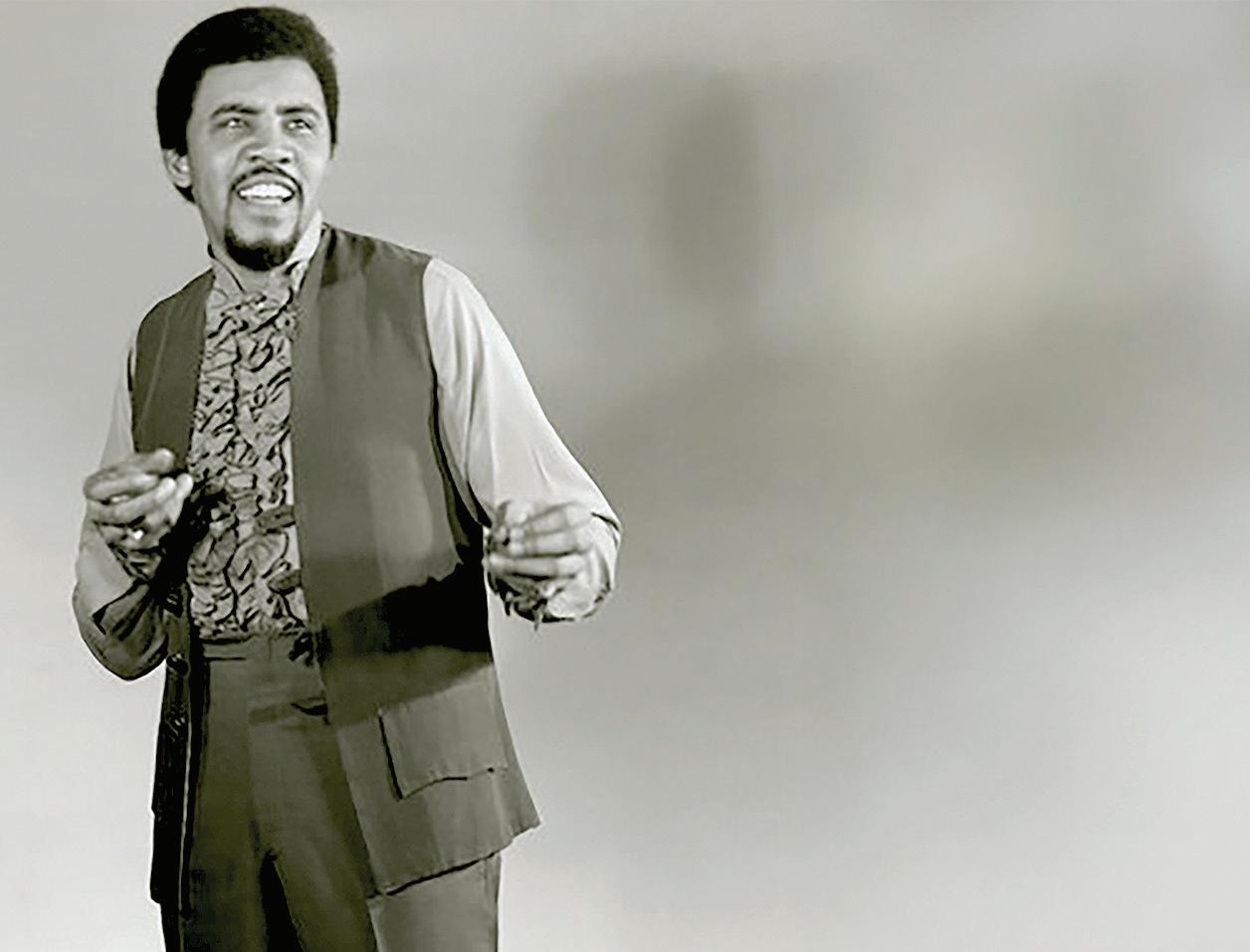
In February 1967, the Rev. C.L. Franklin was tasked with introducing Detroiters to a rising star whose name everyone in town should know.
By that time, this was a familiar practice for the pastor of New Bethel Baptist Church, whose stamp of approval could change minds and lives alike. It worked as he ushered his daughters – one in particular – into the entertainment world, and it worked when he put his reputation on the line four years earlier to convince skeptical Detroiters to gather en masse on Woodward Avenue to let a young preacher from Atlanta make his case for freedom. This time around, he’d be introducing an even younger associate of that preacher, who was also man of the cloth himself.
A brief mention in a February issue of the Michigan Chronicle previewed an upcoming visit by the Rev. Jesse Jackson, “a 25-year-old civil rights leader” – a verbatim descriptor from the Chronicle that lends to some amount of consensus that one could actually be a leader at 25 – who’d be delivering a talk on economic empowerment at New Bethel on a Friday evening, as well as talking about progress made with a new division of the Southern Christian Leadership Conference that was not yet a year old at the time. It was the second time Jackson had been featured in the Chronicle. A few months prior in 1966, Jackson was highlighted in a Chronicle writeup after Operation Breadbasket, the name of the new SCLC division he founded in his hometown in Chicago, took action to demand better conditions and wages for Black grocery store clerks – and
won. Those demands won notice in Black press outlets across the country and officially deemed Jackson, whose name was beginning to appear more and more alongside the SCLC’s first president, the Rev. Martin Luther King Jr., as one to watch. King, a familiar name to Chronicle readers due to his frequent mentions in a recurring column penned by Horace Sheffield, was increasingly in demand and, as some Black press dispatches show, often deputized Jackson and other close affiliates in lieu of his absence or unavailability for speaking engagements, town halls and other appearances in front of Black audiences who were beginning to hang on to his every word. Jackson’s work targeting better working conditions for Black people in Chicago were of interest to Detroiters, who had long com-
plained of being discouraged from career advancement and forced to accept poor wages, all while being asked to accept below-average living conditions in the slums or the projects.
The 1967 address from Franklin to New Bethel’s parishioners did not earn much ink in the Chronicle, nor is there a known copy of the speech. A religion column noted that while Jackson was in town, he delivered a sermon at one east side church’s early service and a second afternoon sermon at a different church. As brief as these summaries are, enough inference can be drawn to suggest the beginning of a lifelong partnership between Jackson and the city of Detroit.
Perhaps Franklin’s presence can be revised as a symbolic torch-passing from an elder statesman to a younger upstart, setting the stage
Michigan Lawmakers Remember Rev. Jesse Jackson’s Legacy in Detroit
By Sam Robinson SENIOR REPORTER
Rev. Jesse Jackson, who died Tuesday, Feb. 17, left a massive impact on those involved in local politics in Detroit and across the state of Michigan.
Lawmakers pouring in tributes to the civil rights icon pointed to Jackson’s visits in Detroit, a city he viewed as a battleground for Black liberation across the country.
In 1970, in a speech at the University of Detroit fieldhouse, Jackson declared an economic war in select areas of the city of Detroit as part of his boycott strategy that forced corporations to hire and support Black workers and their communities.
Twenty-eight years later in 1998, Jackson opened a Detroit field office to assist Black people doing business with the auto industry. In a press conference, Jackson said he wants automakers to hire more minorities and promote more of them to executive positions, to recruit more minority dealers and to do more business with minority-owned firms.
It was the same year Jackson found success in the state during his second presidential run. Jackson was the first Black person Michigan voters nominated to represent a major party to be president of the United States. He upset the eventual Democratic nominee, Michael Dukakis. Jackson defeated candidates including future Vice President Al Gore, President Joe Biden and Dick Gephardt. Jackson earning 55% of the vote in Michigan’s Democratic caucus meant for a brief period, he was viewed as the frontrunner for the nomination.
Jackson was viewed as a leader among Black civil rights but also spoke up about issues happening across the world. He condemned the apartheid in South Africa and criticized the U.S. war in Vietnam.
In 1986, Jackson was in Detroit for a PUSH International Trade Bureau board meeting when he slammed President Ronald Reagan’s foreign policy, which Jackson said was “bombing the U.S. into isolation.”
“Whether it was his annual visits on MLK day, his Rainbow Push conferences for auto suppliers, his high school visits to encourage voter registration, or his personal visits to the Manoogian to give me advice, Rev. Jackson always had a special place in his heart for Detroit,” former Mayor Mike Duggan said in a statement, describing Jackson as a dear friend to the city.
Gov. Gretchen Whitmer also noted Jackson’s “special connection” to Michigan and the city of Detroit.
“I was honored to partner with him on our shared goals of investing in working people and ensuring every Michigander is treated with dignity and respect,” Whitmer said.
Republican candidate for governor, U.S. Rep. John James, offered prayers to the Jackson family “and all who mourn Rev. Jesse Jackson today.”
Rev. Horace Sheffield, the leader of DABO Detroit, in a statement invoked his own family history and talked about how Jackson helped financially support his organization’s work.
“As a child of the Civil Rights Movement — and with a father who stood shoul-
der-to-shoulder with Rev. Jackson during those defining years — I and DABO Detroit mourn his profound loss,” said Rev. Horace Sheffield. “Over the years, Rev. Jackson supported DABO’s work, aided its fundraising efforts, and collaborated with us most recently in opposing unfair treatment by the FCC of minority-owned telecommunications enterprises. A true disciple of Dr. Martin Luther King Jr., Rev. Jackson embodied the principle of keeping “hope alive” and uplifted countless voices.”
The Michigan Legislative Black Caucus (MLBC) today honors the life of Jackson. Black lawmakers said Jackson’s work advanced justice, strengthened democracy and left an enduring mark on communities across Michigan and the nation.
The MLBC issued the following statement in remembrance:
“The Michigan Legislative Black Caucus reflects on the extraordinary moral leadership of Rev. Jesse Jackson, whose life reminds this nation that justice requires persistence, courage and an unshakable belief in the worth of every person. Through moments of progress and setback alike, he challenged America to confront inequality honestly and to expand democracy beyond rhetoric into lived reality. His work helped elevate the voices of working people, strengthened the political power of Black communities and affirmed that public service is, at its core, a moral calling. As Michigan continues its own work toward equality, equity and civil rights, we honor Rev. Jackson’s legacy by carrying forward his demand for accountability, inclusion and hope through action.” You can reach Sam at srobinson@ michronicle.com.
See JESSE JACKSON’S DETROIT
Jesse Jackson’s Detroit
From page A-3 for an unending debate about whether the younger would ever live up to the standards set before him. And as we reflect on the legacy of Jackson following his death on February 17, one could also argue the New Bethel visit -- exactly 59 years to the date of his transition – is emblematic of the unsung labor Detroiters have always performed in making legends out of neophytes.
It wouldn’t be long before the Chronicle’s dispatches on Jackson became longer and took up more column space. With 90 years of archives to pull from, Chronicle journalists’ coverage and commentary from 60 of those years follow a journey to empower Black Americans that took Jackson everywhere from the South Side of Chicago to spitting distance of the White House, with countless trips to Detroit underscoring how this city became the reverend’s barometer for all of Black America.
It’s during this same timeline that as Jackson is stepping into the limelight, Black residents in many cities first began tipping the numbers to count for more than half of their population. Chronicle journalists exploring Detroit’s new status as a Black city, one whose residents are settling into new legislation allowing voting rights and desegregation, but still not that far removed from the Jim Crow south, show how Detroiters arrive at their own station. Studying the parallels and intersections of the two makes a case for a new entry in the annals of Black history. Jackson’s activism over six decades is a familiar narrative of a freedom fighter’s journey of resilience and determination. A closer examination at the role of Detroit and its residents over the same 60 years looks at how demographics can increase not just in number, but in influence -- showing not only how Black leaders were continually met with higher standards and new demands in a growing Black population, but what the consequences could be if they didn’t measure up.
The amount of time Jackson spent in Detroit working with advocacy organizations he founded, delivering speeches, stumping for candidates, speaking to students, joining protesters and picketers, attending celebrity birthday parties on Saturday nights and delivering Sunday morning sermons is immeasurable, even with volumes of archives. This timeline marks some significant events in Jackson’s life, such as causing a stir at a Democratic National Committee meeting in Detroit in his first presidential bid, as well as the routine, everyday gatherings sometimes lost to history, like judging a beauty contest with Detroit’s most senior congressman. While it is far from complete, the amount of available information to dissect here is a testament to the critical work of the Black press. 1960s: A King on Woodward, a kingmaker on Linwood, a kingdom in flames Unbeknownst to Franklin or Jackson, that February, Detroit would transform into an entirely different city a few months after the Chicago resident came to Linwood to address the congregation. Jackson himself would undergo some unexpected metamorphosis soon after. It’s safe to say that Jackson and Franklin hit it off after the February 1967 sermon. Later that July, the Chronicle reported about a well-attended anniversary banquet at New Bethel honoring Franklin’s years of service there. Before Franklin embarked on a three-week European vacation, more than 500 churchgoers wished him well at a lush affair that featured performances from Franklin’s daughters Carolyn, Erma and Aretha, and remarks from politicians and community leaders. UAW President Horace Sheffield took to the podium to introduce Jackson, who gave some extended
remarks.
Throughout the years, Jackson would find himself in close proximity with a generation of Detroiters rising to new levels of prominence across all disciplines. Sheffield, whose granddaughter became Detroit’s mayor last month, frequently championed Jackson in several columns he wrote for the Chronicle over the years and defended any attacks on his stature among Black Americans. So did the Rev. Charles Adams, another legendary local leader with a side gig writing for this publication; in a 1972 essay, Adams wrote that Jackson might “help heal the wounds of Black America, that we might reach the third crucial stage of liberation, and from there to become effective agents in the healing of America and the world.”
Adams certainly had high expectations, but that’s because it seemed like if a Detroiter called, Jackson showed up, including as a featured guest at a benefit concert raising funds for a Black college tour organized by Detroit educator Alonzo Bates (1973); delivering remarks at the funeral for Berry Gordy’s mother, telling mourners that she was “the Lord’s miracle…of taking the ordinary and turning it into the extraordinary” (1975); and returning again and again to New Bethel over the years, most notably delivering a 20-minute address at the funeral for the Rev. C.L. Franklin behind the same pulpit where he was introduced 17 years earlier (1984).
All this name-dropping has a purpose, which is to break down a possible reason why Jackson kept showing up, and kept in good graces with as many locals as he could. Whether he was prepared for it or not, Jackson faced the challenge of having to repeatedly convince Detroiters to get on his side and stay there, the same hurdles King had to overcome when it came down to convincing Northerners to listen to some ideas from Atlanta.
King having make a name for himself isn’t just a learned practice, however.
His efforts of currying favor up North culminated in the largest civil rights demonstration in Detroit history, which doubles as a backdrop for Jackson’s early activity here.
As the Chronicle and fellow Black news outlets reported throughout the 1950s and 60s, civil rights organizations were at odds with each other over who commanded the most influence over improving the lives and outcomes of Black people, a feud growing so tense that it threatened division among the very population they were trying to protect. The NAACP, then presided over by Roy Wilkins, was fighting to preserve its reputation by relying on its status as the first and oldest advocacy, but some were attracted to the younger, more progressive activism from organizations like the newer Southern Christian Leadership Conference and the Congress of Racial Equality.
The tension over where to choose sides played out in Detroit, where residents were skeptical of the then-unproven King. Seeking to raise his profile, a newly formed coalition called the Council for Human Rights placed notice in a May 1963 Chronicle asking for 100,000 to come out for a rally at Cobo Arena for King the following month on June 23. The coalition was formed by Rev. C.L. Franklin. Weeks of promotion in the press, on the ground and in Sunday sermons, boosted by major endorsements from local elite, worked out: Franklin’s goal was beat with more than 125,000 in attendance (“the largest and most dramatic march to take place anywhere in the United States,” the Chronicle reported the following week) to hear King recite a speech that would later be tweaked and finessed into its final version years later under a new title, “I Have a Dream.”
In a number of pieces, the Chronicle called repeatedly for the feuding civil rights organizations to lay down their arms, while also recognizing not only King’s magnetism, but the influence of Detroit organizers and the amount of Black support in town. As Horace Sheffield wrote in his July 6 column, “Beyond a doubt, Detroit’s ‘March for Freedom’ convoked more negroes for a single worthy purpose than any other event in the memory of the oldest living man,” before going on to chastise the NAACP’s old guard and calling for new leadership. And aside from King, the most name-checked figure across coverage of the march was Clarence LaVaughn Franklin – the way Sheffield pronounced him in his column, but C.L. in all other instances.
Franklin and King’s forces coming together in Detroit elevated both of their stature, certifying the already influential Franklin as the ultimate unifier, while King earned much more notice and curiosity in the North as word spread of the Detroit march. Each of their individual influences would follow any aspiring leader, but Jackson’s affiliation with King boosted by a new alliance with Franklin would position Detroit as a natural setting for the young reverend to occupy.
Four months after the New Bethel sermon, rebellion gripped the city that July, the latest in a string of uprisings in urban centers that year. King and the SCLC called for Blacks in cities to engage in civil obedience as a non-violent alternative to rioting, the term used at the time. One method of this, King suggested, was following the lead of Operation Breadbasket, the program led by Jackson that won jobs for Black workers in Chicago by organizing an economic boycott among Black consumers and prolonging it until white businesses met demands to hire more Black workers.
The push to expand Operation Breadbasket ramped quickly and further elevated Jackson’s profile, but King did not live to see those aspirations materialize after his assassination on April 4, 1968. With no time to grieve, questions about who would be King’s successor – not as head of the SCLC, but as the guiding force leading the path to Black liberation – came immediately after, unwittingly pitting Jackson and his peers against each other in contention for that role the rest of their lives, whether they wanted to engage in it or not.
Jackson proclaimed several times over the last 58 years, including to Chronicle journalists, that King was King, and he was not the next King. But Jackson’s actions to secure somewhat of a leading role in carrying out King’s mission while advancing his own relied heavily on garnering support from Black strongholds, some of which were rudderless before King’s death. Ten months after the rebellion of 1967, Detroiters were mourning while still in recovery. The work to unify Black allegiance across geographic borders was quickly unraveling, and impatient local leaders were gradually turning back toward self-segregation.
Whoever would be the next great Black leader would have to know Black America inside and out, and where both its pulse and pain points are. Over the next 20 years after King’s assassination, Jackson and Detroit would become tightly intertwined and make indelible marks on each other’s trajectories as the definition of civil rights broadened to include more than voting privileges and union membership. As with any kind of labor, however, one can’t get too comfortable. In this same timeline, the question evolved from who would be the next MLK to where the next MLK, if one exists, is decided.
1970s: The Country Preacher in the Motor City
Very much like the tensions between Wilkins’ NAACP and King’s SCLC, corrosions among King’s associates appeared not long after his death.
The very public feud between Jackson and the Rev. Ralph Abernathy, who had assumed SCLC’s leadership, played out in the Black press like gossip rags. Rumors of a “rift” between the two blared a Chronicle headline in 1969, stating that Jackson’s growing popularity, his bookings for speaking engagements, and being the “far superior orator” between the two was irking Abernathy.
In Jackson’s more frequent visits to Detroit in the years immediately after the King assassination, it’s worth noting some of the more colorful word choices that appeared in the Chronicle’s pages in that time. The “burly, young preacher” (February 21, 1970) was the object of affection for at least one reader: “I think the Rev. Jesse L. Jackson is such a handsome man. Why doesn’t Hollywood cast him in a movie?” asked one reader to the Chronicle’s syndicated “Dear Nancy” column.
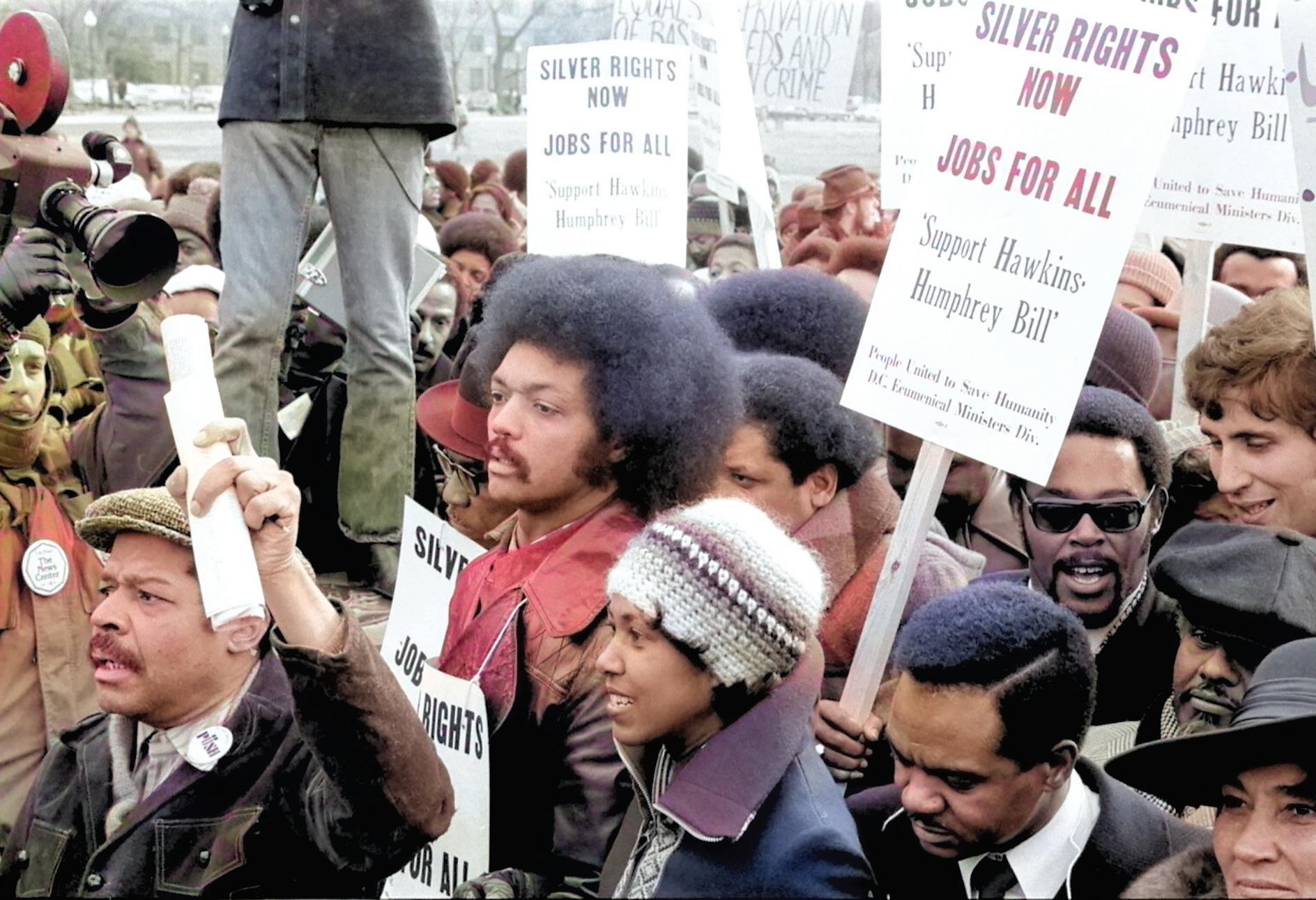
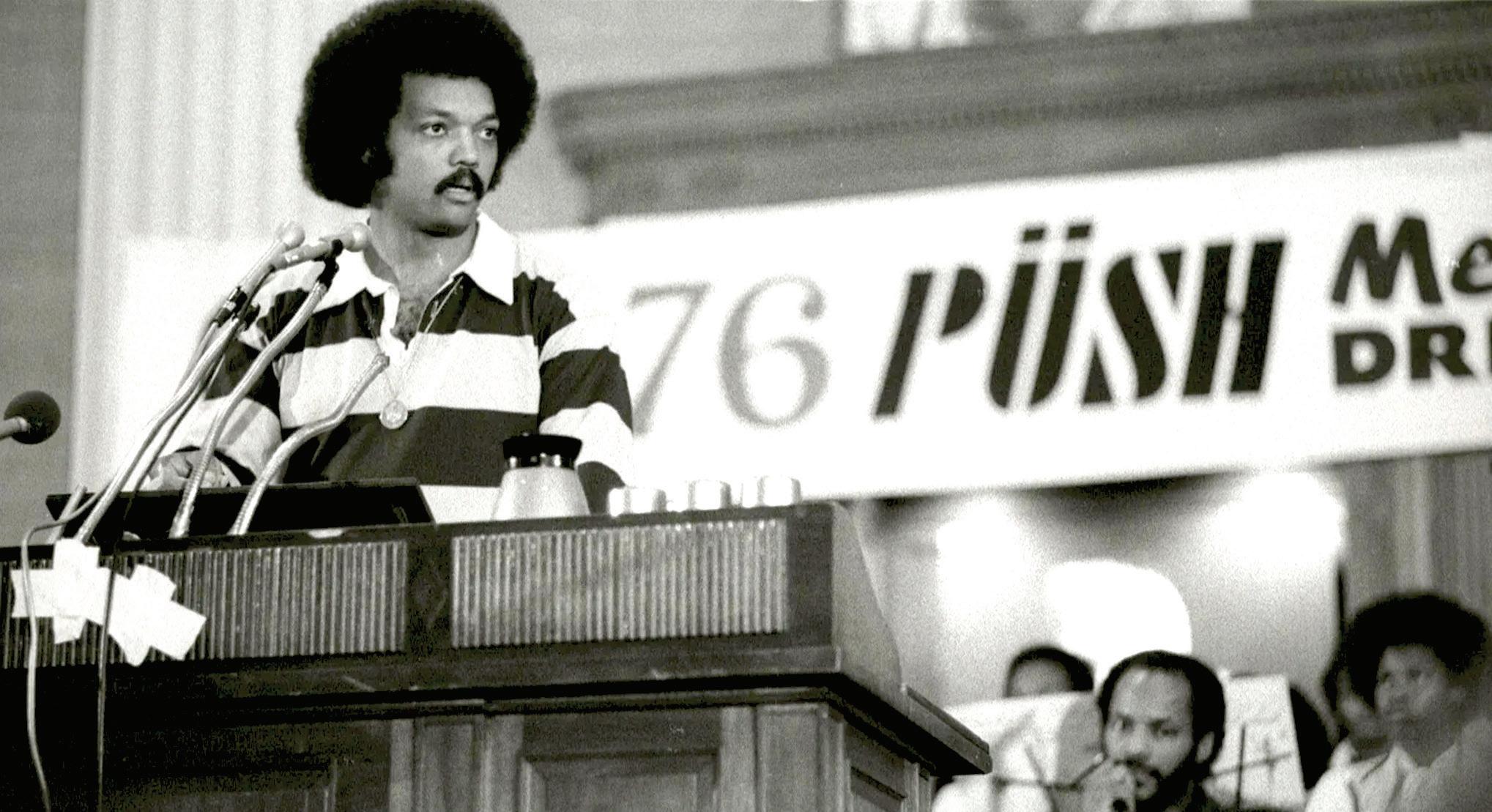
“What is Rev. Jesse Jackson like?” opens one column, discussing an October 1970 visit from Jackson to the University of Detroit Fieldhouse, “Well, once one gets over the impact of his incredibly good looks…one comes to the realization that here stands one amazing man.” Looks aside, Jackson, now calling himself the “Country Preacher,” could undoubtedly draw an audience – both in person and on screen. The Fieldhouse visit was to launch an Operation Breadbasket initiative in the city, in which 2,000 locals attended. Jackson clocked at least a dozen speaking engagements in the city between 1970 and 1972, the beginning of a fruitful half-decade that also coincided with a rise in television appearances in households just getting their first color television. Jackson loudly proclaimed: “I am somebody!” on an episode of Sesame Street, dropped by “Soul Train” to discuss economic development, and appeared in conversation with John Conyers on an ABC News program. (The two also judged a Miss Black America pageant, speaking to how one’s charisma can transcend beyond politics.)
A noteworthy February 1970 address at Wayne State University spoke not only to Jackson’s ability to captivate a crowd, but the significance of using Detroit as a megaphone for his message. Jackson publicly decried President Richard Nixon, who “looks the whole nation right in the eye and tells a bold-faced lie.”
Jackson criticized Nixon for a number of measures affecting Black Americans, name-checking cuts to health care, increasing military ranks and a growing air pollution crisis. In that same address, however, Jackson folded in some criticism of Detroit political and economic leadership. Using the “big tire” on eastbound Interstate 94 as an example, Jackson said how big businesses like Uniroyal (the then-owner of the enlarged tire display) “is what Detroit is all about…rolling over people,” before then turning his remarks to what Black populations should demand from white leadership.
The Wayne State speech was an early citation of Jackson’s years-long frustration with Detroit, which had recently become a majority Black city, not having a Black mayor, which he publicly admonished as a failure. (“You’re not respecting yourself enough to have a Black man as mayor of your city,” Jackson remarked at the October 1970 Fieldhouse event.) In retrospect, it was also a hint at suggesting Jackson could do a better job at being president than one who’s currently in office. Eventually, these two ideas would merge – in some form or fashion.
A5 | Feb. 25 - March 3, 2026
Money.
Property is Power!
‘No Credit Score’ Conventional Mortgages Could Be a Quiet Game Changer for Black Homeownership
By Dr. Anthony O. Kellum CONTRIBUTING WRITER
For generations, Black Americans have been met with the same quiet dismissal in housing finance you don’t qualify. Not because bills went unpaid. Not because income was unstable. But because we didn’t participate in the credit system the way it was designed to be played often by institutions that never fully served us in the first place.
What’s changing now isn’t charity or concession. It’s recognition.
Anthony O. Kellum
A recent policy shift by Fannie Mae signals something important conventional mortgage underwriting is beginning to acknowledge that financial responsibility does not live exclusively inside a three-digit credit score. For thousands of Black households long locked out of homeownership not by behavior, but by structure this change has the potential to be quietly transformative.
For decades, the 620 FICO score operated as an unofficial law of the land. It wasn’t written into statute, but it was enforced with absolute consistency. No score, no house. Thin credit file, no conversation. The result was predictable disciplined renters, savers, and workers were sidelined while access to credit not stewardship of money became the proxy for worthiness.
That door has now cracked open.
Fannie Mae has eliminated the minimum 620 credit score requirement for conventional loans evaluated through its automated underwriting system. In practical terms, borrowers with no traditional credit score or very limited credit history may now qualify if the broader financial picture demonstrates stability, consistency, and capacity. This is not a lowering of standards. It is a recalibration of how risk is understood.
Instead of anchoring eligibility to a single number, underwriting now looks at the borrower as a whole. Income stability, savings behavior, debt-to-income ratios, cash reserves, housing history and the property itself. The totality of the transaction, in other words, real life.
That shift matters deeply for Black households. Many have avoided credit cards out of necessity, distrust, faith, or lack of access. Yet those same households have paid rent faithfully for years. Utilities, cell phones, insurance, and internet obligations that required discipline and consistency but historically earned no recognition in mortgage underwriting. What was invisible before now carries weight.
This policy is aimed squarely at borrowers, the system previously ignored credit-invisible consumers, first-time homebuyers, and households with limited or non-traditional credit histories. In plain language, it speaks to millions of Black renters who did exactly what financial responsibility demands and were still told they didn’t qualify.
That exclusion was never about character. It was structural.
At the same time, intellectual honesty requires clarity. This change is not automatic approval. Borrowers must still demonstrate income, assets, and acceptable debt ratios. Automated underwriting must still return an approve/eligible decision. Individual lenders may
A
New $13M Affordable Senior Housing Complex is Coming to Detroit’s Cass Corridor
By Ebony JJ Curry SENIOR REPORTER
Mayor Mary Sheffield and the Cass Corridor Neighborhood Development Corporation broke ground on Greystone Senior Living Apartments, a 49-unit affordable housing development for Detroit seniors planned for Midtown at 440 Martin Luther King Jr. Blvd. at Cass Avenue. The four-story building is expected to be completed in 2027, according to the project partners.
Greystone is designed exclusively for older adults and will serve households earning between 30% and 80% of Area Median Income. Plans call for 24 one-bedroom units and 25 two-bedroom units, with affordable rent starting at $458 per month. The development will include a community room, library and community center, plus an outdoor green space behind the building. The location places residents near Wick Park, Whole Foods and the Detroit Medical Center, keeping daily needs, recreation and healthcare within close reach.
This groundbreaking hits differently for District 6, where the city’s largest concentration of seniors’ lives.
Many of those residents have watched Detroit change block by block and watched too many elderly people get priced out of the places that raised them. Housing for seniors cannot be treated like a sidebar to development. Seniors need new housing too, and that need is tied to something deeper than square footage. Being able to age close to familiar streets, a trusted clinic, a bus line, a corner store, a church pew and neighbors who notice when you have not stepped outside is part of staying well. Detroit’s elders have carried this city through the eras that did not come with investment. Keeping them rooted should be a standard, not a special request.
The project is moving forward on land that has been vacant for more than 20 years.
That detail matters in a city where empty lots can sit like open wounds, espe-
cially for long-term residents who stayed through disinvestment and uncertainty. Turning that space into homes meant for seniors is a signal that Detroit’s growth can be measured by who gets to remain, not only by who gets to arrive.
Greystone is an early marker of Mayor Sheffield’s housing agenda; it is the first new affordable housing development to break ground since she took office. The development also is among the first to use the expanded Payment in Lieu of Taxes tool, known as PILOT, which reduces city property taxes in exchange for lower rents. The policy is intended to make affordability financially workable for developers while supporting projects that meet the city’s rent restrictions.
“As many of our legacy residents reach their golden years, it’s vital that they have options to live affordably in quality housing,” Sheffield said. “The Greystone Senior Living Apartments is an example of how my administration will work aggressively to build more affordable hous-
ing, particularly for our Seniors. I appreciate the Cass Corridor Neighborhood Development Corporation for its decades of leadership on this front.”
The Greystone project is being led by CCNDC, which has spent more than four decades working to preserve affordability and expand community ownership in the Cass Corridor. Founded in 1982 as a subsidiary of the Concerned Citizens of Cass Corridor after tenants at the Vernon Murphy Apartments acquired their building from an absentee landlord, CCNDC has since rehabilitated and constructed affordable housing across the neighborhood. The organization currently manages 29 buildings totaling 357 units of affordable housing, along with community-serving commercial spaces, according to project materials.
“Greystone Senior Living is about honoring the people who built this neighborhood and making sure they’re not pushed out as it grows,” said Patrick Dorn, executive director of the Cass Corridor Neigh-
The New Generation of Entrepreneurs Is Rising — and Detroit Is in the Mix
By Mark S. Lee CONTRIBUTOR
Entrepreneurship is getting younger — and that shift is reshaping both the national economy and Detroit’s local business landscape.
Across the country, roughly one-third of new businesses are now launched by founders under 35. That marks a significant generational shift. Instead of climbing traditional corporate ladders, many young professionals are building their own. They’re leveraging digital tools, artificial intelligence, e-commerce platforms, and social media to launch faster, leaner, and often with far less startup capital than previous generations required.
This isn’t just about side hustles. It’s about structural change.
Younger entrepreneurs are entering industries like technology, climate innovation, mobility, digital marketing, health services, and creator-driven commerce. They are mission-focused, often blending profit with purpose. They are comfortable operating virtually. And many are building businesses without storefronts, warehouses, or even full-time employees.
Nationally, small businesses still account for 99.9% of all U.S. firms and employ nearly half the private workforce. When
young founders step into that ecosystem, they are not just creating income for themselves — they are influencing hiring patterns, workplace culture, and how companies interact with customers.
Detroit is very much part of this story.
Money Matters
Over the past several years, the city has steadily strengthened its entrepreneurial infrastructure. Public and private partners have launched funding initiatives, startup accelerators, and innovation hubs aimed at retaining talent and growing new ventures locally. Organizations have helped position the city as a center for mobility, climate tech, and advanced manufacturing startups.
Through various collaborations, support continues to grow and evolve. At Michigan Central’s Newlab hub alone, for example, more than 100 startups are collaborating on next-generation transportation and climate solutions. That kind of ecosystem didn’t exist in Detroit a decade ago.
At the neighborhood level, young founders are also driving retail, food service, consulting, and digital service businesses. Many are microbusinesses — one to three employees — but collectively they contrib-
ute to economic vibrancy, job creation, and commercial corridor stability.
There are, however, real challenges.
Access to capital remains one of the biggest barriers for young entrepreneurs, especially those without generational wealth or strong banking relationships. Credit history limitations can restrict loan eligibility. Cash flow management often becomes the make-orbreak issue within the first three years. And while social media can help launch a brand, scaling beyond that initial audience requires operational discipline and strategic planning.
Mentorship also matters. Experience cannot be downloaded. Business fundamentals — accounting, pricing strategy, compliance, and workforce management — still determine long-term sustainability.
The broader question is what this generational wave means for the economy.
Is entrepreneurship becoming the new entry-level job?
In some ways, yes.
For many young adults, launching a business feels more accessible than navigating corporate bureaucracy. But entrepre-
neurship also carries higher risk. Not every startup succeeds. Economic slowdowns, inflation, and shifting consumer demand can quickly test resilience.
For Detroit, the opportunity is significant. A city long defined by industrial reinvention now has a chance to cultivate a generation of homegrown founders who build wealth locally and hire locally. If capital access, mentorship, and policy alignment continue to improve, young business owners could play a central role in inclusive economic growth.
The emergence of young entrepreneurs is more than a trend. It’s a transition. A transition toward digital-first business models. Toward purpose-driven leadership. Toward ownership at earlier stages of life.
And in cities like Detroit — where resilience and reinvention are part of the DNA — that transition could shape the next chapter of economic progress.
The new bosses are not waiting their turn.
They’re building their own table.
We invite readers, business owners, and future entrepreneurs to follow along, ask questions, and engage. If you have story ideas or questions you can email Lee at mark@leegroupinnovation.com or visit leegroupinnovation.com.
Mark S. Lee
Senior Housing Complex
over the age of 55.
From page A-5
borhood Development Corporation. “For generations, Cass Corridor residents fought for the right to stay, to belong, and to shape their own future. This development carries that spirit forward by turning long-vacant land into a place where our seniors can age safely, affordably, and with dignity.”
Councilmember Gabriela Santiago-Romero said the development reflects a commitment to ensuring seniors benefit from quality housing in one of Detroit’s most resourced neighborhoods.
“The fact that Greystone Senior Living Apartments is being built in one of our most thriving neighborhoods is a testament to the city’s commitment to centering our seniors,” Santiago-Romero said. “All residents, especially our seniors, deserve to live in quality, affordable housing where they can age with dignity and access amenities that improve quality of life. Thank you to all the partners, including CCNDC and St. Patrick Senior Center, for commitment to creating communities of care such as this one.”
Service supports are built into the project plan through a partnership with St. Patrick Senior Center, which will provide additional services to residents. The partners say that it will include transportation services, an onsite Wellness Clinic, meal services and exercise classes. St. Patrick Senior Center is described as the largest health, wellness and activities center for Detroiters
Conventional Mortgages
From page A-5
still impose overlays. This is not a free pass. It is a fair shot and that distinction matters.
Zooming out, this shift touches something much larger than loan guidelines. Black homeownership has never been solely about shelter. It is about stability, leverage, intergenerational wealth, and agency. The racial homeownership gap did not emerge by accident; it was engineered through redlining, exclusionary lending, and financial systems that rewarded access over discipline.
When conventional lending finally acknowledges that paying rent on time for a decade is evidence of creditworthiness, it challenges one of the quiet mechanisms that kept that gap in place. This is how structural inequities begin to unwind not through slogans, but through policy that
“At St. Patrick Senior Center, we believe that aging with dignity means more than just having a place to live—it means having access to health, wellness, connection, and community,” said SaTrice Coleman-Bet ts, executive director of St. Patrick Senior Center. “Our partnership with Greystone Senior Living allows us to bring critical ser vices directly to residents, so Detroit seniors can remain active & independent in the neighborhood they call home.”
Senior housing works best when it recognizes the full person. A safe apartment matters. So does a ride to the doctor. So does a meal when your body is tired. So does a space to sit with neighbors and laugh, play cards, trade stories and keep living, fully.
Greystone represents a $13.7 million investment supported by layered financing that includes $2.05 million in HOME funds from the City of Detroit, 9% Low-Income Housing Tax Credits, permanent financ ing through Cinnaire, equity investment from RBC Capital Markets, and develop ment leadership by CCNDC. MSHDA Chief Housing Investment Officer Tony Lentych said the state’s support through tax credits will help convert the long-vacant site into affordable apartments for Detroit seniors.
Project partners expect construction to wrap in 2027, with leasing to follow.
Ebony JJ Curry can be reached at ecurry@ michronicle.com
reflects lived reality.
This move also prepares the ground for newer credit-scoring models designed to better capture positive financial behavior, especially for households that do not revolve credit cards or carry unnecessary debt. That isn’t just technical progress. It’s cultural relevance.
Property Is Power has always rested on a simple truth: your financial story is bigger than a number. For Black families who did “everything right” yet were still denied, this change represents a meaningful step toward access, fairness, and ownership. It will not solve everything. But it moves the needle.
And when more Black families move from renting to owning, wealth compounds, neighborhoods stabilize, and legacy begins.
Property is Power! is a movement to promote home and community ownership. Studies indicate that homeownership leads to higher graduation rates, family wealth, and community involvement.
Michigan Chronicle
Former Leland House Tenants Wait to Collect Their Belongings
By Sam Robinson SENIOR REPORTER
City Council members on Tuesday demanded answers from the city’s law and building department over tenants of Leland House being kept from obtaining their belongings after residents were forced out of the apartment building in December.
Low income seniors made up most of the tenants inside Leland House, the historic downtown building that was originally a luxury hotel. Those displaced after building safety issues closed the historic building have been unable to retrieve their belongings after the city shut down access out of safety concerns.
Council members expressed concern that former tenants missing documents still inside Leland House are at risk of being denied from applying to new housing or employment.
One former tenant, Katherine Guyton, is raising money after losing her part time job at the Leland and losing her address, which is necessary for obtaining new employment.
City of Detroit corporation counsel addressed concerns before council members on Tuesday, saying there’s no solution to re-enter the building until the structure’s transformer is fixed and the power is turned on.
“We are where we are, not because of anything the city of Detroit did,” Mallet said. “Detroit city council can take pride in the way that the bureaucracy in which you are the governors have responded.”
Mallet defended the city’s actions, saying the city three years ago started putting pressure on the owners of the building to get it up to code.
“BSEED has been omnipresent dealing with the issues dealing with the lack of accountability and compliance by the owners of the Leland House,” Mallet said.
Mallet said the city is trying to get tenants their property back and relocated into permanent housing, and force Leland House owners to bring the building into compliance or sell it.
Current owners told a Wayne County judge that they want permission to sell the property.
The next court hearing is Feb. 24, where the city hopes to get the courts permission for the moves to occur. About 20 of the 31 tenants have given the city permission to enter their apartment to pack up their items and deliver them to a public storage facility.
More than 40 people were forced out in December.
Mallet said they are still looking for permission from the remaining 11 former tenants who are without their stuff.
“You said you were late to the party. It sounds like you didn’t show up to me,” District 5 member Renata Miller told Mallet. “This building did not just become unsafe to live in. They’ve had many maintenance failures… This is not new.”
She said the city should make decisions before emergency happens. Miller also defended the residents who haven’t given the city permission to collect their belongings for them.
“When that building was deteriorating three years ago, our job was to shut it down,” Miller said. “It’s an embarrassment… It is not right for us to stand here and say: ‘We’ve done the best that we could.’”
Miller expressed concern with her office’s ability to observe the conditions of apartment buildings throughout the city. At one stop, Miller said apartment management blocked her from talking to residents, and at another, a cockroach fell on her from the ceiling.
“We need BSEED to own up because it’s not right,” Miller said. “When you have 70,000 landlords that are not being compliant in the city of Detroit, that’s a problem with leadership.”
Council member Mary Waters says her own staff has helped relocate tenants from Leland House. She asked Mallet whether tenants could have the dignity of overseeing what’s being removed from their apartment.
“That’s a good idea, we can figure out whether or not we can do something like that, if it’s not the tenant per say, maybe a tenant representative,” Mallet said. “We will try to figure out a way with the fire marshals’ cooperation to get as much involvement with tenants in some way to supervise the packing of their belongings. I don’t think that’s an impossible request.”
District 7 council member Denzel McCampbell said the city must fix the situation.
“It’s not something we can be proud of or happy about. We have to see a different level of enforcement against these landlords who do not care about our families, it’s very clear the owners of the Leland did not care,” McCampbell said.
You can reach Sam at srobinson@ michronicle.com.
Internal Polling Shows Benson Leads James, Duggan in Race for Michigan Governor
By Sam Robinson SENIOR REPORTER
A recent poll surveying likely voters in the Michigan governor’s race has Democratic candidate for governor Secretary of State Jocelyn Benson up over Republican candidate U.S. Rep. John James, with Independent former Detroit Mayor Mike Duggan trailing.
The poll, conducted by national polling firm Impact Research, was commissioned Benson’s campaign. It shows Benson, the leader of Michigan’s Department of State, up on James by three points with Duggan taking about 20% of the vote total.
The polling, conducted from February 9-16 by Impact Research, indicates Benson has a lead in the race for governor based on a survey of 800 likely voters. The poll had a margin of error of plus or minus 3.5 percentage points.
Benson has been seen as the Democratic front runner since she announced her bid to replace term-limited Gov. Gretchen Whitmer last year. Genesee County Sheriff Chris Swanson is also running for governor as a Democrat.
Benson leads the field with 39% of the vote, ahead of John James’ 36%, and Mike Duggan’s 20%, with just 5% undecided. Ben-
son’s campaign pointed to the polls showing the state’s election chief is also leading the rest of the field among Black voters, voters under 55 and voters with and without college degrees.
“It’s no surprise Jocelyn Benson is leading the race for governor,” said Benson Campaign Manager Nikki Goldschein. “Michiganders know her track record of making government work for the people and protecting our rights and freedoms. As voters continue to learn about her plans to lower costs and hold corporations accountable, her momentum continues to grow.” Duggan’s campaign, which conducted its own internal poll last year, questioned the poll’s legitimacy.
“All independent polling continues to show Benson hovering near 30%. The only outlier is a new internal poll she paid for herself. Those results have no credibility as we’re sure the next rounds of independent polling will demonstrate. If they actually believed these numbers, MDP and Benson wouldn’t be spending every day attacking us.”
While Michigan Democratic Party chair Curtis Hertel has been consistently vocalizing his opposition to Duggan’s campaign in interviews, Benson hasn’t spent time during her campaign personally attacking Duggan.
Duggan in recent months has been praised and criticized by Democrats and Republicans, but there’s a sense among most on the left that he’s not as forceful in his critiques of conservative politicians as he has been of his former party.
Gov. Gretchen Whitmer recently said that while she would be supporting the Democratic nominee for governor, she appreciated the job Duggan did as mayor of Detroit.
Republican House Speaker Matt Hall this week said on social media that “Mike Duggan is right” talking about how Democrats weren’t able to pass certain legislation during their legislative trifecta from 20222024.
A poll conducted by Glengariff Group for The Detroit News and WDIV-TV last month showed Duggan at 26%, trailing James at 36% and Benson at 32%. The result was within the poll’s margin of error of plus or minus 4 percentage points, and 8% of participants said they were undecided, the News reported.
A poll released last fall by Schoen Cooperman Research showed Duggan at 26% of voters, Benson at 30% and James taking 29%.
You can reach Sam at srobinson@ michronicle.com.
Termination Threat Over Detroit Immigration Arrest Angers Michigan Conservatives
By Sam Robinson SENIOR REPORTER
Republican lawmakers and conservative groups slammed the Detroit chief of police this week after department leadership disciplined officers who broke city policy when they detained someone downtown last week and contacted Border Patrol.
The coordination between Detroit police officers and Customs and Border Patrol leading to a potential deportation was observed by a Detroit Free Press reporter near Grand Circus Park downtown on Friday.
Detroit’s “Welcoming City” policies prevent police officers from asking about immigration status during traffic stops or assisting federal officers without a detainer warrant. DPD does honor judge-signed detainer requests by ICE, giving agents the power to capture people being held at the Detroit Detention Center.
“The reality is, what we saw that took place was at conflict with what the chief has said is the departmental policy,” council president James Tate said at the latest Detroit City Council session.
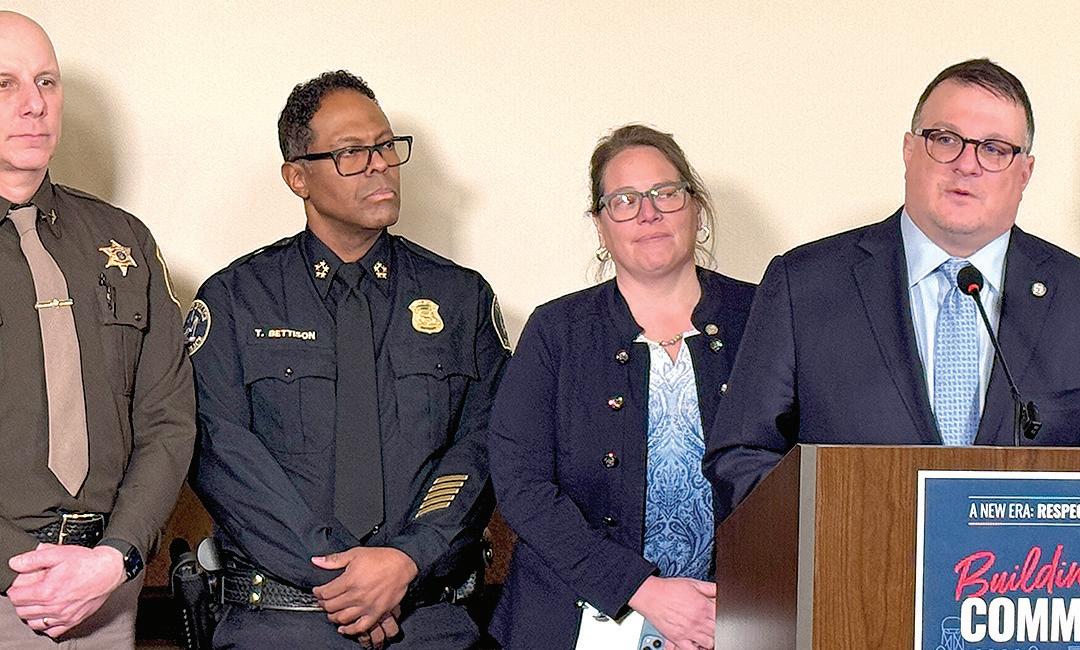
Detroit police chief Todd Bettison said at the latest police commissioners meeting the department plans to terminate the officers who contacted border patrol, in defense of Detroit’s policies aimed at protecting undocumented immigrants. Bettison said two officers were suspended after traffic stops last week and in December.
His comments have been slammed by conservative pundits and politicians.
“I think Detroit needs a new Chief,” Senate Minority Leader Aric Nesbitt said on social media in response to Bettison’s comments.
Conservatives across Michigan criticized Bettison for saying the officers would be terminated in defense of the Democratic city’s immigration policies
“It’s unbelievable that police officers could be fired for helping to apprehend criminals,” said Gabe Butzke, a spokesperson for Michigan Forward Network. “More than ever, public officials in Michigan need to support law enforcement. Instead, Mary Sheffield and Todd Bettison want to run them out of town.”
Detroit Mayor Mary Sheffield doubled down on the policy preventing local law enforcement from collaborating with federal units.
“This administration will reenforce the longstanding policy that the Detroit Police Department does not, in any way, engage in
federal immigration enforcement,” Detroit
Mayor Mary Sheffield said in a statement.
“We will do our part, as a city, to make sure that members of our community, regardless of their immigration status, know their rights and feel safe in Detroit.”
Charles Fitzgerald, first assistant chief, spoke at council Tuesday, saying Detroit police aren’t in the immigration business.
“We never have been, we never will be,” Fitzgerald said.
He said twice in the past two weeks Detroit police officers have contacted a unit under the office of homeland security for “language issues.”
“It’s unacceptable, we do not tolerate it,” Fitzgerald said, adding that once the investigation is complete, the matter will go on to disciplinary command hearing to determine the penalty.
The investigations should be completed in 21 days, he said.
When asked what’s being done to ensure officers understand the city policies surrounding immigration enforcement, Fitzgerald said that officers were recently required to scan a QR code ensuring they understand the ordinance.
He also said the department had an all-command meeting last week that included all captains and above.
“We don’t want there to be confusion where it’s ‘I can’t call ICE but I can call border patrol,’” Fitzgerald said. “We don’t call anyone… We’re doing what we need to
do, we’re not doing immigration.”
District 6 council member Gabriela Santiago-Romero, who represents the city’s largest population of undocumented residents in Southwest Detroit, said what Detroit police officers did last week coordinating with federal immigration agents is a concern her community members have already been raising.
Santiago-Romero mentioned a proposed hotline that residents could call if they observe DPD officers working with federal agents for the purpose of immigration enforcement. However, Fitzgerald said there were currently no plans to establish one.
“It’s a very big police force now, we have a lot of new people, I think that we need these opportunities to be able to do more accountability,” Santiago-Romero said. “The hotline needs to be established as quickly as possible.”
Santiago-Romero pointed to a hotline attorney general Dana Nessel set up for residents to monitor federal agents, saying the city should deploy something similar.
McCampbell pointed out the fact that both incidents were brought to public attention after the release of body cam footage and because of a Detroit Free Press reporter who happened to be at the scene. He asked the police leader whether other incidents could be happening unreported.
“We are doing everything in our power to truly go back and audit,” Fitzgerald said. You can reach Sam at srobinson@ michronicle.com.
Secretary of State Jocelyn Benson, former attorney general Mike Cox, and former Detroit Mayor Mike Duggan.
Photo by Sam Robinson
Detroit police chief Todd Bettison met in Lansing with Republican House Speaker Matt Hall in January 2025. The Detroit Police Department hosted Hall in Detroit to champion a police funding bill. Photo: Samuel Robinson
For Michigan innovators and creators, our most empowering creations might be the communities we build. Leading that charge are Alexa and Johnnie Turnage, who have built a thriving network of entrepreneurs and tech professionals through Black Tech Saturdays, an organization supported by the Michigan Economic Development Corporation and dedicated to empowering the next generation of Black trailblazers.
ALEXA & JOHNNIE TURNAGE
C ity . L ife .
Oakland
County
Honors Five Community Leaders with 2026 Black Excellence Awards
By Jeremy Allen
EXECUTIVE EDITOR
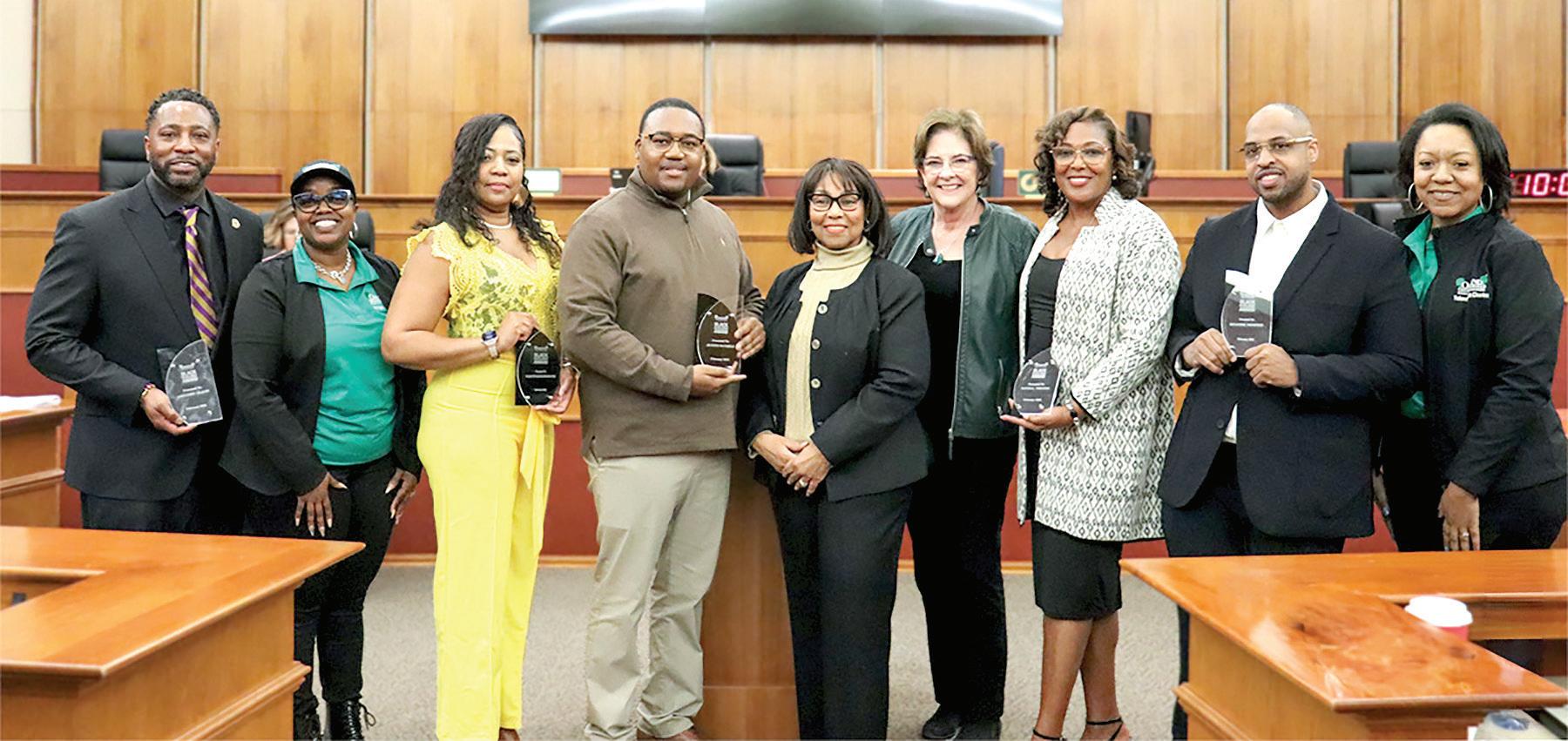
The Oakland County Board of Commissioners marked Black History Month by recognizing five residents with its fifth annual Black Excellence Awards during its Feb. 19 meeting in Pontiac.
This year’s recipients share a strong record of mentoring and youth development alongside their professional and civic accomplishments.
The 2026 awardees were DaQuetta Baylor-Boothe of Pontiac, Sanya L. Weston of Northville, and Kevandre Thompson, Gregory Glenn, and Justen Daniels, all of Southfield.
The awards, established in 2022, are based on public nominations and reviewed by a panel of commissioners that includes Angela Powell (D-Pontiac), Yolanda Smith Charles (D-Southfield), and Linnie Taylor (D-Southfield).
“The Black Excellence Awards began as a way to recognize contributions made by Oakland County’s Black residents, often in quiet and unassuming ways,” said Powell.
“There are numerous community champions who work tirelessly throughout the year, and we definitely applaud their efforts. However, this award allows the community to nominate someone who is making a deep and meaningful impact that may not be seen beyond their neighborhoods. We want to lift up those unsung heroes and showcase their commitments.”
According to Smith Charles, this year’s selection process reflected a growing awareness of the award and the depth of service taking place throughout the county.
“This year we received the largest number of nominations, and it was eye-opening to see the work quietly being done across the Oakland County by people who simply want to make their communities better,” Smith Charles said.
Each year, residents across the county submit names of individuals whose work may not command headlines, but leaves a measurable mark on neighborhoods, schools, and families. The three commissioners review the nominations and select five honorees whose contributions reflect sustained service and leadership.
Commissioners presented each recipient with a commemorative keepsake. Their names will also be added to a plaque displayed outside the Board auditorium, joining previous honorees recognized since the inaugural awards ceremony.
“Selecting only five recipients from a list of highly qualified and dedicated community leaders was difficult. However, these individuals stood out as shining examples of leaders, mentors and change makers in their own
BLACK EXCELLENCE AWARDS
New Office of Youth Affairs Aims to Unify Detroit Youth Voice
By Ebony JJ Curry SENIOR REPORTER
Citywide momentum doesn’t erase what many youth still face day to day.
Federal data shows about 51% of Detroit children lived in poverty in 2024, a number that should stop every “revitalization” talking point mid-sentence and force a real conversation about what kids are carrying into classrooms, onto buses, and back home at night. Detroit’s overall poverty rate was reported around the mid-30% range for 2024, which means this is not a pocket problem. This is citywide.
Mayor Mary Sheffield said she wants Detroit to respond like it understands that truth.
Mayor Sheffield announced Dr. Chanel Hampton as the administration’s first Senior Director of Youth and Education, with a dual appointment as Education Liaison to the Mayor. Under that leadership, JerJuan Howard was named Director of the city’s new Office of Youth Affairs.
The Senior Director role is intended to tighten coordination, strengthen accountability, and bring clearer leadership to the city’s work serving Detroiters ages 0 to 26. The position will align youth policy with the city’s education strategy and push departments to center youth needs in how decisions are made across city government.
As Education Liaison, Hampton will also serve as the Mayor’s Office point person and convener with Detroit Public Schools Community District, charter schools, outof-school-time partners, and community organizations to address ongoing challenges facing students and families.
The Office of Youth Affairs is expected to bring structure to the city’s youth landscape by organizing existing youth councils, forums, and task forces into a coordinated voice, and by working inside city govern-
JerJuan Howard
ment to shape policy that is more equitable and responsive to what young people need.
“Detroit’s young people deserve a city that prioritizes every young person and ensures they have access and opportunities to grow and thrive,” Sheffield said. “Creating the Senior Director of Youth and Education role ensures we have a robust strategy around guaranteeing the best outcomes for young people in our city. Furthermore, with the Office of Youth Affairs, we are embedding youth in how we develop policy, allocate resources and measure success across city government.”
Howard’s selection is not random. His work history is Detroit-rooted and youth-facing.
Howard, a son of Detroit’s westside Puritan Ave., is known as the founder of the
Umoja Debate League and has held roles connected to Detroit Public Schools Community District and Detroit City Council.
Yes, the resume matters. However, the roots matter more.
Detroit has learned the hard way what happens when decisions about our children are made by people who do not know our schools, our blocks, our transit reality, or what it looks like when a young person is trying to focus while the lights might get cut off at home. “Youth outcomes” is a phrase that can get sterilized. Detroit families live the real version of that phrase every day. Federal census data has placed Detroit
The Anatomy of a Heartache:
On the 60th anniversary of the writing and recording of Motown’s “What Becomes of the Brokenhearted,” Redemption Music Media (RMM) is highlighting the landmark recording and the work of co-writer and arranger Paul Riser to illustrate its mission of protecting legacy artists’ rights and ensuring that the creators behind timeless music are properly credited and compensated. It was February 1966. Inside a small Detroit studio that would soon become legendary, the Motown team gathered to record a new song. For Riser, it was another day doing what Motown Records did best: chasing honesty, not history. He had no way of knowing the record would still be resonating with listeners six decades later.
As an arranger and co-writer, Riser focused on
creating an emotional landscape to shape something that would live beyond the lyrics and melody. His arrangement wasn’t meant to overwhelm, but to support the emotion and give space for vulnerability and reflection.
Reflections from Riser are both introspective and textural.
“When we recorded ‘What Becomes of the Brokenhearted,’ the goal wasn’t to impress but to serve the song,” he says. “That day in February of ‘66, the room had a heaviness to it, not sadness exactly, but honesty. I can still feel the mood in that studio—focused, quiet, respectful of what the song was asking for.”
“The arrangement was about giving the heartbreak somewhere to sit. I wanted the strings to sound like a question that didn’t need an answer.
See MOTOWN’S MOST RESILIENT ANTHEM Page B-2
Black Excellence Awards
From page B-1
unique way,” Taylor said.
Baylor-Boothe is the owner and operator of Wee School Preschool, where she has built a program centered on early childhood care and education. Her work focuses on providing a structured and supportive setting for infants and young children. In addition to her role in early learning, Baylor-Boothe leads a food outreach initiative that distributes resources to families facing hardship. Through both efforts, she has established a consistent presence in Pontiac, working directly with parents and children.
Weston founded Youth People Travel Global Edge, a travel en-
terprise designed to introduce young people to cultural exchange and international experiences. Through curated trips and educational programming, Weston aims to expand students’ understanding of global communities. Her commitment to youth engagement also includes serving as a Girl Scout troop leader and mentoring college students as they navigate academic and career planning.
Thompson has worked across several organizations that focus on mentorship and professional development. His involvement includes Big Brothers Big Sisters of Southeast Michigan and the Detroit chapter of the National Black MBA Association, where he supports its Leaders of Tomorrow
Motown’s Most Resilient Anthem
Sometimes the most powerful thing you can do is not say too much.”
The song itself came from a simple, universal question that most people ask themselves at some point in their lives. Lost love. The emotions that follow a breakup, when answers aren’t always there.
Released in June 1966, “What Becomes of the Brokenhearted” quickly became one of Motown Records’ defining successes—reaching No. 1 on the Billboard R&B Singles chart, cracking the Top 10 of the Billboard Hot 100 (peaking at No. 7), and standing as one of the label’s most successful crossover records of the decade. It was exactly the balance Motown aimed for: emotional depth with mass appeal.
With Jimmy Ruffin on lead vocals, the song found its voice. Ruffin delivered a performance that was both strong and vulnerable; heartfelt, restrained, and unmistakably human. You could hear the hurt. You could hear the longing. And that emotional honesty was essential.
“Jimmy had a way of singing that made every word feel lived-in,” Riser noted. “His voice wasn’t just powerful; it carried the weight of heartache and hope all at once. That honesty is what made the performance timeless; you don’t just hear it, you feel it.”
Sixty years later, the song continues to attract new listeners, appearing in films, television, and retrospectives, and still resonating.
“A song like ‘What Becomes of the Brokenhearted’ endures because it speaks to something we all feel,” Riser says. “The melody, the arrangement, the words capture real emotion. That honesty doesn’t age. Heartbreak, longing, and hope are truths that never go out of style. When a performance is rooted in feeling, it stays alive for generations.”
Like much of the music Riser arranged at Motown during the 1960s and 1970s, “What Becomes of the Brokenhearted” was created with the purpose and belief that music could cross boundaries and outlast its moment on the charts.
“I’m proud of the song,” Riser says. “I’m grateful to everyone who helped bring it to life. And I’m deeply thankful to the listeners who have carried it with them for 60 years and counting.”
That enduring impact is why preserving artists’ rights matters.
In 2014, recognizing how often legacy creators were disconnected from their rights, Riser began reclaiming and organizing his work as a composer and arranger. He enlisted attorney Jeffrey Thennisch, who was then working independently on behalf of artists seeking long-overdue recognition and royalties. Riser also connected Thennisch with Ruffin to assist him with his own rights. Sadly, Ruffin passed away in near obscurity before the work could be completed.
The commitment to ensuring artists receive proper credit and compensation for their work has since evolved into Redemption Music Media, with Thennisch as CEO. RMM continues the mission of honoring the architects and voices of Motown’s golden era and ensuring their legacies are protected for generations to come.
“What Paul and artists like Jimmy Ruffin created wasn’t just music, it was art built to last,” says Thennisch. “Our work is to make sure their contributions are properly recognized in how we remember them and ensuring they receive the credit and compensation they’ve earned.”
Noting recent remakes by Bruce Springsteen and a new Japanese cover version released in December 2025, Thennisch adds, “I am honored to play a small role in keeping the song active throughout the world.”
high school mentoring program.
Thompson is also the lead organizer of the upcoming TEDxPontiac event, an independently organized TEDx program intended to highlight local perspectives and innovation. Through these roles, he has connected students and young professionals to networks and opportunities designed to support long-term growth.
Glenn is a military veteran with a combined 21 years of service in the United States Army and the Michigan Air National Guard. Following his military career, he became the owner of Minuteman Press in Clawson. Glenn continues to mentor youth and emerging professionals while remaining active in civic life as a member of the Detroit Shriners. His work spans entrepreneurship, mentor-
ship, and veteran representation within the community.
Daniels brings a background in public health to his outreach efforts with young people. He works with the Alliance of Coalitions for Healthy Communities, overseeing programs that educate youth about the risks associated with tobacco use and strategies for prevention. Daniels has also partnered with the Oakland County Sheriff Police Athletic League and the Pontiac School District Promise Zone Authority. Through these collaborations, he supports initiatives that connect health education, physical activity, and academic opportunity.
The Black Excellence Awards highlight a range of professions and service areas – early childhood education, global travel, business
leadership, military service and public health – while underscoring a shared commitment to mentoring the next generation. For the commissioners, the annual recognition serves not only as a celebration during Black History Month but also as a public record of residents whose work shapes daily life across Oakland County. Participation continues to expand, reflecting both increased community engagement and the breadth of service taking place in cities including Pontiac, Southfield, Northville, and Clawson. With each new class of honorees, the plaque outside the Board auditorium grows, documenting individuals whose impact may begin at the neighborhood level, but resonates throughout the county.
among the cities with the highest child poverty rates, with reporting showing more than half of Detroit children living in poverty based on 2024 estimates. That reality touches everything — attendance, mental health, safety, academics, and the kind of pressure kids carry before they even hit adulthood.
Howard said his approach starts with how Detroit has always been built.
“Historically, Detroit has been built by those who care deeply about their neighborhoods, and our young people are an integral part of that,” Howard said. “As residents, they carry the same pride as older Detroiters, and it is our duty to give them the platform to be contributors.”
He pointed to what he has seen working directly with youth.
“I have spent years working alongside youth in schools and on their blocks, and I have seen what happens when young people are trusted, supported and given real opportunity,” he said. “The Office of Youth Affairs will make sure their voices are embedded into how Detroit grows, so our city’s future reflects the spirit and ideas of the next generations.”
For Howard, it hits home. When sked what it means to be a Black man raised on Detroit’s west side now carrying responsibility for Black boys and girls who look like he once did, he kept it plain.
“For me to be a Black man born and raised in this city, I understand the power of representation,” he said. “I know what it feels like to look for someone who understands your neighborhood, your school, your struggles, and your potential. To hold this responsibility means everything. It means little Black boys and girls in Detroit can see that leadership can start with you, someone on your block, in your classroom, etc.”
Just last year, Howard purchased a long-vacant building near Umoja Village and decided to turn it into something the neighborhood could use.
“Back in the spring of 2024, a 25+ year vacant building around the corner from Umoja Village was put up for sale,” Howard said. “At the very same time the community needed a place to meet/congregate, and the literacy rates here in Detroit needed improvement. When I toured the building I knew that I wanted it to be a solution to some of the problems that my community had.”
He wanted it to be a real neighborhood spot — a place people could come together, talk, and build.
“I had the idea for it to be a bookstore/cafe shop with hopes that it could play an intentional role in the resurgence of my childhood neighborhood,” he said. “I went on to purchase the building and now we have a grand opening date of April 25, 2026.”
Howard said his motivation comes from being poured into himself as a child.
“I had a great childhood. I changed career paths often, from artist, basketball player, to journalist, to lawyer. I was always described as a curious kid,” he said. “A ton of people poured into me during my childhood. I grew up very close to my grandparents Virginia and Tommy, so they played a huge role. I looked up to my grandfather.”
When asked what he would say to Detroit, he framed it as a commitment to the city and his neighborhood.
“To Detroit, I’m fully invested. I came home because I believe in us,” Howard said. “To my neighborhood, I carry you into every room I enter. Every decision I make will reflect the pride, resilience, and potential of the city that raised me.”
He also offered advice across generations, putting responsibility where it belongs — on all of us.
“I would tell our generation to get involved in some capacity in your neighborhood. Play an active role in sustaining it or building it,” he said. “If you’re here, stay and invest. If you left, consider coming back. Detroit is in a position right now where we can shape it into what we want it to be. It is important that we don’t limit ourselves.”
“For the younger generation, I would say use your imagination boldly,” he continued. “The world you want to live in has to be imagined before it can be built. Your creativity is needed.”
“For the older generation, mentorship is key,” Howard said. “Historical context matters now more than ever. Without it, we risk repeating mistakes, but with it, we give young people a foundation to build smarter and stronger.”
Howard said his mission in the role is straightforward.
“My mission is to elevate the voices of youth and make sure they are prioritized at every level of Detroit’s government,” he said. “Young people should see themselves reflected in the decisions that shape this city. My responsibility is to create the systems that make their influence real, measurable, and lasting.”
Howard pointed to Umoja as proof he knows how to build something that lasts.
“Founding the Umoja Debate League prepared me for this role in every way,” he said. “It prepared me to see youth not as participants, but as contributors to the future of Detroit. Umoja started as a simple idea rooted in curiosity and problem solving and grew into a citywide infrastructure serving dozens of schools including some national and international debates,” Howard said.
For Howard, debate was never about a trophy case. He said it was about giving young people tools they can use anywhere — confidence, critical thinking, conflict resolution, and civic engagement.
More than half of Detroit children have been counted as living in poverty in recent Census estimates. That’s the backdrop for this work. That’s why residents will judge this office by what shifts on the ground — what gets funded, what gets fixed, and whether young people feel the difference.
Ebony JJ Curry can be reached at ecurry@michronicle.com.
From page B-1
From page B-1
Office of Youth Affairs
Where There’s A Will, There’s Not Always a Way…
Series: Matters of Life and Death
By Jehan Crump-Gibson GUEST COLUMNIST
The conversation around getting your affairs in order is becoming more mainstream. While it is much needed and well-intentioned, it is sometimes led by individuals without the necessary expertise. This fuels misconceptions and assumptions, which can cause confusion and lead to unintended consequences — namely, probate court. Probate court often involves a time-consuming, public and sometimes costly process before a person’s loved ones can receive what they leave behind for them. This is one of the main reasons we get our affairs in order— to avoid it.
When it comes to messaging around getting your affairs in order, one thing that is emphasized is the importance of getting a Will (or a Last Will and Testament). From reels on Tik Tok and Instagram to YouTube channels and community forums, the public is encouraged to have this important document drawn up so that their assets can avoid probate court. Unfortunately, there is a built-in misconception in this message. It assumes that a Will avoids probate court. The truth? It DOES NOT.
A Will is useful to the extent that it is an instruction sheet that must be honored. It typically lays out who is responsible for distributing any assets that someone leaves behind and who is supposed to get those assets. Assets can mean anything from homes, insurance policies and bank accounts to business interests, stock and retirement accounts. However, those assets do not get distributed without court involvement just because someone has a Will. Why? This is because anything in someone’s name alone when they pass away must go to probate court before it is distributed to anyone. So, if Mama Debbie left a Will but her house and bank accounts are in her name alone with no joint owner or beneficiary, the Will is only useful in telling the court who will get those things. Legally, the house and the accounts cannot pass to whoever they are intended for without the court’s involvement.
A Will also cannot override beneficiary designations. This means that if Mama Debbie names one of her children as beneficiary on her life insurance policy, it does not matter if the Will says she wants all three of her children to receive all her assets. Unless the child who is named beneficiary decides to honor Mama Debbie’s wishes out of moral obligation or the kindness of their heart, the other children will receive none of the life insurance proceeds. Many people discover this and ask what is the point of the Will if it can cause all these issues? My answer? While it certainly serves a purpose, where there’s a Will, there’s not necessarily a way when it comes to avoiding probate court. In many cases, a Trust is the better option.
The Revocable Trust, a popular estate planning tool, is sometimes referred to as “Living Trust” or just “Trust”. It is a legal arrangement established by someone that directs distribution of assets without the need for probate court involvement. It is a Revocable Trust because it is set up during someone’s lifetime and they can change the terms of it at any time while they are alive, if they have sound mind to do so. I compare a Trust to a flower vase. Your assets are the flowers (your house, your bank accounts, life insurance policies, etc.). If your flowers are placed in the vase (the Trust) through beneficiary designations and other means, they will be distributed in accordance with your wishes, without the need for probate court. In most cases, it is truly the best way to avoid probate court.
There are also other types of trusts that may be appropriate to suit someone’s needs. Whether or not you need a Trust is going to depend on your specific assets and circumstances. Please be sure to consult with an experienced estate planning attorney to discuss your options.
Attorney Jehan Crump-Gibson is the Co-Founder and Managing Partner at Great Lakes Legal Group PLLC, where she concentrates her practice in probate and estate planning, business and real estate matters. Great Lakes Legal Group is a growing blackowned law firm serving clients throughout the state of Michigan and in federal courts across the country. Jehan has served as Faculty for the National Business Institute and the Institute of Continuing Legal Education concerning business, probate and estate planning matters. She is a legal analyst with Fox2 Detroit’s The Noon and the author of the book A Matter of Life and Death.
By Jeremy Allen EXECUTIVE EDITOR
Detroit is about to reclaim a title it hasn’t held in decades. It’s not with automotive, but with national defense.
From May 12–14, 2026, Huntington Place in downtown Detroit will become the epicenter of defense, advanced manufacturing, autonomy, and uncrewed systems as the Michigan Defense Expo (MDEX) co-locates with XPONENTIAL, the world’s largest autonomy and uncrewed systems event. Together, the unified event — MDEX x XPONENTIAL 2026 — is expected to draw more than 11,000 attendees, including federal decision-makers, prime contractors, global autonomy innovators, and advanced manufacturers.
For the first time ever, Detroit becomes the convergence point for Department of Defense buyers, global robotics leaders, and next-generation manufacturers operating across ground, air, and maritime domains. Organizers are clear about the scale and intention behind the move: “This is not an expansion. It is a convergence.”
MDEX, hosted by the National Defense Industrial Association Michigan Chapter, enters its 17th year in 2026. What began as a small gathering of industry professionals has grown steadily, with last year’s event drawing more than 3,200 attendees, which was a record at the time. The decision to co-locate with XPONENTIAL represents a dramatic leap forward in visibility and global reach.
XPONENTIAL is the flagship event of the Association for Uncrewed Vehicle Systems International (AUVSI), convening international leaders in autonomy, robotics and uncrewed systems. It rotates globally, and Detroit was selected as its 2026 host city, signaling a recognition of Michigan’s defense manufacturing ecosystem and mobility leadership.
In practical terms, that means more than 11,000 people under one roof at Huntington Place — defense leaders, procurement officials, engineers, technology firms, small businesses, and global companies engaging in real government business on the show floor.
MDEX Event Chair Misty Martin said the core mission of the event remains unchanged even as its footprint grows.
“MDEX has always been about connecting Michigan industry to defense opportunity,” Martin said. “In 2026, that opportunity expands globally. With XPONENTIAL joining us in Detroit, the scale increases, but the mission remains the same: Deliver capability. Build partnerships. Strengthen the industrial base. …It’s a phenomenal way for people to really go around and see what Michigan offers as far as defense.
“I think a lot of people don’t realize how much goes on
By Ebony JJ Curry SENIOR REPORTER
An early morning fire on Friday, Dec. 12, 2025, damaged the Grixdale Farms house where Hitha Healing House operates, knocking the Detroit nonprofit out of its usual space and forcing a pause in on-site programming. For the mothers and families who rely on that circle of care, the loss reaches beyond the building itself, disrupting the weekly rhythm that helps people move through pregnancy, postpartum, grief, and the stretch of life that comes after.
The interruption lands in a moment when maternal health remains a life-or-death issue for Black women. Systemic gaps in health care keep risk elevated during pregnancy and postpartum, and Black mothers continue to die at nearly three times the rate of other groups, according to an April report.
Founded by Kayana Sessoms in 2022, Hitha House opened its center more than a year and a half ago and quickly grew into a steady community resource. Sessoms said hundreds of people have come through for classes and conferences, turning the space into a familiar landing place for learning, support, and connection.
Brilliant Detroit says it has stepped in to keep that rhythm from breaking.
The nonprofit announced a partnership that will bring Hitha Healing House programming to Brilliant Detroit’s Central Hub, allowing services to continue after the fire left Hitha’s programming location unusable. The move includes Hitha’s maternal wellness program, and Nurturing Roots.
Hitha Healing House is a Detroit-based community wellness organization that provides holistic maternal wellness support rooted in cultural healing traditions and
trauma-informed care. Under the partnership, Nurturing Roots will offer mothers up to 10 paid wellness sessions after giving birth. Those sessions include nutrition counseling, massage therapy, lactation support, chiropractic care, and emotional wellness services, according to the announcement.
“This partnership brings our shared values to life by supporting caregivers and children from ‘belly through eight’, within walking distance, in spaces that feel welcoming and rooted in community,” said Tarsha Gale, executive director of Brilliant Detroit.
Sessoms said the loss of a physical home hasn’t changed the organization’s purpose.
“Although we lost our physical home, our mission was never lost,” Sessoms said. “Partnering with Brilliant Detroit allows us to continue serving families with intention, dignity, and care.”
However, this partnership didn’t start from scratch.
Brilliant Detroit said Sessoms first connected with the organization more than a decade ago while she worked at Osborn Neighborhood Alliance and participated in community engagement tied to Brilliant Detroit’s neighborhood hub work. She later supported engagement and outreach at Brilliant Detroit hubs through contract work.
That history, both groups said, helped them move quickly after the fire.
Brilliant Detroit said Hitha’s current offerings include a weekly “Wellness Wednesday,” monthly Sunday community dinners, “First Friday Mama’s Messages,” and a group described as “our Mamas for our Mamas.”
A public event is planned to walk residents through Nurturing Roots
in Michigan. We’re the largest producer of ground vehicles for defense. And so, that’s why we’re so excited about co-locating with XPONENTIAL. We want to show people what Michigan brings to the fight and what we bring to national security. I think that this opportunity is going to open the eyes of those that might not have known what exactly goes on right here in Michigan.”
Michigan’s role in national defense is often underappreciated outside industry circles. The state is the largest producer of ground vehicles for defense, contributing roughly $30 billion annually to Michigan’s economy and supporting more than 166,000 jobs across approximately 5,000 defense and aerospace businesses. Abrams tanks, Bradley fighting vehicles, and advanced ground systems are managed and produced here. The defense industrial base is embedded in the state’s manufacturing DNA.
“We want to show people what Michigan brings to the fight and what we bring to national security,” Martin said.
Bringing together automotive heritage, defense modernization, and autonomy is central to this year’s event. MDEX x XPONENTIAL 2026 will showcase advanced ground systems, aerospace platforms, maritime technologies, robotics, artificial intelligence, logistics, supply chain resilience, research, and workforce development. The co-located structure allows attendees to move between defense-focused programming and global autonomy exhibits seamlessly, reflecting how closely commercial innovation and defense modernization are now intertwined.
For Detroit-based manufacturers and technology companies, the opportunity is tangible. Army contracting officials are expected to participate, along with briefings outlining upcoming procurement opportunities. Small business offices will provide guidance for small companies seeking to secure federal contracts, including firms eligible for setaside programs.
programming scheduled from February through June 2026, according to the announcement. Official Hitha Healing House programming at the Central Hub begins in March.
Once the calendar is fully underway, Wellness Wednesdays will be held weekly at 6 p.m., billed as a consistent space for restoration, education, and connection. Additional Saturday and Sunday events will be scheduled throughout the year.
Community Mama Meals and Meetups are set for every fourth Sunday at 4 p.m., bringing mothers together for a shared meal and conversations focused on wellness, motherhood, and holistic care for mama and baby. Hitha also plans seasonal childbirth education classes focused on childbirth, early parenting, and child development. On rotating Saturdays, the organization will host community outings and service-learning experiences for mamas and babies to do together.
The partnership also opens the door for Hitha families to tap into programs already offered through Brilliant Detroit’s Central Hub.
Those include Maternal Health Office Hours on Mondays from 5 to 6 p.m., described as a virtual space for pregnant and postpartum women to connect, learn, and access resources, including support with self-advocacy in medical settings and links to local programs.
Play & Learn, led by Boldi/Detroit Institute for Children, runs Tuesdays and Wednesdays from 11 a.m. to noon and is designed for children ages 0 to 5, with stories, guided play, and parent-child activities.
Homework Helper is held Tuesdays and Thursdays from 4 to 5 p.m., offering students help with homework, study skills, and building confidence in school subjects.
Nature Tots/Nature Trunks takes place Thursdays from 11 a.m. to noon for children ages 2 to 4 and their caregivers, with stories, crafts, movement, and outdoor exploration.
A Clothing Closet and Diaper Distribution resource is available Monday through Thursday from 11 a.m. to 4 p.m. by appointment, providing gently used clothing for all ages and essentials for families, Brilliant Detroit said.
Brilliant Detroit also noted additional resources for participants, including weekly produce boxes, and said it will host a free summer camp for all Detroit Public Schools students in grades 1 through 3. Applications are now open for the 2026 Nurturing Roots program. The program is described as limited enrollment for mothers and primary caregivers seeking consistent, healing-centered support through pregnancy, postpartum seasons, grief, or major life transitions. Enrolled families also receive access to private offerings closed to the public, including grief circle healing spaces, emotional support groups, family-specific resource navigation, and invitation-only blessing ceremonies and retreats.
Brilliant Detroit Central/Piety Hill is located at 803 Hazelwood St. in Detroit. Families can apply for Nurturing Roots online.
Ebony JJ Curry can be reached at ecurry@michronicle.com.
For minority-owned and Black-owned businesses in particular, the event represents direct access to federal buyers and prime contractors without leaving the city. Organizations that guide companies through certification and procurement processes will also be present to help firms navigate how to do business with the U.S. government.
“We have what we call ‘set asides’ and those are for our small businesses, our SBA or 8(a) businesses, or any of those that are that are trying to get contracts. And we’re talking to our small business office which will have booths there. Listening to the small business briefings I think would be perfect for those type companies that you’re mentioning because there are set-asides for those so that they can get contracts,” Martin said.
Beyond contracting, the week will also feature platform vehicle manufacturers, defense nonprofits, scholarship organizations, and educational pathways for students interested in careers in engineering, robotics, autonomy and advanced manufacturing. Organizers say there will be defense vehicles and technology displays on the floor, offering families and young people a firsthand look at how Michigan’s industrial capacity translates into national security capability.
The broader economic implications are clear. With autonomy reshaping operational doctrine and industrial strategy, integrating MDEX and XPONENTIAL positions Michigan companies in direct view of global partners and federal decision-makers at a time when defense and dual-use technology dollars are moving quickly.
“This is economic development. This is defense readiness. This is advanced manufacturing at scale,” event materials state.
The scale of the 2026 gathering also sends a national message. By hosting the world’s largest autonomy and uncrewed systems event alongside its premier defense expo, Detroit is not simply providing convention space. It demonstrates production capacity, engineering depth, and industrial resilience.
“I think that being able to be asked to co-host this work with and XPONENTIAL for an international show just goes to show one, what a great job we’re doing in the state of Michigan and two, how big we can grow,” Martin said.
For a city long defined by automotive dominance, MDEX x XPONENTIAL 2026 provides a segway (and perhaps a sneak peek) into a continuously growing sector, one where advanced mobility, robotics, artificial intelligence, and defense modernization converge in the same industrial ecosystem.
Registration and exhibitor information for MDEX x XPONENTIAL 2026 is available at mdex-ndia.com.