
By Ebony JJ Curry SENIOR REPORTER
By Sam Robinson SENIOR REPORTER
Former state Sen. Adam Hollier, D-Detroit, is leaving the Democratic primary race for Michigan Secretary of State to run in the 3rd state Senate district.
The lawmaker told Michigan Chronicle Monday evening in a phone call saying he is most experienced and will have the most resources of any candidate running to represent the district that covers Detroit’s Eastside, Highland Park and into Oakland County.
By Ebony JJ Curry SENIOR REPORTER
Late Thursday night, Sept. 14, a historic moment unfolded in American labor relations as the United Auto Workers (UAW) union initiated a strike against Ford, General Motors (GM), and Stellantis. For the first time, the union took simultaneous action against all three major Detroit-based automakers. The action involves approximately 13,000 UAW members in assembly plants across Michigan, Ohio, and Missouri, who walked off their jobs after existing labor contracts expired at 11:59 p.m.
Hollier in September ended his Detroit-based congressional district to run for secretary of state. He joined Black candidates Deputy Secretary of State Aghogho Edevbie and Lt. Gov. Garlin Gilchrist as Democratic primary candidates before dropping out. Edevbie exited the race last month, saying he expected Gilchrist to be the nominee.
IShortly before midnight on Sept. 14, GM released a statement expressing disappointment with the strike action, despite offering what it termed an “unprecedented economic package” that included historic wage increases. Stellantis
He was endorsed by Wayne County executive Warren Evans to take on U.S. Rep. Shri Thanedar in 2024, but failed to turn in enough valid signatures to make the ballot. There was disappointment among Detroit’s Black establishment who are upset with Thanedar when Hollier, who raised big money as a candidate for Congress, didn’t make the ballot.
n a breathtaking celebration of talent, determination, and the unyielding spirit of Black excellence, the Michigan Chronicle marked its 10th Annual 40 Under 40 event Thursday evening. This year’s soirée, drenched in the theme “All Black Everything with Gold Accents,” transcended expectations and essentially illuminated the golden gems within the true essence of Black excellence. Hosted by the charismatic duo of Andre Ash and Lynzee Mychael from Michigan Chronicle’s Finally Friday, the night was a triumph for the city of Detroit and its vibrant community of young Black pro-

received the prestigious Entrepreneur of the Year Award. Brown’s commitment to empowering the city through fashion and entrepreneurship has left an indelible mark.
The evening sparkled with a golden promise as we celebrated remarkable individuals from various walks of life. Among the honorees were the brilliant and visionary co-founders of Detroit Hives, Nicole Lindsey and Timothy Paul Jackson. Their work has not only changed the landscape of beekeeping and urban farming in Detroit but also exemplified the transformative impact Black professionals can have on their communities.
cy mode to protect its operations.
“Entrepreneur of the year – that’s a big deal,” said Brown. “It’s always an honor to be honored and it’s always a blessing to be in a room full of so many talented, accomplished, and popular people that look like me. I’m geeked. I started making and selling clothes as a kid and I always knew that I would have a business, but I never knew it would be Detroit’s brand name business, so I take a lot of pride in the fact that our business represents our city’s pride.”
By Sam Robinson SENIOR REPORTER
By Ebony JJ Curry SENIOR REPORTER
Taking home the Corporate Excellence Award was Dannis Mitchell, Director of Community Engagement at Barton Malow.
ness district that had been the lifeblood of the community.
The party has taken aim at Duggan under Hertel with a flurry press statements and billboard campaign in Detroit that suggested, “Duggan (loves) MAGA Money.”
some Black Democratic circles and allied members of the party.
“Together we have created a social, environmental, and financial impact through bees,” said Jackson. Lindsey followed that sentiment with, “It is through our local partnerships and collaborative efforts that we exist in over 28 plus locations managing the health of 4.5 million honeybees – humbly speaking our movement has inspired others locally, nationally, and even internationally to take on similar missions.”
The Michigan Democratic Party is led by a former state senator who is earning a reputation for battling one of his party’s biggest rivals heading into the November 2026 elections.
He will join other Democratic candidates, John Conyers III and Eboni Taylor, who is endorsed by state Sen. Stephanie Chang, who currently represents the area in the state Senate.
The map has changed significantly since the last election.
For many Detroiters, Interstate 375, or I-375, has long been just another stretch of urban highway, a concrete artery connecting different parts of the city. To some, it’s a mere convenience; to others, it’s an unremarkable part of their daily commute. However, there’s a deeper, far more troubling story beneath the surface of this seemingly ordinary freeway—a story of pain, displacement, and the lasting impact on Black Detroiters.
Detroit Hives, a pioneering organization founded by Lindsey and Jackson, harnesses the power of urban beekeeping to revitalize neighborhoods in the Motor City. Their initiative not only addresses critical issues like environmental conservation but also provides valuable education and employment opportunities to Black De-
In July, 2024, a three-judge panel approved state Senate district maps submitted by the Michigan Independent Citizens Redistricting Commission and authorized implementation of the new boundaries for the 2026 elections.
Taylor formally launched her campaign with supporters at an event Wednesday at the Secret Garden Gallery.
The UAW has branded the industrial action as the “Stand-Up Strike,” focusing on specific plants within each automaker. UAW President Shawn Fain stated, “This strategy will keep the companies guessing. It will give our national negotiators maximum leverage and flexibility in bargaining. And if we need to go all out, we will. Everything is on the table.” Union leaders have also indicated that additional plants could be targeted in future waves if negotiations remain stalled.
He’s made headlines for calling out Mike Duggan, the former Detroit mayor who left the party to run as an independent, for his attacks against the Democratic Party during his unconventional run for governor.
“It is so important to recognize that there are young leaders across the country, many that are born here in Detroit. I represent our city nationally and I tell people, ‘Yea I’m a D-girl I’m from the west-side of Detroit,’” Mitchell expressed. “But more importantly, I’ve been able to have experiences within an industry that not many of us, specifically women of color, have the opportunity to engage in and I’ve been the youngest person in the room, the only Black person in the room, and the only Sistah in the room, and I really had to articulate the importance of showing up, giving chances when others won’t, and being persistent.” As a trailblazing Black woman thriving in a predominantly male-dominated industry, her unwavering commitment to fortifying the connections between businesses and Detroit’s communities is unde-
It’s a history marred by pain, injustice, and economic devastation. More than 130,000 residents, primarily Black, were forcibly displaced. Families were uprooted, generational wealth was obliterated, and a thriving community was torn asunder. The wounds inflicted by I-375 run deep, transcending the physical barrier of a freeway to penetrate the very soul of Black Detroiters.
A string of shootings in Greektown in mid-April left both visitors and residents of this bustling downtown destination in awe. One of these shootings tragically claimed the life of a popular and beloved security guard following a dispute with a patron.
towards mending the wounds inflicted on Black Detroiters and restoring a sense of belonging that was so callously torn away in the past.
Politicos say Duggan’s candidacy poses a risk to the Democratic Party, whose voters are more likely to cast ballots for Duggan than voters on the Republican side.
The I-375 Boulevard Project is about more than just correcting historical injustices; it’s about redefining the future. It will connect downtown Detroit to surrounding neighborhoods, bridging the gap that was placed upon the city decades ago.
Michigan Chronicle sat down with Hertel last week at the Democratic Party office building on Woodward Avenue, which he says is part of their ramped-up focus on attracting quality Black candidates.
This painful legacy can be traced back to the nation’s interstate highway program of 1956—a program that aimed to connect the country but often did so at the expense of marginalized communities. In the case of I-375, it meant carving a path through the heart of Black Detroit, reinforcing segregation, and perpetuating inequality.
Hertel won the chair in an election among party members on Feb. 22, 2025, at a state convention in Detroit. He replaced Lavora Barnes, who led the party since 2019. Barnes, the first Black Michigan party chair, chose not to seek another term following the 2024 election.
“We’re doing training and candidate programs. We’re trying to build people from the ground up so that we’re making investments early in people. And I think that’s what has to change. I think that for far too long, the people have a right to feel ignored. We showed up in Detroit a month before an election and asked people for their votes. To me, that wasn’t actually authentic. It wasn’t actually real. We weren’t part of their communities. And so we have a lot of work to do.”
The male suspect allegedly shot the guard before fleeing the scene, while his female companion is accused of concealing the weapon in her bra.
Hollier pointed to his experience as an officer in the U.S. Army and paratrooper during his run for Congress in Michigan’s 13th Congressional District and in his run for Secretary of State.
By Andre Ash DIGITAL ANCHOR
“Our Democracy is at risk,” Hollier said while campaigning to replace Jocelyn Benson as the state’s top elections official. “With the Trump administration trying to invalidate our elections, rig our maps, and make it harder for every Michigander to vote, we need a Secretary of State who is ready and willing to lead the fight against these attacks from day one.”
The tale begins in what is now Lafayette Park, once known as Black Bottom—a neighborhood rooted in African-American culture and history. Named after its dark, fertile soil, Black Bottom flourished during the mid1900s, nurturing the dreams and aspirations of prominent Detroiters like Coleman Young, Joe Louis, and numerous other Detroit legends. But in the name of urban renewal in the 1950s, this vibrant neighborhood was systematically dismantled, erased from the map, and replaced by a lifeless stretch of asphalt.
Question: We’re here in Detroit, where you grew up and where your family entered politics… How did that shape you?
These incidents unfolded during an unseasonably warm spring, leading to increased pedestrian traffic and heightened tensions in the densely populated downtown area.
Fain clarified the union’s strategy: “I want to give a major shoutout to the thousands of members who are on the picket lines right now fighting for all of us. The Stand-Up Strike is a new approach to striking. Instead of striking all plants at once, select locals will be called on to stand up and walk out on strike. This is our generation’s answer to the movement that built our union – the sit-down strikes of 1937. We told the Big 3 that Sept. 14 was the deadline and we meant it. We gave the companies our economic demands eight weeks ago and it took more than a month to get to the table.”
Hertel said he doesn’t blame Americans for the state of the country under President Donald Trump’s return, instead criticizes Democrats for failing to clearly illustrate the stakes to voters in previous election.
A Holistic Approach to Providing Shelter and Support for Detroit’s Unhoused People
For one to aptly recognize the harm caused by such projects, it is vital to note that some of the planners and politicians behind those projects built them directly through the heart of vibrant, populated communities—oftentimes to reinforce segregation and sometimes as part of a direct effort to replace or eliminate Black neighborhoods.
The Michigan Democratic Party has faced criticism from grassroots members for the lack of Black candidates that party delegates have nominated to statewide offices in recent years. Lt. Gov. Garlin Gilchrist, after dropouts from Deputy Secretary Aghogho Edevbie and former state Sen. Adam Hollier, is the only Black candidate of those running for attorney general, governor, and secretary of state.
Today, the resurgence of Paradise Valley stands as a testament to the indomitable spirit of Black Detroiters and the enduring legacy of Black excellence. This historic district, once a vibrant hub for Black businesses and culture, is experiencing a renaissance that harkens back to its glory days. The destruction of Black Bottom may have torn apart a thriving community, but the resolute determination of a new generation of entrepreneurs and visionaries is reclaiming that lost legacy.
The surge in crime and the influx of visitors to Detroit’s downtown core garnered the attention of the Detroit Police Department (DPD), catching them somewhat off guard.
There remains two candidates other than Gilchrist running to be selected by party delegates as the Democratic nominee for Secretary of State: Ingham County Clerk Barb Byrum and former Whitmer appointee Suzanna Shkreli.
While the residential areas bore the brunt of this demolition, the heart of Black Bottom, its thriving business center, remained largely untouched. Restaurants, theaters, clubs, and bars—the very places that brought Detroit’s Black community together—were concentrated around Hastings Street, the epicenter of African-American culture in the city.
“We have to have a better message,” Hertel said. “We have to run better campaigns. We got to not take people for granted. We have work to do.”
Housing Resource Helpline in response to the challenges that residents face in navigating the complex system of housing services. The helpline provides a single point of contact for people seeking housing assistance and connects them with the resources they need.
But now, after decades of enduring the scars of I-375, there is a glimmer of hope on the horizon. Plans have been unveiled to transform this once-divisive freeway into a vision that seeks to right the wrongs of the past while heralding a new era of inclusivity and community revitalization.
Former Secretary of State Richard Austin was the first Black person to hold that position in any U.S. state and is also the only elected to any statewide office in Michigan except for the Supreme Court.
“I grew up on the east side of Detroit, and if you live in the right neighborhood on the east side of Detroit, my dad was your state rep, John was your state senator, my uncle Dennis was your congressman, my first memories are going door to door in a little red wagon. I do think that watching the way they served inspired me in the sense that my dad was a people person. He was a collector of people.
You can reach Sam at srobinson@michronicle. com.
The Michigan Democratic Party launched a new digital ad campaign last week blaming ex-Detroit Mayor Duggan for mismanaging the ongoing demolition site dirt scandal health experts say pose risks to residents.
The union is pushing for a comprehensive list of demands. This
Homelessness continues to plague urban communities, with families and individuals grappling with the challenges of making ends meet in today’s economic climate. Whether it’s struggling to meet monthly mortgage payments or coping with soaring rental costs in a housing market marked by shockingly high prices, a variety of factors contribute to the growing issue of people becoming unhoused.
Meagan DunnJulie Schneider
Historically, shelters have provided a temporary respite for those in need, often serving as the first or second option after exhausting alternatives like staying with friends or family. Shelters offer a place to rest one’s head and a warm meal, albeit sometimes for extended periods. For others, being unhoused means living in cars or makeshift outdoor
Then, in a cruel twist of fate, Hastings Street, too, was obliterated a few years later, making way for the construction of I-375. This marked the final blow, sealing the fate of Black Bottom and signaling the beginning of the end for Paradise Valley, the Black busi-
Support for the helpline comes from the Gilbert Family Foundation, which has pledged $10 million over three years to fund the program. Wayne Metro Community Action Agency manages the helpline, making it accessible to all Detroit residents. This initiative simplifies access to the City’s various housing services, ensuring that residents in need can easily find assistance.
Fueled by more than $100 million from the Infrastructure Investment and Jobs Act and other partners, this ambitious project aims to create jobs, remove barriers to economic growth, and reconnect the neighborhood with the rest of Detroit. It is a step
With the rise of Black Republican U.S. House Rep. John James, who is running to be the Republican nominee for governor, the difficulty Black candidates face has been an issue within
In the heart of Paradise Valley, Blackowned businesses are not just flourishing but thriving, offering diverse services, products, and experiences that pay homage to the past while paving the way for a prosperous future. From jazz clubs to soul food restaurants, the Black Press, and art galleries to fashion boutiques, this revival is breathing life into the very essence of what once made this neighborhood a vibrant cultural epicenter. It’s a resurgence that extends beyond brick and mortar; it represents the resurgence of a spirit that refuses to be subdued.
James White, Chief of Police for the Detroit Police Department, said: “We were caught somewhat flat-footed right out the gate. By design we went into the spring deployment, which is less than the mid-summer deployment, and saw we say an uptick in violence that first warm weekend.”
I still have constituents of his that will randomly call me and ask me for help on issues because he was so close to the people that he represented, and watching him be able to navigate politics would be difficult. I mean, he served in a really interesting time in
Detroit City Councilman Fred Durhal III, representing District 7, where Eastern Market resides, told the Michigan Chronicle, “It’s still very early in the process, MDOT is
Chief White attributes the violence in Greektown to a combination of weather conditions and a surge in population. He explained, “ We saw numbers downtown that we have not seen, ever. People are emerging from COVID and there’s a feeling that we’re in a post-COVID era… and with the venues downtown and the reasons to come down with all the activities that are going on, we saw hundreds of more people and, in particularly, young folks, teenagers that we hadn’t seen.”
By Jeremy Allen EXECUTIVE EDITOR
By Lynzee Mychael MULTIMEDIA JOURNALIST
The causes of homelessness are as diverse and complex as the individuals experiencing it. In response, the City of Detroit has adopted a holistic approach to combat this issue.
“Providing services and high-quality housing to persons at risk of or who are experiencing homelessness is a key priority of the City of Detroit, said Julie Schneider, Director of Detroit’s Housing and Revitalization Department.

“This means focusing on building the pipeline of supportive housing and coordinating with the Continuum of Care on the delivery of critical resources such as emergency shelter, rapid rehousing, and diversion and prevention programs. It also means preserving and expanding affordable housing options for Detroiters of all incomes and improving housing stability though comprehensive service offerings available through the Detroit Housing Resource HelpLine and Detroit Housing Services Division within HRD.”
In May 2023, the City of Detroit launched the Detroit

From the days of the Great Migration when thousands of Black families flocked to Detroit in search of jobs and a better life, to the pivotal role they played in the city’s cultural and musical heritage, Black Detroiters have left an indelible mark on the city. However, in recent years, Detroit has experienced significant gentrification, which has raised concerns about the displacement of long-standing Black residents. Similar to a setting sun, there’s a rising spirit, and Black Detroiters are reclaiming their place in the city, despite the challenges posed by gentrification.
“The city and its partners offer a lot of great services to help Detroiters with their housing needs, but they don’t mean much if people don’t know how to access them,” said Mayor Mike Duggan. “Thanks to the efforts of our partners and the generous support of the Gilbert Family Foundation, we now have a simple process to guide residents to the right housing resource and a growing number of programs to help them.”
The Gilbert Family Foundation’s broader commitment involves pledging $500 million to support projects across Detroit over the next ten years, with housing initiatives being a significant part of their contribution.
Notably, Detroit has witnessed a consistent decrease in recent years, with the number of unhoused residents steadi ly declining. In 2019, approximately 7,847 people were unhoused and entered the City’s community response system. In 2021, about 5,687 people experienced homelessness.
According to the City of Detroit, since the start of the fiscal year 2019 to 2021, Detroit saw a 28% decrease in the
During the Great Migration, thousands of Black families from the South came to Detroit in search of jobs in the booming automobile industry. Despite facing discrimination and segregation, they built vibrant communities on the city’s east
Responding swiftly to the surge in violence, DPD adjusted its deployment plans. Rather than waiting for mid-summer, they deployed officers in the spring itself to address the situation.
From page A-1
women been premoment of the final. a law1931 law effect, asked the affirm that constitucontain abortion. Our Planned Advocates of founding coalition
ReproducAll, a affirm abortion and freedom in constitution,” Giroux. is that everything in aborMichigan, makes we will we can patients care they
cine and healthcare, may be adversely impacted by the decision to overturn Roe v. Wade.
what the Supreme Court will rule in the upcoming
Michigan, half Republicans and half Democrats, and you had to work together to get things done.
Elected officials are also working to keep Roe v. Wade intact thus holding off Michigan’s 1931 trigger ban. Governor Gretchen Whitmer released a statement saying, in part:
“The words ‘Roe overturned’ are no longer theoretical. I want every Michigander to know— no matter what happens in D.C., I’m going to fight like hell to protect access to safe, legal abortion in Michigan…”
And really that’s the way politics should be. I think that I serve with some great people in the Legislature that were Republicans. I think that, unfortunately, the Republican Party has changed significantly, and that makes it harder to get to a place where where we can find compromise. But it’s that balance of trying to do the right thing while also believing that the Democratic Party is a force for good in the world, and that the things that we’re fighting for, the things that are sold, that we are party working people and making people’s lives better is also essential to who I am.”
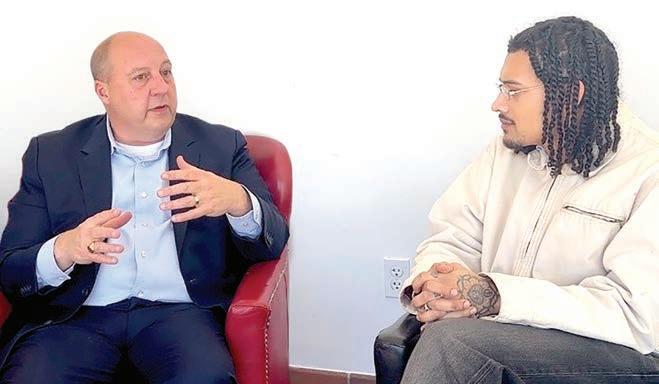
Why is it so hard for Black candidates seeking statewide office in Michigan?
Q: It’s interesting you say that given your resistance to Mayor Mike Duggan’s gubernatorial campaign…
Hertel: “What Mike’s trying to do is have a campaign that’s largely about nothing. I mean, when you really talk about issues and everything else, he talks a lot about grievances. You know, he’s upset about the things that we do, but on the big topics of the day, like the cuts to Medicaid that happens to people that are actually hurting, the Michiganders — Duggan said they’re not that bad, because he wants to get some Trump votes. And I just think that’s not the reality of the situation that we’re in.
More than legal implications, overturning Roe v. Wade would impact several systems across the spectrum. With the potential to drive both foster and adoption numbers upward, a ban on abortions could leave many women to choose a less safe route restoring ‘back alley’ and illegal abortion practices, including self-abortions. Moreover, African American women and women of color, who already have a long-storied history with access and inclusion in medi-
islature adopts it.
concerned about is the impact on our patients. Access to abortion is al ready out of reach for far too many Michiganders, especially Black people and people of color who face additional barriers to care as a result of sys temic inequalities and in stitutional racism. Losing access to legal abortion will impact those communities most, forcing people to become parents or expand their families against their will. Being able to decide and control if, when and how to become a parent is central to building and living a healthy, happy life,” said Vasquez Giroux.
Hertel: “When I look at our Michigan, I think we have a lot of things changing. I mean, Sarah Anthony is the Democratic lead out appropriations, another appropriations chair, but I get one vote of convention like everybody else. Yeah. You know, Joe Tate was the first Black speaker of the house in the first speaker of the house. I was proud to call (Tate) Speaker, since my father is from the same neighborhood. So, I do think things are changing. It doesn’t mean they change fast enough. And I do understand that frustration.
ings of this draft. If that is not the case, we need to stand with Senate Majority Leader Schumer and Gov. Whitmer in support of their efforts to preserve the right to reproductive freedom,” said Chair Alisha Bell, on behalf of the Wayne County Commission.
that. And I think the history of what Jocelyn has done for both voting rights and civil rights in this country will speak to voters, and at the end of the day, we have to have an economic message that actually speaks to everybody in the state and those that are falling behind, then that will be the thing that people will decide when they come to the election.”
Q: Do you get emotional watching the news or the state of the world? How do you handle it?






Beyond the scope of pro-choice versus prolife, the fight for reproductive choice is one of freedom. As Michigan officials work to ensure each woman who finds herself in the position to choose has access to care without the threat of legal action, many wonder
Increase school funding: Statutory changes to increase the School Aid Fund revenue by at least $3.6 billion and establish a permanent weighted funding formula based on student and community needs and universal preschool (0-3).
I think that you look at what people are experiencing right now; the risk of hospital closures, the doubling of the Affordable Care Act rates, it’s not time to be cozying up to those that are willing to (support) that. If a Republican wants to work on workers rights and increase wages for people, and lower costs for people, and take on corporations, that are that’s fine. We can have that conversation. But I don’t think that Mike’s actually having that conversation in this race… He is only doing this because of his he felt like he couldn’t win a Democratic primary, and so far, he’s not acting. He’s tapping to the right because he realizes in order win he has to do that… He has refused to take Donald Trump on, you know, he has celebrated Elon Musk. He has refused to condemn Medicaid cuts.”
I would say that the secretary of state’s position is probably one of the best places to long term run for governor, and so I do think that’s that there’s a reality of that. Garlin made the decision on his own, Garlin wasn’t pushed to do anything. I think he realized this was the best option for him. But I, you know, I also think that you have to, we have to build something. It would be, it would be great just to snap our fingers and change what’s happening.
The health committee recommends reviewing state licensure policies to address the barriers that Black psychologists face in obtaining licensure in Michigan.
I came into this office in last February, and what I can tell you is that we bled everywhere. Last election. We bled in Dearborn, we bled in Detroit, but we also bled in 79 of 83 counties. And the most common thing that I heard as I traveled the state was that people felt abandoned.”
Hertel: “As somebody who has given my life to public service and who still believes in the promise of what America can be for people and the government can make people’s lives better, to watch our Open Government treat its citizens that way. It’s disgusting. And you talk about a VA nurse, you know, who was just trying to defend a woman who was being mace for just trying to stand up. We, as a country, I believe are better than this. Now, I am an optimistic person. I am. I have four kids. That makes you an optimist.

Reject censorship in history instruction: Encouraging Gov. Whitmer to ensure the goal for Michigan schools should be history instruction
Q: We just saw Aghogho Edevbie and Adam Hollier drop out of the secretary of state race, to seemingly make room for Garlin Gilchrist.
Ensure equitable distribution of state health funds: Ensure all Michigan communities with a significant Black population receive adequate funds to address mental health issues.
Q: Do you think the racial discrimination lawsuit against Jocelyn Benson’s office could hurt her with voters?
Hertel: “I think that Jocelyn Benson has a strong history of fighting for civil rights. And I think when you look at her and her soul, that people will see
Protecting Black voting rights: Urge state officials
What I’m inspired by is the people that are willing to still go out, go out and protest, go out and fight, go out and knock doors, go out and make calls — in Iron County, Michigan, they haven’t been a Democratic Party more than a decade. We had 50 people on bar as we launched Iron County Democrats back… They have a Democratic Party again. So I get to see people that despite the loss, despite everything happening in this country, despite why many people would say, why would I keep working? I get to get around and see the actual blood, sweat and tears that people are going to put in to change this country.”
You can reach Sam at srobinson@ michronicle.com.
service providers by 20% each year over five years.
From page A-1
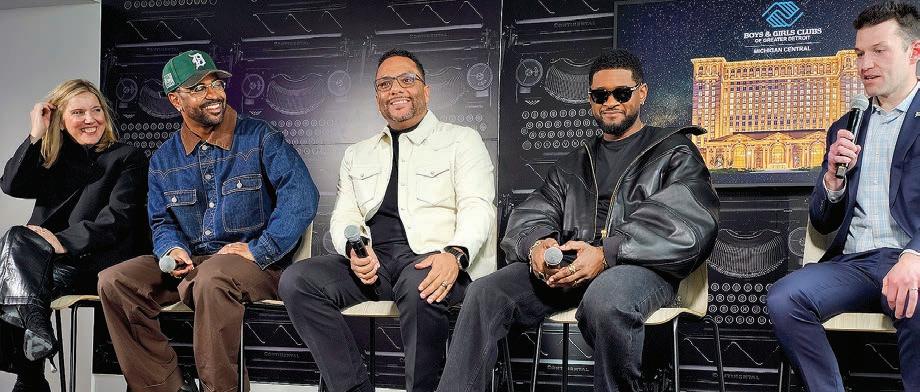
assembly line to Motown. This collaboration – especially with two heavy hitter alumni – extends that legacy by proving the creative economy can be a pathway to ownership and equity,” said Shawn H. Wilson, President & CEO, Boys & Girls Clubs of Southeastern Michigan.
The Michigan Chronicle is now accepting nominations for the 2026 40 Under 40 Awards. Now in its 14th year, the Michigan Chronicle continues its tradition of honoring outstanding African American professionals who inspire others through their vision, leadership, achievements, and commitment to community service. These individuals exemplify excellence, integrity, and influence, consistently breaking barriers and making meaningful contributions within their industries and communities.
In 2026, a new cohort of honorees will be inducted into this distinguished network of leaders. This year’s class will celebrate trailblazers who are advancing economic empowerment and diversity, strengthening faith and educational institutions, and driving impactful change in politics and community engagement.
We invite you to visit MichiganChronicle.com to nominate individuals who embody these values and meet the criteria below: Nomination Criteria:
■ African American professional, executive, or business owner;
■ Demonstrated success within their profession or industry;
■ Positive role model who uplifts and inspires others;
tual town hall meeting to discuss its policy recommendations on Thursday, May 12 at 4 p.m. Join BLAC and a virtual audience in discussing the recommendations to support the Black community.
Michigan Central area, echoed this sentiment. Since 2018, the Sean Anderson Foundation has gifted four fully operational Big Sean Studios to BGCSM locations, impacting over 10,000 youth. This new incubator at The Station is his most ambitious project yet.
and Big Sean, we’re continuing to build new pathways and opportunities, nurturing the next generation of innovators - from creators to manufacturers to technologists - who will drive our city forward for decades to come.”
■ Actively engaged in community service or organizational leadership.
“Together, with our amazing partners, we’re transforming talent into capital and creativity into generational wealth.”
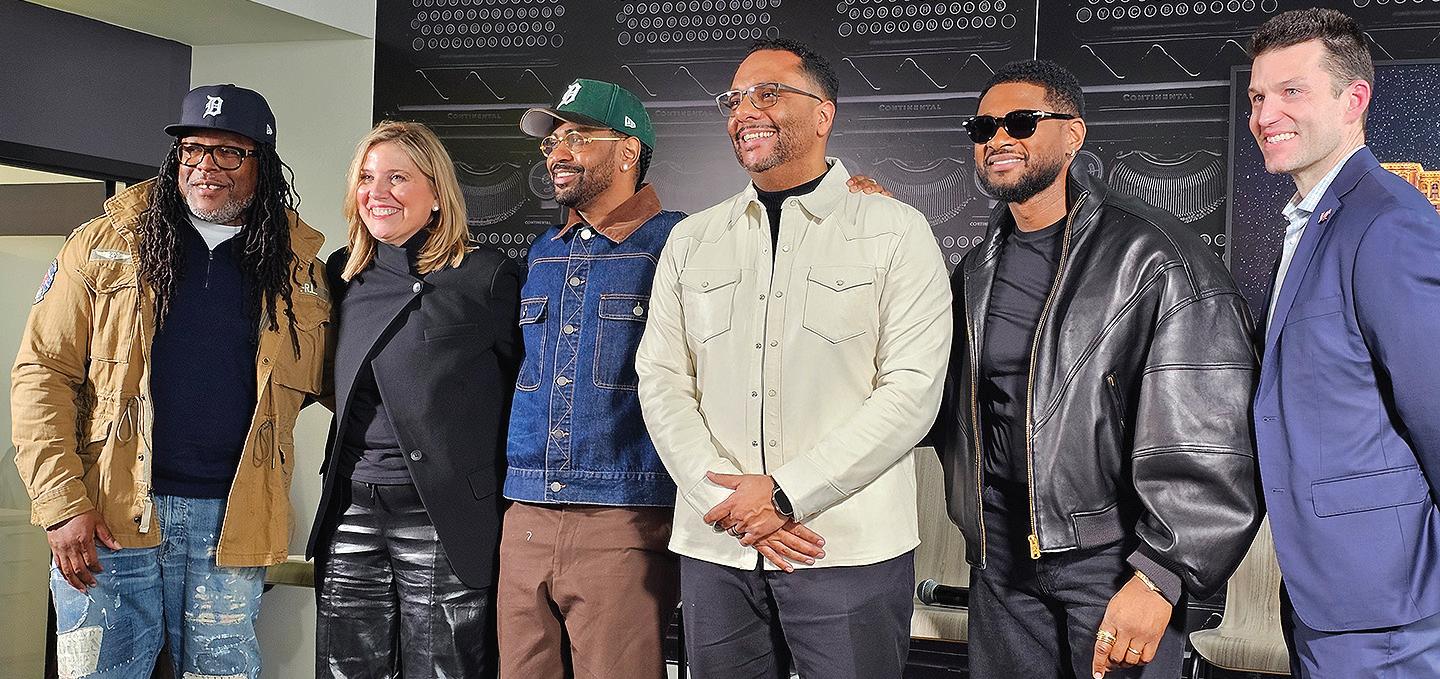
The incubator is being fueled by a powerhouse coalition that extends beyond Usher and Big Sean as individuals. Usher’s New Look (UNL) and the Sean Anderson Foundation (SAF) are joined by heavyweights Ilitch Sports + Entertainment and Emory University’s Goizueta Business School. This ensures that the youth are learning how to master art, not just make it, and they’re also learning about the business and technology behind it.
In a world where high-level production tools are often locked behind the gates of expensive universities or coastal studios, the Incubator brings the “big leagues” to Michigan Avenue.
embraces. transforleadership as a approach that change the syscircumstancoperating Ivory “Transformationdoesn’t just do certhem view of and exdrive that because what create everyentire because people believe that they need to for themselves and others to live better lives.”
“Chancellor Ivery is a true transformational leader and an outstanding CEO, who is more than worthy of the CEO of the Year Award he just received, “ said Prof. James C. Mays, who teaches entrepreneurship and supply chain management at WCCCD’s Corporate College. “In his 27 years at WCCCD, Dr. Ivery has elevated WCCCD to become nationally recognized for excellence and innovation and preparing our students professionally and personally to do great things in the world.”
“I’ve always been a true believer in igniting a spark in the next generation to be better and have access to things we didn’t. This new spark lab in Detroit with my friend and fellow Boys & Girls Club alum Big Sean will not only minimize the access gap for the youth but also prepare them for greatness. It takes just one person to believe in your success, and I’m honored to be one of many in this partnership to help make that happen,” said Usher.
Big Sean, who has been a consistent fixture in the redevelopment of the
“Detroit is where my creativity was born. From freestyling in my mom’s basement to performing on the biggest stages in the world. My mission has always been to make sure the next generation of dreamers and innovators from my city have the access, tools, and mentorship to do the same,” said Big Sean.
“The Innovation Incubator is about showing young people that they don’t have to leave Detroit to chase opportunity, they can build it right here.”
Located on a dedicated youth floor inside The Station – part of Michigan Central’s 30-acre innovation district – the incubator is strategically placed where startups and industry giants collide.
BLAC is housed in the Michigan Department of Labor and Economic Opportunity. Members represent many professional backgrounds, including economics, law, public safety, health and wellness, arts and culture and media. They leverage their experiences and expertise to make recommendations to the governor on critical issues affecting the Black community.
To learn more about BLAC and this upcoming event, visit www.michigan.gov/BLAC.
The programming is designed for young people ages 14–24, covering high-growth sectors including film and television production, artificial intelligence, 3D and immersive technologies, and special effects. Through the partnership with Emory’s Goizueta Business School and Ilitch Sports + Entertainment, participants will earn industry-recognized credentials and gain access to seed funding to launch their own ventures.
“At Michigan Central, we’re committed to creating a future where every young person has the chance to innovate and define the next generation of industries right here in Detroit,” said Carolina Pluszczynski, Chief Operating Officer, Michigan Central.
“By our work with BGCSM, now with the added support from Usher
The involvement of Ilitch Sports + Entertainment (IS+E) adds another layer of professional prestige. As the business arm of the Detroit Red Wings and Detroit Tigers, IS+E has already been instrumental in the city’s youth scene, having opened five Esports lounges at BGCSM locations since 2020.
“Ilitch Sports + Entertainment is honored to partner with Detroit icon Big Sean and R&B legend Usher to empower the next generation of leaders through the Boys & Girls Clubs of Southeastern Michigan,” said Ryan Gustafson, President & CEO of Ilitch Sports + Entertainment.
“Our longstanding partnership with BGCSM has created meaningful opportunities for Detroit’s youth to thrive, and we’re excited to continue inspiring and developing future leaders across our community.”
The incubator is just one piece of a massive 15,000-square-foot facility that promises to be a lighthouse for Detroit. In addition to the entertainment suite, the space will feature an autonomous training center and an innovation lab designed to directly connect youth to broader emerging industries in fields like mobility, advanced manufacturing, and AI.
As Detroit continues its revival, the conversation often focuses on real estate and skylines. However, this $1 million investment by Usher, Big Sean, and their partners proves that the most valuable real estate in the city is the untapped potential of its youth.



By Jeremy Allen EXECUTIVE EDITOR
For all the talk surrounding the Feb. 8, 2026 Super Bowl – from Puerto Rican sensation Bad Bunny’s halftime show to politics around ICE enforcing immigration policy, and everything else – several non-football-watching Detroiters tuned in to watch for a unique reason.
When Shawn Smith took the field as the head referee for Super Bowl 60, it marked a milestone moment in his career and for the Michigan communities that helped shape his path.
Smith’s assignment as the lead official for the game between the Seahawks and Patriots represented years of steady progression through the officiating ranks and served as a point of pride for Detroit and Ferris State University alike. While the best officials often blend into the background, Smith’s presence carried special significance, even though it was not tied to controversy or disputed calls.

Smith’s journey to football’s biggest stage began in Detroit, where he attended Cody High School. A standout athlete, the former Cody Comet was recruited to run track and play football at Eastern Michigan University. His athletic background gave him an early understanding of the game from a player’s perspective, an experience that later informed his approach as an official. After beginning his college career at Eastern Michigan, Smith transferred to Ferris State University, where he continued his education and athletic involvement.
In 1994, Smith graduated from Ferris State with a bachelor’s degree in accountancy, a field that reflected his attention to detail and disciplined mindset. Those traits would later become essential to his officiating career. While at Ferris State, Smith began officiating high school football games, taking his first formal steps into a role that would eventually define his professional life. His early experiences on Michigan fields helped him learn the mechanics of officiating and the importance of consistency and control.
Smith’s officiating career started even earlier, during his junior high school years, when he worked Pop Warner games. He also officiated flag football at Eastern Michigan University, gaining additional experience in managing games and communicating with players and coaches. These formative years allowed Smith to develop confidence and command while steadily building a foundation rooted in preparation and fairness.
As his skills progressed, Smith moved up to the Division II level and eventually into major collegiate conferences. At the college level, he officiated games in Conference USA, the Mid-American Conference, and the Big Ten Conference. Each step up the ladder
See SHAWN SMITH Page A-4
Detroit, MI — The Michigan Chronicle is proud to announce that The List is Out for the 2026 Women of Excellence Awards and Induction Ceremony, now in its 19th year of recognizing extraordinary women who are making a lasting impact across Southeast Michigan. The full list of 2026 honorees—selected from a competitive pool of more than 400 nominations—is now available for public viewing at [URL].
For nearly two decades, the Women of Excellence program has honored women whose leadership, professional achievements, and community service continue to shape the region’s economic, civic, and cultural landscape. The 2026 honorees represent a powerful crosssection of leaders from business, education, healthcare, nonprofit service, government, and entrepreneurship.
“For 19 years, the Women of Excellence program has been one of the Michigan Chronicle’s most meaningful traditions,” said Hiram E. Jackson, CEO of Real Times Media and Publisher of the Michigan Chronicle. “Each year, we are reminded of the
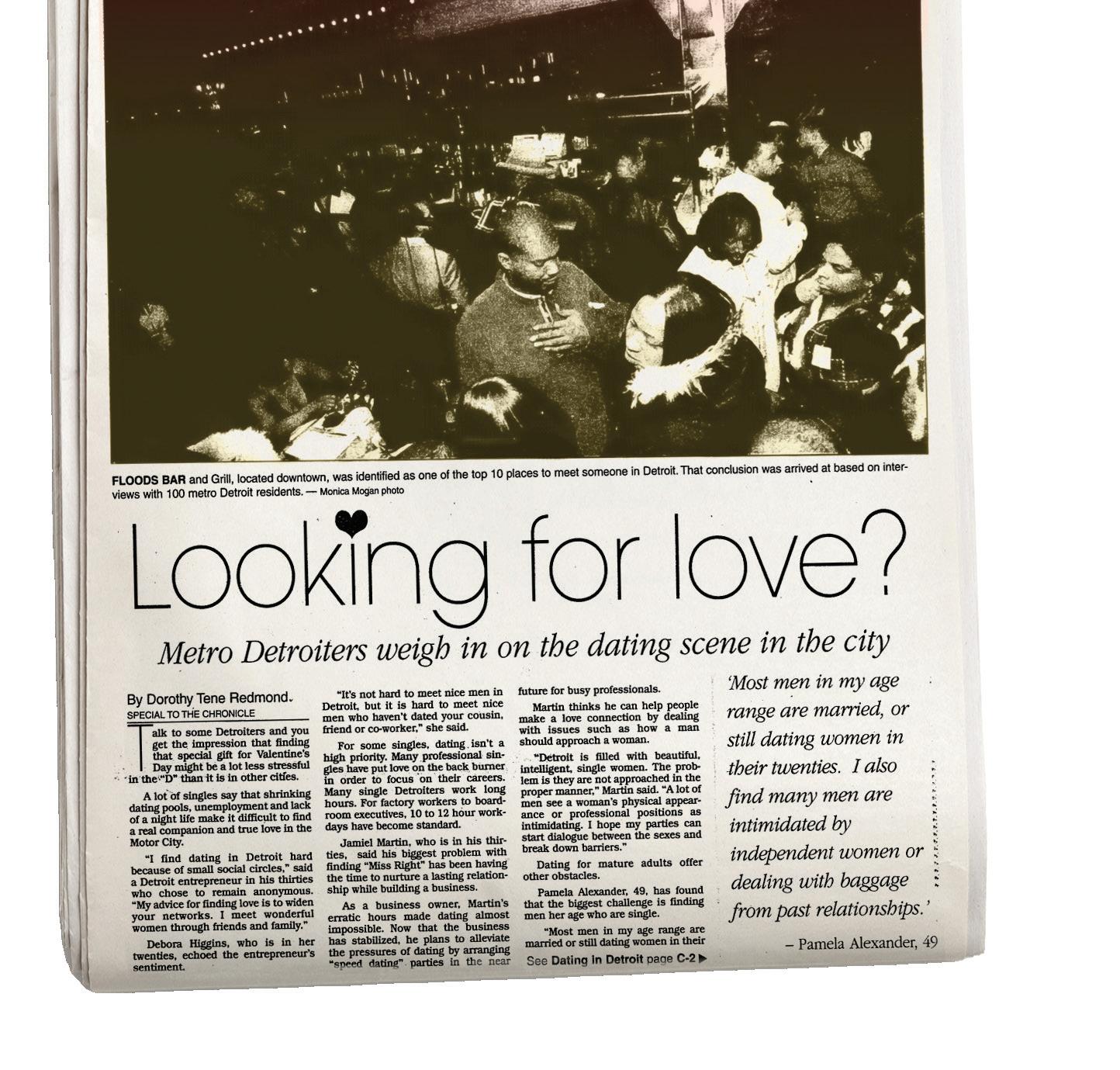
Twenty-one years later, we’re wondering whether anything has changed?


By Sam Robinson SENIOR REPORTER
This year marks the 90th anniversary of the Michigan Chronicle, Michigan’s oldest consecutive operating newspaper. In honor of 90 years of as part of the Black Press, we’re bringing you Chronicle Flashback’s honoring the paper’s history.
In 2005, Debora Higgins told Michigan Chronicle’s Dorothy Tene Redmond, “It’s not hard to meet nice men in Detroit, but it is hard to meet nice men who haven’t dated your cousin, friend or co-worker.”
Twenty-one years later, we’re wondering whether anything has changed?
Redmond’s report on the city’s mid-2000s dating scene highlighted speed dating parties targeted toward those having trouble finding love in Detroit.
Digging through the archives during the first week of February reveals residents in decades past held fundraisers, small parties and “gigantic galas,” like one Valentine’s Day Gala at Cobo Hall honoring former Detroit Mayor Coleman Young.
More than 4,000 people packed Cobo Hall to honor Mayor Young as he completed his first full year in office.
The photo gallery from the event published the week after the event featured councilwoman Erma Henderson, Congressman John Coyers and Detroit’s “unofficial first lady,” Joyce Garrett, a longtime county official who led Detroit’s Bicentennial Commission, overseeing the city’s celebrations of America’s 200th anniversary.
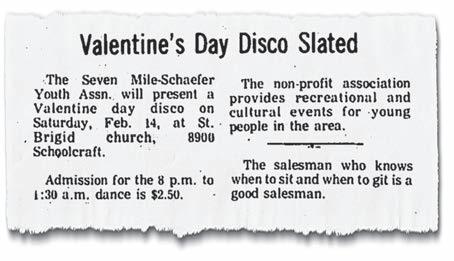
And years later, on the city’s west side, a local youth organization providing recreational and cultural events held an annual late-night Valentine’s Day Disco at a church on Schoolcraft.
“Detroit is filled with beautiful, intelligent, single women. The problem is they are not approached in the proper manner,” said Jamiel Martin, who said he has a hard time balancing a relationship while building a business.
The caption of the story’s featured image, an overhead shot captured by Monica Morgan inside Flood’s Bar and Grill, calls the restaurant one of the top 10 places to meet someone in Detroit.
The year before, Michigan Chronicle featured the ceremony of several couples who chose to be married by Wayne County Clerk Cathy Garrett on Valentine’s Day, the second year Garrett’s office held the special event for couples.
And years later, on the city’s west side, a local youth organization providing recreational and cultural events held an annual late-night Valentine’s Day Disco at a church on Schoolcraft.
In 2003, legendary Detroit journalist Susan Watson dedicated Valentine’s Day to Rosa Parks, who Watson said she once saw reach down on the street from her newspaper office window to help a homeless person.
It was the same day the Detroit Opera House house hosted a 90th birthday celebration for Parks, titled, “For the Love of Rosa.” The civil rights icon’s birthday is 10 days prior. Watson, who died in 2020, even gave readers instructions for sending Parks their own letters of appreciation.
You can reach Sam at srobinson@michronicle.com.

“The Women of Excellence program is a reflection of the strength, brilliance, and influence of women throughout our
said Cathy Nedd, President of
and longtime host of the program. “Each honoree has earned her place through dedication to her
and a deep commitment to the betterment of our community. We are proud to celebrate them and the legacy they
Supporters are invited to participate by
a sponsor, reserving tables, or purchasing individual tickets at www.michiganchronicle.com/woe2026
brought increased pressure and visibility, helping Smith refine his leadership abilities and decision-making under intense scrutiny.
Smith was hired by the NFL in 2015, beginning what would become a long tenure at the professional level. According to Ferris State University, Super Bowl 60 marked his 11th season as an NFL official and his eighth season serving as a referee, the lead official on the field. Easily recognizable by the white cap, the referee carries the responsibility of managing the entire officiating crew, announcing penalties to the stadium, and serving as the final authority on rulings.
Before earning the Super Bowl assignment, Smith had been selected as an alternate referee for a couple of previous Super Bowls, an indication of the league’s confidence in his abilities. His elevation to the field for Super Bowl Sunday represented both professional recognition and the culmination of decades of work that began on youth fields in Michigan.
For Smith, standing at midfield at Super Bowl 60 was a full-circle moment that connected his roots at Cody High School, his education at Ferris State, and his steady rise through football’s officiating ranks. It also served as a reminder that the path to the sport’s biggest stage is not limited to players and coaches, but also includes those tasked with ensuring the game is played fairly at its highest level.






A5 | February 11-17, 2026
By Dr. Anthony O. Kellum
CONTRIBUTING WRITER
Property is Power. But only if we own it.
Across Black and working-class neighborhoods in America, a quiet takeover is underway. It doesn’t come with moving trucks or “For Sale” signs staying up for weeks. It arrives in the form of cash offers, waived contingencies, accelerated closings, and corporate entities whose names never appear on the mailbox.
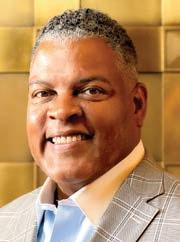
Wall Street is still buying Main Street.
Anthony O. Kellum
Private equity firms, hedge funds, REITs, and large-scale institutional investors are purchasing single-family homes at scale often in the very neighborhoods where Black first-time buyers are trying to gain a foothold. The result is not just higher prices. It is a restructuring of who gets to belong, who gets to stay, and who gets to build wealth.
This is not a housing market anomaly. And once again, Black families are being boxed out of ownership while being locked into permanent renting. If Black families don’t own the block, they will never control the future of it. This moment cannot be misunderstood.
After the 2008 housing crash, institutional investors stepped in to buy distressed properties often in Black neighborhoods hardest hit by foreclosure. What was framed as “market stabilization” became a long-term business model acquire low, rent high, and extract value indefinitely. Fast forward to today. Even as institutional buyers publicly claim to have slowed purchases, their presence remains deeply felt. They are still active in:
■ Entry-level neighborhoods
■ Majority-Black and Brown neighborhoods
■ Sun Belt and Midwest cities with historically affordable homes
■ Areas where first-time buyers rely on financing rather than cash
Their advantage is structural. Cash offers beat financed buyers. Algorithmic pricing beats emotional bids. Portfolio ownership absorbs short-term losses in exchange for long-term dominance. The average Black first-time buyer never stood a fair chance.
This is not just about losing a house. It is about losing a pathway. Homeownership has never been merely shelter for Black Americans. It has been our most reliable tool for wealth creation, community stability, and intergenerational mobility. When investors replace families, the consequences extend far beyond price. Owner-occupied homes anchor neighborhoods. Renters rotate through them. When investors dominate, we see higher rents, fewer long-term residents, less civic engagement, weaker school advocacy, and diminished political influence. The neighborhood becomes a revenue stream, not a community.
The danger is not just economic it is existential. For Black professionals and college-educated buyers, this reality can feel particularly disorienting. On paper, they did everything “right.” Degrees earned. Careers built. Credit managed. Yet they find themselves repeatedly outbid by entities that never intend to live in the homes they purchase. This is how inequality reproduces itself in modern form. Not through exclusion by law, but through competition structured so that families lose before the game even begins. Institutional ownership also distorts pricing. When large investors buy multiple homes in a concentrated area, they artificially inflate comparable sales. This pushes prices beyond
See BLACK FIRST-TIME BUYERS Page A-6

By Aaron Foley EDITOR-AT-LARGE
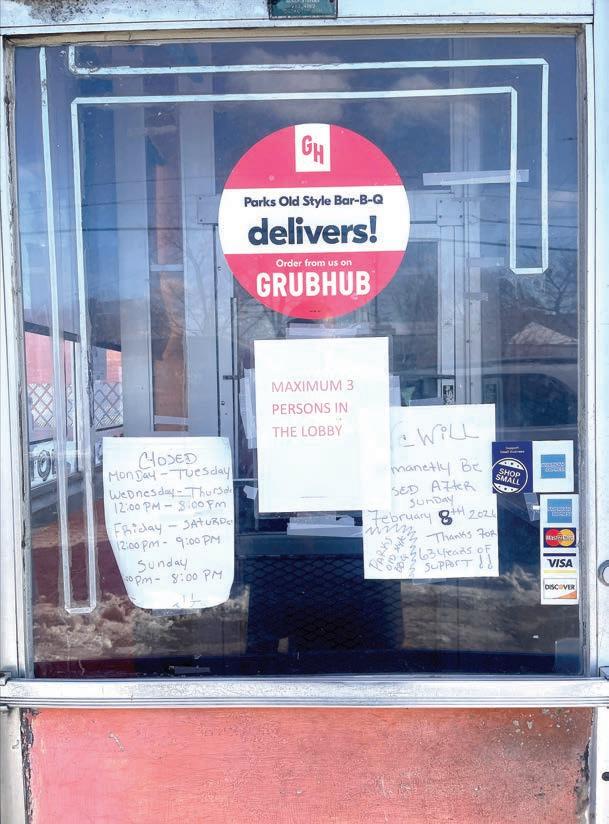
Parks Old Style Bar-B-Que, a humble smokehouse in the North End that satisfied longtime customers’ appetite even as the neighborhood around it crumbled, quietly announced it would be closing after nearly 62 years on February 8 with a handwritten note posted to its front door.
Word of Parks’ closure quickly spread on social media as customers began to line up at the one-story establishment at the corner of Beaubien and Custer that’s large enough for only three patrons at a time in its orange-washed lobby.
A busy clerk behind the counter on Tuesday fielded cash-only orders at noon with small stock, warning customers that some cuts like rib tips wouldn’t be available until two or three hours later, the store was no longer accepting card payments, and that online orders placed via Uber Eats and DoorDash would not be fulfilled this week.
“Don’t worry about the phones,” she said as two lines sounded nonstop while also turning away customers holding up their phones for food-app orders.
“We’re only taking walk-ins.”
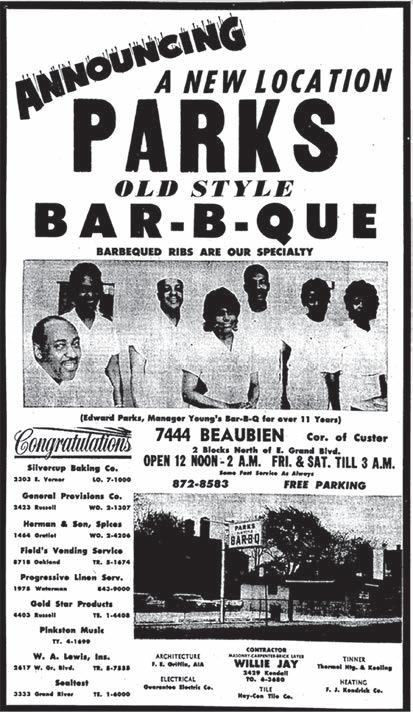
Parks’ was opened by Edward Parks in 1964, who announced the coming restaurant in the pages of the Michigan Chronicle in May of that year. Parks was a former manager of Young’s BBQ for 11 years at that point, another carry-out location that rings bells with Detroiters of a certain age and older; Young’s operated on the east side of Detroit since 1925 before closing in 2006.
Both Parks’ and Young’s – whose founder, John
By Mark S. Lee CONTRIBUTING WRITER
Detroit is a city of innovators, and entrepreneurs. It’s dynamic and has been and still is a national leader and home to an array of businesses, particularly Blackowned businesses. And it’s not just about supporting and celebrating them during Black History Month, but 365 days a year.
Supporting Black-owned businesses is often framed as a cultural or community issue. But at its core, it’s also a powerful economic strategy—one that strengthens local neighborhoods, expands opportunity, and builds a more resilient regional economy. They are the backbone of local and national economies.
With an estimated 50k small businesses, Detroit’s small businesses are diverse, collectively powerful, and more than storefronts. They’re job creators, community anchors, and engines of innovation. When we talk about supporting Black businesses, we’re talking about expanding the base of entrepreneurs who contribute to the tax
base, hire locally, reinvest in neighborhoods, and build generational wealth. That matters to all of us—regardless of background—because stronger local business ecosystems create stronger local economies.
Black businesses help close economic gaps—through growth
One of the most important reasons to support Blackowned businesses is that entrepreneurship has long been one of the most reliable paths to wealth creation in America. A successful business doesn’t just create income for its owner—it creates assets, stability, and the ability to pass something meaningful to the next generation.
But the reality is Black entrepreneurs have historically faced steeper barriers: less access to startup capital, fewer financial networks, lower approval rates for traditional lending, and often less visibility in mainstream business circles. Supporting Black businesses helps level the playing field—not through charity, but through commerce. It’s an investment in talent that
has too often been overlooked. Local dollars circulate and multiply
When you buy from a local Black-owned business, your dollars tend to stay closer to home. That business is more likely to hire locally, use local vendors, purchase from nearby suppliers, and reinvest in the community. This creates what economists call a multiplier effect: the same dollar can generate additional economic activity as it circulates.
It’s why a thriving corridor of small businesses can transform a neighborhood. It reduces vacancies, increases foot traffic, boosts property values, and improves public safety. That’s not theory—it’s what happens when business ownership is broad and inclusive. Supporting Black businesses expands innovation Entrepreneurship is one of America’s greatest competitive advantages. When
more people have access to business ownership, we get more ideas, more products, more services, and more competition— which ultimately benefits consumers.
Black-owned businesses are thriving across industries: tech, logistics, professional services, retail, construction, health and wellness, food, creative industries, and more. Supporting them strengthens the innovation pipeline. It ensures the marketplace reflects the full range of customer needs and cultural insights.
It’s not just what you buy—it’s who gets the opportunity
A key part of supporting Black businesses goes beyond individual shopping decisions. It also includes how corporations, nonprofits, schools, and governments spend money. Supplier diversity programs matter. Contracting opportunities matter. Including Black-owned firms in bid processes matters. If a business is qualified and competitive, it should be in the room. Too often, networks and relationships—not performance—determine who gets the contract. Expanding
what local incomes can sustain and justifies higher rents creating a feedback loop that benefits owners of capital and punishes aspiring owners. Property is Power precisely because it determines who controls space, time, and opportunity. Ownership dictates whether wealth circulates within a community or is siphoned off to shareholders who will never attend the local school board meeting or vote in the local election.
Why this moment matters.
If Black families are shut out of ownership now, the long-term consequences will be severe. Fewer homeowners today means fewer paid-off homes tomorrow. Fewer paid-off homes means less retirement security. Less security means greater dependence on systems that have never prioritized Black well-being. This is not accidental. It is structural. And it demands a strategic response.
First, Black buyers must understand the battlefield. Competing against institutional investors requires preparation, speed, and the right representation. Mortgage readiness must be proactive, not reactive. Pre-approvals, strong local lenders, and informed agents are no longer optional, they are defensive tools.
Second, policy must catch up to reality. Local and state governments must be pushed to regulate excessive institutional ownership of single-family homes, particularly in communities already facing displacement. Housing policy that ignores investor concentration is complicit in community erosion.
Third, community capital must be mobilized. Black professionals, churches, fraternities, sororities, and investment groups must think collectively about ownership. Cooperative models, community land trusts, and pooled capital strategies are not radical ideas they are necessary counter corporate consolidation.
Fourth, narrative matters. We must reject the idea that renting is simply a lifestyle choice when it is increasingly a structural outcome. Stability, equity, and control come from ownership, anything else is temporary.
Finally, we must teach the next generation that homeownership is not just a personal milestone, it is a collective responsibility. Owning property is how communities protect themselves from erasure. Wall Street understands this, that’s why they’re buying.
Property is Power! If Black families do not own the block, they will not control the schools, the politics, the culture, or the future of it.
Property is Power! is a movement to promote home and community ownership. Studies indicate, homeownership leads to higher graduation rates, family wealth, and community involvement.
opportunity expands economic growth.
What supporting Black businesses can look like
Supporting Black businesses doesn’t have to be complicated:
• Buy intentionally: Make Black-owned businesses part of your regular routine—not just during special months.
• Refer and review: Word-of-mouth is priceless. So are online reviews.
• Partner and collaborate: If you’re a business owner, look for ways to subcontract, co-market, or share resources.
• Invest: Consider mentorship, sponsorship, or even direct investment when appropriate.
• Expand procurement: If you lead an organization, diversify your vendor list.
Bottom line
Supporting Black-owned businesses is not simply about doing what’s right—it’s about doing what works. It strengthens the economy, creates jobs, grows the tax base, and builds communities where more people can thrive.
And when Black businesses thrive, Detroit thrives. The region and economy thrive. And ultimately, we all benefit.
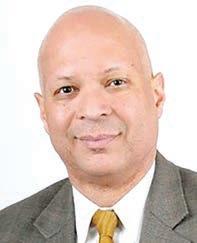
We invite readers, business owners, and future entrepreneurs to follow along, ask questions, and engage. If you have story ideas or questions you can email Lee at mark@leegroupinnovation.com or visit leegroupinnovation.com.
P. Young, arrived in Detroit from Alabama just over a decade before opening up shop, and was uncle to Edward Parks’ wife, Verna -- traded on unique sauces and spice blends to distinguish themselves from other carry-out barbecue spots in the city like Vicki’s BarB-Q on West Warren south of McGraw, or Joe Ann’s in Conant Gardens. Verna Parks boasted in a 1999 interview with the Chronicle that “rare, imported spices” were the secret behind the shop’s success.
But Parks’ had a strategic location going for it as well, located near a number of plants and factories in the vicinity of the North End. General Motors’ former headquarters was still situated on Grand Boulevard at the time of its opening; a GM plant on the Detroit-Hamtramck border is still open. A number of patrons in line on Tuesday donned Carhartt workwear and fluorescent safety gear, a testament to the carry-out’s popularity with blue-collar workers.
But as industry slowly moved out
of Detroit, neighborhoods like the North End – already vulnerable because of costly, aging housing stock –were among the hardest hit. And while take-outs and buy-here-fry-heres have never gone out of fashion in Detroit, barbecue carry-outs in Detroit were overshadowed when newer, dine-in options began to arrive in Detroit in the 2010s, often forgotten in must-visit and best-of lists that also began to appear with more frequency at the time. With the closure of Parks’, only a handful of carry-out barbecue spots remain in the city, including Vicki’s, Nunn’s BBQ II, and Uptown BBQ.
One patron in line held up his phone to take a short video for his followers on social media.
“If you know, you know – Parks’ barbecue,” he said before talking about its closure. After hearing the clerk behind the counter shout again about not taking online orders, he offered another eulogy: “Come down here and pay your respects, and pick it up in person like everyone else.”




By Black Information Network
More than a year into his second term, President Donald Trump has appointed 27 judges to the federal bench — and the makeup of those appointments is drawing renewed scrutiny.
Of the judges confirmed so far, 17 — about 63 percent — are White men. Seven are women, accounting for roughly 25 percent. None are women of color, according to reporting by The 19th.
While the imbalance mirrors Trump’s first term, legal experts say the broader political climate surrounding these confirmations is notable. When Trump left office in 2021, White men made up 64 percent of his judicial appointments, White women accounted for 19 percent, and women of color represented just under 5 percent. This time, critics say, the administration has been more explicit in framing diversity as a liability and judicial independence as disloyalty.
Trump has repeatedly praised judges who rule in his favor, condemned those who rule against him, and moved to dismantle diversity initiatives across the federal government.

“If he’s just choosing judges on the basis of who he thinks will be politically loyal to him, it turns out that a lot of them are White dudes,” Josh Orton, president of the progressive judicial advocacy group Demand Justice, told The 19th.
The gap between Trump’s picks and the current judiciary is stark. According to the Federal Judicial Center, about 40 percent of the nation’s 831 active federal judges are women, and roughly 17 percent are women of color — highlighting how narrow Trump’s second-term selections have been.
Judicial scholars say representation matters not just symbolically, but functionally. Rachael K. Hinkle, a political science professor at the University at Buffalo, has found that women judges — particularly women of color — often take on less visible work, such as writing unpublished opinions that carry limited policymaking power. Her research also shows that decisions authored by women or judges of color are more likely to be challenged by attorneys.
“People have a perception of competence that’s linked to those demographic characteristics,” Hinkle told The 19th.
The stakes are highest in the federal appellate courts, which decide roughly 40,000 cases a year, compared to fewer than 100 heard annually by the U.S. Supreme Court. While the Supreme Court currently includes three women — two of them women of color — the appellate courts shape the vast majority of federal law.
Experts caution it will take years to fully assess the long-term impact of Trump’s judicial appointments. Still, they note that his administration has increasingly linked race and gender diversity to professional incompetence — a theme reflected in policy goals aligned with Project 2025, a far-right blueprint for restructuring the federal government.
Though Trump has publicly denied ties to Project 2025, analyses cited by The 19th indicate that roughly half of its objectives — including rolling back diversity initiatives and narrowing how race and gender can be addressed in public institutions — have already been implemented during his second term.


By Jeremy Allen EXECUTIVE EDITOR
The recent episode in which President Donald Trump’s social media feed briefly carried a video that portrayed Barack and Michelle Obama as apes is way more than another political gaffe.
It is a stark, shameful moment that should prompt grave reflection from all Americans, and especially from those who have grown numb to the worst instincts of our political leaders and their followers.
In posting – and then defending – a piece of content that invokes one of the most dehumanizing and ugly racist tropes in American history, the president crossed a line that should have been beyond the pale for anyone occupying the Oval Office.
This was not satire. This was not a misunderstood joke. This was an image with deep roots in the pseudoscience and propaganda that once sought to justify slavery, segregation, and violence against African Americans. That it appeared in the first week of Black History Month only compounds the offense. That it came from the account of the sitting president of the United States makes it a stain on the very idea of the office.
Trump’s refusal to apologize (instead insisting he “didn’t make a mistake” and shifting blame onto aides) is telling, yet unsurprising. It reveals a political leader who will not fully own the consequences of his own actions, even when those actions traffic in imagery with a long, ugly history of racial dehumanization. And it reveals a base of supporters who, all too often, excuse the inexcusable.
But let’s be clear: this incident should not be viewed in isolation. This is the same president who, for years, amplified the birther conspiracy theory, suggesting that President Obama was not even born in this country. That falsehood was rooted in a willful effort to delegitimize the first Black president of the United States. It also was rooted in a willingness to exploit racial animus for political gain.
Let us also recall that this president oversaw policies and rhetoric that inflicted real harm on communities of color and on immigrants. Trump’s tenures as president have seen the implementation of harsh immigration policies that continue to break
families apart and treat vulnerable people as less than human.
ICE raids and detentions have become traumatic fixtures in the lives of countless families seeking a better life in this country, and it’s a reflection of a worldview that treats some lives as more worthy of dignity and protection than others. Many of the arguments used to defend those policies are thin veneers over something much harsher: a politics of exclusion and dehumanization. This most recent episode is a continuation of a pattern.
Still, it is possible to criticize without descending into cynicism. There was once an era in which presidential missteps were met with a kind of bemused exasperation rather than outright celebration among supporters. Think back to the years of George W. Bush. By all measures, he was a flawed president, prone to malapropisms and public gaffes that became fodder for late-night comedians. Americans often joked about his verbal missteps and his sunny disregard for linguistic precision, but there was something to that dynamic: the ignorance was transparent, but not malevolent.
The jokes, as ill-informed as they sometimes were, sprang from a place of humane incredulity rather than contempt. That era’s “witty ignorance,” as some would call it, at least left room for common ground. It did not traffic in degrading imagery designed to stir up division. It did not purposely deploy racist tropes for political effect.
Contrast that with this moment, where the president is intentionally invoking centuries of racist dehumanization directed at Black Americans. And this moment encourages excuses from supporters to shrug off fundamental decency.
Today, a president’s base embraces his antics as clever, or dismisses them as “just politics,” as though the constant lowering of standards is acceptable collateral in a zero-sum culture war. They do not challenge the racism; they normalize it. They excuse the vile imagery. They treat moral boundaries as optional. And in doing so, they erode something far more valuable than political advantage: the trust, the empathy, and the dignity that bind a democracy together.
Some defenders of the president will
argue that the video was only up for a short period and that it was deleted. But deletion after the fact does nothing to erase the harm of the original act, especially when the deletion is followed by bluster and deflection rather than sincere contrition.
But if there is one lesson that this episode should teach us, it is this: intent matters, accountability matters, and acknowledgment of harm matters.
A true leader would have immediately condemned the racist content, explained precisely how it came to be, and used the moment to reflect publicly on why such imagery is harmful and unacceptable from the highest office in the land.
Instead, what we received was denial shrouded in excuses and a reflexive defense of the indefensible.
To those in the president’s coalition who continue to cheer, to rationalize, to defend, my hope is that you pause for a moment and think about what you are endorsing.
This isn’t about left versus right. This is about whether you value a politics rooted in dignity and respect, or whether you are willing to accept the dehumanizing of fellow Americans as just another tactic in the pursuit of power. If you think such behavior is clever, funny, or harmless, I invite you to consider how it feels to be on the receiving end of centuries of racist caricature.
If you think this is “just politics,” then we have passed the threshold where civility and mutual respect are optional. And once that threshold is crossed, democracy itself is weakened. The presidency is an institution meant to symbolize and uphold the best aspirations of the American experiment. It demands a level of decency that transcends partisanship, even in an era as polarized as ours. The normalization of racialized imagery and rhetoric from the highest office in our land undermines that principle. Civility does not mean appeasement, and decency does not mean silence. Enough excuses. It’s time to demand better, but demanding (and expecting) “better” from Donald Trump seems like an exercise in futility. And one of the only things more futile is to expect his woefully faithful supporters to hold him accountable for his racist ways.
By Sam Robinson SENIOR REPORTER
Saginaw fire captain Chedrick Greene defeated State Board of Education president Pamela Pugh in the packed Democratic primary for the special election in Michigan’s 35th state Senate district Tuesday, according to unofficial results.
Greene, a firefighter and retired Marine, won with about 68.5% of the vote, to Pugh’s 31.5%. There were four other Democratic candidates running.
Greene won the support of labor unions and establishment Democrats like Bay City Rep. Kristen McDonald Rivet, who left the seat to represent the area in Congress.
Greene will face Jason Tunney in the May 5 general election for the seat that was left vacant for more than a year.
“In this incredibly important time, for this incredibly important race, I deeply respect the trust voters have placed in me,” Greene said in a press release. “As we set our sights toward the General Election, voters have a clear choice — a leader grounded in working class experiences, who has put his life on the line for three decades defending our freedoms and protecting Michiganders; or an out-of-touch Republican rubber stamp who is too MAGA to denounce this admin-
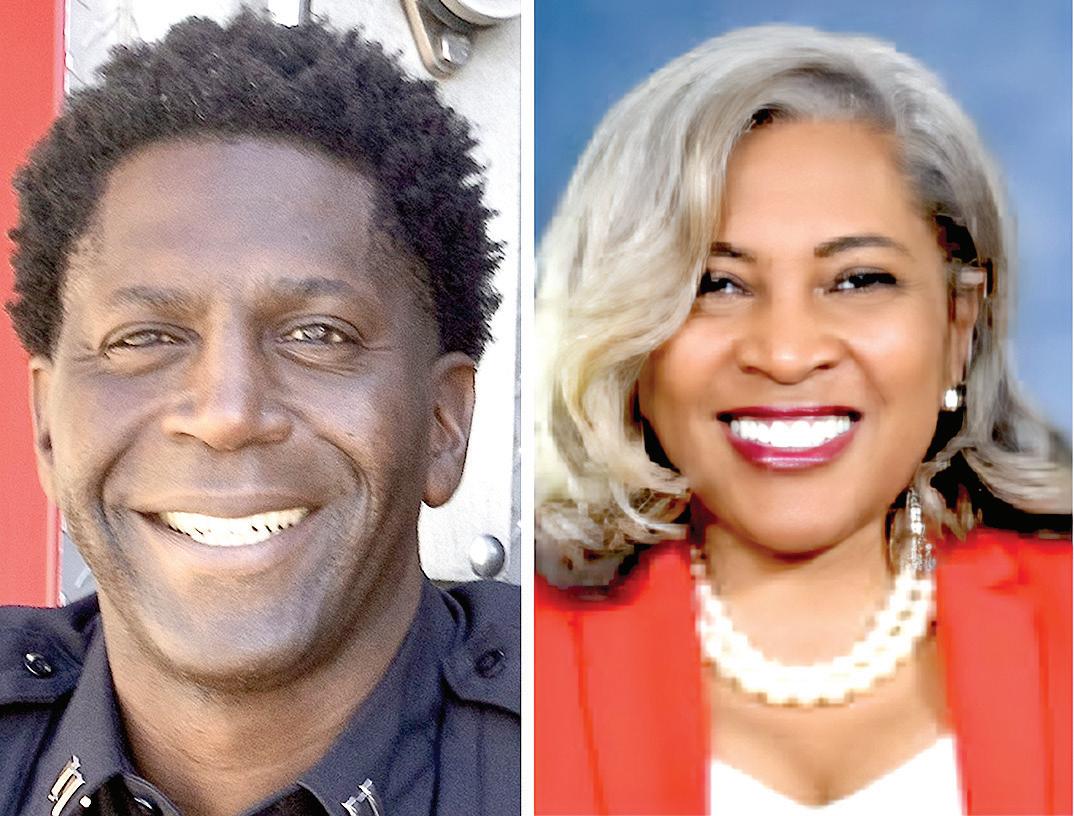
leadership that has been standing up for the well-connected and the wealthy,” Pugh said.
The Associated Press called the election around 11pm for Greene and called the Republican race a few minutes before midnight.
An ad campaign supporting Pugh paid for by a GOP connected group received criticism from Democratic leaders, many who silently backed Greene. On Election Day, the state party shared, and quickly unshared, a post from Rivet on telling people to vote for Greene.
A group called ProgressiveMI, which campaign finance records reveal has ties to Republican groups, sent out material including a message championing Pugh’s values: “Making Medicare for All a Reality & Standing Up to ICE.”
The tactics suggest Republican opponents saw Pugh as the weaker candidate in a general election. Greene raised and spent more than double than Pugh during the latest reporting period, $258,000 compared to Pugh’s $121,000, though both ended with about $20,000 left in their coffers, campaign finance records show.
You can reach Sam at srobinson@ michronicle.com.

Blaire Johnson will join Interlochen Arts Academy for the Imagine US: Celebrating America at 250 tour.
Blaire Johnson, 15, of Bloomfield Hills, will go on tour with Yo-Yo Ma and Interlochen Arts Academy March 7-15, 2026. The tour is a collaborative project with the Boston Symphony Orchestra, The Philadelphia Orchestra, and the Detroit Symphony Orchestra and features side-by-side performances with members of each orchestra, many of whom are Interlochen alumni.
Cristian Măcelaru, Artistic Director and Principal Conductor of Interlochen’s World Youth Symphony Orchestra and Music Director Designate of the Cincinnati Symphony Orchestra, and Interlochen Arts Camp and Academy alumnus, will conduct.

During the tour— which will kick off at Interlochen and include stops in Detroit, Philadelphia, and Boston— students will present a program featuring a new cello concerto by Wynton Marsalis commissioned by Interlochen; Reena Esmail’s “RE|member”; and, a reimagined performance of Charles Ives’ Symphony No. 4 including multidisciplinary elements by students from all seven of the Academy’s artistic disciplines.
Cellist Yo-Yo Ma has been working with Arts Academy students and will serve as the soloist for the Marsalis concerto for the performances in Interlochen, Philadelphia, and Boston. Isidore String Quartet cellist, Arts Academy alumnus, and Detroit native Joshua McClendon will appear as the guest soloist for the Detroit performance. Performance dates and locations for the spring 2026 tour are:
■ Saturday, March 7Corson Auditorium | Interlochen, Michigan
■ Tuesday, March 10Orchestra Hall, Max M. and Marjorie S. Fisher Music Center | Detroit, Michigan
■ Friday, March 13Marian Anderson Hall, Kimmel Center for the Performing Arts | Philadelphia, Pennsylvania
■ Sunday, March 15Symphony Hall | Boston, Massachusetts
Blaire Johnson is a Michigan resident who attended Cranbrook Schools from Pre-K through 8th grade. She has loved acting, singing, and dancing since she was five years old, and after seeing her first Broadway musical in New York City at age seven, she developed a lifelong dream of performing on Broadway. Blaire is a high-achieving academic and musical theatre student at Interlochen and currently serves as the sophomore class student representative. She is deeply grateful for the opportunity to represent her school on this milestone tour.
“Interlochen Arts Academy students from 45 U.S. states and territories, 27 countries, and other young artists from the tour areas will come together, exemplifying the power of the arts to foster understanding and connection, and to help advance the ideals of a democratic society,” explained Trey Devey, President of Interlochen Center for the Arts.
“This tour gives an important youth voice to programming in honor of the nation’s semiquincentennial, creating mini-festivals in each community, reinforcing the essential role of youth arts education, and providing our incredibly talented students with the chance to be mentored by some of the world’s finest musicians as they explore what it means to be a citizen artist. Interlochen is proud to bring current students and the many alumni who hold positions in these orchestras together as we begin celebrations leading to our centennial in 2028.”
“We are delighted to collaborate with part-
See BLAIRE JOHNSON Page B-2
By Ebony JJ Curry SENIOR REPORTER
Five years can feel quick inside a neighborhood that changes block by block.
At Second Baptist Church of Detroit, five years also lands like a checkpoint. This month, Pastor Lawrence W. Rodgers reaches his fifth anniversary leading the 190-year-old congregation planted a few steps from the entertainment district of Greektown. He arrived during COVID-19, when the church had to protect elders, keep ministries alive, and stay visible in a district shaped by tourism, casinos, and constant redevelopment.
Rodgers calls the church a public resource with a spiritual engine.
“I believe that the church is the people’s resource,” he said. “And when I say people, I don’t just mean the church members. I mean the people of the community. Churches are spaces that are owned by the people and should be utilized for the people and for the communities that sit around our congregations.”
That outlook has guided his approach as Greektown continues its transformation and as Second Baptist balances preservation with a future-facing mission. Rodgers has expanded outreach tied to homelessness
By Jeremy Allen EXECUTIVE EDITOR
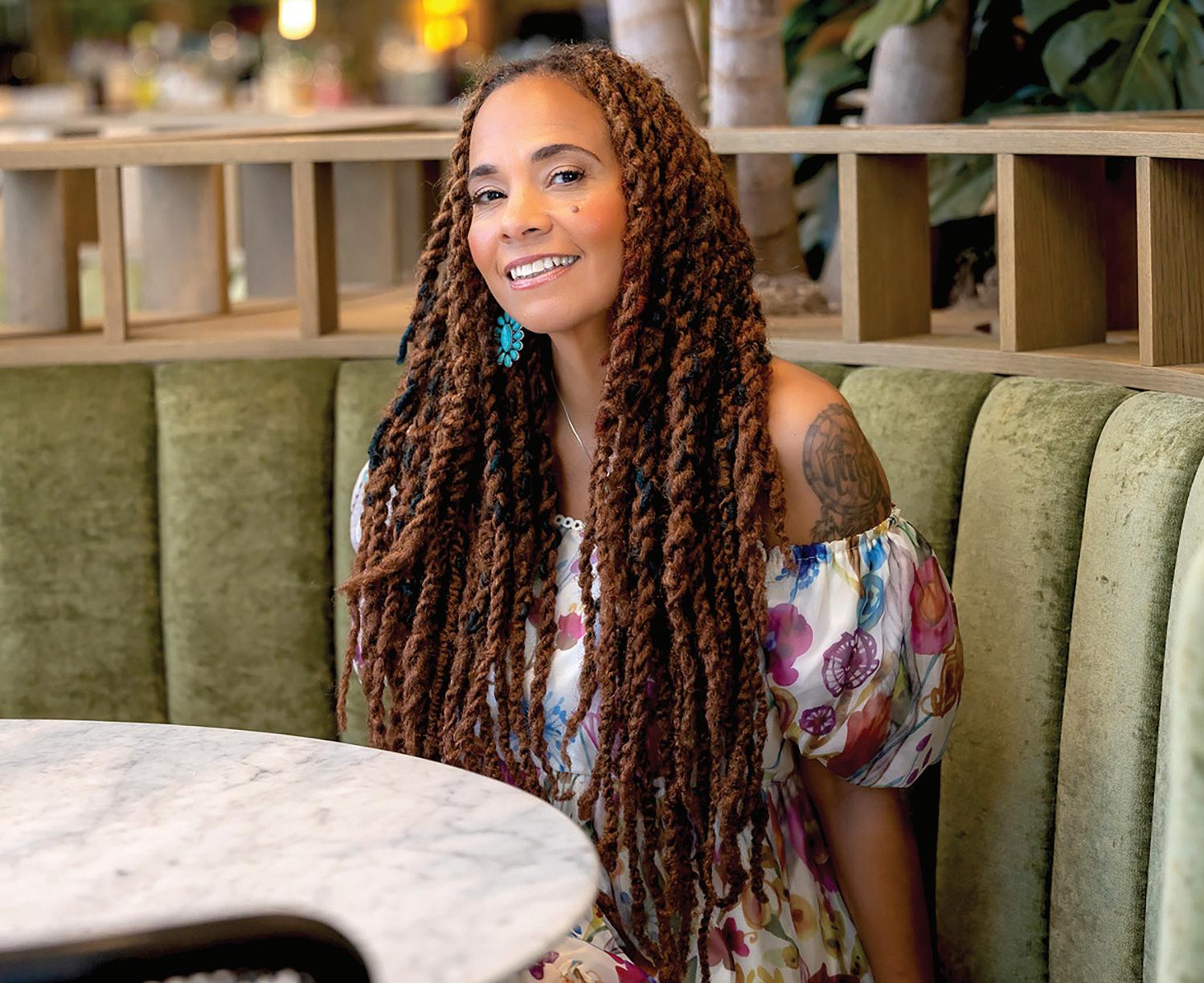
Detroit poet and cultural architect jessica Care moore has never written for the moment alone. Her work speaks to memory and possibility at once, calling forward the ancestors while insisting on a future shaped by intention, care, and courage.
Ahead of Mayor Mary Sheffield’s public inauguration, Moore offered a poem that does exactly that, where she grounded a political ceremony in a way that only she could. moore, like Mayor Sheffield, centered her moment in the people.
The poem arrives as an invocation. It honors Detroit as a city that has endured, organized, dreamed, and demanded more for itself, particularly through the leadership of
Black women who have long carried the work without always receiving the title. Moore’s words move with urgency and tenderness, weaving history, struggle, and hope into a narrative that feels both deeply personal and unmistakably collective.
In a city where poetry has often served as a form of witness and resistance, moore’s contribution stands as a reminder that art remains central to civic life. This was a declaration that affirmed community, accountability, and the sacred responsibility of leadership.
Published here in full, moore’s poem invites readers to sit with its language, feel its weight, and recognize the moment it marks.
On the occasion of Mary Sheffield becoming the first woman mayor Of Detroit, Michigan. Detroit Opera House. January 8, 2026.
“The Beauty is in the Resume”
A
Poem Honoring the 76th Mayor of Detroit, Mary Sheffield
By jessica Care moore Detroit Poet Laureate
When you are a woman in any race, the baton isn’t always Passed to you with grace. Often times, one must go get it with conviction, with purpose, with clarity.
August 5th 1824, the office of the Mayor is created In the city of Detroit. For centuries many men would occupy that seat. Until. Until.
A nurses child
A preacher’s daughter with historical roots tracing Back to the 1800’s.
A grandfather’s inheritance
Until she decided to put her foot on the starting line Her distinct voice into the very male dominated sound of leadership & began to move powerfully into her broader purpose.
On November 4th Detroit didn’t cast this mandated vote for a politician
They voted for a person.
A hugger
A proud Detroiter Raised on the westside.
A woman that literally pulls up for
The people, occupies the block and fills up auditoriums
With students for “A State of The Youth.”
A compassionate human, holding the line for her resilient city.
She raised up from a phoenix metropolis, an unburyable city
With unstoppable people, despite attempts to erase us.
This is what our sister Mary is made from.
One of those post rebellion babies who sat at the hem line of elders
Taking notes and turning it into action.
Watched how they held it
Together.
skin and bone underground & undertow
Detroit refined and yes, we know.
Yes sir, yes ma’am and What up Doe?
A city of masjids & churches
synagogues & temples
A city built by up south hands, & blue collar grit

and mental health support, and he has built partnerships meant to keep the church connected to daily neighborhood needs. He also has grown youth programming that puts STEAM and workforce preparation in the same sentence as ministry. The work sits on top of a legacy that long predates any current development plan.
Second Baptist traces its founding to 1836 and has documented history tied to Black liberation and civic advocacy. The church’s published history describes its role as a station on the Underground Railroad from 1836 to 1865, helping freedom seekers with food, clothing, and shelter before moving them toward Canada. The church
also notes that it established Detroit’s first school for Black children in 1839, and that educator Fannie Richards, a member, became Detroit’s first Black career public school teacher.
Rodgers says his “social outlook” fits that lineage.
He points to the kinds of community-facing programs Second Baptist has hosted during his tenure: political forums, opioid overdose response training with Narcan administration certification, financial literacy sessions, and health clinics focused on diabetes, blood pressure, Alzheimer’s and dementia. He has also brought programming on human trafficking, which he describes as a real concern in Detroit’s role as a border city. Rodgers also places the church’s civil rights ties in the center of its identity. Martin Luther King Jr. corresponded with the church’s then-pastor in the 1950s, “Dr. King wrote us a letter saying that no other church raised more money for the Montgomery bus boycott than the Second Baptist Church of Detroit.”
That history matters to Rodgers for a practical reason. A church that once orga-
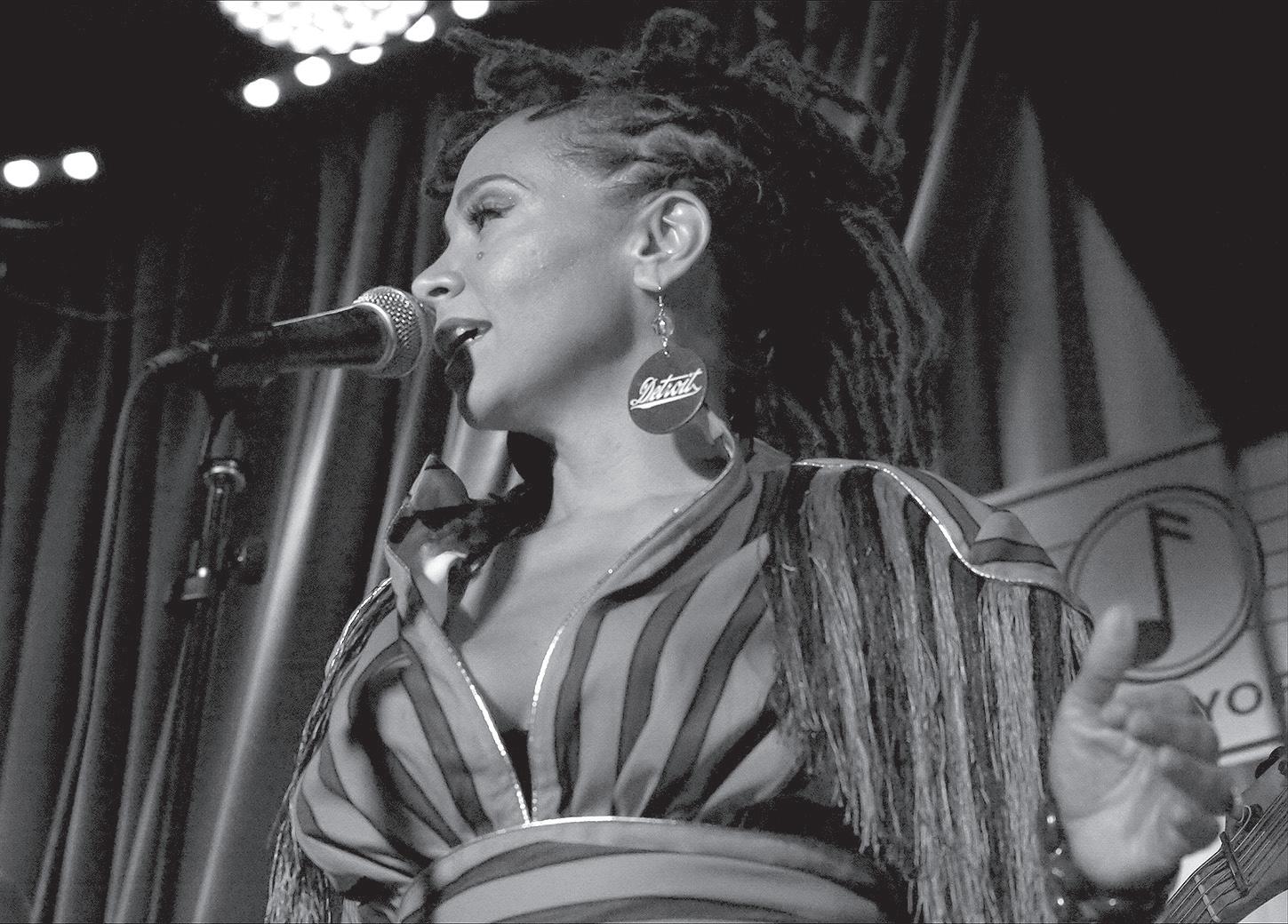
From page B-1
A city that gave the world
Techno & Motown
Coltrane’s Harp & Smokey’s smile.
From the Davison to 7 Mile
Mary Sheffield has been in this work for a while
The Beauty is in Her Resume Legacy in her D.N.A.
A passed down perseverance she laced inside running shoes. A focus that continues to grow with time, with love, from family, reflected through community.
She is the result of a recipe requiring patience
Some fire, an oven, a promisesome love, some resistance, Some swagger, some hope, some joy, a lot of heart, some water
Less water shut offs.
some wonder some time to cook
And eventually, she rises to an occasion
An historical moment in time
It only took us three hundred and twenty four years
To propel our beloved, tenacious city into a future
That is fearless, feminine, grassroots, and unapologetic
With commitment to equity and economic justice for all.
A leadership that wraps itself in the needs of neighborhoods
Invests in its citizens, feeds the hungry, inspires our youth Gives voice to everyone who Lives, works,loves, raises families
And has the audacity to dream here.
She has been walking the actual walk
And when she runs, she actually runs!
Because, We Run 313
During a time when it’s not always easy for black girls to see themselves in the future.
We can ask Kentanji Brown Jackson
Ask Phillis Wheatley Ask Shirley Chisholm
Or we can reach into our own pantheon of leadership
About being a woman and being first.
Ask Erma Henderson
(it’s in the water)
Ask Kyra Bolden
(it’s the wrists)
Ask Charlene White
(it’s the fearlessness))
Ask Barbara Rose Collins
(it’s in the work ethic)
Ask Joann Watson
(it’s in the people)
Ask Rosa Parks
(it’s the courage)
Ask Ruth Ellis
(it’s in our hearts)
How we use our collective imaginations to see
Ourselves in a place, a seat, a position, a room, at a table,
others may not believe possible or even belong
To you.
To us.
To a city.
But, Mayor Sheffield knows exactly who she is & so does the D.
That’s why we are not surprised when her
First bold announcement as Mayor is centered
Around lifting up pregnant mothers and babies.
Our 76th Mayor understands that all
Of our cities’ children deserve a fair chance, & fighting poverty is an investment
A recipe for humanity.
Whipped up in our soup kitchens, on the frontline,
In our classrooms, in our boardrooms, in our Birthing centers, on the strong
Shoulders of every woman that came before her.
If you want to know how to make a city become
A leading example to the world.
If you want the people to thrive, not empires.
Then you have to know Who to hire!!
Congrats Mayor Mary Shefflield Together, Detroit
Will Rise
Higher.
You see yourself in her.
Everyday person that loves helping people
She’s a hugger.
That’s why I rock with her
From page B-1
nized for freedom, education, and dignity has to decide what the next urgent need looks like on Monroe Street right now.
He sees it in the youth.
Rodgers talks about STEAM training as a way to keep Detroit kids from being locked out of tomorrow’s economy. He references automation and robotics and what those shifts can do to traditional manufacturing work, which has shaped Detroit families for generations. His goal, he said, is simple: no community gets left behind.
He connects that belief to his own childhood. Rodgers recalled taking a shop class where he built a small woodworking project for his mother. The point, he said, was not the napkin holder. The point was confidence.
“That shop class demystified woodworking for me,” he said. It made tools feel familiar. It taught safety and skill. That kind of early exposure, he argues, translates into adulthood and into career possibility.
He applies the same idea to science and technology.
“Exposure to the sciences, to technology, to engineering, arts and mathematics helps to demystify these things for young people,” Rodgers said. “They can see themselves in automation or robotics or chemistry, pharmaceuti-
From page B-1
ners who share our commitment to citizen artistry and to inspiring the next generation of artists,” said The Philadelphia Orchestra President and CEO Ryan Fleur. “As we celebrate America’s 250th birthday, we look to the future and to the young people who will help to shape it. This impactful partnership will provide unique opportunities for the next generation of creatives to hone the skills that will enable them to positively impact society through their artistry.”
“The Boston Symphony Orchestra is honored to host Interlochen Arts Academy as part of their extraordinary tour celebrating the 250th anniversary of our nation’s founding. Artistic explorations like these remind us of the vital role the arts have played in shaping America’s story—expressing our shared history, inspiring new perspectives, and bringing people together across generations. By uniting young artists with world-class musicians, this collaboration embodies the spirit of creativity and mentorship that continues to define our nation’s cultural legacy. We look forward to welcoming these exceptional young musicians to Symphony Hall and celebrating the power of music to connect us to our past and guide us toward the future,” said Chad Smith, the Boston Symphony Orchestra’s President and CEO.
Currently, 15 alumni and two alumni parents are musicians with the Boston Symphony Orchestra, nine alumni and one alumni staff member are musicians with The Philadelphia Orchestra, and 16 alumni and five alumni staff members are musicians with the Detroit Symphony Orchestra.
The March 2026 Detroit performance marks the 100th anniversary of the collaboration between Interlochen and the Detroit Symphony Orchestra, which began in 1926 with the inaugural performance of the National High School Orchestra—the precursor to Interlochen Arts Camp—at the DSO’s Orchestra Hall. Over the decades, DSO musicians and conductors have regularly served as faculty members and guest artists at Interlochen Arts Camp and Arts Academy. Since 2019, the orchestra has conducted annual residencies at Interlochen Arts Camp which include a public concert by the DSO, master classes, and a side-by-side performance featuring the World Youth Symphony Orchestra and musicians from the DSO.
“The Detroit Symphony Orchestra celebrates its shared history with Interlochen as national leaders in arts education, particularly in bringing the joy of music to young people in the state of Michigan for a century,” said Erik Rönmark, President and CEO of the DSO. “We can think of no more fitting tribute to the 100th anniversary of our collaboration than this concert by the Interlochen Arts Academy Orchestra at Orchestra Hall in Detroit with DSO musicians who are Interlochen alumni and cellist Joshua McClendon.”
Interlochen Arts Academy’s 2026 tour will build on many recent student touring opportunities, including a performance as part of the New York Philharmonic’s 2022-23 season and a critically acclaimed 2016 performance by the Arts Academy Orchestra at the NY Phil Biennial. Other recent Arts Academy tours include a multidisciplinary performance at Miami’s New World Center in early March 2020 and premieres of new works at National Sawdust and Carnegie Hall in February 2019.
This tour is one of several major initiatives leading up to Interlochen’s Centennial celebrations in 2028. For complete biographical information for Interlochen’s 2026 tour partners, please visit: Yo-Yo Ma at https://www.yo-yoma.com Wynton Marsalis at https://wyntonmarsalis.org/ Cristian Măcelaru at https://macelaru.com/ Reena Esmail at https://www.reenaesmail.com/ Boston Symphony Orchestra at https://www.bso.org/ Detroit Symphony Orchestra at https://www.dso.org/ The Philadelphia Orchestra at www.philorch.org
cals, mathematics, engineering, cybersecurity. I don’t want my community left out of the future marketplace.”
Under Rodgers’ leadership, Second Baptist has hosted youth activities that mix learning with fun. He described sessions where young people built robots and held “robot wars.”
He described chemistry classes where kids watched reactions play out in real time. Financial literacy sessions have included conversations about saving, investing, business ownership, and using a dollar with intention. He has seen young entrepreneurs walk into the space with real stories: a young girl selling lip gloss, a young boy building a resale hustle through thrift finds and online platforms, and other youth learning coding and automation.
Rodgers says the programming is growing, newly backed by outside support.
Second Baptist received a $7,000 grant from the DTE Energy Foundation to support youth STEAM programming, with additional support noted from the Marshall Mathers Foundation.
He said many classes draw about 35 to 40 participants, and the church is planning multiple program dates across spring, summer, and fall, with a new STEAM campaign slated to begin soon.
Greektown’s setting shapes the ministry too. Rodgers describes a district where churches and merchants share sidewalks and the same set of public concerns.
He said he watches compassion and commerce work in proximity, and he believes that partnership can put “humanity” into whatever economic beliefs people carry. He also sees the area’s development as a chance to build more walkable space and more room for community events that lift morale, from neighborhood cookouts to holiday gatherings.
Rodgers also sees opportunity in the district’s nightlife realities. He wants Second Baptist positioned to support people facing addiction, including gambling addiction, alcoholism, and substance use, with partnerships that reach beyond church walls.
Being planted in a modern entertainment district, he said, creates access to people who might never step into a traditional church setting.
Second Baptist will mark its 190th anniversary on March 15, 2026, Pastor Rodgers said. Rodgers hopes the milestone signals something bigger than longevity: a church that remembers what it has stood for, and a church that keeps choosing the next generation as a reason to stand.
For community members looking to connect with programs or partnerships, Rodgers directed residents to the church’s website at secondbaptistdetroit.org.



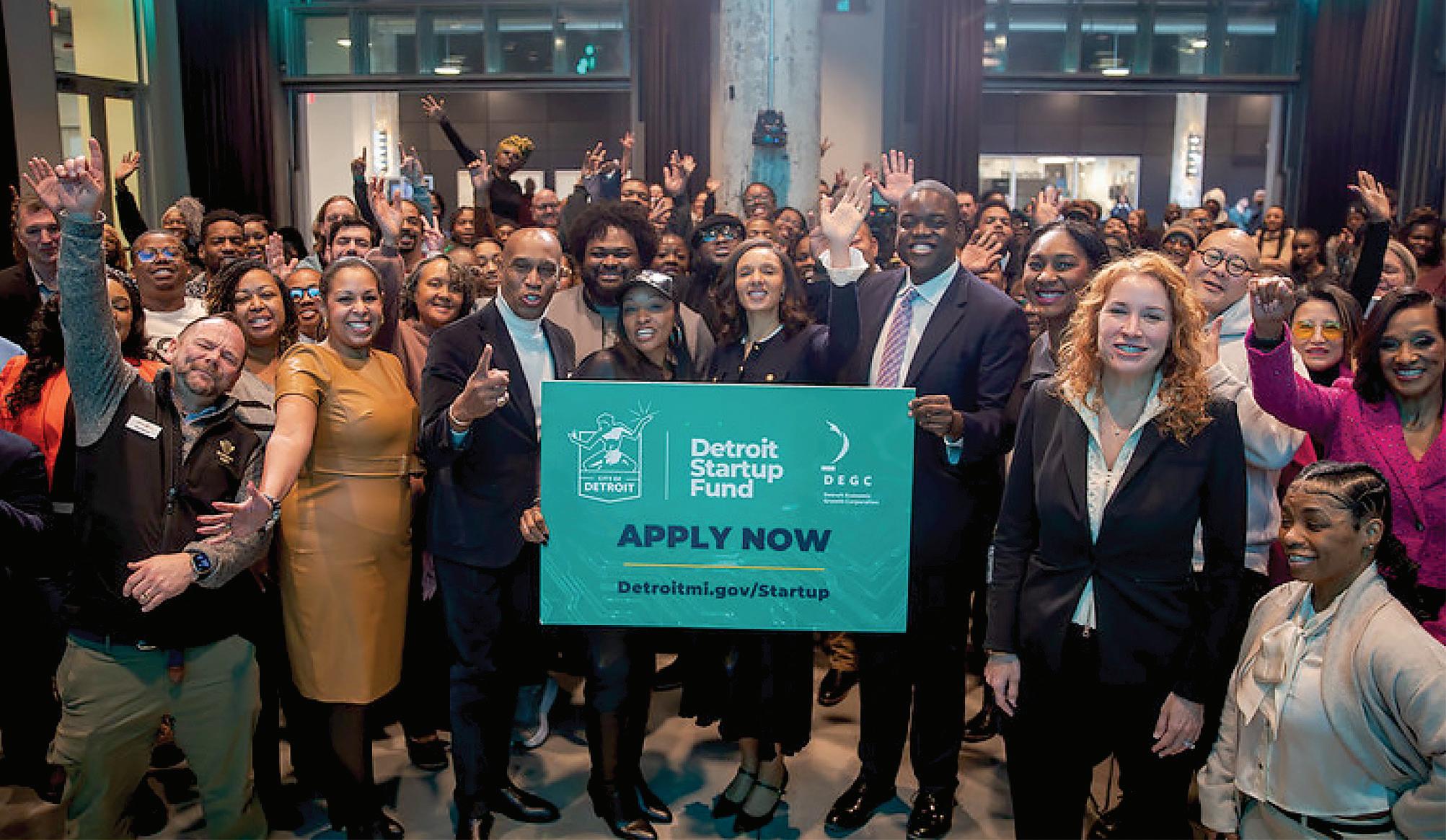
By Ebony JJ Curry SENIOR REPORTER
A lot of Detroit founders can tell you the exact moment they realized their idea was real. The first prototype that worked. The first customer who paid. The first hire they could finally afford.
Then comes the part nobody romanticizes. Payroll. Legal fees. Product development. Vendor payments. Marketing. Rent. The “seed” stage where a company is still trying to prove itself, and access to capital decides who gets to keep building.
Detroit is opening a second round of applications for the Detroit Startup Fund, a municipal grant program offering $300,000 in non-dilutive seed and scale grants to 13 tech startups. The program is designed to support high-growth companies based in Detroit, with a focus on innovation that improves life for residents while fueling job creation and talent retention.
Grants do not take ownership. Founders can keep equity in their company while covering real costs that are often the edge between opening and staying open.
The fund launched in July 2025 with $700,000 and is backed by Detroit’s general fund through a partnership between the City of Detroit and the Detroit Economic Growth Corporation (DEGC). The initial program framework included seed grants of $15,000 and scale grants of $50,000.
Round 2 is open from Feb. 2 through March 2.
Mayor Mary Sheffield framed the fund as a bet on people and ideas that can shape the city’s economic future.
“My administration is laser-focused on creating high-paying jobs, investing in our neighborhoods, and making Detroit the best place in the country to start and scale bold ideas,” Sheffield said in a news release. “Detroit’s future depends on whether we invest in the people and ideas building the next
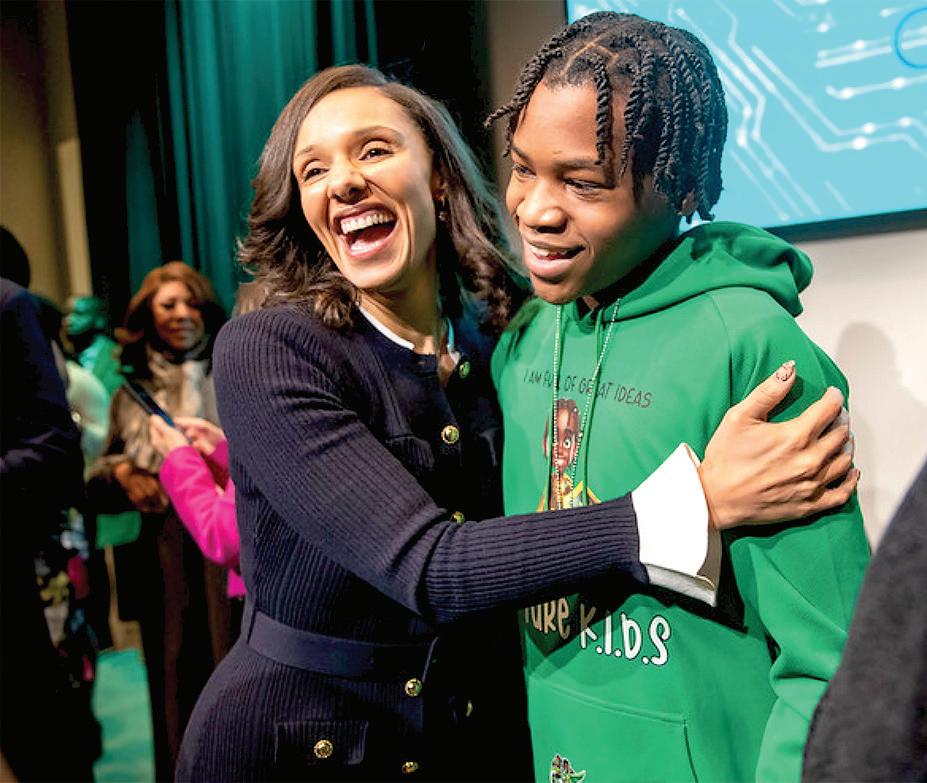
generation of our economy. The Detroit Startup Fund underscores my commitment to doing just that.”
Eligibility rules set a clear baseline. A startup must be less than 10 years old and have the majority of its operations in Detroit to qualify for the non-dilutive grant funding.
The city’s director of entrepreneurship and economic opportunity, Justin Onwenu, has also said the program will reserve a handful of seed grants for startups that intend to relocate to Detroit, while keeping the main focus on companies already building inside the city.
“But for the most part, we want to make
sure that folks who are building in Detroit are given the support they need,” Onwenu said. “And then there may be off-chances where a company or a startup can come to Detroit, create jobs, and we want to support them too.”
The first $300,000 was distributed to 13 recipients in September 2025, with three scale-stage startups receiving $50,000 grants and 10 seed-stage companies receiving $15,000 each. The first round also included about $100,000 allocated for marketing and program staffing, according to reporting and program details.
Drawing 150 applications in the first round, it’s evident that the need is present.
For Black entrepreneurs and Black startup founders, this fund lands in a national reality that stays unforgiving. Venture money still reaches Black founders at a fraction of the level seen by everyone else. Crunchbase reporting found startups with a Black founder or co-founder received about 0.4% of all funding in 2024.
Detroit founders feel that funding gap in the hours it steals.
Hours spent rewriting pitch decks instead of building the product. Hours spent hunting down introductions to people with money, then waiting for replies that never come. Hours spent hearing “circle back next quarter” while bills keep coming every week. All of that time gets pulled from the work that actually grows a company.
A $15,000 grant can cover a critical sprint. A $50,000 grant can stabilize a runway long enough to land customers, secure manufacturing, complete compliance work, or hire technical talent.
A recipient from the first round, CircNova CEO Crystal Brown, said the city-backed support helped her company move faster and compete for what comes next.
“The support allowed us to recruit and relocate top technical talent to Detroit, accelerate development of our drug discovery platform, and reach critical milestones,” Brown said in a release. “It also positioned CircNova for follow-on investment and strategic partnerships, while reinforcing Detroit as a credible home for next-generation biotech and advanced manufacturing.”
Right now, the opportunity is concrete. Round 2 is open. The dollars are defined. The timeline is set. Detroit founders who are building real solutions for Detroiters have another shot at support that does not require giving up a piece of the company to get breathing room.
Applications for Round 2 are available through the city’s Detroit Startup Fund program page and DEGC’s program materials.
By Stacy M. Brown
NNPA NEWSWIRE
SENIOR NATIONAL CORRESPONDENT
Thomas H. Watkins built a daily Black newspaper in New York City when few believed it could survive and even fewer wanted it to succeed.
Watkins, who died in December at 88, founded the New York Daily Challenge and made it the first Black-owned daily newspaper in the city’s history. From its headquarters in Bedford-Stuyvesant, the paper delivered sustained, unapologetic coverage of Black political power, economic interests, and community life, produced and controlled by Black ownership.
At its peak, the Daily Challenge generated nearly $30 million annually and employed dozens of African Americans in journalism, advertising, production, and management. Black-owned newspapers across the country have pointed to that record this week as proof that independence in Black media was not symbolic. It was operational.
Publishers remembering Watkins have described him as a builder rather than a figurehead. He secured national advertising from corporations that had long dismissed Black publications. He insisted that Black readership carried measurable value. He proved it with revenue, payrolls, and longevity.
Watkins expanded his reach well beyond
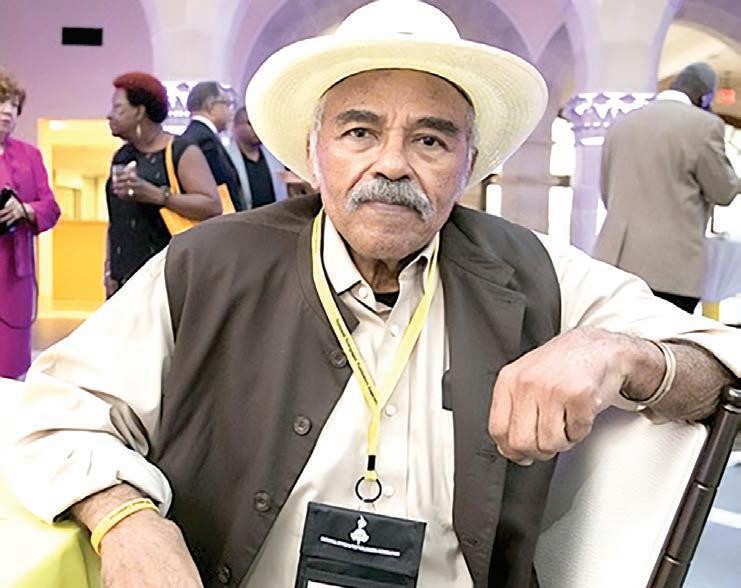
one paper. Over decades, he founded and acquired the Afro Times, New American, Jersey City Challenge, Patterson-Passaic Challenge, and Newark Challenge. Together, those publications formed a regional Black press infrastructure that covered local government, national politics, and internation-

al affairs with consistency and depth rarely matched by mainstream outlets.
In a 2008 oral history interview, Watkins described himself as a capitalist without hesitation. Ownership, he said, was not optional for Black advancement. Newspapers were economic engines as much as

civic institutions, and advertising dollars spent in Black communities should remain there.
Former colleagues recalled that Watkins did not retreat from confrontation. The Daily Challenge covered police misconduct, housing inequity, political boycotts, and global liberation struggles at moments when such reporting carried professional and personal risk. When others hesitated, his papers documented.
Watkins also served as president of the National Newspaper Publishers Association and remained on its board for decades. His leadership helped strengthen cooperation among Black-owned newspapers while maintaining editorial independence.
Beyond publishing, Watkins spoke at historically Black colleges and national organizations, repeating a consistent message about economic control and narrative authority. He lived his later years in Brooklyn, continuing to advocate for Black financial empowerment and media ownership.
“Publisher Thomas Watkins was an icon in the evolution of the Black press of America,” Dr. Benjamin Chavis Jr., President and CEO of the National Newspaper Publishers Association, told member newspapers. “He was an outspoken leader who cherished the value of truth-telling for freedom, justice, and equality. Our responsibility today is to keep the legacy of Thomas Watkins alive and impactful.”
a free, interactive open house experience taking place from 1:30 p.m. to 3:30 p.m. at South Pointe Scholars Charter Academy.
More than an open house, Black History in Motion is the culminating experience of a full day of community programming (10:00 a.m. to 3:30 p.m.) dedicated to honoring the impact, legacy, and excellence of Black history — not as something distant, but as something living, personal, and present.
For one afternoon, families will be invited into an experience that brings Black history off the page and into the room — through visuals, storytelling, and creative engagement designed especially for young people.
At the center of the event is a rare local opportunity: an immersive visit from Dr. Khalid el-Hakim’s nationally acclaimed Black History 101 Mobile Museum, one of the most celebrated traveling Black history exhibitions in the country. The museum is known for its ability to transform schools, gyms, and community spaces into living archives — filled with powerful artifacts, untold narratives, and stories that deepen understanding across generations.
“Khalid is our foremost archivist of the culture. His work preserves our legacy and makes it real for new generations,” said Chuck D, of the famed political advocacy rap group Public Enemy.
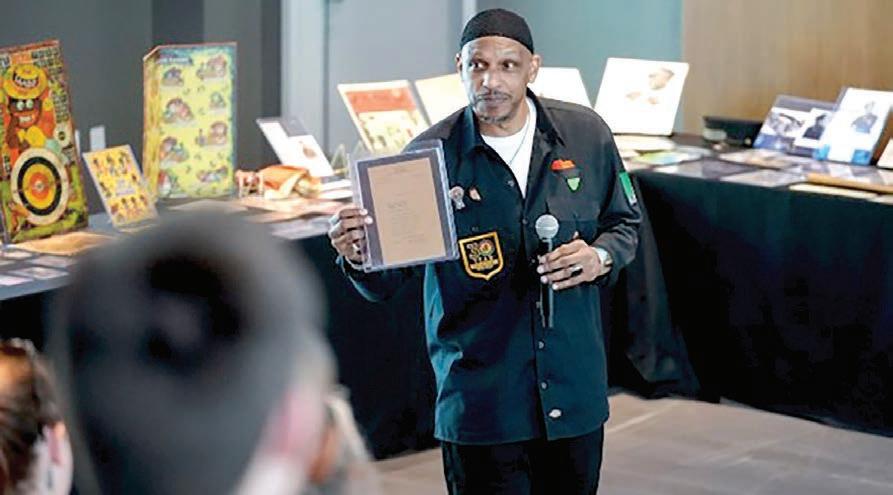
Dr. Khalid is also co-author of the youth literacy book ABC’s of Black History, and the exhibit experience at South Pointe will be intentionally curated to help youth not only learn history, but recognize themselves inside it — through discovery, reflection, and conversation.
A featured highlight of the afternoon will include a live reading from ABC’s of Black History by Kallista Marie, Founder and Director of Our Community Reads, introducing families to influential Black changemakers from A to Z.
The event will also include a screening of Living Proof, a documentary capturing the national impact of the 101 Mobile Museum and its mission to preserve stories too often left out of traditional history lessons.
“This is more than an event
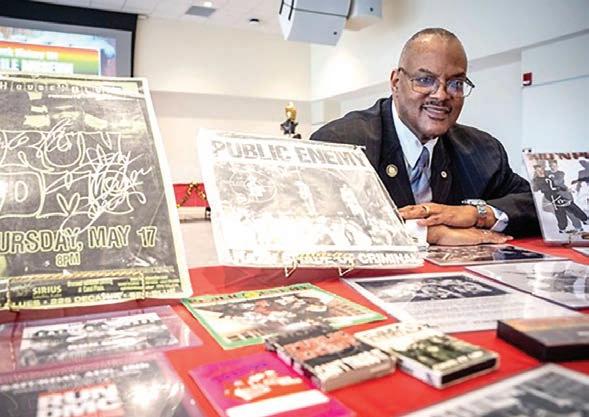
— it’s an opportunity to come together, honor the past, and reflect on the roots that help shape the future we all share,” said Justin Harper, Director at CLR Academy.
The first 40 registered families will receive a complimentary copy of ABC’s of Black History, and youth participants will take part in interactive activities designed
to help them identify with a historical figure and create a personal takeaway inspired by what they learn.
Black History in Motion is free and open to the public. Optional donations and volunteer opportunities will be available on-site to support CLR Academy’s yearround youth programming.
The day opens with WMBK’s 50 Strong Breakfast from 10:00 a.m. to 11:00 a.m., bringing mentors and community members together to invest in Black and Brown boys and young men. CLR Academy then expands that circle of support through k-8 centered youth programming from 11:00 a.m. to 1:00 p.m., helping young people explore identity, build leadership, and step into their own power. The day culminates with the Black History in Motion Open House experience from 1:30 p.m. to 3:30 p.m., where families can learn more about CLR’s story, experience the heart of its work firsthand, and discover meaningful ways to get involved.
“I’m excited for what we have lined up for February 28,” said WMBK Director Jamall Bufford. “We want to be more intentional about showing the partnership and connection of WMBK programs, and let young people know they don’t have to stick to just one thing we offer. We’re inviting the Brotherhood Circle to join us as well — all in the name of Black History and intergenerational learning. Pop in when you can or join us all day. We’ll be connecting from 10:00 a.m. to 3:30 p.m.”
For more details, visit clracademy.org.
This payment plan reduces the interest rate from 18% to 6% per year for eligible taxpayers. To sign up, you must own and live in your home, and have a Principal Residence Exemption (PRE) and ID that proves residency.
Available to everybody, this plan allows a taxpayer to pay taxes pursuant to a payment schedule. The plan will avoid foreclosure provided that payments are submitted per the agreed upon schedule.
This program is not available to everyone. If you own and live in the property, and are su ering financial hardship, you may qualify for this program. Proof of ownership, occupancy, and hardship are required.
Only for taxpayers who live in a community that opted into the PAYS program, have applied for the Poverty Tax Exemption (PTE) at their local assessor’s o ice and were approved. Once notified by your local Assessor’s o ice and deemed eligible, our o ice will mail you a notification letter with your Reduced Amount Due. You will have the option of paying a lump sum (additional 10% o ) or enrolling into a PAYSPA.


Detroit City Reminiscing is a single now streaming on Youtube, Spotify, Amazon, Apple itunes others. This single tells a story about momma”nem whos birthplace was Augusta Arkansas, migrated to Poplar Bluff, MO (near historic Cropperville, MO. Later years followed their Auntie North to Detroit during the Great Migration. This song was copyrighted in 2021.
[L]guest artist Raymond Thomas
[R]writer/exec, producer Jimmie Gladney Sr. To God be the Glory.
4 cols x 2.5 inches
retention, audit rights, and data security standards consistent with the City of Detroit’s CBDG professional services contracting framework. Scope (summary):
• Program operations and compliance support
• Intake, eligibility, and file review
• CBDG Compliance support
• Data management, reporting, and audits
• Stakeholder engagement and coordination Process improvement and capacity building
Contract Term:
Up to 24 months, subject to funding and performance. Compensation: Not-to-exceed amount; fixed fee or hourly rates proposed by respondent.
Submission Deadline: February 16, 2026 Submission Method: Electronic PDF to: National Faith Homebuyers bryantsanders.nationalfaith@gmail.com
NFH is an equal opportunity organization. Minority- and womenowned firms are strongly encouraged to apply.
Discovery Creative Pathways (DCP) is A Tuition-Free Public School Academy with an academic program for grades K-8 announces the 2026-2027 Open Enrollment Period from 1/7/2026 to 4/6/2026. Families can apply at the following link: https://enrollment.powerschool.com/family/gosnap. aspx?action=200005252&culture=en Applications are also available in the school office for both the DCP-Harper Woods and the DCP-Redford location. Should the number of applications received during open enrollment exceed available seats, a random selection drawing will be necessary. The drawing, if needed, will be held on 4/17/26 at 4:00 p.m. at each location.
DCP-HW is located at 19360 Harper Ave.Harper Woods, MI 48225. DCP-Redford is located at 17175 Olympia, Redford, MI 48240.
Team Leader
FEV North America, Inc.: We seek a Team Leader based out of our office at 4554 Glenmeade Lane, Auburn Hills, MI 48326. Lead teams of engineers in the execution of customer projects for testing and validation of gasoline and diesel engine systems; among other duties. Equal opportunity employer as to all protected groups, including protected veterans and individuals with disabilities Apply to job reference number 3856854 at: www.fev.com
Senior Project Engineer
FEV North America, Inc.: We seek a
Senior Project Engineer based out of our office at 4554 Glenmeade Lane, Auburn Hills, MI 48326. Perform project engineering activities, which includes design and BOM management; among other duties. Equal opportunity employer as to all protected groups, including protected veterans and individuals with disabilities Apply to job reference number 3857123 at: www.fev.com
Manager
FEV North America, Inc.: We seek a Manager based out of our office at 4554 Glenmeade Lane, Auburn Hills, MI 48326. Conduct market analysis for key market drivers and trends in the U.S. automotive industry, which includes analyzing the legislation in target segments, determining how they are evolving, and their expected impact on future product portfolio; among other duties. Equal opportunity employer as to all protected groups, including protected veterans and individuals with disabilities Apply to job reference number 3857336 at: www.fev.com
FAMILY FEATURES
As you age, your doctor’s interest in your cholesterol level is likely to increase. That’s no coincidence. High cholesterol and age are two significant risk factors for heart disease, which is the leading cause of death in the United States.
You may not be able to slow the hands of time, but elevated low-density lipoprotein (LDL) cholesterol, also known as “bad” cholesterol, is one of the most significant addressable risk factors for the development of cardiovascular disease. Uncontrolled high LDL-C can lead to death, heart attack, stroke or the need for a coronary revascularization.
While statins are considered first-line treatment for people with high LDL cholesterol, an estimated 29% of patients stop taking their statin within the firstyear, based on findings published in the “American Journal of Cardiology.” Up to 30% of people have some degree of statin intolerance, according to research published in the “Journal of Clinical Lipidology.”
Test your heart health knowledge and learn more about managing your risk factors, including high cholesterol, with this quick quiz:
1. Do cardiovascular diseases, including heart disease and stroke, claim more lives in the U.S. than all forms of cancer and accidental deaths (the Nos. 2 and 3 causes of death, respectively) combined?
Yes. Cardiovascular disease is the No. 1 killer of men and women in America and worldwide, killing more people than both cancer and accidents each year.

Senior Project Engineer FEV North America, Inc.: We seek a Senior Project Engineer based out of our office at 4554 Glenmeade Lane, Auburn Hills, MI 48326. Lead projects




2. According to the American Heart Association, which of the following are true?
■ Men are more likely to have heart attacks at a younger age than women.
■ Women experience different symptoms indicating potential heart disease.
■ Women have a higher risk of fatality because their symptoms are frequently misunderstood or misdiagnosed, leading to delayed treatment. All are True. While many factors are at play, one major underlying issue is historically, women simply haven’t been well represented in clinical trials of heart-related conditions. However, Harvard Health reports that culture is slowly changing and some of the gaps are starting to close.
3. Does statin intolerance mean statins are not effective?
No. On the contrary, statins are the standard of care to lower LDL cholesterol. However, some people cannot take statins at any dose because of statin intolerance symptoms such as muscle pain, while others may have their LDL cholesterol remain uncontrolled because they are not able to take higher doses.
4. Are women more likely to be statin intolerant than men?
Yes. According to the National Institutes of Health, being female is a risk factor for statin intolerance.
5. If a person is statin intolerant, are there other treatments available to help lower their uncontrolled LDLC?
Yes. Alternative treatments are available for people with statin intolerance. A health care provider can help explain what options are available if you experience potential statinassociated side effects.
6. Are musclerelated symptoms typically the most common side effect of statins?
Yes. Muscle pains or cramps (myalgias) are the most common symptoms people experience. Your health care provider may run tests or change your medication to address these symptoms.
For more information on statin intolerance, talk with your health care provider or visit statinalternatives.info.
LDL cholesterol, commonly referred to as “bad” cholesterol, leads to plaque in your arteries, reducing blood flow and potentially damaging your cardiovascular system.
If your bloodwork shows elevated LDL cholesterol levels, you can take steps to reduce it.
1. Eat a healthy diet low in saturated and trans fats and high in fiber, with an emphasis on fruits, vegetables and whole grains.
2. Get at least 30 minutes of exercise daily, and if you carry extra weight, work to lose it.
3. Talk to your health care provider about cholesterollowering medications, which can help lower bad cholesterol and reduce the risks associated with heart disease.