
By Ebony JJ Curry SENIOR REPORTER
By Jeremy Allen EXECUTIVE EDITOR
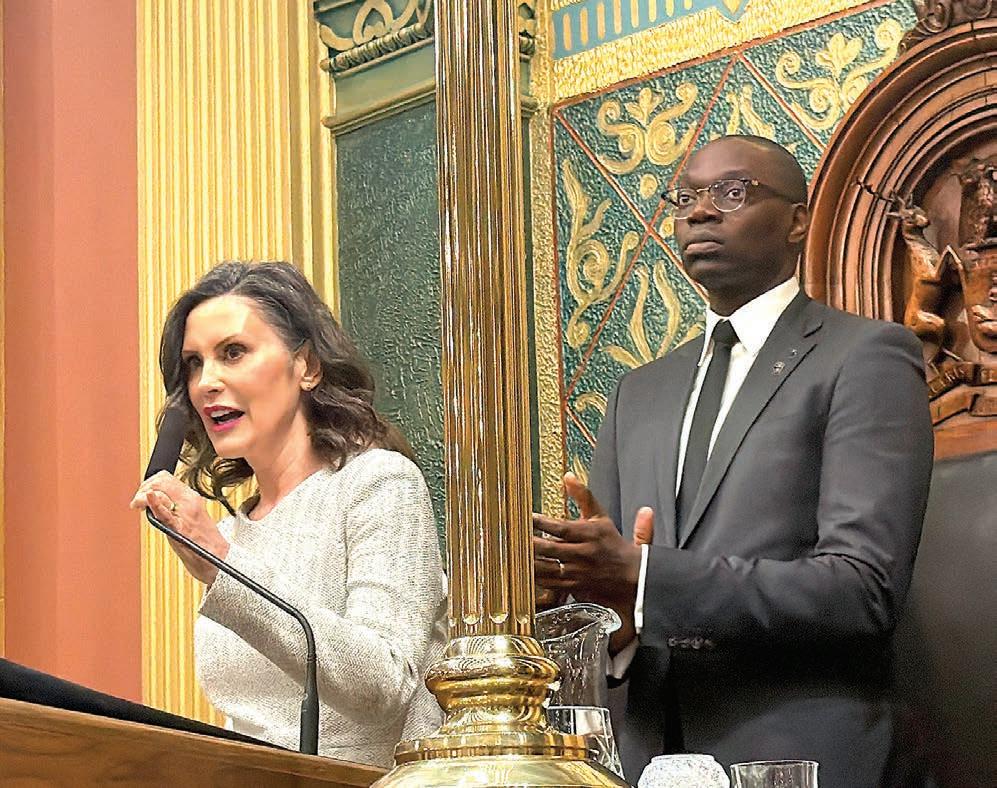
As Executive Editor of the Michigan Chronicle, I listened closely as Gov. Gretchen Whitmer delivered her eighth and final State of the State address on Feb. 25 in Lansing.
By Ebony JJ Curry
Late Thursday night, Sept. 14, a historic moment unfolded in American labor relations as the United Auto Workers (UAW) union initiated a strike against Ford, General Motors (GM), and Stellantis. For the first time, the union took simultaneous action against all three major Detroit-based automakers. The action involves approximately 13,000 UAW members in assembly plants across Michigan, Ohio, and Missouri, who walked off their jobs after existing labor contracts expired at 11:59 p.m.
Final addresses are different. They are less about introducing plans and more about defining how promises made in past addresses were delivered to the residents of the state. They’re legacy speeches — moments when a governor decides how history will remember her priorities, her values, and the people she chooses to center.

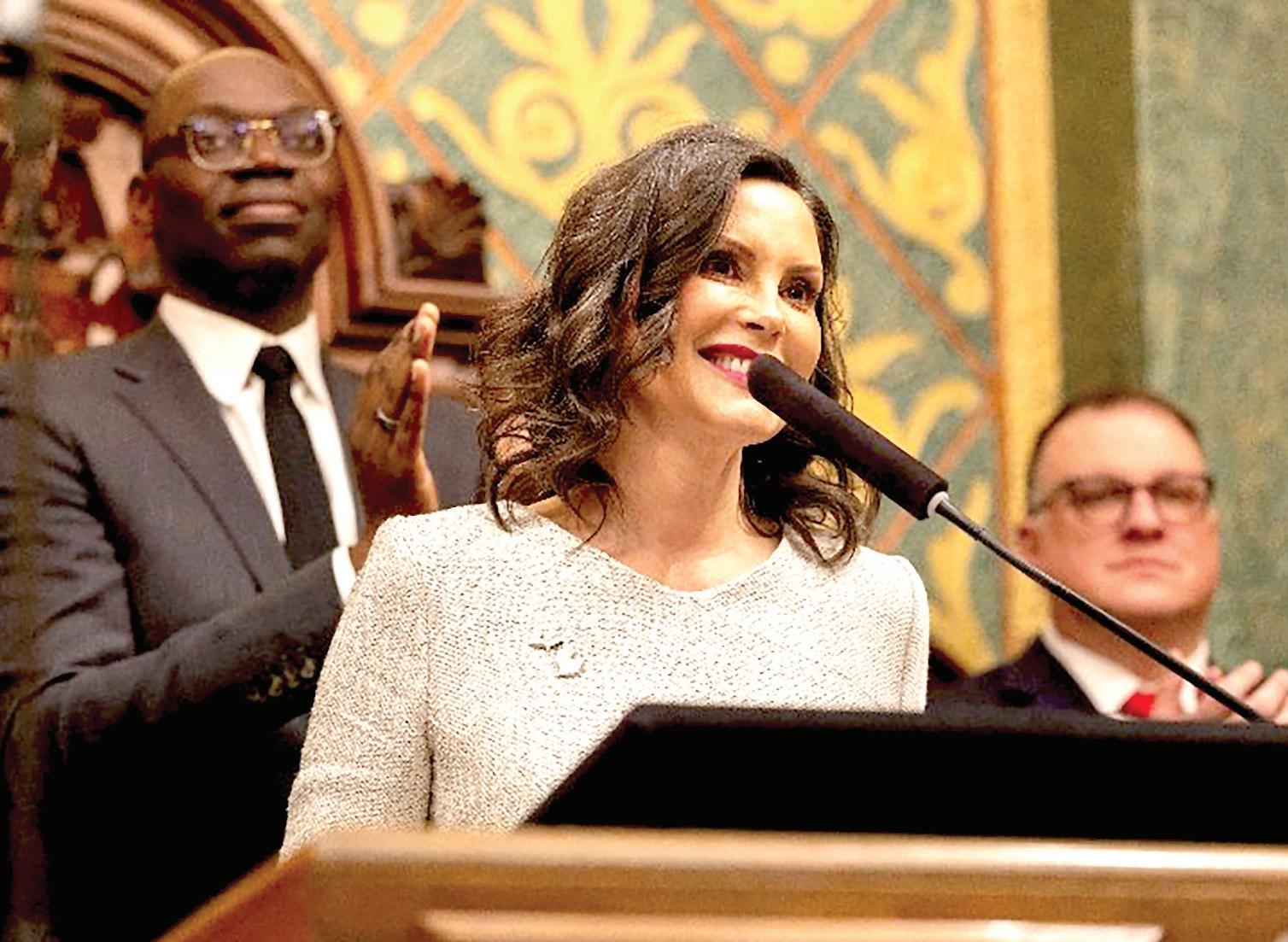
For nearly an hour, Whitmer laid out a detailed roadmap of accomplishments and unfinished business.
n a breathtaking celebration of talent, determination, and the unyielding spirit of Black excellence, the Michigan Chronicle marked its 10th Annual 40 Under 40 event Thursday evening. This year’s soirée, drenched in the theme “All Black Everything with Gold Accents,” transcended expectations and essential ly illuminated the golden gems within the true essence of Black excellence. Hosted by the charismatic duo of Andre Ash and Lynzee Mychael from Michigan Chronicle’s Finally Friday, the night was a triumph for the city of Detroit and its vibrant community of young Black professionals.
She highlighted sweeping investments in literacy and pre-K expansion. She touted housing development numbers and pledged to build more. She defended Medicaid, called for medical debt relief, and celebrated bipartisan infrastructure deals. She reaffirmed protections for the LGBTQ+ community and promised to veto legislation that would diminish their humanity. She recounted balanced budgets, road repairs, clean energy investments, and economic growth.
fashion and entrepreneurship has left an indelible mark.
The evening sparkled with a golden promise as we celebrated remarkable individuals from various walks of life. Among the honorees were the brilliant and visionary co-founders of Detroit Hives, Nicole Lindsey and Timothy Paul Jackson. Their work has not only changed the landscape of beekeeping and urban farming in Detroit but also exemplified the transformative impact Black professionals can have on their communities.
Shortly before midnight on Sept. 14, GM released a statement expressing disappointment with the strike action, despite offering what it termed an “unprecedented economic package” that included historic wage increases. Stellantis also expressed disappointment in a statement, saying the company immediately went into contingency mode to protect its operations.
“Entrepreneur of the year – that’s a big deal,” said Brown. “It’s always an honor to be honored and it’s always a blessing to be in a room full of so many talented, accomplished, and popular people that look like me. I’m geeked. I started making and selling clothes as a kid and I always knew that I would have a business, but I never knew it would be Detroit’s brand name business, so I take a lot of pride in the fact that our business represents our city’s pride.”
Greektown Had 1.4 Million Visits
like they were years ago.
By Sam Robinson SENIOR REPORTER
Taking home the Corporate Excellence Award was Dannis Mitchell, Director of Community Engagement at Barton Malow.
By Ebony JJ Curry SENIOR REPORTER
Throughout the speech, she kept repeating the phrase: “a Michigan for all.” That’s commendable.
Gov. Gretchen Whitmer touted her accomplishments while showering bipartisan praise in her eighth and final State of the State address Wednesday in Lansing.
DPD Chief James White Says Increased Police Presence Culled Violence By Andre
ness district that had been the lifeblood of the community.
But in an address meant to define her closing chapter, two glaring omissions need to be addressed.
“Together we have created a social, environmental, and financial impact through bees,” said Jackson. Lindsey followed that sentiment with, “It is through our local partnerships and collaborative efforts that we exist in over 28 plus locations managing the health of 4.5 million honeybees – humbly speaking our movement has inspired others locally, nationally, and even internationally to take on similar missions.”
Black Michiganders were mentioned once, almost in passing. And Detroit was mentioned once, only in reference to its population growth.
That was it.
Detroit Hives, a pioneering organization founded by Lindsey and Jackson, harnesses the power of urban beekeeping to revitalize neighborhoods in the Motor City. Their initiative not only addresses critical issues like environmental conservation but also provides valuable education and employment opportunities to Black De-
The UAW has branded the industrial action as the “Stand-Up Strike,” focusing on specific plants within each automaker. UAW President Shawn Fain stated, “This strategy will keep the companies guessing. It will give our national negotiators maximum leverage and flexibility in bargaining. And if we need to go all out, we will. Everything is on the table.” Union leaders have also indicated that additional plants could be targeted in future waves if negotiations remain stalled.
For many Detroiters, Interstate 375, or I-375, has long been just another stretch of urban highway, a concrete artery connecting different parts of the city. To some, it’s a mere convenience; to others, it’s an unremarkable part of their daily commute. However, there’s a deeper, far more troubling story beneath the surface of this seemingly ordinary freeway—a story of pain, displacement, and the lasting impact on Black Detroiters.
The governor received criticism from one House Democrat after she praised President Donald Trump for an investment at a Macomb County Air Force base. Democrats, Republicans, and their guests filled the House floor during her speech in front of a joint session of the Michigan House of Representatives and the Michigan Senate.
“People feel slighted because promises that were made have not been fulfilled,” James Johnson, political director at Detroit Action, told Michigan Chronicle ahead of her remarks. “The expectation is that the desire won’t even be addressed. We don’t foresee this governor doing the big thing.”
Ash
Whitmer, during her speech, said she can’t change tariff laws, but she can build housing.
DIGITAL ANCHOR
It’s a history marred by pain, injustice, and economic devastation. More than 130,000 residents, primarily Black, were forcibly displaced. Families were uprooted, generational wealth was obliterated, and a thriving community was torn asunder. The wounds inflicted by I-375 run deep, transcending the physical barrier of a freeway to penetrate the very soul of Black Detroiters.
towards mending the wounds inflicted on Black Detroiters and restoring a sense of belonging that was so callously torn away in the past.
“We’ve invested more to build housing than any administration in state history,” she said.
“It is so important to recognize that there are young leaders across the country, many that are born here in Detroit. I represent our city nationally and I tell people, ‘Yea I’m a D-girl I’m from the west-side of Detroit,’” Mitchell expressed. “But more importantly, I’ve been able to have experiences within an industry that not many of us, specifically women of color, have the opportunity to engage in and I’ve been the youngest person in the room, the only Black person in the room, and the only Sistah in the room, and I really had to articulate the importance of showing up, giving chances when others won’t, and being persistent.” As a trailblazing Black woman thriving in a predominantly male-dominated industry, her unwavering commitment to fortifying the connections between businesses and Detroit’s communities is unde-
Johnson says residents are desperate for politicians who will address people’s issues, not their opponents. He points to the so-called affordability crisis as the reason young people aren’t buying new homes or vehicles. He said he’s been disappointed that expanded childcare wasn’t on the table.
The I-375 Boulevard Project is about more than just correcting historical injustices; it’s about redefining the future. It will connect downtown Detroit to surrounding neighborhoods, bridging the gap that was placed upon the city decades ago.
Whitmer said the state has already built 80,000 new homes, with a new target goal of 115,000.
She said she would do so by getting rid of burdensome regulations that raise construction costs and slow down projects. The comment earned a bipartisan applause from lawmakers inside the Michigan House chamber.
By Andre Ash DIGITAL ANCHOR
In a speech that touched on everything from tariffs and zoning reform to nuclear energy and tuition-free community college, the only explicit reference to Black residents came in the context of hair discrimination protections. That policy matters. The right to wear natural hair without fear of workplace or school discrimination is important and long overdue. But Black communities are more than a single legislative victory folded into a long list of accomplishments. (That’s not to say this is the only legislative win she’s accomplished for Black residents, but it is to say that there could’ve been more of a callout to those other efforts to showcase that intentionality.)
This painful legacy can be traced back to the nation’s interstate highway program of 1956—a program that aimed to connect the country but often did so at the expense of marginalized communities. In the case of I-375, it meant carving a path through the heart of Black Detroit, reinforcing segregation, and perpetuating inequality.
Mention of the state’s role in its largest city happened just twice during Whitmer’s State of the State; Whitmer mentioned the Gordie Howe bridge and the city of Detroit’s population increase, but didn’t offer Detroit residents. However, the governor ended her speech with a nod to the affectionate nickname given to her by Detroiters, “Big Gretch.”
A string of shootings in Greektown in mid-April left both visitors and residents of this bustling downtown destination in awe. One of these shootings tragically claimed the life of a popular and beloved security guard following a dispute with a patron. The male suspect allegedly shot the guard before fleeing the scene, while his female companion is accused of concealing the weapon in her bra.
The Detroit Action leader says his organization will also be pushing for further funding of right to counsel with a state appropriation, which is a tall task in a divided government where Republicans are keen on cutting spending control in the state House.
A Holistic Approach to Providing Shelter and Support for Detroit’s Unhoused People
The tale begins in what is now Lafayette Park, once known as Black Bottom—a neighborhood rooted in African-American culture and history. Named after its dark, fertile soil, Black Bottom flourished during the mid1900s, nurturing the dreams and aspirations of prominent Detroiters like Coleman Young, Joe Louis, and numerous other Detroit legends. But in the name of urban renewal in the 1950s, this vibrant neighborhood was systematically dismantled, erased from the map, and replaced by a lifeless stretch of asphalt.
The governor’s office said that includes making it easier to build in-law suites and duplexes and modernizing lot sizes, setback rules, and parking requirements.
These incidents unfolded during an unseasonably warm spring, leading to increased pedestrian traffic and heightened tensions in the densely populated downtown area.
For one to aptly recognize the harm caused by such projects, it is vital to note that some of the planners and politicians behind those projects built them directly through the heart of vibrant, populated communities—oftentimes to reinforce segregation and sometimes as part of a direct effort to replace or eliminate Black neighborhoods.
Today, the resurgence of Paradise Valley stands as a testament to the indomitable spirit of Black Detroiters and the enduring legacy of Black excellence. This historic district, once a vibrant hub for Black businesses and culture, is experiencing a renaissance that harkens back to its glory days. The destruction of Black Bottom may have torn apart a thriving community, but the resolute determination of a new generation of entrepreneurs and visionaries is reclaiming that lost legacy.
Whitmer also said she would streamline zoning laws to make it easier to build more homes of all kinds, especially in cities where young people most want to live and work.
The surge in crime and the influx of visitors to Detroit’s downtown core garnered the attention of the Detroit Police Department (DPD), catching them somewhat off guard.
Republican leader Matt Hall has pitched a $5 billion-a-year property tax relief package paid by a new 6% sales tax on certain services used by high-earning residents and tourists.
Michigan is home to more than 1.5 million Black residents.
Fain clarified the union’s strategy: “I want to give a major shoutout to the thousands of members who are on the picket lines right now fighting for all of us. The Stand-Up Strike is a new approach to striking. Instead of striking all plants at once, select locals will be called on to stand up and walk out on strike. This is our generation’s answer to the movement that built our union – the sit-down strikes of 1937. We told the Big 3 that Sept. 14 was the deadline and we meant it. We gave the companies our economic demands eight weeks ago and it took more than a month to get to the table.”
While the residential areas bore the brunt of this demolition, the heart of Black Bottom, its thriving business center, remained largely untouched. Restaurants, theaters, clubs, and bars—the very places that brought Detroit’s Black community together—were concentrated around Hastings Street, the epicenter of African-American culture in the city.
We’re entrepreneurs, engineers, educators, nurses, autoworkers, clergy, students, retirees, public servants, journalists. We are disproportionately affected by gaps in homeownership, maternal health disparities, environmental injustice, and the racial wealth divide, which is one of the widest in the country in this state.
The union is pushing for a comprehensive list of demands. This
Homelessness continues to plague urban communities, with families and individuals grappling with the challenges of making ends meet in today’s economic climate. Whether it’s struggling to meet monthly mortgage payments or coping with soaring rental costs in a housing market marked by shockingly high prices, a variety of factors contribute to the growing issue of people becoming unhoused.

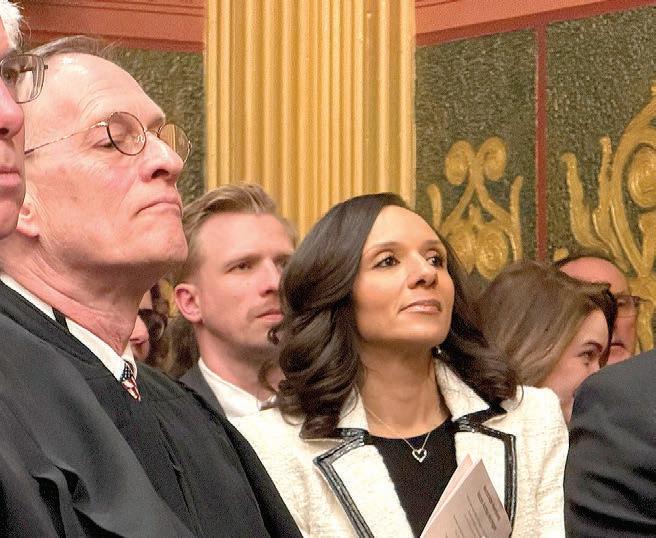
Detroit Mayor Mary Sheffield, who answered questions to the press following the governor’s address, sat in front of Macomb and Oakland County Executives Mark Hackel, watching Whitmer’s speech. Detroit City Council President James Tate, members Mary Waters and Latisha Johnson were also present for Whitmer’s speech.
While most Democratic advocates, staffers, and lobbyists said the address was bittersweet given the governor’s lame duck status, some progressive advocates in Metro Detroit aren’t singing the praises of Democratic Gov. Gretchen Whitmer
Meagan DunnJulie Schneider
Historically, shelters have provided a temporary respite for those in need, often serving as the first or second option after exhausting alternatives like staying with friends or family. Shelters offer a place to rest one’s head and a warm meal, albeit sometimes for extended periods. For others, being unhoused means living in cars or makeshift outdoor
Then, in a cruel twist of fate, Hastings Street, too, was obliterated a few years later, making way for the construction of I-375. This marked the final blow, sealing the fate of Black Bottom and signaling the beginning of the end for Paradise Valley, the Black busi-
Housing Resource Helpline in response to the challenges that residents face in navigating the complex system of housing services. The helpline provides a single point of contact for people seeking housing assistance and connects them with the resources they need.
Support for the helpline comes from the Gilbert Family Foundation, which has pledged $10 million over three years to fund the program. Wayne Metro Community Action Agency manages the helpline, making it accessible to all Detroit residents. This initiative simplifies access to the City’s various housing services, ensuring that residents in need can easily find assistance.
But now, after decades of enduring the scars of I-375, there is a glimmer of hope on the horizon. Plans have been unveiled to transform this once-divisive freeway into a vision that seeks to right the wrongs of the past while heralding a new era of inclusivity and community revitalization.
Hall criticized Democrats for increasing spending in the state budget under Whitmer, but did say he looked forward to working with the governor on property tax cuts that he says would save residents an average of $900 year. Hall also said he wants to work with the governor to force utility companies to lower rates by over a billion dollars.

By Sam Robinson SENIOR REPORTER
By Lynzee Mychael MULTIMEDIA JOURNALIST
The causes of homelessness are as diverse and complex as the individuals experiencing it. In response, the City of Detroit has adopted a holistic approach to combat this issue.
“Providing services and high-quality housing to persons at risk of or who are experiencing homelessness is a key priority of the City of Detroit, said Julie Schneider, Director of Detroit’s Housing and Revitalization Department.
Detroit Mayor Mary Sheffield, viewed by supporters as a progressive Democrat, is promoting a willingness to work across the aisle to deliver on her agenda.
“The city and its partners offer a lot of great services to help Detroiters with their housing needs, but they don’t mean much if people don’t know how to access them,” said Mayor Mike Duggan. “Thanks to the efforts of our partners and the generous support of the Gilbert Family Foundation, we now have a simple process to guide residents to the right housing resource and a growing number of programs to help them.”
Whitmer also pointed to the state’s First pilot that helped families purchase homes. MSHDA is now operating from a waitlist and will allocate funds to those on the list as additional resources become available.
James White, Chief of Police for the Detroit Police Department, said: “We were caught somewhat flat-footed right out the gate. By design we went into the spring deployment, which is less than the mid-summer deployment, and saw we say an uptick in violence that first warm weekend.”
She pushed for an affordable housing tax credit, saying that doing so could build thousands more homes in the state.
Chief White attributes the violence in Greektown to a combination of weather conditions and a surge in population.
Fueled by more than $100 million from the Infrastructure Investment and Jobs Act and other partners, this ambitious project aims to create jobs, remove barriers to economic growth, and reconnect the neighborhood with the rest of Detroit. It is a step
In the heart of Paradise Valley, Blackowned businesses are not just flourishing but thriving, offering diverse services, products, and experiences that pay homage to the past while paving the way for a prosperous future. From jazz clubs to soul food restaurants, the Black Press, and art galleries to fashion boutiques, this revival is breathing life into the very essence of what once made this neighborhood a vibrant cultural epicenter. It’s a resurgence that extends beyond brick and mortar; it represents the resurgence of a spirit that refuses to be subdued.
“Too many workers are being priced out of homeownership,” Whitmer said. Johnson said the governor’s focus on building housing is encouraging, but said
Detroit City Councilman Fred Durhal III, representing District 7, where Eastern Market resides, told the Michigan Chronicle, “It’s still very early in the process, MDOT is
He explained, “ We saw numbers downtown that we have not seen, ever. People are emerging from COVID and there’s a feeling that we’re in a post-COVID era… and with the venues downtown and the reasons to come down with all the activities that are going on, we saw hundreds of more people and, in particularly, young folks, teenagers that we hadn’t seen.”
Responding swiftly to the surge in violence, DPD adjusted its deployment plans. Rather than waiting for mid-summer, they deployed officers in the spring itself to address the situation.
The Gilbert Family Foundation’s broader commitment involves pledging $500 million to support projects across Detroit over the next ten years, with housing initiatives being a significant part of their contribution.
What a Federal Government Shutdown Could Mean for Detroiters?
“This means focusing on building the pipeline of supportive housing and coordinating with the Continuum of Care on the delivery of critical resources such as emergency shelter, rapid rehousing, and diversion and prevention programs. It also means preserving and expanding affordable housing options for Detroiters of all incomes and improving housing stability though comprehensive service offerings available through the Detroit Housing Resource HelpLine and Detroit Housing Services Division within HRD.”

In May 2023, the City of Detroit launched the Detroit

From the days of the Great Migration when thousands of Black families flocked to Detroit in search of jobs and a better life, to the pivotal role they played in the city’s cultural and musical heritage, Black Detroiters have left an indelible mark on the city. However, in recent years, Detroit has experienced significant gentrification, which has raised concerns about the displacement of long-standing Black residents. Similar to a setting sun, there’s a rising spirit, and Black Detroiters are reclaiming their place in the city, despite the challenges posed by gentrification.
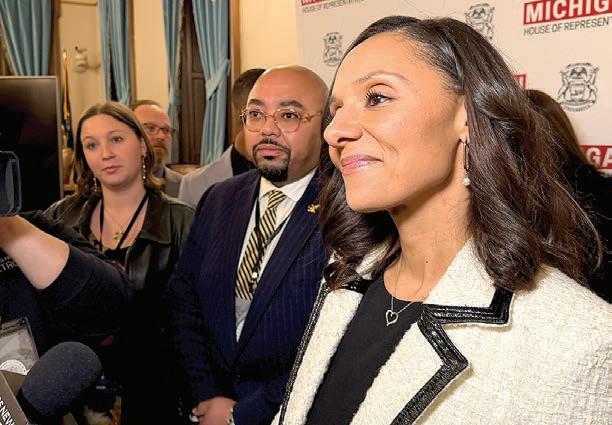
Sheffield said Wednesday night at the governor’s annual state of the state remarks that she was proud to be in Washington, D.C. for President Donald Trump’s State of the Union with Michigan U.S. Sen. Elissa Slotkin.
Notably, Detroit has witnessed a consistent decrease in recent years, with the number of unhoused residents steadi ly declining. In 2019, approximately 7,847 people were unhoused and entered the City’s community response system. In 2021, about 5,687 people experienced homelessness.
There were interruptions to Trump’s speech caused by some House Democrats, including Michigan’s Rashida Tlaib, who shouted in opposition during the president’s most partisan rhetoric. U.S. Rep. Debbie Dingell cited her resistance to Trump as the reason she didn’t attend the address.
According to the City of Detroit, since the start of the fiscal year 2019 to 2021, Detroit saw a 28% decrease in the
stay home or attend with “silent defiance.”
But Slotkin and the Senate Democrats followed orders from House Minority Leader Hakeem Jeffries, D-N.Y., who urged Democrats to
During the Great Migration, thousands of Black families from the South came to Detroit in search of jobs in the booming automobile industry. Despite facing discrimination and segregation, they built
“I’m very proud that I went to represent Detroit,” Sheffield told Michigan Chronicle on Wednesday after Whitmer’s eighth and final State of the State address. “A lot
trification.
The rise in visitors to the Greektown area is evident in data from Placer.ai, a location analytics company specializing in visit trends and demographic insights through geolocation-enabled mobile devices. From May 1-Aug. 27, 2022, there were 1.3 million visits and 655,000 visitors to Greektown, according to Placer.ai. In the same period this year, these numbers increased to 1.4 million visits and 670,000 visitors.
room in the state Capitol, said the governor’s speech hit on issues that affect Detroit residents and are key to her as a new mayor, like affordable housing and improving education.
because of discrimination, but they were also coming because Black people was doing some stuff. When did Black people start doing things in the city? They started doing things in this area in the 1800’s. In the 1800’s the major thing that they were doing in Detroit is they were the leaders in the fight against slavery. The Underground Railroad is the root in the city of Detroit
As Detroit’s downtown area continues to attract both residents and visitors, the police department has implemented various enforcement measures to manage the increased population. Notably, metal detectors have been strategically placed throughout Greektown to deter the illegal carrying of firearms.
“We have strategically placed them at key points, “ Chief White explains. It has been a deterrent for some, and some have tested it. If you are legally carrying a weapon and carrying a CPL, have a great day. If you’re
Sheffield embraced the governor’s bipartisan spirit, shaking hands with Republican House Speaker Matt Hall following the governor’s remarks. Hall’s relationship with the mayor began prior to last year’s election. He has supported the city’s Community Violence Intervention strategies and has built a friendly relationship with former Mayor Mike Duggan, who is now running for governor as an independent.
of good reception to Detroit from Senators — being able to make connections and insert us in the conversation nationally, I thought was important.” Sheffield, speaking to reporters inside the House Appropriations
“Black people were coming to Detroit because Black churches were here, black schools were here, and its was Black businesses here,” said Jordon. “They were coming of course
Duggan and Whitmer have been singing a similar tune in recent months when it comes to dealing with Republicans, offering to work with them on shared goals like building housing instead of confronting them over Trump’s agenda.
cine and healthcare, may be adversely impacted by
what the Supreme Court will rule in the upcoming
women been premoment of the final. a law1931 law effect, asked the affirm that constitucontain abortion. Our Planned Advocates of founding coalition ReproducAll, a affirm abortion and freedom in constitution,” Giroux. is that everything in aborMichigan, makes we will we can patients care they alley’ and illegal abor tion practices, including self-abortions. Moreover, African American women and women of color, who already have a long-storied history with access and inclusion in medi-
representalegislacollection and criminal jusrecomcollection analywith the AttorMichigan Law Standards Association Prosecutors stakeholders collect and strategically. warHouse Operations hearand other would ban of noknock urging the pass reform and Whitmer to the leg-






From page A-1
From page A-1
he feels like new homes being built aren’t affordable.
islature adopts it.
“Most of the new homes build aren’t affordable. Developers build to make profit. That’s not going to get the average Michigander the opportunity for housing. Detroiters are looking for an answer to housing. So many people within our party’s elite has gotten so entrenched in their echo chambers they don’t know what people are saying and how they’re feeling.”
Increase school funding: Statutory changes to increase the School Aid Fund revenue by at least $3.6 billion and establish a permanent weighted funding formula based on student and community needs and universal preschool (0-3).
Sheffield, the new mayor of Detroit, told Michigan Chronicle inside the House Appropriations room following the governor’s remarks that she plans to announce the next round of down payment assistance in the coming weeks.
freedom. As Michigan officials work to ensure each woman who finds herself in the position to choose has access to care without the threat of legal action, many wonder
represent Detroit,” Sheffield said. “A lot of good reception to Detroit from Senators — being able to make connections and insert us in the conversation nationally, I thought was important.”
When the governor outlined her ambitious literacy agenda, where was the acknowledgment that Black students in under-resourced districts often face compounded structural barriers?
When she spoke about housing affordability and firsttime homebuyers, where was the recognition that Black homeownership rates lag significantly behind white households?
The health committee recommends reviewing state licensure policies to address the barriers that Black psychologists face in obtaining licensure in Michigan.
Whitmer, in her speech, highlighted successes she signed into law during her tenure with Democratic control, like civil rights protections for LGBTQ+ residents, the repeal of the state retirement tax, the 5% increase to the working families tax credit, and the reversal of the right-to-work law.
“I think it’s really concerning that our governor is praising Trump in her address and not criticizing him at all,” said Garden City Democrat Dylan Wegela. “We have a detention center coming to Romulus, and instead of using this moment to push back on that, she used it to celebrate Trump.”
When she addressed health care access, where was the direct commitment to reducing the alarming maternal mortality rates that disproportionately impact Black women?
Throughout the speech, Whitmer made direct, heartfelt appeals to other marginalized communities. Most notably, it was to Michigan’s LGBTQ+ residents. She looked into the camera and said, “You belong, you matter… I’ve got your back.” It was a powerful moment. It was clear. It was unequivocal.
“We want to continue to invest in that program and grow it even more so that more people have access,” Sheffield said.
When asked about her time watching Trump’s State of the Union address in Washington, D.C., the day prior, Sheffield said she was proud to attend.
“I’m very proud that I went to
Reject censorship in history instruction: Encouraging Gov. Whitmer to ensure the goal for Michigan schools should be history instruction that is presented by professionals with the subject matter expertise, pedagogical skills, and judgment necessary to present complex information to students that are grounded in provable facts and add to the understanding of modern-day America.
While Duggan endorsed Sheffield’s mayoral campaign after it became clear she was the frontrunner, it’s less clear whether the Democratic mayor will support the Democratic nominee for governor or break from her party to support her predecessor.
Increase mental health supports for the Black community: Recommending Michigan set a goal of increasing the number of Black mental health service providers by 20% each year over five years.
Sheffield said Wednesday Whitmer’s tenure is a testament to what’s able to happen when you collaborate.
“She was able to get a lot done over her tenure because of collaboration and bipartisan support,” Sheffield said of Whitmer. “So, to hear my priorities around literacy and education as we are coming here, we’ve been very focused on how we can bridge the gap to bring more literacy and after school programs in our city. But then also my goal of developing more affordable housing.”
people believe that they need to for themselves and others to live better lives.”
Sheffield said there’s overlap between her goals for the city and the administration statewide, particularly making it easier for developers to build, allowing for greater homeownership among younger residents.
“Our young people have to have access to quality and affordable housing in Detroit,” Sheffield said. “We are
“Chancellor Ivery is a true transformational leader and an outstanding CEO, who is more than worthy of the CEO of the Year Award he just received, “ said Prof. James C. Mays, who teaches
Whitmer proposed erasing medical debt for Michiganders by capping interest rates on the type of debt, preventing medical debt from showing up on credit reports, requiring hospitals to set up financial assistance programs, and banning liens or foreclosures because of medical debt.
Ensure equitable distribution of state health funds: Ensure all Michigan communities with a significant Black population receive adequate funds to address mental health issues.
State Sen. Jeremy Moss, D-Southfield, who organized a protest against a planned ICE office in Southfield last week, told Michigan Chronicle Democrats did a lot of big things under Whitmer, adding that sometimes he thinks people forget.
She also touted some of the bipartisan work since Trump’s election, at one point turning around to high-five the Republican House Speaker. She even thanked President Trump for a promised investment in the Selfridge Air National Guard Base in Harrison Township.
Protecting Black voting rights: Urge state officials to remain vigilant in the fight against schemes to disenfranchise Michiganders of color.
“BLAC members have worked hard to identify the needs of the Black community and we feel these recommendations will provide a solid first step towards breaking down barriers in educa tion, community safety, health and business,” said BLAC Co-Chair Donna L. Bell.
“Tonight was a really good recap — delivering a billion dollars to seniors and working families in Michigan that’s headed off some of the squeeze caused by the federal government,” Moss said. “We’ve protected fundamental freedoms. We protected labor rights, enacted the first gun safety laws in Michigan in a generation. Those are big things in Michigan that are quite literally saving lives today because we took big, bold stances.”
You can reach Sam at srobinson@ michronicle.com.
Black Michiganders deserve to hear that same clarity and for it not to be implied, assumed, or buried in generalities. We need to hear it explicitly, so we know that there are intentional efforts aimed at increasing our quality of life, too.
Then there’s Detroit.
For the first time in nearly 70 years, Detroit’s population grew. Rightfully so, Gov. Whitmer proudly noted that. That achievement deserves applause.
But the growth didn’t happen organically or because of outsiders’ goodwill to the city. It reflects the policy decisions, community resilience, local leadership, and years of work by residents who refused to abandon their city when headlines did.
Detroit is Michigan’s largest city and the cultural capital of the state. The mayor of Detroit is arguably the second most powerful person in the state because of how important the city’s success is to the rest of the state.
The city serves as an international symbol of Black excellence, labor power, creativity, and reinvention. It anchors Southeast Michigan’s economy and drives statewide politics. Despite the fact that the city has secured major development projects, strengthened neighborhood stabilization efforts, expanded entrepreneurship corridors, and ushered in a new era of municipal leadership in the past year, none of those wins made the speech.
Other communities were name-checked for factories and fighter missions. Other regions were celebrated for economic wins. Detroit – the state’s economic and political heartbeat –got five seconds and that brevity is hard to ignore.
To be clear, Gov. Whitmer has accomplishments worth noting. Roads have been repaired at historic levels and budgets have been balanced despite partisan and bi-partisan quarrels about which issues deserve money. Pre-K access has expanded and community college tuition has been eliminated for many.
Gun safety laws have been strengthened, and LGBTQ+ protections have been codified. Michigan’s credit rating has improved. These are tangible outcomes that affect millions of residents.
BLAC is housed in the Michigan Department of Labor and Economic Opportunity. Members represent many professional backgrounds, including economics, law, public safety, health and well embraces. transforleadership as a approach that change the syscircumstancoperating Ivory “Transformationdoesn’t just do certhem view of and exdrive that because what create everyentire because
here to support her and work across the aisle to get things done.”
tual town hall meeting to discuss its policy rec ommendations on Thurs day, May 12 at 4 p.m. BLAC and a virtual audi ence recommendations to sup port the Black communi ty.
Sheffield also offered her opinion on a proposedstreamlining of zoning lawsthat opponents in Metro Detroit say could limit local authority.
“Anytime local control is up in conversation it’s an issue,” Sheffield said.
“But if there’s ways to work around
ensuring that we achieve the overall goal, which is, we want to reduce regulations and zoning requirements because it’s extremely difficult to build housing in Detroit. She said ‘Build, baby, build.’ That’s what we want to do.” You can reach Sam at srobinson@ michronicle.com.

But leadership is measured just as much by presence and attention – who gets acknowledged and centered in moments – as it is by policy wins.
Listen, final speeches are so carefully written. Every paragraph reflects great intention. When a governor has one last opportunity to frame her legacy before the state, what she chooses to emphasize signals what she believes mattered most.
Black voters have been foundational to Democratic victories in Michigan for decades, including Whitmer’s own elections. Detroit has been central to statewide turnout strategies, economic planning, and national political calculations. Yet in a moment designed to capture the fullness of her tenure, the communities that have shaped Michigan’s political landscape were largely absent from the narrative.
That absence doesn’t erase the administration’s work. But it does make certain groups feel absent from the “for all” narrative. If literacy, housing, and health care are the pillars of Michigan’s next chapter, it’s crucial and imperative that equity is at the foundation of those issues. That means explicitly addressing racial disparities in reading proficiency; closing the Black homeownership gap with targeted, measurable strategies; confronting maternal health inequities with urgency; and recognizing Detroit as more than a comeback story in a passing reference.


I will continue to applaud Gov. Whitmer for the seven years of tremendous work she’s done across the state and the country in pursuit of making life better for Michiganders.
But she still has about nine months left in office, and (in addition to working on the important issues she described in her final address) I’d like to see her continue to deepen the conversation by engaging more directly about how important these issues are to Michigan’s Black population.
After all, a “Michigan for all” can’t rely on implication. It requires intention.
A3 | March 4-10, 2026
By Ebony JJ Curry SENIOR REPORTER
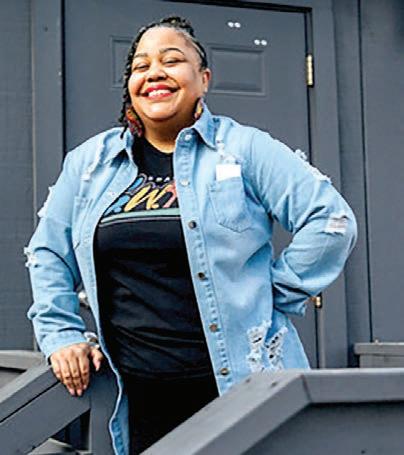
Brightmoor gained a new community learning anchor this week as Detroit educator and neighborhood native Jessie Feliz opened a multilingual learning center on Schoolcraft offering afterschool programming, adult education, and inclusive support for neurodiverse children — a direct investment in families on Detroit’s northwest side.
Located a few blocks from where Feliz grew up, the Jessie Feliz Learning Center brings a neighborhood-based model that many Detroit families have asked for across generations: a place close to home where children can learn after school, adults can build skills, and families can find support without traveling across the city. The center’s programming includes Spanish instruction, tutoring, dance, arts-based learning, adult Spanish and American Sign Language classes, plus inclusive offerings designed for children on the autism spectrum and other neurodiverse learners.
Brightmoor has long been part of larger city conversations about neighborhood stabilization, vacancy, parks, housing redevelopment, and corridor investment. Detroit’s Brightmoor Framework Plan describes the area as part of the city’s northwest side planning work, where residents and planners are addressing quality-of-life issues alongside economic development and land use. That context matters because this opening adds something residents can use right now, not years from now: a family-centered learning space built by someone from the neighborhood.
Feliz said that local connection shaped the vision from the start.
“I always wanted my own space outside of my home,” Feliz said. “I love working with kids, but I wanted a place where children and families could feel safe, welcomed and supported. It seems like I was positioned to be here.”
That sense of purpose followed her back to Detroit in 2017 after teaching in Baltimore and Costa Rica. Feliz returned with a mission to bring joy back to learning and expand bilingualism in Detroit communities. Tuesday’s ribbon-cutting made that mission visible on Schoolcraft in a permanent way.
See BRIGHTMOOR NEIGHBORHOOD Page A-4
By Ebony JJ Curry SENIOR REPORTER
Detroit’s next phase of public safety work is moving deeper into the neighborhoods — and this time, the City is putting that strategy into a formal office built to connect the people already doing the work.
Mayor Mary Sheffield signed her second executive order creating the Mayor’s Office of Neighborhood and Community Safety, a new city office designed to strengthen Detroit’s violence prevention efforts through a public-health approach that centers prevention, intervention, trust-building, and long-term community well-being.
The order takes effect April 7.
The move comes as Detroit enters 2026 after another year of major crime reductions, as Detroit’s Community Violence Intervention (CVI) groups played a major part.
By Ebony JJ Curry SENIOR REPORTER
Detroit students now have a new public education pathway that could change what high school looks like for families across the city.
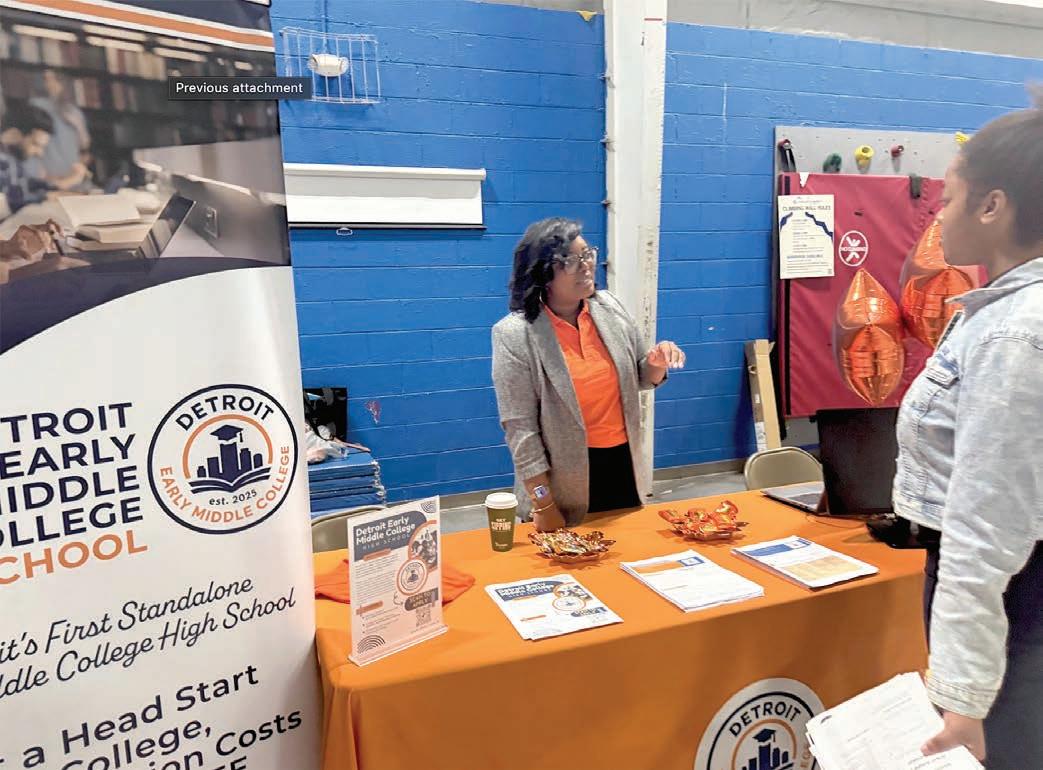
Detroit Early Middle College, announced Feb. 18, is being introduced as the city’s first standalone early middle college high school, a model designed to combine high school academics, career technical education, and college coursework into one track. School leaders say the goal is clear: help students graduate with more than a diploma and leave school with real momentum toward college, a career, or both.
Detroit Early Middle College, also known as DEMC, starts with scholars in ninth grade and continues through the 13th year. By the end of that pathway, students can graduate with up to 60 transferable college credits, an associate degree, and/or an industry certification, according to school leadership.
That matters for Detroit families already carrying the weight of rising college costs, uneven school-to-career pipelines, and longstanding gaps in access to accelerated academic opportunities.
DEMC is stepping into that reality with a model built around earlier access to college-level learning and career preparation, particularly for students from historically underserved communities. The structure blends coursework aligned to Michigan’s high school graduation requirements with postsecondary expectations, while also offering handson learning, academic advising, and
wrap-around supports.
School leaders say the model is designed to help students build academic confidence before they leave high school, not after.
“Detroit Early Middle College is rooted in a belief that every student deserves access to transformative education,” said Lawrence Hood, CEO of the Academy Management Company/ Detroit Academy of Arts and Sciences District. “By empowering our scholars with the opportunity to earn college credits, industry certifications, and an associate degree while still in school, we break down barriers, especially for underserved students and communities. This is about opportunity and building brighter pathways for Detroit’s young people.”
Detroit’s launch arrives as Michigan continues to confront uneven college enrollment outcomes. According to the school’s announcement, 53% of high school graduates across the state enroll in college immediately after graduation, and enrollment rates are lower for economically disadvantaged students.
That gap has consequences far beyond a single graduating class. Fewer students moving directly into postsecondary education can mean fewer credentials, fewer opportunities for wage growth, and fewer pathways into high-demand sectors that increasingly require specialized training. Detroit families have lived that reality for years while also navigating school instability, transportation barriers, cost pressures, and shifting educa-
tion systems. DEMC’s leadership says the school was intentionally created to respond to those disparities by embedding college access and industry credentials directly into the high school experience rather than treating them like add-ons available only to a small group of students.
The model also points to a broader question Detroit has been wrestling with for years: who gets prepared to lead the city’s next chapter?
Detroit’s revitalization has brought new development, new investment, and new conversations about the future of work. Families across the city have also been asking whether Detroit students are being positioned to benefit from that growth in real time. A school model that allows students to graduate with transferable credits and career credentials speaks directly to that concern.
According to DEMC, transferable college credits earned through the program can be accepted by institutions across Michigan through the Michigan Transfer Agreement, which could help students reduce future tuition costs and shorten the time it takes to complete a degree.
For families, that can mean less debt and fewer delays.
For students, that can mean a clearer path from classroom learning to a credential that carries weight after graduation.
For Detroit, that can mean more homegrown talent entering healthcare
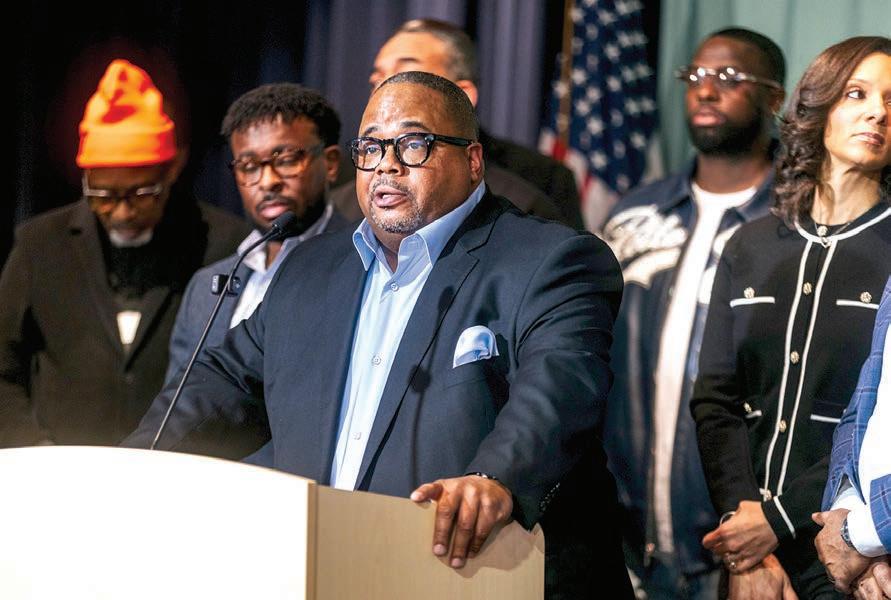
and coordinate existing CVI programs, including ShotStoppers, along with Group Violence Intervention (GVI) through Ceasefire, survivor advocacy work, reentry support, and new crime prevention efforts.
Longtime community advocate Teferi Brent will lead the office as director. Brent brings more than three decades of experience spanning community organizing, faithbased leadership, and business management.
“True safety starts in our neighborhoods when people feel seen, supported and valued,” Brent said. “Our ultimate objective is to serve as a bridge between governmental resources and community-based safety organizations. We believe in a whole-of-government approach that eliminates silos and makes critical resources more accessible to our first responders and community leaders.”
“All categories of major crime in Detroit saw significant reductions in 2025, with new historic
City officials announced that 2025 ended with historic lows in key categories, including criminal homicides, nonfatal shootings, and carjackings. Preliminary city data shared in January showed nonfatal shootings fell to 447, down 26% from 2024, while carjackings dropped to 77, down 46% from the prior year. AP reporting also noted Detroit recorded 165 homicides in 2025, the city’s lowest total since at least the 1960s. That context matters because this new office is not being launched as a reaction to failure. It is being built to protect the gains Detroit has fought hard to make and to address the violence that still leaves families grieving in neighborhoods across the city.
lows of criminal homicides, nonfatal shootings and carjackings,” Sheffield said. “Detroit has shown that when we work together, real progress is possible. Our comprehensive approach to public safety is working, but sustaining that progress requires continued partnership and further strengthening the bridge between government and neighborhood leaders. This office is ensuring that every neigh-
borhood has the tools and support it needs to be safe and thrive.”
The Mayor’s Office of Neighborhood and Community Safety will be supported in part by a $200,000 grant from the Hudson-Webber Foundation to help develop a coordinated, community-driven violence prevention infrastructure. The office will house
Detroit residents have already seen what community-based violence intervention can do when neighborhoods are resourced and trusted.
Over the last few years, Detroit’s CVI work — especially in high-violence areas targeted through ShotStoppers — helped shift the city’s approach away from relying only on enforcement and toward prevention led
From page A-3
by people with relationships on the block. City officials have repeatedly pointed to community violence interrupters as a major contributor to reductions in shootings and retaliatory violence in several Detroit neighborhoods, with earlier results showing steep drops in some CVI zones.
That matters for Black Detroiters, who know violence is never just a headline or a statistic. It is trauma. It is a school day interrupted by grief. It is a family trying to bury a loved one and hold itself together at the same time. It is a block carrying fear long after the police tape is gone.
This new office is designed to centralize the city’s prevention strategy so that the work already happening across community organizations and city departments is not fragmented, duplicated, or undercut by silos. According to the executive order announcement, the office will serve as a hub for violence prevention and intervention efforts and will focus on strategies that are coordinated, data-driven, and responsive to community needs.
Donald Rencher, president and CEO of the Hudson-Webber Foundation, said that infrastructure is exactly what Detroit needs to sustain public safety improvements over time.
“Hudson-Webber Foundation is proud to support the City of Detroit in strengthening a coordinated, community-driven approach to violence prevention,” Rencher said. “We know that sustainable public safety is achieved when residents, community organizations and government work together. This new office represents an important step toward building the infrastructure, trust and long-term strategies necessary to ensure that every Detroit neighborhood has the opportunity to be safe, stable and thriving.”
The office will include six major service areas, each tied to a different part of the safety ecosystem Detroit residents encounter in real life:
Community Violence Intervention (CVI) through ShotStoppers, which uses evidence-informed and community-led strategies to prevent violence through relationship-building, wraparound services, violence interruption, and mediation.
Conflict resolution and restorative practice initiatives, including neighborhood-based training, mediation hubs, and centralized services designed to increase access and center equity.
Survivor advocacy and survivor services, with emotional, practical, and legal support for crime victims, while researching and considering best-practice tools such as Trauma Recovery Centers and other community-based interventions.
Domestic violence and intimate partner violence prevention and intervention, with strategies aimed at aligning and expanding existing resources, teaching healthy relationship skills, and creating proactive, victim-centered supports before abuse escalates.
Reentry support services for adults and juveniles, including a review of the current landscape to identify gaps, align resources, and address factors that contribute to recidivism.
Group Violence Intervention through Ceasefire, which will continue partnerships
and other high-demand fields with a head start.
DEMC also says it will center personalized learning plans, inquiry-based instruction, and real-world application of knowledge. That language matters because many students do not struggle from a lack of ability. They struggle inside systems that were never built around how they learn, what support they need, or what pressures they carry outside school walls.
A model that combines rigorous academics with advising and wrap-around support recognizes that achievement and access are tied together.
Detroit families have seen too many education conversations stop at slogans. What makes this launch worth watching is whether the school can deliver on what it promises: a pathway that is rigorous, accessible, and built for the students most often left out of early college opportunities. If it does, DEMC could become more than a new school. It could become a blueprint for how Detroit rethinks secondary education around credentials, cost, and career readiness without lowering expectations for students.
School leaders are positioning DEMC as part of a long-term investment in economic mobility and workforce development. They say the mission is rooted in equity and access, with a focus on preparing students not only to participate in Detroit’s growth, but to lead it.
That is the part families will be paying attention to.
Detroit students do not need another promise built on possibility alone. They need pathways with structure, support, and outcomes. They need schools that treat college credit, career preparation, and academic excellence as a standard, not a privilege.
Detroit Early Middle College is now entering that conversation with a model the city has not had before.
Families and community partners interested in learning more about enrollment or the school’s academic model can visit demc. org.
Ebony JJ Curry can be reached at ecurry@ michronicle.com.
among community members, law enforcement, and social services to support behavior change and reduce violence among atrisk populations.
One of the most important shifts inside this office is where Detroit is turning its attention next.
Using data and lessons drawn from the city’s successful CVI work, Brent said the Office of Neighborhood and Community Safety will now work to address domestic and intimate partner violence as a major source of violence in Detroit — an area that has not received the same focused citywide prevention strategy. City officials say domestic and intimate partner violence accounted for 17% of homicides in Detroit last year. That figure is one of the clearest signs that Detroit’s next crime reduction gains will require confronting violence that happens behind closed doors, often before it becomes fatal.
“Our CVI groups have done an incredible job bringing down the number of gang-related homicides and shootings and that work will continue,” Brent said. “What their community work has shown us is that domestic and intimate partner violence is a major source of violence that needs focused attention for us to further reduce homicides in Detroit, saving more innocent lives.”
Brent said staff will be assigned to fur-
ther research the issue in Detroit and develop strategies that include conflict resolution and restorative practices.
“Domestic violence really can’t be effectively addressed without these two approaches,” Brent said. “Just like CVI work, our job is to change patterns of behavior and to give people options and tool other than violence.”
Community organizations already working on this issue say the city’s decision could set a new standard.
“Detroit is the first city to devise a comprehensive strategy from the Mayor’s Office specifically designed to address DVI and IPV-related fatal and nonfatal shootings,” said Negus Vu, president of The People’s Action community organization. “That leadership matters. It sets a precedent. It sends a message that we are not waiting for solutions, we are building them.”
Dr. Keisha Allen, CEO of Black Family Development International Training Institute, emphasized that lasting peace requires neighborhood-level tools, not just crisis response after harm has already happened.
“If we truly desire sustainable, peaceful, and safe communities across Detroit, restorative conflict resolution must be a foundational strategy within our neighborhoods, not an afterthought,” Allen said. “I commend the Mayor’s Office of Neighborhood and Community Safety for recognizing that real safety is co-created with the community through restoration, engagement, and
The center’s afterschool program runs Monday through Friday from 3 to 7 p.m. for children ages 5 to 12.
Families can access Spanish instruction, tutoring support, dance, and arts-based learning in one location. A signature program, Sensory Superstar Sundays, was created for children on the autism spectrum and other neurodiverse learners. Feliz, whose son is autistic, also developed dance programming for children who are deaf or hard of hearing, allowing participants to experience rhythm and movement by feeling the beat.
For Brightmoor, that programming mix carries weight beyond enrichment.
Families raising neurodiverse children often face limited local options, long waitlists, or services that do not feel culturally responsive or practically accessible. A neighborhood site designed with inclusion in mind changes how families experience support. Children are not being asked to fit into a program that was built without them. The program was built with them in mind.
Adult education is part of the center’s footprint, too, which gives the space a multigenerational purpose. Adult Spanish and American Sign Language courses create another entry point for residents who want to expand communication skills, improve job opportunities, or support children and family members more effectively at home and in school.
Feliz has already built reach beyond one building. Her trademarked language-learning curriculum, Spanish Swag, is used by schools and organizations in Detroit, across Michigan, and as far as Georgia. Bringing that work into a Brightmoor storefront gives the neighborhood something many communities say they want but do not always receive: local access to a proven program led by a neighborhood-grown educator.
Economic impact is part of the story too, especially in a community where residents often talk about investment in terms of whether it produces something usable, accessible, and rooted. A $50,000 Motor City Match grant helped fund key renovations at the center, including interior and exterior painting, new stair steps, an ADA-compliant ramp, and a new HVAC system.
An ADA-compliant ramp expands access for families and caregivers. Reliable HVAC matters for children in after-school programming and for adults taking classes. Safe entry steps and a refreshed
proactive conflict resolution.”
The office will work across city departments and outside partners, including public health agencies, social service providers, law enforcement and criminal justice partners, schools and hospitals, neighborhood organizations, housing and parks departments, Detroit PAL, the Wayne County Dispute Resolution Center, Center for Working Families, and the Department of Human, Homelessness, and Family Services.
That list tells the real story of what Detroit is trying to do.
Public safety is no longer being framed as a single department’s job. Detroit is treating safety as a neighborhood condition — something shaped by trauma care, housing, youth support, mediation, reentry, family stability, and whether people can get help before conflict turns into gunfire.
City leaders are betting that the same community-rooted CVI model that helped lower shootings can now help Detroit go further.
For a city that has spent years proving crime can go down, this new office raises a harder and more important question: how does Detroit make safety durable?
Sheffield’s answer, at least on paper, is clear — build the infrastructure, fund the relationships, and let neighborhoods help lead what safety looks like.
Ebony JJ Curry can be reached at ecurry@ michronicle.com
building exterior matter for a site meant to feel welcoming, stable, and community-owned.
The center currently employs four staff members, three of whom are Detroit residents, and Feliz plans to expand staffing as summer programming grows. The facility has the capacity to serve up to 30 students at a time. On paper, those are modest startup numbers. On a block level, they represent local jobs, local services, and daily support for families who need options close to home.
National data also points to why Feliz’s bilingual focus lands at a time when many Detroit families are thinking about education and economic mobility together. A Preply analysis of more than 9,500 U.S. job listings shows that bilingual workers earn an average of 19% more than English-only peers. Additionally, fluent bilingualism is cited to delay Alzheimer’s symptoms and to strengthen cross-cultural communication skills.
That national framing meets local reality in Brightmoor, where families are balancing school needs, work schedules, transportation, and caregiving responsibilities. A center that treats bilingualism as a community asset and not a luxury offering puts language learning inside a neighborhood survival and opportunity conversation.
“I can’t escape my mission, which is to bring joy back to learning,” she said. “I want teachers to feel supported, I want families to better understand their children, and no matter the situation, you can still find joy. I’m supposed to be here to bring this center to life. This is just the start of it.”
DEGC Senior Vice President of Small Business Services Sean Gray said the center reflects the kind of neighborhood-serving entrepreneurship Motor City Match was designed to support.
“The work Jessie has put into this community speaks for itself,” Gray said. “Motor City Match exists to give entrepreneurs like her the resources to go further, and that’s what this space does for Detroit families.”
Brightmoor residents are more likely to measure this moment by what happens after the photos: children walking through the doors after school, parents finding support nearby, adults taking classes, and families seeing a neighborhood institution grow on Schoolcraft.
A lot of Detroit stories about neighborhood investment focus on what is planned. Brightmoor families now have something tangible at 20441 Schoolcraft — a learning center built by a daughter of the neighborhood, designed around inclusion, and grounded in the kind of daily needs that shape whether communities feel supported or left to figure it out alone.
Ebony JJ can be reached at ecurry@michronicle.com.

“History has shown us that courage can be contagious and hope can take on a life of its own.” – Michelle Obama
A5 | March 4-10, 2026
By Dr. Anthony O. Kellum
CONTRIBUTING WRITER
Property is Power! and access to it is under threat in the digital age.
For most of the 20th century, discrimination in mortgage lending was explicit. Banks drew red lines around Black neighborhoods, labeling them too risky for investment. Federal underwriting manuals reinforced exclusion. The result was predictable generations of Black Americans locked out of the primary engine of wealth creation in the United States, homeownership.
Anthony O. Kellum
Those maps no longer exist. But exclusion has not disappeared. It has evolved. Today, artificial intelligence and algorithmic decision-making play an increasingly central role in mortgage underwriting, pricing, and marketing. These systems are often described as objective and race-neutral, designed to remove human bias from financial decision-making. In practice, however, they risk reproducing the very inequities they claim to solve.
Discrimination no longer requires intent. It only requires data.
Modern lending algorithms rely on historical information credit scores, income patterns, employment stability, geographic location, and consumer behavior to assess risk. But history matters. Black Americans were systematically denied access to credit, stable housing, and asset-building opportunities for decades. That exclusion is embedded in the data itself.
When algorithms are trained on outcomes shaped by inequality, they learn to normalize those outcomes.
Zip codes become proxies for race. Income volatility becomes a red flag. Gaps in credit histories are interpreted as irresponsibility rather than evidence of historical exclusion. Borrowers can meet every modern standard education, income, financial responsibility and still be penalized because the system doesn’t recognize context.
The result is a system that can generate racially disparate outcomes without ever “seeing” race at all. For Black borrowers, particularly college-educated professionals and first-time buyers, the consequences are often invisible but consequential. Automated underwriting systems may approve a loan, but at a higher interest rate. They may require more reserves, lower debt ratios, or stricter documentation. They may quietly downgrade applications based on factors that have little to do with a borrower’s long-term ability to sustain ownership.
Because these decisions are automated, they are difficult to challenge. Unlike a human loan officer, an algorithm does not explain itself. Applicants are rarely told which variables mattered most or how close they were to approval on better terms.
This opacity matters. Access delayed is often access denied.
Algorithmic bias also extends beyond underwriting. Marketing systems determine which consumers see mortgage offers, refinancing opportunities, or homeownership education in the first place. Studies have shown that certain demographic groups are less likely to be targeted for prime financial products, even when they
A-6
By Adam Hollier
In the Michigan Senate, there is a profound difference between empathy and experience. You can study a map of Detroit, you can memorize the statistics of our unemployment rate, and you can read briefings on the disproportionate violence facing our most vulnerable. But you cannot legislate for the soul of a city if you haven’t walked its streets as a neighbor, served its residents as a first responder, or felt the weight of its history in your own bones. Representation is not a symbolic gesture; it is a functional necessity. For Detroit to thrive, its policy must be led by those who share the lived reality of its people. We are currently witnessing a sobering moment in our state’s history: this is the first legislature since 1941—the year the first Black man was elected to the Michigan Senate— in which there are no Black men serving in that chamber. This vacuum of representation should concern every Michigander who believes that our government should reflect the people it serves. Black leadership in the Senate isn’t just about having a seat at the table—it’s about ensuring that the table is actually set for the people of the 3rd District. My approach to policy has never been academic; it has been visceral. When I advo-
By Jeremy Allen EXECUTIVE EDITOR
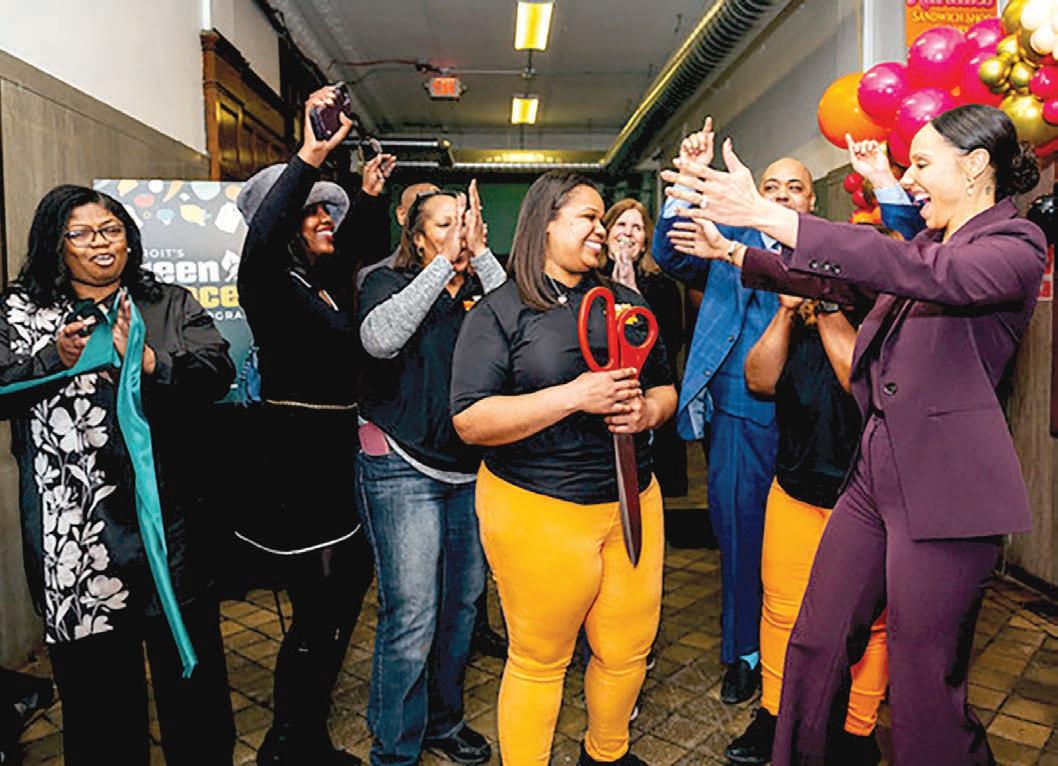
Detroit’s Dexter-Linwood neighborhood – an area long-known for being one of several food deserts in the city – is on a brighter path with the opening of Kandies Mini Mart, a new grocery section within Jacquisha Blackwell’s popular Kandies sandwich shop and catering operation.
The ribbon-cutting ceremony celebrated the first Green Grocer Program opening since its relaunch in 2024, following a seven-year hiatus. The expansion, made possible by a $25,000 grant from the Detroit Economic Growth Corporation (DEGC), aims to fill a crucial gap in walkable grocery access for local residents.
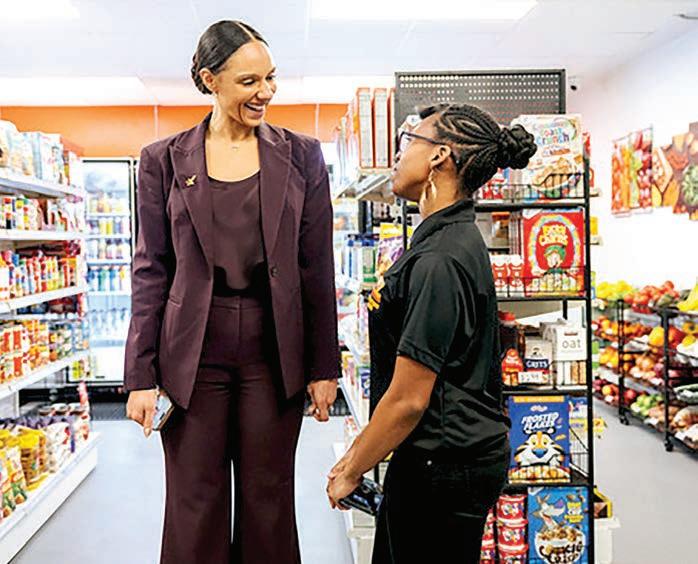
The new grocery section, housed inside the Durfee Innovation Society, offers fresh produce, dairy, baked goods, and a variety of essential grocery and personal items. Blackwell, who has been running her sandwich shop and catering service in the neighborhood for several years, expanded her business to meet the growing need for accessible, affordable, and nutritious food options.
“In this neighborhood, there isn’t a walkable grocery store nearby, so families are often forced to rely on fast food or convenience stores,” said Blackwell. “Kandies Mini Mart aims to help close that gap. We talk to our customers, learn what they need and what they can afford and build our offerings around that.”
The DEGC manages the Green Grocer Program in partnership with the City of Detroit. The initiative focuses on small-format grocery stores, hybrid food concepts, and convenience retailers that bring healthy, fresh food options to neighborhoods with limited access to traditional grocery stores.
on local communities.
“Every corner of our city deserves this type of investment,” said Sheffield. “As mayor, it is my goal to provide more opportunities like this for our residents –walkable access to fresh foods, local ownership, good jobs for our young people.
The Green Grocer Program will play a pivotal role in making this happen.”
Kandies Mini Mart marks a return to the Green Grocer Program, which was originally launched in 2010 to support neighborhood grocery stores and expand access to healthy food. In its first phase, the program helped generate more than $50 million in investments, supporting over 40 grocery businesses and creating
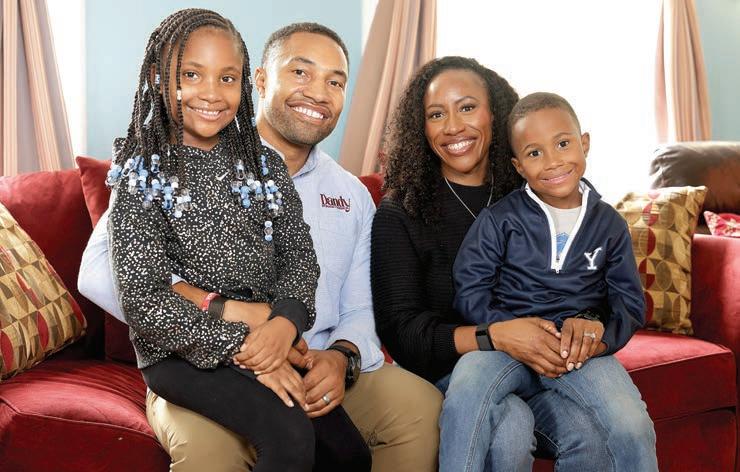
cated for the repeal of the “pension tax” or fought for expanded unemployment benefits during the pandemic, I wasn’t just looking at a budget spreadsheet. I was thinking about the seniors in my neighborhood who were choosing between medication and heat. I was thinking about the workers I knew personally who were locked out of a broken system by bureaucratic red tape. This commitment to the future of our
city is most evident in how I raise my own family. My children are students in Detroit Public Schools. That isn’t a political statement; it’s a reflection of my trust in our community. I trust this district with my children because I believe in the talent of our educators and the potential of our students. But true leadership requires more than just trust; it requires stewardship. That is why I stepped up to co-chair
115 jobs across 14 stores. However, the program was put on hold in 2017 due to funding limitations.
Coleman A. Young II, Detroit City Council President Pro Tempore At-Large, championed the program’s relaunch in 2024 after securing additional funding.
“Nothing is more powerful than an idea whose time has come. The idea of a grocery store in every Detroit neighborhood that serves fresh food, clean water, for sound minds and healthy bodies –is an idea whose time has come,” said Young.
The $25,000 Green Grocer grant that Kandies received was used to purchase re-
the millage renewal work
From page A-5
my work for the LGBTQ+ community. People often ask why a Black veteran made the protection of trans women of color a priority. For me, it is a matter of accountability. As a Black man, I recognize a painful reality: Black men are often the ones perpetrating this violence against our own sisters. Because we are part of the problem, we must also be the ones to stop it. We have to be the ones to stand up, call it out, and change the culture.
When I worked across the aisle to secure $1 million for the Ruth Ellis Center, it was because I knew housing for displaced youth was a matter of life and death. That insight didn’t come from a lobbyist; it came from being a Detroiter who saw the gaps in our safety net firsthand and understood that true leadership means protecting everyone in our family, without exception.
We are at a crossroads in Michigan’s political history. Detroit remains the economic and cultural heart of Michigan, yet our voice in Lansing is only as strong as the leaders we send there. When we talk about “fixing the roads,” Black leadership ensures those conversations include public transit that gets a Detroiter to their shift on time. When we talk about “economic development,” we ensure it includes union protections for the workers who are the backbone of our city.
My time as a paratrooper taught me how to take a leap of faith, trusting my team and my preparation to deliver me to a place where I can do my job. My time as a volunteer firefighter taught me that when there is a crisis, you run toward the smoke. But we cannot do this work effectively if an entire segment of our community is absent from the halls of power. Lived experience is the bridge between a good idea and a life-changing law, and that is why we must restore the voices of Black men to the Michigan Legislature. We need advocacy rooted in the soil of this city—leadership that understands our diversity is our greatest economic engine and that our shared experiences are our most powerful tools for change.
are qualified. Opportunity is filtered before it is even presented. The long-term implications are significant. Higher borrowing costs reduce equity accumulation. Slower entry into homeownership shortens the time horizon for wealth building. Over time, these differences compound widening racial wealth gaps without any single discriminatory act to point to.
Artificial intelligence is not inherently discriminatory. But neither is it neutral. It reflects the values, assumptions, and data of the systems that create it. Without deliberate safeguards, AI risks becoming a highly efficient mechanism for reinforcing historical inequities under the guise of innovation. There are steps that can and should be taken.
First, transparency must be strengthened. Lenders using algorithmic systems should be required to audit outcomes for disparate impact and to provide meaningful explanations for adverse decisions. Black-box lending is incompatible with fair-access principles.
Second, the use of alternative data must be expanded responsibly. Rent payment history, utility payments, and long-term cash-flow stability can provide a more accurate picture of creditworthiness than traditional metrics alone particularly for borrowers historically excluded from mainstream credit.
Third, consumer education must evolve. Financial literacy in the 21st century includes understanding how automated systems evaluate risk. Borrowers must be equipped not only to build credit, but to navigate a data-driven lending environment.
Finally, policymakers must modernize fair-lending enforcement. Laws written for an
frigeration, shelving, and to upgrade the shop’s electrical systems to accommodate the expanded grocery offerings.
Blackwell also ensured that the store remains affordable for families by accepting EBT and WIC benefits.
“Jacquisha didn’t need us to tell her what her neighborhood needs. She was already serving her community,” said Sean Gray, senior vice president at the Detroit Economic Growth Corporation. “We gave her the resources to expand what she was doing well. It’s an investment that will create a significant impact in this community.”
Kandies has also been an important employment resource for Detroit youth. The business currently employs seven staff members, most of whom are local young people, and partners with organizations like Grow Detroit’s Young Talent and Legacy Youth Travel to provide job training, mentorship, and employment opportunities.
“God placed me exactly where I needed to be,” Blackwell said. “I applied for this program, prayed and trusted the process. When I received the call, I knew this was bigger than me. This is about serving the community and being obedient to the pur-
pose God put on my heart.”
Looking ahead, additional food businesses are expected to take advantage of the Green Grocer Program’s support, further increasing access to healthy food in Detroit’s underserved neighborhoods. As the program continues, it will play a crucial role in strengthening the city’s grocery sector and reinforcing the importance of neighborhood-scale grocery stores as vital community assets.
Kandies Mini Mart’s grand opening is just one of the many ways that the Green Grocer Program is reshaping the food landscape in Detroit, bringing healthier food options, local ownership, and job opportunities closer to home for Detroiters.
As Blackwell reflected on the journey to opening her expanded shop, she emphasized the importance of community and the long-term impact of the Green Grocer initiative.
“This isn’t just about a grocery store,” she said. “It’s about showing that people care about the community and giving them the tools to help themselves.”
For more information about the Green Grocer Program and small business resources, interested businesses can visit the DEGC website at degc.org/greengrocer.

era of human discretion must now address algorithmic systems with the same seriousness once applied to redlining maps and discriminatory underwriting manuals.
Property is Power! And when access to property is limited, power is too. Black families must be prepared, informed, and organized to navigate this new era of lending because ownership is the line between permanence and displacement.
If we fail to act, we will see yet another generation locked out of wealth and opportunity. If we act intelligently, strategically, and collectively, we can ensure that ownership remains a tool for equity, agency, and generational strength.
Property is Power! is a movement to promote home and community ownership. Studies indicate that homeownership leads to higher graduation rates, family wealth, and community involvement.













By Aaron Foley EDITOR-AT-LARGE
Ponce Clay is a decorated military veteran, an accomplished attorney, and a holder of several degrees, and though he’s not a preacher, one wouldn’t be mistaken if they assumed there was a theological or divinity title in there somewhere.
After a 20-minute address at Oak Grove African Methodist Church on Detroit’s west side – can’t quite call it a sermon if the person in the pulpit isn’t licensed to preach – Clay accepted one more title: Judge, during an investiture ceremony where he was officially welcomed by a slate of Black judges representing Detroit’s 36th District Court, where he will now serve, and other local and state courts.
“I can’t recall a more extraordinary candidate to present to the governor,” said Wayne County Probate Judge Terrance Keith, one of many speakers to introduce the newly benched Clay to an audience of roughly 300 attendees packing the pews, overflowing the parking lot at Oak Grove for a Saturday afternoon event that rivaled its regular Sunday attendance. “I recognize the tortured history that Black judges have had in this country. And for those who think those days are long gone, look now.”

Clay’s appointment was announced late last year by Gov. Gretchen Whitmer, who also named Chastity Youngblood and Herman Griffin IV to the bench at 36th. And while investiture ceremonies – a public swearing-in or some other confirmation that’s more boisterous than bureaucratic – aren’t required, more and more local public officials are taking those opportunities to make splashy introductions to an audience.
“You are all on the committee to retain Judge Ponce Clay,” retired Michigan Court of Appeals Judge Cynthia Diane Stephens told the audience, lending to both the celebratory and political nature of public investitures, as seat fillers can also be future voters.
Clay grew up a “first-generation Detroiter,” born on the east side to parents who both migrated to the city from Mississippi. “At that time, [Detroit] had the best public schools in the nation,” he said. “That’s the system that empowered me, and that’s the system that produced me.”
His upbringing, which blended Southern values, blue-collar pride (his father, upon arriving in Detroit, went straight to a car plant, he said), and a melting pot of other folks arriving in the Motor City for similar reasons, would show him how to “lead with diversity” in his legal career later. “In Detroit, you move among ‘differents’ – different cultures, different ambitions, different challenges.”
After high school, Clay spent several years in the Navy. “You don’t know how insignificant you can feel while you’re at sea,” he said, “And you think to yourself, ‘if God takes care of these crickets and these birds and this grass, and I’m out here feeling how small I feel, why not me?’ And it’s when it’s so quiet that you hear the loudest of God almighty.”
Clay then went on to earn a bachelor’s degree from Morehouse College in Atlanta, citing an inspiration in Judge George Crockett III, another alumnus of the allmale HBCU. Clay went on to earn two more advanced degrees before going to law school and graduating from the University of Detroit Mercy School of Law.
Prior to Whitmer’s appointment, Clay was founder and partner of Clay Law, PLC. A member of Phi Beta Sigma, the Detroit area’s Morehouse alumni chapter, a board member of City of Detroit Brownfield Redevelopment Authority Community Advisory Committee, and a member of Oak Grove, Clay’s community service and achievements were brought forth by a number of speakers from all stages of his life.
“When I first met him, he said, ‘Ponce.’ I said, ‘Ponce? Like the fountain of youth? Because he looks so young,” said former State Sen. Marshall Bullock, representing Detroit’s Black Greeks as a member of Omega Psi Phi.
Clay’s appointment finishes out a partial term following the resignation of 36th Judge Donald Coleman and expires January 1, 2027.
“Service isn’t a slogan, it’s a mandate,” he said. “Justice means fairness without fear or favor. And in Detroit, it means understanding the lived reality of the people who walk into this courtroom every day.”
You can reach Aaron at afoley@ michronicle.com.

By Sam Robinson SENIOR REPORTER
A recent poll surveying likely voters in the Michigan governor’s race has Democratic candidate for governor, Secretary of State Jocelyn Benson, up over Republican candidate U.S. Rep. John James, with Independent former Detroit Mayor Mike Duggan trailing.
The poll, conducted by national polling firm Impact Research, was commissioned by Benson’s campaign. It shows Benson, the leader of Michigan’s Department of State, up on James by three points, with Duggan taking about 20% of the vote total.
Thepolling, conducted from February 9 to 16 by Impact Research, indicates Benson has a lead in the race for governor based on a survey of 800 likely voters. The poll had a margin of error of plus or minus 3.5 percentage points.
Benson has been seen as the Democratic front-runner since she announced her bid to replace term-limited Gov. Gretchen Whitmer last year. Genesee County Sheriff Chris Swanson is also running for governor as a Democrat.
Benson leads the field with 39% of the vote, ahead of John James’ 36%, and Mike Duggan’s 20%, with just 5% undecided. Benson’s campaign pointed to the polls showing the state’s election chief is also leading the rest of the field among Black voters, voters under 55, and voters with and without college degrees.
“It’s no surprise Jocelyn Benson is leading the race for governor,” said Benson Campaign Manager Nikki Goldschein.
“Michiganders know her track record of making government work for the people and protecting our rights and freedoms.As voters continue to learn about her plans to lower costs and hold corporations accountable, her momentum continues to grow.”
Duggan’s campaign, which conducted its own internal poll last year and promoted a poll conducted by one of the endorsers of his campaign, questioned the poll’s legitimacy.
“All independent polling continues to show Benson hovering near 30%. The only outlier is a new internal poll she paid for herself. Those results have no credibility as we’re sure the next rounds of independent polling will demonstrate. If they actually believed these numbers, MDP and Benson wouldn’t be spending every day attacking us.”
A poll released Monday by theDetroit Regional Chamber, which is backing Duggan’s campaign, has Benson at 30.9%, Duggan at 30.3%, and James at 29.5%.
Chamber president and chief executive officerSandy K. Baruah said the polling is a positive sign for Duggan, but acknowledged that “Frankly, it’s still early.”
While Michigan Democratic Party chair Curtis Hertel has been consistently vocalizing his opposition to Duggan’s campaign in interviews, Benson hasn’t spent time during
her campaign personally attacking Duggan, albeit forher campaign social mediaaccount. Duggan, in recent months, has been praised and criticized by Democrats and Republicans, but there’s a sense among most on the left that he’s not as forceful in his critiques of conservative politicians as he has been of his former party.
Gov. Gretchen Whitmer recently said that while she would be supporting the Democratic nominee for governor, she appreciated the job Duggan did as mayor of Detroit.
Republican House Speaker Matt Hall this week said on social media that “Mike Duggan is right,” talking about how Democrats weren’t able to pass certain legislation during their legislative trifecta from 20222024.
A poll conducted by Glengariff Group for The Detroit News and WDIV-TV last month showed Duggan at 26%, trailing James at 36% and Benson at 32%. The result was within the poll’s margin of error of plus or minus 4 percentage points, and 8% of participants said they were undecided, the News reported.
A poll released last fall by Schoen Cooperman Research showed Duggan at 26% of voters, Benson at 30%, and James taking 29%.
All three candidates live in metro Detroit.
You can reach Sam at srobinson@ michronicle.com.
By Sam Robinson SENIOR REPORTER
U.S. Senate candidate Rep. Haley Stevens announced a string of endorsements Thursday from more than a dozen Black House colleagues.
A group of Congressional Black Caucus members, along with former Rep. Brenda Lawrence, D-Southfield, has endorsed Stevens’ U.S. Senate campaign.
“I’m excited to announce the endorsement of my friend, former Congresswoman Brenda Lawrence, and more than a dozen colleagues from the Congressional Black Caucus!” Stevens posted on social media Thursday morning. “This election means too much to sit on the sidelines and give Trump another seat in the Senate. I’m grateful for the support of my friends and colleagues as I run to keep MI blue!”
Stevens faces Democratic candidates, state Sen. Mallory McMorrow, and former Wayne County health director Abdul ElSayed in in the August primary election.
Stevens has been making appeals to Black elected leaders, posturing as the candidate in the race for Michigan’s opening U.S. Senate seat who can win the support of Black voters.
She was endorsed last year by Michigan’s first Black House Speaker, Rep. Joe Tate, D-Detroit.
“Her entire career, Haley Stevens has been a fighter for Michigan, bringing experience, compassion, and a deep commitment to the people she serves,” said Lawrence, who retired from Congress in 2023 after serving Metro Detroit for four terms.
“From helping save 200,000 Michigan jobs as Chief of Staff during President Obama’s auto rescue to fighting for Blackowned businesses in Congress and standing up to Donald Trump’s chaos, I’ve seen Haley fight and I’ve seen her win.”
Stevens announced endorsements from the following Congressional Black Caucus members:
• Gabe Amo – Congressman for Rhode Island’s 1st District
• Shontel Brown – Congresswoman for Ohio’s 11th District
• Janelle Bynum – Congresswoman for Oregon’s 5th District
• Troy Carter – Congressman for Louisiana’s 2nd District
• Don Davis – Congressman for North Carolina’s 1st District
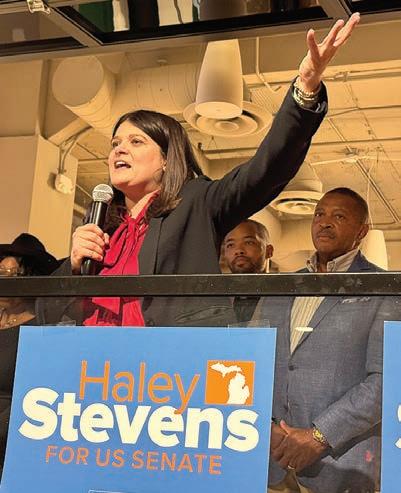



B1 | March 4-10, 2026
By Claude Molinari VISIT DETROIT PRESIDENT & CEO
Over the past decade, I have had a front row seat to Detroit’s comeback. What stands out most is that our momentum did not happen by chance. It is the result of sustained, coordinated investment and a shared belief that Detroit’s best days are still ahead. By concentrating energy and resources in a compact, walkable downtown district anchored by Comerica Park, Ford Field and Little Caesars Arena, we created a powerful engine for growth. What was once episodic event traffic has become consistent, year-round activation that fuels businesses, attracts visitors and supports jobs every day of the year. As President and CEO of the Detroit Metro Convention and Visitors Bureau, and Board Chairman of the Detroit Regional Convention Facility Authority, I have been privileged to help guide Visit Detroit’s strategy to attract meetings, conventions, leisure travelers and business visitors to our region. Within just a few blocks, our downtown is home to the Tigers, Lions, Red Wings and Pistons. That concentration of professional sports franchises in a walkable footprint is nationally unique and draws more than 15 million visitors annually. Beyond sports, the district hosts major concerts, cultural events and live performances that command global attention. The addition of a forthcoming WNBA expansion franchise will further strengthen Detroit’s position as one of the country’s most dynamic sports and entertainment hubs.
Sustained traffic has catalyzed billions of dollars in commercial investment. Signature projects such as Hudson’s Detroit and the reimagined Michigan Central have reshaped the skyline and repositioned our city as a center for mobility, technology, and innovation. New office developments and corporate expansions continue to deepen Detroit’s commercial base, while diversifying the mix of employers and amenities downtown.
Major companies including Google, Microsoft, Amazon, Ford, General Motors, Little Caesars, and DTE Energy have expanded or reinforced their presence here. National retail and hospitality brands such as Whole Foods, MGM Resorts and Marriott have invested in the market, signaling long term confidence in Detroit’s trajectory. For decades, our economy was closely tied to a single industry. Today, we are building resilience through growth in technology, healthcare, higher education, hospitality, and small business development.
Healthcare and education investments are central to this transition. The Tom Gores and Detroit Pistons “Future of Health” initiative, in partnership with Henry Ford Health and Michigan State University, will transform parts
See DETROIT’S COMEBACK Page B-2

By Jeremy Allen EXECUTIVE EDITOR
No one was surprised that Claressa Shields, the GWOAT and the undisputed heavyweight champion, stood in the center of Little Caesars Arena with her arms raised in triumph after soundly defeating her opponent, Franchón Crews-Dezurn, in a unanimous-decision victory. (All three judges scored the fight 100-90 for Shields.)
Shields’ performance in the ring was nothing short of dominant. From the opening bell, she controlled the tempo, using her sharp jab and punishing left hook to break Crews-Dezurn’s defense. But the challenger, true to form, refused to back down. With each round, she pressed forward, challenging Shields, forcing her to fight at a pace that could have easily overwhelmed a lesser champion. But Shields, in the full command of her abilities, simply outboxed her; calmly, methodically, and with the kind of ring IQ that few could match.
But the real story about this Shields/ Crews-Dezurn rivalry has been writing itself since Shields’ teenage years, and this weekend added two more chapters to that story.
See, the two shared the ring for their respective professional debuts. Their first clash, tucked beneath Andre Ward vs. Sergey Kovalev, was a symbolic passing of the torch from one Olympian generation to the next. Shields entered that night fresh off two Olympic golds – the first American boxer ever to achieve the feat. She won that bout, launching a pro career that would redefine women’s boxing.
Crews-Dezurn, though, didn’t fade. She rebuilt, rose, and eventually became an undisputed champion at Super Middleweight. Even as their careers diverged – Shields reaching the pinnacle of success, while Crews-Dezurn faced her own battles, both inside and outside the ring – the two fighters remained in each other’s orbits.
They had shared rings, training camps, and a mutual respect that went far beyond the bravado of their rivalry. They were friends and colleagues before stepping into the ring for the second time. And they re-

mained that way even after pre-fight tensions and exchanging headshots and body blows for 10 rounds in front of more than 17,000 screaming fans inside the arena and countless others around the world who saw the fight live on the DAZN network.
The day before the fight, during the weigh-ins, Sheilds delivered the first blow of the weekend, shoving Crews-Dezurn, who was forehead-to-forehead with Sheilds as the two exchanged words during the showdown. The shove incited a melee amongst their camps, which needed police intervention before it de-escalated.
Both fighters, in their shared post-fight press conference, downplayed the event, saying that “it’s just boxing” and that, while things did get heated in the moment, it’s all part of the fanfare of the sport. Neither walked away from the incident injured nor
By Aaron Foley Editor-at-Large
The penultimate weekend of February saw Detroit through gold-colored glasses.
A raucous Sunday night boxing match at Little Caesars Arena with Flint’s Claressa Shields and Franchon Crews-Dezurn was a test to see how the city’s new mayor can signal a relatability to her constituents as more and more eyes from outside the city are watching –and judging.
Mayor Mary Sheffield donned a pair of Cartier glasses to greet the packed venue with a rousing “what up doe!*”, which certainly wouldn’t be the first time a Detroiter has said hello while buffed up, but definitely the first time a sitting Detroit mayor has publicly taken to a large event wearing the pricey frames with a rich yet complicated local history.
While LCA was lit up this weekend, though, there were shockwaves rolling throughout other parts of the city that, in some way, add some context to
this latest fashion statement from the mayor. Before the first punch, word was quickly spreading about the sudden – and still unclear, as of press time – death of Darrel “D.
Hasty” Hutch, who in the last few years has been one of Detroit’s most widely admired ambassadors – even if he wasn’t appointed as one by a mayor or anyone else.
Anyone who’s followed D.
Hasty probably remembers the first time they saw him and what exactly he was talking about. For this editor, it was about two years ago on TikTok, where Hasty, who commanded more than 90,000 followers on that platform under the screen name Hasty at Hutch, talked directly to the camera about how a customer came into his employer, Hutch’s Jewelry, about getting a pair of glasses repaired.
The issue, Hasty explained, was that the customer believed his glasses were authentic Cartiers, and after holding up the customer’s fakes and a real pair side by side and spending the next few minutes breaking down every-
thing on tint, inscription, screw placement and weight, viewers learned a lesson in in how to spot fake buffs and gained some sympathy for a hapless jeweler who repeatedly has to tell wannabe ballers that they’ve been scammed.
Hasty’s videos, usually filmed at the Oak Park store, did more than compare real buffalo horn with plastic. Almost every video pulled back the curtain on a section of Detroit’s retail scene that has been in plain sight to everyone but perceived in a million different ways. And while anyone with some bare-minimum gemstone knowledge could probably call a famous jeweler by name –think Harry Winston, Lorraine Schwartz, Jacob the Jeweler – none of them would have been born in 1992, and certainly none of them would be Black.
Each of Hasty’s videos about jewelry, whether it was about setting stones in gold chains, showing off pieces from his vintage watch collection (“they thought I
mentally thrown off their game.
“I think that people got it all messed up about me. I think they feel like the more that they troll, the more noise that they make, that it throws me off. I ain’t gon’ ever let nothing throw me off to lose a fight,” Shields said.
“Boxing is the only thing that I’ve loved that gave me the same type of love back. Boxing is what I was chosen to do. God chose me to do this, and I’m gon’ keep representing for women’s boxing and keep representing for me. Nobody can take my confidence. Nobody can take away my grind, my hard work. As much as everybody says ‘Oh, I hope you lose. You need to be humble’; it’s just not gon’ happen. God did not bring me this far just to leave me, and I’m gon’ keep

From page B-1
dogging every last one of them who they bring inside the ring with me. Every last one of them.”
Despite the brief confrontation at the weigh-in, which captured the attention of social media and made for compelling television drama, those who know them best understood that it was all part of the spectacle. In boxing, the intensity of competition sometimes spills over into the personal realm. It’s a momentary flash, not a reflection of the deeper reality.
“I’ve always had real love and respect for Claressa,” Crews-Dezurn said after the fight. “We’ve shared the ring more than once, and that means something. Whenever the call comes, I’m always going to step up and take the fight. I put everything on the line tonight, and I truly believe fights like this push women’s boxing forward. We’re showing the world what’s possible.”
But this fight, like so many others in Shields’ career, was never just about the punches thrown or the belts won. It was about a commitment to ensuring that women’s boxing was no longer an afterthought. Shields has always understood that her victories in the ring come with a responsibility to open doors for others, to make sure that the next generation of women fighters doesn’t have to fight for respect, doesn’t have to beg for recognition.
“I can beat these girls tremendously,” Shields said after the fight, always aiming higher, always pushing herself to do more. “I try hard to get the knockout. I love this sport and I want to see more women thrive in it.”
Shields recalled recently that when she made her pro debut against Crews-Dezurn in November 2016, Shields was paid $50,000
– a figure far larger than the typical purses of $5,000 to $10,000 for women fighters. It was a sum that signaled a shift, an acknowledgment that women could fill arenas and generate the kind of fanfare that had long been reserved for men. Shields took that as a steppingstone and a way to show that women could make a viable living from boxing, and that this was a sport for them, too.
“It’s crazy because when we made our pro debut, (comedian) Dave Chappelle walked up to me and was like ‘Oh my God, that was one of the best fights I’ve seen.’ I have so much respect for Detroit, Flint,” Crews-Dezurn said.
“It filled my heart because I had so many people come from New York, Baltimore, DC, Virginia, Chicago, North Carolina. So for me, this fight tonight was a milestone because (Shields) has built such a platform here, but for me to know truly that I can

bring something to the table – I’m not trying to be her and be the face of boxing. I want to add something, so when she’s doing her, I don’t want to be one of those girls where it’s like she carried all the weight. I want to back her up. So when I came to Detroit, I had to make sure I put on and be a good reflection of that for women’s boxing. (Shields) carried her weight and I carried mine.”
Shields understands the platform her success provides, and she uses it as a springboard to lift others. The fight in Detroit, as spectacular as it was, was simply another example of her desire to redefine what it means to be a woman in boxing.
For her, it goes beyond being the best fighter in the world. Her mission is to reshape the boxing world itself. But even in that pursuit, onlookers continue to be amazed.
As Terence “Bud” Crawford, one of the greatest fighters of his generation, reflected on Shields’ victory, his words were an acknowledgment of the legacy she’s building. “She did amazing,” Crawford said at LCA moments after the fight. “Man, what more can I say? She’s the greatest woman alive.”
Comedian Michael Blackson – along with other celebrities, including Grammy-nominated singer Kelly Price and fellow comedian Mike Epps, among others – was also in attendance. Blackson told the Michigan Chronicle after the fight that this was the first women’s boxing event that he’s attended.
“This is my first women’s fight – the best fight I’ve seen in my life. I’m not gonna watch no more men’s fights. They’re boring. They run around the ring. They don’t hit each other. Women come to fight,” he exclaimed. “(Shields) is like watching Muhammed Ali all over again. I’ve never seen an arena filled to come and watch women

From page B-1
was wearing some bullshit,” he said about a 1970s Audemars Piquet he wore to this year’s Charity Preview that was, after comparing it to another vintage Audemars Piquet he had on hand, was very clearly not some bullshit), or some education into the art of jewelry design, were meticulous. The videos were almost academic, giving credence to what some more conservative old heads might say is being too flashy or doing too much.
Instead, gold chains are treated as appreciating investments, and custom pieces are examples of one’s self-expression. And while many Detroiters know that anyone who works hard enough can get themselves a fur and buffs if they want to, Hutch’s growing platforms put Detroit’s unique style in the algorithms of viewers far beyond the city, most of whom were part of a generation that only knows the city through poverty and bankruptcy.
This isn’t to say that poverty doesn’t exist and that bankruptcy never happened, and this also doesn’t ignore the numerous casualties over the decades tied directly to the local jewelry trade.
One can’t write about Detroit’s diamonds without acknowledging the number of people hurt or killed getting the buffs snatched off their face or the chains yanked from their necks.
Theft of high-priced items happens everywhere – a pair of Jordans can be taken just as easily from an unattended locker room on U of M’s campus as it can from the back seat of your car parked in Midtown –but in Detroit, it’s a difficult conversation that treads along racial and economic lines when the only thing anyone wants to do is look good. And while we’re just starting to mourn Hasty, many of his customers are still grieving his former employer and Hutch’s Jeweler namesake, Dan “Hutch” Hutchinson, who was murdered in 2022.
Which brings us to Mayor Sheffield’s display at the boxing match the other night.
For the past few years, Hutch’s videos were part of a growing legitimacy of Detroit’s jewelry styles that brought some of Old Detroit’s authenticity to the New Detroit mainstream. Cartier, which has been supported by autoworkers’ bonus checks for more than four decades now, recognized Detroiters’ loyalty with an official note of gratitude in 2022.
Two years earlier, Gov. Gretchen Whitmer famously whipped out a pair of Cartier frames during an address to Michigan residents, officially taking the title of “Big Gretch.” It’s around this time, too, that LCA’s “Jewelry Cam” was becoming popular with Pistons game attendees who were also doing the Blade Dance in the stands, and the proliferation of Detroit culture everywhere – from tourists like Lil Yachty and Jack Harlow borrowing our sounds to new Lions players posting up at coneys on 6 Mile way beyond practice hours – is becoming the norm.
The climate had shifted just enough and made it possible for a millennial mayor who’s old enough to have been there when “Boy Would You” first dropped to remind an arena full of spectators where she’s from and where they are. But it can also serve as a timely tribute to someone who was instrumental in why the air here is different now.
Darrel Hasty left an extensive library of videos, where we can continue to share his passion and learn his techniques long after he’s gone. But we can also start to measure the weight of his impact and where we’ll continue to see his influence. The mayor’s office is a good place to start.
(*The spelling of “what up doe!” has been a recent source of debate here at the Chronicle, as staff could not decide if it’s “whatupdoe!,” “whadddupdoe!” or the three-word configuration. It turns out that in an August 13, 1983, issue of the Chronicle, in a piece showcasing new city slang, “What up doe!” in three words with an exclamation point is how it was first printed in this publication – and possibly the first in any local publication.)
Aaron Foley is editor-at-large at the Michigan Chronicle. Reach him at afoley@ michronicle.com.
do anything in my life. I’m so impressed. She’s got a new fan. Women’s boxing, y’all got a new fan. Claressa Shields is the greatest. The best female I’ve seen. Ever.”
The fight served two purposes for Shields: it was about proving that she could outclass anyone who stepped in front of her, and it was about respecting her opponent and the sport of women’s boxing.
“I felt like I had to take my time,” Shields said afterward, her calm demeanor a stark contrast to the ferocity of the fight. “Franchon hits hard, she’s tough, and you have
of New Center and Midtown with mixed income housing, retail, research facilities and public green space. Wayne State University’s Ilitch School of Business and the University of Michigan’s Center for Innovation Detroit Campus, scheduled to open in 2027, are strengthening our talent pipeline and helping attract and retain top talent.
Residential growth has mirrored this broader momentum. Since 2017, seven new residential buildings have opened downtown, with more in development. Neighborhoods such as Brush Park have seen rising property values and hundreds of new housing units completed or underway, reflecting renewed demand for urban living and growing confidence in the city’s core.
Hospitality development has followed. Six hotels have opened since 2017, and four more major projects under construction will add more than 1,000 rooms. From my vantage point at Visit Detroit, this expansion reflects rising demand for meetings, conventions, and major events. Investors are building capacity because our calendar is fuller and more diverse than ever.
High visibility moments accelerate that demand. The 2024 NFL Draft brought hun-
to be tricky with her. She was trying to call the upset. She’s the heavy-hitting diva, and that’s one of the best fights I’ve been in. I had to watch my back every round.”
For Shields, the future is open. Whether it’s a third bout with Crews-Dezurn or a showdown with rising stars like Shadasia Green or Mikaela Mayer, one thing is certain: Shields will continue to set the pace for women’s boxing. In the ring, her dominance is unparalleled. But it’s the work she does outside the ropes, pushing the boundaries of what women in the sport can achieve, that will ultimately define her legacy.
dreds of thousands of visitors downtown and showcased Detroit to national and international audiences. When global artists sell out multiple nights at Little Caesars Arena, it reinforces Detroit’s reputation as a world class entertainment destination. Recognition such as being named to the New York Times list of places to go in 2025 further affirms that Detroit is once again a destination worth experiencing.
Employment growth has been a defining outcome of this resurgence. Our venues and surrounding businesses support thousands of permanent and event-based jobs, many filled by Detroit residents. Investments in public space, including the nearly five-milelong Detroit Riverwalk, have enhanced quality of life while strengthening our appeal to visitors and talent alike.
As we look ahead, the priority is ensuring this growth is sustainable and inclusive. Strong partnerships across public, private and nonprofit sectors remain essential. With population growth leading the state and significant development capacity still untapped, Detroit’s evolution is far from complete. What began as an entertainment-anchored revitalization has matured into a diversified economic model, and I remain committed to ensuring the benefits of this progress are broadly shared.

By Ebony JJ Curry SENIOR REPORTER
Val has done what so many Black mothers do without applause. She raised her kids. She held down a home. She stayed committed to a marriage that once felt like a partnership. Then the house gets quieter, the distance inside the relationship gets louder, and she starts feeling the kind of loneliness that can sit right next to a wedding ring.
That is the emotional doorway into “Mary J. Blige Presents: Be Happy,” Lifetime’s new film executive-produced by Mary J. Blige, directed by Gabourey Sidibe, and built around a familiar turning point: an empty nest, a drifting marriage, and a woman trying to remember herself.
Yet the real backbone of “Be Happy” is not the romance.
The real backbone is the mother-daughter relationship, the one that Black families understand in their bones. Mothers start out as the teacher. Daughters grow up watching, learning, surviving, and becoming. Then one day, the dynamic shifts. A daughter’s care becomes the soft place her mother can land. A daughter’s home becomes a refuge. A daughter’s voice becomes guidance.
That shift lives in the film through Kayla, played by Nzingha “Zing” Ashford, a Michigan-raised artist whose own story carries the same kind of layered lineage the movie is trying to honor.
“I was born here in Detroit and then my family moved to Saginaw,” Ashford told the Michigan Chronicle. “That’s where I was raised and bred, and I started singing in churches.”
She described how her skills were nurtured by community leaders who “poured into the youth, artistically,” then how she took that foundation to Howard University, where she pursued musical theater and made the connections that helped launch her career.
That Michigan-to-HBCU-to-screen arc matters for a Detroit audience because it reads like home. It reads like a path built through neighborhoods, church aisles, school stages, aunties, mentors, and people who took a young person’s talent seriously enough to invest in it.
Ashford’s story fits the city’s ethic: gifts get sharpened in the community.
Val, played by Tisha Campbell, is grappling with empty-nest feelings, loneliness, and growing emotional distance from her husband Ross, played by Russell Hornsby, and she begins to realize her marriage and the woman she once was may be slipping away.
That is not a rare storyline. That is a Black family storyline. Plenty of Detroit women have watched their mothers carry a household through grit and routine, then watched those same mothers face the question nobody prepares you for: Who am I when my role changes?
“Be Happy” answers that question through movement — through Val leaving home and going to her daughter. The film positions Kayla’s life in New Orleans as the backdrop for Val’s rediscovery. Kayla is married, pregnant, nesting. Val shows up needing air, needing clarity, needing a mirror that does not judge her.
“I love the relationship between Val and Kayla,” said Ashford. “It’s filled with so much love and mutual understanding and support, even as Val is journeying through something that is new for her. Kayla gives her mother a safe space to grow and learn more about herself. Their bond is so tight knit.”
She connected it right back to her own life: “My mother and I are super close as well.”
That is the piece that hits hardest for Black women watching.
The mother-daughter bond can feel spiritual because it carries history. It carries sacrifice. It carries the things mothers never put into words because there was work to do. It carries the parts daughters only fully understand once they become adults, once


“There
how to be strong by watching their mothers do it. Then adulthood arrives, and suddenly the strength becomes mutual. The daughter becomes the caretaker in certain moments. The daughter becomes the one to remind her mother to rest. The daughter becomes the person her mother calls when grief hits, when change comes, when the world asks too much.
Ashford spoke about that tenderness with the kind of honesty that does not rush past pain. She mentioned her mother’s mother passing away years ago and how hearing her mother miss her own mom “breaks my heart.”
She named what so many families live through quietly: “We always need that maternal love and care.” That truth is not about weakness. That truth is about being human.
The film’s casting and creative team underline why Lifetime is positioning “Be Happy” as part of its Mary J. Blige partnership. The film is the first of three new original films under Blige’s expanded deal with Lifetime, with Sidibe directing “Be Happy.” The movie features a cast that includes Tisha Campbell, Mekhi Phifer, and Russell Hornsby, alongside Ashford.
For Michigan viewers, Ashford becomes the hometown pull and the hometown pride, while the story itself becomes a conversation starter. Detroit knows what it looks like when women pour into everyone else first. Detroit knows what it looks like when a mother’s identity gets flattened to “provider,” “wife,” “caregiver,” “the one who keeps it together.”
“Be Happy” pushes back by centering healing and self-recognition, then letting the mother-daughter relationship carry the emotional weight without turning it into a lecture.
Ashford also spoke to why Black women-centered stories keep connecting right now.
“Black women find ourselves being put in boxes, far too often overlooked, and not cared for in the way that we deserve,” said Ashford. “Films like this is cathartic because they show healing for us, support, love being treated the way that we deserve.”
For Michigan, that bond lands in a specific way because the state carries its own Black family rhythms. Detroit aunties who raised nieces as daughters. Saginaw families who held tight through economic shifts and still found joy in church choirs and school arts programs. Grandmothers who served as a second set of parents. Daughters who moved away and still became a home base through phone calls, FaceTimes, emergency visits, money transfers, prayer, and the simple act of showing up.
Ashford’s own life reflects that intergenerational thread.
“I followed my sister to Howard, choosing the same school because I wanted to do everything my sister did,” she said. “Then watching my sister perform with the Howard Gospel Choir, I became obsessed.” She credited her time at Howard for the relationships that helped her find her first agent.
That is also the story many Black women recognize: you get pulled forward by somebody you love. You learn by watching. You keep going because someone before you made the path feel possible.
“Be Happy” premieres as a romance drama on paper. On screen, the deeper promise is something else: permission for mothers to evolve, and permission for daughters to be more than students of their mothers’ strength. Kayla does not replace her mother. Kayla supports her mother. Kayla becomes a living reminder that motherhood does not erase womanhood.
That is a story Detroit families can sit with, talk about, argue about, laugh about, cry about, then carry into real life the next time a mother calls her daughter “my baby” and the daughter answers with the kind of care that sounds like: I got you, Ma.
Ebony JJ Curry can be reached at ecurry@ michronicle.com.
By Vern Anthony BSN, MPH, GUEST COLUMNIST
Black History Month calls us not only to remember the past, but to confront how that past continues to shape the lives of Black mothers and babies today. In maternal health, that history is both painful and powerful.
An important and often overlooked figure in maternal health history is Anarcha Westcott. Enslaved and only 17 years old, Anarcha endured a traumatic childbirth that resulted in the death of her baby and severe injury. She was later subjected to repeated experimental surgeries by J. Marion Sims, without consent or anesthesia. These procedures were used to refine surgical techniques and instruments for white women, including versions of the speculum still used today.
At the time, a dangerous and false belief persisted that Black people did not feel pain the same way white people did. Surgeries performed on white women were done with anesthesia, while Black women were denied it. Though medicine has advanced, research shows bias in pain assessment and treatment persists. The legacy of that injustice is not distant history; it echoes in today’s maternal health disparities.
Black history in maternal health is not defined solely by exploitation. It is also
defined by extraordinary leadership and service.
Vern Anthony
Women like Maude Callen, served rural South Carolina for more than 60 years, delivering thousands of babies and training other midwives; Mary Francis Hill Coley, a Georgia midwife delivered more than 3,000 babies; and Biddy Mason, born into slavery and later a respected nurse and midwife in Los Angeles, provided free care to the poor. These women built systems of care rooted in dignity, trust and community, principles that remain essential today.
In Michigan, progress is measurable. The state recently reported the lowest recorded infant mortality rate in its history. In 2023, 607 infants under age 1 died, and the rate declined to 6.1 deaths per 1,000 live births, down from 6.3 the year before. Deaths among Black infants also fell to a record low of 11.9 per 1,000 live births, down from 14.1 in 2022.
Yet the reality remains stark: Black infants in Michigan still die at nearly three times the rate of white infants. Nationally, according to 2023 data from the CDC’s
National Vital Statistics System, Black women had a mortality rate of 50.3 deaths per 100,000 live births — more than three times the rate for white women (14.5).
It is impossible to improve maternal health without acknowledging this history. It is equally impossible to move forward without intentionally dismantling the inequities rooted in it.
This is where the mission of the Southeast Michigan Perinatal Quality Improvement Coalition (SEMPQIC) becomes vital. The coalition works to reduce disparities in adverse maternal, perinatal and infant outcomes by building a coordinated, equitable network for perinatal care across southeast Michigan.
SEMPQIC partners to increase access to doulas, a resource shown to improve birth outcomes, particularly for Black mothers.
It also works with the Michigan Health and Hospital Association, supporting 23 birthing hospitals in Wayne, Oakland and Macomb counties in efforts to reduce maternal morbidity and mortality. More than 600 participants have completed its health
equity and implicit bias trainings, and its outreach has included vaccine education for expectant mothers.
We stand on the shoulders of giants. Honoring them means more than telling their stories. It means dismantling inequities and carrying forward their commitment to community care.
This Black History Month, we honor Anarcha, Maude, Mary and Biddy not only with remembrance, but with action. By committing to equity in maternal and infant health, we ensure the next chapter of this history is defined not by disparity, but by dignity, justice and healthy beginnings for all.
Vern Anthony, BSN, MPH, lead consultant with the Southeast Michigan Perinatal Quality Improvement Coalition (SEMPQIC), brings years of executive and board leadership experience and a proven track record in health policy development, collaborative health care solutions, community health impact strategies, access-to-care models and health-related business initiatives. She has received numerous honors for her leadership and community service, including Distinguished Alumni Awards from Wayne State University and the University of Michigan School of Public Health. Most recently, she was recognized as a “Distinguished Warrior” by the Detroit Urban League and inducted into the Michigan Women’s Hall of Fame.
By Jeremy Allen EXECUTIVE EDITOR
The Black-founded, Lansing-based firm Obsidian Advocacy Group, one of Michigan’s leading governmental consulting and lobbying firms, has made a bold move in expanding its reach and capabilities by bringing on Jasmine Harris as its new Senior Director of Communications and Associate Lobbyist.
The appointment, announced on Feb. 25, 2026, marks a significant milestone for the firm, one that will elevate its influence in both state and national political arenas.
Harris is no stranger to high-stakes political environments. Her career has spanned a number of influential positions, from the halls of the U.S. Senate to national presidential campaigns.
Most recently, she served as Spokesperson and Director of African American Media for U.S. Senate Democratic Leader Chuck Schumer. There, Harris developed a reputation for her ability to navigate complex media landscapes, forge strong relationships, and guide communication strategies that resonate with diverse communities. It’s a skillset she plans to bring to OAG in her new role, where she will help lead the firm’s growing presence in public relations.
“I am both thrilled and honored to join the team at Obsidian Advocacy Group,” Harris said. “I look forward to leveraging my background, relationships, and experience to successfully advocate on behalf of its clients.”
Her new role will see Harris take the helm on key strategic initiatives at OAG, including developing messaging for political campaigns, leading crisis response efforts, engaging stakeholders, and offering media training. As the firm expands its offerings in public relations, Harris’ deep experience in communications will help OAG craft winning strategies for clients facing some of the toughest political and policy challenges.
Tyrone D. Sanders Jr., Esq., founder and Managing Director of OAG, expressed his enthusiasm about Harris’ addition to the team. “We are excited to have Jasmine join OAG. Her background in strategic communications and stakeholder engagement will be extremely valuable. Her political acumen

and professional relationships will enhance the services we provide to our clients,” Sanders said.
A Michigan native, Harris brings not only political expertise but also a personal connection to the state’s landscape. During her time with the Michigan House Democratic Caucus, Harris played a pivotal role in developing the caucus’ social media channels, a skill she has continued to refine throughout her career. It was in this role that she began to understand the power of digital media in shaping political narratives. It’s a key perspective she will bring to OAG’s strategy moving forward.
Her time working on the “Kamala Harris for President” campaign also shaped Harris’ understanding of how to reach and engage specific communities. As the campaign’s Director of African American Media, she helped elevate Vice President Kamala Harris’ profile within key constituencies, leading initiatives like Harris’ now-iconic SiriusXM interview with Charlamagne Tha God in Detroit. She also helped shape major campaign moments, such as the Vice President wearing the “Detroit vs. Everybody” shirt at rallies across Michigan, which
quickly became a preeminent symbol within the political zeitgeist. Harris’ expertise in navigating both local and national media is poised to be a game-changer for OAG. In a state like Michigan, where politics often plays out on a national stage and this year will bring more national attention than in years past, Harris’ ability to connect with diverse audiences and manage high-profile communications is expected to help OAG secure meaningful
wins for its clients. Beyond her professional experience, Harris also brings strong academic credentials to her role. She is a two-time graduate of Central Michigan University with a Bachelor of Arts in Broadcast and Cinematic Arts and a Master of Arts in Political Science, providing her with both academic rigor and a practical understanding of political dynamics. During her time at CMU, she was also a student athlete, where she was a member of the women’s basketball team and part of the 2017 MAC regular season championship team.
At OAG, Harris will play an instrumental role in building out the firm’s comprehensive communications strategies, making her a key figure in OAG’s mission to help clients succeed in Michigan’s competitive political environment. In a field where relationships are often just as important as strategy, Harris’ connections and reputation for delivering results will help solidify OAG’s place as a leader in the space.
Obsidian Advocacy Group has long been known for its bipartisan approach and commitment to providing clients with customized solutions to complex political problems. Founded by Sanders, a seasoned political expert, OAG offers an array of services, from business development to lobbying, with a deep understanding of both state and federal political landscapes. The addition of Harris marks a new chapter in the firm’s evolution, one that seeks to blend traditional lobbying efforts with modern public relations strategies.

Inbox!


This payment plan reduces the interest rate from 18% to 6% per year for eligible taxpayers. To sign up, you must own and live in your home, and have a Principal Residence Exemption (PRE) and ID that proves residency.
Available to everybody, this plan allows a taxpayer to pay taxes pursuant to a payment schedule. The plan will avoid foreclosure provided that payments are submitted per the agreed upon schedule.
This program is not available to everyone. If you own and live in the property, and are su ering financial hardship, you may qualify for this program. Proof of ownership, occupancy, and hardship are required.
Only for taxpayers who live in a community that opted into the PAYS program, have applied for the Poverty Tax Exemption (PTE) at their local assessor’s o ice and were approved. Once notified by your local Assessor’s o ice and deemed eligible, our o ice will mail you a notification letter with your Reduced Amount Due. You will have the option of paying a lump sum (additional 10% o ) or enrolling into a PAYSPA.
CITY OF HIGHLAND PARK
NOTICE OF HEARING ASSESSMENT BOARD OF REVIEW
NOTICE OF HEARING given that the City of Highland Park Board of Review will meet on the following dates and times: Hearings are by appointment only, please call 313-252-0050 Ext 228, to arrange for an appointment.
MARCH BOARD OF REVIEW:
Tuesday, March 3, 2026 10:00 am-11:00 am Organizational Meeting
Monday, March 09, 2026 10:00 am - 4:00 pm Hearings by Appointment
Tuesday, March 10, 2026 10:00 am - 4:00 pm Hearings by Appointment
Wednesday, March 11, 2026 3:00 pm - 9:00 pm Hearings by Appointment
All persons protesting their assessment must complete petitions prior to appearing before the Board of Review. A personal appearance is not required. Written protests to the Board of Review must be received by mail or delivered in person to the Assessing Office by March 11, 2026, at 9:00 pm
The Board of Review will be held in the Treasurers Conference Room on the first floor of the Robert B. Blackwell Municipal Building, 12050 Woodward Ave. Highland Park, Ml 48203
Please come prepared as a ten (10) minute time limit before the Board of Review will be strictly adhered to.

Detroit Edison Public School Academy and Detroit Edison Public School Academy High School - ECE is accepting student applications (Pre-K through grade 12) for the 2026-2027 school year. The student enrollment period will begin Tuesday, February 17, 2026 and will continue until Tuesday, March 17, 2026. Applications accepted after March 17, 2026 may be placed on the waiting list. Parents of students interested in applying for the 2026-2027 school year may apply online at www.detroitedisionpsa.org or obtain an application in the school’s K-8 office located at 1903 Wilkins St. Detroit, MI 48207 or the high school at 3404 St. Aubin Detroit, MI 48207.
FOR
Published Every Wednesday
The City of Detroit's Office of Contracting and Procurement is soliciting proposals/ pricing for PW-7055 E. Grand Boulevard & Hamtramck Dr. Road Reconstruction in accordance with specifications provided in Bid 542837,1. Bids must be received by 02:30 PM EST, March 12, 2026, and will only be accepted through the online Oracle Supplier Portal. To learn more about this bidding opportunity and to access the Supplier Portal, please visit www.detroitmi.gov/supplier
U.S. District Court Eastern District of Michigan CASE MANAGER SUPERVISOR Vacancy Announcement at http://www.mied.uscourts.gov. Located in Detroit, the employee is responsible for a range of supervisory, administrative, and technical duties. EOE
a Tuition-Free Public-School Academy, announces its Open Enrollment period for the 2026-2027 school year for grades K-12. Applications may be picked up at the school 12675 Burt Rd Detroit, MI 48223, detcomschools.org (313)-537-3570 during Open Enrollment period March 2, 2026 through March 27, 2026 during school hours as well as Thursday, March 12, 2026 from 8 a.m. to 6 p.m. and Saturday, March 14, 2026 from 8 a.m. to 11a.m. If enrollment applications exceed the number of available spaces, a random selection drawing will be held at Detroit Community Schools on April 7, 2026 at 2:00 p. m.




(StatePoint) Scammers don’t take days off. From phishing emails to package theft, fraudsters and scammers can cost you money. Fortunately, you can stay one step ahead of them with these simple tips to help protect yourself.
1. Strengthen your online security: Safeguard your accounts by using unique, 12-character passwords and enabling multi-factor authentication whenever possible. Avoid using public Wi-Fi, such as free internet connectivity in coffee shops or libraries, where cyber criminals might be lurking to access your information. Instead, it’s safer to use your phone’s mobile hotspot. Be cautious of unsolicited emails or messages promising prizes or freebies — if it sounds too good to be true, it probably is. Block and report anything suspicious before deleting it. And ask your provider what services they offer for safe browsing, such as Safe Browsing from T-Mobile 5G Home Internet to block malicious links.
2. Donate only to trusted charities: Before making charitable donations, check online reviews by looking up the organization and “complaint” or “scam,” or use trusted resources like Charity Navigator. Be cautious with AIgenerated content where fraudsters may use AI tools to create convincing emails, websites and fundraising messages. Use a credit card instead of a debit card as they offer stronger fraud protections and don’t give scammers
FAMILY FEATURES
In a world where everyone is juggling busy schedules and endless choices, it’s only natural to want more from your vehicle. Not just more features, but more comfort, more quality and more enjoyment every time you get behind the wheel. According to recent survey data from Mazda, 74% of car buyers said special features are “very” or “extremely important,” but 30% admitted they don’t have any features worth showing off to friends or family. This is the “luxury letdown;” the excitement of new features fades, leaving you wanting something more meaningful from your car.
People are looking for more than just bells and whistles. They want a car that feels good to drive, that is thoughtfully designed and that brings more joy and satisfaction to everyday life. It’s not about having the most options or the flashiest tech. It’s about all that and quality, comfort and a sense of connection that lasts long after the new car smell fades.
Beyond the Surface
Forget what you think you know about luxury vehicle features. The most memorable cars are typically built with an incredible attention to detail – a craftsmanship you can see and feel. Smart, thoughtful innovation makes driving better, not more complicated. From the shape of the seats to the way the materials feel under your fingertips, every detail is designed to enhance the experience. In fact, 80% of survey respondents said thoughtful design that makes the driving experience better is extremely or very important during the car-buying process. These subtle touches elevate the everyday and make a car feel truly special.
The Joy of Driving, Reimagined
Driving should be more than a means to get from point A to point B. The most rewarding vehicles are often those that make every journey feel intentional and enjoyable. Responsive handling, intuitive controls and a cabin designed for comfort can transform even the most routine commute into a moment of enjoyment. When a car is engineered to connect driver and road, it brings back the pleasure of driving many have forgotten. For some, this feeling gets lost beneath features and digital overload, but it’s possible to rediscover harmony between driver and car – making every trip feel intentional and rewarding.
Confidence Comes Standard
Safety is more than a feature – it’s a foundation. Advanced safety technologies and strong crash-test ratings provide peace of mind for drivers and their families. With an industry-leading number of Insurance Institute for Highway Safety Top Safety Pick+-awarded vehicles – including the Mazda3 Sedan and Hatchback, CX-30, CX-50, CX-50 Hybrid,
direct access to your bank account.
3. Use your wireless provider’s scam protection: Scammers often rely on robocalls and spoofed numbers to make calls look inviting to answer. Most providers have protection from robocalling and spoofing, including T-Mobile and Metro by T-Mobile, which give customers Scam Shield, a free feature that labels scam calls as “Scam Likely.” These calls can be blocked by dialing #662# or turning on Scam Block in the T-Life app, giving users peace of mind. Lastly, forward suspicious texts to 7726.
4. Monitor deliveries and protect packages: Mail and package theft happen all year round, especially as online shopping continues to grow. Track your shipments in real-time using delivery notifications and apps. Consider installing a smart door camera to monitor activity on your front porch. Many models offer live video feeds and motion detection, sending real-time alerts so you can quickly contact authorities if needed.
5. Stay informed and report suspicious activity: Stay updated on more tips and protections you can take with resources like T-Mobile’s Privacy Center and the Federal Trade Commission (FTC). If you encounter suspicious or fraudulent activity, report it to the FTC at ftc.gov/complaint and the National Center for Disaster Fraud. By reporting scams, you can help protect others and reduce the spread of fraudulent schemes.