Pittsburgh Courier Pittsburgh Courier


 by Zach Petroff
For New Pittsburgh Courier
It has been more than
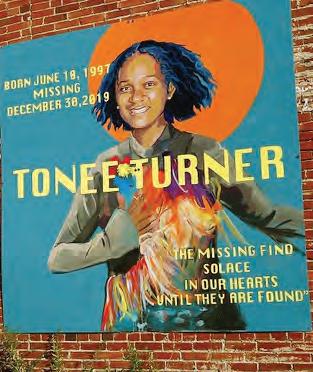
1,140 days since Tonee Turner was last seen.
On a Monday, around 6 p.m., Turner left the Dobra Tea shop in Squirrel Hill to catch a bus back to where she lived in Hazelwood. The bus driver reported seeing Turner get off the bus, as she usually did, on Gidding Street. She has not been seen since.

There have been few developments on the whereabouts of the then 22-yearold Black woman.
Turner’s disappearance garnered little national media attention, despite having similar circumstances to other, more mainstream stories involving missing women. The reason for the lack of national attention? Some say it could very well be the fact that Turner is not White.
“Missing White Woman Syndrome,” a phrase
coined by the late Gwen Ifill, the first Black woman to host a nationally televised U.S. public affairs program on PBS, described the tendency of media to focus coverage of missing-person cases that involve young, traditionally attractive, upper- and middle-class White women rather than women of color. On Feb. 3, Duquesne University hosted a panel discussion on Missing White Woman Syndrome with investigative, media and ethical considerations.
Understanding and assessing this sociological blind spot could help evaluate, and perhaps help to curb, the alarming violence occurring against Black women in the Pittsburgh area. It can also combat the biases in society that put an emphasis on the value of White women over Black women.
SEE MISSING WOMEN A4

 by Diane I. Daniels
For New Pittsburgh Courier
Most of Qiana Buckner’s adolescent years were spent in foster care and homeless shelters throughout the Pittsburgh area.
A Penn Hills resident for the majority of her adult years, leaning on her life experiences, she has been involved in the community helping others facing similar circumstances with the goal to build a promising future for young people by opening doors of opportunities for them. With the vision to lead and help the residents of Penn Hills, Buckner is campaigning to be the next mayor of Penn Hills. If successful, she will become Penn Hills’ first Black female mayor.
She relayed to the New Pittsburgh Courier that her priorities for the municipality are public safety, positive community-police relations, government accountability, community

recreation and investment, public infrastructure, and building pathways to quality living.
“There’s a need for restoration in Penn Hills,” Buckner said. “A need to build and strengthen partnerships and relationships that make our community stronger.”
During her official campaign announcement in December 2022, she said:
“I stand, with a grieving heart, for the young people and parents of our community whom I love, cherish, and connect with daily. Some of our residents have nowhere to go, nothing to do, and no recreational facilities or additional resources that address the mental, physical, and emotional stress they face regularly. Now more than ever, it is crucial for us to come together as a whole community.
Quoting our 16th president of the United States, Mr. Abraham Lincoln, ‘A
WhenBlack women go missing, whyQIANA BUCKNER IS RUNNING FOR MAYOR OF PENN HILLS.
When Ashley Gardner heard about Philadelphia Eagles quarterback Jalen Hurts having an all-women management team, she thought the news was unprecedented.
“Women have remained underrepresented in sport leadership for a long time, so Jalen Hurts deciding to bet on women with his all-women team is really unprecedented,” said Gardner, who is an assistant professor at Temple University’s School of Sport, Tourism and Hospitality Management. “His decision has created another legacy off the field for these women.”
Gardner added that it is still difficult for women to advance in sports, whether through playing or having a career, due to societal ideology and norms.
“Historically, sports were created for men,” Gardner said. “It wasn’t until Title IX in 1972 that it created equal opportunities for boys and girls. But still today, we see the trickle down effects of the centuries of advantage men had on women in sports.
“In the ancient Olympic Games, women were not allowed to enter facilities.
When women began to compete in sports, they said they were inferior because of their menstrual cycle. Now we’re seeing women being inferior not only on the field, but also off. There are still some people today who think women don’t belong in sports,” Gardner added.
According to the online recruitment service Zippia, 68 percent of all sports agents are White. Women make up just 23 percent of NFL agents and of that 10.4 percent are African American men or women.
Nicole Lynn, Hurts’ sports agent, is the first African American woman to represent an NFL draft pick in 2019, when she represented defensive tackle Quinnen Williams. She is also the first African American female agent to represent a quarterback in the Super Bowl.
She is the president of football operations for Klutch Sports Group, and in 2021 she published her autobiography “Agent You.”
Determined to represent Hurts in the NFL, Lynn reached out to him by sending him a direct message (DM) on Instagram.
“She took a risk by hopping in his DMs, but the great thing about her doing that is that now more women and women of color might be empowered to take risks too,” said Megan R. Smith, founder and president of Brownstone PR.

“Whether that’s in sports or another industry that is dominated by men,” she
• FEBRUARY 15
1804—The New Jersey legislature passes a law leading to the gradual elimination of slavery in the state. However, the process was so gradual that there were still slaves in New Jersey right up to the start of the Civil War in 1860.
said. “I also think it gives women the confidence to say
‘Let me step in the room and be my authentic self. Let me show up as myself, demand what I’m worth and put the ball in their court. Whether they decide to say yes or no, I showed up.’”
In addition to Lynn, Hurts has four women that manage his life around football. Klutch Sports Group’s Chantal Romain and Shakeemah Simmons-Winter are a part of Hurts’ media relations and client services management team.
Romain has experience in communication strategies for the NBA, WNBA, NBA G League and NFL. Simmons-Winter is a senior publicist who specializes in the FIBA and NFL. She was the New York Knicks’ public relations coordinator.
Jenna Malphrus handles client management and media relations alongside Simmons-Winter and Rachel Everett, who owns Everett Sports Marketing, handles the NFL star’s marketing.
“I have a team of straight hustlers. … They get things done,” Hurts said in a Sports Illustrated interview in 2022. “And that’s how I am on the field and off the field. We’re all trying to accomplish something.
“I admire anyone who puts their head down and works for what they want,” Hurts said. “And I know women who do that daily, but they don’t get the same praise as men—they don’t get the praise that they deserve.
“I’ve seen that now with tons of different women in my life that are hustlers. Athletes, coaches, women in the business world of sports,” Hurts added. “I see it all the time. And they deserve their flowers, too. So if me saying something about it brings more attention to it, then I’m all for that.”
Smith said Hurts is showing society the right way to invest in women businesses.
“When it comes to the conversation about Jalen Hurts and his all-women management team it’s incredible and dynamic, but for me what’s most important is that he made a financial decision to invest in women,” Smith said.
“He decided that he was
going to invest in the people that give him the best results and they all just happen to be women,” she said. “That is how you effect change with your dollars.
“This decision matters because not enough women and women businesses are getting the opportunities that his team are getting. All I keep thinking about is how his team can use this platform for the next big thing.”
Rakia Reynolds, founder and executive officer of the multimedia communications and marketing agency Skai Blue Media, said she would like to see Lynn be positioned as a thought leader.
“I would have Nicole on more stages and have her talk about why she chose her career,” Reynolds said.
“I would like to see her leverage this moment and create a sustainable plan so that she has more visibility around herself and the people that can come after her.

“I would also love for people to design more programming, talks and speeches around women who are shifting the lens, shifting the culture and blazing trails,” she said. “It’s all about the legacy work that we do.
“We shouldn’t just be in our career or working our jobs without looking around and saying, ‘Who are the people that are going to come after us? How are we setting an example and how are we opening doors for them? We should always be looking to open doors for other people behind us.”
Reynolds said the advice she would give students looking to be a communications professional or work in sports management is study, learn and consume media.
“Study the greats,” Reynolds said. “See what they’re doing, who’s surrounding them and what they’re consuming.
“Consume media and all of its properties whether it’s leaning into the world of artificial intelligence, having a strategic mind or poking holes in things that everyone is talking about,” Reynolds added. “Read the headlines, see what’s trending and gain as much experience as you can prior to jumping into the thing that you think you want to do.”
1851— In an extraordinary bold move for the times, a group of Black and White abolitionists invade a Boston courtroom and forcibly free a fugitive slave before he could be sent back to the South. Shadrach Minkins was hidden from slave-catchers and he later fled to Canada.
1961— A group of U.S. Blacks and African nationalists disrupt a session of the United Nations to protest the slaying of Patrice Lumumba in the Congo. Lumumba was one of Africa’s bright and shining stars. But his nationalism and socialism frightened some Western nations. It is widely believed that Belgium intelligence and America’s CIA arranged the killing of Lumumba.
1965— Great singer and Jazz pianist Nat King Cole dies of lung cancer in Santa Monica, Calif. He was only 45. Cole was the first Black entertainer with his own radio program and later he became the first with a nationally televised TV variety show.
• FEBRUARY 16
1923— The “Empress of the Blues” Bessie Smith makes her first recording—“Downhearted Blues”—which immediately sells more than 800,000 copies for Columbia Records and more than 2 million copies by the end of the year. Those were astounding numbers for those days. The Chattanooga, Tenn., born Smith used her sweeping and powerful voice to sing songs of Black culture and real life such as “Nobody Knows You When You Are Down And Out,” “St. Louis Blues,” “Give Me A Pig Foot And A Bottle Of Beer” and the controversial “Give Me A Reefer And A Gang Of Gin.” She died in an automobile accident in 1937 in Clarksdale, Miss. Early reports that her death was caused by Mississippi medical personnel who refused to treat her because she was Black have never been verified.
• FEBRUARY 17
1902— Opera legend Marian Anderson is born in Philadelphia. Her tremendous operatic talent was revealed at 17 when she was entered into a New York Philharmonic competition and placed first among 299 entrants. Despite her fame she suffered from racist rejection. On Easter Sunday 1939, she performed an open air recital at the Lincoln Memorial because the all-White Daughters of the American Revolution refused to allow her to sing at Washington, D.C.’s Constitution Hall. (NOTE: Throughout her life Anderson gave her birth as Feb. 17, 1902. However, newly discovered evidence suggests she was actually born Feb. 27, 1897.) She died April 8, 1993.
1942— Black Panther Party co-founder Huey P. Newton is born. The Panthers were perhaps the most militant Black organization of the 1960s. At its height, it had thousands of members in several major cities. But it was also the target of massive operations by the FBI and local police departments. Dozens of Panthers would be killed, often under suspicious circumstances. A little known fact, however, is that throughout it all, Newton, an illiterate high school dropout, taught himself to read and in 1980 earned a Ph.D. in social philosophy from the University of California, Santa Cruz. His dissertation was entitled, “War Against the Panthers—A Study of Repression in America.” Newton was found shot to death on an Oakland, Calif., street in 1989.
1963— Perhaps the greatest player to ever dribble a basketball, Michael Jordan , was born on this day in Brooklyn, N.Y. However, his family moved and he played high school basketball in Wilmington, N.C.
1982— The nation’s greatest Jazz pianist and composer Thelonious Monk dies. Born in Rocky Mount, N.C., Monk moved with his family to New York City when he was 4. His classic work was “Round Midnight.”
2006— African-American skater Shani Davis wins the men’s 1,000-meter speed-skating race in Turin, Italy. He became the first Black person to win an individual gold medal in the history of the Winter Olympics.
• FEBRUARY 18
1688— The first formal protest against slavery is conducted by a group of Quakers in Germantown, Pa. They denounced slavery and the slave trade. The Quakers were perhaps the only religious group in America that never compromised and consistently opposed slavery.
1913— The Delta Sigma Theta Sorority was incorporated at Howard University.
1931— Author Toni Morrison is born
Chloe Anthony Wofford in Lorain, Ohio. She won the Pulitzer Prize for Literature in 1993 for her novel, “Beloved.”
• FEBRUARY 19
1919— The “first” Pan African Congress is held bringing together prominent Blacks from throughout the world to chart a program for Black unity and betterment. African-American scholar and activist W.E.B. DuBois was the chief organizer. The gathering was held in Paris, France, and drew 57 distinguished delegates including 16 from the United States, 14 from Africa and others from the Caribbean, South America and Europe. (The 1919 Congress is considered by many the “first” but another such Congress had been organized in 1900.)
1940—Smokey Robinson is born William Robinson in Detroit, Mich. He formed “The Miracles” in 1955 while still in high school. With his voice and poetry of song, Robinson led The Miracles as the group became one of the all-time best record-sellers for Barry Gordy’s Motown music empire.
1942—The Tuskegee Airmen are activated for service in World War II. The all-Black pursuit squadron, later designated 99th Fighter Squadron, was organized and trained at Tuskegee Institute in Alabama. The squadron served with honors in Europe. During the war, the nearly 1,000 pilots who had been trained flew 15,000 sorties, destroyed 1,000 German aircraft and earned more than 150 Distinguished Flying Crosses.
• FEBRUARY 20
1895— The great Black leader Frederick Douglass dies at 78 in Washington, D.C. Douglass was the foremost Black abolitionist struggling to end slavery in the mid-1800s. He used his great oratory skills and his abilities as a newspaper publisher on behalf of freedom and justice for Blacks. Most of his early work emanated from the Rochester, N.Y., area. But after the Civil War he moved to Washington, D.C. Douglass was the nation’s foremost Black leader for nearly 40 years.
1927— Actor Sidney Poitier is born in Miami, Fla., and grows up on Cat Island in the Bahamas. However, by the early 1950s, he was establishing a career in movies. Indeed, it can be said that Poitier was the first Black actor to make it in mainstream movie roles without having to play stereotypical and often demeaning “Black roles.”
1963— Basketball great Charles Barkley is born on this day in Leeds, Ala.
1933— Song stylist and activist Nina Simone is born Eunice Waymon in Tryon, N.C. She was a child prodigy who was playing the piano by age 4. She had numerous songs to her credit, but one of the most memorable was “Mississippi Goddam” which was composed as a protest against the terrorist bombing of a Black church in Birmingham, Ala., which resulted in the deaths of four little Black girls. Simone, often referred to as the High Priestess of Soul, died in France on April 21, 2003.
1965— The most prominent Black nationalist of the 20th century, Malcolm X , is assassinated on this day in Harlem, N.Y.’s Audubon Ballroom while giving a speech which was to issue a call for Black unity. Born Malcolm Little in Omaha, Neb., on May 19, 1925, he graduated at the top of his high school class but had his dream of becoming a lawyer crushed when a teacher told him that was “not realistic for a Nigger.” He gradually drifted into the underworlds of first Boston and then New York where he became a drug dealer and gangster known as “Detroit Red.” He was friends with comedian and upcoming star Redd Foxx who at the time was known as “Chicago Red.” Malcolm was arrested and jailed for robbery at age 20. While in prison he converted to the Nation of Islam and after his release in 1952, he became the leading force building the group into a major national organization. He was a brilliant orator and organizer as well as a fierce opponent of racism, imperialism and the non-violent approach to combating the nation’s evils. But disagreements with Nation of Islam founder Elijah Muhammad led to a split. He then formed the Organization for Afro-American Unity. However, 11 months after his split with the Nation of Islam he was assassinated. Many in the Black community felt the New York City police and the FBI played a role in his death. But three man associated with the Nation of Islam were tried and convicted of his murder.


“I think anytime when you see women, especially women of color, being killed or victims of homicide it is alarming,” said Kathi Elliott, executive director of Gwen’s Girls. “Historically this group has often been overlooked when tragedy or death or homicides have happened.”
According to a 2019 report by the City of Pittsburgh’s Gender Equity Commission, Black women are “more likely to die of homicide than Black women in 93 percent of similar cities” and the city’s “young adults and older adults of all racial groups are more likely to die from homicide than the na -

tional average.” And in 2020, more than a third of the 268,884 women and girls who were reported missing in the U.S. were Black, according to the National Center for Crime Statistics. Black girls and women account for just 15 percent of the U.S. population. “This is very alarming but unfortunately I’m not surprised,” Elliott told the Courier of the data. “Historically, Black girls and women’s lives aren’t valued or protected. Black girls are often seen as complicit in or the cause of the oppressive, abusive, exploitive and traumatic incidences that they experience. What’s
more surprising is that addressing this isn’t a priority and that most people don’t know this horrible fact.”
Elliot, who joined the board of Gwen’s Girls in 2007 and became the CEO in 2015, is all too familiar with the discrepancies when it comes to the news coverage of Black women being victims to homicides and abductions.
“What we’ll tend to see is there might be something mentioned on the news sometimes,” Elliott said. “Then there is not follow-up or any type of effort to use the media or alarm the community to what has happened to that woman and family.”
In her years of expe -

rience, Elliott said she has seen a common narrative in the press and popular culture that assumes the missing Black woman played a role in her disappearance, more so than in instances of missing White women.

“Somebody must be holding them against their will or making them do something,” Elliot said. “The same assumption is not afforded to Black girls.”
In 2017, the Georgetown Law Center on Poverty and Inequality released the study, “Girlhood Interrupted: The Erasure of Black Girls’ Childhood,” which
revealed that adults view Black girls as less innocent and more adult like than their White peers.
“This whole concept of adultification, looking at Black girls being more adult-like and not needing as much caring and support as White girls, is something we’ve seen historically,” El -
liott told the New Pittsburgh Courier. “We’ve seen it in our communities and within our families, but people are not aware of some of the underlying issues that go with what’s happening.”
While race and gender play a major factor on which story receives the most attention, it is not the only factor.
Paula Reed Ward, a reporter for the Pittsburgh Tribune-Review and one of the panelists of the Feb. 3 discussion, noted the nuances that exist when dealing with missing person cases.

“Race is absolutely a consideration in these cases,” Ward said. “But there are other factors that come into play, too.” Those factors, such as socioeconomic status and how media-savvy a family is, can contribute

-
to how much emphasis is placed on a missing person’s case.
“I don’t want to ever see any child abducted, Black or White,” said Pittsburgh Assistant Police Chief Lavonnie Bickerstaff, who also spoke on the panel. “But I do believe if it’s (an) affluent couple, and they know how to maneuver the media...”
Bickerstaff added that
such couples would have the resources to help them travel to media outlets and reach national audiences in ways that less-affluent parents could.
“I think that we will see, maybe not as much, but I think some good coverage on getting that young lady or young man returned,” Bickerstaff said.
Bickerstaff also be -
lieves family and community can play a significant role in helping recover missing persons.
“Community is critical at all of our police endeavors,” Bickerstaff said. “They can go and do and say and get the information that police will never get.”
The New Pittsburgh Courier has learned that human trafficking has been on the increase in the Pittsburgh area, according to FBI Pittsburgh. Human trafficking is the illegal exploitation of a person. Anyone can be a victim of human trafficking, and it can occur in any U.S. community—cities, suburbs and even rural areas. Every year, many adults and children are trafficked worldwide, with more than 1,675 pending FBI cases as of January 2023. In fiscal year 2022,
the FBI initiated 668 human trafficking investigations nationwide. The largest percentage and greatest number of sex trafficking victims recovered in the United States are U.S. citizens. FBI Pittsburgh said that human trafficking victims can be held captive through force, fraud, or physical or psychological coercion. Warning indicators of human trafficking include: Victims work in the same place they live; Poor living conditions; They let someone else
speak for them; They are not in possession of their own travel or immigration documents; There are locks on the outside of doors where they live, rather than inside; They are constantly watched and guarded by someone; Their boss takes their pay or threatens them; They are lied to about the work they are to perform; They are not free to leave.
Victim recovery is the primary goal of trafficking investigations. The FBI’s multi-disciplinary team of agents, analysts,
victim specialists and forensic interviewers work together to ensure a victim-centered, trauma-informed response. FBI victim specialists work with local state and federal resources to provide immediate assistance (shelter, food, clothing) and longterm support (counseling, education assistance, job training). After recovering a victim of human trafficking, field offices seek to arrest and successfully prosecute the traffickers. In the past decade, the FBI’s human trafficking
investigations have been responsible for the arrest of thousands of traffickers and the recovery of numerous victims.
“Human trafficking happens every day, and it often occurs in plain sight,” said FBI Pittsburgh Special Agent in Charge Mike Nordwall, in a statement to the Courier. “Criminals exploit their victims and treat them like commodities for their personal gain. We will continue to collaborate with our partners at every level to focus on this criminal activity
and go after those who are targeting our children and putting them in harm’s way.”
People who are or believe they may be victims of human trafficking may call the National Human Trafficking Hotline at 888-373-7888. More information is available on the National Human Trafficking website. You may also report an incident of human trafficking or suspected human trafficking to FBI Pittsburgh at 412432-4000.

house divided against itself cannot stand.’”
Buckner continued: “We cannot and will not forget all of the people who live here that make up our community. For years now, the leadership regime has chosen in the words of a dear friend, ‘politics over the people.’ Parents have lost their zeal to become actively involved because they have been pushed away or they simply continue to wonder what they can do. Our community has been crying out for change for years, only for it to be ignored.”
Affordable housing is a major concern and focus of Buckner’s campaign. “Our housing market was once welcoming and within the means to people like me. A community where I could flourish and do my part. These days, that is no longer the case and creates a void for those trying to improve living conditions for their family. They are turned away from our community when it comes to being active and getting the job done. This is not the Penn Hills community that I remember. Housing prices and taxes continue to rise, causing a pathway to affordable living to be nearly impossible.”
Equally important to her are the relations between the police department and the community, which she believes has eroded over time. “We are one community, and we need to stand strong for Penn Hills. It is a time for us to all come together to support the
safety and future of our children, residents, and business owners.”
An entrepreneur, advocate, educator and published author, Buckner currently serves as a member of the Early Childhood Education League, where the team focuses on grassroots policy issues for children and families related to early childhood education. For eight years until the

COVID-19 pandemic, she was vice president of the Board of Directors for the Penn Hills Charter School of Entrepreneurship and served as head of the personnel committee, as well as the director for their Soaring in the STEAM program.

The entrepreneurial ventures that she deems as “passion projects” include a mentoring program for girls ages 12 to
17 called Girl P.O.W.E.R., a sports/mentorship camp called Camp of Champions, and expositions for education, health and wellness. Her scholarship program, Gifts for Grads, provides furniture for dorm rooms of high school graduates entering fouryear colleges. Never one to shy away from hard work or a challenge, Buckner is simultaneously running for mayor while operating her other ventures. She’s working on becoming executive director and CEO of Diamond in the Rough Productions and Lady Q Network. The businesses focus on event planning, locally and on a global scale.
“I host women’s empowerment conferences and speak motivationally at the national level to encourage CEOs and entrepreneurs by sharing my life’s journey with others to provide inspiration and guidance,” Buckner told the Courier. She is also the author of three books. Her latest release, “Of Course, I’m Cute; Affirmations and Declarations to Polish Your Inner Diamond,” focuses on affirmations for women and young girls to empower themselves daily. Her first book, “My Journey. My Peace.,” reveals her life’s journey, and her second book, “Metamorphosis,” is her letter to transformation.
Buckner, the mother of 15- and 13-year-old sons, is striving to bring her personal, professional, and leadership experiences to the office of Penn Hills mayor. “Together, we must put in the work and stand strong for Penn Hills youth and senior citizens, all races, nationalities, and income levels. Relationship-building has to take priority within the community and we have to reach beyond our boundaries.”

 by Genea L. Webb
For New Pittsburgh Courier


Miya Gaines is leaning on her relationships with her older female family members to portray the sassy Louise in August Wilson’s “Seven Guitars.”
“I look at my own great grandmother and aunts who are similar to Louise and I pull from that,” explained Gaines, a 21-year-old junior linguistics and theater major at the University of Pittsburgh who hails from the D.C. area. “Louise’s past is long gone and she’s constantly trying to move forward. She doesn’t understand that the other people in the cast have to move forward. August Wilson plays with characters’ emotions but the characters all have a common goal.”
Set in the backyard of a Pittsburgh tenement
in 1948, “Seven Guitars” tells the story of a blues guitarist and singer— Floyd “Schoolboy” Barton—who unexpectedly died just when he was on the verge of stardom. Friends then gathered to reminisce about his life and speculate about his untimely death. The play, which was a finalist for the 1995 Pulitzer Prize for Drama, and winner of the New York Drama Critics Award for Best Play, is the 1940s effort of Wilson’s Pittsburgh Century Cycle—10 plays that highlight a slice of Pittsburgh life decade by decade during the twentieth century.
“Seven Guitars” will be presented by Pitt Theatre Arts from Feb. 17-26 at the Charity Randall Theatre, 4301 Forbes Ave., as part of a weeklong celebration preceding the grand opening celebration of “From the
Hill to the Stage: Celebrating the August Wilson Archive with the University of Pittsburgh Library System,” from Feb. 24-March 3. “Pitt was honored with the archive as a way to help get August Wilson productions on their feet. We really wanted to do the work justice and once you understand the material and the gravity of the language it allows you to delve into the play’s world,” said Pitt dramaturge Victoria LaFave. “August Wilson isn’t here with us, but the archive is open and I was able to go in there and read his notes and some faxes, which allowed me to be able to share his world with the Pitt actors.” The university also enlisted the help and direction of several professional Pittsburgh actors to play key roles in the production alongside the students. Those actors include Wali Jamal, Tru Verrett-Flemming and Chris Colyer. Jamal will be portraying the mystical Headley in the production.
“I enjoy working with the kids,” Jamal said. “This is new to the kids and they don’t know what’s safe and it’s awesome to see them learning. They learn about the the common sense of theater and they learn about the other aspects of theater, like the set designer. I try to take away unnecessary stress for the kids.” Jamal will be performing the character of Headley for the third time during this special
production. He’s also performed in all 11 of Wilson’s plays. “August Wilson wrote rich, fulfilling characters for the older Black man. For people watching August Wilson’s play for the first time, they’re in for a treat because people are going to hear their family’s voices and hear that these situations, regardless of the decade, are relatable and that’s what makes August Wilson’s work so good because it deals with the basic human condition. Regardless of what you think, August Wilson didn’t fail to put in the characters’ dignity.”

Following his “Seven Guitars” run, Jamal will be performing
Wilson’s one-man gem, “How I Learned What I Learned,” at the August Wilson Center for African American Culture, March 2-4 during the August Wilson Society’s Biennial Colloquium. Wilson’s intricate characters are what drew Gaines to tackle the role of Louise.
“I love that August Wilson didn’t give concrete direction and he wants us to embody the characters,” Gaines told the New Pittsburgh Courier. “Everyone in the cast has a positive attitude and the older actors don’t shy away from getting to know us. This show is full of energy, the set is gorgeous and everything happening is so rich.”


DR. PHILMORE HAMIL CRICHLOW

On Sunday, December 4, 2022, Dr. Philmore Hamil Crichlow, formerly of Churchill, passed away at age 95. He was born on the island of Tobago in the West Indies on July 31, 1927. In 1948

Philmore immigrated to the United States earning a medical degree in 1956 from Howard University in Washington, DC. Dr. Crichlow went on to have a 55-year career practicing medicine in Pittsburgh with great care and compassion. There will be a Pittsburgh Celebration of his life on Saturday, May 6, 2023 at Church of The Holy Cross, 7507 Kelly St., in Homewood, at 11:00 AM.
ETHEL DIGGS GANDY

Education: Linwood Elementary School, David B. Oliver High School, Duquesne University School of Nursing (BS, RN), and Graduate Program at the University of Michigan at Ann Arbor (MS, PH).
Employment: Visiting Nurse Association (VNA) at Allegheny Circle Northside (Sandusky Street) and throughout the Allegheny County (1956). Ethel secured a position at West Penn Hospital as Director of Home Care Services (1967). Joined the staff at Hospital Home Health Care Agency of California in Fullerton, CA, where she became the Director of Services (1992).
Home: Long time Northsider, relocated to Pasadena, CA (1989), retired to Moreno Valley, CA (1997}.
Marriage: Quevelle Gandy on February 12, 1966. Memorial Service: Saturday, February 18, 2023 at 11:00 am, Metropolitan Baptist Church 22 Sampsonia Street Pittsburgh, PA 15212 ALL ARE WELCOME.


Mrs. Elizabeth Thomas is celebrating her 100th birthday! She was born February 17, 1923 in Pittsburgh, Pennsylvania. She was the fifth child born to John and Willie Mae Holt. Mrs. Thomas married Elder Freeman L. Thomas November 27,1948. She was a dedicated homemaker while raising her only daughter, Karen. She was First Lady of Shiloh Apostolic Church in Wilkinsburg, PA where her husband pastored for many years. She has a deep faith and was a favorite Sunday school teacher to many students. She is a loving mother, grandmother, great-grandmother, sister, church mother and friend to many.

“O praise the Lord, all ye nations: praise Him, all you people. For His merciful kindness is great toward us: and the truth of the Lord endureth forever. Praise ye the Lord.”
- Psalm 117:1-2
REV. WALKER SAYS: WE PRAISE YOU LORD AND THANK YOU, TOO. From the Rising of the SUN unto the going down of the same the LORD’s Name is to be praised. (Psalm 113:3)

:10—I know how much you wish, I mean really wish, I wasn’t that guy. But alas, I am that guy. You know, the I told you so guy. Just go back a few weeks and be reminded of my prediction—KC Chiefs 31 - Philly Eagles 24. Off by a few points but close enough to talk a little smack! (The fact I guessed wrong on the last five Super Bowl games has nothing to do with it.)
:09—OK, let’s get this out of the way for good.
Note to Philly fans and a few local talk show hosts who apparently put their life savings on the Eagles, or so it would seem. The point is the official made the call he saw, he’s not programmed in a split second to yea or nay. Secondly, hey Philly fans, if you stop the Super Bowl
record-breaking punt return by Kadarius Toney you don’t set yourself up for the end result. Lastly, and this really should end the crying—Eagles cornerback James Bradberry admitted to the penalty... ‘nuff said!
:08—Sorry, not done yet but almost. No scary Philly D-Line, strangely no Philly run game to speak of with Pittsburgh’s own Miles Sanders under-utilized. And correct me if I’m wrong but the Eagles were supposed to have the greatest O-Line since the 1976 Steelers! OK, enough pain—I’m finished.

:07—Same church but different row, and I know you’re thinking what I’m thinking—Will somebody please send Matt Canada the Chiefs playbook? Oh,
my bad, I thought that’s what you were thinking. Help me, Lord, help me Lord, help me Lord!
:06—To that point, JuJu Smith-Schuster is the second Steeler receiver to leave the Steelers recently and get a Super Bowl ring.
I’m just sayin’! (Antonio Brown with Tampa Bay mannnn!)
:05—Oh... Oh... Oh... Hold up, wait a minute
—“Now let me clear my throat” (DJ Kool)—I told you I am not watching the halftime show starring Rihanna, aka RiRi.
I made the mistake of watching it! Look, I am not a hater and God bless the sister for getting paid. But if you think that show lands anywhere near Michael Jackson, 1993, Janet Jackson, 2004, Prince, 2007 or Bruno Mars, 2014, then I don’t know what to tell ya... Just Google or YouTube and see for yourself.
:04—Now on to some other stuff. The Pittsburgh Pirates collection of what they refer to as pitchers, and the catchers have reported to spring training camp. Why, you ask? I - Don’t - Know!
:03—While you were sleeping the IUP men’s basketball team sits alone in these United States as the #1 Division II program. And it’s not the first time—they’ve been there
before. Hoo-Rah!
:02—If you’re thinking for some strange reason the Pitt men’s basketball team should not be ranked in the Top 25, you would be correct. That’s because they should be ranked in the Top 15! I’ve come to this conclusion with some good ol’ old school math. If I beat every team ranked ahead of me from the ACC, and some twice, I should probably be ranked ahead of them. C’mon man!!!
:01—You’re doggone right I left the best for last. You can have your list, after all this is America... Freedom of Speech and all that jazz, but here’s the true list, period. End of story... again! The 10 Greatest Basketball Players of All-Time are as follows—#1 - Kareem Abdul-Jabbar #2 - Wilt
Chamberlain #3 - Michael Jordan #4 - Julius “Dr. J” Erving #5 - Earvin “Magic” Johnson #6Kobe Bryant #7 - LeBron James #8 - Larry Bird #9 - Jerry West #10 - Connie Hawkins. I know it and now you know it too. Now, the most accomplished player of all-time is Bill Russell—c’mon man, 11 rings! Are you serious?!?! And, no, I didn’t forget LeBron James. You want him, you got him! But I will tell you this—If any number of capable players had a four-year head start (meaning no four years of college like Kareem had) they would be the all-time leading scorer in NBA history. I’m just sayin’!!! I know, I know, just call or text me at 412-628-4856. :00—GAME OVER.
Hello, ladies and gentlemen, Super Bowl LVII was played and decided on February 12, 2023. It might as well have been February 12, 1865. Why?
Well, because the perceived premise that the NFL is defeating racial disparity is proving to be a flat out lie. Super Bowl LVII featured two Black quarterbacks competing in a Super Bowl for the first time in the 103-year history of the league.
Doug Williams was the first Black quarterback to win a Super Bowl when he defeated John Elway in Super Bowl XXII. Russell Wilson and Patrick Mahomes followed.
All the pundits are hemming and hawing about this being the first time that two Black quarterbacks competed in a Super Bowl. It should not
have been the first time for that momentous occasion. The percentage of Black players currently playing in the NFL stands at about 70 percent. Yet there are just six Black starting quarterbacks out of 32 teams. Time to pull out the Ouija board, mix up a few rum and cokes, and put Albert Einstein on speed dial because the math seems to be a bit off, doesn’t it, boys and girls? I am not going to name the “savvy six” because we are not talking about reindeer Donner and Blitzen. We are talking about a league that keeps apologizing about its systemic and cultural racism as opposed to actualizing real and substantive changes. Why did it take 103 years for two players of color to face off in an NFL Championship? There
have been many fences built and maintained around the glamorous quarterback position in the NFL. Many excuses such as: Blacks were not smart enough to perform adequately at such a high level, they were better at using their feet to get out of trouble as opposed to remaining in the pocket without panicking. Those myths were dispelled decades ago but those fences still remained firmly in place.
Liz Granderson recently posted an article quoting
Chris Rock on latimes.com titled: “The Super Bowl is being cast as progress for Black quarterbacks.” She quoted Rock as saying:
“To say that Black people have made progress would be to say they deserve what happened to them before,” Rock said in 2014.
“So to say Obama is progress is saying that he’s the first Black person that is qualified to be president. That’s not Black progress. That’s White progress. There’s been Black people qualified to be president for hundreds of years.”
Ms. Granderson continued by pointing out that: “Similarly, it’s not that Black men have finally proven themselves capable of playing quarterback. It’s that the NFL has begun to correct a history of discrimination during which the Canadian Foot-

ball League effectively served as Black quarterbacks’ Negro Leagues.” Blacks were forced to migrate to Canada to escape slavery before the emancipation proclamation was signed by Lincoln. They were forced to go to Canada to be recognized as professional football players as well as to avoid being shipped off to Vietnam to fight as far as they were concerned an unjustified and unnecessary war. For all intents and purposes, Blacks were always qualified to participate in any activity or profession. However, it has been clearly established that White society would rather put an inferior product on the baseball field, the gridiron, and the basketball court just as long as the competition remained White. Slow White play-
ers could not show up other slow White players because slow and inadequate against slow and inadequate, well you know, no harm no foul. Ridding sports of ownership and managerial racism is at best a romanticized fantasy because the I-V that releases the slow drip of the antibiotic to cure racism is relative to eyedrops falling on concrete.
As I began writing “Bayard Rustin: American Dreamer,” my biography of the 20th-century radical leader and activist, one of my colleagues cautioned me not to “fall in love.”
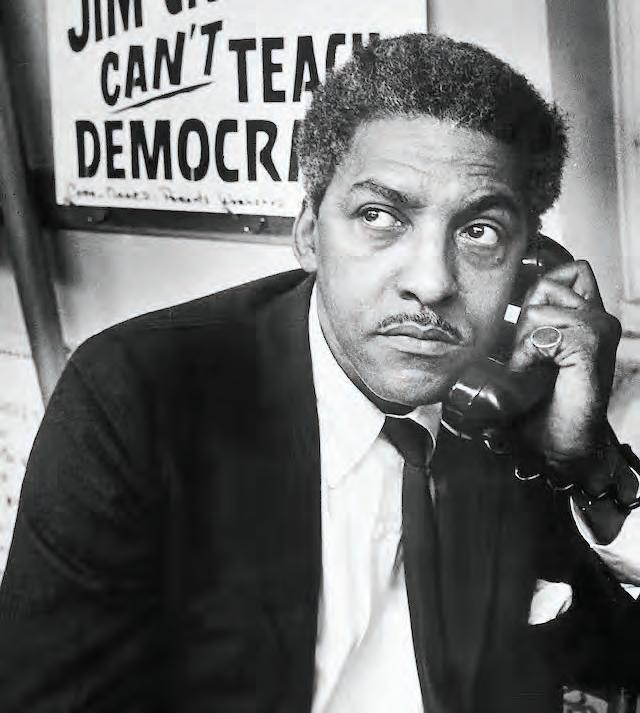
This, of course, is good advice for any biographer, and I tried to follow it.
But it wasn’t easy, because Bayard Rustin was America’s signature radical voice during the 20th century, and yes, I believe those voices includes that of the Rev. Martin Luther King Jr., whom Rustin trained and mentored.
His vision of nonviolence was breathtakingly broad.
He was a civil rights activist, a labor unionist, a socialist, a pacifist and, later in life, a gay rights advocate.
Today, scholars would call Rustin an intersectionalist, a man who understood the complex effects of multiple forms of discrimination, including racism, sexism and classism.
Roosevelt banning racial discrimination in the nation’s defense industries.
then known as a “public indecency” offense, involving sex with two other men in a parked car.
A few years later, King forced him out of the Southern Christian Leadership Conference, fearful of the damage the issue of Rustin’s homosexuality could do to his organization.
Early
Born in West Chester, Pennsylvania, on March 17, 1912, Rustin was one of 12 children raised by their grandparents. It is believed that his devotion to civil rights was formed by his grandmother, whose work with the NAACP resulted in leaders of the Black community, such as W.E.B. Du Bois and Mary McLeod Bethune, visiting the Rustin home during his Quaker upbringing. Rustin was present at the creation of a host of pivotal American liberation movements. He helped found the Congress of Racial Equality and the Southern Christian Leadership Conference, two civil rights organizations that were focused on ending the Jim Crow era of racial segregation.
He worked with Black trade unionist A. Philip Randolph on the 1941 March on Washington Movement, which bore fruit in an executive order by President Franklin
Rustin and Randolph worked again in 1948 on a successful campaign to end segregation in the U.S. military under President Harry Truman. A pacifist, Rustin protested World War II by resisting the draft and, as a result, was imprisoned in 1944 as a conscientious objector.
After his release in 1946, Rustin became a major figure for the next two decades in two prominent pacifist organizations, the Fellowship of Reconciliation and the War Resisters League, both of which opposed the use of violence to settle disputes between individuals or nations.

In 1947, he and members of the Congress of Racial Equality planned the Journey of Reconciliation, the first organized effort to desegregate interstate bus transportation in the South.
Role in Montgomery bus boycott
Because of that work to integrate public transportation, Randolph suggested in 1956 that Rustin meet with a young preacher in Alabama who
was organizing a bus boycott there.
That meeting with the Rev. Martin Luther King Jr. during the Montgomery Bus Boycott of 1956 changed both men forever.
From then on Rustin advised King on the prin-
ciples of Gandhi and nonviolent direct action that —when combined with lawsuits, voter registration drives and lobbying efforts—ultimately led to passage of both the Civil Rights Act of 1964 and the Voting Rights Act of 1965.
For Rustin, Black progress depended on politics and economics. To that end, in 1966 Rustin proposed the “Freedom Budget for All Americans” that promised every American employment, an income and access to health care.
His proposal became the template for progressive political activists in the 21st century.
Jobs and freedom
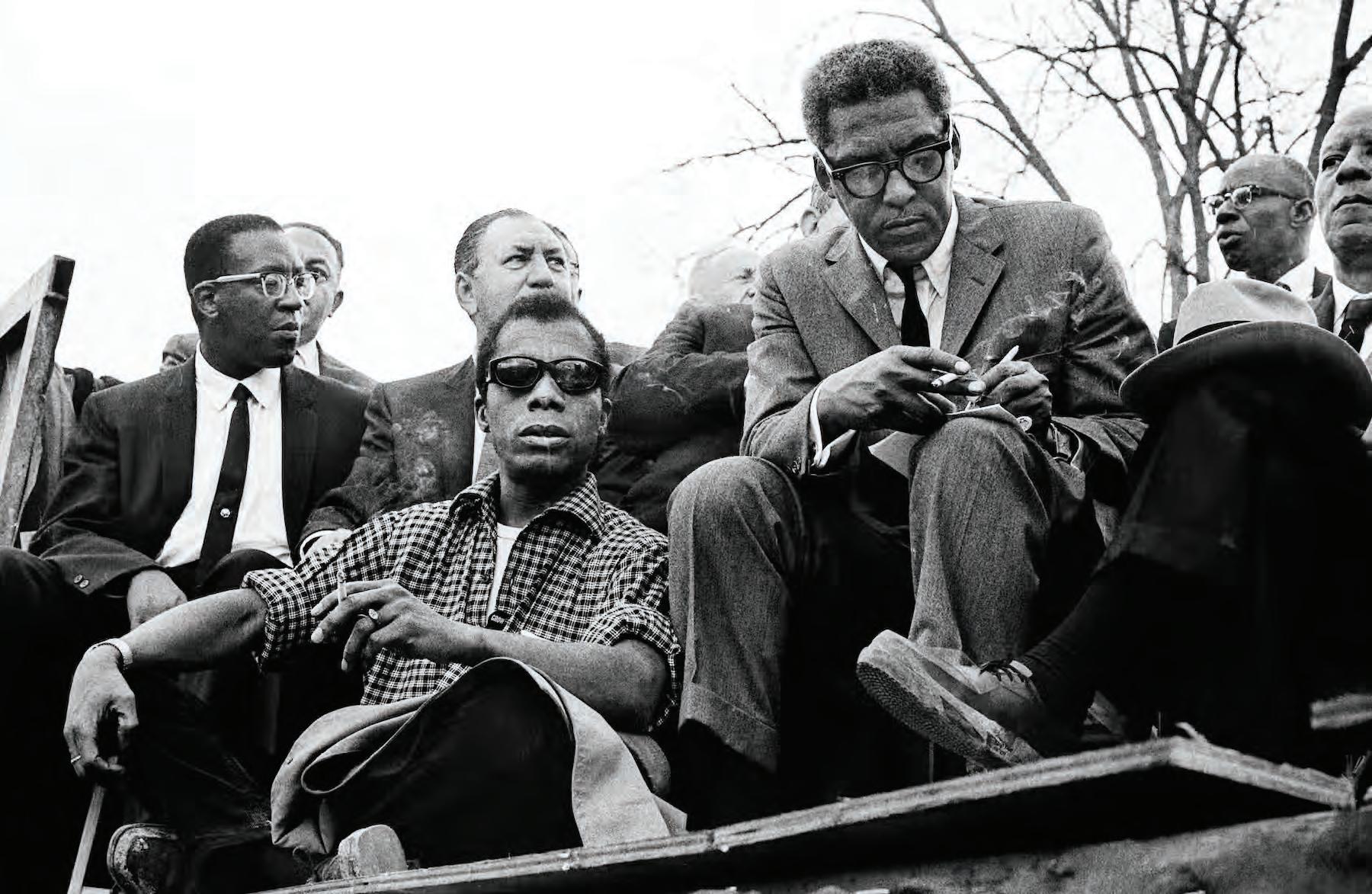
Rustin is best remembered as the organizer and orchestrator of arguably the seminal event in American civil rights history—the 1963 March on Washington for Jobs and Freedom. But it almost did not happen.

Rustin’s homosexuality had always been an issue, and not just to his opponents on the American right or to J. Edgar Hoover and the FBI.
Many progressive activists who were open-minded on matters relating to civil and labor rights were much less so when it came to Rustin’s sexuality.
Rustin had been fired by the Fellowship of Reconciliation after his 1953 conviction in Pasadena, California, on what was
It took the direct intervention of Randolph, Rustin’s lifelong friend and champion, to get King and other major civil rights leaders to agree to his selection as the organizer and orchestrator of the March on Washington in 1963. Rustin then had to survive a denunciation by segregationist Sen. Strom Thurmond on the floor of Congress shortly before the march, during which the South Carolina lawmaker read from FBI reports on Rustin’s flirtation with communism—he had belonged to the Communist Party briefly as a young man—and his homosexuality and arrest in Pasadena.

But Rustin’s ability to organize was now too valuable to lose, and this time King stood by him.
As my research shows, King knew that only Rustin, who had spent the previous two decades leading demonstrations and walking picket lines, had the knowledge and experience to move 250,000 people in and out of Washington, D.C., on a hot summer day.
King also knew that Rustin could manage everything in between, including the order of the speakers.
By insisting that King be placed last on the program, Rustin ensured that King would have the final word and maximum dramatic effect. Though Rustin didn’t know it at the time, King’s “I Have a Dream” remarks eventually constituted one of the greatest speeches ever delivered in American history.
Rustin’s internal conflicts
The constituent parts of Rustin’s radical vision were often at odds and difficult to achieve, forcing Rustin into wrenching choices, as I learned during my research.
During World War II, for instance, he chose pacifism over the cause of civil rights when he refused to bear arms against a racist Nazi regime.
During the Vietnam War,
he chose socialism over pacifism when he muted his criticism of President Lyndon B. Johnson’s policies in the hope of enacting his Freedom Budget for All Americans.
And in 1968, as a Whiteled teachers union and Black activists struggled for control of New York City’s public education system during the bitter Ocean Hill-Brownsville crisis, Rustin chose labor


rights over civil rights and class over race as he lent his support to the union. These choices cost Rustin allies and friendships, as former colleagues who afforded themselves the luxury of one-issue purity denounced him as an apostate, a hypocrite, a turncoat or worse.
But Rustin was none of those. He dedicated his life to helping, as he put it, “peo-
ple in trouble,” whomever and wherever they might be. Accordingly, he put himself on the line for democracy advocates all over the world. They included African Americans, Latinos, working men and women, union members, the poor, war critics, anti-nuclear protesters, gays and lesbians, students, leftists, Soviet Jews, and Haitian, Hmong and Afghan refu-
gees.
If those allegiances appear to be contradictions, in my view they were of the best kind.
Love for Rustin?
Above all else, Rustin chose to help people in trouble based on their condition, not their identity.

For that he has, if not my love, then my profound respect.
Of all the voices I’ve
heard on my journeys through America’s 20th-century history, it is his that resonates most with me. Rustin died in 1987, his radical vision unwavering until the end.
(Jerald Podair, Professor of History, Lawrence University)
(This article is republished from The Conversation under a Creative Commons license.)

For New Pittsburgh Courier
It is officially tax season, according to the Internal Revenue Service, which declared that this year’s tax season started on Jan. 23.
It’s that special time of year when people collect their documents to either rush over to their tax preparer or enter in themselves so that they can receive those nice tax refund checks.
The IRS estimates that they will receive more than 168 million filers this year, most of who will be filing before the April 18 tax deadline. They are urging all taxpayers to file electronically with direct deposit to speed up the process of receiving refunds and avoid any possible delays.
However, before you file your taxes there are some new updates that you need to be aware of, such as IRS warns that 2023 tax refunds may be smaller: The IRS released a statement that taxpayers should brace themselves for small tax refunds due to no economic impact payments (or stimulus payments) being released in 2022.
Also, for people with children, the enhanced child tax credit is now gone, leaving parents with a lower tax refund check than what they received for the 2020-2021 filing years.
• Earned Income Tax Credit of Additional Child Tax Credit filers will have to wait: The IRS will not issue refunds involving the Earned Income Tax Credit or Additional Child Tax Credit before mid-February. This gives the agency extra time to review each case to prevent fraud. Taxpayers who qualify for these tax credits should expect
Arnold Donald possesses two rare, equally enviable and diametrically opposed gifts. He can foresee, prepare for, and ultimately manifest an unlikely and successful future, and he can successfully navigate utterly unforeseeable crises with grace and aplomb.
Someone with his pedigree could point to more than one example of displaying both of these gifts, but the basics must be told.
A son of parents (Hilda Aline Melancon Donald and Warren Joseph Donald Sr.) who had never completed a high school education in a segregated New Orleans, as a Black teenager he declared that he would one day become a general manager at a Fortune 50 science-based global company. Then he did just that, working his way up from intern to many years of leadership positions at Monsanto Company, now Bayer. In more than 20 years at Monsanto he served as a corporate senior vice-president, president of the consumer and nutrition sector, and president of the agricultural sector (the company’s most profitable).
And, as a longtime board member
During Donald’s tenure as CEO, Carnival’s stock price had nearly doubled, reaching an all-time high of $72.70 per share in January 2018, a moment in time when “COVID” was meaningless and pandemics a subject for history books.
of Carnival Corporation, in 2013 he moved from the consultant role of board oversight to operations chief as president and CEO just in time for the COVID-19 pandemic, which might as well have been designed to destroy the cruise industry, where people congregate closely in indoor spaces for lengthy vacations (with the occasional foray onto deck and to the shore).

As someone much better known in the world’s board rooms than its living rooms, Donald suddenly found himself in the global news spotlight in his navigation of Carnival, the world’s largest cruise operator, through the pandemic, given that health protocols intended
to protect the public also threatened to strangle his company and its entire industry.
Not that someone with a compassionate and ultimately global outlook like Donald would take something like a pandemic personally, but it was quite a gut punch for someone who had been succeeding spectacularly in his new role. During Donald’s tenure as CEO, Carnival’s stock price had nearly doubled, reaching an all-time high of $72.70 per share in January 2018, a moment in time when “COVID” was meaningless and pandemics a subject for history books.
It’s difficult to count how many corporate boards Donald was on when he was steering Carnival through the public health crisis. From leadership roles at Monsanto, he assumed the top job of chairman of Merisant Company, a company he helped form that manufactures global sweetener brands such as Equal and Canderel. Given that sugar substitutes are attractive options for diabetics, among others, it makes sense that he moved on to president and CEO of the Juvenile Diabetes Research Foundation International, the world’s largest charitable funder of
Damon, I’m curious to know what your take is on this. Someone is begging me to sell them my waterfront villa that I purchased 4 years ago at $730k. It’s now valued at $1.7 million. He is willing to pay $2 million. There are no more waterfront villas available. Should I hold on to it or cash in?
Damon says: I put this question before my Facebook audience to weigh in. The overall response was 50/50. Half suggested holding the property. The other half suggested selling the property. Below are a few of the responses. After which, I’ll share what I would do if it was me.
I have a friend whose father purchased land for $700. When he passed, he left it to my friend. My friend just sold that property for $2.7 million. We need to quit being concerned with ourselves and teach our children and ourselves how not to be so consumed with things.
~Justine
Cash in (especially if one isn’t using it). The market isn’t going to stay hot forever. That’s an amazing come up and ROI. Put it on the market and let them fight for it. The buyers set the tone for pricing in a hot market. Someone may offer $2.5 million. With hot properties you never know what someone would be willing to pay. If someone offers $2-plus million in CASH, run with it.
~Janeen S., Realtor
In about another 5 to 10 years, it’ll probably be worth twice that. No way I would sell it!
~Terry I’d probably cash it in. That ROI is crazy. Also, waterfront properties nowadays
are suffering major losses due to natural disasters and global warming. As much as I wanted to own some waterfront property, I wouldn’t ever do it now.
~Leelah
Damon here: There’s no wrong answer! It’s a matter of personal preference, financial circumstances, and overall financial goals.


It’s an easy decision for me. “RUN ME MY MONEY!” Here’s my reasoning. It’s a vacation/rental property. This property is for leisure and income.
If you had an opportunity to triple your investment in four years and walk away unscathed, would you do it? I think that the majority of people reading this column would give a resounding yes!
That’s essentially what’s happening here. There’s an offer on the table that will give her a 260 percent return on the purchase price of the property. She paid $750k. She has a buyer willing to pay $2 million. That’s nearly three times what she paid for it.
Actually it’s far more than a 3X return when you look at it from a cash on cash return on investment. Chances are there’s a mortgage on this property.
Meaning her true cash investment was down payment, closing cost, and the mortgage payment that was made over that four-year period. You’re probably looking at a $200,000 total out-of-pocket cash investment. Let’s assume there’s a mortgage balance
of approximately $600,000. If you sell this property for $2,000,000, after paying off the mortgage, you’ll walk away with approximately $1,400,000. That’s a 700 percent cash on cash return on your investment in only four years. That’s freaking insane. To give you historical perspective, the best performing asset class is stocks. The average return on stocks is 10 percent per year. The average appreciation or increase in value for real estate property year over year is five percent. For a property to increase in value from $750,000 to $2,000,000 in four years, that’s an average annual increase in value of approximately 41 percent per year. Based on historical data, the average appreciation of this property is grossly exaggerated in comparison to the norm. Could it be a real estate bubble in this particular market that has peaked. If so, at some point, there’s only one direction for the value of this property to go. That’s down. Many of the people who responded to this question on my Facebook page stated that the property could go up in value. Sure! That’s possible. It could go up in value. That’s called upside potential. There’s two sides to all investments. Upside potential and downside risk. Downside risk could be vacancy, tenants who are slow to pay rent or refuse to pay rent. Maintenance and upkeep of property—just to name a few. You have to consider both—upside potential and downside risk. In our back and forth conversation,
she mentioned long-term rental income is averaging $10k to $12k per month. That’s good rent on a $750,000 property. Poor rent on a $1.7-$2 million property. Monthly rental income should be a minimum of 1 percent of market value. Minimum monthly rent on a $750,000 property should be $7,500 per month. It is currently receiving $10k to $12k. Great! Rental income on a $1.7-$2 million property should be $17,000-$20,000 per month. That makes the $10k to $12k monthly rent currently received not so great.
Again, there’s no wrong answer here.
My opinion in this article is based on what I would do if I woke up with such an offer on the table. She’s considering the offer but she is leaning towards holding on to the property. Her acquisition of this property and other real estate property is a part of her overall retirement plan. She believes that she can get bigger returns investing in real estate than she can investing in the stock market. Considering the fact, she’s observed a 300–700 percent return on investment on this property, it’s going to be hard to convince her otherwise. It’s important to point out. She does both. She invests in real estate and she invests in the stock market.
If she were to sell the property, take the $1.4 million and invest it in the stock market using a diversified investment portfolio, this money would grow to $8.9 million over the next 20 years— her projected retirement year.
Will this property be worth more than $8.9 million 20 years from now? Only time will tell.
For New Pittsburgh Courier
LOS ANGELES—Sage Investment
Club, an investment firm managed by an all-female, African American leadership team, today celebrates 25 years since the launch of its investment platform. Founded by Sonya Weaver-Johnson, the group offers investment education and co-investment opportunities.

While working as a self-employed day trader, Weaver-Johnson was surprised to learn that women were less likely to invest in the stock market than their male peers. This startling fact inspired her to form a community of women she would personally equip with the knowledge to become skilled investors. From the outset, she began educating women about capital markets, offering a proven investment strategy and a simple platform for trading.
Today, Sage Investment Club is ringing the proverbial bell to celebrate its 25th anniversary, and members continue to profit substantially from this unique venture.
According to a 2021 survey conducted by NerdWallet, “Forty-eight percent of women currently invest in the stock market compared to 66 percent of men. What’s more alarming is women are less likely than men to have learned about investments.”
Sage Investment Club has been on a mission to bridge this gap for over two decades. Early in the club’s history, Weaver-Johnson said, “With a little education and engagement, virtually anyone can become a successful investor.”
Her statement has rung true for dozens of women trained by the club over the years. The members of Sage Investment Club use a cloud-based application to manage club operations, and its internal systems are secure and automated.
Also, these highly educated women have diverse professional backgrounds and are leaders in health care, technology, law, entertainment, and education.
The club reached its silver anniversary by leveraging technology, applying in-
dustry-specific thought leadership, committing to sound investment principles, and fostering a sisterhood—something few other investment groups can claim. Since its inception, the club’s portfolio has consistently outperformed the S&P 500 and NASDAQ indexes.
Although investment management is the club’s core function, it has a long-standing culture of giving back. Club members are highly active in their communities and support charitable organizations through board service, philanthropy, and volunteerism.
Looking forward, Sage InvestmentClub plans to further diversify its portfolio by investing in modern vehicles like socially responsible exchange-traded funds (ETFs) and the metaverse. Additionally, the club aims to provide a unique space where women can learn and earn together for years to come.
For more information, go to https:// sageinvestmentclub.com/.
(This story originally appeared in the Philadelphia Tribune.)
For New Pittsburgh Courier
Less-educated U.S. workers often face a lifetime of financial challenges, but some among them are more disadvantaged than others:
Young Asian and White men without college education are paid more —sometimes far more—than both Black men and women of all racial groups, according to a new study co-authored at UC Berkeley.
The study led by Byeongdon Oh, a postdoctoral researcher in the campus’ Social Sciences D-Lab, found that young Black men with no college education earn barely half of what their Asian American and White counterparts make. Latinx, Asian and Black women lag even further.
“Earnings are an important factor to study because they’re related to other outcomes, like health, engagement with the criminal justice system and family development,” Oh said. “So, we focus on the non-college population at an early age. They are already disadvantaged economically—they have very low earnings. If there’s a sizable racial or ethnic earnings disparity in this population, there may be severe consequences.”
The study, “Inequality among the Disadvantaged?
Racial/Ethnic Disparities in Earnings among Young Men and Women without a College Education,” was released Dec. 21, 2022, in the journal Sociology of Race
and Ethnicity, published by the American Sociological Association. It provides the first detailed look at the earnings of young adults with no college experience as their working lives take shape.
In recent years, about onethird of young Americans have stopped their education after high school. That projects to roughly 1 million less-educated young people every year entering a job market that increasingly requires advanced education and training to earn even a middle-class salary. LatinX and Black people are over-represented in this group.
To understand their experience, Oh and colleagues Daniel Mackin Freeman and Dara Shifrer from Portland State University studied data from the High School Longitudinal Study
of 2009, tracing racial and ethnic earnings disparities among men and women who had never attended college. In 2016, they were in their early 20s.
“Striking” was the word the authors used to describe the earnings gaps revealed in the core data:
Young Asian American men with no college education earned an average of $24,837 in 2016, followed by White men at $22,056 and Latinx men at $17,984. Young Black men averaged just $12,573—barely half the wages earned by Asian Americans and Whites.
A similar, but less severe, disparity was evident among young women with no college experience. White women on average earned $14,766, followed by Latinx women at $12,465, Asian American women at $10,935 and Black women
at $10,871. The gap between these women and men was vast, with young Black women on average earning only 44 cents for every dollar earned by Asian American men with similar levels of education.
Oh said the data did not allow the researchers to determine the causes. They did find, however, that a range of possible factors —from family background and home location to high school grades and criminal records—rarely account for the earnings gaps.
But, he explained, racial discrimination in the workforce cannot be ruled out as the cause.
Oh suggested that complex social and economic factors may sort people of color into lower-paying job sectors, but the estimated earnings gaps among
to be updated on their status by Feb. 18, with an expectation that most will receive their refunds by Feb. 28.
• Tax credit available for some new “green” vehicles: If you purchased a new electric vehicle in 2022, you qualify for a tax credit. However, all vehicles purchased after Aug. 16, 2022, after
the Inflation Reduction Act of 2022 was enacted, must have been assembled in North America to qualify.

• Payment app reporting paused for one year: The IRS announced in late December that it is delaying that requirement by one year, meaning those apps must only report income of at least $20,000 for this tax sea-
son. But still, those who make all or part of their income in the gig economy must report their earning to the IRS. This will give the IRS and the apps another year to figure out the logistics of reporting monetary transactions, which may be business or personal. This applies to PayPal, Cash App, and Zelle.
Report digital assets:
The IRS wants to remind everyone to report their digital asset-related income when filing their 2022 taxes. The term digital assets refer to Convertible virtual currency and cryptocurrency, Stablecoins, and non-fungible tokens, or NFTs. In the past, they used the term virtual currencies.
groups of people in the same occupation are still dramatic. These earning disparities, he said, may reflect employer bias against women and Black men.
The findings “suggest that, like their more educated counterparts, young non-college-educated women may face pernicious earnings discrimination in the labor market, regardless of their race/ethnicity,” the authors wrote.
They added: “The results may indicate that employers devalue the work of young Black men without a college education to a greater degree than they do the work of White, Latinx, and Asian men without a college education.”
According to Oh, the pay disparity between Asian and White men on one side and Black men on the other may actually be worse than the data suggest. A disproportionate number of young men who did not go to college are Black. A disproportionate number
of young Black men have been incarcerated, he explained, and incarcerated men were not tracked in the survey data.
“And so, our findings on the earnings gap are conservative—it may be larger,” he said.
The new study opens up a range of new questions for Oh and other researchers. Understanding the experience of the young workers would require more targeted surveys and in-person interviews. Those would allow the researchers to understand whether discrimination is to blame, and if so, how it works, Oh said.
“I hope the contribution of our research is to make people ask why we have these striking earnings gaps,” he said. “Then, rather than wasting time blaming workers’ choices or attitudes, we might get further by identifying discriminatory labor market processes.”
(This article originally appeared in Post News Group.)
For most months in the year, Supplemental Security Income (SSI) recipients get their SSI payment on the first day of the month.
But when the first day of the month falls on the weekend or a federal holiday, you receive your SSI payment on the last business day before the first day of the month. That means you may get two SSI payments in the same month.
We do this to avoid putting you at a financial disadvantage and make sure that you don’t have to wait beyond the first of the month to get your payment. It does not mean that you are receiving a duplicate payment in the previous month, so you do not need to contact us to report the second payment.
Here’s how this will work
in April 2023. April 1, 2023, falls on a Saturday, so we will issue your SSI payment for the month of April on March 31, 2023. In this example, you get two SSI payments in March.
The first March payment, on March 1, is your regularly scheduled payment for March. The second March payment, on March 31, 2023, is your SSI payment for the month of April.
On our website, we provide a Schedule of Social Security Benefit Payments for the current and upcoming calendar year at www.ssa.gov/pubs/calendar.htm.
Securing today and tomorrow starts with being informed. Please share this information with your friends and family.
(Josh Grant is Social Security District Manager in Pittsburgh, Pa.)
diabetes research.
Immediately before taking the helm at Carnival, he served as president and CEO of the Executive Leadership Council, a professional network and leadership forum for African- American executives of Fortune 500 companies. For this dizzying array of accomplishments, Donald, who turned 68 on December 17, will be honored as the Lifetime Achiever in Business at the St. Louis American Foundation’s 2023 Salute to Excellence in Business awards and networking luncheon on Thursday, February 16.
“St. Louis is fortunate to have had for so many years someone like Arnold Donald who has excelled as a global corporate leader and community servant,”
said Donald M. Suggs, president of the St. Louis American Foundation. Washington University in St. Louis first brought Donald to St. Louis in 1975 as a student in its Dual Degree Engineering Program. That was part of his long preparation for becoming the leader of a Fortune 50 science-based global company, since he reckoned that pursuing two distinct degrees would improve his chances of acceptance to an elite-level business program. That became manifest with his acceptance into the University of Chicago Booth School of Business, where he earned an M.B.A. in finance and international business while also starting his long climb at Monsanto Company. Donald continues to serve his alma mater as a member of the Washing-
ton University Board of Trustees since 2011. He has served even longer (since 1995) on the Board of Trustees of another alma mater, Carleton College in Northfield, Minnesota. His other current board posts span the elite local non-profit (Missouri Botanical Garden) and global corporate (Bank of America Corporation) sectors. He has been married for nearly 50 years to Hazel Alethea Roberts, whom he met touring the campus of Carleton College before attending the school. They are parents of two daughters, Radiah Alethea and Alicia Aline, and one son, Stephen Zachary. They also have six grandchildren. In addition to St. Louis, the Donalds also call Miami home.
Keith Alper, chairman and CEO of The Nitrous Effect, a group of marketing
agencies, has known Donald for over 25 years, first, as fellow members of Young Presidents Organization and by serving Donald as a client.
“The amazing thing about Arnold is his vast and rich experience, knowledge, and global network. I always admired that Arnold would be so comfortable and take time for everyone from a waiter on a ship to a global leader,” Alper said.
“He is truly interested in the people he meets. He is an incredibly smart, dynamic, and successful business leader who has had an extremely high profile as a Fortune 500 CEO, yet he is very approachable. He cares deeply about the people and communities where he lives and works, and he uses his time and talents to make a difference.”
When President Joe Biden delivered his State of the Union address last Tuesday he asked lawmakers to work with him on police reform.
“All of us in this chamber, we need to rise to this moment,” said Biden, alluding to the George Floyd Justice in Policing Act, which has been stalled in congress. “We can’t turn away. Let’s do what we know in our hearts we need to do. Let’s come together and finish the job on police reform.”
During the president’s address, he put a spotlight on the horrific police killing in Memphis, Tennessee, which has brought renewed focus on excessive police force.
The parents of Tyre Nichols, who was se
verely beaten by police officers in Memphis and later died, were in the audience as Biden made his remarks.
The 29-year-old was brutally beaten Jan. 7 by Memphis police after he was pulled over for a traffic stop and died three days later.
Also attending the address were Gwen Carr, the mother of Eric Garner, who died after a New York police officer placed him in a banned chokehold, and Philonise Floyd, the brother of George Floyd, whose 2020 death at the hands of Minneapolis police sparked global multiracial protests against excessive police force.
They were among the mothers and fathers and siblings of Black people killed by police invited to attend Biden’s State of the Union address as guests of the Congressional Black Caucus.
In addition to the guests, some lawmakers wore a black button emblazoned with the year 1870, referring to the first known police officer killing an unarmed, free Black person in the United States.
“Philadelphia police chased and shot Henry Truman on March 31, 1870, the same year the nation adopted the 15th Amendment, giving Black men the right to vote,” reports the Washington Post.
“The pins, distributed by Rep. Bonnie Watson Coleman (D., N.J.) are intended to rep
resent ‘how history has repeated itself once again,’ according to a note attached to the pins.”
Police brutality and excessive force will continue to be repeated if there is no accountability and no consequences for police misconduct.
That’s why it is somewhat encouraging that members of the Congressional Black Caucus left a meeting with Biden and Vice President Kamala Harris Tuesday with an agreement on how to address the issue of policing in America.
Rep. Steven Horsford, the chairman of the Black Caucus, told reporters “the focus will always be on public safety.” The group of Black lawmakers did not disclose details about the agreement made in the room but said there will be more information about the legislative package in the days ahead.
While the president has used an executive order to push for reform it mostly focuses on federal agencies by requiring them to review and revise policies on the use of force. The administration is also encouraging local departments to participate in a database to track police misconduct.
However, an executive order is no substitute for federal legislation. Biden must make a deal with Republican lawmakers, that in exchange for increased funding for police, they must back significant police reforms including the widespread use of body cameras, mandatory de-escalation training and legislation making it easier to sue officers for misconduct.
(Reprinted from The Philadelphia Tribune)
(TriceEdneyWire.com)—It is a well-accepted and proven behavioral theory that when people have honest and authentic relationships with one another, they are more inclined to develop genuine friendships. We welcome cultural observances because of the opportunities they provide to exchange information and expand the potential for cross-cultural competence among people of vastly different backgrounds and experiences. Any positive outcomes usually demand serious introspection and straightforward evaluation of how past and present actions shape our perceptions of each other.
I recognize the February designation as Black History Month and truthfully, appreciate that, publicly, White people claim to be on board with us having a month of our own to talk about all of our accomplishments. Even though it is the shortest month of the year, we seem to have been given just enough time to talk about Dr. Martin Luther King Jr., George Washington Carver, Harriet Tubman, Sojourner Truth, and a few very well-known others. I want to show my gratitude to White people by sharing a bit of time during this month to learn about them. I have questions about them and their history that burn, unanswered, somewhere in the atmosphere and I am willing to allow anyone of them who wants to answer to do so:
1. Why do they always want to tell us about their one Black friend who is so nice?
Dr. E. Faye Williams, Esq.
2. Why are they always so happy to have their daughters marry and have children with rich Black men, but don’t allow their young daughters to play with innocent young Black boys?
3. Why are they so afraid (as demonstrated by Ron DeSantis) to have little White children learn the truths of Black History?
4. Why do they want to rewrite and glorify their history while they are shocked that we will not willingly agree to the revisions and distortions they attempt to apply to our history?
5. Why do they resist and object to putting up memorials to our successes, but unwaveringly worship their racists?
6. Why do they love our people like Senator Tim Scott, Dr. Ben Carson, and the new guy from Florida that they dragged out to lure the votes of a few members of the Congressional Black Caucus during that fiasco of the vote for Kevin McCarthy to serve as Speaker of the House?
7. Why do they worship guns in their community, yet work to restrict ownership or remove them from our communities?
8. Why do they accuse Black people
of hating our democracy and tell us, “If you don’t like it here,” we should “go back to where you came from?”
9. Why do so many of them support Russian interests, but seem to relish labeling those of us who do things they don’t like—such as working for justice for our people—socialists/communists?
10. Why do they hate to say, “Black Lives Matter?”
11. Why do they work so hard to limit our voting rights?
12. Why do they elect insurrectionists, racists, and liars like Lauren Boebert, Marjorie Taylor Greene, Jim Jordan, George Santos, and a host of other miscreants to Congress to make crazy laws for us, while they refuse to obey the laws which currently exist? (Blacks and Democrats are dedicated to electing our best!)
13. Why do so few ever find their way to our community until it’s time for elections?
I am prayerful that our White friends will begin to answer these questions, if not to us, then for themselves. These inquiries question their biases and duplicity. These questions do not serve to brand ALL Whites as bad or suggest that there aren’t good White people. I do know a few. We need to see that goodness more often.
(Dr. E. Faye Williams is President of The Dick Gregory Society (thedickgregorysociety.org; drefayewilliams@gmail.com) and President Emerita of the National Congress of Black Women)
When Republicans like Georgia’s Marjorie Taylor Green and Utah’s Mike Lee interrupted President Joe Biden’s State of the Union Address to call him a liar, they may have forgotten their own words.
Worse, Lee doubled down on his own lie, claiming that “no Republican had made such a suggestion” of cutting or changing Social Security and Medicaid.
The White House exposed Lee and others on Thursday, just two days after their arrogant behavior during the globally televised event.
“Half of Sen. Lee’s statement is an admission that he did indeed call for eliminating Social Security outright,” White House spokesman Andrew Bates told reporters.
“But in terms of his claims that he’s aware of ‘no Republican—in either House of Congress—who has suggested any modification to Social Security as a condition for raising the debt ceiling,’ we can help.”
The White House then provided several news articles in which Republican members expressed a desire to cut or modify Social Security and Medicaid.
The articles were published by Fox News, the Washington Post, Reuters, and Bloomberg News.
The White House also noted that Biden has taken steps to protect Social Security and strengthen Medicare, two foundational programs on which tens of millions of seniors rely for a living.
“Congressional Republicans, however, have a different record. For years, Republican members of Congress have repeatedly tried to cut Medicare and Social Security, move toward privatizing one or both programs, and raise the Social Security retirement age and Medicare eligibility age,” White House officials wrote in a Fact Sheet.
Earlier, House Republicans introduced legislation to repeal Biden’s inflation-reduction bill, a move that
Stacy M. BrownCommentary
would raise prescription drug prices for seniors, raise taxes on an estimated 14.5 million people, and give Big Pharma tens of billions of dollars.
On Feb. 9, Biden visited Florida to highlight the work his administration is doing to protect and strengthen Medicare and Social Security. According to the White House, Republican members of Congress have continued to push plans that would jeopardize the economic security of millions of people.
To back that claim, administration officials presented receipts detailing congressional Republicans’ long history of working to reduce Medicare and Social Security.
• Senator Mike Lee said, “One thing that you probably haven’t ever heard from a politician: it will be my objective to phase out Social Security. To pull it up by the roots and get rid of it.”
• In November, John Thune, the number two Senate Republican in leadership, declared that Social Security and Medicare benefits should be slashed.
• Florida Senator Rick Scott is championing a plan to put Medicare, Medicaid, and Social Security on the chopping block every five years, which would put the health and economic security of 63 million Medicare beneficiaries, 69 million Medicaid beneficiaries and 65 million Social Security beneficiaries at risk.
• Senator Ron Johnson of Wisconsin proposed sunsetting these laws every year. According to Politico, the Republican
Study Committee, which includes most House Republicans, released a budget plan that would raise the entry age. The GOP would also raise taxes on some people who retire early or have a certain income, and they would privatize Social Security.
In addition, in 2015, the majority of House Republicans, including Speaker Kevin McCarthy of California, Rep. Steve Scalise of Louisiana, and a slew of others in current leadership, voted to raise the retirement age to 70.
That move would reduce Social Security benefits for tens of millions of seniors who had paid into the system for years.
Republicans in the House also proposed repealing the Inflation Reduction Act, including its provisions on health care.
Working families across the country, including in Florida, where Biden recently traveled, would see their insurance premiums rise by $7,000 per year as a result of such actions.
Approximately 14.5 million Americans would face higher health-care premiums and a tax increase.
If Medicare is unable to negotiate drug prices, everyone with Medicare will face higher drug prices, and the deficit will grow as tens of billions of dollars are returned to Big Pharma.
More than 3.3 million Medicare beneficiaries who use insulin will no longer have the peace of mind of knowing that their insulin is capped at $35, and drug companies may resume increasing drug prices faster than inflation with no accountability, as happened last year for 1,200 prescription drugs.
“In his State of the Union address, President Biden vowed to protect Social Security and Medicare while building on our progress in lowering health-care costs for millions of seniors and American families,” officials said.
As we begin to celebrate Black History Month, a barrage of attacks appears to continue, from police officers beating and killing a Black man in Memphis to two police murders of two Black men in separate incidents in Los Angeles. We have the war on Critical Race Theories, which most White people in opposition neither understand nor can explain. At the same time, efforts are underway to remove from school libraries books on slavery, race, and the attacks on Black lives and communities.
Rod Doss Editor & Publisher Stephan A. Broadus Assistant to the Publisher
 Allison Palm Office Manager Ashley Johnson Sales Director Rob Taylor Jr. Managing Editor John. H. Sengstacke Editor
While we must acknowledge these attacks and their efforts to remove our gains in equality and Civil Rights, let us not get preoccupied with these issues even as we fight against them.
We must regroup, rethink and shore up our weaknesses in this ongoing battle for what is now a battle for human rights, fairness, and equality as citizens of this nation; entitled to every right of every other citizen and immigrant.
First, let us revisit and remember who Dr. Carter G. Woodson was and what he did. He was born to former slaves. He started High School at age 20. He was the second African American to earn a doctorate from Harvard
University. He wrote more than 12 books about the Negro. Some of his better-known works are: The Mis-Education of the Negro (1933), The History of the Negro Church, 1921, A Century of Negro Migration (1918), Negro Orators and Their Orations (1925), and African Heroes and Heroines (1939).
Dr. Woodson also created what was then called “Negro History Week” which has since become Black History Month. He created the Association for the Study of Negro Life and History which continues today as the Association for the Study of African American Life and History (ASALH). He published the first Journal of Negro History in 1916 and in 1921 organized the media company, Associated Publishers, to make books available about the Negro.
The point of all this is that we as a people, because of Dr. Woodson, are more educated in numbers than was ever permitted in his day. We have libraries, Google, the internet, and untold opportunities to learn. We have witnessed the first Black President of these United States, elected twice to that Office; and now have the first Black woman to serve as Vice President of these United States, with African Americans serving in the U.S. Congress and having served more
than once in the positions of Secretary of State of the United States. There is no office we can’t aspire to and nothing we can’t build on that people like Carter G. Woodson left for us. What do we do?
We must remember who we are, who died for us to have the quality of life we enjoy, and, most of all, we must remember that we do not need government permission or assistance to teach our history to our own and others, or to teach that the right to vote and the correct use of that right is how we overcome the Conservative Right and not accept their agenda as a weapon of defeat. We must remember that in many instances since the George Floyd murder, there are often more young Whites marching with us than Blacks sometimes.
We must do like the people of the State of Georgia and use education and our votes to overcome the roadblocks. We have our communities, our churches, and an army of educators, some retired; as well as Black elected Officials.
Let’s rally our resources as those before us, like Dr. Carter G. Woodson. Look at what he did. Think about what we can do.
Where will you stand?
(Dr. John E. Warren is Publisher, San Diego Voice & Viewpoint Newspaper)
(TriceEdneyWire.com)—Students at Hillcrest High School in Tuscaloosa, Alabama, are learning a hard and valuable lesson. These students are not just hearing about the fight behind the civil rights movement; they are living it. In the same spirit behind the boycotts, marches, and lunch counter sit-ins of the 1960s, more than 200 Hillcrest students walked out of class this week to protest a school administrator’s decision to limit a student-led Black History Month program. The students said they were told to leave out significant historical moments, including slavery and the civil rights movement, from the upcoming program.
They “couldn’t talk about slavery and civil rights because one of our administrators felt uncomfortable,” said one student involved in the protest. While the walkout lasted almost an hour, the confusion, hurt, and anger can be long-lasting. The feeling of disrespect is painful, but the students’ response with an organized and peaceful demonstration is admirable. These students became living examples of the Black experience from America’s past. They now know—if they didn’t before—that the subjects of slavery and the civil rights movement are not popular with certain individuals. It makes them “uncomfortable” for a variety of reasons. The students also know that there are issues worth fighting for due to national attempts to limit the truth behind the Black experience from being taught and shared. The story of slavery, including the positive contributions by enslaved people, can unleash a tremendous amount of pride and inspiration for Black students at Hillcrest and elsewhere.
Nature vs. nurture has been debated for centuries. Police brutality can be seen through a similar lens, i.e., the nature of the job or police culture. The question is, which one has the biggest influence on police officers?
In Memphis, Tyre Nichols, a 29-year-old Black man, was assaulted by five Black police officers. Nichols died three days later in the hospital. The Black officers involved, who were members of a special unit called SCORPION, were fired and charged. The video footage revealed that what happened to Nichols was an egregious act of police brutality.
For the past decade, the national media has focused on fatal police encounters between White police officers and Black victims. This intense coverage created a national concern about a racist police culture. Since the officers involved in Nichols’ death were Black, Memphis Police Chief Cerelyn Davis told an interviewer that the Nichols incident removed the notion that the problems with law enforcement centered around race.
Apparently, Chief Davis, a Black woman who runs a police department that is 58 percent Black in a city that is 64 percent Black, didn’t endorse the cookie-cutter notion about a racist police culture.
However, a host of opinion writers believed a racist police culture was the culprit in the Nichols incident. Here are three headlines with a quote:
J. Pharoah Dosspolice in general—There is ample research that anti-Blackness is a factor in American policing. And Black officers, agents of an institutionally racist system, are affected by this. (Rashad Shabazz)
3). The LA Times: What finally sunk for me on the Memphis videos? Five Black officers’ embrace of racist depravity—This isn’t a problem of Black-on-Black violence; it’s a problem of police culture. Systemic racism is the culprit. Cops of all colors embrace a bedrock notion that blackness is suspect, dangerous, and punishable by injury or death. (Erin Aubry Kaplan)
second most dangerous city, according to new study—“Crime went down in 2018, crime is down again in 2019, but it’s not nearly what we want it to be.” Mayor Jim Strickland said.
2). Fox 13-Memphis: Violent crime continues to be a problem in Memphis and Shelby County, up almost a quarter in 2020—“It’s very clear our remaining big challenge is violent crime,” Bill Gibbons, president of the Memphis Shelby Crime Commission, said.

“We have had a major uptick … When you break down the violent crime figures, it’s really the murders and aggravated assaults that have gone up.”
3). New 3-Memphis 2021: Memphis ranked as No.1 most dangerous city— Memphis leaders are making plans to reduce crime rates. However, it is reported that the city needs more police officers.
4). WREG- Memphis 2021: Concerns grow after ranked most dangerous city—A new study found that Memphis is the most dangerous city in the country and has many residents questioning their safety.
These headlines describe the nature of the job for members of the Memphis Police Department, and the department established SCORPION (Street Crimes Operation to Restore Peace in Our Neighborhoods) because the culture of violence became so overwhelming. SCORPION was a product of this environment.
This doesn’t excuse the Black police officers responsible for Nichols’ death.
David W. MarshallThis week, President Biden gave his annual State of the Union speech to the American people before a joint session of Congress. The speech was delivered from the U.S. Capitol—the nation’s signature building as the seat of government—literally would not have been constructed in Washington, D.C., without enslaved labor. Truthfully, slaves didn’t just pick cotton and tobacco; they also built impressive buildings with little or no pay. The authority to construct the Capitol building was granted to the president by Congress in the Residence Act of 1790. This law gave President George Washington broad powers to oversee the construction of a new city on the banks of the Potomac River, complete with the buildings necessary to house the chief executive and the U.S. legislature. The sparsely populated Maryland countryside created a major problem precisely because the local manpower essential for a project of this magnitude did not exist. There were too few carpenters, bricklayers, plasterers, and roofers.
There were virtually no stone cutters or carvers. Architects, engineers, and surveyors had to be brought in from other areas. The only human resource the region could supply in abundance was unskilled labor–slaves. Even before the Capitol’s design was finalized, the commissioners realized they were facing a long-term labor shortage. Rented slave labor from the surrounding slave states of Maryland and Virginia was the option most often used.
While records offer few specific details, enslaved people helped in every facet of construction activities for the new Capitol building. Shackled slaves made their way down Pennsylvania Avenue and worked alongside Black and White freemen in carpentry, masonry, carting, rafting, roofing, plastering, glazing, and painting. The one activity which seems to have been performed exclusively by slaves was sawing, both wood and sandstone. Skilled slaves were often trained in the art of brickmaking and bricklaying. Of all the work performed by enslaved people, carpentry was the most significant contribution to the construction of the U.S. Capitol. Carpentry was a useful skill taught to slaves and passed down to succeeding generations. So many enslaved people’s descendants became carpenters and masons as a profession, and a means to support their families. Did any slaves ever imagine that future generations of Blacks would be elected lawmakers and serve in the legislative building built by their hands and hard work? As we built significant buildings, we also designed them. It is not likely that the story of Paul Revere Williams will ever be mentioned as it should. He was a major contributing figure to American architecture despite the racial obstacles.
Paul Revere Williams was a Black architect who began designing homes and commercial buildings in the early 1920s. When he died in 1980, he created approximately 2,500 buildings, mainly in the Los Angeles area. He was the first Black architect to become a member of the American Institute of Architects in 1923. His work signified the glamour of Southern California. The homes designed by Williams possessed grace and elegance that attracted people of wealth and taste. His clients included Frank Sinatra, Lucille Ball, Desi Arnaz, Cary Grant, and Danny Thomas. In later years, Denzel Washington, Ellen DeGeneres, and Andy Garcia all lived in homes designed by Williams. By law, he was not allowed to live in some areas where he designed homes. He was forced to adjust to the hard reality of racism of his day by teaching himself how to draw upside down so White clients would not be uncomfortable sitting next to him. He believed that for every home and commercial building he could not buy or live in, he was opening the doors for the next generation. Unfortunately, people are “uncomfortable” because Black perseverance and excellence threatens the idea of White supremacy and cannot be stopped.
(David W. Marshall is the founder of the faith-based organization TRB: The Reconciled Body, and author of the book God Bless Our Divided America. He can be reached at www.davidwmarshallauthor.com)
1). CNN: The police who killed Tyre Nichols were Black. But they might still have been driven by racism—Black cops are socialized in police departments that view certain neighborhoods as war zones.
(Van Jones)
2). The Conversation: Black officers aren’t colorblind—they’re inflected by the same anti-Black bias as American society and
These opinion writers proposed that Black police officers are mindless blank slates programmed to become “agents of an institutionally racist system” and then “socialized to view certain neighborhoods” as war zones. Hence, Black police officers view neighborhoods as worse than they actually are. For argument’s sake, let’s say that assessment is accurate. The question remains whether it applies to the situation in Memphis. Did the Black officers involved in the Nichols incident view neighborhoods worse than they tended to be, or were these neighborhoods worse than these Black officers realized?
Here are four headlines with a quote:
1) Fox 13-Memphis: Memphis ranked as
The point is, if opinion writers aren’t going to blame the individuals responsible for Tyre Nichols’ death, then they need to look deeper into how the nature of the job intertwines with the police culture instead of drawing the cookie-cutter conclusion that Black officers are mindless minions doing the bidding of White supremacy.
(TriceEdneyWire.com)—Reviews are rolling in for President Biden’s latest State of the Union address, with many of them focusing on a highlight of the evening: the moment the President got Republicans to cheer for Social Security and Medicare.
It was a neat trick. I still don’t trust the Right to protect these critically important programs—but at least their hypocrisy will be on video if they don’t.
It was a high point in a speech that covered a lot of ground, as State of the Union addresses always do. I feel for President Biden; I’ve had a similar experience on a smaller scale. As mayor of a city, I used to give a state of the city address every year. It always ended up as a laundry list, and my team and I used to wish we could just spend the whole hour on one pressing issue.
And here’s what I would wish for, if President Biden could have devoted his address to one topic. I believe there are few challenges more important today than what is happening to public education. The President talked about expanding educational opportunities, and that was very welcome. He could have spent an hour-plus talking about the attacks on education we are seeing around the country, because an attack on how kids learn is an attack on all of us.
It stuns me that one politician, Florida Gov. Ron DeSantis, was able to bully the College Board into gutting its new AP Black History curriculum. This doesn’t just
Svante Myrick Commentaryhurt students in Florida. The AP curriculum is for students nationwide. And where does it stop? If a right-wing politician flexes enough muscle, can he get the AP to strike President Obama from the curriculum? The College Board folks already bowed to DeSantis by removing Black authors including Ta-Nehisi Coates and Michelle Alexander. They should be ashamed. Censoring books and their authors is especially disturbing to me, because it means our kids will be less educated than the rest of the world. This bankrupts kids intellectually and ultimately weakens our country. My grandmother, who was a librarian, used to say, “Don’t trust anybody who doesn’t want you to read books.” As a kid growing up in poverty, books were my lifeline, and I firmly believe books are like food: kids will starve without either.
I hope that in the future, the President will use the bully pulpit of his office to send a strong message condemning right-wing attacks on education. Florida isn’t the only state in which this is happening; in Virgin-
ia, Gov. Glenn Youngkin made attacks on the freedom to learn a centerpiece of his gubernatorial campaign. He cynically rebranded them as a campaign for “parents’ rights.” But one of the first things he did in office was to set up a “hotline” for people to inform against teachers. The clear objective was to intimidate teachers and scare them away from talking about real issues, primarily related to race but also to LGBTQ+ history and discrimination.
There’s more to say about the State of the Union: that we were glad to hear the President take a more assertive tone on police violence, that we wish he had talked about voting rights. I get it: one speech can’t accomplish every objective. The President achieved an important overarching goal in making it clear that he will be focused on middle- and working-class priorities. He spent about as much time talking about price gouging that hurts average consumers as he did talking about foreign policy. That was fresh, and welcome.
And now it’s back to the daily business of governing and executing on national priorities. Fighting attacks on education, including book banning and censorship, has to be among the top issues. President Biden, great job on Tuesday night; please keep it up as you continue to use your voice and your platform to speak out.
(Svante Myrick is President of People For the American Way.)


(TriceEdneyWire.com)—Each year
the Association for the Study of African American Life and History sets a theme for Black History Month. This year the theme is Black Resistance. It is appropriate for a time such as this because it reflects the work we must do in a climate where there has been active retrenchment of our rights.
The 2022 elections reminded us that voter suppression efforts continue to erode our voting rights. The reduction of our voting rights is taking place as we prepare for the 2024 election. Already the far rights and their allies are attempting to steal the 2024 election by sidelining as many voters as possible. This will pressure our voting rights organization, and I know they are equal to the task.
Their work to prepare for 2024 is the epitome of Black resistance. In the academic realm, 36 states have passed laws restricting what can be taught in classrooms. These laws are specious and ignorant.
Some say teachers can’t teach “critical race theory,” although no one attempts to introduce a higher-level legal concept to K-12 students. Others vaguely say nothing can be taught to make students “feel uncomfortable” about their origins.
Enslavement was uncomfortable. Lynching was uncomfortable. Undoubtedly, Tyre
Nichols felt “uncomfortable” when beasts with badges beat him to death over a traffic stop. What many people do not know about American history is bound to make them uncomfortable. But as my grandma used to say, “ignorance is bliss.” We in academia must use our resistance to repel these malicious efforts. It is overtime for us to ensure that our collective history is reflective of reality.
Nobody wants anybody to “feel bad.” Instead, we want to take the truth and build on it. There is so much to resist that we must also resist the urge to become “too tired” to fight back. I’m ashamed to say that, years ago, I said that I was tired of marching. Wrong! We can never be too tired to march, protest, or stand up for what is right. I am profoundly grateful to the folks in Black Lives Matter who show up and show out in the face of injustice. In Los Angeles, they show up regularly to resist the anti-Blackness that riddles this city. In Washington, DC, people show up to protest land use decisions that push poor and moderate-income people out of the city. In Memphis, folks are showing up to protest the murder of Tyre Nichols. They are resisting, as we all must. Selfcare is also a form of resistance. While we can never be “too tired” to resist, the wise among us will know when it is time to take a break. A leaky vessel can’t carry anybody’s water. When we are broken, we can’t heal anyone, much less our commu-
nity. When we are healthy and whole, we are effective warriors. When we are not, we must ask ourselves if we are bringing our best selves to the struggle.
Nearly 150 years ago, at the end of Reconstruction, African Americans faced resistance to our post-enslavement gains. Black Codes and Jim Crow laws were passed. Vagrancy laws were passed. Those African Americans who had attained some wealth and status, including elective office, found themselves under attack. In that context, people like Ida B. Wells began to document lynchings to ensure that we all knew about the many attacks we were facing.
This present period is reminiscent of the post-Reconstruction era when obstacles were created to prevent further progress in the face of Black gains. It is no accident that the presidency of Barack Obama was followed by retrenchment in the subsequent presidency of the Orange Man, and Vice President Harris has been attacked in both racist and sexist terms. White resistance to Black progress must be met by Black resistance to ignorance.
That is our challenge this Black History Month. Our resistance must be structural, but it must also be personal. We must make decisions about how we resist, but we must resist. “Power concedes nothing without a demand,” said Frederick Douglass. What are you demanding, and how far will you go to ensure that our collective social and economic justice demands are met?
VACANCY – MAYOR, BOROUGH OF EMSWORTH
Notice is hereby given that the position of Mayor, Emsworth Borough, is available. Emsworth resident who fulfills all of the following are qualified to apply:
1. Age eighteen (18) or older
2. Registered elector
3. Resident of Emsworth for not less than one (1) year
4. Have not been convicted of embezzlement of public monies, bribery, perjury or any infamous crime
The appointee shall be required to submit to the Borough an Affidavit of Residency and fulfill any other requirements as prescribed by law. Interested persons should deliver a letter of interest and resume to the Emsworth Borough Building, 171 Center Avenue, Pittsburgh, PA 15202 no later than 3 p.m. March 1, 2023.
Emsworth Council plans to fill the vacancy at the March 8, 2023 council meeting, 6:30 p.m., prevailing time, at the Emsworth Borough Building.
CATHY JONES Borough Secretary
HILLTOP ALLIANCE EXECUTIVE DIRECTOR
Since 2007 Hilltop Alliance has worked collaboratively to preserve and create community assets across South Pittsburgh’s Hilltop (Allentown, Arlington, Arlington Heights, Beltzhoover, Carrick, Knoxville, Mt. Oliver Borough, Mt. Oliver City, Mt. Washington, South Side Slopes and St. Clair)
The Executive Director is the chief executive of the Hilltop Alliance, reports to the Board of Directors and is responsible for the organization’s consistent achievement of its mission and financial objectives. The successful candidate will be a strategic thinker responsible for the day-to-day operations, relationships with stakeholders, and management of development projects, program design, financial management, and implementation of long-term plans.
For a full detailed position announcement and instructions to be considered for this position, please go to https://www.pittsburghhilltopalliance. org/our-people and click on “Job Description” under the Executive Director heading.
GEOLOGIST II
with Arcadis U.S., Inc. (Newton, PA) – Devse new approaches to prblms encntrd. Remote work avail. Reqs ed & exp. Arcadis is EO & AA employer. For full job details, all reqs & to apply online, visit: bit.ly/Arcadis155
ELECTRONICS DESIGN ENGINEER
The University of Pittsburgh’s School of Arts & Sciences in Pittsburgh, PA, seeks an Electronics Design Engineer to be responsible for the conceptual design and development of complex analog and digital electronic circuits for use on projects with a focus on high energy physics. Apply at https://www.join.pitt.edu, #23000771. Please upload a cover letter, curriculum vitae, and salary requirements. The University of Pittsburgh is an Affirmative Action/Equal Opportunity Employer and values equality of opportunity, human dignity and diversity. EOE, including disability/vets.
Aurora Innovation, Inc. seeks Software Engineer II in Pittsburgh, PA to develop software components for behavior planning in autonomous vehicles. Email resume to jobs@aurora.tech using ref# 00174.
SOUTH FAYETTE TWP.
SCHOOL DISTRICT is seeking a: READING ROOM PARAEDUCATOR
Applications must be received by 4:00 PM, February 22, 2023
Complete job descriptions and directions on how to apply are available at: www.southfayette.org
APPLICATIONS ARE NOW
BEING ACCEPTED FOR THE POSITION OF POLICE OFFICER - ALTOONA POLICE DEPARTMENT
Applications for Police Officer with the City of Altoona can be obtained from the Human Resources Department of City Hall Monday through Friday between 8:30 A.M. and 4:30 P.M. For additional information or an application, please visit www.altoonapa.gov.
Completed applications must be received in the Human Resources Department no later than Noon on Friday, March 3, 2023.
Human Resources Department 1301 12th Street, Suite 400 Altoona, PA 16601
The City of Altoona is an Equal Opportunity Employer
MT. LEBANON, PA POLICE OFFICER TESTING
MT. LEBANON POLICE DEPARTMENT will be conducting a physical agility and written exam for POLICE OFFICER on Saturday, March 25, 2023. Starting at $73,886 annually. Must be a U.S. citizen; 21 years of age at hire; bachelor’s degree from accredited college/university at hire; pass physical, written, oral exams plus a comprehensive background investigation.

Full test requirements, description and application may be obtained at https://mtlebanon.bamboohr. com/careers/147.
Deadline ending no later than 4:00 pm, March 16, 2023. Mt. Lebanon provides equal employment opportunities (EEO) to all employees and applicants for employment based on competence, merit, performance, and business needs. We are committed to valuing the diversity of all individuals without regard to race, color, ancestry, religion, sex, sexual orientation, national origin, age, disability, or any other classification protected by law. Reasonable accommodations for the needs of otherwise qualified applicants with disabilities will be made upon request to the Human Resource Office at 412-343-3625 or bcross@mtlebanon.org.
LEGAL ADVERTISING Trust Termination
TRUST TERMINATION:
Advertising Trust Termination due to the death of SISTER MARTHA T. BAIER on October 12, 2022. Claims against said Trust may be filed as follows and sent to: PNC Bank, National Association Attn: Sharon L Whitney 300 Fifth Ave, 31st Floor Pittsburgh, PA 15222 And/or: Trace L. Zihmer, Esquire 3244 Washington Road Suite 210 McMurray, PA 15317
LEGAL ADVERTISING Legal Notices
Estate of O’TOOLE ARLENE N. A/K/A
O’TOOLE ARLENE Deceased of ROSS TOWNSHIP, NO. 00474 of 2023, Executor, Brian T. O’Toole, 117 Oesterle Ln, Pittsburgh, PA 15214, or to MICHAEL J. SALDAMARCO, ESQ., STE. 100, 908 PERRY HWY. PITTSBURGH, PA 15229

Estate of PAULINE V. HOSKING, Deceased of Pittsburgh, PA, NO. 022207325, Wendy M. Hosking, Executrix, 850 Baldwin Street, Apt. 318, Pittsburgh, PA 15234, or to SingletonEnglish Law Offices, Suite 301, 1725 Washington Road, Pittsburgh, PA 15241
Estate of PAUL JOHN PRUCNAL, Deceased of Monroeville Borough, Pennsylvania, NO. 02-23-0446, Ann Margaret Starr, Executrix or to Ryan W. Brode, Atty, 6 Clairton Blvd., Pittsburgh, PA 15236
Estate of ANN SINESKY, Deceased of Scott Township, Allegheny County, Pennsylvania, NO. 02-23-00392, Linda S. Karhu, Executor, 3074 Swallow Hill Circle, Pittsburgh, PA 15220 or to Karen S. Sinesky, Executor, 1420 McFarland Road, Pittsburgh, PA 15216 or to ROBIN L. RARIE, Atty; BRENLOVE & FULLER, LLC. 401 Washington Avenue, Bridgeville, PA 15017
Estate of DOLORES I. STRUBE, Deceased of South Fayette Township, Allegheny County, Pennsylvania, NO. 02-23-00389, Michele Vezzi, Executor, 1116 Mohawk Road, McDonald, PA 15057 or to ROBIN L. RARIE, Atty; BRENLOVE & FULLER, LLC. 401 Washington Avenue, Bridgeville, PA 15017
Estate of TONI LYNN VESPAZIANI, Deceased of Scott Township, Allegheny County, Pennsylvania, NO. 02-23-00394, Beth L. Bonzo, Administrator, 1149 Cardinal Drive, Pittsburgh, PA 15243 or to ROBIN L. RARIE, Atty; BRENLOVE & FULLER, LLC. 401 Washington Avenue, Bridgeville, PA 15017

Estate of MICHAEL E. HOLLIS, Deceased of Pittsburgh, PA, NO. 01921 of 2022, Anna Hollis, Executor, 4051 Penn Ave, Pittsburgh, PA 15224
Estate of LORI L. HOLLIS, Deceased of Pittsburgh, PA, NO. 01922 of 2022, Anna Hollis, Executor, 4051 Penn Ave, Pittsburgh, PA 15224
ANNOUNCEMENTS Meetings
BOARD OF COMMISSIONERS
MONTHLY MEETING
The Housing Authority of the City of Pittsburgh’s Board of Commissioners will hold its monthly Board Meeting on February 23, 2023 at 10:30 a.m. Due to the COVID-19 protective guidelines set forth by federal, state, and local government, the meeting will be held remotely, with public access to be provided online. The HACP will provide a direct link to a livestream of the meeting, and instruction on how to make a public comment. Details will be made available on http://www.hacp.org, in advance of the meeting.
ANNOUNCEMENTS Meetings
MEETING ANNOUNCEMENT COMMUNITY COLLEGE OF ALLEGHENY COUNTY
A regular meeting of the Board of Trustees of the College will be held on:
March 2, 2023
4:30 PM
CCAC Allegheny CampusByers Hall 808 Ridge Avenue, Pittsburgh, PA 15212
LEGAL ADVERTISING
Bids/Proposals
PUBLIC NOTICE –AVALON BOROUGH SALE OF DUMP TRUCK VIA
PUBLIC AUCTION
The Council of the Borough of Avalon, at its January 17, 2023, regular Council meeting, authorized the sale of a 2008 Ford F-550 Dump Truck via public auction. The auction is scheduled to run from 8:00 am on Wednesday, February 15, 2023, through Wednesday, March 1, 2023, at 12:00 pm. Interested parties can view the listing and bid at www.municibid.com, Auction #54388171. At the conclusion of the auction, the vehicle will be awarded to the highest bidder, provided the reserve price is met. The Borough reserves the right to withdraw any listed item from the auction at any time before the auction closes. For questions or to schedule a time to inspect the vehicle, please contact Public Works Crew Chief Dale Regrut at (412) 761-5959 or Assistant Manager Leanne McLaughlin at (412) 761-5820.
Leanne McLaughlin Assistant Borough Manager
HOUSING AUTHORITY OF THE CITY OF PITTSBURGH REQUEST FOR PROPOSAL (RFP) FOR PROJECT BASED VOUCHERS

2023 PHASE 1
RFP #125-01-23
The Housing Authority of the City of Pittsburgh (HACP) hereby request proposals from qualified Firms or Individuals capable of providing the following service(s):
Project Based Vouchers 2023 Phase 1
The documents will be available no later than February 6, 2023 and signed sealed proposals for Phase 1 will be accepted until 9:00 A.M. on March 2, 2023. The Housing Authority of the City of Pittsburgh will only be accepting physical proposals dropped off in person from 8:00 AM until the closing time of 9:00 AM on March 2, 2023 in the lobby of 100 Ross St. Pittsburgh, PA 15219. Proposals may be uploaded to the Authority’s online submission site, the link is accessible via the HACP website and within the RFP. Sealed proposals may still be mailed via USPS at which time they will be Time and Date Stamped at 100 Ross Street 2nd Floor, Suite 200, Pittsburgh, PA 15219. Parties or individuals interested in responding may download a copy of the Solicitation from the Business Opportunities page of www.HACP.org.
Questions or inquiries should be directed to:
Mr. James Harris Housing Authority of the City of Pittsburgh Procurement Department 100 Ross Street 2nd Floor, Suite 200 Pittsburgh, PA 15219 412-643-2832
A pre-submission meeting will be held via Zoom meeting; on February 16, 2023 at 9:00 A.M. Please see meeting information below: Join Zoom Meeting Meeting ID: 839 9336 5128 Passcode: 758885 +1 301 715 8592 US (Washington D.C)
The Housing Authority of the City of Pittsburgh strongly encourages certified minority business enterprises and women business enterprises to respond to this solicitation. HACP has revised their website. As part of those revisions, vendors must now register and log-in, in order to view and download IFB/ RFPs documentation.
Caster D. Binion, Executive Director Housing Authority of the City of Pittsburgh
HACP conducts business in accordance with all federal, state, and local civil rights laws, including but not limited to Title VII, the Fair Housing Act, Section 504 of the Rehabilitation Act of 1973, the Americans with Disabilities Act, The PA Human Relations Act, etc. and does not discriminate against any individuals protected by these statutes.
February 15, 2023
City of Pittsburgh – Office of Management and Budget 414 Grant Street Room 501 Pittsburgh, PA 15219 412-255-2211
This notice shall satisfy two separate but related procedural requirements for activities to be undertaken by the City of Pittsburgh.
REQUEST FOR RELEASE OF FUNDS (1) – CDBG PROJECT
On or about Monday March 6, 2023, the City of Pittsburgh will submit a request to the U.S. Department of Housing and Urban Development (HUD) to release Federal funds under Title 1 of the Housing and Community Development Act of 1974 as amended to undertake a project known as Frankstown and Idlewild Demolitions for the purpose of demolition and blight removal, described below.
The City of Pittsburgh’s Department of Permits, Licensing, and Inspections (PLI) has received requests or complaints from residents, neighborhood groups, or council member offices regarding vacant, dilapidated dwellings. PLI conducts thorough inspections of the structures to determine the extent of damage, potential for collapse, impact to adjacent structures, and impact on the public right of way. PLI scores each structure on the integrity of the roof, walls, foundation, decorative features, exterior stairs, decks/porches/ balconies, and other façade features. This activity is the demolition of multiple single-family parcels within the City of Pittsburgh. These structures have been deemed to be a blight in the neighborhoods and are unsafe and need to be torn down: 7223 Frankstown Avenue, Pittsburgh PA 15208; 7225 Frankstown Avenue, Pittsburgh PA 15208; 7244 Idlewild Street, Pittsburgh, PA 15208; 7246 Idlewild Street, Pittsburgh, PA 15208. The project will cost an estimated $200,000.00 in FY 2020 and an estimated $100,000 in FY 2021 CDBG funds. The project will begin summer of 2023 and conclude in fall 2023. The total estimated cost of the demolitions is $300,000.00
FINDING OF NO SIGNIFICANT IMPACT (2) – CDBG PROJECT
The City of Pittsburgh has determined that the project will have no significant impact on the human environment. Therefore, an Environmental Impact Statement under the National Environmental Policy Act of 1969 (NEPA) is not required. Additional project information is contained in the Environmental Review Record (ERR). The ERR will be made available to the public for review either electronically or by U.S. mail. Please submit your request by U.S. mail to City of Pittsburgh, Office of Management and Budget, 414 Grant St, City County Building Room 501, Pittsburgh, PA 15219, by phone (412) 255-2211 , or by email to Whitney.Finnstrom@pittsburghpa.gov.
PUBLIC COMMENTS
Any individual, group, or agency may submit written comments on the ERR to: Whitney Finnstrom City of Pittsburgh, 414 Grant Street, Room 501 Pittsburgh, PA 15219 (412) 255-2211 OR Whitney.Finnstrom@pittsburghpa.gov
All comments received by Thursday, March 2, 2023 will be considered by the City of Pittsburgh prior to proceeding with the demolition. Comments should specify which Notice (Request for Release of Funds 1 or Finding of No Significant Impact 2) they are addressing.
The City of Pittsburgh certifies to HUD that Ed Gainey in his capacity as Mayor, City of Pittsburgh, consents to accept the jurisdiction of the Federal Courts if an action is brought to enforce responsibilities in relation to the environmental review process and that these responsibilities have been satisfied. HUD’s approval of the certification satisfies its responsibilities under NEPA and related laws and authorities and allows the Urban Redevelopment Authority of Pittsburgh and the Housing Authority of the City of Pittsburgh to use development funds.
HUD will accept objections to its release of funds and the City of Pittsburgh certification for a period of fifteen (15) days following the anticipated submission date or its actual receipt of the request (whichever is later) only if they are on one of the following bases: (a) the certification was not executed by the Certifying Officer of the City of Pittsburgh; (b) the City of Pittsburgh has omitted a step or failed to make a decision or finding required by HUD regulations at 24 CFR part 58; (c) the grant recipient or other participants in the development process have committed funds, incurred costs or undertaken activities not authorized by 24 CFR Part 58 before approval of a release of funds by HUD; or (d) another Federal agency acting pursuant to 40 CFR Part 1504 has submitted a written finding that the project is unsatisfactory from the standpoint of environmental quality. Objections must be prepared and submitted in accordance with the required procedures (24 CFR Part 58, Sec. 58.76) and shall be addressed to the HUD Field Office of Community Planning and Development in Pittsburgh at Phillip.E.McKeough@hud.gov /(412) 644-5846 regarding HUD CDBG funds.
Potential objectors should contact the HUD Field Office of Community Planning and Development in Pittsburgh via email or phone as given above to verify the actual last day of the objection period.
Ed Gainey Mayor City of PittsburghPORT AUTHORITY OF ALLEGHENY COUNTY D.B.A. PRT
Electronic Proposals will be received online at PRT’s Ebusiness website (http://ebusiness.portauthority.org).

Proposals/bid submittals will be due 11:00 AM on March 9, 2023 and will be read at 11:15 AM., the same day through your web browser via Microsoft Teams video conferencing, for the following:
Electronic Proposal - Ebusiness website (http://ebusiness.portauthority.org)
BID NUMBER BID NAME

1 B22-11-112R Road Ops Laptops - Mounts
2 B23-01-05A LRV Wheel Flange Lubricator Sticks
3 B23-02-10A Transit Advertising Installation Services
4 B23-03-11A Air Oil Coolant Transmission & Fuel Filters
5 REV23-02-12A Waste Oil Removal
To join the bid opening through Microsoft Teams meeting on your computer, mobile app or room device Meeting ID: 266 902 650 345
Passcode: webj3N
Or call in (audio only)
412-927-0245 Phone Conference ID: 223 479 140#
No bidder may withdraw a submitted Proposal for a period of 75 days after the scheduled time for opening of the sealed bids.
A Pre-Bid Conference will be held via tele-conference on each of the above items at 10:00 AM, February 22, 2023 as well as through your web browser via Microsoft Teams video conference.
To join the pre-bid meeting through Microsoft Teams on your computer, mobile app or room device Meeting ID: 262 541 887 775
Passcode: fF9W4B
Or call in (audio only)
412-927-0245 Phone Conference ID: 655 174 990#
Attendance at this meeting is not mandatory, but is strongly encouraged.
Questions regarding any of the above bids will not be entertained by the PRT within five (5) business days of the scheduled bid opening. These contracts may be subject to a financial assistance contract between Port Authority of Allegheny County d.b.a. PRT and the United States Department of Transportation. The Contractor will be required to comply with all applicable Equal Employment Opportunity laws and regulations. Contractor is responsible for expenses related to acquiring a performance bond and insurance where applicable. All items are to be FOB delivered unless otherwise specified. Costs for delivery, bond, and insurance shall be included in bidder’s proposal pricing.
Port Authority of Allegheny County d.b.a. PRT hereby notifies all bidders that it will affirmatively insure that in regard to any contract entered into pursuant to this advertisement, disadvantaged business enterprise will be afforded full opportunity to submit bids in response to this invitation and will not be discriminated against on the grounds of race, color, or national origin in consideration for an award.
The Board of PRT reserves the right to reject any or all bids.
ALLEGHENY COUNTY
SANITARY AUTHORITY
LEGAL NOTICE
CONTRACT NO. 1782
O&M BUILDING 4TH FLOOR WINDOWS AND ROOF PARAPET REPAIRS
Sealed Bids for CONTRACT NO. 1782–O&M Building 4th Floor Windows and Roof Parapet Repairs shall be received at the Engineering Department office of the Allegheny County Sanitary Authority, 3300 Preble Avenue, Pittsburgh, PA, 15233, until 11:00 A.M., Prevailing Time, Wednesday, March 15, 2023, and then shall be publicly opened and read. A non-mandatory
Pre-Bid Meeting will be held in person at 10:00 AM, Prevailing Time on Wednesday, February 22, 2023, in Room 119 of the ALCOSAN’s Operations & Maintenance Building located at 3300 Preble Avenue, Pittsburgh, Pennsylvania 15233.
ALCOSAN encourages businesses owned and operated by minorities and women to submit bids on Authority Contracts or to participate as subcontractors or suppliers to successful Bidders. Successful Bidders are to use minority and women’s businesses to the fullest extent possible.
Contract Documents may be examined and obtained at the Engineering office of the Authority.
A non-refundable fee of One hundred dollars ($100) (no cash or credit cards will be accepted) will be charged for each set of Contract Documents received. Bid Security shall be furnished by providing with the Bid a Certified Check or Bid Bond in the amount of 10% of the Bid Price. Contract documents must be purchased directly from ALCOSAN to qualify as an eligible bidder.
Any questions regarding the contract’s Technical Specifications should be directed to Raymond Stasny, Construction Supervisor, via email at raymond.stasny@alcosan.org .
Any questions regarding the Purchase of Contract Bidding Documents should be directed to Kathleen P. Uniatowski, ALCOSAN, via email at contract.clerks@alcosan.org.
The Authority reserves the right to reject any or all bids, to waive any informality in any bid and to accept any bid should it be deemed in the interest of the Authority to do so.
Kimberly Kennedy, P.E. Director of Engineering and Construction
OFFICIAL ADVERTISEMENT THE BOARD OF PUBLIC EDUCATION OF THE SCHOOL DISTRICT OF PITTSBURGH
Sealed proposals shall be deposited at the Administration Building, Bellefield Entrance Lobby, 341 SouthBellefield Avenue, Pittsburgh, Pa., 15213, on March 7, 2023, until 2:00 P.M., local prevailing time for: Pgh. CAPA Replace EM Generator General and Electrical Primes Project Manual and Drawings will be available for purchase on February 13, at Modern Reproductions (412488-7700), 127 McKean Street, Pittsburgh, Pa., 15219 between 9:00 A.M. and 4:00 P.M. The cost of the Project Manual Documents is non-refundable. Project details and dates are described in each project manual.
RFP#850-07-23
The Housing Authority of the City of Pittsburgh (HACP) hereby request proposals from qualified Firms or Individuals capable of providing the following service(s):

Just In Time Inventory Suppliers
The documents will be available no later than February 13, 2023 and signed, sealed proposals will be accepted until: 9:00 AM on March 9, 2023. The Housing Authority of the City of Pittsburgh will only be accepting physical proposals dropped off in person from 8:00 AM until the closing time of 9:00 AM on March 9, 2023 in the lobby of 100 Ross St. Pittsburgh, PA 15219. Proposals may be uploaded to the Authority’s online submission site, the link is accessible via the HACP website and within the RFP. Sealed proposals may still be mailed via USPS to the address referenced in the RFP at which time they will be Time and Date Stamped. Parties or individuals interested in responding may download a copy of the Solicitation from the Business Opportunities page of www.HACP.org.
Questions or inquiries should be directed to:
James Harris Housing Authority of the City of Pittsburgh Procurement Department 100 Ross Street 2nd Floor, Suite 200 Pittsburgh, PA 15219 412-643-2915
A pre-submission meeting will be held via Zoom meeting; on February 21, 2023 at 9:00 AM. Please see meeting information below: Join Zoom Meeting Meeting ID:
The Housing Authority of the City of Pittsburgh strongly encourages certified minority business enterprises and women business enterprises to respond to this solicitation. HACP has revised their website. As part of those revisions, vendors must now register and log-in, in order to view and download IFB/ RFPs documentation.
Caster D. Binion, Executive Director Housing Authority of the City of Pittsburgh HACP conducts
INVITATION FOR BIDSTRASH COLLECTION
The Washington County Housing Authority will receive sealed bids for trash collection services for public housing sites located in East Bethlehen Township, Fredericktown, PA; Borough of Bentleyville, Bentleyville, PA; Borough of North Charleroi, Charleroi, PA; and, Borough of Canonsburg, Canansburg, PA, no later than 10:00 AM on Tuesday, March 7, 2023 at the Washington County Housing Authority, Central Office, 100 Crumrine Tower, Franklin Street, Washington, Pennsylvania, at which time the bids will be publicly opened and read aloud. All bid packets should be clearly marked as “TRASH BID” on the sealed outside envelope. Bid award (s) will be based on individual contracts per site locations for a three (3) year term effective April 1, 2023 through March 31, 2026
Specifications and a form of bid contract may be obtained from Denise Galuppo 724-228-6060 Ext. 107 or Ext. 121, (TDD 724228-6083) at the Authority offices during normal business hours.
A cashiers check or bank draft, payable to the Washington County Housing Authority, or a satisfactory Bid Bond executed by the bidder and acceptable sureties in the amount equal to five percent (5%) of the bid amount shall be furnished with bid. No bid shall be withdrawn for a period of forty-five (45) days subsequent to the opening of the bid without the consent of the Washington County Housing Authority. The Housing Authority reserves the right to reject any or all bids or to waive any informality in the bidding.
In accordance to the law--Title VII of the Civil Rights Act, Executive Order 11246, Sections 503 and 504 of the Rehabilitation Act, subject to the Requirements of Section 3 of the Housing and Urban Development Act of 1968, as amended,--the Washington County Housing Authority does not discriminate in job employment, federal contracts or subcontracts, or housing programs due to race, color, religion, sex, handicap/disabled, national origin, or age.

