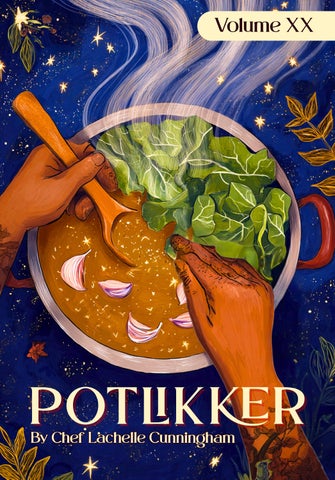
There's a moment in every There's a moment in every pot where the greens have pot where the greens have given all they can give. given all they can give.
Where heat has worked its Where heat has worked its slow magic. Where what's slow magic. Where what's left at the bottom is dark, left at the bottom is dark, rich, alive. rich, alive.
Some folks pour it out. Some folks pour it out. Call it water that's done Call it water that's done its job. Don't know they're its job. Don't know they're throwing away the throwing away the teacher. teacher.
Pot likker is where ancestors show up. Where minerals settle like old stories
This isn't what's left over. This is what we were cooking toward all along.
Where salt and smoke and time become one liquid truth.
What if nothing in your life is extra? What if the quiet parts hold the deepest nourishment?
which
Before Before grocer grocer was la was la a recipe a recipe was some was some leave COULD
Which woul the blood.
Not in books Not in books With their h With their h seasons. seasons. Thr Thr This was This was
Knowing to keep the liquid is not instinct It is learned. Developed wherever nourishment had to stretch. Practiced wherever people chose to thrive instead of merely survive. You walk into a co-op today — not just a store, but a continuation. A place where communities still say:
FROM ENSLAVEMENT FROM ENSLAVEMENT TO EMPOWERMENT TO EMPOWERMENT
Co-ops were born from the same refusal to let someone else control what keeps you alive.
When you shop at a co-op, you're practicing food sovereignty.
When you shop at a co-op, you're honoring the farmers and growers that brought you these greens.
Potlikker doesn't have to taste the same every time.
The greens you choose and how you cook them shape the character of the pot. Learning these differences turns instinct into knowledge.
Know Your Green What Happens in th
When you simmer greens low and slow:
nutrients migrate from leaf to liquid.
Vitamins dissolve and concentrate. Minerals settle.
Let's talk about what actually happens in that pot.
Bitter compounds mellow and sweeten.
Your greens aren't getting weaker. They're giving their strength to the water. So you can drink it. Sip it. Soak your cornbread in it. Heal with it.
You can't force flavors to marry. You can't rush transformation. You can't rush transformation. You can't skip time and expect depth. You can't skip time and expect depth.
Onions need to soften and sweeten.
Garlic needs to bloom. Garlic needs to bloom.
Attention, not interruption.
Steady heat, not shortcuts.
POT LIKKER
PATHWAY 1: NEUTRAL AROMATIC
PATHWAY 2: GREENS-FORWARD
WHAT IT WHAT IT TASTES LIKE: TASTES LIKE:
BEST FOR: BEST FOR:
Cooking grains (rice, Cooking grains (rice, quinoa, millet) quinoa, millet)
Cooking beans Cooking beans
Soup base Soup base
Greens stems (collard, kale, mustard)
Herbs (thyme, bay)
Longer simmer (75–90 minutes)
BEST FOR: BEST FOR:
When you want the pot
WHAT IT WHAT IT TASTES LIKE: TASTES LIKE: Earthy, mineral, Earthy, mineral, unmistakably "greens" unmistakably "greens"
Cooking collard greens Cooking collard greens
Black-eyed peas Black-eyed peas
When you want the pot likker to support other likker to support other flavors flavors
TWO MOTHER TWO MOTHER PATHWAYS PATHWAYS
Cornbread soaking Cornbread soaking Winter dishes Winter dishes Deep nourishment Deep nourishment
This is intentional flavor selection, not avoidance. You're not skipping greens because they're "bad." You're choosing a pathway based on where you're going. That's the lesson.
Some kitchens hold you. You cook there once and you're marked. Years later, you come back — not as a guest, but as the one holding the keys.
When's the last time you cooked with others? What did you make? What did the kitchen sound like? Smell like? Feel like?
CHELLE’s CHELLE’s COLLARD GREENS COLLARD GREENS
It catches what would be left behind. It holds what's too good to waste.
Let's be real about what cornbread does.
It transforms liquid into something you can hold.
This is infrastructure. The friend who shows up knowing exactly what you need without asking.
Pot likker holds steady. Everything built from it moves.
The liquid carries forward. The ingredients shift.
Black-eyed peas don’t have to stay in a bowl.
They can cool into salad. Crisp into fritters. Mash into something spreadable.
Collards don’t have to sit on a plate. They can wrap. Char. Blend.
Cornbread doesn’t have to taste the same every time.
Herbs change it. Hands change it. Season changes it.
Nothing stands still. The knowledge does not break. It bends. It carries. It becomes.
This is how culture survives. Not in museums, Not in museums, but in gardens and kitchens.Not in theory, in your hands. Some neighborhoods carry weight. Some intersections hold memory. When you cook in those places, you ' re not just making food. You're participating in what survives.
But you don't have to be standing on sacred ground to do sacred work. Your kitchen counts. Your pot counts. The person watching you cook — learning without knowing they're learning — they count too.
You're already teaching someone to keep the good stuff. Maybe it's your child. Your friend. Yourself.