Genesee County Board of Commissioners approves Flock camera funding amid public backlash
The decision comes amid public outcry about privacy concerns, overpolicing and risks of mass surveillance
ANDRES OCHOA Times Staff Writer
The Genesee County Board of Commissioners, as part of the Governmental Operations Committee of Genesee County, has voted to continue funding for the use of Flock cameras. This decision comes amid public outcry in the form of demonstrations and public comments at previous meetings, citing privacy concerns, overpolicing and risks of mass surveillance, which have delayed the voting since January. The Genesee County Sheriff’s Department says the cameras are useful in eliminating violent crime. The Board of Commissioners of Genesee County met March 11 as part of their monthly committee
meetings on matters pertaining to government operations in Genesee County. The committee voted 6–1, with two members absent, on two resolutions. The first approved a $30,000 grant from the U.S. Department of Homeland Security to pay for the contractual renewal of the current Flock cameras that are operational in Genesee County, and the second included a $60,000 renewal of fully grantfunded cameras.
Genesee County Commissioner Beverly Brown, D-District 4, was the only commissioner to vote against both resolutions. Brown said, “I distrust systems; I trust individuals. I am concerned about creating and fostering systems that violate civil rights.”
See FLOCK CAMERAS, Page 4
TRI CAMPUS EDITION
No updates on Dearborn chancellor search as Syverud steps away
The search committee, including faculty and administrators from all three campuses, was named in November
HARRISON STIDOLPH Journal Co-Editor in Chief
The Board of Regents announced early last Wednesday that President-elect Kent Syverud would no longer be assuming his duties, citing in a letter from Syverud to the campus community that he would soon start undergoing treatment after being diagnosed with brain cancer.
In the letter – originally an email to Michigan students and staff – Syverud wrote that he wasn’t feeling well the previous week and after seeking medical care at Crouse Hospital in Syracuse, he traveled to the University of Michigan for further assessments from specialists.
“I want to be straightforward with you:” Syverud wrote. “I
have been diagnosed with a form of brain cancer.”
In his announcement, the President-elect wrote that he will be stepping down in order to receive treatment, expressing his gratitude and confidence in the teams at Michigan Medicine and Crouse Hospital. He stated that despite his circumstances he would still return to the University, serving as a member of the Law faculty and an advisor to the Board of Regents.
“While my diagnosis and treatment will prevent me from serving as the 16th President of the University of Michigan, I am deeply moved by the generosity of the Regents, who have invited me to continue contributing as a professor in the Law School and as a special advisor to the Board,” Syverud wrote.
See CHANCELLOR, Page 6
Amir Makled defeats Jordan Acker at state Democratic nomination convention
Makled will run alongside incumbent Paul Brown against two Republicans for two seats on the U-M Board of Regents
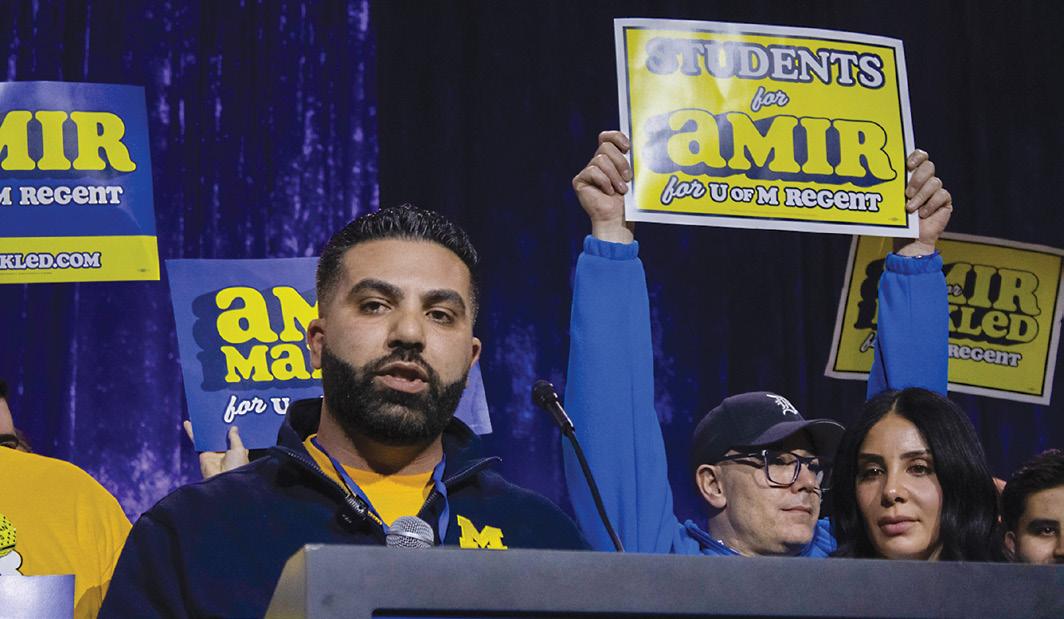
The floor of the Michigan Democratic Party’s state endorsement convention was filled with cheers late Sunday night, as progressive challenger Amir Makled beat incumbent Jordan Acker in the race to be one of the party’s two nominees for the University of Michigan’s Board of Regents. Incumbent regent Paul Brown was also renominated by the party and will be running with Makled against Republican nominees Lena Epstein and Michael Schostak in November. The race between Acker and Makled has mirrored national divides between moderate and progressive Democrats. Acker is seen by many progressive activists as representative of the Board’s current policies, such as ending the University’s Diversity, Equity and Inclusion programs; cutting gender-affirming health care for patients under the age of 19; and prosecuting pro-Palestine student protesters. The victory of Makled — who provided legal representation for protesters and has been critical of the current Board — was perceived by many convention attendees as a major progressive upset. In his acceptance speech, Makled thanked those who voted for him at the convention and promised to embark on a program of reforms at the University.
See MAKLED, Page 8
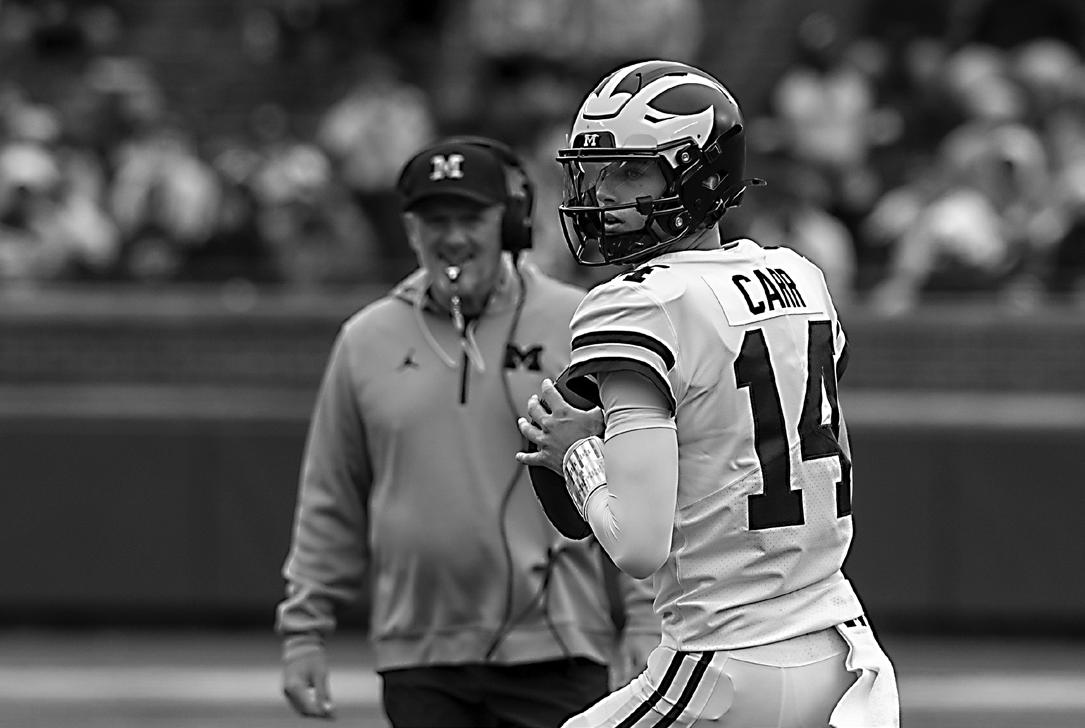
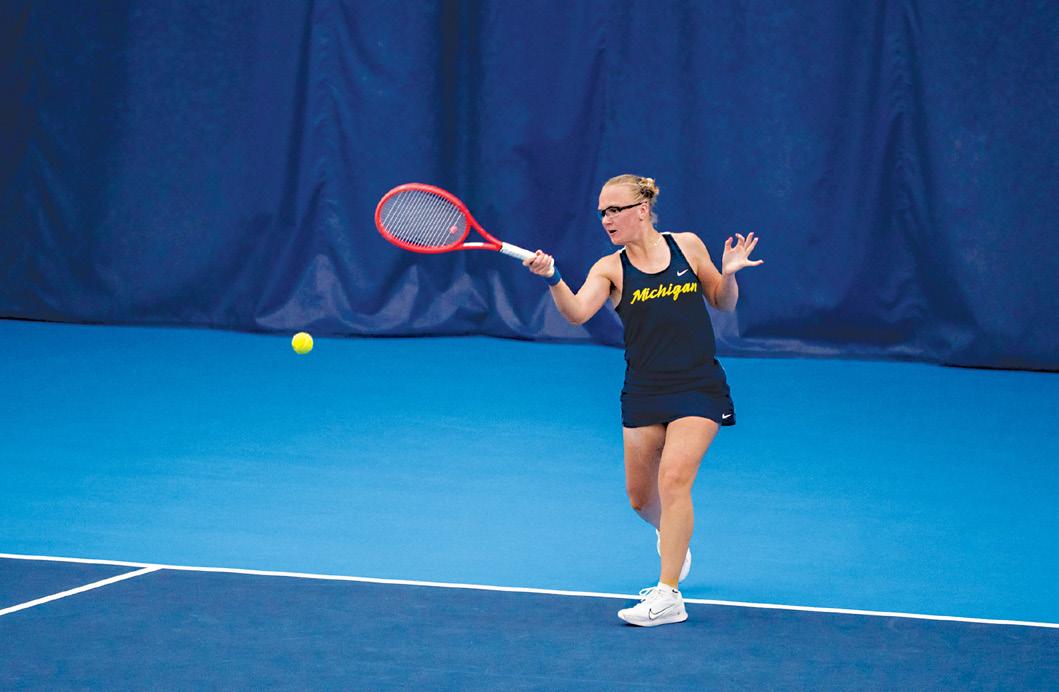
Andres Ochoa/TIMES, Ava Farah/DAILY, Holly Burkhart/DAILY
Design by Maisie Derlega
The Daily’s first collaborative edition with the U-M Dearborn and U-M Flint student papers.
Collaboration takes center stage with UM-Flint and Flint Repertory Theatre co-production
“Lucky Stiff”
“It’s a surprise every day, but we always know we’re gonna have fun.”
MAXWELL LOXTON Times Staff Writer
The University of MichiganFlint’s Department of Fine and Performing Arts partnered with the Flint Repertory Theatre, a local professional theater, to bring “Lucky Stiff” to the stage from March 20 to April 4 at the University of Michigan-Flint Theatre, combining student performers with professional actors in a collaboration of more than a year in the making.
“We knew we wanted to do a co-production … we probably went through six different musicals before we got to Lucky Stiff,” Shelby Newport, professor of theatre and chair of the Department of Fine and Performing Arts, said.
In January 2025, Newport was approached by Nicole Samsel, the interim director of the Flint Repertory Theatre. Samsel proposed that the Flint Repertory Theatre use the UM-Flint theater for its 2025–2026 regular season productions because the professional theater is completing renovations on one of its performance spaces, the Bower Theater, that significantly limit the use of the building. As part of the partnership, Samsel and Newport decided to work together on a co-production with UM-Flint students and Flint Repertory Theatre professionals. “It was sort of a ‘yes and’ that included a mutual benefit of partnering students and actors,” Newport said.
The musical follows the exploits of Harry Witherspoon, who inherits $6 million from his late uncle Anthony. To receive the inheritance, Harry must take his uncle’s dead body
on a trip to Monte Carlo, where the body is dressed to appear alive. Antics and romance follow.
Production for “Lucky Stiff” took months to accomplish, as the joint venture had to work with the schedules of both students and actors. “I think what’s really interesting about the co-production is that a dayin-the-life looks different from week to week. The name of the game is flexibility,” Mara Jill Herman, Flint Repertory Theatre performer who plays Annabel Glick, said. Flexibility has been key, as the cast and production team moved between both practice rooms at the Flint Repertory Theatre and the UM-Flint Theater stage. “They have been really great about respecting
our time. … It’s a surprise every day, but we always know we’re gonna have fun,” Connor Allston, an actor for the Flint Repertory Theatre who plays Harry Witherspoon, said.
As they work with students, both Allston and Herman find that unorthodox methods, such as playing theater games, have helped the group break out of their shell a little bit. “I really like how Stephanie, our director, has incorporated a lot of theater warm-up games. It’s really fun to return to that college setting,” Herman said.
Logan Reeves, a junior who plays the body of Anthony Hendon, said that he believes this experience is unique in its own right.
“They’re national level,” Reeves said. “To hear
their experiences … it’s one, inspiring, but two, it’s preparation. I’d like to do the same thing, so being able to ask questions about ‘How did you do that?’ and ‘How can I do that?’ It’s very helpful.”
Morgan Wright, a sophomore who plays an ensemble member and Rita’s understudy, said she enjoys hearing from the professional actors.
“Getting to hear outsider perspectives from the actors, it really broadens my horizons,” Wright said.
Newport said, “I am most excited about our audiences seeing a different kind of theater than UM-Flint has done by themselves and Flint Rep has done by themselves. Something we could only do together.”
Cesar Chavez allegations spur event cancellation
and raise
questions for UM-Flint initiatives
“When we center a movement on a single icon, we risk silencing the very people the movement was meant to protect.”
ANDRES OCHOA Times Staff Writer
The Latinx Technology & Community Center and the University of Michigan-Flint King Chavez Parks Program have both been facing potential changes after labor and civil rights icon Cesar Chavez was recently accused in a New York Times report of the sexual abuse of minors and fellow activists, along with the rape of Delores Huerta, another labor and civil rights leader.
Some Flint organizations, by name or by association, have decided to start distancing themselves from Chavez. An upcoming event involving the collaboration of the UM-Flint Office of Educational Opportunity Initiatives, EOI, and the Latinx Technology & Community Center, The Chavez & Huerta Luncheon Celebration, planned for Mar. 28, was canceled in light of the news.
In a public statement on the Latinx Technology & Community Center website shortly after canceling the
annual luncheon, Asa Ascencio Zuccaro, the organization’s executive director, wrote that the movement goes beyond Chavez.
“When we center a movement on a single icon, we risk silencing the very people the movement was meant to protect,” Zuccaro wrote. “Our loyalty must not be to a name or a face, but to the values of justice and safety for every member of our community.”
In her public statement to Medium, Delores Huerta wrote that she had been keeping Cesar Chavez’s actions to herself for 60
James C. Renick
years, noting that “exposing the truth would hurt the farmworker movement I have spent my entire life fighting for.” Both Huerta and Chavez were co-founders of the United Farm Workers Union and were leaders in the labor and civil rights movements in the 1960s and the 1970s.
The State of Michigan King Chavez Parks Initiative is a $2.5 million grant to assist students who are Michigan residents facing economic and academic barriers.
The initiative is partnered with seven private and public universities across the state — including U-M Flint — and has been funded year after year since 1986. Its position as a state appropriation, however, means that it must be renewed every year by the state Legislature.
John Girdwood, a manager of the UM-Flint KCP Select Student Support Services Program, said funding for the initiative could be taken away at any time.
“It’s on the chopping block every year, since 1986,” Girdwood said, “So it’s this weird thing where we expect it to be funded next year, but you never know, it could be taken away.”
Girdwood also said he hopes the program will continue in some form even if impacted by the allegations. “I can only be hopeful and optimistic that it’s an opportunity to reconfigure the grant and emphasize its true purpose,” Girdwood said. “The grant’s purpose was never to idolize a single figure or three individuals, the grant has always been to support students that face barriers.”
From the Editor in Chief
UM-Flint Short Play Fest showcases student-directed plays
The two-day event, held in the UM-Flint Theatre Black Box studio, drew a total of 200 attendees
On Apr. 10 and 12, the University of Michigan-Flint held its annual Short Play Fest in the UM-Flint Theatre Black Box studio, with a total of 200 guests in attendance over the two-day period. The event showcased seven student-directed plays, in which students gained handson experience directing, stage managing, and handling light and sound
To direct a play in the Short Play Fest, a student must be registered in class Theatre 320: Intro to Directing or Theatre 415 Special Projects in Directing. Auditions for the Short Play Fest were held Feb. 25 and were open to all students.
For some students, this was their first directing project.
Reese Garfield, a junior theatre major who directed a short play on a couple’s conflicting feelings about having children, said that she enjoyed the experience and has had an interest in directing.
“It was a fun experience,” Garfield said. “I have always been interested in directing, and working with peers has been beneficial. I felt anxious during the performance, but afterwards I felt really accomplished.”
Austin Bishop, a senior theatre major, said that his group spent about a month working on their play.
“I think with the way this year’s schedule was, we actually had less time to work on this project,” Bishop said. “But even so, my group stayed calm and committed to the task at hand. As far as planning goes, we started with a read-through. And then, we spent the next several weeks blocking out our beats.” Noah Anthony, a sophomore theatre major, said operating and handling sound equipment was easier than he expected.
“It’s been a chill, actually,” Anthony said. “Operating the sound board is cool - not as hard as I initially thought it was going to be.” Members got to play several parts, rotating between operating technical equipment, acting, directing and stage managing.
The Short Play Fest is the recipient of the University of Michigan’s Arts Initiative Student Mini-Grant Program, providing $1,000 in funding for student-led projects across all University of Michigan campuses. The grant supported the hiring of a student technical director and lighting designer.
Through this funding, Nathan Carpenter, a junior majoring in the theatre design and technology program, was hired as the Short Play Fest’s technical director and lighting designer. The grant also supported his labor, training and design for the event.
CAMPUS NEWS
HALEY BOWMAN Times Staff Writer
Andres Ochoa/TIMES
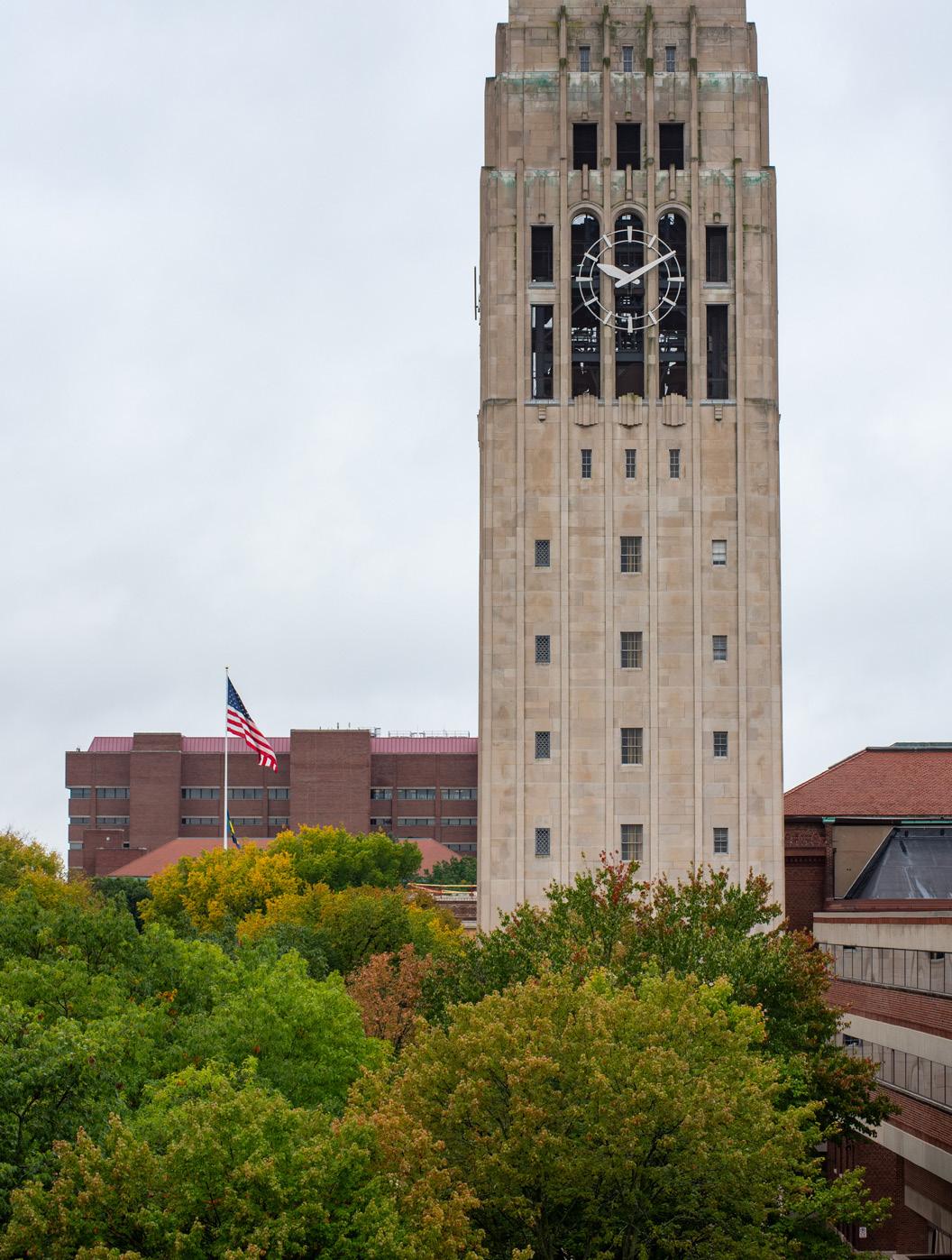
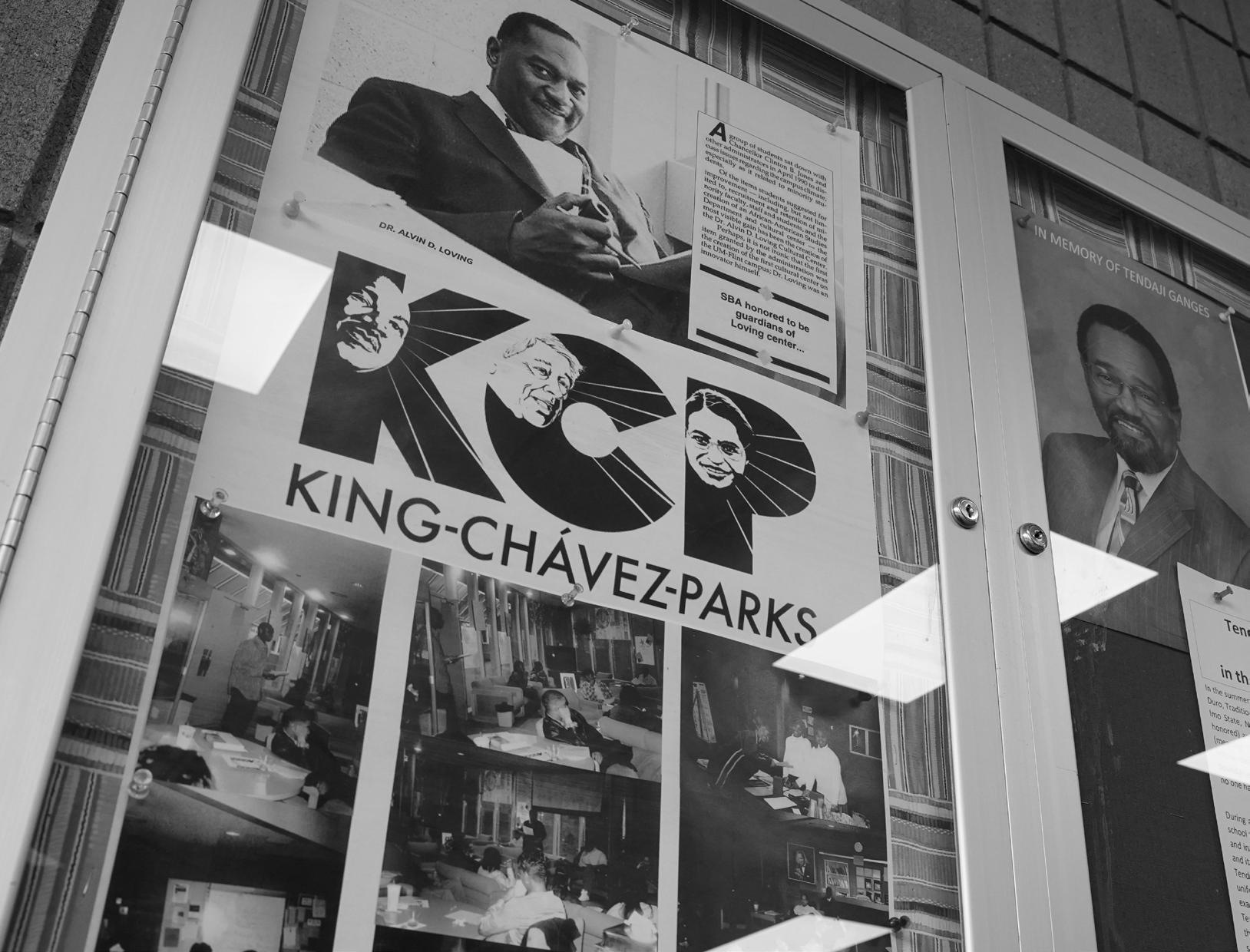
Glass display with the King Chavez Parks Program logo outside of the Loving Lounge on the second floor of the University Center at the University of Michigan-Flint.
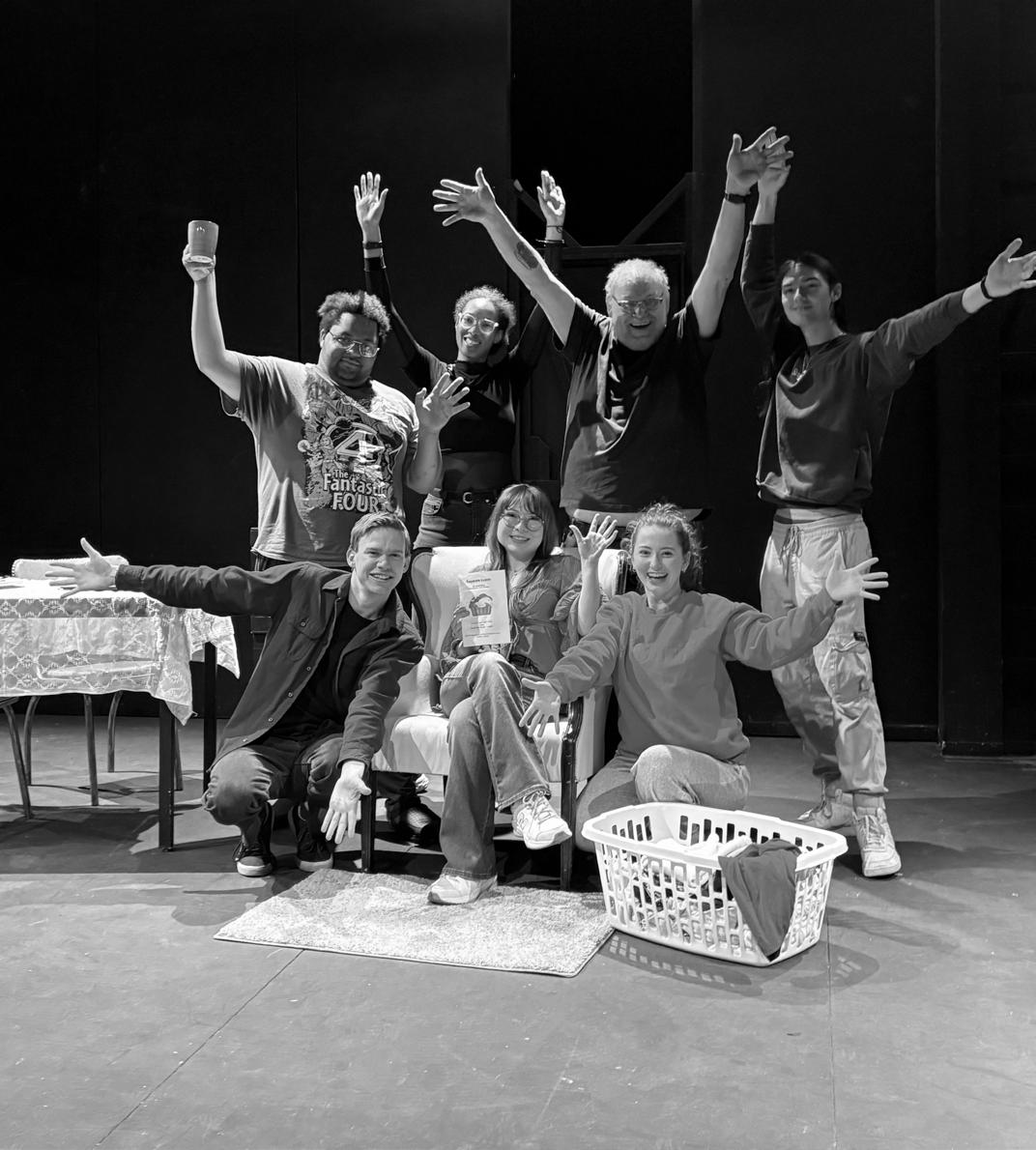
Courtesy of Stephanie VanWagoner.
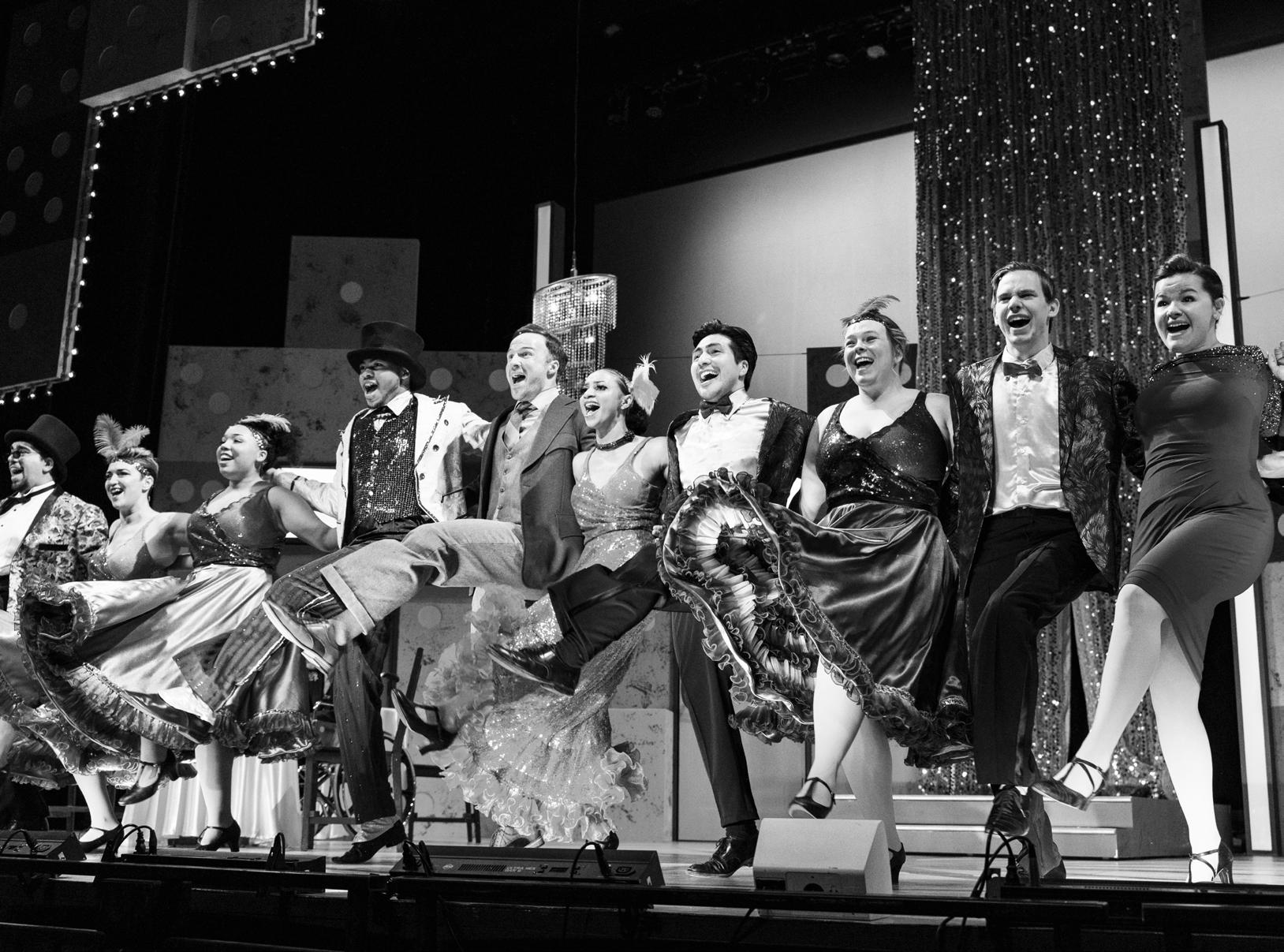
Actors perform during a dress rehearsal of Lucky Stiff at the University of Michigan-Flint in Flint, Michigan, March 18, 2026.
Courtesy of Janet Haley.
Actors in a production in the Short Play Fest.
The voice behind Prism: Meet Flint native Blvck Bunnie
The UM-Flint alum voiced the character of Prism in a viral scene in the video game “Dispatch”
RAMLA OUEDRAOGO Times Editor in Chief
Blvck Bunnie, better known by her stage name THOT SQUAD, is a Flint native and a University of Michigan-Flint alum who quickly gained attention with her role as Prism in the video game “Dispatch”.
“Dispatch” is a narrativedriven superhero comedy video game that was released on Oct. 22, 2025, by AdHoc Studio.
The creators of AdHoc Studio reached out to Blvck Bunnnie to ask if she would be interested in voicing Prism.
“They sent us an email like ‘Hey, I’m making video games, there’s this character Prism you wanna be in my video game?” she said. “We were like, these scammers are going crazy.”
After a preliminary Zoom meeting, Blvck Bunnie traveled to her audition in California, which quickly turned into her first recording session.
In the game, Prism is a supporting character and a reformed villain and pop star who is employed by the Superhero Dispatch Program under the Phoenix Program.
Following its release, “Dispatch” sold 1 million copies within the first 10 days. One scene in particular gained viral attention, which was the bar fight in episode five. While the superheroes are fighting a criminal syndicate, the Red Ring, Prism is singing a song in the background.
The song featured in the scene is “HOES DEPRESSED,” which is one of Blvck Bunnie’s original songs. The song quickly went viral and has more than 21 million streams on Spotify. Her other original song, “POUND CAKE,” is also featured in the game and has more than 9 million streams on Spotify.
“Before the game came out, we had 182,000 monthly listeners on Spotify, and now we have 1.2 million,” she said. Blvck Bunnie
started her music career .in 2022 with her producer and husband, Benny Ari, who is also a former UM-Flint student. That same year, she was the opening act for the rapper cupcakKe.
With new attention, there is also added criticism. Many players voiced their concerns about the character Prism and how she may perpetuate negative stereotypes against black women.
“It grinds my gears because I put so much of myself into Prism for people to be like oh well, she’s a stereotype,” she said, “They are people who think they have surpassed this anti-Blackness that is in black nerd spaces, but really, you just only advocate for Black people who don’t act quote unquote Black.”
Blvck Bunnie explained that she considers herself to be “very authentically Black” but that she also has many other layers.
Before she gained widespread attention, Blvck Bunnie attended UM-Flint. She graduated in 2016 with a dual bachelor’s degree in theater and French. During her senior year, she traveled to New York every month for auditions to pursue a career in acting.
“I booked like two things, but I didn’t book any Broadway or anything like that… then it took me doing this whole switcheroo into music that got me to acting again,” she said.
Blvck Bunnie worked for the Education Opportunity Initiative and the Michigan Times while at UM-Flint. She is currently pursuing a master’s degree in nonprofit leadership from Johns Hopkins University.
Local historian Justin Wetenhall earns seat on Flint Historic District Commission
The UM-Flint alum has worked for years persevering Flint history
MAXWELL LOXTON Times Staff Writer
Flint native Justin Wetenhall was recently appointed Commissioner to the Flint Historic District Commission on March 5 for his work in preservation, which includes the Whaley Historic House Museum, Stockton House Museum and the Durant-Dort Carriage Company.
The FHDC was established in 1970 after the passing of the Michigan Local Historic Districts Act. Commissions such as the FHDC protect neighborhoods of historic value from demolition or modernization. Each of these commissions follows the standards set by the secretary of the interior at a national level.
The WHHM is a Michigan State Historic Site that has been added by the secretary of the interior to the National Register of Historic Places.
After graduating from Grand Blanc High School in 2011, Wetenhall applied to the University of Michigan-Flint.
As a freshman on campus, he entered the history program. Wetenhall said his experience at UM-Flint “opened a lot of doors.”
During his sophomore and junior years, he worked at the DurantDort Carriage Company and the Genesee County Historical Society.
As the organization’s historian for the Genesee County Historic Society, he was mainly involved in representing GCHS at town hall meetings.
“My biggest part was representing the historical society,” Wetenhall said. “I was already getting my name out there — not intentional, I just thought it was cool.”
Wetenhall also serves as the president of the Stockton House
Museum, where he manages the day-to-day operations of the house.
As executive director of WHHM, he is directly involved with ongoing conservation efforts, such as the restoration of the conservatory and gardens, as well as the preservation of several historical paintings by local artists. However, it was his work volunteering and representing these institutes that got him noticed by the council. Wetenhall is also credited with bringing tourism back to the Whaley House.
“House museums have a reputation of being cold and distant,” Wetenhall said. “I opened the house when I got the position. I brought tourists to Flint to see this place. … I genuinely see this house as a passion project, and I think city hall sees that too. They at least know that I’m keenly interested in getting involved in this community.”
His extensive history of restoration efforts made him the ideal choice. “I have basically devoted my adult life to historic preservation, I’ve been
passionately involved for the past decade,” Wetenhall said. After hearing of his nomination, he submitted his resume to the Flint City Council. On Feb. 21, Wetenhall received a call from city hall.
“About three weeks ago, I get a call saying, ‘Hey, there’s gonna be a resolution; your name’s gonna pop up across city council,’” Wetenhall said. “It was a little bit intimidating.’’
After a couple of days, Councilmember Ladel Lewis informed him that the resolution had passed and he was officially appointed to the FHDC. Wetenhall said being appointed commissioner to the FHDC is an honor.
“I look forward to using my voice for the good,” Wetenhall said. “I could be wrong, but I’d like to think that my voice will carry some semblance of weight. As someone who genuinely loves my city, I love the city of Flint… and it’s a privilege to finally be in a position where I can be involved and maybe help its journey and become a part of the city’s history myself.”
The University of MichiganFlint hosted a full day of annual organized events on April 14, aimed at supporting students during finals preparation. The day began with activities in the Frances Willson Thompson Library and continued into the evening at the Harding Mott University Center.
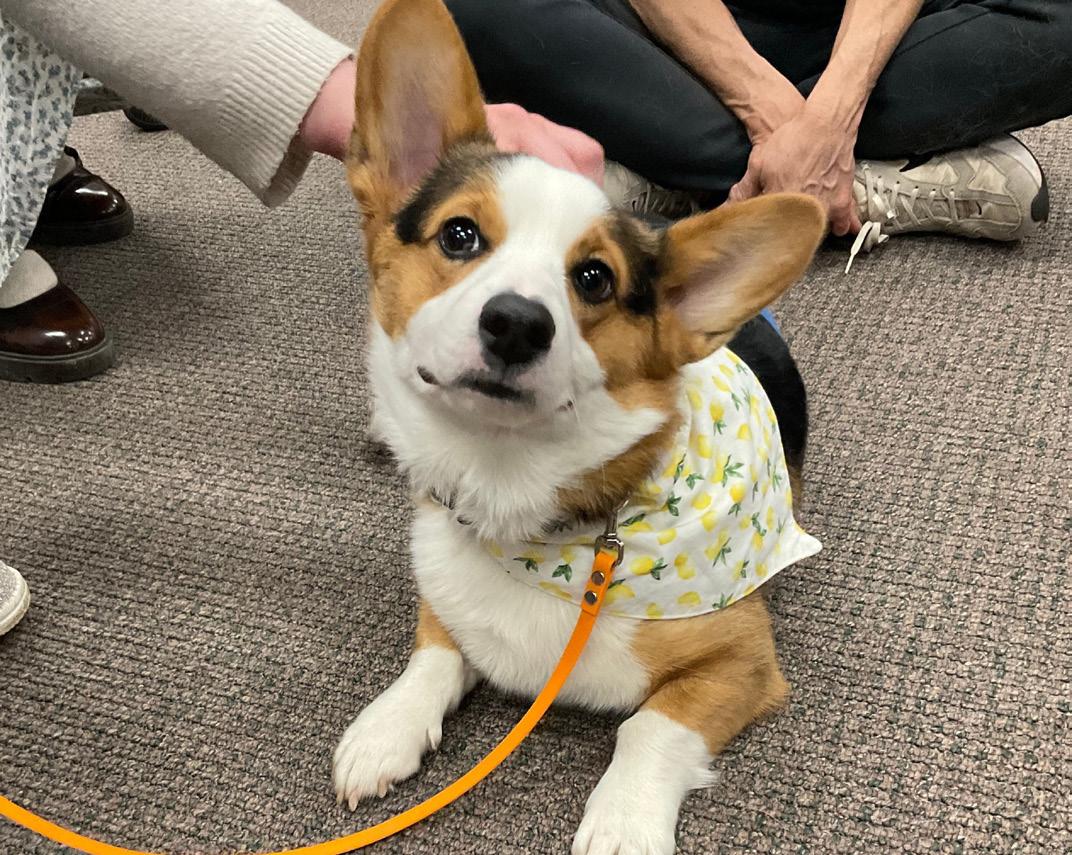
Paws for Relief took place in the Frances Willson Thompson Library from noon to 2 p.m. and again from 5 p.m. to 8 p.m. Students were able to interact with three Mid-Michigan Therapy Dogs.
“Interacting with the therapy (dog) was actually a very soothing experience for me, I don’t have any pets of my own and meeting them brought me so much joy,” Trinity Lee, a freshman majoring in psychology, said.
At 7 p.m, Late Night Breakfast began on the third floor of the Harding Mott University Center and continued until 9 p.m., drawing more than 190 attendees. The program included a photo booth, Kahoot games, caricatures by illustrator David Wodarek, a Plant & Paint event and a late-night breakfast service. The Late Night Breakfast event and related programming have been held annually for 16 years.
Genevieve Brennan, Plant & Paint coordinator, had her own area at the Harding Mott University Center where students could stop by, paint a clay pot and plant a seed in it. She said simple events like Plant & Paint can help students destress during finals week.
“This is a stress relief event for finals week, and students can paint a pot and plant a seed; something so simple, quick and easy can help students
tremendously during these times,” Brennan said.
Late Night Breakfast was made possible through collaboration between Counseling and Psychological Services, Division of Student Affairs, Hall Council, Housing and Residential Life, Office of the Dean of Students, Planet Blue Ambassadors, Recreation Center and Student Government. Planet Blue Ambassadors also implemented a zero-waste initiative by placing designated recycling and compost bins to manage waste generated during the event. Following the Late Night Breakfast, the Late Night in the Library began at 9 p.m. The
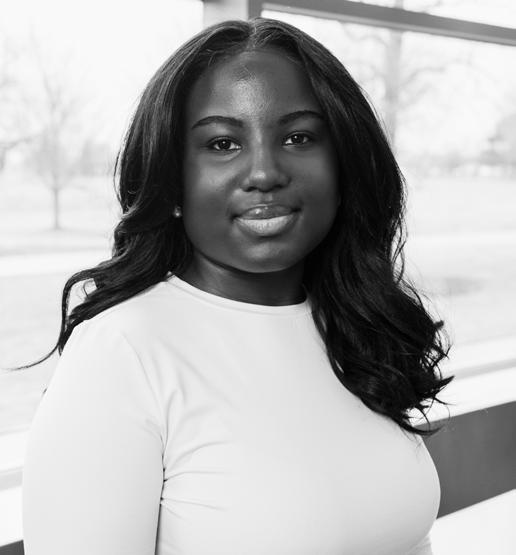
Courtesy of AdHoc Studio.
An image of Prism from the popular video game “Dispatch.”
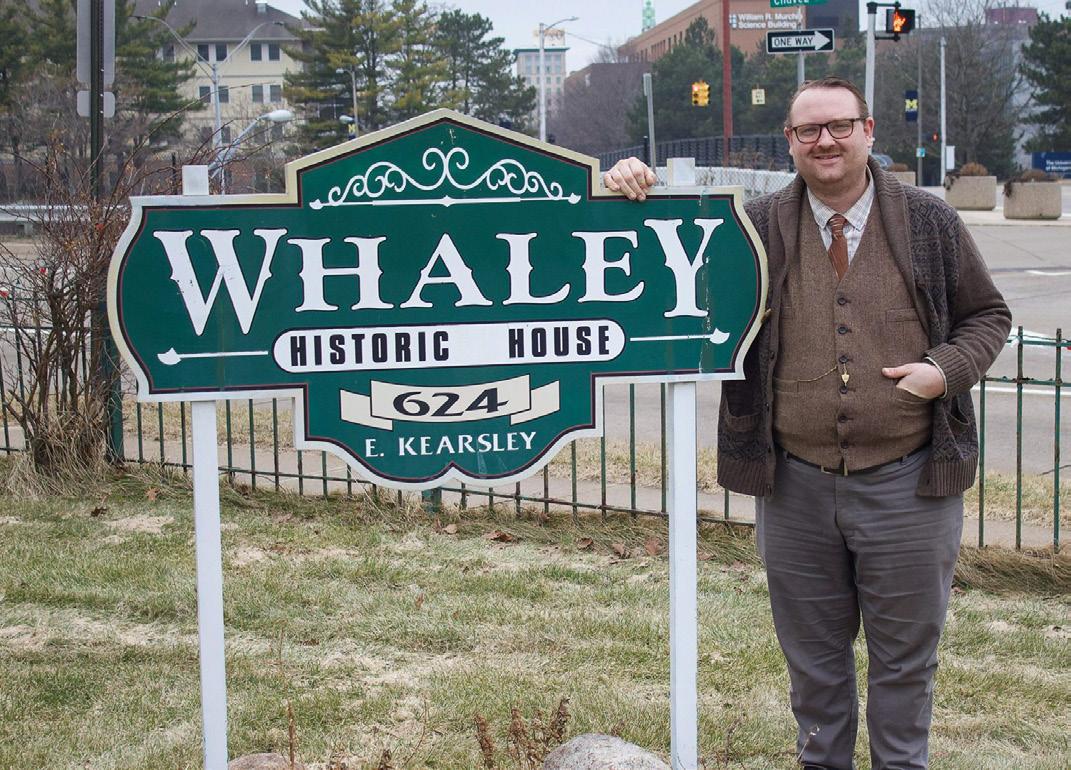
Maxwell Loxton/TIMES
Justin Wetenhall posing with the Whaley Historic House Museum sign in downtown Flint March 19.
CAMPUS NEWS
LUNA hosts second quinceañera event celebrating Latin American culture at UM-Flint
The event featured traditional ceremonial items, a mariachi band, a fashion walk and a choreographed dance
ALYSSA BARNETT Times Staff Writer
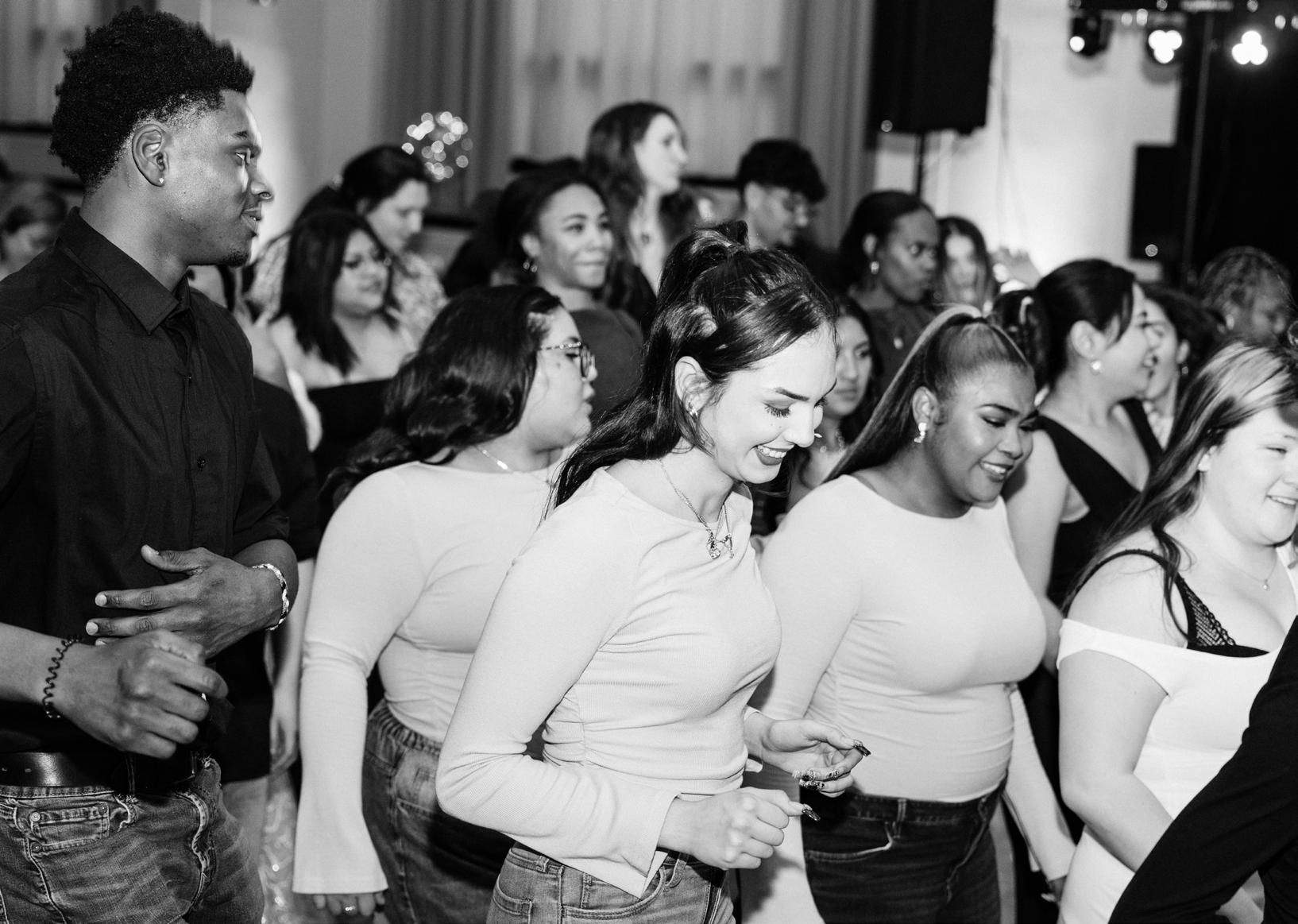
Latinos United for Advancement hosted its second LUNA Quinceañera event on April 1 in the Grand Ballroom of the Northbank Center, bringing a traditional cultural celebration to campus while advancing the organization’s mission of cultural education and community engagement.
“I am so proud of LUNA’s executive board,” Stephanie Vidaillet Gelderloos, an English faculty member at the University of Michigan-Flint and the adviser of LUNA, said.
“They are amazing students with great academic records, yet they all set aside a lot of time and effort to make the quinceañera celebration happen.”
LUNA hosts events throughout the year that highlight Latino culture. The LUNA Quinceañera event is designed to replicate the experience of attending
a traditional quinceañera celebration.
“The event showed a lot of detail and organization, and it gave a clear example of how cultural traditions can be shared in a campus setting,” John Russel, a freshman at UM-Flint majoring in human resources, said.
The event featured a mariachi band, a fashion walk and a choreographed dance performed by LUNA members and students dressed in quinceañera gowns and chambelán suits.
Traditional ceremonial items were also displayed, including a symbolic doll representing the transition from childhood and high heels representing entry into adulthood. Decorations included personal items from students’ own quinceañera celebrations, along with photographs from those events.
“Through LUNA, I had the opportunity to experience Latin dancing, which was something completely new for me,” Nazli
Kurt, a sophomore at UM-Flint majoring in biology, said. “As an international student, being open-minded to different cultures has been a truly unique and meaningful part of my journey. I met amazing friends and spent many hours practicing and learning the dances together. In the end, we had the chance to perform the special dance, which made the whole experience even more special.”
More than 100 students attended the event, which included a Hispanic dinner provided by I Love Pig from the Flint Farmers’ Market. The menu featured birria tacos, pork, chicken and vegetarian arepas. Music for the event was provided by a local DJ, and attendees danced throughout the evening.
“The quinceañera created a welcoming space for Latino students, promoted student growth and celebrated Latino culture on campus,” Gelderloos said.
Genesee Health System partnership brings crisis intervention training to Flint police officers
The 40-hour training program helps officers respond to individuals with mental health issues and apply de-escalation strategies
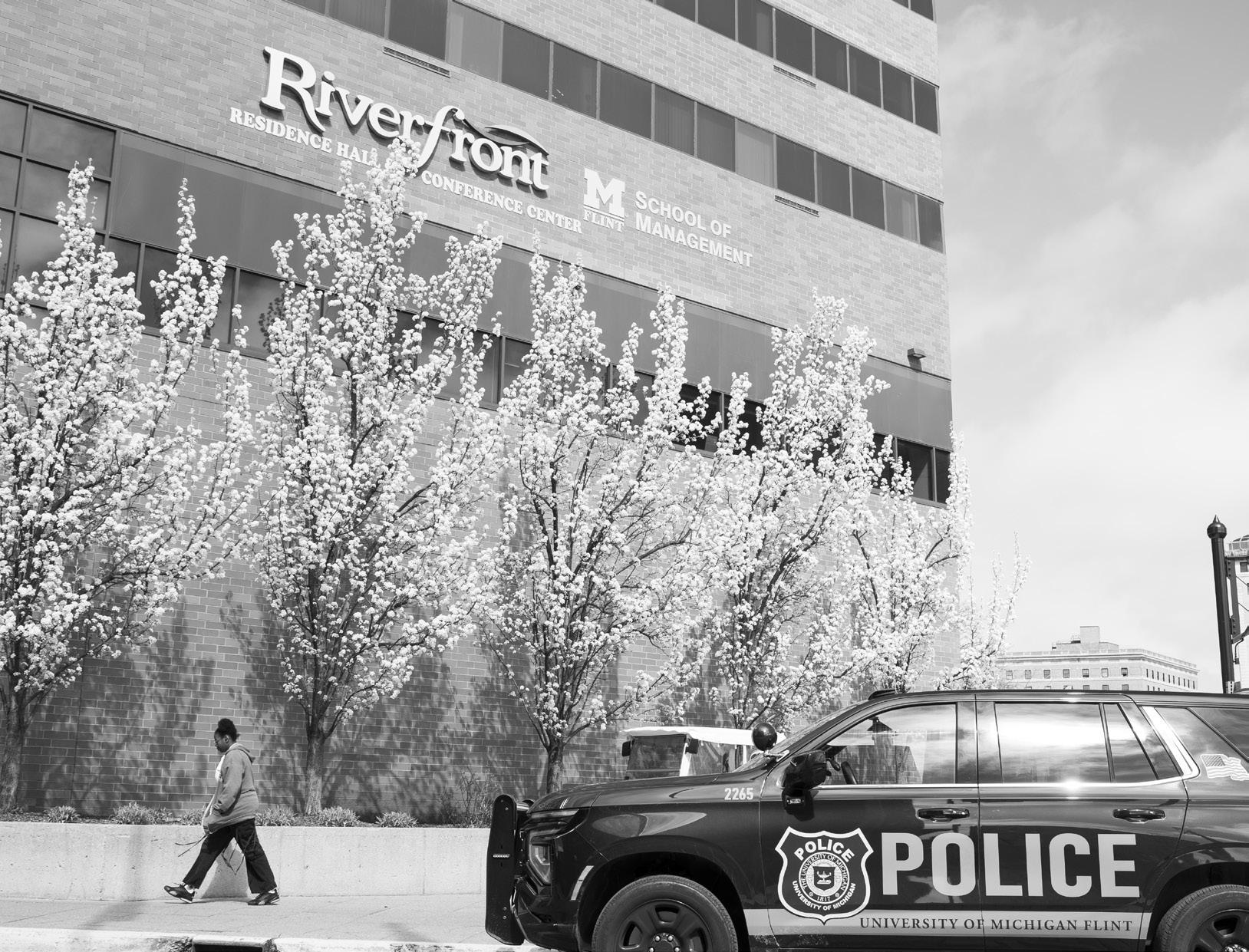
The Flint Police Department and the University of Michigan-Flint’s Department of Public Safety are using Crisis Intervention Training to better respond to mental health emergencies through partnerships with behavioral health professionals.
“Policing is not just about holding individuals accountable; it’s about supporting everyone in our community, regardless of their situation or need,” Ray Hall, DPS director, said. Crisis Intervention Training prepares officers to handle complex situations they may face. Detective Sergeant Alexis Frierson said that officers are often the first to respond to a
crisis, even when no crime has been committed.
“In many cases, people experiencing mental health challenges may behave in ways that can be misunderstood as threatening or noncompliant, which can lead to unnecessary escalation if officers are not properly trained,” Frierson said.
Officers go through a 40-hour program in partnership with
From Page 1
Public comments were held before the official discussion of the resolutions, with a wide range of age groups, from college-aged and older, approaching the podium. Many said they were concerned about mass surveillance and the potential for these cameras to violate people’s First and Fourth Amendment rights.
Rachel Switchel, a Flint resident, and others mentioned the possible use of the technology by U.S. Immigration and Customs Enforcement.
“Surveillance doesn’t keep our communities safe — connection does,” Switchel said. “The benefits do not outweigh the risks here. This is not a tool that promotes safety, privacy or trust.”
Rosalin Salbenblatt, a Flushing resident who once supported the flock cameras, expressed concerns about the camera’s use.
“These cameras are infringing on our First Amendment right to privacy and our Fourth Amendment rights against unreasonable search and seizure,” Salbenblatt said. Jason Murphy, Genesee County Sheriff’s Department captain, said there were limitations on what the Sheriff’s Department can see within the surveillance system. Genesee County Commissioner Delrico J. Loyd, D-District 1, said the Sheriff’s Office is only able to see still shots of the rear of vehicles using the Flock system.
In regard to concerns about the Sheriff’s Office collaborating with federal agencies, Murphy said, “Right now, we only share our camera information with local, state of Michigan law enforcement agencies. We do not share it with anybody out of state; we do not share our information or our cameras with federal agencies.” However, in the case of extreme emergencies, Murphy said that the passing along of information to federal authorities like the FBI in
order to assist with an ongoing investigation is possible.
Genesee County Commissioner Dale Weighill, D-District 8, offered an amendment to the resolutions on the agenda. This amendment would require a signed judicial warrant from a federal agency in order to receive information collected by the Flock system in Genesee County. The amendment could also include a requirement to notify the board when such a request is made. However, the legality and details of this amendment will be discussed in a later meeting.
Weighill addressed concerns of county collaboration with ICE or other federal agencies, saying he has seen “heinous crimes” being solved with the Flock cameras and does want them installed, but with a possible amendment to the resolution continuing their use.
“We have the potential for federal agents, who might not have the constitution in mind.
... There is a potential for them to come and inquire with the
Genesee Health System. The curriculum covers recognizing signs of mental distress; responding to individuals with substance-use disorders, developmental disabilities, psychiatric illnesses; and applying de-escalation strategies.
They also practice scenariobased roleplays and learn how to connect individuals with appropriate community resources.
“In many cases, people experiencing mental health challenges may behave in ways that can be misunderstood as threatening or noncompliant,” Frierson said. “This approach aims to create more compassionate, effective responses and to build greater trust between law enforcement and the communities they serve.”
The Flint Police Department and DPS have also implemented a co-responder model, allowing them to work closely with social workers.
“Our co-responder responds to calls once the scene has been secured by our officers and provides direct support, resources and guidance to those in need,” Hall said.
“Behind every number is a person who didn’t become a victim, a situation that didn’t escalate and a community that feels safer because of (our) work,” Hall said. “This is the future of policing.”
Sheriff’s Office and ask for information that could harm people — who are innocent
Downtown Flint
to see
car boots in May for drivers with unpaid tickets
The Downtown Development Authority will boot cars with six or more outstanding unpaid tickets
RYLIE YEITER Times Staff Writer
In May, the Flint Downtown Development Authority will begin booting cars with six or more outstanding unpaid tickets within its jurisdiction, which spans downtown Flint.
At the downtown business safety and concerns monthly meetup on March 5, the DDA stated that they will begin using car boots due to people in the downtown area not following rules and regulations.
The DDA has the authority to enforce parking and regulations under Michigan’s Downtown Development Authority Act 197 of 1975, which establishes the DDA’s powers and duties. Boots will only be placed on vehicles of individuals with six or more outstanding unpaid tickets. DDA members said this is not aimed at first-time violators, but at habitual offenders. If you are unsure about whether you have any outstanding citations or would like to check your ticket status, you can visit the DDA website.
individuals — and violate their constitutional rights because constitutional rights don’t only apply to citizens, but also to people who are here, living here,” Weighill said.
RYLIE YEITER Times Staff Writer
Rylie Yeiter/TIMES
A UM-Flint Department of Public Safety vehicle in downtown Flint.
Courtesy of Stephanie VanWagoner.
Students and guests celebrate during LUNA Quinceañera Night at the University of Michigan-Flint in Flint April 1.
Rylie Yeiter/TIMES
Cars parked along Saginaw Street in Downtown Flint.
FLINT
Andres Ochoa/TIMES
The Flint Alliance for Immigration Rights protesting outside the Genesee County Administration Building in downtown Flint.
FLOCK CAMERAS
Inclusive History Project Summit 2026 explores histories of inclusion and exclusion
The initiative uses oral history collection, archival recovery, public art and course design to engage with University history
REENA HAMAD Journal Co-Editor in Chief
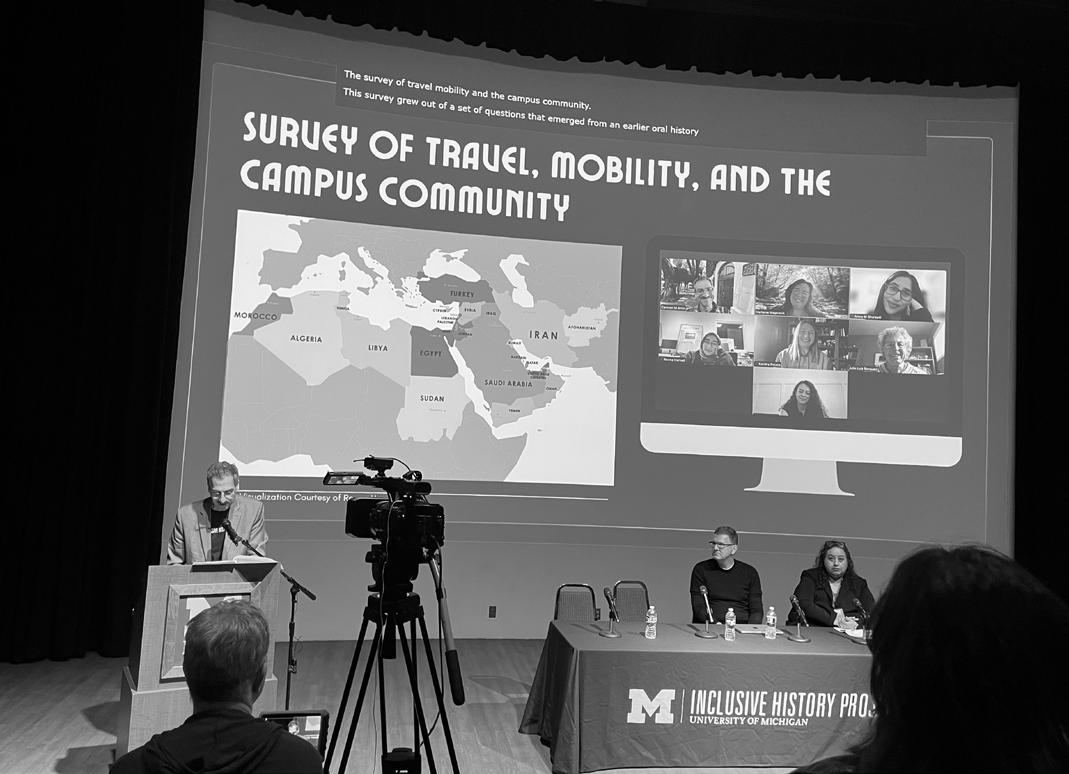
The 2026 Inclusive History
Project Summit held at University of Michigan-Flint brought together students, faculty, staff, alumni and community members for a day centered on two difficult but necessary questions: How can and should the University of Michigan confront its institution’s histories of inclusion and exclusion across its three campuses, and how do we ensure repair goes beyond simple acknowledgment?
IHP Research Directors Camron Amin, Jay Cook and Lisa Lapeyrouse started the event by exploring some of their campus project sites, showcasing some of the real-time progress made toward IHP’s vision of research, engagement and repair.
One of the opening sessions, “Geographies of Justice and the Changing City,” was a roundtable discussion focused on the history and impact of urban renewal in Flint. Speakers spoke of displacement, the changing landscape of the city and the University of MichiganFlint’s place within those shifts.
The conversation also turned to the role of archives in preserving these histories, as well as the collaborative work behind the “Blueprints of Power” exhibition, conveying how public history depends not only on what happened but also on what was documented, preserved and interpreted.
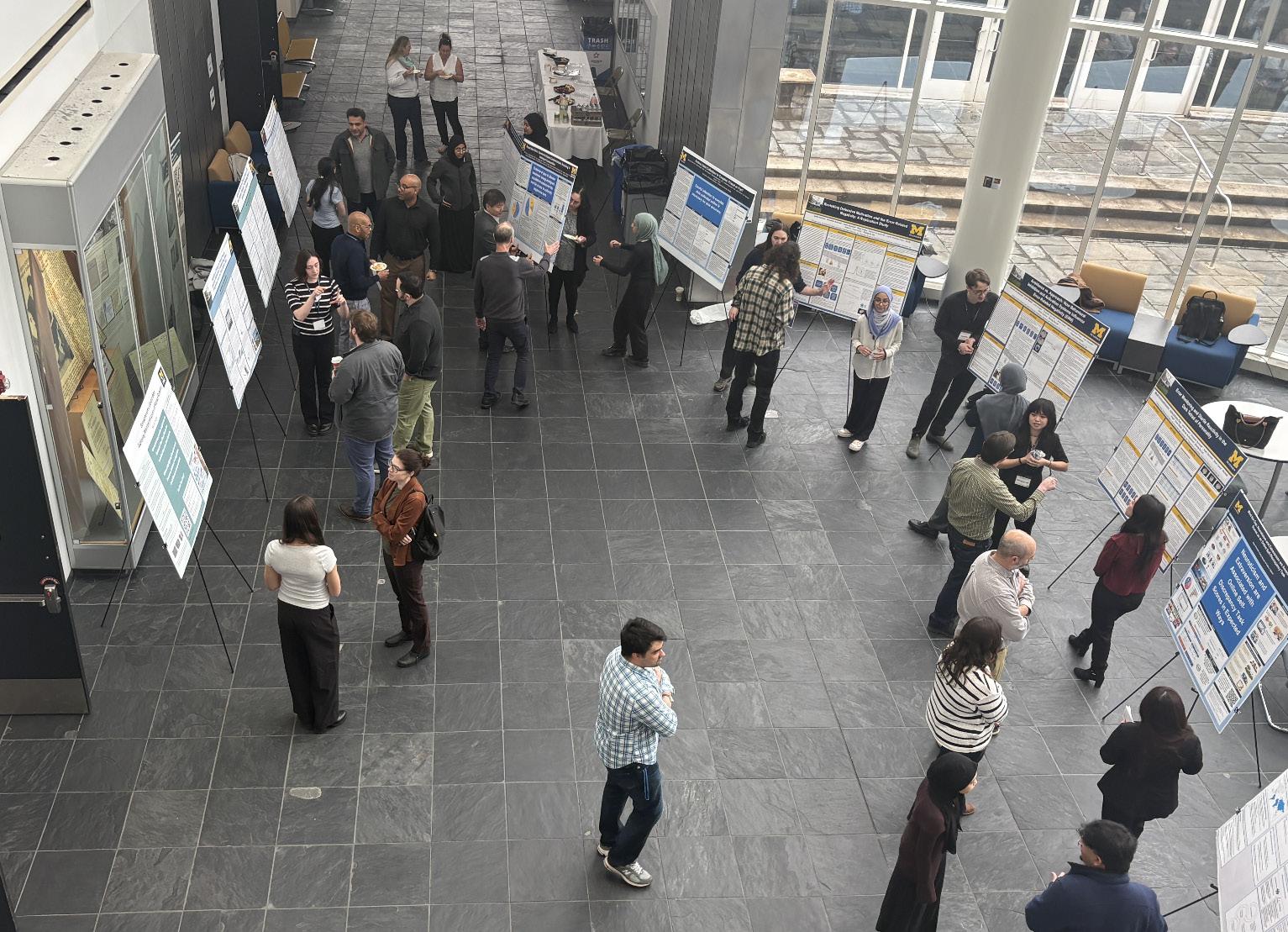
The summit also hosted interactive programming. As part of the “Make, Meet, Learn” session, Flint artist and educator My Proulx led “From Protest to Pride,” a button-making workshop that connected personal expression to the longer history of buttons as tools of activism, organizing and identity. Participants used a range of materials to create
wearable designs rooted in inclusive history, place and selfexpression.
Just a few steps away, attendees were invited to make themselves part of the institution’s record with the help of the IHP Student Advisory Committee. The “Belonging Interactive Photo Mural” asked participants to take a photo and add it to a growing collective display as a statement that the history of the university is actively unfolding. The initiative welcomed participants to have a visible place within it.
That notion of historical recovery and ongoing curation ran through the summit’s sessions of lightning talks.
Christina Blitchok, U-M Flint campaign initiatives and alumni engagement director, presented on the 1956 Project, which documented the first students and faculty at U-M Flint, using individual stories to reconstruct what the campus looked like at its beginning and measure what has changed since.
Rose Wellman, associate professor of anthropology at U-M Dearborn, and Amny Shuraydi, assistant professor of criminology and criminal justice at U-M Dearborn, discussed their project studying U-M Dearborn’s Center for Arab American Studies and student life. Their presentation explored identity and inclusion on a campus deeply shaped by Arab American communities.
Several projects also focused on the institutions that collect and preserve historical materials. Jodi Mase, U-M Ann Arbor graduate research associate, and David Mori, U-M Ann Arbor doctoral student, discussed a collaboration between the Bentley Historical Library and the School of Information. Their project challenges the assumption that universities should simply gather records from marginalized communities
for scholarly use and instead calls for a relationship-building model of historical care.
Wallace Bowie III, Karen Burton, Saundra Little and Craig Wilkins similarly emphasized the labor of historical recovery in their lighting talk that traced the histories of Donal White and Francis Griffin, who are recognized as Michigan’s first Black architects. Bowie, a research assistant for IHP, emphasized their focus on presenting “what it actually looks like to recover a history that has been scattered across archives, institutions and communities.”
Ivy Forsythe-Brown, U-M Dearborn associate professor of sociology, and Terri Laws, U-M Dearborn associate professor of African and African American studies, echoed a similar effort in presenting their developing project of uncovering the history of African and African American studies on the Dearborn campus with the help of oral history.
The Inclusive Storytelling Hub also made an appearance at the IHP Summit. The Wolverine Stories Video Booth invited summit participants to share personal stories about their experiences at the University of Michigan, including memorable moments, challenges and
accomplishments.
Inspired by the StoryCorps oral history model, the booth was created by U-M Dearborn’s ISH to collect stories of inclusion and exclusion from anyone connected to the University of Michigan. These short recorded stories may help support future oral histories, documentaries and other projects about the University’s institutional history.
This summit marked the midpoint of the Inclusive History Project’s current fiveyear phase. IHP aims for these initiatives to reflect a shared method emerging across campuses and disciplines that treats history as a collaborative, community-facing work rather than an idle institutional narrative. Attendees saw the use of oral history, archival recovery, public art, course design and community-based planning to, in the words of IHP co-chair Elizabeth R. Cole, “enrich and deepen our understanding of the University’s full history.” All presenters noted that doing so requires more than simply adding overlooked names and communities to the record, but also rethinking who shaped that record in the first place.
The impact of Bad Bunny’s Super Bowl performance on UM-Dearborn’s Latine community
“Growing up with my Puerto Rican side of the family, going to the island, seeing the references in the Super Bowl was super impactful.”
JOSEPH JULIANO Journal Contributor
Over 128 million households tuned in to watch Super Bowl LX on Sunday, Feb. 8, 2026. But for many homes and academic circles, viewers didn’t come for the football. Some were there to watch someone else — global music superstar Bad Bunny. The Super Bowl was held at Levi’s Stadium in Santa Clara, California. Every year, the National Football League selects an entertainer to perform at the highly awaited Super Bowl Halftime Show. This year, the NFL selected Benito Antonio Martínez Ocasio, known across the world as the “King of Latin Trap” or, more commonly, Bad Bunny.
For Benito Antonio Martínez Ocasio the pressure was on; he had to keep his promise of showing off Puerto Rican and Latine culture to the world. For 13 minutes, he serenaded the world with songs like “Tití Me Preguntó,” “El Apagón” and “BAILE INoLVIDABLE.”
While Bad Bunny, a SoundCloud-rapper-turnedglobal-superstar, was not the first Latino artist to perform at the Super Bowl, his performance was the first Spanish-language dominant solo performance in Super Bowl history.
Jorge González del Pozo, U-M Dearborn professor of Spanish, was quick to describe Bad Bunny as one of the most influential Latino artists in recent years, underscoring the
impact of his original music on mainstream media.
“(His) unique music mixes reggaeton with traditional Puerto Rican rhythms and has helped Spanish-language music reach audiences around the world,” he said. “He is also known for proudly representing Puerto Rican culture and speaking about social issues on the island”
For academics like González del Pozo, he sees the performance as a progression for Latino people in American society.
“The Latin(e) community already has its own strong voice … but moments like this recognize its cultural contributions to U.S. society,” he said.
Alongside members of the booming Hispanic community in Metro Detroit, Latin American
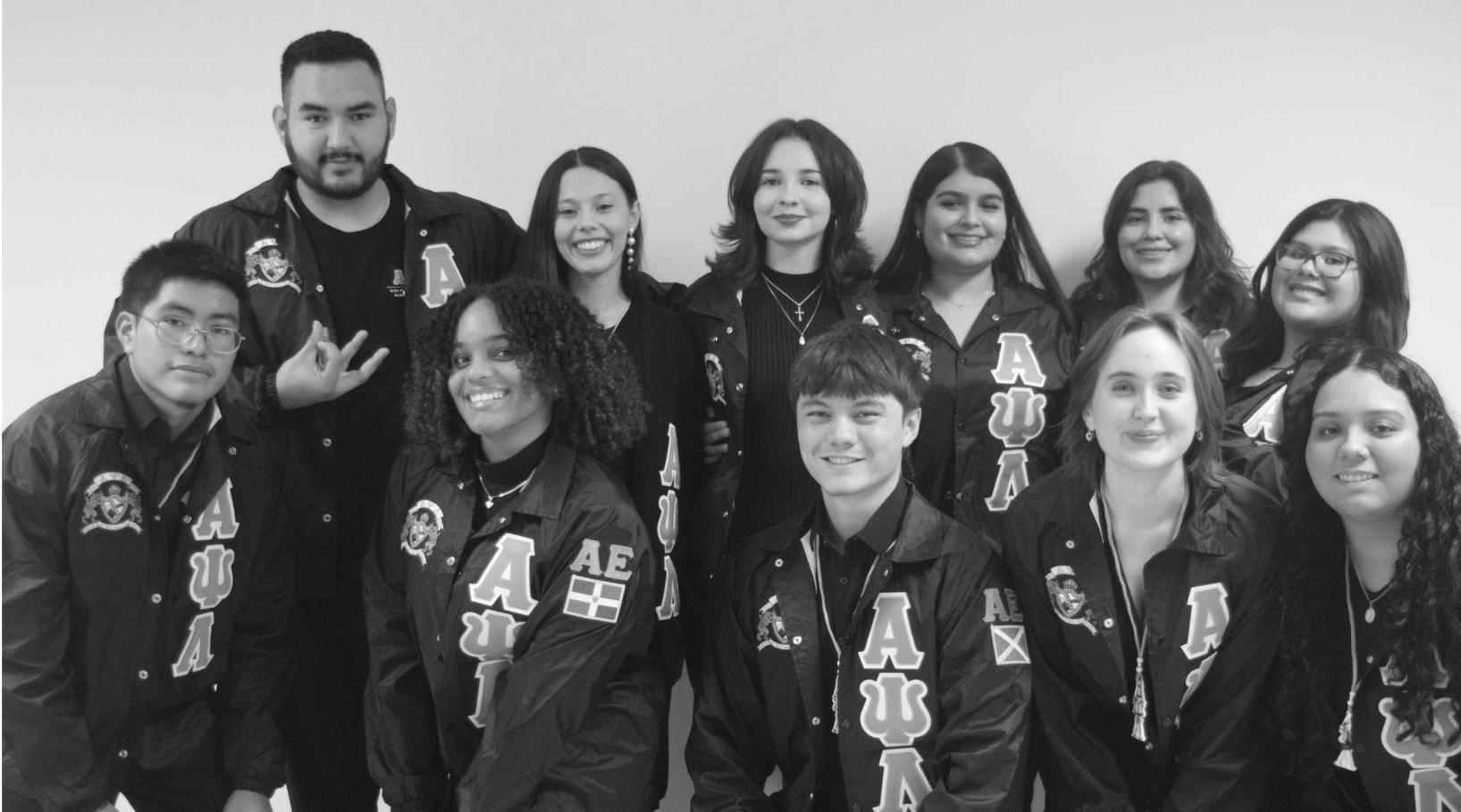
students at U-M Dearborn felt a personal significance to the performance. Yaritza Campos, president of U-M Dearborn’s Alpha Psi Lambda chapter (a Latine-interest co-ed fraternity) said she had an emotional experience watching alongside her Puerto Rican and MexicanAmerican family members.
“Growing up with my Puerto Rican side of the family, going to the island, seeing the references in the Super Bowl was super impactful,” she said. “It even made my own family cry.
Through Bad Bunny’s goal of representing Puerto Ricans in mainstream American culture, Campos and her family felt seen.
Campos described how the spectacle of popular Latin American symbols and Puerto Rican roots — such as crowd-
&
STIDOLPH Co-Editors in Chief
From the Co-Editors in Chief
Since 1971, The Michigan Journal has proudly served as the University of MichiganDearborn’s student newspaper. The Michigan Journal has been more than simply ink printed on a page or words uploaded to a site. It is an eternal record of what we cared about, what we questioned, and what we refused to ignore. It is a space to celebrate achievements, to name challenges honestly, and to make sure the UM-Dearborn experience is told by the people living it every day. Times such as these have made it clearer than ever that journalism, practiced at its highest standards of truth, is often our strongest ally in the face of adversity and injustice — and is sometimes all we have. It is the pillar that upholds the integrity of our society, challenging the status quo, raising awareness, demanding accountability, and driving positive change. And it all starts with student
Champs at last: Wolverines win first-ever CCWHA Championship SPORTS
HARRISON STIDOLPH Journal Co-Editor in Chief
It’s Sunday afternoon, and the Dearborn Ice Skating Center is covered with litter.
A swarm of skaters flood onto the surface, painting a pollock of scattered hockey gloves and blemishes from the errant throws of their winged helmets. The unbridled excitement is palpable; their cacophony of hollers and clangering stick taps fighting for attention over the senses against the roars of a cheering maize and blue-clad crowd.
These cheerers have traveled across state and county lines just to see this moment, watching through the scuffed glass as a velvet-red banner approaches the ice; it awaits the future hands of its forever home: hanging from the rafters on Bernie Klein Place. The centerhung tells the crowd the story: U-M Dearborn, 4; Indiana Tech, 1. For the first time, the Wolverines are to be Central Collegiate Women’s Hockey Association champions.
The 6th-ranked Wolverines skated to their most successful season yet in March, surmounting their first-ever conference title and fighting for their first appearance in the Frosty Four. In only seven years as a program, the bar won’t find itself much higher.
long and put in countless hours of practice and workouts to prepare ourselves for playoffs and nationals. Being able to win for the first time ever really showed the team’s drive and commitment.”
operated fields of sugarcane
— resonated with her family. Campos and her family felt that rather than enforcing stereotypes or romanticizing the island, Ocasio portrayed an accurate and prideful representation. In her perspective, the musician wanted to show the day-to-day life of Puerto Ricans for a wide audience.
“(The performance) showed these events, locations and very significant things that Puerto Ricans see on the island and remember to this day,” she said.
“[His performance] meant that the story is being told and that it’s not forgotten.”
For Latine students like Campos, Bad Bunny’s performance was a valuable representation, shedding a positive light on the community.
After consecutively earning their second-ever American Collegiate Hockey Association National Tournament appearance, the Wolverines came into 2026 with a Bulldogsized chip on their shoulder. But despite their once-again visit to nationals, the last postseason remained blemished — cut short in league play by a heartbreaking 1-0 conference championship loss to 1st-ranked Adrian last season.
The Wolverines skated strong back into the 2026 tournament with a vengeance: Closing out the regular season with a league-leading 29-20 record, the University of Michigan-Dearborn finished conference competition 13-1-0 – netting sweeps of 2nd-ranked Adrian and longtime U-M Dearborn rivals in Michigan State and U-M Ann Arbor’s own Wolverines.
“It was incredible,” said Captain Cadence Pero following the win over Indiana Tech.
“We’ve worked hard all season
Pero — who contributed two assists, finished the season ranked 1st in the nation in point scoring with 59; netting top 3 in goals with 26 and number 1 in assists with 33. “We have such a great group of girls,” she said. “I couldn’t be more proud of each and every one of them for how we showed up during that weekend.” Though ahead of the pack in scoring, the Senior doesn’t skate alone; in fact, 6 UM-Dearborn players placed in the top 25 for goals or assists –the most of any ACHA team. The Wolverines’ longest postseason yet, though cut short by a heartbreaking 5-0 loss in the frosty four to defending champs Liberty, left much to be impressed with their hard-fought path to the semifinal. Dearborn punched above their weight bringing down 3rd-ranked Minot State, and trounced 10th-ranked Jamestown in a 5-0 blowout. What lies in the tunnel ahead to next year’s competition leaves large skates to fill in graduating leadership and key contributors, but progress from the underclass may prove themselves worthy of the mantle. Not only will they be led by a deep junior class contributing well toward the team’s points, but they will have a future of support – namely in two standout freshmen forwards Pallavi Hari and Grace Taylor. Hari finished this year 8th in the country in goal scoring with 23, and Taylor jumped ahead in the lineup to become a bigger contributor this season with 13 points in 25 games. Additional to the success of the underclass, star goalkeeper Kenna Borso, a junior, has another year with the squad. Finishing top 10 this season with a .940 save percentage, the goalie has well-rounded support in Sophomore Nicole Alexander, who boasted 178 saves at .952 over the course of 11 games. All in all after yet another year in the history books, fans are looking forward to the next championship hunt. But in the meantime, a new banner for the best team on campus is a great sight to see.
Courtesy of Yaritza Campos.
UM-Dearborn 2025-2026 Alpha Psi Lambda Members.
James C. Renick University Center, 4901 Evergreen Rd, Dearborn, MI 48128 www.wolverinemedianetwork.com/michiganjournal
REENA HAMAD
HARRISON
Reena Hamad & Harrison Stidolph
Reena Hamad/TIMES
Camron Amin presenting at the IHP Summit 2026.
CAMPUS LIFE
Michigan Journal
How the FIFA World Cup is becoming exclusionary
LEILA EBRAHIM Journal Contributor
This summer, the FIFA World Cup is coming to the United States for the second time in its history. Set to be the largest World Cup yet, the tournament will include a record 48 teams across a total of 104 matches. The U.S., Mexico and Canada will play host to the world’s largest sporting event to date. For soccer fans around the world, this summer will be one to remember. And even for those not familiar with the game, the hype around the six-week tournament will not go unnoticed.
FIFA, or the Fédération Internationale de Football Association, is the worldrecognized governing body of soccer, headquartered in Zurich, Switzerland. It oversees soccer events throughout the world, from small competitions to large ones. FIFA’s most well-known tournament, the World Cup, has been in existence since 1930, first held in Uruguay. And every four years since (except in 1942 and 1946 due to World War II) the competition has taken place without fail.
The World Cup isn’t just about watching soccer — yes, the competition follows teams as they knock each other out in hopes of advancing to the final. But at its very core, the tournament is a way for entire countries to unite, celebrating their own unique cultures. In 2010, when the World Cup was held in South Africa, vuvuzelas were a common sound heard in stadiums. The distinct, horn-like buzz spoke to the country’s Zulu traditions. In Qatar’s 2022 World Cup, fans from various countries were spotted wearing traditional Arab headgear and garb. Even Argentine soccer star, Lionel Messi, donned a Qatari bisht as he raised the trophy for the world to see. It is a celebration of music too: For each World Cup, FIFA collaborates with famous musicians to create a unique album for the specific tournament. Many of these soundtracks often pull their sound from the country in which the year’s World Cup is taking place. “Waka Waka” by Shakira, a song created specifically for the 2010 World Cup in South Africa, features Freshlyground, an Afro-fusion pop band from
Is generative
Cape Town. Since its release, the song has garnered almost 4.5 billion views, becoming the eighth-most-viewed music video on YouTube. Whether you’re a soccer fan or not, it’s almost a certainty you’ve come across this universally known tune.
Since it’s existed, the World Cup has brought together fans from countries all over the world in a peaceful, festive way. The tournament has always been about the love for sport, music, art and culture: a time where people forget their gripes with one another and entire governments pause their conflicts. And if the tournament is known for one thing, it is that it is catered to everyone. The World Cup is marketed for all, with tickets accessible for any fan to buy. Soccer, unlike many other sports, is not historically known as being elitist. Instead, it is recognized and applauded for its encompassing nature, its accessibility and affordability for the general population. In Qatar’s 2022 tournament, the cheapest ticket recorded was $11, and the most expensive ticket for the final itself was $1,607.
But as sales come to a peak for this summer’s upcoming World
A.I.
Cup, fans are angry. Ticket prices are hitting record highs: $60 for the cheapest ticket, and $10,990 for the most expensive one recorded so far. And while $60 may be considered affordable, these tickets are highly limited. Most of them sold out in the pre-sale phases (only open to Visa holders or through a highly randomized and unreliable lottery), and the tickets that are left are outrageously expensive.
In comparison to Qatar’s most expensive final ticket of $1,607, the cheapest final ticket for this 2026 tournament in the U.S. is priced at more than $2,000. And this doesn’t even include travel, hotel and food costs. This is the first time such high prices have been seen in the history of the tournament. It’s unprecedented and completely at odds with what soccer stands for.
This isn’t the only controversy surrounding the upcoming World Cup. FIFA President Gianni Infantino came under fire earlier this year for his latest creation: the FIFA Peace Prize. Described as an award to recognize “exceptional actions for peace and unity,” Infantino awarded the prize to U.S. President Donald Trump.
a threat to the creative process?
WREN SNYDER Journal Contributor
As I approach my senior year in the Journalism and Media Production department at U-M Dearborn, I have been very disappointed to hear members associated with the University ask about the lack of usage of artificial intelligence in my films. I understand and recognize the strong wave of support for what AI is capable of doing, but I don’t believe it has a place in the field of humanities as a substitution for human creativity.
Discussions specifically focusing on how this new technology can benefit students has been rapidly increasing, for better or for worse. What is critical is that
students must understand the ethical and responsible weight of using such a tool, and not letting it replace any cognitive functions. My fear is that the line has become blurred for what utilizations are being considered socially acceptable.
Electronic usage in artistic spaces has long been debated, even the digital camera initially being seen as a less authentic tool compared to more convoluted film cameras. However, over the last few decades, we’ve seen a shift toward embracing more digital art forms. Animations, video game development, datamoshing and other impressive digital forms of artistic expression have used technological advancement to their advantage as they
arrived. I believe that AI has these same capabilities, but only to be used as a tool by these creatives. It should not replace the creative process, but become an accessible resource to those who wish to apply it in different formats. For example, a new tool in Adobe Premiere Pro 2026 that has aided thousands of artists is an AI powered speechto-text transcription tool. This has saved interns like myself hundreds of hours of transcribing audio, but the results are not always accurate. This example of efficiency over accuracy is present in all forms of current generative AI and still requires a specific amount of personal and professional experience to work alongside it.
I have been extremely thankful to be gaining this same personal and professional experience within my department, working directly with award-winning journalists, international filmmakers and professors with both academic creative research and industry experience. Without their knowledge and guidance, I would not be confident in my filmmaking abilities. It is with this confidence that I can proudly say that I do not need to use AI to generate films, nor would I necessarily want to. All of the resources, support and mentors that have curated my creative skills are all invaluable assets that artificially generated deliverables could never truly represent.
Many have expressed anger and annoyance at this action, accusing FIFA of inventing an award specifically for Trump for no valid reason. Even more importantly, many have stated that the U.S. president has done nothing to warrant the reception of a prize that recognizes peace, as many of his actions have only furthered wars and other global issues.
Fans around the world are noticing these controversies surrounding the upcoming World Cup. Many are scared to come to the U.S. out of fear of encountering U.S. Immigration and Customs Enforcement officers or other forms of law enforcement that might be present at games.
Concerningly, when asked about presence at the World Cup, ICE Acting Director Todd Lyons stated that they would play a “key part” in the tournament’s security.
So, while the upcoming 2026 World Cup is an exciting event for many to look forward to, lately, it hasn’t always been a hot topic for positive reasons only. FIFA’s shocking dynamic pricing, coupled with the current social
CHANCELLOR
From Page 1
“My wife Ruth and I look forward with great anticipation to rejoining this remarkable community.”
While the search for yet another U-M president begins, campus community members in Dearborn are left wondering if they will soon see an end to their own chancellor search. Last May, then-Chancellor Domenico Grasso announced he would be serving as interim U-M president.
The move by Grasso sparked a series of interim promotions, including the elevation of Provost Gabriella Scarlatta to the role of interim chancellor and Ghassan Kridli, dean of the College of Engineering and Computer Science, to the role of interim provost.
A total of 11 changes in position or responsibilities have been made as a result of the moves, according to announcements by UM-Dearborn News.
An official search for U-M Dearborn’s next chancellor was announced in November, when the University published a list of names to serve on the search committee. It said that 16 faculty and administrators representing all three campuses would serve, led by two co-chairs: Kridli and U-M Flint Chancellor Laurence B. Alexander.
When asked whether the news of Syverud’s diagnosis would impact the search committee’s priorities or the hiring process for a new chancellor, Kridli and Alexander confirmed that the search remains ongoing.
“The news of Kent Syverud’s health crisis is very sudden and incredibly sad for the entire U-M
and political atmosphere in the U.S., is slowly making what is supposed to be an inclusive event into an elitist, exclusionary tournament only for the privileged and wealthy. It’s a worrying phenomenon at odds with what the World Cup has always stood for. After all, it is only truly the “World” Cup if it includes the world: no matter race, culture, religion or socioeconomic standing. Fortunately, people are taking note of FIFA’s questionable actions. Many are refusing to buy tickets, even boycotting the competition and merchandise all together. We cannot lose sight of who truly holds the power: the fans. It is the fans’ duty to make their frustration known by standing up against these practices in an impactful way, whether that is in the form of boycotts, protests or petitions. Without public support, FIFA and their exclusionary World Cup will be largely unsuccessful. It is up to people all over the world to show that they, and the sport of soccer itself, will not tolerate any form of discrimination that renders the tournament purely for the elite.
community,” Kridli wrote in a statement to The Michigan Journal. “Next steps with regard to the many facets of the presidential transition are currently being discussed and determined. The UM-Dearborn chancellor search process remains ongoing, led by the Office of the President at UM-Ann Arbor. As soon as there are updates, those will be shared with the campus community.”
In the rest of the statement, Kridli wrote that he and Scarlatta would continue in their duties supporting the campus community, expressing his sentiments toward the Syverud family.
“Interim Chancellor Scarlatta and I are committed to supporting our faculty, staff and students during this unexpected transition period and offering whatever support is needed to our colleagues in Ann Arbor as well,” Kridli wrote. “Above all else, our thoughts are with the Syverud family as they navigate this very difficult situation.”
U-M Flint’s Office of the Chancellor also had no official updates as to whether there had been any changes or updates in the search.
“First and foremost, our thoughts are with Kent Syverud and his family as they navigate this diagnosis,” Alexander’s office wrote in an email. “This is deeply difficult news for the entire university community, and our immediate focus is on supporting him with care, respect and compassion. In the meantime, President Grasso continues to lead, and he’s someone the university can rely on to provide steady leadership in a moment like this.”
Majorism: How bias impacts both classes and classism
The term “majorism,” coined by a visionaries at the University of California Los Angeles, describes a dynamic many students know well: scienceand math-based majors are often treated as more valuable than humanities-based majors. For many students in the College of Arts, Sciences, and Letters, that imbalance is not abstract. It shapes everyday academic life, from the way majors are discussed by peers and parents to the way universities allocate time, funding and institutional support. The growing emphasis on science, technology, engineering and mathematics has brought important opportunities, but too often, it has also come at the expense of the humanities.
That imbalance is especially visible in the classroom. From an early age, students are encouraged to pursue STEM fields, often not as part of a holistic education but through a system that subtly teaches them to view the humanities as less practical or less essential. In college, that message can take structural form. Many CASL students have only one section of required courses available each semester. For students who work, care for family members, complete internships or support themselves financially, that lack of flexibility creates a serious burden; they must either take the classes they need to graduate or meet obligations outside the classroom. Students in nonCASL majors, by contrast, often have multiple section options to choose from each semester, allowing them to build schedules that better fit the realities of their lives.
The disparity extends beyond course registration. Employers and outside institutions often direct funding toward programs they believe will produce a more immediate return, which frequently means STEM fields. Internships, partnerships and financial support tend to follow that logic.
Humanities students, meanwhile, are often told their degrees prepare them for a broad and adaptable future, yet the full value of their skills is rarely communicated with the same confidence. As a result, their programs receive less investment, evident in U-M Dearborn’s unremedied CASL cutbacks in November 2024, in turn hindering institutional reinforcement for and their professional pathways. Students who are already underserved by their universities will then find themselves deprived of the resources needed to prepare
them for the industries and organizations they are seeking to work for.
There is also a personal cost to this hierarchy. Dismissive comments, skepticism and a general lack of respect for the humanities can make students feel that the work they care about is constantly being questioned. Many students choose humanities fields because they want to engage deeply with ideas, language, culture, ethics and history. They choose them because those subjects matter. When those choices are repeatedly devalued, even ordinary conversations about one’s major can begin to feel defensive, as though students must continually justify the legitimacy of their interests and ambitions.
The preference for STEM will not disappear overnight, but universities can make deliberate choices about
Wren Snyder/JOURNAL
Each of the most pressing challenges the University of Michigan is facing today — federal funding cuts, union negotiations, athletics scandals, divestment, artificial intelligence and the future of Diversity, Equity and Inclusion — our three campuses face together.
In an era of collapsing local news economies and rampant misinformation, we believe
From the Co-Editors in Chief
student journalism is a form of public service: Not just shining light on the student experience, but holding campus and local institutions accountable for their actions and their effects. This is no small task, and it necessitates that the three campuses commit to coordinate and support each other.
This collaborative edition, the first of its kind, reflects that commitment, and we hope
it marks the beginning of a broader, sustained partnership between The Daily, The Times and The Journal. By working together, we can pursue more comprehensive reporting, amplifying stories that might otherwise go unheard, and ensuring administrative decisions are understood in their full context.
- Edith Pendell & Zachary Ajluni
University President-elect Kent Syverud steps down due to cancer diagnosis
Interim President Domenico Grasso will continue his tenure until a new president is found
University of Michigan
President-elect Kent Syverud announced Wednesday morning that he will no longer take up the position due to a recent brain cancer diagnosis. Syverud’s term was set to begin May 11. The information was first released in an email to the campus community, which included a letter from Syverud.
NEWS BRIEFS
In the letter, Syverud wrote that he is currently receiving treatment from Michigan Medicine.
“Last week, I wasn’t feeling well, and I sought care at Crouse Hospital in Syracuse,” Syverud wrote. “After further evaluation, I traveled to the University of Michigan to receive additional assessment from their specialists. I want to be straightforward with you: I have been diagnosed with a form of brain cancer.”
Storm tears through Ann Arbor, damaging city buildings, Yost Ice Arena City employees worked through the night to address damage caused by two tornadoes
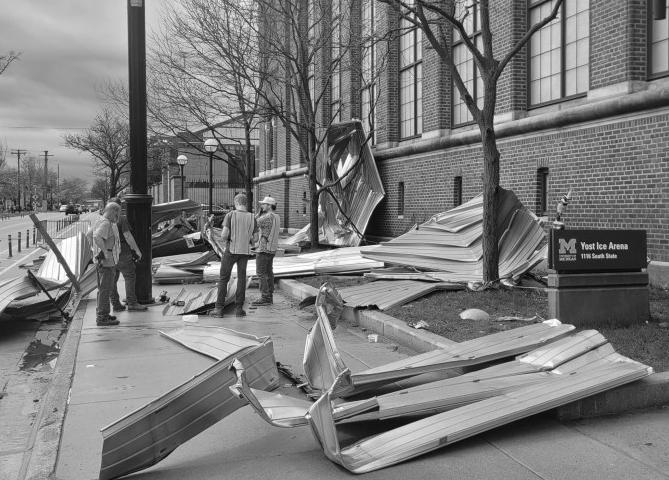
Courtesy of Dominic Apap. Damage outside of Yost ice arena following a tornado April 14.
majority of which were related to the storm,” the statement read.
A storm swept through Ann Arbor at about 1:45 a.m. Tuesday night, damaging Yost Ice Arena and several other locations. The Division of Public Safety and Security announced a Tornado Warning for Washtenaw County at 1:40 a.m. until 2:15 a.m. The National Weather Service is investigating whether a tornado touched down in Ann Arbor.
In a post to X, the Ann Arbor Police Department wrote that officers worked through the night alongside the Ann Arbor Fire Department and the city’s public works teams to respond to emergency calls and clean up debris.
“Between 1:45 a.m. and 6:00 a.m., our department had more than 120 calls for service, the vast
“There are four public works crews out across the city removing fallen trees from roadways. A pile of debris from Yost Ice Arena currently blocks the sidewalk on the west side of South State Street near McKinley Avenue. Additionally, AAFD announced that the east wall of Veterans Memorial Park Ice Arena collapsed, and there has been damage to adjacent fields. The park is closed to the public until further notice. The storm also left debris outside the Argus Building and tore down multiple trees along West Liberty Street. Currently, more than 10,000 people remain without power throughout Washtenaw County, according to the DTE Energy Outage Center. CONTINUED AT MICHIGANDAILY.COM
While Syverud will not be taking up the presidency, he will still take up a position as a member of the Law School faculty and adviser to the University’s Board of Regents. In his letter, Syverud thanked the Board and the University community.
“While my diagnosis and treatment will prevent me from serving as the 16th President of the University of Michigan, I am deeply moved by the generosity of the Regents, who have invited
NEWS BRIEFS
me to continue contributing as a professor in the Law School and as a special advisor to the Board,” Syverud wrote. “My wife Ruth and I look forward with great anticipation to rejoining this remarkable community.”
In a video message, Board Chair Mark Bernstein (D) said interim University President Domenico Grasso will continue his tenure until a new president is elected.
CONTINUED AT MICHIGANDAILY.COM
Ypsilanti Township proposes water moratorium that could block planned UMich data center
“The biggest investments we have are our homes, our businesses, the places we live.”
GLENN HEDIN Daily News Editor
The Ypsilanti Township Board of Trustees approved a resolution Wednesday that could prevent the University of Michigan from drawing the 500,000 gallons of water needed to operate the $1.25 billion data center it plans to construct in partnership with Los Alamos National Laboratory.
The data center has been met with opposition from township residents and members of the University community due to concerns over its potential negative impacts on the electrical grid and environment, as well as its confirmed use in the development of nuclear weapons.
The University is exempt from local zoning laws under Michigan’s Constitution, meaning it could still build its data center even if the township were to pass a moratorium on building data centers. However, the township could obstruct the project by passing a moratorium on providing water to data centers, which they need to cool servers.
The board passed a resolution requesting the Ypsilanti Community Utilities Authority place a water moratorium on hyperscale and mid-size data centers, as well as artificial intelligence computing facilities and “high-performance
computational centers,” the University’s preferred term for the facility. YCUA must approve the moratorium for it to take effect.
During Wednesday’s board meeting, Township Supervisor Brenda Stumbo, who also serves on YCUA’s Board of Commissioners, said she believes YCUA will approve the moratorium.
“The biggest investments we have are our homes, our businesses, the places we live,” Stumbo said. “For them to harm us with the location of these data centers, harm our environment without any studies, not one — YCUA will study it. I believe they will do it right, because YCUA does do things right.”
This resolution is only the latest action from a township harboring increasing opposition to the University’s plans. On March 31, the board approved a resolution formally objecting to the construction of the University’s data center anywhere in the township. Before this resolution, the township had requested the University construct the data center at the American Center for Mobility instead of a Textile Road parcel recently purchased by the University, which is adjacent to the Huron River and an affordable housing development.
CONTINUED AT MICHIGANDAILY.COM
ICE detains driver in Ann Arbor’s Kerrytown District without alerting local officials
“ICE commits violence, lawlessness, and racial profiling. It is an agency that cannot be redeemed and must be abolished.”
DOMINIC APAP Daily News Editor
multiple vehicles, approached with guns drawn, extracted the driver, and took him into custody,” Taylor wrote. “This high risk action occurred without notice to, or cooperation of, the City of Ann Arbor or AAPD. We do not have any information about the arrest preparation or the driver’s identity, history, or current whereabouts.”
In a post to X, the AAPD wrote that police officers responded to the scene at approximately 9 a.m. after ICE agents had left with the detained individual. “Upon arrival, the scene had
already been cleared of federal agents,” the statement read. “Ann Arbor police officers subsequently arranged for the vehicle obstructing the bike lane to be towed. The AAPD was not notified of this enforcement activity before, during, or after it took place, and is not part of their investigation.”
City Council has repeatedly rejected cooperation with ICE.
In February, the council passed a resolution prohibiting ICE agents from using city-owned parking lots as staging areas and requiring them to present a warrant to enter nonpublic
areas within city facilities. At last week’s meeting, Councilmember Cynthia Harrison, D-Ward 1, said she was working on resolutions to prohibit officers from wearing facial coverings and require visible identification. President Donald Trump’s administration filed a lawsuit against Washtenaw County Thursday, claiming its policies interfere with ICE enforcement. Taylor wrote that ICE raids like the one in Kerrytown strike fear in the community and decrease trust in law enforcement.
CONTINUED AT MICHIGANDAILY.COM
Stanford Lipsey Student Publications Building 420 Maynard St. Ann Arbor, MI 48109-1327 734-418-4115 www.michigandaily.com
EDITH PENDELL and ZACHARY AJLUNI Co-Editors in Chief eic@michigandaily.com
CICI COPENHAVER Business Manager business@michigandaily.com
NEWS TIPS tipline@michigandaily.com
LETTERS TO THE EDITOR tothedaily@michigandaily.com
University of Michigan students, faculty and community members gathered Friday evening on the Diag for a vigil honoring Danhao Wang, an assistant research scientist in the College of Engineering who fell from an upper level of the George G. Brown building and died March 20. The Division of Public Safety and Security is investigating his death as “a possible act of selfharm.”
A spokesperson for China’s Ministry of Foreign Affairs claimed the same week that a U-M researcher was subjected to “hostile questioning” by federal law enforcement prior to his death, but did not name the individual.
GOVERNMENT
Code Pink, an anti-war social justice organization, hosted the event. The organization presented a petition to the University’s Board of Regents July 31 calling for increased protection of international students following a series of arrests and federal cases involving Chinese researchers at the University.
The vigil featured remarks from community organizers, moments of silence and a traditional Chinese bowing ceremony. Attendees formed a circle around a small altar adorned with candles, flowers and offerings as speakers reflected on Wang’s life, research and the broader implications of his death.
In an interview with The Michigan Daily, Bob McMurray, a Code Pink member, said the vigil was an opportunity for grieving as a community.
“There are people here in the University research community who still miss Danhao,” McMurray said. “They feel his absence, and we as a community have lost a brother in our human family. Tonight is not about outrage. Tonight, I want us to share our pain, to examine where absence exists and feel the brokenness.”
Linda Wan, a Code Pink member and event organizer, said members of Code Pink felt they had a responsibility to honor Wang.
“We feel that we as a community had a responsibility to mark his passing in a communal way,” Wan said. “He was a guest in our country and a part of a community since 2022, and his loss is a tragedy.” CONTINUED AT MICHIGANDAILY.COM
Gilchrist and Savit nominated by Michigan Democratic Convention for secretary of state and attorney general
“This is about making sure that voices can be heard and freedoms can be realized.”
A record-breaking 7,000 delegates gathered in Detroit to attend the Michigan Democratic Party’s 2026 State Endorsement Convention Sunday. The party formally nominated Lt. Gov. Garlin Gilchrist and Washtenaw County Prosecutor Eli Savit for secretary of state and attorney general, respectively.
Delegates also chose the Democratic nominees for the Michigan Supreme Court; State Board of Education; and the governing boards of the University of Michigan,Michigan State University and Wayne State University.
The convention began with delegates attending caucuses to connect with party leaders and politicians aligned with their policy interests and backgrounds. In the Environment Caucus, Secretary of State Jocelyn Benson, gubernatorial candidate, emphasized the importance of the convention and encouraged delegates to vote for leaders
MAKLED From Page 1
“This moment obviously doesn’t belong to me,” Makled said. “It belongs to every student who believed their voice mattered, every worker who showed up and said, ‘We deserve better,’ every family across the state who looked at this university and thought, ‘Maybe it could be for us, too.’”
Brown kept his acceptance speech brief and expressed gratitude toward his family, labor unions and the LGBTQ+ community for supporting his campaign.
“I just want to thank my children and my wife, my union brothers and sisters, my LGBTQ family and all progressive Democrats,” Brown said. “We will continue to make the University of Michigan the greatest university in the world because of our progressive values.”
Acker and his campaign staff declined The Michigan Daily’s interview requests during and after the convention.
The final days of the race were dominated by a series of personal attacks against each candidate, with Acker receiving backlash for sexually degrading
who will stand up for their wellbeing to restore Michigan’s Democratic trifecta.
“I know what’s at stake,” Benson said. “For our water, for our air, for our infrastructure — you need someone who’s going to stand up to anyone who wants to bring data centers to our state. When we get our trifecta back, we’ll be able to do all these things together. That’s why working from today, ready to win, is so important — because we can.”
Following the caucuses, Michigan U.S. Senate candidates took the stage to deliver their remarks. In his speech, Senate candidate Abdul El-Sayed criticized U.S. foreign policy spending and the role of lobbying groups — like the American Israel Public Affairs Committee — in national politics, drawing strong support from many delegates.
“We cannot continue to make peace with the system that tells us that our best use of our tax dollars is to send money elsewhere in the form of bombs and tanks,” El-Sayed said. “We’ve got to decide that, so long as we are willing to accommodate the likes of an AIPAC in our politics, do not
be surprised when they take us to foreign wars we have no business fighting in.”
After El-Sayed’s speech, U.S. Rep. Haley Stevens, who is also running for U.S. Senate, took the stage, where she was booed by many attendees. Delegates also booed a party official nominating University of Michigan Regent Jordan Acker. Acker later lost to progressive challenger Amir Makled. In an interview with The Michigan Daily, Stevens said young voters have every reason to feel frustrated and want to know where their tax money is going.
“Every young person has a right to ask, ‘What’s coming back to me?’” Stevens said. “(Their money) should not be being funneled into illegal wars that are raising our costs. This should not be being funded to subsidize the billionaires. We have to bring the power back to the people, and we’ve got to start right now.” Other candidates endorsed by Michigan Democrats included both contested and uncontested races across university and statewide governing boards. CONTINUED AT MICHIGANDAILY.COM
messages sent over Slack and Makled receiving criticism over a series of old retweets of posts praising members of the militant group Hezbollah. This media attention does not seem to have detracted from Makled’s support at the convention, though it did polarize some attendees against Acker.
In an interview with The Daily, Makled said the level of grassroots support he received from convention attendees exceeded his expectations.
“This is beyond the support that I was expecting,” Makled said. “This is the largest convention I’ve participated in in 20 years, and I’ve been coming to them since 2006.
This really shows how much the Democratic Party has expanded the electorate and energized the base of what people want to see come November.” Makled was accompanied by student volunteers, who canvassed and cheered for him throughout the convention. Among these volunteers was LSA sophomore Summit Louth, Central Student Government president, who told The Daily that he believes Makled will be more responsive to students’ wishes than the current regents. “I want a regent who is going to put students over everything,” Louth said.
Courtesy of Alexa Cheaney.
U-M regent candidate Amir Makled accepts his nomination at the Michigan Democratic State Endorsement Convention.
The rise of Yemeni coffee shops in Ann Arbor “Try all the different Yemeni coffee shops in the area, and you’ll see the difference.”
Over the past few years, Ann Arbor has seen the opening of numerous Yemeni coffee shops, including Bun Chai Yemeni Coffee & Tea,Bayt Almocha, Qahwah House, Socotra Coffee House andJabal. Yet another — Caffeena — will replace former bubble tea shop Tea Ninja on East Liberty Street, though it currently has no set opening date. Coffee is believed to have originated in Yemen, where it spread to the rest of the world through the port city of Mocha.
Compared to other types of coffee, Yemeni coffee is known for its strong spices — primarily cardamom, cinnamon and ginger
CAMPUS LIFE
— that produce a rich flavor distinct from western coffee.
The first Jabal coffee shop opened in Dearborn Nov. 13, 2023 before opening in Ann Arbor on East Huron Street in March. In an interview with The Michigan Daily, Saqr Waza, co-founder of Jabal, said the shop’s success in Dearborn helped him decide to open a store in Ann Arbor. Waza said Yemeni coffee is one of the best varieties of coffee in the world.
“Yemeni coffee shops in general, it’s more than just the coffee shop,” Waza said. “Yemeni coffee in general is one of the best coffees in the world. … We’re now reigniting the Yemeni coffee and bringing it, and showcasing the quality being, and also the atmosphere, and the hospitality.”
Bayt Almocha is a Yemeni coffee that opened in Kerrytown in June 2025. In an interview with The Daily, Amer Almassudi, Bayt Almocha Ann Arbor manager, said Yemeni coffee shops are unique because many stay open late into the night.
Many Arab Americans do not drink alcohol for religious reasons. Almassudi said Bayt Almocha offers an alcohol-free, alternative nighttime activity.
“It’s better to go have coffee where you can focus on family, friends and enjoying life without having to have alcohol,” Almassudi said. “In our religion, we don’t drink alcohol. … We’re all used to hanging with family and friends over a pot of tea or a pot of coffee, and now we’re opening up the cafes to introduce it to others.”
SpringFest 2026 celebrates local bands and student arts organizations
The day-long music festival featured student performances, local vendors and food trucks
NIKO WILSON & ALIANA RITTER Daily Staff Reporters
The sounds of jazz, K-pop, spoken-word poetry and a cappella from some of the University of Michigan’s most talented musicians echoed through downtown Ann Arbor and the U-M campus Friday afternoon.
Hundreds of students and community members gathered for the SpringFest music festival and street fair hosted by U-M student organization MUSIC Matters. The annual event,founded in 2011, featured street vendors, food trucks and performances from seven student organizations and eight local bands.
The festival ran from 11 a.m. to 7 p.m. and closed off segments of South State Street and North University Avenue. The festival received support from multiple University and corporate sponsors, and there was a large interactive booth for Google Gemini, an artificial intelligence chatbot, on the corner of North University Street and South State Street. Employees gave away Gemini-themed stress balls and smoothies marketed to help students study for finals.
In an interview with The Michigan Daily, LSA senior Macy West, MUSIC Matters SpringFest chair, said the festival took months of preparation, including coordinating with brand partnerships, performers, vendors and city officials.
“It was a lot of coordination with the city, getting barricades and the road shut down and permits for everything,” West said. “I was anxiously checking
the weather for months out, but I really love all of our local bands.” Local bands competed to secure a spot at SpringFest in March at Battle of the Bands. Among these bands was Wisdom Drive, including LSA freshman Jake Nellett playing guitar.
Nellett told The Daily that performing on the SpringFest stage was a new, exciting opportunity for the band.
“This was unreal,” Nellett said. “Usually, it’s just a porch show with mics that suck because stuff’s expensive. It’s always great — good sound, bad sound, big crowd, small crowd — we love it all, but this is definitely the biggest.”
In addition to the live performances, student organizations and small businesses promoted themselves at tables along South State Street during the event.
VIPsfund, a nonprofit student organization that creates sustainable handmade products and donates all proceeds to wildlife conservation initiatives in Madagascar, relies on opportunities to sell products at tabling events like SpringFest.
In an interview with The Daily, LSA senior Anya Renzi, VIPsfund executive board member, said the organization was excited to support MUSIC Matters while representing their club.
“(MUSIC Matters) is very similar to us in wanting to support small local artists, and we just really wanted to second that message and support them, while also giving a little support for ourselves as well,” Renzi said.
“We love seeing people engage with the arts, and we love being another way for people to engage with the arts.”
Bayt Almocha has locations across the country. Almassudi said the shop aims to share Yemeni cuisine and culture through its Ann Arbor location, where founder Abdulla Alysofi grew up.
students to study, take meetings or freely stop by.
“I had the hardest time studying outside of one of the Michigan buildings,” Issa said.
they have a downstairs because in Ann Arbor, obviously, shops are pretty small, so it’s nice that there’s a lot of space to study and hang out with friends.”
Art & Design senior Jenna Downs told The Daily that SpringFest provides an opportunity for various campus communities to unite around music.
“I think it showcases how community is important and being a part of our collective voice in the university space, and finding places you can connect with others,” Downs said. “Just being able to connect with a local group of people that’s likeminded is really amazing. It’s been really rewarding, so I think events like this are important to keep going.”
In an interview with The Daily, LSA junior Joseph Oburu said SpringFest is one of his favorite campus events and was a reason he chose to attend the University.
“(SpringFest) is just an amazing event where everybody just comes out and listens to great local bands and supports local venues and vendors,” Oburu said. “I just love the community, and I think it’s one of the best events in Ann Arbor. When I came up here for a tour, this was one of the things that made me want to come to Michigan, just seeing this whole scene.”
The festival concluded as Wisdom Drive performed covers of pop songs in front of a lively crowd. Nellett said SpringFest showed increasing demand for live music on campus, and he hopes the festival inspires students to start bands.
“At first, I was surprised that there were a lot of bands, but now I can’t believe there’s not more just because of how many people want to go to a show,” Nellett said. “It’s great to see a ton of people love live music, because we love it.”
“We brewed the first coffee, cultivated the first coffee and introduced flavor into coffee, and introduced culture and coffee to the West,” Almassudi said. “It’s one of the main reasons we felt comfortable (coming to Ann Arbor). … This is the home around the same neighborhood where the original founder, Abdulla, grew up.”
University of Michigan alum Mahmoud Issa, franchisee of Jabal’s Ann Arbor location, told The Daily that the shop’s late hours are intended to allow
“If you went to any of these coffee shops, they were always either super full, or they were closed by 4 p.m., 5 p.m.
So, we want to create a place that you have class ending at three, then you can come to Jabal at five and study until 10 or 11 or midnight.”
In an interview with The Daily, LSA freshman Ana Juricic, who frequents Yemeni coffee shop Bun Chai, said she enjoys its matcha and thinks its ambience creates a productive atmosphere.
“I got recommended by a friend to come here to try their matcha, and since then, I’ve only been going here for matcha,” Juricic said. “It’s really nice to sit in here. I like that
Alassudi said the draw of Yemeni coffee shops is not only their coffee, but also the social and communal experiences not provided by traditional coffee chains.
“We’re more family-based and more personal than versus you going in there and just, ‘Hey, let me get a frapp’ or ‘Hey, let me get a cappuccino’ and walk out,” Alassudi said. “We like to get to know people. You can sit and socialize better. … Try all the different Yemeni coffee shops in the area, and you’ll see the difference than you going to a Starbucks and versus you going to a Dunkin’ Donuts — you’ll see the difference.”
Michigan Fashion Media Summit showcases entrepreneurs and students in the fashion industry
“I was so impressed that all three of those women were self-made CEOs. It’s so inspiring how they started their entrepreneurial journey.”
everybody has a journey with peaks and valleys.”
Hundreds of students gathered at the Ross School of Business Friday for the eighth annual Michigan Fashion Media Summit conference. The student-led event aims to shape the future of fashion by connecting students to industry leaders in both fashion and media, featuring speeches from 24 different panelists and displaying student projects.
The event featured a panel titled “Vision to Venture: Founders in Fashion,” which focused on intentionality during the process of building a brand and identifying gaps in the market while staying authentic.
Jessica Williams, head of brand marketing and partnerships at Shopify, was moderator for the panel. She opened the floor to three business founders — Francesca Aiello, Danielle Guizio and Elena Bonvicini — to speak about what it means to be successful.
Aiello, founder and CEO of Frankies Bikinis, started her brand in 2012 at the age of 17. While she initially created bikinis for her and her friends, she gained traction on social media and continued building her business from there. During the panel, she said confidence is essential to starting a business.
“I remember I wasn’t even able to look people in the eyes when I was talking about my brand, which makes me so sad looking back,” Aiello said. “My biggest tip I can give anyone is to believe in yourself and have confidence in what you’re doing, because everything that you’re doing is so unique to you. Nobody can replicate you. Believe in yourself from the jump because
Guizio, CEO and designer of Guizio — a brand known for formfitting silhouettes — started her brand in her parents’ basement with $400 from a tax return.
Today, her eight-figure brand is a staple for major celebrities and is in stores across the United States. When asked about distinguishing her personal identity from her brand’s identity, she talked about maintaining privacy while also being the face of Guizio.
“It just so happened that I was making clothes that I loved and wanted to wear,” Guizio said. “I was wearing and posting them, and gained traction off of that. What’s really interesting now is that I could walk into my store and people don’t know who I am. Customers come up to me and ask, ‘Hey, can you get me this in a size small?’ And I say, ‘Yes, I will.’ … I think what’s so cool about that is it shows how the brand has become bigger than me, and that’s always what I wanted.”
Bonvicini, founder and creative director of EB Denim, began her business in college by thrifting and reworking Levi’s jeans and then selling them to her peers. Through social media and hard work, her brand grew into a wholesale business selling quality jeans. When the topic of dupes came up during the panel, she said Guizio helped her realize she would always be ahead of people who try to copy her.
“I had this pair of jeans that had a chain lacing up the side, and it was basically my whole brand,” Bonvicini said. “One day, I walked into a store, and I saw a dupe of it. I got so pissed, and I posted it on my Instagram story, and Danielle replied back, saying, ‘You know what? That is going to happen, but what they can never
take from you is your creative soul, and you will continue to put out better and better things. You’re going to be light years ahead.’”
In an interview with The Michigan Daily, Business sophomore Lena Sobol, a member of the Ross Retail Club, said she was impressed by the panel.
“I was so impressed that all three of those women were selfmade CEOs,” Sobol said. “It’s so inspiring how they started their entrepreneurial journey and built their brands from the ground up. Today’s panelists inspired me to start putting myself out there just like these people, who were able to climb to the top.”
The event also included the Fashion Forward Showcase, an exhibition for college students building creative projects or businesses. Five selected finalists presented their work at booths and competed for first place. Evelyn Short, a junior at Michigan State University and creator of Mirabelle — a collection inspired by 1970s silhouettes — won and took home the prize of an exclusive professional development experience with the event’s sponsor, fashion mogul Steve Madden.
In an interview with The Daily, Short said her grandmother first introduced her to fashion, and she now uses it as a creative outlet.
“My grandma was a seamstress,” Short said. “Growing up, she taught me how to sew, and we would sketch and make doll clothes together. I feel like that stuck with me so much, and it was something that I continued to pursue. I love how creative fashion is; it bridges so many disciplines, and it allows you to go in so many different directions.”
CAMPUS LIFE
AMANDA PIEL Daily Staff Reporter
NATALIE MARK Daily News Contributor
Courtesy of Amanda Piel.
The Michigan Fashion Media Summit took place April 17 in the Stephen M. Ross School of Business.
Varun Tandon/DAILY
Students and Ann Arbor residents gather in the Diag for SpringFest performances Friday evening.
GOODBYEs B-SIDE
IAN GALLMORE Senior Arts Editor
Everything comes to an end. It’s the natural order of things — a looming inevitability, constantly plaguing the beauty of the present. Goodbyes are our solution to this problem. A way to mark the transition from middle to end. To come to terms with the ever-changing nature of our lives.
Sometimes, goodbyes are about control. Choosing when to leave or what we wish to remember. A practice in intentional living. Other times, they’re about release. Letting go of something, letting nature run its course. A powerful way of closing a chapter. Often, they’re rushed. A quick “bye” as you run out the door, a wave from the other side of the street. A realization that this may be the last time you
Saying goodbye to childhood books
cleaning, I recently tasked myself with tackling the mess that is my closet. Typically this would mean trying on clothes, donating what I’ve outgrown, maybe keeping a few items for nostalgic purposes. But this time, the closet clean out has proved to be a more complicated affair.
see someone, but still the words just won’t come. In the Goodbyes B-Side, Michigan Daily Arts writers search for those final words. They find the art that guides them through a parting or keeps them from leaving. They reminisce, relive and relinquish.
Let me be the first to welcome you to the Goodbyes B-Side. But I’ll let each of the writers say their own goodbye.
Hello always, goodbye never
I have always been bad at saying goodbye. Store-bought tulips, their soil peppered with too many fertilizer pellets, have rotted on my windowsill because I could not bring myself to throw them away. I still have a long-dead, semifamous Thomas Sanders “Sanders Sides” Tumblr blog that I never deactivated. Every October, I replay the first Life is Strange; I say “Are you cereal?!” because of it. I know too much about Owain Glyndŵr, a long-dead Welsh king, because of “The Raven Boys.”
I am all the art I have ever consumed, and I have never said goodbye to any of it. I first read the Wings of Fire series in the fifth grade and, at 21, I still keep up with every new release. This habit is not about reliving the past; it’s part of my continuity — proof that the child I was never disappeared, only accumulated years (and many sketchbooks full of dragon drawings). Some part inside of me will always be waiting on the next dragon prophecy. Some attachments never even pretend to mature. I am still actively shipping Jack Frost from “Rise of the Guardians” with Hiccup Haddock from “How to Train Your Dragon,” a relationship imagined entirely by the internet (read: Tumblr). Once you learn how to care about fictional people, your brain never quite learns how to stop. Imagination does not recognize such expiration dates as growing up.
I still write poetry because, when I was 12 years old, I decided it was the coolest thing in the world, and that judgment has never been revised. Every poem I write is quietly in conversation with that earlier certainty: a child’s conviction carried forward into adulthood without permission.
I have never been to Washington state, yet I yearn for cherry pie and dark woods because “Twin Peaks” taught me how to miss a place that does not belong to me. Art manufactures nostalgia by delivering fully formed longing borrowed from someone else’s dream. I want to be Mae Borowski, a video game cat, for Halloween. I want a leather jacket that says “FUCK THE WORLD” because of Disco Elysium. These are not references I perform for recognition so much as identities I briefly inhabit, testing possible versions of myself. Art offers selves the way clothing offers silhouettes: temporary, but formative. People tell me I am cool, yet so much of what I am is art.
***
For most of history, goodbye meant gone forever. A performance ended and existed in memory. A story changed in the retelling; a
to sing it. Art was memory, and memory is fragile.
Now, nothing really leaves.
The internet has made archivists of us all. Old tweets linger years after their authors forget writing them. YouTube videos uploaded in middle school remain perfectly preserved, waiting to embarrass their creators decades later.
Tumblr blogs sit frozen in time, a digital Pompeii, their aesthetics intact long after their communities have dissolved. We do not lose things anymore; we abandon them, and abandonment is not the same as goodbye.
I could delete that Tumblr blog.
I do not. Its continued existence feels like proof that a former version of me was real and that she loved something enough to leave evidence behind. Even if I did have the nerve to deactivate it, I can’t shake off all those old reblogs. My personal archive has become less about preservation and more about reassurance.
To archive something is to argue that it deserves a future audience. Cave paintings survived not because their creators imagined museums but because someone, somewhere, decided not to erase them. Art persists through our careful deliberation.
But permanence does not guarantee remembrance.
Streaming services quietly remove shows. Flash games vanish with software updates. Hard drives fail. Links rot. Entire corners of the internet disappear despite our belief that digital space is infinite. We preserve more than any generation before us and still lose things against our own desires.
The paradox of modern art consumption is this: Nothing disappears, yet forgetting happens anyway.
Maybe that is why I replay Life is Strange every October. Not to relive the story I know by heart, but to confirm it still exists, right where I left it. The ritual feels almost like maintenance; the game does not need me, but I return anyway.
Goodbye implies separation. It suggests a clean break between past and present, between who we were and who we are now. But art resists that boundary. Every book alters our language, every
The shelves of my childhood closet are practically collapsing under the weight of numerous dusty boxes. As a child I kept every letter, ticket and scrap imaginable. I couldn’t even part with the shreds of paper I tore out of my notebook to doodle on. I was the type to collect stickers but leave them stuck on the page, worried there would be better use for them later in life.
My inability to let things go has always been somewhat of a character flaw. When the tree outside my bedroom window was cut down, I didn’t speak to my dad for several days. Its removal had felt like a personal betrayal. And my family still, to this day, likes to mention the day we got rid of the family couch — and the fact that I tearfully chased the garbage truck down the street as it drove off with the piece of junk.
My most prized possession, though, has always been my collection of novels. I was dreading reaching the box of children’s books I knew laid in the corner of my closet. When I eventually came across it, I decided to take a look inside, but I was sure I wouldn’t be able to part with any of my literary keepsakes.
On top was “The Tail of Emily Windsnap” by Liz Kessler, book one of my favorite series at 8 years old. I only owned the first book because my grandparents’ neighbor had lent me her copies of the rest of the series, preventing me from amassing too large of a collection. That summer lingers in my memory, defined by the sun-dazed days spent bingereading these novels. The story follows a girl who discovers she’s half mermaid, navigating her identity and the journey she takes under the sea. Upon finishing these books, I fell down a rabbit hole of all things mermaids, using them as inspiration in my own creative stories. Next came my well-loved and battered copy of “The Wishing Spell” by Chris Colfer, book one of The Land of Stories series. Discovered in a garage sale at age 9, I immediately found a new favorite book. The story follows two siblings who fall inside an enchanted book where fairy tales come to life, and I quickly found myself wishing that I too could enter this magical world. The spine was already cracked by the time I got my hands on it, but it became even more beat up after my countless rereads. I remember dragging my dad into the reading frenzy, convincing him to read it after me and forming my own mini book club.
At the bottom of the box was “The Hunger Games” by Suzanne Collins. I had discovered the book in a similar place in middle school — but instead in my sister’s closet. The story holds a special place in my heart, as it marked my middle school foray into young adult novels. Set in a post-apocalyptic
themes alongside contemporary relevance. I was enamored with the story and characters and, once finished, I began searching for similar novels to fill the void it left. With a smile on my face, I packed the books I hadn’t touched in years back into their dustencrusted box. I felt so lucky to have these memories and experiences to look back on. These stories played their part in my life, but what more can these words on paper do for me? Although there’s nothing wrong with keeping a collection of your life’s library, it’s not necessary to practically hoard all of these sentimental objects and mementos. The world would not end if I donated my old books or threw away a note I wrote 10 years ago. I may have outgrown these novels, but my love for them has remained and manifested itself in a new form. Glancing at my current bookshelves, I see that my interest in fantasy novels never faded. I still search for the adventure that I found in stories of my childhood. So I made the decision that would send my childhood self into a panic: I donated my box of books. Why not take the opportunity to spark someone else’s love for reading? Saying goodbye to these stories was my way of honoring the impact they had on my life. It wasn’t a goodbye to something I loved, rather it was introducing something I loved to someone else. I know these stories will be in good hands, for they were collecting dust in a donation box or on a stranger’s shelf long before they got to mine.
song rewires
memory and every fictional character becomes a reference point we carry unknowingly into conversations, jokes and habits.
I say “hella” because of a video game released in 2015.
I understand a medieval Welsh rebellion because of a young adult fantasy series. My humor, my vocabulary, even my emotional instincts are collaborative works created by artists I will never meet.
How do you say goodbye to something that has already changed you?
The truth is that we do not consume art so much as absorb it. It settles into us, becoming indistinguishable from personality. The goodbye never arrives because there is nothing left to leave behind.
The tulips eventually collapsed inward, petals browning at the edges, stems soft with rot. I kept them longer than I should have, watching their slow transformation instead of discarding them. Even after throwing them away, traces of soil remained on the windowsill — small, stubborn evidence that they had been there at all.
Art works the same way. Long after we stop engaging with it directly, residue remains: phrases we repeat, feelings we recognize, knowledge we never intended to keep. The ending happens, but the influence does not.
There is no need to say goodbye.
Nothing we have loved ever fully leaves us. It waits in language, in memory, in archived corners of the internet, in references with half-forgotten origins. We carry it forward unintentionally, becoming living archives ourselves.
GOODBYES CROSSWORD
ESTLIN SALAH Digital Culture Beat Editor
Caroline Xi/DAILY
Emmeline Meldrum/DAILY
Hannah Willingham/DAILY
Country roads don’t take me home
few lesser-known hits, she closed out the show with John Denver’s “Take Me Home, Country Roads.”
Goodbye is an artifact you cannot scrapbook
MIRELEZ Daily Arts Writer
Some people enter our lives for a moment, yet leave a presence that feels eternal. In college, this happens constantly: A conversation in a lounge stretches for hours; a collaboration in a group project changes the way you see yourself; a friendship lasts a semester but shapes your understanding of connection for years. Time compresses, but its weight stretches. A single week can feel like a lifetime, and a lifetime can pass in a week.
shared on a bench outside. These pieces are attempts to hold on to what is slipping, to capture the texture and touch of memory. But goodbye is the page that refuses to lie flat. You can keep the ticket, the receipt or the wrapper — but you cannot hold the warmth of being in that exact moment. You cannot preserve the heat, the unspoken currents of a glance or a touch. Goodbye is ephemeral and uncontainable.
Last summer, I sat on a Delta Air Lines plane for eight hours, listened to “Take Me Home, Country Roads” and said goodbye to a newfound home.
After trading rural Ohio for the University of Michigan, I quickly relinquished all ties to my hometown. Eager to escape Ann Arbor, yet wary to return home for the summer, I spent my first summer after freshman year living, working and transitioning to full-time Brit in London. Living in London, I morphed into a new version of myself. Trading my friends and family for the 9 million people of London and going from the Midwest to such a major metropolitan hub was not a natural experience. If I stopped moving for one second, it was easy to feel like a fish out of water. But no matter how uncomfortable it was, I never felt homesick.
More than the city’s gorgeous parks, historical monuments or impressive work-life balance, saying goodbye to comfortability allowed London to become home. Learning how to navigate the unfamiliar firsthand, I was morphing into a person who could handle anything that came my way. It felt authentic, empowering and rewarding, and the longer I stayed, the more London started to feel like a home to this version of myself — one I wanted to stay at forever.
Maybe it was the date — a day before America’s most obnoxious holiday — the crowd of thousands of Brits around me or the time I had spent away from the U.S., but standing in Wembley Stadium singing Denver’s classic hit made me feel so blatantly American.
There was a comfort to the feeling and the memories it brought with it. But greater than that, there was the mirroring fear of returning to all that I had known before.
“Take Me Home, Country Roads” always sounded like driving on dirt roads, flipping through channels on my family’s minivan and, inevitably, coining the song “our family’s anthem.”
In 1971, millions of Americans felt the same, as right after its release the song sprang to No. 2 on the Billboard Top 100. In 1995, filmmaker Hayao Miyazaki used the tune in his film “Whisper of the Heart” to show protagonist Shizuku’s journey of leaving her youth behind and paving her own future. In 2014, West Virginia made the song one of their official anthems, taking the Blue Ridge Mountains to each West Virginia University athletics game. It is a song that, for many people and many years, has connected them to the idea of home.
reveal that Denver isn’t singing about where he is, but rather, a home he has said goodbye to. It is an ode to the nostalgia of home we assume will follow us no matter where we go.
Sitting on my flight heading home to my small town in rural Ohio, I could sense the return to familiarity creeping closer with every passing minute and every note of the song. Yet, this feeling brought me no comfort. I feared the loss of my turbulent, uncomfortable London life that had pushed me to grow. Despite the foreign environment, I had become at home in the version of myself I was embodying. Suddenly, this false pilgrimage of returning to a place so familiar felt more threatening than the transition of living abroad. If the plane was my funeral car, taking me away from my favorite version of myself, “Take Me Home, Country Roads” was the processional tune.
The term “goodbye” traces its origins to the 16th century, or so we think. It was once longer, heavier — a sentence meant to hold someone in your care even as you release them. Over centuries, it was whispered across doorways and roads’ ends, heavy with love and the knowledge that some versions of people are only yours for a moment. Syllables fell away over time. “God be with ye’’ became “goodbye”— flattened, condensed, yet swollen with all it once held.
Now we say it in cafes between classes, text messages before midnight, dorm doorways and library exits after last-minute study sessions. Goodbye. Two syllables that try — and fail — to contain everything a semester has been: the laughter, the confessions, the quiet solidarity, the shared music over earbuds and broken playlists, the library whispers or the hands held briefly between stress and relief.
Some of these moments we try to preserve. We collect fragments of them like a scrapbook: a receipt from the cafe where we laughed too loudly, a ticket stub from a movie that became a private joke, a wrapper from the snack
These types of partings last seconds. A roommate leaves for summer break. A friend graduates. A fleeting conversation that changes you, a presence you will never fully feel again. Still, these short-lived encounters feel like lifetimes. A semester stretches into a decade in the mind, with every shared coffee or walk-home conversation magnified, heavy with significance.
Yet life moves forward, relentless and indifferent. Classes continue. Lectures happen.
Friends meet new people, study new subjects and laugh in new rooms. Time refuses to pause for sorrow. Nonetheless, in the act of noticing, in the act of collecting fragments, we create art. Every goodbye, no matter how brief, becomes a brushstroke in the portrait of our lives.
But art is not something we make and set aside — it is something we become. We turn into a living scrapbook, composed not only of what we can hold, but of what we cannot. The physical artifacts attempt to remain: a mug left behind in a friend’s cabinet or a Post-it Note you kept for reasons you can’t quite explain anymore.
But over time, even these objects lose their edges.
The first time I was forced to think about saying goodbye to London was on July 3, when I saw Lana Del Rey perform at Wembley Stadium. As a lifelong fan, seeing Lana live was one of my bucket list concerts. To say it lived up to the expectation would be an understatement. After a slew of her most commercial songs and a
Denver’s classic used to remind me of my childhood: trips spent hiking around New England mountains, summers spent at camp and Montessori elementary school. It’s as if this song is engrained in the very soil of America. But for such a romantic American love song, something about “Take Me Home, Country Roads” is incredibly melancholy. Lyrics such as “To the place I belong” and “Drivin’ down the road, I get a feelin’ / That I should’ve been home yesterday”
The more time that passes, the deeper Denver’s song feels engrained in a goodbye I’m not willing to say. Back on the country roads he sings of, I’ve found something to love in this combination of melancholy and nostalgia Denver created. My concept of home may be everchanging as I break away into adulthood, but the parts of myself I uncover in each place I pass through are what I am able to keep.
Now, when I listen to “Take Me Home, Country Roads,” I’ve traded the wistfulness of dirt roads for memories of hot, chaotic summers sitting on Primrose Hill, overlooking a city that became my unexpected, uncomfortable home. And instead of saying goodbye, I restart the song again.
it set a record for the highest rated Disney Channel show and introduced a young Miley Cyrus to the world. The show quickly became a cultural phenomenon, featuring iconic songs, merchandise, live touring and, of course, the iconic blonde
wig. Maybe the biggest impact of “Hannah Montana” was Cyrus’ rise to stardom, as she skyrocketed to superstar status for an entire generation of kids. While the show ended in 2011, its fanbase remains alive and well. For those of us who watched the show while it was airing, we’ve grown up alongside Cyrus. With the recent debut of the 20th anniversary special, Cyrus and fans pay homage to “Hannah Montana,” proving that even as we age, we don’t have to say goodbye to our past selves.
“Hannah Montana” was always about identity and self-discovery. The premise of the show is that the protagonist Miley (Miley Cyrus) has a double identity. She lives as both Miley Stewart, an average girl, and Hannah Montana, a global pop star. Throughout the series, Miley struggles with juggling these polar opposite lives, straining her relationships and causing her to contemplate relinquishing her Hannah Montana persona. Yet, she also sometimes forgets herself in Hannah and loses her true identity as Miley Stewart. While her friends and family help ground her, this conflict is only fully resolved when Miley decides to reveal her identity to the world, giving up Hannah. In a particularly meta Season 4 episode titled “Can You See the Real Me?” television broadcaster Robin Roberts (playing herself) interviews Miley Stewart after she reveals her identity. Miley talks about the contrast of being Hannah — fans screaming her name while performing in stylish outfits and
These are the pieces that do not fit in scrapbooks, but build one anyway. Not on paper, but in you. Each interaction leaves a trace; each departure rearranges something small but permanent. We are constantly being assembled and reassembled by the people who pass through us, and the moments we try — and fail — to preserve.
And maybe that is why goodbye resists being a scrapbook. Because it does not belong to the page. It belongs to the person holding it. It seeps into the margins, into the handwriting, into the way the story is told long after the objects themselves have been lost. There is beauty in the ephemeral: in the fact that some moments cannot be held or perfectly preserved. A hand held too briefly, a glance exchanged in a crowded hallway — these are not scrapbookable. They curl at the edges, fade and resist order. Even so, their absence shapes us, leaving an imprint heavier than any receipt, ticket or wrapper could.
Goodbye is not just a word. It is an artifact, a vessel for the things we cannot keep but desperately wish to. It is a type of art we live and breathe, even untrained, even imperfect. Perhaps the privilege is not in holding on, but
What endures instead are the less tangible scraps. The way you start to use a phrase a friend always said, without ever noticing up from someone you only knew for a semester. Your music taste, quietly rerouted by a shared playlist you no longer open. The way you now linger a bit longer in doorways, or hug people tighter, because of one goodbye that taught you something you didn’t know you were learning.
‘Hannah Montana’ is proof you can always find your way back home
heavy makeup — and being Miley, a real girl struggling with acne and bad hair days. As a young viewer, this always stuck with me. Her true identity was always just beneath the hair and makeup, imperfections that were inevitable and inescapable. Underneath Hannah Montana was always Miley Stewart. And underneath Miley Stewart was always Miley Cyrus.
When “Hannah Montana” ended, Cyrus, like many other child stars, struggled with growing pains as she fought to establish herself as an adult separate from the cleancut identity Disney carved out for her. She publicly rebelled, shocking fans with racy music videos and a now infamous appearance at the 2013 Video Music Awards (which is how 9-year-old me learned about twerking, leaving me clutching my pearls). Feeling stifled by the role, Cyrus even joked in an appearance on “Saturday Night Live” that Hannah Montana had been murdered. At the time, the musician was only 20, struggling with sobriety and mental health issues behind the scenes. In hindsight, it’s shocking that a 20-year-old was subject to such public scrutiny. Hannah’s shadow loomed large over Cyrus,
and it was only inevitable that she would fall off the pedestal Disney placed her on. “Hannah Montana” explored the harms of fame, yet after the show ended, Cyrus was left to navigate her own identity as an adult for the first time in front of millions of fans who saw her only as the fictional Miley Stewart. While Cyrus dealt with growing up in the public eye, fans faced similar identity crises in their own lives. None of us are who we were 20 years ago. While I gasped and scoffed at Cyrus declaring Hannah Montana dead, I’m guilty of similarly killing off versions of my past self. As we shed our identities, it’s hard not to feel trapped by these old versions of ourselves, often a graveyard of embarrassment and painful memories. However, as Cyrus has increasingly publicly accepted and embraced her time on Disney Channel, she’s also shown that healing means accepting our pasts.
For the 20th anniversary special, Cyrus once again donned long blonde hair, but instead of a wig, she did her real hair in the style of Hannah Montana. Considering she previously expressed discomfort about putting the wig back on, the hairstyle seems like a perfect way to honor the original series while
it was a return to their childhood and a reminder that we never truly leave our past selves behind. Cyrus embraced this sentiment in the special, stating, “Hannah Montana will always be a part of me.” It’s a little ironic that, while the original series explored themes of growing up, self-discovery and identity, we still had to learn it for ourselves — but that might be what makes the series so timeless and enduring. While we said goodbye to Hannah Montana years ago, she’s never really gone. We grew up together, and she made us who we are now. As Cyrus wisely sang, “You can change your hair and you can change your clothes You can change your mind, that’s just the way it goes You can say ‘Goodbye’ and you can say ‘Hello’ But you’ll always find your way back home.”
ISABELLE PERRAUT Senior Arts Editor
ABBY WEINBERG Film Beat Editor
Maheen Rashid/DAILY
Maheen Rashid/DAILY
Maheen Rashid/DAILY
Vitamin D is a powerful thing
Why Gen Z isn’t interested in ‘No Kings’
MADELEINE BURKE Opinion Columnist
On March 28, the largest single-day demonstration in U.S. history took place with 8 million people in more than 3,000 communities gathering to protest President Donald Trump’s administration. From New York City to eastern Idaho, the third wave of “No Kings” protesters took to the streets. Although the demonstrations broke record numbers and protesters emanated enthusiasm, something was missing.
If you were to ask most people, they would say the “No Kings” protests are dominated by the Baby Boomer generation, and they wouldn’t be completely wrong. According to researchers, the median age of a “No Kings” protester nationwide is 67. While older people take to the streets, something discourages Generation Z from joining in.
The “No Kings” protests originated as an organized effort to oppose tyranny within the Trump administration. However, since then, the demands of protesters have become less clear. There are now a variety of issues being protested, such as the war in Iran, Trump’s deployment of Immigration and Customs Enforcement and a broad disapproval of the administration’s use of executive power. This combination of demands has left the “No Kings” protests with a non-cohesive message. While the protests are extremely popular, their ambiguous demands appear unsuccessful at attracting Gen
Z demonstrators who would rather be involved in issue-based protests. By failing to attract younger crowds, this movement loses credibility as a meaningful force for change.
Lack of focus disincentivizes Gen Z involvement. Young activistsprefer to participate in protests that have direct demands with a clear trajectory for changemaking. For example, when Gen Z led pro-Palestine protests on college campuses, they outlined distinct demands for divestment from companies supporting Israel, as well as a ceasefire agreement.
Gen Z was also a primary leader in abortion rights protests following the overturn of Roe v. Wade, leading 1,000 young activists as they protested outside of the Supreme Court, while more than 100,000 others participated via streaming on social media. This was yet another movement that had a clear goal: restoring Americans’ right to abortion.
Having an explicit set of goals facilitates meaningful disruption that allows protesters to devote all of their time and resources to one cause. It allows Gen Z to confidently oppose one issue without confusion, instead of hiding behind vague goals.
Comparatively, the “No Kings” protests are a more comfortable means of demonstrating, with less defined goals. They’re carefully managed, marching through predetermined routes, making just enough noise to not be a complete disruption to others. However, change doesn’t come from being polite; it comes from disruption of the status quo. Young activists recognize that “No Kings” protests aren’t
targeted toward a specific set of changes and thus consider them useless to participate in.
Public perception of Gen Z’s limited involvement often blames a supposed laziness. Yet, this notion is empirically untrue. Thirty-two percent of Gen Z regularly engage in activism — compared to 24% of millennials — and more than 50% have participated in protests surrounding specific causes.
The problem is not that Gen Z is too lazy to join the “No Kings” protests; it’s that these protests don’t give Gen Z enough of a reason to get involved. Gen Z is uniquely intentional in how they organize, and their involvement must be earned by protest movements.
As one of the most freethinking generations that has watched corruption infiltrate political power, Gen Z has positioned itself as highly effective at mobilizing to form protest movements. By failing to engage this demographic, the “No Kings” movement is missing out on a particularly essential faction of participants.
To improve its legacy, this movement should clarify its goals by choosing one specific issue to protest, whether that be Trump’s deployment of ICE or his war in Iran. Additionally, they should be focusing on protest tactics that create friction, such as marching near their representatives’ offices or creating blockades — any strategy that disrupts to attract attention to their issue. By doing so, they will have a greater chance of attracting younger and more powerful voices. If they don’t, the “No Kings” movement will eventually fade into the background as another inconsequential protest movement in American history.
From The Daily: Jordan Acker deserved to lose
On Sunday, April 19, registered Michigan Democrats convened at the State Endorsement Convention to nominate candidates for several races, including the University of Michigan’s Board of Regents. Though it may have seemed inconsequential to the rest of the state, the race was critical for University students.
This Editorial Board has documented the regents’ inaccessibility, including their deliberate insulation from campus issues and refusal to listen to student concerns. But in recent years, this insulation appears minor in comparison to the regents’ attacks on student rights.
And now one of those regents — Jordan Acker — is answering for their poor judgment.
At the convention, Michigan Democratic delegates decided Acker is no longer fit to run for the regency; he lost the endorsement in a landslide to the other two candidates. Considering his scandal-ridden track record, this Editorial Board will be happy to see him go. We also believe this signals a shift: Regents who are not serving the student body simply won’t keep their jobs.
Acker has sat on the Board since 2019. Throughout his tenure, he has publicly attacked the chair of the Senate Advisory Committee on University Affairs and overseen the surveillance of students he disagreed with politically. Evidently, he has been an integral figure in pushing the University administration in the wrong direction.
Instead of protecting students, Acker amplified false accusations against them. After students occupied the Diag in protest of Israel’s genocide in Gaza, Michigan Attorney General Dana Nessel criminally charged 11 demonstrators. When asked about the unprecedented nature of charging the proPalestine protesters, Acker took an adversarial stance.
“I would say I don’t think we have seen anything like this before either, where you have a coordinated, foreign-funded student protest that is engaging in violent activity,” Acker said.
This rhetoric is completely at odds with the primary responsibility of being a regent: protecting students. Such a public-facing role calls for levelheaded leadership, rooted in the values the University claims to champion. Acker has proven uninterested in upholding these principles.
Just prior to the convention, leaked messages revealed that
Acker made sexual comments about students at the University during his term as regent. In one of the worst messages, he reportedly mused about a student’s sex life after being informed by a parent that their child had contracted a urinary tract infection.
“Maybe he doesn’t realize that his daughter fucks, apparently a lot,” Acker wrote. Both his public conduct and alleged private comments are reprehensible. As regent, he has weaponized the Statement of Student Rights and Responsibilities against students, while reportedly sexualizing them in private. His loss last Sunday confirms what this Editorial Board has long been concerned about: Acker is obviously unfit for his position. More than that, it demonstrates a growing distaste within the Democratic party for out of touch University administrators.
There are seven other regents who have played a part in inciting recent campus turmoil. They might not be as notable or vocal as Acker, but they, too, have utilized their position to enact harmful University policy. Acker’s failure at the convention should serve as a warning to the current regents that they must serve the public interest, or they will be replaced.
It’s time to protect trans rights, not just visibility
& S.N. YEAGER Opinion Contributors
This year, the International Transgender Day of Visibility, March 31, was an urgently needed time for trans joy and solidarity. Yet at the same time, the present moment confronts us with the limits of visibility as newsfeeds blast us hourly with politicians’ fresh attacks on trans people — like states revoking trans people’s driver’s licenses or seeking to criminalize trans people from using the bathroom that matches their gender identity.
As members of the Graduate Employees’ Organization’s Queer and Trans Caucus, we share in the camaraderie that Transgender Day of Visibility offers to fellow trans and nonbinary people. But to our larger community at the University of Michigan and in Ann Arbor, we assert that supporting our “visibility” without fighting for our material rights is not enough for trans justice.
As graduate workers, we are among the first to feel the lack of sufficient workplace safety and benefits. We’re forced to search our office and classroom buildings for the basic dignity of restroom access. We experience yearslong wait times for genderaffirming care from Michigan Medicine, which is rife with canceled appointments, delays in prescription access and other bureaucratic roadblocks. For example, gender-affirming surgeries often require letters of approval that expire after a year; long delays leave trans
people unable to schedule even a preliminary consultation without restarting the entire process. Too often, the hours that we should spend grading papers, conducting lab research or working on our dissertations are spent on the phone with insurance companies and writing emails to inboxes that do not answer.
Furthermore, as educators, we are grievously concerned for the safety of trans youth and adolescents, including our undergraduate students.
The University’s cowardly decision to capitulate to President Donald Trump’s attacks on gender-affirming care for people under 19 has betrayed the Ann Arbor community and withheld lifesaving treatment from minors against the advice of doctors.
Not only were these actions a gross betrayal, but they were also a premature capitulation to an illegal order: Last month, a federal court blocked the Trump administration’s original declaration restricting gender-affirming care. On a campus that has historically underfunded mental health care, such retrograde practices further traumatize patients at the very time when support is needed most.
Most crucially, as organizers, we know that trans rights at the University are a fundamental part of a larger, shared struggle for freedom from oppression. Many of our members are also international students and immigrants; we’ve watched the University abandon us with empty words and repress protests against genocide, all while the U.S. government deports Queer and trans
asylum seekers and whips up genocidal anti-trans rhetoric. Meanwhile, Black trans women continue to suffer horrific and disproportionately high levels of transphobic violence; recently, the government has also intensified its efforts to forcibly detransition incarcerated trans people — among whom trans people of Color, especially Black people, are significantly overrepresented — by banning them from gender-affirming care outright. We emphasize that, despite the national stage on which these headlines often play out, this struggle begins right here in our local community. As just one example of many, the University’s longstanding failure to provide enough bathrooms to meet the needs of everyone on campus also hurts disabled workers, as well as parents who require lactation spaces. And the Trump administration’s ferocious attacks on bodily autonomy and reproductive justice have already closed clinics in Ann Arbor that provided much-needed care to all. Our fight must be your fight, too. We’re ready to fight at the bargaining table and beyond for access to genderaffirming care, dignity as workers, bodily autonomy and more. We call upon our allies to attend protests and other material actions for trans justice in the coming months (for more information,
EMILY QUINTEROS Opinion Cartoonist
THE MICHIGAN DAILY EDITORIAL BOARD
Matthew Prock/DAILY
Varun Tandon/DAILY
1100-1200 Broadway St, Ann Arbor, MI 48105 734-294-5682
Beekman-och@m.knck.io
CONGRATULATIONS TO THE UM PHI BETA KAPPA CLASS OF 2026
Phi Beta Kappa is the oldest and most widely recognized scholarly honorary society in America. Founded in 1776 at the College of William and Mary, it celebrates excellence in the liberal arts and sciences. The UM chapter, Alpha of Michigan, was founded in 1907 and inducted its hundred and eighteenth class into membership on April 12, 2026. An invitation to join Phi Beta Kappa requires a history of impeccable academic performance that reflects not only grades but breadth and depth of intellectual engagement. Membership as a junior is arguably the highest honor that an undergraduate in liberal arts and sciences can achieve. The Executive Committee of the Alpha of Michigan Chapter of Phi Beta Kappa recognizes and congratulates these new members of this venerable society.
Silvia Meena Abbasi
Isabella Marie Bacolor
Markus Ryan Budweg
Claire Elizabeth Byrd
Margaret Elfring
Brooke Abramson
Isabella Joy Acosta
Adham Adam
Amanda Lois Agge
Kristina Alyssa Aguilar
Olubukola Akinbami
Emily Alberts
Adriel Lee Amador
Matthew William Anderson
Nina Ashkanani
William Alexander Aye
Cole Michael Balintfy
Henry Baratz
Eva Claire Bard
Chloe Bayer
Isabella Beebe
Elliott Eren Besirli
Fiona Bian
Noah Binson
Spencer Grace Briggs
Talia Grace Briske
Antonia Mary Brooks
Katherine Bruce
Kathryn Brown Byrnes
Andrew Ronald Calabrese-Day
Mary Virginia Carnell
Kylie Celeste Carter
Amina Norin Cattaui
Tridib .. Chakraborty
Katrina Chan
Alexander Chang
Sunnina Chen
Hara Choi
James Choi
Olivia Christie
Reagan Sue Clarke
Callie Marissa Coleman
Paige Isabel Cook
William Gregory Cooper
Isabelle Karen Cramer
Jack Crandall
Hayden Claire Geibel Navit Gupta
Minglu Jiang
Samuel Knot
George Anthony Kobrossy
Madison Paige Cregar
Julian Creutz
Isabella Cruz
Danielle Grace Culkin
Lily Margaret Dale
Hannah Bonnie Dalinka
Lauren Dauber
Sophia Riley Davidson
John Francis Deering
Ella Grace DeGraw
Rebecca Denenberg
Elle Denzin
Alyssa DeSarbo
Emma Po-Ling Dorre
Isabel J. Dubov
Sara Elizabeth Edwards
Elizabeth Marie Elewany
Mia Juin Englesbe
Rejoana Bagom Evana
Sarah Julie Fares
Caitlin Ford
Samantha Fragin
Eitan Frankowitz
Rosemary Ruth Frederiksen
Julian Freyre
Thomas Michael Gala-Garza
Zachery Ian Gallmore
Emma Glas
Emily Nicole Golding
Bailey Goodman
Matthew Gorski
Nora Gravgaard
Thessa Greebe
Amant Kaur Grewal
Savannah Rose Halpern
Ava Hammerman
John Crowell Hammett
Julia Sorine Hansen
Shuhan He
Hannah Nicola Elyse Heeger
Annika Heflin
2026 Juniors
Victoria Kruk
Jake Ian Lefkowitz
Amy Li
Michelle Liao
Lara Rappaport Da Costa Santos
2026 Seniors
Kathryn Marie Hemmila
Anne Hipps
Emily Huang
Jordan Ross Infeld
Katelyn Jasmin
John Jeffers
Sasha Kalvert
Daphne Kaplan
Abigail Keane
Riley Kelly
Aamna Khatib
Mackenzie Kilano
Jaeryeong Kim
Niharika Ethan Kishan
Maxwell James Kluge
Justin Koch
Eilene Koo
Malina Kaitan Kothari
Joshua Krukonis
Christopher Robert LaFrankie
Kayla Lang
Ada Graham Langston
Alec James Leal
Cecilia Ledezma
Hyejin Lee
Lindsay LeMieux
Zachary Cooper Erlich Levine
Jordan Claire Levy
Raymond Li
Isabella Liu
Emily Luo
Fiona Magyar
Samantha Malcolm
Zhiyue Mao
Julian Marchionda
Alexander Matthews
Sophia Ann Meguid
Alexandra Mercurio
Claudia Minetti
Grace Reneé Mischel
Allison Grace Mocny
Mia Rutkovsky Robbins
Aryan Singh
Faith Julia Smith
William Joseph Szegda
Hania Janina Timek
Zan Mohsin
Oreen Morag
Nikhil Myers
Arthi L. Narayanan
Ramzi Nassif
Kennedy Ndiaye
Audrey Newman
Brady Nichols
Cecelia Claire Occhipinti
Megan Elizabeth Olson
Samantha Mia Pantelic
Rutvik Viral Parikh
Thea Pazdernik
Matthew Peal
Nicholas Pera
Isabelle Paige Perraut
Margaret Gordon Pfohl
Ridley Phan
Patrick Phang Del Pozo
Melina Piazza
Christian P. Potts
Grant Preves
Sophia Pugh
Rhea Raghavan
Sagar Pai Rau
Madison Reese
Macie Hayden Richardson
Claire Rock
Mary Elizabeth Rutherford
Isha Saini
Kira Patel Saporsky
Riley Margaret Sauter
Isabelle Schiff
Kaitlin Schiller
Beatriz Schneider
Paige Helene Senter
Natasha Merin Shapiro
Ahmed Ali Shareef
Emily Shawn
Jiayou Shen
Seth Roen Shero
Isabella Marie Tulchinsky
Isabella Lynn Vitanovich
Lillian Wu Summer Wu
Ramandeep Singh
Angelina Hin Yu Siu
Caroline Slutzky
Clara Elaine Smith
Lindsey Smith
Andrew Middle Sorensen
Sophia Louise Stache Adam Jonah State
Josephine Swinton
Nadia Taeckens
Jessica Tang
Shuyan Tang Jack Victor Teachman
Thomas Edra Timmerman
Rohan Tolani Ariel Tsesis Erin Turnbach
Susanne Medina Udell
Praneet Voleti
Grace Vollmar
Carla Vreeland
Sonia Jayna Walke
Nikhil Dean Walling
Zee Walsh
Mia Jiawen Wang
Keely Weber
Jessica Susan Weinstein
Anabella Chenhui Weiss
Stephanie Anne Westrick
Megan Wieger
Skylar Wiesen
Eden Wilcomes
Amanda Lee Willen
Jasmine Pandya Wisniewski
Audra Melchior Woehle
Madeleine Paye Wren
Sydney Zaagman
Raha Zaman
Helen Zheng Yutian Zhu
KAUMYAR ESMAEL Opinion Analyst
“I have read many definitions of what is a conservationist, and written not a few myself, but I suspect that the best one is written not with a pen but with an axe.”
Irediscovered this quote during my third reading of Aldo Leopold’s renowned book on conservation and land ethics, “A Sand County Almanac.” Besides being one of my favorite books, it’s also a part of the curriculum for Environment 207 at the University of Michigan, and many introductory sustainability courses at other institutions as well. Leopold, a former professor at the University of WisconsinMadison, knows better than anyone that conservation and land management are not concepts that can be learned exclusively from the comfort of a seat in a lecture hall.
As a Program in the Environment major at the University of Michigan, I find Leopold’s approach to be lacking in the curriculum, and only present in sparse, non-compounding courses. Learning sustainability through the integration of active land management for restoration and sustainable resource acquisition purposes provides a depth of understanding that classroom-based analysis alone cannot achieve. If PitE were complemented by more clearly defined undergraduate pathways — such as forestry, agriculture, wildlife management and other
Opinion Broad with no depth: A case against my major
natural-resource-based majors — it would better prepare students for specific career trajectories while grounding interdisciplinary education in practical experience.
PitE can’t decide whether it is based in the social sciences, the biological sciences or the humanities. Within one paragraph of the LSA course guide’s description, PitE is described twice as “broad” and once as “multidisciplinary.”
The program has requirements in the social sciences, natural sciences, culture and interdisciplinary categories. The curriculum being simultaneously broad and shallow is a huge problem. It lacks proper pathways that would prepare students looking to go into a specific field or discipline within the environment.
The current PitE curriculum requires that each student choose a personalized specialization centered around three courses. Specializations are declared by writing two paragraphs conceptually linking three upper-level environment courses to each other via a Google Form. To clarify, I am not doubting the impact that these three courses have had on my education, or the ability of the PitE faculty. Rather, the idea that this specialization is enough to replace a dedicated major and constitute any substantial influence on the direction of a career is ridiculous.
The name PitE doesn’t give a clear picture of what to expect either. Program in the Environment, or the Environment major, is jointly administered through LSA and
the School for Environment and Sustainability. Originally, SEAS began as the School of Forestry and Conservation before becoming the School of Natural Resources and Environment and then, ultimately, SEAS. This paints PitE coursework as a form of land-based learning— hence the “in the Environment” part. PitE definitely offers some courses that are true to the land-based environmentalism image, but many don’t.
Courses like Environ 436: Woody Plants, Environ 430: Soil Ecology, Environ 425: Campus Farm Practicum and Restoration Ecology, for example, are all amazing courses that embody a practical environmental education. But if you wanted to, you could graduate in PitE without once going outside. The practical experience requirement that aims for students to get field experience is satisfied by a single course, which isn’t enough. It can also be satisfied by an internship, which could be any number of positions that may or may not require fieldwork.
In their mission statement, PitE states, “To understand these interactions and learn how to create more rational and equitable forms of human habitation on this planet, PitE students develop a multidisciplinary perspective integrating the methods and approaches of the natural sciences, social sciences, and humanities.”
Ultimately, PitE’s multidisciplinary approach to educating students on equitable human habitation does not educate or provide
Not every friendship bridge needs to burn
SARAH ZHANG Senior Opinion Editor
Every few months, my hometown friends reach out to me to plan lunch, and I hesitate before responding. While my conversations with these friends touch on enjoyable topics — like our classes and memories from high school clubs —, our discussions often revolve around our upcoming summer internships and careers: hours, benefits and corporate prestige, even though none of us have worked a day at a real job. I find myself speaking less, unsure how to participate in conversations that feel more like comparisons. When I talked to my sister about this, she encouraged me to stop spending time with them. I had never considered cutting them off, yet the possibility of never interacting with them again felt appealing. The more that I thought about it, though, I realized that their behavior was quite harmless and that cutting them off would be a disproportionate reaction. The conversation made me question why my first instinct was to withdraw from the friendship instead of trying to change the dynamic.
I am not alone in this desire to cut people out. Our generation has grown up in a
hyperindividualistic culture where ghosting and pulling away have become the norm when dealing with imperfect friendships. Although stepping back when others do not reciprocate the same effort and care is reasonable, not all relationships ultimately warrant equal amounts of emotional investment. Whether we have friends who care too much about the corporate ladder or friends who rarely text first, we should reconsider this urge to end relationships at the first instance of mismatch and, rather, learn to sustain friendships at varying levels of closeness — aiming to preserve as many friendships as possible. The rise of therapy speak — the usage of mental health language in our daily lives — contributes to this hyperindividualistic culture. The overapplication of these phrases and mantras outside of clinical practice misconstrues their intended meaning and normalizes the practice of distancing ourselves from others. Of course, setting boundaries to safeguard mental health is a critical skill. However, the growing tendency to break off friendships due to simple inconveniences suggests we may be swinging too far in the opposite direction. Mindsets such as “I don’t owe anyone anything” or
“protect your peace and energy” often form the basis for our justifications, encouraging us to stop investing time or energy into certain friendships and cementing the standards of perfection that we hold friends to. According to a survey by Global Web Index, 80% of Generation Z respondents reported feeling lonely in the past 12 months. Thus, common advice to only spend time with people we like may be initially appealing to follow, yet it ultimately causes us to narrow our friendship circles, contributing to the broader loneliness crisis.
Hyperindividualistic thinking has also strained relationships beyond friendships. While the decision to end relationships often stems from valid reasons, such as establishing firmer boundaries, the prevalence of calls to “dump him” in romantic contexts or the normalization of ghosting or blocking points to a larger cultural issue of rising isolation and more fragmented social networks. Language intended for self-protection can start to function like a script for justifying more detached behavior, even when a situation calls for practicing patience and giving grace instead.
CONTINUED AT MICHIGANDAILY.COM
enough information about the land management methods that go into supporting habitation. The globalized food system — the conjoining supply chains, policies, crops and processing that congeal to put food on people’s plates — serves as a perfect example. PitE offers many courses about sustainable food systems as well as a food minor and agriculture specialization. Despite this, the Campus Farm Ecological and Organic Farming Practicum — the only in-depth undergraduate course on farming practices that actually places students on the Campus Farm — is not a requirement for either. This model of a sustainable education without demanding prolonged engagement with land management strategies that underpin human habitation produces an insufficient environmental education for students.
As time progressed, the scope of PitE grew and became more interdisciplinary, but at the cost of dissolving specific undergraduate routes, like the historic forestry program. Considering the range and degree of the environmental issues threatening life on Earth, interdisciplinary education often provides the breadth required to intertwine and think about solutions.
Right now, PitE does a great job teaching students to synthesize meaning from the intersection of social structure, political framework and broad ecological functioning.
That said, offering a single undergraduate program that only produces broad thinkers unanchored in a single
discipline is a self-defeating model of interdisciplinary education. Without a base of knowledge rooted in any area of land management or natural resources — like agriculture, forestry or conservation — students are interpreting and applying systems they have no experience in. Without the context of actual field work, interdisciplinary education loses its depth. PitE agrees and even emphasizes “the importance of learning by doing” in their guidelines of practical experience, but with varying degrees of “doing” offered in their program.
Selena Zou/DAILY
I’m not an administrator, nor do I have any real knowhow of what is possible in terms of restructuring the PitE curriculum. But I have some ideas for how things could be changed. The most obvious change that I’ve highlighted would be to increase the practical experience requirement and demand more from students to certify a specialization. Furthermore, creating an environmental justice requirement for natural resource majors and increased field experience requirement for environmental justice and policy students could be a means to retain interdisciplinary education while providing the specificity needed to be more directive in the career path of students. I see potential for a much larger change. PitE’s confused social, biological and humanitarian identity could be streamlined into a structured curriculum that is exclusively based around environmental justice and policy. It would create a void for new natural resource majors to be created or reinstated. Cross-curricular requirements for the proposed natural-resource-based majors and this new environmental justice and policy major would be beneficial not just for PitE majors, but the entire University community as a whole.
Renewable energy isn’t lagging behind, we are
WILLEM DEGOOD Opinion Analyst
Sharply rising utility prices in the past 5 years — part of the broader affordability crisis — have affected millions of Americans. While campaigning for the 2024 presidential election, President Donald Trump repeatedly promised that he would cut energy bills in half by spurring fossil fuel production and centering primary electrical generation on nonrenewable sources. At the same time, he disparaged wind and solar energy to voters, describing their implementation as misguided and expensive. Since the majority of American electricity is still provided by fossil fuel sources, replacing these with renewable ones will allow us to heavily reduce carbon emissions and air pollution. However, the Trump administration has looked to stamp outwind and solar projects since the beginning of 2026, refusing to fund or permit construction of new generative energy capacities across the country. To justify these efforts, Trump continues to describe renewable energy as unaffordable and harmful to the country. Accordingly, overall support for renewable energy implementation continues to drop among Americans, and is now down a quarter since 2020. Many Americans don’t realize that renewable energy no longer requires sacrificing cost savings for environmental protection. Remarkably, in just the past several years, wind and solar have become the cheapest sources of primary electrical generation in most settings. With this in mind, implementing renewable energy is crucial to stabilizing the spike in living costs. In the interest of both sustainability and lowering living expenses, our elected leaders must prioritize clean energy. At the same time, voters should support candidates that prioritize renewable energy; this means voting for health, for sustainability and affordability.
In the 20th century, the government began investigating and investing in the possibility of generating electricity from wind turbines, solar power and other emerging technologies. In 1978, former President Jimmy Carter even installed a solar array on the roof of the White
House, first introducing this new technology to the eyes of many Americans. Yet, for the next three decades, the high costs of these novel technologies — especially wind and solar — kept their demand contained to a sliver of the energy market.
In time, government initiatives to subsidize and spur the market were able to help drive costs down, with solar and wind growing from a 1% combined share in 2005 to a 17% share in 2025. However, almost 60% of America’s current primary electrical generation and 65% within the state of Michigan is still supplied by fossil sources, while renewables — an expanding market — are not seeing a coherent, urgent rate of uptake.
Though the renewable market has grown, most voters continue to favor policies supporting increased fossil fuel production and energy diversity. Notably, this does not completely align with where Americans stand on climate change. Almost 60% believe that climate change is mostly caused by human activity, while a decently sized contingent of people are most concerned about availability and cost minimization of our energy sources, not carbon emissions. While Americans are certain on the environmental benefit of clean energy, they are conflicted on how it will affect their wallets.
While some Americans still believe renewable sources like wind are most expensive, they are actually some of the cheapest forms of energy. Every year, tech companies and researchers develop advances in materials, methods, components and designs that make renewable energy technologies more efficient and less expensive. In particular, recently introduced high-capacity battery storage technologies are able to further minimize generational costs of renewables.
Furthermore, as demand for renewables slowly increases, manufacturers and suppliers improve organizational and logistical efficiency. This rapid growth has outpaced fossil fuels enough that wind and solar — even in the absence of government subsidies — are now equally competitive with fossil fuels, if not more inexpensive.
Avoiding more substantial renewable energy investment has already set us back. In Michigan,
state Attorney General Dana Nessel filed a lawsuit against major fossil fuel companies last month that found a lack of renewable energy availability had actually contributed to higher utility costs for residents. With this in mind, we have to adjust our perceptions of renewable energy. By 2050, American electricity demand may grow by as much as 78%, and renewable energy will be key to accommodating this growth. Because of its lower price, we must utilize electricity sources like wind and solar to ensure that consumers pay lower energy bills. To support renewable energy to the fullest extent possible it is also important to support and elect political actors like Nessel, that prioritize fighting for a fairer market, thereby helping renewables.
While these developments are promising, the path to implementation will still hold obstacles. Wind, solar and battery storage all require an array of expensive minerals and materials in their construction, the supply of which could become strained as renewable development ramps up. Furthermore, the mining and extraction of these necessary minerals introduces a new slate of environmental and political challenges, such as labor rights issues or hazardous pollution. This, however, does not disqualify renewable energy implementation. Rather, it means we must make an effort to manage these problems. Forging the path to a renewable-centered future will require careful planning, international coordination and proper care to make sure our resource needs are met. With the 2026 midterm elections approaching, candidates campaigning for affordability should include renewable energy, not dismiss it. The notion that renewable energy is an expensive luxury is now outdated, and our policies should reflect that. Leaders on both sides of the aisle should make renewable energy investment and implementation a component of their agenda, both while campaigning and in office. We no longer have to choose between a sustainable future and minimizing costs in the present. This November, all voters must understand that a vote for pro-renewable energy politicians means a vote for affordability, too.
LAURA CENCER Opinion Cartoonist
FIRST AND 10: Michigan women’s flag football pushes for recognition
In December, the University of Michigan’s women’s flag football team was practicing outside amid freezing temperatures in the dark and the snow. They had no funding, no indoor space and no University support. Nobody asked them to, but they showed up.
Rackham student Jordan Landis, president of the Michigan women’s flag football team, believes that’s what women’s flag football at the University is all about. Now, just three months later, Landis preps playbook wristbands during a Thursday night practice on North Campus. The team is preparing for its first standalone game, a matchup against Indiana University.
Landis believes it will be a landmark moment for women’s flag football: The game will be the first Big Ten Conference women’s flag football game in the Midwest.
The numbers alone tell a remarkable story about the sport’s unprecedented growth.
USA Football has reported that, from 2015 to 2024, the number of
girls aged 6-12 that are playing flag football has increased by 283%, while participation among girls aged 6-17 increased by 57%. More recently, the number of young women playing on high school teams increased by nearly 60% from 2024 to 2025. For this upcoming spring season, more than 100 new teams will compete among more than 200 clubs.
The driving force behind much of this exponential growth is the sport’s impending introduction at the 2028 Summer Olympic Games in Los Angeles. Additionally, the National Collegiate Athletic Association designated the sport as a 2026 Emerging Sport for Women in January, a primary step to earning official NCAA championship status. This recognition is a tangible step toward ensuring the sport is taken seriously. For many college teams, institutional support followed.
The University of NebraskaLincoln announced it will become the first Power Four conference school to add flag football as a varsity sport and, similarly, the Big South Conference announced it would
add women’s flag football as a varsity sport starting with the 2027-2028 season. Additionally, the Big 12 Conference is looking to formally sponsor women’s flag football beginning in 2028.
Such ventures are also backed by the National Football League, which plans to develop a flag football league for men and women. Through a new partnership with TMRW Sports, the league is expected to launch in 2028. Football legends like Joe Montana, Peyton Manning and Tom Brady are among investors in the league. In addition to NFL players, legendary athletes across various sports such as tennis players Billie Jean King and Serena Williams and soccer player Alex Morgan have been involved in league investments.
The sport’s exponential growth, increasing institutional backing and widespread league investments have all been an inspiration for Landis. Landis grew up in North Carolina and is a lifelong Michigan football fan, and regularly went to games in the Big House growing up with parents who attended the University.
“I always wanted to play football as a kid, and I would always go in the living room and I would do drills, and I would tackle pillows,” Landis said.
After noticing the absence of a women’s club team while playing in the University’s intramural flag football league, Landis was inspired to take action.
“The NFL has been helping, sponsoring youth leagues for high school students … building at the professional level and at the youth level, but not really in the college level yet,” Landis said “We’re at the standpoint where we’re trying to convince them, ‘Hey, there’s a gap between youth and professional flag football.’ So, that’s the point where the growth is so exponential that they’re forgetting the middle stuff.”
To close that gap, Landis looked within her own community at the University.
“I put posters up around campus, and invited girls out to a really low-key practice,” Landis said. “We’ve been playing all these different sports — like
rugby and ultimate frisbee — to try to get as close to football as possible. So, we all came together, and were like … ‘This is awesome, we should start a club’ and co-founded this organization late last year.
***
The University boasts 12 national football championships, more wins than any program in college football history and a stadium that holds more than 100,000 fans. It is home to one of the most athletically decorated programs in the country. And yet, its women’s flag football team still can’t use the University logo.
Since their founding, the team has been turned away by both the University’s club sports department and the University Athletic Department. Their flag belts, wristbands, mouth guards and gloves have all been funded through a team Venmo account with donations pooled together from family members and fundraising tailgates.
In an interview with The Daily, Rackham student Julia Radhakrishnan, vice president of women’s flag football said “All the [club] teams in the Big Ten are officially sponsored except for us…It’s embarrassing that we’re not able to use the block M logo.”
“Practice space was expensive and limited, and we really had no way to work around it,” Radhakrishnan said. “We were practicing outside in December and January, in the dark and the snow. … If that tells you anything about the commitment of this group, I think it really speaks to how much we were willing to do to get to this point.”
Being recognized as “legitimate” has proven to be an ongoing hurdle for the team.
“Women’s flag football is such a new concept to a lot of people, where men’s football has sort of existed in a realm of its own,” Landis said. “The Olympics is a good pushing point for us, because it’s finally being internationally recognized as a legitimate sport.
… We want people to actually recognize that it’s a sport. We have to wear headgear, because it can get physical. We have to wear mouth guards. We have to design plays and run them.”
The team’s physical and mental resiliency has carried them through administrative challenges and brought them closer together as a community.
“We’re trying to grow a community around the sport … so that (the University) knows that it’s impacting their students and they want to make a change,” Radhakrishnan said.
While calling for change from the University, the team continues to serve the community and give back to youth programs. Before the game against Indiana, there was a showcase for youth players to emphasize opportunities to play at the collegiate level.
“Girls from the high school level are … vying for an opportunity to play flag football in college, and that’s been sort of secluded to those small Division II and Division III schools. As bigger schools like Nebraska … are coming up, these girls are like, ‘I want to get involved,’” Landis said.
For Landis and Radhakrishnan, who coach youth flag football, the community is at the heart of what they hope to build. Since launching their Instagram last fall, they’ve been flooded with messages from incoming freshmen, graduate students and prospective players eager to get involved. The door, they say, is always open.
“We’re really trying to build something that is gonna be here after any of us graduate,” Radhakrishnan said. “The team means a lot to all of us. … If there are girls on campus who maybe haven’t heard of us yet, or would be interested in just trying it out and seeing what it’s all about, we are always so excited to meet new people and bring them into this community. We’re really trying to build something that is going to be here after any of us are.”
Later this month, the team will travel to tournaments against varsity teams from Wittenberg University, Heidelberg University and Bowling Green State University, which
launched their women’s flag football club in fall 2025. They’ll also compete against Siena Heights University in a matchup that will mark the program’s final tournament before Siena Heights University’s closure, passing the torch to the University of Michigan from the only other women’s flag football program in Michigan.
“This is a sport that has potential beyond intramural,” Radhakrishnan said. “If (women) want to play flag football, especially girls who didn’t get to play football growing up, if they want to play this sport at a higher level, we’re trying to make that happen. And it’s actually it’s possible.” Leaders like Landis and Radhakrishnan are turning these possibilities into reality. Flag football will be at the Olympics in two years. The NFL is building a professional league. Nebraska is offering scholarships for players. And at Hubbard Field, the Michigan women’s flag football team is still prepping wristbands, pushing for administrative support and showing up because they owe it to themselves — and the movement — to make sure
EMILY ALBERTS Staff Photographer
Women’s flag football at the University of Michigan huddles up during a practice at Hubbard Field on North Campus Thursday April 9.
LSA sophomore Catherine Larock catches a ball at the Trinity Health Sports Dome in Livonia before the game Saturday April 11.
Rackham student Jordan Landis reaches for the flag on Rackham student Julia Radhakrishnan during practice at Hubbard Field on North Campus Thursday April 9.
Rackham student Jordan Landis runs the ball during a game at the Trinity Health Sports Dome in Livonia against Indiana Saturday April 11.
Engineering sophomore Bridget Dorman smiles during a practice at Hubbard Field on North Campus Thursday April 9.
A team member holds two footballs during a women’s flag football practice at Hubbard Field on North Campus Thursday April 9.
In this space, we invite our contributors to be vulnerable and authentic about our experiences and the important issues in our world today.
Our work represents our identities in a way that is both unapologetic and creative. We are a community that reclaims our stories on our own terms.
Multicultural utopias
FAHMIDA RAHMAN MiC Columnist
Last summer, I studied abroad in Rome. Leading up to the trip, I was convinced that my time would be well spent endlessly gazing at men that looked like actor Michele Morrone. Instead, Rome was filled with Abduls. Mahmuds. Arifs. The flight was about 11 hours in total, but when I saw the mass number of brown men in every direction, I wondered if I had accidentally landed in Dhaka. Yes, I know, this sounds exactly like the far-right, antiimmigrant commentary spewed by “passport bros,” who are always alarmed by the fact that Europe is not as homogeneous as they hoped for.
at the shops we frequented for snacks, giving us routine discounts or extra bags of chips. And yet, despite their immense contributions to holding Italy’s tourism sector intact, I slowly caught wind of how the local Italians would undermine Bangladeshis through subtle hostility. A scoff on the bus when Bangladeshis sat next to them. Dismissive glances when they spoke their native language.
Daily Crossword
My reaction, though, was one of relief. The whole way there, I was distraught by the fear that I would be subjected to bigoted comments or just blatant racism. As a person of Color, any vacation necessitates asking, “Will I be safe there?” But the second I saw those men, I instantly relaxed.
To my surprise, Rome was filled with Bangladeshis like myself, navigating the ancient city in search of meaning. For me, that was through experiencing the rich, cultural landscape. For them, it was about leaving everything behind for a better life.
A majority of the Bangladeshis I encountered were surviving off of small, low-paying service jobs. They embodied the Bangladeshi universal spirit of hospitality and grit, a resilience engraved in our cultural code. They were waiters at all the restaurants we visited, secretly adding chili flakes to the rather bland pasta we could not stomach. They were cashiers
I shared the same physical traits as the Bangladeshi men I saw Italians insult. Only I foolishly thought Italians would be able to discern that I was an American if I exuded genteelness and cultural literacy. In other words, I was a suck-up. I found myself being overly apologetic in conversations, pronouncing grazie like a fifth-generation Italian American and felt the need to be overly courteous at all times. My theatrical efforts to be tolerated were met with absolute rejection. Italians did not care what color my passport was or where I called home. The color of my skin, my hijab — by their standards, I was just asking to be ostracized.
Roughly 175,000 Bangladeshis live in Italy, both legal residents and undocumented, making the risky journey across the Mediterranean in pursuit of a better life. It is a bittersweet reality: Despite not being welcome, these Bangladeshis endure, with their futures and families in mind. Thanks to the kindness that is characteristic of Bangladeshi hospitality, everywhere I went in Rome, there was a sense of comfort in knowing that I could find someone who looked like me, who saw me for who I was and who welcomed me without hesitation.
I felt the same sense of belonging in London, where I traveled to after my month in Rome to visit family. Yet again, I was overwhelmed by the stronghold Bangladeshis have on the city’s cultural landscape. My cousin’s entire neighborhood consisted of families from Bangladesh, Pakistan, Nigeria and, of course, Ireland. As someone who grew up in a sheltered, suburban bubble in white America, this, to me, looked like a multicultural utopia.
When I returned home, however, my perspective was altered by the sudden surge of animosity toward immigrants, or what was now termed “migrants,” that took over my social media pages. I became transfixed by this type of media, and it left me questioning whether I was oblivious to how others truly saw people like me. I often refer to myself as a first-generation American. Except according to the architects of this new nationalist school of thought, that was indulgent. I was nothing more than a foreigner.
I had this sudden epiphany that perhaps all this time, I assumed a place in society that would be decreed as overstepping the arbitrary lines drawn to exclude immigrants. British far-right commentators, like Patrick Christy on Great Britain News, screened distorted videos of men crowded on boats, barely holding on against turbulent currents, and instead of commenting on their circumstances or what peril they must be suffering from, they just kept asking, “Where are the women and children?” CONTINUED AT MICHIGANDAILY.COM
In case you haven’t noticed, it’s kind of a bummer to be alive right now.
There’s this word that has entered my lexicon this year: “cooked.” With roots in African American Vernacular English, this word has recently become popular in a large number of online spaces. Urban Dictionary defines it as “a way of describing a scenario, person or object in an extremely negative way.” In the words of Reddit, to say “we are cooked” is to say “we are in a disastrous situation; we have no hope; we are doomed.” From another user: “If you say ‘I’m cooked,’ in slang that means I’m done for.”
I think this word perfectly describes some of my current sentiments: we’re cooked. We’re so cooked.
My present day-to-day seems to be dictated by this overwhelming sense of impending doom (cookedness, if you will). Every day, I am constantly inundated by the news cycle, waiting with bated breath to see which new minority group is being targeted. I am told my generation will be the first generation that will never own a house or escape debt (the voices in my ear tell me I can escape by selling my soul to private equity). I doomscroll on social media as a form of escapism, only to be haunted by posts of the latest bombing victims and a new humanitarian crisis.
I know I am lucky, and so, so privileged to watch these atrocities from afar. And yet, I’m just so tired. I desperately want to sweep away all that is wrong with the world. But what is there to do when I’m certain it’s hopeless?
To be fair, that statement of certainty is interesting in itself.
I believe there is such a thing as objective certainty (though some philosophers may beg to differ). I can say with certainty that 1+1=2 and that if I jump off a high ledge, I will fall to the ground. But there also seems to be a type of certainty that is a mental state, a sort of subjective certainty. I am certain that the third floor of the Shapiro Undergraduate Library will be too full to find a seat at 2 p.m. on a Wednesday. I am certain that my class crush hates me, despite me having never said a word to them.
The last time I felt this hopeless certainty was during my senior year of high school, when, after spending the previous three years battling intense burnout and depression, I got rejected from my dream college. I thought with certainty, at just 18 years old, that my life was over. There was plenty of evidence that this wasn’t true; there are so many people who have done just fine after high school, emerging from situations much worse than mine. Not to mention, the notion of life being “over” seems extra ridiculous to think about now that I am well past 18 and about to graduate college. There is something inherently irrational about that subjective certainty. And yet I, a seemingly rational creature, let that certainty dictate my life.
Obviously, the current state of the world is a whole different beast from a college rejection letter. However, there still seems to be something irrational about the certainty that “we’re cooked” in the present.
For one thing, there’s plenty of evidence to the contrary. America as a country has seen rapid progress even in the past century. It was only around six decades ago that people of Color earned their voting rights. Over the span of more than 100 years, high school attendance rates went from about
10% to almost universal (education disparities are a different story). And even just 16 years ago, 53% of Americans opposed same-sex marriage, while today, almost 70% approve of it.
In school, I was taught that large movements took time and concentrated effort. For every Martin Luther King Jr., there were millions who marched beside him. America was a British colony for almost 180 years — it’s not like George Washington was the first and only person who wanted a separate country. Time and time again, we’ve seen that collective action can create meaningful change.
A simple glance at history tells us that the things going on right now are nothing new. The rise of bigotry, glorification of war to further political agendas and racial targeting are part of a broader pattern baked into this country’s history. Periods of great progress are always met with conservative resistance. The Ku Klux Klan was formed directly after the Reconstruction period led to greater civil rights for Black Americans. Progressive Era reforms that brought about labor protections and women’s suffrage led to a decade of conservative pushback after. The 2010s and early 2020s saw increased access to health care, fourth-wave feminism and more Diversity, Equity and Inclusion initiatives before President Donald Trump’s elections. Progress has never come easily; the United States has always been a violent nation built on exploitation — but today, we’re just more aware of it. And yet, in the long run, the needle consistently seems to point toward change. So knowing all this, why are we so certain the future is hopeless?
Part of the answer lies in something psychologists call learned helplessness, a phenomenon in which — after being repeatedly exposed to negative outcomes — one feels powerless in enacting change. Eventually, they stop trying, even when circumstances may shift.
The current media cycle is almost engineered to produce this effect.
Every day, there’s a new crisis, a new thing to consume, feel outrage about, then scroll past. It’s easy to begin to believe that sitting there and getting angry is the only thing to do.
The media also flattens time, so all we see are the worst snapshots, frozen and on repeat. We rarely get to see all the years of quiet organizing before a movement, or how communities come together over years to rebuild after tragedy happens. Stories like those of Alex Pretti and Renee Good go viral and spark widespread outrage (I could ask why these are the stories that gain virality and not the dozens of other people of Color murdered, but that’s another article for a different day). But the thousands of people rallying in Minnesota and protecting their communities in response rarely trends. The algorithm doesn’t afford slow, long-term change; it rewards what keeps people clicking. And then there’s the content itself. I love saying that I’m cooked. That sometimes, it really is Joever, or that I just have to take the L. I find myself re-quoting the tweets and memes I see and getting in on all the latest pop culture trends. But when hidden agendas permeate the language we use, the memes and content we consume, none of it is neutral. When defeatist language and making light of serious situations become normalized, it limits the extent to which we can engage with these issues. These attitudes become the norm, the way things have to be and the systems in place
stay in place when the people are paralyzed by this feeling and are unable to take action. But, what is the alternative to doomed certainty?
Hope. The counter to hopelessness has to be hope. But how does one find hope? Well, we already engage with hope on a day-to-day basis. It’s not guaranteed that I will find a fulfilling career after getting my degree. It’s not guaranteed that I will wake up tomorrow morning. It’s not even guaranteed that the sun will rise tomorrow. And yet, I dutifully go to my classes, go to bed every night and live each day as if the next one will come. We already orient ourselves toward hope dozens of times a day by simply choosing to live.
A skeptic may say that we make these decisions based on previous logical experiences, and there is truth to that. Past experience tells us that the sun has risen before, degrees have led to careers and sleep results in waking up. But that can only speak to the past; it cannot provide an objective certainty of the future. Between the past and what will be, hope is required to fill that gap. And isn’t there something kind of beautiful about that? How boring would life be with complete certainty?
In this way, hope becomes a choice. I can say with no less objective certainty that the future will be terrible versus the future will be amazing. But I can choose which future I want to orient toward. What exactly is this better future though?
The truth is, I don’t fully know. The problem with progress is that there’s often not much to go off of. We know what we don’t want: the current systems, the current problems. But to avoid repeating the same cycles of the past, what new system must we create? After these systems are brought down, after progress is won, what are we hoping for in their stead?
It’s easy to picture a world that is no different from our current state. But it’s much harder to create something completely new. The idea of democracy didn’t always exist — someone had to conceive of it, map it out and figure out how to put it into practice. Imagination is not something that comes naturally, especially under the current times we live in (there is a famous quote from Mark Fisher that reads, “It is easier to imagine the end of the world than the end of capitalism”). Nonetheless, it is a muscle — something that can and should be trained.
A certainty of doom is only possible if we can’t imagine any other possibilities. If we can learn helplessness through repeated instances of hopelessness, then surely we can take back agency with hopefulness. It can start small — a conversation with someone in the hope of finding common ground, an Instagram story post in the hope of creating awareness for an issue you hope can get better. Then, it can build into something larger — protests in hope of a better government, getting involved within networks of care in hope that these people will one day be able to thrive. I personally chose to go into the field of secondary education, arguably one of the most hopeful careers out there. At the end of the day, hope and imagination will not fix everything. They are not substitutes for action, organizing, mutual aid and creating individual change when possible. But they must be a precondition. I’ve seen the consequences in their absence: burnout, disassociation, a slow death. Hopelessness can easily become a self-fulfilling prophecy.
AMY XIU MiC Columnist
Alisha Razi/MiC
ZACH EDWARDS
Growing up right here in Ann Arbor, my entire life revolved around sports.
I’ve missed a total of five home Michigan football games since I was 7 years old. I played soccer, basketball, volleyball and baseball when I was younger before switching to water polo and swimming in high school. Every summer for my birthday, to this day, I’m gifted the preview magazines of the college football and NFL seasons where I mark up every team’s schedule with my predictions. Back in the day, I would sit on the family room carpet with the TV on mute during NFL Sunday, calling out the plays and players as if I was the commentator myself.
So if you told that younger version of myself that — as a college student — I would be behind the scenes, covering the teams I grew up obsessing over, part of me might have seen the vision. But I never would’ve had the confidence to fully believe it. The lifelong stories that come away from being at the events we get to cover is simply one of the most surreal parts of being on the sports section of The Michigan Daily.
In order for me to get to that point behind the scenes, though, it took quite a bit of growth and help from the people who are behind the scenes in my life.
It took until the beginning of college for me to really pinpoint where my original sports obsession stemmed from. And very few people actually know that origin. Nearly all of it comes from my mom.
SportsMonday: Behind the scenes
Like the rest of my family, she was always at all of my sporting events. But she was the one that answered my hundreds of questions at football games, asking what was going on. She took pictures of me calling those NFL games from the family room floor. In college, she read every single one of my articles and has constantly been a beacon of confidence and support as the chapters of my life turn over, even when I didn’t always have the confidence in myself.
My mom, in relation to sports and life in general, is the first person who showed me what it’s like to be someone behind the scenes. She’s the type of person that supports unconditionally, takes the time to listen and will always attempt to understand with compassion, no matter the circumstances.
While my mom was the beginning of my passion for sports, it’s been more than her support behind the scenes that has gotten me to where I am now. I was terrible at English growing up. I was always in the lowest spelling and reading groups, and writing was never something I did for fun in my free time. The only time I would was for sports — because I loved storytelling. So both of my parents, my lifelong sports coach Don and numerous teachers continued to push and support me to reach this dream role behind the scenes of sports.
All of that simply got my foot in the door of 420 Maynard. Although I wrote about The Daily in my “Why Michigan?” essay, nothing can truly prepare you for what it’s like to join this community. Candidly, our section is overwhelming and loud. Meetings
are chaotic and you’re instantly thrust into your first mock story with a profuse amount of information. At face value, sometimes it’s hard to see how the sports section actually functions. Then, you take a second and look behind the curtain. I sent numerous emails and texts to Jared and Nick my first semester, figuring out how to do a phone cover, to which they always had detailed responses. I had multiple conversations with editors on the back couches during my freshman year, explaining to me what an angle was or how to write a column.
None of these interactions or conversations had to be as intentful or nuanced as they were, but that’s just how The Daily is. Through the chaos comes passion and the type of people that make our section work — the type of people I needed behind the scenes in my life to get me to where I am today.
The culture the sports section creates doesn’t come from the explicit actions we take in front of everyone, but the seemingly insignificant moments of support, connection and conversation in and outside of the newsroom. As a result, one may never know who helped a person get to where they are, and that’s the beauty of our section.
Most people now see me as quite a positive and smiley person. I like to think that I’ve always been that way. But as a college freshman, I was much more of an observer, quiet and reserved. I lacked any semblance of confidence in my writing and who I wanted to be, yet still had this enduring dream to become a storyteller through sports. So those seemingly insignificant conversations and moments of support behind the scenes will continue to be the reason I pursue my dream.
SportsMonday: Be Nice
My many, many days and nights as beat writer and editor at many levels have come and gone, and there are countless conversations and interactions I’ve had behind the scenes at this point. So as a chronic people pleaser at heart, it’s my hope and goal that I gave back in any way possible for the times people did so for me.
That’s how everything has come full circle for me. I wouldn’t be here without my mom, my mentors growing up, the editors before me and my friends and family that read or claim to read all of my stories, sacrificed time for me and listened to me as I made some of the hardest decisions of my life. And again, as a result, I’ve met some of my best friends that I’ll keep in touch with for years to come because of these experiences and moments.
This is just my story. These are just the people behind the scenes for me that helped me get to where
I am. What makes the sports section special is that everyone will have a different story, but they’re all rooted in these behindthe-scenes interactions. My entire life has revolved around sports. Not in the way that might be tangible through attending events like I once thought, but in the moments I’ve had behind the scenes where people have supported me or I’ve connected with others through sports. Being at once in a lifetime sporting events is just a byproduct of those connections. As cool as it’s been to actualize my dream of going behind the scenes for the teams I grew up watching, what I’ll carry with me out of 420 Maynard for the last time is knowing just how many people were behind the scenes to get me to where I am today. And hopefully I’ll have done that for others because that’s just the culture of the sports section.
At 9 a.m. every day, a reminder to “Be Nice” pops up on my phone.
Then, it sits on my home screen for the rest of the day until I feel justified in marking it complete. That, unfortunately, is not an everyday occurrence — although I do think my shooting percentage has risen steadily since I first set my phone to give me the daily reminder six years ago. I love to be brutally honest. I like to make jokes during emotional moments. But in this space, I’m hoping to be a little more genuine.
The Michigan Daily has made me better in a lot of ways. Being Managing Sports Editor has made me a better leader. I think my writing has improved a decent bit too. Above all else, the Sports section has given me people that make me a better friend. Those are the people who challenge me to fulfill my daily reminder.
Let’s start with Zach.
On my first night at The Daily, Noah wished me, “Bye Zach!” on my way out of the building. My byline is not a pseudonym. Zach is just another blond man who
Tommy
joined the Sports section around the same time as me four years ago. I had yet to meet him then, but I was fortunate enough to be co-Managing Sports Editor with Zach in 2025. So, the confusion followed us for all four of our years here, with at least someone from each new class struggling to tell us apart.
Beyond when people first meet us, however, Zach and I are hardly mistaken for one another. A freshman even made a point recently about how necessary our differences were to our MSE partnership. What he probably overlooked, and what I overlooked for a long time, was how important those differences were to me.
It was an inevitable bad cop-good cop dynamic for us. Zach always smiles and Zach always waves. He challenged me everyday to be more welcoming, and to be more patient.
Noah, next.
Boldly, Noah has dubbed himself the future best man at my wedding. We’ll see. What I do know is Noah will go to war for a friend when they need it. He’ll also aptly criticize people (me) when they need it. There’s balance in friendship and no one walks that line better than him.
“Nice” has so many forms and I have Noah to thank for showing them to me.
Of the friends I’ve mentioned or will mention, Rekha is definitely the most similar to me. The grand exception is her tact.
I like to share all my thoughts, Rekha likes to save hers for the most opportune moments. She does it the right way and has taught me to be more intentional with approaching different situations and, namely, different people.
My high school yearbook teacher, who deserves thanks herself — I would have never explored journalism without you, Mrs. Dolata — pointed out that my comments are usually backed by a “disarming smile.” Welp, I have Kenzie and Alina to thank for teaching me that a smile doesn’t always make up for a misguided joke.
I wanted to be their friend very soon after they joined The Daily.
As I struggled to make friends as a freshman, I kept coming back to the Sports desk, urged on by Sam — who, after transferring, made friends by just repeatedly showing up way more than I did.
The second part of making friends, I learned from Kenzie and Alina, is sincerity. You show up for people with your presence, your demeanor and your words.
Last three: other Sam, Josh and the other Zach. This is the most basic of the points I’ll make about being nice and making friends, but they showed me how much it means to invite someone to do something and to keep inviting them. I always smile when Sam asks me to play a board game or when Zach, Josh and I make a plan to host some event.
OK, I think those are sufficient thank yous to everyone — nice enough to check off today’s reminder.
***
Tuesday, my final night here on Maynard St., will be a bit less sad knowing how far into my future these people will stay with me — and how what they taught me won’t ever go away.
But I also wonder if I’ll ever come across a place that brings people together quite like the Sports section does. I tried to be a better friend and a nicer person not just because of the few people I had the space to name above, but because of the stream of people who’ve made this place my home over the past four years.
People were nice to me from the moment I joined. People introduced themselves to me at my first meeting. People texted me about my stories, but also after production just to check in.
I know I was imperfect at
paying that forward, especially at first and even to an extent when I was MSE. But I always tried, and still try, to be a little bit nicer everyday. I try to smile like Zach does. I try to fight for people like Noah
Carr steals show while Underwood limited in Spring Game
There’s really nothing freshman quarterback Tommy Carr could’ve done this spring to have a shot at the starting job, but that didn’t stop him from making his best case. Since practice began a month ago, a noticeable amount of noise has come out of camp about Carr’s rapid development and quick adaptability to the college level, from coaches and teammates alike.
Saturday in the Michigan football team’s Spring Game, the hype was televised. On a day in which sophomore starting quarterback Bryce Underwood was limited, the Wolverines publicly displayed their strong substitute.
“Bryce is our starter right now, and that’s not any different after today,” Whittingham said Saturday. “But Tommy has really made strides and has great pocket presence and escape ability. He
can extend plays, keeps his eyes downfield, all the things you look for in a big-time quarterback.”
Carr comes from a long lineage of Wolverine greats, including his grandfather, legendary coach Lloyd Carr. He got his own first reps for Michigan by opening the second quarter for Team Blue, although he took every snap behind center for both sides until the fourth quarter. The majority of Carr’s pass attempts were short checkdowns or screens, smart decisions but not plays that fill a highlight reel. Those all came with his legs.
Beginning on that initial drive, Carr showcased his scrambling ability throughout the Spring Game. On his first drive with Team Maize, Carr took off on four separate occasions, racking up 26 yards and quickly setting his offense up in the red zone. He ended the day with 51 yards on the ground.
Carr’s acceleration was surprising, as was his confidence
running the football. Even in instances in which he could’ve progressed through his reads a while longer, he chose to keep it himself, relying on his sudden burst of speed to make a play out of it anyway.
“I just think (I was) making all the right throws, making all the right reads, and then when the play breaks down I can get out and
make a play with my legs,” Carr said. Scrambling may very well just be a crucial part of Carr’s individual game, but his tendency to choose the run could be something emphasized by the Wolverines’ new coaching staff. If that’s the case, that could also bode very well for Underwood, a player known for his quickness who was
limited in scramble opportunities a year ago under a different staff. Carr did stay in the pocket long enough to unleash one deep ball down the seam right into sophomore wide receiver Kendrick Bell’s hands in the fourth quarter, but Bell failed to haul it in for what may have been the first touchdown of the day. It was perhaps Carr’s best — and most ambitious — throw on the day, as it was his ability to stay calm in the pocket and recognize chances for shorter gains through the air that stood out most.
A few of Carr’s aforementioned checkdowns required his intended receiver to make a play on the ball, which served as a needed reminder that Carr is still very early on in his development. Regardless, it was a strong showing on the ground and in the air that can give the Wolverines confidence in their depth come the fall. Carr will have ample time to sharpen his game while sitting behind Underwood, who also
participated in the Spring Game to much less effect. Underwood took snaps for both sides in only the first quarter, which encompassed all of three drives and was no-contact. Outside of one 16-yard completion to sophomore tight end Eli Owens early on, Underwood didn’t flash very much in his limited time out on the field. But it wasn’t his job to earn Saturday. Whittingham and his staff have repeatedly praised Underwood for the strides he’s made during spring ball and have no doubts in his ability to lead Michigan’s 2026 campaign. Whittingham made it clear that the Spring Game was going to be all about showcasing what the Wolverines’ twos and threes at every position were capable of, and he stuck to that plan. There was no one on the field Saturday who flaunted their talent more than Carr, and if Underwood’s sophomore campaign is cut short for any reason, the Wolverines are not without another option.
Bridgette Bol/DAILY
does. I try to say the right thing at the right time like Rekha does. I try to be genuine like Kenzie and Alina are. I try to include people like Sam, Josh and Zach do. And I’ll keep trying everyday to check off my “Be Nice” reminder.
JONATHAN WUCHTER Daily Sports Columnist
DREW LENARD Deputy Sports Editor
Courtesy of Jonathan Wuchter.
Courtesy of Holly Burkhart.
Courtesy of Jennifer Edwards.
Courtesy of Emily Alberts.
No. 17 Michigan downs Michigan State, 4-1, for share of Big Ten Championship
“Lucky to win that doubles point,” Bernstein said. “If we don’t win that doubles point, the singles could get really interesting.”
a game from there, taking the second set, 6-3, propelling the Wolverines further ahead.
On Saturday, the Michigan women’s tennis team won its 12th Big Ten match in a row. But unlike the previous 11, this one came with a regular season title.
The seventeenth-ranked Wolverines (16-6 overall, 12-1 Big Ten) defeated Michigan State (1112, 4-9) to claim their share of the Big Ten regular season title. After taking a dramatic doubles point, Michigan found the singles wins it needed for a 4-1 victory to cap off the regular season.
“I think we’ve come a long way,” Wolverines coach Ronni Bernstein said. “I just told them, with how we started, to be tough through this season. And especially losing to Ohio State the first match (of conference play) to go through it. Super cool and proud of them.”
In doubles, Michigan had some early struggles at the one and two spots, but at No. 3, junior Piper Charney and sophomore Emily Sartz-Lunde made quick work of the Spartans. Capitalizing on a Michigan State double fault, the Wolverines duo went up an early break and maintained the advantage throughout the match. From the ground and at the net, Charney and Sartz-Lunde were near-perfect as they rolled to a 6-1 win.
Junior Reese Miller and freshman Laura Rahnel delivered Michigan the other half of the doubles point, but not without tribulation. They were down a break for most of the match but notched a crucial break back as the Spartans attempted to serve it out. The duo eventually won in a tiebreaker, putting the Wolverines up 1-0.
The trends from doubles carried over into singles; most of the matches were back and forth, but Sartz-Lunde stayed clinical. She won a quick 6-2 first set, then flattened her opponent in the second for a 6-0 scoreline.
“(Sartz-Lunde’s) been playing pretty well,” Bernstein said. “Even in practice, I’ve noticed she’s stepping in more and willing to be a little more aggressive. And if she can do that, she’s gonna be tough to beat.”
Michigan’s other straight-set win came from Miller. Despite going down a break twice in the first set, Miller had the last word as she broke twice for the set, 6-4. The second set followed a similar pattern, with neither player holding a clear advantage for most of the set.
Receiving at 4-3, Miller set the tone for the rest of the match: She pulled her opponent out wide with a cross-court forehand, then redirected her next forehand into the open space for a downthe-line winner. She didn’t lose
Michigan State took four first sets in singles, so the clinch for Michigan had to come from a comeback. No. 11 Charney, sophomore Jessica Bernales and freshman Gabriella Lindgren all pushed their matches to deciding sets, and it was Bernales who put the finishing touches on the dual match.
“In the first set there weren’t that many long points and I was just making a lot of errors,” Bernales said. “ … (My strategy was) definitely mix things up, throw in the slices and drop shots because that’s kind of my game.”
With a variety in rallies and steady on-court movement, Bernales flipped her match for a 3-6, 6-3, 6-3 win.
It was a day of extending streaks for the Wolverines: 26 straight wins against the Spartans, 12 straight wins in the Big Ten and four straight Big Ten regular season titles. Both Saturday’s match and the season have had ups and downs, but at the end of it all Michigan emerged victorious.
CHAMPIONSHIP
CHAMPAIGN — Fred Richard could have taken it easy on floor exercise in the final routine of his career. The senior was already dominating the all-around competition while the Michigan men’s gymnastics team was all but eliminated from the team contest.
But he didn’t.
Instead, in the the most Richard ending possible, he tied his highest score on the event under the current code of points, locking up not only the third all–around title of his career, but the silver medal on floor as well. With his allaround win, Richard became just the third male gymnast in NCAA history to take the title outright three times in his career, joining former Minnesota gymnast John Roethlisberger and former Wolverine Sam Mikulak.
“Everybody in the community of gymnastics is supporting me,” Richard said. “Now I feel like I get to live up to their expectations.”
Richard started Saturday’s NCAA finals session on pommel horse, just as he did when he won in 2023. But this time, Richard posted the highest pommel horse score among all-around competitors, getting his dismount around for a 13.766, the seventhbest among all performers.
MEN’S
to save 10% and own a piece of Michigan basketball history.
Rotating with the rest of his Michigan teammates, Richard moved to rings, where he again put up the highest-score among all-arounders. His near perfect malteses flowed into a doubledouble dismount, which he stuck for the night’s fifth-highest rings score, a 13.966.
On vault, Richard merely matched his season average, posting a 13.8. Still, it was enough to tie for first among all-around gymnasts, giving him a nearly 1.7point lead over the field through the first three rotations.
In the fourth rotation on parallel bars, Richard took home his first medal of the evening. Coupling a difficult routine including four release skills with clinical execution that culminated in a stuck double-back dismount, he posted a 14.533 on the apparatus to earn the silver medal.
Not even a comparatively low score on high bar, his second-tolast event of the night, could slow Richard down. His 13.166 was well below his season average but still plenty for him to lead the allaround competition by over four points entering the final rotation — at least double the margin of either of his previous titles.
And then on floor, Richard stuck his opening layout doubledouble. After just a small hop on a double tuck, he stuck a doubletwisting full on a side pass. From
there, he hit a double layout with a small slide on the landing before sticking another side pass, this one a full with two-and-a-half twists. Finally, Richard geared up for the last pass of his collegiate career. One that had already seen him win two NCAA allaround titles and three NCAA event titles, and be named an AllAmerican 14 times.
“It’s crazy just knowing the one thing that you can’t control is time,” Richard said. “I wanted it to last longer, move slower, but nope, just woke up this morning. Time just kept chugging along. And now college career is done.”
A tucked double-double later, Richard’s final routine was over. His 14.4 placed him second on the event, gave him his third NCAA all-around title by nearly five points and secured the fifth AllAmerican honor of the season — bringing his career total to 19.
“That’s our team culture and legacy,” Wolverines coach Yuan Xiao said. “We had Paul Juda. Now we had Fred Richard and they are just all-time excellent in four years. Nothing wrong.”
With a dominant performance, Richard put the finishing touches on his storied career, running away with yet another national competition, and cementing himself as one of the most decorated men’s collegiate gymnasts ever.
GYMNASTICS Michigan fails to defend NCAA title, finishes third
— who started on vault, typically the highest-scoring apparatus — by over three points, and Nebraska and Oklahoma by at least two points each.
CHAMPAIGN — A year after the Michigan men’s gymnastics team ended Stanford’s streak of five consecutive NCAA team championships, the Cardinal are back on top.
The second-ranked Wolverines struggled early and never closed the gap, eventually falling to No. 3 Stanford and No. 1 Oklahoma who finished with 329.825 and 328.495 points, respectively. Michigan finished with 324.857, barely edging out No. 4 Nebraska’s 324.662 for the final podium spot.
The Wolverines started Saturday’s finals session on pommel horse, where junior Zach Granados performed a clean routine but didn’t quite get his dismount around, scoring a 13.266. Junior Kevin Chow followed, putting too much pressure on the horse with his leg on a Mikulak — losing credit for the skill and deducting a fall — to score just 11.566.
“Some skills didn’t get recognized for Kevin Chow, and not a big miss…” Michigan coach Yuan Xiao said. “We tried an inquiry, and the judges had a different opinion.”
Senior Fred Richard and sophomore Aaronson Mansberger stemmed the tide, posting 13.766 and 14.566, respectively. Mansberger’s score earned him the silver medal, but it still wasn’t enough. The Wolverines finished the first rotation already trailing Stanford
On rings for the second rotation, Michigan had three routines above 13.5, but didn’t make up any ground on Stanford or Oklahoma. Freshman Joseph Hale scored a 13.533 in his second-ever collegiate appearance — the first being Friday night’s qualifying session. After a 12.766 from junior Robert Noll, Richard followed with a 13.933 and junior Akshay Puri with a 14.066, the fourth- and fifthhighest scores of the night.
Heading to vault, the Wolverines needed big scores. And they got them from senior Landen Blixt, whose 14.366 finished third, and junior Charlie Larson, who placed fourth with a 14.266. But 13.8s from Richard and sophomore Solen Chiodi meant that Michigan still trailed by almost 3.5 points to Stanford.
On parallel bars, the Wolverines exceeded their season average by nearly a point. Richard posted a 14.533 — earning silver — while Chiodi and sophomore Carson Eshleman both scored in the mid-13s. But a strong Stanford floor lineup kept the Cardinal well out in front, drowning out the Michigan push.
As the Wolverines moved high bar for the fifth rotation, they had drawn closer to Nebraska — now trailing by under a point — and narrowly led Oklahoma,
who had yet to compete on vault. Blixt and junior Pierce Wolfgang went 13 and 13.433 respectively, and Eshleman posted a 14.2, taking silver. But a below-average 13.166 from Richard bumped Michigan back to fourth.
Entering the final rotation, the Wolverines needed a miracle. One that wouldn’t come. Chiodi underrotated on a few early passes and Blixt stepped out of bounds on his first, before Larson fell attempting his layout double-double.
“(Larson’s) legs have been hurting the whole season,” Xiao said. “He was hurting a lot today on the last event on floor. That’s why he buckled at the ankle and the knees. And so I can feel the pain from him.”
Averaging below a 13 across the opening three on floor, there was too much ground for Richard to make up. While his 14.4 was good for second on the event, Michigan still fell to Stanford by nearly five points and Oklahoma by nearly four. Despite the loss, Richard won the all-around competition and the Wolverines took home five medals — three from gymnasts who will return next year.
“We had a lot of potential. We had a lot of great routines,” Xiao said. “It’s a great team. And even when Fred Richard graduates, you can see the next class will take over the program.”
Despite Michigan’s undeniable potential, the Wolverines’ 2026 season ended in anticlimactic fashion, falling short of both their goals and ranking.
Hernandez-Flores/DAILY
JONAH BOTKIN Daily Sports Writer
AMANDA BERGMAN Daily Sports Writer
Vivian Tai/DAILY
LEA BODIFORD Daily Sports Writer
With Wisconsin leading by three in the top of the seventh in Game 2, Lauren Putz faced an 0-2 count and two outs.
After a game characterized by dim offense, this at-bat would determine whether the Michigan softball team would survive to see another. But the sophomore right fielder’s swing was met with empty space, and the Wolverines dropped their first loss to the Badgers in nine years.
Michigan (28-17 overall, 7-11
Big Ten) faced Wisconsin (2614, 9-9) this weekend, playing a doubleheader Saturday due to Friday’s inclement weather, leaving Game 3 for Sunday. The Wolverines fumbled the series win in a surprisingly even offensive matchup, claiming the first game but allowing the
Pitching inconsistencies cost Michigan series against Wisconsin, snap nine-year streak
Badgers to overtake them in the final two matchups due to struggles in the circle.
“We just didn’t get it done in the circle,” Michigan coach Bonnie Tholl said. “That was the difference.”
On Friday, the Wolverines started off their first game of the series with a bang. With two outs in the top of the first, junior left fielder Ella Stephenson smacked a firstpitch home run beyond the leftfield wall, bringing two runners home for a three-run lead.
But Wisconsin clapped back immediately, kick-starting the bottom of the inning with a homer of its own. Two subsequent walks by junior two-way player Erin Hoehn loaded the bases, allowing for a double to bring two runners home and tie the score, 3-3. That messy inning prompted the replacement of Hoehn in the circle by junior right-
hander Gabby Ellis. Entering with bases still loaded, Ellis drew a fly out to wrap up the inning. Standing steady in the circle, she went on to strike out six batters and allowed just one run on two hits and a walk over 6.1 innings. With a steady presence in the circle, Michigan was able to focus on its offense. A single, a full-count walk and a solo homer from senior third baseman Maddie Erickson brought the score to 7-4, a deficit the Badgers never recovered from.
The second game of the day told a different story.
After a strong offensive showing only 30 minutes before, the Wolverines could not find a way to replicate it. They showcased five stale innings and just two hits before a single by junior center fielder Jenissa Conway set the momentum rolling and allowed for Stephenson’s double to
bring Conway and Putz home. And with one more run tallied off a groundout, Michigan had brought the game within three.
But while Wisconsin wasn’t perfect, stranding twelve runners on base, its persistent offense eventually overpowered the Wolverines and tallied 14 hits to Michigan’s four. The Badgers’ offensive success largely relied on the constant cycling of the Wolverines’ pitchers. Beginning with sophomore right-hander Kat Meyers and continuing through the rest of Michigan’s bullpen save for Ellis, no pitcher seemed to be effective in shutting down Wisconsin’s offense. With a lackluster final inning, the Wolverines were submerged, handing the Badgers the win, 6-3.
“We just took too long to adjust offensively,” Tholl said. “I thought we had some well-hit balls and did not get
anything out of them. … We had only four hits in the game, and we probably had about three or four other loud outs, but we need more offense to win games.”
Facing the third and final game, Michigan’s offense emerged from its slump to tally 10 hits, on par with Wisconsin. But it was pitching that sunk the Wolverines once more.
Michigan took advantage of the Badgers’ errors to build up a seemingly safe six-run lead in the fifth. But Wisconsin proved once more that they would not be tamed, capitalizing on four walks to score seven runs in what would prove to be a cataclysmic fifth inning. And it didn’t stop there. Two more walks and a hit-by-pitch propelled the Badgers ahead, 11-8.
The Wolverines desperately cycled through four pitchers in just the fifth and sixth innings
— Ellis to freshman righthander Grayson LaMarche, to sophomore right-hander Haley Ferguson, to Hoehn — to stop the bleeding. It simply wasn’t enough.
Despite scoring on an error and a two-run homer by Putz to tip things 12-11 in its favor, this fragile lead was nothing compared to what could’ve been if pitching inconsistencies hadn’t interfered. When Wisconsin sent a two-run homer of its own over the fence, the Wolverines no longer had a six-run lead to fall back on, and the Badgers punched home the win, 14-12.
Pitching defined both Michigan’s wins and losses this weekend. Without a reliable presence in the circle, the Wolverines found themselves faltering, giving up the series and breaking their nineyear winning streak against Wisconsin.
David Lally Jr. throws complete game for 2-1 Michigan victory over Northwestern, sweeps series
GABE MILLER Daily Sports Writer
Stepping into the batter’s box with two outs in the top of the fifth inning, Northwestern designated hitter Jake Yang yearned to get his team’s first hit of the game. And he did. His hit was the only one senior right-hander David Lally Jr. allowed Sunday. Pitching all nine innings in the final game of the series, Lally threw a complete game for the Michigan baseball team (23-15 overall, 9-8 Big Ten) against the Wildcats (1420-1, 5-12) in a duel of defenses. While the Northwestern infield remained steadfast, Lally pitched the pinnacle game of his career to ensure the lineup could work through the Wildcats armor stress-free. It eventually broke through to materialize a 2-1 victory and earn the Wolverines their first sweep of the season.
“David Lally was phenomenal,” Michigan coach Tracy Smith said. “Outside of a hit and run, where the position player vacates
The Michigan baseball team hasn’t made the NCAA Tournament since appearing at the Louisville Regional in 2022. Before the following season, former coach Erik Bakich departed, transferring leadership of the Wolverines to coach Tracy Smith. In 2023, they dropped to a .500 record, and countless other issues have plagued Michigan in the seasons since, from high roster turnover to strength of schedule.
But this year is different. This year, the Wolverines will have no excuse if they miss out on the NCAA Tournament.
While a lot has gone wrong for Michigan, more has gone right. And at this point, it’s in too deep to relinquish its opportunity for a tournament bid. The Wolverines have put themselves in a position to relatively coast through the remainder of their season. Anything less than a tournament appearance would be a disservice to the work that Michigan has done and the progress it’s made.
Toward the beginning of the 2026 season, the Wolverines certainly had an arsenal of reasons to draw from to explain their shaky start. The most obvious obstacle was their schedule. Michigan faced a gauntlet of highly ranked opponents from the opening weekend on, only tapering
from a no hitter. Something that I wish it wouldn’t have happened, just for him.”
Scoring began late for the Wolverines, with their first runs not coming across until the bottom of the fourth. Junior second baseman Colby Turner was the only one with a hit until the scoring opened up, as the defenses tried their hardest to prevent any traction. Over the first three frames, four halfinnings went one-two-three.
In the bottom of the fourth, Turner knocked the second hit of the game through the right infield. A stolen bag, single and sacrifice bunt safeguarded Turner’s trip around the diamond to get the scoring started. The series star, junior designated hitter Joonsung Park, then shot a single similar to Turner’s to left field to send another runner home, extending the Michigan lead to 2-0.
With two double plays facilitated by Northwestern second baseman Noah Ruiz, evading his glove was vital for the Wolverines to get runners aboard. The gap in the infield
Turner used was critical, as the Wildcats defense locked down the rest of the game. Michigan recorded nine hits on the day, meaning it had to be stopped in the field as opposed to from the mound.
As the Wolverines lineup worked through this sore spot, Lally continued to dish out on the mound. He tightened up to throw six total strikeouts — his season high. Northwestern took its brief chance when Lally chucked an uncharacteristic wild pitch to get its own run in the fifth inning, making it 2-1.
The one hit obtained off Lally’s pitching doesn’t paint the full picture. Through nine innings, 31 total batters came to try their hand against him. While he walked three, gave up the aforementioned hit and a sacrifice, the other 26 left emptyhanded.
“Thank god David Lally was on today,” Smith said.
Ultimately, the scoring ended in the fifth inning, with just two hits total coming after the lone Wildcats run. Lally led Michigan to a far better position to close out
the game, giving up zero earned runs in his gem performance.
“It’s all about execution,” Lally said. “I didn’t have my greatest stuff today, but I knew that if I
Anna Liao: This year, Michigan has no excuses for not hearing its name on Selection Sunday
recently in conference play.
“Our goal has been and will be to extend our season and play as long as possible,” Smith said March 22 following a 2-1 series loss to Nebraska. “To do that, you’ve got to either win the conference, win the tournament or get an at-large bid. We’ve got a lot in front of us. We control all of those things, and all of those things will be in play.”
Winning the Big Ten was largely out of question for the Wolverines from the start. With UCLA occupying the No. 1 spot nationally since the preseason, Michigan would’ve always needed to gain the committee’s notice by another means. Smith turned to RPI to supplement its chances, front-loading the Wolverines’ schedule with highoctane opponents. Naturally, it set them up for disappointment, but missing out on postseason opportunities should not be blamed on this strategy of exhaustion.
The Wolverines didn’t avoid much of the damage from their tough schedule. Some losses were expected, like a sweep by No. 1 UCLA. But like every other team in the nation, they were testing the waters with their first real gameplay. Like every other team in the nation, even the Bruins, they have odd losses to unranked opponents. Michigan has dropped early leads it should’ve maintained, including to California State Northridge and Oakland. It’s played sloppily and allowed much lower–ranked opponents to overtake it. For all of their unsightly
losses, the Wolverines claimed some quality wins, too. Michigan opened the season with a 5-3 win against now-No. 6 Oregon State and took the Beavers to extra innings in the rematch, ending in a loss. The Wolverines followed up with a Quad 1 win against Nebraska and a 2-1 series victory over then-No. 15 Oregon. These games weren’t outliers. Instead, they’re examples of Michigan finding coordination and playing at its full potential. And if the Wolverines’ current fourseries win streak, including a sweep of Northwestern, is any indication, they’re only getting better.
After shutting down the Wildcats, Michigan’s balance comes to an RPI ranking of 44 and a projected season-ending RPI ranking in the low 30s, which puts it in the ballpark for an at-large bid — its first since 2019. The statistical projection assumes that the Wolverines win all but one of their remaining games — an assumption that seemed absurd in March. But their path to the NCAA Tournament becomes more reasonable given that, for the next month of the regular season, their opponents aren’t quite as formidable as the early season lineup. If Michigan is half the team it’s positioned itself as, the rest of its season should be a walk in the park.
Over halfway through the season, it’s clear that the Wolverines’ scheduling strategy paid off. Early losses can’t be an excuse for not
making the cut because, despite them, Michigan is on the bubble for the first time in Smith’s tenure. Those losses aren’t the problem. In fact, the Wolverines shouldn’t run into many problems at all on the path ahead. None of their scheduled opponents fall near their RPI ranking, with the closest being an upcoming midweek game at Miami (Ohio) and a series at Maryland, ranked 57th and 69th, respectively. But Michigan managed to do everything right to set up a lowstakes end to its regular season — and ensure that it’d stay alive afterward.
“When you’re playing good competition, sometimes one mistake can cost the game,” Smith said April 7 after a victory against Central Michigan established the Wolverines’ third three-win streak. “Not that we’re hitting a stretch of lesser competition, because we’re still playing ourselves. We’re kind of where you’d like to have a few more wins, but I’d like to think we’re pretty much spot on to what we thought.”
Preseason expectations for Michigan likely took a different team into account than the one fighting for a tournament bid today. The Wolverines finished 2025 at 70th in the RPI rankings, missing out on the NCAA Tournament for the third year in a row despite having a 33-23 record. If they manage to turn their ranking around to sit on the bubble as predicted, they’d sneak into the postseason to play one more time alongside
teams of the same caliber as their earliest competition.
However, the team is also different today than it was a year ago. For starters, sophomore right-hander Tate Carey, Big Ten Preseason Pitcher of the Year, has played just two innings since an injury in late February. That hasn’t been a problem for Michigan, which established a weekend pitching rotation that has clicked even without Carey on the mound. The Wolverines didn’t need Carey when freshman left-hander Shane Brinham pitched a complete game in a run-rule shutout of Oregon or when he threw nine strikeouts in five innings against Northwestern. They didn’t need Carey when senior right-hander Kurt Barr threw a complete game of his own against Michigan State. And Michigan certainly didn’t need Carey when senior right-hander David Lally Jr. joined the group with a complete game to secure the Wolverines’ first sweep on Sunday. The Wolverines have options — real depth in the bullpen that eliminates the need for Carey to rush his return.
Based on the results that Michigan has achieved with the adversity it has faced, it is as close as it’s ever been to proving something to the NCAA Tournament selection committee: This iteration of Michigan has what it takes to make a postseason run this year. Ironically, the Wolverines’ display of tournament-level resilience started from their lowest point.
“There’s talent in that locker room,” Smith said March 24 after a 7-6 loss to Oakland. “ … Our competition is the thing that it says across our chest, which is ‘Michigan,’ and understand what the standard is of being here, the level of play expected to be here. And you’re going to make mistakes and whatever, but the frequency, the in-and-out mentality, those are things that we can control.”
The recovery that ensued from the loss to Oakland is a case study in why the Wolverines can’t fail now. From one of the most conspicuous stains on their record, they reevaluated their lineups, adjusted their mechanics and came back to a 12-3 record in their games since losing to the Golden Grizzlies.
It’s easy to question whether the true Michigan baseball team is the one that lost to Oakland or the one that runruled Oregon. The real answer is more nuanced: It’s both. The Wolverines have seen it all. By pulling themselves out of a volatility rut formed by an unyielding schedule, injury and embarrassing losses, they’ve raised the ceiling for their success.
In a month, if Michigan doesn’t make the NCAA Tournament, it won’t be able to use scheduling or injuries or slip-ups as an excuse. But if the Wolverines just follow through with the clear-cut trajectory ahead of them, they shouldn’t need an excuse for the first time in four years.
kept my ball low in the zone, we got the best infield in the country. (There’s) not a doubt.”
The Northwestern infield looked beastly, allowing just
two of the Wolverines’ runners to score. However, Michigan wasn’t concerned at any point during the game, as Lally gave it no reason to be.