




VIHAAN EASWAR Daily Sports Writer
LAS VEGAS – The pain was familiar. Heartbreakingly so. In the No. 1 seed Michigan hockey team’s nine trips to the NCAA Frozen Four since the Wolverines last tasted a national championship in 1998, Michigan had fallen at the first hurdle in eight of them, including in each of its four most recent trips. Yet each time, the Wolverines hoped that it would be different. There was always a new bit of kindling to fuel the flame of hope — Hobey Baker Award nominees, future NHL superstars and lateseason surges of momentum. And this year, it was just that, again. A young, rapidly assembled Michigan team had left behind the preseason expectation that it would stumble into the NCAA Tournament through the backdoor,
taking the country by storm in one of its best regular seasons in years.
Leading the polls for much of the year and claiming the Big Ten Tournament title, the Wolverines sauntered into the Frozen Four as the No. 1 overall seed and favorites to win it all. There was a real sense that this would be the breakthrough, the year one of college hockey’s blue bloods would reclaim its place at the top of the mountain.
But instead, it was the same old story — quite literally. On Thursday, in a mirror of its 2022 overtime defeat at this stage to this same opponent, No. 1 seed Michigan (318-1 overall, 17-6-1 Big Ten) fell to No. 2 seed Denver (28-11-3, 17-6-1) 4-3 in double overtime, in an offensive thriller, as a season to remember ended in a heart-wrenchingly recognizable way.
“So proud of this group,” Wolverines coach Brandon Naurato said. “It’s a special group. It’s hard to have it be over.”
Michigan looked outgunned for most of the first period. Entries into the Wolverines’ zone came with ease for the Pioneers, who peppered freshman goaltender Jack Ivankovic with six shots in just the first three minutes.
And about 10 minutes in, Denver drew first blood. The Pioneers successfully navigated another zone entry and chained together three quick passes to drop a puck into the path of forward Kyle Chyzowski, who slotted it through Ivankovic’s legs to put Denver up 1-0.
It took Michigan just two moments to shoot its way into a duel.
The first came courtesy of senior forward Josh Eernisse, who won a face-off, then sniped home from the exact same spot to level the score.
And a little over a minute later, it got its second, when senior forward T.J. Hughes pounced on a simple backdoor tap-in off a deflected shot from freshman forward Adam Valentini to give the Wolverines their first lead of the game.


But the Pioneers’ response came promptly, when less than three minutes into the second period, defenseman Cale Ashcroft let it rip from deep to level the score at 2-2. As the second period wore on, Michigan looked more likely to strike next, winning the possession battle and knocking on the door of Denver goaltender Johnny Hicks — but the door remained closed.
The duel went quiet for a while after that. But with about nine minutes left in the third period, Pioneers defenseman Eric Jamieson received his marching orders. Jamieson slammed his stick to the floor of the box in frustration, knowing that what he’d done might’ve just cost his team the game. That frustration would prove to be justified when junior forward Jayden Perron slotted one home on the subsequent Wolverines power play. With less than nine minutes left on the clock, Michigan seemed to have delivered the finishing shot. But 60 minutes wouldn’t be
enough to decide the winner of a duel between two of the most potent offenses in college hockey — a call that Denver forward Clarke Caswell made, when he tipped in a puck at the backdoor to level the score at 3-3 and send the contest to overtime. It would come down to one goal, a photo finish to decide an offensive thriller worthy of ending in such fashion.
As it happened, 80 minutes wasn’t enough either, as both teams remained scoreless through the first period of overtime. Both teams were penalized again, but neither could take advantage of the subsequent power play. Michigan continued to buffet Hicks’ goal, but he wouldn’t let anything past him.
The Wolverines had more of the puck. They had more than double the shots. The creeping feeling that this time would be different still lingered in the background.
But it stayed only a feeling. About thirteen minutes into the second period of overtime — 93 minutes in total — Pioneers defenseman Kent Anderson picked the puck up in the slot and rifled past Ivankovic. It had happened again. Ivankovic stayed slumped on the ice. Senior defenseman Tyler Duke stared blankly ahead. Freshman forward Cole McKinney dropped to one knee. Valentini picked himself off the ice, then leaned back out of exhaustion.
“I’m proud of the guys,” senior forward Josh Eernisse said. “We fought, we pushed. We had our chances. They’re a good team. They got their bounce, they buried their chance, but I would say every guy left it out there.” The faces were new. But it was a scene Michigan’s been watching on repeat for 28 years.


“The County’s failure to honor ICE detainers endangers the public and places federal officers at great risk.”
KAGAL Daily Staff Reporter
President Donald Trump’s administration filed a federal lawsuit Thursday against Washtenaw County over immigration-related policies.
The lawsuit claims the policies unlawfully interfere with U.S. Immigration and Customs Enforcement efforts and violate the Constitution’s Supremacy Clause.
Filed in the U.S. District Court for the Eastern District of Michigan, the lawsuit names the county, Sheriff Alyshia Dyer, Prosecuting Attorney Eli Savit and the Washtenaw County Board of Commissioners as defendants. In the filing, the federal government claims Washtenaw County’s policies obstruct immigration enforcement and “interfere
with the Federal Government’s authority to protect Americans from criminal illegal aliens.”
The complaint points to a series of county actions, including a sheriff’s office policy declining to honor ICE detainers and limiting information sharing with the federal government, a prosecutorial directive encouraging the avoidance of immigration consequences in charging decisions and a county resolution requiring judicial warrants for federal immigration agents to access county facilities.
In a press release announcing the lawsuit, the U.S. Department of Justice argued that the county’s policies endanger public safety and undermine federal law enforcement.
“Washtenaw County’s policies prioritize the illegal alien over the safety of its own American
citizens,” the press release wrote. “The County’s failure to honor ICE detainers endangers the public and places federal officers at great risk.”
The lawsuit is part of a broader effort by the DOJ to target what it describes as “sanctuary” jurisdictions across the country.
In the same press release, acting Attorney General Todd Blanche said the administration intends to challenge similar policies nationwide.
“Federal agents are risking their lives to keep Michigan citizens safe, and yet Washtenaw County’s leaders are enacting policies designed to obstruct and endanger law enforcement,” Blanche said. “Counties may not deliberately interfere with our efforts to remove illegal aliens and arrest criminals — Washtenaw’s sanctuary policies will not stand.”
The DOJ said this case is the most recent of 14 similar legal actions filed in the past year, pointing to similar actions against New York, Minnesota, Los Angeles, Boston and New Jersey.
In an email to The Michigan Daily, Michelle Billard, Washtenaw County corporation counsel attorney, said the county plans to defend its policies in court.
“We strongly disagree with the characterization of our policies and are confident that our policies are firmly grounded in constitutional principles,” Billard wrote. “The County remains resolutely committed to public safety, enforcing the law, and protecting all members of our community. We are proud to be a welcoming community where all residents, including our immigrant residents, feel safe interacting with local government and law enforcement.”
Stanford Lipsey Student Publications Building 420 Maynard St. Ann Arbor, MI 48109-1327 734-418-4115 www.michigandaily.com
EDITH PENDELL and ZACHARY AJLUNI Co-Editors in Chief eic@michigandaily.com
CICI COPENHAVER Business Manager business@michigandaily.com
NEWS TIPS tipline@michigandaily.com
LETTERS TO THE EDITOR tothedaily@michigandaily.com
EDITORIAL PAGE opinion@michigandaily.com
PHOTOGRAPHY SECTION photo@michigandaily.com NEWSROOM news@michigandaily.com CORRECTIONS corrections@michigandaily.com
ADVERTISING wmg-contact@umich.edu
ANNABELLE YE Joshua Mitnick ’92, ’95 Managing Editor bellaye@umich.edu
GEORGIA MCKAY Digital Managing Editor gmckay@umich.edu
PANYADAHUNDI
tothedaily@michigandaily.com Deputy Editorial Page Editor: Maggie Berling Senior Opinion Editors: Avery Allen, Hayden Buckfire, Isabel Seniawski, Mateo Alvarez, Sarah Zhang
LYRA SHARMA and GRAHAM BARKER Managing Sports Editors sports@michigandaily.com
Deputy Sports Editor: Drew Lenard
Senior Sports Editors: Alina Levine, Ellie Richard, Kenzie Mielke, Nate Schreck, Sam Gibson, Zach Goldstein
CAMPBELL JOHNS and CORA ROLFES Managing Arts Editors arts@michigandaily.com
Senior Arts Editors: Hudsen Mazurek, Ian Gallmore, Isabelle Perraut, Meagan Ismail, Michelle Wu, Siena Beres
MAISIE DERLEGA and SELENA ZOU
Managing Design Editors design@michigandaily.com
Senior Layout Editors: Junho Lee, Frances Leibovich, Graceann Eskin, Kathryn Palsrok
Senior Illustrators: Gabriella Spagnuolo, Caroline Xi, Matthew Prock
BRIDGETTE BOL and HOLLY BURKHART
The event also included University Regents candidate Amir Makled and Ann Arbor mayoral candidate Yousef Rabhi
GIA VERMA & JACOB REICH Daily News Editor & Daily Staff Reporter GOVERNMENT
On Tuesday evening, about 500 students gathered in the Central Campus Classroom Building to hear Hasan Piker, a left-wing political commentator and Twitch streamer, speak at Democratic senatorial candidate Abdul El-Sayed’s campaign rally. This comes just days after members of Congress from both parties called for Piker’s removal from the event.
The rally featured several speakers, including U.S. Reps. Summer Lee, D-Pa., and Rashida Tlaib, D-Mich.; Amir Makled, a University of Michigan Board of Regents candidate; Ann Arbor mayoral candidate Yousef Rabhi; and LSA sophomore Summit Louth, the University’s Central Student Government president. The event was livestreamed by Piker via Twitch.
Piker’s involvement in El-Sayed’s event has generated controversy. Several of El-Sayed’s opponents criticized him, including Republican senatorial candidate Mike Rogers, who called Piker and unspecified other guests “known antisemites.” Fellow Democratic senatorial candidates Mallory McMorrow and Haley Stevens also voiced criticisms, with McMorrow comparing Piker to “alt-right” commentator Nick Fuentes. Stevens called the decision to include Piker “unacceptable,” and said Piker has made “hurtful and antisemitic comments.”
The rally began with a speech from Makled, who framed the event as revitalization within
the Democratic Party and said the University sits at the center of the movement.
“Our movement is no longer being silenced,” Makled said. “It is rooms like this that’s changing democratic of the Democratic Party and changing the movement of our country.”
Tlaib spoke after Makled and praised El-Sayed for his stances against war, fossil fuels, corporate money and Political Action Committees.
“I don’t want to have to convince my next senator to support Medicare for All,” Tlaib said. “I don’t want to have to convince my senator not to fund another bomb, another destruction, another dime to genocide. I don’t want to literally sit back and wonder whether or not he’s going to take — or they’re going to take — money from the fossil fuel industry.”
El-Sayed’s progressive stances have polled well among Democratic primary voters. Tlaib called for voters to support El-Sayed in the Democratic primary in August.
“Let’s get somebody in there that is not just a father and health care advocate and someone that fully understands what is important, but someone that literally knows that when he looks us in the eye, he can’t lie to us, he can’t mislead us,” Tlaib said. “Let’s get somebody elected that helps us thrive and not continue to struggle and continue to fear that they’re going to turn around and literally sell us out.”
Piker followed, defending himself against accusations of antisemitism and clarifying his stance as an anti-Zionist who supports Jewish people and fights antisemitism.
“Every single person in here, and myself included, saw heinous war crimes take place every single
day for the past two-and-a-half years, and we didn’t stand idly by,” Piker said. “We spoke out, and in the beginning, it was a lot lonelier when we spoke out. They used the same exact heinous smears. They said ‘You’re antisemitic.’ They said ‘You’re a radical Islamist,’ but also really woke at the same time. It doesn’t really make sense.”
Piker offered advice for students feeling apathetic about the political process.
“I understand exactly why you feel that way,” Piker said. “You probably went out, you protested, you were participating in the student encampments and you might have even gotten arrested, as a matter of fact, in the process. But the reality is, we just got to keep pushing through it, because we have made some very significant gains in terms of broad awareness initiatives. Obviously, our job is not done, but you’ve got to hold on to those victories.”
Later, in an interview with The Daily, Lee said she believes El-Sayed is the fighter the U.S. Senate needs.
“When I think about our fights ahead, whether it be for Medicare for All, getting money out of politics, building affordable housing or fighting for our unions — these are things that he aligns with. To get a partner that is that strong in the Senate is such an incredible opportunity,” Lee said.
After discussing his love for all people — including Jewish individuals — and reaffirming his commitment to combatting antisemitism, El-Sayed said he believes in continued advocacy for all groups.
“That love and reverence for the Jewish people is founded in a love and reverence for all people,” El-Sayed said. “So how dare I say that I love the
Jewish people without standing up against a genocide against Palestinian people.”
When asked why he believes a progressive can win statewide in a battleground state, El-Sayed said he thinks the current political and economic landscape for Americans will mobilize voters.
“It’s harder to afford groceries, it’s harder to work a stable job, it’s harder to afford a home,” El-Sayed said. “We’re graduating with more debt, young people are worried about whether or not they’ll ever be able to get a job, health care is more expensive, more people have fallen into medical debt — that is all worse now than it was when I ran in 2018.”
In an interview with The Daily, LSA sophomore Taylor Pierce said her inspiration for attending the event came from support of both El-Sayed’s policy platform and Piker’s activism.
“I had to come out to support Hasan,” Pierce said. “I love the energy he brings to being a leftist. … I also came because I wanted to support Abdul, because I generally believe we need more candidates like him. We need more grassroots candidates who aren’t taking in like all this PAC money, who are actually fighting for what the people that they’re supposed to be representing actually want.”
In the rally, Lee highlighted the collective power of voters and encouraged people to use their voices to stand up for what they believe in.
“Right now, I’m not asking you here to believe in us,” Lee said. “I’m asking you to vote for us. But I am saying that I need you to believe in you. I need you to believe in how powerful we are as a collective.”
Michigan residents can vote in the Democratic Senate primaries on Aug. 4.
Senior Photo Editors: Alyssa Mulligan, Ananya Kedia, Arushi Sanghi, Isai Hernandez-Flores, Meleck Eldahshoury ARTS SECTION arts@michigandaily.com SPORTS SECTION sports@michigandaily.com
Managing Photo Editors photo@michigandaily.com
AYA FAYAD Managing Statement Editor statement@michigandaily.com
Deputy Editors: Liska Torok, Lola Post, Riya Kommineni
ALINA MURATA and JOSUE MATA
Managing Copy Editors copydesk@michigandaily.com
Senior Copy Editors: Allison Penski, Claudette Johnson, Crystal Wu, Elizabeth Rozeboom, Emma Oftedal, Justin Xhelilaj, Meagan Ismail, Orkida Xhelaj, Zoey Ueland
EMMA PENG and JULIA MEI
Managing Online Editors webteam@michigandaily.com
Data Editors: Darby Jones, Zora Tucker
Engineering Manager: Alyssa Locke, Daniel Liu
Product Managers: Annice Chang, Sanvika Inturi
AHTZIRI PASILLAS-RIQUELME and EVAN KRUMMEL
Managing Video Editors video@michigandaily.com
Special Projects Coordinator: Shubhankar Dhulia Senior Video Editors: Cameron Detulleo, Gretel Foglesong, Savannah Otten
AMARA M. SMALL and IHAA MOHAN Michigan in Color Managing Editors michiganincolor@michigandaily.com
Senior MiC Editors: Ahmed Elkhatib, Arya Kamat, Muntaha Rahman
AVA CHATLOSH and MEGAN GYDESEN Managing Podcast Editors podeditors@michigandaily.com
Senior Podcast Editors: Abby Willcox, Olivia Dickerson, Rogen McLean, Vily Souris
DA YOUNG KIM and UWAEISH AHMAD Managing Audience Engagement Editors socialmedia@michigandaily.com
Senior Audience Engagement Editors: Caleb Starr, Heewon Moon, Holly Dennis, Isabella Burke, Michelle Fang, Sophia Barczak, Samantha Weiner Sophia Polega
SAYSHA MAHADEVAN and PUJITA RUPANI Culture, Training, and Inclusion Co-Chairs accessandinclusion@michigandaily.com
Senior CTI Editor: Mahee Kavdia
ANNA MCLEAN and DANIEL JOHNSON
Managing Focal Point Editors lehrbaum@umich.edu, reval@umich.edu
Senior Focal Point Editors: Lucy Langerveld, Sasha Kalvert
JAMES KNAKE and MILAN THURMAN
Managing Games Editors crosswords@umich.edu
Senior Games Editors: Eleanor Sullivan, Kiran Parekh, Sam Martin, Tobin Saxton Business Staff
CAROLINE ZOLTAK Marketing Manager GABRIELLE GONDOLY Sales Manager
KATE PARAMBO Creative Director MORGAN ORTH Strategy Manager

The master’s program will emphasize the business, digital and professional aspects of urban technology
SONIA ALIZADEH Daily Staff Reporter
The University of Michigan’s Taubman College of Architecture and Urban Planning will pilot a one-year master of urban technology degree program in fall 2027, which will be one of the first master’s in urban technology degrees offered at a major U.S. university and the first that can be completed in one year. The program will launch at the University of Michigan Center for Innovation in downtown Detroit as one of its first educational programs. Urban Technology — a relatively new academic and professional field — seeks to make cities more environmentally and socially sustainable through technology andurban design. It targets issues specific to urban communities such as water access, transportation and affordable housing.
“I’ve had a really good experience with this major because I get to go deeper into all of my different curiosities,” Vitet said. “We’ve had a lot of freedom in our studios to go down the rabbit hole and create something. It’s opened a lot of doors for me because it’s so new, and people are curious and interested about what it is.”
Vitet said urban technology, as a multi-disciplinary program, exposes students to many different skills.
“You might have urban planners, but they don’t necessarily know how to code or understand emerging technology super well,” Vitet said. “You might have architects and designers that also work in the built environment — but same thing, they lack the other side of that Venn diagram. (Urban technology) kind of sits in the middle of that and teaches us all these different skills.”
Both the undergraduate and master’s programs were spearheaded by Bryan Boyer, associate professor of practice in architecture. Over the summer, Boyer will step down from his current role as faculty director for the undergraduate program and step into his new role as faculty director of the master’s program.
In an interview with The Daily, Boyer said the master’s program concentrates on using digital
The master’s degree is coming five years after Taubman College debuted its four-year bachelor of science in urban technology degree in 2022. The master’s program expands upon the undergraduate program with an emphasis on the business, digital and professional aspects of urban technology in the built environment. In an interview with The Michigan Daily, Taubman senior Emma Vitet, an Urban Technology major, said her positive experience with the major stems from its novelty and creative freedom.
technologies to drive new business opportunities in urban life.
“The degree that we’re creating is focused on what happens when digital technology and essentially more data, evidence-based practices become the norm within the built environment,” Boyer said.
“What it does is create new types of businesses and opportunities that are not architecture or urban planning or real estate. They’re ways to think about housing or workspace and provide those or create those through totally new means.”
According to Boyer, the master’s program is intended for students with three to five years of work experience in fields including architecture, urban design, urban planning or civil engineering. In addition, Boyer said candidates should have a passion for enacting positive change in urban environments.
“The people that we expect to join the program are ones that have both a passion and a realistic view of how change happens in cities,” Boyer said.
“You graduate with all this optimism, and then you sit at a chair at an office somewhere and you’re like ‘I want to do the dreaming. I want to do the strategy. I want to do the cool stuff.’ And your boss is asking you to figure out how many cars pass an intersection in Livonia on a Tuesday.”
CONTINUED AT MICHIGANDAILY.COM
Three new faculty members — Steven Buchman, Michael Schubnell and Kimberlee Kearfott — were elected as members of the Senate Advisory Committee on University Affairs by the University of Michigan Senate Assembly April 6. The members start their three-year terms May 1. Steven Buchman
Buchman, professor of plastic surgery, surgery and neurosurgery, has been a researcher at the University for 31 years. In an interview with The Michigan Daily, Buchman said he believes the University administration has assumed an “autocratic” leadership — something he said will motivate him in his new elected position.
“There is a real problem in regards to shared governance, which I think has decreased over time, and that worries me,” Buchman said. ”The University tells you that they don’t like the way the (federal) government is autocratic with them, and yet they’re quite autocratic with their faculty.”
Buchman said he gave a three-minute speech to the Senate Assembly during the election process where he highlighted his dedication to taking a stand against University administration to protect the voices of faculty and students.
“My promise to them (was) that I would speak my truth to power and wouldn’t be a shrinking violet,” Buchman
said. “I would not hesitate to make the administration uncomfortable if it meant restoring the rights and dignity and the safety of the faculty and those that depend on us,” Buchman said.
Michael Schubnell
Schubnell, a research scientist in the physics department, is currently focused on mentoring undergraduate and graduate students on their research projects. In an interview with The Daily, Schubnell said he aims to reflect and support faculty voices during his term on SACUA.
“I am grateful that I’ve been elected, and I take this role seriously,” Schubnell said. “I believe that shared governance works when faculty input really shapes the decisions early and not after the fact. Not as complainers, but as formers.
My goal on SACUA is to bring faculty perspectives forward in a transparent and principled way.”
Schubnell said his campaign focused on three priorities concerning the current social and political climate both in and outside of universities: freedom in academics, the impacts of generative artificial intelligence in education and shared governance.
“Something that just has come up in the last years (is) the impact of emerging technologies — and here, I’m talking about gen AI,” Schubnell said. “That led me to the three priorities I talked about — protecting academic freedom from outside pressures, helping the University to
respond intelligently to the challenge of generative AI and the strengthening of shared governance — so the people who do the teaching and the research have real influence in the University.”
Kimberlee Kearfott Kearfott, nuclear engineering and radiological sciences professor, is an instructor and collaborates with students independently on research projects. Kearfott told The Daily she believes SACUA will allow her to work with other members to represent the rest of the faculty.
“I’m hoping that we will function together as a team to help the entire university,” Kearfott said. “There are a number of external forces that are keeping us from being even greater than we already are, and the solution to some of those external forces is that we work as a team. The team of SACUA is a voice for the faculty as a whole.”
Kearfott said she aims to improve relationships among diverse academic disciplines as part of SACUA.
“There’s also a diversity, if you will, of the disciplines or the research,” Kearfott said. “What are all these faculty? What are our subject matter expertise? What are we good at? What is our research good at? And it’s a huge diversity, everything from cultural questions to how minute subatomic particles may be working, and I’d like to propose that we try to collaborate across all these.”
JACOB REICH Daily Staff Reporter
The University of Michigan’s chapter of Turning Point USA hosted conservative comedian and provocateur Alex Stein for an open debate on the Diag on Thursday. Students stopped by Stein’s tent and gathered to watch the exchanges, forming a crowd of about 50 at its peak. The event was part of TPUSA’s “Pick Up The Mic” series, meant to promote open dialogue through “prove me wrong” style debate.
LSA senior Sarah Baldwin, president of the University’s TPUSA chapter, said in an interview with The Michigan Daily that the club brought Stein on campus to introduce diverse viewpoints to the University community.
“Our organization is all about making sure that there is diversity of thought and perspective and that there’s conversation between people from different viewpoints on campuses, and this was a great opportunity to bring someone, to bring a different voice to campus,” Baldwin said.
Among other students, Stein debated LSA senior Keshava Demerath-Shanti, a founding member of the progressive Human Rights Party, who argued in favor of legal immigration. Stein said he opposed legal immigration, and particularly H-1B visas, which allow employers to sponsor foreign nationals for highly specialized jobs.
“I would argue that the legal immigration is just as bad,” Stein

said. “I mean, because we have an overabundance of people that are using H-1B visas to scam the system and take jobs from college graduates like yourself.”
Stein made racist comments toward Indians, who make up more than 70% of H-1B visa users.
“So you think Indians are better at tech than Americans? A country that’s literally developed no technology whatsoever?” Stein said. “They still poop in the streets, they literally worship the cow and drink cow urine.”
Stein gained notoriety in 2022 after he called Rep. Alexandria Ocasio-Cortez, D-N.Y., his “favorite big booty Latina” as she
was walking into the U.S. Capitol, which Ocasio-Cortez has called “deeply disgusting.”
One speaker, who did not provide their name, debated Stein on diversity, equity and inclusion initiatives. They made the rhetorical point that paying government interns serves as a form of DEI that makes internships more accessible to individuals from disadvantaged backgrounds. In response, Stein said he disapproves of paying government interns.
At the end of their conversation with Stein, the speaker made an allusion to the killing of TPUSA co-founder Charlie Kirk, telling
him to “Watch out for a hole in the neck.” The individual walked away from Stein without confronting any TPUSA event staffers or police officers that were present.
Stein often responded to debaters jokingly, even during otherwise serious conversations.
At one point, when discussing which illegal immigrants he believes should be deported, he referred to women’s bodies as a measure of who he thinks should be able to stay in the country.
“Big booty Asians — they can stay, that’s cool with me,” Stein said. “Everybody likes Asian chicks.”
When asked if his comments apply to Indians as well, Stein gave a similar response, referencing conservative influencer Priya Patel.
“I mean because my friend Priya Patel — do you know who that is, she’s a very attractive Indian woman,” Stein said.
“But she’s getting a lot of heat because she’s attractive. … Because she is a hot Indian, I’m gonna say yes, big booty Indians can stay too.”
In an interview with The Daily, Demerath-Shanti defended Stein’s right to speak on campus, even if he doesn’t agree with his positions and racist remarks.
“I think anyone who is just saying words has a right to come onto campus,” Demerath-Shanti said. “I think what’s vitally important is the freedom of speech, that the University remain content neutral on these issues.” Demerath-Shanti said he believes many of Stein’s talking points are hypocritical, using LGBTQ+ rights as an example.
“I think his opinions are very often wrong and contradictory,” Demerath-Shanti said. “For example, he doesn’t think that we should be allowing genderaffirming care, but he also then uses the mistreatment of LGBTQ people by Hamas as a justification for being pro-Israel and anti-Palestinian.”
In an interview with The Daily, Stein said he believed it was too early to judge President Donald Trump’s second term.
“We’re at the beginning of the second quarter; we’re 15 months into this thing,” Stein said. “So I’m not going to demonize Trump too much, but (I don’t like) some of the decisions that he has made, like being soft on immigration, starting a war in Iran — a war of choice, in my opinion.”
Stein is the latest of several political commentators to come to campus over the last few weeks. Streamer Hasan Piker was on campus Tuesday for a rally in support of Abdul El-Sayed, U.S. Senate candidate. Ben Carson, former U.S. secretary of housing and urban development, was hosted by Young Americans for Freedom last week for a speech criticizing “victimhood culture.”
“It actually is not very sensible to enforce that some of them have to get a B-, when all of them might be extraordinary students.”
GPA. The change applies to both major and minor students in the Business School.
90% of the class could get a B or above and at least 10% of the class must get a B- or lower. For elective courses, at most 60% of the class could receive an A- or above, 90% of the class could get a B or above and at least 10% of the class must get a B- or lower. The new system, instead of requiring professors to give out a fixed percentage of certain letter grades, they now just aim for an overall class average


In an interview with The Michigan Daily, marketing professor Fred Feinberg said the grading curve was originally changed during the Winter 2020 semester after the COVID-19 pandemic in response to the amount of stress and pressure students were facing at the time, but was reverted back to the current system Fall 2020.
“It’s not like we have had a monolithic grade distribution going back decades — there was some flexibility in it,” Feinberg said. “I am of two minds on grade distribution. It actually is not very sensible for me to enforce that
some of them have to get a grade like a B-, when all of them might be extraordinary students who picked out this class because it was so close to their interests.”
Feinberg said he heard of students taking classes with pre-existing knowledge solely to obtain a good grade.
“I’ve heard students say, ‘I’m taking this class because I already have a background in this, and it’s an easy A, and I need to get into grad school,’” Feinberg said. “We talk about this a lot as faculty, and I think the vast majority of us are very well-meaning and want students to go, ‘I got so much out of your class,’ as opposed to, ‘I got an A out of your class,’— That is not the idea. I think that is what grade
curves generally force students to think about.”
In an interview with The Daily, Business junior Elliot Nederhood said a lower curve could reduce the competitive culture of the Business School.
“I think the competition and competitive nature of the clubs and the classes and the internships and the recruiting is not going anywhere because so much of it is just ingrained in the culture of Ross,” Nederhood said. “But I think it’s a step in the right direction.”
Nederhood said he believes this change could also foster collaboration within classroom settings and among peers. “I think now that you’re not
directly competing against them, I would imagine people would naturally start working together more,”Nederhood said. “Maybe spending more time outside of the classroom, doing school work, and stuff like that.”
Business freshman Zoe Sauvagnargues told The Daily she believes this grading shift will be positive for the students.
“I feel like this is definitely (a) step in the right direction because of the fact that it’s going to allow for more collaboration and for people to be more friendly with each other,” Sauvagnargues said. “And so they will be more willing to lend help, knowing that it’s not going to screw them over,” Sauvagnargues said.
Eight South Asian performance groups showcased their talents at the Michigan Theater Saturday evening during the 15th annual ‘That Brown Show’ hosted by Michigan Sah ān ā. The event showcased a mix of traditional Indian movement styles with modern forms.
Students from Sah ā n ā Music and Dance began the event by performing Indian classical music and Karnataka folk dances, then transitioned into singing a compilation of songs by Shankar Mahadevan, whose music includes jazz and pop styles. Many in the audience were familiar with his music
and clapped along during the performance.
In an interview with The Michigan Daily, LSA sophomore
Akshara Eswar, Michigan
Sah ā n ā vice president, said committee members across the organization — like the public relations and team relations committees — put in two to five hours per week in preparation for the event.
“Our PR team dedicated themselves to making hype videos for social media,” Eswar said. “Team relations coordinated with all our teams and their captains. They did a number of things, like getting teams to practices, getting them to our tech times today, making sure they signed contracts and made it to their dressing rooms
ANN ARBOR
Massive
on time. And then the treasury team worked really hard to get us sponsorships and grants. Finally, the logistics team was tasked with figuring out audio and lighting in the theater today.”
Wolverine Bhangra, a student group who performs the traditional Punjabi folk dance, Bhangra, was the first dance group of the night. In addition to bright attire, their performance included instruments like the khunda,a long stick with fabric at the top, and the sapp, a wooden piece that moves like an accordion.
The second group of the night, Sah ā n ā Dance, told the story of dharma and restoring cosmic balance through a combination of on-screen images and dance. Michigan Wolveraas, a competitive raas-
garba group, performed next. The ensemble had a “Sesame Street” themed performance, using cardboard cutout characters, bright costumes and upbeat dancing to resemble characters like Elmo, Abby Cadabby and Cookie Monster. Michigan Masala, the most recently formed group, fused the high-energy Bhangra and expressive Bollywood dance styles to take the audience through the celebration of a traditional Indian wedding. In an interview with The Daily, Business junior Sharon Thomas, a dancer for Michigan Masala, said she has grown with the organization and was excited to perform.
CONTINUED AT MICHIGANDAILY.COM
“I


Street, where live music from Neutral Zone’s Battle of the Bands and Battle of the Voices winners filled the streets.

Two celebrations lit up the streets of Ann Arbor this weekend. Students and community members carrying illuminated paper and wire figures participated in a street party Friday evening as part of the 16th annual FoolMoon festival. On Sunday afternoon, the 20th annual FestiFools festival showcased colorful giant puppets in a parade along Main Street.
During FoolMoon, participants hoisted luminaries in the shape of birds and other winged creatures in honor of this year’s theme, “Fools of a Feather.” The event began at three stations located at the University of Michigan Museum of Art, the Kerrytown Farmers Market and Slauson Middle School. All three groups proceeded to the corner of Ashley Street and Washington
In an interview with The Michigan Daily, Engineering junior Kenneth Su, an event volunteer, said participants designed and created their FoolMoon luminaries during community workshops.
“Once you have an idea of the puppet, you take chicken wire or any sort of wire and shape it into circles or geometric figures,” Su said. “Then you loop them together. Once you have that, you take just regular clear tape and wrap it all up so that it’s a covered surface. Then we take Elmer’s glue, just glue the surface and put tissue paper on. Afterwards, you wrap it with lights.”
During Festifools Sunday, community members gathered downtown to see a parade where students carried jumbo handcrafted puppets of different creatures. Attendees were
encouraged to dress up based on their interpretation of this year’s theme, “Back to the FOOLture.” Students created FestiFools puppets and FoolMoon luminaries in a Lloyd Scholars for Writing and the Arts class titled “Art in Public Spaces” taught by Mark Tucker, the founder of both events. In an interview with The Daily, Tucker said he had the opportunity to build parade floats in Italy while working for Detroit’s Thanksgiving parade, inspiring him to begin this Ann Arbor tradition.
“In the slow season, they sent me to this little town in Italy where they make five-story-tall floats,” Tucker said. “(I) came back to Ann Arbor, and I started working for the Lloyd Scholars for Writing and the Arts program. I was their art director, and I was like, ‘Woah, wouldn’t it be cool bringing some of that aesthetic that I learned back here?’” CONTINUED AT MICHIGANDAILY.COM
Like most people suffering through a harsh Midwestern winter, there’s only one thing on my mind: summer. Though I can’t physically escape the current false spring (lack of funds for flights will do that), I can dream of what I’d be wearing in a beachy climate.
Here’s everything I hope to have come June (and may it inspire you to build your dream wardrobe too): Sunglasses Wake up, America — the ’60s are back and so are large frames. There’s not a specific pair that comes to mind, but a black, slightly oval frame to protect my eyes from the poisonous sun is just what this girl is dreaming of. A backup pair in brown or maple would be nice to have, but not entirely necessary for outfit styling purposes. Despite wanting adequate sun protection, these are ultimately just for decoration.
Shoes I was a child once, and that means my mother was responsible for dressing me. Somehow, she made the wise decision of granting me a pair of Justice wedged flip-flops at the ripe age of 6. Unfortunately, my feet outgrew them, and it seems like the fashion world did too. But now they’re alive again, which means it’s totally acceptable to wear them to the beach or even shopping at an outdoor mall. I’m excited. And you should be excited, too, because everyone looks better in a little wedge. Ideally, I have a pair in black and a random intricate color, maybe tangerine or a light pistachio. They don’t have to be exceptionally high quality or egregiously priced — unlike the platform thong wedges at Reformation, which I find borderline ridiculous seeing as calf suede leather isn’t saltwater safe. Aside from the wedges, I also want ballet flats. They’re not really a “summer” item since

they’re close-toed, but I’ve been debating making this purchase for some time. And it would only feel right to hit this milestone before half the year is over. I will take no criticism for what I’m about to say, but I wish to purchase the blue Raboesy tabis. It’s what I want, and what my outfits need. Though I refuse to compromise or consider purchasing scrunch ballet shoes — they are uncomfortable to look at and I have too many traumatic memories linked to them.
Hopefully, I’m able to thrift or be gifted an adorable pair in a similar color, because I can’t justify even more excessive spending than I’ve already been doing.
Purses
We went through a bit of a jeans crisis last summer — thank you, American Eagle. But denim is still a nice touch to any outfit, which effectively means I need more of it in my wardrobe. I currently own a Coach Hamptons Hobo bag in signature canvas and love it, so I would like to have the same bag in repurposed denim since I’m already comfortable styling with this specific item. I think these would pair perfectly with the denim heels my mother will (eventually) give me from her closet. The Prada Bonnie bag would also pair nicely, but seeing as it costs an actual arm and a leg, I’ll stick with tried and true Coach.
While scrolling through Pinterest recently (of course), I discovered a white, completely
Caroline Xi/DAILY
sheer lace bag. According to a commenter, the specific Pin seems to be a handmade product by French Instagram user victoriaverdonk, and although to my knowledge she’s not currently selling anything, getting one of these bags has become one of my summer musts. I think the simplicity of the bag is very easy to recreate, so maybe it could be a fun craft in the coming weeks, but that simplicity also suggests it will pair well with almost anything. The see-through fabric feels very airy beach bag to me, something you can dump all your last-minute essentials into that still looks effortless.
Tankinis
I’ve been waiting to go back to this ancient relic since fifth grade. Finally, we made it. I need to see at least three tankinis in my wardrobe this summer or I’ll be remarkably upset. Yes, it will severely ruin my tan lines, but there’s something so calming about the idea of wearing one while reading a beachy book as the blistering sun beams harsh rays on my sensitive skin. Plus, to me, they honestly make your swimsuit feel more like an outfit instead of a pair of underwear because they tend to be more playful and easier to accessorize — throw on a flowy cover-up, some layered jewelry and suddenly it feels like a real summer outfit rather than something you put on just to swim.
CONTINUED AT MICHIGANDAILY.COM

AMANY SAYED Daily Arts Writer
Maggie Smith’s “A Suit or a Suitcase” is a beautifully haunting collection of poems that explore the self, the body and the soul. The poetry collection is split into five sections, each with a range of different poems separated by theme. Across sections, there is an echoing desire to understand what it means to have a body, to exist and to be.
On the surface, Smith’s poems appear simplistic. She doesn’t use flashy rhymes and shies away from more structured forms of poetry. However, her free verse is refreshingly effortless, and her words are incredibly relatable.
I found that certain lines stuck in my head long after I’d read them, even if I’d brushed over them at first. Smith speaks to a variety of audiences — mothers, lovers, grievers — but most of all, she speaks to fellow poets. Throughout several poems, Smith approaches the concept of poetry in an almost meta way, discussing both herself as the poet and her poetry as something she birthed.
Any writer can find themselves somewhere within their poems — their experiences bleed onto the page, their struggle through craft transcribed into words.
Poetry can be tiring to read, especially in large quantities. It tends to ask more of the reader than prose in terms of interpretation, inviting them to consider the deeper meaning behind the words rather than take everything at face value. Smith’s varied usage of spacing and formatting allows for a visually interesting experience that aids the reader along. Some poems are written with two three-line stanzas, others are a series of couplets and still others are written as one long block of text. These small changes aid in the “just one more poem” feel of the book. While reading, I wanted to see what Smith might try next, and I enjoyed seeing how the different forms she used lent themselves to different subject matters. For example, one poem about metaphorically opening up is spaced to be split down the middle of the page, creating an image that matches the words. Beside herself and her writing, the main characters within Smith’s poetry are her children. She frames certain poems around things her own kids have said or questions they have asked her, and digs away at their seemingly innocent thoughts layer by layer. I feel as though I finished the book with an intimate understanding of Smith and her familial relationships. Her poems
are personal yet universal, so that you can place yourself in her shoes or simply come along for the ride. In the titular poem of the book, “A Suit or a Suitcase,” Smith considers the question of what she will miss from this life. Her answer, like the entirety of her poetry, is succinct and clear: “Everything but cruelty.” In a way, this line perfectly captures the subject of the entire collection. Smith writes about everything: love, marriage, loss, theology, therapy and more. Her vivid wording and lush descriptions allow us to consider all these parts of life without cruelty. Through her poems, she has laid these sometimes painful parts of life bare, but she reminds us that to be human is to hurt and she creates beauty out of the ordinary, everyday. I find that there is a clear difference between the person I am before and after reading anything, especially poetry. “A Suit or a Suitcase” is no exception. I am newly inspired, curious and thoughtful thanks to Smith’s words; they reside somewhere on or within my person. Her questions reverberate in my mind — do I wear her poetry, or does it wear me? Is it a suit, or a suitcase?

Mamady Camara, a 20-yearold caregiver and asylum seeker in Michigan, is currently being held in detention by U.S. Immigration and Customs Enforcement. On Jan. 28, a routine check-in turned into his detainment at North Lake Detention Center in northern Michigan. Last month, he was denied bond after being labeled a “flight risk,” despite extensive documentation and community support. The decision came without much explanation — part of a common pattern in our justice system, where detention stretches on and due process feels out of reach. In the meantime, his community has been doing what they can: raising money for legal fees, writing letters, organizing and showing up. One of those efforts took the form of a mutual aid concert, held in solidarity for Camara.
of a national championship-winning team across 128 pages. Relive the whole story of the team that brought a national title back to Ann Arbor. Order today to save 10% and own a piece of Michigan basketball history.


Walking into Canterbury House didn’t feel like entering a typical concert venue. I stepped past people lined along the walls, others sitting crosslegged on pillow seats or on sofas with cups of tea in their hands. I arrived mid-set, during a performance by an eclectic five-man jazz ensemble. Their performance was masterfully backdropped by the house’s large glass planes and the storm of blowing leaves outside. There was no chatter. In its place was a quiet, focused awe. People leaned forward, watching and listening. I took a seat on the carpet and tried to settle into it as crashing cymbals, thunder sticks and slightly discordant yet dovetailing notes filled the room. By the door, a table displayed prints for sale. Most were block prints, hand-carved and inked — some by local artists, others by campus organizers and activist groups. It was pay-what-youcan, all proceeds going toward Camara’s cause. I picked up one print: a linocut rendering of
the one-legged worm guy from Richard Scarry’s children’s books. It read, “Fear is the mind-killer.” The infamous line from “Dune” felt oddly fitting in this space — something about collective anxiety, and the effort to move through it anyway. Between sets, the room loosened. Laughter bubbled in corners, friends checked in with performers and Sasha G, organizer and director of NeuroArts Productions, reminded everyone why we were there. She knows Camara personally and framed the evening’s mission simply: raise funds, show support, enjoy the music and make connections tangible. People picked up pens to draw pictures or write letters to Camara in French, his native language. Soundtracking these moments of a community in motion and assembly were techno and soft dance vinyls, expertly curated and spun by DJ King Sophia. Then came a pair of performers who redefined the space. Trumpet and saxophone, electronically warped, floated and collided in ways both classical and alien. Notes breathed, ebbed, bubbled; every sound teetered on the edge of the expected. Accompanied by Sasha on flute, they built a performance that was one of the most original things I’ve heard in a long time. The entire setup was custom sound design: instrument harmonizers built using Max, a programming tool for musical signal processing that allows for real-time sound manipulation. They showcased talent and music’s expansiveness: its ability to soothe, entertain and enlighten. Next, distortion took the main stage. Two box TVs perched on stools, an antenna wearing a bright blue wig, a corrupted digital camera on a tripod aimed at the couch and Sasha’s flute performance. Wires waterfalled from the camera and across the floor, more connected to a messy array of MIDIs, pedals and a keyboard.
Every flick of the performer’s hand, change of an input, twist of a dial, warped the sound and
visuals simultaneously: Pixels fractured, colors shifted, video bent in sync with the music. It was audiovisual chaos. What stayed with me was how intentional all of it felt. Technology isn’t neutral — it can be shaped, bent, manipulated, musically, politically and institutionally. And in that moment, it felt connected to why we were all there. The systems we navigate — ICE, legal bureaucracy, the structures that control who is seen and who is silenced — can feel just as opaque and controlling. But seeing and hearing this work reminded me that collective action in uncertain times is still possible. The concert became more than a gathering under a shared goal; it provided time to reflect, to meditate on the reasons why we care. Music emerged as a way to resist, connect and act.
Camara’s case is ongoing. He is facing deportation to Guinea despite being a caregiver to an 89-year-old stroke survivor. He is local to Ann Arbor, having graduated from Ypsilanti High School and built deep ties to his local community since he immigrated here at 17. Sasha shared that Camara told her over the phone he’d rather stay in detention than risk deportation, showing how punishing this system can be.
Camara’s final immigration hearing is April 14. Efforts to support him are still active: bake sales in Mason Hall, fundraising by United Asian American Organizations, letter-writing campaigns, calls to senators and ICE officials and a GoFundMe that has already raised more than $29,000 from hundreds of donors. Every note played that night, every print sold, every handwritten letter, is part of a broader effort to help someone navigate a system stacked against them. This evening at the Canterbury House was one of solidarity — a reminder of the many ways we can act for our neighbors, in conjunction with each other and with art. Camara’s story is one many immigrants in the U.S. are facing, but it’s one we can change together.
Do you want to show personality, or do you want to get a job?
GRACE OTIENO
I was blacklisted from McKinsey & Company before I even started my freshman year of college. In the summer of 2024, I was doing a pre-college program for teens around the world interested in potentially entering the world of business. A couple of nights in, my cohort of 24 other kids and I were lucky enough to have the opportunity to sit in the Ross School of Business and hear from a business analyst at McKinsey. Or so I was told we were lucky; back then, I had no clue what McKinsey even was. That, coupled with the fact that it was 6 p.m. on a Friday in July and the thought of sitting in the Law Quad with dining hall soft serve was suddenly sounding really appealing — let’s just say my heart wasn’t in it.
I’ve never been one to be rude, though, so I did my best to engage with the speaker as much as possible. It proved to be an easier task than I thought, especially since he actually turned out to be some kind of complex character — a man from southwest Detroit who grew up with few opportunities. He had worked really hard to go to a small college and study engineering, led by his interests in ideation, design and an instinct to create in unconventional ways.
Upon graduation, it was a bit tougher to find a job than he’d hoped, so he pivoted to business, taking an operations role at a smaller firm. And almost 20 years later, he accepted an offer to join McKinsey as an entrylevel analyst in his middle-age.
This was quite the untraditional path, as most employees entered McKinsey straight out of college before working there three to five years and leaving for a less chaotic job after having saved some good money. This
meant employees were usually graduates from the top target schools, and it was incredibly rare for anyone outside of that mold to land a role — especially that far removed from college.
His ability to break that pattern stood out, so I couldn’t help but ask:
How do you hold onto that side of yourself — the part that likes to create — in a place with such strict rules?
To which he responded, Well, do you want to have a personality, or do you want to get a job?
This was my first time considering a world where the two were mutually exclusive.
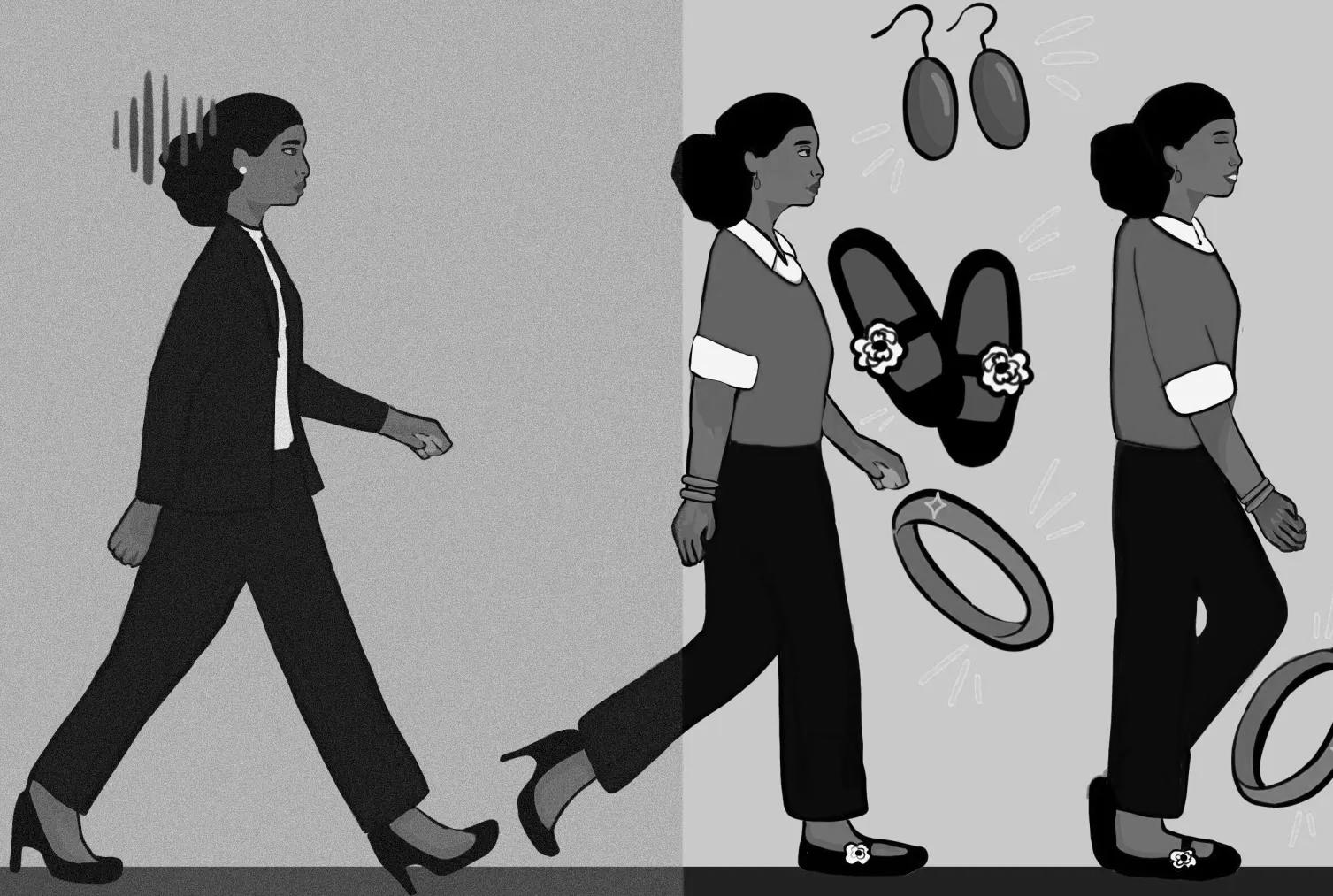
Growing up, the only visual representations I had of the business world were characters like Wilhelmina Slater and Samantha Jones — women who built careers while dressing in ways that reflected their personalities, whether through sharp tailoring, bold color or silhouettes that refused to blend in.
It wasn’t until I came to the University of Michigan that I learned that in the “real world,” it’s standard to wear plain colors — tan, navy, white, black, gray or brown; show no excess skin beyond the hands (not even open-toed flats); and avoid jewelry in uncommon places. I was shocked to watch my male
Audrey Rosenberg /DAILY
friends remove their earrings as they entered the recruitment process for investment banking and my female friends claw off intricate acrylic nail designs before major interviews.
Those expectations eventually extended to me. One night, I wore a pink blazer and white open-toed kitten heels to a club stock pitch, something I hadn’t thought twice about, and was told it wasn’t appropriate. I surprised myself with how quickly I adjusted; I haven’t since reached for either piece again in a professional setting.
When I notice myself making these changes, I think back to that conversation from the summer before I started college.
I found the speaker’s statement so unsettling, especially because of how easily it seemed to be accepted. The idea that personality and professionalism were at odds didn’t feel like it was open for debate. It felt like a rule.
And yet, the more time I spend studying business, the less that rule makes sense to me. I’ve grown increasingly drawn to researching consumer-facing industries, such as fashion, beauty and consumer packaged goods — spaces where I’ve found that success depends on standing out. CONTINUED AT MICHIGANDAILY.COM
REAGAN KELLER Daily Arts Writer
In the era of generative artificial intelligence, users flock to ChatGPT for their wackiest, most out-of-pocket concerns. Soullessly, it spits out responses at a breakneck pace. Its answers are vague and repetitive, lacking the human spark of creativity. Your AI Slop Bores Me offers a wildly unserious alternative to AI queries, facilitating human-tohuman connection amid the AI revolution.
The website functions by pairing random users together: One person prompts, while the other assumes the role of the AI machine. Playfully parodying the interface of large language models, the website features a textbox allowing users to input questions or provide answers. The user roleplaying as the AI has only 75 seconds to answer the human’s question, yielding responses that are hastily-crafted yet charming. They can opt to write or draw, mimicking generative AI’s ability to compose stories and create images. On X, users admire images of quickly drawn Pokémon and cute fish created by artists on the game.
Down to its interface, the vibe of Your AI Slop Bores Me is entirely playful. Decorated with Comic Sans, the website maintains an atmosphere of childlike whimsy and wonder. Its design is intentionally reminiscent of an older age on the internet, when AI didn’t dominate. At the same time, the interface’s playfulness is a parody. The creator, Mihir Maroju, intended for the game to operate as a fun, countercultural statement, fostering a digital space where users could deny AI by using their own creativity and recognizing the silly imperfections in human craft. The game’s goal is to
proliferate its own sort of slop
— human-made, of course. Because it is entirely operated by human interaction, the game utilizes a credit-based bartering system in which users must answer prompts to earn credits.
Credits allow people to ask their wackiest questions, including fanfiction and fan art requests.
The credit system ensures enough users are prompting and answering to guarantee creative output rather than an outpouring of ridiculous prompts without answers.
However, when the demand for responses falls short, users attempting to earn credits could be left waiting in a queue for more than five minutes. The rating system may also affect waiting time; humans have the ability to thumbs-up or thumbs-down responses, and positive ratings place players who want to become AI higher in the queue, while negative or no ratings may cause players to wait even longer.
As with most online platforms, there are also internet safety concerns. There will always be players who attempt to troll or harass other players, proving that the negative aspects of humanity can seep into anything. The moderation system cannot always keep up with massive influxes of
players, which can be problematic when the game is based entirely on player interactions. Maroju revealed in an interview that the site now uses “a mix of automated and manual moderators making sure no one’s ruining the fun for everyone else.” With the creator’s promise of moderation, players can feel a little less wary about joining the site.
Additionally, the game can feel repetitive after a few rounds of playing as a human and acting as AI — especially if some users choose to flat-out ignore the question or if others ask incredibly niche prompts that pertain to specific, less popular media.
More of a rebellion than a direct solution, Your AI Slop Bores Me was built on ideological grounds. Maroju made the game out of discontent for AI-generated art, which is “making artists’ lives worse and also just filling the internet with low-effort generic slop.” The project’s human touch of creativity is invaluable — and these in-game responses are anything but generic, offering unique slop that is more of a bonding experience and an antiAI statement than a genuine Band-Aid for the impact of AI. Realistically, people who use AI will not find the responses they’re looking for here, but they will find a good time.







I have fantastic news. I bought knee-high brown boots. It’s officially April, the season of failed finals and false springs, which means I need the absolute smallest sliver of joy more than ever. As I’m writing this, the University of Michigan’s men’s basketball team has not (yet) won, but to be clear, having these boots that I have coveted for the better part of two years is an equivalent feeling for me. So, Daily Sports Writers, please don’t have my head for this bold declaration.
Lately, I’ve been thinking a lot about how I’ll have to move my two full closets’ worth of clothes to my new-to-me-butdefinitely-rundown college house quite soon. Currently, I’ve got a pleasant mix of “I wore this top when my first college crush talked about his favorite poem,” “My aunt gave me this top and I genuinely hate it but for some reason think my mind might change” and the classic “These jeans fit me three years ago but I cannot let them go and I know they will probably never fit me again but I have an emotional attachment to them” spread across broken hangers and

shelves. It’s time for me to Marie Kondo my life. Too much unworn denim and dusty sweaters. It’s an embarrassment for a fashion advice columnist like myself.
This question has been edited for clarity.
I’m bored with my current wardrobe rotation, but I don’t have a ton of money to spend on new clothes. What do I do? – G Tale as old as time, G! What always works for me is narrowing down my wardrobe. Yes, it’s possible that you hate every piece of clothing in your closet, but I struggle to believe that! Sometimes, our closets can feel like a space full of endless possibilities, and in those moments, the array of options can seem sort of grim. Before buying anything, try to give things away first. Figuring out what is not working — the fit, the

color, the shape or even the item itself — can make the wardrobe refresh much more effective. As for brainstorming ideas for purchases that could bring this fresh feeling we are all desperately searching for after this hellish winter, create a Pinterest board of the ideas that inspire you most. Even if it feels like you can’t pin down a specific vibe, consider two things: First, what would it take to make this outfit a reality, and second, what exactly am I loving about it? Is it the accessories, the fit or something else? Consider what your favorite influencers are doing, or what you’ve seen the fashion icons on the Diag wear: Imitation is the highest form of flattery! The resources that are immediately available to us, à la the chic art history major in your class, can be some of the easiest ways to get accessible ideas that you’re excited about. After a proper clean out and a brainstorm,
NICOLAS EISENBERG Daily Arts Writer
Good films aren’t always funny, and funny films aren’t always good. A concept that might look good in a script or be excellent for a sketch may turn out to be painfully unfunny when made into a movie.
Stoner comedies, a genre of movies that tend to be very lowbrow, embody how hit-or-miss comedy can be; if you aim to be stupid and crass, the result may be unpalatable. Thankfully, “Pizza Movie” avoids this pitfall. It’s an exhilarating and ridiculous romp that accomplishes its goals with flying colors.
“Pizza Movie” is fairly selfexplanatory; two socially awkward college roommates — Jack (Gaten Matarazzo) and Montgomery (Sean Giambrone) — order pizza after a particularly trying day. But while waiting for the pizza, they accidentally consume highly potent psychedelics stashed by a previous resident, thinking they were mints. What starts out as a simple trip downstairs becomes a drug-fueled odyssey as the pair face down the oppressive resident advisor organization governing their dorm, a football team out for blood and invisible chainsaw-wielding assailants who will surely murder the pair if they fail to acquire the pizza.
It’s a simple story structure with a shocking level of depth. The film isn’t attempting to subvert expectations or the genre format, but instead aims to deliver the most polished version of the stoner comedy. Most viewers familiar with the flow of a comedic film can intuit the film’s major plot beats, but how it gets from one point to the next is downright inspired. In one
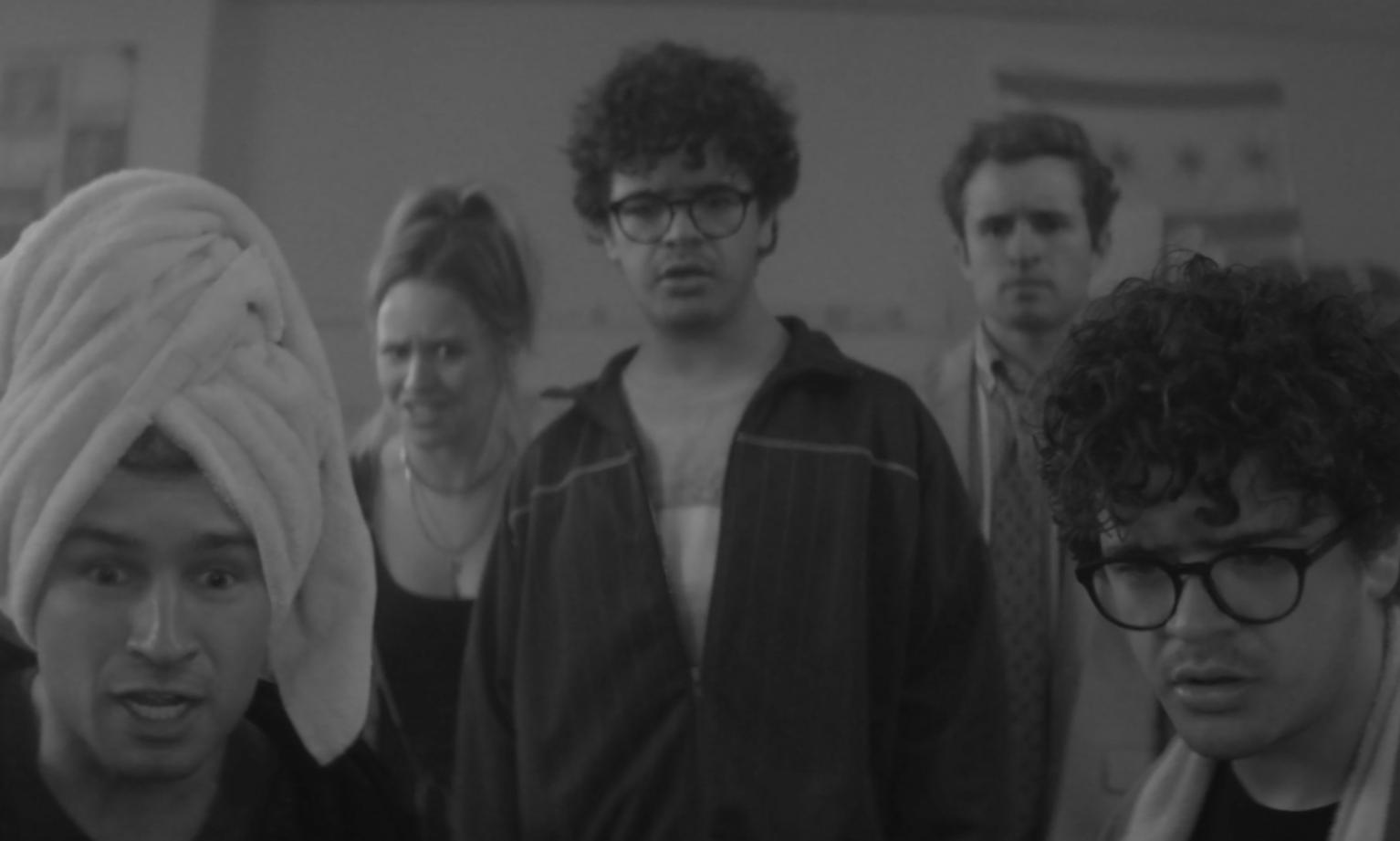
moment the action is surreal — the characters first hallucination is a recursive dream sequence — then it becomes gory, then campy, then gross, then surprisingly emotional, then meta, before returning to surrealism as the movie progresses. It’s not just that our characters are going mad, it’s that everyone else around them is crazy too, and their drug trip reveals this. One moment that stuck out was when the primary antagonist, Blake (Jack Martin), the eccentric head RA, grills a dorm resident about the possible presence of a “pickle jar bong” in his room. The pressure builds as Blake becomes more specific and intense in his line of questioning, before the scene climaxes in a direct reference to the opening of “Inglourious Basterds,” as Blake asks if the “pickle jar bong” is in the resident’s fridge. It’s a great moment in the film, not only because the joke comes at the crescendo of the scene’s tension, but it also communicates Blake’s exaggerated character. There’s a positive feedback loop, where the comedy sets up and fleshes out the characters, and the characters’ depth is used to deliver even funnier jokes.
Beyond its writing, “Pizza Movie” is astonishingly calibrated and aesthetically on point. In the beginning, the scene composition is highly reminiscent of “Mean Girls,” building the expectation of a coming-of-age film with many shot-reverse-shot scenes, warm lighting and long establishing shots. As the insanity begins, the cinematography begins to feel more like “Scott Pilgrim vs. the World,” embracing an action-adventure that feels both exciting and cheesy, with some choreographed fight scenes that are, like most of the film, absurd. It’s a pleasant surprise that the film is both hilarious and well-written, because it knows how to utilize its medium to land jokes with maximum comedic effect.
“Pizza Movie” is a film that resists resting on its laurels in the extreme. It goes above and beyond by continuing to challenge your expectations while entertaining you all the same. Comedy can be highly subjective and, while every joke may not land for everyone, the sheer spectacle of what the directors and actors were able to accomplish makes it worth a watch, whether you’re buzzed, baked or sober.
‘American Dollhouse’ is anything but picture perfect
ANA TORRESARPI TV Beat Editor
South by Southwest 2026 held the national premiere of Director John Valley’s latest project, “American Dollhouse.” As a small-budget independent and Austin-based horror film, “American Dollhouse” had a lot to prove amid the festival’s blockbuster feature lineup.
Indeed, “American Dollhouse” proves itself as more than competent through its acting, cinematography and sound design. Actresses Hailley Lauren as Sarah and Kelsey Pribilski as Sandy demonstrate their prowess as the film’s focal characters. The score elevates each scene through shrieking, discordant strings, reminiscent of iconic horror soundtracks, yet still unique through its execution. Every scene is carefully and deliberately shot, with strange, unsettling zoomins that invite a sense of dread in its audience.
With such impressive craftsmanship at the helm of an independent project such as this one, one might assume the core of the story — the plot — would share the same quality. With a decently intriguing premise, “American Dollhouse” begins with Sarah moving into her late mother’s suburban home. Across the street is a fenced-in, run-down house where a lonely Sandy resides. Dressed in all pink, playing with rollerblades and baking cookies with poorly written notes for her neighbors, Sandy’s meek and childlike disposition clashes with her
obsession with Sarah, watching her from afar and intruding on her family affairs. Once Sandy reveals that Sarah looks exactly like Sandy’s late mother, the two become immersed in a game of cat and mouse, with Sandy as the deadly force hellbent on using Sarah to reenact a childhood family Christmas fantasy.
Although the film’s general plot can keep an audience sufficiently engaged and tell a unique story, “American Dollhouse” was unable to set itself apart from other psychological slashers. When the horror scene is already chock-full of “scary-neighborslasher” films, “American Dollhouse” remains derivative of its predecessors. Sandy becomes the murderous lunatic she was always written to be, Sarah’s friends disappear one by one and Sarah escapes Sandy’s clutches only for the final scene to reveal that — gasp! — Sandy is right behind her, the game of cat and mouse never ending. It felt as though I had seen this movie before, only as excerpts of different, better horror films.
Sandy as the unsettling, lethal yet childlike presence evokes plenty of better written characters within the same trope — Charlie Graham (Milly Shapiro) from “Hereditary,” or The Mother (Matthew Patrick Davis) from “Barbarian.”
Meanwhile, although Lauren tries damn hard to give Sarah a personality, her character spends the majority of her screentime either screaming at Sandy or getting high. Even with her tearjerking backstory, Sarah is never able to induce
anything more than shallow empathy while she endures Sandy’s torture. The largest and most disappointing sin committed by “American Dollhouse” is its constant implication of deeper themes without following through. Family bonds, mothers and childhood trauma remain beneath the surface of the entire film, as if waiting to be uncovered. Only, the film never truly attempts to reckon with them, keeping these themes only as accessories to masquerade as a more competent, intelligent film. For a movie that focuses on a traumatized adult seeking a second chance at a family, “American Dollhouse” had no resounding, underlying message — only the superficial imagery and pseudo-profound dialogue to supplement its horror. At times, it’s hard to differentiate whether “American Dollhouse” wants to be a campy slasher, a psychological horror or a serious biting commentary on whatever it thinks it’s trying to say. Either way, its lack of identity only further damages the already frustrating viewing experience.
As an independent project with limited budget and time, what “American Dollhouse” achieved was impressive in every element except for the story itself. Unfortunately, the narrative product of the film falls flat, even with the strong creative team putting it together. Perhaps mediocrity is the greatest horror “American Dollhouse” could have ever produced.
Think about the image of a zombie. These flesh-eating, resurrected human beings have dominated the horror landscape for decades, with shows like “The Walking Dead” or the more recent “The Last of Us Part II” easily coming to mind. I certainly had my fair share of nightmares after watching zombie films like “Train to Busan,” terrified by the thought of losing my world to mindless creatures whose only goal is to eat my brain. However, despite their massive popularity in horror culture, the origins of the zombie remain a question to many.
The documentary “Black Zombie” gives us the answer: Haitian Vodou.
Directed by Maya Annik Bedward, “Black Zombie” made its premiere at South by Southwest 2026 and focuses on the Haitian origins of the zombie. In actuality, the modern zombie is a far cry from the one Haitians initially
conceived, yet both are terrifying within their own circles for both similar and different reasons.
“Black Zombie” makes one idea clear: The Haitian zombie’s story is born out of oppression and grief. As Haitian Vodou practitioner Yves-Grégory Francois explains in the documentary, the enslaved people of the former French colony Saint Domingue (now Haiti) believed they could only spiritually return to their home in Africa in death. A Haitian zombie is born when they are denied their wish of going home. As a Vodou practitioner revives their dead body, they create the blank-eyed, listless shell forced to work the land once more. Francois concisely summarizes the sentiment: “Here, zombies are real. Zombies are victims.”
The zombie is a symbol for slavery in Haitian Vodou (or Voodoo), one Bedward ensures the audience remembers by the time they leave the theater.
“Black Zombie” travels through the history of Haiti from its beginnings as an enslaved colony
to an independent country won through the Haitian Revolution. Simultaneously, it also interweaves the cinematic history of zombies, tracing it back to the 1932 film “White Zombie,” which introduced them to the silver screen. It is because of these early films and books like William Seabrook’s “The Magic Island” that Haitian Vodou took on a much more sinister look in popular media. Whether it is antagonists like Dr. Facilier from Disney’s “The Princess and the Frog,” whose image was inspired by an actual Vodou figure, or the infamous “voodoo dolls” sold in New Orleans, Vodou is primarily seen as a force of evil.
Here, Bedward carefully and successfully balances her efforts to reclaim both the history of the zombie and the legacy of Vodou. Through an impressive variety of interviews with Vodou practitioners, historians, directors and, notably, Guns N’ Roses guitarist Slash who is an executive producer for the documentary,
‘Project Hail Mary’ is a crowd-pleasing hit
WILL COOPER Daily Arts Writer
Author Andy Weir, unable to secure a full publishing contract for “The Martian,” had to release the novel one chapter at a time. This format allowed a sort of editorial dialogue to emerge, as scientists and armchair experts provided feedback on the accuracy of its scientific concepts. The final published novel was an unexpected success, with Weir’s combination of the aforementioned grounded scientific realism and his funny prose appealing to audiences. Its film adaptation, helmed by filmmaker Ridley Scott and starring lead actor Matt Damon, was a hit as well, opening the door for more Weir adaptations. Now, more than 10 years after the release of “The Martian,” another Weir novel, “Project Hail Mary,” has also been turned into a film. While “Project Hail Mary” is not as scientifically grounded as its predecessor, it has proven to be even more of a box-office success. The result is an entertaining film, but not as emotionally resonant as it could have been.
“Project Hail Mary” begins with molecular biologist Ryland
Grace (Ryan Gosling) awakening on a spacecraft 11 light-years away from Earth with no memory of where he is or how he got there. After uncovering the bodies of two deceased astronauts on his ship, Grace begins to recall his life and mission: a mysterious microbe dubbed “Astrophage” is diminishing the sun’s energy, lowering temperatures on Earth and threatening all of humanity. In an act of desperation — a Hail Mary — the world’s governments sent these astronauts to Tau Ceti, the one star not affected by Astrophage, to figure out how to save the sun. However, due to the long distance they had to travel, the astronauts were put into a medically induced coma, leading to Grace’s amnesia and the other astronauts’ deaths. Intercut with flashbacks, Grace remembers his past life as a disgraced expert in his field, turning to teach middle school science before being recruited by the stern Eva Stratt (Sandra Hüller) for his heterodox views on extraterrestrial life. Despite grappling with remembering his past and yearning to return home, Grace resolves to save the planet.
While these plot trappings may be reminiscent of “Interstellar,” stylistically, “Project Hail Mary”
could not be more different from Christopher Nolan’s epic.
“Project Hail Mary” is a comedic crowd pleaser first and foremost. Filmmaker duo Phil Lord and Christopher Miller rely on their comedic bona fides to make the film consistently funny. Gosling engages in a one-man act, with most of the exposition and comedy coming from Grace speaking to himself in recorded vlogs, a la “The Martian.” Gosling has to provide both characterization and contextual world-building while also driving the comedy that defines the core of the film. At times, the humor verges dangerously close to veering into Marvel-esque quippy dialogue, but Gosling’s endearing charm keeps the film from becoming overly glib.
Besides Gosling, “Project Hail Mary” attempts to immerse audiences through its filmmaking. The film’s cinematographer is veteran Greig Fraser, who tries to convey the sheer scale of the cosmos contrasted with the cramped interior of Grace’s ship. At times, the overuse of CGI and rapid, frenetic editing does have the effect of making the film feel weightless, detached from any true sense of tactility.
CONTINUED AT MICHIGANDAILY.COM
Bedward illustrates what Vodou has done for those who believe in it. From Vodou’s role in sparking the Haitian Revolution to uniting millions of practitioners around the world today in a shared religion and heritage, Vodou’s capacity for good, hope and freedom from oppression shines.
A highlight of “Black Zombie” is the story embedded within itself. In scattered black-andwhite scenes reminiscent of early 20th-century cinema, Bedward crafts a story of a Haitian zombie whose desire for home drives his quest for freedom from the men who took him away from it. To intertwine a short narrative film into a historical documentary was an unexpected move, but incredibly apt. This is yet another way “Black Zombie” corrects the harmful stereotypes about Vodou that movies like “White Zombie,” “The Serpent and the Rainbow” and many more perpetuated. And watching the Haitian zombie — now the protagonist and no longer the villain — yearn for a home across the ocean adds to the weight

of the emotions that Bedward and her interview subjects convey about the zombie’s history.
Documentaries are a chance to reclaim and reframe a piece of history, whether lost to time or to years of misrepresentation. “Black Zombie” faces the formidable task of not just taking back the narrative around zombies and Vodou, but also bringing audiences to reckon with the racist undertones that still bleed into the modern-day zombie and perceptions regarding the practice of Vodou. Othering is core to the treatment of zombies, something that evolves from the dehumanization of Haitian people and culture to the brutal, animalistic depictions of zombies we are familiar with today. But in “Black Zombie,” Bedward makes it clear that Haitian Vodou refuses to stay buried under these prejudices and stereotypes.
SXSW 2026: ‘Over Your Dead Body’ kills the vibe
ANA TORRESARPI TV Beat Editor
Content warning: this article contains mentions of sexual assault.
On the week of March 9, director Jorma Taccone premiered his latest film, “Over Your Dead Body,” starring Jason Segel as Dan and Samara Weaving as Lisa. Marketed as an action comedy, the film promised to deliver humor, thrills and spectacle. For the most part, the movie achieved exactly what it set out to do.
The premise of “Over Your Dead Body” holds a well of promise: a dysfunctional couple plans a getaway to their remote cabin, each intending to kill the other.
The movie starts unassumingly with Dan telling his coworkers about his weekend plans and lamenting about his wife Lisa’s supposed plan to go on a solo hike in the dark during a snowstorm. Meanwhile, unbeknownst to Dan, Lisa has her own scheme for a ‘botched hunting trip’ that would result in his unfortunate demise.
Right off the bat, “Over Your Dead Body” cleverly turns homicidal intentions into a source of humor. Once both plans are
revealed, the couple’s constant bickering shifts from belittling each other into a competition over who would be a better murderer, with the entirety of the theater breaking out in laughter throughout the film. However, it quickly becomes clear that “Over Your Dead Body” is not about who will succeed in their plans. Instead, an unexpected and bloody threat arises, putting their previously concocted murders to an abrupt halt and turning the film into a survival slasher. The couple must team up to fight against their new opponents, introducing a fresh world of hijinks into the film.
While the majority of the film continues with its tirade of punchlines and physical gags, the original plot is lost after the first 30 minutes. As unexpected turns pull the movie into a completely different direction, comedy and sharp dialogue are sidestepped in favor of gratuitous gore that keeps raising the stakes. However, as each act of violence intensifies — first a shooting, then a stabbing, then amputation, then death via lawnmower — the sheer insanity and spectacle of the violence begins to bog down the supposed heart of the film.
Although “Over Your Dead Body” begins as a relationship drama, the film quickly loses interest in its own premise, relying on blood and gore over a marital situational comedy. Even then, the movie’s initial strong grasp of its own humor was inconsistent, making an egregious blunder concerning Dan. There’s an uncomfortably long “comedic” segment of Segel almost getting raped by another man (yes, in 2026 we’re still making rape jokes). These frustrating five minutes of watching a near sexual assault almost irrevocably tarnished the rest of the film’s hard-earned comedy — a shame since it had started so well. Leaving the theater left me only with the realization that “Over Your Dead Body” is substantially less than the sum of its parts. With a good initial plot, stand-out humor (with one embarrassing exception) and a promising cast, the film had everything it needed to succeed. And yet, the final product felt like two separate ideas sewn together solely to surprise viewers. With that being said, would I watch “Over Your Dead Body” again? Over my dead body.
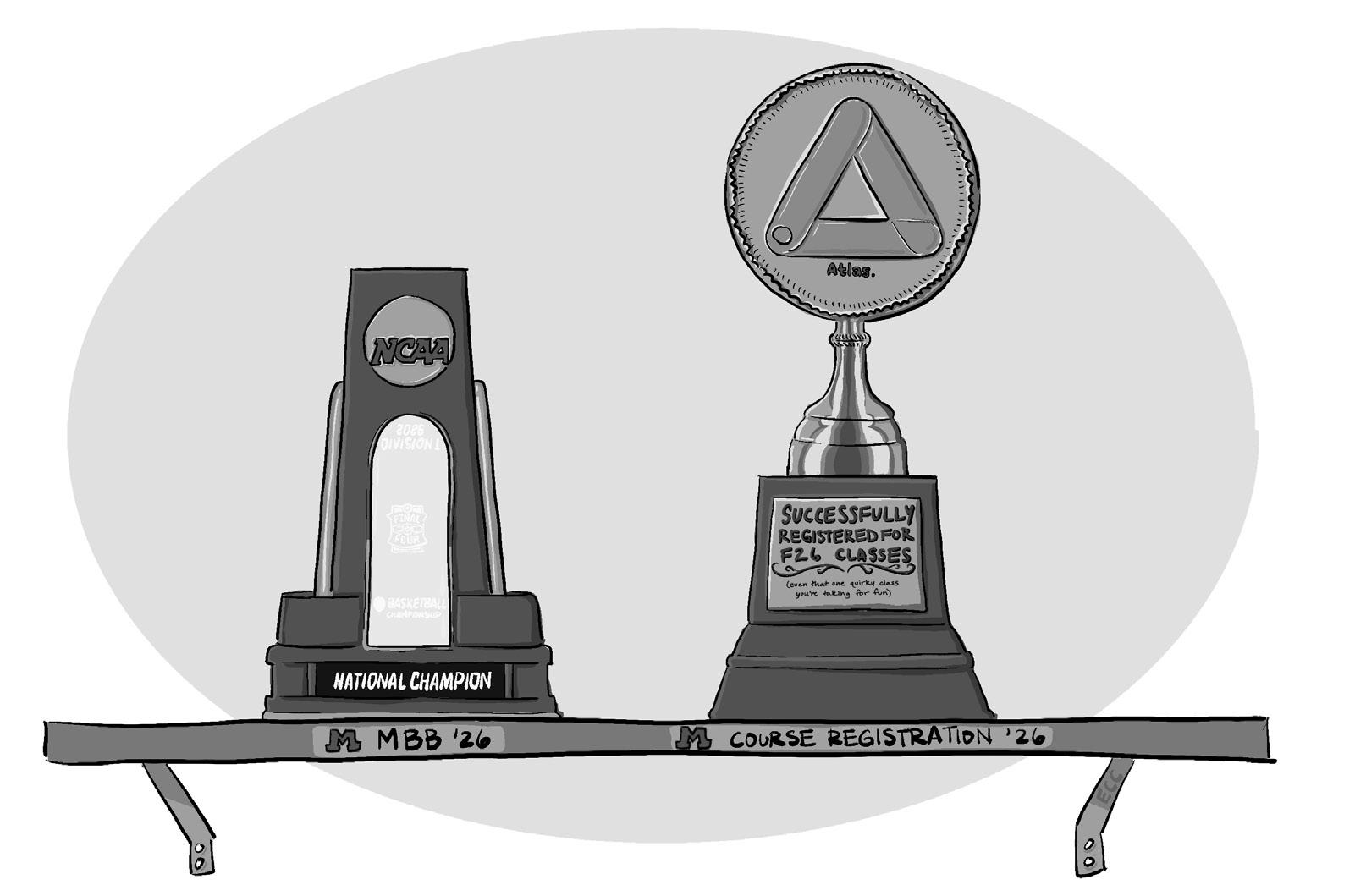
n September 18, 2025,
OInterim University
President Domenico Grasso announced the establishment of the Center for American Dialogue. The $50 million investment, part of the University of Michigan’s Look to Michigan campaign, is an effort to foster respectful and constructive dialogue on campus. While the center was originally expected to open this spring, its launch has been postponed until fall 2026. As it stands, the most concrete plans for the center are “an ambitious slate of activities and programs.” This ambiguity makes the initiative seem driven more by a desire to shape the University’s image, as opposed to fostering productive dialogue.
Despite this opaqueness, the center has immense potential to contribute meaningfully to campus. Above all, the center should be used to amplify student voices as well as those of productive guest speakers. Since it is dedicated to diversity of thought and civil discourse, the University should follow through

on its promise and ensure the ideological and political breadth of speakers reflects this. This could be implemented through increased student decision-making or input on prospective guests.
Student involvement should be prioritized through avenues that allow engagement with each other and the speakers themselves. When students are allowed to participate in active learning sessions, like Oxford Union style debates that prioritize direct student interaction with guests, there is a significant increase in engagement.
The Center for American Dialogue also has an opportunity to bolster civic engagement, but it needs to recognize that political polarization is an issue, especially within higher education, with both sides of the political aisle falling further into extremist echo chambers. For the center to fully engage with everyone on campus, the University cannot have a political agenda while running it, and must recognize that there is a need to engage with people stuck in those echo chambers.
The University shouldn’t ignore the fact that controversial figures, like Myron Gaines and Hasan Piker, already engage with students on campus. Instead, they need to take an active role in facilitating how people engage with these individuals. Hosting these speakers in a space where their ideas can be challenged in a proper forum, rather than just allowing them to pontificate on the Diag or in lecture halls, will strengthen civil discourse on campus.
Most importantly, for the center to be successful, it must ensure students are engaged enough to show up. Its events must be adequately marketed and structured with enough incentives to excite students.
To avoid falling into a monotonous pattern of only speaker events, the center should set up debates, roundtables and Q&A sessions. Such events are more exciting than the generic talking-to from a visiting scholar and are thus more likely to draw student attention. The center should also provide tangible
incentives for students who show up. If events are hosted consistently enough, professors should offer participation points or even extra credit for attending, discussing and writing about the events. Students should also be permitted to help organize the events, allowing them to spread word to their peers about speakers and debates.
The University has ample time to carefully plan how the Center for American Dialogue will function. It must engage a wide variety of students by highlighting diverse perspectives across the political spectrum, amplifying student voices alongside invited speakers and spreading awareness of the center and its engagement opportunities.
The center’s opening has already been pushed back from this spring to this fall. Ideally, the center should open as soon as possible. However, such an ambitious undertaking needs to be established correctly, even if that means further delays in order to ensure the center will properly expose students to new perspectives while increasing civic engagement throughout campus.



Themes of academic dread or nerdiness often crop up when writing comes to mind. Until college, I never truly considered the bigger picture: Why do we write, or more aptly, why should we? Even still, my idea of the skill often boils down to its role in school and authorial or journalistic careers.
In movies like “Matilda” or “The Breakfast Club,” powerhungry educators use writing tasks in attempts to control children. For the SAT, writing means 50 minutes of effectively following their ideal essay structure. In K-12 schooling, my peers and I noticed writing skills were only emphasized for final essay assignments, which teachers marked up with red ink. As a future English teacher, writing instruction and its purpose flood my mind.
While it is difficult to shake these traditional notions around writing, our approach to writing instruction must drastically change. When curricula only focus on strict, narrow assessments, we disenfranchise students from the true power of writing. Writing teaches us to communicate our feelings, identities and our relationships in a physical form. Writing can change our lives and minds. During a time when artificial intelligence lowers the necessary effort in learning,
increasing curiosity around the purpose of writing is critical for schooling. To best serve students’ futures, K-12 educators must build curricula that challenge students with assessments while also embracing writing for its universal purposes.
To start, the notions around “correct” writing genres and styles are myths. Writing theorists explain that the act of writing expands much beyond the formal academic expression.
Writing means to-do lists, journals, memos, newsletters, texting and academic essays.
Being a writer simply requires putting pen to paper and reflecting on how that mode of communication connects to your identity and the world. It doesn’t have to mean excelling in creative writing classes or spending hours surrounded by nerds scratching out manifestos with quills.
Focusing on emphasizing writing’s traditional academic role stifles creativity around what writing can be. The rulefollowing, compliant nature of school already decreases student creativity and autonomy. Teaching students that writing’s only purpose is to fulfill a rubric crushes their adolescent spirit even further. Educators must give students tangible writing instruction and experiences that stretch beyond the confines of rubrics and time limits in order to bolster student creativity.
The need for greater room for student creativity in
schools holds importance beyond essay grades, due to writing’s cognitive and social benefits.Psychiatrists swear by writing as a way to better mental health. Even just a few minutes ofjournaling helps to clear the mind, relieve stress and organize thoughts. While not as common today, writing on paper boasts greater mental gains over typing. So, when writing, the socioemotional benefits are greater when the skill is done by hand, but typing can still do the trick in a crunch. If teachers struggle to make their writing instruction more fluid, the least they could do is get students off of laptops, and make them write by hand. The physiological experience of writing on paper is timeless. If anything, writing instruction must change to reflect the demands of employers rather than just the SAT or high school writing classes. Surveys of businesses show that 82% of employers list effective communication skills as very important. The surveyed businesses even state that writing skills are scarce in job candidates. At a time when larger businesses can afford large language model softwares for their employees, human reading and writing skills still boost job prospects for applicants. So, even if you loathed the essay you wrote on “Macbeth” in high school, writing is something you should invest in.
CONTINUED AT MICHIGANDAILY.COM
JOHN ROGAN Opinion Analyst
Out of all the U.S. states, one is remarkably beautiful and incredibly poor: West Virginia. West Virginia’s economic struggles serve as a microcosm of the nation’s issues with the distribution and proper investment of the state’s wealth; a proverbial canary in the coal mine. West Virginia is well known for its coal and, more recently, natural gas extraction. The economic output of the fossil fuel industry has been a vital component of the statewide economy since the 19th century. Once the beating heart of the U.S., the state now ranks second to last in median household income — a grim statistic for the hardworking people who literally powered the last American century. The hollowing out of the Mountain State’s economy is a grim warning to the rest of the country: political inaction and prioritizing corporate interests leave nothing for the workers who build and sustain the economy.
West Virginia used to be a stronghold of Democratic politics and working-class values. Eventually, the Democrats mechanized the labor of the mining industry, and West Virginia never recovered from the decline of coal. Then, the party failed to take action to stabilize the state’s economic conditions for
struggling coal miners, who had once established the political legitimacy of the party.
They didn’t respond to the calls for economic diversification and left workers to fend for themselves.
Eventually, the Democrats’ empty promises left citizens discontented, leading to a political power vacuum — one that would be filled by the same empty promises for the working class and the same failure to deliver for them.
This problem extends to Republicans in West Virginia, too. Jim Justice ran as a Democrat in 2016, then promptly changed his party affiliation once elected to support President Donald Trump. Justice is a former coal baron, governor and now a sitting senator. His life path from coal baron to politician shows the failure of politics in this country; the people of means find a way to manage their debts and financial misgivings while the everyman’s ledger continues to run red. Under the new Republican leadership, the same problems persisted. Elections have come and gone with little change. Now, politics have become more of an employment racket for politicians rather than a means to serve the people.
West Virginia is not an outlier; the trend of politicians selling out the working class in favor of corporate interests has dominated the national stage. In 2016, pro-workingclass candidate Sen. Bernie Sanders, I-VT, won the
West Virginia Democratic presidential primary. However, at the Democratic National Convention, Hillary Clinton, former Secretary of State and a pro-corporate candidate, was awarded the majority of delegates from the state due to superdelegates. Superdelegates are not obligated to vote in alignment with the will of the people; essentially, they act as party operatives.
The U.S. public has become increasingly disenchanted with Washington politics and the political pendulum as they haven’t seen substantial increases in their quality of life. All the old signals of a growing economy and middle class aren’t cutting it today. It’s hiding an increasingly obvious fact: The average family is struggling to keep up with the growing cost of living.
At a time of record growth in the U.S. stock market, the gap between wealthy households and poorer households has never been wider. While the median household income was $83,730 in 2024, the bottom 50% of households had an average wealth of $60,000, representing 2.5% of national wealth. This means that households in the U.S. aren’t able to build wealth, signaling to politicians that the middle class is struggling. The cost of living in the U.S.is choking out working Americans, and median incomes across all sectors of the economy are down from the turn of the century. CONTINUED AT

Michigan in Color is The Michigan Daily’s section by and for People of Color.
In this space, we invite our contributors to be vulnerable and authentic about our experiences and the important issues in our world today.
Our work represents our identities in a way that is both unapologetic and creative. We are a community that reclaims our stories on our own terms.
efforts, with some craftsmanship techniques and styles of weaving on the brink of extinction.
Most first-generation Syrian Americans grew up thinking they had no cultural clothing to be proud of. On March 30, Students Organize for Syria at the University of Michigan proved that to be far from the truth. Guests gathered in the Michigan Union’s Rogell Ballroom to learn about the long and rich history of Syrian textiles. The event, “Threads of Heritage,” was the first of its kind. It was hosted in collaboration with The Wow Boutique, a fashion business and cultural initiative dedicated to preserving and reintroducing traditional Syrian textiles.
Featuring a display of traditional Syrian clothing, a fashion show and a live presentation from Dema Kazkaz, founder of The Wow Boutique, SOS brought the beauty of Syrian culture to light.
Up on stage, Kazkaz brought out remarkable textiles from all over Syria, explaining the labor required to produce each piece and the history behind them.
Through direct collaboration with Syrian artists, as well as intense sourcing and restoration efforts, The Wow Boutique is working to bring these recovered pieces back to life — all in the face of major regional conflict and displacement.
As part of her process, Kazkaz personally travels to Syria in search of antique pieces from different regions. She explained that many textile shops are often unaware of just how valuable these clothes are to preservation
“The Wow Boutique keeps Syrian culture alive through fashion by working with artisans and supporting traditional craftsmanship,” Kazkaz said.
“Each piece feels meaningful. It carries history and tells a story, not just something you wear. It’s something more personal, something you can actually connect to.”
LSA sophomore Joanna Masri, SOS Co-Education chair and the daughter of founder Kazkaz, spoke to The Michigan Daily on her experience being a part of The Wow Boutique.
“We began The Wow Boutique five years ago — a mother-daughter business, two generations, one brand. Initially, we supported Syrian refugees in Turkey and later focused on Syrian artisans,’’ Masri said. “Now, we specialize in reviving abayas and mother-of-pearl products.”
Masri recalled a trip the duo took to Syria searching for antiques in hopes of collecting and preserving even more vintage and traditional Syrian garments such as the Qandoura.
“In the summer of 2025, we traveled to Saraqib, about 70 kilometers north of Hama, looking for the traditional Qandoura.” Masri said. “We knocked on doors, asking if anyone would share theirs. One household invited us for tea, where five women shared that the Qandoura was part of their dowry, stitched over months. They were preparing to wear them at a wedding the next week, and we celebrated with them.”
The beauty of this art form was not lost on them, she explained. To be a part of a culture that celebrates community and giving is something the founders hope to share with all who interact with The Wow Boutique.
“Inspired by this tradition, we now revitalize Syrian textiles with a modern touch,” Masri said. “Recently, Students Organize for Syria created a knitted sweater inspired by Saraqib, a Syrian textile, and our story — blending heritage with modern creativity.”
In an interview with The Daily, LSA senior Lianne Wimbush shared that this event opened her eyes to the extensive history of Syria and emphasized the importance of staying involved with different cultures.
“I loved this event,” Wimbush said. “It was very informative and I learned more about Syria through the local context represented in each of the textiles. I also really enjoyed seeing my friends wear the pieces, it made everything feel more personal, and I was honestly amazed by how detailed and complex the process of making them is.”
Amid the bustle of campus life, many students appreciate opportunities to feel connected to a culture that often feels too far away. LSA freshman Lujaine Sadoun, a Syrian American student and a model for the showcase, shared how attending SOS events has helped her make connections with fellow Syrian students and establish a sense of belonging on campus.
CONTINUED AT MICHIGANDAILY.COM

Courtesy of Maria Nashef.
It’s a Monday evening, and the pungent aroma of tarka and lentils filled the air. Although the scent seemed promising, I dreaded what was to come: daal. It was a dish my family had unfailingly consumed every single Monday since I could even remember. Although I didn’t necessarily mind the taste of the dish itself, I instinctively cringed at the thought of accidentally biting into methi seeds or a clove, already imagining the sharp bitterness of the whole spices. I had made my complaints with the dish very well known, on multiple occasions, but to no avail. This dish was my father’s favorite, and therefore our staple family meal. Every. Single. Monday. A mere repeated dish may not seem like much, but over the years, it began to grate on me. I became obsessed with breaking away from the overly structured routines that my family had imposed, and college represented an escape, a chance to finally assert my own free will. The closer I got to this ticket to freedom, the more I longed for it. As a senior in high school, I romanticized future Monday dinners that would be spent with friends, gossiping while treating myself to a Chipotle bowl and far away from any methi seeds. It’s not that I was embarrassed of my Gujarati culture or cuisine; I simply didn’t enjoy this mundane routine that my family had forced upon me.
Now, Monday dinners are almost indistinguishable from that of any other day. An attempt at a meal is made hastily in between assignments and club events. There is no predictable conversation occurring over the dinner table; roommates shuffle in and out, engrossed in the schedule of their own hectic days. This silence isn’t overwhelming or isolating, but it is noticeable. Scrolling through Instagram Reels as I eat, the stark difference almost mocks me.
I often get asked while doing morning prayer or weekly fasting what the importance of my actions are, and I instinctively respond with, “I’ve just grown up doing this.” Although I’m aware of the deeper meaning, on a more surface level, the truth is that my actions are habitually based. They are the only aspects to my old routine that I can still implement and feel some kind of cultural connection, serving as silent reminders of the environment that once shaped me.
Truthfully, it has taken almost two years for me to understand that my family’s structure is the very thing that held me together: a delicate balance that had unfortunately been tipped. I seem to have lost my cultural values as the cost of my newfound freedom. In an attempt to escape my Monday daal, I failed to recognize the rest of my Monday routine that had been erased with it.
The evening started with my mother planting herself in the kitchen immediately after work, somehow managing to simultaneously cook cauliflower, lentils and roti — a feat I still admire. Concurrently, my father would leave to take my brother and I to the temple. Growing up in a predominantly Christian community, my parents prioritized giving us exposure to their religious values and knowledge via our weekly temple visits. Upon arrival back home, it would be time to indulge in the meal my mother had prepared and converse as a family for the first time that day.
Like clockwork my father would ask, “So, what’s the new drama, Jiya? Any new gossip at school?” To which my mother would roll her eyes and chip in with, “Why waste time talking about others — let’s talk about more productive things.” Before I could fake disappointment at my stifled opportunity to narrate whatever nonsense occurred that day, my brother would bombard me with questions, “Hey Jiya didi, what classes should I take next semester? Do you think I should join another club? Is varsity tennis too much of a time commitment?” With annoyance I’d respond, as he asked the exact same questions every week, but the cadence of his inquiries formed an echo I didn’t realize I would one day miss.
The deprivation of daal in my life has come at the expense of the mundane charm of Mondays that I failed to recognize. The practice of shifting a cultural routine shaped by obligation into intentional engagement is something that I have found to be difficult to realize and implement. Yet, reflecting back upon the intersections of my routine before college, cultural inheritance is embedded directly into these routines I rushed to escape.
Even so, every evening, I make the effort to call a relative — simply to practice and preserve my Gujarati. Once a week, if not more, I seek out my comfort meals: either the frozen leftovers cooked by my mother or takeout from a local Indian restaurant. At least once a month, I plan a Bollywood movie watch party with my friends (most recently we watched “Om Shanti Om”). And, once a year, I make the effort to travel home to
To the mountains once more
The first time I noticed my siblings weren’t superhuman, I was 11 years old. Our grandfather had passed away several months prior and we were, finally, on the road and on our way to his home in the mountains.
In Latakia, Syria, with a van full of cousins, aunts and uncles, we drove up the long path up the mountain. We annoyed the driver by asking him to turn up the music, which was already loud enough that you couldn’t hear yourself think. The winding slopes were so narrow that if you had your arm hanging out the window, you were sure to get it slashed up by the branches of roadside trees. I did my best to partake in the cousinly banter and play, but in my heart, I was waiting for the moment I would be sitting next to my grandfather’s grave for the first time. So, I mostly stared out the window. If I could get a glimpse through the trees, I would spot the
constant mountainside with its dark green leaves contrasting the pale dirt, lighter than sand. I couldn’t tell why, but I was nervous. Yet watching my older brothers, Zain and Rahmy, be their normal jokester selves encouraged me to steel myself as well.
When we got to the house, we walked to the stretch of crops on the side of the house, weaving through fig trees, cactus fruit and grape vines. We maintained our too-loud nature as we picked fruit, laughter carrying over the valley and its far off echo feeling like a response from a sister mountain. This all dwindled as we approached our grandfather’s grave, although I’m sure he would’ve liked the noise. We stood next to him under the beating sun for a few minutes, then our cousins all peeled away. My brothers and I had made a trek over the Atlantic Ocean to be there and we were all hyperaware that it might’ve been our only chance to see our grandfather’s resting place, so we lingered for much longer. There was no
shade around the grave site; just some tall, dry grass that crunched every time I moved. Our grandma called out from inside, warning us not to spend too much time out there but we didn’t listen. My eyes slowly read the engraved words on his grave over and over, through tear after tear.
When I finally looked up, I saw Rahmy’s solemn expression and Zain’s tear-streaked cheeks.
After a lifetime of looking up to them, this was the first time I felt that my brothers and I were the same. No longer was I hoping to be as tall as Zain or as fast as Rahmy. No longer was I waiting for them to teach me something I hadn’t known before or feeling unreasonably prideful about them thinking I was funny or “cool.” For once, I realized that even if I lost every game, we would always be on an even playing field. From then on, we didn’t need to always be having fun. Sometimes, we could sit for hours in quiet conversation and, although I didn’t see it coming, it was a welcome new experience.
Before, Rahmy always had to be coerced into joining the childish games that Zain would come up with, while I would just go along with anything. In the winter, Zain and I would spend half an hour reinflating our rubber orange ball and taking frames off the walls before slowly popping our heads into whatever room Rahmy was in. One of us would suggest: “Soccer?” To which he usually said yes, only after some pleading. Zain and Rahmy’s imaginative games became things that I asked to do for years. From setting up baseball diamonds with pillows, to jumping competitions, to silly card games, I never forgot all the fun times they conjured up. I cherish those days but I’m happy our relationship matured with us. Of course, it still involved things like being shoved into a pool, snowball fights on sledding hills and being yelled at to quiet down — “boring” was still not in our vocabulary. For some reason, I thought that what happened after visiting our grandfather would be the
last change our sibling dynamic would go through. Then came the years that we spent apart. It started slow at first: moving out of the house or to nearby cities. Then, growing in distance until the closest
celebrate Navratri, garba dancing excitedly as a token of yearly celebration. It’s these habits, woven into layers of mundane routine between classes, friends and calls with family that act as the thread keeping me tied to cultural inheritance. There’s still a level of guilt that ensues with each festivity I miss, such as recently when my family hosted a Holi celebration. As I sat in a Hatcher Library study room preparing for my exams in the coming week, my phone lit up with images of my brother bathed in vibrant splashes of blue, orange and pink powders. My heart dropped, and there was a moment where I had to remind myself that my absence didn’t necessarily mean I was disconnected.
There are many weeks when my routine slips entirely, and it can be hard to revert back to my previous, disciplined manner. Yet, I have also recognized that these numerous habits of practicing culture in my everyday routine were never meant to compete with the fastpaced, independent new college environment that I live in. This was a routine that previously thrived in respect to my family’s support, guidance and shared time — I’m simply in the process of piecing these aspects of normality back together. Despite this perceived detachment from home, I still feel at ease within my new home on campus. Building connections with other students of similar culture and South Asian background has brought a new sense of accordance into my life. My roommates provide the small, unspoken comforts through overlapping routine and familiar laughter; it fills our shared space with a resonance of home. I live nostalgically in the present, relishing memories we share night and day, already dreading the day life takes us separate ways. And although trivial, my small habits paralleling home life are what anchor me to my identity as not only a South Asian student, but also a daughter who wishes to echo the cultural rhythms of routine that my parents had once structured for me. In the absence of home, it is this quiet routine that allows me to carry pieces of it with me — in the small, repetitive moments that I once overlooked.
any one of us could be to the other was 700 miles. In our disjunction, it seemed that we hadn’t had time together strictly as siblings in years.
CONTINUED AT MICHIGANDAILY.COM

JONATHAN WUCHTER Daily Sports Columnist
The Michigan men’s basketball team’s national championship validates countless decisions and uplifts the numerous individuals who made them.
After the Wolverines players themselves and coach Dusty May, the athletic department and its director, Warde Manuel, deserve kudos for a job well done. The investment in the program to adapt to the era and build a roster was masterful. Manuel also made a brilliant but extremely tough decision to fire Juwan Howard and recruit May two years ago.
“I’ll let you guys write how much credit I should get,” Manuel said April 6 amid the celebration. “It’s written. It is what it is. Y’all saw it. Y’all know who hired him. You can say, who gets the credit?
I’m gonna give the credit to Dusty and the staff and the team and everybody around.”
The national championship was, in part, the splendor of the athletic department’s forward thinking and strategic planning. It is not, however, absolution for any of the department’s recent failures.
The wait continues for the results of law firm Jenner & Block’s investigation into the athletic department — which the University has reportedly paid more than $10 million for since it started following former Michigan football coach Sherrone Moore’s inappropriate relationship with a staff
Michigan’s athletic department had an incredible winter, but it shouldn’t whitewash the investigation
member. The investigation was subsequently expanded to evaluate the practices and cultures of the athletic department as a whole. If systematic failures within Manuel’s athletic department are found to be in any way causal of the malpractices that have transpired over the past few years, the University must act. Their actions can not be softened by any amount of goodwill resulting from on-court, on-ice or on-field success. Certainly, Manuel and his staff have done a tremendous job in building both the men’s and women’s basketball programs and the hockey program. This winter and spring have featured the most collective success between the three teams ever — notably, the University’s three highest profile teams after football.
Men’s basketball is the most obvious success story, with Manuel firing a beloved former player in Howard, then wisely including former coach John Beilein in the hiring process for May. Manuel doubled down with financial backing that allowed May to construct a competitive team in year one, and then one of the best in college basketball history in year two. Top to bottom, they constructed the necessary alignment for Michigan to win the NCAA Tournament.
Wolverines women’s basketball coach Kim Barnes Arico has seen resources also increase toward her program. Bringing in now-sophomores
Mila Holloway, Syla Swords and Olivia Olson was the biggest recruiting win of her tenure, and the program’s second-ever Elite Eight has been the early return.
And even if the Michigan hockey team had the makings of a title winner and fell short, a Frozen Four is nothing to scoff at. The construction of the Wolverines on the ice — especially embracing the rule change regarding CHL players — is evidence of the athletic department adapting to the times more than anything.
“We have a lot of anchors in a lot of different programs, and what happened in football this fall is not defining of the 99.9% of the people in that department who are doing the right things,” Manuel said. “And I’m proud of my staff, I’m proud of my coaches, I’m proud of the student athletes and the way they comport themselves and do things. So this is just remarkable for everybody associated with the athletic department and the University of Michigan, especially this basketball team.”
The success of those three teams corroborates Manuel’s assessment of most people in the department. But it only takes a few, especially when their actions are damaging to the well-being of others, to overshadow it all.
And though Manuel only references Moore’s misconduct, there are several incidents that have created controversy around the athletic department. The sign-stealing scandal is least important. Cheating
No. 1 seed Michigan keeps No. 2 seed Denver power play fruitless in Frozen Four loss
LAS VEGAS — Throughout the season, there’s little question as to how valuable the No. 1 seed Michigan hockey team’s power play proved itself to be. But in moments of needing an offensive spark, game-defining moments and defensive shutdowns, something else shined on the ice for the Wolverines — their penalty kill.
It’s something Michigan’s skaters have taken pride in all year, calling it the “power kill” when those units came off the bench. Between killing off major penalties and threatening shorthanded goals consistently, the Wolverines’ penalty kill became part of their identity. And though Michigan’s special teams couldn’t save it in its 4-3 overtime loss to No. 2 seed Denver, the Wolverines’ penalty kill units ended their season with a perfect performance.
“Power play wasn’t good enough,” Pioneers coach David Carle said. “We’ll look at things trying to be better for Saturday, but certainly a factor in the game being how it was.”
One of many opportunities for Denver’s power-play units came early in the night near the halfway mark of the first period. With senior defenseman Tyler
Duke taking a holding penalty, a key member of Michigan’s top kill unit was left watching from the box. But even without the foundational veteran play Duke brings to the special team, the Wolverines delivered grand clears one after the other, setting the tone for the rest of the night.
Michigan managed to avoid the referees’ whistles for the rest of the opening period. But just twenty seconds into the second period, the Wolverines found themselves in the box once again — and this time while trying to protect a 2-1 lead.
This penalty came with a little more trouble for Michigan than the prior. The Pioneers kept consistent pressure in the zone while manning the blue line. The Wolverines repeatedly attempted to clear, but each time found a Denver skater in their way, keeping the top unit on the ice for the majority of the two-minute minor. Even with low energy, freshman goaltender Jack Ivankovic sent the puck to the other side of the ice, giving the penalty-kill unit and the rest of Michigan’s bench time for a breath.
“It was a lack of momentum and opportunities we created for ourselves on the power play,” Carle said.
While the Pioneers were finding moments to score in
5-on-5 play, the Wolverines penalty kill was determined in making sure a goal didn’t come at the hands of their special teams. After a goal from Denver pushed the game to 2-2 heading into the third period, Michigan’s penalty kill was put in the spotlight once again.
Two penalties in the third period put the Wolverines back on the kill as they attempted to hold off the Pioneers. And yet again, Michigan launched the puck routinely down the ice as Denver’s power play found itself unsuccessful in its manadvantage opportunities.
But the Wolverines penaltykill unit was put to one final test in the first overtime period, as both teams knew the next one to score was booking their ticket to the national championship game. The special team only had to kill the penalty for a minute before a matching penalty on the Pioneers put the game into 4-on-4 play, leaving Denver fruitless.
Even with a shutdown performance from its penalty kill teams, it wasn’t enough for Michigan to overcome the rest of the Pioneers offensive production. And in the Wolverines’ final performance of the year with a heartbreak ending, even a perfect penalty kill couldn’t keep them their season alive.

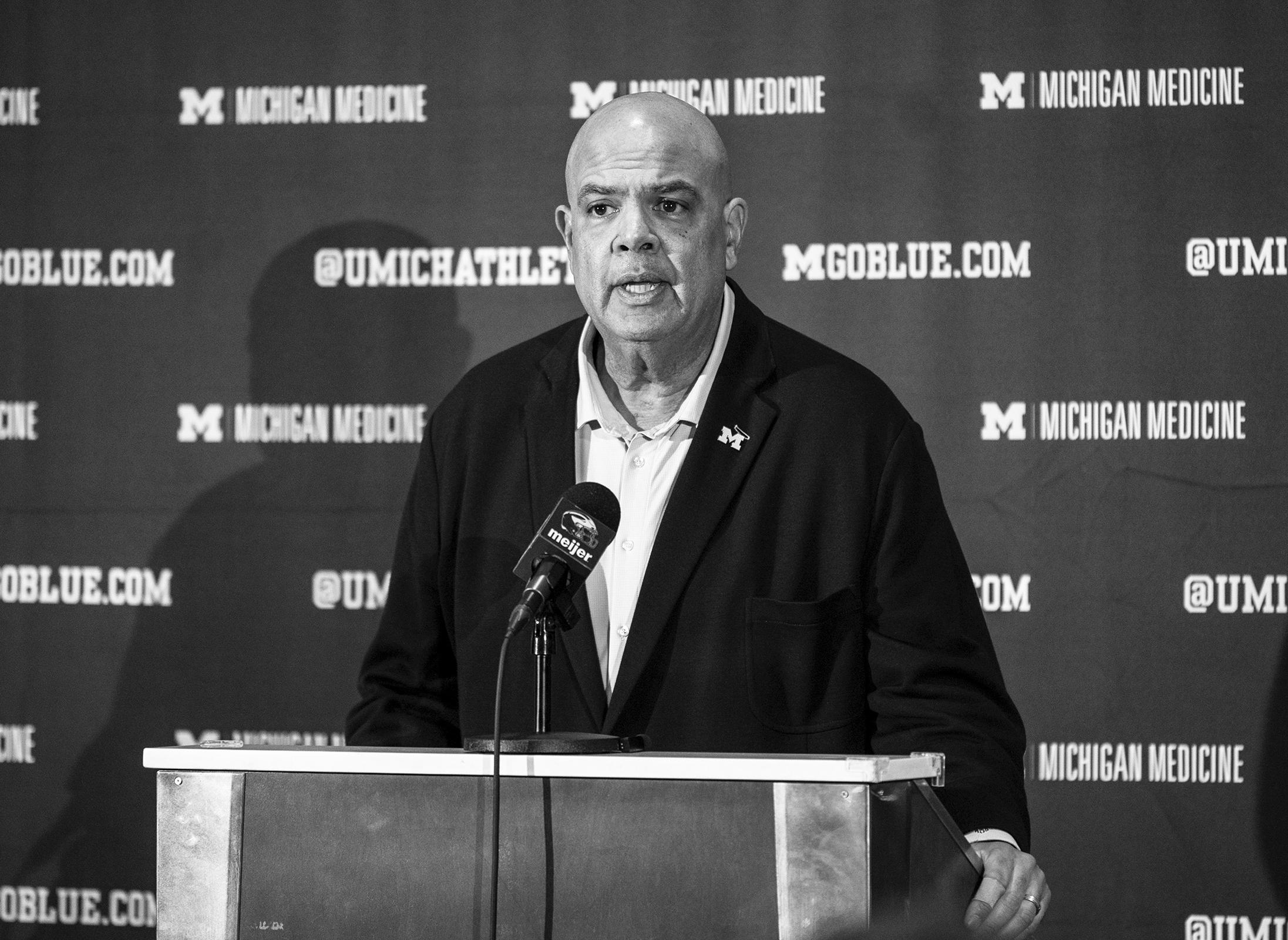
is deplorable, but it didn’t damage lives in the way others’ misconduct did.
Manuel not-so-subtly patted himself on the back for hiring May. Well, Manuel also hired former hockey coach Mel Pearson — who bullied female staffers — and doubled down by retaining him for three months after receiving the report. Moore didn’t exactly pan out as Manuel’s choice to replace Harbaugh, either.
Then there’s former football assistant Matt Weiss and staffer LaTroy Lewis. Their actions are
egregious and disgusting. And in Weiss’ case, the access afforded to him by his position enabled his alleged crimes. Even if they didn’t report directly to Manuel like Moore and Pearson, all of the actions of the athletic department reflect upon his leadership.
There is no balancing act between uplifting student athletes with national and Big Ten titles and employing and enabling individuals whose actions damage others’ lives.
The Wolverines could win a national championship in every sport and it wouldn’t matter. If
the results of the investigation found that Manuel’s leadership and the practices and culture of the athletic department enabled the misdeeds of Moore, Pearson, Weiss and Lewis, that supersedes everything else. The outcome of the investigation will ultimately fall in the hands of incoming University president Kent Syverud. If evidence for necessary change comes across his desk, one men’s basketball title shouldn’t hold him up from making a decision. Winning titles shouldn’t even cross his mind.
Michigan overcomes No. 20 Michigan State, 4-2, in rivalry showdown

After the Michigan men’s tennis team lost the doubles point via two convincing 6-1, 6-3 sets, it seemed like No. 20 Michigan State would fulfil its internal expectations of a routine victory. But despite plenty of reasons for pessimism, the Wolverines’ voices only grew louder.
In front of a packed crowd with strong support for both sides, Michigan (11-9 overall, 6-5 Big Ten) overcame the Spartans (13-8, 10-1) 4-2, snapping their 10-game winning streak and handing them their first conference loss of the season. The Wolverines came back from the early deficit in large part due to their unwavering enthusiasm.
“(The players are) excited about these matches,” Michigan coach Sean Maymi said. “This is what it’s all about for them. They come to Michigan to play in these matches. So they were really excited.”
Freshman Arnav Bhandari and senior Mert Oral quickly fell 6-1 in the No. 3 doubles match. The No. 2 match featured a plethora of critical scoring opportunities for both sides. In the sixth game, Michigan State broke junior Alex Cairo and senior Bjorn Swenson’s serve. Undeterred, the Wolverines immediately broke back at a crucial deuce point. Up 4-3, the Spartans profited off of a perfectly placed lob over Cairo and Swenson’s heads for the game. From there, Michigan State closed out the match to earn the doubles point.
Oral’s straight-sets singles loss further expanded the
Spartans’ lead to 2-0. Once again, it appeared Michigan State would continue its streak of Big Ten dominance. However, Michigan was aptly prepared for such adversity.
“It was a great week of practice,” Maymi said. “The guys trained really hard, and they were ready. We felt physically, mentally, ready. They were just gonna have to put themselves in the position.” Redshirt freshman No. 8 Max Dahlin dominated his first set, immediately breaking the Spartans’ Aristotelis Thanos serve in the first game. He secured another game through back-to-back aces directly followed by back-to-back errors by Thanos en route to a resounding 6-1 set win. The second set was much closer, coming down to a tiebreaker, though Dahlin sealed it with another service winner.
In the No. 5 singles match, Cairo led the first set, 5-4, but trailed 40-0 in the subsequent game, giving Michigan State’s Taym Alazmeh a key break opportunity. In response, Cairo battled back to deuce, winning the game and set off Alazmeh’s shot that snuck just barely out of bounds.
The second set was similarly tight. Tied at four apiece, Cairo capped off a drawn-out rally with a beautiful crosscourt backhand for the game. Although he fell behind 40-0 the next game, Cairo once again fought back to deuce. With the crowd and his teammates cheering in support, he engaged in a lengthy forehand rally.
As his opponent charged the net, an awkwardly placed ball resulted in a volley into the net, sealing the match and
earning the Wolverines cheers of celebration.
After a 6-2 first set victory, Steiglehner found himself even through eight games. After going up a break, he carried that momentum into sweeping the next game. He finished that game, set and match with a monstrous serve that his opponent barely got his racket on. That resulted in a 3-2 meet score, and Michigan needed only one more point to pull off the upset — but that was far from an easy task.
Swenson faced No. 14 Matthew Forbes, the Spartans’ top-ranked player, in the No. 2 singles match. The first set followed what that ranking would suggest: Forbes coasted to a 6-1 victory. Rather than begin to doubt himself, Swenson rose to the occasion, doubling down on his concentration and intentionality.
“Keeping focus for sure and having a game plan when I went up to the line each point,” Swenson said about how he adjusted. “Making sure that I had clarity. So just try to stay level headed and approach every point with a plan.”
Swenson controlled the next set, 6-3, as both he and his teammates grew increasingly energetic. By the beginning of the third set, both teams and the entire crowd had convened around this court. Following a volley at the net to win a long rally at deuce and break Forbes’s serve, Swenson emphatically finished off the match. The jubilation that followed epitomized how the Wolverines pulled off the upset. It was that very passion that gave them the confidence and focus to conquer their powerhouse rival.


Design by Graceann Eskin
ZHANE YAMIN Statement Contributor
In East Hall, tucked into a corner on the third floor of the Psychology Atrium, sits a beautiful baby grand. Its harmonies are coherent and clean, its notes reverberate throughout the expanse of the atrium and its timbre is mature and resolute. I think it is the best place to play the piano on campus.
There is one issue, though. One of the keys, the G-sharp in the second octave, is out of tune. That happens to be my favorite note and the most important note in the songs I love to play.
For the last four years, my go-to catharsis — when exams were tough, relationships were strained or when I needed somewhere to sort my thoughts out — was playing the piano. Usually, this wasn’t at home (I have a shitty keyboard), and I was forced to wander to East Hall. In long improvisations, maybe to the annoyance of some more academically focused students, I put my life to music. But that G-sharp haunted me, forcing me to compromise on what would have been some of the strongest, most foundational notes of my playing. This isn’t what I want to say. I felt a similar feeling when I submitted a speech to speak at the Spring Commencement. I knew that the speech I submitted would need to pass a student committee and then be chosen by a group of administrators, so I wrote it with the intention to make everyone happy. I got so caught up in tailoring the speech to the audience and making them believe I was worthy of speaking that what I ended up submitting wasn’t what I really wanted to say. It wasn’t false, because I still believed it. But it was a compromise.
Even with the compromises, my speech still wasn’t chosen. It could have been a lot of things. Maybe it was too cliche. Maybe the administration didn’t want someone who has been a stark critic of U-M policy to speak at graduation. Or, maybe it just didn’t resonate with people. Either way, the sentiment is the same: This isn’t what we want you to say. That dissonance pervades every aspect of the University of Michigan. It forces us to make decisions where we compromise on who we are or lose out on key aspects of college life: social acceptance, professional opportunities or, sometimes, our safety. There is the narrative or the counternarrative. You can’t live both. You either give up your favorite note or compromise on the music.
For example, the University and its administration have their own narrative. It’s simple: trumpet the University’s successes and sweep its losses under the rug. It’s what’s told via I-94 billboards, administrative communications and on University-affiliated social media accounts. It is a message of pride for everything the University does, from its

athletics to its academics. Especially the type of pride that gets alumni to donate.
That’s hard to reconcile with the counternarrative — the previous four years of scandal and administrative repression that’s been pretty clear to see even for the less socially aware students on campus. Signstealing and football coach firings; former University President Mark Schlissel’s intimate relationships; Diversity, Equity and Inclusion plan initiatives shuttered at the first sign of federal pressure; and free speech and protest crackdowns of the kind this University has never seen before. Four presidents in four years. In this context, it’s hard not to view the (inarguably epic) football video without a healthy dose of irony. It would be much easier to appreciate how amazing the University is without being constantly reminded of administrative policies that are hurting the community.
But the narrative goes deeper than U-M policy. There’s a common narrative about the college experience on an individual level as well. You get into the University of Michigan and you should be nothing but happy. You meet your best friends in Alice Lloyd Residence Hall. You major in something you’re passionate about. You study hard. You go out. You graduate and get a job in a field you’re happy with. Despite that overarching narrative, that’s not the experience that many people have. That’s not the experience that I had.
I didn’t have an easy time adjusting. It was hard for me to go from my hometown, where
I had a robust support system, to college life, where I felt more alone and isolated than ever before. During freshman year and beyond, I stayed in on Thursday and Saturday nights when peers wanted to go out to the bar or drink. I wanted the experience of community, but always felt out of place because I didn’t drink. Academically, I was never sure of the path I wanted to take in life and straddled the line between science and politics. That was more true to me, but it has made finding jobs a little bit more difficult than if I had gone into one or the other. But I’m also not sure anyone feels great about the job market that we’re graduating into, anyway.
For a long time, I struggled with resolving the dissonance between my experience and the broader narratives. Perhaps ironically, the place where I found solace was exactly the place where I spent so much time reporting on and arguing for and against these narratives: The Michigan Daily. At The Daily, I’ve criticized almost every single organization at the University of Michigan and its policies. I’ve seen administrators gain and lose credibility because of their poor decision-making, I’ve seen student leaders make arguments that I disagree with and I’ve even seen my own organization be credibly criticized for platforming unpopular perspectives.
In the cacophony of clashing voices, I started to hear overtones in harmony. I’ve learned that people usually believe they’re
Caroline Xi/DAILY
on the right side of things and that they try to act in a way that’s in alignment with that belief. People are not inherently bad actors, and they don’t make bad decisions to intentionally hurt people — whether that’s by alienating someone who doesn’t drink or by unilaterally revising the student code of conduct. That doesn’t mean nothing matters. It is our responsibility to challenge whatever narratives we are presented with. Those challenges are never frictionless, but they lead to a deeper understanding of the real story: the truth. Dissonance is the truth, and as comfortable as it would be to act like it doesn’t exist, it always will.
I go back to the East Hall atrium now, and I include the G-sharp in my playing. Not because it stopped being out of tune — it didn’t. But because I realized that avoiding it was making the music less, smaller, untrue. The out-of-tune note is part of the instrument. The compromise, the dissonance, the things that don’t resolve cleanly — those aren’t interruptions to the song. They are the song. I think that’s true of this place, too. The University is not the billboard on I-94. It’s not the hype video, and it’s not the protest, either. It’s the friction between them. The four years of mess, of scandal and beauty and contradiction, are a more honest portrait of this institution than anything the administration has ever published. And honestly, it’s a more honest portrait of growing up than the one we were promised when we got in. It is the truth.
My mom gave me a piece of advice that’s been rattling around in my head for the last few years:
“Be interesting.”
It was just before I started college, and I was asking for general advice on what to do in my undergraduate experience. It seems so simple, doesn’t it? But it’s kinda fricking hard. Who am I to determine what other people think is interesting? And isn’t it disingenuous to try to force being interesting? I don’t think I’m particularly interesting, nor do I try to be perceived that way, but a lesson I’ve discovered now that my four years at the University of Michigan are coming to a close is that everyone is at least a little interesting, and that includes myself.
Reflecting on the past four years is tough. Like everyone else, I went through rough patches, had some of the best days of my life and had a lot of overly caffeinated Tuesdays that faded from memory in between. I wanted to do so much with my time, maximize every single minute and never say “no” to any experience. I was not able to do that, but I found some things I truly loved doing, and some people whom I will call friends for the rest of my life. But I think I did what I could with my undergraduate education to make it an interesting experience.
I would say my interesting college experience began with an article about squirrels. I grew concerned with the random bald spots the Diag squirrels had and decided I would use my journalistic experience (none) and investigate the cause. Turns out it was probably just mange, which isn’t much of a secret among wildlife biologists. This article made it on the front page of The Michigan Daily, which lit a fire under my butt to try and write more articles. It felt good to write something that was seen by people and talked about on campus.
That was just the beginning of my professional, yet interesting, experiences. Since that fateful article, I spent countless hours at The Daily and the Michigan Undergraduate Law Review editing articles, making social media posts and writing my butt off. I wanted to do these things in part because I enjoyed them, and partially because I knew they would look good on a resume. I always had a love of reading and writing, but these two publications allowed me to hone those skills in topics I enjoyed. Thanks to these experiences (and getting bored during an Astronomy lecture and scrolling on the Center for Global and Intercultural Studies website), I got the chance to work in Ireland for a magazine covering the local music scene in Dublin. I also got the opportunity to work for Michigan Public, the NPR station in Ann Arbor, where I met award-winning journalists and got to help pick up deer guts off the side of the road. Less formal, but
still professional, I have and continue to be employed at a campus bar as a waiter and occasional bouncer, where I have cleaned up vomit more times than I care to admit. I did these in part to pad the resume, part to earn some money and partially because I genuinely enjoyed doing them — well, not cleaning up the puke (that was kind of gross). These experiences allowed me to figure out what I liked doing and where my skills lie. They forced me out of my comfort zones at times, but it was well worth it every time, thanks to what they taught me. I wanted to make sure that I was employable when I graduated college, so my mom gave me her advice of “be interesting.” She was telling me that — because job recruiters read hundreds of resumes a day – I should do something that makes them pause for a second and actually want to speak with me. Her advice is wellintentioned, but the class of 2026 is going into a horrifying job market, the likes of which hasn’t been seen since the COVID19 pandemic and the Great Recession. So it begs the question — is it enough to have interesting experiences? I’ve always defined an interesting experience as something that causes someone to ask questions or think, “Whoa, that’s neat!” in response to hearing about it. I think that interesting experiences will always be a helpful tool for job applicants; it is a way to stand out and be more than just a name on a page. It is not the end-all-beall of getting a job — you obviously need
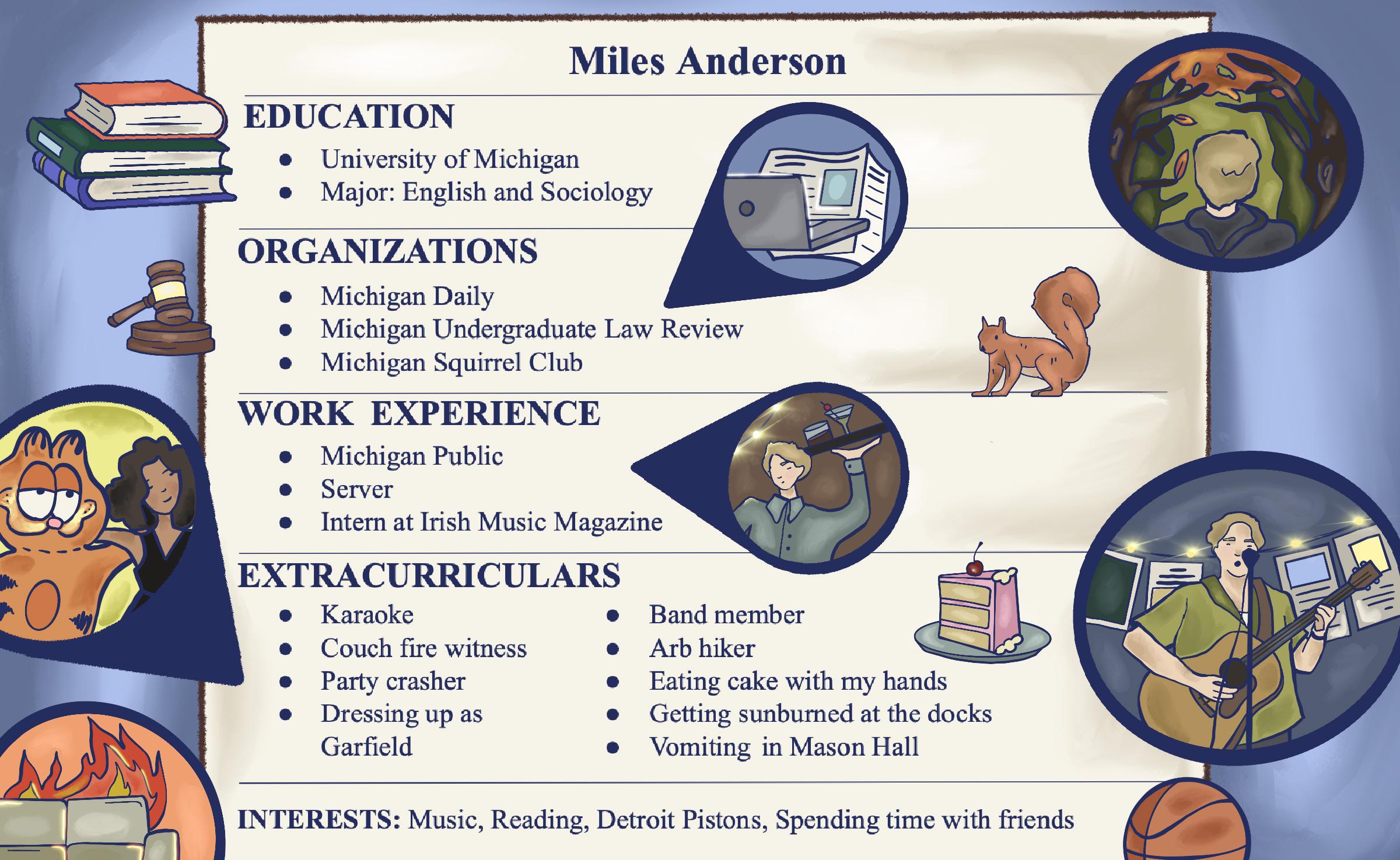
the basic competency and skills required — but it will never hurt. In my time at the University, I was lucky enough to stumble upon opportunities that helped me refine my interests and, from there, seek out work that I knew I would like and would help me add a couple lines to the resume.
However, part of the issue with this advice is that it is beholden to the resume. Sure, I’ve had some interesting work experiences, but most of my interesting experiences were not professional in any way, shape or form. I may have an interests section on my resume, but it is only the barest summary of a summary that does not really convey who I am. But I think this is where an alternate interpretation of “be interesting” can come into play. It doesn’t just have to be about those lines on a resume that may or may not get me an interview — it can be about those small, goofy moments that made up the vast majority of my time as a student.
These moments made both my time and experiences in college worth it. The beauty of them, for me, was that they just kind of appeared or developed into something I never could have imagined. I didn’t directly seek out interesting moments or experiences beyond thinking, “Oh this would be fun,” and then diving into something headfirst.
I had the opportunity to witness several couch fires, some due to National Championships and others just for fun, and then watch the Ann Arbor Fire Department’s response to said burning loveseats. I started a band with some friends and even played an outdoor show with them. I accidentally crashed a couple parties. I did an awful job at karaoke more times than I can count, scream-singing Natasha Bedingfield or Warren Zevon. I got all dolled up to attend formals in the various nightlife locales of Ann Arbor. I also got all dolled up as Garfield on Halloween. I got severely sunburned at the Docks and outside my college house while grilling all day because the weather was nice. I ate some delicious cake with my hands at a fake wedding while wearing a cowboy hat and pajama shorts. I walked through the Nichols Arboretum at midnight listening to music and watching the sky. I built a Lego bonsai tree and watched a supermoon with a friend. I puked during class in the Mason Hall third floor men’s bathroom and off a balcony into a parking lot after eating some things that disagreed with me. These moments were fun, terrifying and everything in between. They showed me how much excitement and joy I could experience and gave me stories I love to tell.
CONTINUEDAT MICHIGANDAILY.COM
GRACIELA BATLLE CESTERO Statement Contributor
Right, left, right, left.
I remember my first night out in college like it was yesterday. After long days of lugging suitcases and Target bags up and down the three flights of stairs to my dorm in East Quad Residence Hall, my side of the room was finally finished. Like clockwork, my phone buzzed with a text message sent in a group chat with everyone from my hometown who had come to the University of Michigan. The message contained a flyer for a “White Out” fraternity party later that night. Across the room, my roommate’s phone lit up with the same message and, as if communicating via telepathy, we decided we were going.
A few hours later, my roommate and I were dressed, donning our whitest attire in our first attempt to blend in with the cool college crowd. As I walked down frat row, my roommate and her boyfriend holding hands in front of me, I was mesmerized by my surroundings. I looked around and took everything in — the college houses blaring music from speakers out on porches, the street full of students with red Solo cups in hand. I made it, I thought to myself. Brighteyed and bushy-tailed, I placed one foot in front of the other and innocently walked into my first fraternity party at my dream school.
Right, left, right, left.
The party was fun, at least initially. After five minutes of “frat flicking” to Pitbull songs, we made our way through the mosh pit of people and into the fraternity basement to find a tub full of the cheapest beer the fraternity could possibly buy. My guy friends all shotgunned one, but my roommate and I decided against it. Fifteen minutes later, we all decided to leave.
We walked aimlessly back down frat row all the way to South University Avenue, placing one foot in front of the other as we tried to find somewhere else to go. Right, left, right, left. I can picture our young freshmen selves so vividly in my mind, and I envy the innocence and possibility that defined us then. We ended up at an empty bar and found a long table with a seat for everyone. Coincidentally, I sat next to the only boy not from my hometown who had joined us that night. We started to make small talk and naturally landed on the topic of why we both chose to come to the University. Without hesitating, I led with the revelation that my dad and my grandfather had graduated from the University in 1996 and 1963, respectively.
“Oh, so you’re a legacy,” the boy said. “It was probably way easier for you to get in, then.”
Right, wrong, right, wrong.
Being a “legacy,” or legacy admissions, refers to the practice of giving specific applicants special preference during the college admissions process because they are
related to an alumnus of the institution. The practice was installed by Ivy League schools in the early 1920s as a strategy to limit Jewish admission to and enrollment in historically Protestant institutions. Several other methods were implemented, like required interviews and aptitude tests, to further phase Jewish immigrants out of the elite collegiate environment. Years later, legacy admissions live on through the occasionally required interview and report of standardized test scores, as well as the sheer number of wealthy legacy students admitted to higher education institutions with every passing year.
The U. S. Supreme Court’s decision to strike down affirmative action policies at Harvard College and the University of North Carolina on June 29, 2023 led to discussion about the legitimacy of the legacy admissions practice. All eight Ivy League institutions in the U.S. still consider legacy status when evaluating applications each year. A larger number of Black and Hispanic students are more likely to enroll in institutions that don’t consider legacy status in admissions. While institutions are still allowed to consider the discussion of race in an applicant’s essay, it is no longer lawful to admit them on the basis of their race only, as it goes against the holistic admissions review process. And while there are open considerations for legacy admission bans in some states across the U.S., the policy still remains prevalent and, for the most part, in full effect.
that the University’s Office of Undergraduate Admissions does not consider legacy status as part of its application process. Take that, I thought, reflecting back to the interaction with the boy I met on that first night out.
Now that I know why and how the practice originated, though, I am riddled with guilt over something that has been extremely meaningful to me throughout these last four years. How do we choose what is right and what is wrong? Will we ever know the difference?
Right, left, right, left.
“The familial ties I have to the University and beyond have cemented my time here and will continue to cement my identity when I leave.”
A few days after the interaction with the boy, I embarked on my first week of school as a Wolverine. On my first day, I remember going to class, walking 15 minutes to get lunch before realizing that the South Quad Dining Hall was actually in the opposite direction and studying at the Shapiro Undergraduate Library for the first time. I felt performative, walking into the UGLi with my maroon Fjällräven Kånken backpack full of the study materials I supposedly needed. I found a high table on the first floor, opened my backpack and pulled out the workbook for my French class to get started on my homework for the week.
“¿Qué?” I demanded. “Lo siento mucho,” my father gave his condolences, as if he wasn’t the one who had just lost his father.
I ended the FaceTime call with my parents as tears welled up in my eyes, but I didn’t let them burst yet. I walked back to my dorm, my eyes fixed on the ground and my attention focused on placing one foot in front of the other: Right, left, right, left. As I walked, I couldn’t stop thinking about how my grandfather had walked these same sidewalks 59 years ago, putting his right foot in front of his left, just as I was doing now. As I walked up the three flights of stairs to my room, putting my right foot in front of my left, I thought of my grandfather looking down on me, excited for the journey I was about to embark on, the same one he embarked on, and the same one my father — his son — embarked on 26 years ago.
I sat on a stool I had purchased to hoist myself up on my dorm bed with ease, my face red and puffy in my hands, thinking to myself, “Why him, why now?” It was then, though, that I realized I was in the best place possible to grieve my grandfather and heal from his death. I decided against traveling home to Puerto Rico for his funeral. The day of my grandfather’s funeral was my first football game day as a U-M student. Every touchdown, every iteration of “The Victors” sung by an audience of 110,000 Michigan fans and Wolverines, was sung in my grandfather’s name. I convinced myself that our football win that day was his doing. That was his legacy.
How is the Ivy League (and so many other higher education institutions in the U.S., for that matter) justifying the legacy admissions process now that affirmative action no longer prevails? How is it that a policy that affords the historically underprivileged the same education as the historically privileged got struck down, but a process that finds its roots in antisemitism and keeping people out rather than letting them in remains? Are legacy students allowed to feel emotional ties to their legacy status, even if the policy itself is far from an innocent familial connection? Whether the University considers legacy status in their admissions review process is not something I checked prior to applying, but I assumed it was a given. While I understood that it would likely give me a leg up in the application process, I didn’t care to research where the practice found its roots, nor how it would play a role in my potential admission.
As I conducted research for this piece, I found
I was barely a page through my assignment when I got a text from my dad asking how my first day was going and to please call him whenever I got the chance; it was important. I skimmed the text and turned my phone face down on the table, deciding to call him when I was done studying for the day. Five minutes later, my phone buzzed again. I tried to resist flipping it around as much as I could, but curiosity got the best of me. It was a text from my college counselor telling me how sorry she is for my loss, but that I have now gained a guardian angel to look over me during the upcoming four years of my college career. Reading that message, my hands started to shake. I shoved my workbook back into my backpack, launched myself from my seat at the high table, frantically gathered all my belongings and dialed my dad’s number as I speed walked out of the first-floor study area. Once outside, I sat on a bench right by the doors of the UGLi, waiting for my dad to answer my FaceTime call. When he finally did, my screen displayed my father’s swollen and splotchy face with red eyes full of tears he wasn’t ready to shed. My mom sat next to him, a comforting hand on my dad’s shoulder.
“Lela,” my dad said, “Ando se nos fue anoche.”
Right, wrong, right, wrong.
What does it mean to have a legacy? What does it mean to leave one?
Even if the University insists that it doesn’t take legacy status into account when conducting their application review, I remember the Common App asking me if I had any family members who graduated from the University.
The reality is that I have two. The reality is that I am a legacy student, and there are benefits that come with that, among these a leg up in the admissions process. The reality is that legacy admissions is a questionable practice at best and a biased tactic that prioritizes the privileged at worst. But my reality is that the familial ties I have to the University and beyond have cemented my time here and will continue to cement my identity when I leave.
My family’s legacy is an integral part of who I am, and that begins with my paternal grandfather.
Ando
My paternal grandfather — Fernando to most, Ando to me, my sister and our four female cousins on our dad’s side — was a mysterious man of little words but many thoughts. He was an architect who loved politics and read books at the speed of light.
He was a family man, a great husband to my grandmother and an exceptional father to my father and his three siblings. But, it took him a while to find himself.
My grandfather first began his college career in 1958 at the Rensselaer Polytechnic Institute, unsure of what his future would hold and what he wanted to dedicate his career to. A semester later, he made the decision to transfer to Tulane University in New Orleans, where he spent a year before making the decision to transfer to the University of Michigan in 1960 for his final four years of college. It was at the University that he identified architecture as his professional passion and was initiated into the former U-M fraternity Sigma Phi Epsilon, whose chapter house on South State Street burned down in 1995 and is now home to the Ford School of Public Policy. He began a now three-generation-long tradition to apply to and attend the University and created a home in Ann Arbor for many to come after him.
The last time I talked to my dad about how many times Ando transferred schools, my dad simply said, “I guess it took him a while to find himself.” It took my grandfather three universities and four years to figure out where he wanted to be and what he wanted to do.
I’ve been enrolled at the same university for the past four years, but it has also taken me the past four years to figure out my place in the world. The truth is, I don’t think I’ll ever figure it out — at least not completely. But that is why, like my grandfather, I will never stop moving through the world with curiosity and an open mind.
The first time I stepped foot in the Public Policy School, I was still a freshman in college. The building was a six-minute walk from East Quad. The day I learned that was where my grandfather’s fraternity had been housed, I walked the six minutes to the Public Policy School and just stood outside, contemplating. He really was larger than life.
My grandfather was an avid reader. Every time I pick up a book — before and after my grandfather’s death — I think of him. There is a library in his apartment where his office used to be, full of all the books he collected throughout his 82 years of life. Sometimes, I sit there in silence and read. I can hear him then, asking me about what I’m reading, just as I see him when I walk the sidewalks of Ann Arbor, just as he lies in the Sigma Phi Epsilon study room at the Public Policy School, just as he’ll be with me wherever I go.
Miña
My paternal grandmother — Carmen Ana to the world, Carmiña colloquially and Miña to me, my sister and our four female cousins — is a fabulous beauty queen. My grandmother never leaves her apartment undone. She always has a full face of makeup, a different outfit for every occasion and her hair perfectly in place. Even at age 85, she still gets her hair tinted and dyed blonde every week, making sure she always looks presentable.
Miña’s characteristic traits might make her seem frivolous and materialistic, but if I’ve learned anything from my grandmother,
it’s that there’s more to everyone than what meets the eye. In the years since my grandfather’s death, I’ve come to know her as a sentimental woman who feels deeply and loves fiercely to a degree that not many understand. My grandmother is merely considered a mother, a grandmother, a sister, a wife and a widow by many. But she is much more than these words because the way she shows up in these roles is one worthy of admiration.
In 1963, before my grandfather’s last semester of college, they got married and my grandmother moved to Ann Arbor. What was once home for him became their home together, christened in a little apartment at Cram Place. They went on to make several more homes together, from Ann Arbor to Santo Domingo, Dominican Republic, to San Juan, Puerto Rico.
Every time my grandmother moved to a new place with my grandfather, she hated it. Some may say she is just pessimistic because there seemed to be no place in the world that would satisfy her completely. What many have yet to understand, though, is that none of these places was my grandmother’s actual home. Rather, she found her home in her husband, my grandfather. Four years after my grandfather’s death, Miña still cries at every mention of him. While some understand this as emotional intensity, I see it as my grandmother’s biggest strength. Throughout the past four years, I have shed innumerable tears. Some because I felt sad, others because I felt alone, some because I felt lost and others because I missed home. My sophomore year, especially, was one riddled with loneliness. It was then that I understood my grandmother’s ever-flowing tears after my grandfather’s death. In losing her home, she became perpetually lonely. As I say goodbye to my home in Ann Arbor, I know I will experience moments of nostalgia, but I know I’ll still be able to call it a home, as it will follow me everywhere through the people who helped me get here. And that all starts with my grandparents’s son, my father. Papa
My father — Juan Carlos to most, Enano to his family and Papa to my sister and me — is the youngest of four siblings and the last of my paternal grandparents’s children. To put it as simply as possible, my dad is the loveliest person I know. Although I’ve only seen my father cry twice in my life, he has one of the biggest hearts I’ve ever had the pleasure of knowing. He is shy but thoughtful, serious but caring. He is as sensitive as he is assertive, as sharp as he is kind. He is intelligent like his father and misunderstood like his mother. He is the best dad in the world.
Papa began his college career in 1992. Like me, he started and ended his time in college at the University. He went from living in a dorm in Alice Lloyd Residence Hall to a house down South University Avenue with all his friends from Puerto Rico who went to the University with him. He decided to declare a major in economics,
following in the footsteps of his three older siblings, who all pursued business in college to some degree. He graduated from the University in 1996 with a Bachelor of Arts in economics, a job secured back home in Puerto Rico, a room to come home to in his parents’s house and unsure of what else awaited him postgrad.
Now, 30 years after his graduation from the University, my father is a successful financial consultant, a homeowner, a father to two young women, an attentive husband and, above all, a committed son. Any time I have any problem, Papa is the first person I call to help me solve it. He is resourceful, he listens and he cares. The way my father has handled his own father’s death and looked after his aging mother, all while taking care of his wife and two daughters both financially and emotionally, is admirable. What impresses me the most is how humbly he does it all, expecting nothing in return. My father is socially anxious in a way that I inherited. He comes across as timid to those who don’t know him, but layered to those who have the privilege of sitting down for a long conversation with him. Whenever I walked past someone on campus whom I didn’t feel confident enough to say hi to and felt guilty about it after, I called him. Whenever I felt insecure after an exam or an interview or had to hide in a bathroom because I couldn’t stop crying, he was always my first call. And his response was always graceful, always gentle, always his. No single human is perfect. But in my eyes, my father is as close to perfect as it gets. There have been many positives and many negatives throughout my college experience. Papa has been there every step of the way. He has visited me seven out of the eight semesters I’ve spent in Ann Arbor, a reality I know I’m very lucky to experience. Ann Arbor is just as much his as it is mine —
it is ours. The most profound joy of my years at the University has been seeing my father relive the best years of his life through my eyes. I don’t think I’ll ever be as indebted to anyone else as I am to my father. In giving me the gift of a college education, I’m happy to have repaid even a fraction of that debt by giving him a space in Ann Arbor to come back to.
Mama
My mother — Camelia to most, Camelot to her closest friends and Mama to me and my sister — is the strongest woman I know. She has the most unapologetically loud personality I’ve ever witnessed in a person and, on the surface, has such an easy time being herself in front of everyone she meets. I don’t think she believes this about herself, but she has a contagious “take it or leave it” attitude that I didn’t inherit but can admire as her firstborn daughter.
Mama married my father in 2002. My parents balance each other out perfectly. Where Papa is shy, Mama is outgoing. Where Papa is quiet, Mama is loud. They work in a synchrony that astonishes me every moment I spend with them, and I can only wish for a relationship as healthy and romantic as theirs.
What my mother didn’t know when she married my father was that she was marrying a “Michigan Man”, both in the literal and figurative sense of the expression. My parents donned me in U-M gear since the moment I was born, and I’ve been tuning in to Michigan Athletics — or, at least listening to them as a backdrop when my father blasted them on TV — for as long as I can remember. But by marrying a Michigan Man characterized by honor and humility, my father has given my mother a second chance at her college experience.
CONTINUED AT MICHIGANDAILY.COM

ANANYA GERA Statement Contributor
When I was thinking of what I wanted to write for this edition, I felt like I didn’t have anything profound to say compared to the others around me who are also graduating. I’m not sure I had the ability to really express what my college experience has been like, with all of its ups and downs. Recently, it feels like I’m trying to survive each day and get to the next, which has hindered my ability to really reflect on the past four years. I can tell you that it’s been good, bad and everything in between, but I still can’t tell you the hows and the whys and what it really means. I think part of that has to do with the nature of my college experience — it wasn’t the best experience in the world, but it certainly wasn’t the worst, either. In the media, we tend to see such a small subset of what these years are actually like for people that it can be hard to recognize your own experience in the content we’re exposed to. I know this isn’t necessarily a new idea, but it is something that has affected the way I perceive my time at the University of Michigan.
I am on the precipice of graduating, and with all the emotions that have come with that, I’ve been walking a lot more frequently. So, as I’ve done recently and in the past, I took a walk. My goal with this was to visit the places in Ann Arbor and at the University that have touched me or shaped me in some way. This is certainly not an exhaustive list, but it felt important to trace my personal geography in this city. Throughout the experience, I was overcome with sickening nostalgia, sadness for my younger self and pride for the life I’ve crafted in four years. But, I’m still not sure I can communicate to you my overall takeaways. Here I present my unfiltered thoughts and experiences. While not as polished or profound as other pieces about graduating, I hope you can take something away from it. I hope when I visit this piece in the future as a different version of myself from the one I am right now, it will be clearer what four years in Ann Arbor have meant to me.
***
East Quad Residence Hall
I remember opening my dorm assignment, seeing the words “East Quadrangle” and feeling relief at the thought of not having to live on North Campus. I remember the anticipation I felt moving in, desperate to get my parents to leave so I could start what I hoped would be the best four years of my life. As I walked by the outside of the building, I felt moments from my freshman year pass over me like waves. Perhaps people can relate to this, or perhaps they can’t, but my freshman year was not the best time of my life — in fact, it was far from it. I was miserable, and I felt so alone on a campus this big. I passed by the spot on East University Avenue where I cried on the
phone to my mom, telling her that I wanted to transfer. Truthfully, this place feels like a bruise, hurting when I press on it too hard. Nichols Arboretum
On my way to the Arb, I passed by other spots that contain so many memories. I passed by the bench where I opened my MCAT score, feeling so anxious and exhilarated all at once. I passed by Mosher-Jordan Residence Hall, where I still frequent the dining hall. I passed by the School of Public Health, which houses my major and has helped me to narrow down further what exactly I am interested in doing in my career. Walking down the sloping hill to the entrance, I realized that it wasn’t exactly buildings and lecture halls that shaped my experience (as much time as I’ve spent in those places), but the little moments and unassuming settings where some of my most integral experiences have occurred. College has underscored the importance of nature to me; whenever I feel overwhelmed, I’ve always found my way back to the Arb to reset. The first time I made it to the big field in the middle, I was in awe of such a special place nestled so close to my residence on campus. I’ve spent countless hours lounging in the sun, reading my book or people-watching. Like so many things, I feel like I took it for granted. I wish I came here more. I wish I had spent more time exploring all the trails. I feel unprepared to leave this place behind, but I’m not sure I would ever feel ready. Time will move forward, much to my chagrin, so the only thing I can do is move forward with it. That terrifies me.
Downtown Ann Arbor
On my walk through downtown Ann Arbor, I passed all my favorite places. In the past two years, downtown Ann Arbor has become a place I frequent on the daily. Literati, Vault of Midnight, Sandy’s Boutique — these are all places on my normal route through this part of the city. As I pass by the restaurants and shops, I am struck by how little this area has changed since I first got to Ann Arbor and how much I’ve changed in the time since then. People tell me that I seem very sure of myself — my wants, my likes, my dislikes. This surprises me, because internally, I feel anything but sure. But reflecting back to myself as a freshman, I can see how I’ve grown out of some of my hesitancy. There is certainly grief in leaving certain parts of myself behind, but I am also proud of the way I’ve matured. My end goal is to get ice cream at Blank Slate Creamery, a place that has remained so important to me as I’ve progressed through college. Eating my basil ice cream (my all-time favorite flavor), I know that some things never change, and I take a lot of comfort in that.
The Blue House on Packard Street I’ve lived in a different place each year of college, and it feels like that was all leading to my current house. Even though I’ve lived here for only eight months and will be leaving it very soon, I do consider this my home. I have posters on the wall, flowers on
my desk and mementos scattered all around. I’ve watched the seasons change from my bedroom windows, observing the trees go from green to orange to bare and now back again. Sometimes it feels like I just got here, like I just started my final year of college, but as I felt the familiar relief wash over me when I laid eyes on my house, I registered just how much time has passed. That makes me uncomfortable, to know the short time I was meant to spend in this house is almost over, but it also makes me proud to know that I love something so much that I made a home out of it. I will miss all the homes I’ve had in Ann Arbor, but I will miss this one especially. I think what makes this house so special is that it feels like a culmination of my time in college. While everyone has different experiences, it feels good to end this year living in a house — a situation that many people speak so highly of. Still, I have some time left — mornings when I will scramble to get out the door after snoozing my alarm too many times, afternoons when I will make my lunch in the smallest kitchen I’ve ever seen, nights when I will watch movies in the living room with my roommates. I plan to make the most of it, even as I mourn my year in this house.
The Michigan Daily I end my walk at the place I find most fitting: The Daily. I’ve already done a reflection on The Daily, where I reminisced about how life-changing it was. But at this moment, all I can think about is how much I miss it. My last semester of college has been fun, but I miss the community that The Daily gave me. I miss feeling good at something, the way I felt good in my role as a managing editor. I miss editing and collaborating with the coolest people I’ve ever met. I miss it in a way that surprises me, because I thought that when my time was up, I’d feel relieved at the new time I had free and the less stress I had to confront. But The Daily was such an integral part of my college experience that without it, I feel untethered. I’ve felt lost without The Daily being the thing that structures my weeks and gives me tangible goals to achieve. But writing this piece has shown me that such an important part of my life is not lost forever, even if my time there has come to an end. Through the process of writing my final piece, I have found myself slipping into my familiar writing routine, one that I crafted through my years of being a columnist: writing my piece out of order, taking time to reflect on the best way to communicate how I feel and having another tab open to look up synonyms for certain words. On my walk, as I looked to 420 Maynard St., I felt comfort knowing that the place where I did my best work, the place that played a profound part in shaping me into who I am in this moment, will be here for me to come back to. I feel that same way now, amid my sadness and longing.
***
To be honest, I put off writing this piece until the very last minute. This reflection
intimidated me because it meant that I had to think critically about past, current and future moments that I’ve pushed to the very recesses of my mind. I am scared to leave the University and enter another stage of life that will be so incredibly different from the one before it. I am terrified to think that the version of myself right now, shaped by all these places and memories and people, will not exist in the same way as I move forward in life. Even as I’m writing this, I feel the familiar throb of anxiety in my throat as I imagine what life will look like only a month from now. I am scared and overwhelmed and am so unsure of myself. I think I am the most unsure of myself and of my direction in life than I have ever been. I wake up every single day anxious, plagued with thoughts about what life will look like when I leave this place.
As I reflect on college, I find the ways in which I think about my experience changing with every single moment. My time at the University has been like a kaleidoscope, with every shift bringing new meanings to the moments I’ve lived through. It is both exhilarating and exhausting to feel the bundle of complicated emotions in my chest that has come to represent what the University means to me.
Walking through Ann Arbor and tracing all the places that mean so much to me allowed me to confront all the emotions I had been ignoring. I’ve loved it and hated it here. I am both itching to leave and desperate to stay. I am not walking away from the University confident that these were the best four years of my life, but I do know they were some of the most formative. When I was a freshman, I always wondered what I would be like four years later. Would I grow to love the University and Ann Arbor? The answer is yes. I do love it here. I love all the places that I’ve mentioned and the many more that I didn’t. I am proud of the person I’ve become and the way in which these places have shaped certain parts of me. That doesn’t mean that I also don’t feel alone and frustrated and intimidated by how these years went and how the next few will go. College still remains a part of us after we graduate and physically leave this place. Four years were spent here learning and growing in uncomfortable, yet fruitful, ways. How could the University not leave an imprint on each of our souls? What comes with that is my relationship with college will change even as I enter new chapters. A thought that I keep coming back to is that, right now, after four years, I still cannot really express what this time has meant to me. The way I feel about the University and all aspects of life it encompasses changes every single day, like leaves shifting in the wind. As I reminisce now and as I reminisce in the future, I’m sure my takeaways from college will be evershifting. My experience was not easy nor conventional, but it is what made me who I am. I think there’s a beauty in that, even amid all the uncertainty I still feel.
ISHA JAYADEV Statement Contributor
Standing in front of the tall double doors, I check the GPS on my phone to make sure I’m at the right place. The time on my phone throws me off — 8:20 a.m. I’m way too early for my first day, but I didn’t want to take any chances with the Metrorail. In the corner of my eye, I notice a park bench, and I clumsily walk over in my new heels, holding a dark green work bag that I do not feel old enough to be carrying. I take it all in for a second. It’s always been my dream to end up here — Washington, D.C. — and I don’t want to take it for granted. I can see the White House from where I’m standing, and as a bright-eyed, naive 22-year-old, even the excitement of people in suits with expensive watches bustling around me fills me with the feverish anticipation for the life ahead.
I graduated from the University of Michigan last December, a semester earlier than my peers, so as I walk into the building and go through security, I’m keenly aware of the fact that my college roommates are probably still asleep. Maybe they had a night out together. Maybe they ordered Taco Bell on DoorDash and fell asleep before it arrived, as they tend to do. Maybe they watched half of a movie or a new reality TV show and have now bonded over it — a bond it feels like I’m no longer a part of. I try not to think too hard about it, not letting myself mourn the life I could have had in college until May, when everyone else graduates. Finishing alone already feels isolating enough; I don’t want to grieve on my own, too.
After our initial orientation, I take the elevator up with my boss and the other paralegal I’ll be starting with. I look over at him, and my mind plays through all the possibilities: Is this a friend I’ll make in D.C.? Will the office bond us? I think the same when I meet the rest of the paralegals — they’re young and they’re friendly, and I wonder if there’s some prospect of community here.
I was right to be excited about that possibility, now knowing my coworkers on a personal level, yet there are still times when I’m laugh-reacting to a message sent in my college roommates’ group chat, desperately hoping my text will bind me back to my friends in Ann Arbor in some way.
I’m no stranger to making new friends. I moved to Wisconsin when I was 4, to Georgia when I was 12, to Michigan when I was 18 and, now, at 22, I’ve moved to D.C. It’ll never end, either; eventually, I’ll move for law school, then three years
later, I’ll move for a job. When I’m older, I’ll probably move to a suburb — maybe for good, this time. But permanence is no guarantee, and each change will require a complete upheaval of everything and everyone I know. My gratitude for the ability to see and experience so much doesn’t always quell the aching feeling that I am constantly leaving the people I love behind.
***
When I first met my best friend in eighth grade, we were inseparable. I still remember how giggly she was, how she could never take anything seriously, which, at 13 years old, was the most endearing quality a girl could have. Under our makeshift forts, we would talk about a future where we lived in neighboring houses, raised our kids together and lived happily ever after. I really believed it, too. But we were never in the same classes in high school, so after middle school ended, we pretty much stopped being friends. For a few years, we’d send “happy birthday” texts, but those too have since tapered off. Although we’re strangers now, I experienced a kind of vulnerability in friendship I hadn’t known before; I didn’t feel an ounce of embarrassment while she stood outside the bathroom door, handing me tampon after tampon as I kept getting it wrong, patiently explaining exactly how it works so we could go swimming later that day. In the midst of puberty and a whole new set of “Inside Out” characters infiltrating my brain, her lack of judgment was exactly the kind of quality I needed in a friend.
In ninth grade, on the first day of my Advanced Placement United States Government and Politics class, I sat behind one of the other girls from my eighth-grade friend group. We had been friends for years, but the split-second decision I made to sit behind her would forever change our friendship. I had never had a serious conversation with her before that, and I was now realizing she had the most intriguing, thought-out opinions on everything, forcing me to keep an open mind on all my previous beliefs on right and wrong. To this day, I find myself repeating her points when someone brings up the ethics of eating meat or the best way to parent a child; I am the most opinionated person I know, and she was the first person to truly challenge me and force me to look outside my own perspective. And as a 14-year-old who thought she knew everything, I needed that.
She quickly became my newest best friend, and I called her my soulmate to anyone who asked. On our senior year prom night, we cried and cried and cried and pinky-promised that this friendship
was forever. Thankfully, we are still great friends, but it’ll never be in the way that means we go to Panera every day and do homework (chit chat) for hours on end. Instead, we go on trips with our other friends from high school and FaceTime and hope for a day that our time together won’t have to be so deliberate, so planned.
I never thought I’d find a girl who knew me so well, who understood me so deeply, with whom I could be so honest that I’d say things I never thought I’d say out loud. I vowed to hold on to that friendship and a few others from high school (which, with a lot of work, I did), no matter what other friendships came along.
And come along, they did. The random girl I found on Instagram while looking for a roommate turned out to be the most dependable, selfless and gracious person I’ve ever met. Together, we met four other girls in the same unfortunate isolation of our North Campus residence hall, and after a single hangout, we solidified our friendship through the making of a group chat. Months later, we’re cuddled on the couch of the Bursley Residence Hall study
room, talking about the future, unsure of what careers we want but dreaming of living in a city together post-grad, unable to accept a life where this friendship may someday be rendered history.
Years later, and we’re all roommates, facing the fact that we all got jobs in different cities post-grad — Boston, Los Angeles, Chicago, D.C., Dayton and New York City. For all of us, the cycle of creating friendships will soon start all over again. But it doesn’t seem fair. What was the point of all this? Why did I spend four years growing up with these girls, only to have it ripped away? But what plagues me the most is this question: Were we friends simply because we were all in the same place?
Because I love these people so much — my friend group from Georgia and my roommates from the University — I hold on to these friendships for dear life, terrified that we may accidentally become strangers. I take pride in holding on — in counting up the years we’ve stayed close, as if it were some sort of accolade I’ve received, proving to me that their worth
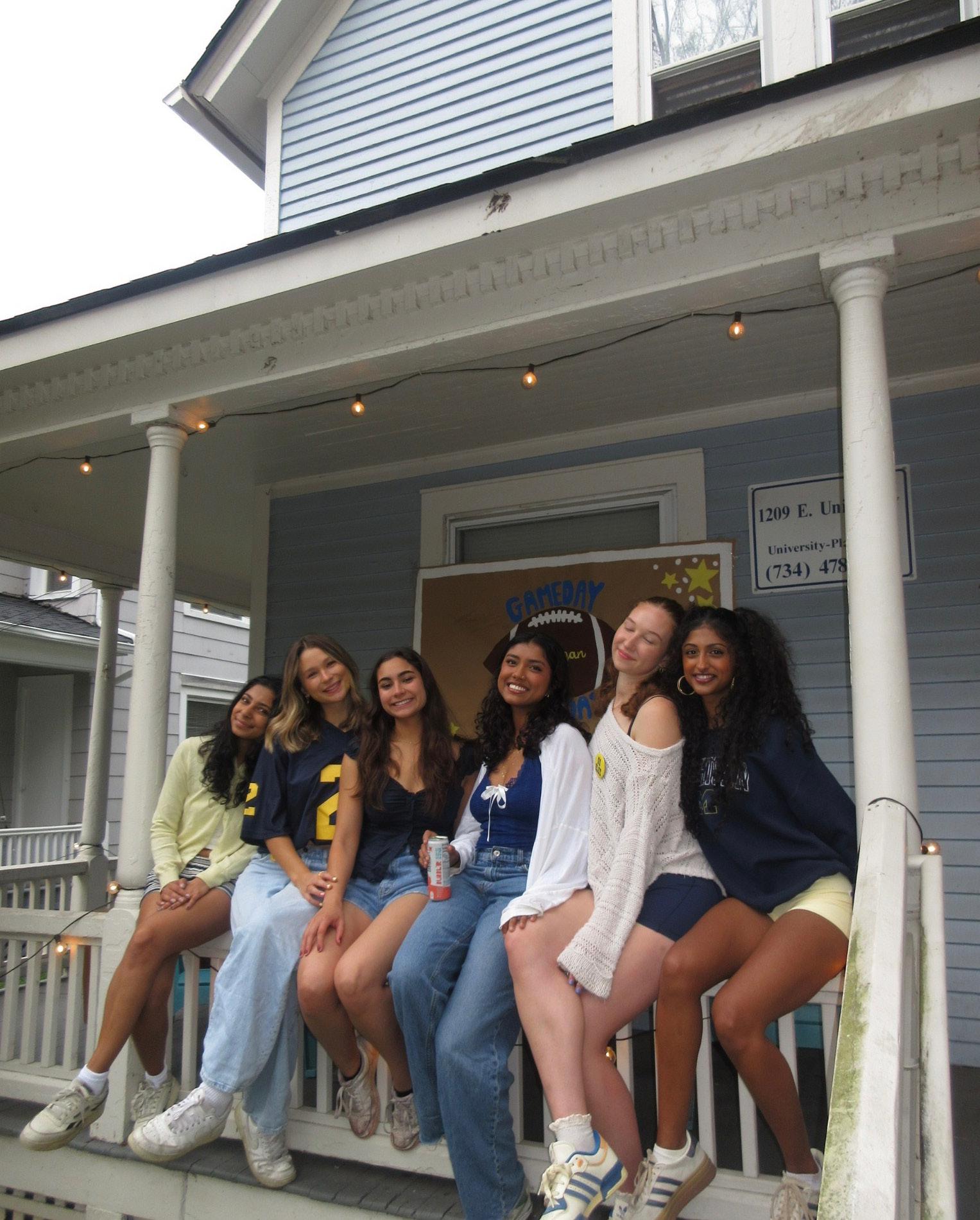
can be measured by their longevity. I’m not sure how to put into words how deeply I have loved and been loved, so it’s easier to smile and tell someone it’s been 10 years of friendship. And in their awe, I revel in the idea that there is some divine intervention that brought me the perfect friendships, and now I’m required to keep them.
I’ve always heard people talk about their long-distance friendships and say things like, “We don’t text or call that much, but when we see each other, it’s like no time has passed.” Although I am quite the texter and even more of a caller, I used to believe that my dynamic with my high school friends would stay consistent forever. For a while, sure. They did. But as my friends and I have grown through our 20s, it has become glaringly obvious to me how our environments have changed us — how we prioritize different things, like different music and don’t even share the same slang anymore. I don’t want it to be true, but I’m playing catch-up constantly — never part of the discussion, but always
told the story in hindsight. I’m given the updates, just not every day. Even though I know it’ll inevitably happen with my college friends as well, I’m not ready for it just yet.
I recently met up with a friend I hadn’t seen in a few years. He sent me this text after: “Feels like you’ve changed a lot since the last time we saw each other. It was cool to see.” When I followed up, he said I seemed more confident and relaxed since he last saw me. I’ve thought about it constantly since — when did this happen? How did I not notice? How could change have happened so silently, so persistently and so under the radar that I had no knowledge of it? But I don’t know what I expected because I see such a palpable, glaring difference in those I’ve known since high school. And no matter how much it scares me, I know I’ll see it eventually with my college friends, as well. We will adapt to our respective cities and environments, and, just as they made me love watching “Love Island,” Diet
Coke and playing cards at restaurants, we will all be inspired by different things and people from here on out.
I am dramatic and pessimistic about post-grad because I love my friends, and I cannot even consider replacing them. But being out of college requires quite a bit of reflection on exactly how one is supposed to make friends, especially without the natural shared spaces like classes, clubs or even a consolidated campus. I had classes with my best friends in high school, and I lived with my best friends in college and I’m realizing it was that shared environment, the forced proximity, that resulted in the kind of loyalty I feel toward them now. There are obviously some people I feel drawn to and particularly known by, but it is truly our environment that has brought us together, and without that shared environment, it may be inevitable for us to grow apart.
I want to believe that friendship isn’t arbitrary, that it would happen regardless of proximity, and even as we
embark on our separate journeys, our friendship will never change. But I’m not sure that’s true. And even though that is devastating, there is something magical in the creation of a bond, simply because we’re both annoyed by how hard the test was, how long the line at Rick’s American Cafe is or even how many overtime hours we have to work. It means that, as long as shared environments exist, with a little bit of work, so too will the possibility of friendships. Even if it’s just for high school, or college, or gap years, or law school or any temporary experience after that, their value exists beyond their permanence. Each friendship has taught me something, changed my perspective in some way or just made an experience 100 times more enjoyable. The cycle of loss continues, but so does the cycle of growth. And as I am laughing with my coworkers over a bottle of wine at happy hour, I try my best to remember that: Even if nothing lasts forever, it was still worth having it at all.


ALENA MIKLOSOVIC Statement Contributor
I had a pretty idyllic childhood. I grew up in a cute Michigan neighborhood, on a block with lots of children to run around with and my best friend Raegan right next door. My siblings, neighbors and I spent nearly every summer day running barefoot up and down the street, zipping like dragonflies from one yard to the next, until it got cool and dark and our parents called us inside. The woods in the backyard became a sprawling metropolis, the trees our high-rise corporate offices. We played capture the flag according to rules that were so specific and so serious, it was like we were competing for Olympic gold. We were movie stars, teachers,
business owners, parents and athletes — sometimes all within the same hour. On Hidden Creek Drive, I was home.
For more than a decade, it was the only home I knew. But when the time came for me to move into West Quad Residence Hall for my freshman year at the University of Michigan, I was ready. It was daunting and scary to pack up my life and start anew, but I was ready to get away from my high school, make new friends, learn new things and be more independent.
I was lucky that I settled into my new life on campus easily. I loved my roommate Sofia, was having fun with my new friends and doing well in all my classes. But every time I would leave West Quad to go back to Hidden Creek Drive, and every time I left my parents’s
house to come back to school, I was struck by a feeling of in-betweenness. I was disconnected from my family and their life in my hometown, and everything about my life at the University was still new and unfamiliar. The phrase “I’m going home” never seemed applicable. A university dorm room certainly was not my home, but I didn’t live in that house on Hidden Creek Drive with my family anymore, either. I felt like I didn’t have a home anywhere.
Since that initial move freshman year, I have moved many more times. I moved from West Quad to an apartment, then out of that apartment and into another. In the summer between my freshman and sophomore years, my parents moved out of the house I grew up in. At the beginning of my senior year, I moved into
a house off Oakland Avenue with five of my friends.
I can’t even tell you the number of times my dad declared, “I’m never moving” from his comfy chair in the corner of our family room. So when my parents decided to move out of the house on Hidden Creek to a bigger, better house across town, I was shocked. And I was sad. I have so many memories in that house, and parting with it felt like confronting the indisputable end of my childhood. I was forced to ask myself who I would be when my home belonged to someone else. It was hard, emotional and sometimes, I still miss that house. But I also think that in many ways, that experience set me free. I came to the conclusion that even though I no longer have a home on Hidden Creek Drive, I
still have the people and the memories that made that place my home, and those things are much more important than the walls themselves.
Since that realization, I no longer feel stuck in the in-between. The phrase “I’m going home” is applicable everywhere; I say it to my parents when I’m going back to my house on campus. I say it to my roommates when I’m going to visit my family. I say it most every Thursday night when I’ve had enough of the Rick’s basement.
Alongside my “aha” moment, I have also had quite a lot of practice moving from place to place in the last five years. I have learned a lot, and now, I know how to move locations without losing myself. So, as a self-proclaimed moving expert, here is my how-to guide for making a home anywhere you are.
constant reminder that I get to decide who I am, just like I get to decide how to decorate my room. I get to add things that reflect who I am now — like The Michigan Daily papers framed above my dresser that represent a huge part of my college experience — without getting rid of all of the things that brought me joy as a child and a teen.
Give yourself time to adjust
Moving sucks. It’s stressful and expensive and frustrating to pack up everything you own and move it to a different place. I have never had a moving day that didn’t exhaust me. But if you stay anywhere long enough, it will start to feel familiar.
Some of the best things about my home in Ann Arbor didn’t come into my life until well after I moved here. In my sophomore year, I decided to join The Daily. When I came back from one of my first shifts, I told my roommate that I didn’t think I was ever going to love it there. It felt big, overwhelming and I had no idea what I was doing. But after a couple of months of spending a few hours a week as a primary editor at the Copy desk, I started to like it. And when I was given the chance to run for Copy chief, I took it.
three months later, I was shy, quiet and feeling disconnected from almost all of my friends. I wasn’t confident in my ability to make new friends, and I felt so behind all my classmates who had already known each other for years. By the time I graduated, I felt so different from the girl I was when I started. Even though I did make some lovely lifelong friends in high school, I never quite found my footing there. I had the feeling that, even though I felt like I had changed, most of my classmates still saw me as the shy, sheltered girl I used to be.
So, when I moved into West Quad, I was excited to meet people who would see me for who I was, rather than for the kid I was at 13. And for the most part, I think they did. I was able to be more outgoing, more confident and more expressive without feeling like it was out of character. I got to explore new things — game days, live music events, run club, wellness clubs, even sorority rush — without wondering if my new interests fit the mold of who I was supposed to be. But while all that exploration was freeing, it also left me feeling a little like I didn’t even know who I was.
Bring your memories with you to every new home
Some things have traveled with me from my childhood bedroom to my dorm room to both apartments and now my house. I’ve decorated all my bedrooms similarly: The lamp on my bedside table, the disco cherries wall art and the Dominic Fike album posters have stayed the same through all of my four years of college. I also love printing out pictures and hanging them up around my room. The faces in them have changed as I’ve made new friends and grown apart from some old ones, but being surrounded by people I love — even just in photo form — has helped me create a space that feels familiar and homey, even if the room is new to me.
As I’ve moved around, being able to have my familiar things with me is a
The year that I was Copy chief, I basically lived in the newsroom, and it ended up being one of the most formative experiences of my life so far. I met some amazing people and found a love for writing and editing that has reshaped what I want my future to look like. Before coming to college, I had no idea what I wanted to do with my life. I was interested in psychology and history, so I majored in those fields, but neither felt like one that I was passionate enough about to dedicate my career to. Working at The Daily introduced me to the field of journalism and helped me realize that I loved it. I have always felt strongly about changing my community for the better, and pursuing journalism as a career has given me an avenue to do that. I never would have had any of that if I had followed my initial feelings of unease and discomfort.
Moving to a new place is exciting; it’s an opportunity for a fresh start, to become the person you want to be. When I moved to the University, I was glad for that opportunity. I grew up in a fairly small town where everyone knew each other, and all the kids in town went to the same school from fourth grade until 12th. But despite living there my whole life, I didn’t go to the district school until ninth grade. Instead, I went to a charter school and spent almost all my time outside of school at gymnastics practices. At the end of eighth grade, I aged out of the charter school and quit gymnastics in the same week. When I started high school
When I started to feel aimless or lonely, it helped to reach out to the people who knew me. I couldn’t be in a place that felt like home, but I could still have a sense of that familiarity. I could call my mom, my sister or Raegan and feel grounded in the fact that even when I didn’t know who I was, they did. They were there for all the moments that made me who I was as a kid and in high school, but they also wanted me to make new friends, join new clubs and find new things to love. They were my home base, and they still recognized me and supported me in my new life, even when I felt like I was in unfamiliar territory.
***
At the end of this summer, I will move again, this time across state lines. I get to move to Chicago and get my master’s in journalism at one of the best programs in the world; I feel so lucky and so excited. But I know I will miss this chapter of my life. I will miss chatting on the porch with my roommates, visiting my family, going out with my friends, sitting at my desk at The Daily, walking around campus in the fall, Ann Arbor coffee shops and game days in the Big House. I know that on moving day, I will feel overwhelmed and exhausted and scared, just like I did when I moved into West Quad four years ago. But I found my place here — I made a home for myself here at the University, at The Daily, in the friendships that I’ve built with people I never would have met had I stayed in that house on Hidden Creek. I know that I will make a new home in Chicago, and I know that I won’t lose my old ones.

MARY COREY Statement Contributor
During my freshman year of college, I often found myself wandering aimlessly around the Nichols Arboretum. Growing up in Ann Arbor, I always had some level of appreciation for the Arb’s greenery and peoplewatching opportunities, but once I got to college, something kept drawing me back there. In lieu of gravestones, both of my mom’s parents have memorial benches there. In high school, I was far too self-absorbed to really give the benches too much thought. But once I started my freshman year, I couldn’t keep myself away.
College felt overwhelming in ways I hadn’t anticipated, even in a town that was so familiar to me. I already knew what my favorite coffee shops were and how to avoid traffic on football Saturdays and the cheapest places to buy groceries. But knowing a place is not the same thing as knowing your place within it.
In my mind, high school would end, and all of my problems would go away with it. But when I got to campus, I found a different version of Ann Arbor than the one I had grown accustomed to. It felt like everyone else had gotten some sort of secret memo that I missed. The dining hall hours and the laundry machines were confusing, school came much less easily to me than it did in high school and it felt like everyone arrived on campus with an already formed group of friends. My grandparents’ benches became somewhere comforting I knew I could keep returning to, especially in a time of my life that was supposed to be exciting, but just felt uncertain.
My grandma grew up in a small town in Wisconsin with a population roughly the size of my high school of 1,200. The first time I remember visiting our family there was the first time I really understood the phrase “the middle of nowhere.” One of my most concrete memories of that visit was just how vast a place can feel. It felt like the whole town was made up of only field and sky. It was hard to imagine that being the place she started, given the life she eventually built.
On paper, she was an impressive woman. After getting her associate degree at a small
college in Wisconsin, she moved to Ann Arbor, went back to school and got her bachelor’s from the University of Michigan while my mom was in high school. I always wish I had gotten to tell her that I ended up in the same place. She was a nurse for 47 years, 20 of those years spent at the University’s hospitals. She dedicated her life, career and education to helping people in very concrete ways.
But she was even more impressive in ways that don’t translate as easily to paper. She was the first person in her family to go to college and spent many nights doing homework with my mom and aunt at the dining room table. On top of being a full-time student, she also managed to work full-time and juggle her responsibilities as a mom and a wife, cooking dinner and spending time with her daughters. My aunt would eventually follow in her footsteps, going to the University to study dance. Her path was different, but it was one that still carried forward the idea that education was something worth pursuing. My mom was academically impressive in her own right — she is currently pursuing her doctoral degree, her fourth college degree. The weight of academic achievement in my family can be traced through a line of hardworking, intelligent women.
My childhood home in Ann Arbor was the same house my mom and aunt grew up in — the same house my grandma lived in while she was a student. In high school, I was adamant I would not go to the University of Michigan and instead take off to a fancy private school on the East Coast. I thought the things I wanted, and the things I needed to live the big life I wanted, couldn’t possibly be found in my hometown. When college acceptances and financial aid packages started to roll in, I unwillingly put my security deposit down and came to terms with where I would be spending the next four years. It took a while, but I think I have realized I am following in the footsteps of two generations of women, even if it’s not in the exact location I once thought it would be. Staying in Ann Arbor didn’t mean standing still. It just meant that my path circled back to something that I was already a part of.
I would not describe my college experience as particularly easy. I found myself working long shifts at my bartending job every weekend and somehow at the helm of a 600-person news organization, which, by itself, required more hours every week than a full-time job. There were moments when I felt stretched thin in every direction, unsure if I was doing any of it particularly well. I think I spent most of college feeling like, despite all that I was doing, I was stuck one step behind everyone else. Financially,
professionally and academically, I was working myself into the ground and still felt I wasn’t keeping up.
Our experiences, spanning across 40-some years and two generations, were similar in some ways. Our circumstances were different, but none of us fit neatly into the version of college that people like to imagine. My aunt studied the performing arts, breaking the bounds of what many people think college is meant for. My grandma was not the traditional college student, instead building something out of necessity and responsibility to her family, her patients and herself.
Now, as I am getting ready to graduate, I’ve been finding myself back in the Arb, visiting her bench. Instead of being stressed about making friends and finding the right building for my classes as I was during my freshman year, I shoulder new worries about leaving the only city I’ve ever lived in and gearing up to move across the country. I wonder if my grandma ever felt the same kind of overwhelm, or if she was simply too busy surviving to dwell on it.
Maybe I keep finding myself back there because I know I’m leaving. Maybe it’s because, after four years, I still don’t feel like I’ve figured anything out in the way I thought I would. Or maybe it’s because, sitting there, I feel a little closer to her. When I would picture graduating from college, I always thought it would give me some sort of clarity, but as graduation comes closer, I feel like I am ending my time at the University with more questions than answers. I think I’ve decided that maybe that’s the point. I haven’t figured everything out or become the version of myself I once imagined I would be, but I’ve realized that I am part of something larger than that — a continuation of the choices she made, the life she built and the opportunities she created for the people who came after her.
Sitting on that bench, I don’t feel like I have answers. But I do feel, in some small way, reassured that everything will work out. My grandma and aunt went in totally different directions after their graduations. But, they both accomplished amazing things through the doors a college education opened for them. I hope to follow in their footsteps.
Hannah Willingham/DAILY