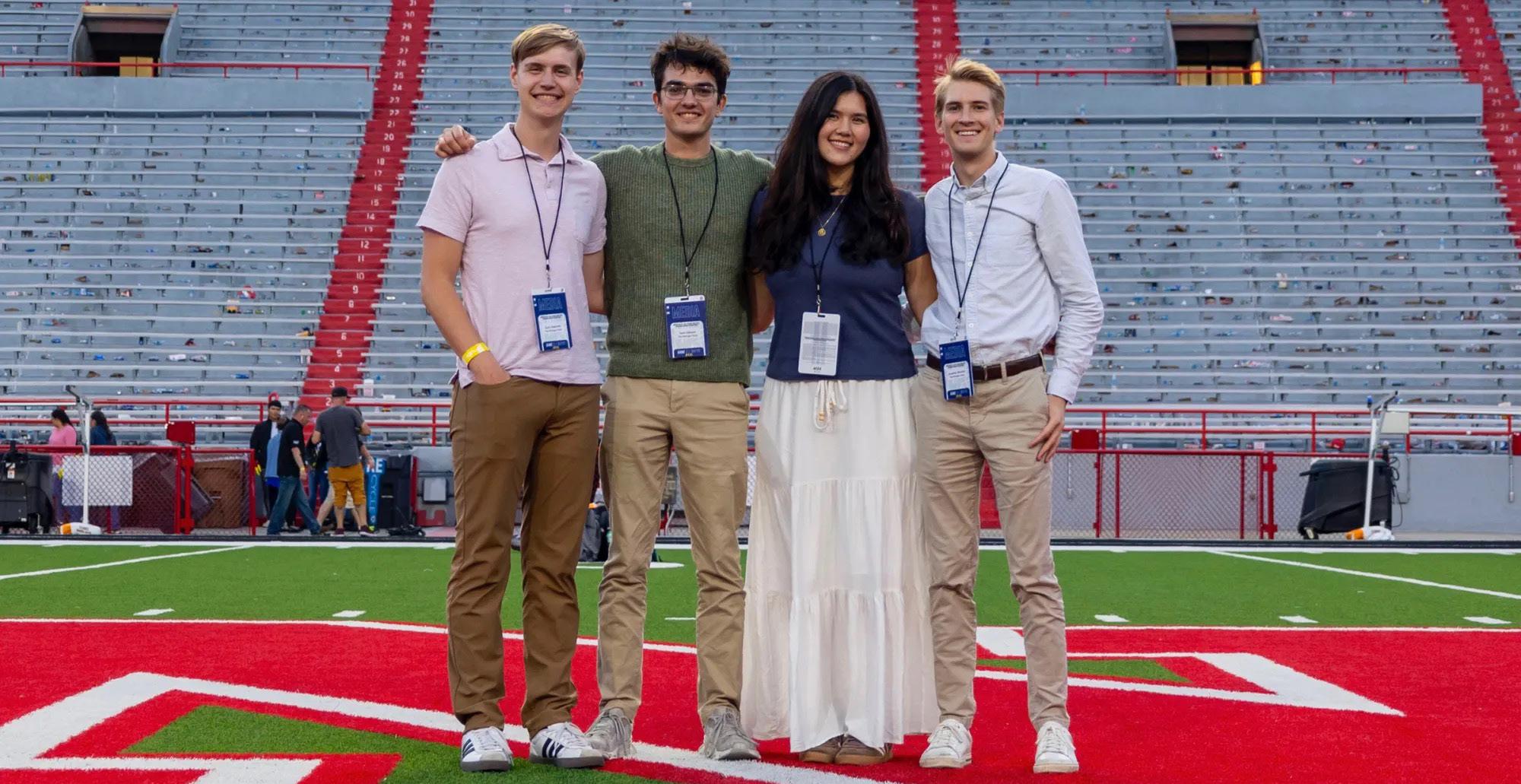
INDIANAPOLIS — Nobody could’ve seen it coming just two years ago. The Michigan men’s basketball team was in despair. An 8-24 record marked the worst season in program history. The Wolverines were without a coach and the roster was in pieces about to lose the majority of its roster.
The memories of 2018, of 2013, of 1993 and 1992 had haunted the Wolverines. School legends had come and gone. 1989 — the only national championship — was 37 years prior. A program that had been so close so many times kept on falling short. The 2023-24 season, about as far from coming close as could be, stung even more.
But Dusty May picked Michigan up even quicker than it fell. The coach that made the Final Four with Florida Atlantic in the Wolverines’ ill-fated season had a clear vision. Built on the back of hard work, roster
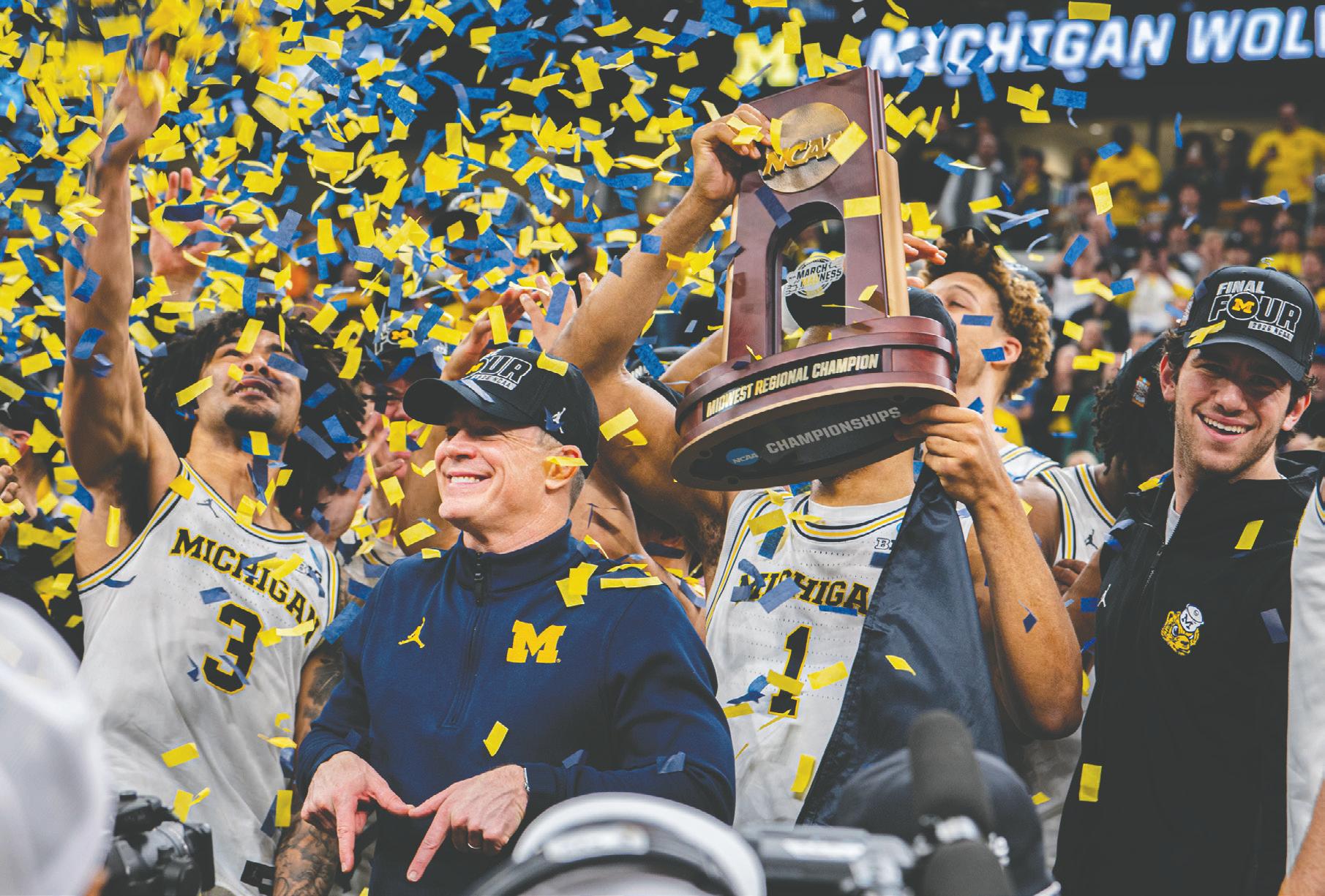
construction and innovative coaching, there was light at the end of the tunnel. May had almost been there before with the Owls; now, in his second year with the Wolverines, he did it. After 37 years, the drought is over. In just 24 months, he brought the Wolverines from rock bottom back to the summit.
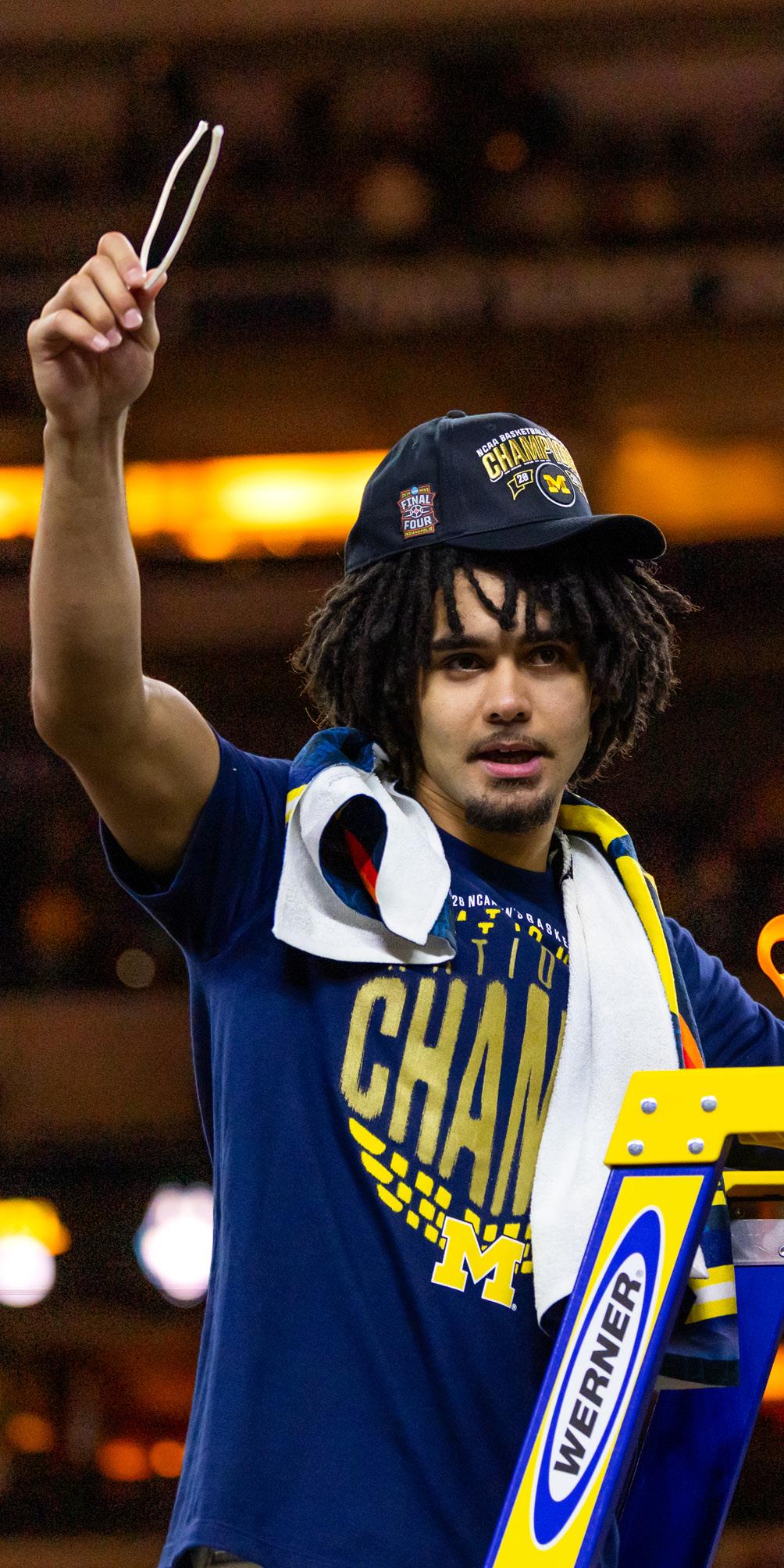
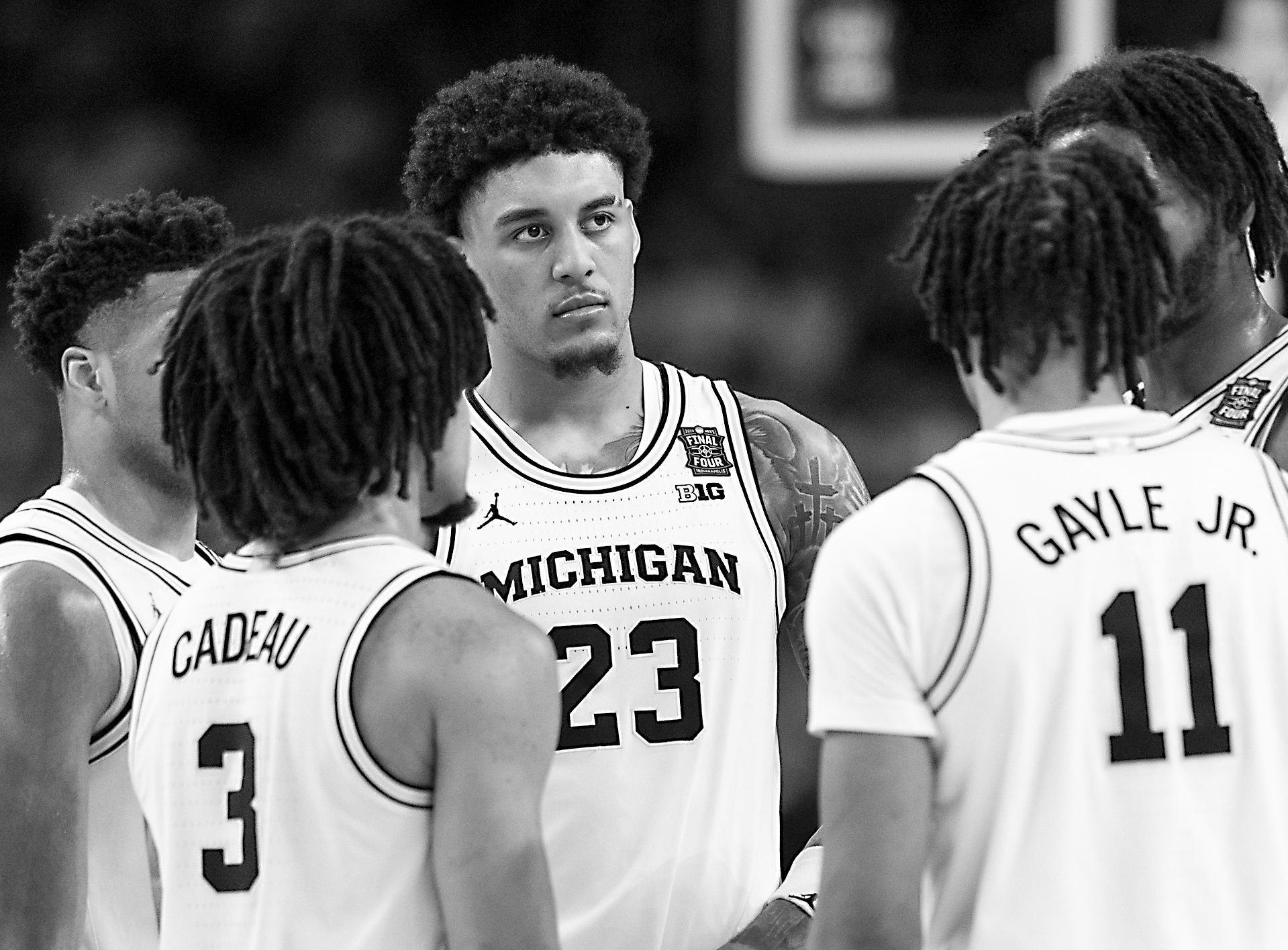
On Monday, after a slow first half in which No. 2 seed Connecticut (34-6) played the game at its speed, No. 1 seed Michigan (37-3) pushed the pace in the second to take a considerable lead. The Wolverines never lost that lead, winning their second national championship in program history, 69-63. “It’s a surreal moment, it doesn’t feel real,” May said. “It still doesn’t feel real because you watch this as a kid, I (went) to bed early … staying up for One Shining Moment. It’s been a tough task for me over the years to see that and think back of all the years that you just want to be a part of something greater than yourselves, more than yourself.
And for this to come to fruition, it just doesn’t seem real.”
The Huskies made sure the game was slow from the jump. Running possessions deep into the clock — as they typically do — led to good looks around the court. Though many of
its sets stagnant and graduate forward Yaxel Lendeborg playing hampered by injury, the typical fluidity of Michigan’s offense was halted; it missed all eight of its threes in the first half and the fast break was a complete non-factor.
tenacity. Meanwhile, Michigan earned numerous trips to the charity stripe as its physicality scrambled UConn. With the Huskies leading 25-23, forward Alex Karaban was charged with a hook-and-hold, and Johnson got two more at the line. The Wolverines continued to do damage around the rim as two interior baskets on the following possessions forced a UConn timeout.
Despite struggling to push the pace, Michigan went into the break up four points anyway. Coming out of half, though, the Wolverines finally played the game their way.
guard Elliot Cadeau kickstart the Wolverines’ transition offense The trivial lead at the break turned to double digits as Cadeau nailed Michigan’s first three of the game, after a fake pass freed him up. Just as it seemed like UConn was about to thrust back into the game with less than eight minutes to go, junior center Aday Mara slammed home a lob in transition. A few minutes later, with the game inching to a close, the Huskies went on a mini-run to close
them didn’t drop as Michigan’s interior defense swarmed, UConn had its foot on the gas as its game plan thrived. Unable to flourish in the slog of a slow-paced, half-court game, the Wolverines struggled to generate offense early. With
But the Wolverines stayed in it through their work down in the paint — like they have all season.
Sophomore forward Morez Johnson Jr. feasted down low, having his way against a defense that struggled with his
“Dusty at halftime was like, ‘Remember when we put that score sheet up at the end of the (Wisconsin game from last season)?’” graduate forward Will Tschetter said. “ ‘Nothing matters stats wise.’ He’s like, ‘All that matters is that we’re cutting down nets in 20 minutes.’ ”
It was night and day compared to the first half. Michigan forced more turnovers in seven secondhalf minutes than in the entirety of the first, which let junior
Ann Arbor, Michigan
UMich investigating engineering researcher’s death after alleged questioning by U.S. government
The March 20th death of Danhao Wang, computer engineering assistant research scientist, is being investigated as “a possible act of self-harm.”
assistant was found after falling from an upper level and was later pronounced deceased.”
The University of Michigan Division of Public Safety and Security is investigating the March 20 death of Danhao Wang, an assistant research scientist in the College of Engineering. A spokesperson for China’s Ministry of Foreign Affairs claimed — though not naming the individual — said a U-M researcher was subjected to “hostile questioning” by federal law enforcement prior to his death.
In an email to The Michigan Daily, Melissa Overton, DPSS deputy chief of police, wrote that the incident is being investigated as “a possible act of self-harm.”
“On March 19, at approximately 11:00 p.m., officers from the University of Michigan Police Department responded to a report of a subject who fell inside the George G. Brown Building,” the statement read. “A faculty research
Lin Jian, spokesperson for the Chinese Ministry of Foreign Affairs, claimed March 27 that a U-M researcher died by suicide after U.S. law enforcement interrogated him, urging the U.S. to conduct a full investigation.
In a post to X, the Chinese Consulate in Chicago criticized the United States for “groundlessly” interrogating Chinese students and scholars.
“China solemnly calls on the U.S. to carry out a full investigation, give the family of the victim and the Chinese side a responsible explanation, stop any discriminatory law enforcement targeting Chinese students and scholars in the U.S., and stop imposing wrongful convictions,” the statement read.
The Consulate did not name the researcher.
The questioning comes in
a time of increased scrutiny towards Chinese international students and scholars, who have increasingly been targeted by the federal government over alleged national security concerns. Critics have described the government’s actions as xenophobic, arguing that they have selectively highlighted the actions of a small number of individuals to paint all Chinese nationals in a suspicious light.
Wang worked in the lab of Zetian Mi, an electrical and computer engineering professor. Engineering Dean Karen Thole wrote in an email Friday that Wang played a major role in research breakthroughs at the University of Michigan, and the community is mourning his death.
“Dr. Wang was a promising and brilliant young mind, whose research into wide bandgap IIInitride semiconductor materials and devices published in Nature stands as a landmark, uncovering for the first time the switching and charge compensation mechanisms
of emerging ferroelectric nitrides,” Thole wrote. “His loss is felt deeply not only by those who knew him here at the University, but also everyone who understands his potential to have contributed to breakthroughs in science that would have positively impacted people around the world.”
Thole further wrote that Wang’s death remains under investigation and warned against misinformation generated by artificial intelligence.
“This is an active police investigation and we have no further information to share regarding the circumstances surrounding his death,” Thole wrote. “In the age of AI and misinformation in unfortunate situations like these, incorrect information can spread quickly, and we must let the investigators complete their work and refrain from speculation until the facts are known and made available.”
CONTINUED AT MICHIGANDAILY.COM
Stanford Lipsey Student Publications Building 420 Maynard St. Ann Arbor, MI 48109-1327 734-418-4115 www.michigandaily.com
EDITH PENDELL and ZACHARY AJLUNI Co-Editors in Chief eic@michigandaily.com
CICI COPENHAVER Business Manager business@michigandaily.com
NEWS TIPS tipline@michigandaily.com
LETTERS TO THE EDITOR tothedaily@michigandaily.com
SARAH PALUSHI Daily News Editor STUDENT GOVERNMENT
CSG representatives walk out of Assembly meeting in response to failed impeachment
The Central Student Judiciary rejected the impeachment of Tyler Fioritto, which was based on alleged harassment, defamatory speech and other concerns
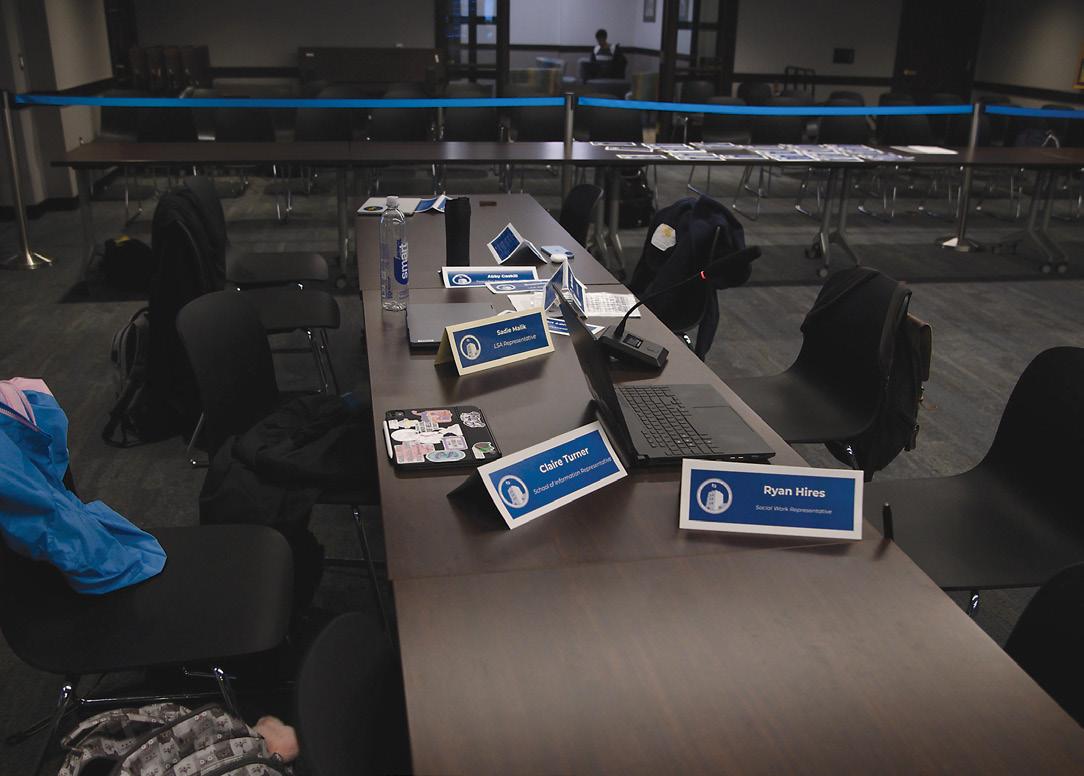
During their Tuesday evening meeting, representatives in University of Michigan’s Central Student Government organized a walk-out following the recently unsuccessful impeachment of Rackham student Tyler Fioritto, CSG representative. The protest followed a March 27 decision by the Central Student Judiciary — which must confirm impeachments — to reject Fioritto’s removal from office, finding the allegations against him did not meet the standard for impeachable conduct. In February, Fioritto was impeached in a 40-2 Student Assembly vote for alleged harassment against another Assembly member.
At the beginning of Tuesday’s meeting, a majority of CSG representatives refused to state their attendance during roll call and walked out of the room as part of an organized walk-out. Assembly members gathered in the hall and cited concerns over how the University and CSG handle harassment cases.
The impeachment came a week after amendments to CSG’s Code of Conduct and Ethics following concerns regarding conflict between representatives. The subsequent impeachment motion alleged violations of the code of conduct on grounds of harassment, defamatory language and threats to Assembly members’ mental health.
In an interview with The Michigan Daily, LSA freshman Sadie Malik, CSG representative,
said the walk-out hopes to highlight systemic issues that allow harassment to persist on campus.
“Essentially, what we’re looking to do is draw attention to the perpetual systems that allow for people who have bad behavior in terms of sexism, racism — all these types of harassment — to continue doing that without actually addressing victims’ concerns,” Malik said. “We’re just trying to show that there is an issue here, and it’s an issue that impacts everyone.”
Assembly members then re-entered the meeting after less than 10 minutes and met quorum — the minimum number of representatives present to resume the meeting — before moving on to community concerns.
Fioritto, who was re-elected as CSG representative in the winter 2026 CSG elections said he hopes members will be able to move past internal conflict for the upcoming term.
“We have an opportunity here to stop the path we’ve been charting,” Fioritto said. “From the recording bans to the public conduct to targeting members’ families. We have the opportunity to end that once and for all. It’s the 16th assembly, and I understand there’s a lot of overlap, obviously — like I think the majority of people are still going to be here — but we can set ourselves apart.”
Rackham student Erin Neely, CSG representative, then took the stand and read a statement on behalf of an anonymous woman. The statement alleged Fioritto harassed the woman during her freshman year at the University while she was
seeking guidance in navigating LSA Student Government.
“I met Tyler Fioritto over the summer through Instagram,” Neely read. “He reached out saying he wanted to take me under his wing and teach me, as I am a freshman. … Tyler sent me several explicit images under the guise of trying to appear unique and different. I felt uncomfortable but I either ignored it or went along, partly because he was ostensibly helping me navigate LSA SG.”
Fioritto responded to the allegation, calling into question the use of an anonymous source and accusing the Assembly’s bias against him. He also said he would be taking legal action against CSG or the anonymous individual.
“Here’s the thing: My reputation has already been tainted; the well’s already been poisoned,” Fioritto said. “That’s all that matters. It doesn’t matter what the truth is. You don’t like me. If you don’t like me already, you’re going to
believe it. It’s literally made up. And I will be taking legal action either against CSG itself or this individual, because it’s completely faceless. And the fact that people are clapping for this as if this is some just moment when it’s totally BS, it’s ridiculous.”
Neely said she believes the reporting of harassment claims to the Equity, Civil Rights, and Title IX Office, Office of Student Accountability and CSJ — regarding Fioritto and otherwise — have not been adequately addressed.
“I have had this conversation with ECRT. I have had this conversation with OSA,” Neely said. “They have dragged their feet. ECRT has dropped the ball on this and other survivor complaints. … Individuals who were harassed have not even been given their time of day in either the student judiciary or the University-level processes, and that’s why we have to go public now.”
LYRA SHARMA and GRAHAM BARKER Managing Sports Editors sports@michigandaily.com
KATE PARAMBO Creative Director MORGAN ORTH Strategy Manager
Vivian Tai/DAILY
Students and volunteers play volleyball during the University of Michigan’s Special Olympics College’s Unified Games at the Big House Friday afternoon.
Emily Alberts/DAILY Empty seats at the Central Student Government meeting in the Union March 31.
THE MICHIGAN DAILY NEWS STAFF
Women at Huron Valley Correction Facility send policy proposal to state leaders to release 800 women over three years
The policy proposal aims to make WHV suitable for single cell occupancy following legislative scrutiny over poor living conditions
KYLIE
On March 4, incarcerated women at the Women’s Huron Valley Correctional Facility sent the Women’s Clemency and Resentencing Initiative to the Michigan Legislature. The three phase policy proposal was sent in collaboration with the American Friends Service Committee and aims to reduce overcrowding in the prison, with a goal of releasing about 800 women from the facility over three years to make WHV suitable for single cell occupancy.
The letter follows a February Michigan House of Representatives’ Oversight Committee hearing, during which Washtenaw County representatives asked the state to address demands for WHV reform. The facility has come under fire for reports that inmate exposure to mold and cleaning chemicals and inadequate access to health care have resulted in deaths and disease outbreaks.
If adopted, the policy would begin its first phase of reform immediately. Phase I calls on Governor Gretchen Whitmer to commute the sentences of more than 100 women who have “demonstrated a willingness to learn, grow, heal and transform
themselves beyond the circumstances which led them to incarceration.”
In an interview with The Michigan Daily, Natalie Holbrook-Combs, program director of AFSC’s Michigan Criminal Justice program, said overcrowded prisons don’t allow successful rehabilitation environments.
“For anybody, prison is a hostile environment,” HolbrookCombs said. “The more people we can get out of the system, and the smaller the population, the more changes we can make that are life-giving, healing and transformative.”
Tashiena Combs, an incarcerated person serving a life sentence at WHV, is among the group of women who wrote the policy proposal. In an interview with The Daily, she said the committees had to make difficult decisions over which 100 women would be included on the initial list for recommended clemency.
“We had to have some really hard conversations,” Combs said. “(We were) talking about the content of a person’s case versus the content of their character and the transformation they’ve had during their time in prison, and how much time they spent pouring into other people to help prevent other women from coming back to prison.”
The list primarily includes women who have served the longest and were sentenced to life.
Holbrook-Combs said concerns over an aging population motivated the decisions around who was selected.
“What could be done for people getting older?” Holbrook-Combs said. “A lot of the lifers are getting older. There are about 45 women who’ve got 20 years or more who are serving life without parole.”
The letter also proposes a partnership with the Healing Home Farm Project, a farm in Michigan that would serve as a transition center for those recently released from incarceration.
The project would provide “wrap around services and peer led programming for long serving women returning to the community.”
Holbrook-Combs said adapting the state’s current incarceration system to include similar models of restorative justice would help transition incarcerated individuals back into the community.
“We believe that prisons are not the answer to public safety issues,” Holbrook-Combs said.
“We believe that violence would be better contained and addressed through different systems — systems rooted in care, community and love.”
CONTINUED AT MICHIGANDAILY.COM
March 2026 Michigan legislative roundup: Voter ID requirements, reproductive
“Requiring proof of citizenship and voter ID is a commonsense safeguard that protects every legal voter.”
ZAHRA KAGAL Daily Staff Reporter
Each month, The Michigan Daily publishes a compilation of bills in the Michigan Legislature for students at the University of Michigan to know about.
The following article explains five bills that have been introduced, passed or signed into law by the Michigan Legislature or Gov. Gretchen Whitmer throughout the month of March 2026.
1. Requiring proof of citizenship for voter registration
Status: Introduced in the House House Bill 4765, sponsored by state Rep. Jason Woolford, R-Howell, would require individuals to provide documentary proof of United States citizenship when registering to vote. Requiring proof of identification when voting would modify several provisions of Michigan’s election law. The bill would mandate voter registration applications include proof of citizenship — such as a birth certificate, passport or naturalization documents — before being processed, and prohibit applicants from being registered until that documentation is verified.
The proposal comes amid heightened national and statelevel debates over election integrity, including efforts
by President Donald Trump to advance the Safeguard American Voter Eligibility Act, a bill that would impose similar federal requirements and has already passed theU.S. House of Representatives, although it is unlikely to pass the U.S. Senate.
In a press release announcing the bill, Woolford said the legislation is intended to strengthen election security and ensure confidence in the voting process.
“Michigan residents deserve to know their votes are protected and that our elections cannot be manipulated,” Woolford said.
“Requiring proof of citizenship and voter ID is a commonsense safeguard that protects every legal voter. If you are legally allowed to vote, these requirements should be easy and straightforward. But we cannot stand by while loopholes threaten the integrity of our elections.”
In a statement, Aghogho Edevbie, Michigan deputy secretary of state, raised concerns about Michiganders having to pay to obtain an Enhanced Driver’s License, as a standard license would no longer be an acceptable form of voter ID under the bill.
“No eligible citizen should have to pay extra fees to exercise their constitutional voting rights,” Edevbie said. “Michiganders deserve to have the facts. This bill is not about voter ID; it’s a way to
stop tens of thousands of eligible Michigan voters from casting their ballot.”
2. Strengthening Michigan’s anti-terrorism law
Status: Passed in the Senate Senate Bill 502, introduced by state Sens. Sue Shink, D-Northfield Township, and Rosemary Bayer, D-Beverly Hills, was passed unanimously in the Michigan Senate March 19 and would update the state’s anti-terrorism statute by adding an intent requirement for prosecuting threats. The intent requirement clarifies that individuals can only be charged if they knowingly or recklessly make a terrorist threat, rather than based solely on how their statements are perceived.
The bill comes after the Michigan Court of Appeals raised concerns that the state’s existing law lacked a clear intent standard, which limited prosecutors’ ability to pursue certain cases. The legislation was passed in the wake of the March 12 attack on Temple Israel in West Bloomfield Township, which federal officials later described as a targeted, Hezbollah-inspired act against the Jewish community.
In a press release following the bill’s passage, Shink said the legislation is intended to give law enforcement stronger tools to respond to threats of terrorism. CONTINUED AT MICHIGANDAILY.COM
As elections approach, what to know about the Board of Regents
“As fiduciaries, Regents act in the best interest of the university to safeguard its assets, reputation and mission while setting the institution’s overall direction.”
The University of Michigan’s Board of Regents may sound like a familiar name, but many students aren’t aware of its actual responsibilities.
The eight elected members of the Board are the governing body of the University. Serving eight-year terms without compensation, the regents provide a general oversight of the institution’s direction and control institutional expenditures.
The regents’ main goal is to ensure the University operates in a financially responsible manner. This can range from approving budgets and tuition rates to managing faculty appointments and overseeing major construction projects across campus.
In an email to The Michigan Daily, University spokesperson Kay Jarvis emphasized the regents’ importance to the University as outlined in the state constitution.
“Under the Michigan Constitution, the Board of Regents is the ultimate governing authority for the University of Michigan,” Jarvis wrote. “As fiduciaries, Regents act in the best interest of the university to safeguard its assets, reputation, and mission while setting the institution’s overall direction.
The board maintains financial oversight by controlling university expenditures, approving the annual budget and overseeing major capital projects. The Board also establishes university-wide
policies, bylaws, and regulations, and it sets strategic priorities such as tuition, research focus and campus expansion.”
The regents’ budgetary decisions have a significant effect on student experience at the University. Notably, in 2024 the Board voted to expand the Go Blue Guarantee — a financial aid program for in-state students — by raising the family income ceiling for full tuition assistance from $75,000 to $125,000.
Beyond financial decisions, the regents make decisions that shape the University’s public image and students’ overall academic experience. In an interview with The Michigan Daily, LSA and Education senior Eric Veal Jr., Central Student Government president, highlighted the regents’ responsibility to promote education and the public interest.
“Regents are the people trusted by the state to create the vision of the University and to make sure that the University is continuing in a way that is still promoting the public interest of the state, but also promoting life-changing education,” Veal Jr. said. “Regents control a lot of functions. They hire the president. They fire the president. Regents also are tasked with ensuring any big change at the University is approved, whether that be tuition changes, or things as simple as what buildings are named.”
Following former University President Santa Ono’s resignation, the Board named Domenico Grasso as interim university president committing to a nationwide search to permanently fill the role. After
a nearly six-month search, the Board named Syracuse University Chancellor Kent Syverud as the 16th president of the University in January. His term will begin July 1.
Regents are also not subject to term limits. Two regent seats appear on the general statewide election ballot every two years in November. Regent candidates must be nominated by their respective party conventions.
The current Board is composed of six Democrats and two Republicans. Democratic incumbent regents Jordan Acker and Paul Brown are seeking reelection as their terms are set to expire in January 2027. They are competing for party endorsement alongside civil rights attorney Amir Makled. Lena Epstein and Michael Schostak were confirmed as Republican candidates for Board March 28 at the Michigan Republican Party’s March 28 endorsement convention. Campaigns across both parties have focused on issues such as affordability, financial aid programs like the Go Blue Guarantee, and broader university priorities.
LSA senior Sean Shelbrock, co-president and co-founder of the CSG Human Rights Party, told The Daily said students can work together to amplify their demands — such as investigating the University’s financial ties to the Israeli government, corporations and institutions — but the Board has the final say.
“The student body can do a whole lot,” Shelbrock said. “We can work with the student government. … But ultimately,
when it comes to an ask like divestment, the final decision comes down to the Board of Regents. Right now, the Board of Regents is very untransparent. … The lives of students in general are tied to the Board of Regents, and it really matters who we have on that board, because right now — Democrat or Republican — they’re not serving us.”
Apart from University students, regent decisions affect the entire state. Also serving as the governing body of Michigan Medicine, health care decisions by the regents can affect all hospital patients and affiliates. In recent years, the Board has made large-scale health care decisions, notably discontinuing genderaffirming care for individuals
younger than 19. In an interview with The Daily, LSA freshman Jolene Frey, co-president of the University’s chapter of College Democrats, said the University’s reputation heightens the stakes of the Board’s decisions, as other public universities are likely to follow suit.
“Students realize that the decisions that are being made by the Board of Regents are going to directly affect them and (the University of) Michigan’s reputation across the United States,” Frey said. “When the University of Michigan is making very large decisions, that sets a precedent for other universities, other states, that these are the policies that they’re making,
‘Maybe we should make them too.’” As state-elected officials, the regents also serve Michigan voters. Veal Jr. said he hopes students understand the regents exist to improve the University and are available to speak directly with students.
“I want students to know they can always reach out to our regents,” Veal Jr. said. “A regent is an elected official, and if you vote in the state of Michigan, you are their constituent. They love to talk to voters and love to make sure that they’re building a relationship with students. The regents are just people like everyone else, and that’s something that I’ve learned in my capacity as president.”
HARMALA Daily Staff Reporter
Epstein survivor Jena-Lisa Jones speaks at 48th annual Take Back the Night rally
“Stay strong. Remember the shame is not for you to carry; it’s for the perpetrator to carry, and that you’re never alone, even on your weakest days.”
Content warning: This article contains mentions of sexual assault.
More than 100 students filled the Michigan Union Rogel Ballroom Thursday night for Ann Arbor’s 48th annual Take Back the Night rally, where survivor stories, performances and calls to action converged into the night’s theme — “Your Story Matters.”
Hosted by University Students Against Rape and Standing Tough Against Rape Society, the event was co-sponsored by University of Michigan’s Central Student Government and the Center for the Education of Women+. The rally aimed to raise awareness about sexual violence and create a space dedicated to survivor healing and empowerment. Following the rally, attendees marched on the streets of Ann Arbor.
This year’s keynote speaker was Jena-Lisa Jones, a survivor of child sex trafficker Jeffrey Epstein and life coach at The Survivors, Inc. To start the rally, STARS Executive Director Pamela Swider said the theme “Your Story Matters” reflects the courage of Jones and other survivors who have spoken out.
“(The theme) was inspired by our keynote speaker and all the brave Epstein survivors who have come forward to share what
happened to them,” Swider said. “They have stood up — several in Washington, D.C. — to say that this kind of power and perpetrator protection must stop and can never happen again. ” At the rally, Rep. Debbie Dingell, D-Mich., said all sexual assault survivors should have full control over how — and whether or not — they share their own stories.
“If they don’t want to tell their story, they don’t want their name released, they don’t want that kind of attention — they have a right to not get that kind of attention because it is not easy,” Dingell said. “You have no idea the kind of courage it takes to even be here with you tonight, let alone go to Washington and tell your story. But think about what it’s like for someone on our campus, who’s scared.” Swider said national scandals should not overshadow everyday experiences.
“Of course, most survivors are not part of an international scandal — that doesn’t mean that their story is any less important,” Swider said. “Sharing a story of sexual violence does multiple things: It helps the survivor to get that off their shoulders, and also it helps other survivors as they see how they can start healing.”
TBTN student volunteers educated attendees about sexual violence terminology, health concerns at the Women’s Huron Valley Correctional Facility and conflict-related sexual
violence. Artists including Sophia VonStardust, Ber-Henda Williams, Audra Kubat and Ballet Folklorico de Metztli used dance, poetry and music to explore themes of resilience and healing.
Mayor Christopher Taylor, who spoke at the rally, delivered a proclamation recognizing April as Sexual Assault Awareness Month in Ann Arbor. Taylor said confronting sexual violence requires a broader cultural shift — one he believes is possible.
“This can be the start,” Taylor said. “Male violence, in all its forms, may be our deepest and most pervasive pathology, but it too can be named, confronted and ultimately defeated. That’s what this evening is about. We do it through recognizing it, we do it through condemning it. But crucially, we do it through the support and uplift and love that we give to the survivors.”
In an interview with The Michigan Daily, Jones encouraged survivors of sexual violence to reframe healing as something uneven and deeply personal rather than a linear process.
“Take it one day at a time,” Jones said. “Stay strong. Remember the shame is not for you to carry; it’s for the perpetrator to carry, and that you’re never alone, even on your weakest days, that there’s always someone out there that is cheering you on behind the scenes.”
CONTINUED AT MICHIGANDAILY.COM
Cirque du Slay celebrated the University’s Pride Month with dancing and minigames
Spectrum Center hosted its annual Pride Prom event, “Cirque du Slay,” Friday evening. The Pride Prom is a part of the University of Michigan’s Pride Month programming, which occurs in April while students are still on campus rather than in June, national LGBTQ Pride Month. The event space was decorated with a circus theme, featuring red and white stripes, party hats resembling clown hats for guests and minigames with prizes. In an interview with the Daily, LSA sophomore Azure Klusek said they enjoyed attending Pride Prom and the circus atmosphere.
“I think the decorations are super cute,” Klusek said. “The little clown plushies that you can get are so cute. And the games, like darts and the cup stack game — I think it’s fun to just listen to classic prom songs and be able to dance again. It’s just a fun night.”
In an interview with The Michigan Daily, Art & Design senior Kade Kuba, an event coordinator, said they
incorporated more games into Pride Prom to better align with this year’s theme. “We wanted to do the games because we did a circus theme,” Kuba said. “We do not normally have games at Pride Prom; we were very excited. We thought it’d be really fun that, no matter if you win or lose the game, you still got even a little small prize.”
In an interview with The Daily, Rackham student Vibhor Katiyar, an event coordinator, discussed some of the other activities offered at the event, such as face painting.
“I think face decorating in particular gives you that circus vibe, carnival vibe,” Katiyar said.
“I also think we want to create a space where people can express themselves, and I feel like people getting their faces painted on is like their way of expressing themselves. I think that fits really well with what we were trying to do.”
Kuba said Pride Prom fosters inclusivity and accessibility for Queer students or those from lowincome backgrounds.
“Pride Prom is so important
because prom is so expensive and, as someone from the South, prom is not always a very accessible
Advocacy group flags hundreds of AAPS library books, alleging inappropriate content
“I took a deep dive, and then what I found was just so many books that are sexualizing our kids from kindergarten on.”
NIKO WILSON Daily Staff Reporter
A newly launched database by parental advocacy group Take Back The Classroom has flagged 545 books in Ann Arbor Public Schools for “inappropriate” content — the highest number of any district in Michigan.
Take Back The Classroom is an initiative led by the Capitol Resource Institute, a Californiabased nonprofit aiming to flag sexual content in library books and provide parents with resources to remove them. In an interview with The Michigan Daily, Karen England, Capitol Resource Institute president, said she initially dismissed other parents’ concerns about inappropriate books until she reviewed them herself.
“When I started looking into the library books, I thought ‘These moms are crazy!’” England said. “I really did, and I share this all the time that I was very judgmental until I took a deep dive, and then what I found was just so many books that are sexualizing our kids from kindergarten on.”
Take Back The Classroom defines sexual content based on the U.S. Supreme Court decision Island Trees v Pico, which states that schools cannot remove books from libraries based on ideological disagreement, but may restrict books deemed “pervasively vulgar” or “educationally unsuitable.”
Most books in TBTC’s database cite excerpts showing vulgarity,
although some listings only show one or no explicit passages.
Eighty percent of the books flagged by TBTC in AAPS appear in the libraries of Ann Arbor’s five public high schools, with Skyline High School leading the district with 123 books on the list. The database features a number of widely acclaimed titles, including Toni Morrison’s Pulitzer Prize winner “Beloved,” Elizabeth Acevedo’s National Book Award ,winner “The Poet X” and Margaret Atwood’s Booker Prize winner “The Testaments.”
In addition to flagging sexually explicit books, TBTC has also placed a red flag warning on books featuring nontraditional gender roles, LGBTQ+ advocacy and other themes they consider to be “progressively propaganda”.
Despite the red flag warnings, England said the initiative was primarily focused on explicit sexual content.
“A lot of people don’t understand how bad and graphic the books are,” England said. “I was in Oklahoma, and there’s an elementary school there that has terrible books, so I went to meet with the senator and he was like, ‘I’ll be calling the superintendent.’ So, I’m encouraged that people are waking up. It has nothing to do with LGBTQ or any race. It’s all about being pervasively vulgar.”
AAPS District policy outlines procedures for evaluating library materials using guidelines from the American Library Association to ensure
that each school’s collections align with curriculum, student interests and social significance.
In an email to The Daily, Andrew Cluley, AAPS director of communications, wrote that librarians curate the district’s libraries to ensure books are age appropriate and educationally valuable.
“The materials in the Ann Arbor Public Schools libraries are chosen by our school librarians, certified educators working to assure we offer ageappropriate materials covering a diversity of topics, viewpoints, and experiences,” Cluley wrote.
“We regularly evaluate our collections to make sure they are meeting the needs of our students and teachers in offering engaging, well-reviewed books that support free-choice reading and curricular needs. Under the AAPS Board of Education policy, parents or guardians may submit a Citizen Request for Reevaluation of Materials form if they have concerns about specific materials.”
England said librarian groups such as the ALA and Michigan Association of School Librarians encourage schools to allow children access to inappropriate books.
“They push for this — they believe there should be no age limit on any of this stuff,” England said. “ I think we have a responsibility if our tax dollars are purchasing this for our minor children, that we should have a say in it.” CONTINUED AT MICHIGANDAILY.COM
thing for Queer people,” Kuba said. “I think having this be an option … you can feel free to wear whatever you want and be who you are with your partner or by yourself, (which) is so essential.”
Klusek said hosting the event in college allows students to have a prom experience as a more authentic version of themselves.
“Especially for people in high school that maybe didn’t get to experience the same thing — like maybe people weren’t out or just didn’t feel like they were able to be themselves,” Klusek said. “I think maybe having that in college is a better opportunity for them to feel a little bit more free to do that and still have the classic high school prom experience, but more authentically as themselves.”
Katiyar said Spectrum Center events like Pride Prom can provide a sense of belonging on campus for Queer students.
“As a community, you need to come together and celebrate yourself,” Katiyar said. “These kinds of events help you identify that there are people who are like you and you have a sense of belonging.”
CONTINUED AT MICHIGANDAILY.COM
Courtesy of Auburn Marriott and Joseph Barber.
march down the street to support survivors of sexual violence during the Take Back the Night rally Thursday
AUDREY SHABELSKI Daily Staff Reporter
CAMPUS LIFE
Michigan in Color is The Michigan Daily’s section by and for People of Color.
In this space, we invite our contributors to be vulnerable and authentic about our experiences and the important issues in our world today.
Our work represents our identities in a way that is both unapologetic and creative. We are a community that reclaims our stories on our own terms.
To my son
ALLANA SMITH MiC Assistant Editor
Wrote Douglas Schrock and Micheal Schwalbe: “For an individual male to enjoy the benefits that derive from membership in the dominant gender group, he must present himself to others as a particular kind of social being: a man.“
I often think about mothers and sons — or, rather, about how I’d feel if I were to have a son. I think about how sweet, soft boys — babies — are socialized to become men. To betray their mothers and daughters alike in the name of solidarity among one another.
What would I do as I watched the child I birthed become all that men can be?
A mother and her son. She may raise her sweet, soft boy to be the aloof, ideal man: assertive and powerful. She may even reward him for his callousness, his lack of “girlish” attitude, but he remains her child, her baby always. Mothers — even in the face of her sons’ procured cruelty — protect. Her son: he has the world at his fingertips.
But her daughter has always been capable. The mother thinks she needs less coddling. She — they — exist in aid of him: access, trophy, opportunity. If they are the world he holds them in the palm of his hand.
I wonder if she feels it: guilt. Does she lie awake at night wondering, “What have I done?” Her and her daughter’s emotional
labor are one and the same.
Maybe I couldn’t be a mother.
The hegemonic masculine: He is a structure of raw power.
The archetypal man, that is the capital “H” Him, is perhaps a father with 2.4 children. His beautiful wife is home, always. She is the ultimate caretaker of his babies, his house and his needs. Her presence is both the proof of his success and the cornerstone of his identity. She is his possession, a silent partner who enables his command of the public sphere.
The Gen Z man is becoming increasingly conservative (and in respect to marriage and dating, even more so than his boomer counterparts). The capital “P” Patriarch evolves as needed, and it is not only communal in its rejection of the feminine; it is communal in its will to find camaraderie among its conventionally sexist peers. Bitches, pussies and sissies — emasculation is his worst fear.
What is prestige among men?
His many women reap the fruits of his masculine labor: mother, daughter, sister, wife.
–I hope that I’m a good daughter, a good sister.
My father, my brother — I think they are dedicated to misunderstanding me, along with all the other women and girls in their lives.
“Why should I submit to a man?”
“Because God said so.”
I hope that I’m a good daughter, a good sister. Maybe I’ll go to hell.
Dec. 19, 2024: The Telegraph unveils Telegram rape chats, where thousands of men share suggestions on how to rape and sexually assault women, with as many as 70,000 members. 70,000 members. Mother, daughter, sister, wife — victims. Prestige among men. CONTINUED AT MICHIGANDAILY.COM
On reaching ‘Unc Status’
AHMED ELKHATIB MiC Senior Editor
“Ahmed, you’re unc now!” My little sister tells me.
“But I’m only 21.” “Only.” She sneers. Since we are about nine years apart, I guess it isn’t too out of the blue for her to see me as “unc.” It’s strange, though, not too long ago I was in her shoes.
It seems that with every passing month, the threshold for reaching “unc status” becomes lower and lower. I could’ve sworn at one point it was reserved only for those at least 30 years old, and even then it was a stretch. “Unc” was a title that only the most hardened of individuals earned. Now, when you celebrate your 21st birthday, you are handed the honorary status without question. Strangely enough, though, I think it’s quite fitting. I don’t believe it to be controversial to say that there is an appreciable difference between under and upperclassmen. This university, maybe life by extension, has a way of wringing any childhood naivety out of you.
I’d like to think I’ve acquired some wisdom in my years here. Lately, I find myself surprised at the words I manage to string together. When I look back at myself, to when I first started at the University of Michigan, I see nothing but a child. These days, I better understand my role in this life and how to fulfill it.
I wish to impart some of what I’ve learned. I hope it’s of benefit.
On Commitments
We start off in life with the roles inherent to us: that of a child, maybe a sibling. As we grow older, we take on more. We become an employee, a student, a teacher, a researcher. An athlete, a writer, a leader. A friend or a partner. At first, it’s overwhelming: We want to fulfill each role, and fulfill them well. But it’s all so new, and so you inevitably fall short on at least one. It can be tempting to withdraw from them one by one.
It is easy to see those new responsibilities as more “work” to do. But the solution is rarely ever to dismiss them. After all, life is but a fulfilling of commitments. And it quickly becomes dull without our responsibility to ourselves and others, no matter how taxing it may be.
Unfortunately, there will be occasions when you fill everyone’s cup but still need to stay up late to finish a task or two. I’ve come to accept these occasional late nights as a regular part of life.
On Love
Love, my father tells me, is not purely “ عواطف,” or emotions. He gives me the example of my dear uncle, who cares for his sick wife. Her bones are fragile, prone to breaking at the most unsuspecting of tasks. His love for her demands a constant sacrifice of his self-autonomy.
“You think this is an easy thing?” My father asked me. Most of our loved ones have committed to our care. To shower us with love despite the inherent sacrifice that comes with it. Love can cost us not only time but even some of our dreams and aspirations. Who better knows this fact than our guardians?
To be there for our beloved ones is a nonnegotiable demand of life. Our partners should be those who intrinsically understand this fact. Popular media often portrays love as a whirlwind of emotions that may
or may not be reciprocated — it is entertaining to watch, but it’s not love.
Love is more objective than we may think. It can just be two people who mutually agree to care and comfort each other no matter the circumstances. Love, in other words, is a minute-to-minute active choice, rather than a passive feeling. I hope we can all find this love in our lives.
On Self-Acceptance
We tend to assume that we are good people. Those who slight us are perceived as “fake”: whether it be friends who failed to reach out, hurt us with an offhand comment or, at worst, a complete betrayal. But I believe that this way of thinking is detrimental to our self-growth. It’s difficult to face the fact that we might be the ones letting the people in our lives down. Good people can falter and make insidious mistakes. Our friends are no exception. Kindness, then, is not simply the occasional favor. It’s being able to see past our friends’ faults and assuming the best of their intentions. Be firm, but gentle with them. For you, too, will wrong people on the trek of life. And when you inevitably do, you’ll likely feel anger toward yourself. Perhaps even disgust or disdain. You’ll think to yourself, “Why did I say that?” or “I shouldn’t have done that.” It’s entirely possible to anguish for weeks on end over an unchangeable past. CONTINUED AT MICHIGANDAILY.COM
Alisha Razi/MiC
Vivien Wang/MiC
This book is for every Wolverines fan who spent 37 years waiting for this team. Celebrate the champs! Relive their record-breaking 2025-26 season in "Conquered: Michigan's Journey to the 2026 National Championship," a hardcover commemorative book from The Michigan Daily. This limited-edition coffee table book provides a unique perspective and combines student journalists’ on-the-ground reporting on every game, player and coach feature stories, and never-before-seen photos to tell the story of a national championship-winning team across 128 pages. Relive the whole story of the team that brought a national title back to Ann Arbor. Order today to save 10% and own a piece of Michigan basketball history.
Willem DeGood
Whitmer can’t afford silence as ICE expands in Michigan
MADELEINE BURKE Opinion Columnist
In her final term as governor, with no plans to run for president or Senate, Gov. Gretchen Whitmer has the unique opportunity to solidify her legacy without worrying about another election.
Intuitively, this would mean using her political power and long-standing experience to continue proving to her constituents that she is capable of addressing their pressing problems as promised. However, while Whitmer has taken action on important issues such as illiteracy, housing shortages and health care debt, she has avoided speaking up on the growing push for potential U.S. Immigration Customs Enforcement detention centers in Michigan. As the primary liaison between federal and state governments,
Whitmer has a duty to speak up against the growing infiltration of ICE in Michigan, specifically the planned detention center in Romulus. If she doesn’t, she risks implicitly consenting to current and future abuses by President Donald Trump’s administration. Since early February, federal agents have pursued plans to convert a warehouse in Romulus into an ICE detention facility. As this warehouse is zoned for light industrial uses, not housing, these plans blatantly violate zoning laws in Romulus. They simultaneously subject 500 detainees to unsafe living conditions, considering the facility is not currently designed to provide basic human needs like food and areas to bathe. These inadequate conditions for detainees align with how Trump has fundamentally reshaped deportation of illegal immigrants to prioritize aggression above respect for dignity.
On Feb. 23, the Romulus City Council unanimously passed a resolution opposing the conversion, citing concerns that it would create a negative spillover effect that causes citizens to feel unsafe in their neighborhoods and that the facility’s presence could risk depleting property values and deterring future investment in the city.
Whitmer was previously vocal in 2019 against the conversion of a state-owned prison into an immigration detention center, claiming that detention centers are not the solution to the immigration crisis. In October 2025, she pardoned a Hmong refugee who had been detained by ICE in Michigan. Nevertheless, she has not since spoken up on any deportations, protests or plans to build ICE facilities in Michigan. CONTINUED AT MICHIGANDAILY.COM
No, CSG activism isn’t useless. It just needs to be smart.
Assembly, CSG’s predecessor, emerged in the crucible of the anti-war movement as a way to organize students and properly represent their views.
Ask the average campusconscious University of Michigan student what they think about Central Student Government and they might say CSG is full of pre-political LARPers and out-of-touch leftist activists who sit around and pass resolutions all day to no avail. They wouldn’t be entirely wrong.
While CSG does improve the average student’s quality of life by funding student organizations, newspaper subscriptions and AirBus shuttles, meetings are dominated with discussions of resolutions that are effectively symbolic statements of approval or disapproval. The recently passed Divest for Humanity Act — asking the University to “investigate” its financial ties to Israel with little to no leverage to actually make that happen — is the latest installment in this ineffective series.
I won’t say that resolutions are completely useless; they document the issues students care about and help form actionable demands for the University to agree or disagree with. But beyond that, deep skepticism remains about CSG’s legitimacy and capability to advocate for the student body against the administration.
Some of those skeptics, like my colleague Lucas Feller, point to specific examples of CSG’s inability to change U-M policy (as was the case with the chaotic impotency of the SHUT IT DOWN party) or their lack of a democratic mandate due to incredibly low voter turnout.
Since CSG is only capable of enacting small student life policies and pointless, performative political messaging that doesn’t represent students, Feller argues, they should just do away with the latter and get absorbed into the University anyway.
That premise, however, is faulty. CSG should pursue activism because it remains the most organized, legitimate and well-funded group to effectuate pro-student policy change on campus. It just needs to be smart about it and focus on “close the gap” policies that tangibly boost the capacity of students to advocate for themselves.
First, though some may contest it, activism has always been CSG’s modus operandi. The Michigan Student
Ever since then, the student government has operated as an advocate for the administrative policies students desire.
For that advocacy to be successful, however, CSG needs to stop relying on dialogues with the administration, and instead leverage its immense financial and organizational resources to apply pressure on it.
A major hurdle for campus organizing is accessibility: The proportion of students who care about an issue is much higher than those who actually show up or email administrators. CSG must focus on closing that gap.
It could, for example, centralize activism materials, automate email campaigns for student petitioners or provide transportation to events. CSG has done this sort of thing before. In response to the United States invading Iraq in 2003, MSA paid for buses to shuttle students to Washington, D.C., to make their voices heard. One could easily see something similar being done for something like the Michigan Democratic Party Convention’s vote to endorse a U-M Board of Regents candidate.
CSG, uniquely, has the funding to make this happen — just redirect a few thousand dollars from non-essential initiatives like programming. After all, our campus can go without a $4,000 CSGala when students are being followed and harassed by plainclothes thugs.
CSG could also take a more active role in capturing the attention of students to foment civic participation regarding hot-button campus issues. Many students aren’t involved in activism on campus simply because they don’t know about what’s going on — like the opaque construction of a data center in a lower-income community or the unilateral revision of the student code of conduct by the Board of Regents.
CSG has the infrastructure to hold public forums on these issues and use its many channels of communication (which, unlike every other student organization, can reach all of campus) to make civic engagement more accessible. While just educating students doesn’t do anything per se, it fights the war of attrition that many campus issues face on the
attention front. That fight would go a long way to create public support and outcry that could pressure administrative officials. Even if the administration gets pissy and tries intervening — like they have in the past — that would only put them in a more precarious position.
With its resources and communication channels, CSG is also well-positioned to provide real data on what students think, especially when it comes to issues the administration feels too insecure to talk about.
CSG could utilize either its positive relationship with the administration or its own communication channels to conduct campus surveys. Public opinion data could inform CSG policies and provide scale-tocampus sentiment. Even if they only get a few thousand responses, that’s much better than nothing. That 9% CSG turnout might not be enough for a democratic mandate, but it’s more than enough for statistical significance. These numbers would be able to singlehandedly legitimize issues; if a survey found that 90% of campus wants to revise the student code of conduct, the University would find it hard to ignore — especially if leveraged to create national scrutiny. An objection some might have to these initiatives is that they might take a stance on an issue that doesn’t represent the majority of student opinion on the topic. No worries! CSG just has to provide equal resources to people on both sides of an issue. That’s exactly what they did for the Iraq war buses — all students were allowed to bus to make their voices heard, regardless of whether they supported the war or not.
CONTINUED AT MICHIGANDAILY.COM
Classified: Local clinical psychologist writing a book about male sexuality in the AI age is seeking a capable research assistant to track down relevant articles and podcasts. $25/hour. Please send letter of interest and CV to jehrlichphd@ gmail.com
Looking ahead
ZHANE YAMIN Opinion Columnist
Maisie Derlega/DAILY
LAURA CENCER Opinion Cartoonist
The books we read on vacation
I smell an orange from somewhere on the plane. My poor posture becomes ever more apparent as I sit crammed in the middle seat. The person to my right, whom I love, has her headband pulled down over her eyes, trying to sleep. The stranger to my left periodically giggles and covers her mouth while watching TikToks for the entire threehour flight. My plum-colored headphones drown out the steady drone of the plane with Eleni Drake or Billie Marten. With every swallow, my ears pop. I set down my latest read, “Lost Lambs” by Madeline Cash, which I checked out from the library just days before. At this moment, I find myself deeply grateful to be alive, to be here. And I begin to write it down so I don’t forget the feeling. We are on our way to Miami, the quintessential calling place for vacationing college students. However, we have no desire to partake in the typical spring break activities. Instead, we are seeking idle relaxation, tranquility or, more specifically, the obligation to have no obligations.
Like many avid readers, I thoroughly overestimate how much I can read during a fiveday trip. Majoring in English and creative writing means that much of my coursework involves reading. To make up for this, I feel some sort of responsibility to “catch up” on pleasure reading and finally give my “Want to Read” bookshelf on Goodreads the attention it deserves. I always find myself packing three to five books, only ever getting through two at most. I’m left disappointed with myself. As if I didn’t do enough, didn’t read enough — effectively turning what should have been a pleasurable reading experience into homework. I often overpack my suitcase and my brain with the books I expect myself to
read. Although I enjoy particular novels, I constantly feel like I don’t enjoy enough novels. Determined to end this cycle, I kept it realistic this spring break: I packed one singular book.
The lucky book, as previously mentioned, was “Lost Lambs” by Madeline Cash. I brought it everywhere with me: the plane, the beach, a cafe, our plethora of Ubers. I read every morning, every night and every moment I desired to. The book traveled so much that the cover took a small beating, and, after returning it to the library, I subsequently received an email detailing disappointment over the wrinkled cover — in fact, this article is in part my public apology to the Hopwood Room librarians. Seriously, I’m sorry about that.
Regardless, there was something romantic about finding myself deeply involved in a singular story. On top of finding refuge from a Michigan winter under Florida’s sun, I found myself immersed in all of the small quirks of this wacky family Cash creates, ranging from a newly opened marriage to a daughter unknowingly e-dating a terrorist.
I wanted to get to know each character like one gets to know a lover — through question after question, never satiated. I felt no pressure to finish the book quickly just to move on to the next because there
simply wasn’t another one in my suitcase. I prioritized fully soaking it in while my freckles deepened under the sun. I felt I was finally able to reclaim pleasure in reading. This didn’t feel like more homework; instead, it felt personal. As I delved deeper into the book, I felt more present in my real life, too. I finally slowed down. Obviously, once I came back to Michigan, my days were once again filled with school and coursework. But I didn’t want to let go of the pleasure I felt dedicating myself to one book over break. As a reader, I always try to be actively reading something — my Goodreads goal to read 26 books this year isn’t going to complete itself — but truthfully, I don’t always succeed at this. And I’m learning that that’s okay. If you’re like me, and you find your suitcase full of books you never end up reading, try bringing just one you’re truly excited to read. Let that story define those couple of days spent exploring a new place. I encourage you to explore your local library and find one lucky novel that speaks to you. Carry it around with you and befriend it, let it welcome you into its world. Allow yourself to finally slow down and exist. We aren’t always allowed the privilege of slow days, so don’t take them for granted. After all, reading shouldn’t feel like work — it’s fun, too.
Roses
are red, violets are blue; ‘Love Is Blind’ Season 10 makes a stormy debut
As a native Ohioan, I’m qualified to say that anyone who knows the current social and political climate of Ohio knows exactly what the culture needs: a bunch of hot straight people bonding over monogamy.
This season’s “Love Is Blind” contestants are sourced from across the Buckeye State, rather than a specific city like previous seasons. Formulated by spiritually qualified sociologists Nick and Vanessa Lachey, the Netflix reality show is pitched as a dating experiment to test the impact of forming emotional connections before physical ones.
I agree with the show’s general premise, in the sense that we were all experimenting at one point, by messaging strangers on Musical. ly or Club Penguin in fourth grade. While the show’s veneer — in terms of set, vacation destinations and date activities —attempts to bring a sense of sophistication and maturity to the situation, I would prefer that they drop the act and place everyone in a San Diego mansion to fight it out.
In practicality, the show operates like a Facebook Marketplace: You shop around. You ask straightforward questions that receive ambiguous answers. You find yourself making questionable, irreversible decisions based on the impulse of the moment and the possibility of a good deal. In the end, someone steals your money, and you never get the duvet cover. Though this makes for an interesting group dynamic and a greater opportunity for dramatic plot turns, it does not lead to sustainable marriages (with one exception).
In my mind, the show’s producers adopted — and successfully delivered — a central theme in the “Love Is Blind” Season 10: Each of the men are gradually revealed to be bad, annoying people. However, rather than acting as a cohesive
element, this throughline further highlights the sheer impossibility of the show’s premise. People cannot, and should not, agree to marry someone they’ve been “talking to” for a week, with the goal of walking down the aisle a month later.
At risk of sounding oversimplistic, whether people’s true colors show from the beginning — like Stevenfrom-finance’s aggressive response to rejection — or at the very end — like Jordan’s lack of commitment to being in Amber’s daughter’s life — almost all of this season’s men are, in some way, morally fraught.
Of course, there is an exception to prove the rule. Vic and Christine seem to have a genuinely caring and sweet relationship, despite their fast-tracked path to marriage. Both people appear to be serious about the relationship, and in an actually serious, ‘not-just-telling-your-sister-inlaw-that-they-can-see-themselvesfalling-in-love-with-you’ reality TV kind of way.
However, this happy incident seems to be in spite of the show, not because of it. Every other relationship that leads to a wedding ceremony this season fails, and rightfully so. Besides each relationship being sorely impulsive, we come to find that most of the guys are dishonest, immature and came prepared for the cameras, not commitment.
Take, for example, Alex. He’s a self-described day trader with a special interest in cryptocurrency. Soon after leaving the blind pod stage, he emphasizes how Ashley is “not his type physically” and hits on Brittany (who is engaged to Devonta). As he and Ashley get to know each other, it becomes pretty clear pretty quickly that Alex is not being honest about his past, or anything else. They discuss moving to Florida or Arizona because of their shared political beliefs. They play Topgolf a lot. They do not get married.
Meanwhile, Chris becomes a prominent villain when his seemingly strong connection with Jess sours over the course of Episode 9. After explaining to Jess that he is only attracted to girls who do pilates, he messages fellow contestant Bri (engaged to Connor, who’s actually pretty normal), trying to start something. We later find out he was insecure about Jess earning more money than him. As these plotlines unfold, it becomes increasingly clear why these guys decided to find love on a reality TV show — and it’s not the desire for genuine connection. Accordingly, a lot of “Love Is Blind” feels like watching a small, awkward flame grow into a destructive forest fire while bystanders admire its beauty and potential. Between couple arguments highlighting the deep-seated reasons that they should not get married, people trying to partner-swap postengagement and previously sewn red flags coming to fruition, it becomes clear that television with a commercial incentive to produce drama is not the ideal setting to meet your partner. In my opinion, it’s likely that stronger bonds are forged less by physical attraction and more by emotional connection, like the premise of this series pretends to suggest. But, that is not what this show is testing. And that’s probably for the best. If the show were to abandon the lie that it’s geared toward finding true love and play into its more outrageous elements, I think it would be publicly viewed as more sincere, despite its embraced frivolity. The new season of “Love Is Blind” makes one thing very clear: Ohio is not for lovers. But, it may be a fantastic echo chamber for wayward personalities to ruin each other’s lives. The Lacheys are not blind as to which makes for better reality TV.
Do you remember Baby Keem? Maybe you remember him as the kid who turned out to be Kendrick Lamar’s cousin? Twophone Baby Keem? You probably remember “ORANGE SODA”, and you definitely recall “family ties.” Regardless, Keem has finally returned after a five-year period of near silence with his long-awaited sophomore album, Ca$ino For an artist who just began to make a name for himself, it was unusual for Keem to take such a long time between releases, especially considering his start. When his debut album, The Melodic Blue, was released in 2021, it followed Keem’s breakout feature on Kanye West’s Donda alongside the release of “family ties,” featuring the long-awaited return of Lamar. The Melodic Blue was poised as a rising star’s entry into the industry, with the help of heavyweight features from Travis Scott and Don Toliver. But from then on, we would only sporadically hear from Keem for another five years. And now that he’s finally returned, was it worth the intermission?
mixtape, DIE FOR MY BITCH
Ca$ino presents itself as an invitation into Keem’s childhood; its release was accompanied by a short series of documentaries chronicling Keem’s upbringing throughout Long Beach and his hometown of Las Vegas. Using footage filmed by his aunt in the early 2000s and recent interviews with childhood friends, these documentaries serve as the album’s mission statement, as the bulk of Ca$ino sees Keem confronting his tumultuous youth. Keem’s voice has even gotten deeper in the time between The Melodic Blue and now, and his deeper pitch works to inform the setting of Ca$ino. This new personal approach is a welcome change, and it’s heard in tracks like the opener “No Security,” as Keem raps of familial struggles intertwined with his newfound success as a young rapper off the heels of his 2019
“Highway 95 pt.2” follows up The Melodic Blue ’s “highway 95,” detailing Keem’s relationships with different members of his family by using Interstate 95 as a metaphor for being a runaway child. Some of the classic Keem mixtape sound can be heard in other tracks, too, like “Birds & the Bees,” with help from a sample of Feist’s “Honey Honey.” Evidently, he’s still got it. The real standout moments of Ca$ino emerge when both Keem and his beats sound confident. Title track “Ca$ino” is reminiscent of past Keem bangers like “trademark usa” and “STATS,” with two blustering beat switches that make for a proper return statement from Keem. The thumping “Circus Circus Free$tyle” is like a sister to “Ca$ino” with three separate beat switches of its own. “I am not a Lyricist” is new ground for Keem and is the album’s key moment, as it’s the most confessional (and ironically lyrical) song throughout his discography. Tapping into an André 3000-esque flow, Keem strips the showmanship and raps about his personal life over a relatively simple beat, detailing his tumultuous Vegas youth and how it affects him to this day. It’s a rare moment of vulnerability within Keem’s output, and its placement in the middle of the tracklist makes it a showstopper. Ca$ino loses some focus sporadically throughout the
tracklist, the songs start to abandon the core of the album’s ethos. “$ex Appeal” with Too $hort is a fun time atop a bouncy West Coast beat, but it sounds like a GNX track that got left on the cutting room floor — alongside some tonal whiplash coming off of the massive “I am not a Lyricist.” The breezy “Dramatic Girl” sticks out like a sore thumb on the tracklist, and sort of ends up sounding like either an attempt at a “luther” moment, or to end up on a vibes-based indie pop playlist. Even the inclusion of “Good Flirts” featuring Lamar feels a bit hamfisted with its straightforward R&B stylings, as singer Momo Boyd’s chorus and Lamar’s verse outshine Keem on his own track. Luckily, it gave us a memorable Lamar bar: “Shit, I gossip with my bitch like I’m Young Thug too.” In addition to Ca$ino ’s scattered nature, it’s difficult to not compare Keem to Lamar. Both artists returned from a largely quiet five-year gap with highly personal records, and despite being nearly double the runtime, a record like Lamar’s Mr. Morale & the Big Steppers feels like a much more realized example of the sort of highly personal return album Keem was aiming for with Ca$ino. The potential is there, but more time in the oven wouldn’t have hurt. CONTINUED AT
MAE SAVAGE Daily Arts Contributor
CHLOE JARRETT Daily Arts Contributor
MARGARET COX Daily Arts Contributor
Hannah Willingham/DAILY
art for ‘Ca$ino’
SMTD’s ‘Marat/Sade’ flickers between beautiful and boring
The School of Music, Theatre & Dance’s Feb. 3 performance of “The Persecution and Assassination of Jean-Paul Marat as Performed by the Inmates of the Asylum of Charenton Under the Direction of the Marquis de Sade,” or “Marat/Sade,” started wonderfully eerie: a massive black cloth slowly pulled back to reveal the entire cast, standing perfectly still, as a bell rang repeatedly. It was hushed and slow. I sat forward in my seat with bated breath, waiting to see what would happen next. The cast all jumped to life at once, bustling to their places in fantastic costumes. Fabric filled the stage, each item of clothing folding and draping exquisitely. The clowns especially were excellently costumed. Their subtle
red, blue and yellow coloring, classic balloon sleeves and funny shoes clearly distinguished them as clowns, but still fell right in place with the rest of the cast’s muted, dirtied and oversized outfits. The makeup was similarly well-done, accentuating their expressions without being too garish. JeanPaul Marat, played by Music, Theatre & Dance sophomore Simon Nigam, wore gorgeous sheer white robes, which at certain moments shone delightfully in the light and acted as a highly effective dramatic element. Unfortunately, many of these engaging aspects of the play were overshadowed by issues that arose mostly in the sound and staging. The set dressing was rather spare, consisting of a few oversized steps along the back wall, Marat’s tub, some benches and a couple of desks. The show is a play within a play that takes place in an asylum, so nearly
The Samantha Woll Dialogues
all the actors remained onstage for the entire performance. The limited number of elements in such an open space, coupled with the constant presence of every character, made it difficult to create variation between scenes. Some were creative, such as the gallows made from the benches, or the staging of Marat’s assassination — which was especially well done and one of my favorite parts of the production — but often the shapes of the scenes were so similar that they blended together. It was also difficult at times to make out what the characters were saying, especially when they spoke or sang as an ensemble. During songs, the actors seemed to be fighting the instruments in order to be heard. In individual lines, there was a tendency among the cast to shout in an effort to create emphasis or demonstrate unrest. Marquis de
Sade, played by Music, Theatre & Dance senior Hayden Steiner, and Marat often had long, winding monologues about the politics of the French Revolution. These speeches are inherently difficult to captivate an audience with. In an attempt to draw interest, it seemed that the actors tried to imbue their lectures with passion by being loud and urgent in their delivery. However, Steiner sometimes managed to escape the urge to clamor, achieving some amount of interest through subtle variations. Unfortunately, the near constant yelling ended up having the opposite of the intended effect; there was so much shouting that quiet, understated moments ended up having the most impact.
This is where Music, Theatre & Dance senior Tessie Morales really stood out in her portrayal of the sleepy assassin, Charlotte Corday. Each one of her scenes
was a breath of fresh air, infused with an enchanting delicateness and disturbed airy strangeness in her dainty movements, jagged line delivery and precise yet wispy singing. Often coupled with Music, Theatre & Dance sophomore Liam Meister as the obsessive Duperret — whose physicality paired with Morales’ in a way that was marvelously suspenseful — Morales’ appearances between Corday’s bouts of slumber were major moments of redemption for the play’s tedious tendencies.
There were definitely other redeeming aspects of the production, such as the pronounced expression and comedy among the clowns: Kokol, Polpoch, Cucurucu and Rossignol, played by Music, Theatre & Dance sophomore Mateo St. Remy, senior Sophia Santos Ufkes, senior Sophia Karaz and senior Ella Saliba, respectively. Music, Theatre &
Dance sophomore Zoe Papadakis was also a treat in her limited appearances as Simonne Evrard, with a realistic, nervous and earnest quality to her speech. The onstage presence of a small band of highly skilled musicians was fun and another great addition. The political relevance of the play also heightened its impact, something many of the actors emphasized in the post-show discussion. These good moments competed with the moments of boredom, overwhelming noise and static staging. In the end, the play left me feeling a bit unsatisfied, having spent more than two hours bouncing back and forth between being pleasantly amused by what was happening onstage and wondering how much longer it would be until it was over. There seemed to be a substantial amount of potential. Like poor Marat, however, that potential was disappointingly assassinated.
‘The End of Romance’ fails to end
heterofatalism
EMILY CHEN Daily Arts Contributor
Is heterosexuality no longer chic? With recent articles like Vogue’s “Is Having a Boyfriend Embarrassing Now?” and Vox’s “Is heterosexuality cringe?” gaining traction online, it seems that heterofatalism — an attitude of disappointment, embarrassment or despair at the state of heterosexual relations — is becoming commonplace. But are heterosexual women truly left with no other options? Must they enter a doomed, stifling relationship with a man or cope with eternal loneliness? In her sophomore novel, “The End of Romance,” Lily Meyer tries to argue the opposite: that heterosexual relationships can be fulfilling and equitable for both men and women. So, is this a glimmer of hope on the horizon? Not exactly. A
Part of the Samantha Woll Dialogues, Raoul Wallenberg Institute Director Jeffrey Veidlinger will moderate an exchange between Professor Jonathan Dekel-Chen, whose son, Sagui, was taken hostage from his home in Kibbutz Nir Oz near the Gaza border on October 7, 2023, and Professor Mkhaimar Abusada, who was evacuated from his home in Gaza during the ensuing war They will discuss their own experiences during war and explore how neighbors across borders ravaged by conflict can seek a better future.
redefinition of what it means to have an equitable heterosexual relationship dynamic is something that I was eager to explore going into this book. Sadly, “The End of Romance” delivers something much more lackluster: the journey of a woman with extreme heterofatalist views who, rather than exploring and defining a new framework for happiness in straight relationships, gradually backtracks on her personal philosophies at every turn until she has no foundational ideas to live by at all.
“The End of Romance” follows Sylvie Broder, a sharp-witted philosophy Ph.D. candidate and the granddaughter of Holocaust survivors. Having freed herself from an emotionally abusive marriage with her high school sweetheart, Jonah, Sylvie turns to graduate school where she begins developing a thesis that details her new philosophy on life: Straight women will find true liberation and happiness only once romance is eradicated. However, her ideas are called into question when she meets Robbie and Abie, two men with whom she forms more complex and meaningful relationships than she ever intended to.
Sylvie’s anti-romance philosophy, whether or not one believes in its sufficiency, provides good food for thought. In her ideal future, no one would ever get married or perform grand gestures of devotion, and there would be no basis for women to publicly play the role of a “girlfriend.” CONTINUED AT MICHIGANDAILY.COM
The best fashion of 2026 wasn’t on a runway: The 2026 Milano Cortina Olympic Winter Games
BELLA JAMERINO Daily Arts Contributor
When most people think of Milan, they think fashion. The 2026 Winter Olympics Parade of Nations served as a reminder for why Milan is the fashion capital of the world. While most nations were outfitted in some form of generic puffer jacket and sneaker, some small nations used their athletic uniforms to present something more layered than your typical winter sports attire: garments rooted in cultural history and national identity.
as a marketing opportunity. The Games are a chance for massive retailers to dress athletes in their logos in front of a global audience and walk away with exposure. Rather than functioning as a subtle advertising campaign for major labels, the smaller, lesser known designers of the Mongolian and Haitian uniforms leveraged the international Olympic stage to showcase something more than creative fashion: culture that refuses to be flattened into a logo.
Mongolia
The Parade of Nations is one of the few moments in sports that has nothing to do with competition. For a few hours, the most competitive arena in the world is taken over by spectacle. The flags, the music, the choreographed march through a stadium full of cameras. Every country gets the same amount of space and the same international audience of billions, and the only thing that differentiates them is how they choose to show up. Most nations walk through the motions. A few walk with something to say. Amid the sea of mediocrity, two nations — standing a total of five athletes strong — stood apart, not only for their aesthetic impact, but also for the deeply rooted stories embedded in their clothing. At every Olympic Games, uniform design is quietly treated
Mongolia’s Olympic uniforms accomplished something that most delegations don’t even attempt: clothing that doubled as a tribute to centuries of the country’s rich history. Goyol Cashmere, a family-run label founded in 2005 and based in Ulaanbaatar, the nation’s capital, made Mongolia’s uniforms. The choice of material cuts straight to the heart of what their uniforms were meant to represent: Cashmere isn’t a “flex” for Mongolians — it’s a lifeline. For generations, nomadic families have worn it through winters that bottom out at minus 22 degrees Fahrenheit in a country where the landscape offers little shelter and the cold is not a season so much as a permanent condition. That’s not heritage for heritage’s sake. That’s survival that eventually became craft, and craft that eventually became identity. Bringing that material to one of the most
internationally watched stages on Earth isn’t a fashion decision; it’s a statement that Mongolia’s greatest asset has always been its resilience. The centerpiece of each look was the deel, a traditional wrapped robe that has been a staple of Mongolian dress for centuries. Wide sleeves, a structured high collar, the whole garment cinched at the waist with a flowing sash — it was engineered for a specific kind of life. Nomadic riders needed something that could insulate them against the brutal cold while still allowing the full range of motion that supported their equestrian lifestyle. The deel solved both problems at once, performing so well that the design has barely changed for centuries. The Olympic version retained every bit of that silhouette and rendered it in fine cashmere, layered textures, a dramatic drape and a regal profile that felt ceremonial without feeling theatrical. That’s the genuinely hard part. A lot of countries attempt this kind of cultural tribute and end up looking like they raided a museum gift shop. Mongolia didn’t. The deel looked like something you would wear — if the occasion was extraordinary enough to call for it. Strip away the cashmere and the ceremony, and it’s the details that tell you the story. Athletes wore gutal, the traditional leather boots made recognizable by their slightly upturned toes. That curve looks ornamental at first glance, but it wasn’t designed for aesthetics; it evolved specifically to keep a rider’s foot locked securely in a stirrup while crossing Mongolia’s vast, unforgiving steppe. Durable, close-fitted and built for rough terrain, they stood in sharp contrast to the sleek athletic boots and sneakers that dominated the rest of the parade. Where other nations dressed their athletes from the ankle down like they were about to compete, Mongolia’s delegation looked like they were preparing to attend the Met Gala.
Ella Flores/DAILY
Cover art for ‘The End of Romance’ owned by Penguin Random House.
GABE EFROS Statement Columnist
What Rama Duwaji taught me about taking back my life
My mom always says that I am the most informed person she has ever met and that I always seem to know everything about every current event. I don’t want to disappoint her, but I don’t know anything about current events. I might know information, but it isn’t my information. It’s social media. I haven’t actually learned new information, but rather, I have learned how to learn information. It’s an easy skill to acquire information about everything when I, and everyone else, have access to it, unfettered at all times. And the thing about it is that it never ends; there is always more information. And as much as I try not to indulge, driving up both my content intake and screen time helps me maintain my sanity.
There is no bigger example of this, for me, than last June, during the New York City mayoral primary race. After a few depressing months of President Donald Trump’s second administration, I had long been looking to Zohran Mamdani as a beacon of hope. I had needed him to win, and information surrounding the primary was my way of controlling the situation. Day after day, I would consume coverage on the race just to make sure that I had a grasp on the situation, internalizing every bit of good news and dismissing all of the bad news. After all, hearing the bad news made me fall further out of control, which social media algorithms knew. Eventually, a day before the race, a released poll showed Mamdani in the lead. I remember this moment in particular because I was taking my routine de-stressing walk in Nichols Arboretum in the afternoon. I
had even made a special effort to not listen to any music or podcast during my walk to truly disconnect from my phone. But the allure of the information waiting for me was too much, and my algorithms were all too eager to show me what I wanted to see. As soon as I saw that poll, I tensed up, eager to consume more information about what it meant for the race. And even after that initial race, there was another race, with its own dynamics to analyze and observe and worry about. The thing is — I am not doing any of this analysis! It’s all pre-inspected information that I consumed to make me feel better about myself, which I then simply regurgitated in conversations. Nonetheless, trying to know everything there was to know about each race without actually investigating anything was comforting to me. By scrolling and feeding into my algorithm, I was able to create a feedback loop of positive information for myself, which I could then repeat to others, reconvincing myself of its perceived usefulness in the process.
I was, of course, aware of this. In a world where I increasingly felt alienated and disenfranchised from the levers of decision making, feeding into my feed gave me a sense of control. There is no real solution to this. I cannot gain control of areas, like elections, that have nothing to do with me. And, as such, I turn to the never-ending stream of information, hoping to find something that confirms what I already believe to provide me with the control that I seek.
Push this instinct just a little further, and it starts to look almost absurd. For example, the X account Club Chalamet, run by a fan who has developed
a parasocial relationship with the actor Timothée Chalamet, went as far as to advise people to take a break from social media because that fan disapproved of Chalamet dating Kylie Jenner. But at the end of the day, they want what I want: a semblance of control and logic in their lives. They want to feel like they know Chalamet, and that they have some say in their relationship with him. And their algorithm is providing that.
At some point, though, you have to realize that the control you want isn’t coming. For me, this all came to a head very recently. A friend asked me, ironically, if I saw Mamdani’s wife Rama Duwaji’s old social media posts. Of course I had. I had already seen them, obsessed over them, considered their implications for the broader left-wing movement in America and fretted over them profusely.
I felt a deep and immense amount of shame. I felt like a failure after having spent 21 years living on Earth for the sum total of my knowledge to largely revolve around online political discourse, curated by looking at my phone for far too long. No one should know that much about a politician’s significant other. But for me, it was how I was able to maintain a sense of normalcy.
It was then — hearing my friend and I talk about Duwaji and her years-old social media posts — that I also realized that I was being completely hysterical. I had spent so much time worrying about something appearing on my own tailormade feed. The likelihood that most other people, let alone anyone that I knew but me and my friend, actually knew of the event is low. I was certain that I was talking to the only other person who actually cared about
About Alexander the Queer Conqueror
SARGENT Statement Correspondent
“Like Hephaestion, who died / Alexander’s lover” — Sufjan Stevens, from “Mystery of Love” These lines from Sufjan Stevens’ song were my introduction to Alexander the Great. Sure, I’d heard the name before, but I didn’t know the first thing about him besides that he was a historical figure somewhere between super old and crazy old. I certainly never imagined this name from the dusty reaches of ancient history could be relevant to me. And then I looked into the story behind those lyrics, and I was shocked at what I learned. One of the most revered men in history had a male lover? Wait, who exactly was Alexander, anyway? And what made him not just great, but the Great? Alexander (356 B.C.E — 323 B.C.E) inherited the kingship of Macedonia from his assassinated father, Phillip II, at the age of 20. When he came to power, Macedonia encompassed the vast majority of Greece, and he dedicated his life to expanding that empire. Alexander became one of the most successful generals in history, losing not a single battle and conquering a massive swath of territory stretching from Greece to modern-day Pakistan. He died at the age of 32, most likely of a fever, leaving behind a legacy as perhaps the most skilled military leader in Western history. And what can be known of his relationship with his lover, Hephaestion? Well, not much. There is, in fact, no direct evidence that their relationship was romantic at all. It is ultimately only a theory, with some scholars arguing in favor and others against. I am not a scholar and will not attempt to wade into the debate. What can be known as surely as we can know anything about Alexander is that he and Hephaestion, who served as one of his generals, were incredibly and uniquely close throughout his life. Hephaestion was Alexander’s confidant, was often alone with him and was permitted to be present when Alexander opened his letters. Ancient sources write that they compared their relationship with that of Achilles
and Patroclus, who are also often interpreted as a couple. When Hephaestion died, Alexander was overcome with grief. The rest is a matter of interpretation. If they were a couple, would there have been social stigma to prevent contemporary writers from explicitly identifying their relationship? Were same-sex relationships more accepted in Macedonia than they were elsewhere in Greece? Are more explicit references to Alexander having relationships with men in later ancient sources reliable? Does the unique strength of Alexander and Hephaestion’s bond reflect a difference in degree or in kind from Alexander’s other friendships? Was Alexander’s reaction to Hephaestion’s death, after which he reportedly did not eat for days, too severe for the loss of a friend? These are all open questions, but for many, it seems more likely than not that Alexander had same-sex relationships. Alexander and Hephaestion’s relationship has, however, entered the public consciousness as one not only of romance, but of deeply devoted love. Or, to fittingly use the Greek term, eros. This can be seen from recent media representations, such as Oliver Stone’s historical epic film “Alexander” or the 2024 Netflix documentary “Alexander: The Making of a God.” If it is true that their relationship was one of eros, then Alexander could be categorized in today’s terms as gay or bisexual. Retroactively imposing labels is tricky, however, and the specific nature of Alexander’s orientation cannot be known. If it were to be precisely described, it may not fit neatly into our modern paradigm of straight, gay or bi. Our modern notions of sexual orientation may rest on shakier foundations than we generally realize. In our time, we categorize solely based on the sex of each person in a relationship. The cultures in which Alexander existed had vastly different understandings of sexuality than ours does, with social status and the specific roles taken typically mattering more than the sexes of the participants. It is best to say that, if Alexander truly had samesex relationships, he fits under the broad and flexible label used today
such an incident, much less even knew about it in the first place. It’s important to note that this all came after my recent decision to significantly cut down on my general screen time. This means I decreased my time on social media, too. I increased my number of walks in the Arb, read books and did plenty of disconnected activities. I even went so far as to be completely removed from the online world by not listening to anything as I did these activities. Yet, the ever-alluring lull of information lurks in the background, waiting for me whenever I pick up my phone. But I don’t crave it anymore — at least I don’t think so. Outside of discourse about Duwaji, I don’t have my finger on the pulse so much anymore. My algorithm still knows me better than most other people, but I don’t actively seek the
power it gives me. In a way, I feel much more in control; I know that no amount of information would ever satisfy me, so I gave up that goal. I feel content in my overall lack of control.
This is not to say that I don’t want Mamdani to be successful. I do. But I cannot obsess over the optics of what his wife posted on the internet over more than a decade ago in an attempt to feel jurisdiction/power/authority. Even if anybody cared (which I don’t think they do), I can’t do anything about it. And reading outrage or support won’t actually give me any control over the situation, just a feeling of control. This doesn’t mean that I am completely checked out or completely changing the way that I receive information; it just means that everything exists in a certain context. I can’t control the information,
or even what information I see, but I can control how I interpret that information. And for online contexts, I have simply interpreted information less than I did beforehand, because none of them are really real My life is still pretty much exactly the same. I still walk through the Arb quite frequently. In fact, I did yesterday. I still do look at my phone, although less than I did before. But, just as I did on all of my other walks, I see people walking. And when I see someone walking, instead of asking myself, “What does that person think about Mamdani’s wife?” and come to an answer after seeing internet discourse, I simply tell myself, “This person doesn’t know Mamdani’s wife, and therefore, I shouldn’t worry about it.” Suffice to say, I have much more actual control of my life than I did before.
What comes before forever?
to encompass those who are not cisgender or heterosexual: Queer.
If you have lived in our culture for any period of time, you’re likely familiar with the stereotypes and the stigma attached to nonheterosexual men. If you are one such man, you will be intimately familiar. Do I even need to describe the stereotypical high voice, or the swaying walk or the limp wrist?
These aesthetic markers are so commonly associated with Queer men that they are often instinctively taken as evidence. They all fit neatly into one descriptor: feminine. From there, the leap is made to suppose that these aesthetic markers reflect weakness: Queer men are feminine, therefore Queer men are weak.
Now, there’s nothing wrong with a man embodying aesthetic markers associated with femininity, and lacking physical strength is not a moral deficiency. Also, of course, the assumption that femininity indicates weakness does not hold. But many Queer men simply do not identify with these ideas of what Queer men are. Many desire to be masculine and to be seen as strong. For others, things are more complicated, and they may simply desire not to be seen as weak to avoid being rejected by other men.
Whatever the reason, the fact is that many Queer men do not fit or do not wish to fit the stereotype of weakness. These men want to be seen and acknowledged, but often, society insists on shoving them into a box they don’t belong in and treating them accordingly. As a result, the historical presence of a prominent Queer man who perfectly fit the ideal of masculine strength serves as a way for them to establish their legitimacy.
Although debatable, as many matters of ancient history are, the understanding of Alexander as Queer exerts force on society and on my own mind. Alexander the Queer Conqueror occupies territory in my subconscious and constantly rides out into my conscious thoughts. Every time Queer men are denigrated as inherently weak, here comes Alexander in gleaming armor, lance held aloft. Weak? How could this man be weak? Alexander, the thought always comes, could tear you in two CONTINUED AT MICHIGANDAILY.COM
JULIA ARBOLEDA Statement Correspondent
Toward the end of June of this past summer, I invited my mom to come to the beach with me. We set off at about 2 p.m., baseball caps and books in hand, and drove 45 minutes to the North Shore of Boston. We played ’90s rock the entire time with the windows down.
As I think about what is a normal part of growing up, I’ve started feeling a serious need to understand my parents as the people they were before they had kids. When they stopped being responsible for almost everything in my life, it opened a new vision of them as individuals with their own histories, ambitions and uncertainties. What were they like? What were they interested in? On my beach outing with my mom, specifically, I found myself wondering: Who did she date? It’s amazing to think that your parents dated and loved other people before they met each other; for me, at least, it almost feels illegal. It clashes with the fixed, parentonly roles I had always seen them in my mom, my dad — that revolved around me. And while my dad has always been open in sharing his romantic past, I realized I knew nothing about my mom’s. So, toes in the sand, I asked. Or, as my older sister puts it, pried.
It was fascinating to hear about these guys who seem almost fictional. I learned about my mom’s motivation to date them and later break up, and about the young woman my mom was at the time. Understanding who people date is a unique window into who they
are, as it can reveal what qualities they’re drawn to and what they admire and value in someone. So, a few ex-boyfriend stories later, we were caught up to the guy I know: my dad. 1995. Graduate school. Over my lifetime, I’ve heard the story of how my parents met several times. It started as a friendship. Then, there was something about my dad surprising my mom at the airport with a cup of coffee. But what I never thought to question before our beach day was the timeline. My parents only dated for one-and-a-half years before my dad popped the question at age 27; with the way time feels like it’s flying now, that’s nothing. One-and-a-half years is almost as long as my first relationship, which surprises me because by the end of it, while we were very close, it didn’t feel settled or certain.
When I asked my mom how she knew that my dad was “the one,” the person she chose for the rest of her life, her response — eloquently worded and insightful as always — stuck with me. She told me that by 29 years old, she had experienced enough in her life and in dating to know what she wanted. The bandwidth for staying with a person you see no real future with shortens, the pool decreases and you know yourself enough to know what’s right. You know what you want.
I recently went to dinner with my good friend, who told me a bit about her plans to marry her current boyfriend of more than three years. It seems that even as most everything in our lives remains uncertain — where we’ll live, what we’ll do and who we’ll
become — she feels completely ready to commit to someone at 20 years old. Even though she has been with her boyfriend for more than three years, and my parents were together for half of that, I take my mom’s lesson into account: She truly knew herself. When my friend was done walking me through her plan, she asked me what I thought. I took a bite of my basil fried rice as I collected all my ideas and opinions. My first reaction was disbelief that a couple could be so ready to think about this so young. I still feel 17 years old most days, and if 20 exists in the decade when people whose goal is to get married typically meet their life partner, there’s no way I’m already here. My second thought went to my own ex-boyfriend. Not in a nostalgic way, but as a point of comparison. That relationship lasted just about as long as my parents dated before getting engaged, and yet, it feels like it existed in a completely different category of my life: I was in high school, surrounded by different people and ways of life. At the time, I thought I understood myself in the relationship — how I felt, what I wanted, where it was going. I remember planning weekends around him and worrying if a text went unanswered. That relationship became a bit allconsuming for me toward the end, and I didn’t realize it at the moment. Looking back, however, it shaped how I spent my time, how I thought about myself and even how I made small decisions. In hindsight, I’m not so sure I understood much of myself at all. In a way I didn’t expect, the end of that relationship clarified things for me more than the relationship itself ever did, even though it felt like a loss in the moment. There were parts of myself that only really came into focus once I was no longer attached to someone else: how I made decisions about how to spend my time and how I experienced moments, like letting a good or bad day be mine alone. My world started feeling distinctly my own again, rather than shaped partially in tandem with another person.
Matthew Prock/DAILY
NOLAN
Yaxel Lendeborg perfect enough in national championship win
XAVIER CHOUSSAT Daily Sports Writer
INDIANAPOLIS — Graduate forward Yaxel Lendeborg is undeniably the No. 1 seed Michigan men’s basketball team’s star. He also undeniably didn’t have a great game in the competitive win against No. 2 seed Connecticut. But he did — and has done — enough to be remembered as a ‘Michigan Man.’
Despite almost nothing being certain in March Madness, the iconic ‘Shock the world boys’ sign from the 1989 title run was bound to make an appearance given a Wolverines’ victory. And though Michigan didn’t enter this NCAA Tournament as the dark horse it did back then, there was still talk of the sign appearing at the beginning of the Wolverines’ postseason run.
But there was one player in particular who was ready from the season’s onset to display the coveted sign while cutting the final nets down. When senior guard Nimari Burnett was asked whose idea it was, he responded, “I want you to guess.”
From which he explained:
“Around November, December, very early on (Lendeborg had the idea),” Nimari said. “He came in as a huge fan of the Fab Five, and like, he always (said) ‘Let’s wear
maize so we can wear black accessories, and we look like the Fab Five.’ But he’s always been about the culture and tradition of Michigan, and his excitement for the moment definitely showed today and showed throughout the season.”
But before Lendeborg would be pictured atop of the ladder with sign and scissors in hand, he had to play 36 minutes of national championship basketball.
Due to getting injured in the Final Four, Lendeborg wasn’t certain to even make an appearance in the final game. But he did his best to dispel that potential, vowing to play in his final and most important collegiate game.
During the game, though, it was clear that his injury was bothering him. He wasn’t flying around on the court as he previous self so often did, and Lendeborg was essentially a non-factor during the first half of the match. Though he played the full 20 minutes, he missed five 3-pointers, notching just four points and two fouls — not a single assist, rebound, block or steal.
Lendeborg didn’t mince words during his halftime interview with Tracy Wolfson, noting that he felt “super weak” and that he “wasn’t making plays he usually does.” Luckily
for Lendeborg though, his band of brothers was there to uplift him like they have all season.
“(Sophomore guard L.J. Cason) was telling me to stop being so hard on myself,” Lendeborg said.. “He was basically saying I’m one of the reasons why we’re here, one of the biggest reasons we got to this moment. Nobody is going to downplay me, what I’ve done this year, because of one bad game. He told me to keep going, no matter what. He believes in me. The rest of my team has my back no matter what.”
The resulting 16 minutes from Lendeborg didn’t end in a magical, fairy-tale personal ending. He limited his longrange shot attempts, attacking the paint for easy buckets. With this move inward, he earned three attempts from the line and converted on all of them.
With accompanying solid defense, Lendeborg ended the game with a modest 13 points and a handful of other boxscore stats. Not a great game, but enough.
And with that enough to help push Michigan over the hump, Lendeborg has earned the right to have his name remembered fondly by fans. Lendeborg is the 2026 Wolverines’ star player, a right he earned with his seasonlong performance — not just his final 36 minutes.
Michigan claims sixth-straight Big Ten Title, Fred Richard completes career all-around sweep
JONAH BOTKIN
Fred Richard’s vault was simply a victory lap.
With the win already secured for the No. 2 Michigan men’s gymnastics team in Friday’s team and all-around session, the senior was competing as the Wolverines’ fifth gymnast of the rotation — an extra spot reserved for all-arounders not in their team’s lineup. The all-around competition was in hand, too, as not even a fall was likely to keep Richard from the title.
Richard didn’t fall and posted a 13.750. His total score of 81.300 was more than enough to win his fourth Big Ten all-around Championship
in as many years and powered Michigan (11-1) to a 323.500, nearly three-points ahead of second-place No. 4 Nebraska (7-3). In Saturday’s individual competition, the Wolverines took home two gold medals — sophomore Carson Eshleman on high bar and freshman Chase Pappas on vault — along with two silver and two bronze.
Michigan opted to start the meet on parallel bars, like it did at the National Championship meet a year ago. Eshleman led off with a 13 flat and junior Pierce Wolfgang, who eventually took bronze in the individual competition, followed with a 13.6. Richard posted a strong 14.15 despite taking extra steps early in the routine, before sophomore
Solen Chiodi finished the rotation with a 13.45 to give the Wolverines their second highest score on the event this season.
“It’s important to have him on (parallel) bars,” Michigan coach Yuan Xiao said. “He’s a really good P-bars guy, and we put him in the fourth place starting (position). It’s more like an anchor spot and he did very well.”
The Wolverines didn’t lead after the first rotation, mostly because No. 6 Penn State (3-3) began on vault, the highest scoring apparatus in men’s gymnastics. But Michigan eliminated most of the gap on high bar in the second, where a 14 and 13.85 from Wolfgang and Eshleman, respectively, helped it overcome falls from Richard and
senior Landen Blixt, and cut the lead to just over three-tenths.
“We had some pretty big mistakes,” Eshleman said. “I think everyone came out with something that they could be proud of, but also something that they know that they need to work on before NCAAs.”
In the third rotation, the Wolverines pulled ahead. Chiodi opened with a 13.3 and Blixt followed with a 13.7. Richard matched Blixt, sticking a fulltwisting double-back dismount before Larson stuck one of his own, a double layout for a 14.1.
Both senior Zach Granados and Richard put up solid scores on pommel horse, at 13.6 and 13.2, respectively, compensating for a fall from junior Kyle Walchuk. Sophomore Aaronson
Mansberger — who took bronze on Saturday — scored a 14.1 to protect the lead.
Michigan led entering the fifth rotation, but the Cornhuskers drew closer as the Wolverines’ rings rotation struggled. By the end of the rotation, Nebraska cut the lead to just four-tenths of a point.
HADLEY ZANN Daily Sports Writer
ROSEMONT, Ill. — By the end of the second inning, the Michigan softball team already found itself down nine runs. That was before it scored 11 of its own. The Wolverines (24-14 overall, 4-8 Big Ten) eked out a win over Northwestern (17-18, 5-7) Sunday in exciting fashion, trailing until the seventh inning before clawing back. Michigan gave up an early lead, but its batters capitalized late to secure the comeback victory, 11-9.
The Wolverines saw a rough first two innings, scoring no runs while giving up nine. Michigan shuffled through four pitchers early, unable to solidify a stop to the Wildcats’ unrelenting offense. Junior right-hander Gabby Ellis pitched for just one out, loading the bases and committing an error that brought in Northwestern’s second run of the game. After throwing just 17 pitches, Ellis was removed and replaced with junior right-hander Erin Hoehn. Another hit and an error brought in two more runs, leaving the Wolverines with a four-run deficit after only one inning. The second inning didn’t fare much better — sophomore righthander Kat Meyers replaced Hoehn, who returned to first base, but Meyers gave up three hits and a pair of runs. After just two outs pitched, freshman right-hander Grayson LaMarche stepped into the circle for Michigan. With runners left on second and third
by Meyers, LaMarche walked two batters, bringing in a run and giving the Wildcats the 7-0 lead. A subsequent hit brought in two more, and the Wolverines found themselves down 9-0 after just two innings.
“We gave them bases by not making defensive plays, by walks, and we just couldn’t stop the bleeding,” Michigan coach Bonnie Tholl said. “We needed to get somebody in the circle that was going to stop their momentum. And it took a while. Even (in) the second inning we got two outs, and they scored all five of those runs with two outs. And we need to do a better job of shutting the door when we need to.”
Partway through the second inning, Northwestern had already run through its lineup twice.
With seven hits and six walks, the Wildcats’ five runners left on base were the one thing keeping the Wolverines from being down double-digits. A nine-run deficit seemed too great to overcome.
But it wasn’t.
With LaMarche dealing, Northwestern was unable to find success at the plate, going scoreless the rest of the game. Michigan, on the other hand, was just heating up.
Early on, the Wolverines’ bats didn’t fare well — through the first cycle of the lineup, just three batters got on base, one of which was due to a fielder’s choice. But Michigan started to make contact in the third inning, with junior center fielder Jenissa Conway slamming a three-run home run to right field to break through. Conway’s home run sparked the Wolverines’ offense.
In the individual competition, Richard’s 13.45, anchored by the highest difficulty score in Michigan’s rotation, all but guaranteed his win. And on the final rotation, the Wolverines headed to vault, where they locked up the contest for good. Chiodi led off with a 13.7 after taking a small step out of bounds. Blixt and Larson followed, both taking minor hops on Yurchenko 2.5 vaults to score 14.1 each. Rounding out the team rotation, Pappas embraced the pressure, landed on his feet and put up a 13.9 to give Michigan the win.
With an error scoring an unearned run in the top of the fourth inning, sophomore right fielder Lauren Putz stepped up to the plate with runners on the corners. Facing a full count, she launched a shot to right-center field and it carried out of the park, cutting the Wildcats’ lead to two.
An RBI triple in the sixth by senior second baseman Janelle Ilacqua put Michigan within one. Down 9-8, entering the top of the seventh, the Wolverines needed clutch hits to keep the game going — and they got them.
Junior left fielder Ella Stephenson smacked a double to left field, placing the tying run on second base. And after a single by senior catcher Lilly Vallimont, senior third baseman Maddie Erickson batted Stephenson in to
“Chase being a freshman in his Big Tens debut closing out the meet, that’s a tough spot to be in,” Eshleman said. “But he handled it, and then was able to get the gold on vault the next day.” Michigan took the team competition for the sixth year in a row — with six individual medals to boot — and Richard became just the second gymnast in conference history to win the all-around four times in their career. With the final Wolverines routine on Friday, Richard put the stamp on another year of conference dominance.
tie the game 9-9. Michigan scored two more runs before the inning ended, claiming its first lead and finalizing a comeback four innings in the making. “I already believed in my team, but they made me (an) even bigger believer,” Tholl said. “And if this doesn’t make them believe in each other and trust each other, then nothing will. I’ve never been a part of a game where we’ve come back from being nine down. And so I’m so proud of them. I’m so happy for them.” A quick bottom of the seventh inning with only one hit sealed the game for the Wolverines. Although the pitching struggled early, the late
Holly Burkhart/DAILY
Holly Burkhart/DAILY
Holly Burkhart/DAILY
DONE &
DUSTED
Graham Barker: Money didn’t win Michigan a national championship, Dusty May did
INDIANAPOLIS — The Michigan men’s basketball team is, without a doubt, led by transfers. Each of the Wolverines’ five starters began their college careers elsewhere, including their best four players — junior guard Elliot Cadeau, graduate forward Yaxel Lendeborg, sophomore forward Morez Johnson Jr. and junior center Aday Mara — who all came in last offseason. And of course, that second-ranked transfer portal class came with a price tag.
Lendeborg’s deal to join Michigan from UAB was reportedly in the range of $2-3 million. The Wolverines’ entire payroll for this year’s roster was reportedly around $10 million. It’s hard to assess the validity of any such numbers, but what isn’t under debate is that Michigan had money to spend.
With those four transfers at the forefront of such a dominant season, it’s been easy to point at dollar amounts as the source of the success. But not every high-
spending team had it as good as the Wolverines did — among the top 15 transfer portal classes, only one other team reached the second weekend of the NCAA Tournament.
While Michigan had the resources to build the roster it desired, that alone didn’t win it a national championship. Dusty May did.
May allocated that budget to the right players and saw things in them that other coaches didn’t.
Lendeborg was the closest to a plug-and-play star, but Cadeau, Johnson and Mara all made significant strides in only one year under the Wolverines coach.
From the start, May realized something about this age of college basketball: There’s no good reason to use the transfer portal as solely a supplement if you have the resources to build a core from it.
“I think everyone would rather us just come in and sign a bunch of freshmen and lose and try to grow it organically, but our job from day one was to win, and so we brought in a balanced class,” May said Feb. 2. “… This (era) is a change. If we’re not fluid and flexible, we coaches don’t have the control that we had seven years ago. We
don’t really have any control, and I’m okay with that.”
So build May did, with the first transfer portal addition being Cadeau. The point guard from North Carolina had high name recognition from his five-star high school career, but hadn’t found his footing with the Tar Heels. Most notably, he shot just 28.1% from three over his first two seasons, limiting his offensive capabilities.
This season has been a different story. Cadeau skyrocketed up to 38% from three, all while doubling his attempts from his time at North Carolina. He’s gone from being played out of the Sweet 16 to the NCAA Tournament’s Most Outstanding Player, cutting down his turnovers and looking in command of an offense more than he ever had before. None of it is by accident.
“I’ve never had a problem with shooting my whole life, my whole career,” Cadeau told The Michigan Daily in February. “I was always a 40%, or maybe 38, 39% shooter every year I played basketball, so it was nothing mechanical-wise. It was just my coach trusting me, and Dusty, I never shot a shot and he’s told me it’s a bad shot. … That’s the thing that was weighing on me
at UNC, and now I just feel like I’m never second-guessing the shot that I take.”
For each one of the Wolverines’ four transfers, the key to development has been just that: confidence, freedom and opportunity. The same goes for Mara.
Shelved on the bench at UCLA, the 7-foot-3 Mara always had potential, just not enough chances to harness it. This season, he expanded his post game and doubled his scoring production. On defense, he became the nation’s premier rim protector and made significant strides in his perimeter mobility. Mara isn’t the same player he was when he committed in April 2025. May didn’t sign him as a finished product, he developed him into one.
“(May) was the one who was asking me and saying, ‘You want to work out? Let’s go today at 4 p.m.,’ ” Mara said March 28. “So we were going one-on-one, practicing new things about my game, shooting or things like that. So as a player, that gives you a lot of confidence, knowing that your coach is there to help you, he wants you to improve. But that’s probably one of the 1,000 things he can do.”
Likewise, Johnson didn’t just slide from one Big Ten starting lineup to another. He was a bench player as a freshman at Illinois who saw an explosion in production this season. Johnson also added a 3-point shot to his arsenal, shooting 12-for-35 this year after never attempting one with the Fighting Illini.
Even Lendeborg, the most polished entry of the group, did more than replicate his last year at UAB. He learned to play a role surrounded by talent, to be more of a perimeter offensive player and how to pick his spots to be aggressive.
Mara, Johnson and Lendeborg are now all projected first-round picks in the next NBA Draft, poised to make much more money than they do with Michigan. They all had the tools to get there, but didn’t unlock them alone, not without the growth they saw under May. And the Wolverines couldn’t have won it all without that growth either.
The comparative lack of success that other transfer-led teams like Louisville, Kansas State, Kentucky and Southern California had puts the job May did with his group into perspective.
There are recruiting misses, off-court chemistry problems and on-court disconnectedness that can hold back a team full of new faces, but Michigan suffered none of those. May and his staff were on the money in every portal swing they took, plucking Cadeau, Mara and Johnson from outside the top-25 rankings. May made sure the play styles gelled on the court as well as the personalities did off it — a sentiment ubiquitous in the Wolverines’ locker room. And once Michigan’s four transfers got to Ann Arbor, the Wolverines’ coaches made sure they wouldn’t leave the same. Outside of Lendeborg, each of Michigan’s transfers were a work in progress. May certainly had the money to build the team he wanted, but he didn’t just assemble a superteam with a blank check. He built and developed one himself. And on Monday night, May, Cadeau, Mara, Johnson and Lendeborg all cut down the nets as national champions — the ultimate return on everyone’s investment.
GRAHAM BARKER Managing Sports Editor
The Michigan Daily Photostaff/DAILY
WOMEN’S MONTH
In observance of Women’s History Month, The Daily’s sports section is launching its ninth annual series aimed at telling the stories of female athletes, coaches, and teams at the University from the perspective of the female writers on staff.
Design by Graceann Eskin and Kathryn Palsrok
The invisible labor of being a woman in charge Women’s Month Weekly
LYRA SHARMA Managing Sports Editor
For the first warm, sunny day in Ann Arbor this year, I walked down to Ray Fisher Stadium. It was a trip I was all too familiar with, having covered the Michigan baseball team the year prior. This time, however, I traded my sweater, skirt and press credential for a baseball cap, jorts and my camera. I’m no longer one of the members of The Michigan Daily’s baseball beat, having traded that position to cover the women’s basketball team and lead The Daily sports section as one of its Co-Managing Sports Editors.
I entered the stadium as a fan — not of the baseball team, but of the writers covering it. For the first time this season, The Daily’s 2026 baseball beat made that trip down to Ray Fisher, and I couldn’t have been prouder.
So as soon as I found them all sitting in the press box, I yelled up, took out my camera, and started snapping away. They smiled and laughed at my eagerness before posing for a picture. Once I finished with my photography, one of the writers told me, “You’re such a mom.”
I smiled because I knew it was true. It’s one of my favorite things about myself — the care that I show for everyone in my
life. Leadership, in my eyes, has always revolved around care and passion first and foremost.
But as I went to bed that night, the words stuck with me in a different way. I began thinking about my past three months at the helm of the section and everything that has come with it. What I signed up for was late nights, hard work and lots of editing. What I hadn’t anticipated being a part of the job description was the additional nurturing role that I’ve subconsciously taken on.
With the time that my staff spends at the Stanford Lipsey Student Publications Building, alongside their grueling other commitments, it’s expected that stresses and tensions will arise. As a result, every week of this job I have been there for tears, rants, advice and consolation. It’s such an honor that so many people trust me enough to be vulnerable in my presence — that trust, it’s something that I’d never want to break.
And yet I can’t help but notice that this part of the job has been almost exclusive to just me.
Of The Daily’s past eight Managing Sports Editors, I am one of the just two women — the rest are all men. I work alongside one of these men, Graham Barker, and I only have
wonderful things to say. Barker has been nothing but steadfast and committed to this section, consistently making the same sacrifices and showing up in the same ways.
All of that being said, I also know that this emotional labor is something that he is less burdened with. I can say the same for many of the other men who came before me. I always thought that disparities in emotional labor were something exclusive to a household. But if that’s the case, then I work in a very large household.
From resolving arguments to calming tears, it sometimes feels as though the onus of the section’s emotional well-being has fallen upon me. I would love to say that this is largely due to my aforementioned leadership values or my general outgoing personality, but I know deep down that this is mostly reduced to my gender.
For the past few months, I have balanced being a boss and leader with being a caretaker. I love being there for my friends, but it has also put me in difficult and draining situations. When the sadness and the struggles being shared with me are due to decisions and actions I’ve taken as a leader, my worlds get muddled. My responses and my own feelings are suddenly much more complicated.
And even if I figure out the way to
navigate each situation both professionally and empathetically, I still head home with a heart that hurts. Many more nights than I can count, I’ve left the newsroom panicked, not because of my ever-growing workload or personal stressors, but because of the weight of the anxieties and hardships of those around me.
Like I’ve said before, I love being there for those I lead. Getting to help not only my staffers but also my friends has been one of the most valuable experiences I’ve had in this role.
But that doesn’t erase the fact that this aspect of my role is somewhat gendered. Furthermore, it doesn’t erase the fact that this labor is largely unseen. It’s not that all women don’t want to be nurturing or empathetic leaders. But it is clear that the worlds of personal and professional become much intertwined for women, regardless of their own intent.
I know myself. I’m going to keep clicking pictures and making sure everyone is okay. I’ll keep being there for those that I care about, no matter how late it is or how tired I am. But those traits aren’t just me being motherly — they’re defining characteristics of my leadership. And for me, or any other woman, I hope they can be seen as such.
Bela Fischer/DAILY
How policy and resistance shaped and shattered Michigan women’s synchronized swimming
for decades, those opportunities remained largely intramural or informal.
The University of Michigan is often known for its athletic programs. On Saturdays in the fall, over 100,000 fans fill the Big House, Crisler Center roars in March and Yost Ice Arena booms with its Children singing their chants. Even students who are indifferent about athletics know when the Wolverines are making a tournament run or competing for a national championship. It is clear that athletics are a key part of campus life. But not every team that once contributed to that identity is still here.
While Michigan’s current athletic success is highly transparent, a number of programs disappeared over time — particularly in women’s athletics. Teams like women’s synchronized swimming once flourished on campus and built their own legacy. Yet, today, many students don’t even know that they existed, fading from campus discourse and only acting as a distant memory of the past.
At Michigan, women’s athletic activity dates back to the late 19th century. Physical education classes were first offered in 1894, and by the early 1900s, women were already playing sports like basketball, tennis and gymnastics recreationally. The creation of the Women’s Athletic Association in 1905 provided structure for competition, but
“(The athletics department) always avoided the topic of team sports (for women) because they thought it wasn’t the right place for women or for women’s nature, they’re ‘delicate,’ ” Education professor and college football historian, Greg Dooley told the Michigan Daily. “They backed it up by bad science, like this is bad for your reproductive system.”
Those ideas shaped Michigan’s approach to women’s athletics well into the 20th century. Even as programs expanded, they were often separated from the same structure, funding and recognition given to the men’s teams. Women competed, but rarely at the varsity level and with even less backing from the university and the athletic department.
But in 1972, a one-page bill started to change everything.
***
The United States government passed Title IX in 1972, which banned sex-based discrimination in federally funded education programs and forced universities to address inequalities — resulting in a change in athletics as well.
At Michigan, uproar from women athletes about unequal scholarships, coaching and resources led to the creation of six varsity sports in the 1973-74 academic year. These sports included tennis, basketball,
swimming and diving, synchronized swimming, volleyball and field hockey. This was a monumental addition to campus, but Title IX did not come with a clear roadmap.
“Title IX is interesting because federal law, in its initial form, doesn’t talk about sports, ” Dooley said. “More importantly, there weren’t clear instructions about what to do or how to do it.”
Legal challenges, including a lawsuit filed in Ann Arbor by Marcia Federbush — a pioneer for equal opportunity — forced universities to begin to implement women’s athletics more seriously. Even then, many athletic departments stood still like a deer in the headlights.
“Athletic directors were feeling the pressure of the budget,” Dooley said. “They were reluctant, and they dragged their feet, and they didn’t invest in it (the women’s athletics programs).”
Just a few years after the lawsuit by Federbush, Title IX was more strictly integrated into collegiate athletics. ThenMichigan athletic director Don Canham made his position clear. In a 1975 interview with the Detroit Free Press, he let his true colors show.
“I’m furious,” Canham said. “I’m more than upset because it’s so absolutely stupid, I just can’t quite comprehend something this ridiculous being shoved down our throats.”
At the time, Canham had already helped transform Michigan athletics, notably
helping to build the attendance of football games to well over 100,000 per game and keeping it that way since 1975. While elevating the program’s national profile, he was also one of the most vocal opponents of Title IX. Canham reflected the broader resistance across college athletics as universities adjusted to new rules and expectations.
Still, the structure of women’s college athletics was shifting. From 1973 to 1981, Michigan’s women’s teams competed under the Association for Intercollegiate Athletics for Women (AIAW), an organization that emphasized broader participation and athlete-centered competition. And this era produced immediate success for women’s athletics in Ann Arbor.
One of the best examples of this success is the synchronized swimming team. Originally one of the University’s six varsity sports for women, the program had deep roots on campus through the Women’s Athletic Association.
Under coach Joyce Lindeman, the Wolverines quickly became a national contender, finishing second at the AIAW National Championships in both 1977 and 1978.
In 1979, Ruth Pickett earned All-American honors and was selected for the AIAW’s Broderick Award, recognizing her as the nation’s top collegiate female athlete.
CONTINUED AT MICHIGANDAILY.COM
CAMPBELL COVIELLO Daily Sports Writer
Photo Courtesy of Bentley Image Bank.
“UM Synchronized Swimming Team, on pool deck at beginning of routine, 1980 AIAW Synchronized Swimming Championship at Margaret Bell Pool”
Month Weekly
The time for Division I women’s hockey is now Women’s
ELLIE RICHARD
There were 16 minutes left on the clock. After a game-tying goal at the end of the third period, the United States women’s hockey team forced overtime against Canada in the Olympic gold medal game.
A stretch pass traveled the length of the ice before landing on the tape of defenseman Megan Keller’s stick. A Canadian player cornered her to the boards, but Keller slipped inside, dangling free. Knifing her way past the defender, Keller guided the puck to the slot. She floated a backhand shot toward the net and the horns sounded.
The golden goal was hers.
Keller’s overtime heroics hold symbolic weight in the world of women’s sports. It represents the continued growth of women’s hockey on the national and global stage. However, it also serves as a reminder of the work left to be done — especially for the University of Michigan.
As a Farmington Hills native, Keller grew up less than an hour away from Ann Arbor. Despite her proximity to campus, she played college hockey at Boston College rather than for the Wolverines.
She never had the opportunity to play for Michigan. It didn’t have a Division I women’s hockey program back then — and it still doesn’t have one today.
Keller’s highlight-reel goal brings the absence of the varsity team into sharp
hockey careers. Denise Ilitch, a member of the Board of Regents at the University of Michigan, emphasized this point in an interview with The Michigan Daily.
“There are just so many Michigan women that are so accomplished, and we’re pushing them out of our state into other states and other teams because we don’t have a team here,” Ilitch told The Daily. “I just think that’s unacceptable.”
As women like Keller go on to bigger and better accomplishments outside of the state, the takeaway is clear: Now, more than ever before, is the time to establish a varsity women’s hockey program at Michigan.
Symbolically, Keller’s goal exposes this glaring absence, but it also offers the Wolverines an opportunity. The goldmedal game drew a record 7.7 million viewers at its peak, a reflection of the growing momentum for women’s hockey in the United States. According to Jenna Trubiano, a strategic advisor to Regent Ilitch on the campaign to launch a varsity program at the university, the surge in viewership is one of many factors that make the moment opportune.
“Speaking as somebody who lives in the women’s hockey world, with the USA gold at the Olympics, the Professional Women’s Hockey League booming, Detroit hosting another takeover tour game in March,” Trubiano told The Daily. “I feel the time is now.”
The recent success of the PWHL in Detroit proves that Michiganders are ready for women’s hockey. Last year, over 14,000 fans gathered in Little Caesars Arena for the matchup between the Minnesota Frost and New York Sirens.
women’s hockey continues to grow, the Wolverines fall further behind with each passing season.
“You look at the Women’s (Olympic) roster, and you’ve got Ohio State, a handful of Wisconsin students and active NCAA students,” Trubiano said. “Michigan isn’t in the conversation on the women’s side.”
Rival Big Ten programs dominate the discourse, sending players to the Olympic stage and shaping the future of the sport. The supposed ‘Leaders and the Best,’ meanwhile, remain on the outside looking in.
“I’m tired of watching Ohio State win,” Ilitch said.
As other Big Ten Conference schools leave a major footprint on the world of women’s hockey, Michigan’s traces remain nowhere to be found.
This is not to say that the university isn’t taking steps to create a women’s varsity hockey team. The Wolverines established a committee, composed of hockey legends Red Berenson and Brendan Morrison, among others, dedicated to launching a women’s program as soon as possible.
“We don’t have a specific date, but I am hoping within the next two to three years, we should be able to figure out how to start a women’s hockey DI team at our school,” Ilitch said.
It’s also important to note that considerable roadblocks are preventing the university from making the varsity dream a reality. The feasibility study conducted by the university in 2024 illuminated some of the financial obstacles hindering the push.
team would require either a retrofit of Yost Ice Arena — where the men’s team currently plays — or a newly constructed facility. Either pathway is projected to be a multimillion-dollar project, ranging from $300 to $350 million. The maintenance costs are also steep. A varsity women’s team would add an annual expense of $4.5 million to the athletics department budget, covering scholarship costs, travel expenses and equipment.
These challenges understandably delay the university’s efforts to launch the women’s varsity program. But these are the same recycled excuses from almost 30 years ago.
Business plans to introduce varsity women’s hockey began in March 1998, but they were ultimately abandoned because of cost. The expenses related to the program are therefore not a new concern but a recurring one.
Cost has been an issue, and it will continue to be one for the foreseeable future. But the biggest roadblock is not cost. It’s buy-in. The university needs to go all-in. It needs to decide that women’s hockey is worth the investment.
Michigan claims to be a hockey state, but it’s not. It can’t be. A hockey state isn’t beholden to men’s teams. So, the Wolverines have a choice. They can choose to let the moment slip by and remain an afterthought in the world of women’s hockey.
Or they can act. They can establish a women’s program, capitalize on the current women’s hockey momentum and vindicate Michigan as the one true ‘HockeyTown.’
As the attention surrounding
Records from the study reveal substantial start-up costs, as a varsity
If Megan Keller’s goal symbolizes anything, it’s that the latter is the only
Daily Sports Editor
Bridgette Bol/DAILY
There’s never
been a better
time to be a girl in sports
Every morning as a kid, I would hear the background noise of the television while sitting half-awake, eating my Cinnamon Toast Crunch at the table. The voices on the screen conversed about the latest sports news while my grandpa and dad would groan in disagreement at what were apparently awful opinions — at least, according to them.
Not only did the hosts of “Mike & Mike” bring me comfort every weekday morning for the majority of my childhood, but they also introduced me to the world of sports. I would march onto the playground during the day, looking to talk about New England’s dynasty with Tom Brady or Russell Wilson legitimizing the Seattle Seahawks.
Despite the range of topics I listened to alongside my morning cereal, one thing was always the same about them all: They rarely talked about women’s sports.
As a young girl growing up, not just playing sports but loving them, I had to search for athletes who looked like me. Women who understood the difference between being a girl playing soccer at recess and the jokes made at their expense for simply being there. Or girls who knew how much harder they’d have to play to be taken as seriously as their male counterparts in gym class.
Women’s sports were rarely primetime television unless it was the Olympics; the appropriate time every four years when female athletes and sports were celebrated along with the rest. But four years is a long time to wait. And there’s no need for years to go by without young girls getting a chance to watch female athletes play the sports they have grown to love.
Thankfully since the days I was a kid, others have finally come to that same realization.
Before recently, women’s sports were usually celebrated and put on a pedestal only on an individual basis. There was no morning rundown of the WNBA games the night before nor player features, and coverage was limited to highlight reels sandwiched between the men’s sports. Legends such as Serena Williams and Katie Ledecky were always in the conversations, but fleeting.
Growing up, there weren’t professional sports teams for most women’s sports. Athletes could hope to reach the collegiate level to play their sport alongside earning a degree, but materializing a future past that was unlikely. Now, more than ever, people are flocking to invest more time, money and passion into women’s sports. Professional teams and leagues continue to spawn over the country as people continue to prove there’s demand for them. Women’s sports are no longer limited to just the collegiate level. And because of that, young girls now have the space to not only watch in awe of those who made it, but to hope for themselves.
The PWHL originated with six teams in 2024 and has now grown to eight teams in just two years. In that same year, Major League Volleyball formed, with Michigan earning its own team in the Grand Rapids Rise. The NCAA officially allowed the women’s basketball tournament to use the March Madness label starting in the 2022 season. The WNBA, which drew an average of 1.2
million viewers for the 2025 regular season, created an aggressive expansion plan to expand to 18 teams by 2030.
People aren’t just attending more games, but they are tuning in to every aspect of the game — the same way they always have to men’s sports. With a mass influx of women’s teams and organizations, girls finally have role models that compete at the highest level.
This generation of young female athletes looked up at their screens and watched the United States women’s hockey team win a gold medal in the 2026 Olympics. They saw Coco Gauff win her first Grand Slam title in 2023 at the US Open. On any given weekend in March, there’s the option of watching women’s college basketball without just assuming the men’s games are the only choice. For the first time, women’s sports can become the first choice and not simply the backup option.
Obviously, there’s always room for growth. There’s still a lack of media coverage for these women’s sports, pay gaps and a plethora of other issues that
plague female athletes and their sports. But despite a list of problems still to face, there’s nothing stopping us from recognizing how far we’ve come.
It’s an environment where girls are getting opportunities to watch the sports they love with female athletes at the helm. A childhood where girls are wearing jerseys of their favorite players, because they now have professional teams to play for and a place for fans to watch them.
Now, during my job as a beforeand-after-school teacher, I have little girls in my program talking about how much they love Paige Bueckers. I have young boys coming in to talk about how exciting the women’s basketball game was at Michigan the night prior. When I visit home now, it’s not just football on the television. It’s my grandpa sitting in his Caitlin Clark shirt while watching an Indiana Fever game.
That’s the change. The small conversations that don’t automatically count out women’s sports anymore— but treat them the same.
MACKENZIE MIELKE Daily Sports Editor
Photo courtesy of Mackenzie Mielke.
How Michigan shaped Reese Miller into the ultimate team player
AMANDA BERGMAN Daily Sports Writer
When Reese Miller was deciding where to play college tennis, there wasn’t a clear path. With her older sister Kari Miller playing for the Michigan women’s tennis team and a long family history with the Wolverines, Reese wanted to try something new. She looked at other schools, other teams, but something wasn’t quite right.
Those teams weren’t Michigan.
Josh Sinha/DAILY
How
“I was just so lucky to grow up around (Michigan) and think that this is the norm,” Reese, now a junior at the university, told The Michigan Daily. “But you quickly realize it’s not. … Initially, (I) was like, I need to go do my own thing. But after visiting the school and seeing how special the team was and the girls and how much they all care, it made the decision quite easy.”
More than anything, Reese’s decision was about the team. And as her time with the Wolverines went on, the team started to mean everything. ***
Reese grew up in Ann Arbor surrounded by tennis. Starting at 4 years old, Reese would spend time after school at Michigan’s Varsity Tennis Center, practicing with Kari and learning from their dad.
A young Reese Miller swings at the tennis ball.
Tennis runs in the whole family. Reese’s aunt, Annie Miller, is a retired
professional tennis player with a careerhigh WTA ranking of No. 40 in the world. One of Annie’s biggest claims to fame is being Serena Williams’ firstever professional opponent; a story that inspired Reese.
“I do think that’s something that really got me started when I was younger,” Reese said. “And kind of how I started to believe that I could be really good.”
Following Annie and Kari’s footsteps, Reese began to excel in junior tennis, traveling to play tournaments on the weekends. While her experience in juniors was mostly individual, Reese always kept a team environment around her. In middle school, she played field hockey and still maintains friendships with her teammates today. And in high school, Reese played for the Pioneer High School girls’ tennis team.
For Reese, high school tennis was a lot different than junior tennis. Where junior tennis was highly competitive and forced Reese to sharpen her skills, she was at the top of the field in high school. She lost just two matches in her entire high school career — both to her eventual Wolverines teammate Julia Fliegner.
“The tennis community isn’t huge, and there’s not a ton of top girls from Michigan,” Reese said. “That definitely made me be able to stand out a little bit, being one of the only top juniors from Michigan. … Most girls that play high school tennis just play during the high
school season, but some of us play yearround. And I think being one of those only people kind of was able to set me apart.”
Reese got a high level of tennis from juniors. She got a team environment from high school. It was the Wolverines that brought the two together. Reese’s tennis community was still small — a nineperson team, to be exact — but it came to mean everything. ***
As soon as Reese started playing for Michigan, she knew she had made the right choice. The team was led by three seniors — including Kari — and they immediately welcomed Reese into the fold. With a stronger team environment than she had ever experienced before, Reese began to understand just what it meant to be part of the Wolverines.
“Getting to Michigan and just seeing how hard all the girls worked and how much they were all improving and how much they believed in each other and believed in themselves was huge and something that you just don’t have when you play an individual sport,” Reese said.
“You don’t really understand that, because it all comes from yourself. That was definitely something I wasn’t fully expecting. I didn’t know how much everyone could care and how much more I could care.”
CONTINUED AT MICHIGANDAILY.COM
Ella Demetrician’s supporters are just another piece of her backbone
Any day it rose over 45 degrees in Appleton, Wisconsin, Ella Demetrician was growing up in the backyard of her home, peppering volleyballs with her sister Grace. Yet, these early memories weren’t always filled with laughter and ease. Instead, Grace pushed Ella with an intensity that never faded.
“I was a really tough older sister, and at first, a lot of our time playing volleyball I was being critical and harsh,” Grace told The Michigan Daily. “Although I’d like to think I was making her a little bit better.”
Ella’s first coach didn’t go easy on her. Grace would hit the ball as hard as she could at Ella and tell her to “do better,” often sending her
back inside upset. This early criticism shaped how she handled adversity early on, building a foundation of resilience that would follow the now-sophomore on the Michigan volleyball team as she progressed in the sport. Throughout her journey with volleyball, Ella has been supported by her family and mentors, each functioning as a piece of her vertebrae. All working together to create strength and stability, they keep her standing upright and on her feet.
With that continuous influence from Grace, Ella started playing club volleyball at the age of 9 with a local team for a couple of years that later dissolved. In transition, she picked up a position with another local team in her eighthgrade year, Fox Cities Elite Volleyball Club.
“When I started, I was an outside hitter,” Ella told The Daily. “We didn’t try to fit me in a
box yet since I was so young, but I always loved hitting.”
During her youth, Ella started playing on the 18U team for FC Elite as a freshman in high school, never falling away from her outside hitter role. It wasn’t a role that came entirely from Ella herself. Playing in the same gym for all of her years on FC Elite, she also had the same coach, Brett Damrow.
It was a risk for Ella to start playing at such a high level, at such a young age. Yet, knowing she wouldn’t be a top performer yet, Damrow still took that chance and embraced Ella for what she was.
It’s not common to have the same club coach for multiple seasons, but because Ella played at a high level early, they grew a close relationship over their four years together. Damrow knew how to push her in ways Ella wouldn’t push
herself. He always found a way to get into her head and assist her in performing to the potential he knew Ella had.
“Getting her to understand that volleyball is a game of errors, it’s a game of mistakes, was the biggest thing we had to work on with her,” Damrow told The Daily. “But that came through osmosis, being in the gym around high-level kids and not putting a lot of pressure on her right away to play at that highest level.”
Because of Damrow’s support, Ella began to trust her own process and acclimate to the feeling of making mistakes. Over time, that confidence translated into more consistent performance on the court, learning to stay present and how to trust herself to be creative. CONTINUED
CATIE PUSH Daily Sports Writer
Dan Kim/DAILY
‘Heart of a champion’: The village that followed Bella Sims to the Olympics and back
time that her swim career began.
Tucked under the block ‘M’ that adorns the wall of Canham Natatorium, there’s a timer set at some five million seconds labeled “Countdown to LA.” In the pool below, there’s a swimmer who sat her parents down and outlined her plan to reach the Tokyo Olympic Games before she even turned 15.
And although she now has an Olympic silver medal and World Championship title to her name, junior Bella Sims didn’t do it alone. She had the support of a community at all levels, from her family to the Wolverines by her side.
Underlying Sims’ athletic journey is a competitive flame — one initially lit by her closest support system.
“Competition is so normalized in my family,” Sims told The Michigan Daily. “Both of my brothers played basketball, and one time I had a three-point competition with my brother, and I beat him. And I’ll just let you know that I will not let him live that down.”
Basketball wasn’t the only sport Sims tried. Her parents required each sibling to do a sport, any sport, with plenty of room for experimentation. Sims took lessons in karate and jiu-jitsu, competed for a few years in gymnastics and was even on her middle school volleyball team at the same
Sims’ first time in the pool started like many of the other sports she tried: with her parents signing her up for classes at a local Life Time Gym.
“My mom grew up in the Philippines and moved to Hawaii, so she didn’t have the experiences that a lot of other kids had,” Sims said. “She wanted us to have the experiences that she never had, so she put me and my brothers into swim lessons. … I thought it was cool, but I didn’t think much of it. But the instructor was like, ‘You’re really good, you should try out for the swim team.’ And so I did just that.”
By the time she was 11, Sims transitioned into training with the Sandpipers of Nevada swim club under head coach Ron Aitken, one of the most highly rated coaches in the United States. Although her demanding training schedule required her to be homeschooled in high school, Sims’ parents made a habit of traveling to make up for missed milestones. The family took weekend trips to California or the family’s summer home in Washington, a day or two on the beach instead of in the pool — working with the Sandpipers’ coaches to squeeze in time for Bella to breathe. But when she returned to practice in between those vacations, Bella made it clear that she was set on her path.
“She sat my husband and I down in the kitchen and she said, ‘I think I have a chance on this,’ ” Sheryl Sims, Bella’s mother, told
The Daily. “She was like, ‘I need you guys to give me a chance for me to go to the Olympics.’ And then we were like, ‘Oh, she’s serious about this.’ I didn’t want to be that parent that forces their child to excel in a sport, but she was actually asking us to give her a chance about this.”
For Sheryl, giving Bella a chance to go to the next level meant transitioning from being a full-time realtor to becoming Bella’s full-time counselor, nutritionist and cheerleader. Twice a day, Sheryl and Bella would make the 45-minute trek to the pool. Those car rides gave the pair a moment to connect, even if it was just to analyze her progress. With only the Nevada heat around, the two of them cherished these brief reprieves in the whirlwind of training and competition. Sheryl would ask why Bella thought another girl won, point out habits in practice that translated to meets and remind Bella that hard work generally correlated directly with results.
Meets weren’t exclusively about competition, as much as Bella continued pushing herself to excel. During those drives, Bella simultaneously internalized the importance of what Sheryl called the “heart of a champion.”
“I would always tell her that the heart of a champion is being happy for your teammates,” Sheryl said. “They always work hard, and the competition is always a result of how hard you practiced. But the minute you can’t be happy for your teammates, you
don’t have the heart of a champion. The heart of a champion is happy.”
Years later, that message stuck with Bella.
Bella quickly put those lessons into practice. When the 15-year-old stepped off the plane in Nebraska for the 2020 Olympic Trials, she kept telling her parents that she could see herself making the cut. While her parents tempered her enthusiasm to protect their daughter from disappointment, that wasn’t part of the plan for Bella. She squeezed into the 200 freestyle finals in lane seven, trailing at the first turn but fighting back for a fifth-place qualifying finish.
The Olympics weren’t necessarily easy for Bella, but not because of the swimming. The youngest athlete on the team, Bella often felt isolated among her peers in Tokyo, who had years of international competition experience. Still, her teammates reassured her that the growing pains of iwnternational meets went away with experience. It would take a few more years for Bella to prove their words right. In the meantime, she returned to domestic competition with Florida for college.
Three years later in Indianapolis, the fight at the Olympic Trials didn’t end the same way for Bella. Her typical results, once predictable from the hours she put into training, evaded her. Her stroke wasn’t clicking, every race felt increasingly out of her hands and after a few days of swimming, she decided to scratch the remaining races.
Despite the heartbreak she felt in the pool and the confusion that replaced her past clarity in the water, Bella stayed to cheer on her competition. From the sidelines, she rallied for her teammates — whether she met them at the Tokyo Olympics or with the Gators. In the end, her village was still growing.
“I still wanted to be with these people for the rest of the meet, and I wanted to watch people reach their dreams of making an Olympic team,” Bella said. “I think that’s still so cool. I love watching people do that.”
The support she gave came back to her shortly after. In the hopes of bringing their daughter some comfort, Bella’s parents took her and her brothers to the Philippines that summer to visit family.
While she was there, Bella gave back to the next generation as much as she supported her own peers. She hosted meet-and-greets with the fans she had accumulated over her young career and got recognized by strangers in Starbucks alike. And no matter how many admirers lined up for photos with her, she never turned them down. After all, Bella was that child once.
ANNA LIAO Daily Sports Writer
Photo courtesy of Sheryl Sims.
ALINA LEVINE
The weight of being one of the only women in the room
The first time I walked into a Michigan football media availability, everything felt familiar.
It was the setup I’d expected: a podium with a microphone attached at the front of the room, ample space for reporters to fill in and a sports information director to field our questions. After two years covering sports for The Michigan Daily and a wealth of experience in press conferences, I thought I knew the drill.
Yet as the rest of the reporters began to fill in, my throat went dry, and all the questions I’d dutifully prepared escaped my mind.
I didn’t understand it at first, but as the press conference got underway, it dawned on me. Looking around the room, for the first time in my career, I was one of the only women. Suddenly, I wasn’t just thinking about what I was going to ask. I was thinking about the possible repercussions of making a mistake.
That was new. That was unfamiliar.
Before covering football, I had spent my
time covering the Wolverines’ softball and women’s basketball teams. Of course, the environment for each sport was different, but the task at hand never felt smaller or any less serious. At the end of the day, I was still responsible for catching details, asking good questions and reporting on the game.
What I failed to realize at the time, however, was that there was an inherent comfort in that environment. Yes, there were still the nerves that any college-aged reporter working alongside seasoned personnel in the field would have, but when working alongside so many other women — and reporting on female coaches and players — there wasn’t any extra baggage.
There was no hyperawareness of how I was being perceived, or concern that a mistake would extend beyond me. My questions were just questions. My writing was just my writing. And my mistakes were just mistakes — mine to own up to. There was a simplicity to that, a kind of ease that I didn’t know existed until it was no longer there.
At the end of the day, covering football didn’t necessarily change the job for me, but it changed what the job felt like.
Throughout the season, I worked alongside
three men, all of whom were incredibly supportive and whom I’m lucky to call my friends. Together, we were trying to figure out how to navigate this field, amid balancing everything else that comes with being in college. There was a comfort in that mutual process.
But while we shared a press box, it didn’t feel like we shared the same margin for error. There’s a weight that comes with being one of the only women in the room, and it’s not something everyone has to consider.
For so many women in the sports industry, getting a foot in the door is already hard enough. But what’s perhaps less talked about is what happens after you enter the room.
The fact of the matter is that women in sports don’t enter a neutral space. There are already assumptions levied upon our shoulders — assumptions about our knowledge, credibility and whether we belong. Most of the time, they’re unspoken. But that doesn’t change the fact that they exist.
When I started working in such a maledominated sport, I felt the full force of those assumptions, and everything changed for me. Now, it wasn’t just about being wrong. It was about what being wrong might confirm.
And in these moments, my mistakes no longer felt like mine — they felt representative of the biases toward all women in sports journalism.
My beatmates and I could make the same mistake, but it wouldn’t feel the same. Whether it was intentional or not, when I spoke, I felt more eyes turn toward me. It could’ve been because they didn’t expect my voice, or they were interested in what I was going to say. But regardless, in a space where I was one of the only women, there was a spotlight that felt harder to ignore.
Part of it is the awareness that you don’t want to be the example someone else is waiting for. The one who confirms a stereotype, reinforces a doubt or gives shape to a false assumption that’s been lingering in the backs of people’s minds.
So I checked my questions one more time before asking them, and hesitated where I hadn’t before. It wasn’t because I didn’t know what I was doing. Rather, it was the fear of what assumptions might be placed upon me and my gender if I slipped up. That’s the weight I hadn’t felt before.