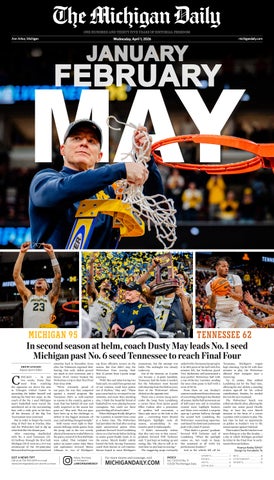
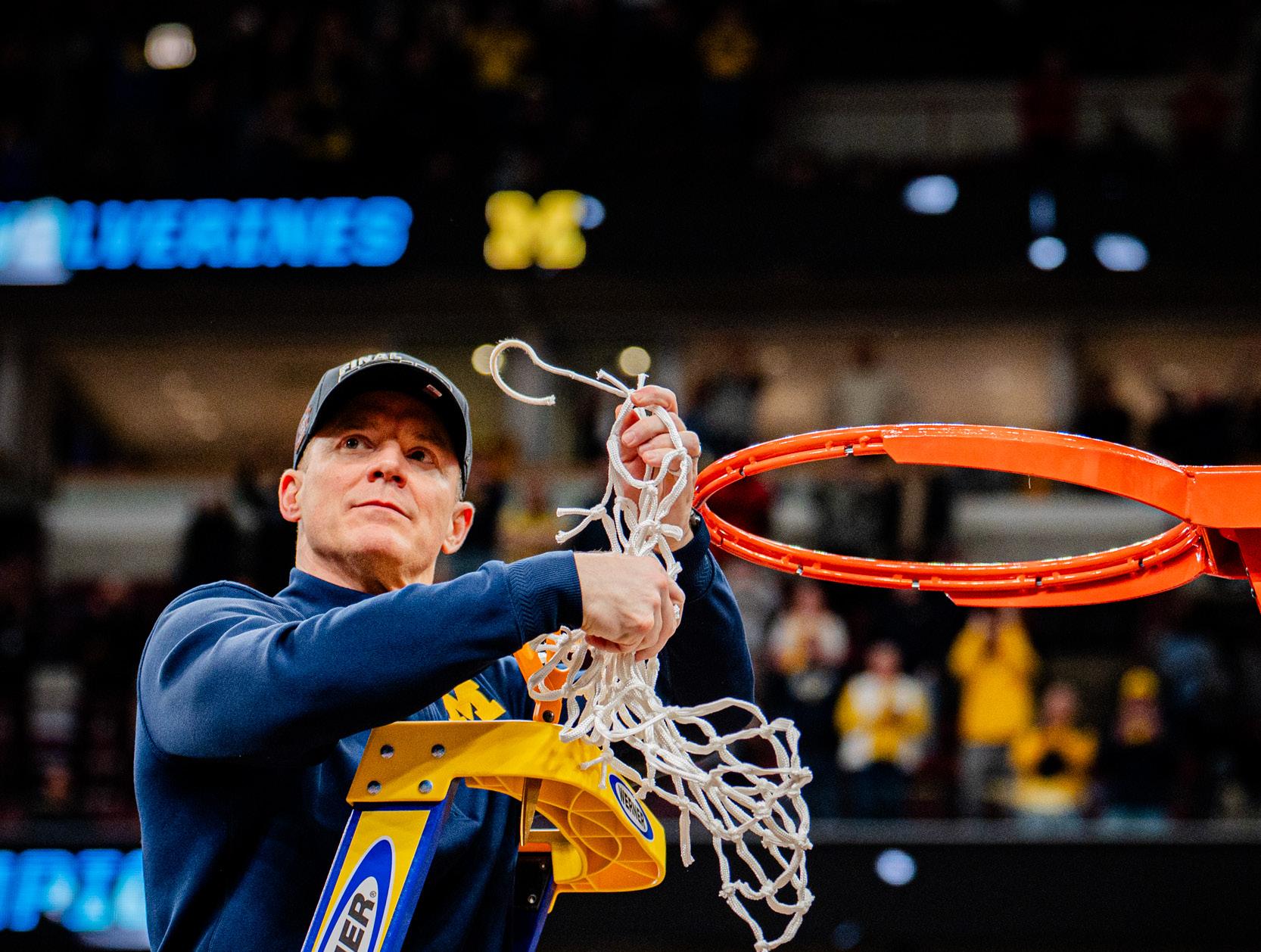
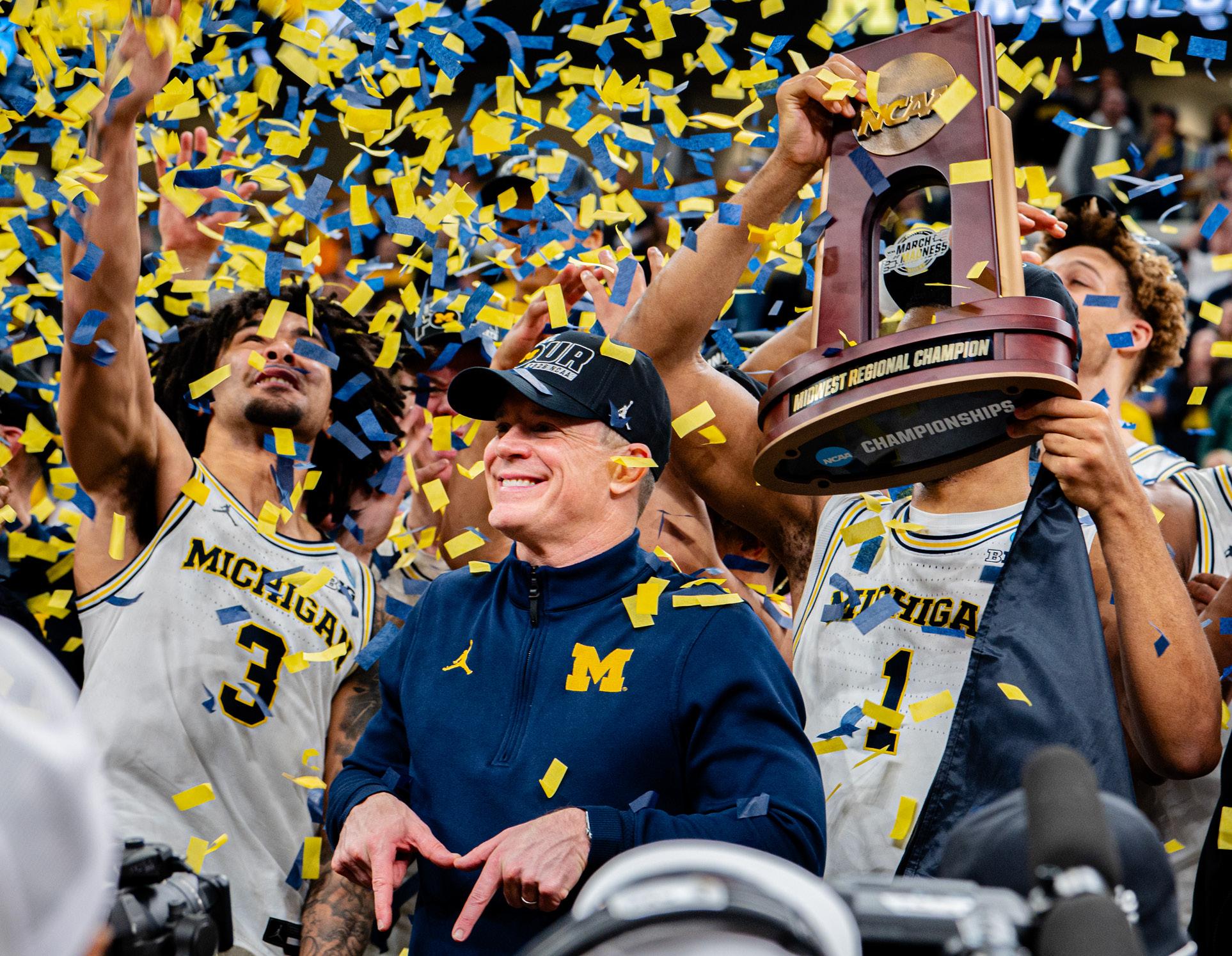
CHICAGO — In just two weeks, Dusty May went from watching the opponent cut down the nets in Chicago’s United Center to ascending the ladder himself and making the final few snips. As the coach of the No. 1 seed Michigan men’s basketball team waved the untethered net at the surrounding fans with a wide grin on his face, all the demons of the Big Ten Tournament were exorcised.
But in order to forget the recent sting of their loss to Purdue, May and the Wolverines had to dig up what feels like the distant past.
After remaining deadlocked with No. 6 seed Tennessee (2512) halfway through the first half, Michigan (35-3) went on a 21-0 run reminiscent of the 40-point-plus blowouts that first garnered national
attention back in November. Even after the Volunteers regained their footing, that early deficit proved too much to ever overcome, and a breezy 95-62 victory booked the Wolverines a trip to their first Final Four since 2018.
“We’re extremely proud of our guys, the way they competed against a storied program like Tennessee that’s as well-coached as anyone in the country, against a team that has battled all year and really improved as the season has gone on,” May said. “But our guys have been up to the challenge, to deliver in the biggest moments all year, and nothing changed tonight.”
Both teams went right to their season-defining inside games from the jump, and as the two overtly physical frontcourts traded blows in the paint, a total of 22 first-half fouls were called. That included two apiece on junior center Aday Mara and sophomore forward Morez Johnson Jr., two of Michigan’s
top three offensive scorers on the season. But that didn’t stop the Wolverines from scoring their first 22 points from 2-point range anyways.
“With ‘Rez and Aday having two fouls each, we could have gotten out of our rotation, could have gotten out of rhythm,” May said. “Those guys came back in, we stayed in our rotations, and more than anything else, I think the beautiful brand of basketball we were playing became contagious. You could see these guys feeding off of each other.”
When Michigan finally did get to the 3-pointer, it couldn’t have come at a better time. The Wolverines had just taken the lead after scoring eight unanswered points when graduate forward Yaxel Lendeborg drove on a fast break before kicking to senior guard Roddy Gayle Jr. in the corner. ‘March Roddy’ calmly buried the look, forcing Tennessee coach Rick Barnes to call timeout. Barnes hoped to stunt Michigan’s
momentum, but the attempt was futile. The onslaught was already underway.
Out of the timeout, an 11-point run became a 21-point landslide. Tennessee had the looks it needed, but the Volunteers went beyond cold shooting from the field as every facet of the Wolverines’ offense clicked on the opposite end.
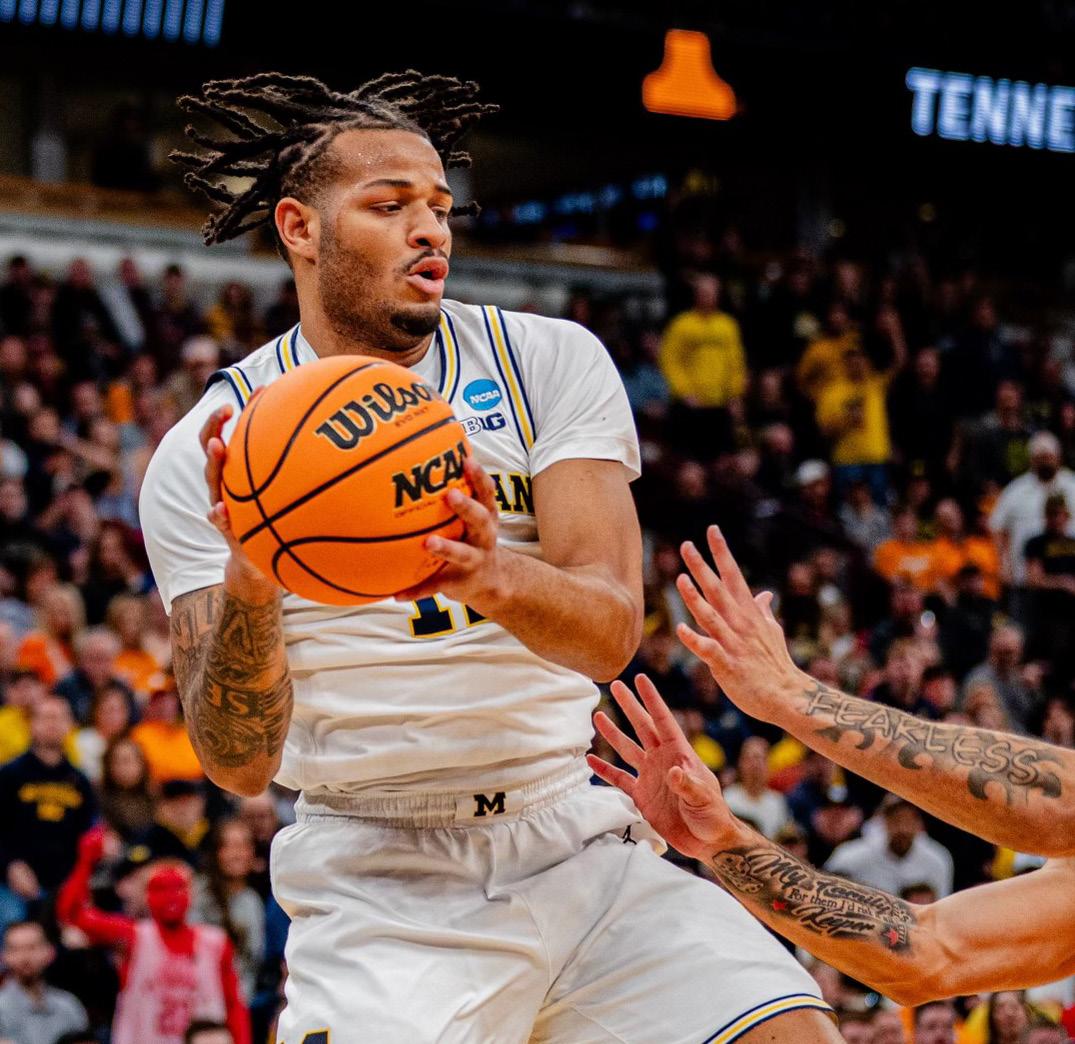
There was a reverse layup and-1 under the hoop from Lendeborg, a corner three from junior guard Elliot Cadeau after a possession of spotless ball movement, a Mara spin move to the hole in the post — everything that’s littered Michigan’s highlight reels all season, accumulating in one massive push to Indianapolis.
“I didn’t necessarily realize that (the run) was to that extent,” graduate forward Will Tschetter said. “I just kept on looking up and seeing, like, ‘Oh, they’re still at 16.’ And then we just kept on scoring.” The staggering surge eventually
ended with a Tennessee layup to give it its 18th point of the half with five minutes left, but freshman guard Trey McKenney still punctuated a near-perfect Wolverines half with a top-of-the-key 3-pointer, sending the once-close game to half with a score of 48-26.
From there on out, Sunday’s contest transformed into a showcase of everything Michigan has flashed all season. Stellar ball movement out of half-court sets and in transition created more highlight buckets, and Mara even swished a surprise spot-up 3-pointer halfway through the second half. Lendeborg, the Wolverines’ season-long superstar, continued his dominant postseason push with a loud 27 points.
“That dude’s a gamer,” graduate forward Will Tschetter said of Lendeborg. “When the spotlight comes on, he’s ready to hoop. Not surprised at all (with his performance Sunday.)” And as the wheels fell off for
Tennessee, Michigan’s wagon kept churning. Up 86-54 with four minutes to play, the Wolverines allowed their marquee man a victory lap. Up 32 points, May subbed Lendeborg out for the final time, allowing his star athlete a standing ovation sign-off for his critical contributions. Besides, he needed the rest for next weekend.
The Wolverines’ bench was rolled out shortly after, allowing the coach’s son, senior guard Charlie May, to have his own March moment in the form of a corner 3-pointer with a minute to play. The last time he had an opportunity as golden as Sunday’s was in the season opener against Oakland. That makes Charlie’s bucket even more fitting on a day like Sunday — a day in which Michigan punched its ticket to the Final Four in earlyseason blowout fashion.
DREW LENARD Deputy Sports Editor
Kedia/DAILY Design by Annabelle Ye
EPA to take over cleanup of longstanding Ann Arbor underground chemical plume
The Gelman Sciences Inc. manufacturing facility was added to the National Priorities List March 12
DOMINIC APAP & CARTER CARINO
Daily News Editor & Daily Staff Reporter
On March 12, the U.S. Environmental Protection Agency added the Gelman Sciences Inc. manufacturing facility to the Superfund National Priorities List — a list of heavily polluted sites allocated greater funding, resources and oversight — to address the contamination caused by an underground dioxane plume.
Gelman Sciences was a medical filter manufacturing company that operated from 1966 to 1986. Their manufacturing process discharged 1,4-dioxane into nearby ponds, leading to the formation of an underground plume that currently stretches four miles long and one mile wide.1,4-dioxane is a likely human carcinogen typically used as industrial solvent. Health risks include liver and kidney damage and cancer.
The plume has since spread into the groundwater and is
moving slowly toward the Huron River, where approximately 85% of Ann Arbor’s drinking water comes from.
In an interview with The Michigan Daily, Jenna Munson, earth and environmental sciences lecturer, said, currently, the plume mainly affects residential wells. She added that, while the situation needs attention, it will take some time for the dioxane to reach the Huron River.
“Nobody who’s getting their undergrad now is going to have to worry, when I’m here — if I’m a freshman now as a senior — that my drinking water is going to be contaminated with dioxane,” Munson said. “It’s going to take longer than that. So it’s not an imminent threat, but it’s definitely something that needs to be dealt with so it doesn’t happen down the line.”
Munson said the city’s Water Treatment Plant will need to develop the ability to take dioxane out of the drinking water if the plume does reach the Huron River.
“They can’t get rid of dioxane yet,” Munson said. “If they have to get rid of dioxane, they know
how. They would have to expand, and they would have to spend a lot of money on it. So they could pull the dioxane out of drinking water but don’t currently have that capability.”
Ann Arbor Mayor Christopher Taylor told The Daily in an interview the designation will allow for additional cleanup efforts as the city works to improve the treatment plant’s capabilities.
“With the introduction of the Superfund designation and additional cleanup efforts I expect being required by the EPA, I would continue to expect Ann Arbor to provide clean, safe drinking water for every water customer,” Taylor said. “Further, we’re not just waiting around for this to happen. We are working hard to modernize and improve our water treatment plant. Our water treatment plant continues to use technology that was deployed in the 1930s.”
The Michigan Department of Environment, Great Lakes, and Energy first asked the EPA to add the site to the Superfund NPL list in 2021, and the EPA
initially proposed the designation in March 2024. Taylor said the designation is the culmination of years of work between Ann Arbor, its neighboring jurisdictions and many other individuals and organizations, including the Coalition for Action on Remediation of Dioxide and U.S. Rep. Debbie Dingell, D-Mich. “Tremendous work has been done with the cooperating jurisdictions, the county, the townships, the city of Ann Arbor and certainly, and incredibly importantly, under the leadership of Congresswoman Dingell,” Taylor said. “She has proven to be a real leader, a real servant leader in this context, working with neighboring jurisdictions (and) helping us accomplish a common goal, which is to accelerate the cleanup.”
Taylor said oversight of the plume will now transition to the EPA, where they will determine cleanup standards and do so in a much faster timeframe than the city alone could.
CONTINUED AT MICHIGANDAILY.COM
Grasso defends UMich from foreign espionage claims in congressional hearing
The interim president told the U.S. House Committee on Education & Workforce that all illegal acts committed by international scholars were handled promptly in accordance with the law
Interim University President Domenico Grasso testified before the U.S. House of Representatives Committee on Education & Workforce Thursday morning in a hearing about purported national security threats posed by Chinese students and scholars at American universities.
The University of Michigan has faced scrutiny from the federal government over the actions of some of its Chinese international students. In August 2023, five Chinese students studying at the University were caught visiting and secretly taking pictures of Camp Grayling, a military outpost in northern Michigan. In July, three visiting Chinese scholars at the University were charged with illegally smuggling roundworm material into the United States, which federal officials speculated was intended for use in biological terrorism attacks. The charges against them were dropped, with an expert from Indiana University saying their actions
posed no risk to American citizens.
U.S. Rep. Tim Walberg, R-Mich., committee chair, opened the hearing by claiming Chinese infiltration posed an existential threat to higher education in America.
“The Chinese Communist Party, CCP, are actively competing against our nation’s interests on the battle grounds of our university campuses,” Walberg said. “They’re unafraid to exploit American good intentions for ill gotten gains. I’m proud that this committee has been a leader in combating malign foreign influence on college campuses.”
Grasso told the committee the number of security breaches by foreign students was small, and all cases were quickly addressed by the University.
“In isolated but serious incidents, a small number of University students and researchers from China have been arrested for unlawful activities,” Grasso said. “In each case, individuals carried out their unlawful acts without the University’s knowledge. Once alerted, we acted swiftly and decisively, working with federal law enforcement, promptly terminating student work visas
and severing all ties with those individuals.”
Democrats on the committee expressed heavy skepticism toward the hearing’s purpose, with several stating their Republican committee members were unfairly focusing on the actions of a small number of Chinese students to promote xenophobic attitudes against all international students.
U.S. Rep. Suzanne Bonamici, D-Ore., said she believed the Republicans’ focus on alleged foreign threats was intended as a distraction from President Donald Trump’s cuts to research funding and effort to dismantle the Department of Education.
“According to the testimony submitted today, which I have read, processes are in place to address any foreign threat,” Bonamici said. “They seem to be doing a decent job. I read your testimony, and there doesn’t seem to be anything close to a university under siege, which is what the title of this hearing portrays. What we can quantify, however, is the enormous and detrimental effect of the Trump administration’s attacks on higher education.”
CONTINUED AT MICHIGANDAILY.COM
Stanford Lipsey Student Publications Building 420 Maynard St. Ann Arbor, MI 48109-1327 734-418-4115 www.michigandaily.com
EDITH PENDELL and ZACHARY AJLUNI Co-Editors in Chief eic@michigandaily.com
CICI COPENHAVER Business Manager business@michigandaily.com
NEWS TIPS tipline@michigandaily.com
LETTERS TO THE EDITOR tothedaily@michigandaily.com
KATE PARAMBO Creative Director MORGAN ORTH Strategy Manager
Courtesy of Glenn Hedin.
Interim University President Domenico Grasso testifies before the U.S. House of Representatives Committee on Education & Workforce.
GLENN HEDIN Daily News Editor
PHOTO OF THE WEEK
Louth and Perez of Human Rights Party projected to become CSG president and vice president
The Human Rights Party candidates are projected to become the 2026-2027 president and vice president after receiving 52.3% of votes cast
SARAH PALUSHI Daily News Editor
LSA sophomores Summit
Louth and Naimah Perez of the Human Rights Party are projected to become the 2026-2027 president and vice president of the University of Michigan’s Central Student Government, according to unofficial election results obtained by The Michigan Daily.
Louth and Perez won 3,037 votes out of 5,808 ballots cast in the executive election — 52.3% — after ranked-choice redistribution.
Louth and Perez’s platform focused on progressive advocacy and affordability on campus. During the March 20 CSG executive debate, Louth said he would work to navigate and balance student interests against pressures from the federal government and administrators if he were elected president.
“We need to say, ‘Look, we understand that the interests of the federal government are their own thing and administrators need to have their own relationship with the federal government, but student voices need to be represented as well,’” Louth said. “I feel like that has been eerily absent in administrators’ minds.”
Michigan Music Business Club hosts fourth annual conference
“We’re bigger and better than ever before, bringing artist keynotes as well as industry professionals that a lot of students haven’t heard from.”
MICAYLA HORWITZ Daily Staff Reporter
The University of Michigan Music Business Club held the fourth annual Michigan Music Business Conference Saturday. The event hosted a range of music industry figures from Leven Kali, Grammy-nominated producer and songwriter, to Jacqueline Saturn, president of Virgin Music Group North America. The conference offered recruitment hours, workshops and other opportunities for students to have one-on-one conversations with professionals from the industry.
business industry — and we want to provide an easy pipeline for students who are interested in going into that,” Manfredi said.
A keynote panel followed, featuring Saturn and Jenna Adler, a music agent from the Creative Artists Agency. They discussed their early years in the music business world, how their careers have evolved and their experiences as women in a maledominated field.
Saturn said her love of music production has been consistent throughout her career, but she discovered a deep passion for developing and promoting new artists along the way.
XCII and producer Ayokay discussed how their music careers evolved from a college hobby. Ayokay is an alum of the University and shared how his time in Ann Arbor shaped his craft.
“The people I met in Ann Arbor, in the creative space, are the first ones that showed me the music I would like,” Ayokay said. “I really fell in love with music when I was in Ann Arbor.”
In an interview with The Daily, Engineering senior Arinjoy Das, MMBC co-president, said the conference is not limited to only club members, but anyone with an interest in music or business.
“When I think back to how it all started, it feels exactly how it is now, really just based on passion and love for music,” Saturn said.
“I think that as a university that is so committed to diversity, inclusion and a leadership culture that emphasizes community protection, we should have clearer and more transparent ways of protecting students,” Perez said. “I think every student should not have to fear the government, and if the University has any autonomy or say, we should definitely urge them to protect us more.”
The election used a rankedchoice voting system, which means there is an instant, automated runoff in which the ticket with the fewest votes is eliminated. Voters who ranked that candidate first have their votes redistributed to their
In a March 19 interview with The Daily, Perez said she hopes her administration will be able to create a campus environment protective of all students.
second choice. This process is repeated until a single ticket has the majority of votes.
According to LSA senior Joyce Jung, CSG elections director, Louth and Perez were ranked first 2,874 times in the first round of voting. LSA junior Hayley Bedell and Public Policy junior Luca Giobbo of EMPOWER
Michigan party came in second, ranked first 2,308 times and LSA freshman Isabella Kiiskila and LSA senior Tony Liu came in third with 540. After elimination of Kiiskila and Liu, final redistribution of votes led Louth and Perez to receive a majority, with 3,037 votes. The official results will be made available once all electionsrelated litigation has been decided by the Central Student Judiciary.
During opening remarks, LSA and Music, Theatre & Dance senior Jackson Manfredi and LSA senior Erika Petterson, co-vice presidents of the conference, reflected on the mission of MMBC and said that while the University does not have a music business program, the club seeks to connect interested students to the field.
“The Michigan Music Business Club was built on the mission to empower, educate and prepare the next generation of executives, tastemakers and power players in the music industry, and that’s why we’re here,” Manfredi said.
In an interview with The Michigan Daily, Manfredi said the conference is critical to bridging this gap.
“We wanted to start the conference to build a bridge between the University of Michigan and the entertainment industry — specifically, the music
“That feeling of what it’s like when you identify something so early and you really believe in it, and you watch sort of the path grow — there’s nothing better than that feeling. So it’s all really based on the love and belief in artists.”
Later in the panel, Adler said she felt satisfied seeing the music industry evolve into a more diverse profession.
“The agency world was all male-dominated, so that’s why for me, it’s so important to champion the next generation of diverse executives and agents,” Adler said.
“Now, to see our hallways in our offices, to be so diverse and to have so many women and young moms, and all of it roaming the hallways gives me so much joy.”
During an afternoon panel, Grammy-nominated artist Quinn
“Now, finally, we’re going into our fourth year, and we’re bigger and better than ever before, bringing artist keynotes as well as industry professionals that a lot of students haven’t heard from,” said Das. “It’s an opportunity for students in general, whether they’re coming from a business background or for the love of music and the industry; the MMBC conference is the perfect place to host that.”
In an interview with The Daily, LSA sophomore Sanaa Devgan, a conference attendee, said the event gave non-members, like herself, a valuable networking opportunity.
“I think it’s super important for students in general, especially those that aren’t exactly connected to (School of Business) resources, since this is an event that’s open to everybody at Michigan,” Devgan said. “It’s nice to have those opportunities to network and to interact with people in the industry.”
“We’ve got a 20-year lease, and we just are really excited for the future.”
After about 19 months of reconstruction, Pinball Pete’s held a soft opening — an initial test launch — of its new location at 500 East Liberty St Friday. The arcade was previously located in the Galleria Mall on South University Avenue for 32 years until Landmark Propertiesbought the building to construct “The Metropolitan,” an 18-story highrise development.
The new space features both a main floor and an underground level. Visitors could freely walk in and explore rows filled with various game machines, while employees worked to continue setting up finishing touches throughout the venue. In an interview with The Michigan Daily, Tapper Arnold,
an employee at Pinball Pete’s, said the redevelopment process was challenging. Arnold said the business had to store material offsite because their new location was not yet ready for occupation.
“We had to move everything to a third party to have it stored outside while this space was developed, so it was kind of hard to have everything tucked away for almost like six months,” Tapper Arnold said. “So once we did finally get everything out, we got it all up and going as fast as possible, and we were able to open in, I think, three weeks.”
Ted Arnold, Pinball Pete’s owner, told The Daily he intentionally planned for the arcade to reopen in time to coincide with large community events such as the Ann Arbor Film Festival and Hash Bash to capitalize on the city’s increased tourism, even if the business wasn’t completely ready.
“I just had a lot of overhead and improvements, and I needed to get it open, just so that the people could get a feel for it,” Ted Arnold said. “Those are really critical times to be open. That’s why we just did what we could and got 90% of the games working and open today.”
Law School student Evelyn Pigott, who attended the soft opening, told The Daily she thinks East Liberty Street’s high foot traffic makes it a good location for the arcade.
“I’ve just been seeing them set up in here for the past few weeks because I live around the corner, so I was curious,” Pigott said. “It was more of a passive thing, but I think it’s a good location for that — maybe there’s a lot of people that walk by.”
LSA junior Hasan Robert Demir, who visited the soft opening, told The Daily he preferred the new
location’s ground-level, accessible layout, as the previous one required visitors to use stairs to reach the underground arcade.
“Before, (the arcade) was underground,” Demir said. “I’d say it’s probably easier to walk in now, just because you don’t have to go down a bunch of stairs. I wasn’t sure if they even had an elevator at the other location, and I see that they have an elevator here now, so that’s nice.”
In an interview with The Daily, Ann Arbor resident Francesca Brunelli, who had previously visited Pinball Pete’s original location, said she was happy the arcade reopened in a more visible area.
“When I have someone that comes here to visit me, I always bring them (to the arcade),” Brunelli said. “I’m happy that they opened another place. I would have been sad if it was just closed. I
think it’s a place where it’s easy to get to and maybe more visible than the other one.”
After working with other businesses downtown, such as the Michigan Theater,State Theatre, Ted Arnold said he liked the new community around the arcade.
“Now that I know all these people and have met all these people that are helping me… everybody’s just excited because they feel that this arcade is going to turn this street into an entertainment corridor,” Ted Arnold said. “It’s really the heart of Ann Arbor, in my opinion.” Tapper Arnold said he hopes to ensure every aspect of the arcade, from its machines to its products, works properly for the customers.
He said that he and the rest of the staff plan to continue decorating and making the most of the new space, even if it is slightly smaller than the previous location.
“We just want to make sure all the machines are running how they should be, and the product is ready for everyone,” Tapper Arnold said. “We’re gonna keep on putting the stuff up. We have more decorating to do. We want to use all the square footage that we have to the best of its ability, because we lost about 4,000. We had to make it a little smaller, but hopefully it’s better.”
Ted Arnold said he is excited to welcome new customers into the arcade and see what the new location will bring for Pinball Pete’s.
“We’ve got a 20-year lease, and we just are really excited for the future — just letting the people come in and experience the new store,” Ted Arnold said. “I just want to thank all the people from the city of Ann Arbor that have supported us, and we look forward to the future.”
“We want to be free, we want security, we just want to be treated right. So we need to bring that back.”
calling for unity within the party ahead of the 2026 election cycle. He said members must take an active role in advancing conservative priorities.
Thousands of delegates, Republican politicians and general attendees gathered Saturday at the Suburban Collection Showplace exposition center to attend the MIGOP Endorsement Convention. The party formally nominated candidates for Secretary of State and Attorney General, marking an early step in the 2026 election cycle as debates over election policy, government spending and party unity continue to shape the race.
Delegates also chose the Republican nominations for the Michigan Supreme Court, the State Board of Education and the governing boards of the University of Michigan,Michigan State University and Wayne State University.
Before the endorsement votes, state Sen. Jim Runestad, R-White Lake, gave a speech
“Our mission must be to restore accountability in the runway of our government, to advance our conservative concerns, to restore freedoms,” Runestad said. “Show up to your county party meetings, volunteer for campaigns, knock on doors, make calls, send text messages, talk to your neighbors, share our message, push back on any impious information”
After a motion to close nominations, the GOP proceeded to nominate candidates for positions where the number of prospective candidates equaled the number of available seats. The nominations are listed below:
Michael Warren and Casandra Morse-Bills for Justice of the Supreme Court
• Bree Moeggenberg and Terence Collins for the State Board of Education
• Julie Maday and Roger Victory for the Michigan
State University Board of Trustees
Lena Epstein and Michael Schostak for the University of Michigan Board of Regents Christa Murphy and Andy Anuzis for Wayne State University Board of Governors
Delegates then cast votes for the Secretary of State and Attorney General nominations. The ballot for Secretary of State was divided between Macomb County Clerk Anthony Forlini and conservative activists
Amanda Love Education, trustee on the Clarkston Community Schools Board of Education and Monica Yatooma, executive board member of the Oakland County Republican Party. The ballot for Attorney General included Eaton County prosecutor Doug Lloyd and attorney Kevin Kijewski. In an interview with The Michigan Daily, David Mcquera, a delegate from District 10, said he is looking for officials who prioritize integrity and accountability.
“For Secretary of State,
and enhanced
Courtesy of Summit Louth.
Summit Louth and Naimah Perez, unofficial president and vice president of the University of Michigan’s Central Student Government pose in the Law School Courtyard.
Isai Hernandez/DAILY Doug Lloyd and Anthony Forlini pose on a stage at the MIGOP Endorsement Convention Saturday.
The Time B-Side
MEAGAN ISMAIL Senior Arts Editor
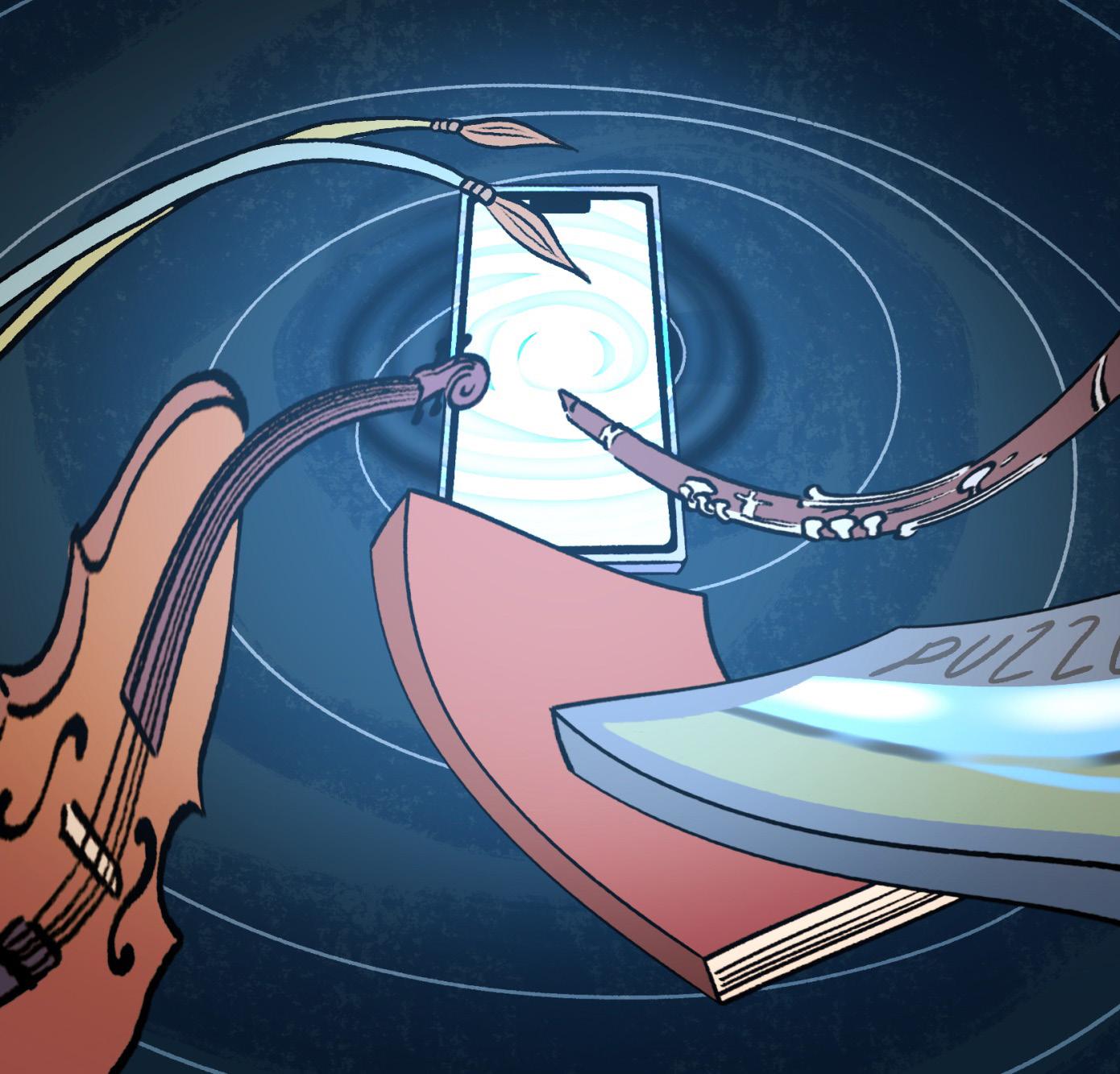
Art is woven through timelines, connecting the past, present and future. It acts as a form of time travel, capturing the essence of an era and transporting you to a specific moment. As the years go by, we rediscover and reimagine the art of years past in a continuous spiral of ideas. With each new creation, original meanings shift and evolve, bringing new
interpretations to light. Not only does art reflect the past and fabricate our present, it also transcends time. It has a lasting impact, able to move us long after it was brought to life. When we look at art of our pasts, we discover truths about ourselves that have not yet been revealed. In the Time B-Side, Daily Arts writers reflect on the art that weaves itself through their lives, bringing them back to the past, shaping their present and forever altering their futures.
Sacrificing clarity for eternity
SOFIA THORNLEY
I only know I’m 18 years old because I remember, roughly, all that had to pass to get me to this point. I know I’m a freshman because I remember the oneand-a-half semesters I’ve spent in Ann Arbor. Our memories are crucial to the way we perceive time, but time is also considered an unforgiving force that pushes on, independent of the fallible human brain. When we speak of time, we may be speaking of two different things: the idea of an external, always-ticking clock or, more likely, the time that lives inside our memories.
The Michigan Daily Crossword
“Eternal Sunshine of the Spotless Mind” is a film about what could happen when the past is so painful, you want to remember nothing at all. After a tumultuous breakup, ex-lovers Joel Barish (Jim Carrey) and Clementine Kruczynski (Kate Winslet) undergo procedures to have the other erased from their minds through a company called Lacuna. They destroy their time as a bid for
Sunday, March 29, 2026 — Puzzle by
peace of mind, an endeavor that proves futile. Time itself is the medium through which we understand film. Meaning is communicated by watching stories unfold sequentially. Knowing this, “Eternal Sunshine of the Spotless Mind” tries to throw you off. We are plunged into Joel’s life immediately after his memory removal procedure. Inexplicably drawn to Montauk in the middle of winter, he has what appears to be a meet-cute with Clementine, in the same place where they first met two years earlier. The pair begin a relationship, again. Its nonlinear narrative, which gradually becomes comprehensible through the rotation of Clementine’s brightly dyed hair, disorients firsttime viewers. On a first watch, we are just as clueless as Joel; his reality is, briefly, our reality as well.
It is only with the passage of time — for viewers in the 108-minute runtime and for the characters in the following weeks — that the truth is revealed. The experiences Joel and Clementine share in the past are what create both their
Johan Landis Lewis
deep emotional intimacy and their mutual animosity. The pair appear to be polar opposites: Clementine is extroverted and impulsive, while Joel’s mellow narration describes his detachment from life. Nonetheless, their romance’s rise and fall brings their starkly different lives together as they fall in love. Though their “second” relationship develops quickly, in its flashbacks, “Eternal Sunshine of the Spotless Mind” is a portrait of the slowly-built understanding between two people that only
occurs through amassing shared memories. When a disillusioned Lacuna employee releases recordings of the erased memories to all former clients, Clementine and Joel discover their shared history. Though they make the decision to try again, they do not immediately pick up where they left off. There is an understanding that the time lost must be made up for, hopefully with a different result this time.
CONTINUED AT MICHIGANDAILY.COM
Tyler, The Creator’s ‘IGOR’: Breaking time using sound
Music production is one of the most fascinating tools of expression an artist can use. Without a single word spoken, a musician can bring you into their world. The warmth of a synth or the aggression of a guitar chord can completely change one’s perception of the emotion, atmosphere or even the meaning of a song. Any decent artist understands this and uses it to some effect, but one creator who uses it better than any other is Tyler, The Creator. Tyler is a master of genre fusion, always working to blend elements of different musical niches to create original works. But he is also an expert at blending musical history; he uses his albums to breathe new
life into foundational works of the genres he finds himself playing with. Elements of classic soul and funk can be found on an album like Flower Boy, while something like CALL ME IF YOU GET LOST sees him working with a revival of ’90s era hip-hop mixtapes and radiofriendly pop-R&B. His influences are always strongly felt, but never make his music feel dated. There’s a forwardthinking, visionary approach to his sound, one that informs the story he’s trying to tell. However, in 2019, Tyler, The Creator evolved his time-traveling production abilities to create something truly transcendent: IGOR IGOR revolves around a love story, with the eponymous main protagonist being hopelessly in love with someone who doesn’t quite feel the same way. This love
story becomes quite toxic, as a relentless Igor drives himself mad and distorts his own identity in order to make this disinterested crush happy. He carves off more and more pieces of his soul to make his relationship work, including buying expensive things, offering unreciprocated sexual pleasure and even threatening to kill his ex-girlfriend.
There is a point where Igor comes to understand everything he has given up in order to make this dream of his reality. In “PUPPET,” after he begs for just a few hours of this man’s time in exchange for everything he has to offer, he says, “I am startin’ to wonder, is this my free will or yours?” But it gets more troubling than that. Underneath that lost individuality, there is something far darker: a complete break from reality and time itself.
It’s been theorized that IGOR was composed as a loop, with the first track resolving the rather inconclusive note the final track ends on. There are definitely hints throughout the album that the protagonist of this album has done this song and dance before, with lines like “Don’t leave, it’s my fault” and “I think I’m in love now / This time I think it’s for real.” Upon first listen, these lines lack specificity, but when you see them as continuations of lines said later in the album, such as “It’s my fault, you gon’ leave” and “But I don’t ever wanna fall in love again,” they make a lot more sense. Our story’s hero is caught in a perpetual loop, never being able to break the cycle of his toxic love. The problem is, then, when does our story begin and end? Even Tyler himself seems not to know,
saying “You felt like the summer to my December / Was it my August? Shit, I don’t remember.” We never actually got to see the beginning of this relationship, and we never see Tyler escape it. Still, these lyrics alone don’t truly do justice to what Tyler was able to achieve through this record’s story. The true magic is in the album’s sound.
IGOR, on one level, sounds scarily futuristic. Crisp synths; sharp, off-kilter percussion; and uncanny vocal modulation bring a sonic palette that feels entirely alien. However, rather than fully fleshing out this more-thanmodern instrumental palette, Tyler plays these elements against old, dusty, vintage soul and pop that cracks through this polished, forward-facing foundation in increasingly strange ways throughout the album.
Because of this, synths go from crystal clear and sparkly to blown out and crackly. Vocal processing can sometimes soar above the instrumental, while at other times get swallowed up by a bass-heavy mix that properly processes every audio channel. Sampled loops can feel elegantly woven in, or overtly out of place. The anachronistic feel of the album’s finished product makes the listening experience disorientingly unique, yet strangely nostalgic. And that is exactly how Tyler’s protagonist is feeling. That creeping sense of deja vu Tyler feels in every track of this album is one that perfectly matches the emotional tone of his romantic struggle. CONTINUED AT MICHIGANDAILY.COM
The Kennedys are back. Well, John F. Kennedy Jr. and Carolyn Bessette Kennedy are back. “Love Story” is definitely interesting, but lucky for you and me, I don’t give television advice. With that in mind, I know you all are expecting me to condemn the CBK aesthetic. But, honestly, from my heart of hearts, there’s not an aesthetic to condemn!
Carolyn Bessette pulls up in the J.Crew roll neck sweater, and the culture’s first thought is, “That’s a fully-formed outfit?” I genuinely cannot fix stupid — it’s not a fit, she’s just skinny. However, her headbands are important to me personally, so much so that I bought my own French headband — which will be the reason I’m digging quarters out of my purse to pay rent this month. This question has been edited for clarity. I continually struggle with gender-neutral formal wear. I usually default to a suit because it feels safer, but there must be a better option. Ideally, not a Billy Porter tuxedo dress, please. — E What I love about gender ambiguity is that it encourages the inhabitance of a third space, and in the
SARAH PATTERSON Daily Arts Writer
Daily Arts Writer
NATE EVANS Daily Arts Writer
Caroline Xi/DAILY
Audrey Rosenberg/DAILY
Cecilia Ledezma/DAILY
SIENA BERES Senior Arts Editor
Recently, one of my professors asked me what my major was, and I responded, “A touchy subject.”
Probably because I thought he would laugh. Instead, he sort of frowned, so I laughed loud enough for the two of us and promptly fled Mason Hall. It was late February, in the middle of fake spring, so outside, the sun was bright and jeering. Everyone on State Street was smiling, nearly frolicking — most likely because they all felt perfectly secure in their academic trajectory.
I had my headphones turned up loud and Teens of Denial by Car Seat Headrest was on shuffle. Since I first discovered the album as a kid, there have been periods in my life where I find myself suddenly compelled to fast from all other earthly records and only listen to it. Every lyric becomes suddenly relevant to the present, no matter how many times I’ve heard the song in the past.
That day, Will Toledo was chanting relentlessly in my ears, “And we’re never gonna, never gonna get a job / And we’re never gonna, never gonna get a job.”
There are certain albums that you grow out of. Recently, I called From Under the Cork Tree by Fall Out Boy “generational” and put it on aux in a full car, only to grit
We are just Teens of Denial
my teeth through Pete Wentz’s whining and realize that I haven’t seriously sat down with the record since I had braces and side bangs.
Other albums you grow into.
I said I hated the band Yes until I was reintroduced to their discography as an adult, by someone who wasn’t my dad playing Close To The Edge on repeat through an eight-hour road trip.
Then, there’s Teens of Denial and the many other records that grow up with you. On the surface, Teens of Denial is about getting high and getting old. Written during Toledo’s miserable freshman year of college at William & Mary, the record is a coming-of-age saga that follows Joe, its drug-addled protagonist.
But when I was 15, Teens of Denial was about the first party I ever went to in my ex-girlfriend’s basement. In my miserable freshman year of college, it was about coming home for winter break and being distraught about not recognizing the newly remodeled Kroger. Now, two months away from being 20, it’s about my sudden lack of direction. I have reached a strange impasse of being the oldest I’ve ever been yet feeling the youngest I’ve ever felt (and I can’t pick a major).
But maybe Teens of Denial was always about duality.
Toledo is famously obvious with his motifs (do you have something against dogs?), thus Teens of Denial is split in two all over. The first track declares, “If I were split in two, I would just take my fists / So I can beat up the rest of me,” while the album cover is a photograph of two similar-looking people fistfighting in a park. Track titles are cleaved by backslashes and parentheses: “Drunk Drivers/ Killer Whales,” “(Joe Gets Kicked out of School for Using) Drugs with Friends (But Says This Isn’t a Problem),” “Unforgiving girl (She’s not an)” and, in its original version, “Just What I Needed/Not Just What I Needed.”
Lyrically, the recurring theme of drug abuse creates a split in the narrator’s self; there is one Joe who is on drugs and one Joe who is not. The former takes the lead on rock-and-roll drives — he’s aggressive and asks uncomfortable questions: “What happened to that chubby little kid who smiled so much and loved the Beach Boys?/What happened is I killed that fucker and I took his name, and I got new glasses.” The latter, sober Joe, emerges to reflect and plead with himself on the longer ballads: “It doesn’t have to be like this/It doesn’t have to be like this/Killer whales, killer whales.” These two distinct narrators make the second-person address used throughout the album feel less like a callout to the audience and more
Why clocks are better broken
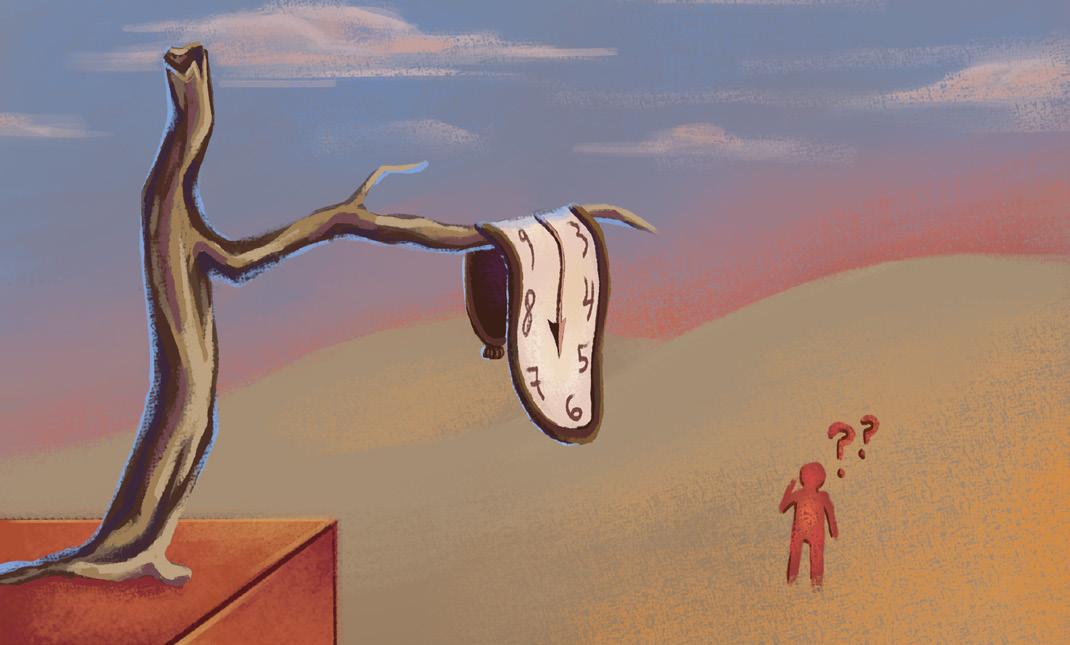
A broken clock — the ultimate contradiction — holds more significance than one may think. Serving as one of the most iconic symbols of Surrealism, images of melting clocks and distorted time filled the movement’s art. Seeking to explore the subconscious, dreams and the uncanny, the Surrealist movement aimed to revolutionize social norms and conventional thought.
Salvador Dalí’s “The Persistence of Memory” (1931) is synonymous with Surrealism, birthing the melting clock we so often see referenced in pop culture and hanging in living rooms today. At the heart of the painting, the three melting clocks are not merely a physical manifestation of the distortion of time so common in dreams, but also a commentary on how we experience time and, therefore, life itself.
By taking one of the greatest symbols of order — two hands perfectly calibrated to show the passage of each moment — and deliberately disrupting its precision, Surrealists made the clock more representative of the human experience. Why does time seem to move so quickly? Why did days feel longer when we were younger? Do we all truly share the same 24 hours? Why are days long but years short? We have all repeatedly asked ourselves these questions; time is not linear, at least not in our eyes. Consider childhood, when a single
year represents a far larger portion of our lives. As we grow older, time seems to speed up. In our late teens and early twenties, we often feel as though elementary school lasted an entire lifetime while college seems to pass in the blink of an eye. Memory also plays a role in measuring the passage of time. Details slowly fade into the abyss: our grandmother’s favorite song, the sound of a childhood best friend’s voice or the other countless small moments that once meant the world to us but now feel distant. Yet, broken or melting clocks are not meant to be entirely depressing; they are meant to reflect society. Time’s relativity allows us to break free from the rigid structure of routine. Yes, every week consists of the same days and every year the same months, but recognizing and truly acknowledging that we have this time at all is perhaps the greatest gift.
Many other Surrealist works may not directly feature distorted clocks as Dalí’s do, but they echo the same disruption of time. The
cloudy skies of René Magritte that resemble the strangeness of dreams, the inclusion of multiple generations in Frida Kahlo’s works and the fluid, playful forms of Joan Miró all capture a similar sense — that time and memory are far more flexible than we assume.
While phrases like carpe diem and tempus fugit urge us not to take time for granted, the broken clock offers the same reminder that the present, and how we choose to experience it, is ultimately up to us.
Do not let the broken clock frighten you. Instead, take comfort in it. Time does not have to move perfectly or follow a strict line to matter. Perhaps that is why Dalí’s melting clocks feel strangely familiar: They mirror the way time truly moves through our lives — stretching, bending and slipping quietly through our fingers.
There is no single timeline we must follow, no quota of moments we are required to meet. Time, like reality itself, is relative to how we perceive it.
like a conversation between Joe and himself.
Perhaps this severance is the essential nature of growing up and outgrowing. Eventually, one skin will no longer fit, but there will be an odd moment where our old and new selves must coexist. To be a teenager is to simmer in the uncomfortable in-between.
To my distress, I’ve recently noticed that I’m slowly losing the ability to relate to the sheer overabundance of teenage media. I watched “Booksmart” for the first time a month ago, and I told my friends that I would have liked it
more had I seen it when I was 16. I felt a fondness for the younger me who would have related to the characters, but I didn’t see my current self in them at all. My friend told me he rewatched “Superbad” and didn’t laugh nearly as hard as he had a year ago. This horrified me. Maybe I don’t want to mature if it means I can’t laugh at “Superbad” anymore.
Soon, time will take away Teens of Denial. One day, I will wake up and listen to Toledo’s monologue midway through “The Ballad of the Costa Concordia” — “How was I supposed to know how to use a tube amp?”, “How was I supposed to know how to ride a bike without hurting myself?” or “How was I supposed to know how to hold a job?” — and it won’t mean a thing. I don’t think this will happen the day I turn 20 or the day I declare a major. But I know that in outgrowing my uncertainty, I will outgrow my favorite album. Still, the beauty of art is that it sticks around, even if I’m not the one enjoying it (or being plagued by it) anymore. There are other Teens of Denial out there who will need this record more than I do, and I’m happy to give it to them.
‘Pride and Prejudice’ will never go out of style
“It is a truth universally acknowledged, that a single man in possession of a good fortune, must be in want of a wife.” — Jane Austen, “Pride and Prejudice”
This line is arguably one of the most iconic first lines in the history of literature. It does everything that a first line should do: build intrigue, introduce characters and highlight the central ideas of the novel in just a few words. It seems Jane Austen’s writing, though a couple centuries old, will never feel too dated. From her first lines to her last, Austen pulls together dramatic, interesting stories out of seemingly boring events — “Just a bunch of people going to each other’s houses,” as one reviewer writes.
Regency-era romance, like “Pride and Prejudice,” can look to the untrained eye like a whole lot of nothing. Characters talk to each other and take long walks on their grand estates until they dramatically make eye contact with their supposed love interests. There is something about them, though, that keeps me coming back for more. They contain a special sauce that emerges from the time period and the themes these books share — one that contemporary romance seems to lack. It is in the tension, the yearning and the deliciously flawed characters, but also the realism.
When Austen was alive, women could not vote, technically could not own property when married or easily access education. Though Austen herself never married, it was also fairly established at the time that, in order for a young woman to make anything of herself, she had to find a husband. How, then, does a swoonworthy romance of a book like “Pride and Prejudice” come to be? Austen’s works are so addictive precisely because, rather than ignoring the circumstances of her time, she amplifies them. Her novels serve as social commentary and escapism at the same time.
Characters like Elizabeth Bennet acknowledge their standing in the social hierarchy. They face pressure from their families to marry, and marry well, lest they remain under the roof of their parents forever. Male characters like Mr. Bingley face their own difficulties in Victorian society, hounded by families who hope that their daughters will be chosen for the life of comfort and ease that marrying into such a well-off family ensures. Amid these uncomfortable truths, Austen’s protagonists still find a way to take control of their own destinies. Elizabeth doesn’t accept the proposal of Mr. Collins, even though she knows that doing so would not only secure her own future but also that of her family.
She rejects Mr. Darcy’s first proposal, choosing dignity over the convenience of a match. In
the end, it is not money, family or power that motivates Elizabeth to get married — it’s love. Only once Mr. Darcy grows and becomes a better man does Elizabeth develop feelings for him and finally accept his proposal.
As a self-proclaimed hopeless romantic, it is love’s stubborn ability to prevail, whatever the time period, that makes me so enamored with Austen’s romances. Her female protagonists are forces to be reckoned with, from Elizabeth to Emma Woodhouse, but within them, there is still an unshakable desire to love and be loved. The nuance I see in Austen’s romances is what sets them apart from the modern romances I read. There are underlying factors beyond the characters’ control pushing them toward marriage, yet these factors fall to the background in favor of the wants of the heart. Today, fewer and fewer couples are choosing to tie the knot. Marriage is neither as important nor revered as it once was. Women, thankfully, can vote, own property and get an education without having a man in their lives. So why does a book like “Pride and Prejudice” still touch the hearts of so many? Austen writes witty, absorbing prose, with funny dialogue and themes that transcend time periods. From her place in the 1800s, she speaks to the human experience and the tenacious, persistent presence of love, no matter the circumstances.
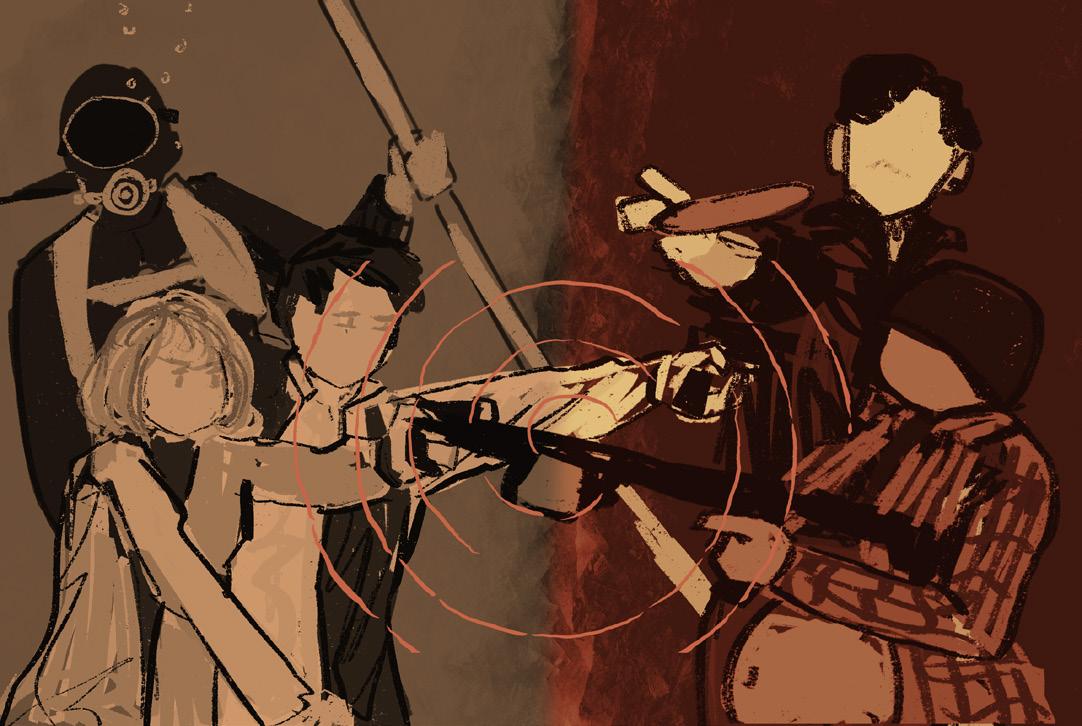
1967 to 2025 and the new youth movement in cinema
In 1967, political protests swept the nation as people argued that the United States’ involvement in the Vietnam War was inherently wrong, sparking rebellion throughout art and giving rise to a youth movement. Two films that emerged on the cusp of this movement, “Bonnie and Clyde” and “The Graduate,” influenced a new Hollywood system and gave way to one of Hollywood’s greatest eras: the 1970s. These pieces advised a younger generation to continually strive for something new and revolutionary. In 2025, we faced a similar predicament where nationwide protests arose, and two films — “One Battle After Another” and “Marty Supreme” — graced the silver screen with a poignant message to the youth. They both parallel the ’67 films by sharing sentiments of rebelling against what the past generation has set out for you and defying those expectations for better or for worse. Writer and filmmaker Neil Bahadur posted on X that
these films are the “…first sign of where the mainstream is headed.” Sean Fennessey, a wellknown film critic for The Big Picture, later replied to this post:
“Consolidation and marketing departments will make replicating 1967, uh, challenging. But one reason this has been an exciting movie year is the way in which these three are revelatory and inspirational for young moviegoers. It feels like the beginning of … something.”
All four films have this ability to speak to the youth in a special and endearing way that is so incredibly rare in the film medium.
“The Graduate” and “Marty Supreme” are both films about the disaffected youth. Benjamin Braddock (Dustin Hoffman) in “The Graduate” is a man lost without purpose, drifting on a pool inflatable without an inkling of how to approach adulthood. Every grown-up around him has an idea of what he should do, whether that be big business, graduate school or marriage; no one cares to ask what he wants. In contrast, Marty Mauser
(Timothée Chalamet) in “Marty Supreme” is a man who knows exactly what he wants: to be the best ping pong player of all time. He is so confident he will achieve this goal that it almost feels preordained that it will happen. This self-assurance inevitably leads to his downfall; he is so focused on himself and his image that he becomes vain, until he finds a true purpose. These men are two sides of the same coin; though their conflict is fundamentally different, they both face the trials of disconnection amid self-belief.
Conversely, “One Battle After Another” and “Bonnie and Clyde” are two deeply political films about running away from one’s past and the feeling of an impending doom while on the cusp of achievement. “Bonnie and Clyde” shows the deep-rooted power of law enforcement and the cruelty that can happen when one group has so much power, leading to the fearmongering of others. In the film, the young Bonnie (Faye Dunaway) and Clyde (Warren Beatty) are both naive and daring, finding themselves
on the run from brutally depicted law enforcement. The film uses these Great Depressionera bandits as an allegory for defiance growing among the youth in the late ’60s. In the same cadence, “One Battle After Another” exhibits the absurdity of organization and how that power can lead to racism and selfrighteousness. The film is almost a pseudo-sequel to “Bonnie and Clyde,” as its main focus is the aftermath of a failed rebellion stuck in the grasp of repression. The film’s main character, Bob Ferguson (Leonardo DiCaprio), is a failed and now egregiously lazy revolutionary who goes on a journey of rediscovering his roots, where he finds that the revolution never really ceased. He receives help from many different groups within the underground movement, showing how they’ve evolved and spread in the face of authority.
These films leave us in a state of security and are meant to leave an impact on the younger viewer.
But whether or not these 2025 films will create a larger change in the Hollywood system is yet
to be seen, and with its current state resting in the aftermath of strikes and studio consolidation, would something like that even be possible to achieve? “Marty Supreme” took months of nonstop in-your-face marketing to gain box office success and, “One Battle After Another,” despite critical affirmation, still underperformed financially. It takes a village to get people to go to the theaters. Much like bombastic studio musicals of the late ’60s, the superhero well is
crumbling; what used to be a sure hundred million dollars at the box office is no more, creating a hole in the movie-going world. It’s quite obvious something has to change to sustain this business, and what the success of “Marty Supreme” and the critical acclaim of “One Battle After Another” should provide is hope. Despite the inner crumbling of studios or our obtuse political climate, good movies are still being made.
CONTINUED AT MICHIGANDAILY.COM
LUCIA LARACH Daily Arts Writer
AMANY SAYED Daily Arts Contributor
SAMUEL BROWN Daily Arts Contributor
Selena Zou /DAILY
Maheen Rashid /DAILY
Caroline Xi /DAILY
EDITORIAL BOARD MEMBERS
Opinion
Duggan shouldn’t drop out, he should win
Gordie Howe Bridge between Detroit and Windsor.
The Michigan Constitution needs an Equal Rights Amendment
LOGAN PIERSON Opinion Columnist
Michigan’s Constitution is where the state’s most basic commitments and protections lie. Still missing from the document, though, is an Equal Rights Amendment: an amendment that offers protection against all forms of sex discrimination, including wage, pregnancy and education prejudice. The Constitution does include an amendment that prohibits discrimination against sex in public university affirmative action programs, but that is still far from the type of comprehensive protection needed.
Michiganders aren’t by any means unprotected, however. The Elliott-Larsen Civil Rights Act, passed in 1976 and amended in 2023, prohibits discrimination and harassment based on sex, race, sexual orientation, gender identity, religion and other forms of identity. Considering these already-established protections, an ERA can seem redundant.
In May 2023, I authored a column explaining the failures of our two-party political system and why young people should look for an alternative.
“America is in crisis, but not irreversibly,” I wrote. “We’ve got to stop expecting solutions from the two major parties — they’re the ones that put us here. Asking them to get us out is like asking an abusive partner for an ice pack and an Advil. The only option is to realize they’re not changing for the better and move on.”
Three years later, an alternative has arrived. Mike Duggan, former mayor of Detroit, is running for governor of Michigan as an Independent, and he could actually win.
In short, James’ vision for Michigan is to ravage the state’s economy while simultaneously cutting the social safety net. His victory would be the political equivalent of letting a pyromaniac into the building right after removing all the fire extinguishers.
economy has completely rebounded from the bankruptcy.
According to Sandy Baruah, CEO of the Detroit Regional Chamber of Commerce, citywide unemployment dropped by roughly 13% over Duggan’s mayoralty. Home values across the city nearly doubled between 2014 and 2022 and increased by 80% for Black Detroiters. Average resident wages are expected to rise to nearly $50,000 by 2028 — 80% higher than in 2014. It’s not surprising that Duggan left office with an approval rating in the mid-80s.
That durability is crucial when considering the tangible outcomes they produce. Nevada and Pennsylvania both used their ERAs to overturn longstanding bans on using state funding for abortion care through Medicaid. In Massachusetts, the state Supreme Court invoked their ERA to stop a discriminatory proposed bill that would prohibit women from competing in contact sports alongside men. ERAs serve as active legal tools to expand protections and block potential infringements.
Still, an ERA wouldn’t be absolute. It would still be subject to the U.S. Constitution’s Supremacy Clause, so if a specific part of the ERA conflicted with valid federal law, a court could prevent it from being enforced. But the possibility of a federal override is a limit on any state constitutional protection, not a reason to dismiss one altogether, and the federal government has not taken any direct action on other state’s ERAs.
Securing a higher level of protection requires more work than passing an ordinary law. In Michigan, getting an amendment on the ballot is difficult: There must be a two-thirds vote in both chambers of the state legislature or a petition with at least 446,198 supporters. After that, it must be approved by a majority of Michigan voters.
The ERA’s purpose, then, would not be to establish rights for Michiganders, but to secure rights that already exist by placing them in the Constitution rather than leaving them solely up to ordinary legislation. Laws are less stable than amendments. The Iowa Civil Rights Act — an act that closely resembles Michigan’s ELCRA — was weakened when Senate File 418 removed gender identity as a protected identity. The bill was controversial, yet it still managed to pass through both chambers of Iowa’s Legislature and was signed into law by Iowa Gov. Kim Reynolds. An amendment, on the other hand, is not so easily changed. Both the Iowa Civil Rights Act and the ELCRA are ordinary laws, meaning they can be repealed or amended by legislative measures. Changing or repealing a Constitutional amendment in Michigan must be subjected to a vote by the people, after either a legislative supermajority or a citizen’s petition puts it on the ballot.
My last straw
That, in turn, makes voter involvement central to any Michigan ERA effort. If an ERA is ever going to reach the Constitution, it will require public participation long before election day. For example, the Michigan Citizenship Verification and Voter Identification Initiative (2026) that may appear on this year’s general election ballot has been in the works for more than a year. The same would need to be true for any effort to add the ERA to Michigan’s Constitution.
Supporters of the ERA need to pressure lawmakers to introduce the amendment and place it on the ballot. Find your senator or representative and either call or write to them, urging them to support a constitutional guarantee of sex equality. If lawmakers fail to act, citizens must organize beyond the legislature and circulate petitions to gather signatures in support of the amendment.
With midterm elections coming up in November, voters should consider candidates that have stated their support for the ERA. Getting an amendment on the ballot for this year is unlikely, considering the amount of signatures needed and the small window, but that doesn’t mean that the ERA should wait.
It’s time to establish strong state protections for all Michiganders, regardless of sex. Statutory protections can be amended, narrowed or repealed through the ordinary legislative process. Constitutional protections are harder to change and, therefore, harder to weaken. With the federal ERA both stalled and outdated, a state amendment would give Michigan the chance to more durably protect equality.
EMILY QUINTEROS Opinion Cartoonist
A February poll from the Detroit Chamber of Commerce showed Duggan ahead of his two main competitors in a threeway race, with 30.1% of likely Michigan voters saying they’d support him come election day.
U.S. Rep. John James, the leading Republican, and Secretary of State Jocelyn Benson, the leading Democrat, both trailed by between one and two points.
This is good news for Michigan. The state is in dire shape, and a Duggan victory in November is key to putting it back on the right track — especially for young people.
Since the first members of Generation Z came of age in 2016, they have broken for the Democratic Party in every major election. Students at the University of Michigan, in particular, lean hard to the left and are more politically active than their counterparts at peer institutions. Our reliability as a voting bloc hasn’t worked to our benefit, and with no shortage of Democratic calls for Duggan to drop out of the race, it’s worth examining where years of partisan devotion have gotten us.
Sixty percent of U-M students will leave Michigan after graduating, becoming part of a broader trend that has made Michigan the only state in the country to lose members of Gen Z on a net basis in recent years. The 40% that stay will enter a stagnating economy with both a weaker job market and slower wage growth than the national average. Several years later, as they pair off and raise families, they will send their children to schools that are quickly becoming among the worst in the country. Even more troubling, those children will play on streets that suffer from disproportionately high levels of violent crime.
Neither party is solely responsible for these woes, but neither party has been able to solve them. At best, they’ve succeeded in managing the state’s decline, and at worst — well, let’s hope James or Benson don’t get the chance to show us.
James has been one of President Donald Trump’s staunchest allies in Congress. He voted in favor of the One Big Beautiful Bill Act, putting hundreds of thousands of Michiganders at risk of losing access to health care and food assistance. He supported Trump’s tariffs on Canada, even as the state’s businesses hemorrhaged billions of dollars. Most recently, he defended Trump’s threat not to open the
Benson’s record is nearly as uninspiring. She deserves credit for reducing wait times at the Department of Motor Vehicles, but that’s hardly a cover for the sloppy remainder of her tenure. Her website brags that she oversaw two of the “most transparent elections in the state’s history.” Benson is evidently failing to meet this standard now that she’s running for governor: The Democratled Michigan Department of Attorney General found that she violated campaign finance laws during the launch of her gubernatorial bid.
The person responsible for enforcing these laws is the secretary of state — Benson’s current job. Conveniently, she avoided any consequences.
There’s also the conflict of interest issue. Benson’s husband sits on the board of Related Companies, the Stephen Rossowned conglomerate whose subsidiary, Related Digital, is currently building a highly contentious, multi-billion dollar data center in Saline Township. He hasn’t committed to leaving the company if his wife wins. Unfortunately, many politicians have the habit of exploiting situations like these for their own benefit.
It’s said that the best predictor of future performance is past performance. If that’s the case, then we can expect James to sell out Michigan to Trump and Benson to set the rules aside for her own self interest.
Hence the need for an Independent candidate.
Duggan’s past performance earned him the title “America’s most effective mayor” from Governing Magazine. The Wall Street Journal said “he turned Detroit around,” and The New York Times called him “the mayor who brought Detroit back from bankruptcy.” It’s rare for the media to heap positive superlatives upon a politician, but even a brief walk through Detroit reveals why Duggan deserves them.
Since he took office in 2014, the city has become unrecognizable. Derelict streets have been revitalized. Empty downtown buildings, once symbols of a great but distant past, have been refilled. Many of the blighted neighborhoods written off by other politicians have been completely restored.
The challenges that faced Detroit resemble the challenges currently facing Michigan. For nearly 70 years, the city withered as the population shrunk, crime rose and economic opportunities evaporated. The school system was infamous for chronic absenteeism and dangerous classrooms.
Duggan is the only candidate in the race who has proven he can solve these problems. Under his leadership, Detroit’s population grew for the first time since 1957, homicides fell to their lowest level since 1965 and the high school graduation rates reached an all-time high. Student test scores, while still low, also rose.
Most impressively, Detroit’s
Wolverines deserve a state they can call home, not one they feel the need to leave after graduation. Duggan brought Detroit back from the brink. He can do the same for Michigan. His value as a candidate, however, doesn’t just stem from his administrative talent. His willingness to engage across political divides clearly contributed to his success as mayor, and his status as an Independent will serve the state well if he wins.
Though mayoral elections in Michigan are technically nonpartisan, Duggan was a lifelong Democrat before his recent break with the party. Still, in Detroit, he rejected proposals from left-wing ideologues to defund the police and eagerly worked with anyone willing to help the city, regardless of their political affiliation. He said the “toxic” partisan fighting in Lansing motivated his decision to run without a traditional label. Democratic calls for Duggan to drop out perfectly exemplify this toxicity. Both the left-wing political class and commentariat say that he’ll play spoiler if he stays in the race, taking votes disproportionately from Benson and handing James the election. But any objective analysis of the polling shows that Benson is actually the most likely to play spoiler, with Duggan beating James in a head-tohead matchup by more than 20 points, compared to Benson’s single digit victory. Beyond that, it speaks to the hollowness of the Democratic Party that their strongest line of attack against Duggan basically amounts to: doesn’t he know he’ll take votes from us?
Yes, he does. And a plurality of Michigan voters, if polls are to be believed, hope he does. The strange mix of befuddlement and animosity with which many Democratic officials and pundits have met Duggan’s campaign reeks of entitlement — as if Michiganders owe the party power, regardless of the policies and personnel it puts forward. Giving one’s unconditional support to a political party is foolish even in normal times. But these aren’t normal times. Our politics have become increasingly polarized as our state has slid into insignificance, and this decline hits young people the hardest. We still have lives to build, and the task becomes harder with every inept leader we elect. But possibly for the first time ever, there is a viable alternative to the two major parties. Young people need to seize the opportunity come November. Duggan was right for Detroit. He’s right for Michigan. And, as a graduate of both the University and U-M Law School, he’s right for Wolverines.
JACK BRADY Opinion Columnist
Akul Gunukula/DAILY
Wind tunnel
ERIN ZEMBLAKU Opinion Cartoonist
Ispent my spring break in Vienna, a city with statues and monuments aplenty, representing a time when Vienna was not just a cultural powerhouse, but also the heart of an empire. Ornate, imposing representations of the likes of Maria Theresa or Franz Joseph I, the individual figures who shaped Austria over the course of history, symbolize a complicated history of imperial power.
Being met with statues at every turn around the Ringstrasse caused me to reflect on how we go about public memorialization at home. In the United States, we’re having to consider more and more how our own history of slavery, westward expansion and white supremacy exist in public memory. These debates are perhaps most heated in the South, where communities debate over whether Confederate monuments ought to continue standing.
Even though the University of Michigan doesn’t have the same grand, imposing statues you might find all over Vienna, the issue of commemoration nevertheless remains an important consideration. From libraries to residence halls, the University certainly isn’t lacking in buildings named for U-M faculty spanning the institution’s history that begins as far back as 1817. As a result, the problematic aspects of national and institutional history sometimes become the baggage attached to a name honored on a building or a plaque.
Whether it concerns how we interpret the history of an entire empire or just an educational institution, the presence of statues, plaques and monuments, especially those tied to questionable or problematic histories, will
continue to prompt questions about removal as a complete solution. These dilemmas don’t have to be treated as a keep-or-toss situation, though. Instead, we can imagine how adding context or even artistic reinterpretation maintains an acknowledgement of the past while incorporating a critical lens of history’s more problematic aspects.
Consider the University’s history, for one. Stand on the Diag, and you’re less than five minutes from buildings that, once upon a time, took their names from unsavory former U-M faculty. A portion of West Quad Residence Hall formerly honored Alexander Winchell, a professor at the University in the 19th century. During the Civil War, he attempted to profit from a Northernappropriated plantation in Mississippi, and he later went on to author a book on evolution that included white supremacist ideologies.
The North University Building, too, was once named for Clarence Cook Little, the University’s president in the late 1920s. Little was an outspoken advocate for the eugenics movement, and after he resigned from his role at the University, he became the
president of the American Eugenics Society.
In response to pressure from students and faculty, the University has since removed the names of both men from the buildings they were associated with, a decision met with support from both in and outside the campus community. While it’s a commendable step, it’s also worth acknowledging in places of either past or present memorialization when our communities did, in fact, honor problematic historical figures.
In the case of the North University Building, for example, this might mean a plaque that recognizes the history of the building and to whom — and, by proxy, to what ideas — it paid tribute, perhaps without even mentioning C. C. Little by name. By adding to or changing public memorialization instead of simply removing it, we make the uncomfortable aspects of the University’s history more salient to the campus as a whole. Consequently, we would have a campus community that recognizes its complicated past and would be better equipped to approach similar issues of public memory of problematic histories when they appear in the future.
CONTINUED AT MICHIGANDAILY.COM
Slippery slope
The death of boredom
When I was younger, boredom meant wandering around my house looking for something to do. I would flip through my mom’s old magazines on the coffee table, or pull out a map and practice memorizing state capitals. I would spend hours reading and falling down different rabbit holes of knowledge, simply because I had nothing better to do.
Now, boredom rarely has the opportunity to exist. Any lapse in activity, and I’ve already reached for my phone and begun scrolling for hours on end.
In this age of endless social media usage, we instinctively turn to our phones to fill silence, replacing the productive discomfort of boredom with hours of mindless stimulation. And in turn, we are less informed and less curious with the world around us.
Our addiction to mindless scrolling is engineered. Social media platforms deliver quick stimulation through instantly accessible short videos that can be refreshed every second. This trains us to crave constant dopamine hits, making activities that require critical thinking and meaningful time investment — like reading a book — feel boring in comparison. Because of this stimulation overload, our attention span shortens. Even our attention spans to our own screens are dropping; according to Gloria Mark, an informatics professor at the University of California, Irvine, the average time Americans can focus on a screen has dropped from 2.5 minutes in 2004 to about 47 seconds today.
Additionally, our algorithms strategically prevent boredom. Our feeds, timelines and For You pages are all predetermined and
curated exactly to cater to our personality and interests, instantly filling any quiet moment with content that — of course — we’ll enjoy, consequently making scrolling both addictive and harmful.
For example, choosing a book to read requires effort and curiosity — we decide what interests us and commit our attention to it. Scrolling, however, removes that process entirely. Instead of boredom motivating us to seek knowledge, algorithms supply us with endless content that was fixed behind the scenes; our feed is guaranteed to show you content that you want to engage with, eliminating the need to determine what you like and dislike. Rather than intentionally exploring knowledge about the world around us by making conscious decisions on our own, we passively absorb fragmented information that’s tailored to keep us engaged instead of enriched.
Scrolling has become our first response to boredom. But boredom used to be the very thing that motivated hobbies. With nothing to do, kids invented games and explored random interests simply to fill the time. Filling that sense of boredom with meaningless scrolling is harmful because it replaces hobbies that build identity, depth and real satisfaction. While hobbies can teach us skills and help us figure out our own personalities, scrolling is forgettable.
Research supports the idea that boredom is a motivational signal that pushes people to seek challenge, meaning and new experiences; when we remove boredom, we also remove the mental trigger that pushes us to think and explore. Before everyone had a cell phone, and before everything revolved around social media, boredom made kids invent. Now, it leads us to TikTok or Instagram Reels because it’s the easier, more convenient thing to fill our time with.
Not letting ourselves be bored costs us the opportunity to develop other skills. There are certainly still individuals who prioritize knowledge through hobbies like reading solo or in book clubs. But in the last 20 years, reading for personal enjoyment has decreased by 40%, which coincides with the introduction of social media. People simply aren’t devoting time to reading like they used to. This is evident through high illiteracy rates and the decline in U.S. adults who read novels or short stories by 17% from 2012 to 2022. Moreover, studies show that creativity as a whole is declining in the United States, with children being reported as less emotionally expressive, energetic and imaginative. This creativity crisis means that upcoming generations face the possibility of longterm effects on innovation, curiosity and intellectual engagement. Having reduced problem-solving abilities combined with a less adaptable, less innovative array of skills means individuals are bound to struggle later on in their adulthood, especially in the workforce.
Trading screen time for hobbies can contribute to fewer depressive symptoms as well as increased happiness and life satisfaction rates. Rather than immediately filling every quiet moment with a screen of stimulation that deteriorates your overall well-being, allow yourself to experience that boredom deeply for once. We need to stop treating boredom as something to escape; it is a powerful gateway to engage with the world around us. As a collective, we have lost the ability to let boredom guide us to discovering new passions, which ultimately harms our curiosity and creativity. It is imperative to let ourselves experience those moments of stillness, pause and quiet, and hope they bring us to explore something new.
Katelyn Kim/DAILY
LAURA CENCER Opinion Cartoonist
SOPHIA FRANCO Opinion Columnist
In this space, we invite our contributors to be vulnerable and authentic about our experiences and the important issues in our world today.
Our work represents our identities in a way that is both unapologetic and creative. We are a community that reclaims our stories on our own terms.
Who
ANNIKA SREEDHAR MiC Columnist
Tick, tick, tick.
I watch the clock, practically bouncing in my seat, waiting for the hands to reach 3:15 P.M. For any other day during the week, I wouldn’t be so hyper and eager for school to end. But today was different. Today was Thursday
When we are finally able to pack up to go home, I grab my best friend’s hand and race down the hallways, pushing past all the slowpokes ahead of us, until we get into my mom’s minivan.
Every Thursday was the same routine: My best friend would come over to my house until her mom came to pick her up after work, and we’d get to have the ultimate playdate. We pretended to be princesses, chefs, warriors — anyone we wanted to be. At one point, we even became security guards for our queen — our queen being an enormous giraffe-cow plushie in my basement I named Polkadot. During those few hours every week, we felt invincible, like we could change the world. We would conclude each playdate by eating croissants and drinking lemonade while we watched shows or movies like “16 Wishes,” “Wild Kratts” and “Littlest Pet Shop.”
It’s clear that I spent a majority of my childhood in my own imagination and with the classic 2000s coming-of-age stories such as the ones I mentioned before. For those characters, their biggest accomplishments were becoming prom queen, having the best graduation party and winning
do we want to be?
battle of the bands. It makes complete sense, then, that I used to believe that the highlight of my life would be my high school graduation. I sincerely thought that, after that moment, everything would just fall into place and I’d receive the happily ever after all my favorite characters got once they walked across the stage. I’d go to a nice university, get into the top law school, have a nice, wellpaying job and live a wonderful life with my family.
Even though I spent all those years playing pretend with my best friend, I never really got to think of the details that my future would have whenever my friends or family would mention the topic in conversation. Discussions of dream schools, internships and jobs always seemed to leave a bitter aftertaste. I did not want to think of the egregious amount of steps that would need to be taken in order to accomplish any one of those tasks, such as getting into a
top law school. Instead, I just had this blind faith that everything would fall into place naturally, so I didn’t need to stress about it too much. While I believe that having faith in your abilities is extremely important, it gets to a point where you are avoiding your problems entirely under the facade of confidence.
Last semester, I started university and walked in, brighteyed and all smiles, completely sure of what I wanted to do with the next four years. I was going to major in political science and join as many extracurriculars as possible — dance team, a capella group, pre-law fraternity, you name it! But after taking one political science class where I realized how little I actually knew about political science and was so intimidated by the professor that I cried after office hours, I decided I never wanted to study it again. CONTINUED AT MICHIGANDAILY.COM
About a month after meeting my now boyfriend on Hinge, I tweeted, “obviously biased now but I have gotten over my distaste for meeting people on dating apps … all human connections are a result of random collisions and algorithms (school, work) that lead to something meaningful and the internet is just an extension of that.”
Like many of my peers, I never saw online dating as an ideal place to meet a partner. Books and movies romanticize either love at first sight or years-long slow burns ending with dramatic confessions for a burning romance — not so much simple algorithmic encounters. Ever the romantic, these kinds of stories made up much of my younger self’s fantasies and daydreams.
On the other hand, dating apps seem to take all the charm out of dating. Fleeting moments of romance in the real world — the brush of a hand, a lingering gaze — are translated into an explicit “like” or “swipe.” People you would once get to know through coincidental (or fateful) encounters now fall flat on your screen into a few pictures and prompts.
Then again, many other aspects of modern dating seem dystopian at times.
For one, the presence of social media creates a way for people to “measure” how much your partner actually likes you. Boyfriend day, girlfriend day, Valentine’s day or birthdays all serve as opportunities to announce to the world whether or not you’re in love and give an update on who you’re with, because everyone definitely needs to know. Miss a post, and people may start to speculate whether or not you are still together. On paper, it’s easy to see how these things are superficial and “made-up”. But when everyone’s doing it, seeds of worry and insecurity can start to bloom
over the fact that your partner doesn’t know about an Instagram holiday. Slowly but surely, these artificial standards can start to affect the reality of a relationship. Then, there’s the plethora of problematic dating advice on the internet. I primarily blame TikTok and its algorithm, designed to capitalize on what you’re insecure about despite the actual content being from people who have never met you a day in their lives. Dating horror stories circulate like wildfire — the more atrocious the story, the more viral the video. A new red flag is created every second. Something as small as standing on the wrong side of the sidewalk becomes a reason for concern, or an “ick.”
While my criticisms stem from what I see online, I can’t help but see the ideas from my explore page start to creep into my offline reality. I hear phrases like, “If he wanted to he would” being thrown around one too many times, and I hear friends strictly abide by the three-month rule.
What these rules have in common is that they intend to minimize what seems to be the greatest form of hurt: heartbreak. If you keep your distance and stay vigilant of the warning signs, it should, in theory, be easier to get yourself out of a bad situation and not be blindsided.
This is a sentiment I can understand, as the fear of being hurt is an incredibly valid and human feeling. However, modern dating culture exacerbates these fears and promotes the idea that following a set of rules can prevent getting hurt in love entirely. While dating experience might in fact help people learn the lessons they need to find and build the relationship they desire, simply following arbitrary standards rather than developing one’s own intuition does not bring anyone closer to this love. It’s easy to throw dating apps under the bus, as they seem to represent the pinnacle of these fears: the detachment, the disillusionment, the defensiveness. We proclaim to hate them, yet we come back to them, still craving connection despite pretending to be nonchalant. The real issue lies not in the apps, but in the crippling fear of heartbreak that has been amplified to such an extent that it has a significant impact on how love as a whole is perceived. While it is true that technology in the digital age has played a key part in this phenomenon, to blame dating apps solely is an unfair and inaccurate projection. Ultimately, having a cute meet-cute does not get rid of these anxieties, and pretending that it will doesn’t help anyone. CONTINUED AT MICHIGANDAILY.COM
The snow kissed my reddened cheeks and planted hickeys on my skin as I idled my way to the Walgreen Drama Center. The morning breeze was so chilly that it caused my eyes to water — no doubt also exposing any trace of sleep deprivation I had — and the frosted red of my face started to swell. I think I could feel a type of stinging in the back of my throat — a small tickle, a minor scratch — usually an indicator I needed to hydrate myself. I would get to it once I settled my items down by my classroom. It was probably also another indicator that this weather, humorously, revealed just how weak my immune system actually is, but I elected to ignore that possibility. I continued on my path. “The show must go on,” I told myself. I must make the most out of what I came to this school for. In spite of the fact that, recently, I’ve been finding myself in episodes of doubt, questioning the value of this perspective and my academic career thus far.
But, I’m starting to love life again. I do love life. I love this life. I love being in the Walgreen Drama Center. I love being a theater student. That’s it.
Today, I didn’t prepare at all to perform my song for class. Admittedly — irresponsibly — I
didn’t know that we were going to cycle through everyone’s songs today. Yesterday, I had ushered for a University Production, and then ran straight to a meeting afterward. I introduced myself there, passionately explaining my love for the performing arts and writing. I shared that performance has taken a great portion of my life — that it’s what I grew up doing — and because of that, it’s what I want to continue doing professionally. But that’s hardly a reason enough to justify my lack of preparation, and it was barely even an excuse.
A quiet shame lingered in the aftermath of my unexpected showcase, growing while I stood in front of my peers, as my posture shrunk. I couldn’t help but look down at myself as I helplessly admitted defeat to my professor, unable to identify what my character beats and shifts were in my song. The mortification followed me as I trudged back to my seat. I sat in silence for the rest of class. I couldn’t even engage in the performances of my peers because I was too isolated inside my own mind, drowning in all the errors I had made in my presentation.
When my professors eventually dismissed us, the first thing I did was apologize profusely to them for my incompetence. They alluded to an old motto that was adopted at the beginning of the semester, which serves as a reminder to encourage us to make mistakes and
remain open to improvement: “Fire the judge.”
For some reason, this sentiment was not enough to motivate me to fight against the commanding current forcing me into my mind’s whirlpool. The tide finally flooded ashore, afterward, the moment I entered a stall in one of the drama center bathrooms to breakdown.
How can I say this is the life I want to live if I can’t even show up to class prepared and ready to perform? In one of the top performing arts schools in the country? “I’ll never succeed,” I told myself in the seclusion of that bathroom. “If I keep this behavior up.”
This semester, I’ve been allowing myself to experiment with various methods of rejection therapy, particularly through auditioning for shows with the intention of getting rejected from them. I want to break free from the harmful, perfectionistic self-perpetuated habits as a creative and, especially, as a performer. I think it’s working. There are days when encountering rejection is easy. I can spend hours filming my selftapes and spend a couple more hours editing them. I may not be fully satisfied with my work, but I’m still joyful that I completed the task and then, I submit.
CONTINUED AT MICHIGANDAILY.COM
Alisha Razi/MiC
Leah Jeon/MiC
VIVIAN PARK MiC Columnist
RIVER STRASNER MiC Columnist
Ananya Prashar/MiC
ANNA WHITNEY
I didn’t grow up with a religion. Some people find this absolutely enviable. I understand the temptation — it can be incredibly difficult to love someone as much as you love your family and yet tear yourself away from a belief system that they uphold and you do not. If you’ve had to do that and your family (or place of worship) has made it difficult for you, I am truly sorry. In a way, though, I’ve often felt like I’m doing exactly that when I seek faith. When I’ve expressed interest in religion in the past, it’s felt like a possible slight to my family. Do they think that I think they’re all going to hell? I don’t, for the record, but it’s a plausible assumption. I don’t want to completely air out my family’s dirty laundry, but my family has a pockmarked history with religion on both sides. Between my grandparents and great-grandparents, someone in my family has had just about every possible religious experience: leaving your home country to flee religious persecution, leaving a family to join a cult, disowning a child born out of wedlock to maintain your religious views. Those generations were Catholic, Protestant, Jewish and Israelite. By the time my parents were adults, they were pretty burned out on the whole religion idea. I don’t blame them, either. I can’t believe in an all-powerful God who would allow such pain to exist in the world … but I still feel the pull toward something bigger than myself. I still yearn for religious community. So, when you’re not raised with a religion, how do you go out and find a religion? This has never been clear to me. I have met people who converted to their partner’s religion, usually ahead of a religious wedding ceremony. I have met people who converted from one denomination to another because the denomination no longer met their needs (for example, converting to Anglicanism because Catholicism will not allow two women to marry in the church). But rarely have I met someone who made the journey from zero to religious in their own time. This doesn’t mean I haven’t considered religions, though. I
Religion shopping and service hopping
remember the first time I walked into a church service: I was 12 years old and there to play a piano accompaniment with worship. (My piano teacher was the church’s accompanist and hoped I would follow in her footsteps.) Despite my role in the service, I knew I didn’t really believe in God, and I knew I was an outsider. Therefore, I assumed I would be judged: Who was this interloper? How could this pagan baby be commissioned to play our music? I spent the service on a balcony with the piano and organist, and thus didn’t interact with the congregation until after the prayers, sermon and hymns were all over. To my shock, everyone was nice. They didn’t pressure me to believe in God. They didn’t even ask about that. And they weren’t nice in a surface-level manner, either; it was clear they were impressed with my piano skills and my willingness to attend a strange church. That day, I felt tears welling up in my eyes. I felt something that shook me, something that threatened to burst through my foundation from underneath. In the sermon and the
kind congregation and the voices melded together in song, I felt something I didn’t think was real: unconditional care. No one knew me, and yet they cared for me. They believed in a God who would always care for me. When I was 15, I dove back in. A friend of mine was the child of a Catholic priest — a father who was then approved by the Vatican to enter the priesthood, a rare but possible position — and her family took me in, spiritually. They would drive me to Mass every week. They would answer my questions. I read books from their home library with titles like “The Case for Christ: A Journalist’s Personal Investigation of the Evidence for Jesus.” I often felt that same unconditional care that I craved, but I also sometimes felt unsettled. Because I was not baptized, I wasn’t initiated and I hadn’t taken my first communion. Communion was the central ritual of each Mass, and I couldn’t join in. I once went up with my arms crossed during communion, a common way of signaling you’d like a short blessing instead of Eucharist, and the priest told me, “We don’t do that here.” I have no
idea why he was so curt — it would have taken just as much time to bless me, and other priests would likely have done so — but I know I was burned crisp with teenage embarrassment as I walked back to my pew, rejected while everyone else savored the sacrament. The Easter Mass was breathtakingly beautiful, but I didn’t know if I really believed a man had been resurrected. As quickly as I’d been involved with Catholicism, I fell out. I fell out with the friends I made along the way, too. I always suspected that our closeness relied on the shared ritual of Sunday Mass, and I suppose I don’t blame them. Religious communities are just that: communities. When you leave the religion, it’s hard not to leave the community, too. And even though I left that specific religious community, I still crave that feeling of togetherness.
So I’ve continued. I’ve eaten many Shabbat dinners. I’ve prayed in Russian Orthodox cemeteries. I’ve fasted with friends during Ramadan. I call this practice “religion shopping,” much to the dismay of many religious people I encountered who hoped to
Matthew Prock/DAILY
evangelize me. Earnest believers have grimaced and told me I shouldn’t need to shop — I should just feel a calling and follow that calling. A calling to what, though? Even if a higher power spoke directly to me, I wouldn’t know which questions to ask to narrow it down to a specific denomination of a specific religion. What am I, a theologian? Furthermore, any calling I feel is to help others and be in community with them. The question of whether or not there is some higher power — let alone a specific one with wants and needs that might punish me when I disobey — is not as important to me as trying to do good in the life I have. In fact, it sometimes feels like a distraction. Whether or not you think God will help you, we should help each other.
So, after some years of muddling about, I think I know what I want from a religion now:
1. The focus should not be on God.
2. Instead, the focus should be on the care and responsibility that we can offer to our communities. We can call this a “deeds, not creeds” mindset.
Reentering the wild kingdom of Ann Arbor
forged the experience into one of the best weeks of my life. In other words, we experienced bliss in the emptiness of our luxuries.
The western and manifestdestined North America: Mountains, deserts, canyons and sandstone formations comprise the terrain. Cool winds haunt the night; the early sun blazes the red, clay earth. Below an ancient tree, covered in grime, an exhausted student emerges from a worn-down tent into the peaceful dawn. He moves in stiff actions, a sign that he did not sleep well the night before. No birds sing upon his arrival. The air is silent. Not even the wind dares to bellow.
He is not alone. He is among a tribe of five other migratory University of Michigan students, surrounded by a vast expanse of mesa. They are far from the watering holes of State Street and must act swiftly to reach the next checkpoint of their journey. ***
It was the last day of my spring break trip before our time came to a close, forcing me to go back to school. During the week, I took on an exciting voyage to the naturerich kingdoms of Southern Utah and Central Colorado alongside a few of my friends in the Michigan Backpacking Club. Isolated from society, we hiked, camped, laughed, quieted our speech and basked in the sunlight and wilderness.
We flourished throughout the nine days of the trip without a shower, still wearing our same pairs of pants. We lacked any meals more flavorful than Dinosaur Eggs oatmeal, and we went without a single restful night as we slept in belowfreezing temperatures. However counterintuitive, these factors
I had all of my essential needs such as water, food and shelter fulfilled — what more could I ask for? Sure, I had to filter and add purification tablets to the frigid spring water we collected on the mountain tops. I had to cook for six people in a miniature pot meant for two, which resulted in us eating two spoonfuls of instant rice every 15 minutes before I could make the next batch. In my dusty tent, I cleaned my face with a baby wipe that would change from pure white into a dark orange hue after the first wipe. But in spite of all that, I had everything I wanted: close friends by my side and time to take in the beauty of one of the most majestic places on Earth. Having gone backpacking before, I knew what these experiences felt like, and I yearned for them. I was more than content. In this environment, I had time to wonder, to reflect, to feel and, in contrast, to not feel anything all at once. The core of hiking is quite literally going on a walk — one of the first skills I learned in my lifetime — but on a more strenuous level. My mind would go blank at times when I would concentrate on making sure I didn’t step weirdly on the uneven ground. The silence was very welcomed. It was a delightful change from the constant noise that surrounds me in my days, where I fill even the tiny gaps in my schedule with scrolling on social media.
Like collecting pebbles, I captured the mundane, beautiful moments of the trip in an aesthetic vlog on my
slim digital camera. Upon my return, I proudly displayed the romanticized footage to my close friends while I commented on the scenes. I was surprised when they all had the same response: “Why would you want to do this?”
For me, the opposite was difficult to understand. Why wouldn’t I want to do this? While my friends were caught up on what I had lacked (basic hygiene and clean clothes), I couldn’t care less about that. In the empty desert, I didn’t have a to-do list overfilled with assignments and interviews. My only concern, in essence, was surviving. My fears returned to their animalistic nature. I felt my fear of heights, one of the only fears humans are born with, activate as I stared down a steep canyon. Traveling through bear country, I kept the bear spray close, afraid of a potential interaction. In contrast, survival doesn’t even cross my mind here in Ann Arbor, where, in contrast, I fear whichever assignment is due next at 11:59 p.m. Perhaps not thinking about survival in Ann Arbor means that the University is doing its job well. Kudos, Michigan! Thankfully, the high tables at the Shapiro Undergraduate Library have never ignited my fear of heights. Here, I have no unwanted interactions with scary animals unless I count the time I passed by Rick’s American Cafe on Halloween night while on the way to the East Quad Residence Hall. Being a student at the University, however, made me fear judgment, poor grades, losing my friends, a long line outside NYPD Pizza and losing to The Ohio State University in football, again. While scary (especially the last
one), none of these are necessary for my survival. I never thought that I would long for my innate fears, but there was something beautiful about running away to nature throughout the trip. I can’t recall the last time I scraped my knee in an attempt to climb a tree, nor the last time I fell into a patch of poison ivy. It feels silly to yearn for a life with those hardships, devoid of the blessings I hold. Yet, at the same time, I feel immediate malaise receiving 40 Canvas notifications as my professor actively grades my paper. I love my friends, but I don’t always want to respond to text messages late at night. When backpacking, although it was a small lie, I rebelled against the world that expects me to always be reachable by telling others that I wouldn’t have signal, allowing myself to be on an “ultimate do not disturb” and feel the peace of disconnection. I would also say I love to learn, but my eyes could use some rest from staring into a dimly lit computer screen all day long. I wonder, do these sentiments make me selfish?
I know that I should feel lucky to have these complaints, but I can’t bring myself to internally accept them. I’d prefer the itchiness of poison ivy over the Canvas notifications since at least it’s physical and has a clear root cause. Likewise, I don’t want a corporate job, however affluent it may be, in the future that makes me perform — what even are streamlining processes and the 80/20 rule? Does having the privilege of an education and the possibility of a prosperous future make me lose the right to feel overwhelmed?
These feelings were waiting for me back on campus. Eventually, I
3. The community should be accepting — I don’t want anyone to feel the way I felt when that priest refused to bless me. Ideally, the religion won’t even care that I’m also visiting other congregations. And 4. I want a joyful community. There is so much suffering in the world, but also so much possibility for gratitude and love. I don’t need to find something new to believe in so much as I want people to believe with. Now that I have my grocery list, I figured I might as well continue religion shopping, but this time with gusto. I started hitting services in rapid succession.
First, I attended a Saturday Shabbat service with the Ann Arbor Reconstructionist Congregation. Judaism resonates with me for multiple reasons. There is no “hell” to fear, just mitzvot (good deeds) to be done. Many sects have de-emphasized God as a requirement and instead focus on togetherness and living one’s values. As the oldest Abrahamic religion, Judaism has more than 3,500 years of history linking modern practitioners to humans of the past. Not only does this make tradition important, but it reminds us that our problems are not new; we are in great community when we struggle and when we succeed. I had been recommended the AARC congregation by a Jewish friend after I plainly asked her, “Do you believe in God?” and told her about my little religion shopping experiment. She’s someone I admire, the kind of person who wears spiked chokers and rewrites the Haggadah for a more personal Passover experience, so I thought she’d give great spiritual advice. She hadn’t attended any AARC services herself, but she thought they looked promising. We spent about 15 minutes scrolling their website to try and ascertain if they were Zionist — more than anything, I was curious if the congregation held a specific opinion that might push out certain community members or limit the political movements with which individuals could be in the community. That didn’t seem to be the case, though. If anything, the congregation seemed to be struggling with the question of Zionism and war in the Middle East together.
CONTINUED AT MICHIGANDAILY.COM
would have to stop running away from them.
The first day back on campus after my trip, I was still on a “nature high,” a mindset of awe and feeling grounded to the Earth. As I walked through the Diag, I watched the campus squirrels more carefully, appreciating their whimsical running. I vowed that I wouldn’t fall into my old habits of ignoring nature. Before my trip, I would speed walk through campus with my headphones on, ignoring the world. Now, I wanted to rip off the headphones to hear the birds sing.
But my old habits soon befell me once again.
Whenever participating in a group icebreaker activity, I tend to say that I love hiking as one of my fun facts, even though I only hike during designated trips. The truth is, I haven’t gone on a spontaneous hike since last summer. Despite that, my close friends and I ask one another, “Does anyone want to go to the Arb tonight?” on a weekly basis.
Despite us all showing interest, we have yet to actually take each other up on this offer.
This week was no exception. By Sunday, I felt the notification buzz in my right pocket and received the predictable message. I replied, saying I could hike in the following weeks once my workload died down, but just not this one.
But my workload never died down. In reality, it has become much worse.
I made excuses to push off the way I wanted to live, and in doing so, I pushed it off indefinitely. In all honesty, I am not sure if I can integrate my hiker personality into my academic environment. I want to be the kind of
person I am when I blissfully backpack, not the stressed one on campus. They both hold strong ground in their respective environments, but polarize each other when together. Hiking gives me an immediate sense of calm. However, studying can potentially give me a better quality of life in an allegedly promised future. Upon returning from spring break, I intended to use what I had learned while backpacking to live life better. No more constantly checking my phone. No more staying locked inside all day. Rather, I was going to make an effort to go outside more. I was going to put time aside to think and gain more clarity in my life. I wanted this to come naturally, without effort. But with time, I am realizing that I have to forcefully create the life I want to live. However simple that may seem, I am just now internalizing the sentiment by setting time aside to spend outside. Perhaps this is only the checkpoint before I continue on my journey of being a student.
Realistically, I am never going to be wearing full-on hiking gear while walking through campus. I can’t just leave my responsibilities behind to spontaneously immerse myself in nature. My workload is also likely to only increase as I take harder classes in the coming semesters. However, my choice to think in the mindset I had while hiking — silence, reflection and a return to the fundamentals of life — can enter my daily life here. My survival in Ann Arbor does not have to be about avoiding stress. Rather, it can be protecting the blissful mindset I found on the hiking trail. I can start by going on a walk.
JULIA ARBOLEDA
This is the question I recently found myself asking on two major fronts. The first is among us women when it comes to nitpicking and discussing the way we look. Over spring break, as I was walking down the street to meet my friend for dinner one night, I overheard two women in their 70s talking about the wrinkles on their faces and the sagging skin around their arms. This isn’t a type of conversation I haven’t heard before; in fact, I hear it all the time — in every age group, in every friend group, in every setting. But watching these two ostensibly wise, older women with their long, flowing gray hair, distinguished trench coats and a host of unique life experiences dumb themselves down to the natural aging process of their skin genuinely terrified me. If this is what the next 50 years look like, I’m not sure I can do it, considering I’m exhausted after only 20. Does it ever end?
The second reason I found myself asking this question was because of male judgment of women’s bodies. I was at my friend’s apartment the other night, happily munching on my Raising Cane’s Chicken Fingers Box Combo meal, when I overheard his roommate, who, guitar in lap, made a comment about the girls in a certain sorority being fat. Very original. To be honest with you, it neither bothered nor shocked me the moment he said it. Like women tearing themselves down, unnecessary male commentary feels like white noise at this point, and you train yourself to ignore it so much that you actually do. But in the following days, when I couldn’t stop thinking about his throwaway comment that wasn’t even directed at me, I realized how much it had bothered me. It was
For reasons I can’t quite discern, I’ve been spending these last few months entrenched in nostalgia. Songs I used to hear, smells I used to smell — everything brings back memories from the past. Going about my day, I am struck over and over by the things I used to do with my time, by snippets of time long past.
I go to a University Musical Society concert, and I watch the orchestra members shuffle around on stage quietly, going through the motions before the show begins: tightening their bows, flipping pages of sheet music and twisting tuning pegs this way and that. I watch them whisper to each other and smile, preparing to play the show that is the culmination of months of practice. I remember so vividly how it feels to be on stage, going through those same motions. I remember the feel of a black concert dress swishing at my feet, strong posture, eyes on the conductor — the comradely feeling of assembling together on stage, the glare of the stage lights and the painkillers I took ahead of time to combat their headacheinducing effects. I remember the feeling of my fingers against the strings, day after day, muscle memory encoded for nine long years before I graduated high school and put my viola down. I hold on to the idea that someday I will return to it, if my life steers me back in that direction.
I go swimming at the North Campus Recreation Building for the first time in months, and I remember it all. I remember the long, seemingly endless dual meets on Saturdays in the summer, walking on hot concrete and pulling on a red swim cap and eating chocolate muffins. I remember the 6:45 a.m. practices, shivering at the edge of the pool, reluctant to jump in as the water seemed to be steaming in the cold morning air. Walking out of the indoor pool building during winter nights with a group of friends, all of our hair immediately beginning to freeze.
STATEMENT
another reminder that women are always being perceived and judged. Does it ever end?
To add insult to injury, on my way home from my friend’s apartment that night, there were three guys walking in my direction, and the one in the middle told me I “looked hot.” For context, I was wearing jeans and a big puffer coat with the hood up, so I’m not really sure what there was to see. When I ignored him, he laughed and called me mute. The funny thing is, I forgot this even happened until I started writing about that night. Does it ever end?
I don’t think my anecdotes come as a surprise to anyone reading. I’m sure you have also heard women in your life tearing their bodies apart, and men making it all that much harder for women not to, with the nasty observations they feel so emboldened to verbalize. I’m sure it also comes as no surprise that women are constantly sold cosmetic products to fix insecurities they didn’t know existed and are told how they should look by those who hold the power. Even in Renaissance Italy, women were prohibited from painting nude female models and portraying women through their own eyes. It seems that has always been a man’s job: to portray women, and to punish them for not living up to that portrayal. Even then, a woman’s value was dictated by someone else’s standards, and any deviation from that could lead to criticism, shame or exclusion, just as it still is now. But, again, you don’t need me telling you this. As history has shaped societal expectations, I began to see how these pressures infiltrated my own life at a young age. In my preteen and teenage years, I realized how the media, big corporations and, most disappointingly, boys, fueled our insecurities. The messaging
Does it ever end?
was everywhere: American Eagle & Aerie told me their most flattering tops accentuated my waist, Sephora told me I should really consider enhancing my natural features and the boys in school told me what they thought of every girl — which of us was “flat as a pancake,” who the top five hottest were and who the ugliest was. The messaging was very confusing — why was I accentuating my waist? Enhancing my features? Was the goal in following American Eagle and Sephora’s guidance to receive more of these uncomfortable comments from the boys in my grade, even though that wasn’t what I wanted?
Naturally, I thought the antidote was pure positivity. Compliments. Praise. When I heard a friend say that she didn’t like the way her hair looked or that she was jealous of another girl’s features, I was quick to dispel her self-criticism. Your hair looks great! Don’t compare yourself to her. You’re very pretty. A part of me hasn’t evolved from this way of thinking. When the glowing ball of sunshine that is my friend meets me for coffee with her hair and makeup beautifully done, of course I want to tell her. When I see how pretty my friend looks in her date party dress, of course I want to verbalize it. I think a lot of this instinct comes from a desire to empower the women in my life. Just like in middle school, I still desperately want all my friends to see themselves as beautiful in a world that I know makes them doubt it, and compliments often feel like the most effective way to do so. But I’ve started to question this way of thinking.
Over the last year or so, I’ve seen the compliments we give each other in a bit of a new light. Positivity is very precarious. While we may genuinely see our friends as beautiful, we are still reinforcing the idea that their
beauty makes them valuable in some way, even if not directly to us. I began noticing this doubleedged sword of positivity in the way women were talking about each other. I’ve overheard innumerable conversations go as follows: Hey do you know so-andso? And the response: Oh my goodness, yes! She’s sooo pretty And it’s not just face-to-face; this culture of scrutinizing and praising appearances travels online, where it’s even more constant and public. Body tea. Skinnyyyyy. Omg WOW you look so good. A million times a day, in a million ways, we are internalizing messages about the way we and the women we know look, even if those messages are positive. And when I stop to really think about it, it’s amazing the comfort and ease with which we, myself included, feel commenting on each other’s bodies. Even with the intention of making her feel confident, my words are constrained by a narrow lexicon that inadvertently emphasizes her appearance. So when I go to compliment my friend on the way she looks, I’m caught in a bit of a dilemma: Is this empowering or reductive?
Empowerment — being granted authority and control — and reduction — the act of making something smaller — may feel like divergent concepts, but they seem to always get blended together in conversations about the products and ideas sold to women. Things like makeup and lingerie are empowering because they are supposed to make you feel confident, but they’re also reductive, because why are you so obsessed with the way you look? Why are you doing things for guys?
While it makes me genuinely happy to hear women uplift each other, it also makes me wonder why the first thing we’re focused on is the way she looks. In the same vein that “bad press is still
press,” a compliment is still a comment. It still draws attention to appearances and puts certain people and their features on pedestals. Is this the most pressing thing we have to say about the women in our lives? And when someone doesn’t get the same attention regarding their physical appearance, what does that say?
What does it mean if she ever stops getting that attention? Most notably, to me, if empowerment is supposed to give someone agency, then is complimenting a woman’s appearance actually empowering, or am I just giving her a quick reassurance that keeps the same social rules alive?
For me, a lot of this internal tension has to do with the fact that the male gaze often feels omnipresent. In conversations with the women in my life, we’ve noticed that, as we’ve grown up, there’s a certain level of anxiety and dread with being constantly perceived. A dread in realizing that the guy you were friends with actually said some objectifying things about another girl. A dread of wondering how that same guy friend then perceives you. A dread of being in a space with only men, even if this dread is sometimes subconscious. When I hear women talking about the way other women look,
What I miss and what that means
The constant smell of chlorine on my skin. I remember how, when you jump into the pool, the borders of your mind seem to go away as you become one with the water. I remember again how the water is easy to fight with, but when you make yourself fluid, it will recognize you and let you through. After 10 years of doing competitive swimming, I remember everything except for why I left all this behind. I sit in class and take notes by hand, like I always have done. Life seems to exist in parallel occurrences of the same thing — somewhere, some time, I am always sitting in a classroom and taking notes. Back in my bedroom at home and my bedroom here at school, these old notebooks pile up, filled with all of this knowledge I never revisit. I keep them just in case I need to reread and relearn these things, just in case I might find them important again. But I never do, and as my past self continues to take down these notes, my current self continues to hold onto thousands of pages filled with subjects I no longer study.
Looking back on these memories, I wonder why they seem to occupy the forefront of my mind. Sometimes, I long to go back, and sometimes, I am just appreciative of the ways I used to spend my time. Regardless of my reaction, these little anecdotes of nostalgia creep in at every moment, making me consider how these things might have shaped me even as I have left them in the past. Does it mean anything that I sometimes want to go back to all of the things I used to be, even as I move further away from them with each passing day?
***
In the various physics classes I have taken recently, I’ve spent a lot of time with the laws of thermodynamics. The first law of thermodynamics explains energy conservation, and it dictates that if a process is cyclic (the start point is the same as the end point), then the internal energy of the system is always constant. This is because internal energy is a state function — it cares only about its current state, not about how it got
I’m hit with a repackaged version of this dread. A dread in feeling like the male desires we’ve been conditioned to care about have infiltrated our conversations, our spaces, our minds. There is a Margaret Atwood quote that reads, “You are a woman with a man inside watching a woman. You are your own voyeur.” As someone trying to detach myself from the way I look as I get older, it pains me to feel like the places I’ve always considered free from this kind of judgment aren’t as free as I thought; that we are still always on display in a way, even among ourselves. So I return to my original question: Does it ever end? Can we ever fully untangle the desire to uplift the women we love from the pressure to conform to something larger than any one of us? Unfortunately, I’ll settle for being pessimistic by saying I don’t think it will ever truly end. But I can safely say that in noticing and questioning it myself over the last year, I’m beginning to see it for what it is: a game none of us are ever really going to win. One where awareness may be the only edge we get. But it’s that awareness, that ability to see the game increasingly clearly, that feels like a step in the right direction.
there. So, what’s the point of these cyclic processes if the total energy change always amounts to zero? They still require work; they still produce heat. Work and heat do care about what path was taken — these variables are not zero in a cyclic process. I think, abstractly, this can apply to people, too. As the things that we experience run their course, starting and ending, we end up in seemingly the same place with no change in energy to show for it. Where did all of those years of swimming and doing orchestra put me, except back where I started? I am no longer a swimmer or a musician, just like before I started. The labels don’t stick, and the skills begin to fade; when you quit something, it drops away from your personality so quickly that it feels as if you never did it. We put in the energy, and it is returned to us in an equal amount. We are still just ourselves. But the work we have done is not zero. There is still something to show for the time
we have put into these things, even as we leave them in the past. Their impact is still present in our lives.
Our experiences shape us, even if they don’t become us. On my hands now, there are three scars in various stages of healing: one from a fall while skiing, one from a fall while running and one left behind years ago from a fall while riding a Razor scooter. I watch how the skin takes a new shape around where it has been torn open. It begins to leave behind a permanent reminder of its past, even as it heals completely over. These small accidents are now etched onto my skin, a small part of the larger story of me. We are not meant to be everything at once. We will constantly go through phases — that is how both time and people work. Nobody expects you to stick with the hobbies you had in your youth forever, and we continue to let go of hobbies, jobs, places and people as we age. I may have quit
swimming and orchestra, and I even quit the state where I used to live by moving here, to Michigan.
But this was to make way for all of the things that I hold dear now.
There aren’t permanent states of being, as each moment changes us in another infinitesimal way and maps onto us the story of years lived and moments left behind.
As time moves forward, so do we.
But that doesn’t mean that each phase isn’t important. Like the moon in its shifting phases, we could never get to the place we are now without passing through the prior steps. If you cloned me now, would I really be the same without having experienced all that I have lived through?
I really miss all of the things I have left behind for the sake of who I am right now. I miss the time spent pursuing different studies or hobbies and the time spent with different people or in different places. It feels like all these things that I have dedicated my time to, I have let slip through
my fingers, for better or for worse. But I can be comforted in knowing that they are still here, whispering through in the way I listen attentively to music or the way I twist my hair into a small, simple bun as if to hide it within a swim cap. Though my old notebooks stay piled up and collect dust, the contents of them are alive somewhere in my brain, providing examples and logical strategies as I approach my current classes. These things I’ve left behind have also left some small, lasting changes on me, and I think that is significant. It can be argued that the life ahead of you is more important than the life behind you. But our pasts mean so much to us; they inform who we are and who we will be. All these things I miss still live on with me, though I do not keep them clenched in my fist. All these experiences leave their mark on me, even as I step away and continue to follow along the path of time.
Ella Flores/DAILY
BRENNA WENDELL
Hannah Willingham/DAILY
Congratulations to the James B. Angell Scholars for 7+ Terms
The following students were among those recognized during the Honors Convocation program on Sunday, March 29, 2026. These individuals have demonstrated the highest level of undergraduate academic success by achieving seven or more consecutive terms of all A’s (A+, A, or A-) while taking a minimum of 14 credit hours, including at least 12 graded (A-E) credits, and earning the designation of Angell Scholar. The University of Michigan congratulates these students on their superior scholastic achievement and wishes them continued success.
School of Music, Theatre & Dance
Stephen M. Ross School of Business
College of Pharmacy
School of Nursing
School of Nursing
College of Literature, Science, and the Arts
College of Literature, Science, and the Arts
School of Information
College of Innovation & Technology, Flint
College of Literature, Science, and the Arts
College of Literature, Science, and the Arts
College of Innovation & Technology, Flint
School of Music, Theatre & Dance
School of Music, Theatre & Dance
College of Engineering
TEN TERM ANGELL SCHOLARS
NINE TERM ANGELL SCHOLARS
EIGHT TERM ANGELL SCHOLARS
College of Engineering and Computer Science, Dearborn
School of Music, Theatre & Dance
College of Literature, Science, and the Arts
College of Literature, Science, and the Arts
School of Music, Theatre & Dance
College of Innovation & Technology, Flint
School of Nursing
College of Engineering and Computer Science, Dearborn
College of Engineering
School of Nursing
Penny W. Stamps School of Art & Design
College of Literature, Science, and the Arts
School of Nursing
College of Literature, Science, and the Arts
College of Literature, Science, and the Arts
School of Music, Theatre & Dance
College of Pharmacy
Annika Abramson
Amanda Agge
Dillon Agrawal
John Ahlin
Latif Ahmed
Oluwatomilade Akinyelu
Angelina Akouri
Venkatesh Alagappan
Farah Alasbahi
Lydia Alig
Danny Applebaum
Aiden Armstrong
Delaney Arnedt
Ioan Assenov
Matthew Averyt
William Aye
Ana Carolina Bahia Coimbra
Henry Baratz
Katheren Barger
Peter Belkin
Jaccob Bell
Andreea Beu
Pedro Bignotto Racchetti
Ethan Binns
Gina Bitkowski
Sirianna Blanck
Maya Bonevich
Myah Bridgewater
Talia Briske
Kathryn Byrnes
Matteo Carcassi
Devin Chaldecott
Isabella Charfoos
Allison Choi
Caden Christoffersen
Reagan Clarke
Peter Cohn
Adrian Cooney
William Cooper
Kirkland Czewski Sinclair Dennison
Alexander Devine
Madeline Dick
Aidan Donley
Xavier Donnellon
Jake Downey
Isabelle Dugan
Chaz Dunselman
Nikolas Economos
Haniya Farooq
Robert Farr-Jones
Ellie Feldpausch
Abigail Ferguson
Alyssa Fodale
Katja Foreman-Braunschweig
Micah Foster
Samantha Fragin
Eitan Frankowitz
Meredith Gallagher
Esther Gao
Brian Georgis
Daytan Gibson
Paley Goldberg
Forrest Gorby
Sophie Grand
Nora Gravgaard
Amanda Greca
Olivia Guzman
Lana Haddad
Nikitha Hadya
Reilly Hanson
Marilyn Harbin
Violet Hawn
Jawad Hazime
Sami Hoang
Grace Holmberg
Huaidian Hou Jessica Hsu
Yuandi Huang Clara Hummel
Grace Jeon
Emma Johnson
Kaminski
Amy Karlsen Riley Kelly
Maya Khadr
Ameer Khilfeh Brandon Kieranen
Max Klarman
Erin Klein
Justin Koch Yoav Konstantino
Tejas Kudva
Hannah Kwong Cecilia Ledezma
School of Music, Theatre & Dance
College of Literature, Science, and the Arts
A. Alfred Taubman College of Architecture and Urban Planning
College of Literature, Science, and the Arts
College of Literature, Science, and the Arts
College of Literature, Science, and the Arts
College of Literature, Science, and the Arts
School of Management, Flint
College of Literature, Science, and the Arts
College of Literature, Science, and the Arts
School of Public Health
College of Literature, Science, and the Arts
College of Literature, Science, and the Arts
College of Literature, Science, and the Arts
School of Information
School of Nursing
College of Literature, Science, and the Arts
College of Engineering
School of Nursing
College of Literature, Science, and the Arts
College of Engineering
College of Engineering
College of Engineering
School of Public Health
College of Literature, Science, and the Arts
College of Literature, Science, and the Arts
College of Engineering
School of Information
SEVEN TERM ANGELL SCHOLARS
Lindsay Lemieux
College of Literature, Science, and the Arts
School of Music, Theatre & Dance
College of Literature, Science, and the Arts
College of Engineering
College of Literature, Science, and the Arts
College of Engineering and Computer Science, Dearborn
College of Literature, Science, and the Arts
College of Literature, Science, and the Arts
School of Public Health
College of Innovation & Technology, Flint
College of Engineering
School of Kinesiology
College of Literature, Science, and the Arts
School of Nursing
College of Engineering
School of Music, Theatre & Dance
College of Literature, Science, and the Arts
College of Arts, Sciences, and Letters, Dearborn
College of Literature, Science, and the Arts
College of Innovation & Technology, Flint
College of Engineering
College of Engineering
College of Literature, Science, and the Arts
College of Engineering
College of Engineering
College of Literature, Science, and the Arts
College of Literature, Science, and the Arts
College of Literature, Science, and the Arts
School of Music, Theatre & Dance
College of Literature, Science, and the Arts
College of Literature, Science, and the Arts
College of Engineering
A. Alfred Taubman
School of Public Health
College of Architecture and Urban Planning
College of Literature, Science, and the Arts
College of Health Sciences, Flint
College of Literature, Science, and the Arts
School of Music, Theatre & Dance
College of Literature, Science, and the Arts
Gerald R. Ford School of Public Policy
Stephen M. Ross School of Business
College of Literature, Science, and the Arts
College of Engineering
School of Music, Theatre & Dance
College of Engineering
College of Engineering
College of Literature, Science, and the Arts
College of Literature, Science, and the Arts
Penny W. Stamps School of Art & Design
College of Engineering
College of Engineering
School of Music, Theatre & Dance
College of Literature, Science, and the Arts
College of Arts, Sciences & Education, Flint
College of Engineering
College of Literature, Science, and the Arts
School of Kinesiology
College of Literature, Science, and the Arts
College of Literature, Science, and the Arts
College of Engineering
College of Engineering
College of Literature, Science, and the Arts
College of Literature, Science, and the Arts
College of Literature, Science, and the Arts
College of Literature, Science, and the Arts
College of Literature, Science, and the Arts
College of Literature, Science, and the Arts
School of Nursing
School of Nursing
College of Literature, Science, and the Arts
College of Literature, Science, and the Arts
College of Engineering
College of Literature, Science, and the Arts
College of Literature, Science, and the Arts
College of Engineering and Computer Science, Dearborn
School of Information
College of Arts, Sciences & Education, Flint
College of Engineering
School of Public Health
College of Engineering
College of Literature, Science, and the Arts
School of Nursing
College of Literature, Science, and the Arts
School of Information
College of Literature, Science, and the Arts
College of Engineering
Gerald R. Ford School of Public Policy
Gerald R. Ford School of Public Policy
College of Literature, Science, and the Arts
College of Engineering
College of Literature, Science, and the Arts
School of Nursing
College of Literature, Science, and the Arts
School of Kinesiology
College of Literature, Science, and the Arts
School of Nursing
College of Literature, Science, and the Arts
Lopez-Linares Perez
Casey Lupariello
Nitin Shankar Madhu
Raina Mahajan
Samantha Malcolm Aidan McKiernan
Elliot Measel
Sophia Meguid
Chloe Meyer
Abigail Middaugh
Zan Mohsin
Christopher Mojares
Teresa Morales
Alexis Muhlstock
Quinn Murphy
Bledar Myslimaj
Kennedy Ndiaye
Lukas Nepomuceno
Elena Nestale
Tyler Nurenberg
Souad Omar
Charles Pappalardo
Dev Patel
Matthew Peal
Isabelle Perraut
Anton Petushkov
Melina Piazza
Olivia Pinto
Sara Plante
Milind Pulugura
Abigail Quigley
Andre Quimper Osores
Hayden Quinn
Reaser
Fabian Rihl
Maggie Robbins Brooklyn Rochow Claire Rock
Isha Saini
Anthony Sanchez
Schiller Alaina Schreiner
Erin Segui Maanibha Sengupta Jaden Serafin Devanshi Shah Evan Shi Katherine Shih Jessica Siegal
College of Engineering and Computer Science, Dearborn
College of Engineering
Gerald R. Ford School of Public Policy
College of Engineering
College of Engineering
School of Public Health
School of Music, Theatre & Dance
School of Music, Theatre & Dance
College of Literature, Science, and the Arts
College of Engineering
School of Music, Theatre & Dance
Penny W. Stamps School of Art & Design
College of Literature, Science, and the Arts
College of Literature, Science, and the Arts
College of Literature, Science, and the Arts
School of Music, Theatre & Dance College of Literature, Science, and the Arts College of Literature, Science, and the Arts College of Engineering and Computer Science, Dearborn College of Literature, Science, and the Arts College of Literature, Science, and the Arts College of Literature, Science, and the Arts College of Literature, Science, and the Arts College of Engineering College of Literature, Science, and the Arts College of Literature, Science, and the Arts College of Literature, Science, and the Arts College of Literature, Science, and the Arts College of Literature, Science, and the Arts College of Engineering
School of Nursing College of Literature, Science, and the Arts School of Music, Theatre & Dance College of Engineering School of Dentistry College of Literature, Science, and the Arts College of Literature, Science, and the Arts College of Literature, Science, and the Arts College of Literature, Science, and the Arts College of Literature, Science, and the Arts College of Literature, Science, and the Arts College of Literature, Science, and the Arts
Penny W. Stamps School of Art & Design College of Literature, Science, and the Arts College of Engineering
College of Engineering
Gerald R. Ford School of Public Policy
School of Music, Theatre & Dance College of Literature, Science, and the Arts
College of Literature, Science, and the Arts
College of Literature, Science, and the Arts
School of Kinesiology
School of Music, Theatre & Dance
College of Literature, Science, and the Arts College of Literature, Science, and the Arts
School of Music, Theatre & Dance
College of Literature, Science, and the Arts
School of Nursing School of Music, Theatre & Dance College of Literature, Science, and the Arts
College of Arts, Sciences & Education, Flint College of Literature, Science, and the Arts
Stephen M. Ross School of Business
Stephen M. Ross School of Business
School of Nursing
Stephen M. Ross School of Business
School of Nursing
College of Literature, Science, and the Arts
College of Literature, Science, and the Arts College of Literature, Science, and the Arts
College of Literature, Science, and the Arts
School of Public Health
College of Engineering
School of Public Health
School of Kinesiology
Gerald R. Ford School of Public Policy
College of Engineering
Penny W. Stamps School of Art & Design
School of Music, Theatre & Dance
College of Engineering
College of Literature, Science, and the Arts
College of Engineering
College of Literature, Science, and the Arts
College of Literature, Science, and the Arts
School of Information
College of Literature, Science, and the Arts
College of Literature, Science, and the Arts
School of Public Health
Jacob Albert Jason Zhang
ending NCAA Tournament run GONE SOUTH
Texas size smothers Michigan,
77-41,
VILY SOURIS Daily Sports Writer
FORT WORTH, Texas — Over seven minutes in, the No. 2 seed Michigan women’s basketball team was still fighting to find its second field goal of the night. Meanwhile, Texas was running away with it, feeling right at home.
“We’re not always the tallest team on the floor,” Wolverines coach Kim Barnes Arico said. “Texas has a little bit more size than us.”
“It’s hard looking at the fieldgoal percentages here, it’s hard to win games with the shots we were putting up,” sophomore guard Syla Swords said. “… definitely they altered our shots, but we got to our spots and just couldn’t finish them.” Consumed by the early
No. 1 seed Texas (35-3) shot 92% from the field in the first quarter while Michigan (28-7) — a team that relies on second-chance points — was locked out of the post completely. Simultaneously, the Longhorns took 3-point shooting out of the picture and all they had to do was guard two players. In front of a house full of orange, Texas killed any sense of normalcy that could’ve pieced the Wolverines back together. They left the floor for the final time this season with a 77-41 loss.
10-point deficit, Michigan subbed out senior guard Brooke Quarles Daniels for an extra forward to provide post defense. Texas usually seeks those same second-chance looks that are crucial to tying together the Wolverines’ offense. Getting better looks from inside the arc, the Longhorns were lights out from the floor, successfully throwing off Michigan’s defensive plan. The Wolverines tackled all 94 feet, but its resilient press melted into a blurry battle of haphazard physicality.
In the second quarter, Michigan came at Texas with six outside attempts that resulted in six of its 12 points. Swords took five of
those 3-point attempts as she bounced between ballhandling and guarding the Longhorns’ perimeter passing. For Texas, sophomore guard Olivia Olson was the only threatening size and thus was its main target — holding her to just two points and no field goals in the entire first half. Olson is often one of the most important contributors in the paint as well as scoring from deep later into games. With Swords filling in Olson’s space, the Wolverines’ backcourt missed Swords’ press and ability to draw fouls. Michigan got lost in backto-back foul calls as its offensive struggles grew more severe. With few jump shots
and sparse shots outside, the Wolverines’ minimal production just barely kept them in the game, trailing 34-21 at halftime. Keeping its heads in the game, Michigan increased offensive attention, attacking the paint in hopes of making layups or finding secondchance points. But on defense, pressing the Longhorns through the halfcourt proved minimally effective and much too costly, especially with their ability to work the ball into the paint.
The Wolverines’ size is a weakness it has worked around before. But in the second half, Texas got too good at throwing Michigan
off balance as it released the ball. And with no chance to grab offensive or defensive boards, the Wolverines had nothing to build off of.
“We weren’t able to rebound out of it,” Barnes Arico said. “And then I think that really deflated us, and then they and then we couldn’t score, and then they just extended it.”
For Michigan to shut down murmurs of being too small, it had to work it out in the paint. That gameplan has been successful time and time again, but this go around there was no amount of offensive production that could pick it up.