

Former U-M Medicine Dean omitted multimillion-dollar pharma ties in multiple publications, Daily investigation finds

‘What’s the loyalty?’
&
Focal Point Co-Managing Editor & Focal Point Reporters
Over a decade marked by a pandemic and nationwide cuts to health care funding, Marschall S. Runge led Michigan Medicine in a historic triple-leadership position. He served as executive vice president of medical affairs and chief executive officer of Michigan Medicine starting in 2015. In 2016, he was appointed dean of the Medical School, serving in all three roles until 2025.
The University of Michigan credits Runge with doubling philanthropic funding and leading the University to its greatest growth in research advancement. In addition to his administrative roles, Runge conducted research of his own, which was largely centered on cardiovascular topics. His University responsibilities made him one of the institution’s highest compensated faculty. In 2024, he was the second highest paid U-M employee with a salary surpassing $2.38 million.
Runge was on another payroll, too. In 2013, Runge was elected to the board of directors at pharmaceutical giant Eli Lilly, where he served until August 2024.
Though Lilly is a known producer of at least one cardiovascular drug, it is unclear whether the research Runge conducted is directly affiliated with the drugs Lilly manufactures.
Runge received at least $2 million from Lilly throughout his tenure as a board member according to Open Payments, a government database that discloses physicians’ external financial relationships.
It isn’t uncommon for doctors to receive compensation from drug and medical device companies for consulting for them. But, an investigation conducted by The Michigan Daily found the payments Runge received from Lilly far exceeded the amounts most of his
peers at other hospitals accepted from similar companies, and that the level of outside compensation is not mirrored by Runge’s U-M leadership colleagues.
The Daily also found that Runge omitted his financial ties to Lilly in at least 12 of his journal publications. Two of these nondisclosures appeared in ScienceDirect, which is owned by Elsevier.
The Daily requested comment from Elsevier about whether the journal was aware of Runge’s conflicts of interest at the time of publication. In a Dec. 5, 2025 email response to The Daily, Elsevier Communications Director Rebecca Clear wrote the company upholds the highest standards of ethics in its publishing to protect the quality and integrity of research.
“In accordance with our commitment, this case is currently under investigation, and we cannot disclose further information until the investigation is complete,” Clear wrote.
In a Jan. 20 corrigendum to one of Runge’s articles, Elsevier noted Runge’s omission of his board of directors position at the time of the article’s original publication.
“The authors regret omitting to include that Marschall S. Runge was a member of the Board of Directors of Eli Lilly at the time of this publication and apologize for any inconvenience that resulted,” the corrigendum read.
Runge declined The Daily’s repeated requests for an interview. However, Runge provided a statement via Mary Masson, Michigan Medicine senior director of public relations, on Dec. 3, 2025. Runge stated that, during his time at the University, he adhered to all of its school-specific requirements.
“I followed every aspect of the University of Michigan conflict of interest (COI) policy. This included receiving approval from the President and the Board of Regents to join the Lilly Board and providing annual updates on any issues that could pose a conflict,” Runge wrote.
The Daily could not confirm whether Runge’s nondisclosures conflicted with University policies.



In an interview with The Daily, Dr. Eric Campbell, research director at the University of Colorado Anschutz Center for Bioethics and Humanities, said that, while external financial relationships with drug and medical device manufacturing
companies aren’t necessarily abnormal, they may pose liabilities.
“When you get to serve on these boards, you can make quite a bit of money,” Campbell said. “It could change the education. It could bias the research. And it also has the potential to leave the impression among the public, elected officials


Daniel Johnson/DAILY
and even the employees that their leaders are essentially trading the reputation of the institution for their own personal benefit.”
While Open Payments data show Runge received more than $2 million from Lilly from 2018 to 2024, The Daily was unable to recover compensation numbers prior to 2018.
Each year, more than 95% of Runge’s received payments were categorized as “compensation for services other than consulting,” a category that includes speaking, training and participating in educational engagements unrelated to continuing medical education.
Runge also received compensation from Lilly in the form of stocks. In 2024, Lilly reported that Runge owned thousands of combined shares and stock units in the company.
Based on Lilly’s current share price, they’re valued at more than $17 million.
An analysis by The Daily of the University Medical School’s executive and senior leadership found Runge’s colleagues at the University did not engage in similar financial relationships with pharmaceutical companies.
An analysis by The Daily also found that Runge receives the second-highest external compensation among the deans of the top 20 medical schools ranked by research.
In an interview with The Daily, Dr. Robert Steinbrook, Public Citizen Health Research Group director, said the allegiances of leaders who participate in external financial relationships may be called into question.
“A dean speaks on behalf of the institution, represents the institution and the question arises: ‘What’s the loyalty?’” Steinbrook said. “Is the loyalty to the institution, or is the loyalty to the outside organization, whether it’s a pharmaceutical company or somebody else?”
‘Disclosures: None.’
The industry standard for researchers who have financial ties is simple: disclose competing
Maisie Derlega/DAILY
interests. Professionals far and wide caution authors of research publications to err on the side of disclosure, with top research institutions and journals maintaining this sentiment. For conflict of interest disclosure policies, many peerreviewed journals follow the standards outlined by the International Committee of Medical Journal Editors. In a page dedicated to disclosure best practices, ICMJE posits that, while external relationships do not always indicate problematic influence on paper, perceptions of conflict may erode trust in science.
“Public trust in the scientific process and the credibility of published articles depend in part on how transparently an author’s relationships and activities, directly or topically related to a work, are handled during the planning, implementation, writing, peer review, editing, and publication of scientific work,” the ICMJE page reads. At least three of the journals in which Runge has been published explicitly utilize the ICMJE’s guidelines in their own conflict of interest disclosure policies. The University has long stood as a pioneer of medical research and innovation, ranking 12th in global research reputation according to the U.S. News & World Report rankings. For U-M employees, the standards for disclosures are clearly defined by the Office of Research Ethics and Compliance: any actual or potential conflicts of interest must be reviewed, eliminated or managed.
Runge sat on Lilly’s board of directors for 11 years, advising its Ethics and Compliance and Science and Technology subcommittees. In that period, he authored 23 journal publications. In 12 of those papers, his financial ties to Lilly were omitted. Beginning in 2022, Runge began uniformly disclosing his ties to Lilly. CONTINUED AT MICHIGANDAILY.COM

Contract negotiations between GEO and UMich suspended for 28 days
The suspension intends to de-escalate tensions after a state mediator alleged GEO acted inappropriately during open bargaining
Micki Czerniak — the state mediator appointed to facilitate contract bargaining between the Graduate Employees’ Organization and Academic Human Resources at the University of Michigan — has suspended all contract negotiations between the two parties for 28 days. In a letter sent Feb. 12 justifying the decision, Czerniak alleged GEO has acted inappropriately during open bargaining sessions.
Stanford Lipsey Student Publications Building 420 Maynard St. Ann Arbor, MI 48109-1327 734-418-4115 www.michigandaily.com
EDITH PENDELL and ZACHARY AJLUNI Co-Editors in Chief eic@michigandaily.com
CICI COPENHAVER Business Manager business@michigandaily.com
NEWS TIPS tipline@michigandaily.com
LETTERS TO THE EDITOR tothedaily@michigandaily.com
EDITORIAL PAGE opinion@michigandaily.com
Editorial Staff
Czerniak was appointed by the Michigan Employment Relations Commission to facilitate shuttle bargaining between HR and GEO when HR’s declined to meet with the union face-to-face, citing an incident in which GEO attempted to record the audio and video of a joint Zoom session between the parties. Czerniak’s conduct as mediator has been controversial, as GEO members have alleged that shuttle negotiation has hindered the bargaining process and Czerniak unfairly biased toward the University.
local presence has made GEO members fear for their safety in the workplace.
Czerniak wrote in the letter that this procession violated the Public Employment Relations Act, which governs contract negotiations between unions and public institutions.
be prohibited conduct pursuant to the Public Employment Relations Act.”
Czerniak also wrote that GEO’s procession resulted in “concerns regarding personal safety.”
During last week’s open bargaining session, union members left their discussion with Czerniak to deliver letters requesting an in-person meeting to HR’s offices. They also asked HR to consider the union’s demands for stronger protections against U.S. Immigration and Customs Enforcement, whose
“The stated purpose of this action, according to GEO’s own social media, was to exert pressure on the University to negotiate face-to-face rather than utilizing the State Mediator to pass and receive proposals at the bargaining table,” Czerniak wrote. “This confrontation was filmed and posted by GEO on Instagram. What is commonly considered to be peaceful protest activity in the ‘public square’ may
Section 423.210 of PERA states that unions may not “restrain or coerce” public employers to select certain bargaining representatives, including in decisions about whether to communicate through a mediator.
In an interview with The Michigan Daily, Rackham student Hiab Teshome, GEO president, said the union’s attempt to meet with HR was peaceful and should not be interpreted as restraint or coercion.
CONTINUED AT MICHIGANDAILY.COM
Annual Winterfest event continues the tradition of philanthropy
Fraternities and sororities compete throughout February to raise the most funds for charity
The annual Winterfest broomball tournament hosted by Sigma Nu, a fraternity at the University of Michigan, attracted students from across campus to fundraise for various organizations by donating on behalf of a U-M fraternity or sorority. This year — as chosen by Sigma Nu, the Interfraternity Council and the Panhellenic Association — donations will support Autism Alliance of Michigan, Fisher House Michigan and The Women’s Center of Southeastern Michigan. The event has raised upwards of $310,000 as of Feb. 15. Depending on the size of the chapter, the sororities and fraternities raise money to qualify for the broomball tournament. The tournament involves teams from specific fraternities or sororities who compete throughout February to raise the most funds. The eight fraternities and sororities that raise the most money automatically earned a position in the final bracket on Feb. 14, while the rest competed for a spot in the preliminary round on Feb. 12. In an interview with The Michigan Daily, LSA sophomore, Eric Yin, vice president of public relations, said that broomball was chosen for the charity competition due to its ability to promote inclusivity among the partaking fraternities and sororities.
“Broomball is just like hockey, but also not hockey since a lot of people don’t skate. It’s not inclusive in that way” said Yin. “I think the whole point of broomball is to capitalize on the Midwest culture and what Michigan itself has to offer, making it unique to our school.” In an interview with The Michigan Daily, Business

sophomore Will Guichard, Sigma Nu philanthropy co-chair, said Winterfest is an activity his fraternity looks forward to hosting annually, and it holds deeper meaning because of its focus on giving back to the community. He said the event takes months of coordination between Sigma Nu, Winterfest beneficiaries and other community members.
“We start building the rink in our backyard back in the fall semester and work on it all the way up until the event,” Guichard said. “We reach out to companies trying to get sponsorships and then (we’re) doing a lot of talking with security, the University and collaborating with all the other fraternities and sororities to raise money.”
Engineering sophomore Aidan Shemper, Sigma Nu philanthropy co-chair, told The Daily he spoke directly with members of the charity organizations chosen this year, increasing his pride in his
fraternity’s donation efforts.
“I have been on the phone contacting the charities that we donate to over the past week,”
Shemper said. “The stories that they can tell — based on where the money goes and what the money does — just makes me excited to be able to do this and proud of the brotherhood for this event and raising the money that we do for these charities.”
In 2025, Winterfest raised a collective $274,227 to their chosen organizations. In an interview with The Daily, Marc Berke, chief development officer of Autism Alliance, which also received donations from Winterfest in 2025, said the funds allowed their organization to support services like the MiNavigator program, a service aiming to help individuals find resources for navigating autism.
Berke said the organization has struggled with limited staff and recent budget cuts but
Winterfest’s donations have helped add back previously laidoff staff members and allowed the organization to continue to provide services.
“This gift really makes an impact on families throughout the state of Michigan, whether they are looking for a diagnosis or finding therapy options, support with insurance or education,” Berke said. “Winterfest is nearing $400,000 that they have contributed to Autism Alliance over time.”
Fisher House Michigan, which provides homes where military and veterans’ families can stay for free while their family member is in the hospital , is another Winterfest beneficiary. In an interview with The Daily, Kate Melcher, Fisher House executive director, said the support from Winterfest has been extremely helpful for them in the past. CONTINUED AT MICHIGANDAILY.COM
LYRA SHARMA and GRAHAM BARKER Managing Sports Editors sports@michigandaily.com
Deputy Sports Editor: Drew Lenard
Senior Sports Editors: Alina Levine, Ellie Richard, Kenzie Mielke, Nate Schreck, Sam Gibson, Zach Goldstein
MAISIE DERLEGA and SELENA ZOU
BRIDGETTE BOL and HOLLY BURKHART
Managing Photo Editors photo@michigandaily.com
Senior Photo Editors: Alyssa Mulligan, Ananya
Deputy Editors: Liska Torok, Lola Post, Riya Kommineni
ALINA MURATA and JOSUE MATA Managing Copy Editors copydesk@michigandaily.com
Senior Copy Editors: Alena Miklosovic, Cristina Frangulian, Elizabeth Harrington, Ellie Crespo, Jane Kim Lily Cutler, Tim Kulawiak, Zoey Ueland
EMMA PENG and JULIA MEI Managing Online Editors webteam@michigandaily.com
Data Editors: Darby Jones, Zora Tucker
Engineering Manager: Alyssa Locke
Product Managers: Annice Chang, Sanvika Inturi
AHTZIRI PASILLAS-RIQUELME and EVAN KRUMMEL Managing Video Editors video@michigandaily.com
Special Projects Coordinator: Shubhankar Dhulia Senior Video Editors: Cameron Detulleo, Gretel Foglesong, Savannah Otten
AMARA M. SMALL and IHAA MOHAN Michigan in Color Managing Editors michiganincolor@michigandaily.com
MiC Editors: Ahmed Elkhatib, Arya Kamat, Mandy Chu, Muntaha Rahman
Vily Souris
ANNA MCLEAN and DANIEL JOHNSON
Managing Focal Point Editors lehrbaum@umich.edu, reval@umich.edu
Senior Focal Point Editors: Lucy Langerveld, Sasha Kalvert
Varun Tandon/DAILY
Kinesiology sophomore Dana Tritz and Art & Design sophomore Chloe Bratton participate in the Residence Halls Association “Iron Chef” event in South Quad Dining Hall Saturday morning.
Dan Kim/DAILY Winterfest at Sigma Nu garners a crowd with broomball tournaments including various fraternities and sororities Saturday afternoon.
GLENN HEDIN Daily News Editor
CAMPUS LIFE
ERIN CHOW Daily Staff Reporter
Urbanism Club builds unsanctioned benches for Ann Arbor bus stops
“The benches have helped keep me warm and comfortable while waiting for the bus. It also helps people with disabilities or injuries if they are unable to stand for long periods of time.”
Last December, the Urbanism Club at the University of Michigan handcrafted and placed benches at multiple inbound bus stops around Ann Arbor.
The locations currently include the stops at Plymouth Road and Murfin Avenue, Dexter Avenue and North Maple Road, Packard Street and Hill Street, and Hill Street and Washtenaw Avenue. This semester, the club aims to place additional benches at Glen and Catherine and the Wilson Student Team Project Center.
In an interview with The Michigan Daily, Taubman sophomore Levi Barense, Urbanism Club program lead, said the idea emerged from an approach called tactical urbanism.
The club created these benches in Barense’s backyard using wooden boards and an online bench blueprint, where members collaborated cutting wood and screwing pieces together. Once finished, club members transported the benches to each bus stop using their personal cars.
In an interview with The Daily, Taubman freshman Alexei Sanoff said the Urbanism Club chose to build benches to improve the overall bus experience for the Ann Arbor community.
“The Ann Arbor bus frequencies are quite unfortunate,” Sanoff said. “The buses have 30-minute headways most of the time. We figure this is an easy way to increase the bus ridership experience quality and, ideally, increased bus ridership is a corollary of that without very much expenditure.”
Barense said Theo Berry, University alum and former Urbanism Club vice president for
“There’s a movement around urbanist circles called tactical urbanism, which are small infrastructural changes that can be done by small groups (that) can show governments that these changes will make a change and will impact people’s lives,” Barense said. “Bus benches (are) a major part of that. … We built four this past semester, and we’re going to continue this semester.”
outreach, chose locations based on ridership data.
“Our design lead, Theo Berry, had previously collected some data on ridership of stops and the condition of some of the stops,” Barense said. “So based on that data he had previously collected, we had the club members pretty much pick. We have another (list of) the most needed stops, so we’ll install the next ones at those.”
Sanoff said placing the benches was a quick and immediately rewarding experience.
“Levi and I deployed one at Packard (Street) and Hill (Street), and that was really easy,” Sanoff said. “We just pulled over into some parking lot, ran out … and wrapped a bike chain around it. As we were driving away, a woman sat down (on the bench) and waved at us.”
Barense said local transit sites did not know about the club’s plans.
“One of the big things about tactical urbanism is you don’t necessarily tell the government that you’re doing it,” Barense said. “We didn’t tell the Ann Arbor Area Transit Authority that we were

doing it — most of the stops are an AAATA stop.”
In an interview with The Daily, Engineering freshman Sehaj Gill, a frequent bus rider, said the new benches have already been useful to her and others. “I use the
Students paint the Rock to mark three years since MSU shooting
“We’re here. We’re one community. We stand together with MSU tonight and going forward.”
Three years after the Feb. 13, 2023 mass shooting at Michigan State University, about 30 University of Michigan students gathered Thursday evening to paint the Rock, honoring the lives of the three victims and renewing calls for gun violence prevention. The event was organized by the College Democrats at the University of Michigan in partnership with the Human Rights Party and chapters of Students Demand Action
ANN ARBOR
and March For Our Lives at the University.
LSA junior Aubrey Greenfield, a board member of the University’s chapter of March For Our Lives, is a survivor of the Oxford High School shooting. In an interview with The Michigan Daily, Greenfield said the event serves as both a memorial and a reminder that gun violence remains a persistent threat on college campuses.
“I’m a survivor of a school shooting back in 2021, so that really fuels my passion for doing gun violence prevention events and raising awareness,” Greenfield
said. “I had a lot of friends who, after surviving our school shooting at Oxford High School, went to Michigan State and experienced a second school shooting. No one should have to go through even one school shooting, let alone two.”
LSA junior Stella Camerlengo, co-chair of College Democrats at the University, said in an interview with The Daily organizing the event was not only a political decision but a personal one. “This is something that has impacted almost every single student that I know,”
Briarwood Mall hosts 10th annual Lunar New Year celebration
Song, dance, martial arts and instrumental performances filled Briarwood Mall on Sunday
ANDRES PULIDO Daily News Contributor
Hundreds of Briarwood Mall patrons entering and leaving JCPenney Sunday afternoon were greeted by both traditional and modern performances in celebration of the Lunar New Year. Before performances began, a parade circled the mall, headed by a line of dragons and followed by a procession of traditional waist drummers.
Attendees enjoyed fusions of song and dance, martial arts demonstrations and instrumental performances by members of Ann Arbor’s premier Chinese learning community, Ann-Hua Chinese School.
This year was the 10th anniversary of the celebration, wherein Ann Arbor’s Chinese community comes together to celebrate its shared culture and heritage. In an interview with The Michigan Daily, Zhu Li, director of Ann-Hua’s Board of Directors,
recounted how Ann-Hua pushed through despite the challenges posed by the COVID-19 pandemic and has continued to expand its reach beyond Briarwood Mall.
“Even during the pandemic, we had a very small-scale celebration, but we didn’t miss that year,” Li said. “Besides the mall celebration, we also collaborate with Ann Arbor District Library, where we’ll be putting on a few performances and doing more arts and crafts this Saturday.”
In an interview with The Daily, Skyline High School freshman Angela Xu said playing her instrument, the erhu, connects to her ancestral homeland.
“It’s called the erhu,” Xu said. “It’s a Chinese traditional instrument, and it has a thousandyear-long history. I love music, and I really want to be a musician.
I think I will play it for the rest of my life.”
In an interview with The Daily, University of Michigan alum Alycia Pietrzak, who witnessed one of the event’s performances, said she
appreciated the opportunity to still celebrate the new year while being away from home.
“My coworker went back to China on Thursday to visit her family and to celebrate the Lunar New Year,” Pietrzak said. “I just think it’s super cool that people have the opportunity to celebrate here, too, because it’s expensive going back, and it’s not always practical for everyone.”
Li agreed with Pietrzak’s sentiment and reaffirmed Ann-Hua’s mission to promote Chinese cultural exchange and awareness with the wider Ann Arbor community.
“A lot of international students here in our university come from cultures that celebrate this holiday, and it’s really difficult to be away from home when the holidays occur,” Li said. “So we feel really proud and happy to be able to present our culture and then bring a little sense of home to them, so they feel like they’re not that far away from the happy time their families are having right now.”

Camerlengo said. “I personally knew one of the girls that passed away and she was just a lovely, lovely human being, and so I truly just hope that one day our Congress and our elected officials decide to act and protect kids over guns.”
LSA senior Sean Shelbrock, HRP co-president, told attendees that confronting gun violence and mobilizing students around issues of safety and justice is central to the party’s founding mission.
“This is why the Human Rights Party was founded,
ADMINISTRATION
and that’s why we’re proud to stand in solidarity tonight as we remember the tragic event that took four students’ lives,” Shelbrock said. “We continue the fight to mobilize students to get students out of their dorms and on the streets so that we can ensure that none of this ever happens again, and at the very least, that we weren’t silent when it did.”
Engineering freshman Selene Koremenos-Tsebelis, SDA co-president, said the event was about not only remembrance but also demonstrating solidarity across campuses.
“I was talking to the current president of Students Demand Action at MSU last night about what we are doing tonight — painting the rock in honor of the victims of the shooting — and she told me how much it means to the MSU community to know they are being supported outside of their campus too, even by students that go to a, quote unquote, rival school,” Koremenos-Tsebelis said. “We’re here. We’re one community. We stand together with MSU tonight and going forward.”
Students for International Labor Solidarity protest for U-M supply chain disclosure
Students protested in the Michigan Athletic Ticket Office for full supply chain transparency
BRADY MIDDLEBROOK Daily Staff Reporter
About a dozen members of the University of Michigan’s chapter of Students for International Labor Solidarity gathered Tuesday afternoon at the intersection of South State Street and East Hoover Avenue to demand fulltier disclosure of the University’s apparel manufacturing process. Three students held a banner which read “STUDENTS AND GARMENT WORKERS UNITED,” while others held signs asking “WHO’S MAKING OUR MERCH?”
After gathering on South State Street in front of Weidenbach Hall, the protesters marched into the Michigan Athletic Ticket Office in hopes of convening an in-person meeting with Kristen Ablauf, Intercollegiate Athletics director of licensing. In the lobby, students chanted, “What does Kristen have to hide, she’s not on the workers’ side,” and “They sweat, we shop — unfair labor, make it stop!” After chanting outside of Ablauf’s office for about 10 minutes, the protesters exited the building and returned to the corner of South State Street and East Hoover Avenue where they resumed chanting.
The Fair Labor Association, of which the University is a member, describes full supply chain transparency as an “emerging norm” and identifies supply chain transparency requirements as including names and addresses of facilities, parent companies of facilities and number of workers.
SILS, formerly United Students Against Sweatshops, is a nationwide organization dedicated to holding universities accountable for labor rights commitments. While the University’s Code of Conduct for University of Michigan Licensees prohibits labor abuses within the
U-M supply chain, abuses like that of Nike’s wage theft from Thai factory workers in 2020 are more difficult to address without full supply chain disclosure.
In an email statement to The Michigan Daily, SILS called the action part of its Follow The Thread campaign and said that while the University does require licensees to disclose direct suppliers, the organization aims to push for transparency regarding the entire supply chain.
“Michigan is required to enforce that all licensees (companies like Nike and Lululemon) disclose all the facilities involved in garment production,” SILS said. “However, most workers in the supply chain are unknown to the university because UM is only disclosing tier1 facilities, where fabric is cut and sewn. Historically, the majority of worker exploitation occurs upstream in the supply chain where fabric is produced, dyed, washed, or finished.”
The statement also read that the U-M President’s Advisory Committee on Labor Standards and Human Rights should push for full-tier disclosure and SILS plans to keep protesting until their aims are achieved.
“Michigan’s Committee on Labor Standards and Human Rights has the authority to enforce these requirements, and it has the responsibility to do so,” the statement read. “Workers around the world cannot wait for incremental change or administrative delay. Our campaign is gaining steam every day, and UM would be wise to act now.”
In an interview with The Michigan Daily, Engineering junior Jonathan Zou, SILS member, accused the University of being complicit in garment manufacturing rights violations.
“We as the student body have a right to know who makes U-M
apparel the entire way — not only who sews the clothes, but who weaves the fabric, who makes the linen, who harvests the plants,” Zou said. “So many workers around the world in the collegiate supply chain that could be making U-M apparel — and have many times been proven to make U-M apparel — suffer terrible working conditions, not only due to the exploitation of U-M licensee brands like Nike and Lululemon, but also due to the oversight and apathy of the University of Michigan.”
Zou went on to criticize the University for not pressuring Nike to resolve the 2020 wage theft case, which was documented by Worker Rights Consortium. He said he believes the University may remain oblivious to other labor violations without supply chain disclosure.
“Since they proved that there was wage theft, U-M has refused to act on it, not only from ignoring repeated protests and voices of dissent from within the community,” Zou said. “There are dozens, if not hundreds, of factories out there suffering the same type of labor abuse, making U-M clothes, that we just don’t know about.” Music, Theater & Dance senior Nova Brown, SILS member, told The Daily that she learned about the organization at a teach-in and joined because of her concern for labor rights in the garment industry.
“I knew about fast fashion, exploitation of garment workers, but I hadn’t thought very much about it in relation to Michigan,” Brown said. “Then, when I went to the teach-in, I got very passionate about this cause and trying to get the University to disclose this information.
… We have no idea the level of exploitation that is happening to these workers, or what affiliations the University has with them.”
Courtesy of Dominic Apap
ANGEL SAADE Daily Staff Reporter
ZAHRA KAGAL Daily Staff Reporter
Drew points and clicks her way into my heart
Each day, after getting out of elementary school, I trundled to my public library, and with spongy headphones and sticky fingers, I would select the same point-and-click mystery game to inch through. Day after day, Nancy Drew was my after school companion.
Not book-Nancy, but gameNancy, rendered in soft-ish pixels and endearingly awkward 3D, clicking her way through creaky houses and suspicious conversations. Bundled into nooks of my quiet, public library, and out of reach of less-thansavory schoolmates, I took time alone with my curiosity, and I wasn’t punished for it — here, raising my hand over and over came with no reprimand. How miraculous.
Nancy Drew was my invitation to the Mr. Boddy dinner party of mystery.
As a self-proclaimed scaredycat, I love a good mystery. Mystery, unlike horror, asks for your attention rather than seeking out your panic. Horror is designed to be brief and overwhelming, but this game left me curious. I thought about Nancy Drew every day when I was supposed to be learning cursive. I was a quiet, understimulated kid, and I loved how engaging these games were. The world is filled with locked doors, coded messages and half-truths,

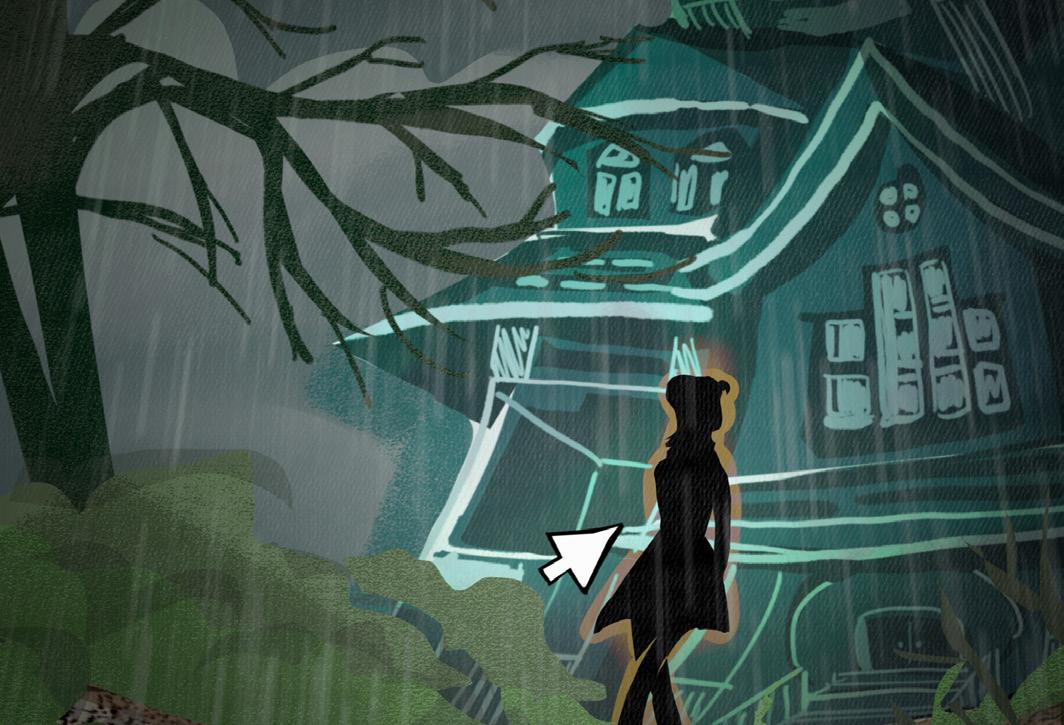
and the constant tension of notknowing keeps me on my toes. Secret of the Old Clock was one of my first introductions to that feeling. Set in a nostalgic, almost dreamlike version of the 1930s, the game feels gentle, even when it’s withholding information. You spend your time delivering telegrams, overhearing conversations, rifling through drawers and slowly realizing that everyone knows more than they’re letting on. The mystery unfolds through small acts of attention: noticing a strange inheritance clause, a timeline that doesn’t quite line up and a creepily lingering smile. There was nothing more rewarding than realizing I was getting closer, creeping towards the answer to a mystery that, to me, nobody else could solve. Just me and Nancy Drew, as if we were an undefeatable mystery-solving team that could
Maheen Rashid/DAILY
outshine Sherlock and Watson themselves.
Ghost Dogs of Moon Lake takes a bit of a darker tone, but it’s still firmly rooted in mystery rather than horror. Yes, there are glowing eyes in the woods surrounding an abandoned cabin with a legend meant to scare people away, but fear is never the point. The ghost dogs are a rumor, a deterrent, a mask for something human underneath. The game understands that the most unsettling things are rarely supernatural.
What I love most about these games is how much they trust the player to take their time, get stuck, wander, reread and rethink without being rushed forward. The game certainly guides you, but the mystery is ultimately solved by your mind alone.
CONTINUED AT



Who killed Bobby Fuller? A forgotten rocker’s final bow
ISABELLA CASAGRANDA Daily Arts Writer
He was found by his mother. In the heat of July 1966, surrounded by the luxurious greenery of Los Angeles, Eva Loraine Fuller’s 23-year-old son, Bobby Fuller, lay motionless in the front seat of the family car in front of his apartment. Other than his maimed face — covered in odd heat spots, completely doused in gasoline (but not burned) — and dried blood stains crusting his shirt, Fuller had no other confirmed major injuries. The car had been there for less than an hour, but Fuller had been dead for over a day. No official cause of death was given, and the police didn’t seem eager to find one. The police chief had died of a heart attack two days prior, and cases like Fuller’s were shelved in the chaos. And just like that, Fuller quietly faded from public memory, and the man who was destined for stardom instead received an unceremonious burial in Hollywood Hills.
Only a few months prior, the El Paso native had scored a Top 10 hit with his group, The Bobby Fuller Four, titled “I Fought The Law.” An upbeat rockabilly tune bathed in tight harmonies that rise over Fuller’s passionate vocals, the song is also carried by the surf guitar that freely glides and bounces around the song like someone zipping around corners in a chase sequence. The drums even mimic bullet fire at one point. In the midst of it all, Fuller details a grim narrative: “I needed money cause / I had none / I fought the law / And the law won!” The song was originally sung by The Crickets, a band led by Buddy Holly, who was Fuller’s biggest musical inspiration.
In Fuller’s interpretation, you can hear the nasally, hiccup-y inflections inspired by Holly, a fellow Texan who was one of rock’s earliest stars. However, The Crickets didn’t write or record this song until after Holly died in a plane crash in his prime.
At 22 years old, Holly’s career was cut short in a field in Iowa
in 1959 — the day the music died — only two years after his first hit. Yet, as Fuller sings his cover, a song born in the embers of Holly’s charred ashes, his vocal optimism is unmistakable. It’s easy as a listener to really believe that he’ll be able to escape the clutches of the law, that one more slick riff will earn him the right to freedom.
Yet just like Holly, Fuller never lived to see his mid-twenties. But, unlike Holly, his death has become a footnote rather than a notable event in music history. Aside from The Clash scoring a hit with the same song in 1979, which functions as the primary way people in the modern day discover his existence, Fuller’s life is usually only indulged by baby boomers of the era or by music nerds that stumble upon his story.
Although, perhaps, it’s more accurate to say that people stumble upon his end, not his career.
CONTINUED AT MICHIGANDAILY.COM


After getting drinks with a friend on Wednesday, I think life just might be beautiful. I’ve been finding the joy in the in-between recently: changing outfits in the middle of the day while I make myself a warm lunch between classes. I’m no longer at the point of exhaustion where finding clothes to wear is an inconsolable, mundane task that takes me down with it. Fashion is fun again
— I’m feeling the opulence everywhere, even in the grass frozen under sheets of ice. I’m feeling the sunshine I’ve created in my greatest fantasy and making it reality one fashion risk at a time. Anyway, that’s my explanation for the weird outfit I wore to class on Thursday. Thank you for your understanding, all. How do I stop feeling overdressed wearing things like dresses or heeled boots and sandals? — A
The key here is “feeling.”
To take on the concept of overdressing, we must first dismantle the social customs that created the term.

Dress codes have always been about making someone else powerful. Even in the 16th century, the late great Queen Elizabeth I reckoned with the consequences of overdressing. She was threatened by the way theatre performers dressed — their costumes acting as an artificial symbol of nobility — leading her to create sumptuary laws dictating who could wear what. As a powerful woman whose throne was constantly at risk, she had to keep the social hierarchy, lest she empower the people who wanted her out. By dressing to avoid going overboard, we fall in line socially. We sheepishly agree to blend in to maintain the status quo. While we are now exempt
from the fingertip-length short rule, I find myself very much still trying to embody the girl who fits easily into the mold — a mold I have to squeeze and hold my breath to fit in to. How do I dress myself so I don’t give off something I’m not? How can I fit myself into an outfit that
Maisie Derlega/DAILY
Cecilia Ledezma/DAILY
ESTLIN SALAH Digital Culture Beat Editor
Maheen Rashid/DAILY
The Mystery B-Side

It’s elementary, my dear Watson! Everybody loves a good mystery. From classic whodunnits to modern thrillers and realworld heists, we can’t help but be intrigued by the unknown. As a kid, I was obsessed with Nancy Drew and Scooby-Doo. I loved how easily I could solve the case alongside the protagonists, following a cookie-crumb trail
of clues straight to an easily unmasked culprit. Now, I binge episodes of “Only Murders in the Building” with my mom, eagerly watching each case unfold. Consumed by curiosity, I can’t help but crave the gratification of watching the puzzle pieces come together to create a full picture. To me, there are few moments in life better than being the first to shout, “I have an accusation to make!” at the end of a game of Clue. While they can range from silly and fun to dark and disturbing, something about a mystery has
always been comforting to me, like a warm cup of tea or sitting in an armchair next to a crackling fire. A good mystery can make time blur. Although it’s easy to establish the initial puzzle, it’s far more difficult to create a satisfying conclusion. Maybe some cases are better left unsolved. In the Mystery B-Side, Daily Arts writers investigate the puzzles that captivate our imaginations. Grab your magnifying glasses and join them in exploring the mysteries within and surrounding art.
‘Twin Peaks’ isn’t a mystery
Few sequences in television have the capacity to draw one in like the “Twin Peaks” pilot episode. The episode is truly a perfect introduction to David Lynch’s (“Mulholland Drive”) masterpiece, demonstrating the eclectic blend of tones that defined his career. It hums along to the rhythm of Angelo Badalamenti’s (“Mulholland Drive”) score, deeply unnerving at one moment and surprisingly light at the next. Most importantly, it establishes the key mystery that drives the rest of the series. From the moment the sheriff’s department pulls the body from the water, the show centers FBI Special Agent Dale Cooper (Kyle MacLachlan, “How I Met Your Mother”) investigating one crucial question: Who killed Laura Palmer (Sheryl Lee, “Dirty Sexy Money”)? The mystery of “Twin Peaks” led to unprecedented success for David Lynch. With record ratings for its time slot, “Twin Peaks”
became a cultural sensation as fans theorized the identity of the killer. However, as the season progressed, it became clear that Lynch had little interest in solving this mystery. Much of “Twin Peaks” Season 1 seemingly meanders with little development of the series’ central mystery. The clues that are revealed are surreal and detached from the mechanics of the plot, such as when Cooper is visited in a dream and told the owls are not what they seem. This leaves viewers with many questions and few answers, along with a general sense of a lack of momentum in solving the mystery. Lynch seemed to be playing with his audience, pushing the whodunnit to the background while he experimented with his own blend of genres that defined the show. The result was declining ratings throughout the second season, with widespread speculations that Lynch was forced into revealing the killer by ABC executives midway through the season at the risk of cancellation. When Laura’s killer was revealed to be her father, Leland (Ray Wise,
“The Young and the Restless”), possessed by an evil spirit, BOB (Frank Silva, “Twin Peaks: Fire Walk With Me”), many fans felt the revelation to be anticlimactic, and the following episodes to be pointless without the fundamental intrigue. It is true that the show’s second season is bizarre, with plot points centering around Civil War figurines and a giant game of chess orchestrated by Windom Earle (Kenneth Welsh, “The Hound of the Baskervilles”), an antagonist with the affectation of a Saturday morning cartoon villain. But the critiques of Leland’s reveal miss a broader point about “Twin Peaks” and Lynch’s project: The mystery never mattered. To say that the mystery doesn’t matter is not to trivialize the character of Laura Palmer or even minimize her presence; in fact, she is omnipresent throughout the series. Lynch shies away from the literalist conventions of the genre: every lead sends Cooper down the wrong path and each suspect is a red herring.
CONTINUED AT MICHIGANDAILY.COM
Investigating the teenage mystery genre
MAEVE MCGINN Daily Arts Writer
When people think of iconic teen TV shows, names like “Gossip Girl,” “Pretty Little Liars” and “Outer Banks” probably come to mind. Besides being targeted toward teenagers, one thing these shows all have in common is that much of their plot lines revolve around a mystery — usually involving a death in a small town. From teenage detective stories like 2004’s “Veronica Mars” to the supernatural crime-solving in 2023’s “School Spirits,” it seems mystery is a genre that doesn’t go out of style. So, what is it about teenage stories that make them so primed for mysteries? Teen media thrives on creating tension and dramatic plotlines that reflect their target audience’s own lived experiences. Even if the average high schooler’s life isn’t as action-packed as the CW Network makes it out to be, the heightened emotions are certainly accurate — thank you, hormones! This need for tension, conflict and drama makes mystery a useful plot device. Many of the typical teenage freak-outs by Spencer Hastings (Troian Bellisario, “Plan B”) or Aria Montgomery (Lucy Hale, “Ragdoll”) in Season 1 of “Pretty Little Liars” would seem trivial if they weren’t underscored by the threat of a violent, anonymous, theoretically dead friend. Sneaking around with your
sister’s boyfriend would only be nominally worrisome if you weren’t being blackmailed by an omnipresent stalker. Beyond underscoring the tension created by teen drama, mystery often serves to propel the plot forward and provide a neat conclusion for the story. In “Riverdale,” Season 1 is driven by the overarching storyline of the mystery of Jason Blossom’s (Trevor Stines, “The Fosters”) murder. His death is a vehicle for many of the subplots and relationships that are created and explored, his killer being the final reveal of the season.
Additionally, because many teen shows are built on their interactions between characters, this relational drama is often the heart of the plot, even if these interpersonal dilemmas can’t sustain 20 or more episodes alone. In “Riverdale,” the willthey-won’t-they relationship of Veronica Lodge (Camila Mendes, “Fairfax”) and Archie Andrews (KJ Apa, “Shortland Street”) would have quickly become trite if the forces behind their hesitancy weren’t tied to their conflict over the events surrounding Jason’s death. There is also something to be said for the distrust of authority that makes teenagers the perfect characters to solve a mystery. The friends in “Outer Banks” are often depicted on their own, with the adults depicted as negligent and classist. High schoolers who already question the status quo and the authority figures around them are perfect for the suspicion and sleuthing
required of an amateur detective. The high school ecosystem that thrives on gossip also serves as a microcosm for the typical small-town community that these shows feature and allows characters to draw conclusions that they may not otherwise make. These features of the teen personality and the circumstances of high school life invite numerous opportunities for the mystery genre. It also can’t be overlooked that, at their core, mysteries are fun. Piecing together clues and analyzing minuscule details provides endless entertainment beyond the regular hallmarks of a teen show — hot characters, friendship drama and messy romances. It gives audiences more salient talking points than if the show only had the run-of-the-mill teenage angst — something that high school viewers probably already experience more than enough of. By including mysteries, showrunners make plotlines appealing to older viewers who could be more enticed to watch a show where the driving motivations behind the drama aren’t simply teenage hormones. Regardless of whether it’s a teenage detective or a mystery plotline, it’s safe to say that, as a general rule, teenagers plus a small town plus a mystery is a recipe for success for audiences of all ages. The shared elements of tension and drama, as well as the teenage inclination for rebellion and gossip, make these teen dramas prime vehicles to tell mystery stories.

‘Severance’ and the art of the mystery box show

“Severance” is considered a mystery box show, a term coined by director J.J. Abrams (“Star Wars: The Force Awakens”),
which is a genre of television characterized by unanswered questions that are designed to keep an audience’s sense of anticipation; think of shows like “Lost,” “Westworld” or even “Stranger Things.” It distinguishes itself from a
traditional mystery, which typically ends in a huge reveal of the culprit. It selectively spaces out its answers and gives the audience just enough while continuing the mystery over the course of several seasons. The definition is in the name:
The show is a Pandora’s box of unanswered questions. They are typical of “high concept” fiction, or shows based on fresh and highly original concepts whose premises grab a viewer’s attention.
“Severance” follows Mark Scout (Adam Scott, “Parks and Recreation”), a man who has had his consciousness permanently severed between his work life and his personal life by his employers at Lumon Industries (called the severance procedure). This means that the version of Mark away from work (called his “outie”) does not remember what he does at work, and likewise, his work-self (called his “innie”) does not remember what happens outside of Lumon, effectively creating two versions of a person. From the beginning, the concept of “Severance” is built for mysteries and positions itself as a new take on the mystery box genre.
At Lumon, innie Mark works in the department called Macrodata Refinement with a colorful cast of characters: Irving (John Turturro, “The
Night Of”), Dylan (Zach Cherry, “Succession”) and Helly (Britt Lower, “Man Seeking Woman”), who was a replacement for Mark’s closest work friend, Petey (Yul Vasquez, “The Outsider”).
After Petey is mysteriously let go at the beginning of the first episode, Mark and Helly begin to question and investigate their work.
Outside of Lumon, Mark is struggling with his grief after losing his beloved wife Gemma (Dichen Lachmann, “The 100”) and, after a surprise encounter with Petey, begins to question the goings-on at Lumon. Already, there are two angles to this central mystery of Lumon: one from the inside and the other on the outside. From this premise, the show delivers fragmented clues to the viewer that are nearly impossible to piece together, forcing fans to make theories, creating that unique sense of anticipation and intrigue.
So what makes a good mystery box show? It’s a series that creates a sense of curiosity and intrigue that keeps a viewer
guessing and theorizing. They have compelling characters, a treasury of secrets and an interesting world designed for speculation. “Severance” checks every box and expands on the genre through its complex characters and fascinating setting. Every character is strongly developed, following their own narrative arcs rife with their own set of mysteries. Beyond the enigmatic setting of Lumon, the world outside the office building equally calls for questions. It’s set in a fictional town called Kier, PE — a corporate town named after Lumon’s founder, Kier Eagan. It’s an off-putting and puzzling place that serves as the perfect backdrop for the secrets that “Severance” keeps. The unique world that the show presents sets it apart from other mystery box shows, seemlessly blending science fiction element with an otherwise grounded universe while never feeling unbelievable or difficult to follow.
CONTINUED AT MICHIGANDAILY.COM

ISABELLE PERRAUT Senior Arts Editor
Cecelia Ledemza/DAILY
WILL COOPER Daily Arts Writer
TAYLOR KOSKI Daily Arts Writer
Maheen Rashid/DAILY
Selena Zou/DAILY

Michigan in Color is The Michigan Daily’s section by and for People of Color.
In this space, we invite our contributors to be vulnerable and authentic about our experiences and the important issues in our world today.
Our work represents our identities in a way that is both unapologetic and creative. We are a community that reclaims our stories on our own terms.

A snapshot of us!
Looking back now, it’s hard to believe that the only way we met was through those chance circumstances one might find in a movie. All that time spent living down the block from one another, going about our lives, not even knowing the other existed. We just complement each other so well! Even if we met at a different moment in time, I still believe that we would recognize the invisible string that tightly wraps us in a warm embrace. Of all the snapshots of our adventures that exist in my memory, one of my favorites to look back on is our walk to the docks. That day became the first stone on the path we’re building inside our neverending story. We have so much to write together!



All the lovers in the night


which, to say the least, had brought me one step closer to becoming a “majnun” myself.
“To whom could I confide my sorrow? Becoming mad with love is a man’s privilege! My despair must remain underground and even my pain must be frugal.” –Layla, from “Majnun and Layla: Songs From Beyond the Grave” by Yann Damezin
Last semester I was enrolled in a class that explored various narratives regarding health and madness across the ancient Middle East. One of our final projects required us to examine the infamous story of Layla and Majnun. While the tale is a fundamental piece of Middle Eastern literature, this project was in many ways a heavily taxing experience. I say this primarily as one of the requirements was to analyze the various mediums that have been used to portray the tale and how they are able to effectively portray the effects of love in relation to madness. This included having to dive through old archives of films, plays and endless forms of texts citing the tale. All of
Growing up in a Middle Eastern household makes me no stranger to this tale. Although Majnun, which is the Arabic word for “insane”, is technically the correct title for the male protagonist of this story, being Iraqi meant growing up hearing my bebe (grandmother) jokingly use the term mkhabal to describe any and everyone she thought of as being remotely mad. Majnun, mkhabal or Qays (his true name) — whatever word you choose to describe him with, there is no doubt that he is viewed as the embodiment of what a lover is in the Middle East, due to his endless devotion to Layla. Yet who truly are these two iconic characters? Over the work of a semester, I have come to realize the weight their roles hold in a broader sense. While beloved as a tale, when dissected, the story of Layla and Majnun is able to reflect to us many deep structural issues regarding gender found within our societies and how they are able to quietly and continuously harm those most impacted. –
The tale begins with Qays and Layla meeting and falling in love as young children. This love grows into a deep devotion that leads the two of them to craft a plan: Qays will ask Layla’s father for her hand in marriage. In a burst of emotion, he publicly expresses his fierce love for Layla, earning him the disapproval and judgment of many. Layla’s father, unsympathetic to their affections, refuses. “How can I hand over my daughter to a madman?” The news is not taken well by either, and Qays’ obsessive love for Layla leads him to stray from his tribe and wander into the depths of the desert. Day after day, he spends his time writing poetry among animals and mourning his separation from Layla. Qays succumbs so deeply to his emotions that he allows them to take over his entire being, thus leading him to hold the title of Majnun — the mad one. But, while Qays is in the desert, where is Layla?
CONTINUED AT MICHIGANDAILY.COM
Marathi, as an act of service
A friend once told me that she could tell I “grew up with a lot of love.” She said it on one of those frigid Michigan winter nights, where icicles adorned the bare oak trees. I don’t remember whether we were huddling outside of a cozy boba shop or strolling through downtown, but I do remember snow swirling around us like glitter dust. I don’t remember what I said or did to prompt her response. Maybe I smiled wide enough to show all 32 of my pearly whites or shared how exorbitantly happy I was to spend time with my extended family over Christmas break.
What I do remember, though, is being at a loss for words before nodding and laughing about it with a quick “thanks.”
When I think of love, I think of the five love languages and how I’ve heard about them so overwhelmingly through pop culture. As I currently run a quick Google search on them, I find that they were first introduced by a man named Gary Chapman, who argues that understanding someone’s primary love language and learning to “speak it” is key to building a stronger relationship.
Upon reading Chapman’s book’s synopsis, I find many other things: a “5 Love Languages® Quiz” (yes, these are trademarked), a Reddit post of dozens of differing opinions about the concept, other explanatory websites and short reel videos of millennials sharing unsolicited advice on how to “strengthen your relationships.” Out of these options, I lean into the first and take the whopping 30-question quiz, receiving (you guessed it) Acts of Service™ as my love language.
While I still can’t quite figure out whether your love language describes what you receive from or give to other people, I am not surprised by my result. I don’t always find the time to consistently see the people I love, ruling out quality time. I can sing praises but still feel empty, taking words of affirmation out of the equation. I would really rather not burden someone with the task of finding me a gift (or do so myself), so definitely not


receiving gifts. As for physical touch, I just cannot do hugs … maybe a side hug?
However, acts of service have always seemingly come natural to me. If you were to ask me to edit your graduate school essays, wait no more than 5 minutes, and you’ll see my Ross School of Business headshot icon pop up on your Google Doc, typing up feedback. If you were to ask me to grab $8 boba with you, even in these trying times, even when both of our wallets are nearly empty, I would say “yes” in a heartbeat. And if you were a student in the dreaded chemistry study group job I have, I would complain and groan and trudge in annoyance through unpaved snow for 20 minutes to your group classroom, but I would still explain problems with a smile and feel my heart swell when you understand the concept. Granted, I do love writing and boba (and chemistry, sometimes). But, the point of all of this is that I, Arya, am a lover of acts of service. Even when I leave college to go home to my family, I still feel myself leaning into this particular love language, despite being a perhaps quieter
and more real version of myself.
As my paternal grandparents have recently moved to the United States, alternating spending time between mine and my aunt’s home, I’ve found myself intertwined with perhaps my deepest act of service yet: relearning Marathi.
Marathi was the language of my parents’ childhoods in India. Whether it was report cards or reprimands, or lullabies and festivals, it was predominant in their lives, later culminating in their attempts to teach their children. There was a time, perhaps under one score ago, when Marathi was the language I mainly spoke in as well. With the advent of things like preschool and not being able to fully tell the teachers in our suburban Michigan town when I was hungry, my mom made the decision to switch the language spoken in our household, letting English take the reins. It was no surprise that speaking English essentially all the time led to my loosened grasp on Marathi.
The phrase I usually default to nowadays, whether I’m meeting new Marathi folks at community gatherings or family abroad in
India, is “mal
(I understand, but I don’t speak). The truth is, I understand far more than I can comfortably say. I usually freeze and tangle my words as I mess up tenses and pronouns when put on the spot. Still, I think I’ve tried my best. There was a time when I thought Marathi, as a language, was limited. While it dates back centuries upon centuries ago and ranks 16th among the most spoken languages in the world, it somehow felt smaller to me than English. Even simple pleasantries — “thank you,” “sorry,” “good luck” — slipped out in English, and anything tied to school or Western life lived more naturally in that vocabulary. I found myself weaving English words into my Marathi, especially for anything beyond the most basic conversation. Perhaps it was less a flaw of the language and more a reflection of how much of it I had let drift away. But, words were never really foremost in how we expressed ourselves, be it in my family or Indian culture more broadly.
ZAINAB HUSEIN MiC Columnist
Zainab Husein/MiC
ARYA KAMAT MiC Senior Editor
Arya Kamat/MiC
EMILY DOBAO - MiC Graphic Artist
Emily Dobao/MiC
My love letter to love


“If you look for it, I’ve got a sneaky feeling you’ll find that love, actually, is all around.”
(“Love Actually,” 2003)
One of my favorite feelings in the world is pretending to be disgusted whenever my parents do something romantic in front of me. I love the glances I share with my older sister, the groans of aversion from younger siblings, the laughs as my parents go in for a second or third kiss. These are the moments I tuck away into my mind as my hopes for the future. If nothing else, I want to be so in love my future kids can feel it in my home. For as long as I can remember, I’ve considered myself a hopeless romantic. As my passions have shifted from computer science to law, and I’ve gone through various phases of my life, one of the only things that has stayed intact is my love for love. I am enamored by the concept of two people choosing each other completely and fully, and I will admit that I contemplate the concept of soulmates a little more often than I should. I often find myself in such an endless loop of searching for love and romanticizing the very idea of it through the people around me and the fiction I consume; I don’t know whether it’s possible to separate the hopeless part from the romantic. Sometimes, I am content with simply holding love in my heart, distributing
it to my family and friends or appreciating the very idea of romance. Other times, I feel as though surely, if I have such capacity for love, then it must be somewhere in my future.
As I’ve grown older, I’ve found myself sitting with the question of why I yearn for romance more seriously. Like many other hopeless romantics, I worry that I am placing too many expectations on the idea of a perfect person that probably doesn’t even exist. Is my desire for romantic love indicative of the fact that I don’t have enough of it for myself? The supposed gap between selflove and romantic love is often debated. While I certainly don’t have it all figured out, I think that rather than seeing my own romanticism as a negative trait, I prefer looking at love as another beautiful part of this world –like the moon and the stars –that I appreciate and admire.
Inevitably, the books I’ve read and the movies I’ve watched over the years have warped my idea of a happily ever after. I want to be swept off my feet. I want the fairy-tale kind of love, the sparkling, romantic kind. I want to find my other half. Love stories like Rapunzel and Eugene’s live forever rent-free in my mind, and I can’t help but wish for something similar for myself. It isn’t just fiction, either. From the couples I pass walking around State Street, to my parents at home, to my recently engaged uncle, I see love everywhere. And, as much as I tell myself that whatever I see on the outside is only a fraction of what it really means

Let’s talk about you and me …

to be in a relationship, I can’t shake the part of me that takes it at face value. Snapshots of romance fill my head like pins in a Pinterest board. I imagine myself three, five, 10 years down the line, happily married to the love of my life. I imagine that whoever he is, he’ll put up with all my late-night rants and the never-ending amount of time it takes me to pick a meal in a restaurant. He’ll read the books I recommend him and write me notes in the margins about which lines made him think of me. He will be there in the morning when I wake up, and when I come home at the end of the day. The love I dream of, though emotionally complex, is really simple in the grand scheme of things. If anything, I’m glad that with all the hatred in the world, I have somehow still held onto hope for true love.
For practically every Muslim wedding or engagement, the same Quranic verse is inscribed on the invitation: “And we created you in pairs” (78:8). Perhaps, above all, it is this verse that keeps me from giving up my hopeless romantic dreams. I am confident that the Creator who crafted a world with so much beauty, precision and love has made enough for me, too. I don’t know if I am just young and naive, or if all those Disney movies have truly shifted my brain chemistry. I do know, though, that, for at least as long as I catch my parents casually holding hands in the car, I will continue to believe in love, wearing my “Hopeless Romantic” title like a badge of honor.

“For safe keeping.”
The boy tells her he trusts her with his secrets. He sends voice memos in low whispers, and she has saved them all. Sometimes, she thinks to go back to listen to this voice that was kind enough to lie, before it had abandoned her.
For safe keeping.
Pointedly, she has never — and she does not.
bent over.” crass. “I’d love to get to know you.” terribly benign. Am I interested? no. Why? i don’t think I could tell you in full. Maybe I don’t like the small talk, the cadence of the voice, these new voices. The oppressive attention of a man who does not and cannot know me. Indifferent at worst, disgusted at best.
Do you remember me? Do you think of my voice and yearn? Am I a part of you just as you remain a part of me, infused in the matter of my brain?
If I am healed, why do I yearn for a man I know does not exist?


Before I turned 18, I’d never liked a boy. It wasn’t that I didn’t yearn for what was intangible to be tangible, or think of candied kisses and high school romance; I was simply — I suppose — indifferent. Three weeks ago, I turned 21, and I guess there is still something to be said about this boy I met at 18. Mostly that, under rib and gristle, my heart still aches something deep and sporadic.
More intimate than any gentle apology he has given me is this act of remembering. Perhaps it is in my thoughts, where he still lives, that he keeps what he took.
I am 21. I haven’t liked another boy since.
I frequent Hinge sometimes. Window shopping.
“You have to start somewhere,” they say. I speak with men who want to be in my bed, “pretty, sexy, beautiful.” boring. “I want to see you
There may be intense eroticism in longing, the wish to be inside one’s skin and consume one’s heart and soul. To know they could take yours, have taken yours, could keep yours. What he has taken from me, whatever it was, wherever it was, I think I’d like it back.
Do I yearn for those words from that mouth: “pretty, beautiful,” “smart, well-read.” Do I yearn for a time where I felt special, where he made me feel special? Perhaps I wish for what all girls do — to be known. eat your heart out, the girl tells the boy. eat mine.
Hungry Ghost Festival
BY SARA WONG - MiC Columnist
Here’s what happened when you died again, Ngin-
Your son picked up a cigarette and I picked up a pen.
pear trees in your yard have withered while the rest of us remain. Your daughter put your husband in a retirement home.
My sisters admonish her each passing day, But hey, did you know we’re sisters again?
We lay ceramic dises and metal trays along your grave
Each year with all of your favorites — roast pork, glass noodles, money.
We keep burning money. My philosophy professor burns incense and I’m brought back to your grave, to those fake paper bills we ignite for you.

I hope you are spending it well in some afterlife, hosting The most lavish of parties, donning every dress you never got to wear. Some confessions, Ngin-Ngin: I have so much time. I picked up a pen because my tongue never worked properly while you were here, and I regret it every day. I am selfishly still living, selfishly still skipping meals and selfishly resting knowing you, or Mama, or Baba, can’t even read the words I pore over. I will keep rewriting myself into existence, and you will never even meet me.
AMANY SAYED MiC Assistant Editor
Amany Sayed/MiC & Alisha Razi/MiC
BY ALLANA SMITH - MiC Assistant Editor
Selena Zou/MiC
Perrault
Hunter Ryerson
Audra Woehle
Jack Verrill
Zhane Yamin
Sarah Zhang
The U-M data center meeting in Ypsilanti was never about community input
The Ann Arbor Marriott
Ypsilanti at Eagle Crest hosted the University of Michigan’s long promised community meeting on Jan. 29. One other community meeting was held for the Ann Arbor community in September, but the Ypsilanti Township Council and local residents insisted it wasn’t enough. For 9 months, there were calls for a meeting to put fears to rest in Ypsilanti Township. The University finally provided one, but it didn’t go the way many attendees hoped it would. The University’s proposed data center in Ypsilanti Township has been controversial because U-M officials have consistently
provided few details and have left township representatives out of the process. In partnership with LANL, the development is meant to provide high-functioning research capacity for the University. Currently, project leaders are deciding between two potential sites for the project: a property on Bridge Road and Textile Road and one at the American Center for Mobility. They will not pay taxes on the property — which one Ypsilanti resident and accountant had calculated would amount to tens of millions of dollars for the township. They also will not be subject to standard zoning laws since this development will be built by a public university. Perhaps, at this stage of the project, hoping for transparency from the University is foolish, considering they have failed
to address concerns from both Ypsilanti residents and the local government from the beginning. There has been a consistent pattern of disrespect: delaying holding a community meeting in Ypsilanti until 11 months after the project announcement, bypassing local government and refusing to divulge important details about the nature of their partnership with LANL.
At the meeting, a series of posters lined the walls, displaying information from the University, Los Alamos National Lab and DTE Energy. Chris Kolb, the University’s vice president for government relations, and data center project lead Steve Ceccio stood by posters closest to the entrance, reciting rehearsed answers to questions from residents.
CONTINUED AT MICHIGANDAILY.COM


From The Daily: To avoid a GEO strike, end shuttle bargaining
Current negotiations between the Graduate Employees’ Organization and the University of Michigan appear to be headed toward a standstill. GEO is the University’s graduate student worker union and is the primary organization responsible for collective bargaining with the University. The union consists of graduate student instructors and graduate student staff assistants. Their contract covers all things related to their employment, including but not limited to wages, hours and benefits. In 2020 and 2023, stalemates in the negotiation process led to campus-wide strikes for graduate student employees.
And both times, these strikes were bad for the campus community. This Editorial Board believes that if the University wants to avoid a strike this year, it needs to simplify the negotiation process so that campus doesn’t pay the price.
Current undergraduate seniors might remember the whirlwind of campus unrest that occurred during the previous set of GEO negotiations with the University in 2023. During this time, one of the primary demands made by the organization was to increase the graduate employee compensation by 8% to about $38,000. After months of unproductive negotiations with the University, GEO began a strike on March 27, 2023 that lasted nearly six months.
For the graduate students, the strike was a partial success. The University granted them several concessions, including better compensation and expanded employee benefits.
However, the strike wasn’t an ideal situation for most
and backlash was widespread.
During the strike, the University wanted to release grades by the end of the winter semester in classes where GSIs were striking, but GEO accused them of falsifying students’ grades. For this reason, they went under review by the Higher Learning Commission, causing such heavy financial damages that they attempted to sue GEO for compensation.
Graduate student pay was withheld for months while undergraduate grading was left up in the air, while many final grades were delayed well into the summer.
Everyone, therefore, has a vested interest in preventing a strike. The only way to do that is for the University and GEO to engage in good faith negotiations. Right now, that’s not happening. So far, the University has been very unenthusiastic in its participation in the GEO negotiations. Its chosen format is problematic — in place of face-to-face negotiations, the University has insisted upon “shuttle bargaining.” Under this arrangement, University and GEO representatives negotiate from separate rooms. The process is facilitated through a state-appointed mediator, who travels between rooms transmitting messages — it’s something like a far less
exciting version of the game “Telephone.”
GEO claims the University wants to impede the contract talks by using this disjointed form of negotiation. Given the needlessly complicated nature of shuttle bargaining, this claim is likely accurate. Since shuttle bargaining has proven fruitless, both parties must agree to face-toface negotiations. Traditional bargaining isn’t a concession — it is a requirement for honest dialogue and a necessary first gesture in a negotiation process. A good-faith bargaining process isn’t just good for optics: it’s good for students. Should the current negotiations devolve into a strike, the University’s undergraduate population would suffer. Without GSIs, professors cannot conduct class, host discussion sections or input grades. During the previous strike, academic life on campus all but shut down. Although the idea of canceled exams or classwork may seem exciting to some readers, we must remember that even if classes stop, tuition payments do not. Students devote hardearned time and money to attend this university and the administration should reciprocate their efforts by committing to a process that is not only productive, but puts student needs first.

How many more scandals until the University does something about it?
Scandals happen at universities. In early 2024, for example, Claudine Gay resigned from her position as president of Harvard University after multiple serious allegations of plagiarism and a weak congressional testimony. The admissions offices at Yale University and the University of Southern California were once ensnared by several instances of bribery. And in 2022, Columbia University shared outdated and misleading information to inflate its ranking on U.S. News & World Report’s annual list of the top colleges in the United States.
However, if a university lands under national scrutiny every year, that should prompt some serious reflection — and serious action. That’s where the University of Michigan finds itself now, and it’s going to take more than tepid apologies to prevent further damage to its reputation.
On Feb. 8, The Michigan Daily reported on the working conditions at the University of Michigan’s child care facilities. Many workers have consistently reported inadequate wages and a concerning quality of life during their time working for the University. University Staff United, a union that represents non-supervisory staff, is calling for better working conditions for early childhood educators. We called for
Because scandal is a widely subjective term, it’s helpful to define it. For the purposes of this column, scandals aren’t just bad or unpopular decisions by the University (of which there are many). Instead, they are insulated instances of national scrutiny that forced the administration to apologize or walk back some of its decisions. This means that there was agreement both in the administration and beyond campus that what took place was wrong — something reserved for truly notable instances of misconduct. Given that definition, over the past four years, there have been at least four major scandals at the University. In 2022, the University’s Board of Regents fired former President Mark Schlissel after emails revealed his intimate relationship with a subordinate. After that, the New York Times magazine wrote a groundshaking investigation into the inefficacy of U-M diversity, equity and inclusion programs.
CONTINUED AT MICHIGANDAILY.COM

Alyssa Mulligan/DAILY
THE MICHIGAN DAILY EDITORIAL BOARD
ELENA NICHOLSON Editorial Page Editor
ZHANE YAMIN Opinion Columnist

Monarch butterfly reinvention
many questions/ That is my one suggestion. …” I had originally put on the Grammy Awards this past Feb. 1 for mindless background noise and to stomp out any independent thought that could’ve formed if the room were quiet. It was an escapade from the silence, something not too avoidant from attention and just
loud enough to keep my mind from wandering inward. “You know I keep it real/ I live for the appeal.” Unlike the endless distraction of the Instagram Reels I had just been scrolling through, the performance on the TV peculiarly held my attention. The glittery entourage illuminated my shoebox apartment as the synths began to drum in a slightly ominous manner. I was completely absorbed in what was unfolding before my very eyes.
“It never was enough/ I always wanted more.” The strangest part of it all is that somewhere between the synths and the display, I found myself completely enamored with Addison Rae singing her song, “Fame is a Gun.” And let’s be clear: If you had told me a few years ago that I would be listening to Rae sing at the Grammys, or that she was nominated for the Best New Artist category, I definitely would’ve thought it was satire. For a little bit of context, Addison Rae is known for her TikTok beginnings, where she amassed 70 million followers in the span of a year from 2020 to 2021 and gained a cult-like following of teenage girls for her involvement with the Hype House. CONTINUED AT MICHIGANDAILY.COM

Talking to strangers about their music memories
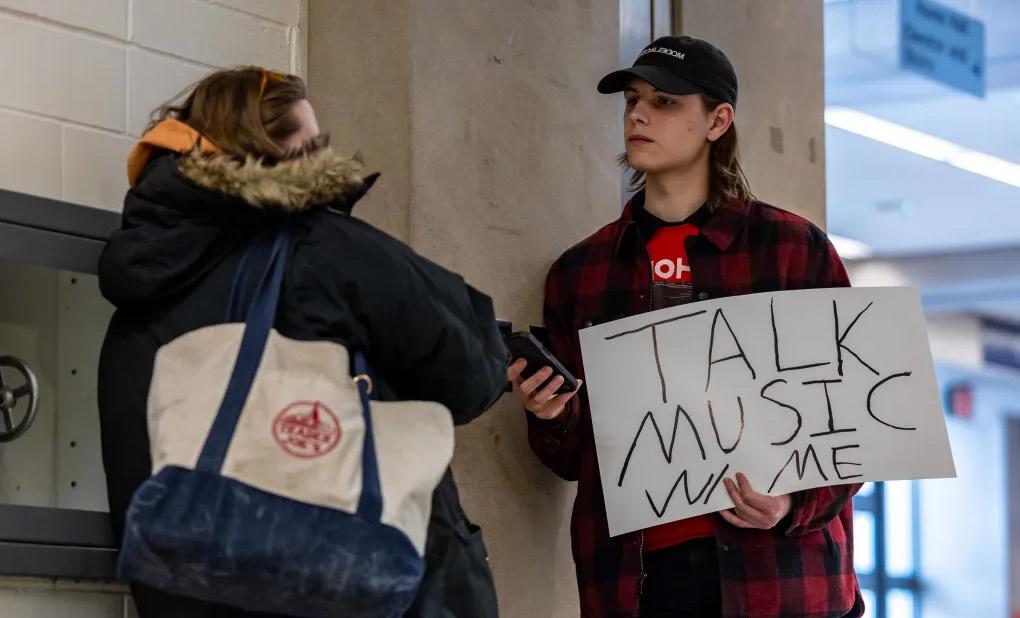
one of the first questions I ask when I meet someone.
The first musical instruments, carved from bone, date back tens of thousands of years. Long before we invented writing, we invented the means by which to express ourselves through song, and every known culture has done so. Music, then, is fundamental to human existence.
You probably didn’t need me to tell you that because, well, you’re human. Music shapes all of our lives, provides powerful experiences and leaves indelible memories. Through music, we celebrate, love, worship, mourn and remember with laughter, tears or both. It binds us together as one of the few things we all have in common, and learning someone’s music taste is one of the best ways to get to know and understand them. That’s why it’s

Small talk stuff has its place, but the subject of music opens up a rich vein of genuine emotion and allows for real connection.
Everyone has a song that they love, a song that comforts them when sad or strengthens a joyful mood, a song that makes them think of a certain person or brings back a happy memory.
Getting to hear people talk about the songs that matter to them and why is a precious experience.
It is a reminder of the depth and complexity behind every pair of eyes you pass in the hallway or meet across a shop counter.
So, this article is kind of an excuse for me to seek out that precious experience and talk to a bunch of strangers about music.
But it’s also an opportunity for me to share that experience with you, because I am a generous person. And it just so happens
to be a chance for me to yap about everything I love about music. Mainly, though, it’s the generosity. A ritual of humiliation: That’s what it felt like to stand in a public place with a sign begging passersby to talk to me. Said public place was the ground floor of Mason Hall, at the very corner of

NOLAN SARGENT Statement Correspondent
Zayd Ahmad/DAILY
LSA junior Nolan Sargent stands and talks with students about music in Mason Hall Thursday afternoon.
When I was younger, I absolutely dreaded the inevitable question grown-ups loved to ask: “What do you want to be when you are older?”
At 6 years old, I just wanted to build infinite Lego sets, dig up rocks in my backyard and someday immerse myself in a future occupation that made me as happy as I was at the moment.
While my peers dreamed boldly of becoming astronauts, pilots and other larger-than-life careers, I hesitated. The realist in me couldn’t commit to a dream that felt so distant, and the idea of choosing one job felt impossibly permanent. At 6 years old, committing to a single occupation felt frightening, as if saying it out loud might lock me into a future I wasn’t ready to choose.
Instead, I tried to reverseengineer the “perfect” career that would encompass all my interests. I wanted something that would challenge me every day and fulfill my creative side, but also allow me to support a family if I chose to have one, all while still maintaining the elusive work-life balance I had heard the grownups emphasize as important. I began to wonder whether such a career even existed at all, and that uncertainty was only deepened by hesitation about choosing a single path.
With this conflict in my head, the only answer that would come out when asked this question was:
“I don’t know.”
That answer, however, never seemed to satisfy the adults asking the question. Growing up in a South Asian culture, it was very typical for the elders to have high expectations for children from a young age. I felt like I had to choose something in business, engineering, health care or law, as those were seemingly the

The power of ‘I don’t know’

only socially acceptable fields in South Asian culture. They wanted something concrete to nod approvingly at; something they could use to quietly measure my potential.
So eventually, I learned to play along. I learned that “I don’t know yet” sounded like failure. That curiosity needed to be condensed into something impressive. That dreams were better received when they fit cleanly into a sentence. So, why didn’t I just give the gossiping grown-ups an answer to keep them happy and continue my search for the “right” career?
Because changing your mind, I learned, came with consequences. It showed that I wasn’t certain about my future or wasn’t serious enough to commit to one pathway. It was almost as damning as saying
“I don’t know” in the first place. Therefore, I was afraid to give an answer and change my mind later, as I was worried it would make me look too indecisive. More than that, I was afraid to attach myself to a field I felt no connection to. Even though I didn’t have to pursue the career I named at the moment, filling in the blank of “I want to be a _____” felt permanent. It was as if saying it out loud would bind me to that future.
Somewhere between elementary school career days and college application essays, the innocent question became loaded. “What do you want to be?” transformed into “How will you effectively contribute to society in the future?” This burden to answer these questions further added to my indecisiveness.
Growing up in an academically high-achieving environment only heightened that pressure. Many of my classmates were children of immigrants, which meant academic success was expected and seen as the only way to success. Conversations about grades, internships and grade point averages dominated every day at school, and it felt like you couldn’t get through a single class without someone asking you about one or the other. After a while, it became so tiring.
My friends always seemed definite about the career they wanted to pursue. They all knew from a young age that they wanted to be engineers, doctors, lawyers and financiers. They spoke with confidence about paths they had chosen long
before they understood what those careers actually demanded. Caught between my phobia of commitment and my desire to find the perfect career for myself, like my peers seemingly had, I stayed silent. And in that silence, I began to realize how early we are taught that uncertainty is something to hide. Instead of exploring uncertainty, we are taught to sit behind masks of confident answers. We’re taught it when adults laugh gently at “I don’t know what I want to be in the future” and immediately suggest an answer for us, as if uncertainty needs correcting. We learn it when applying to college, where, in order to submit an application for a school, you have to pick from a drop-down menu in the Common App of majors you want
I am the left-wing Joe Rogan
I’ll admit it: I am a biased individual. I am a progressive person, and, as such, do not like the Republican Party. However, I am not going to rehash my distaste for them, or even write another polemic against a certain political party for putting forth a presidential candidate that lost to a 79-year-old who was a very close associate of Jeffrey Epstein. Not because I don’t want to do any of that, but because it has been over a year. Surely there are new and exciting developments within the political world that I can discuss.
Unfortunately, there mostly aren’t. In his first year, President Donald Trump cut taxes for the rich, nearly started a war with Iran and eventually had everyone hoping for his death. I wasn’t, and still am not, a genius, but this didn’t really sound like a recipe for success for Trump at the time. Of course, I was right, and his approval rating tanked. Yet, I assumed he would be unpopular precisely for the policies he campaigned on. But how he campaigned was more important. And right now, there is no campaign. Again, I am not a genius, so I am not going to hazard a guess, but it seems like Trump just might lose his congressional majority in about nine months.
The Democratic Party fundamentally doesn’t know how to deal with Trump. Without a unified media opposition against Trump, like during his first term, top liberal consultants advised the Democratic Party to play dead and let Trump cultivate his own distaste. I’m not particularly qualified to make this call, but I knew this wasn’t actually daring. Trump — and those in his administration — are morons. I knew they were going to fail. Everyone knows they are going to fail. Why wait to let him?
One facet of why Trump did not have a similar problem leading up to the 2024 presidential election, despite being old and disgraced, was his utilization of sympathetic
podcast hosts. Essentially, he utilized sympathetic podcast hosts, who are somehow dumber than him, to amplify his campaign. In particular, his appearance on the “Joe Rogan Experience” drew attention not only because of Rogan’s popularity, but also because of Democratic nominee Kamala Harris’s inability to do the same. To the Democratic Party’s credit, they have been trying to remedy this problem. They have just been doing it very poorly. Their efforts included outright paying those they believed to be high-powered and dynamic influencers, like Olivia Julianna. Julianna grew in fame by posting political content on TikTok, growing her outreach to other social media platforms soon after. She used her platform to become an activist to do some legitimately impressive and, in my opinion, good work. However, she really grew in fame after speaking at the 2024 Democratic National Convention, where she encouraged young voters to vote for Kamala Harris. She subsequently got paid $8,000 a month by the Democratic Party and started dedicating her platform to promoting establishment Democratic ideology as opposed to continuing to be an activist. She now runs a Substack in an attempt to further ingratiate herself within an independent punditry class despite her financial incentives to be biased.
The irony here is that the Democratic Party is already strapped for cash. So, they lost to Donald Trump twice, and are going broke to pay a 22-yearold influencer $8,000 a year to solve their image issues?
Money aside, I would not be doing this strategy anyway. First and foremost, Julianna is not dynamic or high-powered. She doesn’t have that many followers on YouTube, where her content mirrors Rogan’s the most. When she does attain attention, it is mostly in response to rightwing commentators, making fun of her. I don’t think she should take verbal abuse, but she is not pushing any discourse or adding anything new to any
conversation. I would not even hazard a guess this time; most people don’t know who she is, and she hasn’t attained any new attention since the Democratic National Committee began paying. She was never going to be Rogan, whether when she was an activist or when she was a shill, because that isn’t Rogan’s appeal. He cannot be manufactured in the way that the Democratic Party tried to do with Julianna.
More broadly, the biggest dichotomy between Rogan and Julianna is who they appeal to currently: Julianna communicates through Substack, an independent platform for users to create their own blogs. It’s niche in terms of overall user base, but attracts both highly engaged people and highly powerful people, making it a larger forum for those who want to drive the discourse of the elites. Rogan hosts his own hours-long podcasts, which are often unedited, and posts them to multiple platforms to maximize his reach. He has too many followers to be decidedly political, whereas Julianna’s politics drive her content. One appeals to an America filled with elite operators, and the other appeals to another America filled with people who can genuinely listen to three hours of the Joe Rogan Experience in one sitting. In some ways, this represents the current state of each political party: The Democratic Party represented increasingly by college-educated Americans, and Republicans by the less educated. There was already quite the gap between each party, but that gap may grow even larger.
But, even before considering all of that, Julianna already agreed with the Democratic Party to begin with! Why would they need to pay her? Because if they don’t, she might say something actually interesting and worth somebody’s time. However, it might make the Democratic Party uncomfortable. So, the money goes to Julianna. She gets to be generationally wealthy and I don’t, even though I am willing and able to do a better job promoting the Democratic Party for free.
to pursue and commit yourself to for the next four years. I now understand that my fear of committing wasn’t really about choosing a career. Rather, my fear stemmed from the idea that one answer would define me and fix my identity before I had a chance to grow into it. As someone who thrived on exploring new paths, saying “I don’t know” was my safeguard to attempt to leave room for growth and become someone I hadn’t met yet. What do you want for dinner tonight? “I don’t know.” What classes do you want to take next semester? “I don’t know.” What ice cream flavor do you want? “I don’t freaking know! Let me try them all.” Now, while I may sound like a super indecisive person (which I can be in certain situations where there is no right answer), I’ve come to appreciate the value in it. Hiding behind these three words allowed me to try a little bit of everything and explore new options I wouldn’t have considered before. I’ve learned this through the many interests I’ve developed over my life, all of which grew from initially not knowing what I wanted to do. Each one has taught me something different about myself. Somewhere between all of my “I don’t knows” and trying new things, I found a love for different hobbies. I realized that I am an awful singer but can play the viola, which I played in orchestra for seven years. I found that I can’t do contact sports, but I love to swim, and so I swam competitively for 10 years and then taught swimming for another two. Through experimenting with different writing styles, I gained a genuine knack for writing, which I now use to write research articles, short stories and for my school newspaper.
CONTINUED AT MICHIGANDAILY.COM

As with most things Democratic Party-related, there is a fundamental misunderstanding of everything. Rogan is popular because he is able to draw an audience independent of politics. Thus, when politics enter the picture, people trust his voice. Nobody is going to pay attention when the people you’re employing to captivate attention are already political. There is also a certain aspect of personal responsibility in all of this. I understand that the job market is not great for my fellow members of Generation Z, but Julianna is plainly ambitious, and she got her job in part because she is willing to tell the Democratic Party what they want to hear, as well as what they already know. In doing so, she has relieved them of having to change themselves in any way. If Julianna were truly independent, she could have used her newfound punditry position to push for reform within the party. But if Julianna is depriving herself of independence, then she is depriving herself of ever attaining any impact beyond what the Democratic Party can manufacture for her.
Of course, there is another wrinkle in the American mind that will foil the Democratic Party’s brilliant plan, beyond
their own incompetence: Nobody agrees on anything anymore in America. There is no consensus reality driven by the media. There is, unfortunately, no Walter Cronkite. There is no more singular voice or source that people can trust and tune into nightly. When people abandon that shared reality for Fox News, then you have two separate Americas in two separate realities. Everyone knows this. I have heard it repeatedly. Yet, the Democratic Party insisted on paying stooges who were already doing their dirty work anyway. The result, of course, is predictable. These influencers end up sounding inauthentic and not becoming the left-wing Joe Rogan. My concern is, of course, that I am a progressive individual, and the Democratic Party is obviously playing a losing game. But more than that, I worry about my country. How much longer can we have two Americas?
U.S. Immigration and Customs Enforcement is essentially Trump’s private army. Sure, twothirds of people think he has gone too far, but that means that one-third of people don’t. That’s about 100 million people.
I do not see how such a situation is tenable for America
in the long term. In the short term, I am not sure I want to stick around to find out. In both terms, I feel powerless to do anything about it. Of course, I also feel anger. It’s not healthy to have one of our two major political parties chasing various political influencers to solve their image issue. Politics isn’t about image. No matter how hard they try, the Democratic Party cannot make themselves reverse engineer their appeal. They’re lame right now, and everyone knows it. They need to fix themselves before other issues can be solved. I am not sure how to rectify these issues. I don’t know how you bridge the gap between our two Americas. It is frustrating and confusing and disappointing all at the same time. Yet, I have found the answer to my personal anger and confusion, the Democratic Party’s problem and my own impending job hunt: me. That’s right. I am offering myself to the Democratic Party. I know what real Americans want to hear. I know how to fix the Democratic Party. I am the left-wing Joe Rogan. I will even offer a discount: For $7,000 a month, wired directly into my bank account from the Democratic National Committee, I will make Democrats great again.
Matthew Prock/DAILY
Gabby Spagnuolo/DAILY
GABE EFROS Statement Columnist
So far this season, the No. 7 Michigan women’s basketball team has lost just four games.
Three of those losses were in topfive matchups — against then-No. 1 UConn, then-No. 5 Vanderbilt and then-No. 2 UCLA — where the Wolverines lost by just three points in every game. Each of the three games followed the same trend, Michigan fell behind in the middle of the game and had to play catch up at the end. Against the Huskies, the Wolverines scored just five first-quarter points. Against the Commodores, they were down by 15 at the half. And against the
WOMEN’S BASKETBALL
SportsMonday: Michigan’s youth can’t be an excuse, because it can compete for titles now
Bruins, Michigan lost the second and third quarters by a combined 13 points. Yet the Wolverines’ ability to claw their way back and still have each come down to the final possession proves two things true at once: They’re still growing because of their youth, but that’s not an excuse to lose because they’re ready to compete for banners now.
Michigan’s inexperience may have been the reason it struggled to compete for a full 40 minutes against its top-five opponents, but going 4-0 in all other ranked matchups proves the talent and potential are still there for both this year’s team and for seasons to come. With the Wolverines completing the season sweep over No. 13 Michigan State in
a dominant win at home after pulling off an overtime win just two weeks prior in East Lansing, it’s proven yet again that Michigan can compete against top teams.
“If I was reflecting at the end of last year or in the preseason, and someone had said, ‘You’re a No. 7 team in the country and (you’ve lost to three top-five teams) by a combined nine points,’ I probably would have said, ‘Okay, we’re headed in a good direction, and we might be ahead of schedule a little bit,’ ” Wolverines coach Kim Barnes Arico said.
Despite being “ahead of schedule,” the fact is those games are a testament that Michigan is competing tightly with top teams in the country and taking down teams of its caliber. As it continues
After slow start, No. 7 Michigan strings together several runs en route to 85-66 victory over No. 13 Michigan State
Spartans clicked early, drilling seven of their first 10 shots en route to a 21-15 lead after one quarter.
fueled by six points from Swords, creating more breathing room.
to grow, the mindset and emphasis shouldn’t be about its youth or how it will be ready in the future, because it’s ready now.
The consistent rotation for the Wolverines includes only one senior in guard Brooke Quarles Daniels while the rest is made up of five sophomores, two juniors and a freshman. Quarles Daniels is the only major contributor who is guaranteed to depart following this season. With a trio of starting sophomore guards — Mila Holloway, Syla Swords and Oliva Olson — who have all won various Big Ten accolades and received national nominations, the core of Michigan’s contributions is intact for years to come.
But why look past this season or dwell on their youth when the
Wolverines are a top-10 team with tight losses to other teams at the top of the country and four ranked wins to boot?
“They don’t want to hear that they’re young,” Barnes Arico said.
“They don’t want to hear that they’re sophomores. They want to win, and they want to win for Michigan, and they want to leave a legacy.”
The transfer portal is the only major factor that could dictate Michigan’s roster construction negatively for the future. Despite the evolving landscape with the portal and NIL, Barnes Arico has stayed committed to the development of players from high school recruitment to graduation.
But nothing is ever guaranteed, so the Wolverines might as well take
advantage of the opportunity to utilize the team they have now and commit to cementing their legacy this season.
The final stretch of games in February will be a true test before Michigan heads into the postseason. Each of the final three games is against a ranked conference opponent, two of which are on the road. With those games serving as final postseason preparations, the emphasis for the Wolverines can no longer be on their youth.
After securing the season sweep over the Spartans, playing down to the wire against three top-five opponents and having the entire postseason in sight before turning the page to the future, Michigan needs to focus on the now. Because it’s ready to compete for titles.
Following a hard-fought overtime victory in East Lansing just two weeks ago, the No. 7 Michigan women’s basketball team faced a relatively quick turnaround against No. 13 Michigan State. The Spartans entered Ann Arbor with revenge on their mind, and as “go green, go white” chants echoed through Crisler Center, they looked ready to ignite an early storm.
Those chants didn’t last long.
The Wolverines (22-4 overall, 13-2 Big Ten) struggled out the gates, mainly with a lack of 3-point shooting success. While Michigan State (20-6, 9-6) didn’t initially click either, it was much more efficient around the rim. This was enough to build an early lead, and Michigan was forced to adjust on both sides of the ball. However, the Wolverines flipped the momentum just a quarter later and carried it all the way until the final buzzer, where the scoreboard read 86-65 in their favor.
“They jumped on us right away,” Michigan coach Kim Barnes Arico said. “We weren’t able to get stops, and then we kind of settled in and really got stops for the rest of the game.”
Baskets were hard for the Wolverines to find early in the first quarter. They started just 6-for-20 from the field with their only buckets coming from inside the perimeter. Meanwhile, the
The second quarter told a different story altogether. Michigan seized control early and never allowed Michigan State to re-enter the frame. After the Wolverines battled back to tie the score, sophomore guard Mila Holloway conducted a personal 7-0 run, which her teammates built off to spark a significant 17-2 scoring run.
“It started with our defense, and we knew that we had to pick that up,” sophomore guard Olivia Olson said. “We know (the Spartans) kind of punched first, so we needed to pick that up and get some easy buckets from that and also just execute on offense.”
While Holloway propelled the initial run, sophomore guard Syla Swords led the team with 10 second-quarter points. Swords left an exclamation point on her strong quarter with a 3-pointer dished by senior guard Brooke Quarles Daniels, extending the lead to 14.
Swords’ 3-pointer concluded the first-half scoring for Michigan, as Michigan State tacked on three more points to close the gap slightly. But it wasn’t much as the Wolverines led 41-30 at halftime, credited to a 26-9 quarter.
Building a relatively comfortable lead, Michigan remained dialed in for the majority of the third quarter, answering offensively whenever the Spartans converted on their end. The Wolverines began the quarter with an 8-2 run,
Looking to stay aggressive, Michigan worked to push the pace throughout the quarter. Transition success developed mostly through the Wolverines’ ability to lurk passing lanes and utilize quick hands to poke the ball free. Quarles Daniels led the charge defensively, as with about one minute remaining in the quarter, she forced a turnover that led to a basket in transition. That bucket led to a Michigan State timeout as it trailed by 19 points, its highest deficit thus far.
The fourth quarter left little doubt about the result. Despite holding a lead well in double digits, Michigan refused to allow easy buckets and continued to force turnovers. Following a pair of Spartans free throws, the Wolverines ignited another run, scoring the next eight points while holding Michigan State scoreless for over four minutes.
“We did some of the things that we did in the first half,” Spartans guard Kennedy Blair said. “We didn’t rebound the ball, they kept getting second chances and that’s something that killed us. … When we’re down by 11, we have to get stops in order to come back, and we didn’t get stops when we needed to.”
After Michigan State struck first, Michigan lit the fuse and never looked back. Responding in the blink of an eye, the Wolverines extended their second-quarter momentum into the second half and completed the sweep over their in-state rival.

DREW LENARD Daily Sports Editor
In Saturday’s Valentine’s Day contest with UCLA, the No. 2 Michigan men’s basketball team had a lot of love for the paint.
In what was first a tightly contested contest at Crisler Center, the Wolverines (24-1 overall, 14-1 Big Ten) pulled away in the second half by doing what they do best. Shooting nearly 75% on the night from two and making proper defensive adjustments out of the break, Michigan buried the Bruins (17-8, 9-5), 86-56, with its daunting inside game.
“We had each others’ back in the second half, and we knew how much better we could be,” graduate guard Nimari Burnett said. “It shows the greatness of this team to not play our best basketball but still be up and then just expand the margin.”
Sophomore forward Morez Johnson Jr. had the cleanest sheet out of anybody in the first half, going a perfect 4-for-4 from the field. Johnson also got the scoring started on the day, fielding a behind-the-back pass from junior center Aday Mara right under the basket, where he loomed for much of the half as a consistent physical presence.
Johnson’s personal five-point run to start the game established a cushion the Wolverines would not yield the entire game, despite a valiant first-half effort on the glass from UCLA and a cold start beyond the arc for Michigan.
As a collective, the Wolverines bricked quite a few uncontested
looks from three before half, going just 3-for-13. In turn, Michigan decided to focus its efforts down low. The Wolverines shot 10-for14 from two in the half and sank 11 free throws — seven of which came from graduate forward Yaxel Lendeborg — and jumped out to a lead as big as 11 in the half.
But the Bruins refused to shy away. Michigan had an awful first half on the glass, getting outrebounded by 10 through 20 minutes of play. UCLA eventually turned those bonus looks into buckets, shrinking the Wolverines’ lead to just two at the break.
“I don’t remember (what I said),” Michigan coach Dusty May said when asked about his halftime locker room speech. “There were three or four or five different messages. Our guys, they know what they need to do, but sometimes you gotta remind them.”
Whatever May’s message was, it certainly resonated. Burnett opened the second half by finally burying his first 3-pointer of the day on his fifth attempt. The Wolverines drained four threes in the second half, but on just six attempts as their attack plan refused to pivot outside.
After Burnett’s three, Michigan’s next eight points came on the interior out of transition looks and set pieces alike, and its lead ballooned back to nine. And just as the Wolverines’ interior offense was peaking, so was their defense. Michigan swiftly picked up the slack in the rebounding game, outdoing the Bruins 19-8 in the second half,
and picked up four more blocks. Not only were the Wolverines securing themselves plenty of transition looks on offense, but they held UCLA to just 18 total points in the second half, a figure stifling enough to win the game without an offense that’s firing on all cylinders.
“Defense and rebounding, as simple as that,” Burnett said about the keys to the second half turnaround. “Maximizing it, doing it together, communication was at an elite level in the second half.”
As the Michigan lead grew back into double digits, it was yet another play in the offensive paint that saw the contest spiral out of the Bruins’ control. Sophomore guard L.J. Cason, who has now put together back-to-back impact performances, drove hard in the left lane, scoring an and-one that hung on the basket for what felt like a minute. When the ball finally dropped, Crisler Center erupted as the Wolverines’ lead had grown to 17, their largest of the night.
After that play, the night was over for UCLA. A Lendeborg chase-down block led to another Cason basket in transition, and pretty soon the Michigan lead had grown over 20. Any early Bruins threat had long been forgotten. Back-to-back dunks from Johnson and Mara with four minutes to play merely rubbed salt in the wound the Bruins were already licking. But both jams also served as exclamation points on a resounding Wolverine win, from the very spot the game had been won in the first place.
Even in big win, Michigan highlights Springfield and Arizona State
In its last three meets, the No. 4 Michigan men’s gymnastics team has competed against the No. 1 team in the country and three strong Big Ten opponents. But in Saturday’s non-conference meet against lower-level opponents, the Wolverines had another priority in mind: promoting the sport. In the 1960’s, there were over 200 Division I men’s gymnastics programs. Since then, that number has plummeted and just 15 teams remain, some of which are not Division I in most sports. Michigan
faced one of those teams Saturday in No. 12 Springfield, alongside Arizona State, whose NCAA program was cut in 1993 and is now one of 16 GymACT members. And while the Wolverines ran away with the meet by over 16 points, Michigan coach Yuan Xiao hoped hosting two of the country’s smaller programs could be a service to them and the sport.
“I think we are glued together as a community,” Xiao said. “… We are trying to support each other, and I hope we can expand to more teams.”
Competing with the reigning NCAA Champions, Springfield stepped up early. On both floor
and rings, it put up its secondhighest apparatus score of the season. Springfield’s Blaise Rousseau came through with a huge routine on rings, parlaying several strong holds and a nearly stuck doubledouble dismount into a 13.85, good for the event title. In the floor competition, Springfield’s Evan Reichert and Will Wilson took second and third, respectively. Reichert stuck the majority of his passes, which included a doublepike dismount and Wilson put down a twisting double tuck, scoring 13.9 and 13.65, respectively. Despite placing athletes in the top six of each event in the
first half of the meet, Arizona State settled in for the final three rotations. On vault, while the Wolverines claimed the top three spots, Arizona State placed three athletes in the top seven, including a fourth-place 13.9 from Izaiha Mlay.
Parallel bars went even better as Arizona State placed two in the top four spots — both at least tying the top Michigan performer. Elliot Foster ran away with the event title, putting up a routine that included strong release moves and steady holds for a 13.55. It was the only parallel bars score of the day above 13, and trailed only Foster himself for the
highest GymACT score on the apparatus this season. Michigan took home the other four event titles, but even those had GymACT roots. Junior Charlie Larson, who began his career at Minnesota’s GymACT program, won floor with an impressive six-pass routine and vault with a Yurchenko 2.5.
“GymACT programs becoming strong enough to compete against us is a really big deal,” Larson said. “Hopefully one day people won’t feel the need to go from GymACT to NCAA and everyone can just compete together.” While that day might not be imminent, and the Wolverines still walked away victorious, Springfield and Arizona State’s success in Saturday’s meet highlights that the talent in men’s gymnastics is not limited to just the upper echelon of Division I.
“I think it’s a really big deal (to host Arizona State), especially to me, because I was in GymACT two years ago,” Larson said. “That used to be me.” In all, half of the meet’s event titles were won by current or former GymACT gymnasts, showing that even though their team may not compete at the highest level, they’re still capable of putting up scores that rival teams like the Wolverines.
Emily Alberts/DAILY
Georgia McKay/DAILY
ZACH EDWARDS Daily Sports Writer
JONAH BOTKIN Daily Sports Writer WOMEN’S
ANDY TREPECK Daily Sports Writer



Arushi Sanghi/DAILY
Zayd Ahmad/DAILY

Michigan ties Penn State, wins shootout
MATTHEW AUCHINCLOSS
Daily Sports Writer
The final shot of the game was No. 72 vs No. 72. Freshman goaltender for the No. 2 Michigan hockey team Jack Ivankovic against No. 6 Penn State forward Gavin McKenna in the shootout. Teammates at World Juniors, friends postgame, enemies now. Ivankovic prevailed with a left-pad stop on the potential first overall pick of this year’s NHL draft, putting a neat ending on what had otherwise been a messy, penalty-filled game. In a game dominated by the man advantage and chances generated off the rush, the Wolverines (235-1 overall, 15-4 Big Ten) rode the constant chaos to tie the Nittany Lions (18-8-1, 10-7), 4-4, and then win a shootout.
Penn State’s rush-based style of hockey generates chaos across the ice, and it’s easy for opponents to be caught up in it. That was evident just 58 seconds into the game when the Nittany Lions already had two shots and one goal on Ivankovic, who couldn’t get across the crease to stop a backhand deflection from forward Reese Laubach. Even when junior forward Garrett Schifsky leveled the game at 1-1 ten minutes into the first,
the rush, frantically skating back and forth down the ice as Penn State rolled over it
“That team’s just full of chaos,” Wolverines coach Brandon Naurato said. “I don’t even know if they know what they’re doing, but it messes you up. They do everything different. Whatever the opposite is of the NHL and their style of play, that’s it. It’s more like youth hockey, where it’s just like run and gun, and it can work for them or it can burn them. But if you get into playing their game against them, they’re really good. It’s going to happen, but at too many moments tonight, I feel like that’s what happened instead of getting to our game.”
Michigan needed help to find its game, and it got it via a fiveon-three with six minutes to go in the first. The Wolverines went to work, drawing the Nittany Lions in with their trademark crisp passing before senior forward T.J. Hughes buried it to tie the game at two. That would be the end of Michigan’s success on the man advantage, though, as it went 0-for4 the rest of the way.
“We’ve got to take advantage of those power plays,” Naurato said.
“Whether it’s in the first shift of the game or the last.”
Instead, Penn State made the Wolverines pay for a bad turnover between sophomore forward Will Horcoff and freshman defenseman
lead at 3-2. Barnett made up for his mistake shortly after with a onetimer to level the game at three apiece, though.
Michigan’s shot count escalated rapidly in the third, but it still couldn’t capitalize. Endless odd-man rushes and grade-A chances turned into nothing as netminder Josh Fleming battled and pucks ricocheted off net-front Nittany Lions. Endless four-onfour chances in the third and yet another power play all failed to come to fruition.
A fall from Penn State defenseman Mac Gadowsky in Michigan’s defensive zone was the chance the Wolverines needed.
With no one on him, freshman forward Malcolm Spence raced out of the zone with Hughes across the ice and fired on Fleming. Fleming couldn’t secure the shot and Hughes batted the rebound out of midair and into the back of the net for a highlight-reel goal. Michigan had its first lead of the day, 4-3.
“It was awesome,” Naurato said. “Good for him. Glad (Spence) shot that puck and then great play by T.J.”
The lead did not last. This time, the Wolverines made the mistake — and Penn State capitalized. Senior forward Josh Eernisse took a minor penalty in a net-front wrestling match with Nittany Lions forward Matt DiMarsico. On the power play, Smith whipped the puck past Ivankovic at the point to erase the deficit and make it 4-4 with just three minutes left in the game. CONTINUED AT MICHIGANDAILY.COM




The No. 2 Michigan hockey team rarely finds itself forced into an underdog position so early on into a contest. However, for three straight games, the Wolverines have seen the scales tipped out of their favor. Tonight that trend came to a close, launching Michigan back into a position it’s more familiar with.
In the teams’ final meeting of the regular season, the Wolverines (24-5-1) defeated No. 6 Penn State (18-9-1), 6-3, on the backs of their success found early on in the matchup. Michigan’s tie the night before sparked a quick fuse that burned just long enough for the Wolverines to achieve another win this season over the Nittany Lions.
Seven minutes into the game, freshman forward Cole McKinney stepped up to take the face off in Penn State’s end.
Despite losing the draw, freshman forward Aidan Park quickly picked up the puck in the left corner, then sent it back to senior defenseman Luca Fantilli. When given a look at net, Fantilli sent a shot on frame where McKinney was ready to tip the puck past the Nittany Lions’ goaltender and put his team out front, 1-0.
And just four minutes later, junior defenseman Ben
Robertson would aid Michigan’s hopes at extending the lead. After his individual effort fell short, he was saved by junior forward Nick Moldenhauer’s ability to snag the rebound and add another goal to the Wolverines’ tally.
“We want to dictate the game,” freshman forward Adam Valentini said. “We don’t want to sit back and let them take it to us. So, I think it’s pretty big of us coming out in the first.”
Now leading 2-0, a small cushion provided a thin safety net for Michigan — one that would rip a minute later.
Penn State forward Matt DiMarsico entered the Wolverines’ zone heavily outnumbered. Falling to his knees, it seemed the Nittany Lions’ try would end as quickly as it started. However, DiMarsico managed to commence a string of passes that ended once the puck rested behind freshman goaltender Jack Ivankovic.
The first period concluded with Michigan up, 2-1, clutching tight to its four minutes of success when preparing for the remaining periods of play. Penn State’s shot count wasn’t slowing down any time soon, much to the Wolverines’ dismay. And this lead would be more vital than ever.
“That’s part of our dominance,” senior forward Josh Eernisse said. “When we’re playing our game and playing our strategy. That’s what we wanted to get back to tonight, having a good Saturday night where we get back to our identity in Michigan hockey.”
The second period was relatively stable. Both groups remained strong in their defensive identities, killing any offensive berths before they became a threat. The period’s lone moment of excitement came from a Michigan power-play goal scored by junior forward Jayden Perron, simply building off that early success the Wolverines cemented 20 minutes prior, to lead 3-1. Michigan had the advantage going into the third period, but whether or not it could maintain that lead was the greater question at hand. The game looked as though the next goal would either give the Nittany Lions hope or carve a clear path to victory for the Wolverines. Then the goal horn sounded. Michigan celebrated around sophomore forward Will Horcoff as he notched his 21st goal of the season on the power play, opening the floodgates for a series of goals in the Wolverines’ favor. A 4-1 lead quickly expanded to 5-1 within three minutes, in spite of Penn State’s notably greater shot tally. While the Nittany Lions were able to squeeze two more past Ivankovic, a 5-3 score did little in energizing Penn State enough to win, especially once Moldenhauer scored an empty netter with a minute to play.
Design by Maisie Derlega & Kathryn Palsrok