UMich child care workers report low wages and quality of life amid union negotiations
Across
three centers, workers debate if their job is sustainable, pointing to low
ALEXA CHEANEY Daily Staff Reporter
Shelby Kurtz began teaching at the University of Michigan’s North Campus Children’s Center three years ago. She works in the outdoor classroom, where daily activities are dependent on the weather — teachers and children may start a sunny day by biking near campus or spend a snowy morning sledding, encouraging development through experiential learning.
Kurtz told The Michigan Daily in an interview that during her time working for the University she has developed close relationships with her coworkers and has found satisfaction in teaching children. However, she often finds herself debating if her job is sustainable, pointing to low wages and financial stress.
“It feels like there’s no end to the financial game of this job,” Kurz said. “I constantly wonder if I need to switch careers to be able to afford my housing because it’s not sustainable for me to keep moving as much as I am. I use a lot of my vacation time for that stuff. I’ve used several vacation days because I haven’t had transportation to work.”
During her time at NCCC, Kurz has been priced out of her housing, moved three times and been left without reliable transportation after being unable to pay for car repairs. In an effort to alleviate her financial stress, Kurz works more than one job, babysitting and helping her musician friends book gigs on the side. She also said she delayed getting a divorce due to anxiety about being able to support herself.
“I have really struggled with my
NEWS BRIEFS
Whitmer
wages and financial stress
mental health,” Kurz said. “I really struggled with getting divorced and figuring out how I’m gonna be able to live on my salary alone. I stayed in a bad relationship for a long time because I knew (leaving) would be a difficult thing to do.”
Across three children’s centers, more than 120 full-time staff members provide care to nearly 500 children. Members of University Staff United, a union representing non-supervisory staff at all three U-M campuses, have long advocated for early childhood educators at the University to
opposes Trump’s call for federal intervention in Michigan elections
“Our nation has a long, proud history of running decentralized federal elections.”
GRACE PARK Daily Staff Reporter
In a video posted to YouTube Feb. 4, Michigan Gov. Gretchen Whitmer objected to U.S. President Donald Trump’s call for elections to be federally controlled in the lead-up to the 2026 midterms, suggesting that federal agents would directly oversee voting in Michigan. In the video, Whitmer said Trump’s suggestion was an attack against voting rights.
“Let me be very clear,” Whitmer said. “Elections will continue to be run at the state level in Michigan. Any attempt by the federal government to take over Michigan elections should be seen for what it is: an attempt to take away your constitutional right to vote.” Trump has repeatedly claimed that widespread voter fraud during the 2020 presidential election occurred in cities such as Atlanta, Detroit and Philadelphia. He said the federal government should intervene in these cities by taking over the responsibility to count votes — a responsibility which currently lies with city clerks and the Secretary of State.
“Go to 2020 and look at the facts that are coming out, rigged, crooked elections,” Trump said. “Take a look at Detroit, take a look at Pennsylvania, take a look at Philadelphia. You go take a look at Atlanta, look at some of the places — horrible corruption on elections. And the federal government should not allow that; the federal government should get involved.”
Whitmer disagreed, saying Michigan’s Republican, Democratic and independent clerks, in collaboration with the secretary of state, have been facilitating proper elections.
“More than 1,600 Republican, Democratic and Independent clerks across Michigan, and the secretary of state ensure that every citizen can vote and have their vote counted,” Whitmer said. “We certify the accurate results, no matter who wins, and we wish the next officeholder the best of luck as they seek to bring people together and lead us forward.”
Secretary of State Jocelyn Benson agreed with Whitmer, telling CNN that Michigan has been following proper voting practices, and that the state should continue to be responsible for running its own elections.
“Elections are run by the states,” Benson said. “We do it very well with integrity, securely and effectively, time and time again, and we invite everyone to look at the transparent evidence that reinforces that fact.”
Whitmer said the current voting system has been constructed to ensure the nation’s democracy and Michigan’s current election administration practices align with the U.S. Constitution.
“Our nation has a long, proud history of running decentralized federal elections,” Whitmer said.
“It’s a system that was designed by our founding fathers to protect us against those who try to take and hold power illegitimately or by force.”
reasons. NCCC lead teacher Arzu Aksu, who works with toddlers, has been on medical leave since late October following a home accident that left her with a concussion, broken arm and broken heel. In an interview with The Daily, Aksu said while she did receive full compensation during her medical leave — set to end mid-February — she also saw an increase in her health insurance payments at the beginning of the year when the University discontinued its U-M Health Plan. Given these additional health care costs, Aksu said she feels disrespected by the University’s current bargaining offer of a 3% raise, which falls short of what she and many other USU members feel they need to
receive a raise. Public salary information from 56 child care center teachers shows an average salary of about $50,323, which, in comparison to Washtenaw county’s $46,000 cost of living for a single adult, leaves a slim disposable income.
In an interview with The Daily, USU vice president Terese Theophilus, a teacher in the infant room of NCCC, said securing a higher salary for child care workers was immediately identified as a top priority when the union was founded.
ANN ARBOR
“For the children’s centers, we are at the bottom of what people are getting paid,” Theophilus said. “We all feel that our work is equally as important as any (other) jobs. I don’t care what your title is.”
Low wages for educators are not unique to the University; the average annual salary for early childhood educators in Michigan is the lowest nationwide at $43,000.
In an email to The Daily, University spokesperson Brian Taylor said the University’s compensation of child care workers is significantly more than the state average.
“The salaries paid to our early childcare educators are some of the highest in the state,” Taylor wrote. “Since 2022, the university has made significant base pay adjustments and provided salary increases to our child care educators. In addition to competitive salary, the university provides comprehensive health benefits and a 10 percent match for employee contributions to the university’s 403B retirement investment program.”
Both Kurz and Theophilus told The Daily many teachers are on medical leave for a variety of
being. Yet our wages don’t reflect the responsibility we carry.” CONTINUED AT MICHIGANDAILY.COM
Growing ICE activity heightens fear and sparks policy responses in Ann Arbor
“Federal agents can operate in the city, but we can regulate how city property is used and make clear that we are not going to assist civil immigration enforcement.”
SANJANA SUNILKUMAR Daily Staff Reporter
Concerns are growing among Ann Arbor residents as U.S. Immigration and Customs Enforcement activity increases in Washtenaw County. As resident anxiety intensifies, local officials are limiting how federal immigration agents use city property and expanding community organizing and response efforts.
On Feb. 2, the Ann Arbor City Council passed a resolution expanding the city’s policy restricting cooperation with civil immigration enforcement. The resolution requires immigration officials to present a warrant to enter private, nonpublic areas of city facilities and prohibits the use of city-owned parking lots as ICE staging areas.
In an interview with The Michigan Daily, Councilmember Ayesha Ghazi Edwin, D-Ward 3, said the response is driven by visible changes in residents’ daily behavior and a growing public safety issue.
“The biggest sign for me is that people are disappearing from public life,” Edwin said.
“People aren’t going to work, they’re afraid of driving, they’re not getting health care and kids are missing school. When those things start happening across a community, that tells us fear is increasing, and that fear itself becomes a public safety issue.”
In an interview with The Daily, Chuck Kieffer, an Ann Arbor community advocate and co-founder of the Movement for Immigrant Rights Action, said uncertainty regarding
immigration enforcement is driving fear in communities.
“What we’re seeing is that ICE activity doesn’t always announce itself in a clear or transparent way,” Kieffer said.
“People are being apprehended suddenly, families don’t know where their loved ones are being taken and vehicles are left abandoned in neighborhoods. That kind of disruption creates fear far beyond the individuals who are detained.” Kieffer said this fear not only harms immigrants, but also local businesses.
“I just met yesterday with the county’s health director … and they are able to describe a notable decrease in the numbers of people who they are seeing in their public service and public assistance programs,” Kieffer said. “The stores and restaurants that historically served immigrant populations have witnessed a significant
decline in their business.”
Edwin said that while the city cannot fully restrict federal immigration enforcement, it can draw firm boundaries.
“We don’t have the power to stop ICE completely, and I want to be really honest about that,”
Edwin said. “Federal agents can operate in the city, but we can regulate how city property is used and make clear that we are not going to assist civil immigration enforcement. We can also communicate clearly so people understand what protections do exist and where the limits are.”
The city’s action follows a January vote by the Washtenaw County Board of Commissioners restricting ICE access to county properties without a warrant.
LSA senior Ames Lim, co-director of United Asian American Organizations, said in an interview with The Daily students are increasingly
relying on each other to decrease anxiety regarding enforcement raids.
“There’s been a lot more mobilization around ICE watch and community protection,” Lim said. “People are trying to look out for each other because there isn’t clear, consistent information coming from institutions. That uncertainty causes panic, especially for students who have undocumented or mixed-status family members.”
Students have also turned to the University for protection and guidance in the face of ICE activities, though many are dissatisfied with the response it has provided so far. Lim said he thinks the University’s definitions of public and nonpublic spaces, the former of which ICE agents can enter without a warrant, tend to confuse many students.
AT
Arbor, Michigan
Georgia McKay/DAILY
Protesters demonstrate on the Diag during the “Salt The Earth” protest Jan. 30.
Mahi Garg/DAILY
The inside of a North Campus Children’s Center classroom Monday afternoon.
18th annual Susan B. Meister lecture discusses music in childhood development
“The study of classical music and elite musical instrument playing is an extraordinarily complex and pressured learning environment.”
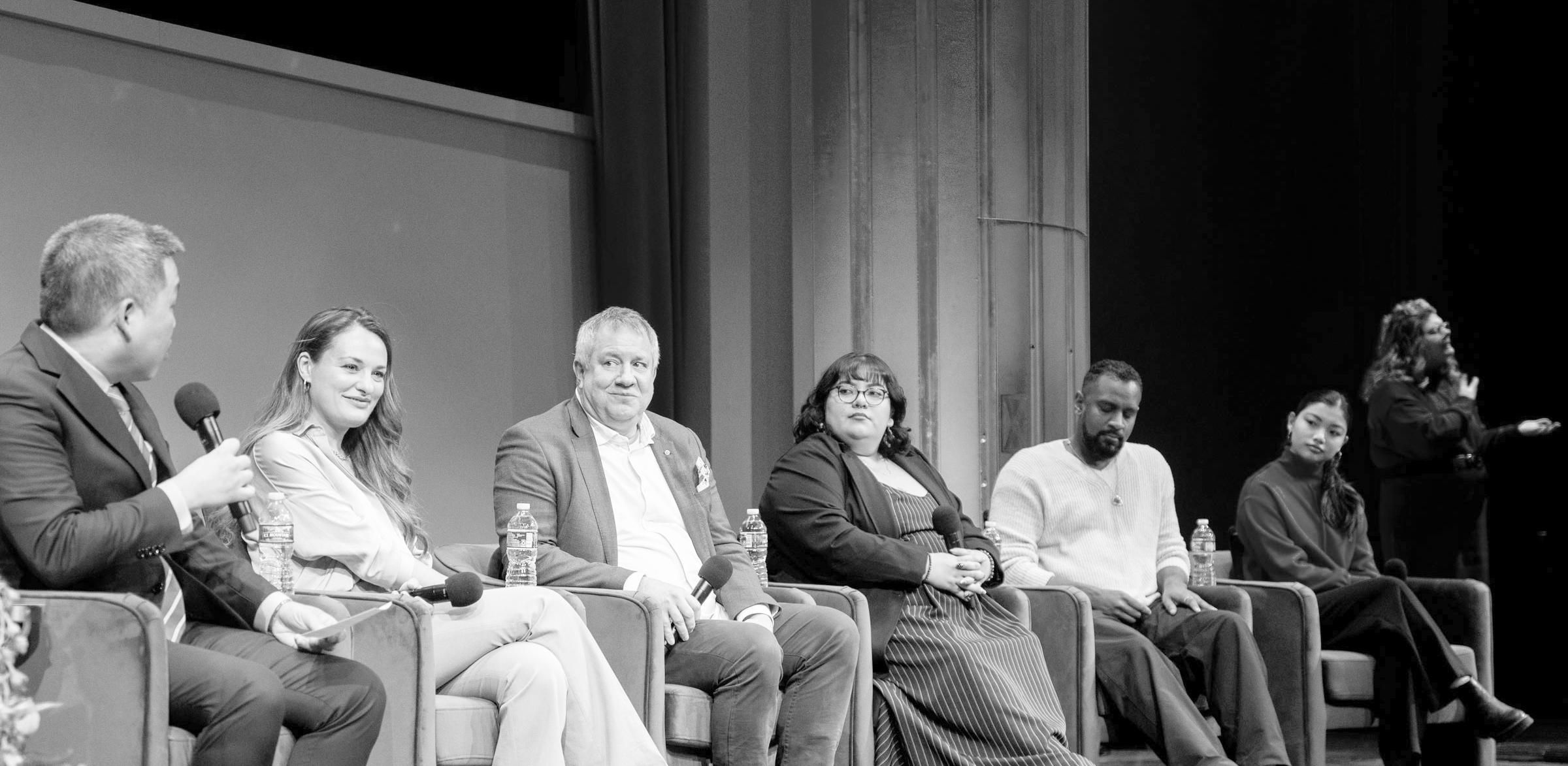
Panelists speak at the 18th annual Susan B. Messier Lecture in Child Health Policy at the Rackham
afternoon.
Stanford Lipsey Student Publications Building 420 Maynard St. Ann Arbor, MI 48109-1327 734-418-4115 www.michigandaily.com
EDITH PENDELL and ZACHARY AJLUNI Co-Editors in Chief eic@michigandaily.com
CICI COPENHAVER Business Manager business@michigandaily.com
NEWS TIPS tipline@michigandaily.com
LETTERS TO THE EDITOR tothedaily@michigandaily.com
ANNABELLE YE Joshua Mitnick ’92, ’95 Managing Editor bellaye@umich.edu
GEORGIA MCKAY Digital Managing Editor
AANYA PANYADAHUNDI and CHRISTINA ZHANG
Senior
“CHEAR … was the first center in the U.S. who solely focused on pediatric health services research, a field that focuses on determining how to get children the right care, at the right time, at the right cost,” Chua said.
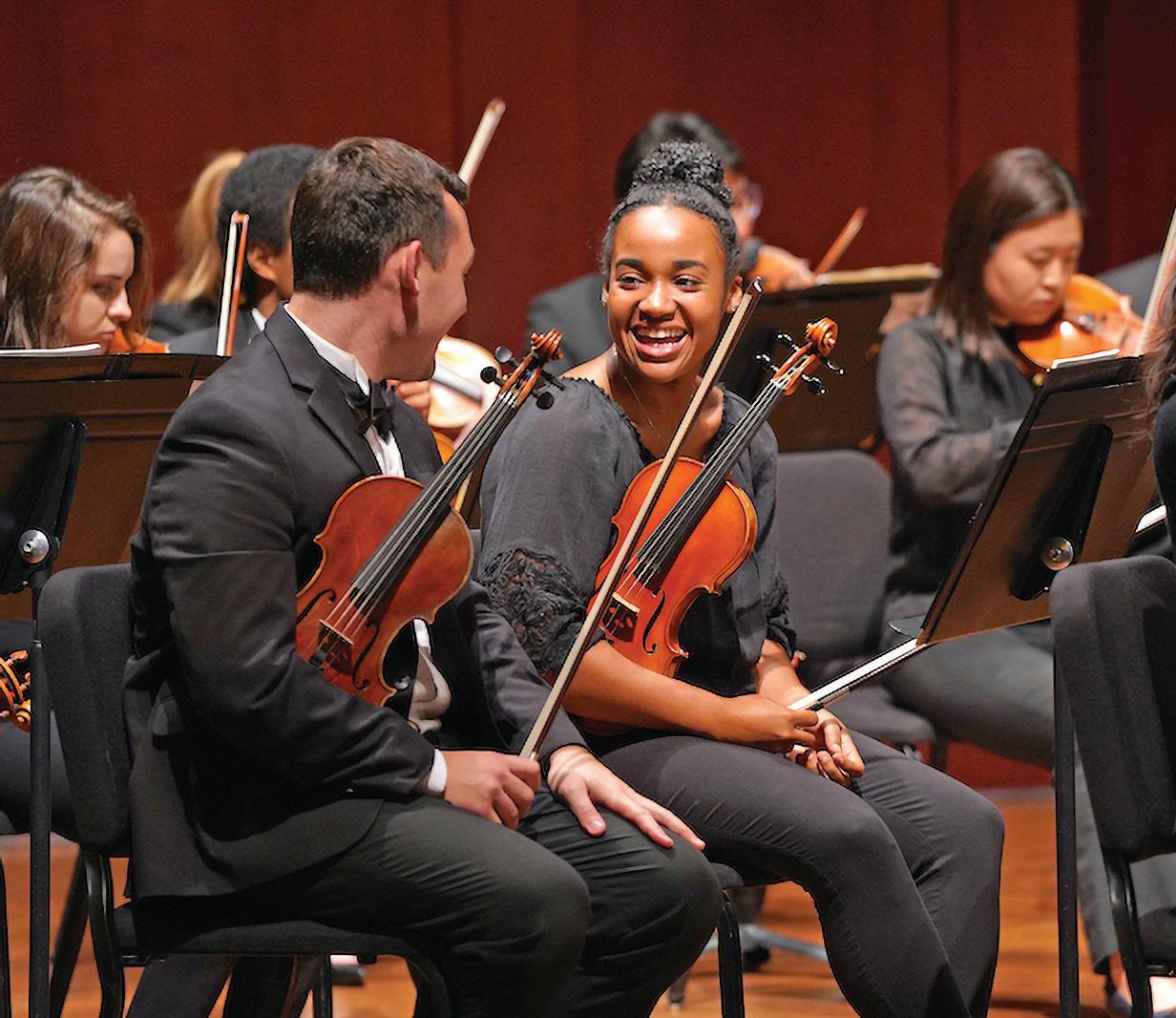
Next, award-winning violinist Nicola Benedetti delivered the keynote lecture, discussing how her relationship with classical music, starting when she began playing at 4 years old, shaped the trajectory of her life after experiencing intense teaching practices.
“The study of classical music and elite musical instrumental playing is an extraordinarily complex and
More than 80 community members gathered in the Rackham Auditorium Thursday afternoon for the Susan B. Meister Lecture in Child Health Policy. The lecture series, sponsored by the Child Health Evaluation and Research Center, featured keynote speaker Nicola Benedetti and four other panelists to discuss the role of music in childhood development. Associate pediatrics professor Kao-Ping Chua, director of the Susan B. Meister Child Health Evaluation and Research Center, opened the lecture by providing a brief history of the lecture series, which was established by Susan B. Meister in 2006 to address pressing child health issues. Chua said CHEAR’s mission is to advance pediatric health service research.
Man charged for stabbing roommate near Arch Street
26-year-old Nizar Mazloum is scheduled for a hearing in the 15th District Court on Thursday after stabbing his 22-year-old female roommate
pressured learning environment,” Benedetti said. “(The study of music) can be brought with competitive, ambitious parenting — a surprisingly high quality of anti-creative and sometimes even anti-useful teaching methods.”
Benedetti said with healthy teaching practices music education and exploration can provide many benefits for children both socially and intellectually.
“One (benefit) is the world of creativity, expression, community, communication and emotion,” Benedetti said. “The second is work, perseverance, resilience and discipline. The third — much documented — cognitive development. The fourth, in the case of mass music experiences, is that community of teamwork.”
ACADEMICS
principal horn
the Berlin
Renata Rangel, who studied percussion performance at the University of Michigan; Carlos Simon, a Grammy-nominated composer; and Music, Theatre & Dance graduate student Katrina Stroud, who studies violin performance — discussed the positive impact involvement with music had on their lives.
Stroud said she disliked the vigorous hours of lessons and practices until one of her teachers provided her with the opportunity to meet others like-minded individuals.
CONTINUED AT MICHIGANDAILY.COM
UMich Flint’s student newspaper relaunches following yearlong hiatus
After shutting down due to staffing and funding challenges, the paper resumed production Jan. 14
SARAYU BONGALE
The Michigan Times — the University of Michigan-Flint’s student newspaper — ceased operations in March 2024 due to funding challenges and a lack of student involvement. The paper resumed Jan. 14 after nearly a year without production. The decision to “sunset” — or, shut down — The Times, which had served the U-M Flint community since 1959, stemmed from its inability to maintain a steady staff, especially amid the COVID-19 lockdown. After it was shut down, the paper lost its website domain name to a different media outlet and its web archives of past work.
In an interview with The Michigan Daily, faculty adviser Scott Atkinson said the sunset of the newspaper was due to the previous editor in chief graduating and the previous managing editor transferring schools, which caused a gap in the newspaper’s leadership.
“The newsroom got small enough for a while, where it was tough to maintain without a journalism program,” Atkinson said.
“It had really just gotten to a point where the staff had dwindled, and the last two students who were keeping it alive were leaving. We literally had no applicants to be an editor.”
CONTINUED AT MICHIGANDAILY.COM
gmckay@umich.edu
Dominic Apap, Gia Verma, Glenn Hedin, Quinn Mittlestat,
Palushi, Sarah
ELENA NICHOLSON and GABE EFROS Editorial Page Editors tothedaily@michigandaily.com
KATE PARAMBO Creative Director MORGAN ORTH Strategy Manager
Grace Lahti/DAILY
The University of Michigan Dance Company performs “A Grain in Time,” choreographed by Maleek Washington, at their 2026 Showcase.
Jonah Feldman/DAILY
Graduate School Auditorium Thursday
After Benedetti’s keynote lecture, four guest panelists — Stefan Dohr,
of
Philharmoniker;
PATRICIA LEONCIO Daily Staff Reporter
Daily Staff Reporter
DOMINIC APAP Daily News Editor
Family lawyer calls Lucas Mattson’s death ‘completely preventable’
“It seems as if this fraternity didn’t do anything that they should have done to try to properly protect minors that they were going to be serving alcohol.”
JACOB REICH & ISABELLA PUCCIO Daily Staff Reporters
19-year-old Engineering
sophomore Lucas Mattson was found dead Jan. 24 on the 1900 block of Cambridge Road. Mattson was last seen at a fraternity party at 1 a.m. on Jan. 23 and was reported missing at 4:30 p.m. later that day. According to police dispatch records, he was found by a homeowner in the backyard of their home at 12:05 p.m. the next day.
While Mattson’s cause of death has not been revealed, temperatures dipped well below zero degrees the night he went missing, and Mattson was not wearing a coat when he was last seen. The University of Michigan community has been grieving and looking for answers ever since.
Mattson attended a fraternity party at Delta Chi Thursday night before he went missing, according to Bobby Raitt, a personal injury attorney hired by the Mattson
family. After a nearly 20-hour search, he was found 2 blocks away from the fraternity. In a press release, the AAPD wrote that foul play was not suspected. On Jan. 25, Delta Chi was placed on interim suspension, which includes all chapter activities, by its chapter headquarters.
Raitt described the party Mattson attended before he went missing in an interview with The Daily.
“He was invited by one of the fraternity brothers that was a friend of his in the engineering program,” Raitt said. “This particular party, there were about 60 to 80 people in the basement. They were having the party with a sorority, and they were all in the basement drinking. What they were drinking was provided by the fraternity.”
Raitt said one of Mattson’s friends told him he didn’t see Mattson leave, but that Mattson consumed alcohol during his time at the party.
“It’s apparent that, while Lucas got (to the party) at about 11:30 p.m., his friends did not physically
see him leave,” Raitt said. “One friend I talked to simply said ‘I knew he must have left at some point, because I looked around and didn’t see Lucas.’ Turns out he was able to drink there (and) walk out the front door in a T-shirt, obviously disoriented, because he wound up being found blocks from this fraternity.”
Mattson’s mother is a single mother, and Lucas was her only child. Raitt said she is grieving the loss and believes neither the University or the fraternity handled the situation well.
“The family is absolutely devastated; obviously, they’re angry as hell,” Raitt said. “This was completely preventable, and it was handled very poorly by the University. … It seems as if this fraternity didn’t do anything that they should have done to try to properly protect minors that they were going to be serving alcohol.”
The firm representing Mattson’s family has indicated a desire to pursue legal action by sending a letter of representation and a preservation of evidence to Delta
Chi, their national chapter and the University. Raitt said those in the state of Michigan who serve minors alcohol can be charged under the state’s social host laws if the minors they serve sustain injuries or die.
“Whether you’re a parent serving alcohol to minors, maybe they’re your kid’s friends — or whether you’re a fraternity — if you serve minors, you’re breaking the law,” Raitt said. “If, as a result of breaking the law and serving minors, there’s death or injury, you’re responsible. We’re still in the investigation phase.”
Personal injury attorney David Bianchi focuses on death cases involving fraternities and hazing.
CSG impeaches representative, hears State of Students address
“We are asking the University to uphold the very ethical standards which we just upheld as an assembly by holding to account a member who harassed people.”
The University of Michigan’s Central Student Government met in the Wolverine Room of the Michigan Union Tuesday evening to hear LSA and Education senior Eric Veal Jr., CSG president, deliver his State of the Students address, discuss resolutions and propose the impeachment of Rackham student Tyler Fioritto, CSG representative. Prior to the start of the official
Assembly meeting, Veal Jr. delivered his State of the Students address, updating the student body on initiatives and administrative updates from the fall semester. In his speech, Veal Jr. said he is committed to supporting academic freedom at the University and providing opportunities for diverse ideas.
“At the heart of governance is a commitment to academic freedom for every student on this campus, from the dance studios (on) North Campus
(to the) many seminars on central, the ability to inquire, to challenge and to speak without fear is a lifeblood of our education,” Veal Jr. said.
“We believe that a university must be a place where friction of competing ideas generates life, and not just heat. Protecting freedom is not just an administrative duty.”
Veal Jr. highlighted recent successes like the town hall hosted by CSG with U.S. Rep Debbie Dingell, D-Mich., and the
ARBOR
CSG grocery bus pilot program as examples of continued efforts towards better serving the student body. Veal Jr. said programs promoted by the Assembly are part of his goal of building stronger student government relations.
“I’m a president who believes that student government is about being visible and building relationships,” Veal Jr. said.
“We have pushed high quality programs to bring us together, from our speaker series, night events … These aren’t just for fun;
our programming (has given) us a handful of ways to engage with students.”
After the address, the Assembly meeting began with the confirmation of individuals into various positions. The confirmed individuals were:
• LSA senior Joyce Jung as Elections Director
• LSA sophomore Jenny Yutian Yin as Deputy Elections Commissioner for Operations
• Business and LSA junior
Lidia Cappelletti as Independent Special Prosecutor LSA junior Anna Tippner as Deputy Student General Counsel • Business sophomore Khanh Nguyen as Deputy Elections Commissioner for Finance • Kinesiology sophomore Sarthak Subudhi as Deputy Elections Commissioner for Events and Outreach. CONTINUED AT MICHIGANDAILY.COM
Things to do around Ann Arbor in February
From Galentine’s activities to live performances, here are nine events happening throughout the month of February
CARTER CARINO Daily Staff Reporter
As winter lingers, local organizations are hosting a variety of events for the Ann Arbor community to escape the cold and stay connected. For those with or without a valentine this February, businesses and community groups are offering events that are sure to make the month memorable. From Galentine’s Day activities to live performances, here are nine events happening throughout the month.
Feb. 6-8: “Hamlet”
Production
The Pioneer High School
Theatre Guild is adapting William Shakespeare’s “Hamlet” with a modern twist and original music from Pioneer students. Tickets can
be purchased on their website.
When: Feb. 6 at 7:00 p.m., Feb. 7 at 2:00 p.m. and 7:00 p.m., Feb. 8 at 2:00 p.m.
Where: Schreiber Auditorium at Pioneer High School, 601 W. Stadium Blvd.
Price: $15 (general admission), $10 (students, seniors and Pioneer staff) Feb. 7: Downtown Ann Arbor Galentine’s Day Small Business Crawl
More than 20 Ann Arbor restaurants and businesses will be participating in the sixth annual “Galentine’s Day Small Business Crawl,” offering special menu items, discounts and giveaways. Participants will be provided a passport to collect stickers from businesses throughout downtown Ann Arbor, including Ferne Boutique, House of Chimney Cakes Café and Le Bon Macaron, and can enter to win a gift basket.
When: Feb. 7
Where: Downtown Ann
Arbor
Price: Prices vary Feb. 8: “Ann Arbor Fiber Arts Expo”
The Ann Arbor District Library is hosting an exhibition on the history of fiber arts, including quilting, spinning
and weaving. Attendees can try their hand at various crafts and purchase materials from local fiber vendors.
When: 10 a.m. to 5 p.m.
Where: AADL: Downtown, 343 S. 5th Ave.
Price: Free Feb. 14-15: Ann Arbor Model Railroad Club’s 56th annual “Train Show and Sale” The Ann Arbor Model Railroad Club is hosting its 56th annual “Train Show and Sale.” At the event, individuals and organizations will come together to display, trade and sell model trains, railroads and accessories.
When: Feb. 14 from 10 a.m. to 4 p.m., Feb. 15 from 10 a.m. to 3 p.m.
Where: Saline Middle School, 7190 N. Maple Road
Price: $7 cash admittance
Feb. 22: Washtenaw County “Polar Plunge” and “Frozen 5K Charity Walk” for Special Olympics Michigan
The Michigan Law Enforcement Torch Run is fundraising for athletes competing in Special Olympics Michigan. This family-friendly event features a polar plunge and 5K charity walk, and participants can register and donate on the event website.
When: “Frozen 5K Charity Walk” begins at 11 a.m. “Polar Plunge” check-in begins at 12 p.m., the Plungester opens at 2 p.m.
Where: Walkers meet at Erratic Ale, 8080 Grand Street, at 11:00am. Plunge is at HOMES Brewery Campus, 112 Jackson Plaza.
Price: Free for plunge, $25 for 5K Feb. 22: The Ark’s 39th annual “Storytelling Festival Family Show” Part of The Ark’s Annual Storytelling Festival, the Family Show event features local and national storytellers. This year’s event hosts children’s author Jennifer Pahl Otto and Adam Booth, a nationally touring artist and educator. Tickets can be purchased on their website. When:
Courtesy of Jennie Schoeppe
JACOB REICH Daily Staff Reporter
Dining on the tracks at Gandy Dancer’s Ann Arbor Restaurant Week
Awaiting some of the coldest days Ann Arbor has seen this year, there was no better place to
spend a quiet Friday afternoon than Gandy Dancer. Located at 401 Depot St., the restaurant’s cobblestone walls and historic charm are impossible to ignore. Originally built in 1886 as the Michigan Central Railroad
Depot, the space has since been restored into a dining destination that preserves its past. Upon entering, guests are greeted by soaring ceilings, chandeliers, stained-glass
windows and decor that nods to the building’s train station origins. Passing room after room on the way to your table, you’ll eventually reach the back wall to find a window overlooking the train tracks. If you’re visiting, requesting a table here is well worth it, as the occasional passing train adds to the immersive experience.
For Ann Arbor Restaurant Week 2026, which ran from Jan. 18 to Jan. 23, Gandy Dancer offered two prix fixe
menus: a $45 Chef’s Highlights option and a $29 lunch menu. I opted for the latter, though the distinctions between the two were minimal, mainly differing in dessert and entree offerings.
Here’s what I ordered: Starters Caesar Salad
Warm, complimentary garlic bread and crackers accompanied by butter and salmon pâté were a refreshing pair to begin the meal. With the lobster bisque
already sold out upon our arrival, I selected the Caesar salad, my second choice from the four available starters. While not a dish I would typically order when dining out, it was fulfilling given the generous shavings of Parmesan cheese and house-made dressing. Still, one can’t help but wonder how much credit a Caesar salad truly deserves for being done right.
Butternut Squash Bisque
The standout of the entire menu was undoubtedly the butternut squash bisque. Creamy and cozy, the soup was finished with goat cheese crumbles, butter croutons and brown butter — an ideal plate for such a cold afternoon. Each spoonful offered something different: the sweetness of brown sugar, the tang of goat cheese, the smoothness of squash and the crunch of crouton. Though not the most visually appealing dish, it was memorable enough that I would return to Gandy Dancer
“Industry” consensus falls from “buy” to “hold”
for this bisque alone. Be warned, however, it’s a seasonal offering (yes, I checked), so enjoy it while it lasts. Who would have thought that missing out on lobster bisque would lead me to discover my new favorite soup in Ann Arbor? Main Course Mediterranean Chicken
Our table initially hoped for the IPA fish and chips, but due to an inability to guarantee no cross-contamination for a shellfish allergy, we opted for the Mediterranean chicken. The portion was generous, and the dish, like the Caesar salad, was fine. Served with artichokes, sun-dried tomatoes, capers, broccolini and mashed potatoes, the plate leaned toward an almost overwhelming abundance of flavors. The true highlight, however, were the mashed potatoes — their smooth texture cemented them as the best pair with the chicken.
CONTINUED AT MICHIGANDAILY.COM
HBO/BBC One’s “Industry” is an addictive combination of sex, drugs, money and banking. The first three seasons charted an ensemble of graduates adapting to the world of investment banking. Featuring ripped-from-the-headlines financial subplots and enough incestuous coworker relations to make your head spin, it was an over-the-top yet relatable drama about losing yourself in your 20s. “The job is everything” was a fact of the show, and failure to accept (or survive) this notion resulted in termination or failure.
Early seasons were defined by the push and pull of substance and surface: The work culture of the central company Pierpoint, characterized by late nights
at the desk and a completely transactional orientation with the world, was so consuming that it broke the characters down and made them into heartless client-facing robots. Seasons 1 and 2 were hyperdramatic depictions of investment banking and the effects of the industry on an individual. The drama came from human reactions to a very specific work culture: drug addiction, a deeply toxic work environment and the constant question: Is the money worth giving yourself up?
Season 3 wrapped up the questions of the show neatly: Ethics do not matter at all in this world, money will win over sincerity every time and if you don’t like it, you’d better leave because nothing’s changing. Pierpoint was bought by an Egyptian sovereign wealth fund, which promptly fired
the show’s remaining gay character because of “lifestyle disagreements.” Harper (Myha’la, “Rehabilitation of the Hill”) manipulated Yasmin (Marisa Abela, “Cobra”) in a moment of grief for financial gain, while Rishi (Sagar Radia, “The Good Karma Hospital”) lost his family because of a gambling addiction that extended from his life as a trader. Rob Spearing (Harry Lawtey, “You & Me”), perhaps the only decent person in the show, left banking (and the series) for a psilocybin startup in Palo Alto. It was pretty pat, and pretty hard not to get the point. Everybody left Pierpoint for other jobs in finance and tech — so now what?
The centrality of banking gave “Industry” a gravitational pull and a home base in which most of the action took place. Like the offices of Sterling
Cooper or the Bada Bing, the trading floor of Pierpoint was the heart of “Industry.” With the structure of Pierpoint gone, the show needs to rely entirely on its characters and on financial drama. The reliance is there, and it’s very clear that the characters and the writing are not up to task. In its current state, “Industry” resembles less an ensemble drama and more a financial “Mission: Impossible” for sexually repressed bag chasers. Gone is the floor, the politically incorrect and frequently abusive banter of the show’s desks. The working lives of the characters are less toxic and less high-stakes. Harper runs her own hedge fund with former Pierpoint medical doctor Eric Tao (Ken Leung, “The Sopranos”), while Yasmin works with her husband Henry (Kit Harrington, “Game of
Vinology’s
Thrones”) at online banking service Tender, which also functions as the central corporation for this season.
In structure and vibe, the show is very similar, taking the script at its word: Everyone is exquisitely dressed, married to their jobs and unable to interact normally. Absurdly jargon-y dialogue raises the act of shorting a stock to a lifeor-death battle with market forces. The scale is grander — the characters seem to float from palace to luxury hotel to castle and back again — but the better clothes and more luxurious backgrounds don’t lead to better drama.
One of the great pleasures of early seasons was the push and pull nature of how meaning is created in this world: “Industry” was able to acknowledge the benefits and luxury of wealth while clearly
exposing how its pursuit could be corrosive. Rob left the finance world because of a crisis of conscience and a realization that there were other, more fulfilling pursuits. All of the remaining characters lack this self-reflection, and the show’s attempts at demystification are less interesting as a result. Like its characters, “Industry” is now living off the highs it can give its audience: kinkier sex scenes, more cocaine and more exotic locales. Without the intense hustle of the investment banking world, all “Industry” has is a bunch of rich hot people hurting each other to add zeroes to their bank accounts. It’s sad that people spend their lives that way, but as drama, it’s not compelling. If this is all that Season 4 of “Industry” has to offer, it is truly drinking the Kool-Aid that it once told us was poison.
Restaurant Week menu: Small portions, big disappointments
it all the more unfortunate to see that nearly all portions — dessert aside — had been cut in half, and then that half felt halved again.
do I do with myself while awaiting the main course if the starter left me unsatisfied and my drink tasted like cubes?
If you’re unfamiliar with Ann Arbor Restaurant Week, it’s an annual week-long event that celebrates the vibrant culinary life in downtown Ann Arbor with select restaurants offering special menus and even discounted meals. This year, Restaurant Week ran from Jan. 18 through Jan. 23, and I decided to dine at one of the participating restaurants — Vinology — on the very last day.
Unfortunately, my experience left much to be desired. Their deal included three courses for $40. A steal on paper, but my experience had a few major issues. The menu didn’t mention automatic gratuity, the portion sizes were small and the overall experience felt inconsistent.
For some background, on my birthday in August, my sister and I dined at Vinology. Everything was exquisite — I think the steak I ordered was roughly the size of my hand — and it truly felt like we never wanted the meal to end. Even the appetizer, simple thick potato wedges, was mesmerizing and somehow elevated into something memorable. It’s safe to say I went into this Restaurant Week with high expectations, which made
I understand that Restaurant Week deals generally involve cuts in the portion sizes to manage costs, but I think that if a restaurant was that concerned about a few dollars, they shouldn’t be participating in something like this. Ultimately, it’s not worth changing their consistency standards and risk hurting their reputation.
I appreciated that the menu had a wide variety of starters and desserts, ranging from baconwrapped dates and scallop grudo to poached pear and tres leche tiramisu. Many other restaurants participating in Restaurant Week didn’t have as many options, so this was a nice touch. Unfortunately, the food itself didn’t match my expectations. My roasted grape salad had exactly two pieces of radish, and they were tossed in seemingly at random and weren’t properly mixed in with the white balsamic vinaigrette — they just sat on top of everything. To make matters worse, my CocaCola arrived only after I had finished my starter — and it came flat. Normally, I could tolerate a mediocre starter or a less-thanperfect drink, but to give me both in one visit is disappointing. What
Eventually I got my tenderloin, done medium rare (anything else is a waste of cow). While the inside was cooked beautifully, the outside was burnt, leaving the entire entree affected. Despite there only being two precut pieces, I ended up smothering the steak in horseradish cream to help mask the taste of char — unfortunately, it didn’t do much. Frankly, the dish should have just been good enough on its own.
The side dish accompanying my steak, marrow-braised cipollini onion, was interesting. Not necessarily in a bad way, more so in an unexpected manner just because I’m used to seeing steak served with greens. My dining companion received the same entree, but her steak was cooked inconsistently, with one half being well done and the other half medium. Quite an odd experience, seeing as none of her bites would taste the same. Her side portion of the sunchoke-parsnip gratin was also larger than mine, as it was in a wider and slightly taller ramekin, so clearly consistency wasn’t a priority when plating our food.
CONTINUED AT MICHIGANDAILY.COM
JACK CONNOLLY Daily Arts Writer
LUCIA LARACH Daily Arts Writer
MARYAM TOBYA Daily Arts Writer
Gabriella Spagnuolo/DAILY Soyeon
Del Water Gap makes it easy to fall in love
It’s 9:15 p.m. on a Sunday, and Samuel Holden Jaffe, otherwise known as the indie rock act Del Water Gap, is walking onto the hazy stage at the Royal Oak Music Theatre. Behind him, a billowing canopy drapes around the band, magnifying their shadows in vibrant, dancing lights. Jaffe is wearing dark, smudgy eyeshadow and a flowy button-down shirt that falls to his calves.
As the fog clears, deafening screams of “I love you” reverberate through the venue. Four girls in the front row wearing hot pink wigs bob around in excitement, stretching their hands out toward the microphone stand. Behind me, a couple pulls each other in for a kiss. Although I arrived at the show as more of a journalist than an enthusiastic fan, the energy of the crowd was palpable. The act opened with “Small Town Joan of Arc,” an upbeat track about a pathologized yet resilient girl who is “all out of Lexapro” and shares a dog with her ex-lover. Many of Jaffe’s songs are in this same vein: intimate yet danceable tunes about mythologized women whose neuroses are romanticized. Whether the audience of mostly young women and girls recognizes this is hard to tell, but it’s clear they love it; as Jaffe continues with “Sorry
I Am,” “Better Than I Know Myself” and “Please Follow,” the crowd dances, claps and sings along fervently, hanging onto his every word.
Jaffe himself is no doubt an engaging performer — he sings with his arms up and open, flaunts his guitar and stands at the edge of the stage, teasing
the audience with his touch. Following a rendition of “New Personality,” Jaffe expresses his love for the local music scene: “One of my first shows ever when I started touring was the Blind Pig,” he says, and cheers fill the room.
CONTINUED AT MICHIGANDAILY.COM
Harry Styles leaves ‘Harry’s House’ for the club with new single ‘Aperture’
After starring in two movies, running the Berlin Marathon and accidentally attending the announcement of Pope Leo XIV, Harry Styles has returned to music
— much to Benson Boone’s dismay.
Nearly four years since the release of Harry’s House, Styles has released a new single for his upcoming fourth studio album, Kiss All the Time. Disco, Occasionally, set to release March 6. Prior to the release of “Aperture,” promotional posters were found
plastered across the globe in New York, London, Berlin, Milan and more. Fans who visited Styles’ website were texted a cryptic voice memo of Styles quietly singing
“We belong together,” which we now know is the chorus refrain of “Aperture.” Fans took to social media in a speculative frenzy. After officially announcing Kiss All the Time. Disco, Occasionally, Styles released the first single “Aperture” on Jan. 22. Immediately, the track departs from the sounds of Harry’s House, opening with layered pulsing synths giving the track a hazy, dream-like quality. Forty-five
seconds in, Styles sings “Take no prisoners for me / I’m told you’re elevating.” His vocals are mellow and subtly reverbed, contrasting with the production’s building rhythm. For a song rooted in techno elements, “Aperture” feels almost fragile.
Reminiscent of 2000s style trance synth, “Aperture” quietly nods to a blend of disco, house and electro-pop genres. In an interview with John Mayer, Styles said he had attended a few LCD Soundsystem concerts during his time off.
“This feeling of being in the audience is so magical. That’s the
music I wanted to make. I wanted it to feel like it was made from the dance floor,” Styles said.
The absence of Styles’ live band in exchange for an electronic mix is certainly different for an artist of his size, but “Aperture” isn’t particularly revolutionary. The track was met with mixed feedback from fans; some praised his new sound while others found it underwhelming and repetitive. Regardless, “Aperture” marks a step away from the sunny poprock sounds of his previous three albums.
CONTINUED AT MICHIGANDAILY.COM
The need to be seen seeing: Rethinking filming at concerts
LILA DARWICHE Daily Arts Contributor
“Are you fucking joking?!”
British musician Charli XCX screams to the crowd. She’s visibly pissed, standing with her hands outstretched in disbelief. The question wasn’t playful — it was sternly directed at the audience before her, overwhelmingly disengaged, even as her most popular song, “I Love It,” pounded through the Kia Forum speakers. Various angles of this scene were posted online not long after Charli’s performance.
Amid years of online discourse on audience engagement, this video garnered yet another wave of criticism toward a familiar enemy: the phones. Modern, mainstream concert-goers have grown accustomed to a culture of near-incessant filming, and, even as artists like Charli become agitated and impatient, the cameras persist.
A certain sect of social media serves as a forum for deliberating the ethics of filming a concert, with some users exploiting clips like this one to make their case one way or another. Debates have only made
the topic more polarizing, though. These conversations often focus on identifying a right or wrong approach, with some arguing for their right to “preserve the memory” and others advocating to “live in the moment.” By rejecting nuance entirely, this can become excruciatingly unproductive, failing to acknowledge the real motives behind filming big events and what drives people to do it so ceaselessly.
Before the internet was invented, it was common to document memories through physical photos, scrapbooks or diaries. People have always used the technology available to detail their lives. Similarly, people in the modern age use cell phones, the internet and social media to record their memories, but it often has an entirely different and largely inauthentic connotation. Why is this the case?
As of today, social media is nearly impossible to define concretely, but many popular apps originated as methods of documentation. Early versions of Facebook and MySpace allowed users to keep their loved ones updated by sharing themselves digitally.
CARLY ANDERSON Daily Arts Writer
Emily Alberts/DAILY
Hannah Willingham/DAILY
What universities owe students when they can’t say
VOORHEES Opinion Columnist
In March 2024, the University of Michigan’s Board of Regents rejected a student-led demand that the University divest from companies linked to Israel’s ongoing military campaign in Gaza. The request had moved through formal channels. Resolutions were passed by student governments, weeks of organizing took place and appeals were made in the language the University itself endorses: ethical stewardship, community values and institutional responsibility. The regents’ response was brief. The proposal was denied. Their public explanation amounted to
a familiar refrain about fiduciary duty and existing investment policy, without engaging with the substance of the students’ arguments or clarifying what standards, if any, would ever make divestment possible. In this case, a demand framed around ethics and accountability was met with an answer that closed the door without explaining why. Rather than treating the refusal as a procedural outcome, many U-M students and faculty protested the administration’s rejection.
At large public universities, student requests are routinely denied or delayed, particularly those involving funding, space access, programming approval or policy reform. In many cases, these refusals are determined by legitimate constraints, including
budget cycles, legal obligations, accreditation requirements and limits embedded in shared governance structures. Students are rarely told which of these constraints is operative in their case. When universities say no to funding, recognition and policy change, students seldom experience the decision as an unbiased outcome. Research shows students identify specific organizational processes and interpersonal treatment as sources of perceived unfairness and these perceptions are tied to lower engagement and dissatisfaction. They experience denials as a judgment rather than an actual administrative issue. CONTINUED AT MICHIGANDAILY.COM
Who is to blame for Ann Arbor’s affordability crisis?
HAYDEN BUCKFIRE Senior Opinion Editor
Cost of living is top of mind for many students at the University of Michigan. Tuition has risen steadily over the past 10 years for both in-state and out-ofstate students, in line with other universities. Unique to Ann Arbor, however, is the magnitude of the strain put on its housing market. Rents for one-bedroom apartments increased by more than 35% from 2016 to 2023 in the city. This is substantially higher than the 26% increase in East Lansing, home of Michigan State University, and over 24% nationwide. Prices surged even more near Central Campus, where most U-M students live. Moreover, Ann Arbor’s off-campus student housing options are bifurcated between mostly outdated lowrise apartments and houses built decades ago or newly built
luxury high-rises with top-ofthe-line amenities.
The rapid change in appearance along South University Avenue, with the development of several new high-rises and near-constant construction, is a microcosm of what many say is the corporatization of Ann Arbor and its small-town charm. Rents at Vic Village South, a luxury student apartment on South University and East University avenues that opened in 2024, hover around $3,000 per month for one bed and compare to what tenants pay in cities such as Boston, San Francisco and Washington, D.C..
Discussions around Ann Arbor housing often center on a convenient search for villains, with blame frequently cast on private equity firms’ involvement in the housing market or “greedy” landlords. The reality is more structural: Ann Arbor landlords are operating in a market with a massive supply-demand mismatch. Furthermore, if private equity dominates new construction, it is because current zoning and high
development costs have made it financially impossible for anyone but the largest corporate entities to build. On a fundamental level, the affordability crisis is caused by the University and Ann Arbor’s refusal to adequately adjust to the rapidly changing demographics of the student body.
It is important to understand the economic context of increasing rent prices in the Ann Arbor area. Housing markets are guided
From The Daily: Michigan must be ready for ICE
THE
MICHIGAN DAILY EDITORIAL BOARD
U.S. Immigration and Custom Enforcement’s executions of Renee Good and Alex Pretti in Minneapolis have disturbed millions nationwide. When they murdered two innocent people, ICE agents proved that — under President Donald Trump’s administration — there are no limits to the violence they will employ against American citizens who stand up for immigrant targets. In response to the killings, tens of thousands of Minnesotans took to the streets and protested amid subzero temperatures, and the Trump administration demoted Gregory Bovino, its disgraced Customs and Border Patrol commander-at-large. In Michigan, ICE is expanding its already established presence. Baldwin is home to the largest detention center in the Midwest, run by private prison company The GEO Group, who are assisting the Trump administration in its plan to increase national immigration detention capacity. Additionally, Trump has frequently alluded
to Detroit as a future target for ICE deployment. Fifteen miles west of Ann Arbor, ICE runs operational flights through Willow Run Airport. Eight miles closer than that, on Jan. 27, ICE detained several parents dropping their children off outside Ypsilanti Community Schools’ campus.
Minneapolis has set a strong standard for what public response to violent ICE action should look like. Given increasing ICE encroachment, this Editorial Board believes Michiganders must emulate that standard..
Mirroring Minnesota’s powerful response is imperative because it led to tangible change. Protests fazed the Trump administration, which forced a shift in strategy. As Trump’s approval rating decreases due to his aggressive immigration policies, momentum continues to build behind the anti-ICE movement.
Overall, the most significant detriment to ICE proceedings has been social media documentation that thrusts agents into the national spotlight. Immediately after ICE sightings are reported in a neighborhood, online posts circulate to warn
at-risk residents and, if someone is detained, observers ensure it is captured on video. Recording is an invaluable way to prevent false narratives from spreading. After both Good and Prettis’s murder, the Trump administration tried to label the victims as terrorists. However, video evidence featuring multiple angles of the killings rapidly circulated and people were able to dismiss these false claims perpetuated by the administration. Michiganders have already shown they are taking note of Minneapolis’ success. On Jan. 30, thousands of University of Michigan students and community members marched in Ann Arbor’s “Salt the Earth” protest, organized by a coalition of student organizations against ICE. Moreover, Washtenaw County recently passed a resolution designating county property as off-limits to ICE agents and opposing their use of face coverings to conceal their identities. These actions are the beginning of individual and collective resistance to the injustices ICE is imposing on Michigan communities.
Cornelia Ovren/DAILY
ALEXANDER
We are are more prepared to face climate change than you think
The last decade has seen a rapid increase in extreme weather events and longterm regional climate shifts that now disrupt economic activity, daily life, ecosystems and public health all around the world. Global emissions of greenhouse gasses have rapidly altered the climate of the planet creating a global crisis we now know as climate change. In our own country, brutal heatwaves in the Southwest, devastating fires in California and dramatic cold spells in Texas have emphasized the imminent threat of climate change to Americans.
With every year that goes by, it becomes easier to notice the reality of the climate crisis and the threat it poses to our prosperity and safety. It doesn’t help at all that our head of state denies the existence of anthropogenic climate change, withdrew our country from global emissions treaties and continues to eliminate policy supporting emissions regulation and clean energy development. Similarly, global inequalities across economic development and geopolitical power mean that many of the poorest countries in the world are the least equipped to face increasingly harsh and unpredictable climates.
Today, significant percentages of Americans — especially among Generation Z — report feeling anxious about climate change and its potential impact on their lives. In a 2024 survey of young American adults aged 16 to 25, 85% of respondents indicated at least a moderate worry about climate change, and 38.3% reported that their worry over climate change negatively affects their daily lives. Behind this is dissatisfaction with the amount of effort taken by leaders in both government and business to mitigate greenhouse gas emissions.
Yet, the reality of the situation is not as bleak as many of us would think. As we adjust our policies and improve our technology to curb greenhouse gas emissions — the root cause of the climate crisis — warming forecasts have become far tamer than they were even a decade ago. Despite the severity of this issue, it is essential to stay rational and optimistic about our future, and recognize that while challenges remain, hardship will not equate hopelessness.
Much of this anxiety surrounding climate change is attributed to fears that it will threaten humanity’s survival. If global warming exceeds 6 degrees Celcius, agricultural collapse, ecological devastation, sea levelrise and extreme weather could threaten billions of lives around the world.
While the first climate forecasts in the 1980s indicated that warming above 4 degrees by 2050 was possible, contemporary modeling suggests a far more favorable outcome. In just the past ten years, these projections have dropped down to under 2.5 degrees Celsius by 2100. On our current course, we will suffer high economic, ecological and health costs, but at a level most of global society can withstand and adapt to.
Regularly improving climate projections are no coincidence. The work of researchers, activists and policymakers worldwide to bring attention to this crisis has had an extremely tangible impact.
Hundreds of countries made domestic policy reforms and have signed on to a number of climate mitigation treaties. In fact, global per capita emissions peaked over a decade ago in 2012. Even failed efforts have contributed to overall progress: For example, 1997’s unsuccessful Kyoto Protocol laid the groundwork for the 2016 Paris Climate Accords, which, despite the world’s failure to meet its ambitious goals, have pushed
significant emissions reforms around the world.
wHowever, it’s easy to feel like the climate crisis is only worsening when there is a seemingly endless stream of worrying headlines and letters of warning in the media. Convincing the world of the gravity of the climate crisis is an undeniably critical part of encouraging action and solving it. Yet, it is often difficult to recognize positive developments through the veil of a media system that profits off of worry and distress. The media disproportionately centers negative narratives about the climate because they naturally tend to garner more of our attention.
All this pessimistic news and content only serve to foster hopelessness and inaction instead of empowering us and showing a way forward. Climate anxiety should not dominate our feelings, especially when progress shows that a sustainable future is within reach. The real situation of the climate is far more nuanced than how we think or feel about it. For every instance of bad news, there is a new technology, policy or development worthy of recognition and enthusiasm.
The global climate crisis deserves the complete attention and devotion of human society. That being said, awareness shouldn’t lead to panic. Current projections still predict significant hardship, but we are not helpless in the face of this crisis. Establishing even a marginally more positive perspective won’t just help alleviate our anxiety, it is how we can emerge from paralyzing hopelessness into motivated, energetic action. No matter how far away we are from ideal climate goals, every tenth of a degree of warming we can prevent counts. As we stand, we cannot let climate anxiety take away from the movement toward sustainability.
Parent megadonors have unmatched access to the administration. That doesn’t have to be a bad thing.
TZHANE YAMIN Opinion
Columnist
here are some ways that the University of Michigan and I aren’t so different. For instance, we both need money.
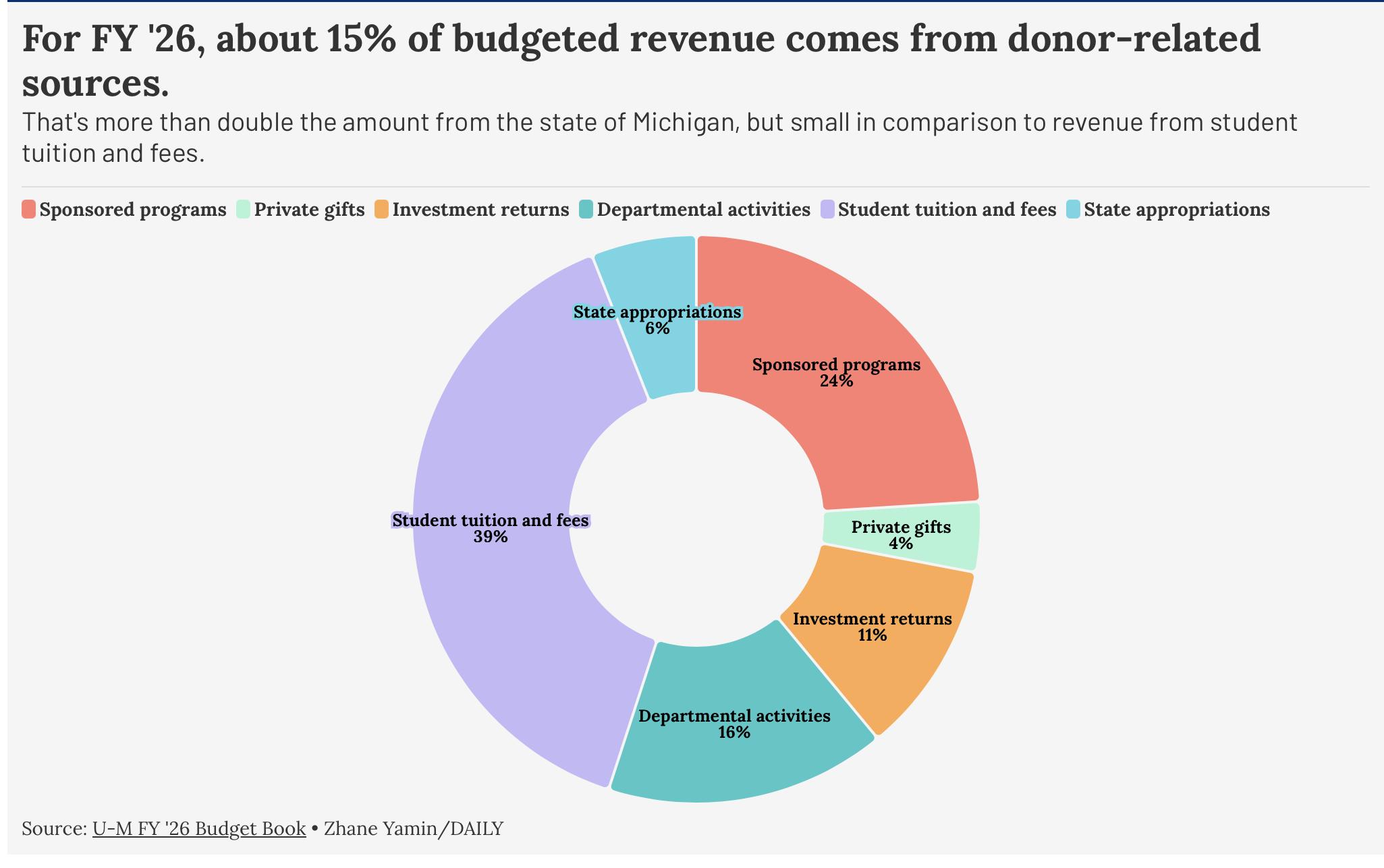
Excluding Michigan Medicine, the University brings in about $6.2 billion in revenue each year, with a substantial chunk going to fund its expansionary development. 15% of that money comes from private gifts and endowment returns. That’s a staggering amount of revenue that is supported by donors. It’s also more than double the amount of money it receives from the state of Michigan, making it more of a donor-funded university than a public one. For comparison, 9.7% of Michigan State University’s operating budget comes from private gifts and endowment returns, while 11.1% comes from state appropriations Philanthropy is a major player in keeping our position as a top public university, but getting people to fork over their money is not an easy thing. That’s why the University has developed a sprawling fundraising infrastructure that offers several incentives to encourage donations. Most people, though, aren’t willing to donate more than $1,000. In the 2022 fiscal year, more than 118,000 patrons donated a total of over $774 million. However, 90% of those donations fell under the $1,000 threshold. That means, even if 90% of those donors gave the full $1,000, the remaining $666 million was paid by approximately 12,000 donors. That’s an average gift amount of $55,500, though it could be likely that a small proportion of those people make up a large amount of the remaining sum. So the problem of fundraising boils down to engaging and
pleasing the small number of megadonors who represent an outsized portion of total donations to the University. To do this, equally outsized incentives are needed. Enter the Parent & Family Leadership Council.
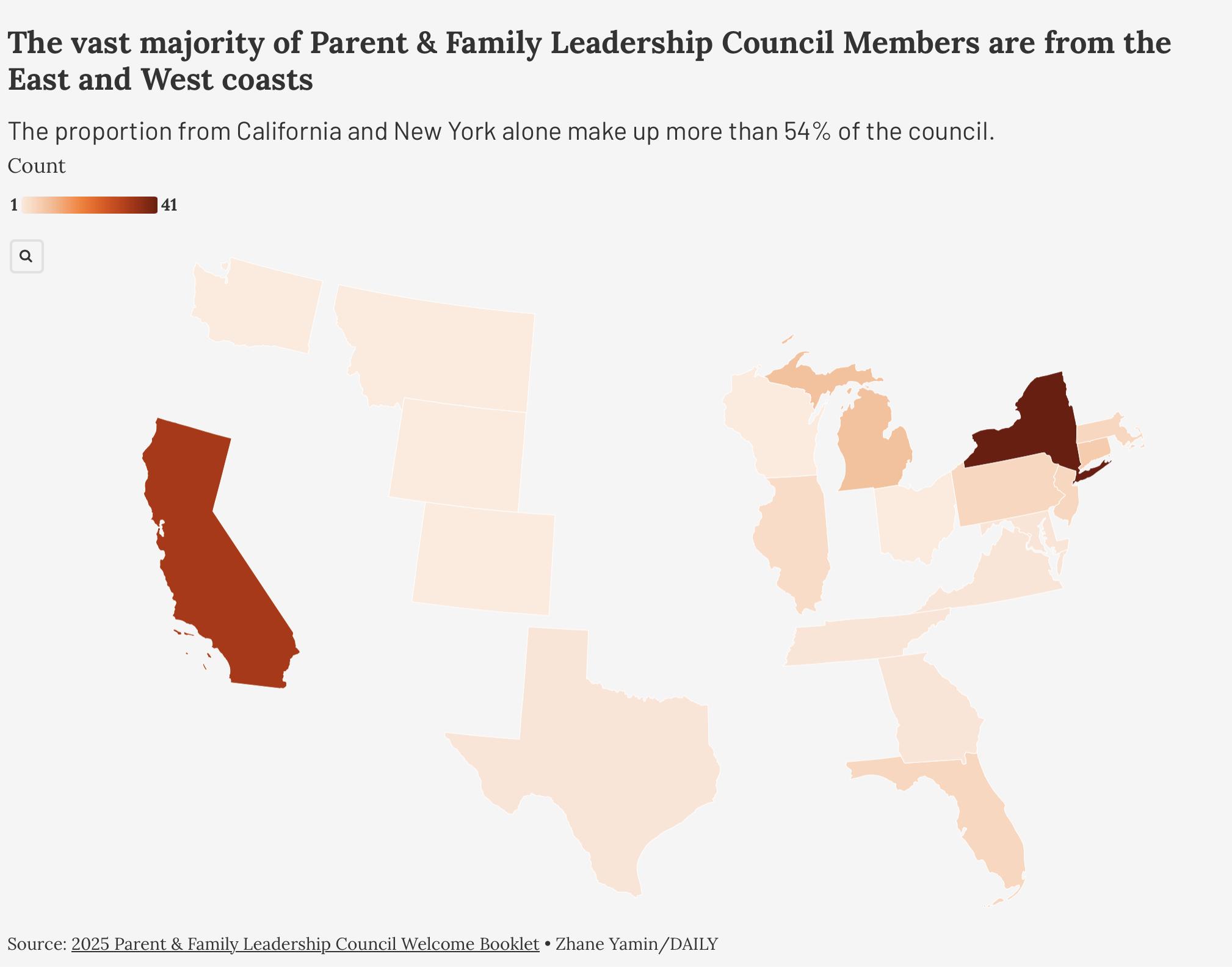
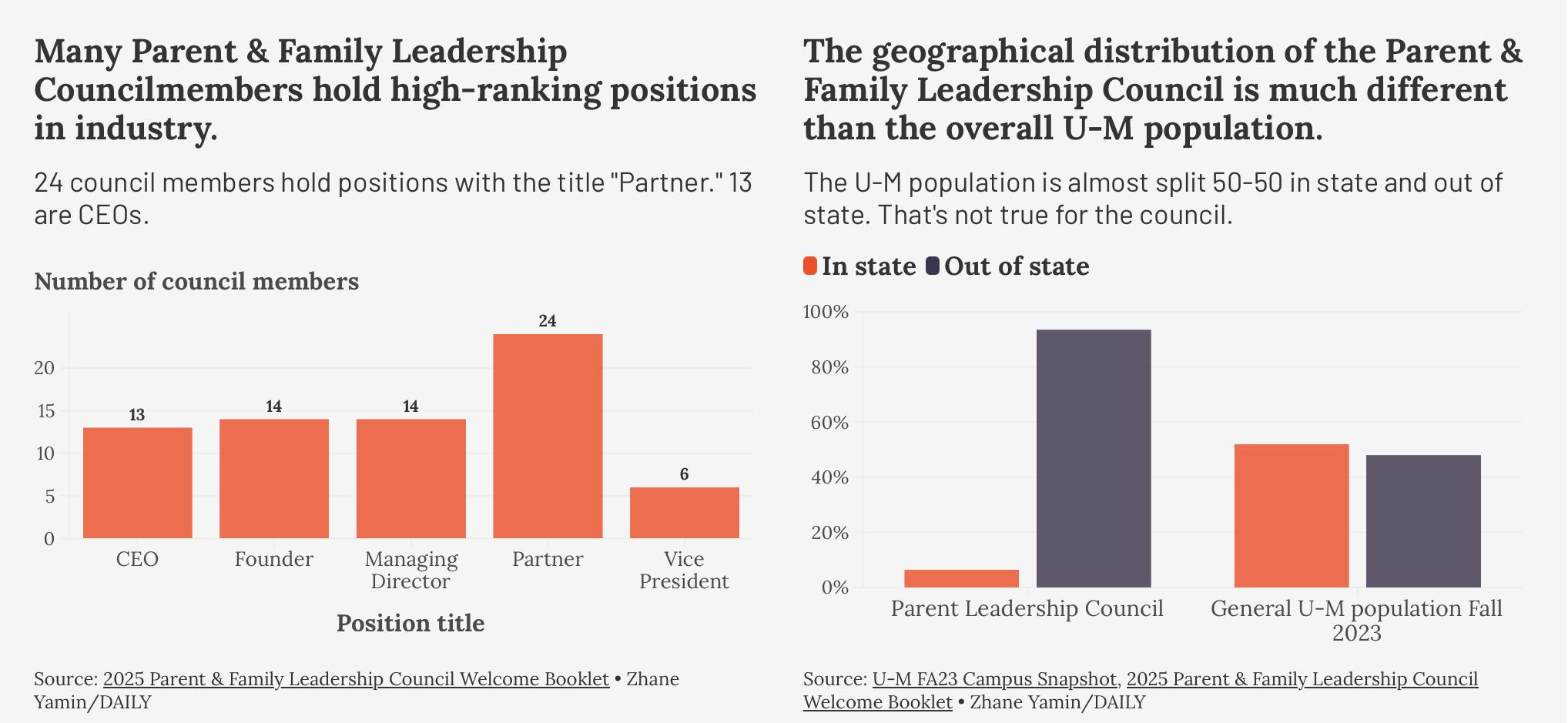
The Parent & Family Leadership Council is a group of about 140 parent and family donors who, according to the website, make “generous philanthropic commitments” to the University. They enjoy a “personal connection point” and a variety of complimentary services during football season and beyond. They also have semiannual council meetings to network with other parents and, as the website puts it, get an “insider’s perspective from University leaders, faculty, and students.”
The donation requirement to become a council member is unclear: Previous reports by The New York Times in 2013 put it at $25,000 over four years. And in 2024, the website stated that members of the “Parent Partners group,” a separate but related group of donors, must donate $50,000 over four years, though that information has since been removed.
The 2025 Parent & Family Leadership Council Welcome
Booklet, obtained by The Michigan Daily, contains more information about who exactly is on the council and their responsibilities. The booklet was publicly available on the website earlier in 2025, but has since been taken down. In addition to attending council meetings, councilmembers are expected to act as ambassadors for the University, host administrators when requested and help to engage and identify other parents for donations. In return, they receive various goodies and, of course, a “personal connection point” with the administration. At this point, there’s nothing unexpected about this. Stagnating state support and a reluctance to implement massive hikes to tuition make it understandable that the University would rely more heavily on fundraising. And, it only makes sense to provide incentives to those who donate. The donors aren’t particularly nefarious either: They help support some of the most important programs that make our institution both great and equitable — scholarships, research at Michigan Medicine, Maize & Blue Cupboard and Services for Students with Disabilities. CONTINUED AT MICHIGANDAILY.COM
WILLEM DEGOOD Opinion Analyst
Matthew Prock/DAILY
If there’s anything college has taught me, it’s that you have to find comfort in loneliness. When left adrift and to your own accord for far too long, the quiet mental spiral that follows is inevitable. You have about 10 seconds before you’re playing back every single time you’ve experienced the slightest feeling of abandonment or betrayal. For me, the one flash point that constantly reappears during these times of reclusion has to be when, in first grade, my elementary school hosted two “breakfast events” — one for Mother’s Day and one for Father’s Day — where parents came in and had donuts and orange juice with their kids. They took the time to sit with them and their friends in the classroom, read books together and dramatically gasp with pride at all their painting projects. But for both days, neither of my parents showed. Instead, I was stuck at the back of the classroom, seated at the reading table with one measly donut and a cold cup of orange juice that I left untouched. I sat there watching all the moms and dads giggle with their kids. One of my classmates, Grace, had her parents switch days, with her mom coming in on Father’s Day and her dad on Mother’s Day because they couldn’t get the day off on their respective holidays. Grace’s mom stood there proudly amidst all the men just to witness the beam on her
daughter’s face when she made a surprise entrance.
The jealousy I had towards Grace was palpable, evident in my lingering stares. It felt like her parents were willing to move the world just to make sure she did not feel left out, while there I sat, confused as to what I could have possibly done for my parents not to come. Had I said something wrong? Was it my fault? I ran through a mental list of all the criteria I needed to abide by, carefully skimming for any recent slipups that could explain this cruel punishment.
With my parents, the concept of meeting emotional needs or even acknowledging the vulnerability that comes with being a child was non-existent. Whether we liked it or not, the purpose of our being was to be everything they never could be. We had to be academically successful, religiously devout enough to secure our spots in heaven and serve as the ultimate poster children of the Bengali diaspora. When people discuss the American Dream, they reflect on all the work their parents did to find footing in this country. But for my parents, we were the bearers of their American Dream. And I obeyed: In proving them right, I thought I could make myself indispensable. So when neither of them showed, it became instinctive to assume I was at fault.
Had I not prayed all five of my prayers recently?
Was I rude to my Dadi? Did I embarrass them in front of any aunties or uncles?
As a child, I could not grasp that there would never be an explanation for their absence; my dad rarely spoke to me, and if my mom wasn’t complaining about my dad or the struggles she endured raising us, our conversations were minimal. Turns out, there was nothing you could do to earn more love or acknowledgement. But there was always an abundance of shortcomings that, despite being trivial, could make them irate by the thought of you. I became more accustomed to the echo chamber my parents created that others would call dysfunction to the point where, when my brother went through the teenage-rebellion phase typical of any ambitious kid born to strict, close-minded immigrant parents unwilling to let you diverge or experience a new culture, I could not empathize with him. Their mindset led me to view my brother’s reasonable emotions as disrespectful and childish. The brother who was nine years my senior, according to my judgments, was a cautionary tale of what I was conditioned to reject. They went back and forth, pleading for their perspectives to be understood, and as a witness to this whole debacle, I could only focus on how, by being so adamant that my brother not “stray” too far from our culture or religious teachings, they never realized that they were losing him in the process.
CONTINUED AT MICHIGANDAILY.COM
We’re all obsessed with calculating what we “deserve.”
It’s a sentiment that underlies the fundamental logic of how we think and function. Phrases from “Congratulations, you deserve it!” to “I’m sorry, you didn’t deserve that,” are commonplace. Compliments are followed by reassurance that your blessings are not by chance, but prophesied by your own worth. Conversely, condolences are followed by consolation that you did nothing wrong; these things just happen.
Perhaps it is only human nature to use the results of our lives as a measure of our individual quality. Bad things happen to good people, and good things happen to bad people all the time, and it’s unfair. Maybe our insistence on keeping track of what we do and don’t deserve comes from our desire to correct this unjustness that we have no power to change.
Some of us look to a higher power — someone or something that can quantify what is good and bad — and assign us to what is fitting. The idea of heaven and hell can be seen as a way to cope with this unfairness, the belief
that there is some reward or punishment acting as a means for sanity throughout this life — that one day, everyone will get just what they deserve.
The problem with this fixation, no matter how innate it may be, is that this logic isn’t exclusively targeted at other people and will inevitably point back to ourselves. We can assume heaven or hell for others all we want, but we must inevitably face the question of which one we deserve.
In “The Perks of Being a Wallflower”, Mr. Anderson famously says, “We accept the love we think we deserve.” Truly, many — myself included — have been constrained by their idea of what they deserve, especially as it relates to love. It is easy for people to limit themselves to what they believe the universe has deemed they are worthy of, a self-fulfilling prophecy that leaves them powerless to change their place in the world.
In the religion I grew up in, the greatest act of love is laying down one’s life. Love, notoriously hard to accept, becomes intertwined with sacrifice and crawls back to me. I see it in the career my mother gave up to raise me, in the country my father left behind. I romanticize the movies
where love means waiting for someone, hurting for someone. I am reminded of it in the body and blood every Sunday, when I consume His sacrifice. I pray to the Father, remorseful of the sins that make me undeserving of this love. I can try to get cleaner, to not miss any sin at my next confession, but I will never be clean enough. I do not know how much cleaner I am getting; He will not speak to me. My Original Sin has permanently made a mark on my goodness. Love becomes sacrifice, and the question was not, “Am I worth loving?” but “Am I worth hurting for?”. And how could I, eternally imperfect, ever deserve it? –
”Am
It’s currently the fourth week of New York City’s largest nursing strike, with about 15,000 nurses joining the picket line. They’re protesting unsafe staff ratios and poor working conditions. According to the The New York Times, the Montefiore Medical Center, New York-Presbyterian/ Columbia University Irving Medical Center, and three other hospitals in the Mount Sinai system have cumulatively spent more than $100 million to temporarily hire nurses and pay for their accommodations to fill the gaps left by the striking nurses. This strike is a result of nurses being overworked and under-resourced, and it’s not the first time NYC nurses have sought better, safer working conditions.
As I’m sure you’ve heard, there’s a nursing shortage in America. The Bureau of Labor Statistics projects there will be more than 193,000 openings for registered nurses each year through 2032 as the current generation of nurses retire. So it was surprising when, last November, the Department of Education proposed changes to student aid provisions that would ultimately reduce the number of nurses available to fill these growing gaps in the workforce.
Under President Donald Trump’s budget law, known as the “One Big Beautiful Bill Act,” a substantial revision proposed a redefinition of which fields are classified as “professional degrees.” Professional degrees are subject to receive more subsidies and tax breaks, so these revisions allow the ED to justify stricter federal loan caps for “non-professional degrees.”
Some of the fields that are now excluded from the definition of “professional degree” programs are social work, physical and occupational therapy and nursing. These changes overhaul parts of the Higher Education Act of 1965 by limiting annual
loans like Parent PLUS Loans and terminating necessary programs like Grad PLUS. For these “nonprofessional” degrees, there would be an annual loan cap at $20,500 for graduate students, whereas graduate students seeking a “professional” degree could get $50,000 annually.
In a press release, the ED wrote that “previously, graduate students could borrow up to the cost of attendance, which led institutions to offer expensive graduate programs with a negative return on investment.”
The ED suggested that, by lowering their cap on loans, they would alleviate the problem of paying high returns altogether.
But this “negative return on investment” will only worsen when public service loan programs are restricted and will put students at a greater disadvantage. These revisions won’t reduce the cost of nursing education. Jennifer Mensik Kennedy, president of The American Nurses Association, replied to the falsehood that these provisions are going to lower student loan burdens. In an interview with the Public Broadcasting System, Kennedy said nurses won’t stop taking out loans; they will just seek out private loans, which will provide worse returns and less forgiveness than public service loans.
In the same report as the ED’s statement, Nicholas Kent, the U.S. Under Secretary of Education said these provisions would “simplify our complex student loan repayment system
and better align higher education with workforce needs.”
As a nursing senior who is preparing to receive my bachelor’s of science degree in May and planning to attend graduate school in the future, these proposals are disappointing to say the least. Hearing about Kent’s “workforce needs,” I can’t help but wonder whose needs he’s referring to. To limit the loans available to students seeking higher education in essential fields that are already underfunded and under-resourced, like nursing or social work, would only increase barriers for these professionals to contribute to the workforce. Kent’s response is out of touch with the actual needs of the American people. The average cost of attendance for nursing graduate students is more than $30,000 a year. Nurse anesthetist school, which is a growing doctorate program, costs more than $109,000 at the nearby University of Detroit Mercy for a three-year program. Others can cost up to two or three times more than that.
Although the provisions target graduate loans, even undergraduate nurses will be affected. The professors who teach future nurses must have a master’s degree. If there aren’t enough nurses with these advanced degrees, there aren’t enough teachers for undergraduate nursing students. CONTINUED AT
FAHMIDA RAHMAN MiC Columnist
VIVIAN PARK
KARAH POST
Sabrina Yu/MiC
Zakira Khandaker/MiC
we do need to incorporate,” said Iliana Woloch.
On Friday night at 8:00 p.m., 25 students clad in sweatpants and glitter gathered in the Keene Theater, where they would be for the next 24 hours as they wrote, memorized and directed a series of scenes that would be performed for the public at 8:00 p.m. Saturday.
Red Eye is a Residential College tradition that takes place once a semester. Students are divided into actors, writers and directors by the student producers Noor Bedi, Lola Finneran and Emma Rahn. Noor Bedi said that, “The goal of Red Eye is to create a safe space and community for people who have never done acting before and they want to try.”
The event kicked off with actors presenting themselves through a round of “Minute of Me” where participants showed off the props they had brought, like a fencing sword and a cheese grater. This game also gave actors a chance to tell the producers and writers what they might be uncomfortable with doing on stage. Because of the nature of the show, actors would not know what they would be performing until the script was completely done. Actor Cammie Golba reminisced on the various roles she’s performed in Red Eye: “My very first one, I played Bowser from the Mario franchise. I’ve played a murderous mom. I’ve played an old man … I’ve played a clown, a jester.”
In the same vein, writers don’t know what they are going to create until they get into the room. “We don’t know what the other person is going to want to write because we have to write in pairs, and we don’t know who we’re paired up with until we get here,” said first-time participant Maia Genisio said.
The only parameters writers need to follow are making sure that nothing in their scene would isolate participants or audience members and that “there is a stuffed dragon named Mishi that
Actors kept busy playing improv games, like All my Friends and I and Party Host, while writers crafted the foundation of the scenes. Actors were unaware of what topic the writers picked or who their fellow groupmates were until the next morning.
What the producers call “midnight dinner” was an amalgamation of snacks served in the green room where participants loaded plates full of gummy bears and Goldfish.
Once 2:00 a.m. hit, writers silently clacked on their keyboards in separate rooms while actors wrapped themselves in blankets and played Jackbox games on a projector in the Keene. It was not uncommon for actors to spontaneously burst into song, singing a cappella renditions of musical theatre classics like “Rocky Horror Picture Show” and “Chicago”.
At 2:30 a.m., actors waited in anticipation as writers were called into the Keene to present their “three-word clues” about what their show might be about. Writers Sabrina Barnes, Ren Kranson and Zoe Waters gave the clue, “sevenlayer dip,” hinting at their script centering around seven circles of hell as a seven-layer dip.
After actors conspired about what the scenes could possibly be about, they got to work creating posters to advertise the show happening in less than 18 hours. Actors spread out on the stage and scrawled on paper using hints from the writers to create posters using the clues they were given.
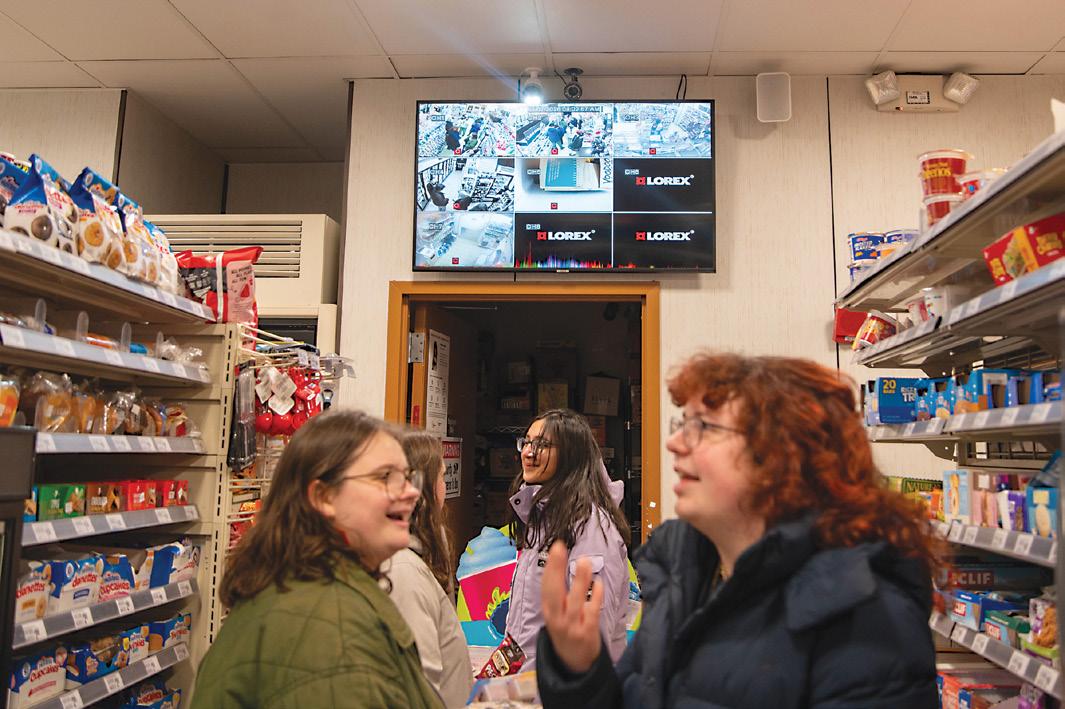
When actors returned to the Keene from hanging up posters all around East Quad Residence Hall, producers set up a projector on the stage with karaoke. Actors performed musical hits like “Guns and Ships” from “Hamilton” and “Michael in the Bathroom” from “Be More Chill”. With scripts written and actors thoroughly exhausted, producer Noor Bedi led everyone to the local 7-Eleven for snacks and slushies at 4:30 a.m. CONTINUED AT MICHIGANDAILY.COM
CLASSIFIED
24 Hours
Excellent place at an excellent price!
Private, furnished room with private full bath. Many utilities and perks included. Known student housing directly adjacent to North Campus. $895 a month. Take over remaining lease through July 2026. Call or email Brent at (231) 357-8826, bandamayes@gmail.com
BRIDGETTE BOL Managing Photo Editor
LSA freshman Chloe Donlan performs during dress rehearsal.
LSA freshman Emma Rahn, LSA sophomore Noor Bedi and LSA freshman Lola Finneran perform their producer sketch during dress rehearsal.
Red Eye participants shop in 7-Eleven.
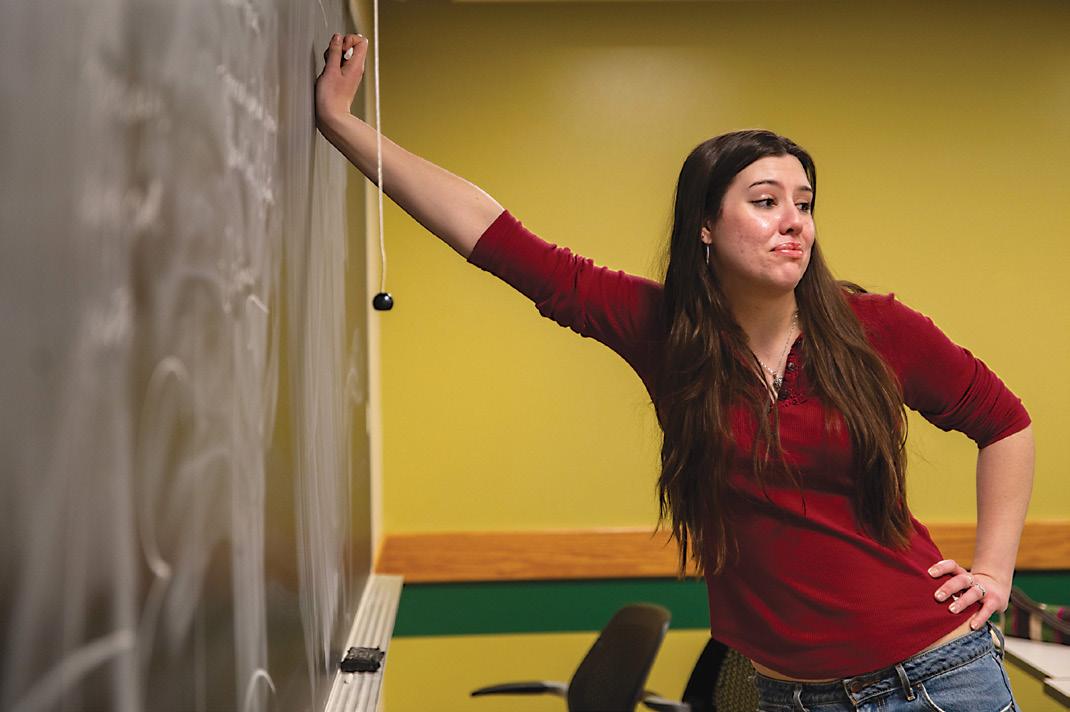
LSA freshman Lola Finneran points to the audience during Minute of Me. LSA senior Sabrina Barnes leans against a chalkboard.
Red Eye participants run around on stage during a game of All of My Friends.
LSA junior Christian Bade performs on stage.
Bridgette Bol/DAILY
No. 2 Michigan plays to its strengths in win over Ohio State, 82-61
XAVIER CHOUSSAT
COLUMBUS — Anchored by the tallest frontcourt in the nation, the No. 2 Michigan men’s basketball team is no stranger to physicality. With a few proclaimed ‘dogs’ by Wolverines coach Dusty May, Michigan doesn’t tend to duck opportunities to outmuscle its opponents.
With another chance to put their physicality on display Sunday, the Wolverines remained true to their seasonlong identity. In a game of bully ball mixed with a touch of finesse, Michigan (22-1 Overall, 12-1 Big Ten) took down Ohio State (15-8, 7-6) in the second and final game of the rivalry series, 82-61.
Currently leading the Big Ten in rebounds, the Wolverines made the Buckeyes pay on the glass early on. Outclassing Ohio State’s power forward and center in pure height, sophomore forward Morez Johnson Jr. and junior center Aday Mara secured boards and tip-ins alike en route to an early lead.
By feeding its bigs early on, Michigan opened up the floor for the rest of its shooters. After securing mismatches, graduate forward Yaxel Lendeborg and Mara’s gravity pulled in help defenders, giving clean looks from the opposite corner. Capitalizing on these shots, freshman guard Trey McKenney and graduate forward Will
MEN’S TENNIS
KYRIE GARWOOD
Daily Sports Contributor
Tschetter each nailed in a three.
“We just had a lot of spacing off the ball,” Lendeborg said. “I drew a lot of drive-and-kick angles and just a lot of moving and reacting to drives, which helped us out a lot.”
While the Wolverines looked to get the ball down low to their bigs or kick out to the wings,
they also took what the Buckeyes were giving them. Recognizing that Ohio State center Christoph Tilly tended to sag low off Mara, the Michigan center took his fifth, sixth and seventh 3-pointer of his collegiate career, swishing the latter two.
Despite losing the battle on the boards early on, the
Buckeyes managed to keep the game competitive against the Wolverines. Neither outstanding nor floundering in any category, Ohio State amassed 34 points to Michigan’s 44 as the halftime buzzer sounded.
Starting the second half, the Wolverines’ bigs once again led the charge. All doing what
they do best — a baby hook from Mara, post-up layups from Johnson and both assisting and making slams at the rim from Lendeborg — Michigan’s supersized lineup punished the Buckeyes inside.
“We’re taking better shots and we’re getting better movement,” May said. “Our
spacing is improving. I’ve been frustrated at times this year with our spacing and our ball movement, and it seems like now we’re settling in to what we’re looking for.”
Ohio State guard Bruce Thornton acted as the sole dam against Michigan’s deluge. Scoring at all levels, the Buckeyes’ team leader in points per game shouldered the majority of Ohio State’s early second-half offense.
Thornton’s play soon proved to not be enough as the Wolverines stretched their double-digit lead even further. Michigan didn’t rely on its cushion though, extinguishing any possibility of a comeback as it continued to hunt and knock down high percentage shots.
“We didn’t lack effort, we lacked major physicality,” Buckeyes coach Jake Diebler said. “And to give you an example, a shot goes up, it’s not like we weren’t running hard to the rim — the problem was we were running hard to the rim and not running hard to hit somebody and creating contact so we could rebound down the floor. That’s not an effort thing, that’s a lack of physicality.”
Building off the physical foundation laid by their bigs, the Wolverines played to their strengths against Ohio State. Not trying to be a team that they aren’t — save Mara’s six points from beyond the arc — Michigan’s drive to flex its physicality earned them a comfortable 21-point victory.
Late heroics guide Michigan to 4-3 win over Tennessee
Senior Mert Oral let his racket drop to the ground, staring up at the scoreboard as his teammates ran to congratulate him. In his first time playing in a three all match, Oral rose to the occasion, breaking his opponent for the match win at 40 all.
Oral’s win clinched the dual match victory for the Michigan men’s tennis team (2-4) on Sunday, successfully bouncing back from a tough loss earlier
in the weekend to notch a win over Tennessee (5-4), 4-3.
The Wolverines started off strong, collecting the doubles point — a feat not always guaranteed for Michigan. While the court 3 pair of freshman Arnav Bhandari and senior Nicholas Steighlehner dropped their match 6-1 to a strong Volunteer duo, redshirt freshman Max Dahlin and freshman Pierce Shaya secured a 6-4 win on court 1. In the end, the doubles point came down to Oral and senior Bjorn Swenson, winning over Tennessee’s Alejandro Moreno
and Jose Garcia in a 7-2 tiebreaker.
“Credit to our Coach Lawson there, keeping us grounded, telling us what to do,” Oral said. “Me and Bjorn, we’ve played a lot together over the last two and a half years and when it got tight and we knew the doubles point was coming down to us, we felt great.”
Heading into singles, the Wolverines were feeling confident. However, first-set losses on five courts quickly quelled any adrenaline.
At the bottom of the lineup Bhandari and Shaya struggled to bounce back, each dropping their matches in straight sets.
The losses gave the Volunteers hope, but a straight set win for Swenson on court 2 helped to ease Michigan’s anxieties.
No. 8 Dahlin solidified the tone on court 1. Known for being incredibly calm throughout his matches, Dahlin squared off against Moreno in a battle of opposites, with Moreno wearing all of his emotions on his sleeve.
The two traded sets before Dahlin ultimately prevailed, taking the last two sets for a 2-6, 6-3, 6-2 victory.
“(Moreno’s emotion) creeped in a bit on me,” Dahlin said. “I’ve just always been quite a quiet and
composed player, so that helped with not getting too affected by all of his things going on.”
Over on court 3, Steighlehner followed suit, dropping his first set and bouncing back in his second. Unfortunately for the Wolverines, Steighlehner failed to complete the comeback, knotting Michigan and Tennessee at three points each.
The match came down to Oral on court 4, who dropped his first set in his second tiebreaker of the day to the Volunteers’ Piotr Siekanowicz before fighting back to take the second set, 6-4. By the time Oral’s third set started it was
the main event, determining who would win the dual. After trading holds, Oral secured a break, went up 5-3 and delivered the Wolverines a hard-earned win.
“(Oral) executed great, handled the moment great,” Michigan coach Sean Maymi said. “That’s not an easy situation when it’s three all and it comes down to you and this was his first opportunity to have that. I’m so happy for him.”
After starting strong with the doubles and initially faltering in singles, the Wolverines relied on veteran players to deliver a backand-forth win over Tennessee.
Sophie Matthews: Michigan is still the undisputed leader of the NCAA after splitting Michigan State series
DETROIT — For the No. 1 Michigan hockey team and No. 2 Michigan State, the 2026 ‘Duel in the D’ marks the state rivals’ highest-ranking matchup yet. The two demonstrated their talents in front of the largest crowd for an indoor college hockey game this year — showing how many people were itching at the opportunity to lay eyes on the NCAA’s top two teams in the country. But only one side left victorious. The Spartans pulled off a convincing win against the Wolverines, sliding five pucks past the goal line. This act of revenge from the night prior leaves the teams sitting at two wins apiece against one another in the regular season, making the debate for No. 1 even more pressing.
Despite Saturday’s convincing win, and however strong the argument is in favor of Michigan State, though, Michigan’s No. 1 ranking is the correct assessment for how it compares to its peers.
In recent years, the Wolverines have been pitted against the Spartans more often than in previous seasons. Aside from the rivalry itself, the two teams presented competitive rosters that consistently put them under a national spotlight. But this year is different from others, and very few predicted how intense the rivalry would become.
Michigan entered the season ranked No. 12, a far jump from its current position that it has
held for the past 10 weeks.
Many anticipated another year of growing pains for the Wolverines as they welcomed in 14 new players after a subpar season the year prior. Michigan State, though, was facing contrasting expectations.
A similarly disappointing season-end for the Spartans left much room to prove their rise to power was not in vain. To do that, a list of needed accomplishments is in order: a Big Ten regularseason and tournament championship, the retention of the ‘Iron D’ trophy and a national championship. One may call them lofty goals, but Michigan State felt more than ready to rise to the occasion.
One thorn cannot seem to leave its side, however. And that thorn is the Wolverines.
Instead of falling into the trap of media expectations, Michigan used the talk to fuel its season. From the beginning, the Wolverines did little to hide their ambitions for the year. They zeroed in on their goals and have kept that focus at the heart of their motivations.
“My ultimate goal is to win a Big Ten championship and a national championship at the end of the year,” sophomore forward Will Horcoff said Oct. 3. “That’s what I’m focused on the whole season.”
And this is what has made Michigan stand out. It’s not the star power — the Spartans are flooded with talent. It’s not the experience — 11 of its players had yet to play a collegiate game entering the season. And it certainly was not last season’s confidence leaking into this year — it’s safe to assume the Wolverines would like to forget that run.
Michigan simply figured
out how to battle. A two-goal deficit — like when down 3-1 Friday with 10 minutes left in regulation — strikes no fear in the eyes of the Wolverines. It instead offers another opportunity to prove the doubters wrong. A majority of the time, they can do it with ease. Back-and-forth battles against opponents like Ohio State and Wisconsin proved that even in moments of pressure, Michigan could quickly erase a lead.
And this weekend is a prime example of the Wolverines’ season in a nutshell: a tough challenge that, if successfully completed, can be the most rewarding. When adversity comes — like splitting a series and being overtaken in Big Ten standings — they’re able to tackle it.
It’s not to say that Michigan always wins — of course it doesn’t. Cracks are inevitably shown when playing 30-plus games. But losing hasn’t been as common of a feeling for the group compared to the rest of the league.
Like their greatest competitor, the Wolverines have just five losses recorded on the year. All losses have been against top-10 opponents in the second game of the series. Having yet to be swept, Michigan has prohibited all opponents from busting out the brooms on a Saturday night.
Michigan State differs in this claim, as the Spartans have had less success against the unlikely opponents. Losing 2-1 against the Buckeyes or suffering an early upset to New Hampshire showed that teams of all calibers can break the machine — not just the superstars. A sweep by the Badgers initiated the greatest debate regarding Michigan
State’s long-term prospects.
On Friday night, Michigan pulled off the ultimate comeback, scoring three unanswered goals to defuse Michigan State in overtime and finally defend home ice. Very little belief was placed in the Wolverines’ hands as the clock dwindled down. But 10 minutes was all they needed to rewrite the narrative.
A series of fights, special teams appearances, individual efforts and demonstrations of chemistry were all utilized in such a short time, showing Michigan’s inability to give up. The Wolverines knew they had all weapons loaded, the trigger just needed to be pulled. A delayed response caused some stress, but a sense of relief ended the night, which is all they really care about anyway.
The second game gave light to the rarely seen dark side of Michigan’s memorable season. When it falls hard, it can be hard to respond, likely due to a lack of experience in these situations. However, a sign of life did appear. Two goals came in the Wolverines’ favor as they tried to surge back late in the game. It was merely too little too late for Michigan, though.
The Wolverines were, after all, facing the next-best team in the country. So if any lesson can be learned in this loss, it’s that Michigan can better understand how to approach a significant deficit when in big moments, like the fast-approaching postseason.
The loss is never a fun sight for them, but it’s far from a reason to question the Wolverines’ validity. Their avoidance of
sweeps and upsets makes them a greater threat than a team with some unpredictability.
“If you want to be that team that wins the last game of the year,” Michigan coach Brandon Naurato said Tuesday. “These are the games you’re going to have to win. And it’s never going to go your way for 60 minutes. There’s going to be some type of adversity or different momentum shifts, and how you respond to that is everything.”
Adversity and challenges remain constants for the Wolverines this year: a schedule full of ranked opponents, a series of underestimated moments and constantly needing to show why their ascent to the top is justified. And when doing that, Michigan has hurdled all in its way — a split series is not going to slow it down any time soon.
ICE HOCKEY
Georgia McKay/DAILY
Ananya Kedia/DAILY
Michigan
DETROIT — No. 2 Michigan State entered the second matchup of the weekend with something to prove. It sat only one spot behind the No. 1 Michigan hockey team in the rankings, lost an overtime game the night prior and held a two-year streak of ‘Duel in the D’ wins it hoped to protect.
And that drive presented itself with an early lead that made it easy for the Spartans (22-6 overall, 13-5 Big Ten) to run away with the ‘Iron D’ trophy once again as the Wolverines (23-5, 14-4) were left behind in the 5-2 loss.
“Anytime you get a chance to win a trophy, it’s always a big game,” Michigan State forward Porter Martone said. “I know our group was up for it and to have a response from last night is huge.”
Coming off an overtime barnburner on Friday night, the beginning of the first period told a different story. With a slow first half to open up the game, both teams looked for opportunities to break in the nets at Little Caesars Arena.
Ananya Kedia/DAILY
Michigan itched for a repeat performance and an offensive run of its own to combat the Spartans’ dominance the prior two periods. Five minutes into the third period, junior forward Nick Moldenhauer cut Michigan State’s lead down to two as he put the puck away on a rebound off the post. “ …But it’s two good teams and that was kind of the message to the guys,” Wolverines coach Brandon Naurato said. “It’s like the Big Ten tournament and the NCAA tournament. Not that this happened tonight, but you can be dominating a team and be down two goals. You can be getting dominated and be up two goals, you just have to keep responding and fighting the fight.”
And the Spartans became the first team to raise their sticks in celebration. Halfway through the opening period, Michigan State forward Gavin O’Connell came in hot to rip a goal from the circle with an open slot in front of him. Though Michigan looked for a response of its own, the neutral zone became a battle as consistent turnovers kept the Wolverines from stringing together an offensive drive.
SOFTBALL
The Spartans put one more on the board before the end of the period on the power play, as Martone put the puck top shelf past freshman goaltender Jack Ivankovic — who made his return between the pipes for the first time since his injury Jan. 11. Going into the second period, Michigan was looking to wake up
Florida spoils Michigan’s perfect opening weekend at USF-Rawlings Invitational
HADLEY ZANN Daily Sports Writer
On the Michigan softball team’s second at-bat of the season, junior outfielder Jenissa Conway stepped up to the plate and doubled to left field, sending senior infielder Indiana Langford home to score. Just 10 pitches into the season, the Wolverines already scored their first run.
That set the tone for the weekend. Opening the season with a bang, Michigan (4-1) thrashed Bethune-Cookman (0-5) with a dominant 17-0 win before taking down South Florida (2-3) and Illinois State (2-3) with scores of 4-0 and 6-2, respectively. The Wolverines fell to No. 6 Florida (5-0) next, 5-1, before bouncing back to finish the weekend with a 4-2 win over Kansas (2-3).
“We are really pleased with how we played,” Michigan coach Bonnie Tholl said Sunday. “The majority of the weekend, we were on the attack. … We like the fact that (the) first few games were shutouts for us, and that’s always a good thing when you can play some really good defense behind your pitchers and get that offensive support.”
That initial defense was powerful, allowing just three hits and recording eight strikeouts for 19 Wildcat batters faced. Junior right-hander Erin Hoehn followed up that performance by pitching the whole game against the Bulls, striking out 11 and allowing zero runs. Junior right-hander Gabby Ellis made her debut as a Wolverine, earning a win against the Redbirds. On the other side of the ball, Michigan came out swinging. After scoring 17 runs in their first game of the season, the Wolverines ended the weekend with a scoring margin of 32-9. Michigan slugged five home runs over the five games, with two coming from sophomore right fielder Lauren Putz. Even with the loss of their leadoff hitter, Langford, after the second game, the Wolverines still swung the bat effectively.
But while Michigan defeated most of the opponents it came across, the Wolverines were stumped by the Gators in their
fourth game of the weekend. When Conway began the game with a homer to right field, the afternoon looked promising for Michigan. But Florida tied the score in the bottom of the first, and the Wolverines were never able to retake the lead.
“When you look at it, we were facing a really top pitcher, and we were able to, as our own pitching staff, (strike) out more batters than we struck out ourselves,” Tholl said. “The difference was they had a few more hits and they coaxed a few more walks, which means they had more base runners to come around the bases when they did get the big hit, so that’s something to continue to work on. But there’s a lot of positives to that game as well.”
Although Michigan kept the Gators scoreless for the next two innings, the bottom of the fourth proved vital to the game’s outcome. After allowing four more runs that inning, the Wolverines were unable to recover, resulting in a 5-1 loss — their first of the young season.
But Michigan didn’t let that loss deter it. The next morning, it faced the Jayhawks in a close match in which it ultimately prevailed, scoring three runs in the sixth inning to take the lead right before the end of the game. The Wolverines finished the weekend on a high note with a 4-2 win, opening their season with a handful of successful games to spur them forward.
“(It’s) very important to start the season off strong, and it just really helps the team with the positive idea of what the season looks like and all that kind of stuff,” Putz said. “Definitely starting off this season strong with a couple wins just to get under our belt so that all the newcomers feel comfortable and all that stuff (is important). It definitely brings us together as a group as well.”
In its first few games of the season, Michigan hit the ground running, refusing to let one loss deter it from a successful showing. And although the loss against Florida is a small blemish on an otherwise perfect weekend, the Wolverines’ early wins reflect a promising start that could propel them into the rest of their season.
its stalling offense to minimize the two-goal lead Michigan State had built up. But rather than finding the back of the net itself, the Spartans notched another pair of goals in about a minute and a half. Michigan State forward Charlie Stramel first took a pass and put the puck away with a backdoor goal. Shortly after, the Spartans mirrored the play, finding the same success and leaving the Wolverines in silence.
MEN’S BASKETBALL
“Every game feels like a must win game,” Michigan State goaltender Trey Augstine said. “Just with our conference being so tight as it is right now, and like it’s been said, but just building towards playoffs, getting our game in a good spot and hitting into that.” Sitting in a four-goal deficit, Michigan was overwhelmed by the Spartans across the ice. With little room to breathe
and Michigan State’s defense suffocating the Wolverines, they struggled to find any space for their own offensive breakthrough. In the final minute of the second period, junior forward Jayden Perron gave Michigan a reason to celebrate for the first time on the night. Perron waited in the wing and took a shot off Augustine’s deflection to give the Wolverines a goal.
But Michigan’s offensive resurgence simply came too late. Looking to utilize a late power-play opportunity and threatening plays, the Wolverines attempted to scrape goals out to tie the game. However, as the Spartans grabbed an empty-netter in the final minutes of the game, Michigan’s fate was sealed. With neither team able to take hold of the season series, the heated rivalry between the two in-state teams ended in a split with Michigan State and Michigan both unable to get the lead over its foes. And with the Spartans finding their offensive stride Saturday just like the Wolverines did the night prior, Michigan State’s offense proved to be enough to take the ‘Iron D’ trophy back to East Lansing.
SportsMonday: Michigan can’t roster pros, regardless of what other programs do
JONATHAN WUCHTER
Daily Sports Writer
The No. 2 Michigan men’s basketball team is the prime example of embracing modern college basketball: NIL, the transfer portal and revenue sharing.
Since coach Dusty May took over ahead of last season, the Wolverines have been at the forefront of embracing new regulations and mechanisms for recruiting and roster construction.
This year’s roster is May’s magnum opus and might remain that way for the rest of his career.
Elsewhere in college basketball — most notably in Tuscaloosa, Ala. — teams are challenging the NCAA in court to roster and play former NBA draft picks and G-League players. Michigan shouldn’t partake.
While adapting to the times has been vital to success across college athletics over the past few years, the Wolverines shouldn’t attempt to be ahead of the curve when it comes to recruiting former professionals.
If NCAA rules change, Michigan has every right to be reactionary, but for now, the Wolverines need to stay out of this mess.
Alabama center Charles Bediako is easily the most controversial player in the sport at the moment.
A restraining order granted by a Tuscaloosa County Circuit Court judge is enabling him to suit up for the Crimson Tide. He played his
first game of the season on Jan. 24 against Tennessee.
Bediako returns to college after playing two seasons with Alabama from 2021 to 2023. In the interim, Bediako appeared in 46 NBA G-League games after going undrafted in 2023 and initially signing a two-way contract with the San Antonio Spurs. He is explicitly barred from playing college basketball according to the NCAA rulebook.
Alabama is arguing Bediako is within his five-year eligibility window. But that’s just what the lawyers are saying — the Crimson Tide are consciously breaking the rules. While every team is pushing NIL and the transfer portal to its limits, and regulations on those are another conversation, Alabama has gone a step too far. Even SEC commissioner Greg Sankey, whose primary interest is the success of conference teams, has gone against the Tide.
A couple of weeks ago, against Ohio State, Michigan went against a player in a somewhat similar situation. Ohio State forward Puff Johnson was never a professional like Bediako, but ran out of eligibility and had multiple waivers denied by the NCAA. He made his debut on Jan. 23 against the Wolverines, and when asked about it, May didn’t offer a strong opinion.
“I think when coaches take a hard stance, and then circumstances force them to
change their minds, and then they look like hypocrites, and that’s something that I don’t really want to do,” May said. “But, you know, I don’t have a strong opinion on it. We’re not doing it. And that’s all we can really control, are the decisions that we make.”
May’s response was entirely appropriate. With how everevolving college basketball has been, he has to keep the door open if the sport keeps trending toward being a minor league system and Bediako’s situation becomes the norm. Maybe that happens in the near future, but that’s not to be decided in a courtroom in Tuscaloosa, nor one in Washtenaw County.
Michigan hockey coach
Brandon Naurato’s approach following the rule change granting eligibility to former Canadian Hockey League players is an in-house blueprint for what to do. In August 2024, the NCAA made the decision, and not because any ineligible player was skating for any team.
After, and only after the rule was changed, did Naurato recruit CHL players. He did it superbly, acting quickly to heavily bolster his class and construct a roster that has the Wolverines ranked No. 1 in the country. Surely Naurato is advised on how to act by the athletic department, as is May. For the department’s many flaws, it has at
least adjusted to NIL, the transfer portal, and revenue sharing in the past couple of years — recruiting and retaining quarterback Bryce Underwood, assembling May’s two stellar frontcourts and keeping the women’s basketball big three rolling.
Michigan has been more conservative with other proposed changes, most notably private equity’s involvement in the Big Ten. But even that may change under incoming president and super-league backer Kent Syverud.
Every major brand in college athletics must take a forwardthinking and ambitious approach, but it’s inherently a fine line to walk. Alabama justifies its action, believing that some combination of the current rules being unjust, enforced incorrectly and a barrier to them winning basketball games gives them a case to play Bediako.
“I believe in our group. I love competing with them,” May said. “And if someone adds a player, then that’s their right as the coach or the administration, whatever, I’m just not up here to judge everyone else.”
It’s not anyone’s right to break the rules. Former professionals have no place in college basketball. May’s wishy-washy response is fine, it’s understandable even — so long as Michigan stays out of the courtroom.
Bridgette Bol/DAILY
MACKENZIE MIELKE Daily Sports Editor
CLOSE CLOSE
VILY SOURIS Daily Sports Writer
When junior forward Ashley Sofilkanich faced No. 2 UCLA’s 6-foot-7 center Lauren Betts for the tipoff, the size difference was already staggering. But somehow, its smallest defensive forces held up the No. 8 Michigan women’s basketball team.
And despite their 69-66 loss, the Wolverines (20-4 overall, 11-2 Big Ten) made strides in their backcourt that left the Bruins (23-1, 13-0) fighting for a breath.
“Michigan is a really good team,” UCLA coach Cori Close said. “They play with great purpose, and they know what they’re looking for, and they gave us all we could handle.”
For Sofilkanich, getting the initial touch on the ball was completely out of reach. On the other hand, sophomore guard
Mila Holloway and senior guard
Brooke Quarles Daniels wouldn’t let a single Bruins attempt go uncontested. From their first possession, the Bruins were dictating pace and manipulating the Wolverines’ positioning on the backcourt. When it came their turn to handle the ball, Quarles Daniels slipped into an unexpected role. Not only did she secure Michigan’s first points of the game, but she did so over the reach of Betts. Even with a wingspan over a foot longer, Betts couldn’t shut Quarles Daniels fully down. Moments later, Holloway blitzed through the lane to hit another layup.
The Wolverines had a grasp on the first quarter. UCLA kept its best contributors on the floor — including Betts, who’s usually given room to breathe even in ranked matchups. Closing the first up 17-13, Michigan held the lead with a boost of confidence backed by its guards. Holloway and Quarles Daniels followed through in the second
quarter, but a 3-point shooting deficit seeped through the cracks. This season, Bruins’ guard Gianna Kneepkens leads her team in threes made by over 20. She shot 4-for-4 from the field and 2-for2 beyond the arc, contributing 10 of UCLA’s 20 points in the second quarter alone. Kneepkens’ contributions were seismic, and on top of Betts’ seamless work at the rim, the Wolverines got flustered. Sophomore guard Olivia Olson filled in defensively where Sofilkanich couldn’t hold up. Olson held off the Bruins’ bigs in the paint and helped her offense find some good looks. Ultimately, UCLA’s offense became unstoppable and quickly picked up its slack, sealing the half with a 33-30 lead.
By the time Michigan could make it work, the third quarter was cemented by the Bruins’ offense and disciplined defense. The Wolverines made no progress for the first four minutes of the third quarter, as UCLA was dominating
possessions by a long shot. Former Bruin sophomore guard Kendall Dudley kept the Wolverines in motion, securing a second-chance jumper which was enough to scare UCLA into a timeout. Still in the lead, but a bit shaken up, the Bruins clocked back in and made a world of improvements.
The already stellar offensive lineup set up even more good looks and Michigan couldn’t account for UCLA’s seamless possessions. Its constant success in the paint had the Wolverines’ defense overworked and their offense underutilized.
The majority of Michigan’s opportunities with the ball fell short. An already struggling threepoint shooting team lost accuracy in the paint after being outrun on the other end. Inconsistent communication and lackluster pacing muddied the waters, making it that much easier for the Bruins to seep through the cracks.
UCLA guard Kiki Rice is arguably the Bruins’ most tangible
threat, even with Betts as its layup machine. Through the half-court, her press exhausted any passing plays the Wolverines had in their pockets. Just the height difference alone put sizable limitations on what Michigan could do. UCLA blinded all of the Wolverines in the paint, and their scrambling runs around the arc often cost them their possession anyway. Michigan held up considerably well by collecting defensive rebounds.
The occasion block or steal also helped in that regard. However, once the Wolverines stepped foot across the line, they didn’t implement the tools to keep it there.
Michigan started the fourth quarter down 54-45. The deficit fluctuated throughout. But with barely a minute remaining, a Bruins shooting foul sent Holloway to the line and ran the margin down to six points. And while it appeared to be an opportunity left up to the offense, the final 30
seconds turned into a defensive battle that the Wolverines suffered through. Michigan loaded up on threes late after a game almost completely void of them. Its recovery efforts were remarkable, yet still three steps behind UCLA. The Wolverines were in a much too familiar position — having threepoint losses against Connecticut, Vanderbilt and now the threat against the Bruins. With a few seconds to go, Michigan attempted a three for the tie, but the shot was too short and too late.
“We lost by three,” Wolverines coach Kim Barnes Arico said. “I don’t know if anybody else has played them that tight.” Michigan’s defense put up a remarkable fight against the Bruins’ huge lineup. But by the end of the first half, the Wolverines lacked the shooting efficiency they needed to get up and over UCLA.
redefined by college students Love,
SARAYU
Statement Correspondent
Love (noun)
an intense feeling of deep affection.
I was surprised when I first searched up the definition of love in the Oxford English Dictionary. What societal norms make so complicated is easily defined in six words. When I think about love, I immediately think about the sacred phrase, “I love you,” said to a partner in a romantic context. Those words carry so much weight for me, largely because society teaches us through books, movies and TV shows that they should not be said lightly. Popular media frames those three words as a defining milestone, something reserved for the right person at the right moment. As a result, love becomes complicated because of the rules we are taught to follow.
Because of this, when we first hear the word “love,” we usually think of romance. We imagine having a boyfriend or girlfriend, someone we may eventually marry. However, the Oxford Languages definition reminds
family, hobbies, belongings and even ourselves. Love isn’t confined to just romantic relationships, but can extend across all types of relationships and passions.
So, I decided to explore what love means to college students and why it’s so often seen as complicated. A quick Google search of “what is love” pointed me to the Cleveland Clinic identifying eight types of love. The eight types of love include eros (romantic or sexual love), philia (friendship), storge (familial love), ludus (playful love), pragma (longlasting love based in commitment), philautia (self-love), mania (obsessive love) and agape (selfless love for others).
Using this background information, I decided to interview college students at the University of Michigan about what love means to them and how they experience it. Across these conversations, I found that their responses consistently fell into four main categories of love — romantic, platonic, familial and self — which I further explore below.
Romantic love
When thinking about love, romantic love is what typically comes to mind. The fiery
those without experience in romantic relationships often responded, “Oh, I don’t have experience with love,” to which I responded, “No, there are different types of love.”
Romantic love is idealized because of consumerism, especially during Valentine’s Day. According to the annual survey conducted by the National Retail Federation, consumer spending on Valentine’s Day this year is expected to reach $29.1 billion. That’s a whole lot of money to be spending on Walmart heart-shaped chocolate boxes and overpriced teddy bears.
So, the consensus is that romantic love is amplified to an almost unavoidable level on Feb. 14. For single people (like me this year), the unfortunate holiday of Valentine’s Day is a doomsday and an annual reminder of what I’m expected to want. For those in relationships, it’s pressure to perform love in a very public and curated way. Either way, the day exposes how narrowly society defines love.
There are different types of love within romantic love. Through my interviews, I noticed students often described romantic
aspect of love makes romantic relationships more vulnerable and sometimes stronger than the other types of love.
“I think since there is a physical connection, you feel more secure with them,” Baldini said. “Because you’ve been more vulnerable and they’re more vulnerable (with) you as well because of the physical (aspect), so you can also tell them more stuff you wouldn’t tell your friends or family.”
The other type of romantic love — dependent on emotional connection — was described as being expressed through actions, building a more emotionally intimate relationship. LSA freshman Kennedy Kavanagh said this love is emphasized by acts of service.
“Romantic love is, you want that person to be your other half,” Kavanagh said. “You want to spend the most time with them. You show your love through acts of your service and physical touch.”
Now, while I don’t necessarily believe in the idea of soulmates or that our lifetimes are spent finding a predestined match, I believe that romantic love is created through constantly working on the relationship.
BONGALE
sweet love notes peek out from under apple cider glasses. While it may seem like a traditional Valentine’s Day dinner, it’s even better: A romantic dinner with your truest loves, your best friends.
No matter what my friend group’s romantic situation was around Valentine’s Day, we always planned to have a Galentine’s dinner to celebrate our friendship and love for each other. Galentine’s Day is an unofficial holiday originally created for women — hence “gal”-entines — but has extended to everyone to express platonic love on Feb. 13. My friends and I celebrate Galentine’s Day by dressing in shades of pink and either going out for dinner or making dinner together and spending quality time together.
But you don’t need a designated day to celebrate friendship. I try to show my love for my friends all year round by buying something that reminds me of them or writing heartfelt notes on special occasions. I also express my love in more indirect ways, such as sending TikToks that remind me of them, or even just enjoying their company while bed-rotting together.
Through my interview process, I’ve realized that the way I express my love for my friends is through Sohn’s definitions of “indirect love.”
“Indirect love applies to all relationships,” Sohn said. “That’s the kind of love that, whoever you’re showing it for, it’s behind closed doors. If your friend or significant other isn’t in the room, how are you speaking about them? … If it’s in that very passionate and affectionate way, I think that’s indirect love.”
The way we show love to friends can look a lot like romantic love, so what is the difference between romantic and platonic love? Anderson believes that, in male friendships specifically, it’s more about what you’re doing together.
“Platonic love is … enjoying something else together versus enjoying each other,” Anderson said. “I love watching a football game with my friends, playing games with my friends, stuff like that. Romantic love, on the other hand, is … spending time with each other, and maybe you’ll do things together, but it’s more about each other than it is about the event.”
This surprised me because, for me, showing platonic love is about who I spend time with rather than what we’re doing. I value my friends’ presence above the activity itself. One of my favorite ways to spend time with my friends is simply working on our own things while being
together, just enjoying each other’s presence.
Sohn even believes that platonic love is stronger than romantic love, as platonic relationships don’t always carry the same pressure.
“With romantic love, people are always waiting for their shoe drop and they’re waiting for the other person to mess up, or they hold a lot of things against them,” Sohn said. “Whereas, I think (with) platonic love … that is your ride or die, that is your soulmate. You will be there for that person no matter what. It’s stronger than romantic love.”
With fewer societal expectations, platonic relationships can feel more natural and authentic in contrast to romantic love, where social norms can sometimes make expressions of care feel performative.
“Platonic love is (about how you’re) going to support that person, either when they’re down, but also potentially when other people are trying to tear them down,” Sohn said. “If your friend isn’t in the room with you and someone else is not talking about that peer in the most positive way, how are you going to show your love for them by saying, ‘That is my friend, that is my day one.’ The purest moments of love happen when the person being loved isn’t even in the room.”
While I resonate with that definition of platonic love the most, I’ve noticed that friendships for some guys can often look different.
“You just (befriend) everybody,” Anderson said. “Who’s closest is purely dependent on how much time you spend together, I feel like. If you spend a lot of time together, then you’re best friends. But that same friend could also not spend much time with you, and you wouldn’t be great friends.”
I’ve always found male friendship dynamics interesting, as it seems that guys can barely know each other and still consider themselves really good friends. Girl friendships stereotypically involve more toxicity (literally the plot of Mean Girls), and, therefore, girls tend to take more time to get to know each other and gauge authenticity before forming closer bonds. While this obviously doesn’t apply to all friendships, I’ve noticed that male and female friendship dynamics often follow these patterns.
Familial Love
To me, family is defined by the people who raised me, supported me and watched me grow up. Because most of my extended biological family lives outside the United
States, I didn’t fully learn to appreciate this kind of love until later in my life.
Coming to college and being halfway across the country from my immediate family made me realize that my family will always be there for me. They accept me even when no one else does, and their love is truly unconditional. This is how I’ve come to define familial love.
LSA sophomore Leah Beel has a similar perspective. For her, familial love is understanding one another.
“With my family, I think it’s more knowing someone very thoroughly and knowing everything they’ve been through, and still choosing to love them,” Beel said. “With my family, it’s more about showing up for each other.”
However, familial love is not limited to biological relationships. Kavanagh described familial love as extending to the people who raised and supported you through childhood, regardless of blood relation.
“Paternal love is loving your parents or the people that have raised you, even if they’re not biologically related,” Kavanagh said. “It’s different from romantic and platonic love because you may not spend as much time with them.”
There are many ways people show their love for their family. For me, it’s in the small things, like taking the time to talk with them, telling them about my day and asking about theirs. Even simple conversations mean a lot to me, because they show that I care and want to stay involved in their lives. Especially when we’re apart, those moments help me feel connected to them and remind me that my family is always there for me.
Expressions of familial love for Baldini range from physical affection to quality time.
“(Familial love) is mostly unspoken, but just in my family, I hug my parents,” Baldini said. “I don’t really hug my sisters. We even talked about it, but we just kind of understand, we love each other. We talk to each other, we laugh with each other. I think laughing with each other, having good times with each other — that’s kind of how we express our love.”
Across these experiences, forgiveness stands out as an important part of family relationships.
Beel emphasized that loving your family means choosing to forgive them if it’s possible.
“I think everyone makes mistakes,” Beel said. “Nowadays, no matter the relationship, people do one wrong thing and they dip. Within families, people
yell at you, you’ll have bad experiences, but forgiving them is an important part of (being a family).”
Growing older has made me realize that my parents shielded me from hard truths when I was younger, and that, overall, family isn’t as perfect as I once thought. However, understanding that my parents have always acted in my best interest and that we are all willing to grow together is what makes my family truly perfect.
Self-love
When asking students what they believe the different types of love are, self-love was mentioned the least by far.
Self-love is often overlooked, but I strongly believe it to be the most important type of love. Our culture tends to emphasize romantic relationships or friendships as the primary measures of happiness. Many people view focusing on oneself as selfish. However, being able to accept yourself and feel secure in who you are creates the foundation for every other relationship. With that acceptance, only then are you able to show up for others. This sentiment is shared with other students, such as Baldini.
“In the end, if you don’t love yourself, you can’t love other people,” Baldini said. Okay, yes, this may sound super cliche, but I strongly believe this statement relates to most relationships. Self-love means doing things for yourself; it means allowing room for self-acceptance, so that you can eventually learn to love yourself. In my personal experience, selflove starts with reflection. Business freshman Oak Carter described self-love as a relationship between yourself and the world around you.
“(Self-love is) more individualized, where it would really be thinking about how you interact with the world, and then thinking about how you treat yourself as well,” Carter said.
When that self-reflection doesn’t happen, it can create problems not only within yourself, but also in your relationships with others. In a past romantic relationship, my partner didn’t know what they wanted and felt unsure of themself. As someone who is driven and clear about my goals, their uncertainty made it difficult for me to be honest and forward about my own needs. Over time, their insecurities began to shape the relationship, and when we tried longdistance, it ultimately didn’t work.
CONTINUED AT MICHIGANDAILY.COM
Dear Michelle: A college love advice column
MICHELLE LIAO Statement Columnist
Love is complex. Unlike everything else in our natural world — the existence of which we can map out through scientific rules — no one has yet figured out the formula for love. Everyone grapples with it differently. One person can feel they don’t love enough, and another can feel they love too much. One person can love someone else for a lifetime, and another can love for a single day. The following letters were collected from a form through which readers submitted their own dilemmas with love — under an anonymous name — in search of greater clarity and perhaps even answers. We hope they will bring some more peace into your life as well.
***
Dear Michelle,
This guy and I talked one summer two years ago and it didn’t work out, and then we did the same exact thing last summer. He asked me out for lunch recently, do you believe in a (right-person-wrong-time) situation? He thinks that’s what it was but I’m wondering if it hasn’t worked out so far, it’s never going to.
– Jacqueline
Dear Jacqueline,
I have to admit, I’ve never been a big proponent of the idea of soulmates. Nor has the invisible string theory ever been particularly appealing to me. In theory, it’s comforting to believe there is one person out there for you, and I’ve found myself wondering at times about the person I will one day marry. Maybe he’s several thousand miles and multiple time zones away, hiking rain-kissed mountains as the sun begins to dip below the horizon. Maybe he’s a few hundred feet away, buried beneath countless books in the same library stacks I sit in now. Yet, is my future husband necessarily “the one”? Even as a self-proclaimed hopeless romantic, I’m not so sure.
I’ve known love to be a complicated thing. I’ve watched my parents fall in and out of love, finally settling for somewhere in between. I’ve dated men who have proclaimed to love me, some who I have believed and some who I have not. I’ve heard stories of people tragically losing their partners early, only to unexpectedly discover love a second time with someone new. All of these experiences struggle to align with my idea of a soulmate. Rather than there being one person carved into the stars for you from the minute you were born, I believe you possess the potential to find love with many people. Stretching ahead of you right now are countless versions of yourself, each one with a different idea of a soulmate. Millions of inconsequential decisions and sheer coincidences lead you down one of these infinite paths, and at the end of one of these paths, you find someone you may want to spend the rest of your life with. Is it fate, or is it a combination
of statistical chaos and a deliberate choice to love someone forever? I find the second option more beautiful.
If I am wrong, and soulmates do exist, then it is possible he could be yours. It could very well be a right-person-wrongtime situation, as you suggested. Love is a fickle creature and does not always make an appearance at once. If you decide against trying again for the third time, it is possible that you would miss out on a love spanning decades. Worse, you could spend the rest of your life wondering what would’ve happened if you agreed to that fateful lunch.
Rather than worry about whether he is the right person, however, I would ask yourself how much work you’re willing to invest into this relationship. Why has it always been the wrong time? Was it truly the timing at fault, or are you two fundamentally different individuals? If you keep trying only because of the slight possibility he might be the one, then perhaps it is time to pause and consider whether you can truly picture a future together. It might be time to walk away. On the other hand, if you stay because some part of him calls to you, then go to that lunch. Choose to walk down this path out of the multitudes, and know that whichever road you do take, you can choose to make it the right one.
Dear Michelle,
Myboyfriendlivesover3,000miles away so we only get to see each other around 4 times a year. I love him so so so much and he’s amazing and perfect in every way, but it does get lonely and sometimes I don’t know what to do about it.
– Toast on Beans
Dear Toast on Beans,
First of all, I love your name. Second of all, it sounds like, unlike the first letter writer, you have discovered your proverbial soulmate. Somehow, you have spanned the distance and navigated the countless minutiae of life, and you found him. It is not a gift to be taken lightly.
nature of our relationship is romantic. The summer before my freshman year of college, I broke up with my high school boyfriend. Countless factors went into that decision, but one of them was my deep hesitance to do long-distance. I wanted to rediscover myself, but I thought I couldn’t do so fully
I won’t pretend that long-distance is not difficult. There are some more wellsuited to long-distance relationships than others, and, as it stands, I fall into the latter category. The longer the miles spool between our feet, the weaker my bonds with others become — regardless of whether the
the jaws of time every year. Find beauty in the mundane, and fall in love — not with him, since that is a task already done, but with the world. Take the long way home with your friends and revel in the way the drifting snow settles into your hair. Take yourself on solo dates and discover new parts of your identity in the relative anonymity of candlelight. Fall in love with the life you have here, and sleep soundly at night knowing you have someone thinking of you from afar. And when you do feel lonely, perhaps it is reassuring to remind yourself that loneliness is simply a reflection of the love the two of you share.
DearMichelle,
I’ve realized now, however, that the two are not mutually exclusive. It’s entirely possible to hold on tightly to your love and discover who you are at the same time. In fact, that is what I recommend you do.
It’s time to find joy in more than the few days with your boyfriend you snatch from
***
Ican’tseemtogetmyselftowantapartner. I have never been attracted to anyone in the sense that I would like to date them or anything. I would like to be married someday but at this rate I’m cooked. Should I just be patient,oristhereawaytochangethis?
– Moss Ball
Dear Moss Ball, Where do I even begin? I saved you for last because of how deeply your note resonated with me. I’ve had my fair share of past partners, but there has always been something missing. None of them have ignited feelings within me such as the ones Toast on Beans hold for their boyfriend, even 3,000 miles apart from one another. As sad as it sounds, I’ve never loved someone in the way I see others love their partners: wholly, without reservation.
I used to search for the answer to this problem within myself. I researched attachment styles, poring over dozens of articles in search of the solution I was sure existed. I sat through psychology lecture after psychology lecture, failing to ever question why I so badly wanted to find this mysterious love in the first place; finding that love was never going to miraculously solve all of my problems. I refuse to believe there is something I can find in a romantic partner that I cannot already find in myself. A loving partner can help you grow in so many ways, but that growth has to stem from within. Because the truth is, I do love. I form connections deeply — and quickly. I love my family more than I can express with words, and I love my friends with a fierceness that rivals that of any romantic relationship. I love myself most of all, and I’m proud of the emotional growth I have worked to obtain over these past few years. When I find the right person for who I am at this moment, I know I will be able to love him as well. This might be the case for you, but it also might not, and I want you to know that’s okay. Chances are, you just haven’t found someone right for you. Yet, even if the years slip by, and you still feel the same way, the most important thing is that you find peace in being with yourself. Fall in love with the person you see every day in the mirror, and that is all you will ever need.
Love,
Band of brothers
Oftentimes, when I am anxious or stressed, I think of times in my life when I wasn’t. Thinking about these moments, whether they were singular or prolonged periods, has always helped to calm me down. But sometimes, reflection isn’t enough. Sometimes, the present overwhelms every other past moment. Although it’s cliche, sometimes, you just need somebody to love.
Early last semester, it felt like I did not have anybody to love. I’m not sure whether it was just the start of the semester making me nervous, or the fact that I was officially more than halfway done with college, but I was anxious, and I was only growing more anxious by the day. Assignments were piling up for a major I didn’t like, I had to see my archnemesis every Saturday and I had lots of existential fears about our planet to top off general, young adult interpersonal issues. All of these external and internal anxieties made me feel isolated and alone, to say the least.
But sometimes, love finds a way. One day in class, when I was feeling particularly anxious, I heard my professor mention the TV show “Friends.” Suddenly, I was transported to a different place, 2,000 miles away, visiting my older brother in California. ***
I’m not sure that I can accurately explain what my older brothers mean to me, but I’m not sure I have to.
When I was very little, they pushed me around in a stroller, literally guiding me through life. When I was in elementary school, they taught me how to behave around other people. When I was in middle school, we would stay up late,
watching movies and playing video games. At every stage of my childhood, they were there, shaping my existence. Anyone who has ever met me has, inadvertently, met them, because I am an extension of them.
Eventually, though, people grow up. My brothers are older than me, and both left for college before me. My oldest brother even graduated college before I graduated high school. There were times when I didn’t see them a whole lot.
My oldest brother eventually moved from Michigan to a different state, halfway across the country, while my other brother was busy adjusting to college. So, in high school, I suddenly existed in an empty house. I had my parents, of course, but they weren’t able to replace the love that was missing. Sometimes, we went a couple days without communicating, and sometimes, I forgot they were there. At first, it felt jarring, going days without seeing them. But it became its own normality for me. It was simply our new existence. Without my brothers there, I had to become my own person.
Suffice to say, such distance changed our love. Between their absence and leaving for college myself, I like to think that I am more of my own person and less of a carbon copy of each of them, like I was when we lived together. Growing up is hard, and I did and still do miss them, but I have enjoyed our time apart. I can articulate myself and explain why I like the things I like and believe the things I believe without relying on them to speak for me. I developed relationships with other friends that mirror my relationship with them. I am now me, whereas before, I was them. We text more than we physically talk now. They don’t play such a central role in my life anymore. But being able to grow
into myself has reminded me that they are always there. Instead of needing to see them to feel close to them, we can talk about whatever it is we are talking about in a much more meaningful way, because it feels like I am talking to them instead of them talking through me.
Their lack of a physical presence doesn’t mean that my two best friends in the world aren’t my two older brothers anymore. I still do love them. A lot, even. But that love isn’t so intense anymore. We have each grown so much since we were younger. We are each our own person now, with our own interests and passions and ideals. When I observe people regularly sitting next to each other during my lectures, or when I see others texting in some group chat with an absurd name that is certainly an inside joke, I think of my brothers. My love for them isn’t what it used to be, because I am not who I used to be. But it’s still there. It just looks different. It may exist mostly in memories now, but those are our memories, and they have them too. And it is those memories of our shared time together that let me know they are always there for me. After all, even if I am my own person, they were my original guides in life. They still understand me, fundamentally, in ways that most people do not, even if I cannot see them in person for the time being.
And still, despite the lack of physicality and the ways in which we’ve grown away from each other, the love I feel and the way we show up for each other is still the same in some ways. I still call my oldest brother Max when I need to know what pair of shoes I should buy next or if I should listen to a musical artist or not. I still call my brother Josh when I need to know how to do something for the first time in a situation I know he has gone through before. Much of my taste in music
or fashion, my knowledge of how to do basic things and the rest of who I am are reflections of their influence on me and my love for them, even if I have become my own person along the way. ***
Two thousand miles away, I am visiting my oldest brother, accompanied by my other brother. I’m sitting on a couch that is covered in dog and cat hair. My eyes are watering because I am allergic to cats. The areas in between my toes are covered in sand (a consequence of watching the sunset on the beach earlier that day). It’s 8:30 p.m., and it’s pitch black outside because the sun sets early and fast in California. It’s beautiful and fleeting. It’s hot enough to be uncomfortable in the small apartment without air conditioning, but not nearly hot enough to make me wish I were anywhere else. I feel more than just satiated after eating too much fried chicken from Jollibee. A lamp, the only source of light in my brother’s apartment, is dimmed. My oldest brother, having turned 27 that day, commandeered the TV remote and put on “Band of Brothers,” a series about World War II.
David Schwimmer, who plays Ross on “Friends,” is part of the cast. Back in Ann Arbor, before I heard my instructor talk about “Friends,” I was anxious.
I can’t remember what I was anxious about, nor what my brothers and I were talking about while we were watching “Band of Brothers.” But at the mere mention of “Friends” in class and the way it brought me back to that day with my brothers, my anxiety dissipated. I knew somebody, somewhere, loved me, and I knew that I had two people to love. It was love that my brothers felt for me and the same love I felt back toward them.
CONTINUED AT MICHIGANDAILY.COM
GABE EFROS Statement Columnist
BRENNA WENDELL Statement Columnist
Sometime in late November, a bomb went off in Canada, and its effects are still rocking the rest of the world. Not a literal bomb, of course. In case you’ve been living in a fallout shelter and somehow missed the sudden and complete world takeover of “Heated Rivalry,” it’s a romance show depicting the unfolding relationship between professional hockey rivals Shane Hollander (Hudson Williams, “Surface of Blood”) and Ilya Rozanov (Connor Storrie, “April X”). It’s an unabashed exploration of secretive Queer love that hooks viewers with sultry scenes and keeps them coming back for the emotional depth.
The bombshell success of “Heated Rivalry” is somewhat surprising. This smallbudgeted book adaptation has taken off in a way that TV shows typically don’t in this age of streaming and endless viewing options. The whole world is enamored with it and hungry for more content: Viewers set their calendars for the anticipated second season, devoted fans make endless edits on TikTok and Instagram and the public hungrily consumes interview after interview with the cast and creative team.
The popularity isn’t contained to an online fandom, either. In my day-to-day life, I’ve been asked by the most unexpected people whether or not I’ve seen the show. Even Ann Arbor businesses are getting in on the show’s cultural capital: Vertex Coffee Roasters recently debuted “Heated Rivalry”-themed drinks, and Necto hosted a “Heated Rivalry” night in early February, and The Blind Pig is set to host its own in April.
We’ll believe in anything
public reaction is the most interesting thing about it. What is it about this show that made it break away from its more niche, target audience of Queer watchers, and what does that have to say about modern romance media? In this season of love, I want to explore the unprecedented success of “Heated Rivalry” and what we love about love.
Of course, among the millions of viewers, there is a large portion of people who disliked the show, citing various opinions about realistic portrayals of Queer love, accurate depictions of the lives of professional athletes and fetishization of gay men. Beyond that, some people refuse to watch the show. Around campus, I’ve heard girls talk about how they wanted to watch the show with their boyfriends or straight male friends, who in turn refused to interact with the show because of its sexual elements and their own feelings of discomfort and shame. It’s so common for modern media to be sexually explicit, with or without necessity for plot progression, but it often doesn’t face the same criticism as “Heated Rivalry.” Are people getting more hesitant to engage with explicit content as society veers more conservative, or is it because the sexual content in question is between two men?
relevance and overarchingly positive public reception display that the world was ready to receive a show like this. I think the themes of “Heated Rivalry” can create a deeper discussion about gender roles, Queer joy and courage that tie the whole thing together to create something that truly flourished in today’s romance culture.
They share themselves with no archetypicallydetermined power dynamic guiding their steps. They do not submit to each other because of power or expectation, but rather, because of love — because it’s what feels right to them. Their walls come down together, allowing them to be vulnerable with each other as they fall more in love.
I honestly think that it’s a matter of exposure. It isn’t like “Heated Rivalry” is the first piece of television media to show us explicit Queer sexuality. Recent movies like “Love Lies Bleeding” and “Queer” immediately come to mind. Gay movies have been explicit for decades. But the difference is the scope of theaudience. “Heated Rivalry” was likely targeting fans of the books and LGBTQ+ romance. But,
One comment I’ve heard time and time again is that “Heated Rivalry” is a show for straight women. But this generalization begs the question, “Is there a rule that says who is allowed to consume media?” Are we assuming that straight women only watch this show for its sexual elements, that this fanbase is built entirely on fetishization? You cannot deny the large community of straight women who have really connected with this show, but there must be something resonating with them. What do straight people see in this show, if the love being reflected is not directly relatable to them? What draws straight people to Queer media in the first place?
When it comes to romance, I think that love is the connecting thread. Romance is the most accessible, relatable form of media. Though you may never experience the exact details of a specific story yourself, there are always pieces of it that can be relatable. The yearning and wistfulness, the struggle of being in an unlabeled relationship, the anticipation of seeing a long-distance lover — these are all things that people of any
Queer romances often make for interesting commentary on gender roles. In “Heated Rivalry,” Shane and Ilya are both traditionally masculine figures, to the extreme. As superstar professional hockey players, they are tough, dominant and physically strong. They carry themselves with careful airs of celebrity, the almost detached and unyielding nature we come to expect from male athletes. When they come together, however, in the darkness of shadowy hotel rooms, there isn’t any magical switch flipped. They are both equally dominant and submissive in turn.
I’ve never been in a relationship with a man, but I’ve kissed a few. The first time I kissed a man, he kept trying to spin me around. I was the one to initiate it, but still, I was looking up at him and his big hands kept pushing me against the wall. He wanted to spin me, and so he did. I was the one who kept pushing the interaction, but he was still in charge. The second time I kissed a man, I was so impaired that I almost didn’t remember it. It’s unsettling that he knew my mouth and I forgot his. I wonder if he knew how far gone I was, if he knew how much power he had in that moment. The third time, I didn’t let a man kiss me, but he did anyway.
There’s always a moment when you realize how much power someone holds over you simply by virtue of being a man. When you are a girl with a man, they have the power. No matter how strong you are, no matter how dominant you are, no matter what you do or say. Societal expectations and physical strength dictate that, as the woman in the relationship, you are always lesser. Every time that I have ever experienced a romantic connection with a man, I have felt less than, even in my wanting.
This feeling has made me avoid seeking relationships with men for fear of losing some crucial sense of autonomy.
Queer media introduced me to the idea that I could be loved by a man in an equal way, in a way that does not take away from my personhood. I do not want to be fundamentally smaller, lesser or dominated in the way that it seems I always will be in relationships with men. I don’t want to feel as if I’m always looking up to a man for his approval; I want him to meet me on even standing ground. This seems to be a common theme among the other bisexual women I know, who often tend to seek relationships with people who aren’t men to avoid this uncomfortable power dynamic. CONTINUED AT MICHIGANDAILY.COM
It’s no secret that I love love — I mean, who doesn’t?
FILIP VIGNJEVIK Statement Contributor
There’s something undeniably special about a cheesy rom-com, Emily Henry romance novels and the over-the-top ways love can be depicted. It lives in a confession amid the pouring rain, in enemies finally becoming lovers and in the happily-everafter we all pretend we’re above wanting. That’s why I, for one, adore this time of year. No, I’m not talking about the mystery of persistent slush or the weather that might be more on-and-off than that one situationship your friend seems to be stuck in — I’m talking about the Season of Love. Love simply feels louder in February. It spills out of store windows, announces itself in department store aisles and seems to be plastered on every wall and screen. The peak of the Season of Love, Valentine’s Day, is categorized by blooming bouquets and heart-shaped boxes of chocolates, gestures waiting to be exchanged on cue. Yet, it seems undeniably fickle that all this affection is condensed into a single day, as if love is on a schedule. Somewhere along the way, love seems to become less of a feeling and more of something to prove — something to flaunt and post, to tell the world that because your roses are redder, your bond is somehow greater. Love becomes a performance, measured in materialism rather than sincerity. A deadline is imposed, and if it isn’t met by 11:59 p.m. on Feb. 14 and wrapped in a sparkly bow, love can feel like it doesn’t count at all.
This constriction of love to a single, highly curated day feels artificial because it reduces love into something measurable. Love is meant to be indescribable — the kind of feeling that leaves you at an utter loss for words, where no dictionary or lexicon can accurately capture its weight. Valentine’s Day doesn’t ask us to be present in love, it expects us to perform in it for all to see. What should be a reminder of all the people and moments that shape who you are becomes insufficient, unless it can be validated publicly. Love should not have a burden of proof, nor should it become a grand spectacle, yet each and every year, more is demanded on the arbitrary societal scale.
Valentine’s Day, the holiday of feelings and connections, only amplifies this. Love becomes a commodity: conditional and transactional. Affection is only shown when it is received, and it’s reserved for a strict 24-hour period, annually.
The transactional nature of Valentine’s Day seems to overshadow the point of the holiday in its entirety. This year, consumers are projected to reach a record $29.1 billion in spending. Materialism, manifested in teddy bears and heartshaped goods, litter our supermarkets just to go on clearance the next day. Do gifts and “expressions” of love cease to matter after Feb. 14? People are budgeting $199.78
arriving in a gift bag. It’s found in the small details we overlook, the niches that make us who we are. In contrast to how Valentine’s Day is presented in the modern day and age, I challenged myself to find all the love that exists in my peripheral vision. I was sick of the artificiality; love didn’t shine as brightly anymore when it was constricted to one measly day. Rather than big displays of adoration, true love, to me, is an unspoken understanding, a definition of who we are. It is truly eye-opening to see what we take for granted and what we love when no one asks.
I, for one, love the small things others do, the things that don’t have to
Nowadays, the “love” I witness is unrecognizable. Red roses transform into red flags; one must decipher if their situationship is a love bomber or a gaslighter. Each motive in the world of romantic attraction is boiled down to a game of strategic planning. It’s embarrassing to admit, but I’ve seen more collective brainpower used to send a simple text than to complete a group project in class. I’m sure Jane Austen and the Brontë sisters would be rolling in their graves if they knew this sad reality plaguing the love they once wrote so fondly of. And to think,
question how the relationship formed in the first place. The one made up of my friends and their shitty boyfriends, of fizzled-out connections and heartbreak destined to happen. I admit I may be biased, but it’s not my fault that my first kiss ended in a case of mononucleosis — that’s just my luck. This season is about more than dinner reservations that I hope you remembered to make, more than comically large teddy bears and soon-to-be wilting rose bouquets. This fine Saturday is all about the fondness we fail to notice — all about true love.
True love is far removed from the modern commodity we see it as, rarely
in the names signed on a brick mysteriously acquired from the Diag sometime last semester. Love, to me, does not have to be exclusively romantic, and neither does Valentine’s Day. I don’t need an annual reminder to love the people in my life, but I can’t lie when I say that this holiday has made me realize how lucky I truly am. I see love in the three-hour FaceTime calls my friends and I have while driving to our colleges across the state, in the photos downloaded off a fire engine-red digital camera that depict my favorite memories from the University of Michigan so far and in silence that feels comfortable simply because it’s with people I love.
I found love in routine, in walking the same paths to my classes, doing the daily crossword with my friends (yes, in lecture, we’re just that locked) and in watching an apartment building slowly grow from my dorm room window. In an odd way, the building represents my growth. When I moved in, the plot of land was just steel poles in the ground. But each day, I get the privilege of watching the building grow floor by floor. Even if I complain about the illegal 5 a.m. construction or the not-sobeautiful view from my dorm window, I recognize how this mundane building is a part of my freshman experience, a small fact I have grown to cherish. I could go on forever listing all the things that bring me joy and make me who I am. I love this school, the friendships I have made and, especially, the “Michigan Difference.” I love the way my name is spelled with an F instead of a Ph, and how my laugh mimics those of the people I am closest to. In seeking what I love, I have found out who I am. I’m the type of person who will invite everyone to a study session just to talk the entire time and get absolutely no work done.
I challenged myself to find love in the mundane, and I quickly realized it was no challenge at all.
The love I speak of is noticing how one of my professors lights up every time a student raises their hand, then immediately locking eyes with my friend and silently plotting which questions we will ask at the next lecture to experience that professor’s joy again. It’s not some grand spectacle, and it doesn’t need to be. Our love should not be conditional and transactional.
There is love in the walls of every building, in the laughs that echo through my friend’s dorm that we lovingly named Tome,
I am someone who notices and appreciates the small things in life. I am a lover of love, no matter how mundane or overlooked. Maybe that’s the problem with how we celebrate love. We’ve narrowed it, convinced ourselves that it has to look a certain way, arrive at a certain time and fit a perfect mold. By confining love, we miss its most powerful form: The small, mundane moments that do not demand visibility and praise. True love exists every day in this form, and perhaps this Valentine’s Day could remind us of this fact.
It’s entirely too easy to lose the meaning of true love. Valentine’s Day is often reduced to one perfect, romantic night, but true love is far from perfect. Love does not matter less just because it isn’t romantic, nor does it need to be reduced to conditional gifts. It surrounds us in everyday life, simply requiring one to look deeper. In the mundane yet beautiful aspects of life, like the fallen leaves, what we love exists quietly, waiting to be recognized.
Hey girl. Words can’t describe how much I love you. You are light, you are love, you are beauty. You’re my favorite sister in law in all of the world and I love drinking tea with you in the morning. Thanks for ev- erything you gorgeous girl, I can’t wait to see you shine even brighter <3
Happy Valentine’s DAY!! I have a huge crush on you! You are so handsome!
To the best friend that Statement gave me: I love you, thank you for such a raw, real, simple, and uncomplicated friendship. To many more years of us!