Over 1,000 students and community members gathered on the Diag Friday afternoon for “Salt the Earth,” a protest opposing escalating federal immigration enforcement and advocating for the abolishment of U.S. Immigration and Customs Enforcement.
The event was organized by a coalition of student groups at the University of Michigan, including Wolverines for Abdul, La Casa, First-Generation PreLaw Students, Lambda Theta Phi Latin Fraternity Inc., the University’s chapter of College Democrats and the Human Rights Party.
In an interview with The Michigan Daily, LSA sophomore William Lewis, Wolverines for Abdul member and an event organizer, said the protest’s central demand was the abolition of ICE.
“We felt like now was the time to capitalize on that energy and show statewide
The protest — part of a nationwide wave of anti-ICE demonstrations sparked by the recent fatal shootings of Minneapolis residents Renee Nicole Good and Alex Pretti — drew students to the heart of campus to voice solidarity with immigrant communities and condemn brutality by enforcement agencies.
that students are really fed up with what’s happening,” Lewis said. “The goal is to abolish ICE. We’ve seen that ICE has completely ignored the Constitution. They’ve started going into places without warrants; they think they don’t even need a warrant.”
The protest began with organizers reading aloud the names of individuals killed by ICE in 2026 so far — Luis Gustavo Núñez Cáceres, Víctor Manuel Díaz, Parady La, Heber Sánchez Domínguez, Pretti, Good, Keith Porter Jr., Luis Beltrán Yáñez-Cruz, and Geraldo Lunas Campos — followed by a moment of silence in their honor.
Student speakers from each organization then gave speeches
condemning ICE and calling for solidarity with undocumented and immigrant communities.
LSA senior Sean Shelbrock, HRP co-president, addressed the crowd, calling the protest a part of a broader political moment.
“We have seen fascist policy, brutal policy and inhumane policy after inhumane policy attempt to tear us apart, divide us and brutalize our neighbors and citizens,” Shelbrock said.
“They want us to cower in fear. They want us to respond with timidness. But what are we going to do? We’re going to show up.”
In an interview with The Daily, Shelbrock said the protest was motivated by empathy and solidarity. He said its
primary goals were educating the community and sustaining long-term organizing efforts.
“We’re out here fighting out of love for our neighbors,” Shelbrock said. “I hope that people go into tomorrow and go into the future and keep that spirit, keep fighting for one another and keep organizing.”
Public Policy junior Aidan Rozema, member of College Democrats, called on attendees to take action against President Donald Trump’s immigration crackdown.
“After the deportation of 230,000 people, you have to look around and see what’s going on,” Rozema said. “We see immigrant children shouting for freedom in detention centers. We see lies
spoken behind a government podium asking us to deny the evidence of our eyes and ears. Will these atrocities finally move America to action?”
In an interview with The Daily, protest attendee Ivy KowalczykCarr said she participated in the demonstration understanding that fear surrounding increased immigration enforcement impacts people’s sense of safety.
“I’m sure seeing ICE agents makes people feel unsafe and unconnected,” Kowalczyk-Carr said. “I want more people to wake up; some of them are misinformed or they just don’t care, but they need to wake up and see what’s really going on here.”
CONTINUED AT MICHIGANDAILY.COM
ICE takes Ypsilanti Community Schools parents into custody
“The
A representative of Los Alamos National Laboratory confirmed nuclear weapons research will be a priority for its portion of the data center it intends to construct in collaboration with the University of Michigan in Ypsilanti Township.
Patrick Fitch, deputy laboratory director for science, technology, and engineering at Los Alamos, was present at the University’s open house on the project in Ypsilanti Thursday. When The Michigan Daily asked if Los Alamos intended to use its portion of the data center to support nuclear weapons research, Fitch said yes.
“The short answer is yes, because aspects of a nuclear weapon is key to our simulation expertise,” Fitch said. “We want this loop to include large investments in national security, so
simulation expertise.”
that spins back into the basic science, and what we learn here — that list of non-nuclear weapons stuff — spins into nuclear weapons.”
The proposed data center has garnered significant opposition from Ypsilanti residents and U-M community members who worry about its potential to negatively impact the surrounding environment and electrical grid, as well the possibility that the facility could be used in the development of nuclear weapons. The University has maintained the facility will not “manufacture” nuclear weapons.
Some activists consider this statement misleading, as data centers are generally used for computing activities and not manufacturing. However, their computing capabilities could be used to support nuclear research in other ways, including in the production of plutonium pits, which serve as the cores of nuclear weapons. While
plutonium pits need not be located at a data center, their development requires intensive computing power.
Los Alamos has operated under federal directive to modernize the United State’s nuclear arsenal through the development of these pits since 2018.
In an interview with The Daily held the day prior to the open house, Chris Kolb, University vice president for government relations, said the University’s previous statements regarding the data center’s potential role in nuclear weapons development were not misleading.
“We’ve never shied away from identifying Los Alamos once we were able to publicly, or the mission they have,” Kolb said. “They’ve talked about four main components. One is to maintain the viability of our nuclear stockpile.”
CONTINUED AT MICHIGANDAILY.COM
The arrests took place at a bus stop during student drop-off times
Immigration and Customs Enforcement agents were reported to be present near an Ypsilanti Community Schools campus Jan. 27, taking several parents into custody while off school grounds, according to a letter sent to Ypsilanti families from YCS Superintendent Alena Zachery-Ross. The letter did not indicate that any students were detained.
Zachery-Ross wrote the district does not voluntarily cooperate with ICE and strives to maintain a protected space for all students.
“Our district policy remains unchanged. We do not voluntarily cooperate with ICE, nor do we grant them access to our school buildings or property without a valid judicial warrant,” Zachery-
Ross wrote. “Additionally, we are working closely with the Washtenaw County Sheriff’s Office to monitor our campus borders and ensure that our school grounds remain a protected space where scholars can learn without the threat of enforcement.”
Washtenaw County Sheriff Alyshia Dyer said in a statement to MLive that the arrests took place at a bus stop during student dropoff times. The number of parents detained was not public at the time of publication, and Dyer said the number is hard to confirm as ICE does not inform local law enforcement.
Zachery-Ross also expressed empathy and support for community members impacted by the detention.
“We will not let this incident diminish our commitment to being a welcoming and inclusive home for every scholar,” the letter read. “We are here for you. We will continue to advocate for your
safety, your dignity, and your right to an education free from fear.” The letter comes after a Jan. 30, 2025 statement from ZacheryRoss that declared YCS will not voluntarily work with ICE after the U.S. Department of Homeland Security reversed its Biden-era policy of prohibiting immigration arrests in schools.
“Regardless of this policy change, Ypsilanti Community Schools will maintain its current policies and procedures to actively protect our scholars, staff, and their families,” Zachery-Ross wrote. “ICE agents will not be allowed access
GLENN HEDIN Daily News Editor
Ann Arbor, Michigan
ZAHRA KAGAL Daily Staff Reporter
UMich faces frustrated Ypsilanti Township residents in open house on proposed data center
“This accomplishes nothing, except for them getting to check off the little box that they had public interaction or public discourse. No, they didn’t.”
The University of Michigan hosted an open house in Ypsilanti Thursday evening regarding its proposed $1.25 billion data center in collaboration with Los Alamos National Laboratory. Over 100 local residents gathered in the Roy Wilbanks Ballroom of the Ann Arbor Marriott Ypsilanti at Eagle Crest to learn more about the project, which many have criticized for its lack of transparency. Representatives from the University, Los Alamos and DTE Energy positioned themselves around the ballroom with poster boards, giving attendees the
ADMINISTRATION
chance to converse with project representatives one-on-one. Many participants, however, expressed dissatisfaction with how decentralized the event was. In an interview with The Michigan Daily, Ypsilanti Township Supervisor Brenda Stumbo said she was expecting a traditional town hall format where University officials take questions from a single large audience regarding the development.
“What they have put out this evening, it’s not interactive,” Stumbo said. “They should do a presentation, have a Q&A and allow people to hear everything — the same message. But right now, it’s individualized, and the people I’ve talked to here are not happy with the lack of transparency and interaction with the facts of it.”
In an interview with The Daily, longtime southeast
UMich hindering contract negotiations through shuttle mediation, GEO claims
The Graduate Employees’ Organization criticized the University’s reliance on a third-party mediator to resolve negotiations
Michigan resident Finn Bowbeer said they have a number of concerns with the pending development, such as potential environmental impacts. Bowbeer said the open house’s one-way communication diminished their trust in the University.
“This accomplishes nothing, except for them getting to check off the little box that they had public interaction or public discourse, and they heard from the public their opinions,” Bowbeer said. “No, they didn’t. They set up colorful poster boards in a circle, in this room, so people could go around and be gaslit by them.”
This open house comes after months of rising tensions between the University and Ypsilanti Township’s residents and local officials, many of whom have criticized the University’s lack of
PUBLIC SAFETY
engagement with the township in the planning of the data center.
In December, U.S. Rep Debbie Dingell, D-Mich., sent a letter to Interim University President Domenico Grasso calling on the University to directly address Ypsilanti Township residents’ concerns.
“The lack of information has caused significant stress and anguish for residents, who are dealing with daily anxiety and growing mistrust because their questions remain unanswered,” Dingell wrote.
In an interview with The Daily held prior to the event, Chris Kolb, the University’s vice president for government relations, said he believed the University’s lack of interaction with the township to be justified. CONTINUED AT MICHIGANDAILY.COM
‘I can see you and I have your location’: UMich community confronts dating app
“I fully believe he would’ve followed me and tried to do something if I went down to the tram station again.” BRADY MIDDLEBROOK
With their 2023-2026 contract agreement set to expire in May, the Graduate Employees’ Organization at the University of Michigan began bargaining sessions with U-M Human Resources in fall 2025. Since November, however, HR has declined to attend negotiations in person, instead requiring the use of facilitated mediation via Micki Czerniak, a Michigan Employment Relations Commission labor mediator. They have also claimed GEO refused to agree to their proposed logistics.
GEO has accused HR of proposing logistics — contract negotiation details regarding bargaining session locations, times, breaks and people permitted at sessions — which rolled back the open bargaining rules which GEO secured during the last bargaining cycle in 2023.
In an interview with The Michigan Daily, Rackham student Kaitlin Karmen, chair of the GEO Solidarity & Political Action Committee, said the logistics HR proposed are much more restrictive, limiting the meetings to Graduate Student Instructors and Graduate Student Staff Assistants while excluding Graduate Student Assistants.
“Last time we had meetings which were open to any GEO member,” Karmen said. “This time, HR’s proposal said only the
bargaining unit, which means only GSIs and GSSAs that are currently employed as those.”
In an interview with The Daily, Rackham student Yash Kumbhat, a GEO member who has worked on contract language, said bargaining should be open to all graduate students. He said those who are not currently employed or unionized still have a stake in the contract, referencing the GSRA unionization campaign.
“(Open bargaining) makes sense for a number of reasons if you consider the fact that we are in the middle of a GSRA unionization process,” Kumbhat said. “There are a number of grad workers who the University might not consider employees but who have a stake in bargaining, and who might become formal members of the union within six months.” Karmen also said HR has falsely claimed they offered GEO the same logistics as the previous bargaining cycle, and that it was GEO that declined the terms.
“This time around, HR has put forth this narrative that they agreed to open bargaining, that they gave us an offer of open bargaining, and that we said no, and that this was the same offer as last time,” Karmen said. “That is categorically false.”
University spokesperson Brian Taylor said in an email to The Daily the University is committed to good faith bargaining.
CONTINUED AT MICHIGANDAILY.COM
they’re taller than me and they’re stronger than me.”
Content warning: This article contains mentions of sexual assault.
Alex, a University of Michigan student who chose to remain anonymous and is referred to here by a pseudonym, first downloaded a dating app the summer after high school. As a gay man from a small rural community, he found it difficult to explore his sexuality.
In an interview with The Michigan Daily, Alex described a forced sexual encounter with someone he met through a dating app.
“I met up with someone in Ann Arbor, and we started having sex,” Alex said. “I was not into it, and I was kind of in a lot of pain — I was like, ‘This is painful, I’m really uncomfortable.’ The person was like 7 feet tall too. I was like, ‘Can I stop? Can we stop? Can we stop?’ and then they just don’t … and I can’t really do anything because
Stanford Lipsey Student Publications Building 420 Maynard St. Ann Arbor, MI 48109-1327 734-418-4115 www.michigandaily.com
EDITH PENDELL and ZACHARY AJLUNI Co-Editors in Chief eic@michigandaily.com
CICI COPENHAVER Business Manager business@michigandaily.com
NEWS TIPS tipline@michigandaily.com
LETTERS TO THE EDITOR tothedaily@michigandaily.com
EDITORIAL PAGE opinion@michigandaily.com
In a world of icks, ghosting and mindless doomscrolling, more and more college students are swiping right and using dating apps to meet people. Despite their increasing cultural relevance, many University of Michigan students have come face to face with the risks these apps carry.
In an interview with The Daily, Engineering junior Nathan Le said he has used Tinder, Hinge and Grindr, but rarely takes time to think about his safety while using dating apps.
“I feel really safe on campus, and Tinder and Hinge feel like an extension of meeting people on campus,” Le said.
“I’ve definitely let my guard down at times — all the time, really — when I’m using the apps. I just inherently trust that, ‘Oh, you’re not catfishing me. You’re not a fake person.’ CONTINUED AT MICHIGANDAILY.COM
Ann Arbor Farmers Market to remain open amid summer renovations
Community members will be able to provide input on the market’s upcoming structural changes
ZOOEY
RAUX & ADELAIDE ELLIS Daily Staff Reporters
The Ann Arbor Farmers Market, an outdoor shopping center tucked away in Kerrytown District, is a historic market that has been open since 1919. Open year-round, Farmers Market vendors sell fresh produce, farm products and other goods to the community.
The market will be undergoing a public visioning process this summer, where community members provide input on major structural changes, such as a new main office building and an improved roof structure. The city demolished the old Farmers Market building in May 2025. The Parks and Recreation department intends to keep the market open to the community during upcoming construction.
In an email to The Michigan Daily, Remy Long, Parks and Recreation deputy manager, wrote that the renovations strive to include input from a variety of local community members.
ARBOR
“The aging infrastructure of the Farmers Market, underscored by the unexpected condemnation of the office building, has prompted the City to initiate a public visioning process that will identify community needs and desires for the Farmers Market,” Long wrote. “Our goal is for the visioning process to solicit input from the public and from a wide variety of community stakeholders.”
The city anticipates the primary renovations to begin this summer. However, renovations to the market’s roof structure have already started. In an interview with The Daily, Farmers Market manager Stefanie Stauffer said she is looking forward to these changes.
“A sort of more recent project coming up is that the city parks department is going to be revamping some of the support beams in our roof,” Stauffer said. “That’s something I’m really excited about.”
In an interview with The Daily, Heidi Higgs, a Farmers Market vendor from Kapnick Orchards, said the market is a
space not only for shopping, but for fostering community.
“The markets are the best part of my job as a whole,” Higgs said. “The people, the community, different walks of life coming through the market, introducing people to new apple varieties and different flavors — it’s great.”
The Farmers Market is a producer-only market, requiring all vendors to be either the grower, producer or creator of what they sell. In an interview with The Daily, Jonathan Goetz, a vendor from Goetz’s Greenhouse and Farm, emphasized the quality of locally-grown produce.
“It doesn’t take long for people to understand that this is the best stuff they can get,” Goetz said. “Once they taste it, they come back over and over.”
The Farmers Market also welcomes those using food assistance programs, such as the Supplemental Nutrition Assistance Program and Double Up Food Bucks, in an effort to increase the market’s accessibility.
Stauffer said the market prioritizes building
activities and events,
live music.
“We are very much a community
Ann Arbor for Public Power kicks off ballot initiative campaign at community event
The ballot proposal aims to create a board of governance to create a municipal utility system. The board would be elected and appointed in 2028
“What this initiative does is it creates the utility board structure for a public utility,” Higgins said.
“It’s not committing the city of Ann Arbor to public power. It is saying we want to have a board in place that would be elected and appointed in 2028 so that, if the city of Ann Arbor tries to pursue a public power future, we’ll be ready.”
Community members gathered at the Clonlara School to kick off Ann Arbor for Public Power’s ballot proposal campaign Saturday afternoon. The proposal would establish a board of governance to create a municipal utility system, with the goal to replace DTE Energy entirely. A2P2 hosted the event to celebrate the campaign and train participants to collect signatures, 6,500 of which are needed for the initiative to be placed on the ballot in November. In his opening remarks, A2P2 President Sean Higgins emphasized the importance of this proposal, recapping the organization’s initiatives against DTE and advocating for public power.
Higgins pointed to the success of other cities in Michigan that pursued public power and now experience more affordable and reliable energy systems. He said it is important to consider these precedents as proof A2P2’s proposed system is a feasible, better alternative to DTE.
“There are many other municipalities in Michigan, in the U.S., that have public power,
ADMINISTRATION
and the model of a publicly owned electric utility is one in which the system is inherently accountable to the stakeholders,”Higgins said.
“These models are simply more economically efficient in the sense that money is not going to shareholders … it’s instead being invested back in the community”
“As we run the ballot initiative, we’re starting to focus a lot more on doing man-on-the-street type questions,” Finn said, “A lot of trying to be a part of the community, more so than being a blank social media face.
CONTINUED AT MICHIGANDAILY.COM
A2P2 Communications Director Nick Finn discussed strategies for community engagement and said it is important to involve Ann Arbor residents in this initiative.
Rep. Rashida Tlaib hosts rally after cancellation of meeting with President Grasso
“Why do we need ICE when we have the University of Michigan targeting and ruining the future of so many of our young people that have attended this university?”
JACOB REICH Daily Staff Reporter
Around 70 students and community members gathered around the entrance to the Alexander G. Ruthven Building Thursday afternoon to protest the cancellation of a meeting between U.S. Rep. Rashida Tlaib, D-Mich., Interim University President Domenico Grasso and students charged by the Office of Student Conflict Resolution for participation in pro-Palestine protests.
The canceled meeting aimed to address the University of Michigan’s OSCR charges against 11 pro-Palestine protestors for their participation in the 2024 Gaza solidarity encampment on the Diag. In September 2024, Michigan Attorney General Dana Nessel announced criminal charges against the students, which were later dropped in May 2025.
The University then issued formal complaints against the students in July 2025 through OSCR. The University administration — rather than just students, staff and faculty — is allowed to file complaints against students and student groups due to a unilateral amendment to the Student Statement of Rights and Responsibilities made in July 2024.
Speakers at the event argued the charges were unfair and the OSCR process stifled their free speech and due process. In an interview with The Michigan Daily, Rackham student Kathleen Brown, who was charged by OSCR for participating in pro-Palestine activism, said she believes the University is unfairly targeting pro-Palestine protesters.
“We’re out here today because the University has launched a systematic campaign of anti-
Palestinian repression, whether that’s deploying police violence against protesters, criminal charges, undercover surveillance, blacklists and now the latest, these student disciplinary charges, and they’ve made changes to the SSRR which guarantees essentially a guilty verdict,” Brown said.
Tlaib said she was scheduled to meet with Grasso Thursday afternoon, and she wanted to bring students who were charged by OSCR to the meeting. During the event, Tlaib stood outside Ruthven and spoke into a microphone, criticizing the University for the cancellation.
“I’m here outside in the freezing cold instead of inside this building behind me because the University canceled a meeting with impacted students and faculty that we’ve been planning for months,” Tlaib said. “University administration asked my office multiple times for a list of guests for this meeting. We mentioned students over and over again, and when we provided them with information about who we wanted to bring, they backed out and began pretending that they never agreed to our meeting in the first place.”
However, in an email to The Daily University spokesperson Kay Jarvis wrote Tlaib did not provide a specific list of guest attendees, and when Grasso offered to meet with just her and her staff, she declined the invitation..
“Don’t even call it OSCR anymore, it makes it sound cartoonish,” Tlaib said. “No, it isn’t. It is ruining lives. There is intimidating free speech on this campus. They couldn’t slam again the book on all of you all, so they created a system from within, at a public university, to crush any form of anti-genocide, pro-Palestinian free speech and organizing on campus.”
Tlaib told The Daily in an interview she believes the meeting was canceled because Grasso doesn’t want to engage with students affected by the OSCR process.
“There is a gaslighting process in Grasso’s office,” Tlaib said. “But I think very clearly he agrees with what’s happening. I think he is somebody that doesn’t want to change the policies, even though we know that they’re violating people’s civil rights and civil liberties, and it is a form of suppression. The fact of the matter is, President Grasso does not want to engage any impacted student or faculty community.” University alum Eaman Ali, one of the students facing disciplinary action, said the OSCR charges against her were unfair.
“I was accused of disrupting University operations, failing to comply with requests to leave University-controlled premises and physically harming, or threatening harm to, the University community,” Ali said. “I and all of us were protesting because Israel was committing genocide in Gaza, and Israel is still now, in January of 2026, committing genocide in Gaza.”
“In keeping with established protocol, the university requested an agenda in advance and a list of attendees to ensure a productive and organized discussion,” Jarvis wrote. “However, Rep. Tlaib’s office declined to provide an agenda and attendee list. As an alternative, President Grasso shared with Rep. Tlaib he would meet with her and members of her staff after she did not share the pre-meeting materials. She declined the invitation.” Tlaib said she believes OSCR repeatedly violated students’ free speech.
Georgia McKay/DAILY
Community members shop at the Ann Arbor Farmers Market Saturday morning.
ANN
SHAYE SMITH Daily Staff Reporter
ELIAS SIMON Daily Arts Writer
‘Departure(s)’ is a legendary artist’s closing masterpiece
I am not really sure if “Departure(s)” counts as a novel. Though billed as such, it is more of an extended meditation composed of five chapters, and only two of those chapters are really about the plot. And we are not sure if this plot really happened, or if it is a tool used by author Julian Barnes to prod us into contemplating the themes of love, memory, identity and death he has chosen to underpin his final book with.
“Departure(s)” is ostensibly about two of narrator Julian’s friends, Stephen and Jean, who date in college, break up, then date again at the end of their lives, break up again and finally die. It’s a story with a big vacant chunk in the middle, during the time that Julian was not there and the book’s two subjects were engaging in separate lives. That is, until in the same way that Julian set the couple up in their twenties, he is asked by Stephen to bring them back
LABAN
together again. That’s the story. It is not explicitly told to us whether “Julian” refers to Julian Barnes, or to what extent this story is memoir versus construction, but there is certainly an awful lot of Barnes soaked into it. The intermission between those two plot chapters is a long reflection about Barnes’ diagnosis with a chronic but non-fatal blood cancer. And, as the book spins toward its finish, we are given a chapter following Barnes’ personal observations about death and grief as an elderly man who has, by now, seen a growing share of deaths and read a compounding number of obituaries. Barnes still has control, but he is beginning to lose it. As he continues to age, his memory will slip, his health will wane and eventually, probably without any control over when or how, he’ll be plucked from the world and exist only as a smattering of dry anecdotes. What does this mean for him, on the eve of his 80th birthday, and what does it mean for us, presumably not? What do we lose as we lose our memory, and to what extent does our memory
shape us? “Departure(s)” opens with a chapter about involuntary autobiographical memories, which are flashes of our pasts so deeply buried that we had no idea they existed, until their sudden onslaught as a result of eating, seeing, smelling or feeling something reminiscent of that time the original memory was formed. Dipping a madeleine in tea? Smelling a pie? Could these trigger memories of all our previous madeleines or pies? Would that allow us to relive our past moments of bliss? How would that feel?
As for Stephen and Jean, the novel asks if their memories of their previous relationship allow them to pick up from where it was left off, or if they doom it, because, as Barnes tells us, our memories have mutated so much that they no longer resemble the truth. After so many years, what use do these fabrications of a juvenile relationship have, anyway? When the two have lived full adult lives in the time since then — with partners, marriages, jobs and a child — and their relationship once again fails, is it
memory’s fault? Is it Julian’s? Is it anybody’s?
Is it Barnes’ responsibility to give us answers to the questions in this book? For the most part, he doesn’t. He doesn’t believe in didactic writers, and we shouldn’t look to him for these kinds of answers anyway. Maybe that is what disqualifies “Departure(s)”
The verdict’s in: ‘All’s Fair’ is abysmal
Six Emmys, four Tonys, five Golden Globes, ten Oscar nominations … and $1.9 billion dollars. From Glenn Close (“Fatal Attraction”) to Teyana Taylor (“Teyana and Iman”), the cast of Hulu’s “All’s Fair” is certainly a formidable cohort. Directed by Ryan Murphy (“Monster”), the highly-anticipated drama was launched on the streaming service in November 2025 and quickly became its most-streamed scripted series in over three years. But do the superstar ensemble, hit director and record numbers make for a good TV show?
“All’s Fair” follows the managing partners of Los Angeles law firm
Grant, Ronson and Green: Allura Grant (Kim Kardashian, debut), Liberty Ronson (Naomi Watts, “Twin Peaks”) and Emerald Green (Niecy Nash, “Monster”). The series opens with Allura and Liberty leaving their male-dominated law firm to start their own practice, taking Emerald under the advice of mentor Dina Standish (Glenn Close, “Damages”). In the process, they exclude longtime coworker Carrington Lane (Sarah Paulson, “Ratched”), catalyzing her insatiable hatred toward them as a rival attorney. Within the genre of legal dramas like “Suits” and “Law and Order,” Murphy’s latest work brings something truly unprecedented: Instead of murder trials or contract negotiations, this women-run law firm handles high-stakes
divorces representing women in toxic marriages. Where other series highlight conflict and competition within a firm, “All’s Fair” showcases how the attorneys of Grant, Ronson and Green support one another, within the workplace and in daily life. Though their clients are eccentric and hard to believe, the lawyers bring a captivating sense of style, preparedness and confidence to each case. Overlooking the absurdities of the firm, from Allura’s courtroom attire to their team-bonding at New York Fashion Week, I couldn’t help but keep watching. Despite the absence of relatable characters, the series was dramatic, funny and increasingly tense with every weekly release, leaving
from being a novel; its story does not end satisfactorily. But his meditation ends. As the book straddles fiction and memoir, “Departure(s)” includes journal entries and notes Barnes wrote between 2022 and 2025, and through these we can see his effort to grapple with the impending days — and we get a sense of how his perspective changes. After three Booker shortlists and one Booker prize, a widowing, a cancer diagnosis, a successful career and an 80th birthday, he is not necessarily optimistic, he is certainly not religious and he is not interested in comforting us, but he is evidently grateful. I hope that’s how I go out.
— and I’m hooked
me excited to see what came next.
By far, the most viral aspect of “All’s Fair” is Kim Kardashian’s acting debut. In any other context, her monotone cadence and tense facial expressions would be unbearable to watch. However, Allura Grant — a fashionable, emotionallyreserved, reputation-obsessed businesswoman — is effectively and (literally) effortlessly portrayed by Kardashian. The perfect casting comes as no surprise, as the series was specifically pitched to Kardashian and her mother, Kris Jenner, and later produced by the two alongside other lead cast members. With a cast this impressive, one of the series’ biggest disappointments
was Teyana Taylor and Naomi Watts’ lack of screentime. Though a key figure in the premiere episodes, Milan, Taylor’s character, is only used as an instrument to propel Allura’s development and abandoned thereafter. Following her rise to recognition after “One Battle After Another,” it’s unfortunate that Taylor wasn’t given enough space to perform in “All’s Fair.” Similarly, Naomi Watts’s Liberty, though a name partner of Grant, Ronson and Green, is entirely absent from multiple episodes and has less captivating plotlines than her counterparts. A well-respected actress for blockbuster films like “Mulholland Drive” and “King Kong,” Watts’ character was underwhelmingly reduced to a sidekick and a punchline because of her British background. The show’s necessary redemption, arguably outweighing its shortcomings, was antagonist Carrington Lane. Simply known as Carr, the troubled, outrageously vulgar and heartless arch-rival of Grant, Ronson and Green stole the show from her first appearance. The series handles her storyline well, positioning her as a conniving, irredeemable villain with a relatable backstory that allows audiences to almost feel sympathy for her. Sarah Paulson masterfully embodies Carr’s insanity as she terrorizes those around her with unreasonable demands and elaborate revenge ploys.
CONTINUED AT MICHIGANDAILY.COM
A$AP Rocky’s ‘Don’t Be Dumb’: Style first, sound second
Eight years don’t pass quietly. On Don’t Be Dumb, A$AP Rocky returns carrying the weight of a life lived in public — pushed releases, a coupling with Rihanna, three children, two criminal trials and a pivot into acting. Yet, through it all, Rocky remains one of cloud rap’s most celebrated architects. Since his 2011 mixtape debut LIVE.LOVE. A$AP, he’s brought atmospheric, reverbed productions to the mainstream. What resonates about Rocky is his ability to create without boxing himself into genre, continually experimenting in ways that feel both accessible and new. Tracks like “L$D” and “I Smoked Away My Brain,” alongside inventive cross-scene pairings with Imogen Heap, Skrillex and the A$AP Mob, cement a discography built on curiosity. But, unlike his previous works, Don’t Be Dumb isn’t a leap forward — instead, it returns to a restrained version of the experimentation that made him compelling in the first place.
The album’s real ambition lies in its visuals. Rocky teams with fantastical, gothic filmmaker and animator Tim Burton to craft a world of characters that appear on Don’t Be Dumb’s cover art and throughout the album’s music videos. He coins the aesthetic they’ve created “ghetto expressionism,” a warped fusion of “German Expressionism and ghetto futurism,” shaped by childhood obsessions with “The Nightmare Before Christmas” and “Vincent” and adult fixations on “Nosferatu” and “Metropolis.” Under Burton’s pen, Rocky’s personas fragment into Gr1m, Mr. Mayers, Rugahand, Babushka Boi, Dummy and Shirthead — all introduced in the “PUNK ROCKY” music video.
“PUNK ROCKY,” the album’s first single released on Jan. 5, is neither punk rock nor classic rap. It opens with an indie guitar riff and drums by Danny Elfman — famed composer and
frequent Burton collaborator — layered over Tame Impala-esque kick drum beats and Rocky’s breezy, “Sundress”-style verses. It doesn’t reinvent the wheel, but it does frame Don’t Be Dumb as a possible reflection of Rocky’s past lo-fi style.
The second single, “HELICOPTER,” could not be more different. Its hectic, PlayStation 2-era graphics and Grand Theft Auto-inspired video leans fully into Rocky’s worldbuilding, blending ’90s–2000s game aesthetics with Visual Effects-driven chaos. Elements of this imagery materialized last year at Rolling Loud Cali, where Rocky appeared dramatically suspended from a helicopter and performed behind a mic-ed podium. Visually, it’s political — nodding to courtroom symbolism, his public persona, government surveillance and control. While a filmic reminder of Rocky’s flair for spectacle, sonically, the track is repetitive and droning.
As he told Perfect Magazine, “Everything I do is based off building legacy. That’s why I’m not so eager to just drop, drop, drop.” Fans were primed for something audacious — a carefully calculated statement from an artist at the height of his creative powers. Yet much of Don’t Be Dumb doesn’t sustain that ambition.
The feature list is solid but could have been wilder. Rocky scrapped collaborations with Ariel Pink, John Maus and Mac DeMarco after leaks last year, still referencing DeMarco on “AIR FORCE (BLACK DEMARCO)”
without actually including him. Regardless, Don’t Be Dumb is a star-studded release, almost excessively pushing Rocky’s affinity for scale and celebrity. There are standout moments. “ROBBERY” blends jazz and rap over a Thelonious Monk sample. Many “mwah”s from Doechii, many tired lines from Rocky. Still, it’s an interesting deviation from Rocky’s usual catalog. “THE END,” featuring Jessica Pratt and will.i.am is futuristic and nihilistic in its sound. It’s one of the few times on the album Rocky lands introspection; the haunting chorus warns of humanity’s collapse while verses tackle religion, racism, institutional decay and the climate crisis. “DON’T BE DUMB/TRIP BABY” — one of my favorite tracks on the album — samples Clairo’s “Sinking” but has a beat shift to a much less impressive second half. “STFU” is noise but in a good way. The background beat expertly melds gothic-wave arpeggiated synths, growling vocals and sounds of crashing glass.
Other tracks don’t fully impress. On “WHISKEY,” Gorillaz’s Damon Albarn contributes his signature faraway, distorted vocals, while literally all Westside Gunn provides is ad-libs (which is iconic for his music but feels unneeded here). “STOLE YA FLOW” is an admitted Drake diss that includes a funny jab at the rumor Drake got a Brazilian butt lift, but not much else.
CONTINUED AT MICHIGANDAILY.COM
Cover art for ‘Departure(s)’ owned by Penguin Random House.
JULIANNA
Daily Arts Writer
ESHA NAIR Daily Arts Writer
ABIGAIL WEINBERG Film Beat Editor
Sundance 2026: ‘Tuner’ is this year’s film to listen for
The 2026 Sundance Film Festival began on Jan. 22 in Park City, Utah — the last time the city would host the festival before it moves to Boulder, Colorado next year.
Filmmakers and creators gather for two weeks every January to celebrate global premieres of some of this year’s most anticipated films. Among such a whirlwind of premieres, “Tuner” was one of the festival’s first features within the Spotlight program, setting the tone for two weeks of creative and bold storytelling.
“Tuner” elevates the importance of sound to a new level through Niki (Leo
Woodall, “Bridget Jones: Mad About the Boy”), a young piano tuner following in the footsteps of his mentor Harry (Dustin Hoffman, “The Graduate”).
Harry’s blunt, outgoing nature perfectly juxtaposes Niki’s quiet and charming persona. Together, the two live a simple life running their piano tuning business and gathering in Harry’s home for dinner with his wife, Marla (Tovah Feldshuh, “Armageddon Time”). But along the edges of Niki’s life creeps a solemn loneliness that infuses every moment Woodall is on screen. His sorrowful demeanor stems from the part of himself that Niki has lost: his hearing. Years ago, a major injury left him with hyperacusis, a condition that causes acute sensitivity
to harsh, loud noises. Left in a constantly vulnerable state, Niki’s life is an attempt to drown out the noise of an incredibly loud world.
Niki’s connection to piano tuning comes from his unique relationship with the auditory world. His hypersensitivity to noise causes many side effects, including perfect pitch, which he uses to tune the soothing, long notes of piano keys — one of the only sounds he can handle. As Nicki realizes halfway through the film, the art of tuning is much like his hearing disability: The point is harmony, not perfection. When all the notes fall into place, Niki brings new life to each piano he touches. But despite his talent for tuning, Niki refuses to actually play the
My digital record of my analog tracking of my perfect off-the-grid life
All women really want is to amass more notebooks endlessly. Or, at least, this is what you’d think after scrolling through my Instagram Explore page. My feed is full of well-groomed young women showing off their so-called “journaling ecosystems”; in detailed videos they heft a stack of six different notebooks into the camera’s view, explaining the designated purpose of each. The most common iterations I’ve seen are the daily journal to record inner thoughts, a reading and media consumption journal, a planner, and scrapbooking or junk journals. Though I’m skeptical of yet another consumerist trend poorly concealed as an opportunity for a personal rebrand, my algorithm also clearly demonstrates that there is a certain appeal to the idea of recording your life in painstaking detail. During an era in which we can post every moment online and our records are stored on the cloud, the significance of our lives is diluted. Certainly, cracking open a pristine leatherbound notebook to write about the novel you’re reading feels more special than the quick-and-dirty of opening Goodreads on your phone. However, I question how effective journaling is as an alternative to
these tracking apps, which can often be less than helpful, anyway.
Apps like Goodreads and StoryGraph, which allow you to log your reading habits and interact with an online reading community, are not necessarily conducive to a healthy mindset surrounding such an innocuous hobby. They can be sources of social comparison and stress if you fail to reach your set goals. Journaling, then, presents an alternate solution: indulge this enduring human desire to track what you consume, and remove yourself from the potentially toxic influences of an online network in the process.
Ironically, the influencers who promote their extensive journaling ecosystems feed more directly into social comparison than an avid reader innocently logging 60 books
a year on Goodreads. This hobby doesn’t come without a price tag; one popular Parisian brand, Louise Carmen, sells customizable (and thus, Instagram-worthy) leatherbound notebooks that retail for up to $450 depending on your order. It’s hard to believe that deleting apps and buying luxury French stationery is really a healthier alternative to logging your media consumption online. I imagine the journalist’s journey starts on Jan. 1; 2026 will be the year they “get their life together.” Inspired by the beautiful, notebook-laden women they see online, they purchase various empty journals and plan out which one will serve which creative purpose. CONTINUED AT MICHIGANDAILY.COM
piano, expanding his turbulent relationship with sound. In many ways, this fear reveals the self-doubt and insecurity that plagues his acceptance of himself, hyperacusis and all. During his otherwise uneventful piano tuning appointments, Niki meets Ruthie (Havana Rose Liu, “Bottoms”), a star piano student. What develops between Niki and Ruthie is not a dramatic love story but rather an awkward empathy, stemming from their shared experience with music. As this relationship begins to unfold, Harry falls ill and finds himself in immense debt. Taking on the weight of Harry’s misfortunes, Niki resorts to using his pitchidentifying abilities for a different purpose: lock picking.
Over the next two acts, the film takes a turn away from the predictable life of a piano tuner and Niki loses himself in the clutches of a lock picking crime organization.
During these gripping, tense scenes, director Daniel Roher (“Navalny”) places the audience in Niki’s ears. The warning signs of danger are not only revealed by suspicious locations and tense moments, but by loud, piercing sounds that ring in Niki’s ears, crushing him. In the Q&A following the film, Roher revealed he was influenced by movies like “A Quiet Place” that rely on their use of sound to craft fear. “Tuner” uses this tie between fear and sound to highlight the cruelty of a world that takes advantage of us at our weakest. With this unique
auditory element, every scene becomes a visceral, at times hard-to-watch, peek into Niki’s world. For Niki, sound is directly entwined with the parts of himself he struggles to accept. Personal moments of insecurity and stress always correspond with the film’s action-packed moments, as Niki’s emotions manifest in physical moments. In the final scene of the film, Niki’s walls come crashing down in a symphony of love, anger for the world and acceptance of himself. These moments where Niki’s emotions materialize encapsulate the emotion behind each piano key pressed throughout the film, and subsequently, every moment that leads Niki to where he needs to be.
CONTINUED AT MICHIGANDAILY.COM
Sundance 2026: ‘How to Divorce During the War’ is a methodical study of humans in conflict
JC RAFAL Daily Arts Writer
This is a short series of facts and statistics: In 2022, nearly 7,400 married couples filed for divorce in Lithuania. Out of those couples, 54.9% had a child under the age of 18. On Feb. 24 of that year, Russia invaded Ukraine. By the end of the year, more than 70,000 Ukrainian refugees came to Lithuania in search of shelter. For many people, these statistics may just seem like numbers, and they treat them as such. Yet, this train of thought fails to recognize that these numbers are reflections of actual human beings. In order to humanize these statistics, director Andrius Blaževi č ius (“Runner”) takes a simple approach: explore the story behind them.
The premise for “How to Divorce During the War” is aptly described in its title. While waiting in the car for their daughter’s violin practice to end, the branch head of an online entertainment company, Marija (Žygimant ė Elena Jakštait ė , “Renovation”), asks for a divorce from Vytas (Marius Repšys, “The Saint”), her out-of-work filmmaker
husband. The ensuing car ride and the rest of the night is painfully awkward for this Lithuanian couple, mainly due to their struggle to inform their daughter. The morning after, though, they turn on their phones and television to be met with the news that Russia invaded Ukraine, starting a full-scale war. What follows is an intimate exploration of the divorced spouses navigating through this new world — one without a spouse, one with a neighboring country at war.
Both Marija and Vytas respond to these changes in their own ways. In regards to their personal life, Vytas retreats to his parents’ home in order to complete his screenplay, whilst Marija parties at a rave with her new partner. They also respond to the conflict of their neighboring countries: Vytas works at a food bank while participating in artful protests, and Marija welcomes in a family of refugees to fill her empty home. Yet, they also find themselves in circumstances beyond their control — circumstances that go against their values; Vytas’ parents find themselves consuming Russian propaganda and Marija’s company refuses to pull their
‘Pluribus’ invites us all in with stellar debut season
investments out of Russia. Their mirrored responses coalesce in Dovil ė (Amelija Adomaityt ė , debut), their daughter, who finds herself, like her parents, affected by both the divorce and the war.
As a film about the war, Blaževi č ius uses a fascinating approach. One would typically expect explicit footage of the war, scenes of a battleground, POVs of soldiers — but Blaževi č ius doesn’t use such scenes. The most we see of the war is the news footage on the living room TV or the vivid descriptions one character creates when talking about it. The war, essentially, takes a backseat. Even in this case, the war doesn’t end up being a backdrop, cherry-picked to serve the narrative. The conflict, despite having no visual presence, has an active role for these characters, directly and indirectly affecting their lives, like in their respective professions. Still, though, the film is very much not a reflection of war itself. It’s slow and methodical, composed of static shots. At its core, it is instead a reflection of the humans living through it. CONTINUED AT MICHIGANDAILY.COM
It starts slowly, the end of the world. A deep-space discovery in the middle of nowhere becomes an accident in a lab and turns into a gradual but continuous breach of containment, a quiet spreading of pathogen from person to person until, one day, life as we understand it seems to grind to a sudden, screeching halt.
“Pluribus” begins with the aforementioned apocalypse sequence: Scientists discover what appears to be an extraterrestrial message, only to realize this strange signal has the power to create a hive mind among anyone it infects. The rate of infection is exponential, meaning that, by the time the world notices anything is wrong, it is
already far too late to do anything about it. What we expected to be a slow end to the world as we know it appears to happen all at once: bodies seizing up around the globe in their simultaneous, violent assimilation into the pluribus, or “the many.”
The real story begins here. On screen, a timer that had previously been counting down to zero begins steadily ticking up. For the rest of the show, this clock will periodically reappear to remind us of where we are in relation to the moment everything changed for good, adding an eerie sense of finality to the events on screen: Time, like everything else in this new world, exists only as before and after the pluribus.
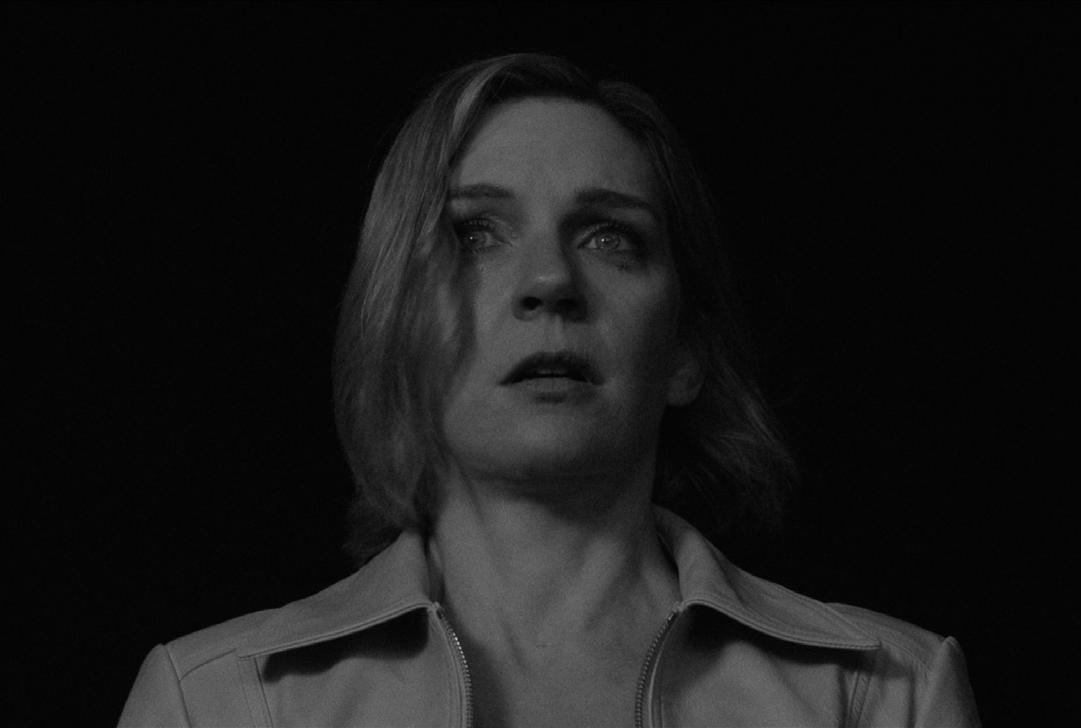
Yet for the series’ protagonist, Carol Sturka (Rhea Seehorn, “Better Call Saul”), this timer might as well be tracking something
else entirely: the time before and after the death of her partner, Helen (Miriam Shor, “Younger”), who tragically passed during her assimilation into the hive mind. Carol, conscious during the whole affair, realizes that she is one of the only minds immune to whatever agent forces this assimilation.
Not only has she lost the woman she loves to this change, but she has also lost the rest of humanity.
Except for her new “babysitter,” Zosia (Karolina Wydra, “Agents of S.H.I.E.L.D.”), who is herself part of the pluribus, Carol is entirely alone in this new world, making it difficult for her to live — let alone grieve — the aftermath of Helen’s death and the haunting realization of her new isolation.
This loneliness — alongside the other emotions it engenders — is one of the strongest elements
‘Saccharine’
of the show, largely driven by Seehorn’s incredible and moving performance as Carol. Wracked with grief over the loss of Helen and terrified by the rapidly changing world around her, Carol yo-yos between rage and depression, paranoia and numb acceptance. She is far from likable in these scenes, often yelling at or insulting members of the pluribus, who she now sees as less than human. Even in scenes when she is “better behaved,” she has a dry, unforgiving attitude, which makes it hard to enjoy her as a person, even as you sympathize with her situation. Left with little else to do but stew in her crockpot of awful emotions, she screams, cries, rants and begs, desperate for someone, anyone, to listen to her.
The problem is, there’s no one left to listen. The hive
mind is happy to, but they’re also eager to make Carol join them, something that makes Carol — who is determined to preserve her individuality — too distrustful to let herself
completely open up to them. The other “survivors” are few, and, unfortunately for Carol, not very fond of her.
CONTINUED AT MICHIGANDAILY.COM
confuses fullness with fulfillment
“Saccharine” is a psychological body horror film starring Midori Francis (“Ocean’s 8”) as Hana, an insecure, overweight first-
year medical student suffering from a binge eating disorder. The film opens with an audiovisual statement: squelching and gutchurning chewing of Hana’s mouth as she devours a smorgasbord of junk food in reverse, cross-cut with a fit woman riding an exercise bike,
glistening with sweat. The scene ends with Hana throwing donuts in the trash and covering them in dish soap, paralleled by a scene of her ogling the woman — later revealed to be Alanya (Madeleine Madden, “The Wheel of Time”), a fellow student, fitness coach and crush. Hana consumes and lusts without restraint, bewitched by the desire to satisfy her cravings and to be with Alanya. Themes of self-hatred, abandonment and envy usher in the first act of “Saccharine.”
When Hana, along with her best friend Josie (Danielle Macdonald, “Bird Box”), are assigned to an obese female corpse in the cadaver lab, whom they callously refer to as “Big Bertha,” she is undoubtedly perturbed by their similar size and nail polish, so much so she scrubs the polish off her nails before joining her friends at a bar. Here, Hana encounters an old friend from high school who shares a
weight loss secret with her: $5,000 pills that make the weight “melt” right off. She calls them “The Grey” and gives Hana two capsules. Astonished by their fast results but repelled by their price, Hana investigates the pill’s properties at her school lab in hopes of being able to replicate it — only to find they share definite similarities with human ash. Hana, being the smart, ethical and resourceful young woman of sound mind she is, harvests and cremates her cadaver’s bones.
As the number on the scale drops lower and lower and Hana’s confidence grows, so does her fear. Big Bertha, as it turns out, won’t let Hana use her ashes for free. The more food Hana eats, the more she loses weight, the more Big Bertha’s spirit grows, the hungrier Bertha becomes. Bertha’s control over Hana is a clear allegory of the possession that is mental
illness and disordered eating — a metaphor even less subtle than Francis’s prosthetic fat suit. Later in the film, we learn more about Bertha’s past and are made to feel sorry for her. She is characterized as selfless and endlessly giving, yet unable to care for herself in her selfloathing. Themes of self-love and self-acceptance are pushed here but get lost in the confused mess of “Saccharine.” Hana’s empathy for Bertha’s struggles suggests the film is heading toward the redemption of Bertha’s spirit and an emphasis on self-compassion, but “Saccharine” fails to take its own cues and opts for indulgent horror. Any scene that diverts our attention from the body and paranormal horror of “Saccharine” and detours toward melodrama feels unearned, building from and to nothing of significance. Hana tells Bertha’s sister (Daniela Rene Fink, “Falling for Her Bodyguard”)
that “You can’t love someone into getting better.” It is a trite moment that feels grossly out of place, a sentiment that is abandoned abruptly and revisited only peripherally. Director Natalie Erika James (“Relic”) attempts to explore the psychological effects of disordered eating by addressing Hana’s relationship with her morbidly obese father (Robert Taylor, “Longmire”) and healthconscious Japanese mother (Showko Showfukutei, debut) — flat characters who are largely left unused beyond providing context and propelling the plot without independent depth. “Saccharine” also briefly touches on the toxic internet culture surrounding dieting and thinness, a topic James picks up and puts down with flighty direction.
CONTINUED AT MICHIGANDAILY.COM
SOFIA THORNLEY Daily Arts Writer
Gabby Spagnuolo/DAILY
CAMILLE NAGY Daily Arts Writer
Official image from ‘Pluribus’ courtesy of Apple TV+.
MAYA RUDER Daily Arts Writer
Oil: More than fuel, less than simple
SETH GABRIELSON Opinion Columnist
We have gotten very good at telling ourselves simple stories about complicated problems. We want villains we can point to, solutions that fit on a sign and endings that reassure us we’re on the right side of history. Oil is one of the things that refuses to cooperate with that impulse. In most conversations, it appears only as gasoline: something dirty, outdated and on its way out. The assumption is that once we electrify cars and build more renewables, oil more or less fades into irrelevance. While that assumption is comforting, it is also wrong. Oil is not an energy source we can swap out at will; it is a material backbone of modern life, and pretending otherwise has consequences.
If that sounds benign, Venezuela makes it malignant.
The country sits atop the world’s largest proven oil
reserves and was once among Latin America’s wealthiest nations. But decades of mismanagement, corruption and external pressure left its oil industry in collapse — and because oil accounted for nearly all export revenue, the economy collapsed with it. Food shortages, failing infrastructure and hospitals without basic supplies followed.
Venezuela has a habit of reclaiming the attention of the United States whenever oil markets tighten, and in early 2026, that pattern became unusually explicit. A U.S. military operation captured former Venezuelan President Nicolás Maduro, and President Donald Trump openly framed American involvement around restoring Venezuelan oil production, saying the U.S. would “run the country” during a transition and revive its petroleum infrastructure with U.S. companies’ help. Where past interventions were cloaked in moral language, this
one foregrounded oil without euphemism — a reminder that, even as we talk about moving beyond fossil fuels, access to them still shapes global power in ways that the conversation around them often ignores.
Venezuela’s crisis exposes how narrowly we tend to think about oil. In public discourse, oil and energy are treated as interchangeable — as if oil’s primary role is to be burned, and once we stop burning it, the problem is solved. But oil’s importance runs far deeper than electricity generation or transportation — it is the raw material behind much of the physical world we take for granted. Plastics, synthetic fibers, fertilizers, pharmaceuticals, medical equipment, packaging, electronics and asphalt are all major uses of oil. Therefore, even in a world powered entirely by renewable electricity, modern life would still depend heavily on petroleum-based materials. CONTINUED AT MICHIGANDAILY.COM
According to social media, my body type is considered unattractive, my gapped teeth are unfavorable and my round face is undesirable. Until my algorithm began recommending solutions to these “flaws,” I merely saw them as plain, typical features. The chubby cheeks I once saw as ordinary needed to be hidden or fixed, and the way social media recommended that I “fix” this was through a suspicious regimen of costly vitamins that claimed to “debloat” my face.
Social media began assigning negative connotations to my features, and before I knew it, my insecurities proliferated. Social media referred to my cheeks as “bloated,” a widely unfavorable descriptor, whereas I previously thought of my chubby cheeks as enduring. Social media rewired my mindset, causing me to negatively evaluate my features, and then promptly offered me ways to “fix” them.
It took less than three taps on the TikTok shop to ensure these presumably face-altering vitamins would arrive at my
house within a week. After seeing no change in my face, I quickly realized that I bought into the influencers’ promise to remove an insecurity they instilled in me.
If it weren’t for social media’s bizarre standards and opinions, a lot of people wouldn’t possess the same insecurities that we do today, much less be aware of them. Furthermore, a lot of people would be saved from compulsive purchases if they never engaged with social media’s supposedly transformative beauty regimens.
Social media platforms create and amplify insecurities through viral trends and exaggerated warnings, creating unnecessary panic about nonexistent problems, as a method to generate profit.
Social media algorithms prioritize emotionally charged content. Fear-based posts about appearance are more likely to be seen repeatedly because they are amplified in these algorithms, fueling widespread insecurity for those who don’t fit a certain beauty standard and generating praise for those who do. For example, one TikTok trend challenged women and young girls to test if they could fit a pair of sunglasses around their waist, insinuating shame if they
couldn’t and pride if they could. This is a clear demonstration of how social media relays their agenda on beauty standards; a waist that could fit a pair of sunglasses suddenly became the standard desirability. Additionally, another trend surfacing on TikTok showed people revealing how yellow their teeth were, where the comments ridiculed those with the yellowest teeth and applauded those with the whitest. Social media and its intoxicating trends are the dictators of our beauty standards. Naturally, with creating nonexistent problems comes the assumption that these problems need to then be fixed with unnecessary and ineffective solutions. There is nothing wrong with your waist not fitting a pair of sunglasses; this isn’t the flex that social media thinks it is. Social media propagates these false ideals and then profits off them through curated advertisements of products. The creation of the TikTok shop allows creators to directly link beauty items in their videos, providing quick, accessible solutions to these nonexistent problems.
CONTINUED AT MICHIGANDAILY.COM
SOPHIA FRANCO Opinion Columnist
Hannah Willingham/DAILY
Sorority Bid Day
in Michigan Winter
conversations, it can make you question everything,” Miki said.
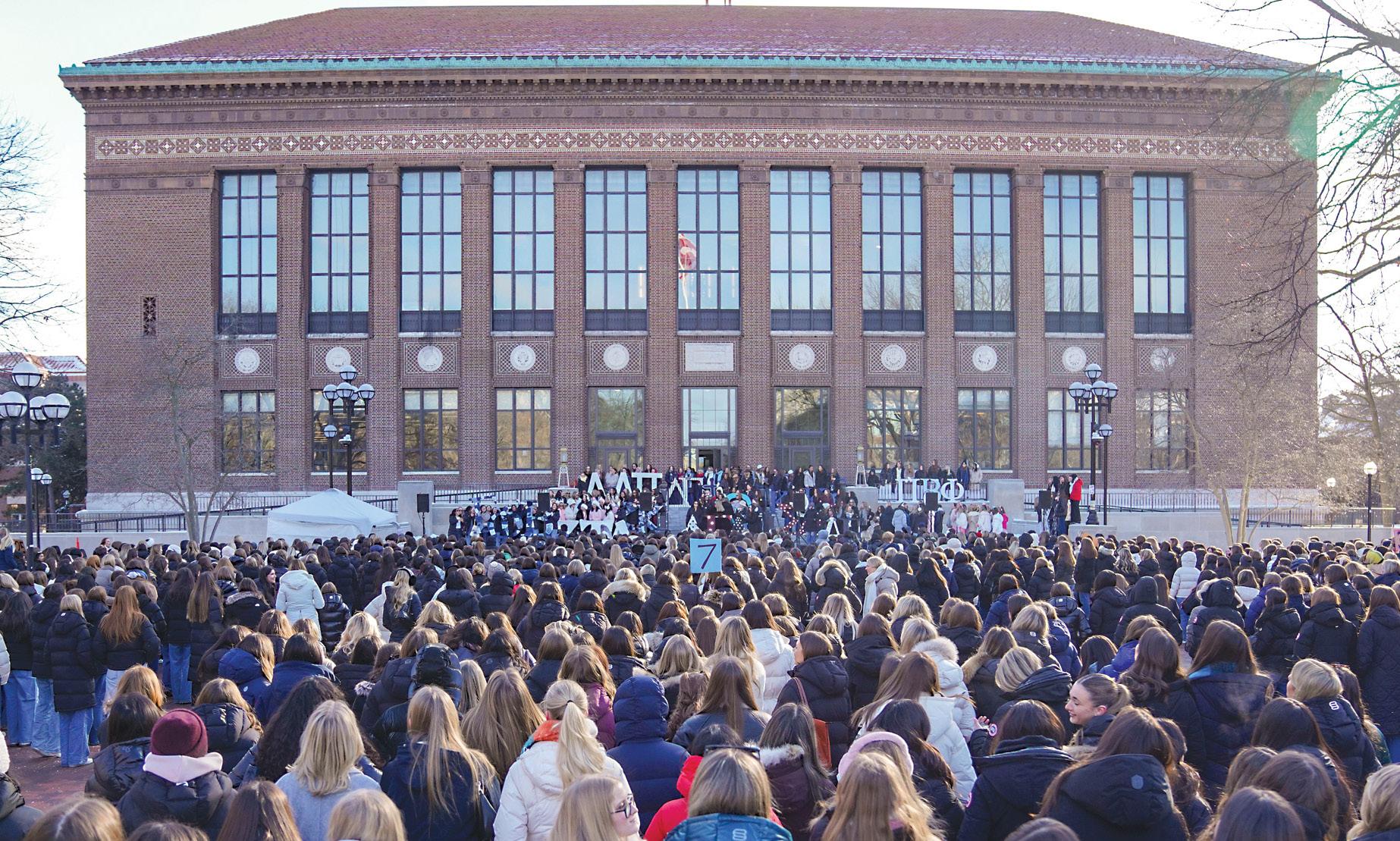
W ith the weather reaching its highest temperature of the day at 20 degrees Fahrenheit, bundled up potential new members piled into the Diag Sunday afternoon to find out which sisterhood they’d call home for their next three years at the University of Michigan.
LSA senior Sophia Herman, executive vice president of the University’s Panhellenic Association, began bid day by explaining that PNMs would have to run to a certain corner of the Diag depending on which sorority’s name would be written inside their envelope.
The crowd consisted of 1,512 PNMs — the largest in University history — waiting earnestly to receive their envelopes. They gathered beneath the Hatcher Graduate Library steps, listening to each of the sororities’ chants.
Each PNM would be offered a bid to one of two sororities they had narrowed down to
As PNMs waited for the countdown to open their envelopes, they set up their phones to record among one another’s shoes, on lamp posts and even laid flat on the floor.
Their eyes focused on the stage, with friends who similarly endured the grueling rushing process, waiting for the moment that had the potential to excite or deeply disappoint them.
After the countdown, PNMs jumped and looked around for their fellow PNMs, sharing their results. Sisters ran from the steps to embrace the girls who would soon become part of their sisterhood. Together they made their way out of each corner of the Diag, finding their way to their respective houses.
As they made it inside, older sisters of the University’s Delta Delta Delta chapter led the new sisters up into their rooms to excitedly show them the shirts they’d wear to celebrate their bid.
At Delta Delta Delta, as with many of the University’s sororities, these sisters joined in
The Panhellenic Association begins bid day on the Diag Jan. 23.
Sorority sisters celebrate at the southwest entrance of the Diag Jan. 23.
LSA sophomore Emily Block embraces LSA freshmen Erin Taylor and Rebecca Shveyd outside the Delta Delta Delta house after running from the Diag to meet their new sisters.
Kappa Delta sisters, Emma Nicles and Skyler Bufalini, embrace among the crowd rushing from the Diag Jan. 23.
LSA Freshmen Erica Berube, Clara Henzke and Kelsea Persinger open their bids among one another on the Diag Jan. 23.
Meleck Eldahshoury/DAILY Design by Graceann Eskin
Michigan in Color is The Michigan Daily’s section by and for People of Color.
In this space, we invite our contributors to be vulnerable and authentic about our experiences and the important issues in our world today.
Our work represents our identities in a way that is both unapologetic and creative. We are a community that reclaims our stories on our own terms.
Conversations in the kitchen
The pressure cooker in our kitchen has always hissed a little too loudly, spilling over a sharp, steady rhythm that cuts through the hum of the day: the clatter of onions hitting a hot pan, my mom humming Kishore Kumar, the faint buzz of my phone as I ignore it for a few more minutes.
“When I hear that cooker go off, I know it’s time to taste and adjust,” my mom laughs. “Good food waits for no one, not even the chef.”
Cooking in our home is a pause disguised as routine. It’s when we stop everything to talk, not about grades or career plans, but about life. It’s when Om, my dog, trots over to us with his tail wagging, convinced every scrape of our plate means food is on its way. It’s when we sit in front of the television, plates balanced on our knees, catching up on new Tollywood movies while offering running commentary on the plot and making predictions that always turn out to be correct.
My mom stirs the pot the way she always has: with more mirchi than any recipe calls for, a pinch of intuition and a calm that comes from decades of feeding people her mother’s recipes. “Recipes are suggestions,” she likes to say.
“Food only tastes good when you cook from your heart, that’s the secret ingredient.” The air fills with the scent of turmeric,
jheera and something akin to nostalgia. It’s not in lecture halls or chemistry labs that I’ve learned the most important lessons of my life, but here, between the sizzles and slow simmering of dinner.
When I was younger, I never understood the weight behind my mother’s stories: how she left everything familiar to build a new future, how she still misses the taste of her mother’s cooking and how her roommate taught her to cook when she first arrived in the United States. She half-jokingly said she “learned to make home wherever you can laugh and share food from a pot on the stove.” I nodded, watching the steam twist upward, not realizing how much of her I would carry with me. Now, at the University of Michigan, I find myself craving
those moments. I cook in my apartment — with too much cumin, too little patience, pans a little messier than they should be — and I think about how every dish is a thread tying me back home. I call my mother, hearing her laugh on the phone as I complain that my food is never quite the same as hers. The conversations that started in our kitchen follow me here: how to stay grounded when life feels uncertain, how to choose joy when it’s easier not to, how to turn homesickness into something warm and nourishing, like rasam. Cooking isn’t simply an act for us. It’s a connection. It’s a reminder that even as I move forward, I am shaped by the flavors, the stories and the woman who taught me. As my mother says, “food is love you can taste, never rush it.”
An homage to Kamil’s
My mom would’ve first stepped foot into Kamil’s MidEastern Food Inc. within her first few days in America. She must’ve been surprised to see that the fridges were stacked with different brands of her favorite Syrian haloumi cheese, the aisles filled with her favorite assorted nuts and that, somewhere in the back, she could hear the sizzling of hot oil frying perfectly browned falafel.
My dad would’ve done the same when he moved to Flint from Chicago. He might’ve followed his nose to the stinging sour of his most desired olives and marveled at the plethora of Fairuz cassette tapes behind the counter at the checkout line. The familiar language coming from people who would soon become familiar faces eased them through their move to Flint.
Before either of them stepped foot in Dearborn — America’s Arab hub — and built a community of people around them, I like to imagine that it was Kamil’s that gave them a taste of home.
Kamil ran a Middle Eastern grocery store in a time when there were no fads surrounding Arab foods, coffee houses or social spaces. Safe to say, his storefront was a pillar of our community that has welcomed us for more than 30 years. He’d been working in Flint since the mid-1980s before he opened his iconic market in 1993. Kamil’s was a haven for us customers: whatever you needed, Kamil had it. Chickpeas? You got it. Grape leaves? Second aisle to your right. Mloukhiyeh? He’ll check in the back. And if he didn’t have what you wanted in the store, he could try to get it for you by next Friday.
After decades of being everyone’s favorite grocer, Kamil retired last month and another Middle Eastern market will open in place of his. And yet, all I can think about is how
Thalam
his store made immigrant and diasporic life in America feel notso-foreign. It’s businesses like his that account for community building — it seemed like Kamil knew everyone who walked into his store. He always addressed us by name or asked about our families, and I always called him Amo, uncle, Kamil. In the checkout line, moms would share recipes on how to make their own qareesha, kids would argue about who the greatest basketball player of all time was and everyone was inclined to smile easily.
For as long as I can remember, my family’s weekly grocery shopping trips have included a stop at Kamil’s. Once there, I would head to the back of the store, where he had an array of olives — from zaytoon to picholine — on one side and rice, lentils and other grains on the other side. The rows of grains were like a playground for me. I would stalk the tubs carefully from the adjacent aisle until I was sure no one was around, then I would scurry up to them and hunt for which container had the big scooper in it. Opening the eyelevel crates one by one, I would scoop out lentils and let them trickle back into their bucket as if it were my own personal sandbox. I thought I was sneaky, quickly closing the containers if an adult neared. I even evaded my older brothers’ watchful eyes. But Kamil must have known. More than once he crept up
on me as he took inventory or showed someone where to find an item. I would slam the lid shut a bit too loud and occupy myself with something else a bit too late. He would just look my way from underneath his glasses and continued doing what he was doing. Later, at the cash register, he would feign ignorance, grab chocolate candies from the counter and hand them to my brothers and me as we stood next to our mom at the checkout. As we smiled, yelled our gratitudes and traded for the ones we wanted, my mom would thank him for the free gifts. On our way back to the car, we would hurry to get in the back seat, buckle our seatbelts and start eating the crumbly, chocolatecovered crackers before we even left the parking lot. Back then, I found Kamil’s store essential because there was no other place I could find mango juice cocktail, halal Rice Krispies Treats and fresh produce that couldn’t be bested anywhere else. As an adult, there is nowhere else I would prefer to buy my hummus, foul mdamas beans, lentils or labneh. And yet, Kamil’s wasn’t just about what his store had to sell; it was an opportunity to indulge in my culture. It was one of the only places that really allowed me to: Not school, not sports teams, not stores or farmers markets because those were places that were flooded with exclusively American ideas. CONTINUED AT MICHIGANDAILY.COM
I. No. Next to my father’s desk sits a chestnut brown, out-of-tune mridangam. I can’t remember exactly when it appeared in my house, only that it’s here now and nobody plays it. It cannot be given away, obviously. So the drum sits there, and I sit by it and neither my father nor I acknowledge its presence in the room.
All my life I’ve been around music. My parents tell me they would notice me tap out Bollywood songs and “Happy Birthday” on the toy keyboards they would buy me. I was a musically-inclined kid, and for years, my parents moved me from class to class throughout the week: violin, piano and even a three-year-long stint with the trumpet. I enjoyed them well enough; I’d find time to practice at home, even without my parents or music teachers telling me to, but all of these instruments were ultimately easy to leave behind. By the time I was in middle school, I didn’t think of musical instruments as necessary, permanent fixtures in my life. And then came the drums.
I tried them out a few times, sitting behind the full set and tapping out little rhythms on the hi-hats and crashers, and fell in love. I was tapping my fingers all the time, everywhere, spinning an imaginary stick between my forefinger and thumb constantly. It was like every song was made up of drums first and vocals, strings, bass or whatever else came later. All I could hear anytime I heard music was the beat.
I had casually brought up the idea of formally learning drums to my father one day while we were in the car. I was just proposing a switch from one interest to another, as I had done so many times before. He was quiet for a moment, long enough to be slightly uncomfortable.
“You know I like music,” I said.
“Yeah. Well … they’re drums.” I was confused now. “So?”
He cleared his throat. “It’s a more masculine instrument, don’t you think? It’s very uncommon for girls or women to play the mridangam.” My chest tightened, and I stared at him blankly for a moment. Then, I burst into tears.
II. I fall in love
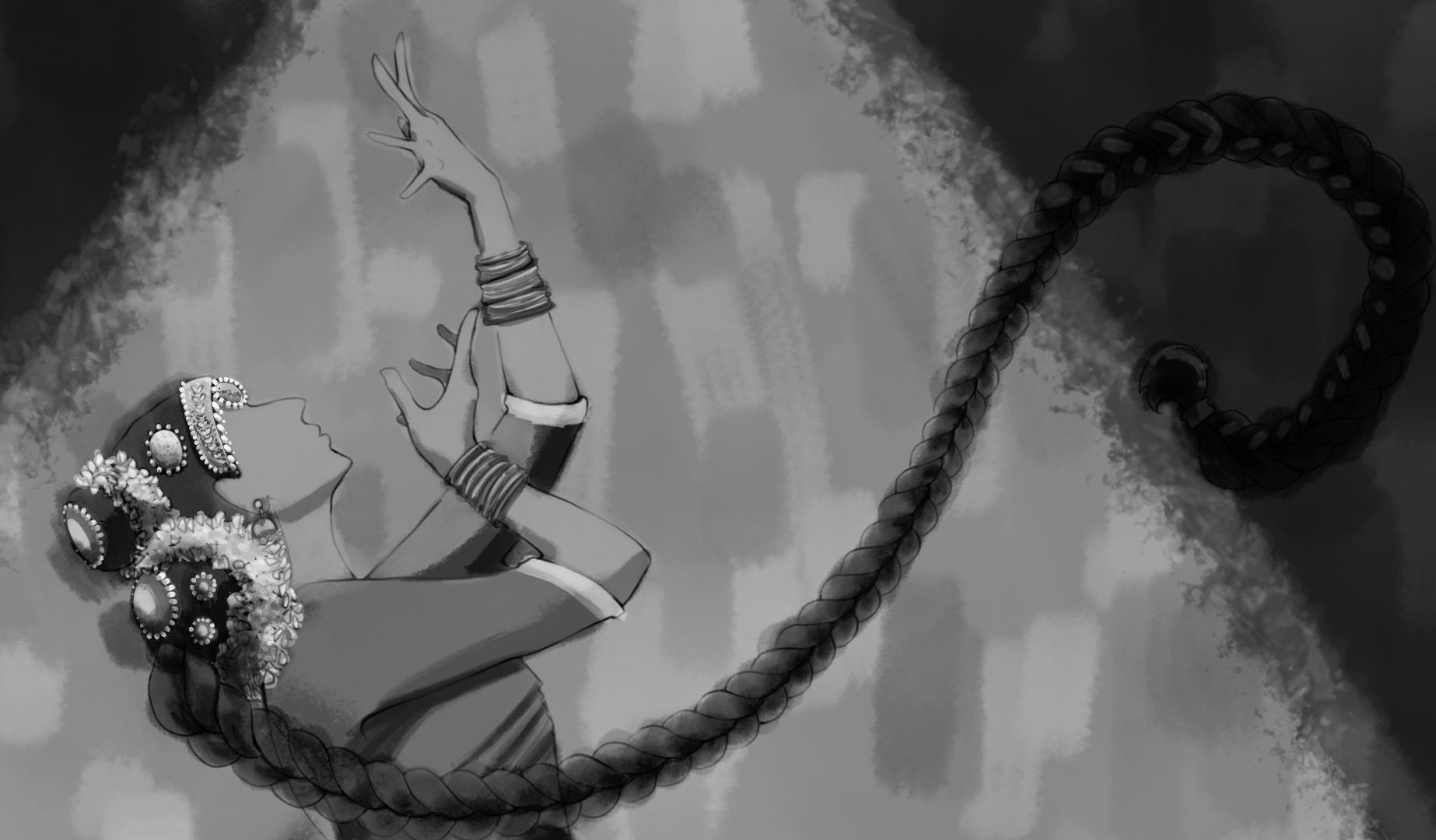
My mom took me to a bharatanatyam recital one day with some family friend I hadn’t seen in a while. I sat in the fold-open seat with the kind of poisonous attitude only middle schoolers have as we waited for the program to begin. The lights dim, curtains draw. A woman in a saree gave a small speech about the art of dance, or maybe it was something about God. I didn’t listen, too distracted by the garish shade of electric green she had chosen to wear as she swished off stage. Distantly, I wondered where the speakers were in this place; I hadn’t heard any music yet — Tha-the-tha-ha. Dit-the-tha-ha.
A drumbeat. No, not drums … Slowly, the lights got brighter, and I saw a new figure in the middle of the stage, facing away. There were flowers in
her hair and bangles all around her arms. She was smaller than the speaker had been, but there was a presence about her that had me hooked immediately. She stomped her feet again rhythmically.
Tha-the-tha-ha. Dit-the-tha-ha.
I gripped the underside of my cloth seat. I could feel a vibration run across my shoulders, down my spine, through my heart …
The dancer lifted herself onto her toes. The drum goes the-hutthe-hee. Back down, then a sharp kick in a clean arc.
I felt a hand on my shoulder pulling me back suddenly. “Sit down,” my mother whispered, but she was smiling. “You’re practically jumping.”
After the performance, my mother and I walked to the guru, circling her as she accepted congratulations and compliments. Step, step. Step, step. When we talked to her, the rhythm of the conversation was quite straightforward. She took one look at me and said (not very quietly) to my mother that I was a bit older than her beginner class. My mom turned to me.
“That’s fine,” I told my future guru. I had never been more sure of anything.
III. Advanced preschool She was not kidding. My class was separated into rows, with the oldest kids in the back and the youngest ones in the front. I was the oldest by almost three years, which is a bigger deal in middle school than you might remember. I mean, the youngest girl in the class was literally 5 years old.
But I got very good very quickly. I performed a thirdyear piece after less than 11 months in class. Dance was what my mind drifted to when I had nothing else to think of, which was most of the time. I was even teaching my own dance students at the end of high school. It’s like everything I loved about drums and rhythms was transformed into a movement and story; every arch of my eyebrow or a sharp kick at a certain mridangam sequence meant something. I am still a performer. I’ve fallen in love with bharatanatyam, and I can feel my heart race every time I’m on stage. Ba-bump. Ba-bump.
IV. But it could’ve been yes I cry after performances only about half of the time. I hate performing poorly in front of my family; even if they can’t immediately recognize a misstep while it’s happening on stage, I know they can see it on my sinking expression as I stalk toward them post-performance.
But this was a good day when I was in my dad’s office, chattering about dance. I loved it, and I made sure everyone knew. I hadn’t lost touch, even in college, and I was proud. My dad’s presence makes it easy to get prideful, I think; watching him nod in approval to my stream of consciousness encourages the boasting to come out. I told him something about beats and rhythms. I’ve always been good at them, you remember, right?
He rubbed his face with his hand. “Yes. I am, too. You know I always wanted to play the drums.”
In an instant, my mood tipped in the other direction. “What?”
He went on about how he’s always felt particularly inclined to follow a beat. Tapping his fingers against the leather-
bound steering wheel of our Honda on long drives, picking out the percussion in songs, things like that. I could feel my chest getting hollow with every sentence. I asked him if he remembered my request all those years ago, and he said he didn’t. I could feel something hard in the back of my throat. “You told me no. You don’t remember? It’s the whole reason I started bharatanatyam.”
He scratched his chin awkwardly. “You know … I think, if you really wanted, you could have done it. Learn mridangam. I mean, look at it now — it just sits here!” He even laughed at this. “But you’re so good at dance now.”
I can’t explain how upset this made me. I mean, what is heartbreak but the feeling you get when you want something you can’t have? What’s the word when you realize you could’ve had it all along? Here is regret, stony and pale: a figure I’m rather familiar with. Ugly, unwanted and angry.
Could I really have done what I wanted? Am I dramatizing the initial rejection I had gotten? To me, this is not a story about holding on to regret. I can’t imagine a life without bharatanatyam, and I’m proud to talk about dance at family gatherings, even if my fingers still twitch every time I see a drum. I recognize, now, that there’s no way I could’ve known at the age of 12 that I could have disobeyed. I recognize that I’m not a dog, perpetually waiting for commands, but a person with the ability to choose my next action. My next passion. What my heart can beat for.
Today, I have come to learn that I always have more agency in the moment than I think I do. Regret is a wet rag on your shelf that never quite seems to dry. You gotta throw it out at some point and start acting. I don’t know if I really could’ve fought casual misogyny at the age of 12 and pursued a life of music, but I know that I could do it now.
Today I know that I don’t take no for an answer. When your heart beats, listen: Thalam never lies.
DIVYA THUMMA MiC Columnist
AMRITA KONDUR MiC Assistant Editor
SUMMER SALMAN MiC Columnist
Alisha Razi/MiC
Zakira Khandaker/MiC
Divya Thumma/MiC
STATEMENT
Raise your hand if you remember what you learned last semester
OUMMU KABBA Statement Correspondent
No takers? Okay. Then raise your hand if you don’t even remember what classes you took last semester. Don’t be embarrassed, hold it up high. I know I am.
Now, class, does anyone have an answer as to why? Why does the information we spend weeks upon weeks learning just disappear with a semester’s end?
Fine, I’ll give it a try. But take some notes. You’re going to want to remember this.
Let us return to when this line of questioning was born. Like most of life’s greatest disappointments, it all started with a New Year’s resolution.
My resolution for 2026 was to become well-read. Though this was sort of a cop-out resolution. By virtue of being a creative writing major, the curriculum pushes you to be well-read, or at least, constantly approaching it. But I wanted to see how far I could stretch my reading appetite and what I could add to my current diet of literature.
Since starting college, I have consumed works by authors like Audre Lorde, Ralph Waldo Emerson, W.E.B. Du Bois, Henry David Thoreau and more. I was pretty proud when I recounted how much I had read just as a second-year. But when I took the time to reflect on those texts, I realized I couldn’t remember much of anything.
Sure, I could recall vague historical contexts and holistic philosophies — about the same amount of information one could get from reading the book jacket. However, when trying to trudge up the specifics that make up those generalities, all I could draw were blanks — the shapes of something someone had once said.
I began to feel like a fake. A fake creative writing major, certainly a fake reader. I felt terrible about forgetting, and, ironically enough, that was a feeling I remembered all too well. It is the same feeling I get at the start of every new school year when I have to face the fact that my grip on past knowledge is slipping all too fast.
Initially, I figured this was just the plight of the humanities major, the consequence of constantly steeping the brain in jumbled alphabet soup. But it turns out even the ever-elusive STEM major is plagued by this forgetting — valuable information lost somewhere in the mind’s network, like dead code. A study conducted at the Massachusetts Institute of Technology backs up this claim with science, fittingly enough.
In 2012, 56 MIT seniors took a test emulating their final exam for physics from freshman year. The results showed that the participants’ mean score was about 50% lower than that of the average freshman. Evidently, regardless of whether you are majoring in the humanities, sciences, arts or something in between, no knowledge is safe from being forgotten, sooner or later.
For the higher education system, this appears to be an innate truth, expected and accepted. But just because this “truth” wears
the face of fact does not mean that we should live with it like a fixed reality. Students pour endless amounts of their time, money, energy and youth into attending college, so shouldn’t we be able to remember it for longer than the few months or years when it is imminently relevant to us?
To what extent is this forgetting “the fault” of the college education system’s structure and culture? To what extent is it “the fault” of students’ approaches to the college experience and to learning? And, if we ever do trace back these fault lines to find out what is rupturing higher education at its core, what the hell are we supposed to do about it?
Oh, you’re still waiting for me to answer. I forgot I’d promised to try. Well, to understand the roles we all play in the aiding and abetting of students’ forgetting, we first must understand ourselves.
***
The learning process has three stages: encoding, storage and retrieval.
As explained by the Noba Project, encoding is the initial perceiving of information. The human mind is always interpreting external sensory input, but the mind selectively encodes the information that is distinctive for some reason or another.
Encoding registers information and storage keeps it tucked away for safekeeping. When storing encoded experiences, the brain biochemically changes its composition in order to leave a memory trace, or engram, of the information onto itself.
To help you better understand, here’s a (distinct) analogy: My second-grade teacher helped my class learn our times tables by putting them to song. “Row, Row, Row Your Boat” for multiples of four. “Yankee Doodle” for multiples of six. “She’ll Be Coming Round The Mountain When She Comes” for multiples of seven. The songs naturally stood out and, through associating them with our times tables, suddenly, those numbers stood out, too. This distinctiveness
Licking honey from a razor
made it easier to encode our times tables and store that information into our brains.
Just like how distinctiveness helps encode information, it also helps us recall it during the retrieval process. Distinctive cues in our environment related to stored memories prompt us to retrieve them. But accuracy is always at risk because the act of memory retrieval is also an act of memory alteration. Additionally, there are often inaccuracies in the encoding and storage processes. The compounding of such errors comes out during the retrieval process and manifests as forgetting.
As laid out by the New Mexico Open Educational Resources Consortium, forgetting can be caused by encoding failures, which occur if you don’t pay attention during the learning process.
Additionally, psychologist Hermann Ebbinghaus’ research suggests that if a memory is not retrieved for a long time, the engram may fade to the point of inaccessibility.
And, “forgetting may occur when we lack the appropriate retrieval cues for bringing the memory to mind.” Another potential cause of forgetting is a lack of the necessary cues to prompt memory retrieval.
Let’s go back to that analogy. My second-grade teacher never gave us songs for multiples of eight or nine. My encoding of those times tables was compromised as nothing made it stand out in my brain, and thus the storage of that information was compromised, too. And, since I didn’t have the easy retrieval cue of a song, the eight and nine times tables were the ones I struggled to remember (still are, embarrassingly enough).
Just one little error causes a domino effect, with each domino falling so far and so fast that they forget they were even once standing.
But — in practice — the learning and memory formation processes are just a few dominoes in a long line of elements affecting higher education and students’ retention of information. To better demonstrate the in-class effect of a few select elements to be honed in on further, I sought out testimonies from three excellent faculty members of the University of Michigan’s English department. Philip Christman is a Lecturer II who mainly teaches first-years, Andrea Zemgulys is the director of Undergraduate Studies in English and an associate professor of English and Monroe Moody is the director of the English Department Writing Program.
Class, let’s hear what the experts have to say.
*** A day we can never forget: March 13, 2020. It is perfectly encoded, stored and associated with a plethora of cues that prompt us to remember it whether we want to or not.
COVID-19 turned the world upside down and left the education systems’ heads spinning. But to what degree are the pandemicrequired alterations to education still impacting students’ retention of course content today, almost six years after the day we will never forget?
CONTINUED AT MICHIGANDAILY.COM
A couple of weeks ago, I attended an open mic poetry session in Ypsilanti at Book Love Bar. The lights were dim. Any sound was hushed. A cyan table with a tiger on it viscerally stared into my soul. I sat there quietly, unsure of what I would even say if I were asked to speak. In catatonic contemplation, the performer’s verses seemed to fly right over my head. Yet, in my silence, one line struck whatever words I would have said from my mouth: “It’s like licking honey from a razor.”
It’s a weird simile, I know. Who would rationally want to lick honey from a razor? But the more I sat with this line, although completely out of context, the more it felt uncomfortably familiar. Because lately, my life has felt like “licking honey from a razor” — often enticingly sweet on the surface, but with a sharp surprise waiting underneath, even when handled gently. I struggled to understand why this line resonated with me so much until I stepped foot back onto campus at the University of Michigan. A single telltale line in Ypsilanti had identified a problematic matter in Ann Arbor: Even on a Friday at 11 p.m., the sidewalks were congested with backpacks and swarming footsteps. As I fiercely walked down State Street back to my apartment, everything felt closer, louder, more in my face — urgent in a way I hadn’t noticed before. Suddenly, the antics of Ann Arbor were asphyxiating, and the height of the stakes at hand seemed too high to climb.
Once I hastily reached my apartment, I reached for my phone, searching for a distraction from the daze. Instead, I was met with obligations that had
been pushed off for hours: text messages to make sure I booked a Ross School of Business room for my business organization, reminders to film Hirevues, messages from my roommates concerning the chores that need to be completed for the week and impending When2Meets to fill out, all effectively swarming my screen and my mind. It felt like everything was out of grasp, far ahead in motion without me — plans solidifying, expectations formulating and time expediting. Otherwise stated: All of it moved quickly, as if I had leaned too close into the blade, and I needed to surgically mask my way through it.
A simple stroll around campus reveals how universally applicable this experience is to the student body. Throughout my two years at the University, I’ve noticed many things. I’ve noticed the impossible task of finding an open seat in the Shapiro Undergraduate Library, regardless of whether it is exam season or not. I’ve noticed exam cycles across different majors, exposed by their collective exhausted demeanors. I’ve noticed people around me in class sending monotonous networking emails in tandem with writing notes. I’ve noticed my peers loading on credit hours’ worth of extracurriculars just to gain a marginal competitive advantage on their resumes. And yet, noticing only further perpetuates the issue. We are in some weird quagmire of trying to do so much, but at the same time, feeling like we are doing too little in comparison to the person next to us. The University has long been a perpetrator of this phenomenon, but today’s language has given it a name: Lock-In Culture.
By locking in, I don’t mean just being busy. And I don’t mean the same kind of price lock-in that my strategy professor claims to talk about when analyzing competitive
industries. This specific term goes beyond the conventions of a typical productive lifestyle.
“Locking in” mandates one to exist in a constant state of being dialed in, only letting your foot off the gas when you don’t feel like you need to travel farther.
In the past, locking in meant “not subject to adjustment.”
However, a different utility for this phrase has risen in today’s landscape. As Generation Z’s glamorized slang, Urban Dictionary puts it: You “get Extra Extra focused on your dream.”
On paper, that sounds admirable. Focus is repackaged as discipline, and commitment as an indicator of maturity. Chain them together, and the path leading to success in all aspirations is paved.
Like many of my fellow students, I am an innate problem solver. When something feels unorganized, or worse, uncertain, my instinct is to take action. I tend to gravitate toward structure to cancel out ambiguity — to mitigate risk before I can even start to sense it. In my case, that often transpires by accepting calendar invites without hesitation, filling a white void with colored commitment just because it exists. I make decisions without acknowledging that I’m making them just so something gets accomplished.
Lately, this impulse has shown up for me in a pretty prominent way that I am sure many can relate to: the never-ending want and pursuit of getting a job. As a business student at the University, I sometimes feel persistently behind, not because of my ability, but because of timing. Last year, I was getting cut from nearly every club I applied to at the Business School, an experience that lodged me into the caste system that berated my sense of self. It made me hyperaware of the hierarchy, of how quickly opportunity turns conditional. Now, this same
idea repeats, just in a different font. This year, as many of my peers move confidently through their finance and consulting recruitment cycles, I find myself still circling the bowl. How much time do I have to decide what I want to do?
I mindlessly turn applications into plans, and plans into obligations, just to quiet the discomfort of not knowing what comes next. Any action feels productive. Making a decision feels responsible. And I, as a result, feel like I am doing something semi-worthwhile — even when, for the first time in my life, I’ve never been more lost on where to go next. When I was in high school, I was always fed the stereotypical line: “You have so much time to figure things out, that’s what your 20s are for!” For much of history, your early adult years were meant for testing the
waters — for trying new things.
A time where you could make mistakes, fall and brush yourself off until you could stand your own ground. But, for me, this idea feels inconceivable and in stark contrast to the reality that I currently live in as a student at the University. It’s exhausting. Being in my fourth semester of college, I feel like I have lived 10 years in the span of two. A decade ago, I probably would have had until at least my junior year to figure out an internship I would want to pursue, but now I am figuring out what I want to do as a sophomore who has barely completed their general education requirements.
Oftentimes, instead of focusing on schoolwork, I find my days filled with anything but schoolwork. Of course, I attend every single lecture, discussion and any academic obligation that
Maisie Derlega/DAILY
I am needed at, but the rhythm here has shifted from learning to positioning myself.
As a student, I see this reality fleshed out on a day-to-day basis. I know people my age — sophomores — who have already landed their summer 2027 internships a year and a half before they will even begin. These internships then lead to a return offer for a job, a stable salary and a lifelong career. In a culture that assigns value to an individual based on the name of their company or how technical their roles are, there is no choice but to adhere to this accelerated timeline and beat out any competition. These students should be planning their spring break trips, not hurling themselves toward any slim chance to gain a far-off promise for more stress under the guise of status and stability. CONTINUED AT MICHIGANDAILY.COM
Gabby Spagnuolo/DAILY
TAYLOR DEREY Statement Columnist
STATEMENT
The lifecycle of a conference friendship
Every time I attend a conference, it starts and ends the exact same way. The cycle inevitably begins with me boarding a solo flight to a new location, dragging my carry-on down the ramp as the first rays of sunlight stretch across the sky.
My heart races, both from the thrill of traveling somewhere new and the terror of spending several days with complete strangers. Throughout the entire flight, I peer through the window, waiting for a glimpse of the land below.
I am rewarded when my plane descends over the city, and I see Washington, D.C., (or Madison, Wis., or Philadelphia) for the first time. What happens after I leave the plane varies, but what remains constant is my eventual encounter with my fellow conference participants. In Madison, I stopped by my hotel room just long enough to drop off my suitcase, immediately running downstairs to meet the two other student attendees I connected with over email a few days prior. That night after the conference, we spent hours sprawled across the hotel room floor, ordering $40 worth of cake through room service in the decadent way only someone who knows they aren’t paying the bill can do. In Washington, D.C., I let the trains pass one by one as I waited for two other students to arrive. The gusts of wind, generated by the passing train cars, send April leaves dancing across the ground. When the students emerged from
their respective planes 30 minutes later, we navigated the twisting city streets together to meet up with the others. In Philadelphia, I spent a quiet afternoon walking the city streets alone. Yet, just hours later, I found people at the conference venue whom I would have breakfast with the next two mornings (a group we endearingly termed “the breakfast club”).
As each conference goes on, we spend every waking moment together. Sessions are booked from 9 a.m. to 8 p.m., and not a single minute passes when I am not with my new friends. We workshop legal cases and talk democracy on balconies, eavesdropping on snippets of other passionate conversations entangled with the breeze. We hear from brilliant speakers leading their respective fields and we embark on guided tours through the city. In the evening, we wander aimlessly down nearby streets, ending up in an obscure vegan restaurant or alleyway garden. At night, I find myself draped over a chair in the common room, legs swinging off the armrest, laptop propped against my knees, as I watch five conference attendees — all of whom had proposed stunningly innovative ideas a few hours earlier — lose confidently at some silly card game. I wake up the next day to meet them for breakfast, their egos still bruised from the losses the night before. I smile and hand them a coffee, and we begin the day anew.
In these unfamiliar cities, my typical inhibitions crumble to the touch. Surrounded by strangers, I emerge as a more confident, unfettered version of myself. In my day-to-day life, I
have expectations to uphold. But, during conferences, I am free to reinvent myself for every person I meet. I find each new person impossibly fascinating, and our bonds transcend the constraints of time. Knowing we’ll likely never see each other again, I am not scared to make a poor impression. When I’m around people I know, even my closest friends, I have an irrational fear that I will say or do something that will diminish their view of me. When I’m with peers at a conference, I know our time is limited, and the pressing anxiety of doing something wrong fades. We abandon small talk in lieu of our hopes and dreams and how the conference fits into them. Together, we marvel at how we saw a conference notice, applied on a whim and somehow ended up here.
And then, inevitably, we leave. The final part of the cycle is not one I enjoy. Three or four days later, the conference draws to a close, and, one by one, we trickle home. They head to New York, Florida, Nebraska, California, Venezuela and Germany, and I board my flight to Michigan. With every mile that passes beneath the wings of the plane, I feel robbed. I grieve for people I knew so intimately and yet not at all. It should be easy to let them slip back out of my life after they had so unobtrusively slipped in, but it is not. Even after a handful of days, I grew used to their presence in my life, and to have them abruptly disappear feels, to some extent, like a loss. I managed to form bonds disproportionate to the time we spent together, and it hurts to let my newfound friends go. I return home to my wonderful
friends and family, and life goes back to normal. I fit back into the preconceived roles I play in society, almost as if I had never left. I attend classes, work and club meetings, and the routine is almost reassuring in its mundanity. Most of the time, the dizzying few days I spent at a conference — and the whirlwind bonds I formed there — feel like a dream. I keep up with the friends I made over Instagram, but all that is posted there are curated snapshots of a life I am not a part of anymore. It feels strange to reach out. Frankly, there’s not much to talk about. Even if I did stay in touch across the distance, capitalized on the tenuous three days tying us together, our friendship would not be the same as it was. Outside of the structured conference, of the new environment, who is to say we’ll still be as close as we were? Even though I firmly deny it, perhaps our friendship was only circumstantial.
I know that part of my sense of loss is rooted in the realization that I will never know the full potential of what could have been. How much can you truly know someone you’ve spent just three days with? I have always fallen too easily for others, perhaps simply falling for the idea of them. As with the “love at first sight” debate, I wonder how much of my attachment is genuine, and how much is a product of my romanticized version of them. After all, the polished version people present of themselves isn’t reality. Maybe after six months, maybe a year, I would’ve realized the incompatibility of our personalities. The friendship
would’ve come to a natural end. Yet without this natural resolution, I remain haunted by the possibility — although slight — that we would’ve had a relationship that would fundamentally alter the path of my life and who I am as a person.
I know, in theory, that it is important to let people go. Some relationships come with an end, but just because someone isn’t in your life forever doesn’t mean your time together wasn’t valuable. At some point, grasping desperately for remnants of someone will only make it hurt worse. If anything, there is beauty in the impermanence of our meeting — in the fact that despite living thousands of miles apart, we were able to come together for this fleeting moment. Only moving on brings hope of peace. I know this, but the knowledge doesn’t make the goodbye easier.
I’ve grown a lot since my freshman year of college, both personally and socially. I am a lot more self-assured and comfortable in my own presence, and there have been signs. Unlike my first conference, I felt more secure leaving to explore on my own in Washington, D.C., and Philadelphia. Yet, despite this growth, I haven’t quite mastered the craft. Even though it’s been half a year since my last conference, and three years since I first boarded a flight alone to an unfamiliar city, I still haven’t figured out entirely how to let them go.
***
The cycle is about to play out again. My flight departs five days from now in the snowy hush of a quiet Friday
So we hosted a Nazi rally
morning, and I will land in the breezy warmth of Orlando, Fla. For three days, I will be enveloped in unfamiliar sights and unfamiliar people. I will forge sudden, magnetic friendships and face unsettling grief when I board the plane home. I will spend the next few years — possibly more — occasionally being reminded of the people I encountered in that far place, oddly sad their lives are continuing without me. I wonder if they will forget me eventually, and whether it would bring me more peace if I did, too. I wonder if they will someday read this piece. I am resolved to enter this conference not fixating on what I will likely eventually lose, but rather, on what I will gain from the precious few days our life paths happen to collide and glance off one another. It is true that I will never know what my life would be like with my conference friends by my side — like if I had lived in New York or Nebraska or Venezuela and could maintain the friendships formed during those long conference days. The people I meet in five days will not be with me for long. I know how the cycle goes, but I also know there is a certain beauty to the grief. The extent of my loss is in direct proportion to the extent of our connection. Greater loss means we were able to form genuine bonds even as the clock was ticking, and so the sadness is tinged with joy. There will be strangers waiting for me when my flight finally lands in Orlando, and, just like always, I cannot wait to meet them.
As soon as I saw the tent on the Diag, encircled by a tightly packed crowd, I felt uneasy. Though I was unfamiliar with the name,“Uncensored America,” printed on the canvas, I am a young American with internet access, so I know what a scene like that means. Further research revealed that Uncensored America is an organization that hosts debates and speaking events primarily with reprehensible right-wing figures. This debate format, most associated with the late and lessthan-great Charlie Kirk, has become a primary feature of our current political era. But for those who don’t know (Lucky! But not for much longer): A political commentator sets up at a college campus, draws a crowd with provocative statements and then debates students and community members one by one while, of course, filming the whole thing to be uploaded as content. Usually,
they will take pains to ensure the audience understands how important what they are doing is, how it’s all about free speech, etc., etc. High-minded ideals are used as cover for decidedly low-brow partisan bloodsports and view-chasing; criticism is deflected by appealing to the value of free speech, as if the right to say anything somehow justifies the specific things one chooses to say. So I knew roughly where my feet were taking me, and I knew I would not enjoy it. But my feet carried on against the protests of my brain, moved by the force of that fundamental human need, upon seeing a Happening, to check it out.
So I checked it out, and Holy Shit. I encountered a torrent of antisemitism, homophobia, misogyny and just about every other type of bigotry from both the speaker and the crowd gathered around the tent. I was only present for a portion of the event and, thankfully, was not there when it veered into Holocaust denial and Nazi salutes; what I
heard in person was disgusting enough.
Once I finally got into a position to see the speaker, who sat in front of a wrinkled banner cringing against the cold with a sign reading “I.C.E. DID NOTHING WRONG. PROVE ME WRONG,” I recognized him as a host of the misogynist podcast, Fresh and Fit. I did not know his name, but unfortunately have learned it since: Myron Gaines. Gaines is an influencer associated with the manosphere, a section of the internet that caters to men both with lifestyle advice and with vicious denigration of women. Something strange about Uncensored America is their emphasis on “fun,” as stated on their website. They go so far as to claim that fun is “at the heart of Uncensored America.” There were plenty of people having fun on the Diag that day. Gaines was clearly enjoying himself, and a gaggle of goobers doubled over with laughter every time he said a slur. Others had less fun. I don’t imagine my classmate, who told
our class she felt compelled to hide her Star of David necklace as she passed by, had any fun at all. Uncensored America claims dedication to the value of free speech and the exchange of ideas, but it seems their events really exist for jackasses to amuse themselves by punching down on the vulnerable. My brief interaction with Gaines proved what I already knew: He was not actually here to debate ideas. While I was there, Gaines spent most of the time listing slurs and rambling about Jewish people, with maybe five minutes total of actual debating. The event was unfocused, but it often returned to the murder of Renee Good by U.S. Immigration and Customs Enforcement goon Jonathan Ross. Reminder: Gaines’ sign read, “I.C.E. DID NOTHING WRONG. PROVE ME WRONG.” Gaines was arguing with a young woman, presumably a student, about whether Good’s killing was legal.
CONTINUED AT MICHIGANDAILY.COM
MICHELLE LIAO Statement Columnist
Cornelia Ovren/DAILY
NOLAN SARGENT Statement Correspondent
Penalty kill aids Michigan in overtime win over Ohio State, 3-2
COLUMBUS — The No. 1
Michigan team was no stranger to the penalty box on Saturday night.
With seven trips to the box — including a five-minute major penalty — the Wolverines’ penalty kill worked overtime to keep the game in their favor. Michigan (22-4 overall, 13-3 Big Ten) utilized its special team to scrape by Ohio State (8-15-1, 4-10) in an overtime win, 3-2.
The beginning of the game started at an unhurried pace as both teams traded possession up and down the ice, but neither was able to find any results. The teams traded penalties early, and Michigan looked to its special teams to jumpstart the offensive front and keep Ohio State at bay.
Rather than a power-play goal, junior forward Garrett Schifsky seized the opportunity with a breakaway on the penalty kill. Schifsky raced down the left side looking for space against four defenders and found junior forward Nick Moldenhauer in the slot for a quick short-handed score.
“Our penalty kill was huge tonight,” Moldenhauer said. “We were definitely undisciplined tonight and usually that’s gonna hurt you a lot, but our (penalty kill) stepped up big time. I think that was a big reason why we came out with a win.”
The penalty kill held the Wolverines’ lead going in the second period while holding off the Buckeyes in the man-disadvantage.
The special teams didn’t get to rest for too long as the penalty kill saw nine minutes of ice time in the second period alone. Five minutes into the second period, Schifsky took a major
penalty for charging, putting Michigan’s penalty kill in the spotlight for a five-minute run. With only a one-goal buffer, the four-man unit for the Wolverines became a wall denying Ohio State the opportunity to tie the game. Michigan bought in, taking blocked shots to the bodies and hitting the ice as freshman
netminder Stephen Peck performed his part as well.
The Wolverines earned another two penalties before the end of the period, leaning on their penalty kill once again. But after killing off the major penalty, the special team held firm with Moldenhauer even getting a few runs down the ice in search of another shorthanded goal.
“Obviously, it was a huge step up from our (penalty kill),” freshman forward Kason Muscutt said. “ … At the same time, you know, I thought that we stood strong and did all the right stuff.”
Though Michigan kept putting itself in the penalty box, its penalty kill units showed it was determined to withstand the
Buckeyes’ rising shot count to look for scoring chances of its own. And halfway through the third period, the Wolverines finally found the second goal they were searching for. Freshman forward Cole McKinney took the puck around the net, bouncing it off the boards, while Ohio State goaltender Sam Hillebrandt lost the puck in the process. Freshman forward Adam Valentini received the pass to tuck the puck away in the corner for Michigan’s second goal.
While the Wolverines’ penalty kill fended off Ohio State for majority of the night, the Buckeyes found a crack on the seventh power-play attempt for them to put their first goal on the board. And with just three minutes left on the clock, Buckeyes defenseman Nathan McBrayer followed suit, tying the game 2-2 and pushing it to overtime.
After a few breakaways running either way, Moldenhauer finished the game the way he started it: with a goal — this time, the overtime game winner. “It shows a lot about our group,” Moldenhauer said. “We can win a game 6-4 or win a game 3-2, so it’s nice to come out with a sweep.”
Michigan hasn’t clicked yet, and that’s what makes it scary
ZACH EDWARDS Daily Sports Writer
So far this season, the No. 3 Michigan men’s basketball team played its best basketball in November. During their trip to Las Vegas, the Wolverines won by a combined 110 points in three games — two of which were ranked opponents, including a now-No. 6 Gonzaga team whose only loss is to Michigan by 40 points.
Last season, the Wolverines proved they could succeed in a tournament setting with a Big Ten Tournament Title and Sweet 16 appearance. The Players Era Tournament in Las Vegas was no different. But Michigan hasn’t played that level of basketball since.
Turnover issues, lack of physicality when rebounding and missing free throws are just the shortlist of problems the Wolverines faced during a stretch where the margin of victory has slipped in the last eight games.
Michigan was handed its first loss to Wisconsin at home after making a multitude of mistakes — most notably giving up 91 points, the most points they’ve allowed all season. From the Players Era Tournament to struggling, the Wolverines have still won 20 out of 21 games, but there’s still much room for improvement.
“This team has such a high ceiling,” Michigan coach Dusty May said following the Wolverines’ 81-73 win over No. 7 Michigan State. “We’re not anywhere near being where we need to be if we’re gonna win a regular season championship, which is the ultimate marathon.” May’s statement, though, is exactly what makes Michigan scary.
Even when not playing “anywhere near” where they need to be, the Wolverines took down two top-10 teams. The first against an illness-ridden No. 5 Nebraska team at home in a game where Michigan committed 19 turnovers and shot 23% from deep. The latter
was the Wolverines’ first win at the Breslin Center since 2018. While turnovers and shooting weren’t an issue Friday night, they did nearly allow a secondhalf comeback after jumping to a 16-point halftime lead.
Averaging 14.6 turnovers in the last five games, lacking frontcourt consistency in a two-point win over Penn State and struggling to contain a red-hot Wisconsin team defensively have all been issues over the last month of league play.
It’s clear the Wolverines haven’t played their best basketball since November, yet they’ve found different ways to win in the two biggest games of the season. And in March when the games matter most, finding ways to win against the nation’s best is all that matters.
“We proved that we can still win in different ways,” May said. “We haven’t been in two games like we were in this week where there’s so little movement. You’re challenged for every inch of the court. You’re challenged for every step. And last year’s team, we didn’t respond very
well once the Big Ten got into this part of the season. We addressed that through recruiting, and our guys were able to do that tonight. They were able to get just enough space and separation and create the angles, and guys stepped up and made plays.”
Last season, Michigan often found itself on the right side of close games. In an eight-game, mid-season stretch, it won seven of those games by an average of 3.4 points. But in the last five games of the regular season when it mattered most, the Wolverines lost to the Spartans twice and lost back-to-back games at home against Illinois and Maryland to let the regular season title slip away.
For a Michigan team that won its first 13 games this season by an average of 30.2 points, it always knew blowing out teams night in and night out wasn’t going to be sustainable once it entered Big Ten play. Similar to last season, finding ways to win in close matchups has become crucial.
The Wolverines, however,
are fundamentally a completely different team from a year ago in terms of roster construction. And the even bigger difference from last year to this year so far has been the messaging. The mentality has grown throughout the year to emphasize that no matter the method, stakes or outside noise along the way, winning is all that matters.
“I thought (Indiana football coach Curt Cignetti) made a great point, he just said, ‘This team’s never played here,’ ” May said. “We just kind of went into it, obviously last year we were 0-2 against these guys, but this team that we have in our locker room, they were 0-0 and so we’re not talking about what the past teams have done.”
That key distinction is what will separate last year’s team from this year’s. Both last year and this year, Michigan started to follow a similar trend of winning conference games by a close margin in the thick of Big Ten play. But this season the Wolverines showed in November what they
can be when everything clicks. They just have to make it more consistent in a way season-long turnover issues prohibited what the Wolverines could be a year ago. And a start to that was when Michigan and May proved they’re an entirely new team from last year with the sheer physicality and composure they showed in East Lansing. The Wolverines were letting the stakes of games in prior weeks loom too large. But a 20-7 start, 16-point halftime lead and squashed potential second-half comeback Friday night proved otherwise. That wouldn’t have happened in years past. So far, aside from an early2026 blunder against the Badgers, Michigan has simply won. If the Wolverines can eliminate the list of issues plaguing them on any given night and commit the revitalized mentality shown against Michigan State, a team currently “not anywhere near being where we need to be” could become one bringing home hardware in March.
At any other one of the Wolverines’ competitions this season, a score of 197.425 would have been more than enough for a victory. But in Sunday’s rivalry meet, that value fell one-tenth of a point short.
The No. 10 Michigan women’s gymnastics team (3-2 overall, 0-2 Big Ten) couldn’t quite surpass No. 15 Michigan State (2-4, 1-2), despite some of the Wolverines’ highest individual and team scores yet. In its second loss and third meet decided by less than a point, Michigan set a season-high score across all four events with its performance. Its vault score in particular was also a season record for the team.
“To come back and get the highest vault score of the season was really incredible, with a lot of really huge vaults,” Wolverines head coach Maile KanewaHermelyn said. “I’m really excited about that.”
That vault score of 49.325 initially gave Michigan an early five-hundredths-of-a-point edge over the Spartans. Graduate Reyna Guggino especially did her part with her Yurchenko 1.5, a fully-valued skill that gave her a score of 9.9, tying for second place. The majority of the team score was composed of similarly steady landings — not quite sticks, but just enough to make up for three athletes competing less valuable skills than the Yurchenko 1.5. And the vault score would set up
from the
Spartans’ Olivia Zsarmani, the team outpaced Michigan on the uneven bars by 0.15 points. Kellerman and Zsarmani’s 9.975 and 9.925, respectively, on the vault pushed Guggino into third and further underlined Michigan State’s newfound dominance. A win was still within reach for the Wolverines down to the
final few routines. And Michigan was in luck — junior Kayli Boozer, sophomore Jahzara Ranger and graduate Carly Bauman were in the lineups for the beam and floor rotations. Boozer served as anchor on the beam, performing her standard routine with practiced poise for a 9.9. Bauman earned the same score after a gainer pike dismount. Together, Boozer and Bauman tied for first alongside Michigan State’s Makayla Tucker and Olivia Zsarmani.
of the field. But if Ranger’s tie for fourth with a near-career high score of 9.925 was any indication, the competition was stiff.
“They knocked it out of the park,” Kanewa-Hermelyn said. “That was a floor party if we’ve ever seen one. Each routine, we just grew the confidence and the energy, and it was really fun to be a part of. … We know there’s so much left on the floor.”
The Wolverines left it all on the floor. And the vault.
Mahi Garg/DAILY
ENo. 3 Michigan outlasts No. 7 Michigan State in battle of top defenses, 83-71
DREW LENARD Deputy Sports Editor
AST LANSING — Yaxel
Lendeborg never thought winning at the Breslin Center would be easy. He just never imagined it would be as difficult as it was.
“This was way more than I thought,” the graduate forward said. “Before we came in we were getting booed. I was in the locker room getting booed, like how do you even know we’re here?”
That level of emotion in a rivalry dating back over a century was only amplified Friday by the fact the two teams had the lowest combined national ranking in series history.
Paired with the reality that the No. 3 Michigan men’s basketball team and No. 7 Michigan State boast two of the
many looks were going to come easy for either offensive group. Everything would have to be created.
In the end it was the Wolverines (20-1 overall, 10-1 Big Ten) who manufactured themselves the most opportunities offensively, blocking out the Breslin Center noise and toppling Michigan State (19-3, 9-2) 83-71 on the road for the first time in eight years.
From the outset Friday night, it appeared both highly touted defenses were going to fit the bill.
Two offenses that typically make their living inside the 3-point line weren’t left with any breathing room on the interior all game, constantly exchanging their typical back-downs and lane drives for kickouts and awkward fadeaways.
“We were struggling to find any rhythm offensively,” Michigan coach
were going to put their head down and get to the rim and put the onus on the officials every possession.”
It was Lendeborg who found a rhythm first, shaking off any pregames nerves brought on by the boos. He led the Wolverines with 12 first-half points as Michigan jumped out to an early lead that expanded to as much as 18 before the halftime buzzer sounded.
Despite what such a lead suggests, Lendeborg’s and the rest of Michigan’s early looks were anything but easy to come by. Lendeborg himself drew two flagrant fouls toward the end of the half that gave him free throws and his team bonus possessions. And with a weakened interior attack, the Wolverines found themselves an edge in the 3-point game instead, sinking five threes compared to their opponents’ two.
Continued at
Breslin
Blues
NATE SCHRECK Daily Sports Editor
EAST LANSING — There was never a pretense of a slow start for the Michigan women’s basketball team on Sunday.
But as a lightning-quick opening for both the Wolverines and Michigan State slipped into a slugfest, both teams’ ability to remain competitive contributed to a tight game.
In Sunday’s matchup, No. 9 Michigan (19-3 overall, 10-1 Big Ten) defeated the 13th-ranked Spartans (19-3, 8-3) 94-91 in a gutsy overtime matchup with 17 lead changes. With neither team leading by double digits at any point, the rivalry matchup was almost dead even until the very end.
“We completely understand the rivalry with Michigan State,” sophomore guard Mila Holloway said.
“They came in and punked us on our
home court last season, so we had a sour taste in our mouth and knowing that we were coming here to return the favor.”
In a frenzied environment, the Spartans settled down quicker. Both teams shot the ball well early, each above 50% from the field in the first quarter, but Michigan held the edge on the glass and took a 25-22 lead going into the second quarter. The first quarter was quick, but it wasn’t sloppy.
The Wolverines’ usually balanced offensive attack lost its depth as only three players scored in the second quarter and a late Michigan State run put it up 42-21 at the half.
Early in the third quarter, Holloway’s assertiveness jumpstarted the offense. Getting downhill in transition, Holloway drew whistles and confidently finished at the rim.
She picked her spots with poise and steadied the Wolverines in the face of a raucous crowd.
“She is so even-keeled,” Michigan coach Kim Barnes Arico said of Holloway. “… Her demeanor is perfect for the position that she plays.”
But as soon as the Wolverines surged ahead, the Spartans responded. It seemed cyclical as Michigan State runs engaged the crowd, and Michigan’s answers quieted it.
The Wolverines have played in close ranked matchups in road environments before, but on Sunday, they found themselves having to come back from double-digit deficits. The wire-to-wire deadlock characterized the entire game, making every possession hold massive implications.
With Michigan slipping further into foul trouble, the Spartans closed the third quarter on a 6-0 run. Tensions rose as Michigan State clung to a 65-64 lead.
Bridgette Bol/DAILY Josh Sinha/DAILY Design by Annabelle Ye